World Food Books' programme is largely produced on Kulin Nation land. We acknowledge the Wurundjeri people of the Kulin Nation as the first and continuing custodians of this land, and pay respect to their Elders past, present, and emerging.
World Food Books is an arts and special interests bookshop in Naarm / Melbourne. Founded in 2010, World Food Books is devoted to the presentation of a rotating, hand-selection of international art, design, literary and counterculture publications with an emphasis on the anti-traditional, the experimental, the avant-garde, the heretic, the marginal.
Presenting new titles alongside rare and out-of-print books, catalogues and journals spanning the fields of modern and contemporary art, design, photography, illustration, film, literature, poetry, cultural theory, philosophy, sexuality, popular and underground culture in its many radical forms, World Food Books wishes to encourage adventurous, thoughtful and open-minded reading, looking, writing, and exchange of publishing and ideas, both current and historical.
As well as our bookshop, located in Melbourne's historical Nicholas Building, all of our inventory is available internationally via our online mail-order service.
World Food Books semi-regularly co-ordinates "Occasions", a programme of exhibits and events at the bookshop and in partnership with other hosts (such as museums and art galleries) that develop out of the activities, relationships and content of the bookshop itself.
World Food Books
The Nicholas Building
37 Swanston Street
Room 5, Level 6
Melbourne 3000
Australia
SHOP HOURS:
Thu–Fri 12–6, Sat 12–5
WEB-SHOP OPEN 24/7
World Food Books
Postal Address:
PO Box 435
Flinders Lane
Victoria 8009
Australia
Art
Theory / Essay
Architecture / Interior
Graphic Design / Typography
Photography
Fashion
Eros
LGBTQ+
Fiction / Poetry
Weird / Speculative / Science Fiction / Horror
Transgressive / Visceral / Abject
Symbolism / Decadence / Fin de siècle
Film / Video
Painting
Sculpture / Installation
Performance / Dance / Theater
Drawing
Sound / Music
Curatorial
Group Shows / Collections
Periodicals
Out-of-print / Rare
Posters / Ephemera / Discs
Signed Books
World Food Books Gift Voucher
World Food Book Bag
Australian Art
Australian Fiction
Australian Science Fiction / Speculative Fiction
Australian Poetry
Australian Photography
Japanese Photography
Conceptual Art
Minimal Art
Dada
'Pataphysics / Oulipo
Fluxus
Concrete Poetry
Pop Art
Surrealism
Arte Povera
Arte Informale / Haute Pâte / Tachism
Nouveau Réalisme / Zero / Kinetic
Situationism / Lettrism
Collage / Mail Art / Xerox Art
Art Brut / Folk / Visionary / Fantastic
Illustration / Graphic Art / Bandes Dessinées
Furniture
Italian Radical Design / Postmodernism
Textiles
Ceramics / Glass
Counterculture
Protest / Revolt
Philosophy
Psychoanalysis
Anthropology
Anarchism
Socialism / Anarchism / Communism / Capitalism
Literary Theory / Semiotics / Language
Feminism / Women's Studies
Gender Studies / Sexuality
Anthropology
Fetishism / BDSM
Drugs / Psychedelia
Crime / Violence
Animal Rights / Veganism
Occult / Esoterica
Ecology / Earth / Alternative Living
Whole Earth / Crafts
All prices in AUD (Australian dollars)
Pick-Ups
Pick-up orders can be collected in our bookshop during opening hours after order date. Please collect any Pick-up orders within 2 weeks of ordering as we have limited storage space. Orders will be released back into stock if not collected within this time. No refunds can be made for pick-ups left un-collected. If you cannot make it in to the bookshop in this time-frame, please choose postage option.
Return Policy
All sales are final. We do accept returns (for refund or exchange) for items received in error. All our orders are packed with special care using heavy-duty padding and cardboard book-mailers or bubble mailers (for smaller books), using reinforcement where required. We cannot take responsibility for any lost, stolen or damaged parcels.
Insurance
Should you wish to insure your package, please email us directly after placing your order and we can organise this at a small extra expense. Although all standard/express tracked packages are very safe and dependable, we cannot take responsibility for any lost, stolen or damaged parcels. We recommend insurance on valuable orders.
Interested in selling your old books, catalogues, journals, magazines, comics, fanzines, ephemera? We are always looking for interesting, unusual and out-of-print books to buy. We only buy books in our fields of interest and specialty, and that we feel we can resell.
We base these prices on desirability, market value, in-print prices, condition and our current stock levels. We offer cash, store credit, and can take stock on consignment. All
about 25% of the price we expect to get when we sell them, or 30% in store credit. We base these prices on desirability, market value, in-print prices, condition and our current stock levels.
Sell your books any day of the week. You can drop them off and return later. If you have a lot of books, we can visit your Sydney home.
We buy books that we feel we can resell. We offer about 25 % of the price we expect to get when we sell them, or 30% in store credit. We base these prices on desirability, market value, in-print prices, condition and our current stock levels.
Philadelphia Wireman
03 August - 01 September, 2018
World Food Books is proud to announce our next Occasion, the first presentation of sculptures by Philadelphia Wireman in Australia.
The Philadelphia Wireman sculptures were found abandoned in an alley off Philadelphia’s South Street on trash night in 1982. Their discovery in a rapidly-changing neighbourhood undergoing extensive renovation, compounded with the failure of all attempts to locate the artist, suggests that the works may have been discarded after the maker’s death. Dubbed the "Philadelphia Wireman" during the first exhibition of this work, in 1985, the maker’s name, age, ethnicity, and even gender remain uncertain. The entire collection totals approximately 1200 pieces, all intricately bound together with tightly-wound heavy-gauge wire (along with a few small, abstract marker drawings, reminiscent both of Mark Tobey and J.B. Murry). The dense construction of the work, despite a modest range of scale and materials, is singularly obsessive and disciplined in design: a wire armature or exoskeleton firmly binds a bricolage of found objects including plastic, glass, food packaging, umbrella parts, tape, rubber, batteries, pens, leather, reflectors, nuts and bolts, nails, foil, coins, toys, watches, eyeglasses, tools, and jewellery.
Heavy with associations—anthropomorphic, zoomorphic, and socio-cultural responses to wrapped detritus—the totemic sculptures by Philadelphia Wireman have been discussed in the context of work created to fulfil the shamanistic needs of alternative religions in American culture. Curators, collectors, and critics have variously compared certain pieces to sculpture from Classical antiquity, Native American medicine bundles, African-American memory jugs, and African fetish objects. Reflecting the artist’s prolific and incredibly focused scavenging impulse, and despite—or perhaps enhanced by—their anonymity, these enigmatic objects function as urban artefacts and arbiters of power, though their origin and purpose is unknown. Philadelphia Wireman, whatever their identity, possessed an astonishing ability to isolate and communicate the concepts of power and energy through the selection and transformation of ordinary materials. Over the course of the past two decades, this collection has come to be regarded as an important discovery in the field of self-taught art and vernacular art.
Presented in collaboration with Fleisher-Ollman Gallery, Philadelphia, and Robert Heald, Wellington.
Susan Te Kahurangi King
02 February - 10 March, 2018
Susan Te Kahurangi King (24 February 1951 - ) has been a confident and prolific artist since she was a young child, drawing with readily available materials - pencils, ballpoint pens and felt-tip markers, on whatever paper is at hand. Between the ages of four and six Susan slowly ceased verbal communication. Her grandparents William and Myrtle Murphy had developed a special bond with Susan so they took on caring responsibilities for extended periods. Myrtle began informally archiving her work, carefully collecting and storing the drawings and compiling scrapbooks. No drawing was insignificant; every scrap of paper was kept. The King family are now the custodians of a vast collection containing over 7000 individual works, from tiny scraps of paper through to 5 meter long rolls.
The scrapbooks and diaries reveal Myrtle to be a woman of great patience and compassion, seeking to understand a child who was not always behaving as expected. She encouraged Susan to be observant, to explore her environment and absorb all the sights and sounds. Myrtle would show Susan’s drawings to friends and people in her community that she had dealings with, such as shopkeepers and postal workers, but this was not simply a case of a grandmother’s bias. She recognised that Susan had developed a sophisticated and unique visual language and sincerely believed that her art deserved serious attention.
This was an unorthodox attitude for the time. To provide some context, Jean Dubuffet coined the term Art Brut in 1945 to describe work created by self-taught artists – specifically residents of psychiatric institutions and those he considered to be visionaries or eccentrics. In 1972 Roger Cardinal extended this concept by adopting the term Outsider Art to describe work made by non-academically trained artists operating outside of mainstream art networks through choice or circumstance. Susan was born in Te Aroha, New Zealand in 1951, far from the artistic hubs of Paris and London that Dubuffet and Cardinal operated in. That Myrtle fêted Susan as a self-taught artist who deserved to be taken seriously shows how progressive her attitudes were.
Susan’s parents Doug and Dawn were also progressive. Over the years they had consulted numerous health practitioners about Susan’s condition, as the medical establishment could not provide an explanation as to why she had lapsed into silence. Dawn educated herself in the field of homeopathy and went on to treat all twelve of her children using these principles – basing prescriptions on her observations of their physical, mental and emotional state.
Doug was a linguist with an interest in philosophy who devoted what little spare time he had to studying Maori language and culture. To some extent their willingness to explore the fringes of the mainstream made them outsiders too but it was their commitment to living with integrity and their respect for individuality that ensured Susan’s creativity was always encouraged.
Even though Susan’s family supported her artistic pursuits, some staff in schools and hospitals saw it as an impediment to her assimilation into the community and discouraged it in a variety of ways. Her family was not always aware of this and therefore did not fully understand why Susan stopped drawing in the early 1990s. However, rather than dwell on the challenges that Susan faced in pursuit of her artistic practice, they prefer to highlight her achievements. In 2008 Susan began drawing again in earnest, after an almost 20 year interruption, and her work is now shown in galleries around the world.
Susan grew up without television and has been heavily influenced by the comics she read as a child. She is absolutely fearless in the appropriation of recognizable characters, such as Donald Duck and Mickey Mouse, in her work. She twists their limbs, contorts their faces, compresses them together, blends them into complex patterned backgrounds - always imbuing them with an incredible energy. Although Susan often used pop culture characters in her work they are not naive or childlike. These are drawings by a brilliant self-taught artist who has been creating exceptional work for decades without an audience in mind.
Mladen Stilinović
"Various Works 1986 - 1999"
02 February 16 - September 10, 2016
Various works 1986 - 1999, from two houses, from the collections of John Nixon, Sue Cramer, Kerrie Poliness, Peter Haffenden and Phoebe Haffenden.
Including: Geometry of Cakes (various shelves), 1993; Poor People’s Law (black and white plate), 1993; White Absence (glasses, ruler, set square, silver spoon, silver ladel with skin photograph and wooden cubes), 1990-1996; Exploitation of the Dead (grey and red star painting, wooden painting, black spoon with red table, red plate), 1984-1990; Money and Zeros (zero tie, paintings made for friends in Australia (Sue, John, Kerrie), numbers painting), 1991-1992; Words - Slogans (various t-shirts) - “they talk about the death of art...help! someone is trying to kill me”, “my sweet little lamb”, “work is a disease - Karl Marx”; Various artist books, catalogues, monographs, videos; Poster from exhibition Insulting Anarchy; "Circular" Croatian - Australian edition; Artist book by Vlado Martek (Dostoyevsky); more.
Thanks to Mladen Stilinović and Branka Stipančić.
Jonathan Walker
Always Will Need To Wear Winter Shirt Blue + Ochre Small Check Pattern
21 August - 21 September, 2015
Untitled
I am not a great reader of poetry but I always return to the work of Melbourne poet, Vincent Buckley (1925- 1988). Perhaps I find his most tantalising piece to be not a finished poem but a fragment left on a scrap of paper discovered on his desk after the poet’s death.
The poetry gathers like oil
In the word-core, and spreads
It has its music meet,
Its music is in movement.
This fragment is more the shell left behind from a volatile thought than a finished poem. I find the last two lines honest but awkward whereas the first two lines work like an arrow. Most likely he could not find a resolution so it was left. Still, in its present form, it remains an eloquent testimony to the ultimate failure of a medium to express mobile thought and sensation, in Buckley’s case, through verbal language. It’s an important matter because this is something all artists have to deal with regardless of the medium.
I have never written a poem, however, I am forever copying fragments from books on paper scraps in a vain effort to fix certain notions in my head. At first, they function as bookmarks that are sometimes returned to when I open the book. But before long, as they accumulate, they fall out littering the table interspersed with A4 photocopies, bills, books and medications.
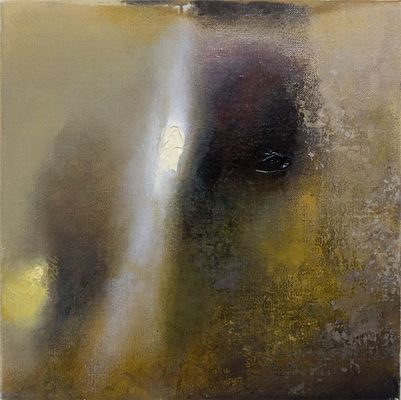
To return to Buckley’s fragment, the first two lines very much evoke how I paint nowadays. As you age, detail diminishes and patches of light become more luminous and float. I feel the most honest way of dealing with this is by smearing the oil paint on the canvas with the fingers and working close-up, blind. Only if the patches coalesce into an approaching image can the work gain a life.
-
Jonathan Walker was born in Melbourne, Australia and brought up on a dairy farm in Gippsland. In the 1970’s he studied painting at RMIT and won the Harold Wright Scholarship to the British Museum, London. During the 1980’s he exhibited at Pinacotheca Gallery, Richmond and had work shown at the NGV and Heidi City Art Gallery. Over the same period he designed the cover for the “Epigenesi” LP by Giancarlo Toniutti, Italy and conducted a mail exchange work with Achim Wollscheid, Germany. The work with artists through the post resulted in an article published in the bicentenary issue of Art and Australia 1988. He showed in artist run spaces such as WestSpace in the 90’s and 2000’s, and until 2012, taught painting at Victoria University, which is where we (Colleen Ahern and Lisa Radford) as organisers of the exhibition, among many others, had the privilege of being his student.
Walker’s knowledge was imparted to students through the careful selection of music, literature, and artists found in books that he himself had ordered for the library. Walker’s strategy was the generosity of sharing his vast knowledge with references specific to each student and their context.
Walker’s paintings share a similar focus and intimacy.
This exhibition presents a small selection of recent paintings alongside a publication that includes Walker’s writing. Observational and analytical, Walker’s work is a type of material notation — the time of day, colour and how it is blended, the both specific and fleeting location of a reflection on lino or the question of whether a chair leg should be included in a painting.
Please join us on Friday August 21 between 6-8pm to celebrate the opening of the exhibition.
Curated by Colleen Ahern and Lisa Radford.
B. Wurtz
Curated by Nic Tammens
March 26 - April 4, 2015
B.Wurtz works from a basement studio in his home on Manhattan’s Lower East Side.
This local fact is attested to by the plastic shopping bags and newsprint circulars that appear in his work. As formal objects, they don’t make loud claims about their origins but nonetheless transmit street addresses and places of business from the bottom of this long thin island. Like plenty of artists, Wurtz is affected by what is local and what is consumed. His work is underpinned by this ethic. It often speaks from a neighborhood or reads like the contents of a hamper:
“BLACK PLUMS $1.29 lb.”
“Food Bazaar”
“USDA Whole Pork Shoulder Picnic 99c lb.”
“RITE AID Pharmacy, with us it’s personal.”
“H. Brickman & Sons.”
“Sweet Yams 59c lb."
Most of the work in this exhibition was made while the artist was in residence at Dieu Donne, a workshop dedicated to paper craft in Midtown. Here Wurtz fabricated assemblages with paper and objects that are relatively lightweight, with the intention that they would be easily transportable to Australia. This consideration isn’t absolute in Wurtz’s work, but was prescriptive for making the current exhibition light and cheap. Packed in two boxes, these works were sent from a USPS post office on the Lower East Side and delivered to North Melbourne by Australia Post.
Wurtz appears courtesy of Metro Pictures, New York.
Thanks to Rob Halverson, Joshua Petherick, Sari de Mallory, Matt Hinkley, Helen Johnson, Fayen d'Evie, Ask Kilmartin, Lisa Radon, Ellena Savage, Yale Union, and "Elizabeth".
John Nixon
"Archive"
December 15 - January 20, 2014
The presentation of John Nixon's archive offered a rare showcase of this extensive collection of the artist's own publications, catalogues, posters, ephemera, editions and more, from the mid 1980s onwards, alongside a selection of his artworks.
Organized by John Nixon, Joshua Petherick and Matt Hinkley.
<a href=http://wfb.public-office.info/artist/john-nixon>All titles by John Nixon
"Habitat"
at Minerva, Sydney (organised by Joshua Petherick and Matt Hinkley)
November 15 - December 20, 2014
Lupo Borgonovo, Janet Burchill & Jennifer McCamley,
Lewis Fidock, HR Giger, Piero Gilardi, Veit Laurent Kurz,
Cinzia Ruggeri, Michael E. Smith, Lucie Stahl, Daniel Weil, Wols
Press Release:
“...It contained seven objects. The slender fluted bone, surely formed for flight, surely from the wing of some large bird. Three archaic circuitboards, faced with mazes of gold. A smooth white sphere of baked clay. An age-blackened fragment of lace. A fingerlength segment of what she assumed was bone from a human wrist, grayish white, inset smoothly with the silicon shaft of a small instrument that must once have ridden flush with the surface of the skin - but the thing’s face was seared and blackened.”
William Gibson, “Count Zero”, 1986
"Autumn Projects Archive"
Curated by Liza Vasiliou
March 6 - March 15, 2014
World Food Books, in conjunction with the Virgin Australia Melbourne Fashion Festival 2014, presented the Autumn Projects archive, consisting of a selection of early examples in Australian fashion with a particular interest in collecting designers and labels from the period beginning in the 1980’s, who significantly influenced the discourse of Australian Fashion.
Curated by Liza Vasiliou, the exhibition provided a unique opportunity to view pieces by designers Anthea Crawford, Barbara Vandenberg, Geoff Liddell and labels CR Australia, Covers, Jag along with early experimental collage pieces by Prue Acton and Sally Browne’s ‘Fragments’ collection, suspended throughout the functioning World Food Books shop in Melbourne.
H.B. Peace
presented by CENTRE FOR STYLE
November 14, 2013
"Hey Blinky, you say chic, I say same"
Anon 2013
H.B. Peace is a clothing collaboration between great friends Blake Barns and Hugh Egan Westland. Their pieces explore the divergences between 'character’ and ‘personality’ in garments....etc
Special Thanks to Joshua Petherick and Matt Hinkley of WFB and Gillian Mears
and a Very Special Thank you to Audrey Thomas Hayes for her shoe collaboration.
Janet Burchill & Jennifer McCamley
"Aesthetic Suicide"
May 10 - June 8, 2013
The first of our occasional exhibitions in the World Food Books office/shop space in Melbourne, "Aesthetic Suicide" presented a body of new and older works together by artists Janet Burchill & Jennifer McCamley, including videos, prints, a wall work, and publications.
During shop open hours videos played every hour, on the hour.
1990, English
Softcover, 220 pages, 20 x 14 cm
1st Edition, Out of print title / used / very good
Published by
City Lights Books / San Francisco
$40.00 - In stock -
First 1990 edition.
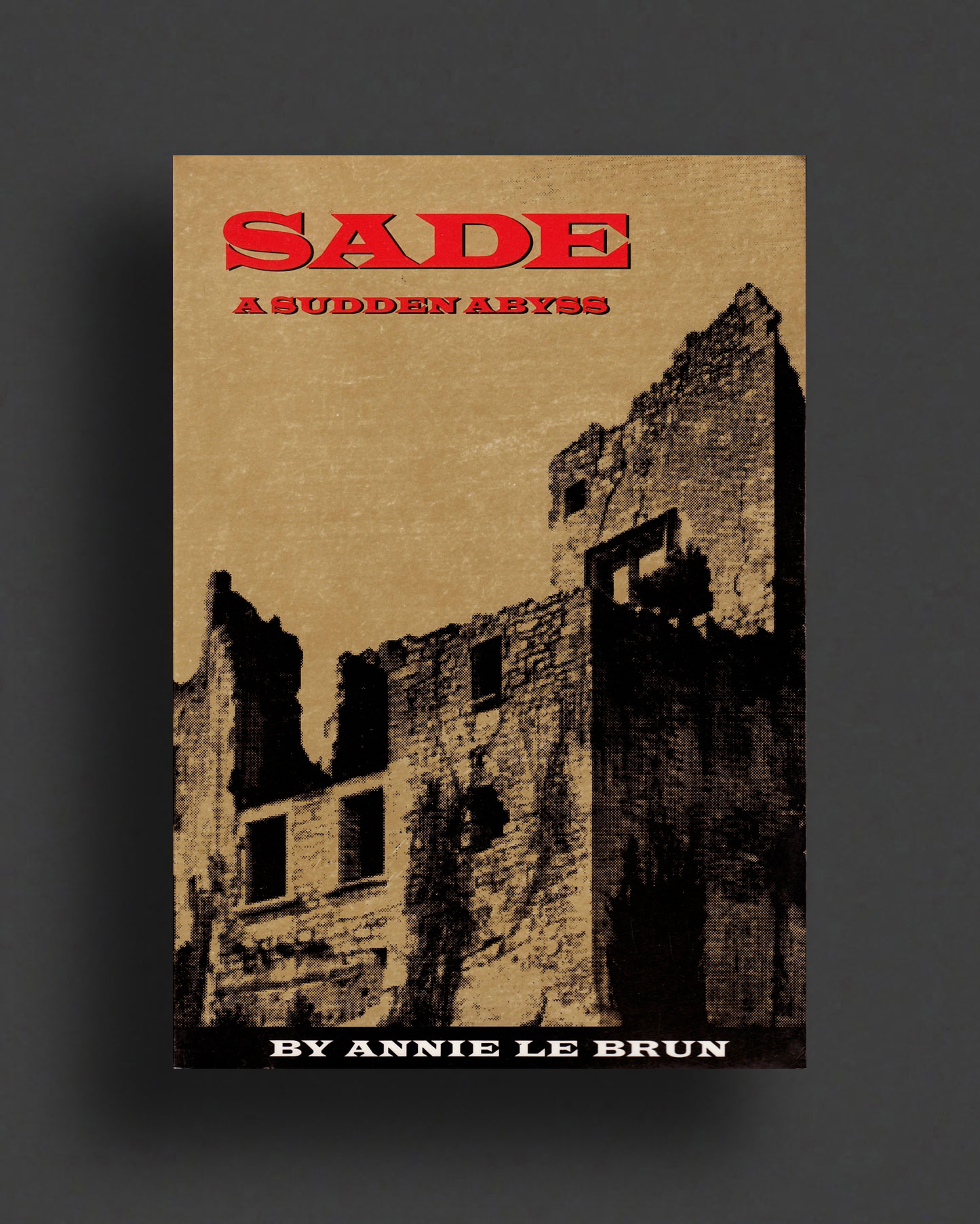
The literary adventure of D.A.F. (1740-1814) is unique and paradoxical. He was widely read in the nineteenth century, but his books disappeared almost completely from circulation in the century. Meanwhile the exegesis of Sade poured from the presses of the Western world in a flood of words in which the writer, the novelist, and the exceptional poet disappeared.
In France today, J. J. Pauvert, who considers Sade "the greatest French writer," is publishing a new edition of the complete works with a new introduction by Annie Le Brun. Sade: A Sudden Abyss is the translation of this introduction, which shows Sade as the inventor of an entirely new language through which he fathoms human nature, desire, and relationships of power.
In this fresh and authoritative survey of Sade's work as a whole, Le Brun frees it from such critics as Bataille, Blanchot, Klossowski, and Barthes (who see Sade's language as a metaphor for history, society, or writing itself). She asks, Where is Sade himself in these texts? What exactly does Sade tell us? What is obscured when Sade's writing is placed in a "universe of discourse" rather than understood as a manifestation of a life spent in eleven prisons over twenty-seven years? Like a powerful laser beam, her reflections cut through two centuries of intellectual hide-and-seek and let Sade for the first time be seen and read in his own light.
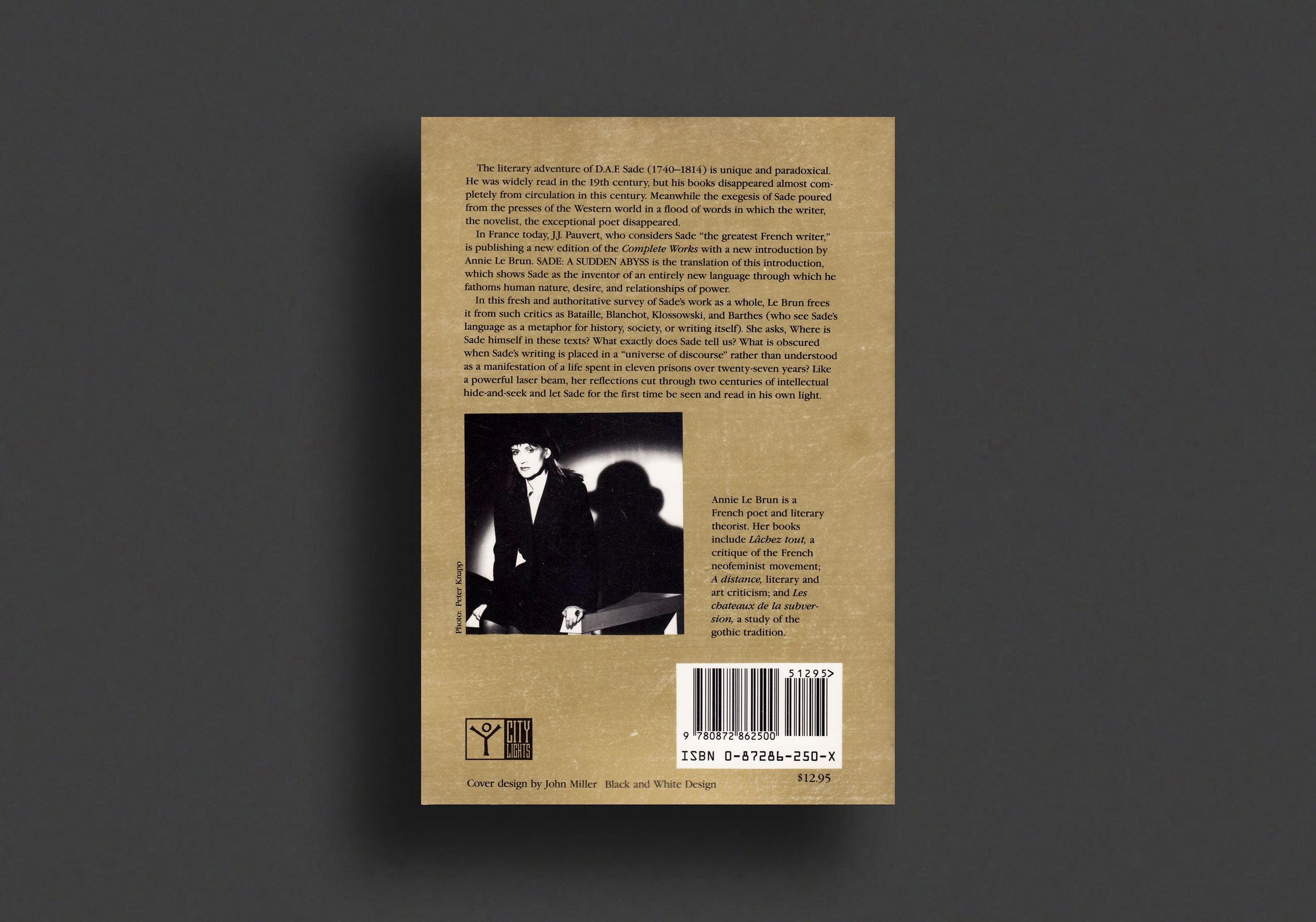
Annie Le Brun is a French poet and literary theorist who participated in the final years of the Surrealist movement. Her books include Lachez tout, a critique of the French neofeminist movement; A distance; and Les chateaux de la subversion, a study of the Gothic tradition.
VG copy.
1980, German
Softcover, 84 page, 26 x 17 cm
Out of print title / used / very good
Published by
Rowohlt / Hamburg
$45.00 - Out of stock
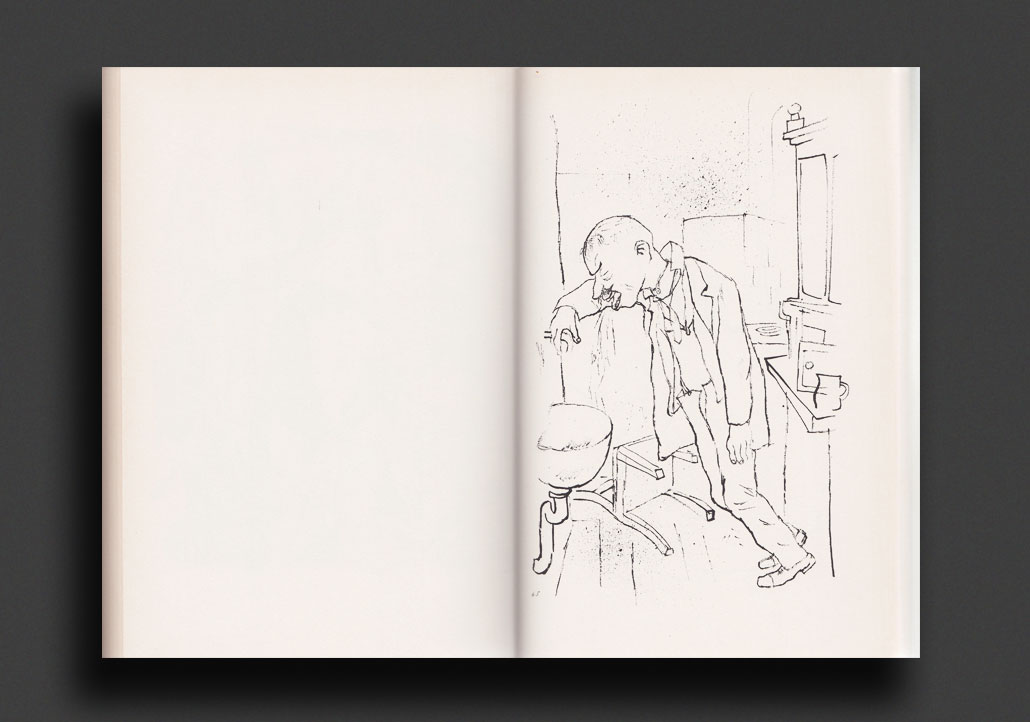
Perhaps the most famous of Grosz's collections is Ecce Homo (Berlin: Malik Verlag, 1923). The title echoes Pilate's presentation of Jesus as King of the Jews, beaten, with a crown of thorns, bloody and ready for crucifixion, and clearly not the Messiah he had been proclaimed to be six days earlier when he was greeted by rapturous crowds. Just so, the image of the heroic German, brave in war and moral in peacetime, took such a beating in Grosz's drawings, watercolors, and paintings, that he was prosecuted for "offences against public morality and for besmirching the values of the German people" (Kranzfelder, 59). Offering an unsparing vision of human nakedness, lust, greed and cruelty, Ecce Homo was found to be a slanderous attack upon the army, which won damages and the removal of 5 color plates and 17 black and white plates from the portfolio in a law suit. Grosz was also fined 6000 marks. Since Grosz had been attacking the Nazis since the early 1920s and since he had singled out Hitler in particular, it is not surprising that after the Nazi's took power in Germany, his works were singled out for ridicule and destruction. 285 of his works were removed from German collections and destroyed and the 1937 Munich Exhibition of Nazi-labelled "Degenerate Art" included five of his paintings, two watercolours, and thirteen drawings. After relocating to the U.S., Grosz wrote to J. B. Neuman concerning his own place in the history of art: "My drawings will naturally stay true–they are fireproof. They will later be seen as Goya's work [is]. They are not documents of the class struggle, but eternally living documents of human stupidity and brutality"
1980 reprint of the collection reproduced in black and white and colour, published by Rowohlt in Hamburg, 1980.
Very good copy.
2009, Japanese
Softcover, 190 pages, 21 x 15 cm
1st Edition, Out of print title / used / very good
Published by
Atelier Third / Tokyo
$60.00 - Out of stock
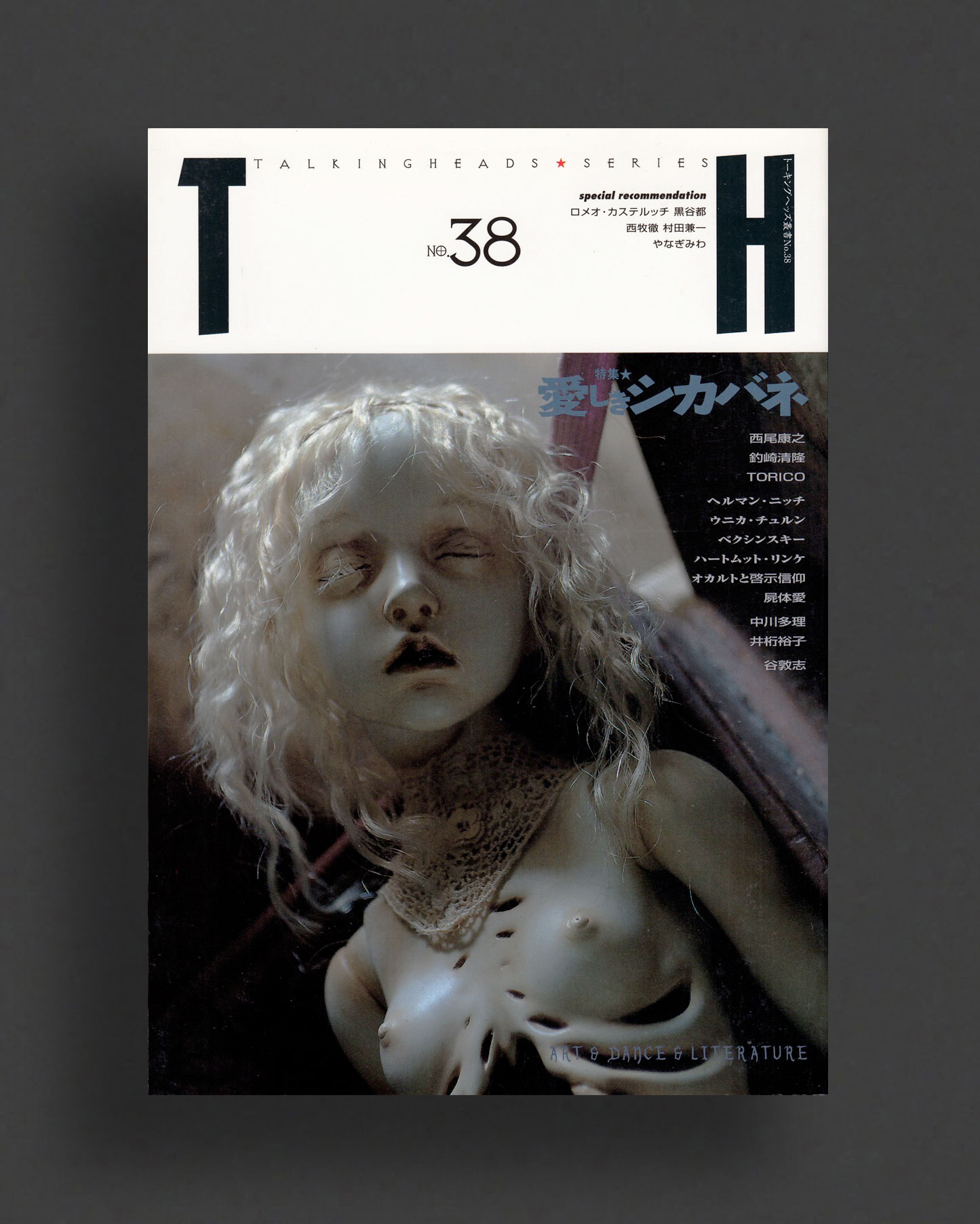
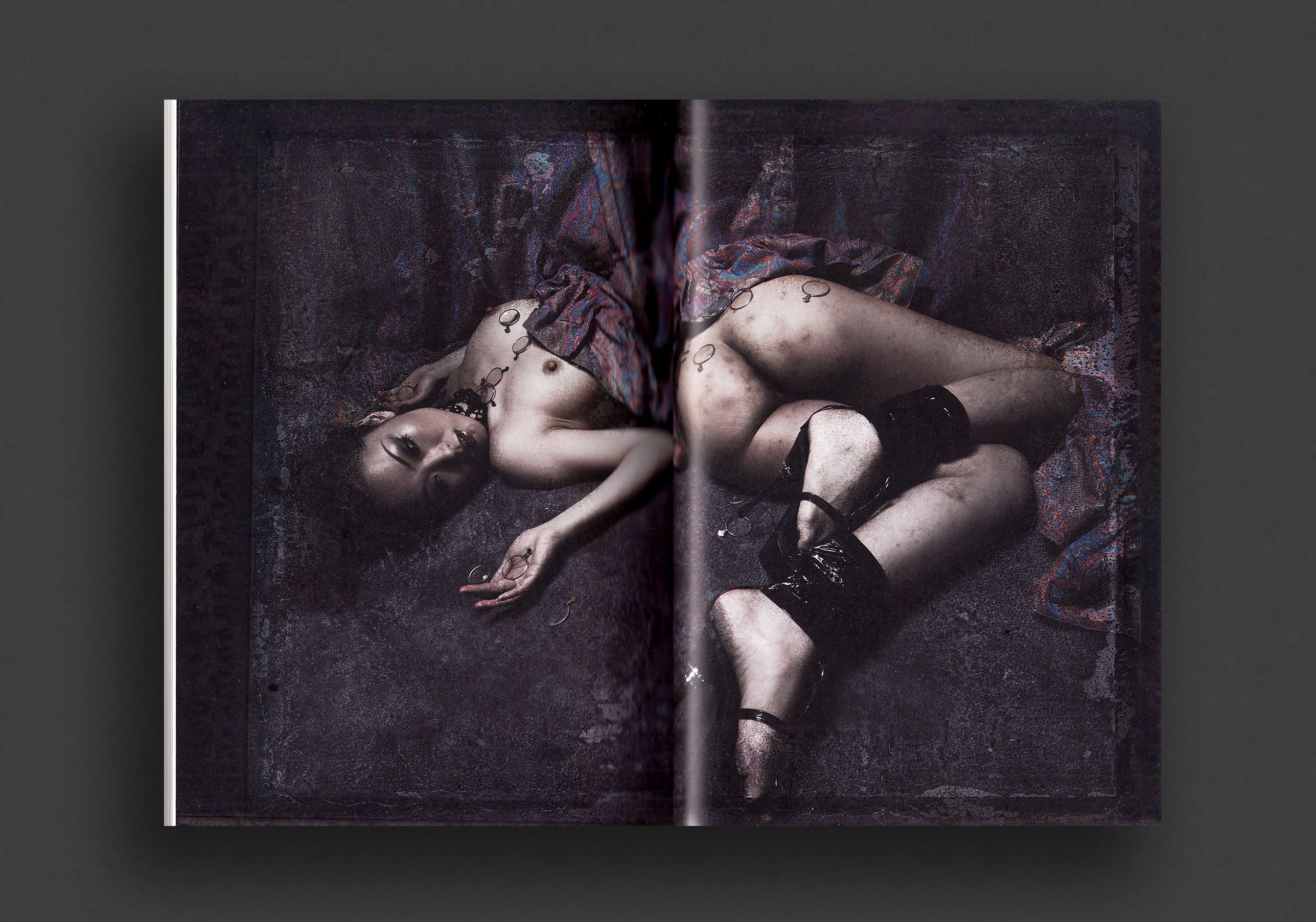
Special 2009 issue of Talking Heads magazine with the feature "My Love is Corpse", entirely devoted to death in the arts and culture. Profusely illustrated throughout in colour and b/w featuring Japanese corpse photographer Kiyotaka Tsurisaki, doll portraits by Tari Nakagawa (with model Yuko Igeta), polish painter Zdzisław Beksiński, Hermann Nitsch, the erotic macabre photography of Atsushi Tani, Eros and Thanatos and the work of artist Yasuyuki Nishio, Unica Zürn and Hans Bellmer, puppeteer Kurotani Miyako, illustrator Toru Nishimaki, painter Hartmut Lincke, illustrator Rie Yamashina, Occult and Revelation, medical museums, corpse love in film and publishing, and much more.
Talking Heads is the glossy arts magazine of Japanese publisher Atelier Third, specialists in the cutting-edge of subcultural Japanese artists working across doll art, ero guro, gothic-lolita and the historical erotic SM works of the abnormal museum, publishing the work of Seiu Ito, Yoshifumi Hayashi, Shintaro Kago, Ran Akiyoshi, Kanaki Tama, Saori Furukawa, Toru Nishimaki, and many more.
VG copy.
1996, Japanese
Softcover (w. dust jacket and obi-strip), 256 pages, 21 x 14.8 cm
1st Edition, Out of print title / used / very good
Published by
Core Magazine / Tokyo
$120.00 - In stock -
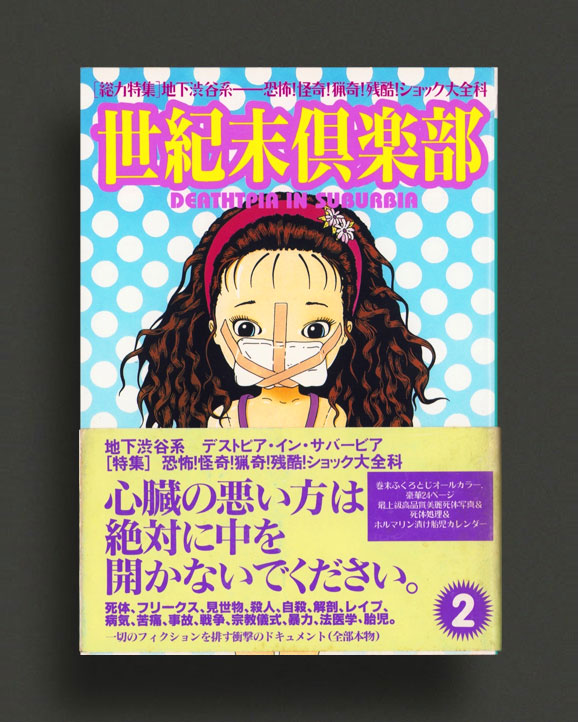
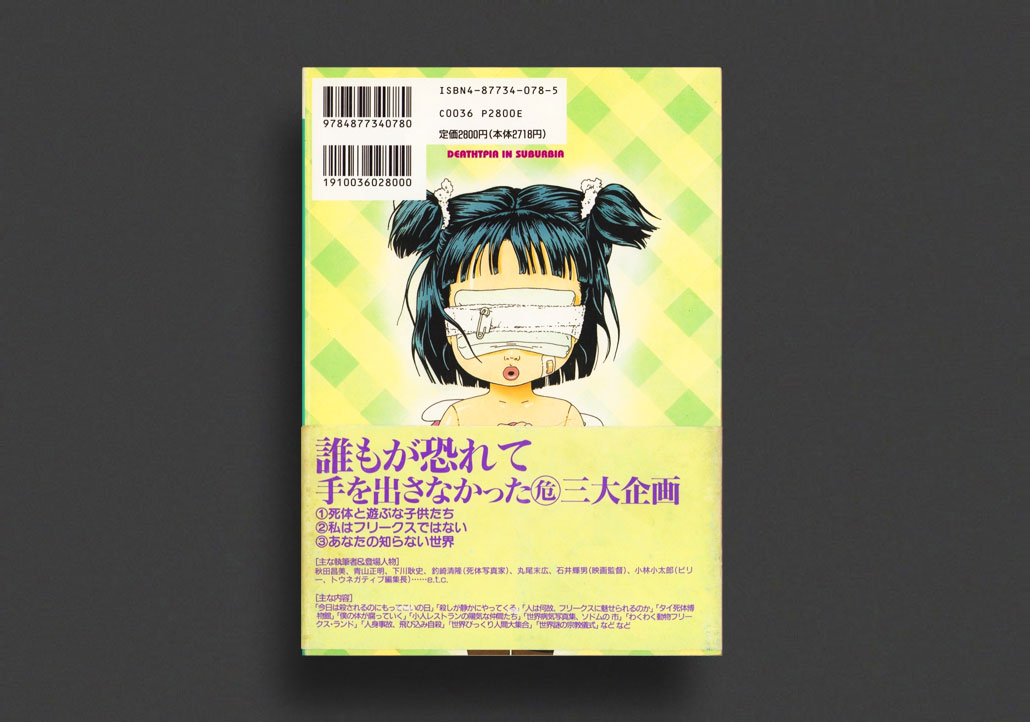
Don't judge a book by it's cover — you've been warned! Straight out of the young nihilist 90s, the second volume of the very short-lived and absolutely demented Seikimatsu Club (End of the Century Club), published in Tokyo between 1996—2000 for a total of only five volumes. This second volume, "Deathtpia in Suburbia", has the feature theme of Horror! Bizarre! Bizarre! Cruelty! and is packed to the absolute brim with "corpses, freaks, spectacles, murders, suicides, autopsies, rapes, sickness, pain, accident, war, religious rituals, violence, forensics, foetuses. A shocking document that eliminates all fiction (all genuine)!"
With contributors to this issue including Masami Akita (Merzbow), Masaaki Aoyama (author), Kiyotaka Tsurisaki (corpse photographer), Suehiro Maruo (ero guro manga artist), Teruo Ishii (ero guro film director), Kotaro Kobayashi (Too Negative editor-in-chief), Trevor Brown (artist), you should know what you are getting yourself into.
Following the trajection of fellow Japanese abnormal subculture magazines such as Kotaro Kobayashi's notorious Too Negative, Ultra Negative, ORG, etc., and in the spirit of a new wave of 90's nihilist publishing around the world (Answer Me!, Killing Times, Fuck!, AMOK, Feral House, etc.) End of the Century Club stares directly into the dark recesses of humanity and presents its viewers with the uncompromising extremes of our global culture. The real stuff. Where Too Negative presents itself as a glossy colour photo/art magazine, End of the Century Club is almost like a Whole Earth Catalog to the authentic macabre. With articles, interviews, reports, catalogues and hundreds of images spanning all manner of medical/autopsy/corpse photography, death journalism, serial killers, formalihide babies, war/shock accident/crime scenes, hara-kiri, murder, rape, slaughterhouse, forensic books, international underground magazines, Photobook of World Diseases, City of Sodom, corpses on the internet, Underground Baby Contest, Atlas of Dermatology, complete guide to Freaks movies, the Garbage Pail Kids, religious ceremonies, animal deformities, Interview with "The King of Cult" ero guro film director Teruo Ishii, bizarro sex, acrotomophila, artist Joel Peter Witkin's world, interview with Masaaki Aoyama, interview with corpse photographer Kotaro Kobayashi (Death, Hardcore Works, Too Negative, Billy, etc.), photography of George Dureau, interview with fetish film director and producer Kaoru Adachi, interview with experimental film director Shozin Fukui (Metal Days, Gerorisuto, Caterpillar, 964 Pinocchio, Rubber's Lover...), article on "Serial Killers & Record Junkies" by Toshihiko Hironaka (of Boris, Balzac, Hellbent fame), and all sorts of other curios from the mondo, bizarro realm.
Includes "gorgeous" 24-page high-quality corpse photo booklet feature and cover art by Trevor Brown.
Not for the fain-hearted. You'll feel like a shower after.
Very Good copy with dust jacket and obi.
1997, Japanese
Softcover (w. dust jacket and obi-strip), 256 pages, 21 x 14.8 cm
1st Edition, Out of print title / used / very good
Published by
Core Magazine / Tokyo
$120.00 - In stock -
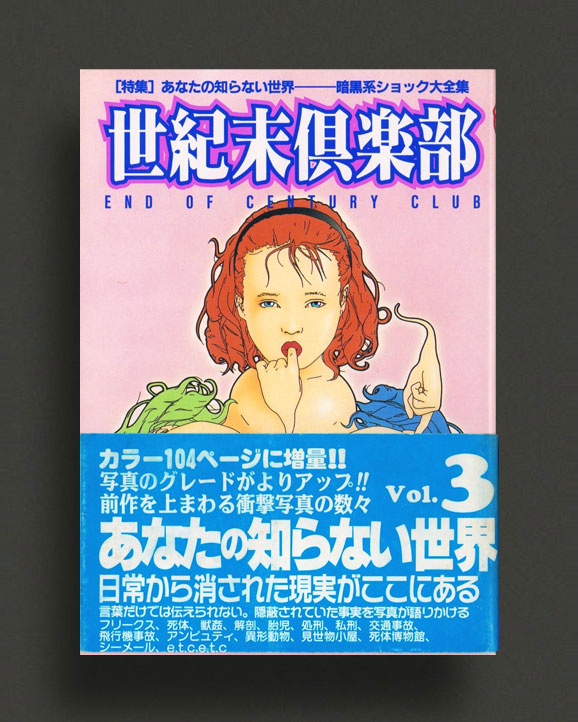
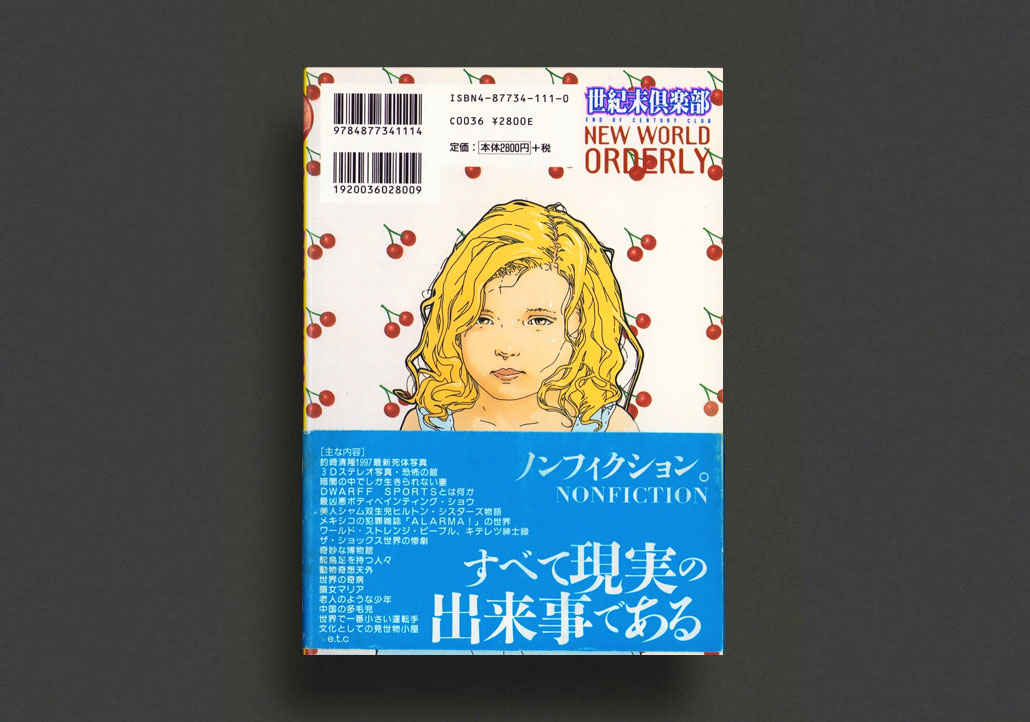
Don't judge a book by it's cover — you've been warned! Straight out of the young nihilist 90s, the third volume of the very short-lived and absolutely demented Seikimatsu Club (End of the Century Club), published in Tokyo between 1996—2000 for a total of only five volumes. This third volume, "The World You Don't Know", has the feature theme of exposing "a reality erased from everyday life", which sums it up... packed to the absolute brim with "freaks, corpses, bestiality, autopsies, fetal executions, lynchings, traffic accidents, plane crashes, amputee, heteromorphic animals, freak shows, corpse museums, shemales, etc. A shocking document that eliminates all fiction (all genuine)!"
With contributors to this issue including Masami Akita (Merzbow), Masaaki Aoyama (author), Kiyotaka Tsurisaki (corpse photographer), Hideshi Hino (horror manga artist / Guinea Pig director), Kotaro Kobayashi (Too Negative editor-in-chief), Trevor Brown (artist), you should know what you are getting yourself into.
Following the trajection of fellow Japanese abnormal subculture magazines such as Kotaro Kobayashi's notorious Too Negative, Ultra Negative, ORG, etc., and in the spirit of a new wave of 90's nihilist publishing around the world (Answer Me!, Killing Times, Fuck!, AMOK, Feral House, etc.) End of the Century Club stares directly into the dark recesses of humanity and presents its viewers with the uncompromising extremes of our global culture. The real stuff. Where Too Negative presents itself as a glossy colour photo/art magazine, End of the Century Club is almost like a Whole Earth Catalog to the authentic macabre. With articles, interviews, reports, catalogues and hundreds of images spanning all manner of medical/autopsy/corpse photography, death journalism, serial killers, formalihide babies, war/shock accident/crime scenes, human intersection, murder art show, lobster boy, 3D stereo photography hall of horrors, donkey fucker (please no!), strange diseases of the world, amputee lovers, siamese twins, deformed children, amazing Photo Press historical stories, animal deformities, huge Hideshi Hino art gallery, book guide and interview, ALARMA! photo gallery, Trevor Brown art gallery, corpse photography, columns and features on and by Kiyotaka Tsurisaki (Death, Hardcore Works, Too Negative, Ultra Negative, Billy, etc.), Father Yod (YaHoWha 13) record guide, Medical Atlas by Naruhiko Tanaka, lots of noise record reviews by Masami Akita (Merzbow) inc. Smell & Quim, M.B., Lustmord, Ramleh, Genocide Organ, Richard Ramirez, Agoraphobic Nosebleed, Whitehouse, Extreme Hair Stench, Genital Masticator, Traci Lords Loves Noise, Morder, etc., interview with artist Wes Benscoter (heavy metal illustrator for Slayer, Mortician, Kreator, Deceased, Cattle Decapitation, etc) on the occasion of his NG Gallery body painting show, complete Freak book library, and all sorts of other curios from the mondo, bizarro realm. Lots of full colour gore.
Not for the fain-hearted. You'll feel like a shower after.
Very Good copy with dust jacket and obi.
1973, English
Softcover, 184 pages, 20 x 13 cm
1st Edition, Out of print title / used / very good
Published by
Calder and Boyars / London
$50.00 - Out of stock
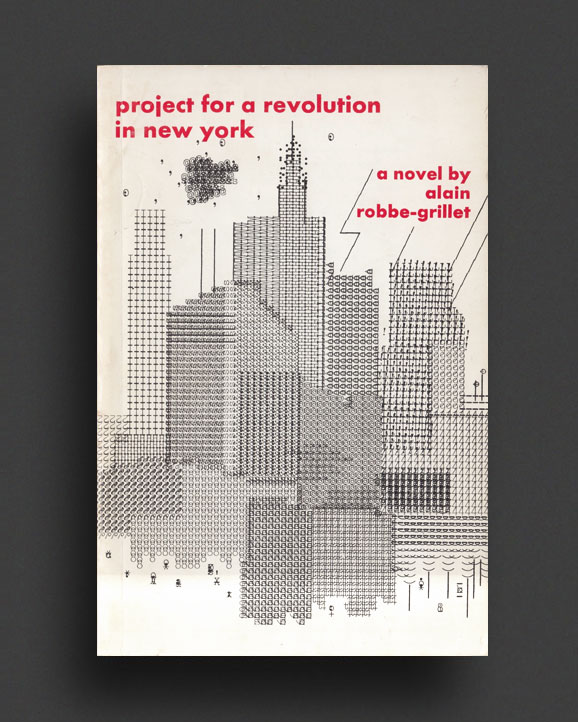
First Calder & Boyars English edition, published 1973, with cover artwork by Donato Cinicolo.
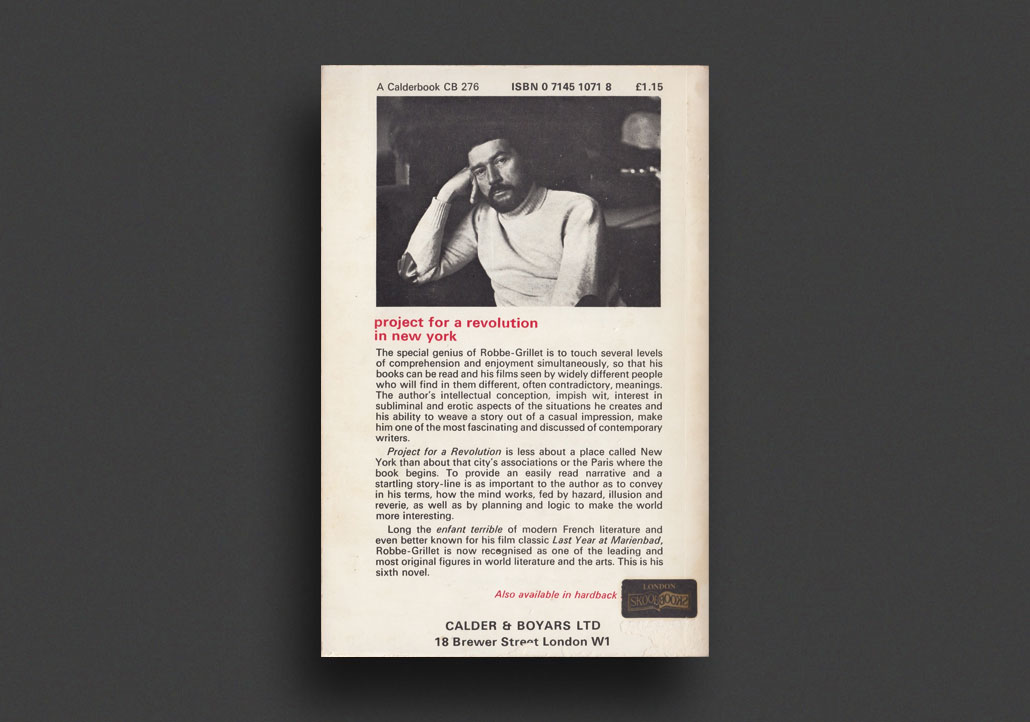
Part prophecy and part erotic fantasy, this classic tale of otherworldly depravity features New York itself—or a foreigner's nightmare of New York—as its true protagonist. Set in the towers and tunnels of the quintessential American city, Alain Robbe-Grillet's novel turns this urban space into a maze where politics bleeds into perversion, revolution into sadism, activist into criminal, vice into art—and back again. Following the logic of a movie half-glimpsed through a haze of drugs and alcohol, Project for a Revolution in New York is a Sadean reverie that bears an alarming resemblance to the New York, and the United States, that have actually come into being.
Alain Robbe-Grillet (1922—2008) was a French writer and filmmaker. He was one of the figures most associated with the Nouveau Roman trend of the 1960s, along with Nathalie Sarraute, Michel Butor and Claude Simon.
Very Good copy.
19745, English
Softcover, 192 pages, 18 x 11 cm
1st Edition, Out of print title / used / very good
Published by
Panther / London
$80.00 - Out of stock
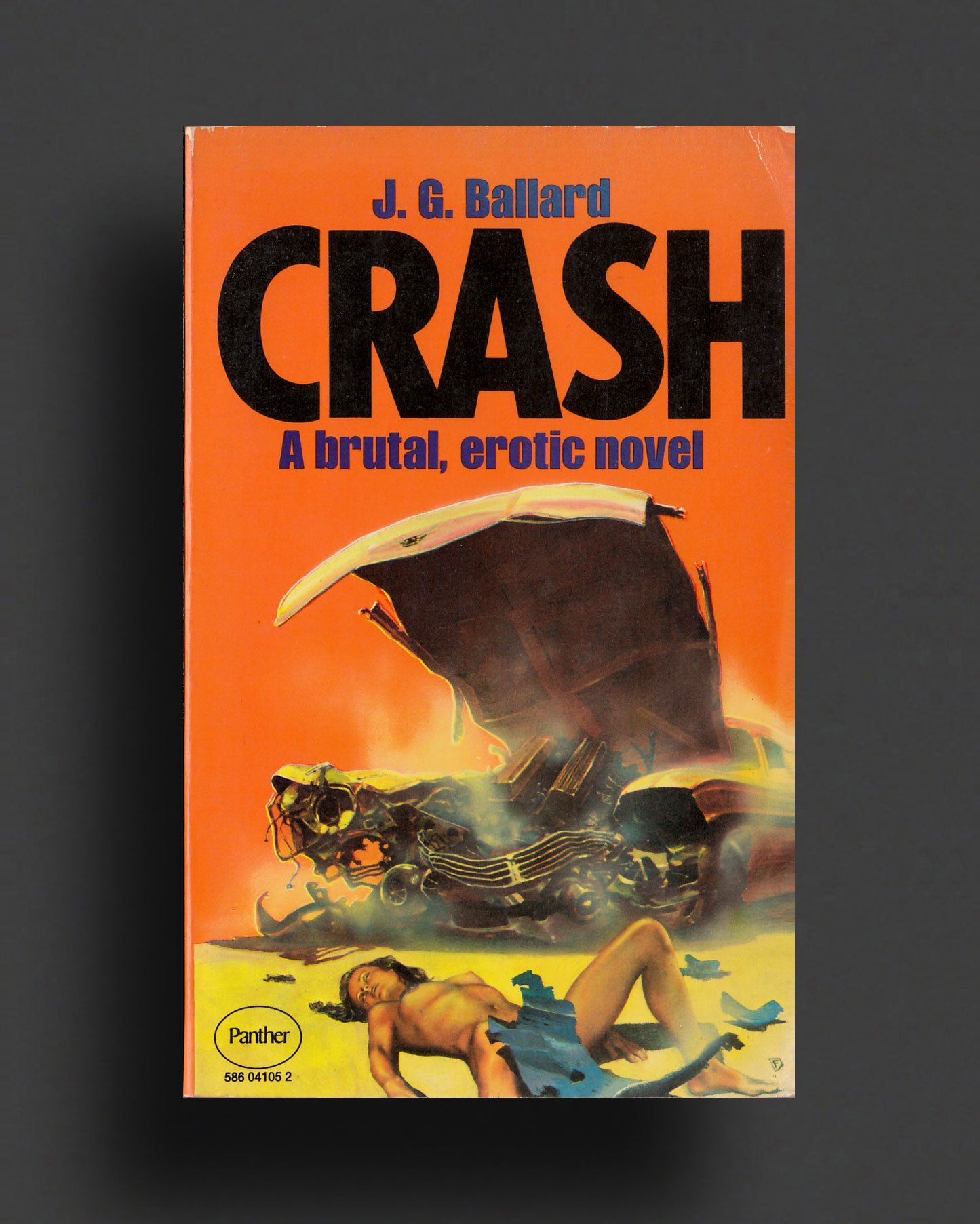
Rare first 1975 Panther edition with the seldom seen iconic cover illustrated by the legendary Chris Foss!
Ballard's 1973 book Crash is a story about symphorophilia; specifically car-crash sexual fetishism: its protagonists become sexually aroused by staging and participating in real car-crashes. It was a highly controversial novel: one publisher's reader returned the verdict "This author is beyond psychiatric help. Do Not Publish!". In 1996, the novel was made into a film of the same name by David Cronenberg.
Original jacket blurb :
"This brilliant, startlingly original novel opens with the narrator recovering in the hospital after a car crash in which he has killed the husband of a young woman doctor. In his pain-filled dreams he finds himself dominated by strange sexual fantasies, and he determines to find the real meaning of this horrific experience. When he leaves the hospital, he revisits the scene of the crash, and meets the woman doctor. During their affair they begin an exploration of the motorcar in all its forms, conducting a variety of sexual experiments on the motorways spreading around London. They meet a violent and aggressive figure called Vaughan, a "hoodlum scientist" who seems determined to die in a car crash with a famous film actress.
Terrified of Vaughan, and yet under his spell, the narrator joins his entourage of racing drivers, drug addicts, and airport prostitutes. They take part in stock-car races, watch test vehicles being crashed at the Road Research Laboratory, and all the time are being carried closer to the sinister climax of the novel, a disquieting vision of the future in which sex and technology form a nightmare marriage.
Violent and frightening, but always true to its subject, Crash is a visionary portrait of the brutal, erotic, and overlit future that beckons ever more powerfully from the margins of the technological landscape. Mr. Ballard has written a compulsively readable tour de force, as hypnotic and baleful in its own way as was A Clockwork Orange is."
James Graham Ballard (15 November 1930 – 19 April 2009) was an English novelist, short story writer, and essayist who first became associated with the New Wave of science fiction for his post-apocalyptic novels such as The Wind from Nowhere (1961) and The Drowned World (1962). In the late 1960s, he produced a variety of experimental short stories (or "condensed novels"), such as those collected in the controversial The Atrocity Exhibition (1970). In the mid 1970s, Ballard published several novels, among them the highly controversial Crash (1973), a story about symphorophilia and car crash fetishism, and High-Rise (1975), a depiction of a luxury apartment building's descent into violent chaos.
Very Good copy, light wear, tanning, some Japanese marginalia to first to chapters.
1977, English
Softcover, 174 pages, 18 x 11 cm
1st Edition, Out of print title / used / very good
Published by
Panther / London
$70.00 - Out of stock
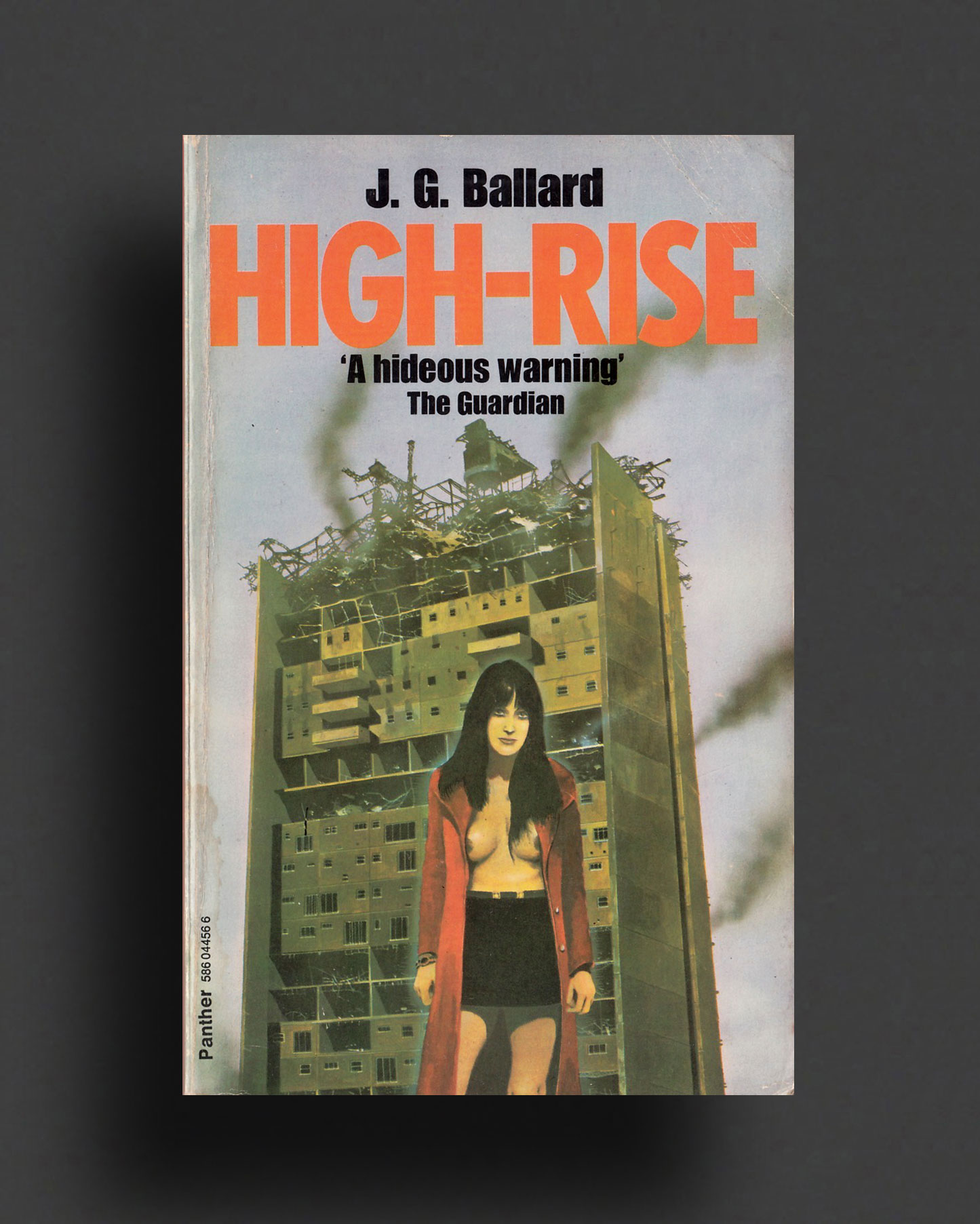
Rare first 1977 Panther edition.
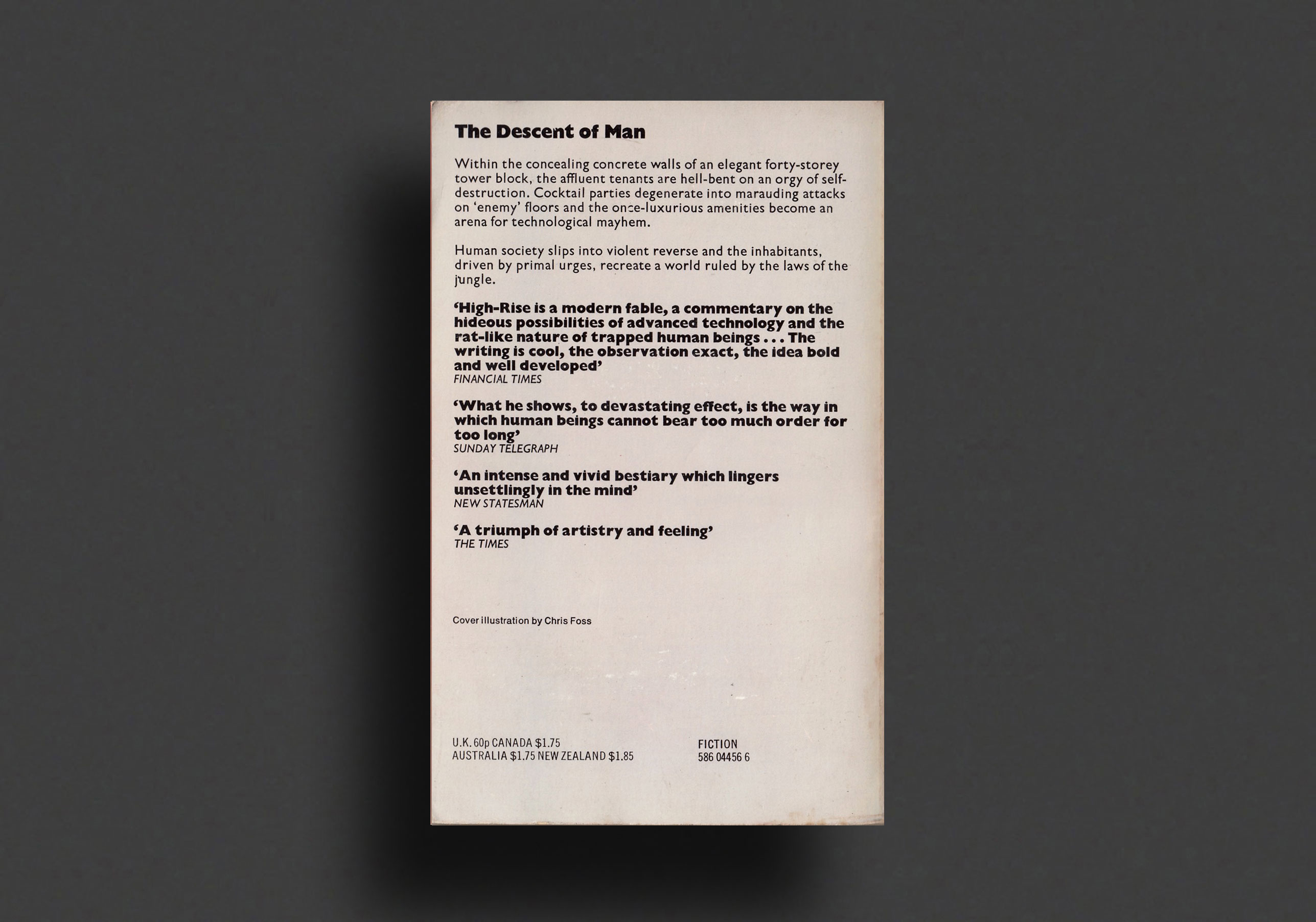
When a class war erupts inside a luxurious apartment block, modern elevators become violent battlegrounds and cocktail parties degenerate into marauding attacks on "enemy" floors. In this visionary tale, human society slips into violent reverse as once-peaceful residents, driven by primal urges, re-create a world ruled by the laws of the jungle.
James Graham Ballard (15 November 1930 – 19 April 2009) was an English novelist, short story writer, and essayist who first became associated with the New Wave of science fiction for his post-apocalyptic novels such as The Wind from Nowhere (1961) and The Drowned World (1962). In the late 1960s, he produced a variety of experimental short stories (or "condensed novels"), such as those collected in the controversial The Atrocity Exhibition (1970). In the mid 1970s, Ballard published several novels, among them the highly controversial Crash (1973), a story about symphorophilia and car crash fetishism, and High-Rise (1975), a depiction of a luxury apartment building's descent into violent chaos.
Very Good copy, light wear/tanning.
1972, English
Softcover, 140 pages, 18 x 11 cm
1st Edition, Out of print title / used / very good
Published by
Panther / London
$70.00 - Out of stock
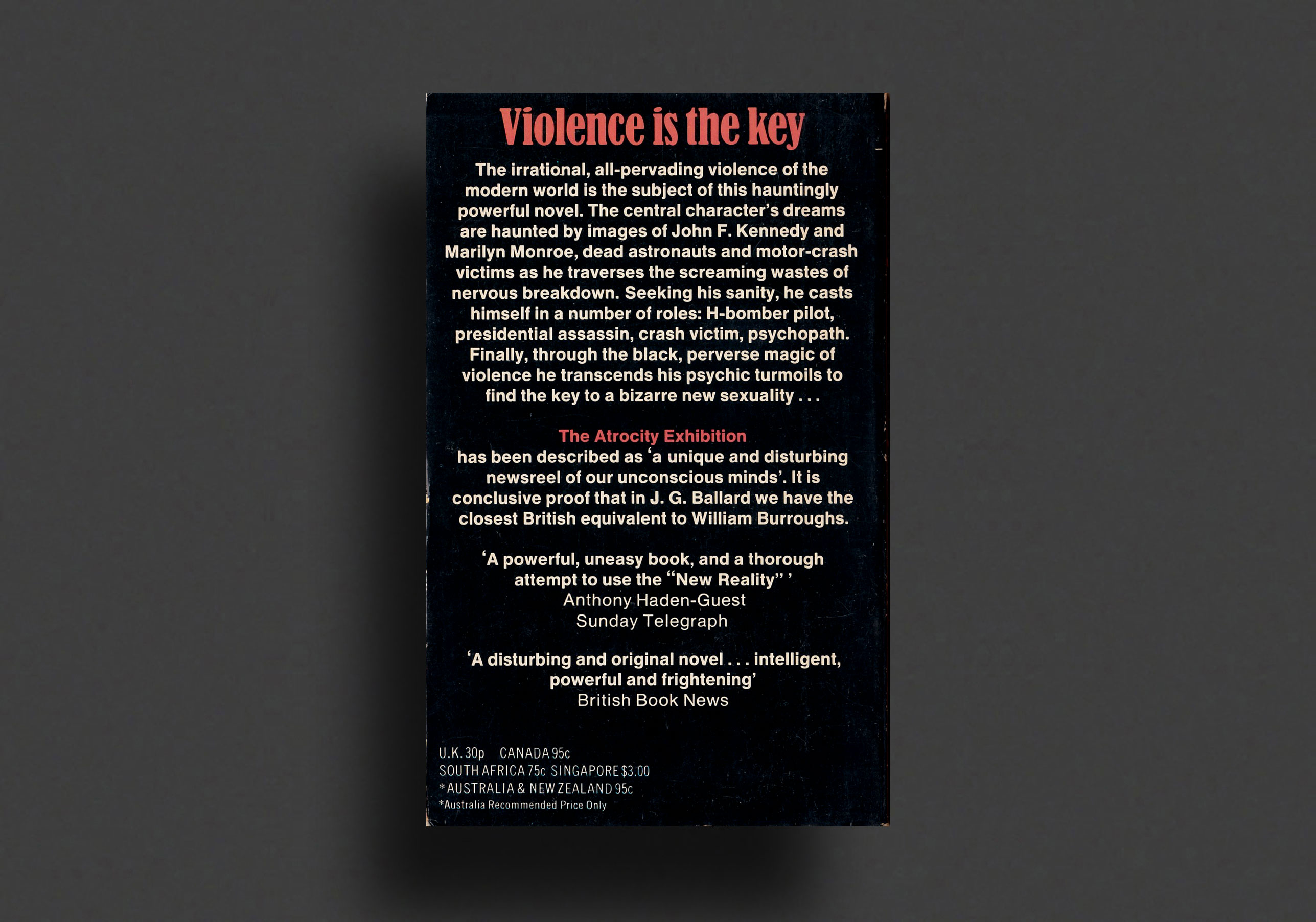
"Violence is the key"
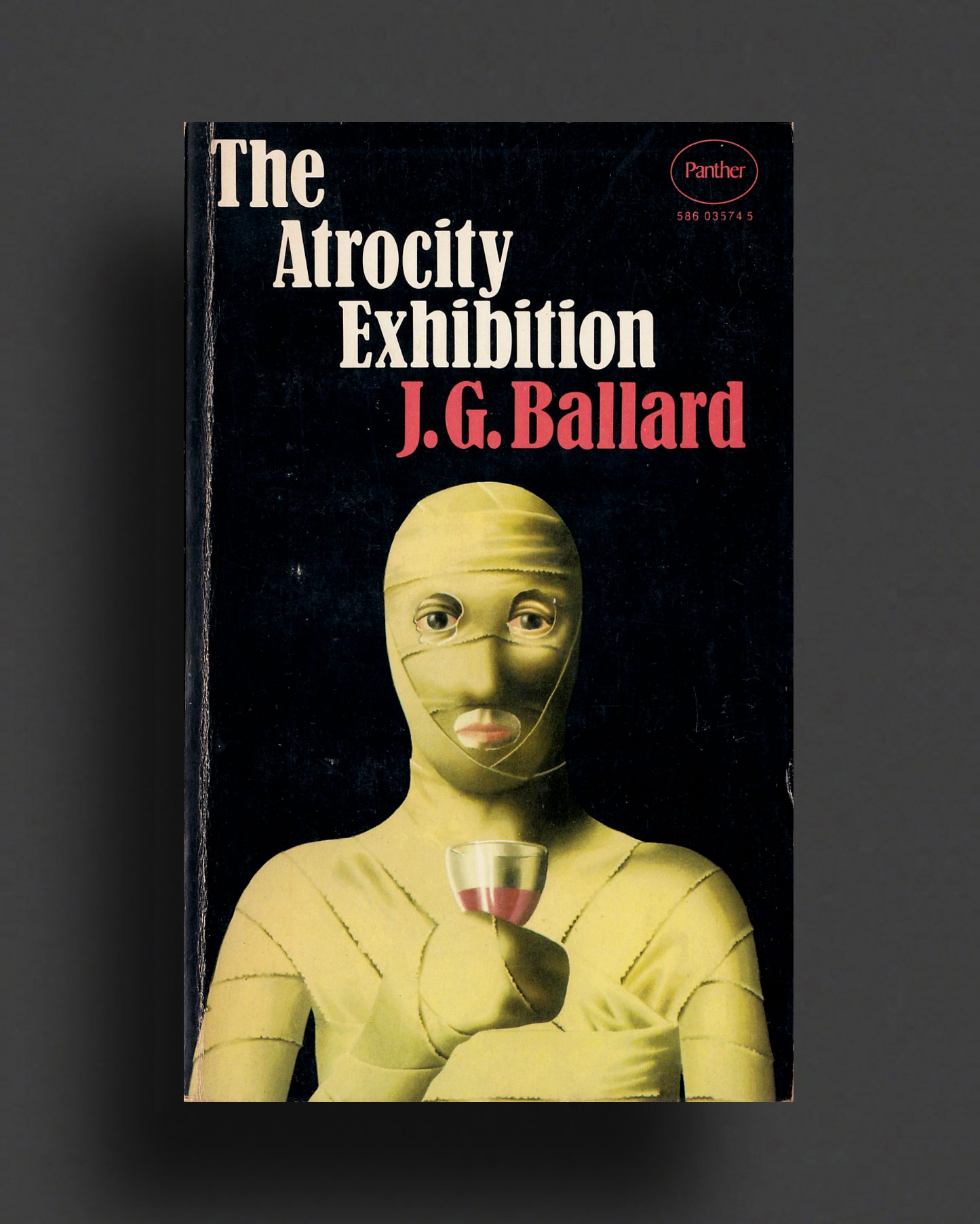
Scarce first 1972 Panther edition of Ballard's groundbreaking, prophetic masterpiece, The Atrocity Exhibition.
The 1970 First American Edition was banned by court order, forcing Doubleday to shred the entire print run. An experimental (rather than a conventional) novel, it has lost none of its awesome power to shock. Atrocity Exhibition is widely regarded as Ballard’s finest, most complex work…
The irrational, all-pervading violence of the modern world is the subject of this extraordinary tour de force. The central character’s dreams are haunted by images of John F. Kennedy and Marilyn Monroe, dead astronauts and car-crash victims as he traverses the screaming wastes of nervous breakdown. Seeking his sanity, he casts himself in a number of roles: H-bomber pilot, presidential assassin, crash victim, psychopath. Finally, through the black, perverse magic of violence he transcends his psychic turmoils to find the key to a bizarre new sexuality.
Very Good copy, light wear, tanning to pages.
1971, English
Softcover, 192 pages, 17.5 x 10.5 cm
1st Edition, Out of print title / used / good
Published by
Berkley Medallion / Berkley
$45.00 - Out of stock
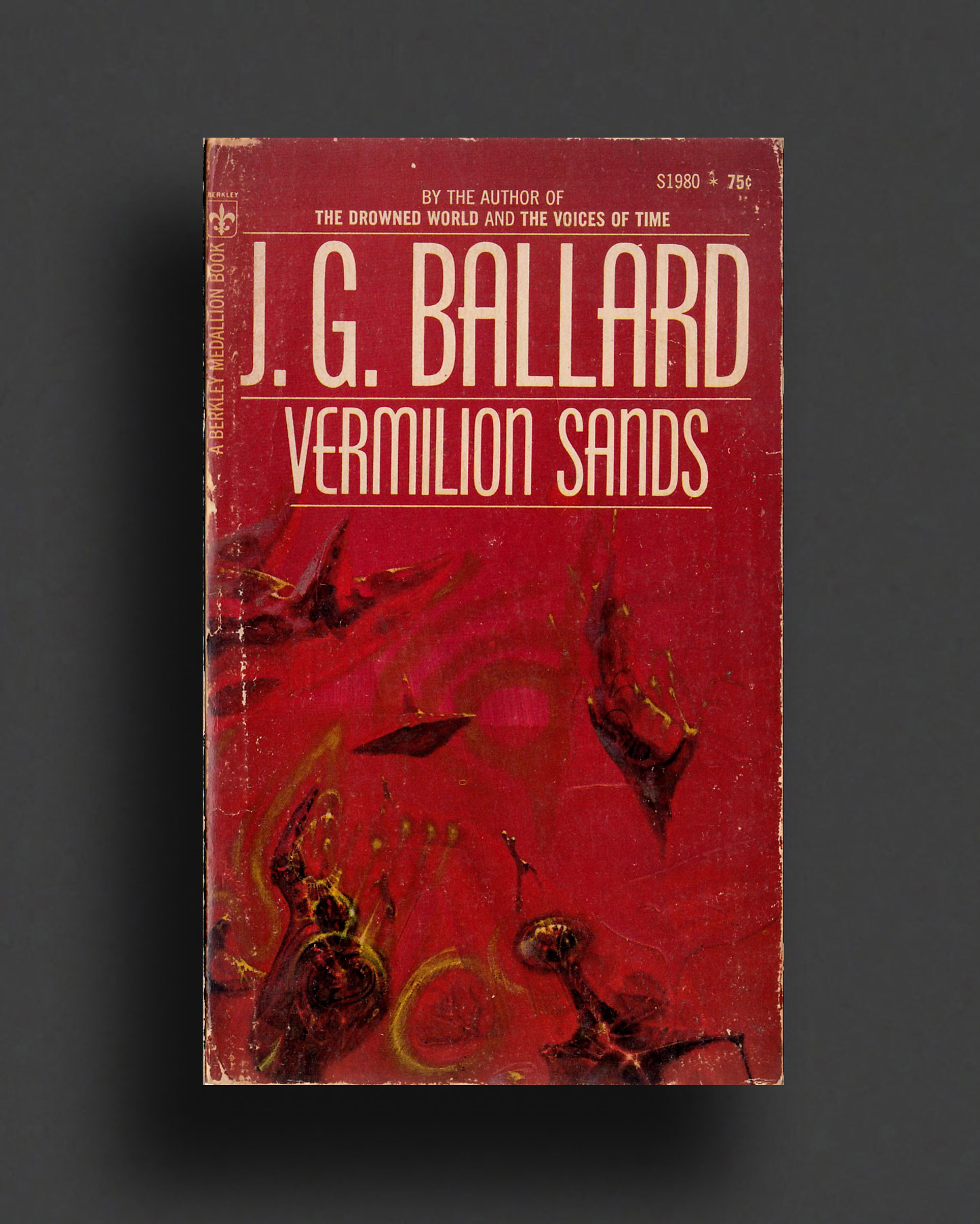
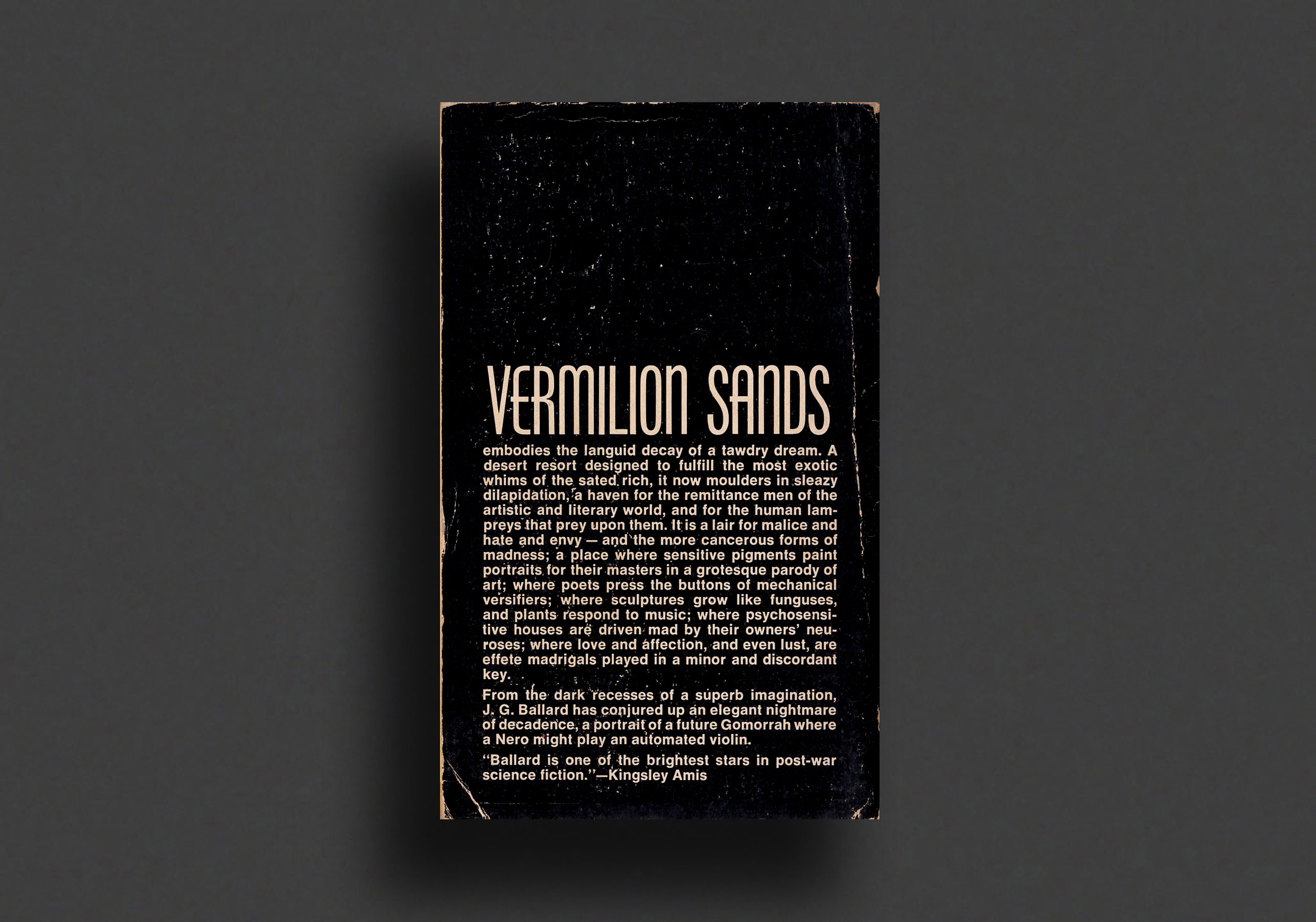
Very first 1971 edition of Vermilion Sands by J.G. Ballard, published by Berkley in this paperback edition 2 years before the Jonathan Cape hardcover. Vermilion Sands is a collection of surreal science fiction short stories by Ballard, one of his finest, all set in an imaginary vacation resort called Vermilion Sands which suggests, among other places, a latter-day Palm Springs. Vermillion Sands is a fully automated desert resort designed to fulfill the most exotic whims of the idle rich. But now it languishes in uneasy decay, populated only by forgotten movie stars, solitary impresarios, parasites, and artistic and literary failures, a place where love and lust pall before the stronger pull of evil.
Vermilion Sands embodies the languid decay of a tawdry dream. A desert resort designed to fulfill the most exotic whims of the sated rich, it now moulders in sleazy dilapidation, a haven for the remittance men of the artistic and literary world, and for the human lampreys that prey upon them. It is a lair for malice and hate and envy — and the more cancerous forms of madness; a place where sensitive pigments paint portraits for their masters in a grotesque parody of art; where poets press the buttons of mechanical versifiers; where sculptures grow like funguses, and plants respond to music; where psychosensitive houses are driven mad by their owners' neuroses; where love and affection, and even lust, are effete madrigals played in a minor and discordant key.
From the dark recesses of a superb imagination, J. G. Ballard has conjured up an elegant nightmare of decadence, a portrait of a future Gomorrah where a Nero might play an automated violin.
"Ballard is one of the brightest stars in post-war science fiction."—Kingsley Amis
Average—Good copy with wear, tanning to pages. Fragile binding. Japan's NW-SF bookshop stamp to title page.
2001, English
Softcover, 158 pages, 21.5 x 13.5 cm
Out of print title / used / very good
Published by
Marion Boyars / London
$25.00 - Out of stock
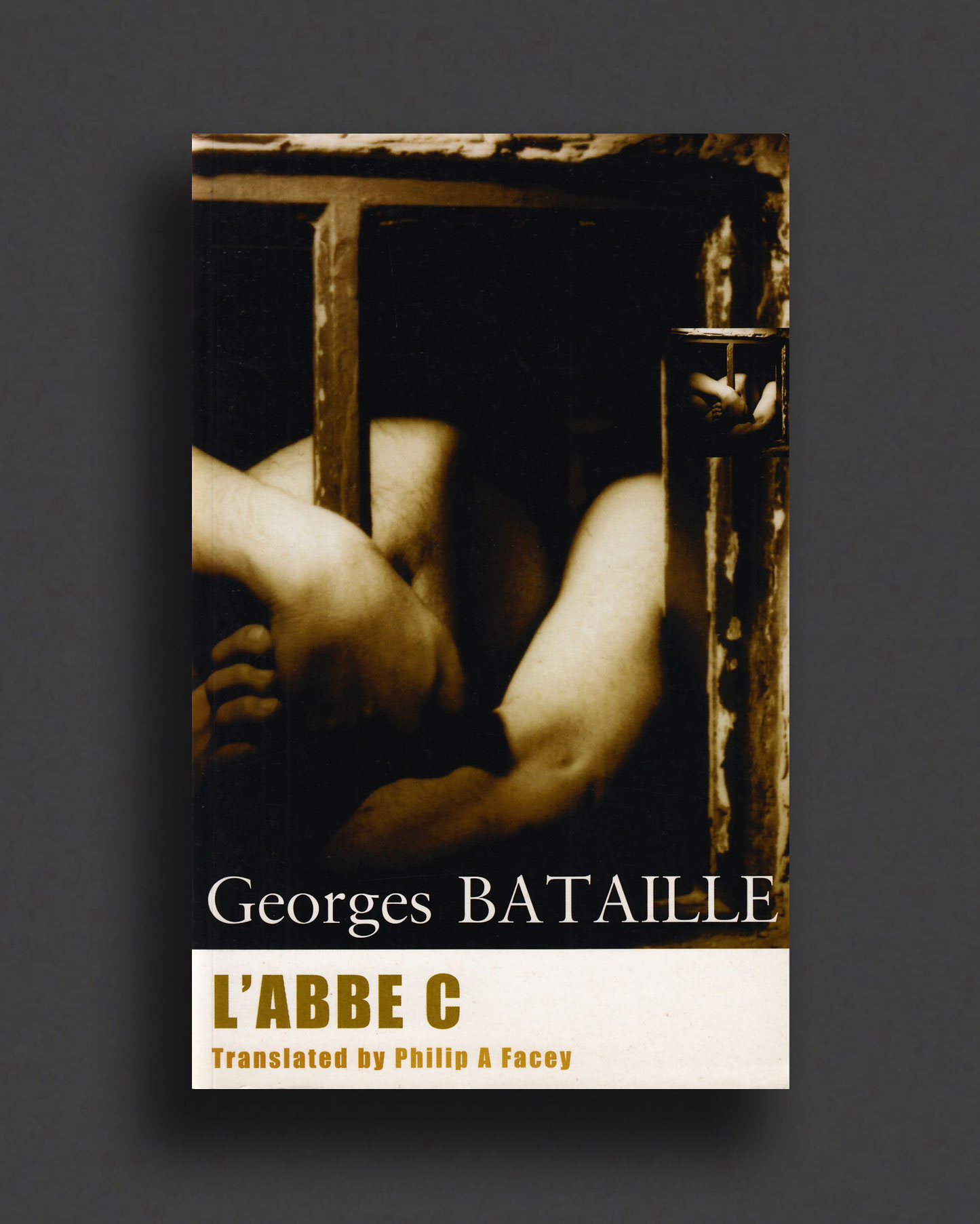
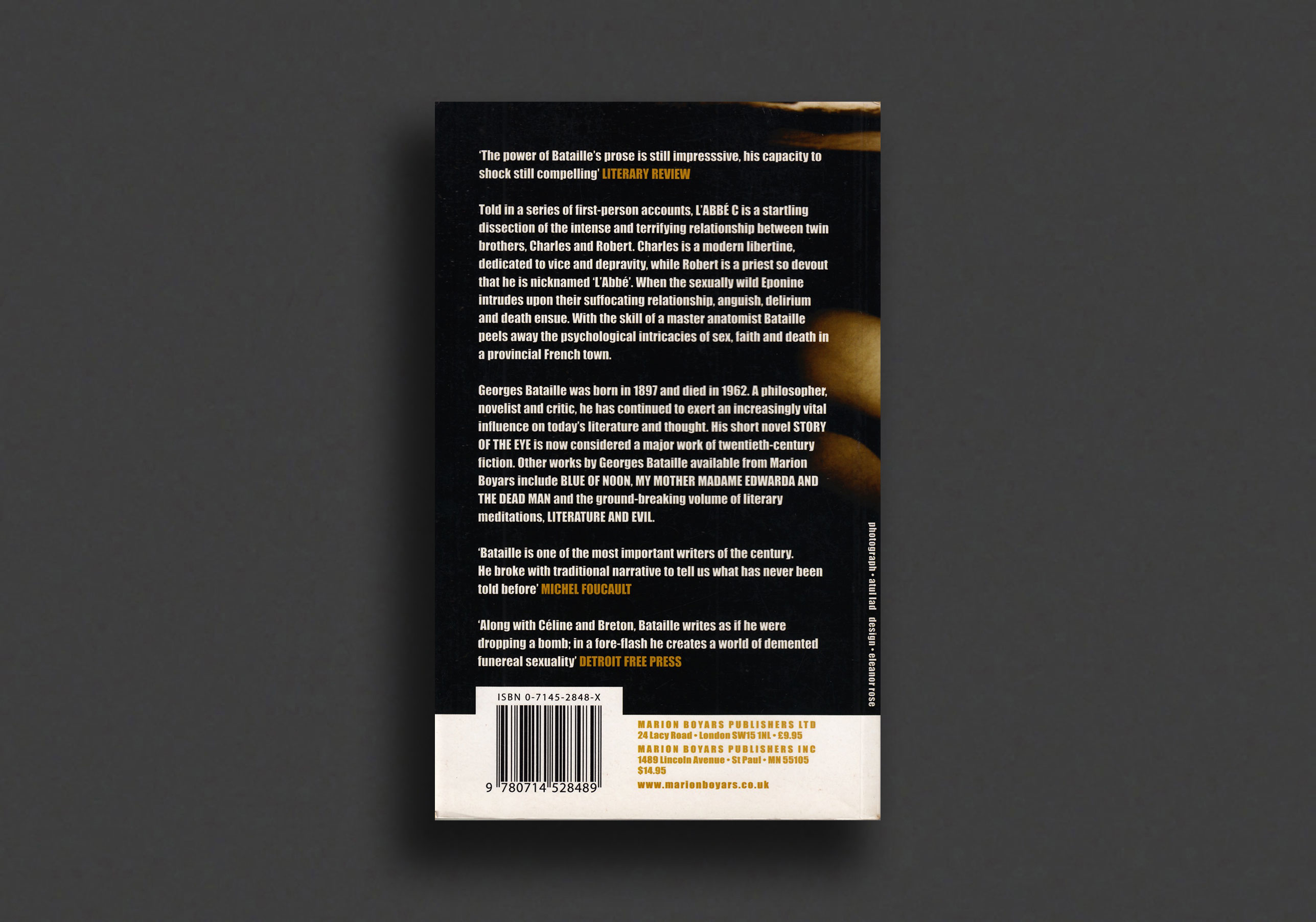
2001 English language edition of Bataille's L'ABBÉ C, translated by Philip A. Facey and published by Marion Boyars.
Told in a series of first person accounts, L'ABBÉ C is a startling narrative of the intense and terrifying relationship between twin brothers, Charles and Robert. Charles is a modern libertine dedicated to vice and depravity; Robert is a priest so devout that he is nicknamed 'L'Abbé'. As the story progresses, the suffocating atmosphere becomes increasingly permeated with illness, breakdown and eventual death. As in Blue of Noon and Story of the Eye, Bataille has succeeded in portraying the darkest and most profound aspects of human experience with amazing strength and dispassionate objectivity.
"Bataille speaks about man's condition, not his nature. Bataille has survived the death of God. In him, reality is conflict."—Jean-Paul Sartre
"Bataille is now recognized in France as one of the most challenging and original writers of our century. English translations of his work are long overdue, and one can only welcome the opportunity for English speaking readers to discover this major modern thinker."—Leo Bersani
"Essentially a psychological novel in which the emotions of the characters determine the movement of the story from beginning to end; explicit sex is absent. The style is crisp and this translation is quite remarkable... always faithful to the spirit."—New York Times Book Review
"The psychological intricacies display a graceful crisscrossing intensity."—Chicago Tribune
Georges Bataille was born in 1897 and died in 1962. He was a philosopher, novelist and critic whose startling and original ideas have influenced much modern literature and thought.
VG copy with previous owner sticker to inside front cover.
1991 / 1994, English
Softcover, 156 pages, 21.5 x 13.5 cm
1st Edition, Out of print title / used / good
Published by
Marion Boyars / London
$28.00 - Out of stock
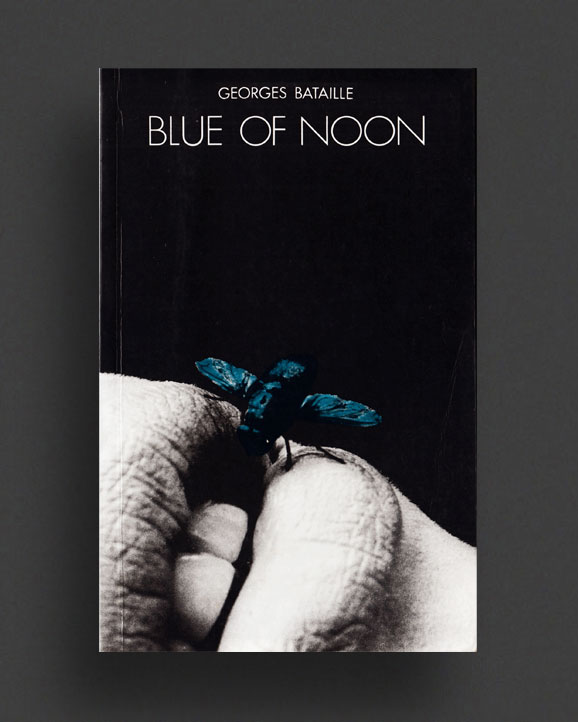
First 1991, 1994 reprint English edition.
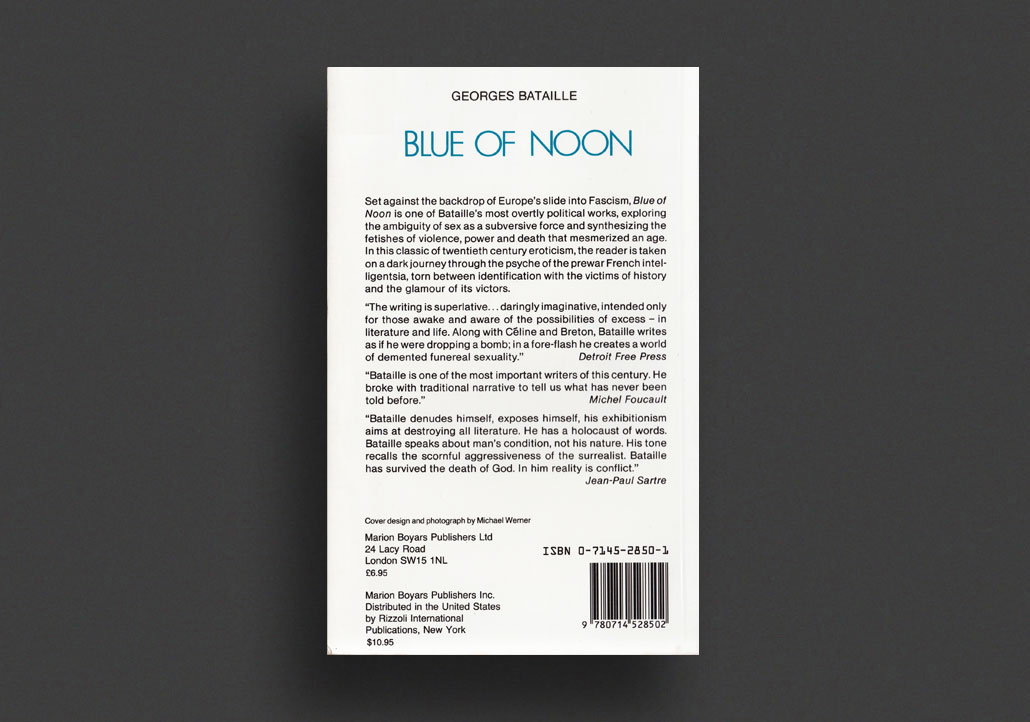
Set against the backdrop of Europe's slide into Fascism, Blue of Noon is one of Bataille's most overtly political works, exploring the ambiguity of sex as a subversive force and synthesizing the fetishes of violence, power and death that mesmerized an age. In this classic of twentieth century eroticism, the reader is taken on a dark journey through the psyche of the prewar French intel- ligentsia, torn between identification with the victims of history and the glamour of its victors.
"The writing is superlative... daringly imaginative, intended only for those awake and aware of the possibilities of excess in literature and life. Along with Céline and Breton, Bataille writes as if he were dropping a bomb; in a fore-flash he creates a world of demented funereal sexuality."—Detroit Free Press
"Bataille is one of the most important writers of this century. He broke with traditional narrative to tell us what has never been told before."—Michel Foucault
"Bataille denudes himself, exposes himself, his exhibitionism aims at destroying all literature. He has a holocaust of words. Bataille speaks about man's condition, not his nature. His tone recalls the scornful aggressiveness of the surrealist. Bataille has survived the death of God. In him reality is conflict."—Jean-Paul Sartre
Good—Very Good copy with some dark spotting to block edges. (sample image)
2003, English
Softcover, 222 pages 20 x 13 cm
Out of print title / used / very good
Published by
Corgi / London
$20.00 - In stock -
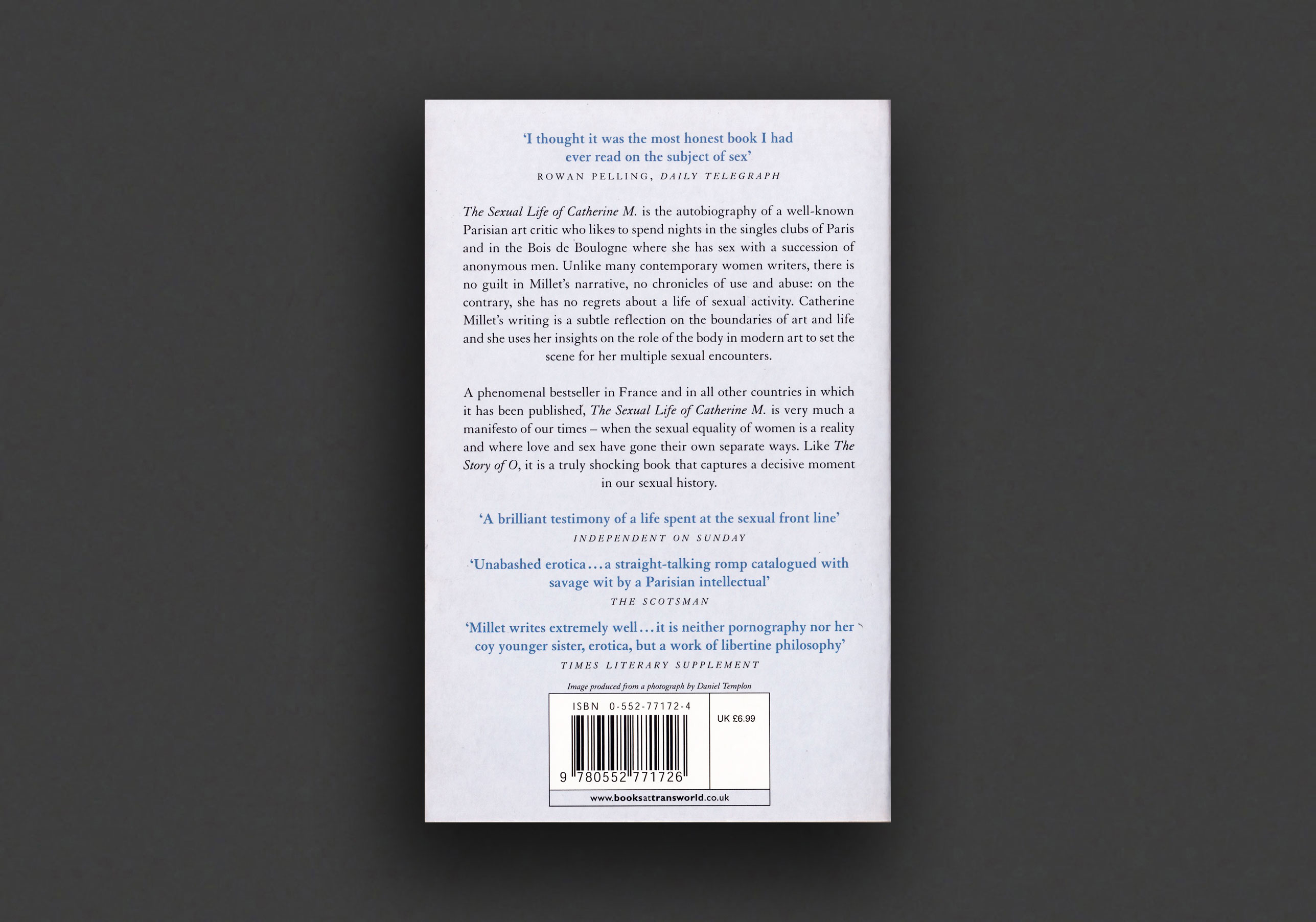
A national best-seller that was featured on such lists as The New York Times, the Los Angeles Times, The Washington Post, the San Francisco Chronicle, The Boston Globe, and Publishers Weekly, The Sexual Life of Catherine M. was the controversial sleeper hit of the year. Since her youth, Catherine Millet, the eminent editor of Art Press, has led an extraordinarily active and free sexual life -- from al fresco encounters in Italy to a gang bang on the edge of the Bois du Boulogne to a high-class orgy at a chichi Parisian restaurant. A graphic account of sex stripped of sentiment, of a life of physical gratification and a relentlessly honest look at the consequences -- both liberating and otherwise -- have created this candid, powerful, and deeply intelligent depiction of unfettered sexuality.
VG copy.
1973, English
Hardcover (w. dust jacket), 208 pages, 20 x 14 cm
1st Edition, Out of print title / used / good
Published by
Jonathan Cape / London
$340.00 - In stock -
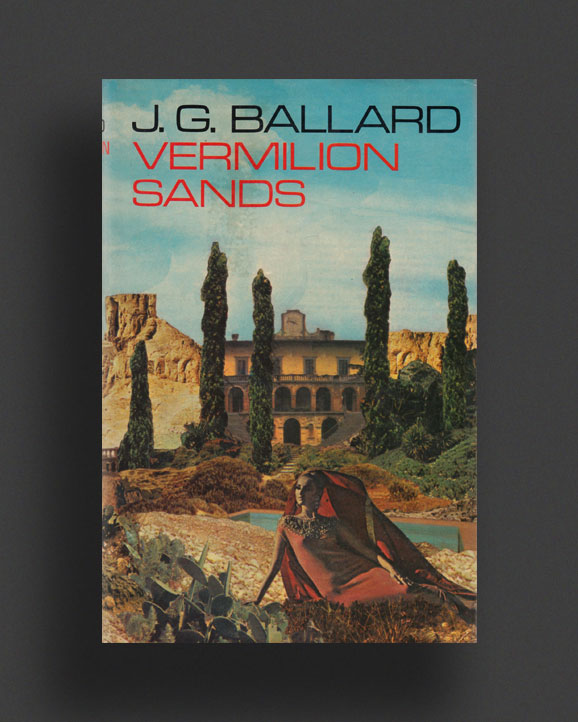
Rare elusive first 1973 hardcover edition of the Jonathan Cape edition of Ballard's Vermilion Sands, which is considered the complete collection, adding an additional story, "The Singing Statues", to the original Berkley paperback edition from 1971, and a preface, both only available in the British edition.
Vermilion Sands is a collection of surreal science fiction short stories by Ballard, one of his finest, all set in an imaginary vacation resort called Vermilion Sands which suggests, among other places, a latter-day Palm Springs. Vermillion Sands is a fully automated desert resort designed to fulfil the most exotic whims of the idle rich. But now it languishes in uneasy decay, populated only by forgotten movie stars, solitary impresarios, parasites, and artistic and literary failures, a place where love and lust pall before the stronger pull of evil. It is a lair for malice and hate and envy — and the more cancerous forms of madness; a place where sensitive pigments paint portraits for their masters in a grotesque parody of art; where poets press the buttons of mechanical versifiers; where sculptures grow like funguses, and plants respond to music; where psychosensitive houses are driven mad by their owners' neuroses; where love and affection, and even lust, are effete madrigals played in a minor and discordant key.
From the dark recesses of a superb imagination, J. G. Ballard has conjured up an elegant nightmare of decadence, a portrait of a future Gomorrah where a Nero might play an automated violin.
"Ballard is one of the brightest stars in post-war science fiction."—Kingsley Amis
"Collection of stories first published in magazines between 1956 and 1970 "about a decaying artists' colony in the near future, set against surrealistic desert landscapes. With their motifs of singing flowers and statues, living clothes, cloud-sculpting and psychotropic houses, the tale are not conventionally linked, and have differing characters. All marvelously original, with unforgettable imagery. One of Ballard's most brilliant books ..." —Pringle, The Ultimate Guide to Science Fiction, second edition (1995), p. 401.
Good ex-libris copy in Very Good but price-clipped dust jacket. Book has some light general aging/light spotting to block edges. Paste-in to first blank page from "South Australian Railways Institute Library", otherwise only very mild marking to blanks. Preserved in mylar wrap.
1965, English
Softcover, 252 pages, 20 x 13.5 cm
1st Edition, Out of print title / used / average
Published by
City Lights Books / San Francisco
$55.00 - Out of stock
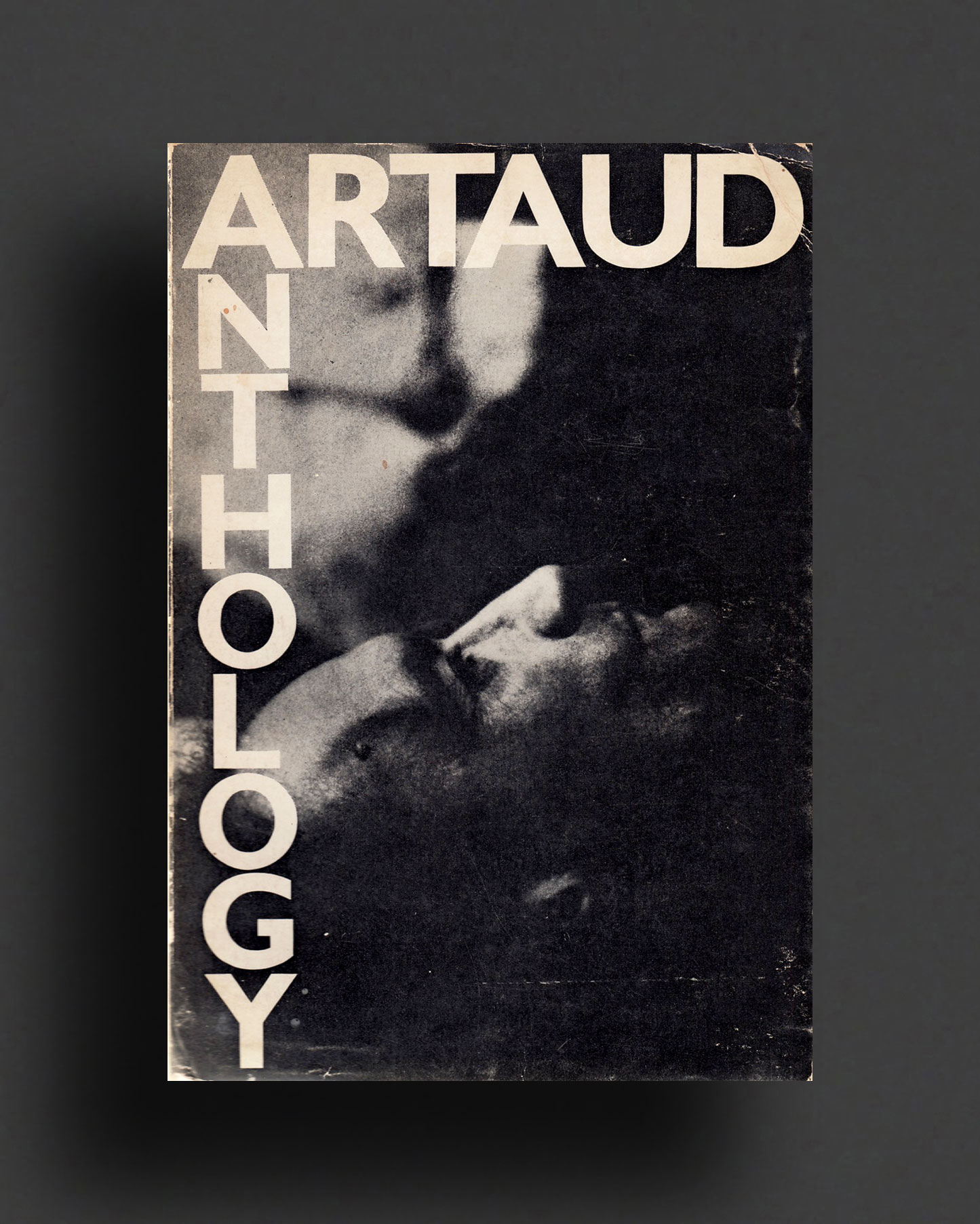
First 1965 edition of the first anthology of writings by Artaud in English, published by City Lights Books, edited and translated by Jack Hirschman.
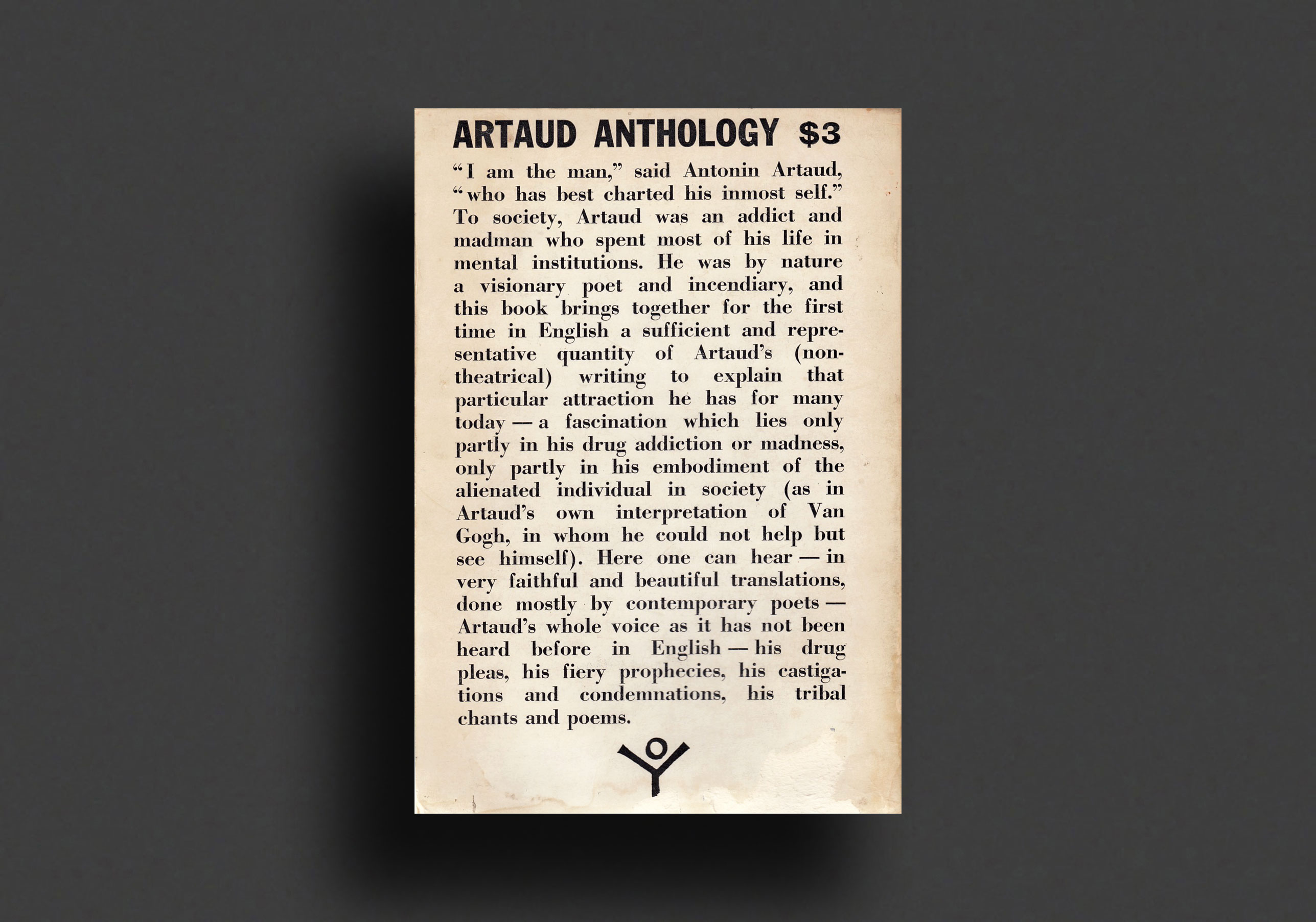
"I am the man," wrote Artaud, "who has best charted his inmost self." Antonin Artaud was a great poet who, like Poe, Holderlin, and Nerval, wanted to live in the infinite and asked that the human spirit burn in absolute freedom.
To society, he was a madman. Artaud, however, was not insane, but in luciferian pursuit of what society keeps hidden. The man who wrote Van Gogh the Man Suicided by Society raged against the insanity of social institutions with insight that proves more prescient with every passing year. Today, as Artaud's vatic thunder still crashes above the "larval confusion" he despised, what is most striking in his writings is an extravagant lucidity.
This collection gives us quintessential Artaud on the occult, magic, the theater, mind and body, the cosmos, rebellion, and revolution in its deepest sense.
Antoine Marie Joseph Artaud, better known as Antonin Artaud (1896 – 1948), was a French dramatist, poet, essayist, actor, and theatre director, widely recognized as one of the major figures of twentieth-century theatre and the European avant-garde.
Jack Hirschman (b. December 13, 1933, in New York, NY) is a poet and social activist who has written more than 50 volumes of poetry. Dismissed from teaching at UCLA for anti-war activities in 1966, he moved to San Francisco in 1973, and was the city's present poet laureate. Hirschman translates nine languages and edited The Artaud Anthology.
Average—Good copy of fragile first edition. Some old water staining to the bottom edge towards the back of the book, some marking/tanning to block edges, covers, crease to spine.
2018, English
Hardcover, 480 pages, 17.4 x 23.2 cm
Published by
Atlas Press / London
$74.00 - In stock -
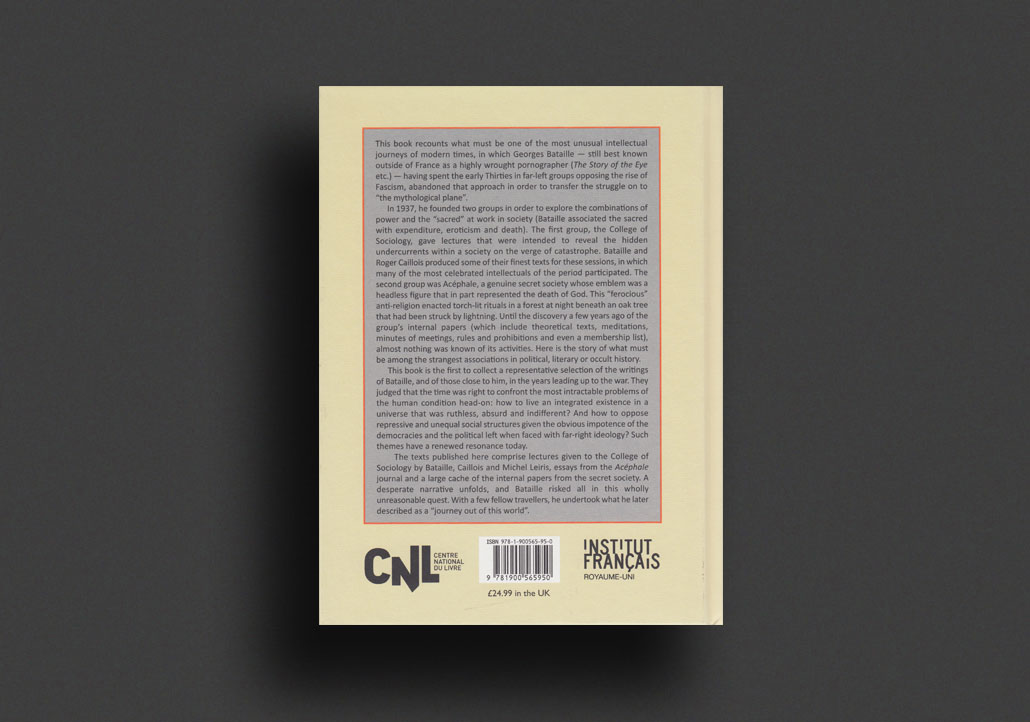
Georges Bataille's secret society, long the stuff of legend, is now revealed in its texts, meditations, rules and prohibitions.
This book recounts what must be one of the most unusual intellectual journeys of modern times, in which the influential philosopher, cultural theorist and occasional pornographer Georges Bataille (1897-1962), having spent the early 1930s in far-left groups opposing the rise of fascism, abandoned that approach in order to transfer the struggle onto "the mythological plane."
In 1937, Bataille founded two groups in order to explore the combinations of power and the "sacred" at work in society. The first group, the College of Sociology, gave lectures that were intended to reveal the hidden undercurrents within a society on the verge of catastrophe. The second group was Acéphale, a genuine secret society and anti-religion whose emblem was a headless figure that, in part, represented the death of God. Until the discovery a few years ago of the group's internal papers (which include theoretical texts, meditations, minutes of meetings, rules and prohibitions and even a membership list), almost nothing was known of its activities.
This book is the first to collect a representative selection of the writings of Bataille, and of those close to him, in the years leading up to World War II. The texts published here comprise lectures given to the College of Sociology by Bataille, Roger Caillois and Michel Leiris, essays from the Acéphale journal and a large cache of the internal papers from the secret society. A desperate narrative unfolds, wherein Bataille risked all in a wholly unreasonable quest--with a few fellow travelers, he undertook what he later described as a "journey out of this world."
Additional texts by Roger Caillois, Pierre Klossowski, Michel Leiris, and by Georges Ambrosino, Pierre Andler, Michel Carrouges, Jacques Chavy, Jean Dautry, Henri Dobier, Henri Dussat, Imre Kelemen, Jean Rollin, Patrick Waldberg.
And with drawings by André Masson
Highest recommendation!
2024, English
Softcover, 240 pages, 13.5 x 14 cm
Published by
Masala Noir / Paris
$44.00 - Out of stock
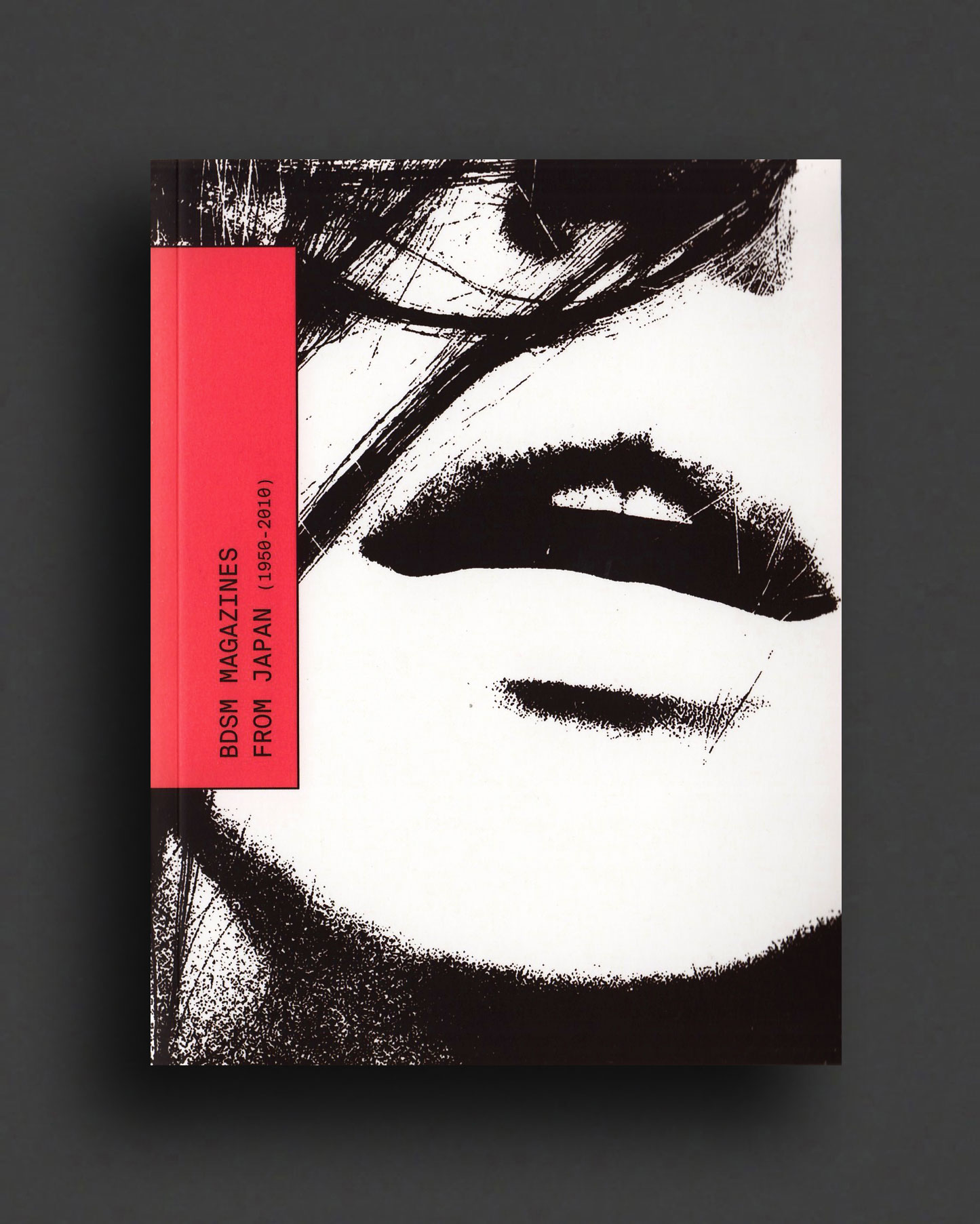
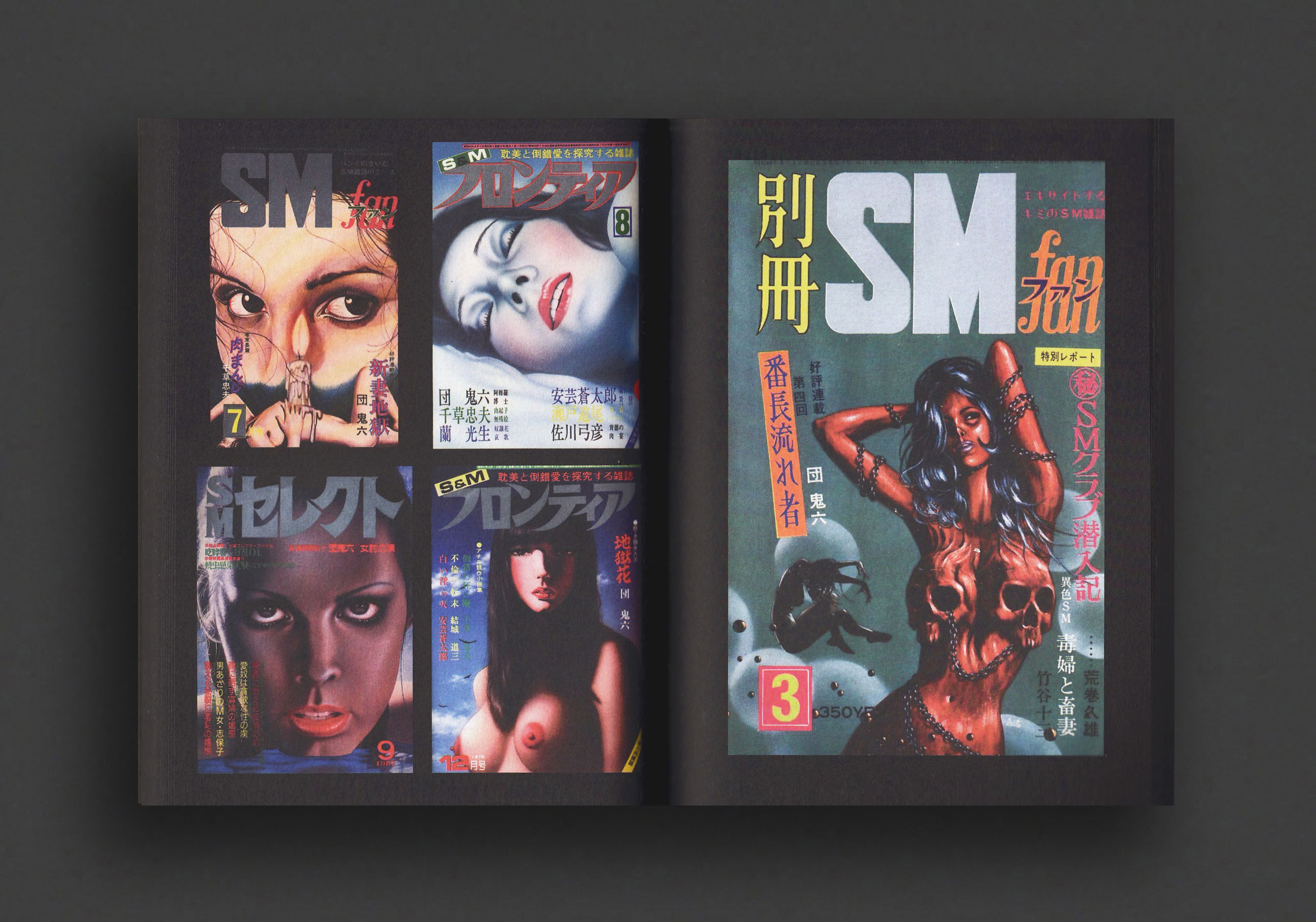
A collection of 300+ BDSM magazine covers from Japan compiled by Masala Noir (1960-2010).
1994, Japanese
Softcover, unpaginated, 28.5 x 21 cm
1st Edition, Out of print title / used / very good
Published by
Eichi Shuppan / Tokyo
$100.00 - Out of stock
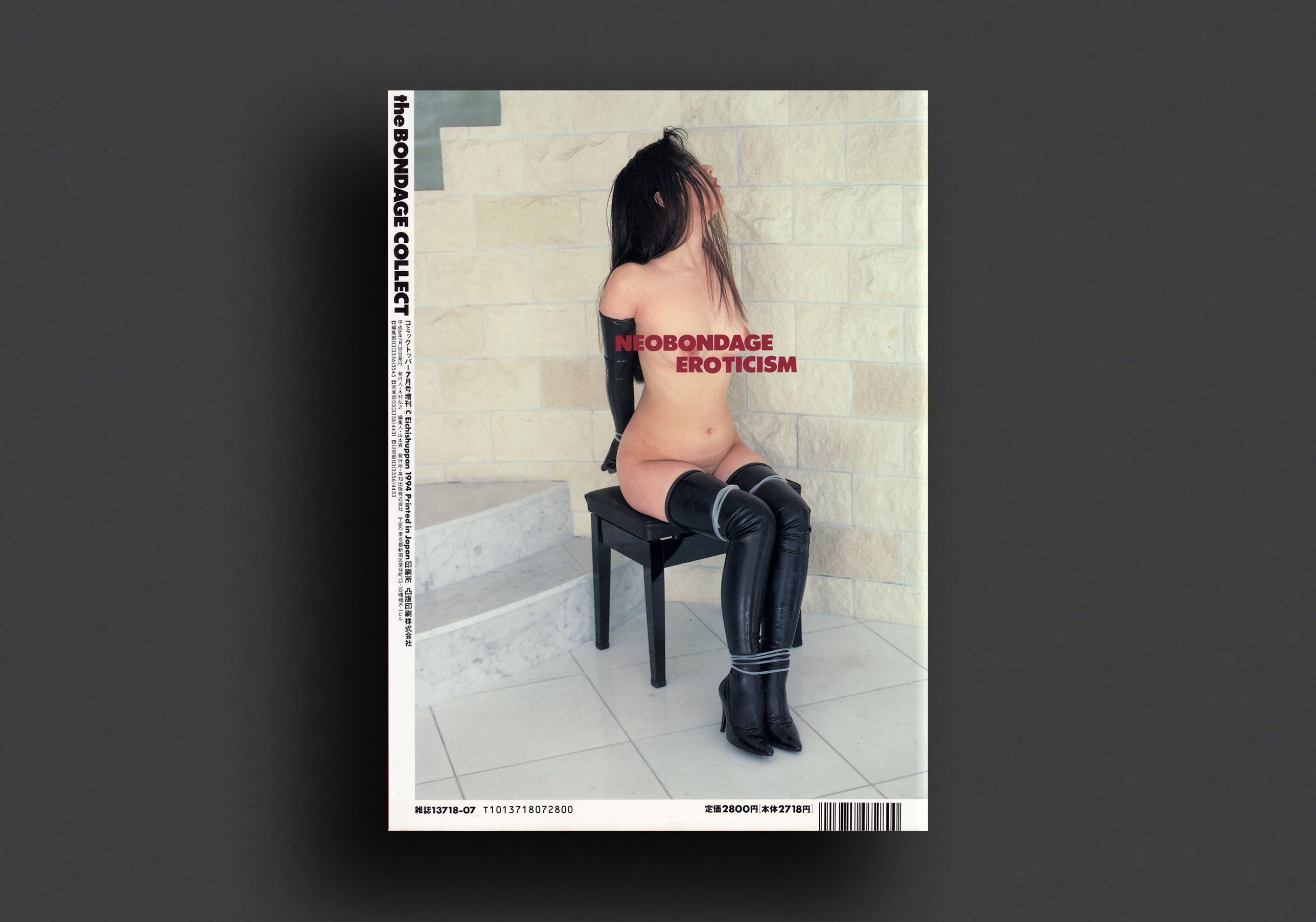
Published by Topaz magazine in 1994, this photo book collects 23 of the feature photoshoots in their entirety from the pages of the short-lived but excellent early 90's Japanese bondage magazine. Edited by Hitoshi Yamamoto, Kazuyoshi Kimoto, Hiroyuki Yano, Naoki Katayama. Features the models: Reiko Yasuhara, Mayumi Yamazaki, Makoto Ohara, Megumi Takahara, Rei Arimori, Emi Aso, Megumi Ishihara, Yuka watanabe, Ena Nakagami, Reiya Isshiki, Ayumi Hara, Mari Fujikawa, Yukari Kashiwagi, Megumi Asada, Reina. Photography by Norio Sugiura, Teruo Maeba, Tsunehiro Takakuwa, Shinji Yamazaki, Wakao Takahashi, Ryosuke Aikawa, Chikashi Yokouchi. Stylists: Jun Yoshida, Takuya Mimi Sayuri Kojima, Hiro Seino, Yumi Nakamori. Hair & Makeup: Rina Matsuhaga, Hiromi Katoh. Special thanks to A.Z.Z.L.O. Discipline!
Edited by Kimura Hiroyuki, Topaz burst onto the flourishing SM scene as the influence of Kinbaku/Shibari culture, fetish fashion, "abnormal" sexual practices, modern primitive, and underground SM culture was becoming hugely influential on high-end fashion, glamour photography, and art/film/music at large. A similar approach to SM Sniper, sharing many of the same contributors such as SM archivist and noise musician Masami Akita (Merzbow), Topaz emphasised the new wave of artistic output from the real protagonists of the experimental SM counterculture in Japan (and abroad), centering around the work of the models, stylists, make-up artists, and fashions designers, as much as the kinbakushi, writers or photographers. Topaz benefited from the large format of a glossy, full-colour magazine, rather than the usual mook format of SM magazines, each issue packed with hundreds of images, a double-sided full-colour fold-out poster, original full-colour glossy photo-shoots, art galleries, reports and reviews on developments in the underground (noise music, pink film, sex clubs, erotic art, etc.), instructional and historical articles, rare interviews and profiles with the featured models and artists, and photo features on all manner of sexual customs and practices (transsexualism, lesbianism, virtual sex, rubberism, medical fetish, prostitution, techno sex...). One of the most under-rated SM mags from Tokyo, brimming with information on underground publishing, boutiques, and erotic art largely lost to time.
Mature audiences only.
Near Fine copy, single corner crease to cover.
1982, Japanese
Softcover (staple-bound), 96 pages, 26 x 18.5 cm
1st Edition, Out of print title / used / very good
Published by
Wakasei / Tokyo
$65.00 - Out of stock
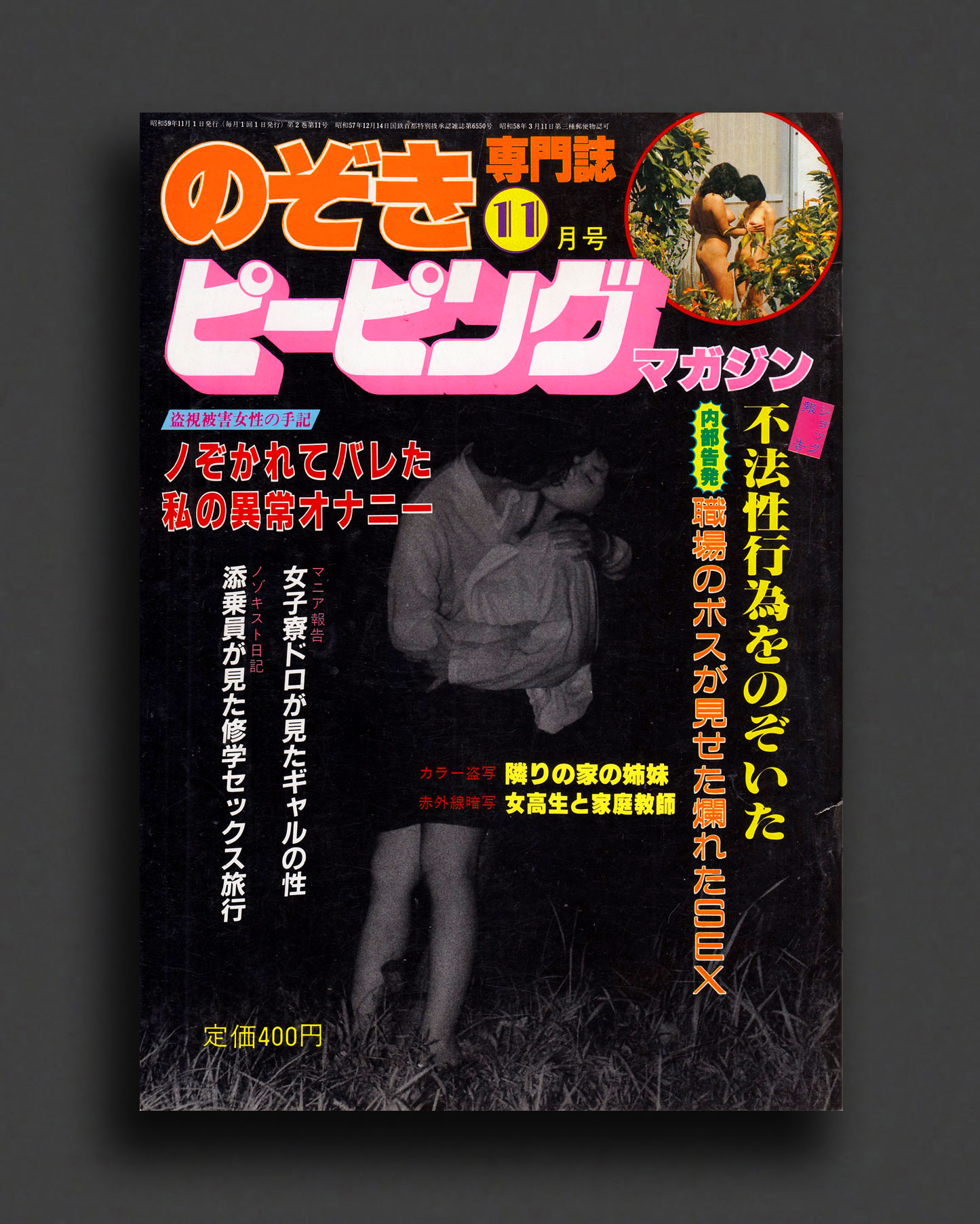
1984 issue of Peeping Magazine, a specialty deviant photography magazine published in Tokyo in the 1980's that covers all manner of voyeuristic close-up/peeper/FLASH/Infrared/Monroe-effect photography (ala Kohei Yoshiyuki and Ikko Kagari) with full-colour and b/w photo features of innovative, controversial, spy photography. Clandestine trysts in the park at night, girls next door, sports action, nature calls (urination)... Staged? simulated? real? professional? amateur? art as criminal impulse? Who knows. Questionable, sure. Certainly a fascinating reflection of the loneliness and desperation that so often accompanies sexual or human desire in a big, cold metropolis like Tokyo.
Mature audiences only.
Very Good copy, light wear.
1990, Japanese
Softcover (w. dust jacket), unpaginated, 21.5 x 27.5 cm
1st Edition, Out of print title / used / very good
Published by
Million Publishing / Tokyo
$180.00 - Out of stock
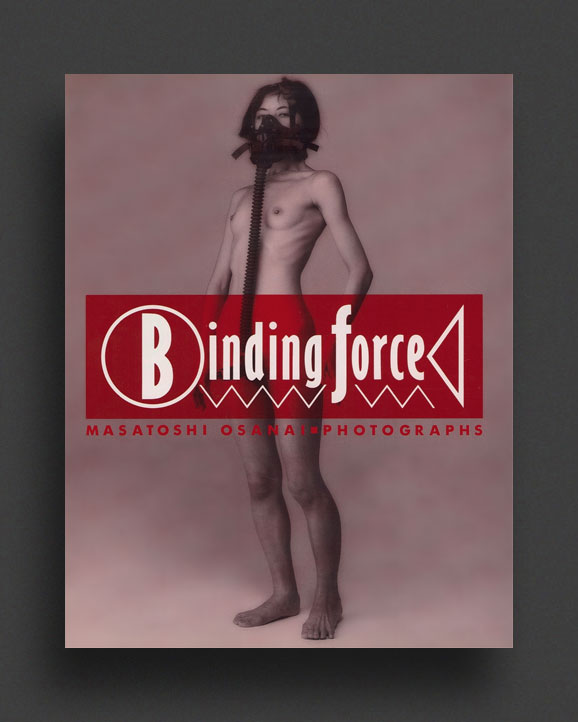
First, only edition of this great bondage photo book by Masatoshi Osanai, published by S&M Sniper's Million publishing house. "Binding Force" is a collection of works by the Japanese photographer who worked as a portrait photographer of idols and celebrities throughout the 1980s to the 1990s. This is his only book of bondage photography, announced in 1990 as "the first face restraint photo book in Japan!!". Like Helmut Newton and Robert Mapplethorpe, Osanai seamlessly works between portraiture and fetish photography, creating a conceptual photo book made up entirely of headshots of models gagged and bound in various face restraints, gas masks and the like. "It's a non-comedy. It's a comedy. It's the beauty of a mask, the wilderness of pleasure, or the grave marker of ecstasy that appears at the end of a transformation." (rough translation from the publisher's blurb). Includes texts (in Japanese) by Shuhei Takahashi and Akira Nagae.
Very Good—Near Fine copy in VG dust jacket.
1995, English
Softcover (staple-bound), 90 pages, 30 x 21 cm
1st Edition, Out of print title / used / very good
Published by
SECRET Magazine / Brussels
$45.00 - Out of stock
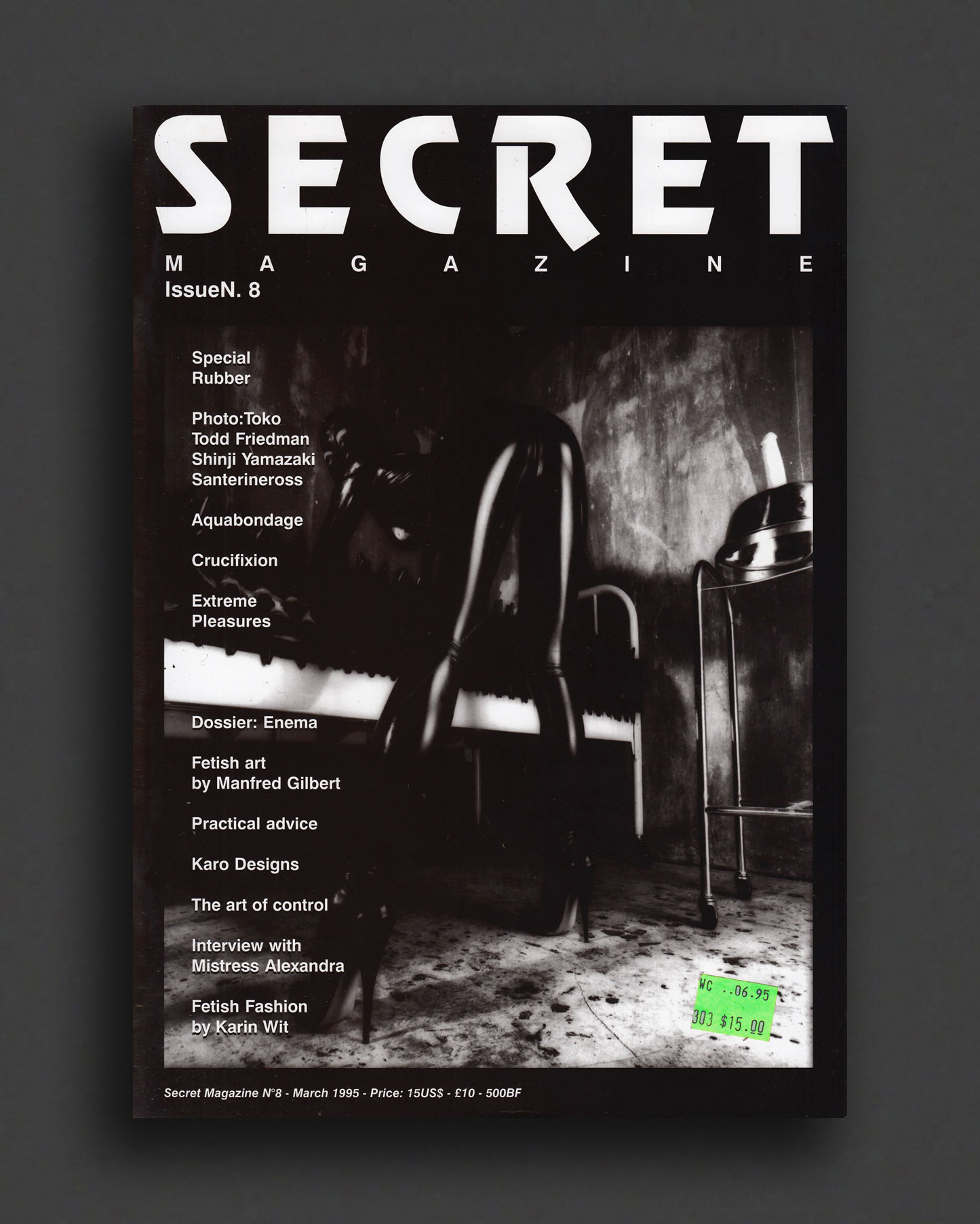
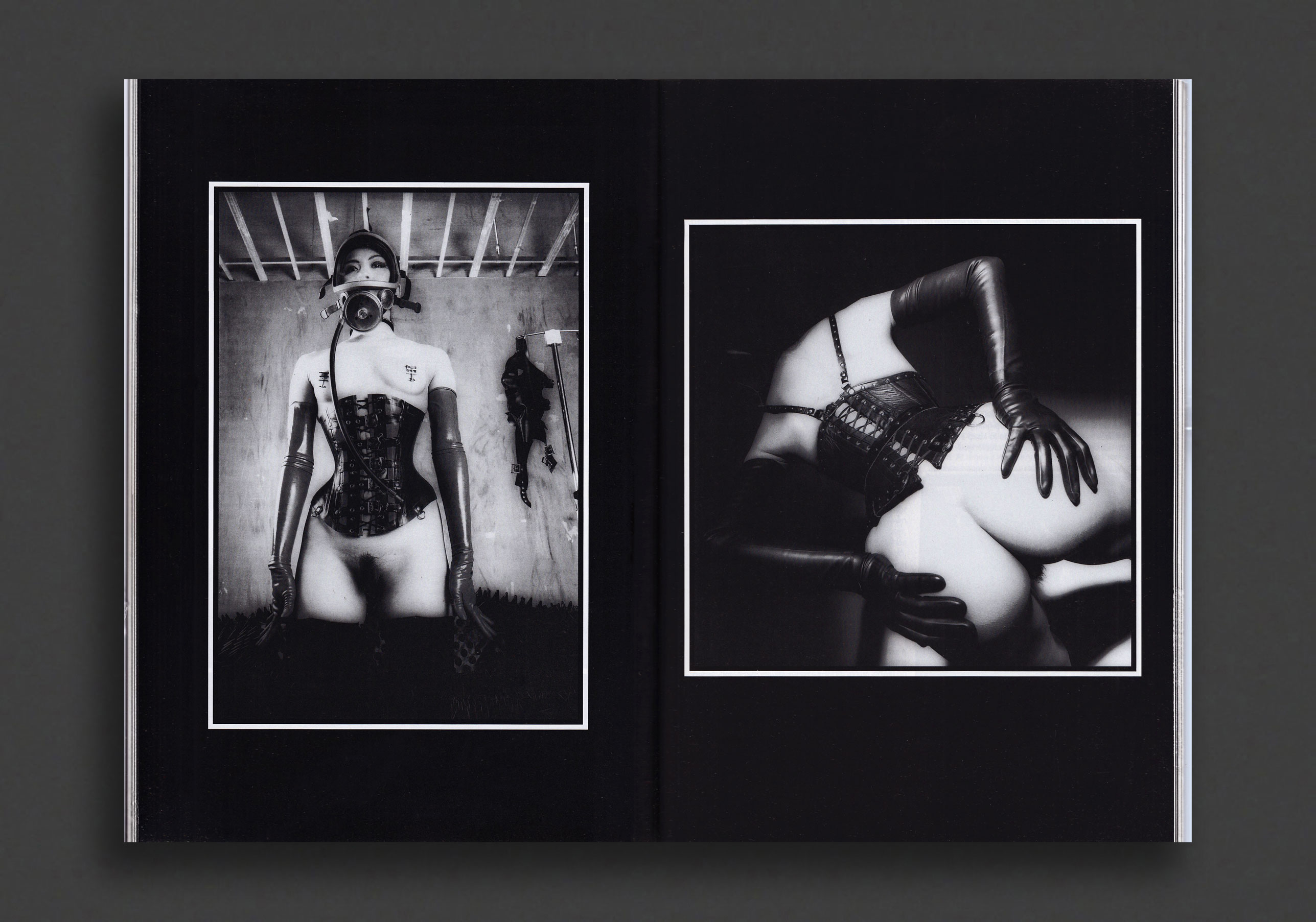
March 1995 issue of Secret Magazine, a legendary fetish and bondage art magazine edited by Jürgen Boedt, published out of Brussels, Belgium, and well respected across the globe. Striking b/w glossy pages filled with photo portfolios, fetish artwork galleries, kink advice, stories, reports from around the fetish world, interviews and much more. One of the last traditional Black and White Bondage Art magazines in Europe.
Very Good copy with general light magazine wear.
1976, French / Japanese
Hardcover portfolio + 18 print plates + insert booklet, 30.5 x 23 cm
Hand-numbered of 970 copies,
1st Edition, Out of print title / used / good
Published by
Gakutokan / Japan
$190.00 - In stock -
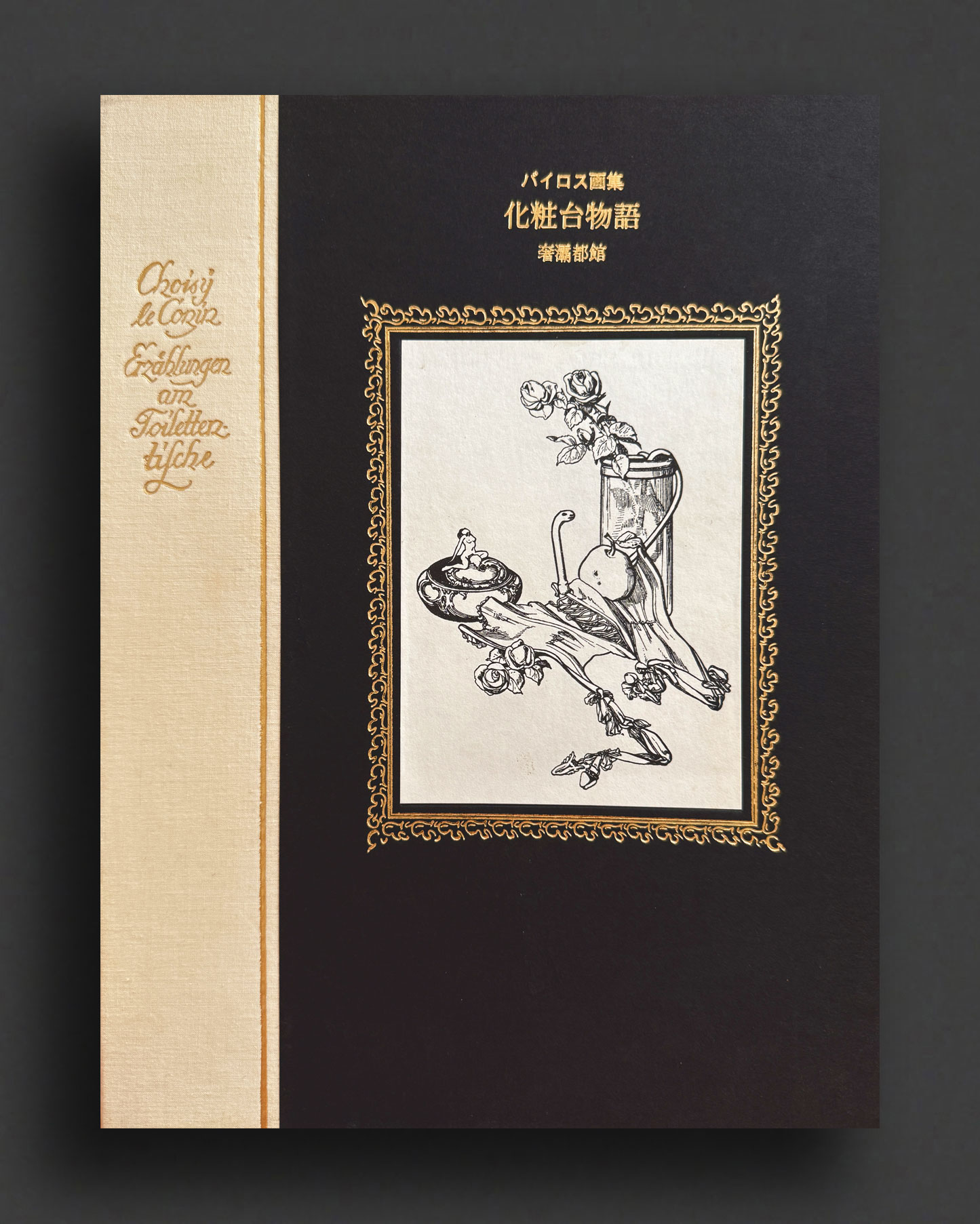
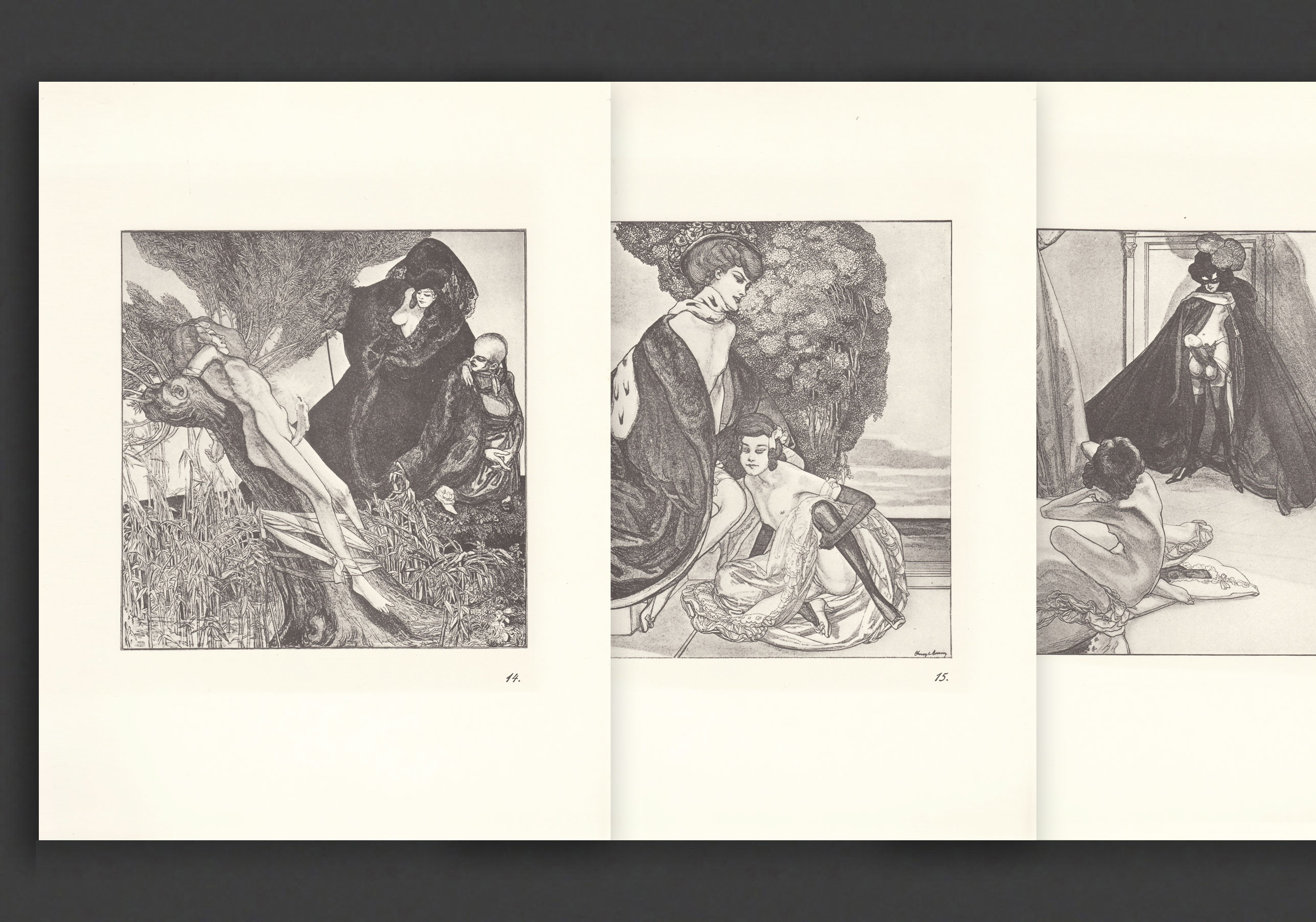
Lovely 1976 limited edition hardcover portfolio of Franz Von Bayros' "Erzählungen am Toilettentische" (1908) an erotic suite first published privately in 1911, published in Japan by Gakutokan. 18 beautifully produced plates housed in gilded, debossed-plate illustrated hardcover clothbound folio, hand-numbered "454" of 970 copies. One of the finest works of the Austrian graphic artist, illustrator, and painter of the fin de siècle, Franz von Bayros (b. 1866, Zagreb; d. 1924, Vienna), considered one of the great erotomaniacs, alongside Aubrey Beardsley and Félicien Rops. His illustrations for classics of erotic literature are characterized by compositional talent, subtle play with ornament, and a delight in opulent settings.
Born in Zabreb, Croatia, Franz von Bayros (1866–1924) was an Austrian commercial artist, illustrator and painter. A leading figure in the Decadent artistic movement, his work challenged Victorian modesty, exploring phantasmagoric imagery and taboo erotic themes such as lesbian relationships, bestiality and sado-masochism, coupled with a keen sense of humour and warmth given to the subject. Franz’s brilliant draughtsmanship, design sense and his carefully-considered erotic imagination made his work eminently approachable and desirable, both as high-quality art and as a vehicle for exploring the limits of sexual experience, yet the scandalous nature of his work led to his arrest and temporary exile from Germany in 1911, returning to an Austria to face the outbreak of war and alienation.
During his prolific period creating erotic works for limited edition collector's portfolios and rare book prints, Franz Von Bayros created illlustrations for Fleurettens Purpurschnecke (1905), Die Memoiren der Fanny Hill (1906), La Bohème (1906), Im Garten der Aphrodite (In the Garden of Aphrodite) (1907), Les Cent Nouvelles (1907), Die Grenouillère (1907), Die hübsche Andalusierin (1907), Manon Lescaut and the Chevalier des Grieux (1911), Erzählungen am Toilettentische (1911), Le Decameron (1911), amongst many more, as well as a brilliant array of ex-libris bookplate illustration.
Very Good copy.
1976, French / Japanese
Hardcover portfolio + 21 print plates, 30.5 x 23 cm
Hand-numbered of 970 copies,
1st Edition, Out of print title / used / very good
Published by
Gakutokan / Japan
$190.00 - In stock -
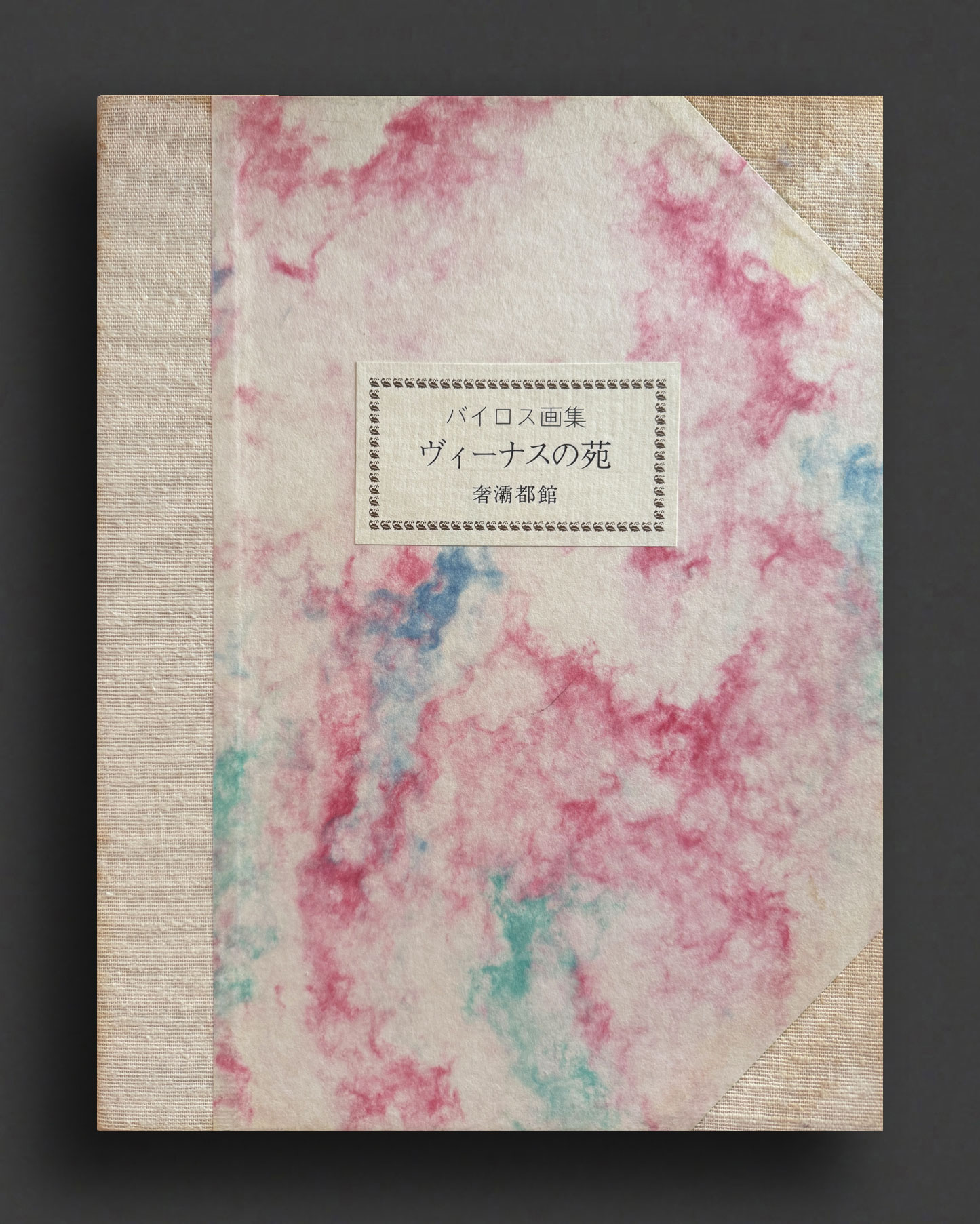
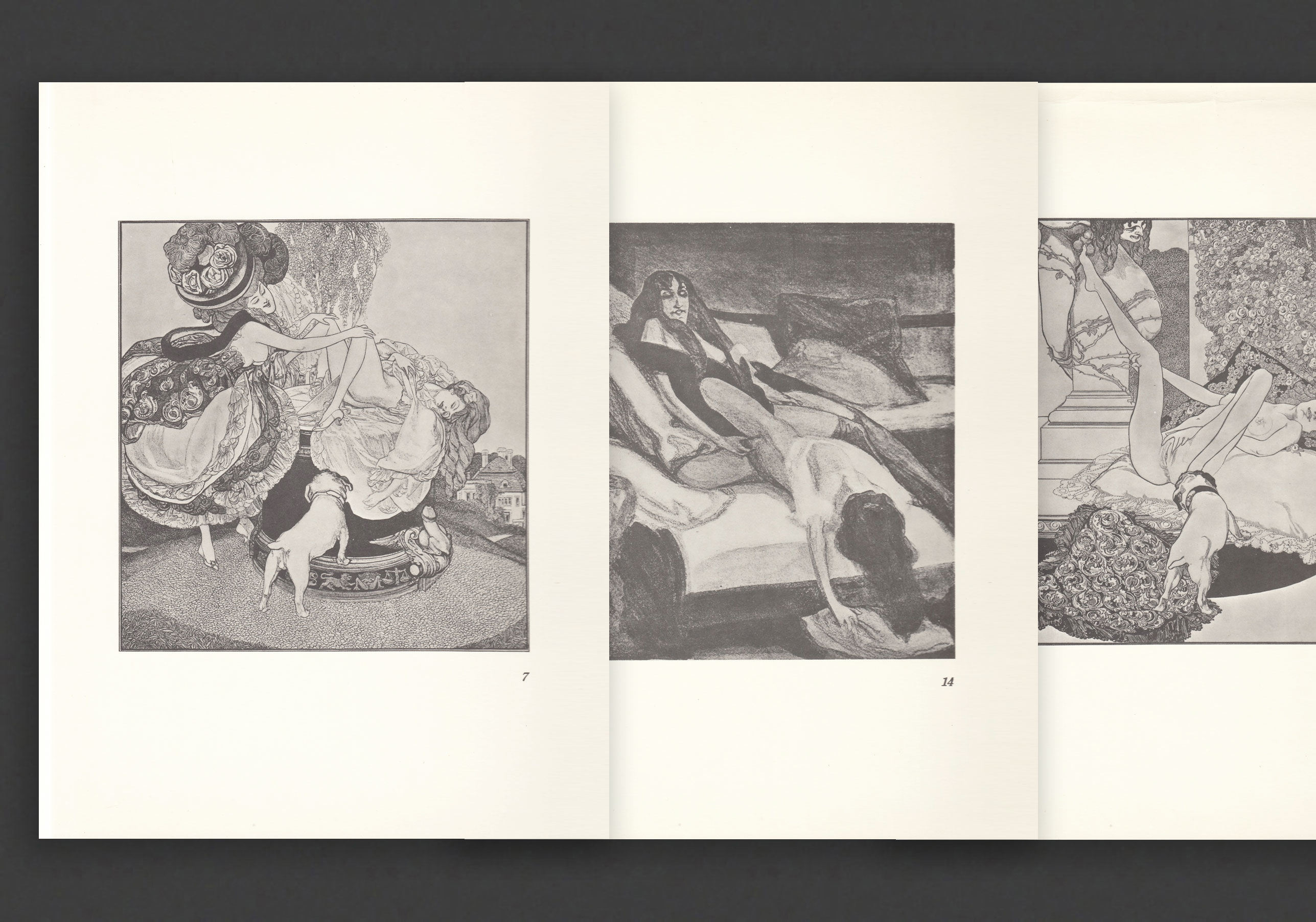
Lovely 1976 limited edition hardcover portfolio of Franz Von Bayros' "Im Garten der Aphrodite" (1907) an erotic suite first published privately in 1910, published in Japan by Gakutokan. 21 beautifully produced plates housed in marbled hardcover clothbound folio, hand-numbered "456" of 970 copies. One of the finest works of the Austrian graphic artist, illustrator, and painter of the fin de siècle, Franz von Bayros (b. 1866, Zagreb; d. 1924, Vienna), considered one of the great erotomaniacs, alongside Aubrey Beardsley and Félicien Rops. His illustrations for classics of erotic literature are characterized by compositional talent, subtle play with ornament, and a delight in opulent settings.
Born in Zabreb, Croatia, Franz von Bayros (1866–1924) was an Austrian commercial artist, illustrator and painter. A leading figure in the Decadent artistic movement, his work challenged Victorian modesty, exploring phantasmagoric imagery and taboo erotic themes such as lesbian relationships, bestiality and sado-masochism, coupled with a keen sense of humour and warmth given to the subject. Franz’s brilliant draughtsmanship, design sense and his carefully-considered erotic imagination made his work eminently approachable and desirable, both as high-quality art and as a vehicle for exploring the limits of sexual experience, yet the scandalous nature of his work led to his arrest and temporary exile from Germany in 1911, returning to an Austria to face the outbreak of war and alienation.
During his prolific period creating erotic works for limited edition collector's portfolios and rare book prints, Franz Von Bayros created illlustrations for Fleurettens Purpurschnecke (1905), Die Memoiren der Fanny Hill (1906), La Bohème (1906), Im Garten der Aphrodite (In the Garden of Aphrodite) (1907), Les Cent Nouvelles (1907), Die Grenouillère (1907), Die hübsche Andalusierin (1907), Manon Lescaut and the Chevalier des Grieux (1911), Erzählungen am Toilettentische (1911), Le Decameron (1911), amongst many more, as well as a brilliant array of ex-libris bookplate illustration.
Very Good copy. Some tanning to cloth extremities.
1979 / 1980, Japanese
2 hardcover volumes (w. dust jackets), 140 pages ea., 26.5 x 20 cm
1st Edition, Out of print title / used / very good
Published by
Gakutokan / Japan
$120.00 - Out of stock
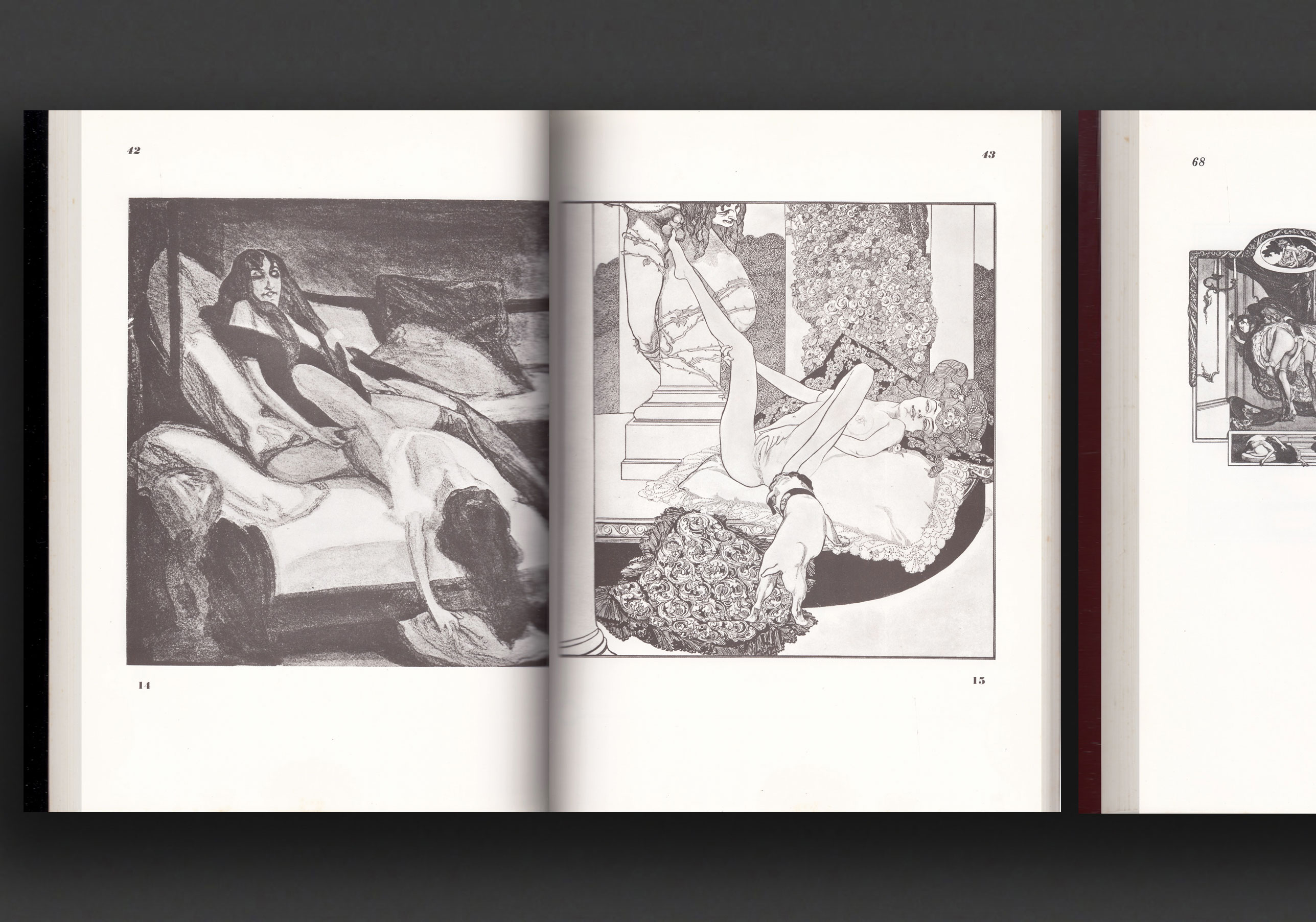
First hardcover editions of both erotic art book collections of Franz Von Bayros, published by Gakutokan, Tokyo, 1979 and 1980. Born in Zabreb, Croatia, Franz von Bayros (1866–1924) was an Austrian commercial artist, illustrator and painter. A leading figure in the Decadent artistic movement, his work challenged Victorian modesty, exploring phantasmagoric imagery and taboo erotic themes such as lesbian relationships, bestiality and sado-masochism, coupled with a keen sense of humour and warmth given to the subject. Franz’s brilliant draughtsmanship, design sense and his carefully-considered erotic imagination made his work eminently approachable and desirable, both as high-quality art and as a vehicle for exploring the limits of sexual experience, yet the scandalous nature of his work led to his arrest and temporary exile from Germany in 1911, returning to an Austria to face the outbreak of war and alienation.
During his prolific period creating erotic works for limited edition collector's portfolios and rare book prints, Franz Von Bayros created illlustrations for Fleurettens Purpurschnecke (1905), Die Memoiren der Fanny Hill (1906), La Bohème (1906), Im Garten der Aphrodite (In the Garden of Aphrodite) (1907), Les Cent Nouvelles (1907), Die Grenouillère (1907), Die hübsche Andalusierin (1907), Manon Lescaut and the Chevalier des Grieux (1911), Erzählungen am Toilettentische (1911), Le Decameron (1911), amongst many more, as well as a brilliant array of ex-libris bookplate illustration.
Together threse books reproduced these erotic artworks of Franz Von Bayros, including the ex-libris works and private commissions. All reproduced in b/w with colour lead plates and accompanying Japanese/German/French bibliographic information and minimal text in Japanese. Almost entirely both made of images.
VG/VG