World Food Books' programme is largely produced on Kulin Nation land. We acknowledge the Wurundjeri people of the Kulin Nation as the first and continuing custodians of this land, and pay respect to their Elders past, present, and emerging.
World Food Books is an arts and special interests bookshop in Naarm / Melbourne. Founded in 2010, World Food Books is devoted to the presentation of a rotating, hand-selection of international art, design, literary and counterculture publications with an emphasis on the anti-traditional, the experimental, the avant-garde, the heretic, the marginal.
Presenting new titles alongside rare and out-of-print books, catalogues and journals spanning the fields of modern and contemporary art, design, photography, illustration, film, literature, poetry, cultural theory, philosophy, sexuality, popular and underground culture in its many radical forms, World Food Books wishes to encourage adventurous, thoughtful and open-minded reading, looking, writing, and exchange of publishing and ideas, both current and historical.
As well as our bookshop, located in Melbourne's historical Nicholas Building, all of our inventory is available internationally via our online mail-order service.
World Food Books semi-regularly co-ordinates "Occasions", a programme of exhibits and events at the bookshop and in partnership with other hosts (such as museums and art galleries) that develop out of the activities, relationships and content of the bookshop itself.
World Food Books
The Nicholas Building
37 Swanston Street
Room 5, Level 6
Melbourne 3000
Australia
SHOP HOURS:
Thu–Fri 12–6, Sat 12–5
WEB-SHOP OPEN 24/7
World Food Books
Postal Address:
PO Box 435
Flinders Lane
Victoria 8009
Australia
Art
Theory / Essay
Architecture / Interior
Graphic Design / Typography
Photography
Fashion
Eros
LGBTQ+
Fiction / Poetry
Weird / Speculative / Science Fiction / Horror
Transgressive / Visceral / Abject
Symbolism / Decadence / Fin de siècle
Film / Video
Painting
Sculpture / Installation
Performance / Dance / Theater
Drawing
Sound / Music
Curatorial
Group Shows / Collections
Periodicals
Out-of-print / Rare
Posters / Ephemera / Discs
Signed Books
World Food Books Gift Voucher
World Food Book Bag
Australian Art
Australian Fiction
Australian Science Fiction / Speculative Fiction
Australian Poetry
Australian Photography
Japanese Photography
Conceptual Art
Minimal Art
Dada
'Pataphysics / Oulipo
Fluxus
Concrete Poetry
Pop Art
Surrealism
Arte Povera
Arte Informale / Haute Pâte / Tachism
Nouveau Réalisme / Zero / Kinetic
Situationism / Lettrism
Collage / Mail Art / Xerox Art
Art Brut / Folk / Visionary / Fantastic
Illustration / Graphic Art / Bandes Dessinées
Furniture
Italian Radical Design / Postmodernism
Textiles
Ceramics / Glass
Counterculture
Protest / Revolt
Philosophy
Psychoanalysis
Anthropology
Anarchism
Socialism / Anarchism / Communism / Capitalism
Literary Theory / Semiotics / Language
Feminism / Women's Studies
Gender Studies / Sexuality
Anthropology
Fetishism / BDSM
Drugs / Psychedelia
Crime / Violence
Animal Rights / Veganism
Occult / Esoterica
Ecology / Earth / Alternative Living
Whole Earth / Crafts
All prices in AUD (Australian dollars)
Pick-Ups
Pick-up orders can be collected in our bookshop during opening hours after order date. Please collect any Pick-up orders within 2 weeks of ordering as we have limited storage space. Orders will be released back into stock if not collected within this time. No refunds can be made for pick-ups left un-collected. If you cannot make it in to the bookshop in this time-frame, please choose postage option.
Return Policy
All sales are final. We do accept returns (for refund or exchange) for items received in error. All our orders are packed with special care using heavy-duty padding and cardboard book-mailers or bubble mailers (for smaller books), using reinforcement where required. We cannot take responsibility for any lost, stolen or damaged parcels.
Insurance
Should you wish to insure your package, please email us directly after placing your order and we can organise this at a small extra expense. Although all standard/express tracked packages are very safe and dependable, we cannot take responsibility for any lost, stolen or damaged parcels. We recommend insurance on valuable orders.
Interested in selling your old books, catalogues, journals, magazines, comics, fanzines, ephemera? We are always looking for interesting, unusual and out-of-print books to buy. We only buy books in our fields of interest and specialty, and that we feel we can resell.
We base these prices on desirability, market value, in-print prices, condition and our current stock levels. We offer cash, store credit, and can take stock on consignment. All
about 25% of the price we expect to get when we sell them, or 30% in store credit. We base these prices on desirability, market value, in-print prices, condition and our current stock levels.
Sell your books any day of the week. You can drop them off and return later. If you have a lot of books, we can visit your Sydney home.
We buy books that we feel we can resell. We offer about 25 % of the price we expect to get when we sell them, or 30% in store credit. We base these prices on desirability, market value, in-print prices, condition and our current stock levels.
Philadelphia Wireman
03 August - 01 September, 2018
World Food Books is proud to announce our next Occasion, the first presentation of sculptures by Philadelphia Wireman in Australia.
The Philadelphia Wireman sculptures were found abandoned in an alley off Philadelphia’s South Street on trash night in 1982. Their discovery in a rapidly-changing neighbourhood undergoing extensive renovation, compounded with the failure of all attempts to locate the artist, suggests that the works may have been discarded after the maker’s death. Dubbed the "Philadelphia Wireman" during the first exhibition of this work, in 1985, the maker’s name, age, ethnicity, and even gender remain uncertain. The entire collection totals approximately 1200 pieces, all intricately bound together with tightly-wound heavy-gauge wire (along with a few small, abstract marker drawings, reminiscent both of Mark Tobey and J.B. Murry). The dense construction of the work, despite a modest range of scale and materials, is singularly obsessive and disciplined in design: a wire armature or exoskeleton firmly binds a bricolage of found objects including plastic, glass, food packaging, umbrella parts, tape, rubber, batteries, pens, leather, reflectors, nuts and bolts, nails, foil, coins, toys, watches, eyeglasses, tools, and jewellery.
Heavy with associations—anthropomorphic, zoomorphic, and socio-cultural responses to wrapped detritus—the totemic sculptures by Philadelphia Wireman have been discussed in the context of work created to fulfil the shamanistic needs of alternative religions in American culture. Curators, collectors, and critics have variously compared certain pieces to sculpture from Classical antiquity, Native American medicine bundles, African-American memory jugs, and African fetish objects. Reflecting the artist’s prolific and incredibly focused scavenging impulse, and despite—or perhaps enhanced by—their anonymity, these enigmatic objects function as urban artefacts and arbiters of power, though their origin and purpose is unknown. Philadelphia Wireman, whatever their identity, possessed an astonishing ability to isolate and communicate the concepts of power and energy through the selection and transformation of ordinary materials. Over the course of the past two decades, this collection has come to be regarded as an important discovery in the field of self-taught art and vernacular art.
Presented in collaboration with Fleisher-Ollman Gallery, Philadelphia, and Robert Heald, Wellington.
Susan Te Kahurangi King
02 February - 10 March, 2018
Susan Te Kahurangi King (24 February 1951 - ) has been a confident and prolific artist since she was a young child, drawing with readily available materials - pencils, ballpoint pens and felt-tip markers, on whatever paper is at hand. Between the ages of four and six Susan slowly ceased verbal communication. Her grandparents William and Myrtle Murphy had developed a special bond with Susan so they took on caring responsibilities for extended periods. Myrtle began informally archiving her work, carefully collecting and storing the drawings and compiling scrapbooks. No drawing was insignificant; every scrap of paper was kept. The King family are now the custodians of a vast collection containing over 7000 individual works, from tiny scraps of paper through to 5 meter long rolls.
The scrapbooks and diaries reveal Myrtle to be a woman of great patience and compassion, seeking to understand a child who was not always behaving as expected. She encouraged Susan to be observant, to explore her environment and absorb all the sights and sounds. Myrtle would show Susan’s drawings to friends and people in her community that she had dealings with, such as shopkeepers and postal workers, but this was not simply a case of a grandmother’s bias. She recognised that Susan had developed a sophisticated and unique visual language and sincerely believed that her art deserved serious attention.
This was an unorthodox attitude for the time. To provide some context, Jean Dubuffet coined the term Art Brut in 1945 to describe work created by self-taught artists – specifically residents of psychiatric institutions and those he considered to be visionaries or eccentrics. In 1972 Roger Cardinal extended this concept by adopting the term Outsider Art to describe work made by non-academically trained artists operating outside of mainstream art networks through choice or circumstance. Susan was born in Te Aroha, New Zealand in 1951, far from the artistic hubs of Paris and London that Dubuffet and Cardinal operated in. That Myrtle fêted Susan as a self-taught artist who deserved to be taken seriously shows how progressive her attitudes were.
Susan’s parents Doug and Dawn were also progressive. Over the years they had consulted numerous health practitioners about Susan’s condition, as the medical establishment could not provide an explanation as to why she had lapsed into silence. Dawn educated herself in the field of homeopathy and went on to treat all twelve of her children using these principles – basing prescriptions on her observations of their physical, mental and emotional state.
Doug was a linguist with an interest in philosophy who devoted what little spare time he had to studying Maori language and culture. To some extent their willingness to explore the fringes of the mainstream made them outsiders too but it was their commitment to living with integrity and their respect for individuality that ensured Susan’s creativity was always encouraged.
Even though Susan’s family supported her artistic pursuits, some staff in schools and hospitals saw it as an impediment to her assimilation into the community and discouraged it in a variety of ways. Her family was not always aware of this and therefore did not fully understand why Susan stopped drawing in the early 1990s. However, rather than dwell on the challenges that Susan faced in pursuit of her artistic practice, they prefer to highlight her achievements. In 2008 Susan began drawing again in earnest, after an almost 20 year interruption, and her work is now shown in galleries around the world.
Susan grew up without television and has been heavily influenced by the comics she read as a child. She is absolutely fearless in the appropriation of recognizable characters, such as Donald Duck and Mickey Mouse, in her work. She twists their limbs, contorts their faces, compresses them together, blends them into complex patterned backgrounds - always imbuing them with an incredible energy. Although Susan often used pop culture characters in her work they are not naive or childlike. These are drawings by a brilliant self-taught artist who has been creating exceptional work for decades without an audience in mind.
Mladen Stilinović
"Various Works 1986 - 1999"
02 February 16 - September 10, 2016
Various works 1986 - 1999, from two houses, from the collections of John Nixon, Sue Cramer, Kerrie Poliness, Peter Haffenden and Phoebe Haffenden.
Including: Geometry of Cakes (various shelves), 1993; Poor People’s Law (black and white plate), 1993; White Absence (glasses, ruler, set square, silver spoon, silver ladel with skin photograph and wooden cubes), 1990-1996; Exploitation of the Dead (grey and red star painting, wooden painting, black spoon with red table, red plate), 1984-1990; Money and Zeros (zero tie, paintings made for friends in Australia (Sue, John, Kerrie), numbers painting), 1991-1992; Words - Slogans (various t-shirts) - “they talk about the death of art...help! someone is trying to kill me”, “my sweet little lamb”, “work is a disease - Karl Marx”; Various artist books, catalogues, monographs, videos; Poster from exhibition Insulting Anarchy; "Circular" Croatian - Australian edition; Artist book by Vlado Martek (Dostoyevsky); more.
Thanks to Mladen Stilinović and Branka Stipančić.
Jonathan Walker
Always Will Need To Wear Winter Shirt Blue + Ochre Small Check Pattern
21 August - 21 September, 2015
Untitled
I am not a great reader of poetry but I always return to the work of Melbourne poet, Vincent Buckley (1925- 1988). Perhaps I find his most tantalising piece to be not a finished poem but a fragment left on a scrap of paper discovered on his desk after the poet’s death.
The poetry gathers like oil
In the word-core, and spreads
It has its music meet,
Its music is in movement.
This fragment is more the shell left behind from a volatile thought than a finished poem. I find the last two lines honest but awkward whereas the first two lines work like an arrow. Most likely he could not find a resolution so it was left. Still, in its present form, it remains an eloquent testimony to the ultimate failure of a medium to express mobile thought and sensation, in Buckley’s case, through verbal language. It’s an important matter because this is something all artists have to deal with regardless of the medium.
I have never written a poem, however, I am forever copying fragments from books on paper scraps in a vain effort to fix certain notions in my head. At first, they function as bookmarks that are sometimes returned to when I open the book. But before long, as they accumulate, they fall out littering the table interspersed with A4 photocopies, bills, books and medications.
To return to Buckley’s fragment, the first two lines very much evoke how I paint nowadays. As you age, detail diminishes and patches of light become more luminous and float. I feel the most honest way of dealing with this is by smearing the oil paint on the canvas with the fingers and working close-up, blind. Only if the patches coalesce into an approaching image can the work gain a life.
-
Jonathan Walker was born in Melbourne, Australia and brought up on a dairy farm in Gippsland. In the 1970’s he studied painting at RMIT and won the Harold Wright Scholarship to the British Museum, London. During the 1980’s he exhibited at Pinacotheca Gallery, Richmond and had work shown at the NGV and Heidi City Art Gallery. Over the same period he designed the cover for the “Epigenesi” LP by Giancarlo Toniutti, Italy and conducted a mail exchange work with Achim Wollscheid, Germany. The work with artists through the post resulted in an article published in the bicentenary issue of Art and Australia 1988. He showed in artist run spaces such as WestSpace in the 90’s and 2000’s, and until 2012, taught painting at Victoria University, which is where we (Colleen Ahern and Lisa Radford) as organisers of the exhibition, among many others, had the privilege of being his student.
Walker’s knowledge was imparted to students through the careful selection of music, literature, and artists found in books that he himself had ordered for the library. Walker’s strategy was the generosity of sharing his vast knowledge with references specific to each student and their context.
Walker’s paintings share a similar focus and intimacy.
This exhibition presents a small selection of recent paintings alongside a publication that includes Walker’s writing. Observational and analytical, Walker’s work is a type of material notation — the time of day, colour and how it is blended, the both specific and fleeting location of a reflection on lino or the question of whether a chair leg should be included in a painting.
Please join us on Friday August 21 between 6-8pm to celebrate the opening of the exhibition.
Curated by Colleen Ahern and Lisa Radford.
B. Wurtz
Curated by Nic Tammens
March 26 - April 4, 2015
B.Wurtz works from a basement studio in his home on Manhattan’s Lower East Side.
This local fact is attested to by the plastic shopping bags and newsprint circulars that appear in his work. As formal objects, they don’t make loud claims about their origins but nonetheless transmit street addresses and places of business from the bottom of this long thin island. Like plenty of artists, Wurtz is affected by what is local and what is consumed. His work is underpinned by this ethic. It often speaks from a neighborhood or reads like the contents of a hamper:
“BLACK PLUMS $1.29 lb.”
“Food Bazaar”
“USDA Whole Pork Shoulder Picnic 99c lb.”
“RITE AID Pharmacy, with us it’s personal.”
“H. Brickman & Sons.”
“Sweet Yams 59c lb."
Most of the work in this exhibition was made while the artist was in residence at Dieu Donne, a workshop dedicated to paper craft in Midtown. Here Wurtz fabricated assemblages with paper and objects that are relatively lightweight, with the intention that they would be easily transportable to Australia. This consideration isn’t absolute in Wurtz’s work, but was prescriptive for making the current exhibition light and cheap. Packed in two boxes, these works were sent from a USPS post office on the Lower East Side and delivered to North Melbourne by Australia Post.
Wurtz appears courtesy of Metro Pictures, New York.
Thanks to Rob Halverson, Joshua Petherick, Sari de Mallory, Matt Hinkley, Helen Johnson, Fayen d'Evie, Ask Kilmartin, Lisa Radon, Ellena Savage, Yale Union, and "Elizabeth".
John Nixon
"Archive"
December 15 - January 20, 2014
The presentation of John Nixon's archive offered a rare showcase of this extensive collection of the artist's own publications, catalogues, posters, ephemera, editions and more, from the mid 1980s onwards, alongside a selection of his artworks.
Organized by John Nixon, Joshua Petherick and Matt Hinkley.
<a href=http://wfb.public-office.info/artist/john-nixon>All titles by John Nixon
"Habitat"
at Minerva, Sydney (organised by Joshua Petherick and Matt Hinkley)
November 15 - December 20, 2014
Lupo Borgonovo, Janet Burchill & Jennifer McCamley,
Lewis Fidock, HR Giger, Piero Gilardi, Veit Laurent Kurz,
Cinzia Ruggeri, Michael E. Smith, Lucie Stahl, Daniel Weil, Wols
Press Release:
“...It contained seven objects. The slender fluted bone, surely formed for flight, surely from the wing of some large bird. Three archaic circuitboards, faced with mazes of gold. A smooth white sphere of baked clay. An age-blackened fragment of lace. A fingerlength segment of what she assumed was bone from a human wrist, grayish white, inset smoothly with the silicon shaft of a small instrument that must once have ridden flush with the surface of the skin - but the thing’s face was seared and blackened.”
William Gibson, “Count Zero”, 1986
"Autumn Projects Archive"
Curated by Liza Vasiliou
March 6 - March 15, 2014
World Food Books, in conjunction with the Virgin Australia Melbourne Fashion Festival 2014, presented the Autumn Projects archive, consisting of a selection of early examples in Australian fashion with a particular interest in collecting designers and labels from the period beginning in the 1980’s, who significantly influenced the discourse of Australian Fashion.
Curated by Liza Vasiliou, the exhibition provided a unique opportunity to view pieces by designers Anthea Crawford, Barbara Vandenberg, Geoff Liddell and labels CR Australia, Covers, Jag along with early experimental collage pieces by Prue Acton and Sally Browne’s ‘Fragments’ collection, suspended throughout the functioning World Food Books shop in Melbourne.
H.B. Peace
presented by CENTRE FOR STYLE
November 14, 2013
"Hey Blinky, you say chic, I say same"
Anon 2013
H.B. Peace is a clothing collaboration between great friends Blake Barns and Hugh Egan Westland. Their pieces explore the divergences between 'character’ and ‘personality’ in garments....etc
Special Thanks to Joshua Petherick and Matt Hinkley of WFB and Gillian Mears
and a Very Special Thank you to Audrey Thomas Hayes for her shoe collaboration.
Janet Burchill & Jennifer McCamley
"Aesthetic Suicide"
May 10 - June 8, 2013
The first of our occasional exhibitions in the World Food Books office/shop space in Melbourne, "Aesthetic Suicide" presented a body of new and older works together by artists Janet Burchill & Jennifer McCamley, including videos, prints, a wall work, and publications.
During shop open hours videos played every hour, on the hour.
1993, Japanese
Softcover, 140 + pages, 29 x 21 cm
1st Edition, Out of print title / used / very good
Published by
Eichi Shuppan / Tokyo
$70.00 - In stock -
"For All Beautiful and Sensual Pleasure"
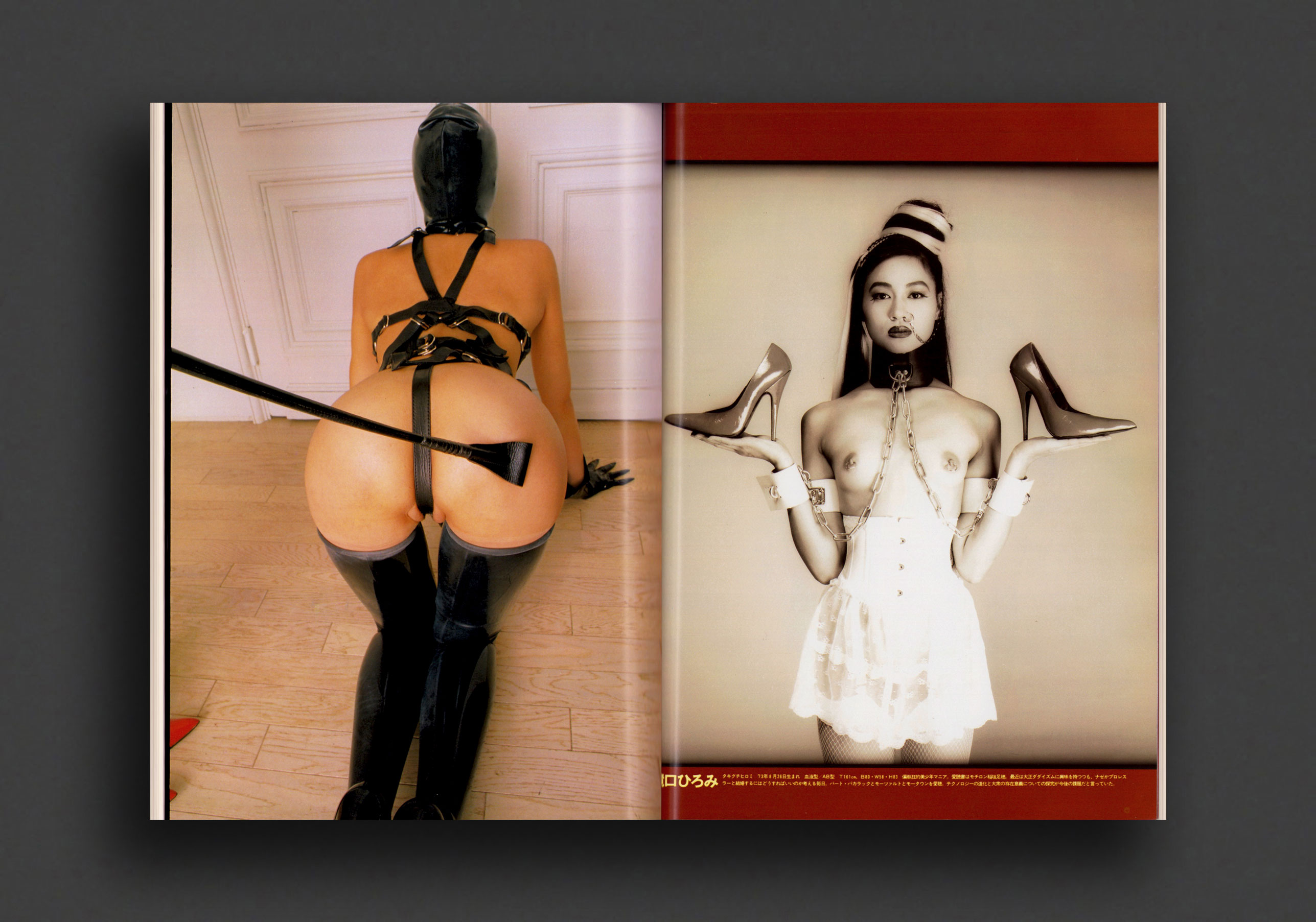
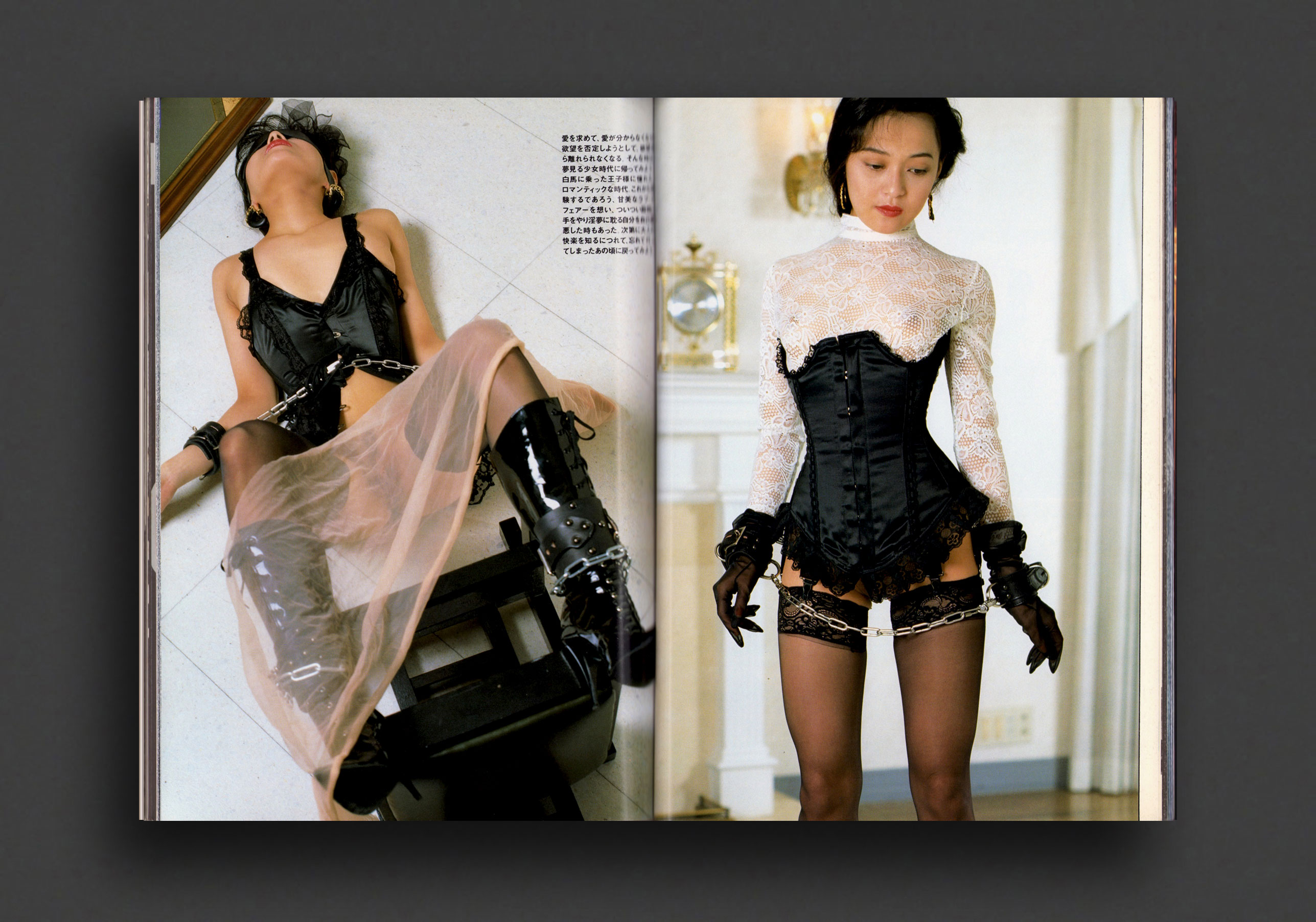
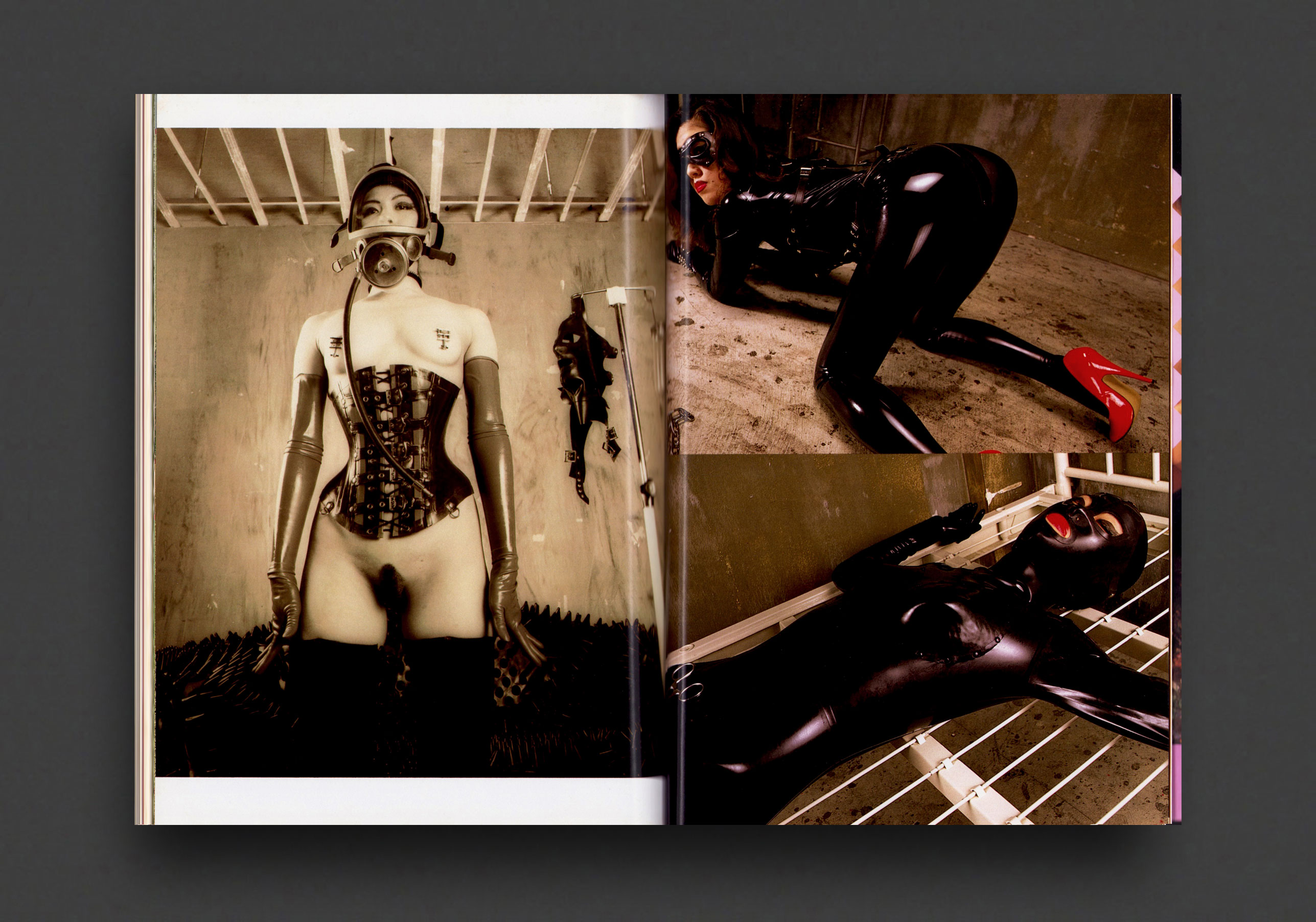
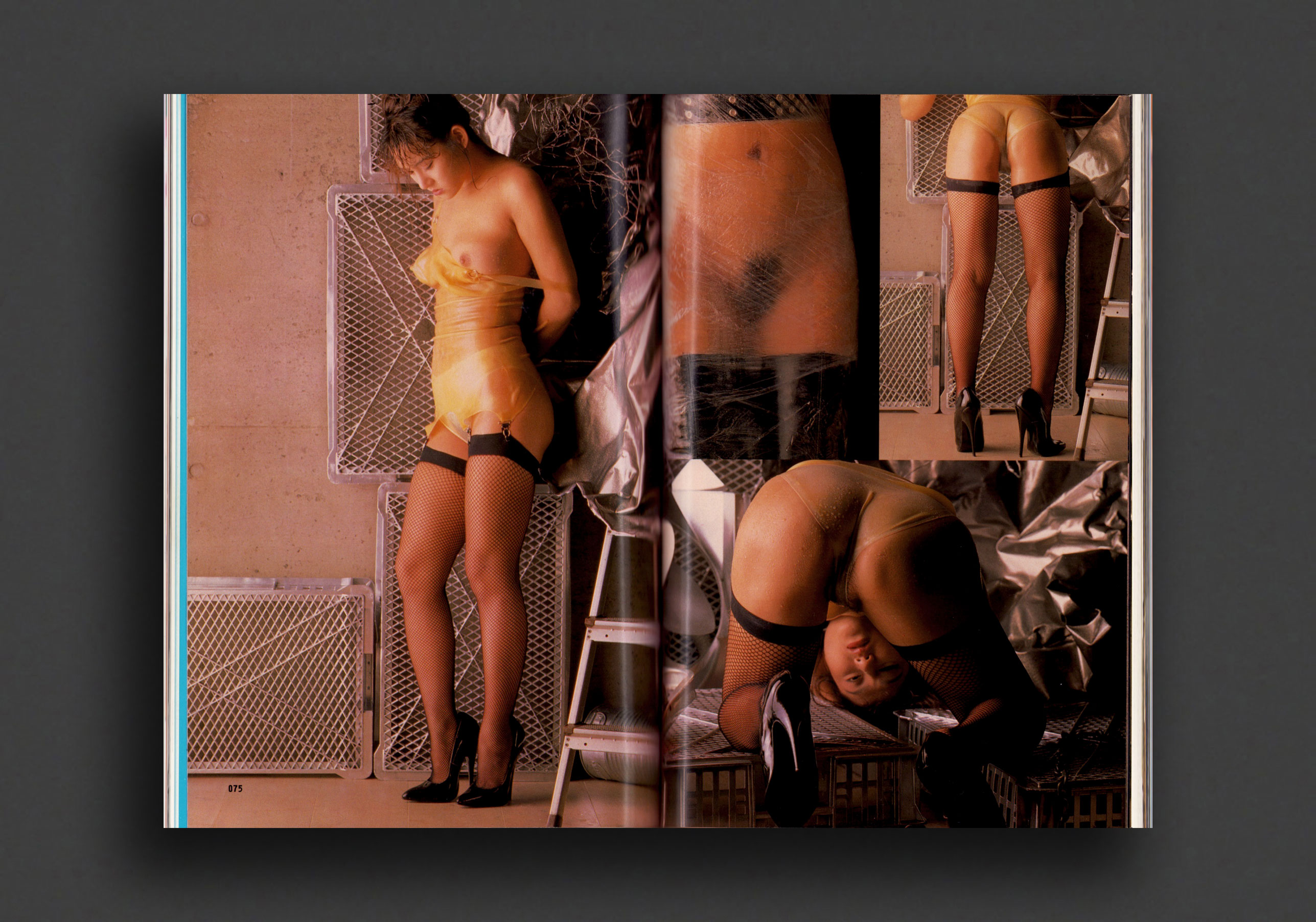
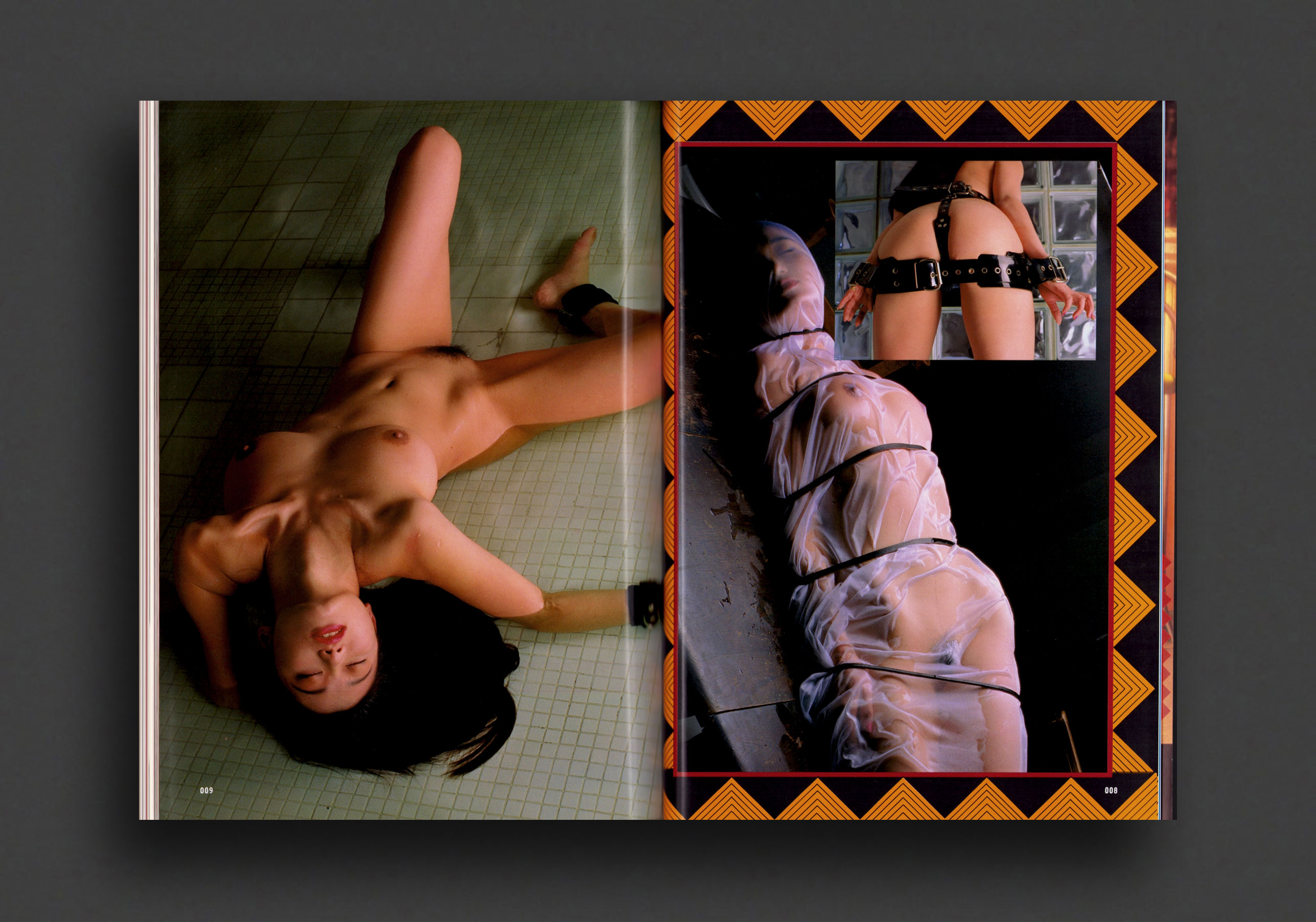
Inaugural April 1993 issue of Japan's short-lived Topaz magazine, published by Eichi Publishing. Edited by Kimura Hiroyuki, Topaz burst onto the flourishing SM scene as the influence of Kinbaku/Shibari culture, fetish fashion, "abnormal" sexual practices, modern primitive, and underground SM culture was becoming hugely influential on high-end fashion, glamour photography, and art/film/music at large. A similar approach to SM Sniper, sharing many of the same contributors such as SM archivist and noise musician Masami Akita (Merzbow), Topaz emphasised the new wave of artistic output from the real protagonists of the experimental SM counterculture in Japan (and abroad), centering around the work of the models, stylists, make-up artists, and fashions designers, as much as the kinbakushi, writers or photographers. Topaz benefited from the large format of a glossy, full-colour magazine, rather than the usual mook format of SM magazines, each issue packed with hundreds of images, a double-sided full-colour fold-out poster, original full-colour glossy photo-shoots, art galleries, reports and reviews on developments in the underground (noise music, pink film, sex clubs, erotic art, etc.), instructional and historical articles, rare interviews and profiles with the featured models and artists, and photo features on all manner of sexual customs and practices (transsexualism, lesbianism, virtual sex, rubberism, medical fetish, prostitution, techno sex...). One of the most under-rated SM mags from Tokyo, brimming with information on underground publishing, boutiques, and erotic art largely lost to time.
Very Good copy.
1993, Japanese
Softcover, 140 + pages, 29 x 21 cm
1st Edition, Out of print title / used / very good
Published by
Eichi Shuppan / Tokyo
$65.00 - Out of stock
"For All Beautiful and Sensual Pleasure"
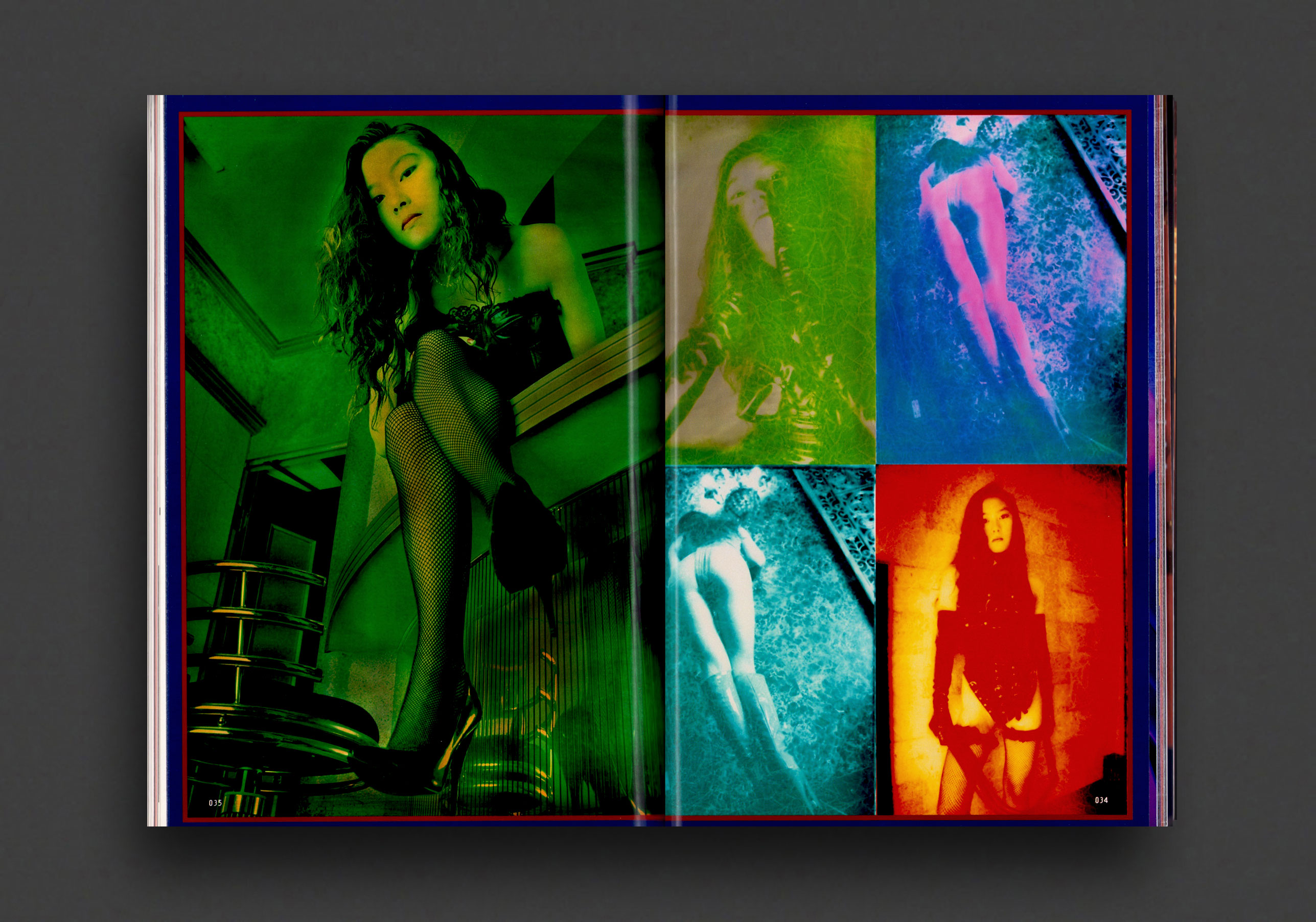
October 1993 issue of Japan's short-lived Topaz magazine, first published by Eichi Publishing in April 1993. Edited by Kimura Hiroyuki, Topaz burst onto the flourishing SM scene as the influence of Kinbaku/Shibari culture, fetish fashion, "abnormal" sexual practices, modern primitive, and underground SM culture was becoming hugely influential on high-end fashion, glamour photography, and art/film/music at large. A similar approach to SM Sniper, sharing many of the same contributors such as SM archivist and noise musician Masami Akita (Merzbow), Topaz emphasised the new wave of artistic output from the real protagonists of the experimental SM counterculture in Japan (and abroad), centering around the work of the models, stylists, make-up artists, and fashions designers, as much as the kinbakushi, writers or photographers. Topaz benefited from the large format of a glossy, full-colour magazine, rather than the usual mook format of SM magazines, each issue packed with hundreds of images, a double-sided full-colour fold-out poster, original full-colour glossy photo-shoots, art galleries, reports and reviews on developments in the underground (noise music, pink film, sex clubs, erotic art, etc.), instructional and historical articles, rare interviews and profiles with the featured models and artists, and photo features on all manner of sexual customs and practices (transsexualism, lesbianism, virtual sex, rubberism, medical fetish, prostitution, techno sex...). One of the most under-rated SM mags from Tokyo, brimming with information on underground publishing, boutiques, and erotic art largely lost to time.
Very Good copy.
1993, Japanese
Softcover, 140 + pages, 29 x 21 cm
1st Edition, Out of print title / used / very good
Published by
Eichi Shuppan / Tokyo
$65.00 - In stock -
"For All Beautiful and Sensual Pleasure"
December 1993 issue of Japan's short-lived Topaz magazine, first published by Eichi Publishing in April 1993. Edited by Kimura Hiroyuki, Topaz burst onto the flourishing SM scene as the influence of Kinbaku/Shibari culture, fetish fashion, "abnormal" sexual practices, modern primitive, and underground SM culture was becoming hugely influential on high-end fashion, glamour photography, and art/film/music at large. A similar approach to SM Sniper, sharing many of the same contributors such as SM archivist and noise musician Masami Akita (Merzbow), Topaz emphasised the new wave of artistic output from the real protagonists of the experimental SM counterculture in Japan (and abroad), centering around the work of the models, stylists, make-up artists, and fashions designers, as much as the kinbakushi, writers or photographers. Topaz benefited from the large format of a glossy, full-colour magazine, rather than the usual mook format of SM magazines, each issue packed with hundreds of images, a double-sided full-colour fold-out poster, original full-colour glossy photo-shoots, art galleries, reports and reviews on developments in the underground (noise music, pink film, sex clubs, erotic art, etc.), instructional and historical articles, rare interviews and profiles with the featured models and artists, and photo features on all manner of sexual customs and practices (transsexualism, lesbianism, virtual sex, rubberism, medical fetish, prostitution, techno sex...). One of the most under-rated SM mags from Tokyo, brimming with information on underground publishing, boutiques, and erotic art largely lost to time.
Very Good copy.
1994, Japanese
Softcover, 140 + pages, 26 x 18 cm
1st Edition, Out of print title / used / very good
Published by
Eichi Shuppan / Tokyo
$55.00 - In stock -
"For All Beautiful and Sensual Pleasure"
February 1994 issue of Japan's short-lived Topaz magazine, first published by Eichi Publishing in April 1993. Edited by Kimura Hiroyuki, Topaz burst onto the flourishing SM scene as the influence of Kinbaku/Shibari culture, fetish fashion, "abnormal" sexual practices, modern primitive, and underground SM culture was becoming hugely influential on high-end fashion, glamour photography, and art/film/music at large. A similar approach to SM Sniper, sharing many of the same contributors such as SM archivist and noise musician Masami Akita (Merzbow), Topaz emphasised the new wave of artistic output from the real protagonists of the experimental SM counterculture in Japan (and abroad), centering around the work of the models, stylists, make-up artists, and fashions designers, as much as the kinbakushi, writers or photographers. Topaz benefited from the large format of a glossy, full-colour magazine, rather than the usual mook format of SM magazines, each issue packed with hundreds of images, a double-sided full-colour fold-out poster, original full-colour glossy photo-shoots, art galleries, reports and reviews on developments in the underground (noise music, pink film, sex clubs, erotic art, etc.), instructional and historical articles, rare interviews and profiles with the featured models and artists, and photo features on all manner of sexual customs and practices (transsexualism, lesbianism, virtual sex, rubberism, medical fetish, prostitution, techno sex...). One of the most under-rated SM mags from Tokyo, brimming with information on underground publishing, boutiques, and erotic art largely lost to time.
This issue was slightly smaller in dimensions and skipped the poster.
Very Good copy.
1994, Japaanese
Softcover, 140 + pages, 29 x 21 cm
1st Edition, Out of print title / used / very good
Published by
Eichi Shuppan / Tokyo
$65.00 - In stock -
"For All Beautiful and Sensual Pleasure"
April 1994 issue of Japan's short-lived Topaz magazine, first published by Eichi Publishing in April 1993. Edited by Kimura Hiroyuki, Topaz burst onto the flourishing SM scene as the influence of Kinbaku/Shibari culture, fetish fashion, "abnormal" sexual practices, modern primitive, and underground SM culture was becoming hugely influential on high-end fashion, glamour photography, and art/film/music at large. A similar approach to SM Sniper, sharing many of the same contributors such as SM archivist and noise musician Masami Akita (Merzbow), Topaz emphasised the new wave of artistic output from the real protagonists of the experimental SM counterculture in Japan (and abroad), centering around the work of the models, stylists, make-up artists, and fashions designers, as much as the kinbakushi, writers or photographers. Topaz benefited from the large format of a glossy, full-colour magazine, rather than the usual mook format of SM magazines, each issue packed with hundreds of images, a double-sided full-colour fold-out poster, original full-colour glossy photo-shoots, art galleries, reports and reviews on developments in the underground (noise music, pink film, sex clubs, erotic art, etc.), instructional and historical articles, rare interviews and profiles with the featured models and artists, and photo features on all manner of sexual customs and practices (transsexualism, lesbianism, virtual sex, rubberism, medical fetish, prostitution, techno sex...). One of the most under-rated SM mags from Tokyo, brimming with information on underground publishing, boutiques, and erotic art largely lost to time.
Very Good copy.
1994, Japanese
Softcover, 140 + pages, 29 x 21 cm
1st Edition, Out of print title / used / very good
Published by
Eichi Shuppan / Tokyo
$65.00 - In stock -
"For All Beautiful and Sensual Pleasure"
August 1994 issue of Japan's short-lived Topaz magazine, first published by Eichi Publishing in April 1993. Edited by Kimura Hiroyuki, Topaz burst onto the flourishing SM scene as the influence of Kinbaku/Shibari culture, fetish fashion, "abnormal" sexual practices, modern primitive, and underground SM culture was becoming hugely influential on high-end fashion, glamour photography, and art/film/music at large. A similar approach to SM Sniper, sharing many of the same contributors such as SM archivist and noise musician Masami Akita (Merzbow), Topaz emphasised the new wave of artistic output from the real protagonists of the experimental SM counterculture in Japan (and abroad), centering around the work of the models, stylists, make-up artists, and fashions designers, as much as the kinbakushi, writers or photographers. Topaz benefited from the large format of a glossy, full-colour magazine, rather than the usual mook format of SM magazines, each issue packed with hundreds of images, a double-sided full-colour fold-out poster, original full-colour glossy photo-shoots, art galleries, reports and reviews on developments in the underground (noise music, pink film, sex clubs, erotic art, etc.), instructional and historical articles, rare interviews and profiles with the featured models and artists, and photo features on all manner of sexual customs and practices (transsexualism, lesbianism, virtual sex, rubberism, medical fetish, prostitution, techno sex...). One of the most under-rated SM mags from Tokyo, brimming with information on underground publishing, boutiques, and erotic art largely lost to time.
Very Good copy.
2016, English
Softcover, 464 pages, 19.7 x 13 cm
Published by
Penguin Books / London
$28.00 - Out of stock
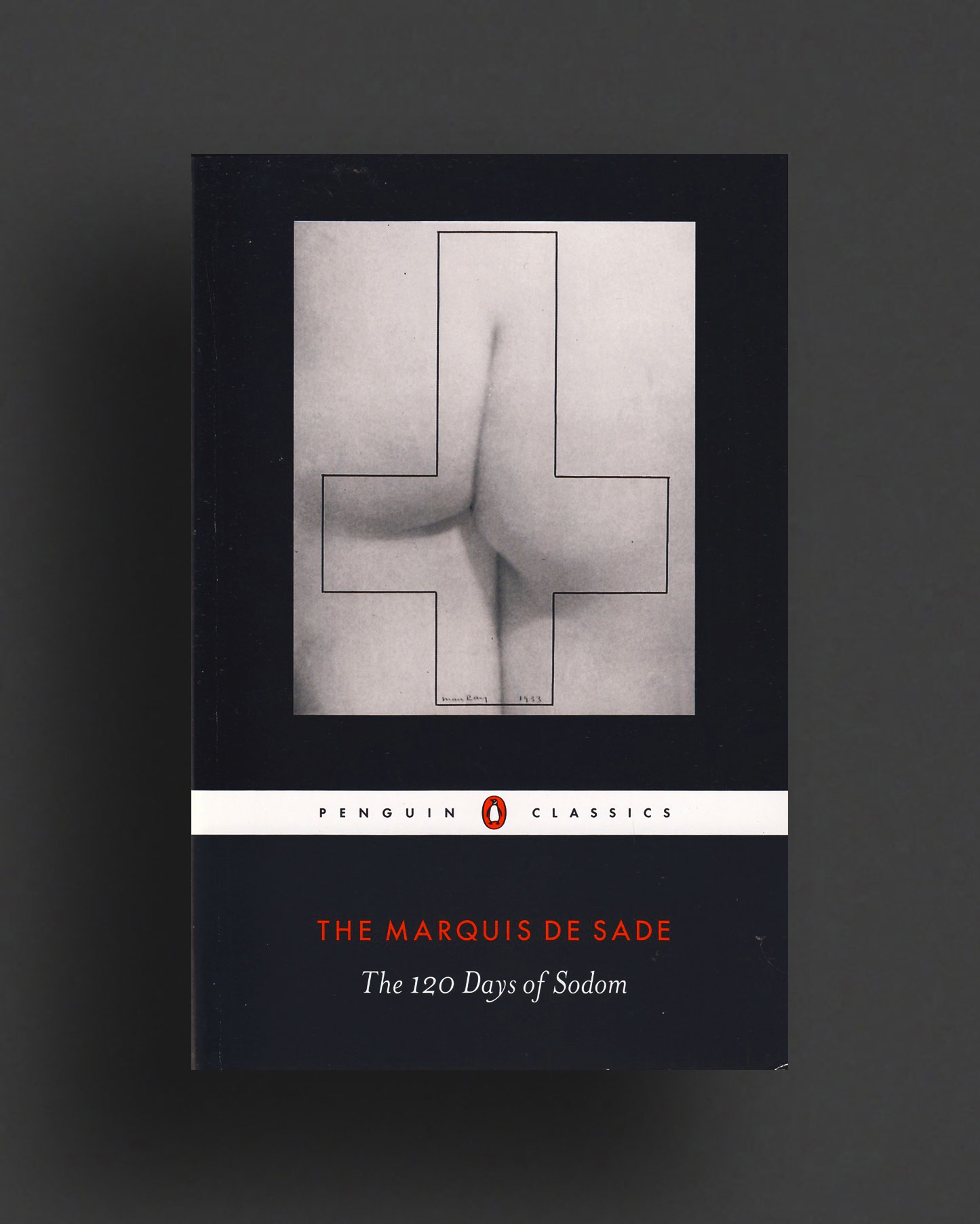
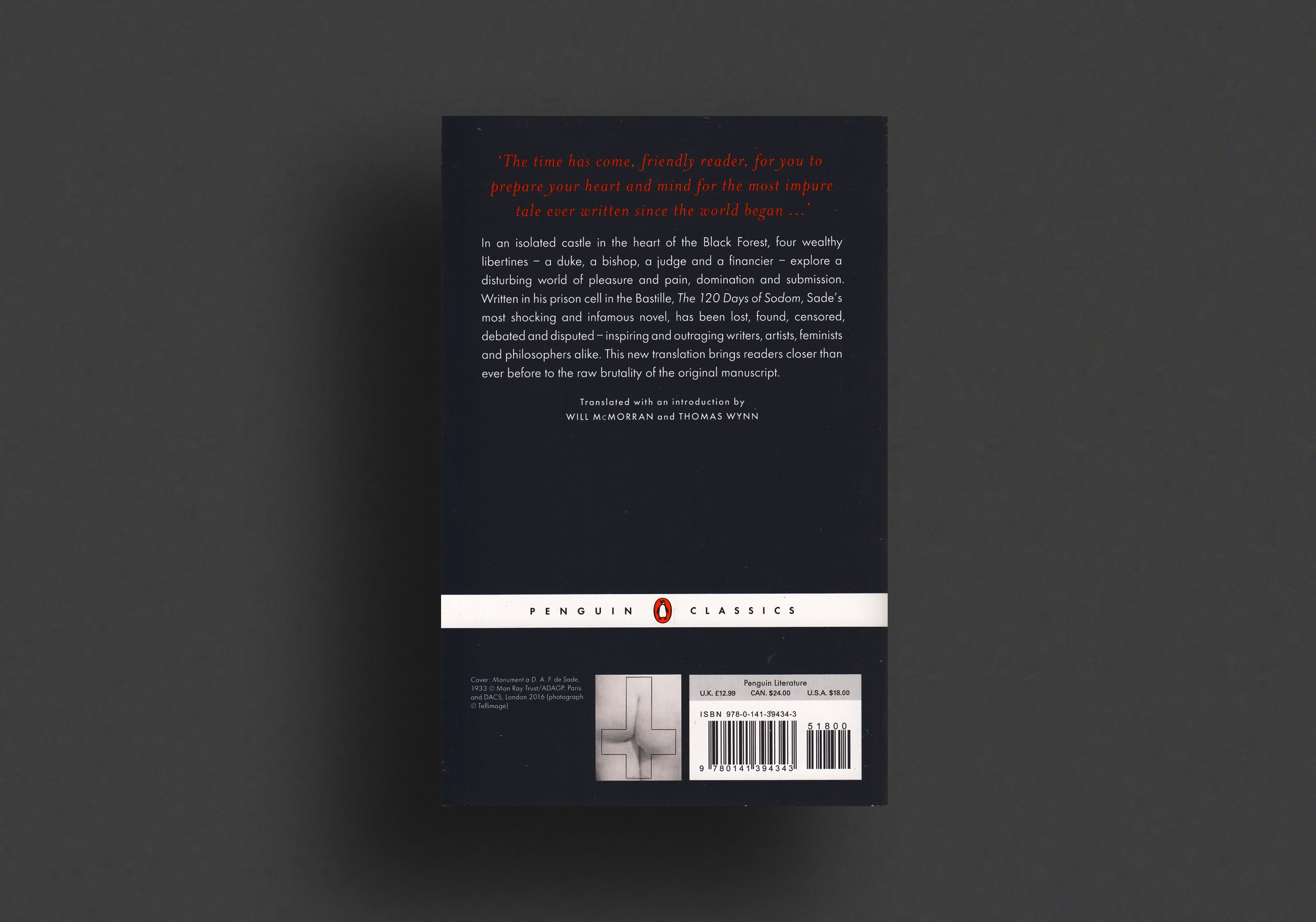
A new translation of Sade's most notorious, shocking, and influential novel
This distressing but hugely important text, which the Marquis de Sade himself called "the most impure tale that has ever been written since the world exists," has influenced countless major artists and thinkers throughout history. Flaubert and Baudelaire both read Sade, the surrealists were obsessed with him, filmmakers like Pasolini saw parallels with twentieth-century history in his writings, and feminists such as Simone de Beauvoir and Angela Carter fought over him. This new translation brings Sade's provocative novel into Penguin Classics for the first time, and will reignite the debate around this most controversial of writers.
For more than seventy years, Penguin has been the leading publisher of classic literature in the English-speaking world. With more than 1,700 titles, Penguin Classics represents a global bookshelf of the best works throughout history and across genres and disciplines. Readers trust the series to provide authoritative texts enhanced by introductions and notes by distinguished scholars and contemporary authors, as well as up-to-date translations by award-winning translators.
1988, Japanese
Softcover (staple-bound), 98 pages, 27 x 21 cm
1st Edition, Out of print title / used / very good
Published by
Sun Publishing / Japan
$45.00 - Out of stock
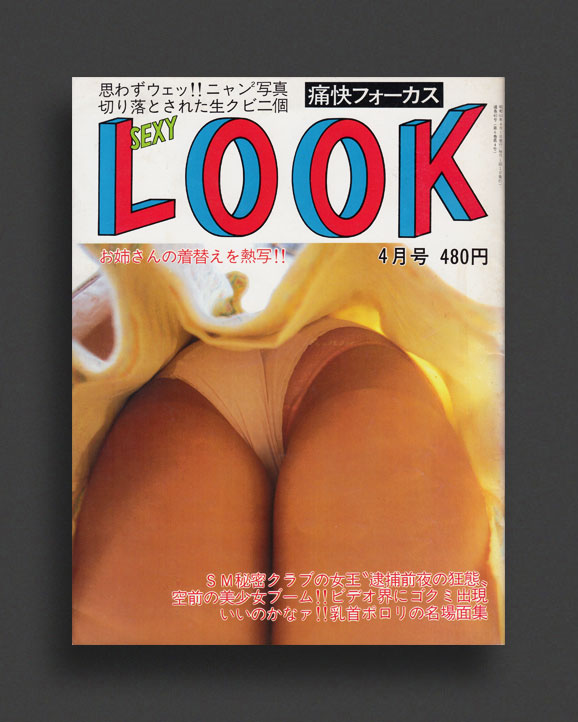
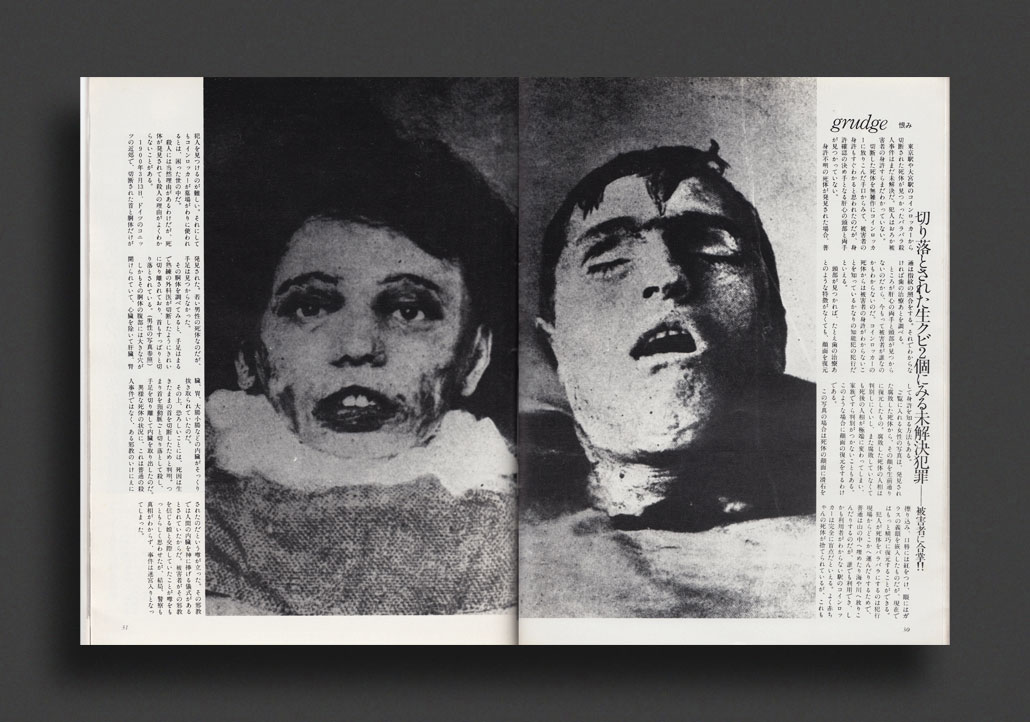
April 1988 issue of Sun Publishing's Sexy Look magazine, a highly collected glossy photo magazine from Tokyo that is made up entirely of colour and b/w spreads throughout that take a single word or phrase, like an accumulative gentlemen's magazine cum encyclopedia of the bizarre, to introduce the reader to titillating thrills, perversions, weird crimes, unusual customs, anthropological oddities, and the 1980s Japanese sex industry from all angles each month. The most prominent angle was a low one, as primarily the magazine was an excuse for the many contributing photographers to take "close-up" peeper/FLASH photography of women (ala Kohei Yoshiyuki and Ikko Kagari). Lots of Tokyo sex club material, with spreads punctuated by ads for pink videos and sex toys.
Very Good copy, light wear.
1986, French
Softcover, 30 pages, 15 x 10.5 cm
Signed by the artist,
1st Edition, Out of print title / used / very good
Published by
Carton Éditions / Lyon
$50.00 - Out of stock
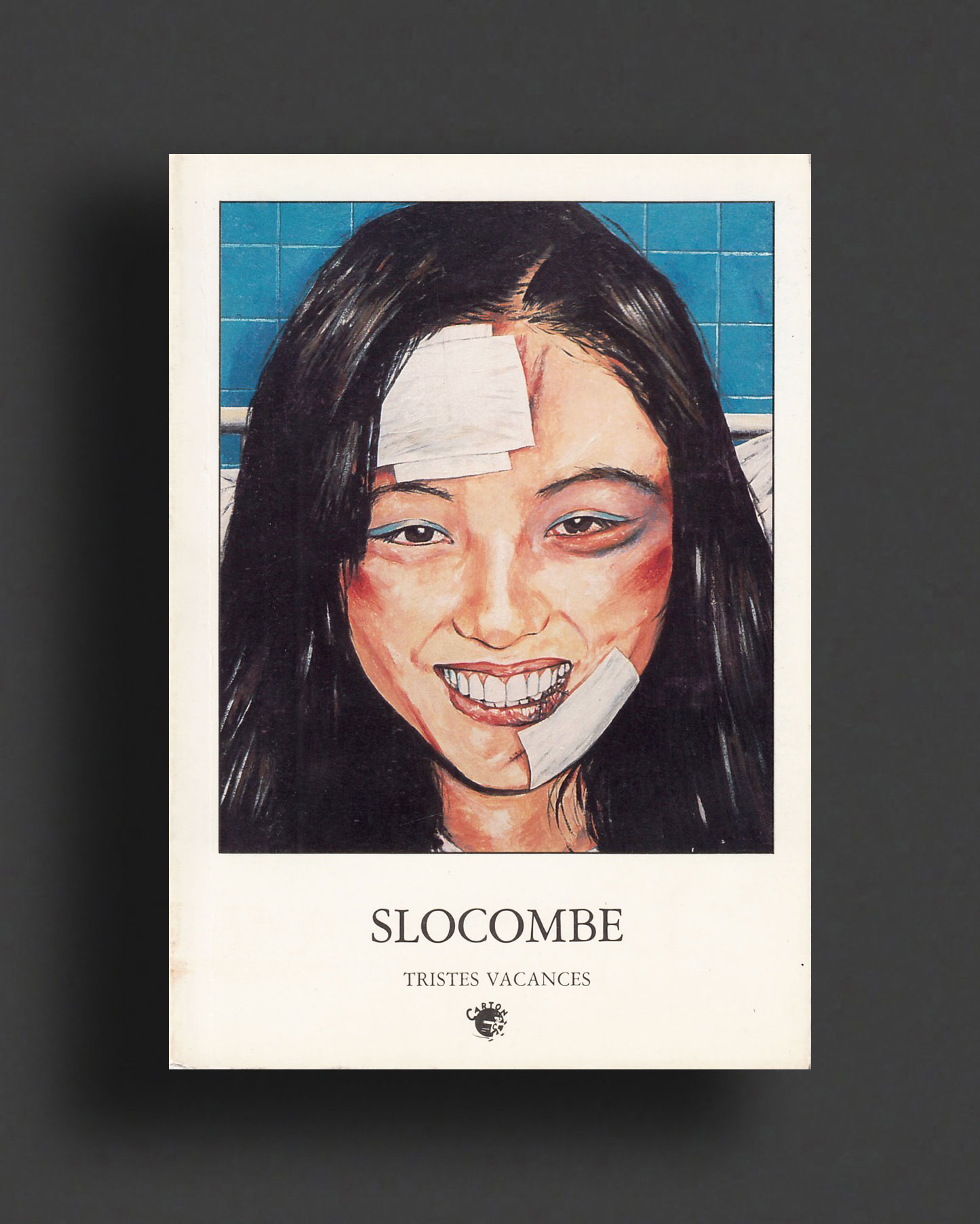
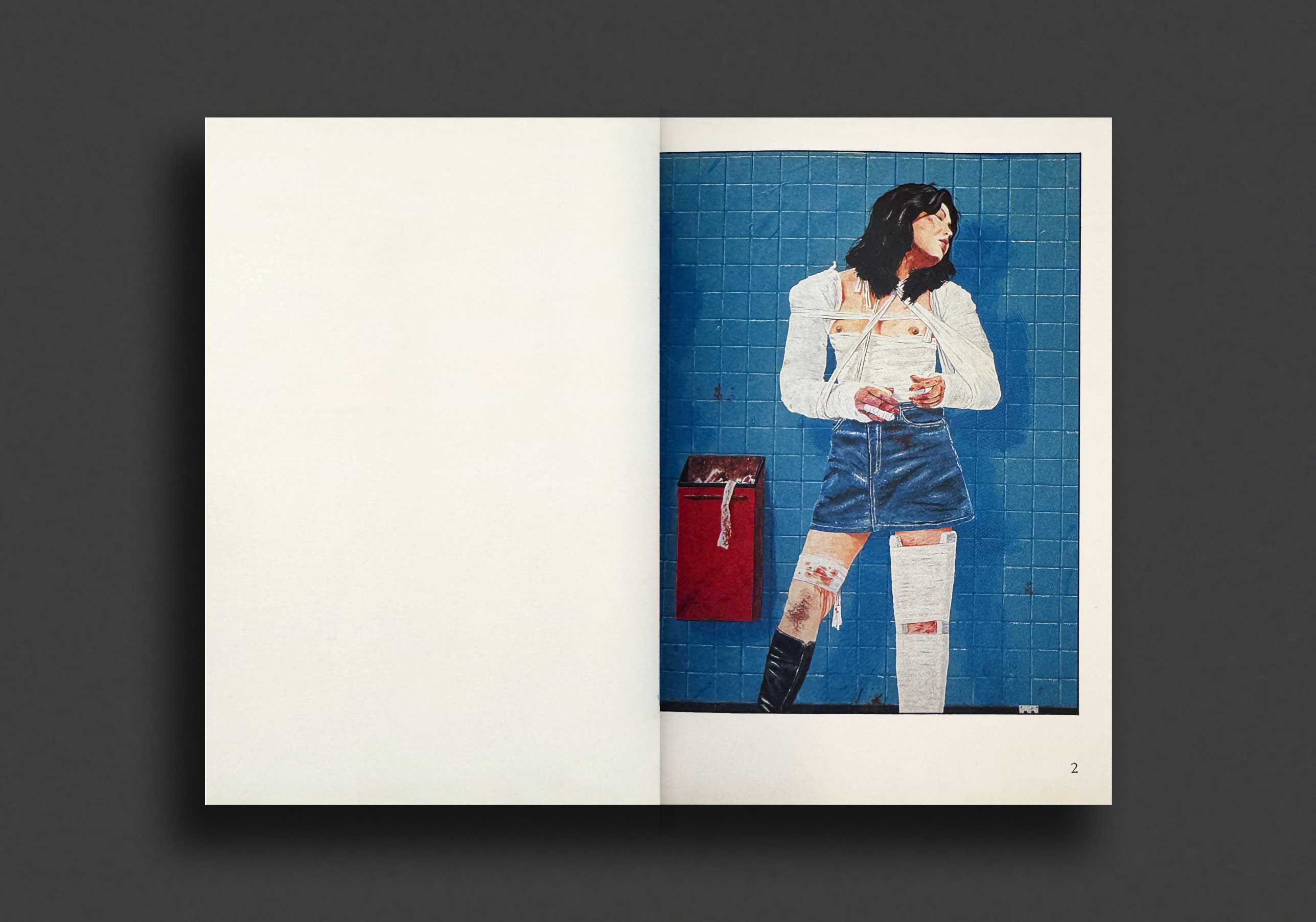
Early 1986 pocket book of medical fetish illustration by Romain Slocombe, "Sad Vacations", signed by the artist. Fifteen full colour works by Slocombe are accompanied by texts (in French) by François Landon and descriptions of each work by Jacques Peeters.
A French cartoonist, illustrator, book author, translator, photographer and filmmaker, Romain Slocombe, born in Paris in 1953, began his career as an illustrator working on comics and counter-culture magazines such as Métal Hurlant in the late 1970s and early 1980s. As an artist, he was closely involved with the punk Bazooka collective, with Kiki Picasso, Bernard Vidal, Natsuko, Yoshi Ichimura, Fred Chalmer, Loulou Picasso, and others, having studied alongside many of its members at the École des Beaux-Arts in Paris. He became known as a comic strip author and published his first bondage album, Prisoner of the Red Army, which caused a scandal. While bandaging women, the artist develops an aesthetics of upheaval, of which J.G. Ballard became the cult writer. Seizing the dark side of Japanese fetishism to invent a new genre of artistic SM — "surgical bondage", Slocombe's medical fetishised "broken dolls" would enter into subcultural history forever through the 1996 publication City of Broken Dolls. Slocombe's distinctive paintings, drawings and photographs of women in medical bondage — tied, injured, bandaged, imprisoned and hospitalised, often combining a re-working of historical political revolution, WW2, noir fiction, and Japanese photographic SM imagery with the graphic language of bande dessinée comic-roman and new wave expressionism, became some of the most strikingly original and influential erotic art of the subcultural 1990s.
Very Good copy, light wear/age.
2022, English
Softcover, 192 pages, 21 x 13.5 cm
Signed by the author,
Published by
Black Inc / Melbourne
$28.00 - In stock -
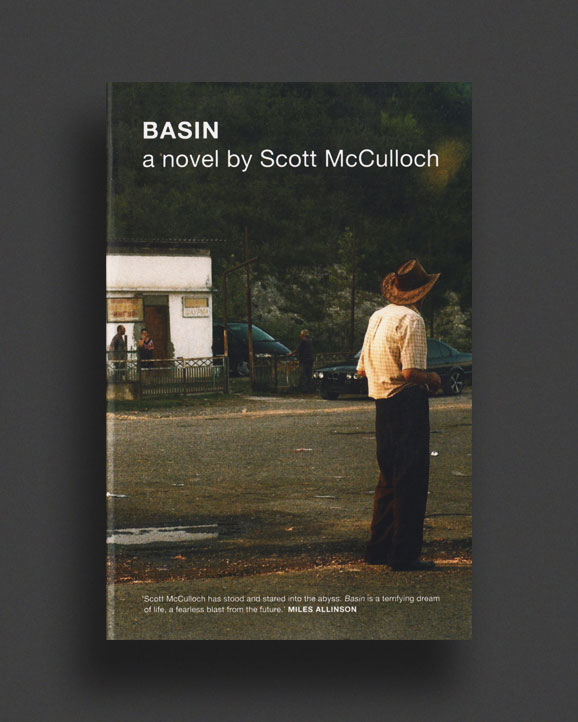
A dark and compelling work by a new voice in Australian – and world – literary fiction.
A nomad swallows poison and drowns himself. Resuscitated by a paramilitary bandit named Aslan, Figure is nursed back into a world of violence, sexuality and dementia. Together, Figure and Aslan traverse a coastline erupting in conflict. When the nearest city is ethnically cleansed, Figure escapes on the last ship evacuating to the other isle of the sea. Crossing village to village largely on foot, a slew of outcasts and ghosts guide him as he navigates states of cultural and metaphysical crisis.
Scott McCulloch’s debut novel, Basin, explores the axis of landscape and consciousness. Echoing the modernist tradition, and written in an incendiary yet elliptical prose style, Basin maps the phenomenon of a civilisation being reborn – a hallucinatory elegy to the inter-zones of self and place.
Born in Melbourne, based between Ukraine and the Caucasus since 2014, and currently dividing his time between Lebanon and Georgia, Scott McCulloch works with prose, essay and sound. His writings have appeared in various magazines and journals worldwide. Basin is his debut novel.
2020, English
Softcover, 408 pages 21.6 x 15.5 cm
1st Edition, Out of print title / used / very good
Published by
Amphetamine Sulphate / Austin
$90.00 - Out of stock
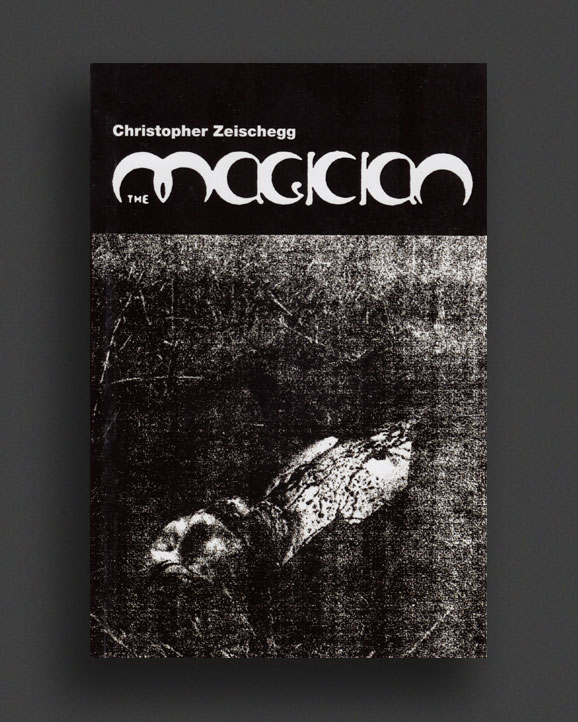
First (out-of-print) Amphetamine Sulphate edition.
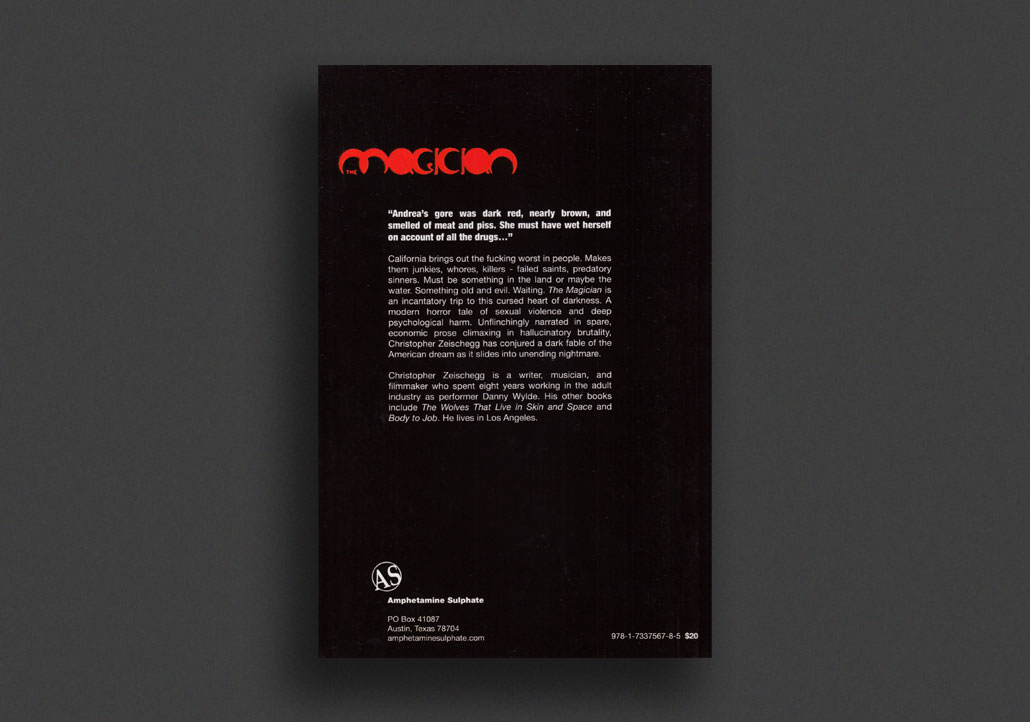
“Andrea’s gore was dark red, nearly brown, and smelled of meat and piss. She must have wet herself on account of all the drugs…”
California brings out the fucking worst in people. Makes them junkies, whores, killers - failed saints, predatory sinners. Must be something in the land or maybe the water. Something old and evil. Waiting. The Magician is an incantatory trip to this cursed heart of darkness. A modern horror tale of sexual violence and deep psychological harm. Unflinchingly narrated in spare, economic prose climaxing in hallucinatory brutality, Christopher Zeischegg has conjured a dark fable of the American dream as it slides into unending nightmare.
Christopher Zeischegg is a writer, musician, and filmmaker who spent eight years working in the adult industry as performer Danny Wylde. His other books include The Wolves That Live in Skin and Space and Body to Job. He lives in Los Angeles.
Very Good copy with light wear to extremities.
2025, English
Softcover, 208 pages, 20.3 x 12.62 cm
Published by
The New York Review of Books / New York
$36.00 - In stock -
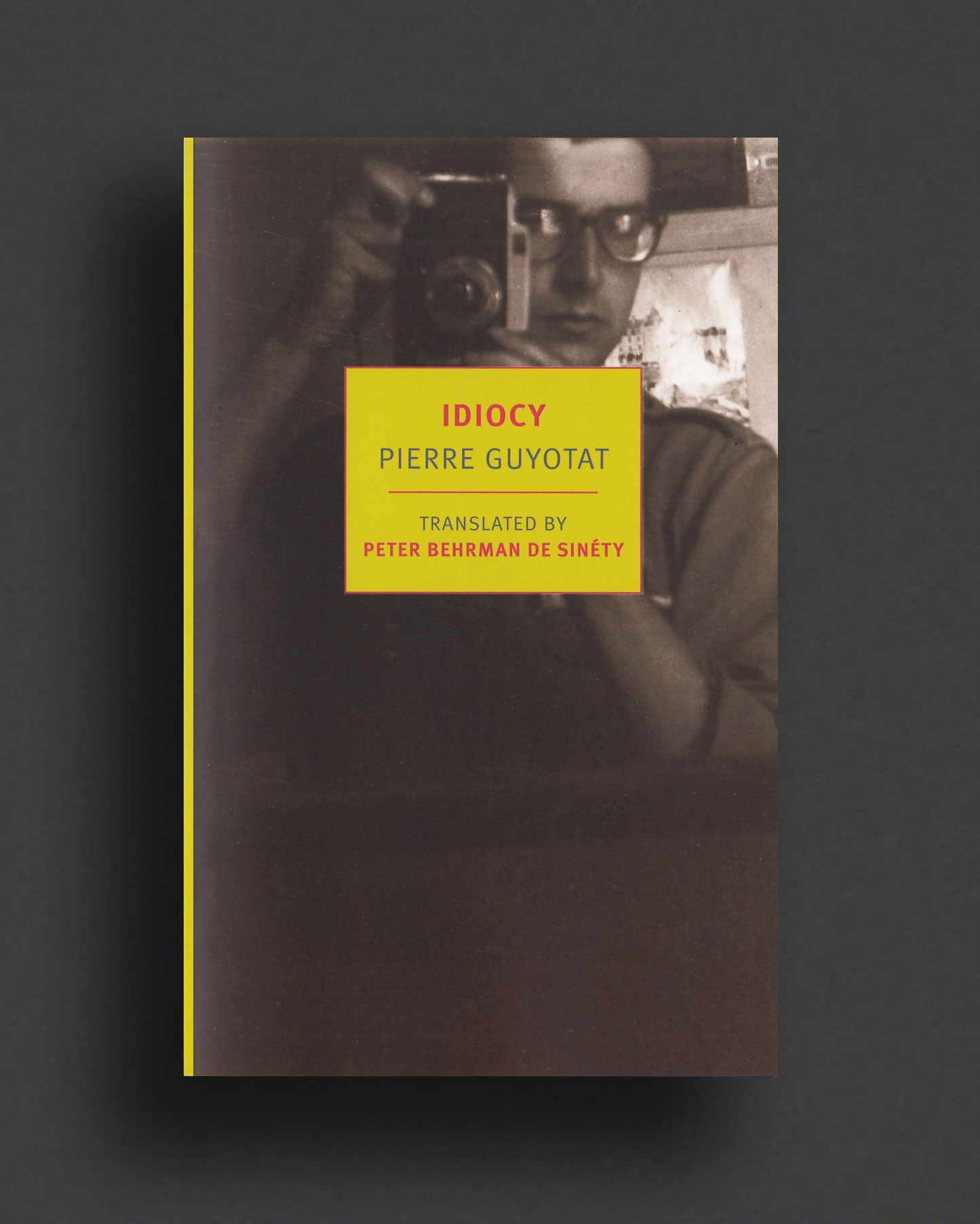
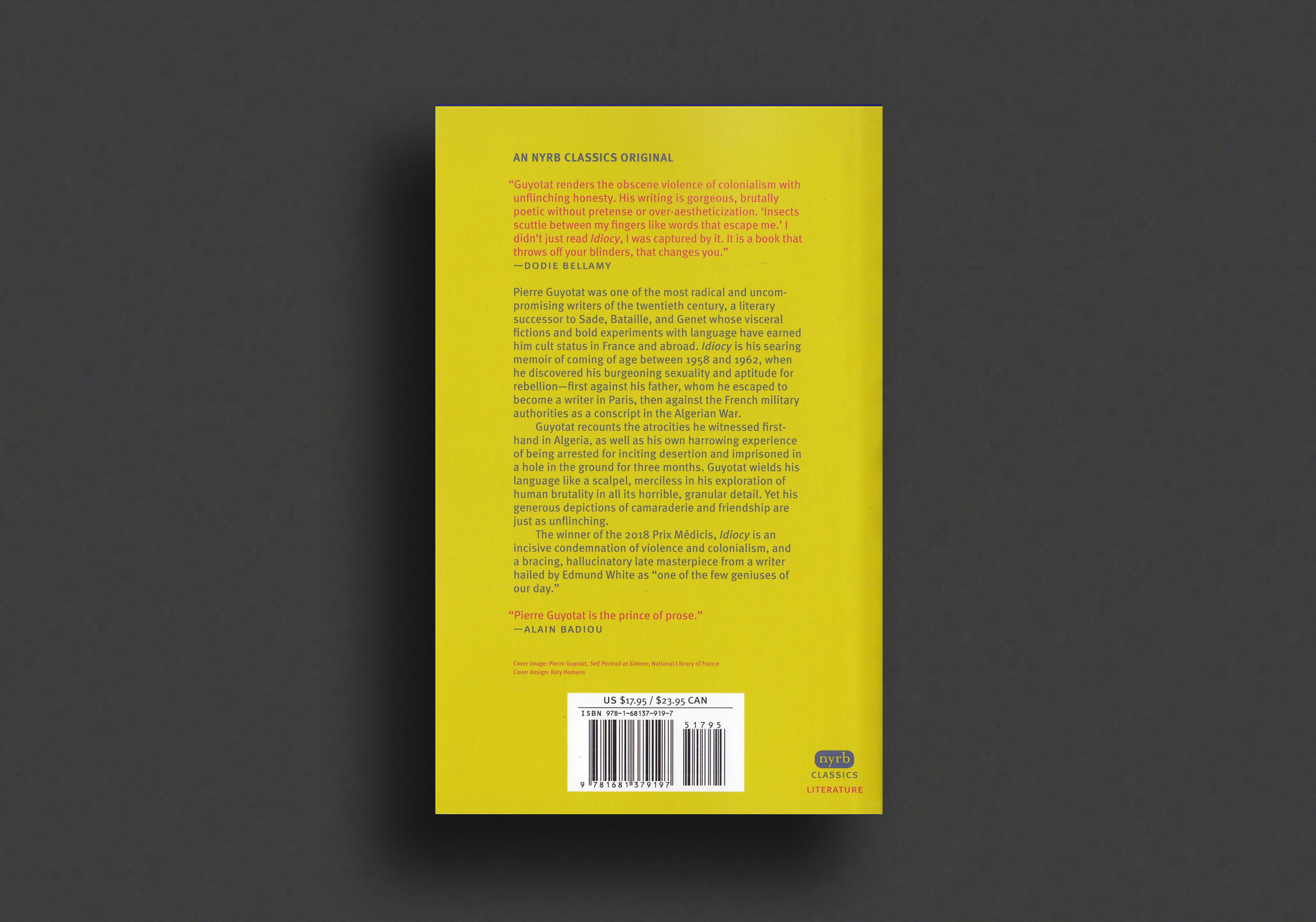
An audacious, unabashedly transgressive memoir about two acts of escape by the author: rebelling aginst his family to seek a freer life in Paris and then, later, from the French military during the Algerian War.
Translated by Peter Behrman De Sinéty.
Pierre Guyotat was one of the most radical and uncompromising writers of the twentieth century, a literary successor to Sade, Bataille, and Genet whose visceral fictions and bold experiments with language have earned him cult status in France and abroad. Idiocy is his searing memoir of coming of age between 1958 and 1962, when he discovered his burgeoning sexuality and aptitude for rebellion—first against his father, whom he escaped to become a writer in Paris, then against the French military authorities as a conscript in the Algerian War.
Guyotat recounts the atrocities he witnessed first-hand in Algeria, as well as his own harrowing experience of being arrested for inciting desertion and imprisoned in a hole in the ground for three months. Guyotat wields his language like a scalpel, merciless in his exploration of human brutality in all its horrible, granular detail. Yet his generous depictions of camaraderie and friendship are just as unflinching.
The winner of the 2018 Prix Médicis, Idiocy is an incisive condemnation of violence and colonialism, and a bracing, hallucinatory late masterpiece from a writer hailed by Edmund White as “one of the few geniuses of our day.”
"Pierre Guyotat is the prince of prose."—Alain Badiou
"Guyotat renders the obscene violence of colonialism with unflinching honesty. His writing is gorgeous, brutally poetic without pretense or over-aestheticization. 'Insects scuttle between my fingers like words that escape me.' I didn't just read Idiocy, I was captured by it. It is a book that throws off your blinders, that changes you."—Dodie Bellamy
"Idiocy, as a work of memoir, maintains an uncanny sobriety throughout its reportage, indulgent in its poetical description . . . As a medium intended to survey war and warmongering, Idiocy becomes more than a simple pulling back of the curtain of atrocity; it would, instead, pull down the whole damned rigging, lights, cameras, and all."—Blake Butler
"[Guyotat is] anti-authoritarian, pushing the French language to its limits of meaning, and fascinated by the filth of fighting, illness, and recovery. . . An ugly, terrifying memoir of childhood, war, and violation, rendered into nightmarish English."—Kirkus Reviews
About the Author
Pierre Guyotat (1940-2020) was a French writer. In 1960, he was conscripted into the Algerian War, the inhumanity of which would become a recurring theme throughout his oeuvre. He is the author of Tomb for 500,000 Soldiers, Eden, Eden, Eden, which was banned in France upon its publication in 1970, and Coma, which won the 2006 Prix Décembre. In 2018, he was awarded the Prix Femina spécial for lifetime achievement.
Peter Behrman de Sinéty grew up in Maine and lives in Paris. He was lecteur d'anglais at the École Normale Supérieure, where he has taught since 2011. His translations include Éric Chevillard's QWERTY Invectives and Maël Renouard's Fragments of an Infinite Memory.
1966, French
Hardcover (clothbound w. dustjacket), 110 pages, 20.5 x 30 cm
1st Edition, Out of print title / used / very good
Published by
Éditions Denoël / Paris
$150.00 - In stock -
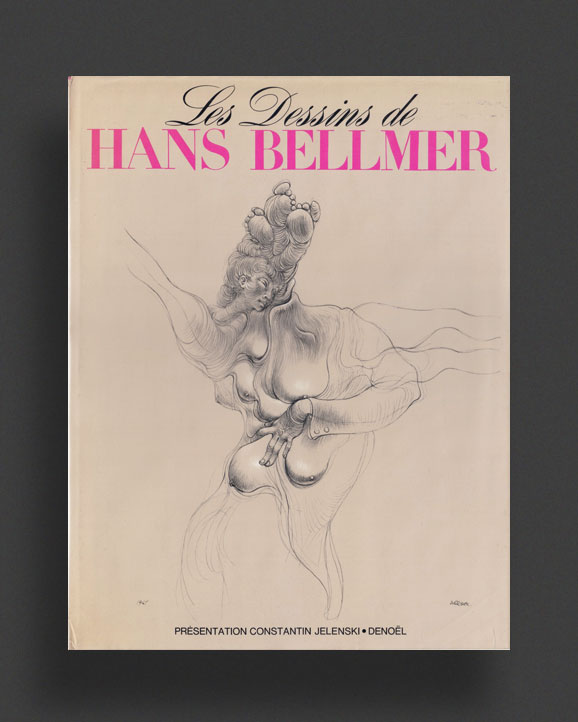
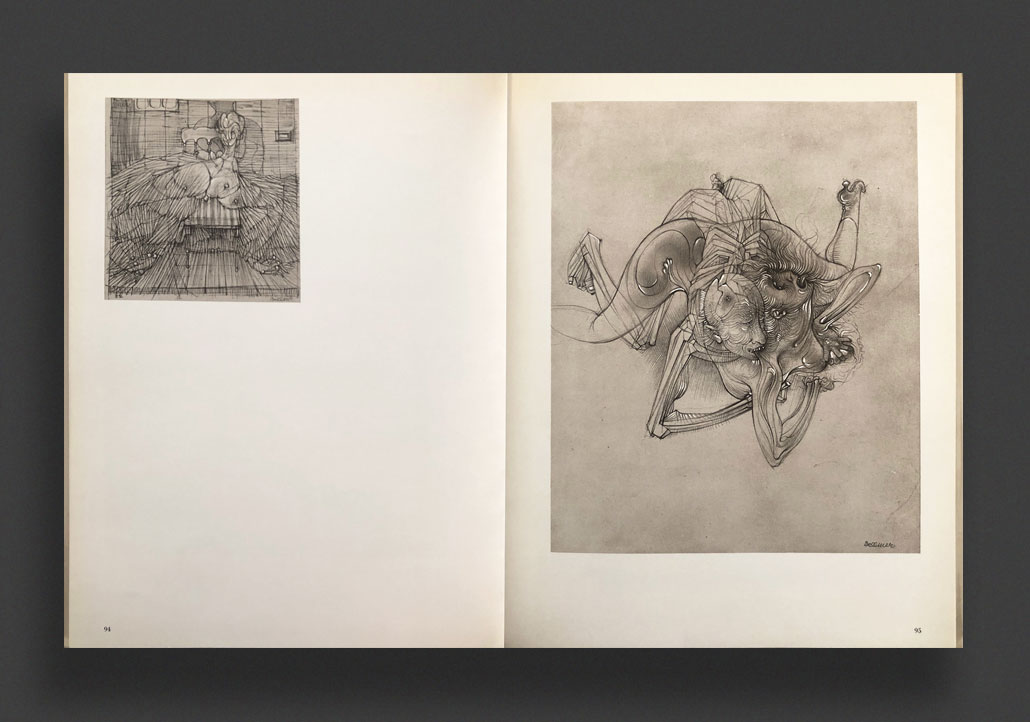
Beautifully produced, scarce French hardcover monographic volume dedicated entirely to reproductions of Surrealist visionary Hans Bellmer's incredible drawings. This is the very first edition, published by Éditions Denoël, Paris, in 1966. With an introduction by Constantin Jelenski. A stunning book, and a key title in the artist's oeuvre.
German artist Hans Bellmer (13 March 1902 – 23 February 1975), was best known for the life-sized pubescent female dolls he produced in the mid-1930s. "Bellmer was born in the city of Kattowitz, then part of the German Empire (now Katowice, Poland). Up until 1926, he'd been working as a draftsman for his own advertising company. He initiated his doll project to oppose the fascism of the Nazi Party by declaring that he would make no work that would support the new German state. Represented by mutated forms and unconventional poses, his dolls were directed specifically at the cult of the perfect body then prominent in Germany. Bellmer was influenced in his choice of art form by reading the published letters of Oskar Kokoschka (Der Fetisch, 1925)."
Very Good – (in original dust jacket and protected under plastic wrap)
1971, Japanese
Rigid softcover (in illustrated slipcase), 64 pages, 30 cm x 21 cm
1st Edition, Out of print title / used / very good
Published by
Gakugei Shorinsha / Tokyo
$380.00 - In stock -
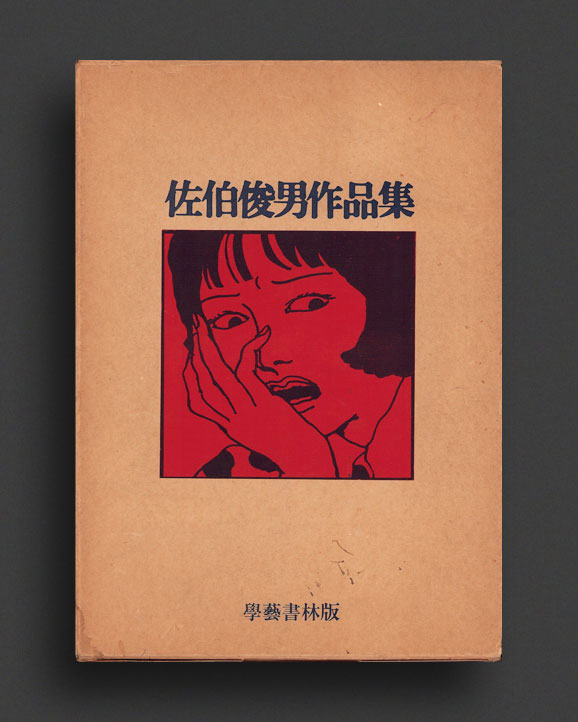
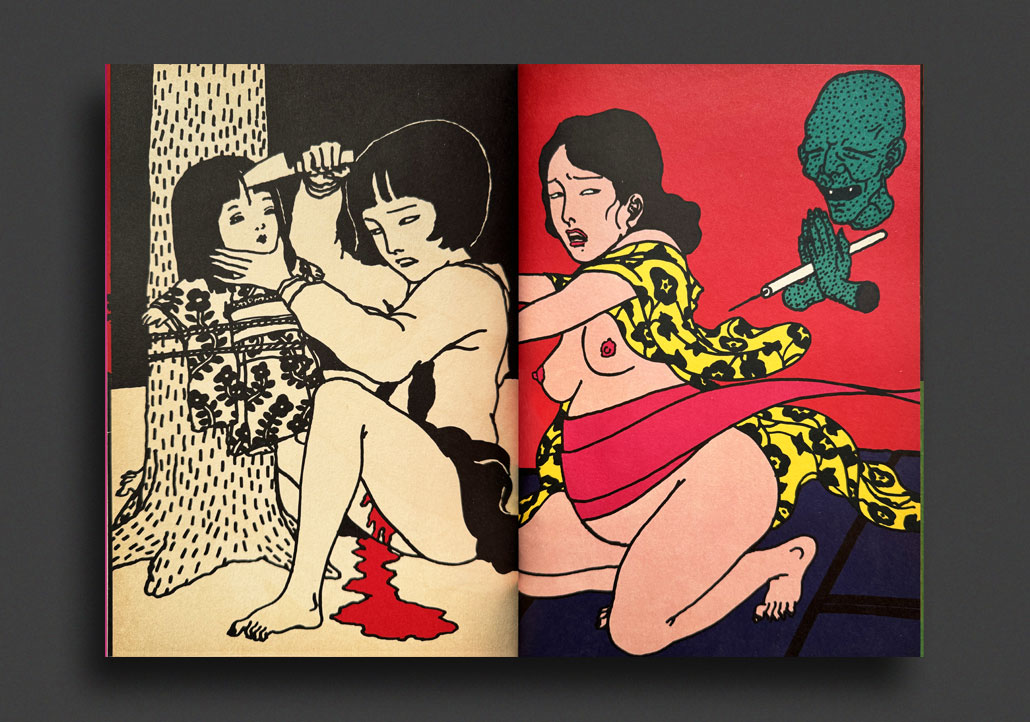
Super rare and bookshop favourite early collection of artworks by ero-guro master Toshio Saeki (1945—2019), published in 1971 by Gakugeishorin. Stunning large-format softcover collection of exquisitely printed saturated full-bleed colour and b/w artworks on warm matte paper stock capturing this legendary underground artist at the height of his powers, housed in original publisher's cardboard slipcase. His third book collection featuring so many of his finest works. Postface by Hiraoka Masaaki in Japanese. A must!
Toshio Saeki (1945—2019) was an illusive Japanese illustrator and painter, and icon of 1970s Tokyo counterculture, known for combining Japanese folklore, Yōkai spirits and elements of Western art with his own sophisticated aesthetics to create a unique, sensational world of eros, dark humour, and horror. Given the title “Erotic Engineer” by Timothy Leary, Saeki's provocative art broke all sexual taboos, questioned Japanese ideology and traditional views on love, desire and gender roles. Saeki’s surgically-precise graphic work is closely related to the Japanese cultural phenomenon ‘Erotic, Grotesque, Nonsense’ (ero, guro, nansensu).
“Toshio Saeki conjures death with a pen”—Shūji Terayama, 1969.
Very Good copy. Very complete copy with slipcase and obi present. Some wear/marking to a VG slipcase.
1977, French
Softcover, 352 pages, 28 x 22 cm
1st Edition, Out of print title / used / very good
Published by
Obliques / Paris
$160.00 - Out of stock
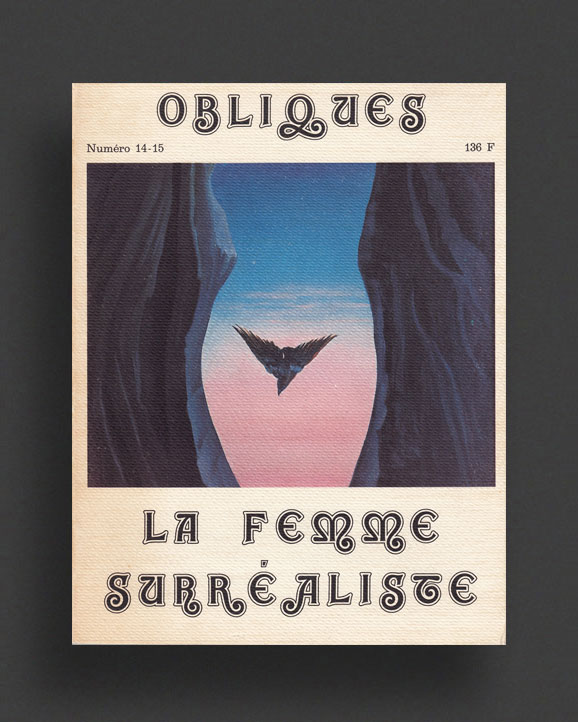
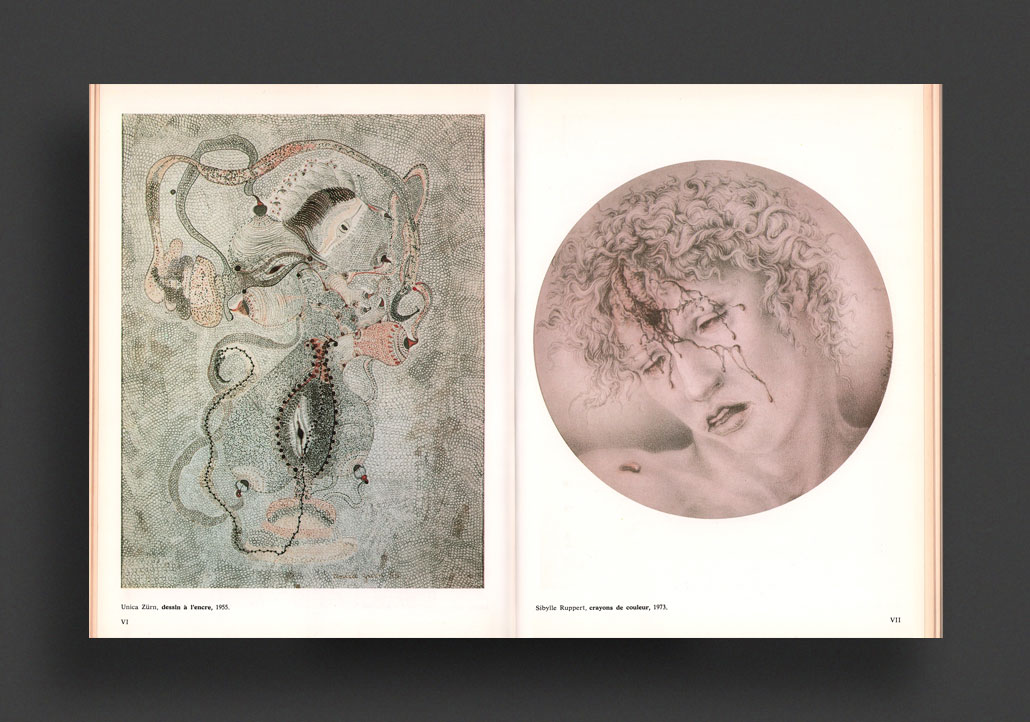
The landmark, over-sized Obliques special double issue, "La Femme Surréaliste", published in Paris in 1977. The French literary journal Obliques (who published special issues on Artaud, Bellmer, Kafka, Klossowski, Vian, Sartre, Robbe-Grillet, Strindberg, Genet...) was the first publisher to present a comprehensive list of the literary and plastic production of Surrealist women with this gorgeous volume, long before the works of surrealist women, as a corpus, began to be more widely studied in the 1980s. Featuring well known names, but also many female artists neglected and seldom mentioned in the recent (strangely narrow-minded) re-evaluation of this period, this beautifully printed issue of Obliques is an incredibly valuable reference on a movement that was decidedly ‘feminine’. Edited by Roger Borderie with Michel Camus, it features profiles on the work and writing of Belen, Maya Bell, Bona, Leonora Carrington, Lise Deharme, Jacqueline Duprey, Aube Elléouët, Josette Exandier, Leonor Fini, Aline Gagnaire, Giovanna, Jane Graverol, Marianne Van Hirtum, Rozeta Hum, Valentine Hugo, Karskaya, Greta Knutson, Laure, Gina Pane, Annie Lebrun, Georgette Magritte, Manina, Joyce Mansour, Nora Mitrani, Meret Oppenheim, Mimi Parent, Valentine Penrose, Gisele Prassinos, Karina Raeck, Remedios Varo, Sibylle Ruppert, Colette Thomas, Toyen, Isabelle Waldberg, Unica Zurn, Cécile Reims, Dorothea Tanning, Greta Knutson, and more. Additional texts and works by Beatrice Didier, Cécile Reims, Michel Butor, Michel Sicard, Andre Pieyre De Mandiargues, Jean Roudaut, Rene Micha, Gerard Legrand, Jean Pfeiffer, Jacques Laurans, Michel Carassou, Annie Lebrun, Charles Bachat, Olivier Milliard, Robert Brechon, Jules Michelet, Jerome Prieur, Xaviere Gauthier, Elsa Thoresen Gouveia, plus a gallery by Titi Parant and Henri Maccheroni's Portraits Corrigés. Profusely illustrated with artworks, mostly in b/w with some colour sections.
Very Good copy of the lovely softcover edition with textured boards. Sunning to spine edge, light general wear.
1991, English
Softcover, 155 pages, 21.5 x 13.5 cm
1st Edition, Out of print title / used / very good
Published by
Marion Boyars / London
$50.00 - Out of stock
First 1991 English edition.
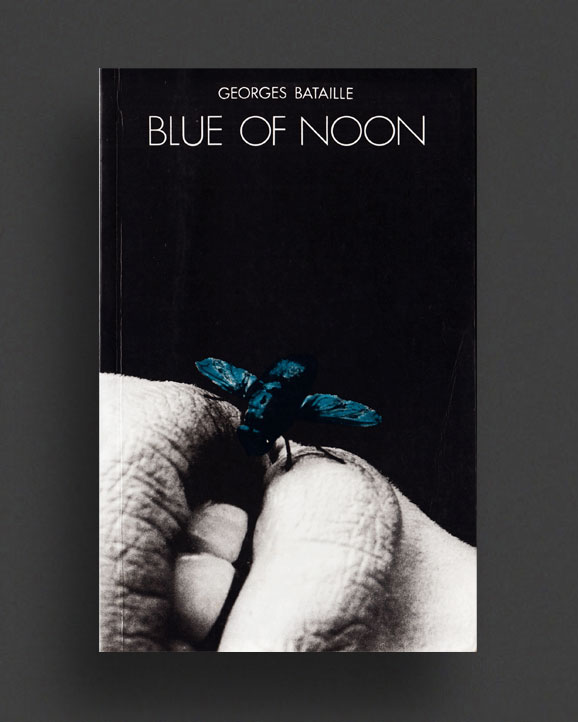
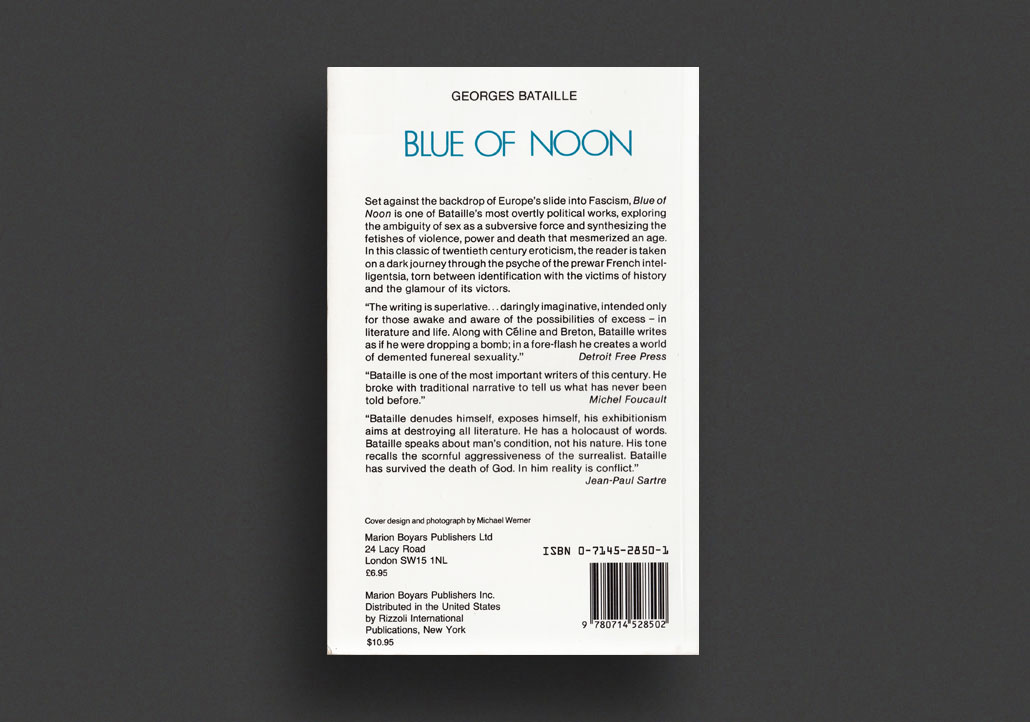
Set against the backdrop of Europe's slide into Fascism, Blue of Noon is one of Bataille's most overtly political works, exploring the ambiguity of sex as a subversive force and synthesizing the fetishes of violence, power and death that mesmerized an age. In this classic of twentieth century eroticism, the reader is taken on a dark journey through the psyche of the prewar French intel- ligentsia, torn between identification with the victims of history and the glamour of its victors.
"The writing is superlative... daringly imaginative, intended only for those awake and aware of the possibilities of excess in literature and life. Along with Céline and Breton, Bataille writes as if he were dropping a bomb; in a fore-flash he creates a world of demented funereal sexuality."—Detroit Free Press
"Bataille is one of the most important writers of this century. He broke with traditional narrative to tell us what has never been told before."—Michel Foucault
"Bataille denudes himself, exposes himself, his exhibitionism aims at destroying all literature. He has a holocaust of words. Bataille speaks about man's condition, not his nature. His tone recalls the scornful aggressiveness of the surrealist. Bataille has survived the death of God. In him reality is conflict."—Jean-Paul Sartre
Very Good copy with light wear. Sample images.
1998, English
Softcover, 176 pages, 23 x 14 cm
1st Edition, Out of print title / used / good
Published by
Main St. Books / New York
$85.00 - In stock -
First edition.
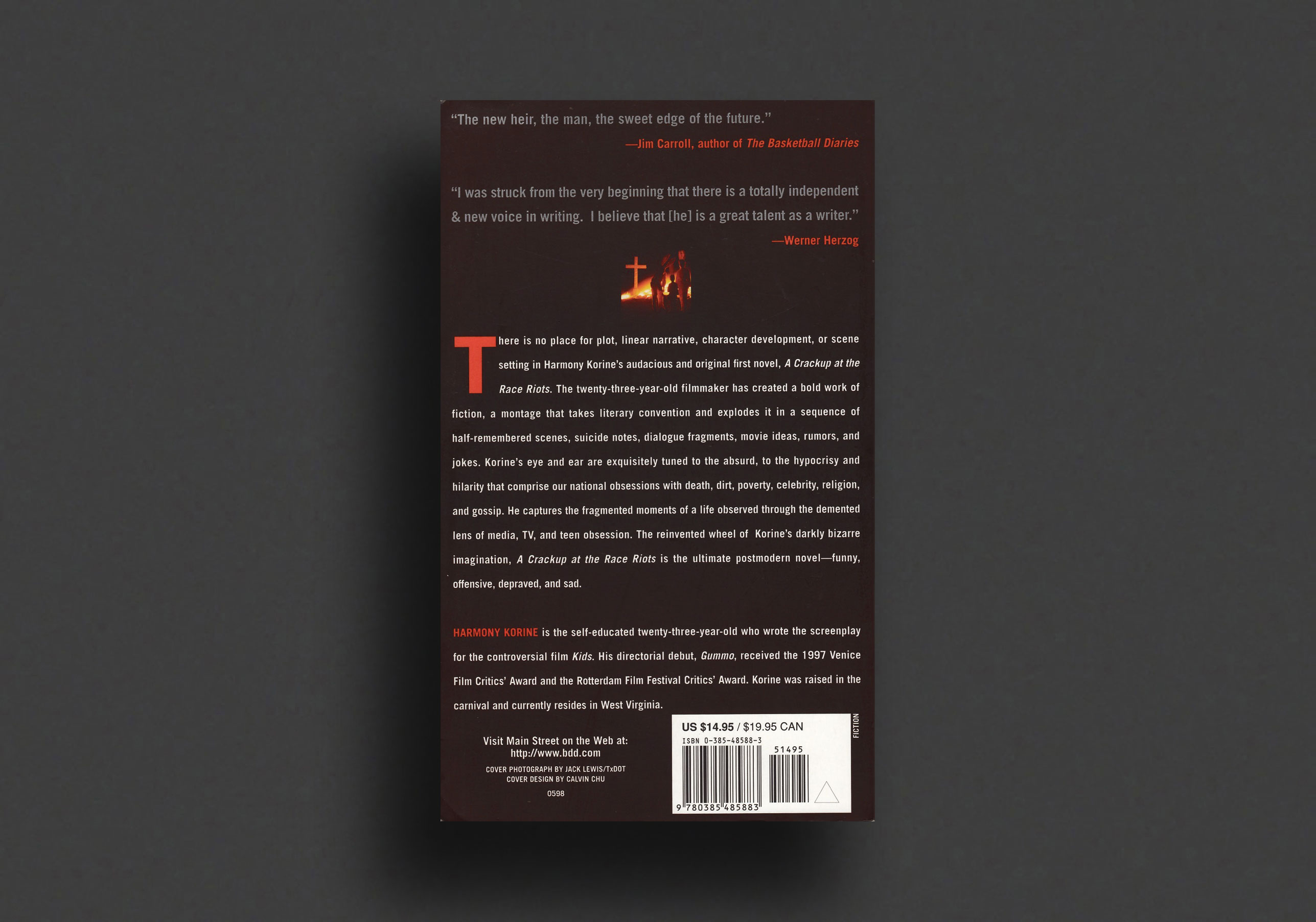
"There is no place for plot, linear narrative, character development, or scene setting in Harmony Korine's audacious and original first novel, A Crackup at the Race Riots. The twenty-three-year-old filmmaker has created a bold work of fiction, a montage that takes literary convention and explodes it in a sequence of half-remembered scenes, suicide notes, dialogue fragments, movie ideas, rumors, and jokes. Korine's eye and ear are exquisitely tuned to the absurd, to the hypocrisy and hilarity that comprise our national obsessions with death, dirt, poverty, celebrity, religion, and gossip. He captures the fragmented moments of a life observed through the demented lens of media, TV, and teen obsession. The reinvented wheel of Korine's darkly bizarre imagination, A Crackup at the Race Riots is the ultimate postmodern novel-funny, offensive, depraved, and sad."
"The new heir, the man, the sweet edge of the future."—Jim Carroll, author of The Basketball Diaries
"I was struck from the very beginning that there is a totally independent & new voice in writing. I believe that [he] is a great talent as a writer."—Werner Herzog
HARMONY KORINE is the self-educated twenty-three-year-old who wrote the screenplay for the controversial film Kids. His directorial debut, Gummo, received the 1997 Venice Film Critics' Award and the Rotterdam Film Festival Critics' Award. Korine was raised in the carnival and currently resides in West Virginia.
Good copy with wear to extremities, Tightly bound, no spine creases.
1997, Japanese / English
Hardcover (w. dust jacket), 70 pages, 26 x 21 cm
1st Edition, Out of print title / used / very good
Published by
Rockin' On / Tokyo
$120.00 - Out of stock
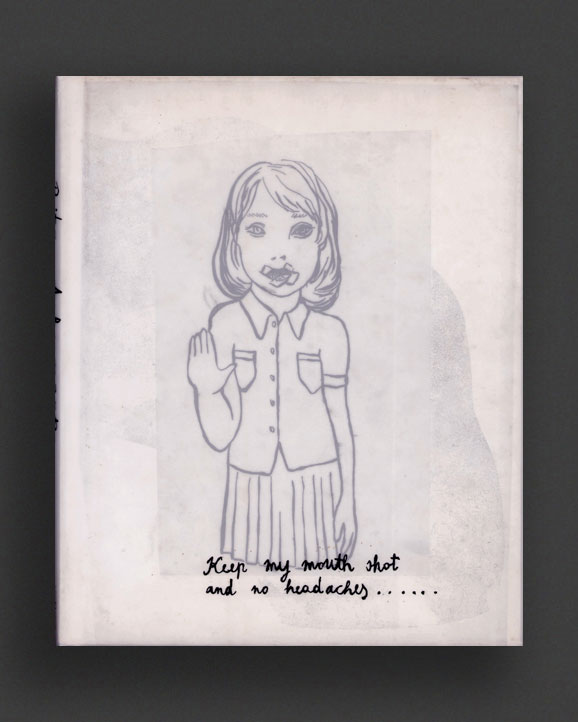
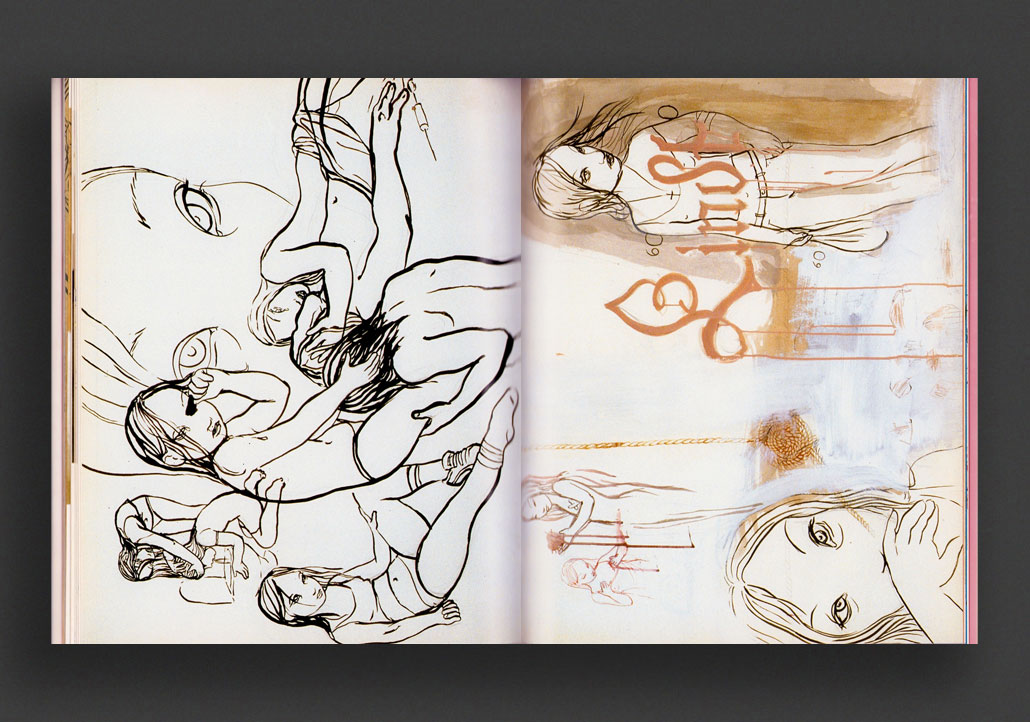
The incredible first monograph that doubles as an artist's book of work by Hungarian New York-based artist Rita Ackerman spanning the years 1993—1996, edited and designed by Makoto Ohrui from Fiction Inc., published by Rockin' On in 1997 and only available in Japan. Long out-of-print, this numbered hardcover volume, with illustrated vellum dust jacket, is illustrated profusely with seventy of Ackerman's drawings, paintings and collages throughout in colour and b/w with many fold-outs and notebook scans, accompanied by essays.
New York City based artist Rita Ackerman was born in Budapest in 1968. She studied at the University of Fine Arts in Budapest and The New York Studio School of Drawing, Painting and Sculpture from the years of 1989 to 1992. Ackermann invented images that became instant sensations, perturbing young girls that are now part of the universe of global imagery. Her drawings and paintings between 1993-95 depict compositions of adolescent female figures of clonelike multiples engaging in various self-destructive and hazardous activities. Her early works with their ambiguous presence serve as bridges between high and low culture, just as the myths and folk tales which often serve as merits to Ackermann's compositions. Later, Ackerman would abandon the figure, erasing the very matter of her own work, in a complex layering of visual language oscillating between abstraction and figuration into a subconscious unfolding of form—concealed deeply in the abstraction of the omnipresence.
First edition, VG copy in VG dust jacket.
1983, Japanese
Softcover (staple-bound), 16 pages, 29.5 x 21 cm
1st Edition, Out of print title / used / very good
Published by
Shochiku / Tokyo
$45.00 - Out of stock
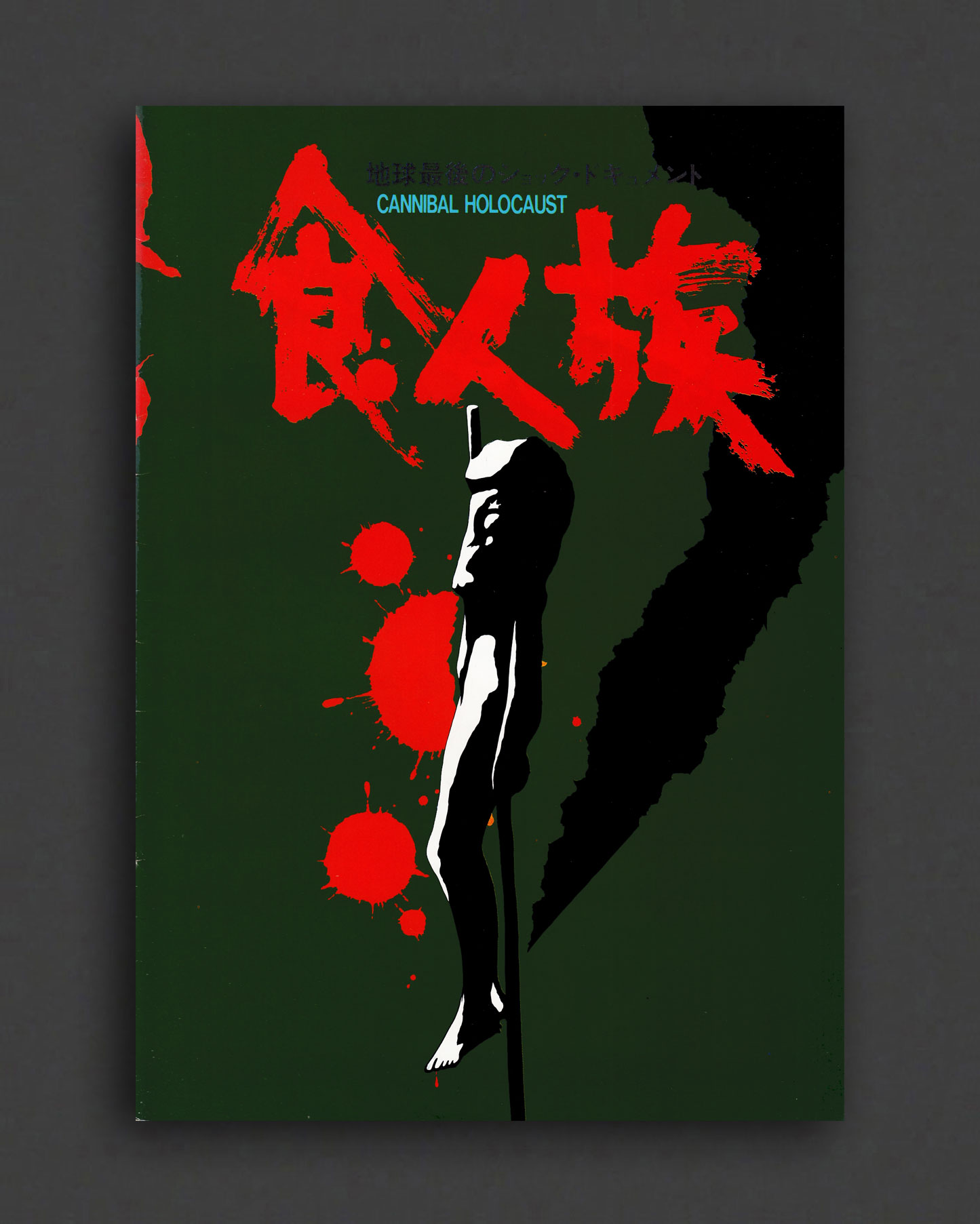
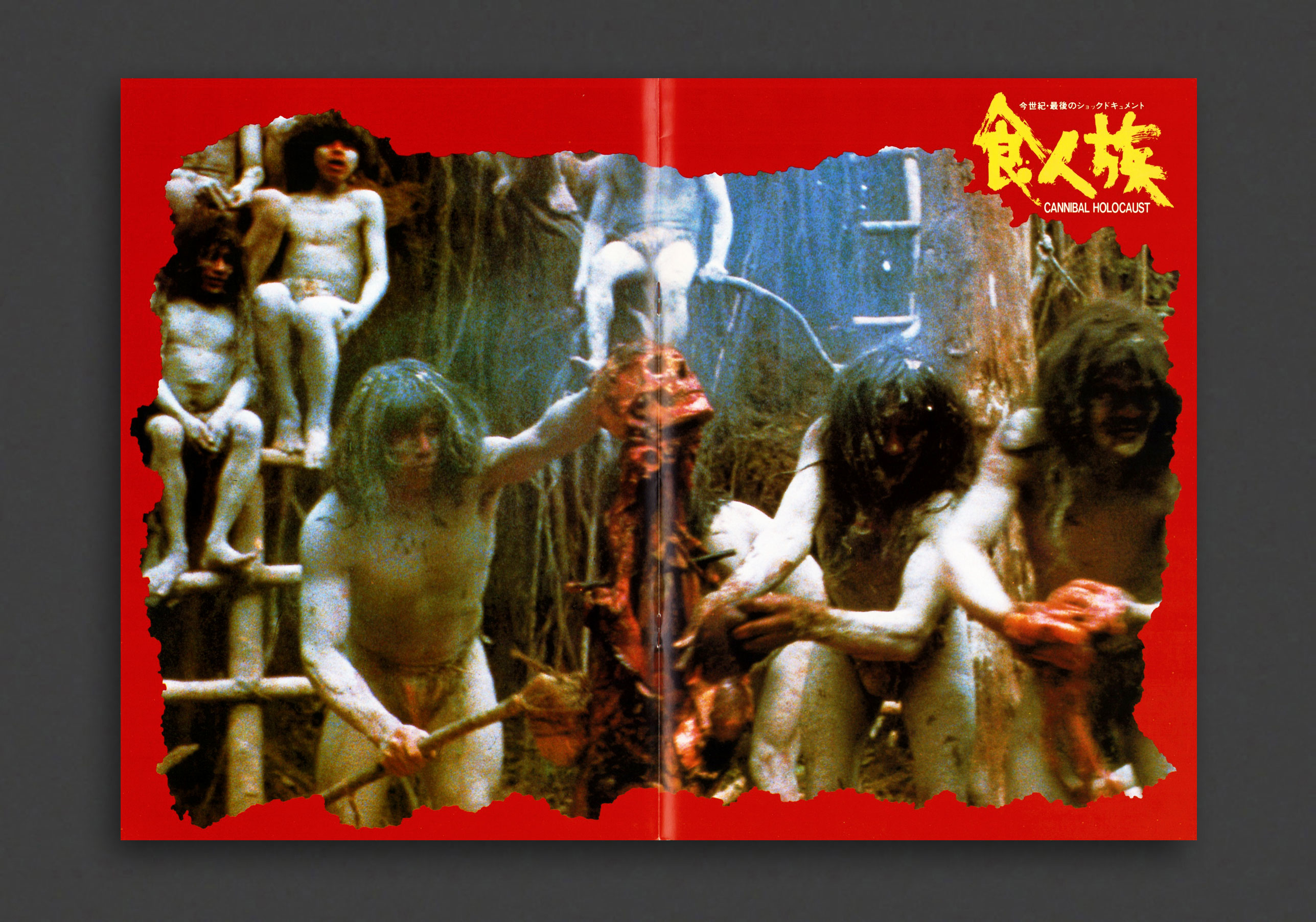
Rare 1983 Japanese souvenir photo booklet for Cannibal Holocaust, the extremely controversial cult 1980 Italian exploitation/mondo/shockumentary cannibal film directed by Ruggero Deodato and written by Gianfranco Clerici. Produced as part of the contemporary cannibal trend of Italian exploitation cinema, Cannibal Holocaust was inspired by Italian media coverage of the Red Brigades' terrorism and influenced by the Mondo documentaries of Gualtiero Jacopetti. Filmed primarily on location in the Amazon rainforest of Colombia with a cast of mostly inexperienced American and Italian actors interacting with actual indigenous peoples, the film starred Robert Kerman as Harold Monroe, an anthropologist who leads a rescue team into the Amazon rainforest to locate a crew of filmmakers that have gone missing while filming a documentary on local cannibal tribes. With a mixture of real and staged violence, combined with handheld camerawork and rough, unedited film quality, Cannibal Holocaust achieved notoriety as its graphic violence aroused a great deal of controversy. Seized after its release in Italy with the makers were convicted of obscenity, the film was released in 1982, but banned in the United Kingdom, Australia, South Africa and several other countries due to its graphic content, including sexual assault and genuine violence toward animals. The film's plot and violence have been noted as commentary on journalistic ethics, the exploitation of South American countries, and the difference between Western and non-Western cultures, yet these interpretations have also been met with criticism, with any perceived subtext deemed hypocritical or insincere due to the film's presentation and the extremely questionable conditions behind its making. The controversial film quickly became a grindhouse smash, but it's biggest and only artistic impact on horror is surely its innovative found-footage conceit, which led to the emergence of an entire subgenre in recent years. Unrecommended viewing. Heavily illustrated throughout with glossy colour and b/w stills from the film, alongside texts in Japanese about the film, cast, and production information.
Very Good copy with light wear.
1981, Japanese
Softcover (staple-bound), 20 pages, 29.5 x 21 cm
1st Edition, Out of print title / used / very good
Published by
Shochiku / Tokyo
$80.00 - In stock -
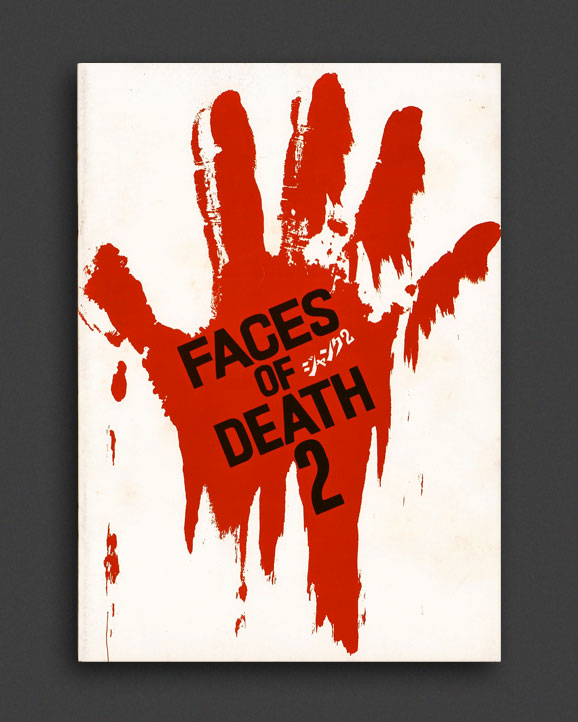
Very rare Japanese souvenir photo booklet for Faces of Death 2, the controversial straight-to-video 1981 American mondo horror documentary film directed by John Alan Schwartz, the follow-up to 1978's Faces of Death, credited under the pseudonyms "Conan Le Cilaire" & "Alan Black" respectively. Mortuaries, accidents and police work are filmed by TV crews and home video cameras. Faces of Death II contained real footage of a dead body being pulled from under a pier, Guerrilla death squads in El Salvador, napalm bombings in Vietnam, Buddhist self-immolations, the drugging of a monkey, a dolphin slaughter, a train disaster in India, Cambodian patients with leprosy, a death museum featuring Joaquin Murrieta's preserved head, a driver high on PCP and a boxer going down for his “final” count. Much like the PSA Aircraft crash, the assassination attempt on President Ronald Reagan occurred recently before the film's completion, and was included as well. Heavily illustrated throughout with glossy colour and b/w stills from the film, alongside texts in Japanese about the film, cast and production information.
Very Good copy with light wear.
1973, Japanese
Softcover (staple-bound), 12 pages, 29.5 x 21 cm
1st Edition, Out of print title / used / very good
Published by
Toho / Tokyo
$90.00 - In stock -
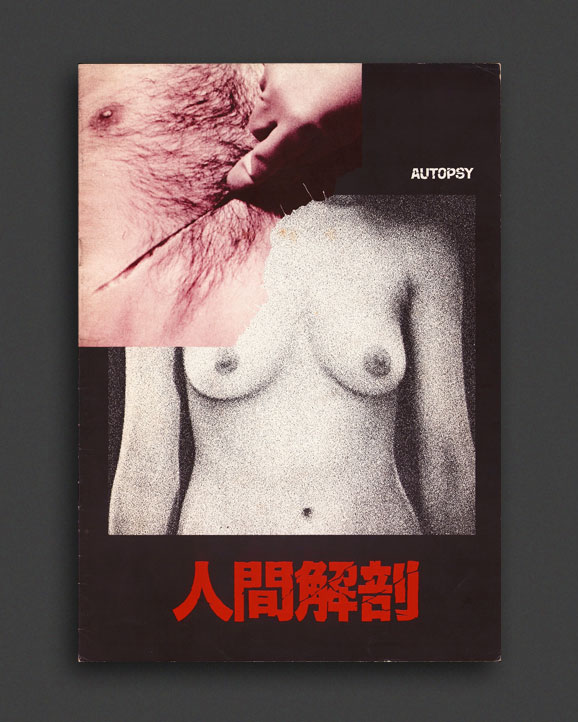
Wonderful, very rare Japanese souvenir photo booklet for Autopsia (Autopsy), a 1973 Spanish Mondo-style docudrama by director Juan Logar about a war correspondent who comes back home and has a spiritual crisis about his own mortality. Surreal fantasy sequences are mixed with graphic real autopsy footage. Heavily illustrated throughout with b/w stills from the film, alongside texts in Japanese about the film, cast and production information.
Very Good copy with light wear.
1973, English
Softcover, 244 pages, 22.2 x 15.2 cm
Out of print title / used / very good
Published by
Da Capo Press / New York
$40.00 - Out of stock
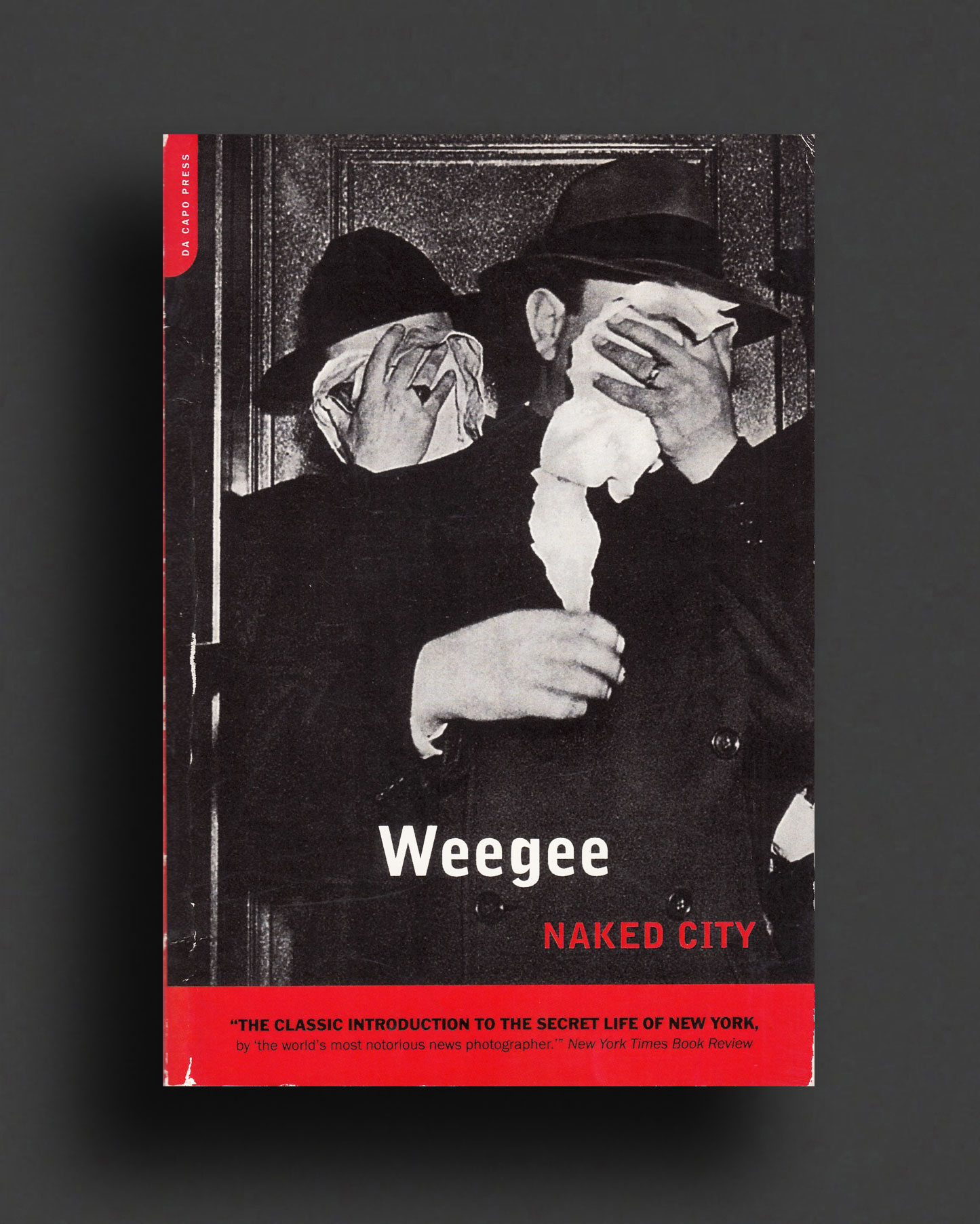
2002 paperback edition of the 1945 masterpiece 'Naked City' by the founding father of gritty, urban photojournalism. A walk on the wild side of New York.
Weegee (1900-1968) is widely acknowledged to be both the originator and reigning king of candid photojournalism, ushering in the age of tabloid culture while simultaneously elevating the sordid side of human life to the status of high art. For Naked City, his first collection, Weegee cruised the teeming streets of 1940s New York in the wee hours in search of the sensational. His photographs were lewd, louche, and licentious, but always brimming with life (except when they were brimming with death). Weegee's profound influence on other photographers over the last half-century derives not only from his sensational subject matter and his use of the blinding, close-up flash, but also from his eagerness to photograph the city at all hours, at all levels. Snapping lovers on the beach at 3:00 in the morning, transgender prostitutes in police buggies, bejeweled society ladies at balls, the desperately poor-no one knew New York like Weegee did. Naked City showcases his talent, his love of the city, and his taste for the absurd and the unbelievable, in a book that will always stand as a classic introduction to the secret life of New York.
"The disasters and spectacles [Weegee] photographed... lay bare the facts of terror and mortality that underlie it."—Village Voice
Arthur Fellig (1899-1968), better known as Weegee, was an Austrian immigrant who worked as a freelance news photographer in New York City. Beginning his career on the police beat, where he specialized in crime and catastrophe, he roamed the city during the 1930s and 1940s in search of the "Page One" photo. His work now resides in the permanent collection of the Museum of Modern Art.
VG copy with some wear to cover extremities.
1994, English
Softcover, 784 pages, 27.1 x 17 cm
Out of print title / used / very good
$40.00 - Out of stock
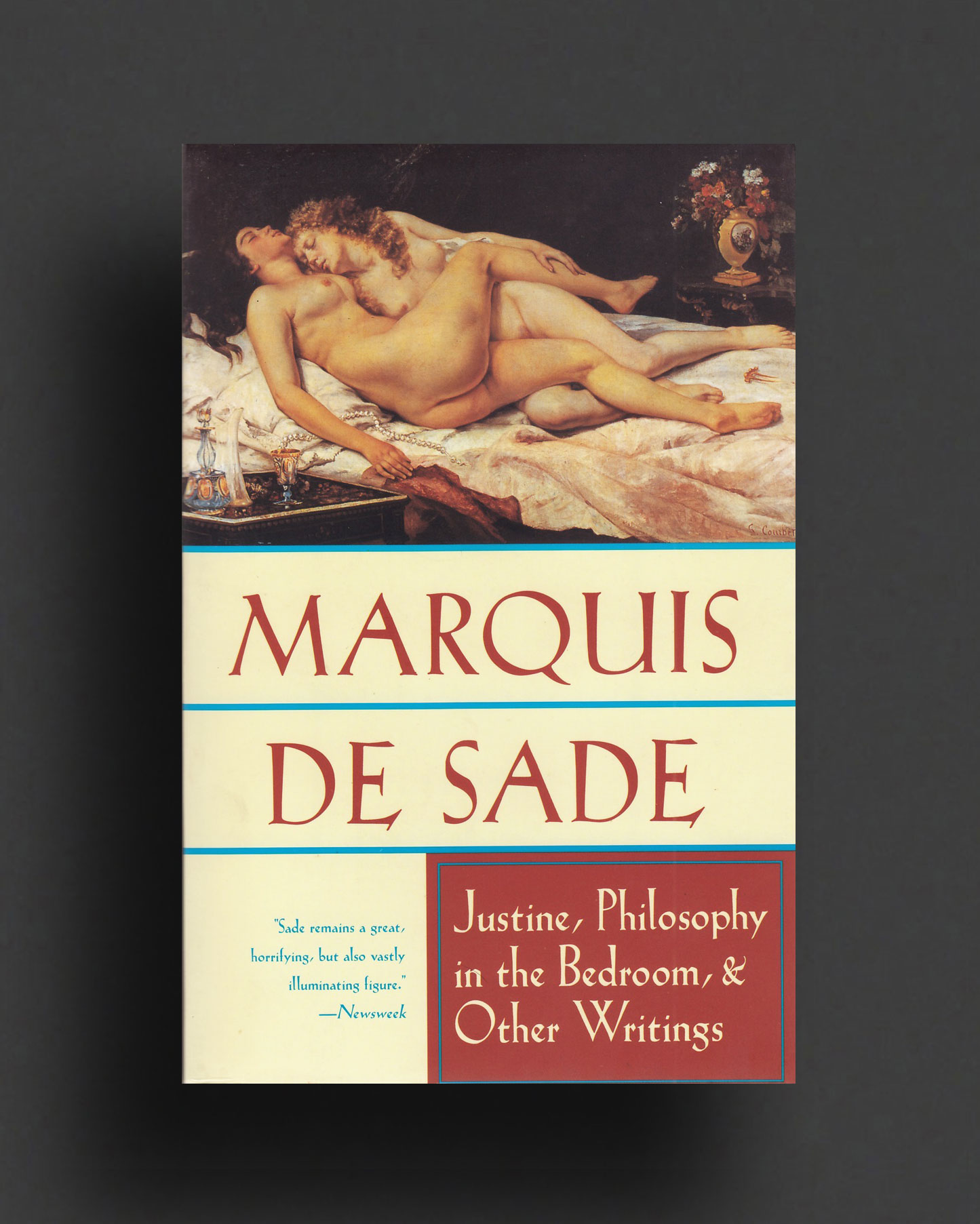
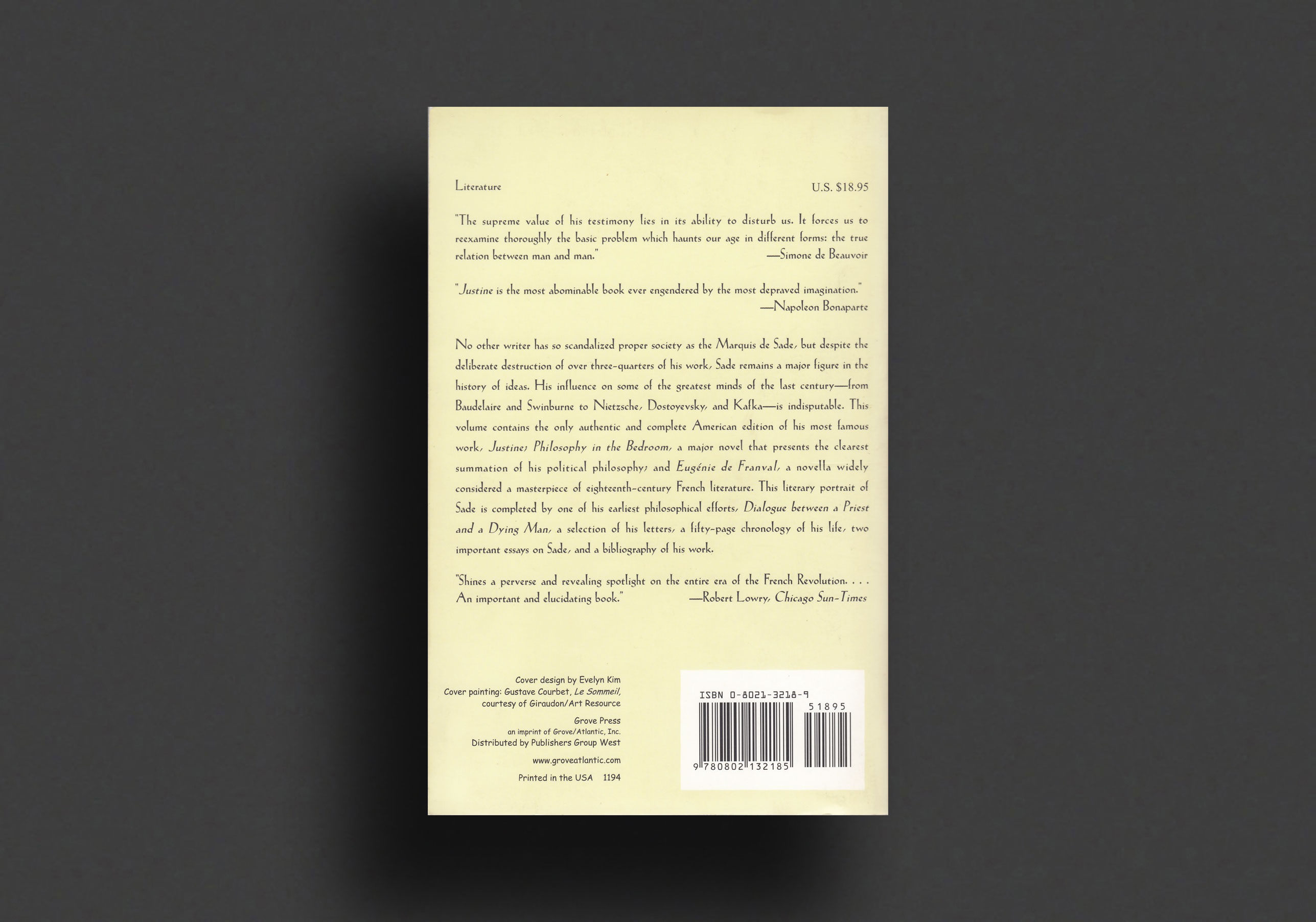
No other writer has so scandalized proper society as the Marquis de Sade, but despite the deliberate destruction of over three-quarters of his work, Sade remains a major figure in the history of ideas. His influence on some of the greatest minds of the last century -- from Baudelaire and Swinburne to Nietzsche, Dostoyevksy, and Kafka -- is indisputable. This volume contains the only authentic and complete American edition of his most famous work, "Justine; Philosophy in the Bedroom, " a major novel that presents the clearest summation of his political philosophy; Eugenie de Franval, a novella widely considered to be a masterpiece of eighteenth-century French literature; and the only authentic and complete American edition of his most famous work, Justine. This literary portrait of Sade is completed by one of his earliest philosophical efforts, Dialogue between a Priest and a Dying Man, a selection of his letters, a fifty-page chronology of his life, two important essays on Sade, and a bibliography of his work.
VG copy.
2003, English
Softcover, 138 pages, 21.5 x13.5 cm
1st Edition, Out of print title / used / very good
Published by
Creation Books / London
$35.00 - In stock -
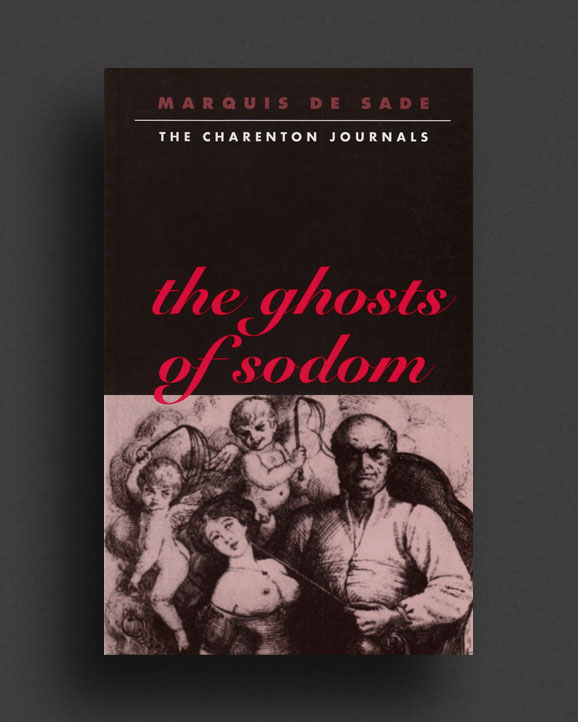
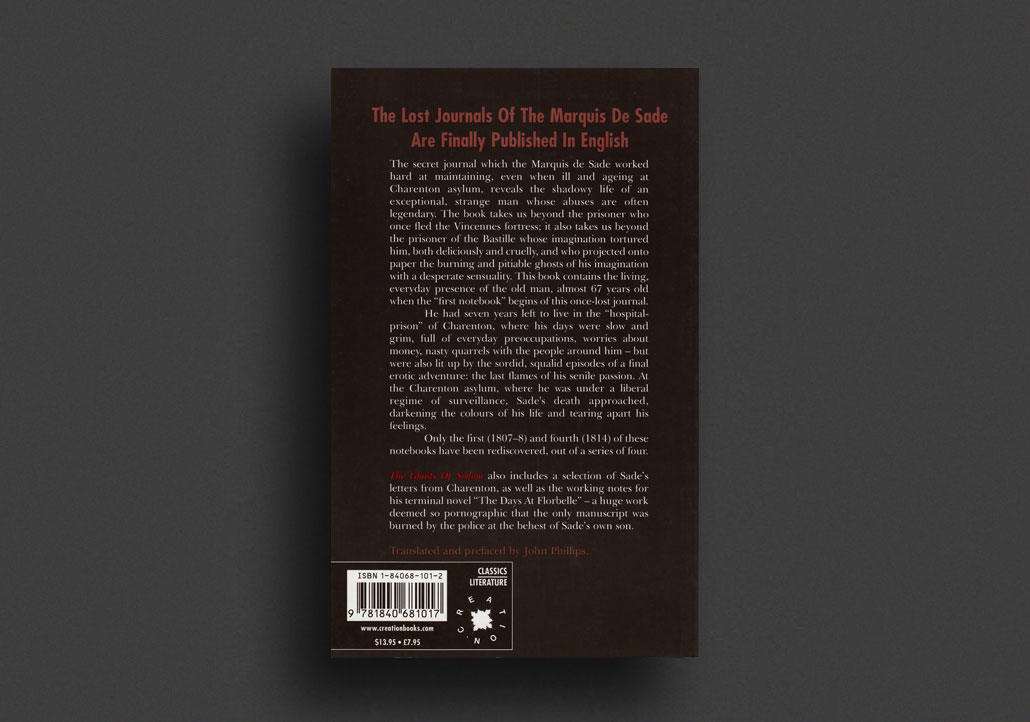
First 2008 English-language print of The Lost Journals Of The Marquis De Sade.
The secret journal which the Marquis de Sade worked hard at maintaining, even when ill and ageing at Charenton asylum, reveals the shadowy life of an exceptional, strange man whose abuses are often legendary. The book takes us beyond the prisoner who once fled the Vincennes fortress; it also takes us beyond the prisoner of the Bastille whose imagination tortured him, both deliciously and cruelly, and who projected onto paper the burning and pitiable ghosts of his imagination with a desperate sensuality. This book contains the living, everyday presence of the old man, almost 67 years old when the "first notebook" begins of this once-lost journal.
He had seven years left to live in the "hospital-prison" of Charenton, where his days were slow and grim, full of everyday preoccupations, worries about money, nasty quarrels with the people around him - but were also lit up by the sordid, squalid episodes of a final erotic adventure: the last flames of his senile passion. At the Charenton asylum, where he was under a liberal regime of surveillance, Sade's death approached, darkening the colours of his life and tearing apart his feelings.
Only the first (1807-8) and fourth (1814) of these notebooks have been rediscovered, out of a series of four.
The Ghosts Of Sodom also includes a selection of Sade's letters from Charenton, as well as the working notes for his terminal novel "The Days At Florbelle" - a huge work deemed so pornographic that the only manuscript was burned by the police at the behest of Sade's own son.