World Food Books' programme is largely produced on Kulin Nation land. We acknowledge the Wurundjeri people of the Kulin Nation as the first and continuing custodians of this land, and pay respect to their Elders past, present, and emerging.
World Food Books is an arts and special interests bookshop in Naarm / Melbourne. Founded in 2010, World Food Books is devoted to the presentation of a rotating, hand-selection of international art, design, literary and counterculture publications with an emphasis on the anti-traditional, the experimental, the avant-garde, the heretic, the marginal.
Presenting new titles alongside rare and out-of-print books, catalogues and journals spanning the fields of modern and contemporary art, design, photography, illustration, film, literature, poetry, cultural theory, philosophy, sexuality, popular and underground culture in its many radical forms, World Food Books wishes to encourage adventurous, thoughtful and open-minded reading, looking, writing, and exchange of publishing and ideas, both current and historical.
As well as our bookshop, located in Melbourne's historical Nicholas Building, all of our inventory is available internationally via our online mail-order service.
World Food Books semi-regularly co-ordinates "Occasions", a programme of exhibits and events at the bookshop and in partnership with other hosts (such as museums and art galleries) that develop out of the activities, relationships and content of the bookshop itself.
World Food Books
The Nicholas Building
37 Swanston Street
Room 5, Level 6
Melbourne 3000
Australia
SHOP HOURS:
Thu–Fri 12–6, Sat 12–5
WEB-SHOP OPEN 24/7
World Food Books
Postal Address:
PO Box 435
Flinders Lane
Victoria 8009
Australia
Art
Theory / Essay
Architecture / Interior
Graphic Design / Typography
Photography
Fashion
Eros
LGBTQ+
Fiction / Poetry
Weird / Speculative / Science Fiction / Horror
Transgressive / Visceral / Abject
Symbolism / Decadence / Fin de siècle
Film / Video
Painting
Sculpture / Installation
Performance / Dance / Theater
Drawing
Sound / Music
Curatorial
Group Shows / Collections
Periodicals
Out-of-print / Rare
Posters / Ephemera / Discs
Signed Books
World Food Books Gift Voucher
World Food Book Bag
Australian Art
Australian Fiction
Australian Science Fiction / Speculative Fiction
Australian Poetry
Australian Photography
Japanese Photography
Conceptual Art
Minimal Art
Dada
'Pataphysics / Oulipo
Fluxus
Concrete Poetry
Pop Art
Surrealism
Arte Povera
Arte Informale / Haute Pâte / Tachism
Nouveau Réalisme / Zero / Kinetic
Situationism / Lettrism
Collage / Mail Art / Xerox Art
Art Brut / Folk / Visionary / Fantastic
Illustration / Graphic Art / Bandes Dessinées
Furniture
Italian Radical Design / Postmodernism
Textiles
Ceramics / Glass
Counterculture
Protest / Revolt
Philosophy
Psychoanalysis
Anthropology
Anarchism
Socialism / Anarchism / Communism / Capitalism
Literary Theory / Semiotics / Language
Feminism / Women's Studies
Gender Studies / Sexuality
Anthropology
Fetishism / BDSM
Drugs / Psychedelia
Crime / Violence
Animal Rights / Veganism
Occult / Esoterica
Ecology / Earth / Alternative Living
Whole Earth / Crafts
All prices in AUD (Australian dollars)
Pick-Ups
Pick-up orders can be collected in our bookshop during opening hours after order date. Please collect any Pick-up orders within 2 weeks of ordering as we have limited storage space. Orders will be released back into stock if not collected within this time. No refunds can be made for pick-ups left un-collected. If you cannot make it in to the bookshop in this time-frame, please choose postage option.
Return Policy
All sales are final. We do accept returns (for refund or exchange) for items received in error. All our orders are packed with special care using heavy-duty padding and cardboard book-mailers or bubble mailers (for smaller books), using reinforcement where required. We cannot take responsibility for any lost, stolen or damaged parcels.
Insurance
Should you wish to insure your package, please email us directly after placing your order and we can organise this at a small extra expense. Although all standard/express tracked packages are very safe and dependable, we cannot take responsibility for any lost, stolen or damaged parcels. We recommend insurance on valuable orders.
Interested in selling your old books, catalogues, journals, magazines, comics, fanzines, ephemera? We are always looking for interesting, unusual and out-of-print books to buy. We only buy books in our fields of interest and specialty, and that we feel we can resell.
We base these prices on desirability, market value, in-print prices, condition and our current stock levels. We offer cash, store credit, and can take stock on consignment. All
about 25% of the price we expect to get when we sell them, or 30% in store credit. We base these prices on desirability, market value, in-print prices, condition and our current stock levels.
Sell your books any day of the week. You can drop them off and return later. If you have a lot of books, we can visit your Sydney home.
We buy books that we feel we can resell. We offer about 25 % of the price we expect to get when we sell them, or 30% in store credit. We base these prices on desirability, market value, in-print prices, condition and our current stock levels.
Philadelphia Wireman
03 August - 01 September, 2018
World Food Books is proud to announce our next Occasion, the first presentation of sculptures by Philadelphia Wireman in Australia.
The Philadelphia Wireman sculptures were found abandoned in an alley off Philadelphia’s South Street on trash night in 1982. Their discovery in a rapidly-changing neighbourhood undergoing extensive renovation, compounded with the failure of all attempts to locate the artist, suggests that the works may have been discarded after the maker’s death. Dubbed the "Philadelphia Wireman" during the first exhibition of this work, in 1985, the maker’s name, age, ethnicity, and even gender remain uncertain. The entire collection totals approximately 1200 pieces, all intricately bound together with tightly-wound heavy-gauge wire (along with a few small, abstract marker drawings, reminiscent both of Mark Tobey and J.B. Murry). The dense construction of the work, despite a modest range of scale and materials, is singularly obsessive and disciplined in design: a wire armature or exoskeleton firmly binds a bricolage of found objects including plastic, glass, food packaging, umbrella parts, tape, rubber, batteries, pens, leather, reflectors, nuts and bolts, nails, foil, coins, toys, watches, eyeglasses, tools, and jewellery.
Heavy with associations—anthropomorphic, zoomorphic, and socio-cultural responses to wrapped detritus—the totemic sculptures by Philadelphia Wireman have been discussed in the context of work created to fulfil the shamanistic needs of alternative religions in American culture. Curators, collectors, and critics have variously compared certain pieces to sculpture from Classical antiquity, Native American medicine bundles, African-American memory jugs, and African fetish objects. Reflecting the artist’s prolific and incredibly focused scavenging impulse, and despite—or perhaps enhanced by—their anonymity, these enigmatic objects function as urban artefacts and arbiters of power, though their origin and purpose is unknown. Philadelphia Wireman, whatever their identity, possessed an astonishing ability to isolate and communicate the concepts of power and energy through the selection and transformation of ordinary materials. Over the course of the past two decades, this collection has come to be regarded as an important discovery in the field of self-taught art and vernacular art.
Presented in collaboration with Fleisher-Ollman Gallery, Philadelphia, and Robert Heald, Wellington.
Susan Te Kahurangi King
02 February - 10 March, 2018
Susan Te Kahurangi King (24 February 1951 - ) has been a confident and prolific artist since she was a young child, drawing with readily available materials - pencils, ballpoint pens and felt-tip markers, on whatever paper is at hand. Between the ages of four and six Susan slowly ceased verbal communication. Her grandparents William and Myrtle Murphy had developed a special bond with Susan so they took on caring responsibilities for extended periods. Myrtle began informally archiving her work, carefully collecting and storing the drawings and compiling scrapbooks. No drawing was insignificant; every scrap of paper was kept. The King family are now the custodians of a vast collection containing over 7000 individual works, from tiny scraps of paper through to 5 meter long rolls.
The scrapbooks and diaries reveal Myrtle to be a woman of great patience and compassion, seeking to understand a child who was not always behaving as expected. She encouraged Susan to be observant, to explore her environment and absorb all the sights and sounds. Myrtle would show Susan’s drawings to friends and people in her community that she had dealings with, such as shopkeepers and postal workers, but this was not simply a case of a grandmother’s bias. She recognised that Susan had developed a sophisticated and unique visual language and sincerely believed that her art deserved serious attention.
This was an unorthodox attitude for the time. To provide some context, Jean Dubuffet coined the term Art Brut in 1945 to describe work created by self-taught artists – specifically residents of psychiatric institutions and those he considered to be visionaries or eccentrics. In 1972 Roger Cardinal extended this concept by adopting the term Outsider Art to describe work made by non-academically trained artists operating outside of mainstream art networks through choice or circumstance. Susan was born in Te Aroha, New Zealand in 1951, far from the artistic hubs of Paris and London that Dubuffet and Cardinal operated in. That Myrtle fêted Susan as a self-taught artist who deserved to be taken seriously shows how progressive her attitudes were.
Susan’s parents Doug and Dawn were also progressive. Over the years they had consulted numerous health practitioners about Susan’s condition, as the medical establishment could not provide an explanation as to why she had lapsed into silence. Dawn educated herself in the field of homeopathy and went on to treat all twelve of her children using these principles – basing prescriptions on her observations of their physical, mental and emotional state.
Doug was a linguist with an interest in philosophy who devoted what little spare time he had to studying Maori language and culture. To some extent their willingness to explore the fringes of the mainstream made them outsiders too but it was their commitment to living with integrity and their respect for individuality that ensured Susan’s creativity was always encouraged.
Even though Susan’s family supported her artistic pursuits, some staff in schools and hospitals saw it as an impediment to her assimilation into the community and discouraged it in a variety of ways. Her family was not always aware of this and therefore did not fully understand why Susan stopped drawing in the early 1990s. However, rather than dwell on the challenges that Susan faced in pursuit of her artistic practice, they prefer to highlight her achievements. In 2008 Susan began drawing again in earnest, after an almost 20 year interruption, and her work is now shown in galleries around the world.
Susan grew up without television and has been heavily influenced by the comics she read as a child. She is absolutely fearless in the appropriation of recognizable characters, such as Donald Duck and Mickey Mouse, in her work. She twists their limbs, contorts their faces, compresses them together, blends them into complex patterned backgrounds - always imbuing them with an incredible energy. Although Susan often used pop culture characters in her work they are not naive or childlike. These are drawings by a brilliant self-taught artist who has been creating exceptional work for decades without an audience in mind.
Mladen Stilinović
"Various Works 1986 - 1999"
02 February 16 - September 10, 2016
Various works 1986 - 1999, from two houses, from the collections of John Nixon, Sue Cramer, Kerrie Poliness, Peter Haffenden and Phoebe Haffenden.
Including: Geometry of Cakes (various shelves), 1993; Poor People’s Law (black and white plate), 1993; White Absence (glasses, ruler, set square, silver spoon, silver ladel with skin photograph and wooden cubes), 1990-1996; Exploitation of the Dead (grey and red star painting, wooden painting, black spoon with red table, red plate), 1984-1990; Money and Zeros (zero tie, paintings made for friends in Australia (Sue, John, Kerrie), numbers painting), 1991-1992; Words - Slogans (various t-shirts) - “they talk about the death of art...help! someone is trying to kill me”, “my sweet little lamb”, “work is a disease - Karl Marx”; Various artist books, catalogues, monographs, videos; Poster from exhibition Insulting Anarchy; "Circular" Croatian - Australian edition; Artist book by Vlado Martek (Dostoyevsky); more.
Thanks to Mladen Stilinović and Branka Stipančić.
Jonathan Walker
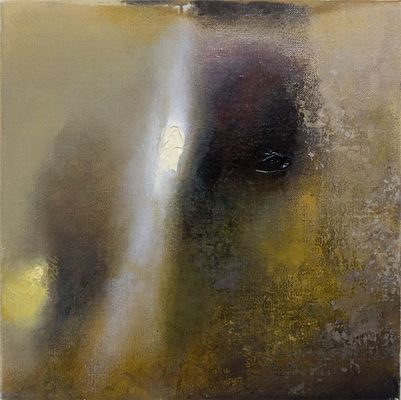
Always Will Need To Wear Winter Shirt Blue + Ochre Small Check Pattern
21 August - 21 September, 2015
Untitled
I am not a great reader of poetry but I always return to the work of Melbourne poet, Vincent Buckley (1925- 1988). Perhaps I find his most tantalising piece to be not a finished poem but a fragment left on a scrap of paper discovered on his desk after the poet’s death.
The poetry gathers like oil
In the word-core, and spreads
It has its music meet,
Its music is in movement.
This fragment is more the shell left behind from a volatile thought than a finished poem. I find the last two lines honest but awkward whereas the first two lines work like an arrow. Most likely he could not find a resolution so it was left. Still, in its present form, it remains an eloquent testimony to the ultimate failure of a medium to express mobile thought and sensation, in Buckley’s case, through verbal language. It’s an important matter because this is something all artists have to deal with regardless of the medium.
I have never written a poem, however, I am forever copying fragments from books on paper scraps in a vain effort to fix certain notions in my head. At first, they function as bookmarks that are sometimes returned to when I open the book. But before long, as they accumulate, they fall out littering the table interspersed with A4 photocopies, bills, books and medications.
To return to Buckley’s fragment, the first two lines very much evoke how I paint nowadays. As you age, detail diminishes and patches of light become more luminous and float. I feel the most honest way of dealing with this is by smearing the oil paint on the canvas with the fingers and working close-up, blind. Only if the patches coalesce into an approaching image can the work gain a life.
-
Jonathan Walker was born in Melbourne, Australia and brought up on a dairy farm in Gippsland. In the 1970’s he studied painting at RMIT and won the Harold Wright Scholarship to the British Museum, London. During the 1980’s he exhibited at Pinacotheca Gallery, Richmond and had work shown at the NGV and Heidi City Art Gallery. Over the same period he designed the cover for the “Epigenesi” LP by Giancarlo Toniutti, Italy and conducted a mail exchange work with Achim Wollscheid, Germany. The work with artists through the post resulted in an article published in the bicentenary issue of Art and Australia 1988. He showed in artist run spaces such as WestSpace in the 90’s and 2000’s, and until 2012, taught painting at Victoria University, which is where we (Colleen Ahern and Lisa Radford) as organisers of the exhibition, among many others, had the privilege of being his student.
Walker’s knowledge was imparted to students through the careful selection of music, literature, and artists found in books that he himself had ordered for the library. Walker’s strategy was the generosity of sharing his vast knowledge with references specific to each student and their context.
Walker’s paintings share a similar focus and intimacy.
This exhibition presents a small selection of recent paintings alongside a publication that includes Walker’s writing. Observational and analytical, Walker’s work is a type of material notation — the time of day, colour and how it is blended, the both specific and fleeting location of a reflection on lino or the question of whether a chair leg should be included in a painting.
Please join us on Friday August 21 between 6-8pm to celebrate the opening of the exhibition.
Curated by Colleen Ahern and Lisa Radford.
B. Wurtz
Curated by Nic Tammens
March 26 - April 4, 2015
B.Wurtz works from a basement studio in his home on Manhattan’s Lower East Side.
This local fact is attested to by the plastic shopping bags and newsprint circulars that appear in his work. As formal objects, they don’t make loud claims about their origins but nonetheless transmit street addresses and places of business from the bottom of this long thin island. Like plenty of artists, Wurtz is affected by what is local and what is consumed. His work is underpinned by this ethic. It often speaks from a neighborhood or reads like the contents of a hamper:
“BLACK PLUMS $1.29 lb.”
“Food Bazaar”
“USDA Whole Pork Shoulder Picnic 99c lb.”
“RITE AID Pharmacy, with us it’s personal.”
“H. Brickman & Sons.”
“Sweet Yams 59c lb."
Most of the work in this exhibition was made while the artist was in residence at Dieu Donne, a workshop dedicated to paper craft in Midtown. Here Wurtz fabricated assemblages with paper and objects that are relatively lightweight, with the intention that they would be easily transportable to Australia. This consideration isn’t absolute in Wurtz’s work, but was prescriptive for making the current exhibition light and cheap. Packed in two boxes, these works were sent from a USPS post office on the Lower East Side and delivered to North Melbourne by Australia Post.
Wurtz appears courtesy of Metro Pictures, New York.
Thanks to Rob Halverson, Joshua Petherick, Sari de Mallory, Matt Hinkley, Helen Johnson, Fayen d'Evie, Ask Kilmartin, Lisa Radon, Ellena Savage, Yale Union, and "Elizabeth".
John Nixon
"Archive"
December 15 - January 20, 2014
The presentation of John Nixon's archive offered a rare showcase of this extensive collection of the artist's own publications, catalogues, posters, ephemera, editions and more, from the mid 1980s onwards, alongside a selection of his artworks.
Organized by John Nixon, Joshua Petherick and Matt Hinkley.
<a href=http://wfb.public-office.info/artist/john-nixon>All titles by John Nixon
"Habitat"
at Minerva, Sydney (organised by Joshua Petherick and Matt Hinkley)
November 15 - December 20, 2014
Lupo Borgonovo, Janet Burchill & Jennifer McCamley,
Lewis Fidock, HR Giger, Piero Gilardi, Veit Laurent Kurz,
Cinzia Ruggeri, Michael E. Smith, Lucie Stahl, Daniel Weil, Wols
Press Release:
“...It contained seven objects. The slender fluted bone, surely formed for flight, surely from the wing of some large bird. Three archaic circuitboards, faced with mazes of gold. A smooth white sphere of baked clay. An age-blackened fragment of lace. A fingerlength segment of what she assumed was bone from a human wrist, grayish white, inset smoothly with the silicon shaft of a small instrument that must once have ridden flush with the surface of the skin - but the thing’s face was seared and blackened.”
William Gibson, “Count Zero”, 1986
"Autumn Projects Archive"
Curated by Liza Vasiliou
March 6 - March 15, 2014
World Food Books, in conjunction with the Virgin Australia Melbourne Fashion Festival 2014, presented the Autumn Projects archive, consisting of a selection of early examples in Australian fashion with a particular interest in collecting designers and labels from the period beginning in the 1980’s, who significantly influenced the discourse of Australian Fashion.
Curated by Liza Vasiliou, the exhibition provided a unique opportunity to view pieces by designers Anthea Crawford, Barbara Vandenberg, Geoff Liddell and labels CR Australia, Covers, Jag along with early experimental collage pieces by Prue Acton and Sally Browne’s ‘Fragments’ collection, suspended throughout the functioning World Food Books shop in Melbourne.
H.B. Peace
presented by CENTRE FOR STYLE
November 14, 2013
"Hey Blinky, you say chic, I say same"
Anon 2013
H.B. Peace is a clothing collaboration between great friends Blake Barns and Hugh Egan Westland. Their pieces explore the divergences between 'character’ and ‘personality’ in garments....etc
Special Thanks to Joshua Petherick and Matt Hinkley of WFB and Gillian Mears
and a Very Special Thank you to Audrey Thomas Hayes for her shoe collaboration.
Janet Burchill & Jennifer McCamley
"Aesthetic Suicide"
May 10 - June 8, 2013
The first of our occasional exhibitions in the World Food Books office/shop space in Melbourne, "Aesthetic Suicide" presented a body of new and older works together by artists Janet Burchill & Jennifer McCamley, including videos, prints, a wall work, and publications.
During shop open hours videos played every hour, on the hour.
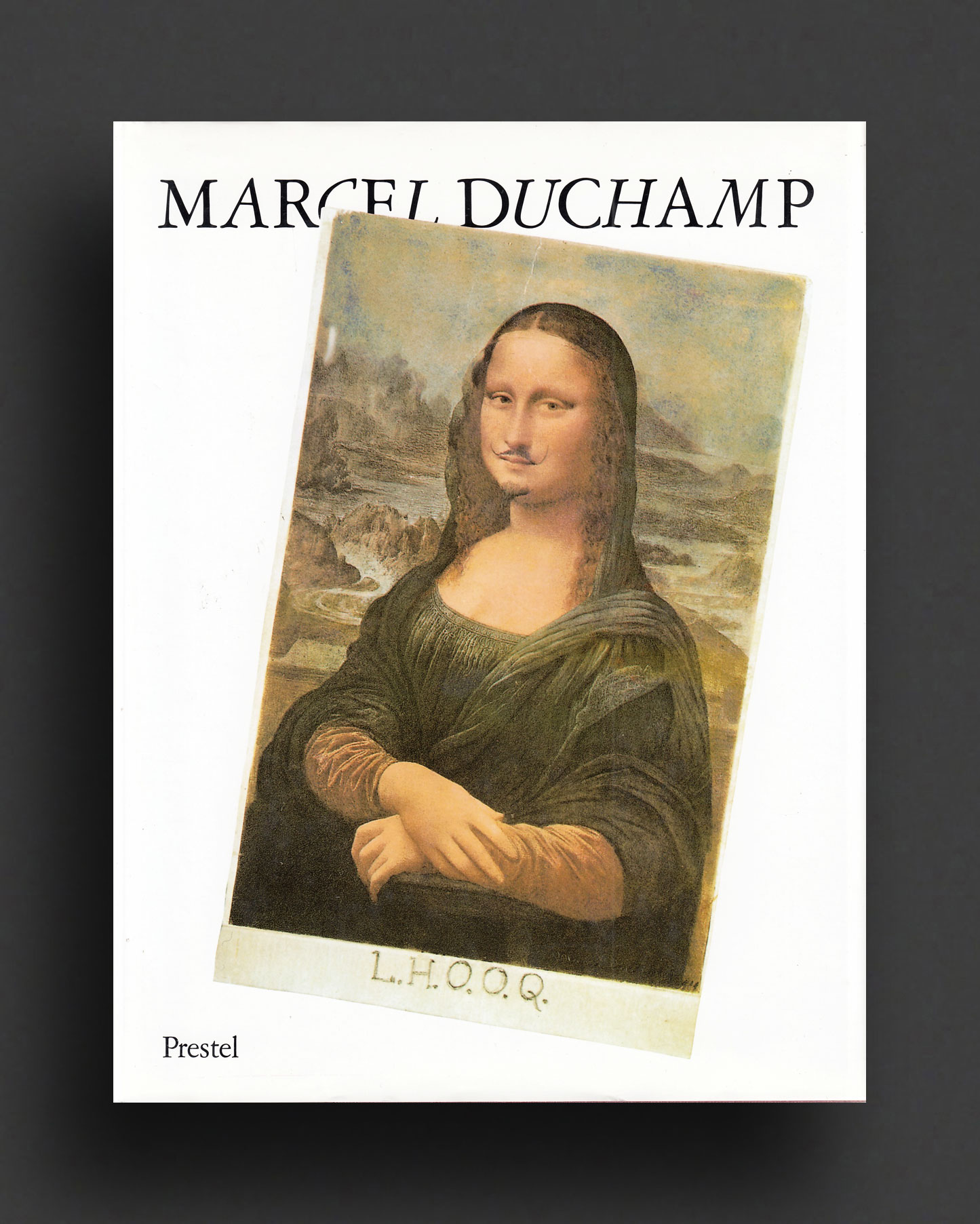
1973 / 1989, English
Hardcover (w. dust jacket), 360 pages, 38.5 x 22 cm
Out of print title / used / good
Published by
Prestel / Munich
$35.00 - In stock -
1989 hardcover re-print of this seminal monograph on Marcel Duchamp, first published ib 1973.
"Marcel Duchamp has changed the history of modern art.
His impact on the twentieth century is rivalled only by that of Matisse and Picasso, and no other figure has so directly influenced recent art forms.
Nude Descending a Staircase (1912), The Bride Stripped Bare by Her Bachelors, Even (1915-23), and the Readymades are acknowledged landmarks in the art of our century, but reference to them only hints at the scope of Duchamp's œuvre. He took up a succession of projects after his much-publicized precocious retirement from "art," and upon his death in 1968 it was revealed that he had been secretly at work for twenty years on a major piece, the naturalistic assemblage entitled Etant donnés (1946-66). As the culmination of his artistic activity, the work allows us to see his total achievement in a new light.
This book, besides presenting a documented photographic survey of Duchamp's works, offers ten original essays by eminent scholars and critics. The essays cover Duchamp's explorations in the areas of language, poetry, the machine, alchemy, and the epistemology of art; on a more personallevel, they treat the milieux and the friendships that shaped his character, the life style to which he adhered, and the influence his example has exerted. Passages from his lectures are included in the book, as well as comments and tributes by more than fifty colleagues, friends, and interested observers. Documentary illustrations, a chronology, and a bibliography complete the volume.
First published in 1973 to immediate acclaim, this monograph continues to be a definitive book on Duchamp.
Lavishly illustrated, it documents his entire career."
ANNE D'HARNONCOURT is Director of the Philadelphia Museum of Art.
KYNASTON McSHINE is Senior Curator of Painting and Sculpture at The Museum of Modern Art, New York.
Good copy. Would be NF/NF but one section of back cover edge dust jacket and board are worn back, the book and jacket are otherwise NF and nicely preserved. Now all under mylar wrap.
1974, Dutch
Softcover (screen-printed + 2 lithographs), 120 pages, 30 x 21 cm
Ed. of 750 copies,
1st Edition, Out of print title / used / very good
Published by
De Bange Duivel / Leiden
$140.00 - Out of stock
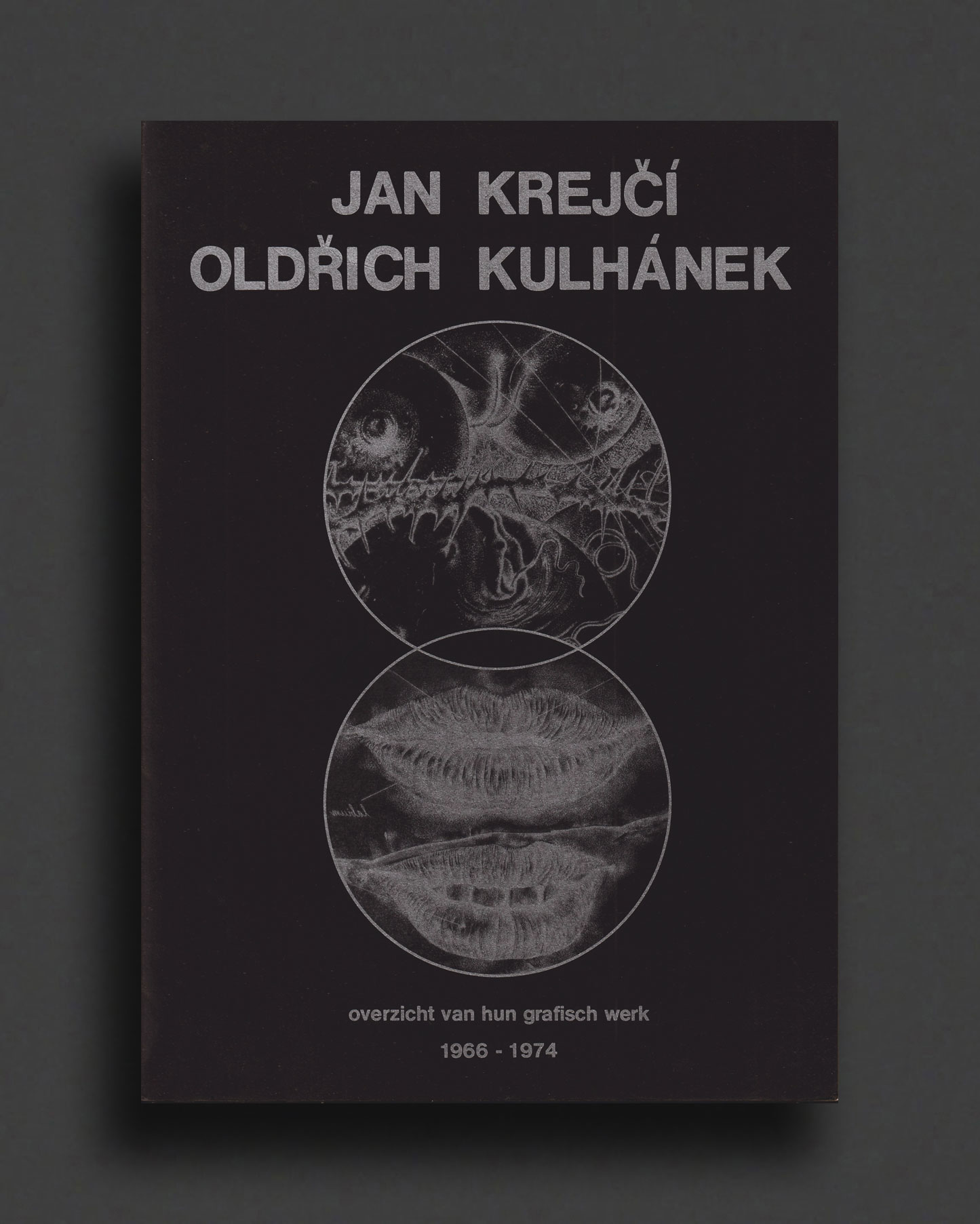
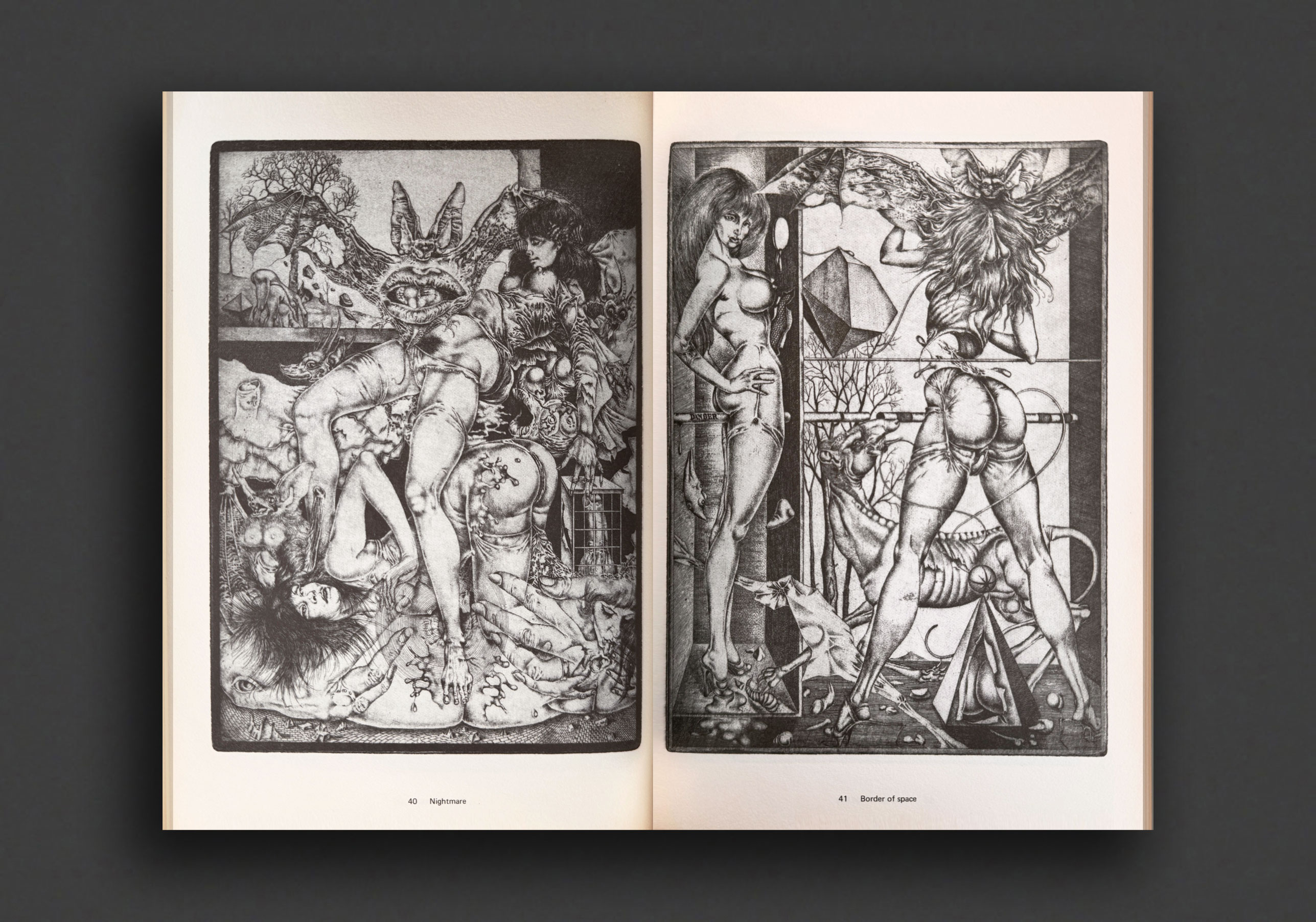
Rare copy of this incredible artbook compiling the works of two Czech graphic artists, Jan Krejčí (1942—2001) and Oldřich Kulhánek (1940—2013), complete with two beautiful lithographs still bound within (one from each artist), published during the retrospective exhibition of the two artists in Leiden's academic art centre in 1974 in a numbered edition of only 750 copies (this copy stamped no. "588"). With screen-printed metallic silver on raw black board cover, this perfectly executed book reproduces the highly-detailed phantasmagorical early graphic works of both illustrators created between 1966 - 1974 on warm paper stock, bookmarked by two fine original lithographs created specifically for this volume. Edited by Leo van Maris and Frans Montens, these commanding lithographic works reflect the influence of the psychedelic 1960's from which they came, rich with symbolism, explicit eroticism, and political anguish, with reference to popular culture and fellow artists, all rendered meticulously via a distinctively Czech surrealist sensitivity. This is one of the only, and certainly best, published examples of the work of Jan Krejčí, and one o the finest collections of the seldom seen earlier, darker an more erotic works of the acclaimed Oldřich Kulhánek. Though little known outside the Czech Republic, Kulhánek is well-known painter, graphic designer, illustrator, stage designer and pedagogue who created the design for the current Czech banknotes and postage stamps.
Highly recommended.
Very Good—Near Fine copy with only light wear.
2025, English
Softcover, 122 pages, 20.5 x 13.5 cm
Published by
Wakefield Press / Cambridge
$40.00 - In stock -
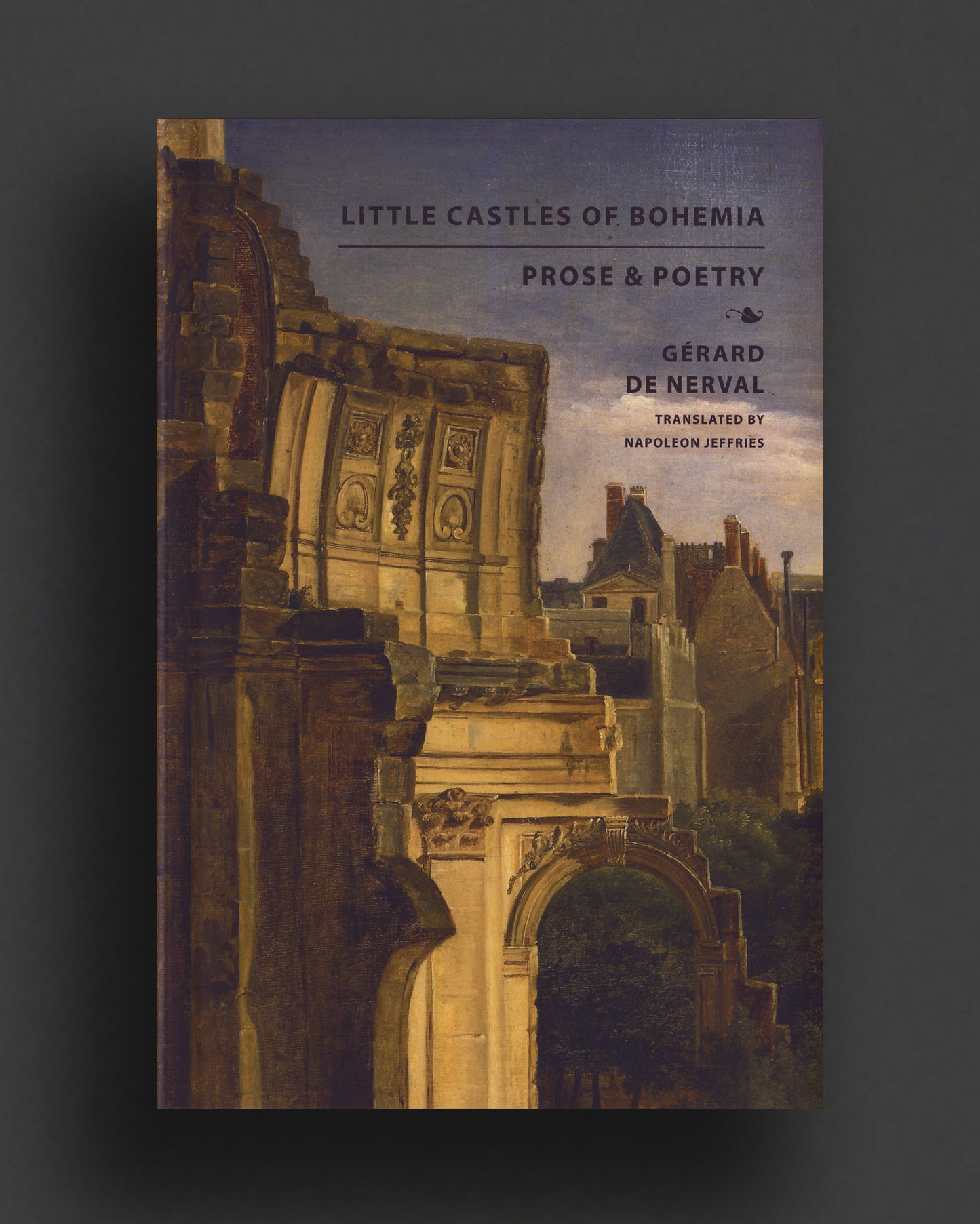
Translated, with an introduction by Napoleon Jeffries
Illustrations by Alfred Prunaire
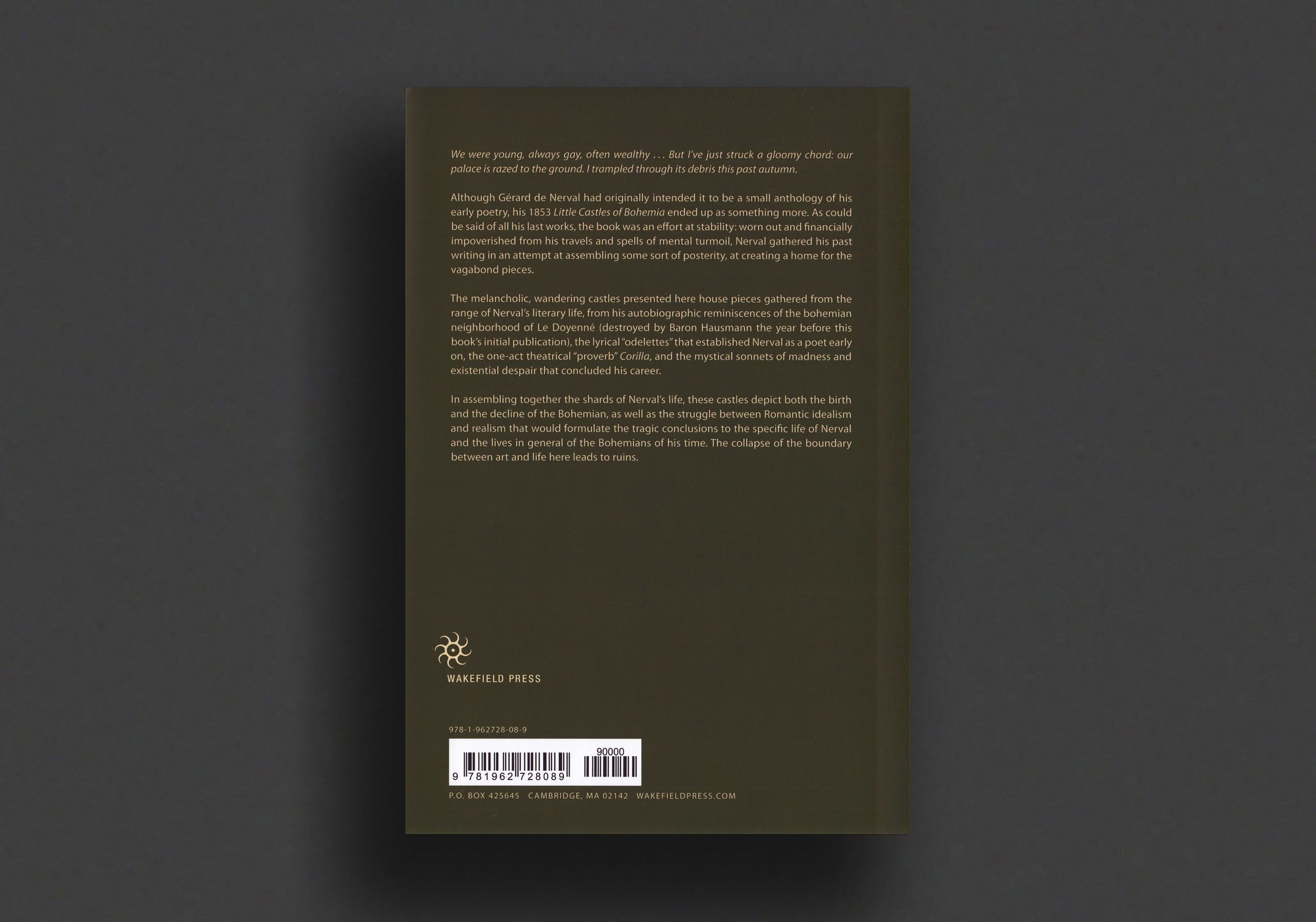
We were young, always gay, often wealthy . . . But I’ve just struck a gloomy chord: our palace is razed to the ground. I trampled through its debris this past autumn.
Although Gérard de Nerval had originally intended it to be a small anthology of his early poetry, his 1853 Little Castles of Bohemia ended up as something more. As could be said of all his last works, the book was an effort at stability: worn out and financially impoverished from his travels and spells of mental turmoil, Nerval gathered his past writing in an attempt at assembling some sort of posterity, at creating a home for the vagabond pieces.
The melancholic, wandering castles presented here house pieces gathered from the range of Nerval’s literary life, from his autobiographic reminiscences of the bohemian neighborhood of Le Doyenné (destroyed by Baron Hausmann the year before this book’s initial publication), the lyrical “odelettes” that established Nerval as a poet early on, the one-act theatrical “proverb” Corilla, and the mystical sonnets of madness and existential despair that concluded his career.
In assembling together the shards of Nerval’s life, these castles depict both the birth and the decline of the Bohemian, as well as the struggle between Romantic idealism and realism that would formulate the tragic conclusions to the specific life of Nerval and the lives in general of the Bohemians of his time. The collapse of the boundary between art and life here leads to ruins.
Gérard de Nerval (1808–1855) was a writer, poet, and translator who wedded French and German romanticism and transformed his research into mystic thought and his bouts of mental illness into such visionary works as the posthumously published Aurélia, or Dream and Life. After his suicide, his work would grow in stature and go on to influence Marcel Proust, André Breton, Antonin Artaud, Michel Leiris, and countless others.
1985, German
Hardcover, 84 pages, 26 x 21 cm
1st Edition, Out of print title / used / very good
Published by
Oberösterreichisches Landesmuseum / Austria
$85.00 - Out of stock
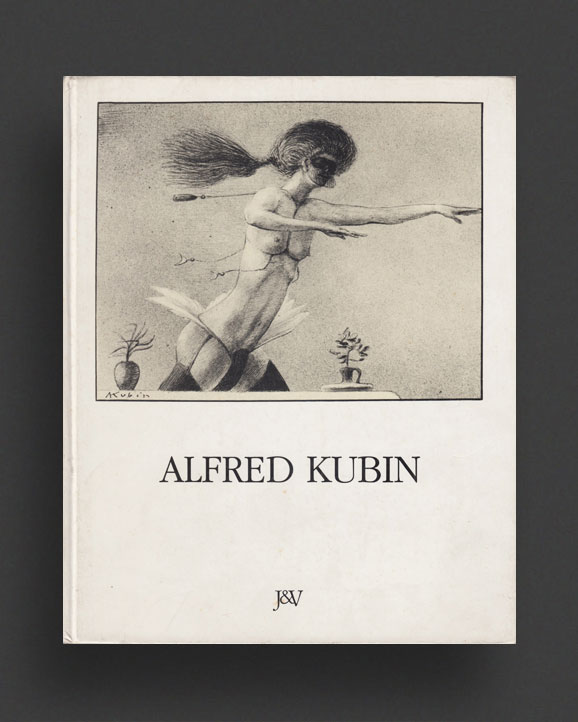
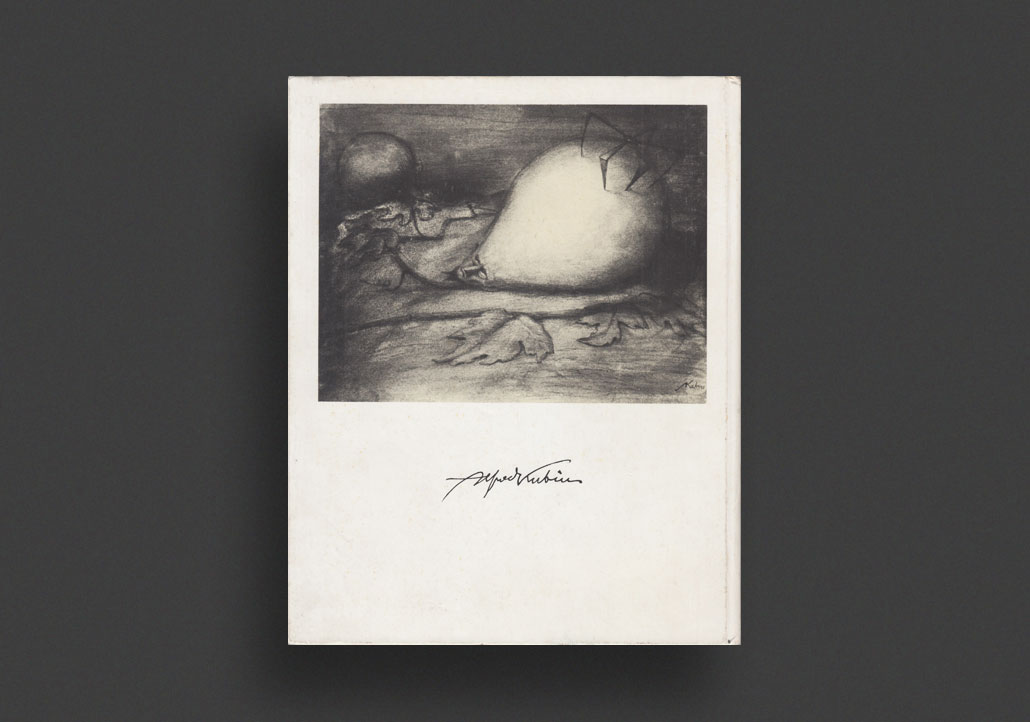
Wonderful hardcover catalogue on the great Austrian draftsman, illustrator and author Alfred Kubin (1877–1959), by the Oberösterreichisches Landesmuseum in Austria in 1985. Aptly titled and translated to "Life, An Abyss", the book is profusely illustrated throughout with the works of Kubin, accompanied by an introduction by Klaus Albrecht Schröder, biography with photographic portraits, and an exhibition catalogue.
The work of Bohemian printmaker, illustrator and occasional writer Alfred Kubin (1877–1959) appears more current today than ever before: for it was violence, wartime destruction, pandemics, natural disasters, the manipulation of the masses and other abysses of human existence that pervaded his highly narrational works. Kubin became an important figure of both the Symbolist and Expressionist movements. The oeuvre of this fantastical creator confronts us with pessimistic visions which – to quote Schopenhauer – delineate “the worst of all possible worlds”. Kubin’s nightmarish oeuvre extends Symbolism and the fantastical art of the 19th century and may be considered a precursor to French Surrealism, with its syntheses of actual and imaginary reality, its bleak realms that Kubin often seasoned with humor, irony and exaggeration. Well known for illustrating the German editions of books by Edgar Allan Poe and Fyodor Dostoevsky, amongst others, during rise of Nazism in Germany his work was considered degenerate; he retreated into solitude and lived in a castle in Zwickledt, Upper Austria. He was awarded the City of Vienna Prize for Visual Arts in 1950, and died at his home on August 20, 1959.
Very Good copy.
1988, French
Softcover (w. dust jacket), 64 pages, 32 x 24 cm
1st Edition, Out of print title / used / fine
Published by
Editions Natiris / Paris
$180.00 - Out of stock
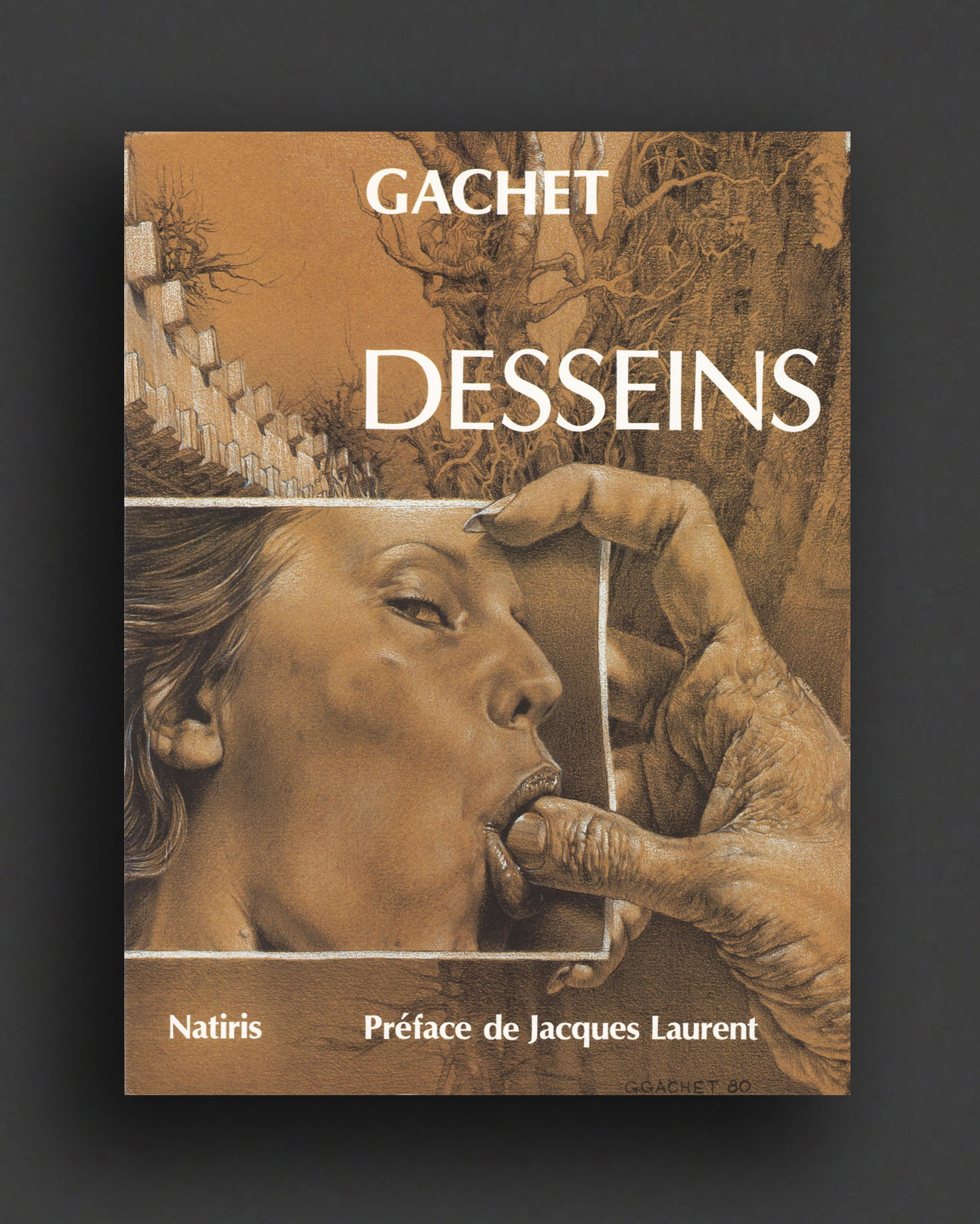
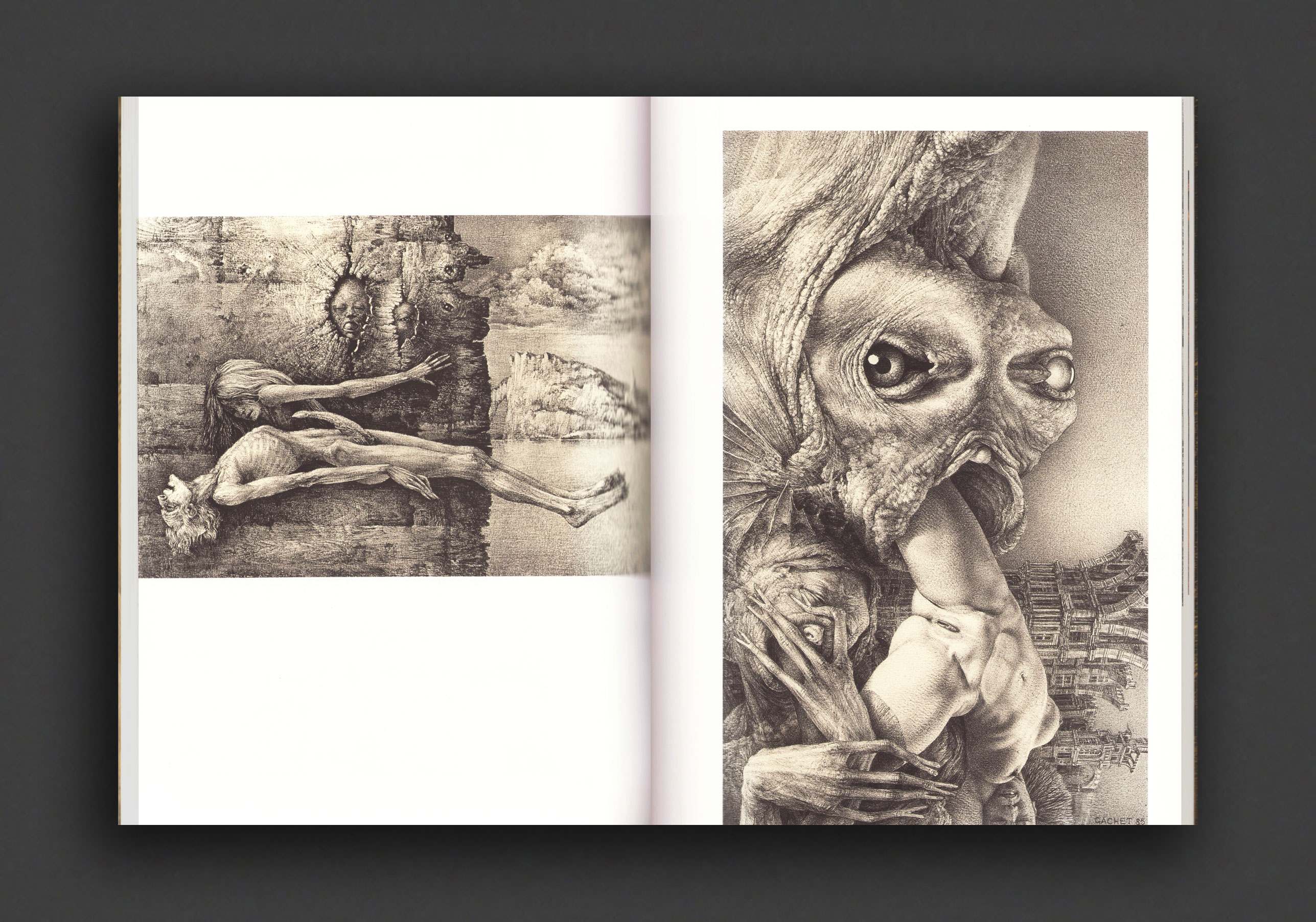
Very rare first 1988 edition of the only art book on the work of Moroccan-born, French graphic artist Gérard Gachet (1935–1985), published by Editions Natiris three years after the mysterious artist's death. Profusely illustrated throughout in colour and monochrome, Desseins is a collection of Gachet’s best drawings, which given how long it took him to produce each one represents the bulk of his lifetime’s output. Gachet’s friend Jacques Laurent (1919–2000), the writer and journalist, contributed a short preface.
Gachet's exquisite erotic magical realism is obsessive, singular and irreducible, served by a secret compulsion, "by the demanding technique that he, a stubborn alchemist, knew how to place at his disposal."
Moving to Paris, he spent a year at the École des Beaux Arts, followed by two years at the École des Arts Decoratifs in Strasbourg. After working in theatre design and teaching, he settled in Strasbourg in 1965 to concentrate on his own artistic work. A lifelong insomniac, Gachet did the painstaking preparatory work for his drawings at night or in the early hours of the morning, when his sensitivity and perceptions were heightened. He would spend his mornings by the river, the natural world an immense influence on his compositions, before he set to work. Rejecting conventional drawing techniques, he normally worked with a ballpoint pen, achieving a softness of line which no ordinary pen could give him, or with fine-tipped charcoal, each drawing usually representing a month’s work. Though his work is charged with a carnal, animal, natural sensuality, and is sometimes violent, it is never cruel. Skulls and skeletons, the symbols of death, haunt many of his drawings alongside women’s breasts, buttocks and vulvas, the source of life and a subject he found eternally fascinating.
"Gérard Gachet left us a body of work that begs to be captured in words. It is romantic, fantastical, realistic. It vibrates, as he himself clearly felt, with the breath of the ancient Germanic Rhine, which carries along in sheaves, twists, and tempestuous waves the beards, the hair, the women's pubic hair. One can sense the presence of the fir trees around the bodies arched by spasms. But all materials tempt this great artist: granular, scaly, polished, sticky, bushy. Under the light of the storm—sometimes muted and heavy, sometimes dazzling—women's genitals are partially revealed, painted with tragic precision. Yet, Gérard Gachet's eroticism is not merely morbid; it is betrayed by a sensual love of bodily forms whose harmonious curves are caressed by a painter who cannot help but—even if he has given himself an abstract starting point or if he claims a symbolic meaning—communicate his desire and pleasure to us. And no doubt he feared addressing the sexuality of our gaze too directly, hence these reptiles and amphibians which, according to him, rejected anthropomorphism—a superfluous fear. The vulvas of his women can be as unsettling as those of Courbet's women, but, enigmatic, they repel as much as they attract."—from Jacques Laurent's preface
Fine copy in Fine dust jacket.
1985, English
Softcover, 124 pages, 19.5 x 12.5 cm
1st Edition, Out of print title / used / very good
Published by
Marion Boyars / London
$50.00 - Out of stock
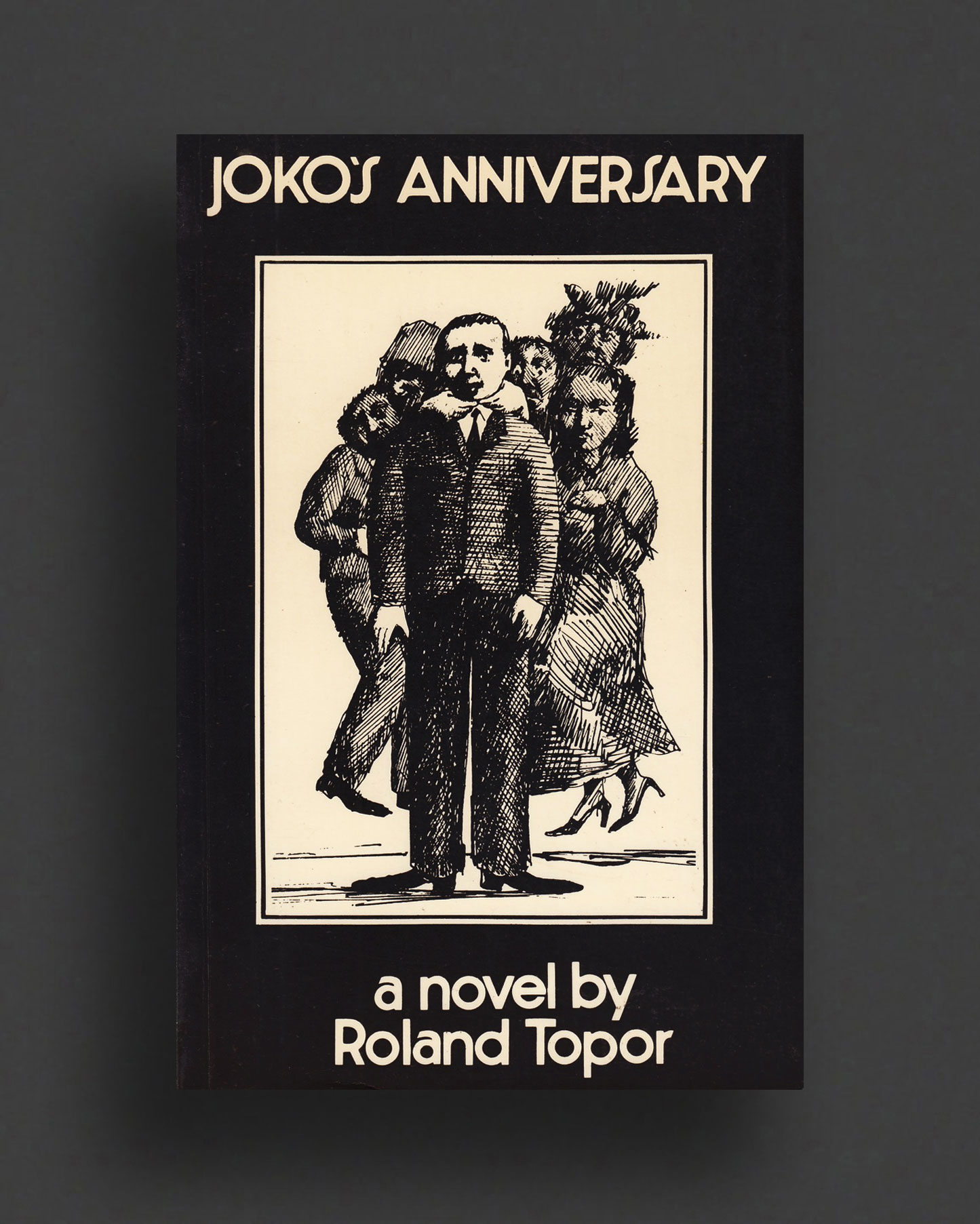
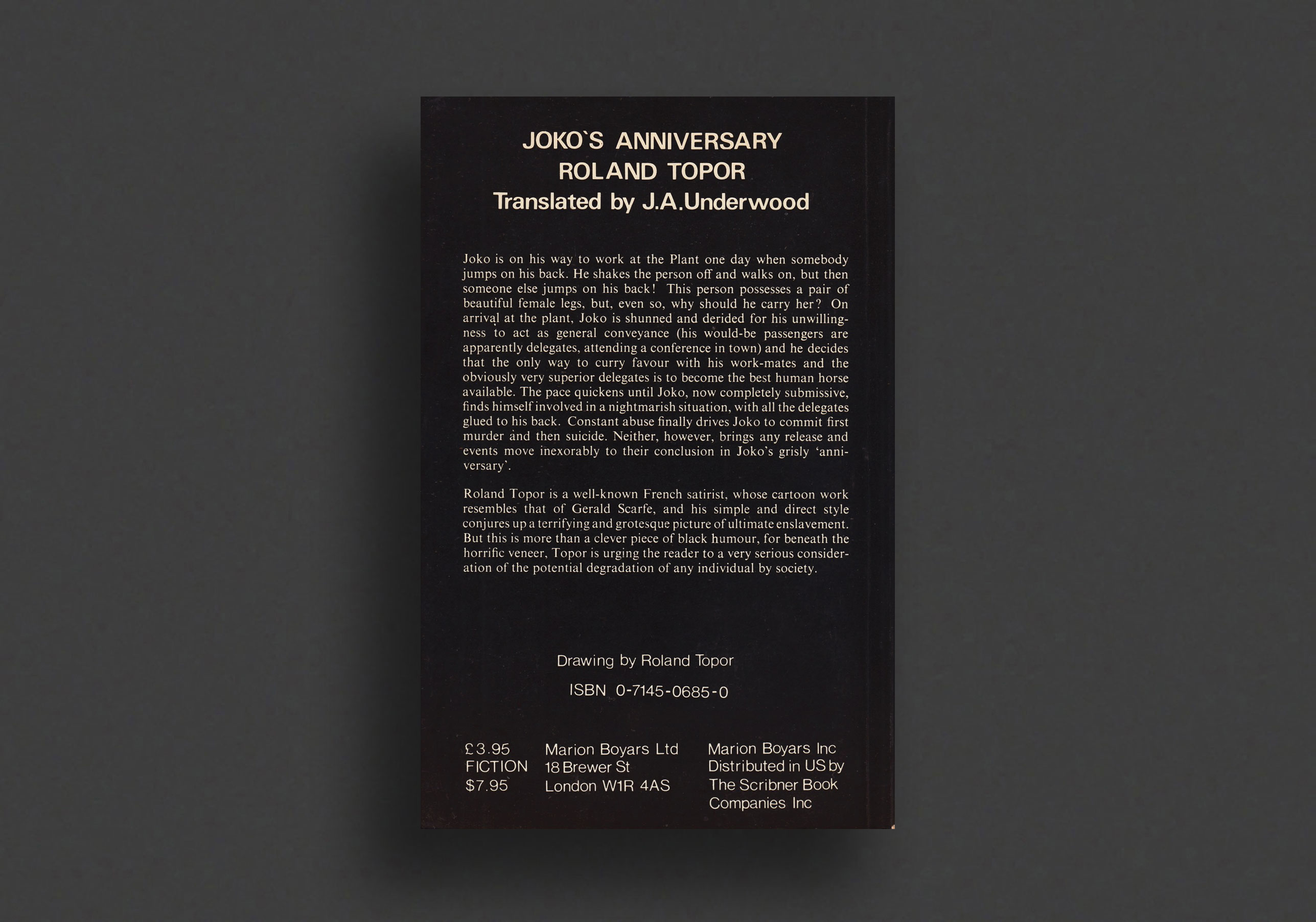
Rare 1985 English edition of Joko's Anniversary, a novel by well-known French satirist Roland Topor, tanslated by J. A. Underwood, first published in France in 1969. In Joko's Anniversary, Topor's simple and direct style conjures up a terrifying and grotesque picture of ultimate enslavement and a vicious satire on social conformity.
"Joko is on his way to work at the Plant one day when somebody jumps on his back. He shakes the person off and walks on, but then someone else jumps on his back! This person possesses a pair of beautiful female legs, but, even so, why should he carry her? On arrival at the plant, Joko is shunned and derided for his unwillingness to act as general conveyance (his would-be passengers are apparently delegates, attending a conference in town) and he decides that the only way to curry favour with his work-mates and the obviously very superior delegates is to become the best human horse available. The pace quickens until Joko, now completely submissive, finds himself involved in a nightmarish situation, with all the delegates glued to his back[...]"
More than a clever piece of black humour, for beneath the horrific veneer, Topor is urging the reader to a very serious consideration of the potential degradation of any individual by society.
"Maybe this obscure exercise in European absurdism doesn’t belong in a horror book review, but it does contain generous helpings of mutilation, cannibalism and demonic possession. Beginning like the most ludicrous SATURDAY NIGHT LIVE sketch ever and concluding with a grand guignol blow out worthy of De Sade, this tale is nothing if not unclassifiable. Whatever it is, it’s most definitely one of the strangest books I’ve ever read, and no surprise, as its author Roland Topor was a close associate of wacky cult figures like Alejandro Jodorowski and Fernando Arrabal. Topor also co-scripted the bizarre sci fi cartoon FANTASTIC PLANET and provided the source novel for Roman Polanski’s whacked-out classic THE TENANT."—The Bedlam Files
Roland Topor (1938—1997) was one of the most unique and versatile French artists of the second half of the 20th century, working prolifically as a provocative and spirited illustrator, author, humorist, satirist, poet, painter, performer, sculptor, playwright, film and TV writer, filmmaker and actor, and much more. A founder of the Panic Movement, an art collective formed by Fernando Arrabal, Alejandro Jodorowsky, and Roland Topor in Paris in 1962, Topor was known for the surreal and absurdist nature of his work.
Very Good copy with mild foxing to block edge.
1997, English
Softcover, 176 pages, 20 x 13 cm
1st Edition, Out of print title / used / very good
Published by
Black Spring Press / London
$60.00 - Out of stock
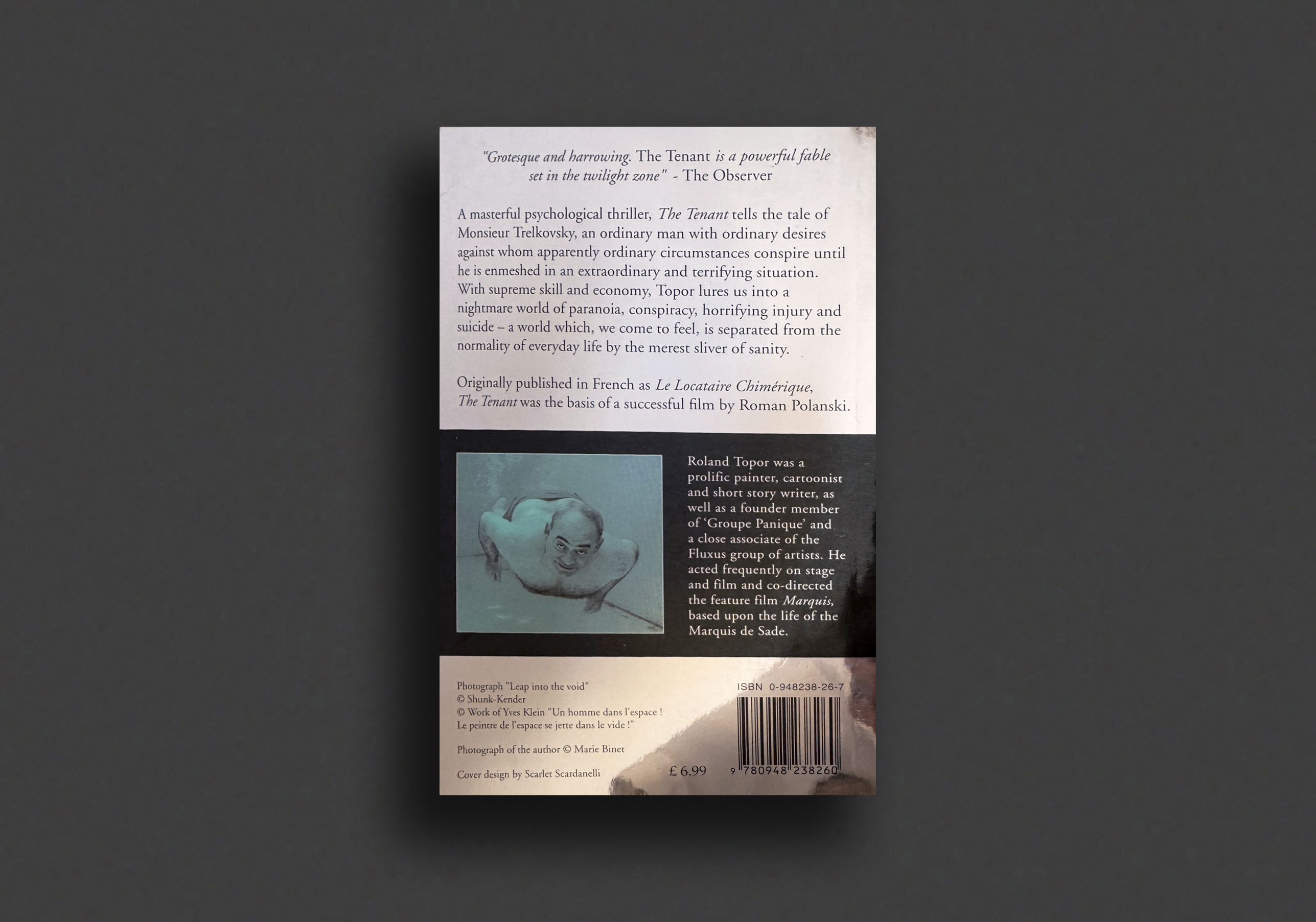
Rare 1997 Black Spring Press edition of Roland Topor's The Tenant with "mirrored" covers. A masterful psychological thriller, The Tenant tells the tale of Monsieur Trelkovsky, an ordinary man with ordinary desires against whom apparently ordinary circumstances conspire until he is enmeshed in an extraordinary and terrifying situation.
"Grotesque and harrowing. The Tenant is a powerful fable set in the twilight zone"—The Observer
With supreme skill and economy, Topor lures us into a nightmare world of paranoia, conspiracy, horrifying injury and suicide - a world which, we come to feel, is separated from the normality of everyday life by the merest sliver of sanity.
Originally published in French as Le Locataire Chimérique in 1964, The Tenant was the basis of a successful film by Roman Polanski.
Roland Topor (1938—1997) was one of the most unique and versatile French artists of the second half of the 20th century, working prolifically as a provocative and spirited illustrator, author, humorist, satirist, poet, painter, performer, sculptor, playwright, film and TV writer, filmmaker and actor, and much more. A founder of the Panic Movement, an art collective formed by Fernando Arrabal, Alejandro Jodorowsky, and Roland Topor in Paris in 1962, Topor was known for the surreal and absurdist nature of his work.
Very Good copy with mild tanning.
1985, English
Hardcover (w. slipcase), unpaginated, 22 x 16 cm
Out of print title / used / very good
Published by
Parlor / Tokyo
$180.00 - Out of stock
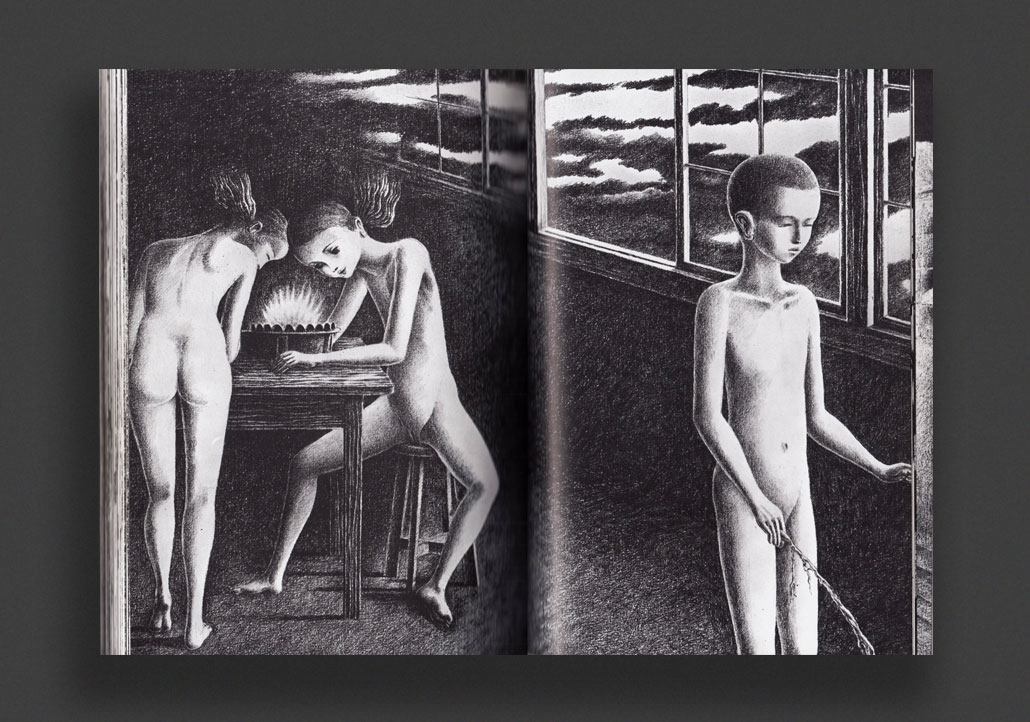
1985 edition of Japanese illustrator Ken Katayama's masterpiece artbook, Beautiful Days, originally issued in this same hardcover, slipcased form in 1969 in a limited edition. Beautiful Days is the most crystallised embodiment of one of the most unique artistic visions of fantasy illustration one could ever find, and the first collection ever published by the artist, when, after discovering the erotic works on the fringe of Surrealism he gave up becoming a painter and gave himself over to the obscene impulses of drawing. "There, so to speak, masturbation became a picture. Until then, I never thought that masturbation could become a painting"—excerpt from Ken Katayama's 1985 postscript. Katayama's magnificently, obsessive graphite-rendered world-making is, like those of Lewis Carroll before him, made up almost entirely of children; children in states of blank-faced entrancement, possession and naked abandon; groping, lost and frozen in a psychosexual schoolhood theatre. Unlike anything else, aspects of Katayama's bewildering sadomasochistic fairytale visions recall the tales of de Sade, Balthus, Hans Bellmer, Carroll's Alice, the architectural dreamscapes of Delvaux or the Metaphysical painters and even fellow Japanese artist Yoshifumi Hayashi — a haunted landscape of eroticised adolescent memories with recurring motifs of free flowing urination and defecation, violently strewn newspapers, urinals, and apparitions of cat-people. Nothing like it! The work even inspired an experimental film of boyhood memories directed by the provocative film-maker Nakamura Masanobu in 1970.
"If you
keep your hands in your pockets
in your pocket
what are you hiding
that's how I got it
darkness in my pocket, days of dust
I opened the old album and showed
beautiful days other days"
Virtually unknown outside his native Japan, Katayama (b. 1940, Tokyo) studied at the Musahino Art University and in the 1960s and 1970s begin contributing illustrations to underground art and literary magazines such as Black Notebook, Featured Story and fetish magazines such as SM Select, amongst many others. He published art books such as Angel Hour, Lost Child's Top, Match Taker, The Cat in Boots, and many more, and went on to become a successful children's story book illustrator, publishing many works throughout the 1980s—90s.
Fine copy, beautifully preserved in Very Good slipcase.
1988, Japanese
Hardcover in heavy, illustrated slipcase, 193 pages, 30.4 x 30 cm
1st Edition, Out of print title / used / very good
Published by
Bijutsu Shuppansha / Japan
$380.00 - In stock -
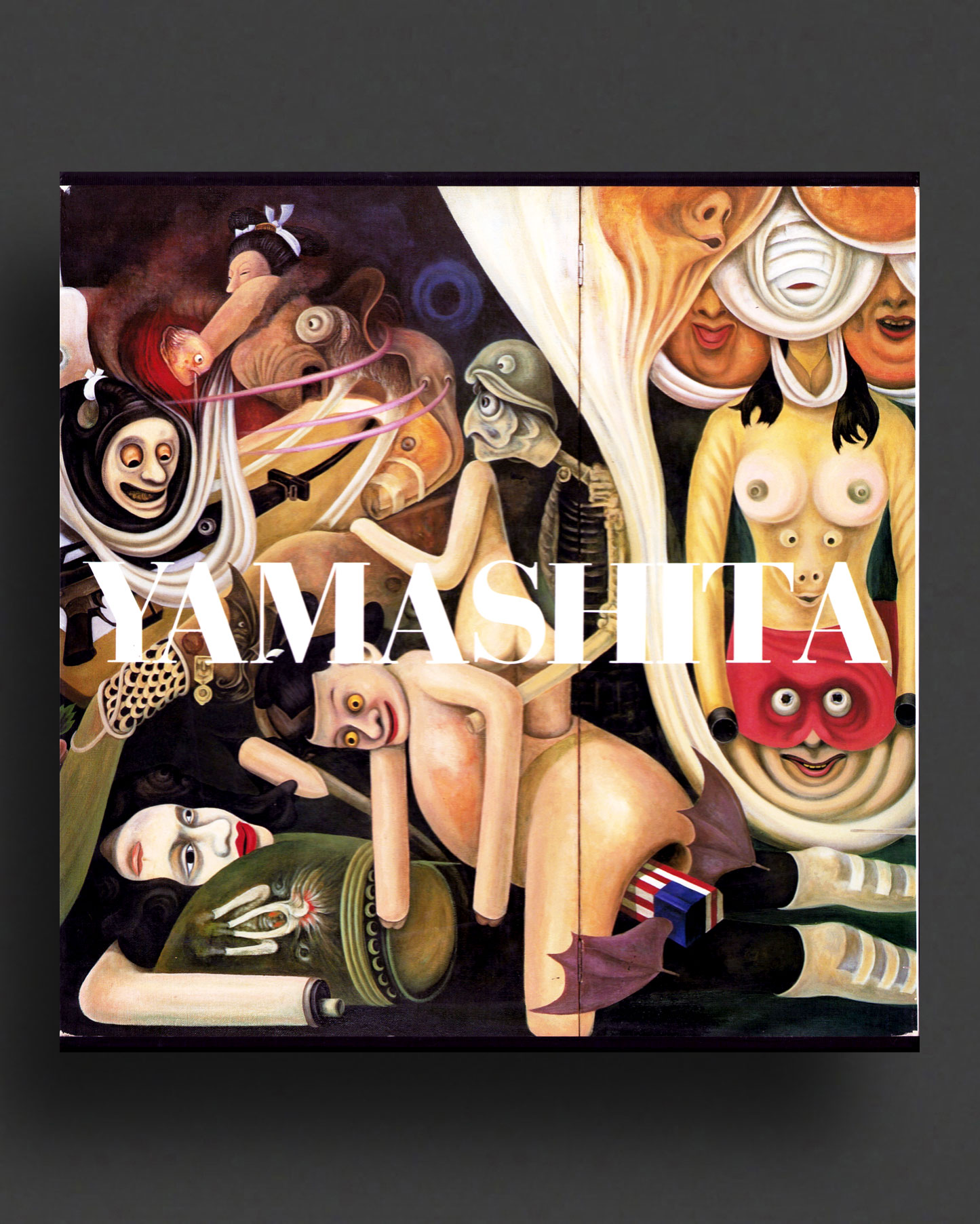
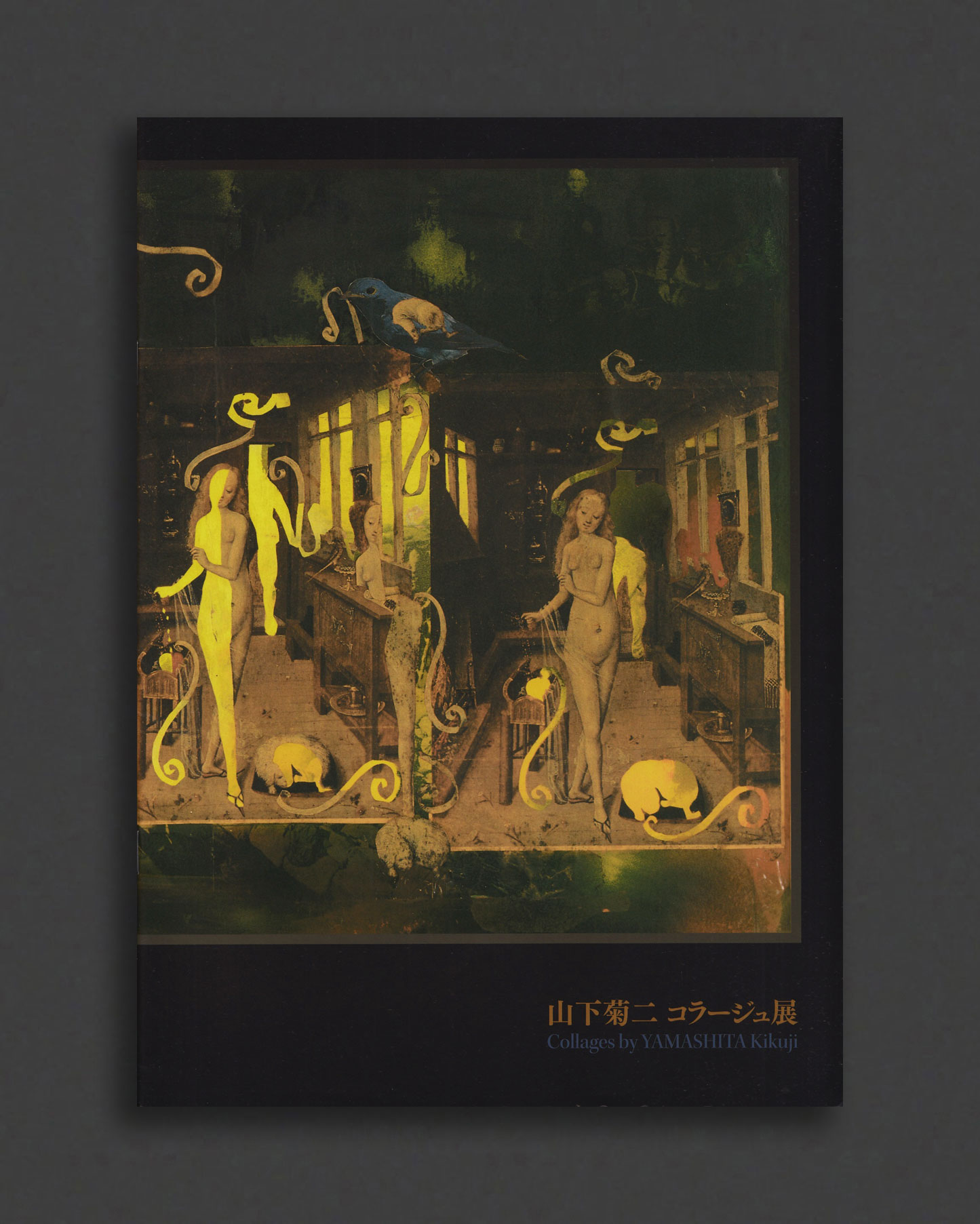
First edition of the most comprehensive, incredibly rare, and hands-down best book on the work of Japanese Surrealist painter Yamashita Kikuji (1919—1986), published in 1988 in this lavish hardcover, slipcased edition designed by the legendary Kiyoshi Awazu and Tokiko Nagayama for Bijutsu Shuppansha. Profusely illustrated with large-format reproductions of Yamashita's incredible phantasmagorical paintings and collages, accompanied by commentry and texts by Japanese poet and essayist Hiroshi Noma, Hideo Ishiguro, art critic Ichirō Hariu, lyricist Hajime Kijima, painter Koichi Tanigawa, Kikuji Yamashita himself, and many others, full catalogue of works, chronology, and more. Highly recommended!
Yamashita Kikuji (b. 1919, Tokushima, Shikoku Island, d. 1986) was a Japanese Surrealist painter, printmaker, collagist, activist and bird lover associated with the postwar avant-garde art movement in Japan who studied under the Japanese Surrealist painter Ichiro Fukuzawa in Tokyo. In 1939 he was drafted into the Japanese Imperial military to fight in China, and although he survived the war, feelings of guilt and traumatic memories of his wartime experience, including participating in the torture and murder of a Chinese prisoner, pervaded his ferocious postwar artistic vision and output. His work became emblematic of the ‘Reportage’ style of painting, whereby artists expressed Socialist concerns in a style combining Social Realism and Surrealism. As a young man he travelled to Europe where he was introduced to the works of artists including Max Ernst, Salvador Dali and Hieronymus Bosch. Yamashita transposes the perverse and fantastical imagery of Bosch into an explicitly Surrealist register. In Yamashita’s paintings, the human figure is fragmented and morphed into erotically suggestive, comical or abject guises. The nude body, and its potential to contort into something uncanny or grotesque, is a continual subject of Yamashita Kikuji’s phantasmagorical paintings. Although he continued to paint hundreds of canvases, he deliberately avoided seeking out commercial success, perhaps out of a sense of guilt, and was only able to survive as a full-time artist thanks to his devoted wife's earnings as a beautician. "He didn’t talk about it much, but he would cry out from his nightmares at night. He sounded like he was in such pain that I used to wake him. He didn’t tell me directly, but in 1970 he published an article, “A Peephole onto Discrimination.” In it, he wrote about how he had executed a prisoner of war in a very brutal fashion." He deeply regretted the fact that he couldn’t give his own life by refusing that order. He wanted to take responsibility for what he had done. That became the driving force behind his paintings. Yamashita was a bird lover—evident in the recurring image of birds in his paintings—and shared his home and studio with many birds, including owls and hawks. It is said that he would sometimes appear at an exhibition, disheveled and cheerful, accompanied by a small bird in his pocket that he would feed premasticated (pre‐chewed) food directly from his mouth.
Very Good book and slipcase — light wear to slipcase edge, light foxing to block edge.
2011, Japanese
Softcover (staple-bound), 26 pages, 29.5 x 21 cm
1st Edition, Out of print title / used / fine
Published by
The Museum of Modern Art / Kamakura
$45.00 - In stock -
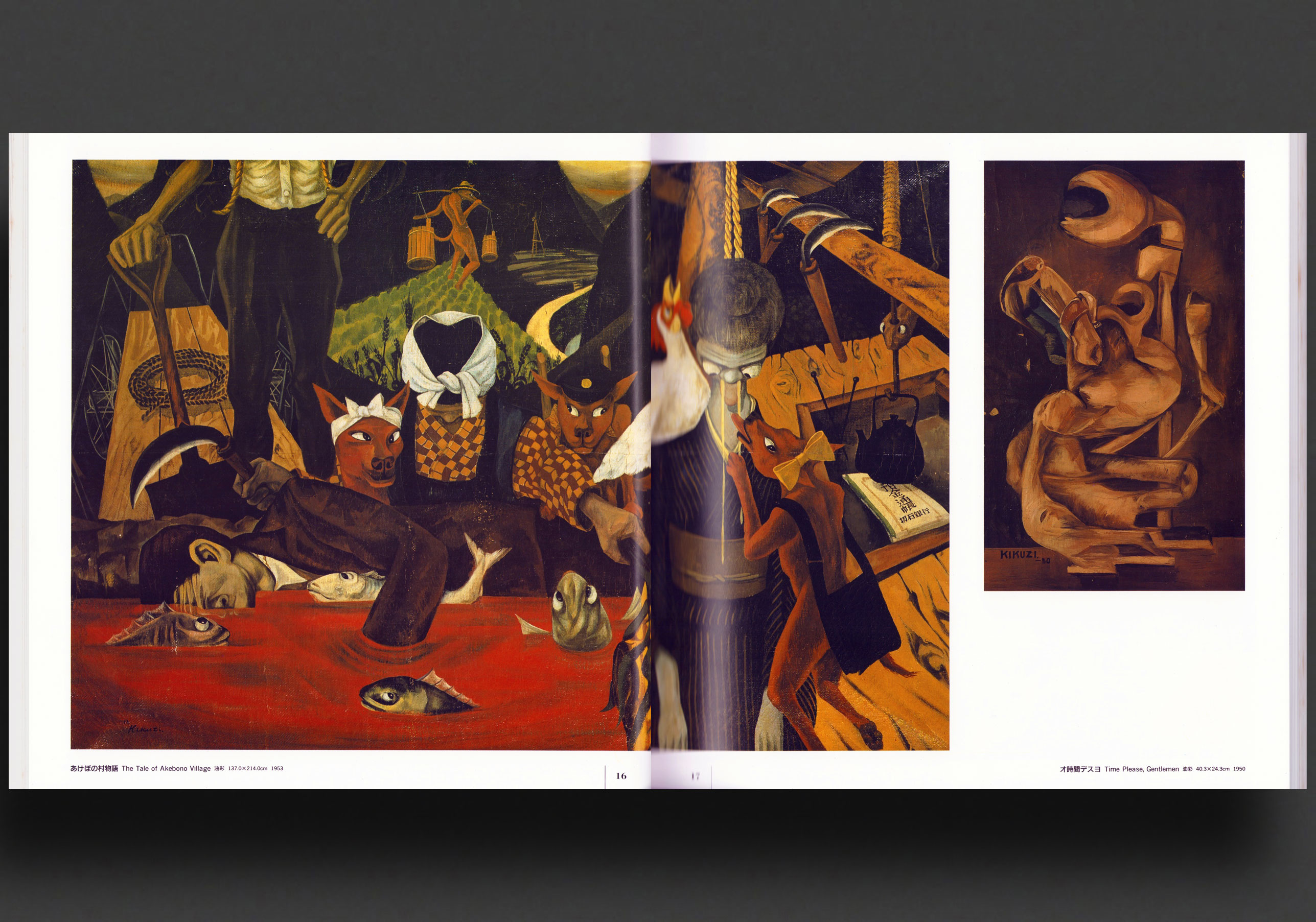
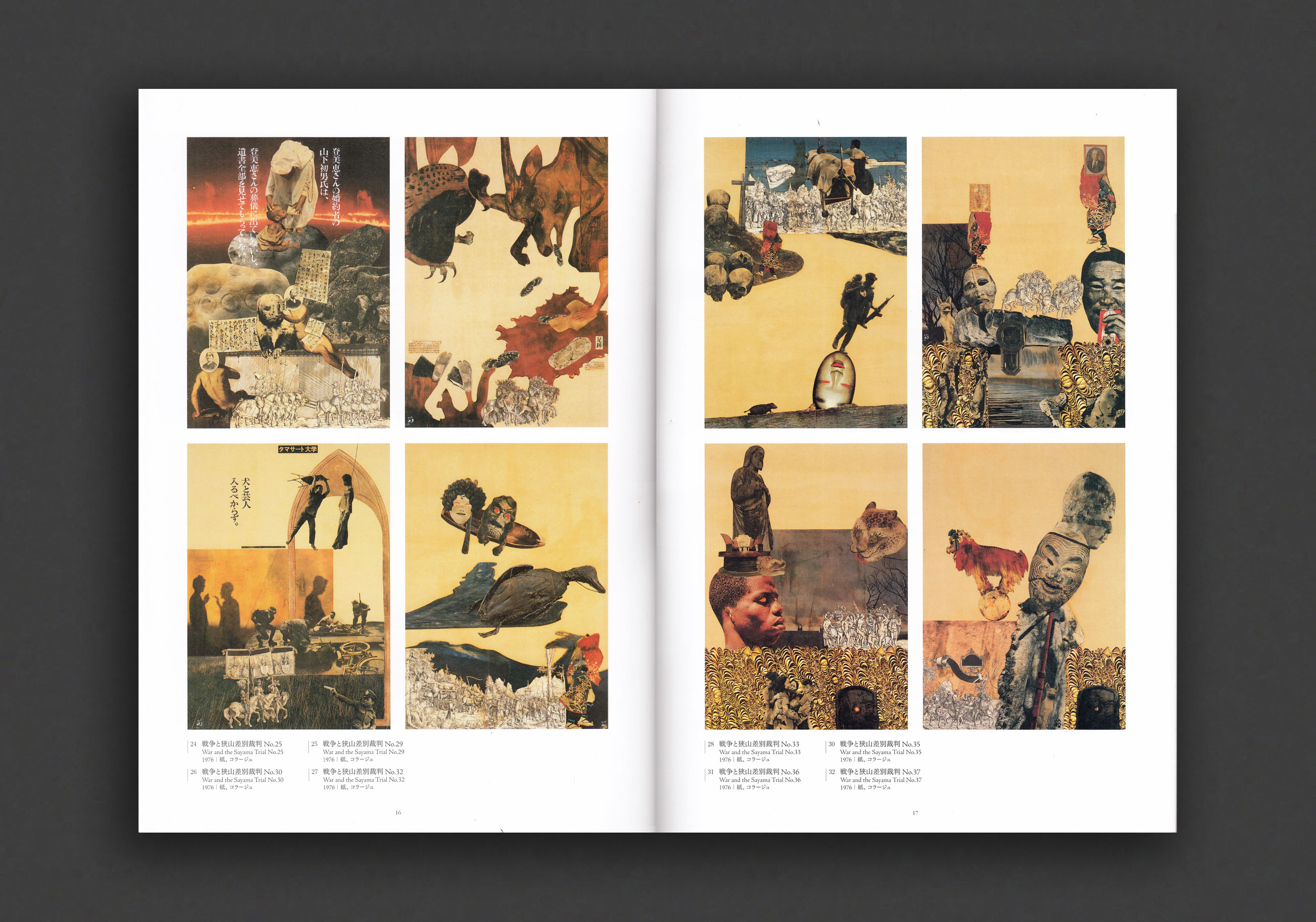
Scarce exhibition catalogue on the Japanese Surrealist painter Kikuji Yamashita (1919—1986), a postwar painter who confronted the problem of the common people's consciousness and characterised the chaos of social realism with spectacular surrealist methods, inventing reportage paintings, and turning real-life incidents into provocative picture-story shows. Published on the occasion of an exhibition focussing on his lesser-known and equally breath-taking collage works at The Museum of Modern Art, Kamakura Annex, January 8 - March 27, 2011, organized by The Museum of Modern Art, Kamakura & Hayama. Bi-lingual introduction in English and Japanese, the catalogue is filled with his collages based on the theme of The Sayama Case Trials, which were donated to the museum in 2009, followed by a chronology.
Kikuji Yamashita (b. 1919, Tokushima, Shikoku Island, d. 1986) was a Japanese Surrealist painter, printmaker, collagist, activist and bird lover associated with the postwar avant-garde art movement in Japan who studied under the Japanese Surrealist painter Ichiro Fukuzawa in Tokyo. In 1939 he was drafted into the Japanese Imperial military to fight in China, and although he survived the war, feelings of guilt and traumatic memories of his wartime experience, including participating in the torture and murder of a Chinese prisoner, pervaded his ferocious postwar artistic vision and output. His work became emblematic of the ‘Reportage’ style of painting, whereby artists expressed Socialist concerns in a style combining Social Realism and Surrealism. As a young man he travelled to Europe where he was introduced to the works of artists including Max Ernst, Salvador Dali and Hieronymus Bosch. Yamashita transposes the perverse and fantastical imagery of Bosch into an explicitly Surrealist register. In Yamashita’s paintings, the human figure is fragmented and morphed into erotically suggestive, comical or abject guises. The nude body, and its potential to contort into something uncanny or grotesque, is a continual subject of Yamashita Kikuji’s phantasmagorical paintings. Although he continued to paint hundreds of canvases, he deliberately avoided seeking out commercial success, perhaps out of a sense of guilt, and was only able to survive as a full-time artist thanks to his devoted wife's earnings as a beautician. "He didn’t talk about it much, but he would cry out from his nightmares at night. He sounded like he was in such pain that I used to wake him. He didn’t tell me directly, but in 1970 he published an article, “A Peephole onto Discrimination.” In it, he wrote about how he had executed a prisoner of war in a very brutal fashion." He deeply regretted the fact that he couldn’t give his own life by refusing that order. He wanted to take responsibility for what he had done. That became the driving force behind his paintings. Yamashita was a bird lover—evident in the recurring image of birds in his paintings—and shared his home and studio with many birds, including owls and hawks. It is said that he would sometimes appear at an exhibition, disheveled and cheerful, accompanied by a small bird in his pocket that he would feed premasticated (pre‐chewed) food directly from his mouth.
Very Good copy.
1978, German
Hardcover (w. hard slipcase), 22 pages + 34 plates, 35 x 29 cm
1st Edition, Out of print title / used / average
Published by
Edition Volker Huber / Offenbach am Main
$45.00 - In stock -
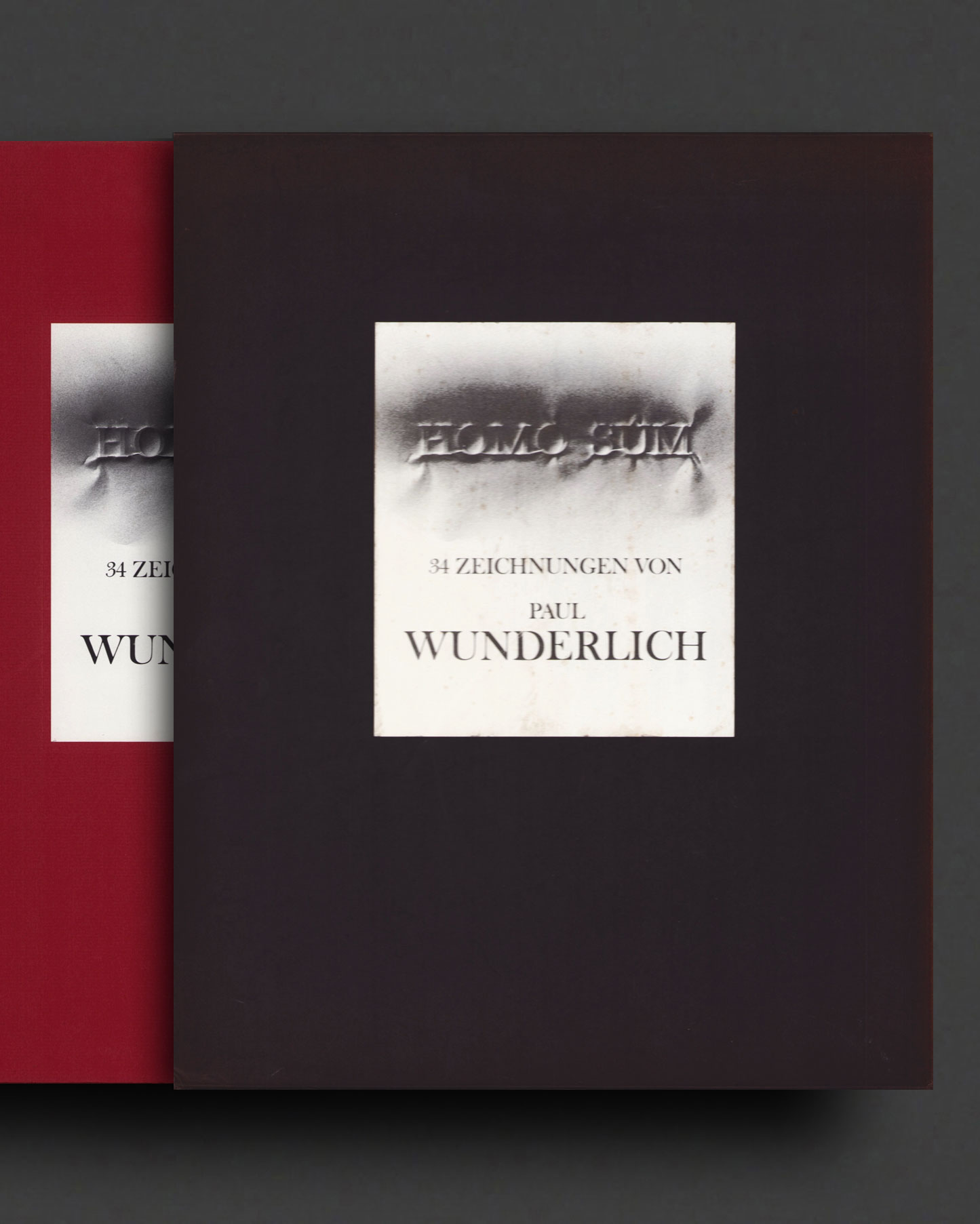
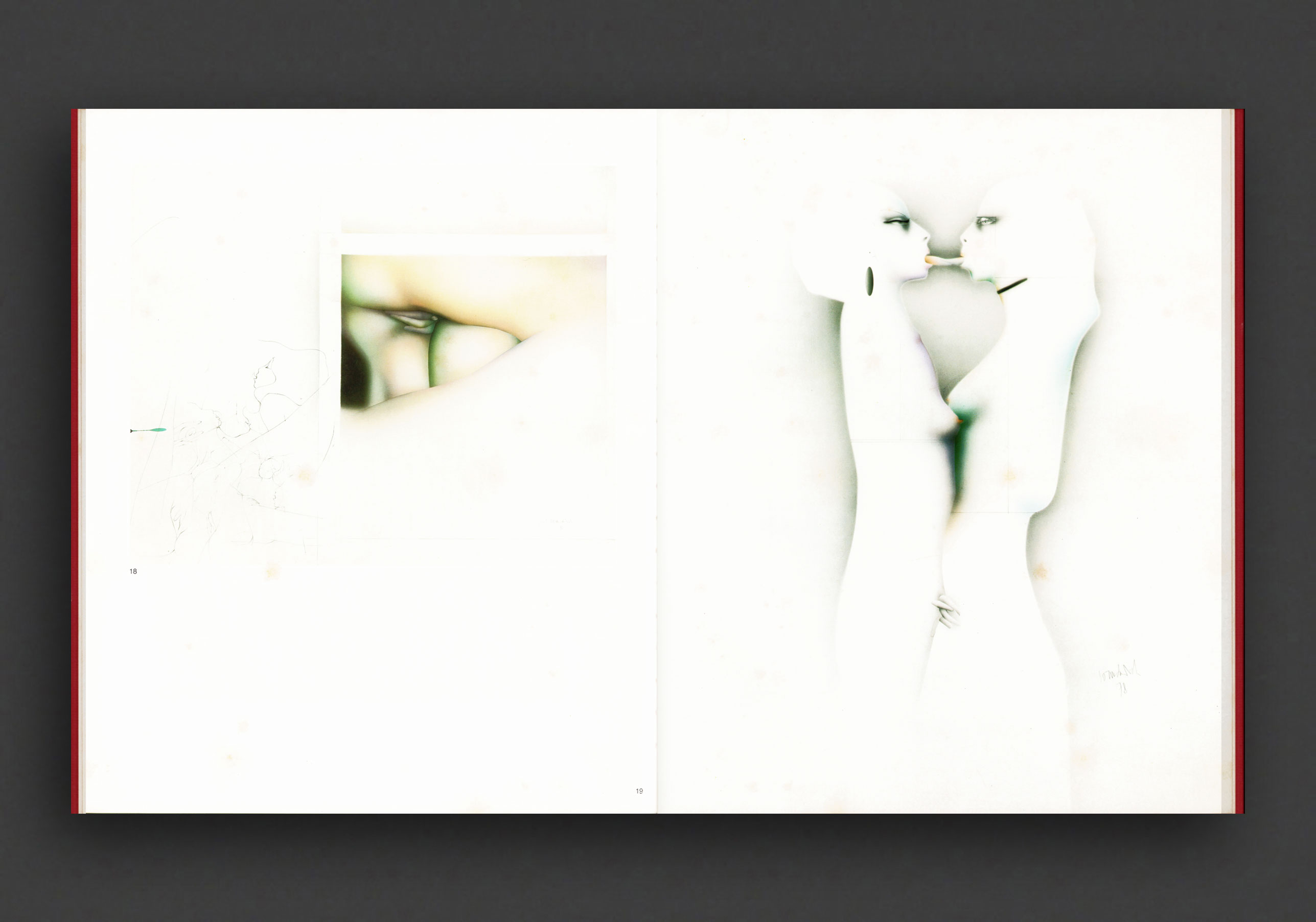
First German 1978 edition of Paul Wunderlich's erotic portfolio "Homo Sum", published by Edition Volker Huber, Offenbach am Main. An lovely over-sized, hardcover edition of 34 full-page drawings housed in hard slipcase with illustrated plate by German painter, sculptor and graphic artist, Paul Wunderlich (1927—2010). Homo Sum is Wunderlich's more explicit works including many same gender male and female scenarios rendered in his iconic airbrush style.
Paul Wunderlich (1927—2010) is known for his erotic, Surrealist-inspired paintings, prints, and sculptures featuring mythological imagery. A pioneer of Magic Realism, Wunderlich received the Japan Cultural Forum Award and the Kunstpreis des Landes Schleswig-Holstein among other accolades. Despite his iconic works being held in some of the world’s most prominent museums, such as the Museum of Modern Art, the British Museum, and the Victoria and Albert Museum, Wunderlich remains an “artist’s artist.” He studied graphic arts at the University of Fine Arts in Hamburg; he later learned printmaking techniques from Oskar Kokoschka and Emil Nolde. His early paintings displayed an abstract, Tachist style, although he embraced figuration in the late 1950s and he developed his characteristic style. He portrayed dismembered figures and sexually provocative imagery reminiscent of the Surrealists, but also influenced art movements such as Art Deco and Art Nouveau. His work was critically received as so scandalous that, in 1960, his lithograph series Qui s’explique (1959) was seized by authorities in Hamburg, and he often had trouble with raids that destroyed his works. Paul Wunderlich was married to photographer Karin Székessy in 1971, and the couple pursued art projects together.
Average copy due to significant foxing (spotting) to pages throughout, light wear, tanning to box edges.
1984, Japanese / English / French
Softcover, 149 pages, 27 x 22 cm
1st Edition, Out of print title / used / fine
Published by
Seibu / Tokyo
$90.00 - In stock -
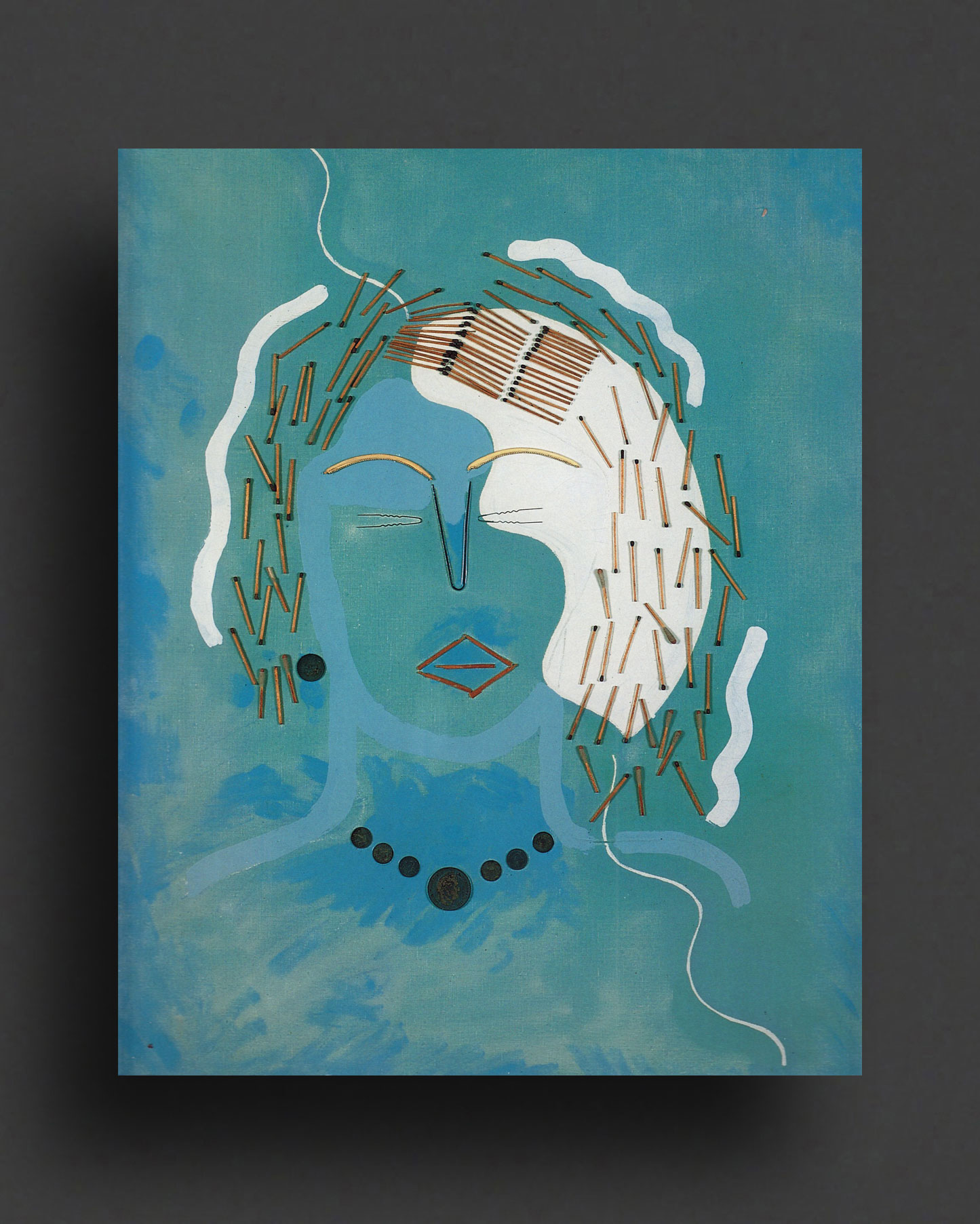
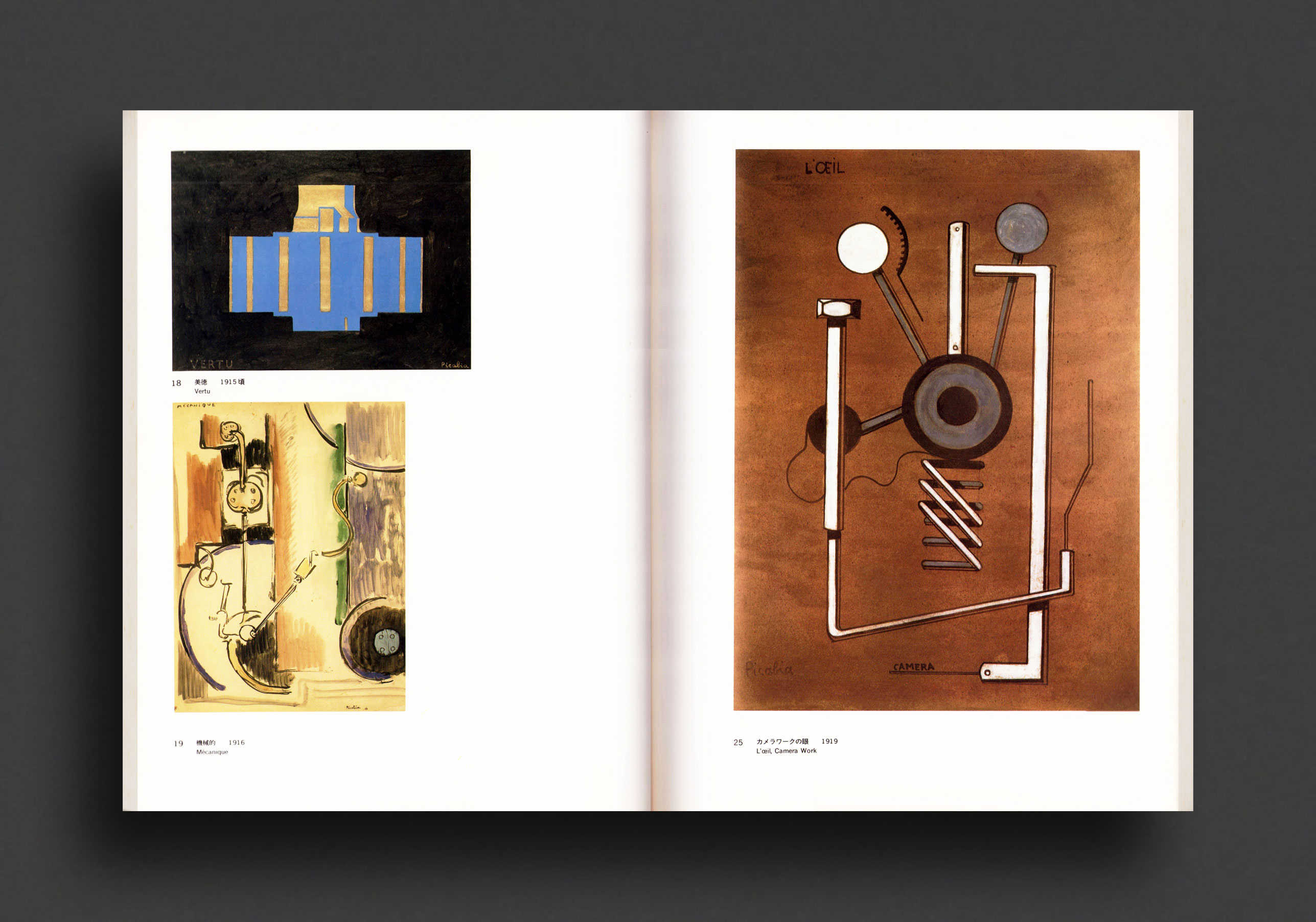
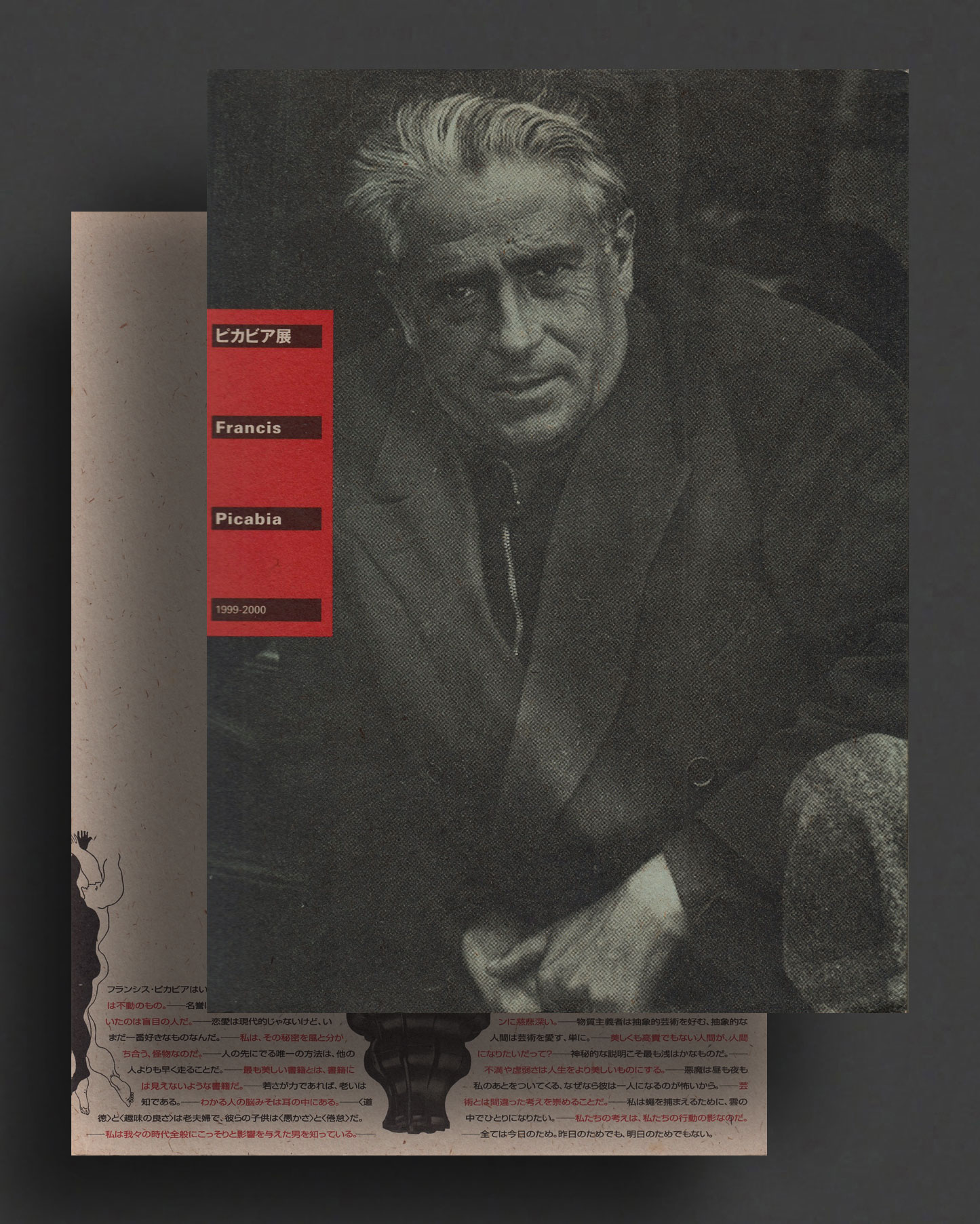
Scarce Japanese Francis Picabia catalogue produced on the occasion of an exhibition at The Museum of Modern Art, Seibu Takanawa 21 July-5 September 1984 and The Seibu Museum of Art, Tokyo 9 September-21 October 1984.
Richly illustrated with many of Picabia's works spanning his entire oeuvre in painting, drawing, text and print, with texts in Japanese,some English and French.
Francis Picabia (22 January 1879 – 30 November 1953) was a French avant-garde painter, poet and typographist. After experimenting with Impressionism and pointillism, Picabia became associated with Cubism. His highly abstract planar compositions were colourful and rich in contrasts. He was one of the early major figures of the Dada movement in the United States and in France. His was later briefly associated with Surrealism, but would soon turn his back on the art establishment.
Near Fine copy.
1999, English / French / Japanese
Softcover (2 Vols in curregated cardboard slip-case), 226 + 120 pages, 18 x 25 cm
1st Edition, Out of print title / used / very good
Published by
APT International / Tokyo
Isetan Museum of Art / Tokyo
$160.00 - In stock -
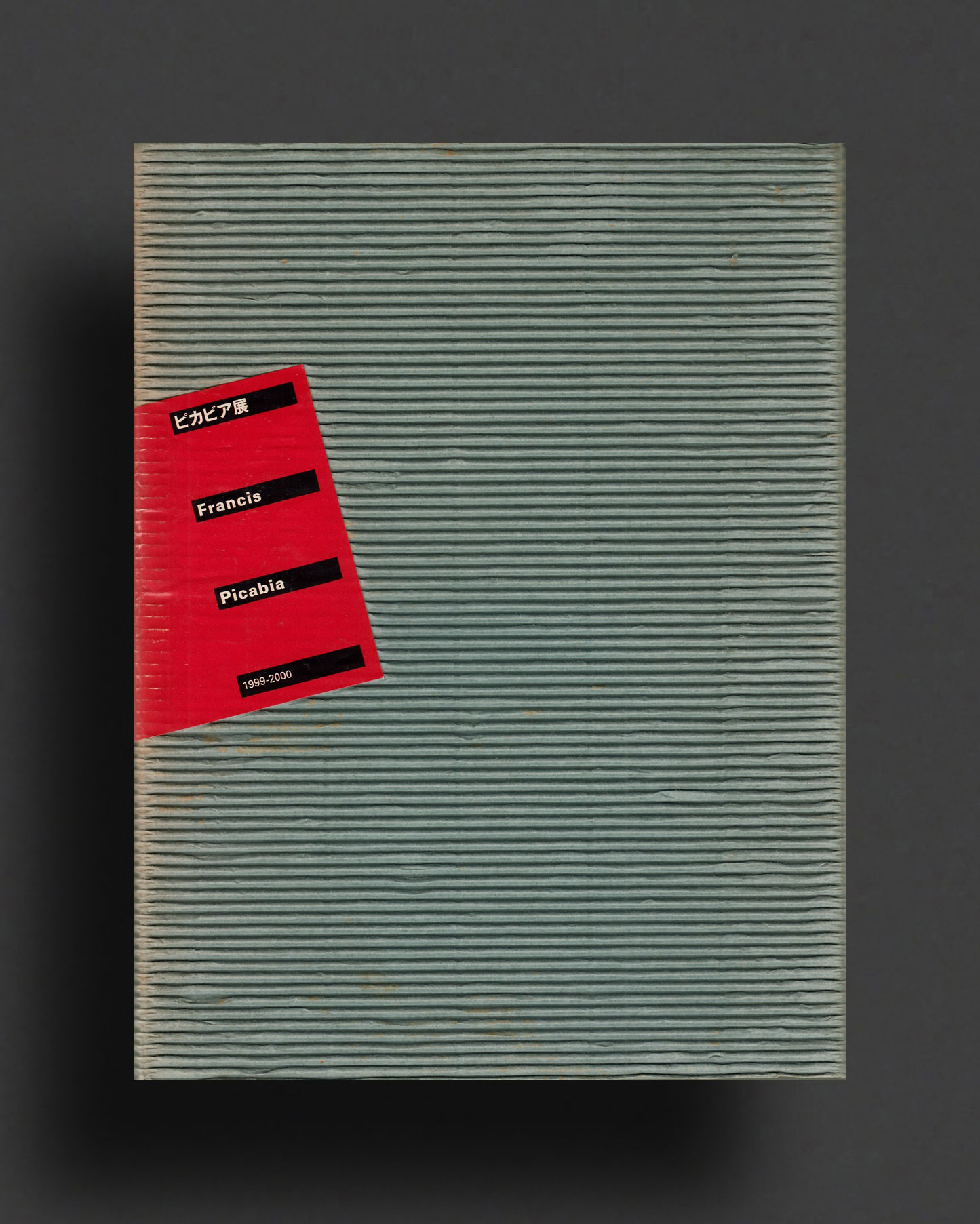
First Edition of this long out-of-print, comprehensive, beautifully produced Japanese two-volume publication on the life and work of the great French avant-garde painter, poet and typographist, Francis Picabia.
Published by APT International in 1999 for a major Japanese travelling exhibition on Francis Picabia, starting at the Isetan Museum of Art in Tokyo in 1999, then to Fukushima and Osaka throughout 1999-2000.
Two Volumes bound in french-fold wraps, both housed in protective corrugated cardboard slip-case with scarlet label wrapped around spine. Slipcase itself is now protected under plastic sleeve.
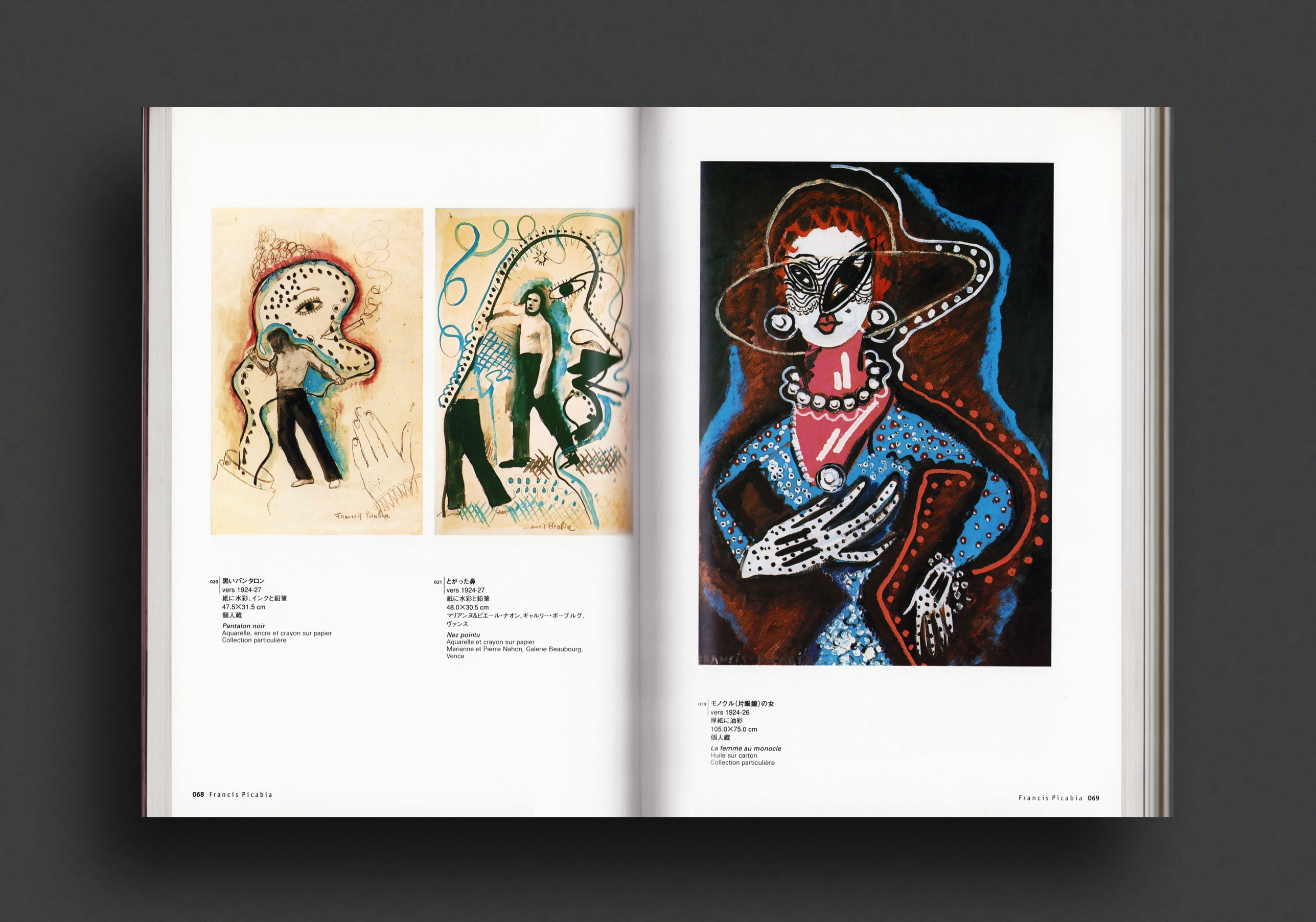
First volume (226 page) forms a comprehensive retrospective of Picabia's life and prolific and defying work across painting, drawing, printing, poetry and film. Extensive colour and b&w reproductions of a vast collection of his painting, illustration and publishing projects are presented alongside a folio of his poems and drawings, plus photo documentation of his studio and private/social life. Also includes a biography and bibliography, as well as an insightful conversation between Olga Picabia (Francis Picabia's widow), Pierre Calté (director of Comité Picabia), Hans Ulrich Obrist (independent curator) and Stefan Banz (independent curator), about Picabia's life (text in English and Japanese). Introductory essays in Japanese and French by Beverley Calte and Arnauld Pierre.
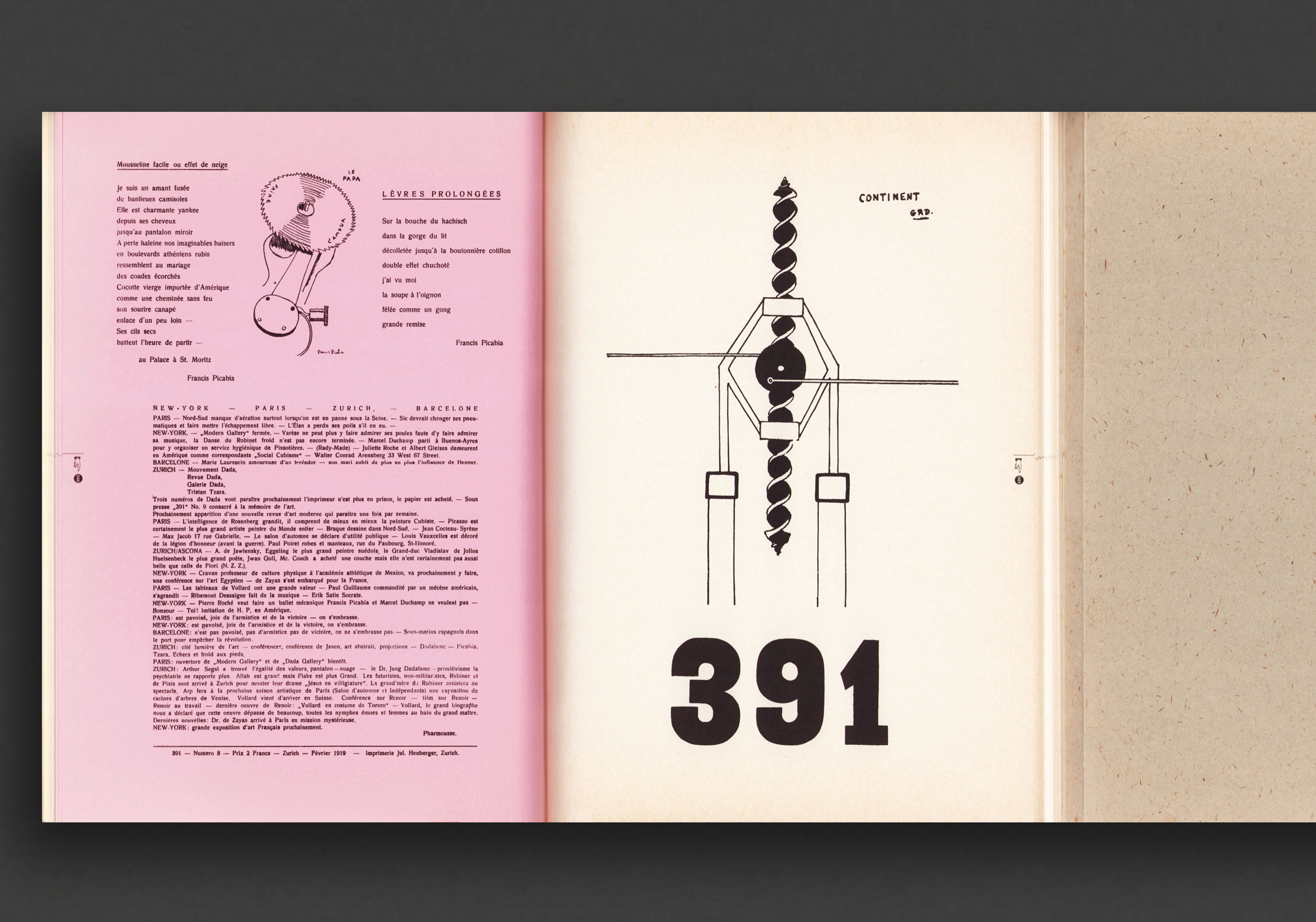
Second volume (120 pages) "391" is a very special book made up of collated facsimiles of the 19 issues of Picabia's famous Dada periodical, "391", dating 1917-1924. 391 first appeared in January 1917 in Barcelona, published and edited by Picabia, assisted in assembling by Olga Sacharoff, a Georgian emigre residing in Barcelona. The title of the magazine derives from Alfred Stieglitz's New York periodical 291 (to which Picabia had contributed), and bore no relation to its contents. Despite Picabia's renown as an artist, it was mostly literary in content, with a wide-ranging aggressive tone, possibly influenced by Alfred Jarry and Apollinaire. There were contributions by two men new to Dada: Man Ray and Marcel Duchamp. However 391 remained essentially the expression of the inventive, energetic and wealthy Picabia, who stated of it: "Every page must explode, whether through seriousness, profundity, turbulence, nausea, the new, the eternal, annihilating nonsense, enthusiasm for principles, or the way it is printed. Art must be unaesthetic in the extreme, useless and impossible to justify."
Francis Picabia (22 January 1879 – 30 November 1953) was a French avant-garde painter, poet and typographist. After experimenting with Impressionism and pointillism, Picabia became associated with Cubism. His highly abstract planar compositions were colourful and rich in contrasts. He was one of the early major figures of the Dada movement in the United States and in France. His was later briefly associated with Surrealism, but would soon turn his back on the art establishment.
Very Good copy in Good slipcase that has discoloured with sun-tanning to spine, corregation has some wear. Books VG both.
1967, German
Hardcover (w. dust jacket), 78 pages, 22.5 x 20.5 cm
1st Edition, Out of print title / used / average
Published by
Verlag Gerd Hatje / Stuttgart
$30.00 - Out of stock
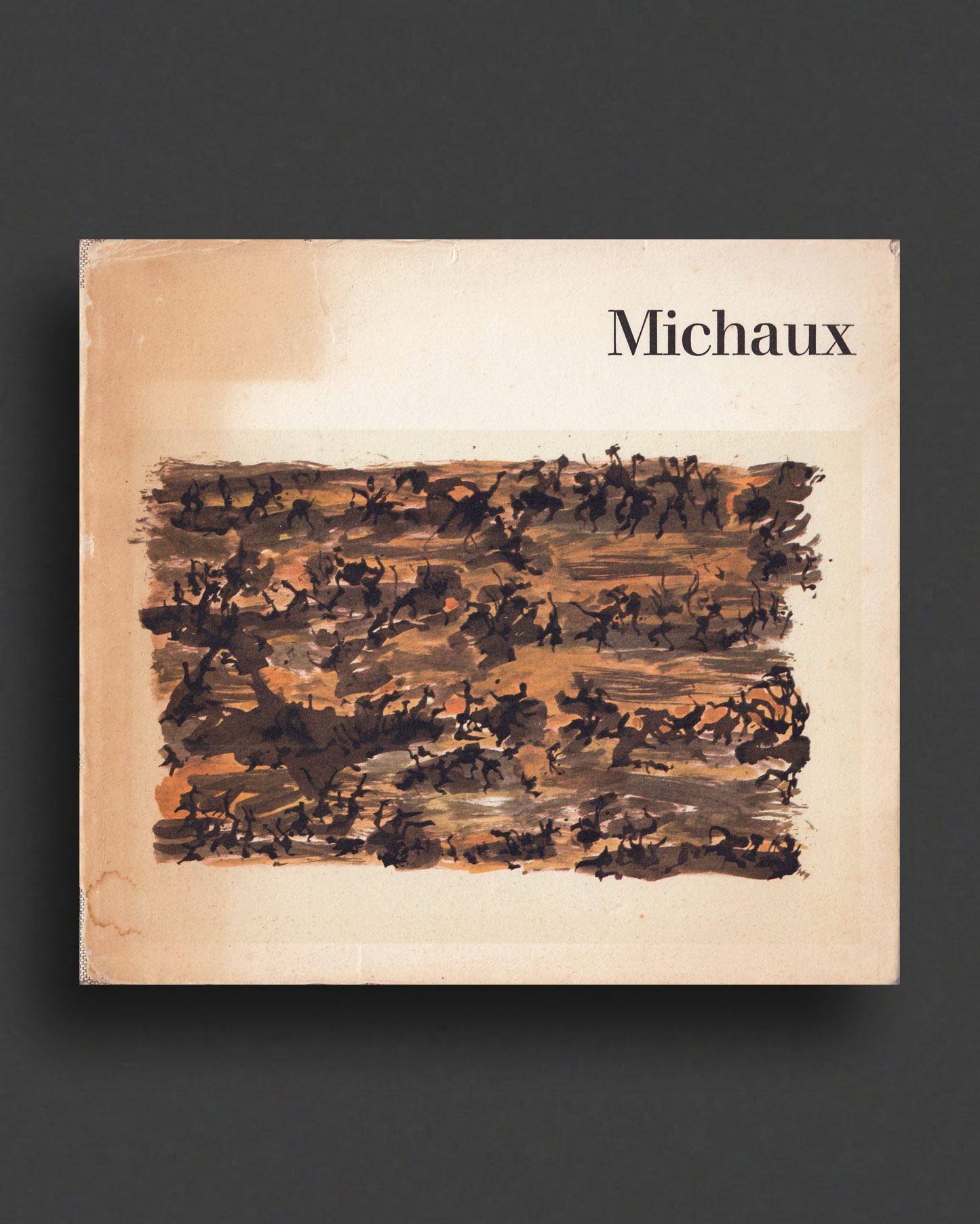
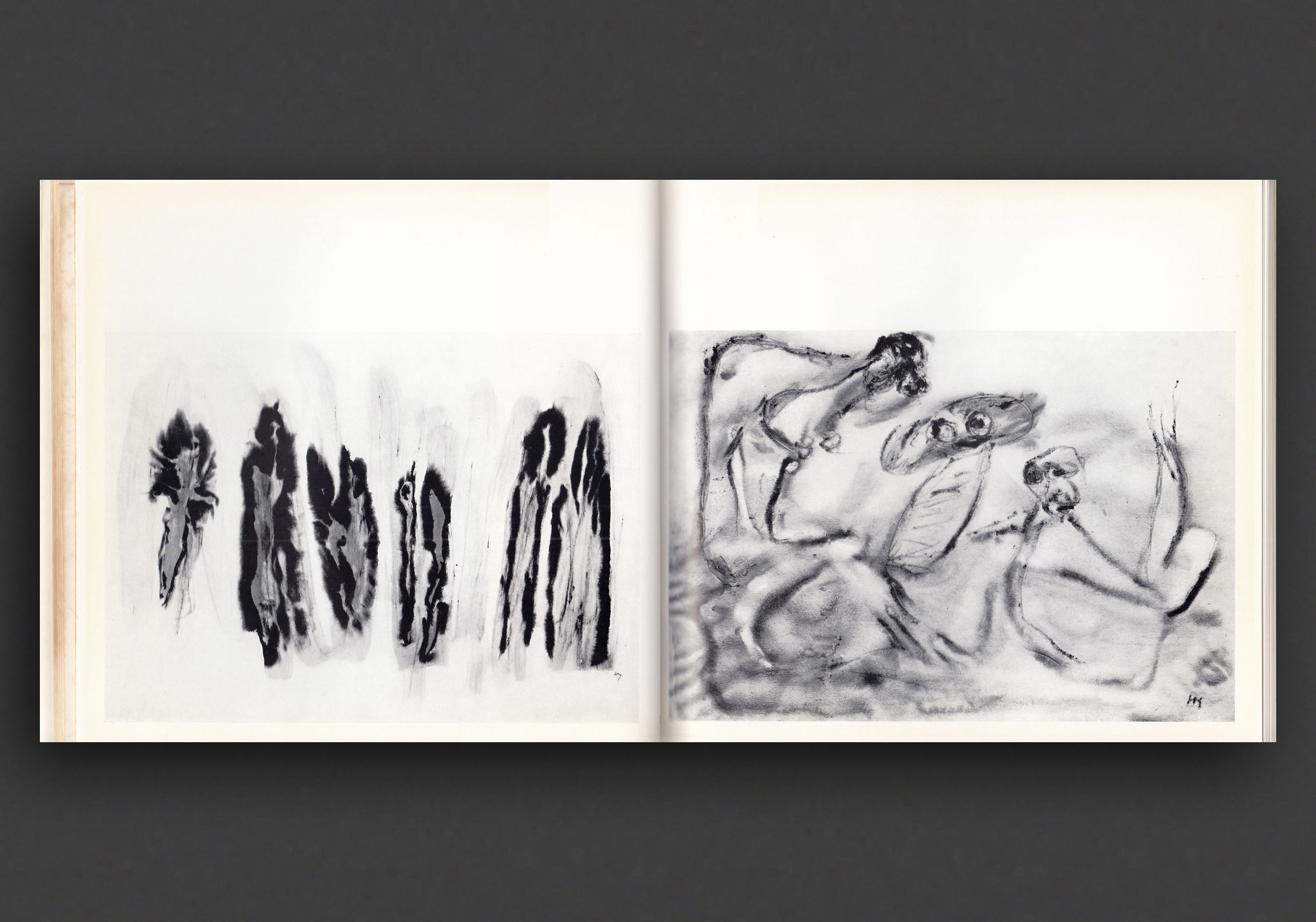
1967 hardcover monograph on Belgian-born French experimental poet, writer and painter Henri Michaux (1899–1984) by Kurt Leonhard, published in Germany by Hatje, Stuttgart. He studied mysticism as a young man and traveled throughout South America and Asia in the ’20s and ’30s before settling in Paris. Michaux is renowned for his strange, highly original poetry and prose, and also for his art, when in the late ’50s he first showed paintings created under the influence of mescaline. In 1965, he was awarded the French National Prize for Letters, but refused the award, saying that it threatened his independence. Published in the series "Kunst heute" as volume 9; with 72 illustrations of works on full-page plates, four of which are in colour.
Average—Good copy in Average DJ w. chipping to extremities, tanning and foxing to both.
2004, Japanese
Softcover, 176 pages, 24 x 18 cm
1st Edition, Out of print title / used / very good
Published by
Atelier Peyotl / Tokyo
$60.00 - Out of stock
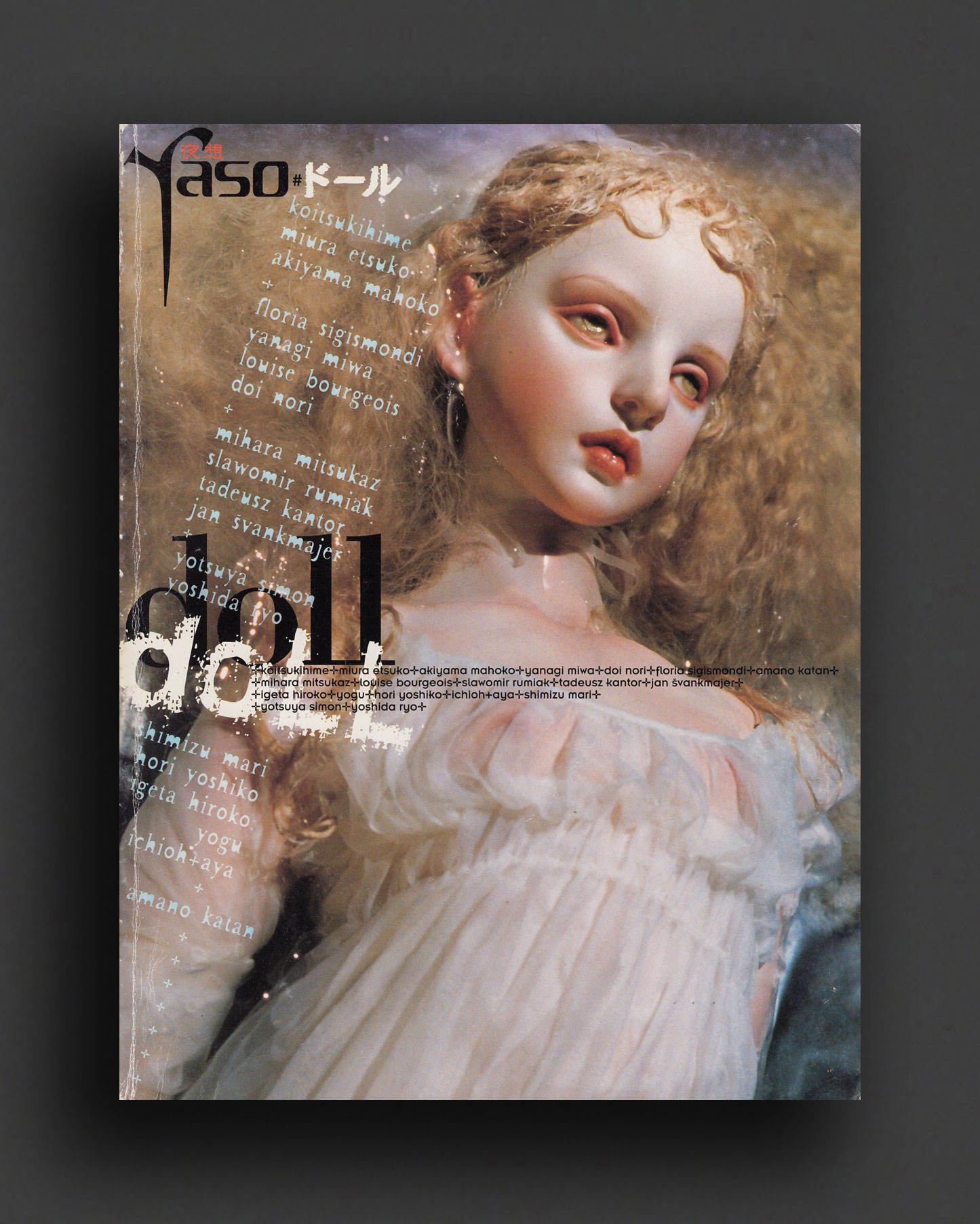
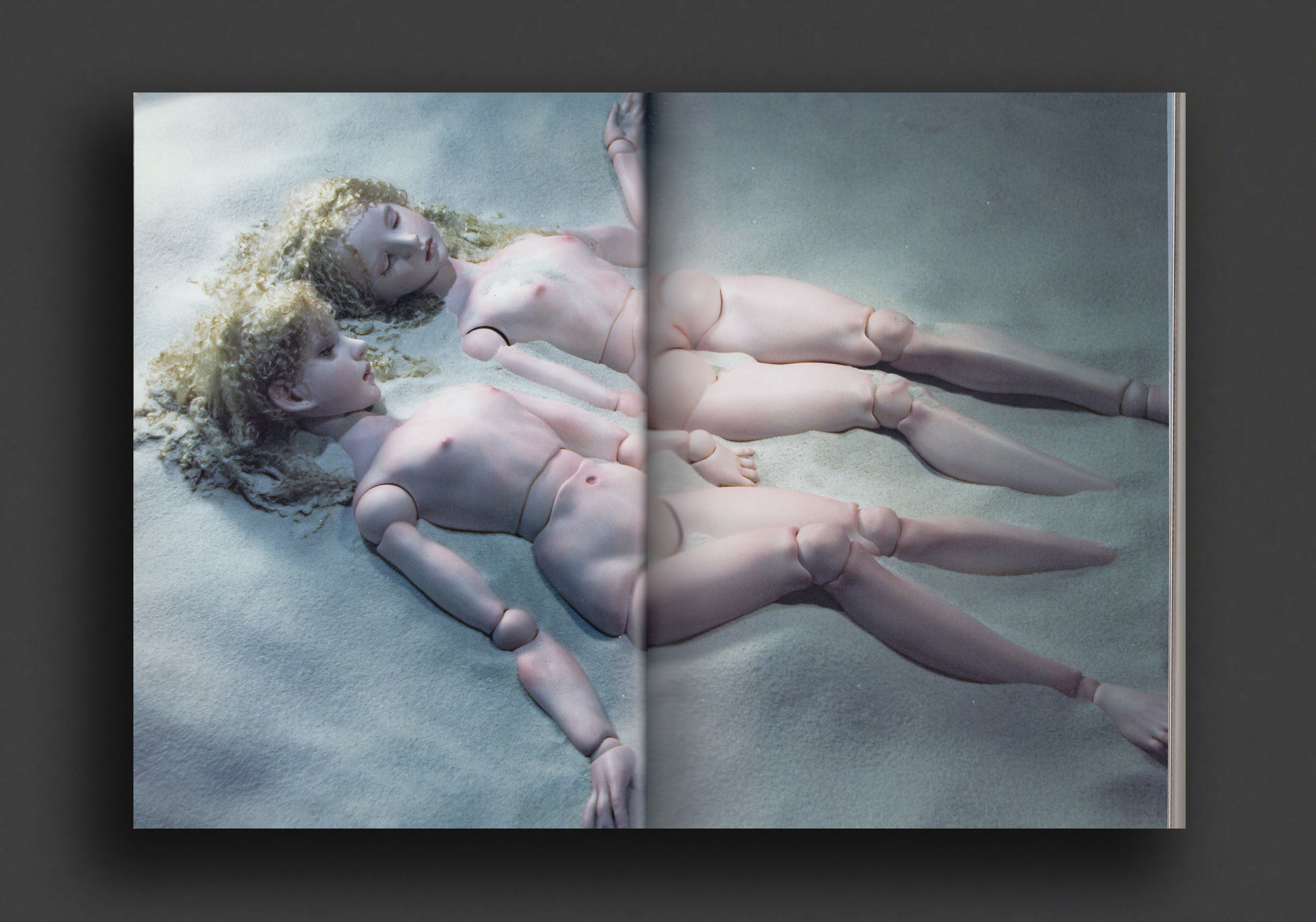
"Doll" Special Feature Issue of cult Japanese underground magazine Yaso, published in 2004, edited by Yuichi Konno and Atelier Peyotl (publishers of Night Vision/Yaso/Peyotl/Wave/Silvester Club...). Heavily illustrated with texts in Japanese with in-depth profiles, interviews and essays on leading artists that work with dolls, including contemporary Japanese masters of doll art, Koitsukihime, Katan Amano, Etsuko Miura, Yoshiko Hori, Yogu, Simon Yotsuya, Ryo Yoshida, Akiyama Mahoko, Mari Shimizu, influential Gothic Lolita illustrator Mitsukazu Mihara, Nori Doi, legendary Czech artist and animator Jan Švankmajer, Polish artist and theatre director Tadeusz Kantor, Japanese photographer Miwa Yanagi, film-maker Floria Sigismondi, Louise Bourgeois, Slawomir Rumiak, Nori Doi, and a fantastic illustrated book guide of doll-related art books and literature, from Mary Shelley to The Surrealists, Hans Bellmer, Ken Katayama, Pierre Mollinier, Makoto Aida, Irina Ionesco, H.R. Giger...
Very Good copy with some wear to cover extremities.
1979, English
Hardcover (w. dust jacket), 127 pages, 13.5 x 22 cm
1st UK Edition, Out of print title / used / good
Published by
Marion Boyars / London
$190.00 - In stock -
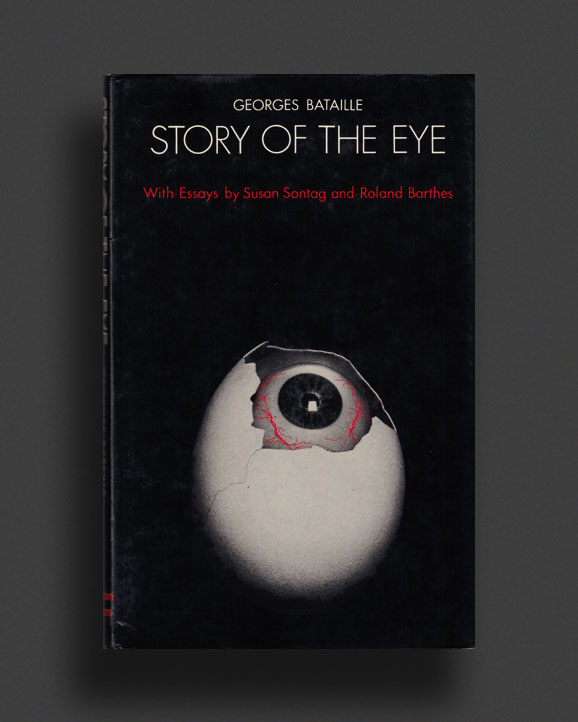
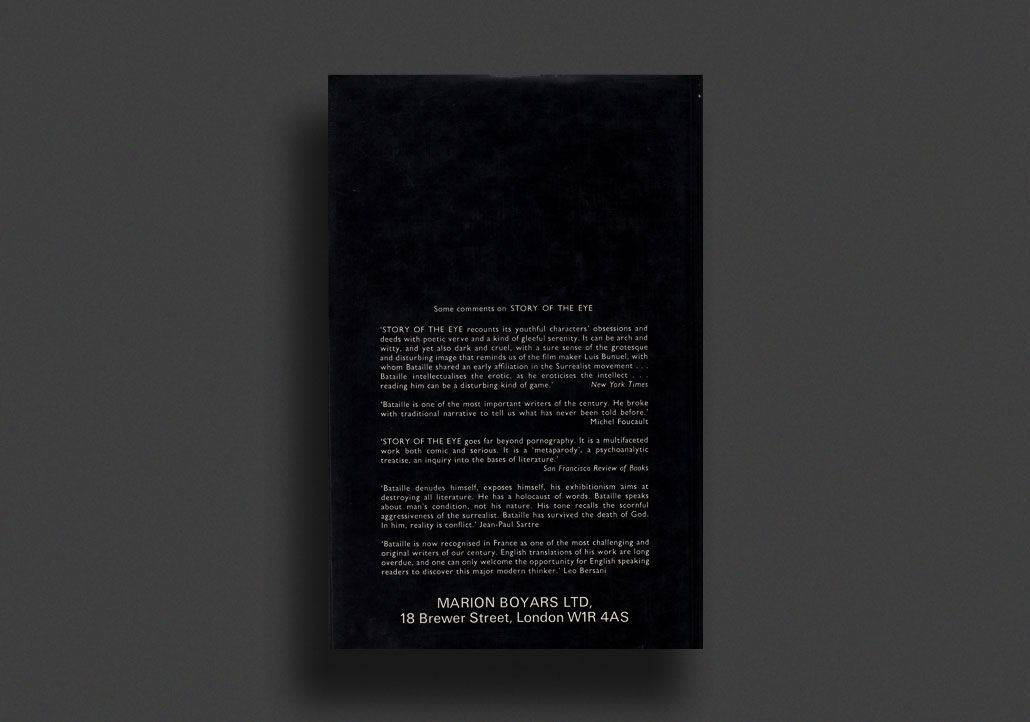
Wonderful first English hardcover edition of George Bataille's Story of the Eye, published by Marion Boyars, London, in 1979. Translated by Joachim Neugroschal with accompanying essays by Susan Sontag and Roland Barthes.
"The caress of the eye over the skin is so utterly, so extraordinarily gentle, and the sensation is so bizarre that it has something of a rooster's horrible crowing." - G.B.
A masterpiece of transgressive, surrealist erotica, Bataille's first novel, published under the pseudonym 'Lord Auch', is still his most notorious work. Called a "metaphysician of evil, Bataille wrote the 1928 novella "Story of the Eye (French: L'histoire de l'œil) as a psychoanalytical task. In this explicit erotic fantasy, the young male narrator and his lovers Simone and Marcelle embark on a sexual quest involving sadism, torture, orgies, madness and defilement, culminating in a final act of transgression. Shocking and sacrilegious, Story of the Eye is the fullest expression of Bataille's obsession with the closeness of sex, violence and death. Yet it is also hallucinogenic in its power, and is one of the erotic classics of the twentieth century.
This edition also includes Susan Sontag's superb study of pornography as art, 'The Pornographic Imagination', as well as Roland Barthes' essay 'The Metaphor of the Eye', which was first published in Bataille's own journal Critique, shortly after Bataille's death in 1962. Barthes' analysis focuses on the centrality of the eye to this series of vignettes, and notices that it is interchangeable with eggs, bulls' testicles and other ovular objects within the narrative. He also traces a second series of liquid metaphors within the text, which flow through tears, cat's milk, egg yolks, frequent urination scenes, blood and semen.
Georges Bataille (1897-1962), French essayist and novelist, was born in Billom, France. He converted to Catholicism, then later to Marxism, and was interested in psychoanalysis and mysticism, forming a secret society dedicated to glorifying human sacrifice. Leading a simple life as the curator of a municipal library, Bataille was involved on the fringes of Surrealism, founding the Surrealist magazine Documents in 1929, and editing the literary review Critique from 1946 until his death.
Good—VG ex-libris copy with light library wear to end blanks, small stamp to colophon in original G—VG dust jacket, no library markings, preserved under mylar wrap. Scarce in this edition with dust jacket present. General reading wear and tanning with age. There is a fierce feminist critique of Susan Sontag's essay in the margins that is an isolated attack Sontag. The rest is left unscathed.
1991, English
Softcover, 118 pages, 21 x 14.5 cm
Out of print title / used / very good
Published by
AK Press / Edinburgh
$50.00 - Out of stock
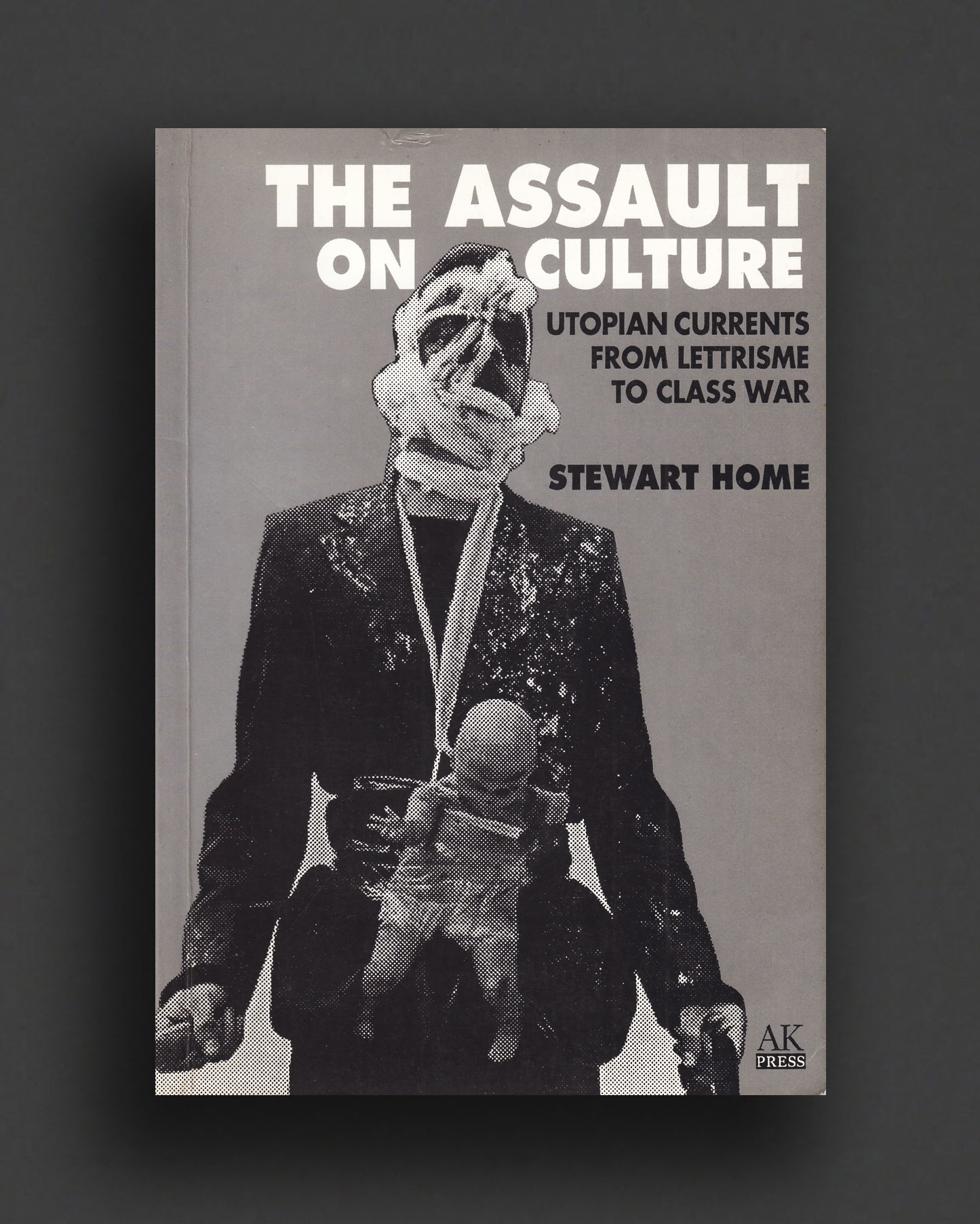
First AK Press 1991 edition of Stewart Home's THE ASSAULT ON CULTURE: UTOPIAN CURRENTS FROM LETTRISM TO CLASS WAR, first published in 1988 by Aporia Press and Unpopular Books. Chapters: Cobra, The Lettriste Movement, The Lettriste International (1952-57), The College Of Pataphysics, Nuclear Art and the International Movement for an Imaginist Bauhaus, From the "First World Congress of Liberated Artists" to the foundation of the Situationist International, The Situationist International in its heroic phase (1957-62)., On the theoretical poverty of the Specto-Situationists and the legitimate status of the Second International, The decline and fall of the Specto-Situationist critique, The origins of Fluxus and the movement in its 'heroic' period, The rise of the depoliticized Fluxus aesthetic, Gustav Metzger and Auto-Destructive Art, Dutch Provos, Kommune 1, Motherfuckers, Yippies and White Panthers, Mail Art, Beyond Mail Art, Punk, Neoism, Class War, plus bibliography.
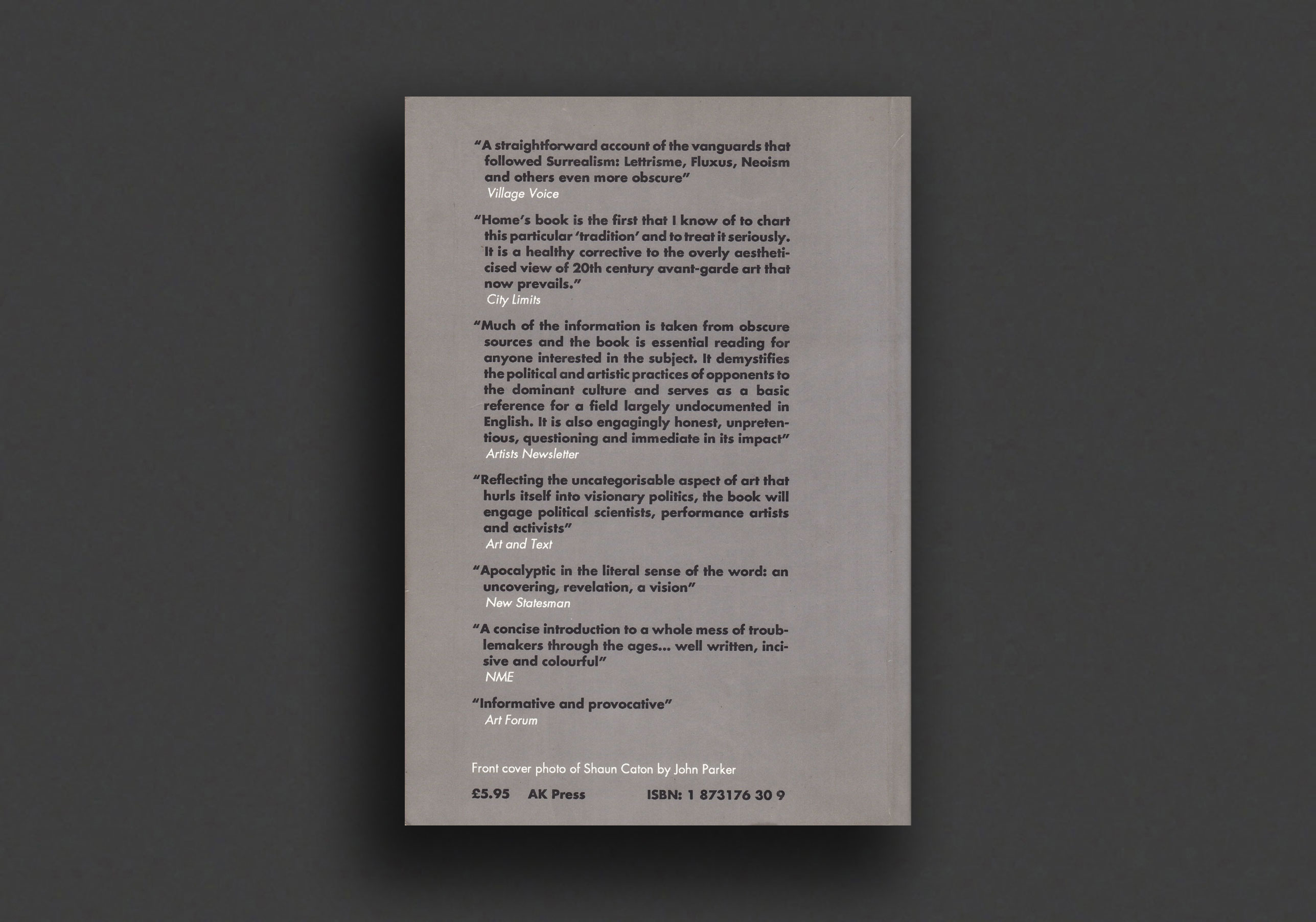
*A straightforward account of the vanguards that followed Surrealism: Lettrisme, Fluxus, Neoism and others even more obscure"—Village Voice
"Home's book is the first that I know of to chart this particular 'tradition' and to treat it seriously.
It is a healthy corrective to the overly aestheti-cised view of 20th century avant-garde art that now prevails."—City Limits
"Much of the information is taken from obscure sources and the book is essential reading for anyone interested in the subject. It demystifies the political and artistic practices of opponents to the dominant culture and serves as a basic reference for a field largely undocumented in English. It is also engagingly honest, unpreten-tious, questioning and immediate in its impact"—Artists Newsletter
"Reflecting the uncategorisable aspect of art that hurls itself into visionary politics, the book will engage political scientists, performance artists and activists"—Art and Text
"Apocalyptic in the literal sense of the word: an uncovering, revelation, a vision"—New Statesman
"A concise introduction to a whole mess of troublemakers through the ages... well written, incisive and colourful"—NME
"Informative and provocative"—Art Forum
Very Good copy.
1999, English
Softcover, 62 pages, 21 x 14 cm
Published by
Shearsman Books / Bristol
$26.00 - Out of stock
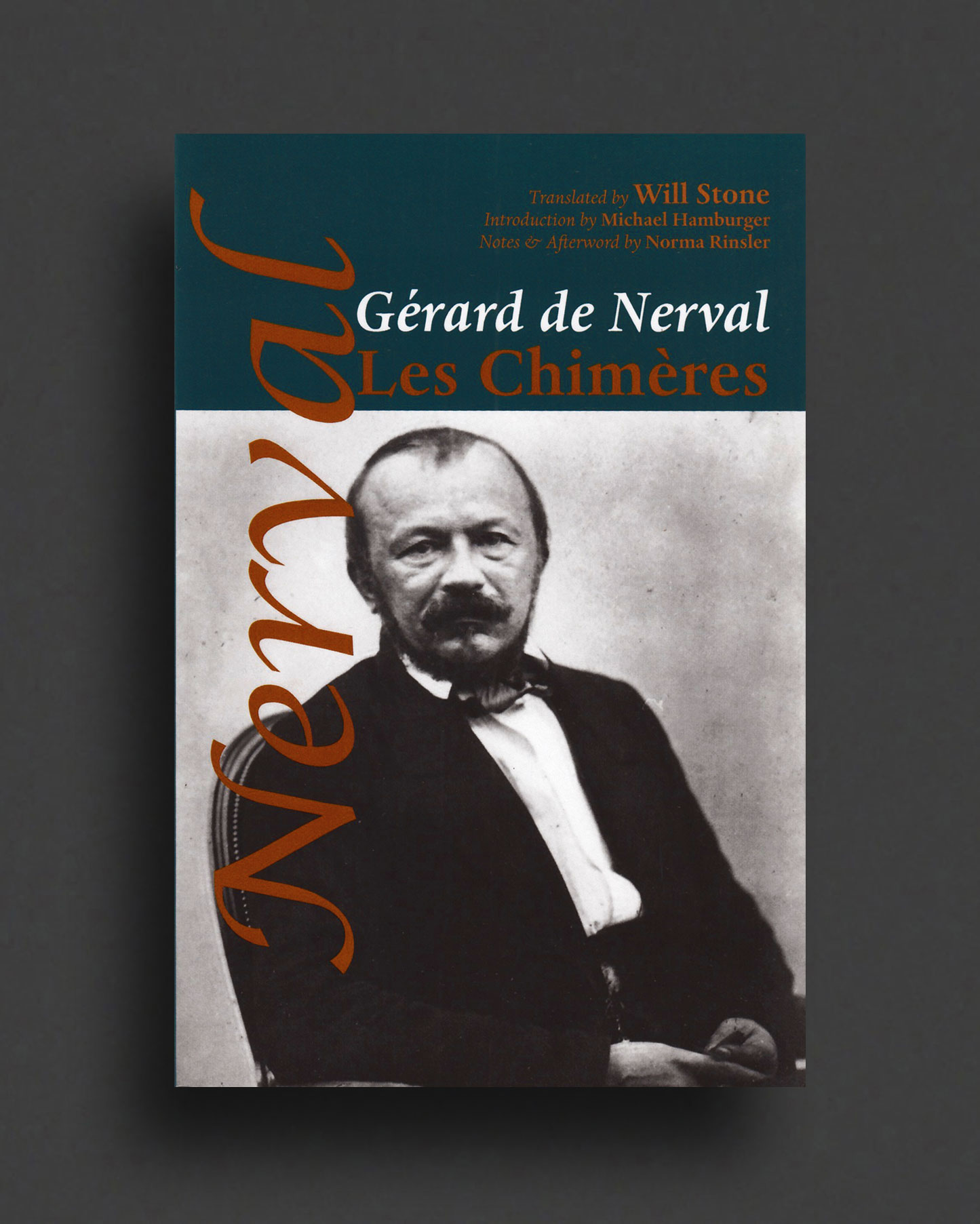
Translated from French by Will Stone.
Introduced by Michael Hamburger, with a Preface by Anne Beresford & Notes and Afterword by Norma Rinsler.
Nerval (1808-1855) is one of the most important writers of nineteenth-century France, both in prose and in verse. A precursor of the symbolists and the surrealists, Nerval has fascinated many major literary figures, including Proust and Breton, Eliot and Apollinaire, Michaux and Leiris.
The great sonnet cycle, Les Chimères, in its marvellous combination of spell, quest and dream, continues to fascinate writers, readers, and that special category of writerly readers, translators. The translator of this volume is the gifted poet Will Stone, who explains his work in a strongly-worded essay: "like a partly submerged crocodile, with one amber eye half open the foreign line sits, waiting for the anxious translator to make a move." The book contains three other texts: a foreword by the poet, Anne Beresford, a general introduction to Nerval by Michael Hamburger (published for the first time in the previous edition of this book, some fifty years after it was written), and an afterword and notes on Les Chimères by Professor Norma Rinsler, the doyenne of English Nervaliens.
Published with the Menard Press.
1979, German
Softcover, unpaginated, 26 x 21 cm
1st Edition, Out of print title / used / average
Published by
Museum Bochum / Bochum
$65.00 - In stock -
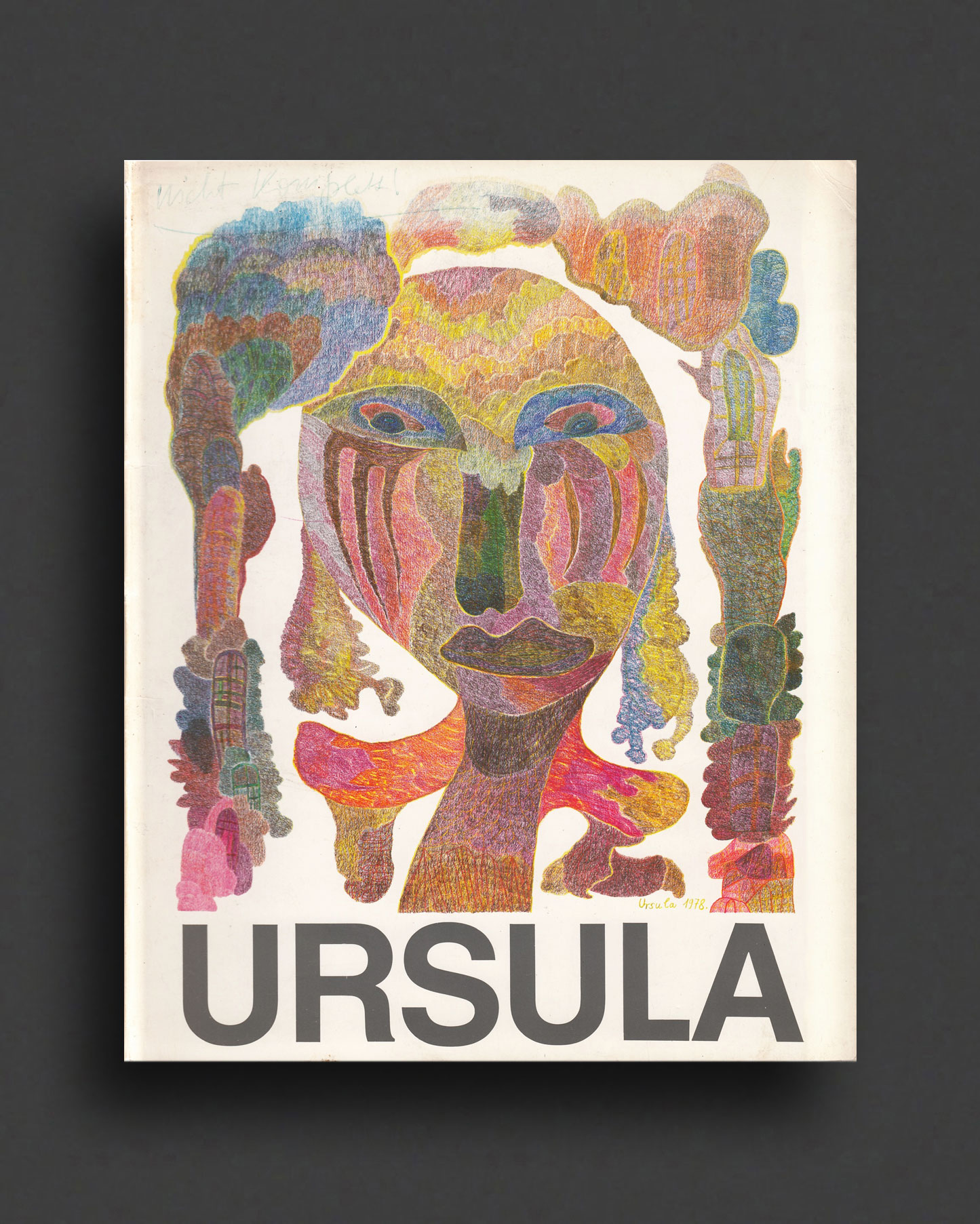
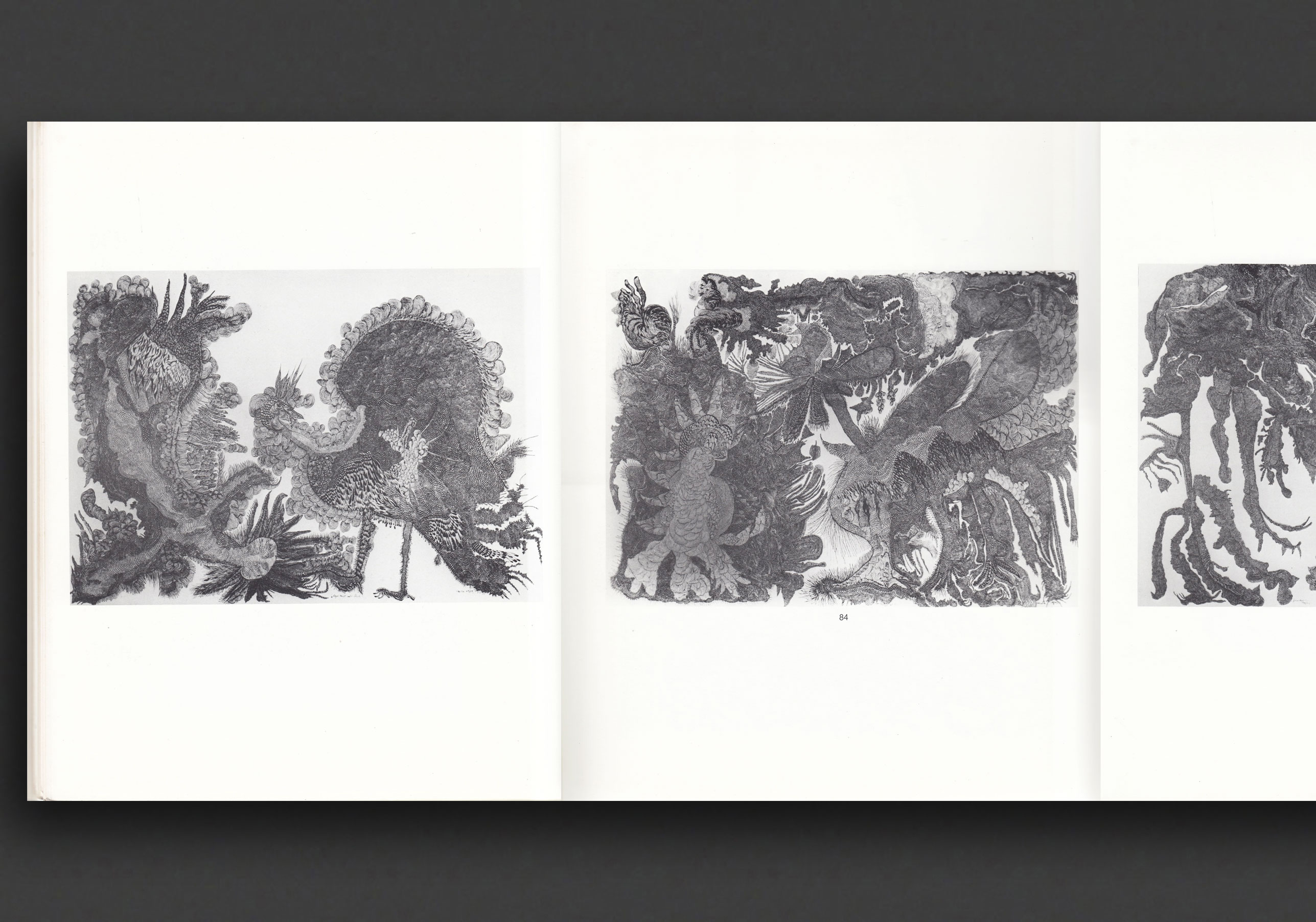
One of the nicest, long long out-of-print catalogues on the work of self-taught German painter Ursula Schultze-Bluhm (1921—1999), also known as Ursula, for a major survey of her work that traveled through Germany in 1979—1980.
Introductory German text by Evelyn Weiss and Heinrich Heine, with a few pages missing from this section, followed by social portraits, with the rest of the book an abundance of works reproduced in colour and b/w (all gallery pages intact) including a fold-out section, followed by a full catalogue of works. A few plates are marked with an X by the previous owner. A truely wonderful selection of her works, mostly painting and ink on paper, but including some incredible sculptural works and installations.
A self-taught artist, Ursula worked intensively on painting and poetry and regularly travelled to Paris, where she met the painter Jean Dubuffet in 1954. Ursula's life and work offer an unconventional narrative of artistic independence. Her art exemplifies the idea that Surrealism is not a style, but an attitude. Ursula subverted reality and found the uncanny in the everyday, challenging the authorities of society and art by imagining new worlds in which old hierarchies are thrown overboard and new ways of life are conceivable. Ursula married fellow Cologne based artist, abstract painter, co-founder of the Quadriga group, Bernard Schultze (1915—2005).
Average—Good copy but with some missing text pages, previous owner's markings, general light wear, discolouration to top cover edge.
2023, English / German
Hardcover, 400 pages, 27 x 22 cm
Published by
Walther König / Köln
$90.00 - In stock -
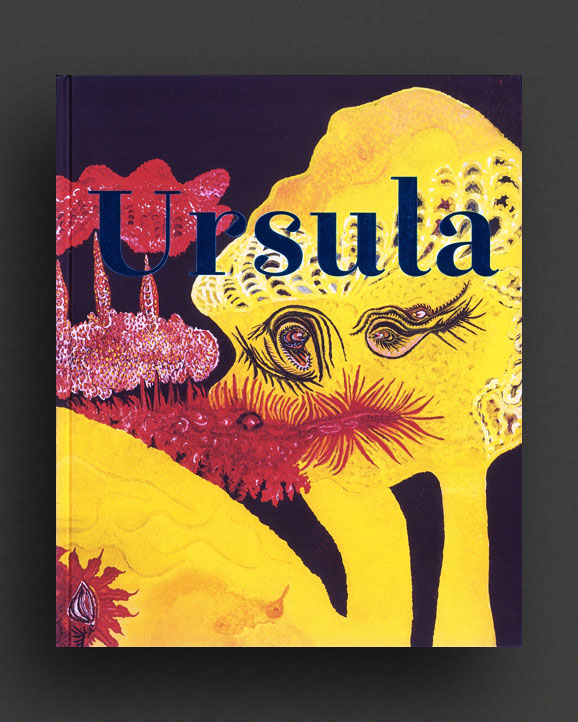
This first comprehensive book ever published on the work and life of self-taught German painter Ursula Schultze-Bluhm (1921—1999), also known as Ursula. Ursula's life and work offer an unconventional narrative of artistic independence. Her art exemplifies the idea that Surrealism is not a style, but an attitude. Ursula subverted reality and found the uncanny in the everyday, challenging the authorities of society and art by imagining new worlds in which old hierarchies are thrown overboard and new ways of life are conceivable. Ursula shared this utopian imagination with artists such as Leonora Carrington, Leonor Fini, Dorothea Tanning, and Unica Zürn. The aim of this catalogue is to present Ursula's captivating and self-assured work to a new generation of art lovers. It reveals that it is the individuality of Ursula's work that allows it to touch on so many fundamental and topical issues, including female self-determination and the challenging of established gender identities, with a worldview in which everything is interconnected and mutually dependent.
Edited by Stephan Diederich.
Contributions by Stephan Diederich, Yilmaz Dziewior, Helena Kuhlmann, Chus Martinez, Elizabeth A. Povinell.
English and German text.
"Cologne Museum Dives Into German Artist’s Once-Lost Fantastical World: Ursula Schultze-Bluhm, painter of unearthly visions was largely overlooked by the art world…"—New York Times, by Andrew Russeth, 2023.
2010, English
Softcover (+ audio CD), 62 pages, 19 x 13 cm
1st Edition, Out of print title / as new
Published by
Thin Man Press / London
$65.00 - Out of stock
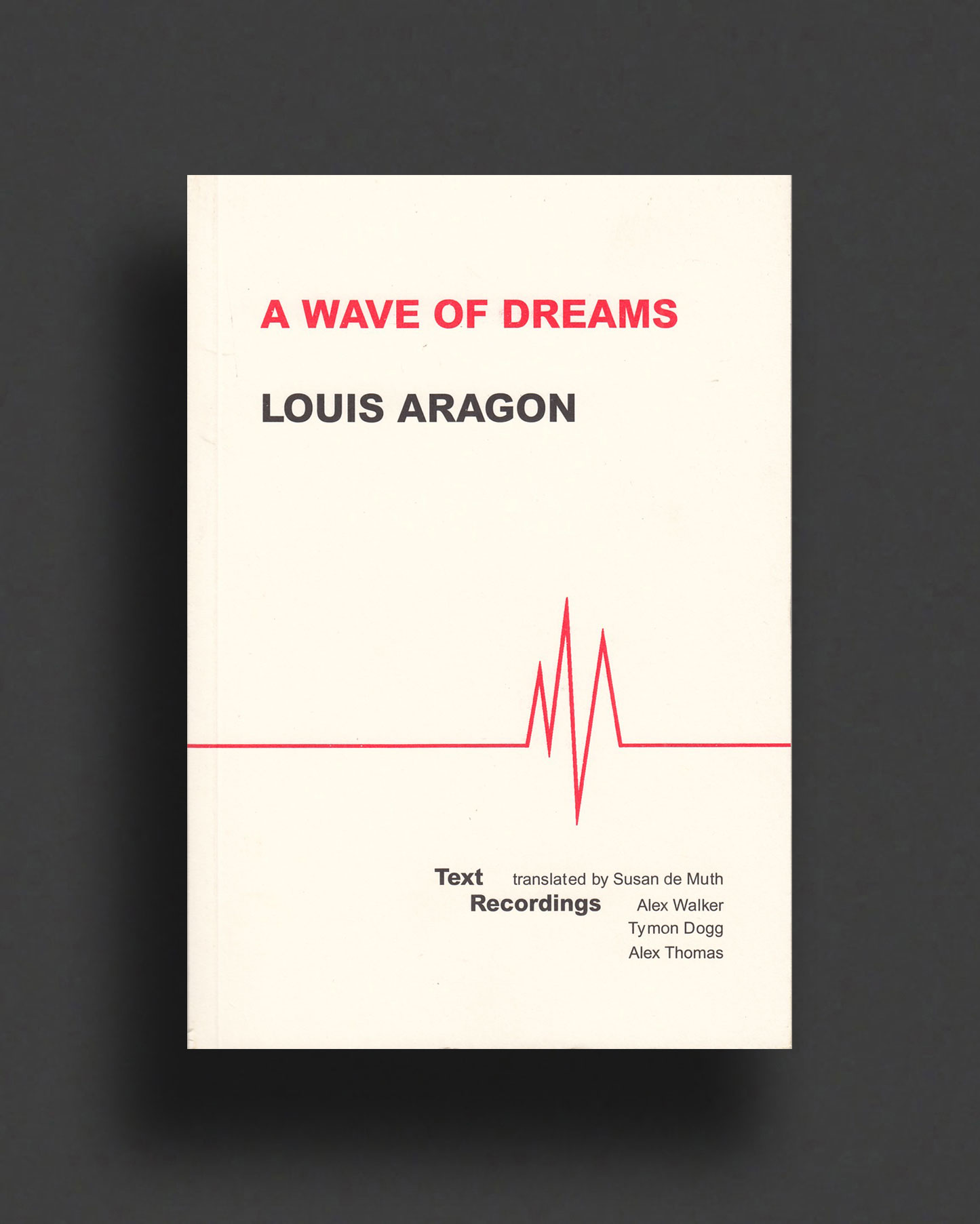
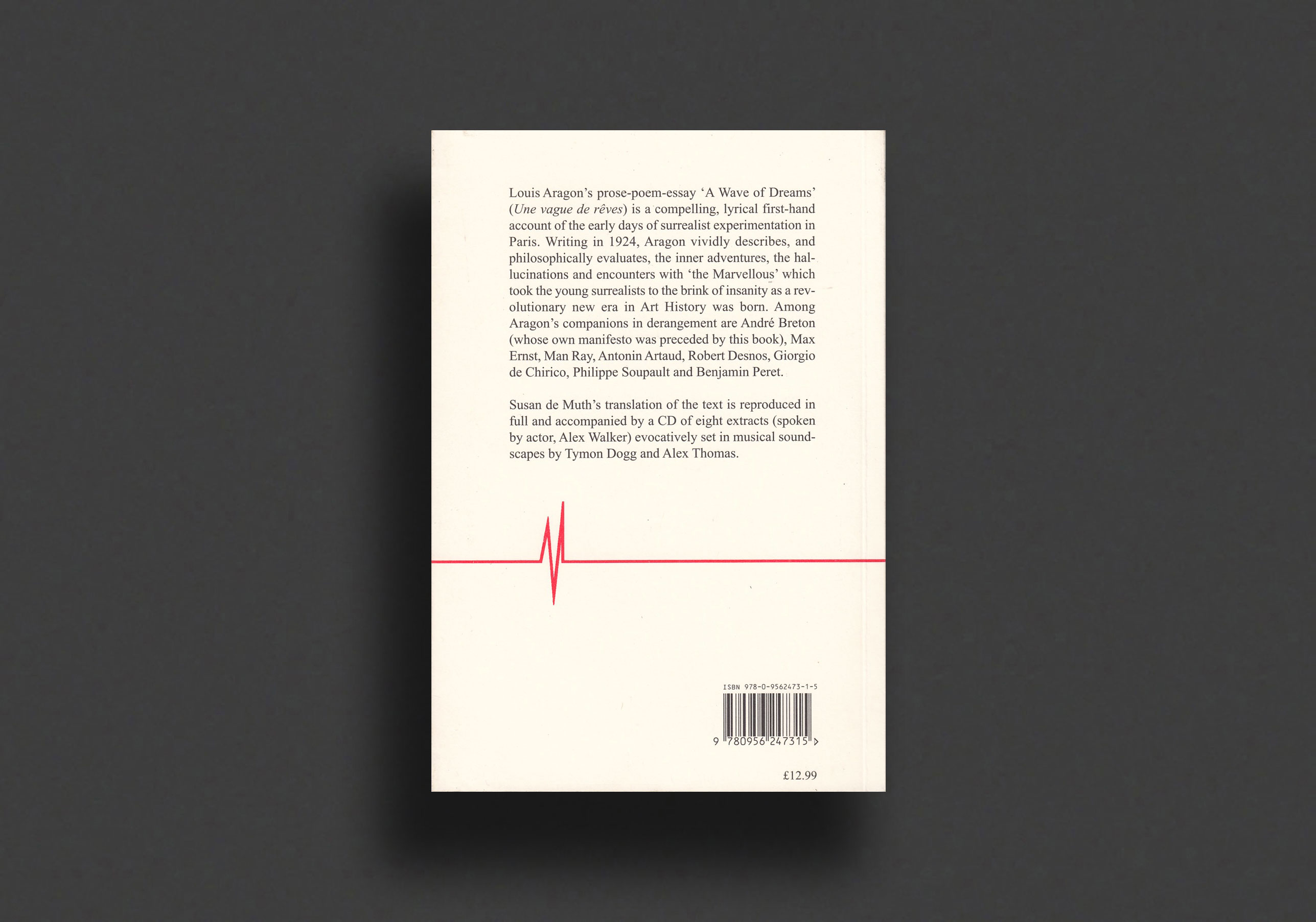
This is the first time Aragon's seminal 1924 French surrealist text has been published in English as a single volume. Aragon's extraordinary prose-poem-essay A Wave of Dreams (Une vague de reves), is a compelling, lyrical, first-hand account of the early days of surrealist experimentation in Paris. Writing in 1924, Aragon vividly describes, and philosophically evaluates, the inner adventures, the hallucinations and encounters with the 'Marvellous' which took the young surrealists to the brink of insanity as a revolutionary new era in Art History was born. Among Aragon’s companions in derangement are André Breton (whose own Surrealist Manifesto was preceded by this book), Max Ernst, Man Ray, Antonin Artaud, Robert Desnos, Georgio de Chirico, Philippe Soupault and Benjamin Peret.
This beautifully presented art book contains Susan de Muth’s translation of the text in English with an introduction by Dawn Ades.
The physical copy of A Wave of Dreams is accompanied by a complimentary CD of eight extracts from the test, spoken by actor Alex Walker, evocatively set in musical soundscapes by Tymon Dogg and Alex Thomas.
"A leftfield treat…mysteriously opaque and strangely lovely."—Thomas H Green, Daily Telegraph.
Fine—As New.
1998, English
Softcover, 96 pages, 13.3 x 21.6 cm
1st Edition, Out of print title / used / very good
Published by
Creation Books / London
$140.00 - In stock -
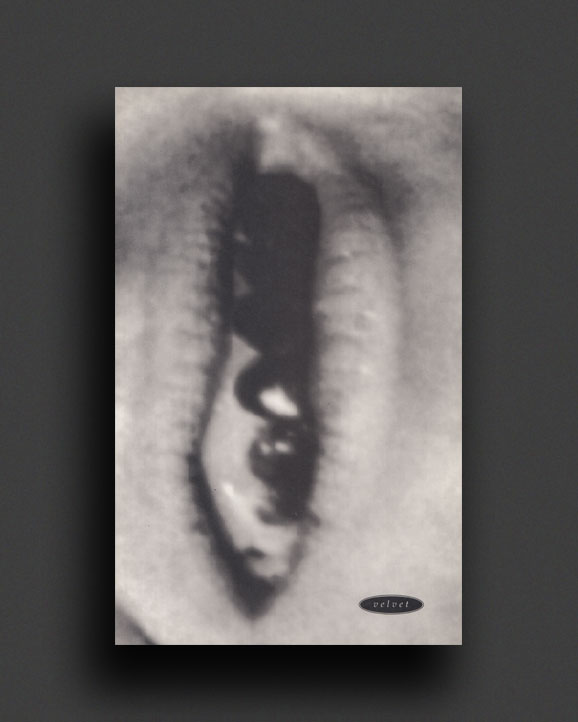
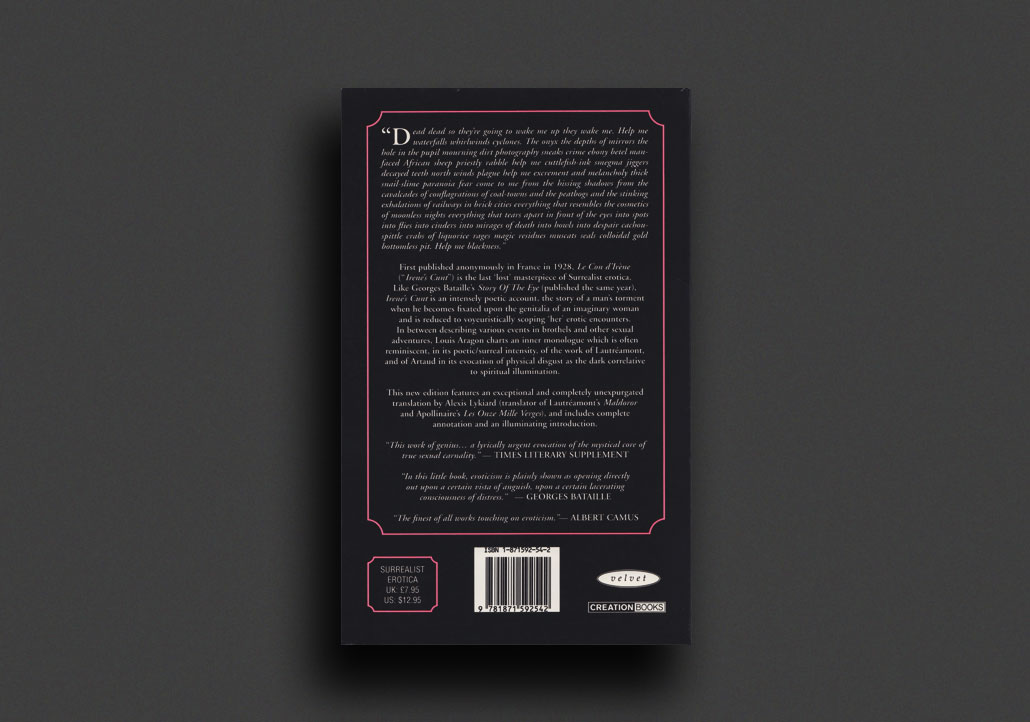
First published anonymously in France in 1928, Irene's Cunt (Le Con d'Irène) by French poet and novelist Louis Aragon, under the pseudonym Albert de Routisie, is the last 'lost' masterpiece of Surrealist erotica. Like Georges Bataille's Story of the Eye (published the same year), Irene's Cunt is an intensely poetic account, the story of a man's torment when he becomes fixated upon the genitalia of an imaginary woman and is reduced to voyeuristically scoping 'her' erotic encounters. In between describing various events in brothels and other sexual adventures, Louis Aragon charts an inner monologue which is often reminiscent, in its poetic/surreal intensity, of the work of Lautreamont, and of Artaud in its evocation of physical disgust as the dark correlative to spiritual illumination.
This new edition features an exceptional and completely unexpurgated translation by Alexis Lykiard (translator of Lautreamont's Maldoror and Apollinaire's Les Onze Mille Verges), and includes complete annotation and an illuminating introduction.
"The finest of all works touching on eroticism" - Albert Camus
"One of the four or five most beautiful poetic works produced by Surrealism" - Jean-Jacques Pauvert
1994, English
Softcover, 182 pages, 20 x 12.5 cm
1st Edition, Out of print title / used / very good
Published by
Faber & Faber / London
$18.00 - Out of stock
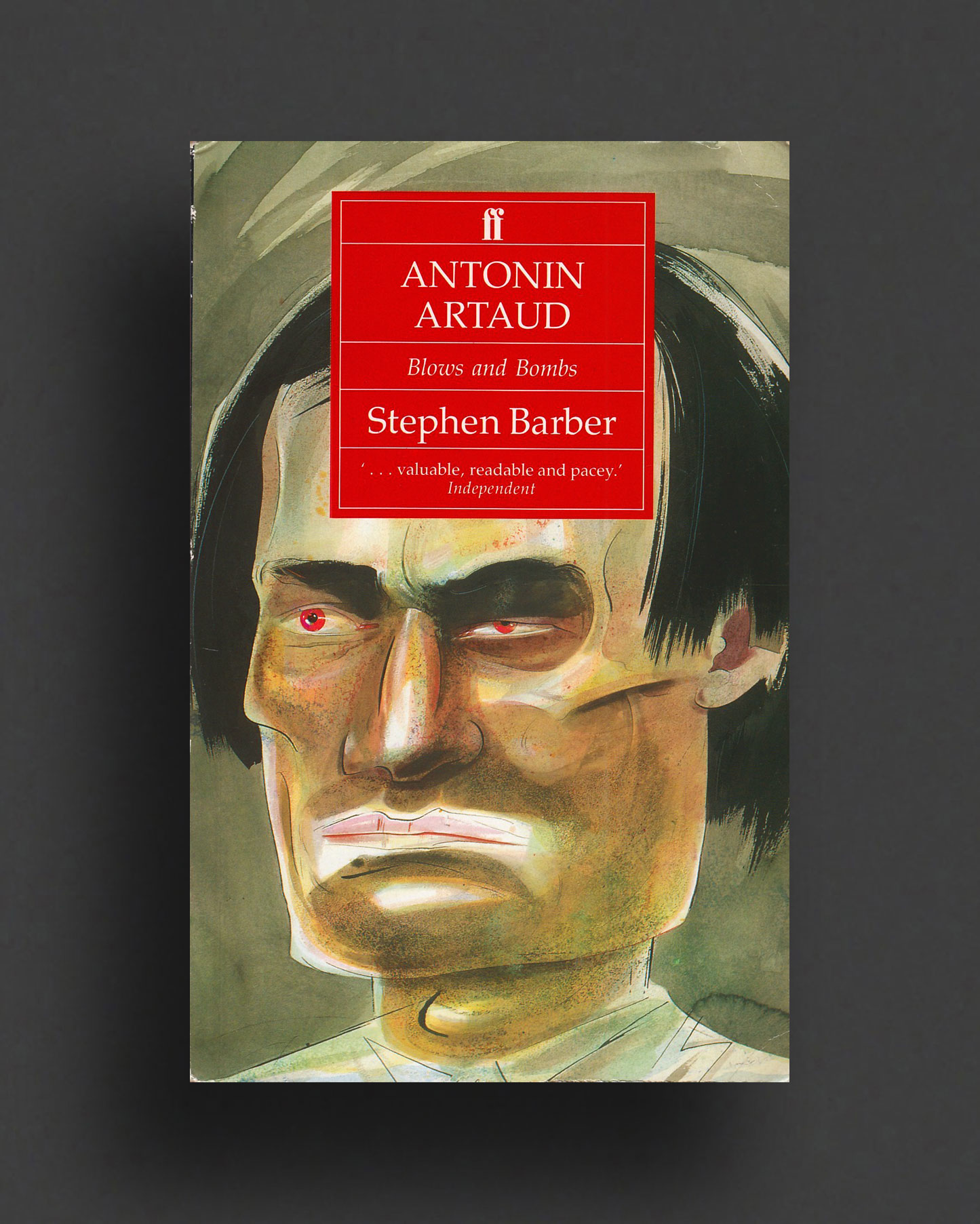
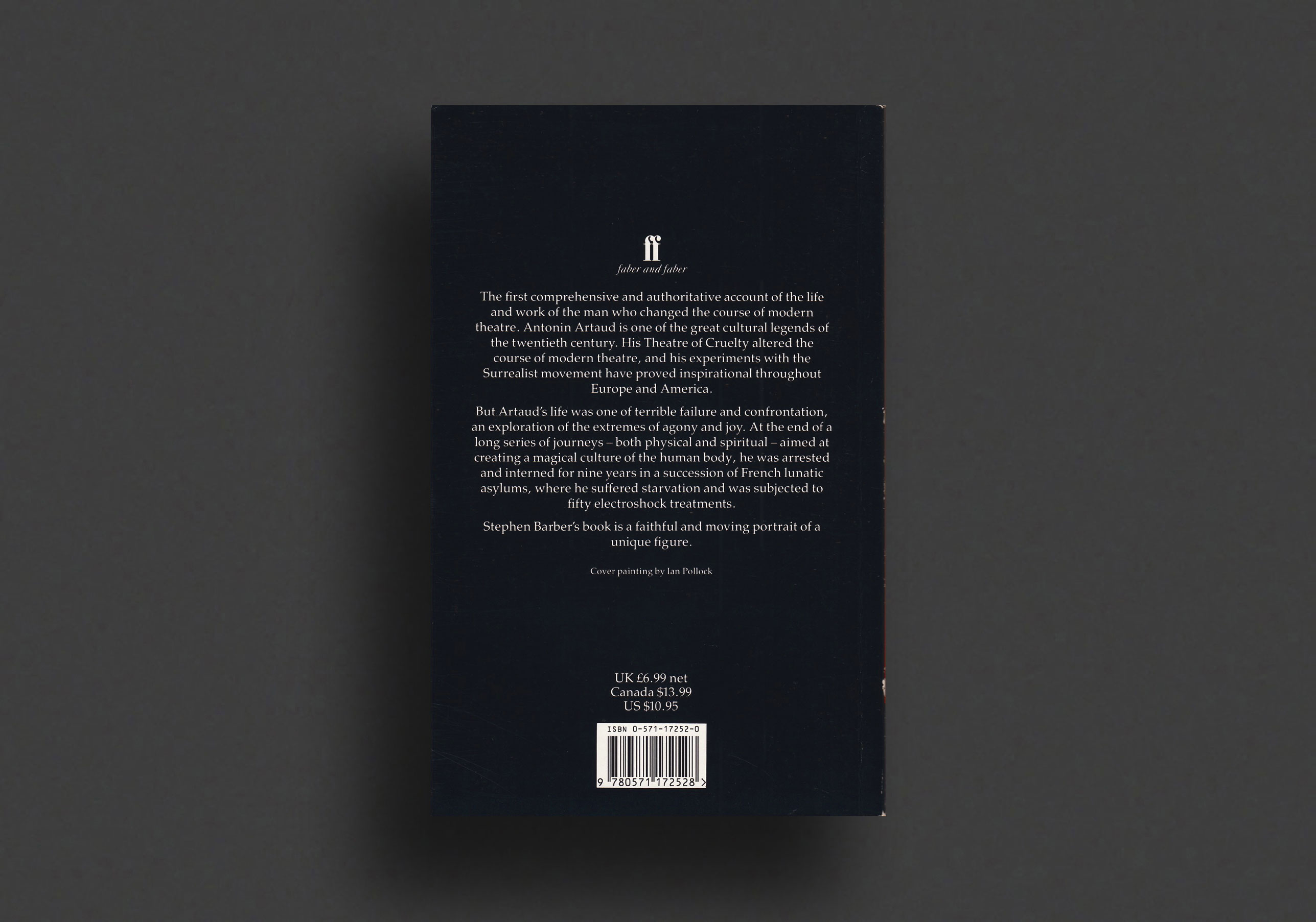
The first 1994 softcover edition of the first comprehensive and authoritative account of the life and work of the man who changed the course of modern theatre. Antonin Artaud is one of the great cultural legends of the twentieth century. His Theatre of Cruelty altered the course of modern theatre, and his experiments with the Surrealist movement have proved inspirational throughout Europe and America.
But Artaud's life was one of terrible failure and confrontation, an exploration of the extremes of agony and joy. At the end of a long series of journeys - both physical and spiritual - aimed at creating a magical culture of the human body, he was arrested and interned for nine years in a succession of French lunatic asylums, where he suffered starvation and was subjected to fifty electroshock treatments.
Stephen Barber's book is a faithful and moving portrait of a unique figure.
VG copy with some page tanning light wear.
2025, English
Hardcover, 392 pages, 29.5 x 25 cm
$150.00 - In stock -
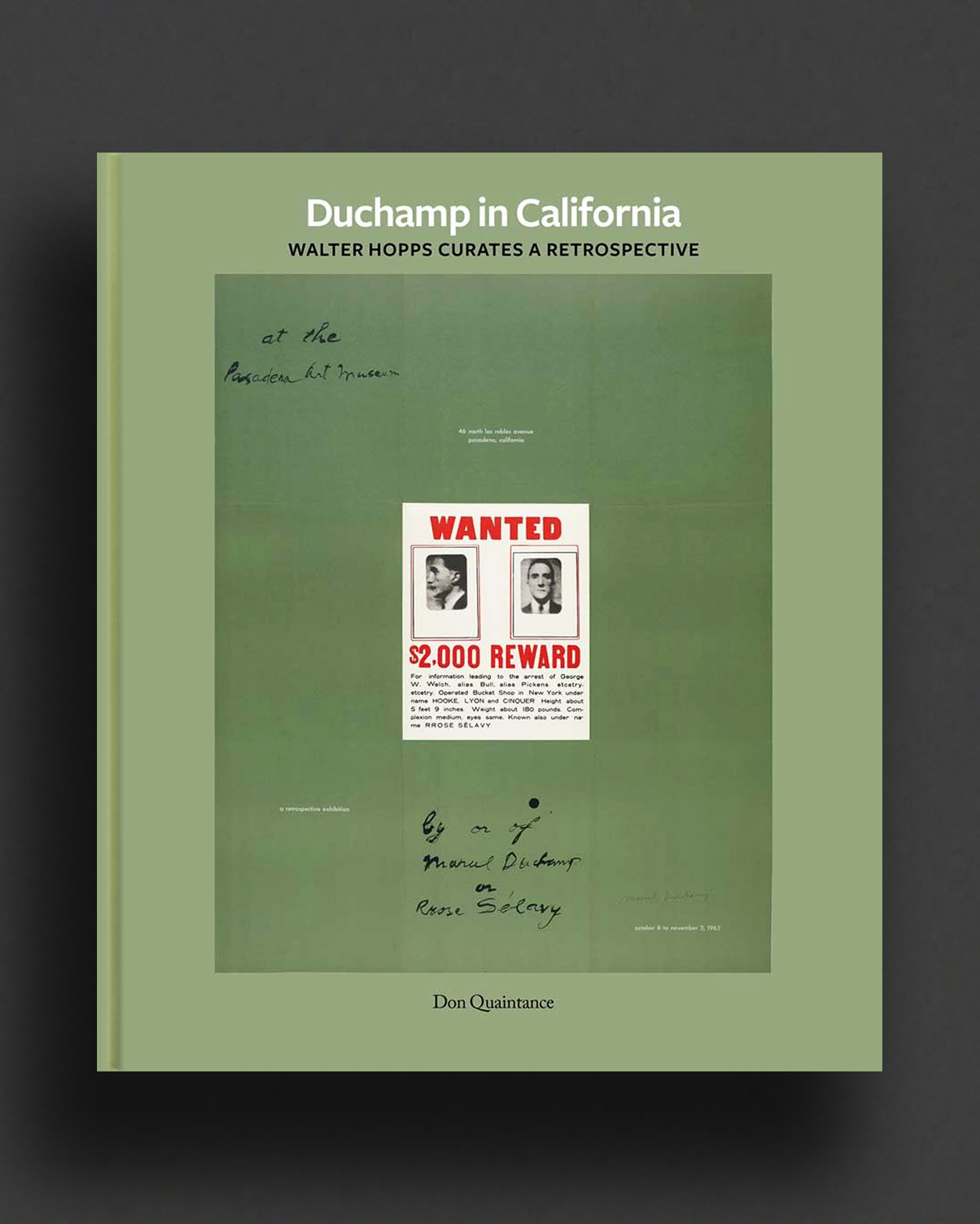
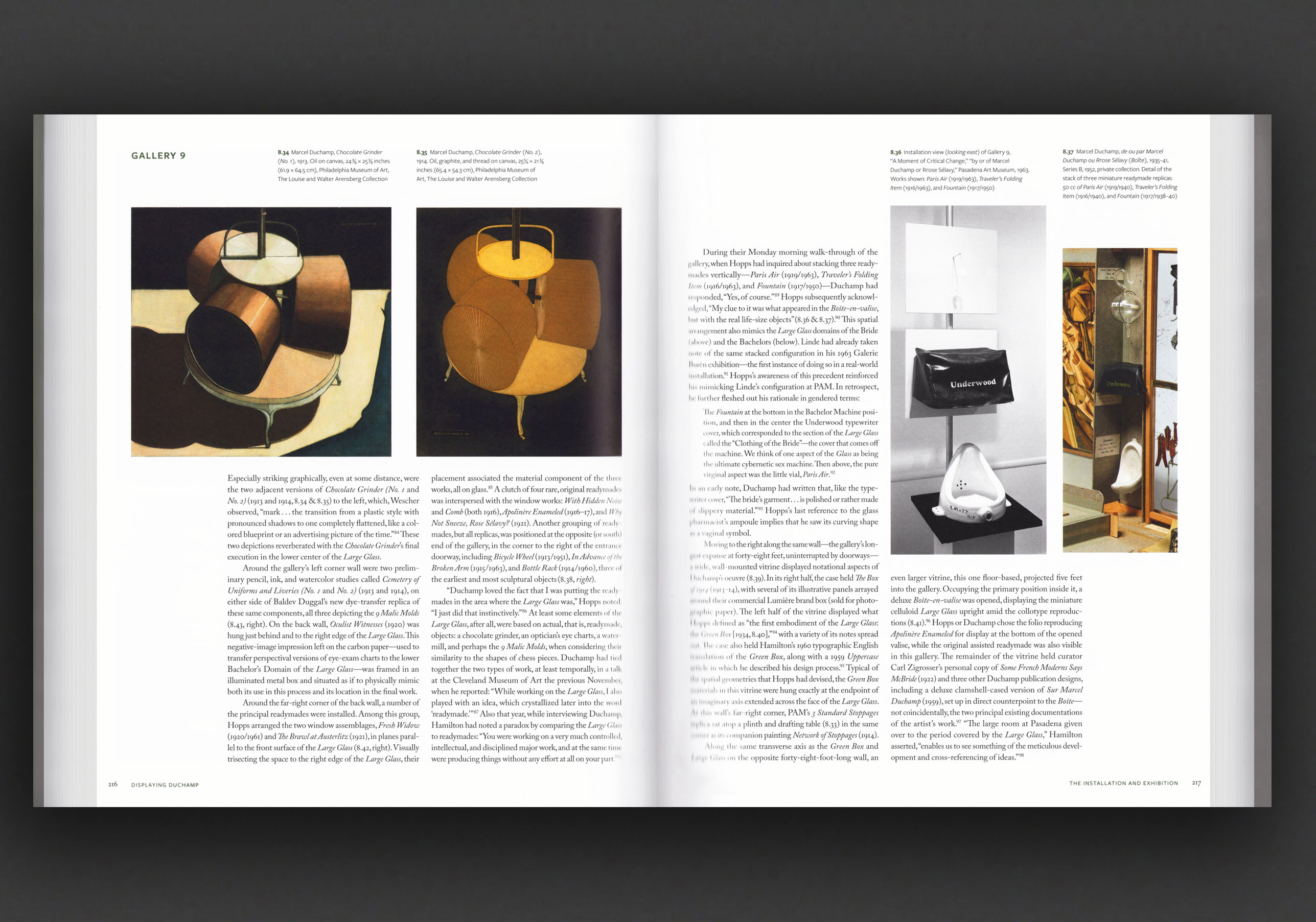
Marcel Duchamp’s first retrospective in 1963, curated by the youthful and energetic curator Walter Hopps, was a singular moment in twentieth-century art history. This chronicle of its conception and execution reveals an ascendant cultural history of Los Angeles in the early 1960s. A reawakening to Duchamp’s impact on contemporary thought was on full display first in California—accompanied by a remarkable cast of artists, curators, critics, gallerists, and collectors, including Larry Bell, Billy Al Bengston, Ed Bereal, Wallace Berman, George Brecht, William N. Copley, Sam Francis, Joe Goode, Richard Hamilton, Dennis Hopper, Robert Irwin, Ed Kienholz, Alison Knowles, Gerard Malanga, Marisol, Patty Mucha, Claes Oldenburg, Richard Pettibone, Ed Ruscha, Andy Warhol, and Robert Watts. With detailed installation diagrams and reproductions of every art object displayed published here for the first time, Duchamp in California shows why the exhibition is revered as an exemplar of curatorial practice for its compelling design and critical acclaim.
By Don Quaintance