World Food Books' programme is largely produced on Kulin Nation land. We acknowledge the Wurundjeri people of the Kulin Nation as the first and continuing custodians of this land, and pay respect to their Elders past, present, and emerging.
World Food Books is an arts and special interests bookshop in Naarm / Melbourne. Founded in 2010, World Food Books is devoted to the presentation of a rotating, hand-selection of international art, design, literary and counterculture publications with an emphasis on the anti-traditional, the experimental, the avant-garde, the heretic, the marginal.
Presenting new titles alongside rare and out-of-print books, catalogues and journals spanning the fields of modern and contemporary art, design, photography, illustration, film, literature, poetry, cultural theory, philosophy, sexuality, popular and underground culture in its many radical forms, World Food Books wishes to encourage adventurous, thoughtful and open-minded reading, looking, writing, and exchange of publishing and ideas, both current and historical.
As well as our bookshop, located in Melbourne's historical Nicholas Building, all of our inventory is available internationally via our online mail-order service.
World Food Books semi-regularly co-ordinates "Occasions", a programme of exhibits and events at the bookshop and in partnership with other hosts (such as museums and art galleries) that develop out of the activities, relationships and content of the bookshop itself.
World Food Books
The Nicholas Building
37 Swanston Street
Room 5, Level 6
Melbourne 3000
Australia
SHOP HOURS:
THU–SAT 12–6
WEB-SHOP OPEN 24/7
World Food Books
Postal Address:
PO Box 435
Flinders Lane
Victoria 8009
Australia
info@worldfoodbooks.com
Art
Theory / Essay
Architecture / Interior
Graphic Design / Typography
Photography
Fashion
Eros
LGBTQ+
Fiction / Poetry
Weird / Speculative / Science Fiction / Horror
Transgressive / Visceral / Abject
Symbolism / Decadence / Fin de siècle
Film / Video
Painting
Sculpture / Installation
Performance / Dance / Theater
Drawing
Sound / Music
Curatorial
Group Shows / Collections
Periodicals
Out-of-print / Rare
Posters / Ephemera / Discs
Signed Books
World Food Books Gift Voucher
World Food Book Bag
Australian Art
Australian Fiction
Australian Science Fiction / Speculative Fiction
Australian Poetry
Australian Photography
Japanese Photography
Conceptual Art
Minimal Art
Dada
'Pataphysics / Oulipo
Fluxus
Concrete Poetry
Pop Art
Surrealism
Arte Povera
Arte Informale / Haute Pâte / Tachism
Nouveau Réalisme / Zero / Kinetic
Situationism / Lettrism
Collage / Mail Art / Xerox Art
Art Brut / Folk / Visionary / Fantastic
Illustration / Graphic Art / Bandes Dessinées
Furniture
Italian Radical Design / Postmodernism
Textiles
Ceramics / Glass
Counterculture
Protest / Revolt
Philosophy
Psychoanalysis
Anthropology
Anarchism
Socialism / Anarchism / Communism / Capitalism
Literary Theory / Semiotics / Language
Feminism / Women's Studies
Gender Studies / Sexuality
Anthropology
Fetishism / BDSM
Drugs / Psychedelia
Crime / Violence
Animal Rights / Veganism
Occult / Esoterica
Ecology / Earth / Alternative Living
Whole Earth / Crafts
All prices in AUD (Australian dollars)
Pick-Ups
Pick-up orders can be collected in our bookshop during opening hours after order date. Please collect any Pick-up orders within 2 weeks of ordering as we have limited storage space. Orders will be released back into stock if not collected within this time. No refunds can be made for pick-ups left un-collected. If you cannot make it in to the bookshop in this time-frame, please choose postage option.
Return Policy
All sales are final. We do accept returns (for refund or exchange) for items received in error. All our orders are packed with special care using heavy-duty padding and cardboard book-mailers or bubble mailers (for smaller books), using reinforcement where required. We cannot take responsibility for any lost, stolen or damaged parcels.
Insurance
Should you wish to insure your package, please email us directly after placing your order and we can organise this at a small extra expense. Although all standard/express tracked packages are very safe and dependable, we cannot take responsibility for any lost, stolen or damaged parcels. We recommend insurance on valuable orders.
Interested in selling your old books, catalogues, journals, magazines, comics, fanzines, ephemera? We are always looking for interesting, unusual and out-of-print books to buy. We only buy books in our fields of interest and specialty, and that we feel we can resell.
We base these prices on desirability, market value, in-print prices, condition and our current stock levels. We offer cash, store credit, and can take stock on consignment. All
about 25% of the price we expect to get when we sell them, or 30% in store credit. We base these prices on desirability, market value, in-print prices, condition and our current stock levels.
Sell your books any day of the week. You can drop them off and return later. If you have a lot of books, we can visit your Sydney home.
We buy books that we feel we can resell. We offer about 25 % of the price we expect to get when we sell them, or 30% in store credit. We base these prices on desirability, market value, in-print prices, condition and our current stock levels.
Philadelphia Wireman
03 August - 01 September, 2018
World Food Books is proud to announce our next Occasion, the first presentation of sculptures by Philadelphia Wireman in Australia.
The Philadelphia Wireman sculptures were found abandoned in an alley off Philadelphia’s South Street on trash night in 1982. Their discovery in a rapidly-changing neighbourhood undergoing extensive renovation, compounded with the failure of all attempts to locate the artist, suggests that the works may have been discarded after the maker’s death. Dubbed the "Philadelphia Wireman" during the first exhibition of this work, in 1985, the maker’s name, age, ethnicity, and even gender remain uncertain. The entire collection totals approximately 1200 pieces, all intricately bound together with tightly-wound heavy-gauge wire (along with a few small, abstract marker drawings, reminiscent both of Mark Tobey and J.B. Murry). The dense construction of the work, despite a modest range of scale and materials, is singularly obsessive and disciplined in design: a wire armature or exoskeleton firmly binds a bricolage of found objects including plastic, glass, food packaging, umbrella parts, tape, rubber, batteries, pens, leather, reflectors, nuts and bolts, nails, foil, coins, toys, watches, eyeglasses, tools, and jewellery.
Heavy with associations—anthropomorphic, zoomorphic, and socio-cultural responses to wrapped detritus—the totemic sculptures by Philadelphia Wireman have been discussed in the context of work created to fulfil the shamanistic needs of alternative religions in American culture. Curators, collectors, and critics have variously compared certain pieces to sculpture from Classical antiquity, Native American medicine bundles, African-American memory jugs, and African fetish objects. Reflecting the artist’s prolific and incredibly focused scavenging impulse, and despite—or perhaps enhanced by—their anonymity, these enigmatic objects function as urban artefacts and arbiters of power, though their origin and purpose is unknown. Philadelphia Wireman, whatever their identity, possessed an astonishing ability to isolate and communicate the concepts of power and energy through the selection and transformation of ordinary materials. Over the course of the past two decades, this collection has come to be regarded as an important discovery in the field of self-taught art and vernacular art.
Presented in collaboration with Fleisher-Ollman Gallery, Philadelphia, and Robert Heald, Wellington.
Susan Te Kahurangi King
02 February - 10 March, 2018
Susan Te Kahurangi King (24 February 1951 - ) has been a confident and prolific artist since she was a young child, drawing with readily available materials - pencils, ballpoint pens and felt-tip markers, on whatever paper is at hand. Between the ages of four and six Susan slowly ceased verbal communication. Her grandparents William and Myrtle Murphy had developed a special bond with Susan so they took on caring responsibilities for extended periods. Myrtle began informally archiving her work, carefully collecting and storing the drawings and compiling scrapbooks. No drawing was insignificant; every scrap of paper was kept. The King family are now the custodians of a vast collection containing over 7000 individual works, from tiny scraps of paper through to 5 meter long rolls.
The scrapbooks and diaries reveal Myrtle to be a woman of great patience and compassion, seeking to understand a child who was not always behaving as expected. She encouraged Susan to be observant, to explore her environment and absorb all the sights and sounds. Myrtle would show Susan’s drawings to friends and people in her community that she had dealings with, such as shopkeepers and postal workers, but this was not simply a case of a grandmother’s bias. She recognised that Susan had developed a sophisticated and unique visual language and sincerely believed that her art deserved serious attention.
This was an unorthodox attitude for the time. To provide some context, Jean Dubuffet coined the term Art Brut in 1945 to describe work created by self-taught artists – specifically residents of psychiatric institutions and those he considered to be visionaries or eccentrics. In 1972 Roger Cardinal extended this concept by adopting the term Outsider Art to describe work made by non-academically trained artists operating outside of mainstream art networks through choice or circumstance. Susan was born in Te Aroha, New Zealand in 1951, far from the artistic hubs of Paris and London that Dubuffet and Cardinal operated in. That Myrtle fêted Susan as a self-taught artist who deserved to be taken seriously shows how progressive her attitudes were.
Susan’s parents Doug and Dawn were also progressive. Over the years they had consulted numerous health practitioners about Susan’s condition, as the medical establishment could not provide an explanation as to why she had lapsed into silence. Dawn educated herself in the field of homeopathy and went on to treat all twelve of her children using these principles – basing prescriptions on her observations of their physical, mental and emotional state.
Doug was a linguist with an interest in philosophy who devoted what little spare time he had to studying Maori language and culture. To some extent their willingness to explore the fringes of the mainstream made them outsiders too but it was their commitment to living with integrity and their respect for individuality that ensured Susan’s creativity was always encouraged.
Even though Susan’s family supported her artistic pursuits, some staff in schools and hospitals saw it as an impediment to her assimilation into the community and discouraged it in a variety of ways. Her family was not always aware of this and therefore did not fully understand why Susan stopped drawing in the early 1990s. However, rather than dwell on the challenges that Susan faced in pursuit of her artistic practice, they prefer to highlight her achievements. In 2008 Susan began drawing again in earnest, after an almost 20 year interruption, and her work is now shown in galleries around the world.
Susan grew up without television and has been heavily influenced by the comics she read as a child. She is absolutely fearless in the appropriation of recognizable characters, such as Donald Duck and Mickey Mouse, in her work. She twists their limbs, contorts their faces, compresses them together, blends them into complex patterned backgrounds - always imbuing them with an incredible energy. Although Susan often used pop culture characters in her work they are not naive or childlike. These are drawings by a brilliant self-taught artist who has been creating exceptional work for decades without an audience in mind.
Mladen Stilinović
"Various Works 1986 - 1999"
02 February 16 - September 10, 2016
Various works 1986 - 1999, from two houses, from the collections of John Nixon, Sue Cramer, Kerrie Poliness, Peter Haffenden and Phoebe Haffenden.
Including: Geometry of Cakes (various shelves), 1993; Poor People’s Law (black and white plate), 1993; White Absence (glasses, ruler, set square, silver spoon, silver ladel with skin photograph and wooden cubes), 1990-1996; Exploitation of the Dead (grey and red star painting, wooden painting, black spoon with red table, red plate), 1984-1990; Money and Zeros (zero tie, paintings made for friends in Australia (Sue, John, Kerrie), numbers painting), 1991-1992; Words - Slogans (various t-shirts) - “they talk about the death of art...help! someone is trying to kill me”, “my sweet little lamb”, “work is a disease - Karl Marx”; Various artist books, catalogues, monographs, videos; Poster from exhibition Insulting Anarchy; "Circular" Croatian - Australian edition; Artist book by Vlado Martek (Dostoyevsky); more.
Thanks to Mladen Stilinović and Branka Stipančić.
Jonathan Walker
Always Will Need To Wear Winter Shirt Blue + Ochre Small Check Pattern
21 August - 21 September, 2015
Untitled
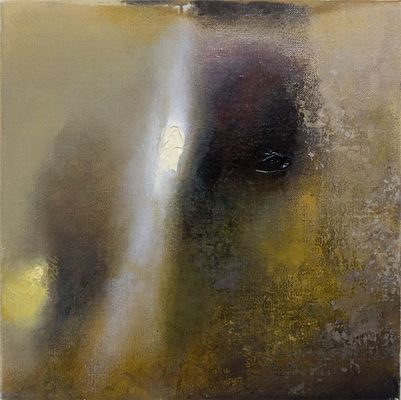
I am not a great reader of poetry but I always return to the work of Melbourne poet, Vincent Buckley (1925- 1988). Perhaps I find his most tantalising piece to be not a finished poem but a fragment left on a scrap of paper discovered on his desk after the poet’s death.
The poetry gathers like oil
In the word-core, and spreads
It has its music meet,
Its music is in movement.
This fragment is more the shell left behind from a volatile thought than a finished poem. I find the last two lines honest but awkward whereas the first two lines work like an arrow. Most likely he could not find a resolution so it was left. Still, in its present form, it remains an eloquent testimony to the ultimate failure of a medium to express mobile thought and sensation, in Buckley’s case, through verbal language. It’s an important matter because this is something all artists have to deal with regardless of the medium.
I have never written a poem, however, I am forever copying fragments from books on paper scraps in a vain effort to fix certain notions in my head. At first, they function as bookmarks that are sometimes returned to when I open the book. But before long, as they accumulate, they fall out littering the table interspersed with A4 photocopies, bills, books and medications.
To return to Buckley’s fragment, the first two lines very much evoke how I paint nowadays. As you age, detail diminishes and patches of light become more luminous and float. I feel the most honest way of dealing with this is by smearing the oil paint on the canvas with the fingers and working close-up, blind. Only if the patches coalesce into an approaching image can the work gain a life.
-
Jonathan Walker was born in Melbourne, Australia and brought up on a dairy farm in Gippsland. In the 1970’s he studied painting at RMIT and won the Harold Wright Scholarship to the British Museum, London. During the 1980’s he exhibited at Pinacotheca Gallery, Richmond and had work shown at the NGV and Heidi City Art Gallery. Over the same period he designed the cover for the “Epigenesi” LP by Giancarlo Toniutti, Italy and conducted a mail exchange work with Achim Wollscheid, Germany. The work with artists through the post resulted in an article published in the bicentenary issue of Art and Australia 1988. He showed in artist run spaces such as WestSpace in the 90’s and 2000’s, and until 2012, taught painting at Victoria University, which is where we (Colleen Ahern and Lisa Radford) as organisers of the exhibition, among many others, had the privilege of being his student.
Walker’s knowledge was imparted to students through the careful selection of music, literature, and artists found in books that he himself had ordered for the library. Walker’s strategy was the generosity of sharing his vast knowledge with references specific to each student and their context.
Walker’s paintings share a similar focus and intimacy.
This exhibition presents a small selection of recent paintings alongside a publication that includes Walker’s writing. Observational and analytical, Walker’s work is a type of material notation — the time of day, colour and how it is blended, the both specific and fleeting location of a reflection on lino or the question of whether a chair leg should be included in a painting.
Please join us on Friday August 21 between 6-8pm to celebrate the opening of the exhibition.
Curated by Colleen Ahern and Lisa Radford.
B. Wurtz
Curated by Nic Tammens
March 26 - April 4, 2015
B.Wurtz works from a basement studio in his home on Manhattan’s Lower East Side.
This local fact is attested to by the plastic shopping bags and newsprint circulars that appear in his work. As formal objects, they don’t make loud claims about their origins but nonetheless transmit street addresses and places of business from the bottom of this long thin island. Like plenty of artists, Wurtz is affected by what is local and what is consumed. His work is underpinned by this ethic. It often speaks from a neighborhood or reads like the contents of a hamper:
“BLACK PLUMS $1.29 lb.”
“Food Bazaar”
“USDA Whole Pork Shoulder Picnic 99c lb.”
“RITE AID Pharmacy, with us it’s personal.”
“H. Brickman & Sons.”
“Sweet Yams 59c lb."
Most of the work in this exhibition was made while the artist was in residence at Dieu Donne, a workshop dedicated to paper craft in Midtown. Here Wurtz fabricated assemblages with paper and objects that are relatively lightweight, with the intention that they would be easily transportable to Australia. This consideration isn’t absolute in Wurtz’s work, but was prescriptive for making the current exhibition light and cheap. Packed in two boxes, these works were sent from a USPS post office on the Lower East Side and delivered to North Melbourne by Australia Post.
Wurtz appears courtesy of Metro Pictures, New York.
Thanks to Rob Halverson, Joshua Petherick, Sari de Mallory, Matt Hinkley, Helen Johnson, Fayen d'Evie, Ask Kilmartin, Lisa Radon, Ellena Savage, Yale Union, and "Elizabeth".
John Nixon
"Archive"
December 15 - January 20, 2014
The presentation of John Nixon's archive offered a rare showcase of this extensive collection of the artist's own publications, catalogues, posters, ephemera, editions and more, from the mid 1980s onwards, alongside a selection of his artworks.
Organized by John Nixon, Joshua Petherick and Matt Hinkley.
"Habitat"
at Minerva, Sydney (organised by Joshua Petherick and Matt Hinkley)
November 15 - December 20, 2014
Lupo Borgonovo, Janet Burchill & Jennifer McCamley,
Lewis Fidock, HR Giger, Piero Gilardi, Veit Laurent Kurz,
Cinzia Ruggeri, Michael E. Smith, Lucie Stahl, Daniel Weil, Wols
Press Release:
“...It contained seven objects. The slender fluted bone, surely formed for flight, surely from the wing of some large bird. Three archaic circuitboards, faced with mazes of gold. A smooth white sphere of baked clay. An age-blackened fragment of lace. A fingerlength segment of what she assumed was bone from a human wrist, grayish white, inset smoothly with the silicon shaft of a small instrument that must once have ridden flush with the surface of the skin - but the thing’s face was seared and blackened.”
William Gibson, “Count Zero”, 1986
"Autumn Projects Archive"
Curated by Liza Vasiliou
March 6 - March 15, 2014
World Food Books, in conjunction with the Virgin Australia Melbourne Fashion Festival 2014, presented the Autumn Projects archive, consisting of a selection of early examples in Australian fashion with a particular interest in collecting designers and labels from the period beginning in the 1980’s, who significantly influenced the discourse of Australian Fashion.
Curated by Liza Vasiliou, the exhibition provided a unique opportunity to view pieces by designers Anthea Crawford, Barbara Vandenberg, Geoff Liddell and labels CR Australia, Covers, Jag along with early experimental collage pieces by Prue Acton and Sally Browne’s ‘Fragments’ collection, suspended throughout the functioning World Food Books shop in Melbourne.
H.B. Peace
presented by CENTRE FOR STYLE
November 14, 2013
"Hey Blinky, you say chic, I say same"
Anon 2013
H.B. Peace is a clothing collaboration between great friends Blake Barns and Hugh Egan Westland. Their pieces explore the divergences between 'character’ and ‘personality’ in garments....etc
Special Thanks to Joshua Petherick and Matt Hinkley of WFB and Gillian Mears
and a Very Special Thank you to Audrey Thomas Hayes for her shoe collaboration.
Janet Burchill & Jennifer McCamley
"Aesthetic Suicide"
May 10 - June 8, 2013
The first of our occasional exhibitions in the World Food Books office/shop space in Melbourne, "Aesthetic Suicide" presented a body of new and older works together by artists Janet Burchill & Jennifer McCamley, including videos, prints, a wall work, and publications.
During shop open hours videos played every hour, on the hour.
1971, Japanese
Softcover (staple-bound), 156 pages, 21.5 x 15 cm
1st Edition, Out of print title / used / very good
Published by
Lemon Inc. / Tokyo
$45.00 - In stock -
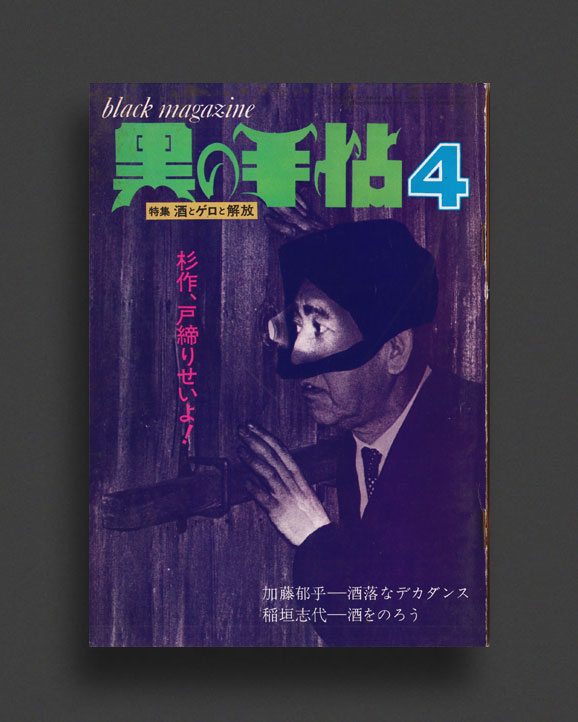
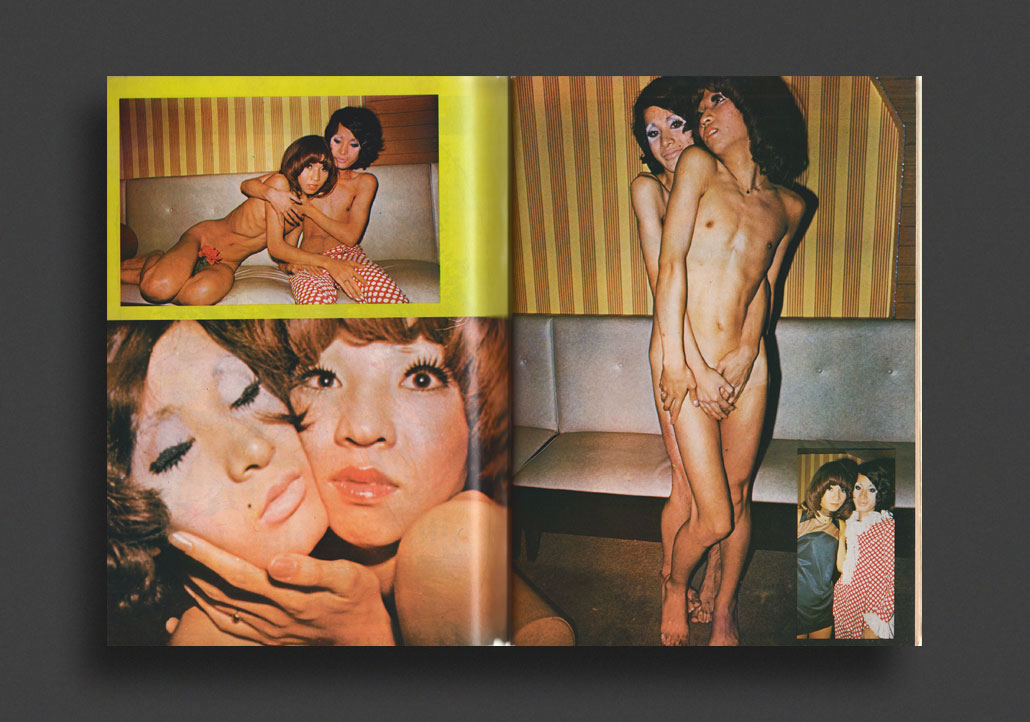
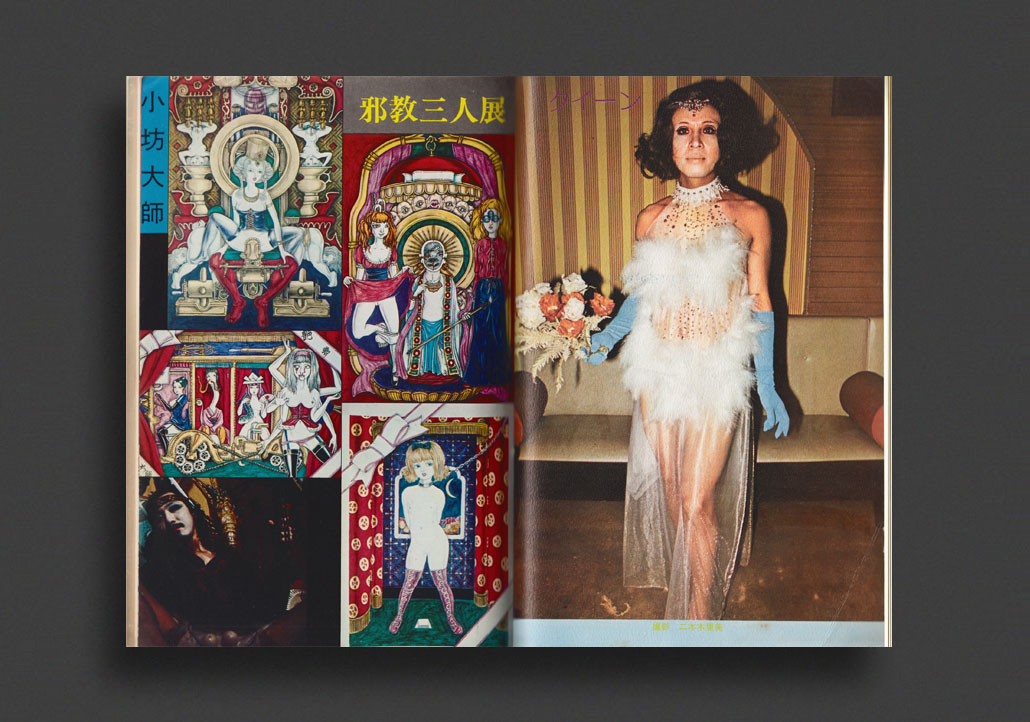
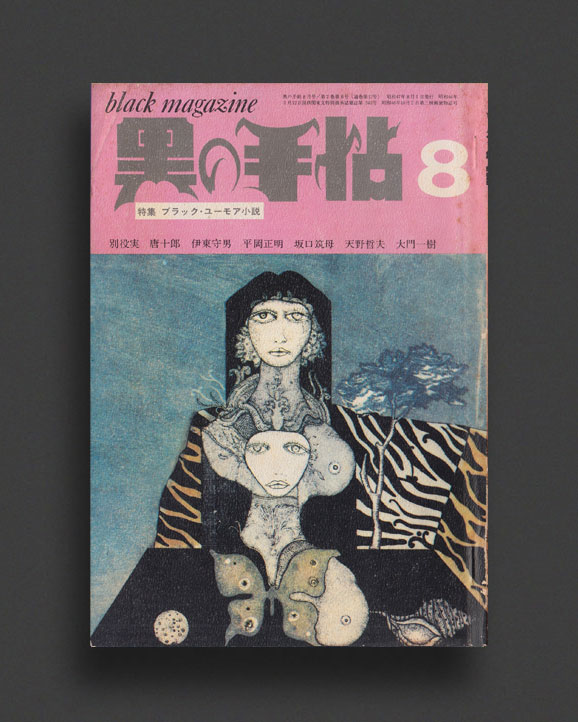
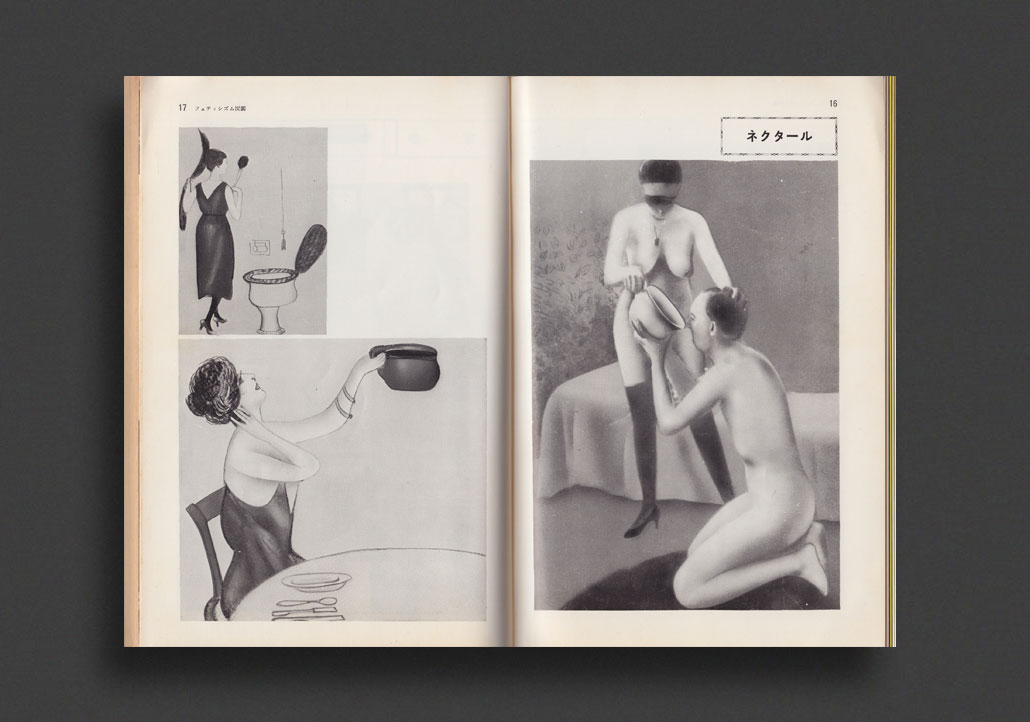
April 1971 issue of legendary Japanese underground arts periodical, Black Magazine (or Black Notebook), a taboo-shattering vehicle of the 1970s subculture in Tokyo. A magazine like no-other, each issue, "a paradise of 1970's heretical culture", was a who's who of non-conformity, introducing a new wave of illustrators, painters, doll-makers and photographers, "taboo" sexuality and fetish culture, avant-garde comics, sadistic literature, radical criticism, queer poetry, activism, black humour, underground film and theatre, and all manner of transgressive, esoteric and erotic material, new and historical. Black Magazine featured the work of Yukio Mishima, Toshio Saeki, Izumi Suzuki, Simon Yotsuya, Shūji Terayama, Ken Katayama, Nobuyoshi Araki, Genpei Akasegawa, Keiichi Tanaami, Kikuji Yamashita, Aoi Fujimoto, Tadanori Yokoo, Hiroshi Nakamura, and so many others. It was also where Japanese photographer Satomi Nihongi's Tokyo Transgender photographs were first printed. Black Magazine was heavy with queer and trans content, and Nihongi's "The Most Beautifuls" was a regular photo-feature in its pages. A lot of great things started in the pages of this unique magazine. A highly recommended publication!
1972, Japanese
Softcover, 122 pages, 21.5 x 15 cm
1st Edition, Out of print title / used / average
Published by
Lemon Inc. / Tokyo
$45.00 - In stock -
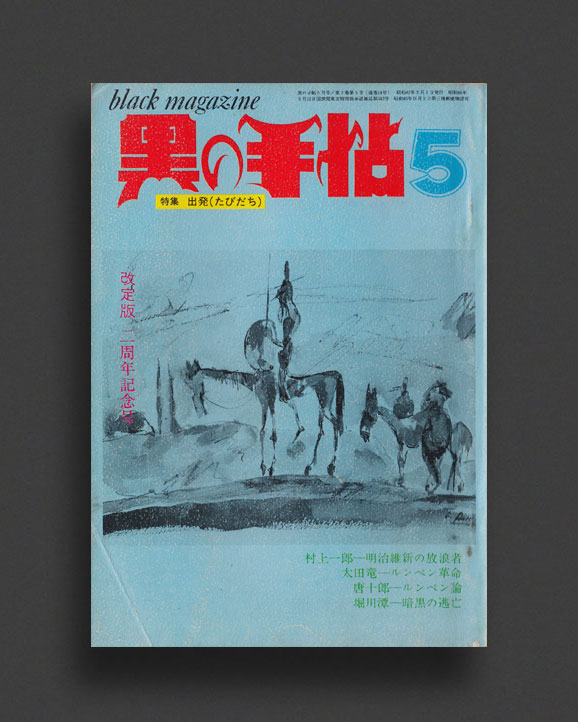
May 1972 issue of legendary Japanese underground arts periodical, Black Magazine (or Black Notebook), a taboo-shattering vehicle of the 1970s subculture in Tokyo. A magazine like no-other, each issue, "a paradise of 1970's heretical culture", was a who's who of non-conformity, introducing a new wave of illustrators, painters, doll-makers and photographers, "taboo" sexuality and fetish culture, avant-garde comics, sadistic literature, radical criticism, queer poetry, activism, black humour, underground film and theatre, and all manner of transgressive, esoteric and erotic material, new and historical. Black Magazine featured the work of Yukio Mishima, Toshio Saeki, Izumi Suzuki, Simon Yotsuya, Shūji Terayama, Ken Katayama, Nobuyoshi Araki, Genpei Akasegawa, Keiichi Tanaami, Kikuji Yamashita, Aoi Fujimoto, Tadanori Yokoo, Hiroshi Nakamura, and so many others. It was also where Japanese photographer Satomi Nihongi's Tokyo Transgender photographs were first printed. Black Magazine was heavy with queer and trans content, and Nihongi's "The Most Beautifuls" was a regular photo-feature in its pages. A lot of great things started in the pages of this unique magazine. A highly recommended publication!
1972, Japanese
Softcover, 122 pages, 21.5 x 15 cm
1st Edition, Out of print title / used / good
Published by
Lemon Inc. / Tokyo
$45.00 - In stock -
August 1971 issue of legendary Japanese underground arts periodical, Black Magazine (or Black Notebook), a taboo-shattering vehicle of the 1970s subculture in Tokyo. A magazine like no-other, each issue, "a paradise of 1970's heretical culture", was a who's who of non-conformity, introducing a new wave of illustrators, painters, doll-makers and photographers, "taboo" sexuality and fetish culture, avant-garde comics, sadistic literature, radical criticism, queer poetry, activism, black humour, underground film and theatre, and all manner of transgressive, esoteric and erotic material, new and historical. Black Magazine featured the work of Yukio Mishima, Toshio Saeki, Izumi Suzuki, Simon Yotsuya, Shūji Terayama, Ken Katayama, Nobuyoshi Araki, Genpei Akasegawa, Keiichi Tanaami, Kikuji Yamashita, Aoi Fujimoto, Tadanori Yokoo, Hiroshi Nakamura, and so many others. It was also where Japanese photographer Satomi Nihongi's Tokyo Transgender photographs were first printed. Black Magazine was heavy with queer and trans content, and Nihongi's "The Most Beautifuls" was a regular photo-feature in its pages. A lot of great things started in the pages of this unique magazine. A highly recommended publication!
2010, Japanese
Softcover (w. dust jacket and obi), 136 pages, 19 x 14.6 cm
1st Edition, Out of print title / as new
Published by
Atelier Third / Tokyo
$90.00 - Out of stock
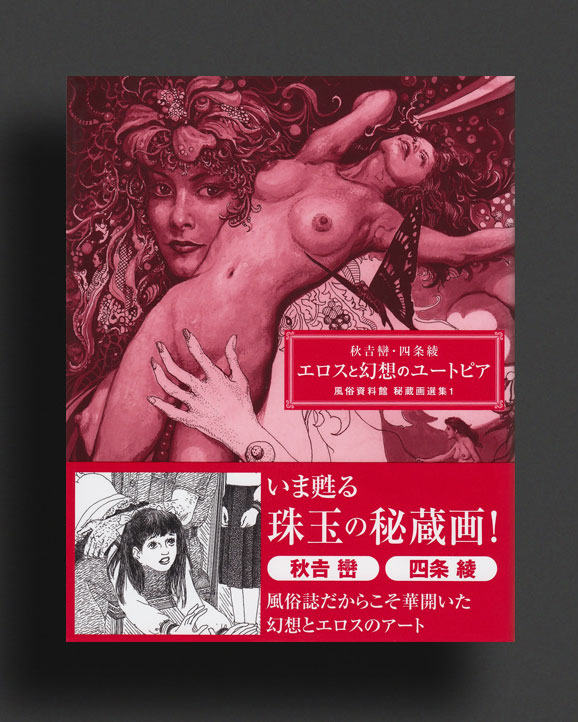
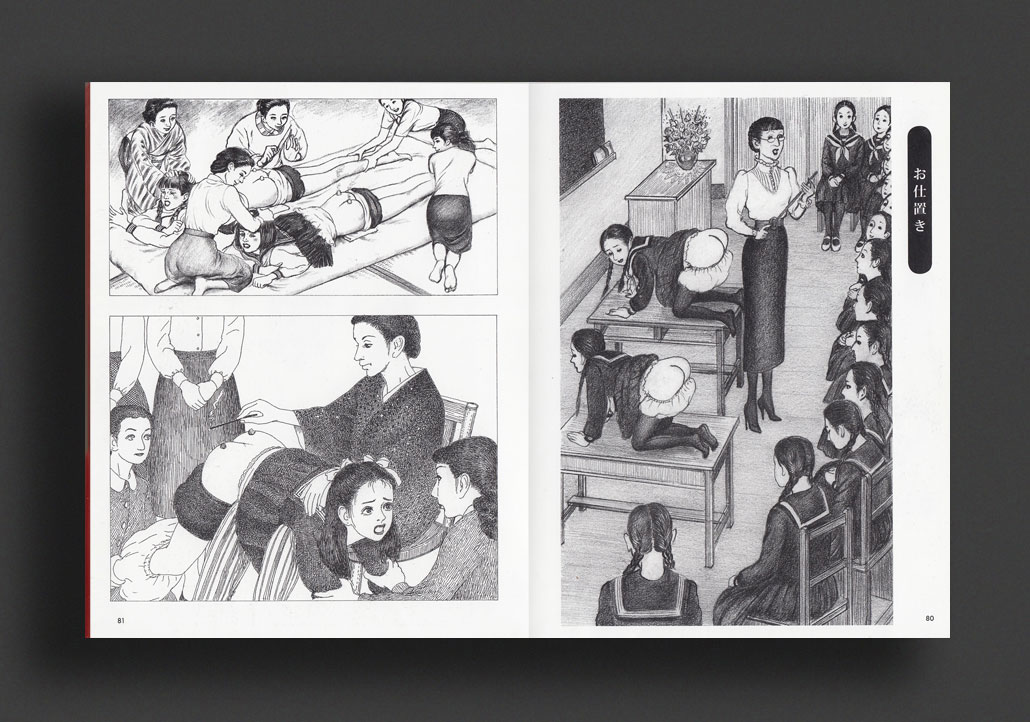
Published in 2010 and long out-of-print, this book collects the rare artworks of Japanese artists Ran Akiyoshi and Aya Shijo explores a world of erotic fantasies ranging from surrealism to magic, S&M to spanking, and much more. Two prolific artists whose work proliferated throughout the bountiful pages of Tokyo's underground SM / fetish publishing scene in the 1960s—1970s, but are virtually unknown and undocumented outside of Japan.
Legendary self-taught underground Japanese artist Ran Ran Akiyoshi (1922—1982), virtually unknown and undocumented outside of Japan, Akiyoshi never held an exhibition nor sold any of his drawings in his lifetime. Much like the work of Toshio Saeki or Namio Harukawa, Akiyoshi's creations proliferated throughout the bountiful pages of Tokyo's underground SM / fetish publishing scene in the 1960s—1970s. Yet Akiyoshi's phantasmagoric world of erotic fantasy is like no other, building sado-masochistic themes within unique, somewhat Lovecraftian and Bosch-esque dreamscapes populated by mythological goddesses and grotesque creatures. His peculiar fantasy drawings were highly praised by Japanese novelist and art critic, Tatsuhiko Shibusawa, an instrumental figure in the Japanese avant-garde who translated de Sade and Bataille to Japanese, and specialised in the study of medieval demonology.
Shijo Aya is a legendary underground Japanese artist little-known inside or outside Japan who specialised in fetish/punishment/humiliation imagery. He illustrated for magazines such as Kitan Club, SM King, SM Fan, and SM Play.
As New in dust jacket w. obi.
2007, English
Softcover, 160 pages, 20.5 x 15.5 cm
Published by
Atlas Press / London
$34.00 - In stock -
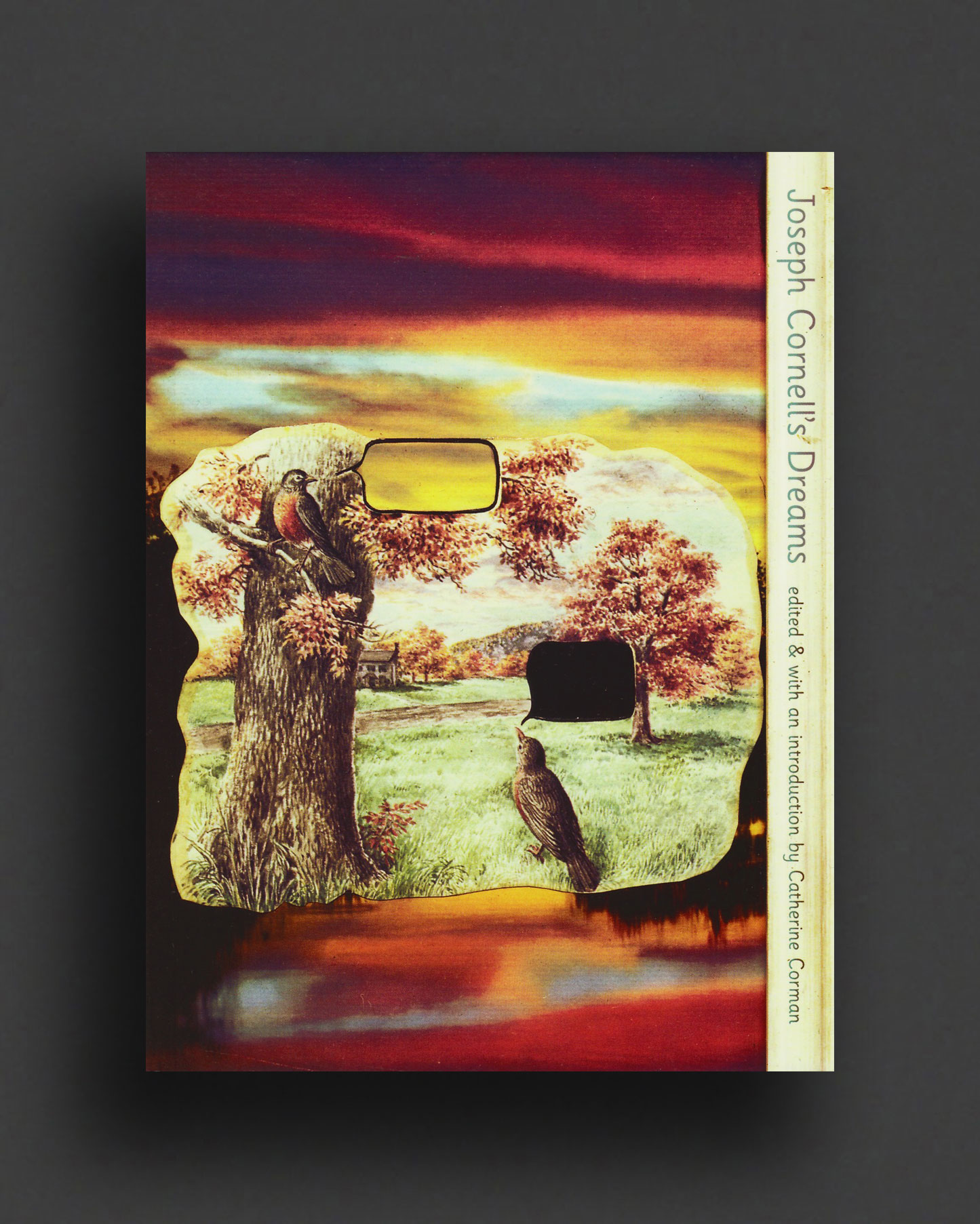
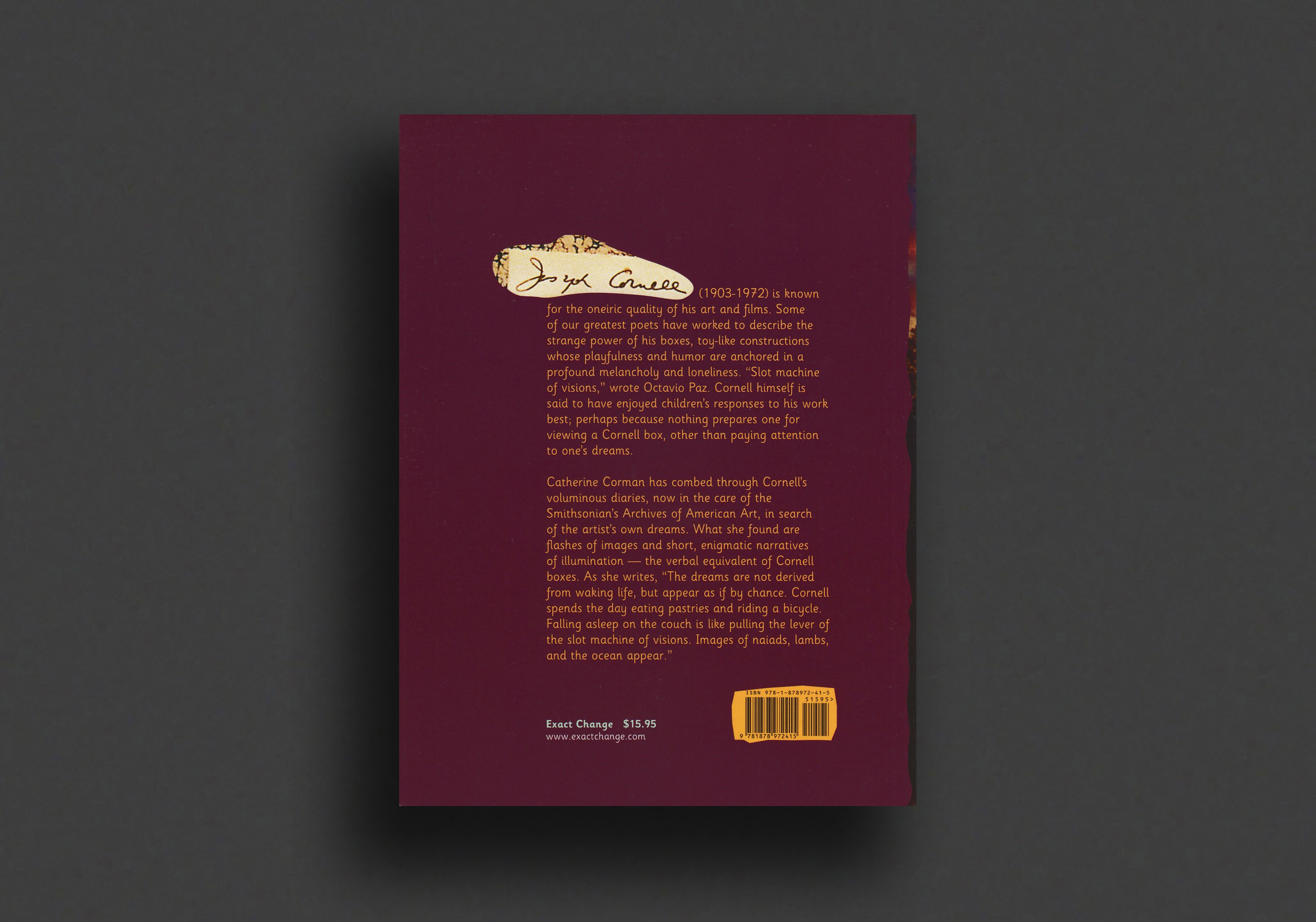
Joseph Cornell is well known for the oneiric quality of his art and films. Many have tried, often in vain, to put into words the strange power of his boxes—toy-like constructions whose playfulness and humor are anchored in a profound melancholy and loneliness. "Slot machines of visions," said Octavio Paz. Cornell himself is said to have enjoyed children's responses to his work; perhaps because nothing prepares one better for viewing a Cornell box than having an unbiased mind. Catherine Corman has combed through the voluminous diaries that Cornell kept throughout his life, now in the care of the Smithsonian's Archives of American Art, in search of the artist's own dreams. What she found are brief flashes of images, and short, enigmatic narratives of illumination -- the verbal equivalent of Cornell boxes.
In 1993, Mary Ann Caws edited a large portion of Cornell's diaries for publication by Thames & Hudson, an invaluable sourcebook for Cornell studies. This new, shorter volume is a poetic addition to that literature, equally indispensible to those interested in Cornell as it contains previously unpublished writings, but also because it is as intriguing and mysterious to the uninitiated as the magical boxes themselves.
1985, English
Softcover, 300 pages, 27.5 x 21 cm
1st Edition, Out of print title / used / very good
Published by
Quartet Books / London
$130.00 - Out of stock
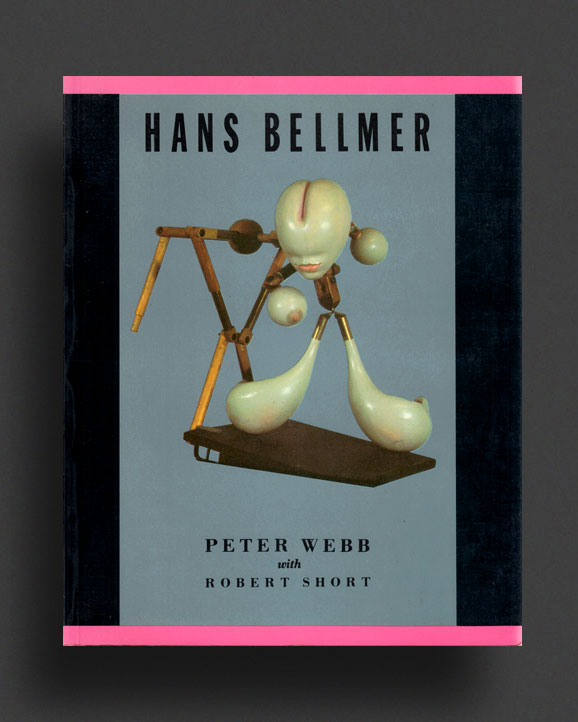
Now rare, first 1985 edition of the first fundamental and comprehensive English-language study of Hans Bellmer (1902—1975), the most provocative representative of Surrealism, authored by Peter Webb with Robert Short and published by Quartet in London. Heavily illustrated throughout with many rare images, in colour and b/w, many photographs and artworks, with bibliography, catalogue and references. An essential, illuminating book for anyone interested in Bellmer's work and life and the development of his historical Doll project, playing close attention to the often neglected but integral visionary texts by Bellmer that accompanied his artworks, with an abundance of written works translated throughout in English for the first time.
"Surrealism was one of the most exciting and influential of twentieth century art movements and much has been written about it since its great flowering in the 1930s. The lives and work of its leading figures (Ernst, Magritte, Dali and Miró) have been extensively researched, but Hans Bellmer, perhaps the most controversial and misunderstood of all the surrealists, has until now remained a mystery. Peter Webb, who interviewed Bellmer shortly before his death, has spent two years unravelling the story of this photographer, sculptor, painter, engraver and writer, and his book provides the first opportunity to evaluate Bellmer's considerable artistic achievement."—book jacket blurb
Very Good copy, mild wear.
1992, Japanese
Hardcover, 98 pages (w. fold-outs), 42 x 30 cm
Out of print title / used / good
Published by
Treville / Tokyo
$140.00 $100.00 - Out of stock
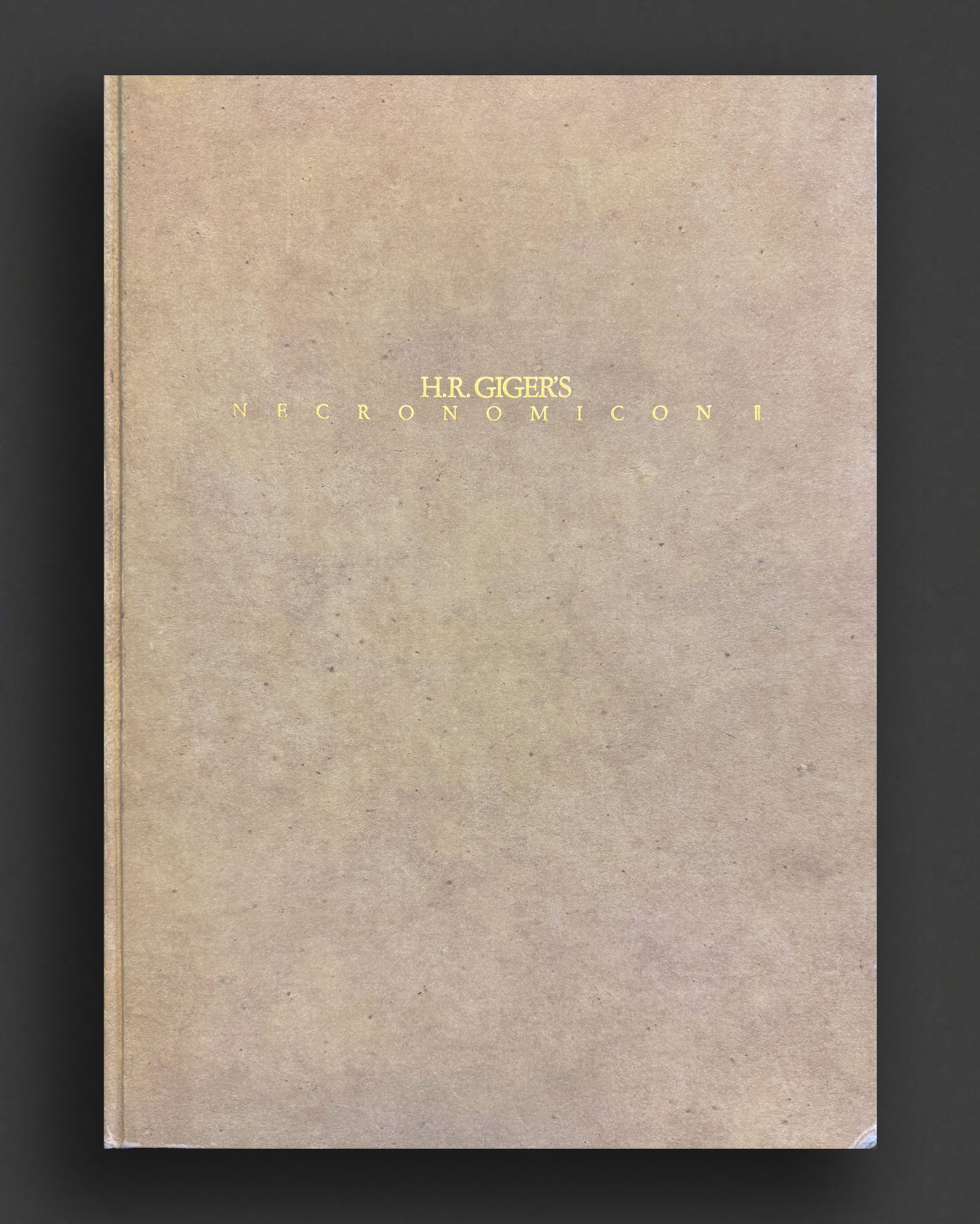
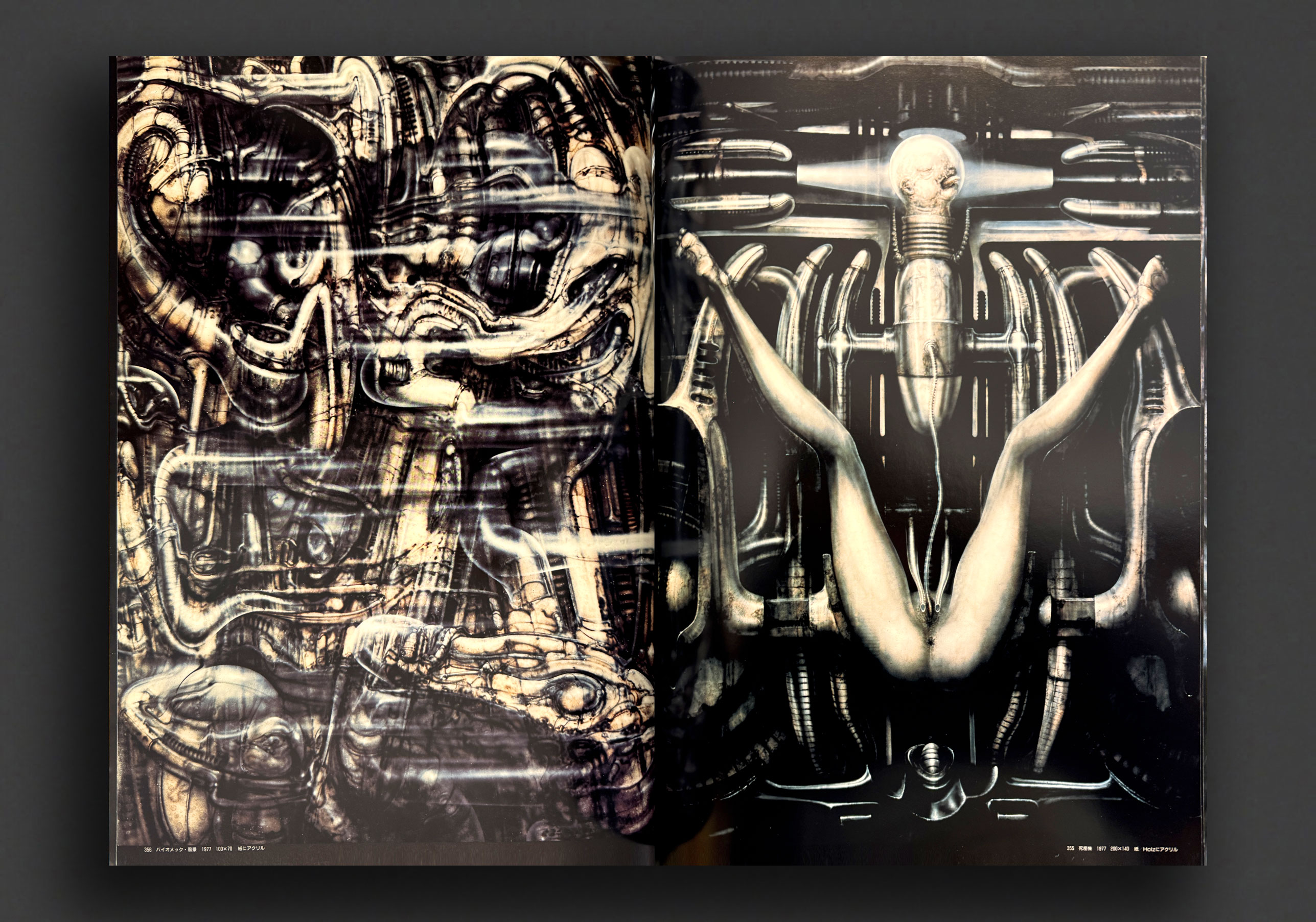
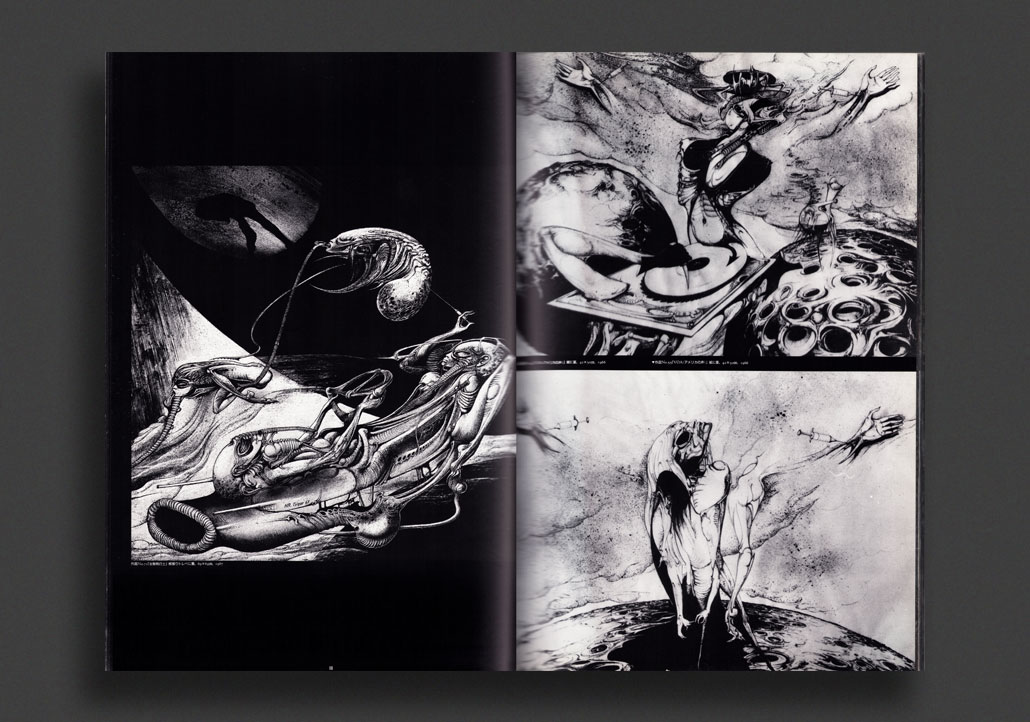
First special Japanese hardcover edition of H.R. Giger's Necronomicon II, the second oversized and visually overwhelming Giger-designed collection that takes us further through the incredible history of one of the most brilliant fantasy artists of the century. Reproducing Giger's award-winning work for the film ALIEN, lavish reproductions of his major paintings, environments, sculptural works, his work for never-shot film "The Tourist", his early grotesque ink illustrations, collaborations with Blondie's Debbie Harry, his "New York City" series from the late 1970's and so much more, all beautifully reproduced in full-colour and black and white, full-bleed spreads, including fold-out pages. Also includes interviews, texts, biography. These Giger folio books have become very desirable, collectable editions in their various printings around the world, the series encompassing the work of one of the world's most unique and influential visionaries of the macabre. This is volume 2 of 2 of "HR Giger's Necronomicon" where Al Azred's legendary magical book of the most wonderful abominations and perversions, "Necronomicon" (made infamous in the pages of HP Lovecraft's "Cthulhu" mythology), becomes a visual reality!
First hardcover Japanese edition, published by Hardcover edition published by Treville, Tokyo, in 1992. Light foxing/splitting/bumping to spine top and bottom, one semi-detaching from binding on endpaper, otherwise internally VG well preserved throughout.
1981, English
Softcover, 320 pages, 15.5 x 23.5 cm
1st Edition, Out of print title / used / very good
Published by
The MIT Press / Massachusetts
$45.00 - Out of stock
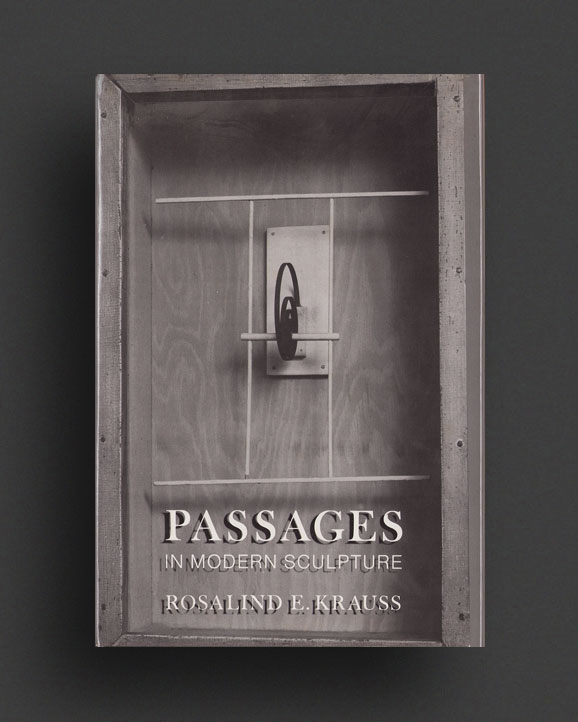
First 1981 edition of Passages in Modern Sculpture, Rosalind E. Krauss classic study of major works by important sculptors since Rodin in the light of different approaches to general sculptural issues to reveal the logical progressions from nineteenth-century figurative works to the conceptual work of the present.
"...Krauss's book is undoubtedly the best treatment of its subject yet written. As a textbook, it ought to raise the level of discourse in art history classes, for it is the meaning, not the chronology, of sculpture since Rodin that is the book's central concern. Krauss avoids the conventional plodding survey and divides the book into a sequence of 'case studies' that permit sustained attention to specific works and artists. In so doing, she attempts to trace a 'tradition' to stand behind that portion of American sculpture of the past 15 years which she espouses critically."—Art in America
"Distinguished art historian and critic Rosalind Krauss analyzes with exceptional clarity and insight the major works that have led 20th century sculpture from the traditional and figurative to the revolutionary conceptual art of the 1970s—an art which has developed a new 'syntax' that discards 'narrative' for instantaneous impact and boldly breaks new ground. Beginning with a penetrating study of Rodin's modernity in rejecting 'narrative' in his 'The Gates of Hell,' she moves successively through detailed examinations of futurism, constructivism, Duchamps' 'readymades,' Brancusi, David Smith's 'Tanktotem,' sculptural realism, and the introduction of light, motion, and theatrical elements into sculpture by Picabia, Calder, Oldenburg, and others right up to younger sculptors like Carl Andre, Blochner, and others [including Robert Morris, Don Judd, Richard Serra, Sol Le Witt, Robert Smithson, and Michael Heizer]. As critic and theorist, Krauss makes demands that will challenge even the most sophisticated."—Publishers Weekly
Rosalind E. Krauss, editor and cofounder of October magazine, is University Professor at Columbia University. She is the author of The Originality of the Avant-Garde and Other Modernist Myths, The Optical Unconscious, Bachelors, and Perpetual Inventory, all published by the MIT Press.
Good—Very Good copy with general light wear.
1977, English
Hardcover (w. dust jacket), 308 pages, 24 x 16 cm
1st UK Edition, Out of print title / used / very good
Published by
Thames and Hudson / London
$65.00 - In stock -
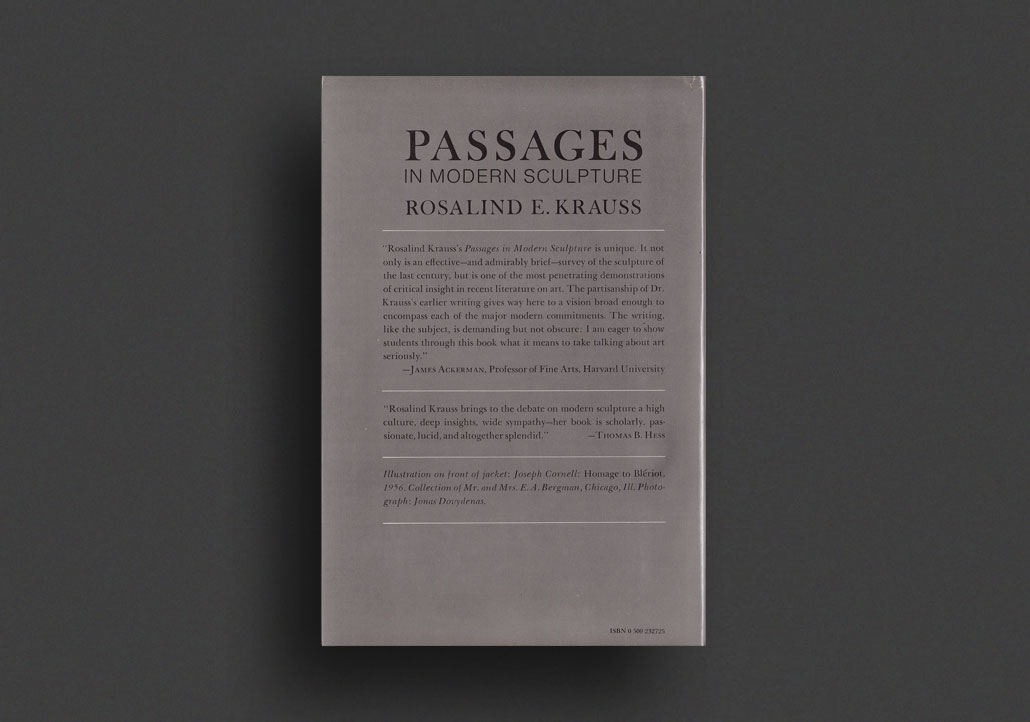
First 1977 hardcover edition of Passages in Modern Sculpture, Rosalind E. Krauss classic study of major works by important sculptors since Rodin in the light of different approaches to general sculptural issues to reveal the logical progressions from nineteenth-century figurative works to the conceptual work of the present.
"...Krauss's book is undoubtedly the best treatment of its subject yet written. As a textbook, it ought to raise the level of discourse in art history classes, for it is the meaning, not the chronology, of sculpture since Rodin that is the book's central concern. Krauss avoids the conventional plodding survey and divides the book into a sequence of 'case studies' that permit sustained attention to specific works and artists. In so doing, she attempts to trace a 'tradition' to stand behind that portion of American sculpture of the past 15 years which she espouses critically."—Art in America
"Distinguished art historian and critic Rosalind Krauss analyzes with exceptional clarity and insight the major works that have led 20th century sculpture from the traditional and figurative to the revolutionary conceptual art of the 1970s—an art which has developed a new 'syntax' that discards 'narrative' for instantaneous impact and boldly breaks new ground. Beginning with a penetrating study of Rodin's modernity in rejecting 'narrative' in his 'The Gates of Hell,' she moves successively through detailed examinations of futurism, constructivism, Duchamps' 'readymades,' Brancusi, David Smith's 'Tanktotem,' sculptural realism, and the introduction of light, motion, and theatrical elements into sculpture by Picabia, Calder, Oldenburg, and others right up to younger sculptors like Carl Andre, Blochner, and others [including Robert Morris, Don Judd, Richard Serra, Sol Le Witt, Robert Smithson, and Michael Heizer]. As critic and theorist, Krauss makes demands that will challenge even the most sophisticated."—Publishers Weekly
Rosalind E. Krauss, editor and cofounder of October magazine, is University Professor at Columbia University. She is the author of The Originality of the Avant-Garde and Other Modernist Myths, The Optical Unconscious, Bachelors, and Perpetual Inventory, all published by the MIT Press.
Very Good in VG dust jacket designed by Krauss with interior architect Alan Buchsbaum!
2006, English
Softcover, 272 pages, 27.1 x 21.4 cm
Published by
Hayward Gallery Publishing / London
$75.00 - In stock -
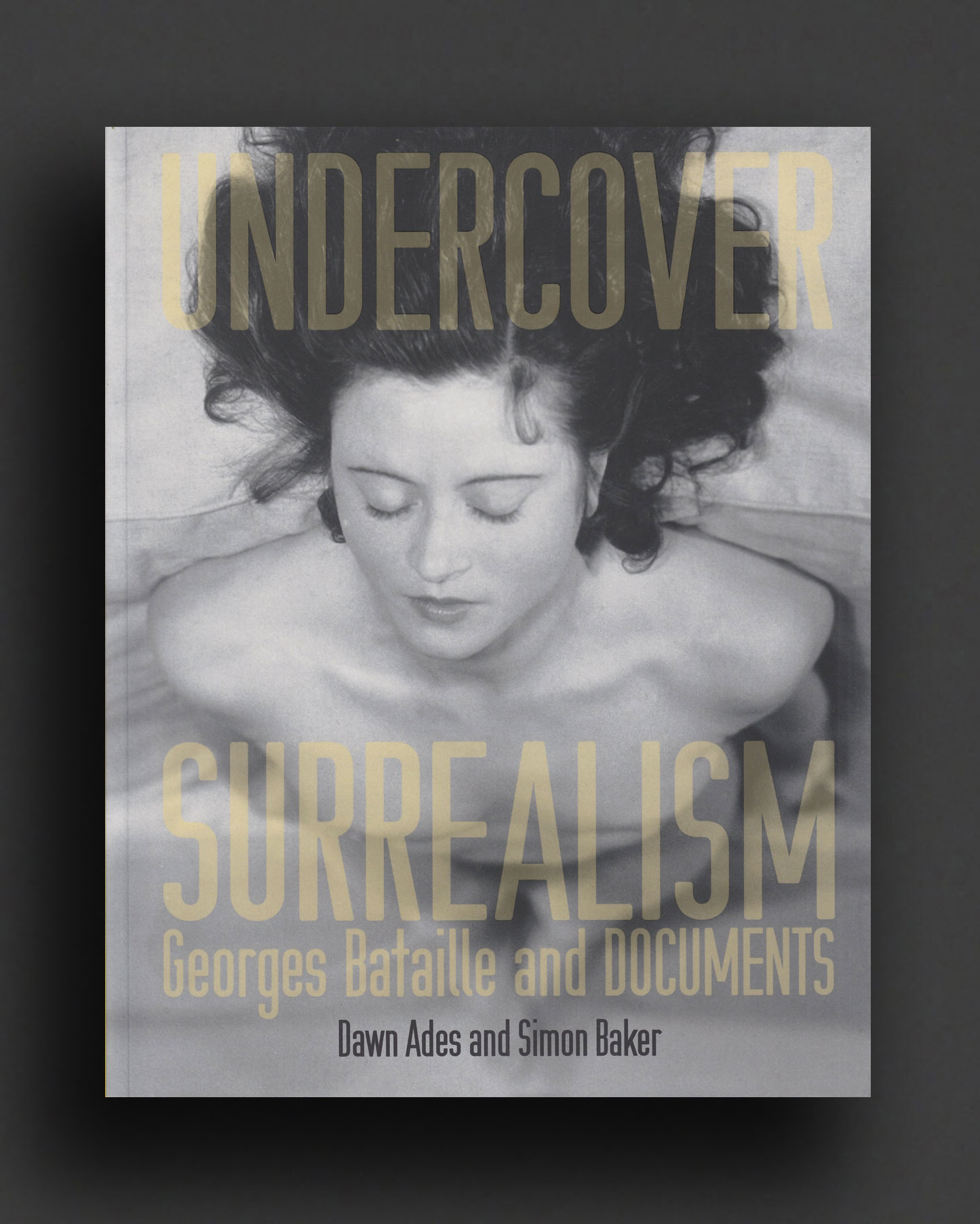
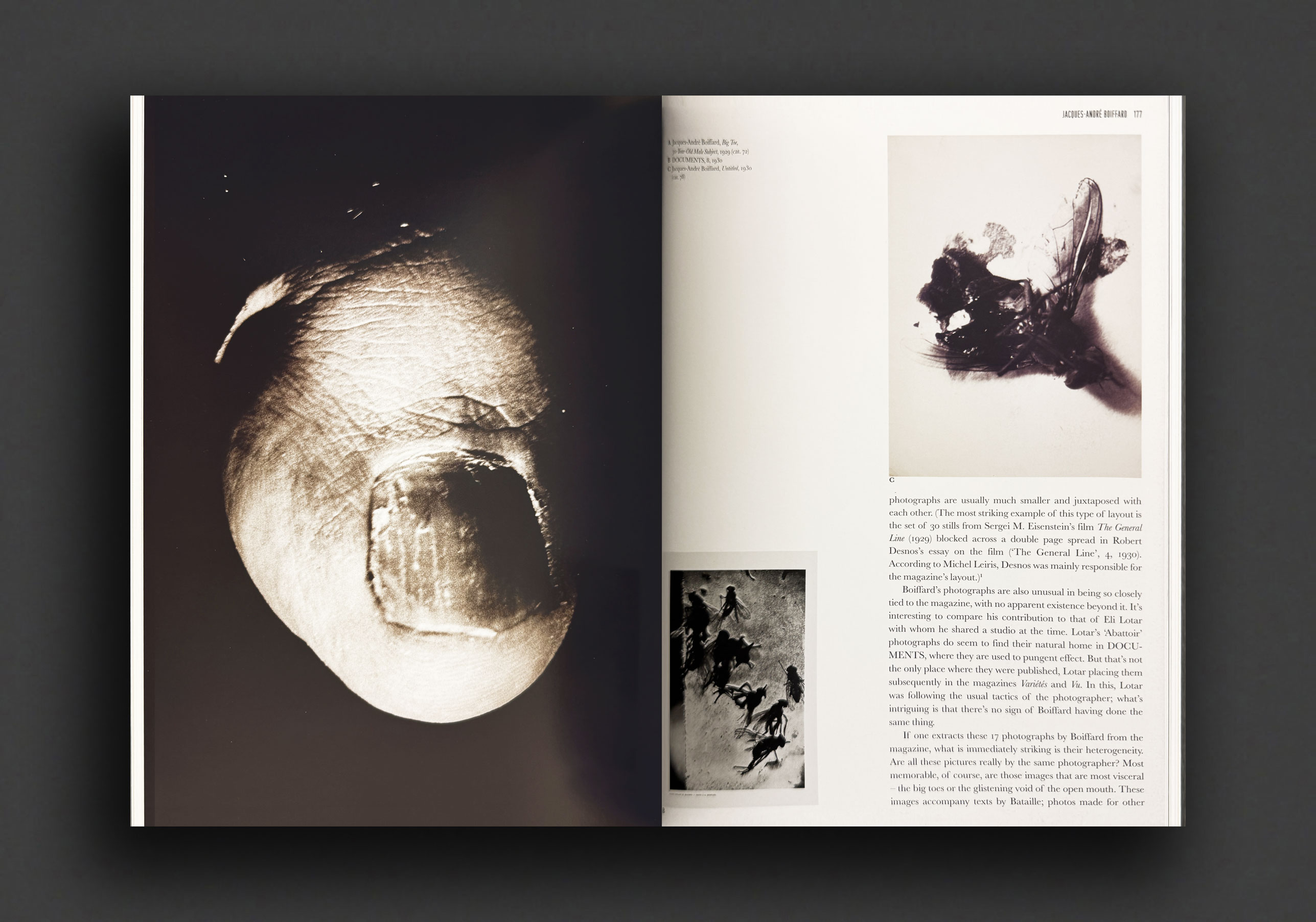
An exploration of the unsettling collisions of art and culture in Georges Bataille's revolutionary journal and a new consideration of twentieth-century masterpieces by Picasso, Miro, Dali, and others against the canvas of their renegade times.
In the Paris art world of the 1920s, Georges Bataille and his journal DOCUMENTS represented a dissident branch of surrealism. Bataille—poet, philosopher, writer, and self-styled "enemy within" surrealism—used DOCUMENTS to put art into violent confrontation with popular culture, ethnography, film, and archaeology. Undercover Surrealism, taking the visual richness of DOCUMENTS as its starting point, recovers the explosive and vital intellectual context of works by Picasso, Miro, Dali, Giacometti, and others in 1920s Paris.
Profusely illustrated (featuring 180 colour images) and filled with valuable English translations of original French texts from DOCUMENTS accompanied by essays and shorter descriptive texts, Undercover Surrealism recreates and recontextualizes Bataille's still unsettling approach to culture. Putting Picasso's Three Dancers back into its original context of sex, sacrifice, and violence, for example, then juxtaposing it with images of gang wars, tribal masks, voodoo ritual, Hollywood musicals, and jazz, makes the urgency and excitement of Bataille's radical ideas startlingly vivid to a twenty-first-century reader.
2024, English
Hardcover (w. dust jacket), 334 pages, 32 x 22 cm
Published by
Centre Pompidou / Paris
$110.00 - In stock -
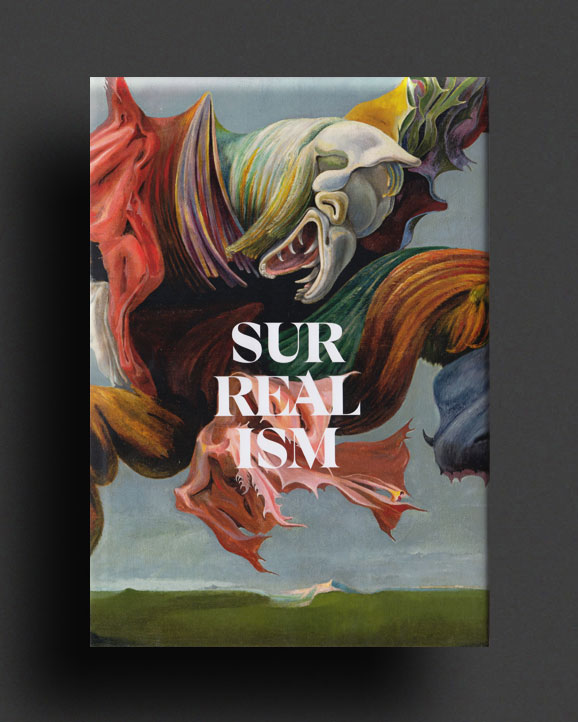
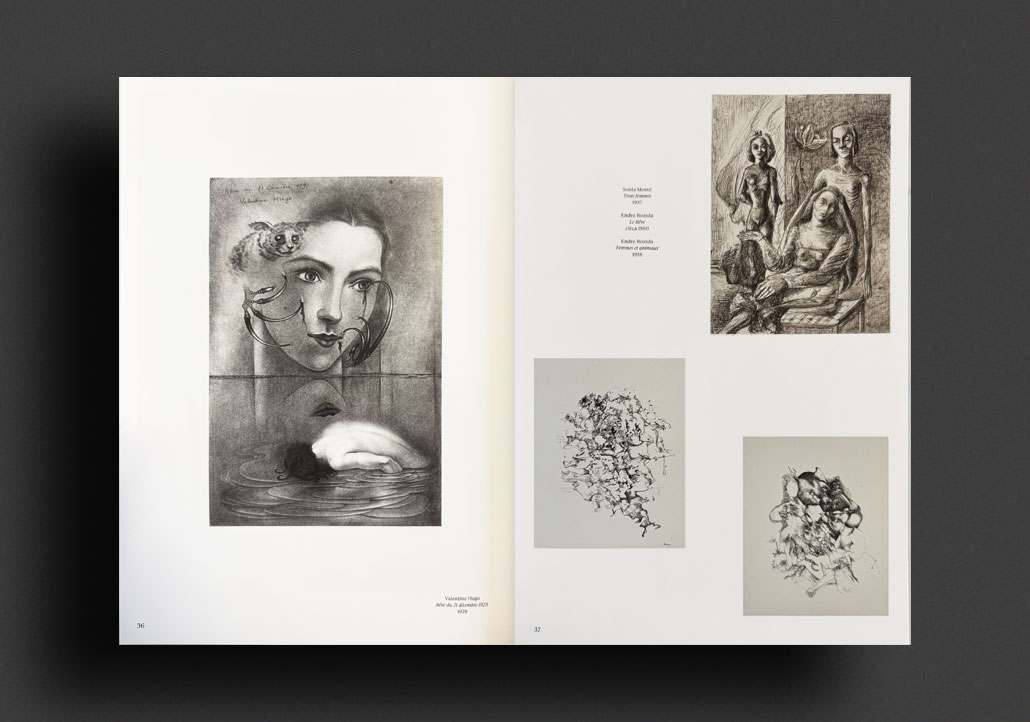
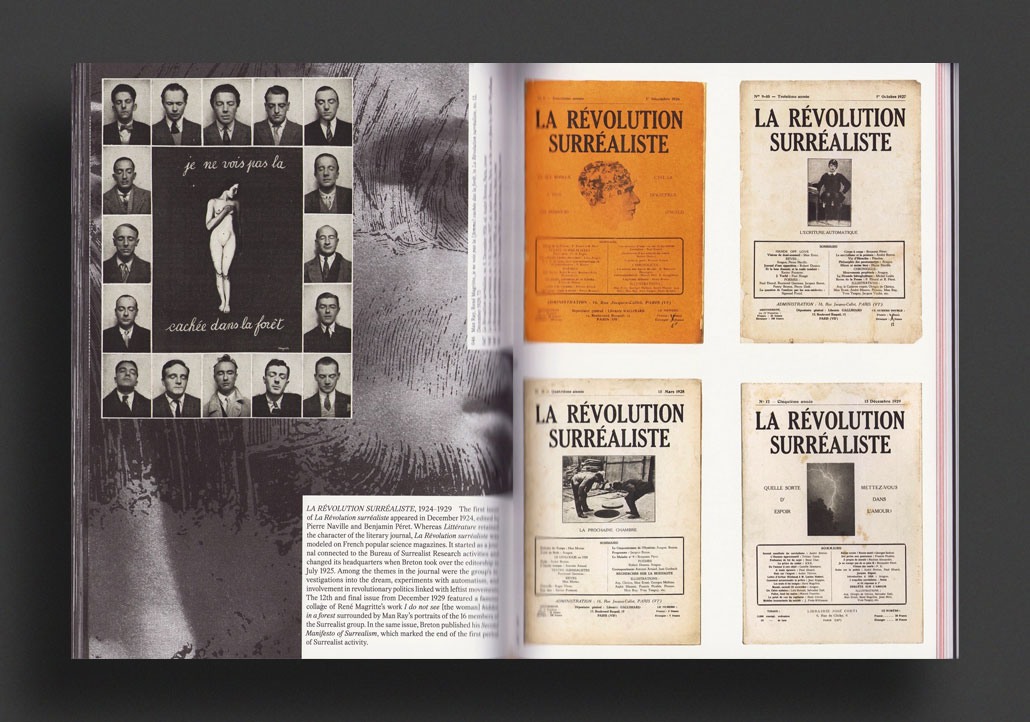
The defining book for the centenary of Surrealism. From September 2024 to January 2025, the Centre Pompidou will celebrate the 100th anniversary of André Breton's Surrealist Manifesto. For the next two years, their unprecedented Surrealist exhibition will tour the art galleries of the world, accompanied by this special catalogue.
Perhaps more than any other artistic movement, Surrealism had a cataclysmic effect on the modern mind, changing forever the way we think about experiencing the world. By rejecting the gross linearity that typified several centuries of preceding artworks, the legendary Surrealists Magritte, Ernst, Carrington, Dali, Tanning and so many others reached beyond the facade of that which is patently visible and found something more. Featuring original essays from leading academics and excerpts from the Surrealist Manifesto itself, this stands among the most essential Surrealist catalogues ever published.
1991, Japanese
Softcover (w. dust jacket, 128 pages, 26 x 18.5 cm
1st Edition, Out of print title / used / very good
Published by
Heibonsha / Tokyo
$60.00 - Out of stock
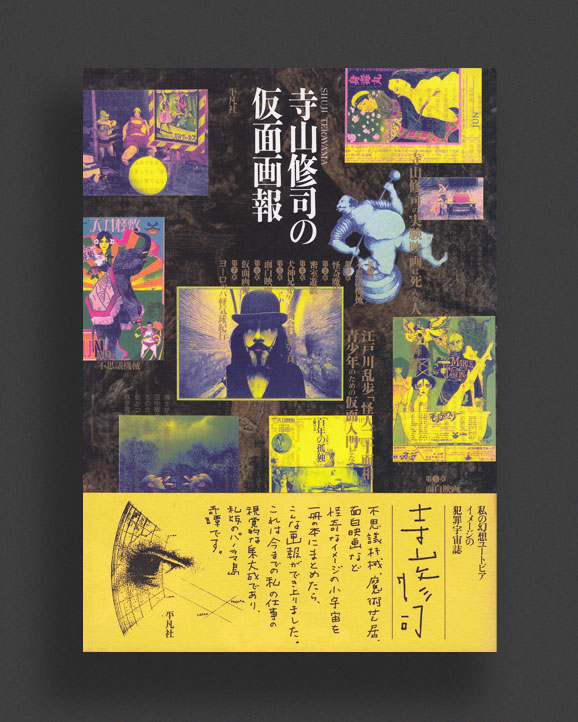
Wonderful photo-book chronology of the world of Shūji Terayama (1935—1983) and his experimental theatre troupe Tenjō Sajiki (with Kujō Kyōko, Yutaka Higashi, Tadanori Yokoo, Fumiko Takagi, ...), a major phenomenon on the Japanese Angura ("underground") theater scene of the 1960s and 70s. Terayama's activities encompass a who's-who of the Japanese avant-garde arts and literature of the time. This book visually documents it all; the filmography, performances, installations, happenings, exhibitions, posters, publications, and all else that resonated from Japan’s most revered and provocative avant-garde film-maker and his collaborators. Profusely illustrated with hundreds of illustrations in colour, duo and b/w with Japanese commentary, biographies and chronology. A wonderful, visually mind-blowing reference for anyone interested in the work of Terayama, Tenjō Sajiki, Surrealist performance, or Japanese avant-garde underground (Angura) theatre.
Shūji Terayama (1935 — 1983) was a Japanese avant-garde poet, dramatist, writer, film director, and photographer. His works range from radio drama, experimental television, underground (Angura) theatre, countercultural essays, to Japanese New Wave and "expanded" cinema. In 1967 Terayama founded Tenjō Sajiki with Kujō Kyōko, Yutaka Higashi, Tadanori Yokoo, and Fumiko Takagi, a Japanese experimental theater troupe. A major phenomenon on the Japanese Angura ("underground") theater scene, the group produced a number of stage works marked by experimentalism, folklore influences, social provocation, grotesque eroticism and the flamboyant fantasy characteristic of Terayama's oeuvre. Terayama is considered one of the most productive and provocative creative artists to come out of Japan, with a wide-reaching influence on many artists from the 1970s onward.
Very Good—Near Fine (w/o obi — image just a sample)
2024, English
Softcover, 328 pages, 21 x 28 cm
Published by
Spector Books / Leipzig
$110.00 - In stock -
The book Archive of Dreams is published in conjunction with the exhibition of the same name that will open the Archiv der Avantgarden. Marking the hundredth anniversary of the first surrealist manifesto and the founding of the Bureau of Surrealist Research in Paris in 1924, the volume is dedicated to the surrealist movement as well as the networks it engendered and the artistic stimuli it provided in the twentieth century. The idea was for the Bureau to collect dream testimonies in whatever form, not only to preserve and analyse them but also to give active expression to them in artistic processes. The publication shows how the practices of the avantgardes blurred the boundaries between dream and reality, between the traditional, passive notion of the archive and the idea of active, innovative artistic experiment — and thus ultimately also between the past, the present, and possible futures.
Works and documents from the period before, during, and after the Second World War shed light on the working methods of international artists and the global network they were involved in. They are complemented by diverse reflections on global protest movements and the traumas of war, thus connecting, too, to everyday experiences in a Europe beset by warfare.
1985, English
Softcover, 304 pages, 23 x 15.2 cm
Published by
University of Minnesota Press / Minnesota
$68.00 - Out of stock
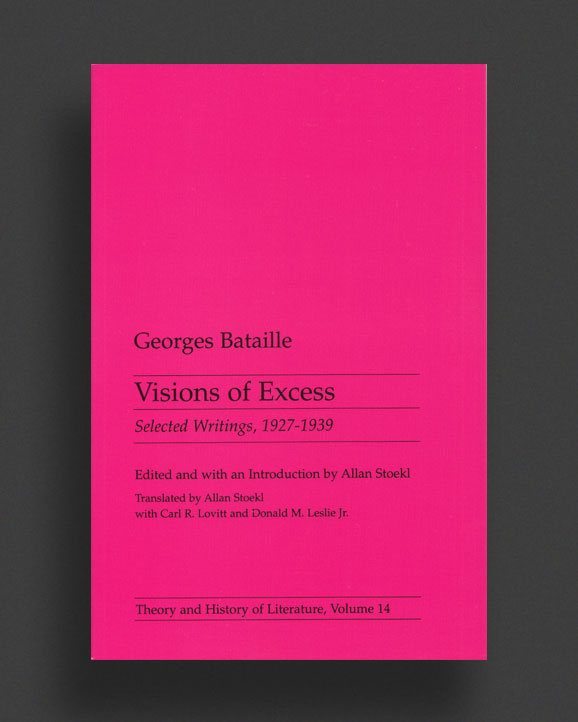
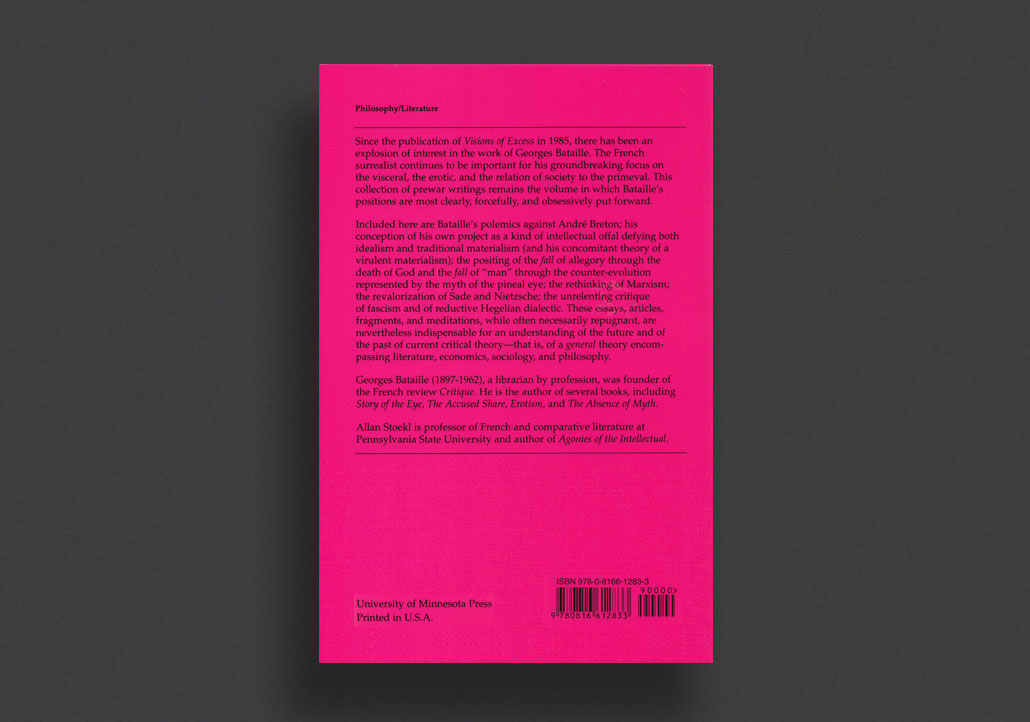
Since the publication of Visions of Excess in 1985, there has been an explosion of interest in the work of Georges Bataille. The French surrealist continues to be important for his groundbreaking focus on the visceral, the erotic, and the relation of society to the primeval. This collection of prewar writings remains the volume in which Bataille’s positions are most clearly, forcefully, and obsessively put forward.
This book challenges the notion of a “closed economy” predicated on utility, production, and rational consumption, and develops an alternative theory that takes into account the human tendency to lose, destroy, and waste. This collection is indispensable for an understanding of the future as well as the past of current critical theory.
Edited by Allan Stoekl
Translated by Allan Stoekl, Carl R. Lovitt, and Donald M. Leslie Jr.
Introduction by Allan Stoekl
Georges Bataille (1897-1962), a librarian by profession, was founder of the French review Critique. He is the author of several books, including Story of the Eye, The Accused Share, Erotism, and The Absence of Myth.
Allan Stoekl is professor of French and comparative literature at Pennsylvania State University and author of Agonies of the Intellectual.
1994, English
Softcover, 176 pages, 23 x 21.6 cm
1st Edition, Out of print title / used / very good
Published by
Atlas Press / London
$45.00 - Out of stock
First English printing from the legendary Atlas Press, London.
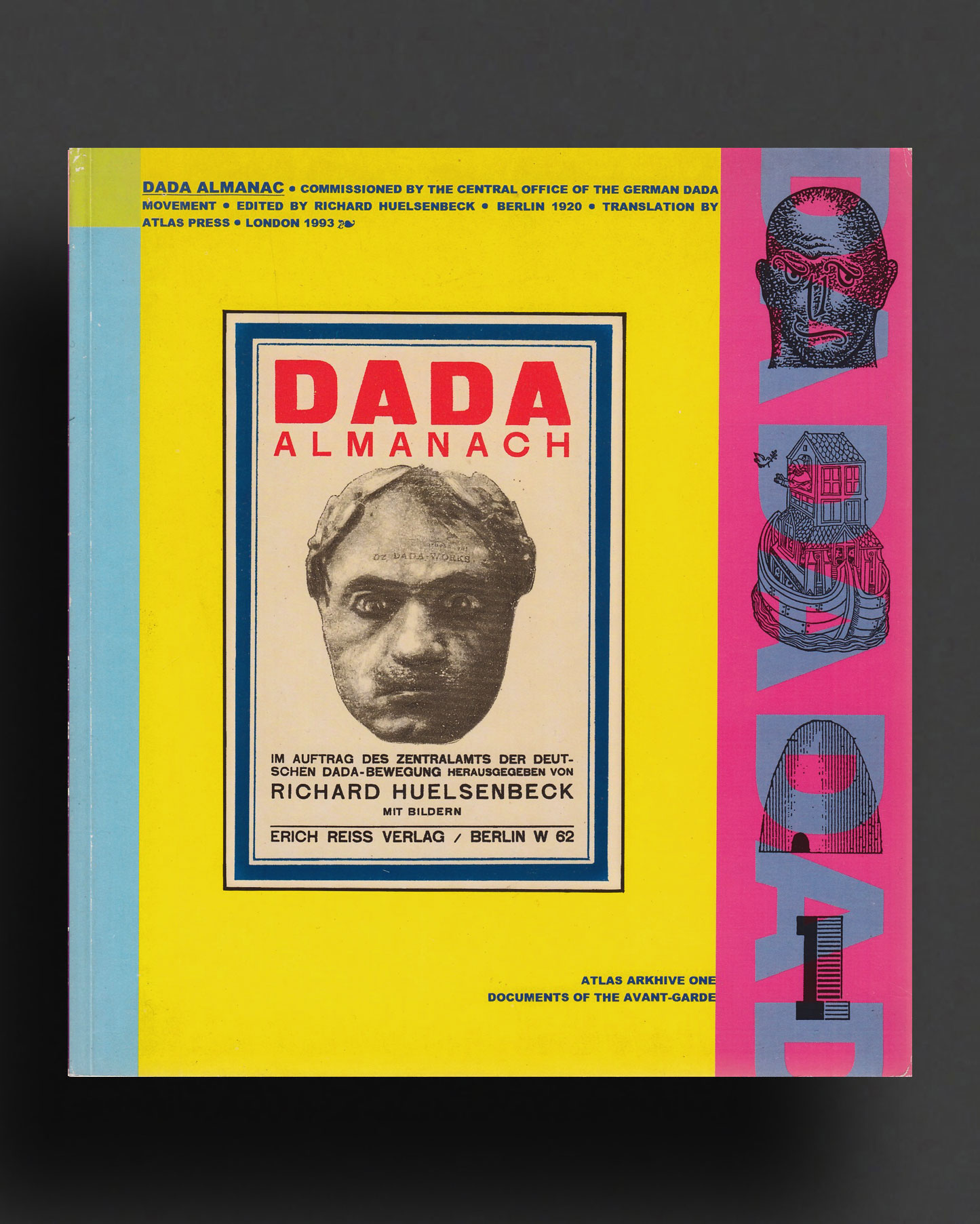
"DADA MEANS NOTHING!" So proclaimed Tristan Tzara, the movement's tireless publicist. Yet this did not prevent the most fanatical and talented artists and writers across Europe from rushing to join its ranks. Anti-war, anti-art, anti-dada, from its beginnings in Zurich during the first World War the dadas swept aside the cultural, philosophical and political norms of their time. Utter disgust with a society that had created the war (and then expected to survive the peace) spurred them to ever greater demonstrations of revulsion and derision. Yet it was not all nihilism: many factions worked within the Dada Movement and it was Huelsenbeck's intention to embody most of them in the Dada Almanac. The largest collection of Dadaist texts ever assembled by the movement, it was originally published in 1920 in a mixture of French and German.
The Dada Almanac was truly international in scope, with substantial sections from the Swiss and French sections of the movement, it embodies Dada's failings as well as its successes, its excesses, its seriousness, its idiocy, but above all the anarchic vitality which made it such a vital precondition for so much that followed in the fields of art, literature and general cultural terrorism.
The editors of this first English translation have added dozens of other relevant texts, documents, portraits etc, as well as explaining contemporary references and events and providing biographies of the numerous personalities involved.
Very Good copy, light wear.
1986, English
Softcover, 100 pages, 21.5 x 15 cm
1st Edition, Out of print title / used / very good
Published by
Atlas Press / London
$45.00 - In stock -
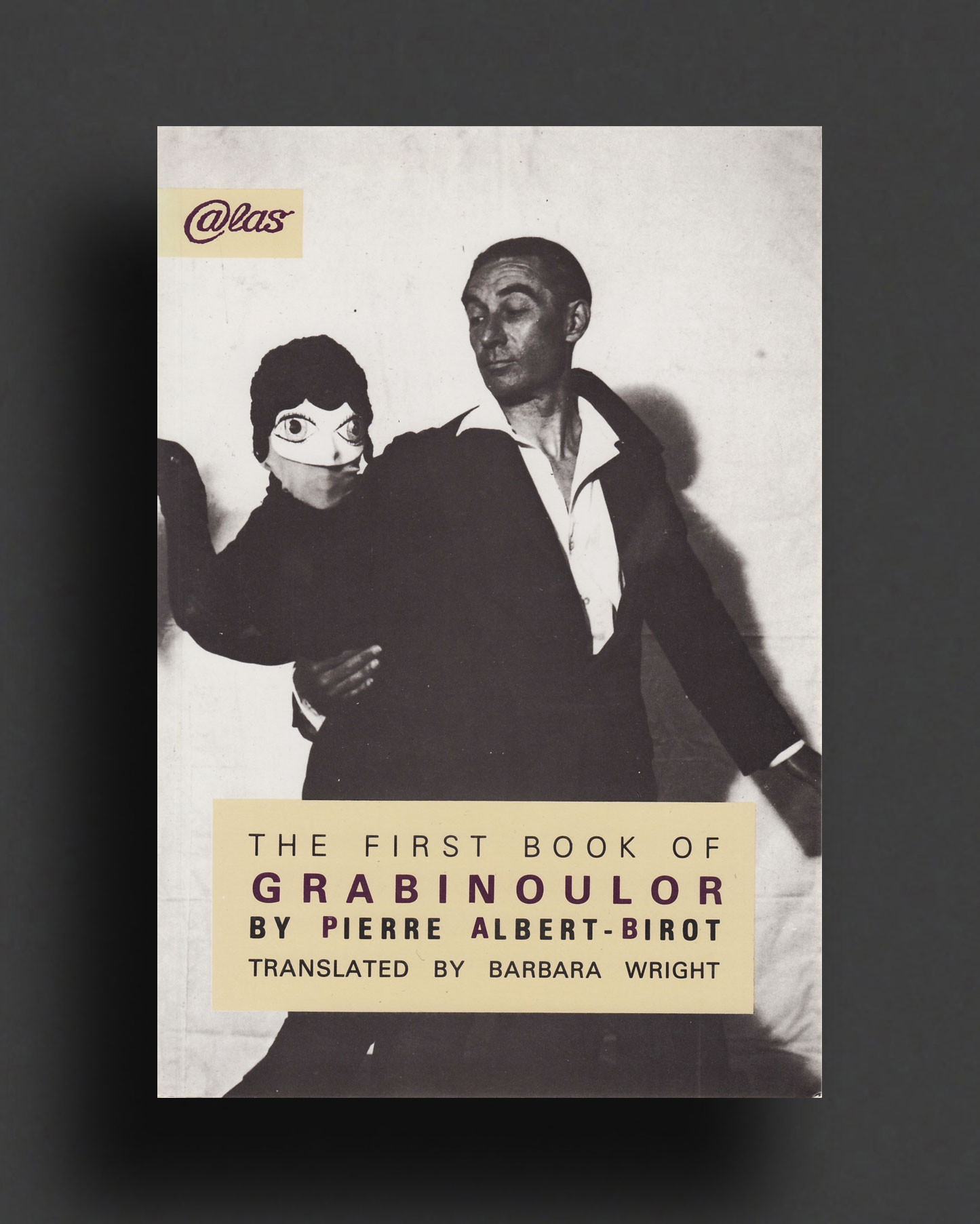
Scarce first 1986 paperback edition of Pierre Albert-Birot's The First Book of Grabinoulor (1919), published by the legendary Atlas Press, translated with a preface by Barbara Wright. Postface by Arlette Albert-Birot.
Pierre Albert-Birot was one of the seminal figures of the modern movement in France. As editor of (one of) the earliest avant-garde reviews SIC, he published most of the futurists, the (future) Dadaists and Surrealists, and many others—and Grabinoulor made his first appearance in its pages.
Like his creator, Grabinoulor was only rediscovered in the last few decades. The book was perhaps neglected because its astonishing formal inventiveness is overwhelmed by an entirely joyous and undespairing outlook which was at total variance with the other literature of the time (1919).
"Grabinoulor is the happiest man in the world;" he is also very Parisian, all-powerful, childlike, satiric, eternally optimistic; his picaresque adventures happen to him in all times and in all places, he is rather forgetful...
Barbara Wright has triumphantly overcome the problems of translating a remarkable work that has been praised by authors as different as Apollinaire, Celine, Jacob, Queneau, and Sollers.
"To the reader willing to admit the existence of joy, Grabinoulor and his life and opinions are pure delight."—Times Literary Supplement
"Grabinoulor has no personal characteristics except an imperturbable appetite for all kinds of pleasure, and a mind rarely paralleled for energy and inventiveness. He is everyone and no one... Anyone who loves Tristram Shandy will love Grabi."—Sunday Times
"It has been called a masterpiece, as if a work could qualify as such when it's only just been born. A work isn't born a masterpiece, it becomes one. And yet it's saying a lot of a book to call it at the same time: Gay, living, contemporary (I don't like the word modern), intelligent, fantastic, poetic, realistic, daring, more than daring, psychological, synthetic, symbolic, simple, classic, universal, surprising, bizarre, banal, larger than life, true to life and even true to experience, attractive, odious, pessimistic, optimistic, serious, humorous and even more than humorous."—Max Jacob in Les Nouvelles litteraires
"Joyously erotic... The irrepressible Grabinoulor performs his fantastic epic feats in an onrush of perpetual motion, which this slim book presents in rivers of unpunctuated prose... Albert-Birot celebrated the erotic as a means of freeing the artistic imagination from bourgeois constraints. For him, sexuality represented poetic creation. His tricks of language, his leaps through time and space are in the tradition of Rabelais and Shandy. The ribaldry does not shock not as it once perhaps did, but Grabinoulor is still fun to read. The book is a valuable document in the development of Dada and surrealism."—Publishers Weekly 1/23/87
"Ingenious imagination.... This fine translation of the Grabinoulor saga deserves reading as a genuine sample of the modernism that its author nurtured in SIC, and that cleared the path for the likes of Cocteau, Breton, and Ionesco."—Choice Jul-Aug '87
Very Good copy.
1995, English
Softcover, 304 pages, 23 x 21 cm
1st Edition, Out of print title / used / very good
Published by
Atlas Press / London
$65.00 - Out of stock
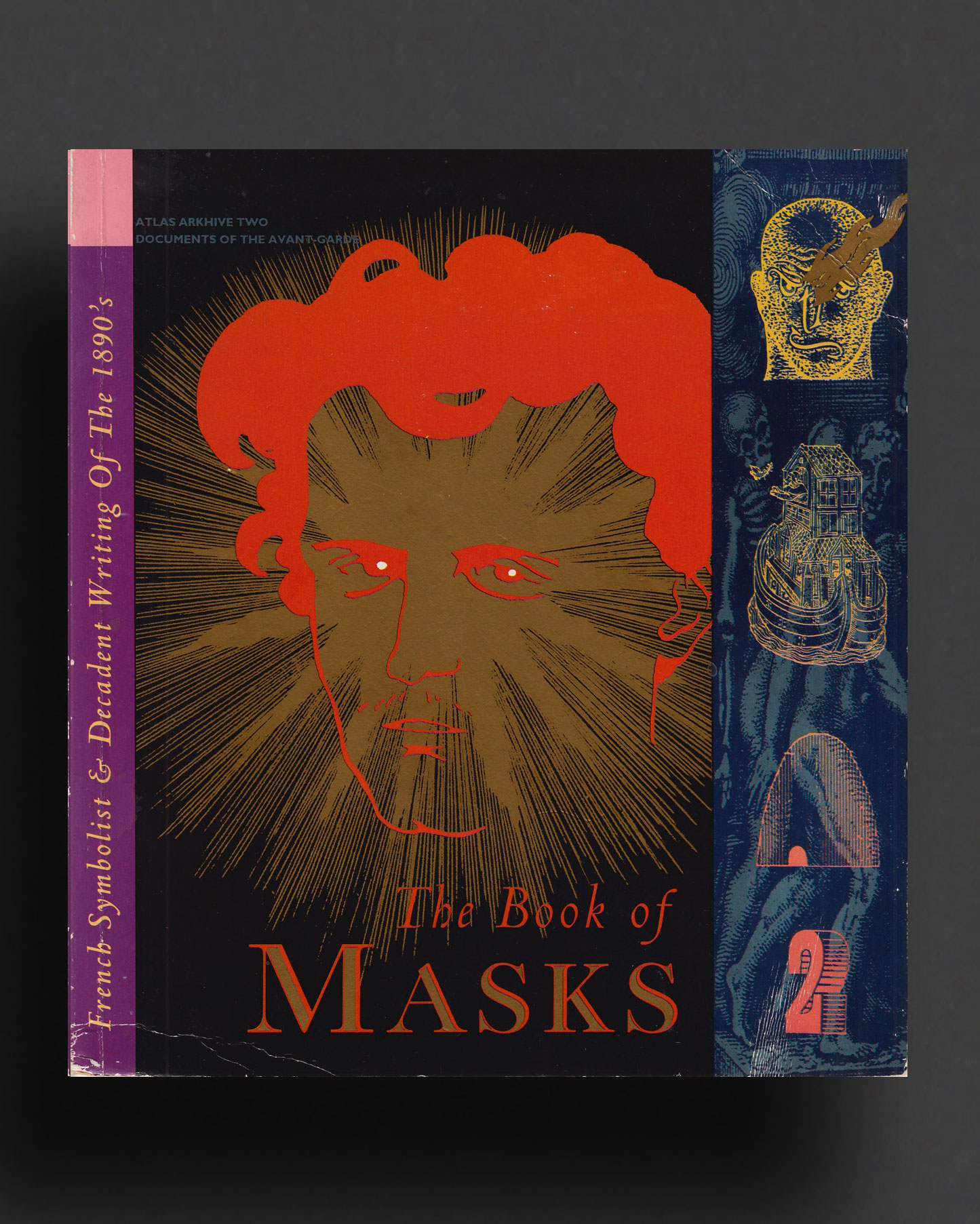
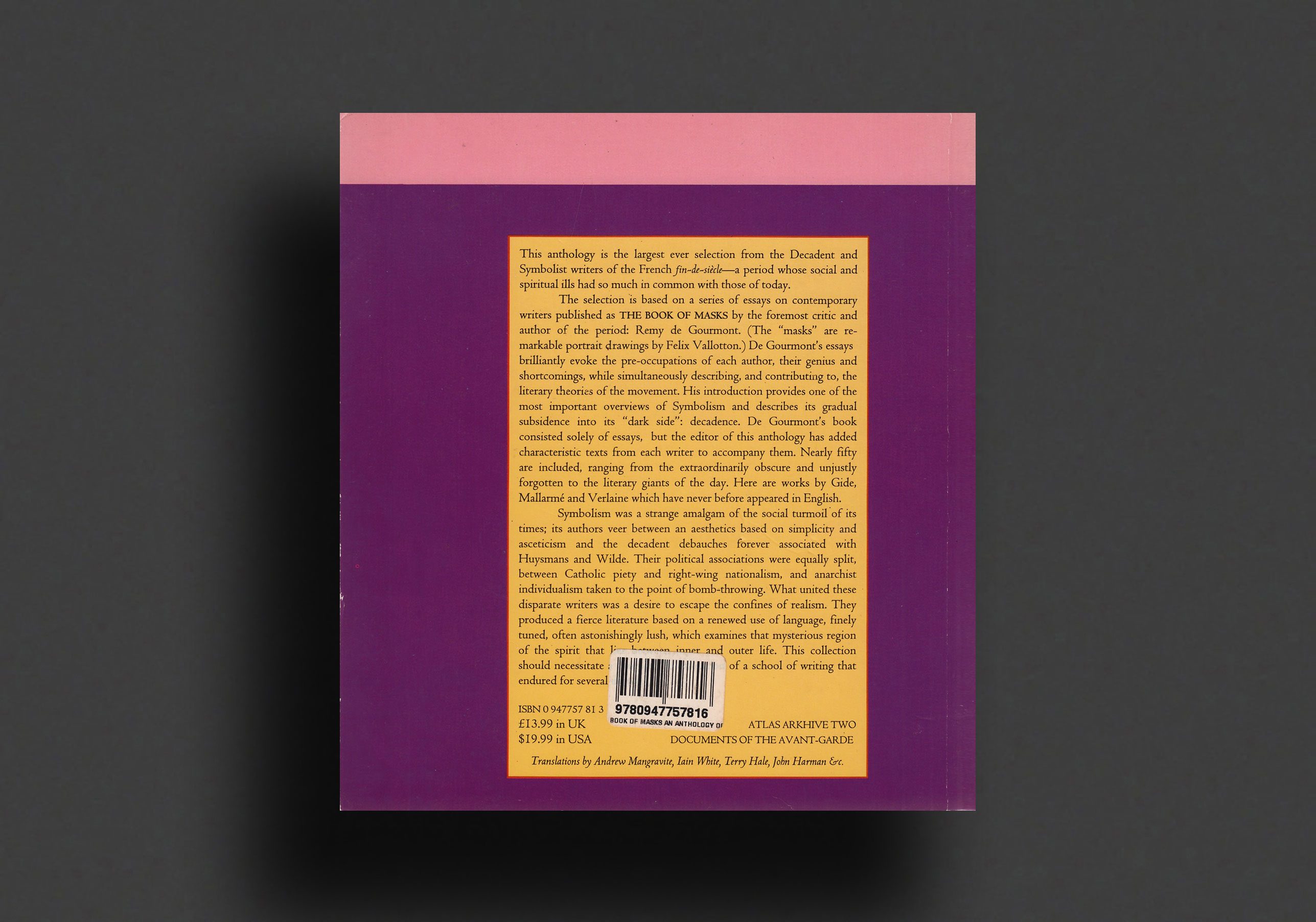
Long out-of-print Atlas Arkhive 2 published by the legendary Atlas Press in 1995. This anthology is the largest ever selection from the Decadent and Symbolist writers of the French fin-de-siècle — a period whose social and spiritual ills had so much in common with those of today.
The selection is based on a series of essays on contemporary writers published as The Book of Masks by the foremost critic and author of the period: Remy de Gourmont. (The "masks" are remarkable portrait drawings by Félix Vallotton.) De Gourmont's essays brilliantly evoke the pre-occupations of each author, their genius and shortcomings, while simultaneously describing, and contributing to, the literary theories of the movement. His introduction provides one of the most important overviews of Symbolism and describes its gradual subsidence into its "dark side": decadence. De Gourmont's book consisted solely of essays, but the editor of this anthology has added characteristic texts from each writer to accompany them. Nearly fifty are included, ranging from the extraordinary obscure and unjustly forgotten to the literary giants of the day. Here are works by Gide, Mallarme and Verlaine which have never before appeared in English.
Symbolism was a strange amalgam of the social turmoil of its times; its authors veer between an aesthetics based on simplicity and asceticism and the decadent debauches forever associated with Huysmans and Wilde. Their political associations were equally split, between Catholic piety and right-wing nationalism, and anarchist individualism taken to the point of bomb-throwing. What united these disparate writers was a desire to escape the confines of realism. They produced a fierce literature based on a renewed use of language, finely tuned, often astonishingly lush, which examines that mysterious region of the spirit that lies between inner and outer life. This collection should necessitate a complete re-evaluation of a school of writing that endured for several decades.
Good—Very Good copy with some wear to extremities small bump to bottom of spine, creasing to boards.
1984, English
Hardcover (w. dust jacket), 364 pages, 24 x 16 cm
1st Edition, Out of print title / used / very good
Published by
Leicester University Press / Leicester
$45.00 - Out of stock
First 1984 hardcover edition.
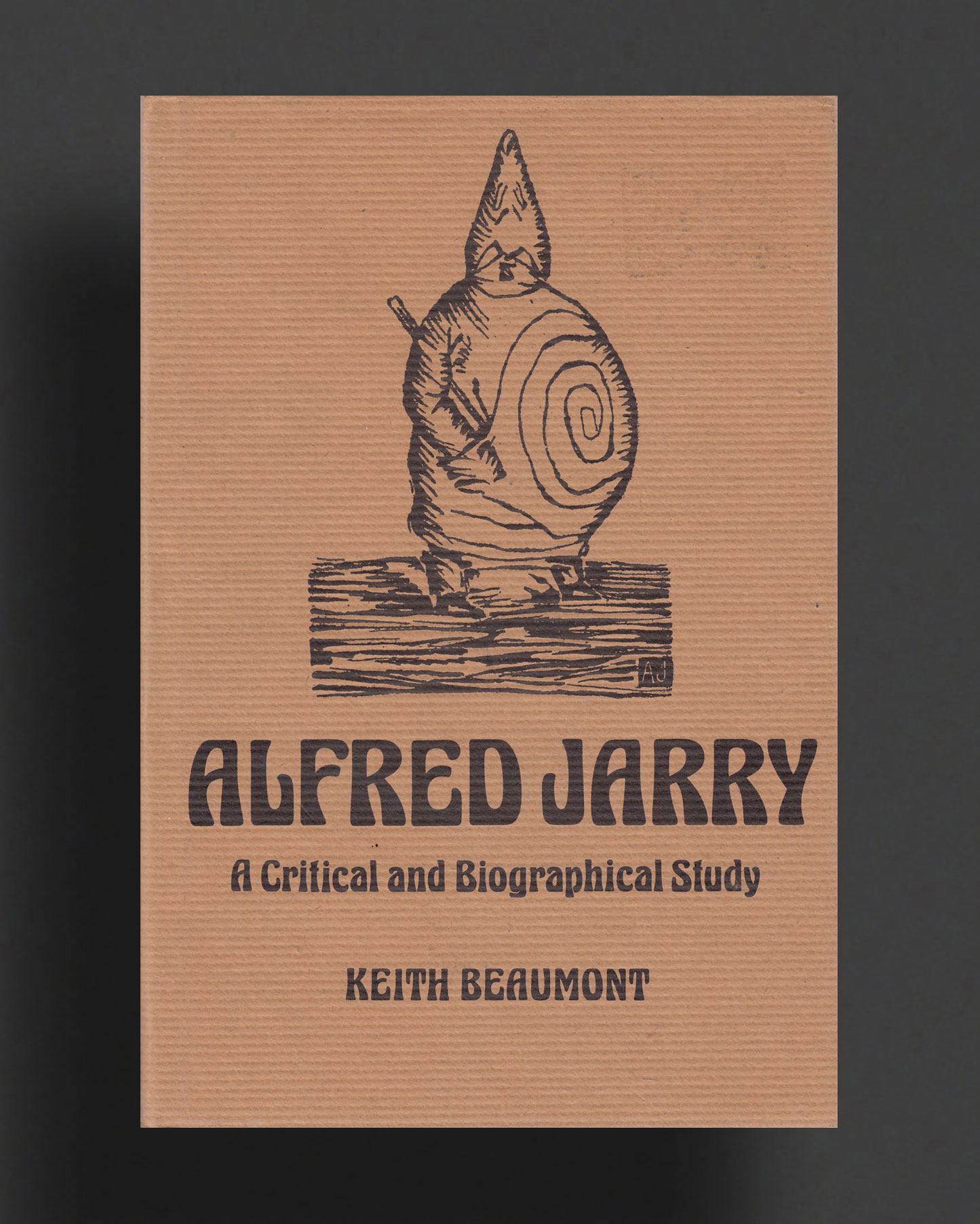
This comprehensive study of Jarry's work examines in detail all of his writings from the early schoolboy farces and the Ubu plays, through his poetry, novels, critical writings and journalism, to the musical comedies of his later years. Jarry emerges as a figure of considerable importance on the European cultural scene, not just as playwright and poet, but also as novelist, critic and pataphysician with insights into the nature of literature and language which make him a forerunner of much of the literature and critical theory of recent years. English translations of the extensive quotes from Jarry's writings are provided alongside the French text throughout.
Keith Beaumont was born in Melbourne, Australia, in 1944, and educated there, graduating from the University of Melbourne in 1966 in French with German. He was awarded the degree of Ph.D. by the University of Warwick in 1971 for a thesis on Nihilism in French Literature, 1880-1900. Since 1970 he has been Lecturer in French at the University of Leicester.
Dr. Beaumont's interest in Jarry dates from his undergraduate days. He has written a number of articles on Jarry and on pataphysics. He is a member of the Collège de Pataphysique and the Société des Amis d'Alfred Jarry.
VG in VG dust jacket.
2024, English
Softcover, 88 pages, 17.8 x 11.4 cm
Published by
Wakefield Press / Cambridge
$32.00 - In stock -
Foreword by René Daumal
Translated by Terry Bradford
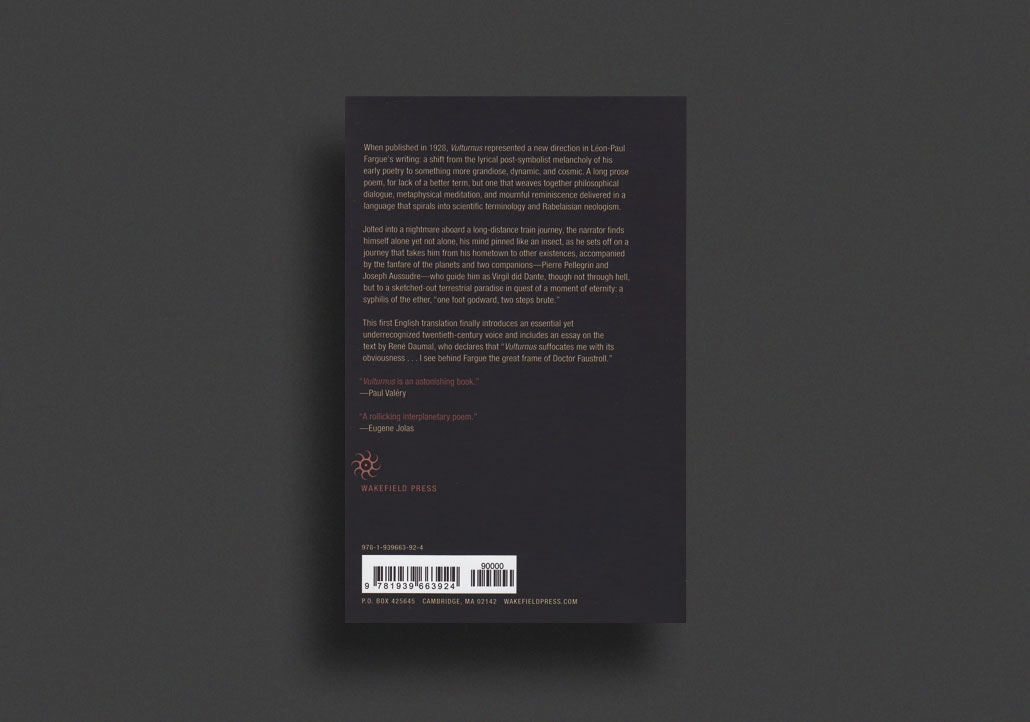
When published in 1928, Vulturnus represented a new direction in Léon-Paul Fargue’s writing: a shift from the lyrical post-Symbolist melancholy of his early poetry to something more grandiose, dynamic, and cosmic. A long prose poem, for lack of a better term, but one that weaves together philosophical dialogue, metaphysical meditation, and mournful reminiscence delivered in a language that spirals into scientific terminology and Rabelaisian neologism.
Jolted into a nightmare aboard a long-distance train journey, the author finds himself alone yet not alone, his mind pinned like an insect, as he sets off on a journey that takes him from his hometown to other existences, accompanied by the fanfare of the planets and two companions—Pierre Pellegrin and Joseph Aussudre—who guide him as Virgil did Dante, though not through hell, but to a sketched-out terrestrial paradise in quest of a moment of eternity: a syphilis of the ether, “one foot godward, two steps brute.”
This first English translation finally introduces an essential yet underrecognized twentieth-century voice and includes an essay on the text by René Daumal, who declares that “Vulturnus suffocates me with its obviousness … I see behind Fargue the great frame of Doctor Faustroll.”
“Vulturnus is an astonishing book.”—Paul Valéry
“A rollicking interplanetary poem.”—Eugene Jolas
Léon-Paul Fargue (1876–1947) was the archetypal poet of Paris, with ties to everyone from Alfred Jarry and Erik Satie to Colette and Maurice Ravel. His work was admired by Rilke, Joyce, and Walter Benjamin. Though his work spanned and was sometimes associated with various literary movements, a bridge of sorts from symbolism to surrealism (though he was opposed to the latter), he kept to his own path throughout his life: a night wanderer who turned his perambulations through Paris into a unique poetry and prose.
“The greatest living poet in France.”—Walter Benjamin
“One of our greatest poets.”—Rainer Maria Rilke
“Fargue taught us to sublimate the life of everyday and make the highest poetry out of it.”—Max Jacob
2024, English
Softcover, 220 pages, 20.32 x 12.7 cm
Published by
Contra Mundum Press / New York
$45.00 - Out of stock
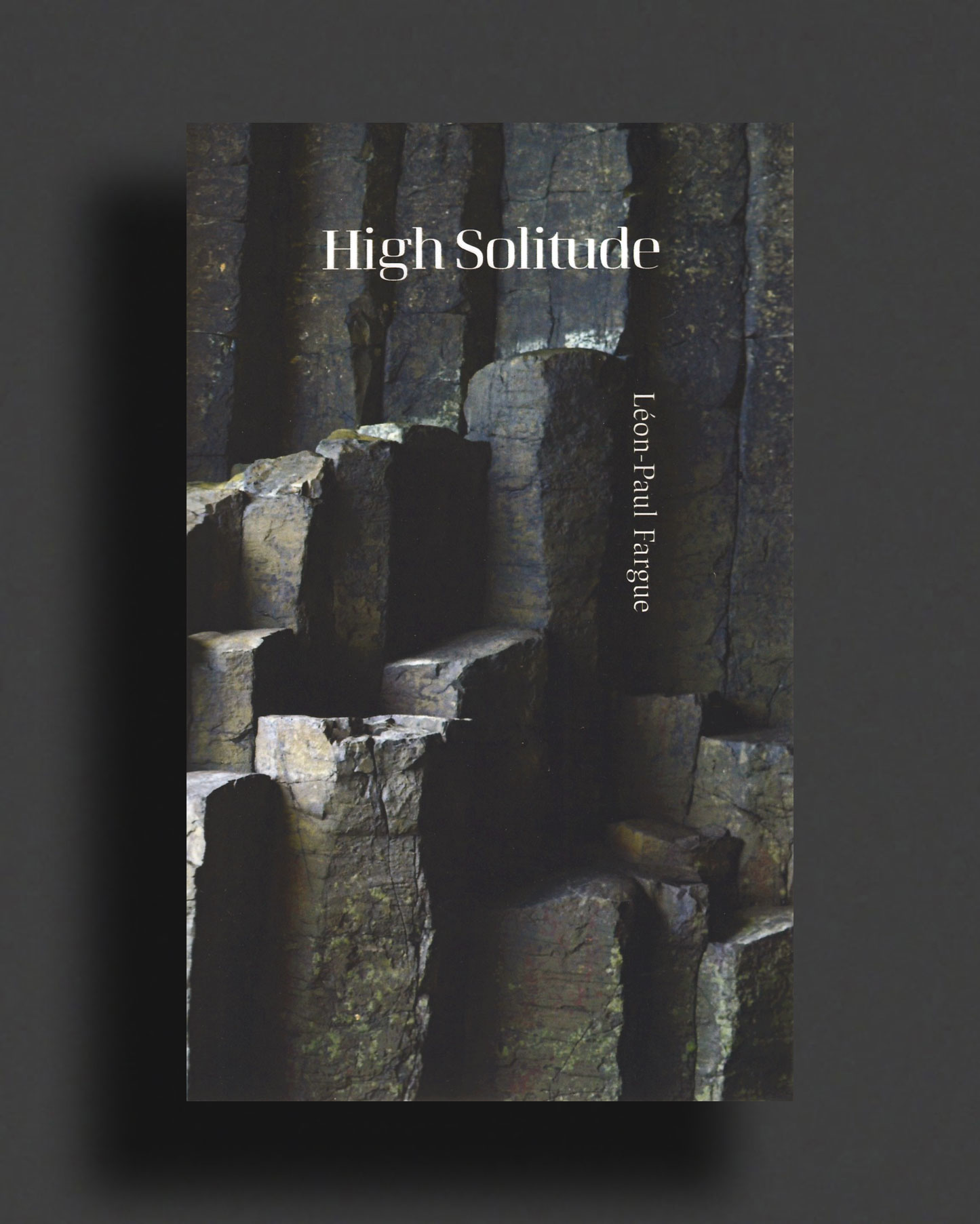
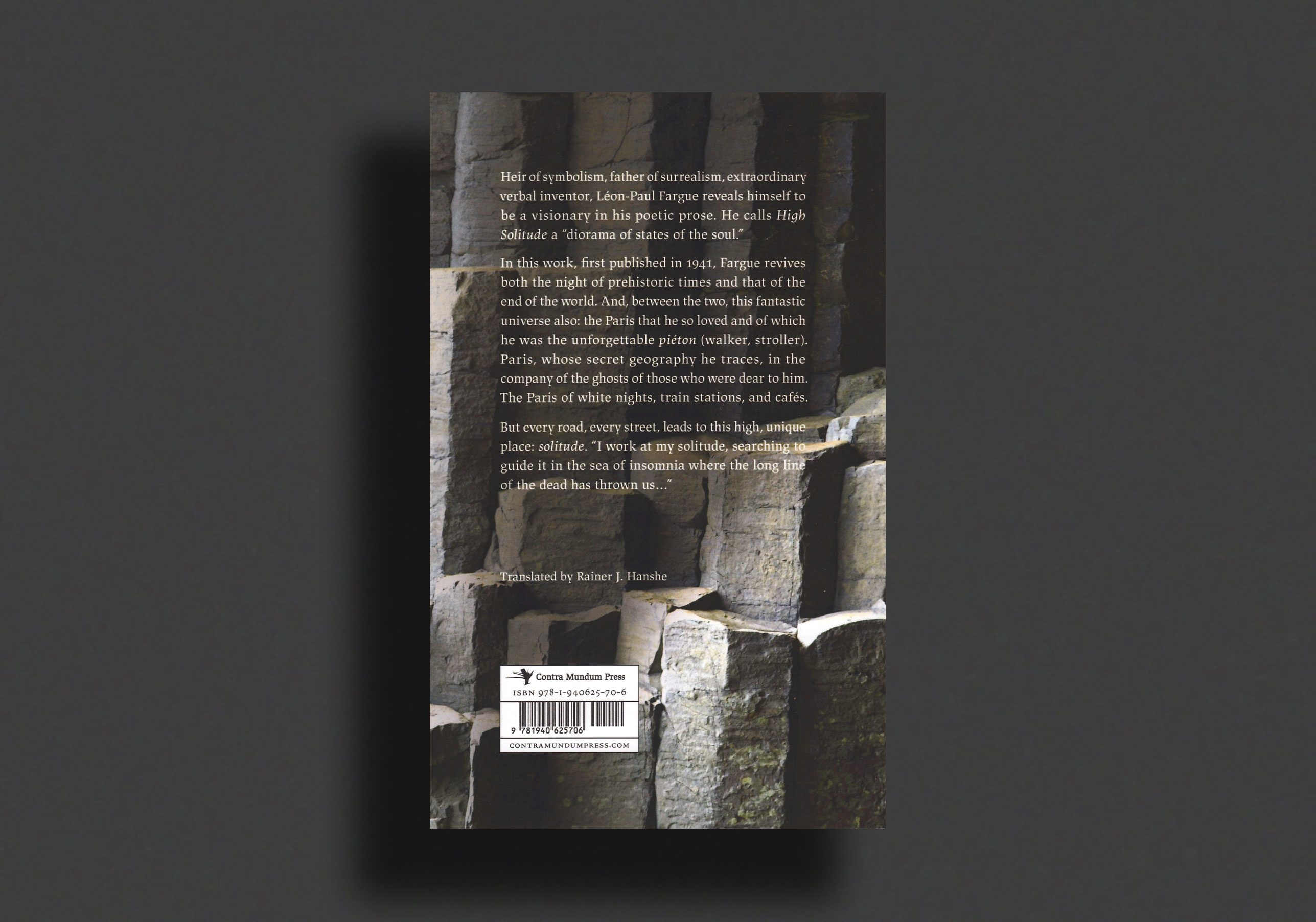
Heir of symbolism, father of surrealism, extraordinary verbal inventor, L on-Paul Fargue reveals himself to be a visionary in his prose poems. He calls High Solitude a "diorama of states of the soul."
In this work, originally published in 1941, Léon-Paul Fargue revives both the night of prehistoric times and that of the end of the world. And, between the two, this fantastic universe also: the Paris that he so loved and of which he was the unforgettable Pi ton. Paris, whose secret geography he traces, in the company of the ghosts of those who were dear to him. The Paris of white nights, stations, and cafes.
But every road, every street, leads to this high, unique place: solitude. "I work at my solitude, searching to guide it in the sea of insomnia where the long line of the dead has thrown us..."
"Fargue taught us to sublimate everyday life and make the highest poetry out of it."—Max Jacob
"Fargue transforms reality and incites it to undergo perilous metamorphoses, and eventually drives it some way toward the abyss. That is the danger of an art devoted to metaphor: it calls everything into question; but that is also its merit, and in the lament for the life of another era which Fargue readily, too readily, intones, it is right that we should hear the wrong note, the unheard of note, which intrudes into it like the cracked echo of an enigma."—Maurice Blanchot
"There is an unknown demon within Fargue that seems to drive him to the most audacious comparisons, in which he makes use of animals, cathedrals, or monsters to castigate the moral squalor of his day. It is a matter of pure poetry, an agility of spirit that leads him ceaselessly to find resemblances or associations for everything his eyes fall on."—André Beucler
LÉON-PAUL FARGUE (1876-1947) was a writer of poems, novels, and essays. He was a member of Les Apaches, an artist's group formed by Ravel and others, and a close friend of Alfred Jarry. Walter Benjamin considered Fargue the greatest poet in twentieth-century France and the two met in the 30s, with Fargue touring the philosopher around the arcades and other parts of Paris. Fargue was considered the great walker of the city of lights and recounted his perambulations in D'après Paris (1931) and Le Piéton de Paris (1939). Other books of his include Haute solitude (1941) and Déjeuners de soleil (1942).
Rainer J. Hanshe was born in Tehran, Iran, raised in New York, and has resided in Europe and elsewhere. He is the author of the novels The Acolytes and The Abdication, as well as of the hybrid entity Shattering the Muses (2016), a collaboration with visual artist Federico Gori, Closing Melodies (2023), a phantomatic encounter between Nietzsche & Van Gogh, and Dionysos Speed (2024). His translations include Baudelaire's My Heart Laid Bare (2017; 2020), Belgium Stripped Bare (2019), and Paris Spleen (2021), Évelyne Grossman's The Creativity of the Crisis, Antonin Artaud's Journey to Mexico: Revolutionary Messages, and Léon-Paul Fargue's High Solitude. as well as longer and shorter works by other authors.His newest work, Humanimality, is forthcoming in 2025. Beyond Sense, a vatic exploration of the aphasiac disintegration of Hölderlin, Baudelaire, Nietzsche, and Artaud, is due out in 2026. He is at work on a new book entitled Burn Poet Burn.
2011, English
Softcover, 228 pages, 20.5 x 15 cm
Published by
Exact Change / Boston
$34.00 - Out of stock
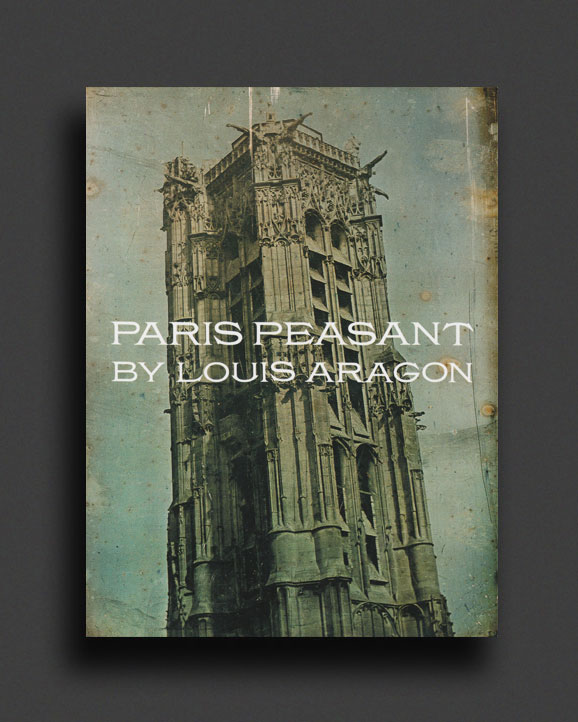
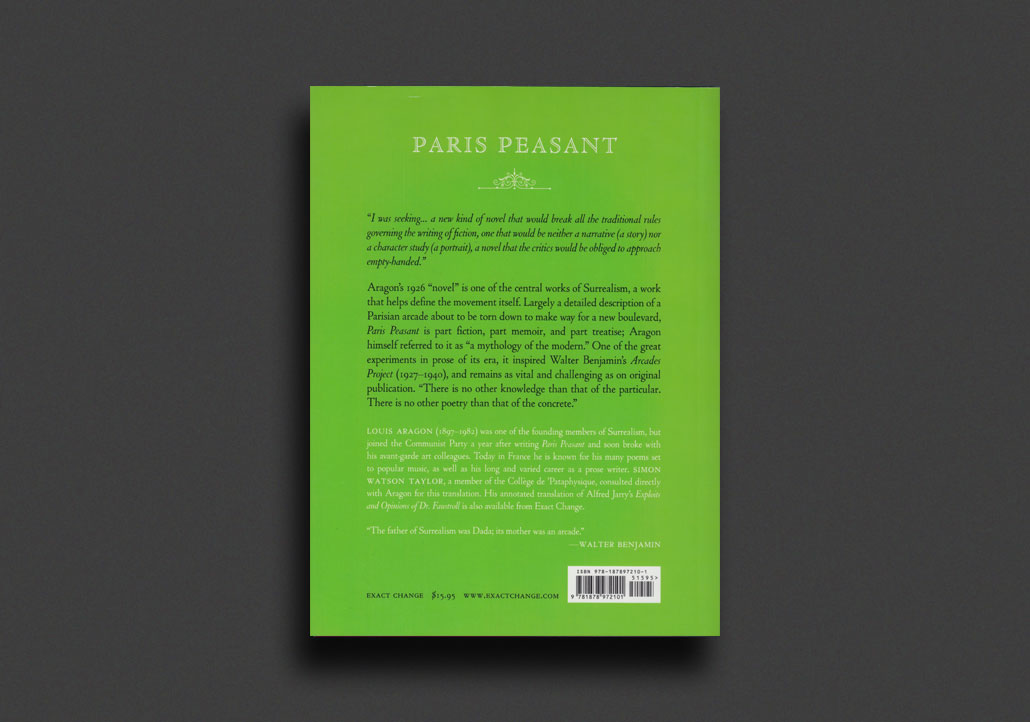
Translated and with an introduction by Simon Watson Taylor.
Paris Peasant (1926) is one of the central works of Surrealism, yet Exact Change's edition is the first U.S. publication of Simon Watson Taylor's authoritative translation, completed after consultations with the author.
Unconventional in form--Aragon consciously avoided recognizable narration or character development--Paris Peasant is, in the author's words, “a mythology of the modern.” The book uses the city of Paris as a stage or framework, and Aragon interweaves his text with images of related ephemera: café menus, maps, inscriptions on monuments and newspaper clippings. A detailed description of a Parisian arcade (nineteenth-century precursor to the mini-mall) and another of the Buttes-Chaumont park, are among the great set pieces within Aragon's swirling prose of philosophy, dream and satire.
André Breton wrote of this work: “no one could have been a more astute detector of the unwonted in all its forms; no one else could have been carried away by such intoxicating reveries about a sort of secret life of the city. . . .”
2001, English
Softcover, 103 pages, 14 x 20.4 cm
Published by
City Lights Books / San Francisco
$28.00 - Out of stock
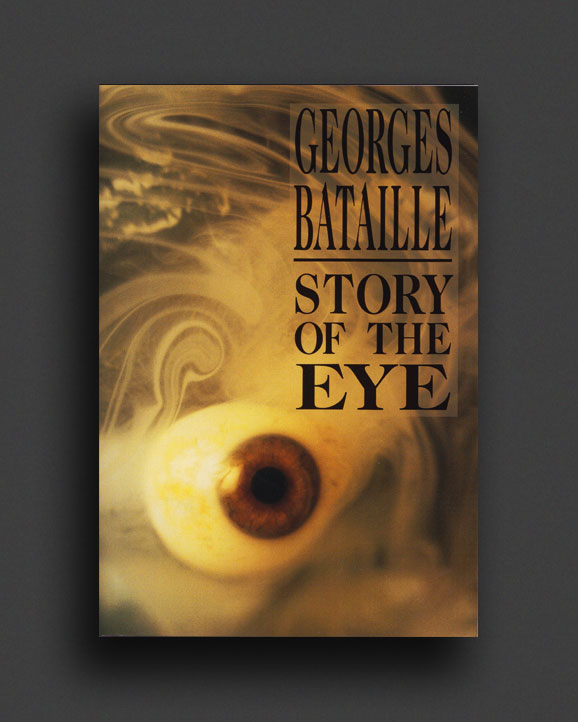
"The caress of the eye over the skin is so utterly, so extraordinarily gentle, and the sensation is so bizarre that it has something of a rooster's horrible crowing." - G.B.
A masterpiece of transgressive, surrealist erotica, Bataille's first novel, published under the pseudonym 'Lord Auch', is still his most notorious work. Called a "metaphysician of evil, Bataille wrote the 1928 novella "Story of the Eye (French: L'histoire de l'œil) as a psychoanalytical task. In this explicit erotic fantasy, the young male narrator and his lovers Simone and Marcelle embark on a sexual quest involving sadism, torture, orgies, madness and defilement, culminating in a final act of transgression. Shocking and sacrilegious, Story of the Eye is the fullest expression of Bataille's obsession with the closeness of sex, violence and death. Yet it is also hallucinogenic in its power, and is one of the erotic classics of the twentieth century.
Georges Bataille (1897-1962), French essayist and novelist, was born in Billom, France. He converted to Catholicism, then later to Marxism, and was interested in psychoanalysis and mysticism, forming a secret society dedicated to glorifying human sacrifice. Leading a simple life as the curator of a municipal library, Bataille was involved on the fringes of Surrealism, founding the Surrealist magazine Documents in 1929, and editing the literary review Critique from 1946 until his death.
1982, English
Hardcover (w. dust jacket), 154 pages, 23.5 x 16 cm
1st Edition, Out of print title / used / very good
Published by
Syracuse University Press / New York
$50.00 - Out of stock
First hardcover edition.
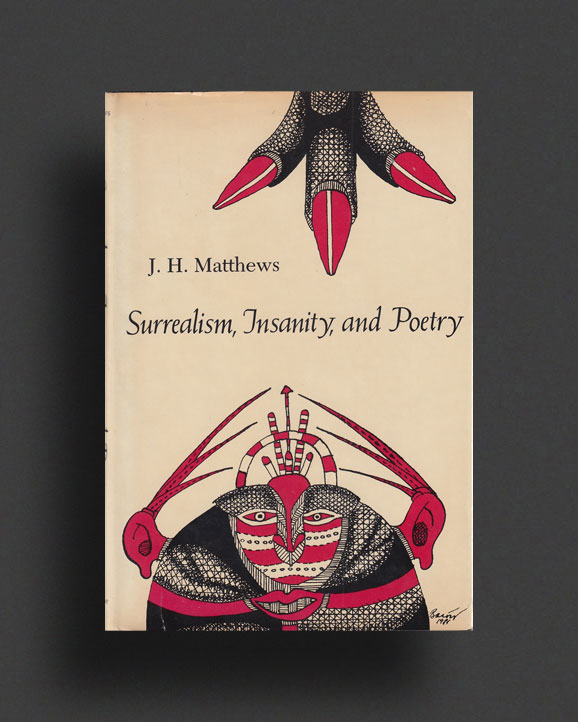
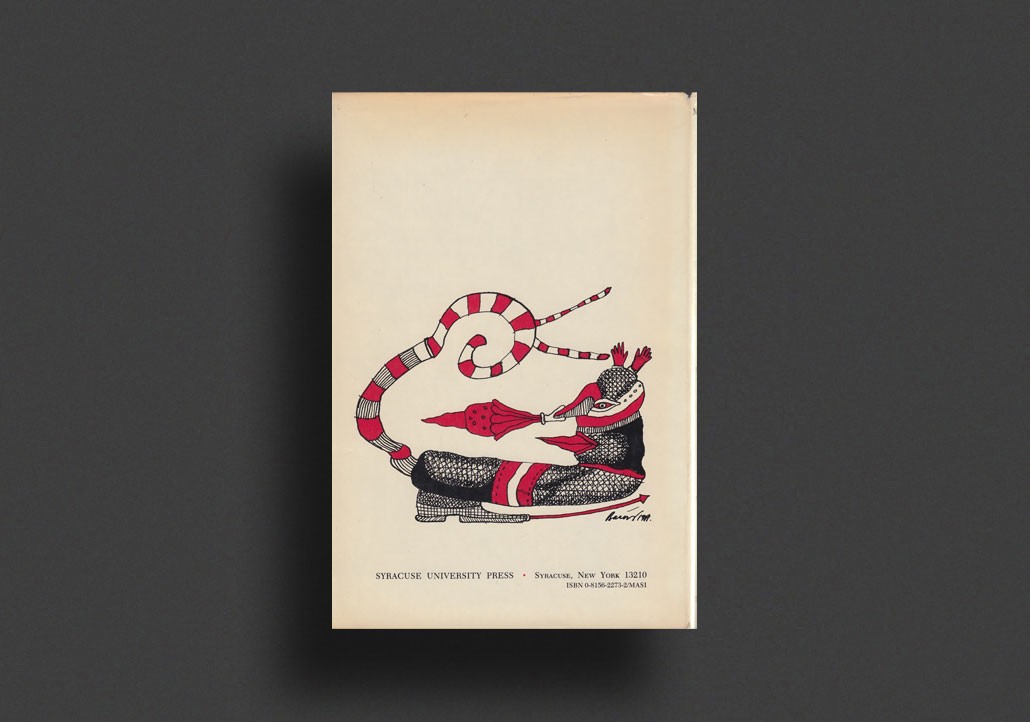
"In this groundbreaking, original study, J. H. Matthews, "clearly the chief scholarly explicator of surrealism today," according to Contemporary Literature, shows how the surrealists' goals and the imaginative freedom of mind are fused and diffused in the poet's creative world. Hallucination, game-playing, experimental research, and the irrational which nurtures new ways of poetical expression are all interwoven.
Out of their eagerness to share the benefits they ascribed to mental disturbance surrealists developed an approach to poetic technique which capitalized on the free association of the unconscious mind without undermining the sanity of the poets themselves.
Matthews discusses early surrealist interest in psychosis, hysteria, and insanity. This interest underlies such major works as André Breton's Nadja and Breton's and Paul Eluard's The Immaculate Conception. It is in the latter text that the issue of insanity and its relationship to poetic activity is most clearly revealed as essential to the surrealist enterprise. Also included here are chapters on insanity's poetic simulation and possession.
Matthews' work is important to anyone interested in poetry, the unconscious, and the history of twentieth-century ideas, as well as to scholars of surrealism.
Karol Baron, a Czech surrealist artist, has provided six original drawings especially for this book."—Dust jacket.
J. H. Matthews is a member of the committee appointed by the French government's Centre National de la Recherche scientifique to establish a center in Paris for documenting world-wide surrealism. He is American correspondent for Edda and Gradiva (Brussels), Phases (Paris), and Sud (Marseilles), magazines devoted to vanguard poetry and art. In 1977 the University of Wales conferred upon him its D. Litt., in recognition of his work on surrealism.
Born in Swansea, Wales, J. H. Matthews has been Professor of French at Syracuse University and editor of Symposium: A Quarterly Journal in Modern Foreign Literatures since 1965. He has edited a selection of stories by Guy de Maupassant (1959) as well as two special issues of La Revue des Lettres Modernes, and is the author of Les deux Zola (1957) and The Inner Dream: Céline as Novelist (1978) and numerous articles on nineteenth-and twentieth-century French literature.
His interest in surrealism has led him to write Péret's Score/Vingt Poèmes de Benjamin Péret
(1965); An Introduction to Surrealism (1965); An Anthology of French Surrealist Poetry (1966); Surrealism and the Novel (1966); André Breton (1967); Surrealist Poetry in France (1969); Surrealism and Film (1971); Theatre in Dada and Surrealism (1974); Benjamin Péret (1975); and The Custom-House of Desire: A Half-Century of Surrealist Short Stories (1975). He is also the author of Toward the Poetics of Surrealism (1976); Le thé-âtre de Raymond Roussel: une énigme (1977); The Imagery of Surrealism (1977); and Surrealism and American Feature Films (1979).
VG copy in VG dust jacket with light tanning/age.
1989, Japanese
Softcover (w. dust jacket + ephemera), 96 pages, 42.5 x 30.5 cm
1st Edition, Out of print title / used / very good
Published by
Treville / Tokyo
$200.00 - In stock -
Rare first 1989 Japanese edition of H. R. Giger's Biomechanics. In his classic series of oversized and visually immersive early art volumes, this book comprises a retrospective showcase, from 1964—88, of Giger's work, designed by and with running commentary by Giger himself, with over 200 drawings, paintings, and sculptures, and including concept art for the film Poltergeist II, and design paintings for Emerson, Lake, and Palmer albums, his lost film work and early cartoons. With a foreword by legendary Science Fiction author and longtime Giger fan Harlan Ellison, who dubs him "our latter-day Hieronymus Bosch."
Note: the Japanese editions of these books often had better reproductions from the original plates than the German and English language editions.
Includes Treville publisher ephemera inserted as issued, including an illustrated advert for Giger poster editions, etc.
Very Good in Very Good dust jacket. Excellent, well-preserved copy.