World Food Books' programme is largely produced on Kulin Nation land. We acknowledge the Wurundjeri people of the Kulin Nation as the first and continuing custodians of this land, and pay respect to their Elders past, present, and emerging.
World Food Books is an arts and special interests bookshop in Naarm / Melbourne. Founded in 2010, World Food Books is devoted to the presentation of a rotating, hand-selection of international art, design, literary and counterculture publications with an emphasis on the anti-traditional, the experimental, the avant-garde, the heretic, the marginal.
Presenting new titles alongside rare and out-of-print books, catalogues and journals spanning the fields of modern and contemporary art, design, photography, illustration, film, literature, poetry, cultural theory, philosophy, sexuality, popular and underground culture in its many radical forms, World Food Books wishes to encourage adventurous, thoughtful and open-minded reading, looking, writing, and exchange of publishing and ideas, both current and historical.
As well as our bookshop, located in Melbourne's historical Nicholas Building, all of our inventory is available internationally via our online mail-order service.
World Food Books semi-regularly co-ordinates "Occasions", a programme of exhibits and events at the bookshop and in partnership with other hosts (such as museums and art galleries) that develop out of the activities, relationships and content of the bookshop itself.
World Food Books
The Nicholas Building
37 Swanston Street
Room 5, Level 6
Melbourne 3000
Australia
SHOP HOURS:
THU–SAT 12–6
WEB-SHOP OPEN 24/7
World Food Books
Postal Address:
PO Box 435
Flinders Lane
Victoria 8009
Australia
info@worldfoodbooks.com
Art
Theory / Essay
Architecture / Interior
Graphic Design / Typography
Photography
Fashion
Eros
LGBTQ+
Fiction / Poetry
Weird / Speculative / Science Fiction / Horror
Transgressive / Visceral / Abject
Symbolism / Decadence / Fin de siècle
Film / Video
Painting
Sculpture / Installation
Performance / Dance / Theater
Drawing
Sound / Music
Curatorial
Group Shows / Collections
Periodicals
Out-of-print / Rare
Posters / Ephemera / Discs
Signed Books
World Food Books Gift Voucher
World Food Book Bag
Australian Art
Australian Fiction
Australian Science Fiction / Speculative Fiction
Australian Poetry
Australian Photography
Japanese Photography
Conceptual Art
Minimal Art
Dada
'Pataphysics / Oulipo
Fluxus
Concrete Poetry
Pop Art
Surrealism
Arte Povera
Arte Informale / Haute Pâte / Tachism
Nouveau Réalisme / Zero / Kinetic
Situationism / Lettrism
Collage / Mail Art / Xerox Art
Art Brut / Folk / Visionary / Fantastic
Illustration / Graphic Art / Bandes Dessinées
Furniture
Italian Radical Design / Postmodernism
Textiles
Ceramics / Glass
Counterculture
Protest / Revolt
Philosophy
Psychoanalysis
Anthropology
Anarchism
Socialism / Anarchism / Communism / Capitalism
Literary Theory / Semiotics / Language
Feminism / Women's Studies
Gender Studies / Sexuality
Anthropology
Fetishism / BDSM
Drugs / Psychedelia
Crime / Violence
Animal Rights / Veganism
Occult / Esoterica
Ecology / Earth / Alternative Living
Whole Earth / Crafts
All prices in AUD (Australian dollars)
Pick-Ups
Pick-up orders can be collected in our bookshop during opening hours after order date. Please collect any Pick-up orders within 2 weeks of ordering as we have limited storage space. Orders will be released back into stock if not collected within this time. No refunds can be made for pick-ups left un-collected. If you cannot make it in to the bookshop in this time-frame, please choose postage option.
Return Policy
All sales are final. We do accept returns (for refund or exchange) for items received in error. All our orders are packed with special care using heavy-duty padding and cardboard book-mailers or bubble mailers (for smaller books), using reinforcement where required. We cannot take responsibility for any lost, stolen or damaged parcels.
Insurance
Should you wish to insure your package, please email us directly after placing your order and we can organise this at a small extra expense. Although all standard/express tracked packages are very safe and dependable, we cannot take responsibility for any lost, stolen or damaged parcels. We recommend insurance on valuable orders.
Interested in selling your old books, catalogues, journals, magazines, comics, fanzines, ephemera? We are always looking for interesting, unusual and out-of-print books to buy. We only buy books in our fields of interest and specialty, and that we feel we can resell.
We base these prices on desirability, market value, in-print prices, condition and our current stock levels. We offer cash, store credit, and can take stock on consignment. All
about 25% of the price we expect to get when we sell them, or 30% in store credit. We base these prices on desirability, market value, in-print prices, condition and our current stock levels.
Sell your books any day of the week. You can drop them off and return later. If you have a lot of books, we can visit your Sydney home.
We buy books that we feel we can resell. We offer about 25 % of the price we expect to get when we sell them, or 30% in store credit. We base these prices on desirability, market value, in-print prices, condition and our current stock levels.
Philadelphia Wireman
03 August - 01 September, 2018
World Food Books is proud to announce our next Occasion, the first presentation of sculptures by Philadelphia Wireman in Australia.
The Philadelphia Wireman sculptures were found abandoned in an alley off Philadelphia’s South Street on trash night in 1982. Their discovery in a rapidly-changing neighbourhood undergoing extensive renovation, compounded with the failure of all attempts to locate the artist, suggests that the works may have been discarded after the maker’s death. Dubbed the "Philadelphia Wireman" during the first exhibition of this work, in 1985, the maker’s name, age, ethnicity, and even gender remain uncertain. The entire collection totals approximately 1200 pieces, all intricately bound together with tightly-wound heavy-gauge wire (along with a few small, abstract marker drawings, reminiscent both of Mark Tobey and J.B. Murry). The dense construction of the work, despite a modest range of scale and materials, is singularly obsessive and disciplined in design: a wire armature or exoskeleton firmly binds a bricolage of found objects including plastic, glass, food packaging, umbrella parts, tape, rubber, batteries, pens, leather, reflectors, nuts and bolts, nails, foil, coins, toys, watches, eyeglasses, tools, and jewellery.
Heavy with associations—anthropomorphic, zoomorphic, and socio-cultural responses to wrapped detritus—the totemic sculptures by Philadelphia Wireman have been discussed in the context of work created to fulfil the shamanistic needs of alternative religions in American culture. Curators, collectors, and critics have variously compared certain pieces to sculpture from Classical antiquity, Native American medicine bundles, African-American memory jugs, and African fetish objects. Reflecting the artist’s prolific and incredibly focused scavenging impulse, and despite—or perhaps enhanced by—their anonymity, these enigmatic objects function as urban artefacts and arbiters of power, though their origin and purpose is unknown. Philadelphia Wireman, whatever their identity, possessed an astonishing ability to isolate and communicate the concepts of power and energy through the selection and transformation of ordinary materials. Over the course of the past two decades, this collection has come to be regarded as an important discovery in the field of self-taught art and vernacular art.
Presented in collaboration with Fleisher-Ollman Gallery, Philadelphia, and Robert Heald, Wellington.
Susan Te Kahurangi King
02 February - 10 March, 2018
Susan Te Kahurangi King (24 February 1951 - ) has been a confident and prolific artist since she was a young child, drawing with readily available materials - pencils, ballpoint pens and felt-tip markers, on whatever paper is at hand. Between the ages of four and six Susan slowly ceased verbal communication. Her grandparents William and Myrtle Murphy had developed a special bond with Susan so they took on caring responsibilities for extended periods. Myrtle began informally archiving her work, carefully collecting and storing the drawings and compiling scrapbooks. No drawing was insignificant; every scrap of paper was kept. The King family are now the custodians of a vast collection containing over 7000 individual works, from tiny scraps of paper through to 5 meter long rolls.
The scrapbooks and diaries reveal Myrtle to be a woman of great patience and compassion, seeking to understand a child who was not always behaving as expected. She encouraged Susan to be observant, to explore her environment and absorb all the sights and sounds. Myrtle would show Susan’s drawings to friends and people in her community that she had dealings with, such as shopkeepers and postal workers, but this was not simply a case of a grandmother’s bias. She recognised that Susan had developed a sophisticated and unique visual language and sincerely believed that her art deserved serious attention.
This was an unorthodox attitude for the time. To provide some context, Jean Dubuffet coined the term Art Brut in 1945 to describe work created by self-taught artists – specifically residents of psychiatric institutions and those he considered to be visionaries or eccentrics. In 1972 Roger Cardinal extended this concept by adopting the term Outsider Art to describe work made by non-academically trained artists operating outside of mainstream art networks through choice or circumstance. Susan was born in Te Aroha, New Zealand in 1951, far from the artistic hubs of Paris and London that Dubuffet and Cardinal operated in. That Myrtle fêted Susan as a self-taught artist who deserved to be taken seriously shows how progressive her attitudes were.
Susan’s parents Doug and Dawn were also progressive. Over the years they had consulted numerous health practitioners about Susan’s condition, as the medical establishment could not provide an explanation as to why she had lapsed into silence. Dawn educated herself in the field of homeopathy and went on to treat all twelve of her children using these principles – basing prescriptions on her observations of their physical, mental and emotional state.
Doug was a linguist with an interest in philosophy who devoted what little spare time he had to studying Maori language and culture. To some extent their willingness to explore the fringes of the mainstream made them outsiders too but it was their commitment to living with integrity and their respect for individuality that ensured Susan’s creativity was always encouraged.
Even though Susan’s family supported her artistic pursuits, some staff in schools and hospitals saw it as an impediment to her assimilation into the community and discouraged it in a variety of ways. Her family was not always aware of this and therefore did not fully understand why Susan stopped drawing in the early 1990s. However, rather than dwell on the challenges that Susan faced in pursuit of her artistic practice, they prefer to highlight her achievements. In 2008 Susan began drawing again in earnest, after an almost 20 year interruption, and her work is now shown in galleries around the world.
Susan grew up without television and has been heavily influenced by the comics she read as a child. She is absolutely fearless in the appropriation of recognizable characters, such as Donald Duck and Mickey Mouse, in her work. She twists their limbs, contorts their faces, compresses them together, blends them into complex patterned backgrounds - always imbuing them with an incredible energy. Although Susan often used pop culture characters in her work they are not naive or childlike. These are drawings by a brilliant self-taught artist who has been creating exceptional work for decades without an audience in mind.
Mladen Stilinović
"Various Works 1986 - 1999"
02 February 16 - September 10, 2016
Various works 1986 - 1999, from two houses, from the collections of John Nixon, Sue Cramer, Kerrie Poliness, Peter Haffenden and Phoebe Haffenden.
Including: Geometry of Cakes (various shelves), 1993; Poor People’s Law (black and white plate), 1993; White Absence (glasses, ruler, set square, silver spoon, silver ladel with skin photograph and wooden cubes), 1990-1996; Exploitation of the Dead (grey and red star painting, wooden painting, black spoon with red table, red plate), 1984-1990; Money and Zeros (zero tie, paintings made for friends in Australia (Sue, John, Kerrie), numbers painting), 1991-1992; Words - Slogans (various t-shirts) - “they talk about the death of art...help! someone is trying to kill me”, “my sweet little lamb”, “work is a disease - Karl Marx”; Various artist books, catalogues, monographs, videos; Poster from exhibition Insulting Anarchy; "Circular" Croatian - Australian edition; Artist book by Vlado Martek (Dostoyevsky); more.
Thanks to Mladen Stilinović and Branka Stipančić.
Jonathan Walker
Always Will Need To Wear Winter Shirt Blue + Ochre Small Check Pattern
21 August - 21 September, 2015
Untitled
I am not a great reader of poetry but I always return to the work of Melbourne poet, Vincent Buckley (1925- 1988). Perhaps I find his most tantalising piece to be not a finished poem but a fragment left on a scrap of paper discovered on his desk after the poet’s death.
The poetry gathers like oil
In the word-core, and spreads
It has its music meet,
Its music is in movement.
This fragment is more the shell left behind from a volatile thought than a finished poem. I find the last two lines honest but awkward whereas the first two lines work like an arrow. Most likely he could not find a resolution so it was left. Still, in its present form, it remains an eloquent testimony to the ultimate failure of a medium to express mobile thought and sensation, in Buckley’s case, through verbal language. It’s an important matter because this is something all artists have to deal with regardless of the medium.
I have never written a poem, however, I am forever copying fragments from books on paper scraps in a vain effort to fix certain notions in my head. At first, they function as bookmarks that are sometimes returned to when I open the book. But before long, as they accumulate, they fall out littering the table interspersed with A4 photocopies, bills, books and medications.
To return to Buckley’s fragment, the first two lines very much evoke how I paint nowadays. As you age, detail diminishes and patches of light become more luminous and float. I feel the most honest way of dealing with this is by smearing the oil paint on the canvas with the fingers and working close-up, blind. Only if the patches coalesce into an approaching image can the work gain a life.
-
Jonathan Walker was born in Melbourne, Australia and brought up on a dairy farm in Gippsland. In the 1970’s he studied painting at RMIT and won the Harold Wright Scholarship to the British Museum, London. During the 1980’s he exhibited at Pinacotheca Gallery, Richmond and had work shown at the NGV and Heidi City Art Gallery. Over the same period he designed the cover for the “Epigenesi” LP by Giancarlo Toniutti, Italy and conducted a mail exchange work with Achim Wollscheid, Germany. The work with artists through the post resulted in an article published in the bicentenary issue of Art and Australia 1988. He showed in artist run spaces such as WestSpace in the 90’s and 2000’s, and until 2012, taught painting at Victoria University, which is where we (Colleen Ahern and Lisa Radford) as organisers of the exhibition, among many others, had the privilege of being his student.
Walker’s knowledge was imparted to students through the careful selection of music, literature, and artists found in books that he himself had ordered for the library. Walker’s strategy was the generosity of sharing his vast knowledge with references specific to each student and their context.
Walker’s paintings share a similar focus and intimacy.
This exhibition presents a small selection of recent paintings alongside a publication that includes Walker’s writing. Observational and analytical, Walker’s work is a type of material notation — the time of day, colour and how it is blended, the both specific and fleeting location of a reflection on lino or the question of whether a chair leg should be included in a painting.
Please join us on Friday August 21 between 6-8pm to celebrate the opening of the exhibition.
Curated by Colleen Ahern and Lisa Radford.
B. Wurtz
Curated by Nic Tammens
March 26 - April 4, 2015
B.Wurtz works from a basement studio in his home on Manhattan’s Lower East Side.
This local fact is attested to by the plastic shopping bags and newsprint circulars that appear in his work. As formal objects, they don’t make loud claims about their origins but nonetheless transmit street addresses and places of business from the bottom of this long thin island. Like plenty of artists, Wurtz is affected by what is local and what is consumed. His work is underpinned by this ethic. It often speaks from a neighborhood or reads like the contents of a hamper:
“BLACK PLUMS $1.29 lb.”
“Food Bazaar”
“USDA Whole Pork Shoulder Picnic 99c lb.”
“RITE AID Pharmacy, with us it’s personal.”
“H. Brickman & Sons.”
“Sweet Yams 59c lb."
Most of the work in this exhibition was made while the artist was in residence at Dieu Donne, a workshop dedicated to paper craft in Midtown. Here Wurtz fabricated assemblages with paper and objects that are relatively lightweight, with the intention that they would be easily transportable to Australia. This consideration isn’t absolute in Wurtz’s work, but was prescriptive for making the current exhibition light and cheap. Packed in two boxes, these works were sent from a USPS post office on the Lower East Side and delivered to North Melbourne by Australia Post.
Wurtz appears courtesy of Metro Pictures, New York.
Thanks to Rob Halverson, Joshua Petherick, Sari de Mallory, Matt Hinkley, Helen Johnson, Fayen d'Evie, Ask Kilmartin, Lisa Radon, Ellena Savage, Yale Union, and "Elizabeth".
John Nixon
"Archive"
December 15 - January 20, 2014
The presentation of John Nixon's archive offered a rare showcase of this extensive collection of the artist's own publications, catalogues, posters, ephemera, editions and more, from the mid 1980s onwards, alongside a selection of his artworks.
Organized by John Nixon, Joshua Petherick and Matt Hinkley.
"Habitat"
at Minerva, Sydney (organised by Joshua Petherick and Matt Hinkley)
November 15 - December 20, 2014
Lupo Borgonovo, Janet Burchill & Jennifer McCamley,
Lewis Fidock, HR Giger, Piero Gilardi, Veit Laurent Kurz,
Cinzia Ruggeri, Michael E. Smith, Lucie Stahl, Daniel Weil, Wols
Press Release:
“...It contained seven objects. The slender fluted bone, surely formed for flight, surely from the wing of some large bird. Three archaic circuitboards, faced with mazes of gold. A smooth white sphere of baked clay. An age-blackened fragment of lace. A fingerlength segment of what she assumed was bone from a human wrist, grayish white, inset smoothly with the silicon shaft of a small instrument that must once have ridden flush with the surface of the skin - but the thing’s face was seared and blackened.”
William Gibson, “Count Zero”, 1986
"Autumn Projects Archive"
Curated by Liza Vasiliou
March 6 - March 15, 2014
World Food Books, in conjunction with the Virgin Australia Melbourne Fashion Festival 2014, presented the Autumn Projects archive, consisting of a selection of early examples in Australian fashion with a particular interest in collecting designers and labels from the period beginning in the 1980’s, who significantly influenced the discourse of Australian Fashion.
Curated by Liza Vasiliou, the exhibition provided a unique opportunity to view pieces by designers Anthea Crawford, Barbara Vandenberg, Geoff Liddell and labels CR Australia, Covers, Jag along with early experimental collage pieces by Prue Acton and Sally Browne’s ‘Fragments’ collection, suspended throughout the functioning World Food Books shop in Melbourne.
H.B. Peace
presented by CENTRE FOR STYLE
November 14, 2013
"Hey Blinky, you say chic, I say same"
Anon 2013
H.B. Peace is a clothing collaboration between great friends Blake Barns and Hugh Egan Westland. Their pieces explore the divergences between 'character’ and ‘personality’ in garments....etc
Special Thanks to Joshua Petherick and Matt Hinkley of WFB and Gillian Mears
and a Very Special Thank you to Audrey Thomas Hayes for her shoe collaboration.
Janet Burchill & Jennifer McCamley
"Aesthetic Suicide"
May 10 - June 8, 2013
The first of our occasional exhibitions in the World Food Books office/shop space in Melbourne, "Aesthetic Suicide" presented a body of new and older works together by artists Janet Burchill & Jennifer McCamley, including videos, prints, a wall work, and publications.
During shop open hours videos played every hour, on the hour.
2021, English
Softcover, 144 pages, 11 x 15 cm
Published by
Onomatopee / Eindhoven
$35.00 - Out of stock
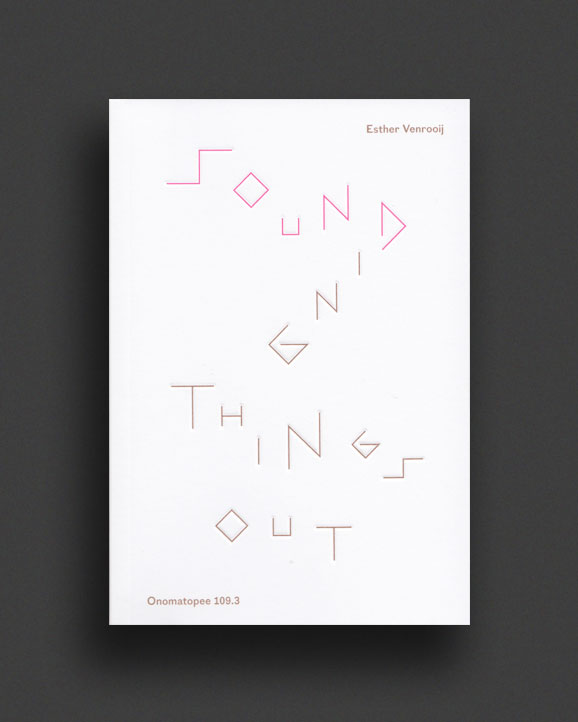
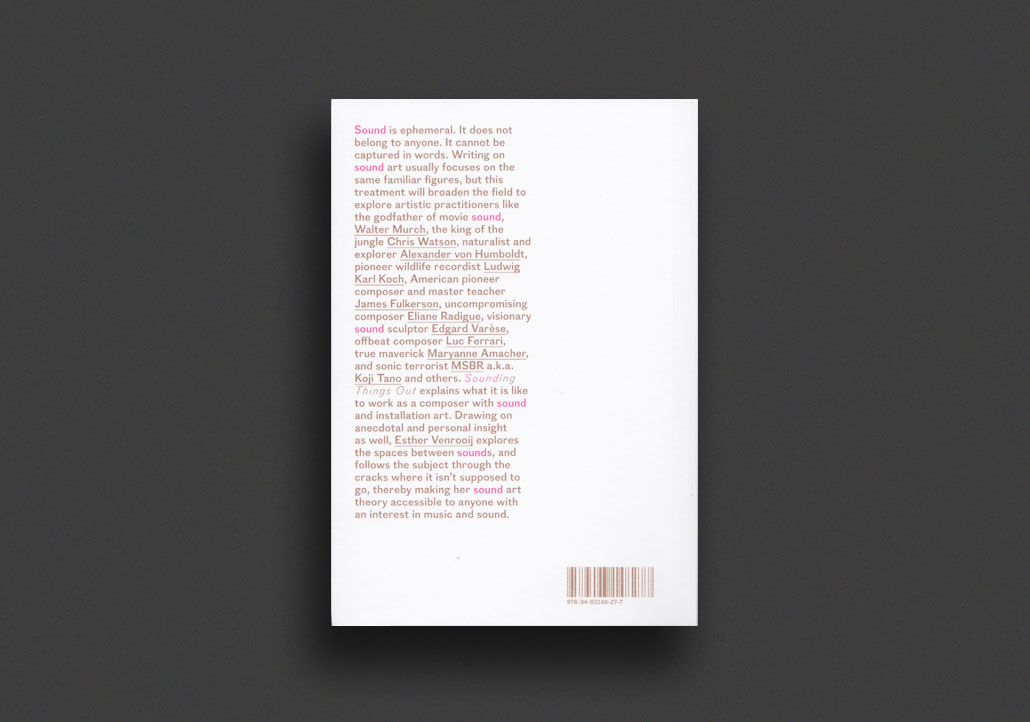
Sound is ephemeral. It does not belong to anyone. It cannot be captured in words. Writing on sound art usually focuses on the same familiar figures, but this treatment will broaden the field to explore artistic practitioners like the godfather of movie sound, Walter Murch, the king of the jungle Chris Watson, naturalist and explorer Alexander von Humboldt, pioneer wildlife recordist Ludwig Karl Koch, American pioneer composer and master teacher James Fulkerson, uncompromising composer Eliane Radigue, visionary sound sculptor Edgard Varèse, offbeat composer Luc Ferrari, true maverick Maryanne Amacher, and sonic terrorist MSBR aka Koji Tano and others.
Sounding Things Out explains what it is like to work as a composer with sound and installation art. Drawing on anecdotal and personal insight as well, Esther Venrooij explores the spaces between sounds, and follows the subject through the cracks where it isn’t supposed to go, thereby making her sound art theory accessible to anyone with an interest in music and sound.
2012, English / Swedish
Softcover, 224 pages, 28 x 21.7cm
Published by
Walther König / Köln
$68.00 - Out of stock
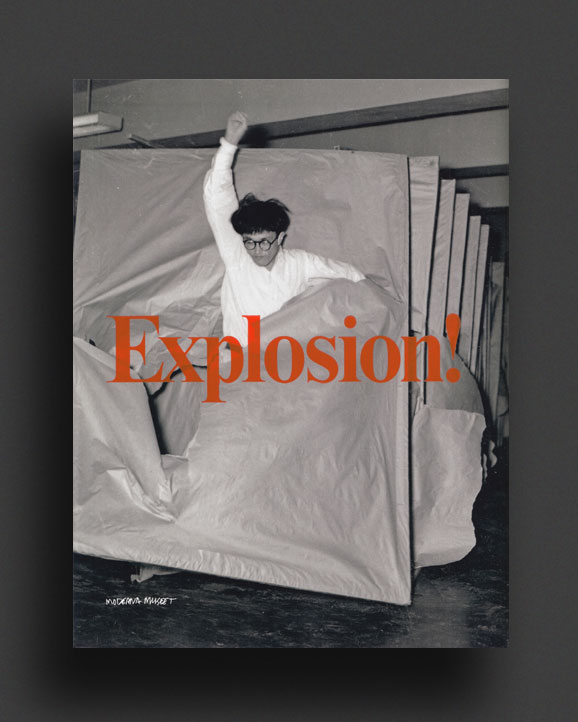
In the years following the Second World War, artists across the world began to attack the most basic premises of painting, in ways that were both aggressive and playful. The creative act itself was deemed as important as the painting that resulted from it, creating an energetic interzone between painting and performance in which chance procedures, the movement of bodies and the participation of spectators were all recruited as tools.
Explosion! Painting as Action explores the connections and cross fertilizations between painting, performance and conceptual art from the late 1940s to the present. Examining painting, photography, video, performance, dance and sound art, this volume includes works by Lynda Benglis, Niki de Saint Phalle, Cai Guo-Qiang, the Gutai Group, Allan Kaprow, Yves Klein, Alison Knowles, Ana Mendieta, Rivane Neuenschwander, Yoko Ono, Jackson Pollock, Robert Rauschenberg, Carolee Schneemann, Shozo Shimamoto, Lawrence Weiner and many others.
2021, English
Softcover, 152 pages, 17.8 x 22.2 cm
Published by
Wesleyan University Press / US
$40.00 - Out of stock
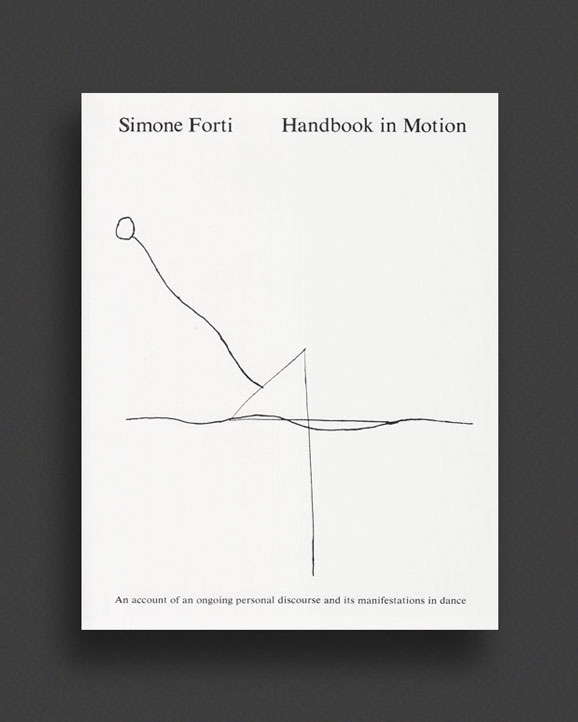
2021 re-print of Simone Forti's classic, Handbook in Motion : An Account of an Ongoing Personal Discourse and Its Manifestations in Dance, originally published in 1974.
Tracing a period in her life from the 1969 Woodstock Festival through the following years living on the land, this singular dance artist's direct and poetic writings bring a turbulent transitional era to life.
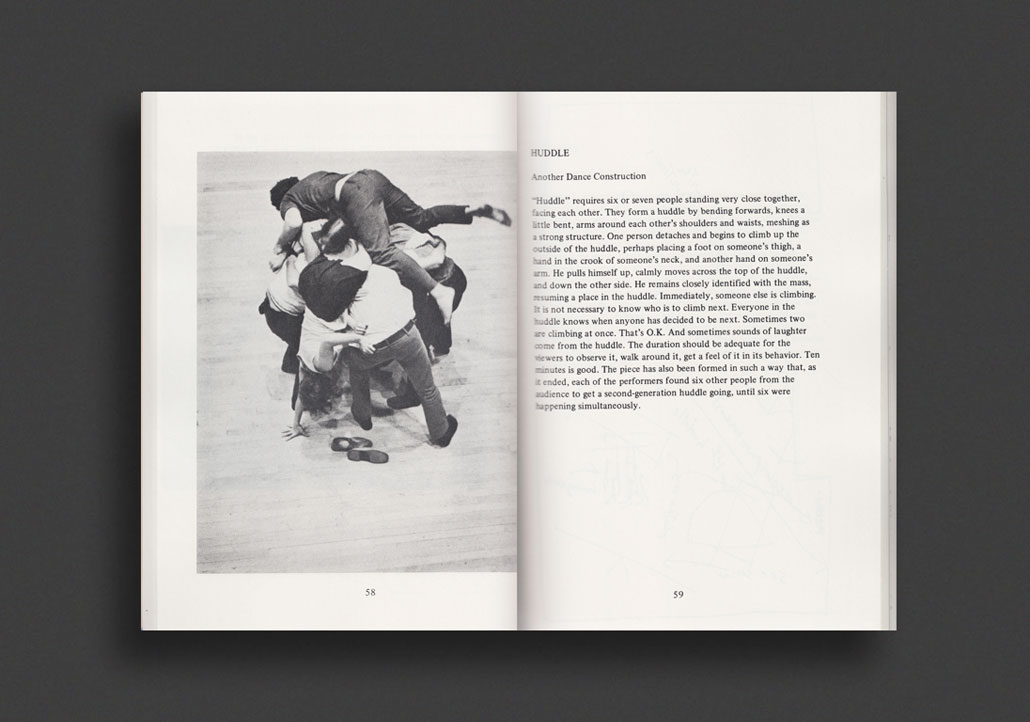
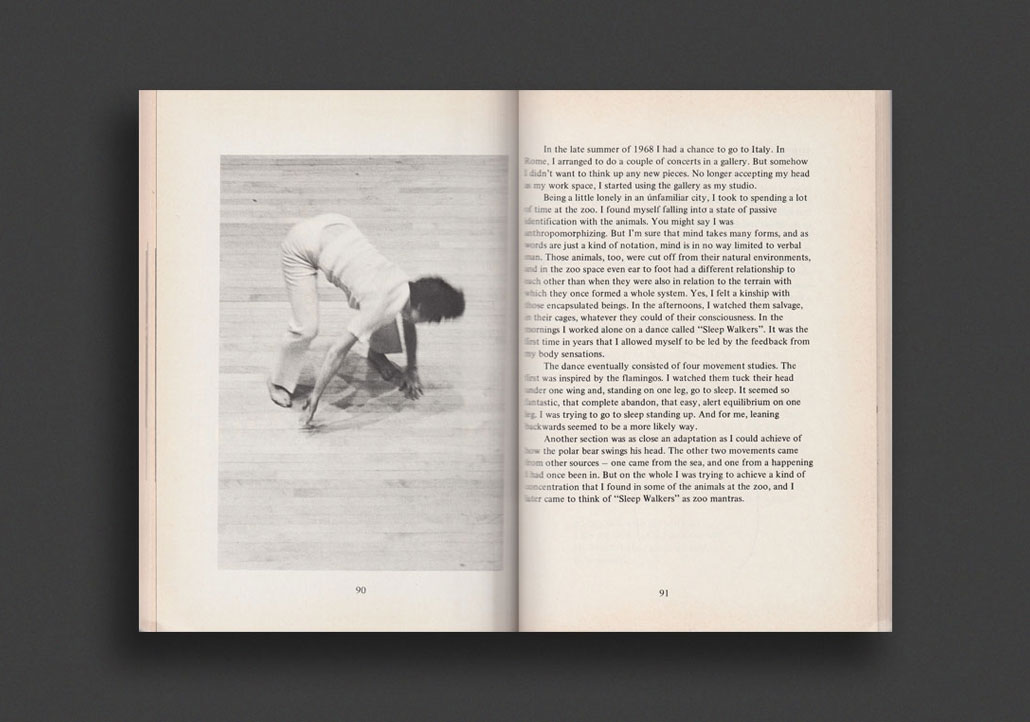
Arriving in New York in the early 60's from California, she brought with her a series of pieces that proved to be a serious influence on the development of "postmodern" dance in years to come. Her "dance-constructions" were based on a concern with bodies in action, the movement not being stylized or presented for its visual line but rather as a physical fact. Combining drawings, "dance reports" (short descriptions of events whose movement made a deep impression on the author's memory), and documentary materials such as scores, descriptions, letters to colleagues, and photographic records of performances, Forti's eye toward creating idioms for exploring natural forms and behaviors is evident throughout.
Simone Forti shifted from painting in 1955 to study dance with Anna Halprin and went on to study composition with Robert Dunn at the Merce Cunningham Studio leading to her association with Judson Dance Theater in the '60s. Her work spans from early minimalist dance-constructions, through animal movement studies, news animations, land portraits, and currently, Logomotion, an improvisational form based on the resonance between movement and the spoken word. She performs and teaches worldwide.
1974, English
Softcover, 152 pages, 17.8 x 22.2 cm
1st Edition, Out of print title / used / average
Published by
The Press of the Nova Scotia College of Art and Design / Halifax
$140.00 - Out of stock
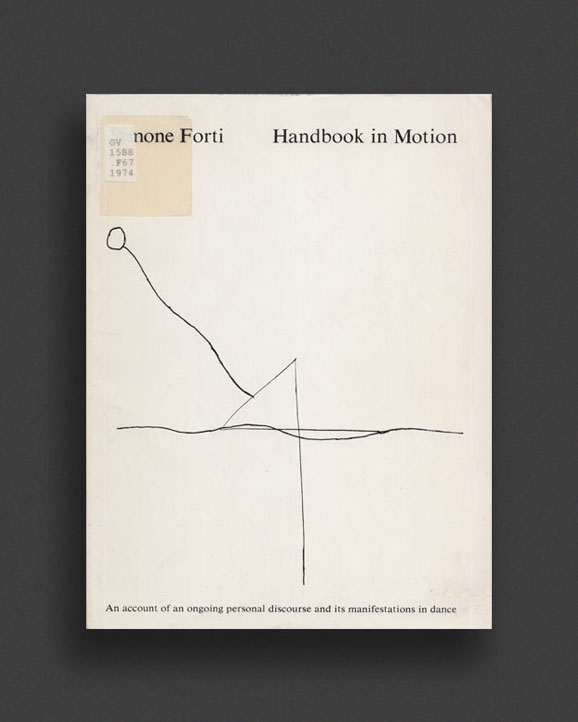
Rare first 1974 edition of Simone Forti's first wonderful monograph/artist's book, Handbook in Motion : An Account of an Ongoing Personal Discourse and Its Manifestations in Dance.
Tracing a period in her life from the 1969 Woodstock Festival through the following years living on the land, this singular dance artist's direct and poetic writings bring a turbulent transitional era to life.
Arriving in New York in the early 60's from California, she brought with her a series of pieces that proved to be a serious influence on the development of "postmodern" dance in years to come. Her "dance-constructions" were based on a concern with bodies in action, the movement not being stylized or presented for its visual line but rather as a physical fact. Combining drawings, "dance reports" (short descriptions of events whose movement made a deep impression on the author's memory), and documentary materials such as scores, descriptions, letters to colleagues, and photographic records of performances, Forti's eye toward creating idioms for exploring natural forms and behaviors is evident throughout.
Simone Forti shifted from painting in 1955 to study dance with Anna Halprin and went on to study composition with Robert Dunn at the Merce Cunningham Studio leading to her association with Judson Dance Theater in the '60s. Her work spans from early minimalist dance-constructions, through animal movement studies, news animations, land portraits, and currently, Logomotion, an improvisational form based on the resonance between movement and the spoken word. She performs and teaches worldwide.
Good ex-libris copy but with few associated markings, including sticker to front cover and library return slip-pocket inside. Otherwise very clean throughout, no notes, light tanning to edges.
2020, English
Hardcover box (2 vols), 224 pages, 27.9 x 20.3 cm
1st Edition, Out of print title / as new
Published by
Atelier Editions / Los Angeles
$200.00 - Out of stock
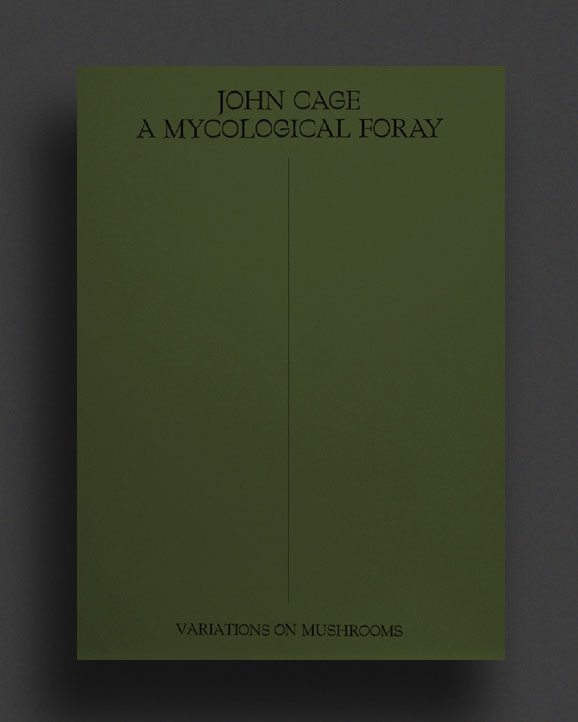
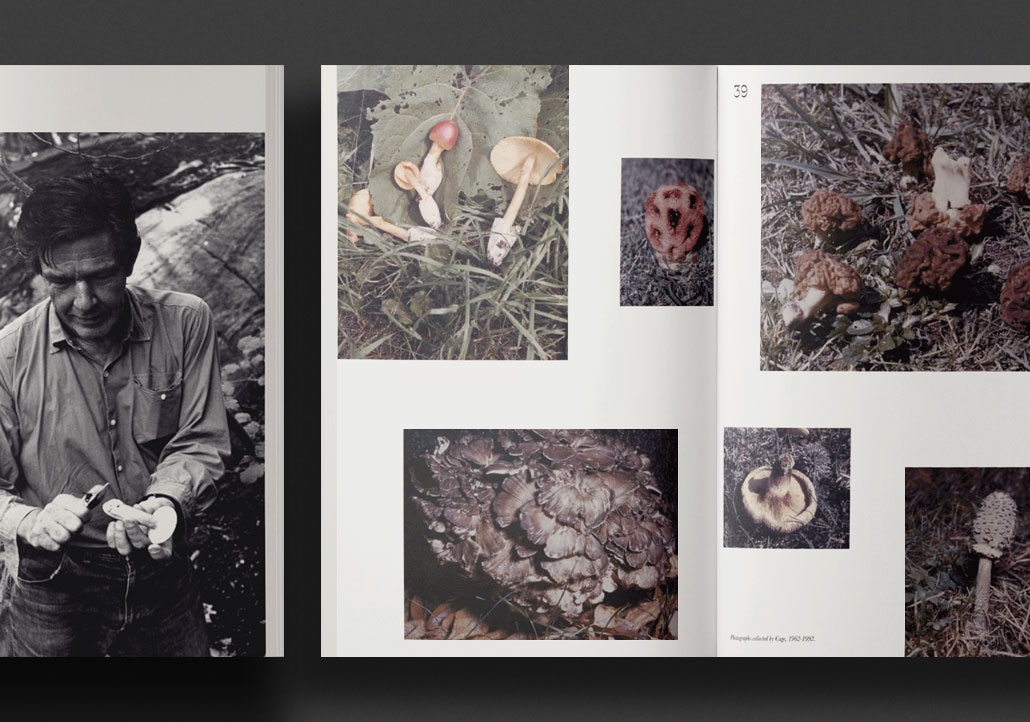
Sealed copy of this incredible, now out-of-print book, foraging for mushrooms with John Cage: writing, art, photography and ephemera from an idiosyncratic chapter in the composer's life.
Imagined as an extended mushroom-foraging expedition, John Cage: A Mycological Foray gathers together Cage’s mushroom-themed compositions, photographs, illustrations and ephemera. Indeterminacy Stories and other writings by Cage are interwoven throughout the first volume within a central essay examining Cage’s enduring relationship with mycology. Also included is a transcript of Cage’s 1983 performance, MUSHROOMS et Variationes. The second volume is the inaugural reproduction of Cage’s 1972 portfolio, Mushroom Book, authored in collaboration with illustrator Lois Long and botanist Alexander H. Smith. Readers are thus drawn through the landscape of Cage’s mycologically centred oeuvre and interests, discovering assorted works, images, compositions, philosophies and ephemera, as one might encounter assorted fungi and flora while foraging.
2020, English
Softcover, 84 pages, 23.4 x 17 cm
Published by
Schwartz City / Melbourne
$20.00 - Out of stock
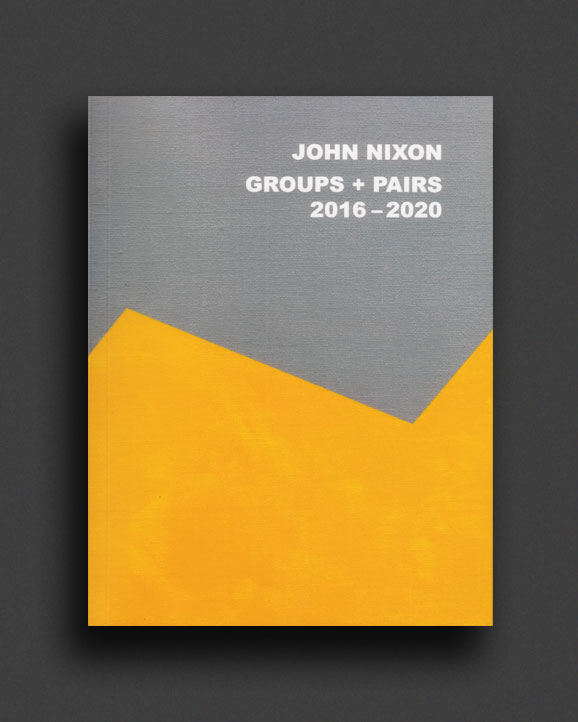
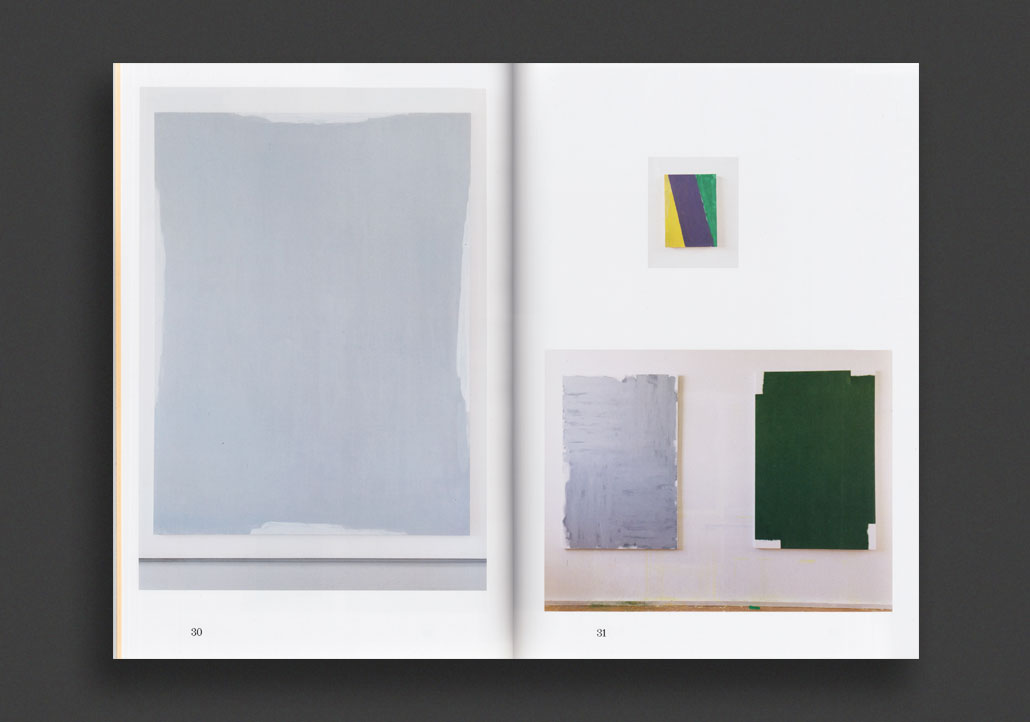
Published on the occasion of the exhibition John Nixon Groups + Pairs 2016–2020 at Anna Schwartz Gallery, and following the unexpected passing of the artist in August 2020, this publication honours the immense artistic contributions of the influential Melbourne abstract artist and leader of radical modernism John Nixon.
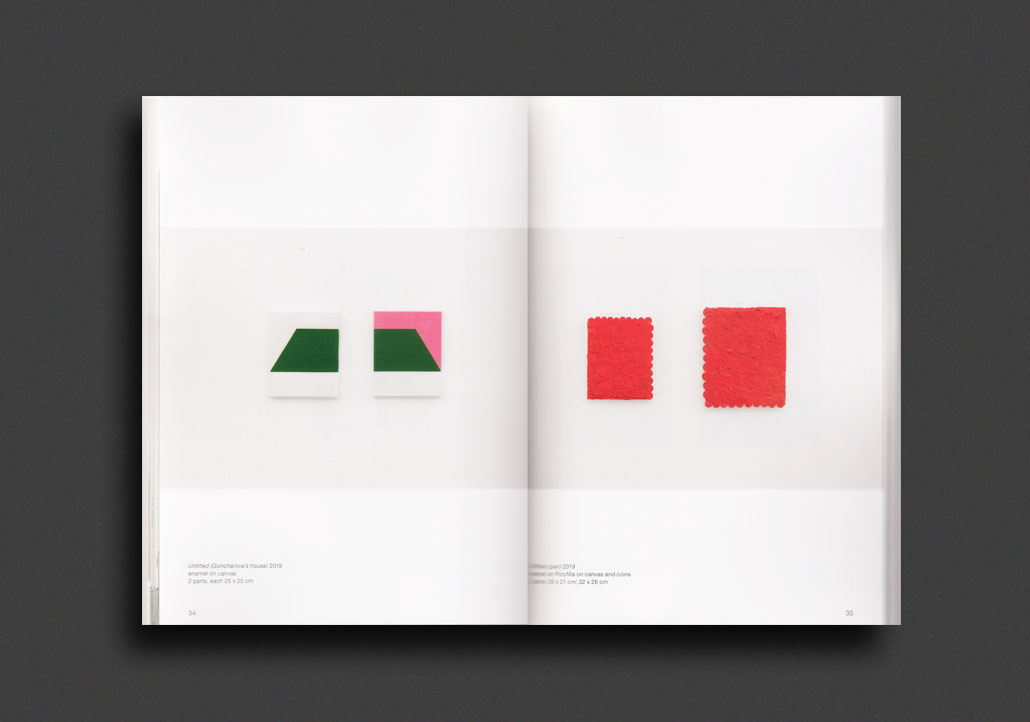
The exhibition John Nixon Groups + Pairs 2016–2020 documents the fundamental threads of Nixon’s practice as they had unfolded since 1968. Featuring a series of his paired paintings – evidence of his ongoing dedication to geometric abstraction –the exhibition also presents video installations capturing performance by Grace Uchinda dressed in Alpha60 alongside two of Nixon’s paintings, further collaborative works made by Nixon and Jacqueline Stojanovic, and a series of posters that were distributed around the inner suburbs of Melbourne in a timely suburban intervention.
John Nixon Groups + Pairs 2016–2020 features an essay by historian Carolyn Barnes and design by Yanni Florence.
John Nixon (1949-2020) was a seminal figure in contemporary Australian abstraction. Since 1968 his work has been dedicated to the ongoing experimentation, analysis and development of radical modernism, minimalism, the monochrome, constructivism, non-objective art and the readymade – key reference points in his work. Experimental Painting Workshop (EPW), which began in 1978, forms the basis of Nixon’s rigorous and long-standing intellectual investigation into the making of art, over time expanding to encompass not only painting, but collage, photography, video, dance and experimental music performance.
Nixon exhibited regularly and widely throughout his career. He held more than 70 solo exhibitions since 2001, including the Museum Gegenstandsfreier Kunst Otterndorf, Otterndorf, and the Auckland Art Gallery, Auckland. He represented Australia at Documenta 7, Kassel, Germany in 1982.
Nixon’s works are held in every major state museum collection in Australia, and selected international public collections include: Solomon R. Guggenheim Museum, New York; Museum Sztuki, Lodz; Foire National d’Art Contemporain, Paris; Stiftung fur Konkrete Kunst, Reutlingen; The Artists Museum, Lodz; Herning Kunstmuseumm, Denmark; Daimler Chrysler Collection, Berlin; Kunstmuseum Esberg, Denmark; Espace d’Art Contemporain, Demigny; National Gallery of Contemporary Art, Seoul.
2021, English
Softcover, 128 pages, 29.7 x 21 cm
Published by
Perimeter Editions / Melbourne
$49.00 - In stock -
Over a career spanning more than three decades, Shelley Lasica’s practice has placed the creative and processional machinations of dance and choreography centre stage. Skirting histories of visual, spatial and performance art as closely as she has embraced dance and choreography, the Melbourne artist’s propositions test the limits of the mediums in which they operate, forever expanding contexts and posing questions of just what dance is and what it can be as art.
Lasica’s debut book The Design Plot – which features texts by project producer Zoe Theodore, curator Pip Wallis and writer Megan Payne – acts as both documentation of Lasica’s ever-evolving practice and a wider vehicle for exploring the relationship between the body and architectural space, imagination and memory. Tracing ten iterations of the collaborative dance work from which the book takes its name, The Design Plot is at once organised and amorphous in its bearings – image sequences fracturing and folding in on themselves amidst a measured, cumulative flow of gestures, people, movements and architectures.
Like the performances themselves – which were conceived with dancers Ellen Davies, Timothy Harvey, Louella Hogan, Daniel Newell, Lilian Steiner and Jo White – the book is just another iteration of The Design Plot’s ongoing process and self-interpretation. ‘Each time The Design Plot is performed,’ writes Zoe Theodore in her essay for the book, ‘it is durational or cumulative, as it hosts a collective conversation that continually questions: What is the work? Where is the work? What happens to the work after occupying this architecture of time and space?’
2020, English
Softcover, 128 pages, 13.8 x 20 cm
Published by
Koenig Books / London
$38.00 - Out of stock
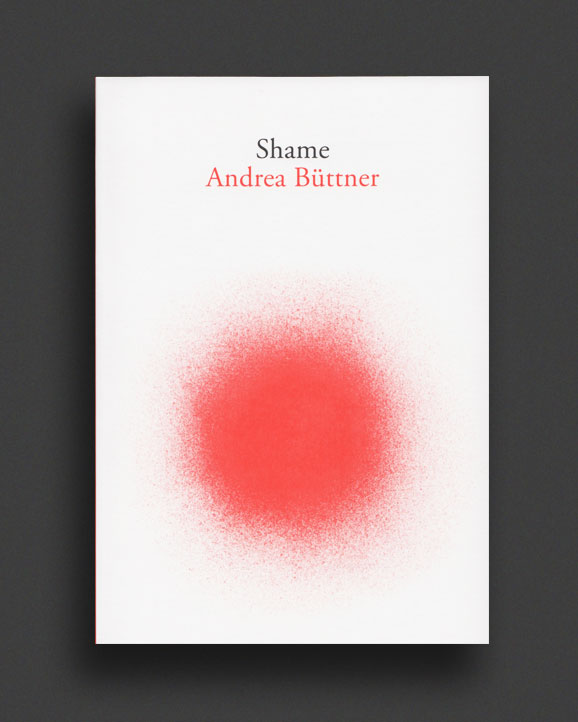
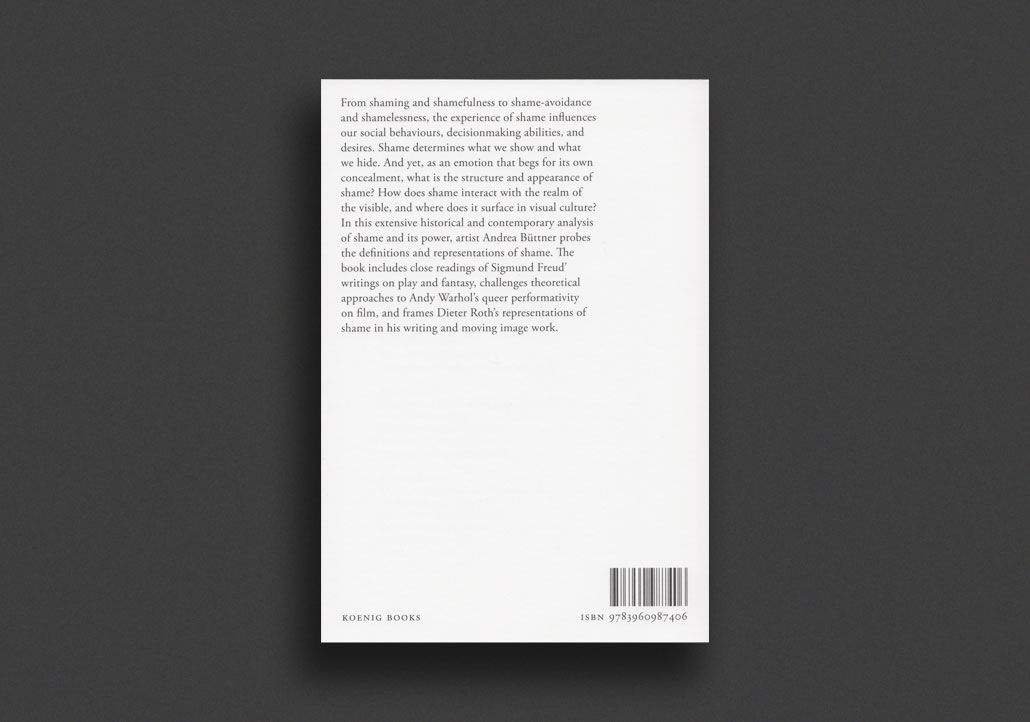
From shaming and shamefulness to shame-avoidance and shamelessness, the experience of shame influences our social behaviours, decision making abilities, and desires. Shame determines what we show and what we hide. And yet, as an emotion that begs for its own concealment, what is the structure and appearance of shame? How does shame interact with the realm of the visible, and where does it surface in visual culture? In this extensive historical and contemporary analysis of shame and its power, artist Andrea Büttner probes the definitions and representations of shame. The book includes close readings of Sigmund Freud’s writings on play and fantasy, challenges theoretical approaches to Andy Warhol’s queer performativity on film, and frames Dieter Roth’s representations of shame in his writing and moving image work.
Designed by HIT Studio.
Andrea Büttner (born 1972) is a German artist. She works in a variety of media including woodcuts, reverse glass paintings, sculpture, video, and performance. She creates connections between art history and social or ethical issues, with a particular interest in notions of poverty, shame, vulnerability and dignity, and the belief systems that underpin them.
2016, English
Softcover, 116 pages, 24 x 16.5 cm
Published by
Surpllus / Melbourne
$20.00 - In stock -
When a still painting shows us that we are moving' presents Melbourne painter and installation artist David Thomas' latest body of work, Impermanences. Featuring contributions from Kit Wise, Professor of Fine Art and Director of the Tasmanian College of the Arts, University of Tasmania; Dr Michael Graeve, a visual and sound artist; and David Thomas.
David Thomas lives and works in Melbourne, Australia. He was born in Belfast, Northern Ireland in 1951 and arrived in Australia in 1958. Thomas has exhibited internationally for the past four decades, including in the United States, Australia, New Zealand, South Korea, Taiwan, China, Singapore, and throughout Europe.
Thomas’ work is represented in public collections including the National Gallery of Victoria, Australian National Gallery, Art Bank, Trinity College, University of Melbourne, RMIT University, Museum of Modern Art at Heide, Cripp’s Collection (Australia and UK); Chartwell Collection, Auckland Art Gallery, Canterbury University (New Zealand); Lim Lip Museum (South Korea); and Kunstmuseum Bonn, Theodor F. Leifeld Stiftung, and Kunstmuseum Ahlen (all Germany). He has received awards from the Australia Council, Art Gallery of New South Wales, and Arts Victoria, and has participated in residencies at the Cité International des Arts (Paris), Two Rooms Gallery (Auckland), Centre for Drawing Research, Wimbledon College of Art, University of the Arts (London), and Porthmeor Studios (St. Ives, UK).
Thomas has curated numerous exhibitions and written extensively on the subject of monochrome painting. He is a Professor of Fine Art at RMIT University in Melbourne where he has taught since 1992. Thomas holds an MA in Fine Art (Painting) and a PhD from RMIT University.
2021, English / German
Softcover, 208 pages, 23 x 16.5 cm
Published by
Texte Zur Kunst / Berlin
$32.00 - Out of stock
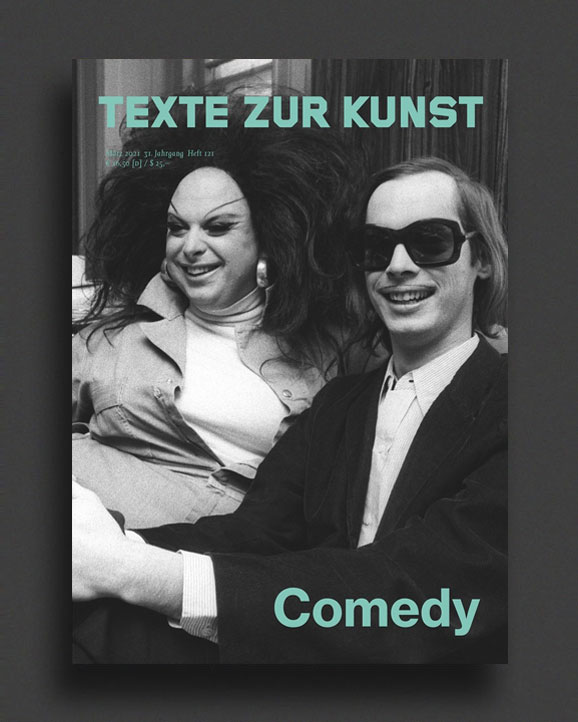
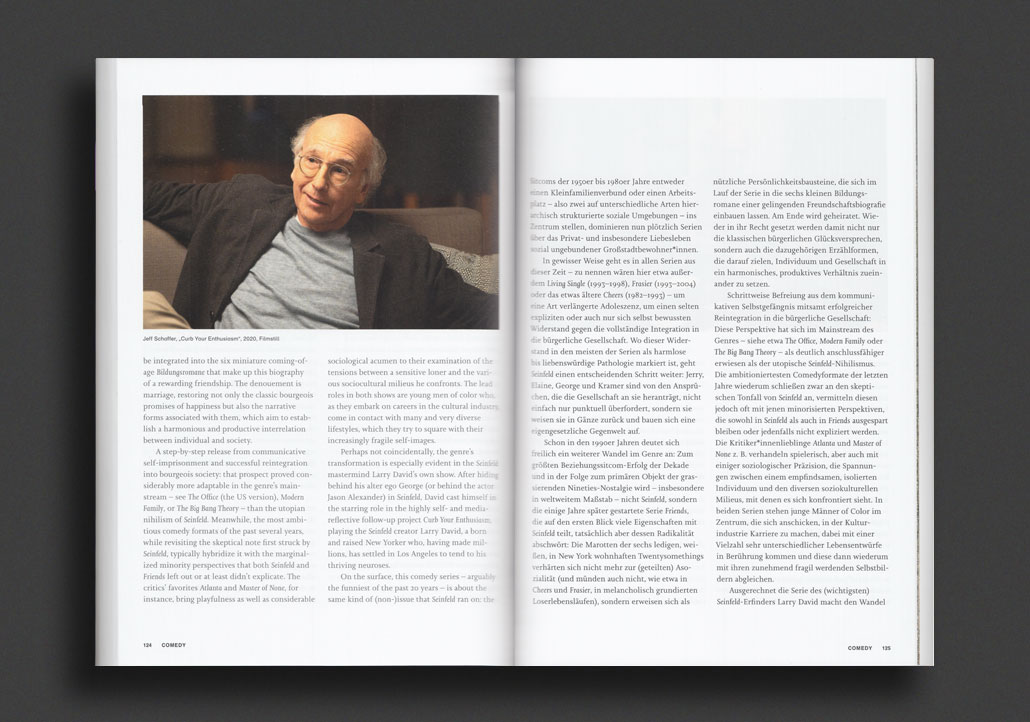
The March issue of Texte zur Kunst, titled “Comedy,” investigates the comedic in art while also examining mass-media formats such as TV series and films. Comedy not only offers consolation and comfort by making the tragic seem comic; for the repressed, it also serves as a catalyst, addressing and thematizing repression through jokes, slapstick, or the grotesque. However, at a time when audiences increasingly demand political commitment and authenticity from art, comedic speech, which is inherently disingenuous, has fallen into disrepute: ironically distanced rhetoric is accused of turning a blind eye to social inequality. Together with Bert Rebhandl, author and co-publisher of the film magazine cargo, the editors conceptualized an issue that examines the role of the joke in art, the psychoanalytic dimension of the comedic, and the limits of satire in the age of Donald Trump.
With contributions by/features on Jennifer A. Greenhill, Kevin B. Lee, Matthias Dell, Glenn Ligon, Jan Böhmermann, Lauren Berlant, Sianne Ngai, Alenka Zupančič, Lynne Tillman, Rosalind Fox Solomon, Bert Rebhandl, Gregory Williams, Andrea Fraser, Lukas Foerster, Seinfeld, Larry David, Christiane Kues, Pujan Karambeigi, Amalia Ulman, Michaela Ott, Iris Därmann, Max Heinrich, Helvetia Leal, Sofia Bempeza, Talia Kwartler, Kai Althoff, Bernard Leach, Saim Demircan, Kim Jones, Samantha Ozer, Wu Tsang, Susanne Von Falkenhausen, Aby Warburg, Daniel Sturgis, Maxwell Alexandre, Genevieve Lipinsky De Orlov, Rosemary Mayer, Akili Tommasino, Howardena Pindell, Awol Erizku, Anna Voswinckel, Marianne Wex, Sarat Maharaj, Marion Von Osten, Françoise Vergès, Madeleine Bernstorff, Ross Bleckner, Douglas Gordon, Amy Sillman …
2020, English / German
Softcover, 272 pages, 23 x 16.5 cm
Published by
Texte Zur Kunst / Berlin
$32.00 - In stock -
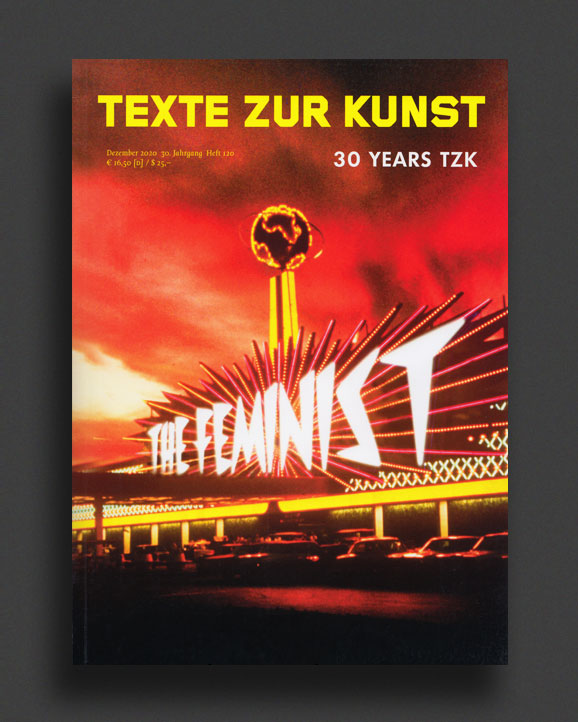
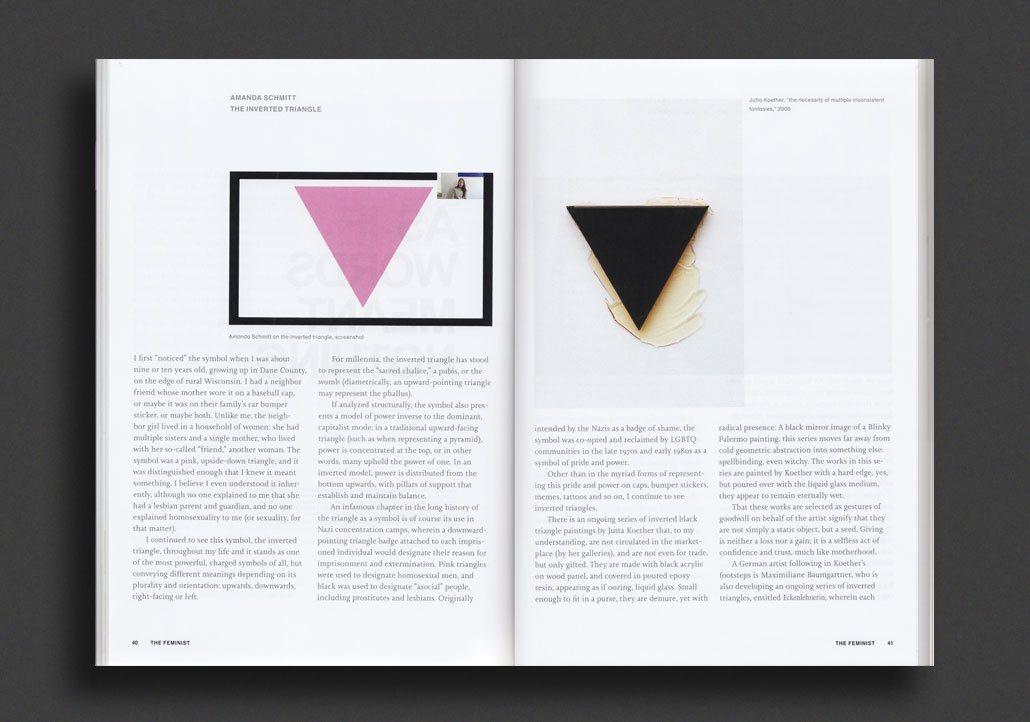
"Exactly three decades after the inaugural issue of TZK was published, we return to the question of where the hard-won and still-embattled rights of women* stand. With this issue, entitled ‘The Feminist’, we celebrate 30 years of controversial discussions about contemporary art and culture. We have invited 30 artists, critics, curators, and theorists of art and culture to talk about a cultural object that they believe is currently of particular interest from a feminist perspective. In highlighting feminist discourses that are especially relevant to the present moment, this issue should illustrate the plurality of thinkers who contribute to feminist projects today. A gesture to the unity and the alliances that critique grounded in solidarity can build!” —from the editorial by Isabelle Graw, Katharina Hausladen, and Genevieve Lipinsky de Orlov.
With contributions by Isabelle Graw, Jeanetta Rich, Mirjam Thomann, Amanda Schmitt, Christian Liclair, Juliane Rebentisch, Jessica Aimufua, Katharina Hausladen, Nikita Gale, Beate Söntgen, Stacey Gillian Abe, Genevieve Lipinsky de Orlov, Taylor Le Melle, Victoria Sin, Julia Heldt, Nadja Abt, Alina Astrova, Astrid Mania, Hanna Magauer, Brigitte Weingart, Paul Niedermayer, Keren Cytter, Steven Warwick, Bini Adamczak, Raphaela Vogel, Miriam Zeh, Lili Reynaud-Dewar, Violaine Huisman, Trakal …
2017, English
Hardcover, 162 pages, 23 x 23 cm
1st Edition, Out of print title / used / very good
Published by
Heide Museum of Modern Art / Victoria
$40.00 $25.00 - Out of stock
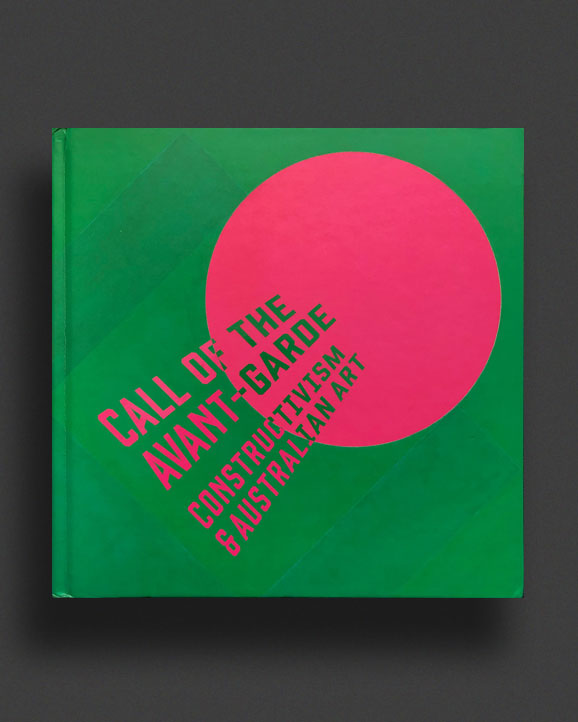
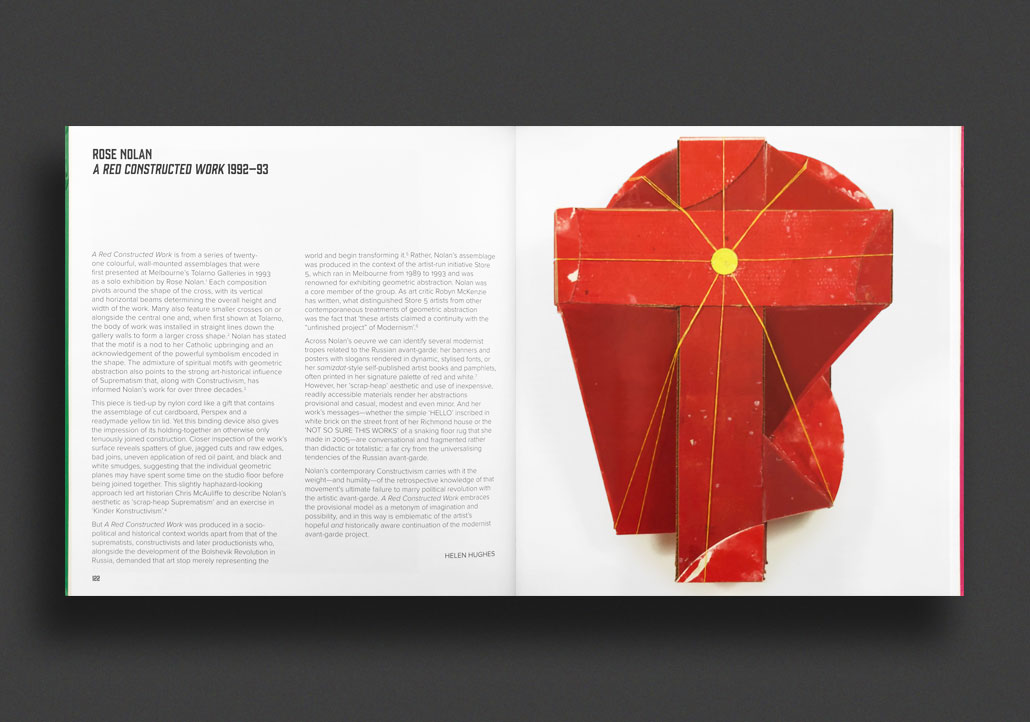
For more than one hundred years, artists have drawn inspiration from the early twentieth-century avant-garde movement Constructivism. Its abstract forms, utopian ideals and vision of art’s vital role in constructing a new society have continued to act as a beacon for artists of successive generations in many countries. This extensive survey of over seventy artists explores how Australian artists have responded to this ground breaking modernist movement and its enduring call upon their imaginations from the 1930s to the present day.
Essay contributions by curators Sue Cramer, Lesley Harding plus additional focus texts by 24 acclaimed Australian writers and curators.
Works illustrated by Australian artists Ralph Balson, Frank Hinder, Inge King, Kerrie Poliness, Justin Andrews, Peter Cripps, Gunter Christmann, George Johnson, Robert Owen, Rose Nolan, John Nixon, Justene Williams and Zoë Croggon, among many others alongside those by key proponents of the original movement, such as Russian artists Rodchenko, Malevich, El Lissitzky and Alexandra Exter from Russia, and British artists Ben Nicholson and Barbara Hepworth.
Hardcover catalogue published to accompany the exhibition of the same name 5 July - 8 October 2017 at Heide Museum of Modern Art, Victoria.
2021, English
Softcover, 52 pages, 15 x 21cm
Published by
Primary Information / New York
$32.00 - Out of stock
Theatre is an artist book that documents seven early performances by Dan Graham taking place from 1969 to 1977 with notes, transcripts, or photographs for each work. Originally published in 1978, and produced here in facsimile form, the publication focuses on several key works that interrogate or undermine the psychological and social space created by, or between, individuals inside the performance venue.
Like most of Graham’s work, they also serve as a critique of cultural norms, with many of the performances utilizing quotidian, social acts that are amplified over time. For example, in Lax/Relax (1969), Graham’s subversion of West Coast new ageism, the artist chants “relax” in sync with a recording of a woman saying “lax” in a meditative manner, which implicates the audience into a group breathing exercise or hypnosis over the course of 30 minutes.
Throughout the ’70s, the artist engaged in a series of works that subverted the prescribed roles of the audience and performer by creating conditions in which each simultaneously functions as both (creating a type of feedback loop). Remarking on another work form this period, Graham once stated, “It begins with Minimal Art, but it’s about spectators observing themselves as they’re observed by other people.”* This paradigm is extended even further in Performer/Audience Sequence (1975) and Performer/Audience Mirror (1977), in which the artist performs by describing the audience as well as himself, creating conditions whereby the audience is performing for the artist as well as themselves.
Like (1971), Past Future Split Attention (1972), and Identification Projection (1977) are also featured in the publication.
Dan Graham (b. 1942) is an artist based in New York. Since the 1960s, he has produced a wide range of work and writing that engages in a highly analytical discourse on the historical, social, and ideological functions of contemporary cultural systems. Architecture, popular music, video, and television are among the focuses of his investigations, which he articulates through essays, performances, installations, videotapes, and architectural/sculptural designs.
Managing Editor: James Hoff
Managing Designer: Rick Myers
2020, English
Softcover, 240 pages, 15.1 x 21.1 cm
Published by
The MIT Press / Massachusetts
Whitechapel / London
$38.00 - Out of stock
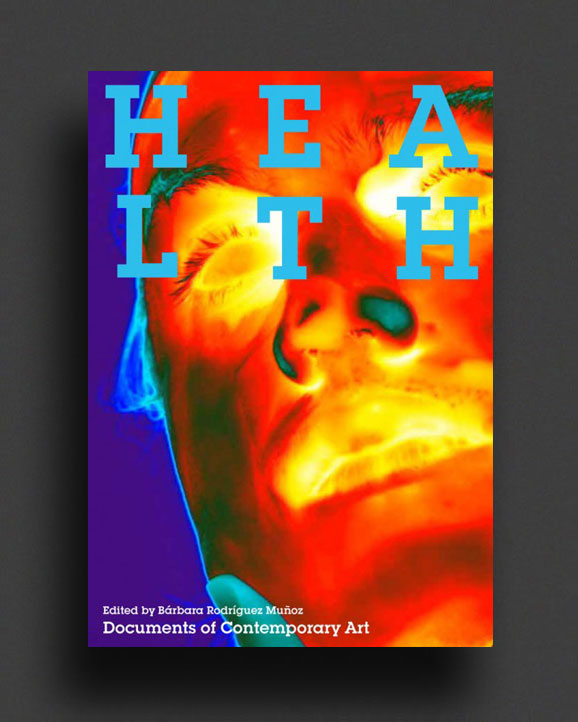
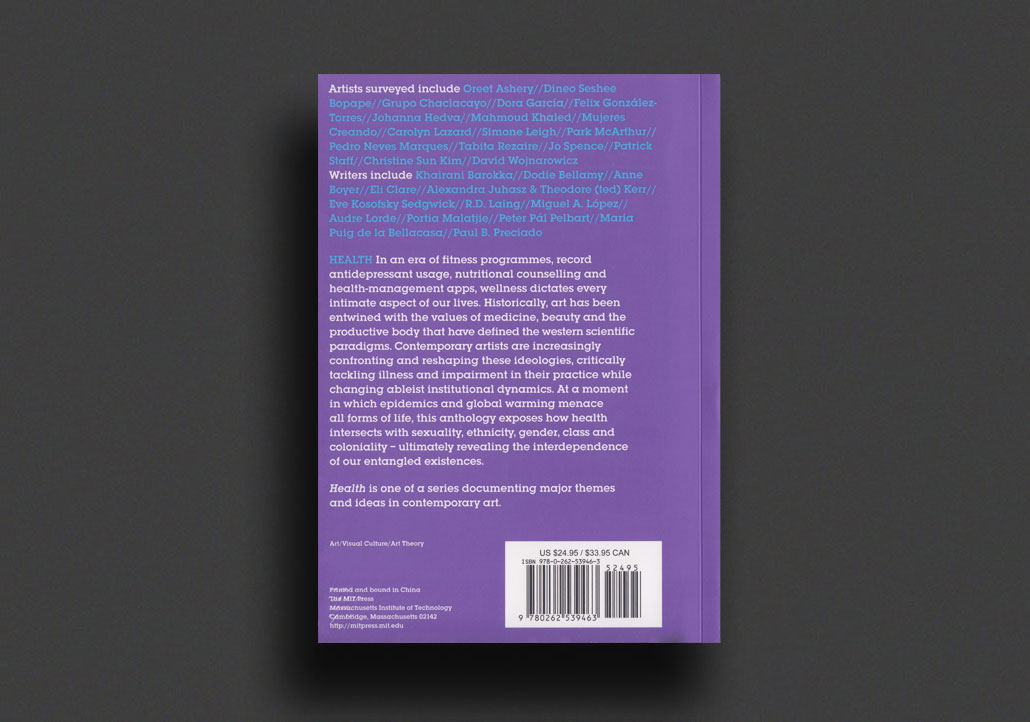
Part of the acclaimed Documents of Contemporary Art series of anthologies which collect writing on major themes and ideas in contemporary art.
The ethical, aesthetic and political significance of practices, positions and theories connected to health in contemporary art.
In an era of fitness programs, increasing antidepressant usage, nutrition counseling and health-management apps, wellness is one of the defining issues of contemporary life, dictating every intimate aspect of our lives. Historically, art has been entwined with the values of medicine, beauty, and the productive body that have defined western scientific paradigms; contemporary artists are increasingly confronting and reshaping these ideologies, critically tackling illness and impairment in their practice while challenging ableist institutional dynamics. In this volume, artists, curators, writers, and thinkers engage with the ways the vulnerability of our bodies reveals structural aspects of our societies.
At a moment at which epidemics and global warming menace all forms of life, we see clearly how health intersects with sexuality, ethnicity, gender, class, and coloniality. By reclaiming other realities, beyond a state of health as a norm, this book questions the myths, stigmas, and cultural attitudes that shape normative perceptions, revealing the interdependence of our entangled existences. The book includes four newly commissioned texts: by artists Mahmoud Khaled and Patrick Staff, by curator Clare Barlow on disability in the museum, and by curator Portia Malatjie on the work of Dineo Seshee Bopape. It also features two texts on the current COVID-19 pandemic, by Anne Boyer and Filipa Ramos.
Artists surveyed include :
Oreet Ashery, Lucy Beech, Dineo Seshee Bopape, Lorenza Böttner, Canaries & Taraneh Fazeli, Grupo Chaclacayo, Anne Charlotte Robertson, Patricia Domínguez, Dora García, Felix González-Torres, Luke Fowler, Alice Hattrick, Tamar Guimarães, Joseph Grigely, Gran Fury, Johanna Hedva, Mahmoud Khaled, Mujeres Creando, Carolyn Lazard, Simone Leigh, Park McArthur, Pedro Neves Marques, Tabita Rezaire, Jo Spence, Patrick Staff, Christine Sun Kim, Pedro Reyes, David Wojnarowicz
Writers include :
Aimar Arriola & Nanci Garín, Clare Barlow, Khairani Barokka, Dodie Bellamy, Anne Boyer, Rizvana Bradley, Eli Clare, Taraneh Fazeli, Theodore (ted) Kerr & Alexandra Juhasz, Eve Kosofsky Sedgwick, R.D. Laing, Miguel A. López, Catalina Lozano, Audre Lorde, Portia Malatjie, Margarida Mendes, Peter Pál Pelbart, Naomi Pearce, Maria Puig de la Bellacasa, Filipa Ramos, Susan Sontag, Paul B. Preciado, Mary Walling Blackburn, Simon Watney & Sunil Gupta
Copublish by MIT Press with Whitechapel Gallery, London
2020, English
Softcover, 172 pages, 14 x 19 cm
Published by
Light Cone Editions / Paris
$40.00 - Out of stock
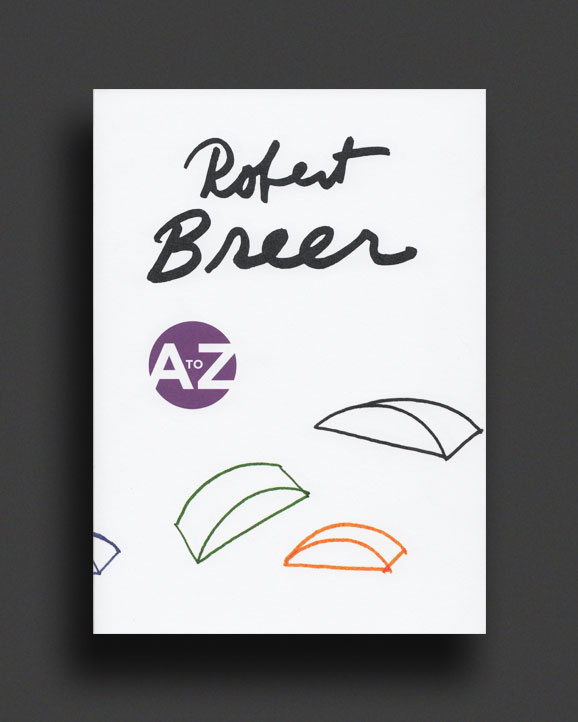
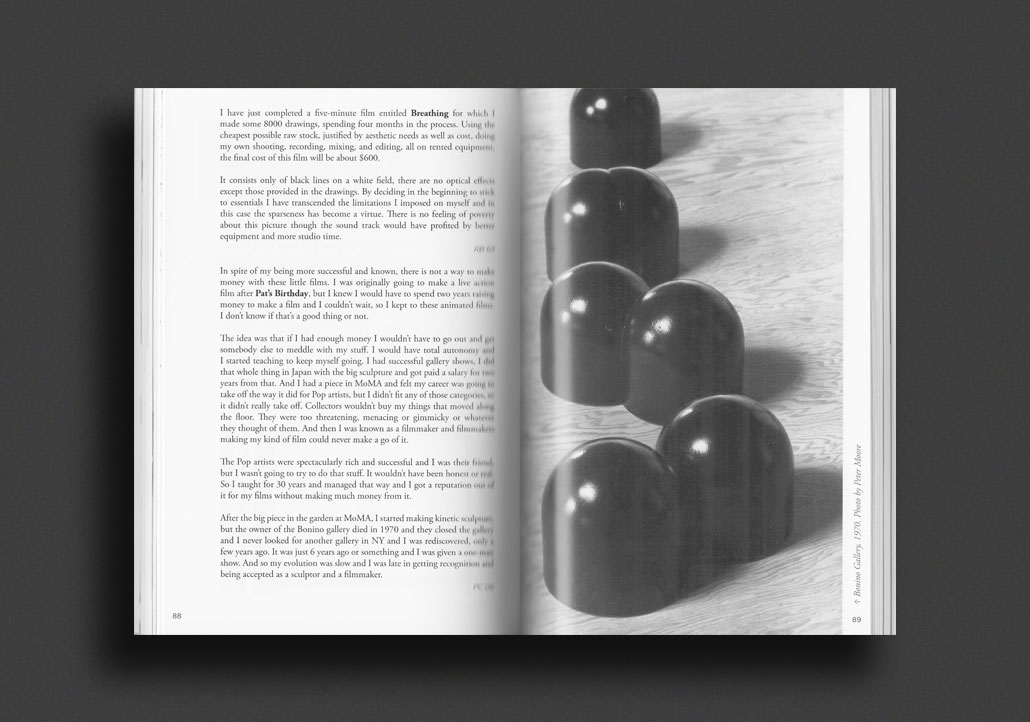
This new publication, Robert Breer A to Z, published by Light Cone Editions, is a self-portrait of Robert Breer. His life and work are presented as an imaginary lexicon, a form which he always admired as being emblematic of the joyous, unexpected, and chaotic nature of life itself.
Drawn from interviews, personal letters and public statements from 1957 to 2009, Robert Breer A to Z brings into a single volume the artist’s reflections on his films and his multiple forays into painting, drawing and kinetic sculpture.
Robert Breer has spent fifty years building up a totally atypical body of work which plays with different genres and abolishes the notions of space and time. Starting off as a painter, he then deconstructed his neoplastic works and ended up with kinetic objects. He dealt next with the thresholds of awareness and perception, both as a sculptor and a filmmaker. His films are composed of a jumble of images that pass at great speed, while his Floats move almost imperceptibly, in accordance with an unpredictable logic. Robert Breer developed his light yet rigorous style while associating with the New York underground in the Pop years. Continuing his subtle exploration of movement, his work still today causes the space of reality -irrevocably unstable- to waver.
Published under the direction of Scott Hammen with an introduction by Simon Rees, Robert Breer A to Z is co-published by Light Cone Editions and the Govett-Brewster Art Gallery.
2019, English
Softcover, 448 pages, 15 x 21cm
Published by
Koenig Books / London
Serpentine Gallery / London
$85.00 $50.00 - Out of stock
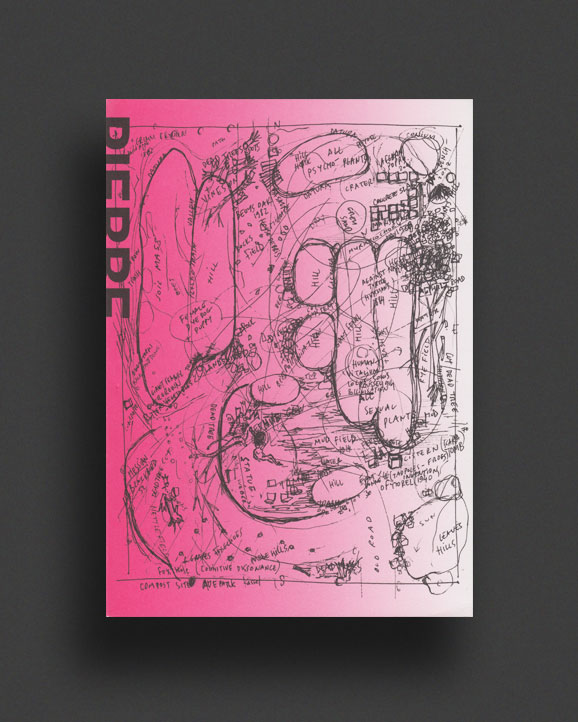
This already out-of-print major survey on renowned French artist Pierre Huyghe (born 1962) chronicles seminal works from the last decade, including his iconic Documenta 13 project "Untilled." An interview between Huyghe and Hans Ulrich Obrist and an essay by Dorothea von Hantelmann accompany drawings, diagrams, photographs, film stills and more.
As New with light cover wear (hence reduced price)
2020, English
Softcover, 116 pages, 15 x 23 cm
Published by
Sound American / New York
$36.00 - Out of stock
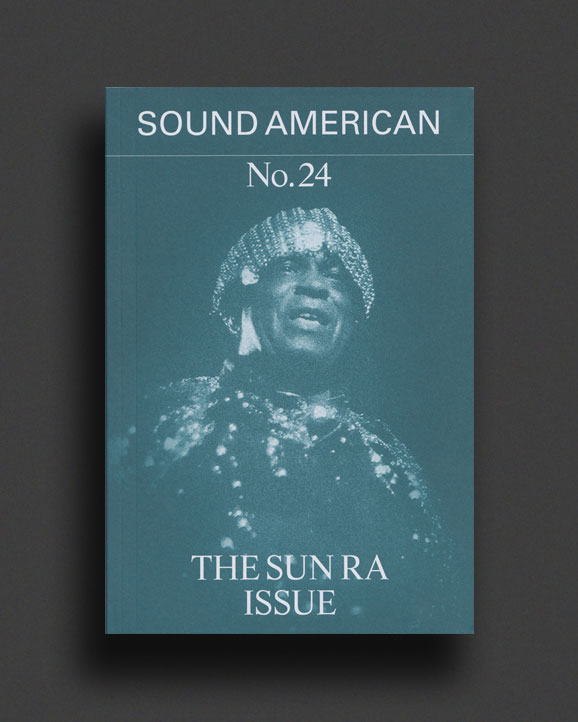
A quarterly journal founded in 2012 by Nate Wooley, providing in-depth interviews and essays, 'Sound American' starts from a simple desire to open the doors of experimental music to a wider audience. Their latest issue celebrates interstellar icon and generative force of nature, Sun Ra. Sun Ra (1914–1993) is an African-American experimental jazz pianist and composer. A prolific artist, he recorded over 100 albums with his band, the Sun Ra Arkestra.
Contributors include Taylor Ho Bynum, John Corbett, Naima Lowe, Luke Stewart with Thomas Stanley, and Ken Vandermark. The issue also features supplemental writing from Jessie Cox on Marshall Allen, Reg Bloor on Glenn Branca, Chris Pitsiokos on Miles Davis's On The Corner, Peter Margasak on Derek Bailey's On The Edge series, and a conversation between Audra Wolowiec and Freya Powell. The issue closes with the first exquisite corpse of the new season: a phenomenal text work by Camae Ayewa (Moor Mother).
2008, English
Softcover, 240 pages, 17 x 24 cm
1st Edition, Out of print title / used / good
Published by
Clouds / Auckland
$55.00 $15.00 - Out of stock
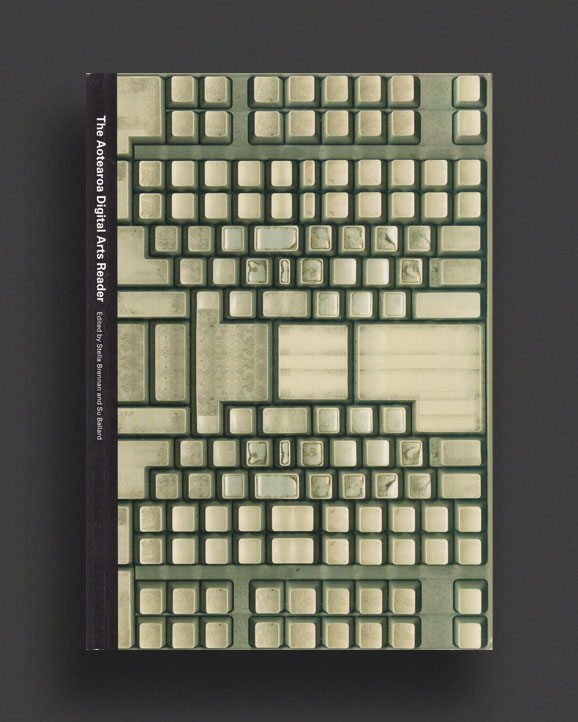
A comprehensive anthology, The Aotearoa Digital Arts Reader provides a snapshot of digital art practice in Aotearoa New Zealand. Editors Stella Brennan and Su Ballard present essays, artists' pageworks and personal accounts that explore the production and reception of digital art. Ranging from research into the preservation of digital artworks to the environmental impact of electronic culture, from discussions of lo-tech aesthetics to home gaming, and from sophisticated data mapping to pre-histories of new media, this book presents a screen grab of digital art in Aotearoa New Zealand.
All contributors are members of Aotearoa Digital Arts (ADA), New Zealand's only digital artists' network. With its mix of work by artists, theorists and educators, this reader represents some of the best new thinking about digital art practices in Aotearoa New Zealand, reflecting the politics of location, yet highly relevant to the wider contexts of digital media art and culture.
Edited by Stella Brennan and Su Ballard
Texts by Adam Hyde, Andrew Clifford, Caroline McCaw, Danny Butt, Douglas Bagnall, Eu Jin Chua, Helen Varley Jameison, Jacquie Clarke, Janine Randerson, Julian Oliver, Julian Priest, Karl D.D. Willis, Kurt Adams, Lissa Mitchell, Maree Mills, Melanie Swalwell, Morgan Oliver, Sally Jane Norman, Sean Cubitt & Bevin Yeatman, Stella Brennan, Stephen Cleland, Su Ballard, Trudy Lane & Ian Clothier, Vicki Smith & Adam Hyde, Zita Joyce
Published by Aotearoa Digital Arts and Clouds
1969, English / Swedish
Softcover, 640 pages, 26.8 x 21 cm
2nd Ed. ,
Out of print title / used / good
Published by
Moderna Museet / Stockholm
$640.00 - Out of stock
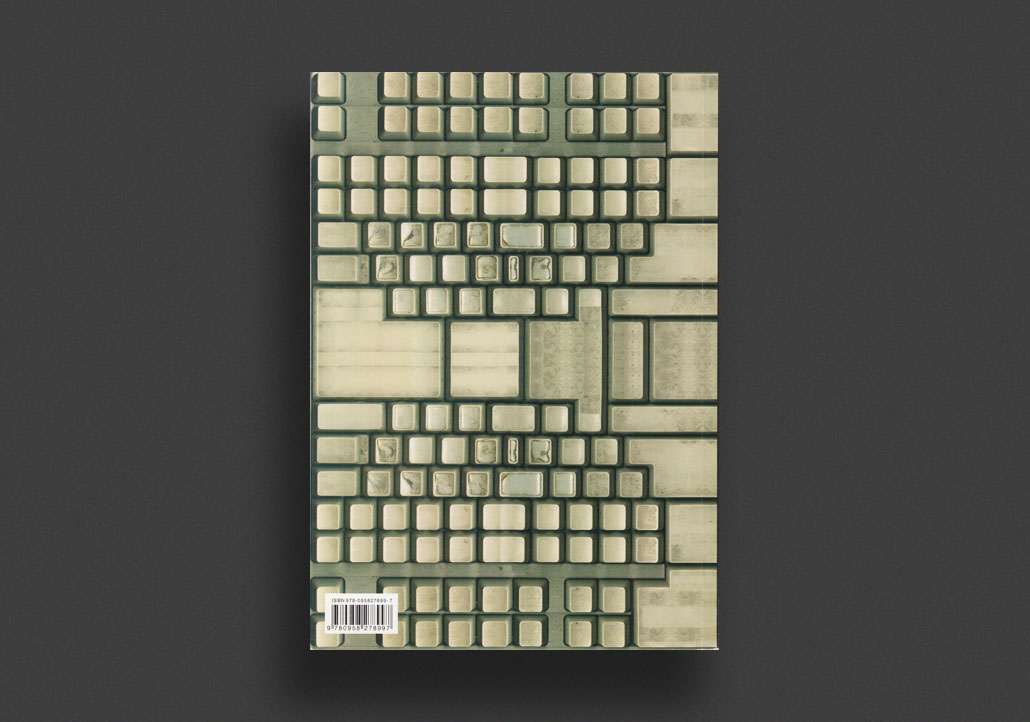
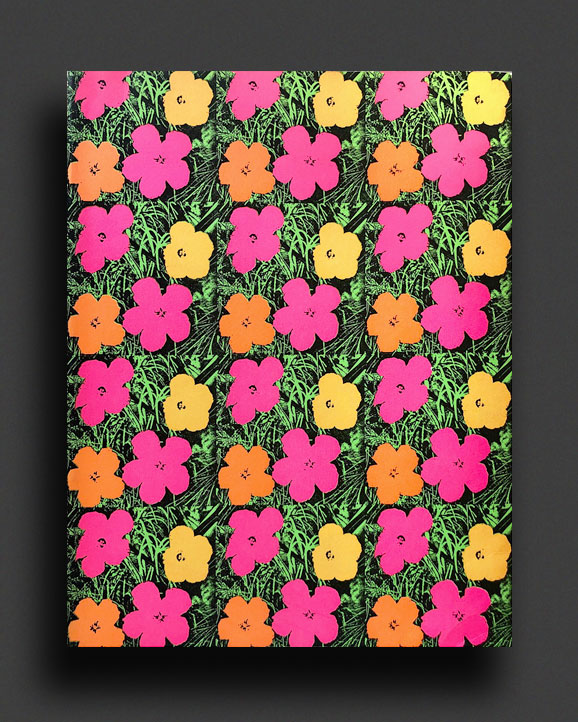
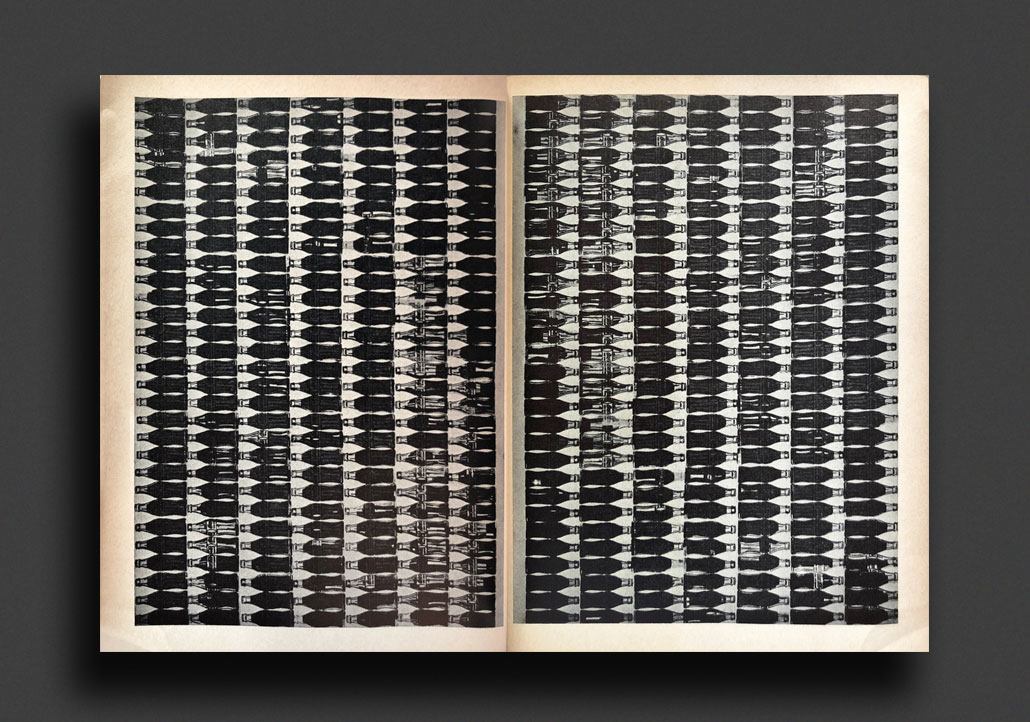
Still the best Warhol catalogue ever made, the very collectible and iconic Warhol photo book published to accompany his first European museum show "Andy Warhol" at the Moderna Museet, Stockholm, February - March, 1968, only three months before he was shot by Valerie Solanas. With virtually no text and adorned with Warhol's flower cover vividly printed in five spot colors, the concept of the catalogue was developed by the great German curator and museum director Kasper König, who commissioned Factory chronicler and inhabitant Billy Name, and a teenage Stephen Shore (!), to document Warhol's world and his co-conspirators living, working, and performing around his East 47th Street New York studio. Both Name and Shore composed rhythms of their own sequences, and neither of them added any captions: they felt the images should speak for themselves. This absence of text contributed to the object-status of the book. The result is one of the most historical photographic capsules of a pivotal time in the New York art scene of the late 1960s. Alongside hundreds of wonderful photographs from the studio, the film-sets, the Velvet Underground performances, the happenings, the road trips, the parties, including further photography by Rudy Burkhardt, Eric Pollitzer, and John Schiff, there are also selections of Warhol's artworks (where König's use of the xerox machine to reproduce Warhol's own work gives this catalogue its signature feel), and documentation of his exhibitions, including fantastic social imagery of the Moderna Museet proceedings not included in the first edition. The only text comes, fittingly, in the form of a series of introductory Warhol quotes and aphorisms.
Since Warhol himself had so much input into the production of this book, this catalogue-as-artist's-book-as-photobook can truly be considered a work of art in its own right. It quickly becoming a cult object, then a collector’s item.
Edited by Andy Warhol, Kasper König, Pontus Hultén, and Olle Granath.
This is the expanded 2nd edition, published in May 1969.
An excellent copy of a fragile book that is extremely prone to wear. Well preserved but with the common brittle binding issue from age and a bulky page count, with some loosening/disconnecting of sections from the spine glue. Much better than most copies out there! A tiny chip to the top back corner (spine corner), otherwise a very clean, presentable copy with only light corner wear and tanning to the newsprint.
2013, English
Softcover, 120 pages, 15 x 21cm
Published by
Fogo Islands Arts / Newfoundland
Sternberg Press / Berlin
$64.00 $10.00 - Out of stock
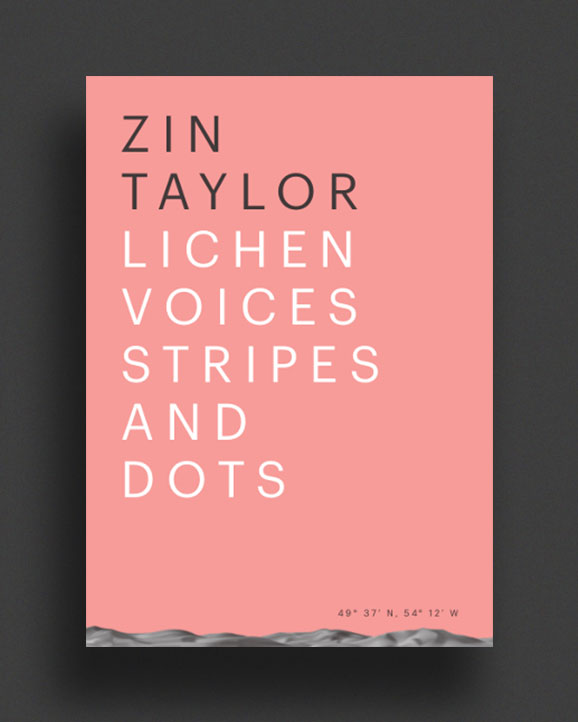
Writing is central to Zin Taylor’s practice. Parallel to a number of artist books, Taylor has made a series of sculptural works the artist proposes as a form of storytelling. How else to understand his project The Story of Stripes and Dots but to “read” the eponymous objects he makes to propel it forward? Taylor conceives of his sculptural components—stripes and dots in many variations—as words in a sentence, the articulation of which can be ongoing. By substituting objects for words, Taylor seeks not to assert equivalence between the two so much as establish the essentially spatialized perception he has of the way language functions. A striking clarity defines the artist’s vision. Taylor sees in language—in art—the highly defined dimensions of a world he can work within.
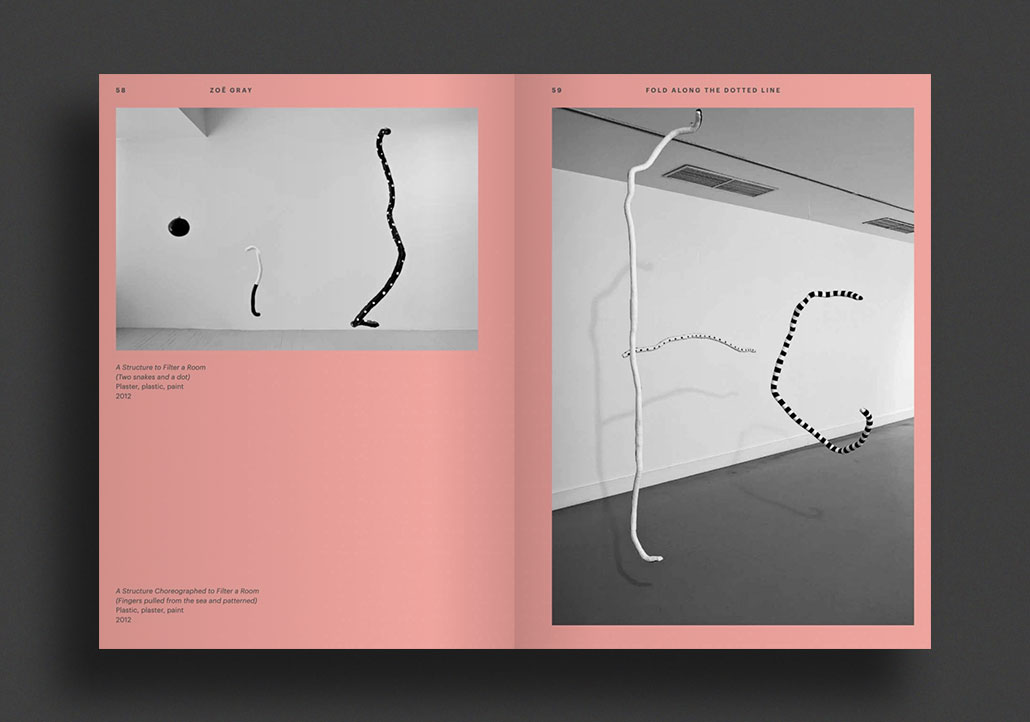
This catalogue accompanies Taylor’s exhibition “The Story of Stripes and Dots (Chapter 5)” at Fogo Island Gallery (September 27, 2013–March 23, 2014), which follows his two-part residency with Fogo Island Arts in 2010 and 2012. Featuring essays by Zoë Gray and Saelan Twerdy, and Taylor in conversation with Patrick Staff and Robin Simpson, the book also presents the artist’s portfolio An Index Describing the Individual 19 Thoughts about Stripes and Dots Arranged on a Vitrine Made of Brass and Glass.
Edited by ROSEMARY HEATHER, NICOLAUS SCHAFHAUSEN
Contributions by ZOË GRAY, ROBIN SIMPSON, PATRICK STAFF, SAELAN TWERDY
2017, English / French
Softcover, 268 pages, 25 x 18.9 cm
Published by
Sternberg Press / Berlin
CAC / Brétigny
$59.00 $10.00 - Out of stock
Contributions by Atelier Van Lieshout (AVL), Robert Breer, Daniel Buren, Maurizio Cattelan, Nicolas Chardon, Marie Cool Fabio Balducci, Lionel Estève, Esther Ferrer, Cyprien Gaillard, Jens Haaning, David Lamelas, François Laroche-Valière (Cie Studio Laroche-Valière), Mathieu Lehanneur, Teresa Margolles, Dominique Mathieu, Hans Walter Müller, Rainer Oldendorf, Roman Ondák, Christodoulos Panayiotou, Gianni Pettena, Pratchaya Phinthong, R&Sie(n) (François Roche, Stéphanie Lavaux, Jean Navarro), Matthieu Saladin, Gabriel Sierra, Santiago Sierra, Xavier Veilhan, VIER5, Annie Vigier & Franck Apertet (les gens d’Uterpan), Lois Weinberger
Organized by curator Pierre Bal-Blanc, the experimental architectural program “Project Phalanstère” consisted of a series of site-specific artworks in the Parisian suburbs. Taking place from 2003 to 2014, these projects developed a creative space extended in time. Here, in contrast with the duration of the work schedule, in which one task follows another, the simultaneity of life’s forces asserted its rhythm. Some works exceeded the conventional time and space of an exhibition: Lionel Estève’s myope et amnésique (2005), for example, was conceived to be larger than any one viewer can see; through the displacement of existing objects, both Cyprien Gaillard and Lois Weinberger reflected upon permanence and the monument; Christodolous Panayiotou and Jens Hanning made subtle alterations to existing architecture, playing with the material presence and experience of light; and so on.
This book proposes to adopt a new syntax. It does not simply call for a renewal of the terminology used in the field of contemporary art programming. Its syntax has taken shape by progressively building on the complex materiality of artworks in a specific context—an art center located in the Parisian suburbs—and not by contriving itself with the help of words and discourses uttered from an abstract perspective. The political aims of “Project Phalanstère” appear in the ungrammatical formulas that the works articulate and in the active resistance that they manifest against a normative authority that, although it accepts the play of words, continues to enforce the disciplinary activity of arts administration. Over one hundred pages of images of the installed works opens the volume, followed by the individual artworks according to a score that denotes use, nature, and location, annotated to place each work within a larger cultural context. A comprehensive timeline of the exhibitions concludes the volume.
Copublished with CAC Brétigny and Work Method, Paris
Design by VIER5
2019, English
Paperback, 88 pages, 17 x 23.5 cm
Published by
Koenig Books / London
Moderna Museet / Stockholm
$76.00 - Out of stock
In 1996, Sharon Hayes undertook her Lesbian Love Tour, during which she visited and photographed 45 "lesbian living rooms" in nearly as many cities. Hayes is interested in how political goals or desires can be manifested in concrete terms and, starting from individuals or smaller groups, can grow into larger movements. The trained journalist and anthropologist is currently one of the most influential politically and socially committed artists of the United States.
The exhibition, Echo at Moderna Museet, Stockholm, explores the gallery space as an echo chamber: with voices and materials reverberating between different historic events. It also references a feminist interpretation of the classical myth of Echo, the nymph who is cursed for her conversational skills. She is condemned to only repeat fragments said by others, sounds devoid of meaning.
The echo resonates as both material and form throughout the work, including a new work made for the exhibition as part of the artist’s ongoing Ricerche project, made in dialogue with Comizi d’amore (1965), Pier Paolo Pasolini’s interview on sex and relations.
Hayes video piece, Symbionese Liberation Army (SLA) (2003), is one example of what the artists calls anachronisms – where an unresolved issue or conflict from the past is approached from a different moment in time. In this instance Hayes reads messages to a live audience from the kidnapped Patty Hearst to her parents that were aired on the radio in 1974.
Other ‘oral translations’ of texts and acts of speech by Hayes are replicated in the gallery for a contemporary audience.
Published on the occasion of the exhibition, Sharon Hayes: Echo at Moderna Museet, Stockholm (13 April – 11 August 2019).
Co-published by Moderna Museet and Koenig Books.
English and Swedish text.
English, 2020
Softcover, 336 pages, 23.5 x 16 cm
Published by
Duke University Press / North Carolina
$59.00 - In stock -
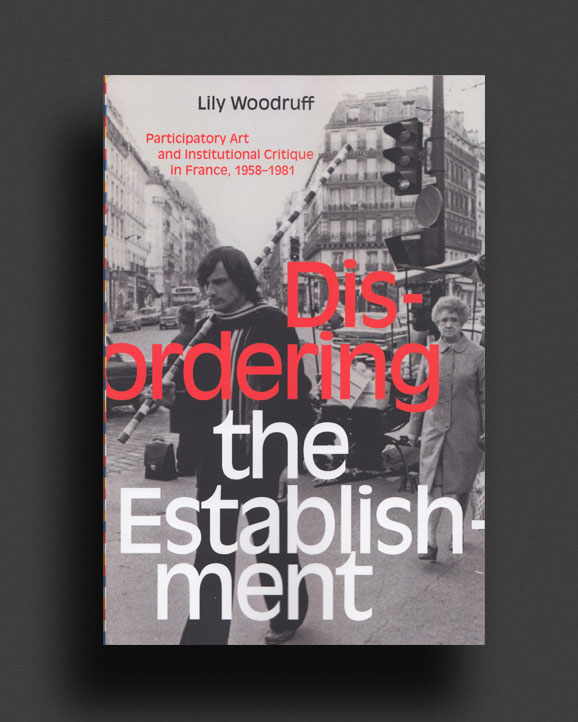
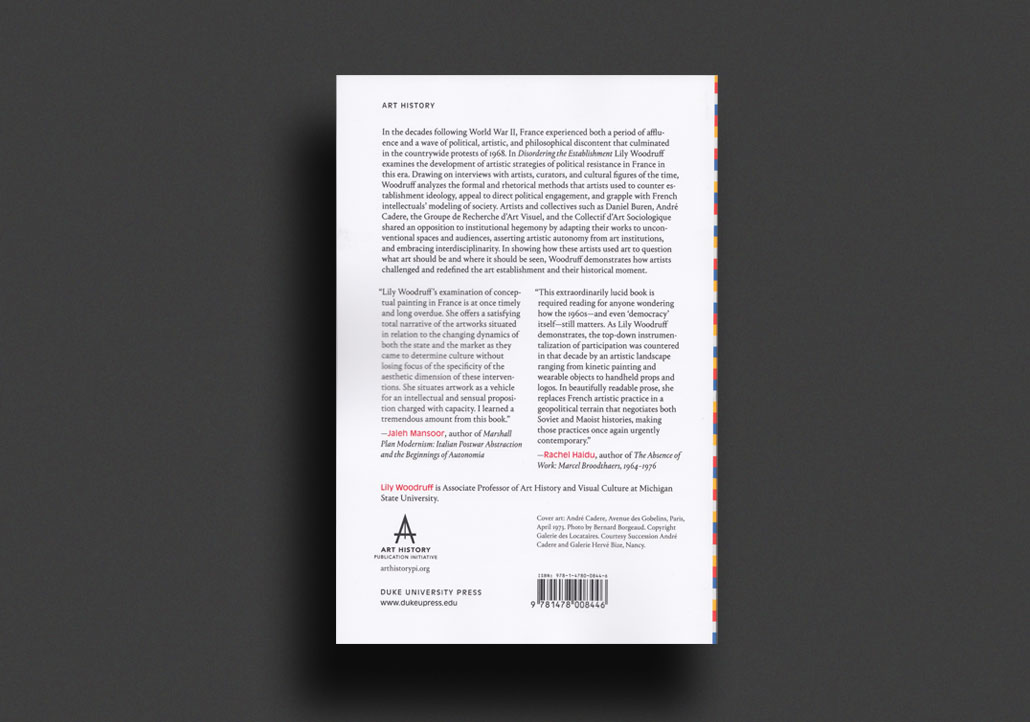
In the decades following World War II, France experienced both a period of affluence and a wave of political, artistic, and philosophical discontent that culminated in the countrywide protests of 1968. In Disordering the Establishment Lily Woodruff examines the development of artistic strategies of political resistance in France in this era. Drawing on interviews with artists, curators, and cultural figures of the time, Woodruff analyzes the formal and rhetorical methods that artists used to counter establishment ideology, appeal to direct political engagement, and grapple with French intellectuals' modeling of society. Artists and collectives such as Daniel Buren, André Cadere, the Groupe de Recherche d’Art Visuel, and the Collectif d’Art Sociologique shared an opposition to institutional hegemony by adapting their works to unconventional spaces and audiences, asserting artistic autonomy from art institutions, and embracing interdisciplinarity. In showing how these artists used art to question what art should be and where it should be seen, Woodruff demonstrates how artists challenged and redefined the art establishment and their historical moment.
“Lily Woodruff's examination of conceptual painting in France is at once timely and long overdue. She offers a satisfying total narrative of the artworks situated in relation to the changing dynamics of both the state and the market as they came to determine culture without losing focus of the specificity of the aesthetic dimension of these interventions. She situates artwork as a vehicle for an intellectual and sensual proposition charged with capacity. I learned a tremendous amount from this book.” — Jaleh Mansoor, author of Marshall Plan Modernism: Italian Postwar Abstraction and the Beginnings of Autonomia
“This extraordinarily lucid book is required reading for anyone wondering how the 1960s—and even ‘democracy’ itself—still matters. As Lily Woodruff demonstrates, the top-down instrumentalization of participation was countered in that decade by an artistic landscape ranging from kinetic painting and wearable objects to handheld props and logos. In beautifully readable prose, she replaces French artistic practice in a geopolitical terrain that negotiates both Soviet and Maoist histories, making those practices once again urgently contemporary.” — Rachel Haidu, author of The Absence of Work: Marcel Broodthaers, 1964–1976
2020, English
Softcover, 150 pages, 21 x 29.7
Ed. of 100,
Published by
Endless Lonely Planet / Melbourne
$25.00 - In stock -
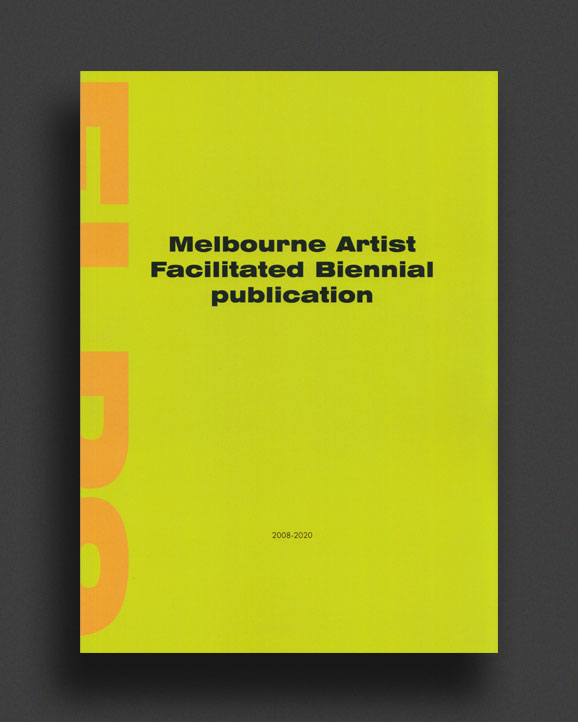
Melbourne Artist Facilitated Biennial publication by Melbourne artist Christopher LG Hill is both the ninth issue of his ongoing publishing imprint Endless Lonely Planet, and a major survey art book marking the end of his 12 year artist facilitated biennale project, spanning 2008-2020.
"Multiple sites and moments, artist facilitated biennials extending on structures and limitations set by Signs of life: Melbourne International Biennial 1999. Abstracting and bringing new meaning to the form of a biennial as a more casual and independent entity, the project has seen many participants and collaborators over the last 12 years. This book hopes to document some of these moments, but more so to be a catalyst for different modes and models that it may inspire." — publisher
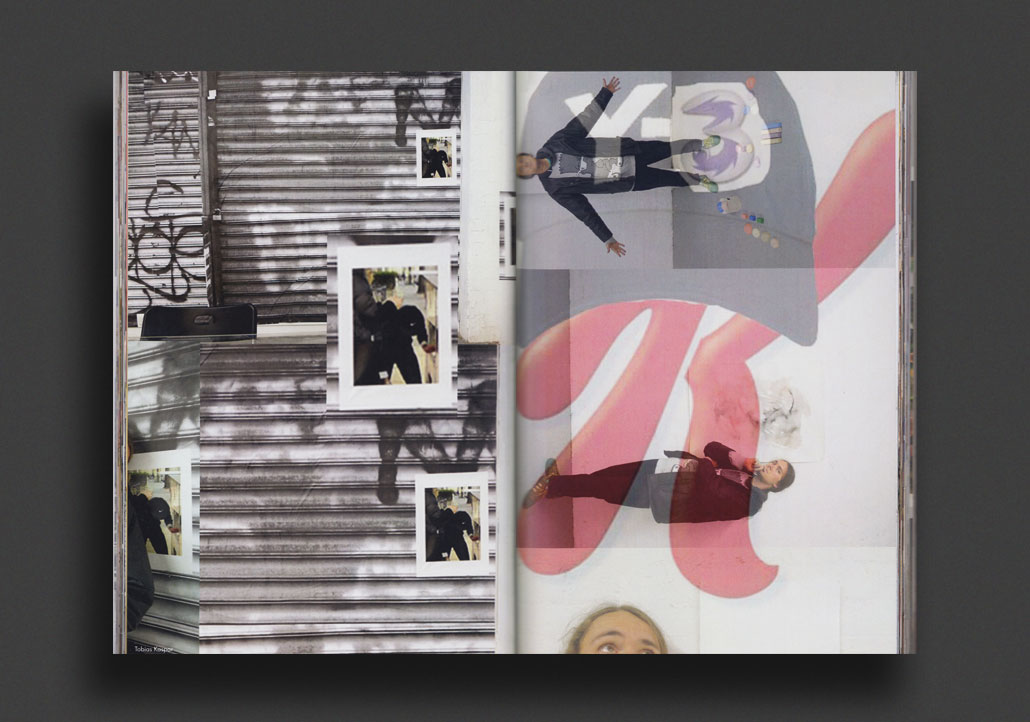
Includes extensive photographic documentation of The (self initiated, Artist funded) second (fourth) Y2K Melbourne Biennial of Art (& Design), TCB art inc., 2008; The First & Final Y3K Second (third) Inaugural Melbourne Biennial of International Arts, Y3K, 2011 (curated by Joshua Petherick, James Deutsher, and Christopher L G Hill); Third/Fourth Melbourne Biennial, Margaret Lawrence Gallery, 2013; 4th/5th Melbourne Artist Facilitated Biennial, TarraWarra Museum of Art, 2016 (as part of TarraWarra Biennial 2016: Endless Circulation curated by Victoria Lynn and Helen Hughes/Discipline); 5th/6th final Melbourne Artist Facilitated Biennial, Dec 2018 -Dec 2020 (co-facilitated by Virginia Overell and Christopher L G Hill in their apartment/ the ex-Telecom building that was the site of the Melbourne International Biennial 1999)
Includes the work of ACW, Liz Allen, Animal Charm, Dan Arps, Sean Bailey, Liv Barrett, Matthew Brown, Ruth Buchannan, Jon Campbell, Jane Caught, Xin Cheng, Fiona Connor, Ying Lan Dann, James Deutsher, Daniel du Bern, Ida Ekblad, ffiXXed, Pat Foster & Jen Berean, Justin K Fuller, Matt Griffin, Ardi Gunawan, Hao Guo, Bianca Hester, Christopher L G Hill, Matt Hinkley, Helen Johnson, Lisa Kelly, Devin Kenny, Taree Mackenzie, Simon McGlinn, Rob Mckenzie, Nick Mangan, Scott Mitchell, Tahi Moore, Kate Newby, Geoff Newton, John Nixon, OSW, Alexander Ouchtomsky, Damon Packard, Spiros Panigriakis, Sean Peoples/ Cheese Peoples, Joshua Petherick, Kain Picken, Janneke Raaphorst, Nick Selenitsch, Christopher Schueler & Matthew Hopkins, Gregory P Sharp, Kate Smith, Sriwhana Spong, Dylan Statham, Masato Takasaka, Ben Tankard, Simon Taylor, Alex Vivian, Annie Wu, Hany Armanious, Andreas Banderas, Mikala Dwyer, Katherine Huang, Tobias Kaspar, Piotr Łakomy, Taree Mackenzie, Tahi Moore, Michael O’Connell, Ester Partegas, Natalie Rognsoy, John Spiteri, Dan Arps, Sean Bailey, Olivia Barrett, Matthew Benjamin, Jon Campbell, Trevelyan Clay, Fiona Connor and Michala Paludan, James Deutsher, DoubleFly, George Egerton-Warburton, Endless Lonely Planet, ffiXXed, Alicia Frankovich, Justin K Fuller, Marco Fusinato, Greatest Hits, Ardi Gunawan, Hao Guo, Christopher L G Hill, Matt Hinkley, David Homewood, Matthew Hopkins, Lou Hubbard, Renee Jaeger, Helen Johnson, Kenneth Biennale (curated by Kenny Pittock and Amy May Stuart: Chris Clarke, Christo Crocker, Christina Hayes, Chris L G Hill, Christine Pittock, Christopher Sciuto), Legendary Hearts (Kieran Hegarty and Andrew Cowie), S.T. Lore, Patrick Lundberg, Carrie McGrath, Rob McKenzie, Taree McKenzie, Nick Mangan, Gian Manik, Kate Meakin, Adelle Mills, Tahi Moore, Kate Newby, Elizabeth Newman, Virginia Overell, Sean Peoples, Joshua Petherick, Kain Picken, Lisa Radford and Sam George, Nick Selenitsch, Kate Smith, Studio Masatotectures, Sydney (Esther Edquist), Masato Takasaka and Madeline Kidd, Ben Tankard, Alex Vivian, Nicki Wynnychuk, y3k, Lauren Burrow, Counterfeitnessfirst, James Deutsher, Laurel Doody, George Egerton-Warburton, ELP3 Vine, Endless Lonely Planet, Lewis Fidock, Aurelia Guo, Christopher L G Hill, Lou Hubbard, Lucina Lane, Kate Meakin, Tahi Moore, Elizabeth Newman, Liam Osborne, Virginia Overell, Joshua Petherick, Lisa Radford, Zac Segbedzi, Nick Selenitsch, Nicholas Tammens, Alex Vivian, Rudi Williams, Gavin Bell, Jarrah de Kuijer and Simon McGlinn, Candida ((Gian Manik and Ricarda Bigolin) in collaboration with Agnieszka Chabros, Samuel Heatley and Jaala Jensen), Xin Cheng, Fiona Connor, Renee Cosgrave, Christo Crocker, Ying Lan Dann, Endless Lonely Planet, Richard Frater, Aurelia Guo, HB Peace, Hoggle, Lou Hubbard, Olivia Koh, Spencer Lai, Laurel Doody Library Supply, Patrick Lundberg, Kate Meakin, Olivia O’Donnell, Jason Willers, and more...
More info at http://www.christopherlghill.com