World Food Books' programme is largely produced on Kulin Nation land. We acknowledge the Wurundjeri people of the Kulin Nation as the first and continuing custodians of this land, and pay respect to their Elders past, present, and emerging.
World Food Books is an arts and special interests bookshop in Naarm / Melbourne. Founded in 2010, World Food Books is devoted to the presentation of a rotating, hand-selection of international art, design, literary and counterculture publications with an emphasis on the anti-traditional, the experimental, the avant-garde, the heretic, the marginal.
Presenting new titles alongside rare and out-of-print books, catalogues and journals spanning the fields of modern and contemporary art, design, photography, illustration, film, literature, poetry, cultural theory, philosophy, sexuality, popular and underground culture in its many radical forms, World Food Books wishes to encourage adventurous, thoughtful and open-minded reading, looking, writing, and exchange of publishing and ideas, both current and historical.
As well as our bookshop, located in Melbourne's historical Nicholas Building, all of our inventory is available internationally via our online mail-order service.
World Food Books semi-regularly co-ordinates "Occasions", a programme of exhibits and events at the bookshop and in partnership with other hosts (such as museums and art galleries) that develop out of the activities, relationships and content of the bookshop itself.
World Food Books
The Nicholas Building
37 Swanston Street
Room 5, Level 6
Melbourne 3000
Australia
SHOP HOURS:
THU–SAT 12–6
WEB-SHOP OPEN 24/7
World Food Books
Postal Address:
PO Box 435
Flinders Lane
Victoria 8009
Australia
info@worldfoodbooks.com
Art
Theory / Essay
Architecture / Interior
Graphic Design / Typography
Photography
Fashion
Eros
LGBTQ+
Fiction / Poetry
Weird / Speculative / Science Fiction / Horror
Transgressive / Visceral / Abject
Symbolism / Decadence / Fin de siècle
Film / Video
Painting
Sculpture / Installation
Performance / Dance / Theater
Drawing
Sound / Music
Curatorial
Group Shows / Collections
Periodicals
Out-of-print / Rare
Posters / Ephemera / Discs
Signed Books
World Food Books Gift Voucher
World Food Book Bag
Australian Art
Australian Fiction
Australian Science Fiction / Speculative Fiction
Australian Poetry
Australian Photography
Japanese Photography
Conceptual Art
Minimal Art
Dada
'Pataphysics / Oulipo
Fluxus
Concrete Poetry
Pop Art
Surrealism
Arte Povera
Arte Informale / Haute Pâte / Tachism
Nouveau Réalisme / Zero / Kinetic
Situationism / Lettrism
Collage / Mail Art / Xerox Art
Art Brut / Folk / Visionary / Fantastic
Illustration / Graphic Art / Bandes Dessinées
Furniture
Italian Radical Design / Postmodernism
Textiles
Ceramics / Glass
Counterculture
Protest / Revolt
Philosophy
Psychoanalysis
Anthropology
Anarchism
Socialism / Anarchism / Communism / Capitalism
Literary Theory / Semiotics / Language
Feminism / Women's Studies
Gender Studies / Sexuality
Anthropology
Fetishism / BDSM
Drugs / Psychedelia
Crime / Violence
Animal Rights / Veganism
Occult / Esoterica
Ecology / Earth / Alternative Living
Whole Earth / Crafts
All prices in AUD (Australian dollars)
Pick-Ups
Pick-up orders can be collected in our bookshop during opening hours after order date. Please collect any Pick-up orders within 2 weeks of ordering as we have limited storage space. Orders will be released back into stock if not collected within this time. No refunds can be made for pick-ups left un-collected. If you cannot make it in to the bookshop in this time-frame, please choose postage option.
Return Policy
All sales are final. We do accept returns (for refund or exchange) for items received in error. All our orders are packed with special care using heavy-duty padding and cardboard book-mailers or bubble mailers (for smaller books), using reinforcement where required. We cannot take responsibility for any lost, stolen or damaged parcels.
Insurance
Should you wish to insure your package, please email us directly after placing your order and we can organise this at a small extra expense. Although all standard/express tracked packages are very safe and dependable, we cannot take responsibility for any lost, stolen or damaged parcels. We recommend insurance on valuable orders.
Interested in selling your old books, catalogues, journals, magazines, comics, fanzines, ephemera? We are always looking for interesting, unusual and out-of-print books to buy. We only buy books in our fields of interest and specialty, and that we feel we can resell.
We base these prices on desirability, market value, in-print prices, condition and our current stock levels. We offer cash, store credit, and can take stock on consignment. All
about 25% of the price we expect to get when we sell them, or 30% in store credit. We base these prices on desirability, market value, in-print prices, condition and our current stock levels.
Sell your books any day of the week. You can drop them off and return later. If you have a lot of books, we can visit your Sydney home.
We buy books that we feel we can resell. We offer about 25 % of the price we expect to get when we sell them, or 30% in store credit. We base these prices on desirability, market value, in-print prices, condition and our current stock levels.
Philadelphia Wireman
03 August - 01 September, 2018
World Food Books is proud to announce our next Occasion, the first presentation of sculptures by Philadelphia Wireman in Australia.
The Philadelphia Wireman sculptures were found abandoned in an alley off Philadelphia’s South Street on trash night in 1982. Their discovery in a rapidly-changing neighbourhood undergoing extensive renovation, compounded with the failure of all attempts to locate the artist, suggests that the works may have been discarded after the maker’s death. Dubbed the "Philadelphia Wireman" during the first exhibition of this work, in 1985, the maker’s name, age, ethnicity, and even gender remain uncertain. The entire collection totals approximately 1200 pieces, all intricately bound together with tightly-wound heavy-gauge wire (along with a few small, abstract marker drawings, reminiscent both of Mark Tobey and J.B. Murry). The dense construction of the work, despite a modest range of scale and materials, is singularly obsessive and disciplined in design: a wire armature or exoskeleton firmly binds a bricolage of found objects including plastic, glass, food packaging, umbrella parts, tape, rubber, batteries, pens, leather, reflectors, nuts and bolts, nails, foil, coins, toys, watches, eyeglasses, tools, and jewellery.
Heavy with associations—anthropomorphic, zoomorphic, and socio-cultural responses to wrapped detritus—the totemic sculptures by Philadelphia Wireman have been discussed in the context of work created to fulfil the shamanistic needs of alternative religions in American culture. Curators, collectors, and critics have variously compared certain pieces to sculpture from Classical antiquity, Native American medicine bundles, African-American memory jugs, and African fetish objects. Reflecting the artist’s prolific and incredibly focused scavenging impulse, and despite—or perhaps enhanced by—their anonymity, these enigmatic objects function as urban artefacts and arbiters of power, though their origin and purpose is unknown. Philadelphia Wireman, whatever their identity, possessed an astonishing ability to isolate and communicate the concepts of power and energy through the selection and transformation of ordinary materials. Over the course of the past two decades, this collection has come to be regarded as an important discovery in the field of self-taught art and vernacular art.
Presented in collaboration with Fleisher-Ollman Gallery, Philadelphia, and Robert Heald, Wellington.
Susan Te Kahurangi King
02 February - 10 March, 2018
Susan Te Kahurangi King (24 February 1951 - ) has been a confident and prolific artist since she was a young child, drawing with readily available materials - pencils, ballpoint pens and felt-tip markers, on whatever paper is at hand. Between the ages of four and six Susan slowly ceased verbal communication. Her grandparents William and Myrtle Murphy had developed a special bond with Susan so they took on caring responsibilities for extended periods. Myrtle began informally archiving her work, carefully collecting and storing the drawings and compiling scrapbooks. No drawing was insignificant; every scrap of paper was kept. The King family are now the custodians of a vast collection containing over 7000 individual works, from tiny scraps of paper through to 5 meter long rolls.
The scrapbooks and diaries reveal Myrtle to be a woman of great patience and compassion, seeking to understand a child who was not always behaving as expected. She encouraged Susan to be observant, to explore her environment and absorb all the sights and sounds. Myrtle would show Susan’s drawings to friends and people in her community that she had dealings with, such as shopkeepers and postal workers, but this was not simply a case of a grandmother’s bias. She recognised that Susan had developed a sophisticated and unique visual language and sincerely believed that her art deserved serious attention.
This was an unorthodox attitude for the time. To provide some context, Jean Dubuffet coined the term Art Brut in 1945 to describe work created by self-taught artists – specifically residents of psychiatric institutions and those he considered to be visionaries or eccentrics. In 1972 Roger Cardinal extended this concept by adopting the term Outsider Art to describe work made by non-academically trained artists operating outside of mainstream art networks through choice or circumstance. Susan was born in Te Aroha, New Zealand in 1951, far from the artistic hubs of Paris and London that Dubuffet and Cardinal operated in. That Myrtle fêted Susan as a self-taught artist who deserved to be taken seriously shows how progressive her attitudes were.
Susan’s parents Doug and Dawn were also progressive. Over the years they had consulted numerous health practitioners about Susan’s condition, as the medical establishment could not provide an explanation as to why she had lapsed into silence. Dawn educated herself in the field of homeopathy and went on to treat all twelve of her children using these principles – basing prescriptions on her observations of their physical, mental and emotional state.
Doug was a linguist with an interest in philosophy who devoted what little spare time he had to studying Maori language and culture. To some extent their willingness to explore the fringes of the mainstream made them outsiders too but it was their commitment to living with integrity and their respect for individuality that ensured Susan’s creativity was always encouraged.
Even though Susan’s family supported her artistic pursuits, some staff in schools and hospitals saw it as an impediment to her assimilation into the community and discouraged it in a variety of ways. Her family was not always aware of this and therefore did not fully understand why Susan stopped drawing in the early 1990s. However, rather than dwell on the challenges that Susan faced in pursuit of her artistic practice, they prefer to highlight her achievements. In 2008 Susan began drawing again in earnest, after an almost 20 year interruption, and her work is now shown in galleries around the world.
Susan grew up without television and has been heavily influenced by the comics she read as a child. She is absolutely fearless in the appropriation of recognizable characters, such as Donald Duck and Mickey Mouse, in her work. She twists their limbs, contorts their faces, compresses them together, blends them into complex patterned backgrounds - always imbuing them with an incredible energy. Although Susan often used pop culture characters in her work they are not naive or childlike. These are drawings by a brilliant self-taught artist who has been creating exceptional work for decades without an audience in mind.
Mladen Stilinović
"Various Works 1986 - 1999"
02 February 16 - September 10, 2016
Various works 1986 - 1999, from two houses, from the collections of John Nixon, Sue Cramer, Kerrie Poliness, Peter Haffenden and Phoebe Haffenden.
Including: Geometry of Cakes (various shelves), 1993; Poor People’s Law (black and white plate), 1993; White Absence (glasses, ruler, set square, silver spoon, silver ladel with skin photograph and wooden cubes), 1990-1996; Exploitation of the Dead (grey and red star painting, wooden painting, black spoon with red table, red plate), 1984-1990; Money and Zeros (zero tie, paintings made for friends in Australia (Sue, John, Kerrie), numbers painting), 1991-1992; Words - Slogans (various t-shirts) - “they talk about the death of art...help! someone is trying to kill me”, “my sweet little lamb”, “work is a disease - Karl Marx”; Various artist books, catalogues, monographs, videos; Poster from exhibition Insulting Anarchy; "Circular" Croatian - Australian edition; Artist book by Vlado Martek (Dostoyevsky); more.
Thanks to Mladen Stilinović and Branka Stipančić.
Jonathan Walker
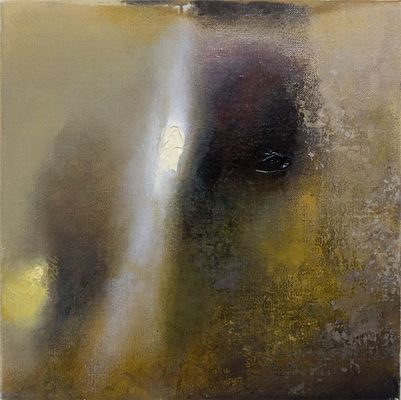
Always Will Need To Wear Winter Shirt Blue + Ochre Small Check Pattern
21 August - 21 September, 2015
Untitled
I am not a great reader of poetry but I always return to the work of Melbourne poet, Vincent Buckley (1925- 1988). Perhaps I find his most tantalising piece to be not a finished poem but a fragment left on a scrap of paper discovered on his desk after the poet’s death.
The poetry gathers like oil
In the word-core, and spreads
It has its music meet,
Its music is in movement.
This fragment is more the shell left behind from a volatile thought than a finished poem. I find the last two lines honest but awkward whereas the first two lines work like an arrow. Most likely he could not find a resolution so it was left. Still, in its present form, it remains an eloquent testimony to the ultimate failure of a medium to express mobile thought and sensation, in Buckley’s case, through verbal language. It’s an important matter because this is something all artists have to deal with regardless of the medium.
I have never written a poem, however, I am forever copying fragments from books on paper scraps in a vain effort to fix certain notions in my head. At first, they function as bookmarks that are sometimes returned to when I open the book. But before long, as they accumulate, they fall out littering the table interspersed with A4 photocopies, bills, books and medications.
To return to Buckley’s fragment, the first two lines very much evoke how I paint nowadays. As you age, detail diminishes and patches of light become more luminous and float. I feel the most honest way of dealing with this is by smearing the oil paint on the canvas with the fingers and working close-up, blind. Only if the patches coalesce into an approaching image can the work gain a life.
-
Jonathan Walker was born in Melbourne, Australia and brought up on a dairy farm in Gippsland. In the 1970’s he studied painting at RMIT and won the Harold Wright Scholarship to the British Museum, London. During the 1980’s he exhibited at Pinacotheca Gallery, Richmond and had work shown at the NGV and Heidi City Art Gallery. Over the same period he designed the cover for the “Epigenesi” LP by Giancarlo Toniutti, Italy and conducted a mail exchange work with Achim Wollscheid, Germany. The work with artists through the post resulted in an article published in the bicentenary issue of Art and Australia 1988. He showed in artist run spaces such as WestSpace in the 90’s and 2000’s, and until 2012, taught painting at Victoria University, which is where we (Colleen Ahern and Lisa Radford) as organisers of the exhibition, among many others, had the privilege of being his student.
Walker’s knowledge was imparted to students through the careful selection of music, literature, and artists found in books that he himself had ordered for the library. Walker’s strategy was the generosity of sharing his vast knowledge with references specific to each student and their context.
Walker’s paintings share a similar focus and intimacy.
This exhibition presents a small selection of recent paintings alongside a publication that includes Walker’s writing. Observational and analytical, Walker’s work is a type of material notation — the time of day, colour and how it is blended, the both specific and fleeting location of a reflection on lino or the question of whether a chair leg should be included in a painting.
Please join us on Friday August 21 between 6-8pm to celebrate the opening of the exhibition.
Curated by Colleen Ahern and Lisa Radford.
B. Wurtz
Curated by Nic Tammens
March 26 - April 4, 2015
B.Wurtz works from a basement studio in his home on Manhattan’s Lower East Side.
This local fact is attested to by the plastic shopping bags and newsprint circulars that appear in his work. As formal objects, they don’t make loud claims about their origins but nonetheless transmit street addresses and places of business from the bottom of this long thin island. Like plenty of artists, Wurtz is affected by what is local and what is consumed. His work is underpinned by this ethic. It often speaks from a neighborhood or reads like the contents of a hamper:
“BLACK PLUMS $1.29 lb.”
“Food Bazaar”
“USDA Whole Pork Shoulder Picnic 99c lb.”
“RITE AID Pharmacy, with us it’s personal.”
“H. Brickman & Sons.”
“Sweet Yams 59c lb."
Most of the work in this exhibition was made while the artist was in residence at Dieu Donne, a workshop dedicated to paper craft in Midtown. Here Wurtz fabricated assemblages with paper and objects that are relatively lightweight, with the intention that they would be easily transportable to Australia. This consideration isn’t absolute in Wurtz’s work, but was prescriptive for making the current exhibition light and cheap. Packed in two boxes, these works were sent from a USPS post office on the Lower East Side and delivered to North Melbourne by Australia Post.
Wurtz appears courtesy of Metro Pictures, New York.
Thanks to Rob Halverson, Joshua Petherick, Sari de Mallory, Matt Hinkley, Helen Johnson, Fayen d'Evie, Ask Kilmartin, Lisa Radon, Ellena Savage, Yale Union, and "Elizabeth".
John Nixon
"Archive"
December 15 - January 20, 2014
The presentation of John Nixon's archive offered a rare showcase of this extensive collection of the artist's own publications, catalogues, posters, ephemera, editions and more, from the mid 1980s onwards, alongside a selection of his artworks.
Organized by John Nixon, Joshua Petherick and Matt Hinkley.
"Habitat"
at Minerva, Sydney (organised by Joshua Petherick and Matt Hinkley)
November 15 - December 20, 2014
Lupo Borgonovo, Janet Burchill & Jennifer McCamley,
Lewis Fidock, HR Giger, Piero Gilardi, Veit Laurent Kurz,
Cinzia Ruggeri, Michael E. Smith, Lucie Stahl, Daniel Weil, Wols
Press Release:
“...It contained seven objects. The slender fluted bone, surely formed for flight, surely from the wing of some large bird. Three archaic circuitboards, faced with mazes of gold. A smooth white sphere of baked clay. An age-blackened fragment of lace. A fingerlength segment of what she assumed was bone from a human wrist, grayish white, inset smoothly with the silicon shaft of a small instrument that must once have ridden flush with the surface of the skin - but the thing’s face was seared and blackened.”
William Gibson, “Count Zero”, 1986
"Autumn Projects Archive"
Curated by Liza Vasiliou
March 6 - March 15, 2014
World Food Books, in conjunction with the Virgin Australia Melbourne Fashion Festival 2014, presented the Autumn Projects archive, consisting of a selection of early examples in Australian fashion with a particular interest in collecting designers and labels from the period beginning in the 1980’s, who significantly influenced the discourse of Australian Fashion.
Curated by Liza Vasiliou, the exhibition provided a unique opportunity to view pieces by designers Anthea Crawford, Barbara Vandenberg, Geoff Liddell and labels CR Australia, Covers, Jag along with early experimental collage pieces by Prue Acton and Sally Browne’s ‘Fragments’ collection, suspended throughout the functioning World Food Books shop in Melbourne.
H.B. Peace
presented by CENTRE FOR STYLE
November 14, 2013
"Hey Blinky, you say chic, I say same"
Anon 2013
H.B. Peace is a clothing collaboration between great friends Blake Barns and Hugh Egan Westland. Their pieces explore the divergences between 'character’ and ‘personality’ in garments....etc
Special Thanks to Joshua Petherick and Matt Hinkley of WFB and Gillian Mears
and a Very Special Thank you to Audrey Thomas Hayes for her shoe collaboration.
Janet Burchill & Jennifer McCamley
"Aesthetic Suicide"
May 10 - June 8, 2013
The first of our occasional exhibitions in the World Food Books office/shop space in Melbourne, "Aesthetic Suicide" presented a body of new and older works together by artists Janet Burchill & Jennifer McCamley, including videos, prints, a wall work, and publications.
During shop open hours videos played every hour, on the hour.
2022, English
Softcover, 456 pages, 16.8 x 23.1 cm
Published by
Karma / New York
$52.00 - Out of stock
Conversations with leading women artists, composers and writers from Judy Chicago, Anohni and Lynne Tillman to Ellie Ga, Tauba Auerbach and Renee Green.
This massive volume comprises over 80 interviews published across a 13-year span of Lauren O’Neill-Butler’s career as a writer, educator, editor and cofounder of November magazine. The majority of the interviews first appeared on Artforum.com’s interviews column, which O’Neill-Butler edited for 11 years. The book is divided into two sections, “Q&A” and “As Told To”—the first comprising interviews in a traditional format and the second recast by O’Neill-Butler in the interviewee’s voice.
Interviewees include: Judy Chicago, Shannon Ebner, Carolee Schneemann, Lucy R. Lippard, Joan Semmel, Liz Deschenes, Eleanor Antin, Andrea Fraser, Anohni, Claudia Rankine, Lorrie Moore, Adrian Piper, fierce pussy, Nan Goldin, Nell Painter, Frances Stark, Sara Greenberger Rafferty, Alex Bag, Agnès Varda, Lisi Raskin, Mary Mattingly, Carol Bove, Jennifer West, Aki Sasamoto, Mary Ellen Carroll, Rebecca Solnit, Rita McBride and Kim Schoenstadt, Karla Black, Julia Bryan-Wilson, Lynda Benglis, Sturtevant, Rachel Foullon, Ellie Ga, Lisa Tan, Mira Schor, Jo Baer, Ruby Sky Stiler, Suzanne Lacy, Rebecca Warren, Katy Siegel, Marlene McCarty, Rachel Mason, Mary Kelly, Dianna Molzan, Lynne Tillman, Polly Apfelbaum, Jesse Jones, Dorothea Rockburne, Sarah Crowner, Lucy Skaer, Sophie Calle, Mary Beth Edelson, W.A.G.E., Mary Heilmann, Pauline Oliveros, Kathryn Andrews, Jessamyn Fiore, Aura Rosenberg, Lucy McKenzie, Rhonda Lieberman, Lucy Dodd, Hong-Kai Wang, Sakiko Sugawa, Beverly Semmes, Virginia Dwan, Jeanine Oleson, Tauba Auerbach, Renee Green, Iman Issa, Monir Shahroudy Farmanfarmaian, Joan Jonas, Yoko Ono, Donna J. Haraway and more.
2022, English
Hardcover (w. printed acetate jacket), 252 pages, 22.9 x 27.3 cm
Published by
Princeton University Press / New York
Pulitzer Arts Foundation / St. Louis
$95.00 - Out of stock
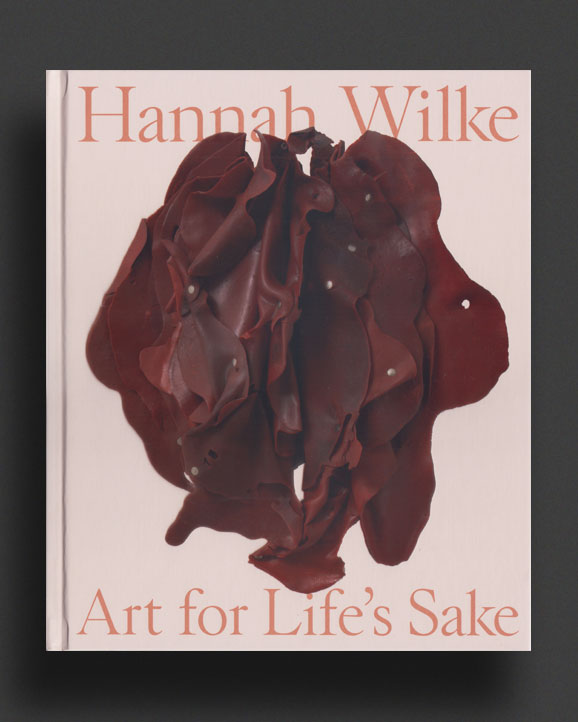
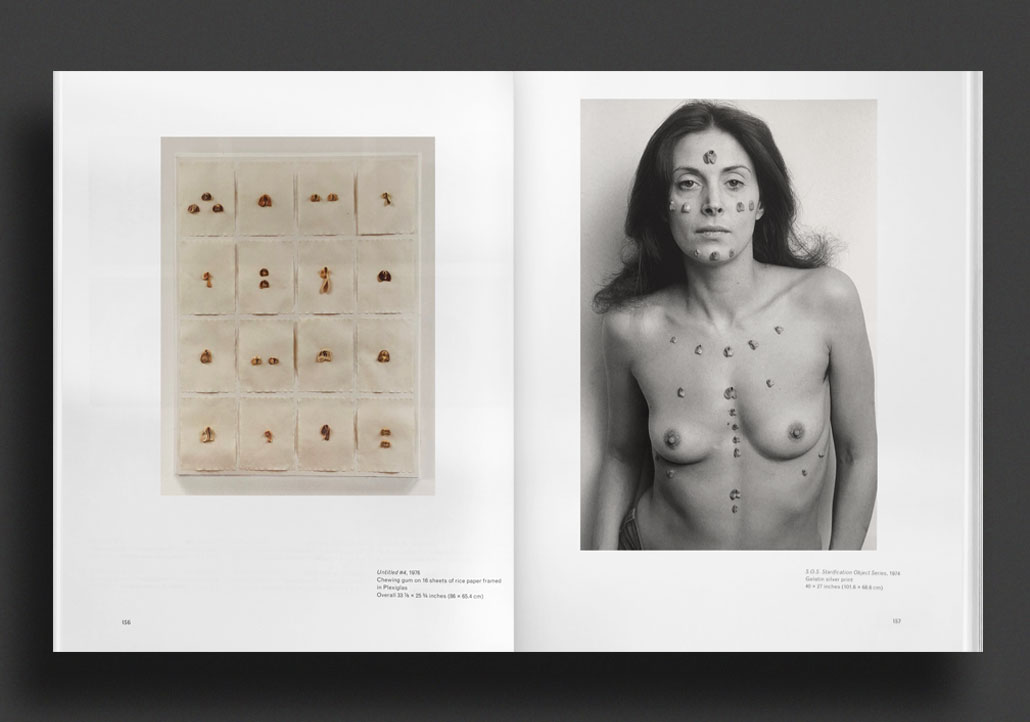
A richly illustrated exploration of Hannah Wilke’s provocative art and trailblazing feminism.
One of the most groundbreaking artists to emerge in American art in the 1960s, Hannah Wilke consistently challenged the prevailing narratives of women’s bodies and their representation throughout her career, until her untimely death in 1993. Wilke established a uniquely feminist iconography in virtually all of the mediums she engaged with—painting, sculpture, photography, video, and performance art—and offered a life-affirming expression of vitality and bodily pleasure in her work.
Hannah Wilke: Art for Life’s Sake highlights the artist’s full range of expression, bringing together photographs, works on paper, video, and examples of Wilke’s sculptures in clay and other, nonconventional materials such as latex, kneaded erasers, and chewing gum. New object photography brings clarity to Wilke’s boundary-crossing art practice, making many of her rarely shown works accessible to readers for the first time. The book features a previously unpublished 1975 interview with Wilke by art critic and historian Cindy Nemser as well as a narrative chronology of Wilke’s art and life with many previously unpublished archival photographs. It includes essays by Glenn Adamson, Connie Butler, and Tamara Schenkenberg, and responses to Wilke’s work by contemporary artists Hayv Kahraman, Nadia Myre, Jeanine Oleson, and Catherine Opie.
Offering fresh perspectives on this influential artist, Hannah Wilke: Art for Life’s Sake sheds new light on Wilke’s technical and formal virtuosity, her important role in shaping postwar American art, and the nuance and poignancy of her feminist subject matter.
Edited by Tamara Schenkenberg and Donna Wingate
Contributions by Glenn Adamson, Connie Butler, Tamara Schenkenberg
Tamara H. Schenkenberg is curator at the Pulitzer Arts Foundation.
Donna Wingate is a New York-based editor.
Glenn Adamson is an independent curator and writer and a senior scholar at the Yale Center for British Art.
Connie Butler is chief curator at the Hammer Museum.
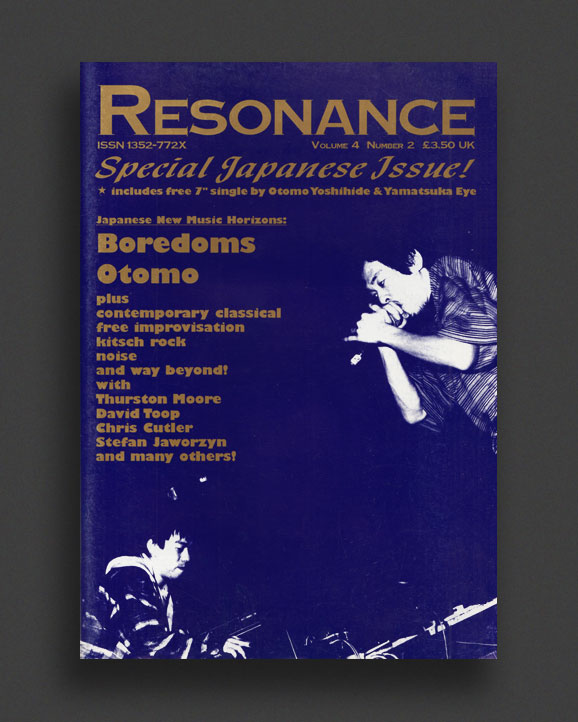
1995, English
Softcover (w. 7" single), 60 pages, 30 x 20.5 cm
1st Edition, Out of print title / used / very good
Published by
London Musician's Collective / London
$65.00 - Out of stock
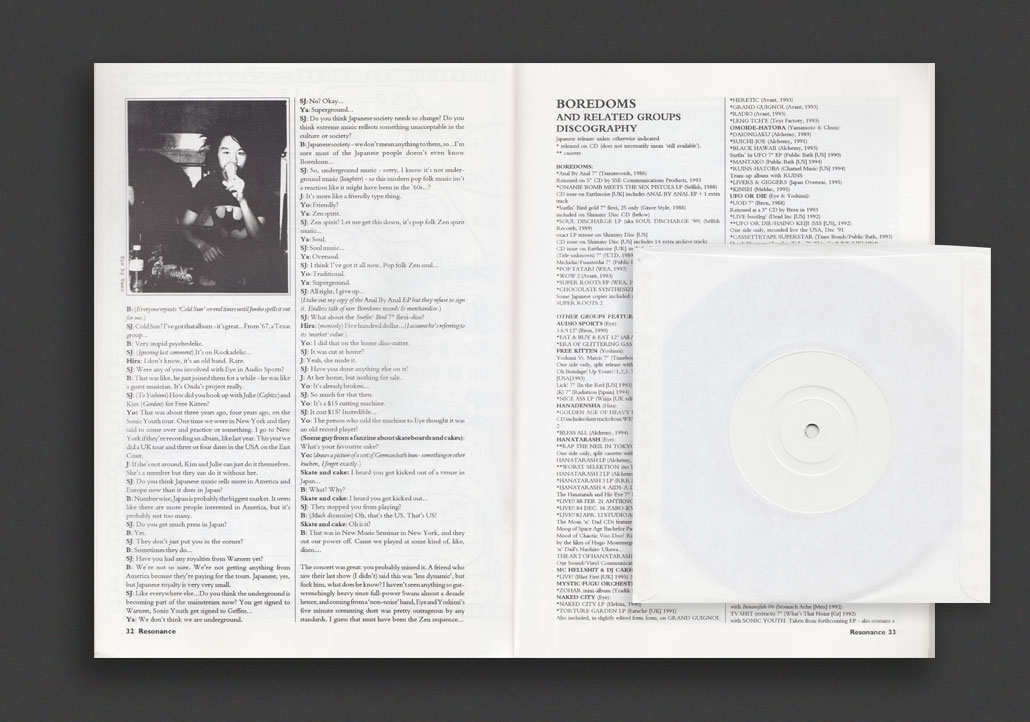
Rare "Special Japanese Issue" (Volume 4 No.2) of Resonance magazine, published by the London Musician's Collective in 1996 with exclusive 7" single of seven untitled pieces by Otomo Yoshihide and Yamatsuka Eye, recorded live in London, Spring 1995. Magazine includes articles by Otomo Yoshihide on the 1970s Japanese improvised scene (Kaoru Abe, Masayuki Takayanagi, Keiji Hano, et al.), Thurston Moore on Japan, Chris Cutler (Henry Cow, Recommended Records, et al.) on Haniwa Chan, Richard Scott on Hôgaku (Traditional Japanese Music), Steve Beresford (Derek Bailey's Company, et al.) on The Honeymoons, David Toop, Boredoms interview by Stefan Jaworzyn (including a Boredoms discography and family tree), Eckhart Derschmidt on Japanese jazz, Stefan Jaworzyn interviews Derek Bailey about working in Japan, live and record reviews and much more.
Very Good copy with Near mint, As New 7" single.
2021, English / French
Softcover, 256 pages, 17.5 x 24 cm
Published by
May Revue / Paris
$32.00 - Out of stock
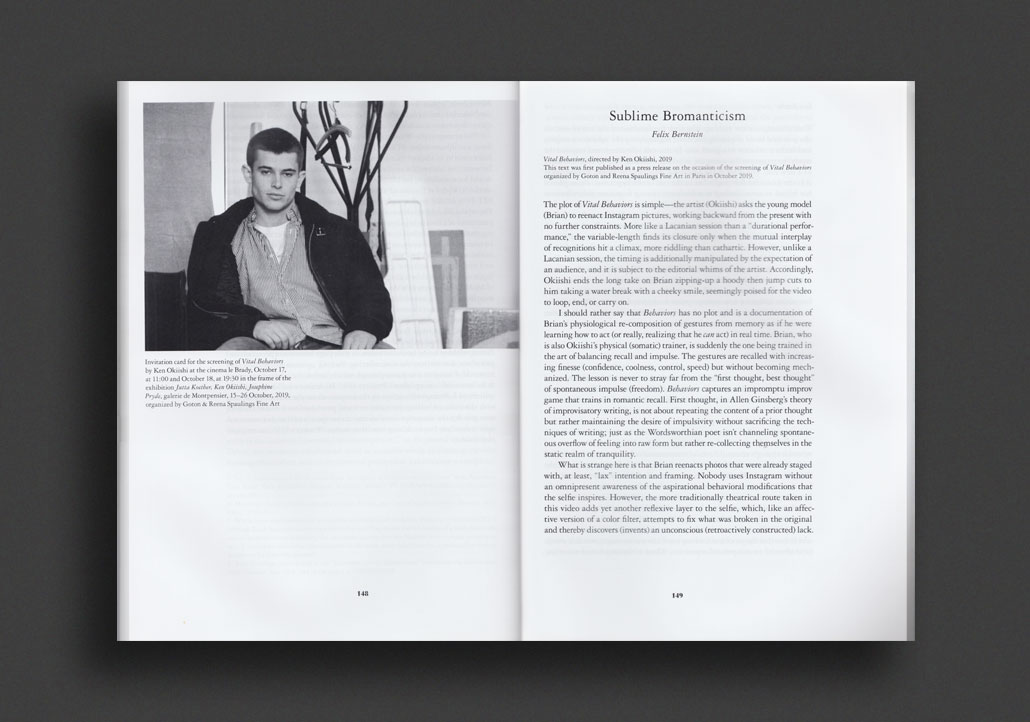
I will not interpret Jack Smith. I will not interpret Jack Smith. I will not interpret Jack… — Felix Bernstein
Finally, a new issue of long standing favourite May revue, with a cover feature on American filmmaker, actor, performance artist and pioneer of underground cinema, Jack Smith (1932 –1989)!
Jack Smith (Michael Krebber, Felix Bernstein, Enzo Shalom, Branden W. Joseph), Gary Indiana, Bruce Hainley and Sohrab Mohebbi, Jean-Luc Godard by Ferdinand Gouzon, Leilah Weinraub by Juliana Huxtable, Nina Könnemann by Megan Francis Sullivan, Louise Lawler by Nick Irvin, Claire Fontaine by Anita Chari, Robert Malaval by Valentin Gleyze, Afuma (Stefan Tcherepnin & Taketo Shimada) by Keith Connolly, Park McArthur by Noah Barker, Ken Okiishi by Felix Bernstein...
Conceived as a collective space in which to develop thoughts and confront positions on artistic production, May magazine examines, twice a year, contemporary art practice and theory in direct engagement with the issues, contexts and strategies that construct these two fields. An approach that could be summed up as critique at work – or as critique actively performed in text and art forms alike.
Featuring essays, interviews, art works and reviews by artists, writers and diverse practitioners of the arts, the magazine also intends to address the economy of the production of knowledge – the starting point of this reflection being the space of indistinction between information and advertisment typical of our time. This implies a dialogue with forms of critique produced in other fields.
2021, English
Softcover, 232 pages, 20 x 13 cm
Published by
Nero / Italy
$59.00 - In stock -
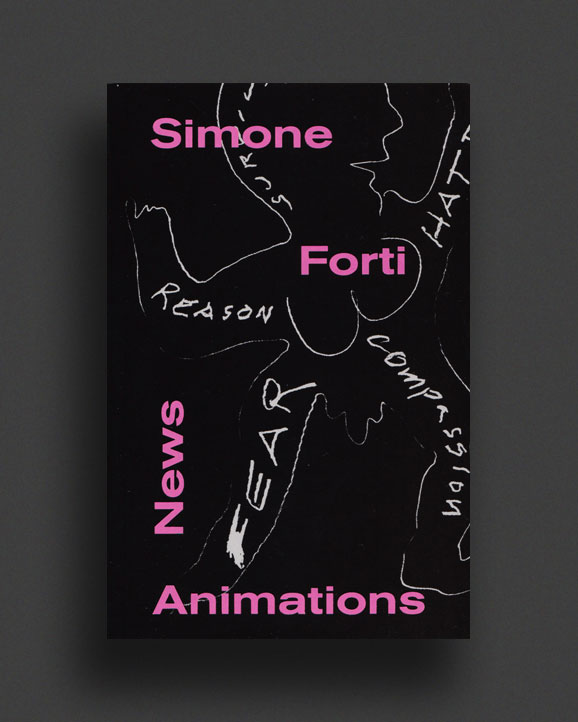
A reference book containing all the transcripts of Simone Forti's News Animations.
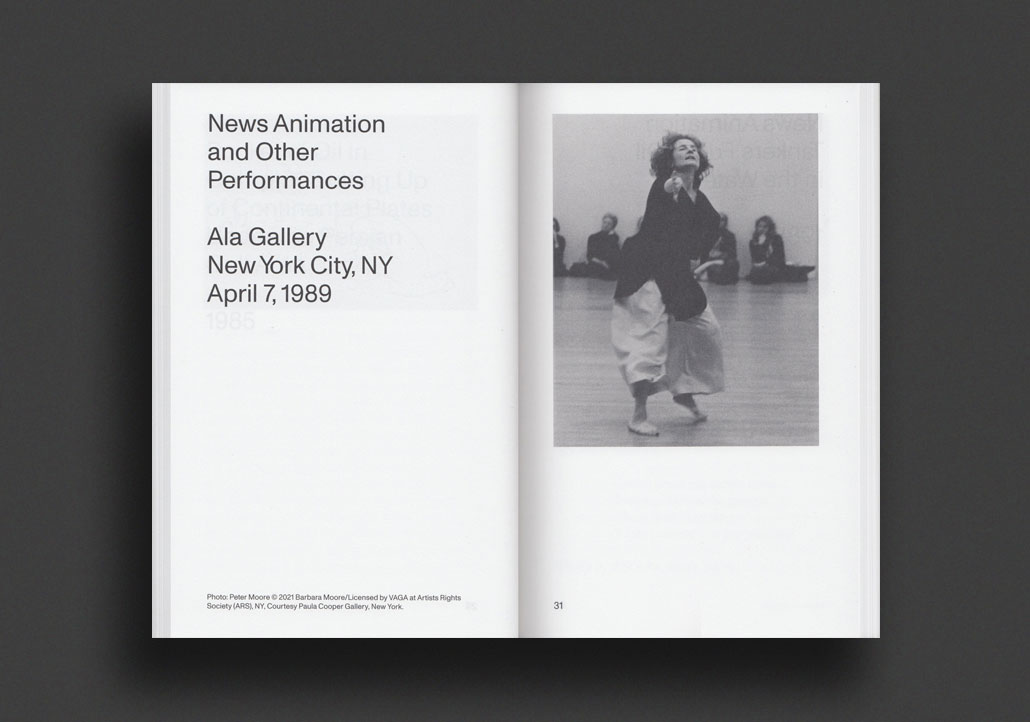
The book is the complete collection of Simone Forti's News Animations, one of the works that best reveal her artistic practice. The news and, more broadly, the most pressing issues of the global socio-political situation, are used to explore the potential of language, its dimensions, and its combination with dance, movements, words, images, and music. Simone Forti has always "danced" the news, it's the way she tells them. But, above all, it's the way she internalizes them, feels them, and processes them. Through a stream of consciousness, the artist grants voice and body to thoughts about the world, its conflicts, war, injustices, and inequalities.
The volume collects Simone Forti's News Animations from 1980 to 2018—through the transcriptions of the performances, images, and drawings—seeking to capture their spirit, their poetic stance and, mostly, understand how they manage to describe the society and the world we live in.
American dancer and choreographer Simone Forti (born 1935 in Florence, Italy) has been a leading figure in the development of contemporary performance over more than fifty years. Artist, choreographer, dancer, writer, Forti has dedicated herself to the research of a kinesthetic awareness, always engaging with experimentation and improvisation. Investigating the relationship between object and body, through animal studies, news animations and land portraits, she reconfigured the concept of performance and dance. Forti emigrated from Italy with her family via Switzerland to Los Angeles in 1938, where she subsequently studied for four years with choreographer Anna Halprin and has since spent most of her life. She joined the experimental downtown art scene in New York during the emergence of performance art, process-based work and Minimal Art and spent a fruitful time in Rome in the late 1960s, where she used the spaces of L'Attico to study and perform. Her work is seen as a precursor of the famous Judson Dance Theater—a group of artists experimenting with dance, including Trisha Brown, Steve Paxton, and Yvonne Rainer—and Minimal Art, although she prefers to be referred simply as a "movement artist."
Forti has worked with artists like Dan Graham, Robert Whitman, Allan Kaprow and Claes Oldenburg and composers like Charlemagne Palestine, Peter Van Riper, and La Monte Young.
Introduction by Luca Lo Pinto.
2017, English / German
Softcover, 431 pages, 20.3 x 27.1 cm
Published by
Walther König / Köln
$65.00 $15.00 - In stock -
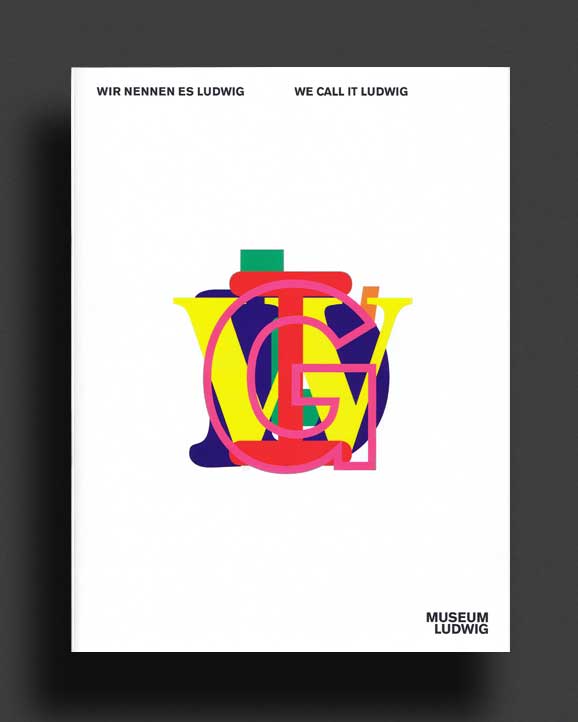
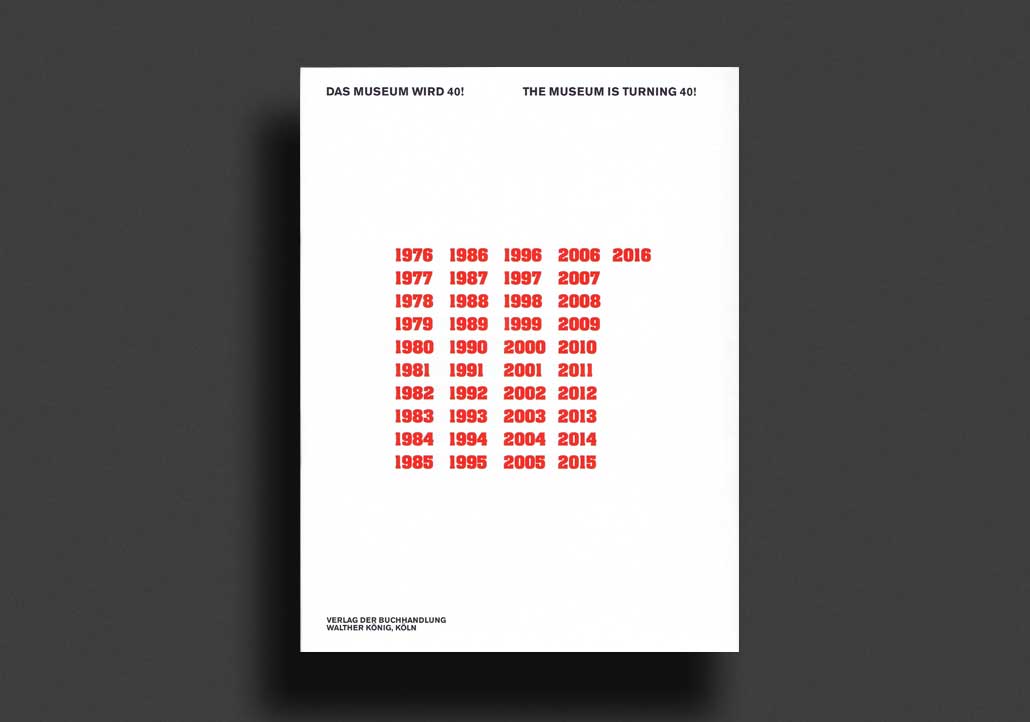
This publication documents the first forty years of exhibitions at the Museum Ludwig through an archive of installations and ephemera. It includes impressions from all the directors of the institution as well as the architects of the building. The conceptual starting point is the anniversary exhibition "We Call It Ludwig: The Museum Is Turning 40!" (2016), which is reflected here in a complete overview of all the works on display. For the anniversary exhibition, which was jointly conceived by the director and all the museum’s curators, twenty-five international artists and artist collectives were invited to engage in depth with the institution and to react to the question of what the Museum Ludwig means to them.
Participating artists included Georges Adéagbo, Ai Weiwei, Ei Arakawa & Michel Auder, Minerva Cuevas, Maria Eichhorn, Andrea Fraser, Meschac Gaba, Guerrilla Girls, Hans Haacke, Diango Hernández, Candida Höfer, Bodys Isek Kingelez, Kuehn Malvezzi, Christian Philipp Müller, Marcel Odenbach, Ahmet Ögüt, Claes Oldenburg, Pratchaya Phinthong, Alexandra Pirici & Manuel Pelmuş, Gerhard Richter, Avery Singer, Jürgen Stollhans, Rosemarie Trockel, Villa Design Group, Christopher Williams.
The expansive archive portion of this large book includes important work by countless artists spanning 40 years.
Edited by Yilmaz Dziewior
1976, English
Softcover, 314 pages, 15 x 21 cm
1st Edition, Out of print title / used / very good
Published by
E P Dutton / New York
$90.00 - Out of stock
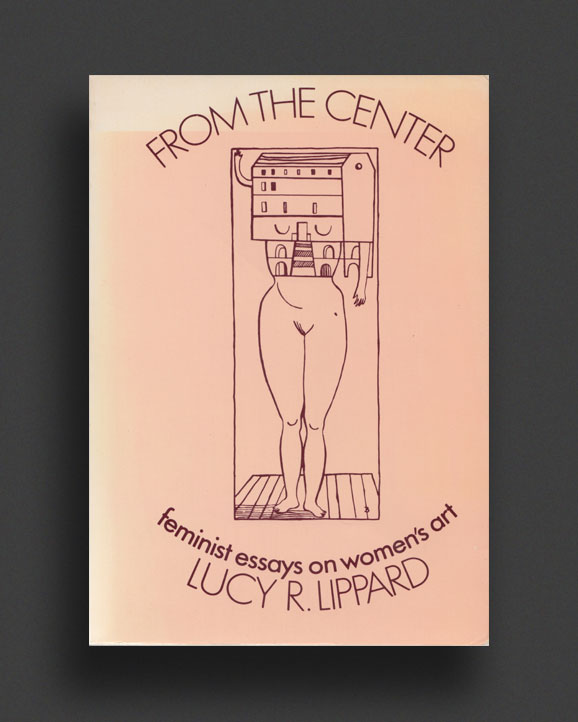
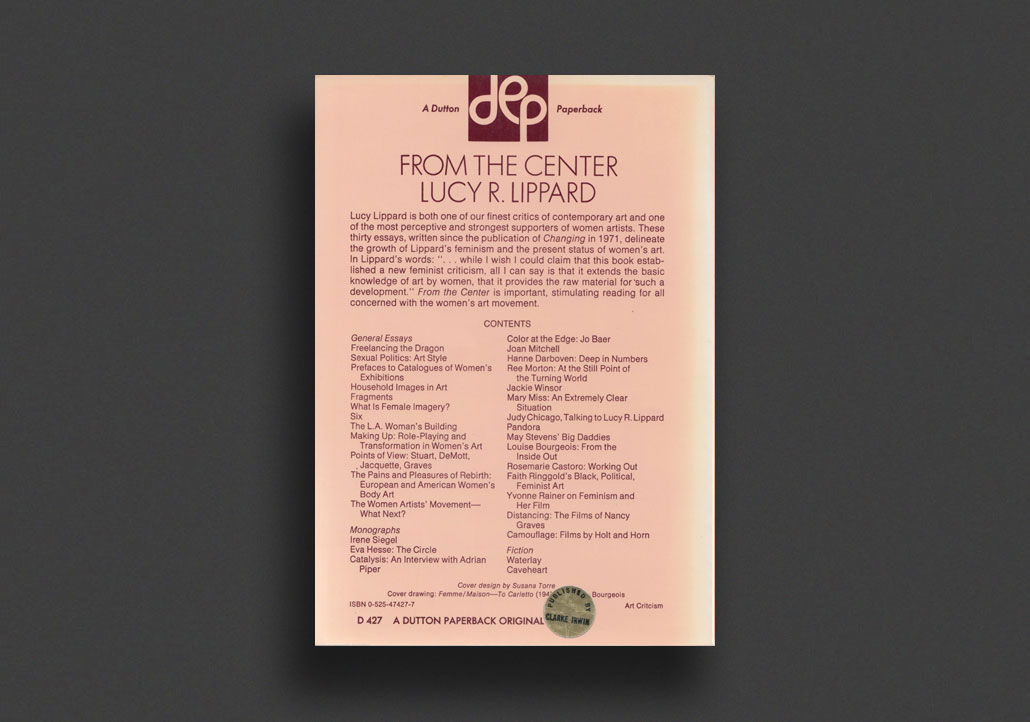
First 1976 printing of this fantastic and now rarely seen classic book collection of essays by internationally acclaimed writer, art critic, activist and curator, Lucy R. Lippard.
"FROM THE CENTER : Feminist Essays on Women's Art" is broken into three sections: GENERAL ESSAYS, MONOGRAPHS, and FICTION. GENERAL ESSAYS include 12 major essays such as "Sexual Politics : Art Style", "Household Images in Art", "Fragments", "What is Female Imagery", "Making Up: Role-Playing and Transformation in Women's Art", "The Pains and Pleasures of Rebirth: European and American Women's Body Art", "The Womens' Art Movement - What Next?" and more. MONOGRAPHS is made up of writings dedicated to single artists, including essays on the work of Eva Hesse, Adrian Piper, Jo Baer, Joan Mitchell, Hanne Darboven, Ree Morton, Irene Siegel, Rosemarie Castoro, Louise Bourgeois, Faith Ringgold, Yvonne Rainer, Judy Chicago, Jackie Winsor, Nancy Graves and many more. A suburb collection, illustrated throughout with examples of the artists written about, including a colour plate section.
Very Good copy with cover/spine tanning, light wear.
1968, Italian / English
Softcover, 98 pages, 32.5 x 24 cm
1st Edition, Out of print title / used / good
Published by
Editoriale Domus / Milan
$65.00 - Out of stock
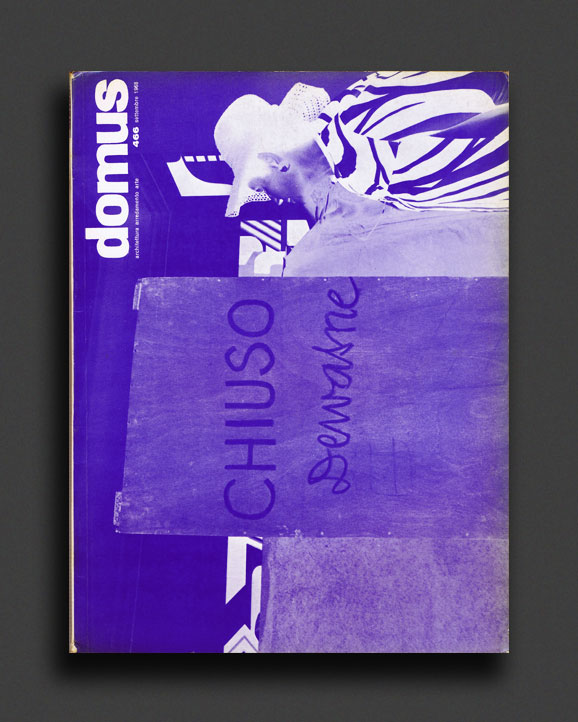
Founded in 1928 as a “living diary” by the great Milanese architect and designer Gio Ponti, domus has been hailed as the world’s most influential architecture and design journal, distributed in 89 countries. With exuberant style and rigor, it offered energetic up-to-date coverage and analysis of major themes, developments and stylistic movements in product, structure, interior, and industrial design. Called the "Mediterranean Megaphone," domus has always been considered the most concrete published expression of Italian style, documenting generations of radical, practical, and beautiful production, both local and across the world. Amongst a seemingly endless archive of contributions and features, domus frequently covered the works of the protagonists of the Anti and Radical Design movements, modern architecture, new experiments in environmental/spatial/commercial design, international product design, the activities of the Arte Povera, Pop art, Minimal Art and Nouveau Réalisme movements, and much more.
No. 466 Settembre 1968
Editor : Gio Ponti
Editorial committee and contributors include : Cesare Casati, Pierre Restany, Agnoldomenico Pica, Pierre Restany, Carmela Haerdtl, Joseph Rykwert, Ettore Sottsass jr., Charles and Ray Eames,
Kho Liang je, Bernard Rudofsky, George Nelson, Fausto Melotti, Tommaso Trini, Tapio Wirkkalaand, Rut Bryk, Hans Hollein, and more.
features :
Archizoom; Lucio Fontana; "Tatlin" by Agnoldomenico Pica; "Apartment Building in Ramat Gan Tel Aviv" by architects Alfred Neumann, Zvi Hecker, Eldar Sharon, "The 18th Aspen Design Conference" by Hans Hollein; Olivetti store in Buenos Aires by architect Gae Aulenti; XIV Triennial of Milan "Il Grande Numero" (Arata Isozaki); "Venice Biennale 1968: A Failure in Attempted Suicide" by Pierre Restany; "For a New Biennale" by Tommaso Trini; Book reviews; and much more.
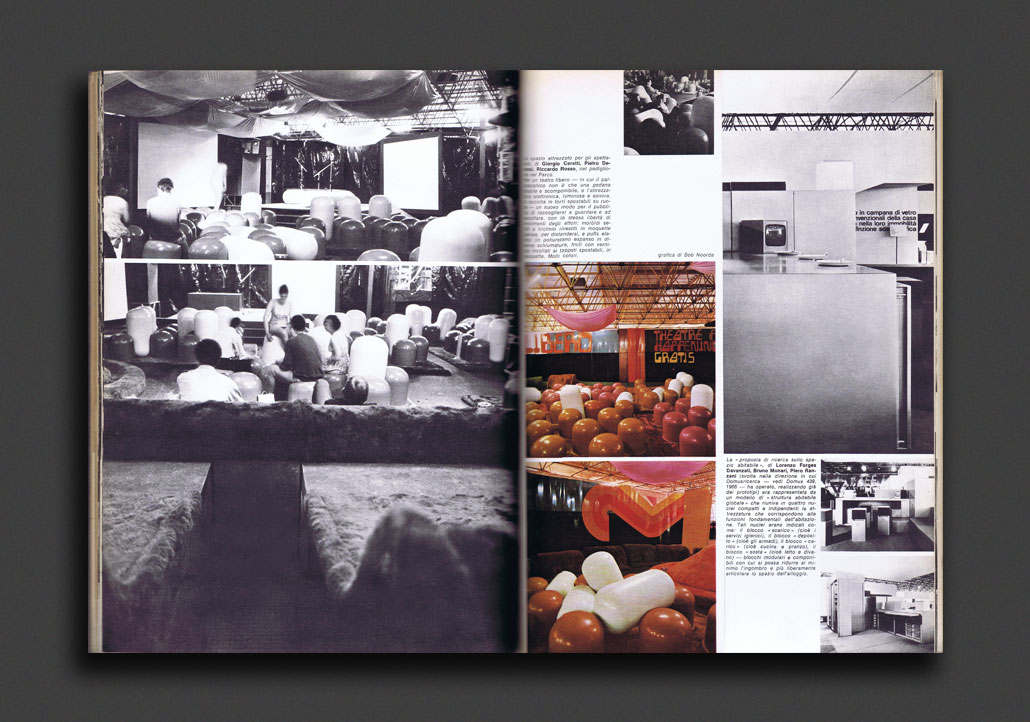
Beautifully printed in Italy and heavily illustrated throughout with vivid colour and black and white photography across multiple paper stocks, page crops and fold-out spreads.
1968, Italian / English
Softcover, 84 pages, 32.5 x 24 cm
1st Edition, Out of print title / used / very good
Published by
Editoriale Domus / Milan
$65.00 - Out of stock
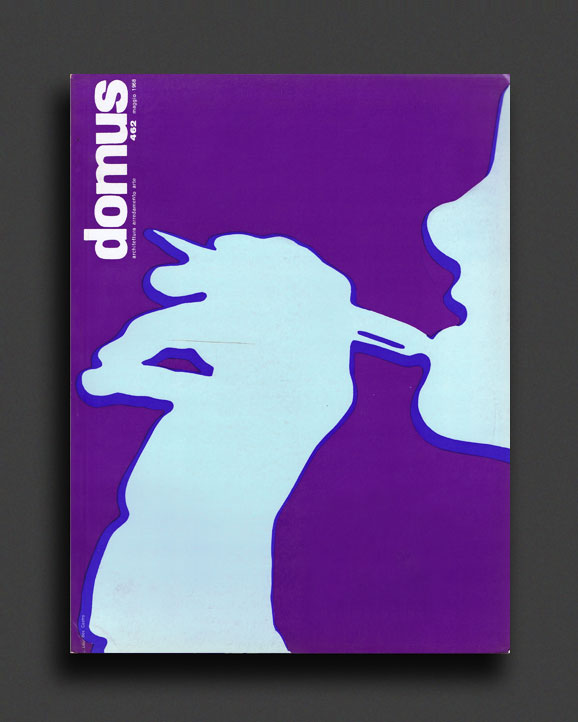
Founded in 1928 as a “living diary” by the great Milanese architect and designer Gio Ponti, domus has been hailed as the world’s most influential architecture and design journal, distributed in 89 countries. With exuberant style and rigor, it offered energetic up-to-date coverage and analysis of major themes, developments and stylistic movements in product, structure, interior, and industrial design. Called the "Mediterranean Megaphone," domus has always been considered the most concrete published expression of Italian style, documenting generations of radical, practical, and beautiful production, both local and across the world. Amongst a seemingly endless archive of contributions and features, domus frequently covered the works of the protagonists of the Anti and Radical Design movements, modern architecture, new experiments in environmental/spatial/commercial design, international product design, the activities of the Arte Povera, Pop art, Minimal Art and Nouveau Réalisme movements, and much more.
domus No. 462 Maggio 1968
Editor : Gio Ponti
Editorial committee and contributors include : Cesare Casati, Pierre Restany, Agnoldomenico Pica, Pierre Restany, Carmela Haerdtl, Joseph Rykwert, Ettore Sottsass jr., Charles and Ray Eames,
Kho Liang je, Bernard Rudofsky, George Nelson, Fausto Melotti, Tommaso Trini, Tapio Wirkkalaand, Rut Bryk, and more.
features :
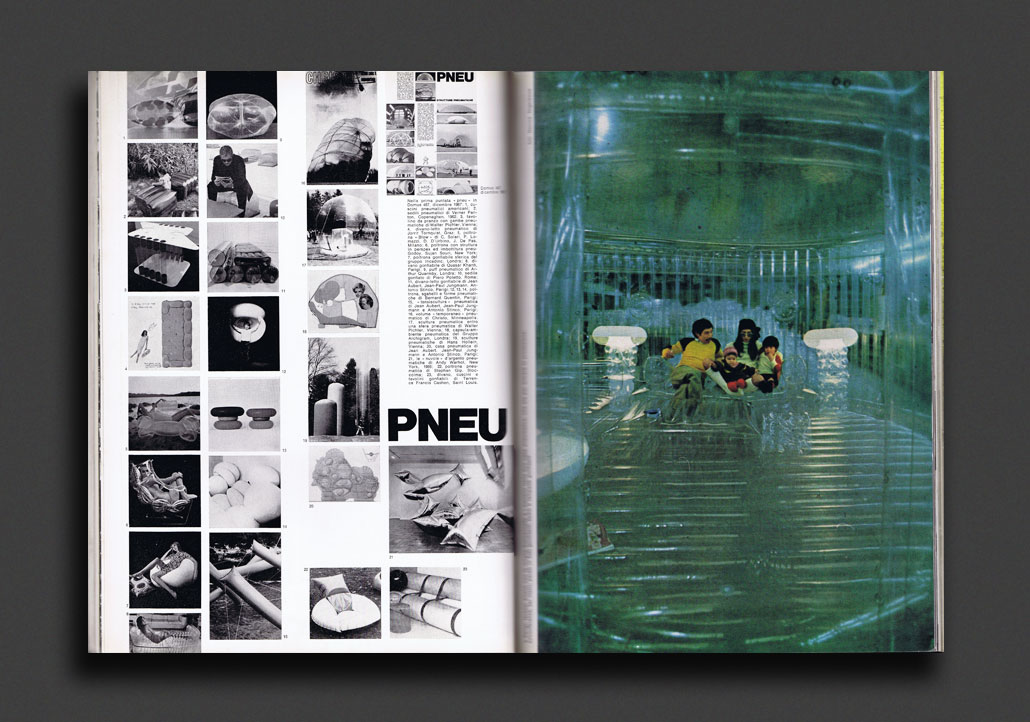
Archizoom; The Living Theatre; "The New Headquarters for the Ford Foundation in New York" by architects Kevin Roche, John Dinkeloo and Associates; "National Aquarium in Washington" by architects Kevin Roche, John Dinkeloo and Associates, with Office of Charles Eames; "Pneu: Inflatable Structures and Forms"; "A Mini Space" by Joe Colombo; new lamp edition from Didier Bernardin; Multiples by Franco Angeli, Lucio Fontana, Gino Marotta, Gianni Colombo, David Morris, Fabrizio Cocchia, etc. by Tommaso Trini; "Charles Rennie Mackintosh 1868-1968; "Magistretti in Paris : the Cerruti 1881 styling centre"; Art exhibitions all over the world; Book reviews; Lourdes Castro / Cesar / Jean-Pierre Raynaud by Pierre Restany; "The House of Roger Tallon"; Pino Pascali; Giulio Paolini; and much more.
Beautifully printed in Italy and heavily illustrated throughout with vivid colour and black and white photography across multiple paper stocks, page crops and fold-out spreads.
2020, English
Softcover, 344 pages, 19.7 x 25.5 cm
Ed. of 3000,
Published by
Primary Information / New York
$82.00 - Out of stock
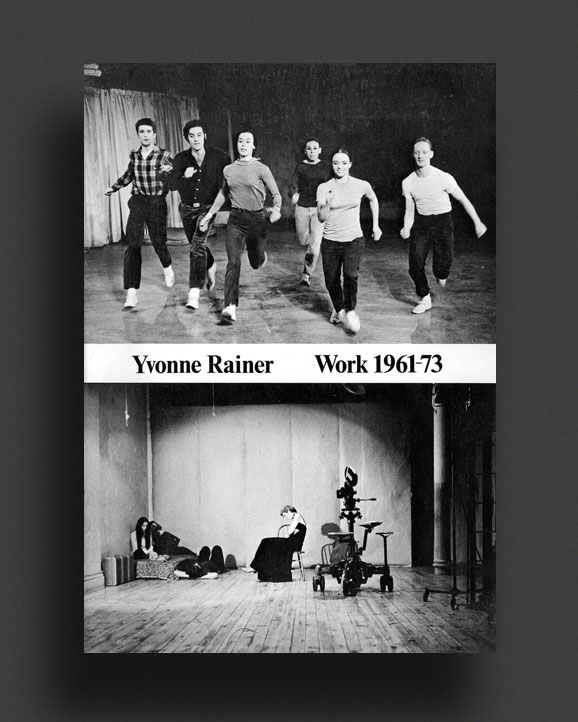
Originally published in 1974 by the Nova Scotia College of Art and Design, Yvonne Rainer’s Work 1961-73 documents the artist’s landmark early works at the intersection of dance, performance, and art. The publication provides multifaceted insight into some of the artist’s most celebrated choreographic works, including Terrain (1962), Trio A (1966), Continuous Project-Altered Daily (1970), War (1970), Street Action (1970), and This is the story of a woman who … (1973), among many others.
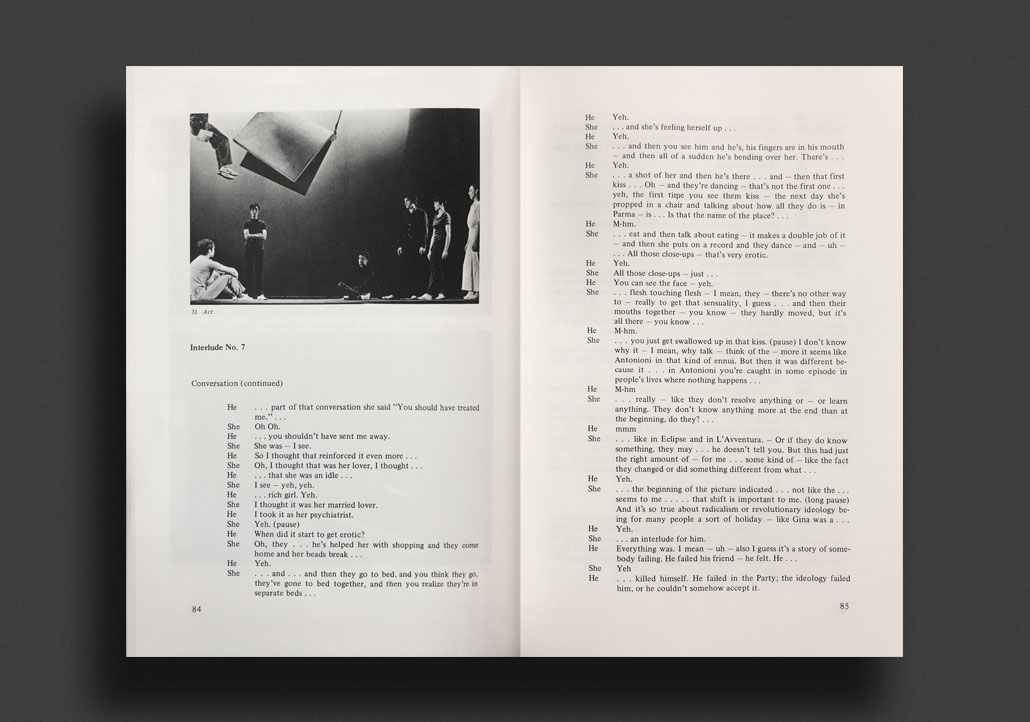
Assembled ostensibly as a survey, Work 1961-73 features a multitude of documentary forms, including scripts, excerpts from the artist’s notebooks, press reviews, correspondence, photographic documentation, literary excerpts, contextualizing texts by the artist, diagrams, film stills, floor plans, scores, and more. As such, the publication resembles an artist book that generously gives the reader access to Rainer’s modes of working, as well as the social and political context around which the work was made. The publication is also a book of writing, with the artist’s frank, witty, and sometimes humorous prose intimately leading the reader through each work.
As the artist states in the book’s introduction: I have a longstanding infatuation with language, a not-easily assailed conviction that it, above all else, offers a key to clarity. Not that it can replace experience, but rather holds a mirror to our experience, give us distance when we need it. So here I am, in a sense, trying to ‘replace’ my performances with a book, greedily pushing language to clarify what already was clear in other terms. But, alas, gone. This has seemed one good reason to compile a book ‘out of’ the remains of my performances, letting the language fall where it may. Let it be said simply “She usually makes performances and has also made a book.”
Work 1961-73 is an indispensable publication for anyone interested in the artist and the radical developments in dance and performance in the 1960s.
Yvonne Rainer (b. 1934) is a dancer, choreographer, writer,and filmmaker. She is a co-founding member of the Judson Dance Theater and worked primarily as a dancer and choreographer from the early 1960s through the early 1970s. Her choreographic work is widely recognized for blurring the lines between performers and non-performers, incorporating gestural and pedestrian movements, as well as classical dance steps and theatre. In 1972, Rainer began making films, producing seven experimental features, including Lives of Performers (1972), Privilege (1990), and MURDER and murder (1996). She returned to dance in 2000, producing new works commissioned by the Baryshnikov Dance Foundation, the Performa Biennial, and The Museum of Modern Art. She is the author of several books including Feelings Are Facts: A Life (2006), A Woman Who…: Essays, Interviews, Scripts (1999), and Poems (2012). She is the recipient of a MacArthur Fellowship, two Guggenheim Awards, The Foundation for Contemporary Art’s Merce Cunningham Award, and a USA Grant.
Edition of 3000
2021, English
Softcover, 240 pages, 14.5 x 21 cm
Published by
Whitechapel / London
The MIT Press / Massachusetts
$40.00 - Out of stock
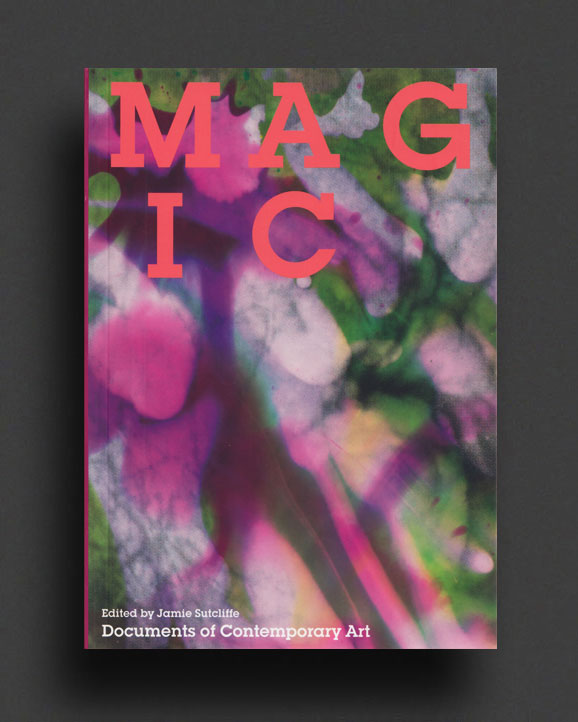
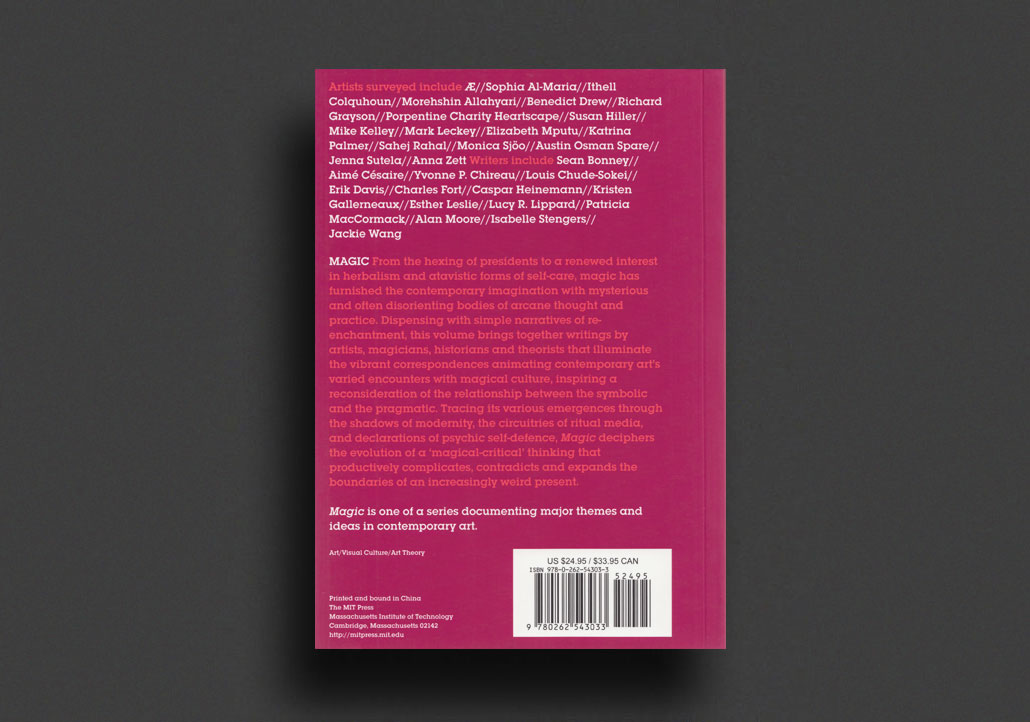
From the hexing of presidents to a renewed interest in herbalism and atavistic forms of self-care, magic has furnished the contemporary imagination with mysterious and complex bodies of arcane thought and practice. This volume brings together writings by artists, magicians, historians, and theorists that illuminate the vibrant correspondences animating contemporary art's varied encounters with magical culture, inspiring a reconsideration of the relationship between the symbolic and the pragmatic.
Dispensing with simple narratives of re-enchantment, Magic illustrates the intricate ways in which we have to some extent always been captivated by the allure of the numinous. It demonstrates how magical culture's tendencies toward secrecy, occlusion, and encryption might provide contemporary artists with strategies of remedial communality, a renewed faith in the invocational power of personal testimony, and a poetics of practice that could boldly question our political circumstances, from the crisis of climate collapse to the strictures of socially sanctioned techniques of medical and psychiatric care.
Tracing its various emergences through the shadows of modernity, the circuitries of ritual media, and declarations of psychic self-defence, Magic deciphers the evolution of a 'magical-critical' thinking that productively complicates, contradicts and expands the boundaries of our increasingly weird present.
Artists surveyed:
Holly Pester, Katrina Palmer, Ithell Colquhoun, Anna Zett, Monica Sjoeo, Sofia Al-Maria, Jack Burnham, Jeremy Millar, Susan Hiller, Mike Kelley, Morehshin Allahyari, Center for Tactical Magic, David Steans, Porpentine, Travis Jeppesen, Linda Stupart, Caspar Heinemann, Elizabeth Mputu, Faith Wilding, David Hammons, Ana Mendieta, Henri Michaux, Kenneth Anger, Benedict Drew, Mark Leckey, Robert Morris, Jenna Sutela, Haroon Mirza, Zadie Xa, Saya Woolfalk, Ian Cheng, Tabita Rezaire, Thee Temple ov Psychick Youth, Elijah Burgher, Pier Paolo Pasolini, Sahej Rahal
Writers:
Charles Fort, Victoria Nelson, Gary Lachman, Yvonne P. Chireau, Randall Styers, Isabelle Stengers, Alan Moore, Simon O' Sullivan, Lucy Lippard, Louis Chude Sokei, Patricia MacCormack, Mark Pilkington, AE, Annie Besant & C.W. Leadbeater, Michel Leiris, Aime Cesaire, Austin Osman Spare, Erik Davis, Mark Dery, Elaine Graham, Jeffrey Sconce, Giulia Smith, Esther Leslie, Alice Bucknell, Gary Zhexi Zhang, Hannah Gregory, Kristen Gallerneaux, Mahan Moalemi, Jamie Sutcliffe, Gregory Sholette, Aaron Gach, Eugene Thacker, Diane Di Prima, Allan Doyle, Aria Dean, Emily LaBarge, Lou Cornum, Joy KMT, Scott Wark, McKenzie Wark, Phil Hine, Jackie Wang, Sean Bonney
2019, English
Softcover, 678 pages, 21.5 x 27.5 cm
Ed. of 2000,
Published by
Primary Information / New York
$89.00 - Out of stock
Out of print.
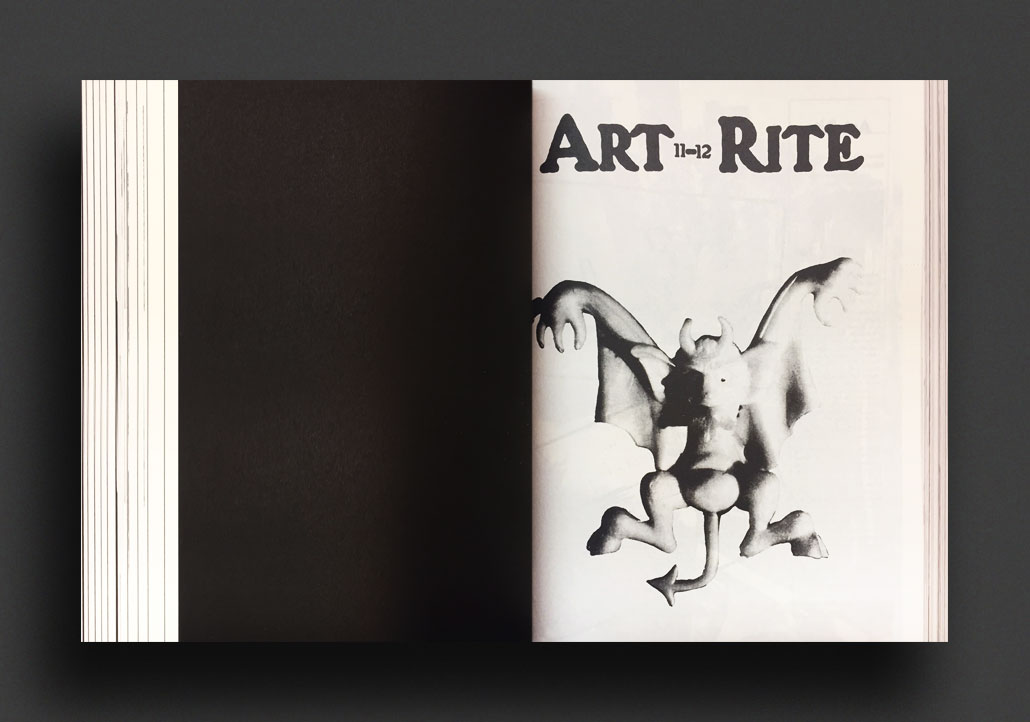
Edited by Walter Robinson, Edit DeAk, and Joshua Cohn, Art-Rite was published in New York City between 1973 and 1978. The periodical has long been celebrated for its underground/overground position and its cutting, humorous, on-the-streets coverage and critique of the art world. Art-Rite moved easily through the expansive community it mapped out, paying homage to an emergent generation of artists, including many who were—or would soon become—the defining voices of the era. Through hundreds of interviews, reviews, statements, and projects for the page—as well as artist-focused and thematic issues on video, painting, performance, and artists’ books—Art-Rite’s sharp editorial vision and commitment to spotlighting the work of artists stands as a meaningful and lasting contribution to the art history of New York City and beyond.
All issues of Art-Rite are collected and published here.
Featured artists include Vito Acconci, Kathy Acker, Bas Jan Ader, Laurie Anderson, John Baldessari, Gregory Battcock, Lynda Benglis, Mel Bochner, Marcel Broodthaers, Trisha Brown, Chris Burden, Scott Burton, Ulises Carrión, Judy Chicago, Lucinda Childs, Christo, Diego Cortez, Hanne Darboven, Agnes Denes, Ralston Farina, Richard Foreman, Peggy Gale, Gilbert & George, John Giorno, Philip Glass, Leon Golub, Peter Grass, Julia Heyward, Nancy Holt, Ray Johnson, Joan Jonas, Richard Kern, Lee Krasner, Shigeko Kubota, Les Levine, Sol LeWitt, Lucy Lippard, Babette Mangolte, Brice Marden, Agnes Martin, Gordon Matta-Clark, Rosemary Mayer, Annette Messager, Elizabeth Murray, Alice Neel, Brian O’Doherty, Genesis P-Orridge, Nam June Paik, Charlemagne Palestine, Judy Pfaff, Lil Picard, Yvonne Rainer, Judy Rifka, Dorothea Rockburne, Ed Ruscha, Robert Ryman, David Salle, Carolee Schneemann, Richard Serra, Jack Smith, Patti Smith, Robert Smithson, Holly Solomon, Naomi Spector, Nancy Spero, Pat Steir, Frank Stella, Alan Suicide (Vega), David Tremlett, Richard Tuttle, Andy Warhol, William Wegman, Lawrence Weiner, Hannah Wilke, Robert Wilson, Yuri, and Irene von Zahn.
2021, English
Hardcover (w. dust jacket), 352 pages, 24 x 16 cm
Published by
Harry N. Abrams / New York
$40.00 - In stock -
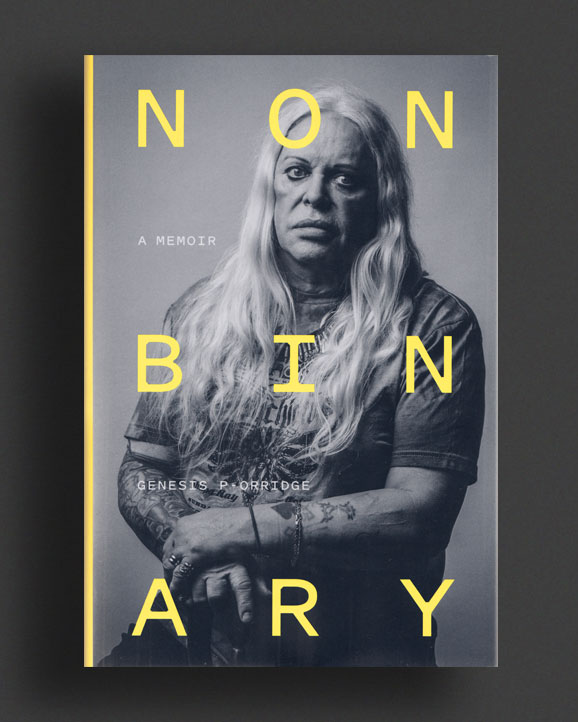
A revealing and beautifully open memoir from pioneering industrial music artist, visual artist, and transgender icon Genesis P-Orridge.
In this groundbreaking book spanning decades of artistic risk-taking, the inventor of “industrial music,” founder of Throbbing Gristle and Psychic TV, and world-renowned fine artist with COUM Transmissions Genesis P-Orridge (1950–2020) takes us on a journey searching for identity and their true self. It is the story of a life of creation and destruction, where Genesis P-Orridge reveals their unwillingness to be stuck—stuck in one place, in one genre, or in one gender. Nonbinary is Genesis’s final work and is shared with hopes of being an inspiration to the newest generation of trailblazers and nonconformists.
Nonbinary is the intimate story of Genesis’s life, weaving the narrative of their history in COUM Transmissions, Throbbing Gristle, and Psychic TV. It also covers growing up in World War II’s fallout in Britain, contributing to the explosion of new music and radical art in the 1960s, and destroying visual and artistic norms throughout their entire life.
In addition to being a captivating memoir of a singular artist and musician, Nonbinary is also an inside look at one of our most remarkable cultural lives that will be an inspiration to fans of industrial music, performance art, the occult, and a life in the arts.
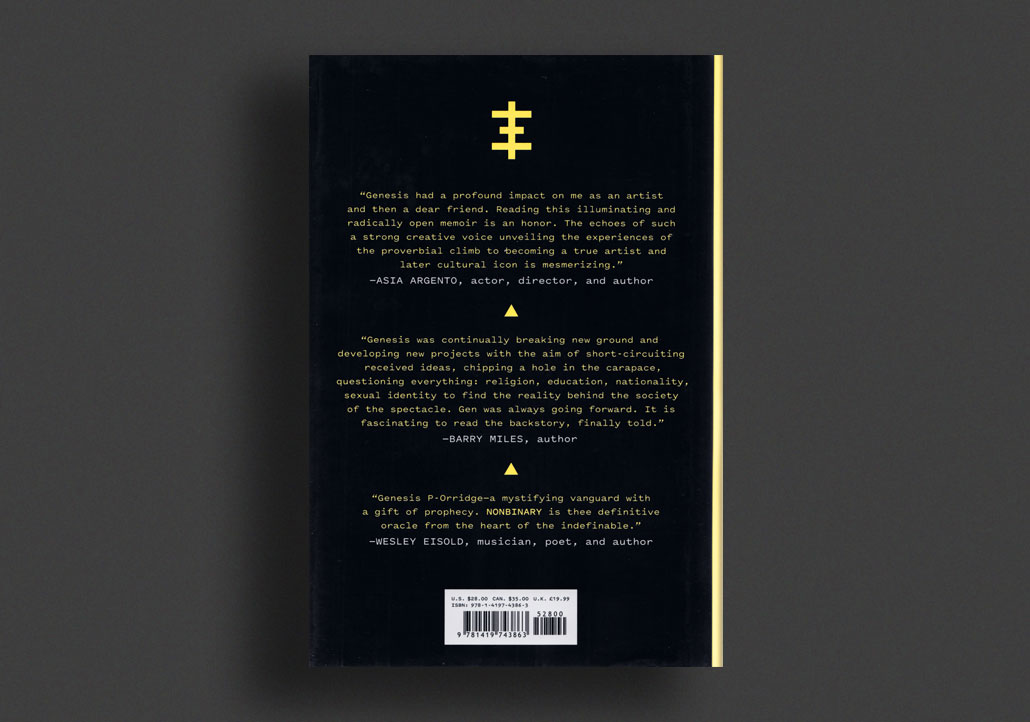
“Genesis had a profound impact on me as an artist and then a dear friend. Reading this illuminating and radically open memoir is an honor. The echoes of such a strong creative voice unveiling the experiences of the proverbial climb to becoming a true artist and later cultural icon is mesmerizing.” — actor, director, and author, Asia Argento
“Genesis was continually breaking new ground and developing new projects with the aim of short circuiting received ideas, chipping a hole in the carapace, questioning everything: religion, education, nationality, sexual identity to find the reality behind the society of the spectacle. Gen was always going forwards. It is fascinating to read the back story, finally told.” — bestselling author, Barry Miles
2020, English
Softcover, 384 pages, 14.8 x 21 cm
Published by
Trapart / Stockholm
$63.00 - In stock -
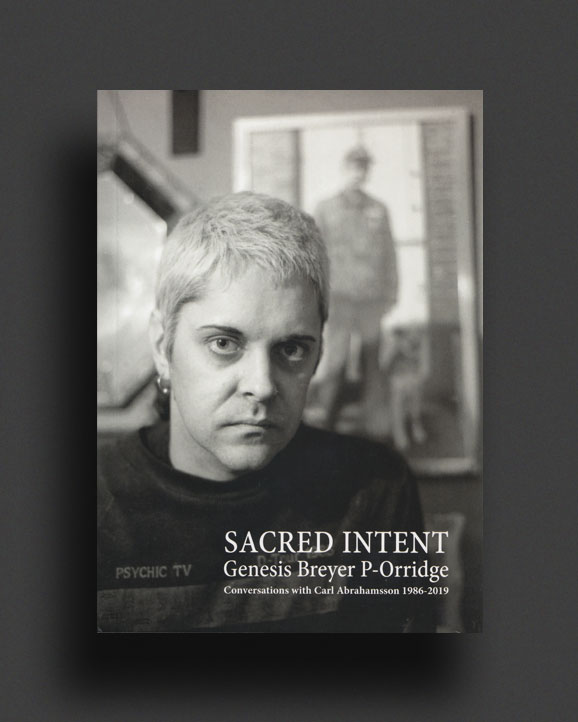
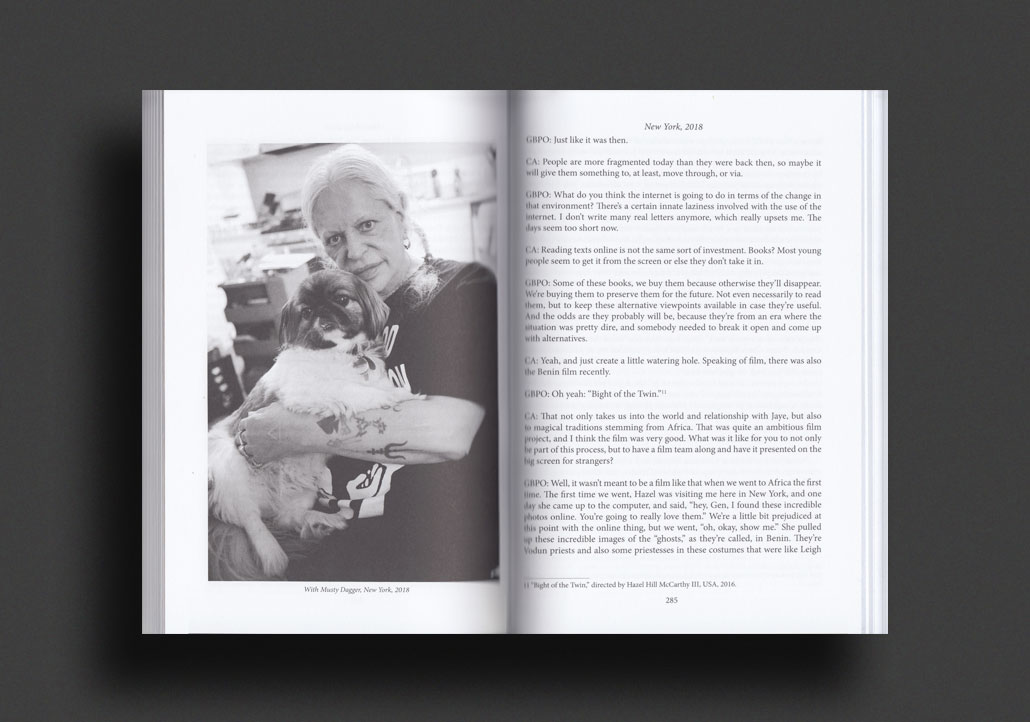
Sacred Intent gathers conversations between artist Genesis Breyer P-Orridge and longtime friend and collaborator, the Swedish author Carl Abrahamsson. From the first 1986 fanzine interview about current projects, over philosophical insights, magical workings, international travels, art theory and gender revolutions, to 2019’s thoughts on life and death in the the shadow of battling leukaemia, Sacred Intent is a unique journey in which the art of conversation blooms.
With (in)famous projects like C.O.U.M. Transmissions, Throbbing Gristle, Psychic TV, Thee Temple Ov Psychick Youth (TOPY) and Pandrogeny, Breyer P-Orridge has consistently thwarted preconceived ideas and transformed disciplines such as performance art, music, collage, poetry and social criticism; always cutting up the building blocks to dismantle control structures and authority. But underneath the socially conscious and pathologically rebellious spirit, there has always been a devout respect for a holistic, spiritual, magical worldview – one of “sacred intent.”
Sacred Intent is a must read for anyone interested in contemporary art, deconstructed identity, gender evolution, and magical philosophy. The book not only celebrates an intimate friendship, but also the work and ideas of an artist who has never ceased to amaze and provoke. Also included are photographic portraits of Breyer P-Orridge taken by Carl Abrahamsson, transcripts of key lectures, and an interview with Jacqueline “Lady Jaye” Breyer P-Orridge from 2004.
2018, English
Softcover, 304 pages, 23 x 17 cm
Published by
Center for Curatorial Studies Bard College / New York
Dancing Fox Press
$78.00 - Out of stock
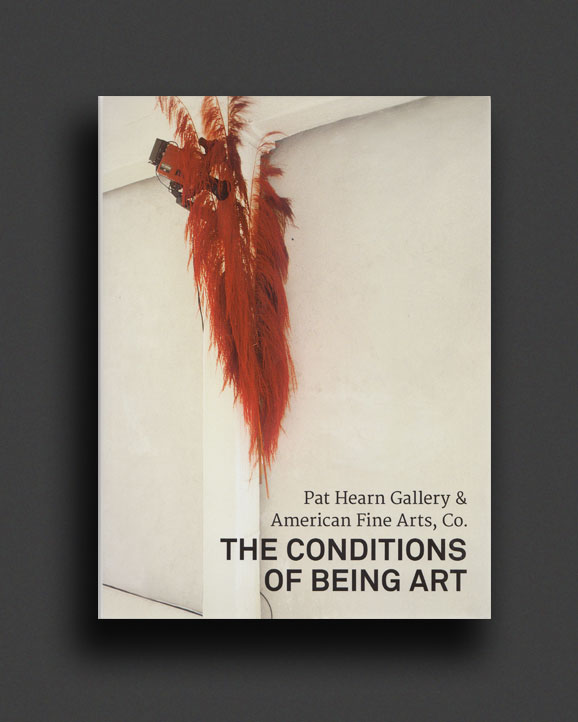
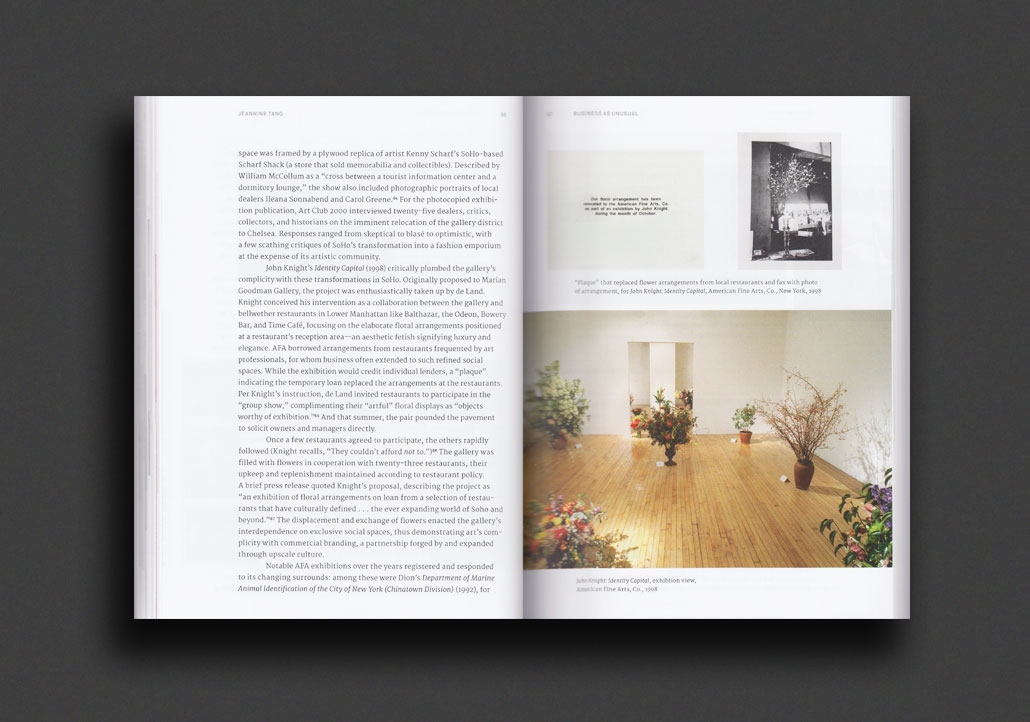
The Conditions of Being Art is the first book to examine the activities of groundbreaking contemporary art galleries Pat Hearn Gallery and American Fine Arts, Co. (1983–2004), and the transnational milieu of artists, dealers and critics that surrounded them.
Drawing on the archives of dealers Pat Hearn and Colin de Land—both, independently, legendary players on the New York art scene of the 1980s and '90s, and one of the great love stories of the art world—this publication illustrates their distinctive artistic practices, significant exhibitions and events, and daily business. Hearn and de Land championed art that challenged the business of running an art gallery; artists like Renée Green and Susan Hiller, Andrea Fraser and Cady Noland, who employed conceptualism and installation, social and institutional critique.
Contributing to the history of exhibitions, institutions and curating, The Conditions of Being Art addresses a significant gap in this literature around experimental commercial spaces in recent art history. This publication is the first book-length critical account of the alternative commercial gallery practices of the 1990s, a moment and a scene that is extremely influential to many of today's art dealers, curators and artists.
Hearn and de Land's gallery practices explored new experimental and ethical possibilities within the selling of art, testing the relationship of contemporary art to its markets. In this volume, full-colour images, in-depth scholarly investigations and detailed gallery histories vibrantly document how Hearn and de Land tested new notions of what an art gallery could be.
Edited with text by Jeannine Tang, Lia Gangitano, Ann Butler. Text by Johanna Burton, Jill Casid, Lauren Cornell, Diedrich Diederichsen, Jennifer King, Mason Leaver-Yap, Kobena Mercer.
Features the work of: Mark Morrisroe, Jimmy de Sana, Art Club 2000, Moyra Davey, Alex Bag, Lutz Bacher, John Knight, J. St. Bernard, John Miller, Renée Green, Jutta Koether, Phillip Taaffe, Christian Philipp Müller, Gregg Bordowitz, Tom Burr, Susan Hiller, Andrea Fraser, Cady Noland, Mark Dion, Julia Scher, Kirsten Mosher, Dan Flavin, Jack Pierson, Stephen Dillemuth, Mary Heilmann, Joan Jonas, Cindy Sherman, Robert Smithson, Jessica Diamond, Rapid Response (Christina Cobb, Peter Fend, Julia Fischer, William Meyer), Lincoln Tobier, Ted Byfield, and many others.
1985, English
Softcover (w. dust-jacket), 200 pages, 21 x 25 cm
1st Edition, Out of print title / used / very good
Published by
Thames and Hudson / London
$190.00 - Out of stock
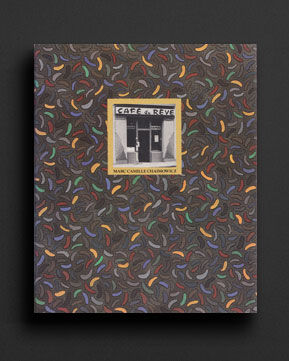
The exquisite "Café du Reve" book by the British-based artist Marc Camille Chaimowicz (b. post-war Paris). This is a copy of the first English printing from 1985.
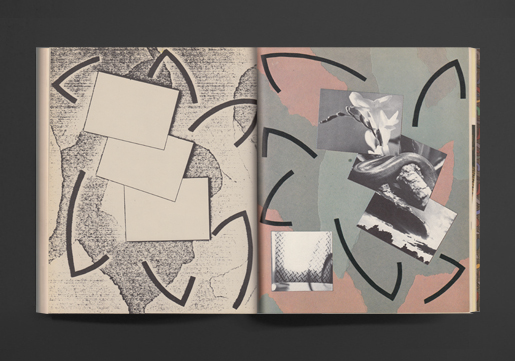
Scarce these days, this beautiful artists book's content is entirely composed, designed and collated from cover to cover by Chaimowicz in the style of a somewhat autobiographical scrap-book. Each page is designed by hand and illustrated with Chaimowicz's decorative motifs and patterns that carry upon them his hotel letterhead correspondence, writings and poetry, paired with photographs of objects, places and people - snapshots taken by Chaimowicz or appropriated from magazines.
"Café du Reve" remains a perfect early example of Chaimowicz's encompassing artistic practice that is immersed in the spatial and emotional experience of environments and décor, literature, the domestic sphere, interior design, ceramics, applied art, wallpaper and textiles.
Born in 1947, Paris, Marc Camille Chaimowicz is a London-based artist whose cross-disciplinary work in painting, drawing, collage, sculpture, installation, furniture, lighting, ceramics, textiles, and wallpaper challenges the categorical divisions between fine and applied arts, masculine and feminine, public and private, past and present. His works are in the Museum of Modern Art, Tate Modern, and Victoria and Albert Museum collections.
Highly recommended.
Very Good in VG dust jacket.
2009, English / French
Softcover (w. dust jacket), 160 pages, 24 x 29 cm
Published by
JRP Ringier / Zürich
Musée cantonal des Beaux-Arts / Lausanne
$88.00 - In stock -
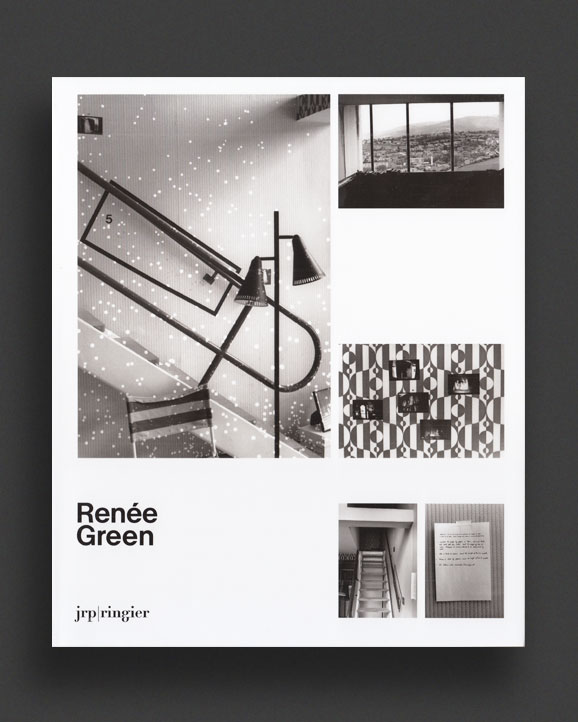
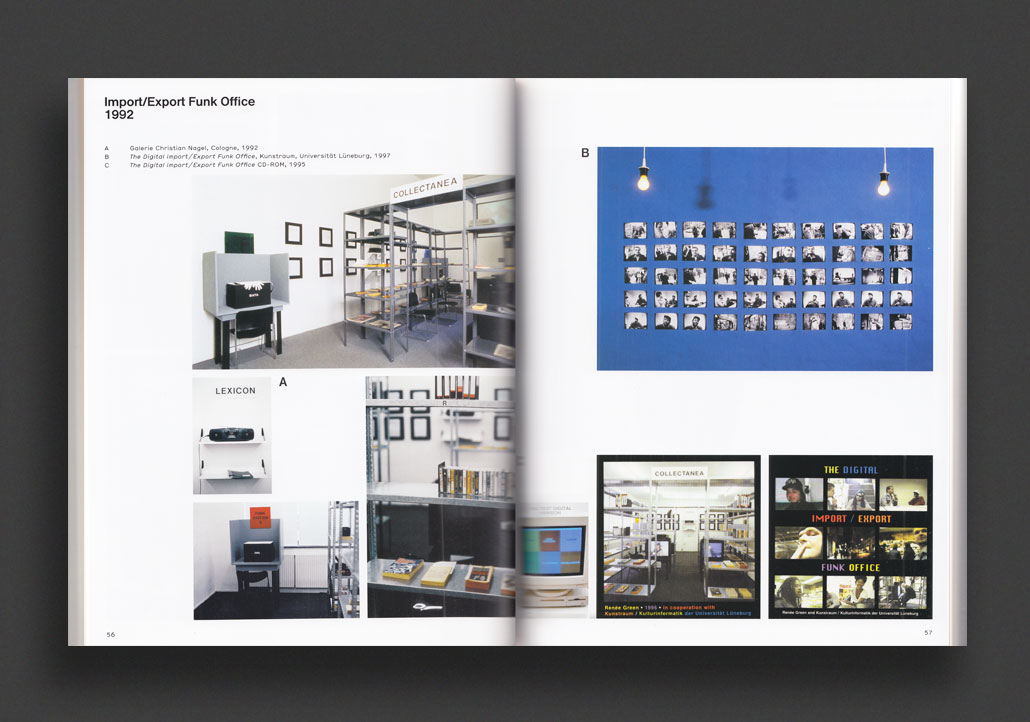
The first overview of the variety and scope of the research carried out by Renée Green over the past twenty years.
This reference monograph provides the first overview of the variety and scope of the research carried out by Renée Green over the past twenty years through mediums as varied as film, video, installation, sound-related works, photographs, prints, banners, texts, websites, and ephemera.
The essays by Nora Alter, Diedrich Diedrichsen, Kobena Mercer, Catherine Quéloz, Gloria Sutton, Elvan Zabunyan, and the interview between Julian Renbentisch and Renée Green not only give an historical overview of the artist's work, but engage with issues central to her practice such as questions of genealogy and memory, archives and their reworkings, movements and displacements, site-specificity and location, positionalities and perceptions. They offer new insight into the artist's specific use of images, sound and text, and her inscription in art history.
Born 1958 in Cleveland, Ohio, artist, writer, and filmmaker Renée Green lives and works in New York and San Francisco. Her work is located both within the legacy of the most ambitious achievements of Conceptual and post-Minimal art, and within a post-colonial critique of culture. It often takes the form of complex, multi-layered archive-like installations that employ a vast array of sources, and point to a variety of issues, always involving the spectator as active participant through multiple points of access.
Edited by Nicole Schweizer.
Texts by Nora Alter, Diedrich Diedrichsen, Renée Green, Kobena Mercer, Catherine Quéloz, Juliane Rebentisch, Gloria Sutton, Elvan Zabunyan.
Published in collaboration with the Musée cantonal des Beaux-Arts, Lausanne.
2020, English
Softcover, 680 pages, 19 x 13.2 cm
Published by
JRP Ringier / Zürich
$65.00 - Out of stock
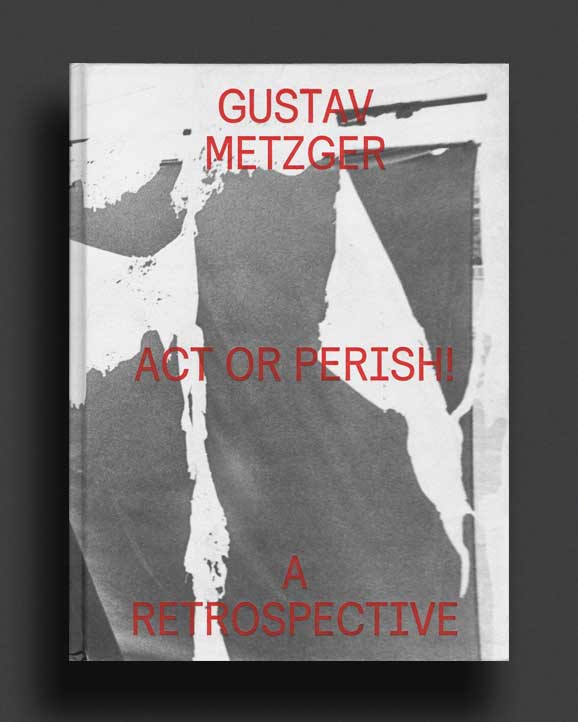
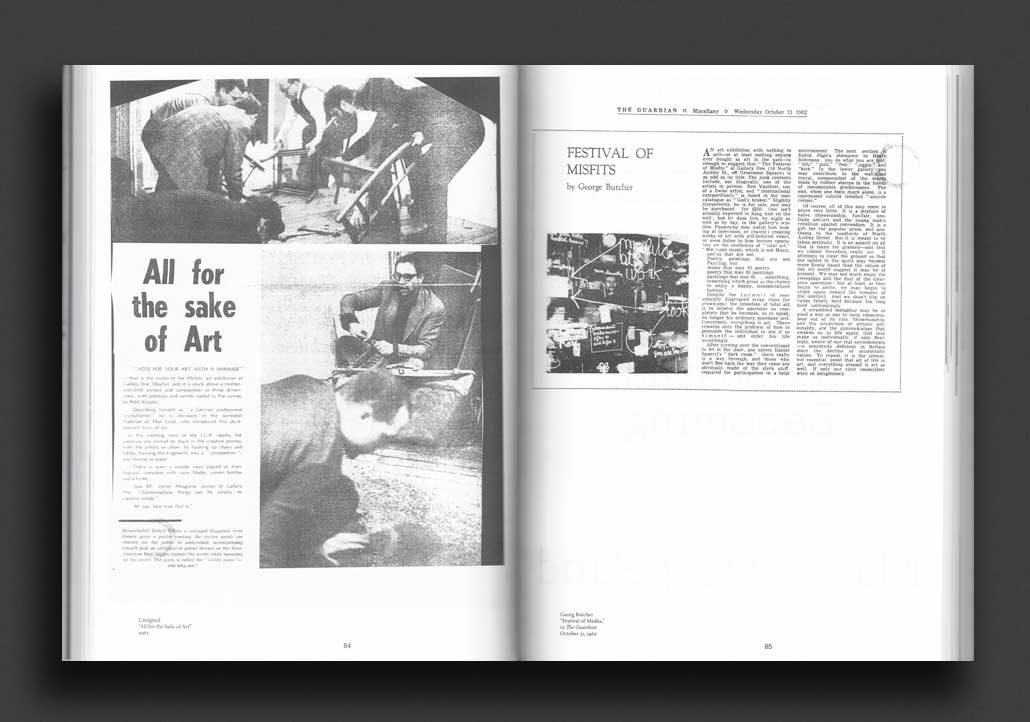
Bringing together more than 350 texts written between 1953 and 2016, this comprehensive volume establishes artist and activist Gustav Metzger (1926–2017) as a towering figure of the 20th century, a long-overdue recognition of the artist’s influential vision.
Renowned for his use of unstable materials and chemical reactions to create artworks that embody processes of change, destruction, and renewal, Metzger was also a prolific writer, theoretician, and satirist.
His interest in technology and science lead him to create such concepts as auto-destructive and auto-creative art—terms he coined with his manifestos on ‘Auto-destructive Art’ in 1959 and ‘Auto-creative Art’ in 1961. He put these ideas into action with artworks made to decay, disintegrate, or change following natural processes.
Edited by Gustav’s long-time friend and curator Mathieu Copeland, this anthology of writings makes Metzger’s key thinking from the 1950s onward available to a wide audience.
It includes seminal writings such as his manifestos of auto-destructive and auto-creative art (both 1961), ‘On Random Activity in Material/Transforming Works of Art’ (1964), ‘The Possibility of Auto-Destructive Architecture’ (1966), his inspiring interview with R. Buckminster Fuller from 1970, ‘The Artist in the Face of Social Collapse’ (1998), and his legacy manifesto entitled ‘Remember Nature’ from 2013, as well as art criticism, political satires, and lecture transcriptions.
His writing allows a challenging reading of the contemporary (art) period as analysed by one of its most discerning figures—a pioneering artist and thinker involved in environmental and societal issues very early on.
2016, English
Hardcover, 224 pages, 22 x 30 cm
Published by
Nero / Rome
$88.00 - In stock -
The catalogue of Metzger's first extensive overview: divided into sections—each of which is accompanied by a critical text—corresponding to those presented in the exhibition, the publication provides systematic insight into an artistic oeuvre considered as one of the most important in the 20th century (with texts by Mathieu Copeland, Hans Ulrich Obrist, Yoko Ono, Hermann Nitsch…).
If the retrospective, which started at the Centre for Contemporary Art in Torun before travelling to Oslo, was presented in distinctively different formats—the former providing audiences with a wide overview of Metzger's career and works, including attention to his early years of political activism and engagement and concomitant radicalization, and the latter focusing upon deeper researched aspects of the artist's production,—the exhibition catalogue provides readers with a rich array of theoretical contributions, including a conversation between Dobrila Denegri and Yoko Ono, Ivor Davies, Hermann Nitsch and Jon Hendricks, as well as Metzger's own writings.
The contributors Pontus Kyander, Andrew Wilson, Mathieu Copeland, Dobrila Denegri, Leanne Dmyterko, Hans Ulrich Obrist, Manuel Olveira take up different aspects of Metzger's work, from the artist's early political activism, to his experimentation with painting to his drafting of the manifestoes for Auto-Destructive Art, providing us with an invaluable and much awaited document for consultation in contemporary art.
Published following the eponymous exhibition at Centre of Contemporary Art in Torun, Poland, from November 8, 2015, to January 17, 2016, and the joint exhibition “Gustav Metzger in Oslo – Extremes Touch and Liquid Crystal Environment” at Kunsthall Oslo and Stiftelsen Kunstnernes Hus, Oslo, from November 14, 2015 to January 31st, 2016.
The artistic oeuvre of Gustav Metzger (1926-2017), in which the concept of Auto-Destructive Art and the Art Strike hold a central role, is considered as one of the most important in the 20th century.
2019, English
Hardcover, 256 pages, 19.2 x 24.6 cm
Published by
The MIT Press / Massachusetts
$100.00 - In stock -
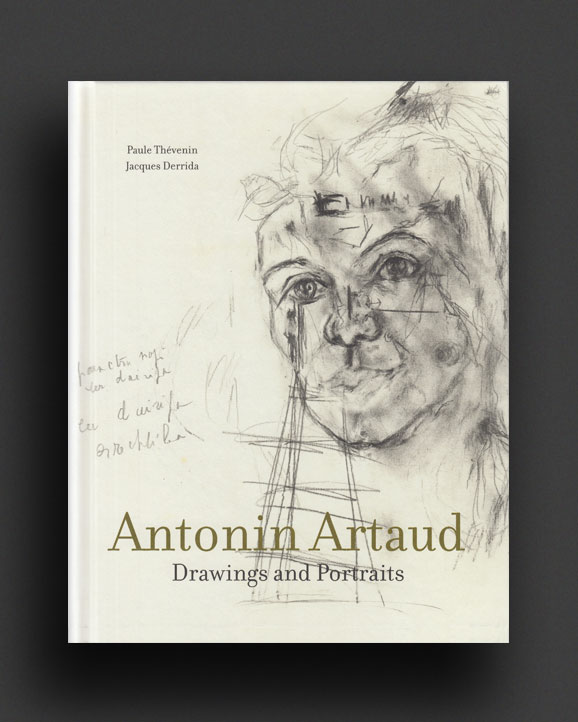
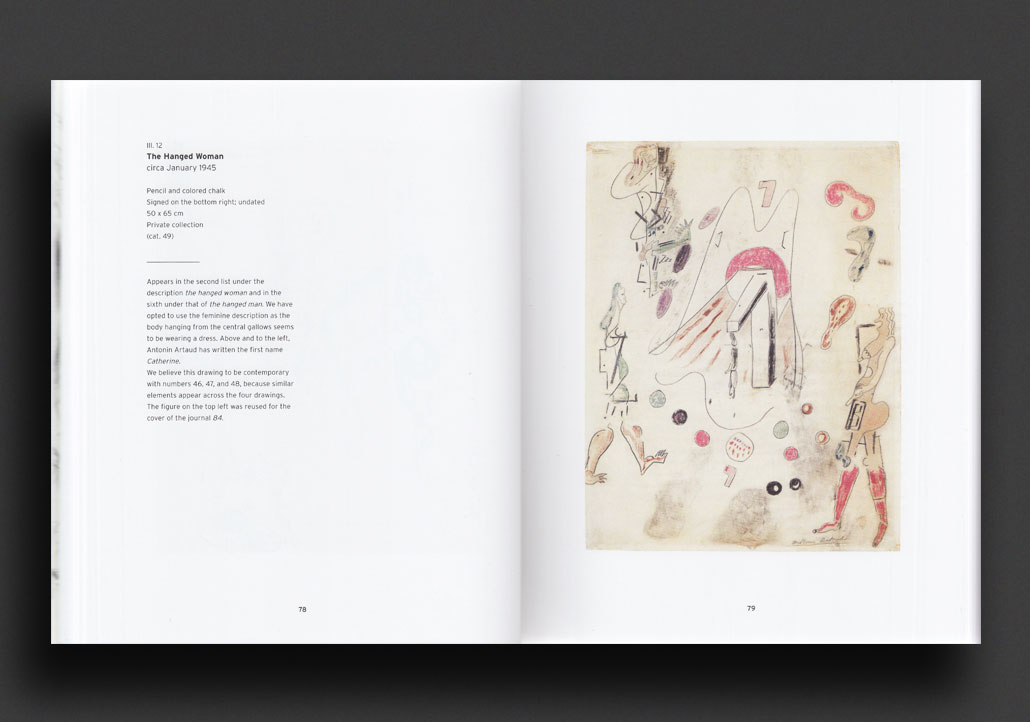
Antonin Artaud (1896–1948) - stage and film actor, director, writer, and visual artist - was a man of rage and genius. Expelled from the Surrealist movement for his refusal to renounce the theatre, he founded the Theater of Cruelty and wrote The Theater and Its Double, one of the key twentieth-century texts on the topic. Artaud spent nine years at the end of his life in asylums, undergoing electroshock treatments. Released to the care of his friends in 1946, he began to draw again. This book presents drawings and portraits from this late resurgence, in colour reproductions. Accompanying the images are texts by by Artaud's longtime friend and editor Paule Thévenin and the philosopher Jacques Derrida.
“We won't be describing any paintings,” Derrida warns the reader. Derrida struggles with Artaud's peculiar language, punctuating his text with agitated footnotes and asides (asking at one point, “How will they translate this?”). Thévenin offers a more straightforward biographical and historical account. (It was on the walls of her apartment that Derrida first saw Artaud's paintings and drawings.) These two texts were previously published by the MIT Press in The Secret Art of Antonin Artaud without the artwork that is their subject. This book brings together art and text for the first time in English.
Paule Thévenin (1918–1993) knew Antonin Artaud well and edited many his complete writings for the French publisher Éditions Gallimard.
Jacques Derrida (1930–2004), an enormously influential philosopher, theoretician, critic, and deconstructionist, is the author of Of Grammatology, The Post Card: From Socrates to Freud and Beyond, Aporias, and many other books.
2019, English
Softcover (w. flexi-disc), 280 pages, 26 x 21 cm
Ed. of 2500,
Published by
Primary Information / New York
$65.00 - Out of stock
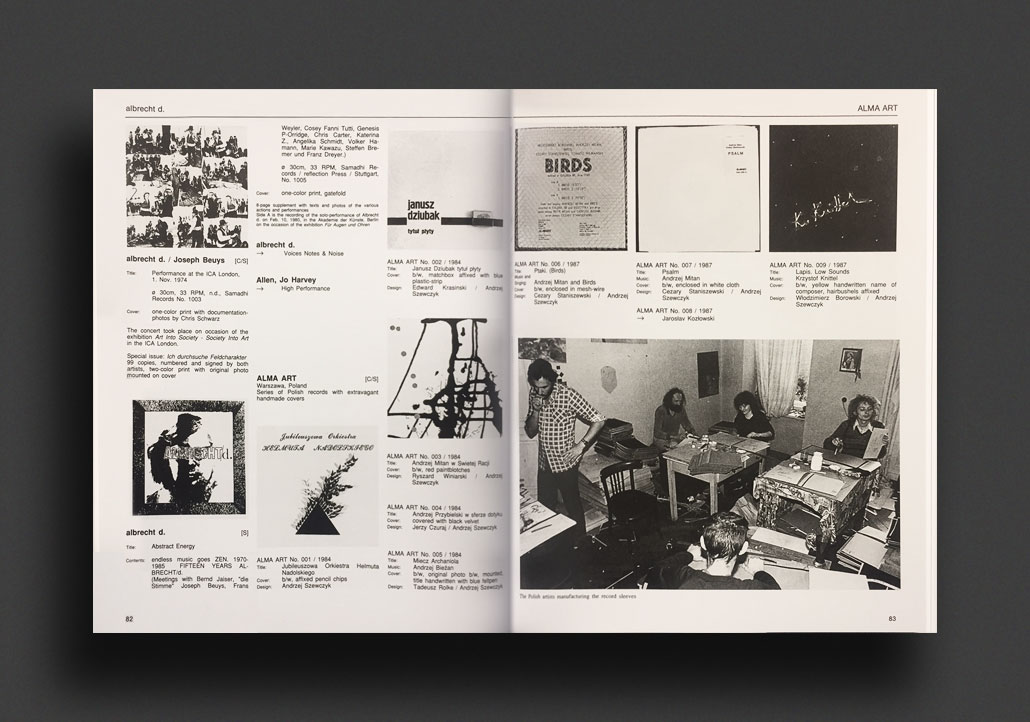
Broken Music is an essential compendium for records created by visual artists. The publication was edited by Ursula Block and Michael Glasmeier and originally published in 1989 by DAAD. Broken Music focuses on recordings, record-objects, artwork for records, and record installations made by thousands of artists between WWII and 1989.
It also includes essays by both editors as well as Theodor W. Adorno, René Block, Jean Dubuffet, Milan Knizak, László Moholy-Nagy, Christiane Seiffert, and Hans Rudolf Zeller, as well as a flexi disc of the Arditti Quartet performing Knizak’s “Broken Music.” The centerpiece of the publication is a nearly 200-page bibliography of artists’ records.
Works chosen for the publication revolved around four criteria: (1) record covers created as original work by visual artists; (2) record or sound-producing objects (multiples/editions/sculptures); (3) books and publications that contain a record or recorded-media object; and (4) records or recorded media that have sound by visual artists.
Artists documented in the volume include Vito Acconci, albrecht/d., Laurie Anderson, Guillaume Apollinaire, Karel Appel, Arman, Hans Arp, Antonin Artaud, John Baldessari, Hugo Ball, Claus van Bebber, John Bender, Harry Bertoia, Jean-Pierre Bertrand, Joseph Beuys, Mel Bochner, Claus Böhmler, Christian Boltanski, KP Brehmer, William Burroughs, John Cage, Henri Chopin, Henning Christiansen, Jean Cocteau, William Copley, Philip Corner, Merce Cunningham, Hanne Darboven, Jim Dine, Marcel Duchamp, Max Ernst, Lawrence Ferlinghetti, Fischli and Weiss, R. Buckminster Fuller, Allen Ginsberg, Philip Glass, Jack Goldstein, Peter Gordon, Hans Haacke, Richard Hamilton, Bernard Heidsieck, Holger Hiller, Richard Huelsenbeck, Isidore Isou, Marcel Janco, Servie Janssen, Jasper Johns, Joe Jones, Thomas Kapielski, Allan Kaprow, Martin Kippenberger, Per Kirkeby, Cheri Knight, Milan Knizak, Richard Kriesche, Christina Kubisch, Laibach, John Lennon, Sol Lewitt, Roy Lichtenstein, Annea Lockwood, Paul McCarthy, Meredith Monk, Josef Felix Müller, Piotr Nathan, Hermann Nitsch, Albert Oehlen, Frank O’Hara, Claes Oldenburg, Yoko Ono, Dennis Oppenheim, Nam June Paik, Charlemagne Palestine, A.R. Penck, Tom Phillips, Robert Rauschenberg, The Red Crayola, Ursula Reuter Christiansen, Gerhard Richter, Jim Rosenquist, Dieter Roth, Gerhard Rühm, Robert Rutman, Sarkis, Thomas Schmit, Conrad Schnitzler, Kurt Schwitters, Selten Gehörte Musik, Richard Serra, Robert Smithson, Michael Snow, Keith Sonnier, Strafe für Rebellion, Jean Tinguely, Moniek Toebosch, Tristan Tzara, Ben Vautier, Yoshi Wada, Emmett Walsh, Andy Warhol, William Wegman, and Lawrence Weiner.
Ursula Block is a curator living in Berlin, Germany. From 1981 until 2014, she ran gelbe Musik, a gallery and record shop in Berlin that featured work by artists at the crossroads between music and art.
Michael Glasmeier is a professor, writer, and editor living in Berlin, Germany. Since the early 1980s, he has curated dozens of shows that explore the intersection between the visual arts, music, film, and language.
1999, English
Hardcover (w. dust jacket), 400 pages, 28 x 24 cm
1st Edition, Out of print title / used / very good
Published by
Charta / Milan
$150.00 - Out of stock
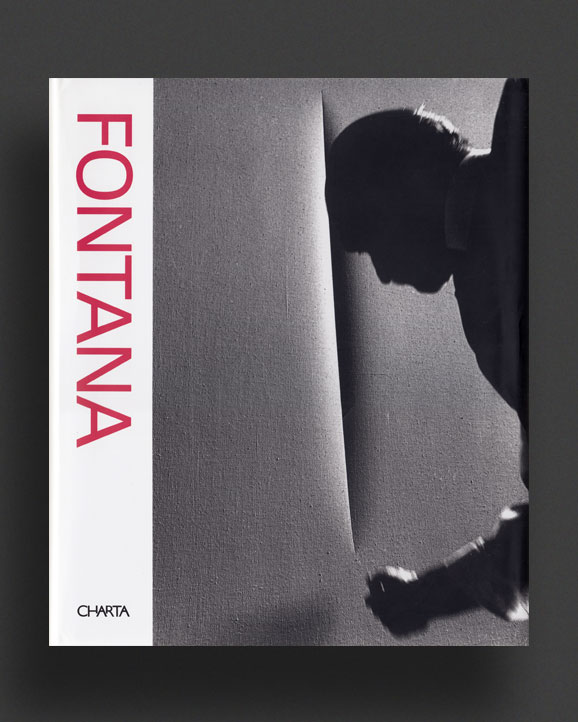
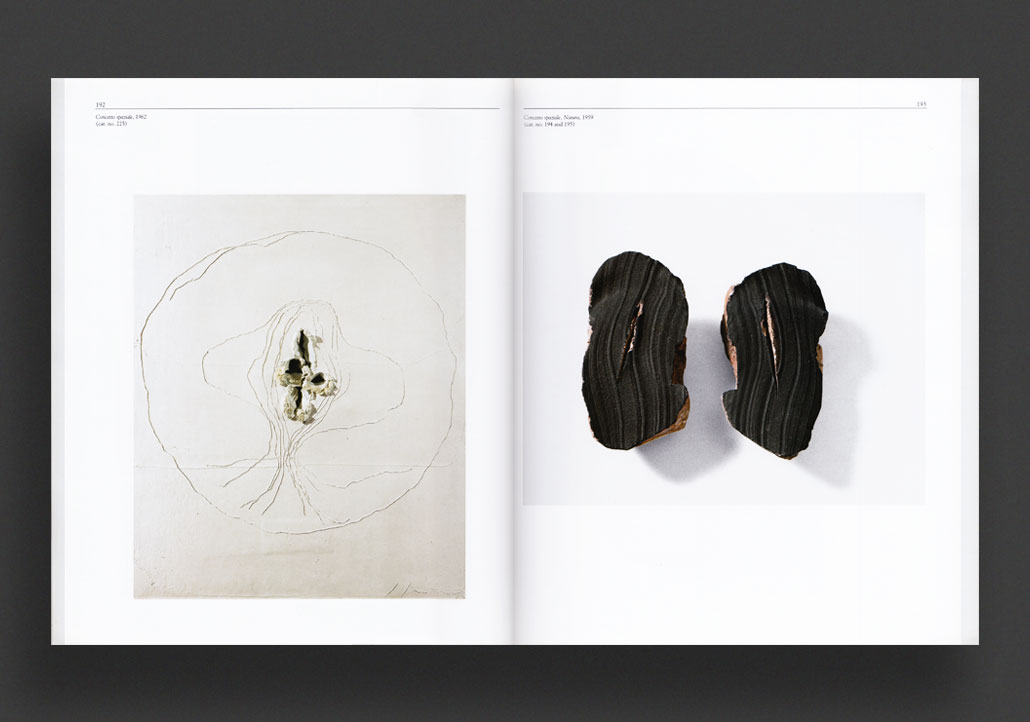
First edition of one of the largest and most comprehensive English-language books on Lucio Fontana, edited by esteemed Italian art critic and leading Fontana author Enrico Crispolti and published on the occasion of a major Lucio Fontana retrospective exhibition held in Milan, 23 April—30 June, 1999. Profusely illustrated throughout in colour and black and white with a huge array of Fontana's works, accompanied by texts from Enrico Crispolti, Antonello Negri, Luciano Caramel, Paolo Biscottini, Tommaso Trini, and a conversation between art critics Guido Ballo and Tommaso Trini, together covering every dimension of this highly original and influential artist's career. Also includes an incredible photo album edited by Nini Ardemagni Laurini and Valeria Ernesti, documenting the artist's world, studio, exhibitions, social life through the lens of many photographers, including many by the great Ugo Mulas, whose photographs adorn the covers. Includes a biography, list of works, exhibitions and a selected bibliography. A rare and in-depth insight into the life and work of a rare artist.
Lucio Fontana (1899–1968) is one the most innovative artists of the 20th century. A major figure of postwar European art and a binational resident of Argentina and Italy, Fontana blurred numerous boundaries in his life and art, crossing borders both literally and figuratively. The founder of Spatialism, a movement focused on the spatial qualities of sculpture and paintings with the goal of breaking through the two-dimensionality of the traditional picture plane, he pushed the painterly into the sculptural and redefined the relationship between the arts. He was best known for his monochrome canvases known as Concetti Spaziale that he would cut or puncture, leaving distinctive gaping slash marks and holes that imbued the finished work with an almost violent energy. In his seminal writing, White Manifesto (1946), the artist traced ideas for creating a new medium that blended architecture, painting, and sculpture. “I do not want to make a painting; I want to open up space, create a new dimension, tie in the cosmos, as it endlessly expands beyond the confining plane of the picture,” he said of his work. Fontana had widespread impact on the following generation of artists, who began to use installation media more aggressively to address the dynamics of space in gallery environments and Land Art. Fontana died on September 7, 1968 in Varese, Italy at the age of 69, just two years after being awarded the Grand Prize for painting at the Venice Biennale.
Very Good copy in VG dust jacket.
2016, English
Softcover, 680 pages, 190 x 250 cm
1st Edition, Out of print title / used / fine
Published by
Steidl / Göttingen
$300.00 - In stock -
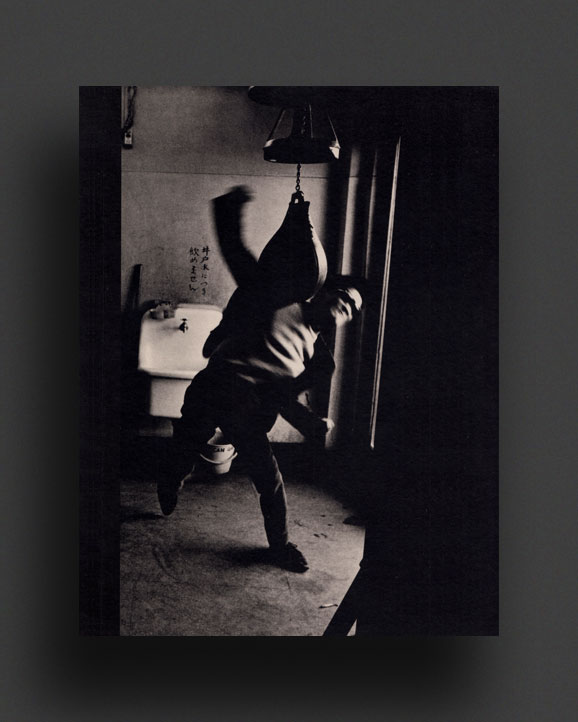
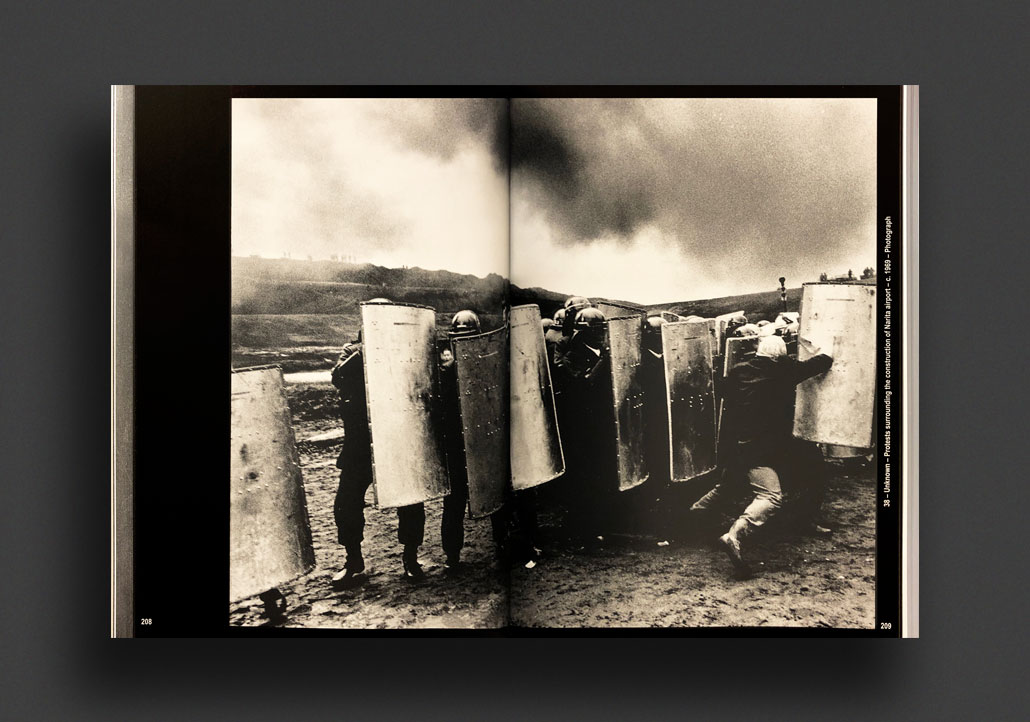
The short-lived Japanese magazine "Provoke," founded in 1968, is nowadays recognized as a major contribution to postwar photography in Japan, featuring the country's finest representatives of protest photography, vanguard fine art and critical theory in only three issues overall. The magazine's goal was to mirror the complexities of Japanese society and its art world of the 1960s, a decade shaped by the country's first large-scale student protests. The movement yielded a wave of new books featuring innovative graphic design combined with photography: serialized imagery, gripping text-image combinations, dynamic cropping and the use of provocatively "poor" materials. The writings and images by "Provoke"'s members-critic Koji Taki, poet Takahiko Okada, photographers Takuma Nakahira, Yakata Takanashi and Daido Moriyama-were suffused with the tactics developed by Japanese protest photographers such as Nobuyoshi Araki, Eikoh Hosoe and Shomei Tomatsu, who pointed at and criticized the mythologies of modern life.
This enormous, and long out-of-print "Provoke" book accompanies the first exhibition ever to be held on the magazine and its creators. Illuminating the various uses of photography in Japan at the time, the catalogue focuses on selected projects undertaken between 1960 and 1975 that offer a strongly interpretative account of currents in Japanese art and society at a moment of historical collapse and renewal.
Out of Print. As New.
1977, Japanese
Softcover (staple-bound w. map insert), 25.5 x 36.5 cm
1st Edition, Out of print title / used / very good
Published by
Shogakukan / Tokyo
$80.00 - In stock -
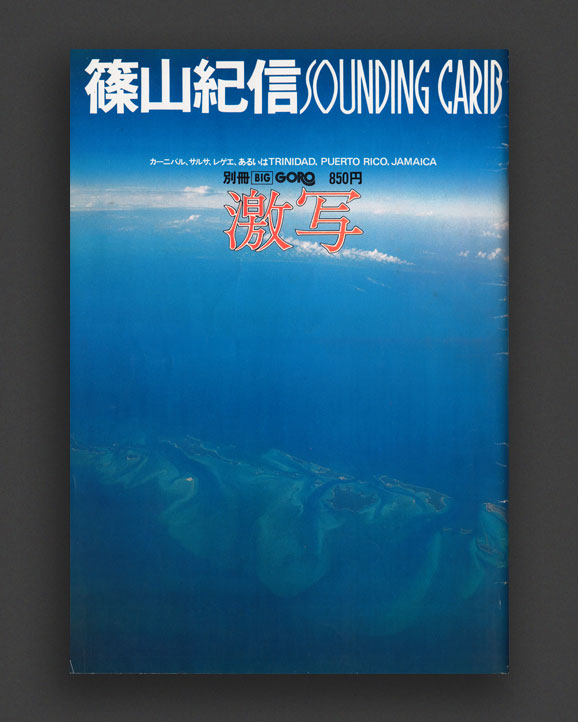
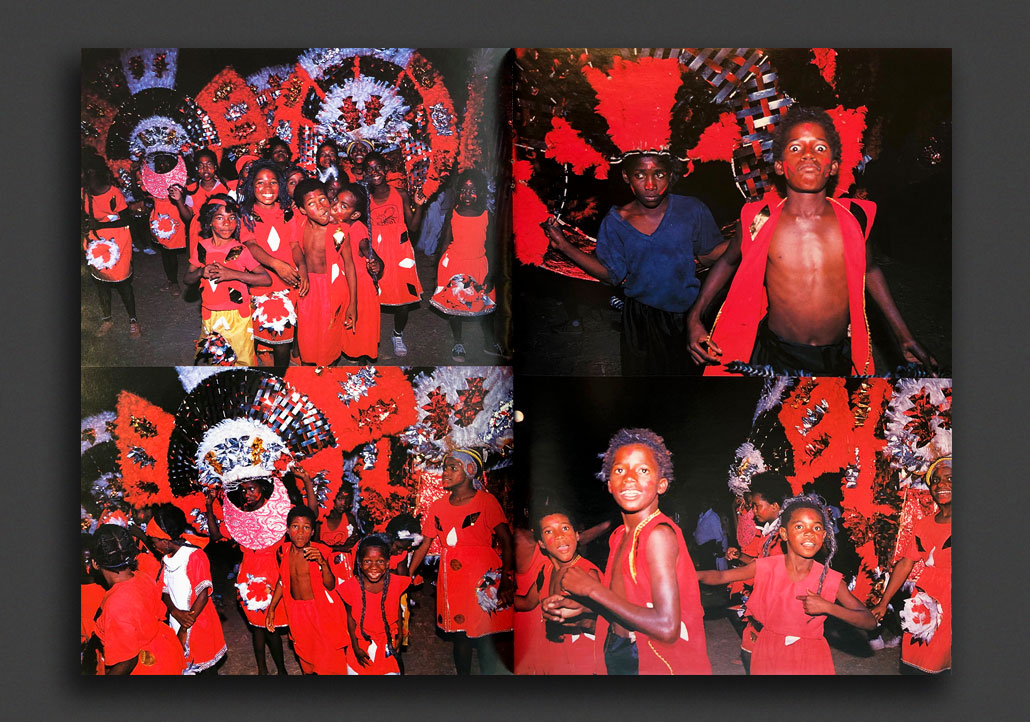
Incredible over-sized 1977 photo book by Kishin Shinoyama, one of Japan's leading photographers. "Sounding Carib" is a photographic special "seperate" edition of 1970s Japanese men's magazine GORO, and one of his lesser-known masterpieces that crosses over into his 1970's "Gekisha" works, a phrase Shinoyama coined for his “risqué photography” of the period. For this wonderful collection Kishin Shinoyama travelled to Trinidad and Tobago, Puerto Rico, and Jamaica, with camera and Olympus micro tape recorder in hand, to record the sights and sounds of the Caribbean. As the title suggests, the explosive photographic imagery follows the rhythm of the local music and festivities, with chapters titles "Trinidad : Carnival", "Puerto Rico : Salsa", and "Jamaica : Reggae", each exquisitely capturing the heat, the colour and the atmosphere of the islands. From the extravagant costumes and dizzying colour of the parades to the street markets, the beaches to the bedrooms, Shinoyama's saturated, deep contrast photographs, candid and uncensored, are a love-letter to the Caribbean of the 1970s. This special publication comes complete with a map insert to follow the journey, also musical listings to accompany the pictures. Kishin also recorded all the sounds of the trip and separately issued an LP of the same name, also through GORO magazine.
Very Good with some light general wear.