World Food Books' programme is largely produced on Kulin Nation land. We acknowledge the Wurundjeri people of the Kulin Nation as the first and continuing custodians of this land, and pay respect to their Elders past, present, and emerging.
World Food Books is an arts and special interests bookshop in Naarm / Melbourne. Founded in 2010, World Food Books is devoted to the presentation of a rotating, hand-selection of international art, design, literary and counterculture publications with an emphasis on the anti-traditional, the experimental, the avant-garde, the heretic, the marginal.
Presenting new titles alongside rare and out-of-print books, catalogues and journals spanning the fields of modern and contemporary art, design, photography, illustration, film, literature, poetry, cultural theory, philosophy, sexuality, popular and underground culture in its many radical forms, World Food Books wishes to encourage adventurous, thoughtful and open-minded reading, looking, writing, and exchange of publishing and ideas, both current and historical.
As well as our bookshop, located in Melbourne's historical Nicholas Building, all of our inventory is available internationally via our online mail-order service.
World Food Books semi-regularly co-ordinates "Occasions", a programme of exhibits and events at the bookshop and in partnership with other hosts (such as museums and art galleries) that develop out of the activities, relationships and content of the bookshop itself.
World Food Books
The Nicholas Building
37 Swanston Street
Room 5, Level 6
Melbourne 3000
Australia
SHOP HOURS:
Thu–Fri 12–6, Sat 12–5
WEB-SHOP OPEN 24/7
World Food Books
Postal Address:
PO Box 435
Flinders Lane
Victoria 8009
Australia
Art
Theory / Essay
Architecture / Interior
Graphic Design / Typography
Photography
Fashion
Eros
LGBTQ+
Fiction / Poetry
Weird / Speculative / Science Fiction / Horror
Transgressive / Visceral / Abject
Symbolism / Decadence / Fin de siècle
Film / Video
Painting
Sculpture / Installation
Performance / Dance / Theater
Drawing
Sound / Music
Curatorial
Group Shows / Collections
Periodicals
Out-of-print / Rare
Posters / Ephemera / Discs
Signed Books
World Food Books Gift Voucher
World Food Book Bag
Australian Art
Australian Fiction
Australian Science Fiction / Speculative Fiction
Australian Poetry
Australian Photography
Japanese Photography
Conceptual Art
Minimal Art
Dada
'Pataphysics / Oulipo
Fluxus
Concrete Poetry
Pop Art
Surrealism
Arte Povera
Arte Informale / Haute Pâte / Tachism
Nouveau Réalisme / Zero / Kinetic
Situationism / Lettrism
Collage / Mail Art / Xerox Art
Art Brut / Folk / Visionary / Fantastic
Illustration / Graphic Art / Bandes Dessinées
Furniture
Italian Radical Design / Postmodernism
Textiles
Ceramics / Glass
Counterculture
Protest / Revolt
Philosophy
Psychoanalysis
Anthropology
Anarchism
Socialism / Anarchism / Communism / Capitalism
Literary Theory / Semiotics / Language
Feminism / Women's Studies
Gender Studies / Sexuality
Anthropology
Fetishism / BDSM
Drugs / Psychedelia
Crime / Violence
Animal Rights / Veganism
Occult / Esoterica
Ecology / Earth / Alternative Living
Whole Earth / Crafts
All prices in AUD (Australian dollars)
Pick-Ups
Pick-up orders can be collected in our bookshop during opening hours after order date. Please collect any Pick-up orders within 2 weeks of ordering as we have limited storage space. Orders will be released back into stock if not collected within this time. No refunds can be made for pick-ups left un-collected. If you cannot make it in to the bookshop in this time-frame, please choose postage option.
Return Policy
All sales are final. We do accept returns (for refund or exchange) for items received in error. All our orders are packed with special care using heavy-duty padding and cardboard book-mailers or bubble mailers (for smaller books), using reinforcement where required. We cannot take responsibility for any lost, stolen or damaged parcels.
Insurance
Should you wish to insure your package, please email us directly after placing your order and we can organise this at a small extra expense. Although all standard/express tracked packages are very safe and dependable, we cannot take responsibility for any lost, stolen or damaged parcels. We recommend insurance on valuable orders.
Interested in selling your old books, catalogues, journals, magazines, comics, fanzines, ephemera? We are always looking for interesting, unusual and out-of-print books to buy. We only buy books in our fields of interest and specialty, and that we feel we can resell.
We base these prices on desirability, market value, in-print prices, condition and our current stock levels. We offer cash, store credit, and can take stock on consignment. All
about 25% of the price we expect to get when we sell them, or 30% in store credit. We base these prices on desirability, market value, in-print prices, condition and our current stock levels.
Sell your books any day of the week. You can drop them off and return later. If you have a lot of books, we can visit your Sydney home.
We buy books that we feel we can resell. We offer about 25 % of the price we expect to get when we sell them, or 30% in store credit. We base these prices on desirability, market value, in-print prices, condition and our current stock levels.
Philadelphia Wireman
03 August - 01 September, 2018
World Food Books is proud to announce our next Occasion, the first presentation of sculptures by Philadelphia Wireman in Australia.
The Philadelphia Wireman sculptures were found abandoned in an alley off Philadelphia’s South Street on trash night in 1982. Their discovery in a rapidly-changing neighbourhood undergoing extensive renovation, compounded with the failure of all attempts to locate the artist, suggests that the works may have been discarded after the maker’s death. Dubbed the "Philadelphia Wireman" during the first exhibition of this work, in 1985, the maker’s name, age, ethnicity, and even gender remain uncertain. The entire collection totals approximately 1200 pieces, all intricately bound together with tightly-wound heavy-gauge wire (along with a few small, abstract marker drawings, reminiscent both of Mark Tobey and J.B. Murry). The dense construction of the work, despite a modest range of scale and materials, is singularly obsessive and disciplined in design: a wire armature or exoskeleton firmly binds a bricolage of found objects including plastic, glass, food packaging, umbrella parts, tape, rubber, batteries, pens, leather, reflectors, nuts and bolts, nails, foil, coins, toys, watches, eyeglasses, tools, and jewellery.
Heavy with associations—anthropomorphic, zoomorphic, and socio-cultural responses to wrapped detritus—the totemic sculptures by Philadelphia Wireman have been discussed in the context of work created to fulfil the shamanistic needs of alternative religions in American culture. Curators, collectors, and critics have variously compared certain pieces to sculpture from Classical antiquity, Native American medicine bundles, African-American memory jugs, and African fetish objects. Reflecting the artist’s prolific and incredibly focused scavenging impulse, and despite—or perhaps enhanced by—their anonymity, these enigmatic objects function as urban artefacts and arbiters of power, though their origin and purpose is unknown. Philadelphia Wireman, whatever their identity, possessed an astonishing ability to isolate and communicate the concepts of power and energy through the selection and transformation of ordinary materials. Over the course of the past two decades, this collection has come to be regarded as an important discovery in the field of self-taught art and vernacular art.
Presented in collaboration with Fleisher-Ollman Gallery, Philadelphia, and Robert Heald, Wellington.
Susan Te Kahurangi King
02 February - 10 March, 2018
Susan Te Kahurangi King (24 February 1951 - ) has been a confident and prolific artist since she was a young child, drawing with readily available materials - pencils, ballpoint pens and felt-tip markers, on whatever paper is at hand. Between the ages of four and six Susan slowly ceased verbal communication. Her grandparents William and Myrtle Murphy had developed a special bond with Susan so they took on caring responsibilities for extended periods. Myrtle began informally archiving her work, carefully collecting and storing the drawings and compiling scrapbooks. No drawing was insignificant; every scrap of paper was kept. The King family are now the custodians of a vast collection containing over 7000 individual works, from tiny scraps of paper through to 5 meter long rolls.
The scrapbooks and diaries reveal Myrtle to be a woman of great patience and compassion, seeking to understand a child who was not always behaving as expected. She encouraged Susan to be observant, to explore her environment and absorb all the sights and sounds. Myrtle would show Susan’s drawings to friends and people in her community that she had dealings with, such as shopkeepers and postal workers, but this was not simply a case of a grandmother’s bias. She recognised that Susan had developed a sophisticated and unique visual language and sincerely believed that her art deserved serious attention.
This was an unorthodox attitude for the time. To provide some context, Jean Dubuffet coined the term Art Brut in 1945 to describe work created by self-taught artists – specifically residents of psychiatric institutions and those he considered to be visionaries or eccentrics. In 1972 Roger Cardinal extended this concept by adopting the term Outsider Art to describe work made by non-academically trained artists operating outside of mainstream art networks through choice or circumstance. Susan was born in Te Aroha, New Zealand in 1951, far from the artistic hubs of Paris and London that Dubuffet and Cardinal operated in. That Myrtle fêted Susan as a self-taught artist who deserved to be taken seriously shows how progressive her attitudes were.
Susan’s parents Doug and Dawn were also progressive. Over the years they had consulted numerous health practitioners about Susan’s condition, as the medical establishment could not provide an explanation as to why she had lapsed into silence. Dawn educated herself in the field of homeopathy and went on to treat all twelve of her children using these principles – basing prescriptions on her observations of their physical, mental and emotional state.
Doug was a linguist with an interest in philosophy who devoted what little spare time he had to studying Maori language and culture. To some extent their willingness to explore the fringes of the mainstream made them outsiders too but it was their commitment to living with integrity and their respect for individuality that ensured Susan’s creativity was always encouraged.
Even though Susan’s family supported her artistic pursuits, some staff in schools and hospitals saw it as an impediment to her assimilation into the community and discouraged it in a variety of ways. Her family was not always aware of this and therefore did not fully understand why Susan stopped drawing in the early 1990s. However, rather than dwell on the challenges that Susan faced in pursuit of her artistic practice, they prefer to highlight her achievements. In 2008 Susan began drawing again in earnest, after an almost 20 year interruption, and her work is now shown in galleries around the world.
Susan grew up without television and has been heavily influenced by the comics she read as a child. She is absolutely fearless in the appropriation of recognizable characters, such as Donald Duck and Mickey Mouse, in her work. She twists their limbs, contorts their faces, compresses them together, blends them into complex patterned backgrounds - always imbuing them with an incredible energy. Although Susan often used pop culture characters in her work they are not naive or childlike. These are drawings by a brilliant self-taught artist who has been creating exceptional work for decades without an audience in mind.
Mladen Stilinović
"Various Works 1986 - 1999"
02 February 16 - September 10, 2016
Various works 1986 - 1999, from two houses, from the collections of John Nixon, Sue Cramer, Kerrie Poliness, Peter Haffenden and Phoebe Haffenden.
Including: Geometry of Cakes (various shelves), 1993; Poor People’s Law (black and white plate), 1993; White Absence (glasses, ruler, set square, silver spoon, silver ladel with skin photograph and wooden cubes), 1990-1996; Exploitation of the Dead (grey and red star painting, wooden painting, black spoon with red table, red plate), 1984-1990; Money and Zeros (zero tie, paintings made for friends in Australia (Sue, John, Kerrie), numbers painting), 1991-1992; Words - Slogans (various t-shirts) - “they talk about the death of art...help! someone is trying to kill me”, “my sweet little lamb”, “work is a disease - Karl Marx”; Various artist books, catalogues, monographs, videos; Poster from exhibition Insulting Anarchy; "Circular" Croatian - Australian edition; Artist book by Vlado Martek (Dostoyevsky); more.
Thanks to Mladen Stilinović and Branka Stipančić.
Jonathan Walker
Always Will Need To Wear Winter Shirt Blue + Ochre Small Check Pattern
21 August - 21 September, 2015
Untitled
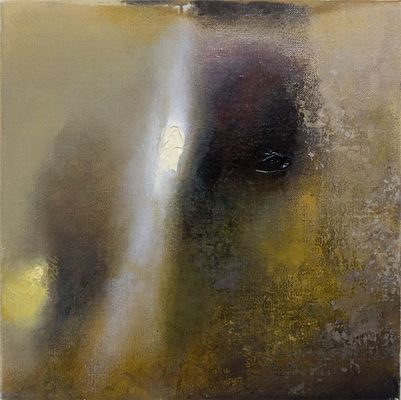
I am not a great reader of poetry but I always return to the work of Melbourne poet, Vincent Buckley (1925- 1988). Perhaps I find his most tantalising piece to be not a finished poem but a fragment left on a scrap of paper discovered on his desk after the poet’s death.
The poetry gathers like oil
In the word-core, and spreads
It has its music meet,
Its music is in movement.
This fragment is more the shell left behind from a volatile thought than a finished poem. I find the last two lines honest but awkward whereas the first two lines work like an arrow. Most likely he could not find a resolution so it was left. Still, in its present form, it remains an eloquent testimony to the ultimate failure of a medium to express mobile thought and sensation, in Buckley’s case, through verbal language. It’s an important matter because this is something all artists have to deal with regardless of the medium.
I have never written a poem, however, I am forever copying fragments from books on paper scraps in a vain effort to fix certain notions in my head. At first, they function as bookmarks that are sometimes returned to when I open the book. But before long, as they accumulate, they fall out littering the table interspersed with A4 photocopies, bills, books and medications.
To return to Buckley’s fragment, the first two lines very much evoke how I paint nowadays. As you age, detail diminishes and patches of light become more luminous and float. I feel the most honest way of dealing with this is by smearing the oil paint on the canvas with the fingers and working close-up, blind. Only if the patches coalesce into an approaching image can the work gain a life.
-
Jonathan Walker was born in Melbourne, Australia and brought up on a dairy farm in Gippsland. In the 1970’s he studied painting at RMIT and won the Harold Wright Scholarship to the British Museum, London. During the 1980’s he exhibited at Pinacotheca Gallery, Richmond and had work shown at the NGV and Heidi City Art Gallery. Over the same period he designed the cover for the “Epigenesi” LP by Giancarlo Toniutti, Italy and conducted a mail exchange work with Achim Wollscheid, Germany. The work with artists through the post resulted in an article published in the bicentenary issue of Art and Australia 1988. He showed in artist run spaces such as WestSpace in the 90’s and 2000’s, and until 2012, taught painting at Victoria University, which is where we (Colleen Ahern and Lisa Radford) as organisers of the exhibition, among many others, had the privilege of being his student.
Walker’s knowledge was imparted to students through the careful selection of music, literature, and artists found in books that he himself had ordered for the library. Walker’s strategy was the generosity of sharing his vast knowledge with references specific to each student and their context.
Walker’s paintings share a similar focus and intimacy.
This exhibition presents a small selection of recent paintings alongside a publication that includes Walker’s writing. Observational and analytical, Walker’s work is a type of material notation — the time of day, colour and how it is blended, the both specific and fleeting location of a reflection on lino or the question of whether a chair leg should be included in a painting.
Please join us on Friday August 21 between 6-8pm to celebrate the opening of the exhibition.
Curated by Colleen Ahern and Lisa Radford.
B. Wurtz
Curated by Nic Tammens
March 26 - April 4, 2015
B.Wurtz works from a basement studio in his home on Manhattan’s Lower East Side.
This local fact is attested to by the plastic shopping bags and newsprint circulars that appear in his work. As formal objects, they don’t make loud claims about their origins but nonetheless transmit street addresses and places of business from the bottom of this long thin island. Like plenty of artists, Wurtz is affected by what is local and what is consumed. His work is underpinned by this ethic. It often speaks from a neighborhood or reads like the contents of a hamper:
“BLACK PLUMS $1.29 lb.”
“Food Bazaar”
“USDA Whole Pork Shoulder Picnic 99c lb.”
“RITE AID Pharmacy, with us it’s personal.”
“H. Brickman & Sons.”
“Sweet Yams 59c lb."
Most of the work in this exhibition was made while the artist was in residence at Dieu Donne, a workshop dedicated to paper craft in Midtown. Here Wurtz fabricated assemblages with paper and objects that are relatively lightweight, with the intention that they would be easily transportable to Australia. This consideration isn’t absolute in Wurtz’s work, but was prescriptive for making the current exhibition light and cheap. Packed in two boxes, these works were sent from a USPS post office on the Lower East Side and delivered to North Melbourne by Australia Post.
Wurtz appears courtesy of Metro Pictures, New York.
Thanks to Rob Halverson, Joshua Petherick, Sari de Mallory, Matt Hinkley, Helen Johnson, Fayen d'Evie, Ask Kilmartin, Lisa Radon, Ellena Savage, Yale Union, and "Elizabeth".
John Nixon
"Archive"
December 15 - January 20, 2014
The presentation of John Nixon's archive offered a rare showcase of this extensive collection of the artist's own publications, catalogues, posters, ephemera, editions and more, from the mid 1980s onwards, alongside a selection of his artworks.
Organized by John Nixon, Joshua Petherick and Matt Hinkley.
<a href=http://wfb.public-office.info/artist/john-nixon>All titles by John Nixon
"Habitat"
at Minerva, Sydney (organised by Joshua Petherick and Matt Hinkley)
November 15 - December 20, 2014
Lupo Borgonovo, Janet Burchill & Jennifer McCamley,
Lewis Fidock, HR Giger, Piero Gilardi, Veit Laurent Kurz,
Cinzia Ruggeri, Michael E. Smith, Lucie Stahl, Daniel Weil, Wols
Press Release:
“...It contained seven objects. The slender fluted bone, surely formed for flight, surely from the wing of some large bird. Three archaic circuitboards, faced with mazes of gold. A smooth white sphere of baked clay. An age-blackened fragment of lace. A fingerlength segment of what she assumed was bone from a human wrist, grayish white, inset smoothly with the silicon shaft of a small instrument that must once have ridden flush with the surface of the skin - but the thing’s face was seared and blackened.”
William Gibson, “Count Zero”, 1986
"Autumn Projects Archive"
Curated by Liza Vasiliou
March 6 - March 15, 2014
World Food Books, in conjunction with the Virgin Australia Melbourne Fashion Festival 2014, presented the Autumn Projects archive, consisting of a selection of early examples in Australian fashion with a particular interest in collecting designers and labels from the period beginning in the 1980’s, who significantly influenced the discourse of Australian Fashion.
Curated by Liza Vasiliou, the exhibition provided a unique opportunity to view pieces by designers Anthea Crawford, Barbara Vandenberg, Geoff Liddell and labels CR Australia, Covers, Jag along with early experimental collage pieces by Prue Acton and Sally Browne’s ‘Fragments’ collection, suspended throughout the functioning World Food Books shop in Melbourne.
H.B. Peace
presented by CENTRE FOR STYLE
November 14, 2013
"Hey Blinky, you say chic, I say same"
Anon 2013
H.B. Peace is a clothing collaboration between great friends Blake Barns and Hugh Egan Westland. Their pieces explore the divergences between 'character’ and ‘personality’ in garments....etc
Special Thanks to Joshua Petherick and Matt Hinkley of WFB and Gillian Mears
and a Very Special Thank you to Audrey Thomas Hayes for her shoe collaboration.
Janet Burchill & Jennifer McCamley
"Aesthetic Suicide"
May 10 - June 8, 2013
The first of our occasional exhibitions in the World Food Books office/shop space in Melbourne, "Aesthetic Suicide" presented a body of new and older works together by artists Janet Burchill & Jennifer McCamley, including videos, prints, a wall work, and publications.
During shop open hours videos played every hour, on the hour.
1997, English
Softcover (staple-bound), 112 pages, 27 x 21 cm
1st Edition, Out of print title / used / very good
Published by
Ben is Dead / Los Angeles
$35.00 - In stock -
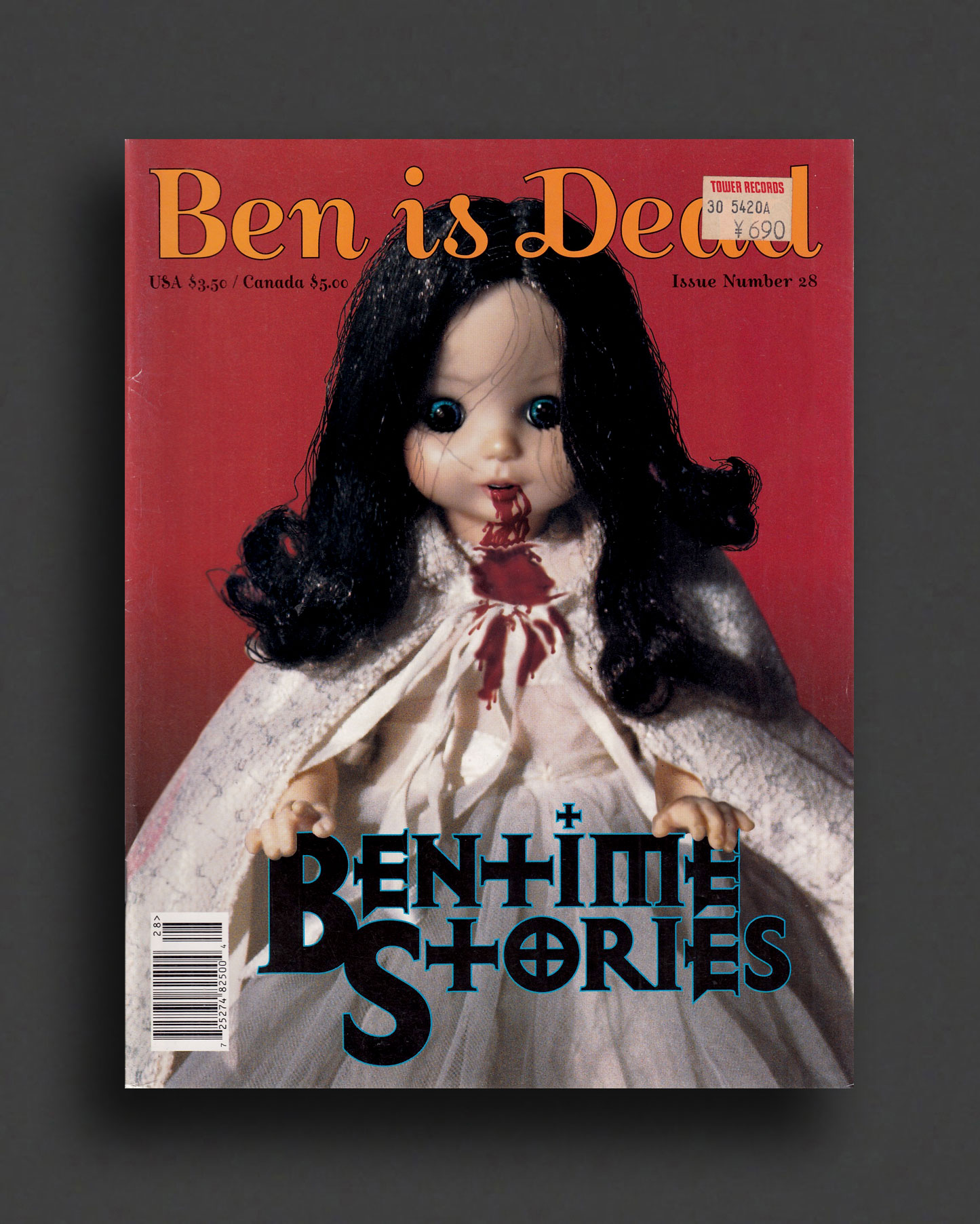
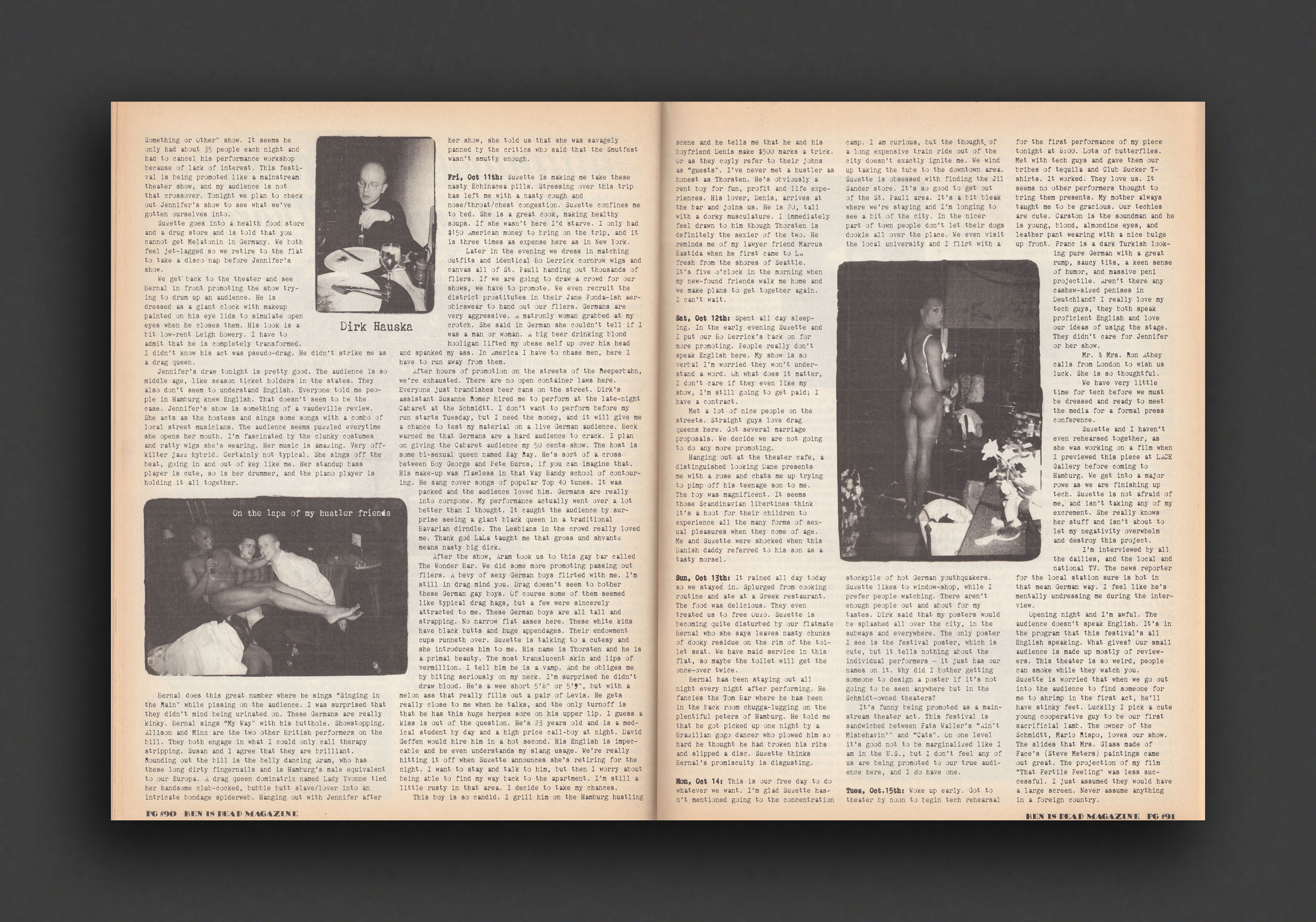
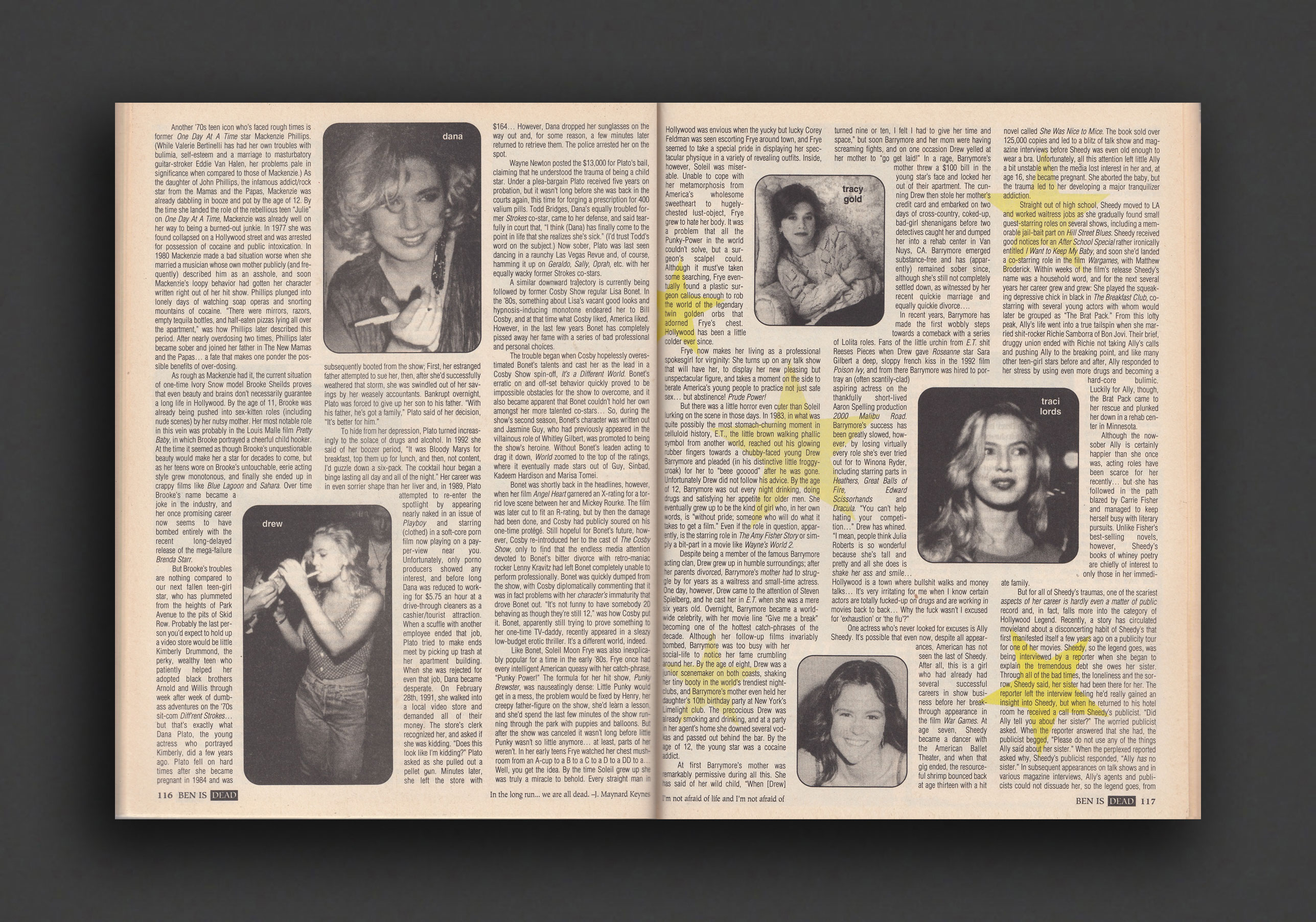
Issue 28 of Ben Is Dead, a prominent Los Angeles-based punk and alternative culture zine, published from 1988 through 1999, founded by Deborah "Darby" Romeo. This issue's theme, 'Bedtime Stories', features all hushed confessionals, perverse tales, and stories of all sorts from all sorts, including Vaginal Davis, Aaron Cometbus, Nina Denata, Darby, and many many more, plus demo and zine reviews, and much more.
Launched on Halloween in 1988, the name Ben is Dead was inspired by a dream about the founder's ex-husband, Ben. Known for its raw, feminist, and anti-corporate aesthetic, the magazine began as a photocopied publication featuring interviews with punk and "alternative" rock bands of the era (including then up-and-comers as Ethyl Meatplow, Nirvana and Hole) alongside the confessional and often shocking writing of Romeo, editors Mikki Halpin and Kerin Morataya, and her many contributors (which included colorful personalities Vaginal Davis, Ron Athey and Lisa Crystal Carver). Starting with issue 10 ("Mother"), each issue had an overall theme ("Revenge," "Obsessions and Bad Habits," "Sex," etc.) which the zine's writers would explore in exhaustive detail, freely recounting their own suicide attempts, kinky sexual adventures, addictions or family horror stories. The zine gradually became much more slick-looking and featured interviews with mainstream acts as Tom Jones, "Weird Al" Yankovic and Duran Duran alongside underground notables like William S. Burroughs, Johnny Rotten and Anton LaVey. Eventually Ben Is Dead had a circulation in the tens of thousands and was being sold in Borders and Tower Records across the United States, and yet it remained the complete antithesis of the morally-preened, aspirational image of contemporary (social) media with it's unedited, confessional nature of it's contents. So many zines from this period are full of wonders that escaped the clutches of the Dead Internet or succumbed the perils of reality; people you won't read about or from anywhere else. Enter the void! Long-live 90's anti-social media.
Very Good copy.
1994, English
Softcover (staple-bound), 152 pages, 27 x 21 cm
1st Edition, Out of print title / used / very good
Published by
Ben is Dead / Los Angeles
$55.00 - In stock -
"WARNING! MAY CONTAIN: ¡MURDERS! PSYCHOS! ¡SEX! ¡DEATH! ¡VOYEURS! ¡VICTIMS! Y MUCHO MORO!"
"You've never seen death? Look in the mirror every day and you'll see it like bees working in a glass hive."—Jean Cocteau
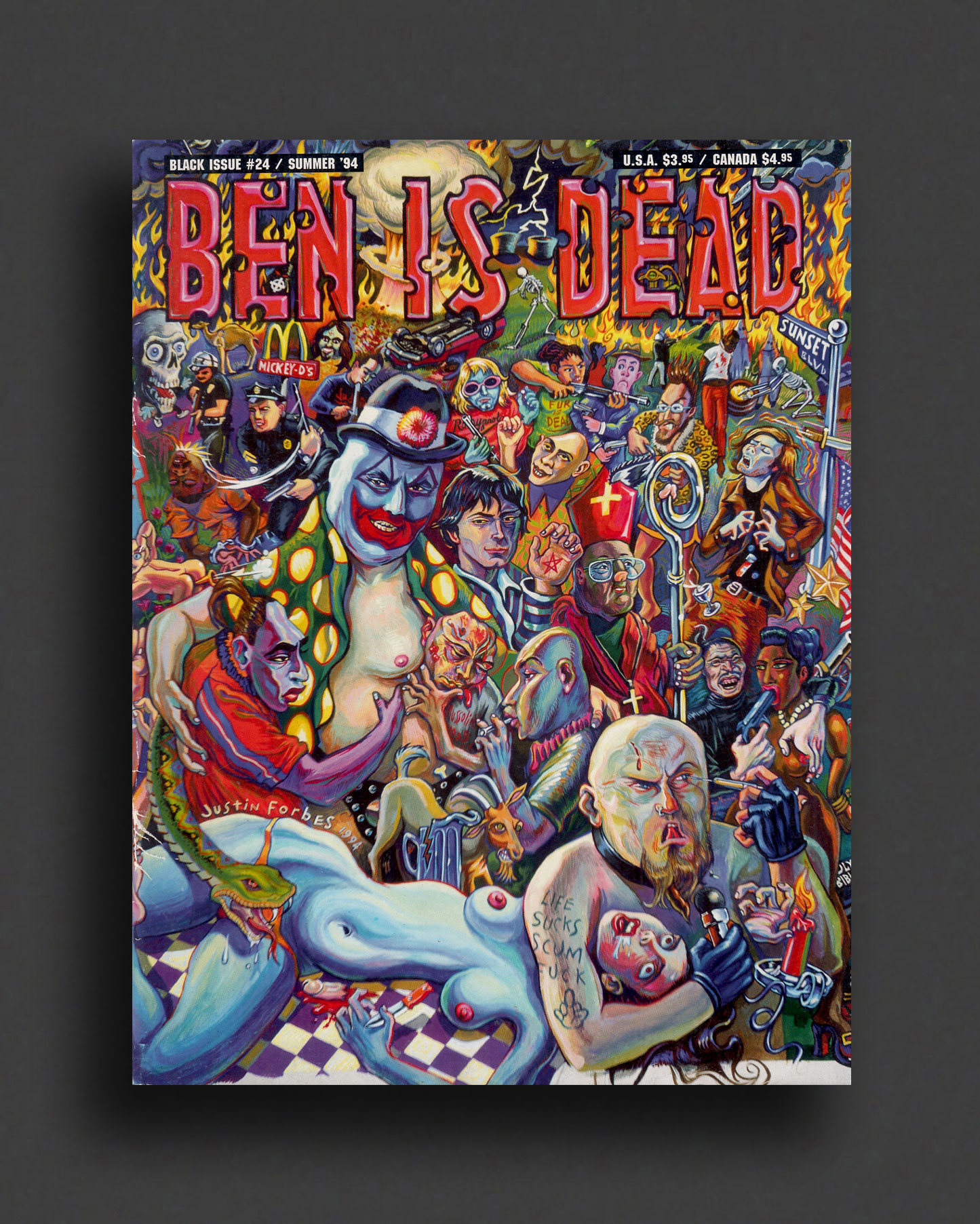
Issue 24 (Summer 1994) of Ben Is Dead, a prominent Los Angeles-based punk and alternative culture zine, published from 1988 through 1999, founded by Deborah "Darby" Romeo. This issue's death-drive theme, the 'Black Issue', features all of the above — hanging out with Anton LaVey of the Church of Satan, "Teen Girl Stars Who Fell To Earth", the murderous zines of Full Force Frank, interview with Nicole Panter (activist, author, manager of the LA punk band The Germs, co-creator, writer, and actor in the original Pee-wee Herman Show), a discussion between Robert Anton Wilson and Timothy Leary, hanging with Lydia Lunch, interview with Boyd Rice, interviews with Keiji Haino, Codeine, Carcass, Pavement, the art of Harald Kock and Phil Bower, 1990's nihilist publishing from comics to serial killer trading cards to magazines (Superfly/Mike Diana, Murder Can Be Fun, Answer Me!, Deceased Fetus, etc), an alternative guide to the disposition of human remains, interviews with director John Aes-Nihil, Johnny Anus / Corpus Delicti the mortician/musician, articles on depression/mental health/prozac/interview with author Peter Breggin, M.D., Amok Press on Black Beauty, mortuary billboards, the death of psychics, nursing homes, articles on death in many forms, marketable corpses, the perfect suicide, scenester death obituaries, loads of reviews, and a nude centrefold of Jack "Dr. Death" Kevorkian, an American pathologist and euthanasia proponent.
Launched on Halloween in 1988, the name Ben is Dead was inspired by a dream about the founder's ex-husband, Ben. Known for its raw, feminist, and anti-corporate aesthetic, the magazine began as a photocopied publication featuring interviews with punk and "alternative" rock bands of the era (including then up-and-comers as Ethyl Meatplow, Nirvana and Hole) alongside the confessional and often shocking writing of Romeo, editors Mikki Halpin and Kerin Morataya, and her many contributors (which included colorful personalities Vaginal Davis, Ron Athey and Lisa Crystal Carver). Starting with issue 10 ("Mother"), each issue had an overall theme ("Revenge," "Obsessions and Bad Habits," "Sex," etc.) which the zine's writers would explore in exhaustive detail, freely recounting their own suicide attempts, kinky sexual adventures, addictions or family horror stories. The zine gradually became much more slick-looking and featured interviews with mainstream acts as Tom Jones, "Weird Al" Yankovic and Duran Duran alongside underground notables like William S. Burroughs, Johnny Rotten and Anton LaVey. Eventually Ben Is Dead had a circulation in the tens of thousands and was being sold in Borders and Tower Records across the United States, and yet it remained the complete antithesis of the morally-preened, aspirational image of contemporary (social) media with it's unedited, confessional nature of it's contents. So many zines from this period are full of wonders that escaped the clutches of the Dead Internet or succumbed the perils of reality; people you won't read about or from anywhere else. Enter the void! Long-live 90's anti-social media.
Very Good copy.
2026, English
Softcover, 92 pages, 20.5 x 13.5 cm
Published by
Semiotext(e) / Los Angeles
$34.00 - Out of stock
Translated by Jeffrey Zuckerman
An account of flawed justice, based on the true story of a murder in a housing project outside Paris.
He is guilty, yes. He is guilty of having yielded, of not allowing himself to be crushed. He is guilty of not having been reasonable, of not having stayed in his place, the one that was his. To have disturbed the order of things…
Ten stab wounds. An old woman in a pool of blood. A nineteen-year-old neighbor now a murderer.
Since publishing her first novel in 2018, Constance Debré’s work has exposed the flaws in the social order with dizzying passion and intelligence. Her first-person trilogy—Playboy, Love Me Tender, and Name—describes the trajectory of leaving a comfortable bourgeois life as mother and wife employed as a criminal justice attorney to become a writer and lesbian. Her books radically challenge all received ideas of the couple, motherhood, family, and inheritance.
In Offenses, Debré trains her sights on a single case of inevitably flawed justice that, like hundreds of others like it, reveals the enmeshed culpabilities of the perpetrator, the victim, the place, and the past. In a housing project adjacent to Paris, an unemployed teenager kills his elderly neighbor in order to pay off a drug debt of €450. Writing with impassioned detachment, Debré uses forensic detail to explore the ambient senselessness behind this senseless crime.
There is a geography, Debré writes. We live in a vertical world, you don’t see. A world made of worlds. Not side by side but set concentrically and upon one another. A bit like Middle Age representations of the universe, a bit like Dante’s circles of hell. Each world only communicating with the worlds directly in contact with it and none of the others.
In Offenses, Debré scathingly describes the misery of poverty and the absence of any horizon beyond.
2025, English
Softcover, 192 pages, 30.5 x 23 cm
Published by
Primary Information / New York
$69.00 - In stock -
Stay away from nothing shines a spotlight on the deep relationship between Paul Thek and Peter Hujar through the artists’ letters and photographs. Beginning in 1956 and spanning two decades, the publication opens a window into their intimate, complex, and beautiful lives, starting with a sequence of images by Hujar that showcases the two of them in innocent moments of pensive and haunting play in Coral Gables and beyond.
These early portraits of their budding relationship are followed by Thek’s first letter to Hujar in 1962, written while the artist is in the Philadelphia harbor aboard a containership bound for Europe. In the letter, Thek is brimming with joy and new discoveries and exclaims that the world “seems bigger and more gloriously strange than ever before in my entire life.” The two eventually meet in Rome, where they both begin to evolve into the icons we know them as today, and the remaining letters trace Thek’s travels and adventures, romantic dalliances, work, and financial ups and downs through 1975. More than fifty letters and postcards, along with drawings and other ephemera, are reproduced in Stay away from nothing and their poetic, quotidian, and melancholic tone provide a rare glimpse into Thek and Hujar’s relationship as it waivers with seduction, glamor, tumult, and mischievousness.
Throughout this period, Hujar was photographing Thek in his now iconic style, capturing him in Italy, in various studios, and on the beaches of Fire Island. Included are the artist’s now-classic images of Thek in the catacombs in Palermo, as well as his studio portraits of the artist creating The Tomb. Among these well-known works are dozens of other photographs, many unpublished until now, including candid portraits of Thek, as well as images of the two artists goofing around or posing for passport photos. Collectively, these images demonstrate not only the complex emotional interiority of Thek but the tender, dark, and hopeful connection between the two artists, lovers, and friends.
An afterword is provided by Andrew Durbin, author of A Wonderful World that Almost Was, a biography of Peter Hujar and Paul Thek.
2013, English
Hardcover (w. dust jacket), 376 pages, 16.5 x 22.9 cm
Published by
Yale University Press / New Haven
$120.00 - In stock -
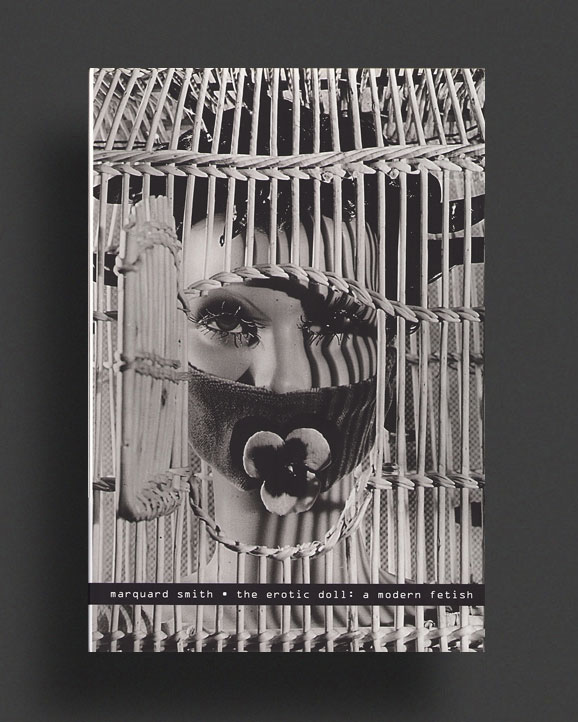
ince the 19th century, dolls have served as toys but also as objects of obsession, love, and lust. That century witnessed the emergence of the term "heterosexual" and of modern concepts of fetishism, perversity, and animism. Their convergence, and the demands of a growing consumer society resulted in a proliferation of waxworks, shop-window dummies, and customized love dolls, which also began to appear in art. Oskar Kokoschka commissioned a life-sized doll of his former lover Alma Mahler; Hans Bellmer crafted poupées; and Marcel Duchamp fabricated a nude figure in his environmental tableau Etant donnés. The Erotic Doll is the first book to explore men's complex relationships with such inanimate forms from historical, theoretical, and phenomenological perspectives. Challenging our commonsense grasp of the relations between persons and things, Marquard Smith examines these erotically charged human figures by interweaving art history, visual culture, gender, and sexuality studies with the medical humanities, offering startling insights into heterosexual masculinity and its discontents.
‘Ladies and gents, welcome to the museum of the erotic doll. Step right up and feast your eyes on modern man’s curious contraptions. If the saucy blow-up doll makes you squeamish, brace yourself for the Dutch Wife (a sailor’s delight!), lubricating robot ladies, surrealist brides stripped bare, state-of-the-art RealDolls, and the iDollators who love them. Marquard Smith is the curator of this collection of men's dolls, rendered in a lavishly illustrated volume.’—Laura Frost, Times Higher Education
'This book is platypus-like, unclassifiable.'—Marina Warner, London Review of Books
“[An] intriguing book . . . Smith teases out the history of these sex objects to provide a thorough genealogy of today’s erotic mannequins.”—Shelly Ronen, Public Books
1987, Japanese
Softcover, 168 pages, 13 x 18 cm
1st Edition, Out of print title / used / very good
Published by
Fiction Inc. / Tokyo
$70.00 - In stock -
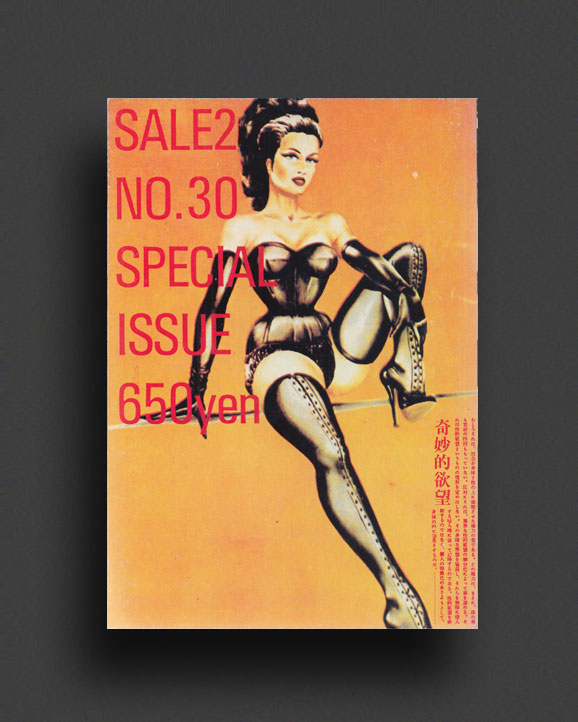
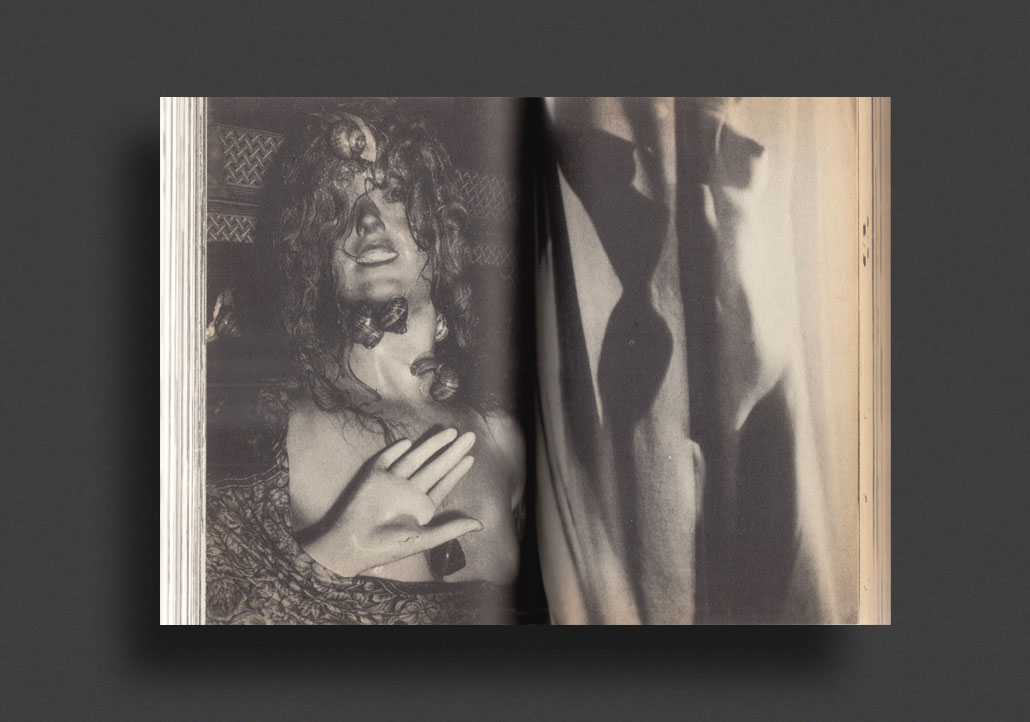
Issue No.30 of the great SALE2 periodical from Tokyo Japan, founded in 1984 by Makoto Orui, who later became art director for Purple magazine in France and Rockin’on magazine in Japan. SALE2 was active for about 14 years during the 1980s—1990s, published regularly as a sort-of fanzine/journal/catalogue/pocket-book by Fiction, Inc., a specialty shop and publisher of fetish and erotica in Tokyo in the 1980-90s. With Orui's distinct design SALE2 developed an exclusive curated editorial set on ‘erotisism and its spiritual philosophy’, with each issue exploring different themes and features, heavy on fetishism and erotic art.
Issue No.30, the "Special Issue" features Hans Bellmer, Leonor Fini, Richard Cerf, Gilles Deleuze, Michel Foucault, Paul Wunderlich, Robert Maplethorpe, Andy Warhol, Man Ray, Lewis Carroll, John Willie, Bernard Montorgueil, Guido Crepax, Van Rod, Carlo, Betty Page, Tealdo, clippings from periodicals such as Amateur Bondage, Bondage Life, Bondage Fantasies, Bizarre Comix, Bizarre Classix, Bizarre Fotos, and much more...
Very heavily illustrated throughout with erotic photography and artwork, all texts in Japanese.
Very Good copy with tanning to pages.
1989, Japanese
Softcover, 208 pages, 13 x 18 cm
1st Edition, Out of print title / used / very good
Published by
Fiction Inc. / Tokyo
$70.00 - Out of stock
Issue No.36 of the great SALE2 periodical from Tokyo Japan, founded in 1984 by Makoto Orui, who later became art director for Purple magazine in France and Rockin’on magazine in Japan. SALE2 was active for about 14 years during the 1980s—1990s, published regularly as a sort-of fanzine/journal/catalogue/pocket-book by Fiction, Inc., a specialty shop and publisher of fetish and erotica in Tokyo in the 1980-90s. With Orui's distinct design SALE2 developed an exclusive curated editorial set on ‘erotisism and its spiritual philosophy’, with each issue exploring different themes and features, heavy on fetishism and erotic art.
Issue No.36, the "Female Foot Fetishism Special Issue" with the wonderful wraparound Pierre Molinier cover is packed with imagery and essays around the theme of "Foot and Fetish Heel" throughout history, literature, film and fetish publishing, etc. profusely illustrated with drawings, photography, bondage illustrations, film stills, catalogue clippings, and artworks, including works by Bill Ward, Pierre Molinier, Nobuyoshi Araki, and so many more. It also features the Fiction, Inc. section that samples a cross-section of content from catalogue publications including the work of John Willie, Bill Ward, Carlo, Eric Stanton, Irving Claw, Betty Page, and periodicals such as Rubber Magazine, Amateur Bondage, Bizarre Comix, Bizarre Classix, Bizarre Fotos, Stiletto, and much more... Very heavily illustrated throughout with erotic photography and artwork, all texts in Japanese.
Very Good copy.
1992, Japanese
Softcover, 192 pages, 13 x 18 cm
1st Edition, Out of print title / used / very good
Published by
Fiction Inc. / Tokyo
$70.00 - In stock -
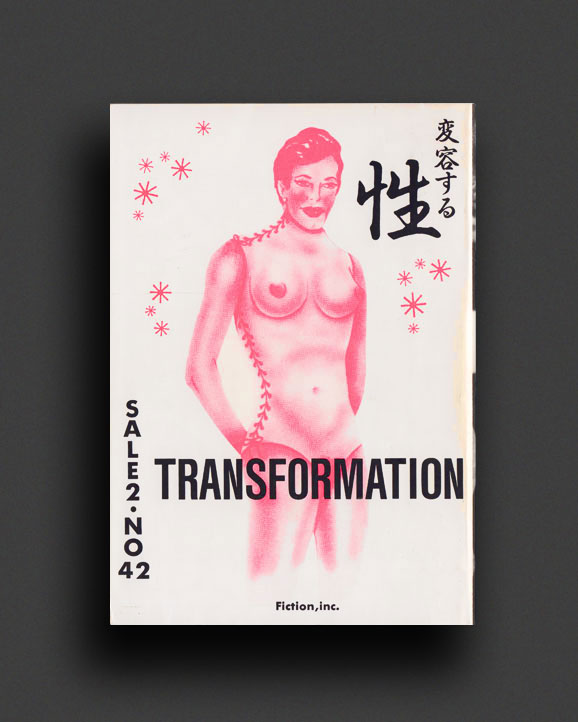
Issue No.42 of the great SALE2 periodical from Tokyo Japan, founded in 1984 by Makoto Orui, who later became art director for Purple magazine in France and Rockin’on magazine in Japan. SALE2 was active for about 14 years during the 1980s—1990s, published regularly as a sort-of fanzine/journal/catalogue/pocket-book by Fiction, Inc., a specialty shop and publisher of fetish and erotica in Tokyo in the 1980-90s. With Orui's distinct design SALE2 developed an exclusive curated editorial set on ‘erotisism and its spiritual philosophy’, with each issue exploring different themes and features, heavy on fetishism and erotic art.
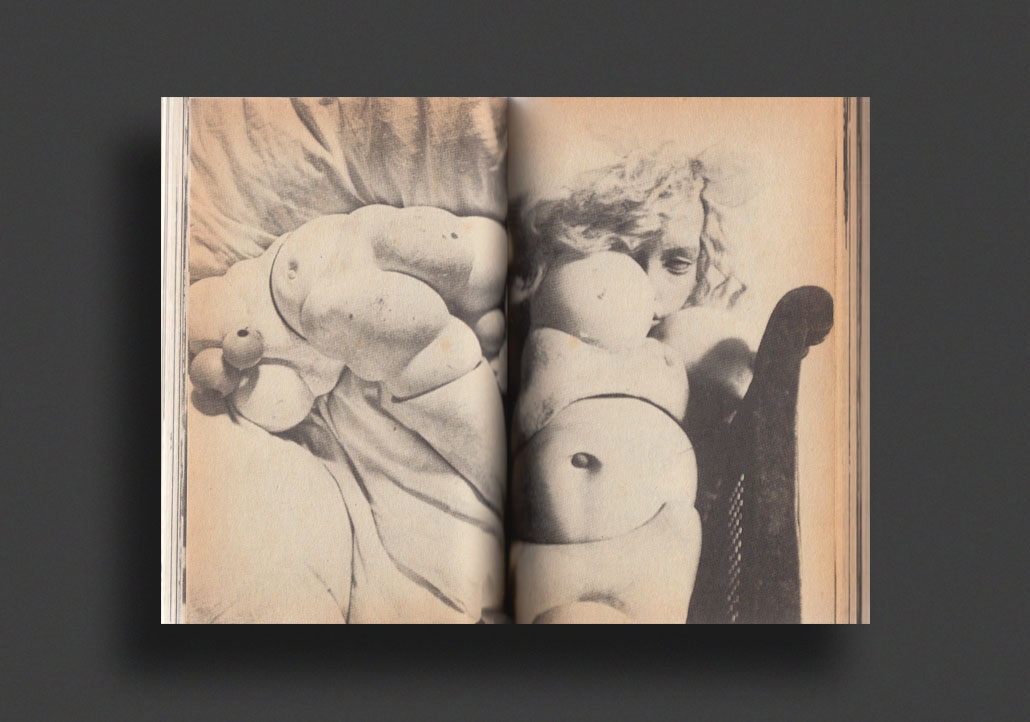
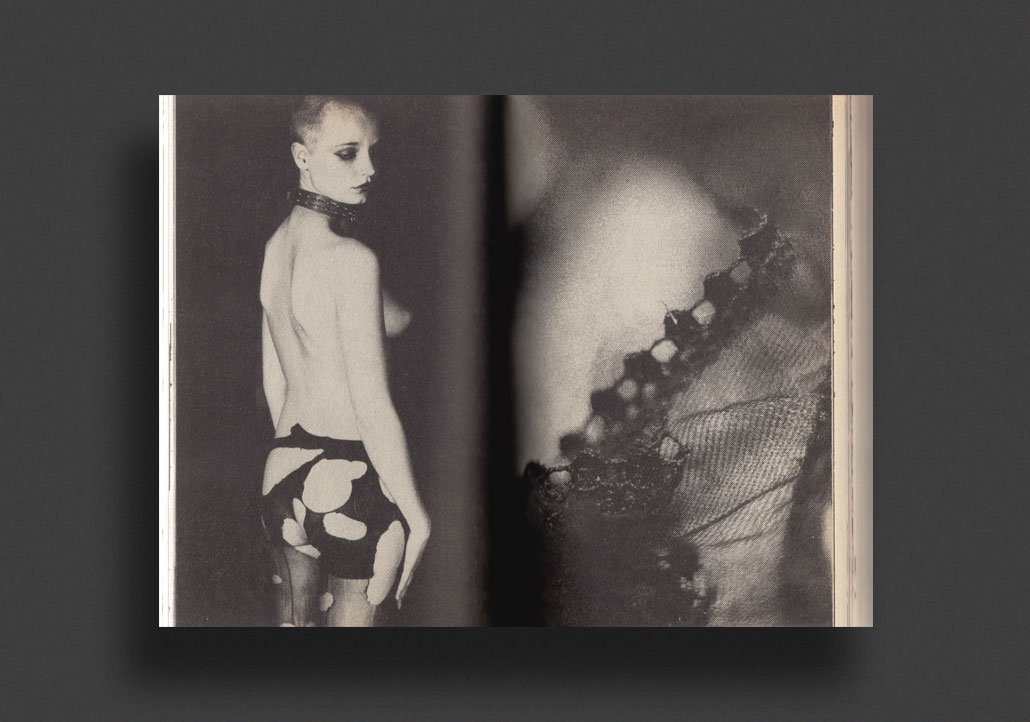
Issue No.42, the "Transformation" issue features collected writings and images around the themes of body transformation, transsexuality, including Pierre Molinier, Mari Akasaka, Kyoko Okazaki, Toyen, Hans Bellmer and Unica Zürn, Henri Maccheroni, Robert Chouraqui, Greybuck's The Equestrians illustrations, Sophia Lamar, plus loads of other images/catalogues of bondage and fetish related arts, and much more...
Very heavily illustrated throughout with erotic photography and artwork, all texts in Japanese.
Very Good copy with tanning to pages.
1988, Japanese
Softcover, 208 pages, 13 x 18 cm
1st Edition, Out of print title / used / very good
Published by
Fiction Inc. / Tokyo
$70.00 - In stock -
Issue No.35 of the great SALE2 periodical from Tokyo Japan, founded in 1984 by Makoto Orui, who later became art director for Purple magazine in France and Rockin’on magazine in Japan. SALE2 was active for about 14 years during the 1980s—1990s, published regularly as a sort-of fanzine/journal/catalogue/pocket-book by Fiction, Inc., a specialty shop and publisher of fetish and erotica in Tokyo in the 1980-90s. With Orui's distinct design SALE2 developed an exclusive curated editorial set on ‘erotisism and its spiritual philosophy’, with each issue exploring different themes and features, heavy on fetishism and erotic art.
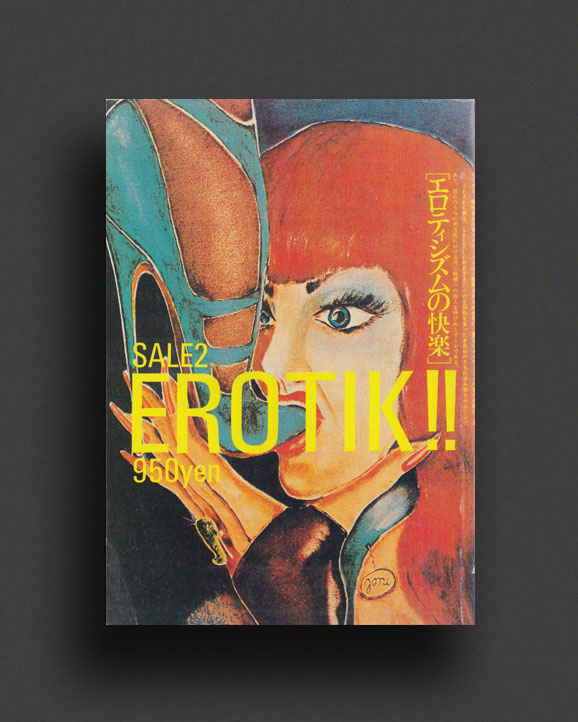
Issue No.35, the "EROTIK!!" issue features erotic writings and artwork throughout by Hans Bellmer, Dorothea Tanning, André Berg, Pierre Molinier, Max Ernst, Armando Calvelli, articles on vintage stag films, nude French postcards, interspersed with lots of mysterious vintage erotic imagery, bondage illustration, and catalogue/advertisments/clippings of Eric Stanton, Irving Klaw, Jim, John Willie, Bizarre Comix, and much more...
Very heavily illustrated throughout with erotic photography and artwork, all texts in Japanese.
Very Good copy, tanning to pages.
1986, Japanese
Softcover, 160 pages, 13 x 18 cm
1st Edition, Out of print title / used / very good
Published by
Fiction Inc. / Tokyo
$70.00 - In stock -
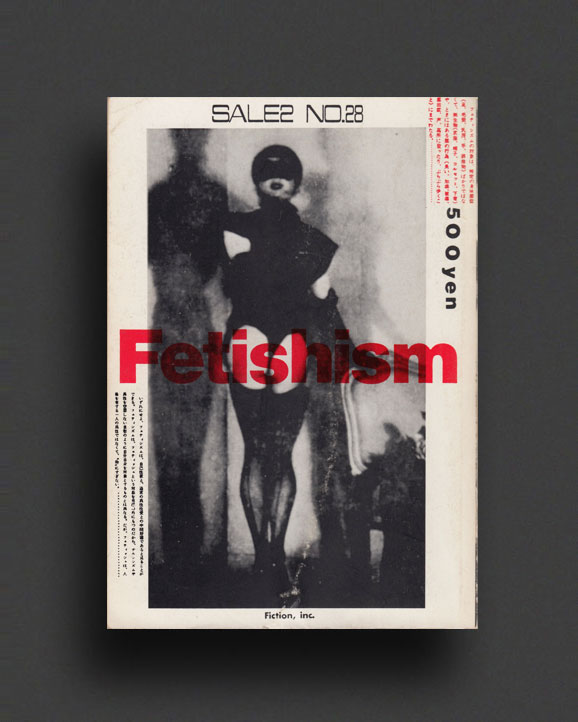
Issue No.28 of the great SALE2 periodical from Tokyo Japan, founded in 1984 by Makoto Orui, who later became art director for Purple magazine in France, published regularly as a sort-of fanzine/journal/catalogue/pocket-book by Fiction, Inc., a specialty bookshop and publisher of fetish and erotica in Tokyo in the 1980—90s. Each issue covers different themes and features, heavy on fetishism.
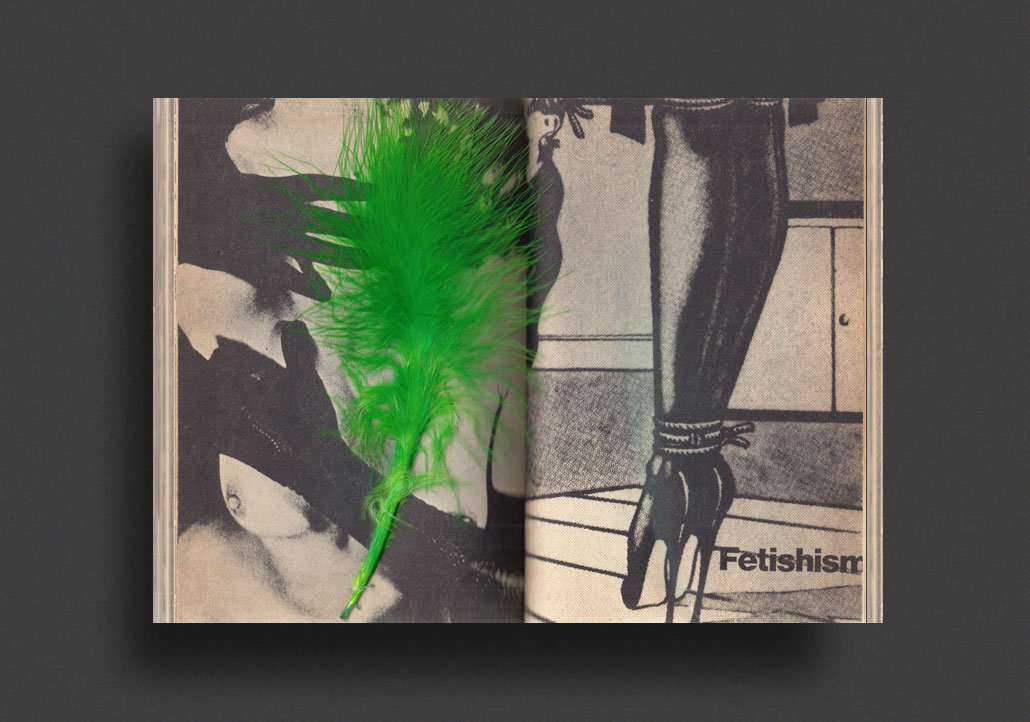
Issue No.28, the "Fetishism" issue features collected writings and images around the theme of fetish by John Willie, Bizarre Magazine, Pierre Molinier, Irina Ionesco, Bernard Faucon (his incredible Summer Camp series), Irwing Klaw, Centurians Publishing Inc. bondage catalogues, Andy Warhol and much more... What's more, this issue comes complete with a green synthetic feather to kickstart your own sensual adventures.
Very heavily illustrated throughout with erotic photography and artwork, all texts in Japanese.
1977, English
Softcover, 396 pages, 18 x 11 cm
1st Edition, Out of print title / used / good
Published by
Penguin Books / London
$28.00 - In stock -
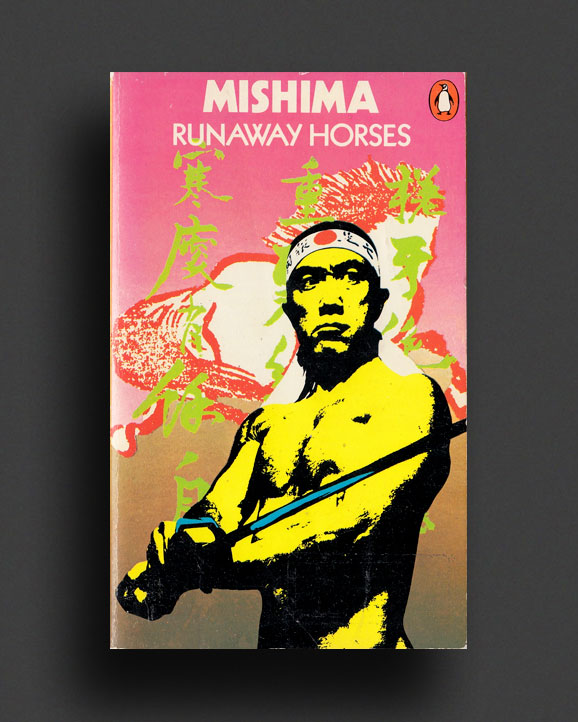
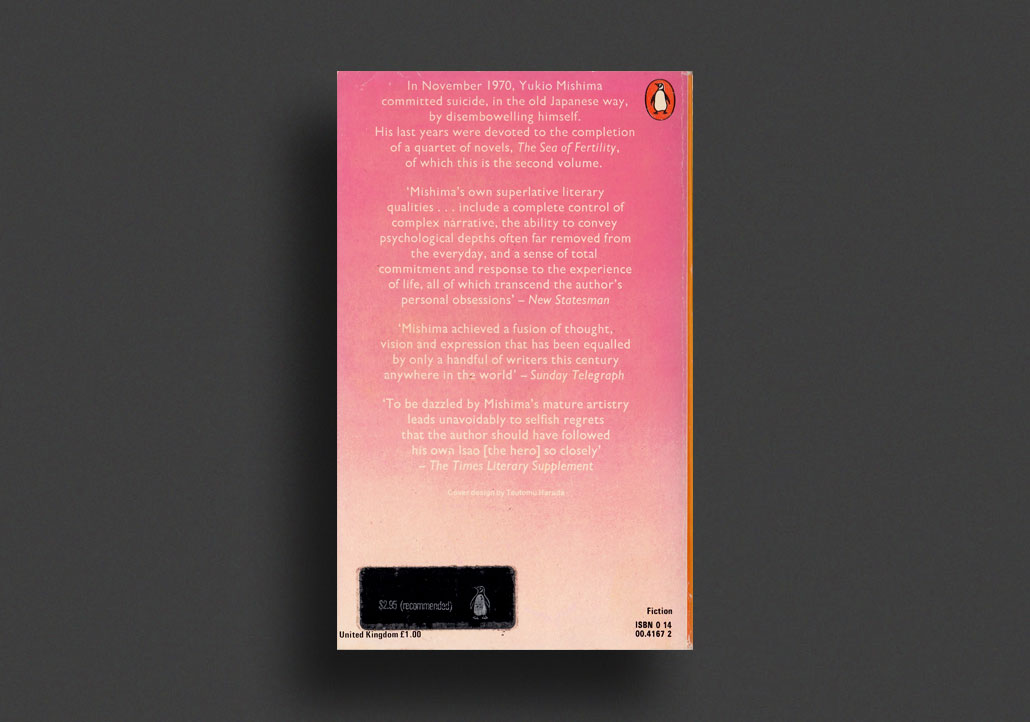
Scarce first 1977 Penguin paperback edition of the first 1973 English translation. Cover design by Tsutomu Harada.
In November 1970, Yukio Mishima committed suicide, in the old Japanese way by disembowelling himself. His last years were devoted to the completion of a quartet of novels, The Sea of Fertility, of which this is the second volume.
Isao is a young, engaging patriot, and a fanatical believer in the ancient samurai ethos. He turns terrorist, organising a violent plot against the new industrialists, who he believes are threatening the integrity of Japan and usurping the Emperor’s rightful power. As the conspiracy unfolds and unravels, Mishima brilliantly chronicles the conflicts of a decade that saw the fabric of Japanese life torn apart.
Mishima's own superlative literary qualities... include a complete control of complex nárrative, the ability to convey psychological depths often far removed from the everyday, and a sense of total commitment and response to the experience of life, all of which transcend the author's personal obsessions'—New Statesman
Yukio Mishima (1925—1970), one of the most spectacularly gifted writers in modern Japan, was born into a samurai family in 1925. Yukio Mishima was a Japanese author, poet, playwright, actor, model, Shintoist, nationalist, and founder of the Tatenokai ("Shield Society"), an unarmed civilian militia. Mishima is considered one of the most important Japanese authors of the 20th century. He was considered for the Nobel Prize in Literature in 1968. His works include the novels Confessions of a Mask and The Temple of the Golden Pavilion. Mishima's work is characterized by "its luxurious vocabulary and decadent metaphors, its fusion of traditional Japanese and modern Western literary styles, and its obsessive assertions of the unity of beauty, eroticism and death", according to author Andrew Rankin. In November 1970 he and his Tatenokai forced their way into a Self-Defense Force headquarters in Tokyo, where Mishima, after reading out a proclamation, committed ritual suicide with a young follower in the commanding officer's room. On the morning of his death, the last volume of Mishima's tetralogy, The Sea of Fertility (The Spring Snow, Runaway Horses, The Temple of Dawn, The Decay of the Angel) was delivered to his publisher.
Scarce first 1976 Penguin paperback edition of the first 1968 English translation. Cover design by Tsutomu Harada.
Shunsuké, an ageing novelist, hits on a brilliant plan to avenge himself on womankind, who, he believes, have blighted his life. He bribes a beautiful homosexual student, Yuichi, to marry. The plan works, Yuichi's wife is made miserable. And Shunsuké gets Yuichi to compromise two of his past tormentors, the blackmailing Mrs Kaburagi and Kyoko, a dizzy socialite. But Yuichi, now the toast of Tokyo's 'gay people' and free of all moral restraint, refuses to be further manipulated. Soon the old writer sees his protégé, his creation, turn into a monster dangerously out of control.
Mishima's own superlative literary qualities... include a complete control of complex nárrative, the ability to convey psychological depths often far removed from the everyday, and a sense of total commitment and response to the experience of life, all of which transcend the author's personal obsessions'—New Statesman
Yukio Mishima (1925—1970), one of the most spectacularly gifted writers in modern Japan, was born into a samurai family in 1925. Yukio Mishima was a Japanese author, poet, playwright, actor, model, Shintoist, nationalist, and founder of the Tatenokai ("Shield Society"), an unarmed civilian militia. Mishima is considered one of the most important Japanese authors of the 20th century. He was considered for the Nobel Prize in Literature in 1968. His works include the novels Confessions of a Mask and The Temple of the Golden Pavilion. Mishima's work is characterized by "its luxurious vocabulary and decadent metaphors, its fusion of traditional Japanese and modern Western literary styles, and its obsessive assertions of the unity of beauty, eroticism and death", according to author Andrew Rankin. In November 1970 he and his Tatenokai forced their way into a Self-Defense Force headquarters in Tokyo, where Mishima, after reading out a proclamation, committed ritual suicide with a young follower in the commanding officer's room. On the morning of his death, the last volume of Mishima's tetralogy, The Sea of Fertility (The Spring Snow, Runaway Horses, The Temple of Dawn, The Decay of the Angel) was delivered to his publisher.
Good copy with general wear and age, book block cocked from storage, tanning. Sample images only.
2003, Japanese
Softcover, 160 pages, 24 x 18 cm
1st Edition, Out of print title / used / fine
Published by
Atelier Peyotl / Tokyo
$65.00 - In stock -
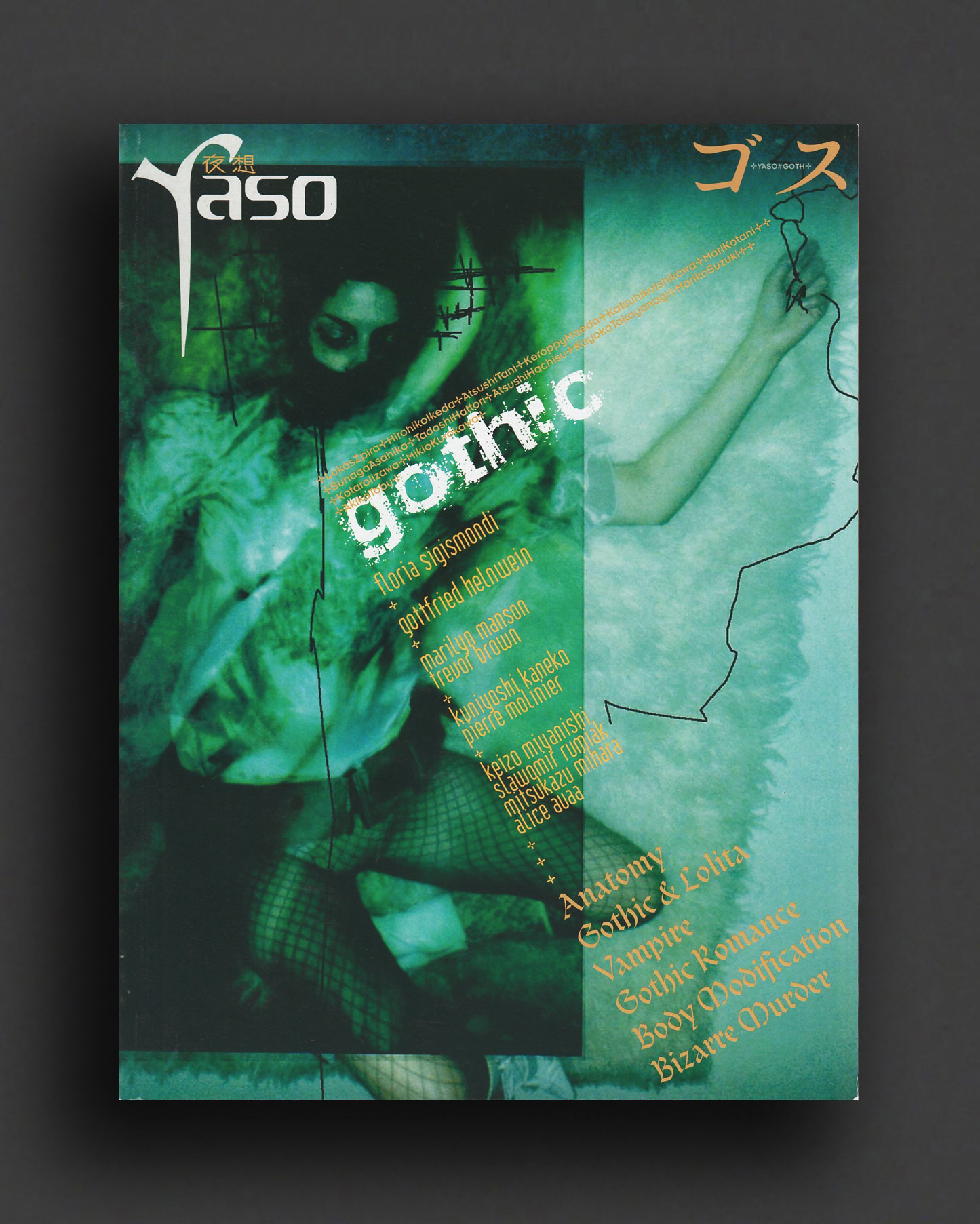
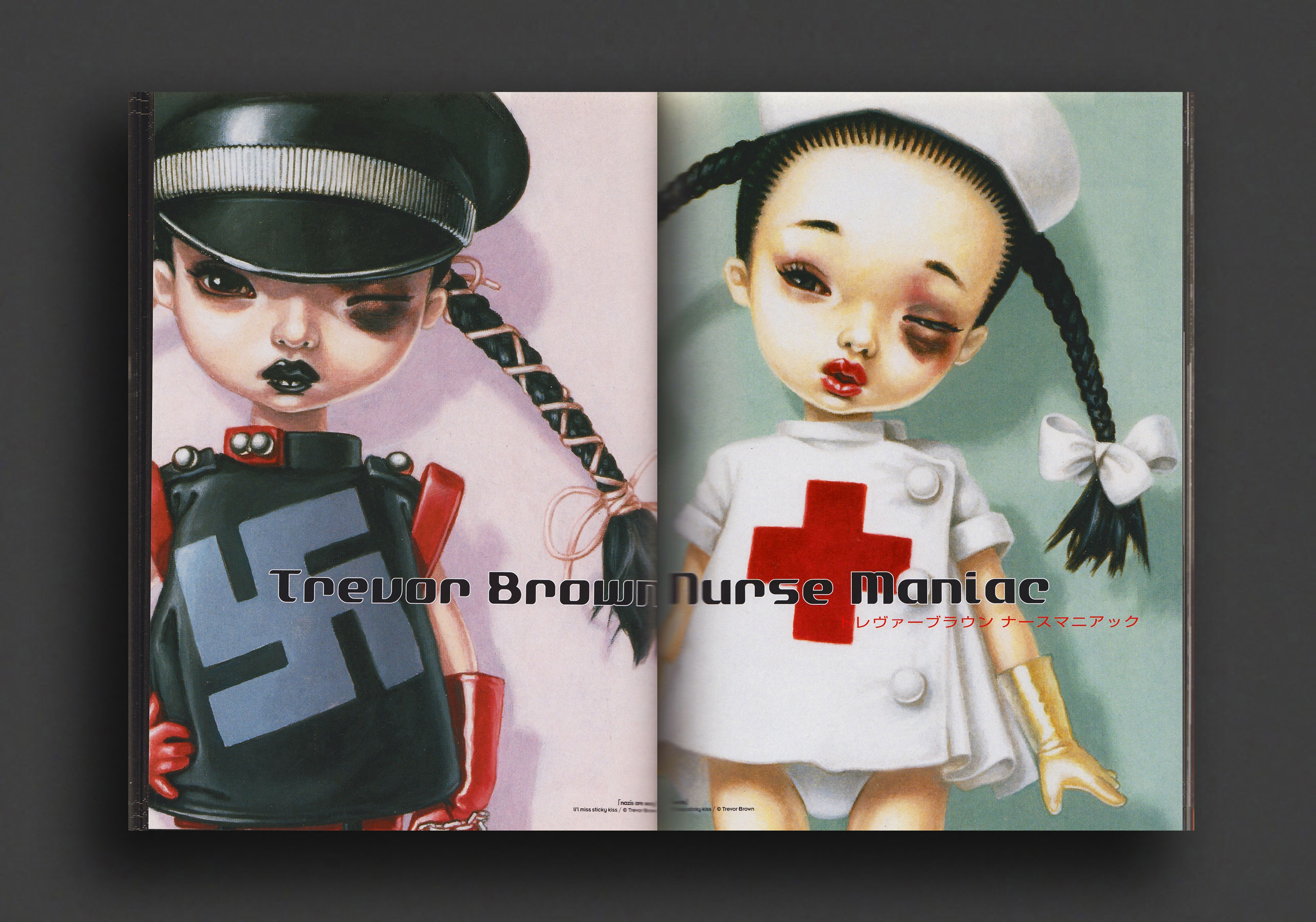
"Gothic" Special Feature Issue of cult Japanese underground magazine Yaso, published in 2003, edited by Yuichi Konno and Atelier Peyotl (publishers of Night Vision/Yaso/Peyotl/Wave/Silvester Club...). Heavily illustrated with texts in Japanese with in-depth profiles, interviews with and essays on Trevor Brown, Gottfried Helnwein, Kuniyoshi Kaneko, ero-manga master Keizo Miyanishi, influential Gothic Lolita illustrator Mitsukazu Mihara, Floria Sigismondi, Marilyn Manson, Alice Auaa, loads of "Modern Primitive" material (piercing, body modification, body performance, etc.), and much more...
Near Fine copy.
1987, English
Softcover, 352 pages, 27 x 22 cm
1st Edition, Out of print title / used / very good
Published by
Semiotext(e) / Los Angeles
Autonomedia / New York
$65.00 - Out of stock
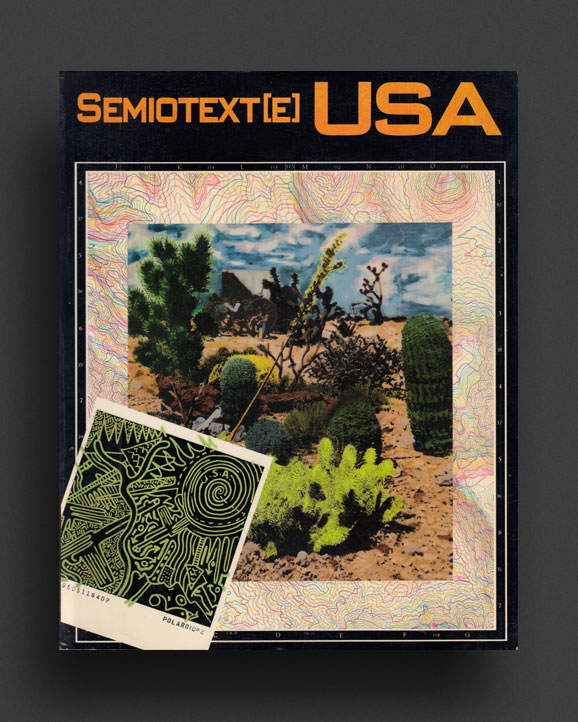
Rare copy of one of the remarkable special book issues of the original Semiotext(e) journal — the notorious Semiotext(e) U.S.A., published in 1987, edited by Jim Fleming and Peter Lamborn Wilson (Hakim Bey), and designed by Sue Ann Harkley. Complete with the unprintable 4-pages, in still-sealed plastic pocket. ("Calling it "subversive" and "obscene," five book printers in the spring of 1987 refused to print Semiotext(e) USA. A sixth printer agreed to do all but four pages, which we have printed separately and included here.") Semiotext(e) U.S.A. is an absolute treasure and time-capsule of subcultural publishing in the 1980s—1990s, centering around Autonomedia and Semiotext(e). The original publisher's blurb says it all:
"THE JOURNAL DENOUNCED IN THE U.S. SENATE FOR ITS ADVOCACY OF "ANIMAL SEX" PRESENTS..."
"A huge compendium of works in AMERICAN PSYCHOTOPOGRAPHY Areas not found on the official map of consensus perception — Maps of energies, secret maps of the USA in the form of words and images.
We are amazed. We are NOT BORED. We have discarded the outworn charm of post-modern incommunicadismo. Passion and involvement, self-abandoned craziness, funny, sexy, dangerous, unabashedly precious, punk, loud and direct. SF, speculative fiction, weird fantasy — Pornography — Other mutated genres — Sermons, rants, broadsheets, crackpot pamphlets, manifestoes — Xerox and mimeo zines — Punkzines — Mail art — Kids' poetry — Subverted advertisements — American samizdat — Astounding rhetoric, elegant propaganda — Underground comix — Geographical documentation (maps, monuments, guides to weird places, photographs) — Stolen top secret documents — And a special feature: scores of personal and classified ads. each one with a box-number or address, to connect YOU with the edges of the USA — Anarchists, unidentified flying leftists, neo-pagans, secessionists, the lunatic fringe of survivalism, cults, foreign agents, mad bombers, ban-the-bombers, nudists, monarchists, children's liberation, tax resisters, zero-workers, mimeo poets, vampires, feuilletonistes, xerox pirates, prisoners, pataphysicians, unrepentant faggots, witches, hardcore youth, poetic terrorists...
For the realization of almost-unheard of desires"
Founded in 1974, Semiotext(e) began as a journal that emerged from a semiotics reading group led by Sylvère Lotringer at the Columbia University philosophy department. Initially, the magazine was devoted to readings of thinkers like Nietzsche and Saussure. In 1978, Lotringer and his collaborators published a special issue, Schizo-Culture, in the wake of a conference of the same name he had organized two years before at Columbia University. The magazine brought together artists and thinkers such as Gilles Deleuze, Kathy Acker, John Cage, Michel Foucault, Jack Smith, Martine Barrat and Lee Breuer. Schizo-Culture brought out connections between high theory and underground culture that had not yet been made, and forged the "high/low" aesthetic that remains central to the Semiotext(e) project.
Good—VG copy with some wear to extremities. Complete with still-sealed additional censored pages.
1972, German
Softcover, 96 pages, 28 x 205 cm
1st Edition, Out of print title / used / good
Published by
Heyne Verlag / Münich
$35.00 - Out of stock
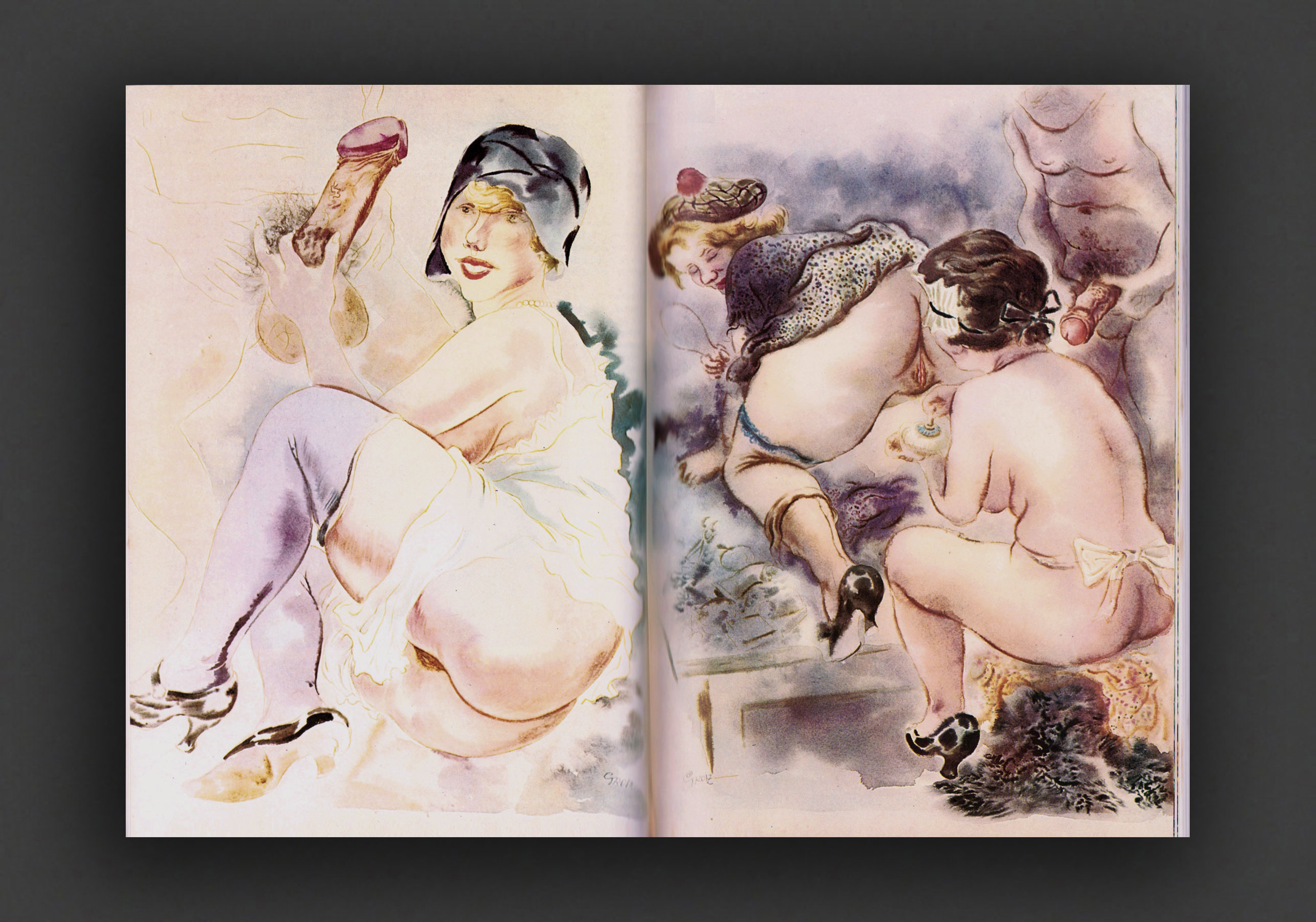
Wonderful 1972 German book of erotic art selected by Phyllis and Dr. Eberhard Kronhausen, rightly considered international experts in the field. "Their exhibition "Erotic Art," which has been shown in many countries around the world, formed the basis for this illustrated volume. Because this exhibition included loans from museums and galleries, as well as works from the Kronhausen couple's collection and other private collections, it was possible to present images that had previously been inaccessible to the public. In selecting works for this volume, care was taken, on the one hand, to depict these unknown works, and, on the other, to provide a reliable overview of the erotic work of the leading artists (painting, graphic art, and sculpture) of our century. Thus, this book is a fortunate exception; it is a precious document, but also a demonstration of the sexual and cultural revolution of our century."
Features the work of Franz von Bayros, Hans Bellmer, Marc Chagall, Lovis Corinth, Salvador Dali, Paul Delvaux, Otto Dix, J. Dubuffet, Max Ernst, Ernst Fuchs, Willi Geiger, George Grosz, Horst Janssen, Allen Jones, Gustav Klimt, Felix Labisse, Jan Lebenstein, Edward Munch, Claes Oldenburg, Pablo Picasso, Herbert Rauschenberg, George Segal, Max Walter Swanberg, Tomi Ungerer, Andy Warhol, Tom Wesselmann.
Good—VG copy with some laminate seperation to cover extremities and slight corner bump.
2025, English
Softcover, 252 pages, 28.6 x 21.3 cm
Published by
Walther König / Köln
MMK / Frankfurt am Main
$70.00 - Out of stock
Edited with text by Susanne Pfeffer.
Text by Diedrich Diederichsen, Ralf Marsault, Eileen Myles, Tal Sterngast.
Rediscovering the transgressive, grotesque drawings of a self-proclaimed "good-for-nothing" artist whose criminal ties cost him his life.
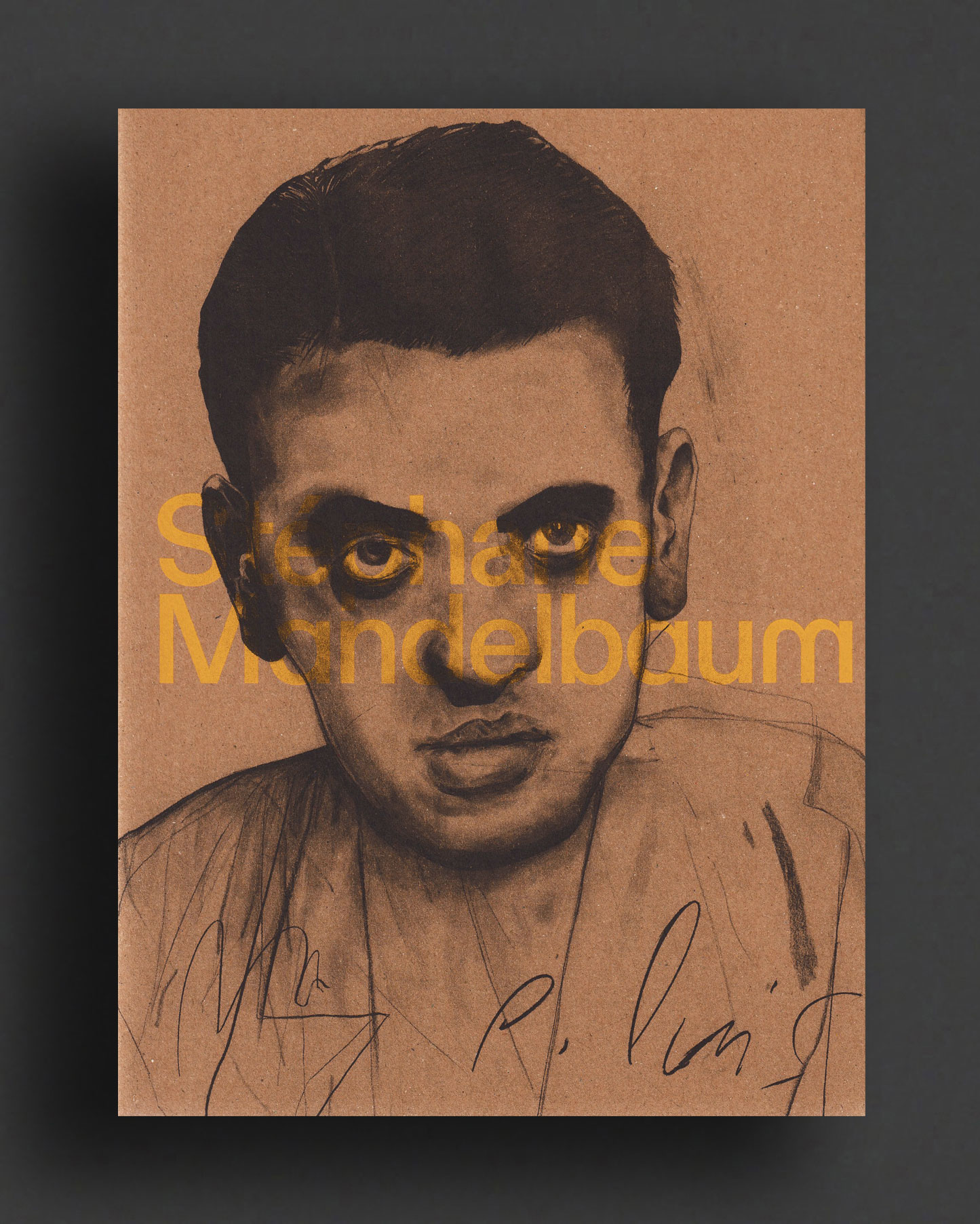
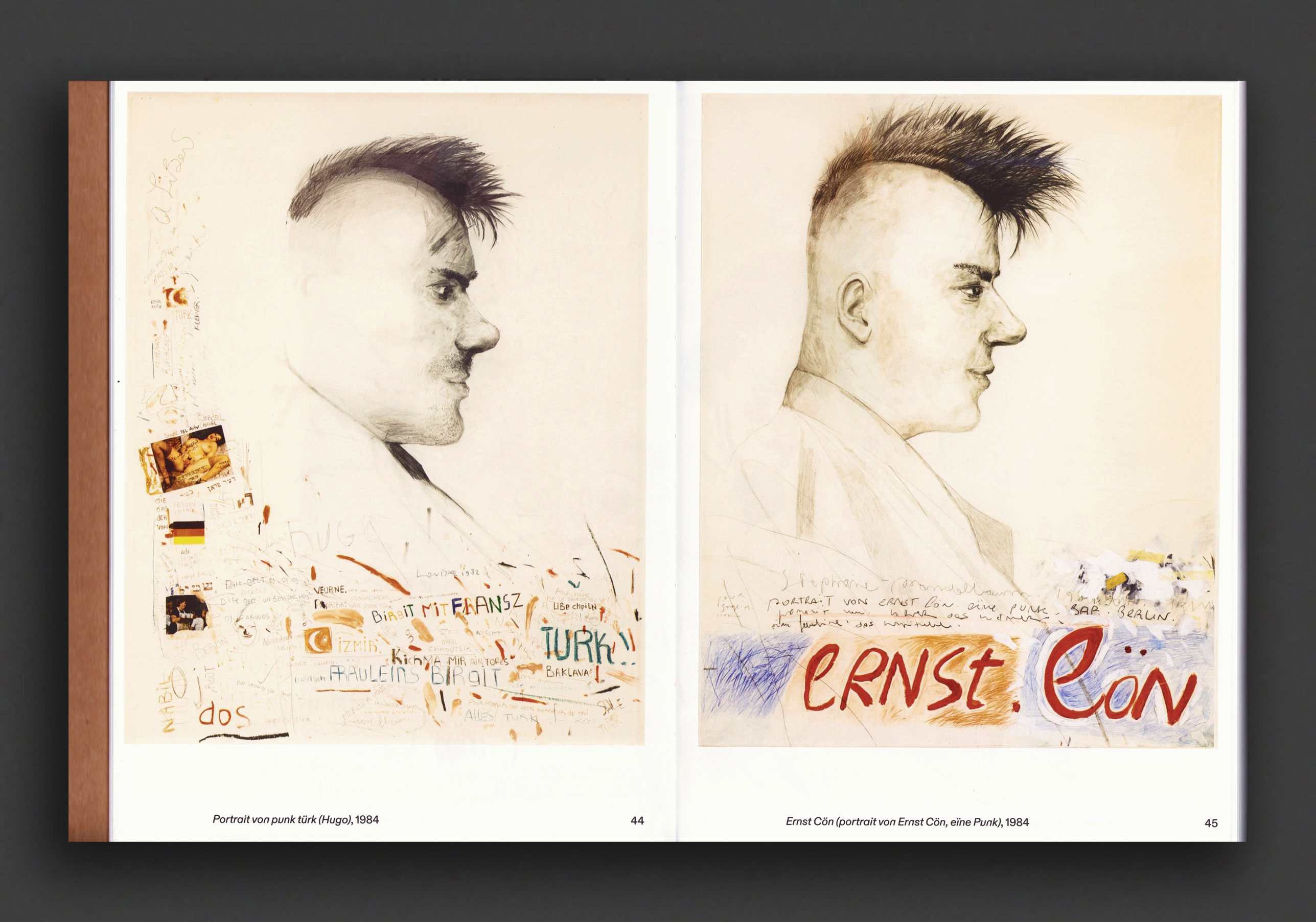
Driven by fascination as well as contempt, Belgian artist Stéphane Mandelbaum (1961–86) produced hundreds of drawings within a short creative period of just 10 years. As a descendant of Holocaust survivors, Jewish history and persecution was often at the center of his work. His portraits, reminiscent of the strained, tortured figures of George Grosz, include renderings of Arthur Rimbaud, Francis Bacon, Pierre Goldman, his grandfather Szulim and his father Arié, but also of National Socialist criminals such as Joseph Goebbels and Ernst Röhm. He interspersed these sketches with newspaper clippings or coarse, short, disparaging phrases in Yiddish, Italian, French or German. This monograph captures Mandelbaum’s haunting, deliberately provocative oeuvre, permeated by his Jewish descent, Belgium’s colonial history and the seedy criminal underworld of Brussels—which ultimately claimed his life.
2023, English
Softcover, 152 pages, 17.5 x 11 cm
Published by
Index Journal / Melbourne
$30.00 - In stock -
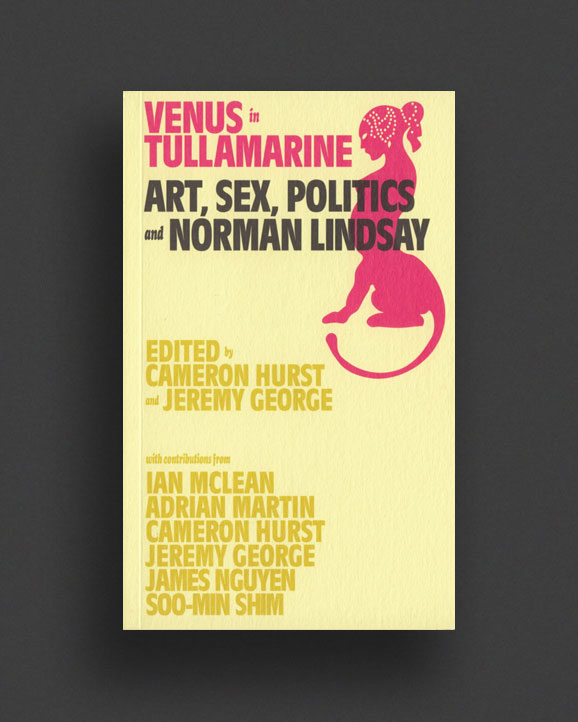
Norman Lindsay (1879–1969) was a prolific, popular and controversial Australian artist. He is best known for his children’s book The Magic Pudding and his skilled prints, which mostly draw on Greek and Roman mythology and nineteenth century literature and philosophy. The Australian cultural consciousness is indelibly marked by Lindsay’s output, his prominence in the Sydney bohemian intellectual scene and by The Magic Pudding, which entrances the imagination of generation after generation of Australian children. This consciousness is marked too by the paradoxical conjunctions of Lindsay’s life: artistic bohemia and fascistic tendencies, avant-gardism and a fervour for the rule of law, libertinism and conservatism, worship and denigration.
This collection of essays examines Lindsay’s current position in Australian art history. The authors’ opinions are erudite, varied and often incendiary; few figures are as divisive as Lindsay.
Film critic Adrian Martin writes alongside Ian McLean, the Hugh Ramsay Chair of Australian Art History at the University of Melbourne, art historian Cameron Hurst, and literary critic Jeremy George. Art historian Soo-Min Shim responds to a video work by artist James Nguyen.
The project develops research conducted during an exhibition of the University of Melbourne’s Norman Lindsay collection, also titled Venus in Tullamarine, held at the George Paton Gallery in 2022.
2025, English
Hardcover, 208 pages, 28 x 24 cm
Published by
Skira / Milan
$95.00 - In stock -
Edited by Antonio Sergio Bessa
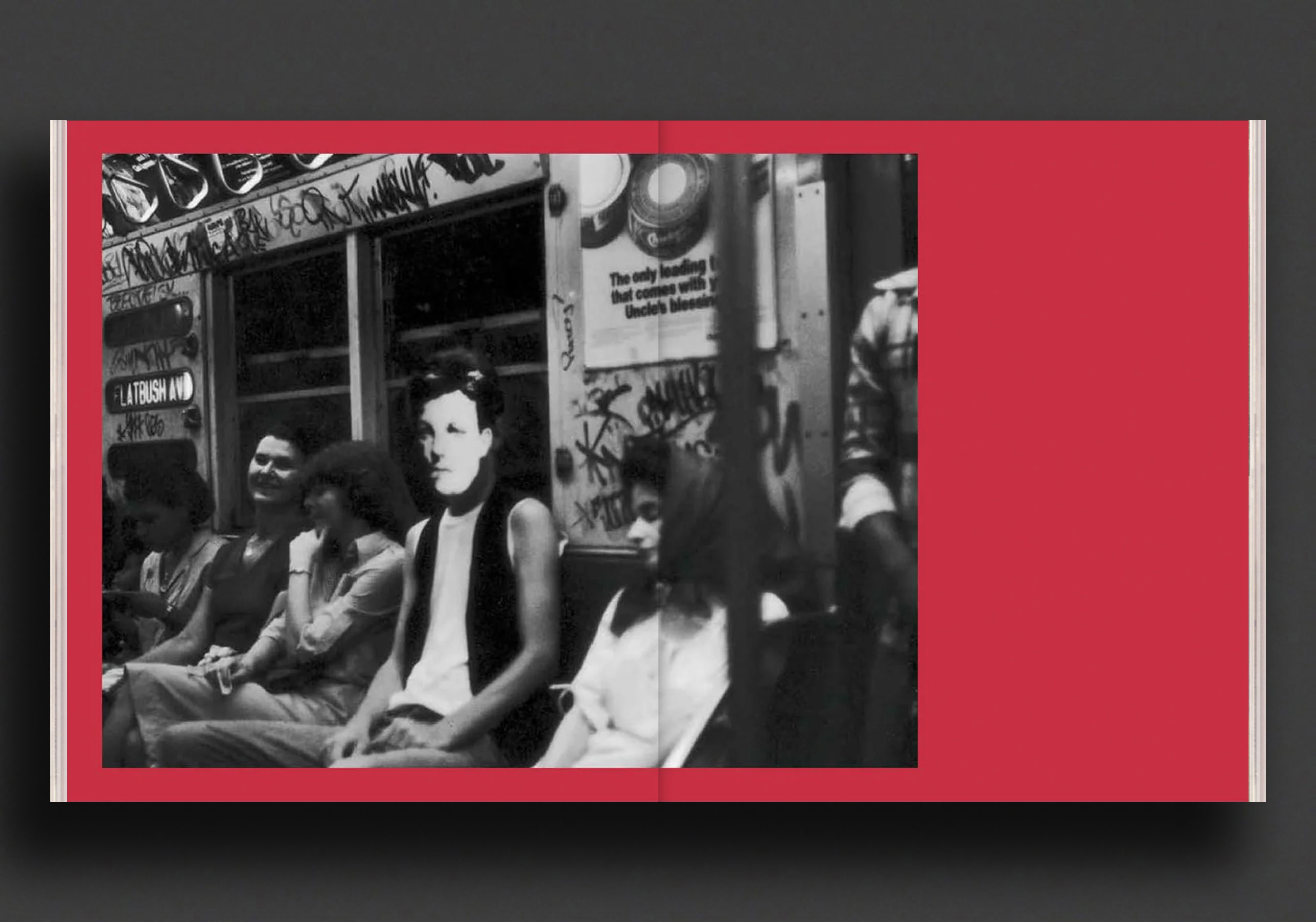
One of David Wojnarowicz's few incursions into photography is a testimony of urban, social and political change in New York in the late 1970s.
In 1978 and 1979, David Wojnarowicz took a series of photographs of a man wearing a paper mask bearing the visage of Arthur Rimbaud, the French poet equally known for his fervid verse and dramatic life. Rimbaud was the instantiation, and perhaps the inventor, of the idea of the young gay hustler of genius.
Presenting a selection of photographs by Wojnarowicz, this amply illustrated volume features an introductory essay by Antonio Sergio Bessa contextualizing the series within a foundation of other works across literature, photography and performance. Nicholas Martin explores Wojnarowicz's practice in the context of the rise of the punk movement in downtown Manhattan in the late 1970s. Craig Dworkin explores Rimbaud's years as a runaway youth in Paris during the Commune, and his acquaintances with the city's bohemia. Marguerite Van Cook contributes an essay about her experiences with the London and New York music and art scenes throughout the 1970s and 1980s. Phillip Aarons offers a personal account of his engagement as a collector of Wojnarowicz's work. The book also features an interview with photographer Allen Frame, who produced several performances of Wojnarowicz's monologues in the early 1980s in New York's Lower East Side, Berlin and Brooklyn.
Painter, photographer, writer, filmmaker, performance artist, songwriter and activist David Wojnarowicz was born in Red Bank, New Jersey, in 1954 and died from AIDS-related illness in New York in 1992. He authored a few books, most famously Close to the Knives. Wojnarowicz attained national prominence as a writer and advocate for AIDS awareness and for his stance against censorship.
1979, French
Hardcover (clothbound, gilt), 112 pages, 21.8 x 14 cm
1st Edition, Out of print title / used / very good
Published by
Obliques / Paris
$170.00 - In stock -
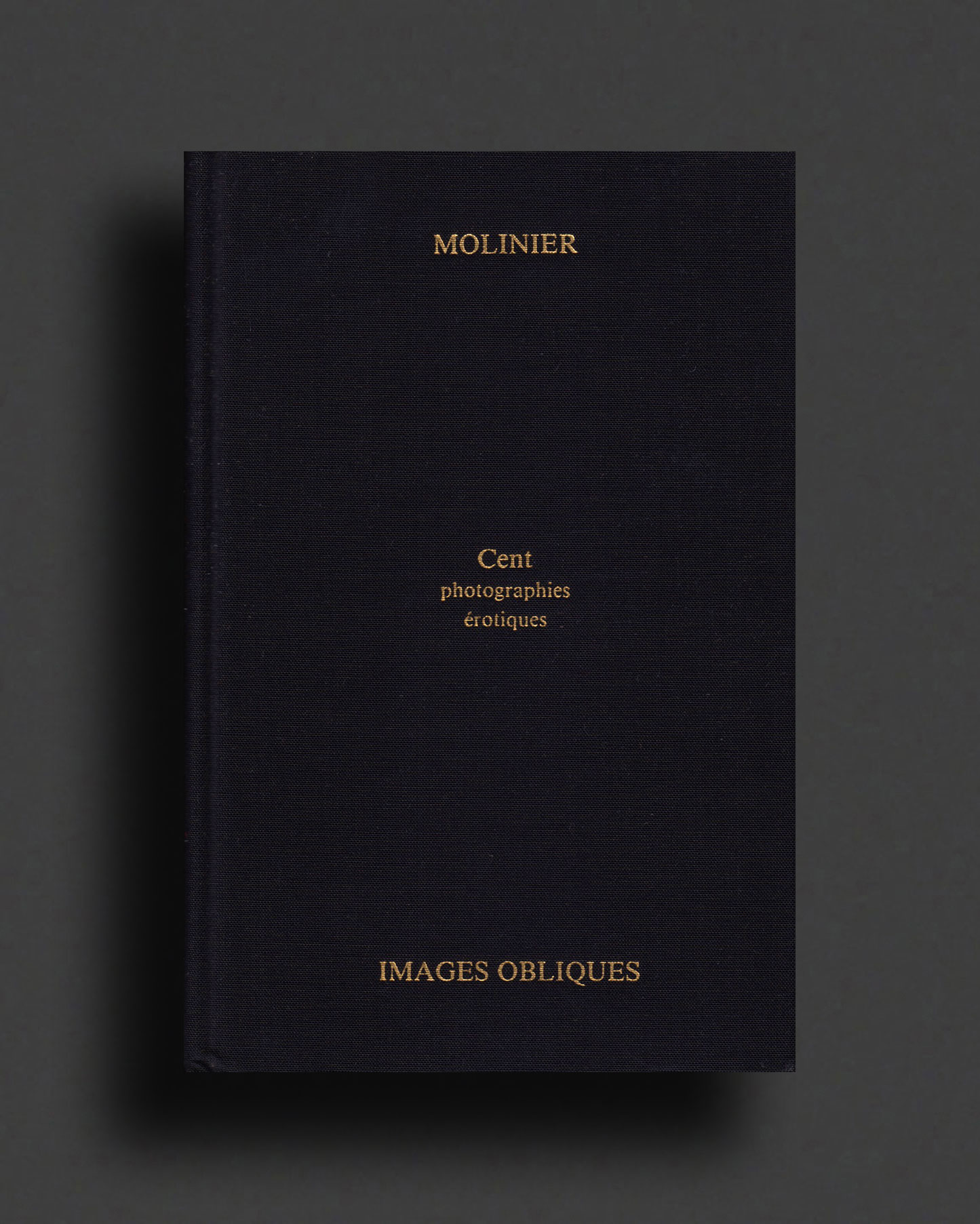
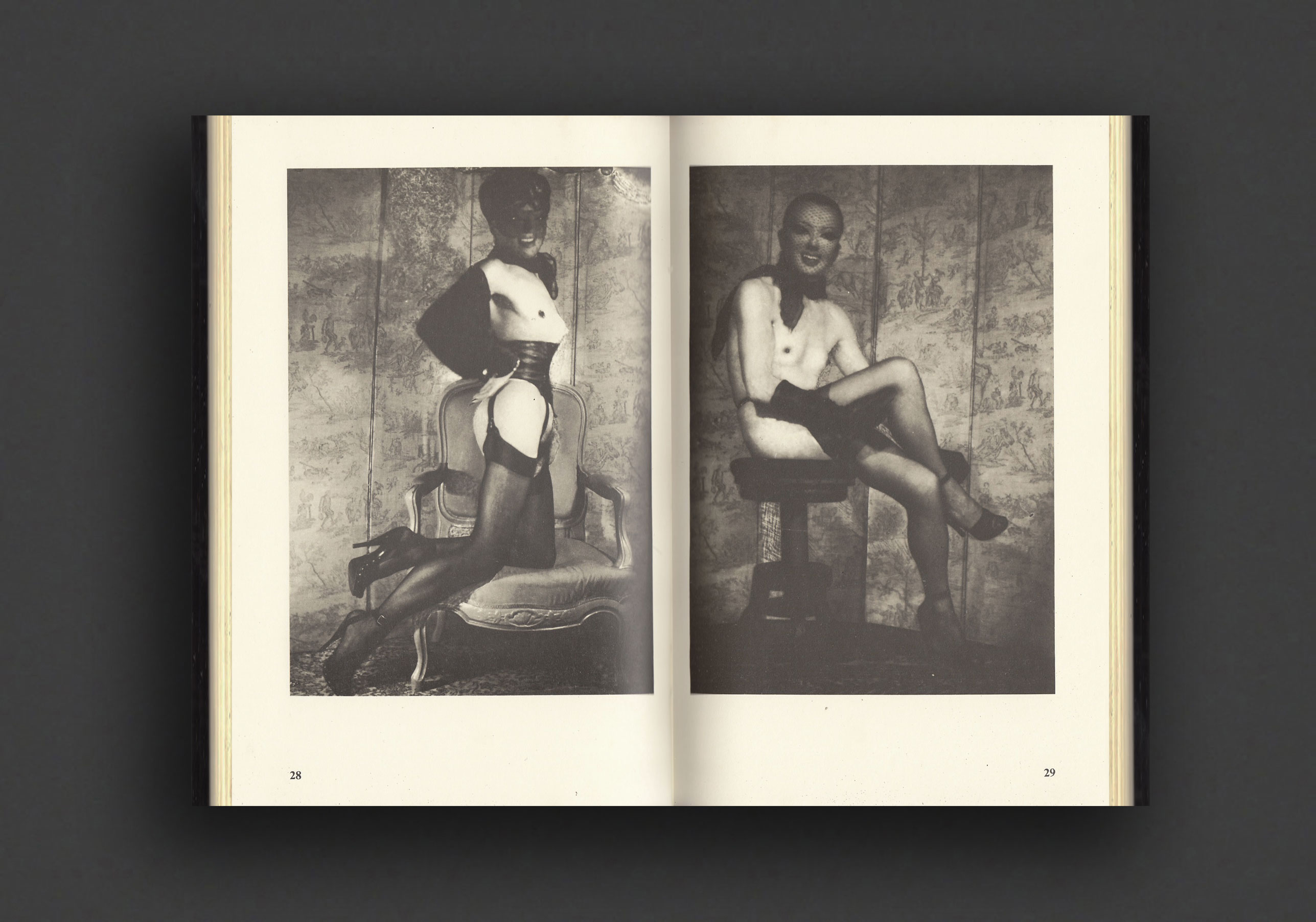
First edition of this beautiful clothbound album of arresting erotic photography by Pierre Molinier (1900—1976), a French painter, photographer and a forerunner of gender performance art and Body Art (Art corporel), published in 1979 by Obliques Images, Paris. Briefly associated with Breton's surrealist group, Molinier spent much of his artistic life working in isolation in Bordeaux, exiled from local and national art scenes. With an introductory essay by French man of letters, playwright, poet, writer, director, journalist, literary critic and photographer, Pierre Bourgeade entitled "La clé est chez le concierge" the rest of the book is made up of some of the most exquisite examples of Molinier's challenging monochrome erotic photography. Cent photographies erotique is the fourth of the collection "Images Obliques" produced by Roger Borderie and Michel Camus.
Pierre Molinier is an unknown of worldwide renown. Every book and every exhibition on the body, gender confusion or sexual excess seems to feature at least one work by this artist whose “genius” was acclaimed by André Breton in a memorable text published in 1956. But the bulk of his work has remained inaccessible. A number of pictures have never been shown and a corpus of only 160 prints has been published. The ensemble revealed by the artist's archives is much more extensive. It includes numerous proofs made to prepare his photomontages and working prints given to friends, but also notebooks and personal letters. Here, precise links emerge between his paintings, photographs and scandalous life. The myth carefully constructed by the artist begins to crumble before the reality of the work.
An inveterate seducer, thoroughgoing fetishist, unrepentant transvestite and inadvertent bisexual, to the very last Molinier remained haunted by two obsessions: pleasure, meaning immediate access to la petite mort, and “leaving a trace in the infinity of time.” This book charts the aesthetic incarnation of his passions. Its 819 photographs, most of them never published before, reveal the method, shed light on the procedures and give details of the origin and alchemy of his latent or composed images. Finally, an exhaustive chronology offers a new biography of Molinier, based on his letters: for it is in the intimacy of these writings that the shaman's heart beats closest to the truth.
In a career shared between the university (fifteen years) and publishing (twenty) Jean-Luc Mercié has written widely on painting and photography. This monograph is his fourth book about Pierre Molinier, the master from Bordeaux.
Born 1900 in Agen (France), Pierre Molinier, surrealistic painter and photographer, a precursor to body art, died in 1976 after having thought out radical and pornographic artwork.
VG copy with light foxing to block edges, initial blanks.
2021, English
Softcover, 260 pages, 20 x 15 cm
Published by
Pilot Press / London
$39.00 - Out of stock
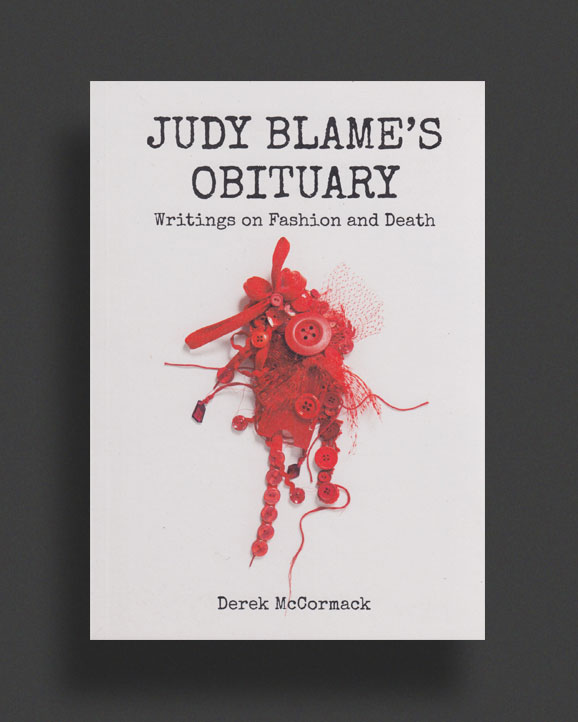
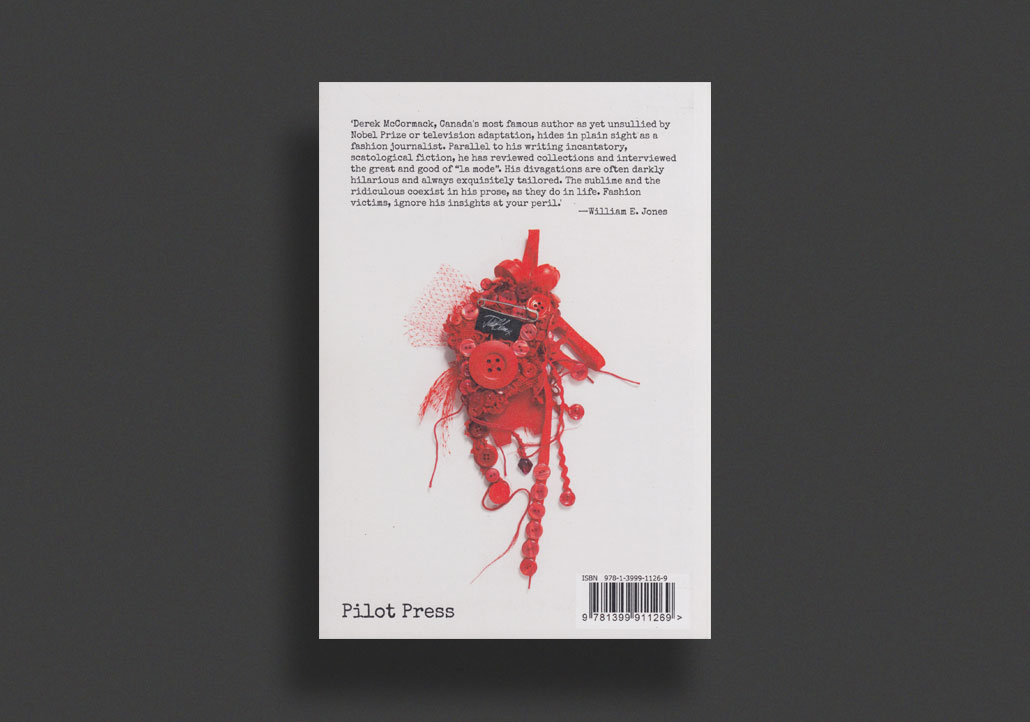
Derek McCormack is the author of fashion-inflected novels that cast luminaries such as Elsa Schiaparelli and Balenciaga as characters. This collection brings together for the first time McCormack's fashion journalism. He writes about and interviews fashion figures that fascinate him, tracing the ways they inspire and inhabit his novels. The result is a sort of memoir in essays: as he writes, "My tribute to [Judy] Blame is about him and about me—there are lots of my own tales woven in with the topics I touch on. The writing here is a sort of autobiography, a life seen through a scrim, or a life as a scrim—my moire mémoire."
Judy Blame's Obituary contains twenty years' worth of reminiscences, reviews of fashion shows and books, interviews with writers about fashion, and interviews with fashion designers about writing. He talks to Nicolas Ghesquière about perfume, and to Edmund White about which perfume he wore as a young fag in New York City. He inspects the clothes that Kathy Acker left behind when she died, and he summons the spirit of Margiela in a literary seance. He traces the history of sequins, then recounts the cursed story of Vera West, the costume designer who dressed the Bride of Frankenstein. These pieces were all previously published, some in Artforum, some in The Believer, and some in underground publications like Werewolf Express—what binds them together is a sense that though fashion victimizes us, this victimization is sometimes a sort of salvation.
Derek McCormack is a Canadian writer. His most recent novels are The Well-Dressed Wound and Castle Faggot, both published by Semiotext(e). Of Castle Faggot, Dennis Cooper said: "It is really just one of the best books ever, and maybe the greatest novel ever written."
Praise for Judy Blame's Obituary:
'Derek McCormack, Canada's most famous author as yet unsullied by Nobel Prize or television adaptation, hides in plain sight as a fashion journalist. Parallel to his writing incantatory, scatalogical fiction, he has reviewed collections and interviewed the great and good of la mode. His divagations are often darkly hilarious and always exquisitely tailored. The sublime and the ridiculous coexist in his prose, as they do in life. Fashion victims, ignore his insights at your peril.' — William E. Jones
1986, English
Softcover, 294 pages, 16.5 x 10.5 cm
1st Edition, Out of print title / used / very good
Published by
Vintage Books / New York
$35.00 - In stock -
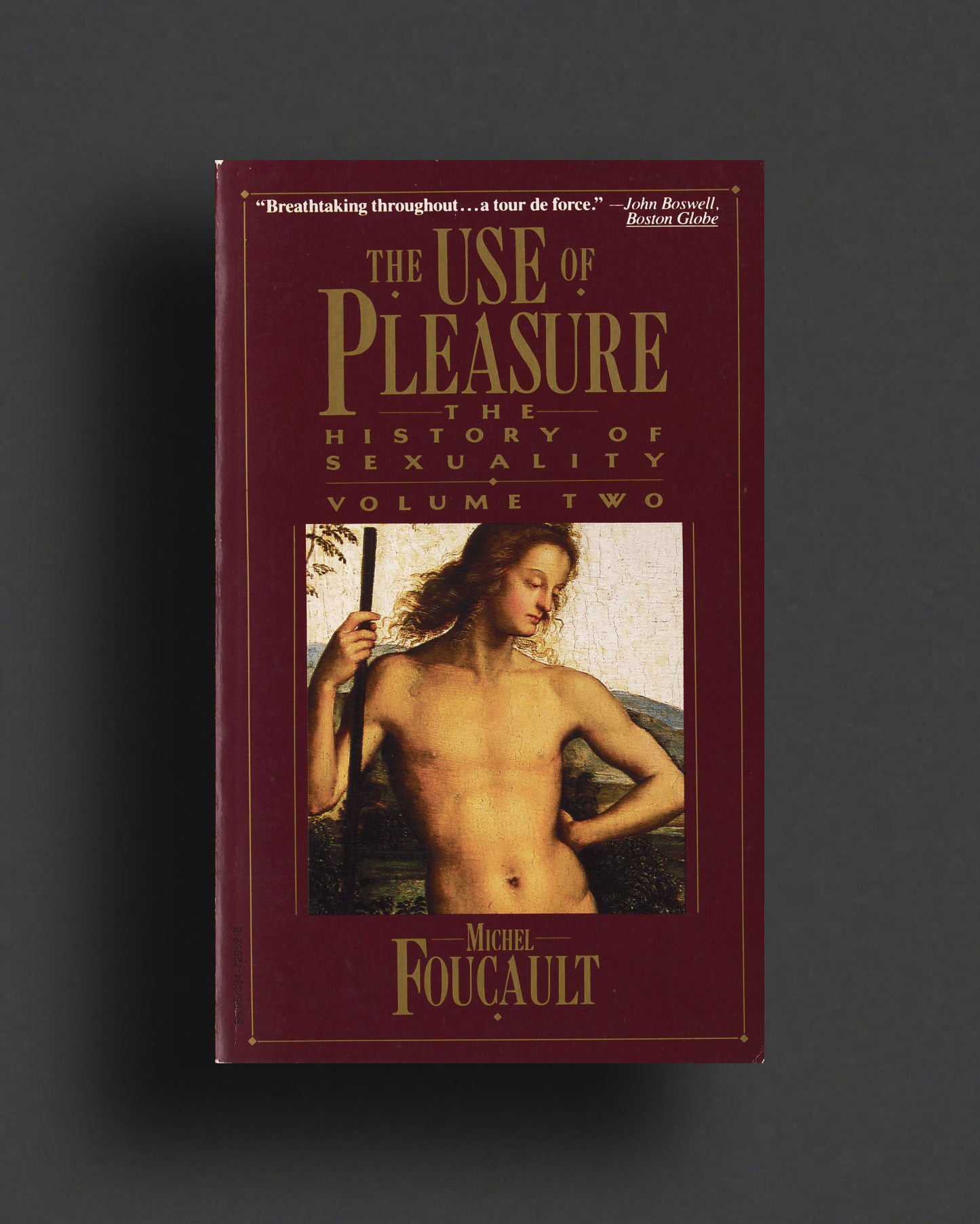
First Vintage 1986 edition. Translated by Robert Hurley.
In this, the sequel to The History of Sexuality, Volume I: An Introduction, the brilliantly original French thinker who died in 1984 gives an analysis of how the ancient Greeks perceived sexuality. Forthcoming
are volumes Ill and IV of The History of Sexuality, concerned, respectively, with the later Greeks and Romans and with the early Christians.
Throughout The Use of Pleasure Foucault analyzes an irresistible array of ancient Greek texts on eroticism as he tries to answer basic questions: How in the West did sexual experience become a moral issue? And why were other appetites of the body, such as hunger, and collective concerns, such as civic duty, not subjected to the numberless rules and regulations and judgments that have defined, if not confined, sexual behavior?
"Required reading for those who cling to stereotyped ideas about our difference from the Greeks in terms of pagan license versus Christian austerity or their hedonism versus our anxiety!"
—Los Angeles Times Book Review
VG copy with some light edgewear/crease to b cover/ tanning.
1969, English
Hardcover, 210 pages, 26 x 18 cm
1st Edition, Out of print title / used / good
Published by
Grove Press / New York
$35.00 - In stock -
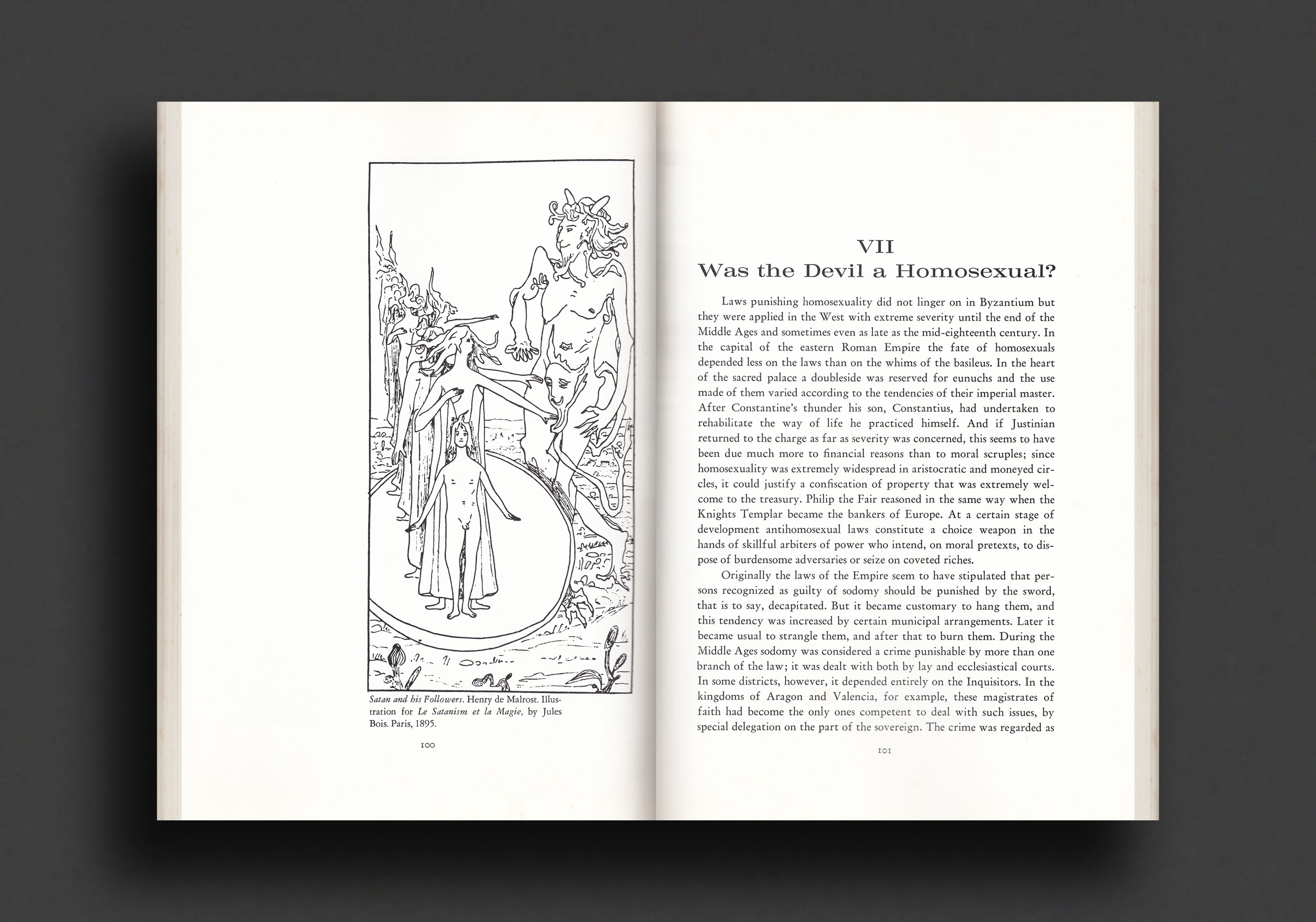
First 1969 hardcover edition of The Other Face of Love by Raymond de Becker, published by Grove Press, New York. A definitive and profusely illustrated study of the history of homosexuality, through literature, mythology, psychology, religion, the arts, with chapters on Greece and Rome, the Moslem East, the latent Homosexual Structure of Christianity, the Renaissance and contemporary issues written before gay liberation. Through the arts and letters, the devil, the uncertainties of science, and much more, the world of same-sex love is illustrated with hundreds of illustrations, drawings, film stills, paintings, photographs and objets d'art. Translated from the French by Margaret Crosland and Alan Daventry. Includes bibliographical footnotes.
Good—VG copy w/o dust jacket, light foxing to block edges, light wear to extremities.
2026, English
Hardcover (w. dust jacket), 208 pages, 27.7 x 23.1 cm
Published by
Semiotext(e) / Los Angeles
$66.00 - In stock -
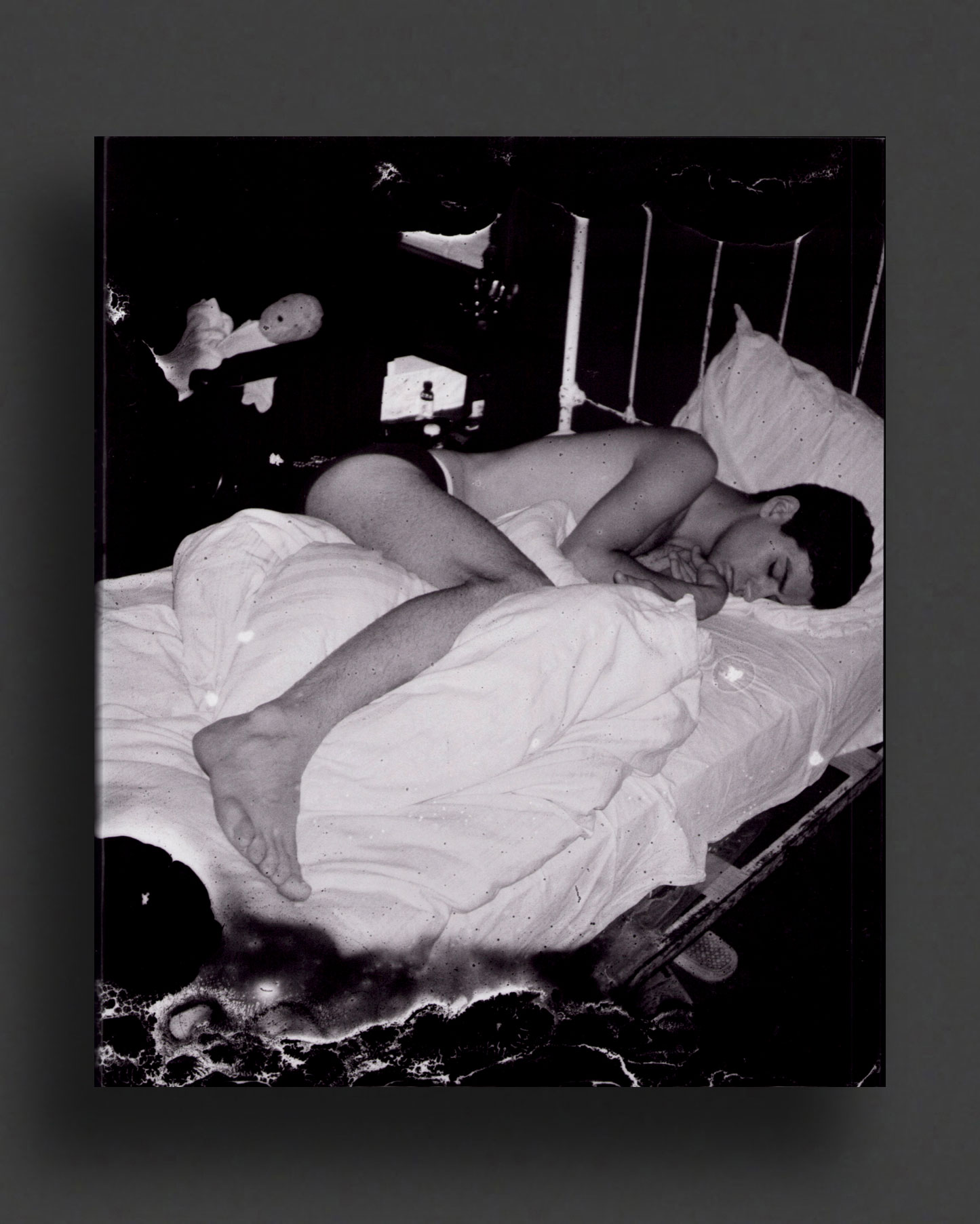
Artist Reynaldo Rivera's second monograph, collecting almost four decades of his intimate and illicit "blue" works.
Propiedad Privada showcases over one hundred photographs from Reynaldo Rivera's personal archive, introducing never-before-seen images alongside some of the artist's most iconic works. Shot from the 1980s to the present, the candid photographs in this raw, erotic series capture moments of privacy and pleasure. The series features the recurring figures of the artist's lovers, friends, and sisters, pictured in their most undressed states, and movingly portrays relationships that have since ended—loves later lost, glimpsed before their undoing. Closer to the present, the series also includes writers and artists who have more recently entered Rivera's life and agreed to pose seductively, performatively for his camera. Propiedad Privada is the artist's second monograph, following the widely praised Reynaldo Rivera: Notes for a Disappeared Cit (2020). Whereas Notes was an ode to Los Angeles, documenting a furtive subculture of house parties and gay clubs, Propiedad Privada is far more interior, capturing “performances” made for an audience of one.
Rivera calls these photographs his “blue” works. There is a sultry moodiness to the series, as well as a fondness for the “indecent” and illicit, for moments that were not staged and not meant to be seen. In an era when self-documenting has become commonplace and candid photography is unhesitatingly shared with strangers, this body of work reaches for intimacy, privacy, self-use. It also upends the predominant representation of gay Latino male sexuality as macho and hardcore. Rivera's subjects, many of them photographed at the height of the AIDS epidemic, are presented neither as predator nor prey, but in more human terms of love, lust, longing, and self-fulfillment. A tender portrait of the artist and his community, Propiedad Privada is both elegiac and documentary. Some of Rivera's subjects have since died, yet are preserved here in peak vitality, fixed in moments of pleasure. Others have become lifelong muses, letting Rivera's lens be witness to their bodies' aging over the years. Many of the photographs depict Rivera himself, his image reappearing throughout the series in mirrors and self-portraits, another body subject to the transformations of time.
Emerging from Rivera’s desire, as a young photographer, to defy taboos surrounding nudity and queer sexuality, Propiedad Privada encapsulates almost four decades of work. Complementing this quietly monumental archive is a curated assortment of texts, including an introduction by Lauren Mackler; a set of specially commissioned “blue” writings by authors Constance Debré, Devan Diaz, Raquel Gutierrez, Hedi El Kholti, Chris Kraus, Brontez Purnell, Reynaldo Rivera, Abdellah Taïa, Colm Tóibín, and Justin Torres; and a selection from poet Gil Cuadros’s canonical collection City of God.
2008, English
Hardcover (w. dust jacket), 192 pages, 25.5 x 25.5 cm
1st Edition, Out of print title / used / very good
Published by
Edition Skylight / Switzerland
$120.00 - In stock -
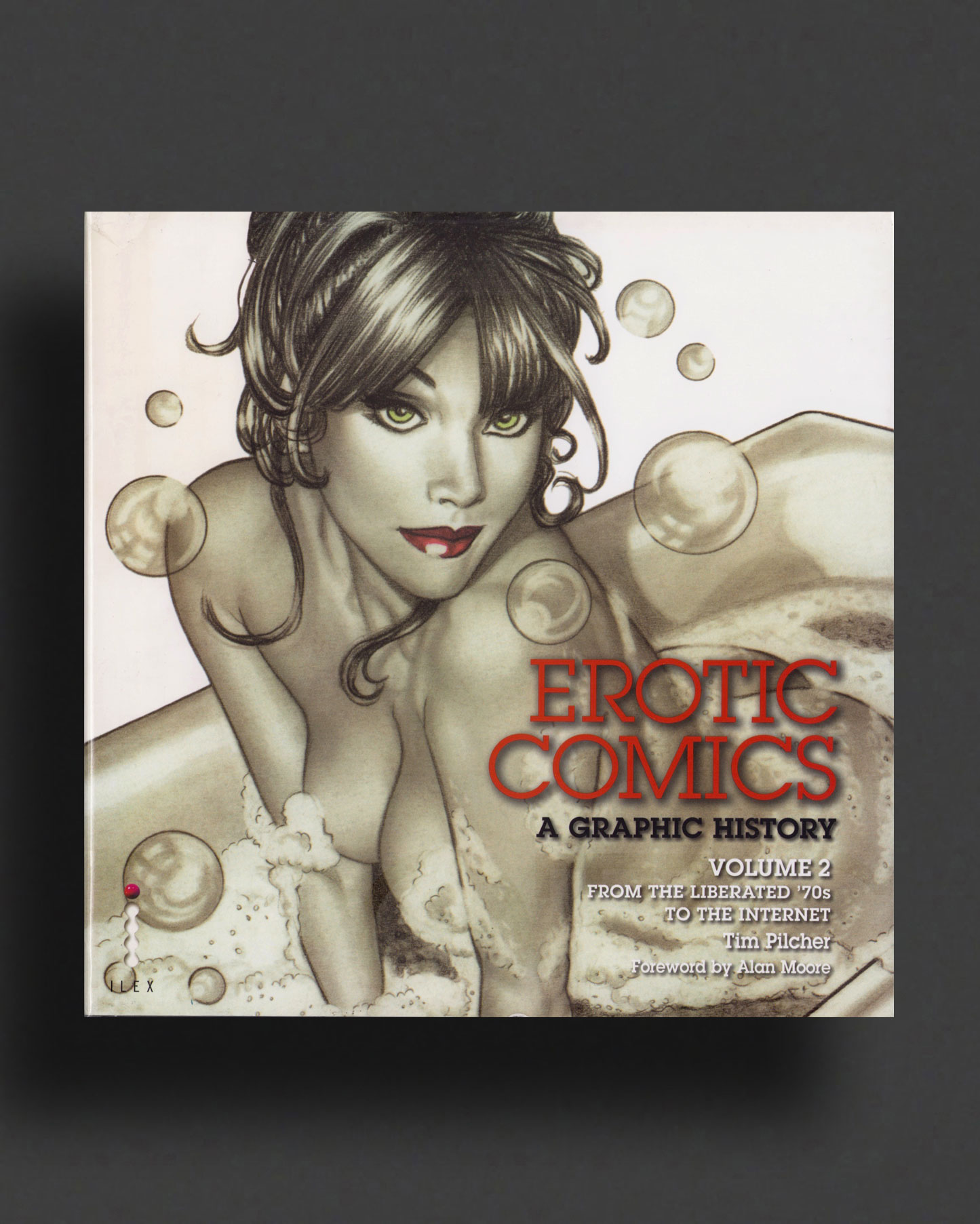
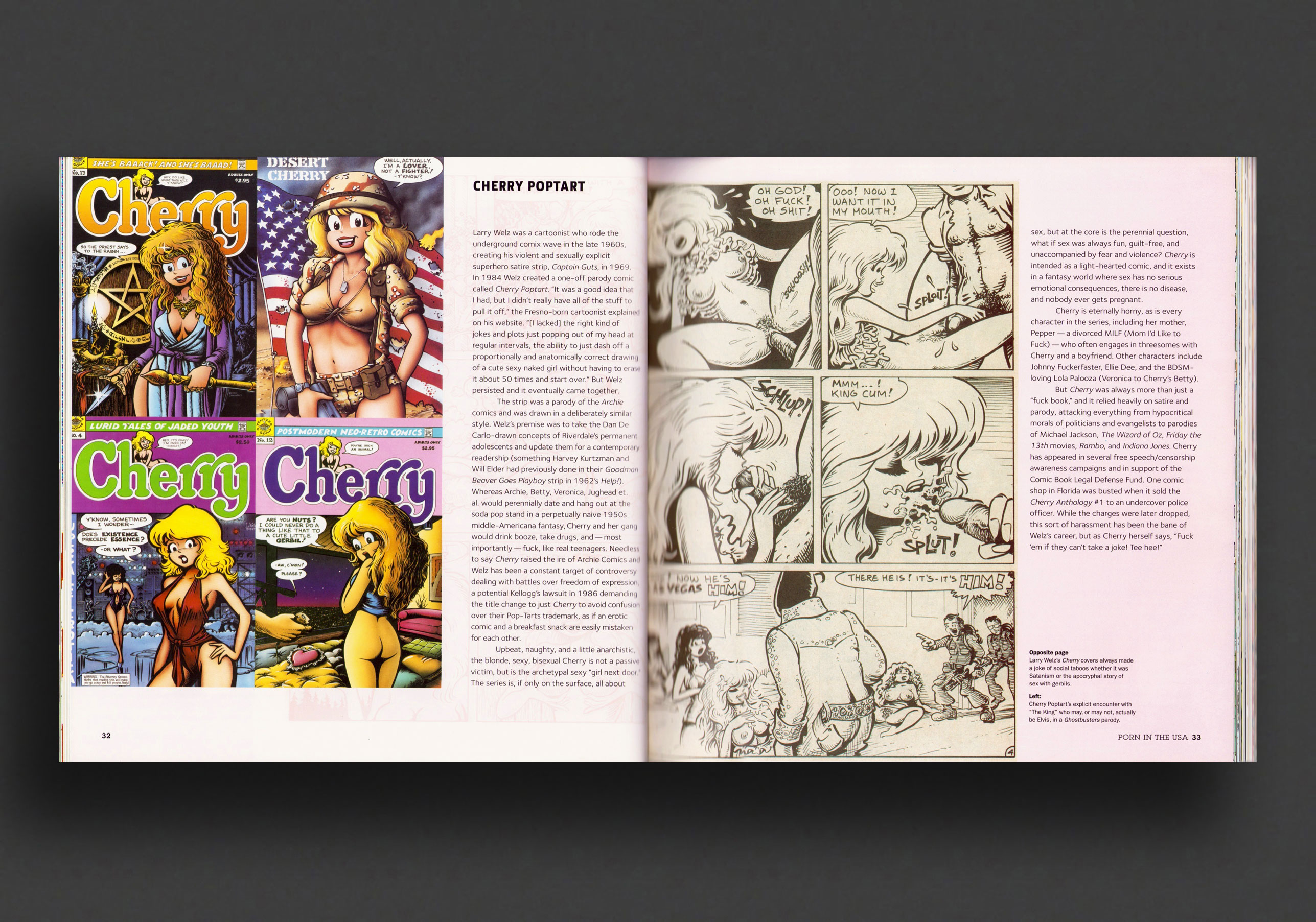
First hardcover edition of the second volume of this invaluable reference on erotic comics, compiled by Tim Pilcher with an introduction by Alan Moore. An incredible breadth of famous, infamous and impossibly obscure publishing exploring the illustrated depths of human desire. Tom of Finland, Erich von Götha, Lynn Paula Russell, Simon Bisley, Paolo E. Serpieri, Gay Comix, Bondage Fairies, Glamour International, Frank Cho, Heavy Metal, Cherry Poptart, Vaughn Bodē, Milo Manara, Howard Cruse, National Lampoon, Roberta Gregory, "Omaha" the Cat Dancer, and so many more…
“The liberating underground comix of the '60s heralded an explosion in the genres of erotic comic art, and this volume picks up the story to show how European, American and Asian artists have explored the possibility of the form in the years since. It covers everything: the erotic comics explosion in America in the mid-'80s; the gay, lesbian, bisexual and transgender comics scene; UK and European erotic comic creators since the '70s; the Japanese hentai phenomenon: to the techno future, where erotic comic creators are sidestepping legal issues by producing work solely for the Internet. Filled with rarely seen art from international forerunners such as Dave Stevens, Jordi Bennet, Frank Thorne, Tom of Finland, Ralf König, and Milo Manara, Erotic Comics 2 is perfect for fans of adult comics, art history, and erotic illustration. As Alan Moore urges in his foreword: "Absorb the contents of this book, and do so shamelessly."”
Tim Pilcher is the co-author of The Essential Guide to World Comics, and has contributed to numerous other books. He was an assistant editor at Vertigo Comics and an associate editor on Comics International. He lives in Brighton, England.
Gene Kannenberg, Jr., is a respected historian of comics and the director of ComicsResearch.org. He serves on the board of the International Journal of Comic Art, and lives in Hudson Valley, New York.
Alan Moore is the author of the acclaimed graphic novels Watchmen, V for Vendetta, and From Hell. His long-awaited erotic graphic novel, Lost Girls, was published in 2006. He lives in Northampton, England.
Very Good copy in VG dust jacket, light wear, preserved in mylar wrap.
1997, English
Softcover (staple-bound), 58 pages, 30 x 21 cm
1st Edition, Out of print title / used / very good
Published by
Radical Philosophy / Bristol
$15.00 - Out of stock
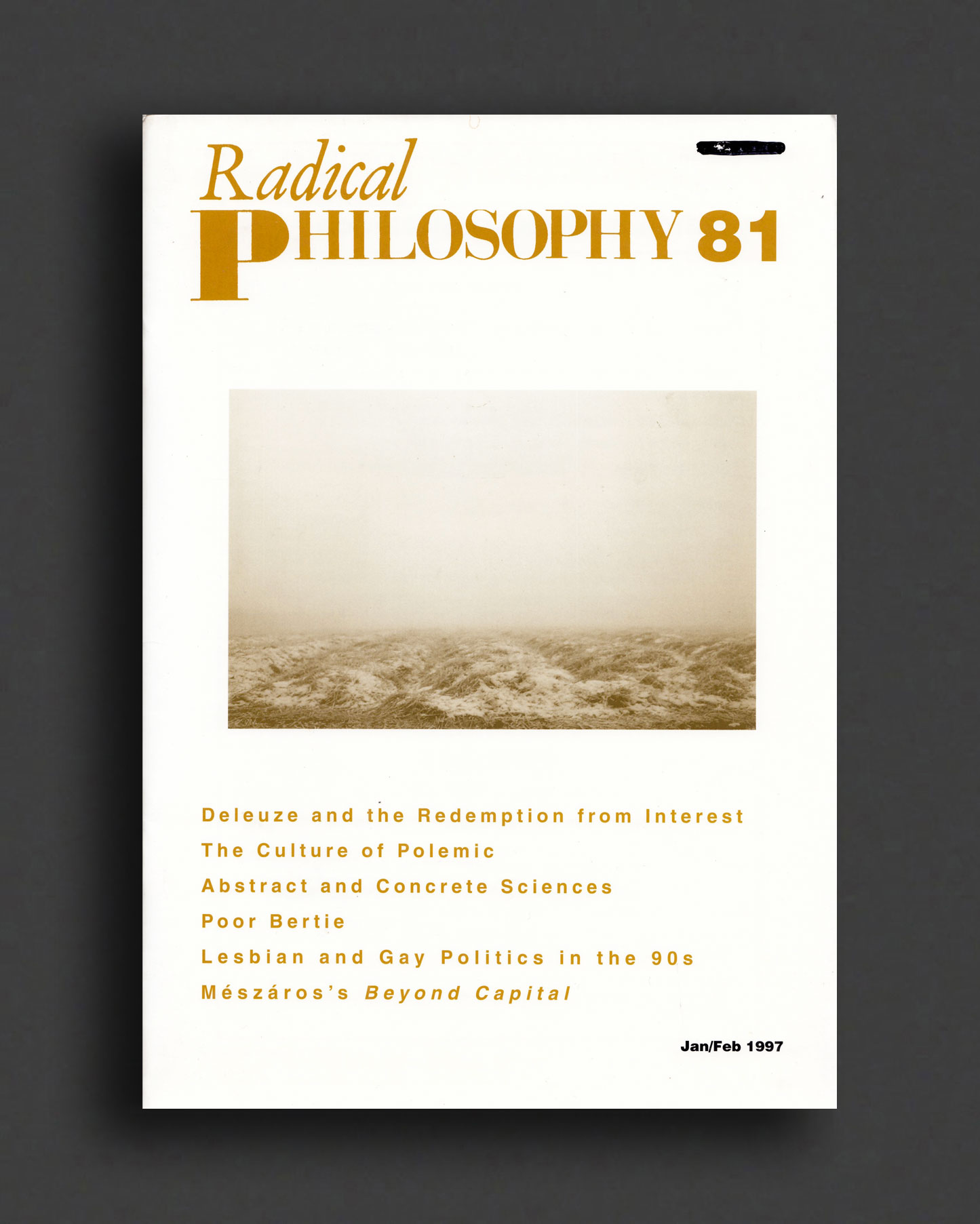
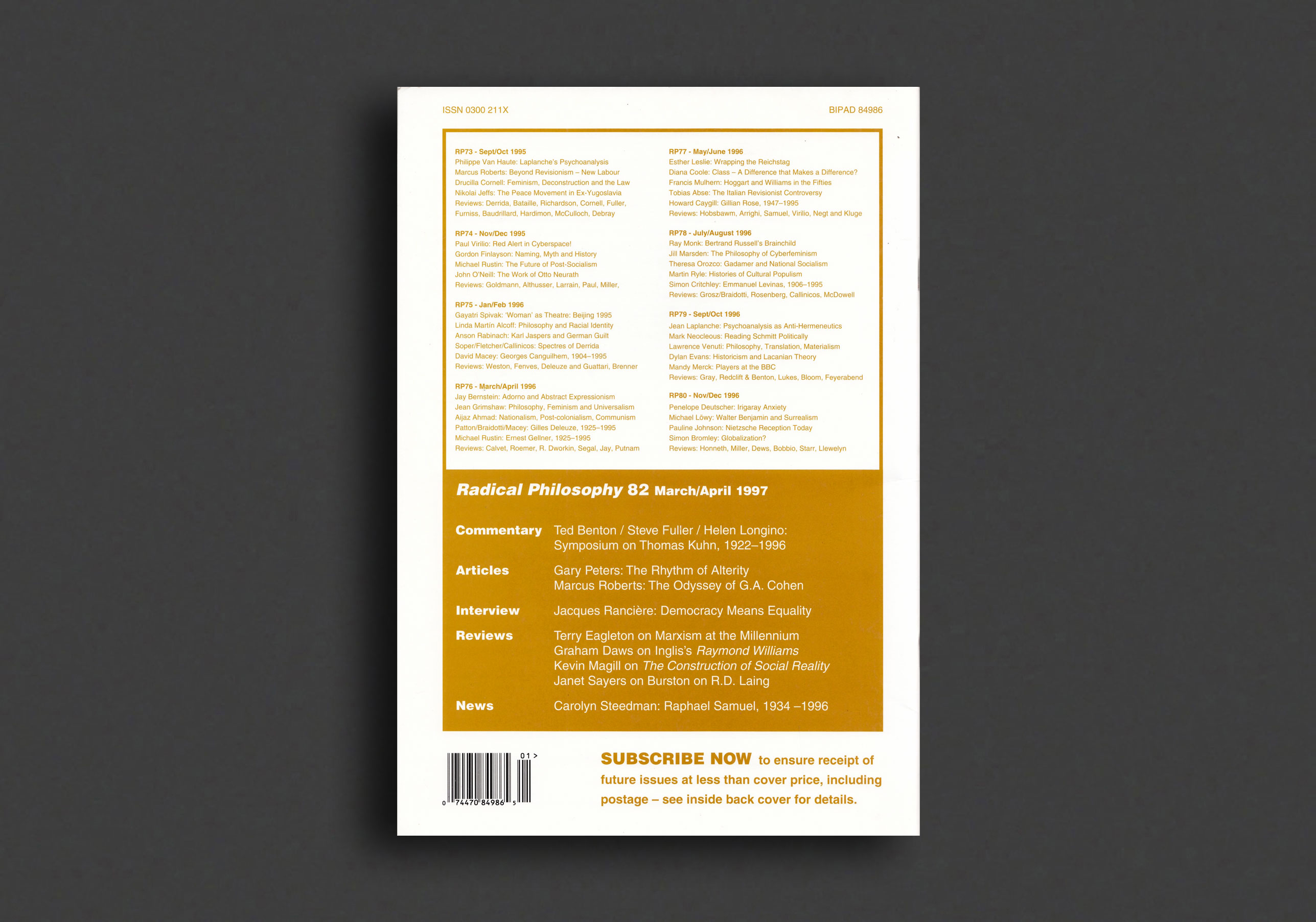
Features: Deleuze and the Redemption from Interest; The Culture of Polemic; Abstract and Concrete Sciences; Poor Bertie; Lesbian and Gay Politics in the 90s; Mészáros's Beyond Capital
Radical Philosophy is a triannual peer-reviewed academic journal of critical theory and philosophy. It was established in 1972 with the purpose of providing a forum for the theoretical work which was emerging in the wake of the radical movements of the 1960s, in philosophy and other fields.
VG copy.