World Food Books' programme is largely produced on Kulin Nation land. We acknowledge the Wurundjeri people of the Kulin Nation as the first and continuing custodians of this land, and pay respect to their Elders past, present, and emerging.
World Food Books is an arts and special interests bookshop in Naarm / Melbourne. Founded in 2010, World Food Books is devoted to the presentation of a rotating, hand-selection of international art, design, literary and counterculture publications with an emphasis on the anti-traditional, the experimental, the avant-garde, the heretic, the marginal.
Presenting new titles alongside rare and out-of-print books, catalogues and journals spanning the fields of modern and contemporary art, design, photography, illustration, film, literature, poetry, cultural theory, philosophy, sexuality, popular and underground culture in its many radical forms, World Food Books wishes to encourage adventurous, thoughtful and open-minded reading, looking, writing, and exchange of publishing and ideas, both current and historical.
As well as our bookshop, located in Melbourne's historical Nicholas Building, all of our inventory is available internationally via our online mail-order service.
World Food Books semi-regularly co-ordinates "Occasions", a programme of exhibits and events at the bookshop and in partnership with other hosts (such as museums and art galleries) that develop out of the activities, relationships and content of the bookshop itself.
World Food Books
The Nicholas Building
37 Swanston Street
Room 5, Level 6
Melbourne 3000
Australia
SHOP HOURS:
THU–SAT 12–6
WEB-SHOP OPEN 24/7
World Food Books
Postal Address:
PO Box 435
Flinders Lane
Victoria 8009
Australia
info@worldfoodbooks.com
Art
Theory / Essay
Architecture / Interior
Graphic Design / Typography
Photography
Fashion
Eros
LGBTQ+
Fiction / Poetry
Weird / Speculative / Science Fiction / Horror
Transgressive / Visceral / Abject
Symbolism / Decadence / Fin de siècle
Film / Video
Painting
Sculpture / Installation
Performance / Dance / Theater
Drawing
Sound / Music
Curatorial
Group Shows / Collections
Periodicals
Out-of-print / Rare
Posters / Ephemera / Discs
Signed Books
World Food Books Gift Voucher
World Food Book Bag
Australian Art
Australian Fiction
Australian Science Fiction / Speculative Fiction
Australian Poetry
Australian Photography
Japanese Photography
Conceptual Art
Minimal Art
Dada
'Pataphysics / Oulipo
Fluxus
Concrete Poetry
Pop Art
Surrealism
Arte Povera
Arte Informale / Haute Pâte / Tachism
Nouveau Réalisme / Zero / Kinetic
Situationism / Lettrism
Collage / Mail Art / Xerox Art
Art Brut / Folk / Visionary / Fantastic
Illustration / Graphic Art / Bandes Dessinées
Furniture
Italian Radical Design / Postmodernism
Textiles
Ceramics / Glass
Counterculture
Protest / Revolt
Philosophy
Psychoanalysis
Anthropology
Anarchism
Socialism / Anarchism / Communism / Capitalism
Literary Theory / Semiotics / Language
Feminism / Women's Studies
Gender Studies / Sexuality
Anthropology
Fetishism / BDSM
Drugs / Psychedelia
Crime / Violence
Animal Rights / Veganism
Occult / Esoterica
Ecology / Earth / Alternative Living
Whole Earth / Crafts
All prices in AUD (Australian dollars)
Pick-Ups
Pick-up orders can be collected in our bookshop during opening hours after order date. Please collect any Pick-up orders within 2 weeks of ordering as we have limited storage space. Orders will be released back into stock if not collected within this time. No refunds can be made for pick-ups left un-collected. If you cannot make it in to the bookshop in this time-frame, please choose postage option.
Return Policy
All sales are final. We do accept returns (for refund or exchange) for items received in error. All our orders are packed with special care using heavy-duty padding and cardboard book-mailers or bubble mailers (for smaller books), using reinforcement where required. We cannot take responsibility for any lost, stolen or damaged parcels.
Insurance
Should you wish to insure your package, please email us directly after placing your order and we can organise this at a small extra expense. Although all standard/express tracked packages are very safe and dependable, we cannot take responsibility for any lost, stolen or damaged parcels. We recommend insurance on valuable orders.
Interested in selling your old books, catalogues, journals, magazines, comics, fanzines, ephemera? We are always looking for interesting, unusual and out-of-print books to buy. We only buy books in our fields of interest and specialty, and that we feel we can resell.
We base these prices on desirability, market value, in-print prices, condition and our current stock levels. We offer cash, store credit, and can take stock on consignment. All
about 25% of the price we expect to get when we sell them, or 30% in store credit. We base these prices on desirability, market value, in-print prices, condition and our current stock levels.
Sell your books any day of the week. You can drop them off and return later. If you have a lot of books, we can visit your Sydney home.
We buy books that we feel we can resell. We offer about 25 % of the price we expect to get when we sell them, or 30% in store credit. We base these prices on desirability, market value, in-print prices, condition and our current stock levels.
Philadelphia Wireman
03 August - 01 September, 2018
World Food Books is proud to announce our next Occasion, the first presentation of sculptures by Philadelphia Wireman in Australia.
The Philadelphia Wireman sculptures were found abandoned in an alley off Philadelphia’s South Street on trash night in 1982. Their discovery in a rapidly-changing neighbourhood undergoing extensive renovation, compounded with the failure of all attempts to locate the artist, suggests that the works may have been discarded after the maker’s death. Dubbed the "Philadelphia Wireman" during the first exhibition of this work, in 1985, the maker’s name, age, ethnicity, and even gender remain uncertain. The entire collection totals approximately 1200 pieces, all intricately bound together with tightly-wound heavy-gauge wire (along with a few small, abstract marker drawings, reminiscent both of Mark Tobey and J.B. Murry). The dense construction of the work, despite a modest range of scale and materials, is singularly obsessive and disciplined in design: a wire armature or exoskeleton firmly binds a bricolage of found objects including plastic, glass, food packaging, umbrella parts, tape, rubber, batteries, pens, leather, reflectors, nuts and bolts, nails, foil, coins, toys, watches, eyeglasses, tools, and jewellery.
Heavy with associations—anthropomorphic, zoomorphic, and socio-cultural responses to wrapped detritus—the totemic sculptures by Philadelphia Wireman have been discussed in the context of work created to fulfil the shamanistic needs of alternative religions in American culture. Curators, collectors, and critics have variously compared certain pieces to sculpture from Classical antiquity, Native American medicine bundles, African-American memory jugs, and African fetish objects. Reflecting the artist’s prolific and incredibly focused scavenging impulse, and despite—or perhaps enhanced by—their anonymity, these enigmatic objects function as urban artefacts and arbiters of power, though their origin and purpose is unknown. Philadelphia Wireman, whatever their identity, possessed an astonishing ability to isolate and communicate the concepts of power and energy through the selection and transformation of ordinary materials. Over the course of the past two decades, this collection has come to be regarded as an important discovery in the field of self-taught art and vernacular art.
Presented in collaboration with Fleisher-Ollman Gallery, Philadelphia, and Robert Heald, Wellington.
Susan Te Kahurangi King
02 February - 10 March, 2018
Susan Te Kahurangi King (24 February 1951 - ) has been a confident and prolific artist since she was a young child, drawing with readily available materials - pencils, ballpoint pens and felt-tip markers, on whatever paper is at hand. Between the ages of four and six Susan slowly ceased verbal communication. Her grandparents William and Myrtle Murphy had developed a special bond with Susan so they took on caring responsibilities for extended periods. Myrtle began informally archiving her work, carefully collecting and storing the drawings and compiling scrapbooks. No drawing was insignificant; every scrap of paper was kept. The King family are now the custodians of a vast collection containing over 7000 individual works, from tiny scraps of paper through to 5 meter long rolls.
The scrapbooks and diaries reveal Myrtle to be a woman of great patience and compassion, seeking to understand a child who was not always behaving as expected. She encouraged Susan to be observant, to explore her environment and absorb all the sights and sounds. Myrtle would show Susan’s drawings to friends and people in her community that she had dealings with, such as shopkeepers and postal workers, but this was not simply a case of a grandmother’s bias. She recognised that Susan had developed a sophisticated and unique visual language and sincerely believed that her art deserved serious attention.
This was an unorthodox attitude for the time. To provide some context, Jean Dubuffet coined the term Art Brut in 1945 to describe work created by self-taught artists – specifically residents of psychiatric institutions and those he considered to be visionaries or eccentrics. In 1972 Roger Cardinal extended this concept by adopting the term Outsider Art to describe work made by non-academically trained artists operating outside of mainstream art networks through choice or circumstance. Susan was born in Te Aroha, New Zealand in 1951, far from the artistic hubs of Paris and London that Dubuffet and Cardinal operated in. That Myrtle fêted Susan as a self-taught artist who deserved to be taken seriously shows how progressive her attitudes were.
Susan’s parents Doug and Dawn were also progressive. Over the years they had consulted numerous health practitioners about Susan’s condition, as the medical establishment could not provide an explanation as to why she had lapsed into silence. Dawn educated herself in the field of homeopathy and went on to treat all twelve of her children using these principles – basing prescriptions on her observations of their physical, mental and emotional state.
Doug was a linguist with an interest in philosophy who devoted what little spare time he had to studying Maori language and culture. To some extent their willingness to explore the fringes of the mainstream made them outsiders too but it was their commitment to living with integrity and their respect for individuality that ensured Susan’s creativity was always encouraged.
Even though Susan’s family supported her artistic pursuits, some staff in schools and hospitals saw it as an impediment to her assimilation into the community and discouraged it in a variety of ways. Her family was not always aware of this and therefore did not fully understand why Susan stopped drawing in the early 1990s. However, rather than dwell on the challenges that Susan faced in pursuit of her artistic practice, they prefer to highlight her achievements. In 2008 Susan began drawing again in earnest, after an almost 20 year interruption, and her work is now shown in galleries around the world.
Susan grew up without television and has been heavily influenced by the comics she read as a child. She is absolutely fearless in the appropriation of recognizable characters, such as Donald Duck and Mickey Mouse, in her work. She twists their limbs, contorts their faces, compresses them together, blends them into complex patterned backgrounds - always imbuing them with an incredible energy. Although Susan often used pop culture characters in her work they are not naive or childlike. These are drawings by a brilliant self-taught artist who has been creating exceptional work for decades without an audience in mind.
Mladen Stilinović
"Various Works 1986 - 1999"
02 February 16 - September 10, 2016
Various works 1986 - 1999, from two houses, from the collections of John Nixon, Sue Cramer, Kerrie Poliness, Peter Haffenden and Phoebe Haffenden.
Including: Geometry of Cakes (various shelves), 1993; Poor People’s Law (black and white plate), 1993; White Absence (glasses, ruler, set square, silver spoon, silver ladel with skin photograph and wooden cubes), 1990-1996; Exploitation of the Dead (grey and red star painting, wooden painting, black spoon with red table, red plate), 1984-1990; Money and Zeros (zero tie, paintings made for friends in Australia (Sue, John, Kerrie), numbers painting), 1991-1992; Words - Slogans (various t-shirts) - “they talk about the death of art...help! someone is trying to kill me”, “my sweet little lamb”, “work is a disease - Karl Marx”; Various artist books, catalogues, monographs, videos; Poster from exhibition Insulting Anarchy; "Circular" Croatian - Australian edition; Artist book by Vlado Martek (Dostoyevsky); more.
Thanks to Mladen Stilinović and Branka Stipančić.
Jonathan Walker
Always Will Need To Wear Winter Shirt Blue + Ochre Small Check Pattern
21 August - 21 September, 2015
Untitled
I am not a great reader of poetry but I always return to the work of Melbourne poet, Vincent Buckley (1925- 1988). Perhaps I find his most tantalising piece to be not a finished poem but a fragment left on a scrap of paper discovered on his desk after the poet’s death.
The poetry gathers like oil
In the word-core, and spreads
It has its music meet,
Its music is in movement.
This fragment is more the shell left behind from a volatile thought than a finished poem. I find the last two lines honest but awkward whereas the first two lines work like an arrow. Most likely he could not find a resolution so it was left. Still, in its present form, it remains an eloquent testimony to the ultimate failure of a medium to express mobile thought and sensation, in Buckley’s case, through verbal language. It’s an important matter because this is something all artists have to deal with regardless of the medium.
I have never written a poem, however, I am forever copying fragments from books on paper scraps in a vain effort to fix certain notions in my head. At first, they function as bookmarks that are sometimes returned to when I open the book. But before long, as they accumulate, they fall out littering the table interspersed with A4 photocopies, bills, books and medications.
To return to Buckley’s fragment, the first two lines very much evoke how I paint nowadays. As you age, detail diminishes and patches of light become more luminous and float. I feel the most honest way of dealing with this is by smearing the oil paint on the canvas with the fingers and working close-up, blind. Only if the patches coalesce into an approaching image can the work gain a life.
-
Jonathan Walker was born in Melbourne, Australia and brought up on a dairy farm in Gippsland. In the 1970’s he studied painting at RMIT and won the Harold Wright Scholarship to the British Museum, London. During the 1980’s he exhibited at Pinacotheca Gallery, Richmond and had work shown at the NGV and Heidi City Art Gallery. Over the same period he designed the cover for the “Epigenesi” LP by Giancarlo Toniutti, Italy and conducted a mail exchange work with Achim Wollscheid, Germany. The work with artists through the post resulted in an article published in the bicentenary issue of Art and Australia 1988. He showed in artist run spaces such as WestSpace in the 90’s and 2000’s, and until 2012, taught painting at Victoria University, which is where we (Colleen Ahern and Lisa Radford) as organisers of the exhibition, among many others, had the privilege of being his student.
Walker’s knowledge was imparted to students through the careful selection of music, literature, and artists found in books that he himself had ordered for the library. Walker’s strategy was the generosity of sharing his vast knowledge with references specific to each student and their context.
Walker’s paintings share a similar focus and intimacy.
This exhibition presents a small selection of recent paintings alongside a publication that includes Walker’s writing. Observational and analytical, Walker’s work is a type of material notation — the time of day, colour and how it is blended, the both specific and fleeting location of a reflection on lino or the question of whether a chair leg should be included in a painting.
Please join us on Friday August 21 between 6-8pm to celebrate the opening of the exhibition.
Curated by Colleen Ahern and Lisa Radford.
B. Wurtz
Curated by Nic Tammens
March 26 - April 4, 2015
B.Wurtz works from a basement studio in his home on Manhattan’s Lower East Side.
This local fact is attested to by the plastic shopping bags and newsprint circulars that appear in his work. As formal objects, they don’t make loud claims about their origins but nonetheless transmit street addresses and places of business from the bottom of this long thin island. Like plenty of artists, Wurtz is affected by what is local and what is consumed. His work is underpinned by this ethic. It often speaks from a neighborhood or reads like the contents of a hamper:
“BLACK PLUMS $1.29 lb.”
“Food Bazaar”
“USDA Whole Pork Shoulder Picnic 99c lb.”
“RITE AID Pharmacy, with us it’s personal.”
“H. Brickman & Sons.”
“Sweet Yams 59c lb."
Most of the work in this exhibition was made while the artist was in residence at Dieu Donne, a workshop dedicated to paper craft in Midtown. Here Wurtz fabricated assemblages with paper and objects that are relatively lightweight, with the intention that they would be easily transportable to Australia. This consideration isn’t absolute in Wurtz’s work, but was prescriptive for making the current exhibition light and cheap. Packed in two boxes, these works were sent from a USPS post office on the Lower East Side and delivered to North Melbourne by Australia Post.
Wurtz appears courtesy of Metro Pictures, New York.
Thanks to Rob Halverson, Joshua Petherick, Sari de Mallory, Matt Hinkley, Helen Johnson, Fayen d'Evie, Ask Kilmartin, Lisa Radon, Ellena Savage, Yale Union, and "Elizabeth".
John Nixon
"Archive"
December 15 - January 20, 2014
The presentation of John Nixon's archive offered a rare showcase of this extensive collection of the artist's own publications, catalogues, posters, ephemera, editions and more, from the mid 1980s onwards, alongside a selection of his artworks.
Organized by John Nixon, Joshua Petherick and Matt Hinkley.
"Habitat"
at Minerva, Sydney (organised by Joshua Petherick and Matt Hinkley)
November 15 - December 20, 2014
Lupo Borgonovo, Janet Burchill & Jennifer McCamley,
Lewis Fidock, HR Giger, Piero Gilardi, Veit Laurent Kurz,
Cinzia Ruggeri, Michael E. Smith, Lucie Stahl, Daniel Weil, Wols
Press Release:
“...It contained seven objects. The slender fluted bone, surely formed for flight, surely from the wing of some large bird. Three archaic circuitboards, faced with mazes of gold. A smooth white sphere of baked clay. An age-blackened fragment of lace. A fingerlength segment of what she assumed was bone from a human wrist, grayish white, inset smoothly with the silicon shaft of a small instrument that must once have ridden flush with the surface of the skin - but the thing’s face was seared and blackened.”
William Gibson, “Count Zero”, 1986
"Autumn Projects Archive"
Curated by Liza Vasiliou
March 6 - March 15, 2014
World Food Books, in conjunction with the Virgin Australia Melbourne Fashion Festival 2014, presented the Autumn Projects archive, consisting of a selection of early examples in Australian fashion with a particular interest in collecting designers and labels from the period beginning in the 1980’s, who significantly influenced the discourse of Australian Fashion.
Curated by Liza Vasiliou, the exhibition provided a unique opportunity to view pieces by designers Anthea Crawford, Barbara Vandenberg, Geoff Liddell and labels CR Australia, Covers, Jag along with early experimental collage pieces by Prue Acton and Sally Browne’s ‘Fragments’ collection, suspended throughout the functioning World Food Books shop in Melbourne.
H.B. Peace
presented by CENTRE FOR STYLE
November 14, 2013
"Hey Blinky, you say chic, I say same"
Anon 2013
H.B. Peace is a clothing collaboration between great friends Blake Barns and Hugh Egan Westland. Their pieces explore the divergences between 'character’ and ‘personality’ in garments....etc
Special Thanks to Joshua Petherick and Matt Hinkley of WFB and Gillian Mears
and a Very Special Thank you to Audrey Thomas Hayes for her shoe collaboration.
Janet Burchill & Jennifer McCamley
"Aesthetic Suicide"
May 10 - June 8, 2013
The first of our occasional exhibitions in the World Food Books office/shop space in Melbourne, "Aesthetic Suicide" presented a body of new and older works together by artists Janet Burchill & Jennifer McCamley, including videos, prints, a wall work, and publications.
During shop open hours videos played every hour, on the hour.
2021, English
Softcover, 240 pages, 11.4 x 17.8 cm
Published by
Semiotext(e) / Los Angeles
$29.00 - Out of stock
How and when American-style slavery created the racial system, not just in the United States but internationally.
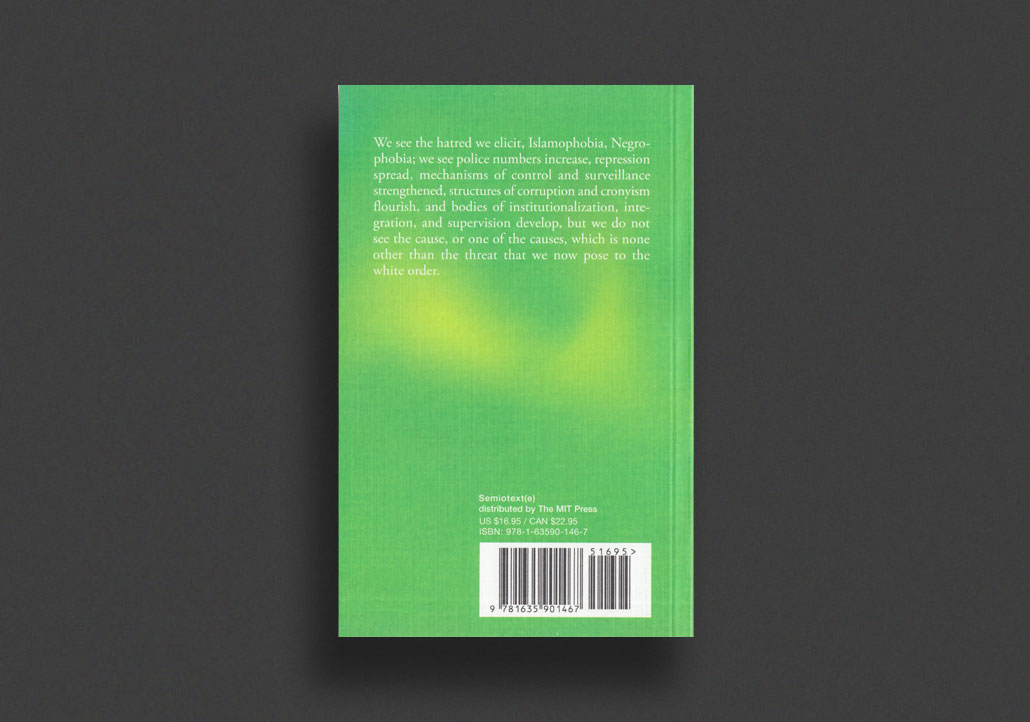
We see the hatred we elicit, Islamophobia, Negrophobia; we see police numbers increase, repression spread, mechanisms of control and surveillance strengthened, structures of corruption and cronyism flourish, and bodies of institutionalization, integration, and supervision develop, but we do not see the cause, or one of the causes, which is none other than the threat that we now pose to the white order.
— from The Colonial Counter-Revolution
Just as Capital produced classes and patriarchy produced genders, colonialism produced race. In The Colonial Counter-Revolution, Sadri Khiari outlines how and when American-style slavery created the racial system, not just in the United States but internationally, and why the development of relationships of equality within the white community favored the crystallization of specifically racial social relations. More than just a response to the dialogue, debate, and trauma of immigration today, this book looks beyond the right/left dichotomy of the issue in politics to the more fundamental political existence of immigrants and Blacks, who must exist politically if they are to exist whatsoever. Race is not biological: race is political. And it is the manifestation of the colonial counter-revolution. In France, that counter-revolution started with General de Gaulle, and continues today, where the anti-colonialist fight of Palestinian Arabs and the anti-racist fight of Arabs and blacks in France have the same adversary: white Western domination.
2021, English
Softcover, 368 pages, 15.2 x 22.9 cm
Published by
Semiotext(e) / Los Angeles
$35.00 - Out of stock
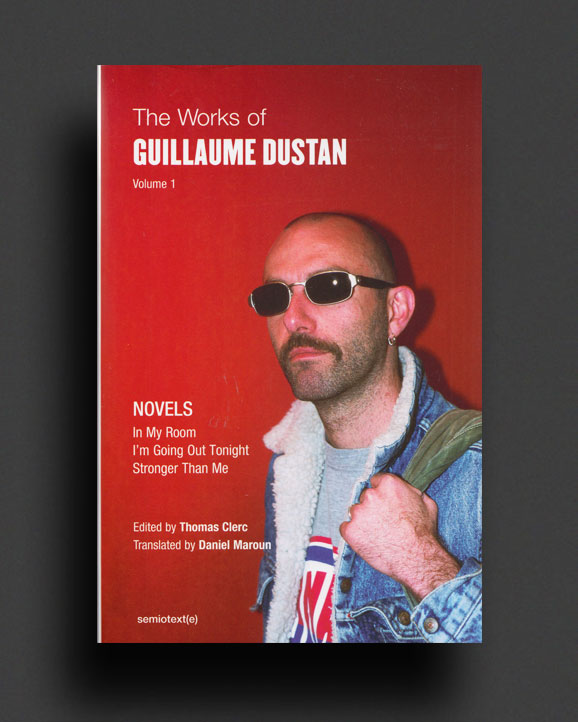
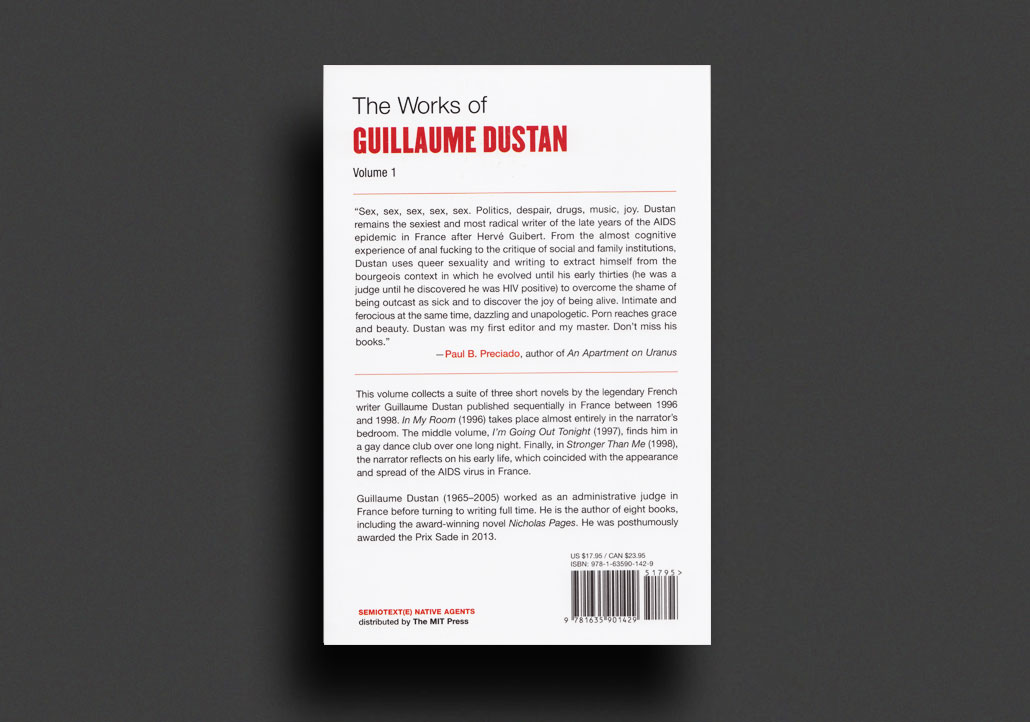
This volume collects a suite of three wildly entertaining and trailblazing short novels by the legendary French anti-assimilationist LGBTQ+ writer Guillaume Dustan. Published sequentially in France between 1996 and 1998, the three novels are exuberant and deliberately affectless accounts of the narrator's sexual odyssey through a Parisian club and bath scene still haunted by AIDS.
In My Room (1996) takes place almost entirely in the narrator's bedroom. The middle volume, I'm Going Out Tonight (1997) finds him venturing out onto the gay scene in one long night. Finally, in Stronger Than Me (1998) the narrator reflects on his early life, which coincided with the appearance and spread of the AIDS virus in France.
A close contemporary of Dennis Cooper, Brett Easton Ellis, Kevin Killian, and Gary Indiana, Guillaume Dustan's deadpan autofiction is at once satirical and intimate, and completely contemporary. Dustan (1965–2005) worked as an administrative judge in France before turning to writing full-time. He is the author of eight books, including the award-winning novel Nicholas Page. He was posthumously awarded the Prix Sade in 2013.
Edited by Thomas Clerc
Translated by Daniel Maroun
"Sex, sex, sex, sex, sex. Politics, despair, drugs, music, joy. Dustan remains the sexiest and most radical writer of late years of the AIDS epidemics in France after Hervé Guibert. From the almost cognitive experience of anal fucking to the critique of social and family institutions, Dustan uses queer sexuality and writing to extract himself from the bourgeois context in which he evolved until his early thirties (he as a judge until he discovered he was HIV positive) to overcome the shame of being out casted as sick and to discover the joy of being alive. Intimate and ferocious at the same time, dazzling and unapologetic. Porn reaches grace and beauty. Dustan was my first editor and my master. Don't miss his books."
— Paul B. Preciadoauthor of An Apartment on Uranus
2021, English
Softcover, 104 pages, 11.4 x 17.8 cm
Published by
Semiotext(e) / Los Angeles
$29.00 - Out of stock
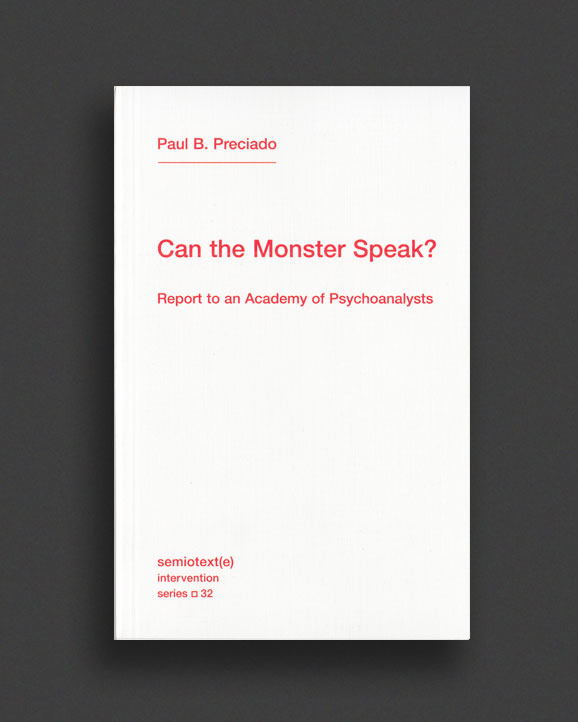
Paul Preciado's controversial 2019 lecture at the École de la Cause Freudienne annual conference, published in a definitive translation for the first time.
November 2019, Paul Preciado was invited to speak in front of 3,500 psychoanalysts at the École de la Cause Freudienne's annual conference in Paris. Standing in front of the profession for whom he is a “mentally ill person” suffering from “gender dysphoria,” Preciado draws inspiration in his lecture from Kafka's “Report to an Academy,” in which a monkey tells an assembly of scientists that human subjectivity is a cage comparable to one made of metal bars.
Speaking from his own “mutant” cage, Preciado does not so much criticize the homophobia and transphobia of the founders of psychoanalysis as demonstrate the discipline's complicity with the ideology of sexual difference dating back to the colonial era—an ideology which is today rendered obsolete by technological advances allowing us to alter our bodies and procreate differently. Preciado calls for a radical transformation of psychological and psychoanalytic discourse and practices, arguing for a new epistemology capable of allowing for a multiplicity of living bodies without reducing the body to its sole heterosexual reproductive capability, and without legitimizing hetero-patriarchal and colonial violence.
Causing a veritable outcry among the assembly, Preciado was heckled and booed and unable to finish. The lecture, filmed on smartphones, was published online, where fragments were transcribed, translated, and published with no regard for exactitude. With this volume, Can the Monster Speak? is published in a definitive translation for the first time.
Paul B. Preciado is the author of Counter-Sexual Manifesto, Testo Junkie: Sex, Drugs and Biopolitics, and Pornotopia, for which he was awarded the Sade Prize in France. He is currently Curator of Public Programmes at the Palais de Tokyo and lives in Paris.
2021, English
Softcover, 200 pages, 11.4 x 17.8 cm
Published by
Semiotext(e) / Los Angeles
$32.00 - In stock -
Why we must reject the illusory consolations of technology and choose revolutiom over fascism.
We are living in apocalyptic times. In Capital Hates Everyone, famed sociologist Maurice Lazzarato points to a stark choice emerging from the magma of today's world events: fascism or revolution. Fascism now drives the course of democracies as they grow less and less liberal and increasingly subject to the law of capital. Since the 1970s, Lazzarato writes, capital has entered a logic of war. It has become, by the power conferred on it by financialization, a political force intent on destruction. Lazzarato urges us to reject the illusory consolations of a technology-abetted “new” kind of capitalism and choose revolution over fascism.
This offensive was made possible by the cycle of revolutions coming to an end. But while it was unfolding, critical thinking announced the suppression of social relations and the advent of a new capitalism, a milder one, more attentive to the comfort of workers. Today, the prophets of technology even boast of a solution to the climate crisis or an exit from capitalism by the very means of capital. In the face of these illusory consolations and the growing threat of fascism, Lazzarato argues it is urgent that we rediscover the meaning of strategic confrontations and the means of rebuilding a revolutionary war machine. Since capital hates everyone, everyone must hate capital.
Translated by Robert Hurley
Maurizio Lazzarato is a sociologist and philosopher in Paris. He is the author of Governing by Debt and Signs and Machines: Capitalism and the Production of Subjectivity, both published by Semiotext(e).
2021, English
Softcover, 224 pages, 14 x 20.5 cm
Published by
Semiotext(e) / Los Angeles
$34.00 - Out of stock
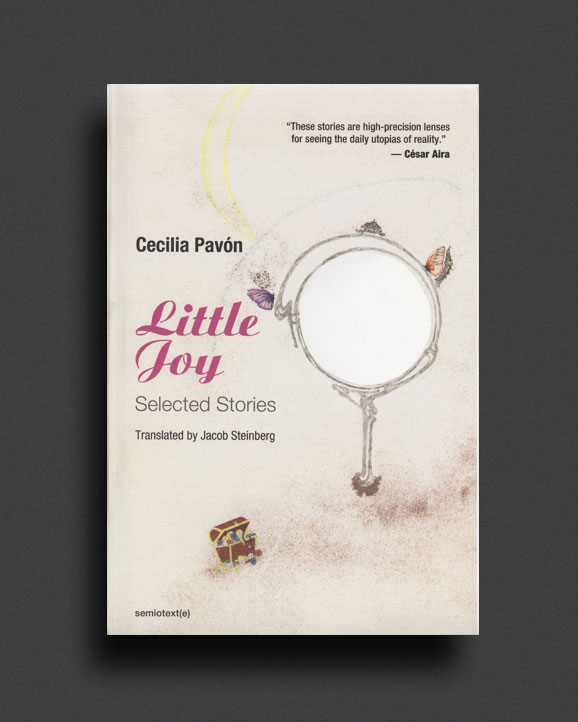
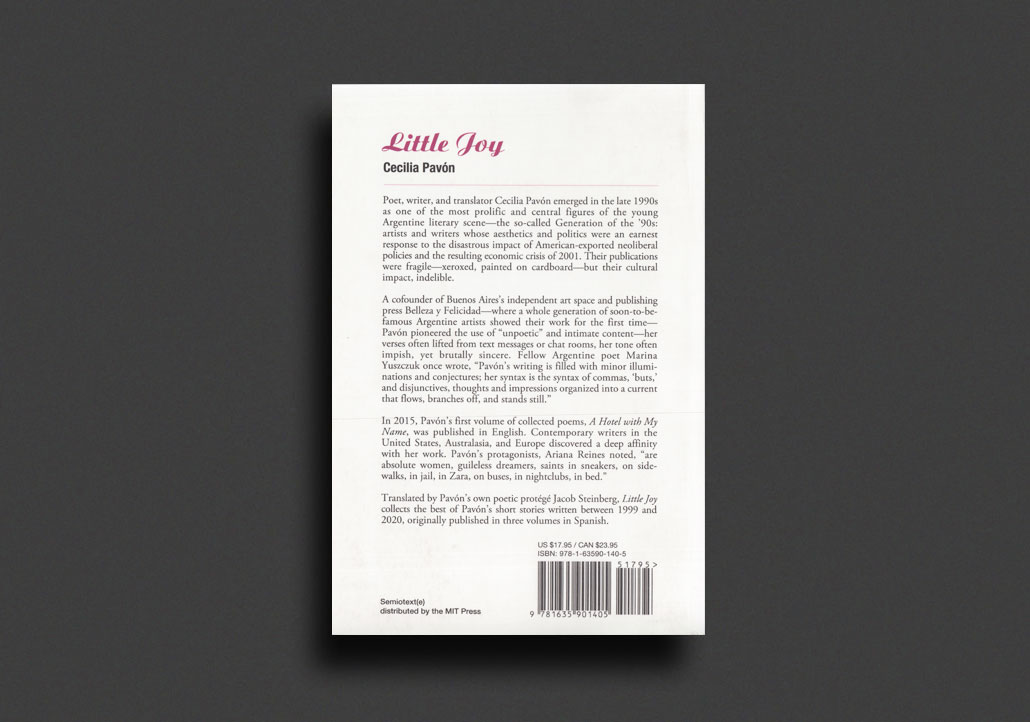
Poet, writer, and translator Cecilia Pavón emerged in the late 1990s as one of the most prolific and central figures of the young Argentine literary scene—the so-called “Generation of the 90s”: artists and writers whose aesthetics and politics were an earnest response to the disastrous impact of American-exported neoliberal policies and the resulting economic crisis of 2001. Their publications were fragile—xeroxed, painted on cardboard—but their cultural impact, indelible.
A cofounder of Buenos Aires's independent art space and publishing press Belleza y Felicidad—where a whole generation of soon-to-be-famous Argentine artists showed their work for the first time—Pavón pioneered the use of "unpoetic" and intimate content—her verses often lifted from text messages or chat rooms, her tone often impish, yet brutally sincere. Fellow Argentine poet Marina Yuszczuk once wrote, "Pavón's writing is filled with minor illuminations and conjectures; her syntax is the syntax of commas, 'buts,' and disjunctives, thoughts and impressions organized into a current that flows, branches off, and stands still."
In 2015, Pavón's first volume of collected poems, A Hotel with My Name, was published in English. Contemporary writers in the United States, Australasia, and Europe discovered a deep affinity with her work. Pavón's protagonists, Ariana Reines noted, "are absolute women, guileless dreamers, saints in sneakers, on sidewalks, in jail, in Zara, on buses, in nightclubs, in bed."
Translated by Pavón's own poetic protégé Jacob Steinberg, Little Joy collects the best of Pavón's short stories written between 1999-2020, originally published in three volumes in Spanish.
"Cecilia Pavón's writings are pure happiness, although they aren't always about happiness, or about happy things. Sometimes emotion erupts but she keeps her eyes moving, scanning the room and the sidewalks, the faces of friends." — Artforum, Best of 2015
"These stories are high-precision lenses for seeing the daily utopias of reality." —César Aira
2021, English
Softcover, 120 pages, 11.4 x 17.8 cm
Published by
Semiotext(e) / Los Angeles
$29.00 - Out of stock
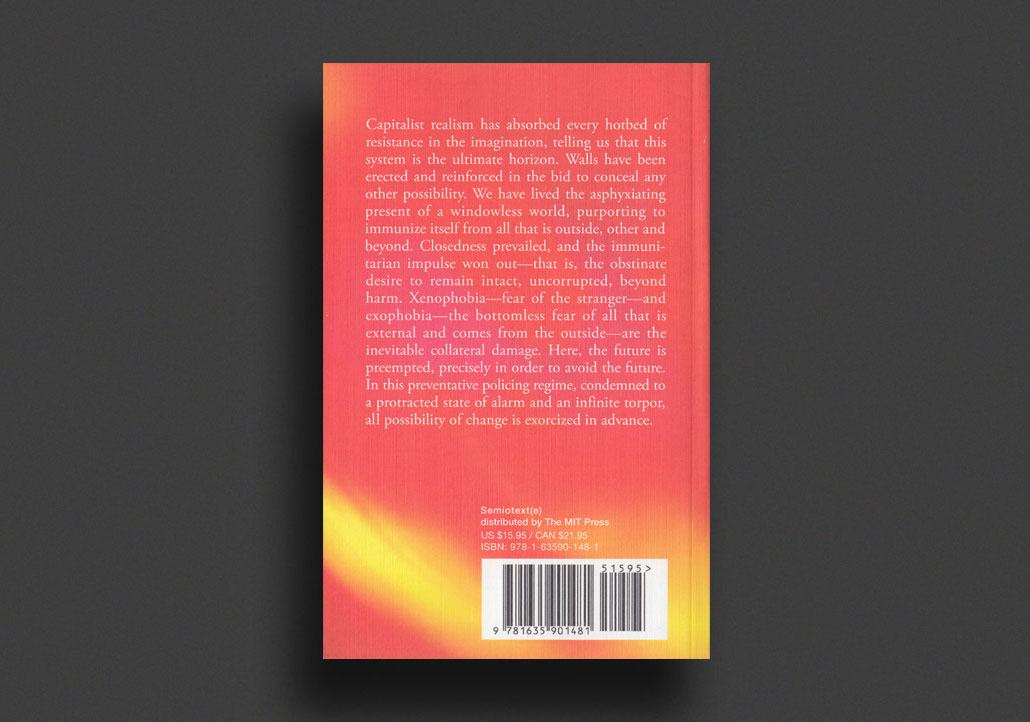
Immunodemocracy offers a stimulating and profound portrayal of the epochal event that has already left its mark on the twenty-first century. Moving from the ecological question to the rule of experts, from the state of exception to immunitarian democracy, from rule by fear to the contagion of conspiracy theory, from forced distancing to digital control, Donatella Di Cesare examines how existence is already changing—and what its future political effects may be. In her own personal style, the author reconstructs the dramatic phases of what she calls "the breathing catastrophe." Coronavirus is a sovereign virus that skirts its way around the walls of patriotism and the sovereignists' imperious frontiers. And it reveals in all its terrible crudeness the immunitarian logic that excludes the weakest and hits the poorest.
The cordon sanitaire of disengagement risks expanding beyond all proportion. The disparity between the protected and the helpless—a challenge to any idea of justice—has never been so blatant. The virus has not introduced, but merely brought out into the open the ruthlessness of the capitalism that is now wrapping us in its devastating spiral, in its compulsive, asphyxial vortex. Is it our final warning? The violent global pandemic shows that it is impossible for us to survive if we don't help each other. We will need to protect ourselves from protection and the specter of absolute immunization. When breathing can no longer be taken for granted, we need to rethink our way of living together.
Translated by David Broder
Donatella Di Cesare teaches theoretical philosophy at the Sapienza University in Rome. One of the most significant voices on the Italian intellectual scene, she is an authoritative contributor to numerous newspapers, websites and journals in Italy and elsewhere. Her books have been translated into eight languages.
2021, English
Softcover, 168 pages, 13.7 x 20.3 cm
Published by
Semiotext(e) / Los Angeles
$28.00 - Out of stock
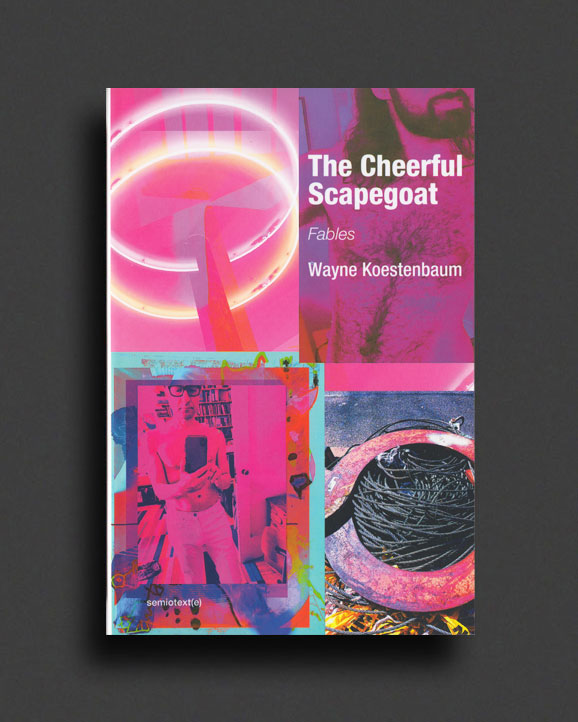
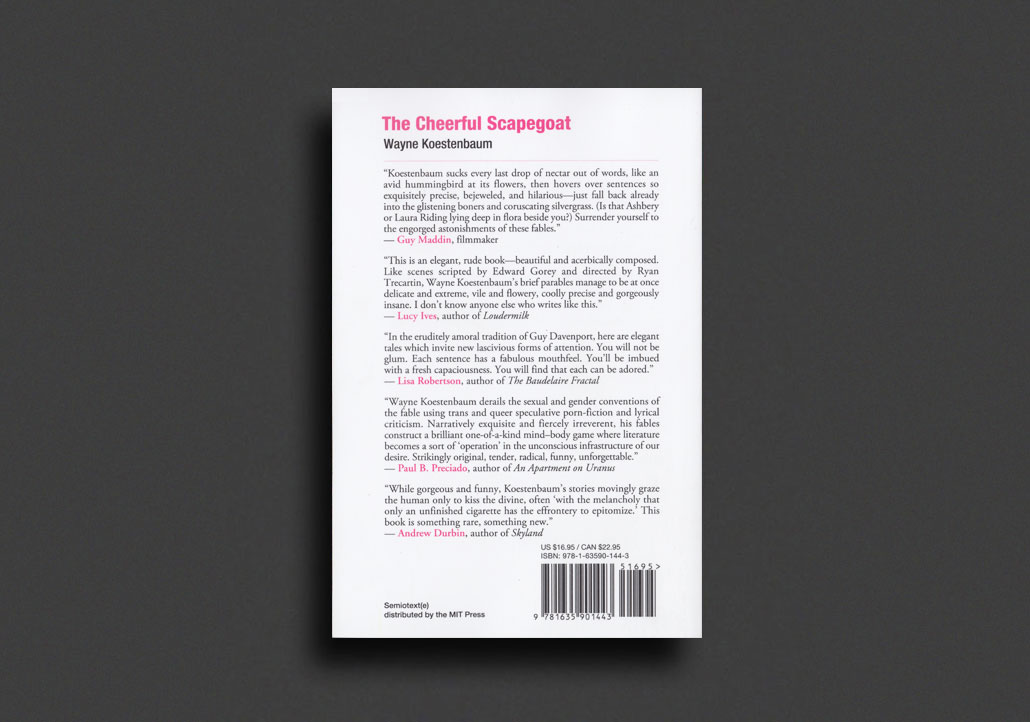
Wayne Koestenbaum's first book of short fiction: a collection of whimsical, surreal, baroque, ribald, and heartbreaking fables.
In his first book of short fiction—a collection of whimsical, surreal, baroque, ribald, and heartbreaking fables—Wayne Koestenbaum takes the gloom and melancholy of our own terrifying political moment and finds subversive solace by overturning the customary protocols of tale-telling. Characters and narrators wander into strange locales; the difference between action and thinking, between reality and dream, grows moot in a heightened yet burlesque manner. The activities in The Cheerful Scapegoat are a cross between a comedy of manners and a Sadean orgy. Language has its own desires: figures of speech carry an erotic charge that straddles the line between slapstick and vertigo. Punishment hangs over every dialogue—but in the fable-world of The Cheerful Scapegoat, abjection comes with an undertaste of contentment. The tchotchkes of queer culture—codes and signifiers—get scrambled together and then blown up into an improbable soufflé.
Koestenbaum's fables travel in circles, slipping away from their original point and leading the reader to a paradisiacal suspension of fixed categories. Intensified sentences and curlicue narratives scheme together mesmerically to convince the reader to abandon old ways of thinking and to take on a commitment to the polymorphous, the wandering, the tangential. Koestenbaum's fables--emergency bulletins uttered in a perverse vernacular of syntactic pirouettes—alert us to the necessity of pushing language into new contortions of exactitude and ecstatic excess.
Wayne Koestenbaum derails the sexual and gender conventions of the genre of the mystical-and-mythical-style fable using trans and queer speculative porn-fiction and lyrical criticism. Narratively exquisite and fiercely irreverent, his fables construct a brilliant one-of-a-kind mind-body-game where literature becomes a sort of “operation” in the unconscious infrastructure of our desire. Strikingly original, tender, radical, funny, unforgettable. — Paul B. Preciadoauthor of An Apartment on Uranus and Testo Junkie
Wayne Koestenbaum—poet, critic, novelist, artist, performer—has published nineteen books, including The Queen's Throat, which was praised by Susan Sontag as "a brilliant book" and was a National Book Critics Circle Award finalist. Formerly Associate Professor of English at Yale and Visiting Professor in the Yale School of Art's painting department, he is Distinguished Professor of English, French, and Comparative Literature at the CUNY Graduate Center in New York City.
2012, English
Softcover, 312 pages, 152 x 229 mm
Published by
Semiotext(e) / Los Angeles
$38.00 - Out of stock
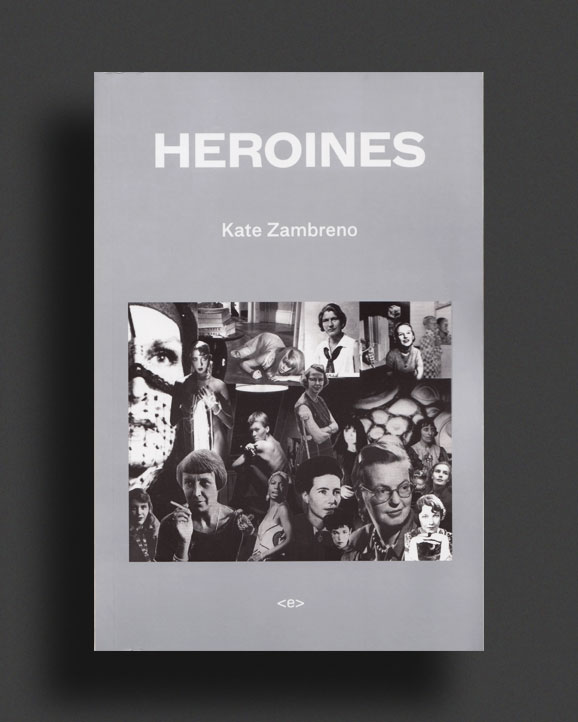
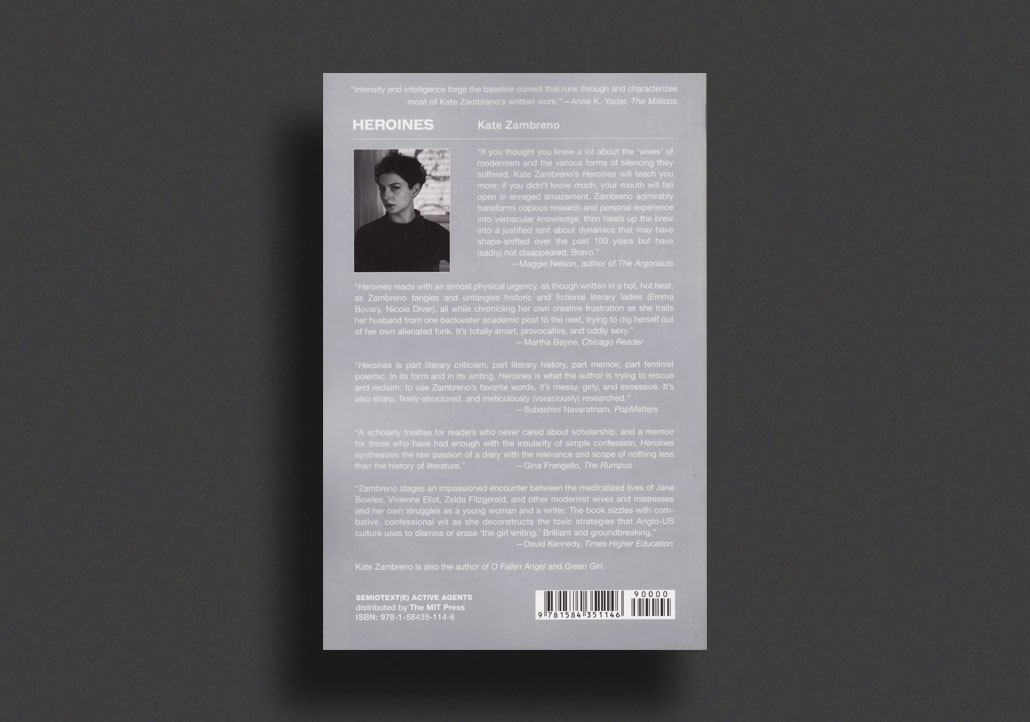
A manifesto for “toxic girls” that reclaims the wives and mistresses of modernism for literature and feminism.
I am beginning to realize that taking the self out of our essays is a form of repression. Taking the self out feels like obeying a gag order--pretending an objectivity where there is nothing objective about the experience of confronting and engaging with and swooning over literature." – from Heroines
On the last day of December, 2009 Kate Zambreno began a blog called Frances Farmer Is My Sister, arising from her obsession with the female modernists and her recent transplantation to Akron, Ohio, where her husband held a university job. Widely reposted, Zambreno's blog became an outlet for her highly informed and passionate rants about the fates of the modernist "wives and mistresses." In her blog entries, Zambreno reclaimed the traditionally pathologized biographies of Vivienne Eliot, Jane Bowles, Jean Rhys, and Zelda Fitzgerald: writers and artists themselves who served as male writers' muses only to end their lives silenced, erased, and institutionalized. Over the course of two years, Frances Farmer Is My Sister helped create a community where today's "toxic girls" could devise a new feminist discourse, writing in the margins and developing an alternative canon. In Heroines, Zambreno extends the polemic begun on her blog into a dazzling, original work of literary scholarship. Combing theories that have dictated what literature should be and who is allowed to write it--from T. S. Eliot's New Criticism to the writings of such mid-century intellectuals as Elizabeth Hardwick and Mary McCarthy to the occasional "girl-on-girl crime" of the Second Wave of feminism--she traces the genesis of a cultural template that consistently exiles female experience to the realm of the "minor," and diagnoses women for transgressing social bounds. "ANXIETY: When she experiences it, it's pathological," writes Zambreno. "When he does, it's existential." By advancing the Girl-As-Philosopher, Zambreno reinvents feminism for her generation while providing a model for a newly subjectivized criticism.
2019, English
Softcover, 152 pages, 13.7 x 20 cm
Published by
Semiotext(e) / Los Angeles
$34.00 - Out of stock
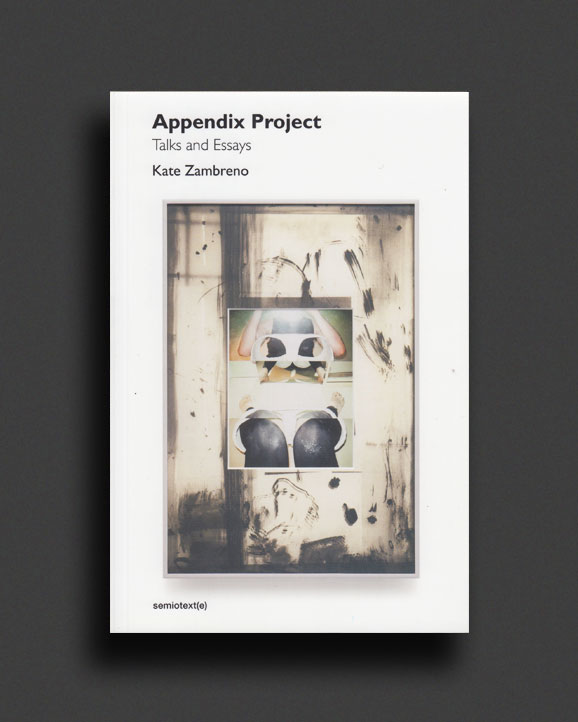
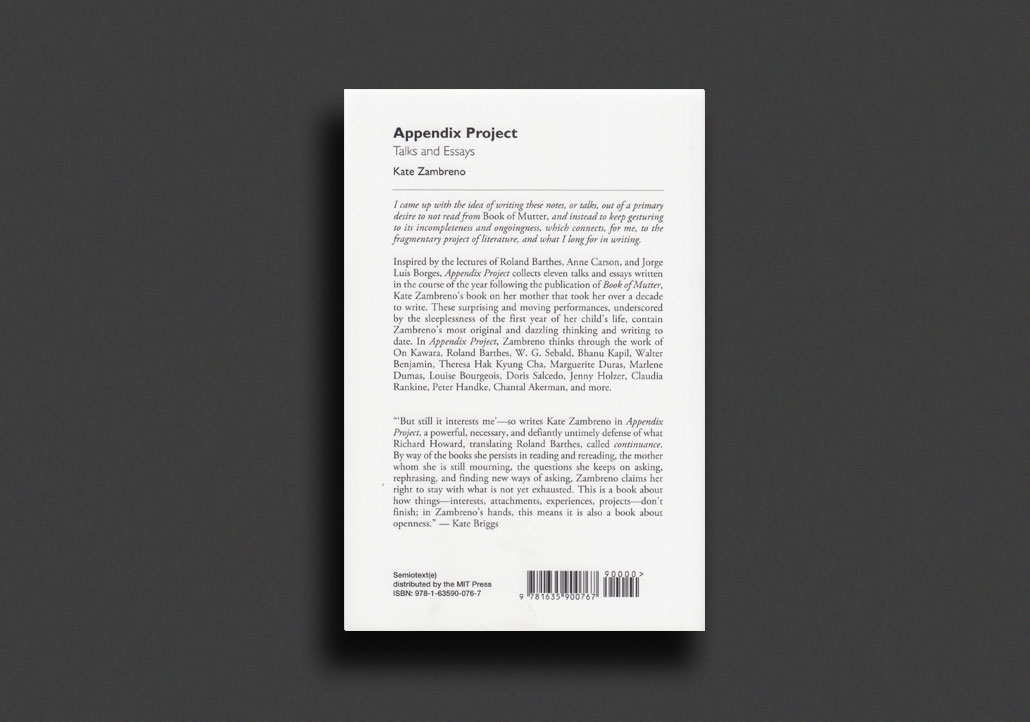
On the ongoing project of writing about grief; Zambreno's addendum to Book of Mutter.
"I came up with the idea of writing these notes, or talks, out of a primary desire to not read from Book of Mutter, and instead to keep gesturing to its incompleteness and ongoingness, which connects, for me, to the fragmentary project of literature, and what I long for in writing."
-from Appendix Project
Inspired by the lectures of Roland Barthes, Anne Carson, and Jorge Luis Borges, Kate Zambreno's Appendix Project collects eleven talks and essays written in the course of the year following the publication of Book of Mutter, Zambreno's book on her mother that took her over a decade to write. These surprising and moving performances, underscored by the sleeplessness of the first year of her child's life, contain Zambreno's most original and dazzling thinking and writing to date. In Appendix Project Zambreno thinks through the work of On Kawara, Roland Barthes, W.G. Sebald, Bhanu Kapil, Walter Benjamin, Theresa Hak Kyung Cha, Marguerite Duras, Marlene Dumas, Louise Bourgeois, Doris Salcedo, Jenny Holzer, and more.
2002, English
Softcover, 430 pages, 15.2 x 23 cm
Published by
Semiotext(e) / Los Angeles
$45.00 - In stock -
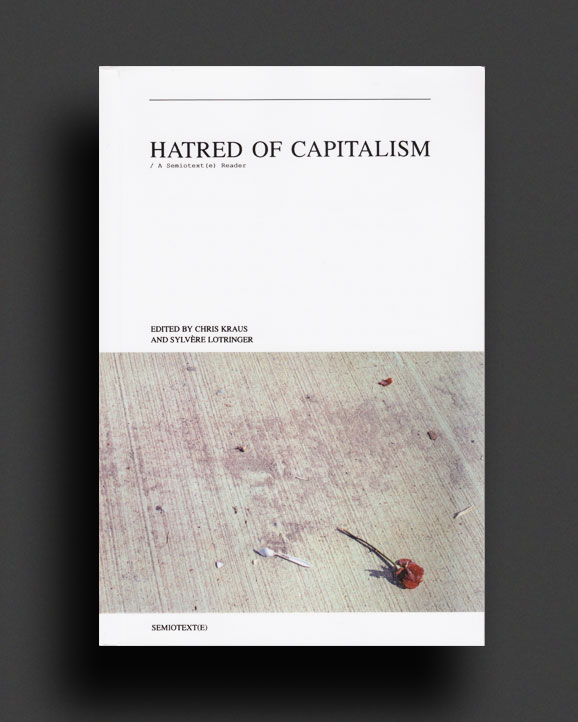
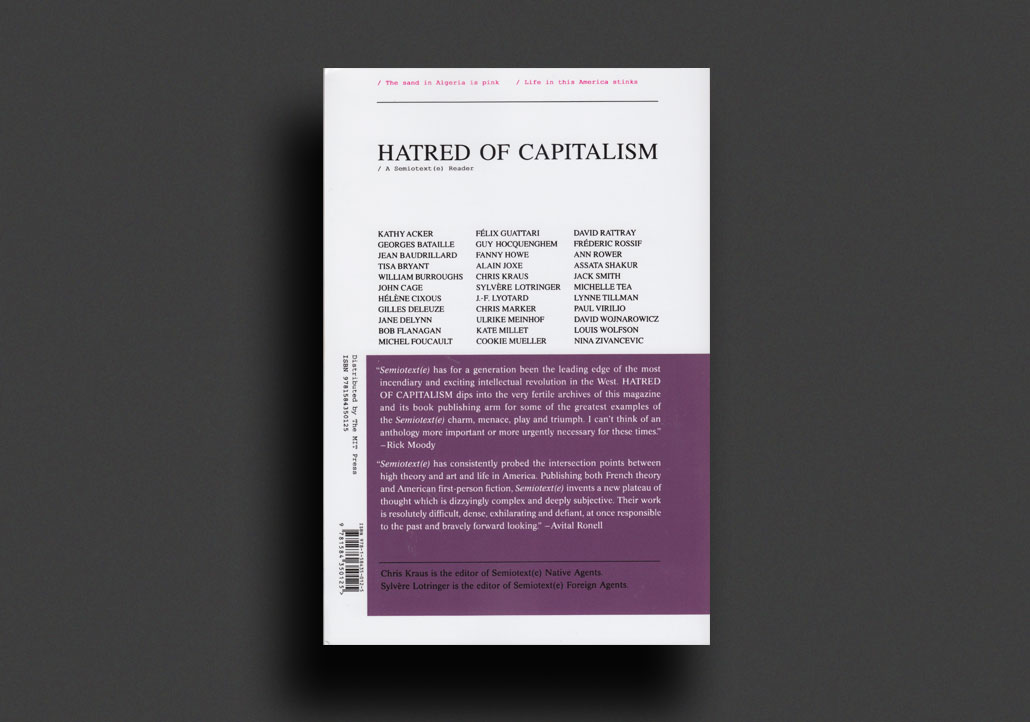
Compiled in 2001 to commemorate the passing of an era, Hatred of Capitalism brings together highlights of Semiotext(e)’s most beloved and prescient works. Semiotext(e)’s three-decade history mirrors the history of American thought. Founded by French theorist and critic Sylvere Lotringer as a scholarly journal in 1974, Semiotext(e) quickly took on the mission of melding French theory with the American art world and punk underground. Its Foreign Agents, Native Agents, Active Agents and Double Agents imprints have brought together thinkers and writers as diverse as Gilles Deleuze, Assata Shakur, Bob Flanagan, Paul Virillio, Kate Millet, Jean Baudrillard, Michelle Tea, William S. Burroughs, Eileen Myles, Ulrike Meinhof, and Fanny Howe. In Hatred of Capitalism, editors Kraus and Lotringer bring these people together in the same volume for the first time.
Chris Kraus is a filmmaker and the author of I Love Dick and Aliens & Anorexia, and coeditor of Hatred of Capitalism: A Semiotext(e) Reader. Index called her “one of the most subversive voices in American fiction.” Her work has been praised for its damning intelligence, vulnerability and dazzling speed.
Sylvère Lotringer, general editor of Semiotext(e), lives in New York and Baja, California. He is the author of Overexposed: Perverting Perversions (Semiotext(e), 2007).
2019, English
Hardcover (w. dust jacket), 288 pages, 15.2 x 22.9 cm
Published by
Semiotext(e) / Los Angeles
$48.00 - In stock -
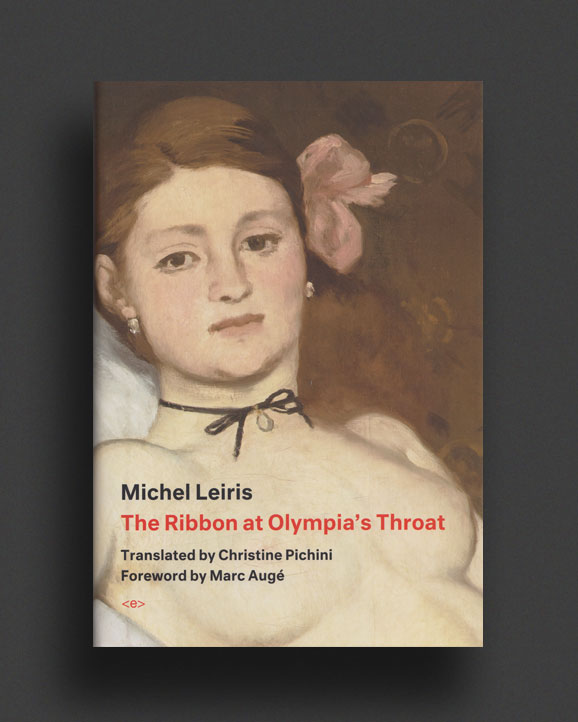
That the nude painted by Manet (in a painting so conceptually new that it created a scandal in its day) achieves so much truth through such a minor detail, that ribbon that modernizes Olympia and, even more than a beauty mark or a patch of freckles would, renders her more precise and more immediately visible, making her a woman with ties to a particular milieu and era: that is what lends itself to reflection, if not divagation! - from The Ribbon at Olympia's Throat
In The Ribbon at Olympia's Throat, Michel Leiris investigates what Lydia Davis has called the "expressive power of fetishism": how a seemingly irrelevant aesthetic detail may cause the eruption of sublimity within the mundane.
Written in 1981, toward the end of Leiris's life, The Ribbon at Olympia's Throat serves as a coda to his autobiographical masterwork, The Rules of the Game, taking the form of both shorter fragments (poems, memory scraps, notes) that are as formally disarming as the fetishistic experiences they describe, and longer essays, more exhaustive critical meditations on writing, apprehension, and the nature of the modern. Rooted in remembrance, devoted to the kaleidoscopic intricacies of wordplay, Leiris draws from his own aesthetic experiences as writer and spectator to explore the fetish that "exposes and disarms the sinister passage of time, "conferring" an undeniable realness upon the whole by essentially causing it to crystallize in a reality it would never have possessed if that sturdy fragment hadn't acted as bait."
Foreword by Marc Augé
Translated by Christine Pichini
"A necessary and enlightening sequel to Leiris's earlier extended explorations of his mind and heart, of writing, life, and art, The Ribbon at Olympia's Throat allows us to continue in his stimulating company as he poses questions in all frankness and humility that are as fresh and personal, even politically timely, today as when he wrote them. This long overdue, fine translation by Christine Pichini recreates with grace and ease Leiris's often labyrinthine sentences--no less complex than the thoughts they express. A pleasure to read." - Lydia Davis, Author of Can't and Won't and translator of Michel Leiris's Rules of the Game, Volumes 1-3
Michel Leiris (1901–1990) was a French surrealist writer and ethnographer. Part of the Surrealist group in Paris, Leiris became a key member of the College of Sociology with Georges Bataille and head of research in ethnography at the CNRS.
2006, English
Hardcover, 220 pages, 17.8 x 25.4 cm
Published by
Semiotext(e) / Los Angeles
$60.00 - Out of stock
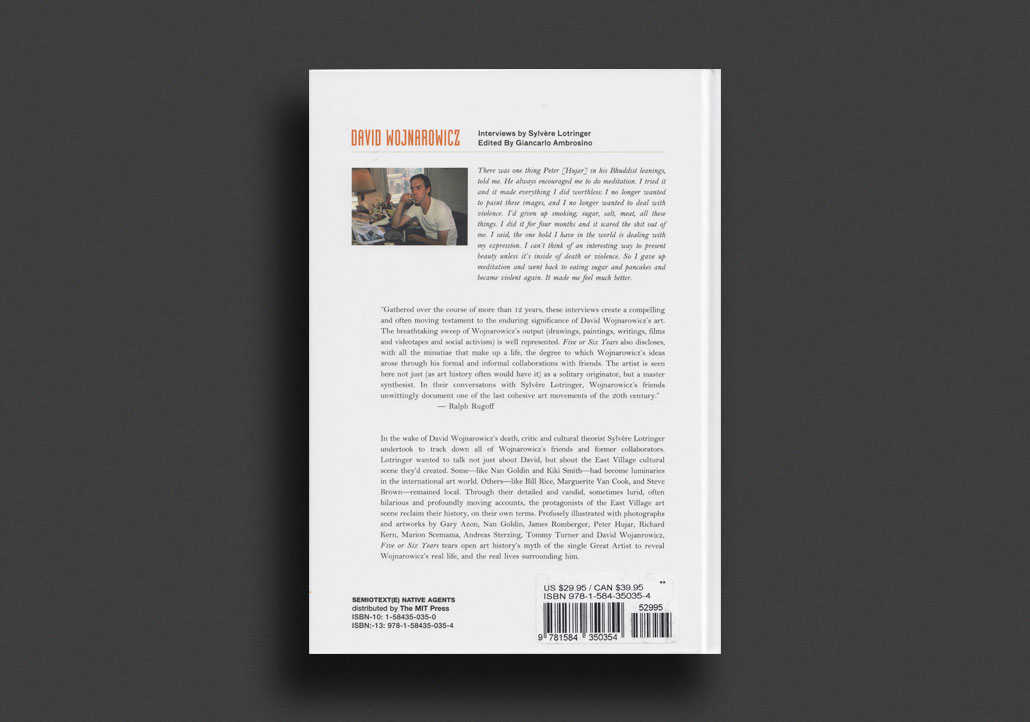
In February 1991, the artist David Wojnarowicz (1954-1992) and the philosopher Sylvère Lotringer met in a borrowed East Village apartment to conduct a long-awaited dialogue on Wojnarowicz's work. Wojnarowicz was then at the peak of his notoriety as the fiercest antagonist of morals crusader Senator Jesse Helms—a notoriety that Wojnarowicz alternately embraced and rejected. Already suffering the last stages of AIDS, David saw his dialogue with Lotringer as a chance to set the record straight on his aspirations, his personal history, and his political views. The two arranged to have this three-hour dialogue video-recorded by a mutual friend, the artist Marion Scemama. Lotringer held on to the tape for a long time. After Wojnarowicz's death the following year, he found the transcript enormously moving, yet somehow incomplete. David was trying, often with heartbreaking eloquence, to define not just his career but its position in time. The subject was huge, and transcended the actual dialogue. Lotringer then spent the next several years gathering additional commentary on Wojnarowicz's life and work from those who knew him best—the friends with whom he collaborated. Lotringer solicited personal testimony from Wojnarowicz's friends and other artists, including Mike Bildo, Steve Brown, Julia Scher, Richard Kern, Carlo McCormick, Ben Neill, Kiki Smith, Nan Goldin, Marguerite van Cook, and others. What emerges from these masterfully-conducted interviews is a surprising insight into something art history knows, but systematically hides: the collaborative nature of the work of any "great artist." All these respondents had, at one time, made performances, movies, sculptures, photographs, and other collaborative works with Wojnarowicz. In this sense, Wojnarowicz appears not only as a great originator, but as a great synthesizer.
2019, English
Softcover, 144 pages, 13.7 x 20.3 cm
Published by
Semiotext(e) / Los Angeles
$34.00 - Out of stock
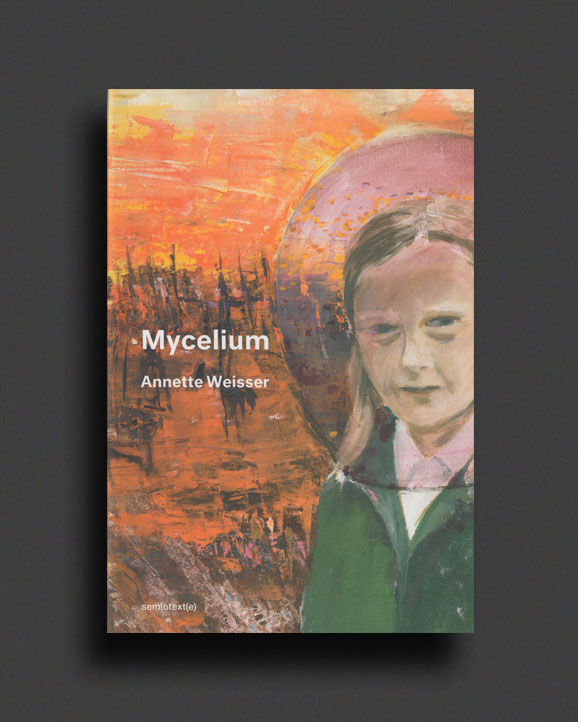
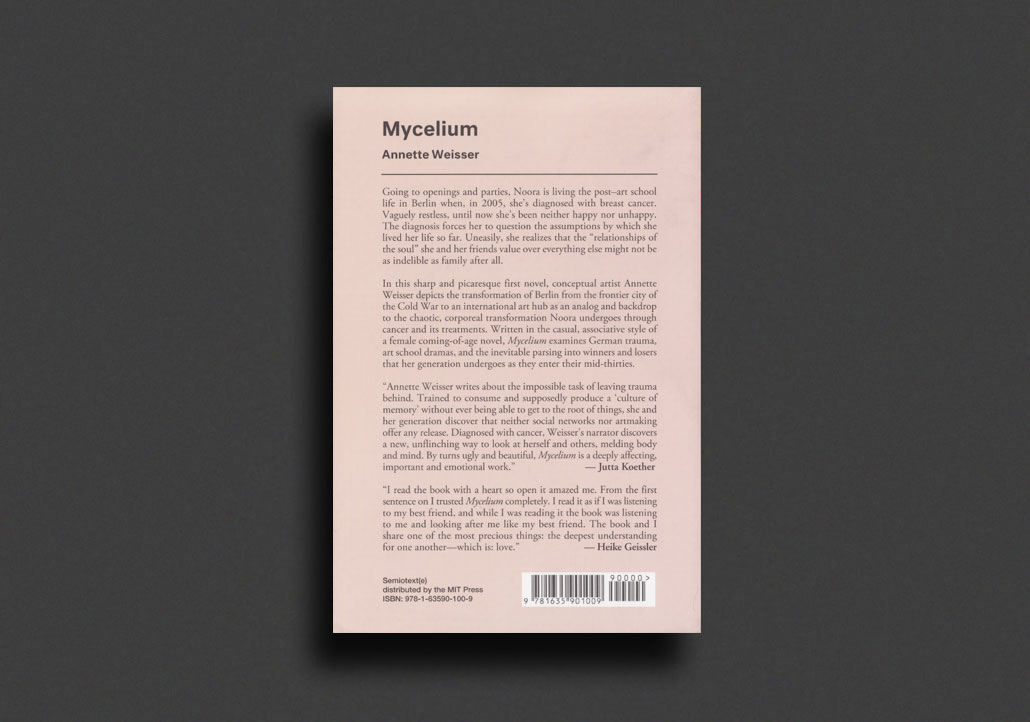
Going to openings and parties, setting up a studio and breaking up with her longtime boyfriend, Noora is living the post-art school life in Berlin when, in 2005, she's diagnosed with breast cancer. Vaguely restless, until now she's been neither happy nor unhappy, but her entry into what she calls "Cancerland" forces her to question the assumptions by which she lived her life so far. Uneasily, she realizes that the "relationships of the soul" she and her friends value over everything else might not be as indelible as family, after all.
In this sharp and picaresque first novel, conceptual artist Annette Weisser depicts the transformation of Berlin from the frontier city of the cold war to an international art hub as an analog and backdrop to the chaotic, corporeal transformation Noora undergoes through cancer and its treatments. Written in the casual, associative style of a female coming-of-age novel, Mycelium examines German trauma, art school dramas, and the inevitable parsing into winners and losers that her generation undergoes as they enter their mid-thirties.
"Annette Weisser writes about the impossible task of leaving trauma behind. Trained to consume, and supposedly produce a "culture of memory" without ever being able to get to the root of things, she and her generation discover that neither social networks nor artmaking offer any release. Diagnosed with cancer, Weisser's narrator discovers a new, unflinching way to look at herself and others, melding body and mind. By turns ugly and beautiful, Mycelium is a deeply affecting, important and emotional work." - Jutta Koether
2017, English
Softcover, 96 pages, 13.7 x 20.3 cm
Published by
Semiotext(e) / Los Angeles
$34.00 - Out of stock
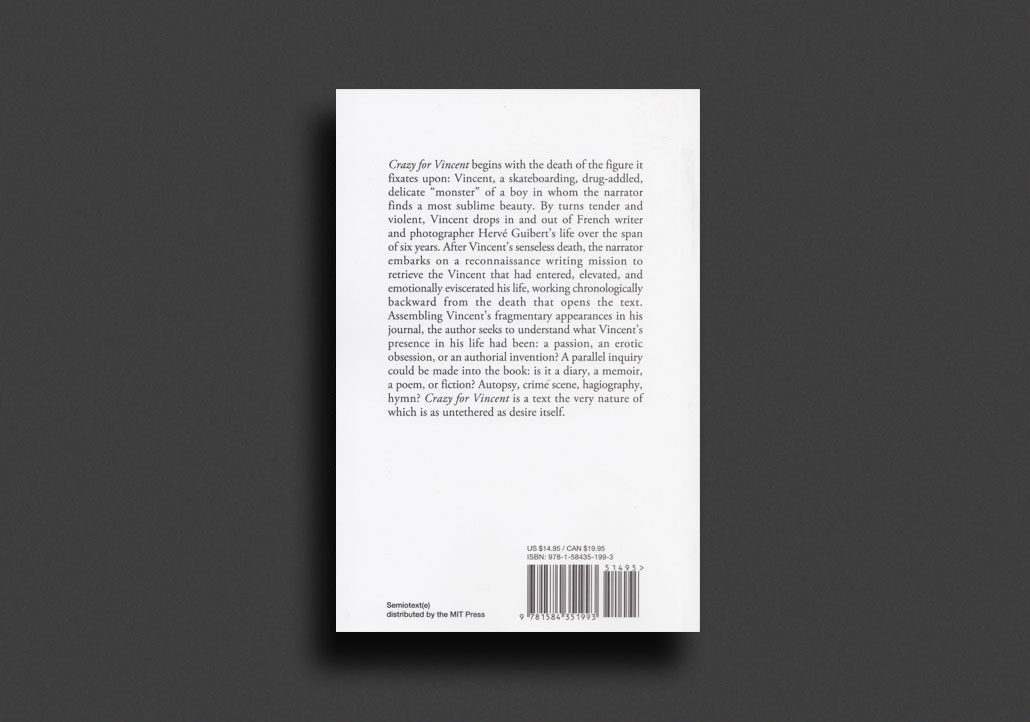
Diary, memoir, poem, fiction? Autopsy, crime scene, hagiography, hymn? The chronicle of an obsessive love.
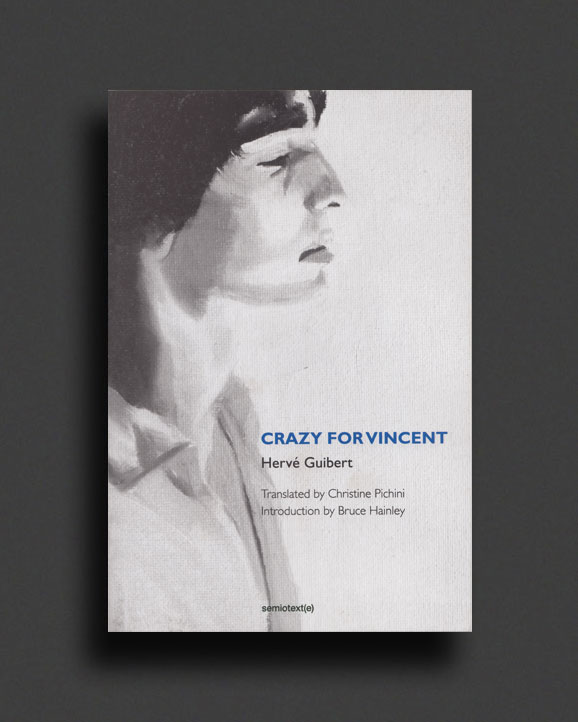
In the middle of the night between the 25th and 26th of November, Vincent fell from the third floor playing parachute with a bathrobe. He drank a liter of tequila, smoked Congolese grass, snorted cocaine...—from Crazy for Vincent
Crazy for Vincent begins with the death of the figure it fixates upon: Vincent, a skateboarding, drug-addled, delicate “monster” of a boy in whom the narrator finds a most sublime beauty. By turns tender and violent, Vincent drops in and out of French writer and photographer Hervé Guibert's life over the span of six years (from 1982, when he first met Vincent as a fifteen-year-old teenager, to 1988). After Vincent's senseless death, the narrator embarks on a reconnaissance writing mission to retrieve the Vincent that had entered, elevated, and emotionally eviscerated his life, working chronologically backward from the death that opens the text. Assembling Vincent's fragmentary appearances in his journal, the author seeks to understand what Vincent's presence in his life had been: a passion? a love? an erotic obsession? or an authorial invention? A parallel inquiry could be made into the book that results: Is it diary, memoir, poem, fiction? Autopsy, crime scene, hagiography, hymn? Crazy for Vincent is a text the very nature of which is as untethered as desire itself.
Introduction by Bruce Hainley
Translated by Christine Pichini
Hervé Guibert (1955–1991) was a writer, a photography critic for Le Monde, a photographer, and a filmmaker. In 1984 he and Patrice Chereau were awarded a César for best screenplay for L'Homme Blessé. Shortly before his death from AIDS, he completed La Pudeur ou L'impudeur, a video work that chronicles the last days of his life.
2020, English
Softcover, 160 pages, 13.7 x 20.3 cm
Published by
Semiotext(e) / Los Angeles
$32.00 - Out of stock
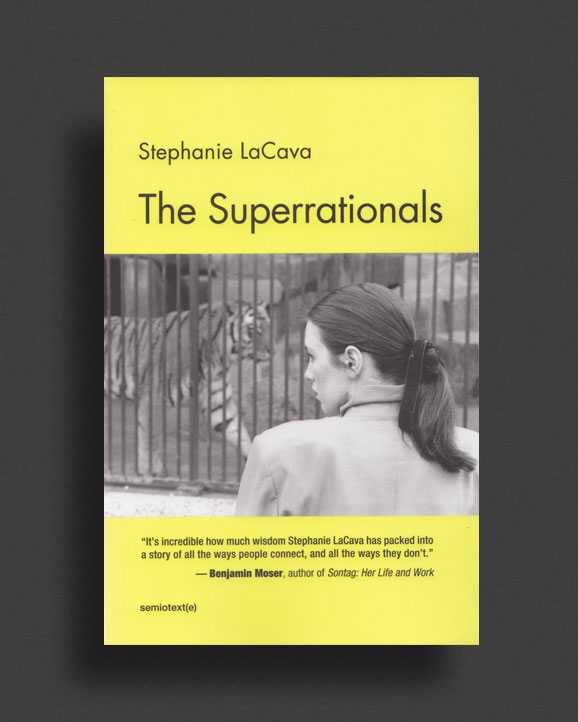
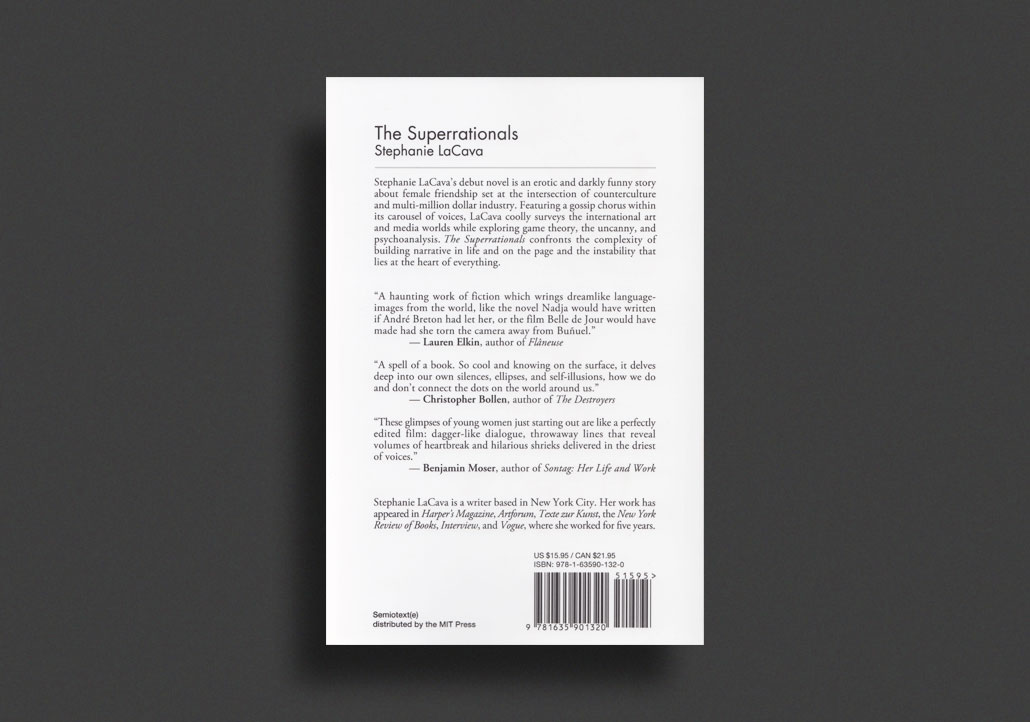
An erotic and darkly comic novel about female friendship, set at the intersection between counterculture and the multimillion dollar art industry.
Over the course of a few days in the fall of 2015, the sophisticated and awkward, wry, and beautiful Mathilde upends her tidy world. She takes a short leave from her job at one of New York's leading auction houses and follows her best friend Gretchen on an impromptu trip to Paris. While there, she confronts her late mother's hidden life, attempts to rein in Gretchen's encounters with an aloof and withholding sometime-boyfriend, and faces the traumatic loss of both her parents when she was a teenager.
Reeling between New York, Paris, Munich, London, and Berlin, The Superrationals is an erotic and darkly comic story about female friendship, set at the intersection between counterculture and the multimillion dollar art industry. Mathilde takes short, perceptive notes on artworks as a way to organize her own chaotic thoughts and life. Featuring a bitchy gossip chorus within a larger carousel of voices, The Superrationals coolly surveys the international art and media worlds while exploring game theory, the uncanny, and psychoanalysis. Written in the “Young Girl” tradition of Michelle Bernstein's All The King's Horses, Bernadette Corporation's Reena Spaulings and Natasha Stagg's Surveys, The Superrationals confronts the complexity of building narrative in life and on the page and the instability that lies at the heart of everything.
It's incredible how much wisdom Stephanie LaCava has packed into story of all the ways people connect, and all the ways they don't. - Benjamin Moser, Sontag: Her Life and Work
Stephanie LaCava is a writer based in New York City. Her work has appeared in Harper's Magazine, Artforum, Texte zur Kunst, the New York Times, the New York Review of Books, Vogue, and Interview.
2014, English
Softcover, 164 pages, 21 x 29.5 cm
Published by
Semiotext(e) / Los Angeles
$65.00 $30.00 - Out of stock
This book offers the first career retrospective of Brian Weil (1954--1996), an artist whose photographs pushed viewers into a deeply unsteadying engagement with insular communities and subcultures. A younger contemporary of such participant-observer photographers as Larry Clark and Nan Goldin, Weil took photographs that foreground the complex relationships between photographer and subject, and between photograph and viewer.
Weil was a member of ACT UP and the founder of New York City's first needle exchange, and his photographs became inextricably tied to his activist practice. His late work, an extensive series of portraits whose subjects bear witness to the emerging AIDS pandemic, is included here, along with selections from several earlier and concurrent projects: Sex (underground sex and bondage participants), Miami Crime(homicide scenes investigated by the Miami Police Department), Hasidim(populations of Hasidic Jews in Brooklyn and the Catskills), and an extensive video project with members of nascent transgender support groups.
This book commemorates a 2013 exhibition of Brian Weil's work at the Institute of Contemporary Art at the University of Pennsylvania and includes in-depth essays on Weil by Stamatina Gregory and Jennifer Burris, an interiew with the artist by Claudia Gould, and reprints of archival edited notes discussing crimeand photographic evidence based on a series of interviews conducted by Sylvère Lotringer with filmmaker George Diaz in the 1980s.
Stamatina Gregory is an independent curator and scholar currently based in New York, where sheis completing a PhD at the Graduate Center of the City University of New York.
2015, English
Softcover, 304 pages, 15.2 x 22.9 cm
Published by
Semiotext(e) / Los Angeles
$45.00 - Out of stock
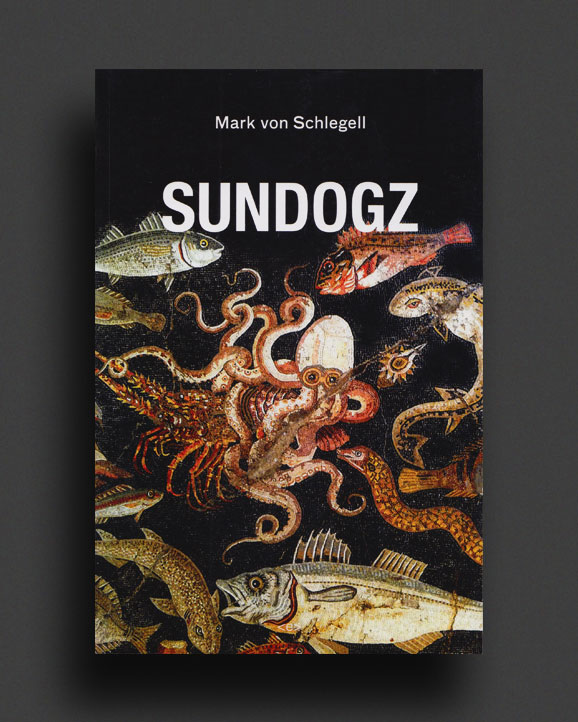
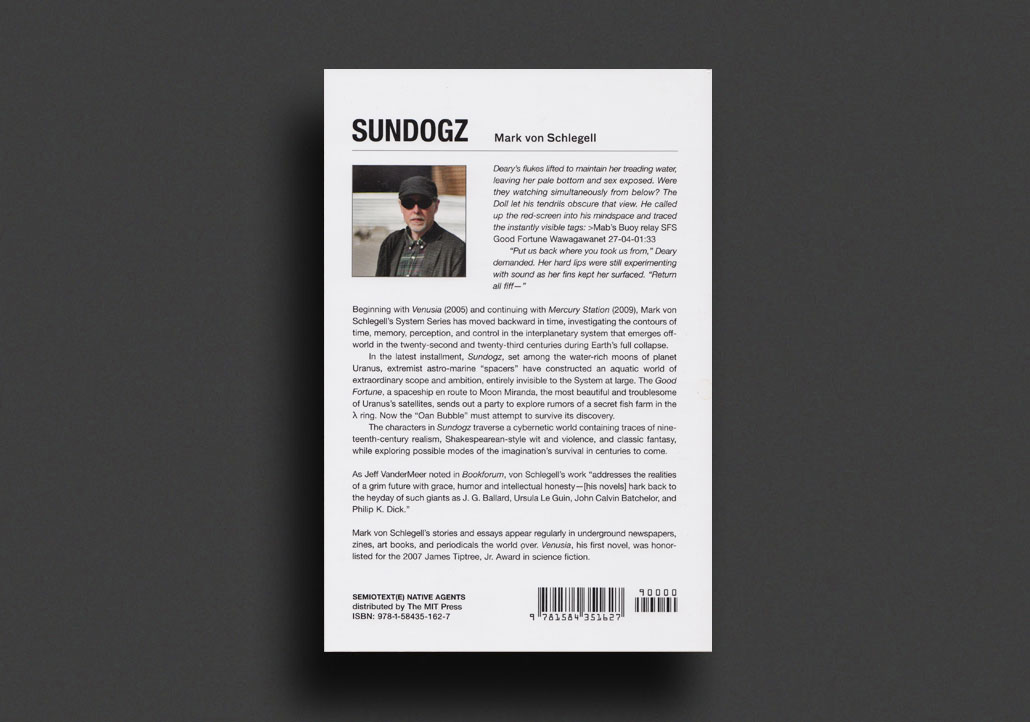
Was there some sort of accident? The Doll was now certain that the Japanese didn’t consider him a human. He was concerned with Deary alone. Her flukes lifted to maintain her treading water, left her pale bottom and sex exposed. Was he watching simultaneously from below? The Doll let his tendrils obscure. 5 hours till orbital synch, he remembered. The Doll called up the red-screen into his mindspace and traced the instantly visible tags: Mab's Buoy relay SFS Good Fortune, Wawagawanet 2145270401:33—
—from Sundogz
Beginning with Venusia (2005) and continuing with Mercury Station (2009), Mark von Schlegell’s System Series has moved backward in time, investigating the contours of time, memory, perception, and control in the inter-planetary system that emerge off-world in the twenty-second and twenty-third centuries during Earth’s full collapse.
In the latest installment, Sundogz, set among the water-rich moons of planet Uranus, extremist astro-marine “spacers” have constructed an aquatic world of extraordinary scope and ambition, entirely invisible to the System at large. The Good Fortune, a spaceship en route to Moon Miranda, the most beautiful and troublesome of Uranus’s satellites, sends out a party to explore rumors of a secret fish farm in the λ ring. Now the "Oan Bubble" must attempt to survive its discovery.
The characters in Sundogz traverse a cybernetic world containing traces of nineteenth-century realism, Shakespearean-style wit and violence, and classic fantasy, while exploring possible modes of the imagination’s survival in centuries to come.
As Jeff Vandermeer noted in Bookforum, von Schlegell’s work “addresses the realities of a grim future with grace, humor and intellectual honesty—[his novels] hark back to the heyday of such giants as J. G. Ballard, Ursula Le Guin, John Calvin Batchelor, and Philip K. Dick.”
2009, English
Softcover, 288 pages, 150 x 226 mm
Published by
Semiotext(e) / Los Angeles
$40.00 - Out of stock
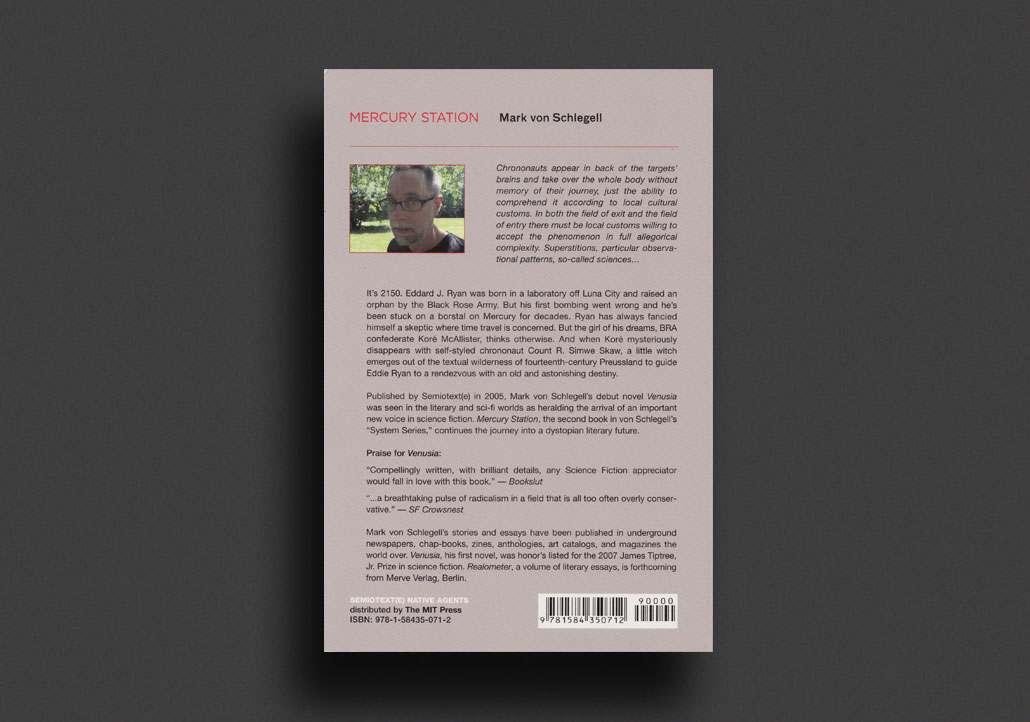
Published by Semiotext(e) in 2005, Mark von Schlegell’s debut novel Venusia was hailed in the sci-fi and literary worlds as a “breathtaking excursion” and “heady kaleidoscopic trip,” establishing him as an important practitioner of vanguard science fiction. Mercury Station, the second book in Von Schlegell’s System Series, continues the journey into a dystopian literary future.
Like Venusia, Mercury Station tells a compelling story, drawn through a labyrinth of future-history sci-fi, medieval hard fantasy, and cascading samplings of high and low culture. The book is a brilliant literary assault against the singularity of self and its imprisonment in Einsteinian spacetime.
2020, English
Softcover, 186 pages, 15.2 x 20.3 cm
Published by
Semiotext(e) / Los Angeles
$44.00 - Out of stock
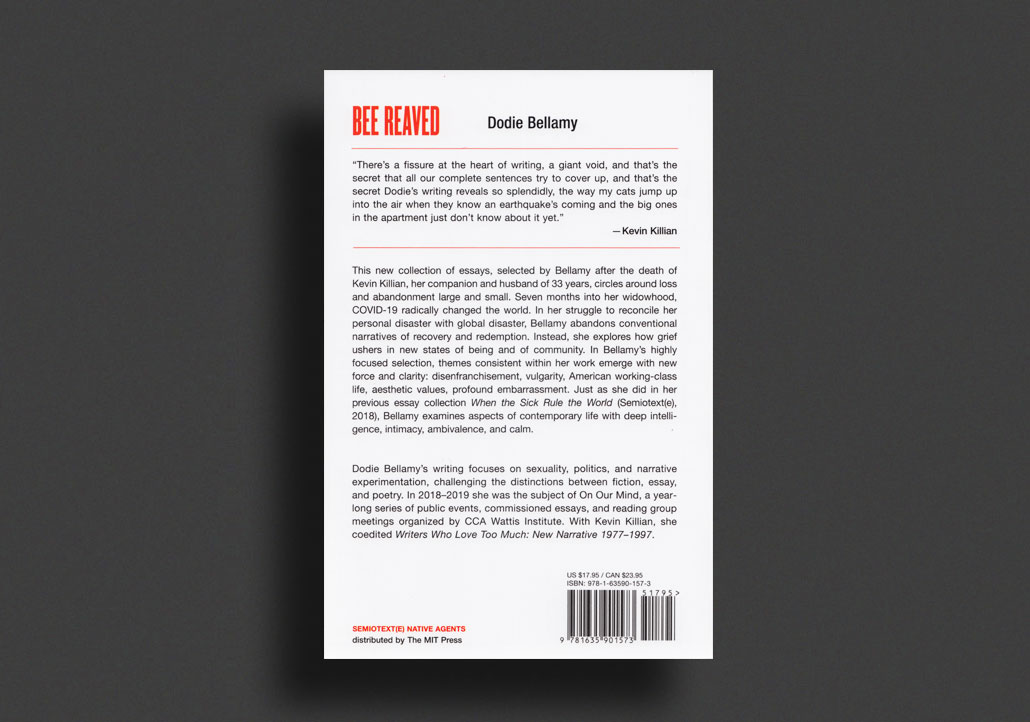
Examining the genre-bending writing of Dodie Bellamy, whose work has focused on sexuality, politics, feminism, narrative experimentation, and all things queer.
Dodie Bellamy (b. 1951, in North Hammond, Indiana) has lived and worked in San Francisco since 1978. A vital contributor to the Bay Area's avant-garde literary scene, Bellamy is a novelist and poet whose work has focused on sexuality, politics, feminism, narrative experimentation, and all things queer. In her words, she champions “the vulnerable, the fractured, the disenfranchised, the fucked-up.”
Dodie Bellamy Is on Our Mind is the first major publication to address Bellamy's prolific career as a genre-bending writer. Megan Milks made several trips to San Francisco in order to spend time with Bellamy and craft a provocative and fascinating profile of the writer. Originally delivered as a lecture at the Wattis Institute, Andrew Durbin's text takes the form of a personal essay, expertly weaving anecdotes of his own encounters with Bellamy's writing with insights into broader themes in her work. Academic Kaye Mitchell takes a close look at the role of shame and its relationship to femininity in particular texts by Bellamy. And Bellamy and her late husband Kevin Killian offer deeply personal, emotionally wrenching ruminations on topics from the mundane (drawing) to the profound (mortality). These texts, alongside archival photos and a complete bibliography make, this book an important compendium on Bellamy.
Jeanne Gerrity is the Deputy Director and Head of Publications at the Wattis and has written for such publications as Artforum, Art Agenda, and Frieze.
Anthony Huberman is the Director and Chief Curator of the Wattis Institute for Contemporary Arts in San Francisco and Founding Director of the Artist's Institute in New York.
2017, English
Softcover, 152 pages, 14 x 19.8 cm
Published by
Semiotext(e) / Los Angeles
The MIT Press / Massachusetts
$32.00 - Out of stock
Introduction by Matias Viegener
Afterword by John Kinsella
“Why am I telling you all this? Partly ‘cause the whole queerness/identity thing for me stretches through everything, absolutely everything. Slipping between straight/gay is child’s play compared to slipping between writer/teacher/influence-peddler whatever. I forget who I am. You reminded me of who I prefer to be.” [M.W.]
“It’s two in the morning. . . I know what you mean about slipping roles: I love it, going high low, power helpless even captive, male female, all over the place, space totally together and brain-sharp, if it wasn’t for play I’d be bored stiff and I think boredom is the emotion I find most unbearable. . . ” [KA]
— from I’m Very into You
After Kathy Acker met McKenzie Wark on a trip to Australia in 1995, they had a brief fling and immediately began a heated two-week email correspondence. Their emails shimmer with insight, gossip, sex, and cultural commentary. They write in a frenzy, several times a day; their emails cross somewhere over the International Date Line, and themselves become a site of analysis. What results is an index of how two brilliant and idiosyncratic writers might go about a courtship across 7,500 miles of airspace—by pulling in Alfred Hitchcock, stuffed animals, Georges Bataille, Elvis Presley, phenomenology, Marxism, The X-files, psychoanalysis, and the I Ching.
Their corresepondence is a Plato’s Symposium for the twenty-first century, but written for queers, transsexuals, nerds, and book geeks. I’m Very Into You is a text of incipience, a text of beginnings, and a set of notes on the short, shared passage of two iconic individuals of our time.
About the Authors
Kathy Acker was a novelist, essayist and performance artist whose books include Blood and Guts in High School, The Childlike Life of the Black Tarantula, Empire of the Senseless, In Memoriam to Identity, Don Quixote, My Mother: Demonology, and her last novel, Pussy King of the Pirates. Born and raised on New York’s Upper East Side, she died of breast cancer in Tijuana, Mexico, in 1997.
McKenzie Wark is an Australian-born writer whose books include Virtual Geography, A Hacker Manifesto, Gamer Theory, The Beach Beneath the Street,Telesthesia and The Spectacle of Disintegration. He teaches at The New School in New York City.
Reviews
“...this collected correspondence offers a fascinating glimpse of two artists at a time when they were as passionate about each another as their work.”—Publishers Weekly
“Described as ‘a Plato’s Symposium for the twenty-first century, but written for queers, transsexuals, nerds, and book geeks’, this voyeuristic, epistolary saga gives us a unique insight into the lives of two artists at a time when they were as passionate about each other as they were their work. I’m Very Into You presents us with the guilty pleasure of gossip at its very smartest.”—Dazed Digital
2009, English
Softcover, 368 pages, 15.3 x 23 cm
Published by
Semiotext(e) / Los Angeles
$49.00 - Out of stock
Poet and post-punk hero Eileen Myles has always operated in the art, writing, and queer performance scenes as a kind of observant flaneur. Myles travels the city—wandering on garbage-strewn New York streets in the heat of summer, drifting though the antiseptic malls of La Jolla, and riding in the van with Sister Spit—seeing it with a poet’s eye for detail and with the consciousness that writing about art and culture has always been a social gesture. Culled by the poet from twenty years of art writing, the essays in The Importance of Being Iceland make a lush document of her—and our—lives in these contemporary crowds.
Eileen Myles, named by BUST magazine "the rock star of modern poetry," is the author of more than twenty books of poetry and prose, including Chelsea Girls, Cool for You, Sorry, Tree, and Not Me (Semiotext(e), 1991), and is the coeditor of The New Fuck You (Semiotext(e), 1995). Myles was head of the writing program at University of California, San Diego, from 2002 to 2007, and she has written extensively on art and writing and the cultural scene. Most recently, she received a fellowship from the Andy Warhol/Creative Capital Foundation.
2019, English
Hardcover (w. dust jacket), 352 pages, 15.2 x 22.9 cm
Published by
Semiotext(e) / Los Angeles
$45.00 - Out of stock
The first authorized biography of postmodernism's literary hero, Kathy Acker.
Acker's life was a fable; and to describe the confusion and love and conflicting agendas behind these memorials would be to sketch an apocryphal allegory of an artistic life in the late twentieth century. It is girls from which stories begin, she wrote in her last notebook. And like other lives, but unlike most fables, it was created through means both within and beyond her control.
--from After Kathy Acker
Rich girl, street punk, lost girl and icon... scholar, stripper, victim, and media-whore: The late Kathy Acker's legend and writings are wrapped in mythologies, created mostly by Acker herself. Twenty years after her death, Acker's legend has faded, making her writing more legible.
In this first, fully authorized, biography, Chris Kraus approaches Acker both as a writer and as a member of the artistic communities from which she emerged. At once forensic and intimate, After Kathy Acker traces the extreme discipline and literary strategies Acker used to develop her work, and the contradictions she longed to embody. Using exhaustive archival research and ongoing conversations with mutual colleagues and friends, Kraus charts Acker's movement through some of the late twentieth century's most significant artistic enterprises.
Beginning in her mid-teens, Acker lived her ideal of the Great Writer as Cultural Hero, and as Kraus argues, she may well have been the only female writer to succeed in assuming this role. She died of untreated cancer at an alternative clinic in Tijuana when she was fifty years old, but the real pathos of Acker's life may have been in the fact that by then she'd already outlived her ideal.
1991, English
Softcover, 202 pages, 11.5 x 18 cm
Published by
Semiotext(e) / Los Angeles
$32.00 - Out of stock
Listen, I have been educated.
I have learned about Western
Civilization. Do you know
What the message of Western
Civilization is? I am alone.
This breakthrough volume, published in 1991 by the author of Cool For You and Chelsea Girls captures the high points of Myles’ work in New York City during the 1980s. Poet, novelist, lesbian culture hero and one-time presidential candidate, Myles has influenced a whole generation of young queer girl writers and activists. She is one of the most brilliant, incisive, immediate writers living today.
Eileen Myles, named by BUST magazine “the rock star of modern poetry,” is the author of more than twenty books of poetry and prose, including Chelsea Girls, Cool for You, Sorry, Tree, and Not Me (Semiotext(e), 1991), and is the coeditor of The New Fuck You (Semiotext(e), 1995). Myles was head of the writing program at University of California, San Diego, from 2002 to 2007, and she has written extensively on art and writing and the cultural scene. Most recently, she received a fellowship from the Andy Warhol/Creative Capital Foundation.
1990, English
Softcover, 160 pages, 11.5 x 18 cm
Published by
Semiotext(e) / Los Angeles
The MIT Press / Massachusetts
$27.00 - Out of stock
Cookie trips through her forty-year odyssey on this planet — from LSD to shopping at the A&P, from birthing Max to shooting Pink Flamingos. The echoes of her passionate commitments will ring in your ears. It is a tragedy to have lost her. Fortunately, along with the memories, she left us this marvellous testament to her intrepid zest for living.
"Cookie Mueller wrote like a lunatic Uncle Remus - spinning little stories from Hell that will make any reader laugh out loud" - John Waters