World Food Books' programme is largely produced on Kulin Nation land. We acknowledge the Wurundjeri people of the Kulin Nation as the first and continuing custodians of this land, and pay respect to their Elders past, present, and emerging.
World Food Books is an arts and special interests bookshop in Naarm / Melbourne. Founded in 2010, World Food Books is devoted to the presentation of a rotating, hand-selection of international art, design, literary and counterculture publications with an emphasis on the anti-traditional, the experimental, the avant-garde, the heretic, the marginal.
Presenting new titles alongside rare and out-of-print books, catalogues and journals spanning the fields of modern and contemporary art, design, photography, illustration, film, literature, poetry, cultural theory, philosophy, sexuality, popular and underground culture in its many radical forms, World Food Books wishes to encourage adventurous, thoughtful and open-minded reading, looking, writing, and exchange of publishing and ideas, both current and historical.
As well as our bookshop, located in Melbourne's historical Nicholas Building, all of our inventory is available internationally via our online mail-order service.
World Food Books semi-regularly co-ordinates "Occasions", a programme of exhibits and events at the bookshop and in partnership with other hosts (such as museums and art galleries) that develop out of the activities, relationships and content of the bookshop itself.
World Food Books
The Nicholas Building
37 Swanston Street
Room 5, Level 6
Melbourne 3000
Australia
SHOP HOURS:
THU–SAT 12–6
WEB-SHOP OPEN 24/7
World Food Books
Postal Address:
PO Box 435
Flinders Lane
Victoria 8009
Australia
info@worldfoodbooks.com
Art
Theory / Essay
Architecture / Interior
Graphic Design / Typography
Photography
Fashion
Eros
LGBTQ+
Fiction / Poetry
Weird / Speculative / Science Fiction / Horror
Transgressive / Visceral / Abject
Symbolism / Decadence / Fin de siècle
Film / Video
Painting
Sculpture / Installation
Performance / Dance / Theater
Drawing
Sound / Music
Curatorial
Group Shows / Collections
Periodicals
Out-of-print / Rare
Posters / Ephemera / Discs
Signed Books
World Food Books Gift Voucher
World Food Book Bag
Australian Art
Australian Fiction
Australian Science Fiction / Speculative Fiction
Australian Poetry
Australian Photography
Japanese Photography
Conceptual Art
Minimal Art
Dada
'Pataphysics / Oulipo
Fluxus
Concrete Poetry
Pop Art
Surrealism
Arte Povera
Arte Informale / Haute Pâte / Tachism
Nouveau Réalisme / Zero / Kinetic
Situationism / Lettrism
Collage / Mail Art / Xerox Art
Art Brut / Folk / Visionary / Fantastic
Illustration / Graphic Art / Bandes Dessinées
Furniture
Italian Radical Design / Postmodernism
Textiles
Ceramics / Glass
Counterculture
Protest / Revolt
Philosophy
Psychoanalysis
Anthropology
Anarchism
Socialism / Anarchism / Communism / Capitalism
Literary Theory / Semiotics / Language
Feminism / Women's Studies
Gender Studies / Sexuality
Anthropology
Fetishism / BDSM
Drugs / Psychedelia
Crime / Violence
Animal Rights / Veganism
Occult / Esoterica
Ecology / Earth / Alternative Living
Whole Earth / Crafts
All prices in AUD (Australian dollars)
Pick-Ups
Pick-up orders can be collected in our bookshop during opening hours after order date. Please collect any Pick-up orders within 2 weeks of ordering as we have limited storage space. Orders will be released back into stock if not collected within this time. No refunds can be made for pick-ups left un-collected. If you cannot make it in to the bookshop in this time-frame, please choose postage option.
Return Policy
All sales are final. We do accept returns (for refund or exchange) for items received in error. All our orders are packed with special care using heavy-duty padding and cardboard book-mailers or bubble mailers (for smaller books), using reinforcement where required. We cannot take responsibility for any lost, stolen or damaged parcels.
Insurance
Should you wish to insure your package, please email us directly after placing your order and we can organise this at a small extra expense. Although all standard/express tracked packages are very safe and dependable, we cannot take responsibility for any lost, stolen or damaged parcels. We recommend insurance on valuable orders.
Interested in selling your old books, catalogues, journals, magazines, comics, fanzines, ephemera? We are always looking for interesting, unusual and out-of-print books to buy. We only buy books in our fields of interest and specialty, and that we feel we can resell.
We base these prices on desirability, market value, in-print prices, condition and our current stock levels. We offer cash, store credit, and can take stock on consignment. All
about 25% of the price we expect to get when we sell them, or 30% in store credit. We base these prices on desirability, market value, in-print prices, condition and our current stock levels.
Sell your books any day of the week. You can drop them off and return later. If you have a lot of books, we can visit your Sydney home.
We buy books that we feel we can resell. We offer about 25 % of the price we expect to get when we sell them, or 30% in store credit. We base these prices on desirability, market value, in-print prices, condition and our current stock levels.
Philadelphia Wireman
03 August - 01 September, 2018
World Food Books is proud to announce our next Occasion, the first presentation of sculptures by Philadelphia Wireman in Australia.
The Philadelphia Wireman sculptures were found abandoned in an alley off Philadelphia’s South Street on trash night in 1982. Their discovery in a rapidly-changing neighbourhood undergoing extensive renovation, compounded with the failure of all attempts to locate the artist, suggests that the works may have been discarded after the maker’s death. Dubbed the "Philadelphia Wireman" during the first exhibition of this work, in 1985, the maker’s name, age, ethnicity, and even gender remain uncertain. The entire collection totals approximately 1200 pieces, all intricately bound together with tightly-wound heavy-gauge wire (along with a few small, abstract marker drawings, reminiscent both of Mark Tobey and J.B. Murry). The dense construction of the work, despite a modest range of scale and materials, is singularly obsessive and disciplined in design: a wire armature or exoskeleton firmly binds a bricolage of found objects including plastic, glass, food packaging, umbrella parts, tape, rubber, batteries, pens, leather, reflectors, nuts and bolts, nails, foil, coins, toys, watches, eyeglasses, tools, and jewellery.
Heavy with associations—anthropomorphic, zoomorphic, and socio-cultural responses to wrapped detritus—the totemic sculptures by Philadelphia Wireman have been discussed in the context of work created to fulfil the shamanistic needs of alternative religions in American culture. Curators, collectors, and critics have variously compared certain pieces to sculpture from Classical antiquity, Native American medicine bundles, African-American memory jugs, and African fetish objects. Reflecting the artist’s prolific and incredibly focused scavenging impulse, and despite—or perhaps enhanced by—their anonymity, these enigmatic objects function as urban artefacts and arbiters of power, though their origin and purpose is unknown. Philadelphia Wireman, whatever their identity, possessed an astonishing ability to isolate and communicate the concepts of power and energy through the selection and transformation of ordinary materials. Over the course of the past two decades, this collection has come to be regarded as an important discovery in the field of self-taught art and vernacular art.
Presented in collaboration with Fleisher-Ollman Gallery, Philadelphia, and Robert Heald, Wellington.
Susan Te Kahurangi King
02 February - 10 March, 2018
Susan Te Kahurangi King (24 February 1951 - ) has been a confident and prolific artist since she was a young child, drawing with readily available materials - pencils, ballpoint pens and felt-tip markers, on whatever paper is at hand. Between the ages of four and six Susan slowly ceased verbal communication. Her grandparents William and Myrtle Murphy had developed a special bond with Susan so they took on caring responsibilities for extended periods. Myrtle began informally archiving her work, carefully collecting and storing the drawings and compiling scrapbooks. No drawing was insignificant; every scrap of paper was kept. The King family are now the custodians of a vast collection containing over 7000 individual works, from tiny scraps of paper through to 5 meter long rolls.
The scrapbooks and diaries reveal Myrtle to be a woman of great patience and compassion, seeking to understand a child who was not always behaving as expected. She encouraged Susan to be observant, to explore her environment and absorb all the sights and sounds. Myrtle would show Susan’s drawings to friends and people in her community that she had dealings with, such as shopkeepers and postal workers, but this was not simply a case of a grandmother’s bias. She recognised that Susan had developed a sophisticated and unique visual language and sincerely believed that her art deserved serious attention.
This was an unorthodox attitude for the time. To provide some context, Jean Dubuffet coined the term Art Brut in 1945 to describe work created by self-taught artists – specifically residents of psychiatric institutions and those he considered to be visionaries or eccentrics. In 1972 Roger Cardinal extended this concept by adopting the term Outsider Art to describe work made by non-academically trained artists operating outside of mainstream art networks through choice or circumstance. Susan was born in Te Aroha, New Zealand in 1951, far from the artistic hubs of Paris and London that Dubuffet and Cardinal operated in. That Myrtle fêted Susan as a self-taught artist who deserved to be taken seriously shows how progressive her attitudes were.
Susan’s parents Doug and Dawn were also progressive. Over the years they had consulted numerous health practitioners about Susan’s condition, as the medical establishment could not provide an explanation as to why she had lapsed into silence. Dawn educated herself in the field of homeopathy and went on to treat all twelve of her children using these principles – basing prescriptions on her observations of their physical, mental and emotional state.
Doug was a linguist with an interest in philosophy who devoted what little spare time he had to studying Maori language and culture. To some extent their willingness to explore the fringes of the mainstream made them outsiders too but it was their commitment to living with integrity and their respect for individuality that ensured Susan’s creativity was always encouraged.
Even though Susan’s family supported her artistic pursuits, some staff in schools and hospitals saw it as an impediment to her assimilation into the community and discouraged it in a variety of ways. Her family was not always aware of this and therefore did not fully understand why Susan stopped drawing in the early 1990s. However, rather than dwell on the challenges that Susan faced in pursuit of her artistic practice, they prefer to highlight her achievements. In 2008 Susan began drawing again in earnest, after an almost 20 year interruption, and her work is now shown in galleries around the world.
Susan grew up without television and has been heavily influenced by the comics she read as a child. She is absolutely fearless in the appropriation of recognizable characters, such as Donald Duck and Mickey Mouse, in her work. She twists their limbs, contorts their faces, compresses them together, blends them into complex patterned backgrounds - always imbuing them with an incredible energy. Although Susan often used pop culture characters in her work they are not naive or childlike. These are drawings by a brilliant self-taught artist who has been creating exceptional work for decades without an audience in mind.
Mladen Stilinović
"Various Works 1986 - 1999"
02 February 16 - September 10, 2016
Various works 1986 - 1999, from two houses, from the collections of John Nixon, Sue Cramer, Kerrie Poliness, Peter Haffenden and Phoebe Haffenden.
Including: Geometry of Cakes (various shelves), 1993; Poor People’s Law (black and white plate), 1993; White Absence (glasses, ruler, set square, silver spoon, silver ladel with skin photograph and wooden cubes), 1990-1996; Exploitation of the Dead (grey and red star painting, wooden painting, black spoon with red table, red plate), 1984-1990; Money and Zeros (zero tie, paintings made for friends in Australia (Sue, John, Kerrie), numbers painting), 1991-1992; Words - Slogans (various t-shirts) - “they talk about the death of art...help! someone is trying to kill me”, “my sweet little lamb”, “work is a disease - Karl Marx”; Various artist books, catalogues, monographs, videos; Poster from exhibition Insulting Anarchy; "Circular" Croatian - Australian edition; Artist book by Vlado Martek (Dostoyevsky); more.
Thanks to Mladen Stilinović and Branka Stipančić.
Jonathan Walker
Always Will Need To Wear Winter Shirt Blue + Ochre Small Check Pattern
21 August - 21 September, 2015
Untitled
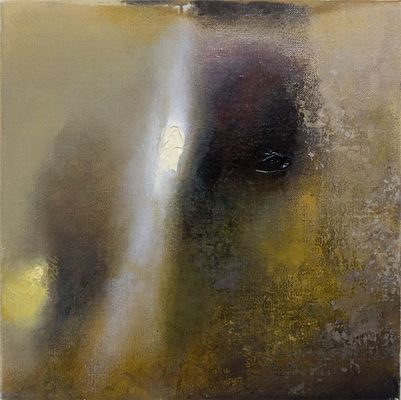
I am not a great reader of poetry but I always return to the work of Melbourne poet, Vincent Buckley (1925- 1988). Perhaps I find his most tantalising piece to be not a finished poem but a fragment left on a scrap of paper discovered on his desk after the poet’s death.
The poetry gathers like oil
In the word-core, and spreads
It has its music meet,
Its music is in movement.
This fragment is more the shell left behind from a volatile thought than a finished poem. I find the last two lines honest but awkward whereas the first two lines work like an arrow. Most likely he could not find a resolution so it was left. Still, in its present form, it remains an eloquent testimony to the ultimate failure of a medium to express mobile thought and sensation, in Buckley’s case, through verbal language. It’s an important matter because this is something all artists have to deal with regardless of the medium.
I have never written a poem, however, I am forever copying fragments from books on paper scraps in a vain effort to fix certain notions in my head. At first, they function as bookmarks that are sometimes returned to when I open the book. But before long, as they accumulate, they fall out littering the table interspersed with A4 photocopies, bills, books and medications.
To return to Buckley’s fragment, the first two lines very much evoke how I paint nowadays. As you age, detail diminishes and patches of light become more luminous and float. I feel the most honest way of dealing with this is by smearing the oil paint on the canvas with the fingers and working close-up, blind. Only if the patches coalesce into an approaching image can the work gain a life.
-
Jonathan Walker was born in Melbourne, Australia and brought up on a dairy farm in Gippsland. In the 1970’s he studied painting at RMIT and won the Harold Wright Scholarship to the British Museum, London. During the 1980’s he exhibited at Pinacotheca Gallery, Richmond and had work shown at the NGV and Heidi City Art Gallery. Over the same period he designed the cover for the “Epigenesi” LP by Giancarlo Toniutti, Italy and conducted a mail exchange work with Achim Wollscheid, Germany. The work with artists through the post resulted in an article published in the bicentenary issue of Art and Australia 1988. He showed in artist run spaces such as WestSpace in the 90’s and 2000’s, and until 2012, taught painting at Victoria University, which is where we (Colleen Ahern and Lisa Radford) as organisers of the exhibition, among many others, had the privilege of being his student.
Walker’s knowledge was imparted to students through the careful selection of music, literature, and artists found in books that he himself had ordered for the library. Walker’s strategy was the generosity of sharing his vast knowledge with references specific to each student and their context.
Walker’s paintings share a similar focus and intimacy.
This exhibition presents a small selection of recent paintings alongside a publication that includes Walker’s writing. Observational and analytical, Walker’s work is a type of material notation — the time of day, colour and how it is blended, the both specific and fleeting location of a reflection on lino or the question of whether a chair leg should be included in a painting.
Please join us on Friday August 21 between 6-8pm to celebrate the opening of the exhibition.
Curated by Colleen Ahern and Lisa Radford.
B. Wurtz
Curated by Nic Tammens
March 26 - April 4, 2015
B.Wurtz works from a basement studio in his home on Manhattan’s Lower East Side.
This local fact is attested to by the plastic shopping bags and newsprint circulars that appear in his work. As formal objects, they don’t make loud claims about their origins but nonetheless transmit street addresses and places of business from the bottom of this long thin island. Like plenty of artists, Wurtz is affected by what is local and what is consumed. His work is underpinned by this ethic. It often speaks from a neighborhood or reads like the contents of a hamper:
“BLACK PLUMS $1.29 lb.”
“Food Bazaar”
“USDA Whole Pork Shoulder Picnic 99c lb.”
“RITE AID Pharmacy, with us it’s personal.”
“H. Brickman & Sons.”
“Sweet Yams 59c lb."
Most of the work in this exhibition was made while the artist was in residence at Dieu Donne, a workshop dedicated to paper craft in Midtown. Here Wurtz fabricated assemblages with paper and objects that are relatively lightweight, with the intention that they would be easily transportable to Australia. This consideration isn’t absolute in Wurtz’s work, but was prescriptive for making the current exhibition light and cheap. Packed in two boxes, these works were sent from a USPS post office on the Lower East Side and delivered to North Melbourne by Australia Post.
Wurtz appears courtesy of Metro Pictures, New York.
Thanks to Rob Halverson, Joshua Petherick, Sari de Mallory, Matt Hinkley, Helen Johnson, Fayen d'Evie, Ask Kilmartin, Lisa Radon, Ellena Savage, Yale Union, and "Elizabeth".
John Nixon
"Archive"
December 15 - January 20, 2014
The presentation of John Nixon's archive offered a rare showcase of this extensive collection of the artist's own publications, catalogues, posters, ephemera, editions and more, from the mid 1980s onwards, alongside a selection of his artworks.
Organized by John Nixon, Joshua Petherick and Matt Hinkley.
"Habitat"
at Minerva, Sydney (organised by Joshua Petherick and Matt Hinkley)
November 15 - December 20, 2014
Lupo Borgonovo, Janet Burchill & Jennifer McCamley,
Lewis Fidock, HR Giger, Piero Gilardi, Veit Laurent Kurz,
Cinzia Ruggeri, Michael E. Smith, Lucie Stahl, Daniel Weil, Wols
Press Release:
“...It contained seven objects. The slender fluted bone, surely formed for flight, surely from the wing of some large bird. Three archaic circuitboards, faced with mazes of gold. A smooth white sphere of baked clay. An age-blackened fragment of lace. A fingerlength segment of what she assumed was bone from a human wrist, grayish white, inset smoothly with the silicon shaft of a small instrument that must once have ridden flush with the surface of the skin - but the thing’s face was seared and blackened.”
William Gibson, “Count Zero”, 1986
"Autumn Projects Archive"
Curated by Liza Vasiliou
March 6 - March 15, 2014
World Food Books, in conjunction with the Virgin Australia Melbourne Fashion Festival 2014, presented the Autumn Projects archive, consisting of a selection of early examples in Australian fashion with a particular interest in collecting designers and labels from the period beginning in the 1980’s, who significantly influenced the discourse of Australian Fashion.
Curated by Liza Vasiliou, the exhibition provided a unique opportunity to view pieces by designers Anthea Crawford, Barbara Vandenberg, Geoff Liddell and labels CR Australia, Covers, Jag along with early experimental collage pieces by Prue Acton and Sally Browne’s ‘Fragments’ collection, suspended throughout the functioning World Food Books shop in Melbourne.
H.B. Peace
presented by CENTRE FOR STYLE
November 14, 2013
"Hey Blinky, you say chic, I say same"
Anon 2013
H.B. Peace is a clothing collaboration between great friends Blake Barns and Hugh Egan Westland. Their pieces explore the divergences between 'character’ and ‘personality’ in garments....etc
Special Thanks to Joshua Petherick and Matt Hinkley of WFB and Gillian Mears
and a Very Special Thank you to Audrey Thomas Hayes for her shoe collaboration.
Janet Burchill & Jennifer McCamley
"Aesthetic Suicide"
May 10 - June 8, 2013
The first of our occasional exhibitions in the World Food Books office/shop space in Melbourne, "Aesthetic Suicide" presented a body of new and older works together by artists Janet Burchill & Jennifer McCamley, including videos, prints, a wall work, and publications.
During shop open hours videos played every hour, on the hour.
1991, English
Softcover, 148 pages, 11.4 x 17.8 cm
1st Edition, Out of print title / used / very good
Published by
Semiotext(e) / Los Angeles
$65.00 - Out of stock
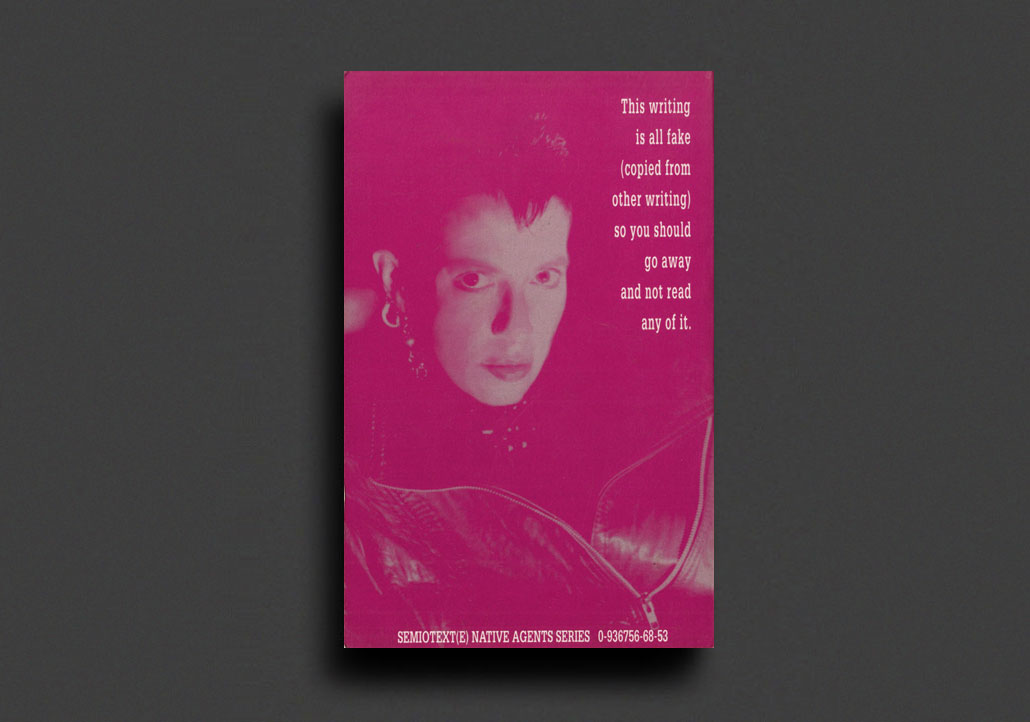
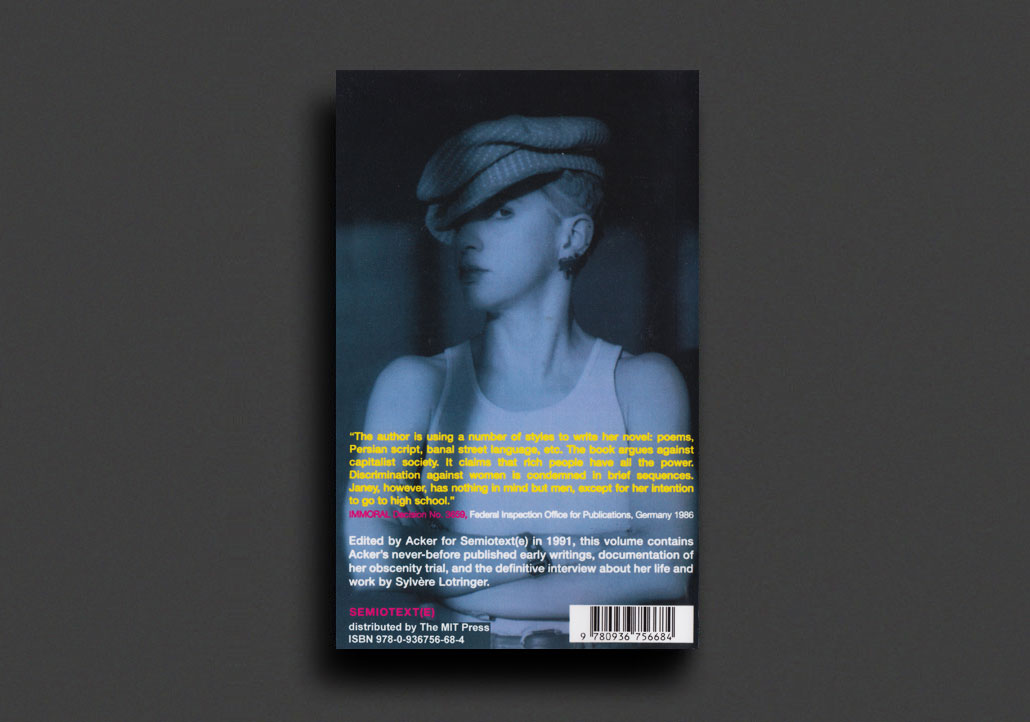
First edition of Kathy Acker's Hannibal Lecter, My Father, published by Semiotext(e) in 1991 as part of the Lotringer edited Native Agents series.
You can say I write stories with sex and violence and therefore my writing isn't worth considering because it uses content much less lots of content. Well, I tell you this: 'Prickly race, who know nothing except how to eat out your hearts with envy, you don't eat cunt'...
Edited by Sylvere Lotringer and published in 1991, this handy, pocket-sized collection of some early and not-so-early work by the mistress of gut-level fiction-making, Hannibal Lecter, My Father gathers together Acker's raw, brilliant, emotional and cerebral texts from 1970s, including the self-published 'zines written under the nom-de-plume, The Black Tarantula. This volume features, among others, the full text of Acker's opera, The Birth of the Poet, produced at Brooklyn Academy of Music in 1985, Algeria, 1979 and fragments of Politics, written at the age of 21. Also included is the longest and definitive interview Acker ever gave over two years: a chatty, intriguing and delightfully self-deprecating conversation with Semiotext(e) editor Sylvere Lotringer—which is trippy enough in itself as Lotringer, besides being a real person, has appeared as a character in Acker's fiction. And last, but not least, is the full transcript of the decision reached by West Germany's Federal Inspection Office for Publications Harmful to Minors in which Acker's work was judged to be "not only youth-threatening but also dangerous to adults," and subsequently banned.
Acker is the sort of the writer that should be read first at 16, so that you can spend the rest of your life trying to figure her out; she confuses, infuriates, perplexes and then all of a sudden the writing seems to be in your bloodstream, like some kind of benign virus. She's definitely not for the easily offended—but then, there are worse things in life than being offended. Such as the things that Acker writes about...
2023, English
Softcover, 368 pages, 17.7 x 11.3 cm
Published by
Semiotext(e) / Los Angeles
$36.00 - Out of stock
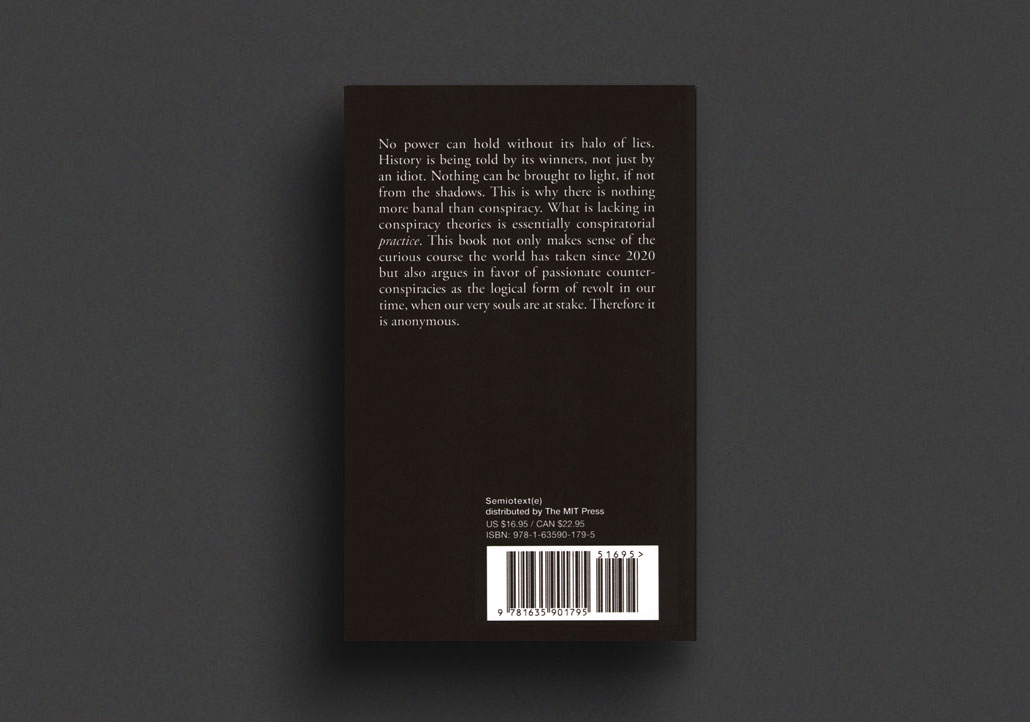
What if capitalism and its social machine were the outcome of a conspiratorial strategy?
What if capitalism and its social machine were the outcome of a conspiratorial strategy? This anonymous book considers evidence that they must be that. Further, it argues in favor of passionate counter-conspiracies as the logical form of revolt in our time, when our very souls are said to be at stake.
Translated by Robert Hurley
Robert Hurley is a translator whose credits include translating the work of French philosophers Michael Foucault, Gilles Deleuze, Pierre Clastres, and Georges Bataille.
"The Conspiracist Manifesto should prompt a reconsideration of the question raised previously by both Jameson and Latour: Can the reflexive skepticism of “critical theory” be distinguished from that of “conspiracy theory”? What is—and what should be—the proper relation between these two bodies of “theory,” both ostensibly defined by radical suspicion?"—Geoff Shullenberger, The Chronicle of Higher Education
2023, English
Softcover, 432 pages, 17.6 x 11.5 cm
Published by
Semiotext(e) / Los Angeles
$35.00 - Out of stock
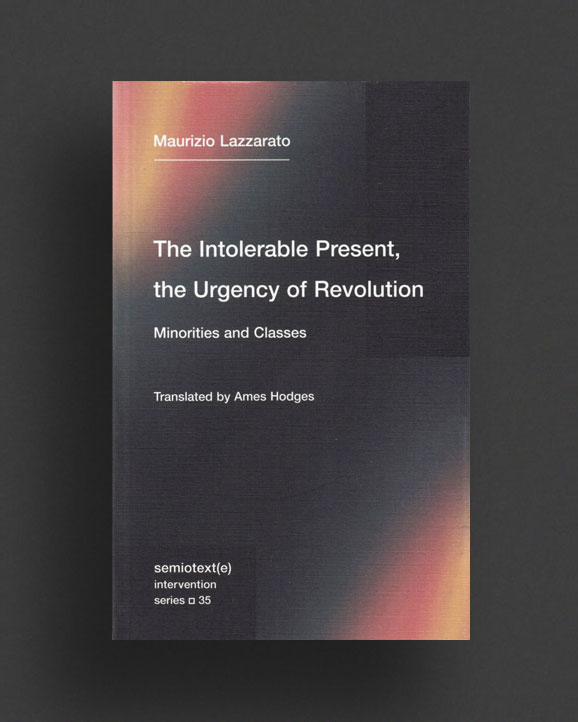
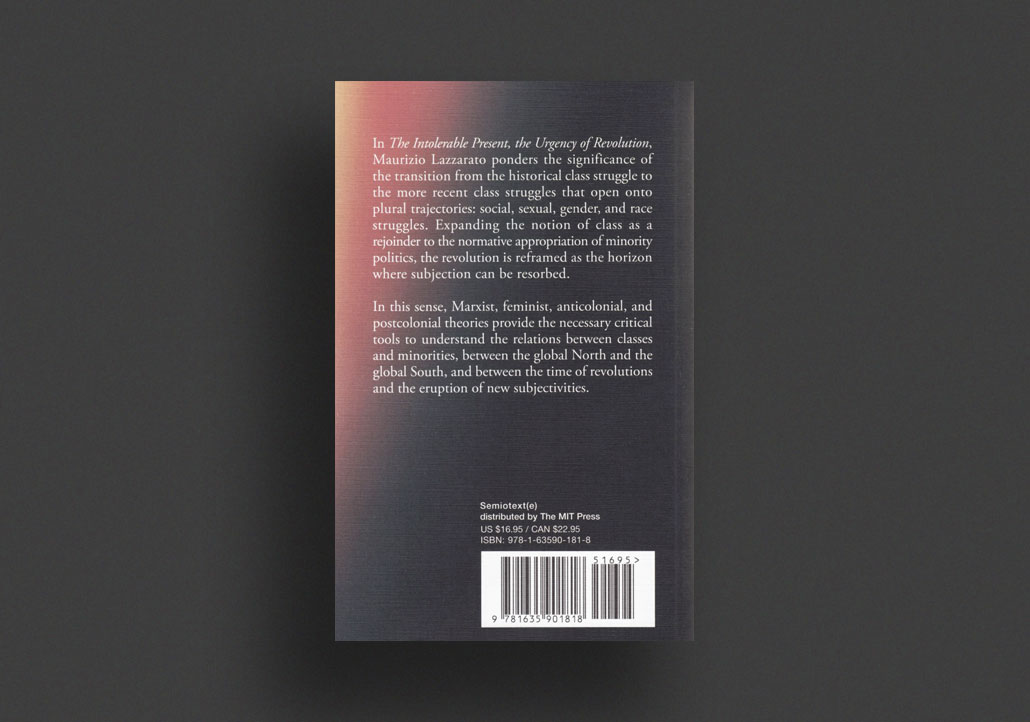
An acute reappraisal for our time of the very concept of revolution.
In order to be effective, union struggles, struggles for national liberation, worker mutualism, or struggles for emancipation were strategies that were necessarily connected to revolution. Starting from the historic defeat of the global Revolution in the mid-1970s, this book draws a portrait-whose elaboration is still lacking-of the concept of revolution. What conditions could lead us to speak of revolution once again?
In The Intolerable Present, the Urgency of Revolution, Maurizio Lazzarato ponders the fundamental importance of the passage from the historical class struggle (the conflict between capital and labour) to the more recent class struggles that open onto plural trajectories- social, sexual, gender, and race struggles. Expanding the notion of class as a rejoinder to the normative appropriation of minority politics, the revolution is returned as the horizon where subjection can be resorbed.
In this sense, Marxist, feminist, anticolonial, and postcolonial theories provide the necessary critical tools to understand the relations between classes and minorities, between the global North and the global South, and between the time of revolutions and the eruption of new subjectivities.
Maurizio Lazzarato is an independent philosopher who lives and works in Paris. He is the author of Wars and Capital with Eric Alliez (Semiotext(e), 2018), and Capital Hates Everyone: Fascism or Revolution (Semiotext(e), 2021).
2023, English
Softcover, 224 Pages, 23.5 x 18 cm
Published by
Semiotext(e) / Los Angeles
$39.00 - Out of stock
Edited by Robert Leonard
Foreword by Chris Kraus
Artist, gallerist, and writer Giovanni Intra's inventive approach to art writing provides a guide to the New Zealand and Los Angeles art scenes of his era.
Everything you read about Los Angeles is true. The city adapts to its own mythology. It's such a ludicrously discussed place that I always feel slightly idiotic in my attempts to produce a serious discourse about it. Raves in the desert, however, are superb. And ecstasy is a great drug. Also, if you hadn't heard, music sounds better when you're high. And the desert surrounding LA is wondrous.—Giovanni Intra, "LA Politics"
Before his early death in 2002, Giovanni Intra enjoyed a rollercoaster ride through the art world. He was an artist and gallerist-cofounding two legendary galleries, the artist-run space Teststrip in Auckland and China Art Objects Galleries in Los Angeles-as well as a writer. Clinic of Phantasms provides a guide to the New Zealand and Los Angeles art scenes of the day, including texts on key artists from New Zealand (John Hurrell, Fiona Pardington, Denise Kum, Ava Seymour, Ann Shelton, Gavin Hipkins, Daniel Malone, and Slave Pianos) and Los Angeles (Charles Ray, Mike Kelley, Paul McCarthy, Dave Muller, Evan Holloway, John McCracken, and Julia Scher).
What makes Intra's work of enduring significance is his inventive approach to art writing, which was informed by his interest in punk, surrealism, and Daniel Paul Schreber, the famous case study in paranoia and hallucination. This volume features writing on Intra from Chris Kraus and Mark von Schlegell, Andrew Berardini, Roberta Smith, Tessa Laird, Will Bradley, Joel Mesler, and Robert Leonard.
"He emerged the radically elegant punk, whip-crack smart and charming as hell . . . The hilarious honesty and sharp intelligence of Giovanni was to me a breeze, a knife, a wonder."—Andrew Berardini, "Everything You Read About Giovanni Intra is True"
Published by Bouncy Castle and Semiotext(e).
1991, English
Softcover, 148 pages, 11.4 x 17.8 cm
Published by
Semiotext(e) / Los Angeles
The MIT Press / Massachusetts
$35.00 - Out of stock
You can say I write stories with sex and violence and therefore my writing isn't worth considering because it uses content much less lots of content. Well, I tell you this: 'Prickly race, who know nothing except how to eat out your hearts with envy, you don't eat cunt'...
Edited by Sylvere Lotringer and published in 1991, this handy, pocket-sized collection of some early and not-so-early work by the mistress of gut-level fiction-making, Hannibal Lecter, My Father gathers together Acker's raw, brilliant, emotional and cerebral texts from 1970s, including the self-published 'zines written under the nom-de-plume, The Black Tarantula. This volume features, among others, the full text of Acker's opera, The Birth of the Poet, produced at Brooklyn Academy of Music in 1985, Algeria, 1979 and fragments of Politics, written at the age of 21. Also included is the longest and definitive interview Acker ever gave over two years: a chatty, intriguing and delightfully self-deprecating conversation with Semiotext(e) editor Sylvere Lotringer—which is trippy enough in itself as Lotringer, besides being a real person, has appeared as a character in Acker's fiction. And last, but not least, is the full transcript of the decision reached by West Germany's Federal Inspection Office for Publications Harmful to Minors in which Acker's work was judged to be "not only youth-threatening but also dangerous to adults," and subsequently banned.
Acker is the sort of the writer that should be read first at 16, so that you can spend the rest of your life trying to figure her out; she confuses, infuriates, perplexes and then all of a sudden the writing seems to be in your bloodstream, like some kind of benign virus. She's definitely not for the easily offended—but then, there are worse things in life than being offended. Such as the things that Acker writes about...
2023, English
Softcover, 232 pages, 11.4 x 17.8 cm
Published by
Semiotext(e) / Los Angeles
The MIT Press / Massachusetts
$34.00 - Out of stock
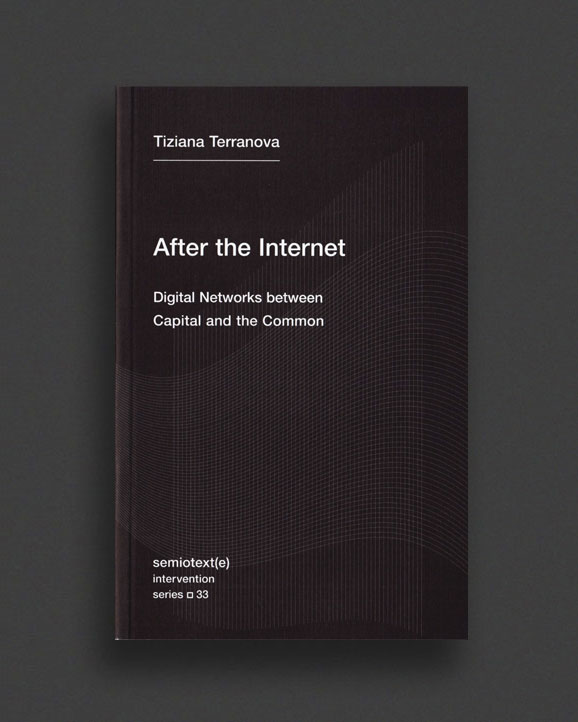
On the internet's transformation from communication tool to computational infrastructure.
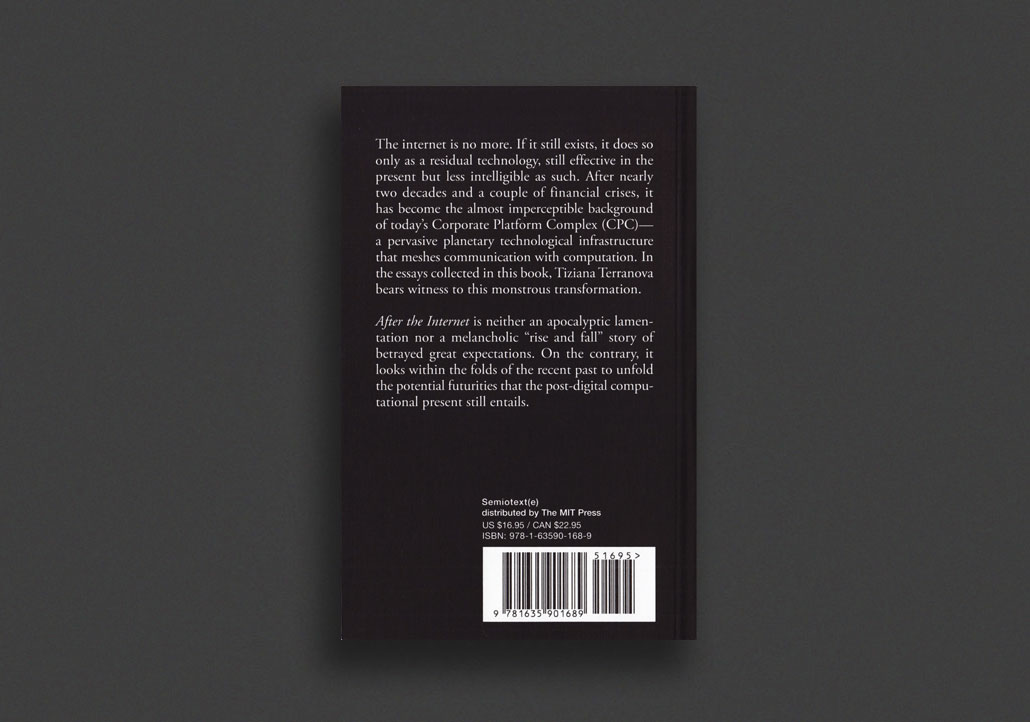
The internet is no more. If it still exists, it does so only as a residual technology, still effective in the present but less intelligible as such. After nearly two decades and a couple of financial crises, it has become the almost imperceptible background of today's Corporate Platform Complex (CPC)--a pervasive planetary technological infrastructure that meshes communication with computation.
In the essays collected in this book, written mostly between the mid-2000s and the late 2010s, Tiziana Terranova bears witness to this monstrous transformation. Mobilizing theories of cognitive capitalism, neo-monadology, and sympathetic cooperation, considering ideas such as the attention economy and its psychopathologies, and evoking the relation between algorithmic automation and the Common, she provides real-time takes on the mutations that have changed the technological, cultural, and economic ethos of the Internet. Mostly conceived, elaborated, and discussed in collective activist spaces, After the Internet is neither apocalyptic lamentation nor melancholic "rise and fall" story of betrayed great expectations. On the contrary, it looks within the folds of the recent past to unfold the potential futurities that the post-digital computational present still entails.
2005, English
Softcover, 216 pages, 15.2 x 22.9 cm
Published by
Semiotext(e) / Los Angeles
$40.00 - Out of stock
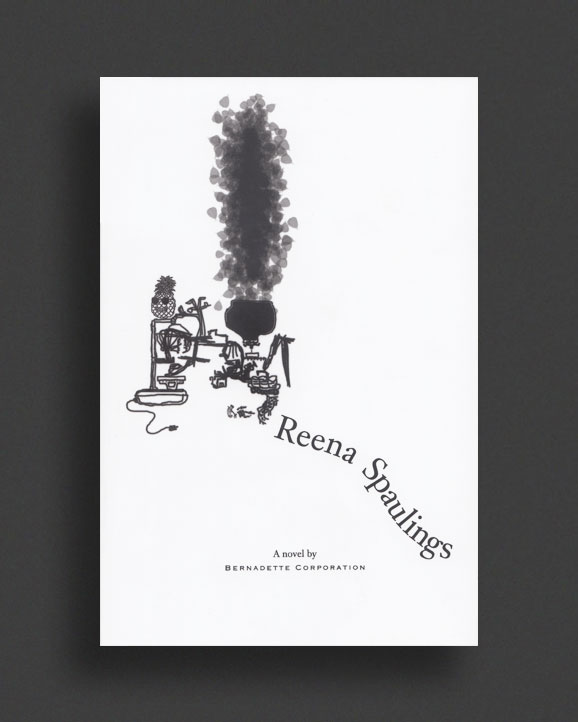
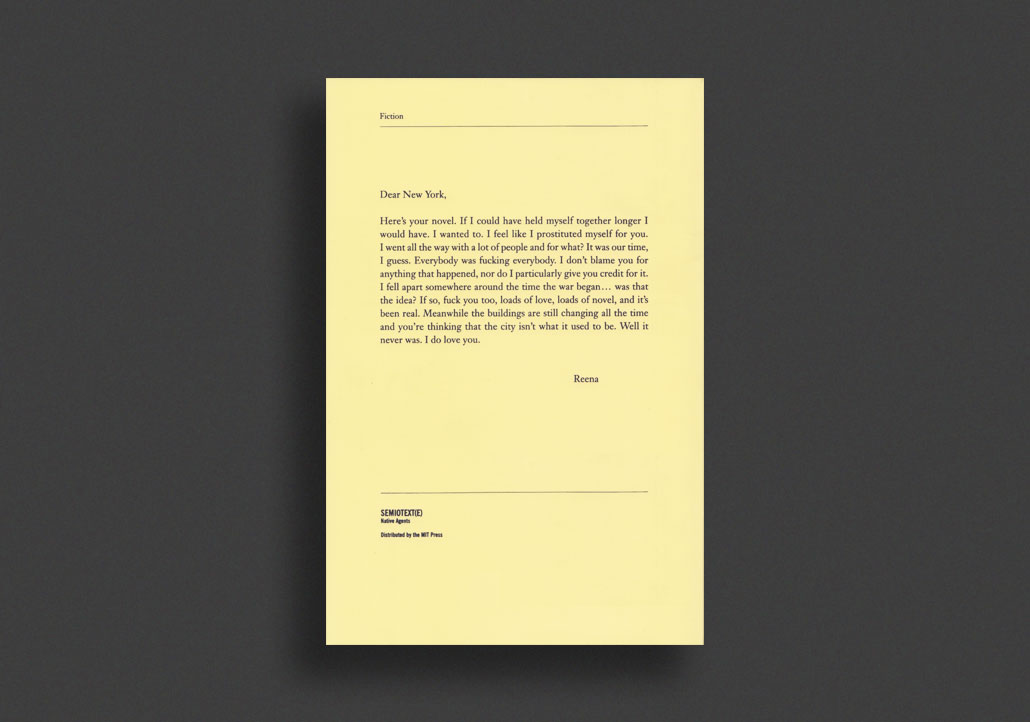
Set in post-9/11 New York City, Reena Spaulings was written by a large collective of writers and artists that bills itself as The Bernadette Corporation. Like most contemporary fiction, Reena Spaulings is about a female twenty-something. Reena is discovered while working as a museum guard and becomes a rich international supermodel. Meanwhile, a bout of terrible weather seizes New York, leaving in its wake a strange form of civil disobedience that stirs its citizens to mount a musical song-and-dance riot called “Battle on Broadway.” Fashioned in the old Hollywood manner by a legion of professional and amateur writers striving to achieve the ultimate blockbuster, the musical ends up being about a nobody who could be anybody becoming a somebody for everybody. The result is generic and perfect—not unlike Reena Spaulings itself, whose many authors create a story in which New York itself strives to become the ultimate collective experiment in which the only thing shared is the lack of uniqueness.
The artist-collective Bernadette Corporation was founded in a night club in 1994. In the beginning the group organized spontaneous, purposeless events in public space. In 1995 they morphed into a fashion label, then a self-publishing company that from 1999 to 2001 published an art magazine called Made in USA. Bernadette Corporation has also produced films, including Hell Frozen Over (2000), and Get Rid of Yourself (2003), as well as exhibits at art galleries and museums throughout the world.
1995, English
Softcover, 312 pages, 11.5 x 18 cm
Published by
Semiotext(e) / Los Angeles
$34.00 - Out of stock
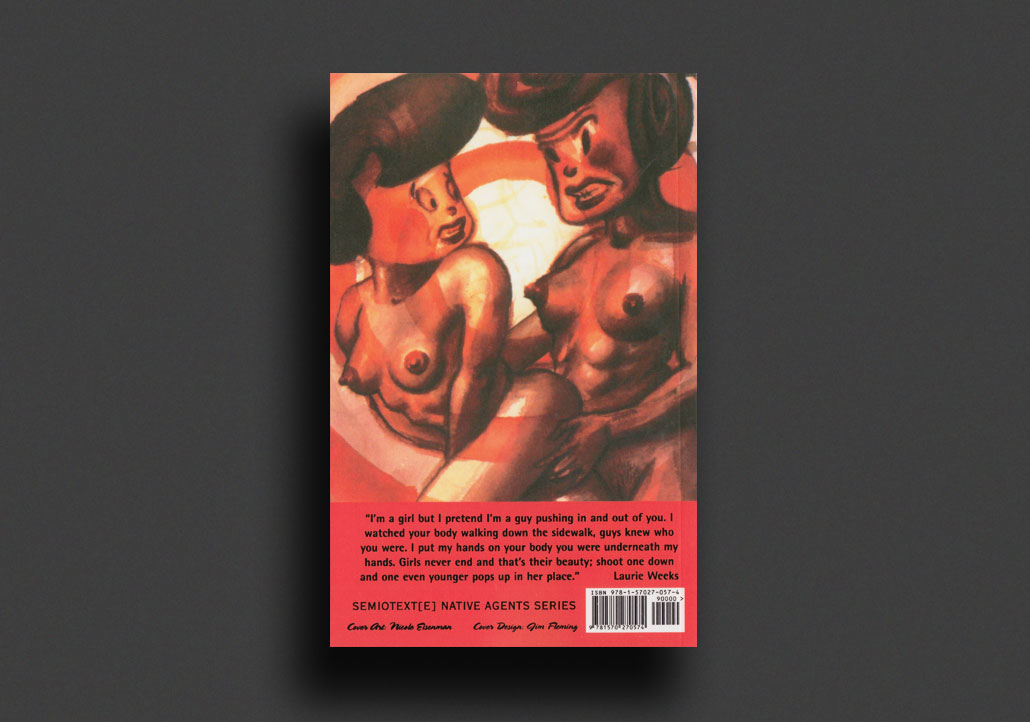
Borrowing its name from the notorious ’60s Ed Sanders magazine, Fuck You: A Magazine of the Arts, the editors have figured a way to rehone its countercultural and frictional stance with style and aplomb. A unique and provocative anthology of lesbian writing, guaranteed to soothe the soulful and savage the soulless.
Edited by Eileen Myles and Liz Kotz.
Contributors:
Tanya Barfield, Dodie Bellamy, Adele Bertei, Lisa Beskin, Rebecca Brown, Kelly Cogswell, Dominique Dibbell, Shannon Ebner, Laura Flanders, Eliza Galaher, Marilyn Hacker, Holly Hughes, Lisa Kron, Joan Larkin, Myra Mniewski, Honor Moore, Cynthia Nelson, Madeline Olnek, Nancy Redwine, Julie Regan, Annie Reid, Danine Ricereto, Camille Roy, Sapphire Joan Schenkar, Kathy Lou Schultz, Lucy Sexton, Linda Smukler, Pamela Sneed, Christina Sunley, Carmelita Tropicana, Laurie Weeks, Debra Weinstein, Joe Westmoreland, Millie Wilson, Linda Yablonsky.
Eileen Myles, named by BUST magazine “the rock star of modern poetry,” is the author of more than twenty books of poetry and prose, including Chelsea Girls, Cool for You, Sorry, Tree, and Not Me (Semiotext(e), 1991), and is the coeditor of The New Fuck You (Semiotext(e), 1995). Myles was head of the writing program at University of California, San Diego, from 2002 to 2007, and she has written extensively on art and writing and the cultural scene. Most recently, she received a fellowship from the Andy Warhol/Creative Capital Foundation.
Liz Kotz teaches in the Art History Department at the University of California, Riverside.
2022, English
Hardcover (w. dust jacket), 224 pages, 26.3 x 18.8 cm
Published by
Semiotext(e) / Los Angeles
$56.00 - Out of stock
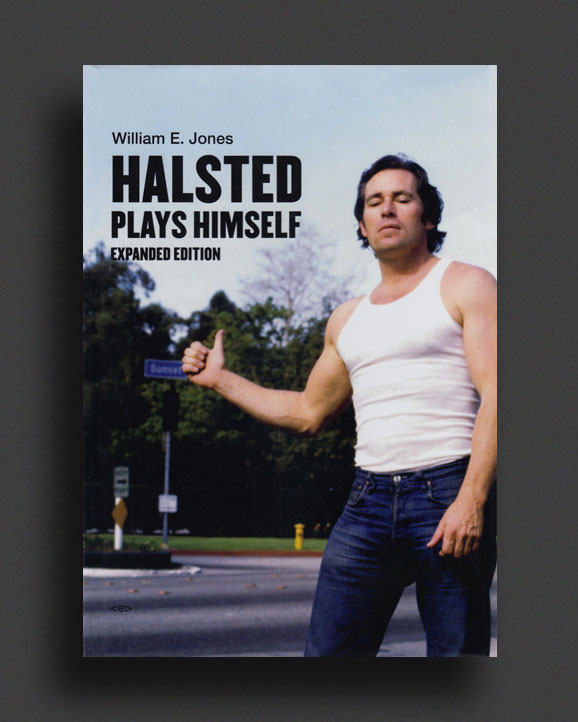
The life, times, and mysteries of Fred Halsted, gay porn's first film auteur, in a new, updated, and expanded edition.
Fred Halsted’s L.A. Plays Itself (1972) was gay porn’s first masterpiece: a sexually explicit, autobiographical, experimental film whose New York screening left even Salvador Dalí repeatedly muttering “new information for me.” Halsted, a self-taught filmmaker, shot the film over a period of three years in a now-vanished Los Angeles, a city at once rural and sleazy. Although his cultural notoriety at one point equaled that of Kenneth Anger or Jack Smith, Halsted’s star waned in the 1980s with the emergence of a more commercial gay porn industry. After the death from AIDS of his long-time partner, lover, spouse (and tormentor) Joey Yale in 1986, Halsted committed suicide in 1989. In Halsted Plays Himself, acclaimed artist and filmmaker William E. Jones documents his quest to capture the elusive public and private personas of Halsted—to zero in on an identity riddled with contradictions. Jones assembles a narrative of a long-gone gay lifestyle and an extinct Hollywood underground, when independent films were still possible, and the boundary between experimental and pornographic was not yet established. The book also depicts what sexual liberation looked like at a volatile point in time—and what it looked like when it collapsed.
The revised and expanded edition of Halsted Plays Himself includes material that came to light since the book’s first publication, including details about the restoration of Halsted’s films by the Museum of Modern Art, the true identities of several key figures in his life, new testimony from family members, and the rediscovery of his feature film Truck It (1973), previously considered lost.
2022, English
Hardcover (w. dust jacket), 616 pages, 23.6 x 16.3 cm
Published by
Semiotext(e) / Los Angeles
The MIT Press / Massachusetts
$65.00 - In stock -
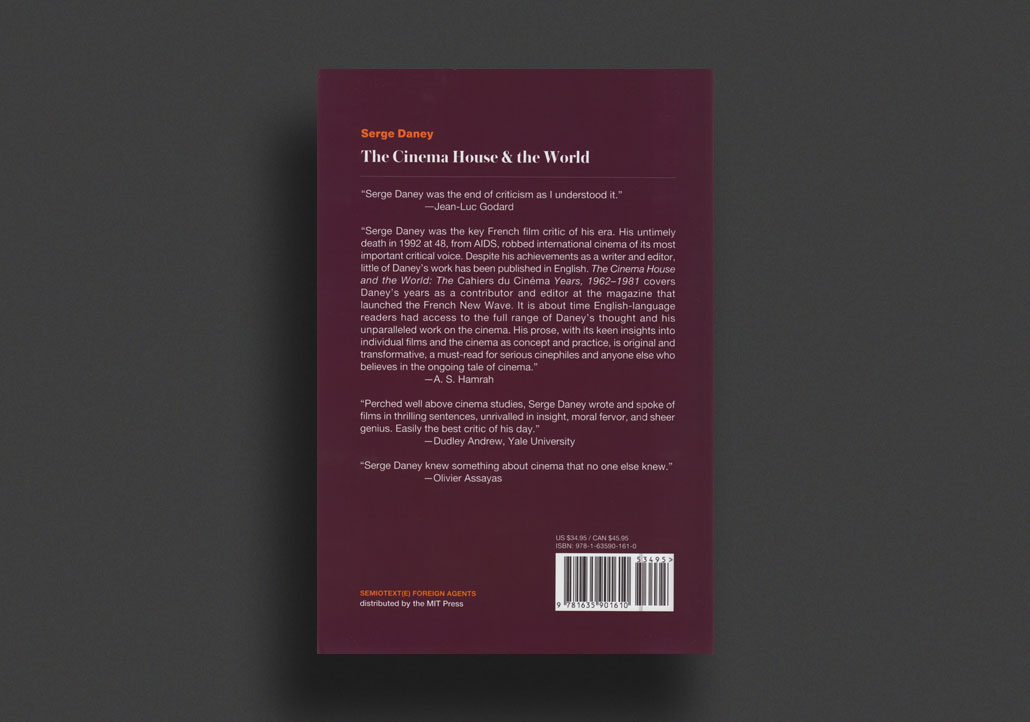
The writings of one of the greatest film critics of his generation on the auteur approach of the French New Wave to a more structural examination of film.
"Serge Daney was the end of criticism as I understood it."—Jean-Luc Godard
One of the greatest film critics of his generation, Serge Daney wrote for Cahiers du Cinéma before becoming a journalist for the daily newspaper Libération. The writings collected in this volume reflect Daney’s evolving interests, from the auteur approach of the French New Wave to a more structural examination of film, psychoanalysis, and popular culture.
Openly gay throughout his lifetime, Daney rarely wrote explicitly about homosexuality but his writings reflect a queer sensibility that would influence future generations. In regular intellectual exchanges with Gilles Deleuze, Félix Guattari, and Roland Barthes, Daney wrote about cinema autobiographically, while lyrically analyzing the transition from modern cinema to postmodern media. A noted polymath, Daney also published books about tennis and Haiti’s notorious Duvalier regime. His criticism is open and challenging, polyvocal and compulsively readable.
"Serge Daney was the key French film critic of his era. His untimely death in 1992 at 48, from AIDS, robbed international cinema of its most important critical voice. Despite his achievements as a writer and editor, little of Daney's work has been published in English. The Cinema House and the World: The Cahiers du Cinéma Years, 1962–1981 covers Daney's years as a contributor and editor at the magazine that launched the French New Wave. It is about time English-language readers had access to the full range of Daney's thought and his unparalleled work on cinema. His prose, with its keen insights into individual films and the cinema as concept and practice, is original and transformative, a must-read for serious cinephiles and anyone else who believes in the ongoing tale of cinema."—A. S. Hamrah
"Thirty years after his death, Daney's revenant presence offers a most welcome disquietude."—Nick Pinkerton
Serge Daney became the editor of Cahiers du Cinema in 1974. In 1981, he left Cahiers and wrote about visual culture for Libération, turning his attention to television and coverage of the Gulf War. He collaborated with Claire Denis on a documentary film, Jacques Rivette, le veilleur (1990). He died of AIDS-related causes in 1992.
A. S. Hamrah is a writer living in Brooklyn. He contributed a column on film to n+1 from 2008 to 2019, and his essays and reviews have appeared in Harper's, Bookforum, Cineaste, and other publications. Heis the author of The Earth Dies Streaming: Film Writing, 2002–2018.
2022, English
Softcover, 264 pages, 13.7 x 20.3 cm
Published by
Semiotext(e) / Los Angeles
$35.00 - Out of stock
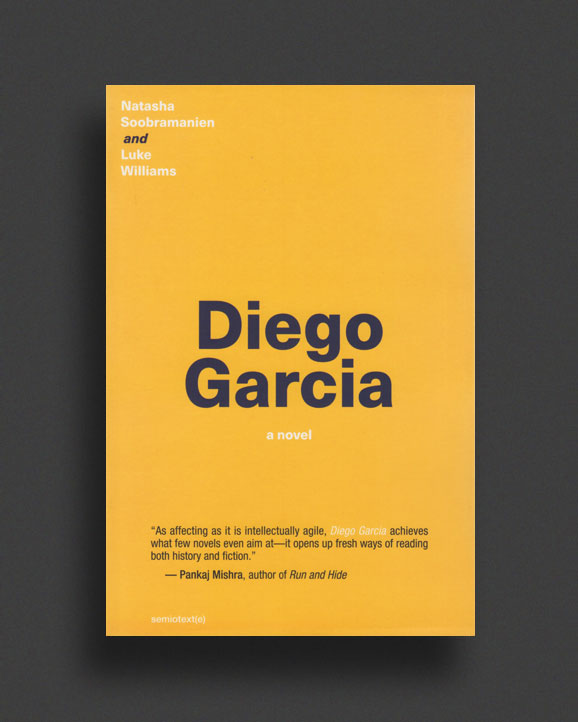
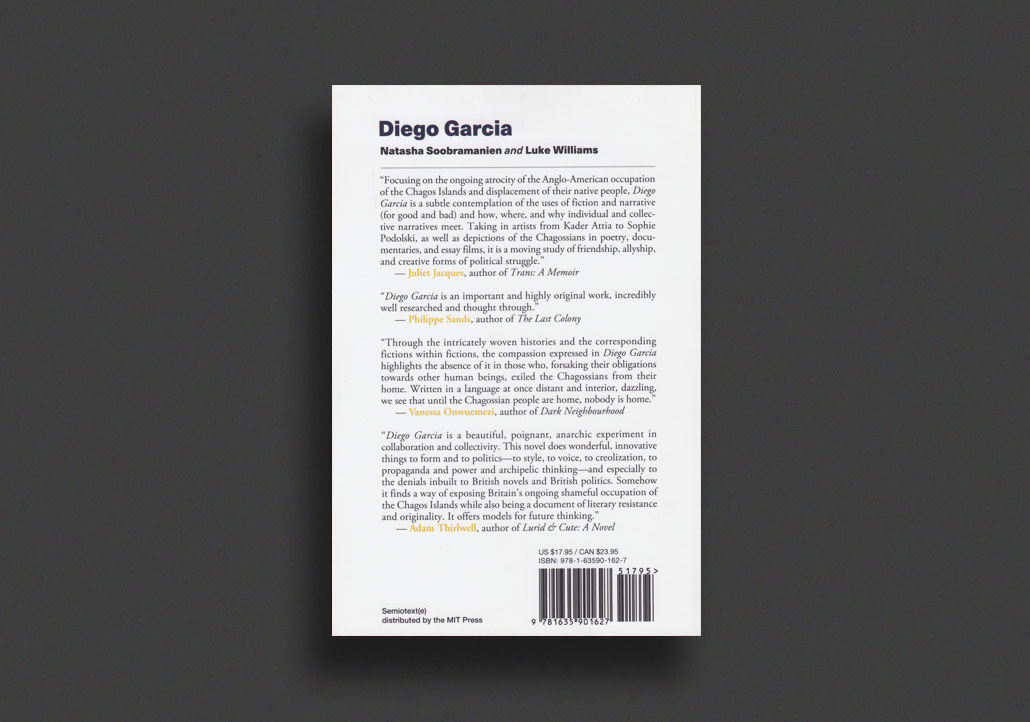
Sad and funny and bitter and true, a novel about grief, discovering your own story, and trying to listen for those stories that are not yours to tell.
August 2014. Two friends, writers Damaris Caleemootoo and Oliver Pablo Herzberg, arrive in Edinburgh from London, the city that killed Daniel--his brother, her frenemy and loved by them both. Every day is different but the same. Trying to get to the library, they get distracted by bickering--will it rain or not and what should they do about their tanking bitcoin?--in the end failing to write or resist the sadness which follows them as they drift around the city.
On such a day they meet Diego, a poet. They learn that Diego's mother was from the Chagos Archipelago, that she and her community were forced to leave their ancestral islands by soldiers in 1973 to make way for a military base. They become obsessed with this notorious episode in British history and the continuing resistance of the Chagossian people, and feel urged to write in solidarity. But how to share a story that is not theirs to tell?
Sad, funny and angry, this collaborative fiction builds on the true fact of another: a collaborative fiction created by the British and US governments to dispossess a people of their homeland.
2022, English
Softcover, 144 pages, 13.7 x 20.3 cm
Published by
Semiotext(e) / Los Angeles
$32.00 - In stock -
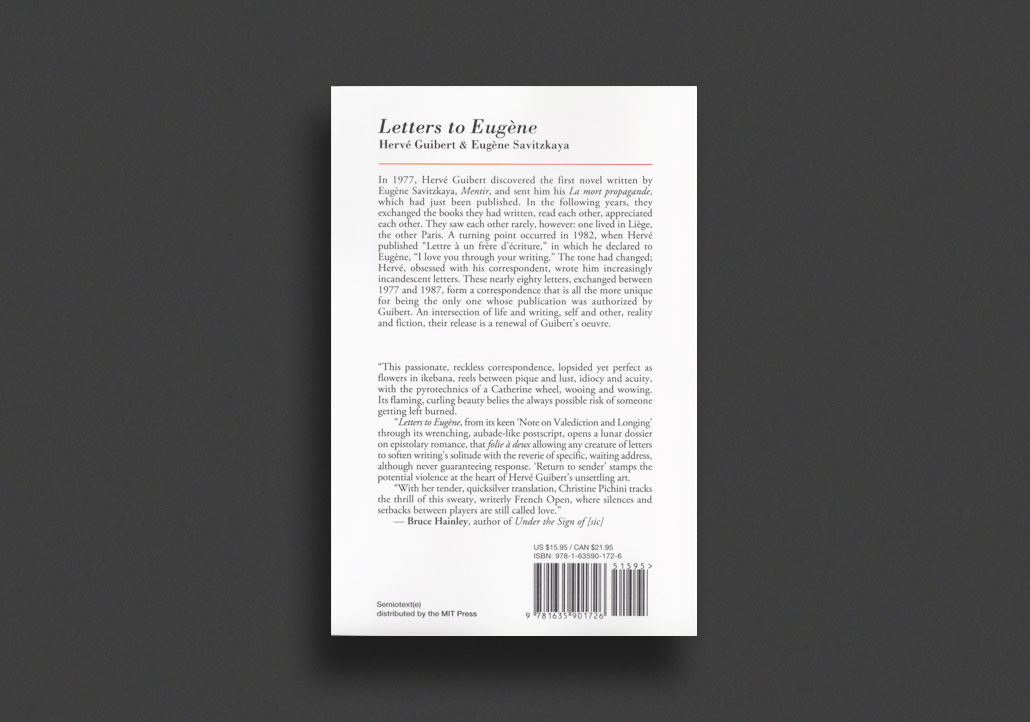
Hervé Guibert's incandescent correspondence with Belgian poet Eugène Savitzkaya.
In 1977, Hervé Guibert discovered the first novel written by Eugène Savitzkaya, Mentir, and sent him his La mort propagande, which had just been published. In the following years, they exchanged the books they had written, read each other, appreciated each other. They saw each other rarely, however: one lived in Liège, the other Paris.
A turning point occurred in 1982, when Hervé published Lettre à un frère d'écriture, in which he declared to Eugène, I love you through your writing. The tone had changed; Hervé, obsessed with his correspondent, wrote him increasingly incandescent letters. 1984 would, however, see the sudden extinguishing of that passion. A deep friendship replaced it, which found itself with new areas to explore: the adventure of publishing L'Autre Journal and at the Villa Medicis, where they were both fellows. These nearly eighty letters, exchanged between 1977 and 1987, form a correspondence that is all the more unique for being the only one whose publication was authorized by Guibert. An intersection of life and writing, self and other, reality and fiction, their release is a renewal of Guibert's oeuvre.
2022, English
Softcover, 160 pages, 13.7 x 20.3 cm
Published by
Semiotext(e) / Los Angeles
$34.00 - Out of stock
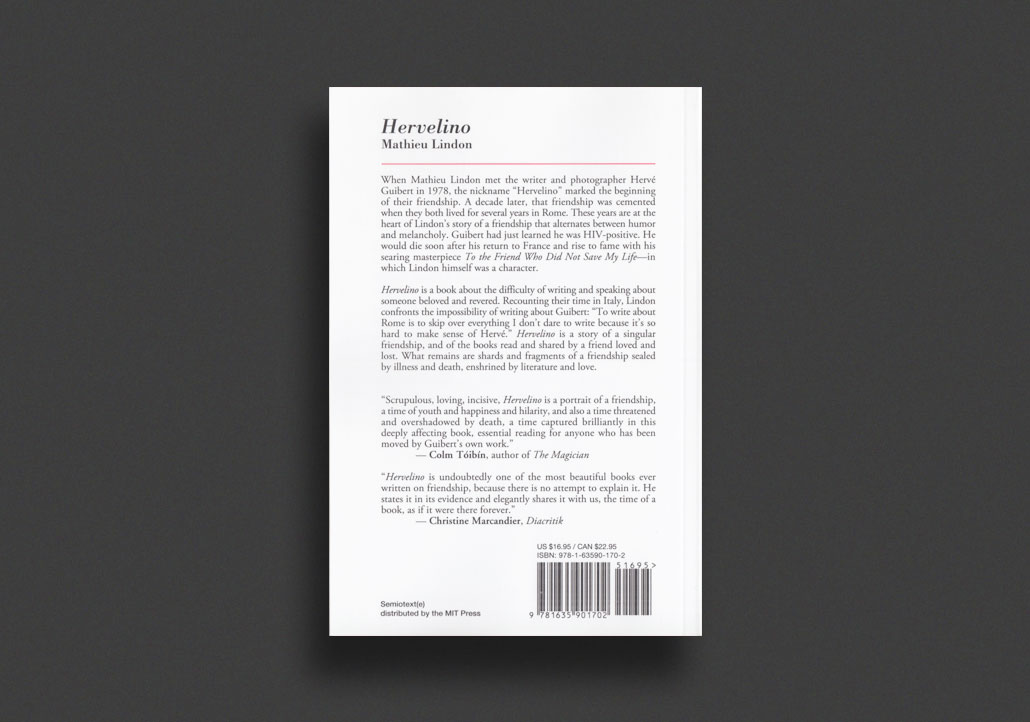
On Hervé Guibert and the difficulty of writing and speaking about someone beloved and revered.
Translated by Jeffrey Zuckerman.
"Soon that was my nickname for Hervé, what with my habit of italianizing the names of my nearest and dearest ... Hervelino: that didn't make me think so much of Hervé as of us both. The word might not seem like much but it was him and it was me, he took it for himself."
Mathieu Lindon met the writer and photographer Hervé Guibert in 1978. The nickname Hervelino marked the start of their friendship, which was cemented a decade later by the years they both spent in Rome. Guibert was a pensionnaire at the Villa Médicis starting in 1987; Lindon became a fellow pensionnaire the next year, and the two would stay in Italy until 1990. These Roman years are at the heart of this autobiographie à deux that alternates between humor and melancholy. Guibert had just learned that he was HIV-positive and would die not long after returning to France and rising to fame with his searing masterpiece To the Friend Who Did Not Save My Life—in which Lindon himself was a character.
Hervelino is a book about the difficulty of writing and speaking about someone beloved and revered. In recounting their time in Italy, Lindon contends with the impossibility of writing about Guibert: "To write about Rome is to skip over everything I don't dare to write because it's so hard to make sense of Hervé." Hervelino is a story of a singular friendship, and of the books read and shared by the friend who was loved and lost. As it closes with each inscription Guibert wrote for his friend Mathieu and with Lindon's present-day commentary below it, what remains are shards and fragments of a friendship sealed by illness and death, enshrined by literature and love.
2018, English
Softcover, 360 pages, 11.4 x 17.8 cm
Published by
The MIT Press / Massachusetts
Semiotext(e) / Los Angeles
$29.00 - In stock -
Essays on the contemporary continuum of incarceration: the biopolitics of juvenile delinquency, predatory policing, the political economy of fees and fines, and algorithmic policing.
What we see happening in Ferguson and other cities around the country is not the creation of livable spaces, but the creation of living hells. When people are trapped in a cycle of debt it also can affect their subjectivity and how they temporally inhabit the world by making it difficult for them to imagine and plan for the future. What psychic toll does this have on residents? How does it feel to be routinely dehumanized and exploited by the police?—from Carceral Capitalism
In this collection of essays in Semiotext(e)'s Intervention series, Jackie Wang examines the contemporary incarceration techniques that have emerged since the 1990s. The essays illustrate various aspects of the carceral continuum, including the biopolitics of juvenile delinquency, predatory policing, the political economy of fees and fines, cybernetic governance, and algorithmic policing. Included in this volume is Wang's influential critique of liberal anti-racist politics, “Against Innocence,” as well as essays on RoboCop, techno-policing, and the aesthetic problem of making invisible forms of power legible.
Wang shows that the new racial capitalism begins with parasitic governance and predatory lending that extends credit only to dispossess later. Predatory lending has a decidedly spatial character and exists in many forms, including subprime mortgage loans, student loans for sham for-profit colleges, car loans, rent-to-own scams, payday loans, and bail bond loans. Parasitic governance, Wang argues, operates through five primary techniques: financial states of exception, automation, extraction and looting, confinement, and gratuitous violence. While these techniques of governance often involve physical confinement and the state-sanctioned execution of black Americans, new carceral modes have blurred the distinction between the inside and outside of prison. As technologies of control are perfected, carcerality tends to bleed into society.
2020, English
Softcover, 272 pages, 13.7 x 20.3 cm
Published by
Semiotext(e) / Los Angeles
$44.00 - In stock -
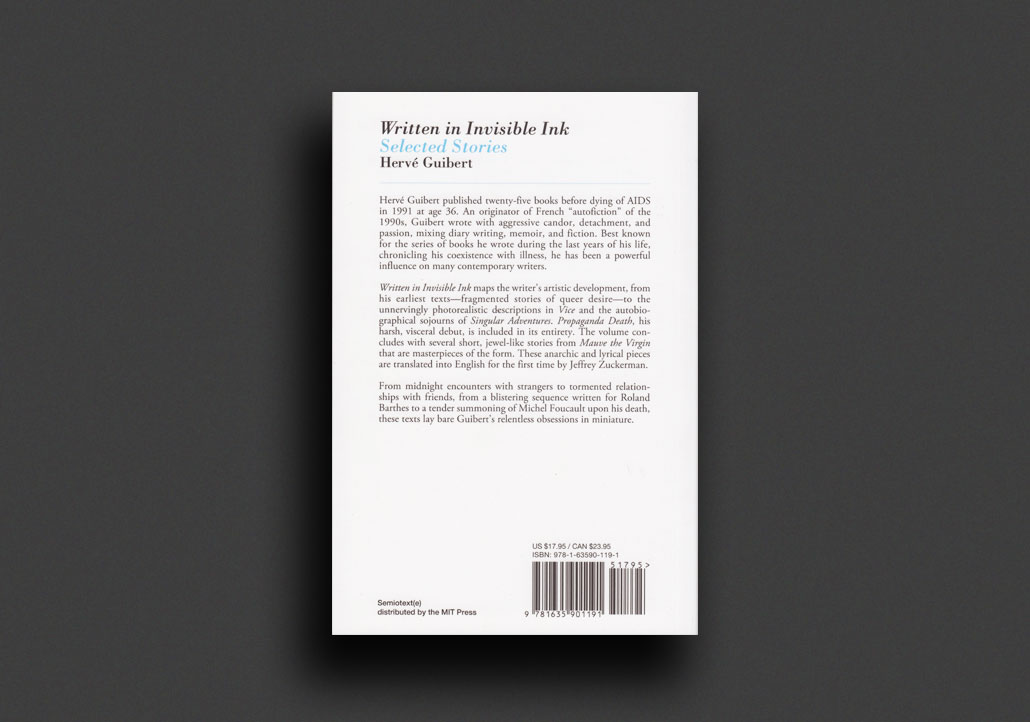
Stories that map the writer's artistic development, written with candor, detachment, and passion. Herve Guibert published twenty-five books before dying of AIDS in 1991 at age 36. An originator of French "autofiction" of the 1990s, Guibert wrote with aggressive candor, detachment, and passion, mixing diary writing, memoir, and fiction. Best known for the series of books he wrote during the last years of his life, chronicling his coexistence with illness, he has been a powerful influence on many contemporary writers. Written in Invisible Ink maps the writer's artistic development, from his earliest texts-fragmented stories of queer desire-to the unnervingly photorealistic descriptions in Vice and the autobiographical sojourns of Singular Adventures. Propaganda Death, his harsh, visceral debut, is included in its entirety. The volume concludes with a series of short, jewel-like stories composed at the end of his life. These anarchic and lyrical pieces are translated into English for the first time by Jeffrey Zuckerman. From midnight encounters with strangers to tormented relationships with friends, from a blistering sequence written for Roland Barthes to a tender summoning of Michel Foucault upon his death, these texts lay bare Guibert's relentless obsessions in miniature.
Translated by Jeffrey Zuckerman
HERVÉ GUIBERT (1955-1991) was a French writer and photographer. A critic for Le Monde, he was the author of some thirty books, most notably To the Friend Who Did Not Save My Life, which presents an intimate portrait of Michel Foucault and played a significant role in changing public attitudes in France towards AIDS.
2020, English
Softcover, 272 pages, 13.7 x 20.3 cm
Published by
Semiotext(e) / Los Angeles
$49.00 - In stock -
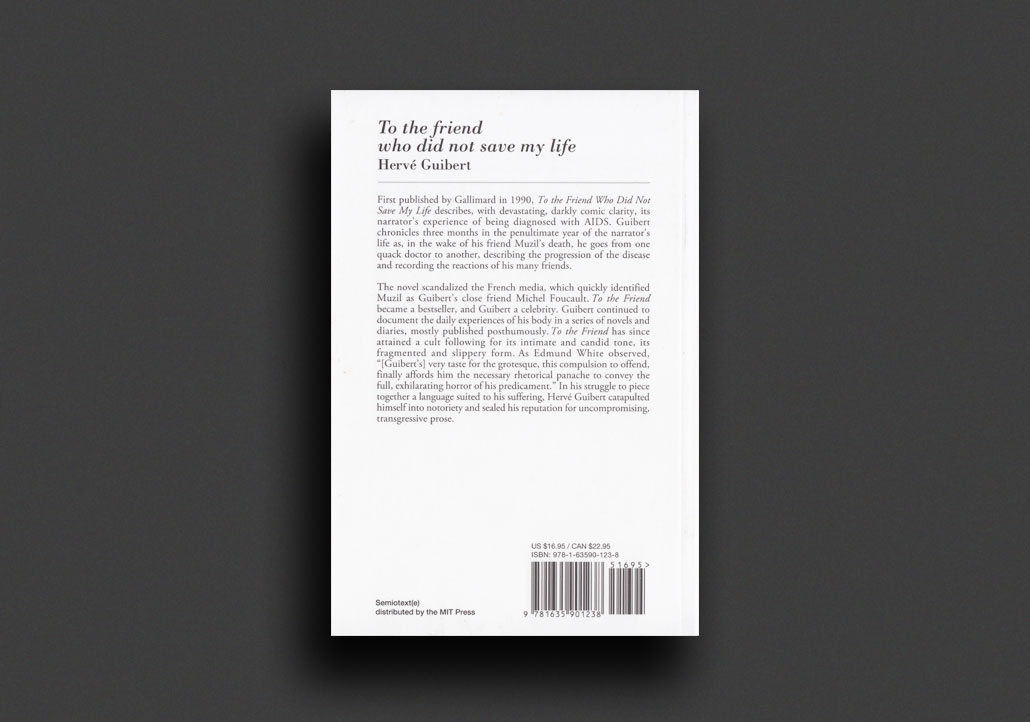
A novel that describes, with devastating, darkly comic clarity, its narrator's experience of being diagnosed with AIDS.
First published by Gallimard in 1990, To the Friend Who Did Not Save My Life describes, with devastating, darkly comic clarity, its narrator's experience of being diagnosed with AIDS. Guibert chronicles three months in the penultimate year of the narrator's life as, in the wake of his friend Muzil's death, he goes from one quack doctor to another, describing the progression of the disease and recording the reactions of his many friends.
The novel scandalized the French media, which quickly identified Muzil as Guibert's close friend Michel Foucault. To the Friend became a bestseller, and Guibert a celebrity. Guibert continued to document the daily experiences of his body in a series of novels and diaries, mostly published posthumously. To the Friend has since attained a cult following for its intimate and candid tone, its fragmented and slippery form. As Edmund White observed, "[Guibert's] very taste for the grotesque, this compulsion to offend, finally affords him the necessary rhetorical panache to convey the full, exhilarating horror of his predicament." In his struggle to piece together a language suited to his suffering, Herve Guibert catapulted himself into notoriety and sealed his reputation for uncompromising, transgressive prose.
Translated by Linda Coverdale, Afterword by Edmund White, Introduction by Andrew Durbin
HERVÉ GUIBERT (1955-1991) was a French writer and photographer. A critic for Le Monde, he was the author of some thirty books, most notably To the Friend Who Did Not Save My Life, which presents an intimate portrait of Michel Foucault and played a significant role in changing public attitudes in France towards AIDS.
2019, English
Softcover, 408 pages, 13.7 x 20.3 cm
Published by
Semiotext(e) / Los Angeles
$38.00 - Out of stock
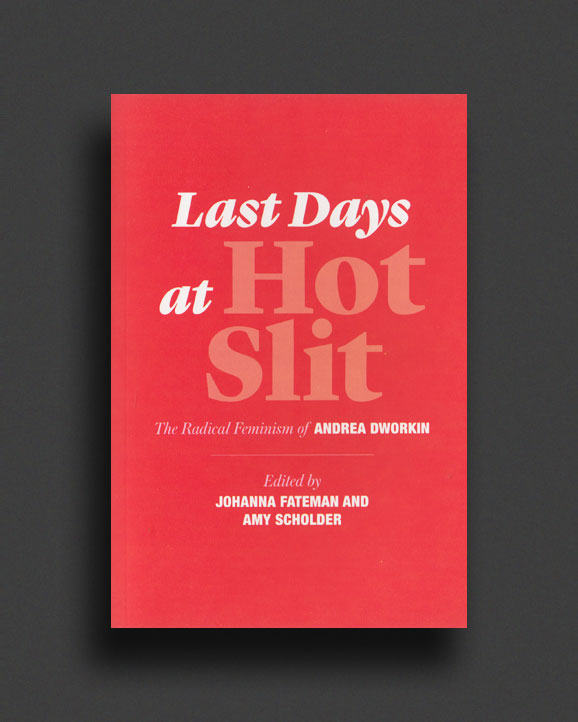
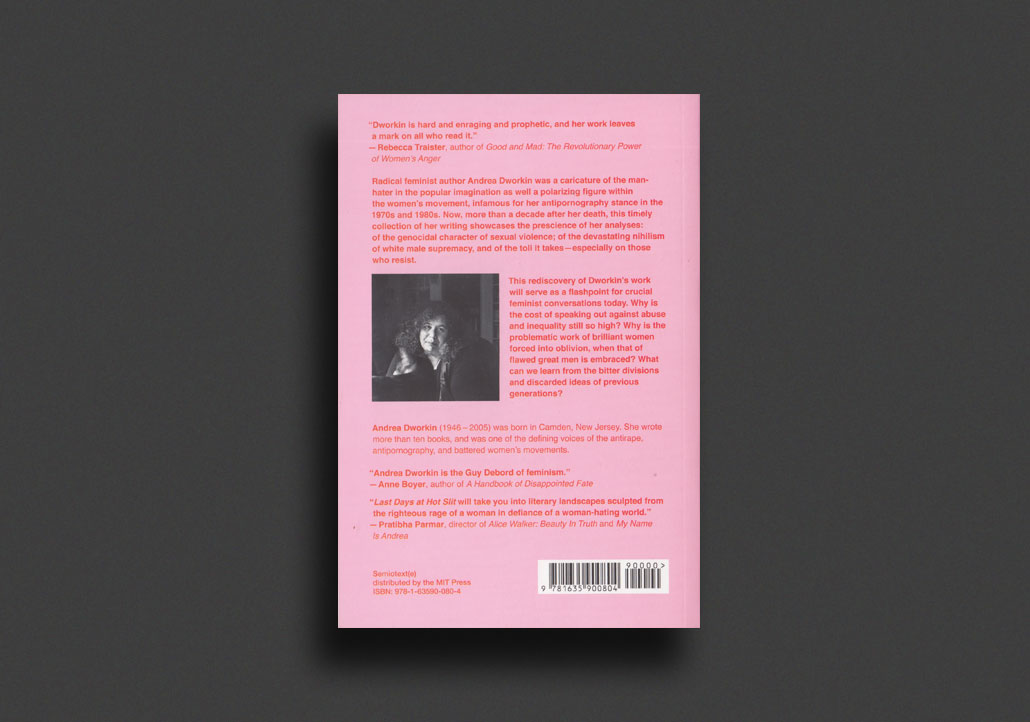
Selections from the work of radical feminist author Andrea Dworkin, famous for her antipornography stance and role in the feminist sex wars of the 1980s.
Radical feminist author Andrea Dworkin was a caricature of misandrist extremism in the popular imagination and a polarizing figure within the women's movement, infamous for her antipornography stance and her role in the feminist sex wars of the 1980s. She still looms large in feminist demands for sexual freedom, evoked as a censorial demagogue, more than a decade after her death. Among the very first writers to use her own experiences of rape and battery in a revolutionary analysis of male supremacy, Dworkin was a philosopher outside and against the academy who wrote with a singular, apocalyptic urgency.
Last Days at Hot Slit brings together selections from Dworkin's work, both fiction and nonfiction, with the aim of putting the contentious positions she's best known for in dialogue with her literary oeuvre. The collection charts her path from the militant primer Woman Hating (1974), to the formally complex polemics of Pornography (1979) and Intercourse (1987) and the raw experimentalism of her final novel Mercy (1990). It also includes “Goodbye to All This” (1983), a scathing chapter from an unpublished manuscript that calls out her feminist adversaries, and “My Suicide” (1999), a despairing long-form essay found on her hard drive after her death in 2005.
Andrea Dworkin (1946–2005) was an American radical feminist author associated with antipornography, antirape, and battered women's movements of the 1970s and 80s. She wrote more than ten books, both nonfiction and fiction, and she coauthored, with feminist law professor Catherine Mackinnon, the highly controversial Antipornography Civil Rights Ordinance of 1983.
Johanna Fateman is a writer, musician, and coowner of Seagull Salon in New York. Her art criticism appears regularly in The New Yorker and Artforum.
Amy Scholder is an editor and writer. She is currently producing a documentary feature, Disclosure: Trans Lives on Screen, and serves as board president of Lambda Literary.
1985 / 1991, English
Softcover, 142 pages, 18 x 12 cm
1st Edition, Out of print title / used / very good
Published by
Autonomedia / New York
Semiotext(e) / Los Angeles
$35.00 - Out of stock
"A Blake Angel on Bad Acid" — Robert Anton Wilson
"Fascinating..." — William Burroughs
"Who is Hakim Bey? I love him!" — Timothy Leary
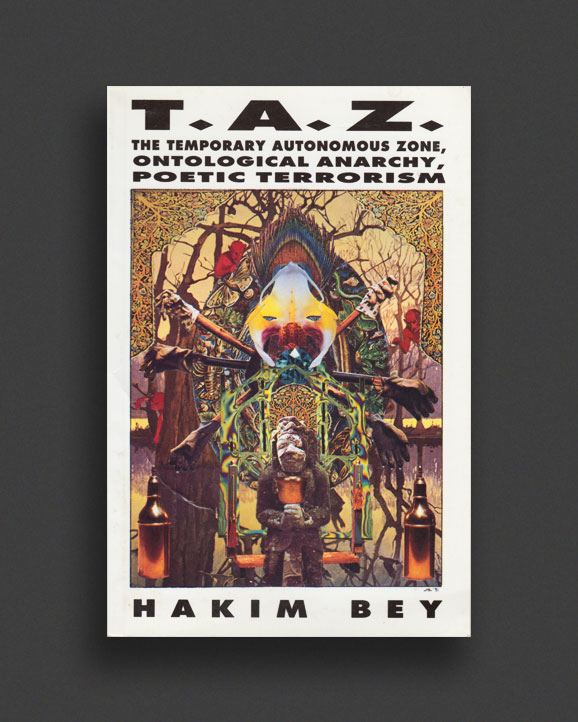
First trade paperback edition of T.A.Z.: The Temporary Autonomous Zone, the underground cult bestseller and first book by anarchist writer and poet Hakim Bey (Peter Lamborn Wilson) published in 1991 by Autonomedia. Originally published in 1985 and circulated in the underground via small private and pirate editions, these texts were an inspiration for a generation of troublemakers and idealists. Both celebrated in the punk underground (where the original book has become a seminal text) and denounced in some anarchist circles, the book has proved itself as both influential and relevant to multiple generations of dreamers, agitators, and activists.
Essays that redefine the psychogeographical nooks of autonomy. Recipes for poetic terror, anarcho-black magic, post-situ psychotropic surgery, denunciations of spiritual addictions to vapid infotainment cults — this is the bastard classic, the watermark impressed upon our minds. Where conscience informs praxis, and action infects consciousness, T.A.Z. is beginning to worm its way into above-ground culture. This book offers inspired blasts of writing, from slogans to historical essays, on the need to insert revolutionary happiness into everyday life through poetic action, and celebrating the radical optimism present in outlaw cultures. It should appeal to alternative thinkers and punks everywhere, as it celebrates liberation, love and poetic living.
This book contains the full text of "Chaos: The Broadsheets of Ontological Anarchism", the complete "Communiques of the Association for Ontological Anarchy", and the new long essay "The Temporary Autonomous Zone".
Very Good copy with some light wear.
2022, English
Softcover, 320 pages, 13.3 x 20.3 cm
Published by
Semiotext(e) / Los Angeles
$32.00 - Out of stock
The conclusion of a radically philosophical and personal series of Fanny Howe novels animated by questions of race, spirituality, childhood, transience, resistance, and poverty.
First published by Semiotexte in 2001, Indivisible concludes a radically philosophical and personal series of Fanny Howe novels animated by questions of race, spirituality, childhood, transience, wonder, resistance, and poverty. Depicting the tempestuous multiracial world of artists and activists who lived in working-class Boston during the 1960s, Indivisible begins when its narrator, Henny, locks her husband in a closet so that she might better discuss things with God. On the verge of a religious conversion, Henny attempts to make peace with the dead by telling their stories.
2012, English
Softcover, 96 pages, 17.6 x 11.4 cm
Published by
Semiotext(e) / Los Angeles
$30.00 - Out of stock
We are living under the administration of fear: fear has become an environment, an everyday landscape. There was a time when wars, famines, and epidemics were localized and limited by a certain timeframe. Today, it is the world itself that is limited, saturated, and manipulated, the world itself that seizes us and confines us with a stressful claustrophobia. Stock-market crises, undifferentiated terrorism, lightning pandemics, "professional" suicides.... Fear has become the world we live in.
The administration of fear also means that states are tempted to create policies for the orchestration and management of fear. Globalization has progressively eaten away at the traditional prerogatives of states (most notably of the welfare state), and states have to convince citizens that they can ensure their physical safety.
In this new and lengthy interview, Paul Virilio shows us how the "propaganda of progress," the illuminism of new technologies, provide unexpected vectors for fear in the way that they manufacture frenzy and stupor. For Virilio, the economic catastrophe of 2007 was not the death knell of capitalism, as some have claimed, but just further evidence that capitalism has accelerated into turbo-capitalism, and is accelerating still. With every natural disaster, health scare, and malicious rumor now comes the inevitable "information bomb"--live feeds take over real space, and technology connects life to the immediacy of terror, the ultimate expression of speed. With the nuclear dissuasion of the Cold War behind us, we are faced with a new form of civil dissuasion: a state of fear that allows for the suspension of controversial social situations.
2008, English
Softcover, 136 pages, 15.2 x 22.9 cm
Published by
Semiotext(e) / Los Angeles
$44.00 - Out of stock
As celebrated as it is reviled, internationally acclaimed filmmaker Catherine Breillat's novel Pornocracy viscerally enacts the dramatic confluence of mystery, desire, and shame that lies at the heart of sexuality. In Pornocracy, a beautiful woman wanders through a gay disco and engages a man, confident that he will follow her. Perversely and dispassionately, she offers her body as the ground of a ritualistic game in which, over the course of three evenings, the two will explore the numbing mechanics of sexual brutality. What follows is an exchange between a man and a woman that is both frankly sexual and deeply philosophical. Adapted and directed for film in France by Breillat as Anatomy of Hell (2004), Pornocracy leads the reader through an undulating and atmospheric exploration of the criminal and the erotic, finally climaxing in a place well beyond more familiar moral terrain. Although Breillat's films — most recently Fat Girl (2001) and Romance (1999) — are well known to international audiences, this publication marks her literary debut in America. It will demonstrate that Breillat's famous films are but one aspect of her strikingly original poetic and philosophical vision.
Catherine Breillat is a filmmaker and writer based in Paris. She is known not only for her films focusing on themes of sexuality, but also for her best-selling novels. Pornocracy is the first of her novels to be published in English.
Translated by Paul Buck and Catherine Petit
Afterword by Peter Sotos
Introduction by Chris Kraus
2021, English
Softcover, 128 pages, 13.8 x 20.3 cm
Published by
Semiotext(e) / Los Angeles
$32.00 - Out of stock
A love letter to Paris and a meditation on how it has changed in two decades, evolving from the twentieth century into the twenty-first, from analog to digital.
Your telephone is precious. It may be envied. We recommend vigilance when using it in public.
— Paris bus public notice
In fall 2014 Lauren Elkin began keeping a diary of her bus commutes in the Notes app on her iPhone 5c, writing down the interesting things and people she saw in a Perecquian homage to Bus Lines 91 and 92, which she took from her apartment in the 5th Arrondissement to her teaching job in the 7th.
Reading the notice, she decided to be vigilant when using her phone: she would carry out a public transport vigil, using it to take in the world around her and notice all the things she would miss if she continued using it the way she had been, the way everyone does--to surf the web, check social media, maintain her daily sense of self through digital interaction. Her goal became to observe the world through the screen of her phone, rather than using her phone to distract from the world.
During the course of that academic year, the Charlie Hebdo attacks occurred and Elkin had an ectopic pregnancy, requiring emergency surgery. At that point, her diary of dailiness became a study of the counterpoint between the everyday and the Event, mediated through early twenty-first century technology, and observed from the height of a bus seat. No. 91/92 is a love letter to Paris, and a meditation on how it has changed in the two decades the author has lived there, evolving from the twentieth century into the twenty-first, from analog to digital.
2021, English
Softcover, 256 pages, 15.2 x 22.9 cm
Published by
Semiotext(e) / Los Angeles
$37.00 - Out of stock
A new collection of essays from Dodie Bellamy on disenfranchisement, vulgarity, American working class life, aesthetic values, and profound embarrassment.
So. Much. Information. When does one expand? Cut back? Stop researching? When is enough enough? Like Colette's aging courtesan Lea in the Chéri books, I straddle two centuries that are drifting further and further apart.—Dodie Bellamy, “Hoarding as Ecriture”
This new collection of essays, selected by Dodie Bellamy after the death of Kevin Killian, her companion and husband of thirty-three years, circles around loss and abandonment large and small. Bellamy's highly focused selection comprises pieces written over three decades, in which the themes consistent within her work emerge with new force and clarity: disenfranchisement, vulgarity, American working class life, aesthetic values, profound embarrassment. Bellamy writes with shocking, and often hilarious, candor about the experience of turning her literary archive over to the Beinecke Rare Book & Manuscript Library at Yale and about being targeted by an enraged online anti-capitalist stalker. Just as she did in her previous essay collection, When the Sick Rule the World, Bellamy examines aspects of contemporary life with deep intelligence, intimacy, ambivalence, and calm.
Dodie Bellamy's writing focuses on sexuality, politics and narrative experimentation, challenging the distinctions between fiction, the essay and poetry. In 2018–19 she was the subject of On Our Mind, a yearlong series of public events, commissioned essays and reading group meetings organized by CCA Wattis ICA. With Kevin Killian, she coedited Writers Who Love Too Much: New Narrative 1977–1997. A compendium of essays on Bellamy's work, Dodie Bellamy Is on Our Mind, was published in 2020 by Wattis ICA/Semiotext(e).
2021, English
Softcover, 240 pages, 15.2 x 22.9 cm
Published by
Semiotext(e) / Los Angeles
$34.00 - Out of stock
Bellamy's debut novel revives the central female character from Bram Stoker's Dracula and imagines her as an independent woman living in San Francisco during the 1980s.
"A luscious deeply fucked up extravagant work." — Eileen Myles
Hypocrisy's not the problem, I think, it's allegory the breeding ground of paranoia. The act of reading into--how does one know when to stop? KK says that Dodie has the advantage because she's physical and I'm only psychic. ... The truth is: everyone is adopted. My true mother wore a turtleneck and a long braid down her back, drove a Karmann Ghia, drank Chianti in dark corners, fucked Gregroy Corso ... — Dodie Bellamy, The Letters of Mina Harker
First published in 1998, Dodie Bellamy's debut novel The Letters of Mina Harker sought to resuscitate the central female character from Bram Stoker's Dracula and reimagine her as an independent woman living in San Francisco during the 1980s--a woman not unlike Dodie Bellamy. Harker confesses the most intimate details of her relationships with four different men in a series of letters. Vampirizing Mina Harker, Bellamy turns the novel into a laboratory: a series of attempted transmutations between the two women in which the real story occurs in the gaps and the slippages. Lampooning the intellectual theory-speak of that era, Bellamy's narrator fights to inhabit her own sexuality despite feelings of vulnerability and destruction. Stylish but ruthlessly unpretentious, The Letters of Mina Harker was Bellamy's first major claim to the literary space she would come to inhabit.
"I am … in awe of Dodie Bellamy's talent … grateful for the profound ways in which this novel has caused me to consider what the novel form is and can be when subjected to the most brilliant and original talent imaginable. The Letters of Mina Harker has continually unfolded in my imagination and increased my astonishment … its power and beauty have remained utterly mysterious." — Dennis Cooper
Introduction by Emily Gould
Dodie Bellamy's writing focuses on sexuality, politics and narrative experimentation, challenging the distinctions between fiction, the essay and poetry. In 2018–19 she was the subject of On Our Mind, a yearlong series of public events, commissioned essays and reading group meetings organized by CCA Wattis ICA. With Kevin Killian, she coedited Writers Who Love Too Much: New Narrative 1977–1997. A compendium of essays on Bellamy's work, Dodie Bellamy Is on Our Mind, was published in 2020 by Wattis ICA/Semiotext(e).