World Food Books' programme is largely produced on Kulin Nation land. We acknowledge the Wurundjeri people of the Kulin Nation as the first and continuing custodians of this land, and pay respect to their Elders past, present, and emerging.
World Food Books is an arts and special interests bookshop in Naarm / Melbourne. Founded in 2010, World Food Books is devoted to the presentation of a rotating, hand-selection of international art, design, literary and counterculture publications with an emphasis on the anti-traditional, the experimental, the avant-garde, the heretic, the marginal.
Presenting new titles alongside rare and out-of-print books, catalogues and journals spanning the fields of modern and contemporary art, design, photography, illustration, film, literature, poetry, cultural theory, philosophy, sexuality, popular and underground culture in its many radical forms, World Food Books wishes to encourage adventurous, thoughtful and open-minded reading, looking, writing, and exchange of publishing and ideas, both current and historical.
As well as our bookshop, located in Melbourne's historical Nicholas Building, all of our inventory is available internationally via our online mail-order service.
World Food Books semi-regularly co-ordinates "Occasions", a programme of exhibits and events at the bookshop and in partnership with other hosts (such as museums and art galleries) that develop out of the activities, relationships and content of the bookshop itself.
World Food Books
The Nicholas Building
37 Swanston Street
Room 5, Level 6
Melbourne 3000
Australia
SHOP HOURS:
THU–SAT 12–6
WEB-SHOP OPEN 24/7
World Food Books
Postal Address:
PO Box 435
Flinders Lane
Victoria 8009
Australia
info@worldfoodbooks.com
Art
Theory / Essay
Architecture / Interior
Graphic Design / Typography
Photography
Fashion
Eros
LGBTQ+
Fiction / Poetry
Weird / Speculative / Science Fiction / Horror
Transgressive / Visceral / Abject
Symbolism / Decadence / Fin de siècle
Film / Video
Painting
Sculpture / Installation
Performance / Dance / Theater
Drawing
Sound / Music
Curatorial
Group Shows / Collections
Periodicals
Out-of-print / Rare
Posters / Ephemera / Discs
Signed Books
World Food Books Gift Voucher
World Food Book Bag
Australian Art
Australian Fiction
Australian Science Fiction / Speculative Fiction
Australian Poetry
Australian Photography
Japanese Photography
Conceptual Art
Minimal Art
Dada
'Pataphysics / Oulipo
Fluxus
Concrete Poetry
Pop Art
Surrealism
Arte Povera
Arte Informale / Haute Pâte / Tachism
Nouveau Réalisme / Zero / Kinetic
Situationism / Lettrism
Collage / Mail Art / Xerox Art
Art Brut / Folk / Visionary / Fantastic
Illustration / Graphic Art / Bandes Dessinées
Furniture
Italian Radical Design / Postmodernism
Textiles
Ceramics / Glass
Counterculture
Protest / Revolt
Philosophy
Psychoanalysis
Anthropology
Anarchism
Socialism / Anarchism / Communism / Capitalism
Literary Theory / Semiotics / Language
Feminism / Women's Studies
Gender Studies / Sexuality
Anthropology
Fetishism / BDSM
Drugs / Psychedelia
Crime / Violence
Animal Rights / Veganism
Occult / Esoterica
Ecology / Earth / Alternative Living
Whole Earth / Crafts
All prices in AUD (Australian dollars)
Pick-Ups
Pick-up orders can be collected in our bookshop during opening hours after order date. Please collect any Pick-up orders within 2 weeks of ordering as we have limited storage space. Orders will be released back into stock if not collected within this time. No refunds can be made for pick-ups left un-collected. If you cannot make it in to the bookshop in this time-frame, please choose postage option.
Return Policy
All sales are final. We do accept returns (for refund or exchange) for items received in error. All our orders are packed with special care using heavy-duty padding and cardboard book-mailers or bubble mailers (for smaller books), using reinforcement where required. We cannot take responsibility for any lost, stolen or damaged parcels.
Insurance
Should you wish to insure your package, please email us directly after placing your order and we can organise this at a small extra expense. Although all standard/express tracked packages are very safe and dependable, we cannot take responsibility for any lost, stolen or damaged parcels. We recommend insurance on valuable orders.
Interested in selling your old books, catalogues, journals, magazines, comics, fanzines, ephemera? We are always looking for interesting, unusual and out-of-print books to buy. We only buy books in our fields of interest and specialty, and that we feel we can resell.
We base these prices on desirability, market value, in-print prices, condition and our current stock levels. We offer cash, store credit, and can take stock on consignment. All
about 25% of the price we expect to get when we sell them, or 30% in store credit. We base these prices on desirability, market value, in-print prices, condition and our current stock levels.
Sell your books any day of the week. You can drop them off and return later. If you have a lot of books, we can visit your Sydney home.
We buy books that we feel we can resell. We offer about 25 % of the price we expect to get when we sell them, or 30% in store credit. We base these prices on desirability, market value, in-print prices, condition and our current stock levels.
Philadelphia Wireman
03 August - 01 September, 2018
World Food Books is proud to announce our next Occasion, the first presentation of sculptures by Philadelphia Wireman in Australia.
The Philadelphia Wireman sculptures were found abandoned in an alley off Philadelphia’s South Street on trash night in 1982. Their discovery in a rapidly-changing neighbourhood undergoing extensive renovation, compounded with the failure of all attempts to locate the artist, suggests that the works may have been discarded after the maker’s death. Dubbed the "Philadelphia Wireman" during the first exhibition of this work, in 1985, the maker’s name, age, ethnicity, and even gender remain uncertain. The entire collection totals approximately 1200 pieces, all intricately bound together with tightly-wound heavy-gauge wire (along with a few small, abstract marker drawings, reminiscent both of Mark Tobey and J.B. Murry). The dense construction of the work, despite a modest range of scale and materials, is singularly obsessive and disciplined in design: a wire armature or exoskeleton firmly binds a bricolage of found objects including plastic, glass, food packaging, umbrella parts, tape, rubber, batteries, pens, leather, reflectors, nuts and bolts, nails, foil, coins, toys, watches, eyeglasses, tools, and jewellery.
Heavy with associations—anthropomorphic, zoomorphic, and socio-cultural responses to wrapped detritus—the totemic sculptures by Philadelphia Wireman have been discussed in the context of work created to fulfil the shamanistic needs of alternative religions in American culture. Curators, collectors, and critics have variously compared certain pieces to sculpture from Classical antiquity, Native American medicine bundles, African-American memory jugs, and African fetish objects. Reflecting the artist’s prolific and incredibly focused scavenging impulse, and despite—or perhaps enhanced by—their anonymity, these enigmatic objects function as urban artefacts and arbiters of power, though their origin and purpose is unknown. Philadelphia Wireman, whatever their identity, possessed an astonishing ability to isolate and communicate the concepts of power and energy through the selection and transformation of ordinary materials. Over the course of the past two decades, this collection has come to be regarded as an important discovery in the field of self-taught art and vernacular art.
Presented in collaboration with Fleisher-Ollman Gallery, Philadelphia, and Robert Heald, Wellington.
Susan Te Kahurangi King
02 February - 10 March, 2018
Susan Te Kahurangi King (24 February 1951 - ) has been a confident and prolific artist since she was a young child, drawing with readily available materials - pencils, ballpoint pens and felt-tip markers, on whatever paper is at hand. Between the ages of four and six Susan slowly ceased verbal communication. Her grandparents William and Myrtle Murphy had developed a special bond with Susan so they took on caring responsibilities for extended periods. Myrtle began informally archiving her work, carefully collecting and storing the drawings and compiling scrapbooks. No drawing was insignificant; every scrap of paper was kept. The King family are now the custodians of a vast collection containing over 7000 individual works, from tiny scraps of paper through to 5 meter long rolls.
The scrapbooks and diaries reveal Myrtle to be a woman of great patience and compassion, seeking to understand a child who was not always behaving as expected. She encouraged Susan to be observant, to explore her environment and absorb all the sights and sounds. Myrtle would show Susan’s drawings to friends and people in her community that she had dealings with, such as shopkeepers and postal workers, but this was not simply a case of a grandmother’s bias. She recognised that Susan had developed a sophisticated and unique visual language and sincerely believed that her art deserved serious attention.
This was an unorthodox attitude for the time. To provide some context, Jean Dubuffet coined the term Art Brut in 1945 to describe work created by self-taught artists – specifically residents of psychiatric institutions and those he considered to be visionaries or eccentrics. In 1972 Roger Cardinal extended this concept by adopting the term Outsider Art to describe work made by non-academically trained artists operating outside of mainstream art networks through choice or circumstance. Susan was born in Te Aroha, New Zealand in 1951, far from the artistic hubs of Paris and London that Dubuffet and Cardinal operated in. That Myrtle fêted Susan as a self-taught artist who deserved to be taken seriously shows how progressive her attitudes were.
Susan’s parents Doug and Dawn were also progressive. Over the years they had consulted numerous health practitioners about Susan’s condition, as the medical establishment could not provide an explanation as to why she had lapsed into silence. Dawn educated herself in the field of homeopathy and went on to treat all twelve of her children using these principles – basing prescriptions on her observations of their physical, mental and emotional state.
Doug was a linguist with an interest in philosophy who devoted what little spare time he had to studying Maori language and culture. To some extent their willingness to explore the fringes of the mainstream made them outsiders too but it was their commitment to living with integrity and their respect for individuality that ensured Susan’s creativity was always encouraged.
Even though Susan’s family supported her artistic pursuits, some staff in schools and hospitals saw it as an impediment to her assimilation into the community and discouraged it in a variety of ways. Her family was not always aware of this and therefore did not fully understand why Susan stopped drawing in the early 1990s. However, rather than dwell on the challenges that Susan faced in pursuit of her artistic practice, they prefer to highlight her achievements. In 2008 Susan began drawing again in earnest, after an almost 20 year interruption, and her work is now shown in galleries around the world.
Susan grew up without television and has been heavily influenced by the comics she read as a child. She is absolutely fearless in the appropriation of recognizable characters, such as Donald Duck and Mickey Mouse, in her work. She twists their limbs, contorts their faces, compresses them together, blends them into complex patterned backgrounds - always imbuing them with an incredible energy. Although Susan often used pop culture characters in her work they are not naive or childlike. These are drawings by a brilliant self-taught artist who has been creating exceptional work for decades without an audience in mind.
Mladen Stilinović
"Various Works 1986 - 1999"
02 February 16 - September 10, 2016
Various works 1986 - 1999, from two houses, from the collections of John Nixon, Sue Cramer, Kerrie Poliness, Peter Haffenden and Phoebe Haffenden.
Including: Geometry of Cakes (various shelves), 1993; Poor People’s Law (black and white plate), 1993; White Absence (glasses, ruler, set square, silver spoon, silver ladel with skin photograph and wooden cubes), 1990-1996; Exploitation of the Dead (grey and red star painting, wooden painting, black spoon with red table, red plate), 1984-1990; Money and Zeros (zero tie, paintings made for friends in Australia (Sue, John, Kerrie), numbers painting), 1991-1992; Words - Slogans (various t-shirts) - “they talk about the death of art...help! someone is trying to kill me”, “my sweet little lamb”, “work is a disease - Karl Marx”; Various artist books, catalogues, monographs, videos; Poster from exhibition Insulting Anarchy; "Circular" Croatian - Australian edition; Artist book by Vlado Martek (Dostoyevsky); more.
Thanks to Mladen Stilinović and Branka Stipančić.
Jonathan Walker
Always Will Need To Wear Winter Shirt Blue + Ochre Small Check Pattern
21 August - 21 September, 2015
Untitled
I am not a great reader of poetry but I always return to the work of Melbourne poet, Vincent Buckley (1925- 1988). Perhaps I find his most tantalising piece to be not a finished poem but a fragment left on a scrap of paper discovered on his desk after the poet’s death.
The poetry gathers like oil
In the word-core, and spreads
It has its music meet,
Its music is in movement.
This fragment is more the shell left behind from a volatile thought than a finished poem. I find the last two lines honest but awkward whereas the first two lines work like an arrow. Most likely he could not find a resolution so it was left. Still, in its present form, it remains an eloquent testimony to the ultimate failure of a medium to express mobile thought and sensation, in Buckley’s case, through verbal language. It’s an important matter because this is something all artists have to deal with regardless of the medium.
I have never written a poem, however, I am forever copying fragments from books on paper scraps in a vain effort to fix certain notions in my head. At first, they function as bookmarks that are sometimes returned to when I open the book. But before long, as they accumulate, they fall out littering the table interspersed with A4 photocopies, bills, books and medications.
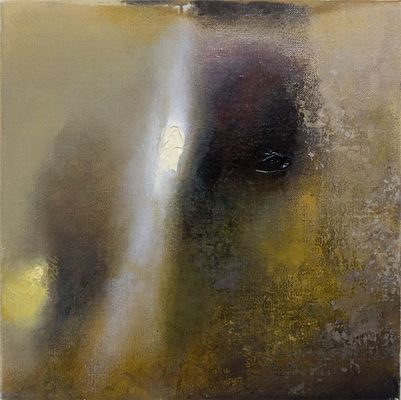
To return to Buckley’s fragment, the first two lines very much evoke how I paint nowadays. As you age, detail diminishes and patches of light become more luminous and float. I feel the most honest way of dealing with this is by smearing the oil paint on the canvas with the fingers and working close-up, blind. Only if the patches coalesce into an approaching image can the work gain a life.
-
Jonathan Walker was born in Melbourne, Australia and brought up on a dairy farm in Gippsland. In the 1970’s he studied painting at RMIT and won the Harold Wright Scholarship to the British Museum, London. During the 1980’s he exhibited at Pinacotheca Gallery, Richmond and had work shown at the NGV and Heidi City Art Gallery. Over the same period he designed the cover for the “Epigenesi” LP by Giancarlo Toniutti, Italy and conducted a mail exchange work with Achim Wollscheid, Germany. The work with artists through the post resulted in an article published in the bicentenary issue of Art and Australia 1988. He showed in artist run spaces such as WestSpace in the 90’s and 2000’s, and until 2012, taught painting at Victoria University, which is where we (Colleen Ahern and Lisa Radford) as organisers of the exhibition, among many others, had the privilege of being his student.
Walker’s knowledge was imparted to students through the careful selection of music, literature, and artists found in books that he himself had ordered for the library. Walker’s strategy was the generosity of sharing his vast knowledge with references specific to each student and their context.
Walker’s paintings share a similar focus and intimacy.
This exhibition presents a small selection of recent paintings alongside a publication that includes Walker’s writing. Observational and analytical, Walker’s work is a type of material notation — the time of day, colour and how it is blended, the both specific and fleeting location of a reflection on lino or the question of whether a chair leg should be included in a painting.
Please join us on Friday August 21 between 6-8pm to celebrate the opening of the exhibition.
Curated by Colleen Ahern and Lisa Radford.
B. Wurtz
Curated by Nic Tammens
March 26 - April 4, 2015
B.Wurtz works from a basement studio in his home on Manhattan’s Lower East Side.
This local fact is attested to by the plastic shopping bags and newsprint circulars that appear in his work. As formal objects, they don’t make loud claims about their origins but nonetheless transmit street addresses and places of business from the bottom of this long thin island. Like plenty of artists, Wurtz is affected by what is local and what is consumed. His work is underpinned by this ethic. It often speaks from a neighborhood or reads like the contents of a hamper:
“BLACK PLUMS $1.29 lb.”
“Food Bazaar”
“USDA Whole Pork Shoulder Picnic 99c lb.”
“RITE AID Pharmacy, with us it’s personal.”
“H. Brickman & Sons.”
“Sweet Yams 59c lb."
Most of the work in this exhibition was made while the artist was in residence at Dieu Donne, a workshop dedicated to paper craft in Midtown. Here Wurtz fabricated assemblages with paper and objects that are relatively lightweight, with the intention that they would be easily transportable to Australia. This consideration isn’t absolute in Wurtz’s work, but was prescriptive for making the current exhibition light and cheap. Packed in two boxes, these works were sent from a USPS post office on the Lower East Side and delivered to North Melbourne by Australia Post.
Wurtz appears courtesy of Metro Pictures, New York.
Thanks to Rob Halverson, Joshua Petherick, Sari de Mallory, Matt Hinkley, Helen Johnson, Fayen d'Evie, Ask Kilmartin, Lisa Radon, Ellena Savage, Yale Union, and "Elizabeth".
John Nixon
"Archive"
December 15 - January 20, 2014
The presentation of John Nixon's archive offered a rare showcase of this extensive collection of the artist's own publications, catalogues, posters, ephemera, editions and more, from the mid 1980s onwards, alongside a selection of his artworks.
Organized by John Nixon, Joshua Petherick and Matt Hinkley.
"Habitat"
at Minerva, Sydney (organised by Joshua Petherick and Matt Hinkley)
November 15 - December 20, 2014
Lupo Borgonovo, Janet Burchill & Jennifer McCamley,
Lewis Fidock, HR Giger, Piero Gilardi, Veit Laurent Kurz,
Cinzia Ruggeri, Michael E. Smith, Lucie Stahl, Daniel Weil, Wols
Press Release:
“...It contained seven objects. The slender fluted bone, surely formed for flight, surely from the wing of some large bird. Three archaic circuitboards, faced with mazes of gold. A smooth white sphere of baked clay. An age-blackened fragment of lace. A fingerlength segment of what she assumed was bone from a human wrist, grayish white, inset smoothly with the silicon shaft of a small instrument that must once have ridden flush with the surface of the skin - but the thing’s face was seared and blackened.”
William Gibson, “Count Zero”, 1986
"Autumn Projects Archive"
Curated by Liza Vasiliou
March 6 - March 15, 2014
World Food Books, in conjunction with the Virgin Australia Melbourne Fashion Festival 2014, presented the Autumn Projects archive, consisting of a selection of early examples in Australian fashion with a particular interest in collecting designers and labels from the period beginning in the 1980’s, who significantly influenced the discourse of Australian Fashion.
Curated by Liza Vasiliou, the exhibition provided a unique opportunity to view pieces by designers Anthea Crawford, Barbara Vandenberg, Geoff Liddell and labels CR Australia, Covers, Jag along with early experimental collage pieces by Prue Acton and Sally Browne’s ‘Fragments’ collection, suspended throughout the functioning World Food Books shop in Melbourne.
H.B. Peace
presented by CENTRE FOR STYLE
November 14, 2013
"Hey Blinky, you say chic, I say same"
Anon 2013
H.B. Peace is a clothing collaboration between great friends Blake Barns and Hugh Egan Westland. Their pieces explore the divergences between 'character’ and ‘personality’ in garments....etc
Special Thanks to Joshua Petherick and Matt Hinkley of WFB and Gillian Mears
and a Very Special Thank you to Audrey Thomas Hayes for her shoe collaboration.
Janet Burchill & Jennifer McCamley
"Aesthetic Suicide"
May 10 - June 8, 2013
The first of our occasional exhibitions in the World Food Books office/shop space in Melbourne, "Aesthetic Suicide" presented a body of new and older works together by artists Janet Burchill & Jennifer McCamley, including videos, prints, a wall work, and publications.
During shop open hours videos played every hour, on the hour.
2025, English
Softcover, 188 pages, 29.5 x 20.5 cm
Published by
AdminAdmin / Melbourne
$45.00 - In stock -
Containing original contributions; artwork, art-historofiction, hagiofiction, critical essays, poetry and prose, some loosely centred around instinct and the mind.
This with contributions by Erik van Lieshout, Peles Duo x Rob Crosse, CAConrad, Robert McKenzie, Mark Beasley, Hany Armanious, Patrick Hartigan, Elizabeth Pulie, Anthea Behm, Luke Stettner, Skyler Brickley, Tommy Miller, Rebecca Holborn, Penelope Latté, Guy Benfield, Jason Vorhees.....and more
2023, English / French
Softcover, 219 pages, 15.2 x 21.5 cm
Published by
City Lights Books / San Francisco
$40.00 - In stock -
Erotic-macabre poetry by an overlooked Surrealist woman from the Middle East.
"You know very well, Joyce, that you are for me—and very objectively too—the greatest poet of our time. Surrealist poetry, that's you."—André Breton
"Your poems know the essential cries, those which speak of passion in its vertigo."—Gaston Bachelard, author of The Poetics of Space
The most significant Surrealist poet to emerge in 1950s Paris was a woman, Joyce Mansour. Mansour was a Syrian Jewish exile from Egypt whose fierce, macabre, erotically charged works gave André Breton's Surrealist group a much-needed jolt after the ravages of the Second World War. Among new adherents, only Mansour wrote poems commensurate with those of Robert Desnos, René Char, Benjamin Péret, and other poets from the movement's heyday. Yet she remains curiously neglected in English translation, and even her posthumous reputation in France suffers from the patriarchal and chauvinist biases of the French literary establishment.
Emerald Wounds: Selected Poems by Joyce Mansour is a much-needed corrective to this state of affairs, a compact yet career-spanning, bilingual anthology of this incendiary poet. With a biographical introduction by translator Emilie Moorhouse, Emerald Wounds showcases the entire arc of Mansour's trajectory as a poet, from the at-once gothic and minimalist fragments of her first collection in 1953, Screams, to the serpentine power of her final poems of the 1980s. Juxtaposing the original French poems with their English translations, Mansour's voice surges forward uncensored and raw, communicating the frustrations, anger, and sadness of an intelligent, worldly woman who defies the constraints and oppression of a male-dominated society that sees women as superficial objects of desire rather than multidimensional, autonomous subjects. Mansour is a poet the world needs today.
2025, English
Softcover, 130 pages, 20.3 x 17.8 cm
Published by
The New York Review of Books / New York
$34.00 - Out of stock
Ancient Mesopotamia, the Zodiac, and the land of the dead feature in this wildly surrealistic adventure story—Leonora Carrington's revolutionary second novel, long out of print.
The Stone Door is an omen, an incantation, and an adventure story rolled into one. Built in layers like a puzzle box, it is the tale of two people, of love and the Zodiac and the Kabbalah, of Transylvania and Mesopotamia converging at the Caucasus, of a mad Hungarian King named Böles Kilary and of a woman's discovery of an initiatory code that leads to a Cyclopean obstacle, to love, self and awareness, to the great stone door of Kescke and beyond.
Written at the end of World War II but not published until 1977 and long unavailable, The Stone Door is at once a celebration of the union of the surrealist painter Leonora Carrington and her husband, the Hungarian-born photographer Chiki Weisz, and an argument for the unification of the male and the female as a means of liberating the human race.
2015, English
Softcover, 116 pages, 12 x 18 cm
Published by
Wakefield Press / Cambridge
$29.00 - Out of stock
In the last days of the Venetian Republic, the successive wives of Count Alvise Lanzi suffer mysterious, agonizing deaths. Murder Most Serene offers a cruel portrait of a beautiful, corrupt city-state and its equally extravagant, cruel, and corrupt inhabitants; redolent of darkness, death, corruption, poison, and transgression, it is also an over-the-top, tongue-in-cheek Venetian romp. Rich in historical detail and bursting with bejeweled putrescence, Gabrielle Wittkop’s chilling memento mori eschews the murder mystery in which it is garbed for a scintillating depiction of physical, moral, societal, and institutional corruption, in which the author plays the role of puppeteer—“present, masked as convention dictates, while in a Venice on the brink of downfall, women gorged with venom burst like wineskins.”
Self-styled heir to the Marquis de Sade, Gabrielle Wittkop (1920–2002) was a French author of a remarkable series of novels and travelogues, all laced with sardonic humor and dark sexuality, with recurrent themes of death, decay, disease, and decrepitude. After meeting Justus Wittkop, a German deserter, in Paris under the Occupation, she hid him from the Nazis and then married him after the war, in what she described as an “intellectual alliance.” He would commit suicide in 1986, with her approval, after being diagnosed with Parkinson’s. Her first novel, The Necrophiliac, appeared in 1972, but a number of her books have only been made available since her own suicide in 2002, after she was diagnosed with lung cancer.
Translated, with an introduction, by Louise Rogers Lalaurie
“To all who suffer under political systems, Wittkop offers a prescription that’s difficult to swallow: the more violent your liberation, the more obscene and criminal you’ll have to become to feel free.” — Joshua Cohen, Harper’s Magazine
“This is dark, rich, deeply disturbing writing, conscious of its artifice and expertly manipulating that.” — M. A. Orthofer, The Complete Review
“This isn’t simply a transcription of past events, but a kaleidoscopic vision of a society on the verge of moral, physical, and political collapse. The inevitable death of the Serene Republic rendered in a precocious admixture of apocalyptic foreboding and arch comedy.” — Karl Wolff, New York Journal of Books
“Wittkop frames her macabre voyeurism in the tradition of the ancient injunction inscribed on the Delphic temple: Know thyself.” — Matt Seidel, The Millions
“[Murder Most Serene] is a romp. Wittkop, too, is a superior writer, and I mean superior to nearly everyone I’ve ever read. These sentences are gorgeous; these sentences are so gorgeous they rekindled my belief in the efficacy of the beautiful. But when I recommend this book to friends, and they dutifully ask me why, I say this, first: Murder Most Serene will be the most fun you have reading this year. It was for me. — Ben Carter Olcott, Three Percent
“[B]y far the most radical of Wittkop’s works thus far available in English, a fascinating—if aesthetically dubious—exploration of Calvinistic world-weariness.” — Mark Molloy, Music & Literature
1995, English
Softcover, 276 pages, 24.5 x 17 cm
1st Edition, Out of print title / used / very good
Published by
Creation Books / London
$80.00 - Out of stock
From Peeping Tom to Videodrome, Mondo Cane to "shockumentaries", Faces of Death to live TV suicides.
The 1994 cult classic, in the updated and revised 1995 edition, Killing for Culture: Death Film from Mondo to Snuff by David Kerekes & David Slater, the definitive investigation into that controversial and inflammatory of all urban myths: the "snuff" movie. Including: Feature film, Mondo film, Death film, and a comprehensive filmography and index. Illustrated by rare and stunning photographs from cinema, documentary and real life, Killing for Culture is a vital book which examines and questions the human obsession with images of violence, dismemberment and death, and the way our society is coping with an increased profusion of these disturbing yet compelling images from all quarters.
Very Good copy.
1993, English
Softcover, 280 pages,
1st Edition, Out of print title / used / very good
Published by
Dedalus / Cambs
$35.00 - In stock -
In the the public mind surrealism is associated primarily with its visual imagery: and this has served to obscure the richness of surrealist contributions in other spheres. This has been particularly so in respect of its rich storytelling tradition...Surrealism draws on older traditions of storytelling, most notably the fairy tale and the Gothic novel...it seeks to capture the mysterious essence of reality and to embody myth and the forces set free by desire.
"The range is impressive, and includes several women...Gisele Prassinos...Leonora Carrington and Meret Oppenheim; contemporary writers like Rikki Ducornet. Richardson makes available in English several early treasures, such as Salvador Dali's Reverie and Pierre Unik's Long Live the Bride, a wonderful tale of mistaken identity and metonymical transfer of meaning." —Fiona Bradley in the Times Literary Supplement
"'I went to fetch my car, but my chauffeur, who has no sense at all, had just buried it,' writes Leonora Carrington in this captivating collection of tales from 17 languages."—The Observer
VG copy.
1992, English
Softcover, 302 pages, 24 x 16.5 cm
1st Edition, Out of print title / used / good
Published by
Cornell University Press / New York
$100.00 - Out of stock
First 1992 edition.
"This brilliant and substantial study will be required reading for critics of Gothic literature and for feminist theorists. Unlike other psychoanalytic readers who localize the 'horror' in Gothic fiction by interpreting it as an effect of repressed anxiety about motherhood or genital sexuality, Massé regards the horror as systemic and actual, and for this reason her study is far more radical, comprehensive, and satisfying. In the Name of Love is challenging and engaging reading that opens out onto new critical territory all the way through." -Claudia L. Johnson, Marquette University
"Massé handles an important topic in a thorough, clear, and interesting fashion. I especially liked the book's combination of theoretical analysis and original readings of texts. In the Name of Love will make a significant contribution in all the areas it treats-feminism, psychoanalysis, and literature."-Shirley Nelson Garner, Department of English, University of Minnesota
The Gothic woman is taught to believe that self-abnegation will be rewarded by love; her experience clearly proves otherwise. Although Gothic fiction has characteristically been written by and for women, this sophisticated and venturesome book is one of the first to examine the contradictions of the Gothic pact in the light of contemporary feminist and psychoanalytic theory. Michelle A. Massé looks at selected British and American novels from the eighteenth century to the present, focusing on the theme of masochism as an element of women's identity. Approaching the Gothic novel by way of psychoanalysis, she also identifies a Gothic plot within psychoanalytic theory itself.
In fiction that ranges from Charlotte Brontë's Jane Eyre, Charlotte Perkins Gilman's The Yellow Wallpaper, and Daphne de Maurier's Rebecca to Gloria Naylor's Linden Hills, Margaret Atwood's Lady Oracle, and Pauline Réage's Story of O, Massé explores the narrative of women being trained to embrace their own subordination. She begins by asserting that the stylistic and structural repetitions of the Gothic constitute both symptoms of this trauma and attempts to work it through. Massé delineates the pattern of women's ego formation in the courtship plot and discusses what she calls "marital Gothic." She then addresses the complicated issues raised by the classic beating fantasy in which the young girl must choose to accept the role of victim, aggressor, or spectator. In her conclusion, she con- siders modes of resistance to this triangular drama and to the related fantasy of romance.
In the Name of Love will be essential reading for scholars and students in the fields of gender studies, critical, psycho-analytic, and novel theory, as well as Victorian and contemporary fiction.
MICHELLE A. MASSÉ is Associate Professor of English at Louisiana State University, Baton Rouge. A graduate of Anna Maria College, she received her Ph.D. degree from Brown University.
Cover illustration: King Cophetua and the Beggar Maid, by Edward Burne-Jones. Tate Gallery, London/Art Resource, New York.
Good copy, light spine tanning/creasing, crease to front cover corner, light wear.
2019, English
Softcover, 160 pages, 19.6 x 12.6 cm
1st Edition, Out of print title / used / very good
Published by
Virago / London
$30.00 - Out of stock
"Tanning's fictional debut unquestionably deserves to be recognised as a complete artistic success...
Tanning has assembled all the ingredients necessary for an extraordinary drama of love and betrayal, jealousy and regret... told in confident, fluid prose highlighted by passages of hallucinatory beauty"—GUARDIAN
In the stark beauty of the desert, a mansion built by a madman rears its impudent architecture like an insult.
The estate is called Windcote, 'its very name a masquerade', and its master, the odious Raoul Meridian, has invited a group of guests to spend a weekend, during the course of which they will find themselves driven by obsessions and confusions unlike any they've experienced before.
Untouched by the fevers and failures around her is the indomitable child Destina, who will lead them into the heart of a mysterious canyon, where desire and cruelty forge an implacable truth.
"It seems hardly fair that Dorothea Tanning, in a long, passionately inventive career as a painter, should have acquired as well the other harmony of prose, and that her passionate inventions as a writer should be so lovingly, so wisely resolved"—RICHARD HOWARD
VG copy.
1982/1992, Japanese
Softcover, 192 pages, 21 x 14.5 cm
Out of print title / used / very good
Published by
Atelier Peyotl / Tokyo
$60.00 - In stock -
"Corpse" Special Feature Issue of cult Japanese underground magazine Yaso, first published in 1982, then re-printed in 1992, edited by Yuichi Konno and Atelier Peyotl (publishers of Night Vision/Yaso/Peyotl/Wave/Silvester Club...). Heavily illustrated with texts in Japanese that look at the theme of death and the dead in the arts, literature, occultism, ancient sciences, philosophy, mythology, poetry, film, crime, and much more. Features John Duncan, Tetsumi Kudo, Cosey Fanni Tutti, Masahisa Fukase, Franz Kafka, Johann Wolfgang von Goethe, Guillaume Apollinaire, Joe Potts (LAFMS), Takashi Ishii, Rudolf II — Holy Roman Emperor, Akinari Ueda, Marcel Duchamp, Chris Burden, Paul Celan, Alain Resnais, Gilyak Amagasaki, Shusaku Arakawa, Pieter Bruegel the Elder, Shuji Terayama, Andy Warhol, Charles Manson, Brian Wilson, Kyoko Endoh, Princess Yongtai, Salvador Dalí, Ono no Komachi, Kiyoshi Kasai, Caravaggio, Throbbing Gristle, Takizawa Bakin, Leno and Rosemary LaBianca, Manson Family, Fyodor Dostoevsky, Wu Zetian, Genesis P-Orridge, Yusuke Nakahara, Ranpo Lagrange, Mitsusada Fukasaku, Nakai Hideo, Richard Wagner, and many more.
Very Good copy.
1960, English
Softcover, 144 pages, 18 x 11.5 cm
1st Edition, Out of print title / used / good
Published by
Berkley Medallion Books / Berkley
$14.00 - In stock -
First Berkeley Medallion Books paperback edition from 1960 of this short science fiction story collection by prolific genre author Murray Leinster, pseudonym of William Fitzgerald Jenkins. Stories include "The Aliens", "Fugitive from Space"; "Anthropological Note", "Skit-Tree Planet", and "Thing from the Sky". Illustrated by Richard Powers.
"WHEN MANKIND MEETS THE ALIENS
Who are the mysterious "aliens"? Some day, in the near or the far-distant future, mankind will meet them. What will happen then?
In this fascinating collection of stories, these questions are asked-and stimulating answers are given-by Murray Leinster, one of today's most prolific and most popular science-fiction writers.
Most scientists agree that many of the millions of planets in our galaxy are hosts to forms of life that are unknown to us-alien forms. They believe so because life will arise wherever the proper conditions exist— and in our teeming galaxy these conditions must exist on tens of thousands of planets.
Some of this strange alien life must be intelligent life. And some day man will encounter it.
What will happen then is thrillingly told in this unusual book by a master of science fiction."—book blurb
Average-Good copy with general wear, toning, foxing.
2000, English
Hardcover (w. dust jacket), 224 pages, 20 x 14 cm
1st Edition, Out of print title / used / good
Published by
Twisted Spoon Press / Prague
$65.00 - In stock -
First hardcover English edition of The Sufferings of Prince Sternenhoch by Ladislav Klíma, published by Twisted Spoon in Prague, 2000. Long out-of-print. Translated from the Czech by Carleton Bulkin. Illustrated by Michal Vavrečka. Afterword by Josef Zumr.
Ladislav Klíma is considered to be one of the most important Czech philosophers of the 20th century, and arguably the greatest of the prewar era. His work has influenced artists of all stripes, most notably Bohumil Hrabal and the Plastic People of the Universe. His approach toward philosophy was similar to that of the sages of ancient India: i.e., one should not limit philosophy to speaking or writing about it, one should live it. In this way Klíma embarked on a lifelong pursuit of becoming “God,” which he equated with Absolute Will. Drawing his greatest inspiration from Schopenhauer and Nietzsche, he developed his conception of will and radical subjectivism in numerous essays, aphorisms, tracts, prose works, and plays. Though he wrote many novels and stories, The Sufferings of Prince Sternenhoch is the only full-length work of fiction Klima prepared for publication during his lifetime. In a series of journal entries, the book chronicles the descent into madness of Prince Sternenhoch, the German Empire's foremost aristocrat and favorite to the Kaiser. Having become the “lowliest worm” at the hands of his deceased wife Helga, the Queen of Hells, he eventually attains an ultimate state of bliss and salvation. Klíma explores here the paradoxical nature of pure spirituality with dark absurdist humor and comically grostesque, often obscene, scenes. This volume also includes Klima's notorious essay “My Autobiography.” Though Klíma's work has been translated into many languages, this is the first book of his to appear in English.
Carleton Bulkin, from the San Francisco area, received an M.A. in Slavic Languages and Literatures from Indiana University. His translations include Hidden History by Otokar Brezina (Twisted Spoon Press, 1998) and A False Dawn by Ilona Lacková (University of Hertfordshire Press, 2000).
Josef Zumr, a member of the Philosophy Institute of the Czech Academy of Sciences, teaches philosophy at Palacky University in Olomouc. He has devoted much of his professional life to Klíma's work.
Michal Vavrečka was born in 1975 in Olomouc. He is a graduate of the School of Fine Arts in Prague and now teaches painting at the State Arts School in Český Krumlov.
"The non-conformist work of Ladislav Klíma has almost always shocked, has often incited scandal, but has hardly ever left us indifferent. It is not necessary to accept his view of the world, but it is possible to live through it and enjoy it in all of its ambiguity, just as one does in the theater."—Václav Havel
"Klíma's tale reads like a book that Edgar Allan Poe might have written if he'd read Nietzsche, but there are also moments of reverie that are pure Czech . . . Klíma's rambunctious mix of high and low style and holy and profane content has been stamped indelibly on the Czech literary tradition."—Washington City Paper
"A dark, diverting entertainment, certainly out of the ordinary ... [Klíma] was a decidedly odd bloke, a real character. But he was not a stupid man, and he could write. This volume is apparently the first book of Klíma's to appear in English. Certainly he is an author deserving wider recognition in the English-speaking world."—The Complete Review
"Given the power of Carleton Bulkin's excellent translation, I can only hope that Twisted Spoon or some other publisher sees fit to soon translate more of Klíma's works—fiction or philosophy . . . The Sufferings of Prince Sternenhoch runs with gale-force intensity and speed."—Tom Bowden, The Education Digest
ISBN 8086264106
224 pp.
14 x 20cm
hardcover
6 full-color illustrations
fiction • novel
cover by Pavel Růt
1993, English
Softcover, 1238 pages, 17.5 x 13 cm
1st Edition, Out of print title / used / average
Published by
Twisted Spoon Press / Prague
$60.00 - Out of stock
Rare first edition of Paul Leppin's most acclaimed book, Severin's Journey into The Dark: A Prague Ghost Story, published in English here for the first time by Twisted Spoon in Prague. Translated from the German by Kevin Blahut
Leppin once wrote: “Prague remains my deepest experience. Its conflicts, its mystery, its ratcatcher’s beauty have ever provided my poetic efforts with new inspiration and meaning.” It is this city of darkened walls and strange decay that forms the backdrop of Severin’s erotic adventures and fateful encounters as he enters a world of femmes fatales, Russian anarchists, dabblers in in the occult, and denizens of decadent salons. First published in 1914, Leppin seeks to unlock the mysterious erotic nature of his native city buried deep in the subconscious of its inhabitants. His depiction of this world, in a Prague straddling the border between the ancient and the modern, has brought Severin’s Journey into the Dark deserved international acclaim. As Max Brod so aptly remarked: "Leppin was the truly chosen bard of the painfully disappearing old Prague..."
Average—Good copy. Internally VG with cover rubbing, darkening and some old sticker damage to back cover. Dedication to inside front cover.
1989, English
Softcover, unpaginated, 20.5 x 13.5 cm
1st Edition, Out of print title / as new
Published by
Creation Books / London
$90.00 - Out of stock
As New copy of this very rare collection of poetry by the master of the macabre Edgar Allan Poe, illustrated throughout with many lithographs by French Symbolist Odilon Redon. A beautiful edition from the beginning of the Creation Books catalogue.
"Deep in earth my love is lying And I must weep alone." (1847)
"Edgar Allan Poe (1809-1849) considered himself foremost a poet. Even his best-remembered tales read as prose-poems; obsessive tracts on dream and trance, catalepsy, premature burial, fetishism, necrophilia: a canon of ossified manias whose morbidness is reflected in the substance of his verse compositions. These, epistles of a poisoned romance between body and soul, charting febrile dreamscapes, seem to reflect the writer's life of sexual torment through a drink and opium mirror; a symphony of dead brides and delirium.
It was this doomed spiral that Baudelaire later recognized in announcing his own credo of perpetual intoxication; his "Fleurs du Mal" were inspired directly by Poe, sickly blooms that in turn coil through the feverclaws of Rimbaud, or the foetid distortions of Lautreamont. Right through to the claustrophobic cosmogenies of H.P. Lovecraft and perhaps beyond, the spirit of Poe resonates throughout the history of insane literature.
The poems selected for this present volume chart Poe's idealistic disintegration; from youthful Byronic romanticism, as in the long, convoluted and naive narrative "Al Aaraaf" (1829) into his more familiar, hallucinant cartography of the necropolis - most starkly expressed in the spiritual nadir of "The Conqueror Worm" (1842). In "Ulalume", for example, the writer is compelled to
revisit the swamplands where he has entombed the corpse of his butchered bride on a previous Hallowe'en; in "The Raven" , he is haunted by that dread harbinger of menstruation with promises of a spectral visitation from a mistress beyond the grave. The much-anthologized "Annabel Lee" - included here, as are several poems, in a lesser-known early version - is an unveiled paean to necrophilia.
The above-mentioned pieces are just some of many oneiric shards from that lost and fragmented mosaic, the glittering yet entombed genius of the artist - dreamland glimpsed through the sarcophagus lid of the heavens."
"Odilon Redon (1840-1916) was compelled to reproduce the most insane images from his unconscious, inspired by such "dangerous" writers of his time as Poe, Baudelaire, and Flaubert. Acclaimed by the Symbolists, clearly anticipating Surrealism, his bizarre and macabre works were immortalized by description in Joris-Karl Huysmans' profane bible "A Rebours" ("Against Nature") of 1884 -itself one of the strangest books ever committed to print.
The lithographs reproduced herein are from Redon's series "A Edgar Poe" of 1882."
—James Havoc (introduction)
Fine—As New copy.
1999, English
Softcover, 96 pages, 13.5 x 21.5 cm
1st Edition, Out of print title / used / fine
Published by
Creation Books / London
$45.00 - In stock -
Dead Brides contains the vampire cycle of live stories, written between 1835 and 1842, which in many ways forms the nucleaus of Poe's prose work: Berenic, Montella, The Fall of the House of Usher, and The Oval Portrait. In these classic tales, Poe investigates the vampiric nature of human relationships, including love and lust both normal and incestuous, and develops his theme to observe the vampiric qualities inherent in the creative or artistic process.
Vampirism, with its terrible energy exchanges and lesions, is ultimately Poe's analogy for a love that persists beyond the grave - an all-consuming passion that knows no peace until an undead reconciliation is effected.
With a preface by Jeremy Reed, Dead Brides is illustrated by the lithographs of the Symbolist Odilon Redon, who was compelled to reproduce the most insane images from his unconcious through the inspiration of Baudelaire, Huysmans, and other dangerous writers of his age.
Near Fine copy.
1961 / 1971, English
Softcover, 196 pages, 16 x 10.5 cm
Out of print title / used / very good
Published by
Scholastic Book Services / USA
$15.00 - In stock -
1971 print of this popular 1961 pocket-book collection of eight classic stories by the master of horror, Edgar Allan Poe. Fantastic stories of the dreamlike; unreal, world of Edgar Allan Poe. " The Fall of the House of Usher", "Ligeia", "The Mask of the Red Death", plus five others that hover on the edges of madness, sounding the knell of doom.
Good—VG copy with general wear/age.
1978, English
Hardcover (w dust jacket), 160 pages, 23.5 x 16 cm
1st Edition, Out of print title / used / fine
Published by
Dent / London
$40.00 - In stock -
First 1978 hardcover edition of this anthology of the "eerie, weird and wicked".
"The diversity of this collection, chosen by a mastermind of the macabre, is a guarantee of success. Some of the stories are chilling, some surprising and bewildering, some unexpectedly tragic—but all are memorable. There are many forms of horror— sometimes it comes disguised as a normal occurrence, or it appears in a lovely chateau on the Riviera—or on a slave ship, in a tale of revenge. Franz Kafka writes of a horrific experience in his memorable tale. Ray Bradbury shows us that even a love relationship is not always free from terror, and Evelyn Waugh's description of peaceful days in a tropical sun, reading Dickens, catches us completely unprepared for the devastating horror which erupts.
Features the short stories of Ray Bradbury, Evelyn Waugh, R. C. Cook, Algernon Blackwood, Miriam Allen deFord, Robert Graves, Fielden Hughes, E F Benson, Richard Middleton, Stanley Ellin, Franz Kafka, Christine Campbell Thomson & L P Hartley.
Jacket drawing by Alex Brychta.
NF/NF DJ.
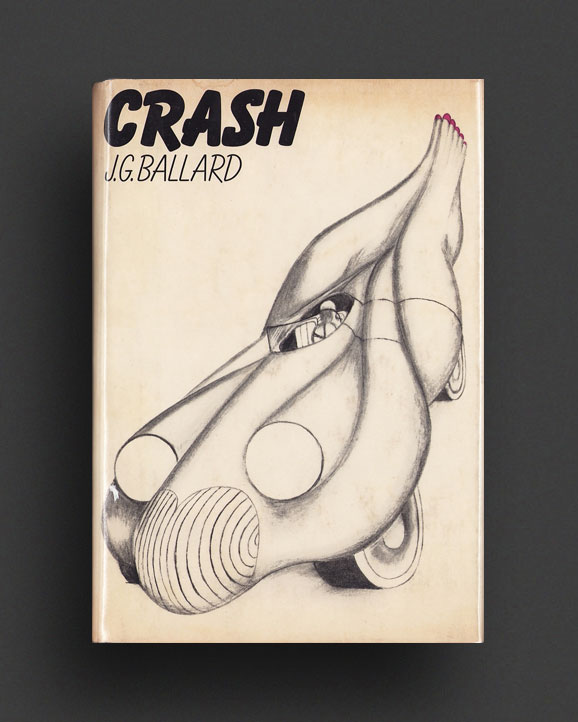
1995, English
Softcover, 224 pages, 20 x 13 cm
Out of print title / used / good
Published by
Vintage / UK
$20.00 - Out of stock
1995 Vintage UK paperback edition.
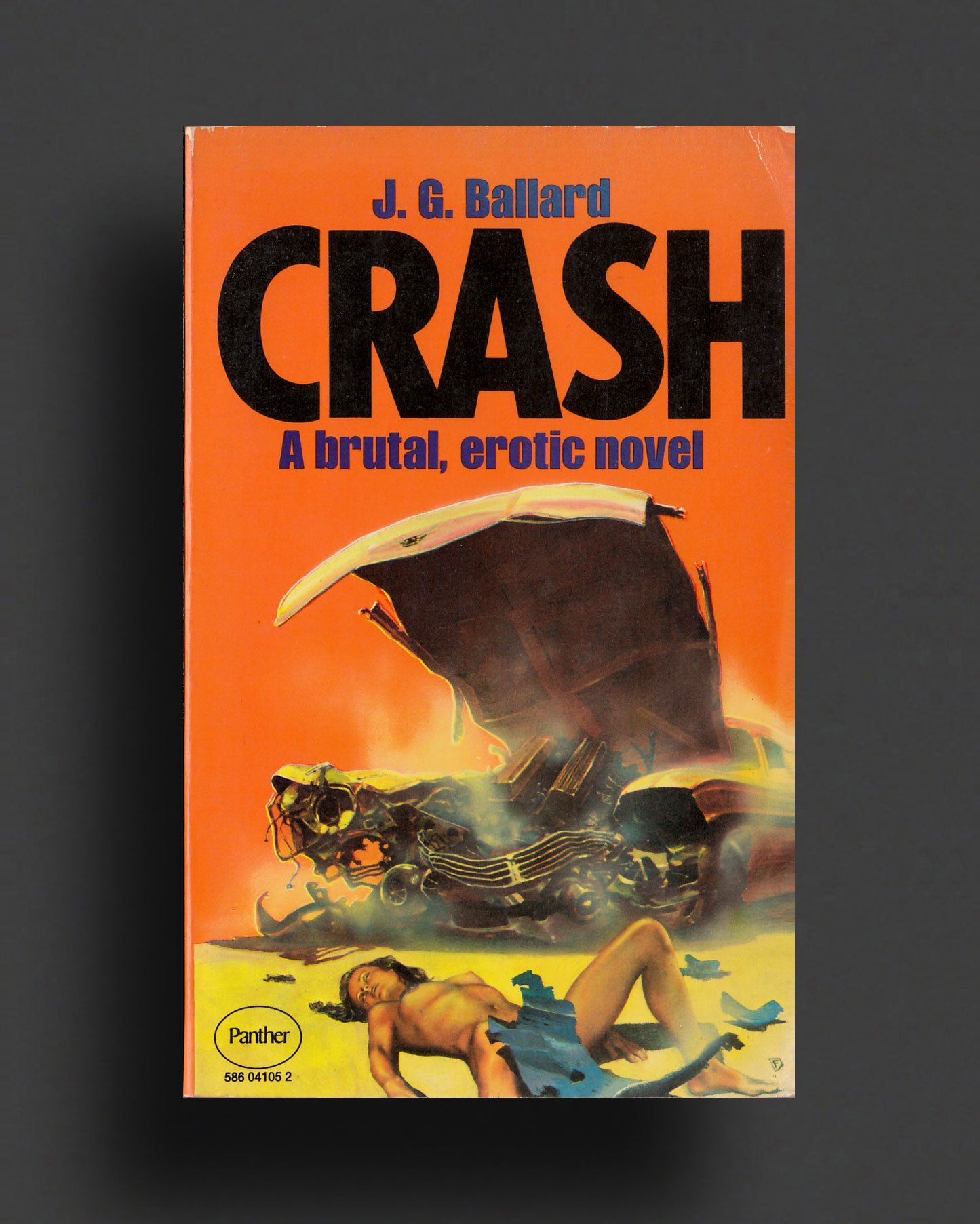
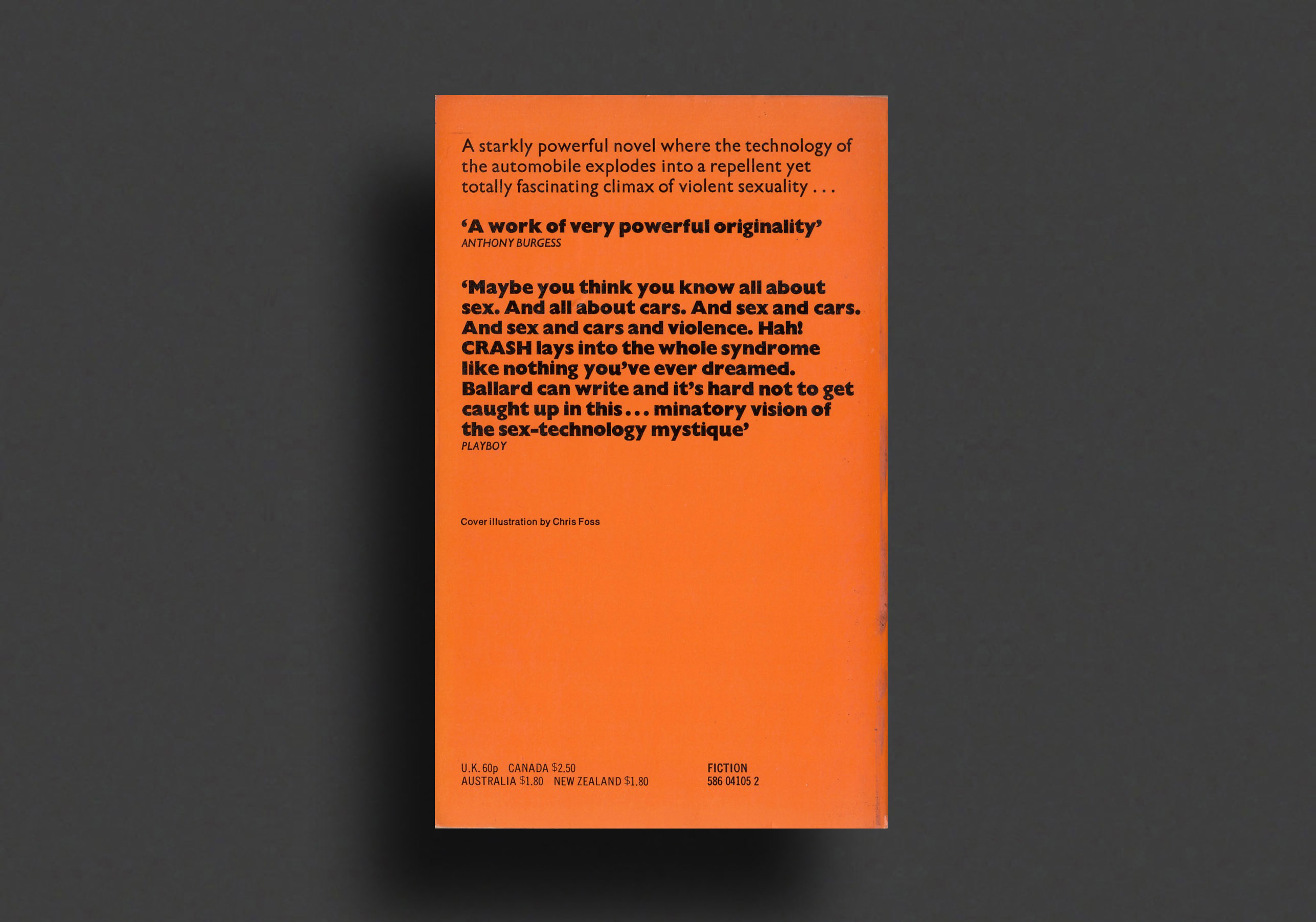
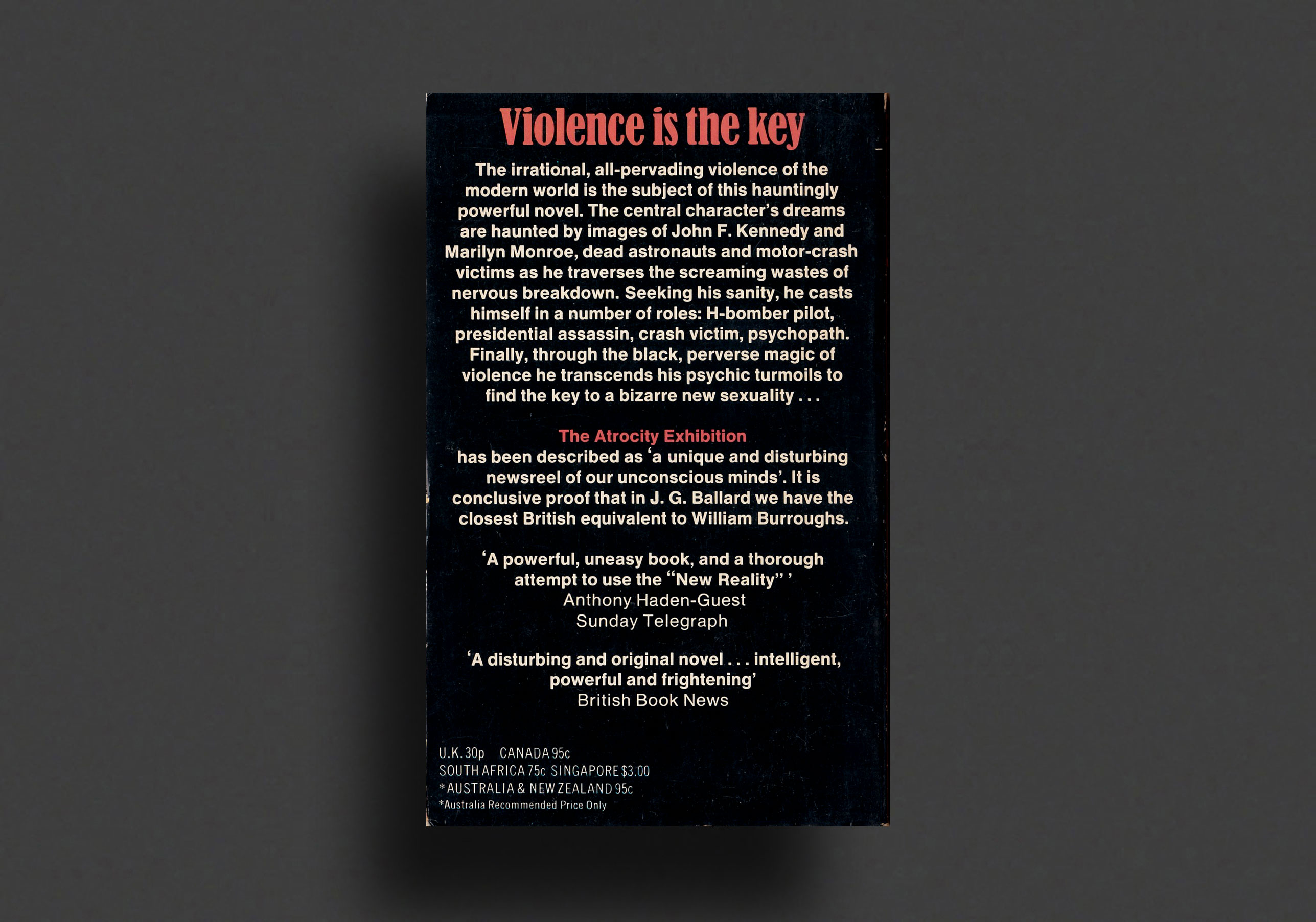
"The cult status of Crash has intensified since its original publication in 1973, making it a classic of underground literature. In this hallucinatory novel, the car provides the hellish tableau in which Vaughan, a 'TV scientist' turned 'nightmare angel of the highways', experiments with erotic atrocities among crash victims, each more sinister than the last: ultimately, he craves a union of blood, semen, and engine coolant in a head-on collision with Elizabeth Taylor."—book jacket
"A writer of enormous inventive powers, Ballard has, like Calvino, a remarkable gift for filling the empty, deprived spaces of modern life with invisible cities and the wonder worlds of the imagination"—Malcolm Bradbury, New York Times Book Review
"Ballard is amongst our finest writers of fiction"—Anthony Burgess
Good copy, bit "kinky" from storage, toned pages, cover wear.
1992, English
Softcover, 132 pages, 21 x 13.5 cm
1st Edition, Out of print title / used / very good
Published by
Atlas Press / London
$50.00 - Out of stock
First 1992 English Atlas Press edition.
A literary masterpiece of early Surrealism from the virtuoso of automatic writing, Robert Desnos.
Mystery, the marvelous, the city of Paris transmuted by love, and Sanglot the Corsair's pursuit of the siren Louise Lame: these are the essential ingredients of Liberty or Love!, a masterpiece of early Surrealism written by Robert Desnos (1900-1945) and first published in 1924 to immediate acclaim. Characters appear and disappear at whim; they walk underwater and accept the most astounding coincidences with calm nonchalance. This crown jewel of Surrealist eroticism is part hymn to the erotic and part adventure story illumined by the shades of Lautréamont, Jack the Ripper and Sade. Desnos was famously lauded by André Breton--in his First Manifesto of Surrealism--for having come "closest to the Surrealist truth," and his novel is a dream at once violent and tender--the perfect embodiment, in fact, of the Surrealist spirit: joyful and despairing, and effortlessly scandalous.
Very Good copy some wear to covers.
1970, English
Softcover, 234 pages, 17.7 x 10.5 cm
Out of print title / used / very good
Published by
Ballantine Books / New York
$25.00 - Out of stock
First 1970 Ballantine edition of At the Edge of the World, a collection of thirty fantasy short stories by legendary Irish writer Lord Dunsany. Edited, introduction, notes and afterword by American author, editor and critic of science fiction and fantasy, Lin Carter.
“Dunsany’s stories are a priceless possession for any lover of fantasy. Like first-rate poetry, they are endlessly readable. Those who have not read them have something to look forward to, and an assortment of Dunsany is the foundation stone of any fantasy collection.”—L. Sprague de Camp
"Dunsany loves the vivid green of jade and of copper domes, and the delicate flush of sunset on the ivory minarets of impossible dream cities. To the truly imaginative he is a talisman and a key unlocking rich storehouses of dream."—H. P. Lovecraft
"Had I read Idle Days on the Yann when I was a boy, I had perhaps been changed... and looked to that first reading as the creation of my world."—William Butler Yeats
"The creative romanticist alone can engineer a satisfying evasion of workaday life. Thanks to these haphazard sorcerers, my life has been a marvellous affair. I have quested past the lair of Tharagavrug, to the steel gate, to The Porte Resonante, of the Fortress Unvanquishable; and I am now upon the point of going in to cut off, for the third or fourth time, Gaznaks Gaznak's evil head."—James Branch Cabell
Very Good—Near Fine copy, well preserved, unread, only toning to block edges.
1981, English
Hardcover (w. dust jacket), 500 pages, 23.5 x 16 cm
1st Edition, Out of print title / used / very good
Published by
Avenel / New York
$40.00 - In stock -
First 1981 hardcover edition of 'A Treasury of Fantasy', a 500 page collection of classic Fantasy tales through the ages, edited by Cary Wilkins at the height of the 1970s/1980s revival in the fantastic fiction genre, illustrated with 46 imaginative illustrations from such fine artists as Aubrey Beardsley, H. J. Ford, Arthur Hughes, Richard Doyle, Lancelot Speed, and others.
"Beyond time, beyond space, "beyond the fields we know" —fantasy reveals to us not only unexplored worlds but also the unexplored realms of our imagination. Spanning seven centuries, the stories and novels in this book will take you through enchanted forests, magnificent palaces, and dragon-haunted caves to rocky shores at the end of the world."
Includes:
The Elves – Johann Ludwig Tieck, The King of the Golden River – John Ruskin, Phantastes – George MacDonald, The Wood Beyond the World – William Morris, The King of Elfland's Daughter – Lord Dunsany, The Doom That Came to Sarnath – H. P. Lovecraft, Swords of the Purple Kingdom – Robert E. Howard, The Rule of Names – Ursula K. Le Guin
"Prepare yourself for mystical journeys through the unbounded worlds of fantasy.
Once you've been there and back, you may find your journeys are only beginning."
VG copy in VG DJ with some minor shipping to top edge of DJ, general light toning/foxing to edges of block.
1992, English
Softcover, 224 pages, 19.5 x 12.5 cm
1st Edition, Out of print title / used / very good
Published by
Dedalus / Cambs
$30.00 - Out of stock
First 1992 Dadalus English translation of The Green Face, Meyrink's second novel, published in Germany in 1916 to critical and commercial acclaim. With cover art by Richard Oelze.
"Its setting is Amsterdam, which is used in the novel as a symbol of European decadence, and is ultimately destroyed. "The novel has the classic Meyrink features - the mystical wedding, the galaxy of grotesque characters and the haunting atmosphere of the ghetto. Mike Mitchell's superb translation of The Green Face will help establish Gustav Meyrink's reputation as one of this century's most important authors of fantastic fiction."—book jacket
"Meyrink's The Green Face is second in visionary power only to The Golem... By creating an all-pervading atmosphere of kafkaesque mystery and uncertainty, Meyrink succeeds in suggesting inexhaustible depths and heights of meaning."—Franz Rottensteiner
Good—VG copy with light wear/toning.
1997, Japanese
Softcover (w. dust jacket), 104 pages, 21 x 29.5 cm
1st Edition, Out of print title / used / good
Published by
Treville / Tokyo
$120.00 - Out of stock
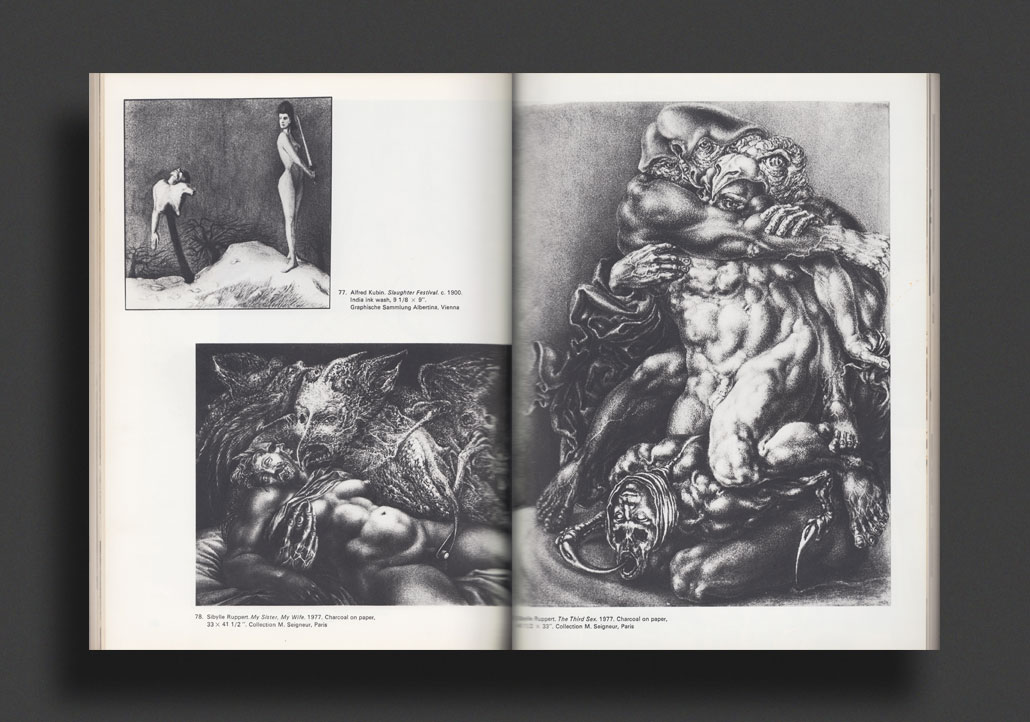
Scarce copy of the now out-of-print Biomannerism book, first edition, published in Japan by Treville in 1997. An incredible selection of international artists linked through their exploration of new aesthetics of erotic metamorphosis between the organic and synthetic compiled with texts by Stéphan Lévy Kuentz. Features lavishly illustrated chapters dedicated to the works of artists Daniel Ouellette, Michel Henricot, Sibylle Ruppert, Joe Hackbarth, Tsutomu Otsuka, Beksinski, Yoshifumi Hayashi, Jean-Marie Poumeyrol, H. R. Giger.
"The erotic Biomannerism movement is a creature of the cyberage, an expression of technophobia and fear of mutation. The artists represented here come from the U.S., France, Germany, Japan, and Switzerland, but they share a Kafkaesque view of the human condition, which they express in twisting, writhing, bulging, disintegrating images of the human form. Inspiration flows from Michelangelo, Dali, da Vinci, Rubens, and Duchamp, as well as Blade Runner, Frankenstein, and Intel."
Good copy due to a small knock/closed tear to a few pages, otherwise Very Good in VG dust jacket with only light general wear.
1960, English
Softcover, 160 pages, 18 x 10.5 cm
1st Edition, Out of print title / used / good
Published by
Dell / New York
$20.00 - In stock -
First 1960 Dell paperback edition of Theodore Sturgeon's Venus Plus X, a 1961 Hugo Award finalist for Best Novel. David Pringle included it in his book Science Fiction: The 100 Best Novels.
Charlie Johns has been snatched from his home on 61 North 34th Street and delivered to the strange future world of Ledom. Here, violence is a vague and improbable notion. Technology has triumphed over hunger, overpopulation, pollution, even time and space. But there is a change Charlie finds even more gender is a thing of the past. Venus Plus X is Theodore Sturgeon's brilliant evocation of a civilization for whom tensions between male and female and the human preoccupation with sex no longer exist.
As Charlie Johns explores Ledom and its people, he finds that the human precepts he holds dear are profane in this new world. But has Charlie learned all there is to know about this advanced society? And why are the Ledom so intent on gaining Charlie's approval? Unsettling, compelling, and no less than visionary, here is science fiction at its a novel whose wisdom and lyricism make it one of the most original and insightful speculations on gender ever produced.
Theodore Sturgeon (1918–1985) is considered one of the godfathers of contemporary science fiction and dark fantasy. The author of numerous acclaimed short stories and novels, among them the classics More Than Human, Venus Plus X, and To Marry Medusa, Sturgeon also wrote for television and holds among his credits two episodes of the original 1960s Star Trek series, for which he created the Vulcan mating ritual and the expression "Live long and prosper." He is also credited as the inspiration for Kurt Vonnegut's recurring fictional character Kilgore Trout.
Sturgeon is the recipient of the Hugo Award, the Nebula Award, and the International Fantasy Award. In 2000, he was posthumously honored with a World Fantasy Award for Life Achievement.
Good copy with general age, heavy toning, foxing, etc.
1972, English
Softcover, 160 pages, 17.7 x 11 cm
Out of print title / used / good
Published by
Corgi / London
$10.00 - Out of stock
1972 Corgi paperback edition of Theodore Sturgeon's Venus Plus X, a 1961 Hugo Award finalist for Best Novel. David Pringle included it in his book Science Fiction: The 100 Best Novels.
Charlie Johns has been snatched from his home on 61 North 34th Street and delivered to the strange future world of Ledom. Here, violence is a vague and improbable notion. Technology has triumphed over hunger, overpopulation, pollution, even time and space. But there is a change Charlie finds even more gender is a thing of the past. Venus Plus X is Theodore Sturgeon's brilliant evocation of a civilization for whom tensions between male and female and the human preoccupation with sex no longer exist.
As Charlie Johns explores Ledom and its people, he finds that the human precepts he holds dear are profane in this new world. But has Charlie learned all there is to know about this advanced society? And why are the Ledom so intent on gaining Charlie's approval? Unsettling, compelling, and no less than visionary, here is science fiction at its a novel whose wisdom and lyricism make it one of the most original and insightful speculations on gender ever produced.
Theodore Sturgeon (1918–1985) is considered one of the godfathers of contemporary science fiction and dark fantasy. The author of numerous acclaimed short stories and novels, among them the classics More Than Human, Venus Plus X, and To Marry Medusa, Sturgeon also wrote for television and holds among his credits two episodes of the original 1960s Star Trek series, for which he created the Vulcan mating ritual and the expression "Live long and prosper." He is also credited as the inspiration for Kurt Vonnegut's recurring fictional character Kilgore Trout.
Sturgeon is the recipient of the Hugo Award, the Nebula Award, and the International Fantasy Award. In 2000, he was posthumously honored with a World Fantasy Award for Life Achievement.
Good copy with general age, toning, etc. discolouration to edges/spine.