World Food Books' programme is largely produced on Kulin Nation land. We acknowledge the Wurundjeri people of the Kulin Nation as the first and continuing custodians of this land, and pay respect to their Elders past, present, and emerging.
World Food Books is an arts and special interests bookshop in Naarm / Melbourne. Founded in 2010, World Food Books is devoted to the presentation of a rotating, hand-selection of international art, design, literary and counterculture publications with an emphasis on the anti-traditional, the experimental, the avant-garde, the heretic, the marginal.
Presenting new titles alongside rare and out-of-print books, catalogues and journals spanning the fields of modern and contemporary art, design, photography, illustration, film, literature, poetry, cultural theory, philosophy, sexuality, popular and underground culture in its many radical forms, World Food Books wishes to encourage adventurous, thoughtful and open-minded reading, looking, writing, and exchange of publishing and ideas, both current and historical.
As well as our bookshop, located in Melbourne's historical Nicholas Building, all of our inventory is available internationally via our online mail-order service.
World Food Books semi-regularly co-ordinates "Occasions", a programme of exhibits and events at the bookshop and in partnership with other hosts (such as museums and art galleries) that develop out of the activities, relationships and content of the bookshop itself.
World Food Books
The Nicholas Building
37 Swanston Street
Room 5, Level 6
Melbourne 3000
Australia
SHOP HOURS:
THU–SAT 12–6
WEB-SHOP OPEN 24/7
World Food Books
Postal Address:
PO Box 435
Flinders Lane
Victoria 8009
Australia
info@worldfoodbooks.com
Art
Theory / Essay
Architecture / Interior
Graphic Design / Typography
Photography
Fashion
Eros
LGBTQ+
Fiction / Poetry
Weird / Speculative / Science Fiction / Horror
Transgressive / Visceral / Abject
Symbolism / Decadence / Fin de siècle
Film / Video
Painting
Sculpture / Installation
Performance / Dance / Theater
Drawing
Sound / Music
Curatorial
Group Shows / Collections
Periodicals
Out-of-print / Rare
Posters / Ephemera / Discs
Signed Books
World Food Books Gift Voucher
World Food Book Bag
Australian Art
Australian Fiction
Australian Science Fiction / Speculative Fiction
Australian Poetry
Australian Photography
Japanese Photography
Conceptual Art
Minimal Art
Dada
'Pataphysics / Oulipo
Fluxus
Concrete Poetry
Pop Art
Surrealism
Arte Povera
Arte Informale / Haute Pâte / Tachism
Nouveau Réalisme / Zero / Kinetic
Situationism / Lettrism
Collage / Mail Art / Xerox Art
Art Brut / Folk / Visionary / Fantastic
Illustration / Graphic Art / Bandes Dessinées
Furniture
Italian Radical Design / Postmodernism
Textiles
Ceramics / Glass
Counterculture
Protest / Revolt
Philosophy
Psychoanalysis
Anthropology
Anarchism
Socialism / Anarchism / Communism / Capitalism
Literary Theory / Semiotics / Language
Feminism / Women's Studies
Gender Studies / Sexuality
Anthropology
Fetishism / BDSM
Drugs / Psychedelia
Crime / Violence
Animal Rights / Veganism
Occult / Esoterica
Ecology / Earth / Alternative Living
Whole Earth / Crafts
All prices in AUD (Australian dollars)
Pick-Ups
Pick-up orders can be collected in our bookshop during opening hours after order date. Please collect any Pick-up orders within 2 weeks of ordering as we have limited storage space. Orders will be released back into stock if not collected within this time. No refunds can be made for pick-ups left un-collected. If you cannot make it in to the bookshop in this time-frame, please choose postage option.
Return Policy
All sales are final. We do accept returns (for refund or exchange) for items received in error. All our orders are packed with special care using heavy-duty padding and cardboard book-mailers or bubble mailers (for smaller books), using reinforcement where required. We cannot take responsibility for any lost, stolen or damaged parcels.
Insurance
Should you wish to insure your package, please email us directly after placing your order and we can organise this at a small extra expense. Although all standard/express tracked packages are very safe and dependable, we cannot take responsibility for any lost, stolen or damaged parcels. We recommend insurance on valuable orders.
Interested in selling your old books, catalogues, journals, magazines, comics, fanzines, ephemera? We are always looking for interesting, unusual and out-of-print books to buy. We only buy books in our fields of interest and specialty, and that we feel we can resell.
We base these prices on desirability, market value, in-print prices, condition and our current stock levels. We offer cash, store credit, and can take stock on consignment. All
about 25% of the price we expect to get when we sell them, or 30% in store credit. We base these prices on desirability, market value, in-print prices, condition and our current stock levels.
Sell your books any day of the week. You can drop them off and return later. If you have a lot of books, we can visit your Sydney home.
We buy books that we feel we can resell. We offer about 25 % of the price we expect to get when we sell them, or 30% in store credit. We base these prices on desirability, market value, in-print prices, condition and our current stock levels.
Philadelphia Wireman
03 August - 01 September, 2018
World Food Books is proud to announce our next Occasion, the first presentation of sculptures by Philadelphia Wireman in Australia.
The Philadelphia Wireman sculptures were found abandoned in an alley off Philadelphia’s South Street on trash night in 1982. Their discovery in a rapidly-changing neighbourhood undergoing extensive renovation, compounded with the failure of all attempts to locate the artist, suggests that the works may have been discarded after the maker’s death. Dubbed the "Philadelphia Wireman" during the first exhibition of this work, in 1985, the maker’s name, age, ethnicity, and even gender remain uncertain. The entire collection totals approximately 1200 pieces, all intricately bound together with tightly-wound heavy-gauge wire (along with a few small, abstract marker drawings, reminiscent both of Mark Tobey and J.B. Murry). The dense construction of the work, despite a modest range of scale and materials, is singularly obsessive and disciplined in design: a wire armature or exoskeleton firmly binds a bricolage of found objects including plastic, glass, food packaging, umbrella parts, tape, rubber, batteries, pens, leather, reflectors, nuts and bolts, nails, foil, coins, toys, watches, eyeglasses, tools, and jewellery.
Heavy with associations—anthropomorphic, zoomorphic, and socio-cultural responses to wrapped detritus—the totemic sculptures by Philadelphia Wireman have been discussed in the context of work created to fulfil the shamanistic needs of alternative religions in American culture. Curators, collectors, and critics have variously compared certain pieces to sculpture from Classical antiquity, Native American medicine bundles, African-American memory jugs, and African fetish objects. Reflecting the artist’s prolific and incredibly focused scavenging impulse, and despite—or perhaps enhanced by—their anonymity, these enigmatic objects function as urban artefacts and arbiters of power, though their origin and purpose is unknown. Philadelphia Wireman, whatever their identity, possessed an astonishing ability to isolate and communicate the concepts of power and energy through the selection and transformation of ordinary materials. Over the course of the past two decades, this collection has come to be regarded as an important discovery in the field of self-taught art and vernacular art.
Presented in collaboration with Fleisher-Ollman Gallery, Philadelphia, and Robert Heald, Wellington.
Susan Te Kahurangi King
02 February - 10 March, 2018
Susan Te Kahurangi King (24 February 1951 - ) has been a confident and prolific artist since she was a young child, drawing with readily available materials - pencils, ballpoint pens and felt-tip markers, on whatever paper is at hand. Between the ages of four and six Susan slowly ceased verbal communication. Her grandparents William and Myrtle Murphy had developed a special bond with Susan so they took on caring responsibilities for extended periods. Myrtle began informally archiving her work, carefully collecting and storing the drawings and compiling scrapbooks. No drawing was insignificant; every scrap of paper was kept. The King family are now the custodians of a vast collection containing over 7000 individual works, from tiny scraps of paper through to 5 meter long rolls.
The scrapbooks and diaries reveal Myrtle to be a woman of great patience and compassion, seeking to understand a child who was not always behaving as expected. She encouraged Susan to be observant, to explore her environment and absorb all the sights and sounds. Myrtle would show Susan’s drawings to friends and people in her community that she had dealings with, such as shopkeepers and postal workers, but this was not simply a case of a grandmother’s bias. She recognised that Susan had developed a sophisticated and unique visual language and sincerely believed that her art deserved serious attention.
This was an unorthodox attitude for the time. To provide some context, Jean Dubuffet coined the term Art Brut in 1945 to describe work created by self-taught artists – specifically residents of psychiatric institutions and those he considered to be visionaries or eccentrics. In 1972 Roger Cardinal extended this concept by adopting the term Outsider Art to describe work made by non-academically trained artists operating outside of mainstream art networks through choice or circumstance. Susan was born in Te Aroha, New Zealand in 1951, far from the artistic hubs of Paris and London that Dubuffet and Cardinal operated in. That Myrtle fêted Susan as a self-taught artist who deserved to be taken seriously shows how progressive her attitudes were.
Susan’s parents Doug and Dawn were also progressive. Over the years they had consulted numerous health practitioners about Susan’s condition, as the medical establishment could not provide an explanation as to why she had lapsed into silence. Dawn educated herself in the field of homeopathy and went on to treat all twelve of her children using these principles – basing prescriptions on her observations of their physical, mental and emotional state.
Doug was a linguist with an interest in philosophy who devoted what little spare time he had to studying Maori language and culture. To some extent their willingness to explore the fringes of the mainstream made them outsiders too but it was their commitment to living with integrity and their respect for individuality that ensured Susan’s creativity was always encouraged.
Even though Susan’s family supported her artistic pursuits, some staff in schools and hospitals saw it as an impediment to her assimilation into the community and discouraged it in a variety of ways. Her family was not always aware of this and therefore did not fully understand why Susan stopped drawing in the early 1990s. However, rather than dwell on the challenges that Susan faced in pursuit of her artistic practice, they prefer to highlight her achievements. In 2008 Susan began drawing again in earnest, after an almost 20 year interruption, and her work is now shown in galleries around the world.
Susan grew up without television and has been heavily influenced by the comics she read as a child. She is absolutely fearless in the appropriation of recognizable characters, such as Donald Duck and Mickey Mouse, in her work. She twists their limbs, contorts their faces, compresses them together, blends them into complex patterned backgrounds - always imbuing them with an incredible energy. Although Susan often used pop culture characters in her work they are not naive or childlike. These are drawings by a brilliant self-taught artist who has been creating exceptional work for decades without an audience in mind.
Mladen Stilinović
"Various Works 1986 - 1999"
02 February 16 - September 10, 2016
Various works 1986 - 1999, from two houses, from the collections of John Nixon, Sue Cramer, Kerrie Poliness, Peter Haffenden and Phoebe Haffenden.
Including: Geometry of Cakes (various shelves), 1993; Poor People’s Law (black and white plate), 1993; White Absence (glasses, ruler, set square, silver spoon, silver ladel with skin photograph and wooden cubes), 1990-1996; Exploitation of the Dead (grey and red star painting, wooden painting, black spoon with red table, red plate), 1984-1990; Money and Zeros (zero tie, paintings made for friends in Australia (Sue, John, Kerrie), numbers painting), 1991-1992; Words - Slogans (various t-shirts) - “they talk about the death of art...help! someone is trying to kill me”, “my sweet little lamb”, “work is a disease - Karl Marx”; Various artist books, catalogues, monographs, videos; Poster from exhibition Insulting Anarchy; "Circular" Croatian - Australian edition; Artist book by Vlado Martek (Dostoyevsky); more.
Thanks to Mladen Stilinović and Branka Stipančić.
Jonathan Walker
Always Will Need To Wear Winter Shirt Blue + Ochre Small Check Pattern
21 August - 21 September, 2015
Untitled
I am not a great reader of poetry but I always return to the work of Melbourne poet, Vincent Buckley (1925- 1988). Perhaps I find his most tantalising piece to be not a finished poem but a fragment left on a scrap of paper discovered on his desk after the poet’s death.
The poetry gathers like oil
In the word-core, and spreads
It has its music meet,
Its music is in movement.
This fragment is more the shell left behind from a volatile thought than a finished poem. I find the last two lines honest but awkward whereas the first two lines work like an arrow. Most likely he could not find a resolution so it was left. Still, in its present form, it remains an eloquent testimony to the ultimate failure of a medium to express mobile thought and sensation, in Buckley’s case, through verbal language. It’s an important matter because this is something all artists have to deal with regardless of the medium.
I have never written a poem, however, I am forever copying fragments from books on paper scraps in a vain effort to fix certain notions in my head. At first, they function as bookmarks that are sometimes returned to when I open the book. But before long, as they accumulate, they fall out littering the table interspersed with A4 photocopies, bills, books and medications.
To return to Buckley’s fragment, the first two lines very much evoke how I paint nowadays. As you age, detail diminishes and patches of light become more luminous and float. I feel the most honest way of dealing with this is by smearing the oil paint on the canvas with the fingers and working close-up, blind. Only if the patches coalesce into an approaching image can the work gain a life.
-
Jonathan Walker was born in Melbourne, Australia and brought up on a dairy farm in Gippsland. In the 1970’s he studied painting at RMIT and won the Harold Wright Scholarship to the British Museum, London. During the 1980’s he exhibited at Pinacotheca Gallery, Richmond and had work shown at the NGV and Heidi City Art Gallery. Over the same period he designed the cover for the “Epigenesi” LP by Giancarlo Toniutti, Italy and conducted a mail exchange work with Achim Wollscheid, Germany. The work with artists through the post resulted in an article published in the bicentenary issue of Art and Australia 1988. He showed in artist run spaces such as WestSpace in the 90’s and 2000’s, and until 2012, taught painting at Victoria University, which is where we (Colleen Ahern and Lisa Radford) as organisers of the exhibition, among many others, had the privilege of being his student.
Walker’s knowledge was imparted to students through the careful selection of music, literature, and artists found in books that he himself had ordered for the library. Walker’s strategy was the generosity of sharing his vast knowledge with references specific to each student and their context.
Walker’s paintings share a similar focus and intimacy.
This exhibition presents a small selection of recent paintings alongside a publication that includes Walker’s writing. Observational and analytical, Walker’s work is a type of material notation — the time of day, colour and how it is blended, the both specific and fleeting location of a reflection on lino or the question of whether a chair leg should be included in a painting.
Please join us on Friday August 21 between 6-8pm to celebrate the opening of the exhibition.
Curated by Colleen Ahern and Lisa Radford.
B. Wurtz
Curated by Nic Tammens
March 26 - April 4, 2015
B.Wurtz works from a basement studio in his home on Manhattan’s Lower East Side.
This local fact is attested to by the plastic shopping bags and newsprint circulars that appear in his work. As formal objects, they don’t make loud claims about their origins but nonetheless transmit street addresses and places of business from the bottom of this long thin island. Like plenty of artists, Wurtz is affected by what is local and what is consumed. His work is underpinned by this ethic. It often speaks from a neighborhood or reads like the contents of a hamper:
“BLACK PLUMS $1.29 lb.”
“Food Bazaar”
“USDA Whole Pork Shoulder Picnic 99c lb.”
“RITE AID Pharmacy, with us it’s personal.”
“H. Brickman & Sons.”
“Sweet Yams 59c lb."
Most of the work in this exhibition was made while the artist was in residence at Dieu Donne, a workshop dedicated to paper craft in Midtown. Here Wurtz fabricated assemblages with paper and objects that are relatively lightweight, with the intention that they would be easily transportable to Australia. This consideration isn’t absolute in Wurtz’s work, but was prescriptive for making the current exhibition light and cheap. Packed in two boxes, these works were sent from a USPS post office on the Lower East Side and delivered to North Melbourne by Australia Post.
Wurtz appears courtesy of Metro Pictures, New York.
Thanks to Rob Halverson, Joshua Petherick, Sari de Mallory, Matt Hinkley, Helen Johnson, Fayen d'Evie, Ask Kilmartin, Lisa Radon, Ellena Savage, Yale Union, and "Elizabeth".
John Nixon
"Archive"
December 15 - January 20, 2014
The presentation of John Nixon's archive offered a rare showcase of this extensive collection of the artist's own publications, catalogues, posters, ephemera, editions and more, from the mid 1980s onwards, alongside a selection of his artworks.
Organized by John Nixon, Joshua Petherick and Matt Hinkley.
"Habitat"
at Minerva, Sydney (organised by Joshua Petherick and Matt Hinkley)
November 15 - December 20, 2014
Lupo Borgonovo, Janet Burchill & Jennifer McCamley,
Lewis Fidock, HR Giger, Piero Gilardi, Veit Laurent Kurz,
Cinzia Ruggeri, Michael E. Smith, Lucie Stahl, Daniel Weil, Wols
Press Release:
“...It contained seven objects. The slender fluted bone, surely formed for flight, surely from the wing of some large bird. Three archaic circuitboards, faced with mazes of gold. A smooth white sphere of baked clay. An age-blackened fragment of lace. A fingerlength segment of what she assumed was bone from a human wrist, grayish white, inset smoothly with the silicon shaft of a small instrument that must once have ridden flush with the surface of the skin - but the thing’s face was seared and blackened.”
William Gibson, “Count Zero”, 1986
"Autumn Projects Archive"
Curated by Liza Vasiliou
March 6 - March 15, 2014
World Food Books, in conjunction with the Virgin Australia Melbourne Fashion Festival 2014, presented the Autumn Projects archive, consisting of a selection of early examples in Australian fashion with a particular interest in collecting designers and labels from the period beginning in the 1980’s, who significantly influenced the discourse of Australian Fashion.
Curated by Liza Vasiliou, the exhibition provided a unique opportunity to view pieces by designers Anthea Crawford, Barbara Vandenberg, Geoff Liddell and labels CR Australia, Covers, Jag along with early experimental collage pieces by Prue Acton and Sally Browne’s ‘Fragments’ collection, suspended throughout the functioning World Food Books shop in Melbourne.
H.B. Peace
presented by CENTRE FOR STYLE
November 14, 2013
"Hey Blinky, you say chic, I say same"
Anon 2013
H.B. Peace is a clothing collaboration between great friends Blake Barns and Hugh Egan Westland. Their pieces explore the divergences between 'character’ and ‘personality’ in garments....etc
Special Thanks to Joshua Petherick and Matt Hinkley of WFB and Gillian Mears
and a Very Special Thank you to Audrey Thomas Hayes for her shoe collaboration.
Janet Burchill & Jennifer McCamley
"Aesthetic Suicide"
May 10 - June 8, 2013
The first of our occasional exhibitions in the World Food Books office/shop space in Melbourne, "Aesthetic Suicide" presented a body of new and older works together by artists Janet Burchill & Jennifer McCamley, including videos, prints, a wall work, and publications.
During shop open hours videos played every hour, on the hour.
2025, English
Softcover, 160 pages, 30.5 x 22.6 cm
Published by
Richardson / New York
$77.00 - In stock -
New "California" themed issue of of Richardson magazine, the cult magazine that navigates the murky boundaries between art and obscenity, edited by Andrew Richardson (of Richardson label, fashion stylist w. Supreme, CK, Valentino, etc.) and art direction by Laura Genninger of STUDIO 191 (designer of AnOther Magazine, etc.). Featuring Sky Bri, Photographed by Harley Weir. With additional work by Frances Stark, Mario Ayala, Andy Capper, Bruce Wagner, Ed Ruscha, Bruce LaBruce, Chivas Clem, Alex Kekesi, Delicious Tacos, Jack Mason, Kazumi, Karley Sciortino, Noah Kumin, Taylor Lorenz, Weirdo Dave / Fuck This Life, William E. Jones, Scarlett Kapella, Stewart Home, Rosie Marks, A. Kircher, Anna Khachiyan, and Dasha Nekrasova.
2013, English
Softcover, 160 pages, 30.6 x 22.6 cm
1st Edition, Out of print title / used / fine
Published by
Richardson / New York
$220.00 - In stock -
Incredible seventh issue ("The Death Issue") of Richardson magazine, the cult magazine that navigates the murky boundaries between art and obscenity, edited by Andrew Richardson (of Richardson label, fashion stylist w. Supreme, CK, Valentino, etc.) and art direction by Laura Genninger of STUDIO 191 (designer of AnOther Magazine, etc.). This seventh issue features features Tori Black on the cover (and inside) photographed by Nobuyoshi Araki, Aaron Bondaroff, Antoine D'Agata, Nobuyoshi Araki, Aurel Schmidt, Bela Borsodi, Bill Henson, Bjarne Melgaard, Bret Easton Ellis, Genesis Breyer P-Orridge, Christopher Wool, Cy Twombly, Cyprien Gaillard, Dan Colen, Daniel Johnston, Danny Lyon, Doping Pong, Enrique Metindes, Weirdo Dave / Fuck This Life, Fuyuko Matsui, Giasco Bertoli, Glenn Kenny, Gunter Brus, Hanna Liden, Harmony Korine, Jack Webb, Jack Donoghue, James Dearlove, Jenny Saville, Jim Goad, Joe Coleman, John Holland, John Willie, Pope John Paul II, Kiyotaka Tsurisaki, Leon Lefarge, Michael Schmidt, Mila Djordjevic, Namio Harukawa, Nate Lowman, Pascal Dangin, Paul McCarthy, Peter Saville, Robert Crumb, Raymond Pettibon, Richard Prince, Sophia Al Maria, Stewart Home, Terry Richardson, Toshio Saeki, Trevor Brown, Vince Aletti.
Near Fine copy.
2010, English
Softcover, 128 pages, 30.5 x 22.5 cm
1st Edition, Out of print title / used / very good
Published by
Richardson / New York
$220.00 - In stock -
Incredible fourth issue ("The Female Gaze Issue") of Richardson magazine, the cult magazine that navigates the murky boundaries between art and obscenity, edited by Andrew Richardson (of Richardson label, fashion stylist w. Supreme, CK, Valentino, etc.) and art direction by Laura Genninger of STUDIO 191 (designer of AnOther Magazine, etc.). This fourth issue (The Female Gaze Issue) features the Sasha Grey cover photographed by Glen Luchford (w. continued photo feature inside), and featuring work by Carolee Schneemann, Valie Export, Genesis P-Orridge, GB Jones, Alex Needham, Amy Kellner, Kira Jolliffe, Bunny Yeager, Tristan Taormino, Michelle Maccarone, Mila Djordjevic, Gunter Rambow, V. Vale/ Re/Search, Simon Ford, Clara Herve & Eugene Krafft, Carol Bove, Sue Williams, Tracy Emin, Carolin Kunst & Sunje Todt, Kotaro Iizawa, and much more. Riddled with bans and confiscations due to explicit un-censored imagery by Japanese censorship standards.
Very Good copy.
1998, English / Japanese
Softcover, 128 pages, 30.5 x 22.5 cm
1st Edition, Out of print title / used / very good
Published by
Little More / Tokyo
Richardson / New York
$250.00 - Out of stock
Controversial inaugural (December 1998) issue of Richardson magazine, the cult 1990's art/sex magazine published by Little More in Japan, edited by Andrew Richardson (of Richardson label, fashion stylist w. Supreme, CK, Valentino, etc.) and art direction by Laura Genninger of STUDIO 191 (designer of AnOther Magazine, etc.). Navigating the murky boundaries between art and obscenity, an honourable pursuit in Japan, this first issue features the double-cover (censored and non-censored) of adult film star Jenna Jameson shot by Glen Luchford, along with J.J. photo feature and interview, Richard Prince’s “Spiritual America” text and photography/artworks inc. the infamous 11-year-old Brooke Shields piece, "Be Broken" erotic artwork gallery by Harmony Korine, "Love Letter to Amerika" from Takashi Homma, Terry Richardson photography, "Cunt" fiction by Stewart Home, photos by French cinematographer (Gummo, Ulysse, Boy Meets Girl, etc.) Jean-Yves Escoffier, Japanese V-Cinema and pink star Nao Saejima, Stewart Home on Cosey Fanni Tutti, many works of photography and text by American photojournalist and writer Erika Langley, erotic photography by skater Ed Templeton of photographer and wife Deanna Templeton, vintage erotica collection by photographer Bela Borsodi, poetry and more! Riddled with bans and confiscations due to explicit un-censored imagery by Japanese censorship standards.
Texts in both English and Japanese.
Very Good copy.
2010, Japanese
Softcover, 208 pages, 24 x 18.5 cm
1st Edition, Out of print title / used / very good
Published by
Atelier Peyotl / Tokyo
$65.00 - Out of stock
Incredible Hans Bellmer special feature Issue of cult Japanese underground magazine Yaso, published in 2010, edited by Yuichi Konno and Atelier Peyotl (publishers of Night Vision/Yaso/Peyotl/Wave/Silvester Club...). Being a magazine specialising in the doll arts it was only natural that they would dedicate an entire issue to the ground-breaking work of German Surrealist Hans Bellmer and the development of his dolls, and pay homage to his immense influence on Japanese doll artists by discussing his work with them. Heavily illustrated with reproductions of Bellmer's iconic doll photography and drawings, alongside reproduced and translated original texts, extensive chronology of Bellmer and Unica Zürn, the drawing and anagram work of his partner Zürn, an invaluable bibliography of publications related to Bellmer to date, and many portraits of the artist. There is an extensive chronicle of doll history and development stretching from 1902—2010 and a large part of the issue is made up of heavily illustrated exclusive interviews with Japanese artists influenced by the legacy of Bellmer, including Simon Yotsuya, Nori Doi, Ryo Yoshida, Tatsumi Hijikata, Makoto Onozuka, Kishin Shinoyama, Minori Nawata, and more, surveys contemporary doll artists Volks, PEACH-PIT, naruto, Hizuki, Tari Nakagawa, Minori Nawata, Os, Akihiko Aono, mican, Ayumi, Masanao, Katan Amano, Nishioka Bro. & Sis., and many more, and includes essays by Sue Taylor, Alice Mahon, Kumi Ogata... absolutely packed with content and a valuable Bellmer reference in the context of his Japanese influence on the arts.
Very Good copy.
2025, English
Softcover (staple-bound), 12 pages, 13.4 x 13.6 cm
Limited Edition,
Published by
Oriette Wood / Naarm
$40.00 - In stock -
"Comic Trials" is a new small edition hand silk-screen and assembled graphic zine from Oriette Wood.
"A homage to the golden age of comics, this screen printed publication is an exercise of drawing and half-toning in colour, formatted like a comic panel. Like a lot of my work these pages are scenes of love, kink, femininity, and something other."—Oriette Wood
Silkscreened in very limited edition
1994, English
Softcover (staple bound), 68 pages, 21 x 15 cm
1st Edition, Out of print title / used / very good
Published by
Yellow Press / UK
$50.00 - In stock -
Rare English film digest / fanzine by celebrated genre writer and editor of Giallo Pages, John Martin, "... And You Will Live In Terror!", published by Yellow Press is devoted entirely to Italian master Lucio Fulci's incredible 1981 Southern Gothic supernatural horror film, The Beyond, story created. Written by Dardano Sacchetti, and starring Catriona MacColl and David Warbeck, its plot follows a woman who inherits a hotel in rural Louisiana that was once the site of a horrific murder, and which may be a gateway to hell. It is the second film in Fulci's Gates of Hell trilogy after City of the Living Dead (1980), and was followed by The House by the Cemetery (1981). The Beyond ranks among Fulci's most celebrated films, and has gained an international cult following. This little book reproduces all of its glory in glossy full-colour and b/w, packed with film stills, lobby cards, posters and other visual documents, accompanying Martin's texts and production details. Martin is an author, editor and authority on the British "video nasties" phenomenon and all things exploitation all'italiana.
Very Good copy.
1990, English
Softcover (staple bound), 36 pages, 21 x 15 cm
1st Edition, Out of print title / used / very good
Published by
The FFM Association / Paris
$50.00 - In stock -
Rare copy of Fantasy Film Memory Presents "Shockers" issue no. 2 of the film digest / fanzine, published in France in October 1990, and devoted entirely to "The Poet of the Macabre", Italy's giallo gore master Lucio Fulci (1927—1996). This English text book is packed with glossy colour and b/w film stills, lobby cards, posters, and on-set photos and other visual documents, not to mention loads of spectacular Fulci mania, accompanying texts and information compiled by Jean-Claude Michel. A must for any fan. The "Shockers" series was published in 4 issues between 1990—1991.
Very Good copy.
2025, English
Softcover, 224 pages, 20 x 13.67 cm
Published by
Semiotext(e) / Los Angeles
$39.00 - Out of stock
A long-form dialogue—on cinema and survival—with the visionary French filmmaker.
"The virtuous always engage in a pseudoreligious morality. But there’s one thing they never say: the desire for pleasure is thought in motion. It’s what makes you transfigure a dull and repetitive sexual act into something that can bring you to ecstasy and an idea of eternity..."—Catherine Breillat to Murielle Joudet
Catherine Breillat has always told just one story: her own, the story of a young girl whose existence was forbidden, who was, from childhood, cut in half, split between her mind and her sexuality, marked by the shame of being born female. She became a filmmaker at a time when choosing that vocation meant disobeying the world.
During six months between September 2022 and March 2023, the film critic Murielle Joudet interviewed Catherine Breillat for thirty hours, often following up with further discussion over the phone. Joudet and Breillat discuss each of her films in chronological order, moving freely between Breillat’s cinematic vision, her life, and the situations, artworks, and thought that have inspired her films.
From A Real Young Girl (1975) to Last Summer (2023), Breillat has made films in an attempt to recover what she believes was stolen from her— the “unfilmable,” inexhaustible grey area of the feminine where shame, transgression, sensuality, disgust, and the search for oneself intertwine until they become indistinguishable. Her work proposes a haunting imperative to know oneself... and for her heroines, this spiritual search plays out as an open war with the opposite sex.
A conversation with Catherine Breillat is as much a cinema master class as it is a lesson in survival.
Catherine Breillat is a filmmaker and writer based in Paris. She is known not only for her films focusing on themes of sexuality but also for her bestselling novels.
Murielle Joudet is a film critic for Le Monde, as well as for TV and radio. She is the author of Isabelle Huppert- Vivre ne nous regarde pas (2018), Gena Rowlands- On aurait d dormir (2020), and La Seconde Femme- Ce que les actrices font la vieillesse (2022).
1990, Japanese
Softcover (w. dust jacket), 196 pages, 21 x 15 cm
1st Edition, Out of print title / used / fine
Published by
Sanwa / Tokyo
$60.00 - In stock -
"Packed with embarrassing photos submitted by masochistic women!"
1990 Issue 41 of Mania Club, a Japanese SM/Kinbaku glossy magazine published by Sanwa Publishing, edited by Akira Matsuyama and accomplished rope artist (Kinbakushi) Masato Marai, who was once assistant to Chimuo Nureki and also edited SM Mania, SM Hisyousetsu, SM Sniper, and contributed to SM Select and SM Fan. Profusely illustrated throughout with bondage and fetish photo galleries in colour and b/w by professionals and amateurs alike, this issue with a central gallery by master of kinbaku photography Norio Sugiura. Originally published as a special edition of SM Mania, Mania Club became a regular publication that took a unique approach. Alongside commissioned professional shoots, Mania Club proudly declares that it is the only fully-fledged SM Magazine in Japan that is based on submissions, and is created together with its readers, much in the tradition of long-lost SM pioneers Kitan Club and Fuzoku Kitan.
This special first "Women's Gold" issue with "Shameplay" feature is lead entirely by submissions from masochistic women all over Japan who enjoy public exposure, humiliation, embarrassment, obscene behaviour, and the pleasure of exhibitionism in all imaginable forms (urophilia, scatophilia, punishment, flashing, pet play...). Abundantly illustrated with colour and b/w photographs of their private and not-so-private sexual proclivities.
"The contributors who send photos and notes to Mania Club are all people who have dedicated their lives to the pursuit of sex. It has a different impact than the average SM magazine. Outdoor training maniacs, anus lovers, uniform fetishists, pee lovers, masturbation maniacs, etc. Countless practitioners show us the profound world of eroticism. These genuine photographs and notes from people who have experienced it are a deeply moving record of love and sex. A must-see for anyone interested in "sex.""—Mania Club afterword
Fine copy in Fine dust jacket.
1968, Japanese
Softcover (lenticular cover w. illustrated slipcase), 244 pages, 18.5 x 12.5 cm
1st Edition, Out of print title / used / very good
Published by
Bijyutsu Shuppan / Tokyo
$200.00 - In stock -
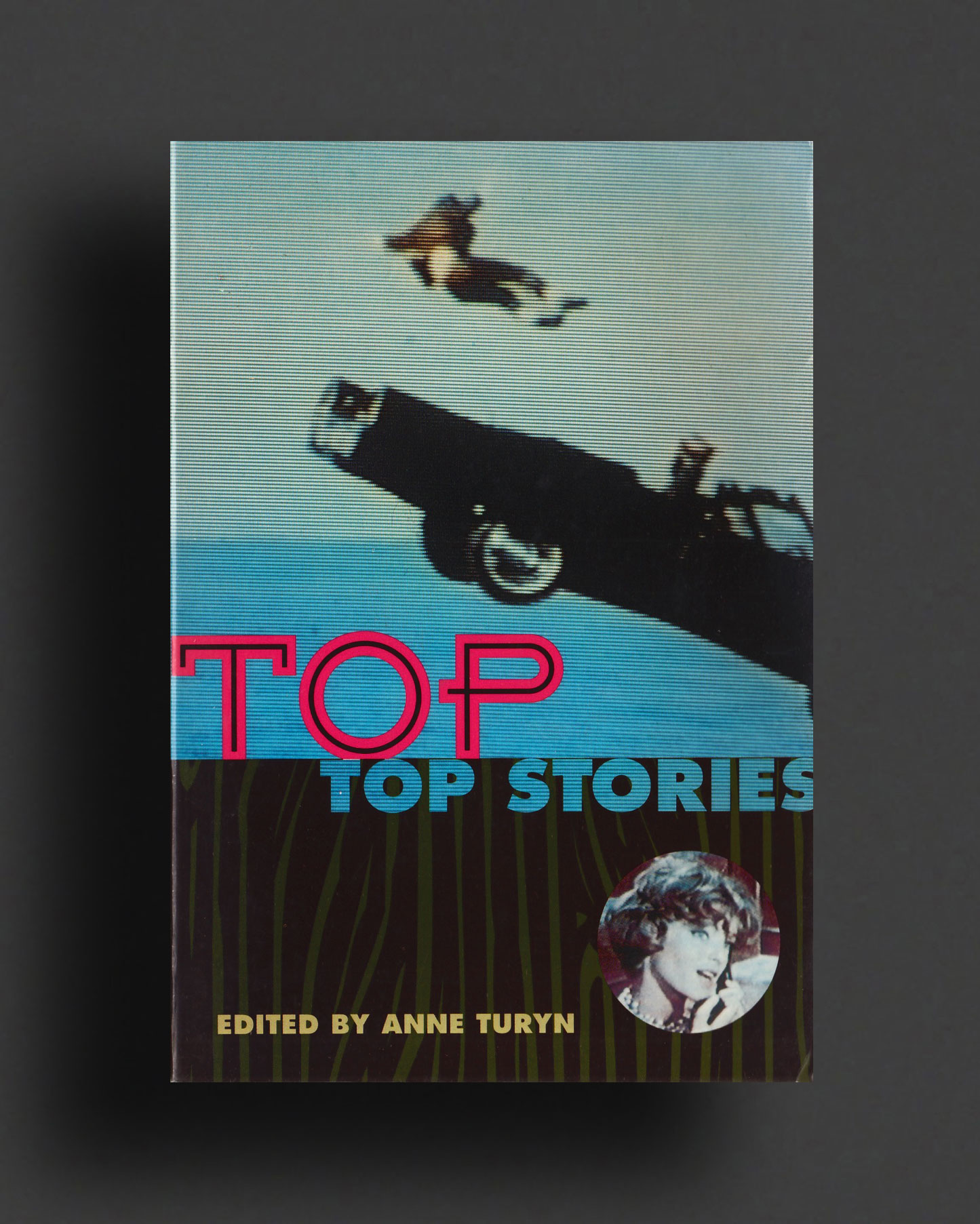
Rare first 1968 slipcase edition of legendary Japanese Neo-Dadaist Ushio Shinohara's autobiography art-book, published right before he left Japan for New York City. With endorsement on the slipcase from Japanese artist and theorist Tarō Okamoto, the book is as explosively designed as an iconic Shinohara boxing performance. Wrapped in a lenticular cover and spanning many different paper stocks and fold-out plates, "The Way of the Avant-Garde" is profusely illustrated with bold graphics, exhibition and performance photographs, cartoons and collages accompanying Shinohara's texts that document his post-war avant-garde work in Tokyo — a violent blend of Japanese unrest, Action Art and American Pop.
Ushio Shinohara (b. 1932), nicknamed “Gyu-chan” (Little Cow) for his iconic Mohawk haircut, was a pivotal member of the Neo-Dada movement (or Neo-Dada Organizers) in Japan along with artists Genpei Akasegawa, Masunobu Yoshimura, Shūsaku Arakawa, Sayako Kishimoto, Tetsumi Kudō, Natsuyuki Nakanishi, etc. The book focuses on his struggling years as a young artist in Japan, the early radical performances, actions, and exhibitions staged by himself and his peers in the avant-garde — impulsive spectacles, often involving physical destruction of objects, that the art critic Ichirō Hariu deemed "savagely meaningless," and that inspired another art critic, Yoshiaki Tōno, to coin the term "anti-art" (han-geijutsu). The term group member Genpei Akasegawa would later use was "creative destruction" whereby the group sought to create a space for new types of art to emerge by systematically seeking out and destroying all existing artistic norms and conventions. Examples included filling galleries with piles of garbage, smashing furniture to the beat of jazz music, and prancing the streets of Tokyo in various states of dress and undress. Using the human body as their medium of art, their violent performances reflected both their dissatisfaction with the restrictive environment of the Japanese art world at the time, as well as contemporary social developments, most notably the massive 1960 Anpo protests against the U.S.-Japan Security Treaty.
In June 1960, Akasegawa read out the group's "manifesto" (written by Ushio Shinohara) to a group of reporters:
"No matter how much we fantasize about procreation in the year 1960, a single atomic explosion will casually solve everything for us, so Picasso’s fighting bulls no longer move us any more than the spray of blood from a run-over stray cat. As we enter the blood-soaked ring in this 20th century—a century which has trampled on sincere works of art—the only way to avoid being butchered is to become butchers ourselves."
This statement conveyed a sense of hopeless desperation that, at a time when attempts to create new forms of art were being suffocated by oppressive ideologies and hide-bound institutions, the only way to save art was to kill it.
Shinohara embraced Pop Art as early as 1963. In 1964, Shinohara was inspired to creatively “copy” Robert Rauschenberg’s “Coca-Cola Plan” (1958), having seen the work pictured in an article by the iconic Japanese critic Yoshiaki Tono in “Mizue” magazine. Shinohara explained: “As I was looking closely at how it was made, I noticed the use of three empty Coca-Cola bottles and realized there were tons of empty Coca-Cola bottles in my backyard.” Because the original work by Rauschenberg had been reproduced in the magazine in black-and-white, Shinohara invented the colors for his own duplicative assemblage (of which he made ten), incorporating bright white and accents of yellow and red. When Rauschenberg visited Shinohara’s studio with Tono while visiting Tokyo in the same year, he was surprised to see Shinohara’s reimagining of his work, joyfully exclaiming, “My son!”
The book features Robert's creative friendship with Shinohara and documents their events and discussions together in Tokyo, illustrated with wonderful visual spreads of the “Coca-Cola Plan(s)", which contributed to an important artistic questioning of authorship and consumer culture that pre-occupied both artists.
Ushio has lived and worked in New York since 1969, his work has been exhibited internationally at institutions including the Hara Museum of Contemporary Art, Centre Georges Pompidou, the Guggenheim Museum SoHo, National Museum of Modern Art, Tokyo, Leo Castelli Gallery, New York, Museum of Contemporary Art, Los Angeles and The Metropolitan Museum of Art, Seoul, and others. Shinohara and his wife, Noriko, are the subjects of a documentary film by Zachary Heinzerling called Cutie and the Boxer.
Very Good copy in Good—VG slipcase (slipcase has some light marking an old damp-stains/toning, mostly to the back) otherwise well preserved.
1991, English
Softcover, 118 pages, 21 x 14.5 cm
Out of print title / used / very good
Published by
AK Press / Edinburgh
$50.00 - Out of stock
First AK Press 1991 edition of Stewart Home's THE ASSAULT ON CULTURE: UTOPIAN CURRENTS FROM LETTRISM TO CLASS WAR, first published in 1988 by Aporia Press and Unpopular Books. Chapters: Cobra, The Lettriste Movement, The Lettriste International (1952-57), The College Of Pataphysics, Nuclear Art and the International Movement for an Imaginist Bauhaus, From the "First World Congress of Liberated Artists" to the foundation of the Situationist International, The Situationist International in its heroic phase (1957-62)., On the theoretical poverty of the Specto-Situationists and the legitimate status of the Second International, The decline and fall of the Specto-Situationist critique, The origins of Fluxus and the movement in its 'heroic' period, The rise of the depoliticized Fluxus aesthetic, Gustav Metzger and Auto-Destructive Art, Dutch Provos, Kommune 1, Motherfuckers, Yippies and White Panthers, Mail Art, Beyond Mail Art, Punk, Neoism, Class War, plus bibliography.
*A straightforward account of the vanguards that followed Surrealism: Lettrisme, Fluxus, Neoism and others even more obscure"—Village Voice
"Home's book is the first that I know of to chart this particular 'tradition' and to treat it seriously.
It is a healthy corrective to the overly aestheti-cised view of 20th century avant-garde art that now prevails."—City Limits
"Much of the information is taken from obscure sources and the book is essential reading for anyone interested in the subject. It demystifies the political and artistic practices of opponents to the dominant culture and serves as a basic reference for a field largely undocumented in English. It is also engagingly honest, unpreten-tious, questioning and immediate in its impact"—Artists Newsletter
"Reflecting the uncategorisable aspect of art that hurls itself into visionary politics, the book will engage political scientists, performance artists and activists"—Art and Text
"Apocalyptic in the literal sense of the word: an uncovering, revelation, a vision"—New Statesman
"A concise introduction to a whole mess of troublemakers through the ages... well written, incisive and colourful"—NME
"Informative and provocative"—Art Forum
Very Good copy.
1992, English
Softcover, 190 pages, 18 x 11.5 cm
1st Edition, Out of print title / used / good
Published by
Semiotext(e) / Los Angeles
$25.00 - Out of stock
First 1992 Semiotext(e) Foreign Agents edition of "Sick Burn Cut (At Last the Reappearance of Our Lady of the Ugly Ones in Spokane, Washington)" by Deran Ludd.
"Mary is a 31-year-old man with a revolver in a cheap cotton dress."
Good copy with age/light wear to block edge/cover edges.
1986, English
Hardcover (w. dust jacket), 144 pages, 22.9 x 25.1 cm
1st Edition, Out of print title / used / very good
Published by
Aperture / New York
$550.00 - In stock -
First 1986 hardcover edition of Nan Goldin’s classic photo book, The Ballad of Sexual Dependency, published by Aperture, New York. A landmark work in the field of raw sociological reportage, The Ballad of Sexual Dependency is a visual diary chronicling the struggles for intimacy and understanding among the friends and lovers whom Goldin describes as her “tribe.” These photographs described a lifestyle that was visceral, charged and seething with a raw appetite for living, and the book soon became the swan song for an era that reached its peak in the early 1980s. Through an accurate and detailed record of Goldin’s life, The Ballad of Sexual Dependency records a personal odyssey as well as a more universal understanding of the different languages men and women speak. All these years later, Goldin’s lush color photography and candid style still demand that the viewer encounter their profound intensity head-on. The book’s influence on photography and other aesthetic realms continues to grow, making it a classic of contemporary photography.
From Goldin's introduction: "I sometimes don't know how I feel about someone until I take his or her picture. I want the people in my pictures to stare back. I want to show exactly what my world looks like, without glamorization, without glorification."
"Nan Goldin’s Ballad of Sexual Dependency is a beggar’s opera of recent times. Here were real thieves and unexpected heroes, and a sense that some things in life might still be worth a brawl."—Artforum
Nan Goldin was born in Washington, D.C., in 1953, and grew up in Lexington, Massachusetts. Her first solo show was held in Boston in 1973. She moved to New York in 1979, where she began documenting the city’s gay and transvestite scenes and developed the informal snapshot aesthetic for which she is celebrated today. Goldin was the 2007 recipient of the Hasselblad Award.
Very Good—Near Fine copy with VG dust jacket. Definite 1986 first edition in the original unclipped ($39.95) dust jacket, designed by Keith Davis.
1995, English
Softcover, 252 pages, 24.5 x 17 cm
1st Edition, Out of print title / used / very good
Published by
Creation Books / London
$80.00 - In stock -
First 1995 Creation edition of Deathtripping, the first illustrated history, account and critique of the "Cinema Of Transgression", providing a long-overdue and comprehensive documentation of this essential modern sub-cultural movement and its roots in the New York art/rock and underground film scenes. Including interviews with key transgressive film-makers, including Richard Kern, Nick Zedd, Casandra Stark, Beth B, Tommy Turner, Tessa Hughes-Freeland, plus collaborators Lydia Lunch, Joe Coleman and David Wojnarowicz; studies of more recent film-makers including Jeri Cain Rossi, Richard Baylor, Todd Phillips; a brief history of underground/trash cinema: Andy Warhol, Jack Smith, George and Mike Kuchar, John Waters; notes and essays on the philosophy and aesthetics of transgression; extensive film analysis; index and bibliography. Heavily illustrated with rare and often disturbing photographs, Deathtripping is a unique document, the definitive guide to the roots, philosophy and development of a style of film-making whose influence and impact can no longer be ignored.
WARNING: CONTAINS ADULT MATERIAL
G—VG copy with some wear to covers and 1996 inscription to inside front cover.
1995 / 1998, English
Softcover, 286 pages, 24.5 x 17 cm
1st Edition, Out of print title / used / very good
Published by
Creation Books / London
$80.00 - In stock -
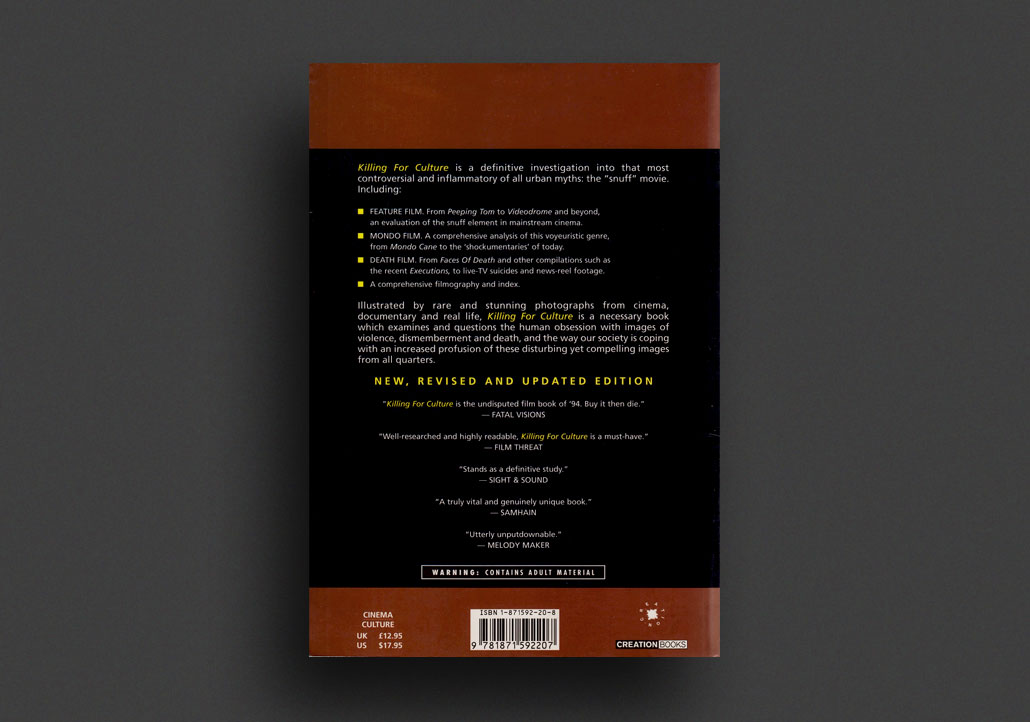
From Peeping Tom to Videodrome, Mondo Cane to "shockumentaries", Faces of Death to live TV suicides.
The 1994 cult classic, in the updated and revised 1995 edition, Killing for Culture: Death Film from Mondo to Snuff by David Kerekes & David Slater, the definitive investigation into that controversial and inflammatory of all urban myths: the "snuff" movie. Including: Feature film, Mondo film, Death film, and a comprehensive filmography and index. Illustrated by rare and stunning photographs from cinema, documentary and real life, Killing for Culture is a vital book which examines and questions the human obsession with images of violence, dismemberment and death, and the way our society is coping with an increased profusion of these disturbing yet compelling images from all quarters.
G—VG copy with light wear to covers, previous owner's name to inside front cover. 1998 print of 1995 ed.
1997 / 2001, English
Softcover, 246 pages, 24.5 x 17 cm
Out of print title / used / very good
Published by
Creation Books / London
$80.00 - In stock -
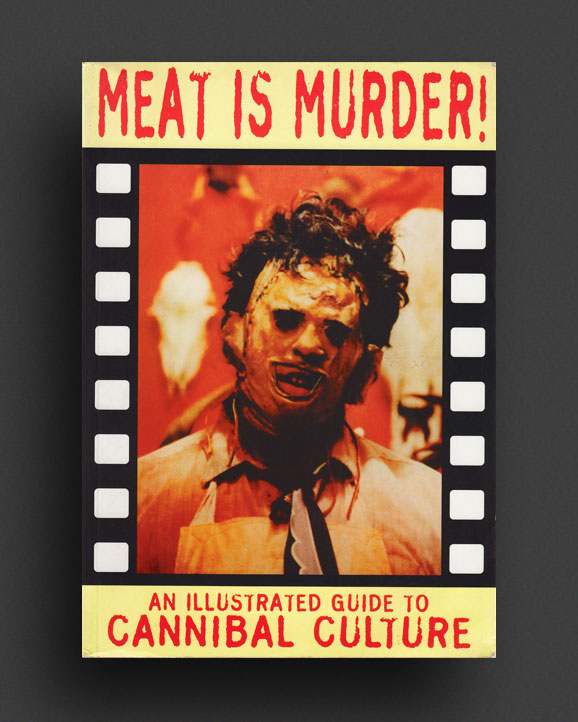
2001 updated edition of Brottman's classic study of cannibalism in film, first issued in 1997.
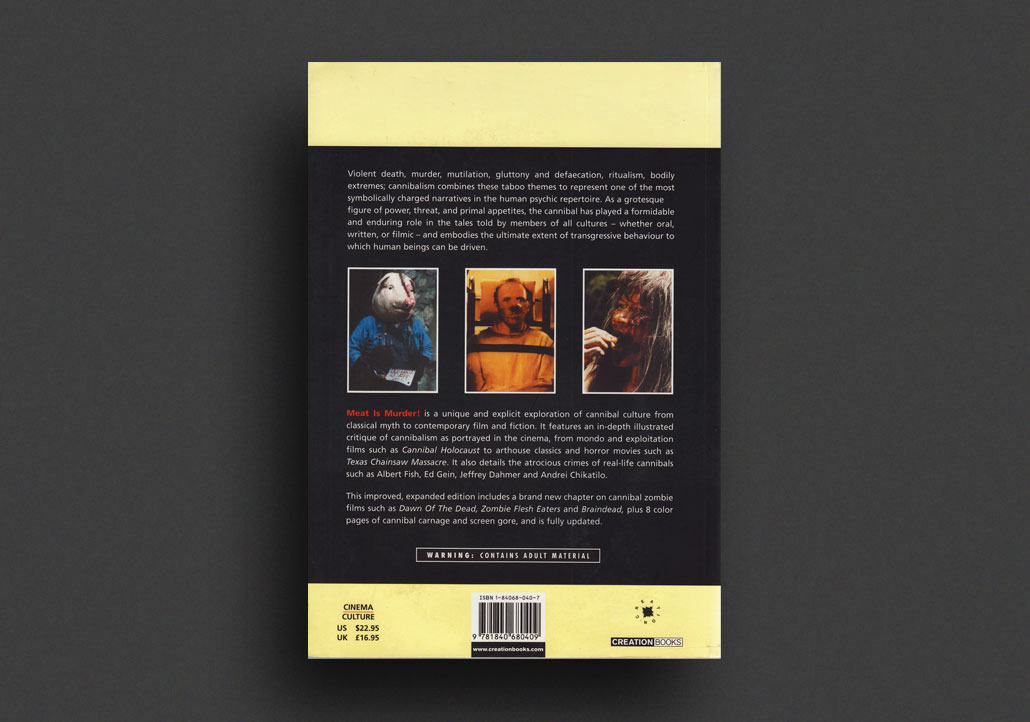
Violent death, murder, mutilation, gluttony and defaecation, ritualism, bodily extremes; cannibalism combines these taboo themes to represent one of the most symbolically charged narratives in the human psychic repertoire. As a grotesque figure of power, threat, and primal appetites, the cannibal has played a formidable and enduring role in the tales told by members of all cultures - whether oral, written, or filmic - and embodies the ultimate extent of transgressive behaviour to which human beings can be driven.
Meat Is Murder! is a unique and explicit exploration of cannibal culture from classical myth to contemporary film and fiction. It features an in-depth illustrated critique of cannibalism as portrayed in the cinema, from mondo and exploitation films such as Cannibal Holocaust to arthouse classics and horror movies such as Texas Chainsaw Massacre. It also details the atrocious crimes of real-life cannibals such as Albert Fish, Ed Gein, Jeffrey Dahmer and Andrei Chikatilo.
This improved, expanded edition includes a brand new chapter on cannibal zombie films such as Dawn Of The Dead, Zombie Flesh Eaters and Braindead, plus 8 color pages of cannibal carnage and screen gore, and is fully updated.
VG copy with some wear to covers/extremities.
1948, English
Hardcover, 252 pages, 22 x 15 cm
1st Edition, Out of print title / used / good
Published by
Gerald G. Swan / London
$35.00 - In stock -
1948 printing of the first English Gerald G. Swan hardcover edition of The Whip and The Rod by Prof. R. G. Van Yelyer, first printed in 1941. Illustrated throughout with plates of cruelty.
"Basically every form of corporal punishment may be traced to the human animal's penchant for cruelty, which expresses itself in the infliction of pain or humiliation whenever an opportunity presents itself."
"With regard to many of the habits and customs of mankind there is much dispute as to the exact time when they first made their appearance, but so far as whipping is concerned there can be no such dispute or contention. It is as old as mankind itself. All that ranks as debatable is the time when any one specific aspect or form of flagellation was initiated. For, like most things, flagellation is an art, capable of much development. The history of the whip, as will be evident from this treatise, shows strange evolutionary concepts."—from the introduction
Good copy with some marking to boards, foxing/tanning to block edges.
2003, English
Softcover, 164 pages, 14 x 21.5 cm
Out of print title / used / very good
Published by
Creation Books / London
$140.00 - Out of stock
Long out-of-print 2003 English edition of Eden, Eden, Eden - Pierre Guyotat's masterpiece of atrocity and obscenity.
The most subversive French novelist of the later 20th century, Pierre Guyotat (b. 1940) was the uncompromising heir of De Sade, Artaud, Rimbaud and Genet. Published in France in 1970 by Gallimard, with a preface by Michel Leiris, Roland Barthes and Philippe Sollers, Eden, Eden, Eden was greeted by both furore and acclaim. The book was immediately banned by the French government as pornographic. A campaign of international support for the book was signed by the like of Pier Paolo Pasolini, Jean-Paul Sartre, Pierre Boulez, Joseph Beuys, Pierre Dac, Jean Genet, Simone de Beauvoir, Joseph Kessel, Maurice Blanchot, Max Ernst, Italo Calvino, Jacques Monod, and Nathalie Sarraute. François Mitterrand and Georges Pompidou tried to get the ban lifted but failed until 11 years later when a newly elected President Mitterrand personally intervened to lift the ban in 1981.
Today Eden, Eden, Eden is recognised as one of the major works of the last century. In literally a single sentence, a desert-like, polluted, apocalyptic landscape of unending civil war unfolds without any morality (and therefore also without evil). This delirious, lacerating novel of startling innovation brings scenes of brutal carnage into intimate collision with relentless acts of prostitutional sex and humiliation.
'a new landmark and starting-point for new writing'—Roland Barthes
'I have never read anything like it in any stream of literature'—Michel Foucault
Very Good copy. Light corner bump, light crease to top back cover, otherwise Fine throughout.
1975, English
Softcover, 174 pages, 18 x 11 cm
1st Edition, Out of print title / used / very good
Published by
Corgi / London
$28.00 - Out of stock
1975 Corgi English edition of Story of O, one of the most famous erotic novels of all time, by French literary critic, journalist, and novelist, Anne Cécile Desclos (1907—1998), under the pen name Pauline Réage. The original French text published in 1954 by Jean-Jacques Pauvert, with the first English translation published by Olympia Press in 1965.
"STORY OF O — notorious as an underground novel, remarkable as a rare instance of pornography sublimed to purest art — appeared first under mysterious circumstances at Paris in 1954 ... STORY OF O is neither a fantasy nor a case history. With its alternate beginnings and endings; its simple direct style (like that of a fable); its curious air of abstraction, of independence from time, place and personality, what it resembles most is a legend — the spiritual history of a saint and martyr. ... Commencing with the simplest of situations, the story gradually opens out into a Daedalian maze of perverse relationships — a clandestine society of sinister formality and elegance where the primary bond is mutual complicity in dedication to the pleasures of sadism and masochism...."—New York Times Book Review
In February 1955, Story of O won the French literature prize Prix des Deux Magots, but the French authorities still brought obscenity charges against the publisher. The charges were rejected by the courts, but a publicity ban was imposed for a number of years.
Only just before her death did the book's author Anne Desclos reveal her true identity in regards to the book. Jean Paulhan, the author's lover and the person to whom she wrote Story of O in the form of love letters, wrote the preface, "Happiness in Slavery". Paulhan admired the Marquis de Sade's work and told Desclos that a woman could not write like de Sade. Desclos took this as a challenge and wrote the book. Paulhan was so impressed that he sent it to a publisher. In the preface, he goes out of his way to appear as if he does not know who wrote it.
"A remarkable piece of work"—Harold Pinter
"I do believe that Pauline Réage has confounded all her critics and made pornography (if that is what it is) an art"—Brian Aldiss
"A rare thing, a pornographic book well written and without a trace of obscenity"—Graham Greene
"A highly literary and imaginative work, the brilliance of whose style leaves one in no doubt whatever of the author's genius... a profoundly disturbing book, as well as a black tour-de-force"—Spectator
"Here all kinds of terrors await us, but like a baby taking its mother's milk all pains are assuaged.
Touched by the magic of love, everything is transformed. STORY OF O is a deeply moral homily"
—J.G. Ballard
Very Good copy, light wear only,
1988, English
Softcover, 288 pages, 18 x 10.5 cm
Out of print title / used / very good
Published by
Corgi / London
$18.00 - In stock -
1988 Corgi English edition of Story of O, one of the most famous erotic novels of all time, by French literary critic, journalist, and novelist, Anne Cécile Desclos (1907—1998), under the pen name Pauline Réage. The original French text published in 1954 by Jean-Jacques Pauvert, with the first English translation published by Olympia Press in 1965.
"STORY OF O — notorious as an underground novel, remarkable as a rare instance of pornography sublimed to purest art — appeared first under mysterious circumstances at Paris in 1954 ... STORY OF O is neither a fantasy nor a case history. With its alternate beginnings and endings; its simple direct style (like that of a fable); its curious air of abstraction, of independence from time, place and personality, what it resembles most is a legend — the spiritual history of a saint and martyr. ... Commencing with the simplest of situations, the story gradually opens out into a Daedalian maze of perverse relationships — a clandestine society of sinister formality and elegance where the primary bond is mutual complicity in dedication to the pleasures of sadism and masochism...."—New York Times Book Review
In February 1955, Story of O won the French literature prize Prix des Deux Magots, but the French authorities still brought obscenity charges against the publisher. The charges were rejected by the courts, but a publicity ban was imposed for a number of years.
Only just before her death did the book's author Anne Desclos reveal her true identity in regards to the book. Jean Paulhan, the author's lover and the person to whom she wrote Story of O in the form of love letters, wrote the preface, "Happiness in Slavery". Paulhan admired the Marquis de Sade's work and told Desclos that a woman could not write like de Sade. Desclos took this as a challenge and wrote the book. Paulhan was so impressed that he sent it to a publisher. In the preface, he goes out of his way to appear as if he does not know who wrote it.
"A remarkable piece of work"—Harold Pinter
"I do believe that Pauline Réage has confounded all her critics and made pornography (if that is what it is) an art"—Brian Aldiss
"A rare thing, a pornographic book well written and without a trace of obscenity"—Graham Greene
"A highly literary and imaginative work, the brilliance of whose style leaves one in no doubt whatever of the author's genius... a profoundly disturbing book, as well as a black tour-de-force"—Spectator
"Here all kinds of terrors await us, but like a baby taking its mother's milk all pains are assuaged.
Touched by the magic of love, everything is transformed. STORY OF O is a deeply moral homily"
—J.G. Ballard
Very Good copy, light wear only,
2002, Japanese / English
Hardcover (w. die-cut dust jacket and boards), unpaginated, 26.5 x 19 cm
1st Edition, Out of print title / as new
Published by
Pan-Exotica / Tokyo
$120.00 - In stock -
First 2002 limited hardcover edition of celebrated Japanese doll artist Ryo Yoshida's Articulated Doll artist's book, with the original die-cut dust-jacket and cloth boards to reveal the eyeball. Lavishly illustrated with Yoshida's exquisite dolls, this unique book explores the anatomy of ball-jointed dolls through the eyes of the artist and author, who, like the practices of Simon Yotsuya and Hans Bellmer before him, creates elaborate and beautiful photographs of the dolls in various poses. Like fellow contemporary Japanese doll artist Katan Amano, Yoshida's fetishistic and macabre 1990's work is steeped in gothic and decadent reference. The photographs are divided into the following themes: Good Friends, Young Kimono-Clad Girls, Girls, Nightmare, The Anatomy of Beauties, Alice's Adventures, Siesta, Girl in the Case, Fetish, Belle de Jour, Articulated Girl, Masochists, Captive, Femme Fatale, Nymphomania.
Includes bilingual (Japanese/English) biography and essay "Dissection Play" written by Ryo Yoshida.
Fine—As New copy.
2025, English
Softcover, 448 pages, 22.5 x 19.2 cm
Published by
FAB Press / UK
$80.00 - In stock -
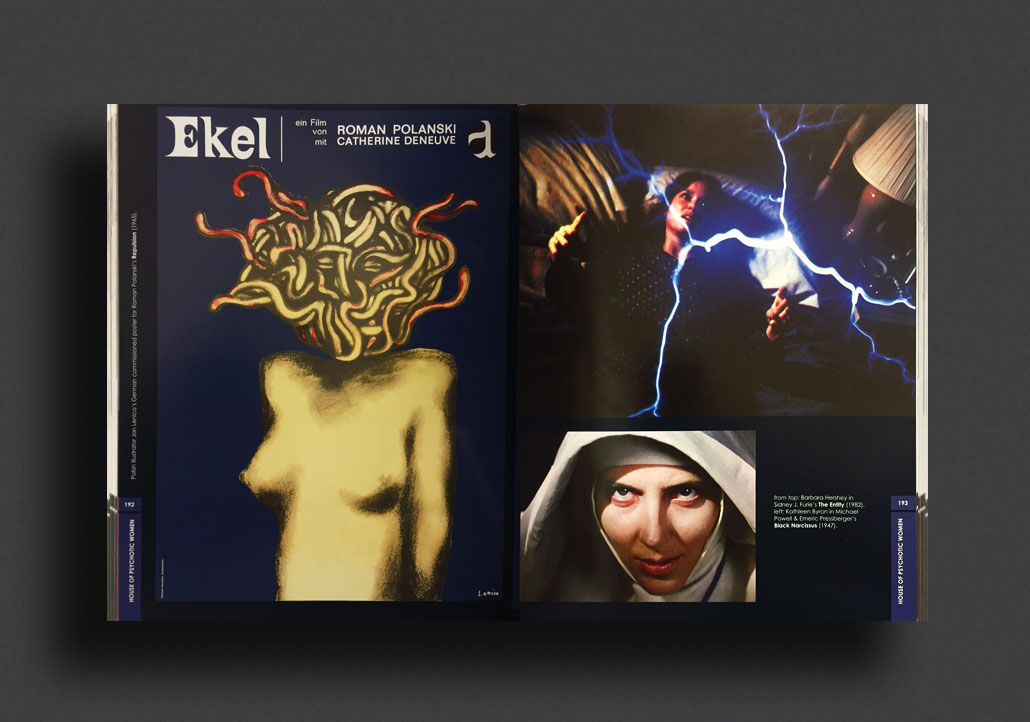
In 2012, a book debuted that would go on to canonical status and usher in a new way of writing about film. Kier-La Janisse's HOUSE OF PSYCHOTIC WOMEN is an autobiographical exploration of female neurosis in horror and exploitation films that examines hundreds of films through a daringly personal lens. In this pioneering work, anecdotes and memories interweave with film history, criticism, trivia and confrontational imagery to create a reflective personal history and a consideration of female madness, both onscreen and off.
To mark its 10th anniversary, Kier-La Janisse and FAB Press have reteamed to produce an expanded edition the book, featuring new writing on 100 more films - many of which were inspired in part by the book itself - and hundreds of new images. This hardcover expanded edition is now available in softcover.
Cinema is full of neurotic personalities, but few things are more transfixing than a woman losing her mind onscreen. Horror as a genre provides the most welcoming platform for these histrionics: crippling paranoia, desperate loneliness, masochistic death-wishes, dangerous obsessiveness, apocalyptic hysteria. Unlike her male counterpart - 'the eccentric' - the female neurotic lives a shamed existence, making these films those rare places where her destructive emotions get to play.
This sharply-designed book, including a 48-page full-colour section, is packed with 680 rare stills, posters, pressbooks and artwork throughout, that combine with family photos and artifacts to form a titillating sensory overload, with a filmography that traverses the acclaimed and the obscure in equal measure. Films covered include The Entity, The Corruption of Chris Miller, Singapore Sling, 3 Women, Toys Are Not for Children, Repulsion, Let's Scare Jessica to Death, The Haunting of Julia, Secret Ceremony, Cutting Moments, Out of the Blue, Mademoiselle, The Piano Teacher, Possession, Antichrist and hundreds more!
Compendium of Female Neurosis. A cross-section of horror and violent exploitation films that feature disturbed or neurotic women as primary or pivotal characters.
Alice, Sweet Alice; All the Colors of the Dark; Alucarda; Anima persa; Antichrist; Asylum; The Attic; Audition; Autopsy; The Baby; Bad Dreams; Bad Guy; Bas-fonds; Bedevilled; The Beguiled; La Belle Bête; The Bird with the Crystal Plumage; Black Narcissus; Black Swan; The Blood Spattered Bride; The Blue Eyes of the Broken Doll; Born Innocent; Boy Meets Girl; The Brave One; The Bride; The Brood; Burnt Offerings; Butcher, Baker, Nightmare Maker; Can Go Through Skin; A Candle for the Devil; Carrie; La casa muda; Cat People; La cérémonie; Children Shouldn't Play with Dead Things; Christiane F.; The Collector; The Corruption of Chris Miller; Les cousines; "Criminally Insane"; The Curse of the Cat People; Cutting Moments; Daddy; Dead Creatures; Defenceless: A Blood Symphony; Dementia; Descent; The Devil's Widow; The Devils; Diabel; Die! Die! My Darling!; The Dinner Party; Dirty Weekend; Dr. Jekyll and His Women; Don't Deliver Us from Evil; Don't Look Now; Don't Torture a Duckling; Doppelganger; Dracula's Daughter; Dream Home; The Entity; The Escapees; Eyes of a Stranger; Fatal Attraction; Feed; Five Across the Eyes; Footprints; Forbidden Photos of a Lady Above Suspicion; Four Flies on Grey Velvet; Freeze Me; The Frightened Woman; Frightmare; Funeral Home; Gently Before She Dies; The Geography of Fear; The Girl Next Door; The Glass Ceiling; Goodbye Gemini; A Gun for Jennifer; Handgun; Happy Birthday to Me; Hard Candy; The Haunting (1963); The Haunting (2009); The Haunting of Julia; Haute tension; Heavenly Creatures; The Honeymoon Killers; A Horrible Way to Die; I Never Promised You a Rose Garden; Images; In My Skin; The Innocents; Inside; The Isle; Julie Darling; Kichiku; The Killer Nun; Kissed; Knife of Ice; The Ladies Club; The Last Exorcism; The Legend of Lylah Clare; The Legend of the Wolf Woman; Let's Scare Jessica to Death; A Lizard in a Woman's Skin; Love Me Deadly; The Loved Ones; Macabre; The Mad Room; Mademoiselle; Madhouse (1974); Madhouse (1981); Madness; The Mafu Cage; Man, Woman and Beast; Marnie; Martyrs; Masks; May; Misery; Morris County; Morvern Callar; Mother's Day; Ms.45; Mumsy, Nanny, Sonny & Girly; Nabi: The Butterfly; Neighbor; Neither the Sea Nor the Sand; Nekromantik; Nekromantik 2; Next of Kin; The Night Porter; A Night to Dismember; Nightbirds; Nightmares; La nuit des traquées; The Other Hell; The Other Side of the Underneath; Out of the Blue; Paranoia; Paranormal Activity; The Perfume of the Lady in Black; Persona; Phenomena; The Piano Teacher; Pigs; Play Misty for Me; Possession; Pretty Poison; Prey; Psycho Girls; The Rapture; The Rats Are Coming! The Werewolves Are Here!; Rebecca; Red Desert; Red Sun; Red White & Blue; The Reincarnation of Peter Proud; Repulsion; Road to Salina; Roman's Bride; Santa Sangre; Schizo; Scissors; Scream 4; Séance on a Wet Afternoon; Secret Ceremony; The Secret Life of Sarah Sheldon; Shock; Singapore Sling; Sinner; Sisters (1973); Sisters (2006); Slaughter Hotel; The Snake Pit; Sombre; Spider Baby; The Stendhal Syndrome; Straight On Till Morning; Strait-Jacket; The Strange Possession of Mrs. Oliver; The Strange Vengeance of Rosalie; Symptoms; Szamanka; That Cold Day in the Park; They Call Her One Eye; 3 Women; To Let; Toys Are Not for Children; Trance; Trilogy of Terror; Trouble Every Day; Twin Peaks: Fire Walk with Me; The Uninvited; Venom; Venus Drowning; The Washing Machine; What Ever Happened to Baby Jane?; The Whip and the Body; Whoever Slew Auntie Roo?; Windows; The Witch Who Came from the Sea; The Woman; Woman Transformation; Wound PLUS MORE THAN 100 EXTRA FILM REVIEWS EXCLUSIVE TO THIS NEW EDITION
Kier-La Janisse is a film writer, programmer, producer and founder of The Miskatonic Institute of Horror Studies. She is the author of A Violent Professional: The Films of Luciano Rossi (2007) and has been an editor on numerous books including Warped & Faded: Weird Wednesday and the Birth of the American Genre Film Archive (2021), Yuletide Terror: Christmas Horror on Film and Television (2017) and Satanic Panic: Pop-Cultural Paranoia in the 1980s (2015). She was a producer on David Gregory’s Tales of the Uncanny (2020) and wrote, directed and produced the award-winning documentary Woodlands Dark and Days Bewitched: A History of Folk Horror (2021) for Severin Films, where she is a producer and editor of supplemental features. She is currently at work on several books including a monograph about Monte Hellman’s Cockfighter.
1970, Japanese
Softcover (staple-bound w. 2 x flexi-disc), 16 pages, 24.5 x 20.5 cm
1st Edition, Out of print title / used / very good
Published by
Asahi Sonorama / Tokyo
$150.00 - Out of stock
The Death of Yukio Mishima! is a special edition "Sounds Magazine" published in 1970 by Asahi Sonorama in Tokyo to commemorate the sudden, shocking death of Japanese writer Yukio Mishima, one of the most important postwar stylists of the Japanese language. Kimitake Hiraoka (b. 1925), known by his pen name Yukio Mishima, was a Japanese author, poet, playwright, actor, model, Shintoist, ultranationalist, and the leader of an attempted coup d'état on 25th November 1970 that culminated in his own spectacular suicide, in a traditional seppuku (hara-kiri), or samurai ritual disemboweling. He was 45 years old.
This commemorative magazine is entirely devoted to Mishima, published right after the news of his suicide, presenting two 7" flexi-discs compiling alarming, moment by moment audio recordings from the 25th November 1970 — announcements from the scene by the self-defense forces and the chief-of-police; the Shield Society members arrested for intruding; right-wing group salute to Mishima's spirit; Mishima's speech about his motivation for founding The Tatenokai (Shield Society) – a private militia dedicated to traditional Japanese values and veneration of the Emperor, his training in kendo and bodybuilding, the Japanese language; audio of Mishima's mentor and friend, Nobel Prize-winning novelist Yasunari Kawabata, rushing to the scene of the incident; nationalist politician and writer Shintaro Ishihara talks about Mishima’s death; a discussion about the life and death of Mishima at the Tokyo University; and more. The publication is full of photographs of Mishima performing and training, giving his speech on Nov 25, and a shocking crime scene image after the incident. It also reproduces the full text of his shield society manifesto.
VG copy, light wear to cover corners/edges, light page toning, flexi-discs likely unplayed.