World Food Books' programme is largely produced on Kulin Nation land. We acknowledge the Wurundjeri people of the Kulin Nation as the first and continuing custodians of this land, and pay respect to their Elders past, present, and emerging.
World Food Books is an arts and special interests bookshop in Naarm / Melbourne. Founded in 2010, World Food Books is devoted to the presentation of a rotating, hand-selection of international art, design, literary and counterculture publications with an emphasis on the anti-traditional, the experimental, the avant-garde, the heretic, the marginal.
Presenting new titles alongside rare and out-of-print books, catalogues and journals spanning the fields of modern and contemporary art, design, photography, illustration, film, literature, poetry, cultural theory, philosophy, sexuality, popular and underground culture in its many radical forms, World Food Books wishes to encourage adventurous, thoughtful and open-minded reading, looking, writing, and exchange of publishing and ideas, both current and historical.
As well as our bookshop, located in Melbourne's historical Nicholas Building, all of our inventory is available internationally via our online mail-order service.
World Food Books semi-regularly co-ordinates "Occasions", a programme of exhibits and events at the bookshop and in partnership with other hosts (such as museums and art galleries) that develop out of the activities, relationships and content of the bookshop itself.
World Food Books
The Nicholas Building
37 Swanston Street
Room 5, Level 6
Melbourne 3000
Australia
SHOP HOURS:
THU–SAT 12–6
WEB-SHOP OPEN 24/7
World Food Books
Postal Address:
PO Box 435
Flinders Lane
Victoria 8009
Australia
info@worldfoodbooks.com
Art
Theory / Essay
Architecture / Interior
Graphic Design / Typography
Photography
Fashion
Eros
LGBTQ+
Fiction / Poetry
Weird / Speculative / Science Fiction / Horror
Transgressive / Visceral / Abject
Symbolism / Decadence / Fin de siècle
Film / Video
Painting
Sculpture / Installation
Performance / Dance / Theater
Drawing
Sound / Music
Curatorial
Group Shows / Collections
Periodicals
Out-of-print / Rare
Posters / Ephemera / Discs
Signed Books
World Food Books Gift Voucher
World Food Book Bag
Australian Art
Australian Fiction
Australian Science Fiction / Speculative Fiction
Australian Poetry
Australian Photography
Japanese Photography
Conceptual Art
Minimal Art
Dada
'Pataphysics / Oulipo
Fluxus
Concrete Poetry
Pop Art
Surrealism
Arte Povera
Arte Informale / Haute Pâte / Tachism
Nouveau Réalisme / Zero / Kinetic
Situationism / Lettrism
Collage / Mail Art / Xerox Art
Art Brut / Folk / Visionary / Fantastic
Illustration / Graphic Art / Bandes Dessinées
Furniture
Italian Radical Design / Postmodernism
Textiles
Ceramics / Glass
Counterculture
Protest / Revolt
Philosophy
Psychoanalysis
Anthropology
Anarchism
Socialism / Anarchism / Communism / Capitalism
Literary Theory / Semiotics / Language
Feminism / Women's Studies
Gender Studies / Sexuality
Anthropology
Fetishism / BDSM
Drugs / Psychedelia
Crime / Violence
Animal Rights / Veganism
Occult / Esoterica
Ecology / Earth / Alternative Living
Whole Earth / Crafts
All prices in AUD (Australian dollars)
Pick-Ups
Pick-up orders can be collected in our bookshop during opening hours after order date. Please collect any Pick-up orders within 2 weeks of ordering as we have limited storage space. Orders will be released back into stock if not collected within this time. No refunds can be made for pick-ups left un-collected. If you cannot make it in to the bookshop in this time-frame, please choose postage option.
Return Policy
All sales are final. We do accept returns (for refund or exchange) for items received in error. All our orders are packed with special care using heavy-duty padding and cardboard book-mailers or bubble mailers (for smaller books), using reinforcement where required. We cannot take responsibility for any lost, stolen or damaged parcels.
Insurance
Should you wish to insure your package, please email us directly after placing your order and we can organise this at a small extra expense. Although all standard/express tracked packages are very safe and dependable, we cannot take responsibility for any lost, stolen or damaged parcels. We recommend insurance on valuable orders.
Interested in selling your old books, catalogues, journals, magazines, comics, fanzines, ephemera? We are always looking for interesting, unusual and out-of-print books to buy. We only buy books in our fields of interest and specialty, and that we feel we can resell.
We base these prices on desirability, market value, in-print prices, condition and our current stock levels. We offer cash, store credit, and can take stock on consignment. All
about 25% of the price we expect to get when we sell them, or 30% in store credit. We base these prices on desirability, market value, in-print prices, condition and our current stock levels.
Sell your books any day of the week. You can drop them off and return later. If you have a lot of books, we can visit your Sydney home.
We buy books that we feel we can resell. We offer about 25 % of the price we expect to get when we sell them, or 30% in store credit. We base these prices on desirability, market value, in-print prices, condition and our current stock levels.
Philadelphia Wireman
03 August - 01 September, 2018
World Food Books is proud to announce our next Occasion, the first presentation of sculptures by Philadelphia Wireman in Australia.
The Philadelphia Wireman sculptures were found abandoned in an alley off Philadelphia’s South Street on trash night in 1982. Their discovery in a rapidly-changing neighbourhood undergoing extensive renovation, compounded with the failure of all attempts to locate the artist, suggests that the works may have been discarded after the maker’s death. Dubbed the "Philadelphia Wireman" during the first exhibition of this work, in 1985, the maker’s name, age, ethnicity, and even gender remain uncertain. The entire collection totals approximately 1200 pieces, all intricately bound together with tightly-wound heavy-gauge wire (along with a few small, abstract marker drawings, reminiscent both of Mark Tobey and J.B. Murry). The dense construction of the work, despite a modest range of scale and materials, is singularly obsessive and disciplined in design: a wire armature or exoskeleton firmly binds a bricolage of found objects including plastic, glass, food packaging, umbrella parts, tape, rubber, batteries, pens, leather, reflectors, nuts and bolts, nails, foil, coins, toys, watches, eyeglasses, tools, and jewellery.
Heavy with associations—anthropomorphic, zoomorphic, and socio-cultural responses to wrapped detritus—the totemic sculptures by Philadelphia Wireman have been discussed in the context of work created to fulfil the shamanistic needs of alternative religions in American culture. Curators, collectors, and critics have variously compared certain pieces to sculpture from Classical antiquity, Native American medicine bundles, African-American memory jugs, and African fetish objects. Reflecting the artist’s prolific and incredibly focused scavenging impulse, and despite—or perhaps enhanced by—their anonymity, these enigmatic objects function as urban artefacts and arbiters of power, though their origin and purpose is unknown. Philadelphia Wireman, whatever their identity, possessed an astonishing ability to isolate and communicate the concepts of power and energy through the selection and transformation of ordinary materials. Over the course of the past two decades, this collection has come to be regarded as an important discovery in the field of self-taught art and vernacular art.
Presented in collaboration with Fleisher-Ollman Gallery, Philadelphia, and Robert Heald, Wellington.
Susan Te Kahurangi King
02 February - 10 March, 2018
Susan Te Kahurangi King (24 February 1951 - ) has been a confident and prolific artist since she was a young child, drawing with readily available materials - pencils, ballpoint pens and felt-tip markers, on whatever paper is at hand. Between the ages of four and six Susan slowly ceased verbal communication. Her grandparents William and Myrtle Murphy had developed a special bond with Susan so they took on caring responsibilities for extended periods. Myrtle began informally archiving her work, carefully collecting and storing the drawings and compiling scrapbooks. No drawing was insignificant; every scrap of paper was kept. The King family are now the custodians of a vast collection containing over 7000 individual works, from tiny scraps of paper through to 5 meter long rolls.
The scrapbooks and diaries reveal Myrtle to be a woman of great patience and compassion, seeking to understand a child who was not always behaving as expected. She encouraged Susan to be observant, to explore her environment and absorb all the sights and sounds. Myrtle would show Susan’s drawings to friends and people in her community that she had dealings with, such as shopkeepers and postal workers, but this was not simply a case of a grandmother’s bias. She recognised that Susan had developed a sophisticated and unique visual language and sincerely believed that her art deserved serious attention.
This was an unorthodox attitude for the time. To provide some context, Jean Dubuffet coined the term Art Brut in 1945 to describe work created by self-taught artists – specifically residents of psychiatric institutions and those he considered to be visionaries or eccentrics. In 1972 Roger Cardinal extended this concept by adopting the term Outsider Art to describe work made by non-academically trained artists operating outside of mainstream art networks through choice or circumstance. Susan was born in Te Aroha, New Zealand in 1951, far from the artistic hubs of Paris and London that Dubuffet and Cardinal operated in. That Myrtle fêted Susan as a self-taught artist who deserved to be taken seriously shows how progressive her attitudes were.
Susan’s parents Doug and Dawn were also progressive. Over the years they had consulted numerous health practitioners about Susan’s condition, as the medical establishment could not provide an explanation as to why she had lapsed into silence. Dawn educated herself in the field of homeopathy and went on to treat all twelve of her children using these principles – basing prescriptions on her observations of their physical, mental and emotional state.
Doug was a linguist with an interest in philosophy who devoted what little spare time he had to studying Maori language and culture. To some extent their willingness to explore the fringes of the mainstream made them outsiders too but it was their commitment to living with integrity and their respect for individuality that ensured Susan’s creativity was always encouraged.
Even though Susan’s family supported her artistic pursuits, some staff in schools and hospitals saw it as an impediment to her assimilation into the community and discouraged it in a variety of ways. Her family was not always aware of this and therefore did not fully understand why Susan stopped drawing in the early 1990s. However, rather than dwell on the challenges that Susan faced in pursuit of her artistic practice, they prefer to highlight her achievements. In 2008 Susan began drawing again in earnest, after an almost 20 year interruption, and her work is now shown in galleries around the world.
Susan grew up without television and has been heavily influenced by the comics she read as a child. She is absolutely fearless in the appropriation of recognizable characters, such as Donald Duck and Mickey Mouse, in her work. She twists their limbs, contorts their faces, compresses them together, blends them into complex patterned backgrounds - always imbuing them with an incredible energy. Although Susan often used pop culture characters in her work they are not naive or childlike. These are drawings by a brilliant self-taught artist who has been creating exceptional work for decades without an audience in mind.
Mladen Stilinović
"Various Works 1986 - 1999"
02 February 16 - September 10, 2016
Various works 1986 - 1999, from two houses, from the collections of John Nixon, Sue Cramer, Kerrie Poliness, Peter Haffenden and Phoebe Haffenden.
Including: Geometry of Cakes (various shelves), 1993; Poor People’s Law (black and white plate), 1993; White Absence (glasses, ruler, set square, silver spoon, silver ladel with skin photograph and wooden cubes), 1990-1996; Exploitation of the Dead (grey and red star painting, wooden painting, black spoon with red table, red plate), 1984-1990; Money and Zeros (zero tie, paintings made for friends in Australia (Sue, John, Kerrie), numbers painting), 1991-1992; Words - Slogans (various t-shirts) - “they talk about the death of art...help! someone is trying to kill me”, “my sweet little lamb”, “work is a disease - Karl Marx”; Various artist books, catalogues, monographs, videos; Poster from exhibition Insulting Anarchy; "Circular" Croatian - Australian edition; Artist book by Vlado Martek (Dostoyevsky); more.
Thanks to Mladen Stilinović and Branka Stipančić.
Jonathan Walker
Always Will Need To Wear Winter Shirt Blue + Ochre Small Check Pattern
21 August - 21 September, 2015
Untitled
I am not a great reader of poetry but I always return to the work of Melbourne poet, Vincent Buckley (1925- 1988). Perhaps I find his most tantalising piece to be not a finished poem but a fragment left on a scrap of paper discovered on his desk after the poet’s death.
The poetry gathers like oil
In the word-core, and spreads
It has its music meet,
Its music is in movement.
This fragment is more the shell left behind from a volatile thought than a finished poem. I find the last two lines honest but awkward whereas the first two lines work like an arrow. Most likely he could not find a resolution so it was left. Still, in its present form, it remains an eloquent testimony to the ultimate failure of a medium to express mobile thought and sensation, in Buckley’s case, through verbal language. It’s an important matter because this is something all artists have to deal with regardless of the medium.
I have never written a poem, however, I am forever copying fragments from books on paper scraps in a vain effort to fix certain notions in my head. At first, they function as bookmarks that are sometimes returned to when I open the book. But before long, as they accumulate, they fall out littering the table interspersed with A4 photocopies, bills, books and medications.
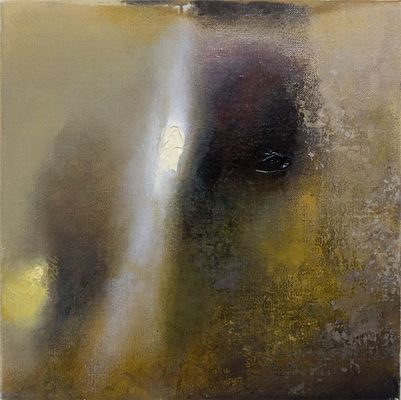
To return to Buckley’s fragment, the first two lines very much evoke how I paint nowadays. As you age, detail diminishes and patches of light become more luminous and float. I feel the most honest way of dealing with this is by smearing the oil paint on the canvas with the fingers and working close-up, blind. Only if the patches coalesce into an approaching image can the work gain a life.
-
Jonathan Walker was born in Melbourne, Australia and brought up on a dairy farm in Gippsland. In the 1970’s he studied painting at RMIT and won the Harold Wright Scholarship to the British Museum, London. During the 1980’s he exhibited at Pinacotheca Gallery, Richmond and had work shown at the NGV and Heidi City Art Gallery. Over the same period he designed the cover for the “Epigenesi” LP by Giancarlo Toniutti, Italy and conducted a mail exchange work with Achim Wollscheid, Germany. The work with artists through the post resulted in an article published in the bicentenary issue of Art and Australia 1988. He showed in artist run spaces such as WestSpace in the 90’s and 2000’s, and until 2012, taught painting at Victoria University, which is where we (Colleen Ahern and Lisa Radford) as organisers of the exhibition, among many others, had the privilege of being his student.
Walker’s knowledge was imparted to students through the careful selection of music, literature, and artists found in books that he himself had ordered for the library. Walker’s strategy was the generosity of sharing his vast knowledge with references specific to each student and their context.
Walker’s paintings share a similar focus and intimacy.
This exhibition presents a small selection of recent paintings alongside a publication that includes Walker’s writing. Observational and analytical, Walker’s work is a type of material notation — the time of day, colour and how it is blended, the both specific and fleeting location of a reflection on lino or the question of whether a chair leg should be included in a painting.
Please join us on Friday August 21 between 6-8pm to celebrate the opening of the exhibition.
Curated by Colleen Ahern and Lisa Radford.
B. Wurtz
Curated by Nic Tammens
March 26 - April 4, 2015
B.Wurtz works from a basement studio in his home on Manhattan’s Lower East Side.
This local fact is attested to by the plastic shopping bags and newsprint circulars that appear in his work. As formal objects, they don’t make loud claims about their origins but nonetheless transmit street addresses and places of business from the bottom of this long thin island. Like plenty of artists, Wurtz is affected by what is local and what is consumed. His work is underpinned by this ethic. It often speaks from a neighborhood or reads like the contents of a hamper:
“BLACK PLUMS $1.29 lb.”
“Food Bazaar”
“USDA Whole Pork Shoulder Picnic 99c lb.”
“RITE AID Pharmacy, with us it’s personal.”
“H. Brickman & Sons.”
“Sweet Yams 59c lb."
Most of the work in this exhibition was made while the artist was in residence at Dieu Donne, a workshop dedicated to paper craft in Midtown. Here Wurtz fabricated assemblages with paper and objects that are relatively lightweight, with the intention that they would be easily transportable to Australia. This consideration isn’t absolute in Wurtz’s work, but was prescriptive for making the current exhibition light and cheap. Packed in two boxes, these works were sent from a USPS post office on the Lower East Side and delivered to North Melbourne by Australia Post.
Wurtz appears courtesy of Metro Pictures, New York.
Thanks to Rob Halverson, Joshua Petherick, Sari de Mallory, Matt Hinkley, Helen Johnson, Fayen d'Evie, Ask Kilmartin, Lisa Radon, Ellena Savage, Yale Union, and "Elizabeth".
John Nixon
"Archive"
December 15 - January 20, 2014
The presentation of John Nixon's archive offered a rare showcase of this extensive collection of the artist's own publications, catalogues, posters, ephemera, editions and more, from the mid 1980s onwards, alongside a selection of his artworks.
Organized by John Nixon, Joshua Petherick and Matt Hinkley.
"Habitat"
at Minerva, Sydney (organised by Joshua Petherick and Matt Hinkley)
November 15 - December 20, 2014
Lupo Borgonovo, Janet Burchill & Jennifer McCamley,
Lewis Fidock, HR Giger, Piero Gilardi, Veit Laurent Kurz,
Cinzia Ruggeri, Michael E. Smith, Lucie Stahl, Daniel Weil, Wols
Press Release:
“...It contained seven objects. The slender fluted bone, surely formed for flight, surely from the wing of some large bird. Three archaic circuitboards, faced with mazes of gold. A smooth white sphere of baked clay. An age-blackened fragment of lace. A fingerlength segment of what she assumed was bone from a human wrist, grayish white, inset smoothly with the silicon shaft of a small instrument that must once have ridden flush with the surface of the skin - but the thing’s face was seared and blackened.”
William Gibson, “Count Zero”, 1986
"Autumn Projects Archive"
Curated by Liza Vasiliou
March 6 - March 15, 2014
World Food Books, in conjunction with the Virgin Australia Melbourne Fashion Festival 2014, presented the Autumn Projects archive, consisting of a selection of early examples in Australian fashion with a particular interest in collecting designers and labels from the period beginning in the 1980’s, who significantly influenced the discourse of Australian Fashion.
Curated by Liza Vasiliou, the exhibition provided a unique opportunity to view pieces by designers Anthea Crawford, Barbara Vandenberg, Geoff Liddell and labels CR Australia, Covers, Jag along with early experimental collage pieces by Prue Acton and Sally Browne’s ‘Fragments’ collection, suspended throughout the functioning World Food Books shop in Melbourne.
H.B. Peace
presented by CENTRE FOR STYLE
November 14, 2013
"Hey Blinky, you say chic, I say same"
Anon 2013
H.B. Peace is a clothing collaboration between great friends Blake Barns and Hugh Egan Westland. Their pieces explore the divergences between 'character’ and ‘personality’ in garments....etc
Special Thanks to Joshua Petherick and Matt Hinkley of WFB and Gillian Mears
and a Very Special Thank you to Audrey Thomas Hayes for her shoe collaboration.
Janet Burchill & Jennifer McCamley
"Aesthetic Suicide"
May 10 - June 8, 2013
The first of our occasional exhibitions in the World Food Books office/shop space in Melbourne, "Aesthetic Suicide" presented a body of new and older works together by artists Janet Burchill & Jennifer McCamley, including videos, prints, a wall work, and publications.
During shop open hours videos played every hour, on the hour.
2019, English
Hardcover, 516 pages, 21 x 28 cm
1st Edition, Out of print title / as new
Published by
Fondazione Prada / Venice
$240.00 - Out of stock
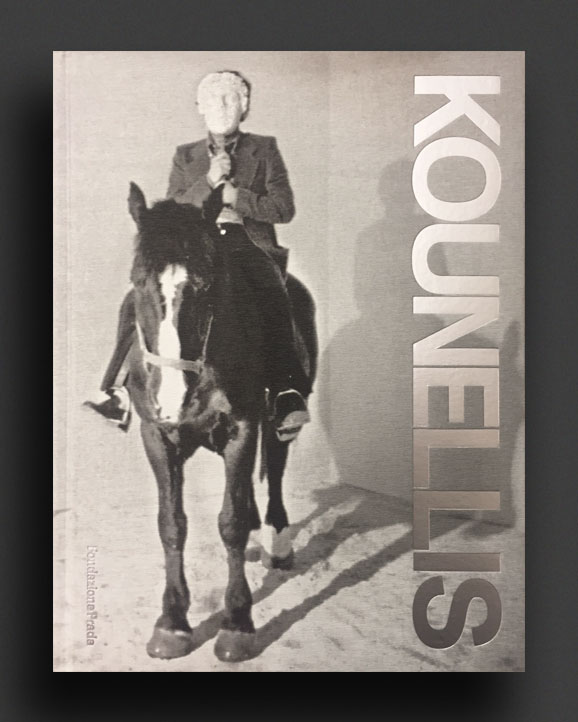
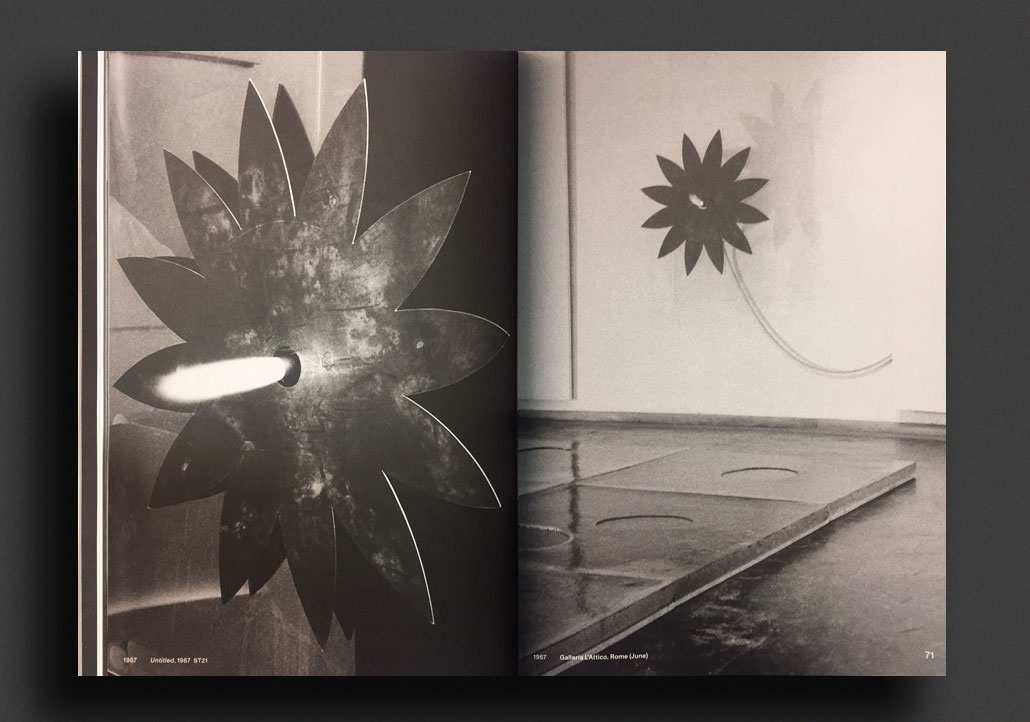
The ultimate (now out-of-print) Jannis Kounellis book. Published by Fondazione Prada to accompany the exhibition 'Jannis Kounellis', curated by Germano Celant, the major retrospective in Venice dedicated to the artist. Developed in collaboration with Archivio Kounellis, the exhibit brings together more than 60 works from 1959 to 2015, from both Italian and international museums, as well as from important private collections both in Italy and abroad. This comprehensive hardcover catalogue explores the artistic and exhibition history of Jannis Kounellis (Piraeus 1936 - Rome 2017), a Greek Italian artist and key figure associated with Arte Povera, a movement theorized by curator Germano Celant as a major shift from work on flat surfaces to installations. In 1967, Kounellis installed "live birds in cages along with rose-shaped, cloth cut-outs pinned to canvas" alongside his painting. Through this shift in his work, "Kounellis was more interested in anarchical freedom from linguistic norms and conventional materials. The space of the gallery and the exhibition site in general were transformed into a stage where real life and fiction could join in a suspension of disbelief." Viewers became part of the scene of these living natural sources of energy within the gallery space. He continued his involvement with live animals later in 1969, when he exhibited twelve living horses, as if they were cars, in the Galleria l'Attico's new location in an old garage in Via Beccaria. Kounellis introduced recurring materials such as propane torches, smoke, coal, meat, ground coffee, lead, and found wooden objects into his installations, which looked beyond the gallery environment to historical (mostly industrial) sites. Lavishly illustrated throughout with full bleed large installation photographs, individual works, performances, details, an illustrated bibliographic history, introductory essay by Germano Celant, foreword by Miuccia Prada and Patrizio Bertelli, and more, this volume forms a valuable, intimate resource on Kounellis.
2016, English
Hardcover (w. dust jacket + CD), 232 pages, 22.9 x 29.2 cm
Published by
Silver Gate Inc. / Taxas
$115.00 - Out of stock
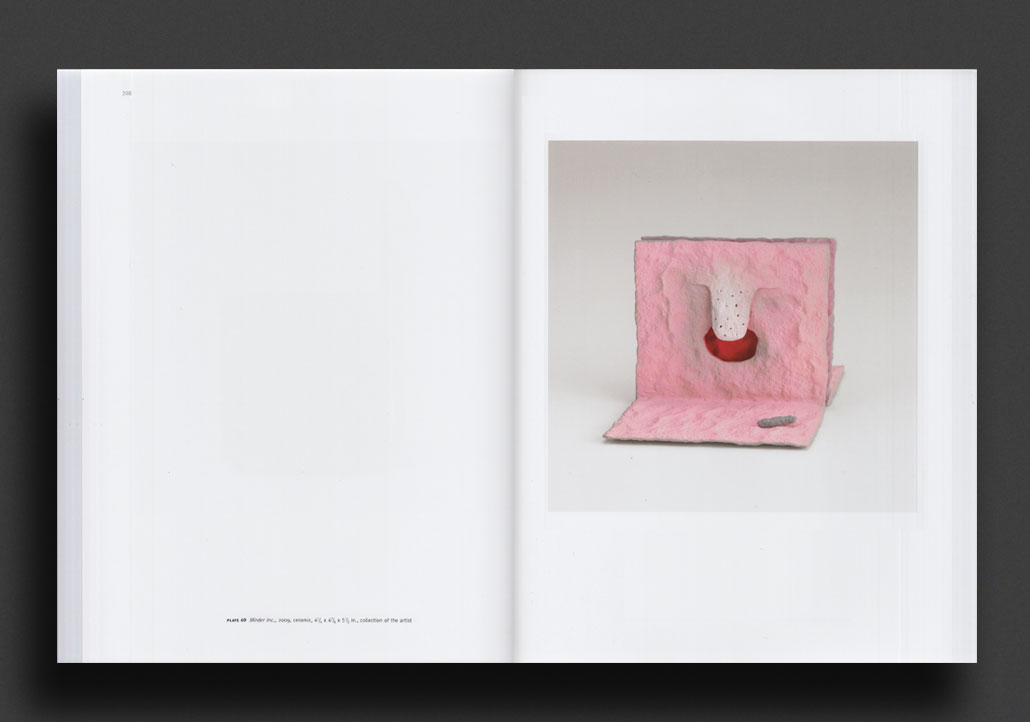
Years in the making, this definitive monograph presents nearly six decades of work by the pioneering San Francisco-based ceramic sculptor Ron Nagle (born 1939). The plates section features 51 sculptures made since 1958, all reproduced in full colour. Critical essays by Joel Selvin and David Pagel and a foreword by Dave Hickey offer diverse perspectives on Nagle's accomplishments as both an artist and a musician. An illustrated chronology provides an overview of his life and work, including his apprenticeship with ceramicist Peter Voulkos, his seminal role in San Francisco's psychedelic music scene, his sound design for the film The Exorcist, and his obsessive devotion to intimately scaled sculpture. Nagle's irrepressible personality comes through in the book's innovative design, which includes a jacket that unfolds into a poster of the artist dressed as his film hero Charlie Chan. Also included is a CD of 21 songs spanning Nagle's musical career, from the 1960s to the 2000s. An essential, comprehensive and intimate book on one of America's great contemporary sculptors.
2020, English
Hardcover, 288 pages, 26.7 x 22.9 cm
Published by
MoMA / New York
$120.00 - Out of stock
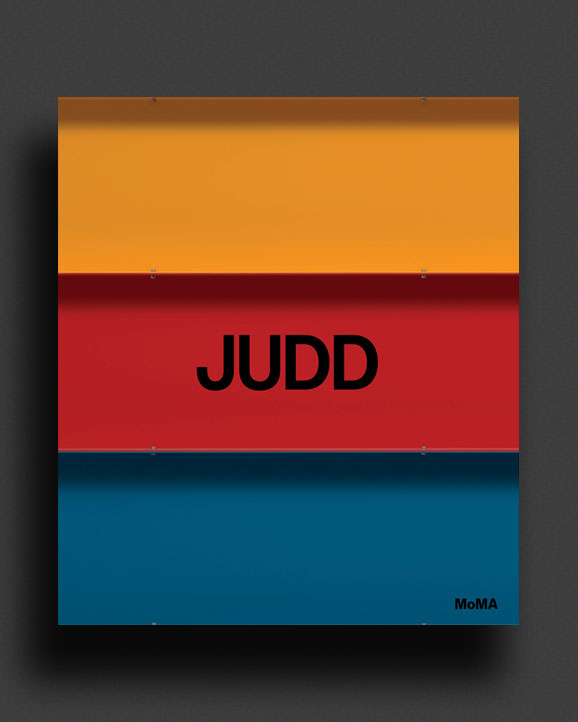
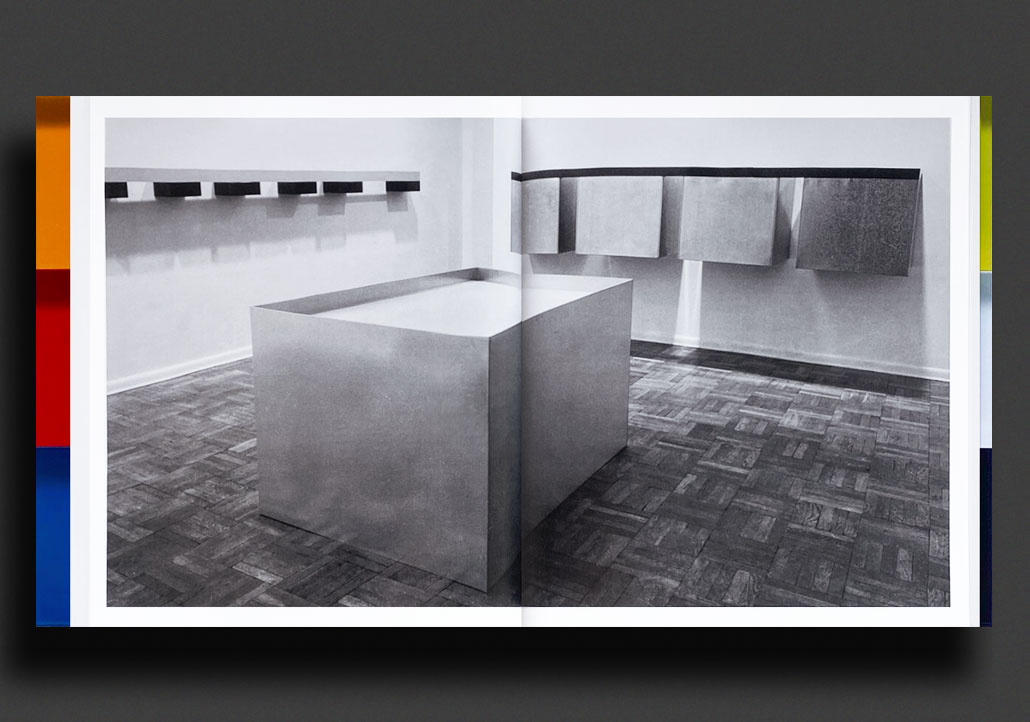
The first retrospective in 30 years on American maverick Donald Judd's minimalist sculpture, architecture and furniture. Published to accompany the first US retrospective exhibition of Donald Judd's sculpture in more than 30 years, Judd explores the work of a landmark artist who, over the course of his career, developed a material and formal vocabulary that transformed the field of modern sculpture. Donald Judd was among a generation of artists in the 1960s who sought to entirely do away with illusion, narrative and metaphorical content. He turned to three dimensions as well as industrial working methods and materials in order to investigate "real space," by his definition. Judd surveys the evolution of the artist's work, beginning with his paintings, reliefs and handmade objects from the early 1960s; through the years in which he built an iconic vocabulary of works in three dimensions, including hollow boxes, stacks and progressions made with metals and plastics by commercial fabricators; and continuing through his extensive engagement with colour during the last decade of his life.
This richly illustrated catalog takes a close look at Judd's achievements, and, using newly available archival materials at the Judd Foundation and elsewhere, expands scholarly perspectives on his work. The essays address subjects such as his early beginnings in painting, the fabrication of his sculptures, his site-specific pieces and his work in design and architecture.
Donald Judd (1928-94) began his professional career working as a painter while studying art history and writing art criticism. One of the foremost sculptors of our time, Judd refused this designation and other attempts to label his art: his revolutionary approach to form, materials, working methods and display went beyond the set of existing terms in midcentury New York. His work, in turn, changed the language of modern sculpture.
1991, French / English
16 colour postcards, 15 × 10.5 cm
1st Edition, Out of print title / as new
Published by
Le Consortium / Dijon
$180.00 - Out of stock
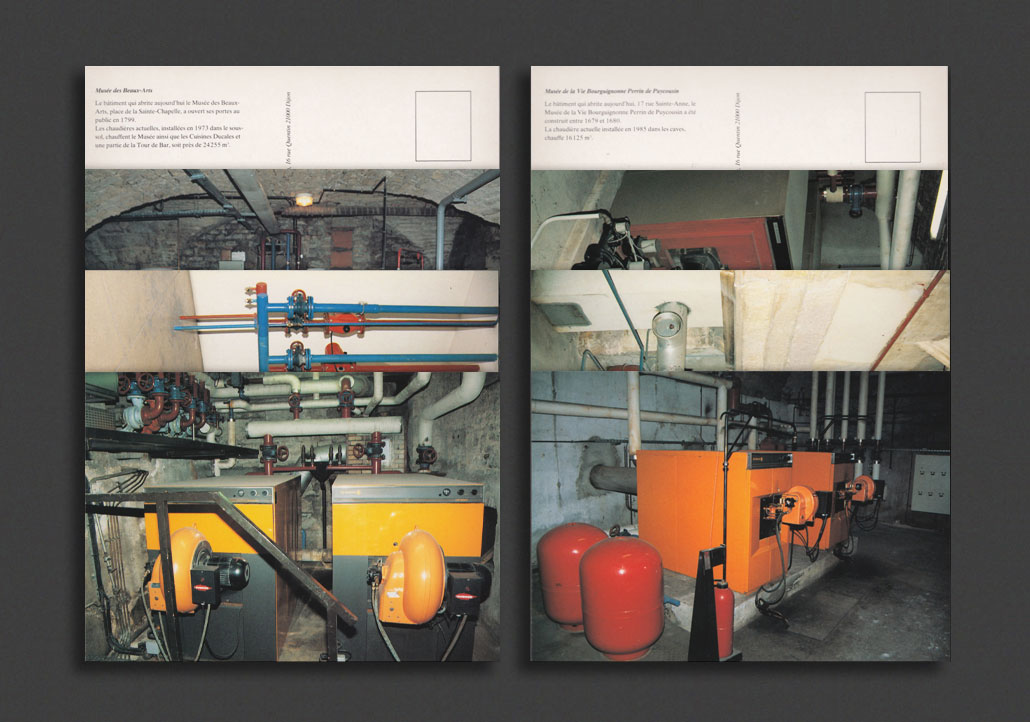
Out of print sealed postcard set produced on the occasion of Michael Asher’s exhibition at Le Consortium Dijon, 7 June – 27 July 1991.
The work on show in Dijon depicted the heating systems in the basements of sixteen of the well-known architectural landmarks in a city famous for its tourism. On the walls of the exhibition space Asher exactly reproduced the schematic engineering diagrams of interior axial cuts for the heaters belonging to each of the buildings chosen. Painted in black at the same height as the actual heaters, the diagrams, on a purely formal level, presented eccentric shapes and seemingly abstract designs while expressing vigilant precision and regulated linearity.
A set of colour postcards, meant to have been sold in the city at souvenir stores and available for viewing and purchase at the reception desk, completed the exhibition as a whole. The photographs of the heaters-displayed on postcards as if they were historic monuments or scenic views-correlated with the schematic wall drawings, grounding them in the functional reality of furnaces composed of oil burners, water heaters, pressure tanks, gages, pipes, and so on.
Photography by Pascal Pique.
Michael Asher (1943–2012) is an internationally renowned pioneer of institutional critique and conceptual art. Since the mid-1960s he has explored how museums and other institutions frame the art experience for viewers and influence the cultural dialogue. His interventions use elements that exist or existed at the site.
Still sealed, As New copies. Limited edition.
2012, English
Hardcover, 288 pages, 22.5 x 27 cm
1st UK Edition, Out of print title / as new
Published by
Yale University Press / New Haven
$120.00 - In stock -
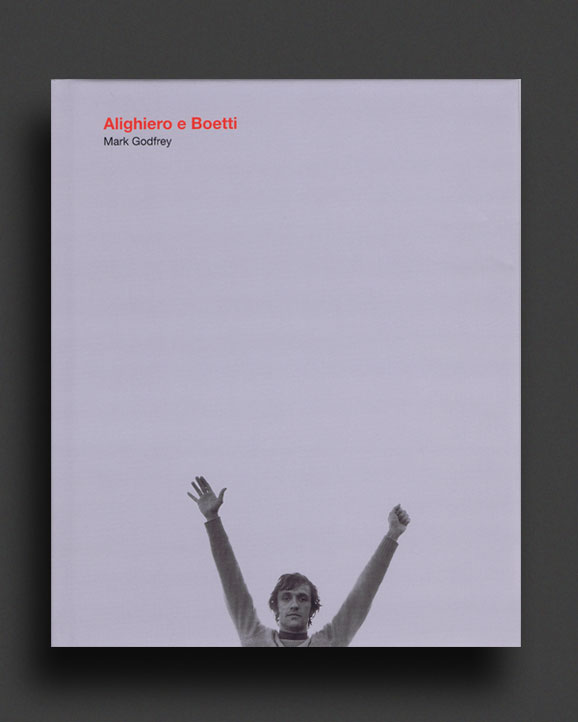
Now out-of-print, this is the first monograph on the influential 20th-century artist Alighiero e Boetti and his groundbreaking works.
Alighiero e Boetti (1940-1994) has emerged as one of the most significant figures of postwar European art whose practice is having an unfolding impact on younger artists. His powerful influence can be attributed to the material diversity of his work, its conceptual ingenuity, and his political sensibility. His work, though usually associated with the Italian Arte Povera group and Conceptual Art, has never quite fit into these contexts. Boetti ceased making Arte Povera–type objects in 1969 after a few years of association with the group, and his later choice of materials (embroidery, calligraphy, mosaic, kilims) put a gulf between his work and that of most artists of the 1970s and 1980s.
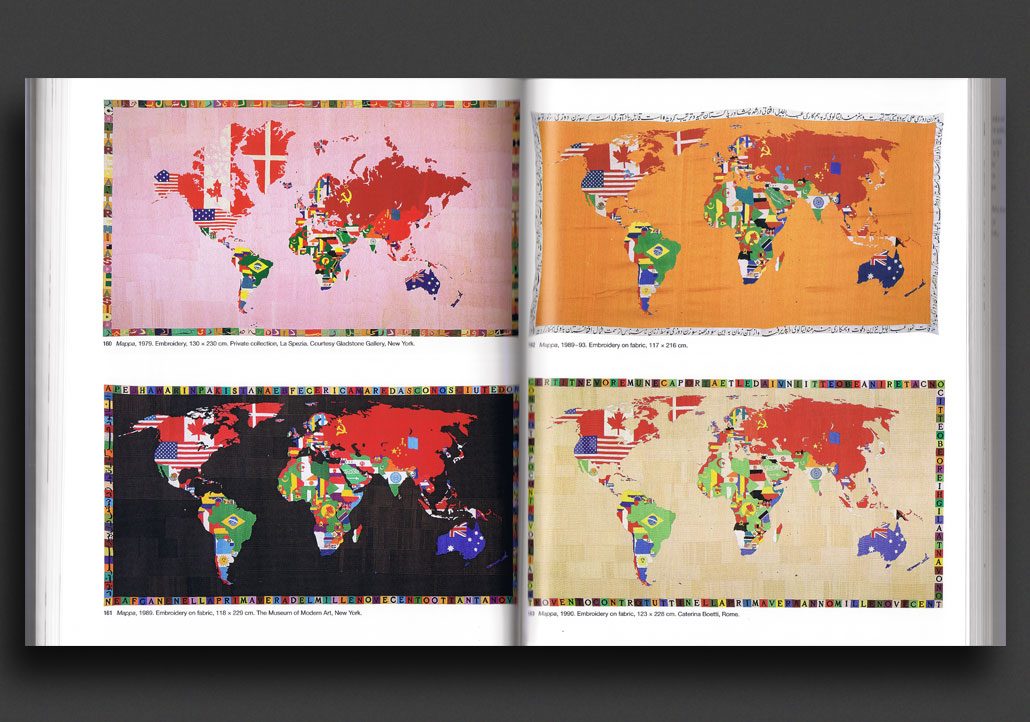
Boetti had an idiosyncratic style of working, and he often collaborated with or commissioned others to execute his ideas, including his celebrated maps of the world, colorfully embroidered by women in Afghanistan and Pakistan. He tended to create several divergent bodies of work at once in series that he continued throughout his life. Alighiero e Boetti is the first monograph covering the whole career of this crucial artist to be published in English. Rather than present a linear account of the artist's creative practice, the book contains linked chapters that expound on the key subjects of Boetti's art and position this work in relation to that of his European and American contemporaries.
2007, Japanese
Softcover (with die-cut cover), 200 pages, 21.4 cm x 26 cm
1st Edition, Out of print title / as new
Published by
Asahi Shimbun / Japan
$90.00 - Out of stock
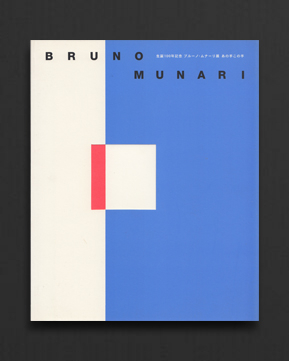
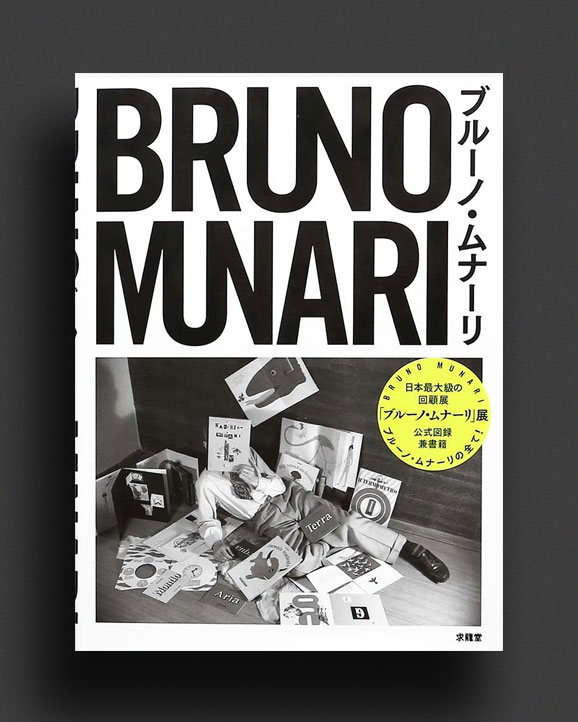
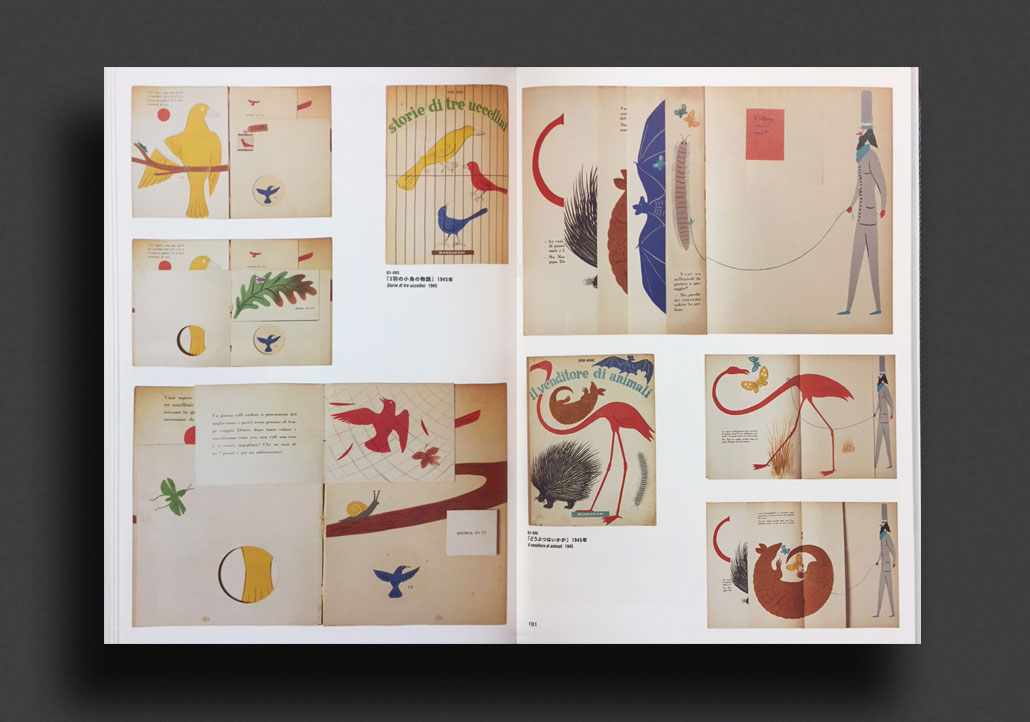
This richly illustrated and designed book was published on the occasion of the exhibition "Bruno Munari - Da Cosa Nasce Cosa -", 1 December 2007 - 14 January, 2008, at The Itabashi Museum of Art, Tokyo, celebrating the 100th Anniversary of the Italian artist Bruno Munari's birth. This lovely copy with bonus inserted exhibition flyer, exhibition ticket and book errata.
Chronologically showcasing his innovative and iconic graphic works in book and poster design, sculpture, illustration, interior/furniture design, games, art objects, and much more, this gorgeous, profusely illustrated exhibition catalogue illustrates Munari's rich creative history through modernism, futurism, and concrete art. It particularly focuses on Munari's book work, both his own authored titles and books and periodicals he created cover artwork for and contributed to/featured in, from his earliest days through. Includes rarely seen images of his illustrated/painted originals and sketches that were featured in the exhibition, along with insight into his relationships and productions in Japan throughout his career. A wonderful archive of material. Texts in Japanese.
Bruno Munari (October 24, 1907, Milan – September 30, 1998, Milan) was an Italian artist, designer, and inventor who contributed fundamentals to many fields of visual arts (painting, sculpture, film, industrial design, graphic design) in modernism, futurism, and concrete art, and in non visual arts (literature, poetry) with his research on games, didactic method, movement, tactile learning, kinesthetic learning, and creativity.
Very Good copy with inserted exhibition brochure, exhibition ticket and errata.
2012, English / German
Softcover, 376 pages (1200 coloir / 20 b/w), 210 x 297 mm
Published by
JRP Ringier / Zürich
$59.00 $20.00 - In stock -
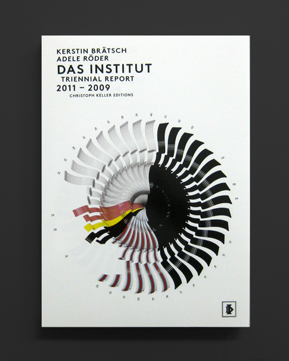
"Das Institut" presents a lavishly illustrated review of the productions, exhibitions, and collaborations in which it has been involved over the past three years in the style of a business report. "Das Institut" was founded in New York in 2007 by Kerstin Brätsch (1979) and Adele Röder (1980) as a notional free space in which they both gave themselves the opportunity of working independently from the concept of their own oeuvres, for their promotion and reproduction.
Taking an ironic approach to themselves, and using great verbal wit, they have tackled the strategies of (self-)marketing head on. The fast-tempo artistic ping-pong game between the two agency proprietors Brätsch and Röder can be followed in detail in this artist's book. Each smuggles her works into the agency as models for further processing by the other. Sources of inspiration, costs, sales revenue, and exhibition techniques are frankly disclosed. What at first looks like a strong overstatement that treads on a fine line between art, knitwear, role play, and marketing is at the same time a trenchant observation of the art scene, and a plea for artistic experiment and the potential of painting.
"Das Institut" participated in the group show "Non-solo show, Non-group show" at Kunsthalle Zürich (2009) and recently in the 54th Venice Biennial (2011). The book is published on the occasion of its solo exhibitions at the Parc Saint Léger, Pougues-les-Eaux (2010); the Kölnischer Kunstverein (Spring 2011); and the Kunsthalle Zürich (Autumn 2011).
The publication is part of the series of artists' projects edited by Christoph Keller.
2000, English / German
Hardcover (w. audio CD), 136 pages, 20 x 24 cm
1st Edition, Out of print title / as new
$30.00 - In stock -
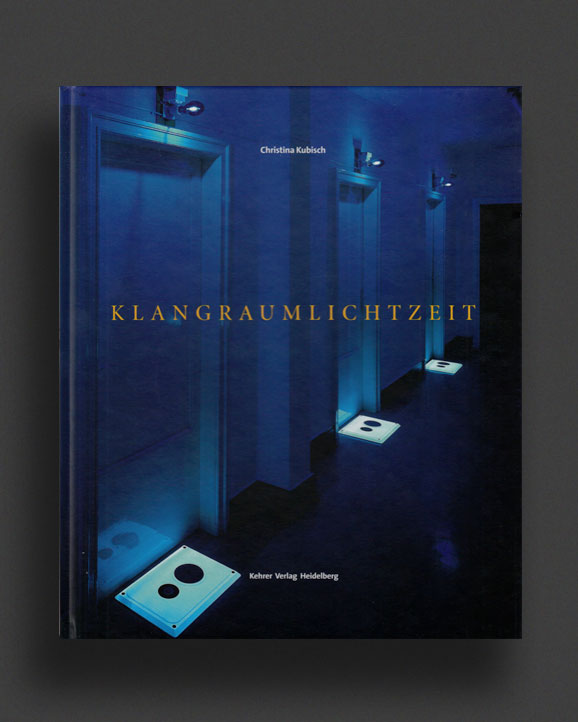
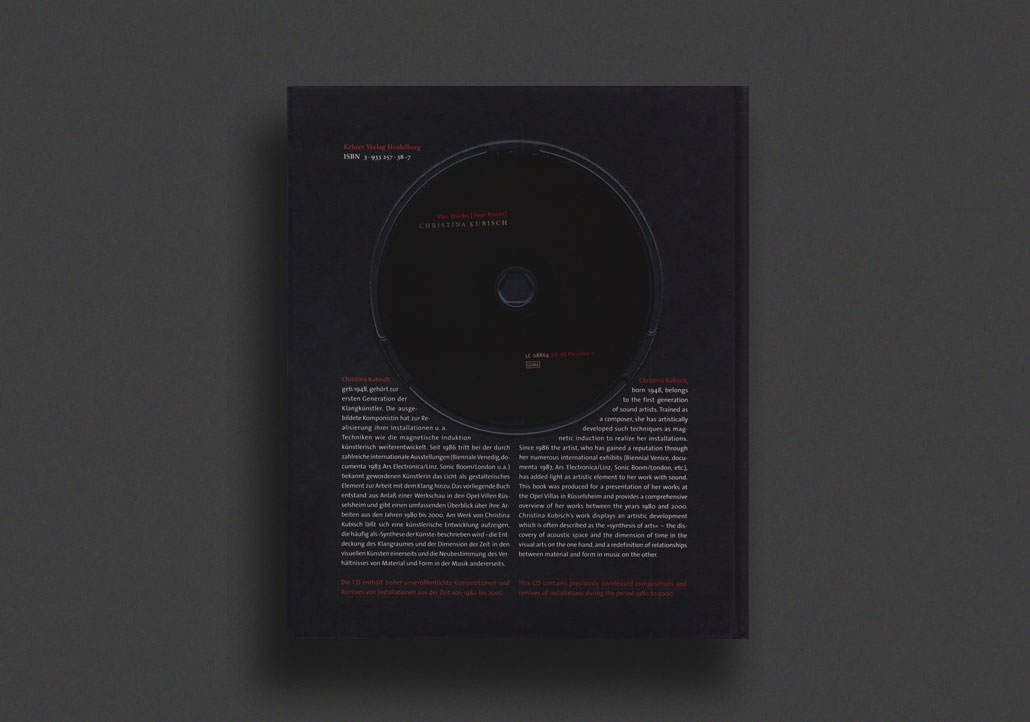
Christina Kubisch (born 1948 in Bremen) belongs to the first generation of sound artists who also developed their own techniques, such as magnetic induction, to realize their installations. Since 1986, the trained composer, who has become known through numerous international exhibitions and participation in exhibitions (Venice Biennale, documenta 1987, Ars Electronica, Linz, etc.), has added light as a design element to her work with sound. This book brings together works created between 1980 and 2000 that can be understood as border crossings between music and fine arts. Although composed according to musical criteria, Christina Kubisch's sound installations are always related to the surrounding spaces, their atmosphere and history.
The accompanying CD contains compositions and remixes of sound installations from the period 1980 to 2000.
"This book provides an excellent overview of Christina Kubisch's sound-space-light-time installations, both optically in excellent color recordings and acoustically in shape previously unpublished compositions and remixes of sound installations as well as theoretically well-founded contributions by Carsten Ahrens, Hans Gercke, Antje von Graevenitz and Christoph Metzger (interview with Christina Kubisch)." (Artium Libri, New Releases on Art New Arts Publications, Issue 1, 2001).
Fine—As New copy, unplayed CD.
1979, English
Softcover, 159 pages, 28 x 23 cm
1st Edition, Out of print title / used / very good
Published by
Harry N. Abrams / New York
$50.00 - Out of stock
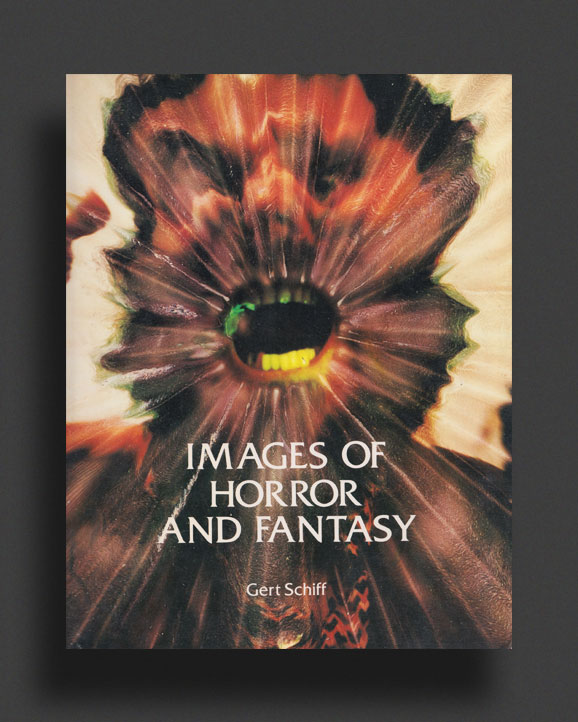
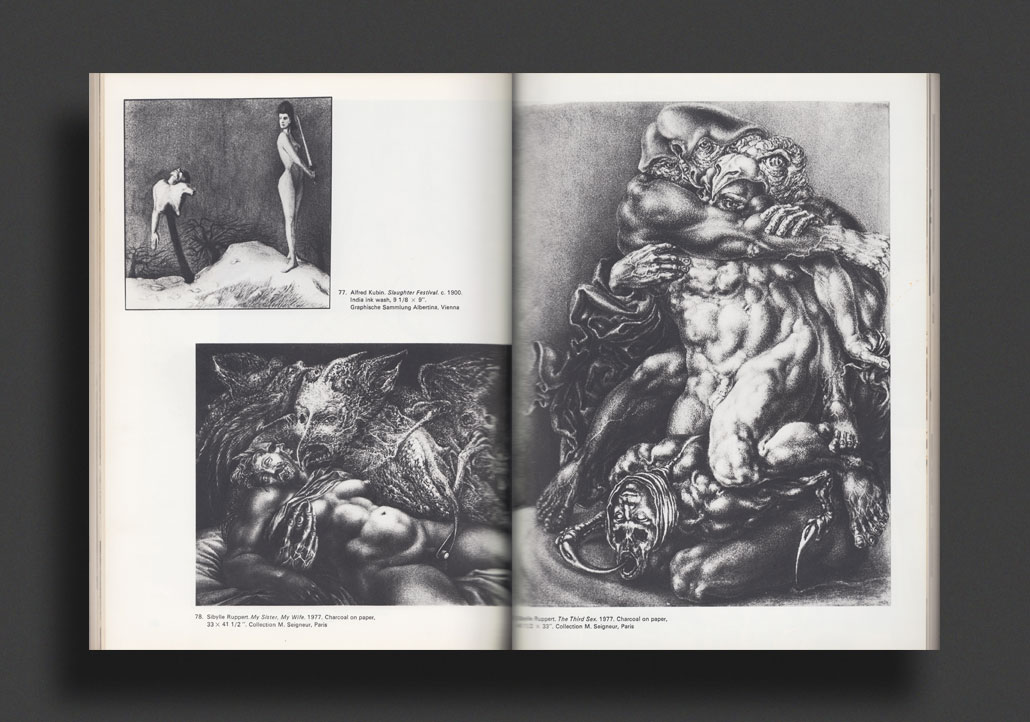
Published by Abrams in 1978, Images of Horror and Fantasy by art historian Gert Schiff expanded on a major group exhibition guest curated by Schiff at the Bronx Museum in 1977. The resulting publication is a perceptive critical and psychological analyses of a variety of nineteenth-and twentieth-century art that "unfolds simultaneously on the level of historical and social reality and on the level of dreams. Its purpose is to expose some of the principal anxieties of modern man and their resolution in utopian reveries and escapist fantasies." Profusely illustrated in colour and b/w throughout with the works of Alfred Kubin, James Ensor, George Grosz, Paul Thek, Sibylle Ruppert, Henry Fuseli, Paul Delvaux, Nancy Grossman, Käthe Kollwitz, Max Beckmann, Fernand Khnopff, Rudolph von Ripper, Max Klinger, H. R. Giger, Jonah Kinigstein, Edward Keinholz, Jean Delville, Lucas Samaras, Miriam Beerman, Willem de Kooning, Man Ray, Oskar Kokoschka, Salvador Dali, Paolo Soleri, Jean Auguste Dominique Ingres, Georges Rouault, Otto Dix, Pablo Picasso, Philip Evergood, William Blake, Giorgio de Chirico, Ivan Albright, Yves Tanguy, Paul Klee, Jasper Johns, Germaine Richier, Francisco de Goya, Henri de Toulouse-Lautrec, Henri Matisse, Max Ernst, Francis Bacon, Rene Magritte, Illya Repin, Antoine Wiertz, Odilon Redon, Edward Burra, Larry Rivers, George Segal, Thomas Cole, Léon Frédéric, Matthias Grünewald, Rico Lebrun, Bruce Connor, Edvard Munch, and many more.
Gert Schiff (1926 — 1990, b. Oldenburg, Germany) was an art historian, critic, lecturer and professor at the Institute of Fine Arts of New York University. A specialist in the Romantic movement, particularly the work of Henry Fuseli and William Blake, Mr. Schiff was also very much involved with 20th-century art, organising many major exhibitions around his interests whilst authoring important studies on the arts from his dwellings at the Chelsea Hotel.
Very Good copy.
2019, English / German
Softcover, 384 pages, 20 x 25 cm
1st Edition, Out of print title / as new
Published by
Ludwig Museum / Cologne
$85.00 - Out of stock
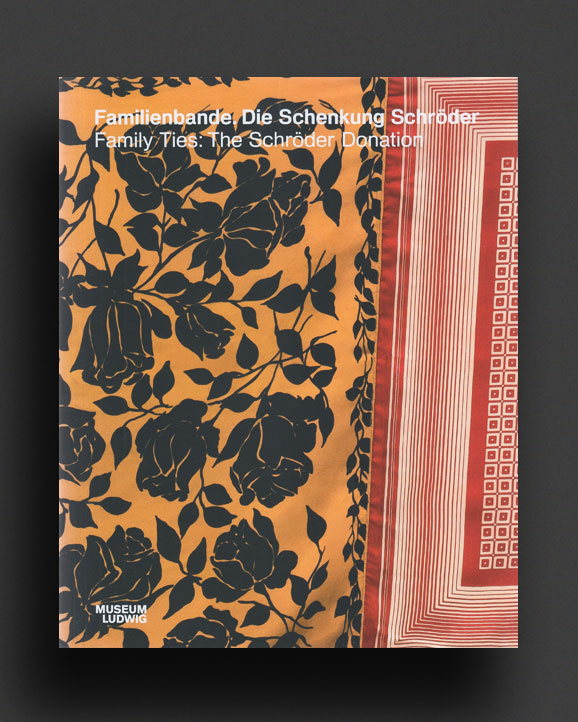
Family, clan, clan, gang, clique, clique, fandum, elective kinship, alliance, collaboration, network.
In the 1990s a new art scene began to form in Cologne. New galleries, magazines such as Texte zur Kunst, and the alternative exhibition space Friesenwall 120 were started. Alexander Schröder followed these developments from Berlin. Already as an art student at the Hochschule der Künste Berlin, he founded his own gallery along with Thilo Wermke. At the same time, he began collecting art from the 1990s and 2000s with his special eye.
Today his collection exemplifies the idiosyncratic and sensual side of this era, which was shaped by Conceptual Art. It demonstrates the significance of artist groups and collaborations in changing constellations at the time. Proximity and distance, connections and competition, inclusion and exclusion existed in productive friction with each other. Now the Schröder family has donated twenty-nine works from their collection, including large-scale installations, to the Museum Ludwig by artists such as Kai Althoff, Cosima von Bonin, Tom Burr, Lukas Duwenhögger, Isa Genzken, and Danh Võ. The exhibition Family Ties: The Schröder Donation presents these works to the public along with a selection from the Museum Ludwig collection. It focuses on art at the turn of the twenty-first century and examines the special conditions that existed in Cologne, also in relationship to New York.
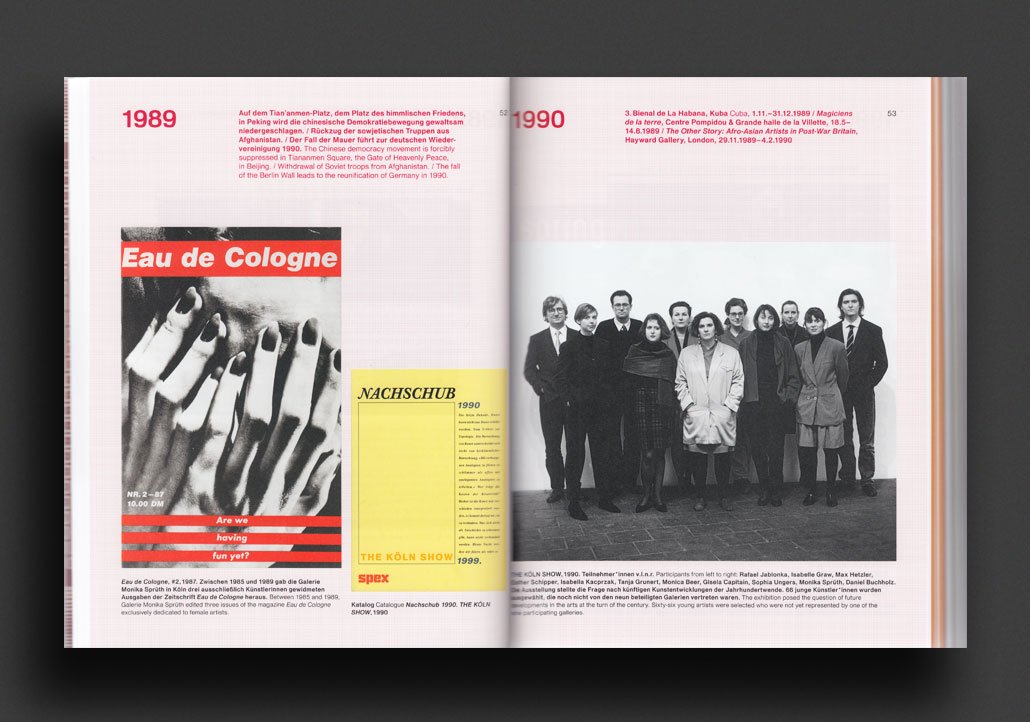
The chronological documents (the works of art themselves, the invitations, flyers, fanzines, journals and texts from the 1990s to the 2000s) arranged on a timeline in this catalogue provide an insight into the development of art at that time in Cologne and New York. Selected essays and reviews reflect the at that time virulent theoretical debates; selective metadata point to drastic socio-political events and influential exhibitions. The catalog accompanies the exhibition Schroeder with works by Kai Althoff, Cosima von Bonin, KP Brehmer, Tom Burr, Luke Duwenhögger, Isa Genzken, Dan Graham, Renee Green, Ull Hohn, Hilary Lloyd, Lucy McKenzie, Christian Philip Muller, Nils Norman, Stephen Prina and Danh Vo.
2022, English
Hardcover, 262 pages, 22 x 28.5 cm
Published by
Walther König / Köln
Zeno X Gallery / Antwerp
$120.00 - Out of stock
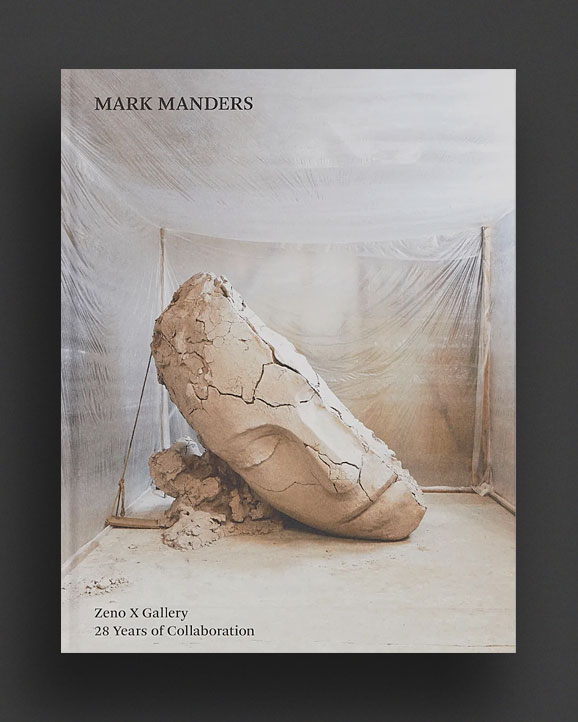
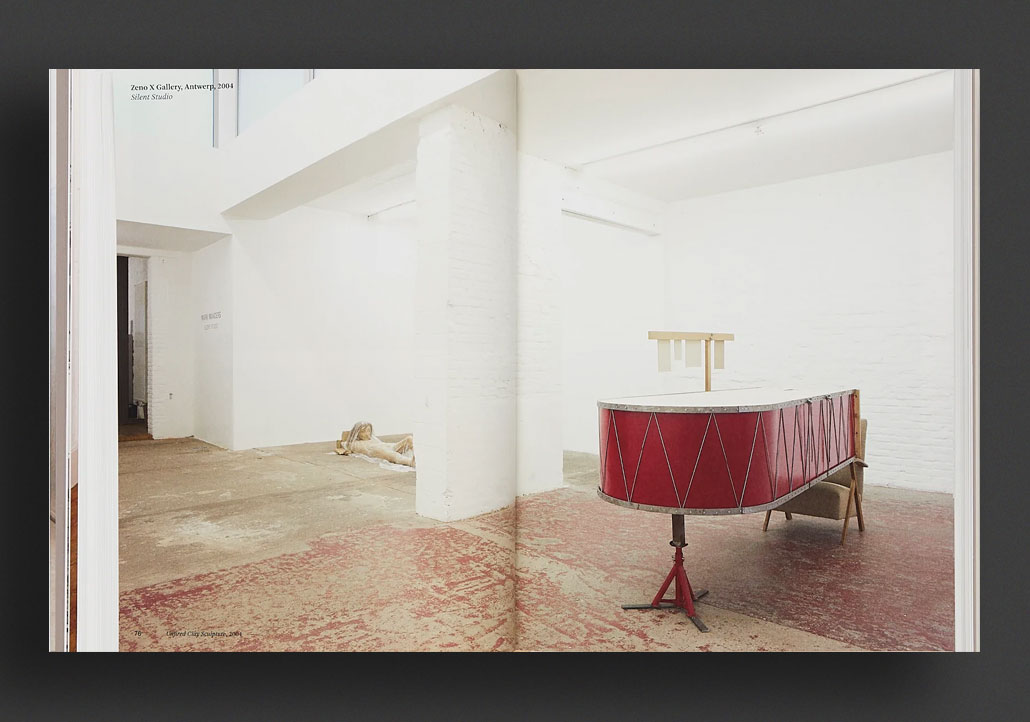
Mark Manders – Zeno X Gallery, 28 Years of Collaboration offers an overview of the long-standing collaboration between the artist Mark Manders (b. 1968) and Zeno X Gallery in Antwerp. The review has been published to accompany his most recent solo exhibition in the gallery and highlights a number of important exhibitions and special projects in Belgium and abroad in which Manders was invited to take part from the 1990s to the present day.
Mark Manders has been working since 1986 on what he calls his ‘self-portrait as a building’. His oeuvre – consisting of installations, sculptures, works on paper and drawings – is ascribed the metaphor of a fictional building, divided into separate rooms whose precise shape and size is undefined. There is no beginning and no end. Manders strives for timelessness and universality using archetypal forms and familiar-looking materials such as clay, bronze and wood. His bronze sculptures and installations consequently appear more vulnerable than they are in reality.
With text contributions from Mark Manders, Frank Demaegd (Zeno X Gallery) and Marjolein Sponselee.
Publication accompanying the exhibition in Zeno X Gallery, which takes place from 3 September to 15 October 2022.
2018, Japanese / Italian
Softcover (w. dust jacket), 380 pages, 25.7 x 19 cm
1st Edition, Out of print title / as new
Published by
Museum of Modern Art / Kamakura
$89.00 - Out of stock
First edition of the incredible Japanese Bruno Munari Retrospective catalogue, published on the occasion of the largest ever survey exhibition of Bruno Munari's work, that travelled across Japan in 2018. At nearly 400 pages, this profusely colour-illustrated book begins with Munari's early futurist paintings and mobile sculptures and carries the reader through his entire career, generously showcasing throughout an impressive archive of his innovative and iconic graphic works in book and poster design, sculpture, illustration, interior/furniture design, games, art objects, his Xerografia, and much more. It's all here! A wonderful document of material. Texts in Japanese and Italian, with a full chronology, and extensive list of exhibited works. Stunning.
Bruno Munari (October 24, 1907, Milan – September 30, 1998, Milan) was an Italian artist, designer, and inventor who contributed fundamentals to many fields of visual arts (painting, sculpture, film, industrial design, graphic design) in modernism, futurism, and concrete art, and in non visual arts (literature, poetry) with his research on games, didactic method, movement, tactile learning, kinesthetic learning, and creativity.
1984, English
Softcover, 250 pages, 21 x 30 cm
1st Edition, Out of print title / used / very good
Published by
Biennale of Sydney / Sydney
$70.00 - Out of stock
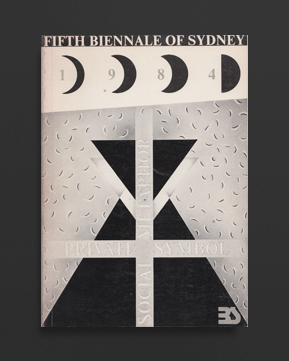
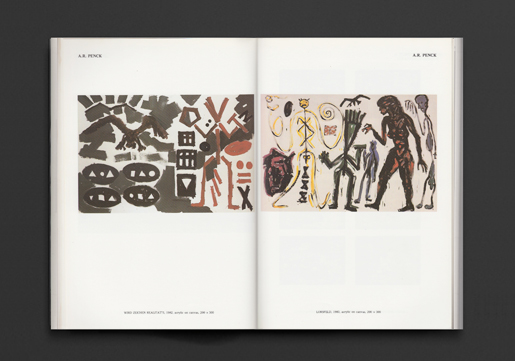
Catalogue published on the occasion of the Fifth Biennale of Sydney 1984, 11 April – 17 June 1984. Under the artistic direction of Leon Paroissien the 1984 Biennale was titled "Private Symbol: Social Mataphor" and featured the work of Davida Allen, Armando, Art & Language, Terry Atkinson, Breda Beban, Joseph Beuys, Tony Bevan, Annette Bezor, Francois Boisrond, Peter Booth, Tomasz Ciecierski, Tony Cragg, Juan Davila, Antonio Dias Gonzalo Diaz, Eugenio Dittborn, Felix Droese, Marlene Dumas, Edward Dwurnik Mimmo Germana, Gilbert & George, Mike Glier, Hans Haacke, Jenny Holzer, Ralph Hotere, Jorg lmmendorff, Berit Jensen, Birgit Jürgenssen, Mike Kelley, Peter Kennedy, Anselm Kiefer, Karen Knorr, Barbara Kruger, Robert Longo, Colin McCahon, Syoko Maemoto, Sandra Meigs, Cildo Meireles, Gianni Melotti, Marisa Merz, Annette Messager, Olaf Metzel, Sara Modiano, Michael Mulcahy, Josef Felix Müller, Christa Näher, Annick Nozati, Anna Oppermann, Andy Patton, A.R. Penck, Robert Randall & Frank Bendinelli, Jytte Rex, Georges Rousse, Klaudia Schifferle, Hubert Schmalix, Cindy Sherman, Vincent Tangredi, Peter Taylor, Dragoljub Raéa Todosijevié, Vicki Varvaressos, Jenny Watson, Michiko Yano, Eva Man-Wah Yuen
This catalogue includes colour examples of the work of all participating artists alongside texts by Leon Paroissien, Annelie Pohlen, Carter Ratcliff, Jean-Louis Pradel, Leon Paroissien.
1992, English / German / French
Softcover, 176 pages, 30 x 23 cm
1st Edition, Out of print title / used / very good
Published by
Taschen / Cologne
$90.00 - Out of stock
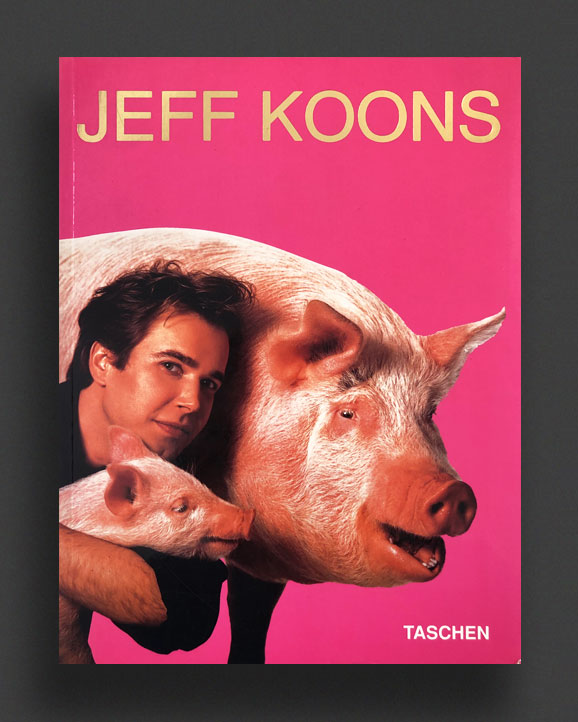
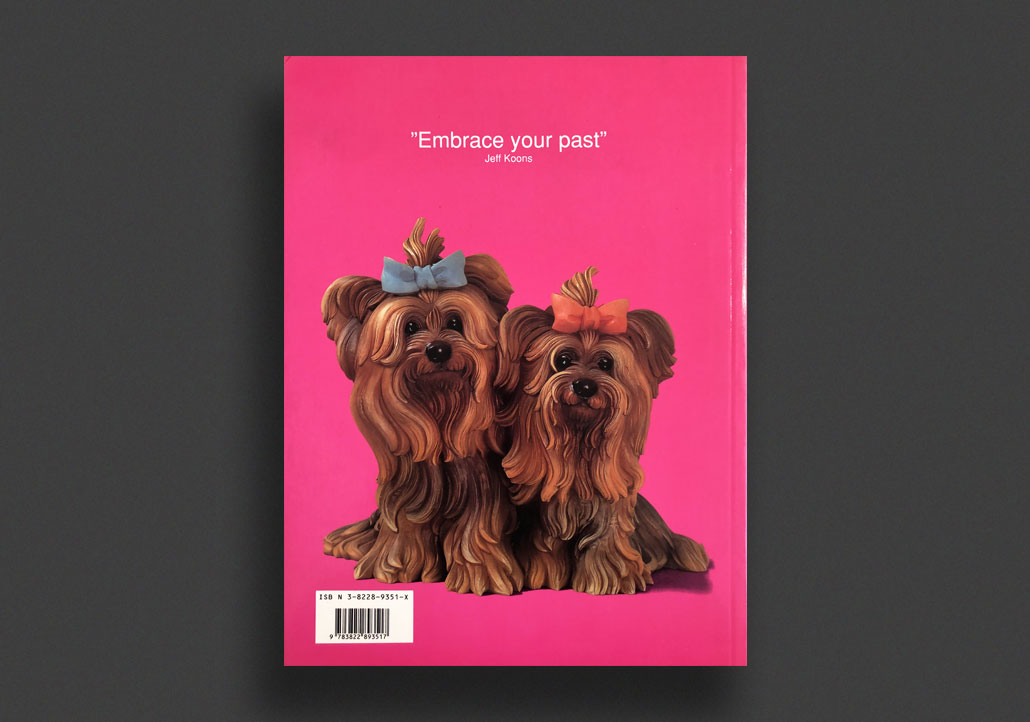
First edition of the first major monograph compiled on American artist Jeff Koons, published by Taschen in 1992, edited by Angelika Muthesius. Lavishly illustrated in glossy full-colour surveying renowned early and iconic Koons works from 1979—1992, including The New (vacuums), Equilibrium (basketballs), Luxury and Degradation, Statuary (Rabbit, etc.), Banality (Michael Jackson and Bubbles, Pink Panther...), Puppy, and much more. There's so much work in this monograph beautifully reproduced in all its kitsch glory, however, what makes it particularly appealing is the fact of including the extensive uncensored series Made In Heaven (1990—91), featuring the artist himself and Ilona Staller, aka Cicciolina, the Hungarian-Italian former porn star, politician, singer and Koons' then-wife, in highly explicit sexual positions rendered in porcelain, glass, and hi-definition (explicit) glamour photography. Loathed by critics, many of the works were destroyed by Koons following his divorce, yet the series helped make Koons the household name he is today. Text in German, English and French by Angelika Muthesius, Jean-Christophe Amman and Anthony Haden-Guest, plus interview with Koons.
Jeffrey Lynn Koons (b. 1955) is an American artist recognized for his work dealing with popular culture and his sculptures depicting everyday objects. He lives and works in both New York City and his hometown of York, Pennsylvania.
Very Good copy.
2021, English
Hardcover (w. obi-strip), 292 pages, 28 x 22 cm
Published by
Walther König / Köln
Museum Folkwang / Essen
$160.00 - Out of stock
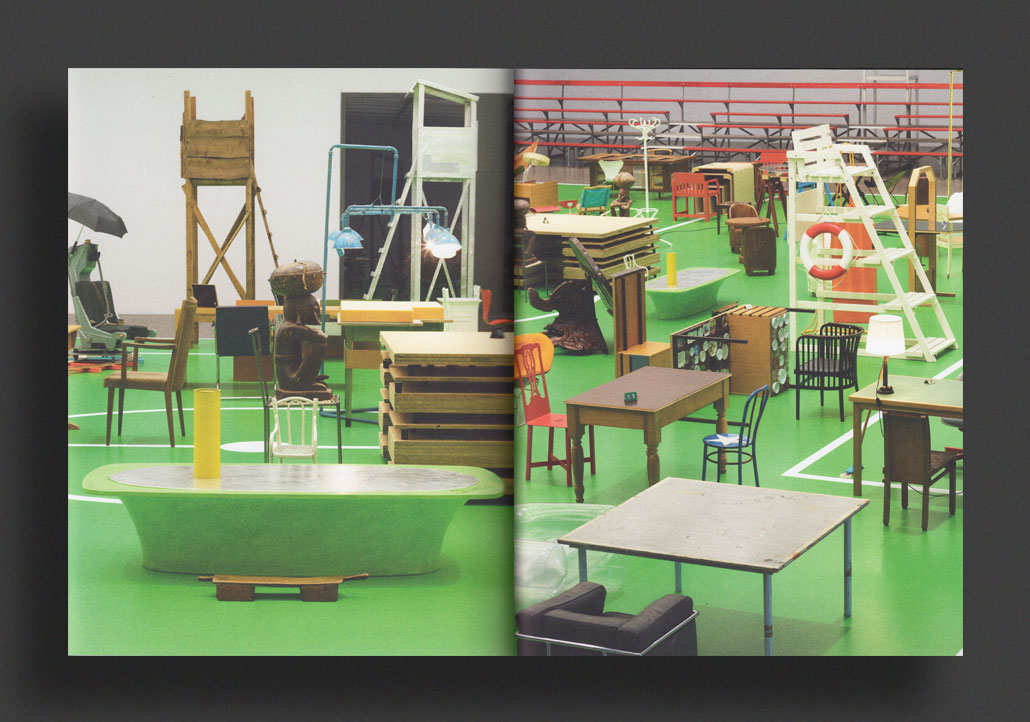
A detailed documentation of Kippenberger’s epic masterpiece. Kippenberger's largest and most complex work, The Happy End of Franz Kafka’s "Amerika" explores a utopia of universal employment, based on a section from Kafka’s titular novel in which the protagonist, Karl Rossmann, applies for a job at the “biggest theater in the world”: “whoever wants to become an artist should sign up!”.
Kippenberger spent several years preparing, researching and producing the epic installation, set out on a stylized football pitch, and made up of 50 table-and-chair ensembles. Alongside classic design icons and found objects, it also includes furniture especially produced by Kippenberger, as well as pieces by numerous artist friends, including Cosima von Bonin, Tony Oursler, Ulrich Strothjohann and Jason Rhodes. This profusely illustrated hardcover publication examines the work, and includes, for the first time, “biographies” of the individual objects, tracing the contexts of their creation, collection and integration into the installation.This volume therefore constitutes the definitive documentation of The Happy End of Franz Kafka’s "Amerika" and offers a new way to approach Martin Kippenberger’s life and oeuvre.
Published on the occasion of the exhibition at Museum Folkwang, Essen (2021).
2018, English
Softcover, 216 pages, 255 x 192 mm
Published by
Surpllus / Melbourne
$40.00 - Out of stock
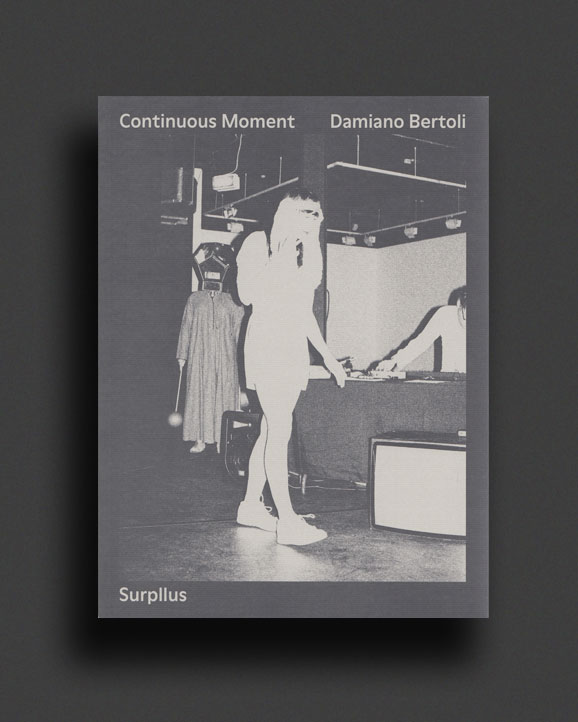
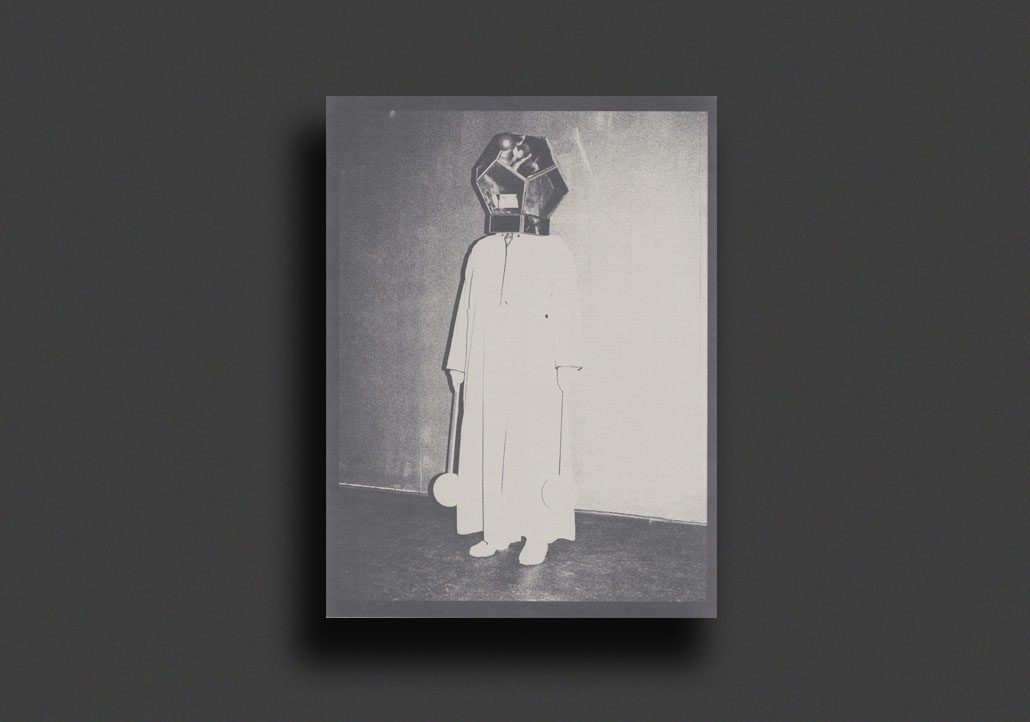
Comprehensive monograph on the work of Australian artist Damiano Bertoli.
"Melbourne artist Damiano Bertoli is best known for the ongoing series ‘Continuous moment’, a multidisciplinary practice that offers a paratactic investigation of artistic experiments, social projects and theoretical legacies that inform the history of modernism and contemporary art. At the centre of much of this thought and production is a delirious pragmatism that draws on material as diverse as Pablo Picasso’s 1941 surrealist play Le desire attrape par la queue (Desire caught by the tail), originally performed under the shadow of Nazi occupation, the aspirational practices of Superstudio (1966–78), which sought to live without architecture, and the occultism of the homicidal sect led by Charles ‘Willis’ Manson. What is decisive, in any case, is that for Bertoli the unity of this practice resides in a display methodology that echoes a number of avant-garde principles that question the backward looking gaze." - Nik Papas
Published by Surpllus. Designed by Ziga Testen, Edited by Brad Haylock.
Profusely illustrated throughout in colour and black and white, with accompanying essays by Justin Clemens, Helen Hughes, Helen Johnson, Nik Papas, Chris Sharp, Liza Vasiliou.
2022, English
Softcover, 344 pages, 26.8 x 35.5 cm
Published by
Skira / Milan
$110.00 $90.00 - In stock -
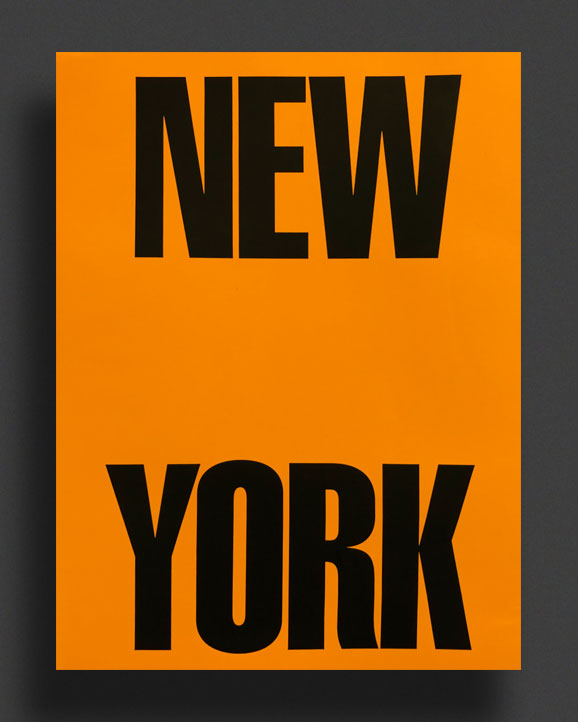
Charting the three momentous years in which New York became the global capital of art.
The radical cultural transformations that occurred in New York in the three years between January 1962 and December 1964 ramified across the world. In addition to a whole host of creative innovations across disciplines, the period also saw a shift in the center of artistic gravity from Europe to the United States and the rise of a new leadership in the arts—curators, gallerists and other impresarios.
Modeled on the scale and format of Life magazine (one of the most widely read publications of the era), this lavishly illustrated oversized paperback traces a detailed itinerary of artists and curators, experimental exhibitions and museums, as well as historical and political events that transformed society during this explosive moment. From the New Realists exhibition at Sidney Janis Gallery in 1962 to Robert Rauschenberg's unexpected win of the International Grand Prize in Painting at the 1964 Venice Biennale, every groundbreaking event from this incredible three-year period is documented.
Organized chronologically, the book is teeming with images of artworks and archival photographs, and artist interviews conducted by the late great curator Germano Celant.
Artists include: Diane Arbus, Lee Bontecou, Chryssa, Merce Cunningham, Jim Dine, Melvin Edwards, Dan Flavin, Lee Friedlander, Nancy Grossman, Jasper Johns, Donald Judd, Ellsworth Kelly, Yayoi Kusama, Norman Lewis, Roy Lichtenstein, Marisol, Agnes Martin, Louise Nevelson, Isamu Noguchi, Claes Oldenburg, Yvonne Rainer, Robert Rauschenberg, Faith Ringgold, Larry Rivers, James Rosenquist, Miriam Schapiro, Carolee Schneemann, George Segal, Jack Smith, Harold Stevenson, Marjorie Strider, Mark di Suvero, Bob Thompson and Andy Warhol.
Conceived by Germano Celant. Edited with text by Sam Sackeroff, Lerman-Neubauer Associate Curator at the Jewish Museum. Preface by Claudia Gould, Helen Goldsmith Menschel Director at the Jewish Museum. Introduction by Michael Rock. Interviews by Germano Celant with Christo and Jim Dine. Text by Claudia Gould, Michael Rock, Sam Sackeroff, Emily Bauman, Ninotchka D. Bennahum, Jennifer G. Buonocore-Nedrelow, Olivia Casa, Laura Conconi, J. English Cook, Maria Corti, Michaëla de Lacaze Mohrmann, Joshua B. Guild, Liz Hirsch, Hiroko Ikegami, Susan Murray, Kristina Parsons, Benjamin Serby, Jennifer Sichel, Robert Slifkin.
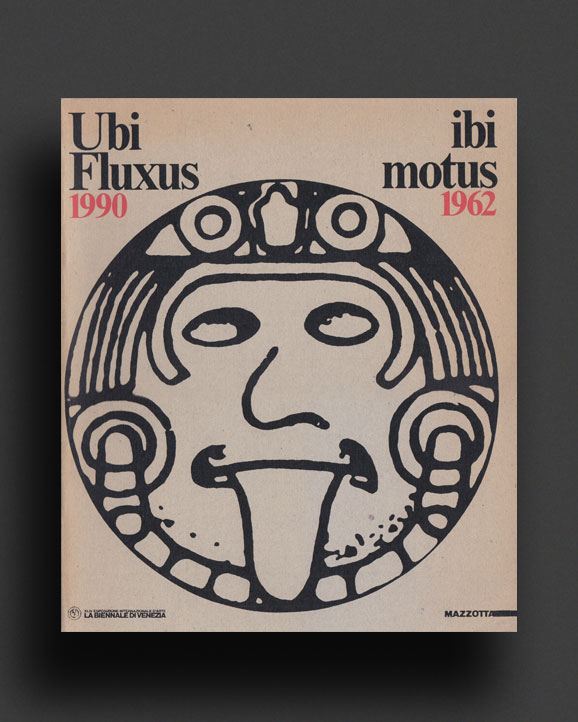
1990, English / Italian
Softcover, 500 pages, 27 x 23 cm
1st Edition, Out of print title / used / very good
Published by
Mazzotta / Milan
$140.00 - Out of stock
Huge and comprehensive exhibition catalogue published in conjunction with "Ubi Fluxus Ibi Motus : 1962-1990" held at the Ex Granai della Repubblica alle Zitelle from May 26 - September 30, 1990. Profusely illustrated throughout with essays by curator Achille Bonito Oliva, Gino Di Maggio, Gianni Sassi, and many others (texts in English and Italian.)
Captures the history of Fluxus, including the works of Nam June Paik, Joe Maciunas, Christo, Dieter Rot, Öyvind Fahlström, Ray Johnson, Piero Manzoni, Gustav Metzger, Jean Tinguely, Al Hansen, Dick Higgins, Allan Kaprow, Jean-Jacques Lebel, Carolee Schneemann, Ay-o, Wolf Vostell, Eric Andersen, Joseph Beuys, George Brecht, John Cage, Giuseppe Chiari, Phillip Corner, Willem de Ridder, Robert Filliou, Joe Jones, Milan Knizak, Alison Knowles, Arthur Køpcke, Takehisa Kosugi, Shigeko Kubota, Yoko Ono, Ben Vautier, Robert Watts, Emmett Williams, Takehisa Kosugi, Shigeko Kubota, La Monte Young, and many others. Sections: Pre-Fluxus (1958-1962), Fluxus during the Collective Years (1962-1964), Fluxus during Fluxus, Some Fluxus friends, Pre-history.
First edition in very good, well-preserved, crisp condition - only tanning from age to cover.
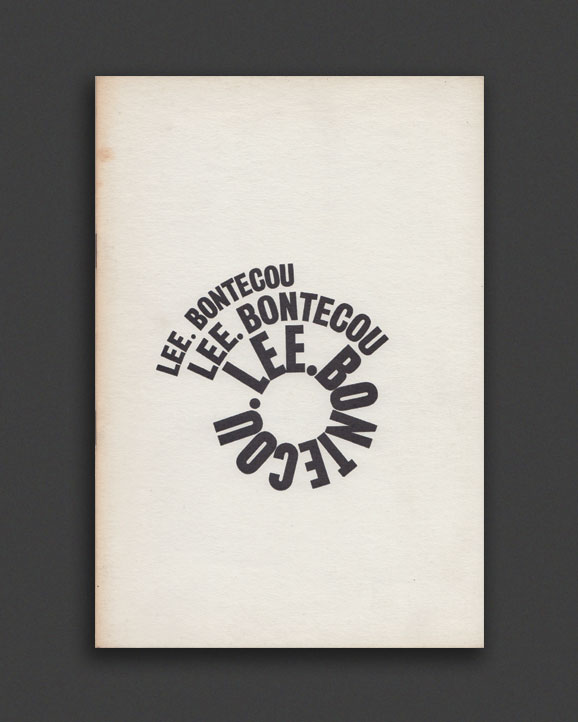
1965, French
Softcover, 16 pages, 26.5 x 18.0 cm
1st Edition, Out of print title / used / very good
Published by
Galerie Ileana Sonnabend / Paris
$100.00 - Out of stock
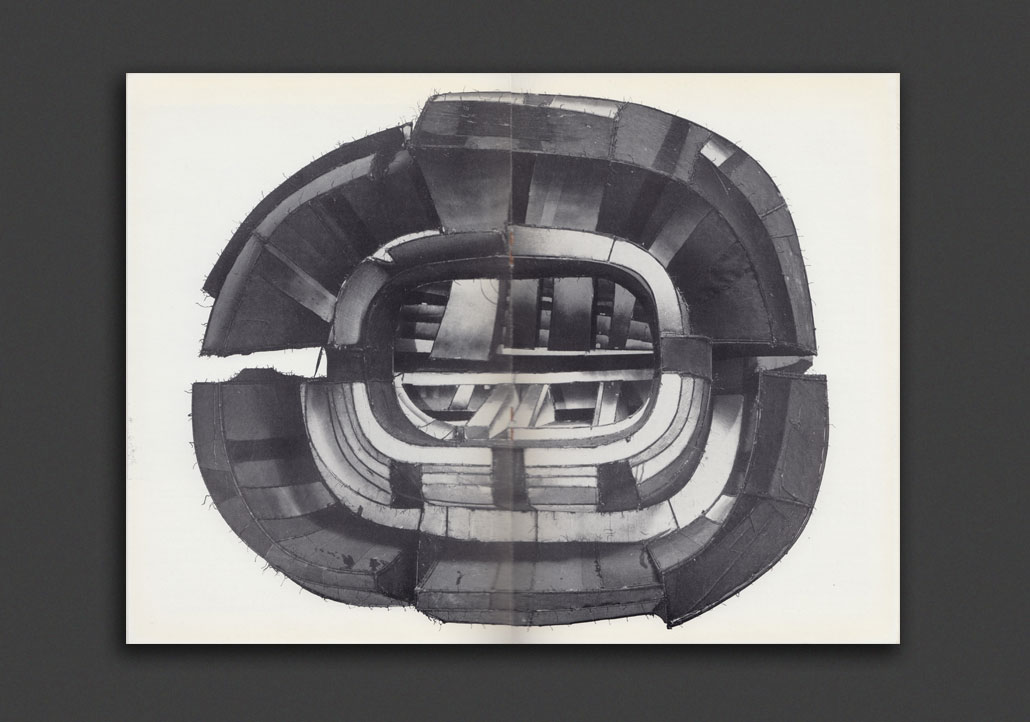
Scarce copy of the first international catalogue to appear on the work of the great American artist Lee Bontecou. Published to accompany her solo exhibition at Galerie Ileana Sonnabend, Paris, in 1965. Monochrome illustrations of Bontecou's sculptures throughout, alongside essays by Gillo Dorfles, Gerald Gassiot-Talabot, and Annette Michelson, and bio.
One of the most widely recognized female artists of the 1960s, Lee Bontecou creates welded wall reliefs, hanging sculptures, and miniature, mystical drawings that reflect her interest in natural and man-made forms. Brown and black in tone and often with ominous, organic voids at their centers, her large-scale patchwork accumulations of canvas, leather, wire mesh, and muslin recall nests, machines, ancient architecture, and the human body. She constructs her massive, free-hanging forms from constellations of steel, shaped canvas, porcelain curios, and explosive lengths of wire that reach far into space. Through such works, Bontecou has sought to capture “as much of life as possible—no barriers—no boundaries—all freedom in every sense,” she says.
Very Good copy, no creasing and only light edge tanning.
2017, English
Softcover, 340 pages, 23 x 17.7 cm
Ed. of 1000,
Published by
Michael Lett / Auckland
Clouds / Auckland
$35.00 - In stock -
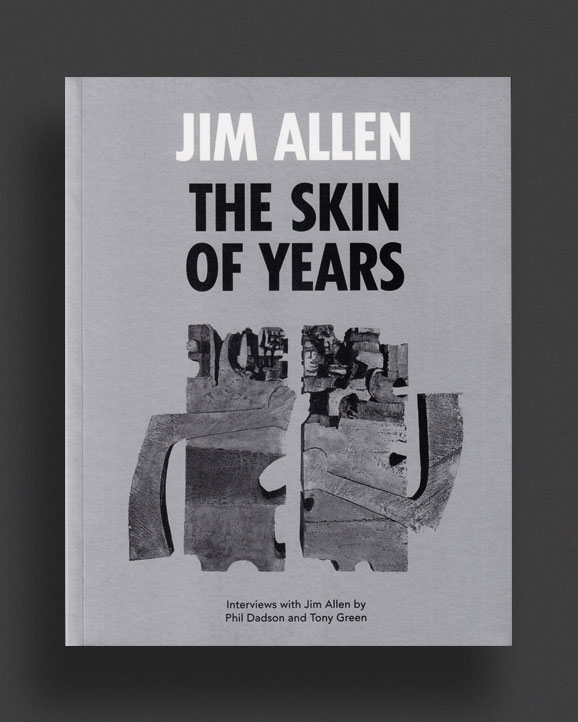
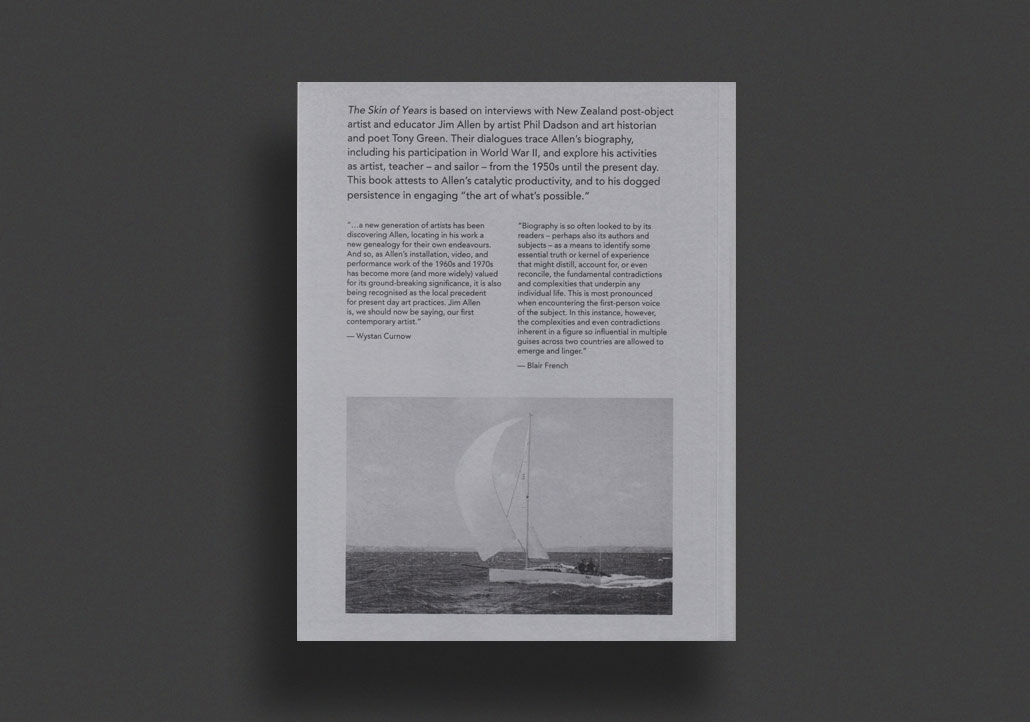
New Zealand artist and educator Jim Allen is both a formidable influence upon his followers and a prolific artist in his own right. A leader of post-object practices in the global south, Allen’s immersive installations and light touch share much with his self-proclaimed heroes, experimental filmmaker and sculptor Len Lye and Brazilian kineticist Hélio Oitica. This robust reader contains over 300 pages of interviews with Allen, conducted largely by art historian Tony Green and fellow artist Phil Dadson. Through these colourful and often humorous oral histories, one can trace the narrative of Allen’s life, including his participation in WWII and formation as an artist and teacher—and sailor!—from the 1950s until the present day. An important record of a woefully understudied figure of postwar art, The Skin of Years presents Allen’s dogged persistence to engage in what he has called “the art of the possible.”
Introductions by Wystan Curnow and Blair French.
Edited by Gwynneth Porter.
“…a new generation of artists has been discovering Allen, locating in his work a new genealogy for their for own endeavours. And so, as Allen�s installation, video, and performance work of the 1960s and 1970s has become more (and more widely) valued for its ground-breaking significance, it is also being recognised as the local precedent for present day art practices. Jim Allen is, we should now be saying, our first contemporary artist.”—Wystan Curnow
“Biography is so often looked to by its readers – perhaps also its authors and subjects – as a means to identify some essential truth or kernel of experience that might distill, account for or even reconcile the fundamental contradictions and complexities that underpin any individual life. This is most pronounced when encountering the first-person voice of the subject. In this instance, however, the complexities and even contradictions inherent in a figure so influential in multiple guises across two countries are allowed to emerge and linger.”—Blair French
1980, German
Softcover, 140 pages, 26.8 x 22 cm
1st Edition, Out of print title / used / good
Published by
Ludwig Museum / Cologne
$65.00 - Out of stock
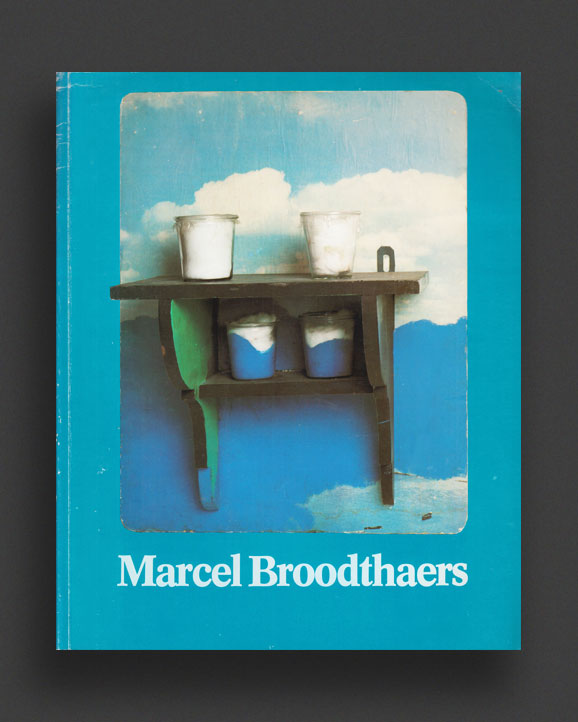
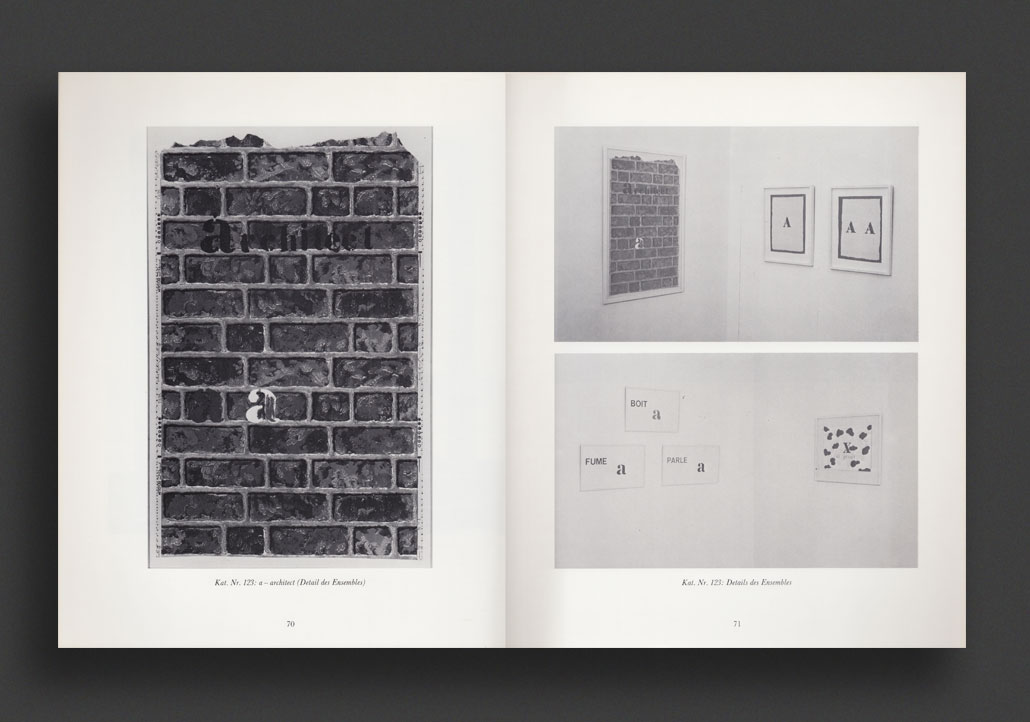
Catalogue published on the occasion of the Marcel Broodthaers major survey exhibition at Museum Ludwig, Cologne, October 4—November 26, 1980. Illustrated throughout in colour and b/w with the 128 exhibited objects, texts (in German) by Karl Ruhrberg, Evelyn Weiss, Michael Compton, Pierre Restany, Jürgen Harten, Gerhard Kohlberg.
Good copy with some cracking to top of spine.
2012, English
Hardcover, 404 pages, 21.6 x 26.2 cm
Published by
Ediciones Polígrafa / Barcelona
$150.00 - Out of stock
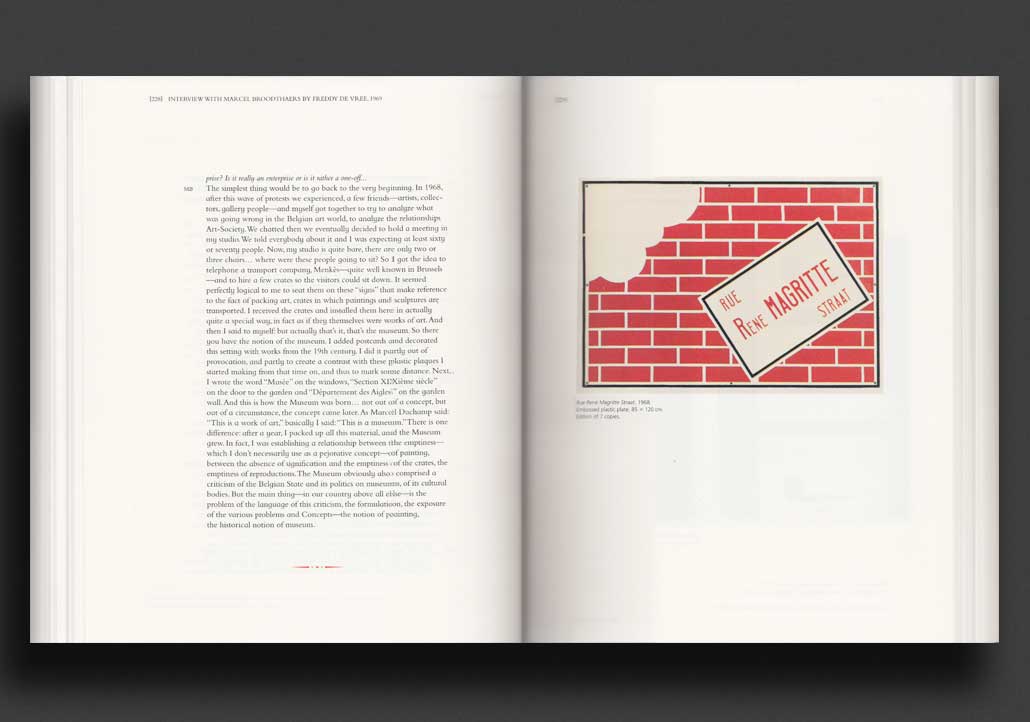
"I, too, asked myself if I could not sell something and succeed in life... Finally the idea of inventing something insincere came to me and I got to work immediately."
With this statement, penned for his first solo show in April, 1964, Marcel Broodthaers (1924-1976) announced his death as a poet and birth as an artist. In fact, he was to transform the category of artist completely, purging the vocation of its medium-specific implications to pursue a unified conceptualism across media such as artist's books, prints, film, installation, sculpture and writings-- "where the world of plastic arts and the world of poetry might possibly, I wouldn't say meet, but at the very frontier where they part." Broodthaers' "Museum of Modern Art, Eagles Department" (1968-1972) inaugurated the practice now known as institutional critique, and the linguistic foundations of his art--as well as his emphasis on printed multiples--also proved prescient for subsequent strains of Conceptual art. Edited by Gloria Moure in collaboration with the artist's estate, this momentous publication eclipses in its scope all previous Broodthaers monographs and writings collections. It gathers his early poetry, statements, critical essays both published and unpublished, open letters, interviews, preparatory notes and scripts alongside nearly 200 colour images in a massive and decisive presentation of the artists' postmedium art.
Marcel Broodthaers was born in Belgium in 1924. From the late 1940s to the early 1960s he worked primarily as a poet, and was a member of the Belgian Groupe Surrealiste-revolutionnaire, which included Andre Blavier, Achille Chavee and Rene Magritte. After almost two decades of poverty, Broodthaers performed a symbolic burial of his life as a poet by embedding 50 copies of his poetry collection Pense-Bete in plaster. However, his art continued to be characterized by its emphasis on written text. Broodthaers died in 1976, on his fifty-second birthday, and is buried in Brussels beneath a tomb of his own design that features images from his allegorical repertoire, including a pipe, a wine bottle and a parrot.
1984, German
Softcover (staple-bound), 38 pages, 28 x 23.5 cm
Ed. of 800,
1st Edition, Out of print title / used / very good
Published by
Zellermayer Galerie / Berlin
$45.00 - In stock -
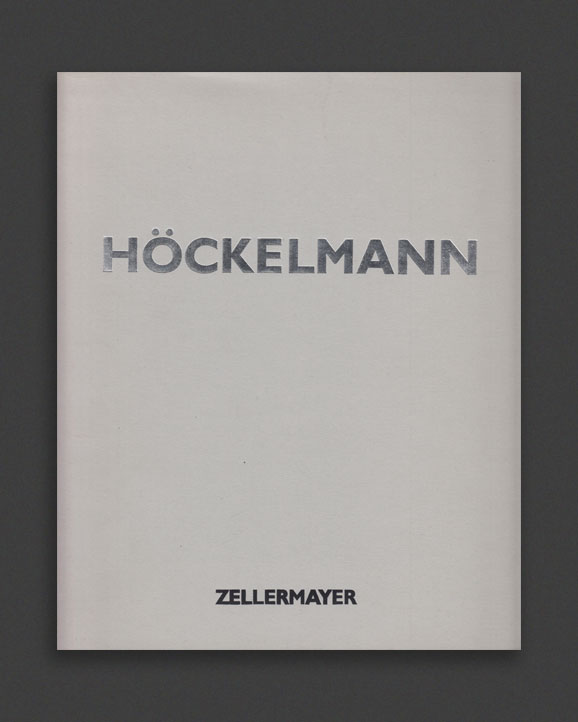
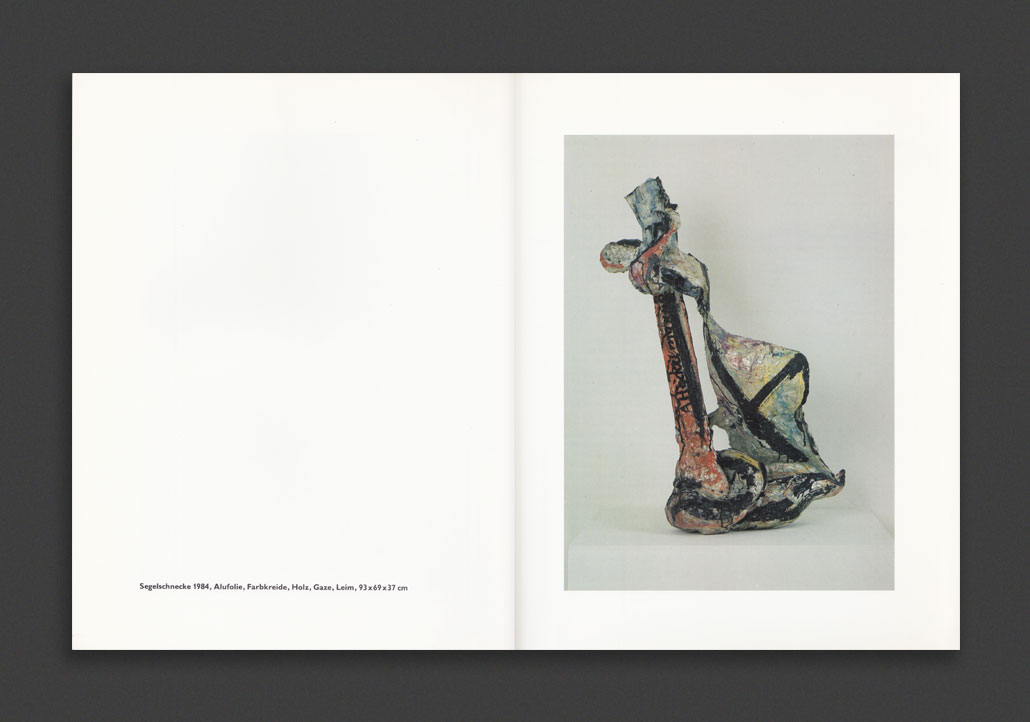
Catalogue published in 1984 to accompany and document German artist Antonius Höckelmann's incredible aluminium foil sculptures produced between 1983—84, exhibited in survey at Zellermayer Galerie , Berlin. Illustrated throughout in colour with each work, accompanied by a short introduction text (German) and biography.
Edition of 800.
The basic material from which Höckelmann forms his sculptures is unusual: aluminum foil, which, when crumpled up, twisted and stretched, achieve amazing strength. In places, glue-soaked gauze strips are wound over it and colored with wax crayons. The artist forces his materials into the most unusual creeping movements. Forms that sometimes remind us of a gnarled tree seem strange to us at first; the aluminum foil, twisted together to form a volume, shows spiral formations that become labyrinthine furrows. And then the viewer may remember his own play with the silver foil of a cigarette pack lying around: If the bales and balls of thin foil do not result in miniature plastics, just big enough how they can be formed between the fingertips and further transformed and developed when a piece of foil is again twisted around existing thickenings? Seen in this way, Antonius Höckelmann's sculptures are "huge miniatures". As if under a magnifying glass, a whole new world emerges with unknown shapes and images never seen before. The big comes from the small, freed from all the obligations of dimensions.
Antonius Höckelmann (1937, Oelde—2000, Cologne ) was a German artist. Höckelmann trained as a wood sculptor in his hometown from 1951 to 1957 and studied from 1957 to 1961 at the University of Fine Arts in Berlin with Karl Hartung . His first gallery owner was the art dealer Michael Werner, who was also looked after by Galerie Zellermayer. He was later represented at various other galleries, such as Galerie Elke and Werner Zimmer, in Düsseldorf, Galerie Fred Jahn, Munich, De Weer Art Galerie, Outigem / Belgium or at Galerie Claude Samuel, Paris. In 1970 he moved to Cologne and studied at the Rolandseck train station near Bonn. In 1977 he took part in documenta 6, in 1982 in documenta 7 in Kassel, and in 1984 in the exhibition From Here - Two Months of New German Art in Düsseldorf. Many of his works combine sculpture and painting. Wooden sculptures and also sculptures made of other materials (bronze, silver foil, straw) were completely painted. Höckelmann died in 2000 at the age of 63 and was buried in Cologne's North Cemetery (Hall 22 No. 185).
Very Good copy.
1971, English
Hardcover, 97 pages, 25 x 29 cm
1st Edition, Out of print title / used / very good
Published by
Edizioni 0 / Milan
$100.00 - In stock -
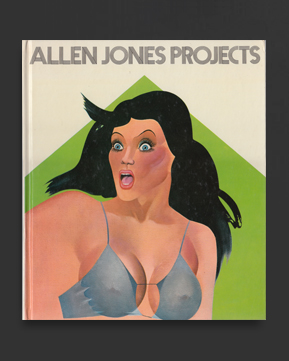
First edition of "Projects", the fantastic 1971 hardcover artist book by British Pop artist Allen Jones.
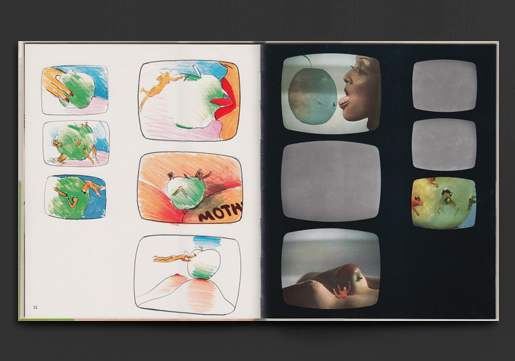
Designed and typeset by Jones, in collaboration with Roy Walker and Anthony Matthews, this lavish hardcover book is heavily illustrated throughout (primarily in vivid colour) with photographs, drawings, video excerpts and montages by Jones. Five of Allen Jones' costume/set design/art direction projects are covered in this book, including his work for opera (Mozart's "The Abduction from the Seraglio"), film ("The Playroom" and "A Clockwork Orange"), stage (two sequences from "Oh Calcutta!") and television ("Männer Wir Kommen"). "The text has been researched and transcribed from taped interviews with Allen Jones by Ruth Messina and Bonne Boston."
Allen Jones (b. 1 September 1937) is a British pop artist, best known for his sculptures, paintings, drawings, and work in set and costume design for film and theatre.
Jones’ exhibitions of erotic sculptures, such as the set Chair, Table and Hat Stand (1969), are studies in forniphilia, which turn women into items of human furniture. Much of his work draws on the imagery of rubber fetishism and BDSM. The sculptures in the Korova Milk Bar from the 1971 film A Clockwork Orange were based on works by Jones after he turned down the request by Stanley Kubrick to design the set for no payment. Jones designed Barbet Schroeder’s 1976 film Maîtresse.
Very Good copy, light water marking to end papers, not affecting content.