World Food Books' programme is largely produced on Kulin Nation land. We acknowledge the Wurundjeri people of the Kulin Nation as the first and continuing custodians of this land, and pay respect to their Elders past, present, and emerging.
World Food Books is an arts and special interests bookshop in Naarm / Melbourne. Founded in 2010, World Food Books is devoted to the presentation of a rotating, hand-selection of international art, design, literary and counterculture publications with an emphasis on the anti-traditional, the experimental, the avant-garde, the heretic, the marginal.
Presenting new titles alongside rare and out-of-print books, catalogues and journals spanning the fields of modern and contemporary art, design, photography, illustration, film, literature, poetry, cultural theory, philosophy, sexuality, popular and underground culture in its many radical forms, World Food Books wishes to encourage adventurous, thoughtful and open-minded reading, looking, writing, and exchange of publishing and ideas, both current and historical.
As well as our bookshop, located in Melbourne's historical Nicholas Building, all of our inventory is available internationally via our online mail-order service.
World Food Books semi-regularly co-ordinates "Occasions", a programme of exhibits and events at the bookshop and in partnership with other hosts (such as museums and art galleries) that develop out of the activities, relationships and content of the bookshop itself.
World Food Books
The Nicholas Building
37 Swanston Street
Room 5, Level 6
Melbourne 3000
Australia
SHOP HOURS:
THU–SAT 12–6
WEB-SHOP OPEN 24/7
World Food Books
Postal Address:
PO Box 435
Flinders Lane
Victoria 8009
Australia
info@worldfoodbooks.com
Art
Theory / Essay
Architecture / Interior
Graphic Design / Typography
Photography
Fashion
Eros
LGBTQ+
Fiction / Poetry
Weird / Speculative / Science Fiction / Horror
Transgressive / Visceral / Abject
Symbolism / Decadence / Fin de siècle
Film / Video
Painting
Sculpture / Installation
Performance / Dance / Theater
Drawing
Sound / Music
Curatorial
Group Shows / Collections
Periodicals
Out-of-print / Rare
Posters / Ephemera / Discs
Signed Books
World Food Books Gift Voucher
World Food Book Bag
Australian Art
Australian Fiction
Australian Science Fiction / Speculative Fiction
Australian Poetry
Australian Photography
Japanese Photography
Conceptual Art
Minimal Art
Dada
'Pataphysics / Oulipo
Fluxus
Concrete Poetry
Pop Art
Surrealism
Arte Povera
Arte Informale / Haute Pâte / Tachism
Nouveau Réalisme / Zero / Kinetic
Situationism / Lettrism
Collage / Mail Art / Xerox Art
Art Brut / Folk / Visionary / Fantastic
Illustration / Graphic Art / Bandes Dessinées
Furniture
Italian Radical Design / Postmodernism
Textiles
Ceramics / Glass
Counterculture
Protest / Revolt
Philosophy
Psychoanalysis
Anthropology
Anarchism
Socialism / Anarchism / Communism / Capitalism
Literary Theory / Semiotics / Language
Feminism / Women's Studies
Gender Studies / Sexuality
Anthropology
Fetishism / BDSM
Drugs / Psychedelia
Crime / Violence
Animal Rights / Veganism
Occult / Esoterica
Ecology / Earth / Alternative Living
Whole Earth / Crafts
All prices in AUD (Australian dollars)
Pick-Ups
Pick-up orders can be collected in our bookshop during opening hours after order date. Please collect any Pick-up orders within 2 weeks of ordering as we have limited storage space. Orders will be released back into stock if not collected within this time. No refunds can be made for pick-ups left un-collected. If you cannot make it in to the bookshop in this time-frame, please choose postage option.
Return Policy
All sales are final. We do accept returns (for refund or exchange) for items received in error. All our orders are packed with special care using heavy-duty padding and cardboard book-mailers or bubble mailers (for smaller books), using reinforcement where required. We cannot take responsibility for any lost, stolen or damaged parcels.
Insurance
Should you wish to insure your package, please email us directly after placing your order and we can organise this at a small extra expense. Although all standard/express tracked packages are very safe and dependable, we cannot take responsibility for any lost, stolen or damaged parcels. We recommend insurance on valuable orders.
Interested in selling your old books, catalogues, journals, magazines, comics, fanzines, ephemera? We are always looking for interesting, unusual and out-of-print books to buy. We only buy books in our fields of interest and specialty, and that we feel we can resell.
We base these prices on desirability, market value, in-print prices, condition and our current stock levels. We offer cash, store credit, and can take stock on consignment. All
about 25% of the price we expect to get when we sell them, or 30% in store credit. We base these prices on desirability, market value, in-print prices, condition and our current stock levels.
Sell your books any day of the week. You can drop them off and return later. If you have a lot of books, we can visit your Sydney home.
We buy books that we feel we can resell. We offer about 25 % of the price we expect to get when we sell them, or 30% in store credit. We base these prices on desirability, market value, in-print prices, condition and our current stock levels.
Philadelphia Wireman
03 August - 01 September, 2018
World Food Books is proud to announce our next Occasion, the first presentation of sculptures by Philadelphia Wireman in Australia.
The Philadelphia Wireman sculptures were found abandoned in an alley off Philadelphia’s South Street on trash night in 1982. Their discovery in a rapidly-changing neighbourhood undergoing extensive renovation, compounded with the failure of all attempts to locate the artist, suggests that the works may have been discarded after the maker’s death. Dubbed the "Philadelphia Wireman" during the first exhibition of this work, in 1985, the maker’s name, age, ethnicity, and even gender remain uncertain. The entire collection totals approximately 1200 pieces, all intricately bound together with tightly-wound heavy-gauge wire (along with a few small, abstract marker drawings, reminiscent both of Mark Tobey and J.B. Murry). The dense construction of the work, despite a modest range of scale and materials, is singularly obsessive and disciplined in design: a wire armature or exoskeleton firmly binds a bricolage of found objects including plastic, glass, food packaging, umbrella parts, tape, rubber, batteries, pens, leather, reflectors, nuts and bolts, nails, foil, coins, toys, watches, eyeglasses, tools, and jewellery.
Heavy with associations—anthropomorphic, zoomorphic, and socio-cultural responses to wrapped detritus—the totemic sculptures by Philadelphia Wireman have been discussed in the context of work created to fulfil the shamanistic needs of alternative religions in American culture. Curators, collectors, and critics have variously compared certain pieces to sculpture from Classical antiquity, Native American medicine bundles, African-American memory jugs, and African fetish objects. Reflecting the artist’s prolific and incredibly focused scavenging impulse, and despite—or perhaps enhanced by—their anonymity, these enigmatic objects function as urban artefacts and arbiters of power, though their origin and purpose is unknown. Philadelphia Wireman, whatever their identity, possessed an astonishing ability to isolate and communicate the concepts of power and energy through the selection and transformation of ordinary materials. Over the course of the past two decades, this collection has come to be regarded as an important discovery in the field of self-taught art and vernacular art.
Presented in collaboration with Fleisher-Ollman Gallery, Philadelphia, and Robert Heald, Wellington.
Susan Te Kahurangi King
02 February - 10 March, 2018
Susan Te Kahurangi King (24 February 1951 - ) has been a confident and prolific artist since she was a young child, drawing with readily available materials - pencils, ballpoint pens and felt-tip markers, on whatever paper is at hand. Between the ages of four and six Susan slowly ceased verbal communication. Her grandparents William and Myrtle Murphy had developed a special bond with Susan so they took on caring responsibilities for extended periods. Myrtle began informally archiving her work, carefully collecting and storing the drawings and compiling scrapbooks. No drawing was insignificant; every scrap of paper was kept. The King family are now the custodians of a vast collection containing over 7000 individual works, from tiny scraps of paper through to 5 meter long rolls.
The scrapbooks and diaries reveal Myrtle to be a woman of great patience and compassion, seeking to understand a child who was not always behaving as expected. She encouraged Susan to be observant, to explore her environment and absorb all the sights and sounds. Myrtle would show Susan’s drawings to friends and people in her community that she had dealings with, such as shopkeepers and postal workers, but this was not simply a case of a grandmother’s bias. She recognised that Susan had developed a sophisticated and unique visual language and sincerely believed that her art deserved serious attention.
This was an unorthodox attitude for the time. To provide some context, Jean Dubuffet coined the term Art Brut in 1945 to describe work created by self-taught artists – specifically residents of psychiatric institutions and those he considered to be visionaries or eccentrics. In 1972 Roger Cardinal extended this concept by adopting the term Outsider Art to describe work made by non-academically trained artists operating outside of mainstream art networks through choice or circumstance. Susan was born in Te Aroha, New Zealand in 1951, far from the artistic hubs of Paris and London that Dubuffet and Cardinal operated in. That Myrtle fêted Susan as a self-taught artist who deserved to be taken seriously shows how progressive her attitudes were.
Susan’s parents Doug and Dawn were also progressive. Over the years they had consulted numerous health practitioners about Susan’s condition, as the medical establishment could not provide an explanation as to why she had lapsed into silence. Dawn educated herself in the field of homeopathy and went on to treat all twelve of her children using these principles – basing prescriptions on her observations of their physical, mental and emotional state.
Doug was a linguist with an interest in philosophy who devoted what little spare time he had to studying Maori language and culture. To some extent their willingness to explore the fringes of the mainstream made them outsiders too but it was their commitment to living with integrity and their respect for individuality that ensured Susan’s creativity was always encouraged.
Even though Susan’s family supported her artistic pursuits, some staff in schools and hospitals saw it as an impediment to her assimilation into the community and discouraged it in a variety of ways. Her family was not always aware of this and therefore did not fully understand why Susan stopped drawing in the early 1990s. However, rather than dwell on the challenges that Susan faced in pursuit of her artistic practice, they prefer to highlight her achievements. In 2008 Susan began drawing again in earnest, after an almost 20 year interruption, and her work is now shown in galleries around the world.
Susan grew up without television and has been heavily influenced by the comics she read as a child. She is absolutely fearless in the appropriation of recognizable characters, such as Donald Duck and Mickey Mouse, in her work. She twists their limbs, contorts their faces, compresses them together, blends them into complex patterned backgrounds - always imbuing them with an incredible energy. Although Susan often used pop culture characters in her work they are not naive or childlike. These are drawings by a brilliant self-taught artist who has been creating exceptional work for decades without an audience in mind.
Mladen Stilinović
"Various Works 1986 - 1999"
02 February 16 - September 10, 2016
Various works 1986 - 1999, from two houses, from the collections of John Nixon, Sue Cramer, Kerrie Poliness, Peter Haffenden and Phoebe Haffenden.
Including: Geometry of Cakes (various shelves), 1993; Poor People’s Law (black and white plate), 1993; White Absence (glasses, ruler, set square, silver spoon, silver ladel with skin photograph and wooden cubes), 1990-1996; Exploitation of the Dead (grey and red star painting, wooden painting, black spoon with red table, red plate), 1984-1990; Money and Zeros (zero tie, paintings made for friends in Australia (Sue, John, Kerrie), numbers painting), 1991-1992; Words - Slogans (various t-shirts) - “they talk about the death of art...help! someone is trying to kill me”, “my sweet little lamb”, “work is a disease - Karl Marx”; Various artist books, catalogues, monographs, videos; Poster from exhibition Insulting Anarchy; "Circular" Croatian - Australian edition; Artist book by Vlado Martek (Dostoyevsky); more.
Thanks to Mladen Stilinović and Branka Stipančić.
Jonathan Walker
Always Will Need To Wear Winter Shirt Blue + Ochre Small Check Pattern
21 August - 21 September, 2015
Untitled
I am not a great reader of poetry but I always return to the work of Melbourne poet, Vincent Buckley (1925- 1988). Perhaps I find his most tantalising piece to be not a finished poem but a fragment left on a scrap of paper discovered on his desk after the poet’s death.
The poetry gathers like oil
In the word-core, and spreads
It has its music meet,
Its music is in movement.
This fragment is more the shell left behind from a volatile thought than a finished poem. I find the last two lines honest but awkward whereas the first two lines work like an arrow. Most likely he could not find a resolution so it was left. Still, in its present form, it remains an eloquent testimony to the ultimate failure of a medium to express mobile thought and sensation, in Buckley’s case, through verbal language. It’s an important matter because this is something all artists have to deal with regardless of the medium.
I have never written a poem, however, I am forever copying fragments from books on paper scraps in a vain effort to fix certain notions in my head. At first, they function as bookmarks that are sometimes returned to when I open the book. But before long, as they accumulate, they fall out littering the table interspersed with A4 photocopies, bills, books and medications.
To return to Buckley’s fragment, the first two lines very much evoke how I paint nowadays. As you age, detail diminishes and patches of light become more luminous and float. I feel the most honest way of dealing with this is by smearing the oil paint on the canvas with the fingers and working close-up, blind. Only if the patches coalesce into an approaching image can the work gain a life.
-
Jonathan Walker was born in Melbourne, Australia and brought up on a dairy farm in Gippsland. In the 1970’s he studied painting at RMIT and won the Harold Wright Scholarship to the British Museum, London. During the 1980’s he exhibited at Pinacotheca Gallery, Richmond and had work shown at the NGV and Heidi City Art Gallery. Over the same period he designed the cover for the “Epigenesi” LP by Giancarlo Toniutti, Italy and conducted a mail exchange work with Achim Wollscheid, Germany. The work with artists through the post resulted in an article published in the bicentenary issue of Art and Australia 1988. He showed in artist run spaces such as WestSpace in the 90’s and 2000’s, and until 2012, taught painting at Victoria University, which is where we (Colleen Ahern and Lisa Radford) as organisers of the exhibition, among many others, had the privilege of being his student.
Walker’s knowledge was imparted to students through the careful selection of music, literature, and artists found in books that he himself had ordered for the library. Walker’s strategy was the generosity of sharing his vast knowledge with references specific to each student and their context.
Walker’s paintings share a similar focus and intimacy.
This exhibition presents a small selection of recent paintings alongside a publication that includes Walker’s writing. Observational and analytical, Walker’s work is a type of material notation — the time of day, colour and how it is blended, the both specific and fleeting location of a reflection on lino or the question of whether a chair leg should be included in a painting.
Please join us on Friday August 21 between 6-8pm to celebrate the opening of the exhibition.
Curated by Colleen Ahern and Lisa Radford.
B. Wurtz
Curated by Nic Tammens
March 26 - April 4, 2015
B.Wurtz works from a basement studio in his home on Manhattan’s Lower East Side.
This local fact is attested to by the plastic shopping bags and newsprint circulars that appear in his work. As formal objects, they don’t make loud claims about their origins but nonetheless transmit street addresses and places of business from the bottom of this long thin island. Like plenty of artists, Wurtz is affected by what is local and what is consumed. His work is underpinned by this ethic. It often speaks from a neighborhood or reads like the contents of a hamper:
“BLACK PLUMS $1.29 lb.”
“Food Bazaar”
“USDA Whole Pork Shoulder Picnic 99c lb.”
“RITE AID Pharmacy, with us it’s personal.”
“H. Brickman & Sons.”
“Sweet Yams 59c lb."
Most of the work in this exhibition was made while the artist was in residence at Dieu Donne, a workshop dedicated to paper craft in Midtown. Here Wurtz fabricated assemblages with paper and objects that are relatively lightweight, with the intention that they would be easily transportable to Australia. This consideration isn’t absolute in Wurtz’s work, but was prescriptive for making the current exhibition light and cheap. Packed in two boxes, these works were sent from a USPS post office on the Lower East Side and delivered to North Melbourne by Australia Post.
Wurtz appears courtesy of Metro Pictures, New York.
Thanks to Rob Halverson, Joshua Petherick, Sari de Mallory, Matt Hinkley, Helen Johnson, Fayen d'Evie, Ask Kilmartin, Lisa Radon, Ellena Savage, Yale Union, and "Elizabeth".
John Nixon
"Archive"
December 15 - January 20, 2014
The presentation of John Nixon's archive offered a rare showcase of this extensive collection of the artist's own publications, catalogues, posters, ephemera, editions and more, from the mid 1980s onwards, alongside a selection of his artworks.
Organized by John Nixon, Joshua Petherick and Matt Hinkley.
"Habitat"
at Minerva, Sydney (organised by Joshua Petherick and Matt Hinkley)
November 15 - December 20, 2014
Lupo Borgonovo, Janet Burchill & Jennifer McCamley,
Lewis Fidock, HR Giger, Piero Gilardi, Veit Laurent Kurz,
Cinzia Ruggeri, Michael E. Smith, Lucie Stahl, Daniel Weil, Wols
Press Release:
“...It contained seven objects. The slender fluted bone, surely formed for flight, surely from the wing of some large bird. Three archaic circuitboards, faced with mazes of gold. A smooth white sphere of baked clay. An age-blackened fragment of lace. A fingerlength segment of what she assumed was bone from a human wrist, grayish white, inset smoothly with the silicon shaft of a small instrument that must once have ridden flush with the surface of the skin - but the thing’s face was seared and blackened.”
William Gibson, “Count Zero”, 1986
"Autumn Projects Archive"
Curated by Liza Vasiliou
March 6 - March 15, 2014
World Food Books, in conjunction with the Virgin Australia Melbourne Fashion Festival 2014, presented the Autumn Projects archive, consisting of a selection of early examples in Australian fashion with a particular interest in collecting designers and labels from the period beginning in the 1980’s, who significantly influenced the discourse of Australian Fashion.
Curated by Liza Vasiliou, the exhibition provided a unique opportunity to view pieces by designers Anthea Crawford, Barbara Vandenberg, Geoff Liddell and labels CR Australia, Covers, Jag along with early experimental collage pieces by Prue Acton and Sally Browne’s ‘Fragments’ collection, suspended throughout the functioning World Food Books shop in Melbourne.
H.B. Peace
presented by CENTRE FOR STYLE
November 14, 2013
"Hey Blinky, you say chic, I say same"
Anon 2013
H.B. Peace is a clothing collaboration between great friends Blake Barns and Hugh Egan Westland. Their pieces explore the divergences between 'character’ and ‘personality’ in garments....etc
Special Thanks to Joshua Petherick and Matt Hinkley of WFB and Gillian Mears
and a Very Special Thank you to Audrey Thomas Hayes for her shoe collaboration.
Janet Burchill & Jennifer McCamley
"Aesthetic Suicide"
May 10 - June 8, 2013
The first of our occasional exhibitions in the World Food Books office/shop space in Melbourne, "Aesthetic Suicide" presented a body of new and older works together by artists Janet Burchill & Jennifer McCamley, including videos, prints, a wall work, and publications.
During shop open hours videos played every hour, on the hour.
1989, English
Softcover (staple-bound), 72 pages, 23.5 x 33.5 cm
1st Edition, Out of print title / used / good
Published by
Tension / South Yarra
$30.00 - Out of stock
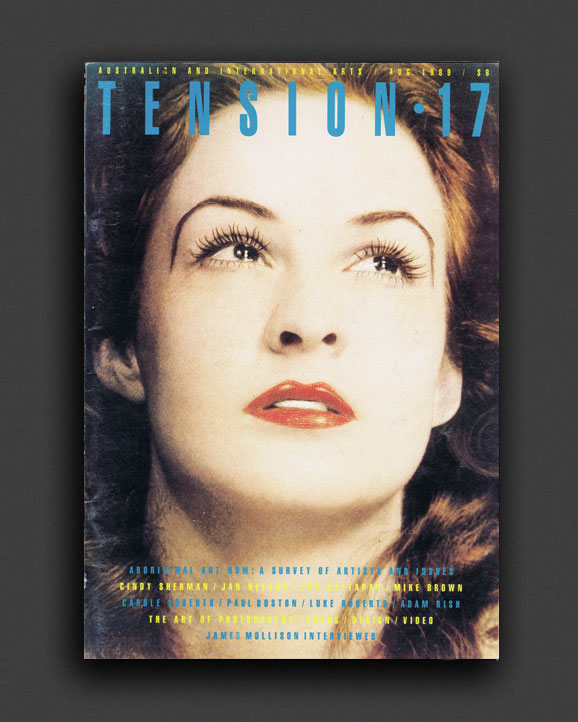
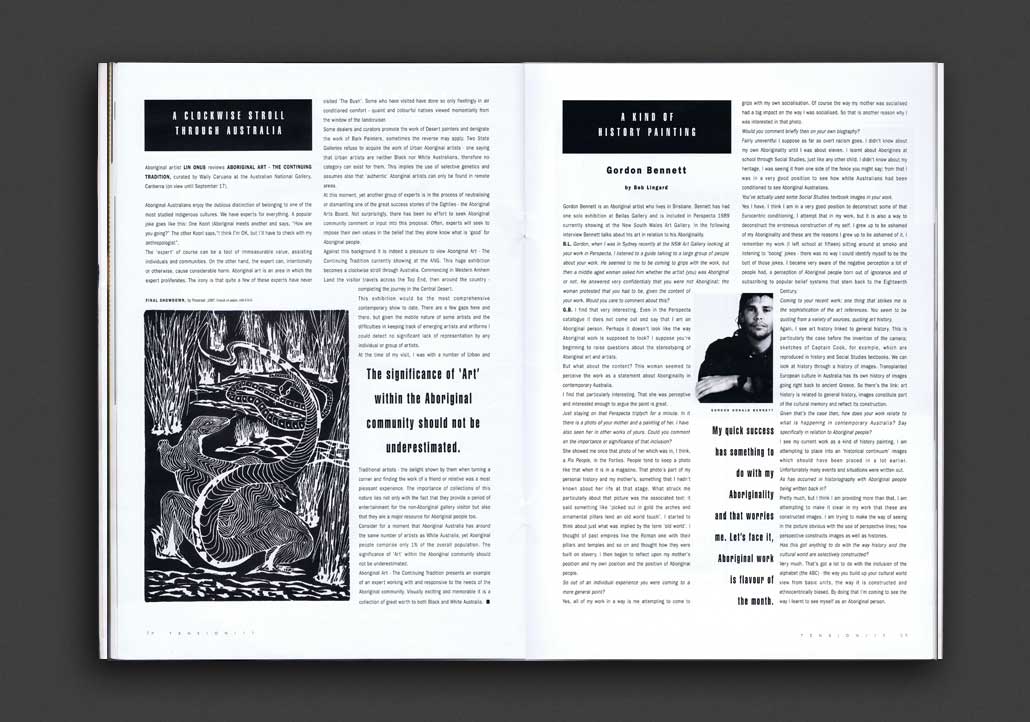
TENSION 17 (Australian and International Arts : August 1989) features articles on Mike Brown, Peter Halley, Cindy Sherman, Jon Cattapan, Jan Nelson, Paul Boston, Adam Rish, Carole Roberts, Luke Roberts, Carlo Mollino, "The Art of Photography", "Video", Horst, "The Designers' Designers" by Emma Dent Coed (on the art directors, designers, and visual marketing behind fashion designers such as Yohji Yamamoto, Dries Van Noten, John Galliano, Rei Kawakubo/Comme des Garcons, etc. inc. Peter Saville, Nick Knight, etc.), and "Aboriginal Art Now : A Survey of Artists and Issues", inc. the work of Gordon Bennett, Jarinyanu David Downs, Rover Thomas, Trevor Nickolls, Tim Johnson, a review by Lin Onus, and more.
TENSION (1983-1990) was one of the central "popular" culture arts periodicals to come out of Melbourne in the 1980s, emerging from the ashes of Virgin Press. Independently published and edited by critic Ashley Crawford, Tension magazine lasted for 25 bi-monthly issues dedicated to Art, Music, Fashion, Theatre, Film, Photography, across reviews, interviews, reports, critical essays and artist pages. Now an important document of culture in Australia, and especially Melbourne in the 1980s, issues featured the writing and contributions of Paul Taylor, McKenzie Wark, Mike Parr, John Nixon, Catharine Lumby, Philip Brophy, Adrian Martin, Ashley Crawford, Peter Tyndall, Jean Baudrillard, Timothy Leary, Gerard Malanga, Keith Haring, Gerald Murnane, and many more. In 1985 Crawford, with John Buckley, staged an exhibition issue of the magazine, 'Visual Tension', at ACCA featuring the work of Howard Arkley, Marianne Baillieu, Peter Booth, Paul Boston, Peter Cripps, Richard Dunn, Maria Kozic, John Lethbridge, Geoff Lowe, Linda Marrinon, John Matthews, John Nixon, Stieg Persson, Robert Rooney, Gareth Sansom, Vivienne Shark LeWitt, Imants Tillers, Peter Tyndall, Jenny Watson, John Young.
1990, English
Softcover (staple-bound), 88 pages, 23.5 x 33.5 cm
1st Edition, Out of print title / used / good
Published by
Tension / South Yarra
$30.00 - Out of stock
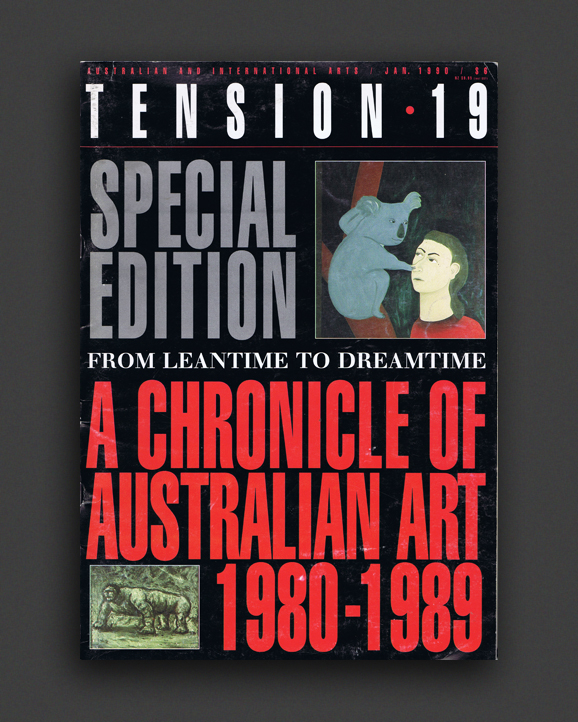
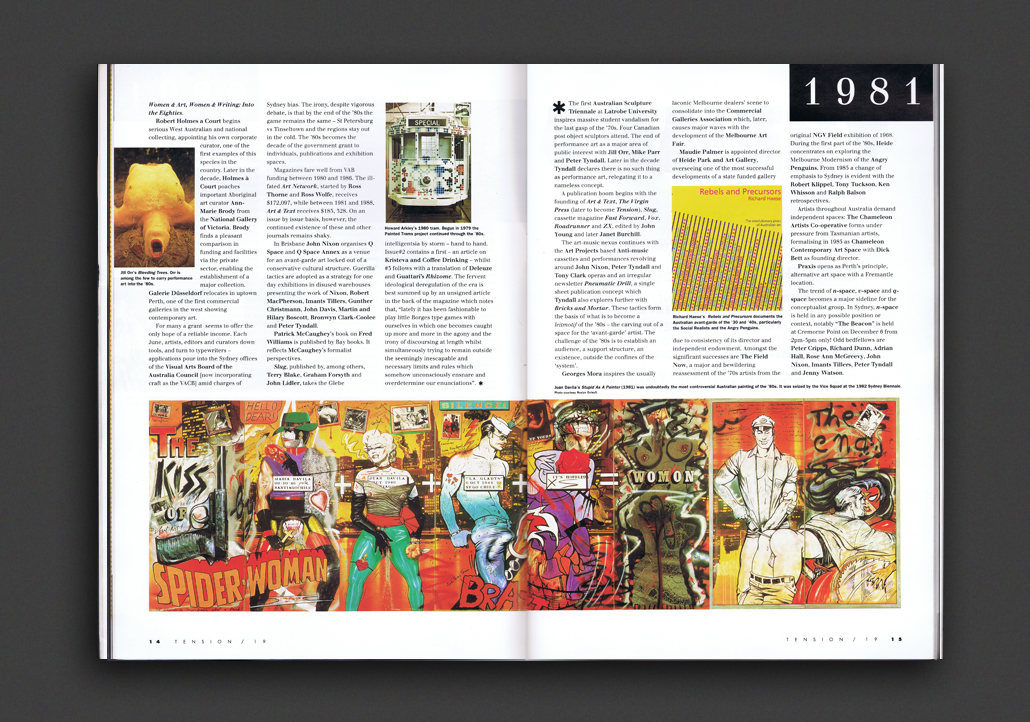
TENSION 19 (SPECIAL EDITION : FROM LEANTIME TO DREAMTIME - A CHRONICLE OF AUSTRALIAN ART 1980-1989) packs a concise year-by-year look-back at the exhibitions, artists, galleries, concerts, performances, publications, clubs, politics, influences that shaped Australian Art in the 1980s, compiled "in one week". Features contributions from writers Catherine Lumby, Charles Green, Chris McAuliffe, and Francis Pound (looking at NZ Art) and features the work of far too many artists to mention.
TENSION (1983-1990) was one of the central "popular" culture arts periodicals to come out of Melbourne in the 1980s, emerging from the ashes of Virgin Press. Independently published and edited by critic Ashley Crawford, Tension magazine lasted for 25 bi-monthly issues dedicated to Art, Music, Fashion, Theatre, Film, Photography, across reviews, interviews, reports, critical essays and artist pages. Now an important document of culture in Australia, and especially Melbourne in the 1980s, issues featured the writing and contributions of Paul Taylor, McKenzie Wark, Mike Parr, John Nixon, Catharine Lumby, Philip Brophy, Adrian Martin, Ashley Crawford, Peter Tyndall, Jean Baudrillard, Timothy Leary, Gerard Malanga, Keith Haring, Gerald Murnane, and many more. In 1985 Crawford, with John Buckley, staged an exhibition issue of the magazine, 'Visual Tension', at ACCA featuring the work of Howard Arkley, Marianne Baillieu, Peter Booth, Paul Boston, Peter Cripps, Richard Dunn, Maria Kozic, John Lethbridge, Geoff Lowe, Linda Marrinon, John Matthews, John Nixon, Stieg Persson, Robert Rooney, Gareth Sansom, Vivienne Shark LeWitt, Imants Tillers, Peter Tyndall, Jenny Watson, John Young.
1990, English
Softcover (staple-bound), 72 pages, 23.5 x 33.5 cm
1st Edition, Out of print title / used / good
$30.00 - Out of stock
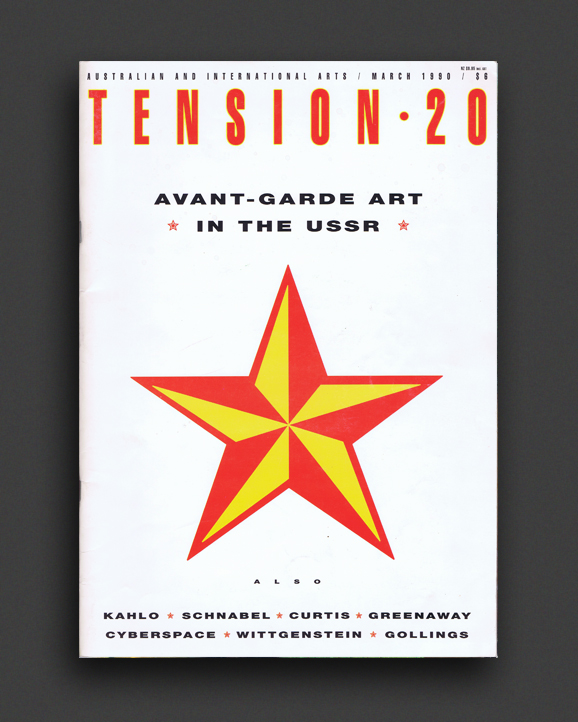
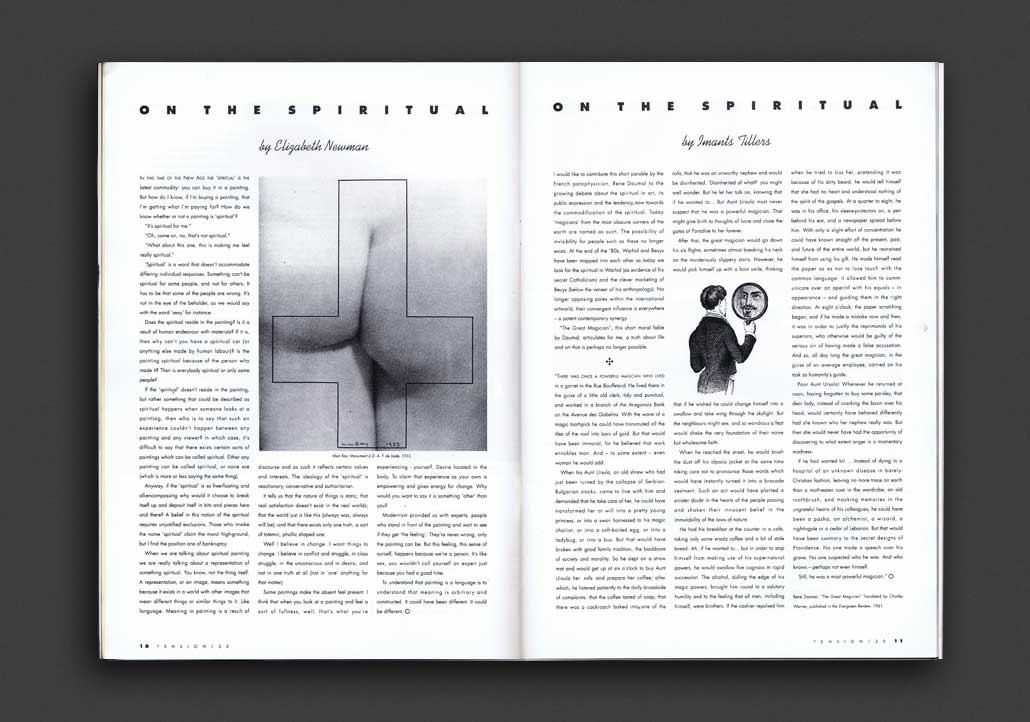
TENSION 20 ("Avant-Garde Art In The USSR" - Australian and International Arts : March 1990) features texts by Elizabeth Newman and Imants Tillers, articles on Julian Schnabel, Cyberspace, Peter Greenaway, Frida Kahlo, "Peewee meets Robocop : Films of the '80s" by Adrian Martin, "Towards a Post-Pop Language : Books of the '80s" by McKenzie Wark, and a huge cover feature "Avant-Garde Art In The USSR", with essays by Meryl Ryan, Ashley Crawford, Viktor Misiano, Dmitry Prigov, and Elena Pivovarova. Plus, news, letters, reviews (Kosuth, Nixon, etc.) and much more.
TENSION (1983-1990) was one of the central "popular" culture arts periodicals to come out of Melbourne in the 1980s, emerging from the ashes of Virgin Press. Independently published and edited by critic Ashley Crawford, Tension magazine lasted for 25 bi-monthly issues dedicated to Art, Music, Fashion, Theatre, Film, Photography, across reviews, interviews, reports, critical essays and artist pages. Now an important document of culture in Australia, and especially Melbourne in the 1980s, issues featured the writing and contributions of Paul Taylor, McKenzie Wark, Mike Parr, John Nixon, Catharine Lumby, Philip Brophy, Adrian Martin, Ashley Crawford, Peter Tyndall, Jean Baudrillard, Timothy Leary, Gerard Malanga, Keith Haring, Gerald Murnane, and many more. In 1985 Crawford, with John Buckley, staged an exhibition issue of the magazine, 'Visual Tension', at ACCA featuring the work of Howard Arkley, Marianne Baillieu, Peter Booth, Paul Boston, Peter Cripps, Richard Dunn, Maria Kozic, John Lethbridge, Geoff Lowe, Linda Marrinon, John Matthews, John Nixon, Stieg Persson, Robert Rooney, Gareth Sansom, Vivienne Shark LeWitt, Imants Tillers, Peter Tyndall, Jenny Watson, John Young.
2016, English / Italian
Softcover, 216 pages, 17 x 24 cm
Published by
Danilo Montanari Editore / Ravenna
$59.00 - Out of stock
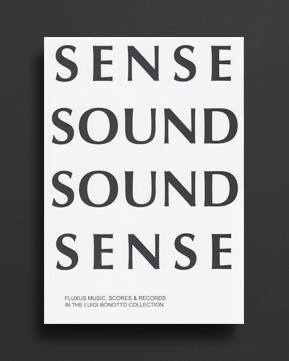
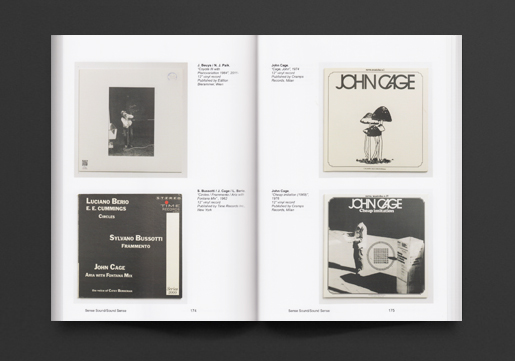
Luigi Bonotto dedicated himself to keeping the work of the artists of Fluxus and Experimental Poetry alive, and to preserving, cataloguing, and promoting their poetry, music, and work, which was strongly influenced by John Cage and the key concept of his theoretical framework, indeterminacy. Published on the occasion of an exhibition curated by Patrizio Peterlini and Walter Rovere, with the collaboration of Giorgio Maffei, this catalogue delves deeply into this aspect of the Fluxus network. Rife with illustrations, the materials of the collection, as well as the movement and its history, are analysed in scholarly essays by Anna Cestelli Guidi, Alison Knowles, and the curators.
features the work of Henning Christiansen, Wolf Vostell, Eric Andersen, George Brecht, Sylvano Bussotti, John Cage, Giuseppe Chiari, Philip Corner, Esther Ferrer, Juan Hidalgo, Dick Higgins, Robert Filliou, Toshi Ichiyanagi, Joe Jones, Milan Knizak, Takehisa Kosugi, Shigeko Kubota, György Ligeti, George Maciunas, Jackson Mac Low, Walter Marchetti, Charlotte Moorman, Claes Oldenburg, Yoko Ono, Nam June Paik, Ben Patterson, Terry Riley, Mieko Shiomi, Takako Saito, Gianni-Emilio Simonetti, Ben Vautier, Yoshimasa Wada, La Monte Young and others.
Out of Print.
2018, English
Softcover, 192 pages,
Edition of 2000,
Published by
Primary Information / New York
$29.00 - Out of stock
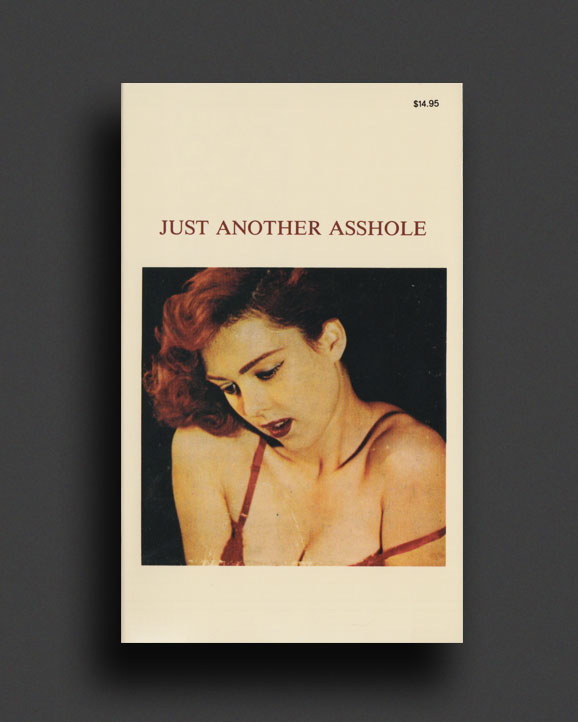
Just Another Asshole was an influential and now-legendary mixed-media publication series edited by Barbara Ess from 1978 to 1987. The submission process was open and collaborative, and each issue was produced in a different format (e.g., limited-edition zine by Ess, tabloid-sized graphic arts magazine, 4 pages in an issue of Artforum, photography book, LP record album, paperback book). Several were edited with Jane Sherry or Glenn Branca.
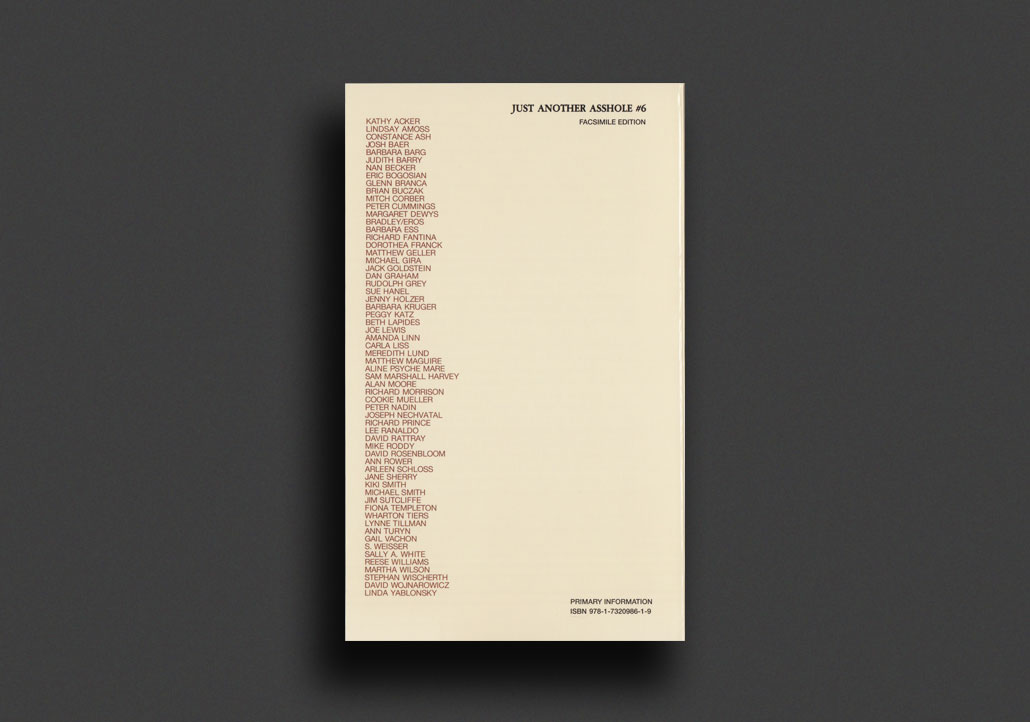
Issue 6 of the magazine, co-edited with Branca, was published in the form of a pulp paperback book with writings by sixty-one artists from the early-80s downtown scene. It includes short stories, performance transcripts, aphorisms, plays, monologues, screenplays, and essays that offer a window into the gritty and dynamic culture of New York City before gentrification pushed the underground out of Lower Manhattan.
Contributors include Kathy Acker, Lindsay Amos, Constance Ash, Josh Baer, Barbara Barg, Judith Barry, Nan Becker, Eric Bogosian, Glenn Branca, Brian Buczak, Mitch Corber, Peter Cummings, Margaret De Wys, Bradley Eros, Barbara Ess, Richard Fantina, Dorothea Franck, Matthew Geller, Michael Gira, Jack Goldstein, Dan Graham, Rudolph Grey, Sue Hanel, Jenny Holzer, Peggy Katz, Barbara Kruger, Beth Lapides, Joe Lewis, Amanda Linn, Carla Liss, Meredith Lund, Matthew Maguire, Aline Psyche Mare, Sam Marshall Harvey, Alan Moore, Richard Morrison, Cookie Mueller, Peter Nadin, Joseph Nechvatal, Richard Prince, Lee Ranaldo, David Rattray, Mike Roddy, David Rosenbloom, Ann Rower, Arleen Schloss, Jane Sherry, Kiki Smith, Michael Smith, Jim Sutcliffe, Fiona Templeton, Wharton Tiers, Lynne Tillman, Anne Turyn, Gail Vachon, S.Weisser, Sally A. White, Reese Williams, Martha Wilson, Stephan Wischerth, David Wojnarowicz, and Linda Yablonsky.
Barbara Ess is an artist living and working in New York City and upstate New York. She uses photography, video, and sound to make her work, which has been shown widely in the United States and Europe. She is an Associate Professor of Photography at Bard College.
Glenn Branca was a composer whose work included music for experimental rock bands, large ensemble instrumentals for electric guitars, symphonies for both electric instrumentation and acoustic orchestras, chamber ensemble pieces, an opera, a ballet, choral works, and music for film, dance, theater, and art installations. He was an early pioneer of the no wave punk scene that emerged in downtown New York in the late ’70s.
Edition of 2000
2018, English
Softcover (w. dust jacket), 160 pages, 19 x 25.5 cm
Published by
Sternberg Press / Berlin
$54.00 $15.00 - Out of stock
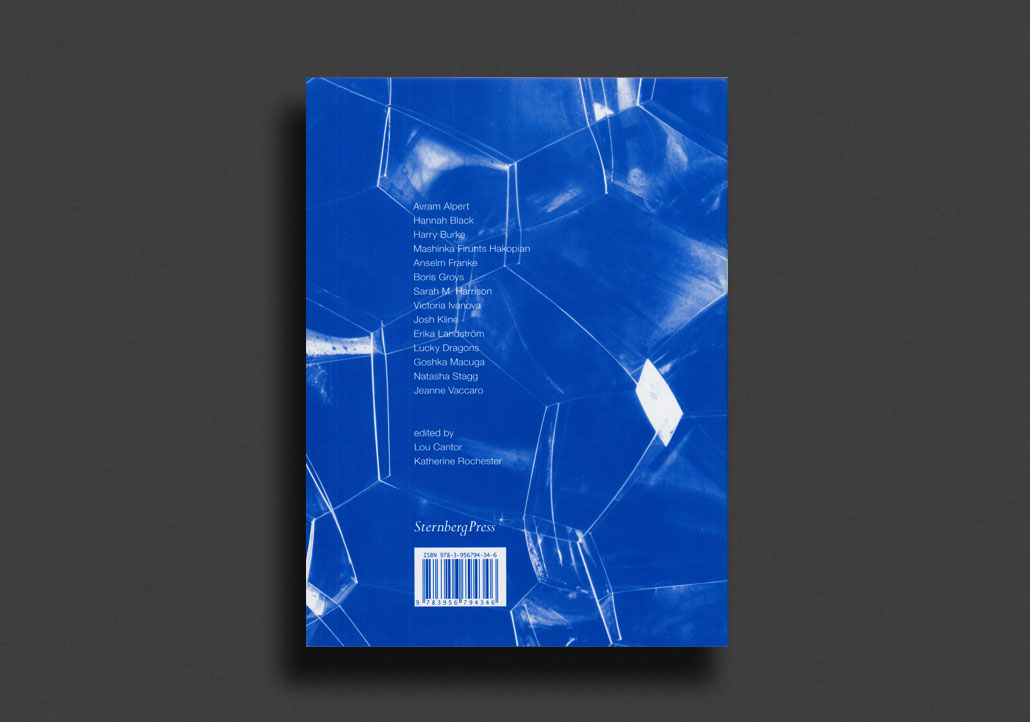
Contributions by Avram Alpert, Hannah Black, Harry Burke, Lou Cantor, Lucky Dragons, Anselm Franke, Boris Groys, Mashinka Firunts Hakopian, Sarah Harrison, Victoria Ivanova, Josh Kline, Erika Landström, Goshka Macuga, Katherine Rochester, Natasha Stagg, Jeanne Vaccaro
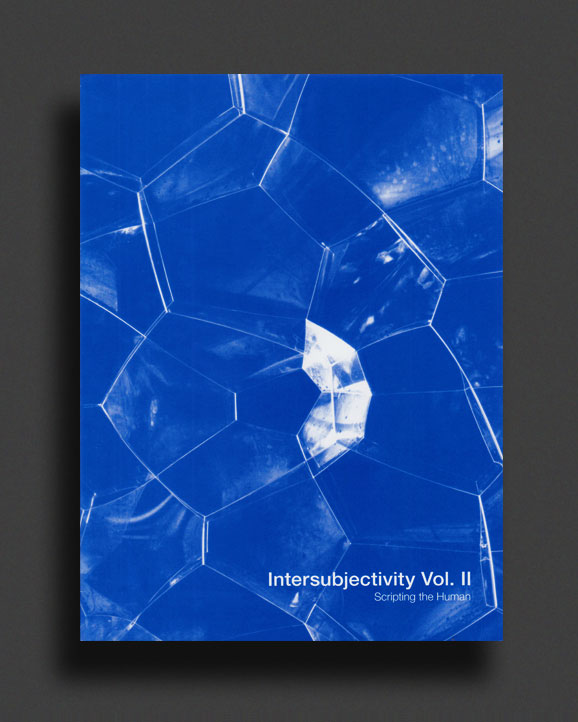
The second in a series of edited volumes on intersubjectivity, this collection of essays considers the relationship between performance, subjectivity, and human agency. Certain texts explore the ways in which performance is decoupled from human embodiment via forms of mediation, mechanical reproduction, or simulation. Others seek to examine how performance is conceptualized. Encompassing both historical and speculative perspectives, Scripting the Human explores the ways in which non-human (or trans/post-human) entities complicate notions of subjectivity and exert intersubjective pressures of their own on social, political, scientific, and philosophical discourses. Might the interaction between two chatbots—whose behavioral patterns are modeled on human traits—be intersubjective, or are they simply scripted? Can scripting the human lead to transformative encounters or does it produce a closed system whose complexity obscures its ultimate limitations? Ranging from the origins of contemporary conceptions of intersubjectivity in continental philosophy to more recent formulations that derive from systems theory, trans identity, and the emergent field of bot pedagogy, Scripting the Human approaches intersubjectivity as both historical phenomenon and nascent mode of present-day relation.
Design by BOKA Bożena Kalinowska
1975, English
Softcover, 23 pages, 18 × 26 cm
1st Edition, Out of print title / used / fine
Published by
Monash University Exhibition Gallery / Victoria
$160.00 - Out of stock
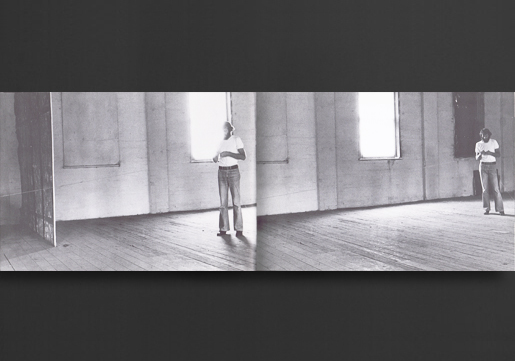
Very rare early catalogue/artists' book by John Davis, published on the occasion of an exhibition at Monash University Exhibition Gallery, Department of Visual Arts, September 2 - 26 1975.
Staple-bound landscape catalogue contains introduction, biography, artist texts and photographic documentation of the works "Time", "Space" and "Place"
A perfect copy.
John Davis (16 September 1936 – 17 October 1999) was an Australian sculptor and pioneer of Environmental art. An Australian exponent of Arte povera, he famously developed a new mode of Site-specific art at the Mildura Sculpture Triennial in the early 1970s. John Davis established a critically acclaimed reputation as an influential sculptor and installation artist whose practice synthesised material diversity with an idiosyncratic concept of landscape and ecology. Davis travelled widely and exhibited regularly in America, Japan and Australia. As well as participating in the inaugural Mildura Sculpture Triennial, and he represented Australia at the Venice Biennale in 1978. Davis initially worked in wood and later in fibreglass and aluminium, becoming known for his multiples and for his distinctive formalist style. By 1973, Davis had become increasingly interested in conceptual, process-based and land art practices, and his mature works reflect his sensitivity to elemental forces, the organic world, and his profound connection to the ecological fragility and beauty of landscape.
2018, English
Softcover, 280 pages
Published by
Archive Books / Berlin
Casco / Utrecht
If I Can’t Dance / Amsterdam
$42.00 - Out of stock
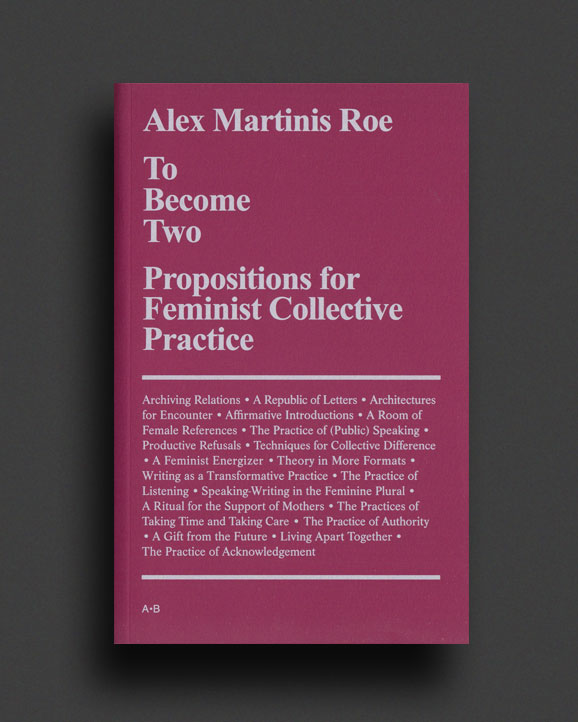
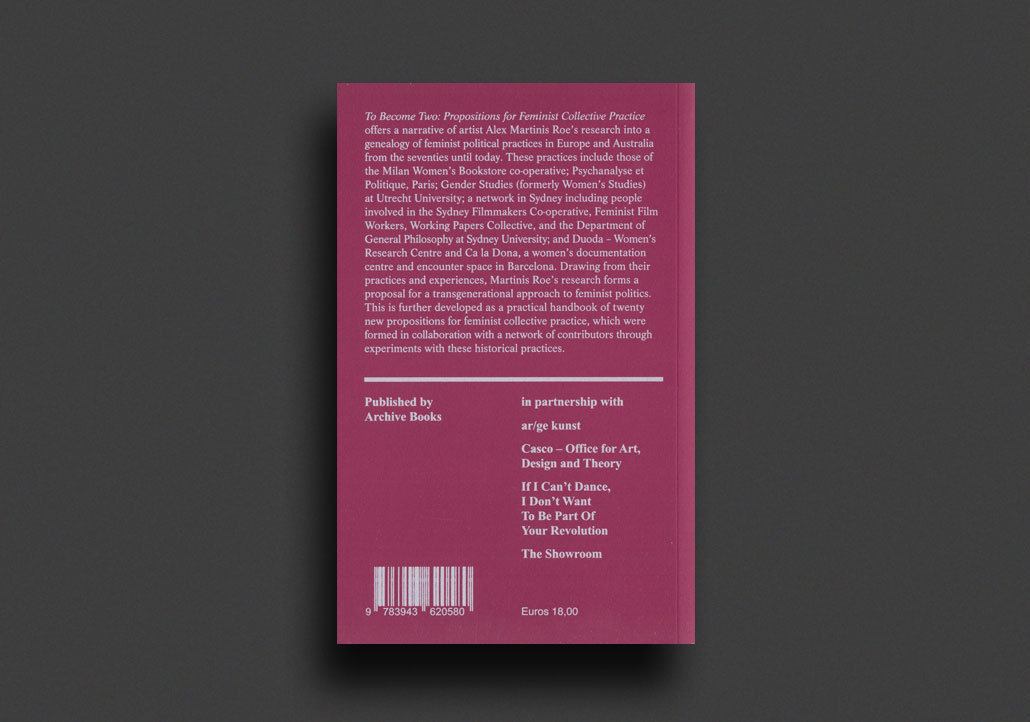
To Become Two: Propositions for Feminist Collective Practice offers a narrative of artist Alex Martinis Roe’s research into a genealogy of feminist political practices in Europe and Australia from the seventies until today. These practices include those of the Milan Women’s Bookstore co-operative; Psychanalyse et Politique, Paris; Gender Studies (formerly Women’s Studies) at Utrecht University; a network in Sydney including people involved in the Sydney Filmmakers Co-operative, Feminist Film Workers, Working Papers Collective, and the Department of General Philosophy at Sydney University; and Duoda – Women’s Research Centre and Ca la Dona, a women’s documentation centre and encounter space in Barcelona. Drawing from their practices and experiences, Martinis Roe’s research forms a proposal for a transgenerational approach to feminist politics. This is further developed as a practical handbook of twenty new propositions for feminist collective practice, which were formed in collaboration with a network of contributors through experiments with these historical practices.
2019, English / German
Softcover, 240 pages, 23 x 16.5 cm
Published by
Texte Zur Kunst / Berlin
$32.00 $15.00 - Out of stock
For the latest issue no. 113, TEXTE ZUR KUNST investigates the structures within the arts and cultural spheres where racism and discrimination are practiced, performed, and reproduced. This special issue concentrates specifically on the context of Germany, and includes discussions and texts from artists and theorists throughout the country who have dedicated special attention to current and ongoing political and social crises; specifically the challenges these crises pose for the language and terms of art criticism. How can criticism mount an appropriate response to the discrimination and injustices that pervade all levels of society?
ISSUE NO. 113 / MARCH 2019 "DISKRIMINIERUNG/DISCRIMINATION"
TABLE OF CONTENTS
PREFACE
SABETH BUCHMANN AND ISABELLE GRAW - THE CRITIQUE OF ART CRITICISM
COMMON GROUND / Colin Lang in Conversation with Julia Grosse, Suza Husse, and Max Czollek
ÇIĞDEM INAN
NON-RECOGNITION / The Other Side of the Critique of Racism
VIOLENT MEDIATIONS / Jenny Nachtigall in Conversation with Hannah Black
NAMING RACISM / Sven Beckstette in Conversation with Veronika Fuechtner and Oliver Hardt
HELMUT DRAXLER - THE ART OF DISCRIMINATION
ROTATION
INTENTIONALE BEGEGNUNGEN / Hanna Magauer über Christian Kravagnas „Transmoderne. Eine Kunstgeschichte des Kontakts“
SITUIERTE SENSIBILITÄT! / Michaela Ott über „Sensibilität der Gegenwart“ von Burkhard Liebsch (Hg.)
LIEBE ARBEIT KINO
PARTICLE ACCELERATOR / Daniel Horn on the Biennale de l’Image en Mouvement, Geneva
REVIEWS
COURS, CAMARADE / Tom McDonough on “The Most Dangerous Game” at Haus der Kulturen der Welt, Berlin
BAUHAUS IM GLOBALEN SÜDEN / Tobi Maier über „bauhaus imaginista: Learning From“ im SESC Pompéia, São Paulo
FULLY IMMERSED / Megan R. Luke on Heidi Bucher at Parasol unit foundation for contemporary art, London
DOPPELBELASTUNG / Sophie Goltz über „Medea muckt auf. Radikale Künstlerinnen hinter dem Eisernen Vorhang“ in der Kunsthalle im Lipsiusbau, Dresden
AUDIENZ BEIM MALERFÜRSTEN / Ulrich Pfisterer über Jörg Immendorff im Haus der Kunst, München
SITUATIONAL AWARENESS / SOFTCORE INSURRECTION / Kari Rittenbach on Tobias Kaspar at the Kunsthalle Bern
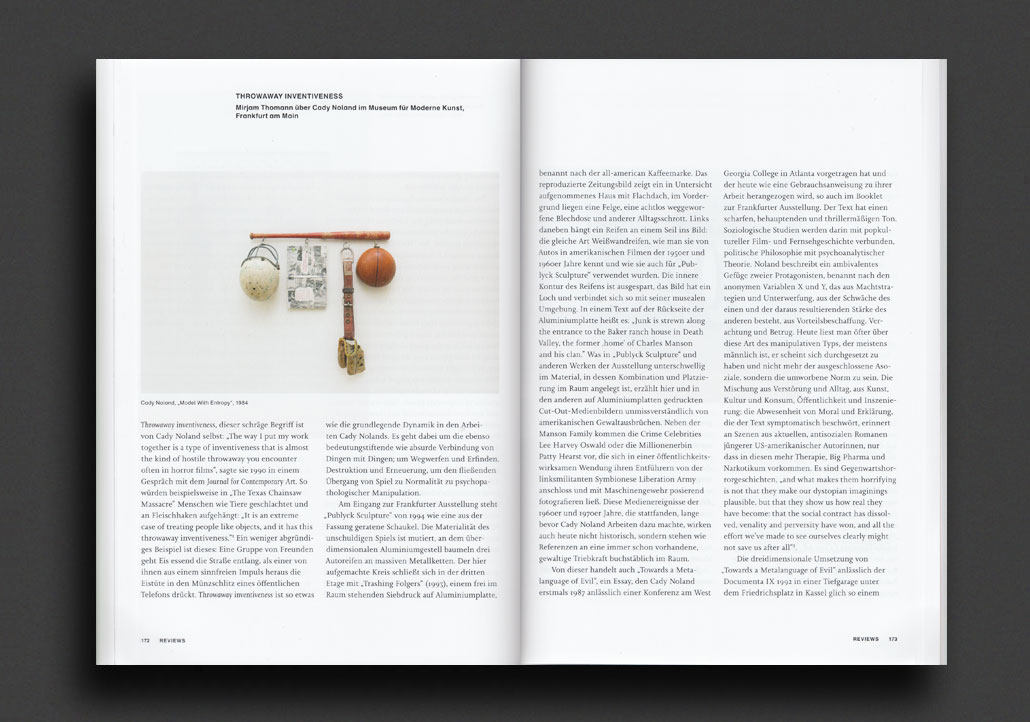
THROWAWAY INVENTIVENESS / Mirjam Thomann über Cady Noland im Museum für Moderne Kunst, Frankfurt am Main
REBEL REBEL / Saim Demircan on Sarah Lucas at the New Museum, New York
AUFGELADENE FRACHT / Nadja Abt über Ulrike Müller im Kunstverein für die Rheinlande und Westfalen, Düsseldorf
EVENTUALLY, EVERYTHING BECOMES LIQUID / Luisa Lorenza Corna on Metahaven at the Institute of Contemporary Arts, London
EVENING JOE / Robert Müller über Ed Ruscha in der Secession, Wien
CIRCUMSTANCES OF SOCIAL WORK / Eric Golo Stone on Laurie Parsons at the Museum Abteiberg, Mönchengladbach
AT LAST, WARHOL COMES OUT OF THE CLOSET / Jonathan D. Katz on Andy Warhol at the Whitney Museum of American Art
OBITUARY
ROBERT MORRIS (1931−2018)
FERDINAND KRIWET (1942–2018)
LOTHAR BAUMGARTEN (1944–2018)
EDITION
ARTURO HERRERA
ALICJA KWADE
1977, German
Heavy card slipcase (4 vols.), 323 pages; 357 pages; 378 pages; 40 pages; 21 x 29.5 cm
1st Edition, Out of print title / used / good
Published by
Paul Dierich / Kassel
$100.00 - Out of stock
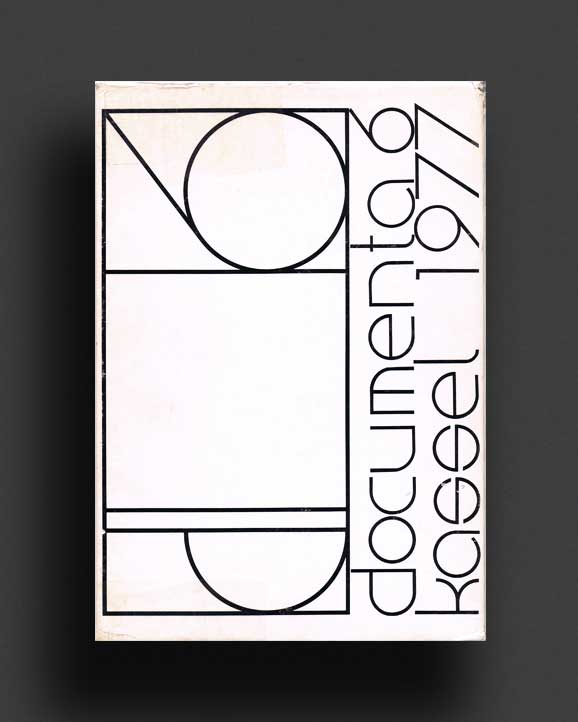
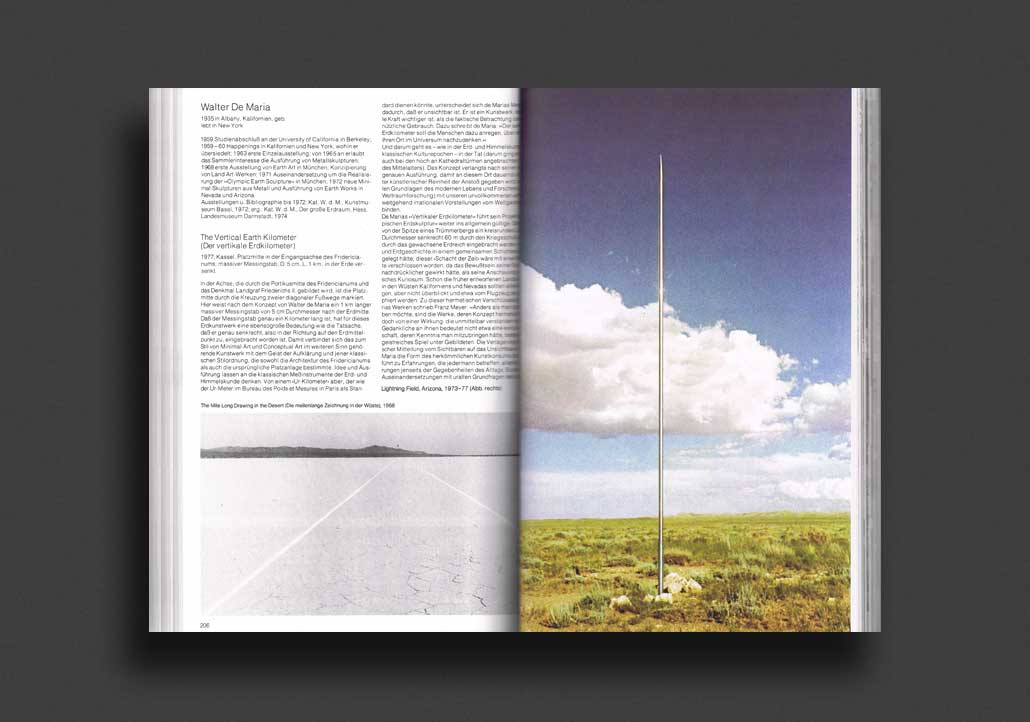
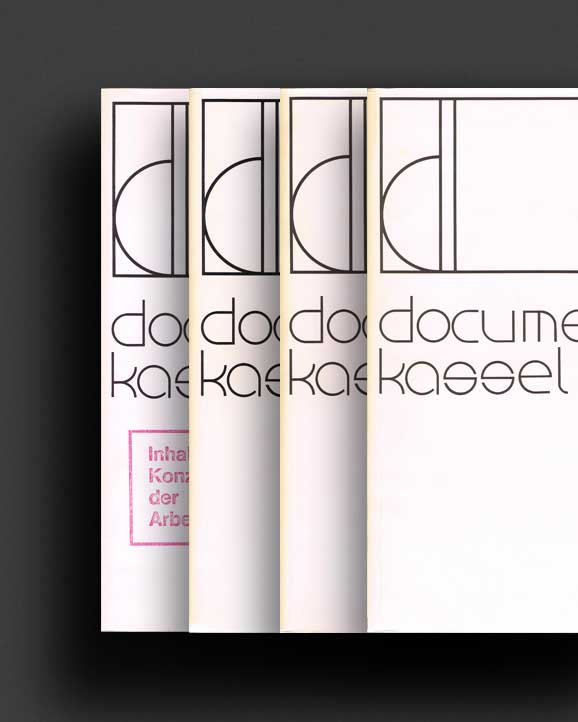
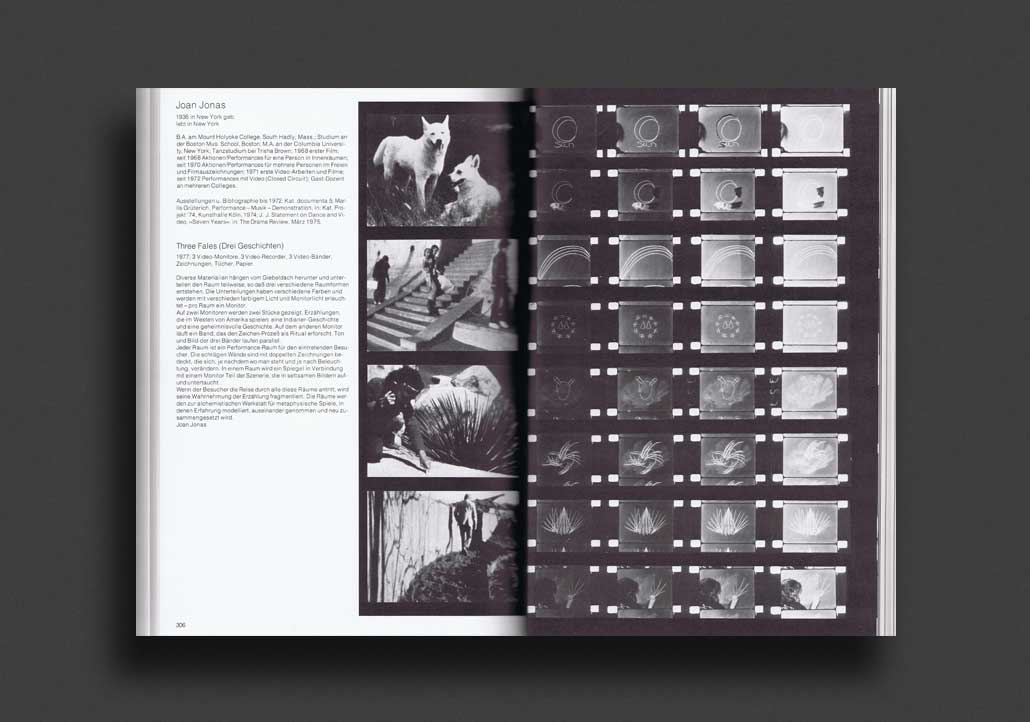
Complete 3 volume boxset exhibition catalogue published in conjunction with Documenta 6, the sixth edition of documenta, a quinquennial contemporary art exhibition. It was held between 24 June and 2 October 1977 in Kassel, Germany, and the artistic director was Manfred Schneckenburger. The title of the exhibition was: Internationale Ausstellung – international exhibition.
Box contains volume 1: painting - sculpture - performance (320 pages) / volume 2: photography - film - video (357 pages) / volume 3: drawings - utopian design - books (376 pages + show) / special edition of exhibition information booklet (40 pages + show); essays by Lothar Romain, Bazon Brock, Karl Oskar Blase, Klaus Honnef, Evelyn Weiss, Manfred Schneckenburger, Arnold Bode, Wieland Schmied, and Lothar Lang.
Artists featured throughout include Francis Bacon, Jennifer Bartlett, Georg Baselitz, Gerd Baukhage, Enzo Cacciola, Louis Cane, Chuck Close, Ulrich Erben, Winfred Gaul, Raimund Girke, Kuno Gonschior, Camille Graeser, Gotthard Graubner, Nancy Graves, Alan Green, Richard Hamilton, Heijo Hangen, Bernhard Heisig, Michael Heizer, Edgar Hofschen, Jasper Johns, Willem de Kooning, Attila Kovács, László Lakner, Roy Lichtenstein, Markus Lüpertz, Wolfgang Mattheuer, Gerhard Merz, Rune Mields, Carmengloria Morales, Malcolm Morley, Claudio Olivieri, Roman Opalka, Palermo, A.R. Penck, Lucio Pozzi, Hans-Peter Reuter, Gerhard Richter, Claude Rutault, Willi Sitte, Frank Stella, Werner Tübke, Bernar Venet, Andy Warhol, Reindert Wepko van de Wint, Gianfranco Zappetini, Jerry Zeniuk, Bernhard and Hilla Becher, Bernhard Johannes Blume, Christian Boltanski, Bettina Brand, Heinz Breloh, James Collins, Zdenek Felix, Reinhold Hohl, Gabrielle Honnef-Harling, Erich Kuby, Werner Lippert, Bernd Lohse, Felix H. Mann, Hilmar Pabel, Georg Reinhardt, Liselotte Strelow, Ann Wilde, Jürgen Wilde, Peter Ackermann, Michael von Biel, Fernando Botero, Miguel Condé, Renato Guttoso, Horst Janssen, Giacomo Manzù, Pablo Picasso, Wolfgang Schmitz, Rudolf Schoofs, André Thomkins, Bodo Baumgarten, Blythe Bohnen, Pinchas Cohen Gan, Rupprecht Geiger, Hetum Gruber, Eva Hesse, Sol LeWitt, Nino Malfatti, Bob Ryman, Jan Schoonhoven, Lee U-Fan, Rainer Werner Fassbinder, Martin Scorsese, Stanley Kubrick.
Texts in German.
Also includes an exhibition guide booklet in the same format as the 3 main catalogue volumes.
Good copy throughout with general tanning and age wear to box and books, some knocking and tape-mended cracking to the box binding corners and edging.
1971, German
Softcover, 464 pages, 29.7 x 21 cm
1st Edition, Out of print title / used / very good
Published by
DuMont / Köln
$85.00 - Out of stock
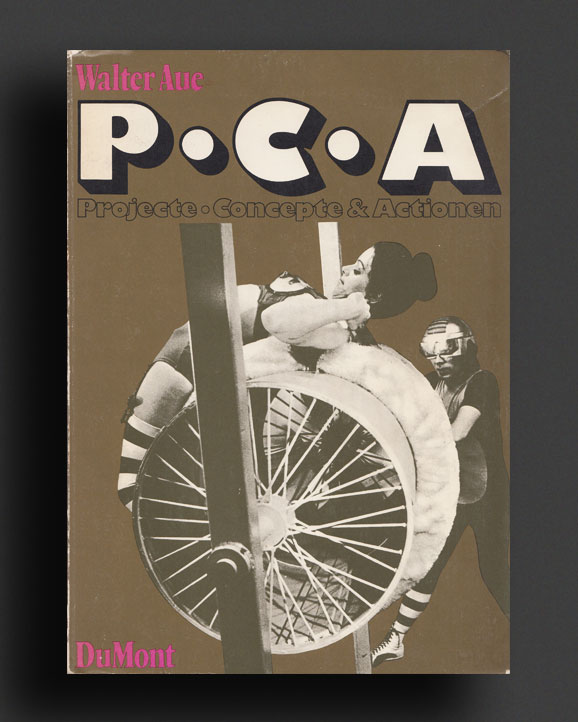
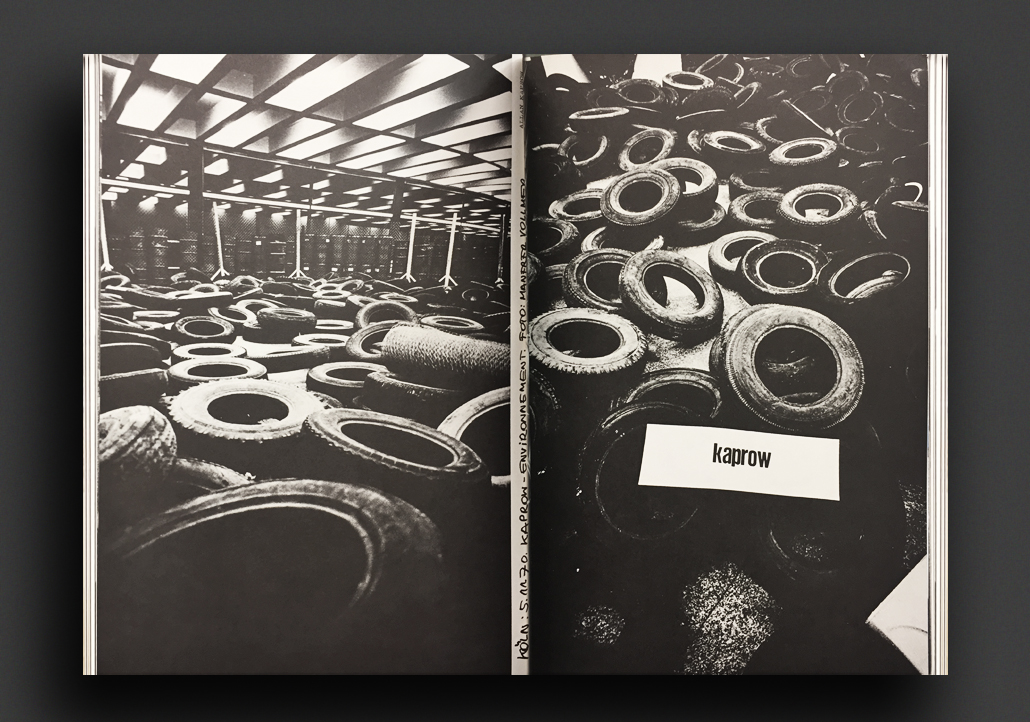
Huge, densely-illustrated volume compiled by German publisher/editor/essayist/curator Walter Aue, who worked closely with conceptual and performance artists in the 1960s-1970s. Laid-out by Aue himself, the book feels like a very natural scrap-book compendium of artist contributions, reproducing artworks, documentation of happenings, texts, photographs, diagrams, collages, news-clippings, instructions, etc. across over 450 pages, with Aue's type-written opening essay and cataloguing throughout. Features the most notable conceptual, actionist and performance artists of the period, spanning Fluxus, Arte Povera, radical architecture, Nouveau Realisme, etc. including Dieter Rot, Joseph Beuys, Robert Smithson, Pino Pascali, Stanley Brouwn, Jannis Kounellis, Klaus Rinke, Ben Vautier, Al Hansen, Walter Pichler, Hilla and Bernhard Becher, Giuseppe Penone, Ettore Sottsass, Gilbert and George, Walter De Maria, Wolf Vostell, Hans Hollein, Imi Knoebel, Barry Flanagan, Allan Kaprow, Carolee Schneemann, Hamish Fulton, Christo, Elfriede Jelinek, Dennis Oppenheim, Urs Lüthi, Sigmar Polke, Gerhard Rühm, Blink Palermo, Lawrence Weiner, Ed Ruscha, HA Schult, Hermann Nitsch, James Lee Byars, Jan Dibbets, Jochen Gerz, Mauricio Kagel, Nam June Paik, Otto Mühl, Arnulf Rainer, Jan Voss, George Brecht, Robert Filliou, Franz Erhard Walther, Timm Ulrichs, Daniel Spoerri, Erich Reusch, Paul Pechter, Rainer Giese, Jörg Immendorff, Henning Christiansen, Gilberto Zorio, Panamarenko, Joseph Kosuth, Dan Graham, Dick Higgins, Ian Baxter, Mel Bochner, Haus-Rucker-Co, Markus Raetz, Sottsass, Nam June Paik, Hans Haacke, Tetsumi Kudo, Bruce Mclean, On Kawara, and so many more.
Depending on the artist, texts are in English, German, Dutch, etc. Opening essay in German.
Very Good, light wear/tear to top spine.
2005, English / German
Softcover, 270 pages, 19 x 27 cm
1st Edition, Out of print title / used / very good
Published by
Neues Museum Weserburg Bremen / Bremen
$150.00 - Out of stock
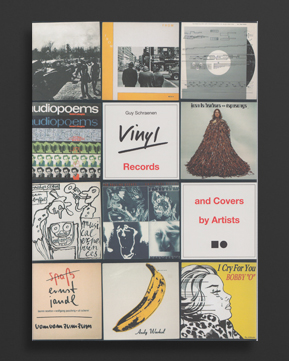
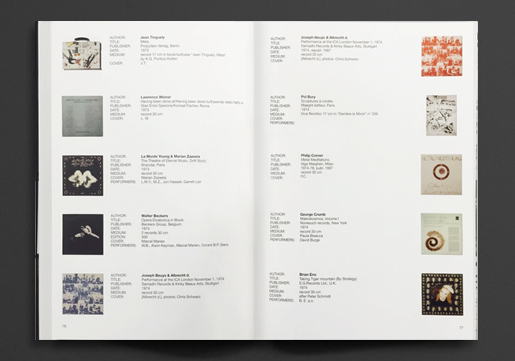
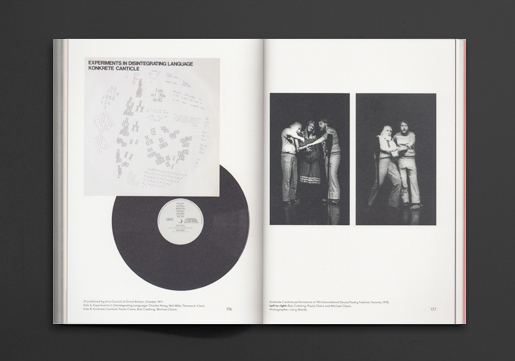
This large, detailed catalogue forms a unique and important document, which was produced to accompany an exhibition at Neues Museum Weserburg Bremen, Bremen, 21.8. - 27.11.2005 and Museu d'Art Contemporani de Barcelona, Barcelona, 16.5. - 1.10.2006 showcasing a selection of some 800 pieces from the collection of Guy Schraenen. The main of this collection comprises vinyl records and covers by artists, musicians and poets in LP, single and other formats, alongside other sound media (tapes and CDs). Posters and books are also included. The exhibition shows artists (such as Hanne Darboven, Jean Dubuffet, Dieter Roth, Joseph Beuys, Laurie Anderson, John Cage, Yoko Ono, Yves Klein, Roman Opalka, Lawrence Weiner, Mike Kelley, Öyvind Fahlström, Art & Language and Hermann Nitsch) and artistic movements of the second half of the twentieth century through this complex medium of the vinyl cover, with its dual visual and audible components. Here Guy Schraenen has edited together an extensive visual catalogue of these historical objects.
A wonderful book for anyone interested in the history of modern sound art and the artistic medium of the vinyl sleeve, especially in the fields of Avantgarde, Electro-Acoustic, Modern Classical, Musique Concrète, Sound-Poetry, Art Rock, Industrial, Power-Electronics....
Henri Chopin, A.R. Penck, Brion Gysin, George Brecht, Marcel Duchamp, Arman, Karel Appel, Öyvind Fahlström, Pierre Henry, Art & Language, Peter Brötzmann, Red Krayola, Ernst Jandl, Vito Acconci, Hanne Darboven, Jean Dubuffet, Dieter Roth, Joseph Beuys, Laurie Anderson, Yves Klein, Roman Opalka, Hermann Nitsch, Yoko Ono, Tony Conrad, Andy Warhol, John Cage, Pierre Schaeffer, Derek Bailey, Han Bennink, Jean Tinguely, Steve Reich, Meredith Monk, Terry Fox, Terry Riley, Sun Ra, Pandit Pran Nath, Albrecht/d., Robert Ashley, Bob Cobbing, Lawrence Weiner, Philip Glass, La Monte Young, Marian Zazeela, Poly Bury, Charlemagne Palestine, Carl Andre, Brian Eno, Mike Kelley, Sonic Youth, Henry Flynt, Jon Gibson, Michael Snow, Roland Topor, Michael Nyman, Harold Budd, Robert Filliou, Nam June Paik ... just the tip of the iceberg.
Very Good copy of the rare first printing from Bremen.
2015, English / German / Dutch
Softcover, 560 pages, 25cm x 25cm
Published by
Walther König / Köln
$85.00 - Out of stock
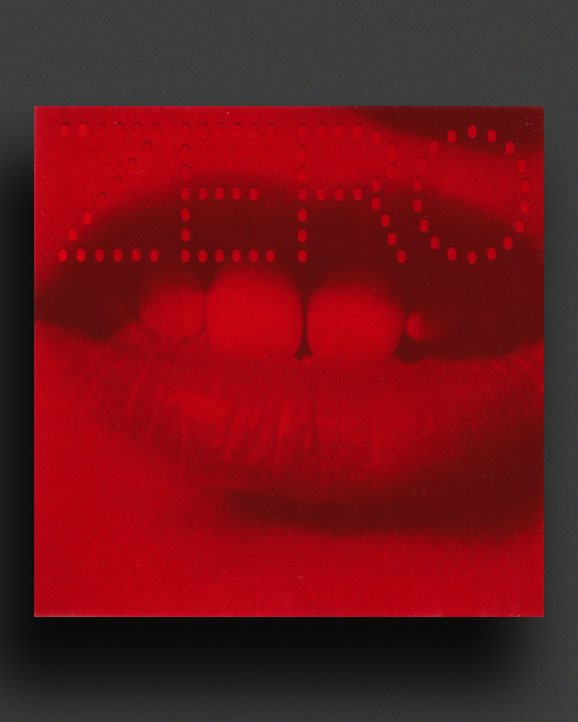
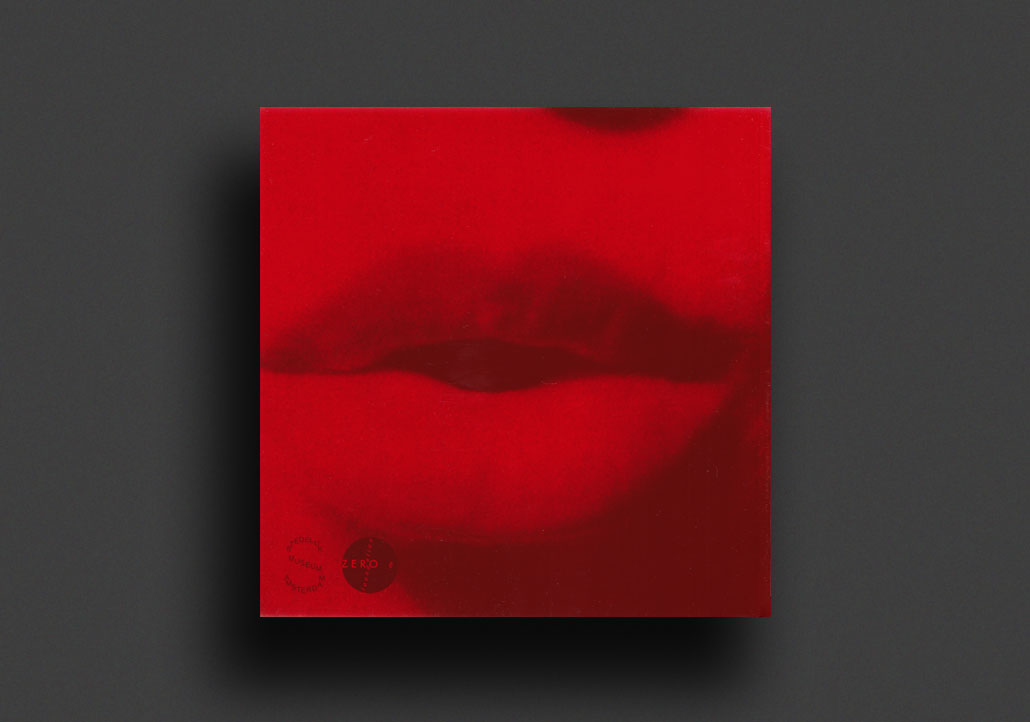
Fire, light, movement, space, demonstrations, and performances: this major publication forms a historic survey of the innovative, international avant-garde artists’ group, ZERO.
In 1957, Heinz Mack and Otto Piene devised the name ZERO for a new art movement and magazine. The brevity of the term ZERO and the fact that it retained its meaning in many languages helped the group to become an international “brand” in the ‘60s. After the Second World War and the grim years of post-war reconstruction, the term ZERO marked the coming of a new, optimistic, experimental, and pioneering kind of art. Piene described it as “a zone of silence and of pure possibilities for a new beginning.” While the ZERO movement was under formation, Dutch artists Armando, Jan Henderikse, Henk Peeters, Jan Schoonhoven, and herman de vries established the Nul group in the Netherlands. Like-minded artists in France, Italy, and Belgium – such as Jean Tinguely, Yves Klein, Daniel Spoerri, Jesús Rafael Soto, Lucio Fontana, Pierre Manzoni, Dadamaino, and Christian Megert – were also formulating similar artistic strategies - many affiliated with other movements such as Nouveau réalisme, Arte Povera, Minimalism, Op Art, Land Art and Kinetic art. They joined up with the trio of artists from Dusseldorf: Mack, Piene, and Günther Uecker. Together, the artists began to organize exhibitions in galleries, museums, and in their own studios. They also co-created artworks, experimenting with the most innovative materials and media, as well as gave performances and happenings, produced multiples, and published magazines and other publications. In 1962, the Stedelijk Museum staged the first museum presentation of ZERO. A few years later, a more comprehensive survey, Nul 1965, followed, a presentation widely considered as one of the movement’s highlights. Precisely fifty years later, in 2015, the Stedelijk presented an historical survey that sheds light on how the network’s artists redefined the meaning and form of art forever.
This extensive, deeply researched and richly illustrated (over 900 plates) publication, edited by curator Margriet Schavemaker, and Dirk Poerschmann, academic staff member of the ZERO Foundation, includes essays by Antoon Melissen, Johan Pas, Francesca Pola & Thekla Zell, and the transcript of a conversation between Mattijs Visser and Daniel Birnbaum. Organized by the ZERO foundation and including some 200 objects, ZERO is one of the most comprehensive resources available on this self-consciously avant-gardist international movement.
Includes the work of Arman, Armando, Bernard Aubertin, Pol Bury, Enrico Castellani, Gianni Colombo, Dadamaino, Lucio Fontana, Hermann Goepfert, Gerhard von Graevenitz, Gotthard Graubner, Hans Haacke, Jan Henderikse, Paul van Hoeydock, Oskar Holweck, Yves Klein, Yayoi Kusama, Walter Leblanc, Adolf Luther, Heinz Mack, Piero Manzoni, Almir Mavignier, Christian Megert, François Morellet, Saboro Murakami, Henk Peeters, Otto Piene, Uli Pohl, George Rickey, Dieter Roth, Hans Salentin, Jan Schoonhoven, Jesús Raphael Soto, Daniel Spoerri, Jean Tinguely, Gunther Uecker, Jef Verheyen, Nanda Vigo, herman de vries.
2015, English
Softcover, 208 pages, 17 x 24 cm
Published by
Occasional Papers / London
$50.00 - Out of stock
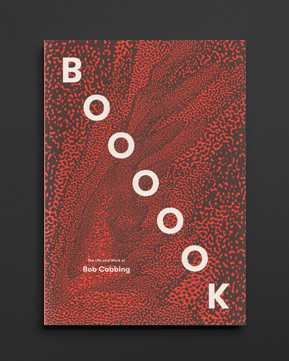
This is the first comprehensive overview of the life and work of the pioneering British concrete and sound poet Bob Cobbing (1920-2002). 'Boooook' addresses all aspects of Cobbing's career, with essays detailing his key roles in Better Books, London Film-makers' Co-op and the abAna trio, as well as his involvement in the Destruction in Art Symposium, Fylkingen and Writers Forum. Edited by William Cobbing and Rosie Cooper – and illustrated with reproductions of artworks, documents, posters, poems and film stills from the Bob Cobbing family collection – Boooook features contributions by Adrian Clarke, Arnaud Desjardin, Sanne Krogh Groth, Will Holder, Gustav Metzger, Andrew Wilson, and others.
2018, English / German
Softcover, 240 pages, 23 x 16.5 cm
Published by
Texte Zur Kunst / Berlin
$32.00 - Out of stock
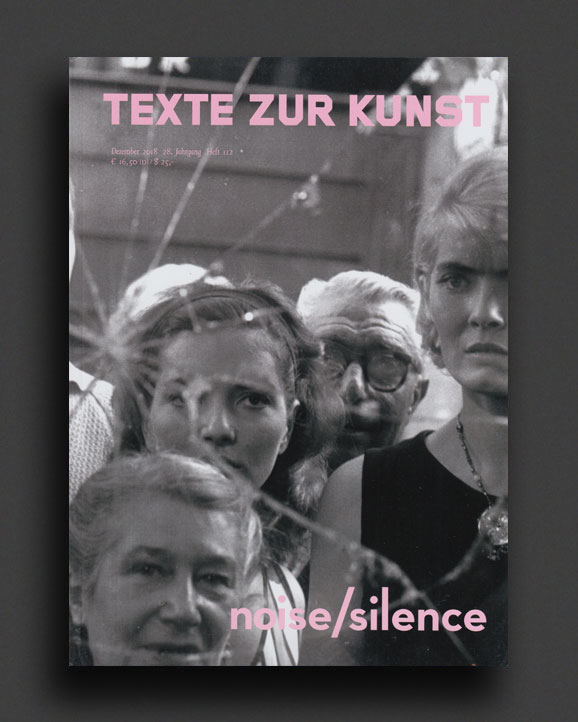
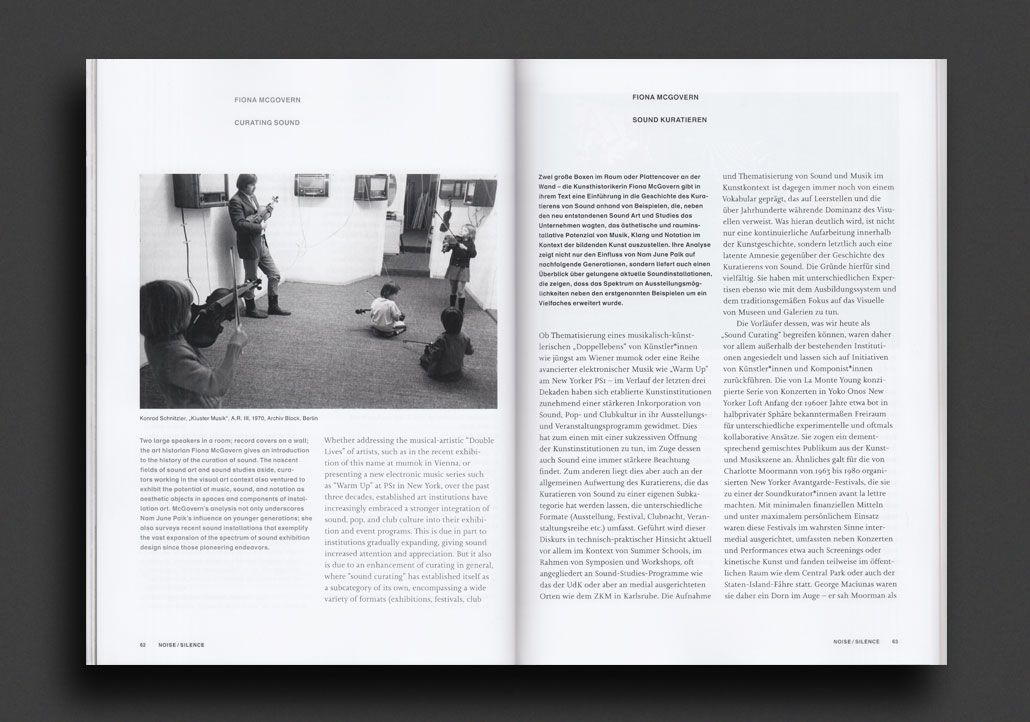
Issue # 112 of Texte zur Kunst, “Noise/Silence,” focuses on these two sonic extremes that define the boundaries of the audible, framing all possible sonic expressions therein. Given the emergence of sound as its own field of inquiry within the arts, and the development of newer media forms for sound production, can we still reliably argue that noise and silence are open to artists and musicians today in the ways that they were for Luigi Russolo in his 1913 manifesto, “The Art of Noises;” or, in John Cage’s writings on silence? In our analysis and judgment on the contemporary significance of noise and silence within sound and music, we are also questioning the potential for radical gestures with sound tout court—the all or nothing. What is left for music and sonic interventions today? What kinds of subversive noises can be marshaled against the deafening silence? And where, if anywhere, can silence provide a shelter from the relentless noise from the outside? We assembled a group of media historians and philosophers to give us a theoretical orientation in this shifting sonic landscape, and also asked four artists/musicians to weigh in on the possibility for radical gestures in their own practice. The results offer a much-needed revision of the terms for sound in the arts today.
Issue No. 112 / December 2018 "Noise/Silence"
Table Of Contents
Forward
Preface
Rolf Grossmann - Silence, Sound, Noise / Aesthetic And Media-Technological Observations
Ute Holl - Excavating Silence
Fiona Mcgovern - Curating Sound
Sound Rules / Colin Lang And Cevdet Erek In Conversation
Michaela Melián - Electric Ladyland
Andrea Neumann - Production By Subtraction
Arto Lindsay
Puce Moment
New Development
Political Myth – Prefiguration – Brexit / Angus Nicholls On The Mythic Structures Behind Brexit
Rotation
Metabolismen Der Moderne / André Rottmann Über „Entgrenzter Formalismus. Verfahren Einer Antimodernen Ästhetik“ Von Kerstin Stakemeier
Migration Und Film Denken / Nanna Heidenreich Über Brigitta Kusters „Grenze Filmen“
The Third Persona / Amanda Schmitt On Ben Lerner And Anna Ostoya’s “The Polish Rider”
Klang Körper
Figuring Space / Steven Warwick On Catherine Christer Hennix
Reviews
This Is The Rented Moment / Nicolás Guagnini On Jack Smith At Artists Space, New York
Konzeptueller Fehlschlag / Fabio Cypriano Über Die 33. Biennale In São Paulo
Enjoy Your Sinthome / Sven Lütticken On Dora García At The Reina Sofía, Madrid
Artists Must Begin Helping Themselves / Pedro De Llano On Stephan Dillemuth At A Certain Lack Of Coherence, Porto
Der Traumzauberbaum / Inka Meißner Über Amy Lien & Enzo Camacho Im Kunstverein Freiburg
Burnt By The Sun / Colin Lang On Katarina Sieverding At Manifesta 12, Palermo
Star Alliance / Alida Müschen Über Ei Arakawa Im Kunstverein Für Die Rheinlande Und Westfalen, Düsseldorf
Canon Fodder / Julia Pelta Feldman On Charline Von Heyl At Petzel Gallery, New York
Manspainting / Georg Imdahl Über Balthus In Der Fondation Beyeler, Basel
Case Of Urgency / Christina Catherine Martinez On Gerry Bibby At O-Town House, Los Angeles
Meshes Of The Platform Age / Jakob Schillinger On Loretta Fahrenholz At Mumok, Vienna
Re-Call, Re-Take, Represent / Rattanamol Singh Johal On Vivan Sundaram At The Kiran Nadar Museum Of Art, New Delhi And Haus Der Kunst, Munich
Grasping History / Frauke Zabel Über Karin Schneider Im Kunstverein Nürnberg
Stacked Cards / Ana Vogelfang On Pablo Accinelli At Malba, Buenos Aires
Computerkunst Jenseits Des Computers / Karel Císař Über „1968:Computer.Art“ In Brno
Abstraction Of The Body / Melissa Gordon On Amy Sillman At Camden Arts Centre, London
Feministischer Dekolonialismus Avant La Lettre / Michaela Wünsch Über Theresa Hak Kyung Cha Im Kulturzentrum Der Koreanischen Botschaft, Berlin
Where The Bodies Are Buried / Ana Teixeira Pinto On Roee Rosen At The Centre Pompidou, Paris
Chez Michel / Anke Dyes Über Henrik Olesen Im Schinkel Pavillon, Berlin
Obituary
Helena Almeida (1934–2018) / João Ribas
Klaus Herding (1939−2018) / Tom Holert
Edition
Dominique Gonzalez-Foerster
Jeanette Mundt
Wolfgang Tillmans
1968, German
Hardcover (w. dust jacket), 370 pages, 22 x 22 cm
Out of print title / used / good
Published by
Württembergischer Kunstverein / Stuttgart
$120.00 - Out of stock
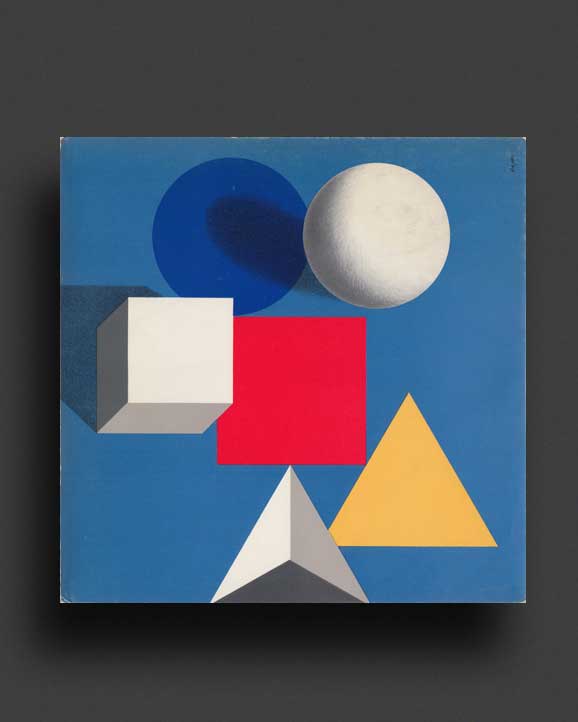
The amazing Bauhaus book, published in 1968 and designed and typeset to abolish all Upper Case letters by Herbert Bayer (one of the most influential members of the Bauhaus) for the first major Bauhaus survey exhibition after the Second World War, curated by Prof. Ludwig Grote, dr. Dieter Honisch, Herbert Bayer and Hans Maria Wingler, at Württembergischer Kunstverein Stuttgart.
This is the hard cover edition of what is without a doubt one of the most comprehensive and characteristic Bauhaus reference books ever published.
370 pages (with multiple paper stocks) contain no less than 650 colour and black and white illustrations selected from the Bauhaus Archiv, documenting the output of the Bauhaus from Weimar to Dessau to Berlin. This heavy, exhaustive volume is split into the following sections : preliminary course and teaching (includes Iteen, Moholy-Nagy, Albers, Schlemmer, Hirschfield-Mack, Klee and Schmidt); workshops (includes Teaching on Architecture, Sculpture, Stage, Stained Glass, Photography, Metal, Carpentry, Pottery, Typography, Mural Painting and Weaving); architecture and design (includes Gropius, Hannes Meyer, Mies van der Rohe, Hilberseimer, Brenner, Heiberg, A. Mayer, Stam Wittwer, Arndt, Bayer and Breuer); painting, sculpture, graphics (includes Josef Albers, Arndt, Bayer, Feininger, Itten, Kandinsky, Klee, Marcks, Moholy-Nagy, Muche, Schlemmer, Wols, etc.); life at the bauhaus; continuation of the teaching; biographies; bibliographies; index.
Includes introductory essays by Ludwig Grote, Walter Gropius, Heinz Winfried Sabais, Otto Stelzer, Hans Eckstein, Nikolaus Pevsner, Jurgen Joedicke, Will Grohmann and Hans M. Wingler.
Artists included: Walter Gropius, Marcel Breuer, Ludwig Mies Van Der Rohe, Gunta Stolzl, Joost Schmidt, Oskar Schlemmer, Walter Peterhans, Georg Muche, Lilly Reich, Laszlo Moholy-Nagy, Hannes Meyer, Gerhard Marcks, Johannes Itten, Ludwig Hilberseimer, Max Bill, Wassily Kandinsky, Lyonel Feininger, Alfred Arndt, Josef Albers, Marianne Brandt, Herbert Bayer, Paul Klee, Josef Hartwig, Wilhelm Wagenfeld, Christian Dell, Otto Lindig, Theodor Bogler, Wols, and so many others.
Includes references to all aspects of the Bauhaus, including: Itten's Preliminary Course, Klee's Course, Kandinsky's Course, Color Experiments, Carpentry Workshop, Stained Glass Workshop, Pottery Workshop, Metal Workshop, Weaving Workshop, Stage Workshop, Wall Painting Workshop, Display Design, Architecture, Typography and Layout; the Bauhaus Press, the Weimar Exhibition, 1923, Moholy-Nagy's Preliminary Course, Albers' Preliminary Course, Bauhaus Building, The Masters' Houses, Other Buildings in Dessau, Architecture Department, Weaving Workshop, Typography Workshop: Printing, layout, posters, Photography, Exhibition Technique, Wall Painting Workshop: Wall paper, Sculpture Workshop, Stage Workshop, Extracurricular Activities, Spread of the Bauhaus Idea, Bauhaus Teaching in the United States and much more.
All texts in German.
Of all the artists to pass through the Bauhaus, none lived the Bauhaus ideal of total integration of the arts into life like Herbert Bayer (1900 - 1985). He was a graphic designer, typographer, photographer, painter, environmental designer, sculptor and exhibition designer. Between 1925 and 1928, Bayer was head of the printing workshop at the Bauhaus and produced many designs that became standards of a Bauhaus "style." Bayer was instrumental in moving the Bauhaus to purely sans serif usage in all its work, and is especially known is his lowercase, which continues in this 1968 catalogue.
Hardcover 2nd edition w. illustrated dust jacket (protected under plastic wrap) - good copy throughout, with the common bind-splitting at some intervals due to old glue and paper weight (seems to have been previously repaired). All pages still bound and present. Heavy spotting to outer top block edge, tanning to pages edges, otherwise bright and very clean throughout. Good jacket, only light wear.
2018, English
Softcover, 200 pages, 20.2 x 25.5 cm
Published by
MoMA / New York
$58.00 - Out of stock
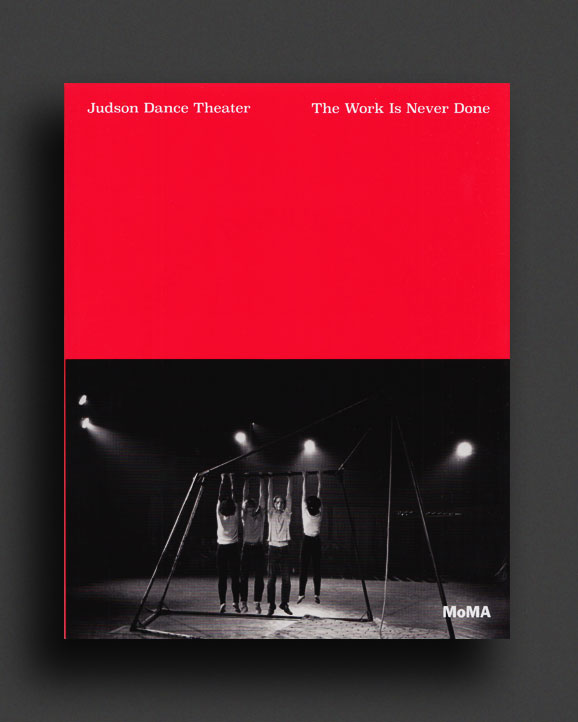
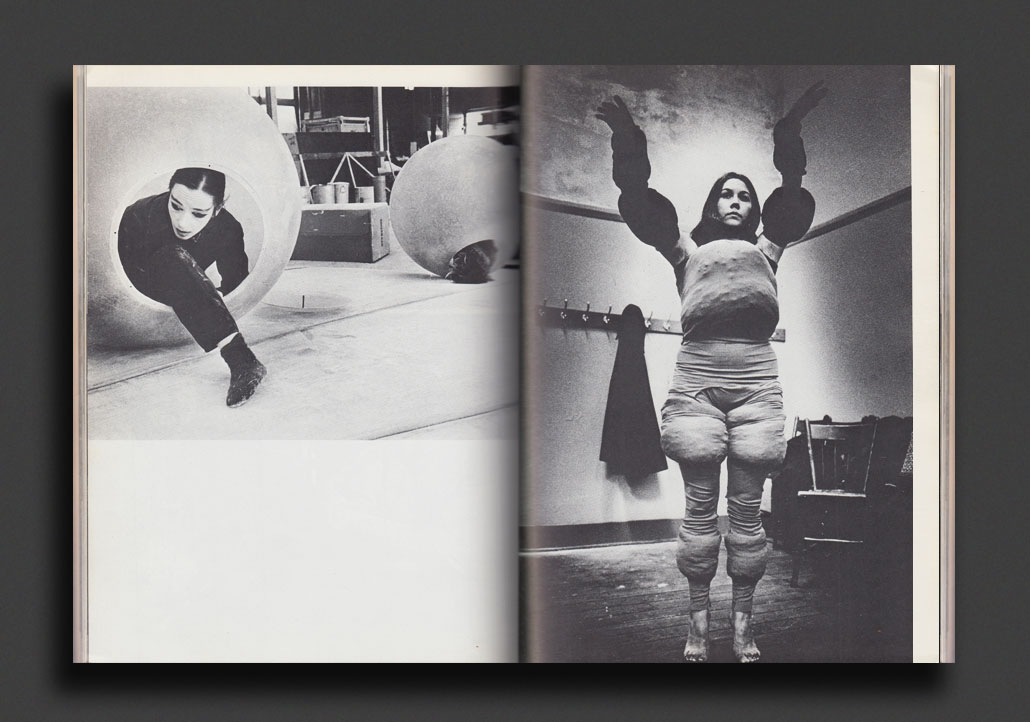
Using "ordinary" movements, the Judson Dance Theater stripped dance of its theatrical conventions
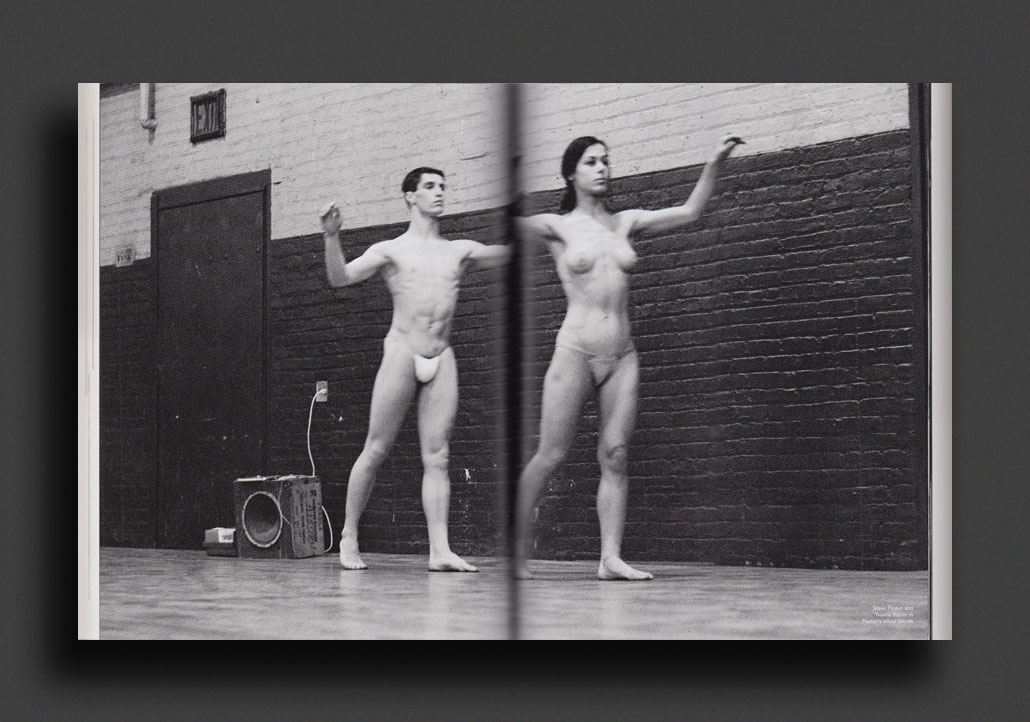
Taking its name from the Judson Memorial Church, a socially engaged Protestant congregation in New York's Greenwich Village, Judson Dance Theater was organized as a series of open workshops from which its participants developed performances. Redefining the kinds of movement that could count as dance, the Judson participants--Trisha Brown, Lucinda Childs, Philip Corner, Bill Dixon, Judith Dunn, David Gordon, Alex Hay, Deborah Hay, Fred Herko, Robert Morris, Steve Paxton, Rudy Perez, Yvonne Rainer, Robert Rauschenberg, Carolee Schneemann and Elaine Summers, among others--would go on to profoundly shape all fields of art in the second half of the 20th century. They employed new compositional methods to strip dance of its theatrical conventions, incorporating "ordinary" movements--gestures typical of the street or home, for example, rather than a stage--into their work, along with games, simple tasks, and social dances to infuse their pieces with a sense of spontaneity.
Published in conjunction with an exhibition at the Museum of Modern Art, Judson Dance Theater: The Work Is Never Done highlights the workshop's ongoing significance. The catalog charts the development of Judson, beginning with the workshops and classes led by Anna Halprin, Robert Ellis Dunn and James Waring, and exploring the influence of other figures working downtown such as Simone Forti and Andy Warhol, as well as venues for collective action like Judson Gallery and the Living Theatre. Lushly illustrated with film stills, photographic documentation, reproductions of sculptural objects, scores, music, poetry, architectural drawings and archival material, the publication celebrates the group's multidisciplinary and collaborative ethos as well as the range of its participants.
2018, English / German
288 pages, 11 x 18 cm
Published by
Christoph Merian / Basel
$42.00 - Out of stock
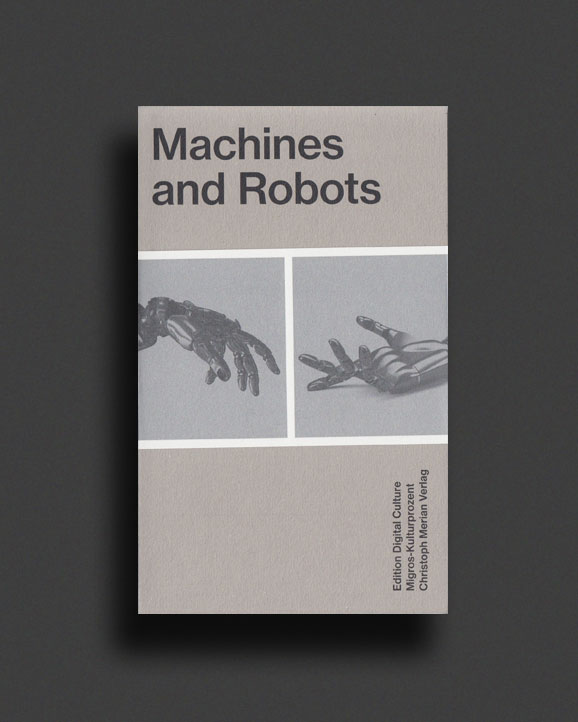
Machines, automats, and robots have always exerted a special fascination on artists. Yet computers, digitisation, and the Internet have given this attraction entirely new impulses. Moreover, developments in artificial intelligence and robotics are of critical importance today. The fifth volume of this series provides insights into current research topics and investigates their artistic potential and possible issues. It contains illustrations and a detailed glossary of significant terms, in addition to contributions by Raffaello D’Andrea, Andreas Broeckmann, Roland Fischer, Martina Kammermann, Bruno Spoerri, Philipp Theisohn, Mads Pankow, and Roland Wetzel.
2018, English
Hardcover, 240 pages, 195 x 240 cm
Published by
Prestel / Munich
$50.00 $20.00 - Out of stock
Foreword by Farkas Rozsa
Contributions by Hito Steyerl, Hannah Black and Natasha Stagg
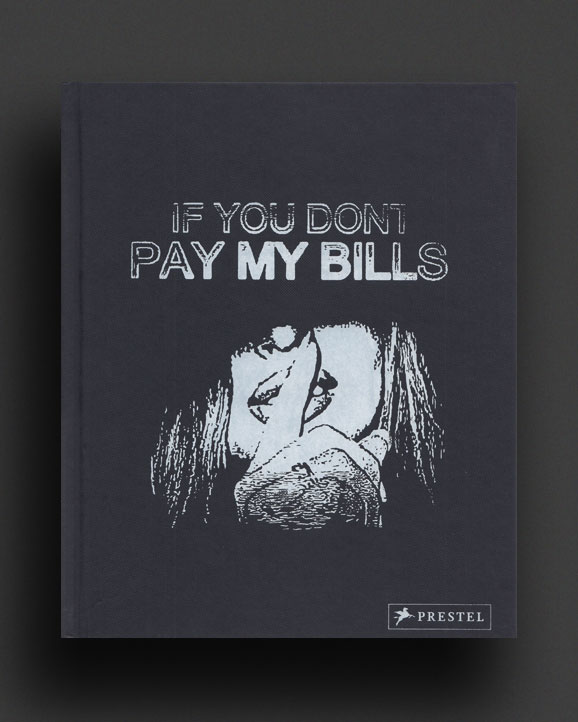
Amalia Ulman's performance "Excellences & Perfections", which unfolded on Instagram in 2014, follows an aspiring it-girl who undergoes a series of cosmetic surgeries and lifestyle changes to help jumpstart her career. For six months Ulman mesmerized her followers with nearly daily posts that documented a young woman trying on different personas in order to make her way in the world. Finally, the real Amalia Ulman revealed the fiction that she had created-a performance piece about identity, gender, class, sexuality, and lifestyle porn. The illustrations are presented in chronological order to give readers the experience of viewing the work as an uninterrupted stream, in the way her followers first saw them on social media. A forerunner of a new brand of performance art, Ulman has made a significant statement about the intersection of life and art-one that couldn't be more timely or compelling.
2018, English / German
Softcover, 182 pages,
Published by
Sternberg Press / Berlin
Künstlerhaus Halle für Kunst & Medien / Graz
$69.00 $40.00 - Out of stock
Edited by Sandro Droschl, Künstlerhaus, Halle für Kunst & Medien
Texts by Christian Egger, Sabine Weier, Tanja Widmann
This catalogue is published on the occasion of the two group exhibitions “The only performances that make it all the way...“ and “Yes, but is it performable? Investigations on the Performative Paradox“ which were shown at Künstlerhaus, Halle für Kunst & Medien in 2013 and 2016.
Both exhibitions are united by an activating dialogical confrontation of recent, performative practices and performances dealing with the main works of historical forerunners. Throughout the respective exhibition, two to three works were added, while also parts and objects of the performances remained in the exhibition space, thus the exhibition set-up presented itself as transparent and could be experienced by the audience.
Artists included : Pauline Boudry / Renate Lorenz, Michael Clark + The Fall, Guy de Cointet, Carola Dertnig, Cosey Fanni Tutti, Liz Glynn, Jakob Lena Knebl + das_em, Thomas Kratz, Adam Linder, Michele di Menna, Gina Pane, Claus Richter, Barbara T. Smith
Design by Nik Thoenen and Maia Gusberti
1984, English
Softcover, 342 pages, 270 x 280 cm
1st Edition, Out of print title / used / average
Published by
U.M.I. Research Press / Michigan
$50.00 - Out of stock
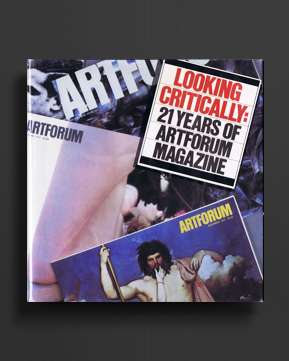
Softcover edition of "LOOKING CRITICALLY: 21 YEARS OF ARTFORUM MAGAZINE", the heavy 342 page volume anthology of the first 21 years of the world's most important modern and art journal. An incredibly valuable collection of art theory.
Edited by Amy Baker Sandback, designed by Roger Gorman and Mary Beath and published in 1984 by U.M.I. Research Press, this dense volume, bound in hardcover to the dimensions of a copy of ARTFORUM, begins with an Ed Kienholz review at the Ferus Gallery from ARTFORUM's June 1962 inaugural issue, and ends with Barbara Kruger reviewing the film "TRON" for the November 1982 issue. An amazing compendium of articles and reviews from the magazine's important first 21 years, featuring contributions by the likes of John Cage, Robert Morris, Kate Steinitz, Henry T. Hopkins, Don Factor, Robert Pincus-Witten, Dennis Adrian, John Coplans, Hilton Kramer, Harold Rosenberg, Henry Geldzahler, John Cage, Walter Hopps, Ed Ruscha, Allan Kaprow, Robert Rosenblum, Dan Flavin, Boris Groys, Sam Wagstaff, Billy Kluver, Lucy R. Lippard, Robert Rosenblum, Roger Shattuck, Ad Reinhardt, Mel Bochner, Andy Warhol, Roy Lichtenstein, Claes Oldenburg, Barbara Rose, Manny Farber, Michael Fried, Robert Morris, Philip Leider, Hollis Frampton, Carl Andre, Richard Serra, Lawrence Alloway, Barbara Kruger, Jane Livingston, Lizzie Borden, Kenneth Baker, Laurie Anderson, Agnes Martin, Cindy Nemser, Sidney Tillim, Annette Michelson, Rosalind Krauss, Jeremy Gilbert-Rolfe, Roberta Smith, Peter Plagens, Peter Schjeldahl, J. Hoberman, Hal Foster, Richard Flood, Carter Ratcliff, Stuart Morgan, Max Kozloff, Donald Kuspit, Dan Graham, Walter De Maria, Komar & Melamid, Edit De Ak, Lawrence Weiner, Kathy Acker, Robert Mapplethorpe, Anselm Kiefer, Thomas McEvilley, Louise Bourgeois, Ingrid Sischy, and too many more to list. Artists featured include: Josef Albers, Richard Tuttle, Jo Baer, Carl Andre, Ant Farm, Hans Arp, Max Bill, Mel Bochner, Alighiero Boetti, Lee Bontecou, Constantin Brancusi, Bertholt Brecht, Richard Avedon, Francis Bacon, Diane Arbus, Michaelangelo Antonioni, Lynda Beglis, Larry Bell, Terry Fox, James Byers, Rober Barry, Marcel Breuer, AA Bronson, Luis Buñel, Daniel Buren, Chris Burden, Joseph Beuys, Anthony Caro, Marcel Broodthaers, John Chamberlain, Paul Cézanne, Marc Chagall, Jean Cocteau, Merce Cunningham, Sonia Delauney, Walter de Maria, Bruce Connor, Jean Dubuffet, Max Ernst, Walker Evans, Dan Flavin, Marcel Duchamp, Albrecht Dürer, Lucio Fontana, Hollis Frampton, Alberto Giacometti, Eva Hesse, Gilbert & George, Philip Glass, John Cage, Nancy Graves, Dan Graham, Robert Grosvenor, Nancy Grossman, Walter Gropius, Hans Haacke, Hairy Who, David Hockney, Douglas Huebler, Jorg Immendorff, Donald Judd, Jasper Johns, Joan Jonas, Allan Kaprow, On Kawara, Ellsworth Kelly, Edward Keinholz, Paul Klee, Alison Knowles, Joseph Kosuth, Brice Marden, Agnes Martin, André Masson, Henri Matisse, Roberto Matta, Sol Lewitt, Roy Lichtenstein, Barbara Kruger, Jannis Kounellis, Markus Lüpertz, El Lissitzky, Rene Magritte, Robert Mapplethorpe, John McCracken, Mario Merz, Robert Morris, Robert Motherwell, Ree Morton, Louise Nevelson, Barnett Newman, Kenneth Noland, Claes Oldenburg, Eduardo Paolozzio, A. R. Penck, Irving Penn, Francis Picabia, Pablo Picasso, Larry Poons, Ken Price, Yvonne Rainer, Robert Rauschenberg, Martial Raysse, Roman Polanski, Jackson Pollock, Steve Reich, Gerrit Rietveld, Alain Robbe-Grillet, Dorothae Rockburne, James Rosenquist, Mark Rothko, Robert Ryman, Lucas Samaras, Kurt Schwitters, Oscar Schlemmer, Richard Serra, Cindy Sherman, David Smith, Robert Smithson, Michael Snow, Robert Venturi, Wolf Vostell, Andy Warhol, Frank Stella, Saul Steinberg, Karlheinz Stockhausen, Bruno Taut, Jean Tinguely, Anne Truitt, Paul Wunderlich, Lawrence Weiner, Louise Bourgeois, Alfred Hitchcock, and so many more.
A Good copy throughout, with cover rubbing and corner bumping. Tightly bound and clean copy internally.
1970, Dutch
Softcover, 128 pages, 21 x 27 cm
1st Edition, Out of print title / used / good
Published by
Foton / Amsterdam
$50.00 - Out of stock
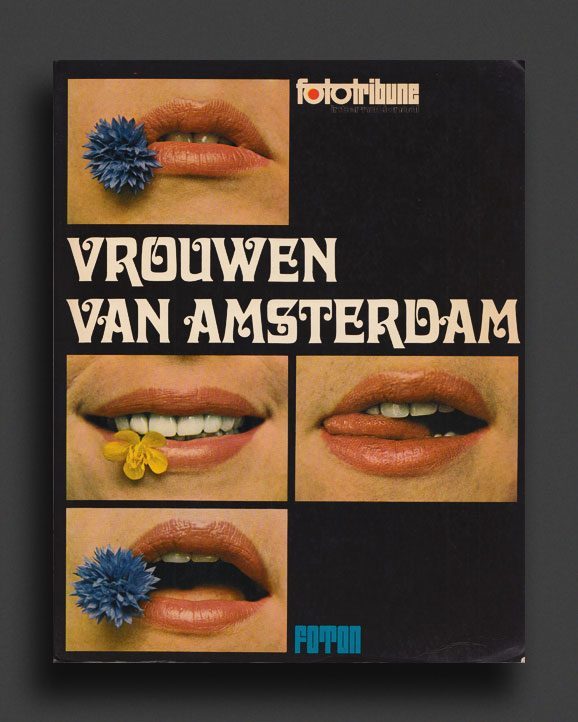
First edition of "Vrouwen Van Amsterdam" published by Foton Amsterdam in 1970 - a folio of photography by Dutch artists celebrating the women of Amsterdam. Features the work of Ed van der Elsken, Mattheus Engel, Claude van Heye, Cor Jaring, Suki Langereis, Henk van der Leeden, Philip Mechanicus, Marian Morris, Hans Pelgrom, Wim Renes, Jutka Rona, Matthijs Schofer, Nico van der Stam, Chris Paul Stapels, Koen Wessing, Marian Zijlstra. Lavishly illustrated throughout in colour and black and white, mostly full bleed images, with opening interviews with each photographer (in Dutch) with Hanneke Meerum Terwogt.
1969, English
Hardcover (clothbound), 240 pages, 21 x 22 cm
1st US Edition, Out of print title / used / good
Published by
Praeger Publishers Inc. / New York
$140.00 - Out of stock
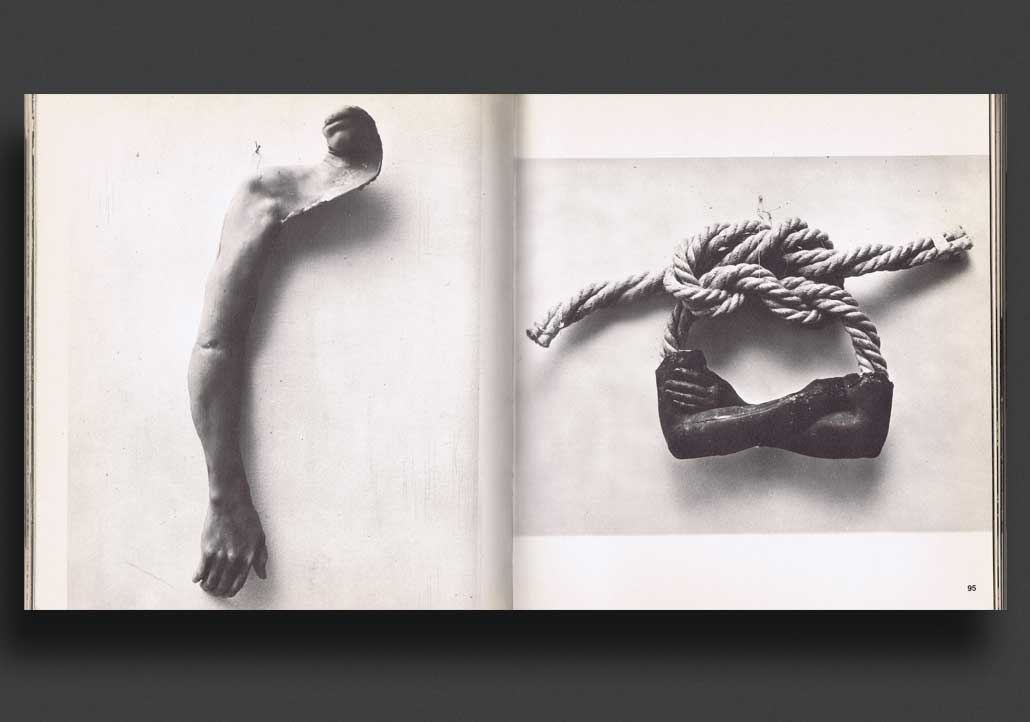
First hardcover US printing of "Art Povera", the now legendary critical/photographic book by Germano Celant (Italian art historian, critic and curator) documenting the so-called "Art Povera /Arte Povera" movement (meaning "poor art", coined by Celant in 1967) and published by Studio Vista, London in 1969 and Praeger, New York, the same year.
Includes profiles of major artists of the movement, including a short text followed by pages of full-page photographs for each artist.
Artists featured: Walter de Maria, Michelangelo Pisteletto, Stephen Kaltenbach, Richard Long, Mario Merz, Douglas Huebler, Joseph Beuys, Eva Hesse, Michael Heizer, Ger van Elk, Lawrence Weiner, Luciano Fabro, Bruce Nauman, Joseph Kosuth, Jan Dibbets, Giovanni Anselmo, Robert Barry, Pier Paolo Calzolari, Dennis Oppenheim, Barry Flanagan, Robert Smithson, Giulio Paolini, Reiner Ruthenbeck, Alighiero Boetti, Giuseppe Penone, Franz Erhard Walther, Hans Haacke, Gilberto Zorio, Robert Morris, Marinus Boezem, Carl Andre, Emilio Prini, Richard Serra.
"This book does not aim at being an objective and general analysis of the phenomenon of art or life, but is rather an attempt to flank (both art and life) as accomplices of the changes and attitudes in the development of their daily becoming. This book does not attempt to be objective since the awareness of objectivity is false consciousness. The book, made up of photographs and written documents, bases its critical and editorial assumptions on the knowledge that criticism and iconographic documents give limited vision and partial perception of artistic work. The book, when it reproduces the documents of artistic work, refutes the linguistic mediation of photography. The book, even though it wants to avoid the logic of consumption, is a consumer's item. ... This book produces a collection of already old material. ... In this book there is no need to reflect in order to seek a unitary and reassuring value, immediately refuted by the the authors themselves, rather there is the necessity to look into it for the changes, limits, precariousness and instability of artistic work." -- text from Celant's introduction "Stating That.
Good ex-library copy with light associated markings, without dust jacket. Otherwise clean, tightly bound Very Good copy throughout (never loaned).
1971, English
Softcover, 60 pages, 23 x 23 cm
1st UK Edition, Out of print title / used / good
Published by
The Australian Ballet Company / Melbourne
$25.00 - Out of stock
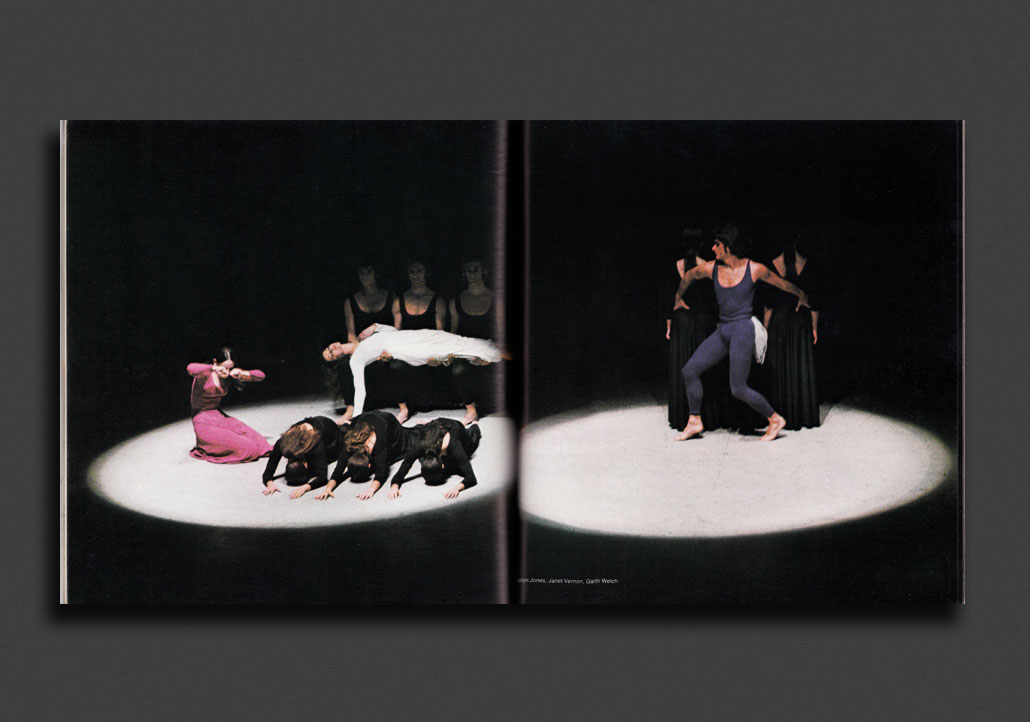
This handsome publication commemorates the 1970-71 season of The Australian Ballet company. Richly illustrated throughout with colour and b/w photography by Australian photographer Paul Cox and others, capturing the rehearsals, performances (with Marilyn Jones, Garth Welch, etc.), souvenir photos of the North American Tour (with Rudolf Nureyev), The Company, Repertoire, The School, and more.
Edited by Noel Petty, texts by John Wallace.
Design by Graham Blacker.
Good copy with heavy cover creasing and general wear.