World Food Books' programme is largely produced on Kulin Nation land. We acknowledge the Wurundjeri people of the Kulin Nation as the first and continuing custodians of this land, and pay respect to their Elders past, present, and emerging.
World Food Books is an arts and special interests bookshop in Naarm / Melbourne. Founded in 2010, World Food Books is devoted to the presentation of a rotating, hand-selection of international art, design, literary and counterculture publications with an emphasis on the anti-traditional, the experimental, the avant-garde, the heretic, the marginal.
Presenting new titles alongside rare and out-of-print books, catalogues and journals spanning the fields of modern and contemporary art, design, photography, illustration, film, literature, poetry, cultural theory, philosophy, sexuality, popular and underground culture in its many radical forms, World Food Books wishes to encourage adventurous, thoughtful and open-minded reading, looking, writing, and exchange of publishing and ideas, both current and historical.
As well as our bookshop, located in Melbourne's historical Nicholas Building, all of our inventory is available internationally via our online mail-order service.
World Food Books semi-regularly co-ordinates "Occasions", a programme of exhibits and events at the bookshop and in partnership with other hosts (such as museums and art galleries) that develop out of the activities, relationships and content of the bookshop itself.
World Food Books
The Nicholas Building
37 Swanston Street
Room 5, Level 6
Melbourne 3000
Australia
SHOP HOURS:
THU–SAT 12–6
WEB-SHOP OPEN 24/7
World Food Books
Postal Address:
PO Box 435
Flinders Lane
Victoria 8009
Australia
info@worldfoodbooks.com
Art
Theory / Essay
Architecture / Interior
Graphic Design / Typography
Photography
Fashion
Eros
LGBTQ+
Fiction / Poetry
Weird / Speculative / Science Fiction / Horror
Transgressive / Visceral / Abject
Symbolism / Decadence / Fin de siècle
Film / Video
Painting
Sculpture / Installation
Performance / Dance / Theater
Drawing
Sound / Music
Curatorial
Group Shows / Collections
Periodicals
Out-of-print / Rare
Posters / Ephemera / Discs
Signed Books
World Food Books Gift Voucher
World Food Book Bag
Australian Art
Australian Fiction
Australian Science Fiction / Speculative Fiction
Australian Poetry
Australian Photography
Japanese Photography
Conceptual Art
Minimal Art
Dada
'Pataphysics / Oulipo
Fluxus
Concrete Poetry
Pop Art
Surrealism
Arte Povera
Arte Informale / Haute Pâte / Tachism
Nouveau Réalisme / Zero / Kinetic
Situationism / Lettrism
Collage / Mail Art / Xerox Art
Art Brut / Folk / Visionary / Fantastic
Illustration / Graphic Art / Bandes Dessinées
Furniture
Italian Radical Design / Postmodernism
Textiles
Ceramics / Glass
Counterculture
Protest / Revolt
Philosophy
Psychoanalysis
Anthropology
Anarchism
Socialism / Anarchism / Communism / Capitalism
Literary Theory / Semiotics / Language
Feminism / Women's Studies
Gender Studies / Sexuality
Anthropology
Fetishism / BDSM
Drugs / Psychedelia
Crime / Violence
Animal Rights / Veganism
Occult / Esoterica
Ecology / Earth / Alternative Living
Whole Earth / Crafts
All prices in AUD (Australian dollars)
Pick-Ups
Pick-up orders can be collected in our bookshop during opening hours after order date. Please collect any Pick-up orders within 2 weeks of ordering as we have limited storage space. Orders will be released back into stock if not collected within this time. No refunds can be made for pick-ups left un-collected. If you cannot make it in to the bookshop in this time-frame, please choose postage option.
Return Policy
All sales are final. We do accept returns (for refund or exchange) for items received in error. All our orders are packed with special care using heavy-duty padding and cardboard book-mailers or bubble mailers (for smaller books), using reinforcement where required. We cannot take responsibility for any lost, stolen or damaged parcels.
Insurance
Should you wish to insure your package, please email us directly after placing your order and we can organise this at a small extra expense. Although all standard/express tracked packages are very safe and dependable, we cannot take responsibility for any lost, stolen or damaged parcels. We recommend insurance on valuable orders.
Interested in selling your old books, catalogues, journals, magazines, comics, fanzines, ephemera? We are always looking for interesting, unusual and out-of-print books to buy. We only buy books in our fields of interest and specialty, and that we feel we can resell.
We base these prices on desirability, market value, in-print prices, condition and our current stock levels. We offer cash, store credit, and can take stock on consignment. All
about 25% of the price we expect to get when we sell them, or 30% in store credit. We base these prices on desirability, market value, in-print prices, condition and our current stock levels.
Sell your books any day of the week. You can drop them off and return later. If you have a lot of books, we can visit your Sydney home.
We buy books that we feel we can resell. We offer about 25 % of the price we expect to get when we sell them, or 30% in store credit. We base these prices on desirability, market value, in-print prices, condition and our current stock levels.
Philadelphia Wireman
03 August - 01 September, 2018
World Food Books is proud to announce our next Occasion, the first presentation of sculptures by Philadelphia Wireman in Australia.
The Philadelphia Wireman sculptures were found abandoned in an alley off Philadelphia’s South Street on trash night in 1982. Their discovery in a rapidly-changing neighbourhood undergoing extensive renovation, compounded with the failure of all attempts to locate the artist, suggests that the works may have been discarded after the maker’s death. Dubbed the "Philadelphia Wireman" during the first exhibition of this work, in 1985, the maker’s name, age, ethnicity, and even gender remain uncertain. The entire collection totals approximately 1200 pieces, all intricately bound together with tightly-wound heavy-gauge wire (along with a few small, abstract marker drawings, reminiscent both of Mark Tobey and J.B. Murry). The dense construction of the work, despite a modest range of scale and materials, is singularly obsessive and disciplined in design: a wire armature or exoskeleton firmly binds a bricolage of found objects including plastic, glass, food packaging, umbrella parts, tape, rubber, batteries, pens, leather, reflectors, nuts and bolts, nails, foil, coins, toys, watches, eyeglasses, tools, and jewellery.
Heavy with associations—anthropomorphic, zoomorphic, and socio-cultural responses to wrapped detritus—the totemic sculptures by Philadelphia Wireman have been discussed in the context of work created to fulfil the shamanistic needs of alternative religions in American culture. Curators, collectors, and critics have variously compared certain pieces to sculpture from Classical antiquity, Native American medicine bundles, African-American memory jugs, and African fetish objects. Reflecting the artist’s prolific and incredibly focused scavenging impulse, and despite—or perhaps enhanced by—their anonymity, these enigmatic objects function as urban artefacts and arbiters of power, though their origin and purpose is unknown. Philadelphia Wireman, whatever their identity, possessed an astonishing ability to isolate and communicate the concepts of power and energy through the selection and transformation of ordinary materials. Over the course of the past two decades, this collection has come to be regarded as an important discovery in the field of self-taught art and vernacular art.
Presented in collaboration with Fleisher-Ollman Gallery, Philadelphia, and Robert Heald, Wellington.
Susan Te Kahurangi King
02 February - 10 March, 2018
Susan Te Kahurangi King (24 February 1951 - ) has been a confident and prolific artist since she was a young child, drawing with readily available materials - pencils, ballpoint pens and felt-tip markers, on whatever paper is at hand. Between the ages of four and six Susan slowly ceased verbal communication. Her grandparents William and Myrtle Murphy had developed a special bond with Susan so they took on caring responsibilities for extended periods. Myrtle began informally archiving her work, carefully collecting and storing the drawings and compiling scrapbooks. No drawing was insignificant; every scrap of paper was kept. The King family are now the custodians of a vast collection containing over 7000 individual works, from tiny scraps of paper through to 5 meter long rolls.
The scrapbooks and diaries reveal Myrtle to be a woman of great patience and compassion, seeking to understand a child who was not always behaving as expected. She encouraged Susan to be observant, to explore her environment and absorb all the sights and sounds. Myrtle would show Susan’s drawings to friends and people in her community that she had dealings with, such as shopkeepers and postal workers, but this was not simply a case of a grandmother’s bias. She recognised that Susan had developed a sophisticated and unique visual language and sincerely believed that her art deserved serious attention.
This was an unorthodox attitude for the time. To provide some context, Jean Dubuffet coined the term Art Brut in 1945 to describe work created by self-taught artists – specifically residents of psychiatric institutions and those he considered to be visionaries or eccentrics. In 1972 Roger Cardinal extended this concept by adopting the term Outsider Art to describe work made by non-academically trained artists operating outside of mainstream art networks through choice or circumstance. Susan was born in Te Aroha, New Zealand in 1951, far from the artistic hubs of Paris and London that Dubuffet and Cardinal operated in. That Myrtle fêted Susan as a self-taught artist who deserved to be taken seriously shows how progressive her attitudes were.
Susan’s parents Doug and Dawn were also progressive. Over the years they had consulted numerous health practitioners about Susan’s condition, as the medical establishment could not provide an explanation as to why she had lapsed into silence. Dawn educated herself in the field of homeopathy and went on to treat all twelve of her children using these principles – basing prescriptions on her observations of their physical, mental and emotional state.
Doug was a linguist with an interest in philosophy who devoted what little spare time he had to studying Maori language and culture. To some extent their willingness to explore the fringes of the mainstream made them outsiders too but it was their commitment to living with integrity and their respect for individuality that ensured Susan’s creativity was always encouraged.
Even though Susan’s family supported her artistic pursuits, some staff in schools and hospitals saw it as an impediment to her assimilation into the community and discouraged it in a variety of ways. Her family was not always aware of this and therefore did not fully understand why Susan stopped drawing in the early 1990s. However, rather than dwell on the challenges that Susan faced in pursuit of her artistic practice, they prefer to highlight her achievements. In 2008 Susan began drawing again in earnest, after an almost 20 year interruption, and her work is now shown in galleries around the world.
Susan grew up without television and has been heavily influenced by the comics she read as a child. She is absolutely fearless in the appropriation of recognizable characters, such as Donald Duck and Mickey Mouse, in her work. She twists their limbs, contorts their faces, compresses them together, blends them into complex patterned backgrounds - always imbuing them with an incredible energy. Although Susan often used pop culture characters in her work they are not naive or childlike. These are drawings by a brilliant self-taught artist who has been creating exceptional work for decades without an audience in mind.
Mladen Stilinović
"Various Works 1986 - 1999"
02 February 16 - September 10, 2016
Various works 1986 - 1999, from two houses, from the collections of John Nixon, Sue Cramer, Kerrie Poliness, Peter Haffenden and Phoebe Haffenden.
Including: Geometry of Cakes (various shelves), 1993; Poor People’s Law (black and white plate), 1993; White Absence (glasses, ruler, set square, silver spoon, silver ladel with skin photograph and wooden cubes), 1990-1996; Exploitation of the Dead (grey and red star painting, wooden painting, black spoon with red table, red plate), 1984-1990; Money and Zeros (zero tie, paintings made for friends in Australia (Sue, John, Kerrie), numbers painting), 1991-1992; Words - Slogans (various t-shirts) - “they talk about the death of art...help! someone is trying to kill me”, “my sweet little lamb”, “work is a disease - Karl Marx”; Various artist books, catalogues, monographs, videos; Poster from exhibition Insulting Anarchy; "Circular" Croatian - Australian edition; Artist book by Vlado Martek (Dostoyevsky); more.
Thanks to Mladen Stilinović and Branka Stipančić.
Jonathan Walker
Always Will Need To Wear Winter Shirt Blue + Ochre Small Check Pattern
21 August - 21 September, 2015
Untitled
I am not a great reader of poetry but I always return to the work of Melbourne poet, Vincent Buckley (1925- 1988). Perhaps I find his most tantalising piece to be not a finished poem but a fragment left on a scrap of paper discovered on his desk after the poet’s death.
The poetry gathers like oil
In the word-core, and spreads
It has its music meet,
Its music is in movement.
This fragment is more the shell left behind from a volatile thought than a finished poem. I find the last two lines honest but awkward whereas the first two lines work like an arrow. Most likely he could not find a resolution so it was left. Still, in its present form, it remains an eloquent testimony to the ultimate failure of a medium to express mobile thought and sensation, in Buckley’s case, through verbal language. It’s an important matter because this is something all artists have to deal with regardless of the medium.
I have never written a poem, however, I am forever copying fragments from books on paper scraps in a vain effort to fix certain notions in my head. At first, they function as bookmarks that are sometimes returned to when I open the book. But before long, as they accumulate, they fall out littering the table interspersed with A4 photocopies, bills, books and medications.
To return to Buckley’s fragment, the first two lines very much evoke how I paint nowadays. As you age, detail diminishes and patches of light become more luminous and float. I feel the most honest way of dealing with this is by smearing the oil paint on the canvas with the fingers and working close-up, blind. Only if the patches coalesce into an approaching image can the work gain a life.
-
Jonathan Walker was born in Melbourne, Australia and brought up on a dairy farm in Gippsland. In the 1970’s he studied painting at RMIT and won the Harold Wright Scholarship to the British Museum, London. During the 1980’s he exhibited at Pinacotheca Gallery, Richmond and had work shown at the NGV and Heidi City Art Gallery. Over the same period he designed the cover for the “Epigenesi” LP by Giancarlo Toniutti, Italy and conducted a mail exchange work with Achim Wollscheid, Germany. The work with artists through the post resulted in an article published in the bicentenary issue of Art and Australia 1988. He showed in artist run spaces such as WestSpace in the 90’s and 2000’s, and until 2012, taught painting at Victoria University, which is where we (Colleen Ahern and Lisa Radford) as organisers of the exhibition, among many others, had the privilege of being his student.
Walker’s knowledge was imparted to students through the careful selection of music, literature, and artists found in books that he himself had ordered for the library. Walker’s strategy was the generosity of sharing his vast knowledge with references specific to each student and their context.
Walker’s paintings share a similar focus and intimacy.
This exhibition presents a small selection of recent paintings alongside a publication that includes Walker’s writing. Observational and analytical, Walker’s work is a type of material notation — the time of day, colour and how it is blended, the both specific and fleeting location of a reflection on lino or the question of whether a chair leg should be included in a painting.
Please join us on Friday August 21 between 6-8pm to celebrate the opening of the exhibition.
Curated by Colleen Ahern and Lisa Radford.
B. Wurtz
Curated by Nic Tammens
March 26 - April 4, 2015
B.Wurtz works from a basement studio in his home on Manhattan’s Lower East Side.
This local fact is attested to by the plastic shopping bags and newsprint circulars that appear in his work. As formal objects, they don’t make loud claims about their origins but nonetheless transmit street addresses and places of business from the bottom of this long thin island. Like plenty of artists, Wurtz is affected by what is local and what is consumed. His work is underpinned by this ethic. It often speaks from a neighborhood or reads like the contents of a hamper:
“BLACK PLUMS $1.29 lb.”
“Food Bazaar”
“USDA Whole Pork Shoulder Picnic 99c lb.”
“RITE AID Pharmacy, with us it’s personal.”
“H. Brickman & Sons.”
“Sweet Yams 59c lb."
Most of the work in this exhibition was made while the artist was in residence at Dieu Donne, a workshop dedicated to paper craft in Midtown. Here Wurtz fabricated assemblages with paper and objects that are relatively lightweight, with the intention that they would be easily transportable to Australia. This consideration isn’t absolute in Wurtz’s work, but was prescriptive for making the current exhibition light and cheap. Packed in two boxes, these works were sent from a USPS post office on the Lower East Side and delivered to North Melbourne by Australia Post.
Wurtz appears courtesy of Metro Pictures, New York.
Thanks to Rob Halverson, Joshua Petherick, Sari de Mallory, Matt Hinkley, Helen Johnson, Fayen d'Evie, Ask Kilmartin, Lisa Radon, Ellena Savage, Yale Union, and "Elizabeth".
John Nixon
"Archive"
December 15 - January 20, 2014
The presentation of John Nixon's archive offered a rare showcase of this extensive collection of the artist's own publications, catalogues, posters, ephemera, editions and more, from the mid 1980s onwards, alongside a selection of his artworks.
Organized by John Nixon, Joshua Petherick and Matt Hinkley.
"Habitat"
at Minerva, Sydney (organised by Joshua Petherick and Matt Hinkley)
November 15 - December 20, 2014
Lupo Borgonovo, Janet Burchill & Jennifer McCamley,
Lewis Fidock, HR Giger, Piero Gilardi, Veit Laurent Kurz,
Cinzia Ruggeri, Michael E. Smith, Lucie Stahl, Daniel Weil, Wols
Press Release:
“...It contained seven objects. The slender fluted bone, surely formed for flight, surely from the wing of some large bird. Three archaic circuitboards, faced with mazes of gold. A smooth white sphere of baked clay. An age-blackened fragment of lace. A fingerlength segment of what she assumed was bone from a human wrist, grayish white, inset smoothly with the silicon shaft of a small instrument that must once have ridden flush with the surface of the skin - but the thing’s face was seared and blackened.”
William Gibson, “Count Zero”, 1986
"Autumn Projects Archive"
Curated by Liza Vasiliou
March 6 - March 15, 2014
World Food Books, in conjunction with the Virgin Australia Melbourne Fashion Festival 2014, presented the Autumn Projects archive, consisting of a selection of early examples in Australian fashion with a particular interest in collecting designers and labels from the period beginning in the 1980’s, who significantly influenced the discourse of Australian Fashion.
Curated by Liza Vasiliou, the exhibition provided a unique opportunity to view pieces by designers Anthea Crawford, Barbara Vandenberg, Geoff Liddell and labels CR Australia, Covers, Jag along with early experimental collage pieces by Prue Acton and Sally Browne’s ‘Fragments’ collection, suspended throughout the functioning World Food Books shop in Melbourne.
H.B. Peace
presented by CENTRE FOR STYLE
November 14, 2013
"Hey Blinky, you say chic, I say same"
Anon 2013
H.B. Peace is a clothing collaboration between great friends Blake Barns and Hugh Egan Westland. Their pieces explore the divergences between 'character’ and ‘personality’ in garments....etc
Special Thanks to Joshua Petherick and Matt Hinkley of WFB and Gillian Mears
and a Very Special Thank you to Audrey Thomas Hayes for her shoe collaboration.
Janet Burchill & Jennifer McCamley
"Aesthetic Suicide"
May 10 - June 8, 2013
The first of our occasional exhibitions in the World Food Books office/shop space in Melbourne, "Aesthetic Suicide" presented a body of new and older works together by artists Janet Burchill & Jennifer McCamley, including videos, prints, a wall work, and publications.
During shop open hours videos played every hour, on the hour.
1974, English
Newspaper, 28 pages, 41 x 29 cm
1st Edition, Out of print title / used / very good
Published by
Incorporated Newsagencies / West Melbourne
$90.00 $60.00 - Out of stock
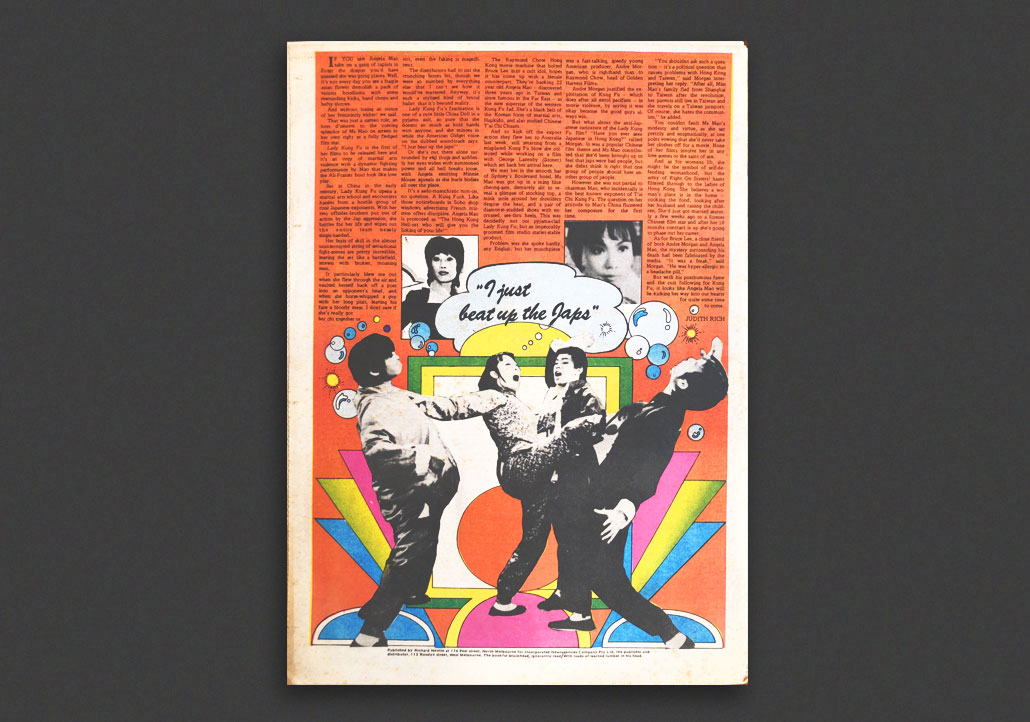
Rare February 1974 issue of The Living Daylights, a radical, riotous weekly counter-culture magazine out of North Melbourne in the 1970's, edited by Oz magazine founder Richard Neville, along with Terence Maher, Michael Morris, and graphic designer Laurel Olszewski, and published by Neville's fellow OZ colleague, Richard Walsh, between 1973-4. The Living Daylights was packed with all happening things in youth counter-culture, filled with articles, cartoons, artwork, sex, drugs, rock n roll and protest. A provocative, humorous and controversial anti-establishment bulletin in the tradition of Oz, regularly featuring the artwork of Martin Sharp, Michael Luenig, Dickie, and Neil McLean! This issue features 186 Years of Penal Outrage, activists against the closure of Lameroo "Free Beach" in Darwin, Bondi photography by Syd Shelton, dodgy Adelaide drug squad, Melbourne marijuana activists, Nimbin news, female singers, women's liberation and beauty trends by Margaret Smith, Confessions of a Working Class Shit Eater by poet Eric Beach, Taiwanese actress Angela Mao, Fritz the Cat, and so much more.
A wonderful, very seldom seen, historical piece of Australian counterculture publishing.
Very Good copy with light wear/tanning.
1974, English
Newspaper, 28 pages, 41 x 29 cm
1st Edition, Out of print title / used / very good
Published by
Incorporated Newsagencies / West Melbourne
$90.00 $60.00 - Out of stock
Rare March 1974 issue of The Living Daylights, a radical, riotous weekly counter-culture magazine out of North Melbourne in the 1970's, edited by Oz magazine founder Richard Neville, along with Terence Maher, Michael Morris, and graphic designer Laurel Olszewski, and published by Neville's fellow OZ colleague, Richard Walsh, between 1973-4. The Living Daylights was packed with all happening things in youth counter-culture, filled with articles, cartoons, artwork, sex, drugs, rock n roll and protest. A provocative, humorous and controversial anti-establishment bulletin in the tradition of Oz, regularly featuring the artwork of Martin Sharp, Michael Luenig, Dickie, and Neil McLean! This issue features Ian Stocks in conversation with science fiction legend Arthur C. Clarke, a guide to smuggling, Allen Ginsberg on cocaine and Abbie Hoffman, Heroin, Pentridge prison, Magic Mushrooms, police brutality against black Australians, Cherry Ripe on the pioneering drag queen anarchy of Sylvia and the Synthetics, meditation, Veronica Perry on the ecology of Shit, the Bitch newspaper, Miles Davis, and so much more.
A wonderful, very seldom seen, historical piece of Australian counterculture publishing.
Very Good copy with light wear/tanning.
1977, English
Softcover, 144 pages, 27 x 19 cm
1st Edition, Out of print title / used / very good
Published by
Point / Sausalito
$60.00 - Out of stock
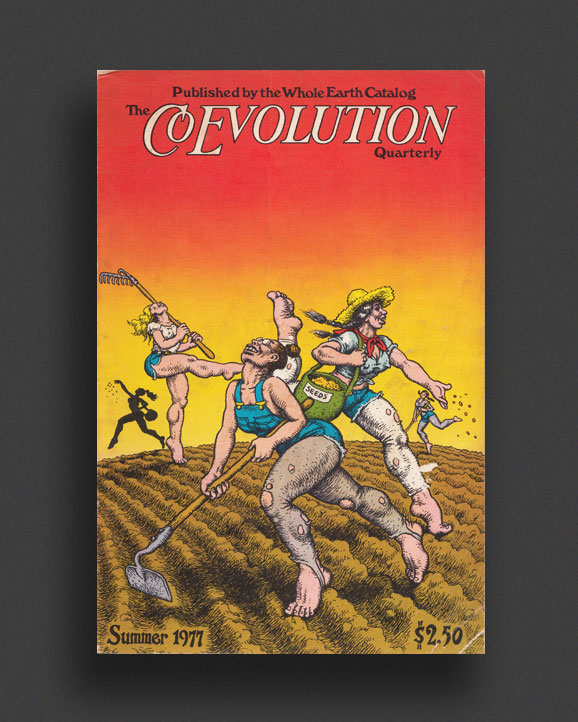
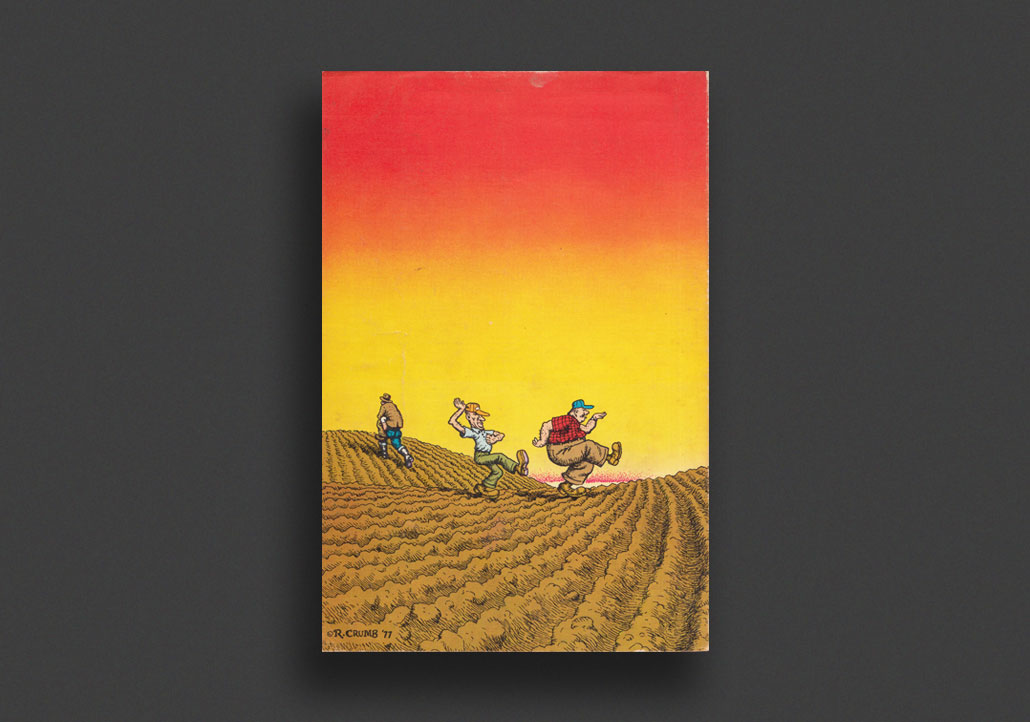
Summer 1977 issue of The CoEvolution Quarterly, with covers by Robert Crumb. A descendant from the 1970s' counterculture bible, "The Whole Earth Catalog," The CoEvolution Quarterly was published in Sausalito, California, 4 times annually between 1974—1985. It mixed articles with ads and reviews about all things alternative living, environmentalism, going back to the land, sustainable living, self-sufficiency, politics, challenging the system, community living, nomadism, and soft revolution. Includes comic by Crumb and many illustrations throughout.
Very Good, general cover wear, tanning.
1979, Engish
Hardcover (w. dust jacket), 96 pages, 33 x 24 cm
1st Edition, Out of print title / used / very good
Published by
Octopus / London
$80.00 $30.00 - Out of stock
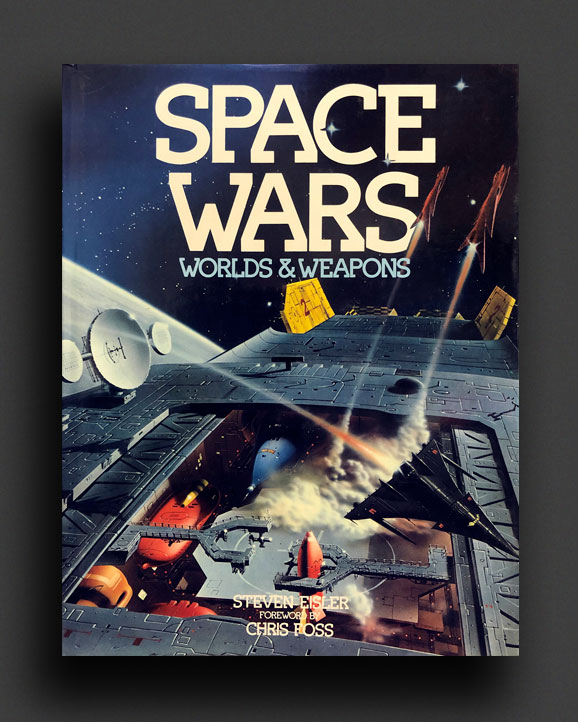
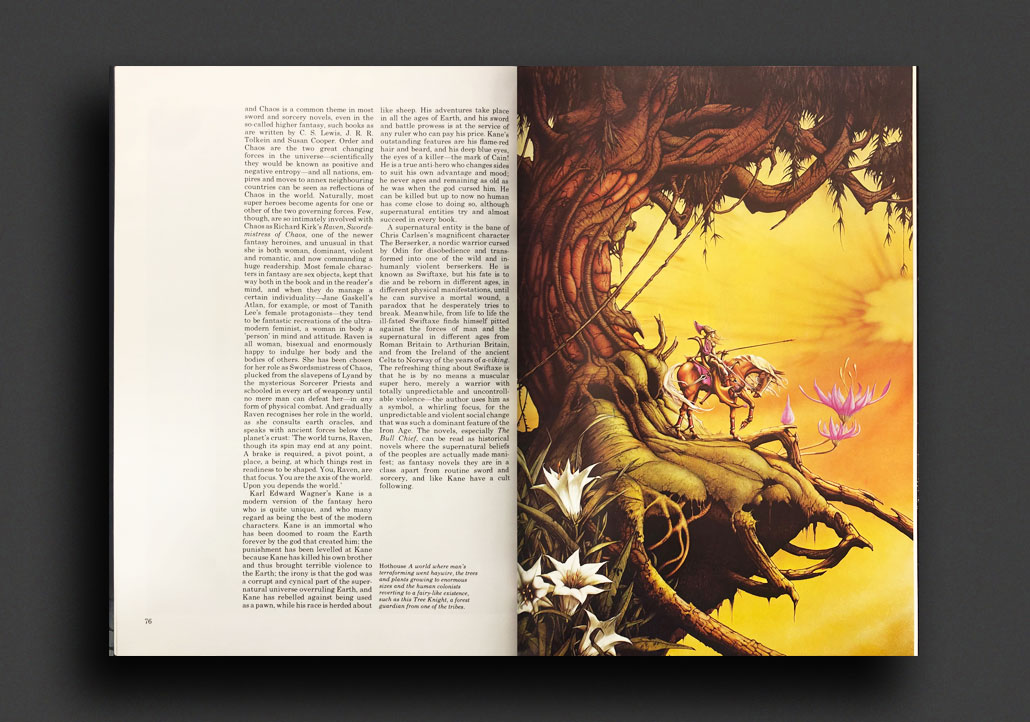
First hardcover 1979 print of SPACE WARS: WORLDS AND WEAPONS, "a dramatic and exciting account of the conflicts which engulfed the Galactic worlds during the first five millennia on the cosmic calendar. Stunningly illustrated are the machines, the spacecraft and weaponry used by the Empires of the first three Federations during the Zone Wars. Blueprints and technical specifications of some of the enormous battlecruisers, transporters and artificial worlds are published for the first time. The ingeniously researched text, taken from the records of contemporary journalists and authors, traces the history of these fierce fighting years." Illustrated throughout with contributions by many of the leading fantasy artists of the 1970s. Scarce in the original hardcover 1979 edition, more commonly available in the popular 1988 softcover print.
Very Good copy in VG dust jacket.
1970 / 1975, Japanese
Softcover (w. dust jacket), 100 pages, 26 x 18 cm
Out of print title / used / very good
Published by
Iwasaki Art Co. / Japan
$70.00 - Out of stock
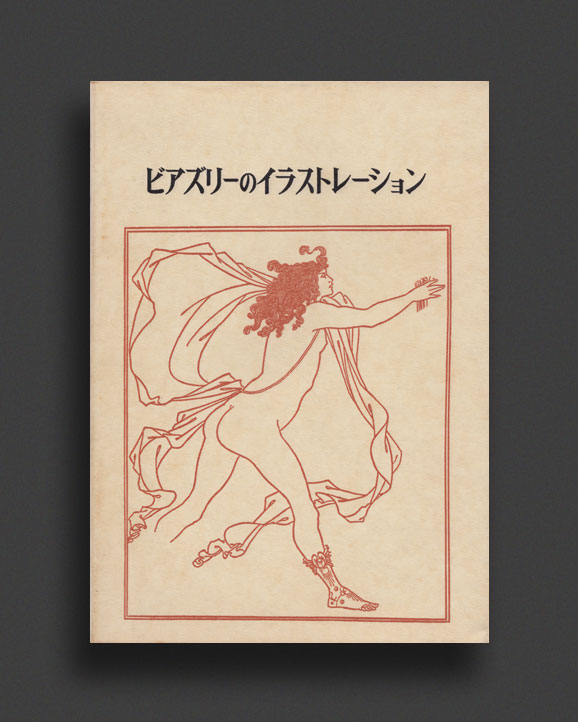
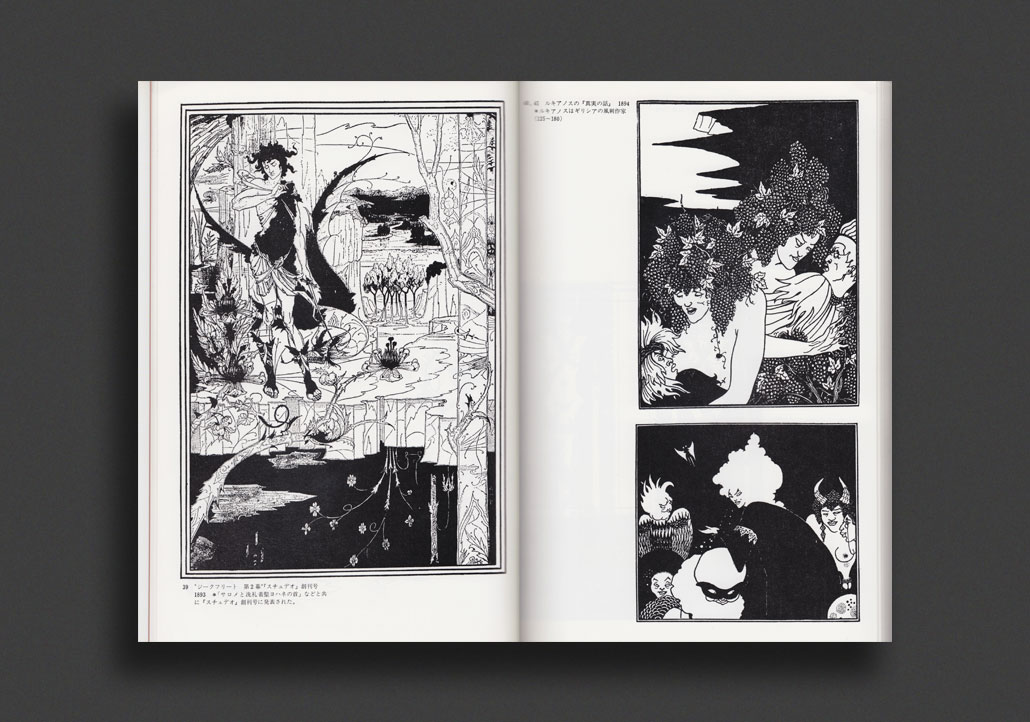
Lovely 1975 Japanese monograph on the work of Aubrey Beardsley, first published in 1970. Profusely illustrated throughout with 155 works, illustrated biography, biography and list of works, wrapped up in textured stock cover and dust jacket. Texts by Tadayuki Omori.
Aubrey Vincent Beardsley (1872 – 1898) was an English illustrator and author. His black ink drawings were influenced by Japanese woodcuts, and emphasized the grotesque, the decadent, and the erotic. He was leading figure in the aesthetic movement, the British counterpart of Decadence and Symbolism. He produced extensive illustrations for books and magazines such as The Studio, The Yellow Book, and The Savoy. Beardsley was a public as well as private eccentric. He said "I have one aim—the grotesque. If I am not grotesque, I am nothing." Oscar Wilde said Beardsley had "a face like a silver hatchet, and grass green hair." Wilde's irreverent wit and work reflected the decadence of his era and his influence was enormous, despite his early death from tuberculosis at age 25. His influence is clearly visible in the work of the French Symbolists, the Poster Art Movement of the 1890s, the work of many later-period Art Nouveau artists such as Papé and Clarke and 20th fantasy illustration.
Very Good copy in VG original dust jacket.
1960, English
Hardcover, 48 pages, 29.5 x 22 cm
1st Edition, Out of print title / used / good
Published by
The World Publishing Company / Cleveland
$48.00 - Out of stock
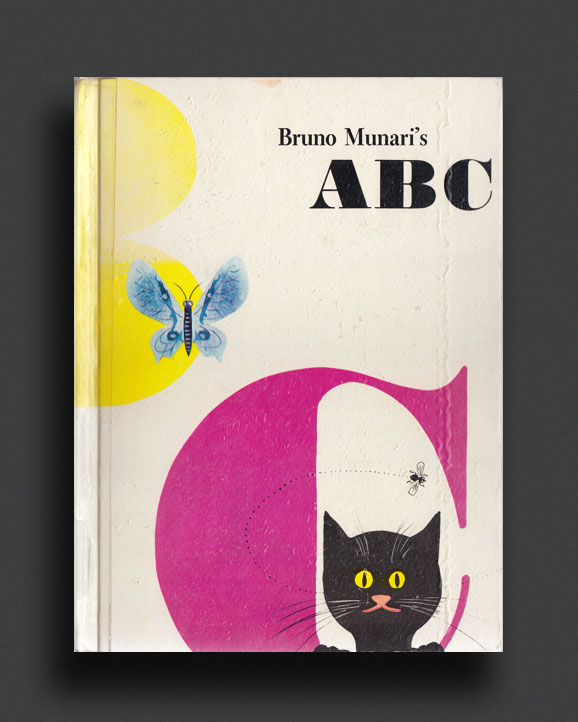
First World Library Binding illustrated hardcover edition of Bruno Munari's ABC, published in English in 1960 by The World Publishing Company, Cleveland. One of his most celebrated and reprinted children's books, there is nothing like the first editions of these beautiful illustrated books from this period. In this classic imaginative ABC, acclaimed Italian artist, designer and children's author Bruno Munari brings the joy of letters to life - from an Ant on an Apple to a Blue Butterfly to a Cat in a Cage, Munari pairs words in whimsical ways until Fly frees itself from its page, lands on the Hat, buzzes near the Ice Cream and provides the final sound for Zzzzz.
Bruno Munari (October 24, 1907, Milan – September 30, 1998, Milan) was an Italian artist, designer, and inventor who contributed fundamentals to many fields of visual arts (painting, sculpture, film, industrial design, graphic design) in modernism, futurism, and concrete art, and in non visual arts (literature, poetry) with his research on games, didactic method, movement, tactile learning, kinesthetic learning, and creativity.
Good ex-library copy w. associated markings and wear.
Various copies of similar condition — may not be same copy as pictured.
1963, English
Hardcover, 52 pages, 29.5 x 22 cm
1st Edition, Out of print title / used / good
Published by
The World Publishing Company / Cleveland
$48.00 - Out of stock
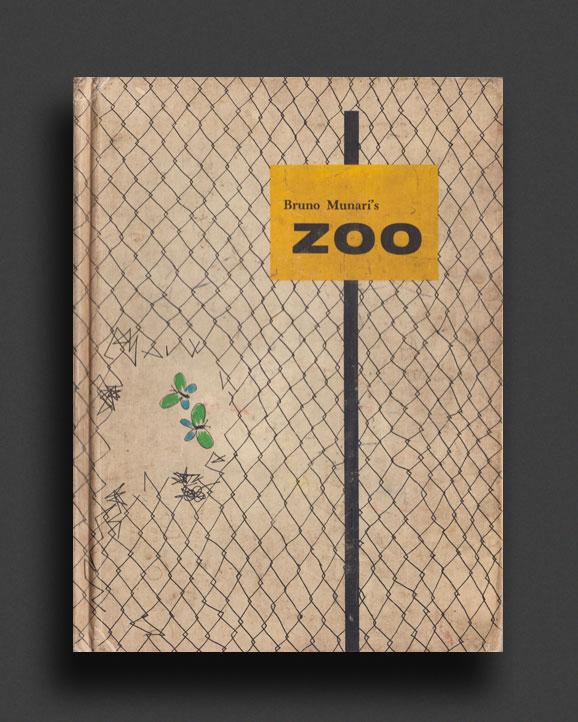
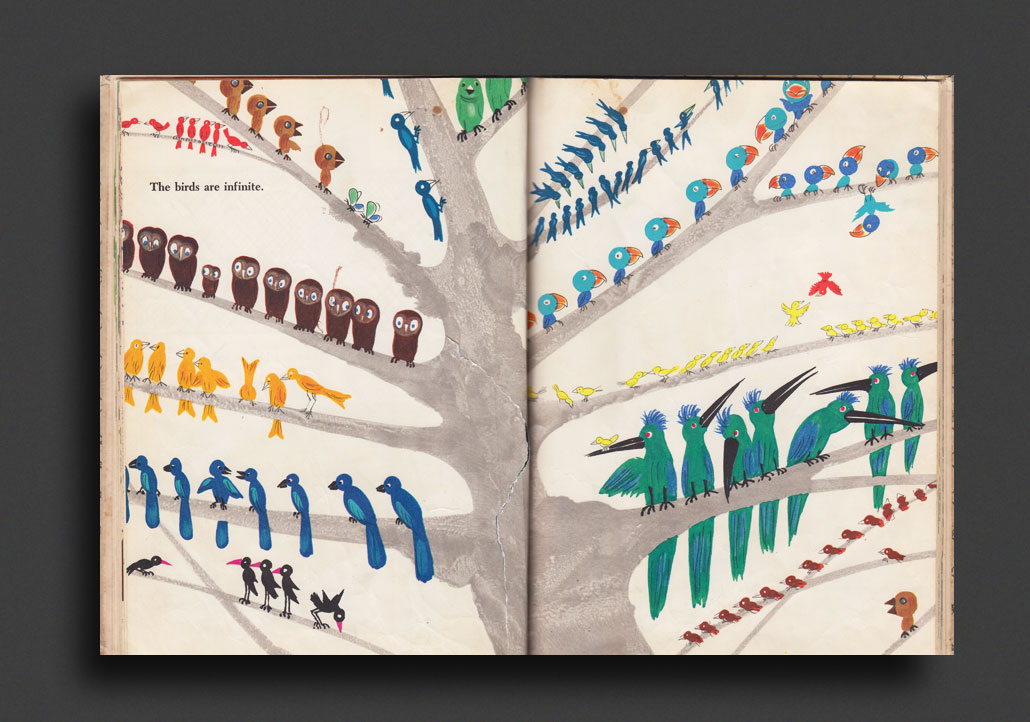
First 1963 World Library Binding illustrated hardcover edition of Bruno Munari's Zoo, published in English by The World Publishing Company, Cleveland. One of his most celebrated and reprinted children's books, there is nothing like the first editions of these beautiful illustrated books from this period. Bruno Munari's books have been hailed as "among the most original, inventive and beautiful ever created", and Zoo is without doubt among his most graphically stunning book works. Young readers will enjoy Munari's bright, bold illustrations as they are introduced to a host of animals; older readers will appreciate his wry humour throughout.
Bruno Munari (October 24, 1907, Milan – September 30, 1998, Milan) was an Italian artist, designer, and inventor who contributed fundamentals to many fields of visual arts (painting, sculpture, film, industrial design, graphic design) in modernism, futurism, and concrete art, and in non visual arts (literature, poetry) with his research on games, didactic method, movement, tactile learning, kinesthetic learning, and creativity.
Average-Good ex-library copy w. associated markings w/o dust jacket. Tight throughout with general wear, light markings and small closed tears to some pages (no content missing). Boards handsomely well worn with age.
1988, English
Softcover, 96 pages, 23 x 23 cm
1st Edition, Out of print title / used / very good
Published by
Ebury Press / London
$120.00 - Out of stock
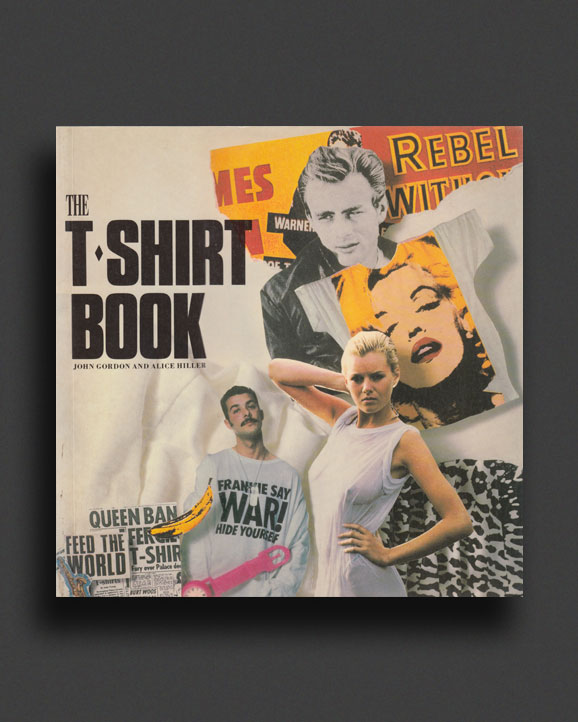
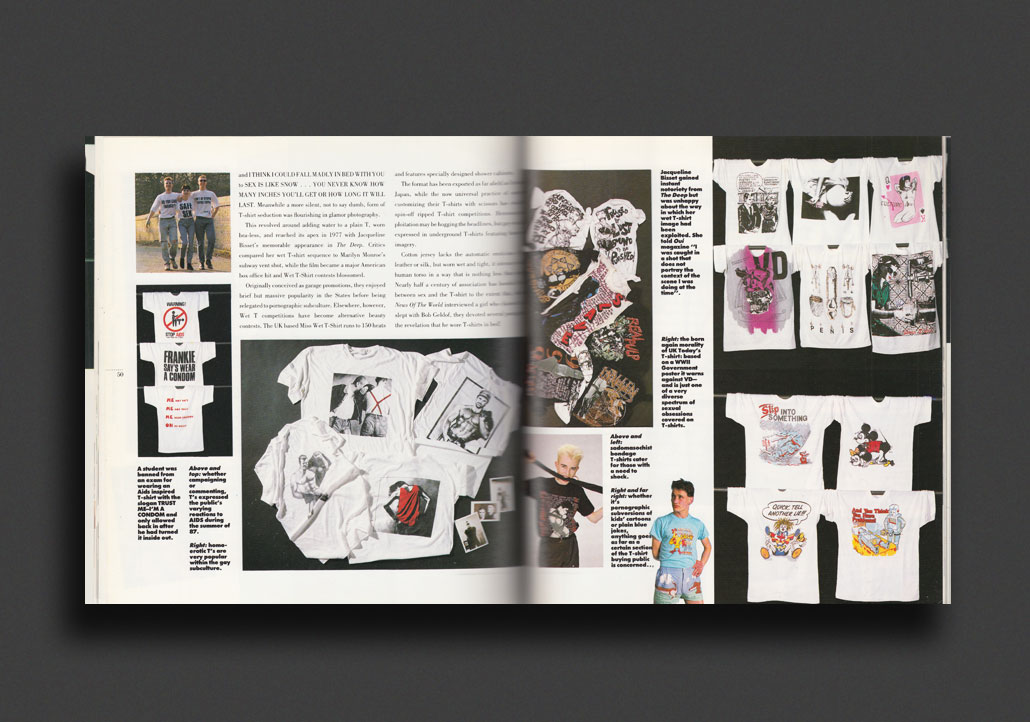
The now collectable illustrated book that traces the history of the T-shirt, from humble undergarment to high fashion artefact. Published in 1988, this one-of-a-kind valuable reference book encompasses the most iconic and the most marginal of t-shirt history from the 1950s to the late 1980s, over 300 stunning colour photographs immortalize the classic designs from every era of this universal item of clothing through fashion, music, politics, protest, novelty, sex, colour, comfort and controversy, from The Grateful Dead to The Miami Dolphins, from the Royal Family to Vivienne Westwood, Ibiza to Artists Against Apartheid. John Gordon and Mandy Ollis are design consultants to the book, record and fashion industries. Alice Hillier is a freelance writer on popular culture and has contributed to "Blitz", "The Face", and "The Observer Magazine".
Very Good copy.
1984, English
Softcover, 120 pages, 26 x 18 cm
Out of print title / used / very good
Published by
International General / New York
$70.00 - Out of stock
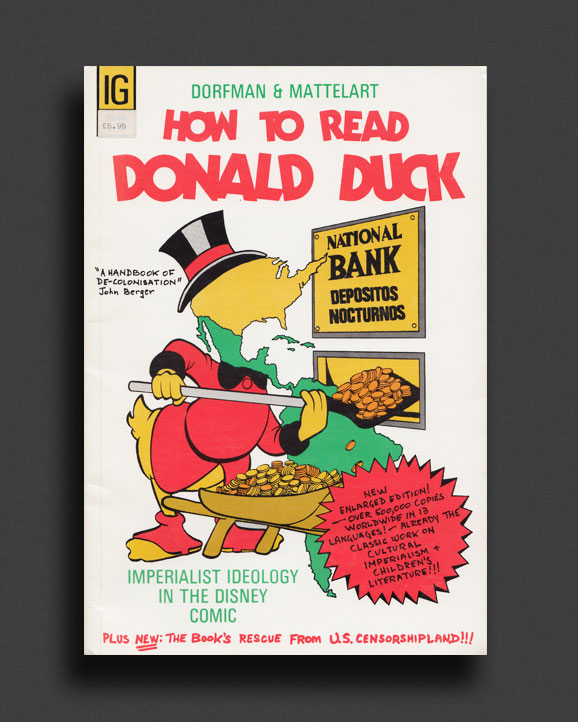
Scarce copy of the second (expanded and enlarged) 1984 English-language edition of "How to Read Donald Duck", first published in 1975.
“A literary grandmaster.” ―Time
"A Hand-book of De-Colonisation" — John Berger
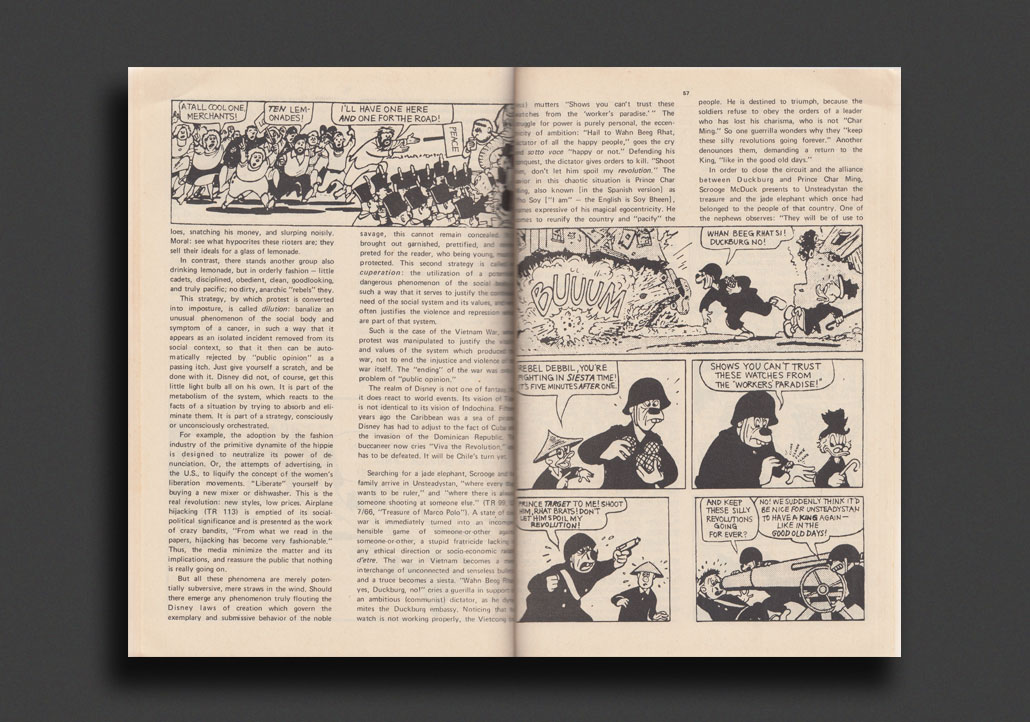
First published in 1971, How to Read Donald Duck shocked readers by revealing how capitalist ideology operates in our most beloved cartoons. Having survived bonfires, impounding and being dumped into the ocean by the Chilean army, this controversial book is once again back on our shelves.
Written and published during the blossoming of Salvador Allende's revolutionary socialism, the book examines how Disney comics not only reflect capitalist ideology, but are active agents working in this ideology's favour. Focusing on the hapless mice and ducks of Disney, curiously parentless, marginalised and always short of cash, Ariel Dorfman and Armand Mattelart expose how these characters established hegemonic ideas about capital, race, gender and the relationship between developed countries and the Third World. Disney recognized the challenge and, when the book was translated and imported into the United States in 1975, managed to have all 4,000 copies impounded. Ultimately, 1,500 copies of the book were allowed into the country, the rest of the shipment was blocked, and until now no American publisher has re-released the book, which has sold over 1 million copies worldwide.
A devastating indictment of a media giant, a document of twentieth-century political upheaval, and a reminder of the dark undercurrent of pop culture, How to Read Donald Duck is once again available, together with a new introduction by Ariel Dorfman.
Translated by art historian David Kunzle.
Very Good copy. Some pinching (not splitting) to spine edge, previous owner's signature to first page, otherwise beautifully preserved, crisp copy.
1964, English
Softcover (staple-bound), 20 pages,
1st Edition, Out of print title / used / good
Published by
Oz Publications / Sydney
$70.00 - Out of stock
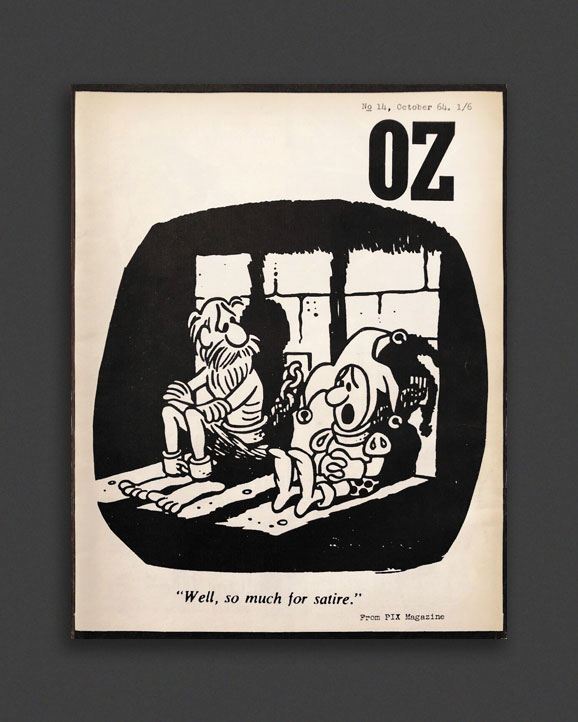
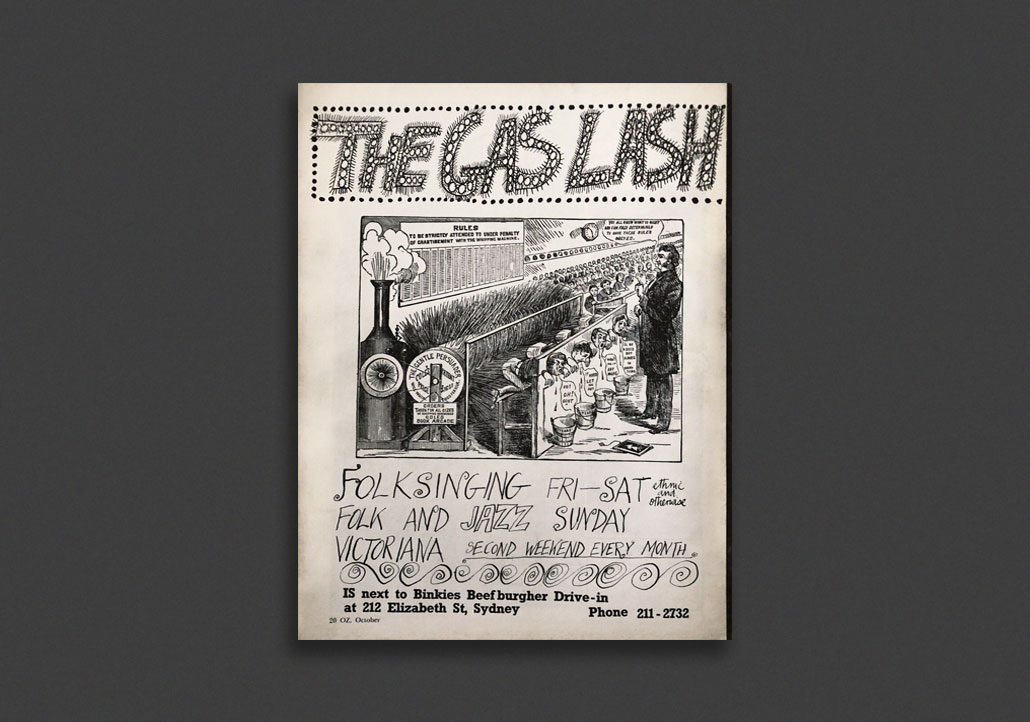
OZ No. 14, October 1964.
Editors: Richard Walsh and Richard Neville.
Art Director: Martin Sharp
Oz magazine was first published in Sydney in 1963 under the general editorship of Richard Neville, Richard Walsh and Martin Sharp. Taking a pen nib to the eye of Australian conservatism, the magazine covered topics such as homosexuality, abortion, inequality, police brutality, the White Australia policy and the Vietnam War. After fighting obscenity charges in Sydney, Neville and Sharp moved to the UK in 1967 and established London Oz with writer and editor Jim Anderson. Although Sharp continued as an artist, Neville enlisted British designer Jon Goodchild to ‘shape the magazine’ for a new audience. During this period, Sharp had established himself as one of the leading artists of the psychedelic era, designing album covers and posters for Jimi Hendrix, Cream and Bob Dylan. His ‘Plant a Flower Child’ (No.5) and ‘Bob Dylan’ (No. 7) covers from 1967 placed Oz at the vanguard of 60’s counter-culture publishing.
In 1970, Neville, Anderson and street seller cum editor Felix Dennis were charged with obscenity and conspiring to ‘debauch and corrupt the morals of young children’ after they invited a group of secondary school students to author, edit and design the School Kids Oz issue (No. 28).
Good copy of one of the very collectable Australian issues, now rarely seen. Contains text and illustrations of a satirical nature, addressing political and social issues of the time, including religion and the Royals. General tanning and wear.
1967, English
Softcover (staple-bound), 20 pages,
1st Edition, Out of print title / used / average
Published by
Oz Publications / Sydney
$40.00 - Out of stock
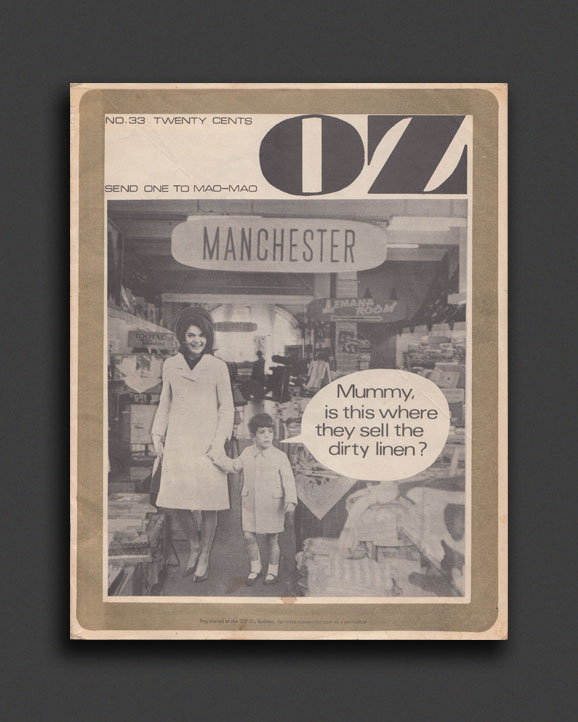
OZ No. 33, March 1967.
Editors: Richard Walsh and Dean Letcher.
Artists: Mike Glasheen, Garry Shead, Peter Fisher.
Foreign Agents: Richard Neville and Martin Sharp.
Oz magazine was first published in Sydney in 1963 under the general editorship of Richard Neville, Richard Walsh and Martin Sharp. Taking a pen nib to the eye of Australian conservatism, the magazine covered topics such as homosexuality, abortion, inequality, police brutality, the White Australia policy and the Vietnam War. After fighting obscenity charges in Sydney, Neville and Sharp moved to the UK in 1967 and established London Oz with writer and editor Jim Anderson. Although Sharp continued as an artist, Neville enlisted British designer Jon Goodchild to ‘shape the magazine’ for a new audience. During this period, Sharp had established himself as one of the leading artists of the psychedelic era, designing album covers and posters for Jimi Hendrix, Cream and Bob Dylan. His ‘Plant a Flower Child’ (No.5) and ‘Bob Dylan’ (No. 7) covers from 1967 placed Oz at the vanguard of 60’s counter-culture publishing.
In 1970, Neville, Anderson and street seller cum editor Felix Dennis were charged with obscenity and conspiring to ‘debauch and corrupt the morals of young children’ after they invited a group of secondary school students to author, edit and design the School Kids Oz issue (No. 28).
Good copy of one of the very collectable Australian issues, now rarely seen. Has one single clipped illustration on one internal page (not affecting text). General tanning and wear.
1989, English
Softcover, 176 pages, 21 x 14.5 cm
1st Edition, Out of print title / used / very good
Published by
Attack International / London
$80.00 - In stock -
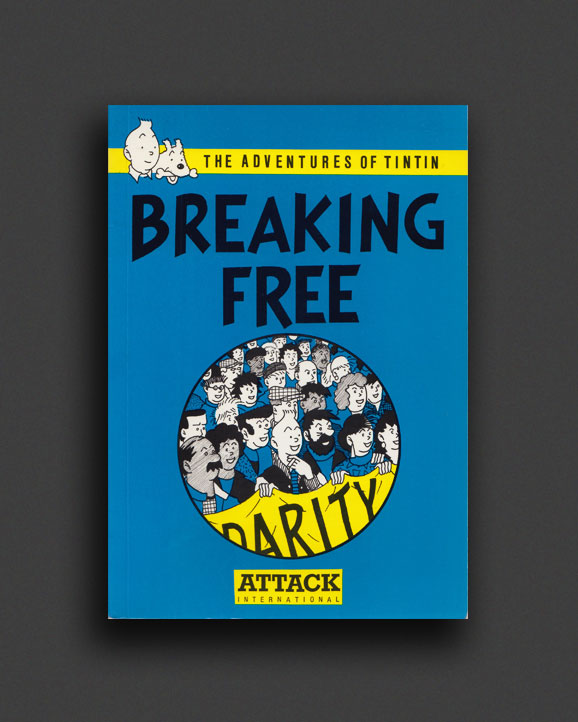
"He's Back, He's Bad"
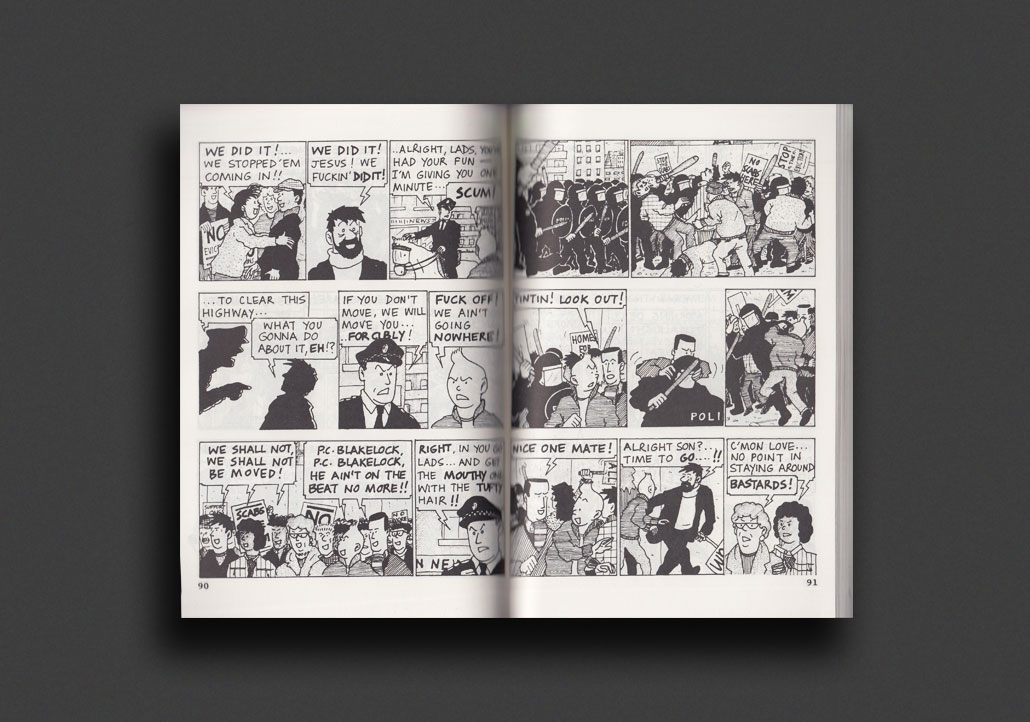
Scarce first edition of the anarchist parody of the popular The Adventures of Tintin series of comics, published in 1989 by Attack International, London. An exercise in détournement, the book was written under the pseudonym "J. Daniels" in the wake of the 1980s miners strike in Britain, and much of what’s detailed draws its parallels from that. Poor safety in the workplace, the clash of ideologies with ordinary people caught in the middle, the shredding of communities over scab labour, and connivance between employers and union officials all feature, along with the evils of property development leading gentrification. More broadly republished in 1999, then again re-printed by anarchist publishers Freedom Press in 2011. The story features a number of characters based on those from the original series by Hergé, notably Tintin himself and Captain Haddock (referred to only as 'the Captain' and depicted here as being Tintin's uncle), but not the original themes or plot. Snowy is featured on the cover - being especially visible on this first edition's cover - but not in the narrative. The story tracks Tintin's development from a disaffected, shoplifting youth to a revolutionary leader.
Its initial release in 1989 caused a furor in the tabloid newspapers in the United Kingdom, who excoriated the comic for characterizing Tintin as a "picket yob". In a 1990 review, The Times called the book "a naive and brutish strip-cartoon book for junior Dave Sparts." In 1994, The Guardian wrote, "The interesting things about it are the way each frame is adapted from Hergé's originals, and the touching belief in the possibility of an upsurge in grassroots socialist radicalism."
Very Good copy of the first edition.
2016, English / Italian
Softcover (w. dustjacket), 496 pages, 23 x 31 cm
Published by
A+m Bookstore / Viaindustriae
$109.00 - Out of stock
The ultimate compendium of counterculture press in the United States and the Netherlands during the heady decades of the 1960s and ’70s, this volume is the definition of sex, drugs, and rock ‘n roll. From underground pornography, free love, anti-establishment anarchism, and Provo, to anti-war protests, spiritual empowerment, the Black Panthers, and women’s liberation, it’s all here. Page after page of magazine covers, articles, advertisements, and clippings encapsulate the era when academia revolted, gays marched in the streets, and hippies wondered if Jesus got high, too. Newspapers and magazines included are Aloha, American Avatar, Avatar, Bauls, Berkeley Barb, Berkeley Tribe, Big Muddy Gazette, Countdowm, East Village The Other, Fapto, Fire!, Freedom News, Friends, Gay, Gay Power, Gay Scene, Gay Sunshine, Georgia Straight, Good Times, Haight Ashbury Eye, Haight Ashbury Free Press, Haight Ashbury Love Street, Haight Ashbury Maverick, Haight Ashbury Tribune, Harbinger, Helix, Hitweek, Idiot International, Iets, Insekten Sekte, Juche, Kabouter Krant, Kaleidoscope, King Kong International, Kiss, Klaas Krant, Liberated Guardian, Los Angeles Free Press, Mondo Beat, Muhammad Speaks, Nola Express, Old Mole, Open City, Oracle Los Angeles, Oracle San Francisco, Other Scenes, Peninsula Observer, Pic up, Pleasure, Provo, Quicksilver Times, Rampage, Rat, Real Free Press, Re Nudo, Rising Up Angry, Royal World Countdown, San Francisco Ball, San Francisco Express Times, Screw, Search & Destroy, Sette Aprile, Sniffin' Glue, Southern Free Press, Spy-in, Styng, Suck, The Bird, The Black Dwarf, The Black Panther, The International Times, The New York Review of Sex, The Oracle, The Seed, Virginity, Washington Free Press, Witte Krant.
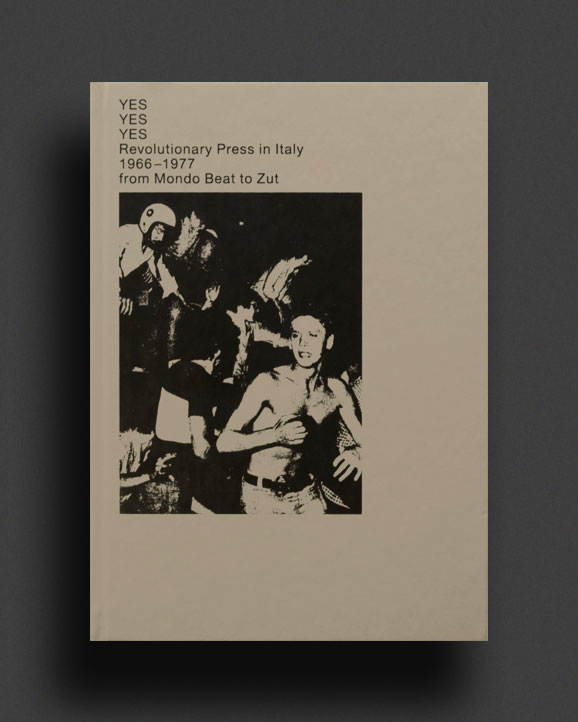
2020, English / Italian
Hardcover, 544 pages, 24 x 17 cm
Published by
A+m Bookstore / Viaindustriae
$109.00 - In stock -
Densely filled with reproductions of newspapers, magazines, mimeographs, news-sheets, pamphlets, and other ephemera, this book investigates the Italian scene during the turbulent years between 1966 and 1977. These revolutionary printing activities were linked to the political, ideological, and countercultural struggle of a period of protest and occupation of public spaces as areas of freedom and social creativity for a disillusioned generation. A selection of over 600 publications are catalogued in this book, output from the subversive newsrooms of the radical artistic and libertarian movements, and “ultra-political” groups, autonomists, and other collectives seeking change.
Texts by Pablo Echaurren, Ugo La Pietra, Gianni-Emilio Simonetti
1977, French
Softcover, 66 pages, 21 x 27 cm
1st Edition, Out of print title / used / good
Published by
Les Humanoïdes Associés / Paris
$45.00 - Out of stock
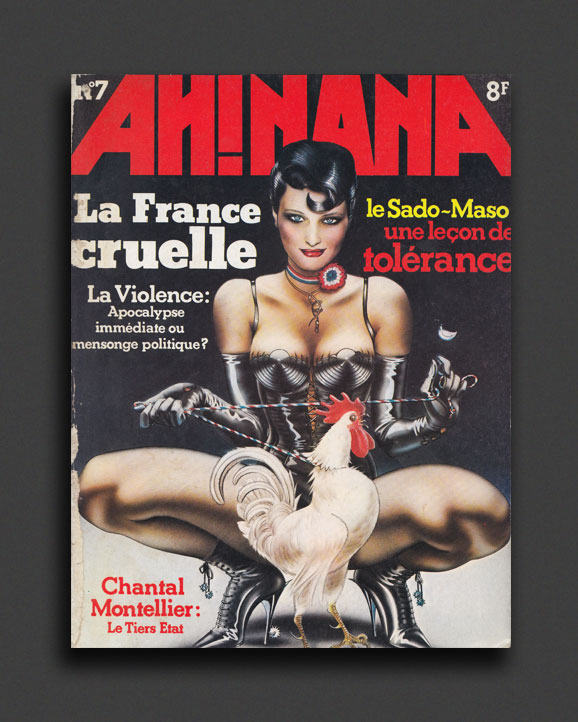
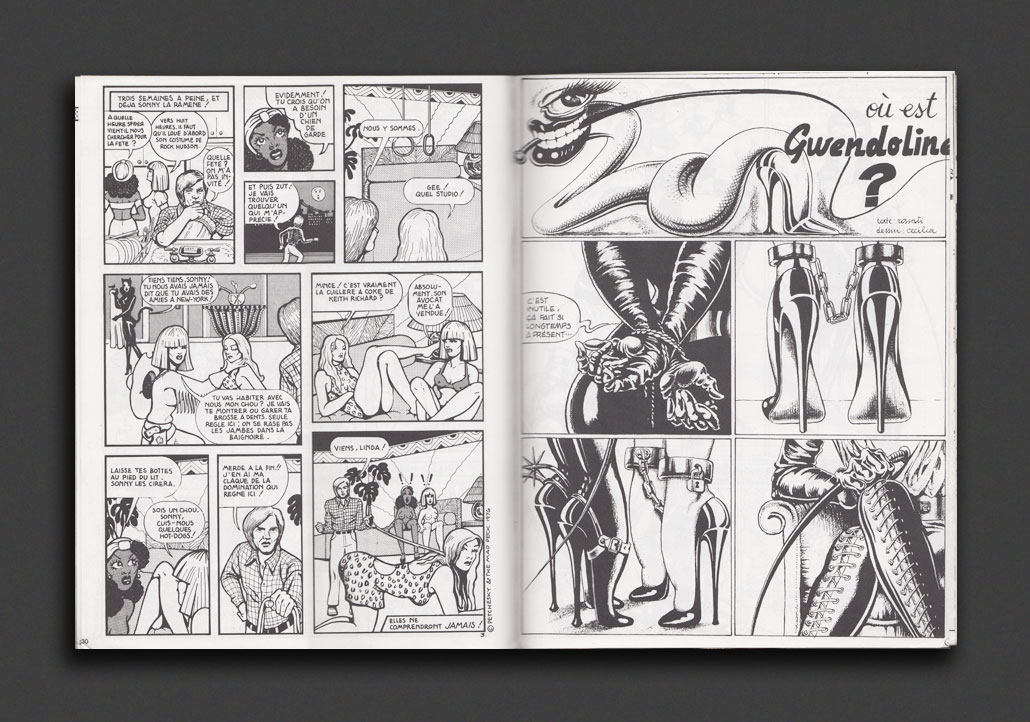
Seventh issue of the pioneering Ah! Nana, a quarterly journal devoted to comics (bande dessinée) by women, the first such publication in France. With the theme of ‘La France Cruelle’ (Cruel France), No. 7 revolves around comics and articles on the subject of Sadomasochism ('La Sado-Maso: Une leçon de Tolérance'). Features the work of Chantal Montellier, Nicole Claveloux, Émilie Labroux, Marianne Leconte, Isabelle Sacuto, Alain Robbe-Grillet, Janie Jones, Trina Robbins, and many more.
Published by Les Humanoïdes Associés (Paris), best known as the publisher of Metal Hurlant (Heavy Metal), Ah! Nana was a ground-breaking but short-lived (1976-1978) bande dessinée journal devoted to comics by women. Ah! Nana's first editorial in 1976 described the conception of this new publication in the following way:
‘Several female artists, colourists and journalists were complaining to each other about having to incorporate male fantasies disguised as essential features of publishing into our work. We decided to act, sketching out the idea of a journal…’ With the slogan "fait par et pour les femmes", Ah! Nana was an explosion on the scene, uniting the energy of the feminist movement with the burgeoning provocations of the underground comics movement.
From the third issue on, each issue had a special topic, some of which were controversial, including issues devoted to Nazism, incest, and Homosexuality and Transgender Issues, and Sado-Masochism. Both the comics (with contributions from France, Italy, US, et al) and the articles also explored women artists in other mediums, including an illustrated article on Patti Smith in the first issue, and a Roman Photo by Agnes Varda in the third. Articles on the herstory of comic art by women were also included.
After only nine issues the journal folded after falling foul of strict censorship laws, however, as the only journal in French history providing an unprecedented vehicle both for semi-established and previously unpublished female creators to present their work it constituted an innovative development in the very male-dominated bande dessinée scene of the 1970s, and an important chapter in comic history.
Some damage to spine and general wear/age, otherwise a good copy throughout.
2003, English
Softcover, 154 pages, 25.5 x 18.5 cm
1st Edition, Out of print title / used / very good
Published by
Eros Comix / Seattle
$180.00 - Out of stock
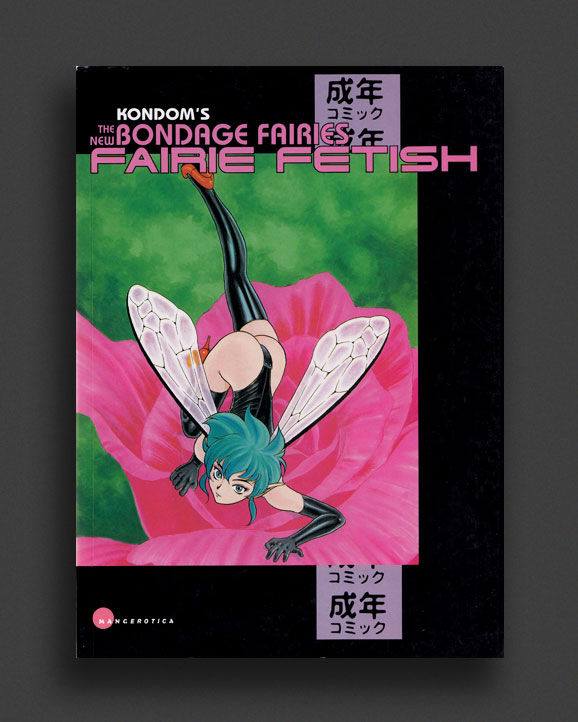
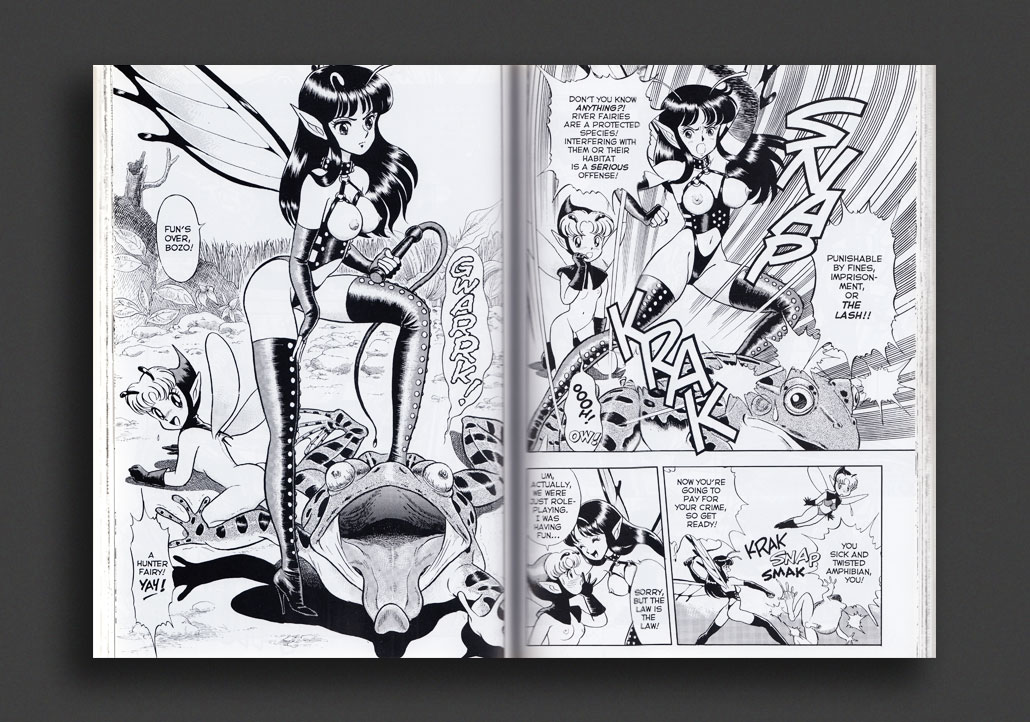
Rare early English-language collection of the cult classic eromanga Bondage Fairies, "the first hit translated adult manga" — Manga: The Complete Guide. This is the first edition of The New Bondage Fairies : "Fairie Fetish" by Eros Comix in 2003, collecting stories from the late 1990s. These English editions are super hard to come by.
Created by manga artist Teruo Kakuta under the pen name "Kondom", a multilingual pun, meaning "little insect" in Japanese and "condom" in English, Bondage Fairies is an erotic series about highly sexual female forest fairies, who work as police officers protecting the forest, whilst engaging in a wild array of anthropomorphized, inter-species sexual acts. The series began in Japan in 1990 as Insect Hunter, but it was quickly banned from sale by the Tokyo Metropolitan Ordinance. Under a new title, the manga was serialized in manga magazine Lemon Kids. The series is among the earliest sexually explicit manga (eromanga) commercially translated and published uncensored in the United States where the earliest editions date from 1994 (Venus Press). Eros Comix subsequently published a multi-volume series of the collected Bondage Fairies, and subsequent stories, now all very collectible. Translated to Swedish, German, French, and Italian, Bondage Fairies is one of the most popular underground adult Japanese comics outside Japan.
Very Good copy.
2006, English / Japanese
Hardcove (in padded, silver foiled cover), 156 pages, 19 x 19 cm
1st Edition, Out of print title / used / fine
Published by
NGV (National Gallery of Victoria) / Victoria
$67.00 - Out of stock
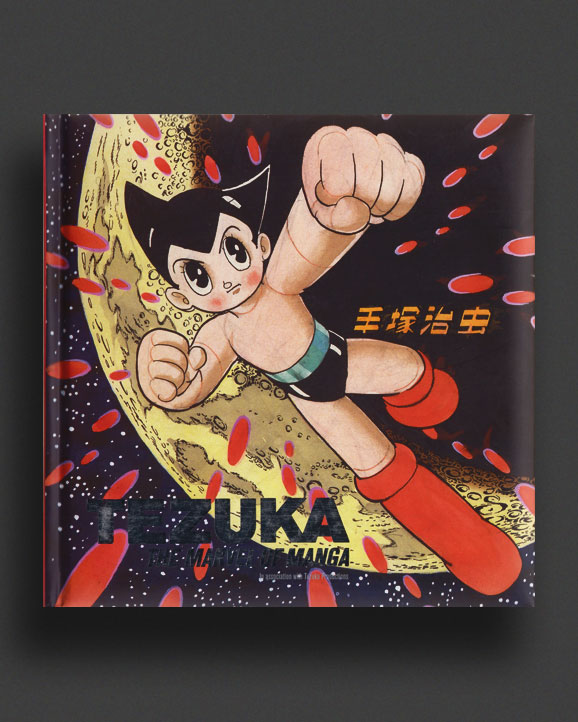
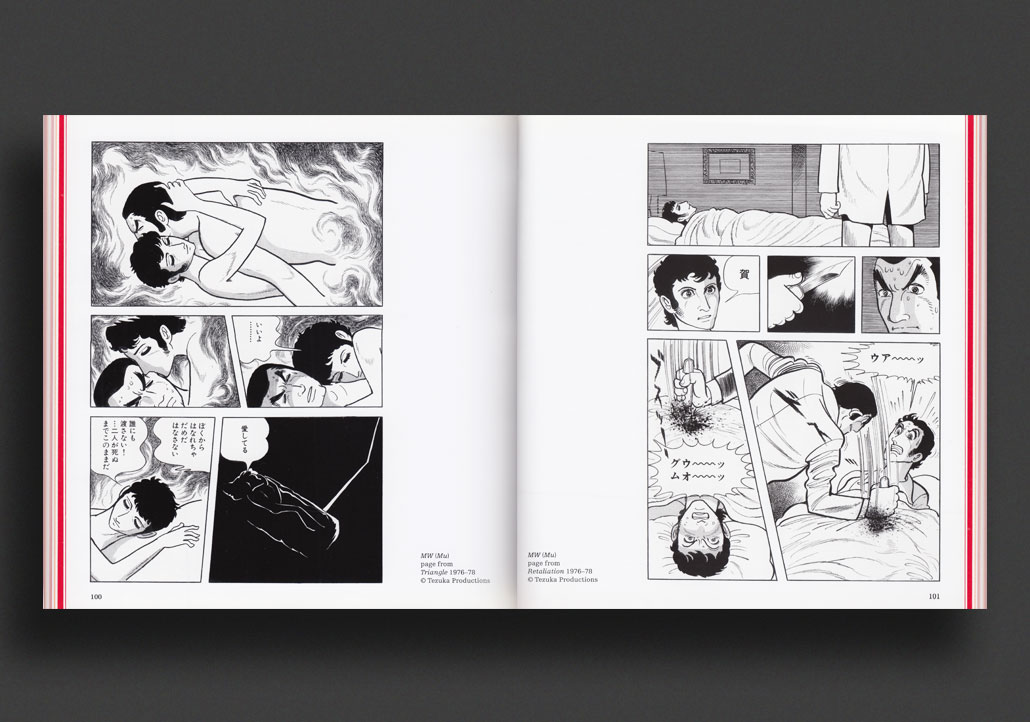
First out of print edition of Tezuka - The Marvel of Manga, catalogue published on the occasion of a major exhibition curated by Australian artist Philip Brophy for the National Gallery of Victoria, Melbourne in 2006. The exhibition profiled the Postwar manga of Japan's leading and most historically important manga artist, Osamu Tezuka. It toured to the Art Gallery of New South Wales, Sydney, and the Asian Art Museum of San Francisco. Edited by Philip Brophy with translations by Tetsuro Shimauchi, the book is profusely illustrated throughout, accompanied by a set of 6 critical essays written by English and Japanese writers, dealing with various aspects of Osamu Tezuka’s manga (with some reference to his anime). Also includes a complete checklist of all 234 works exhibited in the exhibition, biography and more.
Fine copy.
1983, French
Hardcover, 60 pages, 21.5 x 29.5 cm
1st Edition, Out of print title / used / very good
Published by
Glénat Editions / Grenoble
$55.00 - Out of stock
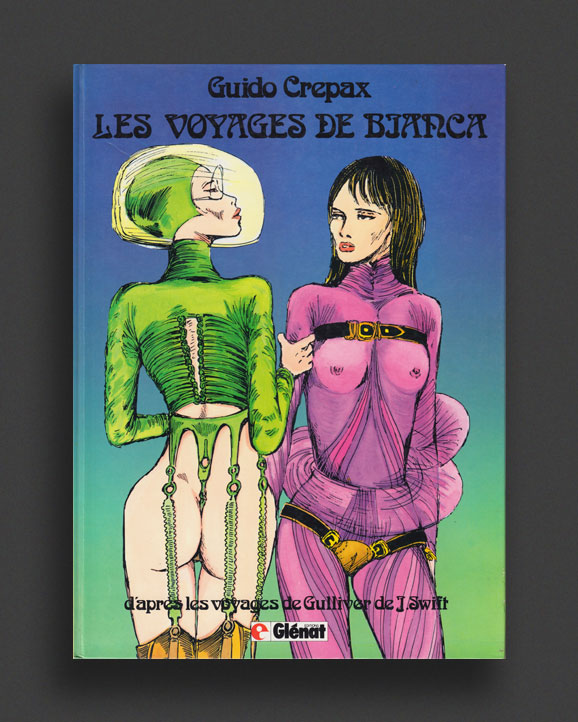
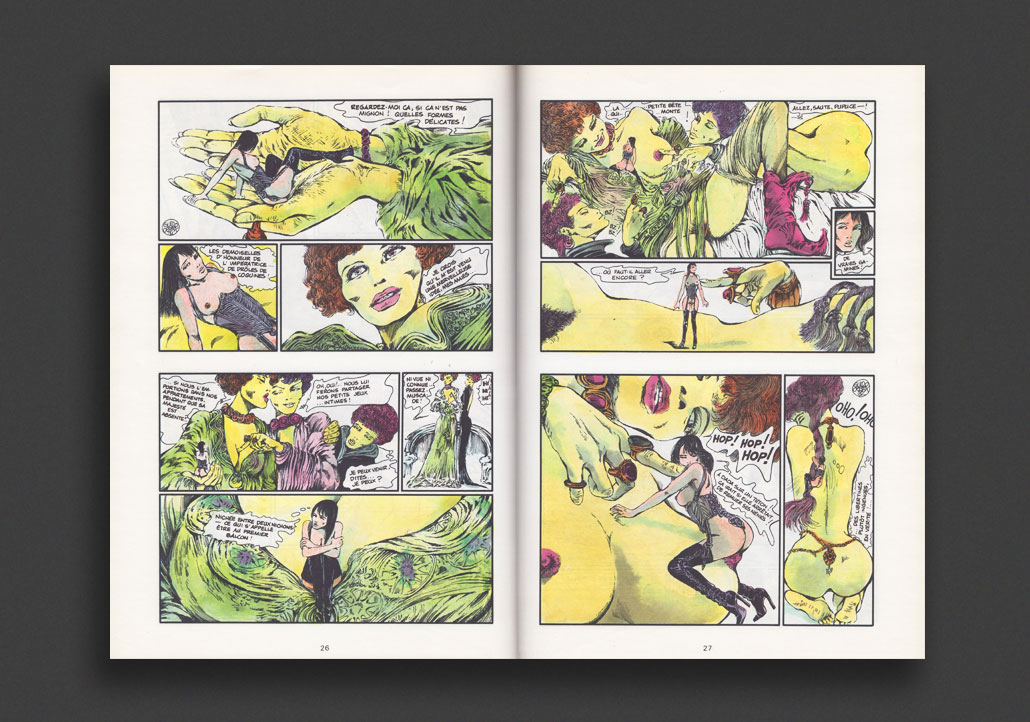
Wonderful first 1983 hardcover edition of the French edition of 'Les Voyages de Bianca' by Italian comics artist Guido Crepax, published by Glénat Editions in 1983. Sci-fi themed adventures of Crepax's Bianca, plus another story based on Gulliver's Travels, all with Crepax's heavy dose of eroticism and sadomasochism, beautifully illustrated with colour paint washes in full colour throughout.
Guido Crepas (1933—2003, Milan), better known by his nom de plume Guido Crepax, was an Italian comics artist. He studied at the School of Architecture at the University of Milan. After graduating, he made his debut in comic books in 1959 when he contributed his work to Tempo Medico. He joined the new magazine Linus in 1965 with a fantasy comic, 'Neutron', a superhero comic about an art critic with the mysterious power to stop humans or objects via his gaze. It featured a minor character called Valentina, a fashionable, communist Milanese photographer born in 1942, who quickly became Crepax's protagonist and his most famous creation. Valentina became an underground icon of 1960s culture. Crepax's work became noted for his very sophisticated expressionistic yet graphic drawing style, his truely innovative panel work and his unusual compositions that seemed to have more in common with modern art and film than comic strips. His psychedelic, dreamlike storylines were immersive, generally involving a strong dose of erotism and a predilection towards sadomasochism and the surreal. After 'Valentina', other titles followed, such as 'L'Astronave Pirata' (1968), 'La Casa Matta' (1969), 'La Calata di Mac Similiano' (1969), 'Belinda', 'Anita' and 'Bianca'. Crepax's illustrated adaptations of classic erotic stories like De Sade's 'Justine', Pauline Réage's 'Histoire d'O' and Sacher-Masoch's 'Venus in Furs' brought him further acclaim, especially to English audiences who had mostly only read translated Crepax through the pages of Heavy Metal magazine.
Very Good copy.
1976, French
Hardcover, 216 pages, 31.5 x 24.5 cm
1st UK Edition, Out of print title / used / very good
Published by
Idea E / Florence
$120.00 - Out of stock
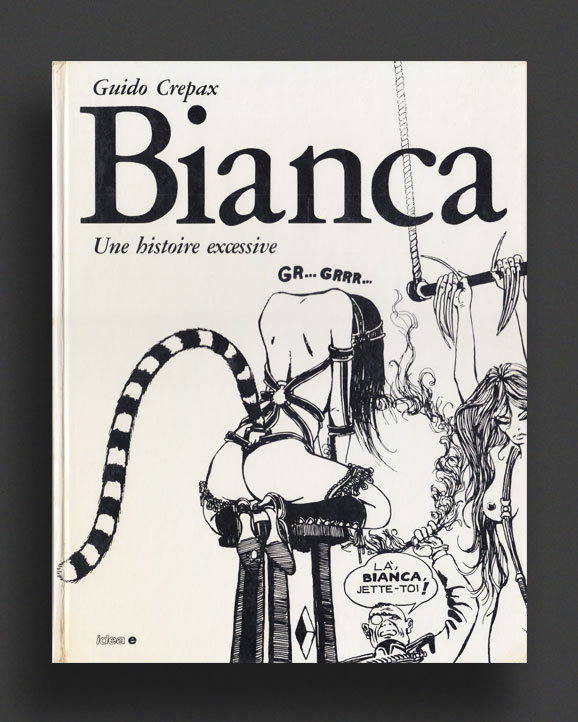
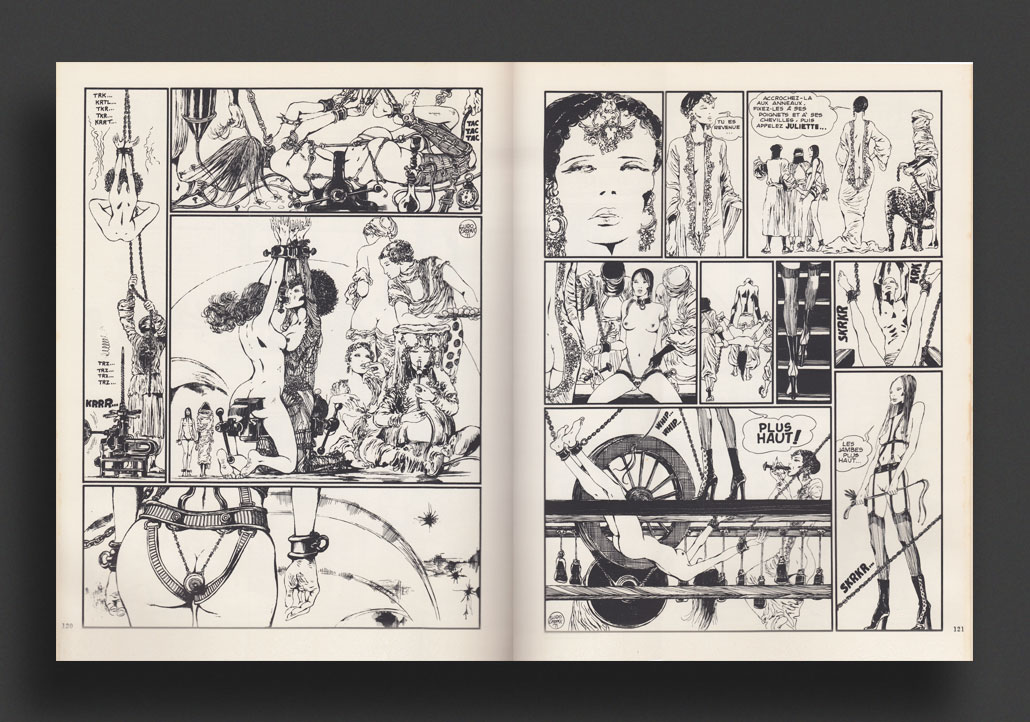
Wonderful scarce first hardcover French edition of 'Bianca, Une Histoire Excessive' by Italian comics artist Guido Crepax, published by Idea E in Firenze/Roma, 1976. Created between 1968 and 1973, Bianca is probably the most whimsical and psychedelic work created by Crepax, one of the great underrated masters of the comic book form, and undoubtedly one of his all-time classics. Like much of Crepax's work, the dizzying, explosive pages of Bianca centre around the perspective of a central female character who's trapped in a series of sexual fantasies and adventures, heavy in sm/bondage imagery, traversing every dreamlike scenario imaginable through some of the most wild and uninhibited line, texture and panel work Crepax has ever published. This lovely first French edition comes with the original, usually missing, inserted Bianca paper doll.
Guido Crepas (1933—2003, Milan), better known by his nom de plume Guido Crepax, was an Italian comics artist. He studied at the School of Architecture at the University of Milan. After graduating, he made his debut in comic books in 1959 when he contributed his work to Tempo Medico. He joined the new magazine Linus in 1965 with a fantasy comic, 'Neutron', a superhero comic about an art critic with the mysterious power to stop humans or objects via his gaze. It featured a minor character called Valentina, a fashionable, communist Milanese photographer born in 1942, who quickly became Crepax's protagonist and his most famous creation. Valentina became an underground icon of 1960s culture. Crepax's work became noted for his very sophisticated expressionistic yet graphic drawing style, his truely innovative panel work and his unusual compositions that seemed to have more in common with modern art and film than comic strips. His psychedelic, dreamlike storylines were immersive, generally involving a strong dose of erotism and a predilection towards sadomasochism and the surreal. After 'Valentina', other titles followed, such as 'L'Astronave Pirata' (1968), 'La Casa Matta' (1969), 'La Calata di Mac Similiano' (1969), 'Belinda', 'Anita' and 'Bianca'. Crepax's illustrated adaptations of classic erotic stories like De Sade's 'Justine', Pauline Réage's 'Histoire d'O' and Sacher-Masoch's 'Venus in Furs' brought him further acclaim, especially to English audiences who had mostly only read translated Crepax through the pages of Heavy Metal magazine.
Very Good copy with general light wear and tanning.
1977, English
Softcover (staple-bound), 96 pages, 28 x 20 cm
1st Edition, Out of print title / used / average
Published by
HM Communications / New York
$25.00 - Out of stock
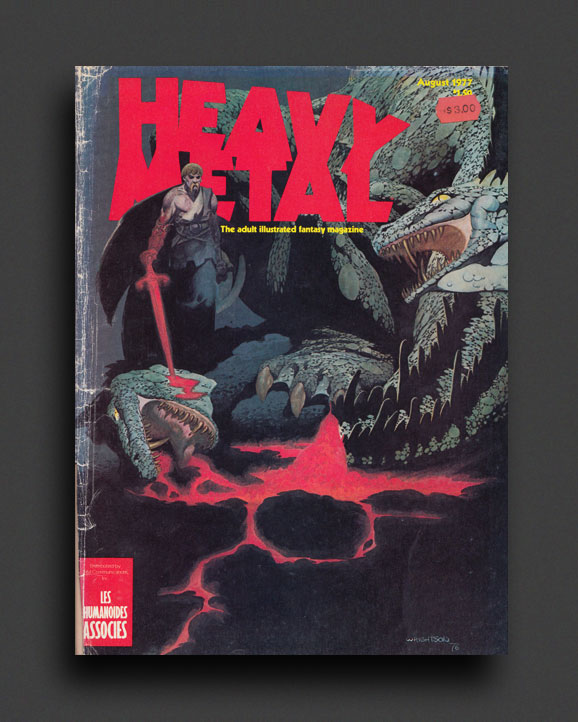
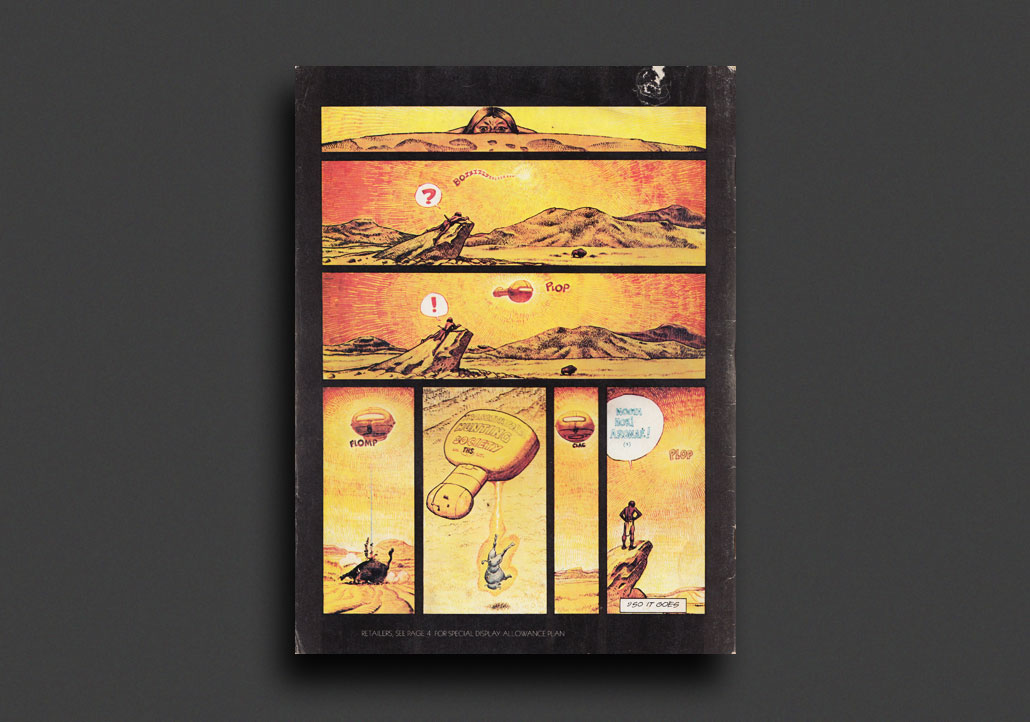
Heavy Metal August 1977 issue, featuring comic stories/art by Moebius, Philippe Druillet, Nicole Claveloux, Dan O'Bannon, Gotlib (Marcel Gottlieb), Chris Foss, Richard Corben, George Barr, and many more, plus the usual fare of sci-fi, movies, music... Cover art by Bernie Wrightson. Back cover by Moebius.
Heavy Metal is an American science fiction and fantasy comics magazine that exploded onto the publishing scene in 1977 and shaped a generation with its blend of dark fantasy/science fiction and erotica. Unlike the traditional American comic books of that time bound by the restrictive Comics Code Authority, Heavy Metal featured explicit content. The magazine started out as a licensed translation of the French science-fantasy magazine Métal Hurlant, including work by Enki Bilal, Philippe Caza, Guido Crepax, Philippe Druillet, Jean-Claude Forest, Jean Giraud (a.k.a. Moebius), Chantal Montellier, and Milo Manara. The magazine later ran Stefano Tamburini and Tanino Liberatore's ultra-violent RanXerox. Heavy Metal gradually evolved into a publication featuring North American contributors like Richard Corben, Matt Howarth, Stephen R. Bissette, Alex Ebel, John Holmstrom, Paul Kirchner, Terrance Lindall, Gray Morrow, Walt Simonson, Dan Steffan, Jim Steranko, John Shirley, Arthur Suydam, Bernie Wrightson, and Olivia De Berardinis.
Good copy with heavy wear to cover spine, general wear/tanning to page edges.
1983, English
Softcover (staple-bound), 96 pages, 28 x 20 cm
1st Edition, Out of print title / used / very good
Published by
HM Communications / New York
$35.00 - Out of stock
Heavy Metal February 1983 issue, featuring comic stories/art by Guido Crepax, Milo Manara, Richard Corben, Jeff Jones, Fernando Fernández, Michael Kaluta, Angus McKie, Caza, and many more, plus the usual fare of sci-fi, movies, music... Cover art by Sanjulián.
Heavy Metal is an American science fiction and fantasy comics magazine that exploded onto the publishing scene in 1977 and shaped a generation with its blend of dark fantasy/science fiction and erotica. Unlike the traditional American comic books of that time bound by the restrictive Comics Code Authority, Heavy Metal featured explicit content. The magazine started out as a licensed translation of the French science-fantasy magazine Métal Hurlant, including work by Enki Bilal, Philippe Caza, Guido Crepax, Philippe Druillet, Jean-Claude Forest, Jean Giraud (a.k.a. Moebius), Chantal Montellier, and Milo Manara. The magazine later ran Stefano Tamburini and Tanino Liberatore's ultra-violent RanXerox. Heavy Metal gradually evolved into a publication featuring North American contributors like Richard Corben, Matt Howarth, Stephen R. Bissette, Alex Ebel, John Holmstrom, Paul Kirchner, Terrance Lindall, Gray Morrow, Walt Simonson, Dan Steffan, Jim Steranko, John Shirley, Arthur Suydam, Bernie Wrightson, and Olivia De Berardinis.
Very Good copy.
1983, English
Softcover (staple-bound), 96 pages, 28 x 20 cm
1st Edition, Out of print title / used / good
Published by
HM Communications / New York
$30.00 - Out of stock
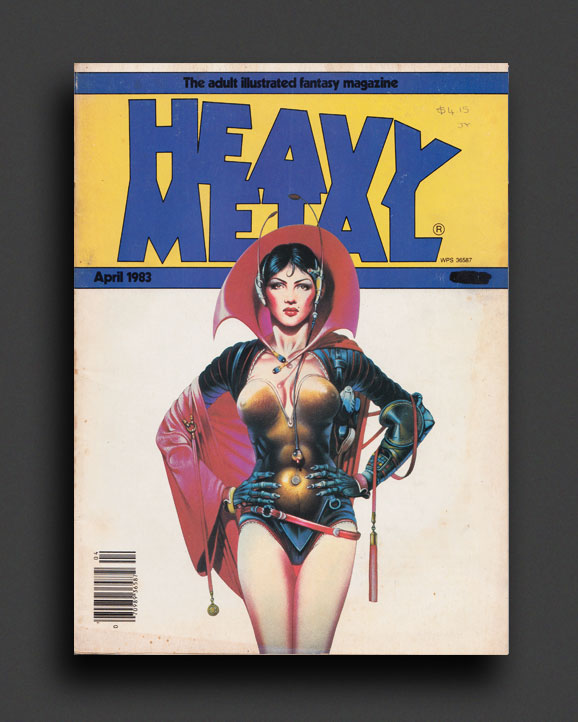
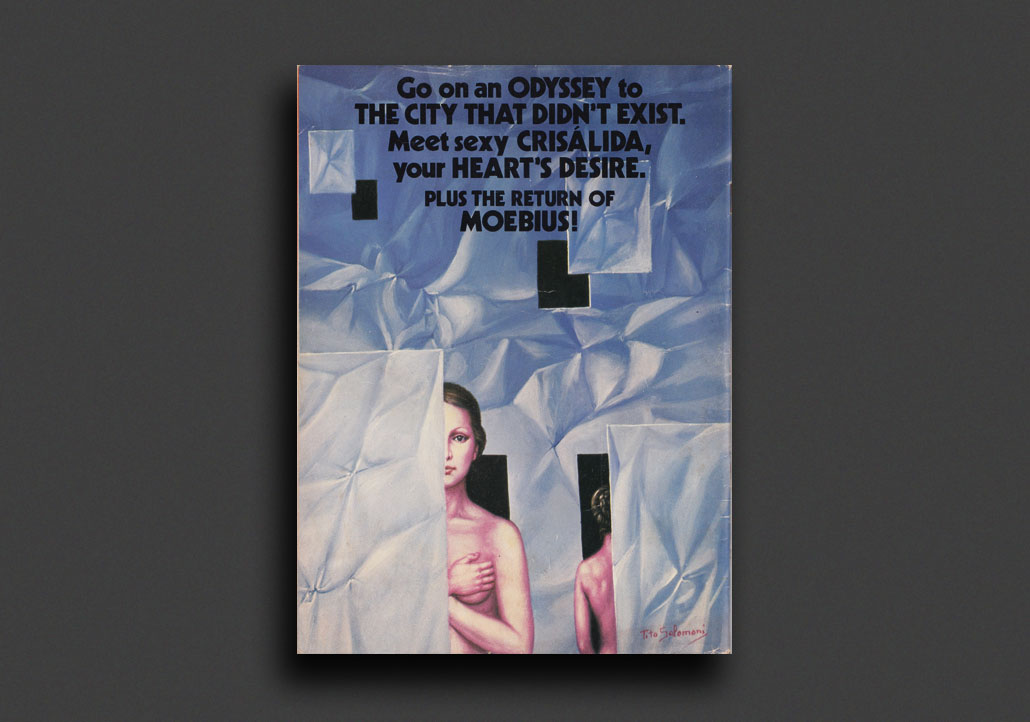
Heavy Metal February 1983 issue, featuring comic stories/art by Milo Manara, Moebius, Guido Crepax, Jeff Jones, Fernando Fernández, Michael Kaluta, Caza, Enki Bilal, José Maria Martín Sauri, Angus McKie, and many more, plus the usual fare of sci-fi, movies, music... Cover art by Chris Achilleos. Back cover by Tito Salomoni.
Heavy Metal is an American science fiction and fantasy comics magazine that exploded onto the publishing scene in 1977 and shaped a generation with its blend of dark fantasy/science fiction and erotica. Unlike the traditional American comic books of that time bound by the restrictive Comics Code Authority, Heavy Metal featured explicit content. The magazine started out as a licensed translation of the French science-fantasy magazine Métal Hurlant, including work by Enki Bilal, Philippe Caza, Guido Crepax, Philippe Druillet, Jean-Claude Forest, Jean Giraud (a.k.a. Moebius), Chantal Montellier, and Milo Manara. The magazine later ran Stefano Tamburini and Tanino Liberatore's ultra-violent RanXerox. Heavy Metal gradually evolved into a publication featuring North American contributors like Richard Corben, Matt Howarth, Stephen R. Bissette, Alex Ebel, John Holmstrom, Paul Kirchner, Terrance Lindall, Gray Morrow, Walt Simonson, Dan Steffan, Jim Steranko, John Shirley, Arthur Suydam, Bernie Wrightson, and Olivia De Berardinis.
Good copy with general wear/tanning/darkening.
1975, French
Softcover (staple-bound), 82 pages, 27 x 21.5 cm
1st Edition, Out of print title / used / very good
Published by
Les Humanoïdes Associés / Paris
$65.00 - Out of stock
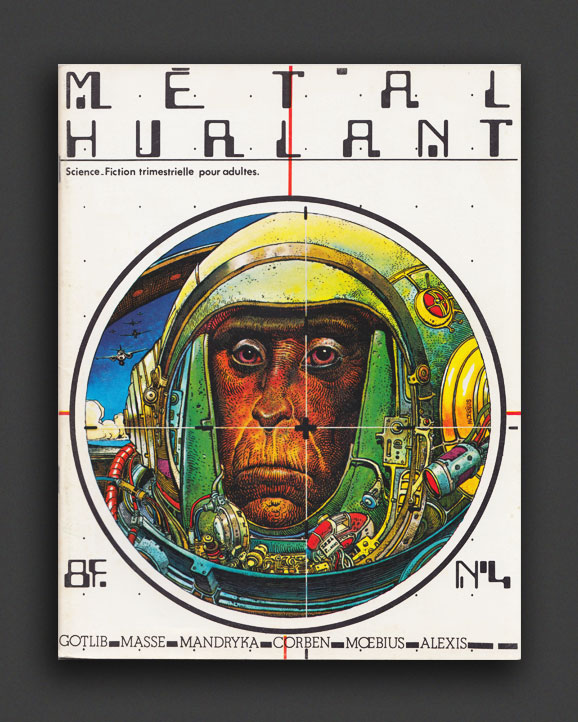
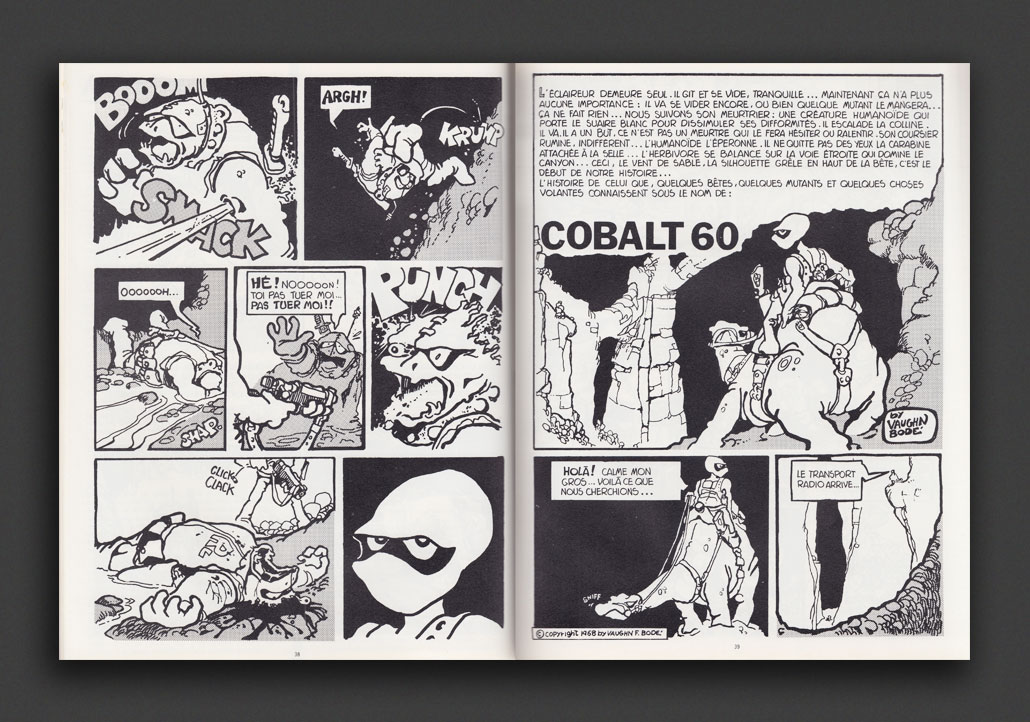
Metal Hurlant No. 4 1975 issue featuring comic stories/art by Moebius, Philippe Druillet, Vaughn Bodé, Richard Corben, Gotlib, Jean-Pierre Dionnet, Alain Voss, and many more, plus the usual fare of sci-fi, movies, music... Cover art by Moebius. Original French editions, very scarce outside Europe.
Métal Hurlant (literal translation: "Howling Metal") was a French comics anthology of science fiction and horror comics stories, created in December 1974 by comics artists Jean Giraud (better known as Mœbius) and Philippe Druillet together with journalist-writer Jean-Pierre Dionnet and financial director Bernard Farkas. The four were collectively known as "Les Humanoïdes Associés" (United Humanoids), which became the name of the publishing house releasing Métal Hurlant. English, German and Italian editions were also licensed, including Heavy Metal, published in the US by National Lampoon. Métal hurlant was originally released quarterly with contributors including Moebius and Druillet, depicting such iconic characters as Arzach and Lone Sloane for the first time, as well as work by Richard Corben, Guido Crepax, Alejandro Jodorowsky, Enki Bilal, Caza, Serge Clerc, Alain Voss, Berni Wrightson, Nicole Claveloux, Milo Manara, Frank Margerin, Masse, Chantal Montellier, and many others.
Good copy.
1976, French
Softcover (staple-bound), 66 pages, 28.5 x 20.5 cm
1st Edition, Out of print title / used / good
Published by
L'Echo des Savanes / Paris
$30.00 - Out of stock
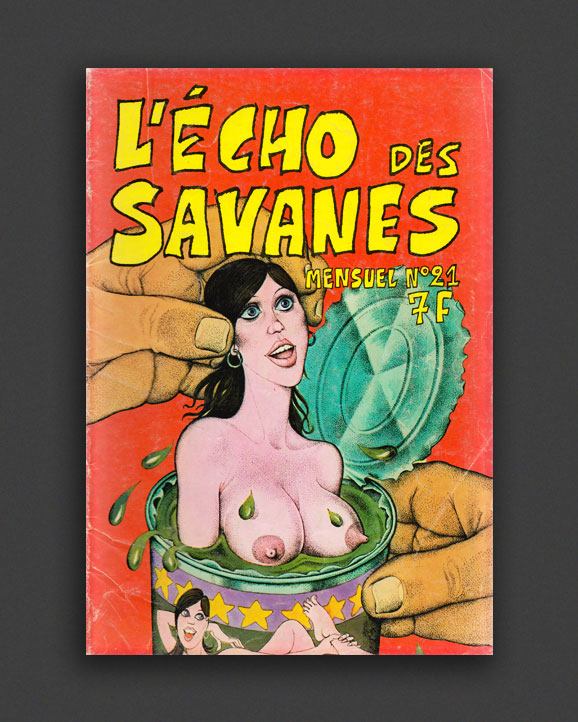
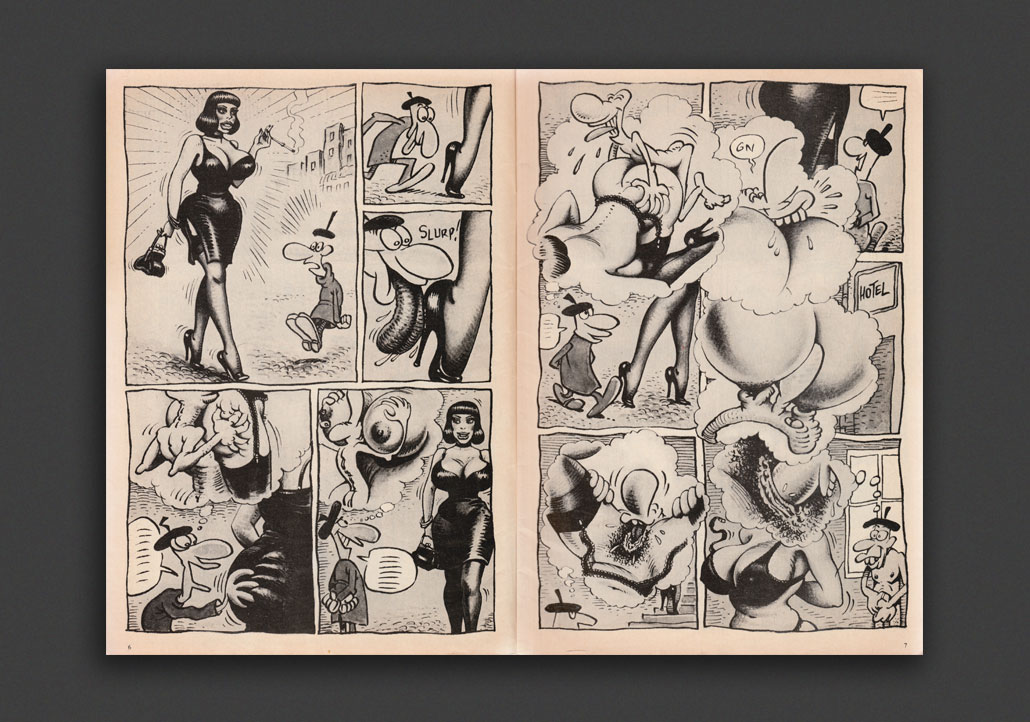
Issue 21 of L'Echo des Savanes Mensuel, published in 1976. Cover art by Georges Pichard. Features comics, artwork by Pichard, Jean Solé, Wallace Wood, Georges Wolinski, Gilbert Shelton, Dave Sheridan, Harvey Kurtzman, Nikita Mandryka, Jay Kinney, René Pétillon, Berbe, Philippe Marcelé, René Pétillon, alphabet by French novelist Georges Perec, more stories, cartoons, and much more...
L'Echo des Savanes Mensuel was a leading Franco-Belgian comics magazine founded in 1972 by Claire Bretécher, Marcel Gotlib and Nikita Mandryka. It featured many of the best of underground comic artists from around the world, particularly France and the US, every issue packed with parody of all sorts, often cartoons playfully taking the mickie out of other "popular" cartoons, and of course endless T & A and buffoonery. They were also book publishers of some excellence.
Good copy with general wear.