World Food Books' programme is largely produced on Kulin Nation land. We acknowledge the Wurundjeri people of the Kulin Nation as the first and continuing custodians of this land, and pay respect to their Elders past, present, and emerging.
World Food Books is an arts and special interests bookshop in Naarm / Melbourne. Founded in 2010, World Food Books is devoted to the presentation of a rotating, hand-selection of international art, design, literary and counterculture publications with an emphasis on the anti-traditional, the experimental, the avant-garde, the heretic, the marginal.
Presenting new titles alongside rare and out-of-print books, catalogues and journals spanning the fields of modern and contemporary art, design, photography, illustration, film, literature, poetry, cultural theory, philosophy, sexuality, popular and underground culture in its many radical forms, World Food Books wishes to encourage adventurous, thoughtful and open-minded reading, looking, writing, and exchange of publishing and ideas, both current and historical.
As well as our bookshop, located in Melbourne's historical Nicholas Building, all of our inventory is available internationally via our online mail-order service.
World Food Books semi-regularly co-ordinates "Occasions", a programme of exhibits and events at the bookshop and in partnership with other hosts (such as museums and art galleries) that develop out of the activities, relationships and content of the bookshop itself.
World Food Books
The Nicholas Building
37 Swanston Street
Room 5, Level 6
Melbourne 3000
Australia
SHOP HOURS:
THU–SAT 12–6
WEB-SHOP OPEN 24/7
World Food Books
Postal Address:
PO Box 435
Flinders Lane
Victoria 8009
Australia
info@worldfoodbooks.com
Art
Theory / Essay
Architecture / Interior
Graphic Design / Typography
Photography
Fashion
Eros
LGBTQ+
Fiction / Poetry
Weird / Speculative / Science Fiction / Horror
Transgressive / Visceral / Abject
Symbolism / Decadence / Fin de siècle
Film / Video
Painting
Sculpture / Installation
Performance / Dance / Theater
Drawing
Sound / Music
Curatorial
Group Shows / Collections
Periodicals
Out-of-print / Rare
Posters / Ephemera / Discs
Signed Books
World Food Books Gift Voucher
World Food Book Bag
Australian Art
Australian Fiction
Australian Science Fiction / Speculative Fiction
Australian Poetry
Australian Photography
Japanese Photography
Conceptual Art
Minimal Art
Dada
'Pataphysics / Oulipo
Fluxus
Concrete Poetry
Pop Art
Surrealism
Arte Povera
Arte Informale / Haute Pâte / Tachism
Nouveau Réalisme / Zero / Kinetic
Situationism / Lettrism
Collage / Mail Art / Xerox Art
Art Brut / Folk / Visionary / Fantastic
Illustration / Graphic Art / Bandes Dessinées
Furniture
Italian Radical Design / Postmodernism
Textiles
Ceramics / Glass
Counterculture
Protest / Revolt
Philosophy
Psychoanalysis
Anthropology
Anarchism
Socialism / Anarchism / Communism / Capitalism
Literary Theory / Semiotics / Language
Feminism / Women's Studies
Gender Studies / Sexuality
Anthropology
Fetishism / BDSM
Drugs / Psychedelia
Crime / Violence
Animal Rights / Veganism
Occult / Esoterica
Ecology / Earth / Alternative Living
Whole Earth / Crafts
All prices in AUD (Australian dollars)
Pick-Ups
Pick-up orders can be collected in our bookshop during opening hours after order date. Please collect any Pick-up orders within 2 weeks of ordering as we have limited storage space. Orders will be released back into stock if not collected within this time. No refunds can be made for pick-ups left un-collected. If you cannot make it in to the bookshop in this time-frame, please choose postage option.
Return Policy
All sales are final. We do accept returns (for refund or exchange) for items received in error. All our orders are packed with special care using heavy-duty padding and cardboard book-mailers or bubble mailers (for smaller books), using reinforcement where required. We cannot take responsibility for any lost, stolen or damaged parcels.
Insurance
Should you wish to insure your package, please email us directly after placing your order and we can organise this at a small extra expense. Although all standard/express tracked packages are very safe and dependable, we cannot take responsibility for any lost, stolen or damaged parcels. We recommend insurance on valuable orders.
Interested in selling your old books, catalogues, journals, magazines, comics, fanzines, ephemera? We are always looking for interesting, unusual and out-of-print books to buy. We only buy books in our fields of interest and specialty, and that we feel we can resell.
We base these prices on desirability, market value, in-print prices, condition and our current stock levels. We offer cash, store credit, and can take stock on consignment. All
about 25% of the price we expect to get when we sell them, or 30% in store credit. We base these prices on desirability, market value, in-print prices, condition and our current stock levels.
Sell your books any day of the week. You can drop them off and return later. If you have a lot of books, we can visit your Sydney home.
We buy books that we feel we can resell. We offer about 25 % of the price we expect to get when we sell them, or 30% in store credit. We base these prices on desirability, market value, in-print prices, condition and our current stock levels.
Philadelphia Wireman
03 August - 01 September, 2018
World Food Books is proud to announce our next Occasion, the first presentation of sculptures by Philadelphia Wireman in Australia.
The Philadelphia Wireman sculptures were found abandoned in an alley off Philadelphia’s South Street on trash night in 1982. Their discovery in a rapidly-changing neighbourhood undergoing extensive renovation, compounded with the failure of all attempts to locate the artist, suggests that the works may have been discarded after the maker’s death. Dubbed the "Philadelphia Wireman" during the first exhibition of this work, in 1985, the maker’s name, age, ethnicity, and even gender remain uncertain. The entire collection totals approximately 1200 pieces, all intricately bound together with tightly-wound heavy-gauge wire (along with a few small, abstract marker drawings, reminiscent both of Mark Tobey and J.B. Murry). The dense construction of the work, despite a modest range of scale and materials, is singularly obsessive and disciplined in design: a wire armature or exoskeleton firmly binds a bricolage of found objects including plastic, glass, food packaging, umbrella parts, tape, rubber, batteries, pens, leather, reflectors, nuts and bolts, nails, foil, coins, toys, watches, eyeglasses, tools, and jewellery.
Heavy with associations—anthropomorphic, zoomorphic, and socio-cultural responses to wrapped detritus—the totemic sculptures by Philadelphia Wireman have been discussed in the context of work created to fulfil the shamanistic needs of alternative religions in American culture. Curators, collectors, and critics have variously compared certain pieces to sculpture from Classical antiquity, Native American medicine bundles, African-American memory jugs, and African fetish objects. Reflecting the artist’s prolific and incredibly focused scavenging impulse, and despite—or perhaps enhanced by—their anonymity, these enigmatic objects function as urban artefacts and arbiters of power, though their origin and purpose is unknown. Philadelphia Wireman, whatever their identity, possessed an astonishing ability to isolate and communicate the concepts of power and energy through the selection and transformation of ordinary materials. Over the course of the past two decades, this collection has come to be regarded as an important discovery in the field of self-taught art and vernacular art.
Presented in collaboration with Fleisher-Ollman Gallery, Philadelphia, and Robert Heald, Wellington.
Susan Te Kahurangi King
02 February - 10 March, 2018
Susan Te Kahurangi King (24 February 1951 - ) has been a confident and prolific artist since she was a young child, drawing with readily available materials - pencils, ballpoint pens and felt-tip markers, on whatever paper is at hand. Between the ages of four and six Susan slowly ceased verbal communication. Her grandparents William and Myrtle Murphy had developed a special bond with Susan so they took on caring responsibilities for extended periods. Myrtle began informally archiving her work, carefully collecting and storing the drawings and compiling scrapbooks. No drawing was insignificant; every scrap of paper was kept. The King family are now the custodians of a vast collection containing over 7000 individual works, from tiny scraps of paper through to 5 meter long rolls.
The scrapbooks and diaries reveal Myrtle to be a woman of great patience and compassion, seeking to understand a child who was not always behaving as expected. She encouraged Susan to be observant, to explore her environment and absorb all the sights and sounds. Myrtle would show Susan’s drawings to friends and people in her community that she had dealings with, such as shopkeepers and postal workers, but this was not simply a case of a grandmother’s bias. She recognised that Susan had developed a sophisticated and unique visual language and sincerely believed that her art deserved serious attention.
This was an unorthodox attitude for the time. To provide some context, Jean Dubuffet coined the term Art Brut in 1945 to describe work created by self-taught artists – specifically residents of psychiatric institutions and those he considered to be visionaries or eccentrics. In 1972 Roger Cardinal extended this concept by adopting the term Outsider Art to describe work made by non-academically trained artists operating outside of mainstream art networks through choice or circumstance. Susan was born in Te Aroha, New Zealand in 1951, far from the artistic hubs of Paris and London that Dubuffet and Cardinal operated in. That Myrtle fêted Susan as a self-taught artist who deserved to be taken seriously shows how progressive her attitudes were.
Susan’s parents Doug and Dawn were also progressive. Over the years they had consulted numerous health practitioners about Susan’s condition, as the medical establishment could not provide an explanation as to why she had lapsed into silence. Dawn educated herself in the field of homeopathy and went on to treat all twelve of her children using these principles – basing prescriptions on her observations of their physical, mental and emotional state.
Doug was a linguist with an interest in philosophy who devoted what little spare time he had to studying Maori language and culture. To some extent their willingness to explore the fringes of the mainstream made them outsiders too but it was their commitment to living with integrity and their respect for individuality that ensured Susan’s creativity was always encouraged.
Even though Susan’s family supported her artistic pursuits, some staff in schools and hospitals saw it as an impediment to her assimilation into the community and discouraged it in a variety of ways. Her family was not always aware of this and therefore did not fully understand why Susan stopped drawing in the early 1990s. However, rather than dwell on the challenges that Susan faced in pursuit of her artistic practice, they prefer to highlight her achievements. In 2008 Susan began drawing again in earnest, after an almost 20 year interruption, and her work is now shown in galleries around the world.
Susan grew up without television and has been heavily influenced by the comics she read as a child. She is absolutely fearless in the appropriation of recognizable characters, such as Donald Duck and Mickey Mouse, in her work. She twists their limbs, contorts their faces, compresses them together, blends them into complex patterned backgrounds - always imbuing them with an incredible energy. Although Susan often used pop culture characters in her work they are not naive or childlike. These are drawings by a brilliant self-taught artist who has been creating exceptional work for decades without an audience in mind.
Mladen Stilinović
"Various Works 1986 - 1999"
02 February 16 - September 10, 2016
Various works 1986 - 1999, from two houses, from the collections of John Nixon, Sue Cramer, Kerrie Poliness, Peter Haffenden and Phoebe Haffenden.
Including: Geometry of Cakes (various shelves), 1993; Poor People’s Law (black and white plate), 1993; White Absence (glasses, ruler, set square, silver spoon, silver ladel with skin photograph and wooden cubes), 1990-1996; Exploitation of the Dead (grey and red star painting, wooden painting, black spoon with red table, red plate), 1984-1990; Money and Zeros (zero tie, paintings made for friends in Australia (Sue, John, Kerrie), numbers painting), 1991-1992; Words - Slogans (various t-shirts) - “they talk about the death of art...help! someone is trying to kill me”, “my sweet little lamb”, “work is a disease - Karl Marx”; Various artist books, catalogues, monographs, videos; Poster from exhibition Insulting Anarchy; "Circular" Croatian - Australian edition; Artist book by Vlado Martek (Dostoyevsky); more.
Thanks to Mladen Stilinović and Branka Stipančić.
Jonathan Walker
Always Will Need To Wear Winter Shirt Blue + Ochre Small Check Pattern
21 August - 21 September, 2015
Untitled
I am not a great reader of poetry but I always return to the work of Melbourne poet, Vincent Buckley (1925- 1988). Perhaps I find his most tantalising piece to be not a finished poem but a fragment left on a scrap of paper discovered on his desk after the poet’s death.
The poetry gathers like oil
In the word-core, and spreads
It has its music meet,
Its music is in movement.
This fragment is more the shell left behind from a volatile thought than a finished poem. I find the last two lines honest but awkward whereas the first two lines work like an arrow. Most likely he could not find a resolution so it was left. Still, in its present form, it remains an eloquent testimony to the ultimate failure of a medium to express mobile thought and sensation, in Buckley’s case, through verbal language. It’s an important matter because this is something all artists have to deal with regardless of the medium.
I have never written a poem, however, I am forever copying fragments from books on paper scraps in a vain effort to fix certain notions in my head. At first, they function as bookmarks that are sometimes returned to when I open the book. But before long, as they accumulate, they fall out littering the table interspersed with A4 photocopies, bills, books and medications.
To return to Buckley’s fragment, the first two lines very much evoke how I paint nowadays. As you age, detail diminishes and patches of light become more luminous and float. I feel the most honest way of dealing with this is by smearing the oil paint on the canvas with the fingers and working close-up, blind. Only if the patches coalesce into an approaching image can the work gain a life.
-
Jonathan Walker was born in Melbourne, Australia and brought up on a dairy farm in Gippsland. In the 1970’s he studied painting at RMIT and won the Harold Wright Scholarship to the British Museum, London. During the 1980’s he exhibited at Pinacotheca Gallery, Richmond and had work shown at the NGV and Heidi City Art Gallery. Over the same period he designed the cover for the “Epigenesi” LP by Giancarlo Toniutti, Italy and conducted a mail exchange work with Achim Wollscheid, Germany. The work with artists through the post resulted in an article published in the bicentenary issue of Art and Australia 1988. He showed in artist run spaces such as WestSpace in the 90’s and 2000’s, and until 2012, taught painting at Victoria University, which is where we (Colleen Ahern and Lisa Radford) as organisers of the exhibition, among many others, had the privilege of being his student.
Walker’s knowledge was imparted to students through the careful selection of music, literature, and artists found in books that he himself had ordered for the library. Walker’s strategy was the generosity of sharing his vast knowledge with references specific to each student and their context.
Walker’s paintings share a similar focus and intimacy.
This exhibition presents a small selection of recent paintings alongside a publication that includes Walker’s writing. Observational and analytical, Walker’s work is a type of material notation — the time of day, colour and how it is blended, the both specific and fleeting location of a reflection on lino or the question of whether a chair leg should be included in a painting.
Please join us on Friday August 21 between 6-8pm to celebrate the opening of the exhibition.
Curated by Colleen Ahern and Lisa Radford.
B. Wurtz
Curated by Nic Tammens
March 26 - April 4, 2015
B.Wurtz works from a basement studio in his home on Manhattan’s Lower East Side.
This local fact is attested to by the plastic shopping bags and newsprint circulars that appear in his work. As formal objects, they don’t make loud claims about their origins but nonetheless transmit street addresses and places of business from the bottom of this long thin island. Like plenty of artists, Wurtz is affected by what is local and what is consumed. His work is underpinned by this ethic. It often speaks from a neighborhood or reads like the contents of a hamper:
“BLACK PLUMS $1.29 lb.”
“Food Bazaar”
“USDA Whole Pork Shoulder Picnic 99c lb.”
“RITE AID Pharmacy, with us it’s personal.”
“H. Brickman & Sons.”
“Sweet Yams 59c lb."
Most of the work in this exhibition was made while the artist was in residence at Dieu Donne, a workshop dedicated to paper craft in Midtown. Here Wurtz fabricated assemblages with paper and objects that are relatively lightweight, with the intention that they would be easily transportable to Australia. This consideration isn’t absolute in Wurtz’s work, but was prescriptive for making the current exhibition light and cheap. Packed in two boxes, these works were sent from a USPS post office on the Lower East Side and delivered to North Melbourne by Australia Post.
Wurtz appears courtesy of Metro Pictures, New York.
Thanks to Rob Halverson, Joshua Petherick, Sari de Mallory, Matt Hinkley, Helen Johnson, Fayen d'Evie, Ask Kilmartin, Lisa Radon, Ellena Savage, Yale Union, and "Elizabeth".
John Nixon
"Archive"
December 15 - January 20, 2014
The presentation of John Nixon's archive offered a rare showcase of this extensive collection of the artist's own publications, catalogues, posters, ephemera, editions and more, from the mid 1980s onwards, alongside a selection of his artworks.
Organized by John Nixon, Joshua Petherick and Matt Hinkley.
"Habitat"
at Minerva, Sydney (organised by Joshua Petherick and Matt Hinkley)
November 15 - December 20, 2014
Lupo Borgonovo, Janet Burchill & Jennifer McCamley,
Lewis Fidock, HR Giger, Piero Gilardi, Veit Laurent Kurz,
Cinzia Ruggeri, Michael E. Smith, Lucie Stahl, Daniel Weil, Wols
Press Release:
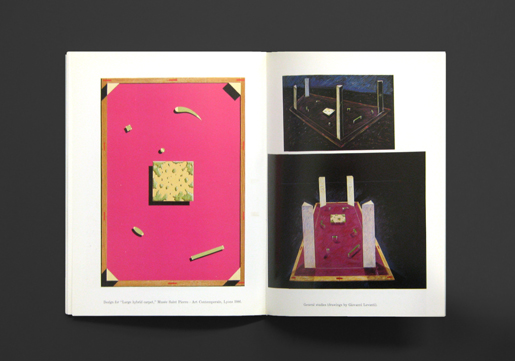
“...It contained seven objects. The slender fluted bone, surely formed for flight, surely from the wing of some large bird. Three archaic circuitboards, faced with mazes of gold. A smooth white sphere of baked clay. An age-blackened fragment of lace. A fingerlength segment of what she assumed was bone from a human wrist, grayish white, inset smoothly with the silicon shaft of a small instrument that must once have ridden flush with the surface of the skin - but the thing’s face was seared and blackened.”
William Gibson, “Count Zero”, 1986
"Autumn Projects Archive"
Curated by Liza Vasiliou
March 6 - March 15, 2014
World Food Books, in conjunction with the Virgin Australia Melbourne Fashion Festival 2014, presented the Autumn Projects archive, consisting of a selection of early examples in Australian fashion with a particular interest in collecting designers and labels from the period beginning in the 1980’s, who significantly influenced the discourse of Australian Fashion.
Curated by Liza Vasiliou, the exhibition provided a unique opportunity to view pieces by designers Anthea Crawford, Barbara Vandenberg, Geoff Liddell and labels CR Australia, Covers, Jag along with early experimental collage pieces by Prue Acton and Sally Browne’s ‘Fragments’ collection, suspended throughout the functioning World Food Books shop in Melbourne.
H.B. Peace
presented by CENTRE FOR STYLE
November 14, 2013
"Hey Blinky, you say chic, I say same"
Anon 2013
H.B. Peace is a clothing collaboration between great friends Blake Barns and Hugh Egan Westland. Their pieces explore the divergences between 'character’ and ‘personality’ in garments....etc
Special Thanks to Joshua Petherick and Matt Hinkley of WFB and Gillian Mears
and a Very Special Thank you to Audrey Thomas Hayes for her shoe collaboration.
Janet Burchill & Jennifer McCamley
"Aesthetic Suicide"
May 10 - June 8, 2013
The first of our occasional exhibitions in the World Food Books office/shop space in Melbourne, "Aesthetic Suicide" presented a body of new and older works together by artists Janet Burchill & Jennifer McCamley, including videos, prints, a wall work, and publications.
During shop open hours videos played every hour, on the hour.
Softcover, 304 pages (26 color and 8 b/w ill.), 14 x 23 cm
Published by
Sternberg Press / Berlin
$26.00 - Out of stock
Edited by Magnus Ericson, Ramia Mazé
Contributions by Magnus Ericson, Natasha Marie Llorens, Ramia Mazé Interviews with Ana Betancour, Otto von Busch, Mauricio Corbalan, Pelin Dervis, Anthony Dunne, Joseph Grima, Peter Lang, Yanki Lee, Tor Lindstrand, Helena Mattsson, Ou Ning, Doina Petrescu, Fiona Raby, Meike Schalk, Christina Zetterlund
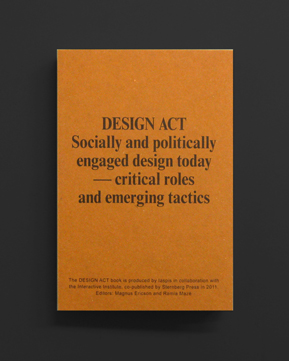
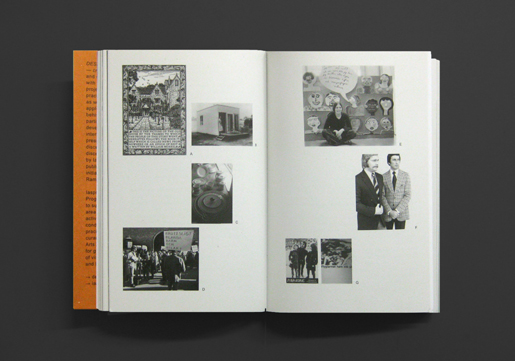
Design Act: Socially and Politically Engaged Design Today—Critical Roles and Emerging Tactics is a project that presents and discusses contemporary design practices that engage with political and societal issues. Since 2009, the Iaspis project Design Act has been highlighting and discussing practices in which designers have been engaging critically as well as practically in such issues. Itself an example of applied critical thinking and experimental tactics, the process behind the Design Act project is considered as a curatorial, participatory and open-ended activity. Design Act has developed through an online archive, public events, and an international network.
Co-published with Iaspis
Design by Johanna Lewengard
2012, English
Softcover, 192 pages, 30 b/w ill., 13.6 x 20 cm
$25.00 - Out of stock
Contributions by Ruth Buchanan, Helmut Draxler, Faculty of Invisibility, Katja Gretzinger, Rama Hamadeh, Claudia Mareis, Doreen Mende
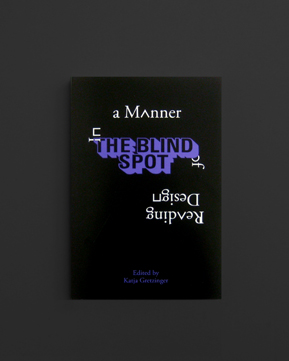
What we perceive and think of as "true" is widely influenced by our knowledge—carrying with it implicit conceptions we are not aware of. Design, as a planned action, is necessarily both theory and practice. It brings together thinking and everyday objects and therefore ingrains itself in the contexts we are all living in. Yet, being largely unreflected on, design is likely to simply affirm societal norms instead of questioning them. If design aims at taking a critical stance, it needs to change its acquaintance with knowledge and develop its own discourse to understand the underlying conceptions that are at play.
The metaphor of the "blind spot" proposes the perspective of looking at what is implicit or unnoticed in our perception. By doing so, it seeks to open up common readings of what design is and can do. The montage of texts featured here includes diverse voices and readings, meant to create a space in which debate can unfold, a debate that considers the impossibility of an unbiased position and as such reminds us of our dependence on the other in any conception—and any project design might aspire to.
1987, English
Softcover, 64 pages (colour ill. throughout), 280 x 220 mm
Out of print title / Used*,
Published by
Seattle Art Museum / Seattle
$10.00 - Out of stock
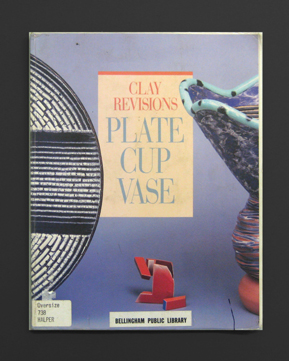
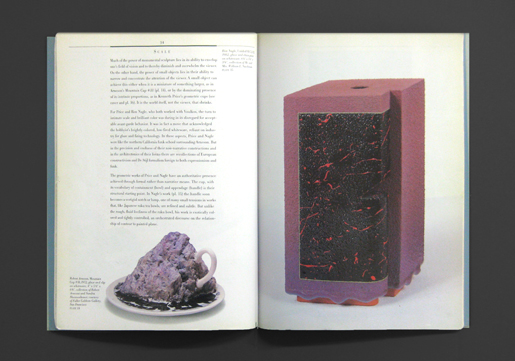
Published by Seattle Art Museum, this catalogue accompanied the exhibition "Clay Revisions: Plate, Cup, Vase", held at Renwick Gallery in 1988. The show was organized by the Seattle Art Museum and curated by Vicki Halper, the author of this catalogue. It documents work by many of the world's leading ceramists, including Ken Price, Peter Shire, Mary Heilmann, Peter Voulkos, Ron Nagle, Richard Shaw, Robert Arneson, and many more.
1990, English
Softcover, 240 pages, 305 x 230 mm
Out of print title/Used*,
Published by
Los Angeles County Museum of Art / Los Angeles
$30.00 - Out of stock
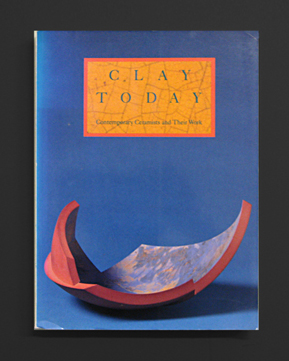
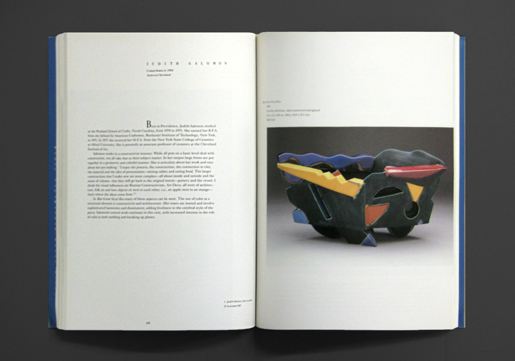
A catalogue of the Howard and Gwen Laurie Smits Collection at the Los Angeles County Museum of Art. This publication showcases the collection, one of the most outstanding selections of contemporary vessel ceramics in the world. The goal of this collection, begun in the 1970s, was to gather works by living artists, that showed their diversity, energy, and intellectual concerns. It is composed principally of works from 1979 to 1988, with a core representative of southern California potters. For background on the interwoven histories of English and American studio potters in the development of the clay movement, work of European and especially English artists are represented, including works that illustrate a technique or "moment" to show a specific genre. The catalogue profiles 64 ceramists through biographies, photographs, and discussions of the artist's work.
1987, English
Softcover, 78 pages (colour ill. throughout), 20 x 23 cm
Out of print title / Used*,
Published by
The MIT Press / Massachusetts
$25.00 - Out of stock
Andrea Branzi, one of Italy's foremost designers and critics, and Nicoletta Branzi, designer of limited edition art clothing for women, introduce the neoprimitive style under the generic title "Domestic Animals." These mysterious creature-objects are oriented to domestic settings, intended to be used or worn, but they are also fetishistic and contemplative, arousing expectations that magic or tribal rituals are about to be performed.
Uniting precision of design with natural raw materials, these objects fashioned from tree trunks, sticks of wood and animal skins joined to steel "bamboo" rods and painted in bright, totemic colors fascinate us. Taken out of their wild settings and tamed by technology, "domestic animals" establish a loving relationship with man, sharing his most private space. We have not seen anything like them in the world of interior, furniture, or fashion design before.
The ideas and creations in Domestic Animals were developed by the Branzis over several years, and can be understood as a metaphor of the relationship that links man to a number of animal and technical presences within the home. The Branzis have created clothing, furniture, and objects of decoration that challenge the conventional notions of habitation: Where living too often takes place in empty spaces marked out by couches they have introduced an environment of archetypal symbols and materials that invite a new way of inhabiting the home.
1995, English
Hardcover (w. dust jacket), 160 pages, 325 x 240 cm
1st British Edition. Out of print title / Used*,
Published by
Academy Editions / London
$20.00 - Out of stock
Where is television going and what shall we, as viewers, be seeing in the future? These and other questions are addressed by the contributors to this book. Each author focuses on different aspects of television, approaching the topic from his or her own area of expertise. The book does not aim to find definitive answers, but presents what may perhaps be described as a collection of musings, meditations or brainstormings.
2012, English
Softcover (saddle-stitch binding), 32 pages, 225 x 160 mm
Edition of 1000,
Published by
Paraguay Press / Paris
$10.00 - Out of stock
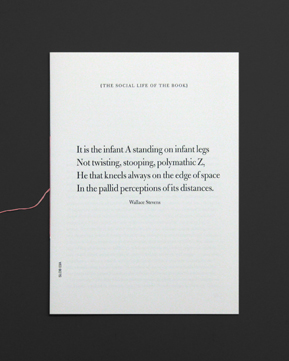
This is the third installment of The Social Life of the Book, which is a quarterly, subscription-based series of texts by writers, artists, publishers, designers, booksellers, etc., reflecting on reading, designing, publishing, and distributing books today.
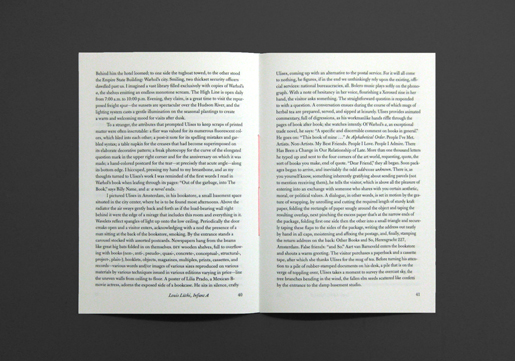
Infant A by Louis Lüthi. It makes sense that Mr. Lüthi would use the framework of a fictionalized conversation between his protagonist and the figure of Ulises Carrion (Mexican writer, expatriated to The Netherlands) to examine the uses, meanings, and significance of the letter "a;" further down the rabbit-hole lies Warhol's a: a novel, as counterpoint. As a designer he is known for investigations of language and their influences on visual representations, but it's his deft zig-zagging, a kind of exuberance in figuring it all out that makes it work.
The Social Life of the Book is a collection of commissioned texts dealing with books, and how they engage with the circulation of ideas and the agency of social situations. It brings together artists, publishers, writers, designers, booksellers, etc. who consider books less as finished objects or forms but for their disruptive potential and their ability to produce new relationships, new publics and new meanings.
It develops as a series of 16-page, saddle- stitched signatures, available on postal subscription and in selected bookstores. The collection will also be hand-bound into a single volume, whose edition is determined by demand. In its contents as well as its distribution, the series aims to entice readers into a particular attention not only to printed material as such, but also to the ecosystem of knowledge writing, publishing and distributing form together.
Publishing structure and design by Will Holder
2011, English
Softcover (saddle-stitch binding), 32 pages, 225 x 160 mm
Edition of 1000,
Published by
Paraguay Press / Paris
$10.00 - Out of stock
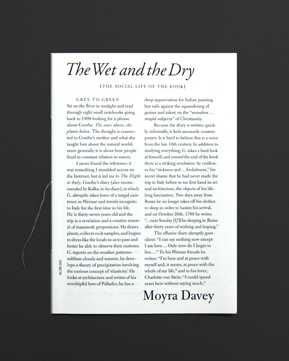
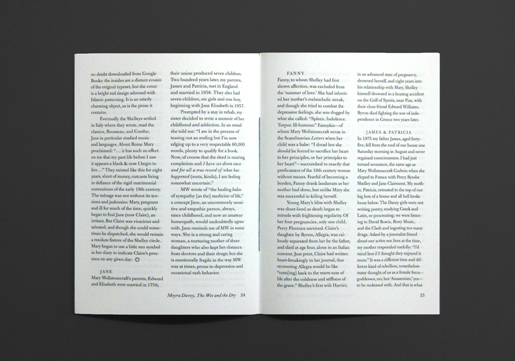
This is the second installment of The Social Life of the Book, which is a quarterly, subscription-based series of texts by writers, artists, publishers, designers, booksellers, etc., reflecting on reading, designing, publishing, and distributing books today.
Moyra Davey (1958, Toronto) is an artist, a photographer and a writer, one of the founding members of the collectively-run gallery Orchard (2005-2008). She notably published 'The Problem of Reading' (Documents Books, 2003), and is the editor of 'Mother Reader: Essential Writings on Motherhood' (Seven Stories Press, 2001). More recently, she dealt with Walter Benjamin's correspondence and the presence of sculpted books in Parisian cemetries in her 2009 video 'My Necropolis', and used the form of the 'air letter' to circulate her photographs.
The Social Life of the Book is a collection of commissioned texts dealing with books, and how they engage with the circulation of ideas and the agency of social situations. It brings together artists, publishers, writers, designers, booksellers, etc. who consider books less as finished objects or forms but for their disruptive potential and their ability to produce new relationships, new publics and new meanings.
It develops as a series of 16-page, saddle- stitched signatures, available on postal subscription and in selected bookstores. The collection will also be hand-bound into a single volume, whose edition is determined by demand. In its contents as well as its distribution, the series aims to entice readers into a particular attention not only to printed material as such, but also to the ecosystem of knowledge writing, publishing and distributing form together.
Publishing structure and design by Will Holder
2011, English
Softcover (saddle-stitch binding), 32 pages, 225 x 160 mm
Edition of 1000,
Published by
Paraguay Press / Paris
$10.00 - Out of stock
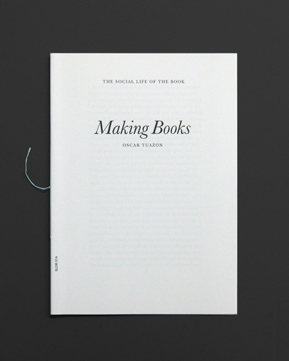
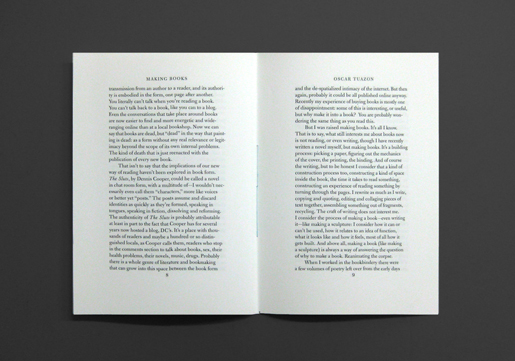
This is the first installment of The Social Life of the Book, which is a quarterly, subscription-based series of texts by writers, artists, publishers, designers, booksellers, etc., reflecting on reading, designing, publishing, and distributing books today.
The first installment of this project is "Making Books" by artist Oscar Tuazon. This text recalls the origins of his taste for the book form, through an auto-biographical account of his parent's book-bindery and a further reflection on his sculptural work.
The Social Life of the Book is a collection of commissioned texts dealing with books, and how they engage with the circulation of ideas and the agency of social situations. It brings together artists, publishers, writers, designers, booksellers, etc. who consider books less as finished objects or forms but for their disruptive potential and their ability to produce new relationships, new publics and new meanings.
It develops as a series of 16-page, saddle- stitched signatures, available on postal subscription and in selected bookstores. The collection will also be hand-bound into a single volume, whose edition is determined by demand. In its contents as well as its distribution, the series aims to entice readers into a particular attention not only to printed material as such, but also to the ecosystem of knowledge writing, publishing and distributing form together.
Publishing structure and design by Will Holder
2012, English
Softcover, 322 pages ( 138 b/w and 15 color ill.), 18.8 x 25.3 cm
Published by
Sternberg Press / Berlin
$42.00 - Out of stock
With contributions by Anni Albers, Doug Ashford, Gaston Bachelard, Angelo Bellfatto, Nova Benway, Gregg Bordowitz, Johanna Burton, Theresa Choi, Beatriz Colomina, Lynne Cooke, Moyra Davey, Tom Eccles, Diana Fuss, Jennifer Gross, Elizabeth Grosz, Roni Horn, Jenny Jaskey, Susanne Küper, Elisabeth Lebovici, Nathan Lee, Zoe Leonard, Dorit Margreiter, Josiah McElheny, Helen Molesworth, Georges Perec, Juliane Rebentisch, David Reed, Lisa Robertson, Joel Sanders, Virginia Woolf, Amy Zion
Encounters with art engage various conditions of interiority—whether through psychic spaces or specific physical environments, such as museums and private residences. The exhibition “If you lived here, you’d be home by now,” presented at the Hessel Museum of Art, CCS Bard, in 2011, was the catalyst for the current volume, providing a paradigmatic case study for probing issues of the personal and subjective within realms of the sociological and the cultural. Through diverse discursive modes—commissioned essays, conversations and talks, historical writings, and artistic projects—this anthology, the first CCS Readers volume, examines the poetics and politics of interior experience within the frame of contemporary art.
2012, English
Hardcover, 266 pages (5 b/w and 43 color ill.) 11 x 17.8 cm
Published by
Sternberg Press / Berlin
$31.00 - Out of stock
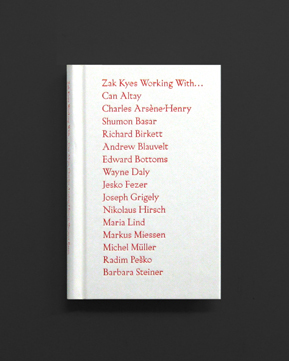
With contributions by Can Altay, Charles Arsène-Henry, Shumon Basar, Richard Birkett, Andrew Blauvelt, Edward Bottoms, Wayne Daly, Jesko Fezer, Joseph Grigely, Nikolaus Hirsch, Maria Lind, Markus Miessen, Michel Müller, Radim Peško, Barbara Steiner
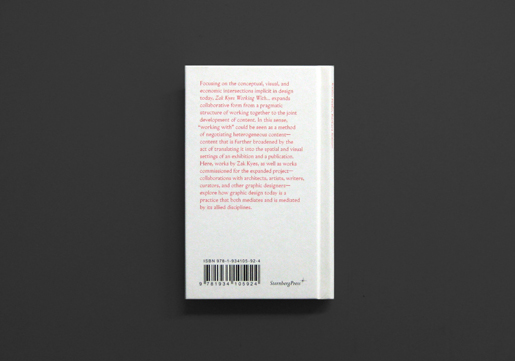
To accompany his exhibition at the Museum of Contemporary Art Leipzig, this book presents the work of the Swiss-American graphic designer Zak Kyes. In collaboration with the curator, Barbara Steiner, the exhibition and publication bring together a range of works by Kyes, as well as works by a host of collaborators that includes architects, artists, writers, curators, editors, and graphic designers, presenting contemporary graphic design as a practice that mediates, and is mediated by, its allied disciplines.
Kyes, who lives and works in London, is known for his critical approach to graphic design, which encompasses publishing, editing, and site-specific projects for and in collaboration with cultural institutions. In 2005, Kyes founded the design studio Zak Group, and, in 2006, he became Art Director of the Architectural Association (AA), London. Under the auspices of the AA, he organized the seminal touring exhibition “Forms of Inquiry: The Architecture of Critical Graphic Design,” and later cofounded Bedford Press, an imprint that seeks to develop new models for contemporary publishing. By broadening the highly specialized role of the designer, Kyes challenges and further develops today’s graphic design practice.
While this work constitutes the exhibition’s point of departure, its focus is on the conceptual, visual, and economic intersections that link Kyes with his collaborators, revealing and further unfolding the designer’s multivalent practice. These intersections vary in form from idealistic to pragmatic, urgent and time-sensitive to abiding and long-lasting. Rather than presenting a chronological overview of Kyes’s work, the book highlights the designer’s relations with partners, clients, and institutions, and the creative potential of these collaborations to evolve traditional understandings of graphic design, art, and architecture.
Design by Wayne Daly
2012, English
Softcover, 372 pages, 12.9 x 19.8 cm
Published by
Sternberg Press / Berlin
$36.00 - Out of stock
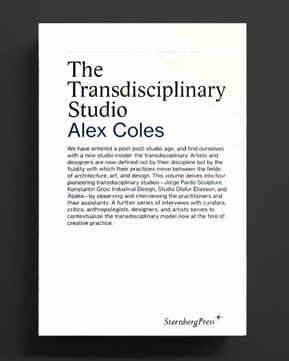
We have entered a post-post-studio age, and find ourselves with a new studio model: the transdisciplinary. Artists and designers are now defined not by their discipline but by the fluidity with which their practices move between the fields of architecture, art, and design. This volume delves into four pioneering transdisciplinary studios—Jorge Pardo Sculpture, Konstantin Grcic Industrial Design, Studio Olafur Eliasson, and Åbäke—by observing and interviewing the practitioners and their assistants. A further series of interviews with curators, critics, anthropologists, designers, and artists serves to contextualize the transdisciplinary model now at the fore of creative practice.
Including interviews with Jorge Pardo, Konstantin Grcic, Olafur Eliasson, and Åbäke; and Vito Acconci, Gui Bonsiepe, James Clifford, Dexter Sinister, Martino Gamper, Ryan Gander, Caroline Jones, Ronald Jones, Maria Lind, Alessandro Mendini, Rick Poynor, and Andrea Zittel.
The Transdisciplinary Studio is the first volume of a series of books by Alex Coles on the expanded studio model and contemporary praxis.
Design by Surface, Frankfurt am Main/Berlin
2012, English
Softcover, 224 pages, 16.5 x 23.5 cm
Published by
Dexter Sinister / New York
Sternberg Press / Berlin
The Serving Library / New York
$16.00 - Out of stock
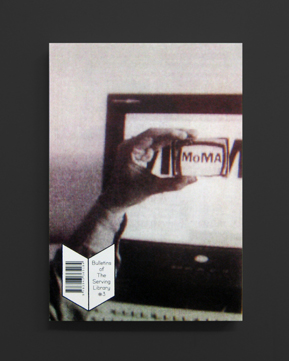
With contributions by Andrew Blum, Bruno Latour, Graham Meyer, Pierre-André Boutang, David Reinfurt, Chris Evans, Jessica Winter, Ian Svenonius, Angie Keefer, Francis McKee, Benjamin Tiven, Louis Lüthi, Dexter Sinister, and Laura Hoptman
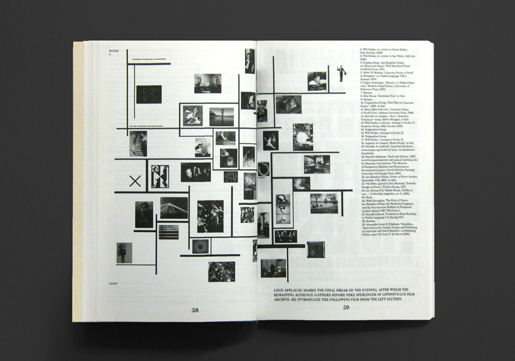
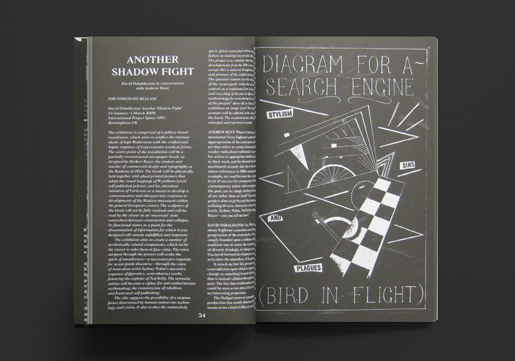
This issue of Bulletins of the Serving Library doubles as a catalog of sorts to "Ecstatic Alphabets/Heaps of Language," a group exhibition curated by Laura Hoptman at the Museum of Modern Art, New York, from May 6 to August 27, 2012. It is a pseudo-catalog in the sense that, other than a section of images at the back, it bears no direct relation to the works in the exhibition. Instead, the bulletins extend in different directions from the same title, and could be collectively summarized as preoccupied with the more social aspects of Typography.
Video trailer, assembled from thirteen texts in the catalog.
2010, English
Softcover, 104 pages, offset/newsprint, 165 x 235 mm
Published by
Dexter Sinister / New York
$27.5.00 - Out of stock
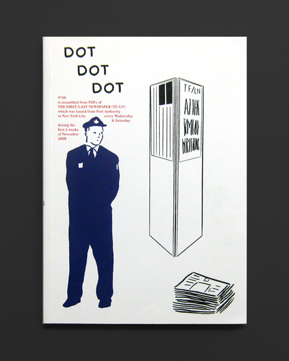
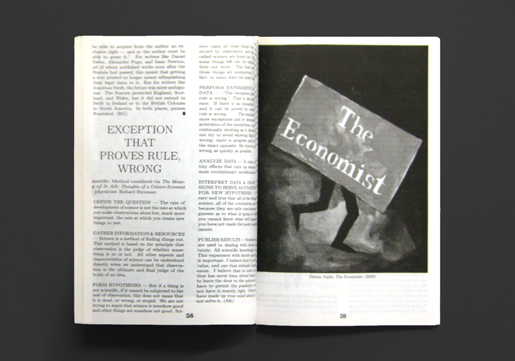
is assembled from PDFs of THE FIRST/LAST NEWSPAPER (TF/LN)
which was issued from Port Authority in New York CIty
every Wednesday & Saturday during the first 3 weeks
of November 2009
2009, English
Softcover, 104 pages, offset/newsprint, 165 x 235 mm
Published by
Dexter Sinister / New York
$27.5.00 - Out of stock
In this issue:
D/S present PARALLEL introductions
Richard Hollis on the EYE and the EAR
James Goggin itemizes ways of reading in London, 2008 with Maria Fusco, Will Holder, Richard Hollis, Maki Suzuki and Jörg Heiser
Will Holder speaks of the poetics of concrete poetry and documenting the work of Falke Pisano
Stefan Themerson & Language - a film by Erik van Zuylen introduced by Mike Sperlinger
Dan Fox plays an extended version of Refracted Light Through Armoury Show
Jennifer Higgie reads from Carnival Theory, a play-in-progress with Johnny Vivash
Agency presents Specimen 0880: Papa Hemingway
David Reinfurt explains NaÏve Set Theory with an overhead projector
Malcolm McLaren (in absentia) is interviewed by Mark & Stephen Beasley (in absentia)
Stuart Bailey - describes the Science, Fiction of E.C. Large with Will Holder and David Reinfurt
plus
Alex Klein - Portrait of Genesis Breyer P-Orridge, New York City, May 2008
Mitim (Eta) by Radim Peško
Walead Beshty - Beshty’s Possible Triangle, 2008
Dexter Sinister - Beshty’s Possible Triangle, 2008
Janice Kerbel - Remarkable, 2008
and
The Middle of Nowhere, Chapter 8 by Will Holder
2008, English
Softcover, 104 pages, offset/newsprint, 165 x 235 mm
Published by
Dexter Sinister / New York
$27.5.00 - Out of stock
A W.A.S.T.E. of Ink (after Thomas Pynchon)
DDD16 was conceived parallel to—and is issued from under the wing of—the project 'True Mirror', directed from the Commander’s Room at the 7th Regiment Armory Building, New York between 4–23 March, 2008 and tracked at http://www.sinisterdexter.org. On reflection, we realised real news doesn’t need a press release.
The issue then draws liberally from three other interlocking projects, all founded by guest-co-editor Raimundas Malašauskas.
In this issue:
2012, English
Softcover, 180 pages, 102 x 143 mm
Published by
F de C / Tokyo
$10.00 - Out of stock
The F de C Reader #1 is F de C’s first exploitation of print.
A bi-yearly ”fashion magazine”, the Reader will be complemented by a separate visual publication, also published twice a year.
180 pages, containing only the images necessary to give it sense, the F de C de Reader is a ‘fashion’ magazine in the sense that it both starts from and constantly returns to ‘clothing’, but in between it’s focused on everything but. Perhaps closer to a short story about a life in clothes, told by a dozen different characters…
The CONTENTS in this first issue are primarily centered on Japan and China; with a series of conversations starting in Tokyo in the wake of the March 2011 disaster coiling some 40 years into the past and future, in addition to a look at China and creativity, culture and context.
The PRODUCTION itself completely reflects the F de C philosophy:
The first issue is printed in Indonesia where the editorial team worked hands-on with a small local printing company completing the whole job in two all-night sessions. The main design concept was finally inspired by the pocket-sized standard textbooks of the country.
Printed in one color on inexpensive, unbleached paper, with a compact size of 102 x 143 mm and weighing only 80g it is the diametrical opposite of glossy fashion publications. As they say in China, things develop in the opposite direction when they reach their limit.
FEATURED ARE:
Anders Edström did photography for Martin Margiela in the early days when the Maison was actually a small Paris apartment and talks about those days as well as about his life in Tokyo where he sometimes experiences difficulties communicating.
Well-known ‘super-tourist’ photographer Max Pam would never do fashion photography, but we discovered that that’s actually what he did when he went to Xinjiang province in 1986. He also talks about the thrills and perils of exhibiting in a Museum in Japan during the economic bubble.
ffiXXed have been making clothes in New York, Berlin and Hong Kong but ended up settling in Shenzhen. What’s it like to work and live in China as a designer, and to be completely independent, meaning you’re actually responsible for your work and production and most of all: able to make real change happen?
Toshio Nakanishi, founder of the influential Japanese new wave band Plastics, talks about the time when Japan erupted in a wave of creativity having previously been flooded by ‘western’ and other cultural influences — a situation not at all dissimilar from China today, as it becomes clear in several conversations with young Chinese designers and fashion design students at The Central Academy of Fine Arts in Beijing.
ALSO INCLUDED:
Chikashi Suzuki on the (so-so) state of fashion photography in Japan.
Zhang Da, designer at ShangXia Hermes and at his own label Boundless, on the current state of design and creativity in China and looking outside vs. looking within when creating.
Photos of textile factories in the PR of China.
A series of photographs by Motoyuki Daifu.
2008, English
Softcover, 138 pages (b/w & colour ill.), 22 x 28 cm
Published by
Museum of Contemporary Art Detroit / Detroit
$54.00 - Out of stock
Rei Kawakubo (born 1942) established Comme des Garcons in Tokyo in 1973 and quickly consolidated her stature as one of the three major Japanese designers alongside Issey Miyake and Yohji Yamamoto. Kawakubo's conceptions stem from her background in fine arts and literature rather than from any formal design training. Her fabrication methods, and her collaborations with artists such as the late, great Merce Cunningham, are explored in this survey of her work. "ReFusing Fashion" presents over 40 key garments, costumes from Kawakubo's Cunningham collaboration, photographs, runway footage and ephemera.
2012, English/Czech
Softcover, 64 Pages (colour, b&w ill.), 150 x 210 mm
Published by
Moravian Gallery / Brno
$20.00 - Out of stock
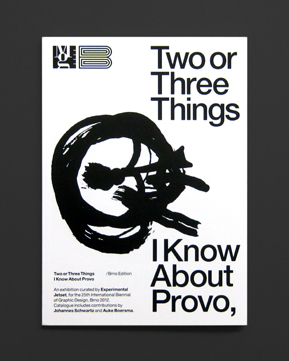
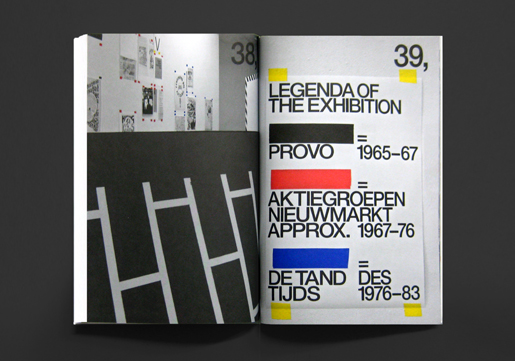
Invited by the organizers of the 25th International Biennial of Graphic Design in Brno to guest-curate one of the exhibitions, Experimental Jetset decided to present a reworked version of 'Two or Three Things I Know About Provo', the exhibition that originally took place in the beginning of 2011, at Amsterdam art space W139.
For the Brno Bienniale, Experimental Jetset reworked and reinterpreted their original exhibition, adding new material and updated texts, as well as video- and audio-material.
On the occasion of the exhibition, the Moravian Gallery published a small catalogue, designed by Experimental Jetset, featuring contributions by Auke Boersma, Johannes Schwartz and Marek Pokorny.
1999, English/German
Softcover, 64 pages (56 colour and 21 b&w plates), 155 x 205 mm
Published by
Oktagon Verlagsgesellschaft mbH / Cologne
$19.00 - Out of stock
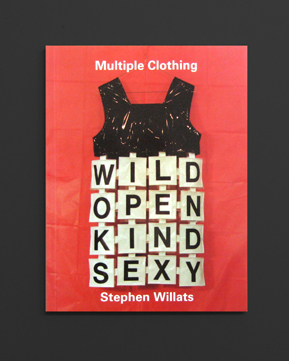
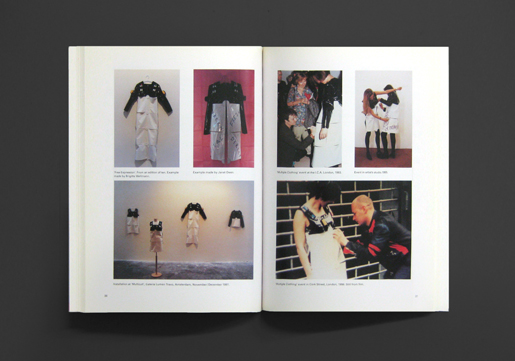
Since the early 1960s, Stephen Willats has devoted himself to the dialogue between the artwork and the viewer. His models from the series Multiple Clothing are specially made mix-and-match PVC garments. Each design is produced as an assemblage of clothing sections that contain either single words, or a range of letters. These can be built up within the framework of each design, indicating the state of mind of the wearer. This artist's book contains diagrams, drawings and photographs of the work alongside comment and text written by Willats himself.
2004, English
Softcover, 360 pages (32 color & 400 b&w ill.), 15 x 20 cm
Published by
Valiz / Amsterdam
$53.00 - Out of stock
Edited by Brigitte Van der Sande. Essays by Gilles Deleuze, Felix Guattari, Roland Barthes, Jean-Luc Godard, Jorinde Seijdel, Robert Bresson, and Adolf Loos.
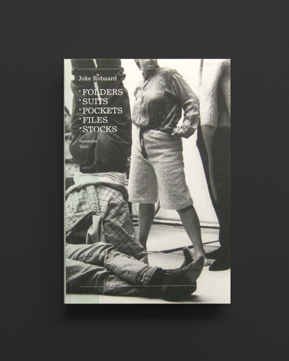
Artist and photographer Joke Robaard, originally trained in fashion, investigates human configurations (e.g., networks of friends or neighbors). After “directing” individuals into certain positions and patterns in relation to one another, she photographs them, using clothing to illustrate where connections lie and how they constantly shift.
2010, English
Softcover, 160 pages, ills colour & bw, 23 x 28 cm
Published by
PIN-UP MAGAZINE
$22.00 - Out of stock
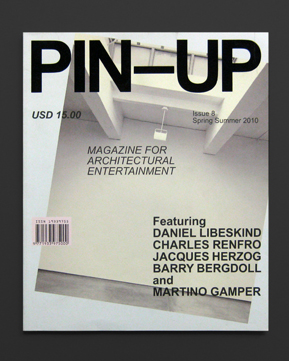
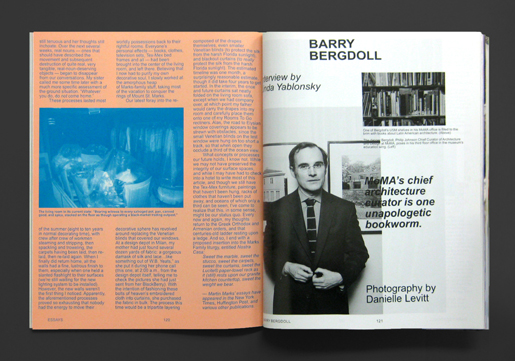
This issue of Pin-Up was entirely produced in their temporary office in the heart of Los Angeles. Features articles on Daniel Libeskind, Charles Renfro, Martino Gamper, MoMa’s architecture curator Barry Bergdoll, and an interview with Jacques Herzog. Essays by Payam Sharifi on Moscow’s Barrikadnaya apartment building, and by Paul Haacke on growing up along the Hudson River waterfront, entitled 'Meat Market Memories'.
2009, English
Softcover, 156 pages, ills colour & bw, 23 x 28 cm
Published by
PIN-UP MAGAZINE
$22.00 - Out of stock
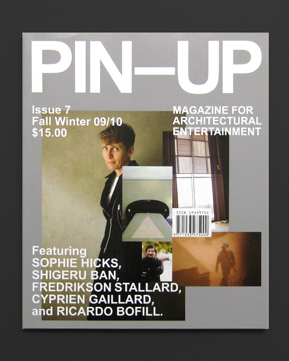
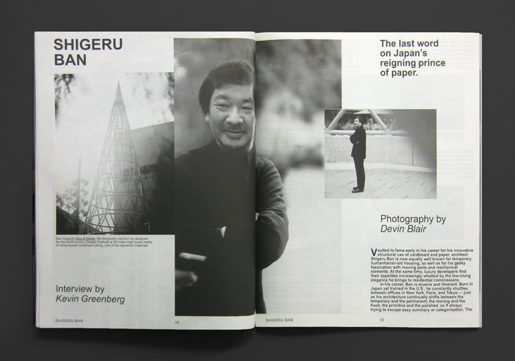
Obsessions are the stuff of this winter issue of PIN-UP, be it a restaurant built on the passion for knick and knack (The Pale Blue Door, London), the teasing out of details beyond rational limits (Sophie Hicks and Alvar Aalto) or the life devouring labour-of-love designs of Fredrikson Stallard. Obsession can also produce the monumental (Ricardo Bofill), be concerned with the constructive (Shigeru Ban) and the destructive (Cyprien Gaillard) and it can also be found in a selection of PIN-UP’s 75 favourite objects that are collected here. Entertaining, surprising and informative, all essays, folios and featured articles with the abovementioned names, are accompanied by colour and black and white photographs.
2011, English
Softcover, 220 pages, ills colour & bw, 23 x 28 cm
Published by
PIN-UP MAGAZINE
$22.00 - Out of stock
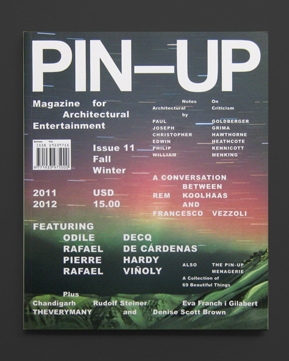
Winter Wonderland featuring pieces by Elisa Strozyk & Sebastian Neeb, Faye Toogood, Max Lipsey, Eero Arnio, Fort Standard, Aldo Bakker, and artist Jochen Weber. Photography by Salem's Heather Marlatt.