World Food Books' programme is largely produced on Kulin Nation land. We acknowledge the Wurundjeri people of the Kulin Nation as the first and continuing custodians of this land, and pay respect to their Elders past, present, and emerging.
World Food Books is an arts and special interests bookshop in Naarm / Melbourne. Founded in 2010, World Food Books is devoted to the presentation of a rotating, hand-selection of international art, design, literary and counterculture publications with an emphasis on the anti-traditional, the experimental, the avant-garde, the heretic, the marginal.
Presenting new titles alongside rare and out-of-print books, catalogues and journals spanning the fields of modern and contemporary art, design, photography, illustration, film, literature, poetry, cultural theory, philosophy, sexuality, popular and underground culture in its many radical forms, World Food Books wishes to encourage adventurous, thoughtful and open-minded reading, looking, writing, and exchange of publishing and ideas, both current and historical.
As well as our bookshop, located in Melbourne's historical Nicholas Building, all of our inventory is available internationally via our online mail-order service.
World Food Books semi-regularly co-ordinates "Occasions", a programme of exhibits and events at the bookshop and in partnership with other hosts (such as museums and art galleries) that develop out of the activities, relationships and content of the bookshop itself.
World Food Books
The Nicholas Building
37 Swanston Street
Room 5, Level 6
Melbourne 3000
Australia
SHOP HOURS:
THU–SAT 12–6
WEB-SHOP OPEN 24/7
World Food Books
Postal Address:
PO Box 435
Flinders Lane
Victoria 8009
Australia
info@worldfoodbooks.com
Art
Theory / Essay
Architecture / Interior
Graphic Design / Typography
Photography
Fashion
Eros
LGBTQ+
Fiction / Poetry
Weird / Speculative / Science Fiction / Horror
Transgressive / Visceral / Abject
Symbolism / Decadence / Fin de siècle
Film / Video
Painting
Sculpture / Installation
Performance / Dance / Theater
Drawing
Sound / Music
Curatorial
Group Shows / Collections
Periodicals
Out-of-print / Rare
Posters / Ephemera / Discs
Signed Books
World Food Books Gift Voucher
World Food Book Bag
Australian Art
Australian Fiction
Australian Science Fiction / Speculative Fiction
Australian Poetry
Australian Photography
Japanese Photography
Conceptual Art
Minimal Art
Dada
'Pataphysics / Oulipo
Fluxus
Concrete Poetry
Pop Art
Surrealism
Arte Povera
Arte Informale / Haute Pâte / Tachism
Nouveau Réalisme / Zero / Kinetic
Situationism / Lettrism
Collage / Mail Art / Xerox Art
Art Brut / Folk / Visionary / Fantastic
Illustration / Graphic Art / Bandes Dessinées
Furniture
Italian Radical Design / Postmodernism
Textiles
Ceramics / Glass
Counterculture
Protest / Revolt
Philosophy
Psychoanalysis
Anthropology
Anarchism
Socialism / Anarchism / Communism / Capitalism
Literary Theory / Semiotics / Language
Feminism / Women's Studies
Gender Studies / Sexuality
Anthropology
Fetishism / BDSM
Drugs / Psychedelia
Crime / Violence
Animal Rights / Veganism
Occult / Esoterica
Ecology / Earth / Alternative Living
Whole Earth / Crafts
All prices in AUD (Australian dollars)
Pick-Ups
Pick-up orders can be collected in our bookshop during opening hours after order date. Please collect any Pick-up orders within 2 weeks of ordering as we have limited storage space. Orders will be released back into stock if not collected within this time. No refunds can be made for pick-ups left un-collected. If you cannot make it in to the bookshop in this time-frame, please choose postage option.
Return Policy
All sales are final. We do accept returns (for refund or exchange) for items received in error. All our orders are packed with special care using heavy-duty padding and cardboard book-mailers or bubble mailers (for smaller books), using reinforcement where required. We cannot take responsibility for any lost, stolen or damaged parcels.
Insurance
Should you wish to insure your package, please email us directly after placing your order and we can organise this at a small extra expense. Although all standard/express tracked packages are very safe and dependable, we cannot take responsibility for any lost, stolen or damaged parcels. We recommend insurance on valuable orders.
Interested in selling your old books, catalogues, journals, magazines, comics, fanzines, ephemera? We are always looking for interesting, unusual and out-of-print books to buy. We only buy books in our fields of interest and specialty, and that we feel we can resell.
We base these prices on desirability, market value, in-print prices, condition and our current stock levels. We offer cash, store credit, and can take stock on consignment. All
about 25% of the price we expect to get when we sell them, or 30% in store credit. We base these prices on desirability, market value, in-print prices, condition and our current stock levels.
Sell your books any day of the week. You can drop them off and return later. If you have a lot of books, we can visit your Sydney home.
We buy books that we feel we can resell. We offer about 25 % of the price we expect to get when we sell them, or 30% in store credit. We base these prices on desirability, market value, in-print prices, condition and our current stock levels.
Philadelphia Wireman
03 August - 01 September, 2018
World Food Books is proud to announce our next Occasion, the first presentation of sculptures by Philadelphia Wireman in Australia.
The Philadelphia Wireman sculptures were found abandoned in an alley off Philadelphia’s South Street on trash night in 1982. Their discovery in a rapidly-changing neighbourhood undergoing extensive renovation, compounded with the failure of all attempts to locate the artist, suggests that the works may have been discarded after the maker’s death. Dubbed the "Philadelphia Wireman" during the first exhibition of this work, in 1985, the maker’s name, age, ethnicity, and even gender remain uncertain. The entire collection totals approximately 1200 pieces, all intricately bound together with tightly-wound heavy-gauge wire (along with a few small, abstract marker drawings, reminiscent both of Mark Tobey and J.B. Murry). The dense construction of the work, despite a modest range of scale and materials, is singularly obsessive and disciplined in design: a wire armature or exoskeleton firmly binds a bricolage of found objects including plastic, glass, food packaging, umbrella parts, tape, rubber, batteries, pens, leather, reflectors, nuts and bolts, nails, foil, coins, toys, watches, eyeglasses, tools, and jewellery.
Heavy with associations—anthropomorphic, zoomorphic, and socio-cultural responses to wrapped detritus—the totemic sculptures by Philadelphia Wireman have been discussed in the context of work created to fulfil the shamanistic needs of alternative religions in American culture. Curators, collectors, and critics have variously compared certain pieces to sculpture from Classical antiquity, Native American medicine bundles, African-American memory jugs, and African fetish objects. Reflecting the artist’s prolific and incredibly focused scavenging impulse, and despite—or perhaps enhanced by—their anonymity, these enigmatic objects function as urban artefacts and arbiters of power, though their origin and purpose is unknown. Philadelphia Wireman, whatever their identity, possessed an astonishing ability to isolate and communicate the concepts of power and energy through the selection and transformation of ordinary materials. Over the course of the past two decades, this collection has come to be regarded as an important discovery in the field of self-taught art and vernacular art.
Presented in collaboration with Fleisher-Ollman Gallery, Philadelphia, and Robert Heald, Wellington.
Susan Te Kahurangi King
02 February - 10 March, 2018
Susan Te Kahurangi King (24 February 1951 - ) has been a confident and prolific artist since she was a young child, drawing with readily available materials - pencils, ballpoint pens and felt-tip markers, on whatever paper is at hand. Between the ages of four and six Susan slowly ceased verbal communication. Her grandparents William and Myrtle Murphy had developed a special bond with Susan so they took on caring responsibilities for extended periods. Myrtle began informally archiving her work, carefully collecting and storing the drawings and compiling scrapbooks. No drawing was insignificant; every scrap of paper was kept. The King family are now the custodians of a vast collection containing over 7000 individual works, from tiny scraps of paper through to 5 meter long rolls.
The scrapbooks and diaries reveal Myrtle to be a woman of great patience and compassion, seeking to understand a child who was not always behaving as expected. She encouraged Susan to be observant, to explore her environment and absorb all the sights and sounds. Myrtle would show Susan’s drawings to friends and people in her community that she had dealings with, such as shopkeepers and postal workers, but this was not simply a case of a grandmother’s bias. She recognised that Susan had developed a sophisticated and unique visual language and sincerely believed that her art deserved serious attention.
This was an unorthodox attitude for the time. To provide some context, Jean Dubuffet coined the term Art Brut in 1945 to describe work created by self-taught artists – specifically residents of psychiatric institutions and those he considered to be visionaries or eccentrics. In 1972 Roger Cardinal extended this concept by adopting the term Outsider Art to describe work made by non-academically trained artists operating outside of mainstream art networks through choice or circumstance. Susan was born in Te Aroha, New Zealand in 1951, far from the artistic hubs of Paris and London that Dubuffet and Cardinal operated in. That Myrtle fêted Susan as a self-taught artist who deserved to be taken seriously shows how progressive her attitudes were.
Susan’s parents Doug and Dawn were also progressive. Over the years they had consulted numerous health practitioners about Susan’s condition, as the medical establishment could not provide an explanation as to why she had lapsed into silence. Dawn educated herself in the field of homeopathy and went on to treat all twelve of her children using these principles – basing prescriptions on her observations of their physical, mental and emotional state.
Doug was a linguist with an interest in philosophy who devoted what little spare time he had to studying Maori language and culture. To some extent their willingness to explore the fringes of the mainstream made them outsiders too but it was their commitment to living with integrity and their respect for individuality that ensured Susan’s creativity was always encouraged.
Even though Susan’s family supported her artistic pursuits, some staff in schools and hospitals saw it as an impediment to her assimilation into the community and discouraged it in a variety of ways. Her family was not always aware of this and therefore did not fully understand why Susan stopped drawing in the early 1990s. However, rather than dwell on the challenges that Susan faced in pursuit of her artistic practice, they prefer to highlight her achievements. In 2008 Susan began drawing again in earnest, after an almost 20 year interruption, and her work is now shown in galleries around the world.
Susan grew up without television and has been heavily influenced by the comics she read as a child. She is absolutely fearless in the appropriation of recognizable characters, such as Donald Duck and Mickey Mouse, in her work. She twists their limbs, contorts their faces, compresses them together, blends them into complex patterned backgrounds - always imbuing them with an incredible energy. Although Susan often used pop culture characters in her work they are not naive or childlike. These are drawings by a brilliant self-taught artist who has been creating exceptional work for decades without an audience in mind.
Mladen Stilinović
"Various Works 1986 - 1999"
02 February 16 - September 10, 2016
Various works 1986 - 1999, from two houses, from the collections of John Nixon, Sue Cramer, Kerrie Poliness, Peter Haffenden and Phoebe Haffenden.
Including: Geometry of Cakes (various shelves), 1993; Poor People’s Law (black and white plate), 1993; White Absence (glasses, ruler, set square, silver spoon, silver ladel with skin photograph and wooden cubes), 1990-1996; Exploitation of the Dead (grey and red star painting, wooden painting, black spoon with red table, red plate), 1984-1990; Money and Zeros (zero tie, paintings made for friends in Australia (Sue, John, Kerrie), numbers painting), 1991-1992; Words - Slogans (various t-shirts) - “they talk about the death of art...help! someone is trying to kill me”, “my sweet little lamb”, “work is a disease - Karl Marx”; Various artist books, catalogues, monographs, videos; Poster from exhibition Insulting Anarchy; "Circular" Croatian - Australian edition; Artist book by Vlado Martek (Dostoyevsky); more.
Thanks to Mladen Stilinović and Branka Stipančić.
Jonathan Walker
Always Will Need To Wear Winter Shirt Blue + Ochre Small Check Pattern
21 August - 21 September, 2015
Untitled
I am not a great reader of poetry but I always return to the work of Melbourne poet, Vincent Buckley (1925- 1988). Perhaps I find his most tantalising piece to be not a finished poem but a fragment left on a scrap of paper discovered on his desk after the poet’s death.
The poetry gathers like oil
In the word-core, and spreads
It has its music meet,
Its music is in movement.
This fragment is more the shell left behind from a volatile thought than a finished poem. I find the last two lines honest but awkward whereas the first two lines work like an arrow. Most likely he could not find a resolution so it was left. Still, in its present form, it remains an eloquent testimony to the ultimate failure of a medium to express mobile thought and sensation, in Buckley’s case, through verbal language. It’s an important matter because this is something all artists have to deal with regardless of the medium.
I have never written a poem, however, I am forever copying fragments from books on paper scraps in a vain effort to fix certain notions in my head. At first, they function as bookmarks that are sometimes returned to when I open the book. But before long, as they accumulate, they fall out littering the table interspersed with A4 photocopies, bills, books and medications.
To return to Buckley’s fragment, the first two lines very much evoke how I paint nowadays. As you age, detail diminishes and patches of light become more luminous and float. I feel the most honest way of dealing with this is by smearing the oil paint on the canvas with the fingers and working close-up, blind. Only if the patches coalesce into an approaching image can the work gain a life.
-
Jonathan Walker was born in Melbourne, Australia and brought up on a dairy farm in Gippsland. In the 1970’s he studied painting at RMIT and won the Harold Wright Scholarship to the British Museum, London. During the 1980’s he exhibited at Pinacotheca Gallery, Richmond and had work shown at the NGV and Heidi City Art Gallery. Over the same period he designed the cover for the “Epigenesi” LP by Giancarlo Toniutti, Italy and conducted a mail exchange work with Achim Wollscheid, Germany. The work with artists through the post resulted in an article published in the bicentenary issue of Art and Australia 1988. He showed in artist run spaces such as WestSpace in the 90’s and 2000’s, and until 2012, taught painting at Victoria University, which is where we (Colleen Ahern and Lisa Radford) as organisers of the exhibition, among many others, had the privilege of being his student.
Walker’s knowledge was imparted to students through the careful selection of music, literature, and artists found in books that he himself had ordered for the library. Walker’s strategy was the generosity of sharing his vast knowledge with references specific to each student and their context.
Walker’s paintings share a similar focus and intimacy.
This exhibition presents a small selection of recent paintings alongside a publication that includes Walker’s writing. Observational and analytical, Walker’s work is a type of material notation — the time of day, colour and how it is blended, the both specific and fleeting location of a reflection on lino or the question of whether a chair leg should be included in a painting.
Please join us on Friday August 21 between 6-8pm to celebrate the opening of the exhibition.
Curated by Colleen Ahern and Lisa Radford.
B. Wurtz
Curated by Nic Tammens
March 26 - April 4, 2015
B.Wurtz works from a basement studio in his home on Manhattan’s Lower East Side.
This local fact is attested to by the plastic shopping bags and newsprint circulars that appear in his work. As formal objects, they don’t make loud claims about their origins but nonetheless transmit street addresses and places of business from the bottom of this long thin island. Like plenty of artists, Wurtz is affected by what is local and what is consumed. His work is underpinned by this ethic. It often speaks from a neighborhood or reads like the contents of a hamper:
“BLACK PLUMS $1.29 lb.”
“Food Bazaar”
“USDA Whole Pork Shoulder Picnic 99c lb.”
“RITE AID Pharmacy, with us it’s personal.”
“H. Brickman & Sons.”
“Sweet Yams 59c lb."
Most of the work in this exhibition was made while the artist was in residence at Dieu Donne, a workshop dedicated to paper craft in Midtown. Here Wurtz fabricated assemblages with paper and objects that are relatively lightweight, with the intention that they would be easily transportable to Australia. This consideration isn’t absolute in Wurtz’s work, but was prescriptive for making the current exhibition light and cheap. Packed in two boxes, these works were sent from a USPS post office on the Lower East Side and delivered to North Melbourne by Australia Post.
Wurtz appears courtesy of Metro Pictures, New York.
Thanks to Rob Halverson, Joshua Petherick, Sari de Mallory, Matt Hinkley, Helen Johnson, Fayen d'Evie, Ask Kilmartin, Lisa Radon, Ellena Savage, Yale Union, and "Elizabeth".
John Nixon
"Archive"
December 15 - January 20, 2014
The presentation of John Nixon's archive offered a rare showcase of this extensive collection of the artist's own publications, catalogues, posters, ephemera, editions and more, from the mid 1980s onwards, alongside a selection of his artworks.
Organized by John Nixon, Joshua Petherick and Matt Hinkley.
"Habitat"
at Minerva, Sydney (organised by Joshua Petherick and Matt Hinkley)
November 15 - December 20, 2014
Lupo Borgonovo, Janet Burchill & Jennifer McCamley,
Lewis Fidock, HR Giger, Piero Gilardi, Veit Laurent Kurz,
Cinzia Ruggeri, Michael E. Smith, Lucie Stahl, Daniel Weil, Wols
Press Release:
“...It contained seven objects. The slender fluted bone, surely formed for flight, surely from the wing of some large bird. Three archaic circuitboards, faced with mazes of gold. A smooth white sphere of baked clay. An age-blackened fragment of lace. A fingerlength segment of what she assumed was bone from a human wrist, grayish white, inset smoothly with the silicon shaft of a small instrument that must once have ridden flush with the surface of the skin - but the thing’s face was seared and blackened.”
William Gibson, “Count Zero”, 1986
"Autumn Projects Archive"
Curated by Liza Vasiliou
March 6 - March 15, 2014
World Food Books, in conjunction with the Virgin Australia Melbourne Fashion Festival 2014, presented the Autumn Projects archive, consisting of a selection of early examples in Australian fashion with a particular interest in collecting designers and labels from the period beginning in the 1980’s, who significantly influenced the discourse of Australian Fashion.
Curated by Liza Vasiliou, the exhibition provided a unique opportunity to view pieces by designers Anthea Crawford, Barbara Vandenberg, Geoff Liddell and labels CR Australia, Covers, Jag along with early experimental collage pieces by Prue Acton and Sally Browne’s ‘Fragments’ collection, suspended throughout the functioning World Food Books shop in Melbourne.
H.B. Peace
presented by CENTRE FOR STYLE
November 14, 2013
"Hey Blinky, you say chic, I say same"
Anon 2013
H.B. Peace is a clothing collaboration between great friends Blake Barns and Hugh Egan Westland. Their pieces explore the divergences between 'character’ and ‘personality’ in garments....etc
Special Thanks to Joshua Petherick and Matt Hinkley of WFB and Gillian Mears
and a Very Special Thank you to Audrey Thomas Hayes for her shoe collaboration.
Janet Burchill & Jennifer McCamley
"Aesthetic Suicide"
May 10 - June 8, 2013
The first of our occasional exhibitions in the World Food Books office/shop space in Melbourne, "Aesthetic Suicide" presented a body of new and older works together by artists Janet Burchill & Jennifer McCamley, including videos, prints, a wall work, and publications.
During shop open hours videos played every hour, on the hour.
1991, English
Softcover, 176 pages, 23 x 15 cm
1st Edition, Out of print title / used / very good
Published by
Columbia University Press / New York
$35.00 - Out of stock
First 1991 Columbia edition.
Published in France in 1980, Marine Lover is the first in a trilogy in which Luce Irigaray links the interrogation of the feminine in post-Hegelian philosophy with a pre-Socratic investigation of the elements. Irigaray undertakes to interrogate Nietzche, the grandfather of poststructuralist philosophy, from the point of view of water.
According to Irigaray, water is the element Nietzsche fears most. She uses this element in her narrative because for her there is a complex relationship between the feminine and the fluid. Irigaray's method is to engage in an amorous dialogue with the male philosopher. In this dialogue, she ruptures conventional discourse and writes in a lyrical style that defies distinction between theory, fiction, and philosophy.
Luce Irigaray (b. 1930) is a Belgian-born French feminist, philosopher, linguist, psycholinguist, psychoanalyst, and cultural theorist who examined the uses and misuses of language in relation to women.
Very Good copy.
2000, English
Softcover, 22.5 x 14.5 cm
1st Edition, Out of print title / used / fine
Published by
Columbia University Press / New York
$40.00 - In stock -
Linguist, psychoanalyst, and cultural theorist, Julia Kristeva is one of the most influential and prolific thinkers of our time. Her writings have broken new ground in the study of the self, the mind, and the ways in which we communicate through language. Her work is unique in that it skillfully brings together psychoanalytic theory and clinical practice, literature, linguistics, and philosophy.
In her latest book on the powers and limits of psychoanalysis, Kristeva focuses on an intriguing new dilemma. Freud and psychoanalysis taught us that rebellion is what guarantees our independence and our creative abilities. But in our contemporary "entertainment" culture, is rebellion still a viable option? Is it still possible to build and embrace a counterculture? For whom—and against what—and under what forms?
Kristeva illustrates the advances and impasses of rebel culture through the experiences of three twentieth-century writers: the existentialist John Paul Sartre, the surrealist Louis Aragon, and the theorist Roland Barthes. For Kristeva the rebellions championed by these figures—especially the political and seemingly dogmatic political commitments of Aragon and Sartre—strike the post-Cold War reader with a mixture of fascination and rejection. These theorists, according to Kristeva, are involved in a revolution against accepted notions of identity—of one's relation to others. Kristeva places their accomplishments in the context of other revolutionary movements in art, literature, and politics. The book also offers an illuminating discussion of Freud's groundbreaking work on rebellion, focusing on the symbolic function of patricide in his Totem and Taboo and discussing his often neglected vision of language, and underscoring its complex connection to the revolutionary drive.
Julia Kristeva is a practicing psychoanalyst and professor of linguistics at the University of Paris. She is the author of many acclaimed books, including Time and Sense; Strangers to Ourselves, and New Maladies of the Soul, all published by Columbia.
Translated by Jeanine Herman
NF copy.
2002, English
Hardcover (w. dust jacket), 392 pages, 23.67 x 16.15 cm
1st Edition, Out of print title / used / fine
Published by
Columbia University Press / New York
$30.00 - In stock -
First 2002 hardcover edition.
Julia Kristeva, herself a product of the famous May '68 Paris student uprising, has long been fascinated by the concept of rebellion and revolution. Psychoanalysts believe that rebellion guarantees our independence and creative capacities, but is revolution still possible? Confronted with the culture of entertainment, can we build and nurture a culture of revolt, in the etymological and Proustian sense of the word: an unveiling, a return, a displacement, a reconstruction of the past, of memory, of meaning? In the first part of the book, Kristeva examines the manner in which three of the most unsettling modern writers-Aragon, Sartre, and Barthes-affirm their personal rebellion.
In the second part of the book, Kristeva ponders the future of rebellion. She maintains that the "new world order" is not favorable to revolt. "What can we revolt against if power is vacant and values corrupt?" she asks. Not only is political revolt mired in compromise among parties whose differences are less and less obvious, but an essential component of European culture-a culture of doubt and criticism-is losing its moral and aesthetic impact.
"Kristeva... follows up The Sense and Non-Sense of Revolt with this important, interdisciplinary tour de force."—Library Journal
"The reader will encounter in these pages the literary music of allusive, profound passages that uniquely characterize the expression of Kristeva's thoughts."—Choice
"Kristeva's work is an intricate mix of cultural criticism and psychoanalysis.... Kristeva's call to return to the intimate is salutory in a world given over to the dictates of production and consumption alone. The comments on patriotism, nationalism, hospitality and cosmopolitanism are politically astute and ethically humanist."—Pramod K. Nayar "Philosophy in Review "
Julia Kristeva is professor of linguistics at the Université de Paris VII and author of many acclaimed works and novels, including The Severed Head: Capital Visions, This Incredible Need to Believe, Hatred and Forgiveness, and Teresa, My Love: An Imagined Life of the Saint of Avila, all published by Columbia. She is the recipient of the Hannah Arendt Prize for Political Thought and the Holberg International Memorial Prize.
NF—F copy in NF—F dust jacket.
1991, English
Softcover, 212 pages, 23 x 13 cm
1st Edition, Out of print title / used / very good
Published by
University of Nebraska Press / Lincoln
$45.00 - Out of stock
First 1991 edition.
"This book is destined to be a classic. It is one of Cixous's most widely recognized and celebrated fictional texts, and Betsy Wing's translation is masterful." —Alice A. Jardine, Harvard University.
In writing Le Livre de Promethea Hélène Cixous set for herself the task of bridging the immeasurable distance between love and language. She describes a love between two women in its totality, experienced as both physical presence and a sense of infinity. The result is a stunning example of l'écriture feminine that won kudos when published in France in 1983. Its translation into English by Betsy Wing will extend the influence of a writer already famous for her novels and contributions to feminist theory.
In her introduction Betsy Wing notes the contemporary emphasis on "fictions of presence." Cixous, in The Book of Promethea, works to "repair the separation between fiction and presence, trying to chronicle a very-present love without destroying it in the writing." Betsy Wing is a freelance translator and fiction writer. She translated Catherine Clément and Hélène Cixous's La Jeune Née (The Newly Born Woman) into English in 1986. A collection of her fiction, Look Out for Hydrophobia, was published in 1990.
VG copy.
1991, English
Softcover,
1st Edition, Out of print title / used / very good
Published by
Routledge / London
$15.00 - In stock -
First 1991 Edition.
'The most inclusive and synthesizing study of Cixous to date'—Nicole Ward Jouve, University of York
Helene Cixous' analyses of the relations between sexuality and textual production have transformed theoretical discussion of gender and writing. Her work on the implications of a feminine economy in writing, and insistence on the bodily dimensions of textual production have led to a new understanding of the project of feminist literary criticism.
Morag Shiach provides an introduction for the English-speaking reader to the range of Cixous's creative and theoretical writings. In dealing with Cixous' theoretical arguments, Shiach both clarifies the philosophical and historical context of her work, and insists on its novelty and specificity. The book offers close analysis of Cixous' fictional texts, as well as her discussions of the relations between the political and the textual. There is also a detailed account of Cixous' theatrical writings, and of her collaboration with the Theatre du Soleil.
Morag Shiach is Lecturer in English at Queen Mary and Westfield College, University of London.
Women's studies/Cultural studies/Literary theory/French literature
VG copy.
1998, English
Softcover, 198 pages, 21.5 x 14 cm
1st Edition, Out of print title / used / fine
Published by
Routledge / London
$45.00 - In stock -
First 1998 Routledge edition.
STIGMATA brings together Hélène Cixous' most recent essays for the first time in any language. It is a collection of texts that get away escaping the reader, the writer, the book-by one of the greatest authors and intellectuals of the modern world.
Signifying through a tissue of philosophical metaphor, poetic power, critical insight and disarming lightness, Cixous' writing is taken up in a reading pursuit, chasing across borders and through languages on the heels of works by authors such as Stendhal, Joyce, Derrida, Lispector, Tsvetaeva, and Rembrandt, da Vinci, Picasso-works that share an elusive movement in spite of striking differences.
Along the way these essays explore a broad range of poetico-philosophical questions that have long been circulating in the Cixousian universe: love's labours lost and found, feminine hours, autobiographies of writing, animal-human family ties, the prehistory of the work of art... woven into a performance of writing at the intersection of contemporary Western history and a singularity named Hélène Cixous. Evoking her 'origins', the economy of a departure from Algeria (so as) never to arrive, and the psychomythical events that are engraved as fertile wounds into the body's many bodies, this book is an extraordinary writer's testimony to our lives and times.
Fine copy.
1990, English
Softcover, 214 pages, 21.5 x 13.5 cm
1st Edition, Out of print title / used / very good
Published by
Routledge / London
$25.00 - Out of stock
This volume begins with a new essay by Julia Kristeva, 'The Adolescent Novel', in which she examines the relation between novelistic writing and the experience of adolescence as an 'open structure. It is this blend of the literary with the psychoanalytic that places Kristeva's work central to current thinking, from semiotics and critical theory to feminism and psychoanalysis.
The essays in this volume offer insight into the workings of Kristeva's thought, ranging from her analyses of sexual difference, female temporality and the perceptions of the body to the mental states of abjection and melancholia, and their representation in painting and literature.
Kristeva's persistent humanity, her profound understanding of the dynamics of intention and creativity, mark her out as one of the leading theoreticians of desire. Each essay offers the reader a new insight into the many aspects that make up Kristeva's entire oeuvre.
Includes essays by Julia Kristeva, John Lechte, Noreen O’Connor, Alison Ainley, Tina Chanter, Elizabeth Gross, Victor Burgin, Cynthia Chase, Leslie Hill, Virginia Woolf, Makiko Minow-Pinkney, Maud Ellman
John Fletcher is Lecturer in English at the University of Warwick. He has published on literary, cinematic and psychoanalytic topics.
Andrew Benjamin is Lecturer in Philosophy at the University of Warwick. He is editor of Post-Structuralist Classics and The Problems of Modernity (both in the Warwick Studies in Philosophy and Literature series), co-author of What is Deconstruction? (Academy Edition), and author of Translation and the Nature of Philosophy (Routledge, 1989).
VG copy.
1990, English
Softcover, 222 pages, 23 x 15 cm
1st Edition, Out of print title / used / very good
Published by
Harvester Wheatsheaf / New York
$30.00 - In stock -
The work of Helene Cixous, novelist, dramatist and critic has influenced the French feminist theoretical movement. These essays from British, French and American critics, cover a range of topics from feminist aesthetics and "Etudes Feminines", to the impact of Cixous' theory on teaching practice.
VG copy.
1997, England
Softcover, 272 pages, 21.5 x 14 cm
1st Edition, Out of print title / used / very good
Published by
Routledge / London
$20.00 - In stock -
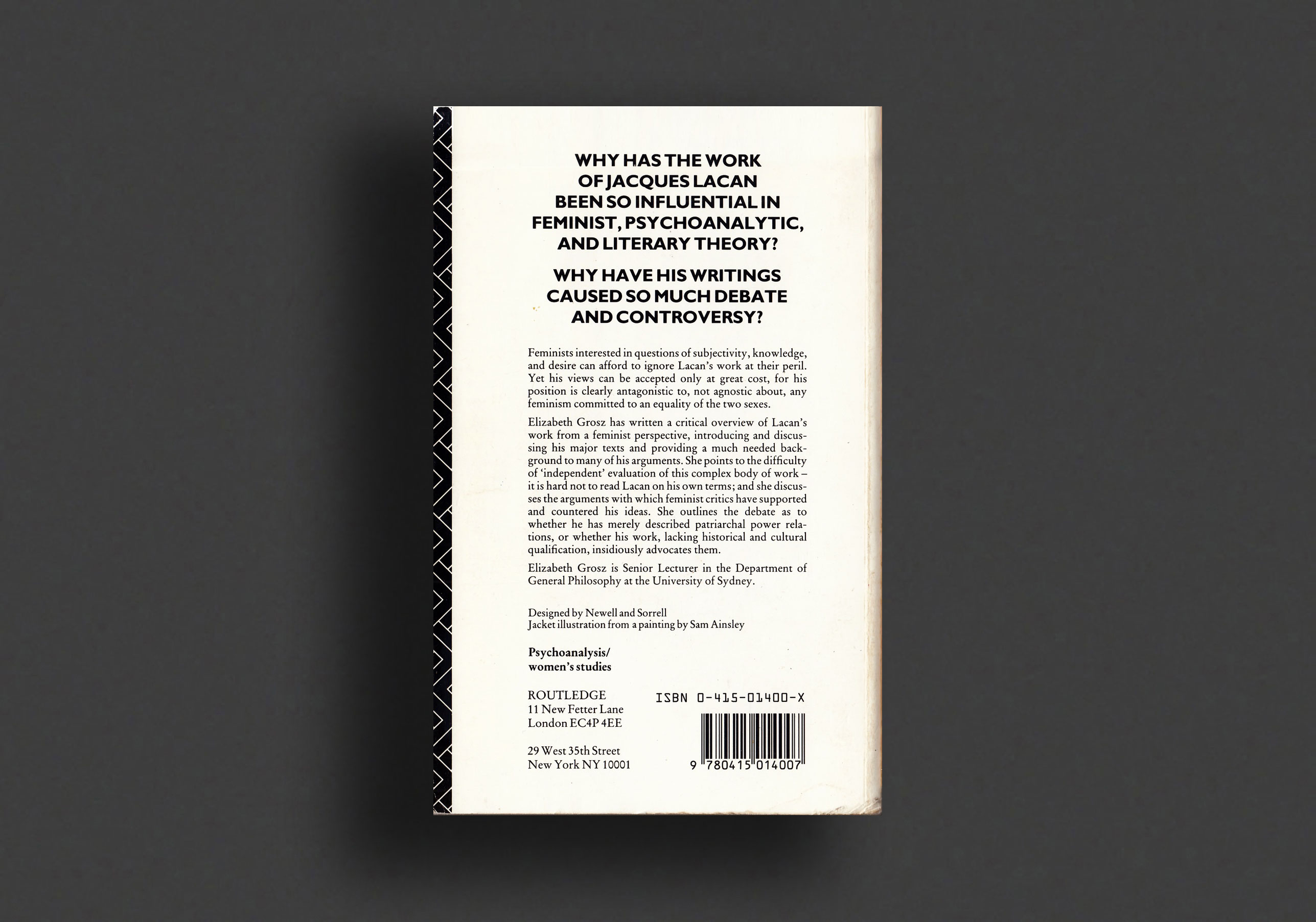
Foucault Said That Power Is Everywhere - But If This Is So Why Don't Women Exercise More Of It?
Why Should Feminists Be Interested In Foucault?
'A fascinating and stimulating read. I particularly liked the fact that the book's agenda is set by feminist questions. I think it fills a real niche in what is currently available on the topic.'—Mary Maynard, Centre for Women's Studies, York University
Questions of sexuality and power were central to the writings of Michel Foucault, yet Foucault largely ignored feminism.
This book considers how seriously feminists should take his challenge by exploring the problems that Foucault raises for feminism, and the implications of the absence of gender in his own work.
Caroline Ramazanoglu is Senior Lecturer in Sociology, Goldsmiths' College, University of London.
Cover drawing: Erich Heckel, 'Girl Reading', MOMA, New York Cover design: Phil Bicker Gender studies/Sociology
VG copy.
2025, English
Hardcover (clothbound), 124 pages, 23 x 23 cm
Published by
Drill Hall Gallery / Canberra
$45.00 - In stock -
This title brings the collection of Canberra couple Susan Taylor and Peter Jones into focus on the advent of its 25th anniversary. Seeded from an initial interest in mid-century modern design and early twentieth century avant-gardes, the collection blossomed into an embrace of non-objective and abstract art. Artists featured include General Idea, Maria Kozic, Peter Maloneyi, Elizabeth Newman, John Nixon, Robert Rooney, Janet Burchill, Jennifer McCamley and many more.It has grown to revel in the intersections between conceptual art, geometric abstraction, seriality, non-objective painting, photography, contemporary jewellery and poetics to develop conjunctions across time, place and materiality.
The publication accompanies the exhibition curated by Peter Jones at the Drill Hall Gallery, Australian National University, 19 April – 15 June 2025.
Eye to Eye delves into several of the collection’s multi-faceted and revelatory cross-sections. In his essay Peter Jones explores how the couple’s interests have been refined and extended by the art they love and the people that surround that art. In an interview with Drill Hall Gallery director Tony Oates, Susan Taylor discusses the correlations between sustainable fashion and conceptual art with a focus on jewellery. National Gallery of Australia’s curator of photography, Shaune Lakin, traces developments in local conceptual photography from the 1960s as they play out across the Taylor Jones collection. Acclaimed writer Quentin Sprague offers illuminating insight into the work of Robert Rooney and John Nixon, two stalwarts in the Taylor Jones collection. The publication touches on a vast array of local and international art historically significant developments, revealing the power of the private collection to expose perspectives that may go unnoticed in larger, public collections.
1988, English
Hardcover, 282 pages, 22 x 14.5 cm
1st Edition, Out of print title / used / very good
Published by
Cambridge University Press / Cambridge
$45.00 - In stock -
Very rare first hardcover edition of Anna K. Kuhn's book-length chronological study in English of Christa Wolf's works, published by Cambridge in 1988. It traces the development and continuity of the writer's major themes and concerns against the backdrop of her constantly evolving relationship to Marxism, and documents the rise of her feminist consciousness. It does not, however, focus only on political and feminist issues, but addresses all facets of Wolf's identity by showing how her works reflect her own self-understanding. Forced by the clash between her vision of a humane socialism and the practice of socialism she observed in the German Democratic Republic to reassess her role as a writer and critic, Wolf broke through to her unique style in The Quest for Christa T., a work initially repudiated in the GDR both for its unorthodox subject matter and for its unconventional form. Since then, Wolf has effectively challenged the restrictions placed on writers in the GDR by writing on topics such as the Nazi past (Patterns of Childhood), Romanticism (No Place on Earth), patriarchal attitudes in the GDR (Cassandra) and the Chernobyl nuclear disaster (Storfall)."
Anna K. Kuhn's research interests include women's literature, feminist theory, film studies and German cultural studies.
VG copy w/o dust jacket. Note: not the 2009 re-issue often listed as a 1988 edition.
1977, English
Softcover, 222 pages, 19 x 11.5 cm
1st Edition, Out of print title / used / good
Published by
Seven Seas Books / Berlin
$45.00 - In stock -
Rare first 1977 English edition of this collection of important essays by German novelist and essayist Christa Wolf (1929—2011) first published in German in 1973. Translated here by Joan Becker.
"The Reader and the Writer consists of a number of essays and prose pieces by a leading writer of the German Democratic Republic and a concluding portrait of the author by biogeneticist, Hans Stubbe. "Writing," says Christa Wolf in the title essay, "is only one operation in a more complex process to which we give the splendid name of living." Her concern for literature's function within the context of life is a theme that runs through all her pieces. Whether she is describing the simple heroism of people she has encountered or reminiscences of a darker past or a visit to a biogeneticist at his research center her sense of vitality, honest quest for answers and warmth of personality are always present. Essays on other writers include those on Bertolt Brecht, Vera Inber, Ingeborg Bachmann, Fred Wander and Anna Seghers who come alive first as people and as writers whose works express the profound commitment of their lives. Another is a sketch that recalls a date in 1948 when she read her first Marxist book, Engels on Feuerbach, in which she underlined: "In the place of moribund reality comes a new viable reality. That was the process which was to fill my life..."—publisher's blurb
Christa Wolf (1929—2011) was German novelist and essayist. She is considered one of the most important writers to emerge from the former East Germany. Wolf was a German writer of rare purity and sensitivity who grew up under nazism and became an adult under communism. Her work records the impact of these ideologies on individual lives. She was, as one critic put it, "a writer of scrupulous 'touchstone' honesty", and it is the pursuit and uncovering of truth, under the most beleaguered circumstances, that defines her.
Good—VG copy. Clear laminate peeling with age at cover edges, repaired by some pieces of tape, cover in tact with only light edge wear. Binding and interior VG throughout., a well preserved copy.
1990, English
Softcover, 144 pages, 20.5 x 14 cm
1st Edition, Out of print title / used / very good
Published by
City Lights Books / San Francisco
$40.00 - Out of stock
First 1990 edition of Shock Treatment, the collection of Karen Finley’s most provocative and acclaimed performance monologues, essays, and poems, with “The Constant State of Desire,” “We Keep Our Victims Ready,” “It's Only Art,” and “The Black Sheep.” Excoriating misogyny, homophobia, abusive families, greed, and state coercion of bodies and minds, Finley holds out hope for a world informed not by hate and fear, but by truth and unconditional love.
“If you haven’t read this book yet–buy it, take it home, and read it now! This is the work that made me get off my ass and actually do something, and it will inspire you, too.”–Kathleen Hanna, singer, Bikini Kill, Le Tigre and The Julie Ruin
“Finley’s Shock Treatment is more than just ‘art.’ It remains a searing and necessary indictment of America, a call to arms, a great protest against the injustices waged on queers and women during a time in recent American history where government intervention and recognition was so desperately needed. Twenty-five years on, Finley’s work continues to shock and provoke readers and audiences, demonstrating the powerful cultural and political impact her work has had on modern American art and performance art.”–Nathan Smith, Los Angeles Review of Books
No other artist captures the drama and fragility of the AIDS era as Karen Finley does in her 1990 classic book Shock Treatment. “The Black Sheep,” “We Keep Our Victims Ready,” “I Was Never Expected to Be Talented,”–these are some of the seminal works which excoriated homophobia and misogyny at a time when artists and writers were under attack for challenging the status quo. This twenty-fifth anniversary expanded edition features a new introduction in which Finley reflects on publishing her first book as she became internationally known for being denied an NEA grant because of perceived obscenity in her work. She traces her journey from art school to burlesque gigs to the San Francisco North Beach literary scene. A new poem reminds us of Finley’s disarming ability to respond to the era’s most challenging issues with grace and humor.
KAREN FINLEY’s raw and transgressive performances have long provoked controversy and debate. Karen Finley (b. 1956) is an American performance artist, musician, poet, and educator. Her raw and transgressive performances have long provoked controversy and debate. Her performance art, recordings, and books are used as forms of activism. Her work frequently uses nudity and profanity.Finley incorporates depictions of sexuality, abuse, and disenfranchisement in her work. She is a professor at the Tisch School of the Arts at New York University.
VG copy.
1975, English
Softcover (staple-bound), 32 pages, 21 x 15 cm
1st Edition, Out of print title / used / very good
Published by
Jill Matthews / Adelaide
$80.00 - In stock -
Exceptionally rare independent publication issued for International Women's Day in 1975, compiled by Australian social and feminist historian Jill Matthews (b. Adelaide 1949) — a crucial, harrowing and inspiring chronology of women's life in Australia since white settlement which expands into texts on Aboriginal Women, The Vote, Work, Education, closing with a directory of Women's Organisations across South Australia.
"In 1974, the United Nations declared that the whole of 1975 would be International Womens Year. This booklet arises from research carried out specifically for Intermational Womens Day—March 8, celebrated in South Australia by a march through the streets of Adelaide and various goings-on at the Festival Centre. The booklet aims to provide some factual information concerning the herstory/history of women in Australia since white settlement and to offer a few interpretations of these facts for discussion"—Jill Matthews
In 1984 Matthew's authored her rewritten PhD thesis as Good and Mad Women: The Historical Construction of Femininity in Twentieth Century Australia, published by Allen & Unwin. In her 1987 review, British historian Catherine Hall considered it to be an "essential starting point for British readers into the rapidly extending world of Australian feminist history".
Very Good copy, well preserved copy with light general wear and a few light drip marks to the cover.
1992, English
Softcover (loose-leaf w. paperclip), unpaginated, 23 x 16 cm
1st Edition, Out of print title / used / very good
Published by
Mercurial Editions
Elwood
$55.00 - In stock -
Rare first edition of Australian text artist and performer Berni Janssen's 1992 work, Mangon, published by Mercurial Editions in Elwood, Melbourne, a private press "specialising in publishing new work which explores, poetic form, imaginal philosophy and psychology and non realist approaches to art and image." Edition of only 250 copies, hand-bound with a single large paper-clip. In 1992, the publication was launched with speaking voice and found object sounds in collaboration with experimental composer Warren Burt.
"One of Australia’s treasures, berni janssen, a pioneering sound poet, is fully focused on the auditory as a means of experiencing the world. The voice of berni is loud and clear. She takes us with her into the auditory world as it is changing and asks us to reconsider "the strange echo chamber we live in."—Dr Ros Bandt, International Environmental Sound Artist
Berni Janssen is a text artist who works with words in all their forms, printed, spoken, performed. She has a collaborative multidisciplinary practice spanning over thirty-five years, working with composers, performers, visual artists and community members to make word inspired art. She is renowned for her evocative and captivating performances. Her publications include Possessives and Plurals (Fillia Press. 1985); Xstatic (Post Neo. 1988); mangon (Mercurial Editions. 1992) and Lake & Vale (PressPress. 2010). Poems have been published in magazines including Cordite, Heat, Meanjin, Overland, Extra and performed on radio and at festivals around the world. She lives in Dja Dja Wurrung Country in the Central Highlands of Victoria.
Good copy with rusted paper-clip, rubbing to frot cover, wear to extremities.
1979, English
Softcover, 152 pages, 20 x 13.5 cm
1st Edition, Out of print title / used / fine
Published by
Chrysalis Books / Los Angeles
$290.00 - In stock -
Rare unread first 1979 edition of Lucy R. Lippard's experimental novel, I See / You Mean.
I See / You Mean is an experimental novel about mirrors, maps, relationships, the ocean, elusive success, and possible happiness. Through a collage of verbal photographs, overheard dialogue, sexual encounters, found material, and self identification devices (astrology, the I Ching, palmistry, Tarot), it charts from past to future the changing currents between two women and two men: a writer, a model/stockbroker/maybe dictator, a photographer, and an actor. A lot happens between the lines. Art critic Lucy Lippard wrote this novel in 1970 and became a feminist in the process: “I started writing and realized I was ashamed to be a woman. Then I had to find out why. Then I got very angry. The fragmented visual form came out of contemporary art and the conflicting emotions of 1960s political confrontation; they suggested a new way to put things back together—an open-ended, female way that didn’t pretend conclusions.”
Lucy R. Lippard is a writer, activist, and curator. She is the author of twenty-five books on contemporary art and cultural criticism and has curated some fifty exhibitions in the United States, Europe, and Latin America.
As New, unread copy of the first 1979 edition.
1981, English
Softcover, 126 pages, 20 x 13 cm
Out of print title / used / very good
Published by
Penguin Books / London
$15.00 - Out of stock
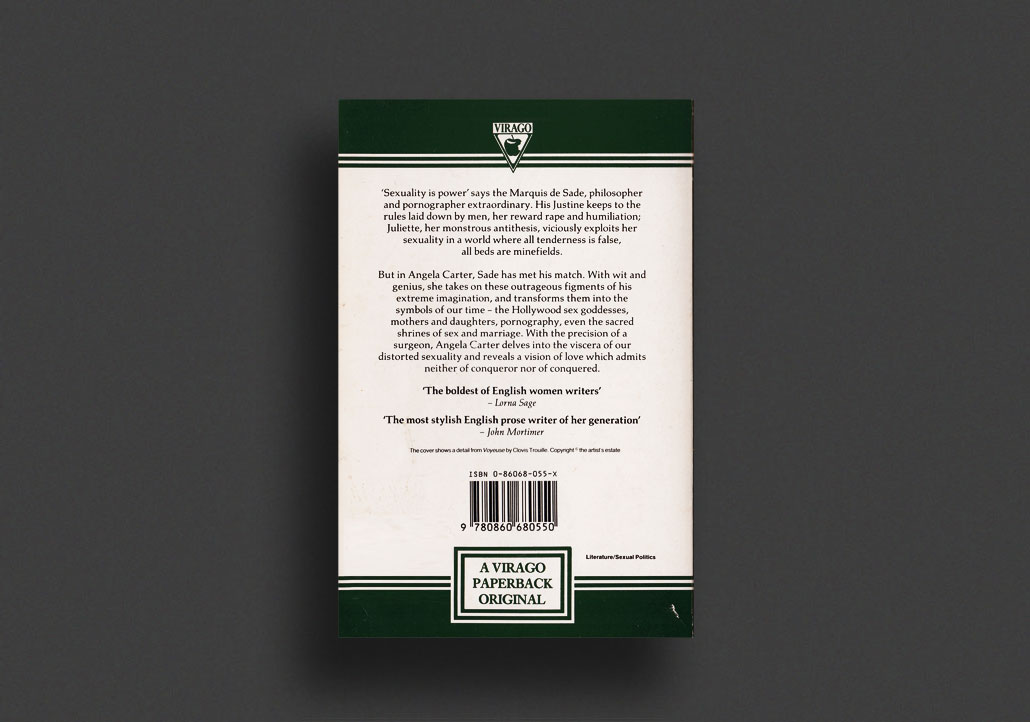
1981 Penguin paperback edition of Angela Carter's 1979 classic The Bloody Chamber, a feminist retelling of favourite fairy tales interwoven by a master of seductive, luminous storytelling.
From the lairs of the fantastical and fabular and from the domains of the unconscious's mysteries...
Lie the brides in the Bloody Chamber — Hunts unwillingly the Queen of the Vampires — Slips Red Riding Hood into the arms of the Wolf — Pimps our Puss-in-Boots for his lustful master...
In tales that glitter and haunt – strange nuggets from a writer whose wayward pen spills forth stylish, erotic, nightmarish jewels of prose – the old fairy stories live and breathe again, subtly altered, subtly changed.
"She writes a prose that lends itself to magnificent set pieces of fastidious sensuality...dreams, myths, fairy tales, metamorphoses, the unruly unconscious, epic journeys and a highly sensual celebration of sexuality in both its most joyous and darkest manifestations"—Ian McEwan, author of The Child in Time
"The boldest of English women writers"—Lorna Sage
"The most stylish English prose writer of her generation"—John Mortimer
Angela Olive Pearce (formerly Carter, 1940—1992), who published under the name Angela Carter, was an English novelist, short story writer, poet, and journalist, known for her feminist, magical realism, and picaresque works. She is mainly known for her book The Bloody Chamber (1979). In 1984, her short story "The Company of Wolves" was adapted into a film of the same name. In 2008, The Times ranked Carter tenth in their list of "The 50 greatest British writers since 1945"
Very Good copy.
2021, English
Softcover (w. dust jacket), 112 pages, 22.23 x 14.61 cm
Published by
Hayward Gallery Publishing / London
$48.00 - Out of stock
The abiding presence of spiritualism in art, from af Klint to Susan Hiller.
Bringing together more than 30 international artists from the late 19th century to the present day, Not without My Ghosts surveys work inspired by spiritualism and its rich cultural history.
With original essays by art historian Susan L. Aberth and curators Simon Grant and Lars Bang Larsen, this publication explores the anti-authoritarian political agendas of 19th-century spiritualism and the movement’s close association to the history of feminism, as well as its continued influence on contemporary practitioners. Spanning diverse artistic approaches, Not without My Ghosts offers a unique insight into the ties that bind spirit and mediumistic art across the centuries.
Artists: William Blake, Cameron, Ann Churchill, Ithell Colquhoun, Louise Despont, Casimiro Domingo, Madame Fondrillon, Chiara Fumai, Madge Gill, Susan Hiller, Barbara Honywood, Georgiana Houghton, Anna Mary Howitt, Victor Hugo, Augustin Lesage, Pia Lindman, Ann Lislegaard, André Masson, Grace Pailthorpe, František Jaroslav Pecka, Olivia Plender, Sigmar Polke, Lea Porsager, Austin Osman Spare, Yves Tanguy, Suzanne Treister with The Museum of Blackhole Spacetime Collective
1999, English
Softcover, 300 pages, 17 x 24 cm
1st Edition, Out of print title / used / very good
Published by
Black Dog Publishing Ltd / London
$220.00 - Out of stock
Scarce first 1999 edition of this definitive resource on the work of COUM Transmissions and Throbbing Gristle.
"These people are the wreckers of civilisation", exclaimed the Conservative Member of Parliament Nicholas Fairbairn in 1976. His outburst was meant to describe four artists and musicians: Genesis P-Orridge, Cosey Fanni Tutti, Peter Christopherson and Chris Carter - members of the seminal band Throbbing Gristle. What "these people" had done to deserve such an epithet, and what they were about to do, is the subject of this book.
Throbbing Gristle are widely lauded as the band that invented industrial music, and their influence can be observed across today's musical landscape: from house and techno to industrial death metal. Wherever experimental electronic music is being made, Throbbing Gristle's influence can be felt.
"Wreckers of Civilisation recalls a time which despite volumes of print remains occluded, obdurate, even intimidating: that moment before the conservative reconstruction. To be awake in London in the late 1970s was to be plunged into turmoil: externally manifest in riot, internally within various forms of damage and depression and, if one felt brave or driven, extreme aesthetics. COUM Transmissions and Throbbing Gristle mark the furthest reach of that impulse: even more so than Punk, they plunged into a technological and personal examination of the dark side - the forbidden, the taboo, the dystopian future on the doorstep. Today this might seem like science fiction or deliberate shock tactics, but then it seemed like reportage, front line dispatches from a convulsed country."
Heavily illustrated and complete with a chronological list of actions, concerts and exhibitions, discography, filmography, bibliography and much more, this heavy volume has become an invaluable and sought after resource on TG, COUM Transmissions, and Industrial Records.
Simon Ford is a freelance writer and art historian. He was previously Research Associate in Craft and Design and Curator of the Design Council Slide Collection at Manchester Metropolitan University, as well as being a curator at the Victoria and Albert Museum. He received his PhD in the History of Art from the Courtauld Institute of Art in 2000. He is the author of Wreckers of Civilisation: The Story of COUM Transmissions and Throbbing Gristle (1999, 2017, Black Dog Publishing). His most recent book is The Situationist International: A User's Guide (2006, Black Dog).
Very Good copy.
1997, English
Softcover, 244 pages, 21.5 x 14 cm
1st Edition, Out of print title / used / good
Published by
Cambridge University Press / Cambridge
$15.00 - In stock -
How do gender and race become objects of intellectual inquiry? What happens to marginal discourses when they participate in the academic processes of scrutiny and evaluation? In Women Intellectuals, Modernism, and Difference, Alice Gambrell examines the careers of a group of women intellectuals - Leonora Carrington, Ella Deloria, H. D., Zora Neale Hurston, and Frida Kahlo - whose scholarly rediscovery coincided with the rise of feminist and minority discourse studies in the academy. She examines the exhibitions, memoirs, poems, ethnographies, and personal correspondences these women produced, combining concrete local observation with contemporary theoretical perspectives on race and gender. Through a mixture of empirical detail and theoretical speculation, Gambrell explores the role these women played in expanding the conception of American literature by their involvement in the Harlem Renaissance. She offers new ways of thinking about the relationships between cultural studies, feminism and minority discourse within the ongoing reassessment of modernism.
Good copy, crease to front top corner, light wear.
1992, English
Softcover, 224 pages, 23 x 15.5 cm
1st Edition, Out of print title / used / very good
Published by
Polity / US
$20.00 - In stock -
This book offers a systematic attempt to explore the point of convergence between feminist theory and the work of Michel Foucault.
Lois McNay is the author of Foucault and Feminism: Power, Gender and the Self, published by Wiley.
'Thought-provoking account.'—Times Higher Education Supplement
'Lois McNay has produced an attractively clear and critical account of how feminists might use Foucault's last works.'—Sociology
'It offers a clearly written and thorough, critical survey of Foucault's last publications. This, in turn, is balanced by a wide-ranging and equally critically review of recent developments within contemporary feminist ethical theory. It is well worth the read!!'—Women's Philosophy Review
'This is an excellent book, lucid, carefully argued, sympathetically critical and a great pleasure to read.'—Jeffrey Weeks, South Bank University
VG copy.
2000, English
Softcover, 228 pages, 178 x 229 cm
1st Edition, Out of print title / used / very good
Published by
October Books / New York
The MIT Press / Massachusetts
$30.00 - Out of stock
Out of print first 2000 softcover edition of Rosalind E. Krauss' Bachelors, published by October / MIT Press.
Since the 1970s Rosalind Krauss has been exploring the art of painters, sculptors, and photographers, examining the intersection of these artists' concerns with the major currents of postwar visual culture. These essays on nine women artists are framed by the question, born of feminism, "What evaluative criteria can be applied to women's art?" In the case of surrealism, in particular, some have claimed that surrealist women artists must either redraw the lines of their practice or participate in the movement's misogyny. Krauss resists that claim, for these "bachelors" are artists whose expressive strategies challenge the very ideals of unity and mastery identified with masculinist aesthetics. Some of this work (such as that of Louise Bourgeois or Cindy Sherman) could be said to find its power in strategies associated with such concepts as écriture feminine. Bachelors attempts to do justice to these and other artists (Claude Cahun, Dora Maar, Louise Lawler, Francesca Woodman) in the terms their works demand.
Rosalind E. Krauss, University Professor at Columbia University and an editor and cofounder of October magazine, is the author of The Originality of the Avant-Garde and Other Modernist Myths (1985), The Optical Unconscious (1993), The Picasso Papers (1999), and Bachelors (1999), all published by the MIT Press, and coauthor (with Yve-Alain Bois) of Formless: A User's Guide (Zone Books, 1997).
"[S]timulating, difficult, and often dazzling...Bachelors is a smart and often profound book that makes avaluable contribution to the gendered field it abhors." Carol Zemel, Women's Review of Books.
Contents: By way of introduction, Claude Cahun and Dora Maar; portrait of the artist as "fillette", Louise Bourgeois; the "cloud", Agnes Martin; contingent, Eva Hesse; untitled, Cindy Sherman; problem sets, Francesca Woodman; bachelors, Sherrie Levine; souvenir memories, Louise Lawler.
VG copy with only a corner bump/bend to the top-right.
1980, English
Softcover (w. insert), 142 pages, 21 x 29 cm
1st Edition, Out of print title / used / very good
Published by
LIP / Melbourne
$50.00 - Out of stock
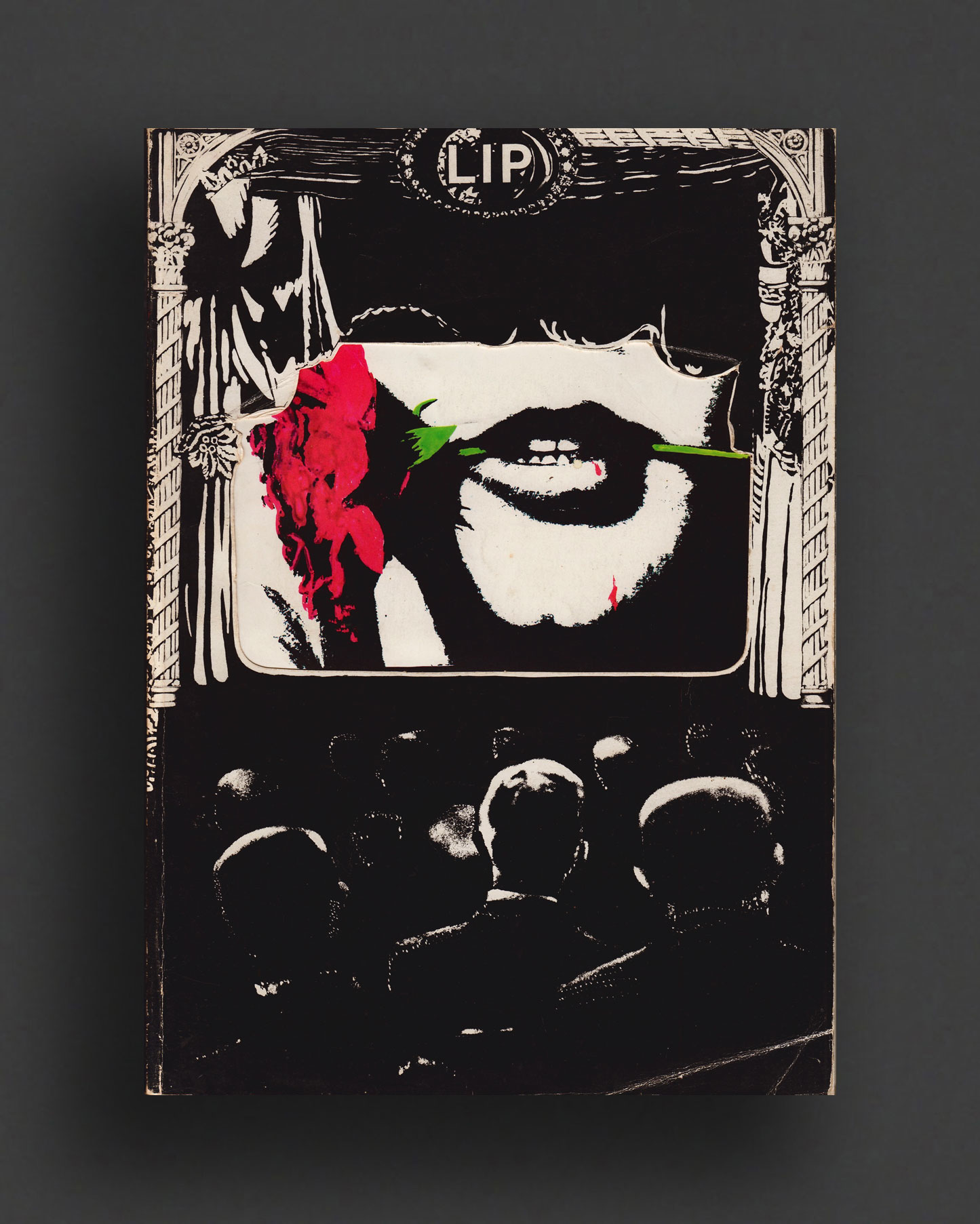
The incredible book-sized 1980 edition of Melbourne's great LIP journal. Published out of Carlton between 1976-1984, LIP encapsulated Australian feminist artistic practice of the period, publishing articles and interviews by women on women in film, sound, theatre, painting, photography, poetry, criticism, activism, journalism, publishing, sculpture, design, education, and much more.
In this issue:
Editorial; MEDIA : Heralding Women : A Visual Essay by Lesley Dumbrell, Freda Freiberg and Elizabeth Gower; The Women At Work Kit - a discussion with Judy Munro, Sylvie Shaw and Ponch Hawkes, by Jeannette Fenelon; Shoulder to Shoulder and Up Hill; The Way by Julie Copeland; The Coming Out Show : Five Years On by Julie Rigg; Nancy Dexter : In Her Own Accent by Elizabeth Owen; Fiona McDougall press photographer; Child's Image, Women's Hands by Barbara Hall; ART : Memories of Grace Crowley by Janine Burke, Ian North, Frank and Margel Hinder; "Mothers' Memories, Others' Memories" by Vivienne Binns; The Dinner Party - Introduction by Isabel Davies; Judy Chicago And The Dinner Party by Ailsa O'Connor; 'The Coming Out Show' discusses 'The Dinner Party'. Transcribed and edited by Isabel Davies; The Adelaide Women's Art Movement by Jane Kent and Anne Marsh; Adelaide Women's Performance Month, November 1979; River Murray Project by Bonita Ely; Joy Hester by Janine Burke; Janet Dawson - Painter, interviewed by Lesley Dumbrell; Monday To Monday by Maxienne Foote; Ethel Carrick (Mrs. E. Phillips Fox) by Margaret Rich; The Male Nude, Margaret Walters interviewed by Julie Copeland; Stella Sallman photographs; Don't Believe I'm An Amazon - Ulrike Rosenbach talking with Elizabeth Gower, Margaret Rose and Janine Burke, transcribed by Margaret Rose; Tertiary Visual Arts Education Study and Report by Alison Fraser; Holos - Whole, Graphos - Picture, The Work Of Margaret Benyon by Catherine Peake; Ceramic Sculpture - Maggie May; Artist-Decorated Trams - Statements by Erica McGilchrist and Mirka Mora on the tram design project, Melbourne and Metropolitan Tramways Board; THEATRE/PERFORMANCE : At Home - A series of Five Solo Performances by Lyndal Jones (1977-80) documentation by Lyndal Jones and Suzanne Spunner; Beyond Glitter - The Role Of The Female Performer as seen by Robyn Archer in "A Star is Tom" by Suzanne Spunner; Wimmin's Circus by Katie Noad; Jeannie Lewis interviewed by Christine Johnston; Failing In Love by Ruth Maddison; By A Bamboo Blind : Jenny Kemp, writer and director of Sheila Alone interviewed by Suzanne Spunner; Brisbane Womens Theatre Group by Barbara Allen; FILM : The Women's Film In The Post-Haskell Era by Freda Freiberg; Making A Career Of Feminism by Suzanne Spurner; How Will We Learn To Remember Tomorrow? 'A Catalogue of Independent Women's Films' reviewed by Barbara Hall; The Problems Of Pluralism : Women's Films And Feminist Films by Kate Legge; Interview With Norma Disher; Margot Nash & Margot Oliver; Roma 'Just An Ordinary Life' by Jan Macdonald
Insert : Crosswords by Elizabeth Gower
Front Cover : Erica Mc Gilchrist
Back Cover : Mirka Mora
Co-ordinator : Elizabeth Gower
LIP Collective members: Annette Blonski, Janine Burke, Isabel Davies, Suzanne Davies, Lesley Dumbrell, Jeannette Fenelon, Freda Freiberg, Elizabeth Gower, Barbara Hall, Christine Johnston, Elizabeth Owen, Cathy Peake, Suzanne Spunner.
VG copy.
1980, English
Softcover (staple/tape bound), 110 pages, 29.5 x 21.5 cm
1st Edition, Out of print title / used / good
Published by
The Anthology Collective—Women's Art Movement / Adelaide
Experimental Art Foundation / Adelaide
$80.00 - Out of stock
“The Anthology Collective was formed towards the end of 1979. We felt that there was a definite need for local women writers to be represented at the 1980 Adelaide Festival of Arts. The coincidence of the opening of the Festival with International Women’s Day has provided us with an ideal opportunity to present South Australia with a collection of the work of the women who live and write here.”
Gorgeous and very rare mimeographed, tape/staple-bound 1980 anthology of writing by South Australian Women compiled by The Anthology Collective (Jenny Boult, Anne Hosking, Morlock, Kate Veitch) with the Women's Liberation Centre, Women's Art Movement, Media Resource Centre, Unemployed Workers Union, Experimental Art Foundation and Yeast, Adelaide.
Good copy with foxing and wear to covers.