World Food Books' programme is largely produced on Kulin Nation land. We acknowledge the Wurundjeri people of the Kulin Nation as the first and continuing custodians of this land, and pay respect to their Elders past, present, and emerging.
World Food Books is an arts and special interests bookshop in Naarm / Melbourne. Founded in 2010, World Food Books is devoted to the presentation of a rotating, hand-selection of international art, design, literary and counterculture publications with an emphasis on the anti-traditional, the experimental, the avant-garde, the heretic, the marginal.
Presenting new titles alongside rare and out-of-print books, catalogues and journals spanning the fields of modern and contemporary art, design, photography, illustration, film, literature, poetry, cultural theory, philosophy, sexuality, popular and underground culture in its many radical forms, World Food Books wishes to encourage adventurous, thoughtful and open-minded reading, looking, writing, and exchange of publishing and ideas, both current and historical.
As well as our bookshop, located in Melbourne's historical Nicholas Building, all of our inventory is available internationally via our online mail-order service.
World Food Books semi-regularly co-ordinates "Occasions", a programme of exhibits and events at the bookshop and in partnership with other hosts (such as museums and art galleries) that develop out of the activities, relationships and content of the bookshop itself.
World Food Books
The Nicholas Building
37 Swanston Street
Room 5, Level 6
Melbourne 3000
Australia
SHOP HOURS:
THU–SAT 12–6
WEB-SHOP OPEN 24/7
World Food Books
Postal Address:
PO Box 435
Flinders Lane
Victoria 8009
Australia
info@worldfoodbooks.com
Art
Theory / Essay
Architecture / Interior
Graphic Design / Typography
Photography
Fashion
Eros
LGBTQ+
Fiction / Poetry
Weird / Speculative / Science Fiction / Horror
Transgressive / Visceral / Abject
Symbolism / Decadence / Fin de siècle
Film / Video
Painting
Sculpture / Installation
Performance / Dance / Theater
Drawing
Sound / Music
Curatorial
Group Shows / Collections
Periodicals
Out-of-print / Rare
Posters / Ephemera / Discs
Signed Books
World Food Books Gift Voucher
World Food Book Bag
Australian Art
Australian Fiction
Australian Science Fiction / Speculative Fiction
Australian Poetry
Australian Photography
Japanese Photography
Conceptual Art
Minimal Art
Dada
'Pataphysics / Oulipo
Fluxus
Concrete Poetry
Pop Art
Surrealism
Arte Povera
Arte Informale / Haute Pâte / Tachism
Nouveau Réalisme / Zero / Kinetic
Situationism / Lettrism
Collage / Mail Art / Xerox Art
Art Brut / Folk / Visionary / Fantastic
Illustration / Graphic Art / Bandes Dessinées
Furniture
Italian Radical Design / Postmodernism
Textiles
Ceramics / Glass
Counterculture
Protest / Revolt
Philosophy
Psychoanalysis
Anthropology
Anarchism
Socialism / Anarchism / Communism / Capitalism
Literary Theory / Semiotics / Language
Feminism / Women's Studies
Gender Studies / Sexuality
Anthropology
Fetishism / BDSM
Drugs / Psychedelia
Crime / Violence
Animal Rights / Veganism
Occult / Esoterica
Ecology / Earth / Alternative Living
Whole Earth / Crafts
All prices in AUD (Australian dollars)
Pick-Ups
Pick-up orders can be collected in our bookshop during opening hours after order date. Please collect any Pick-up orders within 2 weeks of ordering as we have limited storage space. Orders will be released back into stock if not collected within this time. No refunds can be made for pick-ups left un-collected. If you cannot make it in to the bookshop in this time-frame, please choose postage option.
Return Policy
All sales are final. We do accept returns (for refund or exchange) for items received in error. All our orders are packed with special care using heavy-duty padding and cardboard book-mailers or bubble mailers (for smaller books), using reinforcement where required. We cannot take responsibility for any lost, stolen or damaged parcels.
Insurance
Should you wish to insure your package, please email us directly after placing your order and we can organise this at a small extra expense. Although all standard/express tracked packages are very safe and dependable, we cannot take responsibility for any lost, stolen or damaged parcels. We recommend insurance on valuable orders.
Interested in selling your old books, catalogues, journals, magazines, comics, fanzines, ephemera? We are always looking for interesting, unusual and out-of-print books to buy. We only buy books in our fields of interest and specialty, and that we feel we can resell.
We base these prices on desirability, market value, in-print prices, condition and our current stock levels. We offer cash, store credit, and can take stock on consignment. All
about 25% of the price we expect to get when we sell them, or 30% in store credit. We base these prices on desirability, market value, in-print prices, condition and our current stock levels.
Sell your books any day of the week. You can drop them off and return later. If you have a lot of books, we can visit your Sydney home.
We buy books that we feel we can resell. We offer about 25 % of the price we expect to get when we sell them, or 30% in store credit. We base these prices on desirability, market value, in-print prices, condition and our current stock levels.
Philadelphia Wireman
03 August - 01 September, 2018
World Food Books is proud to announce our next Occasion, the first presentation of sculptures by Philadelphia Wireman in Australia.
The Philadelphia Wireman sculptures were found abandoned in an alley off Philadelphia’s South Street on trash night in 1982. Their discovery in a rapidly-changing neighbourhood undergoing extensive renovation, compounded with the failure of all attempts to locate the artist, suggests that the works may have been discarded after the maker’s death. Dubbed the "Philadelphia Wireman" during the first exhibition of this work, in 1985, the maker’s name, age, ethnicity, and even gender remain uncertain. The entire collection totals approximately 1200 pieces, all intricately bound together with tightly-wound heavy-gauge wire (along with a few small, abstract marker drawings, reminiscent both of Mark Tobey and J.B. Murry). The dense construction of the work, despite a modest range of scale and materials, is singularly obsessive and disciplined in design: a wire armature or exoskeleton firmly binds a bricolage of found objects including plastic, glass, food packaging, umbrella parts, tape, rubber, batteries, pens, leather, reflectors, nuts and bolts, nails, foil, coins, toys, watches, eyeglasses, tools, and jewellery.
Heavy with associations—anthropomorphic, zoomorphic, and socio-cultural responses to wrapped detritus—the totemic sculptures by Philadelphia Wireman have been discussed in the context of work created to fulfil the shamanistic needs of alternative religions in American culture. Curators, collectors, and critics have variously compared certain pieces to sculpture from Classical antiquity, Native American medicine bundles, African-American memory jugs, and African fetish objects. Reflecting the artist’s prolific and incredibly focused scavenging impulse, and despite—or perhaps enhanced by—their anonymity, these enigmatic objects function as urban artefacts and arbiters of power, though their origin and purpose is unknown. Philadelphia Wireman, whatever their identity, possessed an astonishing ability to isolate and communicate the concepts of power and energy through the selection and transformation of ordinary materials. Over the course of the past two decades, this collection has come to be regarded as an important discovery in the field of self-taught art and vernacular art.
Presented in collaboration with Fleisher-Ollman Gallery, Philadelphia, and Robert Heald, Wellington.
Susan Te Kahurangi King
02 February - 10 March, 2018
Susan Te Kahurangi King (24 February 1951 - ) has been a confident and prolific artist since she was a young child, drawing with readily available materials - pencils, ballpoint pens and felt-tip markers, on whatever paper is at hand. Between the ages of four and six Susan slowly ceased verbal communication. Her grandparents William and Myrtle Murphy had developed a special bond with Susan so they took on caring responsibilities for extended periods. Myrtle began informally archiving her work, carefully collecting and storing the drawings and compiling scrapbooks. No drawing was insignificant; every scrap of paper was kept. The King family are now the custodians of a vast collection containing over 7000 individual works, from tiny scraps of paper through to 5 meter long rolls.
The scrapbooks and diaries reveal Myrtle to be a woman of great patience and compassion, seeking to understand a child who was not always behaving as expected. She encouraged Susan to be observant, to explore her environment and absorb all the sights and sounds. Myrtle would show Susan’s drawings to friends and people in her community that she had dealings with, such as shopkeepers and postal workers, but this was not simply a case of a grandmother’s bias. She recognised that Susan had developed a sophisticated and unique visual language and sincerely believed that her art deserved serious attention.
This was an unorthodox attitude for the time. To provide some context, Jean Dubuffet coined the term Art Brut in 1945 to describe work created by self-taught artists – specifically residents of psychiatric institutions and those he considered to be visionaries or eccentrics. In 1972 Roger Cardinal extended this concept by adopting the term Outsider Art to describe work made by non-academically trained artists operating outside of mainstream art networks through choice or circumstance. Susan was born in Te Aroha, New Zealand in 1951, far from the artistic hubs of Paris and London that Dubuffet and Cardinal operated in. That Myrtle fêted Susan as a self-taught artist who deserved to be taken seriously shows how progressive her attitudes were.
Susan’s parents Doug and Dawn were also progressive. Over the years they had consulted numerous health practitioners about Susan’s condition, as the medical establishment could not provide an explanation as to why she had lapsed into silence. Dawn educated herself in the field of homeopathy and went on to treat all twelve of her children using these principles – basing prescriptions on her observations of their physical, mental and emotional state.
Doug was a linguist with an interest in philosophy who devoted what little spare time he had to studying Maori language and culture. To some extent their willingness to explore the fringes of the mainstream made them outsiders too but it was their commitment to living with integrity and their respect for individuality that ensured Susan’s creativity was always encouraged.
Even though Susan’s family supported her artistic pursuits, some staff in schools and hospitals saw it as an impediment to her assimilation into the community and discouraged it in a variety of ways. Her family was not always aware of this and therefore did not fully understand why Susan stopped drawing in the early 1990s. However, rather than dwell on the challenges that Susan faced in pursuit of her artistic practice, they prefer to highlight her achievements. In 2008 Susan began drawing again in earnest, after an almost 20 year interruption, and her work is now shown in galleries around the world.
Susan grew up without television and has been heavily influenced by the comics she read as a child. She is absolutely fearless in the appropriation of recognizable characters, such as Donald Duck and Mickey Mouse, in her work. She twists their limbs, contorts their faces, compresses them together, blends them into complex patterned backgrounds - always imbuing them with an incredible energy. Although Susan often used pop culture characters in her work they are not naive or childlike. These are drawings by a brilliant self-taught artist who has been creating exceptional work for decades without an audience in mind.
Mladen Stilinović
"Various Works 1986 - 1999"
02 February 16 - September 10, 2016
Various works 1986 - 1999, from two houses, from the collections of John Nixon, Sue Cramer, Kerrie Poliness, Peter Haffenden and Phoebe Haffenden.
Including: Geometry of Cakes (various shelves), 1993; Poor People’s Law (black and white plate), 1993; White Absence (glasses, ruler, set square, silver spoon, silver ladel with skin photograph and wooden cubes), 1990-1996; Exploitation of the Dead (grey and red star painting, wooden painting, black spoon with red table, red plate), 1984-1990; Money and Zeros (zero tie, paintings made for friends in Australia (Sue, John, Kerrie), numbers painting), 1991-1992; Words - Slogans (various t-shirts) - “they talk about the death of art...help! someone is trying to kill me”, “my sweet little lamb”, “work is a disease - Karl Marx”; Various artist books, catalogues, monographs, videos; Poster from exhibition Insulting Anarchy; "Circular" Croatian - Australian edition; Artist book by Vlado Martek (Dostoyevsky); more.
Thanks to Mladen Stilinović and Branka Stipančić.
Jonathan Walker
Always Will Need To Wear Winter Shirt Blue + Ochre Small Check Pattern
21 August - 21 September, 2015
Untitled
I am not a great reader of poetry but I always return to the work of Melbourne poet, Vincent Buckley (1925- 1988). Perhaps I find his most tantalising piece to be not a finished poem but a fragment left on a scrap of paper discovered on his desk after the poet’s death.
The poetry gathers like oil
In the word-core, and spreads
It has its music meet,
Its music is in movement.
This fragment is more the shell left behind from a volatile thought than a finished poem. I find the last two lines honest but awkward whereas the first two lines work like an arrow. Most likely he could not find a resolution so it was left. Still, in its present form, it remains an eloquent testimony to the ultimate failure of a medium to express mobile thought and sensation, in Buckley’s case, through verbal language. It’s an important matter because this is something all artists have to deal with regardless of the medium.
I have never written a poem, however, I am forever copying fragments from books on paper scraps in a vain effort to fix certain notions in my head. At first, they function as bookmarks that are sometimes returned to when I open the book. But before long, as they accumulate, they fall out littering the table interspersed with A4 photocopies, bills, books and medications.
To return to Buckley’s fragment, the first two lines very much evoke how I paint nowadays. As you age, detail diminishes and patches of light become more luminous and float. I feel the most honest way of dealing with this is by smearing the oil paint on the canvas with the fingers and working close-up, blind. Only if the patches coalesce into an approaching image can the work gain a life.
-
Jonathan Walker was born in Melbourne, Australia and brought up on a dairy farm in Gippsland. In the 1970’s he studied painting at RMIT and won the Harold Wright Scholarship to the British Museum, London. During the 1980’s he exhibited at Pinacotheca Gallery, Richmond and had work shown at the NGV and Heidi City Art Gallery. Over the same period he designed the cover for the “Epigenesi” LP by Giancarlo Toniutti, Italy and conducted a mail exchange work with Achim Wollscheid, Germany. The work with artists through the post resulted in an article published in the bicentenary issue of Art and Australia 1988. He showed in artist run spaces such as WestSpace in the 90’s and 2000’s, and until 2012, taught painting at Victoria University, which is where we (Colleen Ahern and Lisa Radford) as organisers of the exhibition, among many others, had the privilege of being his student.
Walker’s knowledge was imparted to students through the careful selection of music, literature, and artists found in books that he himself had ordered for the library. Walker’s strategy was the generosity of sharing his vast knowledge with references specific to each student and their context.
Walker’s paintings share a similar focus and intimacy.
This exhibition presents a small selection of recent paintings alongside a publication that includes Walker’s writing. Observational and analytical, Walker’s work is a type of material notation — the time of day, colour and how it is blended, the both specific and fleeting location of a reflection on lino or the question of whether a chair leg should be included in a painting.
Please join us on Friday August 21 between 6-8pm to celebrate the opening of the exhibition.
Curated by Colleen Ahern and Lisa Radford.
B. Wurtz
Curated by Nic Tammens
March 26 - April 4, 2015
B.Wurtz works from a basement studio in his home on Manhattan’s Lower East Side.
This local fact is attested to by the plastic shopping bags and newsprint circulars that appear in his work. As formal objects, they don’t make loud claims about their origins but nonetheless transmit street addresses and places of business from the bottom of this long thin island. Like plenty of artists, Wurtz is affected by what is local and what is consumed. His work is underpinned by this ethic. It often speaks from a neighborhood or reads like the contents of a hamper:
“BLACK PLUMS $1.29 lb.”
“Food Bazaar”
“USDA Whole Pork Shoulder Picnic 99c lb.”
“RITE AID Pharmacy, with us it’s personal.”
“H. Brickman & Sons.”
“Sweet Yams 59c lb."
Most of the work in this exhibition was made while the artist was in residence at Dieu Donne, a workshop dedicated to paper craft in Midtown. Here Wurtz fabricated assemblages with paper and objects that are relatively lightweight, with the intention that they would be easily transportable to Australia. This consideration isn’t absolute in Wurtz’s work, but was prescriptive for making the current exhibition light and cheap. Packed in two boxes, these works were sent from a USPS post office on the Lower East Side and delivered to North Melbourne by Australia Post.
Wurtz appears courtesy of Metro Pictures, New York.
Thanks to Rob Halverson, Joshua Petherick, Sari de Mallory, Matt Hinkley, Helen Johnson, Fayen d'Evie, Ask Kilmartin, Lisa Radon, Ellena Savage, Yale Union, and "Elizabeth".
John Nixon
"Archive"
December 15 - January 20, 2014
The presentation of John Nixon's archive offered a rare showcase of this extensive collection of the artist's own publications, catalogues, posters, ephemera, editions and more, from the mid 1980s onwards, alongside a selection of his artworks.
Organized by John Nixon, Joshua Petherick and Matt Hinkley.
"Habitat"
at Minerva, Sydney (organised by Joshua Petherick and Matt Hinkley)
November 15 - December 20, 2014
Lupo Borgonovo, Janet Burchill & Jennifer McCamley,
Lewis Fidock, HR Giger, Piero Gilardi, Veit Laurent Kurz,
Cinzia Ruggeri, Michael E. Smith, Lucie Stahl, Daniel Weil, Wols
Press Release:
“...It contained seven objects. The slender fluted bone, surely formed for flight, surely from the wing of some large bird. Three archaic circuitboards, faced with mazes of gold. A smooth white sphere of baked clay. An age-blackened fragment of lace. A fingerlength segment of what she assumed was bone from a human wrist, grayish white, inset smoothly with the silicon shaft of a small instrument that must once have ridden flush with the surface of the skin - but the thing’s face was seared and blackened.”
William Gibson, “Count Zero”, 1986
"Autumn Projects Archive"
Curated by Liza Vasiliou
March 6 - March 15, 2014
World Food Books, in conjunction with the Virgin Australia Melbourne Fashion Festival 2014, presented the Autumn Projects archive, consisting of a selection of early examples in Australian fashion with a particular interest in collecting designers and labels from the period beginning in the 1980’s, who significantly influenced the discourse of Australian Fashion.
Curated by Liza Vasiliou, the exhibition provided a unique opportunity to view pieces by designers Anthea Crawford, Barbara Vandenberg, Geoff Liddell and labels CR Australia, Covers, Jag along with early experimental collage pieces by Prue Acton and Sally Browne’s ‘Fragments’ collection, suspended throughout the functioning World Food Books shop in Melbourne.
H.B. Peace
presented by CENTRE FOR STYLE
November 14, 2013
"Hey Blinky, you say chic, I say same"
Anon 2013
H.B. Peace is a clothing collaboration between great friends Blake Barns and Hugh Egan Westland. Their pieces explore the divergences between 'character’ and ‘personality’ in garments....etc
Special Thanks to Joshua Petherick and Matt Hinkley of WFB and Gillian Mears
and a Very Special Thank you to Audrey Thomas Hayes for her shoe collaboration.
Janet Burchill & Jennifer McCamley
"Aesthetic Suicide"
May 10 - June 8, 2013
The first of our occasional exhibitions in the World Food Books office/shop space in Melbourne, "Aesthetic Suicide" presented a body of new and older works together by artists Janet Burchill & Jennifer McCamley, including videos, prints, a wall work, and publications.
During shop open hours videos played every hour, on the hour.
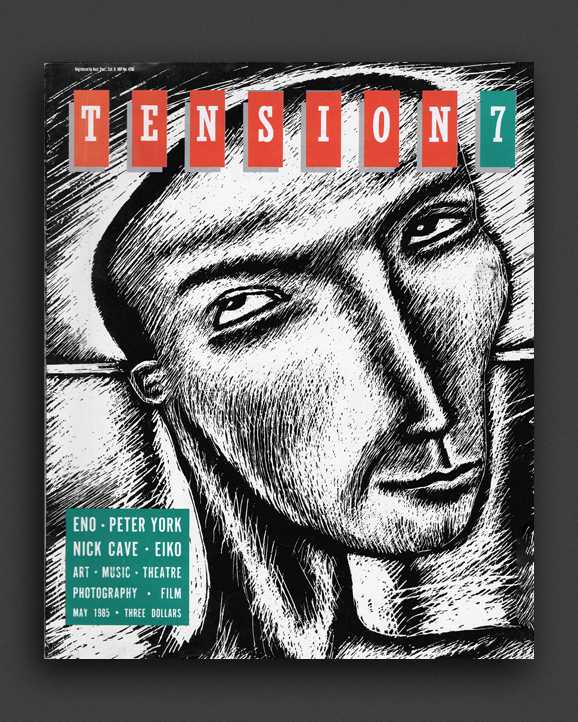
1985, English
Softcover (staple-bound), 32 pages, 27 x 33 cm
1st Edition, Out of print title / used / good
Published by
Tension / South Yarra
$30.00 - Out of stock
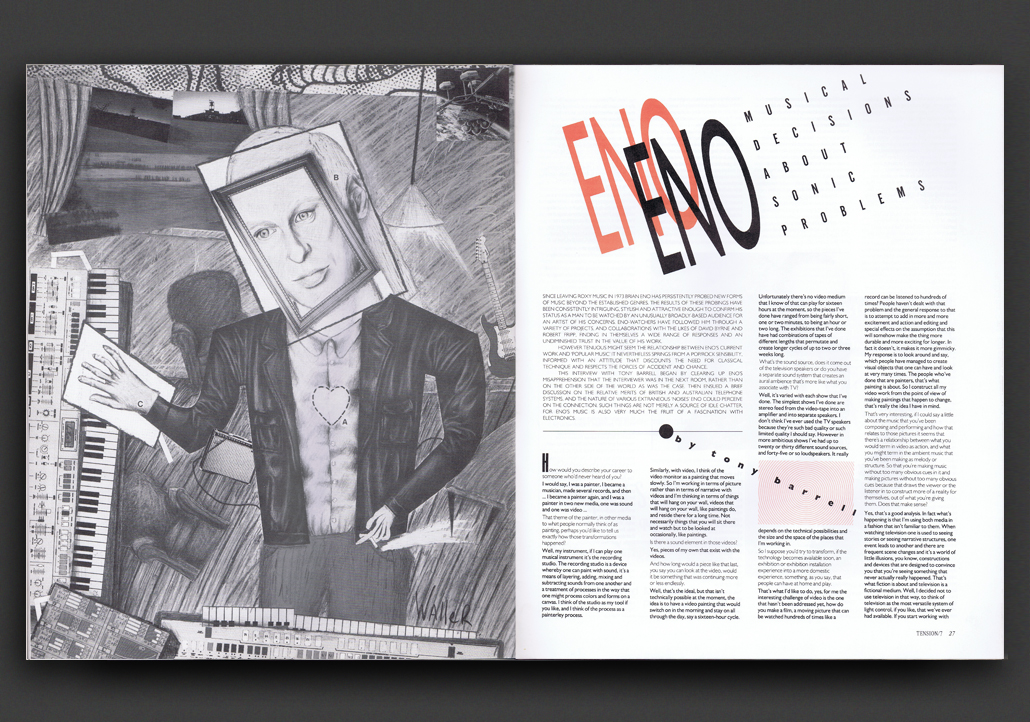
Tension 7 (May 1985) features Brian Eno, Reg Mombassa, Eiko Ishioka, Nick Cave, Brian De Palma, David Puttnam, Peter York, Bashir Baraki's portraits of Peter Booth and Robert Rooney, and more.
TENSION (1983-1990) was one of the central "popular" culture arts periodicals to come out of Melbourne in the 1980s, emerging from the ashes of Virgin Press. Independently published and edited by critic Ashley Crawford, Tension magazine lasted for 25 bi-monthly issues dedicated to Art, Music, Fashion, Theatre, Film, Photography, across reviews, interviews, reports, critical essays and artist pages. Now an important document of culture in Australia, and especially Melbourne in the 1980s, issues featured the writing and contributions of Paul Taylor, McKenzie Wark, Mike Parr, John Nixon, Catharine Lumby, Philip Brophy, Adrian Martin, Ashley Crawford, Peter Tyndall, Jean Baudrillard, Timothy Leary, Gerard Malanga, Keith Haring, Gerald Murnane, and many more. In 1985 Crawford, with John Buckley, staged an exhibition issue of the magazine, 'Visual Tension', at ACCA featuring the work of Howard Arkley, Marianne Baillieu, Peter Booth, Paul Boston, Peter Cripps, Richard Dunn, Maria Kozic, John Lethbridge, Geoff Lowe, Linda Marrinon, John Matthews, John Nixon, Stieg Persson, Robert Rooney, Gareth Sansom, Vivienne Shark LeWitt, Imants Tillers, Peter Tyndall, Jenny Watson, John Young.
1989, English
Softcover (staple-bound), 56 pages, 23.5 x 33.5 cm
1st Edition, Out of print title / used / good
Published by
Tension / South Yarra
$25.00 - Out of stock
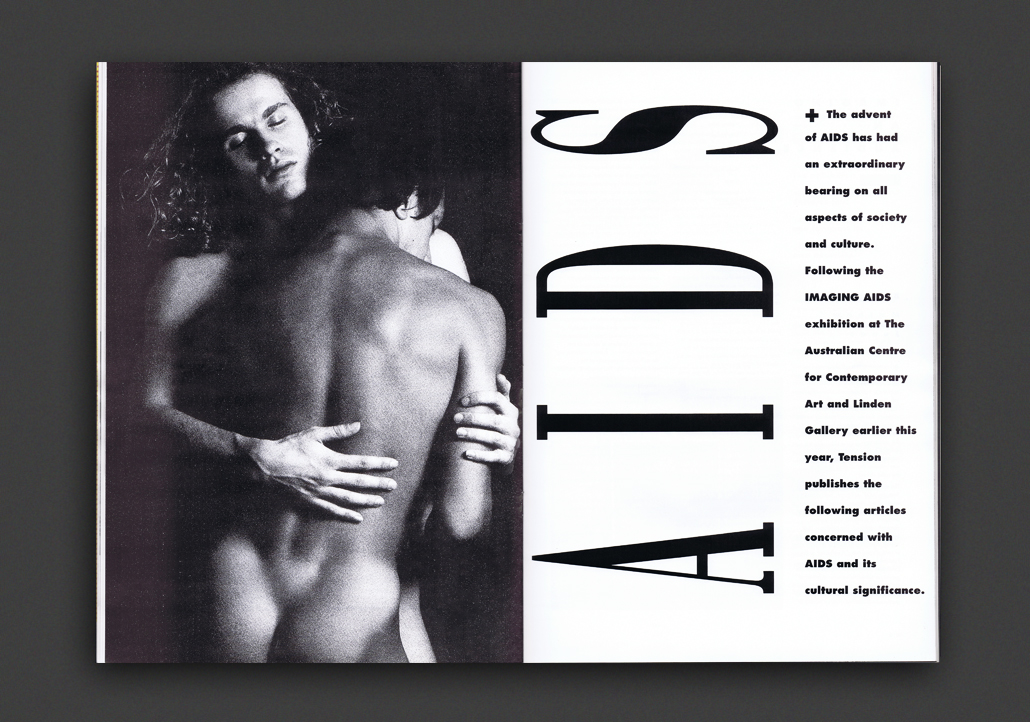
TENSION 16 (Australian and International Arts : May 1989) features articles on Robert Hunter, Lyndal Jones, Malcolm McLaren, Robert Pearce, Andy Warhol, "AIDS, ARTS & SOCIETY", "Trash & Junk Culture" by Adrian Martin w. Philip Brophy, Maria Kozic, Andrew and Ian Haig, "The Liberated Page", "Nightwatch" by Ted Colless, Tim Burns, Angus Jones, Bette Mifsud, and more.
Good copy but cover torn.
TENSION (1983-1990) was one of the central "popular" culture arts periodicals to come out of Melbourne in the 1980s, emerging from the ashes of Virgin Press. Independently published and edited by critic Ashley Crawford, Tension magazine lasted for 25 bi-monthly issues dedicated to Art, Music, Fashion, Theatre, Film, Photography, across reviews, interviews, reports, critical essays and artist pages. Now an important document of culture in Australia, and especially Melbourne in the 1980s, issues featured the writing and contributions of Paul Taylor, McKenzie Wark, Mike Parr, John Nixon, Catharine Lumby, Philip Brophy, Adrian Martin, Ashley Crawford, Peter Tyndall, Jean Baudrillard, Timothy Leary, Gerard Malanga, Keith Haring, Gerald Murnane, and many more. In 1985 Crawford, with John Buckley, staged an exhibition issue of the magazine, 'Visual Tension', at ACCA featuring the work of Howard Arkley, Marianne Baillieu, Peter Booth, Paul Boston, Peter Cripps, Richard Dunn, Maria Kozic, John Lethbridge, Geoff Lowe, Linda Marrinon, John Matthews, John Nixon, Stieg Persson, Robert Rooney, Gareth Sansom, Vivienne Shark LeWitt, Imants Tillers, Peter Tyndall, Jenny Watson, John Young.
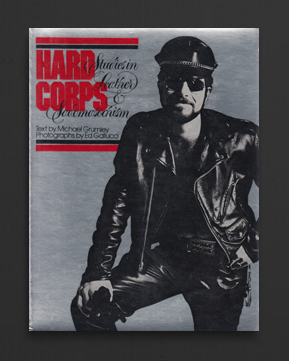
1977, English
Softcover (silver foil cover w. original plastic sleeve), 94 pages, 20.3 x 26.9 cm
1st Edition, Out of print title / used / very good
Published by
E P Dutton / New York
$150.00 - Out of stock
A now sought-after piece of published history, "Hard Corps : Studies in Leather and Sadomasochism", was published in 1977. This famous photographic book takes a personal look inside the world of SM in the 1970s, with thoughtful and revealing texts by Michael Grumley that follow the encounters and stories of SMs many varied practitioners, alongside the photography of Ed Gallucci (who shot for the hugely influential US Rock magazine Crawdaddy!, as well as Rolling Stone, Penthouse, Esquire and Playboy).
First edition copy in it's printed foil cover in plastic sleeve. Very Good copy - light wear to sleeve from age.
2013, English
Hardback, 256 pages, 29 x 25.5cm
1st Edition, Out of print title / as new
Published by
Hardie Grant Books
State Library of Victoria / Melbourne
$60.00 - Out of stock
Now out of print, Decade 1970-1980 highlights Ellis as one of Australia’s most important chroniclers of 1970s Australia. The photographs, predominantly black and white, are drawn from a core selection originally made by Rennie, from his own unpublished book, and supplemented by other significant and iconic images from the Rennie Ellis Photographic Archive and the State Library of Victoria’s collection. Many of the photographs are accompanied by extended captions written by Rennie Ellis and are published for the first time!
A social documenter and flâneur, Ellis used his camera as a passport to navigate new experiences, resulting in a culturally important and vast body of work. Decade explores the cultures and sub-cultures of the seventies: the political upheavals, alternative lifestyles and counter culture, the women’s movement, gay liberation, the new religions and cults, pop festivals, the Vietnam and other protests, massage parlours, the disco scene, the blossoming of Australia’s film industry, the new sexual freedom, Aboriginal rights, street festivals, the new theatre, fashion, drugs and the emergence of a decadent and hedonistic society that would later characterise the Eighties.
Edited by multi-award winning photographer, Stephen Dupont, with essays by Manuela Furci, Director of the Rennie Ellis Photographic Archive, Paul Cox, Film maker and Photographer and Susan Van Wyk, Senior Curator of Photography at the National Gallery of Victoria.
No other photographer has documented Australian society in such depth and with such insight into the human condition as Rennie Ellis. Active from the 1970s until his death in 2003, Rennie Ellis' non-judgmental approach was his 'access-to-all-areas' pass. Ellis used his camera as a key to open the doors to the social arenas of the rich and famous and to enter the underbelly of the nightclubs, bearing witness to the indulgences and excesses. In today's post-Henson era, these captured moments offer an intimate access to an Australia tantalisingly, but sadly, now almost out of reach.
As new copy.
1984, English
Softcover, 342 pages, 270 x 280 cm
1st Edition, Out of print title / used / average
Published by
U.M.I. Research Press / Michigan
$50.00 - Out of stock
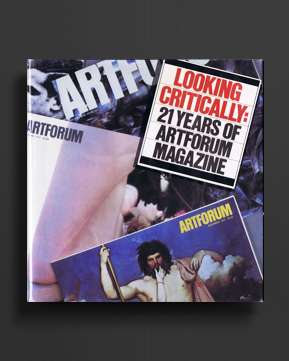
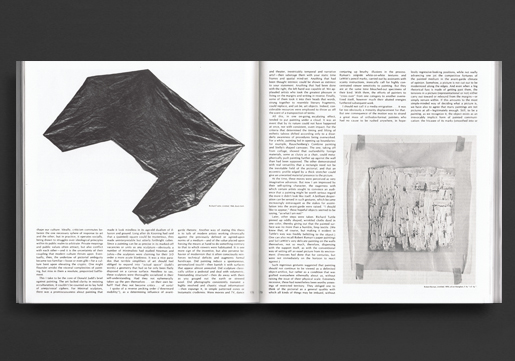
Softcover edition of "LOOKING CRITICALLY: 21 YEARS OF ARTFORUM MAGAZINE", the heavy 342 page volume anthology of the first 21 years of the world's most important modern and art journal. An incredibly valuable collection of art theory.
Edited by Amy Baker Sandback, designed by Roger Gorman and Mary Beath and published in 1984 by U.M.I. Research Press, this dense volume, bound in hardcover to the dimensions of a copy of ARTFORUM, begins with an Ed Kienholz review at the Ferus Gallery from ARTFORUM's June 1962 inaugural issue, and ends with Barbara Kruger reviewing the film "TRON" for the November 1982 issue. An amazing compendium of articles and reviews from the magazine's important first 21 years, featuring contributions by the likes of John Cage, Robert Morris, Kate Steinitz, Henry T. Hopkins, Don Factor, Robert Pincus-Witten, Dennis Adrian, John Coplans, Hilton Kramer, Harold Rosenberg, Henry Geldzahler, John Cage, Walter Hopps, Ed Ruscha, Allan Kaprow, Robert Rosenblum, Dan Flavin, Boris Groys, Sam Wagstaff, Billy Kluver, Lucy R. Lippard, Robert Rosenblum, Roger Shattuck, Ad Reinhardt, Mel Bochner, Andy Warhol, Roy Lichtenstein, Claes Oldenburg, Barbara Rose, Manny Farber, Michael Fried, Robert Morris, Philip Leider, Hollis Frampton, Carl Andre, Richard Serra, Lawrence Alloway, Barbara Kruger, Jane Livingston, Lizzie Borden, Kenneth Baker, Laurie Anderson, Agnes Martin, Cindy Nemser, Sidney Tillim, Annette Michelson, Rosalind Krauss, Jeremy Gilbert-Rolfe, Roberta Smith, Peter Plagens, Peter Schjeldahl, J. Hoberman, Hal Foster, Richard Flood, Carter Ratcliff, Stuart Morgan, Max Kozloff, Donald Kuspit, Dan Graham, Walter De Maria, Komar & Melamid, Edit De Ak, Lawrence Weiner, Kathy Acker, Robert Mapplethorpe, Anselm Kiefer, Thomas McEvilley, Louise Bourgeois, Ingrid Sischy, and too many more to list. Artists featured include: Josef Albers, Richard Tuttle, Jo Baer, Carl Andre, Ant Farm, Hans Arp, Max Bill, Mel Bochner, Alighiero Boetti, Lee Bontecou, Constantin Brancusi, Bertholt Brecht, Richard Avedon, Francis Bacon, Diane Arbus, Michaelangelo Antonioni, Lynda Beglis, Larry Bell, Terry Fox, James Byers, Rober Barry, Marcel Breuer, AA Bronson, Luis Buñel, Daniel Buren, Chris Burden, Joseph Beuys, Anthony Caro, Marcel Broodthaers, John Chamberlain, Paul Cézanne, Marc Chagall, Jean Cocteau, Merce Cunningham, Sonia Delauney, Walter de Maria, Bruce Connor, Jean Dubuffet, Max Ernst, Walker Evans, Dan Flavin, Marcel Duchamp, Albrecht Dürer, Lucio Fontana, Hollis Frampton, Alberto Giacometti, Eva Hesse, Gilbert & George, Philip Glass, John Cage, Nancy Graves, Dan Graham, Robert Grosvenor, Nancy Grossman, Walter Gropius, Hans Haacke, Hairy Who, David Hockney, Douglas Huebler, Jorg Immendorff, Donald Judd, Jasper Johns, Joan Jonas, Allan Kaprow, On Kawara, Ellsworth Kelly, Edward Keinholz, Paul Klee, Alison Knowles, Joseph Kosuth, Brice Marden, Agnes Martin, André Masson, Henri Matisse, Roberto Matta, Sol Lewitt, Roy Lichtenstein, Barbara Kruger, Jannis Kounellis, Markus Lüpertz, El Lissitzky, Rene Magritte, Robert Mapplethorpe, John McCracken, Mario Merz, Robert Morris, Robert Motherwell, Ree Morton, Louise Nevelson, Barnett Newman, Kenneth Noland, Claes Oldenburg, Eduardo Paolozzio, A. R. Penck, Irving Penn, Francis Picabia, Pablo Picasso, Larry Poons, Ken Price, Yvonne Rainer, Robert Rauschenberg, Martial Raysse, Roman Polanski, Jackson Pollock, Steve Reich, Gerrit Rietveld, Alain Robbe-Grillet, Dorothae Rockburne, James Rosenquist, Mark Rothko, Robert Ryman, Lucas Samaras, Kurt Schwitters, Oscar Schlemmer, Richard Serra, Cindy Sherman, David Smith, Robert Smithson, Michael Snow, Robert Venturi, Wolf Vostell, Andy Warhol, Frank Stella, Saul Steinberg, Karlheinz Stockhausen, Bruno Taut, Jean Tinguely, Anne Truitt, Paul Wunderlich, Lawrence Weiner, Louise Bourgeois, Alfred Hitchcock, and so many more.
A Good copy throughout, with cover rubbing and corner bumping. Tightly bound and clean copy internally.
1985, English
Softcover, 96 pages, 30 x 21 cm
1st Edition, Out of print title / used / very good
Published by
Art Gallery of New South Wales / Sydney
$100.00 - Out of stock
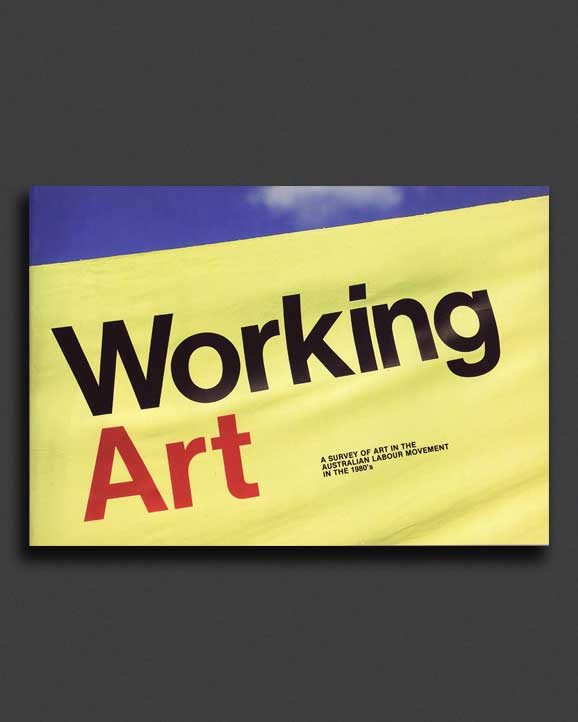
Very scarce catalogue and unique valuable resource published to accompany the exhibition "Working Art: A Survey of Art in The Australian Labour Movement in The 1980's", curated by Australian conceptual artist, curator and writer Ian Burn for the Art Gallery of New South Wales in 1985. Designed by Michael Davies of the Art Workers Union (AWU), this heavily illustrated (in colour and black and white) catalogue surveys the Banners, Posters, Graphics, Photographs, and Media of the Australian Labour movement during the 1980's, as well as a detailed "Historical Sketch" written and compiled by Ian Burn and Sandy Kirby that illustrates the rich history of the Arts in Australian unionism and communities. Alongside the many exhibited prints and textiles, there is photo documentation throughout of marches, performances, artist's at work, historical exhibitions, plus reproductions of newsletters, newspapers, cartoons, announcements, along with further accompanying introductory texts and a bibliography.
Includes inserted Trade Union Information Kit "Art and Working Life : The Victorian Trades Hall Council Arts Workshop" booklet that takes an illustrated look at the activities of the VTHC Workshop in the 1980s. A perfect accompaniment to this catalogue. Also, errata slip enclosed from the NSW catalogue.
Ian Burn (1939-1993) was an Australian conceptual artist, curator and writer who spent the first part of his career working in London and New York. It was here that he began working with Art & Language, a collaborative group who produced the publication Art-Language and whose members included artists Roger Cutforth, Joseph Kosuth and Mel Ramsden. Returning to Australia in 1977 Burn became involved in the Art Workers Union (AWU), a political and social platform that championed artists’ rights and helped change the landscape and expectations under which artists worked in Australia. From 1980 onwards, together with artist and social activist Ian Millis, he worked on a number of initiatives to further the cause of the labour movement, including Union Media Services and the Art and Working Life program. Burn died by accidental drowning in 1993.
A great copy of an important resource on Australia's cultural, industrial and political history, and also an important publication by Ian Burn.
Light general reading/handling creasing to oblong pages, otherwise tight and clean throughout. Previous owner's name penned to title page.
2016, English
Hardcover (w. dust jacket), 304 pages, 29 x 24.5 cm
Published by
Art Yard / London
$110.00 - Out of stock
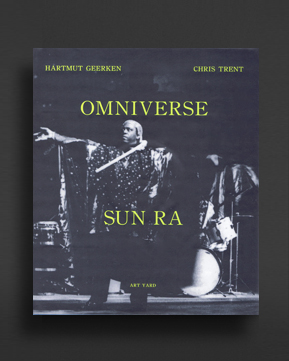
Revised and expanded second edition of Hartmut Geerken and Chris Trent’s comprehensive reference "Omniverse Sun Ra", originally published in 1994.
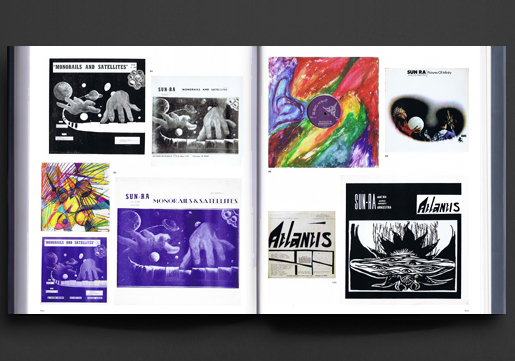
Omniverse Sun Ra features many previously unpublished photographs of Sun Ra and His Arkestra in New York in 1966 and Germany in 1979 by Val Wilmer, and Hartmut Geerken’s previously unpublished photographs from Heliopolis in Cairo, Egypt, in 1971, in addition to an updated comprehensive pictorial and annotated discography by Chris Trent, including chronological discography and alphabetical record title, composition, personnel, and record label indexes, as well as indexes of shellac 78RPM records, 45 RPM singles, jackets, and labels.
Also includes essays and photo documents by Hartmut Geerken, Chris Trent, Amiri Baraka, Robert L. Campbell, Chris Cutler, Gabi Geist, Sigrid Hauff, Karl Heinz Kessler, Robert Lax, and Salah Ragab.
2015, English
Softcover (w. printed plastic jacket), 464 pages, 18.5 x 24 cm
Out of print title / as new
Published by
Spector Books / Leipzig
$90.00 - Out of stock
Out-of-print English edition.
The interdisciplinary and experimental educational ideas espoused by Black Mountain College (BMC), founded in North Carolina in 1933, made it one of the most innovative schools in the first half of the twentieth century. Visual arts, economics, physics, dance, architecture, and music were all taught here on an equal footing, and teachers and students lived together in a democratically organized community. The first rector of the school was John Andrew Rice, and Josef Albers, John Cage, Walter Gropius, and Buckminster Fuller were among the many adepts to give courses here. In consequence, BMC witnessed the development of a range of avant-garde concepts. This richly illustrated book appeared in conjunction with a Black Mountain exhibition ( 5 June – 27 September 2015, Nationalgalerie im Hamburger Bahnhof – Museum für Gegenwart – Berlin). It is the first comprehensive publication on BMC in the German-speaking world and traces the key moments in the history of this legendary school.
1972, English
Softcover (die-cut), 48 pages, 21 x 19.5 cm
1st Edition, Out of print title / used / good
Published by
Alister Taylor / Wellington
$90.00 - Out of stock
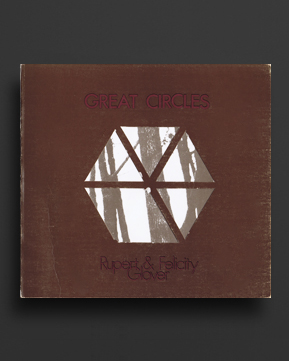
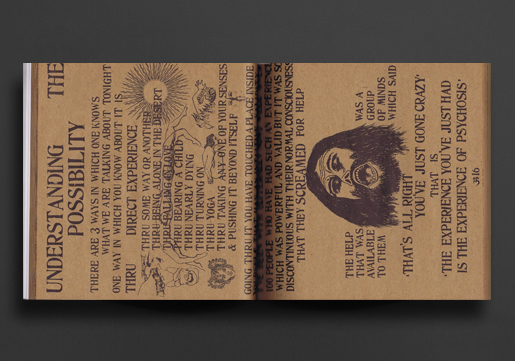
Published in 1972 by Alister Taylor, Wellington, New Zealand, "Great Circles, or How to Build Your Own Dome Home" is one of the finest, and scarcest, books published on building a geodesic dome house.
Written by Rupert and Felicity Glover, this heavily visual volume (wonderfully photographed and complete with templates) traces, step-by-step, their personal process in building a geodesic dome house to counter the burdens building and property regulations were imposing on New Zealand residents (and residents all over the world to this day).
"[...] This is a book which tells you how to beat them at their own game by building the most efficient structure, in terms of a space-materials ratio, yet discovered. In short, this is a housing plan for the alternative society. In it we describe for you a geodesic dome we built ourselves in the summer of 1971-72. It took us six weeks, it cost us about $1500, and it's beautiful. You could build it faster, for at no time did we have more than two people working on it, and you could build it cheaper, by using demolition materials and having your own workshop. But the main thing is that you can build it and they don't make a cent out of it. This is a chance to use the ingenuity which keeps the alternative society going. If they have rules, break them only as a last resort. It is much better to find ways of making them inappropriate or irrelevant. By building a dome you can do just this. This book gives you simple but full instructions for making a geodesic dome. The dome was invented by the visionary genius, R. Buckminster Fuller, who refers to this planet as "Spaceship Earth", and remarks that it didn't come with an instruction book. We have used some of Fuller's ideas, some from other people, and some of our own. We expect you to do the same, because this book makes no rules. It tells how to do something that we have done, but it certainly does not say you must do it the way we did. If someone doesn't improve at least some of our methods, we shall be disappointed. We have deliberately kept the book simple, thinking that bullshit would be a hindrance rather than a help, but we have included one chapter on the mathematics of the geodesic dome for those of you who want to upset our ideas completely but don't own a computer. [...]"
First and only edition.
1978, English
Softcover, 380 pages, 20.3 x 20.1cm
Out of print title / used / fine
Published by
Hanuman Foundation / New Mexico
$25.00 - Out of stock
“We’re talking about metamorphosis
We’re talking about going from a caterpillar to a butterfly
We’re talking about how to become a butterfly.”
"In March 1961, Professor Richard Alpert – later renamed Ram Dass – held appointments in four departments at Harvard University. He published books, drove a Mercedes and regularly vacationed in the Caribbean. By most societal standards, he had achieved great success... And yet he couldn’t escape the feeling that something was missing.
Psilocybin and LSD changed that. During a period of experimentation, Alpert peeled away each layer of his identity, disassociating from himself as a professor, a social cosmopolite, and lastly, as a physical being. Fear turned into exaltation upon the realization that at his truest, he was just his inner-self: a luminous being that he could trust indefinitely and love infinitely.
And thus, a spiritual journey commenced. Alpert headed to India where his guru renamed him Baba Ram Dass – “servant of God.” He was introduced to mindful breathing exercises, hatha yoga, and Eastern philosophy. If he found himself reminiscing or planning, he was reminded to “Be Here Now.” He started upon the path of enlightenment, and has been journeying along it ever since.
Be Here Now is a vehicle for sharing the true message, and a guide to self-determination.
With over 150 pages of metaphysical illustrations, practical advice on how to implement a yogic regiment, and a chapter dedicated to quotes and book recommendations, Be Here Now is sure to enrich your emotional, physical, and spiritual life."
'Because we are all interrelated, what affects another person affects you.'
1978 edition.
2017, English
Softcover, 160 pages, 10.5 x 15 cm
Published by
Spector Books / Leipzig
$28.00 - Out of stock
A visionary assemblage of historical, present-day and speculative material on space colonies, inspired by the culture of the Whole Earth Catalog.
At the beginning of the 1970s, American physicist Gerard K. O'Neill developed the first ideas for colonizing space. Shortly thereafter, Stewart Brand, cyber-communard and editor of the Whole Earth Catalog, took up these ideas and published the book Space Colonies in 1977. Space Colonies, an edition of Brand's CoEvolution Quarterly, funded by the proceeds of the Whole Earth Catalog, took up the question of whether space might be colonized by the year 2000. Artist Fabian Reimann takes up Brand and O'Neill's particular strain of techno-utopianism in Space Colonies: A Galactic Freeman's Journal. In his photo-essay Reimann assembles historical, present-day and speculative material, combining these with fictional and factual stories to create a composite of different images of the world. With global ecological disaster an even more pressing issue than it was in 1977, and the colonization of space still touted by some as a last-ditch resort, Reimann looks back at the dreams and nightmares of the 1970s with a sophisticated visual humor. Fabian Reimann (born 1975) is an artist working in Leipzig and, since 2004, the editor of the "ego-zine" Freeman's Journal. His Another Earth Catalog, which refers back to Stewart Brand's Whole Earth Catalog, was published by Spector Books in 2012. Reimann works with sculpture, photography, collage, painting and text in extended research projects that blend history and science, and fact and fiction
2017, English
Softcover (ring-bound), 368 pages, 24 x 33 cm
1st Ed.,
Published by
Spector Books / Leipzig
$86.00 - Out of stock
The mid-1960s witnessed a boom in underground and self-published works in West Germany. Hectographs, mimeographs and offset printing not only allowed for the production of small, low-cost print runs, but also promoted a unique aesthetic. Using wild mock-ups, these messianic amateurs combined typescript aesthetics, handwriting, scribbled drawings, assemblages of collaged visuals, porn photos, snapshots and comic strips, forging a new, wildly free, sensibility in the process. This book is the first to present the underground and self-published works that came out of West Germany in such depth, while also showing the international context in which they emerged – not as an anecdotal history but as an attempt to tap into the aesthetic cosmos of the Do-It-Yourself rebellion. Insomuch, Under the Radar also challenges us to take a new look at the current boom in independent publishing, the risograph aesthetic and more.
An incredible collection and valuable volume for anyone interested in underground publishing history!
1972, Japanese
Softcover (w. dust jacket), 207 pages, 27.7 x 21.6 cm
Published by
Soshisha / Japan
$35.00 - Out of stock
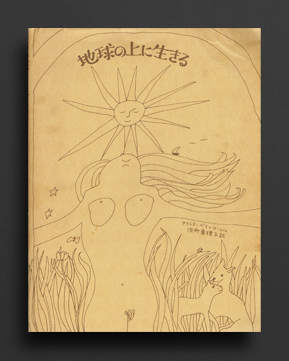
The first Japanese edition of "Living on The Earth", published in 1972. All texts in Japanese.
The title page reads "Celebrations, storm warnings, formulas, recipes, rumors, and country dances harvested by Alicia Bay Laurel."
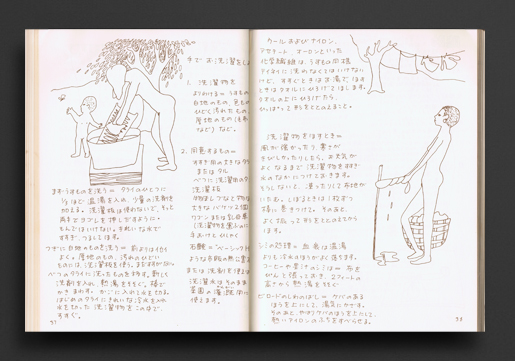
Originally published in Berkeley, California in 1970, more than thirty years ago, the seminal "Living on the Earth" is for people who would rather chop wood for fire than work behind a desk to pay the electric company. It's for people who want the best recipe for lavender soap or huckleberry jam. It's for people who want to make their own clothing, play guitar, learn woodcarving, gardening, canning and drying food, and natural first aid methods. The book has no chapters; no rigid structures or rules. It grew naturally out of the lessons the author has learned, and which she shares. Living on the Earth is a beautiful book to see and read, as well as a spiritually uplifting work whose simplicity radiates warmth and promotes serenity and goodwill to all those who encounter it. The large format paperback is entirely written in Alicia's cursive script and beautifully illustrated on every page with her line drawings. Alicia's innovative illustration and book design styles have been enthusiastically emulated in dozens of books and greeting cards since it's original publishing, and in 2012 "Living on the Earth" was chosen as one of the 101 most influential American cookbooks of the 20th century. Alicia was just 20 years old when the book was first published, and it would go on to become a New York Times "best-seller" and one of the most influential manuals for natural, conscious living ever created.
1981, English
Softcover (staple-bound), 38 pages, 15 x 21 cm
1st Edition, Out of print title / Used*,
Published by
Brickburner Press / Queensland
$20.00 - Out of stock
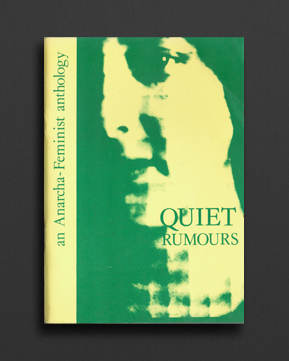
Three important essays from Anarchist-Feminists theorists/writers Peggy Kornegger, Zero Collective, and Kytha Kurin, dating 1975-1980, published in 1981 by Backburner Press in Australia.
Originally appearing in the Anarchist journals Second Wave, Zero and Open Road, this publication contains "Anarchism: The Feminist Connection" by Peggy Kornegger, "Anarchism/Feminism" by Zero Collective, and "Anarcha-Feminism: Why the Hyphen?" by Kytha Kurin.
1980, English
Softcover (staple-bound), 72 pages, 15 x 21 cm
1st Edition, Out of print title / Used*,
Published by
Dark Star / London
$35.00 - Out of stock
Feminist anthology 4 QUIET RUMOURS brings together for the first time some of the key writings by anarcha-feminists from the early ’70’s. Originally only available as individual pamphlets, so popular they were continually re-printed, demand now justifies the appearance of this anthology. The various writers illustrate the clear parallels existing between feminist practice ― non-hierarchical, anti- authoritarian and de-centralist ― and the theories of anarchism. These timeless concerns are posed against the rigid dogmas and patriarchal states of our modern world. The re-issue of these essays will undoubtably provoke thought and debate - as they have done ever since their first appearance.
Texts by Black Rose Anarcho-Feminists, Lynne Farrow, Peggy Kornegger, Marian Leighton, Voltairine de Cleyre, Carol Ehrlich.
1980, English
Softcover (staple-bound), 34 pages, 15 x 21 cm
1st Edition, Out of print title / Used*,
Published by
Brickburner Press / Queensland
$20.00 - Out of stock
"This introduction to anarchism was first published in June 1969 as the hundredth issue of the monthly magazine Anarchy, and was immediately reprinted as a separate pamphlet. It was reprinted again in 1971, and it has also been translated into Danish, Dutch, French, German, Greek, Italian (twice), Japanese, Spanish (twice), and Yiddish (in Argentina). This new edition is unchanged except for the addition of this paragraph, of a new penultimate paragraph in the section on “The individual and society”, and of a new postscript at the end." - Brickburner Press, January 1977
1980 Australian reprint of Nicolas Walter's seminal essay "About Anarchism". Nicolas Hardy Walter was a British anarchist and atheist writer, speaker and activist. He was a member of the Committee of 100 and Spies for Peace, and wrote on topics of anarchism and humanism.
Contents: WHAT ANARCHISTS BELIEVE; HOW ANARCHISTS DIFFER; WHAT ANARCHISTS WANT; WHAT ANARCHISTS DO
1996, English
Softcover (staple-bound), 18 pages, 15 x 21 cm
1st Edition, Out of print title / Used*,
Published by
Free Labour / Brunswick
$15.00 - Out of stock
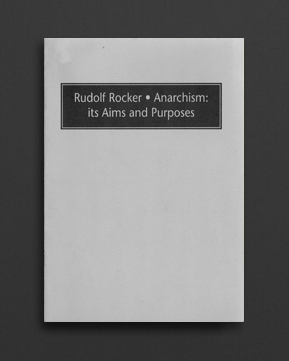
"I am an Anarchist not because I believe Anarchism is the final goal, but because there is no such thing as a final goal." - Rudolf Rocker
"Rudolf Rocker (1873 - 1958) was a German anarchist who was forced into exile in 1892. He settled in Britain in 1895 and, though himself not Jewish, was active in the Jewish movement until he was interned and later deported during World War 1. He was active back in Germany until the rise of Hitler forced him into exile again, and he spent the rest of his life in the USA. Anarchism: Its Aims and Purposes is the first chapter of Rudolf Rocker's libertarian classic Anarchosyndicalism, originally published in 1938 by Martin Secker and Warbug. Anarchosyndicalism has been reprinted several times since and appears in a revised and abridged version as Anarchism and Anarcho-Syndicalism. An attempt has been made within the text of this pamphlet to soften the gender-specific language, a product, apparently, of pre-feminist times. Where possible, the original text has been left unaltered. Where this has been impossible, substitute ”man," "his" or ”him" for the word appearing in the brackets to return to the original text."
Reprinted in 1996 by Brunswick's Free Labour Press, this
Softcover (staple-bound), 20 pages, 15 x 21 cm
1st Edition, Out of print title / Used*,
Published by
Jura Books / NSW
$15.00 - Out of stock
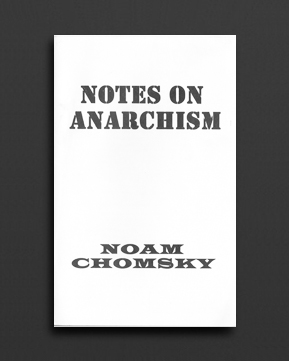
An undated Australian reprint of this seminal essay by American linguist, philosopher, cognitive scientist, historian, social critic, and political activist, Noam Chomsky, first published in the 1973 collection For Reasons Of State. Published by Sydney's Jura Books.
2013, English
Softcover, 304 pages, 24 × 17 cm
Published by
Hyphen Press / London
$55.00 $30.00 - Out of stock
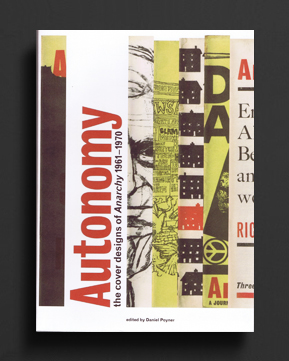
Anarchy was a journal of ideas published in London in the 1960s. Although its contributors were many and diverse, Anarchy was essentially the creation of one person, Colin Ward (1924–2010). With this journal, and throughout his work as a writer, editor, and activist, Ward proposed the idea that anarchist principles of mutual aid and autonomous organization outside a centralized state can be achieved here and now. This book gives attention for the first time to the covers of Anarchy, designed mostly by Rufus Segar. These little-known works provided the enticing entry to the plain text pages of the journal. The book reproduces all of the covers in a sequence that suggests, incidentally, something of the history of graphic design in Britain in those years. And it goes beyond the images, with an array of supporting texts that give a full picture of Anarchy and its context.
Contents
Daniel Poyner, Introduction
The covers of Anarchy
Raphael Samuel, ‘Utopian sociology’
Daniel Poyner, A conversation with Rufus Segar
Richard Hollis, ‘Anarchy and the 1960s’
Robin Kinross, An index to Anarchy
‘Autonomy’ doesn’t try to present Segar as some great innovator of graphic design. He wasn’t one and makes no claim to be. What the book sets out to do, and it succeeds magnificently without visual or verbal hyperbole, is to enrich and add nuance to our understanding of a 1960s graphic landscape we might think we know inside out by acquainting us with unfamiliar work that provided an important forward-thinking publication with its public face. Segar believed in the journal’s cause and 40 years later, he reports, he and his wife Sheila are still anarchists.
Rick Poynor, Creative Review, January 2013
1992, English
Softcover (staple-bound), 48 pages, 22 x 28 cm
1st edition, Out of print title / used*,
Published by
Spartacus Publishers / California
$70.00 - Out of stock
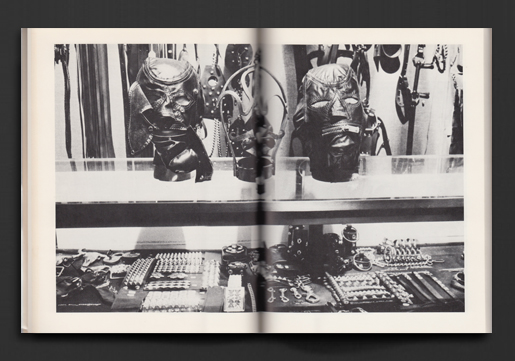
Wonderful, ultra scarce early 1990's fetish catalogue from California's Spartacus production house. "The Most Unique Fetish Catalog In The World", Bizarre #3 : Bondage catalog offers Spartacus' incredible visually-rich (Adults Only) magazine style pages of saturated colours, incredible airbrushed illustrations, and exclusive demonstrative bondage photography of their world-class bondage equipment and devices.
Note: this issue has a few photographs of male and female genitals hand censored (with black marker). Quite likely by the international distributor or Japanese vendor who originally sold this title.
Softcover (staple-bound), 48 pages, 22 x 28 cm
1st edition, Out of print title / used*,
Published by
Spartacus Publishers / California
$70.00 - Out of stock
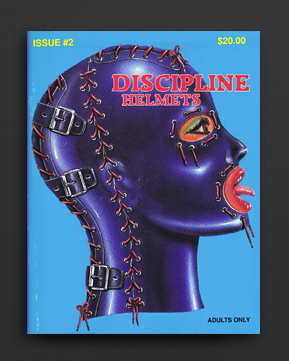
Wonderful, ultra scarce early 1990's fetish catalogue from California's Spartacus production house. Discipline Helmets #2 offers Spartacus' incredible visually-rich (Adults Only) magazine style pages of saturated colours, incredible airbrushed illustrations, and exclusive demonstrative bondage photography of their world-class bondage equipment and devices.
2017, English
Softcover, 72 pages, 9.5 x 14.8 cm
Published by
Moderna Museet / Stockholm
Sternberg Press / Berlin
$15.00 - Out of stock
How did art escape the deadlock of the Situationists’ anti-art refusal? Did the relational artists, with their repetitions of Situationist slogans and techniques, outline a sustainable, micro-political alternative to Guy Debord’s dream of surpassing art and realizing philosophy? Looking back at some of the Situationists’ confrontations with the museum, this book traces a path beyond the tragedy of negativity and the litany of recuperation. At the center is the concept of play; originally adopted as the principle of reconciled life, it returns as the lever of instrumentalization. But in the extraterrestial wasteland of the present, spaces of ludic coexistence and experimentation may remain possible, provided that pessimism can be adequately organized.
part of the All the King’s Horses Series, edited by Daniel Birnbaum and
Kim West
Copublished between Sternberg Press and Moderna Museet, Stockholm
Design by Studio Christopher West
1984, English
Hardcover (w. dust jacket), 342 pages, 270 x 280 cm
1st Edition, Out of print title / Used*,
Published by
U.M.I. Research Press / Michigan
$150.00 - Out of stock
First, hardcover edition of "LOOKING CRITICALLY: 21 YEARS OF ARTFORUM MAGAZINE", the heavy 342 page volume anthology of the first 21 years of the world's most important modern and art journal. An incredibly valuable collection of art theory.
Edited by Amy Baker Sandback, designed by Roger Gorman and Mary Beath and published in 1984 by U.M.I. Research Press, this dense volume, bound in hardcover to the dimensions of a copy of ARTFORUM, begins with an Ed Kienholz review at the Ferus Gallery from ARTFORUM's June 1962 inaugural issue, and ends with Barbara Kruger reviewing the film "TRON" for the November 1982 issue. An amazing compendium of articles and reviews from the magazine's important first 21 years, featuring contributions by the likes of John Cage, Robert Morris, Kate Steinitz, Henry T. Hopkins, Don Factor, Robert Pincus-Witten, Dennis Adrian, John Coplans, Hilton Kramer, Harold Rosenberg, Henry Geldzahler, John Cage, Walter Hopps, Ed Ruscha, Allan Kaprow, Robert Rosenblum, Dan Flavin, Boris Groys, Sam Wagstaff, Billy Kluver, Lucy R. Lippard, Robert Rosenblum, Roger Shattuck, Ad Reinhardt, Mel Bochner, Andy Warhol, Roy Lichtenstein, Claes Oldenburg, Barbara Rose, Manny Farber, Michael Fried, Robert Morris, Philip Leider, Hollis Frampton, Carl Andre, Richard Serra, Lawrence Alloway, Barbara Kruger, Jane Livingston, Lizzie Borden, Kenneth Baker, Laurie Anderson, Agnes Martin, Cindy Nemser, Sidney Tillim, Annette Michelson, Rosalind Krauss, Jeremy Gilbert-Rolfe, Roberta Smith, Peter Plagens, Peter Schjeldahl, J. Hoberman, Hal Foster, Richard Flood, Carter Ratcliff, Stuart Morgan, Max Kozloff, Donald Kuspit, Dan Graham, Walter De Maria, Komar & Melamid, Edit De Ak, Lawrence Weiner, Kathy Acker, Robert Mapplethorpe, Anselm Kiefer, Thomas McEvilley, Louise Bourgeois, Ingrid Sischy, and too many more to list. Artists featured include: Josef Albers, Richard Tuttle, Jo Baer, Carl Andre, Ant Farm, Hans Arp, Max Bill, Mel Bochner, Alighiero Boetti, Lee Bontecou, Constantin Brancusi, Bertholt Brecht, Richard Avedon, Francis Bacon, Diane Arbus, Michaelangelo Antonioni, Lynda Beglis, Larry Bell, Terry Fox, James Byers, Rober Barry, Marcel Breuer, AA Bronson, Luis Buñel, Daniel Buren, Chris Burden, Joseph Beuys, Anthony Caro, Marcel Broodthaers, John Chamberlain, Paul Cézanne, Marc Chagall, Jean Cocteau, Merce Cunningham, Sonia Delauney, Walter de Maria, Bruce Connor, Jean Dubuffet, Max Ernst, Walker Evans, Dan Flavin, Marcel Duchamp, Albrecht Dürer, Lucio Fontana, Hollis Frampton, Alberto Giacometti, Eva Hesse, Gilbert & George, Philip Glass, John Cage, Nancy Graves, Dan Graham, Robert Grosvenor, Nancy Grossman, Walter Gropius, Hans Haacke, Hairy Who, David Hockney, Douglas Huebler, Jorg Immendorff, Donald Judd, Jasper Johns, Joan Jonas, Allan Kaprow, On Kawara, Ellsworth Kelly, Edward Keinholz, Paul Klee, Alison Knowles, Joseph Kosuth, Brice Marden, Agnes Martin, André Masson, Henri Matisse, Roberto Matta, Sol Lewitt, Roy Lichtenstein, Barbara Kruger, Jannis Kounellis, Markus Lüpertz, El Lissitzky, Rene Magritte, Robert Mapplethorpe, John McCracken, Mario Merz, Robert Morris, Robert Motherwell, Ree Morton, Louise Nevelson, Barnett Newman, Kenneth Noland, Claes Oldenburg, Eduardo Paolozzio, A. R. Penck, Irving Penn, Francis Picabia, Pablo Picasso, Larry Poons, Ken Price, Yvonne Rainer, Robert Rauschenberg, Martial Raysse, Roman Polanski, Jackson Pollock, Steve Reich, Gerrit Rietveld, Alain Robbe-Grillet, Dorothae Rockburne, James Rosenquist, Mark Rothko, Robert Ryman, Lucas Samaras, Kurt Schwitters, Oscar Schlemmer, Richard Serra, Cindy Sherman, David Smith, Robert Smithson, Michael Snow, Robert Venturi, Wolf Vostell, Andy Warhol, Frank Stella, Saul Steinberg, Karlheinz Stockhausen, Bruno Taut, Jean Tinguely, Anne Truitt, Paul Wunderlich, Lawrence Weiner, Louise Bourgeois, Alfred Hitchcock, and so many more.
Very uncommon hardcover edition, with dust jacket.
1976, English
Softcover (staple-bound), 60 pages, 21 x 14 cm
Out of print title / Used*,
Published by
Betty Dodson / New York
$70.00 - Out of stock
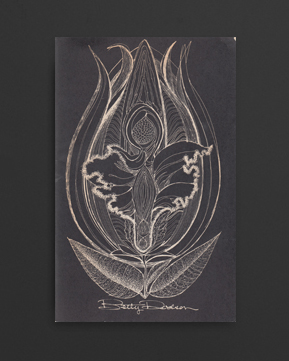
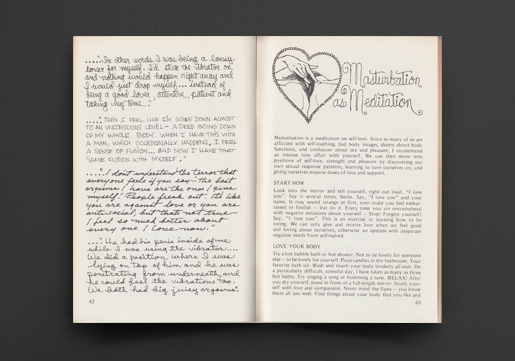
1976 edition of Betty Dodson's "Liberating Masturbation", her first self-published book on self-love that became a feminist classic. Includes the chapters: "The Romaticized Image of Sex", "Sharing Masturbation", "Going Public", "Conciousness Raising", "Becoming Cunt Positive", "Bodysex Workshops", "Masturbation as Meditation"...
Betty Dodson (born August 24, 1929) is an American sex educator. An artist by training, she exhibited erotic art in New York, before pioneering the pro-sex feminist movement, separate from mainstream feminism, which she sees as needlessly political and hostile to men. Dodson’s workshops and manuals encourage women to masturbate, often in groups. Although bisexual herself, she repudiates the labels that define sexuality.