World Food Books' programme is largely produced on Kulin Nation land. We acknowledge the Wurundjeri people of the Kulin Nation as the first and continuing custodians of this land, and pay respect to their Elders past, present, and emerging.
World Food Books is an arts and special interests bookshop in Naarm / Melbourne. Founded in 2010, World Food Books is devoted to the presentation of a rotating, hand-selection of international art, design, literary and counterculture publications with an emphasis on the anti-traditional, the experimental, the avant-garde, the heretic, the marginal.
Presenting new titles alongside rare and out-of-print books, catalogues and journals spanning the fields of modern and contemporary art, design, photography, illustration, film, literature, poetry, cultural theory, philosophy, sexuality, popular and underground culture in its many radical forms, World Food Books wishes to encourage adventurous, thoughtful and open-minded reading, looking, writing, and exchange of publishing and ideas, both current and historical.
As well as our bookshop, located in Melbourne's historical Nicholas Building, all of our inventory is available internationally via our online mail-order service.
World Food Books semi-regularly co-ordinates "Occasions", a programme of exhibits and events at the bookshop and in partnership with other hosts (such as museums and art galleries) that develop out of the activities, relationships and content of the bookshop itself.
World Food Books
The Nicholas Building
37 Swanston Street
Room 5, Level 6
Melbourne 3000
Australia
SHOP HOURS:
SHOP CLOSED FOR SUMMER
RE—OPEN JAN 2
WEB-SHOP OPEN 24/7
World Food Books
Postal Address:
PO Box 435
Flinders Lane
Victoria 8009
Australia
info@worldfoodbooks.com
Art
Theory / Essay
Architecture / Interior
Graphic Design / Typography
Photography
Fashion
Eros
LGBTQ+
Fiction / Poetry
Weird / Speculative / Science Fiction / Horror
Transgressive / Visceral / Abject
Symbolism / Decadence / Fin de siècle
Film / Video
Painting
Sculpture / Installation
Performance / Dance / Theater
Drawing
Sound / Music
Curatorial
Group Shows / Collections
Periodicals
Out-of-print / Rare
Posters / Ephemera / Discs
Signed Books
World Food Books Gift Voucher
World Food Book Bag
Australian Art
Australian Fiction
Australian Science Fiction / Speculative Fiction
Australian Poetry
Australian Photography
Japanese Photography
Conceptual Art
Minimal Art
Dada
'Pataphysics / Oulipo
Fluxus
Concrete Poetry
Pop Art
Surrealism
Arte Povera
Arte Informale / Haute Pâte / Tachism
Nouveau Réalisme / Zero / Kinetic
Situationism / Lettrism
Collage / Mail Art / Xerox Art
Art Brut / Folk / Visionary / Fantastic
Illustration / Graphic Art / Bandes Dessinées
Furniture
Italian Radical Design / Postmodernism
Textiles
Ceramics / Glass
Counterculture
Protest / Revolt
Philosophy
Psychoanalysis
Anthropology
Anarchism
Socialism / Anarchism / Communism / Capitalism
Literary Theory / Semiotics / Language
Feminism / Women's Studies
Gender Studies / Sexuality
Anthropology
Fetishism / BDSM
Drugs / Psychedelia
Crime / Violence
Animal Rights / Veganism
Occult / Esoterica
Ecology / Earth / Alternative Living
Whole Earth / Crafts
All prices in AUD (Australian dollars)
Pick-Ups
Pick-up orders can be collected in our bookshop during opening hours after order date. Please collect any Pick-up orders within 2 weeks of ordering as we have limited storage space. Orders will be released back into stock if not collected within this time. No refunds can be made for pick-ups left un-collected. If you cannot make it in to the bookshop in this time-frame, please choose postage option.
Return Policy
All sales are final. We do accept returns (for refund or exchange) for items received in error. All our orders are packed with special care using heavy-duty padding and cardboard book-mailers or bubble mailers (for smaller books), using reinforcement where required. We cannot take responsibility for any lost, stolen or damaged parcels.
Insurance
Should you wish to insure your package, please email us directly after placing your order and we can organise this at a small extra expense. Although all standard/express tracked packages are very safe and dependable, we cannot take responsibility for any lost, stolen or damaged parcels. We recommend insurance on valuable orders.
Interested in selling your old books, catalogues, journals, magazines, comics, fanzines, ephemera? We are always looking for interesting, unusual and out-of-print books to buy. We only buy books in our fields of interest and specialty, and that we feel we can resell.
We base these prices on desirability, market value, in-print prices, condition and our current stock levels. We offer cash, store credit, and can take stock on consignment. All
about 25% of the price we expect to get when we sell them, or 30% in store credit. We base these prices on desirability, market value, in-print prices, condition and our current stock levels.
Sell your books any day of the week. You can drop them off and return later. If you have a lot of books, we can visit your Sydney home.
We buy books that we feel we can resell. We offer about 25 % of the price we expect to get when we sell them, or 30% in store credit. We base these prices on desirability, market value, in-print prices, condition and our current stock levels.
Philadelphia Wireman
03 August - 01 September, 2018
World Food Books is proud to announce our next Occasion, the first presentation of sculptures by Philadelphia Wireman in Australia.
The Philadelphia Wireman sculptures were found abandoned in an alley off Philadelphia’s South Street on trash night in 1982. Their discovery in a rapidly-changing neighbourhood undergoing extensive renovation, compounded with the failure of all attempts to locate the artist, suggests that the works may have been discarded after the maker’s death. Dubbed the "Philadelphia Wireman" during the first exhibition of this work, in 1985, the maker’s name, age, ethnicity, and even gender remain uncertain. The entire collection totals approximately 1200 pieces, all intricately bound together with tightly-wound heavy-gauge wire (along with a few small, abstract marker drawings, reminiscent both of Mark Tobey and J.B. Murry). The dense construction of the work, despite a modest range of scale and materials, is singularly obsessive and disciplined in design: a wire armature or exoskeleton firmly binds a bricolage of found objects including plastic, glass, food packaging, umbrella parts, tape, rubber, batteries, pens, leather, reflectors, nuts and bolts, nails, foil, coins, toys, watches, eyeglasses, tools, and jewellery.
Heavy with associations—anthropomorphic, zoomorphic, and socio-cultural responses to wrapped detritus—the totemic sculptures by Philadelphia Wireman have been discussed in the context of work created to fulfil the shamanistic needs of alternative religions in American culture. Curators, collectors, and critics have variously compared certain pieces to sculpture from Classical antiquity, Native American medicine bundles, African-American memory jugs, and African fetish objects. Reflecting the artist’s prolific and incredibly focused scavenging impulse, and despite—or perhaps enhanced by—their anonymity, these enigmatic objects function as urban artefacts and arbiters of power, though their origin and purpose is unknown. Philadelphia Wireman, whatever their identity, possessed an astonishing ability to isolate and communicate the concepts of power and energy through the selection and transformation of ordinary materials. Over the course of the past two decades, this collection has come to be regarded as an important discovery in the field of self-taught art and vernacular art.
Presented in collaboration with Fleisher-Ollman Gallery, Philadelphia, and Robert Heald, Wellington.
Susan Te Kahurangi King
02 February - 10 March, 2018
Susan Te Kahurangi King (24 February 1951 - ) has been a confident and prolific artist since she was a young child, drawing with readily available materials - pencils, ballpoint pens and felt-tip markers, on whatever paper is at hand. Between the ages of four and six Susan slowly ceased verbal communication. Her grandparents William and Myrtle Murphy had developed a special bond with Susan so they took on caring responsibilities for extended periods. Myrtle began informally archiving her work, carefully collecting and storing the drawings and compiling scrapbooks. No drawing was insignificant; every scrap of paper was kept. The King family are now the custodians of a vast collection containing over 7000 individual works, from tiny scraps of paper through to 5 meter long rolls.
The scrapbooks and diaries reveal Myrtle to be a woman of great patience and compassion, seeking to understand a child who was not always behaving as expected. She encouraged Susan to be observant, to explore her environment and absorb all the sights and sounds. Myrtle would show Susan’s drawings to friends and people in her community that she had dealings with, such as shopkeepers and postal workers, but this was not simply a case of a grandmother’s bias. She recognised that Susan had developed a sophisticated and unique visual language and sincerely believed that her art deserved serious attention.
This was an unorthodox attitude for the time. To provide some context, Jean Dubuffet coined the term Art Brut in 1945 to describe work created by self-taught artists – specifically residents of psychiatric institutions and those he considered to be visionaries or eccentrics. In 1972 Roger Cardinal extended this concept by adopting the term Outsider Art to describe work made by non-academically trained artists operating outside of mainstream art networks through choice or circumstance. Susan was born in Te Aroha, New Zealand in 1951, far from the artistic hubs of Paris and London that Dubuffet and Cardinal operated in. That Myrtle fêted Susan as a self-taught artist who deserved to be taken seriously shows how progressive her attitudes were.
Susan’s parents Doug and Dawn were also progressive. Over the years they had consulted numerous health practitioners about Susan’s condition, as the medical establishment could not provide an explanation as to why she had lapsed into silence. Dawn educated herself in the field of homeopathy and went on to treat all twelve of her children using these principles – basing prescriptions on her observations of their physical, mental and emotional state.
Doug was a linguist with an interest in philosophy who devoted what little spare time he had to studying Maori language and culture. To some extent their willingness to explore the fringes of the mainstream made them outsiders too but it was their commitment to living with integrity and their respect for individuality that ensured Susan’s creativity was always encouraged.
Even though Susan’s family supported her artistic pursuits, some staff in schools and hospitals saw it as an impediment to her assimilation into the community and discouraged it in a variety of ways. Her family was not always aware of this and therefore did not fully understand why Susan stopped drawing in the early 1990s. However, rather than dwell on the challenges that Susan faced in pursuit of her artistic practice, they prefer to highlight her achievements. In 2008 Susan began drawing again in earnest, after an almost 20 year interruption, and her work is now shown in galleries around the world.
Susan grew up without television and has been heavily influenced by the comics she read as a child. She is absolutely fearless in the appropriation of recognizable characters, such as Donald Duck and Mickey Mouse, in her work. She twists their limbs, contorts their faces, compresses them together, blends them into complex patterned backgrounds - always imbuing them with an incredible energy. Although Susan often used pop culture characters in her work they are not naive or childlike. These are drawings by a brilliant self-taught artist who has been creating exceptional work for decades without an audience in mind.
Mladen Stilinović
"Various Works 1986 - 1999"
02 February 16 - September 10, 2016
Various works 1986 - 1999, from two houses, from the collections of John Nixon, Sue Cramer, Kerrie Poliness, Peter Haffenden and Phoebe Haffenden.
Including: Geometry of Cakes (various shelves), 1993; Poor People’s Law (black and white plate), 1993; White Absence (glasses, ruler, set square, silver spoon, silver ladel with skin photograph and wooden cubes), 1990-1996; Exploitation of the Dead (grey and red star painting, wooden painting, black spoon with red table, red plate), 1984-1990; Money and Zeros (zero tie, paintings made for friends in Australia (Sue, John, Kerrie), numbers painting), 1991-1992; Words - Slogans (various t-shirts) - “they talk about the death of art...help! someone is trying to kill me”, “my sweet little lamb”, “work is a disease - Karl Marx”; Various artist books, catalogues, monographs, videos; Poster from exhibition Insulting Anarchy; "Circular" Croatian - Australian edition; Artist book by Vlado Martek (Dostoyevsky); more.
Thanks to Mladen Stilinović and Branka Stipančić.
Jonathan Walker
Always Will Need To Wear Winter Shirt Blue + Ochre Small Check Pattern
21 August - 21 September, 2015
Untitled
I am not a great reader of poetry but I always return to the work of Melbourne poet, Vincent Buckley (1925- 1988). Perhaps I find his most tantalising piece to be not a finished poem but a fragment left on a scrap of paper discovered on his desk after the poet’s death.
The poetry gathers like oil
In the word-core, and spreads
It has its music meet,
Its music is in movement.
This fragment is more the shell left behind from a volatile thought than a finished poem. I find the last two lines honest but awkward whereas the first two lines work like an arrow. Most likely he could not find a resolution so it was left. Still, in its present form, it remains an eloquent testimony to the ultimate failure of a medium to express mobile thought and sensation, in Buckley’s case, through verbal language. It’s an important matter because this is something all artists have to deal with regardless of the medium.
I have never written a poem, however, I am forever copying fragments from books on paper scraps in a vain effort to fix certain notions in my head. At first, they function as bookmarks that are sometimes returned to when I open the book. But before long, as they accumulate, they fall out littering the table interspersed with A4 photocopies, bills, books and medications.
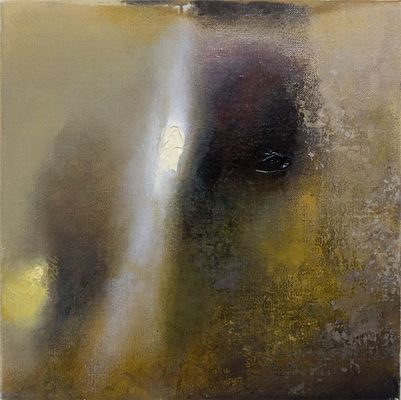
To return to Buckley’s fragment, the first two lines very much evoke how I paint nowadays. As you age, detail diminishes and patches of light become more luminous and float. I feel the most honest way of dealing with this is by smearing the oil paint on the canvas with the fingers and working close-up, blind. Only if the patches coalesce into an approaching image can the work gain a life.
-
Jonathan Walker was born in Melbourne, Australia and brought up on a dairy farm in Gippsland. In the 1970’s he studied painting at RMIT and won the Harold Wright Scholarship to the British Museum, London. During the 1980’s he exhibited at Pinacotheca Gallery, Richmond and had work shown at the NGV and Heidi City Art Gallery. Over the same period he designed the cover for the “Epigenesi” LP by Giancarlo Toniutti, Italy and conducted a mail exchange work with Achim Wollscheid, Germany. The work with artists through the post resulted in an article published in the bicentenary issue of Art and Australia 1988. He showed in artist run spaces such as WestSpace in the 90’s and 2000’s, and until 2012, taught painting at Victoria University, which is where we (Colleen Ahern and Lisa Radford) as organisers of the exhibition, among many others, had the privilege of being his student.
Walker’s knowledge was imparted to students through the careful selection of music, literature, and artists found in books that he himself had ordered for the library. Walker’s strategy was the generosity of sharing his vast knowledge with references specific to each student and their context.
Walker’s paintings share a similar focus and intimacy.
This exhibition presents a small selection of recent paintings alongside a publication that includes Walker’s writing. Observational and analytical, Walker’s work is a type of material notation — the time of day, colour and how it is blended, the both specific and fleeting location of a reflection on lino or the question of whether a chair leg should be included in a painting.
Please join us on Friday August 21 between 6-8pm to celebrate the opening of the exhibition.
Curated by Colleen Ahern and Lisa Radford.
B. Wurtz
Curated by Nic Tammens
March 26 - April 4, 2015
B.Wurtz works from a basement studio in his home on Manhattan’s Lower East Side.
This local fact is attested to by the plastic shopping bags and newsprint circulars that appear in his work. As formal objects, they don’t make loud claims about their origins but nonetheless transmit street addresses and places of business from the bottom of this long thin island. Like plenty of artists, Wurtz is affected by what is local and what is consumed. His work is underpinned by this ethic. It often speaks from a neighborhood or reads like the contents of a hamper:
“BLACK PLUMS $1.29 lb.”
“Food Bazaar”
“USDA Whole Pork Shoulder Picnic 99c lb.”
“RITE AID Pharmacy, with us it’s personal.”
“H. Brickman & Sons.”
“Sweet Yams 59c lb."
Most of the work in this exhibition was made while the artist was in residence at Dieu Donne, a workshop dedicated to paper craft in Midtown. Here Wurtz fabricated assemblages with paper and objects that are relatively lightweight, with the intention that they would be easily transportable to Australia. This consideration isn’t absolute in Wurtz’s work, but was prescriptive for making the current exhibition light and cheap. Packed in two boxes, these works were sent from a USPS post office on the Lower East Side and delivered to North Melbourne by Australia Post.
Wurtz appears courtesy of Metro Pictures, New York.
Thanks to Rob Halverson, Joshua Petherick, Sari de Mallory, Matt Hinkley, Helen Johnson, Fayen d'Evie, Ask Kilmartin, Lisa Radon, Ellena Savage, Yale Union, and "Elizabeth".
John Nixon
"Archive"
December 15 - January 20, 2014
The presentation of John Nixon's archive offered a rare showcase of this extensive collection of the artist's own publications, catalogues, posters, ephemera, editions and more, from the mid 1980s onwards, alongside a selection of his artworks.
Organized by John Nixon, Joshua Petherick and Matt Hinkley.
"Habitat"
at Minerva, Sydney (organised by Joshua Petherick and Matt Hinkley)
November 15 - December 20, 2014
Lupo Borgonovo, Janet Burchill & Jennifer McCamley,
Lewis Fidock, HR Giger, Piero Gilardi, Veit Laurent Kurz,
Cinzia Ruggeri, Michael E. Smith, Lucie Stahl, Daniel Weil, Wols
Press Release:
“...It contained seven objects. The slender fluted bone, surely formed for flight, surely from the wing of some large bird. Three archaic circuitboards, faced with mazes of gold. A smooth white sphere of baked clay. An age-blackened fragment of lace. A fingerlength segment of what she assumed was bone from a human wrist, grayish white, inset smoothly with the silicon shaft of a small instrument that must once have ridden flush with the surface of the skin - but the thing’s face was seared and blackened.”
William Gibson, “Count Zero”, 1986
"Autumn Projects Archive"
Curated by Liza Vasiliou
March 6 - March 15, 2014
World Food Books, in conjunction with the Virgin Australia Melbourne Fashion Festival 2014, presented the Autumn Projects archive, consisting of a selection of early examples in Australian fashion with a particular interest in collecting designers and labels from the period beginning in the 1980’s, who significantly influenced the discourse of Australian Fashion.
Curated by Liza Vasiliou, the exhibition provided a unique opportunity to view pieces by designers Anthea Crawford, Barbara Vandenberg, Geoff Liddell and labels CR Australia, Covers, Jag along with early experimental collage pieces by Prue Acton and Sally Browne’s ‘Fragments’ collection, suspended throughout the functioning World Food Books shop in Melbourne.
H.B. Peace
presented by CENTRE FOR STYLE
November 14, 2013
"Hey Blinky, you say chic, I say same"
Anon 2013
H.B. Peace is a clothing collaboration between great friends Blake Barns and Hugh Egan Westland. Their pieces explore the divergences between 'character’ and ‘personality’ in garments....etc
Special Thanks to Joshua Petherick and Matt Hinkley of WFB and Gillian Mears
and a Very Special Thank you to Audrey Thomas Hayes for her shoe collaboration.
Janet Burchill & Jennifer McCamley
"Aesthetic Suicide"
May 10 - June 8, 2013
The first of our occasional exhibitions in the World Food Books office/shop space in Melbourne, "Aesthetic Suicide" presented a body of new and older works together by artists Janet Burchill & Jennifer McCamley, including videos, prints, a wall work, and publications.
During shop open hours videos played every hour, on the hour.
2023, English
Softcover, 140 pages, 18 x 12.5 cm
Published by
Sublunary Editions / Seattle
$34.00 - Out of stock
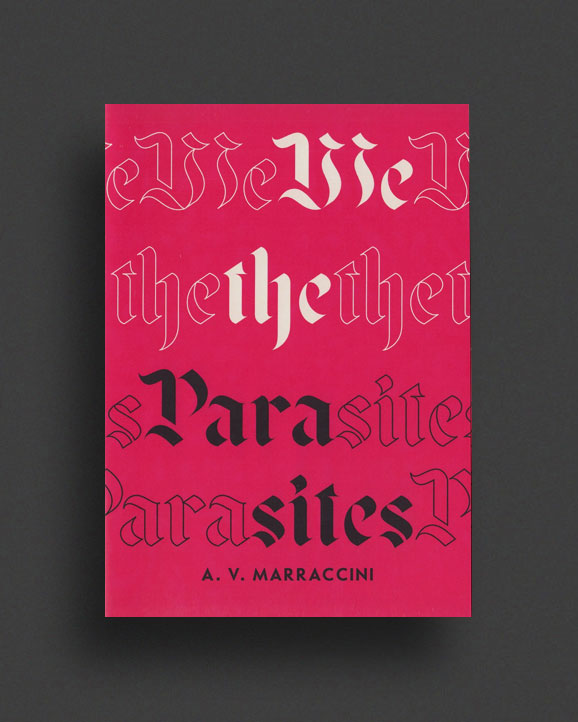
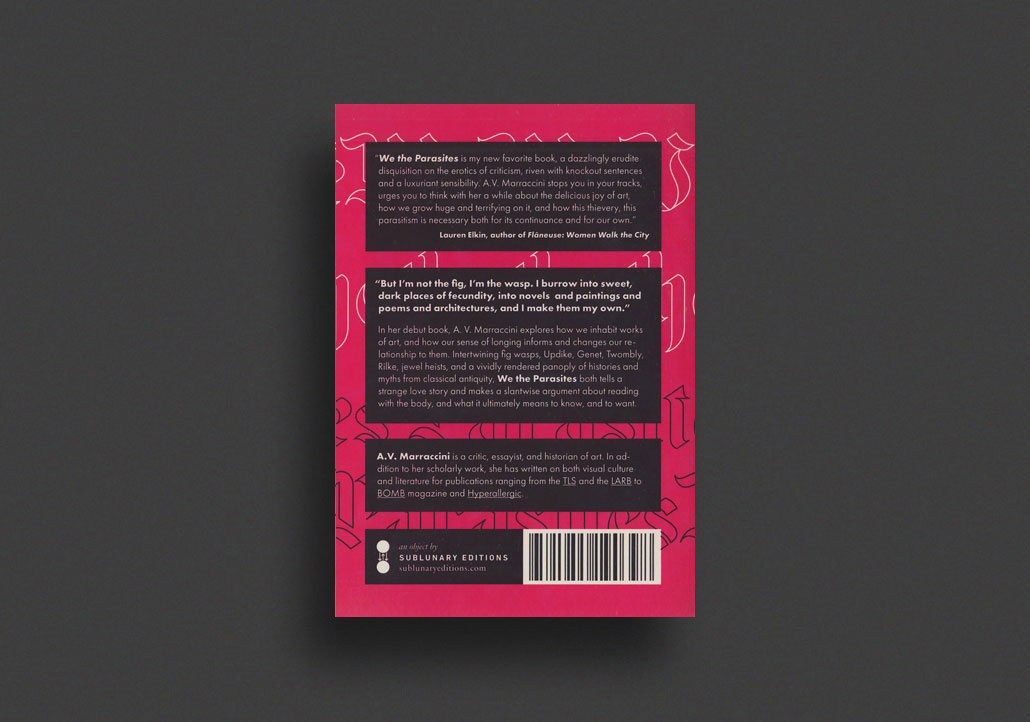
"But I’m not the fig, I’m the wasp. I burrow into sweet, dark places of fecundity, into novels and paintings and poems and architectures, and I make them my own."
"We the Parasites is my new favorite book, a dazzlingly erudite disquisition on the erotics of criticism, riven with knockout sentences and a luxuriant sensibility. A. V. Marraccini stops you in your tracks, urges you to think with her a while about the delicious joy of art, how we grow huge and terrifying on it, and how this thievery, this parasitism is necessary both for its continuance and for our own."—Lauren Elkin, author of Flâneuse: Women Walk the City
"In 1964, Sontag wrote: 'In place of a hermeneutics we need an erotics of art.' Since then, many works of criticism have paid lip service to this desideratum, but few have managed to achieve it. […] In We the Parasites, encountering a work of art is not fixed as a safe looking at, but rather as an eating, a kissing, a being-seduced-by, a being-contaminated by, a being-infected-by that restores art and criticism to the dangerous adventure that it is."—Ryan Ruby
In her debut book, A. V. Marraccini explores how we inhabit works of art, and how our sense of longing informs and changes our relationship to them. Intertwining fig wasps, Updike, Genet, Twombly, Rilke, jewel heists, and a vividly rendered panoply of histories and myths from classical antiquity, We the Parasites both tells a strange love story and makes a slantwise argument about reading with the body, and what it ultimately means to know, and to want.
A.V. Marraccini is a critic, essayist, and historian of art. In addition to her scholarly work, she has written on both visual culture and literature for publications ranging from the TLS and the LARB to BOMB magazine and Hyperallergic.
2022, English
Softcover, 358 pages, 20.5 x 13 cm
Published by
11:11 Press / US
$48.00 - Out of stock
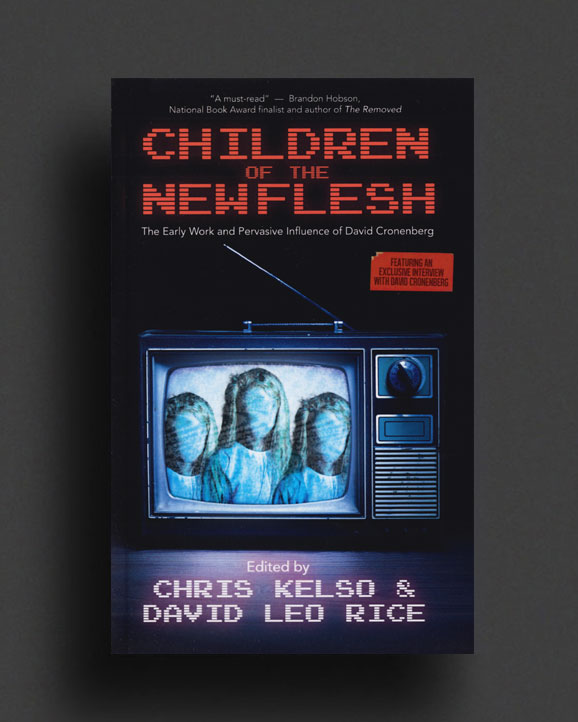
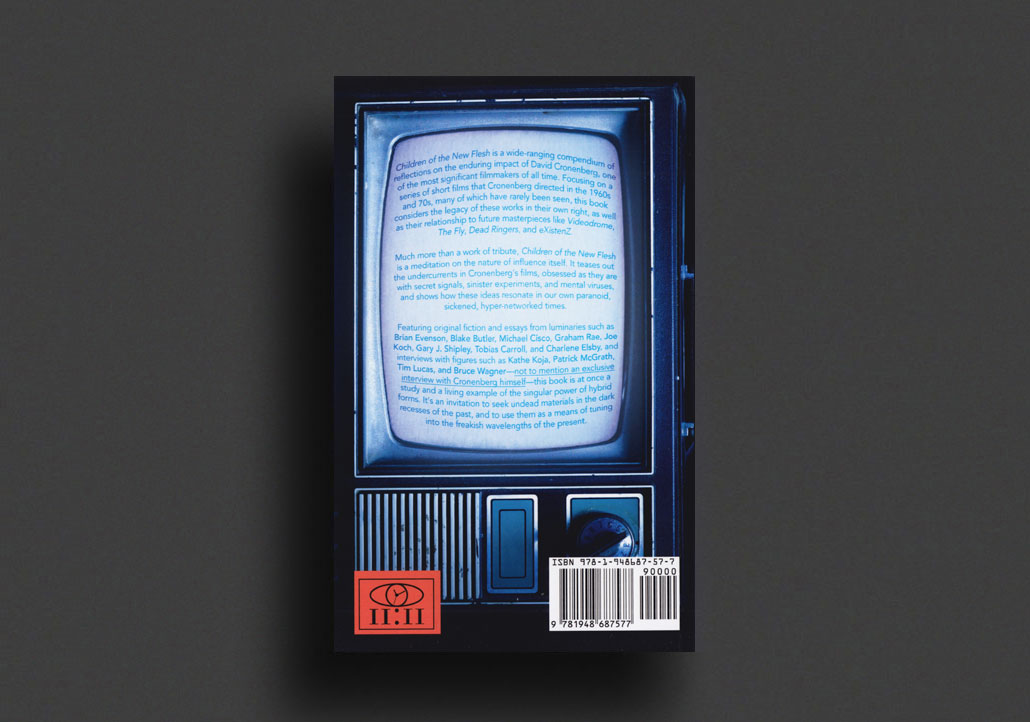
Children of the New Flesh is a wide-ranging compendium of reflections on the enduring impact of David Cronenberg, one of the most significant filmmakers of all time. Focusing on a series of short films that Cronenberg directed in the 1960s and 70s, many of which have rarely been seen, this book considers the legacy of these works in their own right, as well as their relationship to future masterpieces like Videodrome, The Fly, Dead Ringers, and eXistenZ.
Much more than a work of tribute, Children of the New Flesh is a meditation on the nature of influence itself. It teases out the undercurrents in Cronenberg's films, obsessed as they are with secret signals, sinister experiments, and mental viruses, and shows how these ideas resonate in our own paranoid, sickened, hyper-networked times.
Featuring original fiction and essays from luminaries such as Brian Evenson, Blake Butler, Michael Cisco, Graham Rae, Joe Koch, Gary J. Shipley, Tobias Carroll, and Charlene Elsby, and interviews with figures such as Kathe Koja, Patrick McGrath, Tim Lucas, and Bruce Wagner—not to mention an exclusive interview with Cronenberg himself—this book is at once a study and a living example of the singular power of hybrid forms. It's an invitation to seek undead materials in the dark recesses of the past, and to use them as a means of tuning into the freakish wavelengths of the present.
"CHILDREN OF THE NEW FLESH IS A MUST-READ FOR FILM FANATICS AND FANS OF DAVID CRONENBERG. EDITED BY CHRIS KELSO AND DAVID LEO RICE, THIS COLLECTION EXPLORES THE DARK PERIPHERIES OF CRONENBERG'S INFLUENCE AND EARLY WORK, EXAMINING A WORLD OF STRANGENESS AND MYSTERY." - BRANDON HOBSON, NATIONAL BOOK AWARD FINALIST AND AUTHOR OF THE REMOVED
"THE LIVING LEGEND OF ECCENTRIC CINEMA BEGETS WEIRD NEW PROGENY IN CHILDREN OF THE NEW FLESH" - RUE MORGUE MAGAZINE
"DO NOT OVEREMPHASIZE CRONENBERG'S LOVE AFFAIR WITH THE PHYSICAL BODY; THAT DOES A DISSERVICE TO HIS DEEP, ABIDING, PASSIONATE INTEREST IN THE ENERGY BODY, THE ETHEREAL BODY, THE BODY DOUBLE, THE COSMIC BODY. IN THE END, HE IS A CONSUMMATE PHILOSOPHER OF THE SPIRIT." - BRUCE WAGNER, AUTHOR OF DEAD STARS, MAPS TO THE STARS, AND THE MARVEL UNIVERSE
2023, English
Softcover, 158 pages, 21 x 14 cm
Published by
11:11 Press / US
$48.00 - Out of stock
Somewhere between a journal and a report, a question and an answer, Suicide: The Autoimmune Disorder of the Psyche takes up the “only serious problem in philosophy” and submits it to the only kind of scrutiny proper to it: the personal. In arriving at this “personal” account, however, Nao detours through decidedly un-private, public cultural touchpoints—the lives of celebrities, religion, television shows, sporting events—and in doing so lays bare how even this most subjective of phenomena grows out of an endless encounter with the world. Race has a part in this encounter. So does migration. As does money. Growing out of these entanglements, queer affinities bud and bloom in this text—which, made up of pen-and-ink drawings, photographs, and Nao’s playful spin on pilish, is simultaneously constrained and unconstrained—to become the bonds that can make one want to live on.
After losing my father to suicide I was given many very thoughtful books about why we sometimes kill ourselves; none of them, even in sum, carried the insight, vision, or credibility of Vi Khi Nao’s SUICIDE: THE AUTOIMMUNE DISORDER OF THE PSYCHE. Achingly un-sentimental, extensively researched, exquisitely illustrated, and overflowing with personal wisdom (and, most importantly, warmth), SUICIDE inhabits a truly novel numbering system to chart a kind of star map to the present condition, a guide to failure, an ode to other people; a way, if we stick together, to survive. — Daniel Uncapher
SUICIDE would be an encyclopedic novel if encyclopedic novels were not boring and if instead of trying to capture the full range of the world’s knowledge—like Dante, Joyce, or Pynchon—they attempted to capture instead what knowledge feels like on the brink of death and the cosmic and pragmatic love it takes to keep each other living. Vi Khi Nao knows, too, how short life is and kept it under 153 pages. — CLOSE WALL
Vi Khi Nao’s SUICIDE: THE AUTOIMMUNE DISORDER OF THE PSYCHE confronts the universal question of suicide with a scientific curiosity, mathematical precision, and visionary vulnerability that is uniquely their own, and will leave a lasting impression on any reader—especially those who know all-too well the weight of the titular subject in their lives. — Randall Scott
Vi Khi Nao traces all the ways suicide twisted around her family, her education, her art, and her heart condition in this brilliant memoir. It’s a revealing and honest account of her “suicidal scars of the soul” and the devastating effect that illness has on a life. — Anthony Luebbert
This manuscript. What is it? What is it? The laying out of a life along the razor’s edge of its own annihilation. An investigation of the conditions of its possibility. A reflection on famous suicides. Famous non-suicides. The illnesses within which health is inscribed. Memoir punctuated by image, number, text. Each word a brush stroke. Every metaphor a fatty lump. Constrained by the infinite sprawl of π, SUICIDE: THE AUTOIMMUNE DISORDER OF THE PSYCHE opens as a wound into a mind working through what it means to live by passing through the identical question of what it means to die. — FAR WALL
2023, English
Softcover, 248 pages, 21.5 x 14 cm
Published by
Rose Books / Arizona
$34.00 - Out of stock
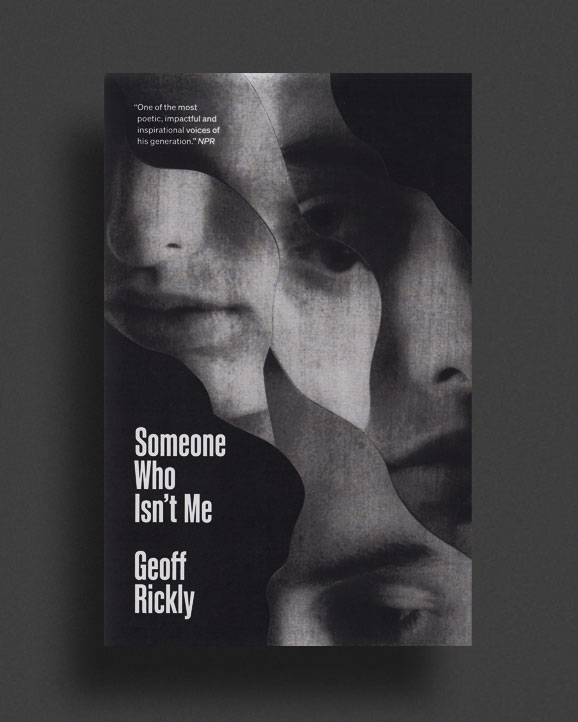
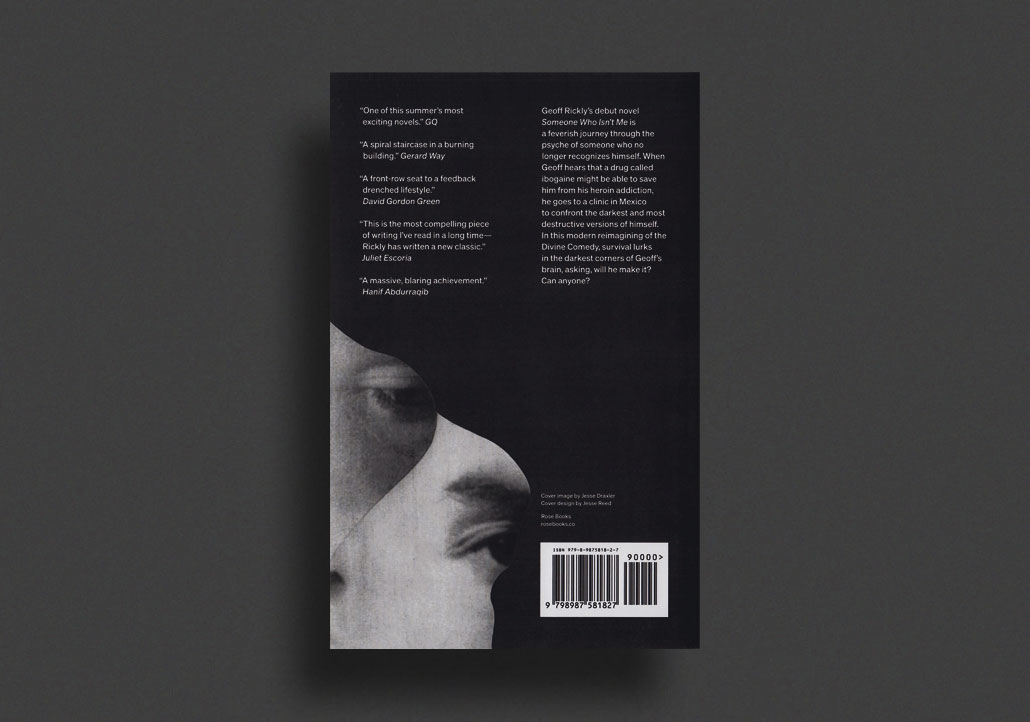
Geoff Rickly’s debut novel Someone Who Isn’t Me is a feverish journey through the psyche of someone who no longer recognizes himself. When Geoff hears that a drug called ibogaine might be able to save him from his heroin addiction, he goes to a clinic in Mexico to confront the darkest and most destructive versions of himself. In this modern reimagining of the Divine Comedy, survival lurks in the darkest corners of Geoff’s brain, asking, will he make it? Can anyone?
2021, English
Softcover, 432 pages, 17.5 x 10 cm
Published by
Inside The Castle / Kansas
$40.00 - Out of stock
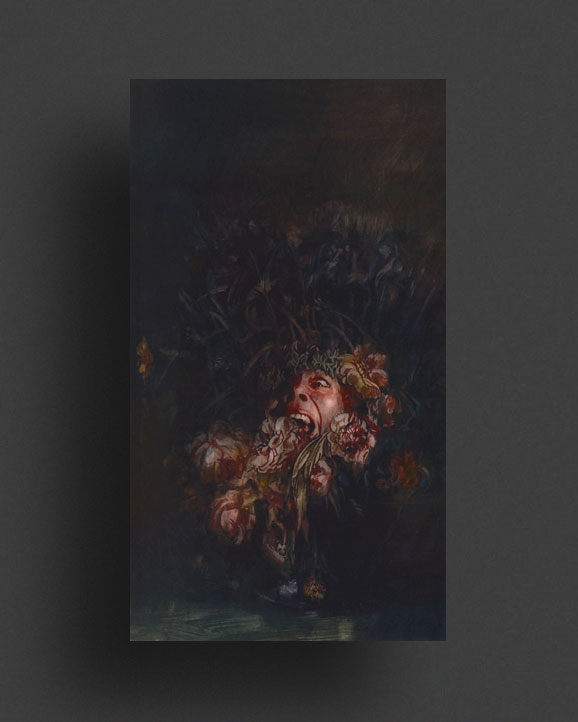
“Horror” w/ special guests Bráulio Amado / badbadbadbad.com Chris Farren / chrisfarren.com Chris Zeishegg / chriszeischegg.com Dan Mumford / dan-mumford.com Elijah Funk / online-ceramics.com Glenn R. / awginc.org John Jr. / john-jr.com Johnny Ryan John Trefry / jhtrefry.org Maggie Siebert Maria Calandra / mariacalandra.com Mark McCoy / markmccoyart.com Perry Shall / perryshall.com Richard “French” Sayer / funeralfrench.com Roland Scagnetti Sammy Harkham Thomas Moore Tony Stella / tony-stella.com
"Hunchback ‘88 is the new-ish debut novel from Christopher Norris (formerly of Combatwoundedveteran). The novel is ostensibly a simple slasher story but it’s presentation is what makes it great. This novel is probably the most formally daring work I’ve read in years. Revolting and erotic in equal measures. Norris finds his own rhythms in obstructing the reader’s understanding of what exactly is going on page-to-page. Hunchback is thrilling to read in the same way that novels like A Clockwork Orange and Trainspotting were in High School."—The Chain World
2023, English
Softcover, 320 pages, 12 x 19 cm
Published by
Uh Books / Amsterdam
$25.00 - In stock -
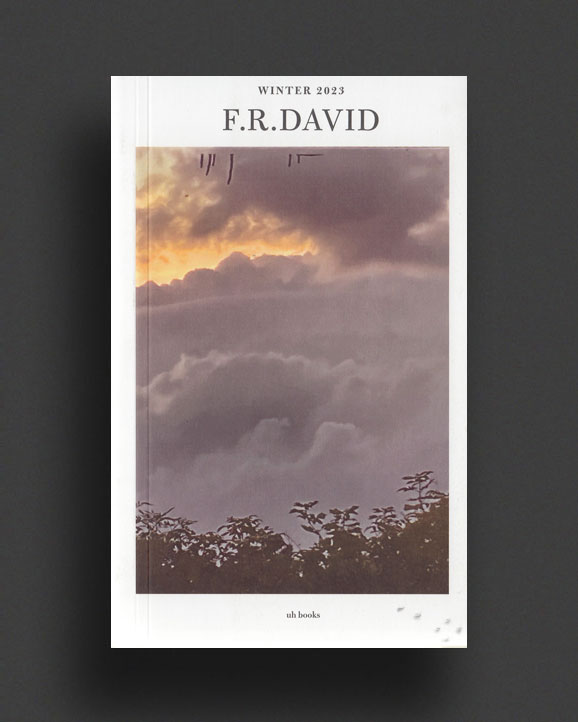
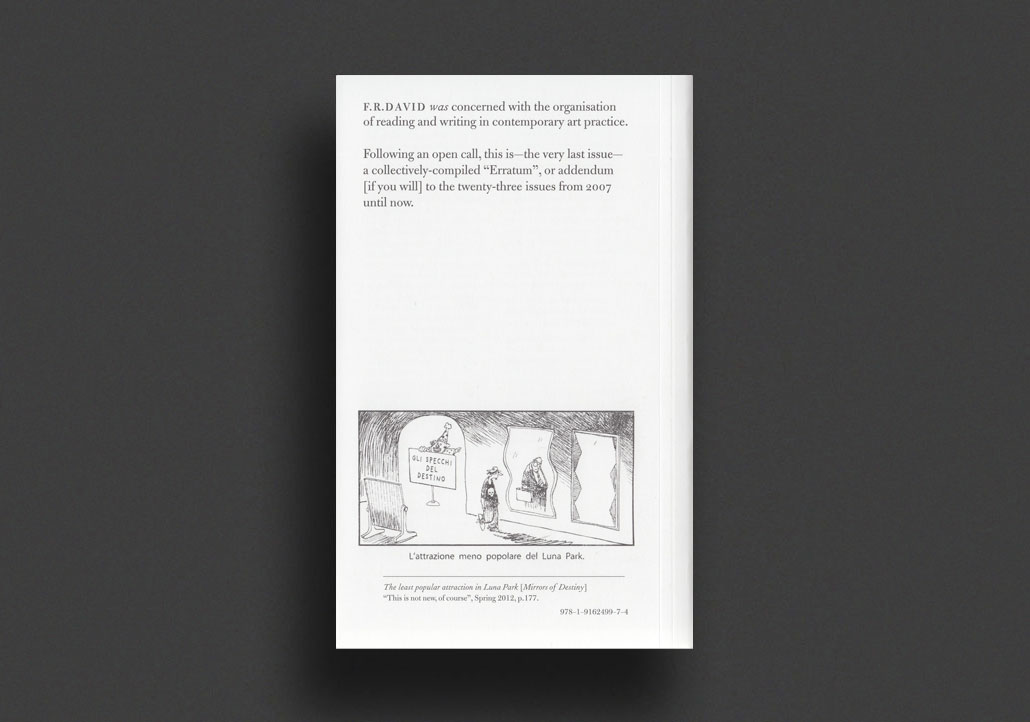
F.R.DAVID was concerned with the organisation of reading and writing in contemporary art practice. Following and open call, this is - the very last issue - a collectively-compiled "Erratum", or addendum [if you will] to the twenty-three issues from 2007 until now.
Edited with Paul Abbott, After 8, Alma Sarif, Phil Baber, Daniel Blumberg, Thomas Boutoux, Kristien Van den Brande, Chloe Chignell, Martina Copley, Anthony Elms, Chris Evans, Carolina Festa, Kasper Feyrer, Richard Finlay Fletcher, Ben Green, Mariëtte Groot, Krist Gruijthuijsen, Léa Guillon, Sarah Handley, Gloria Hasnay, Loes Jacobs, Michel Khleifi, Willis Kingery, gerlach en koop, James Goggin, Keira Greene, Léa Guillon, Jacob Lindgren, Kobe Matthijs, Martino Morandi, Zen Nguyen, Alice Notley, Robert M. Ochshorn, Oscar the dog, Willem Oorebeek, David Reinfurt, Scott Rogers, Andrés de Santiago Areizaga, Rosa Sarholz, Clara Schulmann, Andrea di Serego Alighieri, Sabrina Tarasoff, Kristy Trinier, Seymour Wright and Unknown.
1973, Japanese
Hardcover (w. dust jacket), 139 pages, 24.7 x 18.7 cm
Out of print title / used / very good
Published by
Fujingahosha / Tokyo
$200.00 - Out of stock
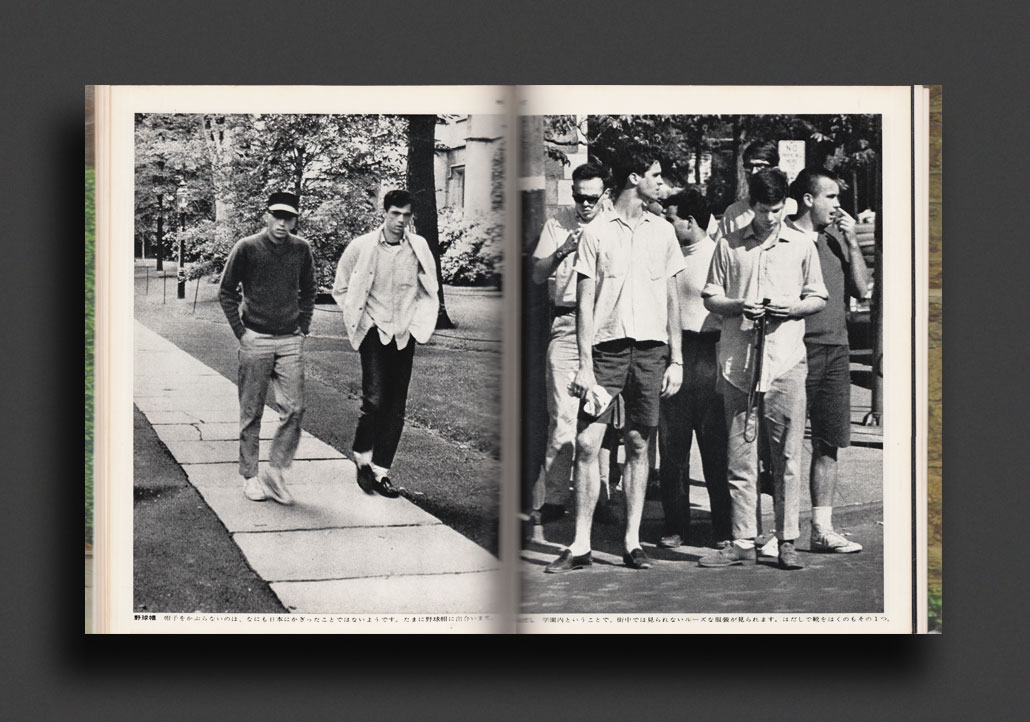
1973 hardcover print of the first 1965 Japanese edition of "Take Ivy", the legendary cult fashion photo-book and mythological sociological study that set off an explosion of American-influenced fashion amongst Tokyo students and re-defined "Ivy Style" as we know it.
Sold out immediately upon publication, and little known outside of Japan until the 2000s, Take Ivy (the title inspired by "Take Five" by Dave Brubeck) was authored by four Japanese sartorial men's style enthusiasts, including Van Jacket founder and unerring dandy Kensuke Ishizu and photographer Teruyoshi Hayashida (who shot for the influential Men’s Club magazine in Japan). In early 1960s Tokyo, many of these Ivy enthusiasts were arrested simply for dressing in "outlandish" American-inspired styles. In the run-up to the 1964 Tokyo Olympics, authorities aimed to clean up Japan’s image, targeting those who strayed too far from traditional norms. During this backlash, Hayashida, Ishizu, and their team set off to the USA in search of their beloved modern "American-style". Upon their arrival on the campuses of America’s elite Ivy League universities they were stunned by the dissonance between real Ivy league style and the Japanese understanding of Ivy. The resplendent sartorial formality of Japan’s Ivy was nowhere to be seen. Where were the three-piece suits that were supposed to be the de facto Ivy uniform? Did this style-conscious utopia the Japanese men espoused and emulated ever even exist? This realisation did not discourage the team, but rather gave birth to something truely unique. The Japanese Reimagining of Ivy.
The result is a beautiful and iconic collection of seemingly candid, almost voyeuristic, possibly staged photographs of college-aged men and their clothes between 1959—1965, shot on campus. Whether getting a meal in the cafeteria, lounging in the quad, riding bikes, studying in the library, in class, or at the boathouse, the subjects of this photographic compendium are impeccably and distinctively dressed in fine American-made garments, documenting an idealised golden age of Ivy League campus life. An aspirational ideal designed to inspire. It wasn’t just about the clothes; it was about the lifestyle they represented. A vision of American confidence and cool modernity that resonated deeply with young Japanese audiences and became a cultural reference the world over. The New York Times described "Take Ivy" as “a treasure of fashion insiders”, a bible for designers, stylists and photographers ever since its first publication. While America is the birthplace of Ivy Style, it was the meticulous attention to detail and cultural reinterpretation of the Japanese that preserved and redefined it for generations to come. "Take Ivy" shaped the Ivy we know today. It became the definitive document of the Ivy Style and remains one of the most iconic fashion books of all time.
Original copies are rare in the West, garnering auction prices as high as $2000 USD. This is the rarely seen first 1965 edition in its second print run from 1971, identical to the first print-run with only minor text corrections. The later 1973 and 1980 reprints being much larger print-runs due to demand, although all now incredibly sought after. The quality and feel of these early editions, printed in Japan, far surpass the many later, more common English and Japanese editions.
Very Good copy in Good dust jacket (preserved in mylar wrap). Small closed tears to top of dust-jacket spine, otherwise VG; some foxing spots to first and last pages, otherwise a wonderful sharp copy of the very scarce, very limited 1973 printing. The quality and feel of these early editions, printed in Japan, far surpass the many later, more common English and Japanese editions.
2023, English / French
Vinyl LP
400 copies,
Published by
Slow Moves / Turin—Paris
$58.00 - In stock -
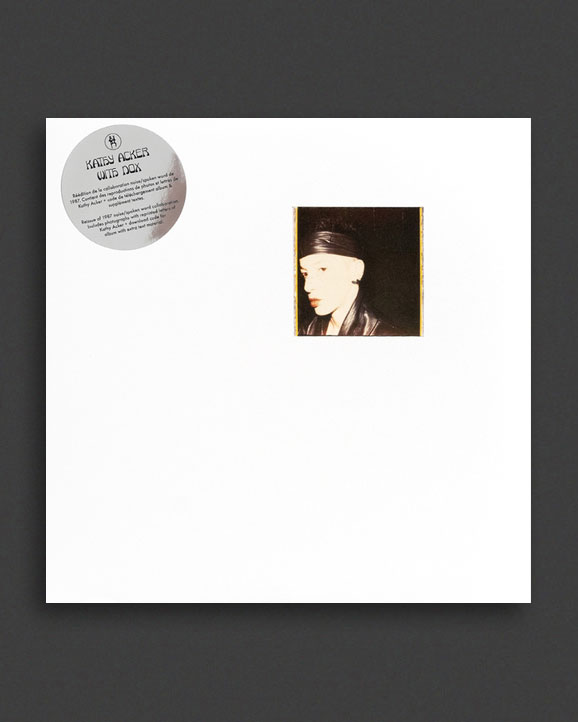
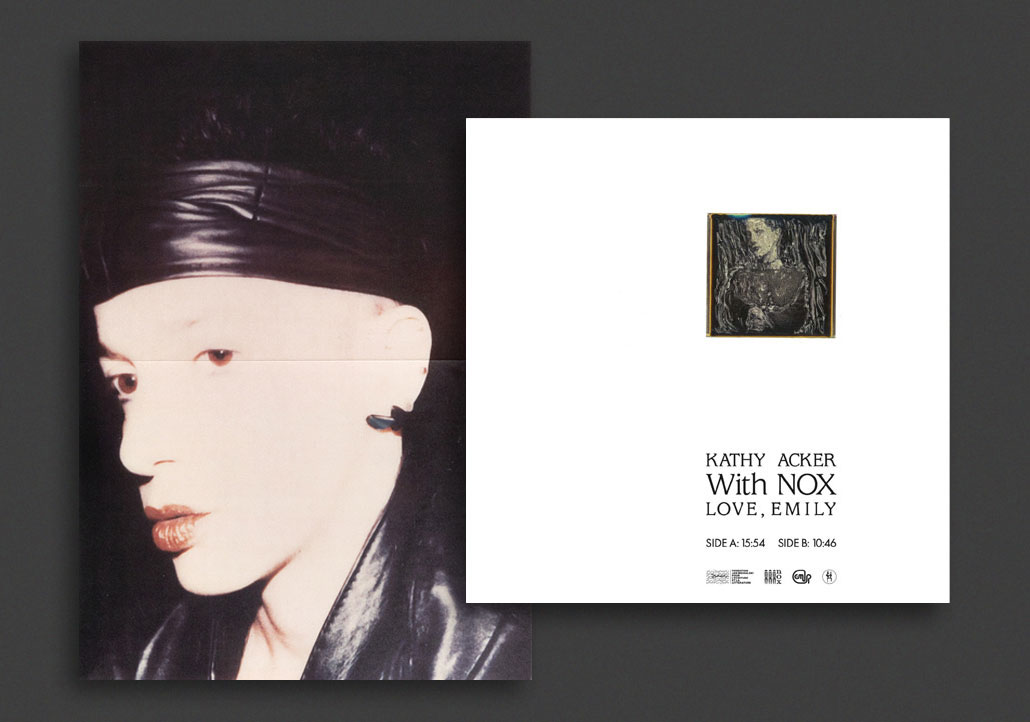
Originally released in a long sold-out edition of 50 cassette tapes, Love, Emily (Acte 3) was the third and final album of Michel Henritzi’s industrial label AKT Production. Recorded in a Paris studio in 1987, this 25-minute collage of spoken word and noise saturations intersects two radical voices from literature and experimental music of the time: American author Kathy Acker reading excerpts from her book My Death My Life by Pier Paolo Pasolini, and Nox, mainstay of the French noise and industrial scene. Pulled from oblivion, restored and remastered for vinyl by Slow Moves, this archive gem crosses the clashing worlds of poetry and industrial music, melding Acker’s thought-provoking words to absolute and inflexible industrial sounds. A lot of it is noise, but a lot of it is also play; research for a new mystique, generating unusual forms and unknown languages.
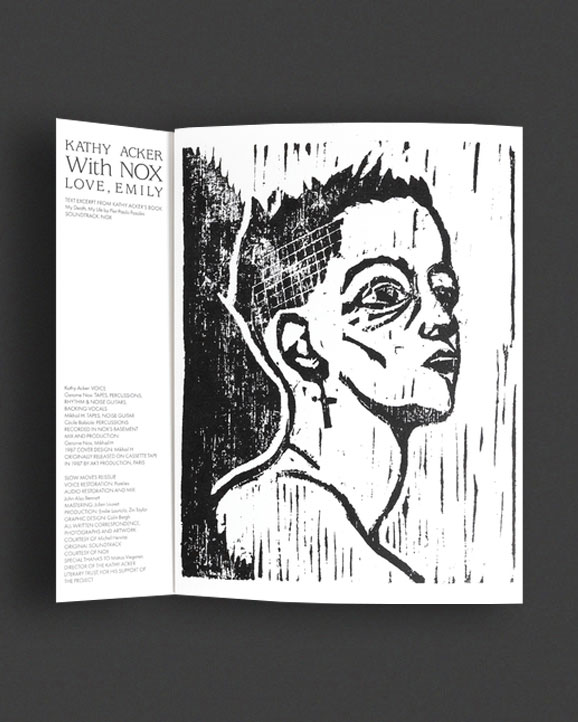
Published in a limited edition of 400 copies, this vinyl also comes with a long printed panel of previously unpublished photographs and letters from Kathy Acker, tracing the background exchanges that led to the collaboration between the groundbreaking writer, Henritzi and Nox, a poster of Kathy Acker with french translations and a download code featuring both music and extra archival material (interview and articles).
Kathy Acker (1947-1997) was at the forefront of transgressive writing from the Seventies until her death. Her provocative intertextual narratives—halfway between autobiography and pornography—were developed in lectures, performances and films (Variety, Bette Gordon). Her published work includes Blood and Guts in High School (1984), Don Quixote (1986), and Empire of the Senseless (1988).
Nox was a French industrial band active from 1981 to 1992, founded by Arno (guitar, voice), Cécile Babiole (bass, voice, percussions), and Gerome Nox (guitar, voice), joined by Laurent Perrier (guitar, voice) then Laurent Pernice (percussions, voice). Their musical influences go from German Krautrock (Neu, Can...) to industrial music (Cabaret Voltaire, Throbbing Gristle...) through repetitive music. The collective is at the origin of the AKT label with Michel Henritzi.
2023, English
Softcover, 168 pages, 10.5 x 8 cm
Published by
Hanuman Editions / US
$25.00 - Out of stock
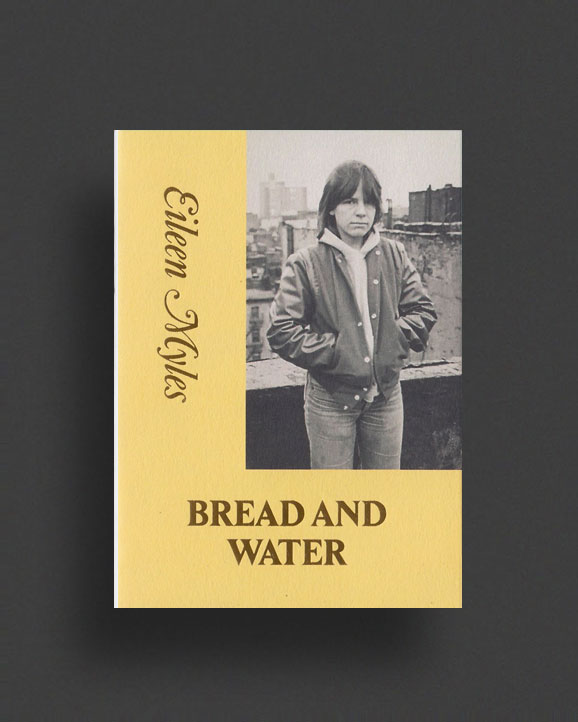
Bread and Water
Eileen Myles
First published by Hanuman Books in 1986, Bread and Water is the debut short story collection by the renowned poet Eileen Myles, assembling six stories with an autobiographical flavor, of being a queer, working-class poet with a penchant for mischief. Stories include: "Light Warrior", "21, 22, 23…, "Merry Christmas Mr. Title", "Bath, Maine", "Bread and Water", and "Everybody Would Go Play Cards at Eddie and Nonie's".
Eileen Myles (b. 1949) is an American writer, poet, artist, teacher, and playwright. They are the author of more than twenty books, including Sappho's Boat, Chelsea Girls, Afterglow, and For Now.
From the first series redux of Hanuman Books, the legendary and cult series of chapbooks that were printed in southern India and published out of the storied Chelsea Hotel in New York City between 1986 and 1993. Founded by American curator Raymond Foye and artist Francesco Celemente, Hanuman Books was dedicated mainly to the extreme deconstructive edge of the countercultural poetic, musical, and artistic currents of the 1960s and 1970s, spanning the era of the Cold War, the AIDS crisis, the Harlem Ballroom scene, the Beats, Warhol's Factory etc. Hanuman Books sought to marry the folk-minimal-artisanal with the cutting edge, playfully marketing their books as ‘secret’ documents of an avant-garde subculture, meant to be passed on covertly at street corners just as millenarian chapbooks of medieval times were supposed to have been. Printed in India, the small format is meant to mimic the chapbook form of the Hanuman Chalisa (a folk compendium of chants to the Hindu god Hanuman, sold very cheaply in the bazaars of India) that made them perfect for slipping illicitly into any pocket. Redux editions edited by Shruti Belliappa and Joshua Rothes.
2023, English
Softcover, 176 pages, 10.5 x 8 cm
Published by
Hanuman Editions / US
$25.00 - In stock -
Already a member of The Feminist Writers’ Guild and one of the principle founders/proponents of the New Narrative movement, Dodie Bellamy published her first book with Hanuman Books in 1991. Feminine Hijinks brings together two long pieces, "Complicity" and "The Debbies I Have Known", along with a new introduction by the author, written for this reissue.
Dodie Bellamy (b. 1951) is an American writer, journalist, and educator, most often associated with the New Narrative movement. She is the author of The Letters of Mina Harker, Cunt-ups, Pink Steam, The TV Sutras, and co-edited Writers Who Love Too Much: New Narrative Writing 1977–1997 with Kevin Killian.
From the first series redux of Hanuman Books, the legendary and cult series of chapbooks that were printed in southern India and published out of the storied Chelsea Hotel in New York City between 1986 and 1993. Founded by American curator Raymond Foye and artist Francesco Celemente, Hanuman Books was dedicated mainly to the extreme deconstructive edge of the countercultural poetic, musical, and artistic currents of the 1960s and 1970s, spanning the era of the Cold War, the AIDS crisis, the Harlem Ballroom scene, the Beats, Warhol's Factory etc. Hanuman Books sought to marry the folk-minimal-artisanal with the cutting edge, playfully marketing their books as ‘secret’ documents of an avant-garde subculture, meant to be passed on covertly at street corners just as millenarian chapbooks of medieval times were supposed to have been. Printed in India, the small format is meant to mimic the chapbook form of the Hanuman Chalisa (a folk compendium of chants to the Hindu god Hanuman, sold very cheaply in the bazaars of India) that made them perfect for slipping illicitly into any pocket. Redux editions edited by Shruti Belliappa and Joshua Rothes.
2023, English
Softcover, 64 pages, 10.5 x 8 cm
Published by
Hanuman Editions / US
$25.00 - Out of stock
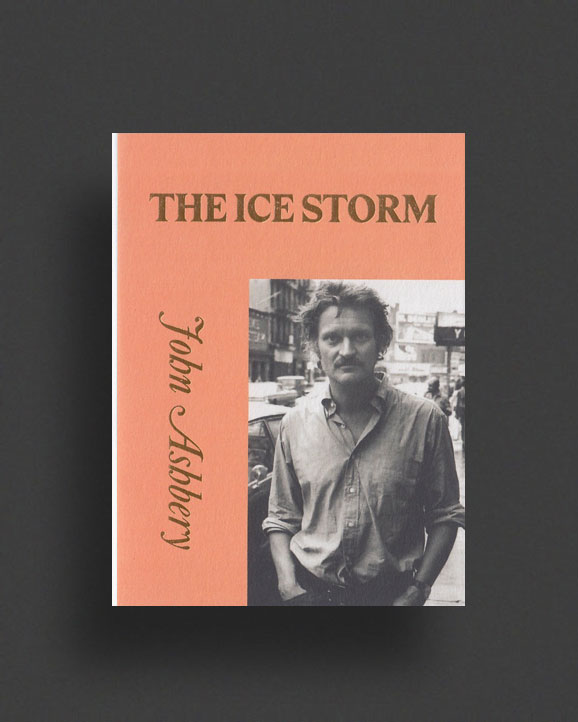
Published in 1987 as a standalone volume by Hanuman Books, John Ashbery's "The Ice Storm" is an extended prose-poem by one of the most important and influential poets of our time.
John Ashbery (1927-2017) was an American poet and critic. Referred to often as an "avant-garde" poet, "experimentalist", or "surrealist", Ashbery's work resisted easy classification. He was awarded nearly every major prize for an American poet during his career, including a Pulitzer Prize in 1967 for Self-Portrait in a Convex Mirror.
From the first series redux of Hanuman Books, the legendary and cult series of chapbooks that were printed in southern India and published out of the storied Chelsea Hotel in New York City between 1986 and 1993. Founded by American curator Raymond Foye and artist Francesco Celemente, Hanuman Books was dedicated mainly to the extreme deconstructive edge of the countercultural poetic, musical, and artistic currents of the 1960s and 1970s, spanning the era of the Cold War, the AIDS crisis, the Harlem Ballroom scene, the Beats, Warhol's Factory etc. Hanuman Books sought to marry the folk-minimal-artisanal with the cutting edge, playfully marketing their books as ‘secret’ documents of an avant-garde subculture, meant to be passed on covertly at street corners just as millenarian chapbooks of medieval times were supposed to have been. Printed in India, the small format is meant to mimic the chapbook form of the Hanuman Chalisa (a folk compendium of chants to the Hindu god Hanuman, sold very cheaply in the bazaars of India) that made them perfect for slipping illicitly into any pocket. Redux editions edited by Shruti Belliappa and Joshua Rothes.
2007, English
Softcover, 24.5 × 19.5 × 1.8 cm
1st Edition, Out of print title / as new
Published by
Pan-Exotica / Tokyo
Treville / Tokyo
$50.00 - Out of stock
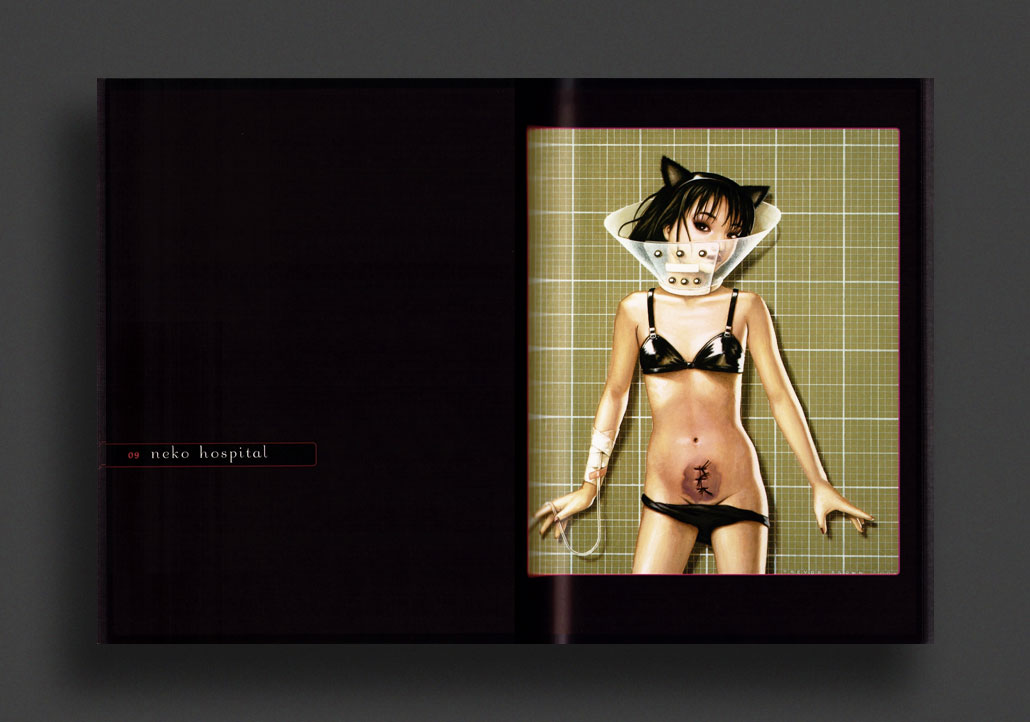
First 2007 softcover edition of Trevor Brown’s "Rubber Doll", published in Japan by Pan-Exotica/Treville. This collection of paintings revolves around the theme of rubber. Lots of cutesy, lolita-esque girls with toys in latex and rubber fantasy scenarios. Published only in Japan, where the English artist has resided since 1994.
Trevor Brown (b. 1959) is an illusive and prolific artist who's work explores paraphilias, such as lolicon, ero guro, BDSM, and other fetish themes. Innocence and violence collide in Brown's confronting images. Early features on his art appeared in Adam Parfrey's Apocalypse Culture II, Shade Rupe's Funeral Party 2, and in Jim Goad's ANSWER Me! zine, garnering him wide notoriety across the provocative underground publishing scene of the 1980s—90s. He's contributed artwork to many album covers of Whitehouse, Coil, John Zorn, and many more, illustrated for Coup de Grace, an edition of Friedrich Nietzsche's Der Antichrist, the covers of Timeless magazine, and more recently illustrated the cover of the Gothic & Lolita Bible (a subculture in which Brown has many dedicated fans) in Japan, where Brown's work has been published in many art book editions.
As New copy.
1996, English / German
Softcover, 288 pages, 27 x 24 cm
1st Edition, Out of print title / used / very good
Published by
Oktagon Verlag / Stuttgart
$220.00 $100.00 - Out of stock
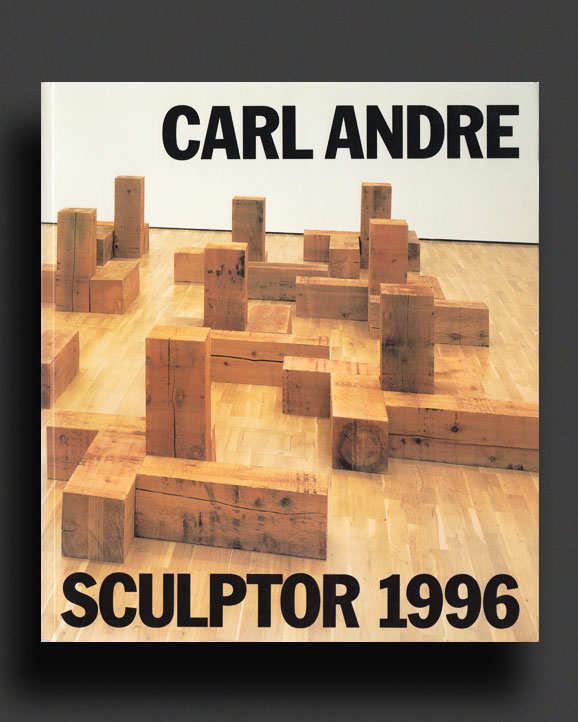
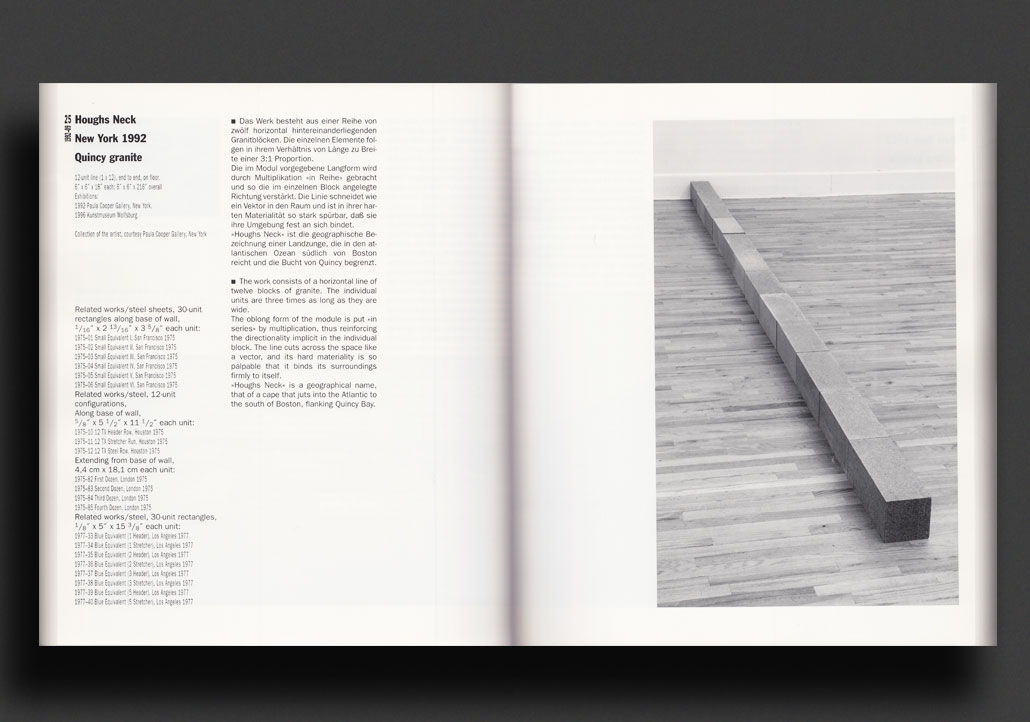
First edition of one of the most sought after of Andre books, this large, heavily illustrated exhibition catalogue was published in conjunction with major exhibition conceived by Carl Andre with curator Eva Meyer-Hermann and held in Germany at Krefeld at Home, Wolfsburg at Large in 1996. The book forms an extensive exhibition chronology and detailed catalogue raisonné of works (including texts/notations and specs to accompany each work - illustrated in both colour and b/w throughout), alongside essays by Eva Meyer-Hermann and Paul Sutinen, as well as an interview with the artist conducted by Phyllis Tuchman, and a letter from Hollis Frampton to Enno Develing.
All texts in both German and English.
Carl Andre (b. 1935) is an American Minimal sculptor and poet associated with Minimalism. Andre is known for abstract work made of repetitive blocks, bricks, and metal plates arranged directly on the floor. Like other Minimalists of his generation, Andre constructed his works out of industrial materials that called attention to the inherent physical structure of the piece and to the architecture of the surrounding space. Eschewing metaphor and symbolism, Andre’s work operates as a set of purely physical and perceptual concerns. Moving to New York in 1957, he became associated with friend Frank Stella and worked in Stella’s studio while developing his own drawings and sculpture. Stella’s abstract paintings of that period were an important influence on Andre’s developing aesthetic, as was the work of modern sculptor Constantin Brâncuși. A number of experiences—including four years of work in railyards in the early 1960s and a trip to the prehistoric archaeological site of Stonehenge in England—solidified Andre’s determination to work with modular units, from wood to metals. Placing square metal tiles onto larger squares, upon which he invited viewers to walk, challenged the museum audience, who were more accustomed to keeping their distance from artworks and to observing sculptures on pedestals.
First edition, very scarce. Very Good copy, clean and tight throughout, only light corner bumping to bottom and tanning to spine, otherwise a crisp copy.
2023, English
Hardcover (clothbound), 268 page, 29.8 x 25.4 cm
Published by
Karma / New York
$125.00 - Out of stock
A window into the world of 1970s painting through the work of 30 women artists. Text by Hilton Als, Elizabeth Hess, Lucy R. Lippard, Ivy Shapiro. Conversation with Connie Choi, Cynthia Carlson, Cynthia Hawkins, Harriet Korman, Dindga McCannon.
Published to follow the landmark exhibition at Karma Gallery, New York, this catalog unites the works of 30 women painters who were active in New York City during the 1970s. The collection showcases the diverse practices and backgrounds of these artists, all of whom were deeply influenced by the transformative legacy of second-wave feminism. During this period, a new form of painting emerged, fusing elements of sculpture and textile into the medium while reevaluating its role through innovative art historical methodologies. Amid debates about the relevance of painting, women artists revitalized the practice, coinciding with a shifting political landscape characterized by the global revolt of women against their marginalized status.
Artists include: Emma Amos, Ida Applebroog, Jennifer Bartlett, Betty Blayton, Vivian Browne, Cynthia Carlson, Martha Diamond, Louise Fishman, Suzan Frecon, Nancy Graves, Cynthia Hawkins, Mary Heilmann, Virginia Jaramillo, Jane Kaplowitz, Harriet Korman, Lois Lane, Helen Marden, Dindga McCannon, Ree Morton, Elizabeth Murray, Ellen Phelan, Howardena Pindell, Sylvia Plimack Mangold, Faith Ringgold, Dorothea Rockburne, Susan Rothenberg, Joan Semmel, Jenny Snider, Joan Snyder, Pat Steir.
2024, English
Softcover, 145 pages, 21 x 29.8 cm
Published by
Neon Parc / Melbourne
Discipline / Melbourne
$30.00 - Out of stock
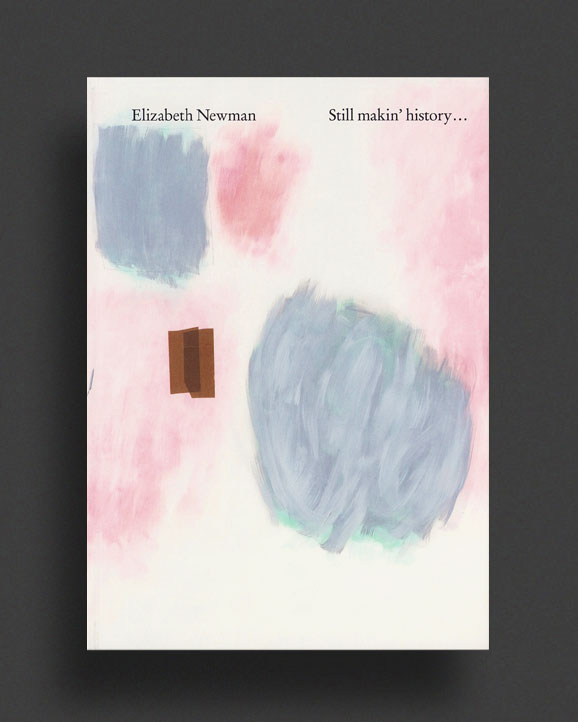
This luminous volume on artist Elizabeth Newman includes two essays by Francis Plagne, each of which cover different, crucial time-periods of Newman’s practice. Highly illustrated, the beautiful works collected here range from the very recent, to those created in the last ten years or so. Melbourne-based Newman uses painting, printmaking, installation and found objects to explore, interrogate and apprehend questions that revolve around the philosophical and social conditions of art.
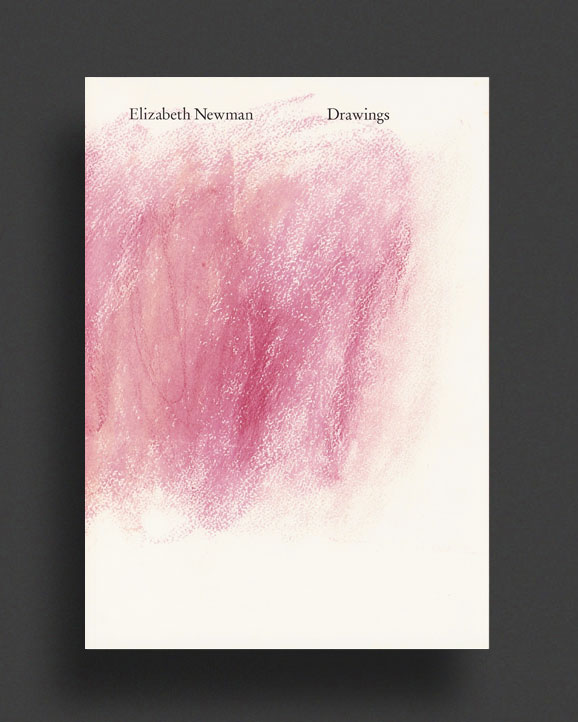
Co-published by Neon Parc and Discipline, Elizabeth Newman: Still makin’ history.... is the sister volume to Elizabeth Newman: Drawings.
2024, English
Softcover, 145 pages, 21 x 29.8 cm
Published by
Neon Parc / Melbourne
Discipline / Melbourne
$30.00 - Out of stock
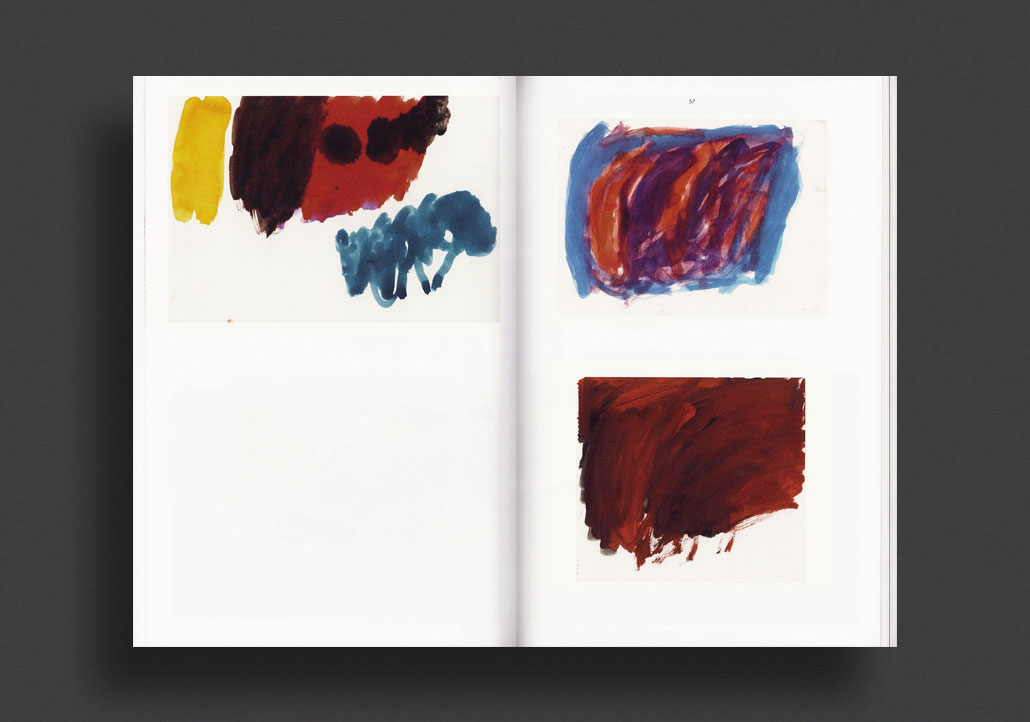
This beautiful volume traces the links between Elizabeth Newman’s drawing practice and wider oeuvre. As Erik Jensen writes in his accompanying essay "her drawings are stubborn and deliberate and curious and patient" – they are acts of discovery that are, as Newman says, about "going to the nothing... to what is most me". Often radiant with colour, much of the work here is strikingly immediate, playful, visceral. Also includes an interview between Helen Hughes, Francis Plagne and Newman.
Co-published by Neon Parc and Discipline, Elizabeth Newman: Drawings is the sister volume to Elizabeth Newman: Still makin’ history....Melbourne-based artist Elizabeth Newman uses painting, printmaking, installation and found objects to explore, interrogate and apprehend questions that revolve around the philosophical and social conditions of art.
2021, English
Softcover (w. plastic dust jacket), 72 pages, 21 x 30 cm
Published by
Drill Hall Gallery / Canberra
$35.00 - In stock -
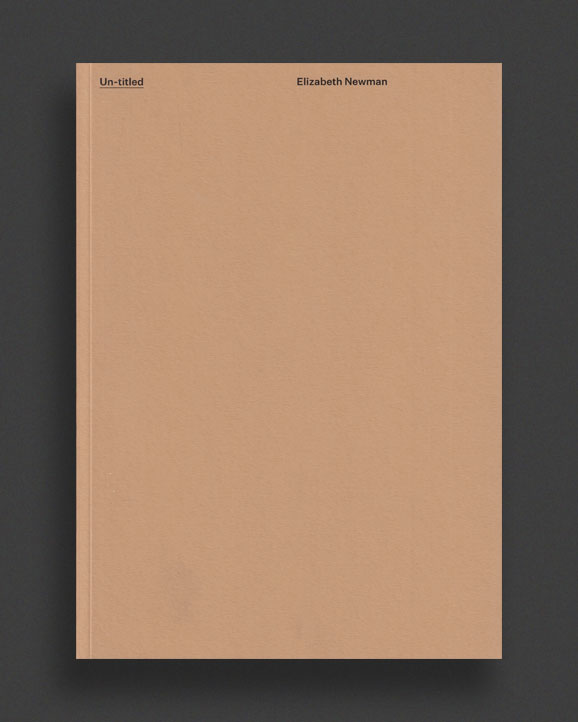
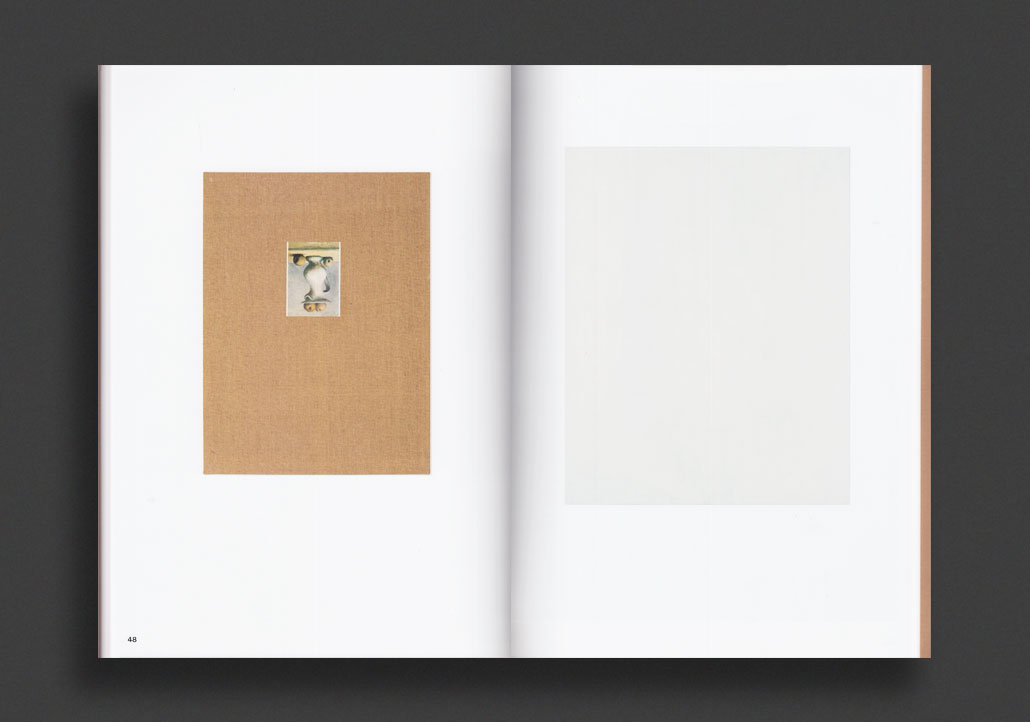
Catalogue published on the occasion of the exhibition Un-titled: Elizabeth Newman at Drill Hall Gallery, Canberra, 20 November, 2021—23 January, 2022. The exhibition surveyed Newman’s body of work, ranging from collage, installation, text-based, textile or found object, and all infused with painterly notions of re-presentation. Hovering around the edges of signification, embracing affect and the act of becoming, her work pivots around reversals of positive and negative, challenging the limitations of language while paradoxically affirming the plasticity of our systems of understanding. Profusely illustrated throughout with essays by Tony Oates and Frances Plagne. Designed by Small Tasks.
2024, English
Hardcover (clothbound w. printed acetate jacket), 168 pages, 30.48 x 22.86 cm
Published by
D.A.P. / New York
DelMonico Books / US
$99.00 - Out of stock
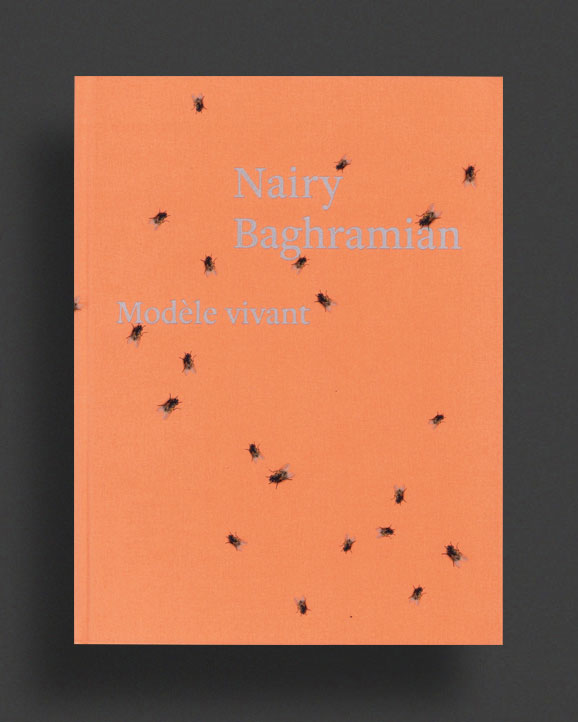
Edited with text by Catherine Craft. Foreword by Jeremy Strick. Text by Julie Mehretu, Kate Nesin, Paulina Pobocha.
New sculptures and installations that critically examine the formal, social and linguistic roles of live models
Over the past three decades, Iranian-born, German-based artist Nairy Baghramian (born 1971) has created sculptures and installations that upend expected modes of presentation and challenge the architectural, social, political and historical contexts that inform them.
The new works featured in this publication explore the provisional body as the site of trauma—drawing inspiration from the tradition of the “modèle vivant,” the French term for a live model in an art class. In her "ambivalently abstract" works, the artist takes unconventional approaches to materials associated with sculptural traditions of casting, including aluminum, lead, steel and wax. In conversation with sculptures from the Nasher’s permanent collection by Louise Bourgeois, Henri Matisse, Pablo Picasso and others, Baghramian’s works offer new ways to think about representations of bodies and the unseen labor of models, as well as the linguistic play afforded by different meanings of the word “model” and its linguistic relatives, such as “modulate” and “modify.”
2012, English
Hardcvoer (clothbound), 72 pages, 27 x 21 cm
Published by
M.33 / Melbourne
$55.00 - Out of stock
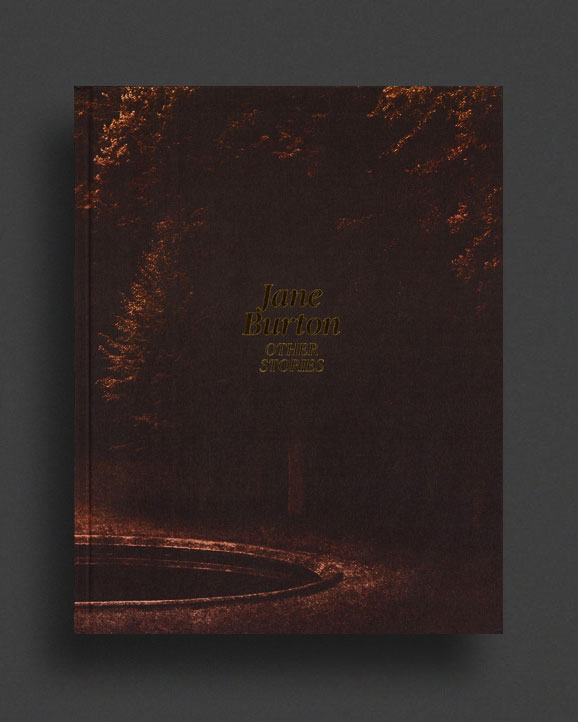
Leading Australian photo-artist Jane Burton's Other Stories captures her arcane sense of mood and atmosphere to stunning effect. Other Stories is a collection of photographs that are intended to be experienced as a series of loose associations rather than determined narratives. Structured with five chapters like a fairy-tale collection, each series is toned in a different colour – reminiscent of old photographic processes and hand-colouring techniques. The atmosphere common to all the stories is cinematic and dreamlike. Saturated with colour (peach-sepia, red, viridian green, lavender, and blue), each has its own emotional pitch and temperature; the ‘story’ is non-linear, non-literal, falling instead between remembrance, hallucination, and fantasy.
Whether depicting a figure, landscape, interior, or object, the photographs are imbued with a weight of meaning and emotional intensity. The landscapes are rendered as symbolic and psychological – places imagined, felt, remembered, rather than actual or specific. The female figure depicted, a character that moves through the stories, an animating presence, more ghost than definitive persona.
Text by Ingrid Perez.
2023, English
Softcover, 184 pages, 29.5 x 22 cm
Published by
Perimeter Editions / Melbourne
MUMA / Victoria
UNSW Press / Sydney
$55.00 - Out of stock
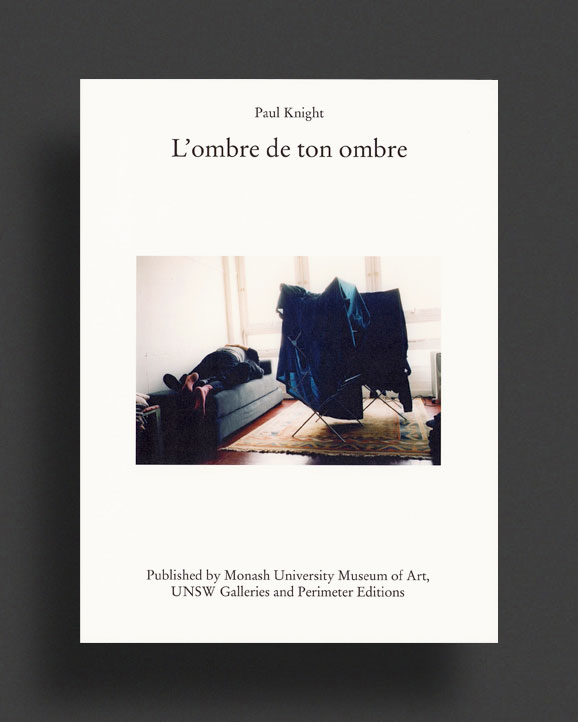
Many species, besides us humans, have developed a notion of love; that absolute beast of biology – love – has filled our brains with delight and sorrow and it has become our most inspirational addition to the line of consciousness. Love is so diverse, complex and complicated to us that it functions more like the air in the array of a storm than a simplistic cause-and-effect response. – Paul Knight
Paul Knight: L’ombre de ton ombre is the first monograph dedicated to Australian-born and Berlin-based artist Paul Knight, co-published by Monash University Museum of Art | MUMA, Melbourne, UNSW Galleries, Sydney, and Perimeter Editions. The publication accompanies his first survey exhibition, co-commissioned by MUMA and UNSW Galleries.
For more than two decades, Knight has taken intimacy as his subject, considering its relationship to representation and the social designs that underpin its expression. This has led him, via an interest in science, to the potential role that intimacy plays in consciousness as an evolutionary line. Knight’s ongoing photographic project, Chamber Music, records the life he shares with his partner Peter. Since their meeting in 2009, the series has accumulated hundreds of glimpses into the domestic space of their relationship, with its images created through varying degrees of pre-meditation and chance; often the camera timer is set so that it simply captures what it sees. The photographs test the ability of this machine – the camera – and the prints it produces to capture and contain intimacy. The images hold human love, which Knight proposes might be our only positive legacy in a future in which machine intelligence carries on, bearing the mark of its creators, beyond humanity itself.
Paul Knight: L’ombre de ton ombre features an extensive selection of photographs from Chamber Music and details the algorithmic working methods of the textile and machine learning works that Knight has developed for the exhibition. It brings artistic and scientific perspectives into conversation with his evolving practice, inviting contributions from: Professor of Contemporary Art History at the Ruskin School of Art, University of Oxford, Anthony Gardner, who situates Knight’s practice within histories of contemporary art and of queer visibility; theoretical astrophysicist and Hawking Chair in Cosmology and Science Communication at the Perimeter Institute for Theoretical Physics, Ontario, Dr Katie Mack, who responds with a poetic evocation of the cosmic timescales that underpin Knight’s thinking; and philosopher Oxana Timofeeva, who reflects on machine learning in the context of human consciousness. The publication will be launched at the exhibition opening at MUMA on 7 October 2023.
MUMA (Melbourne) x UNSW Galleries (Sydney) x Perimeter Editions (Melbourne).
2023, English
Softcover, 136 pages, 10.8 x 17.6 cm
Published by
Common Room / Naarm
$25.00 - Out of stock
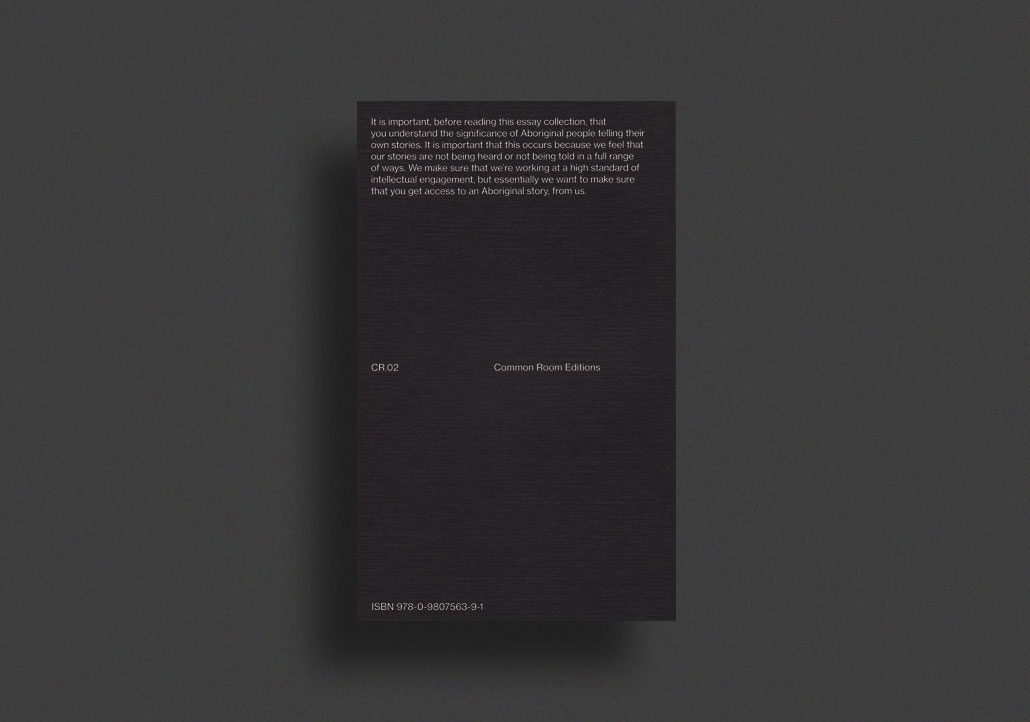
The first in a co-published series with Melbourne School for Discontent, the three longform essays in this book examine various under-known histories of so-called Australia from Aboriginal perspectives, drawing from colonial archives, extensive study and lived experience to examine the ongoing legacy of colonial policy and legislation, from the early 1800s through to Native Title and into the twenty-first century.
2023, English
Softcover, 76 pages, 10.8 x 17.6 cm
Published by
Common Room / Naarm
$18.00 - Out of stock
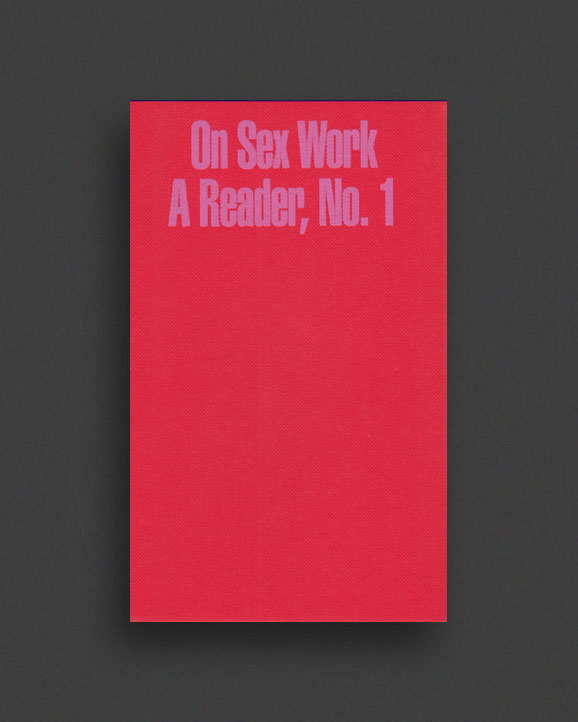
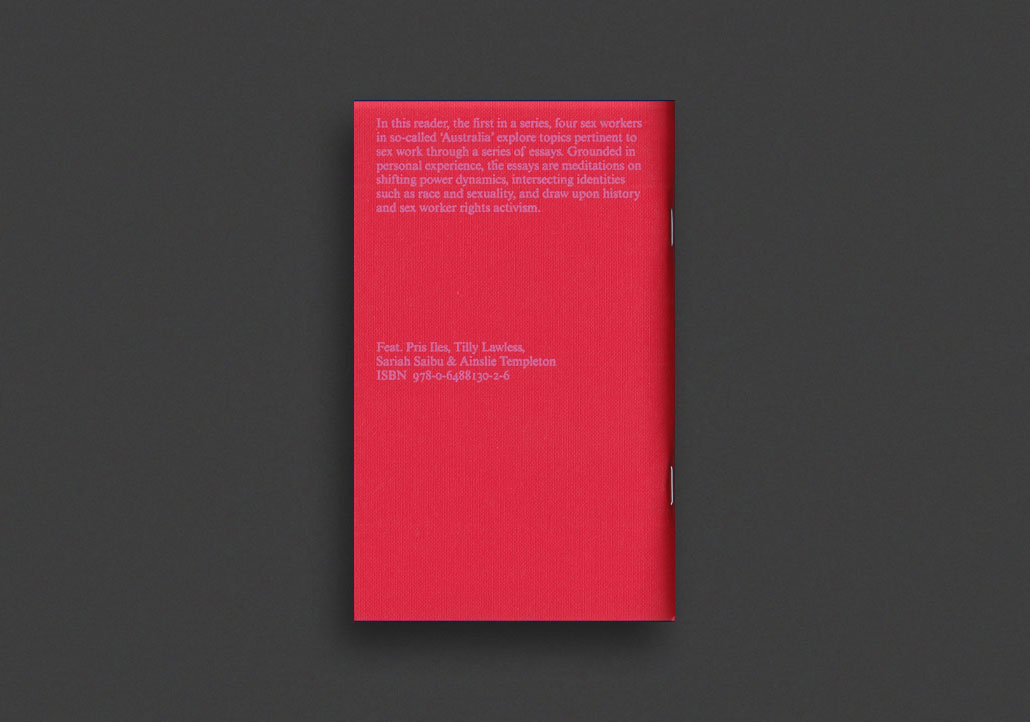
In this reader, the first in a series, four sex workers in so-called 'Australia' explore topics pertinent to sex work through a series of essays. Grounded in personal experience, the essays are meditations on shifting power dynamics, intersecting identities such as race and sexuality, and draw upon history and sex worker rights activism.
Texts by Pris Iles, Tilly Lawless, Sariah Saibu and Ainslie Templeton.
2023, English
Softcover, 72 pages, 10.8 x 17.6 cm
Published by
Common Room / Naarm
$18.00 - Out of stock
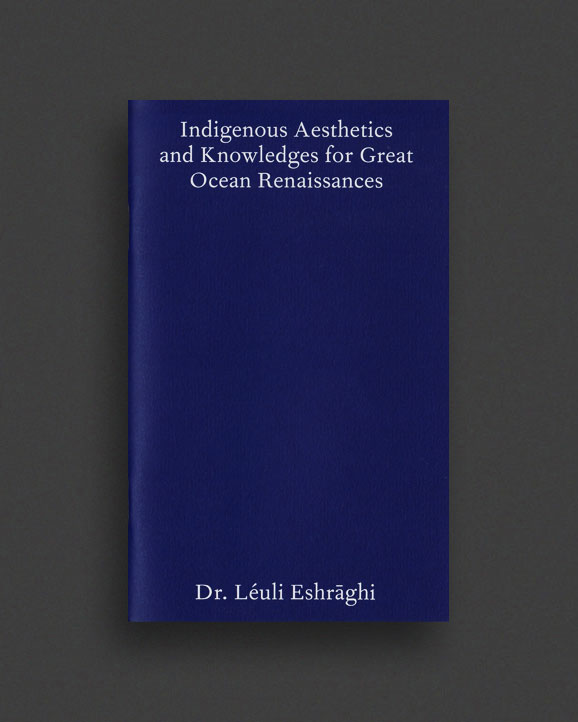
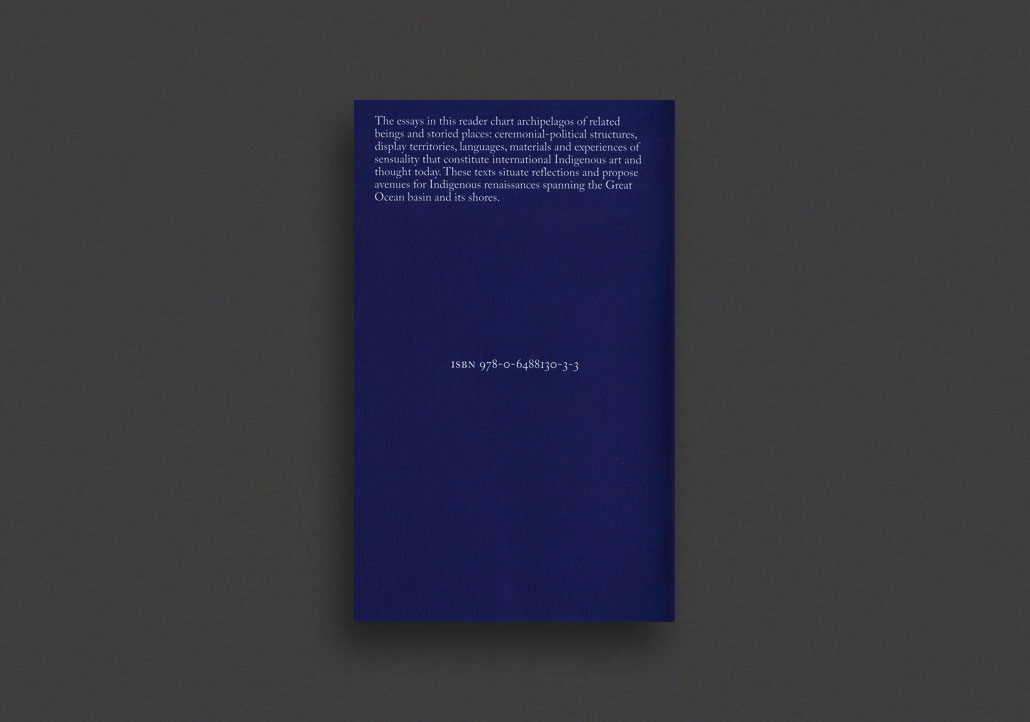
The essays in this reader chart archipelagos of related beings and stories places: ceremonial-political structures, display territories, languages, materials and experiences of sensuality that constitute international Indigenous art and thought today. These texts situate reflections and propose avenues for Indigenous renaissances spanning the Great Ocean basin and its shores.
Introduction by Cara Kirkwood.
2002, English
Softcover, 144 pages, 22.9 x 11.5 cm
Published by
Semiotext(e) / Los Angeles
$30.00 - Out of stock
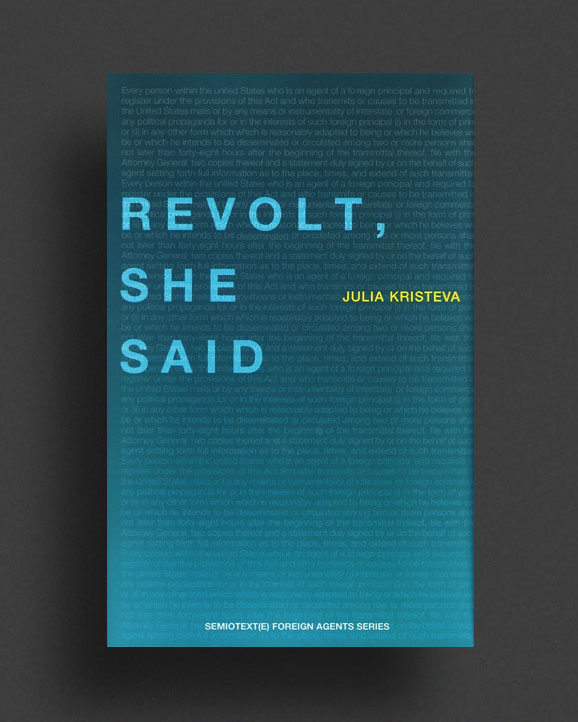
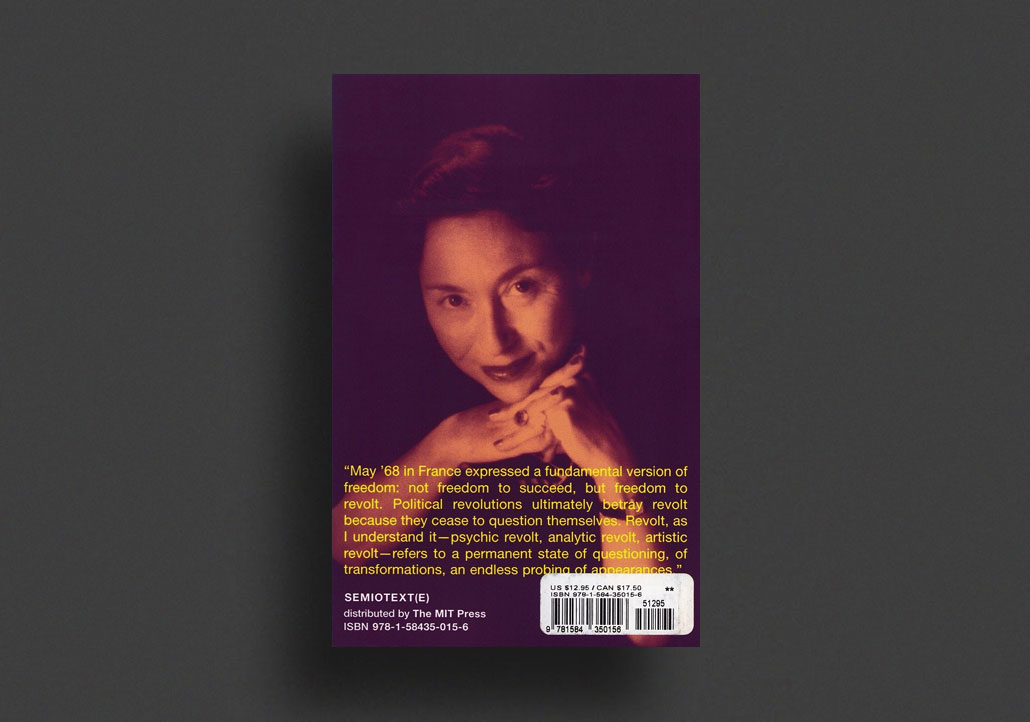
May '68 in France expressed a fundamental version of freedom: not freedom to succeed, but freedom to revolt. Political revolutions ultimately betray revolt because they cease to question themselves. Revolt, as I understand it—psychic revolt, analytic revolt, artistic revolt--refers to a permanent state of questioning, of transformations, an endless probing of appearances. In this book, Julia Kristeva extends the definition of revolt beyond politics per se. Kristeva sees revolt as a state of permanent questioning and transformation, of change that characterizes psychic life and, in the best cases, art. For her, revolt is not simply about rejection and destruction—it is a necessary process of renewal and regeneration.
Julia Kristeva is a professor of linguistics at the Université de Paris VII. She is the author of many highly respected books and a practicing psychoanalyst.