World Food Books' programme is largely produced on Kulin Nation land. We acknowledge the Wurundjeri people of the Kulin Nation as the first and continuing custodians of this land, and pay respect to their Elders past, present, and emerging.
World Food Books is an arts and special interests bookshop in Naarm / Melbourne. Founded in 2010, World Food Books is devoted to the presentation of a rotating, hand-selection of international art, design, literary and counterculture publications with an emphasis on the anti-traditional, the experimental, the avant-garde, the heretic, the marginal.
Presenting new titles alongside rare and out-of-print books, catalogues and journals spanning the fields of modern and contemporary art, design, photography, illustration, film, literature, poetry, cultural theory, philosophy, sexuality, popular and underground culture in its many radical forms, World Food Books wishes to encourage adventurous, thoughtful and open-minded reading, looking, writing, and exchange of publishing and ideas, both current and historical.
As well as our bookshop, located in Melbourne's historical Nicholas Building, all of our inventory is available internationally via our online mail-order service.
World Food Books semi-regularly co-ordinates "Occasions", a programme of exhibits and events at the bookshop and in partnership with other hosts (such as museums and art galleries) that develop out of the activities, relationships and content of the bookshop itself.
World Food Books
The Nicholas Building
37 Swanston Street
Room 5, Level 6
Melbourne 3000
Australia
SHOP HOURS:
THU–SAT 12–6
WEB-SHOP OPEN 24/7
World Food Books
Postal Address:
PO Box 435
Flinders Lane
Victoria 8009
Australia
info@worldfoodbooks.com
Art
Theory / Essay
Architecture / Interior
Graphic Design / Typography
Photography
Fashion
Eros
LGBTQ+
Fiction / Poetry
Weird / Speculative / Science Fiction / Horror
Transgressive / Visceral / Abject
Symbolism / Decadence / Fin de siècle
Film / Video
Painting
Sculpture / Installation
Performance / Dance / Theater
Drawing
Sound / Music
Curatorial
Group Shows / Collections
Periodicals
Out-of-print / Rare
Posters / Ephemera / Discs
Signed Books
World Food Books Gift Voucher
World Food Book Bag
Australian Art
Australian Fiction
Australian Science Fiction / Speculative Fiction
Australian Poetry
Australian Photography
Japanese Photography
Conceptual Art
Minimal Art
Dada
'Pataphysics / Oulipo
Fluxus
Concrete Poetry
Pop Art
Surrealism
Arte Povera
Arte Informale / Haute Pâte / Tachism
Nouveau Réalisme / Zero / Kinetic
Situationism / Lettrism
Collage / Mail Art / Xerox Art
Art Brut / Folk / Visionary / Fantastic
Illustration / Graphic Art / Bandes Dessinées
Furniture
Italian Radical Design / Postmodernism
Textiles
Ceramics / Glass
Counterculture
Protest / Revolt
Philosophy
Psychoanalysis
Anthropology
Anarchism
Socialism / Anarchism / Communism / Capitalism
Literary Theory / Semiotics / Language
Feminism / Women's Studies
Gender Studies / Sexuality
Anthropology
Fetishism / BDSM
Drugs / Psychedelia
Crime / Violence
Animal Rights / Veganism
Occult / Esoterica
Ecology / Earth / Alternative Living
Whole Earth / Crafts
All prices in AUD (Australian dollars)
Pick-Ups
Pick-up orders can be collected in our bookshop during opening hours after order date. Please collect any Pick-up orders within 2 weeks of ordering as we have limited storage space. Orders will be released back into stock if not collected within this time. No refunds can be made for pick-ups left un-collected. If you cannot make it in to the bookshop in this time-frame, please choose postage option.
Return Policy
All sales are final. We do accept returns (for refund or exchange) for items received in error. All our orders are packed with special care using heavy-duty padding and cardboard book-mailers or bubble mailers (for smaller books), using reinforcement where required. We cannot take responsibility for any lost, stolen or damaged parcels.
Insurance
Should you wish to insure your package, please email us directly after placing your order and we can organise this at a small extra expense. Although all standard/express tracked packages are very safe and dependable, we cannot take responsibility for any lost, stolen or damaged parcels. We recommend insurance on valuable orders.
Interested in selling your old books, catalogues, journals, magazines, comics, fanzines, ephemera? We are always looking for interesting, unusual and out-of-print books to buy. We only buy books in our fields of interest and specialty, and that we feel we can resell.
We base these prices on desirability, market value, in-print prices, condition and our current stock levels. We offer cash, store credit, and can take stock on consignment. All
about 25% of the price we expect to get when we sell them, or 30% in store credit. We base these prices on desirability, market value, in-print prices, condition and our current stock levels.
Sell your books any day of the week. You can drop them off and return later. If you have a lot of books, we can visit your Sydney home.
We buy books that we feel we can resell. We offer about 25 % of the price we expect to get when we sell them, or 30% in store credit. We base these prices on desirability, market value, in-print prices, condition and our current stock levels.
Philadelphia Wireman
03 August - 01 September, 2018
World Food Books is proud to announce our next Occasion, the first presentation of sculptures by Philadelphia Wireman in Australia.
The Philadelphia Wireman sculptures were found abandoned in an alley off Philadelphia’s South Street on trash night in 1982. Their discovery in a rapidly-changing neighbourhood undergoing extensive renovation, compounded with the failure of all attempts to locate the artist, suggests that the works may have been discarded after the maker’s death. Dubbed the "Philadelphia Wireman" during the first exhibition of this work, in 1985, the maker’s name, age, ethnicity, and even gender remain uncertain. The entire collection totals approximately 1200 pieces, all intricately bound together with tightly-wound heavy-gauge wire (along with a few small, abstract marker drawings, reminiscent both of Mark Tobey and J.B. Murry). The dense construction of the work, despite a modest range of scale and materials, is singularly obsessive and disciplined in design: a wire armature or exoskeleton firmly binds a bricolage of found objects including plastic, glass, food packaging, umbrella parts, tape, rubber, batteries, pens, leather, reflectors, nuts and bolts, nails, foil, coins, toys, watches, eyeglasses, tools, and jewellery.
Heavy with associations—anthropomorphic, zoomorphic, and socio-cultural responses to wrapped detritus—the totemic sculptures by Philadelphia Wireman have been discussed in the context of work created to fulfil the shamanistic needs of alternative religions in American culture. Curators, collectors, and critics have variously compared certain pieces to sculpture from Classical antiquity, Native American medicine bundles, African-American memory jugs, and African fetish objects. Reflecting the artist’s prolific and incredibly focused scavenging impulse, and despite—or perhaps enhanced by—their anonymity, these enigmatic objects function as urban artefacts and arbiters of power, though their origin and purpose is unknown. Philadelphia Wireman, whatever their identity, possessed an astonishing ability to isolate and communicate the concepts of power and energy through the selection and transformation of ordinary materials. Over the course of the past two decades, this collection has come to be regarded as an important discovery in the field of self-taught art and vernacular art.
Presented in collaboration with Fleisher-Ollman Gallery, Philadelphia, and Robert Heald, Wellington.
Susan Te Kahurangi King
02 February - 10 March, 2018
Susan Te Kahurangi King (24 February 1951 - ) has been a confident and prolific artist since she was a young child, drawing with readily available materials - pencils, ballpoint pens and felt-tip markers, on whatever paper is at hand. Between the ages of four and six Susan slowly ceased verbal communication. Her grandparents William and Myrtle Murphy had developed a special bond with Susan so they took on caring responsibilities for extended periods. Myrtle began informally archiving her work, carefully collecting and storing the drawings and compiling scrapbooks. No drawing was insignificant; every scrap of paper was kept. The King family are now the custodians of a vast collection containing over 7000 individual works, from tiny scraps of paper through to 5 meter long rolls.
The scrapbooks and diaries reveal Myrtle to be a woman of great patience and compassion, seeking to understand a child who was not always behaving as expected. She encouraged Susan to be observant, to explore her environment and absorb all the sights and sounds. Myrtle would show Susan’s drawings to friends and people in her community that she had dealings with, such as shopkeepers and postal workers, but this was not simply a case of a grandmother’s bias. She recognised that Susan had developed a sophisticated and unique visual language and sincerely believed that her art deserved serious attention.
This was an unorthodox attitude for the time. To provide some context, Jean Dubuffet coined the term Art Brut in 1945 to describe work created by self-taught artists – specifically residents of psychiatric institutions and those he considered to be visionaries or eccentrics. In 1972 Roger Cardinal extended this concept by adopting the term Outsider Art to describe work made by non-academically trained artists operating outside of mainstream art networks through choice or circumstance. Susan was born in Te Aroha, New Zealand in 1951, far from the artistic hubs of Paris and London that Dubuffet and Cardinal operated in. That Myrtle fêted Susan as a self-taught artist who deserved to be taken seriously shows how progressive her attitudes were.
Susan’s parents Doug and Dawn were also progressive. Over the years they had consulted numerous health practitioners about Susan’s condition, as the medical establishment could not provide an explanation as to why she had lapsed into silence. Dawn educated herself in the field of homeopathy and went on to treat all twelve of her children using these principles – basing prescriptions on her observations of their physical, mental and emotional state.
Doug was a linguist with an interest in philosophy who devoted what little spare time he had to studying Maori language and culture. To some extent their willingness to explore the fringes of the mainstream made them outsiders too but it was their commitment to living with integrity and their respect for individuality that ensured Susan’s creativity was always encouraged.
Even though Susan’s family supported her artistic pursuits, some staff in schools and hospitals saw it as an impediment to her assimilation into the community and discouraged it in a variety of ways. Her family was not always aware of this and therefore did not fully understand why Susan stopped drawing in the early 1990s. However, rather than dwell on the challenges that Susan faced in pursuit of her artistic practice, they prefer to highlight her achievements. In 2008 Susan began drawing again in earnest, after an almost 20 year interruption, and her work is now shown in galleries around the world.
Susan grew up without television and has been heavily influenced by the comics she read as a child. She is absolutely fearless in the appropriation of recognizable characters, such as Donald Duck and Mickey Mouse, in her work. She twists their limbs, contorts their faces, compresses them together, blends them into complex patterned backgrounds - always imbuing them with an incredible energy. Although Susan often used pop culture characters in her work they are not naive or childlike. These are drawings by a brilliant self-taught artist who has been creating exceptional work for decades without an audience in mind.
Mladen Stilinović
"Various Works 1986 - 1999"
02 February 16 - September 10, 2016
Various works 1986 - 1999, from two houses, from the collections of John Nixon, Sue Cramer, Kerrie Poliness, Peter Haffenden and Phoebe Haffenden.
Including: Geometry of Cakes (various shelves), 1993; Poor People’s Law (black and white plate), 1993; White Absence (glasses, ruler, set square, silver spoon, silver ladel with skin photograph and wooden cubes), 1990-1996; Exploitation of the Dead (grey and red star painting, wooden painting, black spoon with red table, red plate), 1984-1990; Money and Zeros (zero tie, paintings made for friends in Australia (Sue, John, Kerrie), numbers painting), 1991-1992; Words - Slogans (various t-shirts) - “they talk about the death of art...help! someone is trying to kill me”, “my sweet little lamb”, “work is a disease - Karl Marx”; Various artist books, catalogues, monographs, videos; Poster from exhibition Insulting Anarchy; "Circular" Croatian - Australian edition; Artist book by Vlado Martek (Dostoyevsky); more.
Thanks to Mladen Stilinović and Branka Stipančić.
Jonathan Walker
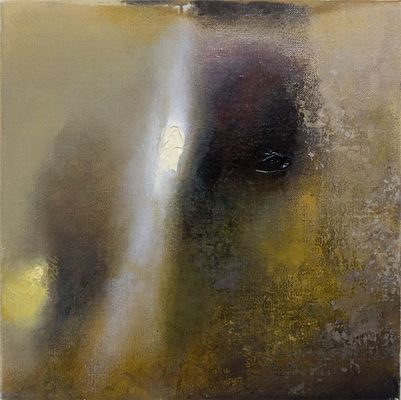
Always Will Need To Wear Winter Shirt Blue + Ochre Small Check Pattern
21 August - 21 September, 2015
Untitled
I am not a great reader of poetry but I always return to the work of Melbourne poet, Vincent Buckley (1925- 1988). Perhaps I find his most tantalising piece to be not a finished poem but a fragment left on a scrap of paper discovered on his desk after the poet’s death.
The poetry gathers like oil
In the word-core, and spreads
It has its music meet,
Its music is in movement.
This fragment is more the shell left behind from a volatile thought than a finished poem. I find the last two lines honest but awkward whereas the first two lines work like an arrow. Most likely he could not find a resolution so it was left. Still, in its present form, it remains an eloquent testimony to the ultimate failure of a medium to express mobile thought and sensation, in Buckley’s case, through verbal language. It’s an important matter because this is something all artists have to deal with regardless of the medium.
I have never written a poem, however, I am forever copying fragments from books on paper scraps in a vain effort to fix certain notions in my head. At first, they function as bookmarks that are sometimes returned to when I open the book. But before long, as they accumulate, they fall out littering the table interspersed with A4 photocopies, bills, books and medications.
To return to Buckley’s fragment, the first two lines very much evoke how I paint nowadays. As you age, detail diminishes and patches of light become more luminous and float. I feel the most honest way of dealing with this is by smearing the oil paint on the canvas with the fingers and working close-up, blind. Only if the patches coalesce into an approaching image can the work gain a life.
-
Jonathan Walker was born in Melbourne, Australia and brought up on a dairy farm in Gippsland. In the 1970’s he studied painting at RMIT and won the Harold Wright Scholarship to the British Museum, London. During the 1980’s he exhibited at Pinacotheca Gallery, Richmond and had work shown at the NGV and Heidi City Art Gallery. Over the same period he designed the cover for the “Epigenesi” LP by Giancarlo Toniutti, Italy and conducted a mail exchange work with Achim Wollscheid, Germany. The work with artists through the post resulted in an article published in the bicentenary issue of Art and Australia 1988. He showed in artist run spaces such as WestSpace in the 90’s and 2000’s, and until 2012, taught painting at Victoria University, which is where we (Colleen Ahern and Lisa Radford) as organisers of the exhibition, among many others, had the privilege of being his student.
Walker’s knowledge was imparted to students through the careful selection of music, literature, and artists found in books that he himself had ordered for the library. Walker’s strategy was the generosity of sharing his vast knowledge with references specific to each student and their context.
Walker’s paintings share a similar focus and intimacy.
This exhibition presents a small selection of recent paintings alongside a publication that includes Walker’s writing. Observational and analytical, Walker’s work is a type of material notation — the time of day, colour and how it is blended, the both specific and fleeting location of a reflection on lino or the question of whether a chair leg should be included in a painting.
Please join us on Friday August 21 between 6-8pm to celebrate the opening of the exhibition.
Curated by Colleen Ahern and Lisa Radford.
B. Wurtz
Curated by Nic Tammens
March 26 - April 4, 2015
B.Wurtz works from a basement studio in his home on Manhattan’s Lower East Side.
This local fact is attested to by the plastic shopping bags and newsprint circulars that appear in his work. As formal objects, they don’t make loud claims about their origins but nonetheless transmit street addresses and places of business from the bottom of this long thin island. Like plenty of artists, Wurtz is affected by what is local and what is consumed. His work is underpinned by this ethic. It often speaks from a neighborhood or reads like the contents of a hamper:
“BLACK PLUMS $1.29 lb.”
“Food Bazaar”
“USDA Whole Pork Shoulder Picnic 99c lb.”
“RITE AID Pharmacy, with us it’s personal.”
“H. Brickman & Sons.”
“Sweet Yams 59c lb."
Most of the work in this exhibition was made while the artist was in residence at Dieu Donne, a workshop dedicated to paper craft in Midtown. Here Wurtz fabricated assemblages with paper and objects that are relatively lightweight, with the intention that they would be easily transportable to Australia. This consideration isn’t absolute in Wurtz’s work, but was prescriptive for making the current exhibition light and cheap. Packed in two boxes, these works were sent from a USPS post office on the Lower East Side and delivered to North Melbourne by Australia Post.
Wurtz appears courtesy of Metro Pictures, New York.
Thanks to Rob Halverson, Joshua Petherick, Sari de Mallory, Matt Hinkley, Helen Johnson, Fayen d'Evie, Ask Kilmartin, Lisa Radon, Ellena Savage, Yale Union, and "Elizabeth".
John Nixon
"Archive"
December 15 - January 20, 2014
The presentation of John Nixon's archive offered a rare showcase of this extensive collection of the artist's own publications, catalogues, posters, ephemera, editions and more, from the mid 1980s onwards, alongside a selection of his artworks.
Organized by John Nixon, Joshua Petherick and Matt Hinkley.
"Habitat"
at Minerva, Sydney (organised by Joshua Petherick and Matt Hinkley)
November 15 - December 20, 2014
Lupo Borgonovo, Janet Burchill & Jennifer McCamley,
Lewis Fidock, HR Giger, Piero Gilardi, Veit Laurent Kurz,
Cinzia Ruggeri, Michael E. Smith, Lucie Stahl, Daniel Weil, Wols
Press Release:
“...It contained seven objects. The slender fluted bone, surely formed for flight, surely from the wing of some large bird. Three archaic circuitboards, faced with mazes of gold. A smooth white sphere of baked clay. An age-blackened fragment of lace. A fingerlength segment of what she assumed was bone from a human wrist, grayish white, inset smoothly with the silicon shaft of a small instrument that must once have ridden flush with the surface of the skin - but the thing’s face was seared and blackened.”
William Gibson, “Count Zero”, 1986
"Autumn Projects Archive"
Curated by Liza Vasiliou
March 6 - March 15, 2014
World Food Books, in conjunction with the Virgin Australia Melbourne Fashion Festival 2014, presented the Autumn Projects archive, consisting of a selection of early examples in Australian fashion with a particular interest in collecting designers and labels from the period beginning in the 1980’s, who significantly influenced the discourse of Australian Fashion.
Curated by Liza Vasiliou, the exhibition provided a unique opportunity to view pieces by designers Anthea Crawford, Barbara Vandenberg, Geoff Liddell and labels CR Australia, Covers, Jag along with early experimental collage pieces by Prue Acton and Sally Browne’s ‘Fragments’ collection, suspended throughout the functioning World Food Books shop in Melbourne.
H.B. Peace
presented by CENTRE FOR STYLE
November 14, 2013
"Hey Blinky, you say chic, I say same"
Anon 2013
H.B. Peace is a clothing collaboration between great friends Blake Barns and Hugh Egan Westland. Their pieces explore the divergences between 'character’ and ‘personality’ in garments....etc
Special Thanks to Joshua Petherick and Matt Hinkley of WFB and Gillian Mears
and a Very Special Thank you to Audrey Thomas Hayes for her shoe collaboration.
Janet Burchill & Jennifer McCamley
"Aesthetic Suicide"
May 10 - June 8, 2013
The first of our occasional exhibitions in the World Food Books office/shop space in Melbourne, "Aesthetic Suicide" presented a body of new and older works together by artists Janet Burchill & Jennifer McCamley, including videos, prints, a wall work, and publications.
During shop open hours videos played every hour, on the hour.
2009, English
Softcover, 128 pages, 152 x 229 mm
Published by
Semiotext(e) / Los Angeles
$25.00 - In stock -
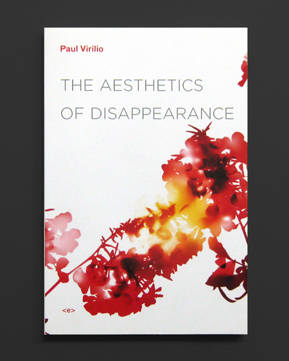
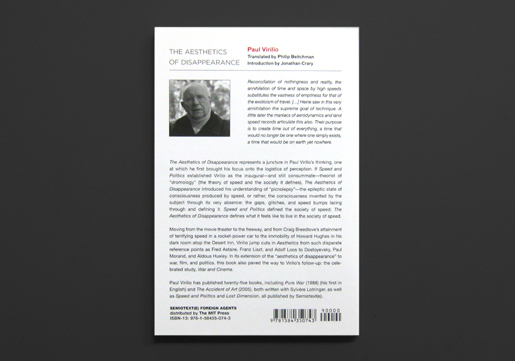
Virilio himself referred to his 1980 work The Aesthetics of Disappearance as a “juncture” in his thinking, one at which he brought his focus onto the logistics of perception—a logistics he would soon come to refer to as the “vision machine.” If Speed and Politics established Virilio as the inaugural—and still consummate—theorist of “dromology” (the theory of speed and the society it defines), The Aesthetics of Disappearance introduced his understanding of “picnolepsy”—the epileptic state of consciousness produced by speed, or rather, the consciousness invented by the subject through its very absence: the gaps, glitches, and speed bumps lacing through and defining it. Speed and Politics defined the society of speed; The Aesthetics of Disappearance defines what it feels like to live in the society of speed.
“I always write with images,” Virilio has claimed, and this statement is nowhere better illustrated than with The Aesthetics of Disappearance. Moving from the movie theater to the freeway, and from Craig Breedlove’s attainment of terrifying speed in a rocket-power car to the immobility of Howard Hughes in his dark room atop the Desert Inn, Virilio himself jump cuts from such disparate reference points as Fred Astaire, Franz Liszt, and Adolf Loos to Dostoyevsky, Paul Morand, and Aldous Huxley. In its extension of the “aesthetics of disappearance” to war, film, and politics, this book paved the way to Virilio’s follow-up: the celebrated study, War and Cinema.
This edition features a new introduction by Jonathan Crary, one of the leading theorists of modern visual culture.
Paul Virilio has published twenty-five books, including Pure War (1988) (his first in English) and The Accident of Art (2005), both written with Sylvère Lotringer, as well as Speed and Politics and Lost Dimension, all published by Semiotext(e).
2012, English
Softcover, 192 pages, 15 x 22.5 cm
Published by
Semiotext(e) / Los Angeles
$35.00 - Out of stock
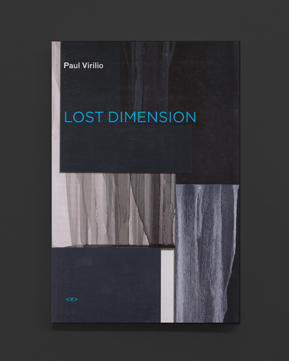
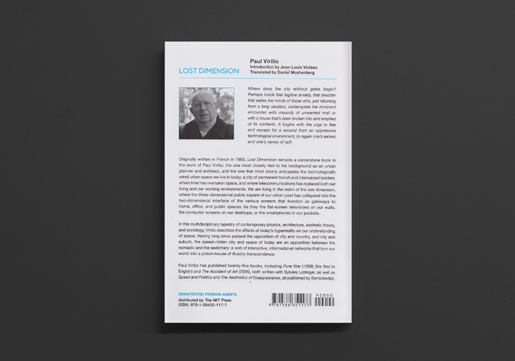
Originally written in French in 1983, Lost Dimension remains a cornerstone book in the work of Paul Virilio: the one most closely tied to his background as an urban planner and architect, and the one that most clearly anticipates the technologically wired urban space we live in today: a city of permanent transit and internalized borders, where time has overtaken space, and where telecommunications has replaced both our living and our working environments. We are living in the realm of the lost dimension, where the three-dimensional public square of our urban past has collapsed into the two-dimensional interface of the various screens that function as gateways to home, office, and public spaces, be they the flat-screen televisions on our walls, the computer screens on our desktops, or the smartphones in our pockets.
In this multidisciplinary tapestry of contemporary physics, architecture, aesthetic theory, and sociology, Virilio describes the effects of today’s hyperreality on our understanding of space. Having long since passed the opposition of city and country, and city and suburb, the speed-ridden city and space of today are an opposition between the nomadic and the sedentary: a web of interactive, informational networks that turn our world into a prison-house of illusory transcendence.
Paul Virilio was born in 1932 and has published a wide range of books, essays, and interviews grappling with the question of speed and technology, including Speed and Politics, The Aesthetics of Disappearance, and The Accident of Art, all published by Semiotext(e). Jean-Louis Violeau is a sociologist and researcher at the 'Architecture-Culture-Société' laboratory of the Ecole d'architecture de Paris-Malaquais in Paris. His most recent book is Les Architectes et Mai 68.
2005, English
Softcover, 128 pages, 15 x 22.5 cm
Published by
Semiotext(e) / Los Angeles
$28.00 - Out of stock
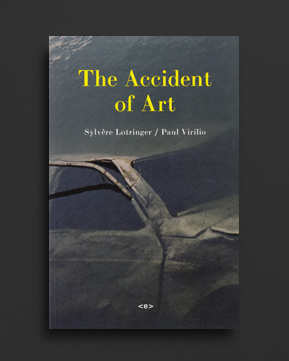
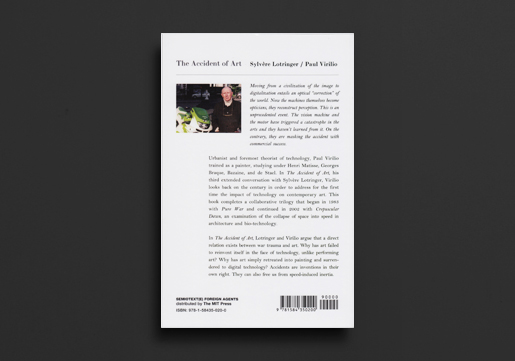
There is a catastrophe within contemporary art. What I call the "optically correct" is at stake. The vision machine and the motor have triggered it, but the visual arts haven't learned from it. Instead, they've masked this failure with commercial success. This "accident" is provoking a reversal of values. In my view, this is positive: the accident reveals something important we would not otherwise know how to perceive.-- Paul Virilio, The Accident of Art
Urbanist and technological theorist Paul Virilio trained as a painter, studying under Henri Matisse, Georges Braque, Bazaine and de Stael. In The Accident of Art, his third extended conversation with Sylvere Lotringer, Virilio addresses the situation of art within technological society for the first time. This book completes a collaborative trilogy the two began in 1982 with Pure War and continued with Crepuscular Dawn, their 2002 work on architecture and biotechnology.In The Accident of Art, Virilio and Lotringer argue that a direct relation exists between war trauma and art. Why has art failed to reinvent itself in the face of technology, unlike performing art? Why has art simply retreated into painting, or surrendered to digital technology? Accidents, Virilio claims, can free us from speed's inertia. As technological catastrophes, accidents are inventions in their own right.
2007, English
Softcover, 200 pages, 15.2 x 22.9 cm
Published by
Semiotext(e) / Los Angeles
The MIT Press / Massachusetts
$30.00 - In stock -
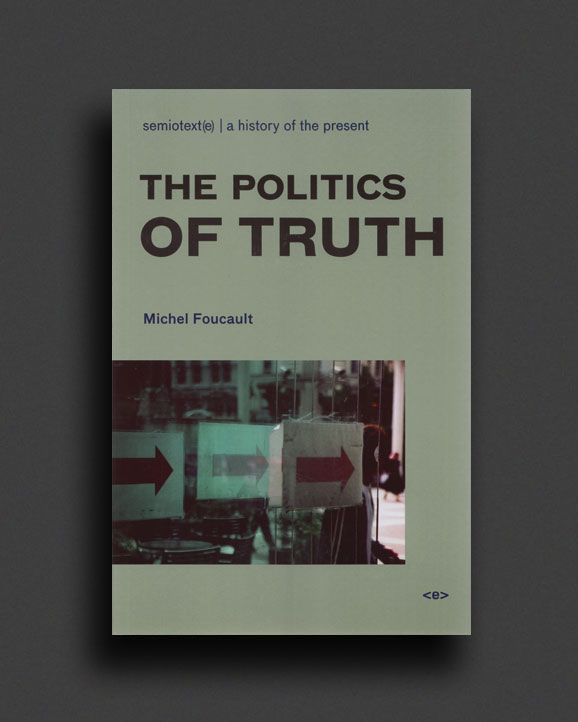
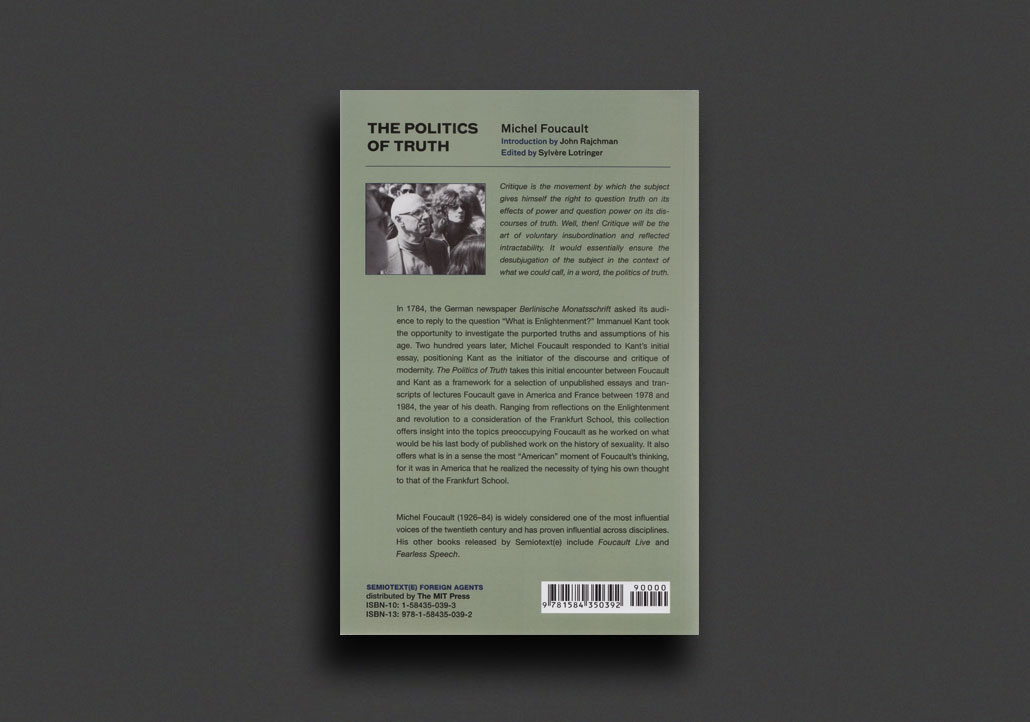
Ranging from reflections on the Enlightenment and revolution to a consideration of the Frankfurt School, this collection offers insight into the topics preoccupying Foucault as he worked on what would be his last body of published work, the three-volume History of Sexuality.
In 1784, the German newspaper Berlinische Monatsschrift asked its audience to reply to the question "What is Enlightenment?" Immanuel Kant took the opportunity to investigate the purported truths and assumptions of his age. Two hundred years later, Michel Foucault wrote a response to Kant's initial essay, positioning Kant as the initiator of the discourse and critique of modernity. The Politics of Truth takes this initial encounter between Foucault and Kant, as a framework for its selection of unpublished essays and transcripts of lectures Foucault gave in America and France between 1978 and 1984, the year of his death. Ranging from reflections on the Enlightenment and revolution to a consideration of the Frankfurt School, this collection offers insight into the topics preoccupying Foucault as he worked on what would be his last body of published work, the three-volume History of Sexuality. It also offers what is in a sense the most "American" moment of Foucault's thinking, for it was in America that he realized the necessity of tying his own thought to that of the Frankfurt School.
Edited by Sylvere Lotringer
Michel Foucault (1926–84) is widely considered to be one of the most influential academic voices of the twentieth century and has proven influential across disciplines.
Sylvère Lotringer is Jean Baudrillard Chair at the European Graduate School, Switzerland, and Professor Emeritus of French literature and philosophy at Columbia University.
2014, English
Softcover, 88 pages, 13.7 x 20.3 cm
Published by
Semiotext(e) / Los Angeles
The MIT Press / Massachusetts
$28.00 - Out of stock
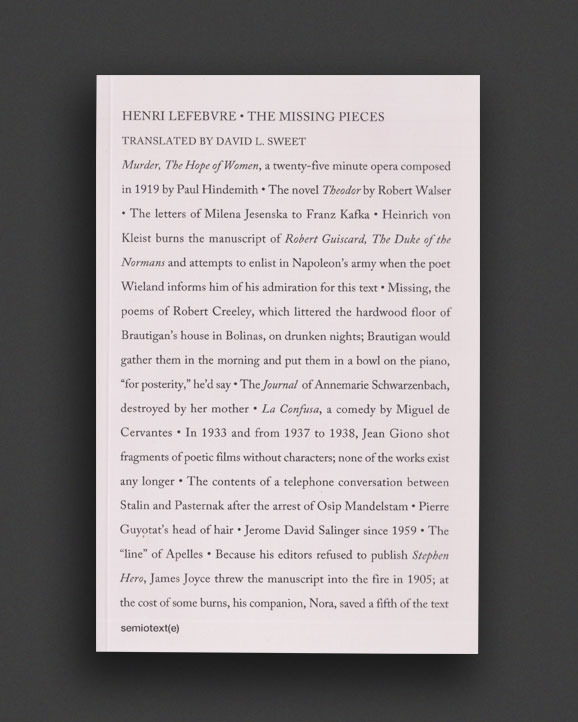
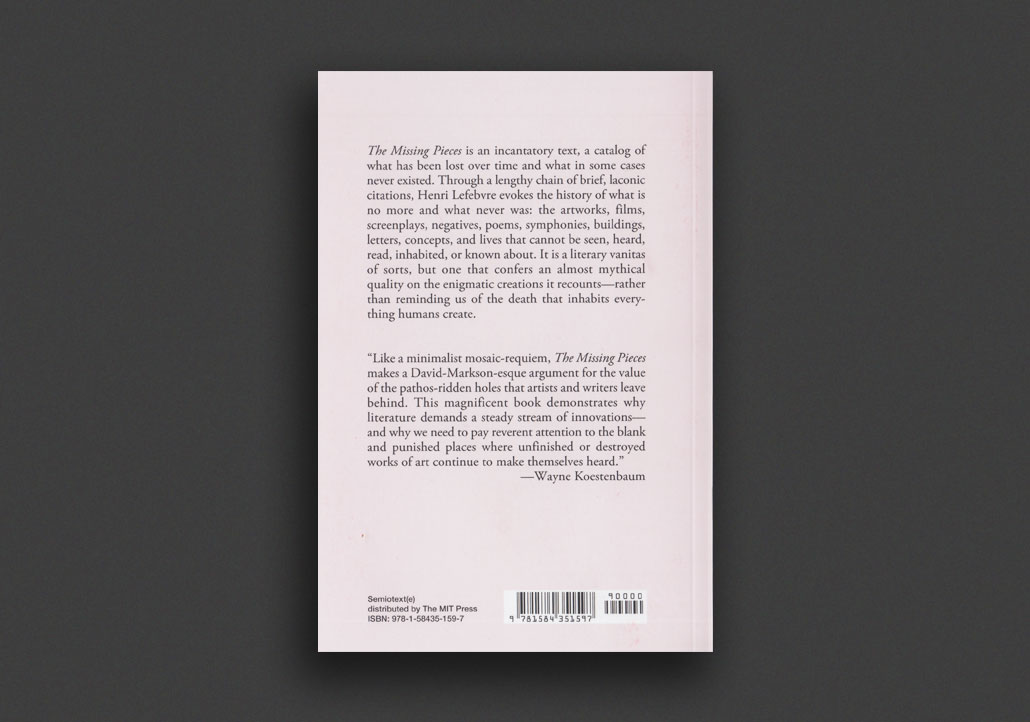
An incantatory catalog of cultural artifacts either lost to time or never realized.
• A boarder for two years following a national funeral, Mirabeau is removed from the Pantheon and transferred to the cemetery of Clamart when his pornographic novels are discovered • A photograph taken by Hessling on Christmas night, 1943, of a young woman nailed alive to the village gate of Novimgorod; Hessling asks his friend Wolfgang Borchert to develop the film, look at the photograph, and destroy it • The Beautiful Gardener, a picture by Max Ernst, burned by the Nazis—from The Missing Pieces
The Missing Pieces is an incantatory text, a catalog of what has been lost over time and what in some cases never existed. Through a lengthy chain of brief, laconic citations, Henri Lefebvre evokes the history of what is no more and what never was: the artworks, films, screenplays, negatives, poems, symphonies, buildings, letters, concepts, and lives that cannot be seen, heard, read, inhabited, or known about. It is a literary vanitas of sorts, but one that confers an almost mythical quality on the enigmatic creations it recounts—rather than reminding us of the death that inhabits everything humans create.
Lefebvre's list includes Marcel Duchamp's (accdidentally destroyed) film of Man Ray shaving off the Baroness Elsa von Freytag-Loringhoven's pubic hair; the page written by Balzac on his deathbed (lost); Spinoza's Treatise on the Rainbow (thrown into a fire); the final seven meters of Kerouac's original typescript for On the Road (eaten by a dog); the chalk drawings of Francis Picabia (erased before an audience); and the one moment in André Malraux's life in which he exclaimed “I believe, for a minute, I was thinking nothing.” The Missing Pieces offers a treasure trove of cultural and artistic detail and will entertain even those readers not enamored of the void.
Translated by David L. Sweet
2018, English
Softcover, 296 pages, 22.9 x 15.2 cm
Published by
Semiotext(e) / Los Angeles
The MIT Press / Massachusetts
$40.00 - Out of stock
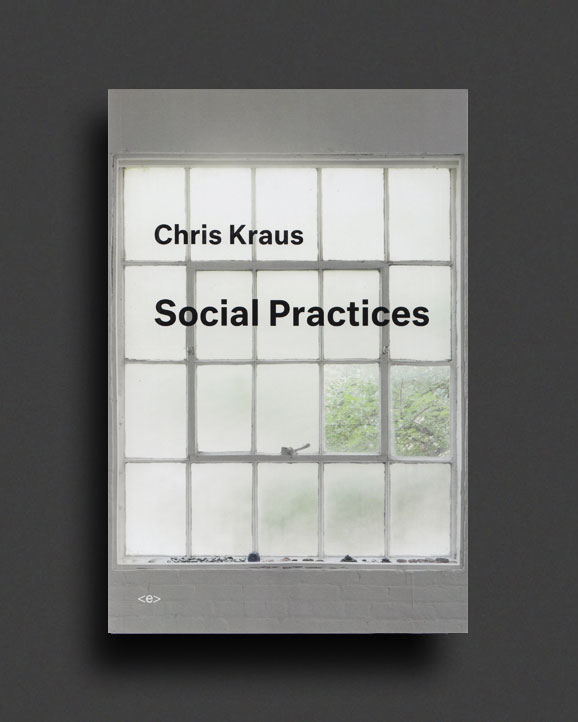
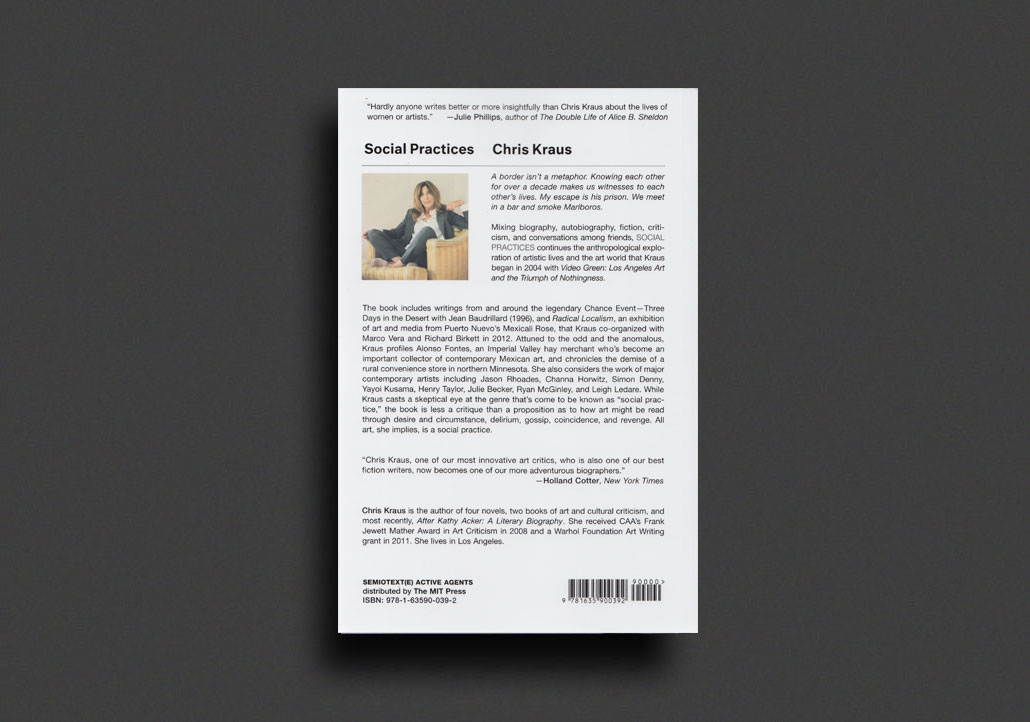
Essays on and around art and art practices by the author of I Love Dick.
A border isn't a metaphor. Knowing each other for over a decade makes us witnesses to each other's lives. My escape is his prison. We meet in a bar and smoke Marlboros.—from Social Practices
Mixing biography, autobiography, fiction, criticism, and conversations among friends, with Social Practices Chris Kraus continues the anthropological exploration of artistic lives and the art world begun in 2004 with Video Green: Los Angeles Art and the Triumph of Nothingness. Social Practices includes writings from and around the legendary “Chance Event—Three Days in the Desert with Jean Baudrillard” (1996), and “Radical Localism,” an exhibition of art and media from Puerto Nuevo's Mexicali Rose that Kraus co-organized with Marco Vera and Richard Birkett in 2012. Attuned to the odd and the anomalous, Kraus profiles Elias Fontes, an Imperial Valley hay merchant who has become an important collector of contemporary Mexican art, and chronicles the demise of a rural convenience store in northern Minnesota. She considers the work of such major contemporary artists as Jason Rhoades, Channa Horowitz, Simon Denny, Yayoi Kusama, Henry Taylor, Julie Becker, Ryan McGinley, and Leigh Ledare. Although Kraus casts a skeptical eye at the genre that's come to be known as “social practice,” her book is less a critique than a proposition as to how art might be read through desire and circumstance, delirium, gossip, coincidence, and revenge. All art, she implies, is a social practice.
2018, English
Softcover, 88 pages, 20.5 x 14 cm
Published by
Semiotext(e) / Los Angeles
$32.00 - Out of stock
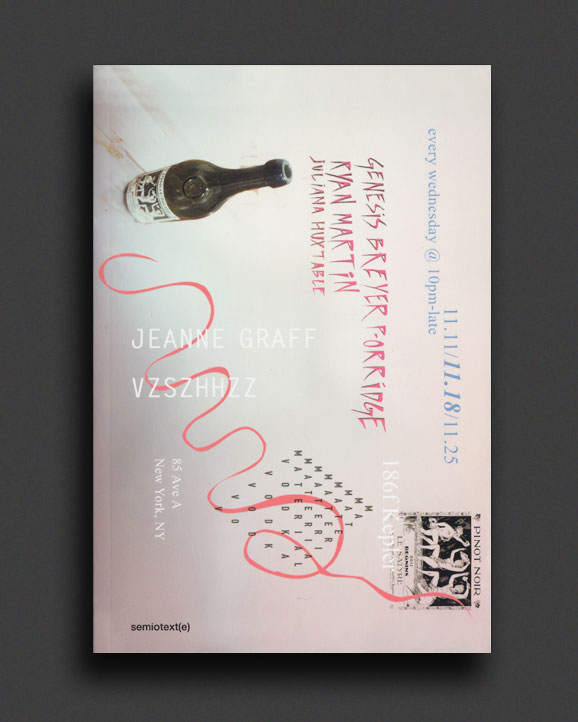
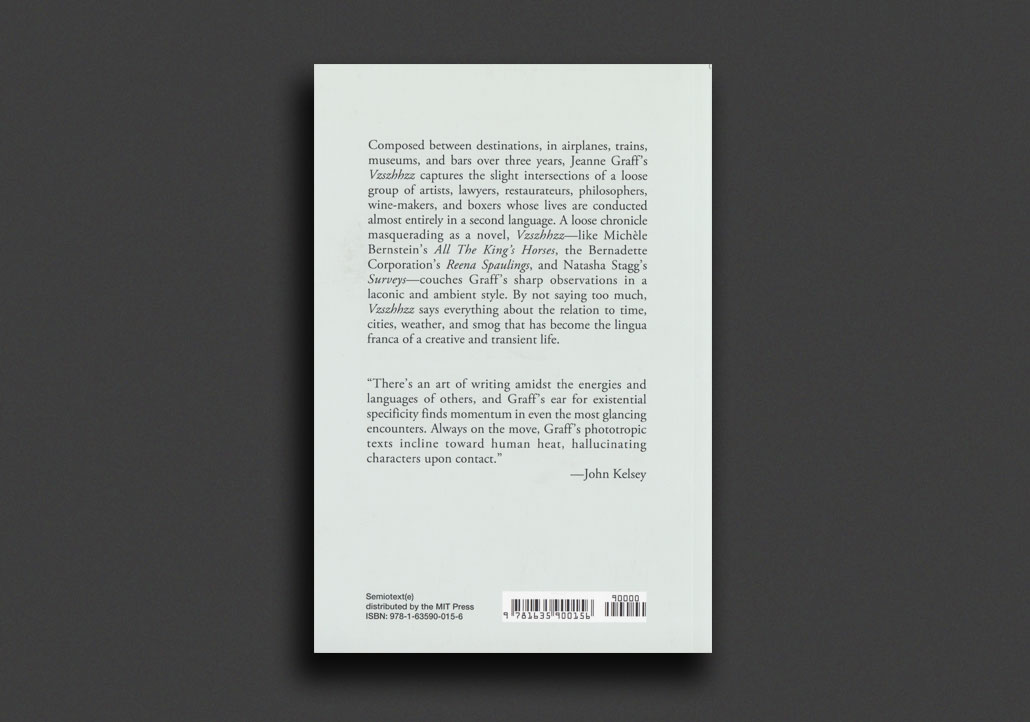
A novel that captures the glancing intersections of a loose group of artists and lawyers, restaurateurs, philosophers, wine-makers, and boxers.
Having dinner at the Triennale, Massimiliano is cooking Pho. He bought the ingredients a few days ago on his way back from Vietnam. The building was built in 1933, Malou went there as a child with Jacqueline, the fascist architecture and the name Triennale remained. A building named “every three years.” Massimiliano was born on December 6th, the same day as Malou…—from Vzszhhzz
Composed between destinations, in airplanes, trains, museums, and bars over three years, Jeanne Graff's Vzszhhzz captures the slight intersections of a loose group of artists and lawyers, restauranteurs, philosophers, wine-makers and boxers whose lives are conducted almost entirely in a second language. A loose chronicle masquerading as a novel, Vszhhzz—like Michèle Bernstein's All The King's Horses, the Bernadette Corporation's Reena Spaulings, and Natasha Stagg's Surveys—couches Graff's sharp observations in a laconic and ambient style. By not saying too much, Vzszhhzz says everything about the relation to time, cities, weather and smog that has become the lingua franca of a creative and transient life.
"There's an art of writing amidst the energies and languages of others, and Graff's ear for existential specificity finds momentum in even the most glancing encounters. Always on the move, Graff's phototropic texts incline toward human heat, hallucinating characters upon contact."—John Kelsey
2018, English
Hardcover (w. dust jacket), 456 pages, 152 x 229 cm
Published by
Semiotext(e) / Los Angeles
The MIT Press / Massachusetts
$65.00 - In stock -
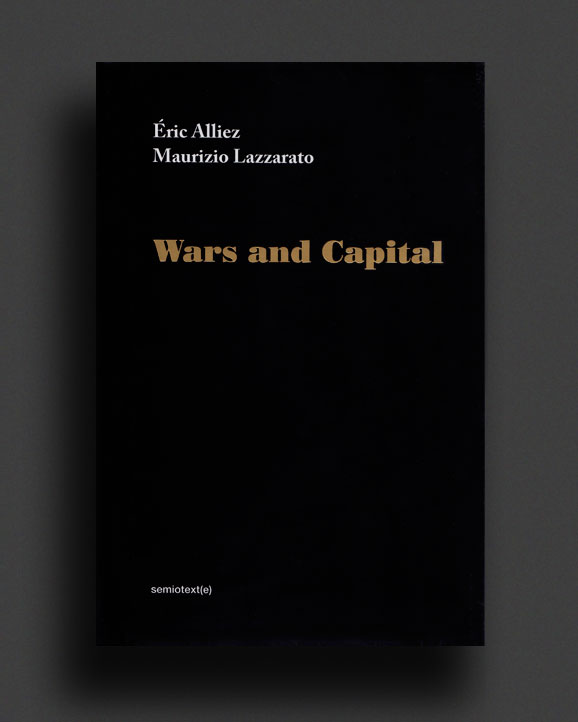
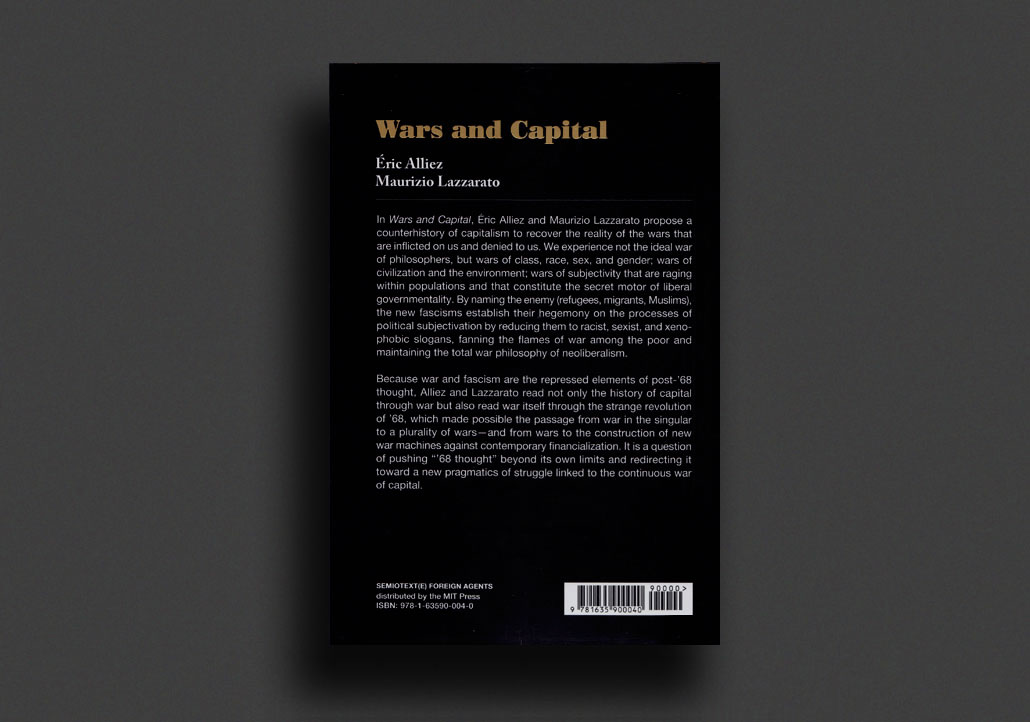
A critique of capital through the lens of war, and a critique of war through the lens of the revolution of 1968.
“We are at war,” declared the President of the French Republic on the evening of November 13, 2015. But what is this war, exactly?
In Wars and Capital, Éric Alliez and Maurizio Lazzarato propose a counter-history of capitalism to recover the reality of the wars that are inflicted on us and denied to us. We experience not the ideal war of philosophers, but wars of class, race, sex, and gender; wars of civilization and the environment; wars of subjectivity that are raging within populations and that constitute the secret motor of liberal governmentality. By naming the enemy (refugees, migrants, Muslims), the new fascisms establish their hegemony on the processes of political subjectivation by reducing them to racist, sexist, and xenophobic slogans, fanning the flames of war among the poor and maintaining the total war philosophy of neoliberalism.
Because war and fascism are the repressed elements of post-'68 thought, Alliez and Lazzarato not only read the history of capital through war but also read war itself through the strange revolution of '68, which made possible the passage from war in the singular to a plurality of wars—and from wars to the construction of new war machines against contemporary financialization. It is a question of pushing “'68 thought” beyond its own limits and redirecting it towards a new pragmatics of struggle linked to the continuous war of capital. It is especially important for us to prepare ourselves for the battles we will have to fight if we do not want to be always defeated.
Translated by Ames Hodges
2004, English
Softcover, 328 pages, 15 x 22.5 cm
Published by
Semiotext(e) / Los Angeles
$39.00 - Out of stock
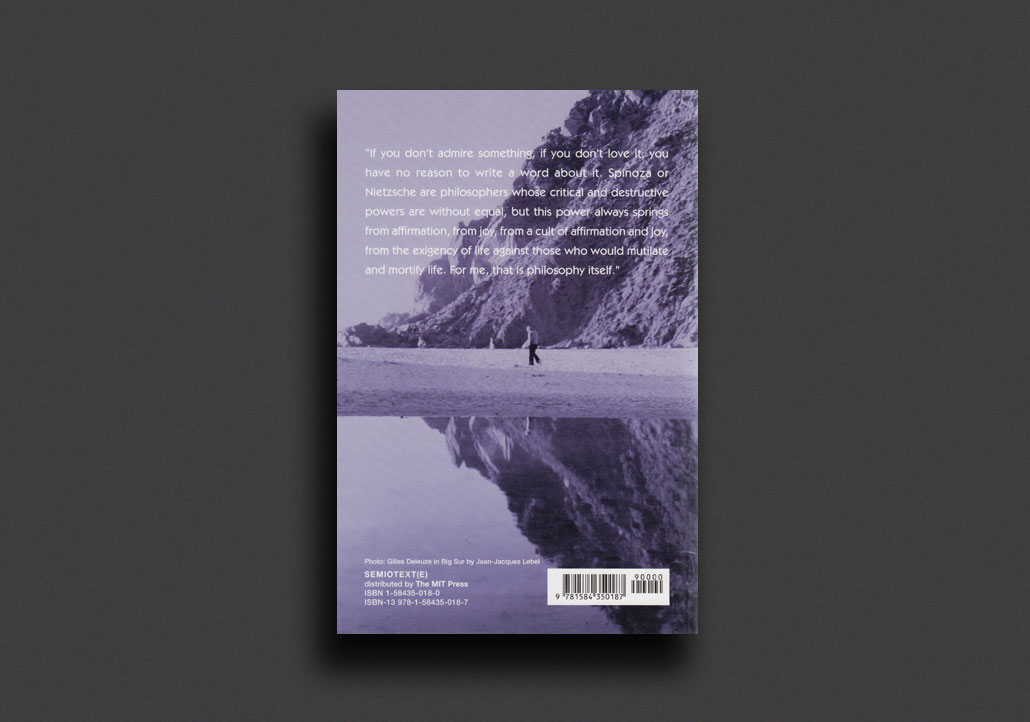
A fascinating anthology of texts and interviews written over 20 years by renowned French philosopher Gilles Deleuze.
"One day, perhaps, this century will be Deleuzian," Michel Foucault once wrote. This book anthologizes 40 texts and interviews written over 20 years by renowned French philosopher Gilles Deleuze, who died in 1995. The early texts, from 1953-1966 (on Rousseau, Kafka, Jarry, etc.), belong to literary criticism and announce Deleuze's last book, Critique and Clinic (1993). But philosophy clearly predominates in the rest of the book, with sharp appraisals of the thinkers he always felt indebted to: Spinoza, Bergson. More surprising is his acknowledgement of Jean-Paul Sartre as his master. "The new themes, a certain new style, a new aggressive and polemical way of raising questions," he wrote, "come from Sartre." But the figure of Nietzsche remains by far the most seminal, and the presence throughout of his friends and close collaborators, Felix Guattari and Michel Foucault. The book stops shortly after the publication of Anti-Oedipus, and presents a kind of genealogy of Deleuze's thought as well as his attempt to leave philosophy and connect it to the outside -- but, he cautions, as a philosopher.
Translated by Mike Taormina
Edited by David Lapoujade
2015, English
Softcover, 384 pages, 15 x 23 cm
Published by
Semiotext(e) / Los Angeles
$48.00 - Out of stock
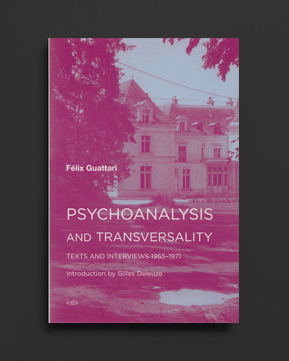
Introduction by Gilles Deleuze
Translated by Ames Hodges
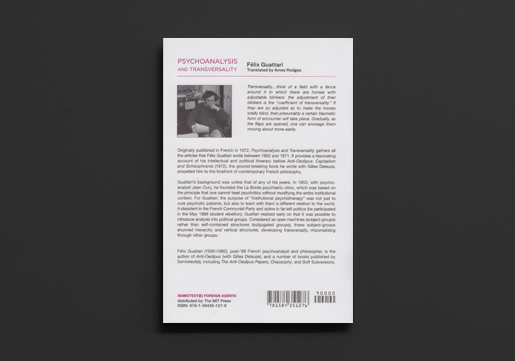
Originally published in French in 1972, Psychoanalysis and Transversality gathers all the articles that Félix Guattari wrote between 1955 and 1971. It provides a fascinating account of his intellectual and political itinerary before Anti-Oedipus: Capitalism and Schizophrenia (1972), the ground-breaking book he wrote with Gilles Deleuze, propelled him to the forefront of contemporary French philosophy.
Guattari’s background was unlike that of any of his peers. In 1953, with psychoanalyst Jean Oury, he founded the La Borde psychiatric clinic, which was based on the principle that one cannot treat psychotics without modifying the entire institutional context. For Guattari, the purpose of “institutional psychotherapy” was not just to cure psychotic patients, but also to learn with them a different relation to the world. A dissident in the French Communist Party and active in far-left politics (he participated in the May 1968 student rebellion), Guattari realized early on that it was possible to introduce analysis into political groups. Considered as open machines (subject-groups) rather than self-contained structures (subjugated groups), these subject-groups shunned hierarchy and vertical structures, developing transversally, rhizomatizing through other groups.
Psychoanalysis and Transversality collects twenty-four essays by Guattari, including his foundational 1964 article on transversality, and a superb introduction by Gilles Deleuze, “Three Group-Related Problems.”
About the Author
Félix Guattari (1930–1992), post-‘68 French psychoanalyst and philosopher, is the author of Anti-Oedipus (with Gilles Deleuze), and a number of books published by Semiotext(e), including The Anti-Oedipus Papers, Chaosophy, and Soft Subversions.
2018, English
Hardcover (w. dust jacket), 231 pages, 23 x 15.5 cm
Published by
Semiotext(e) / Los Angeles
$46.00 - Out of stock
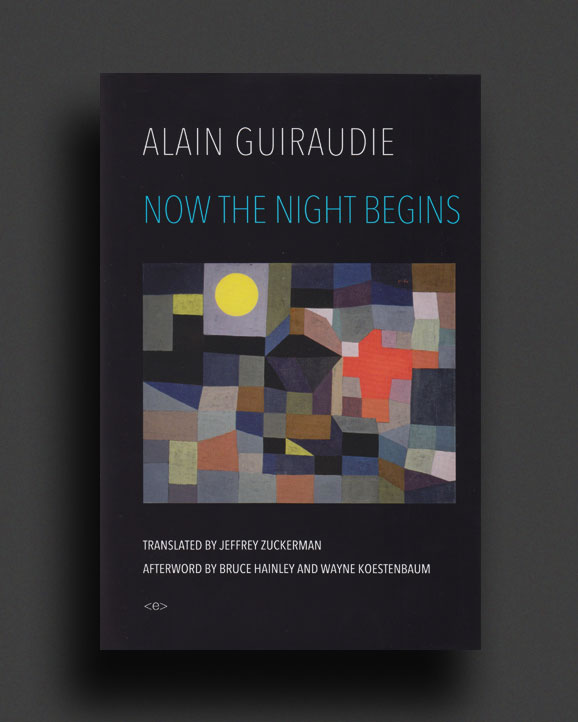
A novel that is a meditation on friendship, love, obsession, power, and abuse, by turns hyperrealist and phantasmagoric, recalling the work of Sade and Bataille.
Afterword by Bruce Hainley and Wayne Koestenbaum
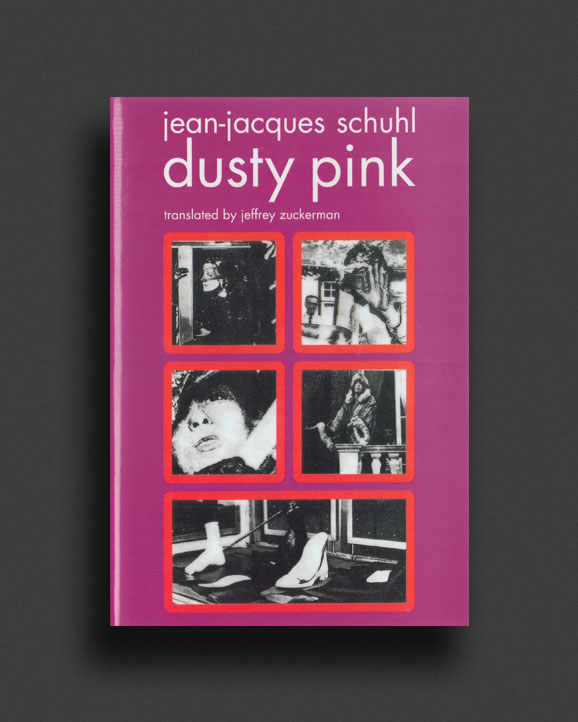
Translated by Jeffrey Zuckerman
And he leaves. I'm not happy, I'm pretty upset at myself, I wasn't satisfied with him but I wouldn't have been any better without him. I sit on the couch and think. I'm not actually thinking, it's already been thought, I have to call Grampa... I need to hear his voice. I miss him.—from Now the Night Begins
At the tail end of summer vacation, Gilles Heurtebise drifts between lazy afternoons, swimming, cruising the shores of a nearby lake, and absentmindedly hooking up with old lovers. He has yet to achieve material or romantic stability. He is forty, facing a precarious future with unformed fears and regrets. The one thing that seems solid is Grampa, the ninety-year-old patriarch of a family Gilles has befriended. Gilles grows obsessed by the old man, and a strange sexual bond grows between the two. When the police get involved, and Gilles is witness to a murder, the banality of interhuman violence is brought to a paroxysmal climax.
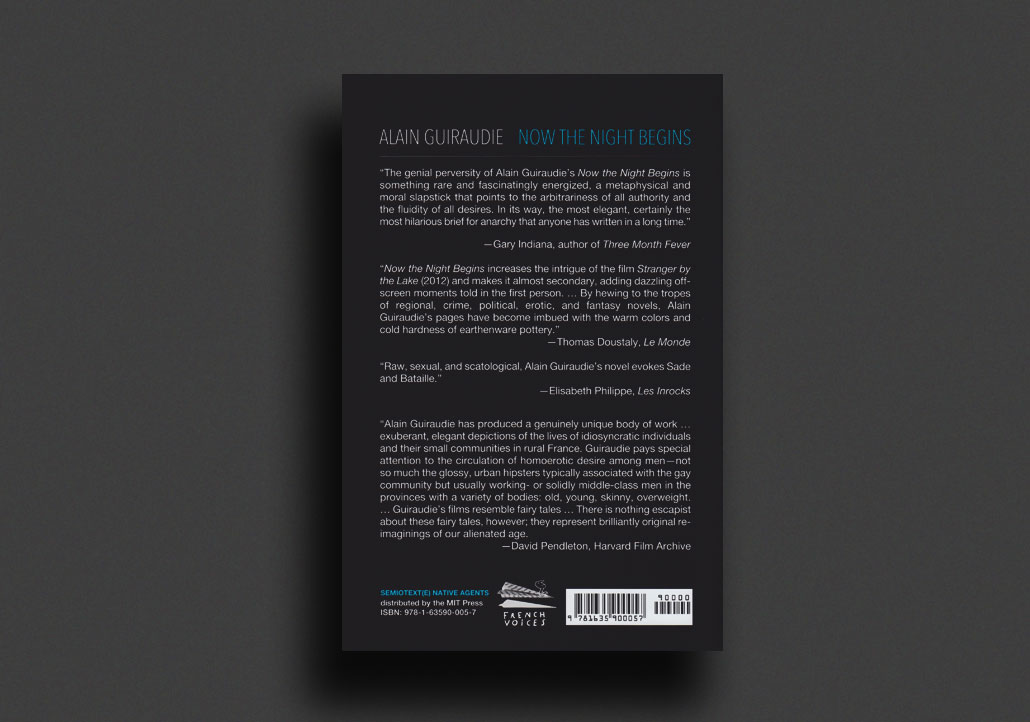
The winner of France's prestigious Prix Sade, Now the Night Begins is a meditation on friendship, love, power, and abuse in a world where social relations have radically disintegrated. Interwoven with swaths of Occitan, the language of troubadours and love, and by turns hyperrealist and phantasmagoric, the novel recalls Georges Bataille's dark surrealism and the unvarnished violence of Bret Easton Ellis. It proves Alain Guiraudie's status as the preeminent writer of the vulnerability underlying our contemporary malaise.
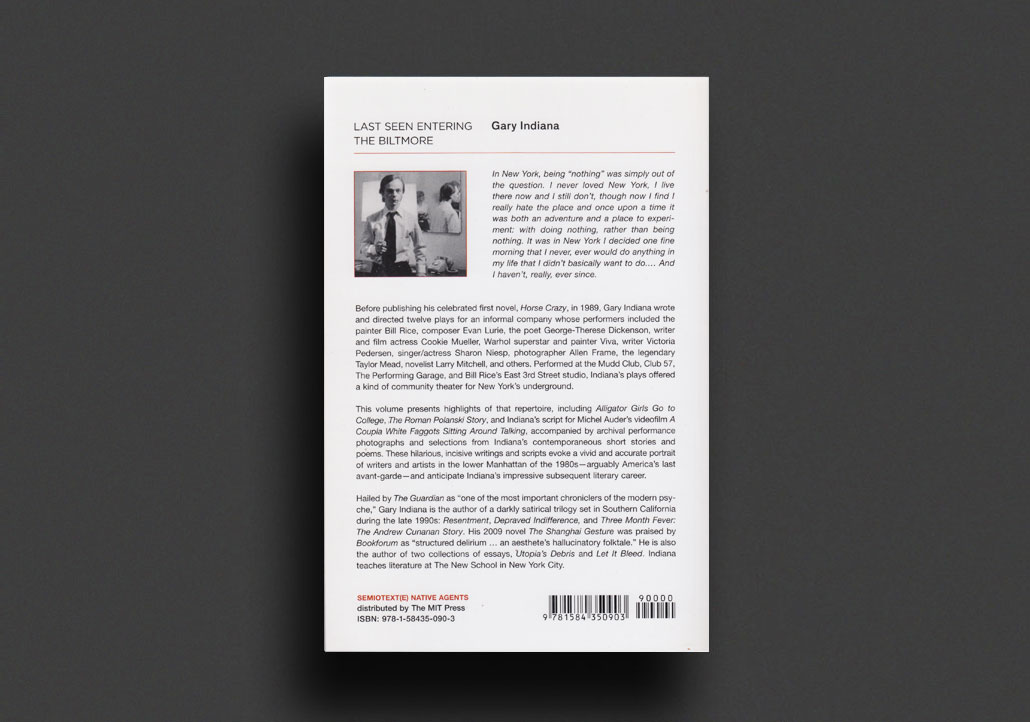
“The genial perversity of Alain Guiraudie's Now the Night Begins is something rare and fascinatingly energized, a metaphysical and moral slapstick that points to the arbitrariness of all authority and the fluidity of all desires. In its way, the most elegant, certainly the most hilarious brief for anarchy that anyone has written in a long time.”—Gary Indiana
“Raw, sexual, and scatological, Alain Guiraudie's novel evokes Sade and Bataille.”—Elisabeth Philippe
2000/2013, English
Softcover, 248 pages, 152 x 229 mm
New (2nd) edition,
Published by
Semiotext(e) / Los Angeles
$40.00 - Out of stock
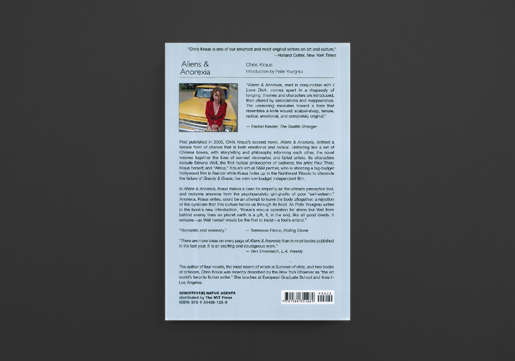
First published in 2000, Chris Kraus's second novel, Aliens & Anorexia, defined a female form of chance that is both emotional and radical. Unfolding like a set of Chinese boxes, with storytelling and philosophy informing each other, the novel weaves together the lives of earnest visionaries and failed artists. Its characters include Simone Weil, the first radical philosopher of sadness; the artist Paul Thek; Kraus herself; and "Africa," Kraus's virtual S&M partner, who is shooting a big-budget Hollywood film in Namibia while Kraus holes up in the Northwest woods to chronicle the failure of Gravity & Grace, her own low-budget independent film. In Aliens & Anorexia, Kraus makes a case for empathy as the ultimate perceptive tool, and reclaims anorexia from the psychoanalytic girl-ghetto of poor "self-esteem." Anorexia, Kraus writes, could be an attempt to leave the body altogether: a rejection of the cynicism that this culture hands us through its food. As Palle Yourgrau writes in the book's new foreword, "Kraus's rescue operation for aliens like Weil from behind enemy lines on planet Earth is a gift, if, in the end, like all good deeds, it remains -- as Weil herself would be the first to insist -- a fool's errand."
The author of four novels, the most recent of which is Summer of Hate, and two books of criticism, Chris Kraus was recently described by the New York Observer as "the art world's favorite fiction writer." She teaches at European Graduate School and lives in Los Angeles.
Foreword by Palle Yourgrau
1988 / 2012, English
Softcover, 88 pages, 15.2 x 22.9 cm
Published by
The MIT Press / Massachusetts
Semiotext(e) / Los Angeles
$30.00 - Out of stock
“The need to speak, even if one has nothing to say, becomes more pressing when one has nothing to say, just as the will to live becomes more urgent when life has lost its meaning.”
--from The Ecstasy of Communication
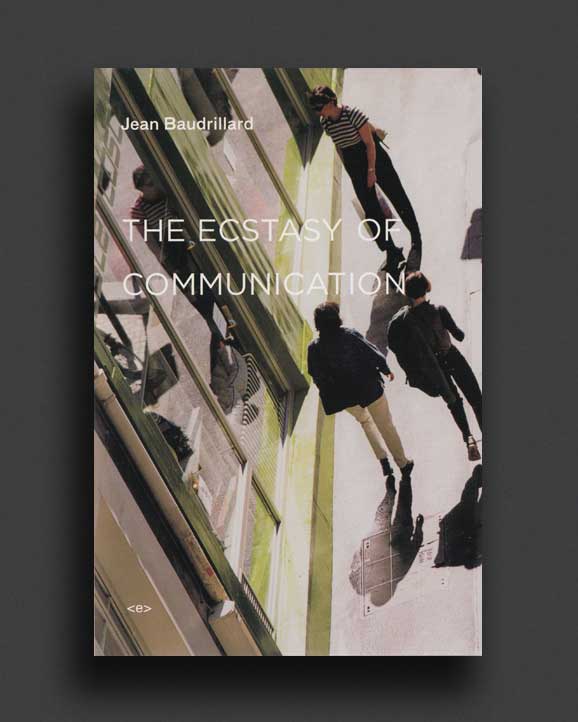
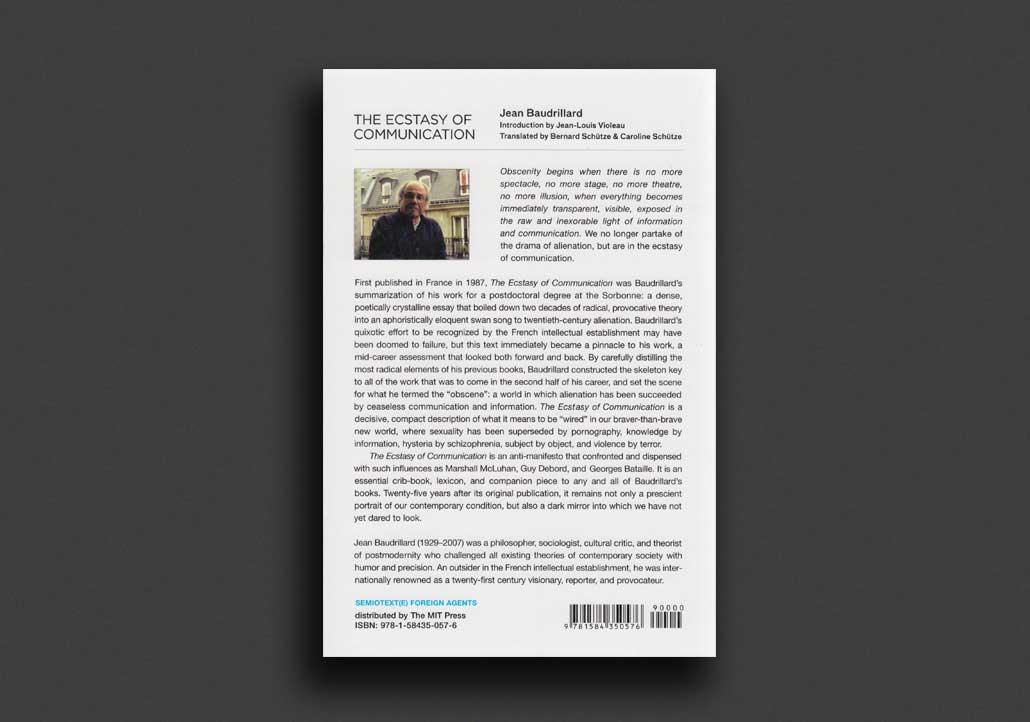
First published in France in 1987, The Ecstasy of Communication was Baudrillard’s summarization of his work for a postdoctoral degree at the Sorbonne: a dense, poetically crystalline essay that boiled down two decades of radical, provocative theory into an aphoristically eloquent swan song to twentieth-century alienation. Baudrillard’s quixotic effort to be recognized by the French intellectual establishment may have been doomed to failure, but this text immediately became a pinnacle to his work, a mid-career assessment that looked both forward and back. By carefully distilling the most radical elements of his previous books, Baudrillard constructed the skeleton key to all of the work that was to come in the second half of his career, and set the scene for what he termed the “obscene”: a world in which alienation has been succeeded by ceaseless communication and information. The Ecstasy of Communication is a decisive, compact description of what it means to be “wired” in our braver-than-brave new world, where sexuality has been superseded by pornography, knowledge by information, hysteria by schizophrenia, subject by object, and violence by terror.
The Ecstasy of Communication is an anti-manifesto that confronted and dispensed with such influences as Marshall McLuhan, Guy Debord, and Georges Bataille. It is an essential crib-book, lexicon, and companion piece to any and all of Baudrillard’s books. Twenty-five years after its original publication, it remains not only a prescient portrait of our contemporary condition, but also a dark mirror into which we have not yet dared to look.
Introduction by Jean-Louis Violeau
Translated by Bernard Schütze and Caroline Schütze
About the Author
Jean Baudrillard (1929–2007) was a philosopher, sociologist, cultural critic, and theorist of postmodernity who challenged all existing theories of contemporary society with humor and precision. An outsider in the French intellectual establishment, he was internationally renowned as a twenty-first century visionary, reporter, and provocateur.
2017, English
Softcover, 296 pages, 22.9 x 22 cm
Published by
Semiotext(e) / Los Angeles
The MIT Press / Massachusetts
$39.00 - Out of stock
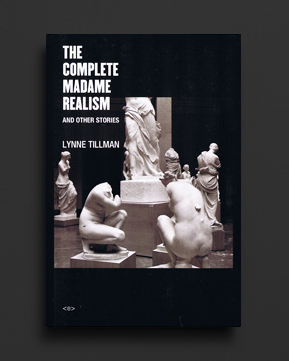
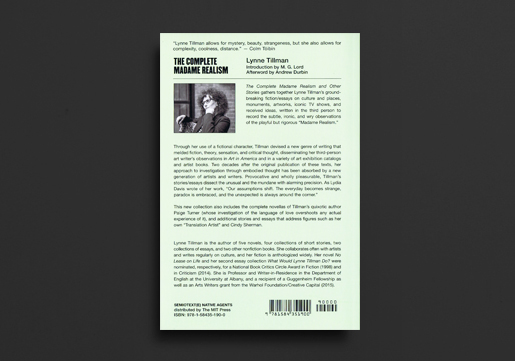
The Complete Madame Realism and Other Stories gathers together Lynne Tillman’s groundbreaking fiction/essays on culture and places, monuments, artworks, iconic TV shows, and received ideas, written in the third person to record the subtle, ironic, and wry observations of the playful but stern “Madame Realism.”
Through her use of a fictional character, Tillman devised a new genre of writing that melded fiction and theory, sensation, and critical thought, disseminating her third-person art writer’s observations in such magazines as Art in America and in a variety of art exhibition catalogs and artist books. Two decades after the original publication of these texts, her approach to investigation through embodied thought has been wholly absorbed by a new generation of artists and writers. Provocative and wholly pleasurable, Tillman’s stories/essays dissect the mundane with alarming precision. As Lydia Davis wrote of her work, “Our assumptions shift. The every day becomes strange, paradox is embraced, and the unexpected is always around the corner.”
This new collection also includes the complete stories of Tillman’s other persona, the quixotic author Paige Turner (whose investigation of the language of love overshoots any actual experience of it), and additional stories and essays that address figures such as the “Translation Artist” and Cindy Sherman.
About the Author
Lynne Tillman is the author of five novels, four collections of short stories, two collection of essays and two other nonfiction books. She collaborates often with artists and writes regularly on culture, and her fiction is anthologized widely. Her novel No Lease on Life and her second essay collection What Would Lynne Tillman Do? were nominated, respectively, for a National Book Critics Circle Award in Fiction (1998) and in Criticism (2014). She is Professor and Writer-in-Residence in the Department of English at the University at Albany, a recipient of a Guggenheim Fellowship as well as an Arts Writers grant from the Warhol Foundation/Creative Capital (2015).
2012, English
Softcover, 160 pages, 114 x 178 mm
Published by
Semiotext(e) / Los Angeles
$29.00 - Out of stock
The Uprising is an Autonomist manifesto for today’s precarious times, and a rallying cry in the face of the catastrophic and irreversible crisis that neoliberalism and the financial sphere have established over the globe. In his newest book, Franco “Bifo” Berardi argues that the notion of economic recovery is complete mythology. The coming years will inevitably see new surges of protest and violence, but the old models of resistance no longer apply. Society can either stick with the prescriptions and “rescues” that the economic and financial sectors have demanded at the expense of social happiness, culture, and the public good; or it can formulate an alternative. For Berardi, this alternative lies in understanding the current crisis as something more fundamental than an economic crisis: it is a crisis of the social imagination, and demands a new language by which to address it.
This is a manifesto against the idea of growth, and against the concept of debt, the financial sector’s two primary linguistic means of manipulating society. It is a call for exhaustion, and for resistance to the cult of energy on which today’s economic free-floating market depends. To this end, Berardi introduces an unexpected linguistic political weapon--poetry: poetry as the insolvency of language, as the sensuous birth of meaning and desire, as that which cannot be reduced to information and exchanged like currency. If the protests now stirring about the world are to take shape and direction, then the revolution will be neither peaceful nor violent--it will be linguistic, or will not be at all.
About the Author:
Franco Berardi, aka “Bifo,” founder of the famous “Radio Alice” in Bologna and an important figure of the Italian Autonomia Movement, is a writer, media theorist, and media activist. He currently teaches Social History of the Media at the Accademia di Brera, Milan.
2012, English
Softcover, 144 pages, 114 x 178 mm
Published by
Semiotext(e) / Los Angeles
$28.00 - Out of stock
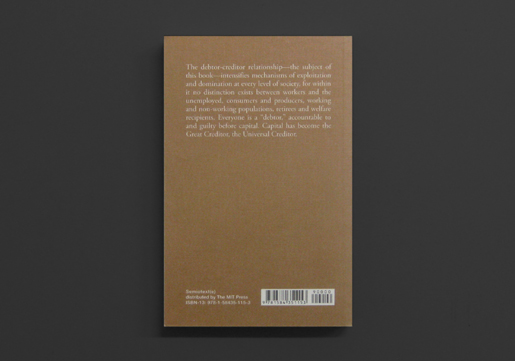
The debtor-creditor relation, which is at the heart of this book, sharpens mechanisms of exploitation and domination indiscriminately, since, in it, there is no distinction between workers and the unemployed, consumers and producers, working and non-working populations, between retirees and welfare recipients. They are all “debtors,” guilty and responsible in the eyes of capital, which has become the Great, the Universal, Creditor.
--from The Making of the Indebted Man
Debt—both public debt and private debt—has become a major concern of economic and political leaders. In The Making of the Indebted Man, Maurizio Lazzarato shows that, far from being a threat to the capitalist economy, debt lies at the very core of the neoliberal project. Through a reading of Karl Marx’s lesser-known youthful writings on John Mill, and a rereading of writings by Friedrich Nietzsche, Gilles Deleuze, Félix Guattari, and Michel Foucault, Lazzarato demonstrates that debt is above all a political construction, and that the creditor/debtor relation is the fundamental social relation of Western societies.
Debt cannot be reduced to a simple economic mechanism, for it is also a technique of “public safety” through which individual and collective subjectivities are governed and controlled. Its aim is to minimize the uncertainty of the time and behavior of the governed. We are forever sinking further into debt to the State, to private insurance, and, on a more general level, to corporations. To insure that we honor our debts, we are at once encouraged and compelled to become the “entrepreneurs” of our lives, of our “human capital.” In this way, our entire material, psychological, and affective horizon is upended and reconfigured.
How do we extricate ourselves from this impossible situation? How do we escape the neoliberal condition of the indebted man? Lazzarato argues that we will have to recognize that there is no simple technical, economic, or financial solution. We must instead radically challenge the fundamental social relation structuring capitalism: the system of debt.
Essay on the Neoliberal Condition
By Maurizio Lazzarato
Translated by Joshua David Jordan
2011, English
Softcover, 216 pages, 114 x 178 mm
Published by
Semiotext(e) / Los Angeles
$32.00 - In stock -
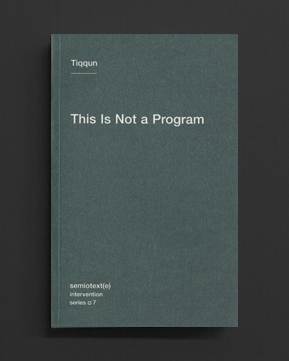
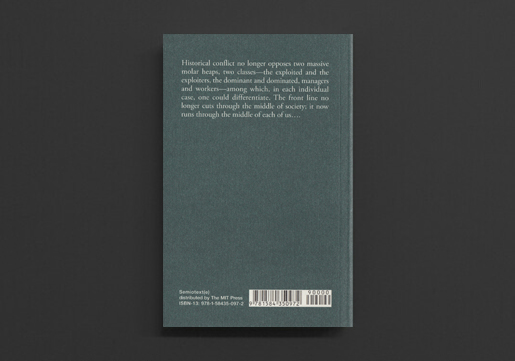
Historical conflict no longer opposes two massive molar heaps, two classes—;the exploited and the exploiters, the dominant and dominated, managers and workers—between which, in each individual case, it would be possible to differentiate. The front line no longer cuts through the middle of society; it now runs through each one of us. . . ''—from This Is Not a Program
Traditional lines of revolutionary struggle no longer hold. Rather, it is ubiquitous cybernetics, surveillance, and terror that create the illusion of difference within hegemony. Configurations of dissent and the rhetoric of revolution are merely the other face of capital, conforming identities to empty predicates, ensuring that even ''thieves,'' ''saboteurs,'' and ''terrorists'' no longer exceed the totalizing space of Empire. This Is Not a Program offers two texts, both originally published in French by Tiqqun with Introduction to Civil War in 2001. In ''This Is Not a Program,'' Tiqqun outlines a new path for resistance and struggle in the age of Empire, one that eschews the worn-out example of France’s May ‘68 in favor of what they consider to be the still fruitful and contemporary insurrectionary movements in Italy of the 1970s. ''As a Science of Apparatuses'' examines the way Empire has enforced on the subject a veritable metaphysics of isolation and pacification, ''apparatuses'' that include chairs, desks, computers; surveillance (security guards, cameras); disease (depression); crutch (cell phone, lover, sedative); and authority.
Tiqqun’s critique of the biopolitical subject and omnipresent Empire is all the more urgent as we become inured to the permanent state of exception that is the War on Terror and to other, no less intimate forms of pacification. But all is not lost. In its unrelenting production of the Same, Empire itself creates the conditions necessary for the insurrection to come.
Tiqqun is a French collective of authors and activists formed in 1999. The group published two journal volumes in 1999 and 2001 (in which the collective author ''The Invisible Committee'' first appeared), as well as the books Théorie du Bloom and Théorie de la jeune fille.
2012, English
Softcover, 136 pages, 11.4 x 17.8 cm
Published by
Semiotext(e) / Los Angeles
$28.00 - Out of stock
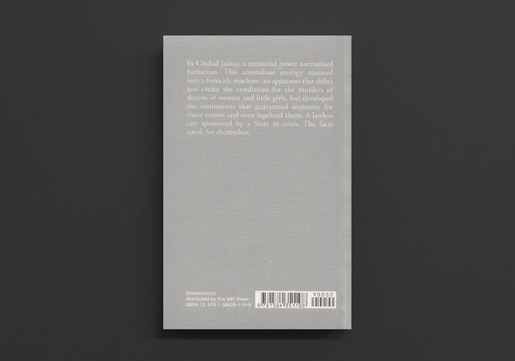
In Ciudad Juarez, a territorial power normalized barbarism. This anomalous ecology mutated into a femicide machine: an apparatus that didn’t just create the conditions for the murders of dozens of women and little girls, but developed the institutions that guarantee impunity for those crimes and even legalize them. A lawless city sponsored by a State in crisis. The facts speak for themselves.
—from The Femicide Machine
Best known to American readers for his cameo appearances as The Journalist in Roberto Bolano’s 2666and as a literary detective in Javier Marías’s novel Dark Back of Time, Sergio González Rodríguez is one of Mexico’s most important contemporary writers. He is the author of Bones in the Desert, the most definitive work on the murders of women and girls in Juárez, Mexico, as well as The Headless Man, a sharp meditation on the recurrent uses of symbolic violence; Infectious, a novel; and Original Evil, a long essay. The Femicide Machine is the first book by González Rodríguez to appear in English translation.
Written especially for Semiotext(e) Intervention series, The Femicide Machine synthesizes González Rodríguez’s documentation of the Juárez crimes, his analysis of the unique urban conditions in which they take place, and a discussion of the terror techniques of narco-warfare that have spread to both sides of the border. The result is a gripping polemic. The Femicide Machine probes the anarchic confluence of global capital with corrupt national politics and displaced, transient labor, and introduces the work of one of Mexico’s most eminent writers to American readers.
2017, English
Softcover, 224 pages, 15.2 x 22.9 cm
Published by
Semiotext(e) / Los Angeles
The MIT Press / Massachusetts
$38.00 - Out of stock
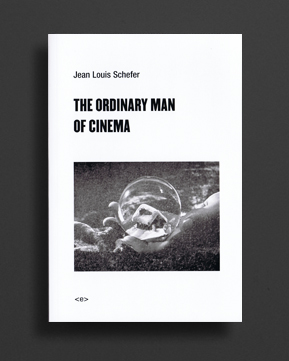
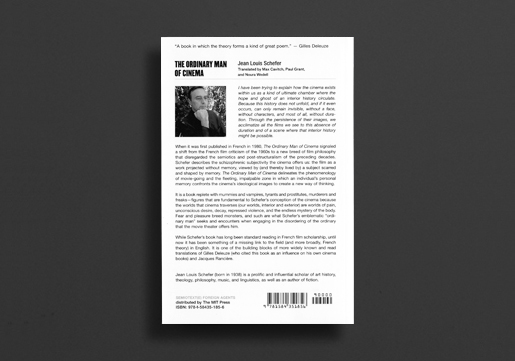
When it was first published in French in 1980, The Ordinary Man of Cinema signaled a shift from the French film criticism of the 1960s to a new breed of film philosophy that disregarded the semiotics and post-structuralism of the preceding decades. Schefer describes the schizophrenic subjectivity the cinema offers us: the film as a work projected without memory, viewed by (and thereby lived by) a subject scarred and shaped by memory. The Ordinary Man of Cinema delineates the phenomenology of movie-going and the fleeting, impalpable zone in which an individual’s personal memory confronts the cinema’s ideological images to create a new way of thinking.
It is also a book replete with mummies and vampires, tyrants and prostitutes, murderers and freaks—figures that are fundamental to Schefer’s conception of the cinema, because the worlds that cinema traverses (our worlds, interior and exterior) are worlds of pain, unconscious desire, decay, repressed violence, and the endless mystery of the body. Fear and pleasure breed monsters, and such are what Schefer’s emblematic “ordinary man” seeks and encounters when engaging in the disordering of the ordinary that the movie theater offers him. Among other things, Schefer considers “The Gods” in 31 brief essays on film stills and “The Criminal Life” with reflections on spectatorship and autobiography.
While Schefer’s book has long been standard reading in French film scholarship, until now it has been something of a missing link to the field (and more broadly, French theory) in English. It is one of the building blocks of more widely known and read translations of Gilles Deleuze (who cited this book as an influence on his own cinema books) and Jacques Rancière.
Translated by Max Cavitch, Noura Wedell and Paul Grant
About the Author
Jean Louis Schefer (born in 1938) is a prolific and influential scholar of art history, theology, philosophy, music, and linguistics, as well as an author of fiction.
2016, English
Softcover, 384 pages, 15 x 22.5 cm
Published by
Semiotext(e) / Los Angeles
$45.00 - Out of stock
I read and wrote to invoke what seemed impossible -- relation itself -- in order to take part in a world that ceaselessly makes itself up, to "wake up" to the world, to recognize the world, to be convinced that the world exists, to take revenge on the world for not existing. -- from Communal Nude
Since cofounding San Francisco's influential New Narrative circle in 1979, Robert Gluck has been one of America's finest prose stylists of innovative fiction, bending narrative into the service of autobiography, politics, and gay writing. This collection brings together for the first time Gluck's nonfiction, a revelatory body of work that anchors his writing practice. Gluck's essays explore the ways that storytelling and selfhood are mutually embedded cultural forms, cohering a fractured social reality where generating narrative means generating identity means generating community. "I'd laugh at (make art from) any version of self," Gluck writes, "I write about these forms -- that are myself -- to dispense with them, to demonstrate how they disintegrate before the world, the body." For any body -- or text -- to know itself, it must first see how it sees the world, and understand itself as writing. Gluck's essays affirm this radical narratorial precept in rich spirals of reading, self-reflection, anecdote, escapade, and "metatext." These texts span the author's career and his creative affinities -- from lost manifestos theorizing the poetics of New Narrative; to encomia for literary and philosophic muses (Kathy Acker, the HOW(ever) poets, Frank O'Hara, Georges Bataille, and others); to narrative journalism, book reviews, criticism, and public talks. Many of the texts are culled from obscure little magazines and ephemeral online sources; others have never been published. As lucid as story, as lush as theory, and as irresistible as gossip, Gluck's essays are the quintessence of New Narrative theory in practice.
1977, English
Softcover, 208 pages (146 ill.), 152 x 229 mm
Published by
Semiotext(e) / Los Angeles
The MIT Press / Massachusetts
$50.00 - Out of stock
Learning from Las Vegas created a healthy controversy on its appearance in 1972, calling for architects to be more receptive to the tastes and values of "common" people and less immodest in their erections of "heroic," self-aggrandizing monuments. This revision includes the full texts of Part I of the original, on the Las Vegas strip, and Part II, "Ugly and Ordinary Architecture, or the Decorated Shed," a generalization from the findings of the first part on symbolism in architecture and the iconography of urban sprawl.
Robert Venturi is an award-winning architect and an influential writer, teacher, artist, and designer. His work includes includes the Sainsbury Wing of London's National Galler; renovation of the Museum of Contemporary Art, San Diego; dozens of major academic projects; and the groundbreaking Vanna Venturi House. Denise Scott Brown is a Founding Principal of Venturi, Scott, Brown, and Associates (VBSA) whose work and ideas have influenced generations of architects and planners. Steven Izenour (1940-2001) was coauthor of Learning from Las Vegas (MIT Press, 1977) and a principal in the Philadelphia firm Venturi, Scott Brown and Associates, Inc (VSBA). His most noted projects at VSBA include Philadelphia's Basco showroom, the George D. Widener Memorial Treehouse at the Philadelphia Zoo, the Camden Children's Garden, and the house he designed for his parents in Stony Creek, Connecticut.
"...a brilliant document of the times...a work which uses history knowledgeably, skillfully, and creatively: a rarity." Journal of the Society of Architectural Historians
"...professionally informed, competitively astute, and perversely brilliant..." The Yale Review
"...these studies are brilliant...the kind of art history and theory that is rarely produced." The New York Times Ada Louis Huxtable
2016, English
Softcover, 208 pages, 15 x 22.5 cm
Published by
Semiotext(e) / Los Angeles
$36.00 - In stock -
The animal of the molecular revolution will be neither mole nor snake, but a drone-animal-thing that is solid, liquid, and a gas. — from Dividuum
As the philosophical, religious, and historical systems that have produced the "individual" (and its counterparts, society and community) over the years continue to break down, the age of "dividuality" is now upon us. The roots of the concept of the "dividuum" can be traced back to Latin philosophy, when Cicero used the term to translate the "divisible" in the writings of Epicurus and Plato; later, medieval scholars utilized the term in theological discussions on the unity of the trinity. Grounding himself in the writings of the medieval bishop Gilbert de Poitiers and his extensive commentaries on Boethius, Gerald Raunig charts a genealogy of the concept and develops a philosophy of dividuality as a way of addressing contemporary modes of production and forms of life. Through its components of dispersion, subsistence, and similarity, dividuality becomes a hidden principle of obedience and conformity, but it also brings with it the potential to realize disobedience and noncompliant con/dividualities. Raunig's bad news is that dividuality is responsible for much of the intensified exploitation and enslavement taking place under contemporary machinic capitalism. Algorithms, derivatives, big data, and social media technology all contribute to the rampant expansion of divisive management strategies and desires for self-division. The good news, however, is that this same terrain of dividuality presents an opportunity for a new kind of resistance, one that can be realized in the form of con/division.
Gerald Raunig is a philosopher and art theorist. He works at the Zurich University of the Arts, Zurich and the eipcp (European Institute for Progressive Cultural Policies), Vienna. He is coeditor of the multilingual publishing platform Transversal Texts and the Austrian journal Kamion. He is the author of Art and Revolution, A Thousand Machines, and Factories of Knowledge, Industries of Creativity, all published by Semiotext[e].
2006, English
Softcover, 296 pages, 152 x 229 mm
New Edition,
Published by
Semiotext(e) / Los Angeles
$35.00 - Out of stock
Sylvie wanted to believe that misery could simply be replaced with happiness. Time was a straight line, stretching out before you. If you could create a golden kind of time and lay it right beside the other time, the time of horror, Bad History could just recede into the distance without ever having to be resolved.--from TorporSet at the dawn of the New World Order, Chris Kraus's third novel, Torpor loops back to the beginning of the decade that was the basis of I Love Dick, her pseudo-confessional cult-classic debut. It's summer, 1991, post-MTV, pre-AOL. Jerome Shafir and Sylvie Green, two former New Yorkers who can no longer afford an East Village apartment, set off on a journey across the entire former Soviet Bloc with the specious aim of adopting a Romanian orphan. Nirvana's on the radio everywhere, and wars are erupting across Yugoslavia.Unhappily married to Jerome, a 53-year-old Columbia University professor who loathes academe, Sylvie thinks only of happiness. At 35, she dreams of stuffed bears and wonders why their lives lack the tremulous sincerity that pervades thirtysomething, that season's hot new TV show. There are only two things, Sylvie thinks, that will save them: a child of their own, and the success of The Anthropology of Unhappiness, her husband's long-postponed book on the Holocaust. But as they move forward toward impoverished Romania, Jerome's memories of his father's extermination at Auschwitz and his own childhood survival impede them. Savagely ironic and deeply lyrical, Torpor explores the swirling mix of nationalisms, capital flows and negative entropy that define the present, haunted by the persistence of historical memory. Written in the third person, it is her most personal novel to date.
Chris Kraus is the author of the novels Aliens and Anorexia, I Love Dick, and Torpor, as well as Video Green: Los Angeles Art and the Triumph of Nothingness and Where Art Belongs, all published by Semiotext(e). A Professor of Writing at the European Graduate School, she writes for various magazines and lives in Los Angeles.
2016, English
Softcover, 352 pages, 15.2 x 22.9 cm
Published by
Semiotext(e) / Los Angeles
$49.00 - Out of stock
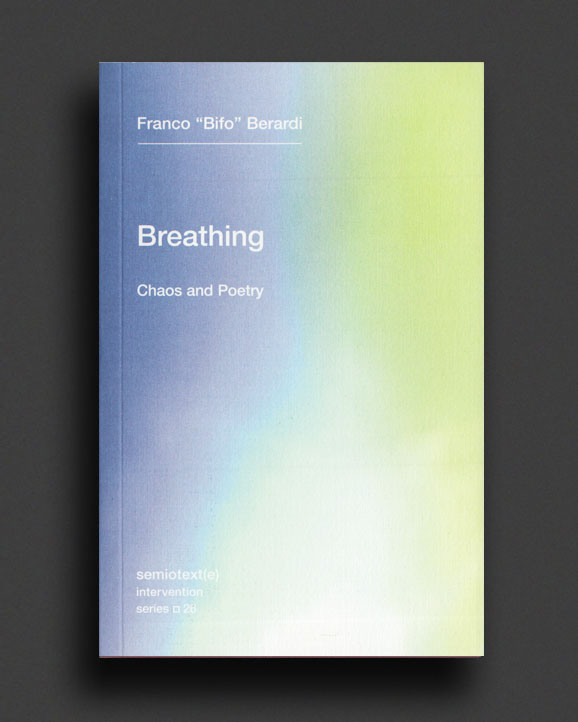
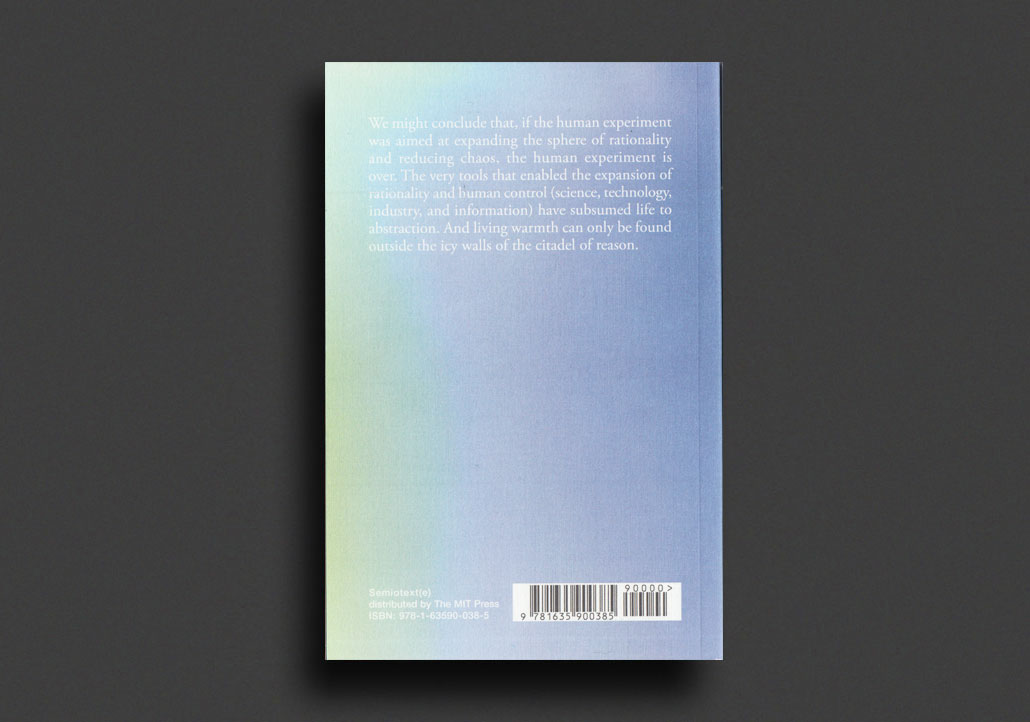
Franco "Bifo" Berardi's newest book analyzes the contemporary changes taking place in our aesthetic and emotional sensibility -- changes the author claims are the result of semio-capitalism's capturing of the inner resources of the subjective process: our experience of time, our sensibility, the way we relate to each other, and our ability to imagine a future. Precarization and fractalization of labor have provoked a deep mutation in the psychosphere, and this can be seen in the rise of psychopathologies such as post-traumatic stress disorder, autism, panic, and attention deficit disorder. Sketching out an aesthetic genealogy of capitalist globalization, Berardi shows how we have arrived at a point of such complexity in the semiotic flows of capital that we can no longer process its excessive currents of information. A swarm effect now rules: it has become impossible to say "no." Social behavior is trapped in inescapable patterns of interaction coded by techno-linguistic machines, smartphones, screens of every size, and all of these sensory and emotional devices end up destroying our organism's sensibility by submitting it to the stress of competition and acceleration. Arguing for disentanglement rather than resistance, Berardi concludes by evoking the myth of La Malinche, the daughter of a noble Aztec family. It is a tale of a translator and traitor who betrayed her own people, yet what the myth portends is the rebirth of the world from the collapse of the old.