World Food Books' programme is largely produced on Kulin Nation land. We acknowledge the Wurundjeri people of the Kulin Nation as the first and continuing custodians of this land, and pay respect to their Elders past, present, and emerging.
World Food Books is an arts and special interests bookshop in Naarm / Melbourne. Founded in 2010, World Food Books is devoted to the presentation of a rotating, hand-selection of international art, design, literary and counterculture publications with an emphasis on the anti-traditional, the experimental, the avant-garde, the heretic, the marginal.
Presenting new titles alongside rare and out-of-print books, catalogues and journals spanning the fields of modern and contemporary art, design, photography, illustration, film, literature, poetry, cultural theory, philosophy, sexuality, popular and underground culture in its many radical forms, World Food Books wishes to encourage adventurous, thoughtful and open-minded reading, looking, writing, and exchange of publishing and ideas, both current and historical.
As well as our bookshop, located in Melbourne's historical Nicholas Building, all of our inventory is available internationally via our online mail-order service.
World Food Books semi-regularly co-ordinates "Occasions", a programme of exhibits and events at the bookshop and in partnership with other hosts (such as museums and art galleries) that develop out of the activities, relationships and content of the bookshop itself.
World Food Books
The Nicholas Building
37 Swanston Street
Room 5, Level 6
Melbourne 3000
Australia
SHOP HOURS:
THU–SAT 12–6
WEB-SHOP OPEN 24/7
World Food Books
Postal Address:
PO Box 435
Flinders Lane
Victoria 8009
Australia
info@worldfoodbooks.com
Art
Theory / Essay
Architecture / Interior
Graphic Design / Typography
Photography
Fashion
Eros
LGBTQ+
Fiction / Poetry
Weird / Speculative / Science Fiction / Horror
Transgressive / Visceral / Abject
Symbolism / Decadence / Fin de siècle
Film / Video
Painting
Sculpture / Installation
Performance / Dance / Theater
Drawing
Sound / Music
Curatorial
Group Shows / Collections
Periodicals
Out-of-print / Rare
Posters / Ephemera / Discs
Signed Books
World Food Books Gift Voucher
World Food Book Bag
Australian Art
Australian Fiction
Australian Science Fiction / Speculative Fiction
Australian Poetry
Australian Photography
Japanese Photography
Conceptual Art
Minimal Art
Dada
'Pataphysics / Oulipo
Fluxus
Concrete Poetry
Pop Art
Surrealism
Arte Povera
Arte Informale / Haute Pâte / Tachism
Nouveau Réalisme / Zero / Kinetic
Situationism / Lettrism
Collage / Mail Art / Xerox Art
Art Brut / Folk / Visionary / Fantastic
Illustration / Graphic Art / Bandes Dessinées
Furniture
Italian Radical Design / Postmodernism
Textiles
Ceramics / Glass
Counterculture
Protest / Revolt
Philosophy
Psychoanalysis
Anthropology
Anarchism
Socialism / Anarchism / Communism / Capitalism
Literary Theory / Semiotics / Language
Feminism / Women's Studies
Gender Studies / Sexuality
Anthropology
Fetishism / BDSM
Drugs / Psychedelia
Crime / Violence
Animal Rights / Veganism
Occult / Esoterica
Ecology / Earth / Alternative Living
Whole Earth / Crafts
All prices in AUD (Australian dollars)
Pick-Ups
Pick-up orders can be collected in our bookshop during opening hours after order date. Please collect any Pick-up orders within 2 weeks of ordering as we have limited storage space. Orders will be released back into stock if not collected within this time. No refunds can be made for pick-ups left un-collected. If you cannot make it in to the bookshop in this time-frame, please choose postage option.
Return Policy
All sales are final. We do accept returns (for refund or exchange) for items received in error. All our orders are packed with special care using heavy-duty padding and cardboard book-mailers or bubble mailers (for smaller books), using reinforcement where required. We cannot take responsibility for any lost, stolen or damaged parcels.
Insurance
Should you wish to insure your package, please email us directly after placing your order and we can organise this at a small extra expense. Although all standard/express tracked packages are very safe and dependable, we cannot take responsibility for any lost, stolen or damaged parcels. We recommend insurance on valuable orders.
Interested in selling your old books, catalogues, journals, magazines, comics, fanzines, ephemera? We are always looking for interesting, unusual and out-of-print books to buy. We only buy books in our fields of interest and specialty, and that we feel we can resell.
We base these prices on desirability, market value, in-print prices, condition and our current stock levels. We offer cash, store credit, and can take stock on consignment. All
about 25% of the price we expect to get when we sell them, or 30% in store credit. We base these prices on desirability, market value, in-print prices, condition and our current stock levels.
Sell your books any day of the week. You can drop them off and return later. If you have a lot of books, we can visit your Sydney home.
We buy books that we feel we can resell. We offer about 25 % of the price we expect to get when we sell them, or 30% in store credit. We base these prices on desirability, market value, in-print prices, condition and our current stock levels.
Philadelphia Wireman
03 August - 01 September, 2018
World Food Books is proud to announce our next Occasion, the first presentation of sculptures by Philadelphia Wireman in Australia.
The Philadelphia Wireman sculptures were found abandoned in an alley off Philadelphia’s South Street on trash night in 1982. Their discovery in a rapidly-changing neighbourhood undergoing extensive renovation, compounded with the failure of all attempts to locate the artist, suggests that the works may have been discarded after the maker’s death. Dubbed the "Philadelphia Wireman" during the first exhibition of this work, in 1985, the maker’s name, age, ethnicity, and even gender remain uncertain. The entire collection totals approximately 1200 pieces, all intricately bound together with tightly-wound heavy-gauge wire (along with a few small, abstract marker drawings, reminiscent both of Mark Tobey and J.B. Murry). The dense construction of the work, despite a modest range of scale and materials, is singularly obsessive and disciplined in design: a wire armature or exoskeleton firmly binds a bricolage of found objects including plastic, glass, food packaging, umbrella parts, tape, rubber, batteries, pens, leather, reflectors, nuts and bolts, nails, foil, coins, toys, watches, eyeglasses, tools, and jewellery.
Heavy with associations—anthropomorphic, zoomorphic, and socio-cultural responses to wrapped detritus—the totemic sculptures by Philadelphia Wireman have been discussed in the context of work created to fulfil the shamanistic needs of alternative religions in American culture. Curators, collectors, and critics have variously compared certain pieces to sculpture from Classical antiquity, Native American medicine bundles, African-American memory jugs, and African fetish objects. Reflecting the artist’s prolific and incredibly focused scavenging impulse, and despite—or perhaps enhanced by—their anonymity, these enigmatic objects function as urban artefacts and arbiters of power, though their origin and purpose is unknown. Philadelphia Wireman, whatever their identity, possessed an astonishing ability to isolate and communicate the concepts of power and energy through the selection and transformation of ordinary materials. Over the course of the past two decades, this collection has come to be regarded as an important discovery in the field of self-taught art and vernacular art.
Presented in collaboration with Fleisher-Ollman Gallery, Philadelphia, and Robert Heald, Wellington.
Susan Te Kahurangi King
02 February - 10 March, 2018
Susan Te Kahurangi King (24 February 1951 - ) has been a confident and prolific artist since she was a young child, drawing with readily available materials - pencils, ballpoint pens and felt-tip markers, on whatever paper is at hand. Between the ages of four and six Susan slowly ceased verbal communication. Her grandparents William and Myrtle Murphy had developed a special bond with Susan so they took on caring responsibilities for extended periods. Myrtle began informally archiving her work, carefully collecting and storing the drawings and compiling scrapbooks. No drawing was insignificant; every scrap of paper was kept. The King family are now the custodians of a vast collection containing over 7000 individual works, from tiny scraps of paper through to 5 meter long rolls.
The scrapbooks and diaries reveal Myrtle to be a woman of great patience and compassion, seeking to understand a child who was not always behaving as expected. She encouraged Susan to be observant, to explore her environment and absorb all the sights and sounds. Myrtle would show Susan’s drawings to friends and people in her community that she had dealings with, such as shopkeepers and postal workers, but this was not simply a case of a grandmother’s bias. She recognised that Susan had developed a sophisticated and unique visual language and sincerely believed that her art deserved serious attention.
This was an unorthodox attitude for the time. To provide some context, Jean Dubuffet coined the term Art Brut in 1945 to describe work created by self-taught artists – specifically residents of psychiatric institutions and those he considered to be visionaries or eccentrics. In 1972 Roger Cardinal extended this concept by adopting the term Outsider Art to describe work made by non-academically trained artists operating outside of mainstream art networks through choice or circumstance. Susan was born in Te Aroha, New Zealand in 1951, far from the artistic hubs of Paris and London that Dubuffet and Cardinal operated in. That Myrtle fêted Susan as a self-taught artist who deserved to be taken seriously shows how progressive her attitudes were.
Susan’s parents Doug and Dawn were also progressive. Over the years they had consulted numerous health practitioners about Susan’s condition, as the medical establishment could not provide an explanation as to why she had lapsed into silence. Dawn educated herself in the field of homeopathy and went on to treat all twelve of her children using these principles – basing prescriptions on her observations of their physical, mental and emotional state.
Doug was a linguist with an interest in philosophy who devoted what little spare time he had to studying Maori language and culture. To some extent their willingness to explore the fringes of the mainstream made them outsiders too but it was their commitment to living with integrity and their respect for individuality that ensured Susan’s creativity was always encouraged.
Even though Susan’s family supported her artistic pursuits, some staff in schools and hospitals saw it as an impediment to her assimilation into the community and discouraged it in a variety of ways. Her family was not always aware of this and therefore did not fully understand why Susan stopped drawing in the early 1990s. However, rather than dwell on the challenges that Susan faced in pursuit of her artistic practice, they prefer to highlight her achievements. In 2008 Susan began drawing again in earnest, after an almost 20 year interruption, and her work is now shown in galleries around the world.
Susan grew up without television and has been heavily influenced by the comics she read as a child. She is absolutely fearless in the appropriation of recognizable characters, such as Donald Duck and Mickey Mouse, in her work. She twists their limbs, contorts their faces, compresses them together, blends them into complex patterned backgrounds - always imbuing them with an incredible energy. Although Susan often used pop culture characters in her work they are not naive or childlike. These are drawings by a brilliant self-taught artist who has been creating exceptional work for decades without an audience in mind.
Mladen Stilinović
"Various Works 1986 - 1999"
02 February 16 - September 10, 2016
Various works 1986 - 1999, from two houses, from the collections of John Nixon, Sue Cramer, Kerrie Poliness, Peter Haffenden and Phoebe Haffenden.
Including: Geometry of Cakes (various shelves), 1993; Poor People’s Law (black and white plate), 1993; White Absence (glasses, ruler, set square, silver spoon, silver ladel with skin photograph and wooden cubes), 1990-1996; Exploitation of the Dead (grey and red star painting, wooden painting, black spoon with red table, red plate), 1984-1990; Money and Zeros (zero tie, paintings made for friends in Australia (Sue, John, Kerrie), numbers painting), 1991-1992; Words - Slogans (various t-shirts) - “they talk about the death of art...help! someone is trying to kill me”, “my sweet little lamb”, “work is a disease - Karl Marx”; Various artist books, catalogues, monographs, videos; Poster from exhibition Insulting Anarchy; "Circular" Croatian - Australian edition; Artist book by Vlado Martek (Dostoyevsky); more.
Thanks to Mladen Stilinović and Branka Stipančić.
Jonathan Walker
Always Will Need To Wear Winter Shirt Blue + Ochre Small Check Pattern
21 August - 21 September, 2015
Untitled
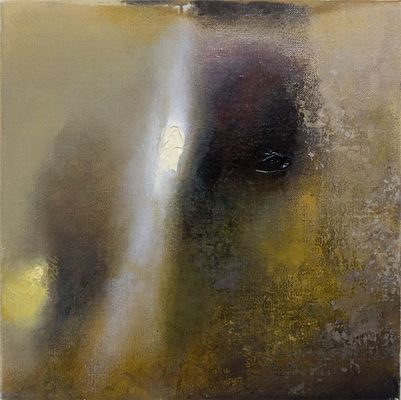
I am not a great reader of poetry but I always return to the work of Melbourne poet, Vincent Buckley (1925- 1988). Perhaps I find his most tantalising piece to be not a finished poem but a fragment left on a scrap of paper discovered on his desk after the poet’s death.
The poetry gathers like oil
In the word-core, and spreads
It has its music meet,
Its music is in movement.
This fragment is more the shell left behind from a volatile thought than a finished poem. I find the last two lines honest but awkward whereas the first two lines work like an arrow. Most likely he could not find a resolution so it was left. Still, in its present form, it remains an eloquent testimony to the ultimate failure of a medium to express mobile thought and sensation, in Buckley’s case, through verbal language. It’s an important matter because this is something all artists have to deal with regardless of the medium.
I have never written a poem, however, I am forever copying fragments from books on paper scraps in a vain effort to fix certain notions in my head. At first, they function as bookmarks that are sometimes returned to when I open the book. But before long, as they accumulate, they fall out littering the table interspersed with A4 photocopies, bills, books and medications.
To return to Buckley’s fragment, the first two lines very much evoke how I paint nowadays. As you age, detail diminishes and patches of light become more luminous and float. I feel the most honest way of dealing with this is by smearing the oil paint on the canvas with the fingers and working close-up, blind. Only if the patches coalesce into an approaching image can the work gain a life.
-
Jonathan Walker was born in Melbourne, Australia and brought up on a dairy farm in Gippsland. In the 1970’s he studied painting at RMIT and won the Harold Wright Scholarship to the British Museum, London. During the 1980’s he exhibited at Pinacotheca Gallery, Richmond and had work shown at the NGV and Heidi City Art Gallery. Over the same period he designed the cover for the “Epigenesi” LP by Giancarlo Toniutti, Italy and conducted a mail exchange work with Achim Wollscheid, Germany. The work with artists through the post resulted in an article published in the bicentenary issue of Art and Australia 1988. He showed in artist run spaces such as WestSpace in the 90’s and 2000’s, and until 2012, taught painting at Victoria University, which is where we (Colleen Ahern and Lisa Radford) as organisers of the exhibition, among many others, had the privilege of being his student.
Walker’s knowledge was imparted to students through the careful selection of music, literature, and artists found in books that he himself had ordered for the library. Walker’s strategy was the generosity of sharing his vast knowledge with references specific to each student and their context.
Walker’s paintings share a similar focus and intimacy.
This exhibition presents a small selection of recent paintings alongside a publication that includes Walker’s writing. Observational and analytical, Walker’s work is a type of material notation — the time of day, colour and how it is blended, the both specific and fleeting location of a reflection on lino or the question of whether a chair leg should be included in a painting.
Please join us on Friday August 21 between 6-8pm to celebrate the opening of the exhibition.
Curated by Colleen Ahern and Lisa Radford.
B. Wurtz
Curated by Nic Tammens
March 26 - April 4, 2015
B.Wurtz works from a basement studio in his home on Manhattan’s Lower East Side.
This local fact is attested to by the plastic shopping bags and newsprint circulars that appear in his work. As formal objects, they don’t make loud claims about their origins but nonetheless transmit street addresses and places of business from the bottom of this long thin island. Like plenty of artists, Wurtz is affected by what is local and what is consumed. His work is underpinned by this ethic. It often speaks from a neighborhood or reads like the contents of a hamper:
“BLACK PLUMS $1.29 lb.”
“Food Bazaar”
“USDA Whole Pork Shoulder Picnic 99c lb.”
“RITE AID Pharmacy, with us it’s personal.”
“H. Brickman & Sons.”
“Sweet Yams 59c lb."
Most of the work in this exhibition was made while the artist was in residence at Dieu Donne, a workshop dedicated to paper craft in Midtown. Here Wurtz fabricated assemblages with paper and objects that are relatively lightweight, with the intention that they would be easily transportable to Australia. This consideration isn’t absolute in Wurtz’s work, but was prescriptive for making the current exhibition light and cheap. Packed in two boxes, these works were sent from a USPS post office on the Lower East Side and delivered to North Melbourne by Australia Post.
Wurtz appears courtesy of Metro Pictures, New York.
Thanks to Rob Halverson, Joshua Petherick, Sari de Mallory, Matt Hinkley, Helen Johnson, Fayen d'Evie, Ask Kilmartin, Lisa Radon, Ellena Savage, Yale Union, and "Elizabeth".
John Nixon
"Archive"
December 15 - January 20, 2014
The presentation of John Nixon's archive offered a rare showcase of this extensive collection of the artist's own publications, catalogues, posters, ephemera, editions and more, from the mid 1980s onwards, alongside a selection of his artworks.
Organized by John Nixon, Joshua Petherick and Matt Hinkley.
"Habitat"
at Minerva, Sydney (organised by Joshua Petherick and Matt Hinkley)
November 15 - December 20, 2014
Lupo Borgonovo, Janet Burchill & Jennifer McCamley,
Lewis Fidock, HR Giger, Piero Gilardi, Veit Laurent Kurz,
Cinzia Ruggeri, Michael E. Smith, Lucie Stahl, Daniel Weil, Wols
Press Release:
“...It contained seven objects. The slender fluted bone, surely formed for flight, surely from the wing of some large bird. Three archaic circuitboards, faced with mazes of gold. A smooth white sphere of baked clay. An age-blackened fragment of lace. A fingerlength segment of what she assumed was bone from a human wrist, grayish white, inset smoothly with the silicon shaft of a small instrument that must once have ridden flush with the surface of the skin - but the thing’s face was seared and blackened.”
William Gibson, “Count Zero”, 1986
"Autumn Projects Archive"
Curated by Liza Vasiliou
March 6 - March 15, 2014
World Food Books, in conjunction with the Virgin Australia Melbourne Fashion Festival 2014, presented the Autumn Projects archive, consisting of a selection of early examples in Australian fashion with a particular interest in collecting designers and labels from the period beginning in the 1980’s, who significantly influenced the discourse of Australian Fashion.
Curated by Liza Vasiliou, the exhibition provided a unique opportunity to view pieces by designers Anthea Crawford, Barbara Vandenberg, Geoff Liddell and labels CR Australia, Covers, Jag along with early experimental collage pieces by Prue Acton and Sally Browne’s ‘Fragments’ collection, suspended throughout the functioning World Food Books shop in Melbourne.
H.B. Peace
presented by CENTRE FOR STYLE
November 14, 2013
"Hey Blinky, you say chic, I say same"
Anon 2013
H.B. Peace is a clothing collaboration between great friends Blake Barns and Hugh Egan Westland. Their pieces explore the divergences between 'character’ and ‘personality’ in garments....etc
Special Thanks to Joshua Petherick and Matt Hinkley of WFB and Gillian Mears
and a Very Special Thank you to Audrey Thomas Hayes for her shoe collaboration.
Janet Burchill & Jennifer McCamley
"Aesthetic Suicide"
May 10 - June 8, 2013
The first of our occasional exhibitions in the World Food Books office/shop space in Melbourne, "Aesthetic Suicide" presented a body of new and older works together by artists Janet Burchill & Jennifer McCamley, including videos, prints, a wall work, and publications.
During shop open hours videos played every hour, on the hour.
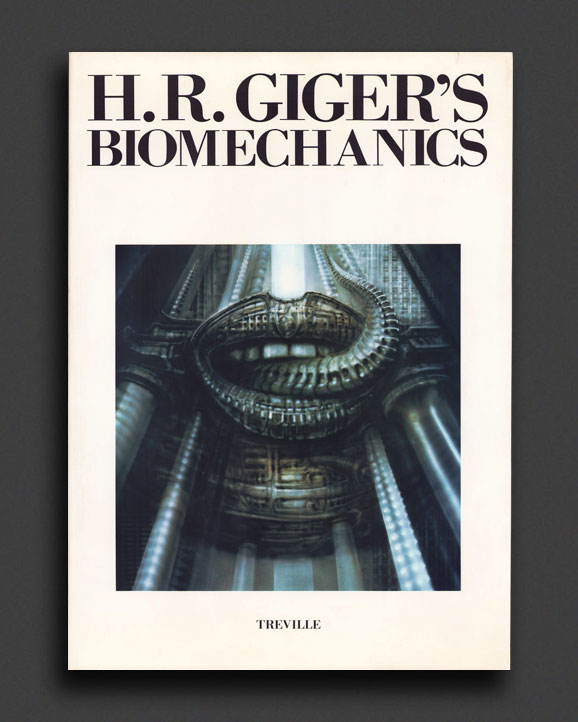
1989, Japanese
Softcover (w. dust jacket + ephemera), 96 pages, 42.5 x 30.5 cm
1st Edition, Out of print title / used / very good
Published by
Treville / Tokyo
$200.00 - In stock -
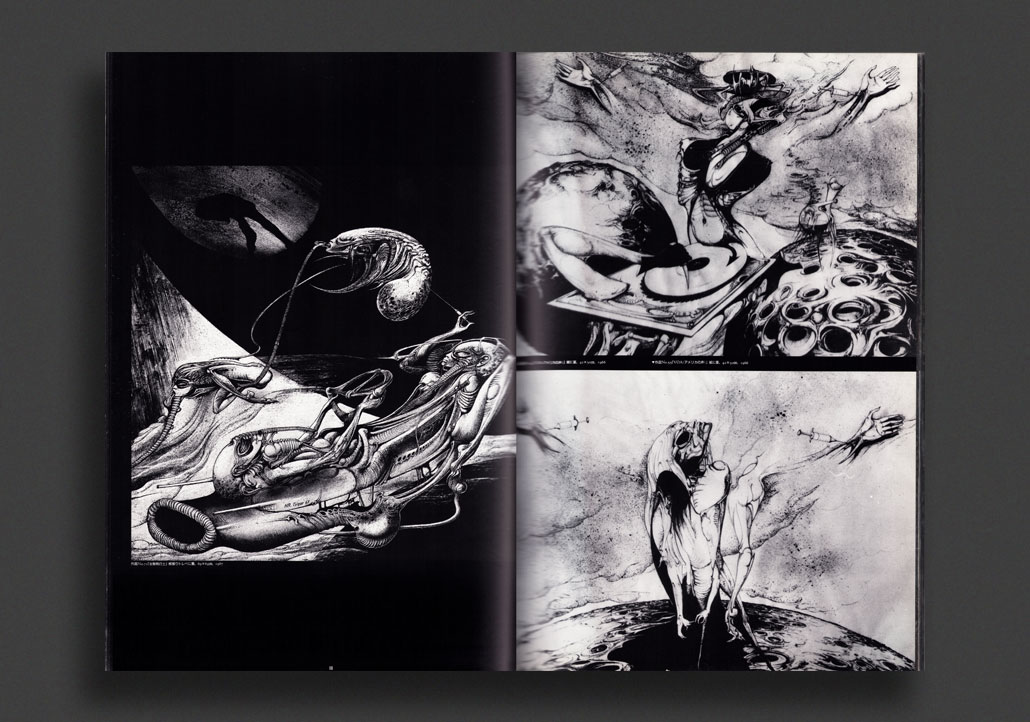
Rare first 1989 Japanese edition of H. R. Giger's Biomechanics. In his classic series of oversized and visually immersive early art volumes, this book comprises a retrospective showcase, from 1964—88, of Giger's work, designed by and with running commentary by Giger himself, with over 200 drawings, paintings, and sculptures, and including concept art for the film Poltergeist II, and design paintings for Emerson, Lake, and Palmer albums, his lost film work and early cartoons. With a foreword by legendary Science Fiction author and longtime Giger fan Harlan Ellison, who dubs him "our latter-day Hieronymus Bosch."
Note: the Japanese editions of these books often had better reproductions from the original plates than the German and English language editions.
Includes Treville publisher ephemera inserted as issued, including an illustrated advert for Giger poster editions, etc.
Very Good in Very Good dust jacket. Excellent, well-preserved copy.
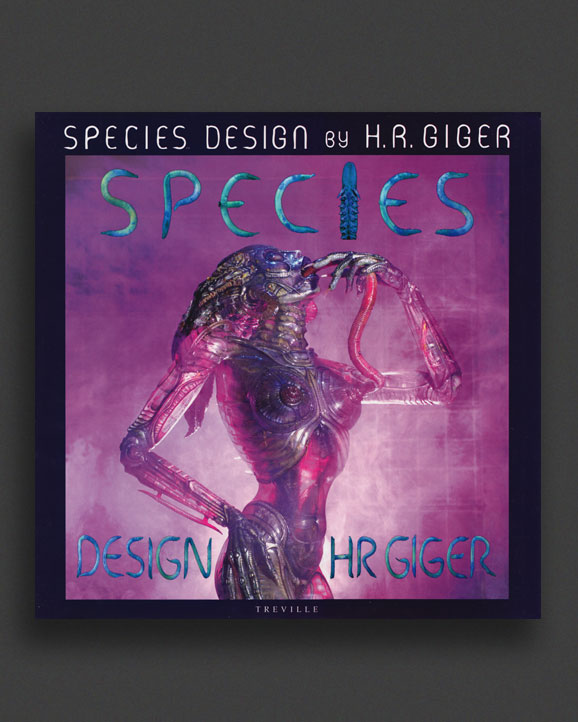
1996, Japanese
Softcover, 86 pages, 30 x 30 cm
1st Edition, Out of print title / used / very good
Published by
Treville / Tokyo
$80.00 - Out of stock
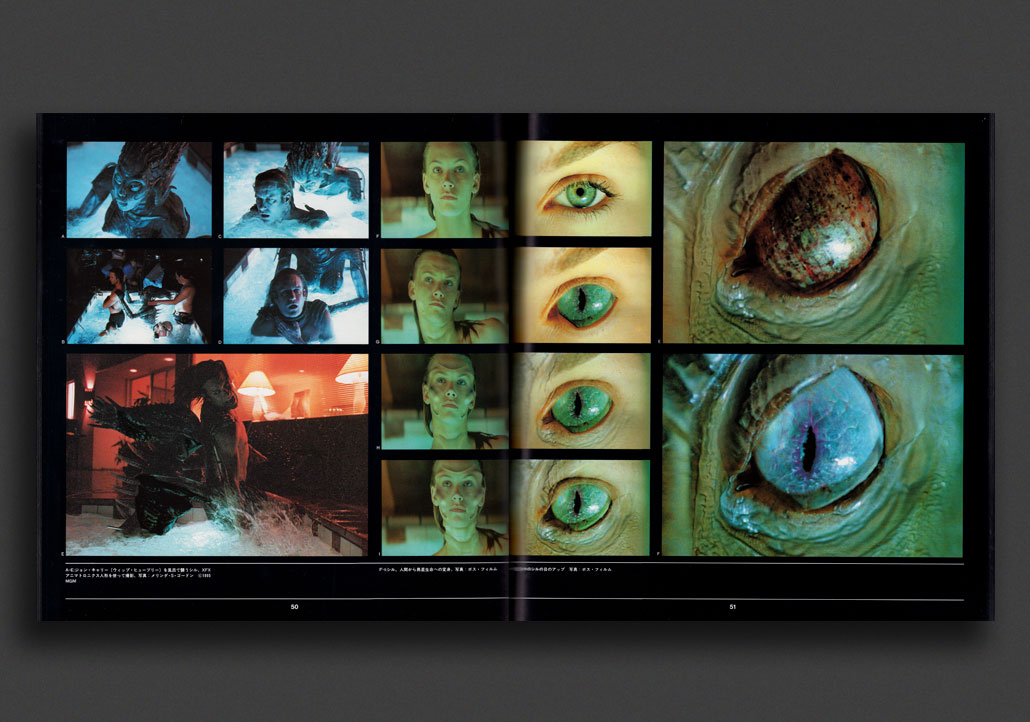
First Japanese edition of the official companion book to the 1995 American sci-fi horror film Species (directed by Roger Donaldson and written by Dennis Feldman) and the film's artistic designer H.R. Giger, famous for his creations for the Alien film. This profusely illustrated "Making of" book is packed with reproductions of Giger's incredible conceptual drawings and models as well as photographs of special effects processes, Giger's set-design, animatronics, and creature fabrication, detailing all the work involved in bringing the science fiction creature Sil to the screen. Includes fold-out illustration of the famous "Ghost Train" and much more.
Very Good copy in VG dust jacket.
1971, Japanese
Rigid softcover (in illustrated slipcase), 64 pages, 30 cm x 21 cm
1st Edition, Out of print title / used / very good
Published by
Gakugei Shorinsha / Tokyo
$400.00 - In stock -
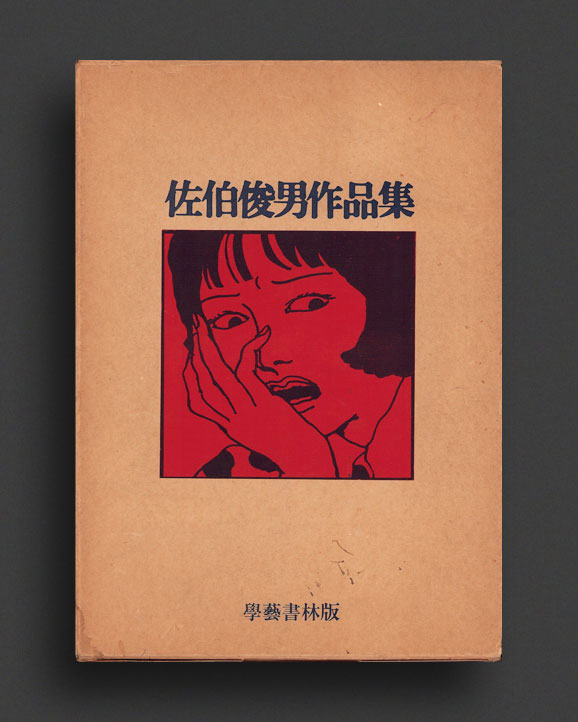
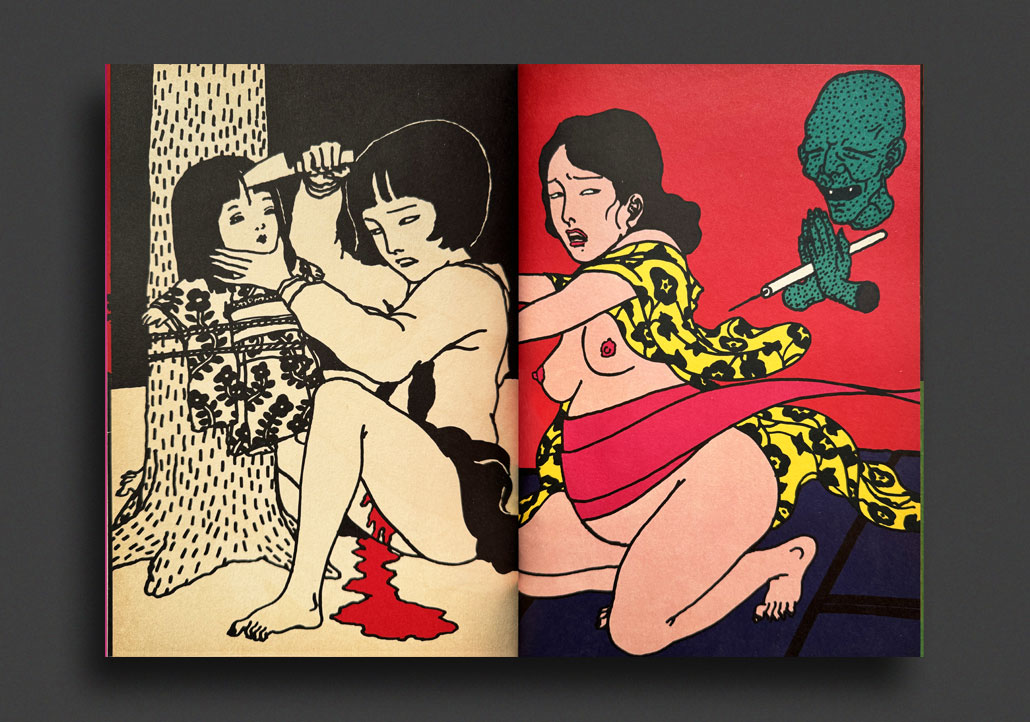
Super rare and bookshop favourite early collection of artworks by ero-guro master Toshio Saeki (1945—2019), published in 1971 by Gakugeishorin. Stunning large-format softcover collection of exquisitely printed saturated full-bleed colour and b/w artworks on warm matte paper stock capturing this legendary underground artist at the height of his powers, housed in original publisher's cardboard slipcase. His third book collection featuring so many of his finest works. Postface by Hiraoka Masaaki in Japanese. A must!
Toshio Saeki (1945—2019) was an illusive Japanese illustrator and painter, and icon of 1970s Tokyo counterculture, known for combining Japanese folklore, Yōkai spirits and elements of Western art with his own sophisticated aesthetics to create a unique, sensational world of eros, dark humour, and horror. Given the title “Erotic Engineer” by Timothy Leary, Saeki's provocative art broke all sexual taboos, questioned Japanese ideology and traditional views on love, desire and gender roles. Saeki’s surgically-precise graphic work is closely related to the Japanese cultural phenomenon ‘Erotic, Grotesque, Nonsense’ (ero, guro, nansensu).
“Toshio Saeki conjures death with a pen”—Shūji Terayama, 1969.
Very Good copy. Very complete copy with slipcase and obi present. Some wear/marking to a VG slipcase.
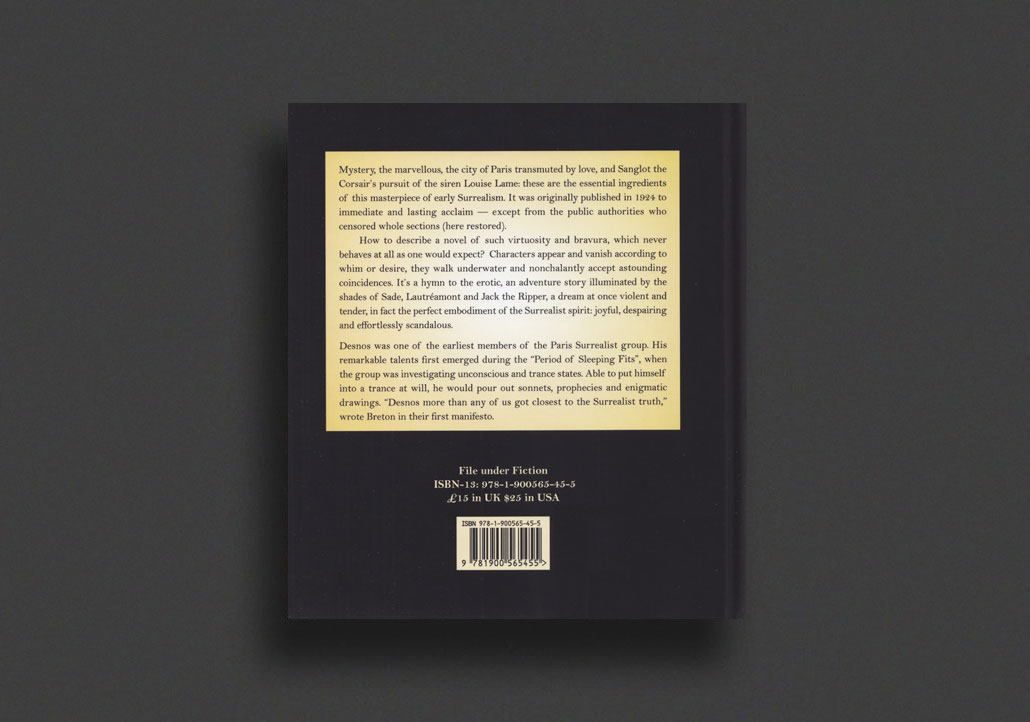
2013, English
Hardcover, 176 pages, 17.4 x 19.6 cm
Published by
Atlas Press / London
$46.00 - In stock -
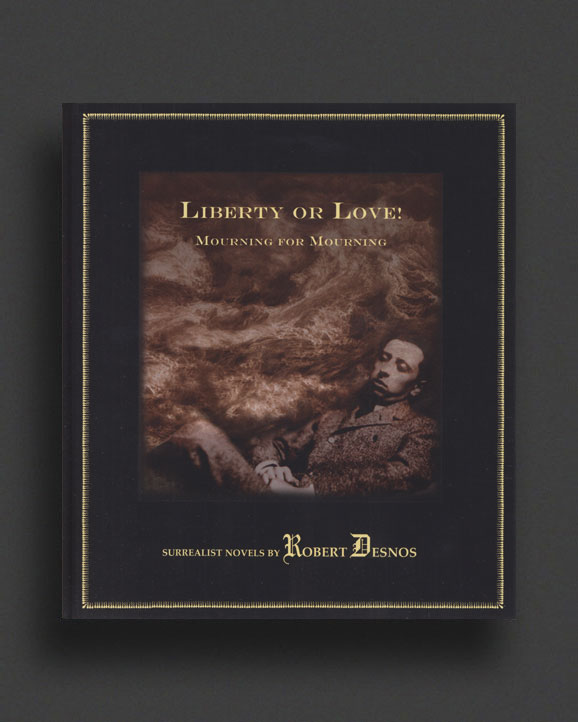
Mystery, the marvellous, the city of Paris transmuted by love, and Sanglot the Corsair’s pursuit of the siren Louise Lame: these are the essential ingredients of this masterpiece of early Surrealism. It was originally published in 1924 to immediate and lasting acclaim — except from the public authorities who immediately censored whole sections (here restored).
How describe a novel of such virtuosity and bravura, which never behaves as one would expect? Characters appear and vanish according to whim and desire, they walk underwater, nonchalantly accept astounding coincidences. It’s a hymn to the erotic, an adventure story illumined by the shades of Sade, Lautréamont and Jack the Ripper, a dream at once violent and tender, in fact the perfect embodiment of the Surrealist spirit: joyful, despairing, and effortlessly scandalous.
Desnos was one of the earliest members of the Paris Surrealist group. His remarkable talents first emerged during the “Period of Sleeping Fits”, when the group was investigating unconscious and trance states. Able to put himself in trance at will, he would pour out sonnets, prophecies, enigmatic drawings. “Desnos more than any of us got closest to the Surrealist truth,” wrote Breton in their first manifesto.
An active member of the Resistance, Desnos died of typhus two weeks after his liberation from the Nazi concentration camp at Terezin.
Translated and introduced by Terry Hale.
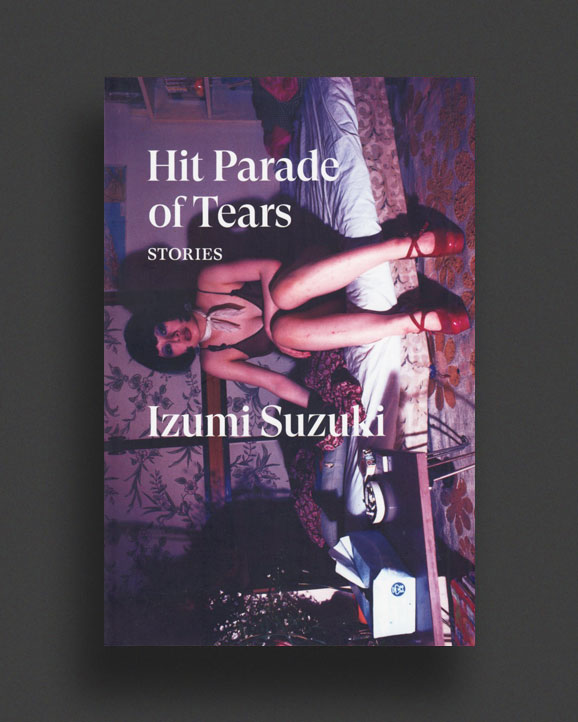
2023, English
Softcover, 288 pages, 20.9 x 13 cm
Published by
Verso / London
$32.00 - Out of stock
A new collection of stories from the cult author of Terminal Boredom.
Izumi Suzuki had ideas about doing things differently, ideas that paid little attention to the laws of physics, or the laws of the land. In this new collection, her skewed imagination distorts and enhances some of the classic concepts of science fiction and fantasy.
A philandering husband receives a bestial punishment from a wife with her own secrets to keep; a music lover finds herself in a timeline both familiar and as wrong as can be; a misfit band of space pirates discover a mysterious baby among the stars; Emma, the Bovary-like character from one of Suzuki’s stories in Terminal Boredom, lands herself in a bizarre romantic pickle.
Wryly anarchic and deeply imaginative, Suzuki was a writer like no other. These eleven stories offer readers the opportunity to delve deeper in this singular writer's work.
Translated by Sam Bett, David Boyd, Daniel Joseph and Helen O'Horan
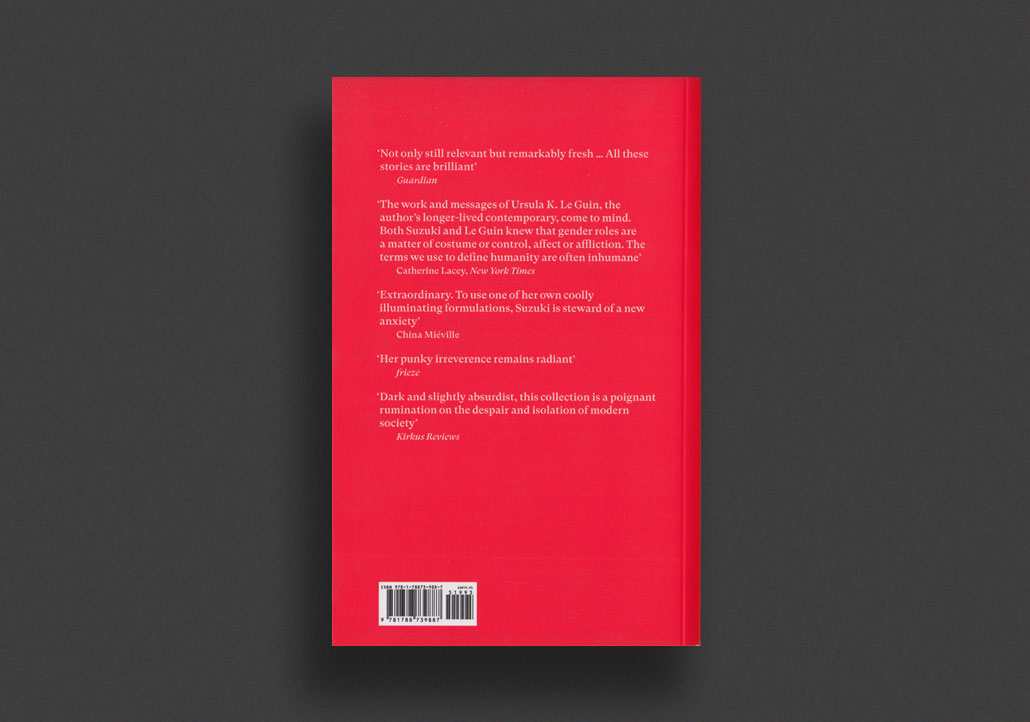
"Extraordinary. To use one of her own coolly illuminating formulations, Suzuki is steward of a new anxiety"—China Miéville
"Brilliant and often bleak … all shot through with a camp ethos, dark humour and kitchen-sink realism … in their brio and jagged urgency, these stories have, if anything, only gained in their alarming immediacy."— Times Literary Supplement
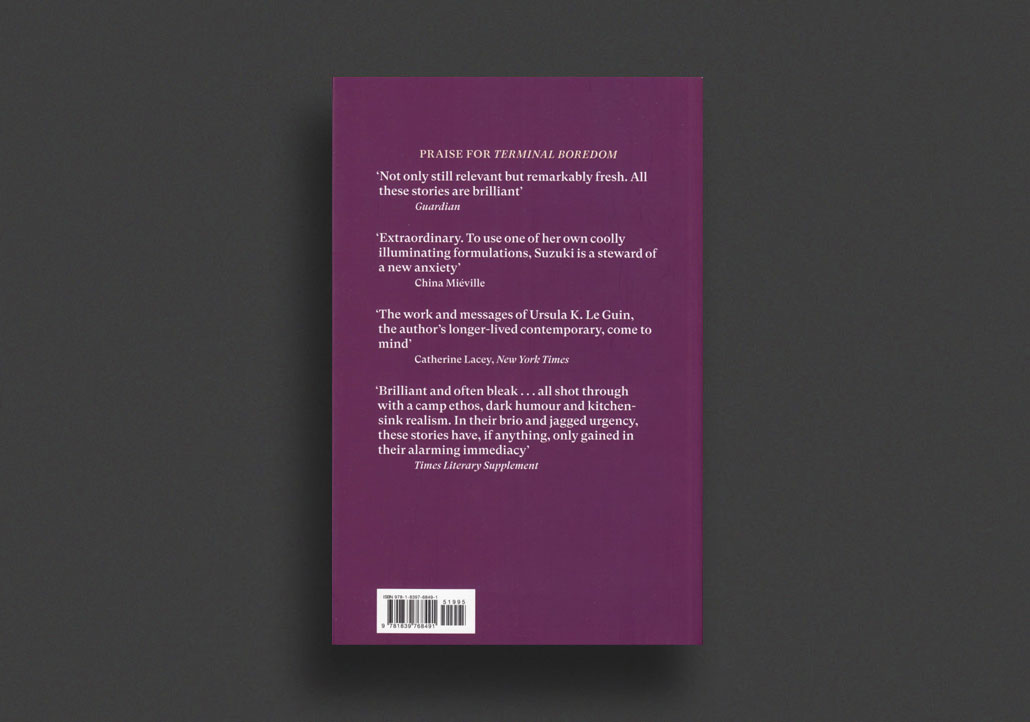
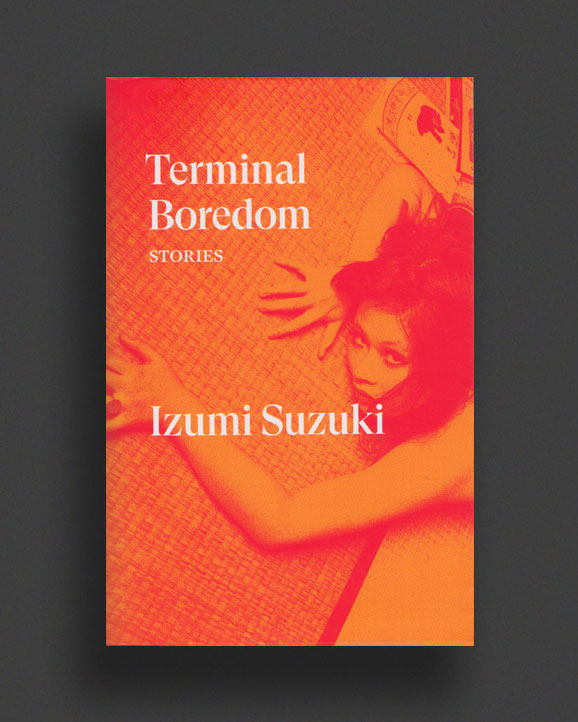
2021, English
Softcover, 208 pages, 20.9 x 13 cm
Published by
Verso / London
$32.00 - In stock -
The first English-language publication of the work of Izumi Suzuki, a legend of Japanese science fiction and a countercultural icon.
In a future where men are contained in ghettoised isolation, women enjoy the fruits of a queer matriarchal utopia—until a boy escapes and a young woman’s perception of the world is violently interrupted. The last family in a desolate city struggles to approximate twentieth- century life on Earth, lifting what notions they can from 1960s popular culture. But beneath these badly learned behaviours lies an atavistic appetite for destruction. Two new friends enjoy drinks on a holiday resort planet where all is not as it seems, and the air itself seems to carry a treacherously potent nostalgia. Back on Earth, Emma’s not certain if her emotionally abusive, green-haired boyfriend is in fact an intergalactic alien spy, or if she’s been hitting the bottles and baggies too hard. And in the title story, the tyranny of enforced screen-time and the mechanisation of labour foster a cold-hearted and ultimately tragic disaffection among the youth of Tokyo.
Nonchalantly hip and full of deranged prescience, Suzuki’s singular slant on speculative fiction would be echoed in countless later works, from Neuromancer to The Handmaid’s Tale. In these darkly playful and punky stories, the fantastical elements are always grounded in the universal pettiness of strife between the sexes, and the gritty reality of life on the lower rungs, whatever planet that ladder might be on.
Izumi Suzuki was born in 1949. After dropping out of high school she worked in a factory before finding success and infamy as a model and actress. She was a member of Shuji Terayama's independent underground theater troupe Tenjo Saijiki, and acted in both "pink" films and classics of 1970s Japanese cinema. Izumi was the subject of many of Nobuyoshi Araki's most famous photographs and this photobook is one of his most sought after.. When the father of her children, the jazz musician Kaoru Abe, died of an overdose, Suzuki’s creative output went into hyperdrive and she began producing the irreverent and punky short fiction, novels and essays that ensured her reputation would outstrip and outlast that of the men she had been associated with in her early career. She took her own life in 1986, leaving behind a decade’s worth of groundbreaking and influential writing.
1985, English
Softcover (w. paste-ins), 224 pages, 21 x 15 cm
1st Edition, Out of print title / used / very good
Published by
Atlas Press / London
$100.00 - In stock -
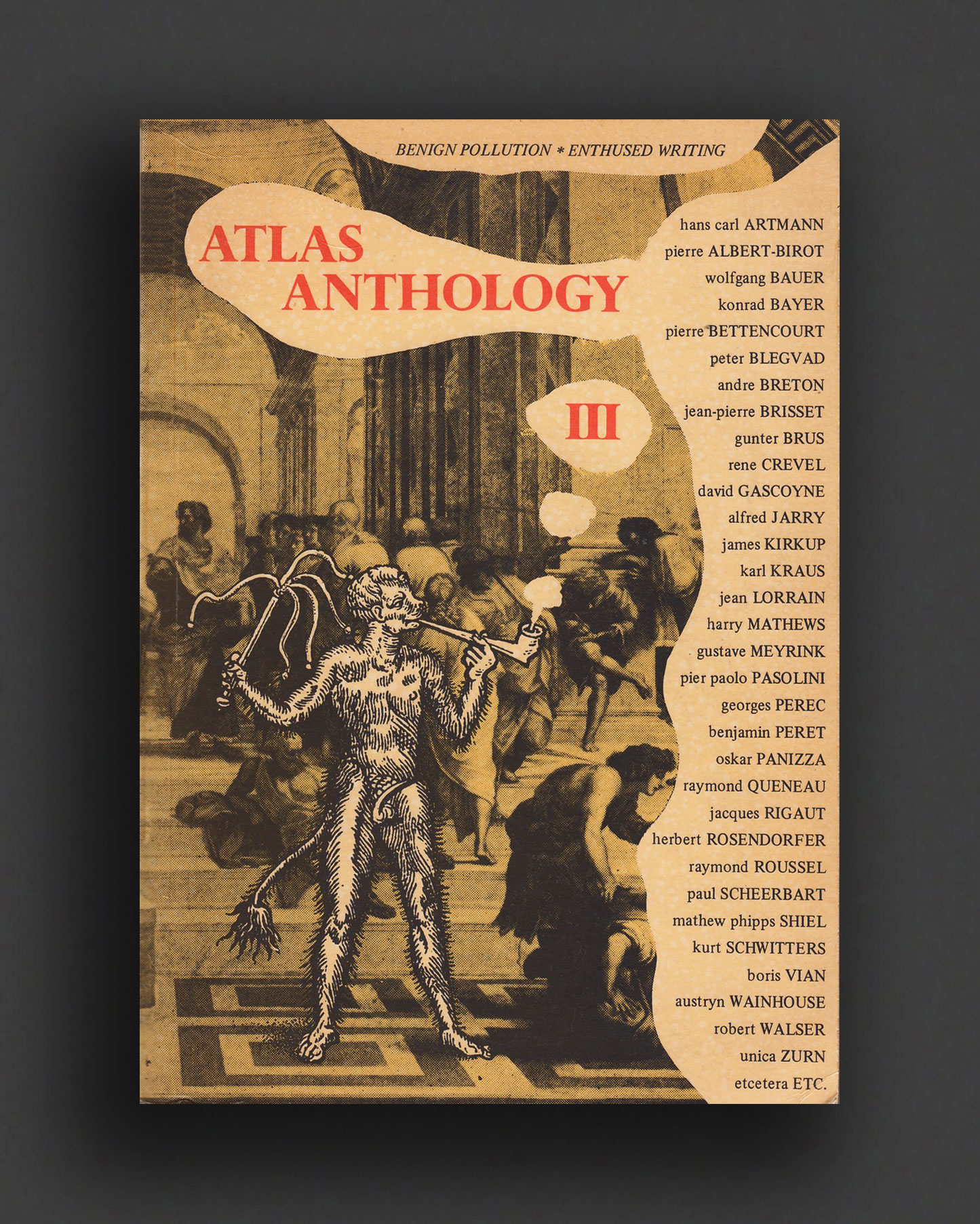
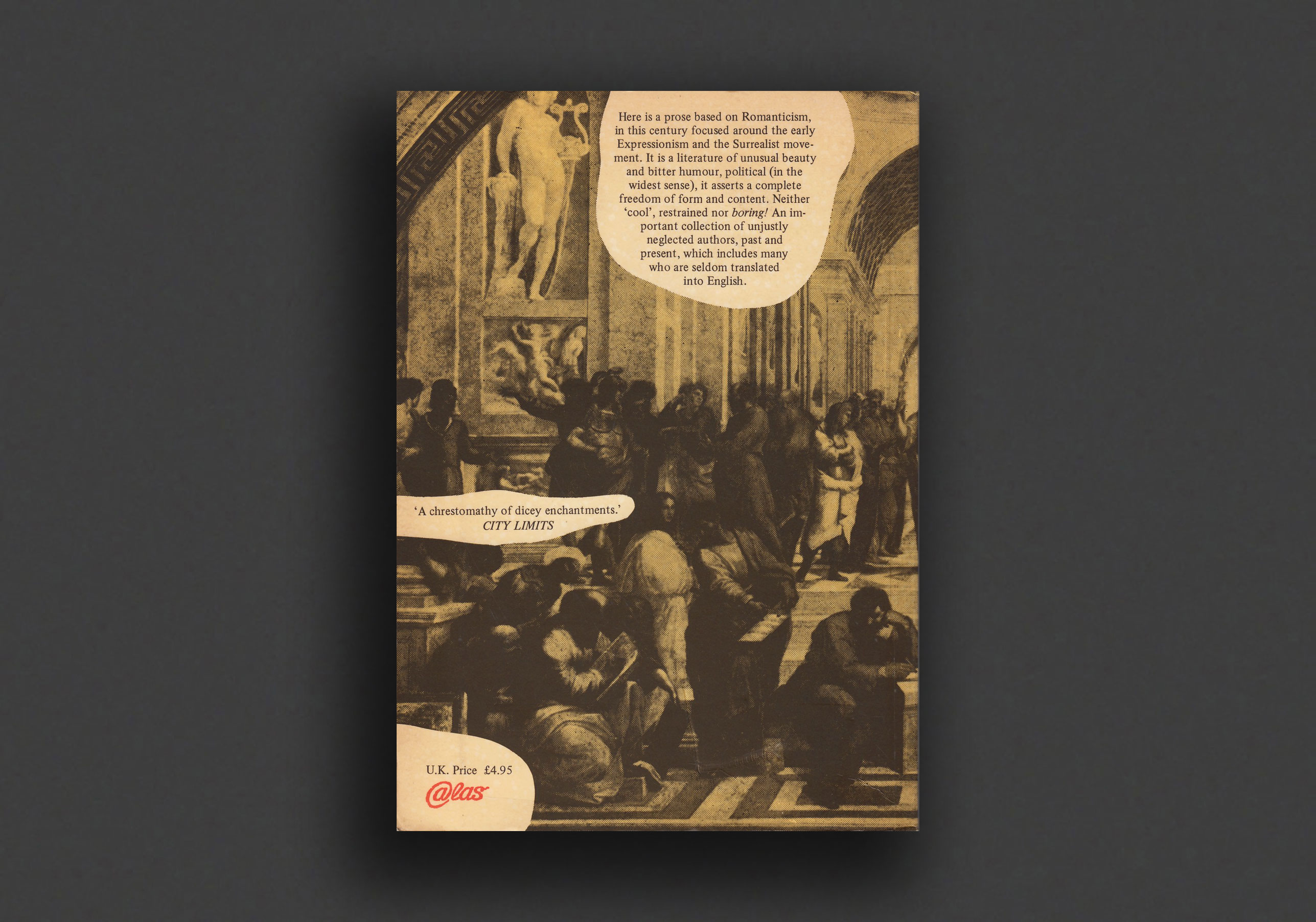
"A chrestomathy of dicey enchantments.'—CITY LIMITS
Now rare, long out-of-print 1985 Atlas Anthology 3, edited by Alastair Brotchie & Malcolm Green. "Benign Pollution, Enthused Writing". The third production from the legendary Atlas Press, the third general anthology and the first book to be actually typeset (a very expensive business in those days).
Features: Hans Carl Artmann, Pierre Albert-Birot, Wolfgang Bauer, Konrad Bayer, Pierre Bettencourt, Peter Blegvad, Andre Breton, Jean-Pierre Brisset, Günter Brus, René Crevel, David Gascoyne, Alfred Jarry, James Kirkup, Karl Kraus, Jean Lorrain, Harry Mathews, Gustave Meyrink, Pier Paolo Pasolini, Georges Perec, Benjamin Peret, Oskar Panizza, Raymond Queneau, Jacques Rigaut, Herbert Rosendorfer, Raymond Roussel, Paul Scheerbart, Mathew Phipps Shiel, Kurt Schwitters, Boris Vian, Austryn Wainhouse, Robert Walser, Unica Zürn, Etcetera Etc.
"Here is a prose based on Romanticism, in this century focused around the early Expressionism and the Surrealist movement. It is a literature of unusual beauty and bitter humour, political (in the widest sense), it asserts a complete freedom of form and content. Neither 'cool', restrained nor boring! An important collection of unjustly neglected authors, past and present, which includes many who are seldom translated into English."
Highest recommendation.
Good—Very Good copy complete with all the paste-ins. General wear and tanning.
1986, Japanese
Softcover, 76 pages, 29.7 x 29.7 cm
Out of print title / used / very good
Published by
Treville / Tokyo
$100.00 - In stock -
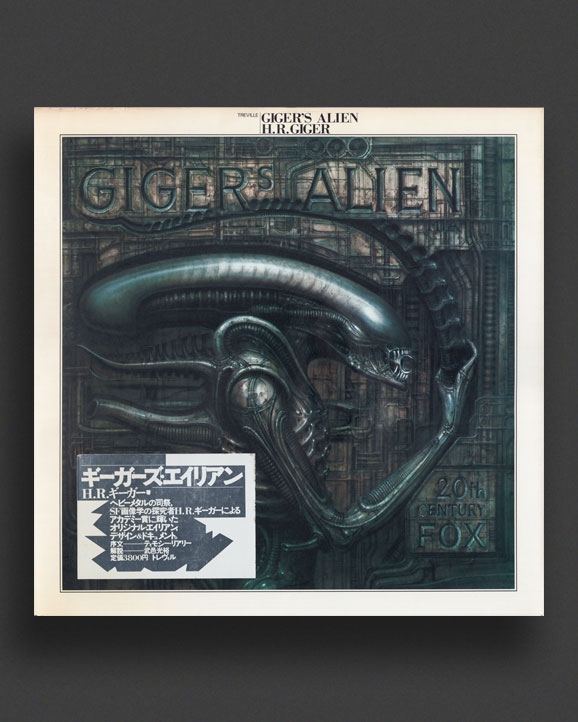
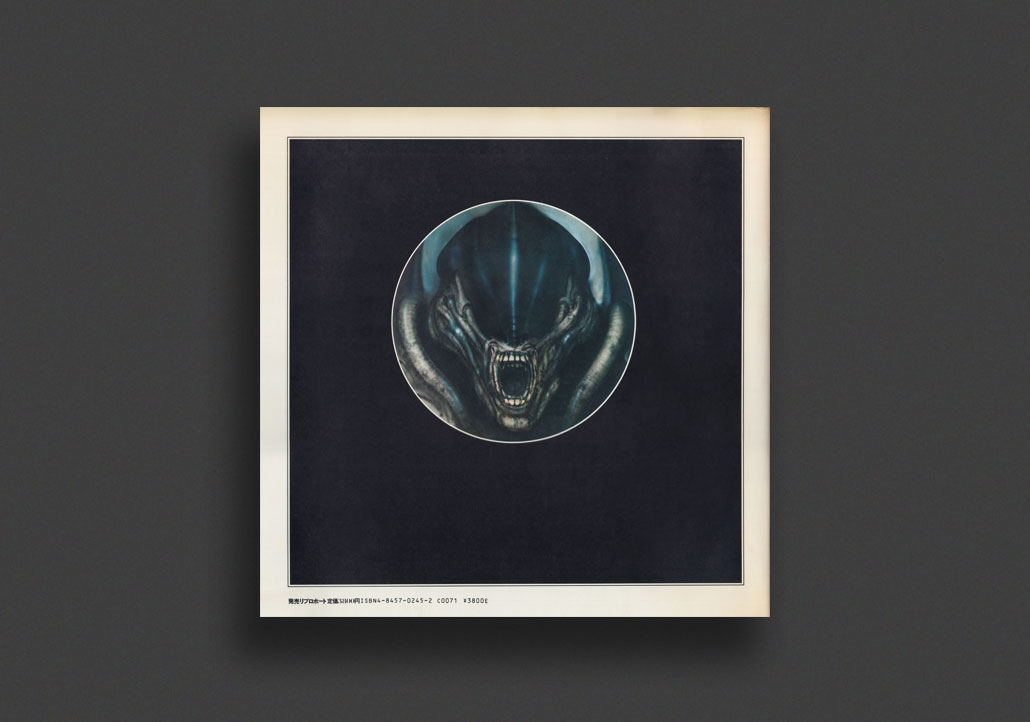
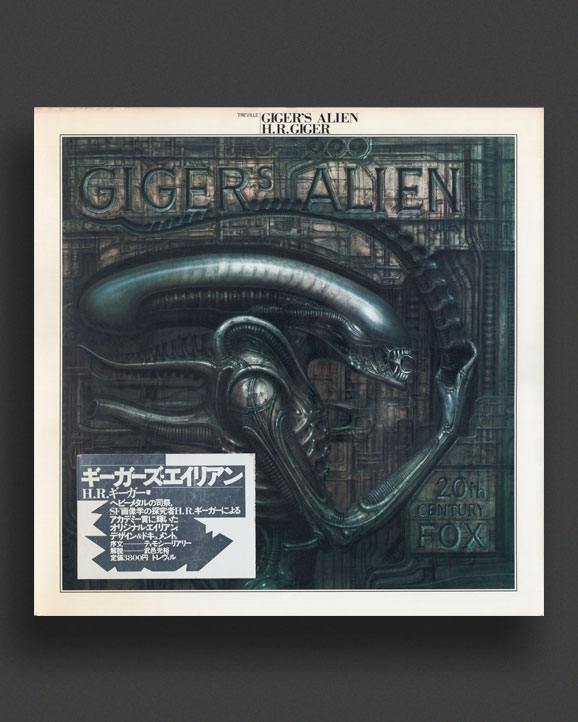
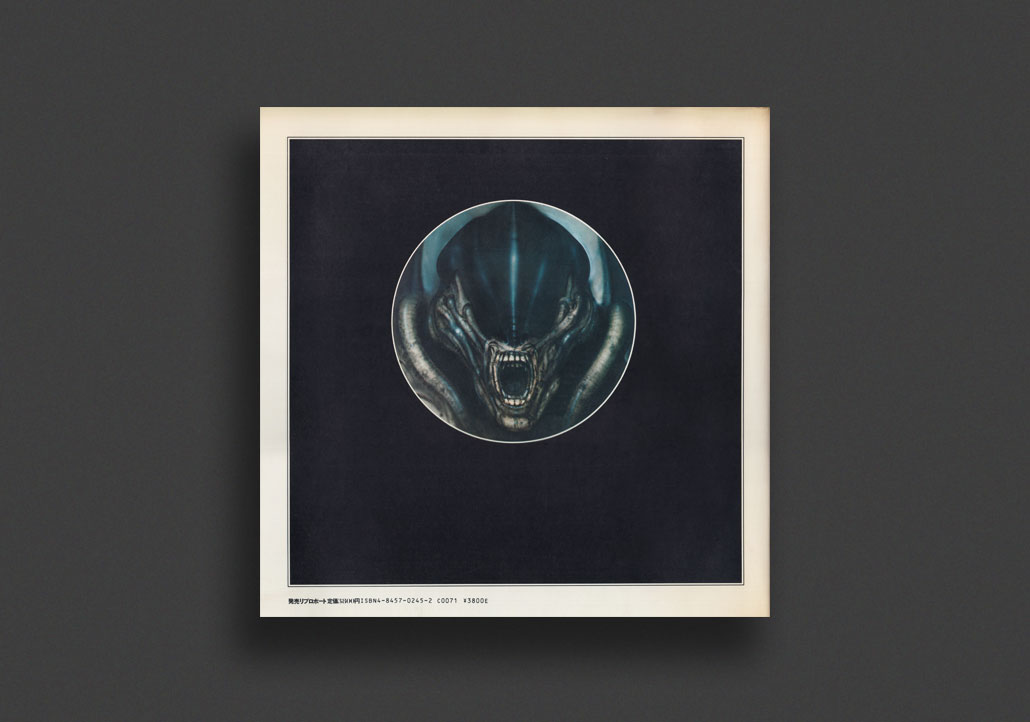
Japanese 1986 edition of the classic "Giger's Alien", a visually stunning and wonderfully insightful book for any fan of the art of H.R. Giger, Ridley Scott and Dan O'Bannon's Alien film or in the production of science-fiction/horror/special effects in any way. A must.
"Giger's Alien provides a complete record of the months and months of painstaking work that resulted in two hours of terrifying celluloid. Sketches, original paintings, photographs of scenery and the Alien under construction and scenes from the film are linked by Giger's detailed diary of his thoughts and actions at the time".
Very Good copy in original dust jacket of this title. Only light wear, beautifully preserved.
1965, English
Softcover, 288 pages, 18.5 x 12 cm
1st Edition, Out of print title / used / very good
Published by
Jupiter Books / London
$60.00 - In stock -
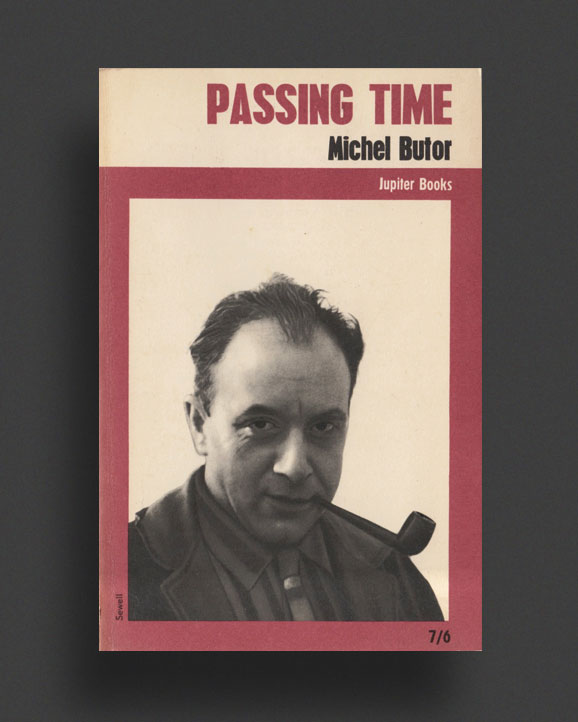
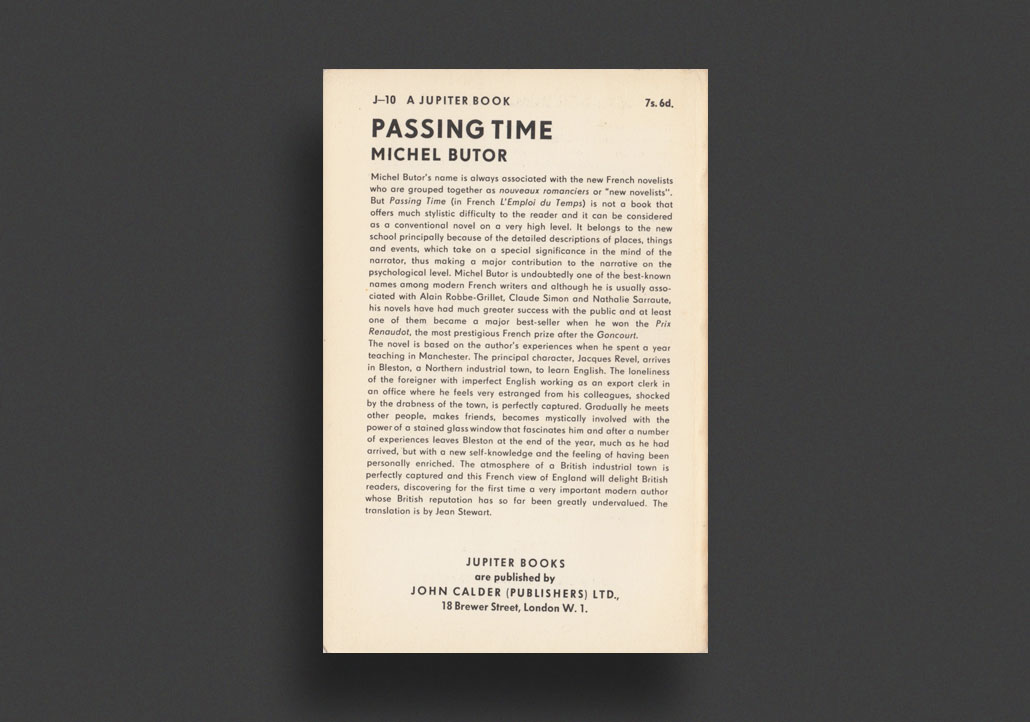
First 1965 Jupiter Books English edition of Michel Butor's Passing Time, first published in France in 1956 as L'Emploi du temps, winning the 1957 Fénéon Prize.
"Michel Butor is perhaps the most gifted and original of that avant-garde group of young French writers who are seeking to regenerate the novel by means of a 'new realism'."—BBC
Frenchman Jacques Revel arrives in Bleston, an industrial city in the north of England—also a thinly disguised, reimagined Manchester—to begin employment as a shipping clerk. Lost under the spell of a dark, dank, labyrinthine metropolis, he endeavours to solve the puzzle of an attempted murder. We follow his erratic odyssey in diary form as a growing sense of unease envelops him and mysterious fires erupt throughout the city.
Passing Time, originally published in France as L'Emploi du temps (1956), is the great, forgotten Manchester novel, a book of enormous imagination and vitality. Melding Greek myth with Proustian method to formulate a brilliant study of alienation and the nebulousness of memory. A work that attempts to excavate Britain's proto-capitalist past and industrial forebears—interrogating their affect on modernity and the human soul.
"[Butor] is crammed, one might say, with positivity: it is the visible side of a hidden truth—once again literature defines itself by the illusion it is more than itself, the work being destined to illustrate a trans-literary order."—Roland Barthes
"Judging by this novel the experience [of working in Manchester] has marked him for life, for Passing Time is not so much a hymn, as a whole oratorio of hate. The mood suggests Kafka at his most paranoid; the method harks back to Virginia Woolf but here the stream-of-consciousness has become a turbid flood, the dark Irwell, mazy as the Ganges delta."—The Guardian
Michel Butor (1926—2016) was a French poet, novelist, teacher, essayist, art critic and translator, and one of the leading exponents of the nouveau roman (“new novel”) alongside Alain Robbe-Grillet, Claude Simon, Nathalie Sarraute, an avant-garde literary movement that emerged in France in the 1950s.
Very Good copy.
2025, English
Softcover, 162 pages, 20.3 x 12.7 cm
Published by
Weirdpunk Books / US
$25.00 - Out of stock
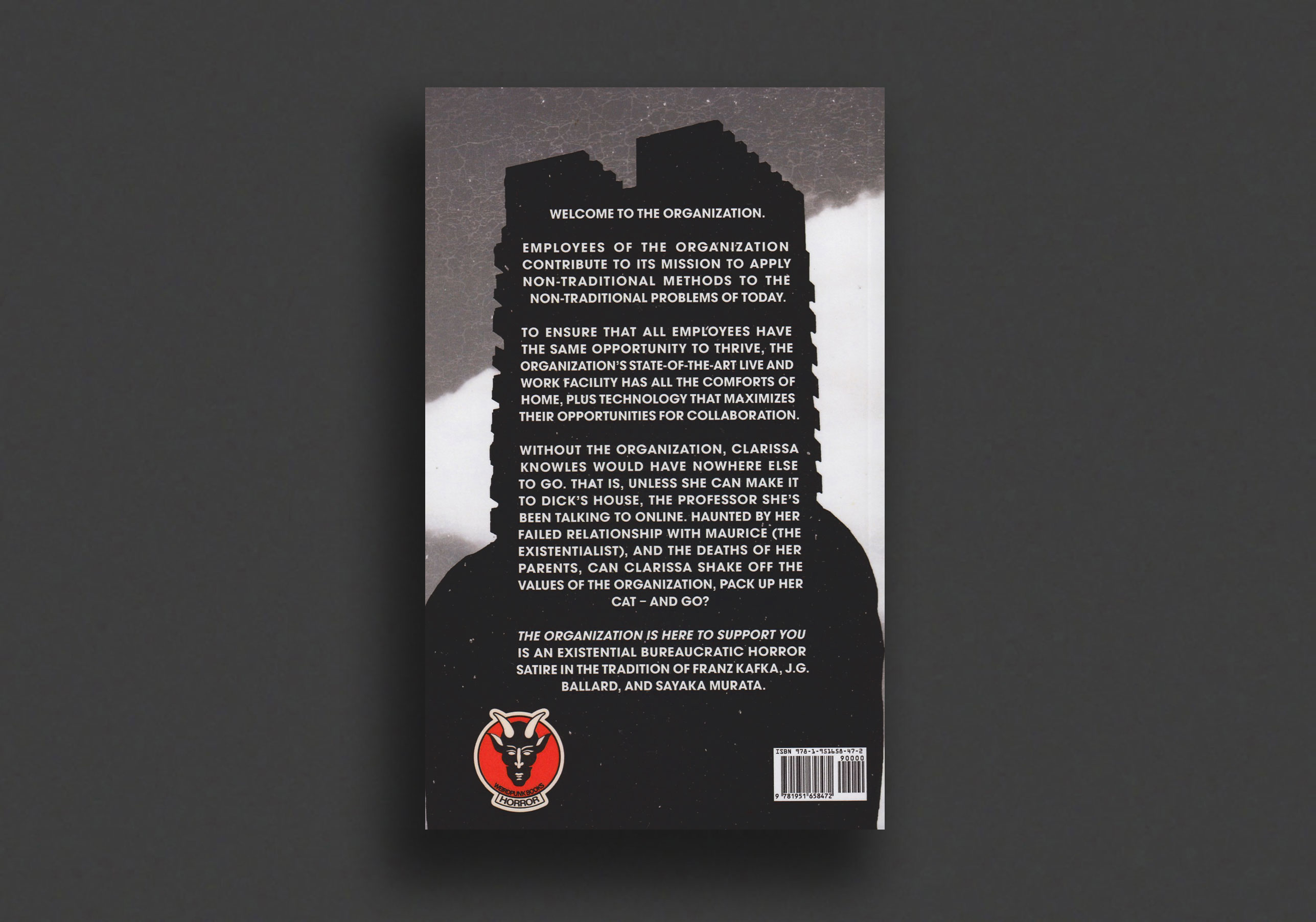
Welcome to the Organization. Employees of the organization contribute to its mission to apply non-traditional methods to the non-traditional problems of today. To ensure that all employees have the same opportunity to thrive, the organization’s state-of-the-art live and work facility has all the comforts of home, plus technology that maximizes their opportunities for collaboration. Without the organization, Clarissa Knowles would have nowhere else to go. That is, unless she can make it to Dick’s house, the professor she’s been talking to online. Haunted by her failed relationship with Maurice (the existentialist), and the deaths of her parents, can Clarissa shake off the values of the organization, pack up her cat – and go? The Organization is Here to Support You is an existential bureaucratic horror satire in the tradition of Franz Kafka, J.G. Ballard, and Sayaka Murata.
1995, English
Softcover, 102 pages, 15.2 x 10.2 cm
Published by
Filthy Loot / Ames
$20.00 - Out of stock
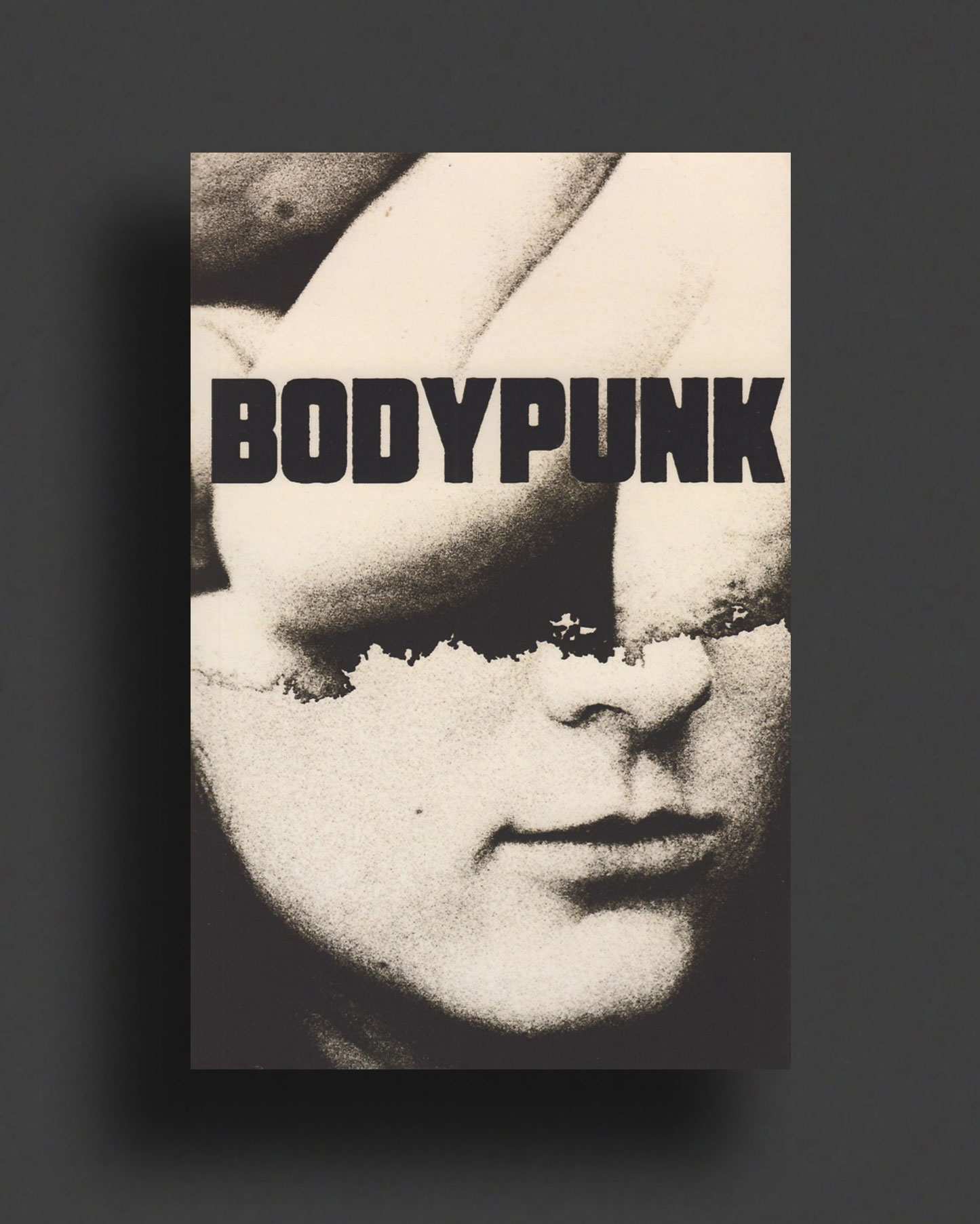
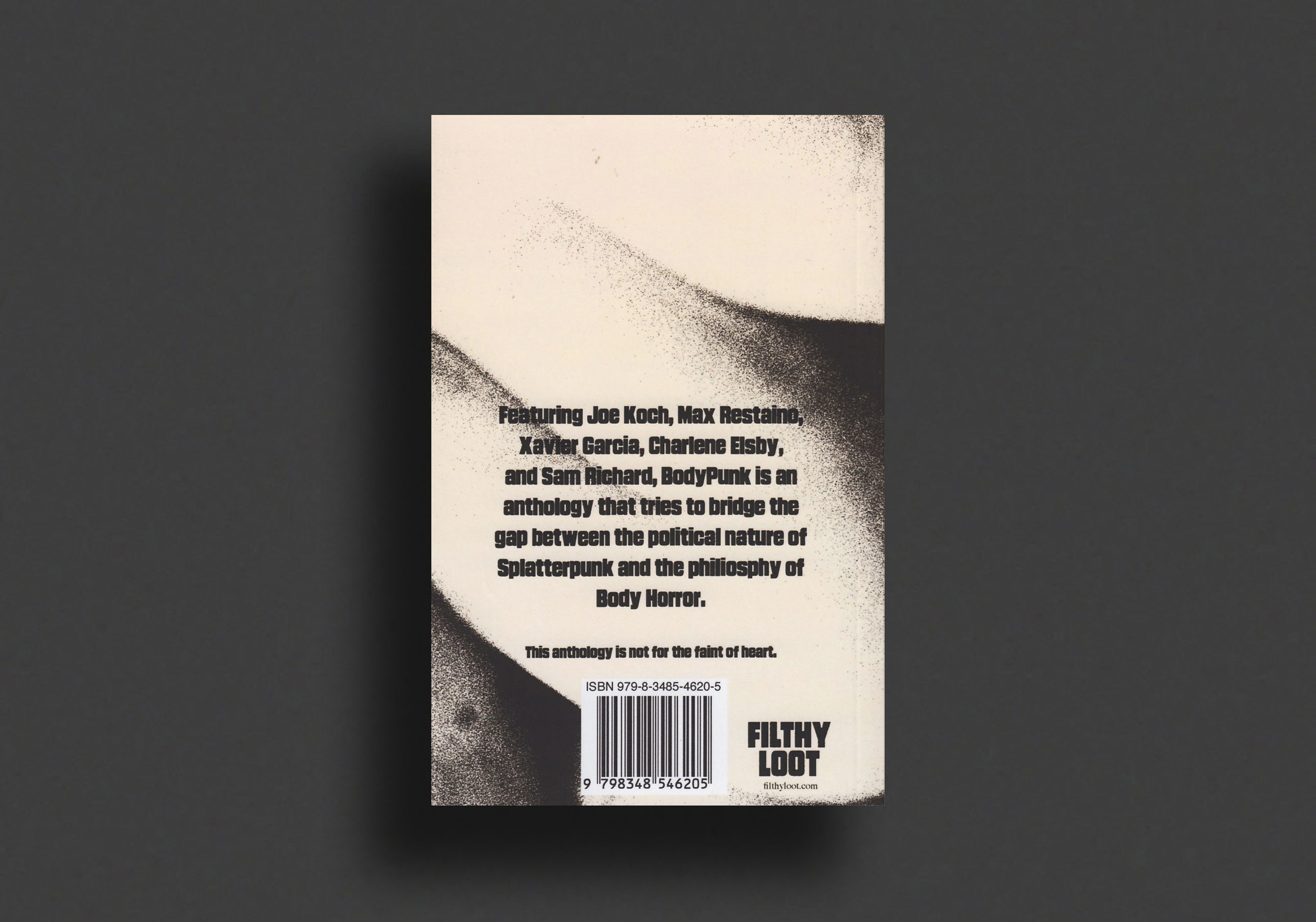
Body Horror + Splatterpunk = BodyPunk.
If you get to the core of the Filthy Loot aesthetic, juxtaposition is everything.
Featuring Joe Koch, Max Restaino, Xavier Garcia, Charlene Elsby, and Sam Richard. This is an anthology intended to muddy the waters for subgenre purists the world over. You’re welcome.
2004, English
Softcover, 200 pages, 21.6 x 14 cm
Published by
Stanford University Press / Palo Alto
$48.00 - Out of stock
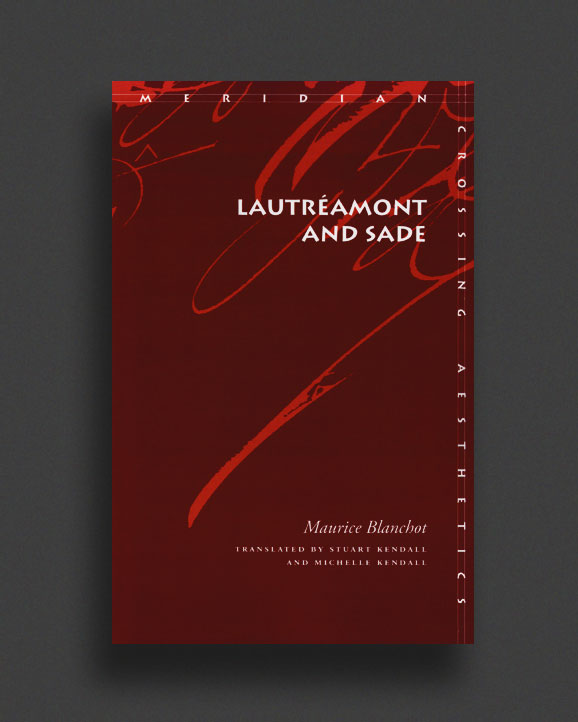
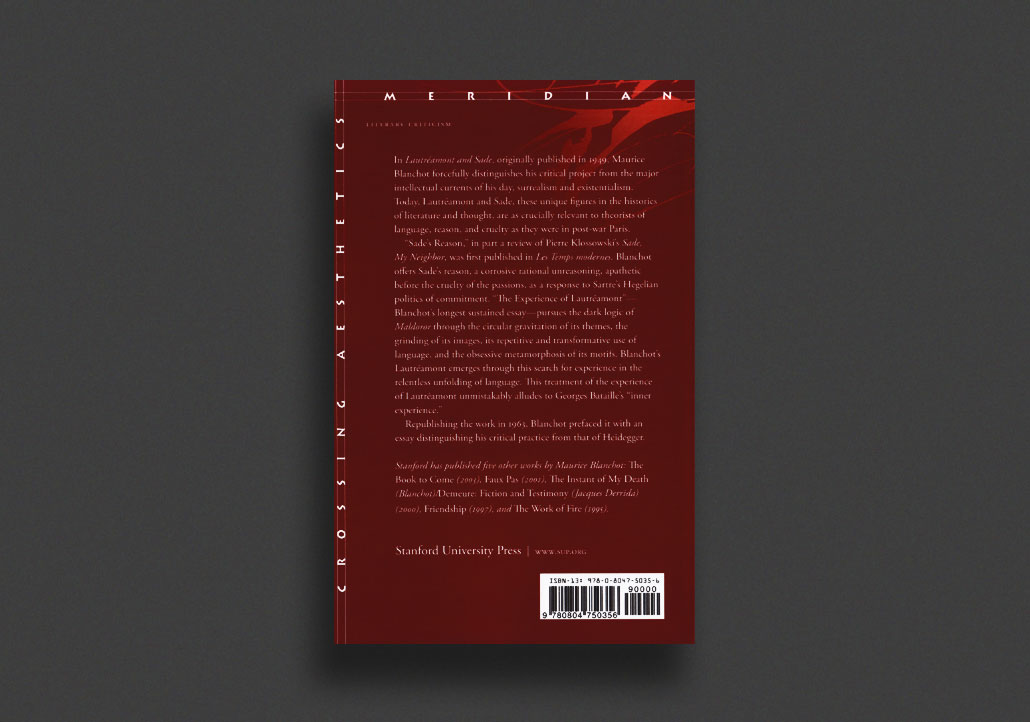
In Lautréamont and Sade, originally published in 1949, Maurice Blanchot forcefully distinguishes his critical project from the major intellectual currents of his day, surrealism and existentialism. Today, Lautreamont and Sade, these unique figures in the histories of literature and thought, are as crucially relevant to theorists of language, reason, and cruelty as they were in post-war Paris.
"Sade's Reason," in part a review of Pierre Klossowski's Sade, My Neighbor, was first published in Les Temps modernes. Blanchot offers Sade's reason, a corrosive rational unreasoning, apathetic before the cruelty of the passions, as a response to Sartre's Hegelian politics of commitment.
"The Experience of Lautreamont," Blanchot's longest sustained essay, pursues the dark logic of Maldoror through the circular gravitation of its themes, the grinding of its images, its repetitive and transformative use of language, and the obsessive metamorphosis of its motifs. Blanchot's Lautreamont emerges through this search for experience in the relentless unfolding of language. This treatment of the experience of Lautreamont unmistakably alludes to Georges Bataille's "inner experience."
Republishing the work in 1963, Blanchot prefaced it with an essay distinguishing his critical practice from that of Heidegger.
Maurice Blanchot (1907-2003) was a French writer, philosopher, and literary theorist. His work had a strong influence on later post-structuralist theorists such as Jacques Derrida. He is one of the most enigmatic and influential figures in modern French writing yet no interview, no biographical sketch, and hardly any photographs have ever been published of him.
1979 / 2004, Japanese
Softcover, 76 pages, 29.7 x 29.7 cm
Out of print title / used / very good
Published by
Treville / Tokyo
Pan-Exotica / Tokyo
$80.00 - Out of stock
Japanese edition of the classic 1979 "Giger's Alien", a visually stunning and wonderfully insightful book for any fan of the art of H.R. Giger, Ridley Scott and Dan O'Bannon's Alien film or in the production of science-fiction/horror/special effects in any way. A must.
"Giger's Alien provides a complete record of the months and months of painstaking work that resulted in two hours of terrifying celluloid. Sketches, original paintings, photographs of scenery and the Alien under construction and scenes from the film are linked by Giger's detailed diary of his thoughts and actions at the time".
Very Good copy in VG original dust jacket of this title. 2004 edition.
1996, English
Softcover (staple-bound), 82 pages, 29.5 x 21 cm
1st Edition, Out of print title / used / good
Published by
Immerse / London
$40.00 - Out of stock
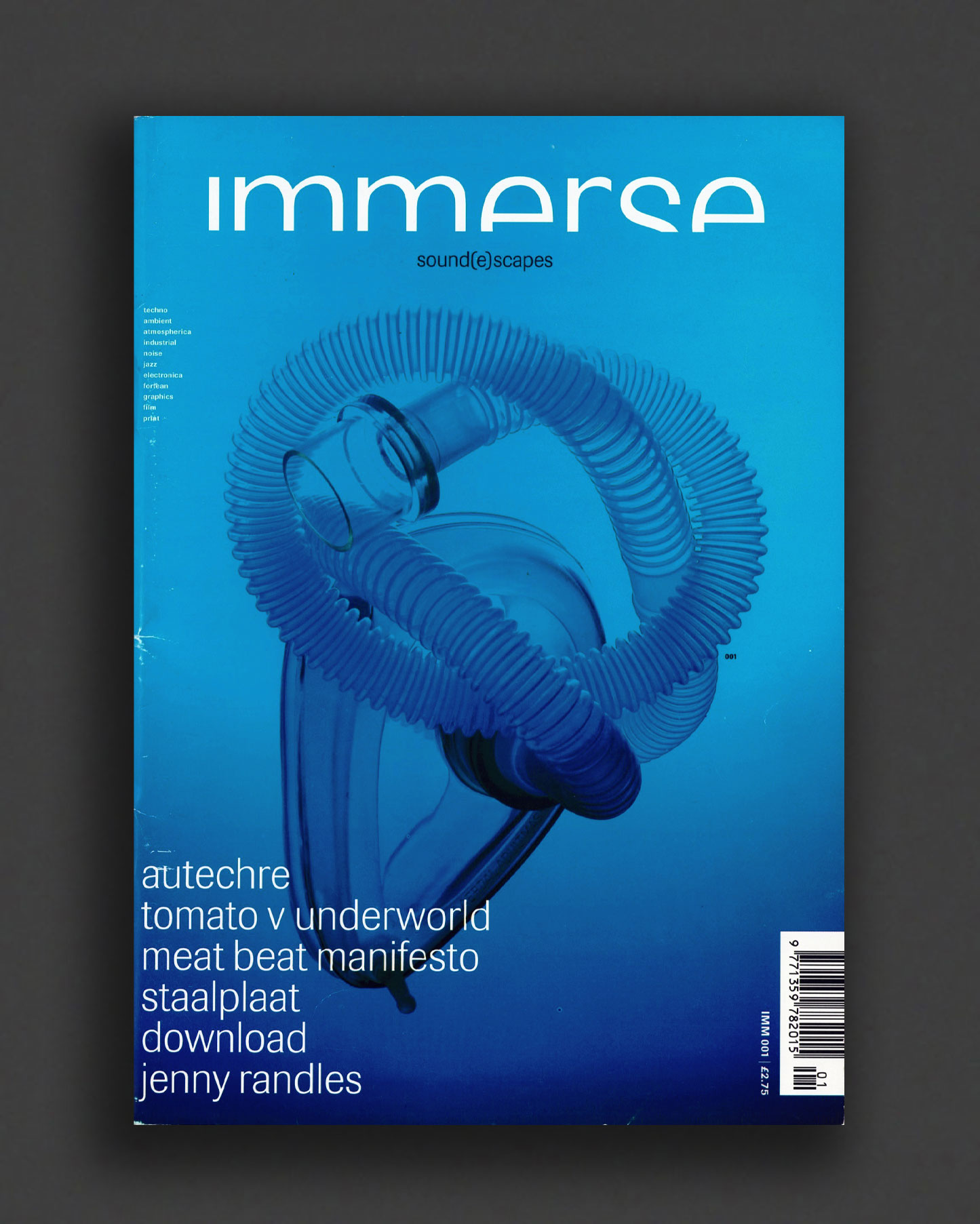
Rare first issue of Immerse magazine from London, featuring Controlled Bleeding, Autechre, Tomato vs Underworld, Shinjuku Thief, Meat Beat Manifesto, Staalplaat, Download, Jenny Randles (former British UFO Research Association), Stan Brakhage, cryptozoology, CM von Hausswolff, Black Lung, Carl Stone, filmmaker Nigel Wingrove, and much more.
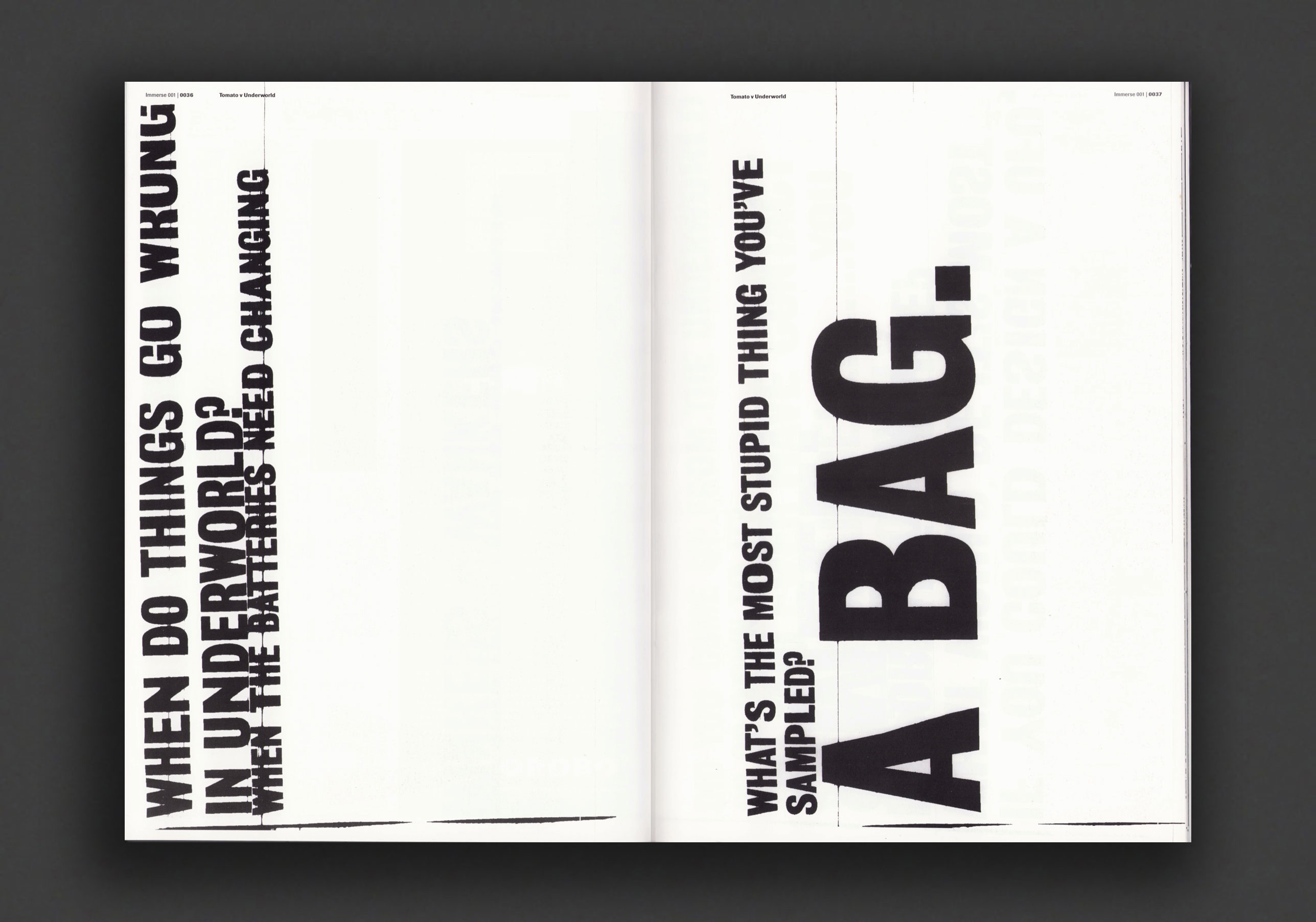
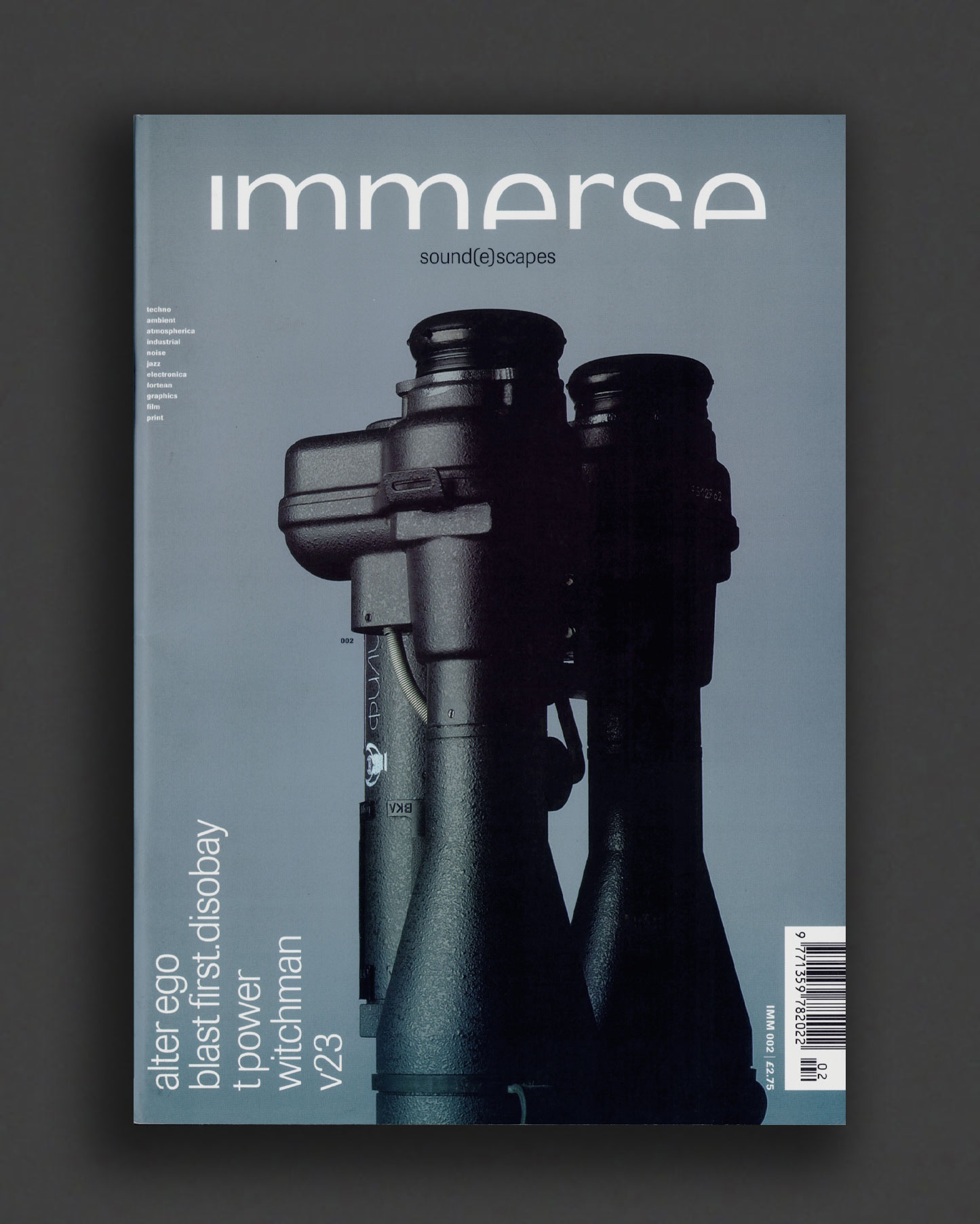
London's Immerse "sound(e)scapes" magazine lasted only three issues, was published by a group of enthusiasts on a limited budget, and yet it perfectly encapsulates a moment when esoteric counterculture, experimental electronic music, weird literature, irreverent"techno chaos" graphic design, and even fortean paranormal experience and conspiracy theory collided and mutated from the depths of the 1980s industrial underground via 1990s cyber-punk toward the spectre of Y2K. Collectively edited by Mathew F. Riley, Leigh Neville, and Neil Gardner, the "(sub)cultural" magazine was first and foremost an incredible music magazine devoted to techno, ambient, atmospherica, industrial, noise, jazz, electronica, but also covered film, fiction, design, subculture, the paranormal, basically anything that took the collective's fancy. Sleek (and occasionally schizo) design with guest design features from Tomato, The Designers Republic, v23, etc. each issue's cover features photography by Toby McFarlan Pond of sensory enhancement technology – respiratory equipment, nightvision binoculars, audio monitoring equipment. The covers really set the tone. Packed with in-depth features on artists and labels — interviews, discographies, profiles, artist pages, film and literature features, esoterica, loads of reviews, and much more.
Good—VG copy with some edge wear/spine pinching.
1996, English
Softcover (staple-bound), 82 pages, 29.5 x 21 cm
1st Edition, Out of print title / used / very good
Published by
Immerse / London
$40.00 - Out of stock
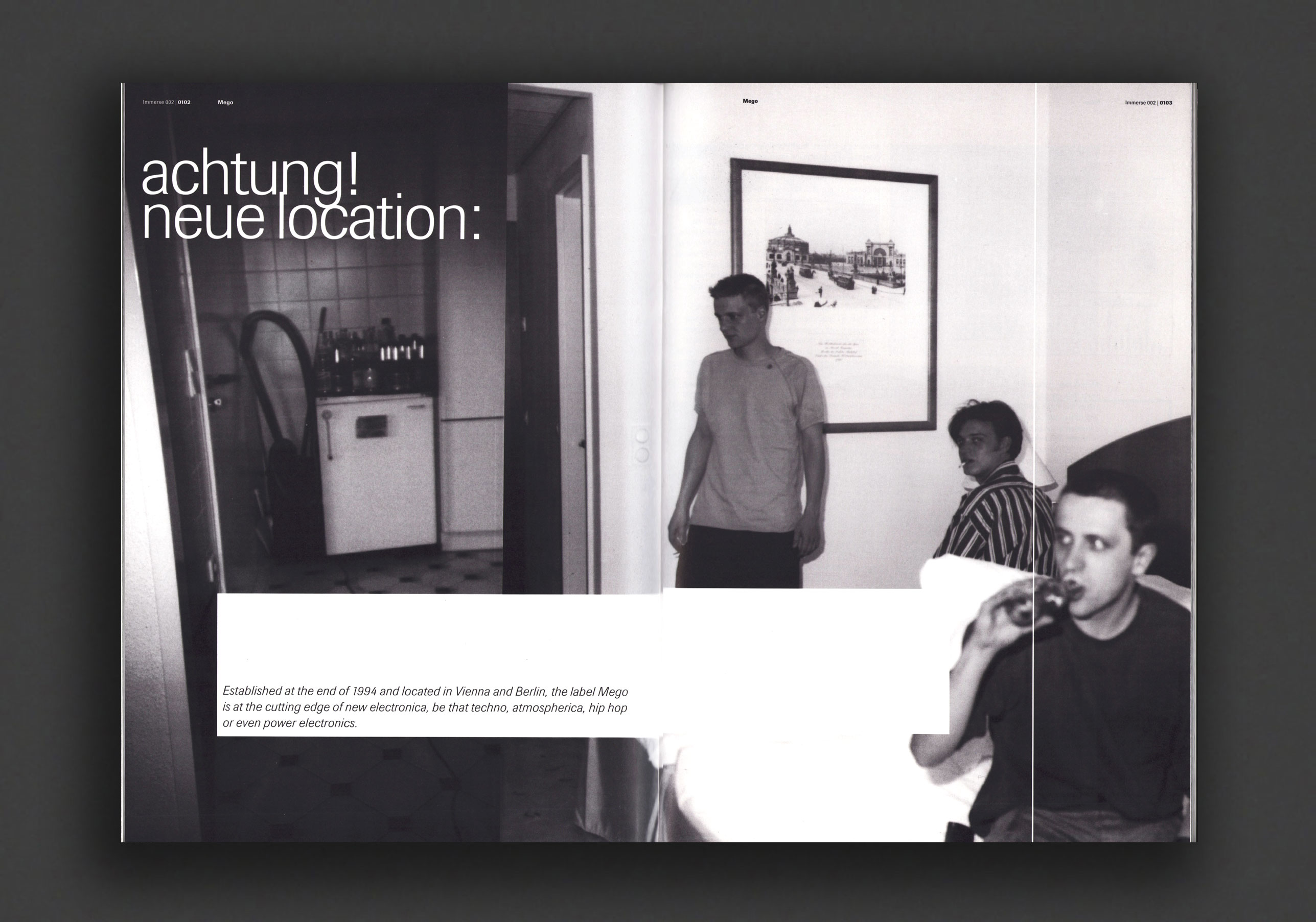
Rare second issue of Immerse magazine from London, featuring Alter Ego, Mego, Thomas Ligotti, Blast First, T.Power, Witchman, v23, New Albion Records, Kenneth Anger vs Alistair Crowley, and much more.
London's Immerse "sound(e)scapes" magazine lasted only three issues, was published by a group of enthusiasts on a limited budget, and yet it perfectly encapsulates a moment when esoteric counterculture, experimental electronic music, weird literature, irreverent"techno chaos" graphic design, and even fortean paranormal experience and conspiracy theory collided and mutated from the depths of the 1980s industrial underground via 1990s cyber-punk toward the spectre of Y2K. Collectively edited by Mathew F. Riley, Leigh Neville, and Neil Gardner, the "(sub)cultural" magazine was first and foremost an incredible music magazine devoted to techno, ambient, atmospherica, industrial, noise, jazz, electronica, but also covered film, fiction, design, subculture, the paranormal, basically anything that took the collective's fancy. Sleek (and occasionally schizo) design with guest design features from Tomato, The Designers Republic, v23, etc. each issue's cover features photography by Toby McFarlan Pond of sensory enhancement technology – respiratory equipment, nightvision binoculars, audio monitoring equipment. The covers really set the tone. Packed with in-depth features on artists and labels — interviews, discographies, profiles, artist pages, film and literature features, esoterica, loads of reviews, and much more.
VG copy
1992, English
Softcover, 94 pages, 30 x 23 cm
1st Edition, Out of print title / used / good
Published by
Taschen / Cologne
$40.00 - Out of stock
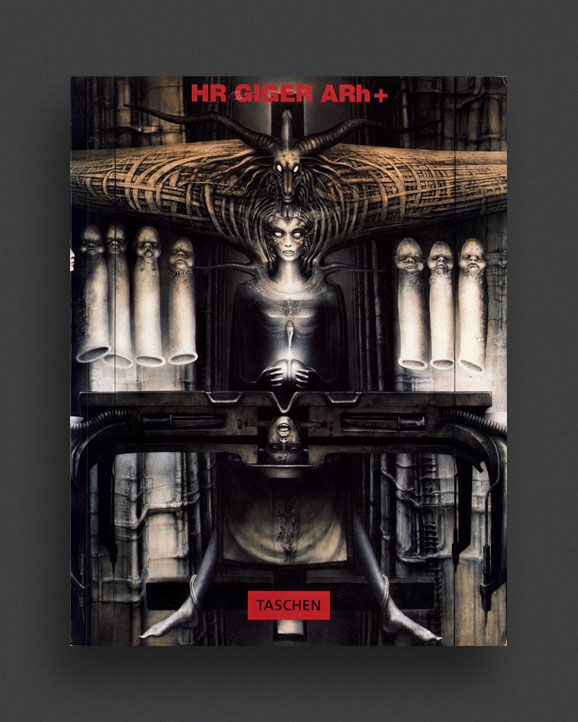
"The more famous I get, the more I am tolerated, albeit with some head-shaking."H.R. Giger
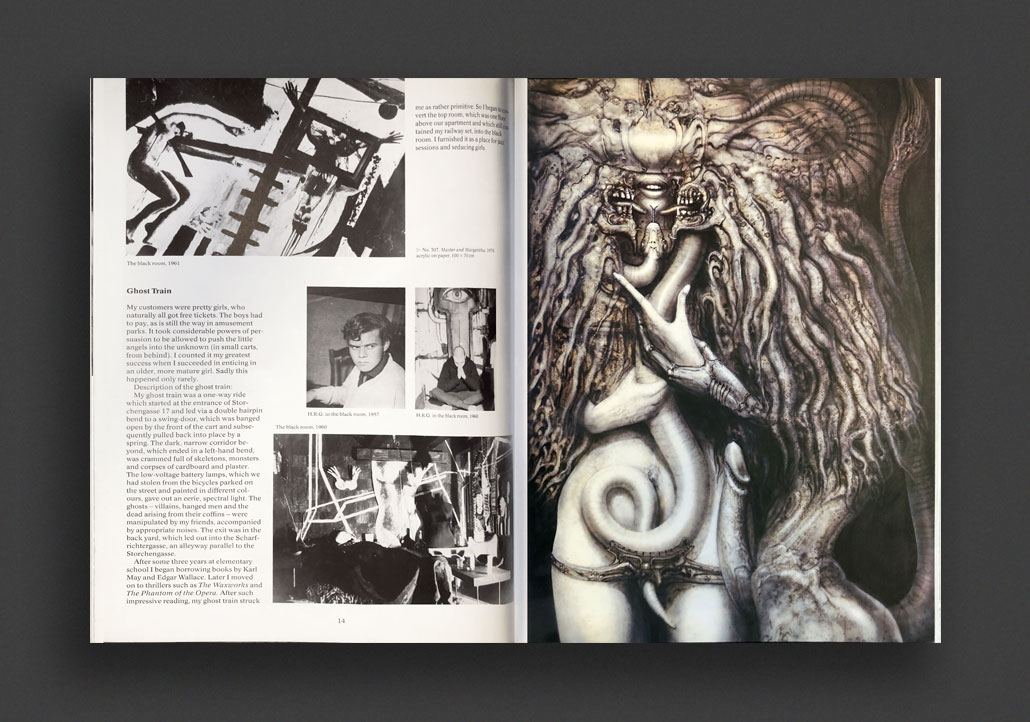
1992 printing of A Rh+ in the English edition, collecting Giger's multi-faceted career in one place: From surrealistic dream landscapes, experimental film, grotesque cartoons, album cover designs, sculptures, through to his famous Alien creatures, encompassing a world like no other. Lavishly illustrated with over 100 images with detailed captions, this monograph forms a detailed chronological summary of the life and oeuvre of the foremost modern fantasy artist and ALIEN master, H.R. Giger, covering his cultural and historical importance and a concise biography.
Good copy with some cover wear, couple of loose pages, all present.
2025, English
Softcover, 180 pages, 19.5 x 13.5 cm
Published by
Twisted Spoon Press / Prague
$42.00 - Out of stock
translated from the Czech by Christopher Morris
frontispiece by Tomáš Fafek
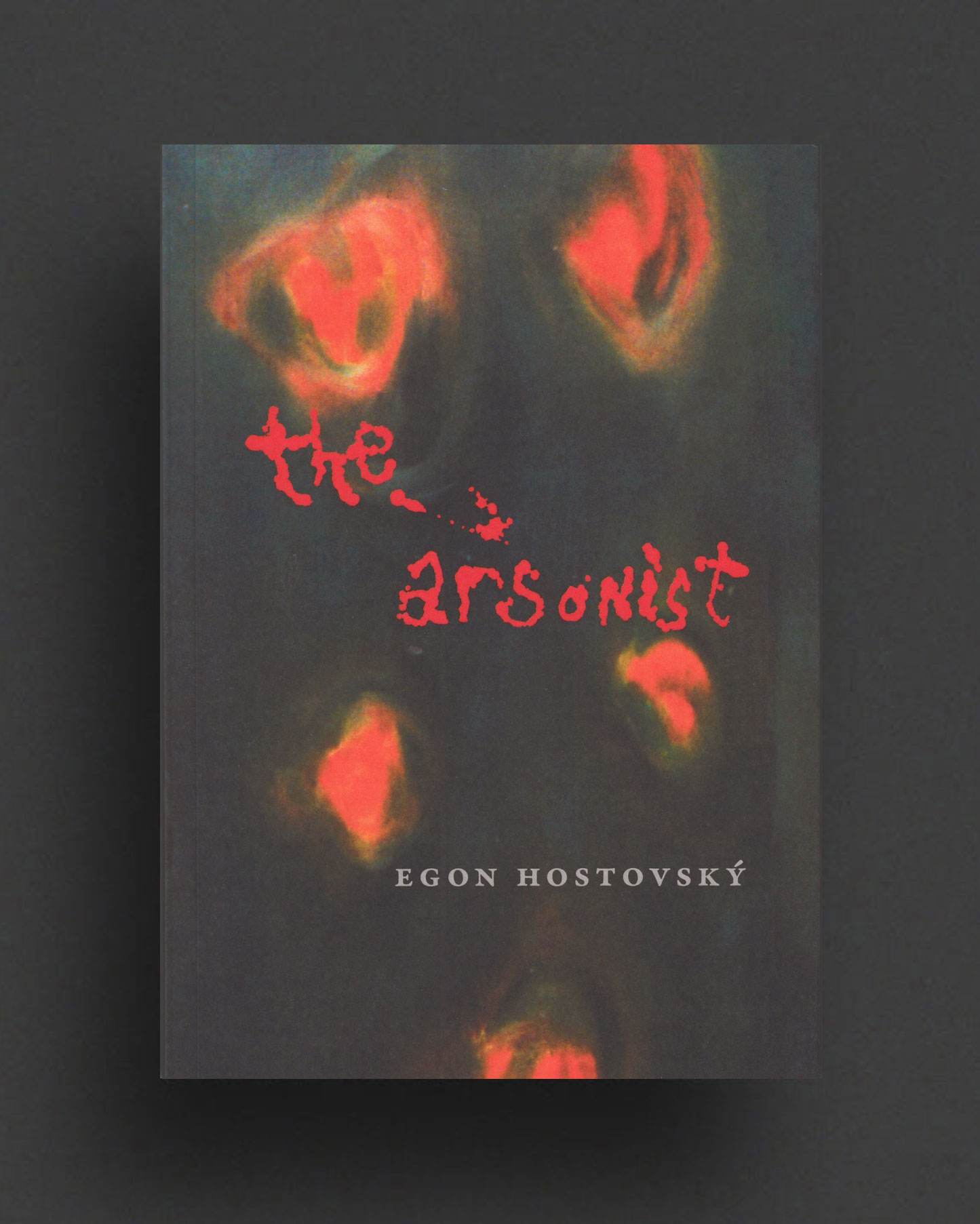
Awarded the Czechoslovak State Prize for Literature in 1936, The Arsonist explores the world of youth against the backdrop of a small eastern Bohemian border town being menaced by an invisible firebug. Time and fire, their ability to reshape and destroy, are central. Encoded in echo, wind, and smoke — in the gesture and in the whisper — the true nature of events is too intangible and fleeting, too pregnant with the unknown, to provide any genuine certainty, and this is the real source of the townsfolk's terror. Their misguided attempts to identify the elusive arsonist ultimately reveal the emptiness and inflexibility of their own lives. One of the most distinctive voices in 20th-century Czech letters, Hostovský’s mix of mysticism, irony, and wit, all leavened by the influence of Expressionism on his early work, results in a richly textured narrative amid an atmosphere of growing peril that serves as a harbinger of the catastrophe to come. This is the first English translation.
"I was utterly gripped and absorbed by “The Arsonist” from start to finish. On the level of what is almost a mystery story, it’s thoroughly engrossing."—Kaggsy's Bookish Ramblings
"The Arsonist is unsettling on multiple levels, and Hostovský is particularly good at the layering – including that of the various passions and disappointments of the two Simon teens. He weaves a lot into the relatively short novel, and it holds up very well."—M.A. Orthofer, The Complete Review
"... deceptively quiet Zbečnov seethes just beneath the surface with the kind of smoldering, smothered urges eptiomized by adolescent angst. Though Hostovský doesn't reveal the firebug's face until the last chapter, this is hardly a suspense novel. The book's surface mystery story serves mostly as a mirror and backdrop for the psychological action that is its theme and emotional core. By the book's close, fire, darkness, suspicion and secrecy have twisted into a network of associations that illuminate both Kamil's troubled family and the entire town."—The Prague Post
"Hostovský produced novels that were near masterpieces."—Arne Novák
"The Arsonist is a spare, elegant meditation on unseen terror, given form in random fires within a small town in eastern Bohemia as Czech and Prussian anti-Semitism erupts."—Literární noviny
2025, English
Softcover, 228 pages, 20 x 14 cm
Published by
Twisted Spoon Press / Prague
$42.00 - In stock -
translated from the Czech by Tereza Novická
frontispiece by Rybka Ivanko Brabcová
cover by Unica Zürn
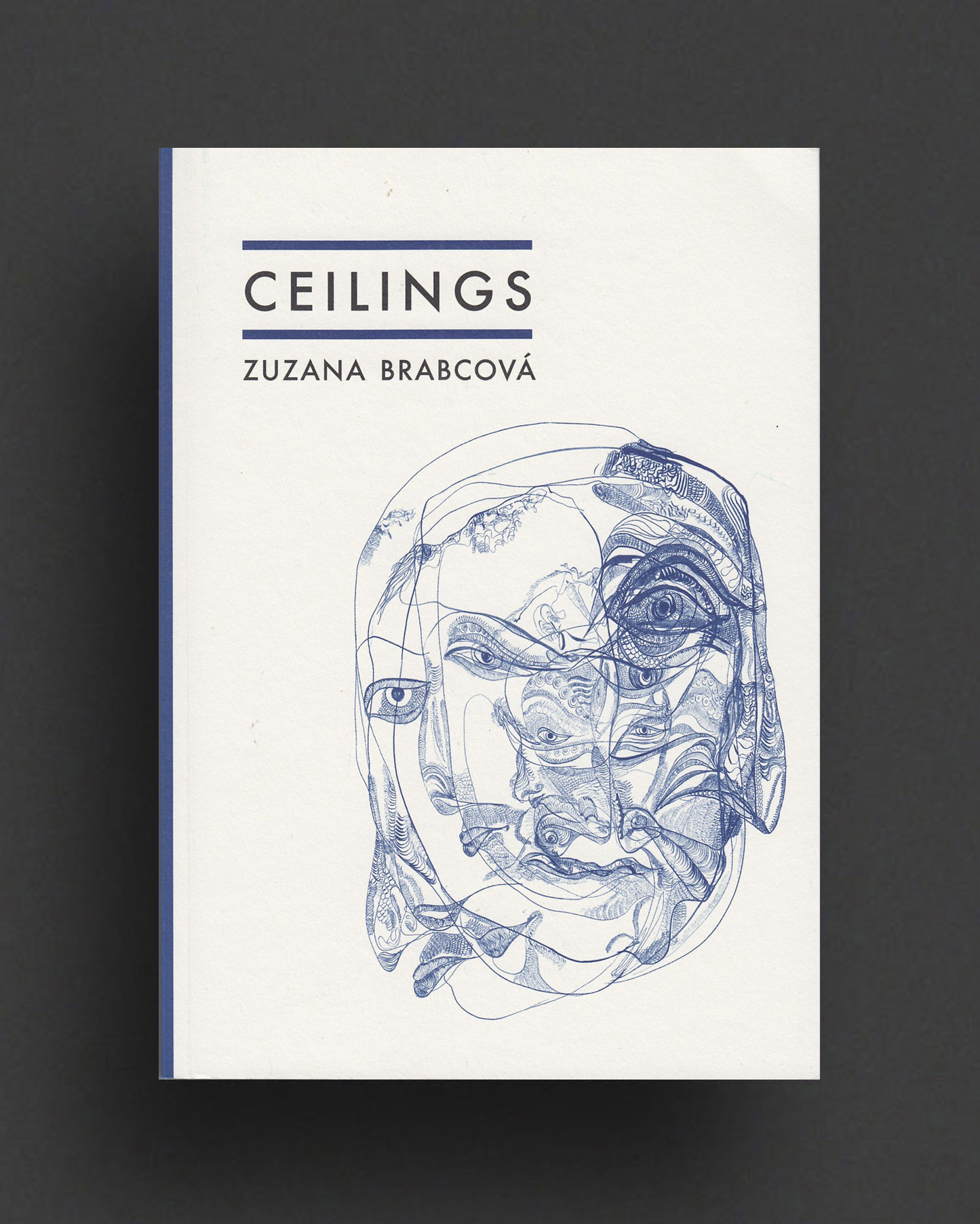
Kin to the work of Leonora Carrington and Unica Zürn, Ceilings is a polyphonic novel that takes place in a mental hospital in Prague where the "narrator" is undergoing detox treatment for substance abuse. As the borders blur between inner experience and the outer world, between reality and dream, as the walls and ceilings hemming in the desire for freedom fantastically break open as if into the unknown and gender fluidly shifts between brother and sister, who are one and the same, Brabcová’s flights of imagination portray how difficult it is to “come out of oneself” and to engage with the other in a multifarious world that demands it of us, no matter how ambivalently.
Magnesia Litera Prose Book of the Year for 2013
"The prose is hypnotic and often very beautiful, but the narrative is fragmented; that, of course, is deliberate, to replicate the state of Ema’s mind as she undergoes her detox, with her mental state often spiralling out of control. The surreal imagery, the shifts of location, the fluidity of her identity are all brilliantly rendered by Brabcova, and the result is an exhilarating and sometimes dizzying work which leaves you a bit stunned."—Kaggsy's Bookish Ramblings
"Ceilings is a crazy, delirious read, one that explores the complexities of being human and ruminates on how we assemble ourselves from what has happened to us, whowe know, what we would like to happen and who we would like to meet."—Rupert Loydell, International Times
"The ceiling that forms the horizon of someone lying in a hospital bed becomes a metaphor for the mingling of the past with the present, of phantasmagoria with the real. It is the very ceiling of reality, with a hole yawning with hallucinatory visions and memories, passage through which only leads to the next, ultimate ceiling of the self."—iLiteratura.cz
"Zuzana Brabcová's novel is a literary event, an extreme work, exceptional in its concision and poetry."—Petr A. Bílek Respekt
1997, Japanese
Hardcover (w. dust jacket and obi), 104 pages, 29.7 x 21 cm
1st Edition, Out of print title / used / very good
Published by
Treville / Tokyo
$150.00 - In stock -
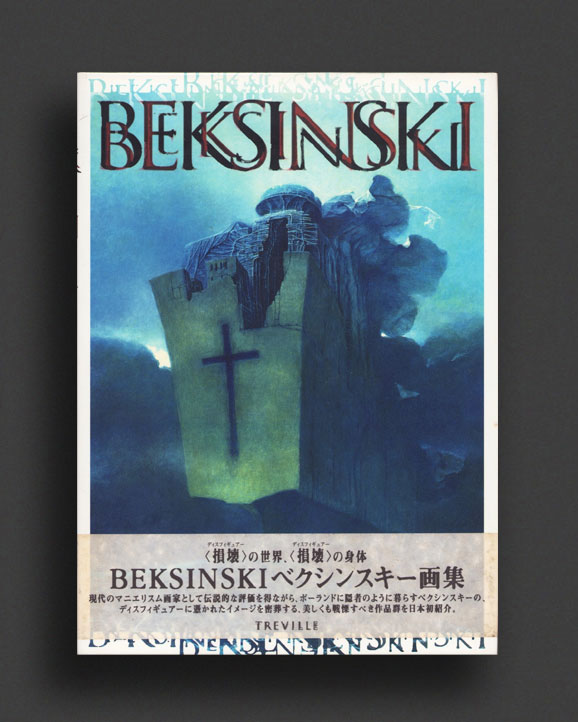
"Beksinski's powerfully unique paintings are such as I have never before seen" — H.R. Giger
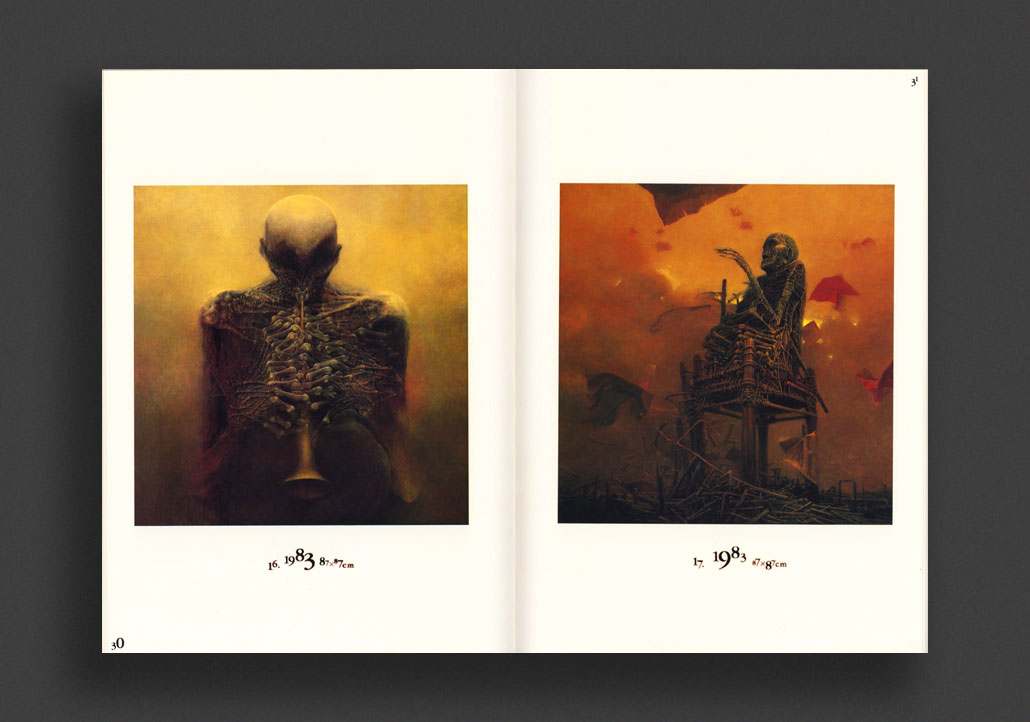
First Edition of the collected works of Zdzisław Beksiński, published originally in hardcover in 1997 by Editions Treville in Tokyo.
"Death, putrefaction, destruction. A time-space continuum that converts everything into eternal ruins
that are dominated by inexplicable loneliness and fear, causing the spirit of eroticism to echo hollowly across his canvases." This is an anthology of the Polish master of introvert fantasy. Chronology of paintings reproduced in colour with bio, exhibition history and essay (in Japanese).
Zdzisław Beksiński (1929 – 2005) was a Polish painter, photographer and sculptor. Beksiński had no formal training as an artist. Born in Sanok, he studied architecture in Kraków and worked as a construction site supervisor before turning to his passion for art, sculpting with construction site materials for his medium. His early photography would be a precursor to his paintings, often referred to as dystopian surrealism. Beksiński claimed, "I wish to paint in such a manner as if I were photographing dreams". Beksiński undertook painting with a passion, working intensely whilst listening to classical music and quickly becoming a leading figure in contemporary Polish art. In the late 1960s, Beksiński entered what he himself called his "fantastic period", which lasted up to the mid-1980s, during which he created his famed images of desolate, surrealistic landscapes with intricate depictions of anxious, abstracted figures and architecture in states of decay, mutation and decomposition. Although Beksiński's art was often dark, he himself was known to be a pleasant person with a keen sense of humour. Modest and somewhat shy, he avoided public events such as the openings of his own exhibitions and almost never visited museums or exhibitions in general. He always credited music as his main source of inspiration. Beksiński avoided concrete analysis of the content of his work, saying "I cannot conceive of a sensible statement on painting". Beksiński was stabbed to death at his Warsaw apartment in February 2005 by a 19-year-old acquaintance from Wołomin, reportedly because he refused to lend the teenager money.
"In the medieval tradition, Beksinski seems to believe art to be a forewarning about the fragility of the flesh – whatever pleasures we know are doomed to perish – thus, his paintings manage to evoke at once the process of decay and the ongoing struggle for life. They hold within them a secret poetry, stained with blood and rust." — Guillermo del Toro, Mexican film director
Very Good copy with VG dust jacket and Obi, with only light age/wear.
1981, English
Softcover, 84 pages, 29.3 x 29.3 cm
1st Edition, Out of print title / used / very good
Published by
Wild & Woolley / Sydney
$140.00 - In stock -
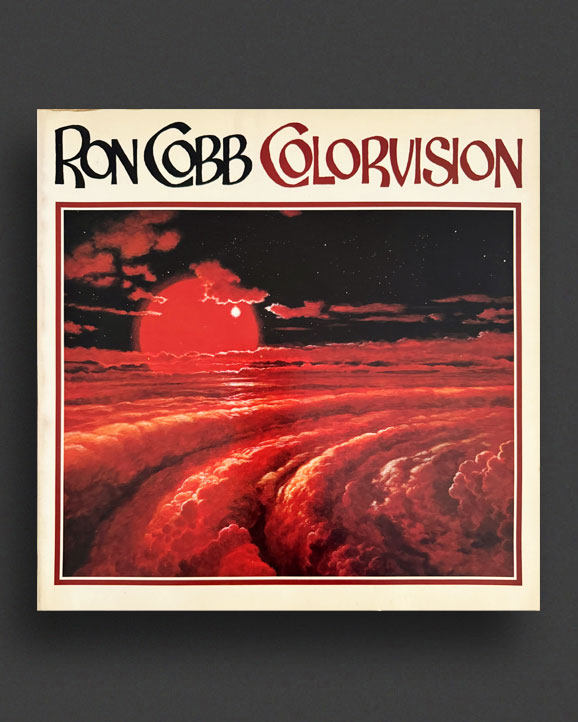
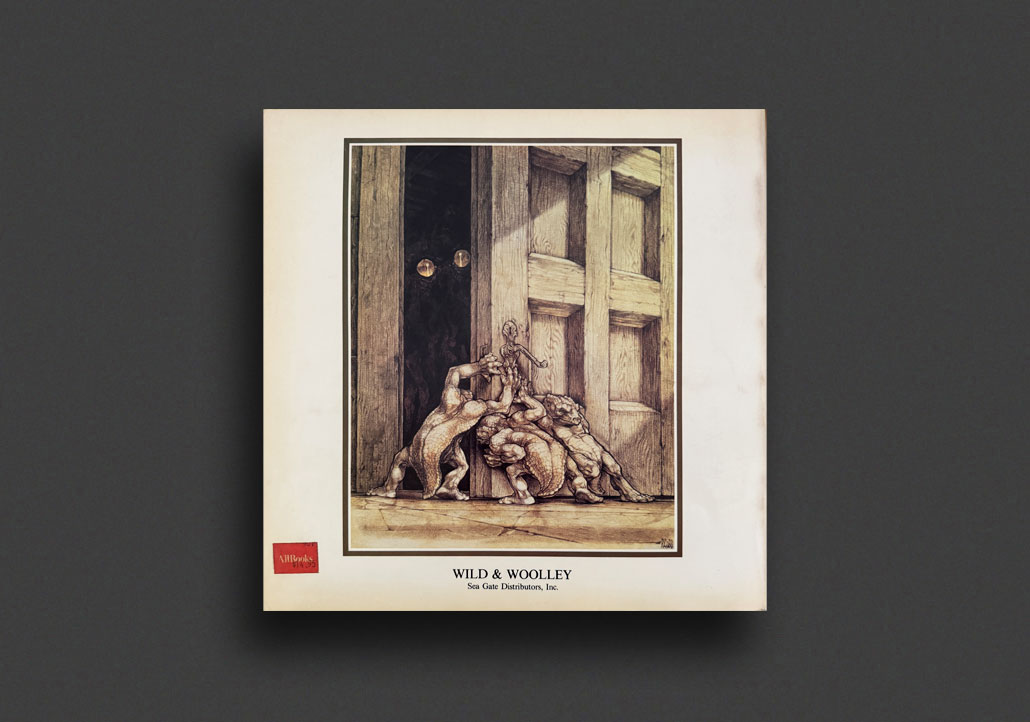
First 1981 edition of this large-format, full-colour monograph on the inimmitable American–Australian illustrator, artist and concept designer Ron Cobb (1937—2020), published by Wild & Woolley in Glebe, Sydney. Profusely illustrated, Colorvision is a chronological survey of the diverse artwork of Ron Cobb, from his early days in Los Angeles, where he was born, to Sydney, where he moved in 1972 and spent most of his life. With accompanying bio and texts and anecdotes from Cobb's collaborators, the book comprehensively surveys his earliest work in Hollywood, his Monsters covers, his radical political cartoon work for the 1960's Underground Press, through to the dominant focus of the book — his groundbreaking 1970's concept art for major films including Dark Star (1974), Star Wars (1977), Alien (1979), Raiders of the Lost Ark (1981), and Conan the Barbarian (1982).
By the age of 18, Cobb, with no formal training in graphic illustration, was working as an animation "inbetweener" artist for Disney Studios in Burbank, California. He progressed to becoming a breakdown artist on the animation feature Sleeping Beauty (1959), the last Disney film to have cels inked by hand. After Sleeping Beauty was completed in 1957, Cobb was laid off by Disney and worked assorted jobs, painted covers for the legendary Monsters magazine, before being drafted and sent to Vietnam. After his discharge, Cobb began contributing to one of the first underground newspapers of the 1960s, New Age esotericist and editor Art Kunkin's Los Angeles Free Press, noted for its radical politics, as well as the Mother Earth News and other counterculture magazines. Cobb became regarded as one of the finest political cartoonists of the mid-1960s—early 1970s, outspoken on topics of war, ecology, and injustice. Cobb also created a symbol which was later featured on the Ecology Flag. Disenfranchise, Cobb moved to Sydney in 1972, and began contributing to the Australian alternative press, magazines such as The Digger, and published art books with Wild & Woolley. Cobb returned to cinema work when he worked with Dan O'Bannon to design the eponymous spaceship for the 1973 cult film, Dark Star (he drew the original design for the exterior of the Dark Star spaceship on a Pancake House napkin). After contributing designs for Alejandro Jodorowsky's uncompleted film adaption of Frank Herbert's novel Dune, Cobb was engaged by Lucasfilm to produce conceptual artwork for the space fantasy film Star Wars (1977). Working alongside artists John Mollo and Ralph McQuarrie, he created the designs for a number of exotic alien creatures for the Mos Eisley cantina scene. His incredible concept work continued with Alien (1979), Raiders of the Lost Ark (1981), Conan the Barbarian (1982), Back to the Future (1985), The Abyss (1989), Total Recall (1990), and Southland Tales (2006), and directed the Australian comedy film Garbo in 1992. During the 1990s, Cobb developed characters and designs for Rocket Science Games, becoming an influential figure in video game design just as he had become in film.
Very Good copy with light handling wear only, light tanning, edge wear to covers.
1977, English
Softcover, 160 pages, 27.5 x 18.5 cm
Out of print title / used / very good
Published by
Penguin Books / London
$90.00 - Out of stock
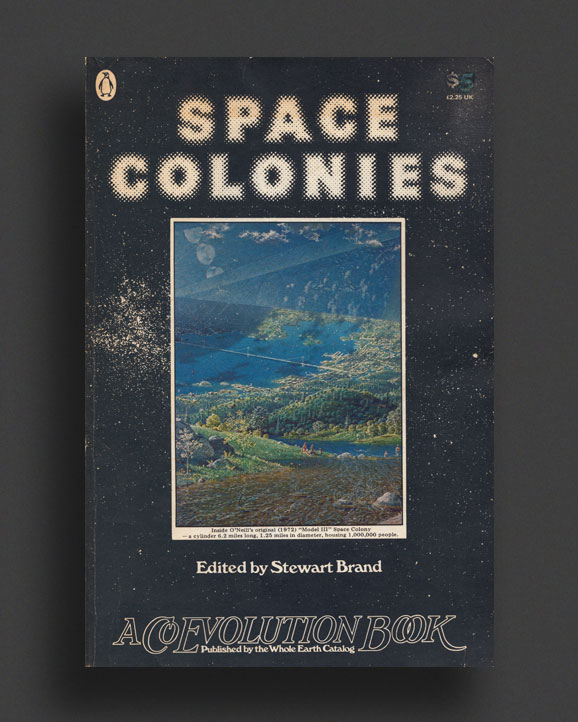
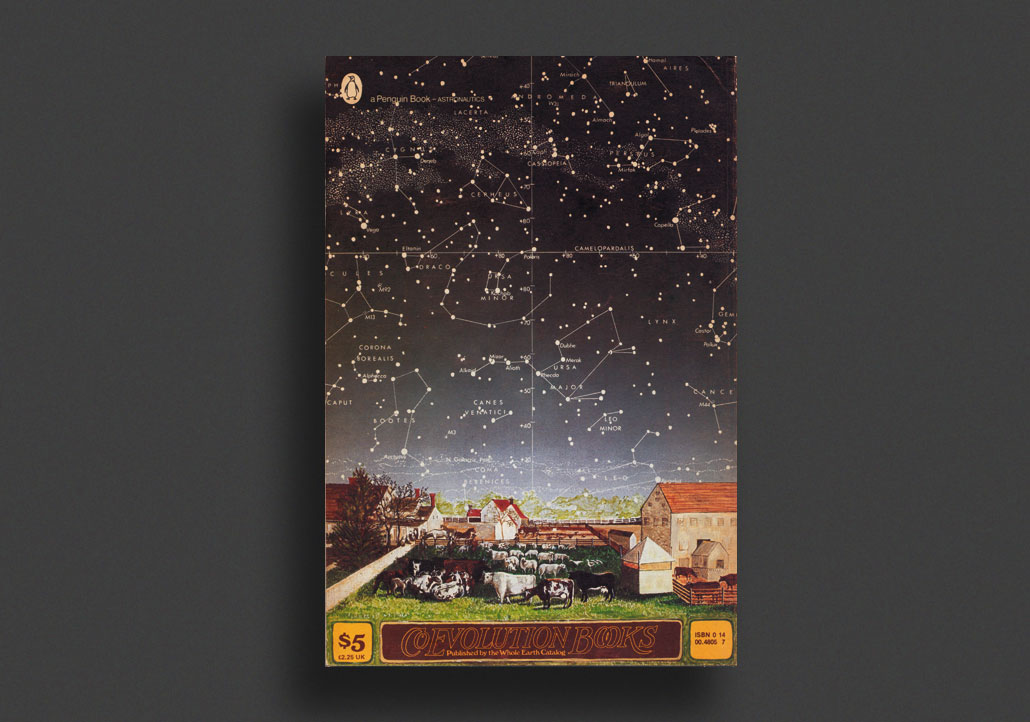
Cyber-communard and editor of the Whole Earth Catalog, Stewart Brand's 1977 visionary compendium, "Space Colonies". A special book edition of Brand's legendary CoEvolution Quarterly, Space Colonies took up the question of whether space might be colonized by the year 2000, going to where no media on the subject of space travel has gone before. A visionary and controversial assemblage of articles, illustrations, information and opinions on space colonies, inspired by the culture of the Whole Earth Catalog, with contributions from Buckminster Fuller, Richard Brautigan, Ant Farm, Carl Sagan, Lynn Margulis, Wendell Berry, Gary Snyder, David Browner, Paolo Soleri, Eric Drexler, Rusty Schweickart, and many more... interviews with Jacques Cousteau, Gerard O'Neill, Carl Sagan, Lynn Margulis, and many more, all organized into three sections - Vision, Debate and Space.
"This book is about how to take Space personally. Gerard O'Neill's vision of Space Colonies has turned the universe inside out for people. Instead of seeing the space program as a "boondoggle for scientists" (Herman Kahn), suddenly they can see Space as a path, or at least a metaphor, for their own liberation. And those who are critics of high technology — who abound in this book — can leverage their arguments from Space industrialization as the quintessence of what they are fighting. What's new is that people are extrapolating from the future and outside instead of just from the past and inside."
Very Good copy, with some light tanning/wear.
1993, Japanese
Hardcover (w. dust jacket), 220 pages, 13.6 cm x 19.4 cm
1st Edition, Out of print title / used / fine
Published by
Seikyūsha / Tokyo
$110.00 - Out of stock
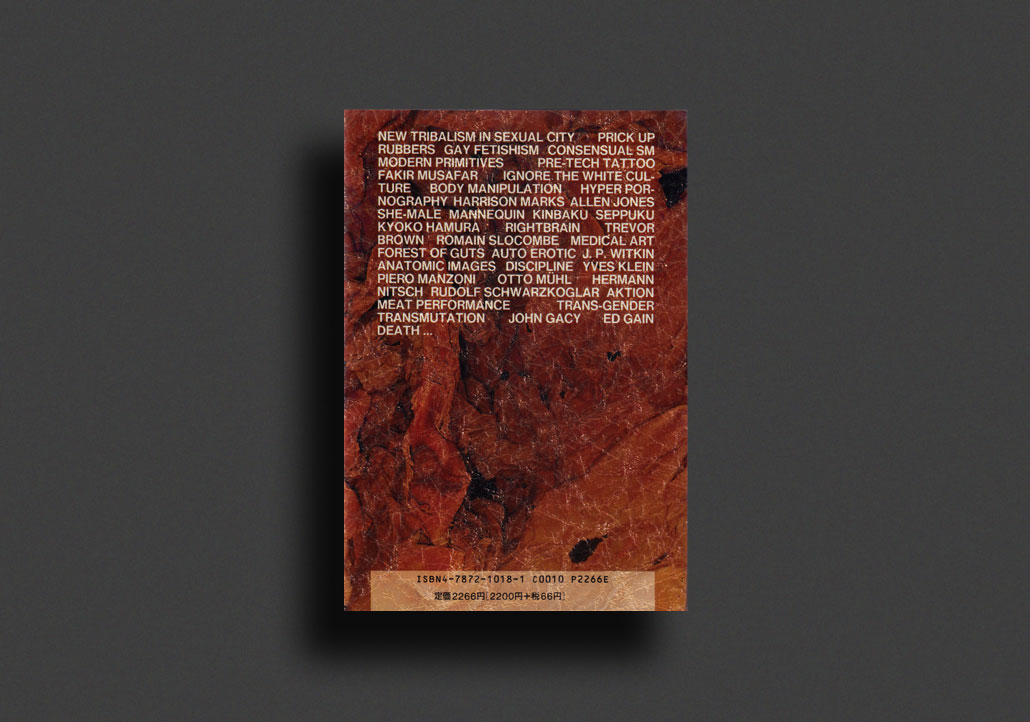
New Tribalism In Sexual City, Prick Up, Rubbers, Gay Fetishism, Consensual SM, Modern Primitives, Pre-Tech Tattoo, Fakir Musafar, Ignore the White Culture, Body Manipulation, Hyper Pornography, Harrison Marks, Allen Jones, She-Male, Mannequin, Kinbaku, Seppuku, Kyoko Hamura, Rightbrain, Trevor Brown, Roman Slocombe, Medical Art, Forest Of Guts, Auto Erotic, J. P. Witkin, Anatomic Images, Discipline, Yves Klein, Piero Manzoni, Otto Mühl, Hermann Nitsch, Rudolf Schwarzkoglar, Aktion, Meat Performance, Trans-Gender, Transmutation, John Gacy, Ed Gain, Death ...
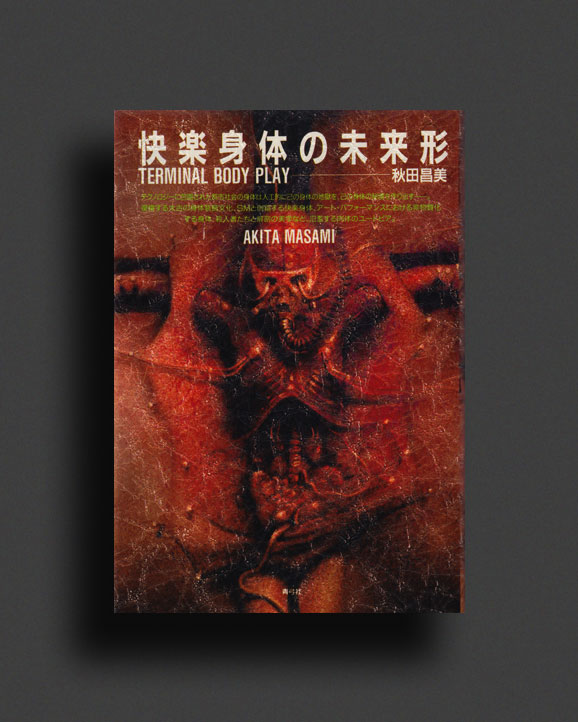
First hardcover edition of "Terminal Body Play", written by Merzbow's Masami Akita and published only in Japan in 1993. Covering all the above subjects with b/w illustrations, "Terminal Body Play" explores a plethora of physical utopias, including a revived ancient culture of body decoration and manipulation, the pleasure of the body perverted by BDSM, the dematerialised body of performance art, the aesthetics of murder, medicine and anatomy, and so much more. Merzbow is a noise project created in Tokyo, Japan in 1979 under the direction of noise technician Masami Akita. As well as a legendary underground noise artist, Akita is a prolific writer in Japan and frequently writes on the arts, music, erotica, esoterica, modern architecture, and animal rights, with articles on emerging subcultures and underground extreme cultures appearing in publications like SM Sniper, Studio Voice and Fool's Mate. His development of the Merzbow aesthetic ran parallel with a series of investigative books in which he catalogued and introduced a vast amount of hermetic types of music, sexual practices and autonomous creativity to a fairly conservative (but not close-minded) Japanese audience. "Terminal Body Play" is one of these very books.
First edition, Japanese text, fine copy with fine "textured" and illustrated dust jacket.
2017, English
Softcover, 232 pages, 14 x 17.5 cm
Published by
Dorothy Project / St. Louis
$38.00 - In stock -
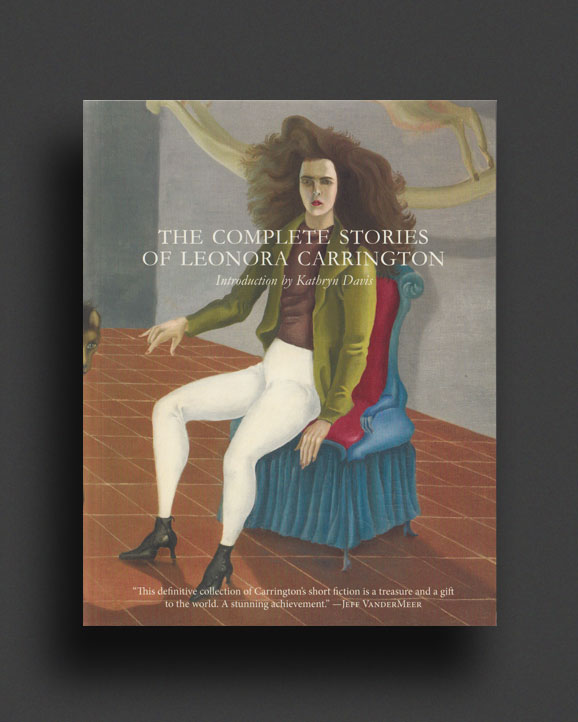
"Her delirious fantasy reveals to us a little of the secret magic of her paintings" - Luis Buñuel
Surrealist writer and painter Leonora Carrington (1917-2011) was a master of the macabre, of gorgeous tableaus, biting satire, roguish comedy, and brilliant, effortless flights of the imagination. Nowhere are these qualities more ingeniously brought together than in the works of short fiction she wrote throughout her life.
Published to coincide with the centennial of her birth, THE COMPLETE STORIES OF LEONORA CARRINGTON collects for the first time all of her stories, including several never before seen in print. With a startling range of styles, subjects, and even languages (several of the stories are translated from French or Spanish), THE COMPLETE STORIES captures the genius and irrepressible spirit of an amazing artist's life.
1996, English
Softcover, 256 pages, 24.5 x 17 cm
1st Edition, Out of print title / used / good
Published by
Creation Books / London
$55.00 - In stock -
First 1996 edition.
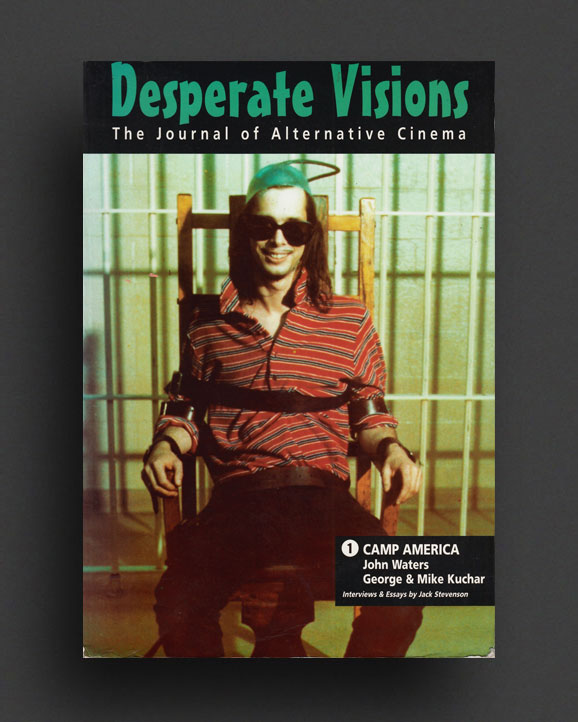
Twins George and Mike Kuchar were born in the Bronx in 1942. As teenage cinephiles, both began producing films based on their own version of Hollywood movies, going on to produce a string of low budget classics such as: 1 Was A Teenage Rumpot, Pussy On A Hot Tin Roof, Mike's Sins Of The Fleshapoids and George's infamous Hold Me While I'm Naked.
Baltimore-born John Waters was profoundly and irreversibly affected by the visionary, trashy aesthetic of the '60s underground, especially the Kuchars, who Waters insists "...made me want to make films. THEY are the reason". His films were also influenced by the low budget exploitation pictures of directors like Russ Meyer and Herschell Gordon Lewis. Like his predecessors, Waters used a regular cast of friends, which included Divine, Edith Massey, Mary Vivian Pearce, Mink Stole and Cookie Mueller, all to become trash stars/icons. He is the director of such trash classics as Pink Flamingos, Female Trouble, and Desperate Living; his more recent films have included Hairspray and Serial Mom.
Camp America includes interviews not only with John Waters, but also with members of his notorious entourage; plus extensive interviews with George & Mike Kuchar and a comprehensive assessment of their career and influence as well as a unique feature on underground actress Marion Eaton, star of Curt McDowell's Thundercrack! The book has many rare photographs, plus a filmography and index, and not only documents a fascinating period of extreme underground film-making, but contextualises it firmly within the social fabric of the times, bringing the New York, Baltimore and San Francisco underground/sleaze film scenes of the '60s and '70s vividly to life.
Good copy with crease to back cover, wear to corners, thumb marking to block edge.