World Food Books' programme is largely produced on Kulin Nation land. We acknowledge the Wurundjeri people of the Kulin Nation as the first and continuing custodians of this land, and pay respect to their Elders past, present, and emerging.
World Food Books is an arts and special interests bookshop in Naarm / Melbourne. Founded in 2010, World Food Books is devoted to the presentation of a rotating, hand-selection of international art, design, literary and counterculture publications with an emphasis on the anti-traditional, the experimental, the avant-garde, the heretic, the marginal.
Presenting new titles alongside rare and out-of-print books, catalogues and journals spanning the fields of modern and contemporary art, design, photography, illustration, film, literature, poetry, cultural theory, philosophy, sexuality, popular and underground culture in its many radical forms, World Food Books wishes to encourage adventurous, thoughtful and open-minded reading, looking, writing, and exchange of publishing and ideas, both current and historical.
As well as our bookshop, located in Melbourne's historical Nicholas Building, all of our inventory is available internationally via our online mail-order service.
World Food Books semi-regularly co-ordinates "Occasions", a programme of exhibits and events at the bookshop and in partnership with other hosts (such as museums and art galleries) that develop out of the activities, relationships and content of the bookshop itself.
World Food Books
The Nicholas Building
37 Swanston Street
Room 5, Level 6
Melbourne 3000
Australia
SHOP HOURS:
THU–SAT 12–6
WEB-SHOP OPEN 24/7
World Food Books
Postal Address:
PO Box 435
Flinders Lane
Victoria 8009
Australia
info@worldfoodbooks.com
Art
Theory / Essay
Architecture / Interior
Graphic Design / Typography
Photography
Fashion
Eros
LGBTQ+
Fiction / Poetry
Weird / Speculative / Science Fiction / Horror
Transgressive / Visceral / Abject
Symbolism / Decadence / Fin de siècle
Film / Video
Painting
Sculpture / Installation
Performance / Dance / Theater
Drawing
Sound / Music
Curatorial
Group Shows / Collections
Periodicals
Out-of-print / Rare
Posters / Ephemera / Discs
Signed Books
World Food Books Gift Voucher
World Food Book Bag
Australian Art
Australian Fiction
Australian Science Fiction / Speculative Fiction
Australian Poetry
Australian Photography
Japanese Photography
Conceptual Art
Minimal Art
Dada
'Pataphysics / Oulipo
Fluxus
Concrete Poetry
Pop Art
Surrealism
Arte Povera
Arte Informale / Haute Pâte / Tachism
Nouveau Réalisme / Zero / Kinetic
Situationism / Lettrism
Collage / Mail Art / Xerox Art
Art Brut / Folk / Visionary / Fantastic
Illustration / Graphic Art / Bandes Dessinées
Furniture
Italian Radical Design / Postmodernism
Textiles
Ceramics / Glass
Counterculture
Protest / Revolt
Philosophy
Psychoanalysis
Anthropology
Anarchism
Socialism / Anarchism / Communism / Capitalism
Literary Theory / Semiotics / Language
Feminism / Women's Studies
Gender Studies / Sexuality
Anthropology
Fetishism / BDSM
Drugs / Psychedelia
Crime / Violence
Animal Rights / Veganism
Occult / Esoterica
Ecology / Earth / Alternative Living
Whole Earth / Crafts
All prices in AUD (Australian dollars)
Pick-Ups
Pick-up orders can be collected in our bookshop during opening hours after order date. Please collect any Pick-up orders within 2 weeks of ordering as we have limited storage space. Orders will be released back into stock if not collected within this time. No refunds can be made for pick-ups left un-collected. If you cannot make it in to the bookshop in this time-frame, please choose postage option.
Return Policy
All sales are final. We do accept returns (for refund or exchange) for items received in error. All our orders are packed with special care using heavy-duty padding and cardboard book-mailers or bubble mailers (for smaller books), using reinforcement where required. We cannot take responsibility for any lost, stolen or damaged parcels.
Insurance
Should you wish to insure your package, please email us directly after placing your order and we can organise this at a small extra expense. Although all standard/express tracked packages are very safe and dependable, we cannot take responsibility for any lost, stolen or damaged parcels. We recommend insurance on valuable orders.
Interested in selling your old books, catalogues, journals, magazines, comics, fanzines, ephemera? We are always looking for interesting, unusual and out-of-print books to buy. We only buy books in our fields of interest and specialty, and that we feel we can resell.
We base these prices on desirability, market value, in-print prices, condition and our current stock levels. We offer cash, store credit, and can take stock on consignment. All
about 25% of the price we expect to get when we sell them, or 30% in store credit. We base these prices on desirability, market value, in-print prices, condition and our current stock levels.
Sell your books any day of the week. You can drop them off and return later. If you have a lot of books, we can visit your Sydney home.
We buy books that we feel we can resell. We offer about 25 % of the price we expect to get when we sell them, or 30% in store credit. We base these prices on desirability, market value, in-print prices, condition and our current stock levels.
Philadelphia Wireman
03 August - 01 September, 2018
World Food Books is proud to announce our next Occasion, the first presentation of sculptures by Philadelphia Wireman in Australia.
The Philadelphia Wireman sculptures were found abandoned in an alley off Philadelphia’s South Street on trash night in 1982. Their discovery in a rapidly-changing neighbourhood undergoing extensive renovation, compounded with the failure of all attempts to locate the artist, suggests that the works may have been discarded after the maker’s death. Dubbed the "Philadelphia Wireman" during the first exhibition of this work, in 1985, the maker’s name, age, ethnicity, and even gender remain uncertain. The entire collection totals approximately 1200 pieces, all intricately bound together with tightly-wound heavy-gauge wire (along with a few small, abstract marker drawings, reminiscent both of Mark Tobey and J.B. Murry). The dense construction of the work, despite a modest range of scale and materials, is singularly obsessive and disciplined in design: a wire armature or exoskeleton firmly binds a bricolage of found objects including plastic, glass, food packaging, umbrella parts, tape, rubber, batteries, pens, leather, reflectors, nuts and bolts, nails, foil, coins, toys, watches, eyeglasses, tools, and jewellery.
Heavy with associations—anthropomorphic, zoomorphic, and socio-cultural responses to wrapped detritus—the totemic sculptures by Philadelphia Wireman have been discussed in the context of work created to fulfil the shamanistic needs of alternative religions in American culture. Curators, collectors, and critics have variously compared certain pieces to sculpture from Classical antiquity, Native American medicine bundles, African-American memory jugs, and African fetish objects. Reflecting the artist’s prolific and incredibly focused scavenging impulse, and despite—or perhaps enhanced by—their anonymity, these enigmatic objects function as urban artefacts and arbiters of power, though their origin and purpose is unknown. Philadelphia Wireman, whatever their identity, possessed an astonishing ability to isolate and communicate the concepts of power and energy through the selection and transformation of ordinary materials. Over the course of the past two decades, this collection has come to be regarded as an important discovery in the field of self-taught art and vernacular art.
Presented in collaboration with Fleisher-Ollman Gallery, Philadelphia, and Robert Heald, Wellington.
Susan Te Kahurangi King
02 February - 10 March, 2018
Susan Te Kahurangi King (24 February 1951 - ) has been a confident and prolific artist since she was a young child, drawing with readily available materials - pencils, ballpoint pens and felt-tip markers, on whatever paper is at hand. Between the ages of four and six Susan slowly ceased verbal communication. Her grandparents William and Myrtle Murphy had developed a special bond with Susan so they took on caring responsibilities for extended periods. Myrtle began informally archiving her work, carefully collecting and storing the drawings and compiling scrapbooks. No drawing was insignificant; every scrap of paper was kept. The King family are now the custodians of a vast collection containing over 7000 individual works, from tiny scraps of paper through to 5 meter long rolls.
The scrapbooks and diaries reveal Myrtle to be a woman of great patience and compassion, seeking to understand a child who was not always behaving as expected. She encouraged Susan to be observant, to explore her environment and absorb all the sights and sounds. Myrtle would show Susan’s drawings to friends and people in her community that she had dealings with, such as shopkeepers and postal workers, but this was not simply a case of a grandmother’s bias. She recognised that Susan had developed a sophisticated and unique visual language and sincerely believed that her art deserved serious attention.
This was an unorthodox attitude for the time. To provide some context, Jean Dubuffet coined the term Art Brut in 1945 to describe work created by self-taught artists – specifically residents of psychiatric institutions and those he considered to be visionaries or eccentrics. In 1972 Roger Cardinal extended this concept by adopting the term Outsider Art to describe work made by non-academically trained artists operating outside of mainstream art networks through choice or circumstance. Susan was born in Te Aroha, New Zealand in 1951, far from the artistic hubs of Paris and London that Dubuffet and Cardinal operated in. That Myrtle fêted Susan as a self-taught artist who deserved to be taken seriously shows how progressive her attitudes were.
Susan’s parents Doug and Dawn were also progressive. Over the years they had consulted numerous health practitioners about Susan’s condition, as the medical establishment could not provide an explanation as to why she had lapsed into silence. Dawn educated herself in the field of homeopathy and went on to treat all twelve of her children using these principles – basing prescriptions on her observations of their physical, mental and emotional state.
Doug was a linguist with an interest in philosophy who devoted what little spare time he had to studying Maori language and culture. To some extent their willingness to explore the fringes of the mainstream made them outsiders too but it was their commitment to living with integrity and their respect for individuality that ensured Susan’s creativity was always encouraged.
Even though Susan’s family supported her artistic pursuits, some staff in schools and hospitals saw it as an impediment to her assimilation into the community and discouraged it in a variety of ways. Her family was not always aware of this and therefore did not fully understand why Susan stopped drawing in the early 1990s. However, rather than dwell on the challenges that Susan faced in pursuit of her artistic practice, they prefer to highlight her achievements. In 2008 Susan began drawing again in earnest, after an almost 20 year interruption, and her work is now shown in galleries around the world.
Susan grew up without television and has been heavily influenced by the comics she read as a child. She is absolutely fearless in the appropriation of recognizable characters, such as Donald Duck and Mickey Mouse, in her work. She twists their limbs, contorts their faces, compresses them together, blends them into complex patterned backgrounds - always imbuing them with an incredible energy. Although Susan often used pop culture characters in her work they are not naive or childlike. These are drawings by a brilliant self-taught artist who has been creating exceptional work for decades without an audience in mind.
Mladen Stilinović
"Various Works 1986 - 1999"
02 February 16 - September 10, 2016
Various works 1986 - 1999, from two houses, from the collections of John Nixon, Sue Cramer, Kerrie Poliness, Peter Haffenden and Phoebe Haffenden.
Including: Geometry of Cakes (various shelves), 1993; Poor People’s Law (black and white plate), 1993; White Absence (glasses, ruler, set square, silver spoon, silver ladel with skin photograph and wooden cubes), 1990-1996; Exploitation of the Dead (grey and red star painting, wooden painting, black spoon with red table, red plate), 1984-1990; Money and Zeros (zero tie, paintings made for friends in Australia (Sue, John, Kerrie), numbers painting), 1991-1992; Words - Slogans (various t-shirts) - “they talk about the death of art...help! someone is trying to kill me”, “my sweet little lamb”, “work is a disease - Karl Marx”; Various artist books, catalogues, monographs, videos; Poster from exhibition Insulting Anarchy; "Circular" Croatian - Australian edition; Artist book by Vlado Martek (Dostoyevsky); more.
Thanks to Mladen Stilinović and Branka Stipančić.
Jonathan Walker
Always Will Need To Wear Winter Shirt Blue + Ochre Small Check Pattern
21 August - 21 September, 2015
Untitled
I am not a great reader of poetry but I always return to the work of Melbourne poet, Vincent Buckley (1925- 1988). Perhaps I find his most tantalising piece to be not a finished poem but a fragment left on a scrap of paper discovered on his desk after the poet’s death.
The poetry gathers like oil
In the word-core, and spreads
It has its music meet,
Its music is in movement.
This fragment is more the shell left behind from a volatile thought than a finished poem. I find the last two lines honest but awkward whereas the first two lines work like an arrow. Most likely he could not find a resolution so it was left. Still, in its present form, it remains an eloquent testimony to the ultimate failure of a medium to express mobile thought and sensation, in Buckley’s case, through verbal language. It’s an important matter because this is something all artists have to deal with regardless of the medium.
I have never written a poem, however, I am forever copying fragments from books on paper scraps in a vain effort to fix certain notions in my head. At first, they function as bookmarks that are sometimes returned to when I open the book. But before long, as they accumulate, they fall out littering the table interspersed with A4 photocopies, bills, books and medications.
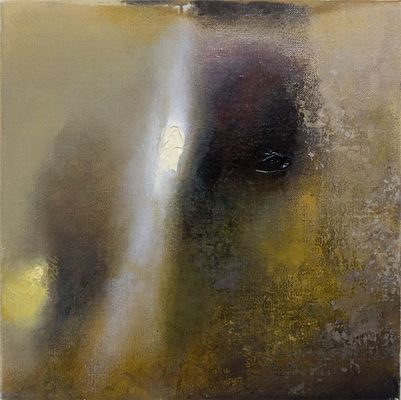
To return to Buckley’s fragment, the first two lines very much evoke how I paint nowadays. As you age, detail diminishes and patches of light become more luminous and float. I feel the most honest way of dealing with this is by smearing the oil paint on the canvas with the fingers and working close-up, blind. Only if the patches coalesce into an approaching image can the work gain a life.
-
Jonathan Walker was born in Melbourne, Australia and brought up on a dairy farm in Gippsland. In the 1970’s he studied painting at RMIT and won the Harold Wright Scholarship to the British Museum, London. During the 1980’s he exhibited at Pinacotheca Gallery, Richmond and had work shown at the NGV and Heidi City Art Gallery. Over the same period he designed the cover for the “Epigenesi” LP by Giancarlo Toniutti, Italy and conducted a mail exchange work with Achim Wollscheid, Germany. The work with artists through the post resulted in an article published in the bicentenary issue of Art and Australia 1988. He showed in artist run spaces such as WestSpace in the 90’s and 2000’s, and until 2012, taught painting at Victoria University, which is where we (Colleen Ahern and Lisa Radford) as organisers of the exhibition, among many others, had the privilege of being his student.
Walker’s knowledge was imparted to students through the careful selection of music, literature, and artists found in books that he himself had ordered for the library. Walker’s strategy was the generosity of sharing his vast knowledge with references specific to each student and their context.
Walker’s paintings share a similar focus and intimacy.
This exhibition presents a small selection of recent paintings alongside a publication that includes Walker’s writing. Observational and analytical, Walker’s work is a type of material notation — the time of day, colour and how it is blended, the both specific and fleeting location of a reflection on lino or the question of whether a chair leg should be included in a painting.
Please join us on Friday August 21 between 6-8pm to celebrate the opening of the exhibition.
Curated by Colleen Ahern and Lisa Radford.
B. Wurtz
Curated by Nic Tammens
March 26 - April 4, 2015
B.Wurtz works from a basement studio in his home on Manhattan’s Lower East Side.
This local fact is attested to by the plastic shopping bags and newsprint circulars that appear in his work. As formal objects, they don’t make loud claims about their origins but nonetheless transmit street addresses and places of business from the bottom of this long thin island. Like plenty of artists, Wurtz is affected by what is local and what is consumed. His work is underpinned by this ethic. It often speaks from a neighborhood or reads like the contents of a hamper:
“BLACK PLUMS $1.29 lb.”
“Food Bazaar”
“USDA Whole Pork Shoulder Picnic 99c lb.”
“RITE AID Pharmacy, with us it’s personal.”
“H. Brickman & Sons.”
“Sweet Yams 59c lb."
Most of the work in this exhibition was made while the artist was in residence at Dieu Donne, a workshop dedicated to paper craft in Midtown. Here Wurtz fabricated assemblages with paper and objects that are relatively lightweight, with the intention that they would be easily transportable to Australia. This consideration isn’t absolute in Wurtz’s work, but was prescriptive for making the current exhibition light and cheap. Packed in two boxes, these works were sent from a USPS post office on the Lower East Side and delivered to North Melbourne by Australia Post.
Wurtz appears courtesy of Metro Pictures, New York.
Thanks to Rob Halverson, Joshua Petherick, Sari de Mallory, Matt Hinkley, Helen Johnson, Fayen d'Evie, Ask Kilmartin, Lisa Radon, Ellena Savage, Yale Union, and "Elizabeth".
John Nixon
"Archive"
December 15 - January 20, 2014
The presentation of John Nixon's archive offered a rare showcase of this extensive collection of the artist's own publications, catalogues, posters, ephemera, editions and more, from the mid 1980s onwards, alongside a selection of his artworks.
Organized by John Nixon, Joshua Petherick and Matt Hinkley.
"Habitat"
at Minerva, Sydney (organised by Joshua Petherick and Matt Hinkley)
November 15 - December 20, 2014
Lupo Borgonovo, Janet Burchill & Jennifer McCamley,
Lewis Fidock, HR Giger, Piero Gilardi, Veit Laurent Kurz,
Cinzia Ruggeri, Michael E. Smith, Lucie Stahl, Daniel Weil, Wols
Press Release:
“...It contained seven objects. The slender fluted bone, surely formed for flight, surely from the wing of some large bird. Three archaic circuitboards, faced with mazes of gold. A smooth white sphere of baked clay. An age-blackened fragment of lace. A fingerlength segment of what she assumed was bone from a human wrist, grayish white, inset smoothly with the silicon shaft of a small instrument that must once have ridden flush with the surface of the skin - but the thing’s face was seared and blackened.”
William Gibson, “Count Zero”, 1986
"Autumn Projects Archive"
Curated by Liza Vasiliou
March 6 - March 15, 2014
World Food Books, in conjunction with the Virgin Australia Melbourne Fashion Festival 2014, presented the Autumn Projects archive, consisting of a selection of early examples in Australian fashion with a particular interest in collecting designers and labels from the period beginning in the 1980’s, who significantly influenced the discourse of Australian Fashion.
Curated by Liza Vasiliou, the exhibition provided a unique opportunity to view pieces by designers Anthea Crawford, Barbara Vandenberg, Geoff Liddell and labels CR Australia, Covers, Jag along with early experimental collage pieces by Prue Acton and Sally Browne’s ‘Fragments’ collection, suspended throughout the functioning World Food Books shop in Melbourne.
H.B. Peace
presented by CENTRE FOR STYLE
November 14, 2013
"Hey Blinky, you say chic, I say same"
Anon 2013
H.B. Peace is a clothing collaboration between great friends Blake Barns and Hugh Egan Westland. Their pieces explore the divergences between 'character’ and ‘personality’ in garments....etc
Special Thanks to Joshua Petherick and Matt Hinkley of WFB and Gillian Mears
and a Very Special Thank you to Audrey Thomas Hayes for her shoe collaboration.
Janet Burchill & Jennifer McCamley
"Aesthetic Suicide"
May 10 - June 8, 2013
The first of our occasional exhibitions in the World Food Books office/shop space in Melbourne, "Aesthetic Suicide" presented a body of new and older works together by artists Janet Burchill & Jennifer McCamley, including videos, prints, a wall work, and publications.
During shop open hours videos played every hour, on the hour.
2015, English
Softcover, 302 pages, 12.7 x 20.32 cm
Published by
Nine-Banded Books / West Virginia
$34.00 - Out of stock
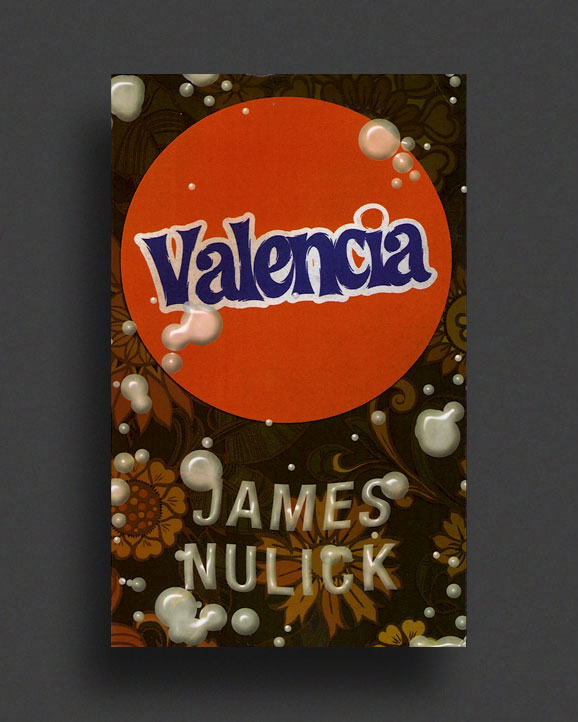
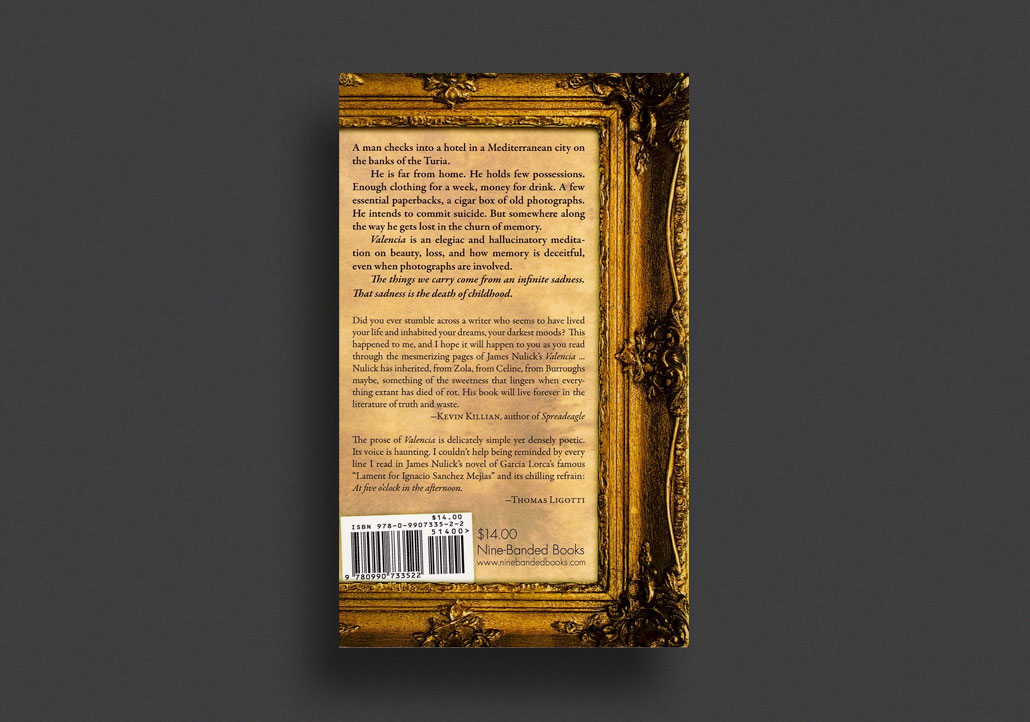
A man checks into a hotel in a Mediterranean city on the banks of the Turia. He is far from home. He holds few possessions. Enough clothing for a week, money for drink. A few essential paperbacks, a cigar box of old photographs. He intends to commit suicide. But somewhere along the way he gets lost in the churn of memory.
Valencia is an elegiac and hallucinatory meditation on beauty, loss, and how memory is deceitful, even when photographs are involved.
The things we carry come from an infinite sadness. That sadness is the death of childhood.
Did you ever stumble across a writer who seems to have lived your life and inhabited your dreams, your darkest moods? This happened to me, and I hope it will happen to you as you read through the mesmerizing pages of James Nulick’s Valencia… Nulick has inherited, from Zola, from Celine, from Burroughs maybe, something of the sweetness that lingers when everything extant has died of rot. His book will live forever in the literature of truth and waste.—Kevin Killian, author of Spreadeagle
The prose of Valencia is delicately simple yet densely poetic. Its voice is haunting. I couldn’t help being reminded by every line I read in James Nulick’s novel of Garcia Lorca’s famous “Lament for Ignacio Sanchez Mejias” and its chilling refrain: At five o’clock in the afternoon.—Thomas Ligotti, author of The Conspiracy against the Human Race
1970, English
Softcover, 104 pages, 19.5 x 13 cm
1st Edition, Out of print title / used / good
Published by
Calder and Boyars / London
$20.00 - Out of stock
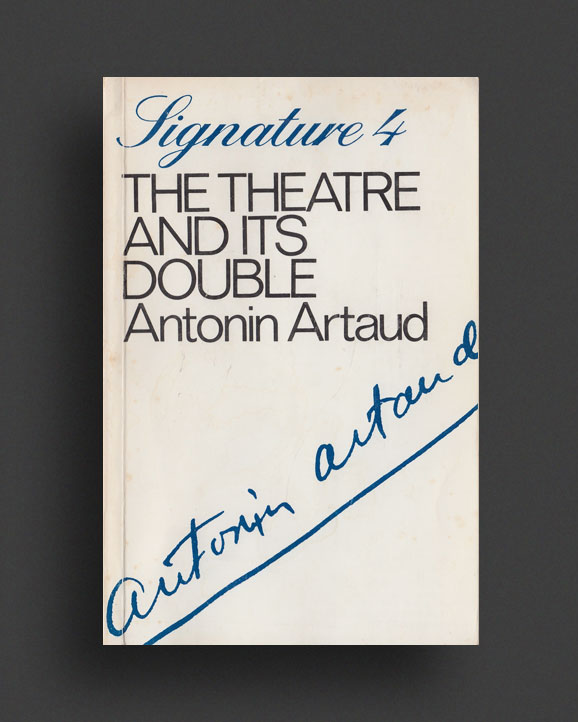
This collection of essays remains the most radical text on performance in print today. This volume contains the famous Manifestos of the Theatre of Cruelty and the definitions of this theatre; the underlying impulses of performance (described by Artaud as its 'metaphysics'); some suggestions on a physical training method for actors and actresses; a long appreciation of the expressive values of Eastern dance drama. Also included is Seraphim's Theatre, in which Artaud attempts an actor's application of the Taoist principles of fullness and emptiness. "We cannot go on prostituting the idea of the theater, the only value of which is in its excruciating, magical relation to reality and danger," Artaud wrote. He fought vigorously against an encroaching conventionalism he found anathema to the very concept of theater. He sought to use theater to transcend writing, "to break through the language in order to touch life." The Theatre and Its Double is widely read throughout the world as a source of inspiration for new drama, for those in search of the meaning of the theatre, as well as for the beauty of its lines.
This remarkable French playwright and poet was born in 1896. He was a leading figure in the Surrealist movement and despite a divergence of ideas remained a dedicated Surrealist all his life, devoting his time to the study of problems of conflict between man's physical and intellectual natures. He died in 1948.
Good copy of 1970 English edition with general age and wear. Ex-owner's name to top of first page, bump to top-right corner, tanning to extremities.
1983, Japanese / English
Softcover (w. original plastic cover and obi band), 138 pages, 22 x 30 cm
1st Edition, Out of print title / used / very good
Published by
Asahi Shimbun / Japan
$180.00 - Out of stock
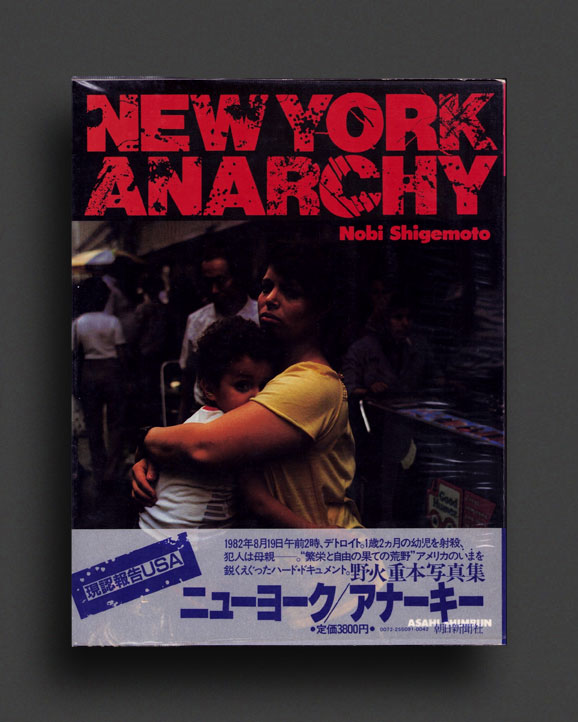
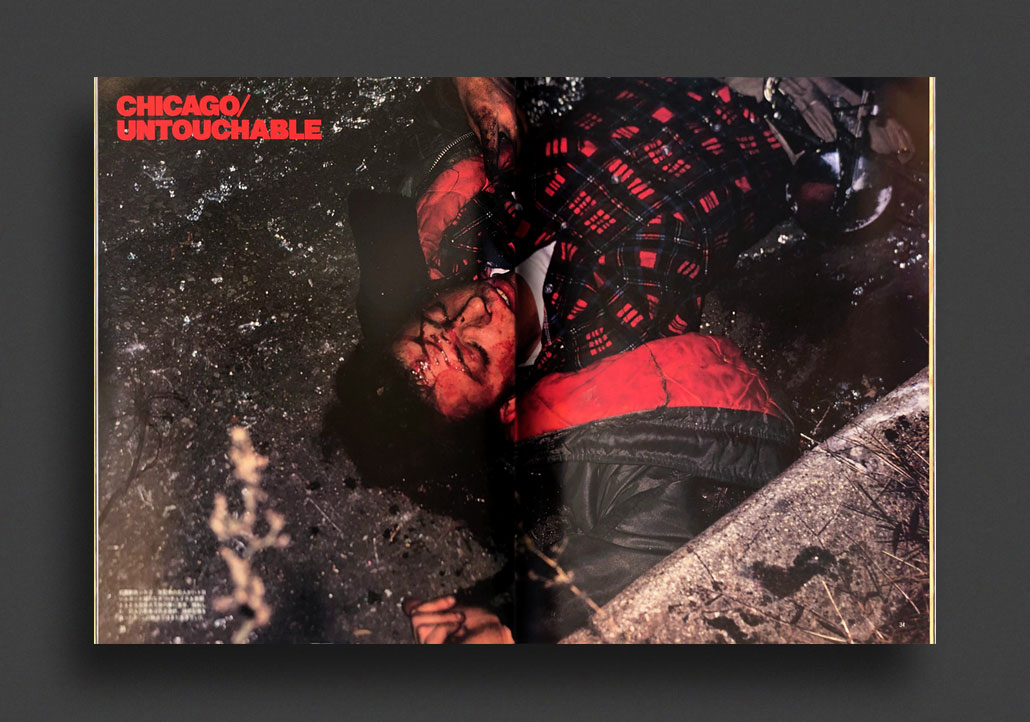
Rare first edition of this compelling early 1980's photo book of violence and disaffection in American cities from Japanese photographer Shigemoto Nobi, printed by Asahi Shimbun in 1983.
Images of social unrest, gang warfare, prostitution, police precinct lockups, murder... the "poverty of the heart" real people must face behind the facade of America's boasted wealth of economic growth, something Japanese photographer Shigemoto Nobi (b. 1943) first encountered when he went to New York in his twenties to work as a freelance commercial photographer. Despite the implications of the title, Shigemoto Nobi visited and documented not only New York, but also Detroit, Chicago, Hawaii, the US/Mexican border and the Fort Apache Indian reservation, taking images primarily at night. Intense, lurid reportage on life in the United States of America in rich, saturated colour Kodochrome. File alongside Kiyotaka Tsurisaki, Seiji Kurata, or Bruce Davidson's "Subway".
First printing in original protective plastic sleeve with original obi band. Texts in Japanese and English.
Very Good copy with usual light damage/shrinkage to aged original plastic dust jacket cover/obi. Light edge wear.
2008, English
Softcover, 190 pages, 22 x 14 cm
1st Edition, Out of print title / used / very good
Published by
Solar Books / US
$140.00 - Out of stock
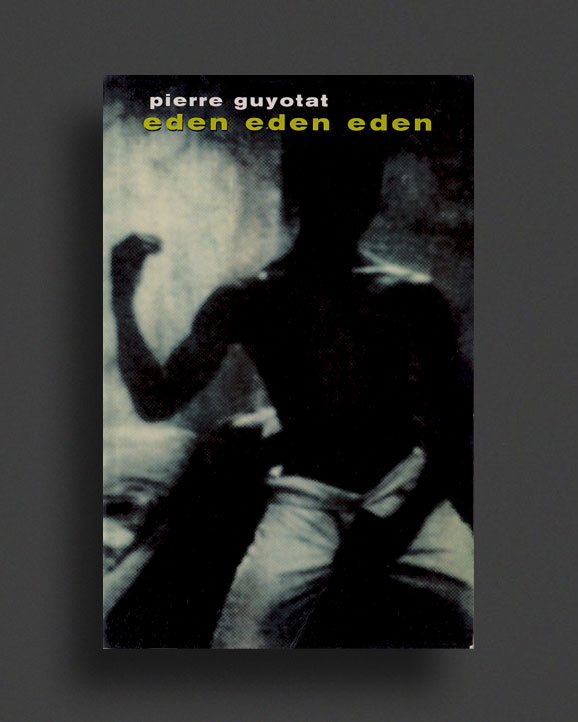
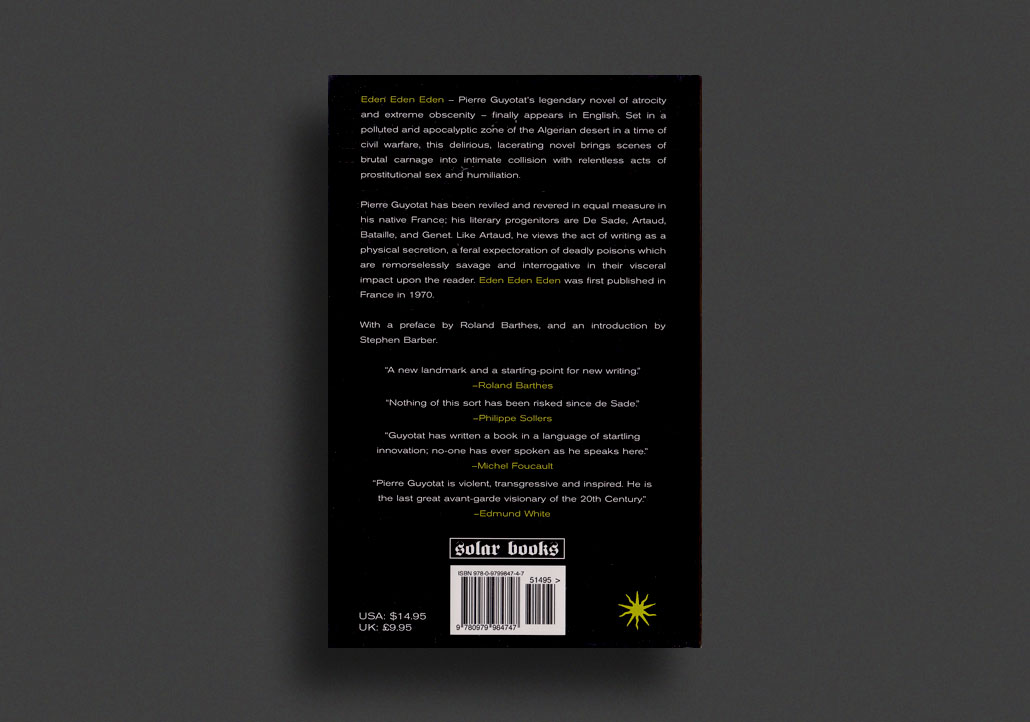
2003 Solar Books edition of the long out-of-print English edition of Eden, Eden, Eden — Pierre Guyotat's masterpiece of atrocity and obscenity, with preface by Roland Barthes and introduction by Stephen Barber.
The most subversive French novelist of the later 20th century, Pierre Guyotat (b. 1940) was the uncompromising heir of De Sade, Artaud, Rimbaud and Genet. Published in France in 1970 by Gallimard, with a preface by Michel Leiris, Roland Barthes and Philippe Sollers, Eden, Eden, Eden was greeted by both furore and acclaim. The book was immediately banned by the French government as pornographic. A campaign of international support for the book was signed by the like of Pier Paolo Pasolini, Jean-Paul Sartre, Pierre Boulez, Joseph Beuys, Pierre Dac, Jean Genet, Simone de Beauvoir, Joseph Kessel, Maurice Blanchot, Max Ernst, Italo Calvino, Jacques Monod, and Nathalie Sarraute. François Mitterrand and Georges Pompidou tried to get the ban lifted but failed until 11 years later when a newly elected President Mitterrand personally intervened to lift the ban in 1981.
Today Eden, Eden, Eden is recognised as one of the major works of the last century. In literally a single sentence, a desert-like, polluted, apocalyptic landscape of unending civil war unfolds without any morality (and therefore also without evil). This delirious, lacerating novel of startling innovation brings scenes of brutal carnage into intimate collision with relentless acts of prostitutional sex and humiliation.
"a new landmark and starting-point for new writing"—Roland Barthes
"I have never read anything like it in any stream of literature"—Michel Foucault
Very Good copy with some light creasing.
2021, English
Softcover, 144 pages, 21 x 13.5 cm
Published by
Soho Press / New York
$32.00 - Out of stock
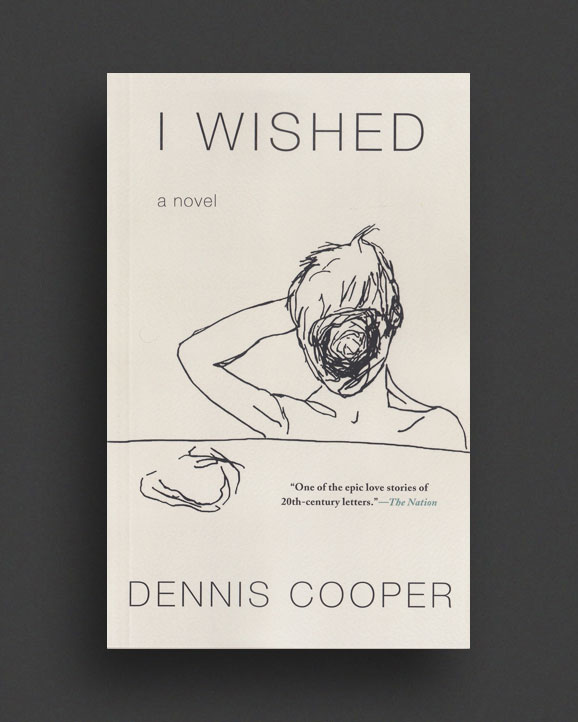
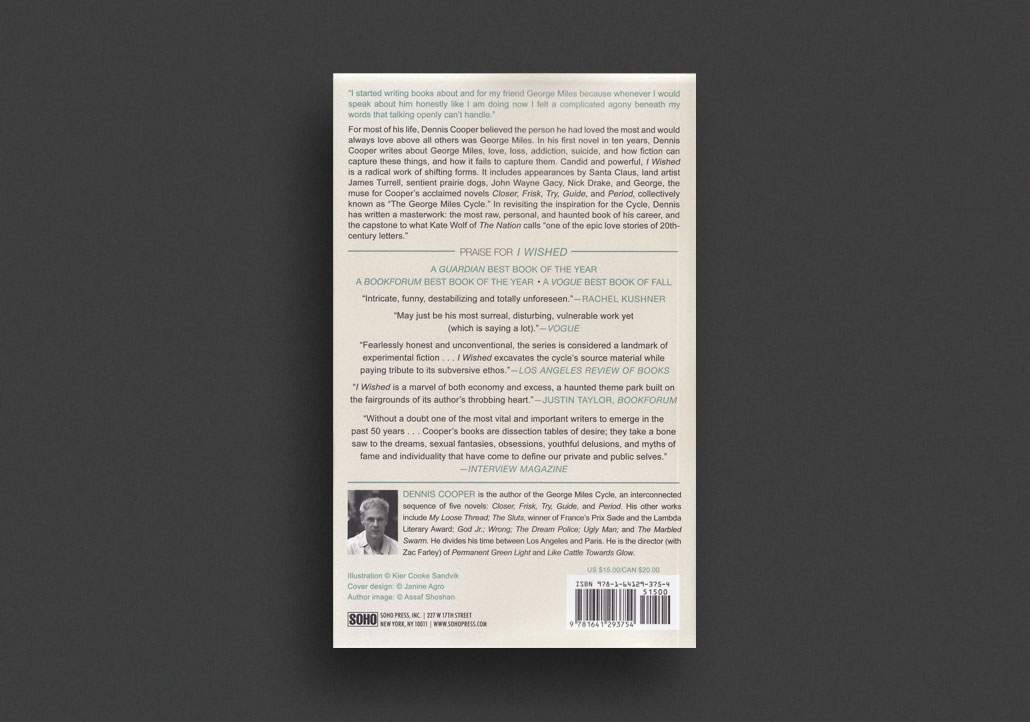
“I started writing books about and for my friend George Miles because whenever I would speak about him honestly like I am doing now I felt a complicated agony beneath my words that talking openly can’t handle.”
For most of his life, Dennis Cooper believed the person he had loved the most and would always love above all others was George Miles. In his first novel in ten years, Dennis Cooper writes about George Miles, love, loss, addiction, suicide, and how fiction can capture these things, and how it fails to capture them. Candid and powerful, I Wished is a radical work of shifting forms. It includes appearances by Santa Claus, land artist James Turrell, sentient prairie dogs, John Wayne Gacy, Nick Drake, and George, the muse for Cooper’s acclaimed novels Closer, Frisk, Try, Guide, and Period, collectively known as “The George Miles Cycle.” In revisiting the inspiration for the Cycle, Dennis has written a masterwork: the most raw, personal, and haunted book of his career.
Dennis Cooper (born 1953) is an American novelist, poet, critic, editor and performance artist who grew up in the Southern California. In 1976, he founded Little Caesar Magazine and Press, which he ran until 1982. In 1985, he moved to Amsterdam for two and a half years, where he began his ten year long project, The George Miles Cycle, an interconnected sequence of five novels that includes Closer, Frisk, Try, Guide, and Period. His post-George Miles Cycle novels include My Loose Thread, The Sluts and God, Jr. Other works include the short-story collections Wrong and Ugly Man, poetry collections The Dream Police and The Weaklings, as well as the recent Smothered in Hugs: Essays, Interviews, Feedback, and Obituaries. Dennis Cooper currently spends his time between Los Angeles and Paris.
First paperback edition.
2001, English
Softcover, 334 pages, 14 x 21.5 cm
Published by
Power Publications / Sydney
$30.00 - Out of stock
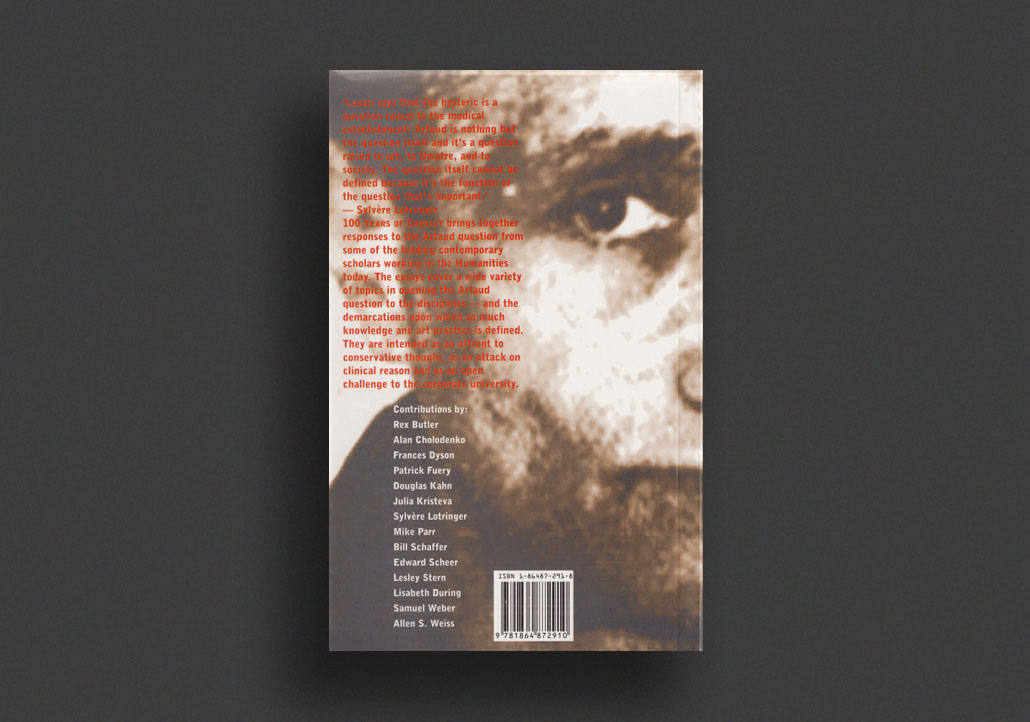
"Lacan says that the hysteric is a question raised to the medical establishment: Artaud is nothing but the question itself and it's a question raised to art, to theatre, and to society. The question itself cannot be defined because it's the function of the question that's important."—Sylvere Lotringer
100 Years of Cruelty: Essays on Artaud brings together responses to the Artaud question from some of the leading contemporary scholars working in the humanities today. The essays cover a wide variety of topics in opening the Artaud question to the disciplines – and the demarcations upon which so much knowledge and art practice is defined. They are intended as an affront to conservative thought, as an attack on clinical reason and as an open challenge to the corporate university.
Contributors: Rex Butler, Alan Cholodenko, Lisabeth During, Frances Dyson, Patrick Fuery, Douglas Kahn, Julia Kristeva, Sylvère Lotringer, Mike Parr, Bill Schaffer, Edward Scheer, Lesley Stern, Samuel Weber, Allen S. Weiss.
2023, English
Softcover (w. dust jacket), 110 pages, 25 x 17 cm
Published by
ACCA / Melbourne
$25.00 - In stock -
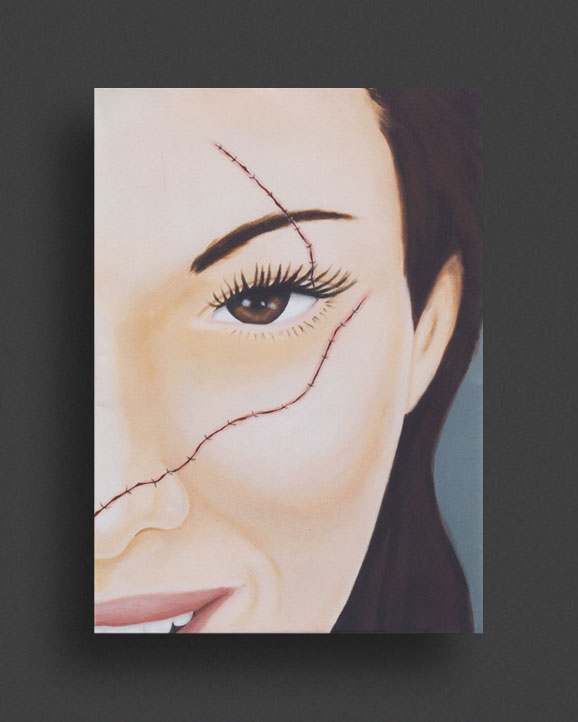
Produced in association with the upcoming ACCA exhibition of the same name, this publication casts a lens upon feminist, queer, and non-binary subjectivities to consider the transgressive pleasures and liberations of horror, as makers, masters and consumers of the genre.
From the other side features curatorial texts by Elyse Goldfinch and Jessica Clark, alongside writings from Barbara Creed, author of The Monstrous Feminine; Canadian film writer Kier-La Janisse, author of the cult classic, House of Psychotic Women, 2012; Lisa Fuller, a Murri woman and author of the novel Ghost Bird, 2021; and a horror-themed screenplay by UK-based author and filmmaker Alison Peirse, editor of the Women Make Horror anthology, 2021.
Artists featured in the exhibition and book include Clare Milledge, Cybele Cox, Heather B Swann, Jemima Lucas, Julia Robinson, Karla Dickens, Kellie Wells, Lonnie Hutchinson, Louise Bourgeois, Maria Kozic, Marianna Simnett, Mia Boe, Minyoung Kim, Naomi Blacklock, Naomi Kantjuriny, SJ Norman, Suzan Pitt, Tracey Moffatt and Zamara Zamara.
The exhibition crosses the artificial parameters of horror in the everyday, as something that exists as part of society but also from outside of it. Culminating in a potent synthesis of dread, camp, humour and catharsis, From the other side challenges the traditional narratives and assumed boundaries of the body, gender, the self and the ‘other’.
2004, Japanese
Softcover (w. dust jacket and obi), 176 pages, 21 x 14.8 cm
1st Edition, Out of print title / used / very good
Published by
Seirin Kogeisha / Tokyo
$65.00 - Out of stock
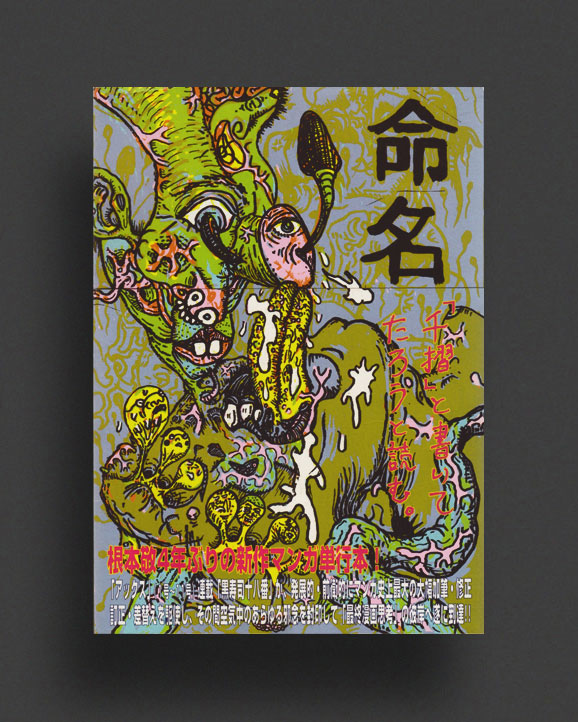
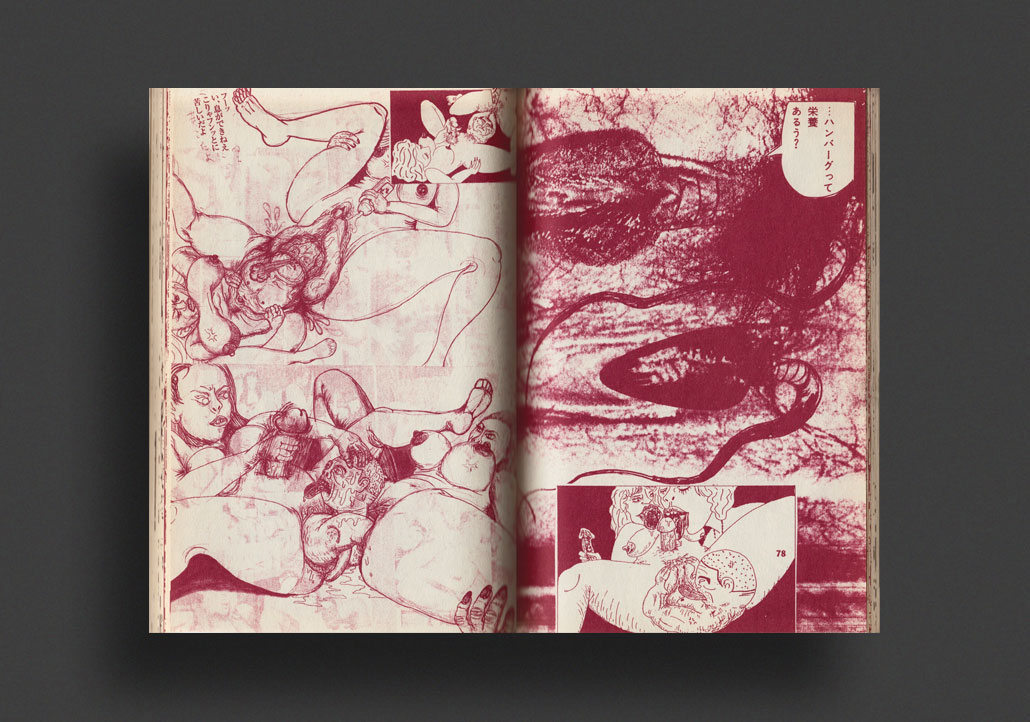
First edition of "Heta-uma" master Takashi Nemoto's wild artbook from 2004, Naming, an unremittingly explicit all-out libidinal gore-fest of experimental manga illustration and collage of the highest degree. Printed throughout in many monochromatic chapters on warm paperstock, Nemoto's horror comedy has real insightful beauty in its madness. Born in Shibuya in 1958, making his debut in Garo magazine in 1981, Nemoto is a devoted figure of the Japanese underground. Due to his pessimistic, satirical stance, and unapologetically squalid subject matter, Nemoto has long been a controversial figure in Japan—clashing violently with mainstream Japanese morals—and is just now receiving some critical success there. Reviewers are finally looking past his gross-out humour to find far-flung influences and connections like Mark Twain, Otto Dix and Andre Masson. The prolific Nemoto also writes, produces video works and events, and re-issues out of print and forgotten records, together with the critic Manabu Yuasa, and the designer Hideo Funabashi, under the name Maboroshi No Meiban Kaihō Dōmei.
Very Good copy w. VG dust jacket and obi.
2001, English
Softcover, 256 pages, 13 x 20.5 cm
Published by
Vintage Books / New York
$33.00 - Out of stock
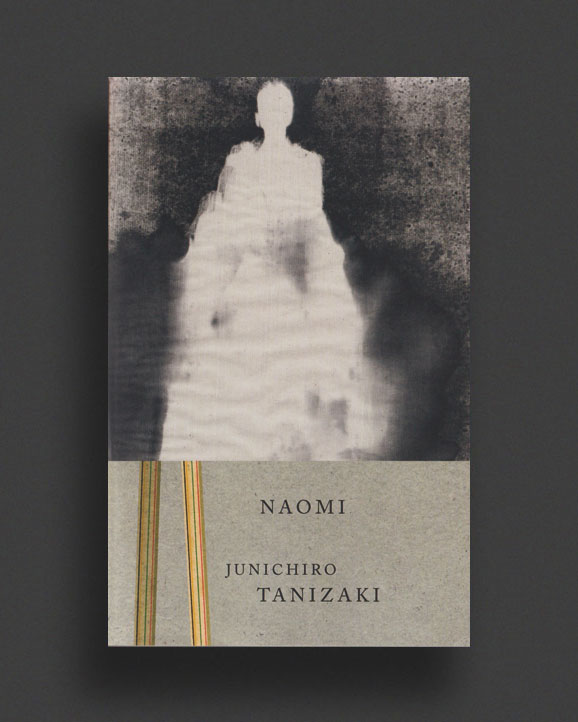
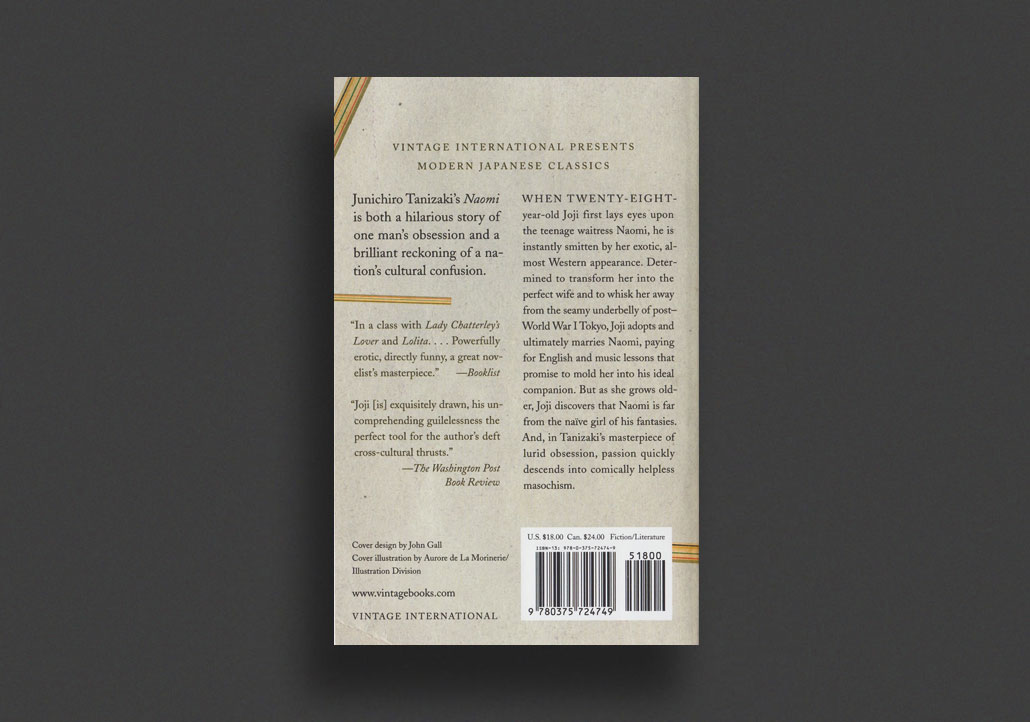
A hilarious story of one man's obsession and a brilliant reckoning of a nation's cultural confusion-from a master Japanese novelist.
Na-o-mi. The three syllables of this name, unusual in 1920s Japan, captivate a 28-year-old engineer, who soon becomes infatuated with the girl so named, a teenaged cafe waitress. Drawn to her Eurasian features and innocent demeanor, Joji is eager to whisk young Naomi away from the seamy underbelly of post-World War I Tokyo and to mold her into his ideal wife. But when the two come together to indulge their shared passion for Western culture, Joji discovers that Naomi is far from being the naive girl of his fantasies. And, in Tanizaki's masterpiece of lurid obsession, passion quickly descends into comically helpless masochism.
A literary masterpiece that helped to establish Junichiro Tanizaki as Japan's greatest novelist, Naomi is both a hilarious story of one man's obsession and torment, and a brilliant evocation of a nation's cultural confusion.
"In a class with Lady Chatterley's Lover and Lolita... Powerfully erotic, directly funny, a great novelist's masterpiece."—Booklist
Junichiro Tanizaki was born in Tokyo in 1886 and lived in the city until the earthquake of 1923, when he moved to the Kyoto-Osaka region, the scene of one of his most well-known novels, The Makioka Sisters (1943-48). The author of over twenty books, including Naomi (1924), Some Prefer Nettles (1928), Arrowroot (1931), and A Portrait of Shunkin (1933), Tanizaki also published translations of the Japanese classic, The Tale of Genji in 1941, 1954, and 1965. Several of his novels, including Quicksand (1930), The Key (1956), and Diary of a Mad Old Man (1961) were made into movies. He was awarded Japan's Imperial Prize in Literature in 1949, and in 1965 he became the first Japanese writer to be elected as an honorary member of the American Academy and the National Institute of Arts and Letters. Tanizaki died in 1965.
2017, English
Softcover, 182 pages, 12.7 x 20.3 cm
Published by
Nine-Banded Books / West Virginia
$35.00 - Out of stock
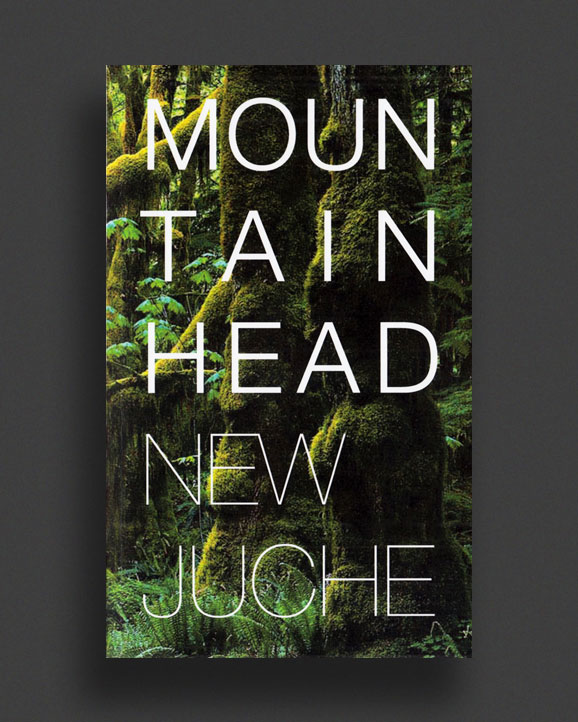
Dennis Cooper has described New Juche as “one of the most inspiring, original and groundbreaking artists working today,” and Mountainhead is arguably the elusive writer/photographer’s most accomplished work to date. Within the structure of a sexually charged exotic travelogue, we discover prose that is at once repulsive, lyrical, and deeply sensual; that is anchored by a raconteur’s instinct for gritty storytelling, yet punctuated by liminal flights of feverish imagination. Mountainhead deftly interlaces personal confession with an unsettling disquisition on pornography, photography, prostitution, the body, identity, and place. In its cascading momentum, readers are confronted by a vertiginous exposition of interpersonally fraught revelation and deception that remains implacably wedded to the thematic emblem of nature as moral alibi.
New Juche is the nom de guerre of a writer and photographer who lives and works in Southeast Asia. He is also the author of Wasteland, The Mollusc and Gymnasium.
2023, English
Softcover, 170 pages, 24 x 18 cm
Published by
Gallows Fruit / Thailand
$70.00 - Out of stock
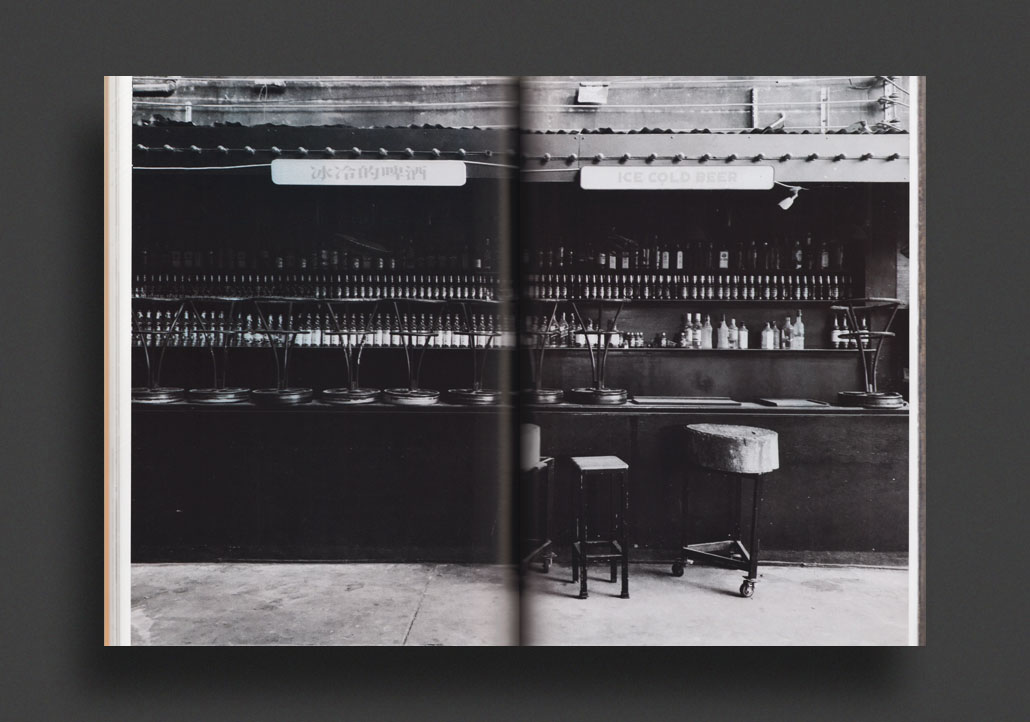
Issue 1 of New Juche's journal HEAT DEATH, published by Gallows Fruit, Thailand. Text and image by New Juche; editorial assistance by Steve Finbow and Karolina Ursula Urbaniak; Design by Karolina Ursula Urbaniak and New Juche.
TOPOPHILIA; NOSTALGIA; ARCHITECTURE; LANDSCAPE; ZONE; RUIN; SEX; ENVIRONMENT; PHOTOGRAPHY; NON-AFFILIATED
"In a room on the top floor I closed the door behind me and took a photo album into the dusty bathtub and lent back with my knees up in front of me and my head on a greasy pillow. Light filtered very pleasantly down through the green vines that laced the unglazed window and the fulsome trees outside. A second shaft of light fell through a space in the torn ceiling. My body felt very still, apart from my heart which I could feel beating and also hear, and it was the only sound in the room apart from birdsong."
New Juche is a writer and artist based in Southeast Asia since 2003. Dennis Cooper has called him "one of the most inspiring, original and groundbreaking artists working today". New Juche's published books include Mountainhead, Bosun, The Devils, and The Worm.
2000, Japanese / English
Hardcover (w. dust jacket) in slipcase, 27.5 x 19.5 cm
1st Edition, Out of print title / used / fine
Published by
Taiyo books / Japan
$790.00 - Out of stock
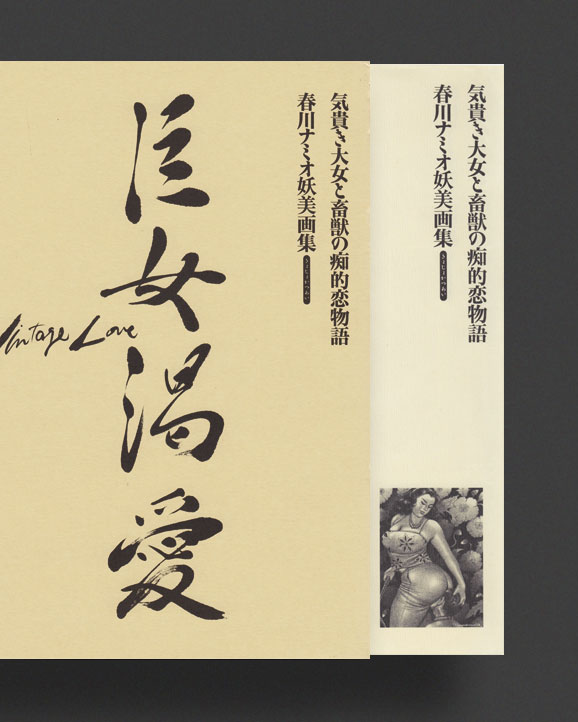
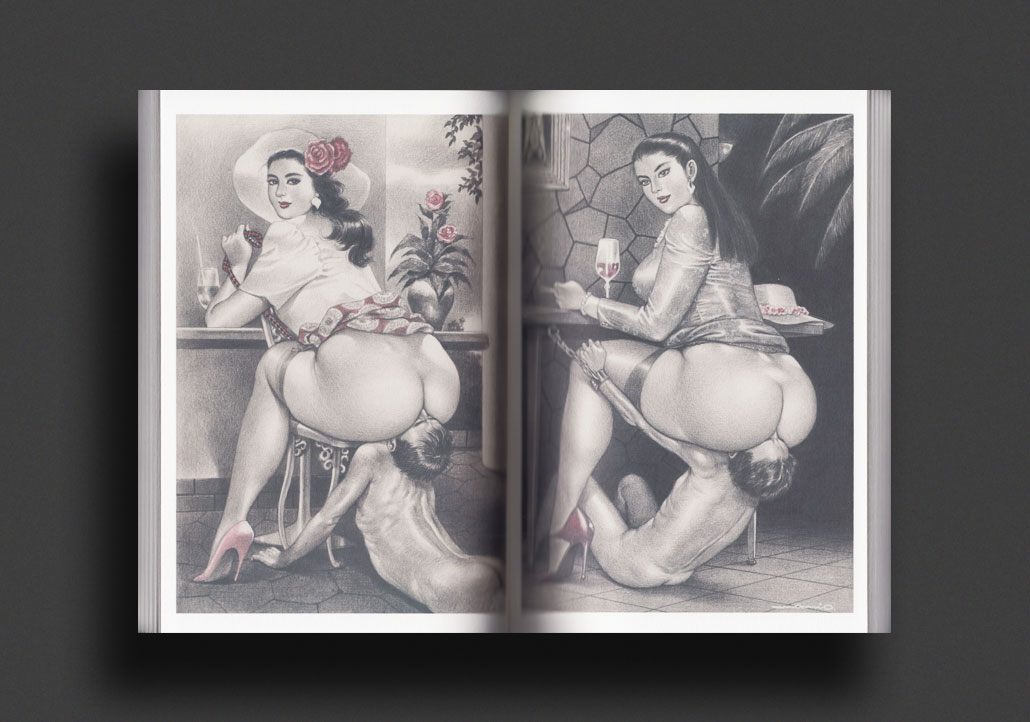
Super rare, very collectible Namio Harukawa oversized hardcover art book, published in Japan in 2000 and long out-of-print. This deluxe art book is considered the first book devoted entirely to Harukawa's "Paradise under the grand hips" — his iconic big-girl-love-femdom-facesitting illustrations. Beautifully produced and lavishly illustrated heavy book full of the exceptional work of Namio Harukawa (1947—2020), a pseudonymous Japanese fetish artist best known for his masterful pencil works depicting female domination ("femdom"), with erotic asphyxiation through facesitting appearing as a frequent subject of his art. As well as an impeccably reproduced collection of Harukawa's works in full-bleed colour, the book features Harukawa's complete illustrated "lewd love story of a noble lady and a beast", a collection of many of his best known works beautifully reproduced alongside sado-masochist narratives. A stunning book and must for any Harukawa fan.
Namio Harukawa (1947—2020), a pseudonymous Japanese fetish artist best known for his masterful pencil works depicting female domination ("femdom"), with erotic asphyxiation through facesitting appearing as a frequent subject of his art. Born 1947 in Osaka, Japan, Harukawa’s distinctive penname combines the name of film actress Harukawa Masumi with an anagram of Naomi, the sadistic heroine in Tanizaki Jun’ichiro’s novel "Chijin no ai / A Fool’s Love". While in high school, Harukawa began contributing work to the readers’ column of leading postwar Japanese SM pulp magazine "Kitan Club". Since then, Harukawa’s drawings of male masochism have lovingly portrayed noble, voluptuously beautiful women and the men who serve them as human furniture. An extraordinary and prolific artist who remained committed to the regime of “absolute Ganmen Kijo Shugi (facesitting principle)” throughout his artistic life, Namio Harukawa passed away on April 2020, he was 72 years old.
Fine copy in original illustrated, gold foiled Near Fine dust jacket and Near Fine slipcase, only light wear. Hardcovers also illustrated. A well-preserved copy.
2012, English / Japanese
Softcover (w. dust jacket + obi), 169 pages, 21 x 14.5 cm
Signed by Namio Harukawa,
1st Edition, Out of print title / used / very good
Published by
Pot Publishing / Japan
$440.00 - Out of stock
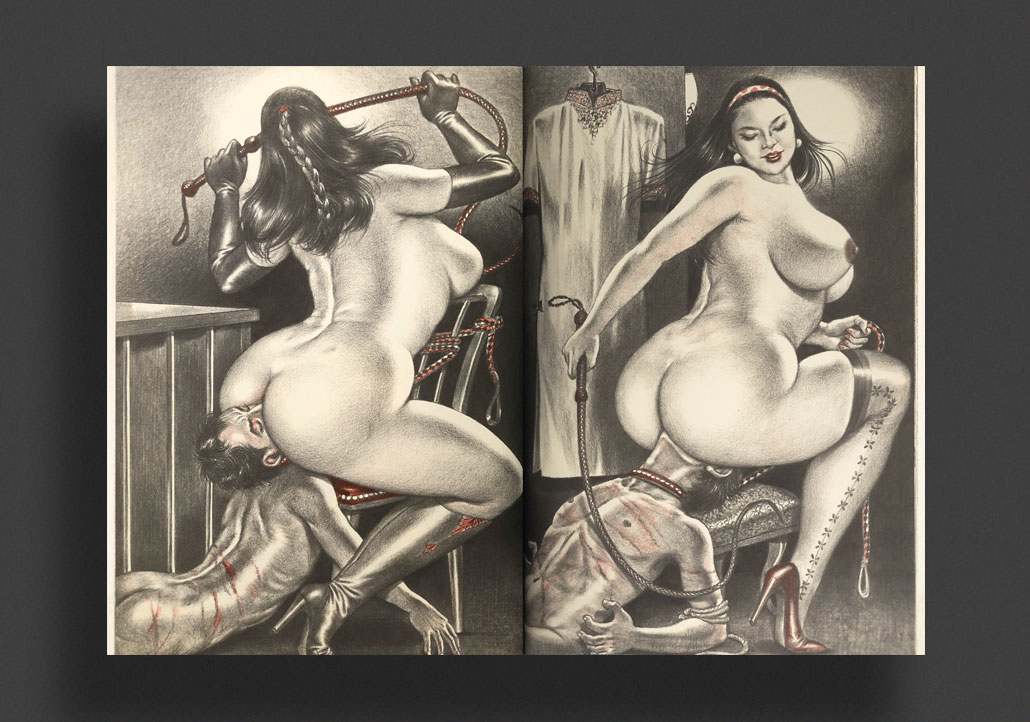
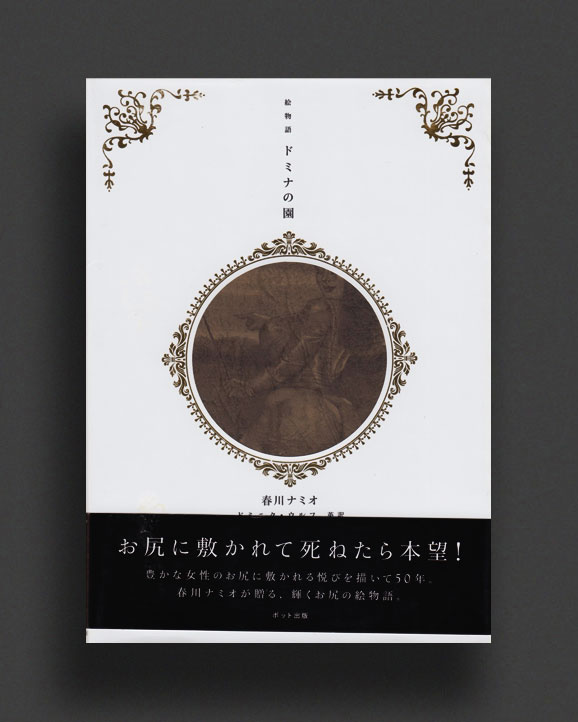
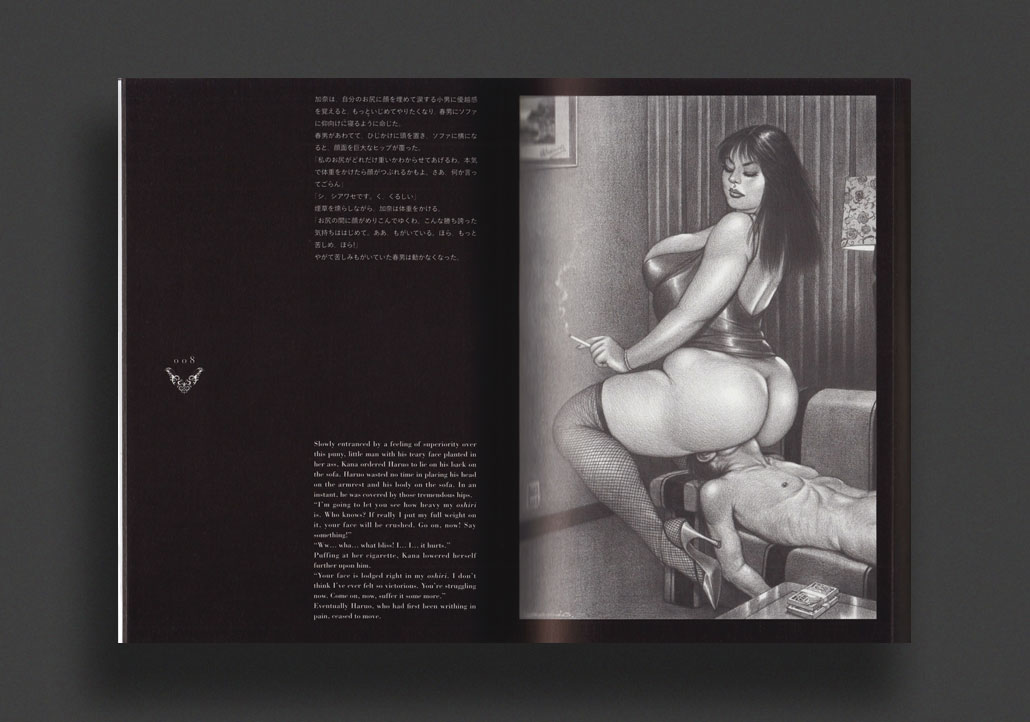
Signed copy of the first edition of (the last?) of Namio Harukawa's illustrated story books, Garden of Domina, published in Japan in 2012. A bilingual (Japanese / English) story illustrated by 80 new femdom artworks rendered by Harukawa. "A gorgeous gluteus, a bounteous bottom, a robust rump, even an ample ass: there are many ways to describe the pleasures of the oshiri (pronounced o-shee-ree.) In Harukawa Namio's delicately conceived drawings and their accompanying story, there emerges a holy bond of lust and love between cosmetics company president Ohara Kana and the men who would serve her. Kana loves to abuse men with her tremendous buttocks, and they explore the cruel joys found beneath her stunning endowment. Eventually, Kana creates a Garden of Paradise where she, her fellow lusty ladies, and their slaves discover the most exquisite ecstasies of the ass. A leading Japanese SM illustrator who has dedicated his oeuvre to the glories of the glories of the glories of the glories of the glories of the ass, Namio Harukawa both amuses and arouses his reader in this charming tale."
Signed by Namio Harukawa in bold metallic ink to title page.
Sample of a story: "Yoshiko liberated Horoshi from her oshiri and fastened him by his two hands to a post in the room. 'It's so sweet you're crying. I'll make you cry some more.' Completely naked, Yoshiko straddled Horoshi from above and pressed her genitals into his face. A slender man, Horoshi arched backwards like a bow...."
Namio Harukawa (1947—2020), a pseudonymous Japanese fetish artist best known for his masterful pencil works depicting female domination ("femdom"), with erotic asphyxiation through facesitting appearing as a frequent subject of his art. Born 1947 in Osaka, Japan, Harukawa’s distinctive penname combines the name of film actress Harukawa Masumi with an anagram of Naomi, the sadistic heroine in Tanizaki Jun’ichiro’s novel "Chijin no ai / A Fool’s Love". While in high school, Harukawa began contributing work to the readers’ column of leading postwar Japanese SM pulp magazine "Kitan Club". Since then, Harukawa’s drawings of male masochism have lovingly portrayed noble, voluptuously beautiful women and the men who serve them as human furniture. An extraordinary and prolific artist who remained committed to the regime of “absolute Ganmen Kijo Shugi (facesitting principle)” throughout his artistic life, Namio Harukawa passed away on April 2020, he was 72 years old.
Very good—Near Fine with dust jacket and obi, Sgned by Namio Harukawa!
2020, Japanese / English
Softcover (w. dust jacket and obi-strip), 366 pages, 15 x 21 cm
Published by
Treville / Tokyo
$90.00 - In stock -
Back in print!
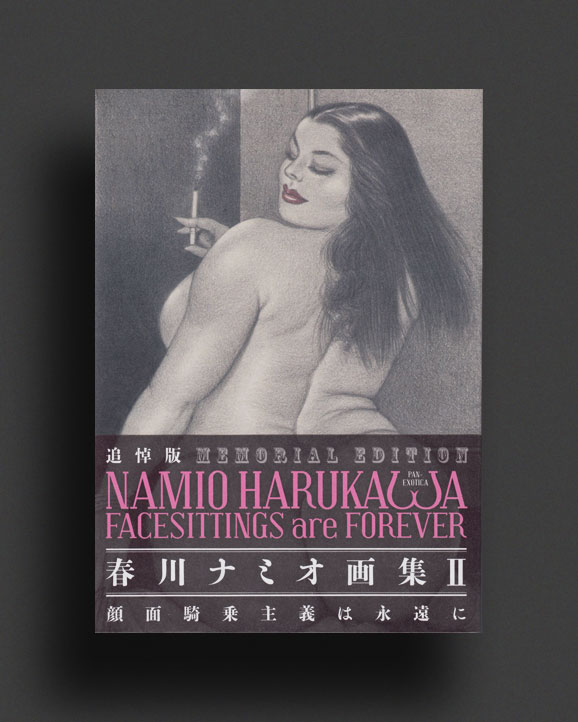
Wonderful new memorial monograph dedicated to the exceptional work of Namio Harukawa (1947 – 2020), a pseudonymous Japanese fetish artist best known for his masterful pencil works depicting female domination ("femdom"), with erotic asphyxiation through facesitting appearing as a frequent subject of his art. Born 1947 in Osaka, Japan, Harukawa’s distinctive penname combines the name of film actress Harukawa Masumi with an anagram of Naomi, the sadistic heroine in Tanizaki Jun’ichiro’s novel "Chijin no ai / A Fool’s Love". While in high school, Harukawa began contributing work to the readers’ column of leading postwar Japanese SM pulp magazine "Kitan Club". Since then, Harukawa’s drawings of male masochism have lovingly portrayed noble, voluptuously beautiful women and the men who serve them as human furniture. Namio Harukawa passed away on April 2020, he was 72 years old. This book is a requiem dedicated to the memory of an extraordinary artist who remained committed to the regime of “absolute Ganmen Kijo Shugi (facesitting principle)” throughout his artistic life.
The profusely illustrated "Facesittings Are Forever" consists of a fine selection over 300 of Namio Harukawa’s works spanning his entire career, including many unpublished works, rough sketches, late works, and coloured works of his mid-career. It features an illustrated archive of his publications, including a rare Gekiga (hard-boiled style) work “Shokeijima no Oujo” and never before seen photographs of his workshop. There are also written contributions in Japanese from Shigeru Kashima, Jun Miura, Rockin Jelly Bean, and Hitomi Onuma.
1971, English
Softcover, 192 pages, 17.5 x 10.5 cm
1st Edition, Out of print title / used / very good
Published by
Berkley Medallion Books / Berkley
$65.00 - Out of stock
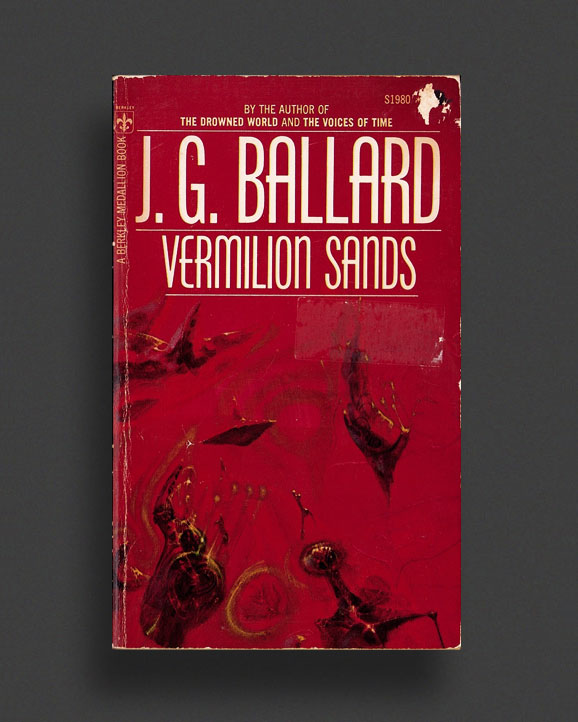
Very first 1971 edition of Vermilion Sands by J.G. Ballard, published by Berkley in this paperback edition 2 years before the Jonathan Cape hardcover. Vermilion Sands is a collection of surreal science fiction short stories by Ballard, one of his finest, all set in an imaginary vacation resort called Vermilion Sands which suggests, among other places, a latter-day Palm Springs. Vermillion Sands is a fully automated desert resort designed to fulfill the most exotic whims of the idle rich. But now it languishes in uneasy decay, populated only by forgotten movie stars, solitary impresarios, parasites, and artistic and literary failures, a place where love and lust pall before the stronger pull of evil.
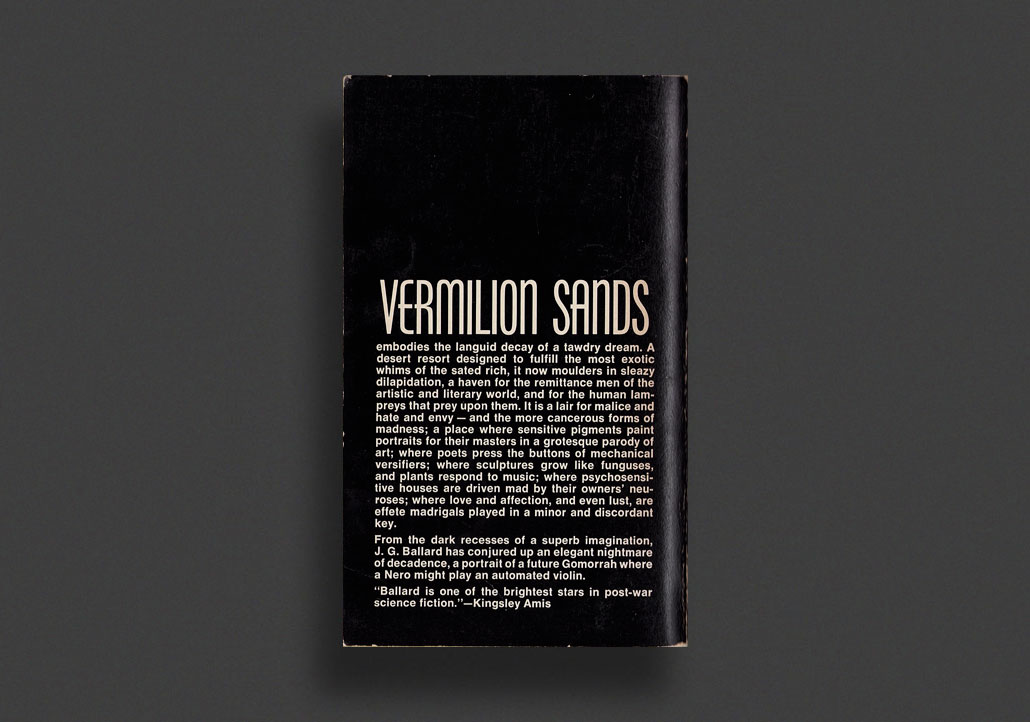
Vermilion Sands embodies the languid decay of a tawdry dream. A desert resort designed to fulfill the most exotic whims of the sated rich, it now moulders in sleazy dilapidation, a haven for the remittance men of the artistic and literary world, and for the human lampreys that prey upon them. It is a lair for malice and hate and envy — and the more cancerous forms of madness; a place where sensitive pigments paint portraits for their masters in a grotesque parody of art; where poets press the buttons of mechanical versifiers; where sculptures grow like funguses, and plants respond to music; where psychosensitive houses are driven mad by their owners' neuroses; where love and affection, and even lust, are effete madrigals played in a minor and discordant key.
From the dark recesses of a superb imagination, J. G. Ballard has conjured up an elegant nightmare of decadence, a portrait of a future Gomorrah where a Nero might play an automated violin.
"Ballard is one of the brightest stars in post-war science fiction."—Kingsley Amis
Good copy with some previous sticker damage to top corner of cover, light wear. Tanning to pages, otherwise a tight VG copy.
1976, English
Softcover, 84 pages, 28.5 x 21 cm
1st Edition, Out of print title / used / good
Published by
Dover / New York
$35.00 - Out of stock
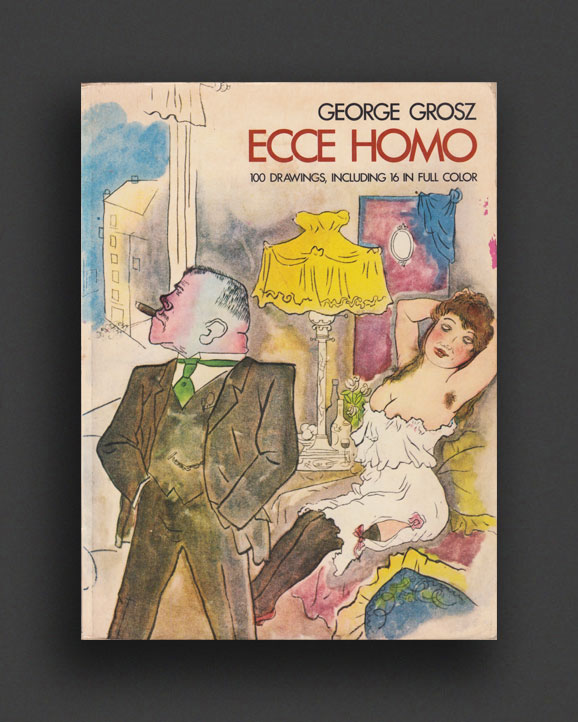
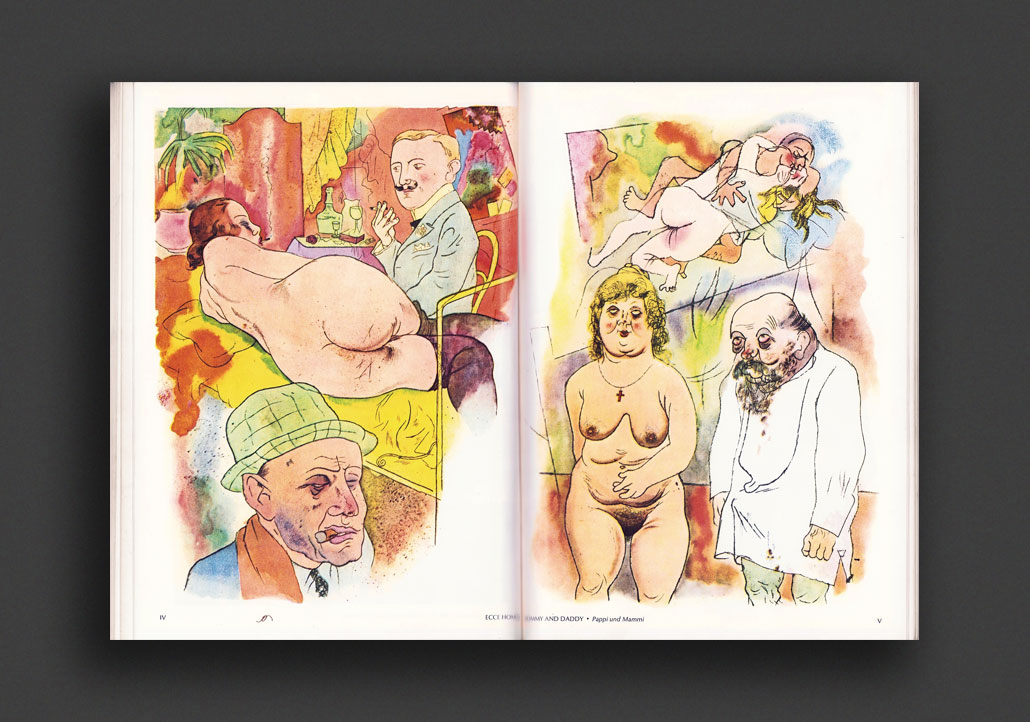
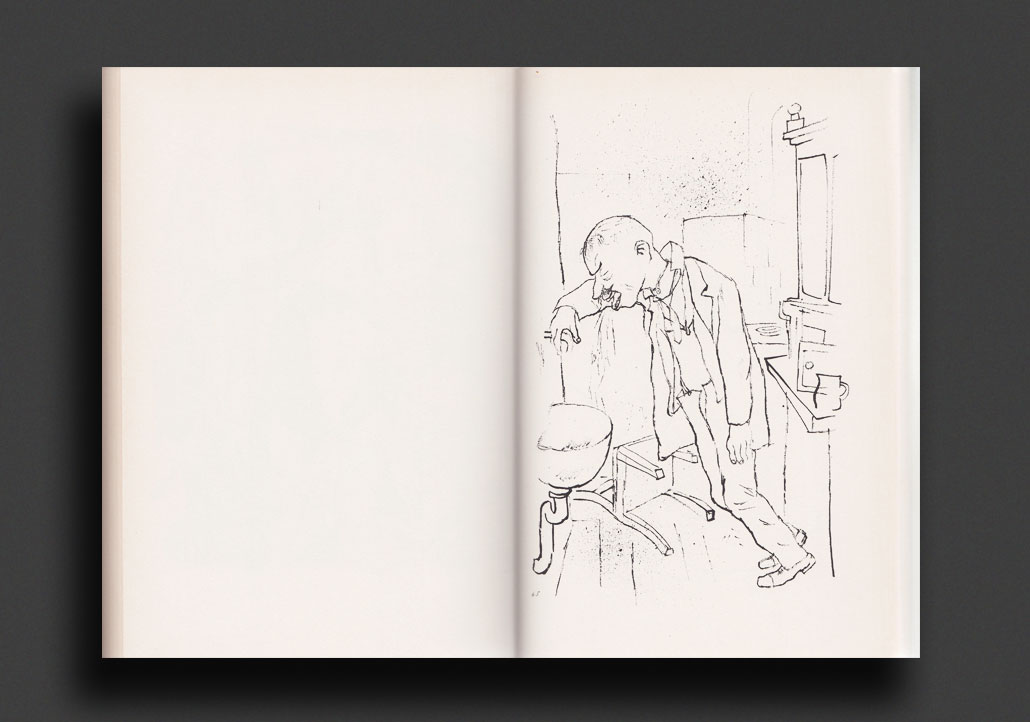
Perhaps the most famous of Grosz's collections is Ecce Homo (Berlin: Malik Verlag, 1923). The title echoes Pilate's presentation of Jesus as King of the Jews, beaten, with a crown of thorns, bloody and ready for crucifixion, and clearly not the Messiah he had been proclaimed to be six days earlier when he was greeted by rapturous crowds. Just so, the image of the heroic German, brave in war and moral in peacetime, took such a beating in Grosz's drawings, watercolors, and paintings, that he was prosecuted for "offences against public morality and for besmirching the values of the German people" (Kranzfelder, 59). Offering an unsparing vision of human nakedness, lust, greed and cruelty, Ecce Homo was found to be a slanderous attack upon the army, which won damages and the removal of 5 color plates and 17 black and white plates from the portfolio in a law suit. Grosz was also fined 6000 marks. Since Grosz had been attacking the Nazis since the early 1920s and since he had singled out Hitler in particular, it is not surprising that after the Nazi's took power in Germany, his works were singled out for ridicule and destruction. 285 of his works were removed from German collections and destroyed and the 1937 Munich Exhibition of Nazi-labelled "Degenerate Art" included five of his paintings, two watercolours, and thirteen drawings. After relocating to the U.S., Grosz wrote to J. B. Neuman concerning his own place in the history of art: "My drawings will naturally stay true–they are fireproof. They will later be seen as Goya's work [is]. They are not documents of the class struggle, but eternally living documents of human stupidity and brutality"
1976 Dover Edition.
Average—Good copy with previous owner gift inscription to front endpaper. General wear/marks.
1997, English
Softcover, 320 pages, 21 x 13.5 cm
1st Edition, Out of print title / used / very good
Published by
Serpent's Tail / London
$85.00 - Out of stock
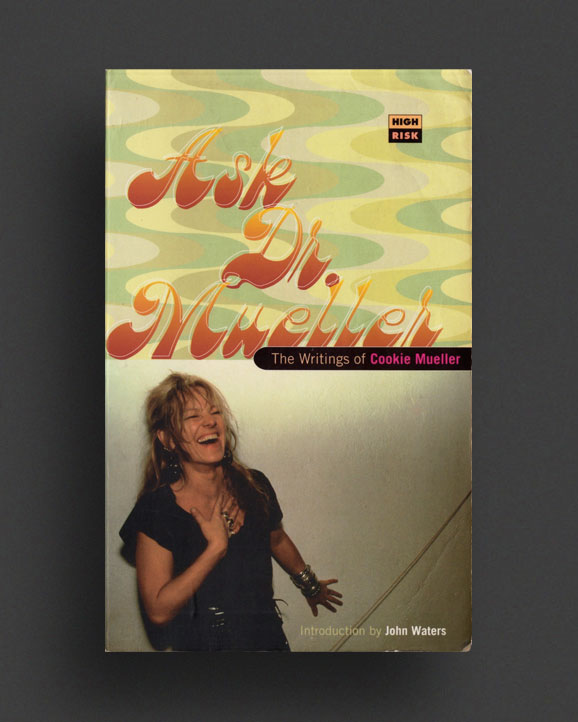
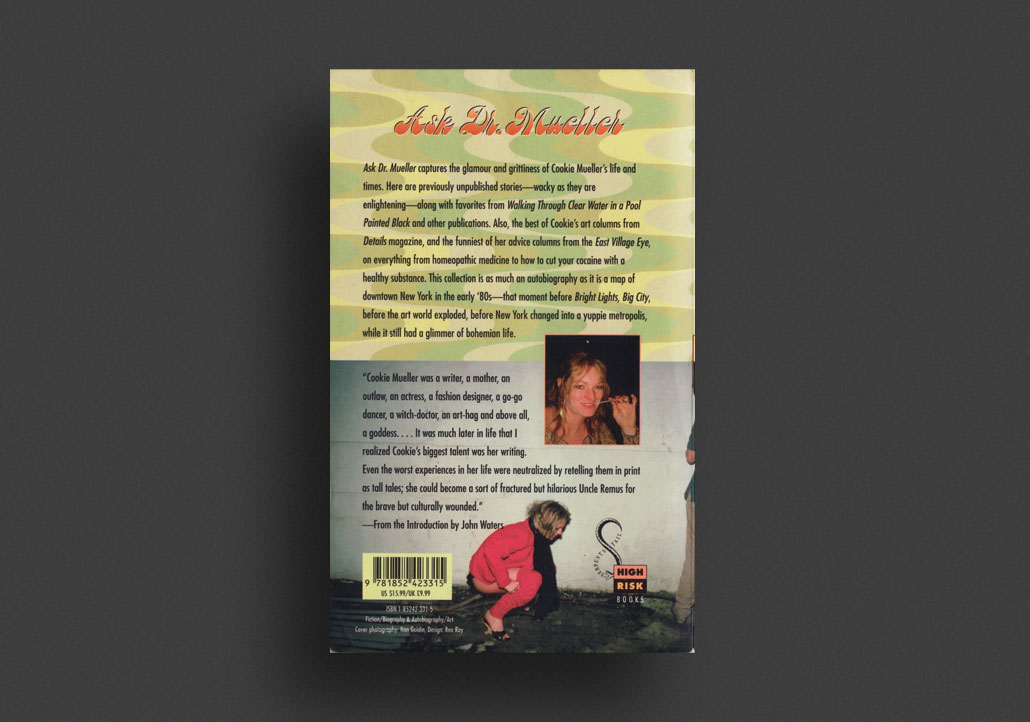
"Cookie Mueller was a writer, a mother, an outlaw, an actress, a fashion designer, a go-go dancer, a witch-doctor, an art-hag and above all, a goddess.... It was much later in life that I realized Cookie's biggest talent was her writing. Even the worst experiences in her life were neutralized by retelling them in print as tall tales; she could become a sort of fractured but hilarious Uncle Remus for the brave but culturally wounded."—From the Introduction by John Waters
Rare first 1997 edition of the long out-of-print collection, Ask Dr. Mueller — The Writings of Cookie Mueller, published by High Risk Books / Serpent's Tail, with introduction by John Waters.
"Ask Dr. Mueller captures the glamour and grittiness of Cookie Mueller's life and times. Here are previously unpublished stories—wacky as they are enlightening—along with favorites from Walking Through Clear Water in a Pool Painted Black and other publications. Also, the best of Cookie's art columns from Details magazine, and the funniest of her advice columns from the East Village Eye, on everything from homeopathic medicine to how to cut your cocaine with a healthy substance. This collection is as much an autobiography as it is a map of downtown New York in the early '80s—that moment before Bright Lights, Big City, before the art world exploded, before New York changed into a yuppie metropolis, while it still had a glimmer of bohemian life."
Cookie Mueller was a fiction writer, columnist, cult movie star who appeared in several of John Waters films, and an art critic. She died of Aids in 1989.
Very Good copy with light tanning to pages.
1980, Japanese
Softcover, 326 pages, 21 x 15 cm
1st Edition, Out of print title / used / very good
Published by
Nihon Shuppansha / Tokyo
$120.00 - In stock -
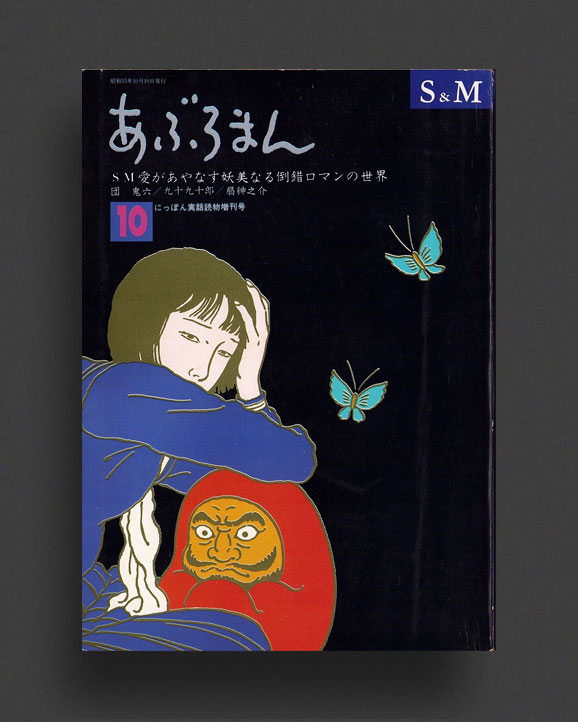
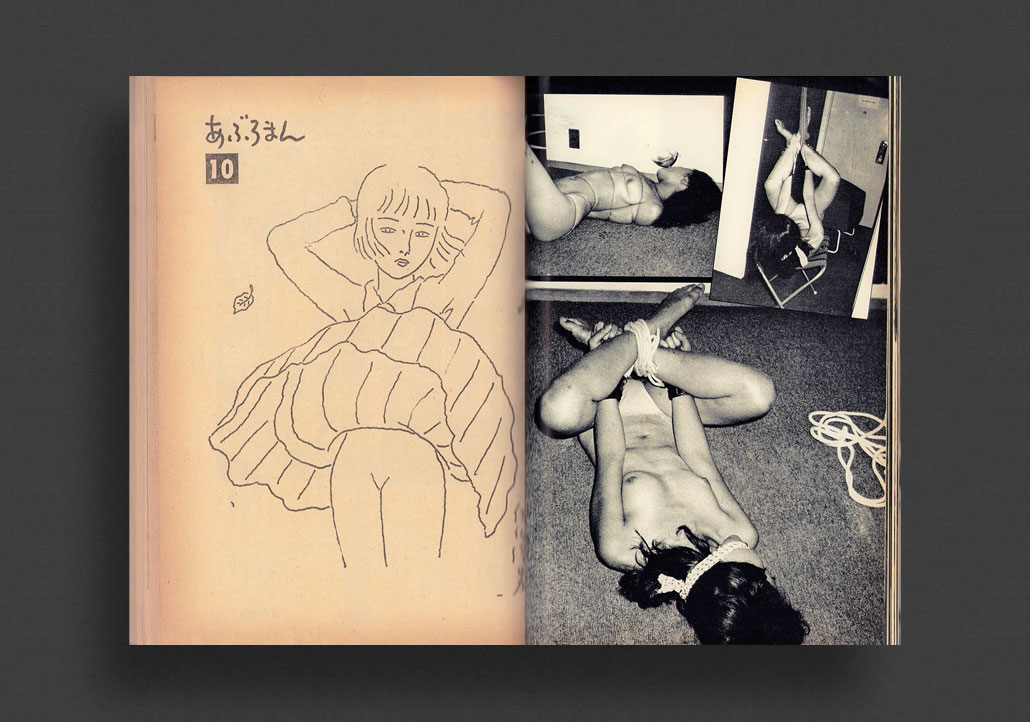
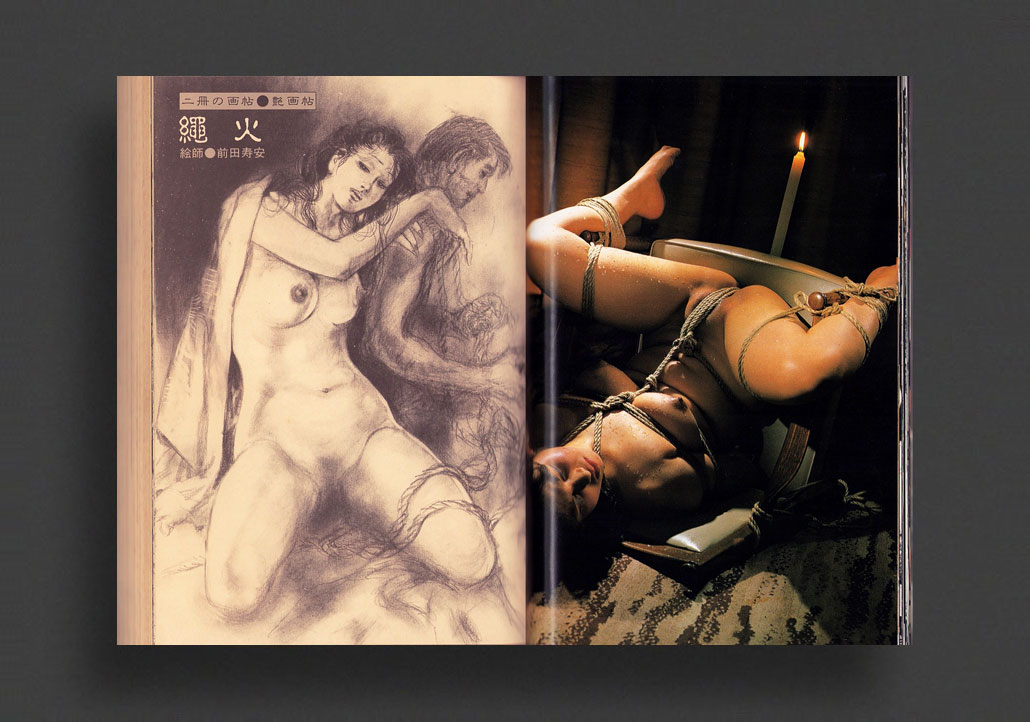
Very rare first issue (October 1980) of S&M Aburoman ("the world of beautiful perverted romance that SM love makes"), featuring cover artwork by Toshio Saeki. Founded in October 1980 by Nihon Shuppansha and edited by Mitsuo Yasuda (who also created SM Club, alongside Oniroku Dan, Sotaro Aki, and Tadao Chigusa), S&M Aburoman was a short-lived SM magazine packed with fetish illustrations, artwork galleries, photographic features, stories, pin-up spreads, and articles exploring SM sexuality. Features contributions by Toshio Saeki, Oniroku Dan, Keizo Miyanishi, Kujuro Kujuro, Shinnosuke Ougi, Haruo Shinozaki, Juan Maeda, and many more. Double sided pin-up of Japanese actress Azuma Terumi.
Very Good copy, tanning and light cover wear.
1981, Japanese
Softcover, 326 pages, 21 x 15 cm
1st Edition, Out of print title / used / very good
Published by
Nihon Shuppansha / Tokyo
$100.00 - Out of stock
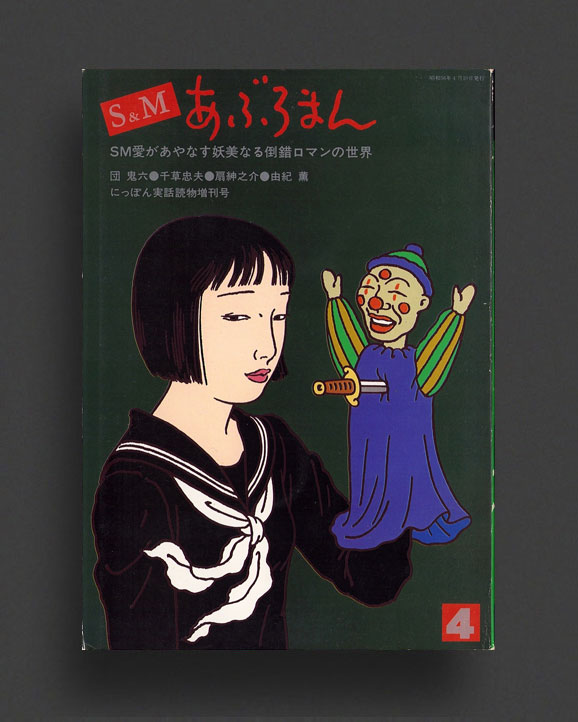
Rare April 1981 issue of S&M Aburoman ("the world of beautiful perverted romance that SM love makes"), featuring cover artwork by Toshio Saeki. Founded in October 1980 by Nihon Shuppansha and edited by Mitsuo Yasuda (who also created SM Club, alongside Oniroku Dan, Sotaro Aki, and Tadao Chigusa), S&M Aburoman was a short-lived SM magazine packed with fetish illustrations, artwork galleries, photographic features, stories, pin-up spreads, and articles exploring SM sexuality. Features contributions by Toshio Saeki, Tadao Chigusa, Tadao Matasuoka, Shinnosuke Ougi, Akira Kasuga, Juan Maeda, and many more.
Very Good copy, tanning and light cover wear.
1991/1992, Japanese
Various newsprint/offset ephemera, unpaginated, 26 x 18.5 cm; 20 x 19.2 cm; 20 x 23 cm
1st Edition, Out of print title / used / very good
Published by
Jūrō Kara / Tokyo
$45.00 - Out of stock
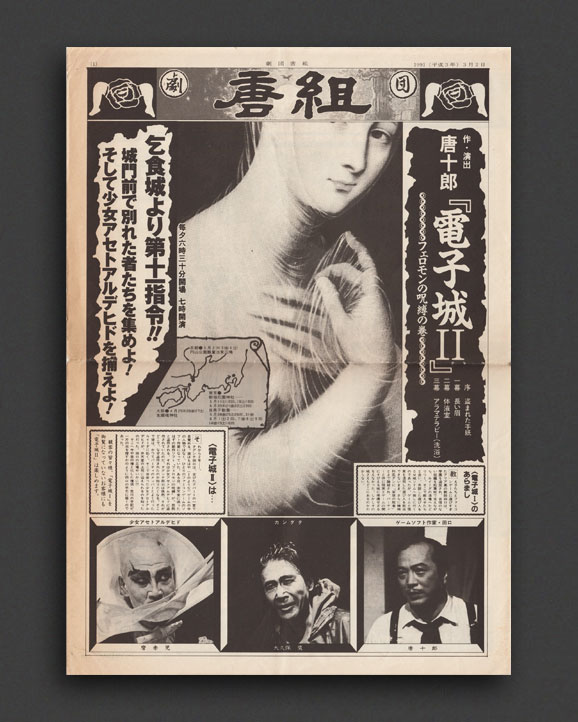
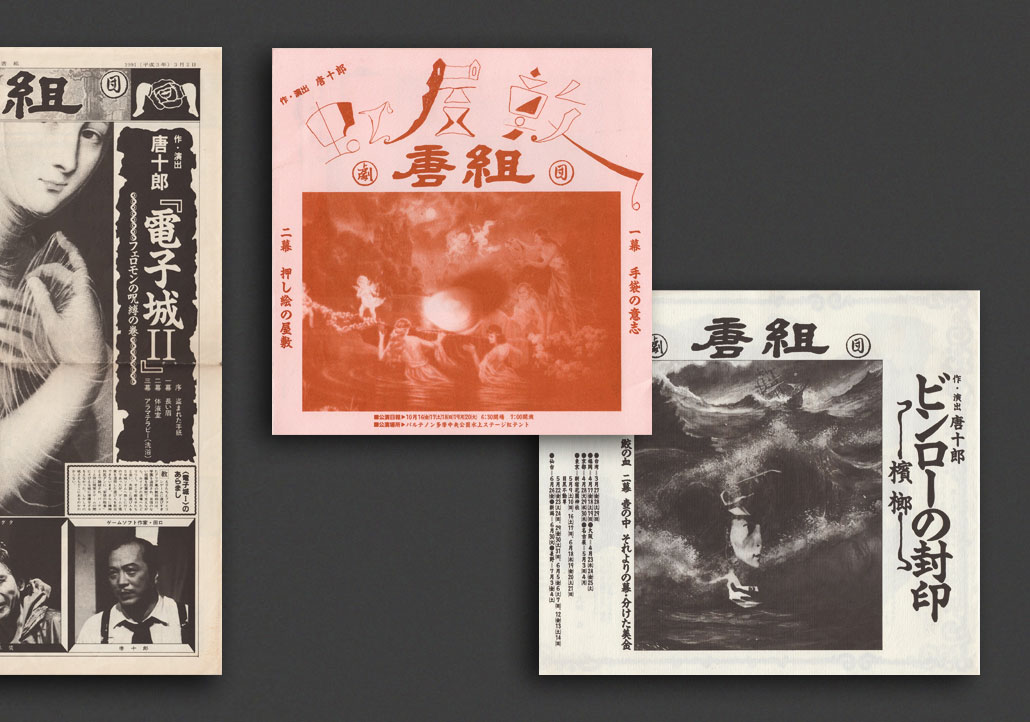
Lot of 3 pieces of ephemera relating to Jūrō Kara and his Jōkyō Gekijo (Situation Theatre) company, formed in 1963. Jūrō Kara (b. 1940) is a Japanese avant-garde playwright, theatre director, author, actor, and songwriter. He was at the forefront of the Angura ("underground") theatre movement in Japan. According to the theatre historian, David G. Goodman, "Kara conceived his theatre in the premodern mold of kabuki—not the sanitized, aestheticized variety performed today, but the erotic, anarchic, plebeian sort performed during the Edo period (1600–1868) by itinerant troupes of actors who were rejected by bourgeois society as outcasts and 'riverbed beggars.' Emulating their itinerant forebears, Kara and his troupe performed throughout Japan in their mobile red tent." Kara's troupe gave guerrilla-like performances that adopted what is known as the tokkenteki nikutairon (the theory of the privileged body). Kara boldly affirmed that there was no longer a need for great play manuscripts in contemporary drama, and that it was the dramatic body of those who were on stage that was more important. Kara's beliefs of the "privileged body" was a dichotomy where the actor was a social pariah and a medium for the manifestation of the audience's dreams and desires. Kara appeared in Nagisa Ōshima's 1969 New Wave classic, Diary of a Shinjuku Thief, amongst many other films.
Lot includes pamphlets for Jūrō Kara directed performances of Gekidan Karagumi's "Nijiyashiki" at the iconic Red Tent in Parthenon Tama Central Park, Tokyo; The Betel Seal (Act 1: Blood of The Shark, Act 2: Inside The Jar); newspaper brochure for Jūrō Kara's Electronic Castle II / Beggar of Love. All performances 1991—1992.
Very Good all. Light tanning/wear to newspaper.
1967, Japanese
Softcover, 294 pages, 21 x 15 cm
1st Edition, Out of print title / used / very good
Published by
Shinpusha / Tokyo
$40.00 - Out of stock
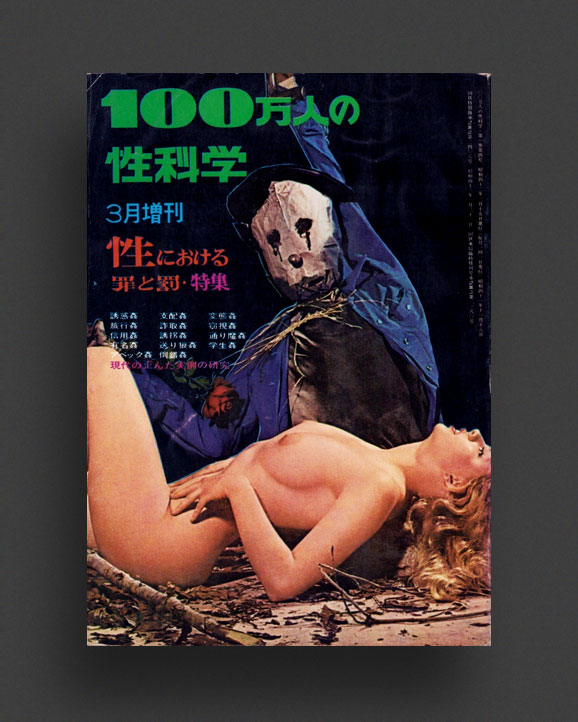
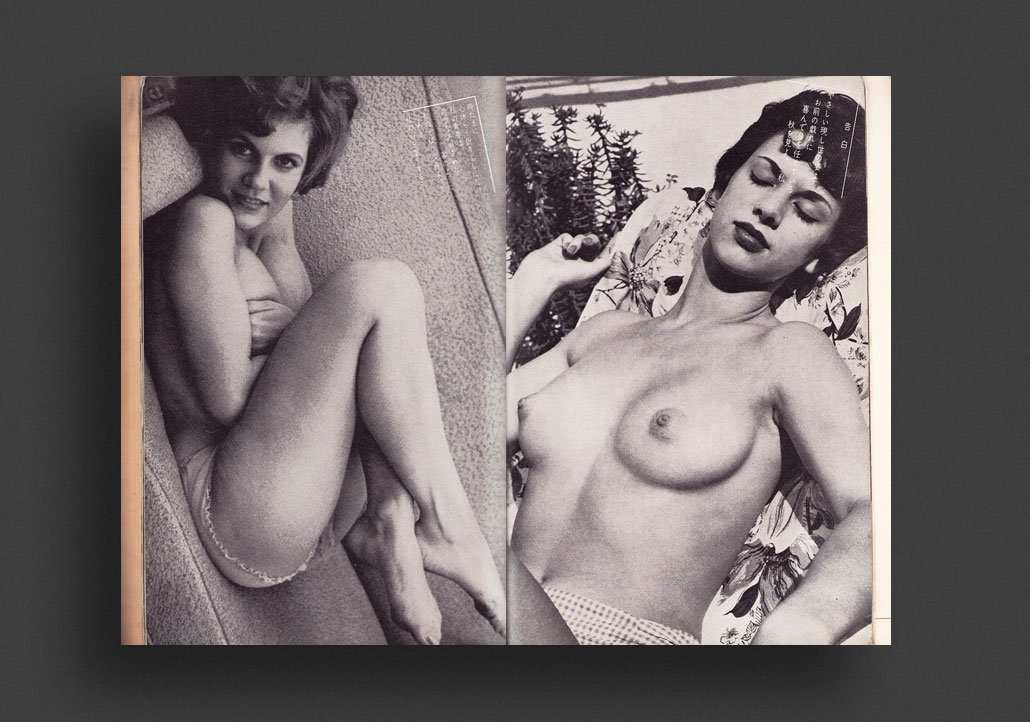
Rare March 1967 issue of Sexology for One Million People (rough translation), a magazine published by the underground bookstore Shinpusha in Tokyo in the late 1960s. As the title suggests, the magazine covers sexual customs and sexual sciences from all over the world and throughout history, but particularly focussing on liberated modern sexuality in Japan and abroad. This March special issue with the grim theme of "Crime and Punishment" features many articles on sex crimes, voyeurism, kidnapping, molestation and rape, complete with crime photography, wild info-graphics of sex-crime statistics, police files, court cases, and much more. Also includes profile on pink film heroine Tamaki Katori, photo features of Western female nudes, articles on female physiognomy with cartoons an photographic assistance, a "sexual love law" roundtable discussion with a variety of promiscuous "reckless" Japanese teenage girls, special feature on "unusual ways to enjoy the female body by 10 celebrities"... even a photo guide to kissing. Lots of illustrations, cartoons, and wonder photo-collage and single spot-colour sections throughout.
Very Good copy with light wear/age.
1964, Japanese
Softcover (staple-bound), 240 pages, 21 x 15 cm
1st Edition, Out of print title / used / good
Published by
Kubo Shoten / Japan
$70.00 - Out of stock
Rare November 1964 issue of "THE JAPAN'S MOST REMARKABLE SM MAGAZINE", Rear Window, an early, pioneering SM magazine that played an important role in the formation of postwar SM culture, along with Kitan Club. Launched by Kubo Shoten in 1956, Rear Window was edited by Toshiyuki Suma, with Chimuo Nureki serving as editor-in-chief. In 1962—1965 Chimuo Nureki took over as editor. Heavy with wonderful artwork galleries in colour and bw, stunning kinbaku/bondage photo-features, illustrated fetish fiction, articles on sex customs, fold-outs, and much more, with contributions by Ran Akiyoshi, Mineko Tsuzuki, Kiyoshi Kimata, Chimuo Nureki (Yukio Kanai), Ayako Nakagawa (Kazutomo Fujino), Yoji Muku, Kazuyuki Kohinata, Akihiro Yamada, Taiga Utagawa, Hiroshi Urato, Hisashi Yoshida, Kimi Nakajima, and many others.
Good copy with cover wear, tanning.
1980, German
Softcover, 84 page, 26 x 17 cm
Out of print title / used / very good
Published by
Rowohlt / Hamburg
$45.00 - Out of stock
Perhaps the most famous of Grosz's collections is Ecce Homo (Berlin: Malik Verlag, 1923). The title echoes Pilate's presentation of Jesus as King of the Jews, beaten, with a crown of thorns, bloody and ready for crucifixion, and clearly not the Messiah he had been proclaimed to be six days earlier when he was greeted by rapturous crowds. Just so, the image of the heroic German, brave in war and moral in peacetime, took such a beating in Grosz's drawings, watercolors, and paintings, that he was prosecuted for "offences against public morality and for besmirching the values of the German people" (Kranzfelder, 59). Offering an unsparing vision of human nakedness, lust, greed and cruelty, Ecce Homo was found to be a slanderous attack upon the army, which won damages and the removal of 5 color plates and 17 black and white plates from the portfolio in a law suit. Grosz was also fined 6000 marks. Since Grosz had been attacking the Nazis since the early 1920s and since he had singled out Hitler in particular, it is not surprising that after the Nazi's took power in Germany, his works were singled out for ridicule and destruction. 285 of his works were removed from German collections and destroyed and the 1937 Munich Exhibition of Nazi-labelled "Degenerate Art" included five of his paintings, two watercolours, and thirteen drawings. After relocating to the U.S., Grosz wrote to J. B. Neuman concerning his own place in the history of art: "My drawings will naturally stay true–they are fireproof. They will later be seen as Goya's work [is]. They are not documents of the class struggle, but eternally living documents of human stupidity and brutality"
1980 reprint of the collection reproduced in black and white and colour, published by Rowohlt in Hamburg, 1980.
Very good copy.
2023, English
Softcover (staple-bound), 24 pages, 21 x 14.5 cm
Published by
Degrowth Collective / Naarm
$5.00 - In stock -
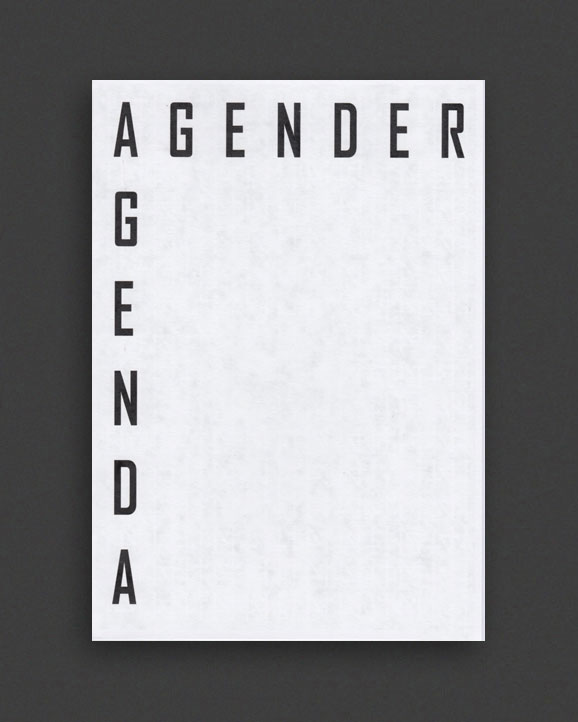
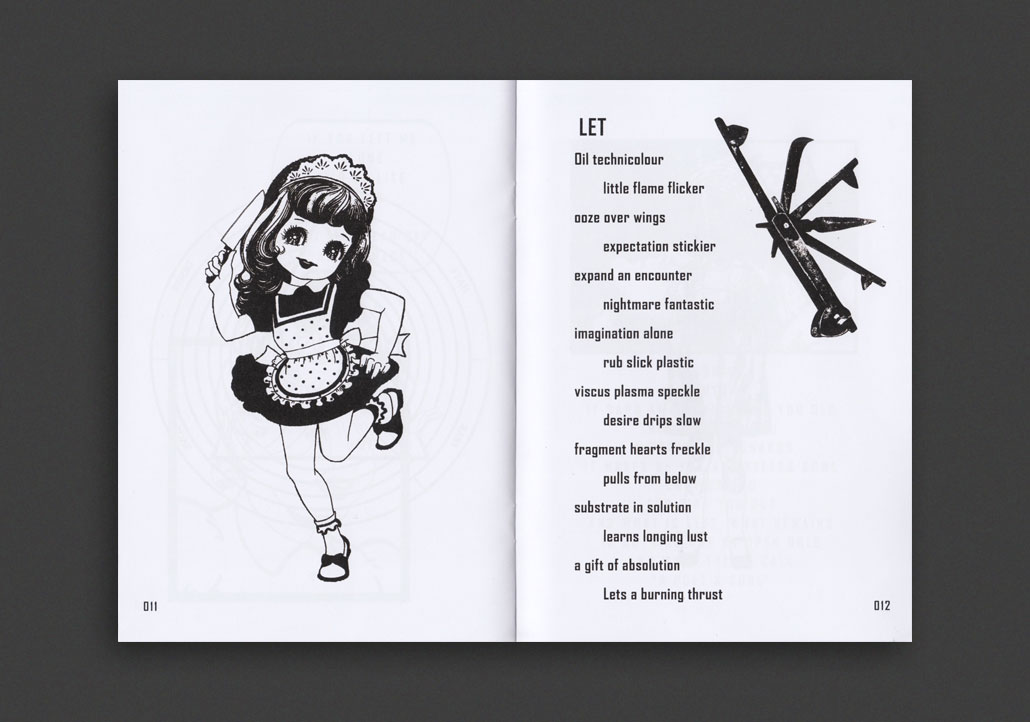
AGENDER AGENDA is the first poemzine produced by DEGROWTH COLLECTIVE, an art cult dedicated to the idea that decay the essential step we must first take into the circle which preserves us.
AGENDER AGENDA is an act of expression — that to destroy gender, colonialism, capitalism and punishment - we must first destroy these things in our self. It is a love letter to all those who have begun this process.
by ruth e pleasant, mercury violet, wren e pleasant, sky black