World Food Books' programme is largely produced on Kulin Nation land. We acknowledge the Wurundjeri people of the Kulin Nation as the first and continuing custodians of this land, and pay respect to their Elders past, present, and emerging.
World Food Books is an arts and special interests bookshop in Naarm / Melbourne. Founded in 2010, World Food Books is devoted to the presentation of a rotating, hand-selection of international art, design, literary and counterculture publications with an emphasis on the anti-traditional, the experimental, the avant-garde, the heretic, the marginal.
Presenting new titles alongside rare and out-of-print books, catalogues and journals spanning the fields of modern and contemporary art, design, photography, illustration, film, literature, poetry, cultural theory, philosophy, sexuality, popular and underground culture in its many radical forms, World Food Books wishes to encourage adventurous, thoughtful and open-minded reading, looking, writing, and exchange of publishing and ideas, both current and historical.
As well as our bookshop, located in Melbourne's historical Nicholas Building, all of our inventory is available internationally via our online mail-order service.
World Food Books semi-regularly co-ordinates "Occasions", a programme of exhibits and events at the bookshop and in partnership with other hosts (such as museums and art galleries) that develop out of the activities, relationships and content of the bookshop itself.
World Food Books
The Nicholas Building
37 Swanston Street
Room 5, Level 6
Melbourne 3000
Australia
SHOP HOURS:
THU–SAT 12–6
WEB-SHOP OPEN 24/7
World Food Books
Postal Address:
PO Box 435
Flinders Lane
Victoria 8009
Australia
info@worldfoodbooks.com
Art
Theory / Essay
Architecture / Interior
Graphic Design / Typography
Photography
Fashion
Eros
LGBTQ+
Fiction / Poetry
Weird / Speculative / Science Fiction / Horror
Transgressive / Visceral / Abject
Symbolism / Decadence / Fin de siècle
Film / Video
Painting
Sculpture / Installation
Performance / Dance / Theater
Drawing
Sound / Music
Curatorial
Group Shows / Collections
Periodicals
Out-of-print / Rare
Posters / Ephemera / Discs
Signed Books
World Food Books Gift Voucher
World Food Book Bag
Australian Art
Australian Fiction
Australian Science Fiction / Speculative Fiction
Australian Poetry
Australian Photography
Japanese Photography
Conceptual Art
Minimal Art
Dada
'Pataphysics / Oulipo
Fluxus
Concrete Poetry
Pop Art
Surrealism
Arte Povera
Arte Informale / Haute Pâte / Tachism
Nouveau Réalisme / Zero / Kinetic
Situationism / Lettrism
Collage / Mail Art / Xerox Art
Art Brut / Folk / Visionary / Fantastic
Illustration / Graphic Art / Bandes Dessinées
Furniture
Italian Radical Design / Postmodernism
Textiles
Ceramics / Glass
Counterculture
Protest / Revolt
Philosophy
Psychoanalysis
Anthropology
Anarchism
Socialism / Anarchism / Communism / Capitalism
Literary Theory / Semiotics / Language
Feminism / Women's Studies
Gender Studies / Sexuality
Anthropology
Fetishism / BDSM
Drugs / Psychedelia
Crime / Violence
Animal Rights / Veganism
Occult / Esoterica
Ecology / Earth / Alternative Living
Whole Earth / Crafts
All prices in AUD (Australian dollars)
Pick-Ups
Pick-up orders can be collected in our bookshop during opening hours after order date. Please collect any Pick-up orders within 2 weeks of ordering as we have limited storage space. Orders will be released back into stock if not collected within this time. No refunds can be made for pick-ups left un-collected. If you cannot make it in to the bookshop in this time-frame, please choose postage option.
Return Policy
All sales are final. We do accept returns (for refund or exchange) for items received in error. All our orders are packed with special care using heavy-duty padding and cardboard book-mailers or bubble mailers (for smaller books), using reinforcement where required. We cannot take responsibility for any lost, stolen or damaged parcels.
Insurance
Should you wish to insure your package, please email us directly after placing your order and we can organise this at a small extra expense. Although all standard/express tracked packages are very safe and dependable, we cannot take responsibility for any lost, stolen or damaged parcels. We recommend insurance on valuable orders.
Interested in selling your old books, catalogues, journals, magazines, comics, fanzines, ephemera? We are always looking for interesting, unusual and out-of-print books to buy. We only buy books in our fields of interest and specialty, and that we feel we can resell.
We base these prices on desirability, market value, in-print prices, condition and our current stock levels. We offer cash, store credit, and can take stock on consignment. All
about 25% of the price we expect to get when we sell them, or 30% in store credit. We base these prices on desirability, market value, in-print prices, condition and our current stock levels.
Sell your books any day of the week. You can drop them off and return later. If you have a lot of books, we can visit your Sydney home.
We buy books that we feel we can resell. We offer about 25 % of the price we expect to get when we sell them, or 30% in store credit. We base these prices on desirability, market value, in-print prices, condition and our current stock levels.
Philadelphia Wireman
03 August - 01 September, 2018
World Food Books is proud to announce our next Occasion, the first presentation of sculptures by Philadelphia Wireman in Australia.
The Philadelphia Wireman sculptures were found abandoned in an alley off Philadelphia’s South Street on trash night in 1982. Their discovery in a rapidly-changing neighbourhood undergoing extensive renovation, compounded with the failure of all attempts to locate the artist, suggests that the works may have been discarded after the maker’s death. Dubbed the "Philadelphia Wireman" during the first exhibition of this work, in 1985, the maker’s name, age, ethnicity, and even gender remain uncertain. The entire collection totals approximately 1200 pieces, all intricately bound together with tightly-wound heavy-gauge wire (along with a few small, abstract marker drawings, reminiscent both of Mark Tobey and J.B. Murry). The dense construction of the work, despite a modest range of scale and materials, is singularly obsessive and disciplined in design: a wire armature or exoskeleton firmly binds a bricolage of found objects including plastic, glass, food packaging, umbrella parts, tape, rubber, batteries, pens, leather, reflectors, nuts and bolts, nails, foil, coins, toys, watches, eyeglasses, tools, and jewellery.
Heavy with associations—anthropomorphic, zoomorphic, and socio-cultural responses to wrapped detritus—the totemic sculptures by Philadelphia Wireman have been discussed in the context of work created to fulfil the shamanistic needs of alternative religions in American culture. Curators, collectors, and critics have variously compared certain pieces to sculpture from Classical antiquity, Native American medicine bundles, African-American memory jugs, and African fetish objects. Reflecting the artist’s prolific and incredibly focused scavenging impulse, and despite—or perhaps enhanced by—their anonymity, these enigmatic objects function as urban artefacts and arbiters of power, though their origin and purpose is unknown. Philadelphia Wireman, whatever their identity, possessed an astonishing ability to isolate and communicate the concepts of power and energy through the selection and transformation of ordinary materials. Over the course of the past two decades, this collection has come to be regarded as an important discovery in the field of self-taught art and vernacular art.
Presented in collaboration with Fleisher-Ollman Gallery, Philadelphia, and Robert Heald, Wellington.
Susan Te Kahurangi King
02 February - 10 March, 2018
Susan Te Kahurangi King (24 February 1951 - ) has been a confident and prolific artist since she was a young child, drawing with readily available materials - pencils, ballpoint pens and felt-tip markers, on whatever paper is at hand. Between the ages of four and six Susan slowly ceased verbal communication. Her grandparents William and Myrtle Murphy had developed a special bond with Susan so they took on caring responsibilities for extended periods. Myrtle began informally archiving her work, carefully collecting and storing the drawings and compiling scrapbooks. No drawing was insignificant; every scrap of paper was kept. The King family are now the custodians of a vast collection containing over 7000 individual works, from tiny scraps of paper through to 5 meter long rolls.
The scrapbooks and diaries reveal Myrtle to be a woman of great patience and compassion, seeking to understand a child who was not always behaving as expected. She encouraged Susan to be observant, to explore her environment and absorb all the sights and sounds. Myrtle would show Susan’s drawings to friends and people in her community that she had dealings with, such as shopkeepers and postal workers, but this was not simply a case of a grandmother’s bias. She recognised that Susan had developed a sophisticated and unique visual language and sincerely believed that her art deserved serious attention.
This was an unorthodox attitude for the time. To provide some context, Jean Dubuffet coined the term Art Brut in 1945 to describe work created by self-taught artists – specifically residents of psychiatric institutions and those he considered to be visionaries or eccentrics. In 1972 Roger Cardinal extended this concept by adopting the term Outsider Art to describe work made by non-academically trained artists operating outside of mainstream art networks through choice or circumstance. Susan was born in Te Aroha, New Zealand in 1951, far from the artistic hubs of Paris and London that Dubuffet and Cardinal operated in. That Myrtle fêted Susan as a self-taught artist who deserved to be taken seriously shows how progressive her attitudes were.
Susan’s parents Doug and Dawn were also progressive. Over the years they had consulted numerous health practitioners about Susan’s condition, as the medical establishment could not provide an explanation as to why she had lapsed into silence. Dawn educated herself in the field of homeopathy and went on to treat all twelve of her children using these principles – basing prescriptions on her observations of their physical, mental and emotional state.
Doug was a linguist with an interest in philosophy who devoted what little spare time he had to studying Maori language and culture. To some extent their willingness to explore the fringes of the mainstream made them outsiders too but it was their commitment to living with integrity and their respect for individuality that ensured Susan’s creativity was always encouraged.
Even though Susan’s family supported her artistic pursuits, some staff in schools and hospitals saw it as an impediment to her assimilation into the community and discouraged it in a variety of ways. Her family was not always aware of this and therefore did not fully understand why Susan stopped drawing in the early 1990s. However, rather than dwell on the challenges that Susan faced in pursuit of her artistic practice, they prefer to highlight her achievements. In 2008 Susan began drawing again in earnest, after an almost 20 year interruption, and her work is now shown in galleries around the world.
Susan grew up without television and has been heavily influenced by the comics she read as a child. She is absolutely fearless in the appropriation of recognizable characters, such as Donald Duck and Mickey Mouse, in her work. She twists their limbs, contorts their faces, compresses them together, blends them into complex patterned backgrounds - always imbuing them with an incredible energy. Although Susan often used pop culture characters in her work they are not naive or childlike. These are drawings by a brilliant self-taught artist who has been creating exceptional work for decades without an audience in mind.
Mladen Stilinović
"Various Works 1986 - 1999"
02 February 16 - September 10, 2016
Various works 1986 - 1999, from two houses, from the collections of John Nixon, Sue Cramer, Kerrie Poliness, Peter Haffenden and Phoebe Haffenden.
Including: Geometry of Cakes (various shelves), 1993; Poor People’s Law (black and white plate), 1993; White Absence (glasses, ruler, set square, silver spoon, silver ladel with skin photograph and wooden cubes), 1990-1996; Exploitation of the Dead (grey and red star painting, wooden painting, black spoon with red table, red plate), 1984-1990; Money and Zeros (zero tie, paintings made for friends in Australia (Sue, John, Kerrie), numbers painting), 1991-1992; Words - Slogans (various t-shirts) - “they talk about the death of art...help! someone is trying to kill me”, “my sweet little lamb”, “work is a disease - Karl Marx”; Various artist books, catalogues, monographs, videos; Poster from exhibition Insulting Anarchy; "Circular" Croatian - Australian edition; Artist book by Vlado Martek (Dostoyevsky); more.
Thanks to Mladen Stilinović and Branka Stipančić.
Jonathan Walker
Always Will Need To Wear Winter Shirt Blue + Ochre Small Check Pattern
21 August - 21 September, 2015
Untitled
I am not a great reader of poetry but I always return to the work of Melbourne poet, Vincent Buckley (1925- 1988). Perhaps I find his most tantalising piece to be not a finished poem but a fragment left on a scrap of paper discovered on his desk after the poet’s death.
The poetry gathers like oil
In the word-core, and spreads
It has its music meet,
Its music is in movement.
This fragment is more the shell left behind from a volatile thought than a finished poem. I find the last two lines honest but awkward whereas the first two lines work like an arrow. Most likely he could not find a resolution so it was left. Still, in its present form, it remains an eloquent testimony to the ultimate failure of a medium to express mobile thought and sensation, in Buckley’s case, through verbal language. It’s an important matter because this is something all artists have to deal with regardless of the medium.
I have never written a poem, however, I am forever copying fragments from books on paper scraps in a vain effort to fix certain notions in my head. At first, they function as bookmarks that are sometimes returned to when I open the book. But before long, as they accumulate, they fall out littering the table interspersed with A4 photocopies, bills, books and medications.
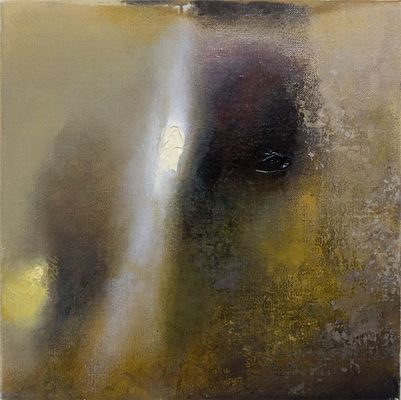
To return to Buckley’s fragment, the first two lines very much evoke how I paint nowadays. As you age, detail diminishes and patches of light become more luminous and float. I feel the most honest way of dealing with this is by smearing the oil paint on the canvas with the fingers and working close-up, blind. Only if the patches coalesce into an approaching image can the work gain a life.
-
Jonathan Walker was born in Melbourne, Australia and brought up on a dairy farm in Gippsland. In the 1970’s he studied painting at RMIT and won the Harold Wright Scholarship to the British Museum, London. During the 1980’s he exhibited at Pinacotheca Gallery, Richmond and had work shown at the NGV and Heidi City Art Gallery. Over the same period he designed the cover for the “Epigenesi” LP by Giancarlo Toniutti, Italy and conducted a mail exchange work with Achim Wollscheid, Germany. The work with artists through the post resulted in an article published in the bicentenary issue of Art and Australia 1988. He showed in artist run spaces such as WestSpace in the 90’s and 2000’s, and until 2012, taught painting at Victoria University, which is where we (Colleen Ahern and Lisa Radford) as organisers of the exhibition, among many others, had the privilege of being his student.
Walker’s knowledge was imparted to students through the careful selection of music, literature, and artists found in books that he himself had ordered for the library. Walker’s strategy was the generosity of sharing his vast knowledge with references specific to each student and their context.
Walker’s paintings share a similar focus and intimacy.
This exhibition presents a small selection of recent paintings alongside a publication that includes Walker’s writing. Observational and analytical, Walker’s work is a type of material notation — the time of day, colour and how it is blended, the both specific and fleeting location of a reflection on lino or the question of whether a chair leg should be included in a painting.
Please join us on Friday August 21 between 6-8pm to celebrate the opening of the exhibition.
Curated by Colleen Ahern and Lisa Radford.
B. Wurtz
Curated by Nic Tammens
March 26 - April 4, 2015
B.Wurtz works from a basement studio in his home on Manhattan’s Lower East Side.
This local fact is attested to by the plastic shopping bags and newsprint circulars that appear in his work. As formal objects, they don’t make loud claims about their origins but nonetheless transmit street addresses and places of business from the bottom of this long thin island. Like plenty of artists, Wurtz is affected by what is local and what is consumed. His work is underpinned by this ethic. It often speaks from a neighborhood or reads like the contents of a hamper:
“BLACK PLUMS $1.29 lb.”
“Food Bazaar”
“USDA Whole Pork Shoulder Picnic 99c lb.”
“RITE AID Pharmacy, with us it’s personal.”
“H. Brickman & Sons.”
“Sweet Yams 59c lb."
Most of the work in this exhibition was made while the artist was in residence at Dieu Donne, a workshop dedicated to paper craft in Midtown. Here Wurtz fabricated assemblages with paper and objects that are relatively lightweight, with the intention that they would be easily transportable to Australia. This consideration isn’t absolute in Wurtz’s work, but was prescriptive for making the current exhibition light and cheap. Packed in two boxes, these works were sent from a USPS post office on the Lower East Side and delivered to North Melbourne by Australia Post.
Wurtz appears courtesy of Metro Pictures, New York.
Thanks to Rob Halverson, Joshua Petherick, Sari de Mallory, Matt Hinkley, Helen Johnson, Fayen d'Evie, Ask Kilmartin, Lisa Radon, Ellena Savage, Yale Union, and "Elizabeth".
John Nixon
"Archive"
December 15 - January 20, 2014
The presentation of John Nixon's archive offered a rare showcase of this extensive collection of the artist's own publications, catalogues, posters, ephemera, editions and more, from the mid 1980s onwards, alongside a selection of his artworks.
Organized by John Nixon, Joshua Petherick and Matt Hinkley.
"Habitat"
at Minerva, Sydney (organised by Joshua Petherick and Matt Hinkley)
November 15 - December 20, 2014
Lupo Borgonovo, Janet Burchill & Jennifer McCamley,
Lewis Fidock, HR Giger, Piero Gilardi, Veit Laurent Kurz,
Cinzia Ruggeri, Michael E. Smith, Lucie Stahl, Daniel Weil, Wols
Press Release:
“...It contained seven objects. The slender fluted bone, surely formed for flight, surely from the wing of some large bird. Three archaic circuitboards, faced with mazes of gold. A smooth white sphere of baked clay. An age-blackened fragment of lace. A fingerlength segment of what she assumed was bone from a human wrist, grayish white, inset smoothly with the silicon shaft of a small instrument that must once have ridden flush with the surface of the skin - but the thing’s face was seared and blackened.”
William Gibson, “Count Zero”, 1986
"Autumn Projects Archive"
Curated by Liza Vasiliou
March 6 - March 15, 2014
World Food Books, in conjunction with the Virgin Australia Melbourne Fashion Festival 2014, presented the Autumn Projects archive, consisting of a selection of early examples in Australian fashion with a particular interest in collecting designers and labels from the period beginning in the 1980’s, who significantly influenced the discourse of Australian Fashion.
Curated by Liza Vasiliou, the exhibition provided a unique opportunity to view pieces by designers Anthea Crawford, Barbara Vandenberg, Geoff Liddell and labels CR Australia, Covers, Jag along with early experimental collage pieces by Prue Acton and Sally Browne’s ‘Fragments’ collection, suspended throughout the functioning World Food Books shop in Melbourne.
H.B. Peace
presented by CENTRE FOR STYLE
November 14, 2013
"Hey Blinky, you say chic, I say same"
Anon 2013
H.B. Peace is a clothing collaboration between great friends Blake Barns and Hugh Egan Westland. Their pieces explore the divergences between 'character’ and ‘personality’ in garments....etc
Special Thanks to Joshua Petherick and Matt Hinkley of WFB and Gillian Mears
and a Very Special Thank you to Audrey Thomas Hayes for her shoe collaboration.
Janet Burchill & Jennifer McCamley
"Aesthetic Suicide"
May 10 - June 8, 2013
The first of our occasional exhibitions in the World Food Books office/shop space in Melbourne, "Aesthetic Suicide" presented a body of new and older works together by artists Janet Burchill & Jennifer McCamley, including videos, prints, a wall work, and publications.
During shop open hours videos played every hour, on the hour.
1974, Japanese
Hardcover (cloth-bound w. original illustrated card box and dust jacket) 160 pages, 21 x 21.6
1st Edition, Out of print title / used / very good
$140.00 - In stock -
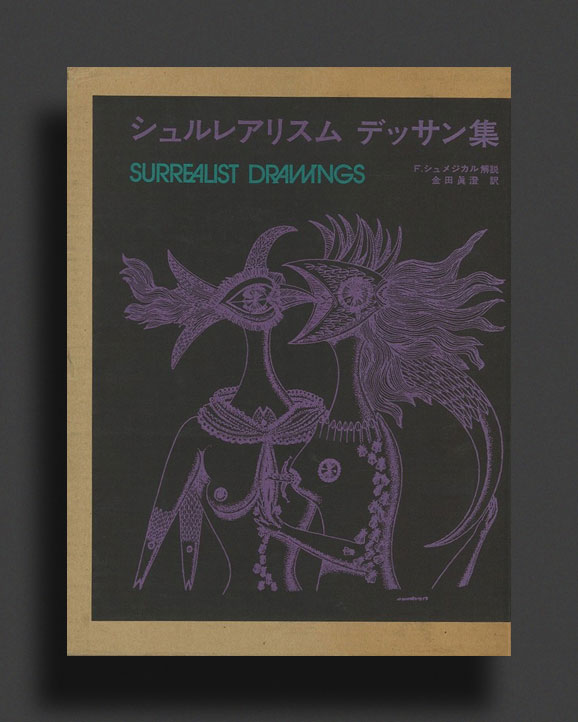
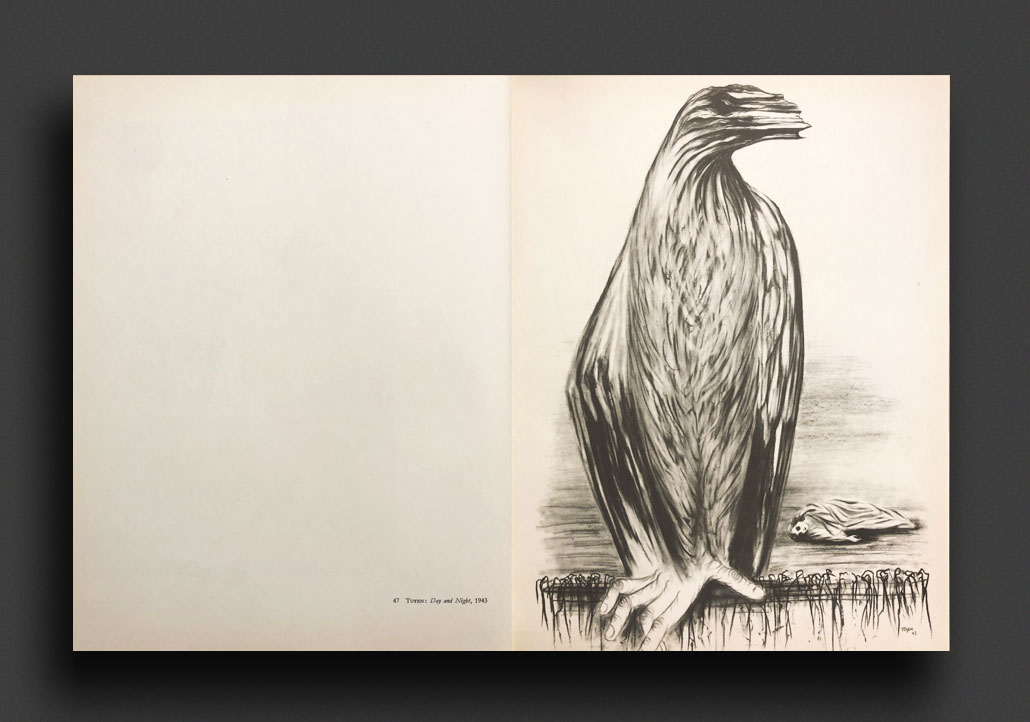
Stunning boxed first printing of the Japanese edition of "Surrealist Drawings" by František Šmejkal, printed and bound in cloth-covers in Japan in 1973. A beautiful clothbound hardcover folio of drawings by artists affiliated with Surrealism. What makes this lovely collection special is the inclusion of many of the Czech Surrealists, and a generally broad European scope of artists. Czech art historian František Šmejkal has collated a wonderful selection of works on paper by Toyen, Jindřich Štyrský, Wolfgang Paalen, Giorgio de Chirico, Hans Bellmer, Alfred Kubin, Francis Picabia, Jacques Hérold, Yves Tanguy, Man Ray, Josef Istler, Max Ernst, André Breton, František Muzika, Paul Delvaux, Wilfredo Lam, Richard Oelze, Mikuláš Medek, Joan Miró, Josef Sima, Kurt Seligmann, Odilon Redon, Andre Masson, Max Walter Svanberg, Salvador Dali, Arshile Gorky, Victor Brauner, Rene Magritte, and many more.
Very Good copy in original slipcase and plastic jacket over cloth. Almost Fine, but with corner bumping to top.
1996, English
Softcover, 354 pages, 25.4 x 20.4 cm
1st Edition, Out of print title / used / very good
Published by
Cambridge University Press / Cambridge
$55.00 - In stock -
First 1996 edition.
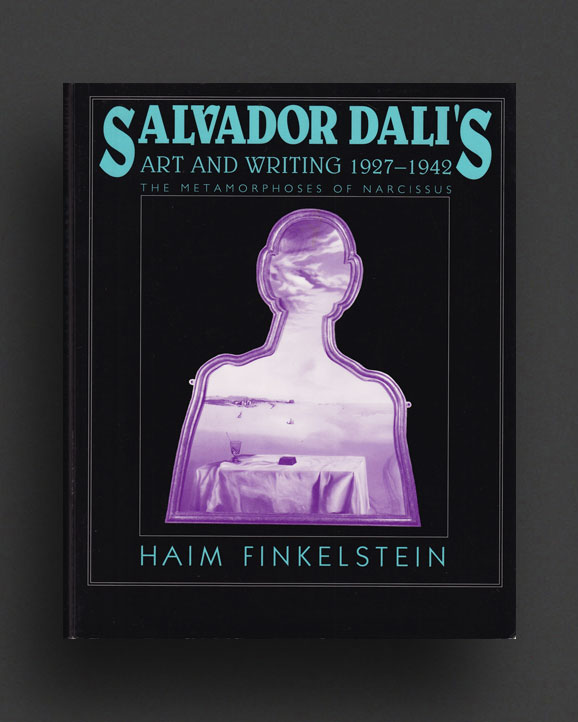
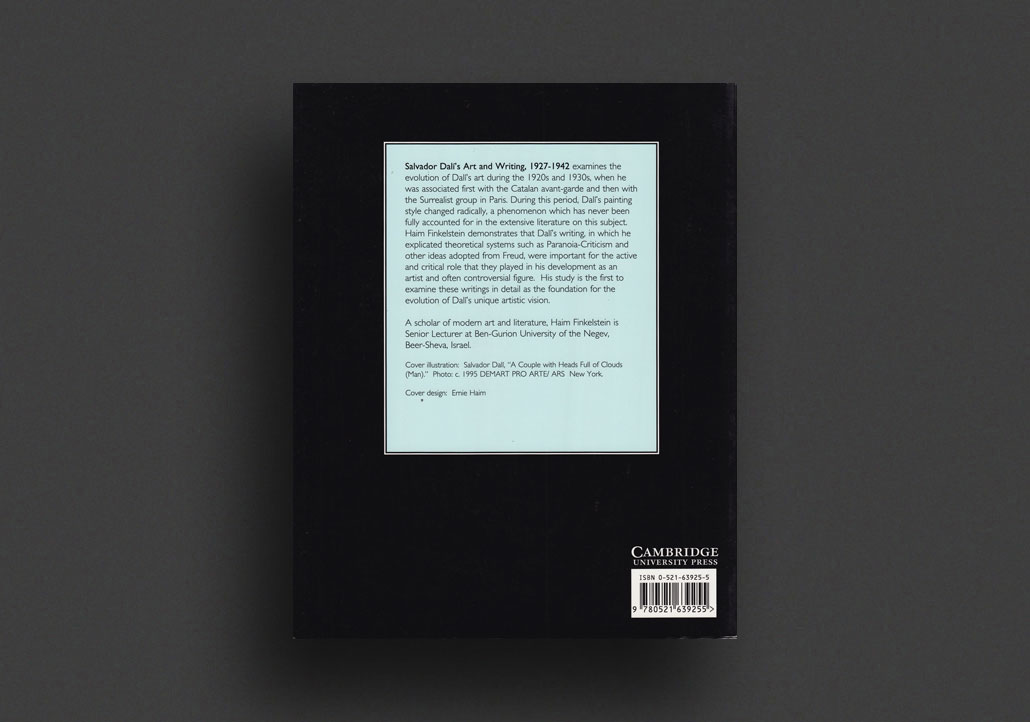
This book examines the evolution of Dalí's art during the 1920s and 1930s when he was associated first with the Catalan avant-garde and then with the Surrealist group in Paris. During this period, Dalí's painting style changed radically, a phenomenon which has never been fully accounted for in the extensive literature on this subject. Haim Finkelstein demonstrates that Dalí's writing, in which he explicated theoretical systems such as Paranoia-Criticism and other ideas adopted from Freud, were important for the active and critical role that they played in his development as an artist and often controversial figure. His 1996 study examines these writings in detail as the foundation for the evolution of Dalí's unique artistic vision.
' … this exuberant, well-focused study charts the metamorphosis of an unsure, neurotic Catalan painter into a dynamic, neurotic internationally famous (ex)-Surrealist.' Art Newspaper
'… certainly one of the better books on Dalí I have encountered … the text is an excellent exposition of what was within Dalí's horizon of expectations almost moment by moment. In this respect, the book is exemplary, going well beyond the tendency towards generalisation apparent in almost every other book-length work on the artist.' British Journal of Aesthetics
VG copy, light wear to extremities.
1992, English
Softcover, 280 pages, 20.5 x 15 cm
Published by
Exact Change / Boston
$38.00 - In stock -
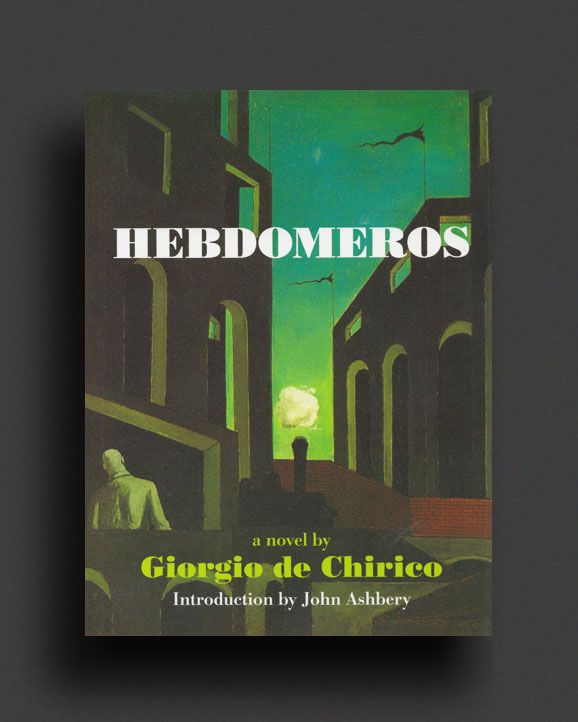
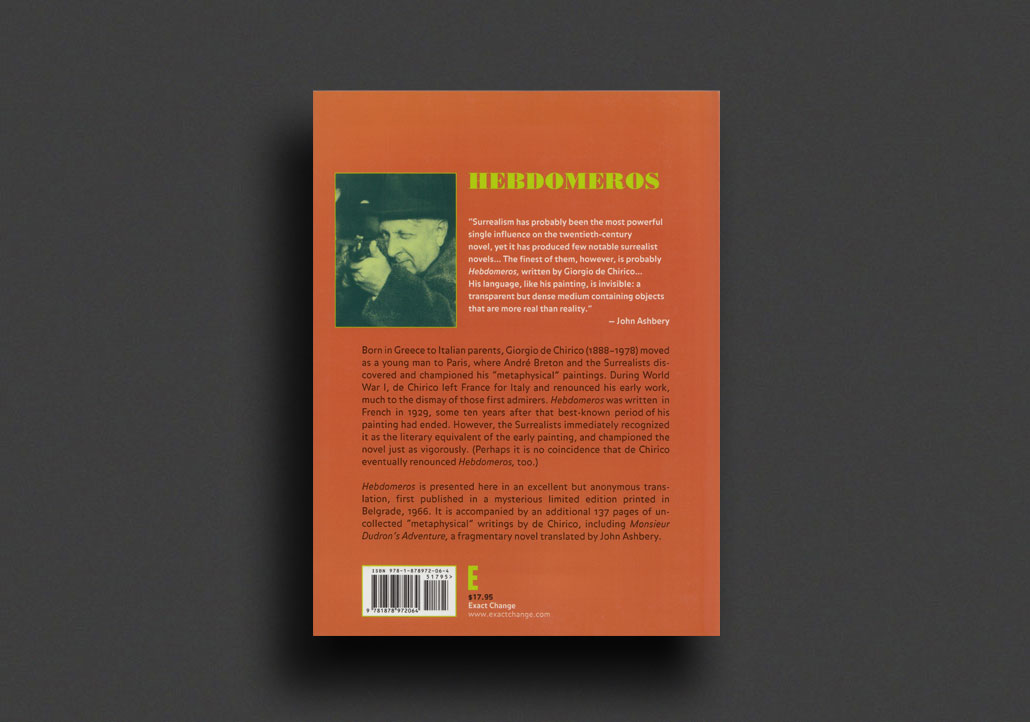
The artist Giorgio de Chirico's novel, Hebdomeros is a dream-like book of situations and landscapes reminiscent of his paintings. In his introduction John Ashbery calls the book "the finest work of Surrealist fiction", noting that de Chirico "invented for the occasion a new style and a new kind of novel... his long run-on sentences, stitched together with semi-colons, allow a cinematic freedom of narration... his language, like his painting, is invisible: a transparent but dense medium containing objects that are more real than reality." Hebdomeros is accompanied by an appendix of previously untranslated or uncollected writings, including M. Dudron's Adventure, a second, fragmentary novel translated by John Ashbery.
1995, English
Softcover, 244 pages, 24.5 x 17 cm
1st Edition, Out of print title / used / average
Published by
Creation Books / London
$45.00 - Out of stock
HELL ON EARTH!
First 1995 Edition.
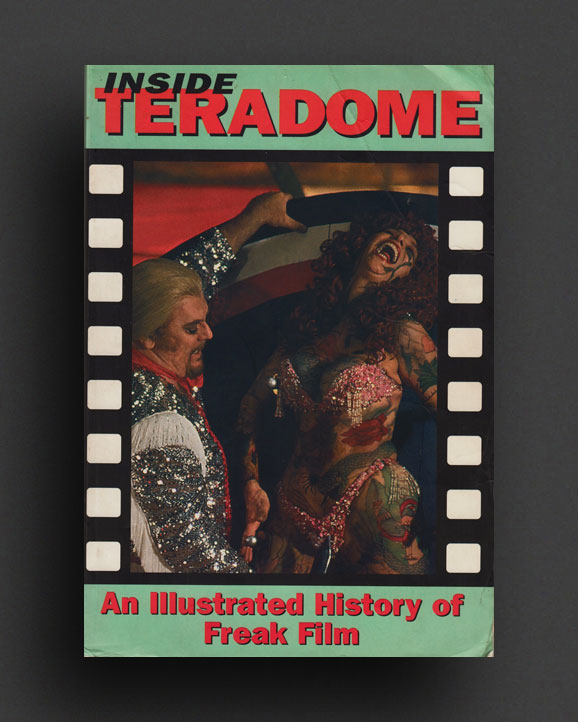
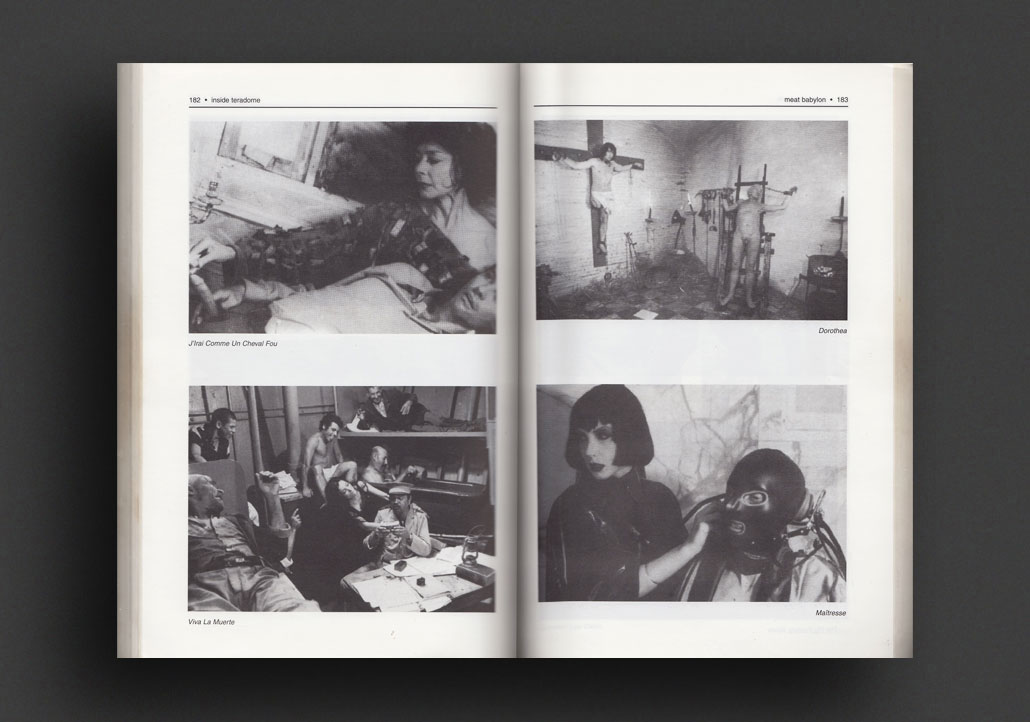
From the Roman games to American travelling carnivals, freakshows - human anomalies presented for spectacle - have flourished throughout recorded history. The birth of the movies provided a further outlet for these displays, which in turn led to a peculiar strain of bizarre cinema: Freak Film.
Inside Teradome is a comprehensive, fully illustrated guide to the roots and development of this fascinating, often disturbing cinematic genre.
Including:
A brief history of teratology; freaks in myth and medicine.
The history of freakshows, origins of cinema.
Influence of sideshows on cinema.
Use of human anomalies in cinema.
Freaks and geeks.
Bizarre cinema: mutilation and other fetishes.
Illustrated filmography; index.
From the pioneering illusions of Georges Méliès and the Expressionist distortions of Dr Caligari, the surgical horrors of Mad Love and real-life grotesqueries of Tod Browning's Freaks, to the modern nightmare visions of Texas Chainsaw Massacre, Eraserhead, and Santa Sangre, Inside Teradome reveals a twisted thread of voyeuristic sickness running not only through cinema, but through the society of which it has always been the most telling barometer.
WARNING: CONTAINS ADULT MATERIAL
Average copy with wear to corners and edges, creasing.
2008, English
Softcover, 150 pages, 23 x 15.5 cm
Published by
Solar Books / US
$45.00 - In stock -
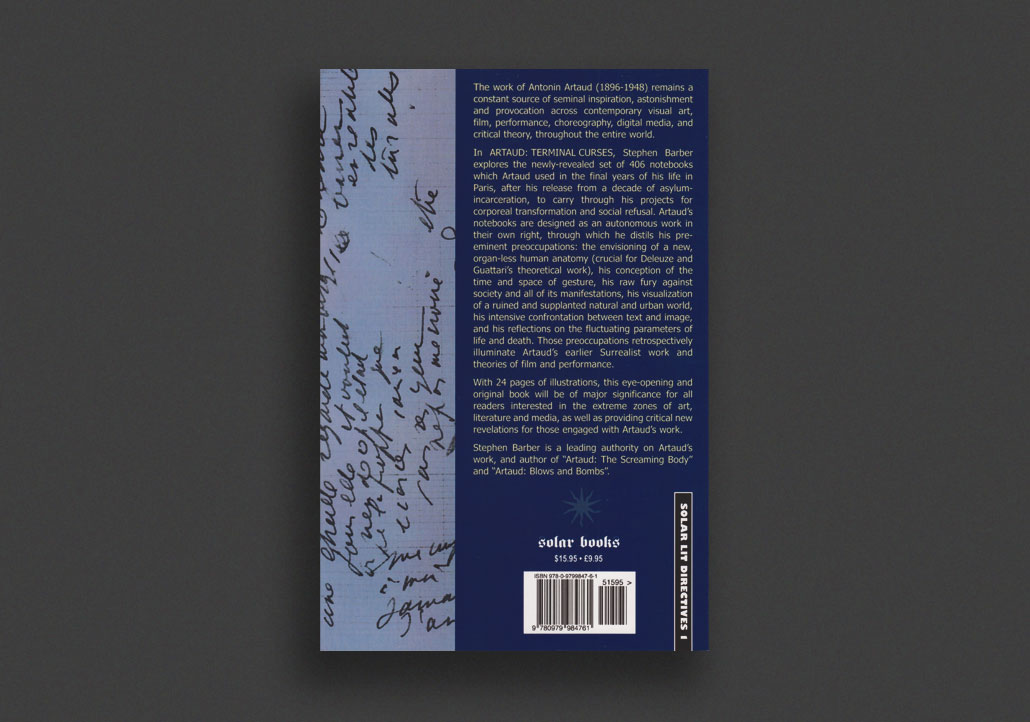
The work of Antonin Artaud (1896-1948) remains a constant source of seminal inspiration, astonishment and provocation across contemporary visual art, film, performance, choreography, digital media, and critical theory, throughout the entire world.
In Artaud: Terminal Curses, Stephen Barber explores the newly-revealed set of 406 notebooks which Artaud used in the final years of his life in Paris, after his release from a decade of asylum-incarceration, to carry through his projects for corporeal transformation and social refusal. Artaud’s notebooks are designed as an autonomous work in their own right, through which he distils his preeminent preoccupations: the envisioning of a new, organ-less human anatomy (crucial for Deleuze and Guattari’s theoretical work), his conception of the time and space of gesture, his raw fury against society and all of its manifestions, his visualization of a ruined and supplanted natural and urban world, his intensive confrontation between text and image, and his reflections on the fluctuationg parameters of life and death. Those preoccupations retrospectively illuminate Artaud’s earlier Surrealist work and theories of film and performance.
With 24 pages of illustrations, this eye-opening and original book will be of major significance for all readers interested in the extreme zones of art, literature and media, as well as providing critical new revelations for those engaged with Artaud’s work.
1999, English
Softcover, 128 pages, 24 x 18 cm
1st Edition, Out of print title / used / good
Published by
Creation Books / London
The Tears Corporation / London
$40.00 - Out of stock
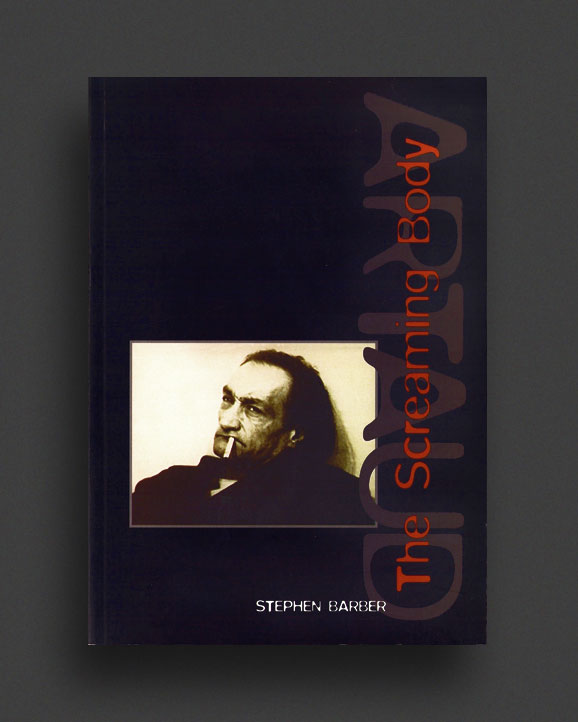
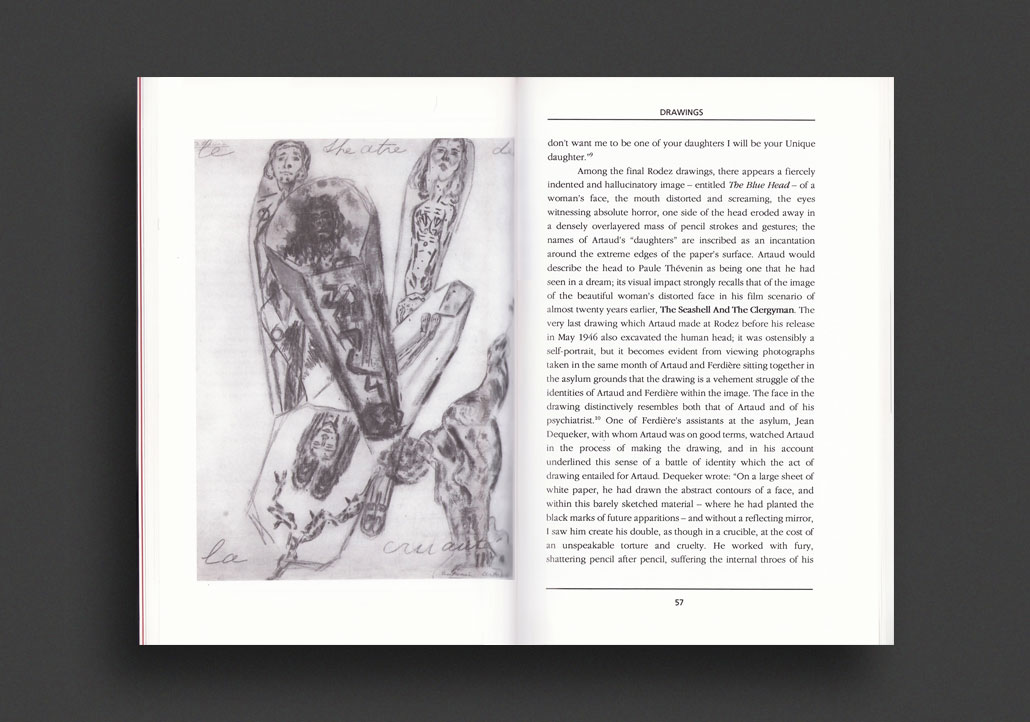
Antonin Artaud (1896-1948) remains the most inspirational, provocative and challenging figure in world-wide contemporary culture. His trajectory extends from the Surrealist movement, to the Theatre of Cruelty, to the lunatic asylums of France, and finally back to Paris and the most astonishing period of his work.
For the first time, the book gives a full and authoritative account of Artaud's film projects, and his conception of Surrealist cinema. It examines his unique series of drawings of the fragmented human body, begun in the ward of a lunatic asylum and finished in a state of furious liberation. Finally, the book captures Artaud's ultimate experiment with the screaming body in the form of his censored recording To Have Done With The Judgement Of God - an experiment which is unprecedented in the history of art, and which ultimately decimates that history.
The Screaming Body is an essential resource and inspiration for those engaged in creating the definitive culture of our time, in film, art, music and writing.
Good copy, some wear to cover otherwise VG throughout rest.
2015, English
Softcover (french-folds), 608 pages, 24 x 17 cm
Published by
Ridinghouse / London
$65.00 - In stock -
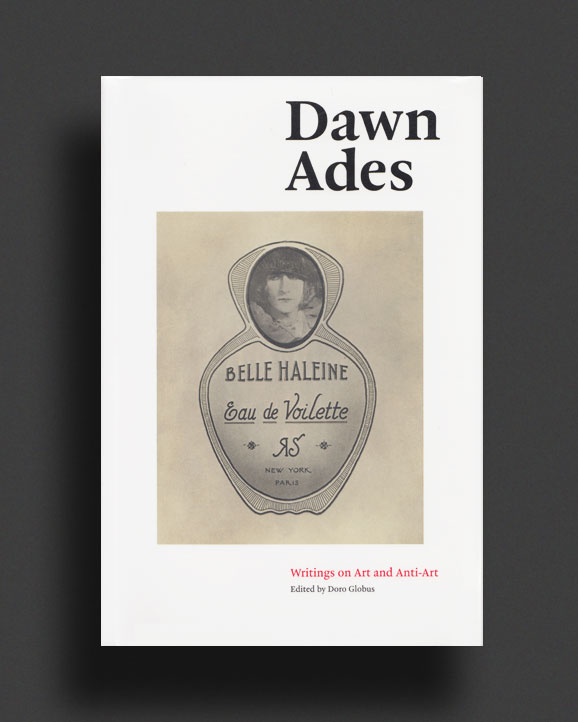
Art historian and curator Dawn Ades is a leading voice on Dada, Surrealism, abstraction and art from Latin America. Ades addresses themes fundamental to the history of modern art and the avant-garde, across time periods and art movements, from Europe to the Americas. She offers alternative readings and investigates the particular dynamics that affect the ways images and objects are produced, presented and received.
With topics ranging from close-up photography to the female subject in Mexico, and from automatism to photomontage, as well as monographic essays on artists such as Francis Bacon, Salvador Dali, Marcel Duchamp and Hannah Hoch, this collection explores major figures of the twentieth century as well as art beyond the canon. The selected writings are divided into sections that correspond to the overarching concerns of gender, identity, the impact of new mediums and the enduring significance of the materials of art.
2023, English
Softcover, 184 pages, 23.6 x 15.7 cm
Published by
Oxford University Press / New York
$98.00 - In stock -
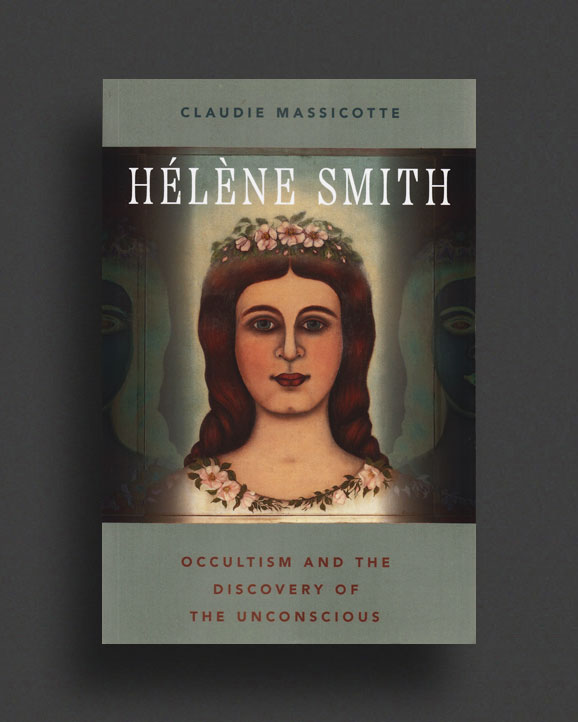
This work follows the story of an exceptional medium whose performances of possession in the nineteenth and twentieth centuries influenced some of the most renowned scientists and artists of her time. Hélène Smith’s creation of languages, performances of celestial scenes, and paintings of spiritual visions came to embody the extreme possibilities of a new form of subjectivity. Among many other scholars, psychologist Théodore Flournoy, linguist Ferdinand de Saussure, and surrealist artist André Breton spent years interpreting her marvelous experiences in secular terms, highlighting the complex facets of a deeply creative unconscious. In retracing their encounters, this book sheds new light on the role of women in the history of depth psychology, demonstrating that studies of spiritual mediums forged an unconscious different from the now well-known studies of hysterics. In illuminating Smith’s contributions to evolving understandings of the subject during a period understood by many as one of secularization, the book also demonstrates how female embodiment became a crucial locus for the conceptualization of disenchantment in the modern world.
"This book is a rich, sensitive, and thought-provoking work that sheds new light on the role of female mediums and patients in the construction of psychological discourses. As Massicotte points out, Hélène Smith was not only a gifted medium, but also an active and creative contributor to contemporary scientific theories on the unconscious. This is an accurate and engaging account of the story of this extraordinary woman, her influence on scientists and artists, and her indispensable role in the history of psychology."—Júlia Gyimesi, Head of Department, Department of Personality and Clinical Psychology, Pázmány Péter Catholic University
"During her career as a medium in the late nineteenth century, Hélène Smith wrote poems, invented languages, developed herself as all-round artist, and even travelled—in her astral body—to other planets. Now, this example of female creativity, who lived at a time when only men were considered geniuses, is finally getting the spotlight she deserves. Massicotte's thoughtful study of this surrealist role model contributes significantly to the histories of psychoanalysis and of modern occultism. Telling Smith's story, it also sheds light on the gender dynamics at play in the modern discovery of the unconscious and the complexity of authorship both overcome and deepened, paradoxically, by creative women mediums."—Tessel M. Bauduin, author of Surrealism and the Occult: Occultism and Western Esotericism in the Work and Movement of André Breton
"This book will be of importance to anyone interested in the history of psychology and the way psychological theories both reflect and impact the way we view the universe and the creatures in it—especially women."—Allison P. Coudert, Nova Religio
"This agile volume is a nice addition to the ever-growing corpus of research on "Western Esotericism" and its entanglement with modern identity formation."—Davide Marino, Religious Studies Review
1999, English
Softcover, 280 pages, 23.2 x 16.6 cm
1st Edition, Out of print title / used / very good
Published by
University of California Press / Berkley
$40.00 - In stock -
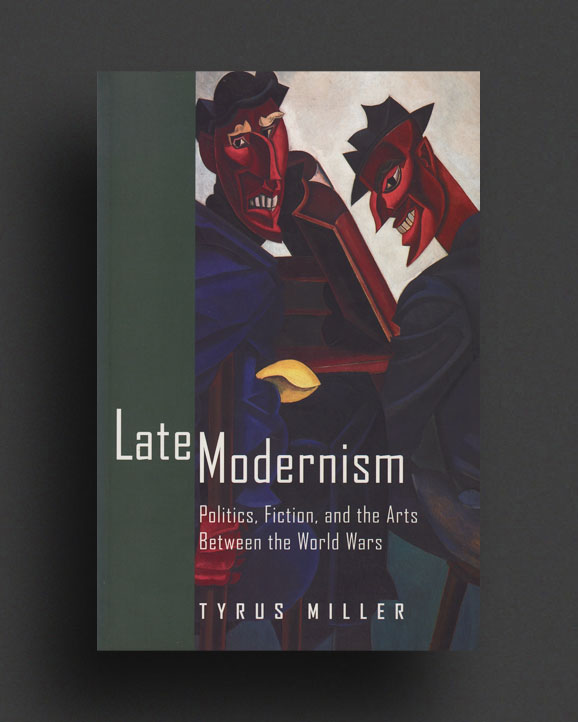
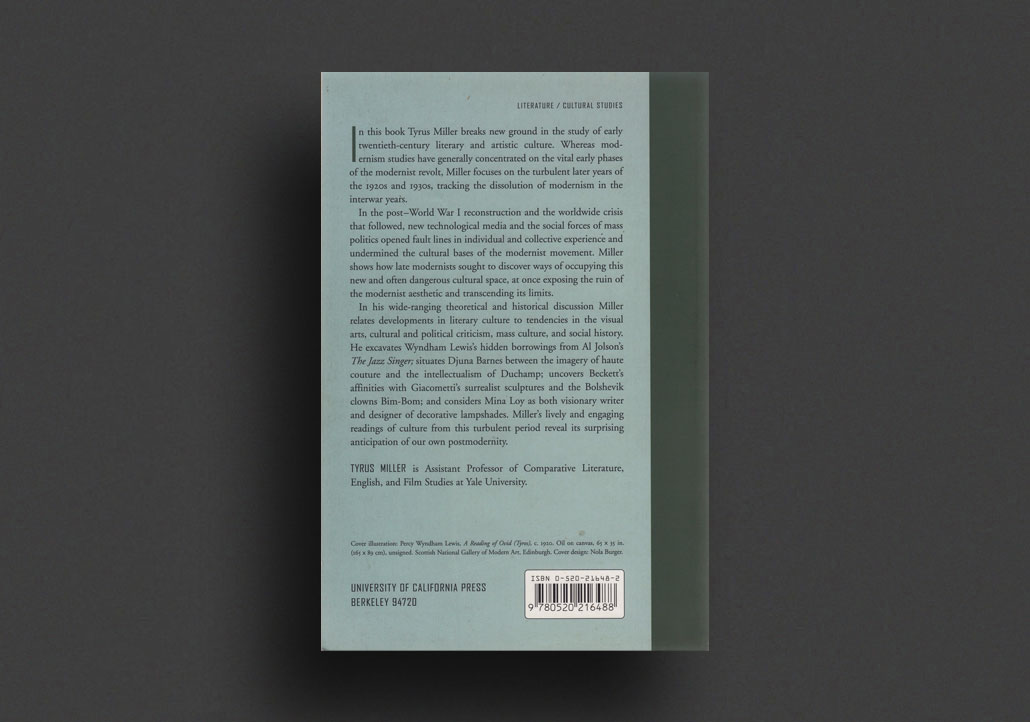
Tyrus Miller breaks new ground in this study of early twentieth-century literary and artistic culture. Whereas modernism studies have generally concentrated on the vital early phases of the modernist revolt, Miller focuses on the turbulent later years of the 1920s and 1930s, tracking the dissolution of modernism in the interwar years.
In the post-World War I reconstruction and the worldwide crisis that followed, Miller argues, new technological media and the social forces of mass politics opened fault lines in individual and collective experience, undermining the cultural bases of the modernist movement. He shows how late modernists attempted to discover ways of occupying this new and often dangerous cultural space. In doing so they laid bare the ruin of the modernist aesthetic at the same time as they transcended its limits.
In his wide-ranging theoretical and historical discussion, Miller relates developments in literary culture to tendencies in the visual arts, cultural and political criticism, mass culture, and social history. He excavates Wyndham Lewis's hidden borrowings from Al Jolson's The Jazz Singer; situates Djuna Barnes between the imagery of haute couture and the intellectualism of Duchamp; uncovers Beckett's affinities with Giacometti's surrealist sculptures and the Bolshevik clowns Bim-Bom; and considers Mina Loy as both visionary writer and designer of decorative lampshades. Miller's lively and engaging readings of culture in this turbulent period reveal its surprising anticipation of our own postmodernity.
VG copy, first ed.
1964 , French
Hardcover, 192 pages, 30.5 x 24.5 cm
1st Edition, Out of print title / used / very good
Published by
Pont Royal Del Duca - Laffont
Paris
$100.00 - Out of stock
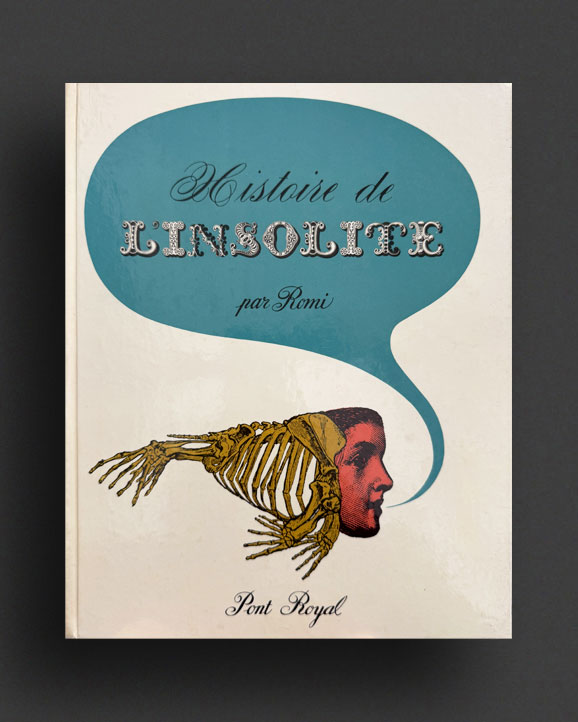
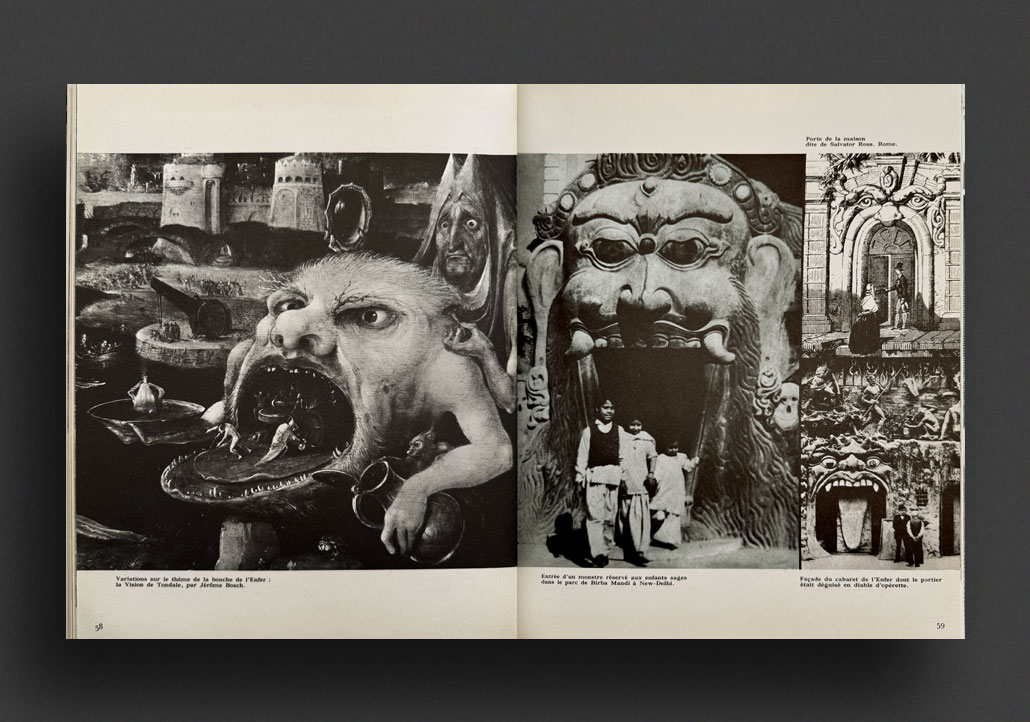
First 1964 hardcover edition of Histoire de l'insolite (History of the Unusual) by Romi. Preface by Philippe Soupault, artistic design by Pierre Chapelot. An incredible visual survey of the weird and wonderful from the history of occultism to the absurd, the cabinet of curiosities to the voyages of science fiction, demonology to psychosis, the Fin de siècle, Futurists, Surrealists, Dadaists, Pataphysicians, the visionaries, the mediums, the curios, the macabre, the bizarre. Profusely illustrated in mono and duotone with many pasted-in lush colour plates, this is a beautiful visual reference of the fantastic throughout history. Chapters include (translated from French): The Sources of the Unusual - A Legendary Bestiary - Fantastic Voyages - The Design to Surprise - Unusual Enterprises, featuring Alfred Jarry, Giuseppe Arcimbaldo, P.T. Barnum, Edward Lear, Hélène Smith, Raymond Roussel, Alessandro Cagliostro, Stanislao Lepri, Hieronymus Bosch, Ferdinand Cheval, and hundreds of other artists, poets, mystics and unknowns. With a preface by none other than Surrealist founder, Dadaist, writer, poet, novelist, critic, political activist, Philippe Soupault (1897-1990).
Very Good copy, highly recommended.
2004, English
Softcover, 83 pages, 23 x 16 cm
Published by
Graywolf Press / Minneapolis
$38.00 - Out of stock
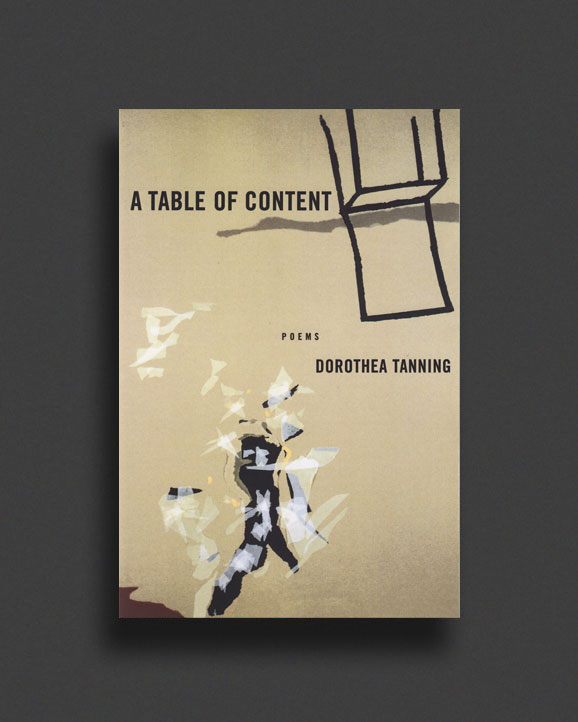
The extraordinary first poetry collection by the renowned painter and sculptor Dorothea Tanning
Finally, on second, in bras. Bras swarming everywhere,
giant pink moths at rest, their empty cups clamoring,
"Fill me."
—from "End of the Day on Second"
Dorothea Tanning is an exceptional visual artist, and now, in her nineties, she has become an exceptional poet. In A Table of Content, we are made to see more clearly the city landscape, the creative impulse, and the worlds of potential disaster and sensual erotics with a vision that survives taste, trend, and time.
"Some would call these poems collages, finery glued into dreamy images. But I prefer to call the whole of them a kaleidoscope-angled feelings and dappled ideas constantly shape-shifting into remarkable new patterns, by turns giddy and grave. And when you put the little device down, you realize you've all along been looking at your own life, grandly reimagined by a master. Dorothea Tanning's verbal wizardry is a constant surprise, an abiding delight, and readers who sit down to A Table of Content can expect to stand up more strangely themselves. She wears her soul on her sleeve, and it shines, it shines!"—J. D. McClatchy
Dorothea Tanning (1910-2012) lived an extraordinary life as an artist and writer. She published two books of poetry, A Table of Content and Coming to That; two memoirs, Birthday and Between Lives: An Artist and Her World; and a novel, Chasm. In 2012, she died at the age of 101 at her home in New York City.
2019, English / Polish
Hardcover, 64 pages, 19.5 x 14.5 cm
Published by
Bosz / Lesko
$25.00 - Out of stock
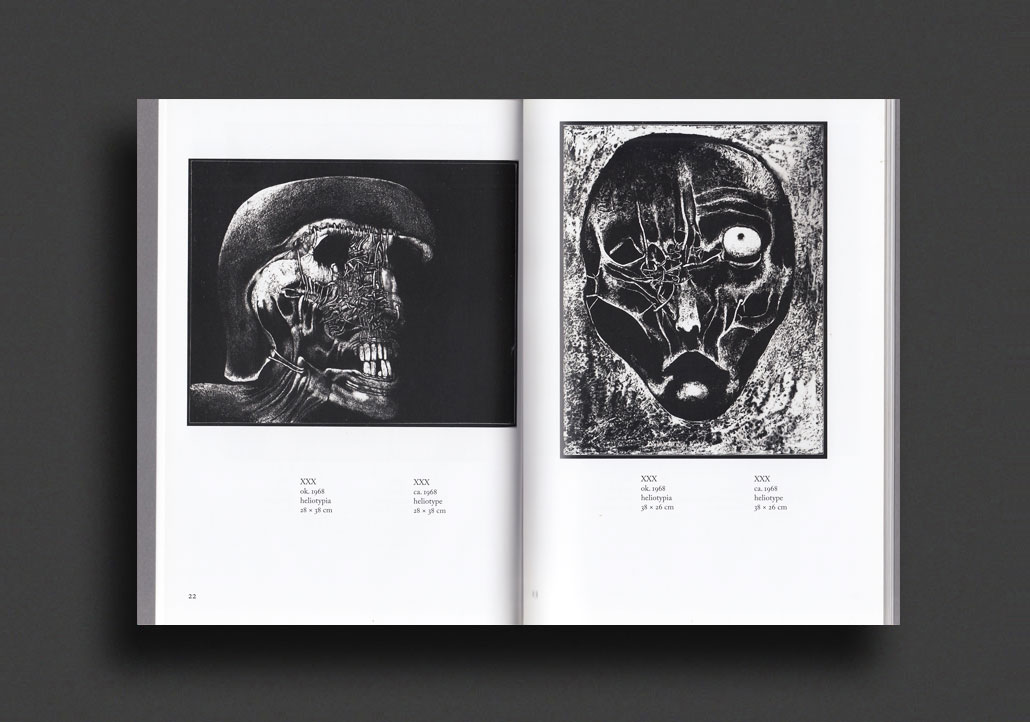
First hardcover edition of this new volume dedicated to the graphics of Zdzisław Beksiński (1929–2005). Profusely illustrated throughout, with an introduction by art historian Wiesław Banach.
“Beksiński. Graphics” is another miniature book presenting one of the arts that the very talented artist from Sanok, Zdzisław Beksiński, was passionate about. On sixty pages, you will find the master’s works selected by the head of the Historical Museum in Sanok, Wiesław Banach, a friend of Beksiński and connoisseur of his art.
Zdzisław Beksiński (1929 – 2005) was a Polish painter, photographer and sculptor. Beksiński had no formal training as an artist. Born in Sanok, he studied architecture in Kraków and worked as a construction site supervisor before turning to his passion for art, sculpting with construction site materials for his medium. His early photography would be a precursor to his paintings, often referred to as dystopian surrealism. Beksiński claimed, "I wish to paint in such a manner as if I were photographing dreams". Beksiński undertook painting with a passion, working intensely whilst listening to classical music and quickly becoming a leading figure in contemporary Polish art. In the late 1960s, Beksiński entered what he himself called his "fantastic period", which lasted up to the mid-1980s, during which he created his famed images of desolate, surrealistic landscapes with intricate depictions of anxious, abstracted figures and architecture in states of decay, mutation and decomposition. Although Beksiński's art was often dark, he himself was known to be a pleasant person with a keen sense of humour. Modest and somewhat shy, he avoided public events such as the openings of his own exhibitions and almost never visited museums or exhibitions in general. He always credited music as his main source of inspiration. Beksiński avoided concrete analysis of the content of his work, saying "I cannot conceive of a sensible statement on painting". Beksiński was stabbed to death at his Warsaw apartment in February 2005 by a 19-year-old acquaintance from Wołomin, reportedly because he refused to lend the teenager money.
According to Mexican film director Guillermo del Toro "In the medieval tradition, Beksinski seems to believe art to be a forewarning about the fragility of the flesh – whatever pleasures we know are doomed to perish – thus, his paintings manage to evoke at once the process of decay and the ongoing struggle for life. They hold within them a secret poetry, stained with blood and rust."
"Beksinski's powerfully unique paintings are such as I have never before seen" H.R. Giger
2019, English / Polish
Hardcover, 64 pages, 19.5 x 14.5 cm
Published by
Bosz / Lesko
$25.00 - Out of stock
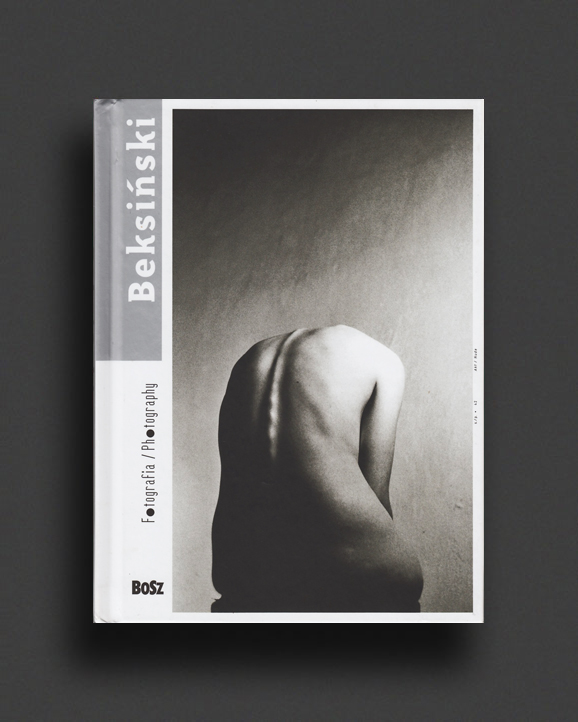
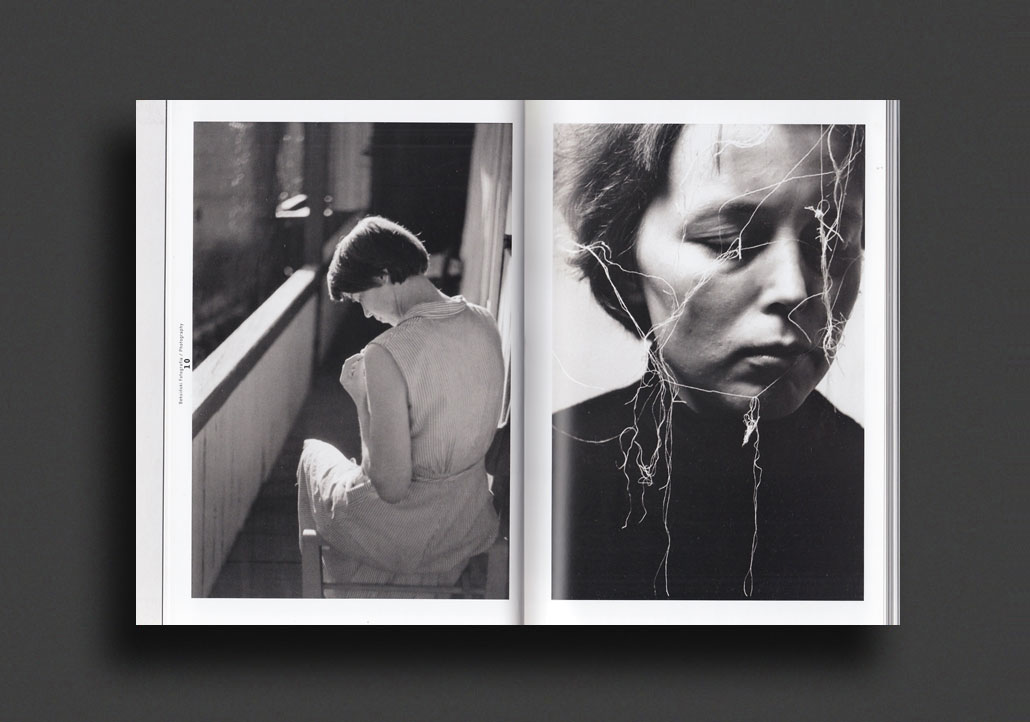
First hardcover edition of this new volume dedicated to the photography of Zdzisław Beksiński (1929–2005). Profusely illustrated throughout, with an introduction by art historian Wiesław Banach.
Zdzisław Beksiński was a photographer for a relatively short period of less than eight years. The artist's main model was his wife, Zofia Beksinska, who not only brilliantly exposed the female beauty, but also lived up to the experimenter's requirements. Beksinski's photographs, characterised by formal diversity and poetic sensitivity, focus mainly on the issue of transience. The photographs featured in this book belong to the collection of the Historical Museum in Sanok.
Zdzisław Beksiński (1929 – 2005) was a Polish painter, photographer and sculptor. Beksiński had no formal training as an artist. Born in Sanok, he studied architecture in Kraków and worked as a construction site supervisor before turning to his passion for art, sculpting with construction site materials for his medium. His early photography would be a precursor to his paintings, often referred to as dystopian surrealism. Beksiński claimed, "I wish to paint in such a manner as if I were photographing dreams". Beksiński undertook painting with a passion, working intensely whilst listening to classical music and quickly becoming a leading figure in contemporary Polish art. In the late 1960s, Beksiński entered what he himself called his "fantastic period", which lasted up to the mid-1980s, during which he created his famed images of desolate, surrealistic landscapes with intricate depictions of anxious, abstracted figures and architecture in states of decay, mutation and decomposition. Although Beksiński's art was often dark, he himself was known to be a pleasant person with a keen sense of humour. Modest and somewhat shy, he avoided public events such as the openings of his own exhibitions and almost never visited museums or exhibitions in general. He always credited music as his main source of inspiration. Beksiński avoided concrete analysis of the content of his work, saying "I cannot conceive of a sensible statement on painting". Beksiński was stabbed to death at his Warsaw apartment in February 2005 by a 19-year-old acquaintance from Wołomin, reportedly because he refused to lend the teenager money.
According to Mexican film director Guillermo del Toro "In the medieval tradition, Beksinski seems to believe art to be a forewarning about the fragility of the flesh – whatever pleasures we know are doomed to perish – thus, his paintings manage to evoke at once the process of decay and the ongoing struggle for life. They hold within them a secret poetry, stained with blood and rust."
"Beksinski's powerfully unique paintings are such as I have never before seen" H.R. Giger
2019, English / Polish
Hardcover, 64 pages, 19.5 x 14.5 cm
Published by
Bosz / Lesko
$25.00 - Out of stock
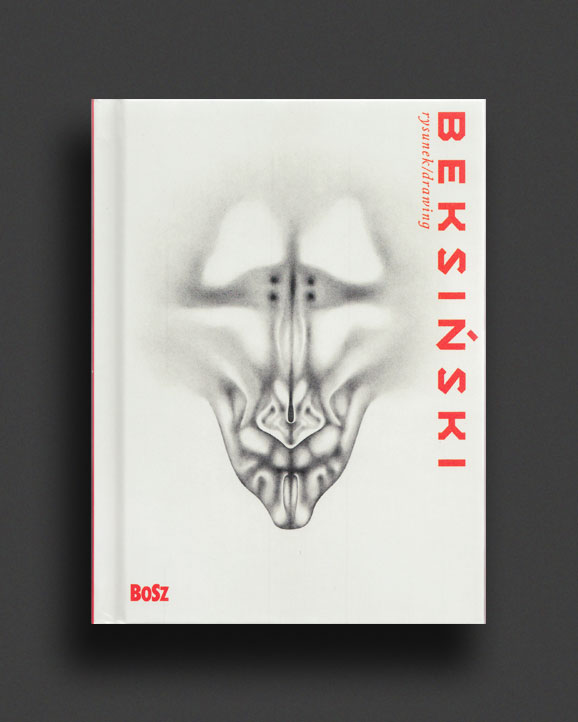
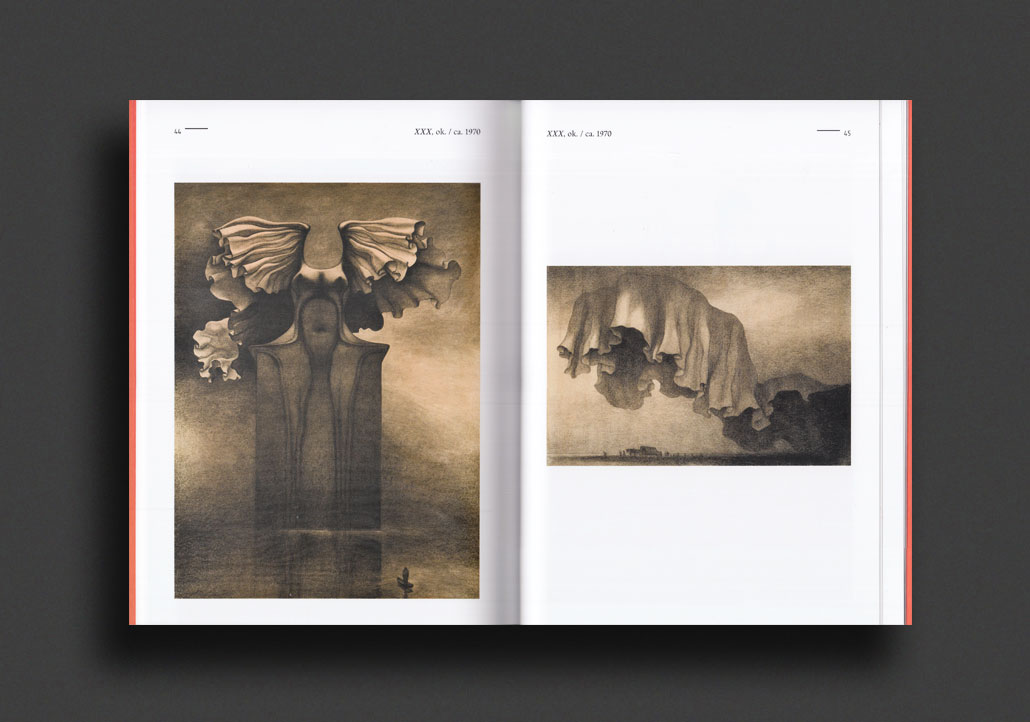
First hardcover edition of this new volume dedicated to the drawings of Zdzisław Beksiński (1929–2005). Profusely illustrated throughout, with an introduction by art historian Wiesław Banach.
"Since early childhood, drawings had been the artist's main means of communication. "Usually, when I explain something to others, I like to draw it on a piece of paper", he would say. In fact, he left thousands of drawings, usually sketches, sometimes even notes reflecting the way he thought and rendered the original idea into a complete work of art. Due to its nature, this album merely presents a selection of his works that mark various stages of Beksinski's artistic activity, starting from his 1946 youthful self-portrait, to pieces from his final years." - Wiestaw Banach
Zdzisław Beksiński (1929 – 2005) was a Polish painter, photographer and sculptor. Beksiński had no formal training as an artist. Born in Sanok, he studied architecture in Kraków and worked as a construction site supervisor before turning to his passion for art, sculpting with construction site materials for his medium. His early photography would be a precursor to his paintings, often referred to as dystopian surrealism. Beksiński claimed, "I wish to paint in such a manner as if I were photographing dreams". Beksiński undertook painting with a passion, working intensely whilst listening to classical music and quickly becoming a leading figure in contemporary Polish art. In the late 1960s, Beksiński entered what he himself called his "fantastic period", which lasted up to the mid-1980s, during which he created his famed images of desolate, surrealistic landscapes with intricate depictions of anxious, abstracted figures and architecture in states of decay, mutation and decomposition. Although Beksiński's art was often dark, he himself was known to be a pleasant person with a keen sense of humour. Modest and somewhat shy, he avoided public events such as the openings of his own exhibitions and almost never visited museums or exhibitions in general. He always credited music as his main source of inspiration. Beksiński avoided concrete analysis of the content of his work, saying "I cannot conceive of a sensible statement on painting". Beksiński was stabbed to death at his Warsaw apartment in February 2005 by a 19-year-old acquaintance from Wołomin, reportedly because he refused to lend the teenager money.
According to Mexican film director Guillermo del Toro "In the medieval tradition, Beksinski seems to believe art to be a forewarning about the fragility of the flesh – whatever pleasures we know are doomed to perish – thus, his paintings manage to evoke at once the process of decay and the ongoing struggle for life. They hold within them a secret poetry, stained with blood and rust."
"Beksinski's powerfully unique paintings are such as I have never before seen" H.R. Giger
2024, English / French
Hardcover, 128 pages, 24 x 29.5 cm
Published by
Arsenicgalerie / Paris
$78.00 - Out of stock
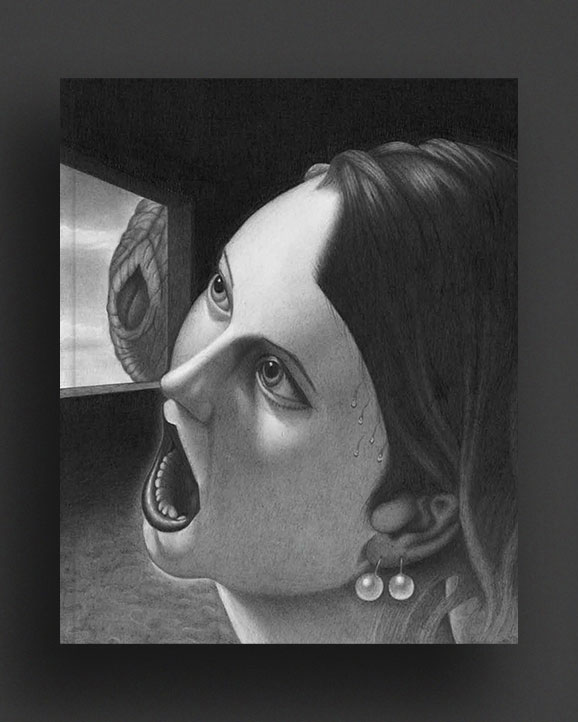
The first monograph on the Japanese artist of desire.
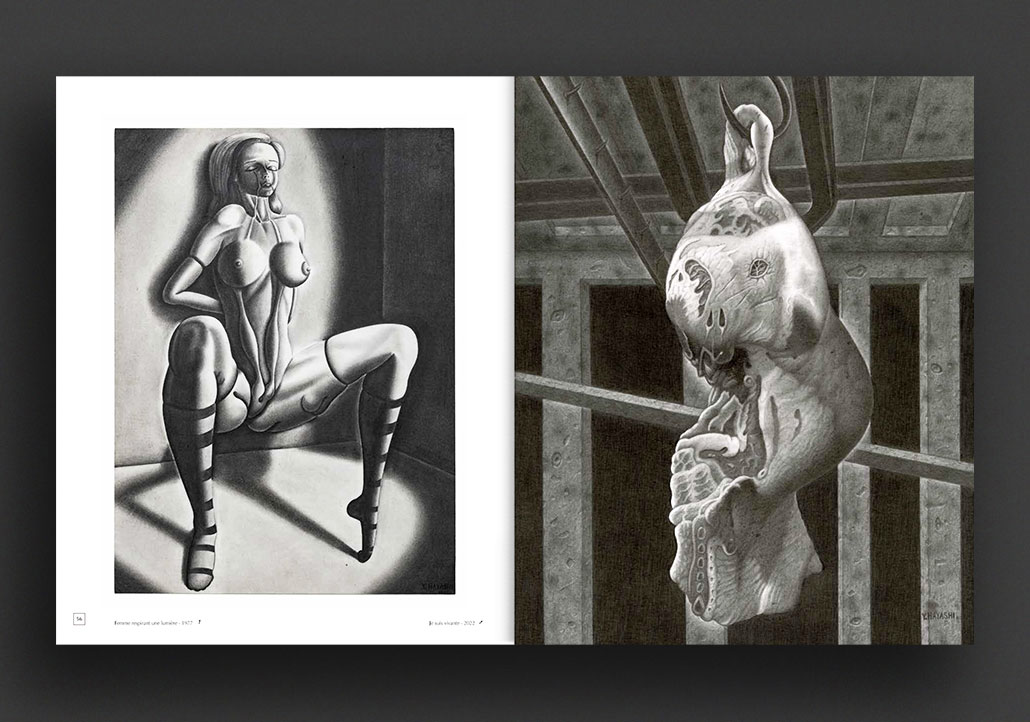
In this lavishly illustrated book, Xavier-Gilles Néret analyzes the work of Yoshifumi Hayashi from an existential and philosophical as well as artistic perspective, drawing on his interviews with the Japanese artist who, for almost half a century, has shamelessly asserted the importance of sexual desire and the body in all its material dimensions.
From his erotic drawings of callipagous women to his sexualized landscapes, from his vulvar and ithyphallic flowers to his "still lifes" teeming with life, Hayashi pursues his quest for the mysteries of matter through the subtle play of light in the gradations of lead pencil, of which he has become a virtuoso alchemist, to fuel irrepressible desire and "repassionate life".
Yoshifumi Hayashi (born 1948 in Fukuoka, Japan) is an artist specializing in scenes of female erotica. In 1974 he moved to Paris, where he began to produce pencil drawings. At first his main influence was the metaphysical world of De Chirico, but soon his focus shifted to the lower half of the female anatomy… Hayashi's art comes straight from the darkest depths of his subconscious and the artist lays his innermost paranoias, fetishes and obsessions. Despite this profoundly personal quality his work is also highly and objectively erotic.
Text by Xavier-Gilles Néret.
Foreword by Catherine Robbe-Grillet.
2000, English
Softcover, 228 pages, 178 x 229 cm
1st Edition, Out of print title / used / very good
Published by
October Books / New York
The MIT Press / Massachusetts
$30.00 - Out of stock
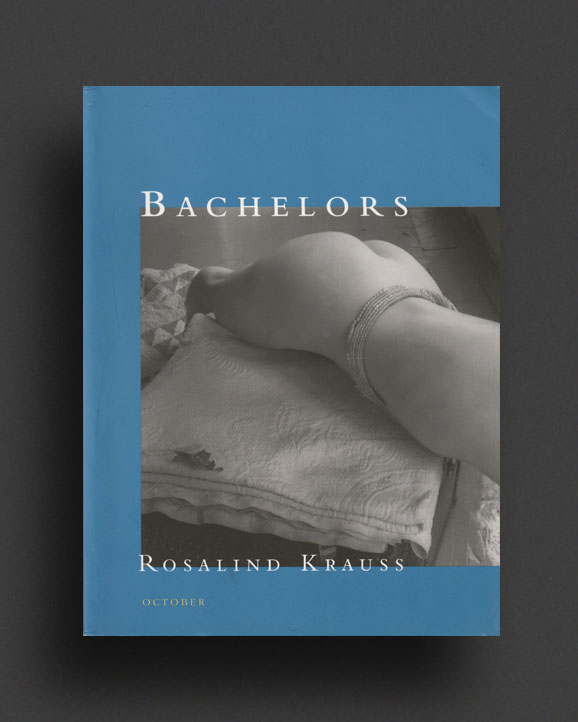
Out of print first 2000 softcover edition of Rosalind E. Krauss' Bachelors, published by October / MIT Press.
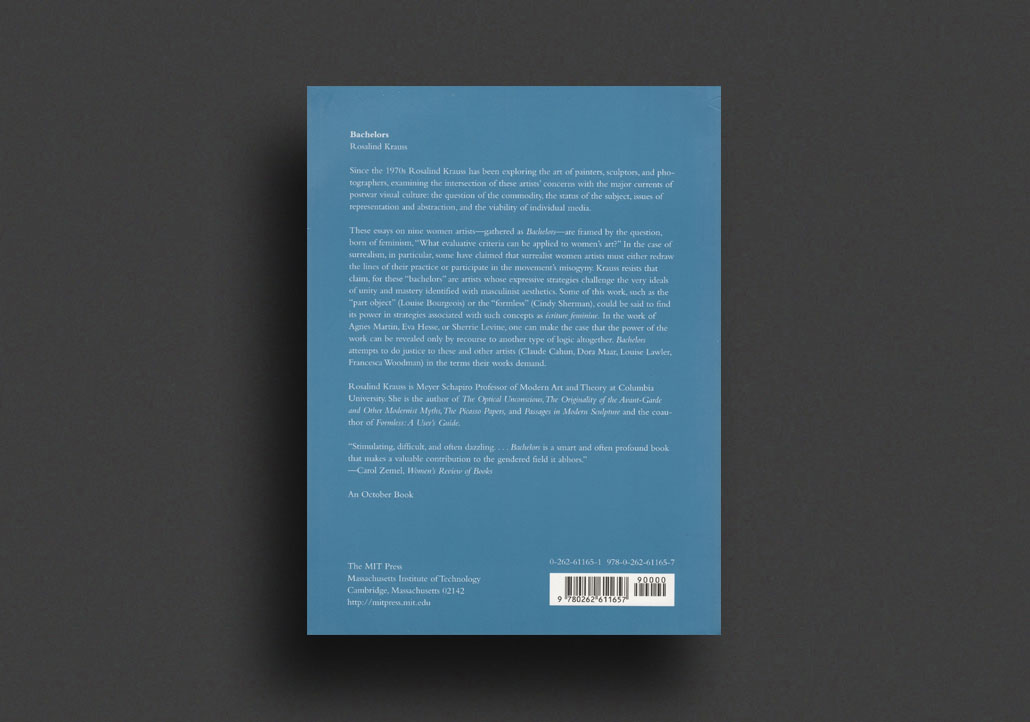
Since the 1970s Rosalind Krauss has been exploring the art of painters, sculptors, and photographers, examining the intersection of these artists' concerns with the major currents of postwar visual culture. These essays on nine women artists are framed by the question, born of feminism, "What evaluative criteria can be applied to women's art?" In the case of surrealism, in particular, some have claimed that surrealist women artists must either redraw the lines of their practice or participate in the movement's misogyny. Krauss resists that claim, for these "bachelors" are artists whose expressive strategies challenge the very ideals of unity and mastery identified with masculinist aesthetics. Some of this work (such as that of Louise Bourgeois or Cindy Sherman) could be said to find its power in strategies associated with such concepts as écriture feminine. Bachelors attempts to do justice to these and other artists (Claude Cahun, Dora Maar, Louise Lawler, Francesca Woodman) in the terms their works demand.
Rosalind E. Krauss, University Professor at Columbia University and an editor and cofounder of October magazine, is the author of The Originality of the Avant-Garde and Other Modernist Myths (1985), The Optical Unconscious (1993), The Picasso Papers (1999), and Bachelors (1999), all published by the MIT Press, and coauthor (with Yve-Alain Bois) of Formless: A User's Guide (Zone Books, 1997).
"[S]timulating, difficult, and often dazzling...Bachelors is a smart and often profound book that makes avaluable contribution to the gendered field it abhors." Carol Zemel, Women's Review of Books.
Contents: By way of introduction, Claude Cahun and Dora Maar; portrait of the artist as "fillette", Louise Bourgeois; the "cloud", Agnes Martin; contingent, Eva Hesse; untitled, Cindy Sherman; problem sets, Francesca Woodman; bachelors, Sherrie Levine; souvenir memories, Louise Lawler.
VG copy with only a corner bump/bend to the top-right.
1993, English
Softcover, 346 pages 21.5 x 13.5 cm
Out of print title / used / very good
Published by
Northwestern University Press / Evanston
$50.00 - In stock -
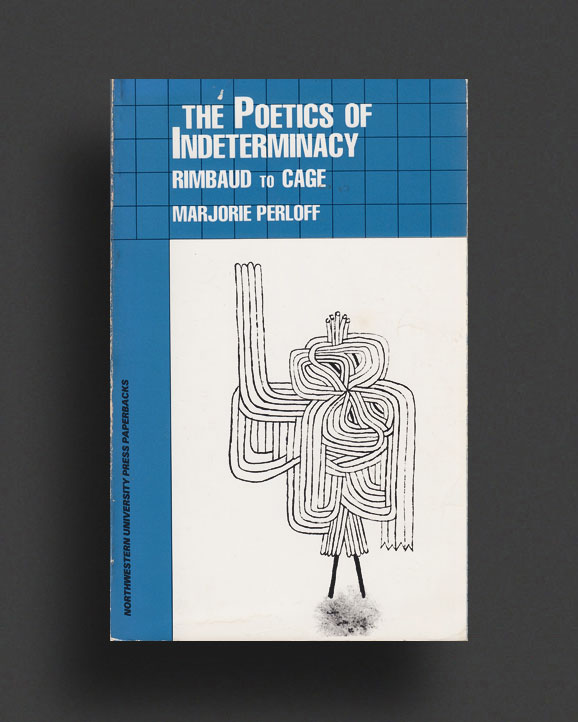
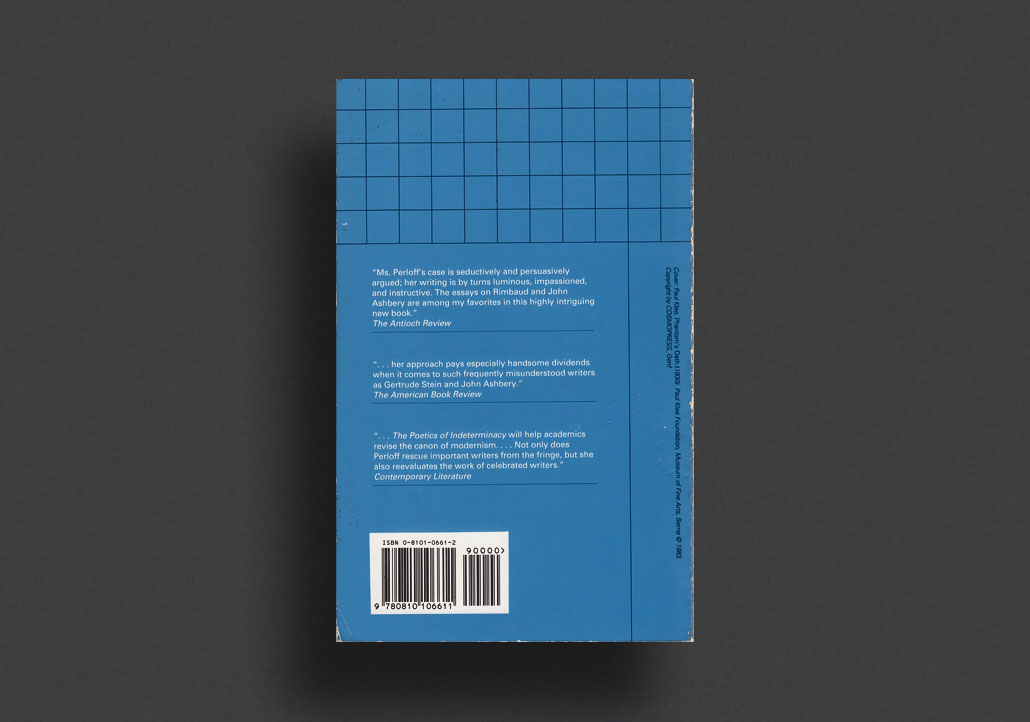
In her seminal study, first published in 1981, Marjorie Perloff argues that the map of Modernist poetry needs to be redrawn to include a central tradition which cannot properly be situated within the Romantic-Symbolist tradition dominating the early twentieth century. She traces this tradition from its early "French connection" in the poetry of Rimbaud and Apollinaire as well as in Cubist, Dada, and early Surrealist painting; through its various manifestations in the work of Gertrude Stein, William Carlos Williams, and Ezra Pound; to such postmodern "landscapes without depth" as the French/English language constructions of Samuel Beckett, the elusive dreamscapes of John Ashbery, and the performance works of David Antin and John Cage.
Very Good copy of 1993 second edition.
2003, English
Softcover, 310 pages, 21.5 x 13.5 cm
1st Edition, Out of print title / used / very good
Published by
Creation Books / London
$150.00 - Out of stock
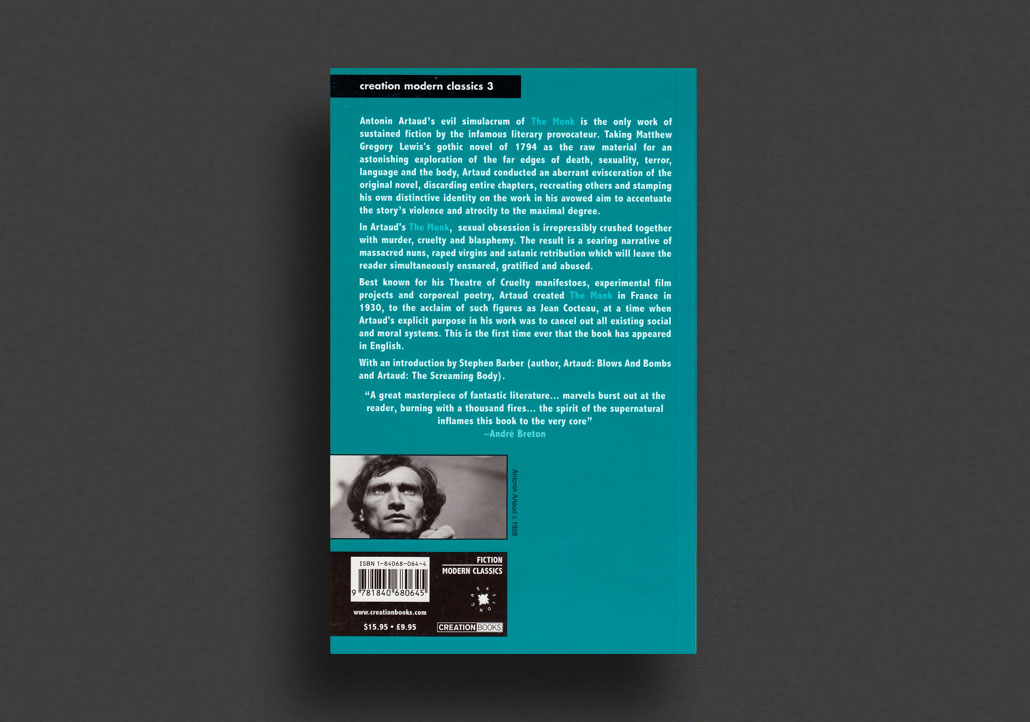
First 2003 English Edition of Antonin Artaud’s evil simulacrum of The Monk, the only work of sustained fiction by the infamous literary provocateur. Taking Matthew Gregory Lewis's gothic novel of 1794 as the raw material for an astonishing exploration of the far edges of death, sexuality, terror, language and the body, Artaud conducted an aberrant evisceration of the original novel, discarding entire chapters, recreating others and stamping his own distinctive identity on the work in his avowed aim to accentuate the story's violence and atrocity to the maximal degree.
In Artaud's The Monk, sexual obsession is irrepressibly crushed together with murder, cruelty and blasphemy. The result is a searing narrative of massacred nuns, raped virgins and satanic retribution which will leave the reader simultaneously ensnared, gratified and abused.
Best known for his Theatre of Cruelty manifestoes, experimental film projects and corporeal poetry, Artaud created The Monk in France in 1930, to the acclaim of such figures as Jean Cocteau, at a time when Artaud's explicit purpose in his work was to cancel out all existing social and moral systems. This is the first time ever that the book has appeared in English. With an introduction by Stephen Barber.
"A great masterpiece of fantastic literature... marvels burst out at the reader, burning with a thousand fires... the spirit of the supernatural inflames this book to the very core"—André Breton
Very Good—NF copy.
1972, Japanese
Softcover (french folds w. slipcase), approx 150 pages, 19 x 13 cm
1st Edition, Out of print title / used / very good
Published by
Rosicrucian Society / Tokyo
$140.00 - Out of stock
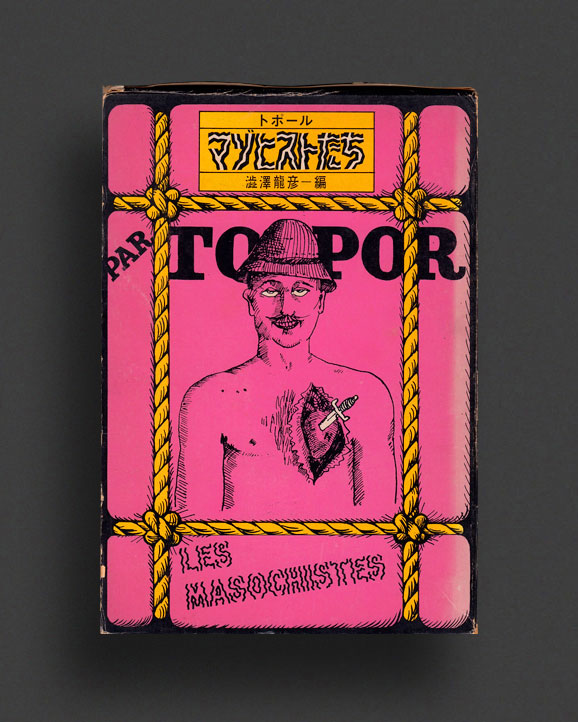
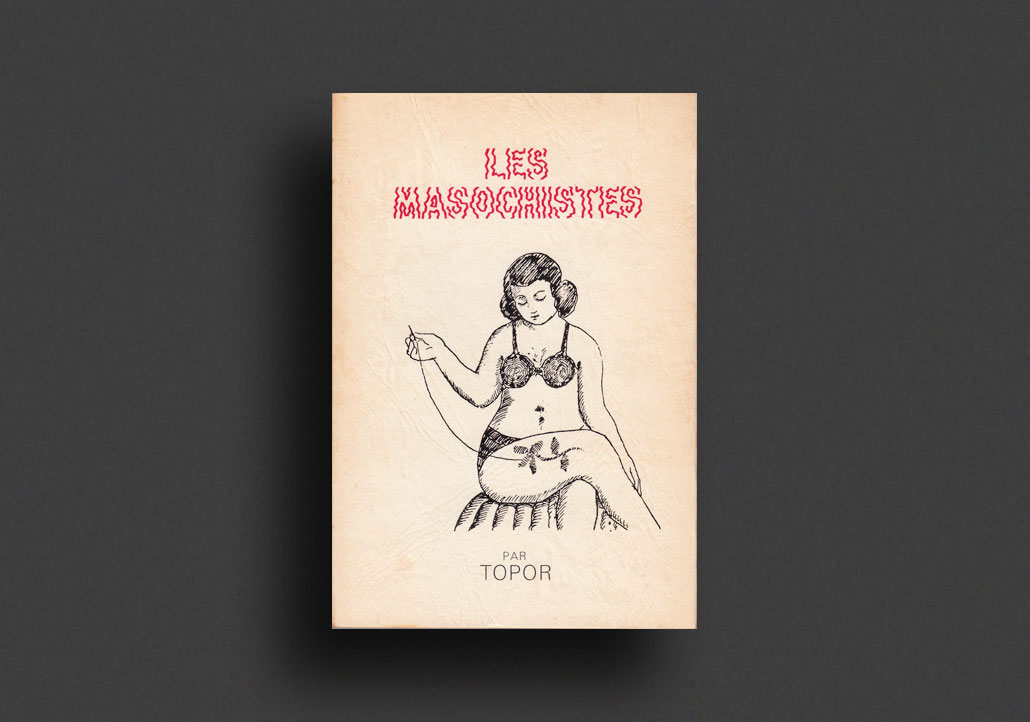
First 1972 Japanese slipcased edition of Roland Topor's classic collection 'Les Masochists', published by Rosicrucian Society, Tokyo, and edited by renowned Japanese critic, author, scholar of demonology, and translator Tatsuhiko Shibusawa. First published in Paris in 1960 by controversial Belgian-born French publisher Éric Losfeld (Éditions Le Terrain Vague), 'Les Masochistes' presents one of Topor’s most acclaimed early collections of illustrations of people engaged in acts of masochism. A perfect precursor to the dark humour that Topor would make a fantastic career of. A beautiful production of this series, this Japanese edition in illustrated cardboard slipcase features the full 'Les Masochists' series plus a further Topor masterpiece collection of incredible works that followed 'Les Masochistes' and were the feature of his first art books, all edited together with an afterword by Shibusawa. Includes introduction by Jacques Sternberg, translated from French to Japanese.
Roland Topor (1938—1997) was one of the most unique and versatile French artists of the second half of the 20th century, working prolifically as a provocative and spirited illustrator, author, humorist, satirist, poet, painter, performer, sculptor, playwright, film and TV writer, filmmaker and actor, and much more. A founder of the Panic Movement, an art collective formed by Fernando Arrabal, Alejandro Jodorowsky, and Roland Topor in Paris in 1962, Topor was known for the surreal and absurdist nature of his work.
Tatsuhiko Shibusawa (1928—1987), was a well-known and controversial Japanese novelist, art critic, and translator of French writers such as Jean Cocteau, Georges Bataille and Marquis de Sade. In 1960 he and his publisher, Kyōji Ishii, were trialled for public obscenity over the publishing of Shibusawa's translation of de Sade's Juliette into the Japanese language. What was to be known as the "Sade Trial" took 9 years and although many of Japan's leading authors testified for the defense, in 1969 the Japanese Supreme Court ruled them guilty and charged. This did not deter Shibusawa, whose essays on black magic, demonology and eroticism were popular reading in Japan, and in 1981 he was awarded the 9th Izumi Kyoka Literature Prize.
Very Good copy in VG slipcase, some tanning to spine edge.
1983, English
Hardcover, 184 pages, 24 x 14 cm
1st Edition, Out of print title / used / very good
Published by
UMI Research Press / Ann Arbor
$50.00 - Out of stock
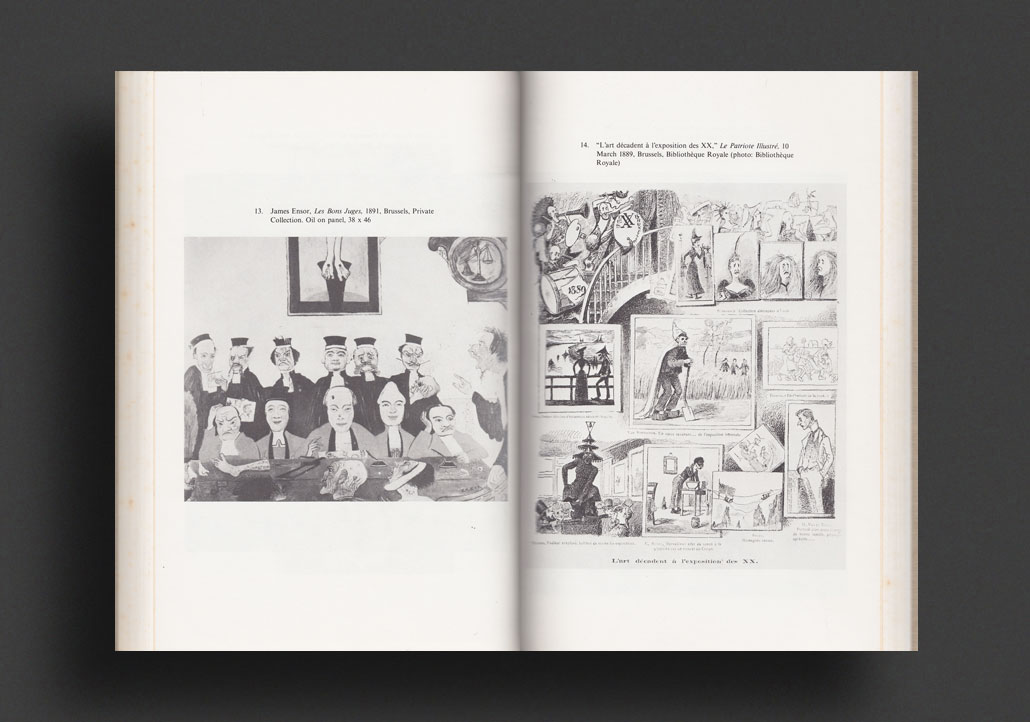
First 1984 hardcover edition of Jane Block's Les XX and Belgian Avant-Gardism 1868-1894, published by UMI Research Press, Ann Arbor.
"This study attempts both offer a comprehensive view of Belgian avant-garde art from 1868 to 1894 and to relate its artistic aims to the political and social milieu while charting the path of Les XX in the avant-garde groups, its reaction to the academic tradition, and its internal aesthetic evolution which ranged from Impressionism to the decorative arts. This research should also serve to illuminate the strong reciprocal nature of the ties between artistic centers, especially Paris and Brussels, and reveal the unique contribution of Les XX modern art. What the study does not do is follow the careers of the 32 individual artists who were members of Les XX nor even attempt to identify all the works actually shown at Les XX. This would be impossible because of the insufficient descriptions in the Les XX catalogs and in the contemporary press. Instead, this study seeks to discuss the contribution of the group as a whole and its impact on Belgian art and the artistic establishment. It describes how and why Les XX came to be one of the most avant-garde groups in Europe during its time."
Very Good copy with light wear to cloth covers and light tanning.
1964, English
Softcover (staple-bound), 16 pages, 24.5 x 18.5 cm
1st Edition, Out of print title / used / very good
Published by
Melbourne University Film Society / Melbourne
$25.00 - In stock -
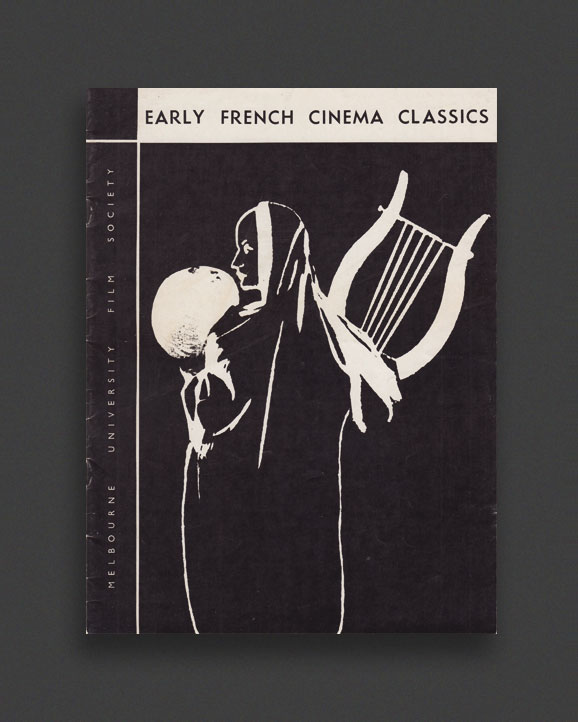
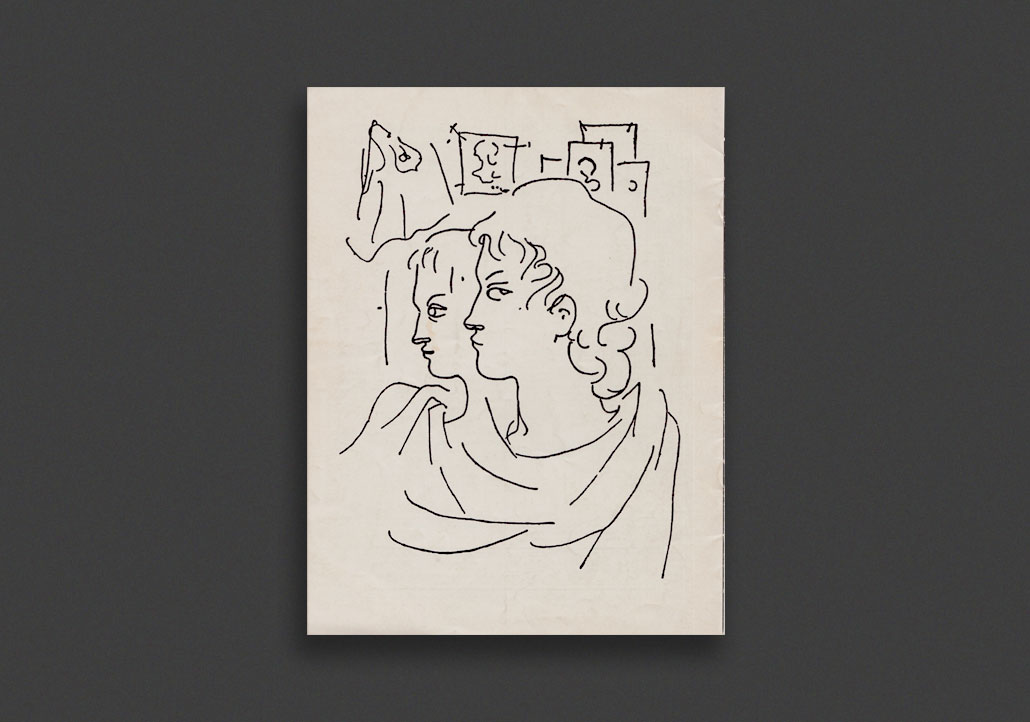
This scarce brochure was published by Melbourne University Film Society on the occasion of a special season of screening of Early French Cinema Classics in 1964. Edited by Laurie Clancy and Peter Hourigan, features texts and illustrations on the films of Luis Bunuel, Jean Vigo, and Jean Cocteau, along with filmographies and a screening programme. Published in Melbourne in 1964 (we estimate, not dated).
The Melbourne University Film Society published periodicals (Annotations on Film) and guides to accompany their film programme, aimed at presenting films in Melbourne in the medium they were created and providing a critical reading of them for an independent, membership-based film society. Starting in 1948, the Melbourne University Film Society (MUFS) changed its name to Cinémathèque in 1984 and continues to this day in Melbourne. A written accompaniment to their programme can be seen in the form of the current-day online journal Senses of Cinema.
Very Good copy, light wear.
1961, Czech
Softcover, 64 pages, 17.5 x 15.5 cm
1st Edition, Out of print title / used / very good
Published by
SNKLU / Prague
$70.00 - Out of stock
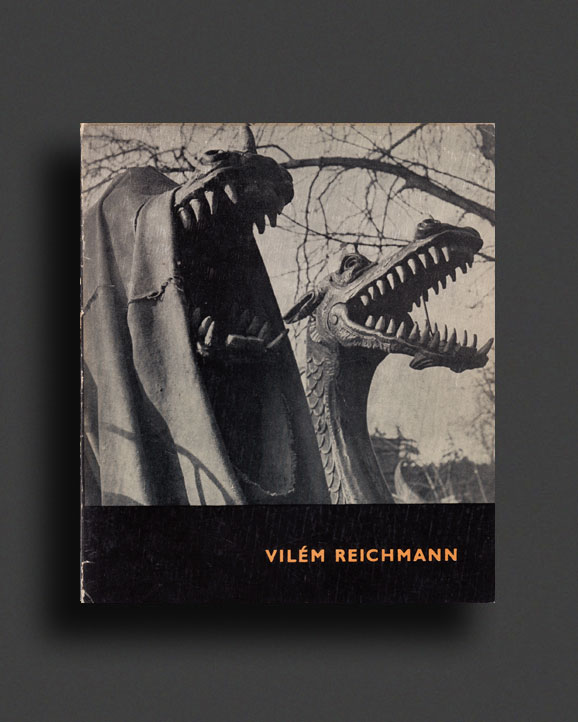
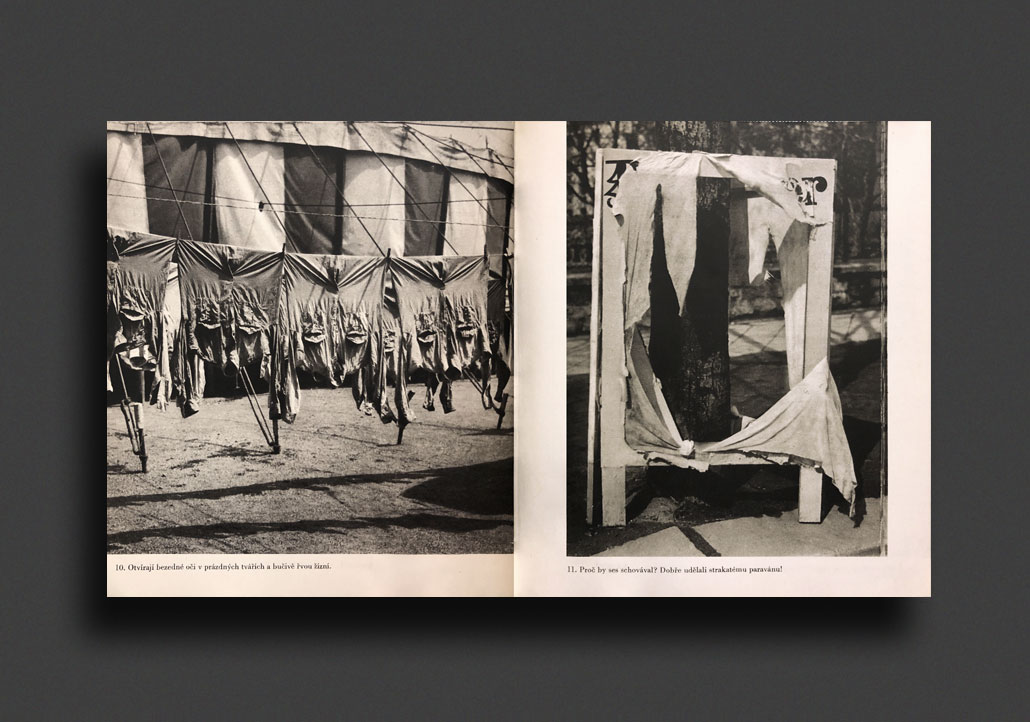
Wonderful and long out-of-print Vilém Reichmann monograph, published in Prague in 1961 as part of the distinctive series of Czech monographs on photographers published by SNKLU, a wing of the great Odeon publishing house. Edited by fellow photographer/painter Václav Zykmund, this beautifully printed book presents a selection of 64 of his best lyrical surreal images, printed in gravure.
Vilém Reichmann (1908-1991) was one of the premiere Czech surrealist photographers. Reichmann comes from the German-Jewish community in Brno and began photographing in 1930, whilst working as a graphic artist for numerous left-wing magazines in Czechoslovakia. Influenced by the Depression and war years, he developed a Surrealist style modelled on lyrical interpretations of reality through visual metaphors. After World War II he became a member of ‘Ra’, a Czech Surrealist art group, and his work shows the influence of textural abstraction and absurdist humor. Antonín Dufek, an erudite specialist in the field of the Czech photography, confirms Reichmann’s fundamental position in the history of the Czech photography, especially its surrealist movement.
Good copy with some moisture ripple and general wear. Moisture stain at back but not affecting contents.
1989, English
Softcover, 174 pages, 21.2 x 14.5 cm
1st Edition, Out of print title / used / very good
Published by
Atlas Press / London
$90.00 - Out of stock
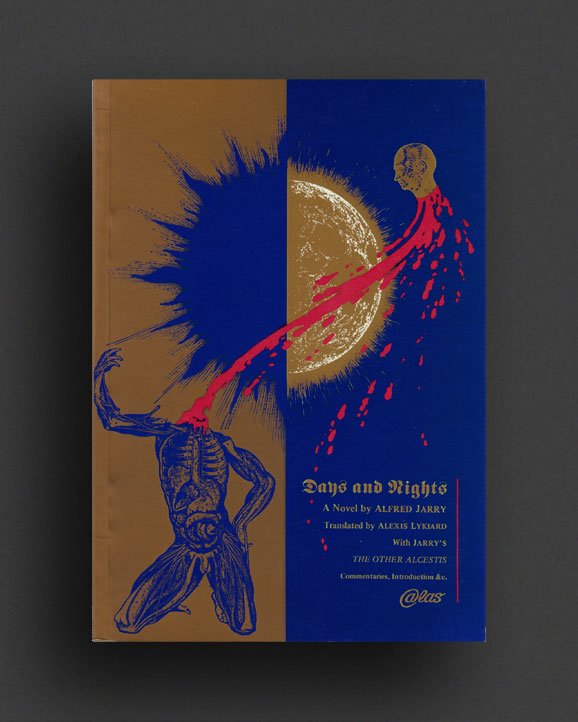
Rare first English translation of this 1897 novel by French symbolist writer and 'pataphysician Alfred Jarry (1873—1907). Translated by Alexis Lykiard, with introduction by Alastair Brotchie and additional verse translations by Stanley Chapman. Preceded by Alfred Jarry’s The Other Alcestis, translated by John Harman. Illustrated by Peter Blegvad, with an afterword by Alastair Brotchie.
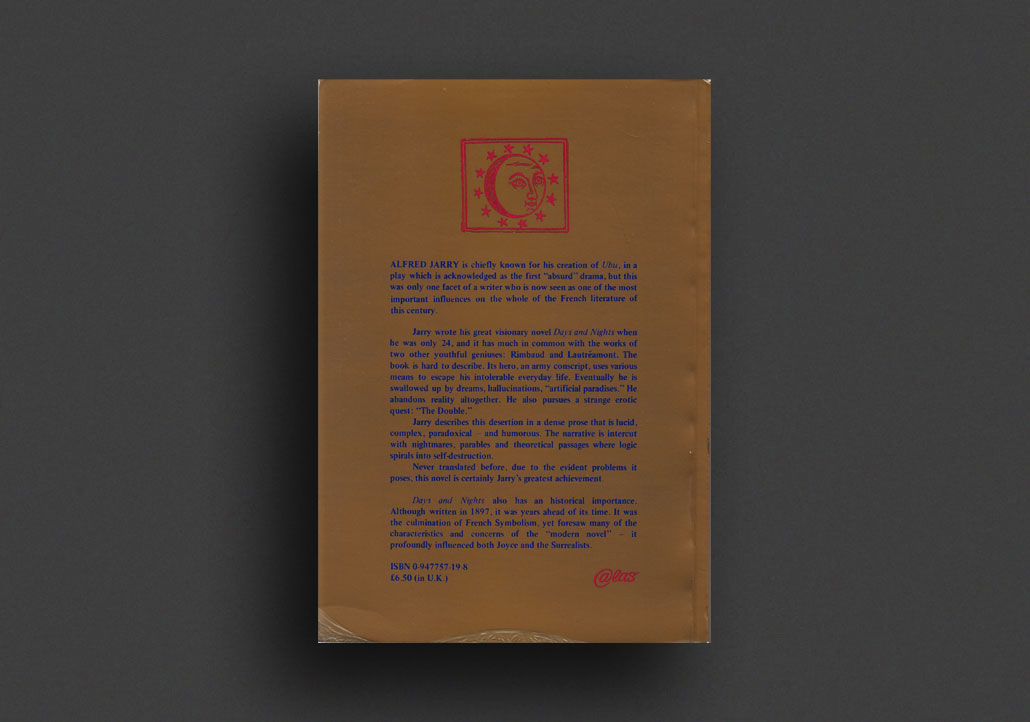
Alfred Jarry is chiefly known for his creation of Ubu, in a play which is acknowledged as the first "absurd" drama, but this was only one facet of a writer who is now seen as one of the most important influences on the whole of the French literature of this century. Jarry wrote his great visionary novel Days and Nights when he was only 24, and it has much in common with the works of two other youthful geniuses: Rimbaud and Lautréamont. The book is hard to describe. Its hero, an army conscript, uses various means to escape his intolerable everyday life. Eventually he is swallowed up by dreams, hallucinations, "artificial paradises." He abandons reality altogether. He also pursues a strange erotic quest: "The Double." Jarry describes this desertion in a dense prose that is lucid, complex, paradoxical and humorous. The narrative is intercut with nightmares, parables and theoretical passages where logic spirals into self-destruction.
Never translated before, due to the evident problems it poses, this novel is certainly Jarry's greatest achievement.
Days and Nights also has an historical importance. Although written in 1897, it was years ahead of its time. It was the culmination of French Symbolism, yet foresaw many of the characteristics and concerns of the "modern novel" — it profoundly influenced both Joyce and the Surrealists.
Very Good copy but with some laminate peeling from back cover corners.
2014, English
Softcover, 142 pages, 18 x 11.5 cm
Published by
Wakefield Press / Cambridge
$33.00 - In stock -
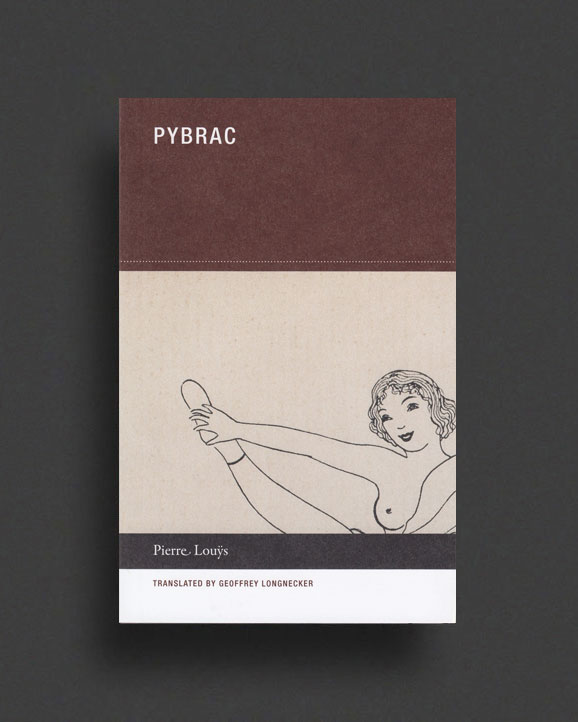
Translated, with an introduction, by Geoffrey Longnecker
Illustrations by Toyen
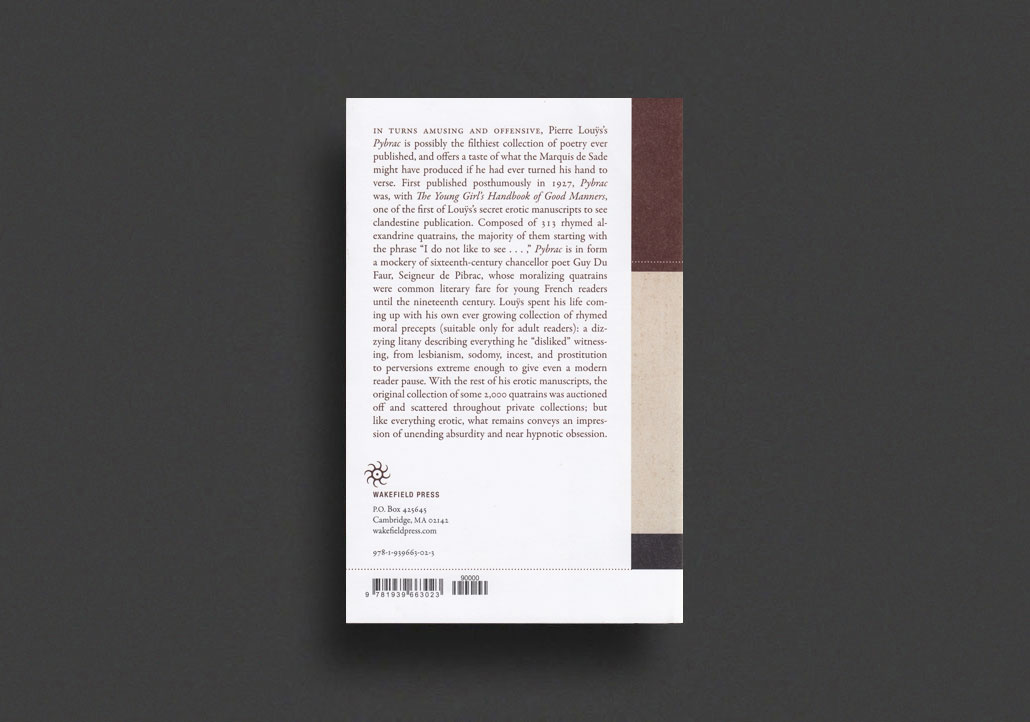
In turns amusing and offensive, Pierre Louÿs’ Pybrac is possibly the filthiest collection of poetry ever published, and offers a taste of what the Marquis de Sade might have produced if he had ever turned his hand to verse. First published posthumously in 1927, Pybrac was, with The Young Girl’s Handbook of Good Manners, one of the first of Louÿs’ secret erotic manuscripts to see clandestine publication. Composed of 313 rhymed alexandrine quatrains, the majority of them starting with the phrase “I do not like to see…,” Pybrac is in form a mockery of sixteenth-century chancellor poet Guy Du Faur, Seigneur de Pibrac, whose moralizing quatrains were common literary fare for young French readers until the nineteenth century. Louÿs spent his life coming up with his own evergrowing collection of rhymed moral precepts (suitable only for adult readers): a dizzying litany describing everything he “disliked” witnessing, from lesbianism, sodomy, incest, and prostitution to perversions extreme enough to give even a modern reader pause. With the rest of his erotic manuscripts, the original collection of over 2,000 quatrains was auctioned off and scattered throughout private collections; but like everything erotic, what remains collected here conveys an impression of unending absurdity and near hypnotic obsession.
Pierre Louÿs (1870–1925) was a best-selling author in his time, and a friend of and influence on such luminaries as André Gide, Paul Valéry, Oscar Wilde, and Stephane Mallarmé. He achieved instant notoriety with Aphrodite and The Songs of Bilitis, and his 1898 novel The Woman and the Puppet has been adapted for the screen in such noteworthy films as Josef von Sternberg’s The Devil Is a Woman and Luis Buñuel’s That Obscure Object of Desire. But it was only after his death that his true legacy was to be uncovered: nearly nine hundred pounds of erotic manuscripts were discovered in his home, all of them immediately scattered among collectors and many lost. The body of work that has since been gathered—manuscripts continue to be discovered—leaves little doubt: Louÿs is the greatest French writer of erotica there ever was.
“Louÿs entered eroticism the way others enter politics or religion”—Jean-Paul Goujon
“One of the great and glorious erotomaniacs of the end of the nineteenth century and the beginning of the twentieth”—André Pieyre de Mandiargues