World Food Books' programme is largely produced on Kulin Nation land. We acknowledge the Wurundjeri people of the Kulin Nation as the first and continuing custodians of this land, and pay respect to their Elders past, present, and emerging.
World Food Books is an arts and special interests bookshop in Naarm / Melbourne. Founded in 2010, World Food Books is devoted to the presentation of a rotating, hand-selection of international art, design, literary and counterculture publications with an emphasis on the anti-traditional, the experimental, the avant-garde, the heretic, the marginal.
Presenting new titles alongside rare and out-of-print books, catalogues and journals spanning the fields of modern and contemporary art, design, photography, illustration, film, literature, poetry, cultural theory, philosophy, sexuality, popular and underground culture in its many radical forms, World Food Books wishes to encourage adventurous, thoughtful and open-minded reading, looking, writing, and exchange of publishing and ideas, both current and historical.
As well as our bookshop, located in Melbourne's historical Nicholas Building, all of our inventory is available internationally via our online mail-order service.
World Food Books semi-regularly co-ordinates "Occasions", a programme of exhibits and events at the bookshop and in partnership with other hosts (such as museums and art galleries) that develop out of the activities, relationships and content of the bookshop itself.
World Food Books
The Nicholas Building
37 Swanston Street
Room 5, Level 6
Melbourne 3000
Australia
SHOP HOURS:
THU–SAT 12–6
WEB-SHOP OPEN 24/7
World Food Books
Postal Address:
PO Box 435
Flinders Lane
Victoria 8009
Australia
info@worldfoodbooks.com
Art
Theory / Essay
Architecture / Interior
Graphic Design / Typography
Photography
Fashion
Eros
LGBTQ+
Fiction / Poetry
Weird / Speculative / Science Fiction / Horror
Transgressive / Visceral / Abject
Symbolism / Decadence / Fin de siècle
Film / Video
Painting
Sculpture / Installation
Performance / Dance / Theater
Drawing
Sound / Music
Curatorial
Group Shows / Collections
Periodicals
Out-of-print / Rare
Posters / Ephemera / Discs
Signed Books
World Food Books Gift Voucher
World Food Book Bag
Australian Art
Australian Fiction
Australian Science Fiction / Speculative Fiction
Australian Poetry
Australian Photography
Japanese Photography
Conceptual Art
Minimal Art
Dada
'Pataphysics / Oulipo
Fluxus
Concrete Poetry
Pop Art
Surrealism
Arte Povera
Arte Informale / Haute Pâte / Tachism
Nouveau Réalisme / Zero / Kinetic
Situationism / Lettrism
Collage / Mail Art / Xerox Art
Art Brut / Folk / Visionary / Fantastic
Illustration / Graphic Art / Bandes Dessinées
Furniture
Italian Radical Design / Postmodernism
Textiles
Ceramics / Glass
Counterculture
Protest / Revolt
Philosophy
Psychoanalysis
Anthropology
Anarchism
Socialism / Anarchism / Communism / Capitalism
Literary Theory / Semiotics / Language
Feminism / Women's Studies
Gender Studies / Sexuality
Anthropology
Fetishism / BDSM
Drugs / Psychedelia
Crime / Violence
Animal Rights / Veganism
Occult / Esoterica
Ecology / Earth / Alternative Living
Whole Earth / Crafts
All prices in AUD (Australian dollars)
Pick-Ups
Pick-up orders can be collected in our bookshop during opening hours after order date. Please collect any Pick-up orders within 2 weeks of ordering as we have limited storage space. Orders will be released back into stock if not collected within this time. No refunds can be made for pick-ups left un-collected. If you cannot make it in to the bookshop in this time-frame, please choose postage option.
Return Policy
All sales are final. We do accept returns (for refund or exchange) for items received in error. All our orders are packed with special care using heavy-duty padding and cardboard book-mailers or bubble mailers (for smaller books), using reinforcement where required. We cannot take responsibility for any lost, stolen or damaged parcels.
Insurance
Should you wish to insure your package, please email us directly after placing your order and we can organise this at a small extra expense. Although all standard/express tracked packages are very safe and dependable, we cannot take responsibility for any lost, stolen or damaged parcels. We recommend insurance on valuable orders.
Interested in selling your old books, catalogues, journals, magazines, comics, fanzines, ephemera? We are always looking for interesting, unusual and out-of-print books to buy. We only buy books in our fields of interest and specialty, and that we feel we can resell.
We base these prices on desirability, market value, in-print prices, condition and our current stock levels. We offer cash, store credit, and can take stock on consignment. All
about 25% of the price we expect to get when we sell them, or 30% in store credit. We base these prices on desirability, market value, in-print prices, condition and our current stock levels.
Sell your books any day of the week. You can drop them off and return later. If you have a lot of books, we can visit your Sydney home.
We buy books that we feel we can resell. We offer about 25 % of the price we expect to get when we sell them, or 30% in store credit. We base these prices on desirability, market value, in-print prices, condition and our current stock levels.
Philadelphia Wireman
03 August - 01 September, 2018
World Food Books is proud to announce our next Occasion, the first presentation of sculptures by Philadelphia Wireman in Australia.
The Philadelphia Wireman sculptures were found abandoned in an alley off Philadelphia’s South Street on trash night in 1982. Their discovery in a rapidly-changing neighbourhood undergoing extensive renovation, compounded with the failure of all attempts to locate the artist, suggests that the works may have been discarded after the maker’s death. Dubbed the "Philadelphia Wireman" during the first exhibition of this work, in 1985, the maker’s name, age, ethnicity, and even gender remain uncertain. The entire collection totals approximately 1200 pieces, all intricately bound together with tightly-wound heavy-gauge wire (along with a few small, abstract marker drawings, reminiscent both of Mark Tobey and J.B. Murry). The dense construction of the work, despite a modest range of scale and materials, is singularly obsessive and disciplined in design: a wire armature or exoskeleton firmly binds a bricolage of found objects including plastic, glass, food packaging, umbrella parts, tape, rubber, batteries, pens, leather, reflectors, nuts and bolts, nails, foil, coins, toys, watches, eyeglasses, tools, and jewellery.
Heavy with associations—anthropomorphic, zoomorphic, and socio-cultural responses to wrapped detritus—the totemic sculptures by Philadelphia Wireman have been discussed in the context of work created to fulfil the shamanistic needs of alternative religions in American culture. Curators, collectors, and critics have variously compared certain pieces to sculpture from Classical antiquity, Native American medicine bundles, African-American memory jugs, and African fetish objects. Reflecting the artist’s prolific and incredibly focused scavenging impulse, and despite—or perhaps enhanced by—their anonymity, these enigmatic objects function as urban artefacts and arbiters of power, though their origin and purpose is unknown. Philadelphia Wireman, whatever their identity, possessed an astonishing ability to isolate and communicate the concepts of power and energy through the selection and transformation of ordinary materials. Over the course of the past two decades, this collection has come to be regarded as an important discovery in the field of self-taught art and vernacular art.
Presented in collaboration with Fleisher-Ollman Gallery, Philadelphia, and Robert Heald, Wellington.
Susan Te Kahurangi King
02 February - 10 March, 2018
Susan Te Kahurangi King (24 February 1951 - ) has been a confident and prolific artist since she was a young child, drawing with readily available materials - pencils, ballpoint pens and felt-tip markers, on whatever paper is at hand. Between the ages of four and six Susan slowly ceased verbal communication. Her grandparents William and Myrtle Murphy had developed a special bond with Susan so they took on caring responsibilities for extended periods. Myrtle began informally archiving her work, carefully collecting and storing the drawings and compiling scrapbooks. No drawing was insignificant; every scrap of paper was kept. The King family are now the custodians of a vast collection containing over 7000 individual works, from tiny scraps of paper through to 5 meter long rolls.
The scrapbooks and diaries reveal Myrtle to be a woman of great patience and compassion, seeking to understand a child who was not always behaving as expected. She encouraged Susan to be observant, to explore her environment and absorb all the sights and sounds. Myrtle would show Susan’s drawings to friends and people in her community that she had dealings with, such as shopkeepers and postal workers, but this was not simply a case of a grandmother’s bias. She recognised that Susan had developed a sophisticated and unique visual language and sincerely believed that her art deserved serious attention.
This was an unorthodox attitude for the time. To provide some context, Jean Dubuffet coined the term Art Brut in 1945 to describe work created by self-taught artists – specifically residents of psychiatric institutions and those he considered to be visionaries or eccentrics. In 1972 Roger Cardinal extended this concept by adopting the term Outsider Art to describe work made by non-academically trained artists operating outside of mainstream art networks through choice or circumstance. Susan was born in Te Aroha, New Zealand in 1951, far from the artistic hubs of Paris and London that Dubuffet and Cardinal operated in. That Myrtle fêted Susan as a self-taught artist who deserved to be taken seriously shows how progressive her attitudes were.
Susan’s parents Doug and Dawn were also progressive. Over the years they had consulted numerous health practitioners about Susan’s condition, as the medical establishment could not provide an explanation as to why she had lapsed into silence. Dawn educated herself in the field of homeopathy and went on to treat all twelve of her children using these principles – basing prescriptions on her observations of their physical, mental and emotional state.
Doug was a linguist with an interest in philosophy who devoted what little spare time he had to studying Maori language and culture. To some extent their willingness to explore the fringes of the mainstream made them outsiders too but it was their commitment to living with integrity and their respect for individuality that ensured Susan’s creativity was always encouraged.
Even though Susan’s family supported her artistic pursuits, some staff in schools and hospitals saw it as an impediment to her assimilation into the community and discouraged it in a variety of ways. Her family was not always aware of this and therefore did not fully understand why Susan stopped drawing in the early 1990s. However, rather than dwell on the challenges that Susan faced in pursuit of her artistic practice, they prefer to highlight her achievements. In 2008 Susan began drawing again in earnest, after an almost 20 year interruption, and her work is now shown in galleries around the world.
Susan grew up without television and has been heavily influenced by the comics she read as a child. She is absolutely fearless in the appropriation of recognizable characters, such as Donald Duck and Mickey Mouse, in her work. She twists their limbs, contorts their faces, compresses them together, blends them into complex patterned backgrounds - always imbuing them with an incredible energy. Although Susan often used pop culture characters in her work they are not naive or childlike. These are drawings by a brilliant self-taught artist who has been creating exceptional work for decades without an audience in mind.
Mladen Stilinović
"Various Works 1986 - 1999"
02 February 16 - September 10, 2016
Various works 1986 - 1999, from two houses, from the collections of John Nixon, Sue Cramer, Kerrie Poliness, Peter Haffenden and Phoebe Haffenden.
Including: Geometry of Cakes (various shelves), 1993; Poor People’s Law (black and white plate), 1993; White Absence (glasses, ruler, set square, silver spoon, silver ladel with skin photograph and wooden cubes), 1990-1996; Exploitation of the Dead (grey and red star painting, wooden painting, black spoon with red table, red plate), 1984-1990; Money and Zeros (zero tie, paintings made for friends in Australia (Sue, John, Kerrie), numbers painting), 1991-1992; Words - Slogans (various t-shirts) - “they talk about the death of art...help! someone is trying to kill me”, “my sweet little lamb”, “work is a disease - Karl Marx”; Various artist books, catalogues, monographs, videos; Poster from exhibition Insulting Anarchy; "Circular" Croatian - Australian edition; Artist book by Vlado Martek (Dostoyevsky); more.
Thanks to Mladen Stilinović and Branka Stipančić.
Jonathan Walker
Always Will Need To Wear Winter Shirt Blue + Ochre Small Check Pattern
21 August - 21 September, 2015
Untitled
I am not a great reader of poetry but I always return to the work of Melbourne poet, Vincent Buckley (1925- 1988). Perhaps I find his most tantalising piece to be not a finished poem but a fragment left on a scrap of paper discovered on his desk after the poet’s death.
The poetry gathers like oil
In the word-core, and spreads
It has its music meet,
Its music is in movement.
This fragment is more the shell left behind from a volatile thought than a finished poem. I find the last two lines honest but awkward whereas the first two lines work like an arrow. Most likely he could not find a resolution so it was left. Still, in its present form, it remains an eloquent testimony to the ultimate failure of a medium to express mobile thought and sensation, in Buckley’s case, through verbal language. It’s an important matter because this is something all artists have to deal with regardless of the medium.
I have never written a poem, however, I am forever copying fragments from books on paper scraps in a vain effort to fix certain notions in my head. At first, they function as bookmarks that are sometimes returned to when I open the book. But before long, as they accumulate, they fall out littering the table interspersed with A4 photocopies, bills, books and medications.
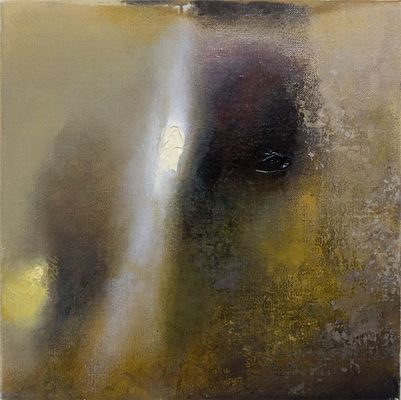
To return to Buckley’s fragment, the first two lines very much evoke how I paint nowadays. As you age, detail diminishes and patches of light become more luminous and float. I feel the most honest way of dealing with this is by smearing the oil paint on the canvas with the fingers and working close-up, blind. Only if the patches coalesce into an approaching image can the work gain a life.
-
Jonathan Walker was born in Melbourne, Australia and brought up on a dairy farm in Gippsland. In the 1970’s he studied painting at RMIT and won the Harold Wright Scholarship to the British Museum, London. During the 1980’s he exhibited at Pinacotheca Gallery, Richmond and had work shown at the NGV and Heidi City Art Gallery. Over the same period he designed the cover for the “Epigenesi” LP by Giancarlo Toniutti, Italy and conducted a mail exchange work with Achim Wollscheid, Germany. The work with artists through the post resulted in an article published in the bicentenary issue of Art and Australia 1988. He showed in artist run spaces such as WestSpace in the 90’s and 2000’s, and until 2012, taught painting at Victoria University, which is where we (Colleen Ahern and Lisa Radford) as organisers of the exhibition, among many others, had the privilege of being his student.
Walker’s knowledge was imparted to students through the careful selection of music, literature, and artists found in books that he himself had ordered for the library. Walker’s strategy was the generosity of sharing his vast knowledge with references specific to each student and their context.
Walker’s paintings share a similar focus and intimacy.
This exhibition presents a small selection of recent paintings alongside a publication that includes Walker’s writing. Observational and analytical, Walker’s work is a type of material notation — the time of day, colour and how it is blended, the both specific and fleeting location of a reflection on lino or the question of whether a chair leg should be included in a painting.
Please join us on Friday August 21 between 6-8pm to celebrate the opening of the exhibition.
Curated by Colleen Ahern and Lisa Radford.
B. Wurtz
Curated by Nic Tammens
March 26 - April 4, 2015
B.Wurtz works from a basement studio in his home on Manhattan’s Lower East Side.
This local fact is attested to by the plastic shopping bags and newsprint circulars that appear in his work. As formal objects, they don’t make loud claims about their origins but nonetheless transmit street addresses and places of business from the bottom of this long thin island. Like plenty of artists, Wurtz is affected by what is local and what is consumed. His work is underpinned by this ethic. It often speaks from a neighborhood or reads like the contents of a hamper:
“BLACK PLUMS $1.29 lb.”
“Food Bazaar”
“USDA Whole Pork Shoulder Picnic 99c lb.”
“RITE AID Pharmacy, with us it’s personal.”
“H. Brickman & Sons.”
“Sweet Yams 59c lb."
Most of the work in this exhibition was made while the artist was in residence at Dieu Donne, a workshop dedicated to paper craft in Midtown. Here Wurtz fabricated assemblages with paper and objects that are relatively lightweight, with the intention that they would be easily transportable to Australia. This consideration isn’t absolute in Wurtz’s work, but was prescriptive for making the current exhibition light and cheap. Packed in two boxes, these works were sent from a USPS post office on the Lower East Side and delivered to North Melbourne by Australia Post.
Wurtz appears courtesy of Metro Pictures, New York.
Thanks to Rob Halverson, Joshua Petherick, Sari de Mallory, Matt Hinkley, Helen Johnson, Fayen d'Evie, Ask Kilmartin, Lisa Radon, Ellena Savage, Yale Union, and "Elizabeth".
John Nixon
"Archive"
December 15 - January 20, 2014
The presentation of John Nixon's archive offered a rare showcase of this extensive collection of the artist's own publications, catalogues, posters, ephemera, editions and more, from the mid 1980s onwards, alongside a selection of his artworks.
Organized by John Nixon, Joshua Petherick and Matt Hinkley.
"Habitat"
at Minerva, Sydney (organised by Joshua Petherick and Matt Hinkley)
November 15 - December 20, 2014
Lupo Borgonovo, Janet Burchill & Jennifer McCamley,
Lewis Fidock, HR Giger, Piero Gilardi, Veit Laurent Kurz,
Cinzia Ruggeri, Michael E. Smith, Lucie Stahl, Daniel Weil, Wols
Press Release:
“...It contained seven objects. The slender fluted bone, surely formed for flight, surely from the wing of some large bird. Three archaic circuitboards, faced with mazes of gold. A smooth white sphere of baked clay. An age-blackened fragment of lace. A fingerlength segment of what she assumed was bone from a human wrist, grayish white, inset smoothly with the silicon shaft of a small instrument that must once have ridden flush with the surface of the skin - but the thing’s face was seared and blackened.”
William Gibson, “Count Zero”, 1986
"Autumn Projects Archive"
Curated by Liza Vasiliou
March 6 - March 15, 2014
World Food Books, in conjunction with the Virgin Australia Melbourne Fashion Festival 2014, presented the Autumn Projects archive, consisting of a selection of early examples in Australian fashion with a particular interest in collecting designers and labels from the period beginning in the 1980’s, who significantly influenced the discourse of Australian Fashion.
Curated by Liza Vasiliou, the exhibition provided a unique opportunity to view pieces by designers Anthea Crawford, Barbara Vandenberg, Geoff Liddell and labels CR Australia, Covers, Jag along with early experimental collage pieces by Prue Acton and Sally Browne’s ‘Fragments’ collection, suspended throughout the functioning World Food Books shop in Melbourne.
H.B. Peace
presented by CENTRE FOR STYLE
November 14, 2013
"Hey Blinky, you say chic, I say same"
Anon 2013
H.B. Peace is a clothing collaboration between great friends Blake Barns and Hugh Egan Westland. Their pieces explore the divergences between 'character’ and ‘personality’ in garments....etc
Special Thanks to Joshua Petherick and Matt Hinkley of WFB and Gillian Mears
and a Very Special Thank you to Audrey Thomas Hayes for her shoe collaboration.
Janet Burchill & Jennifer McCamley
"Aesthetic Suicide"
May 10 - June 8, 2013
The first of our occasional exhibitions in the World Food Books office/shop space in Melbourne, "Aesthetic Suicide" presented a body of new and older works together by artists Janet Burchill & Jennifer McCamley, including videos, prints, a wall work, and publications.
During shop open hours videos played every hour, on the hour.
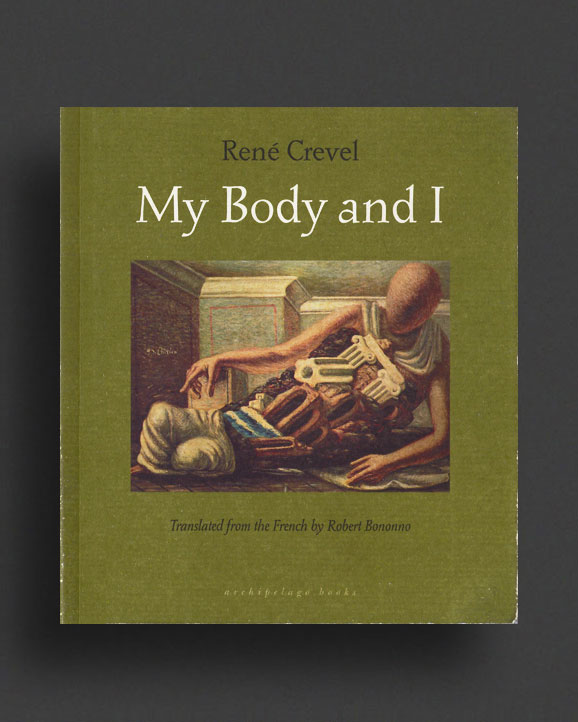
2005, English
Softcover, 145 pages, 15.24 x 16.51 cm
1st Edition, Out of print title / used / very good
Published by
Archipelago Books / New York
$90.00 - Out of stock
Rare First English translation, long out-of-print.
Translated from French by Robert Bononno.
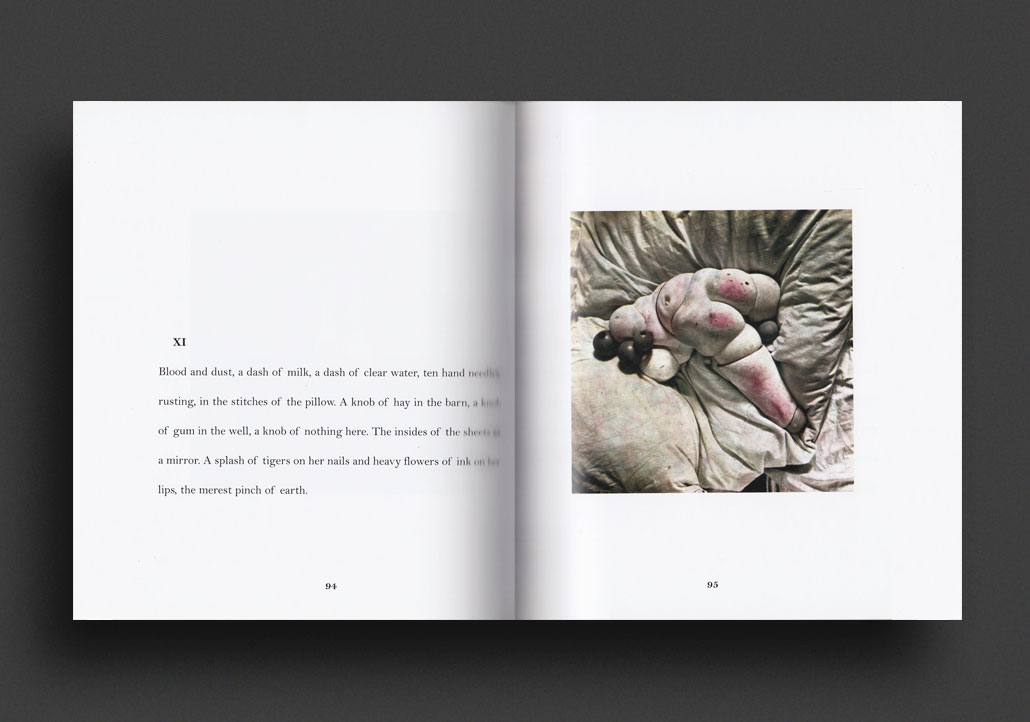
In My Body and I (Mon Corps et Moi, 1925), René Crevel attempts to trace with words the geography of a being. Exploring the tension between body and spirit, Crevel’s meditation is a vivid personal journey through illusion and disillusion, secret desire, memory, the possibility and impossibility of life, sensuality and sexuality, poetry, truth, and the wilderness of the imagination. The narrator’s Romantic mind moves from evocative tales to frank confessions, making the reader a confidant to this great soul trapped in an awkward-fitting body. A Surrealist Proust.
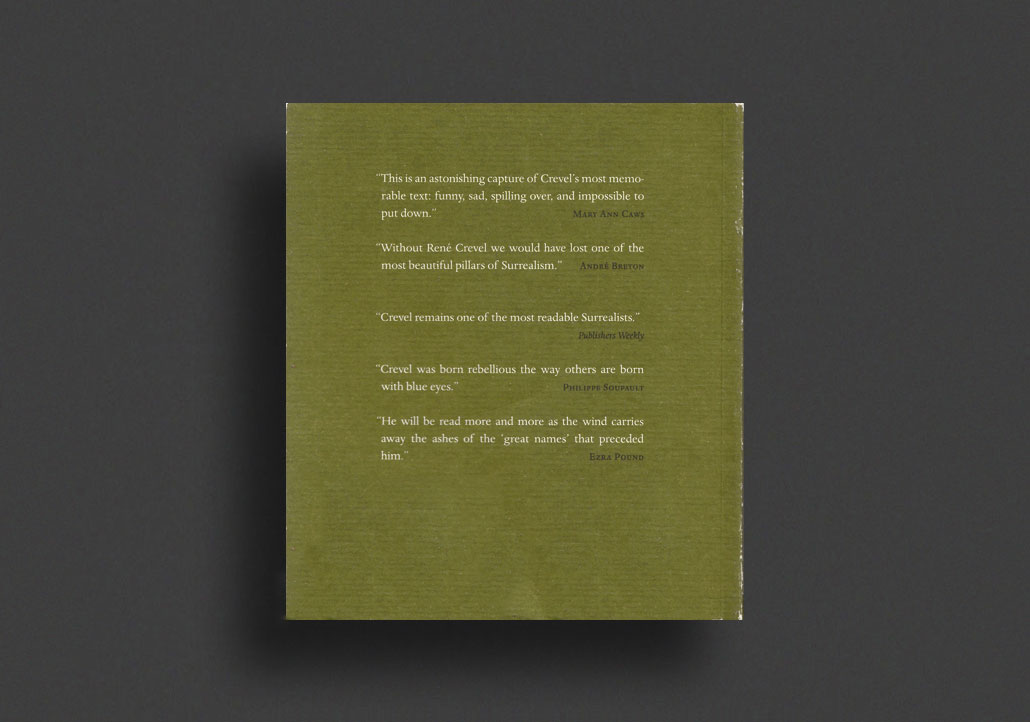
“Without René Crevel we would have lost one of the most beautiful pillars of surrealism.”—André Breton
“The works that Crevel left us indicate that he was one of the most original, gifted French novelists of the century.”—San Francisco Bay Guardian
“Crevel remains one of the most readable Surrealists…His liquid language tumbles along, powered by his strong descriptions, by his love of Freudian wordplay—rarely is a cigar just a cigar.”—Publishers Weekly
Very Good copy with light wear.
1968 / 1969, Japanese / French
4 Vols., softcover, approx. 1000 pages, 23 x 18 cm
1st Edition, Out of print title / used / very good
Published by
Tensei Shuppan / Tokyo
$350.00 - Out of stock
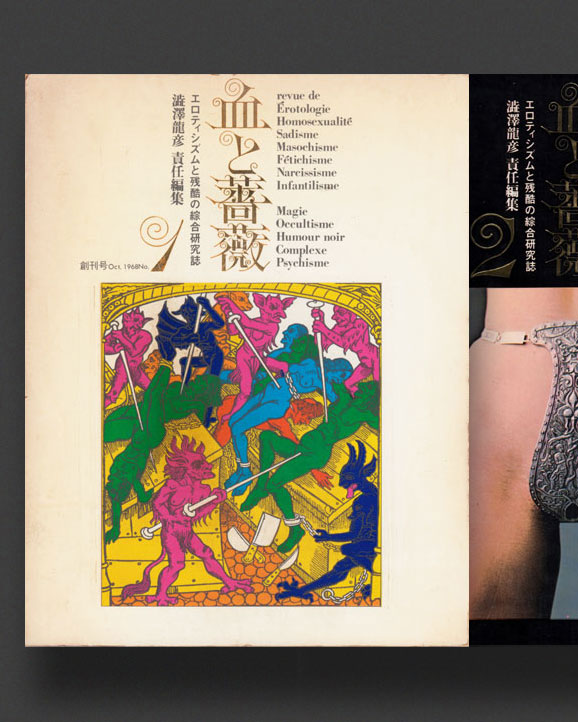
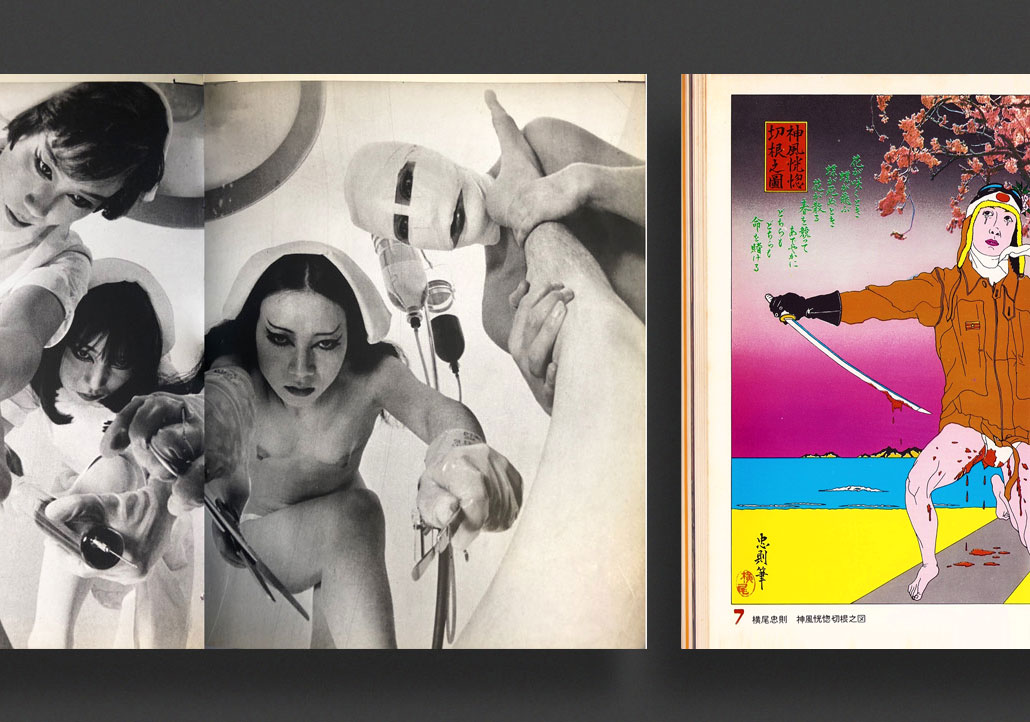
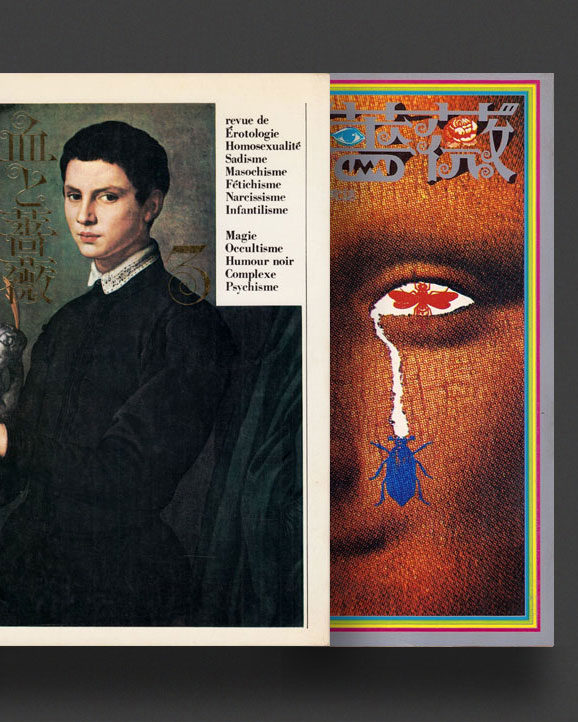
Complete 4 issue run of Le Sang Et La Rose — a masterpiece of the Japanese underground! Opening with Kishin Shinoyama's photographic portraits of Yukio Mishima depicted as Saint Sebastian and onward through one thousand pages exploring the outer limits of subversive human potential!
Revue de Érotologie, Homosexualité, Sadisme, Masochisme, Fétischisme, Narcissime, Infantilisme, Magie, Occultisme, Humour Noir, Complexe Psychisme. What more could you ask for? Le Sang Et La Rose was a groundbreaking, yet short-lived Japanese arts and literary journal published in Tokyo from late 1968—mid 1969, published in a total of four luxurious, now collectible, volumes. The first three issues were edited by Tatsuhiko Shibusawa (1928—1987), a legendary, controversial Japanese novelist, art critic, translator of French writers such as Jean Cocteau, Georges Bataille and Marquis de Sade, and specialist in medieval demonology. The fourth final issue, and rarest of the four, edited by critic Masaaki Hiraoka and designed by self-taught painter, graphic designer and political activist, Kiyoshi Awazu (!) The importance of this magazine to the Japanese avant-garde and radical culture cannot be overstated.
Born from a period of political, social and economical turmoil in Japan, Le Sang Et La Rose may be understood as a emblematic distillation and product of the late ‘60s student rebellion and anti-authoritarian underground culture. Wilfully politically subversive, the publication drew upon a vast range of perspectives - from criticism, literature, obscure esoteric sciences, art, eroticism, radical avant-garde and a historical-rooted Japanese counterculture; featuring literature, theory, art, photography, illustration and graphic design from the most innovative and subversive Japanese and international (predominately French) artists, authors and critics, spanning the themes above. As instigator, Tatsuhiko Shibusawa in effect formulated the magazine’s design to be a spiritual and political operative that would weaponize its readers minds. This stance was made clear in the 1969 manifesto text — "My 1969" — in which Shibusawa discuss' how he perceived the ‘60s as being the age of ideas, ideas as weapons, and outlined a distain towards systems of power, moralism, State oppression, sanitised and harmless liberalism, dogmatic academic sciences and an outright distrust for ideological, progressive literary scholars who advocate "freedom of expression", but have never caused friction with the judicial power. The magazine sketched out an aim to push towards a new kind of personal freedom, intellect, autonomy and moral compass. Here, the concept of ‘erotism’ — as discussed by Georges Bataille in his highly influential 1957 book "Erotism: Death and Sensuality" — acts as a critical force.
Tatsuhiko Shibusawa (1928—1987), was a well-known and controversial Japanese novelist, art critic, and translator of French writers such as Jean Cocteau, Georges Bataille and Marquis de Sade. In 1960 he and his publisher, Kyōji Ishii, were trialled for public obscenity over the publishing of Shibusawa's translation of de Sade's Juliette into the Japanese language. What was to be known as the "Sade Trial" took 9 years and although many of Japan's leading authors testified for the defense, in 1969 the Japanese Supreme Court ruled them guilty and charged. This did not deter Shibusawa, whose essays on black magic, demonology and eroticism were popular reading in Japan, and in 1981 he was awarded the 9th Izumi Kyoka Literature Prize.
All Good—VG copies with general wear and age.
Vol 1 with bumping and open chip to top of spine.
1990, English
Softcover (w. dust jacket), 512 pages, 29.5 x 23 cm
1st Edition, Out of print title / used / very good
Published by
Biennale of Sydney / Sydney
$120.00 - In stock -
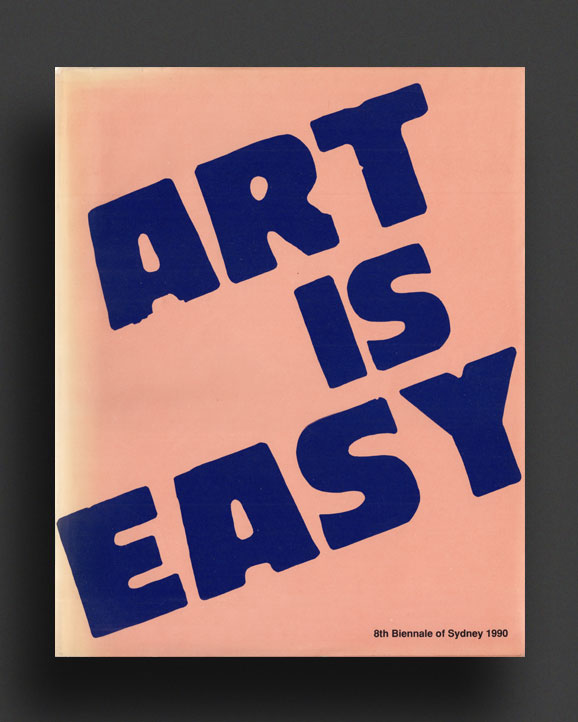
First edition of the incredible (huge) catalogue published to accompany the 8th Biennale of Sydney 1990 "The Readymade Boomerang: Certain Relations in 20th Century Art", held 11 April-3 June 1990 in Sydney across various venues. The eighth Biennale began from ‘a trio of Dada originators’: Marcel Duchamp, Man Ray and Francis Picabia. A large number of artists across generations joined these key figures in Artistic Director René Block’s exploration of the ‘readymade’ in twentieth-century art, which aimed to highlight ‘its invention and pure use by Duchamp, to its resurgence in Nouveau Realism, Pop Art, and Fluxus of the 60s, all the way to new versions by young contemporary artists’. Pop, fluxus and conceptual artists such as Andy Warhol, Richard Hamilton, Marcel Broodthaers, Joseph Beuys, John Cage, Alison Knowles, César, George Brecht, Nam Jun Paik and Piero Manzoni were shown alongside Rosemarie Trockel, John Nixon, Ian Burn, Mel Ramsden, Janet Burchill, Peter Tyndall, Robert Rooney, Rosalie Gascoigne, Cindy Sherman, Bruce Nauman, Hans Haacke, Rebecca Horn, Sophie Calle, Jeff Koons, Allan Kaprow, Jenny Holzer, Robert Gober, Jill Scott, Bill Culbert, Stanley Brouwn, Peter Cripps, Terry Fox, Ian Hamilton Finlay, Fischli & Weiss, KP Brehmer, Sigmar Polke, Dieter Rot, Hanne Darboven, Robert MacPherson, Jackie Redgate, Ed Ruscha, Barbara Bloom, Oyvind Fahlstrom, amongst so many others. The industrial Bond Store at Millers Point featured site-specific works by artists such as Olaf Metzel and Simone Mangos, and several works were created on-site in Sydney, amplifying Block’s notion of the Biennale as a ‘workshop’. A comprehensive satellite program of music, performance, lectures, symposia, workshops and exhibitions at various Sydney venues complemented the exhibition, with Carles Santos’ piano recital on a barge in Sydney Harbour a highlight. Five satellite exhibitions included On Kawara, Joseph Beuys, Alain Fleischer, Fluxus and Broken Record, which featured artist’s experimentations with audio recordings, vinyl and album artwork – from John Cage’s 33 1/3 composition for 12 record players to Milan Knížák’s record-collages.
An incredible Sydney biennale, captured here across over 500 pages conceived and realised by René Block and Jennifer Cook - profusely illustrated with examples of all artists works and accompanying texts throughout by Lynne Cooke, Bernice Murphy, Anne Marie Freybourg, Dick Higgins, René Block and Jennifer Cook. Very Good copy with only general wear/ageing. Bright and clean, includes tanned original dust jacket now preserved under plastic wrap.
Having represented Beuys, Richter and Polke, German gallery owner, art publisher, art collector and curator René Block (born 1942) ranks among the central figures of the 1960s avant-garde.
Very Good copy with original dust jacket. Common tanning to dust jacket spine, now preserved under mylar wrap.
1993, Japanese
Softcover, 240 pages, 21 x 15 cm
1st Edition, Out of print title / used / very good
Published by
Atelier Peyotl / Tokyo
$65.00 - Out of stock
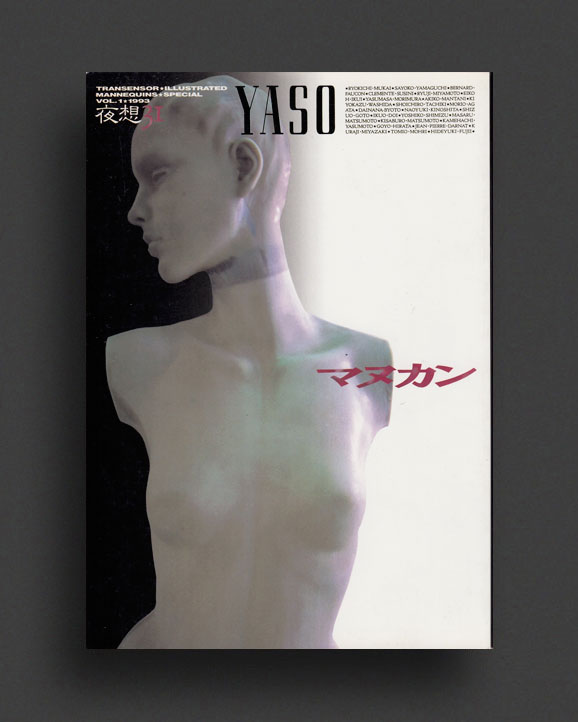
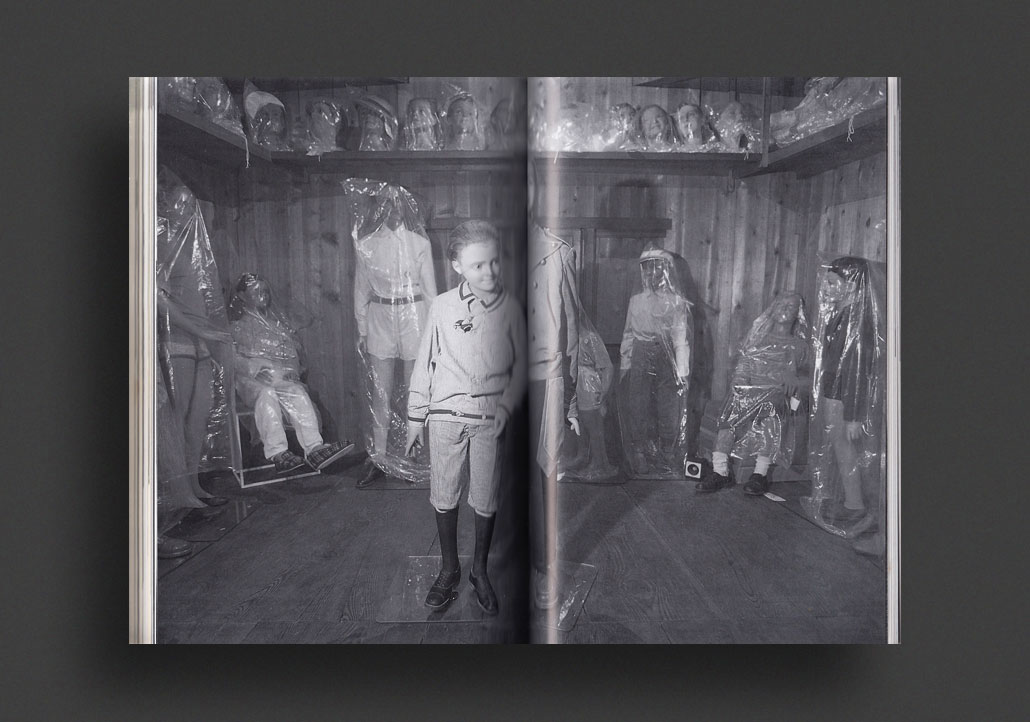
"Mannequin" Special Feature Issue of cult Japanese underground magazine Yaso, published in 1993, edited by Yuichi Konno and Atelier Peyotl (publishers of Night Vision/Yaso/Peyotl/Wave/Silvester Club...). Heavily illustrated with texts in Japanese that look at the theme of the mannequin from fashion apparatus to fetish object, automatons to living dolls, including a panoramic photographic history of mannequins, a photo feature of French photographer Bernard Faucon's boy mannequin collection, a huge illustrated article on famous Japanese costume, stage and exhibition designer, and Issey Miyake collaborator Tomio Mohri, the wax anatomical models of dissected corpses by Clemente Michelangelo Susini of Florence (1754–1814) shot by Ryuji Miyamoto, Czech animator Jirí Barta's Klub odlozenych, Japanese model and actress Sayoko Yamaguchi, the living dolls of the Japanese theatre, medical mannequins, crash-test dummies, icons, "Doll Love" and erotic dolls, plus lots more and a lot more Bernard Faucon!
Very Good—Near Fine copy.
1996, English
Softcover, 176 pages, 23 x 21 cm
1st Edition, Out of print title / used / average
Published by
Atlas Press / London
$85.00 - Out of stock
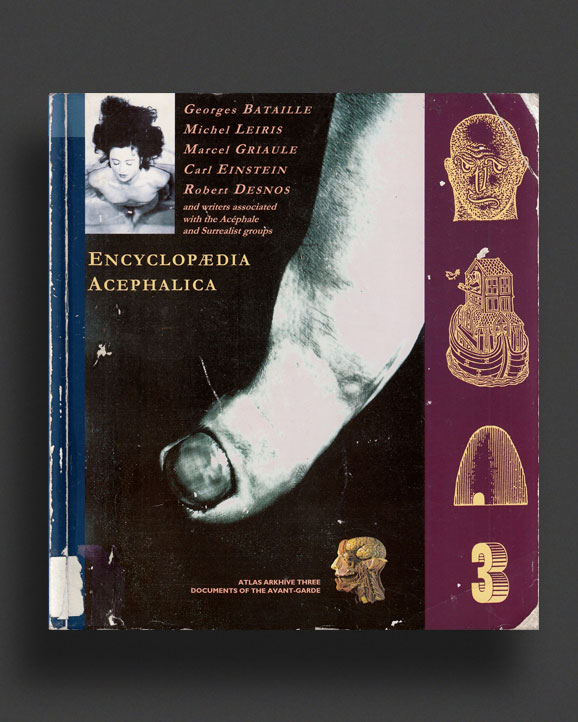
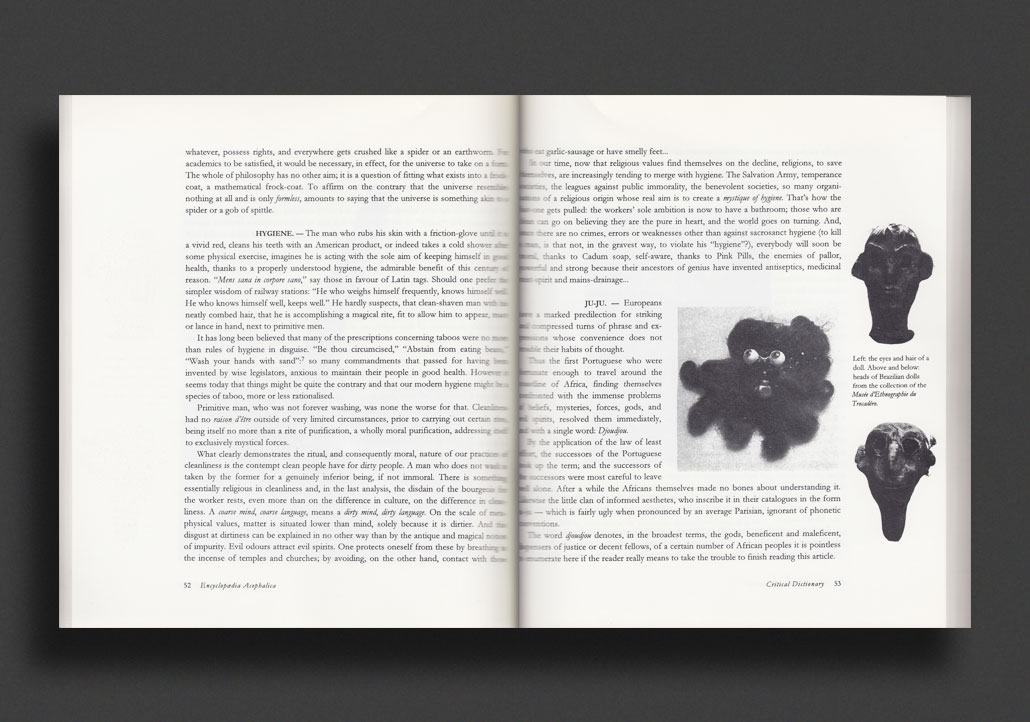
First edition of the incredible and sadly long out-of-print Encyclopedia Acephalica, published by Atlas Press in 1996 as part of their mighty Atlas Arkhive : Documents of the Avant Garde series.
Bataille’s thought is complex, and his books make few concessions to the reader. The first series of texts here, however, were written for a wider audience by Bataille and his friends, in the form of a Critical Dictionary, and they provide a witty, poetic and concise introduction to his ideas. The Dictionary appeared in the magazine edited by Bataille, Documents, in the early 1930s, and includes entries from prominent ethnologists and cultural commentators of the day. The second series of texts here, the Da Costa Encyclopédique was published anonymously after the liberation of Paris in 1947 by members of the Acéphale group and writers associated with the Surrealists. Both cover the essential concepts of Bataille and his associates: sacred sociology; scatology, death and the erotic; base materialism; the aesthetics of the formless; sacrifice, the festival and the politics of the tumult etc: a new description of the limits of being human. Humour, albeit, sardonic, is not absent from these remarkable redefinitions of the most heterogeneous objects or ideas: Camel, Church, Dust, Museum, Spittle, Skyscraper, Threshold, Work – to name but a few.
While the Documents group was celebrated for joining together artists, authors, sociologists and ethnologists (among the most important of their time) in a literary and philosophical project, the Acéphale group was more mysterious. Until recently even its membership was only vaguely known, and its activities remained secret (these are explored in detail for the first time in English in The Sacred Conspiracy, published by Atlas Press, also available at World Food Books). The origins of the Da Costa only became known in 1993, the present volume revealed for the first time its principal compilers: Robert Lebel, Isabelle Waldberg and Marcel Duchamp, but the identity of the authors of a large part of it is still unknown.
Texts by Georges Bataille, Michel Leiris, Marcel Griaule, Carl Einstein, Robert Desnos and writers associated with the Acéphale and Surrealist groups.
Introduced by Alastair Brotchie. Translated by Iain White, Dominic Faccini, Annette Michelson, John Harman, Alexis Lykiard.
Average—Good, cover with edge and corner wear and some some damages from spine sticker removal, fuzzed corners, otherwise Good pre-loved copy throughout.
1970, German
Softcover (w. dust jacket), 118 pages, 21 x 17 cm
Out of print title / used / very good
Published by
Studio 69 / Cologne
$90.00 - Out of stock
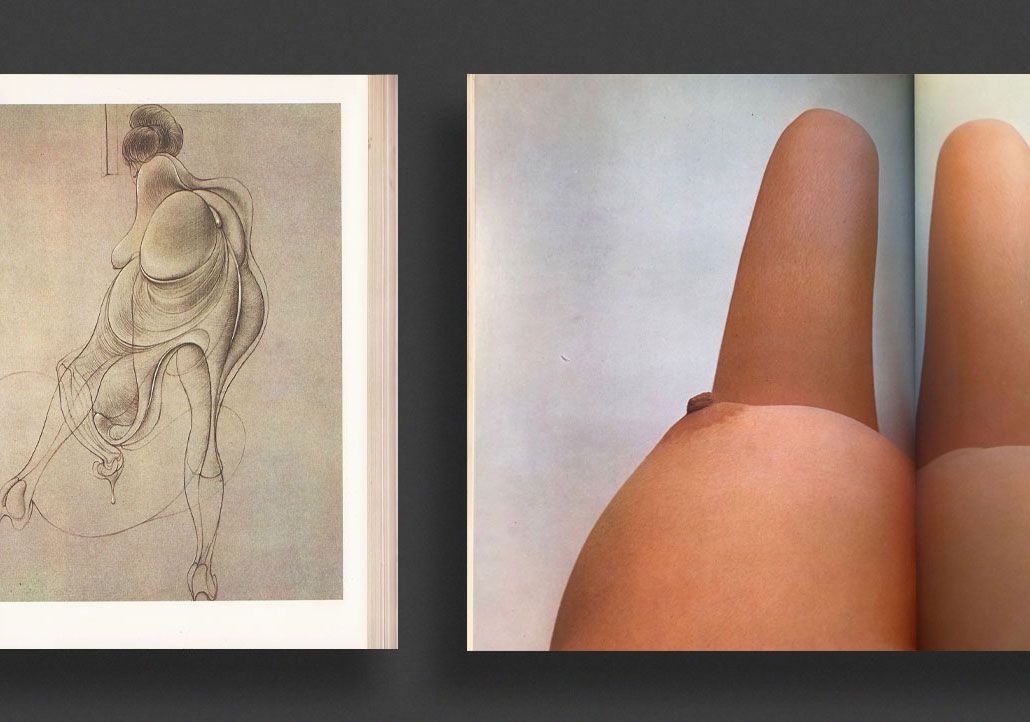
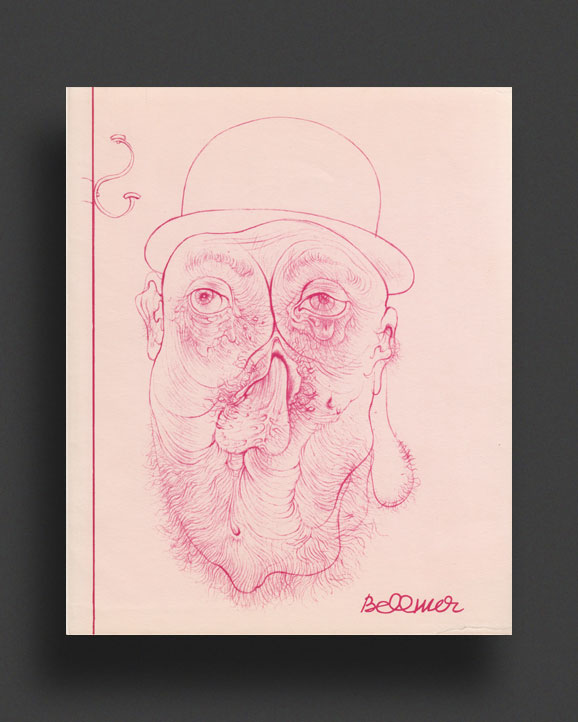
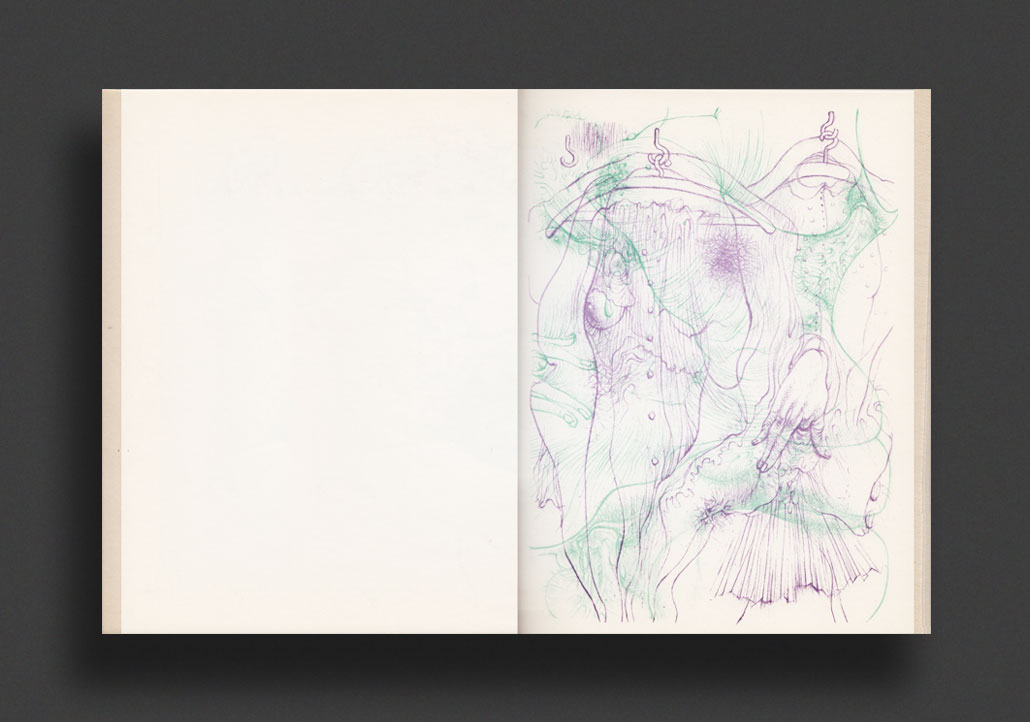
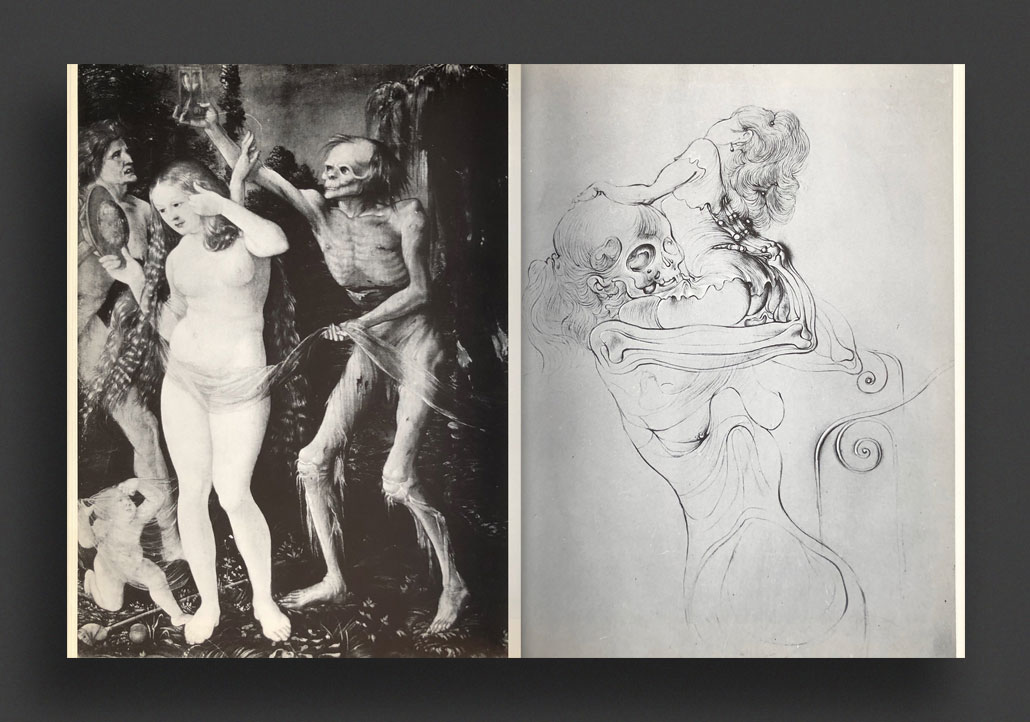
First edition, edited and designed by Galerie Sydow's Heinrich Sydow-Zirkwitz, this beautiful book of Hans Bellmer's graphic works was published as a special project between Studio 69 in Cologne and Galerie Sydow in Frankfurt to accompany the exhibition "Ars Erotica" in 1970. Handsomely printed with spot-colour over-printing and illustrated throughout with Bellmer's graphic famous graphic series' "Bellmer à Sade" (1961), "Petite Traité de Morale" (1965) and illustrations for Georges Bataille's "Madame Edwarda" (1965). Includes text by Horst Albert Glaser. A very handsome collection and one of the nicest Bellmer books.
Very Good copy in Good dust jacket with very small closed repaired tear to bottom corner.
1975, French / German
Softcover, 306 pages, 27 x 21 cm
1st Edition, Out of print title / used / very good
Published by
Obliques / Paris
$160.00 - Out of stock
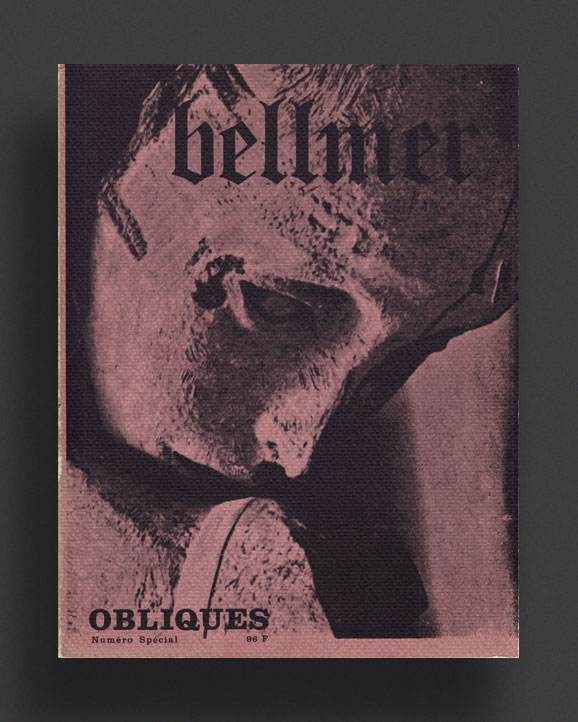
The gorgeous over-sized Hans Bellmer Obliques Special Issue, published in Paris in 1975, the year of the great artists death. Still possibly the best and most comprehensive Bellmer book, this special, beautifully printed issue of French literary journal Obliques (who also published special issues on Artaud, Kafka, Klossowski, Vian, Sartre, Robbe-Grillet, female Surrealists, Strindberg, Genet...) features over 300 pages devoted to the oeuvre of Bellmer, lavishly illustrated throughout in colour and b/w with his drawings, etchings, photographs, dolls, assemblages, portraits and other works, accompanied by biography, exhibition history, bibliography, personal life, wonderful photographs with Unica Zürn, facsimiles of Bellmer's writings and books, and many other notes. An incredible reference. Contributors include Paul Eluard, Nora Mitrani, Jean Brun, Paul Buck, Bernard Noel, Yves Bonnefoy, Michel Butor, Hans Bellmer, Georges Hugnet, Catherine Binet, Rene de Solier, Michel Camus, Jerome Peignot, and more. Also features Heinrich von Kleist's "Sur la theatre de marionnettes" and Strindberg's play, "Le Mardi-Gras de Polichinelle". Texts in French and German. Highly recommended.
German artist Hans Bellmer (1902—1975), is regarded as one of the most radical, subversive of the Surrealists, best known for the remarkable life-sized pubescent female dolls he produced in the mid-1930s. Born in the city of Kattowitz, then part of the German Empire (now Katowice, Poland), up until 1926 Bellmer worked as a skilled draftsman for his own advertising company. He initiated his doll project to oppose the fascism of the Nazi Party by declaring that he would make no work that would support the new German state. Represented by grotesque, mutated forms, twisted into unconventional sexual poses, or deformed by missing or superfluous limbs, his dolls were directed specifically at the cult of the perfect physique then prominent in Germany. Bellmer was influenced in his choice of art form by reading the published letters of Oskar Kokoschka (Der Fetisch, 1925). After the Nazis branded his work as “degenerate,” Bellmer fled to France, where he was embraced by the Surrealists. Bellmer gave up doll-making and spent the following decades creating erotic drawings, etchings, sexually explicit photographs, paintings, and prints, almost always dealing with female subjects and themes of abject sexuality and forbidden desire. In 1954, he met artist and writer Unica Zürn, who became his companion until her suicide in 1970. Bellmer died 24 February 1975 of bladder cancer. He was buried beside Zürn at Père Lachaise Cemetery with a tomb marked "Bellmer – Zürn".
Very Good copy. Only light wear, some spine, back cover tanning.
1991, English
Hardcover (w. dust jacket), 120 pages, 21.6 x 15.3 m
1st Edition, Out of print title / used / very good
Published by
University of Nebraska Press / Lincoln
$40.00 - Out of stock
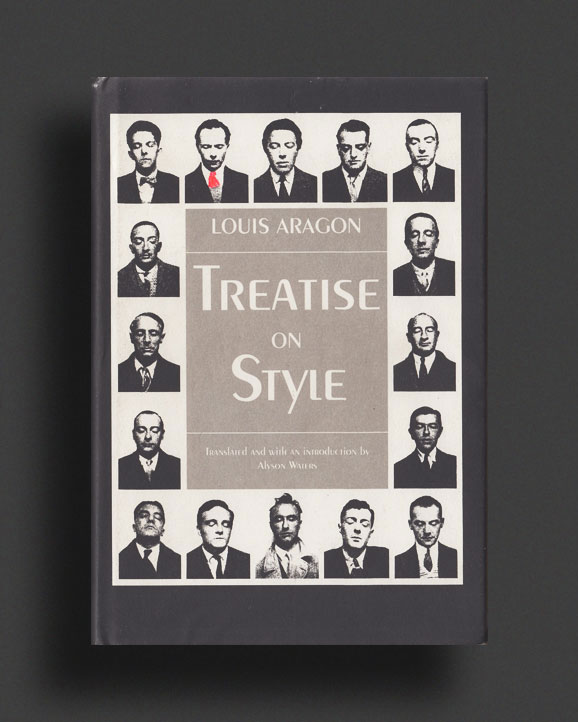
First English 1991 hardcover edition.
Surprising juxtapositions like goats spread across pianos and fearful optical illusions like eyeballs being sliced characterized the surrealistic movement in the arts in 1928 when Louis Aragon published Traite du Style in Paris. Aragon had become ever more contemptuous of vogues and pretensions. In the name of surrealism, he produced the first significant critique of it. Instead of merely upsetting old relationships and skewering sensibilities, Traite du Style was meant to shock with a capital S, and it did. Only now has it been completely translated into English. Although time has attenuated the scandalous nature of Aragon's language, his criticism has lost none of its edge in this translation by Alyson Waters.
From the beginning, which describes a postcard showing a little boy on a potty as representative of French humor and the French spirit, to the end, an attack in scatalogical language on the French military establishment, Aragon zeros in on one target after another. Nothing escapes his notice or venom-whether it is the masturbatory output of contemporary writers, the prostitution of culture, or the perversions of government. Still, Treatise on Style is more than a brilliant diatribe directed against what Aragon perceived as the moral, political, and intellectual failures of his time. He proposes surrealism, in art as in life, as a means to achieve a valid ethical and aesthetic "style." Surrealism, as Aragon defines it here, loses some of its mythical and mystical trappings; it becomes inspiration with rolled-up shirt-sleeves. He exercises this faculty in his own writing, which aims to shake readers out of their complacency by alternating the intensely lyrical with the borderline obscene and juxtaposing the language of the educated elite with that of the street. Whether denouncing religious fantacism or dispensing praise, Aragon remains true to his idea of the surrealist project: to reclassify certain values through the act of writing itself. Treatise on Style entertains as a portrait of a movement and of a personality who kept moving.
"This translation brings through into English just exactly the ferocious irony and acerbic wit of Aragon. Throughout it keeps up the texture of the original."—Mary Ann Caws, Hunter College and City University of New York
Alyson Waters, an adjunct lecturer in the Department of Romance Languages at Hunter College and CUNY, has translated articles for Art in America and other periodicals.
Very Good copy in VG dust jacket, only light edge wear. Probably unread.
1991, English
Softcover (cloth-bound w. dust jacket), 40 pages, 20 x 14.5 cm
1st Edition, Out of print title / used / very good
Published by
Hourglass Press / Paris
$100.00 - Out of stock
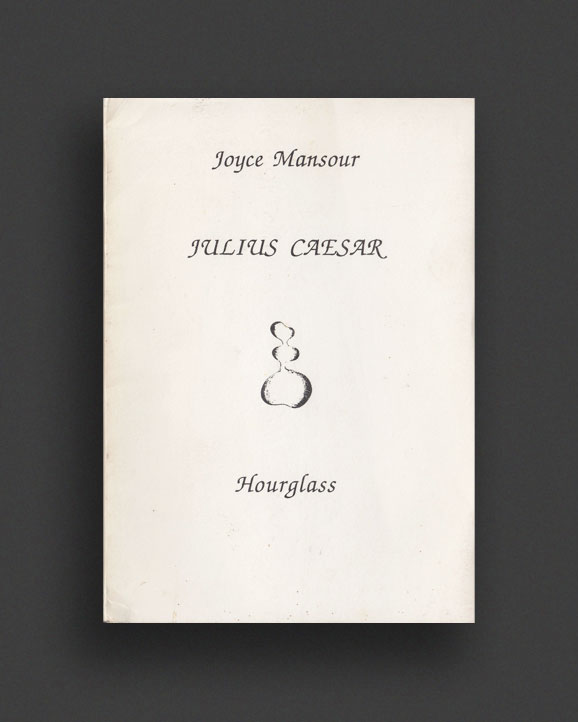
Rare, privately-issued first English edition of Joyce Mansour's dark Surrealist classic, Julius Caesar, translated, introduced and privately issued in an edition of 150 copies by Peter Webb in 1991. Illustrated by Bo Veisland. Seldom read in the English language, Julius César was first published in France by Seghers in 1953, with four illustrations by Mansour's friend Hans Bellmer.
"My intention in this foreword is not to offer any explanation concerning the contents or possible interpretation of Julius Caesar, but to present certain clues as to how the translation of this work has evolved and often harassed me - one might almost say noxiously - for over seventeen years."
"I first discovered and identified Joyce Mansour's name in Philippe Audoin's book Les Surréalistes. I say identified because, through some peculiar process of ideation, I recognized it as familiar, as though I knew (would know) the person in question. I immediately ordered the books to which my student's grant extended: Rapaces, Les Gisants Satisfaits and, later, Histoires Nocives, and found myself impressively startled by the rapid output of such violent, sultry and purely poetical images, tinged with Joyce's personal brand of cruel, black humour."—excerpt from the translator's introduction
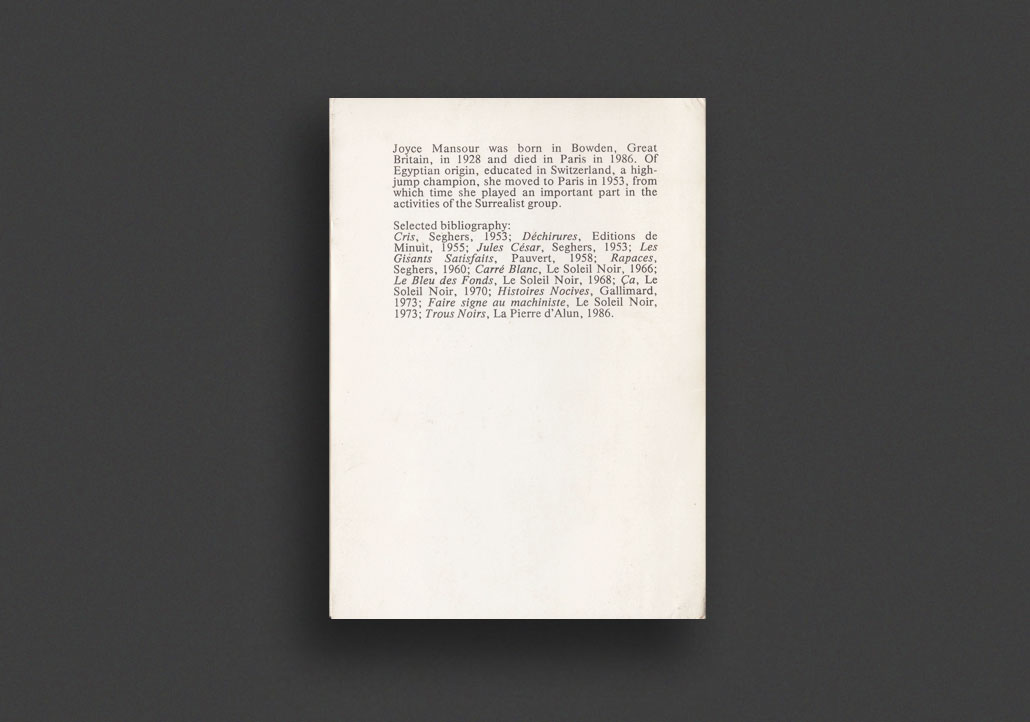
Joyce Mansour was born in Bowden, Great Britain, in 1928 and died in Paris in 1986. Of Egyptian origin, educated in Switzerland, a high-jump champion, she moved to Paris in 1953, from which time she played an important part in the activities of the Surrealist group.
Very Good copy, with a small knock to bottom-left corner. Light tanning.
2021, English
Hardcover (w. dust jacket), 408 pages, 28 x 23 cm
Published by
University of Pittsburgh Press / Pittsburgh
$220.00 - Out of stock
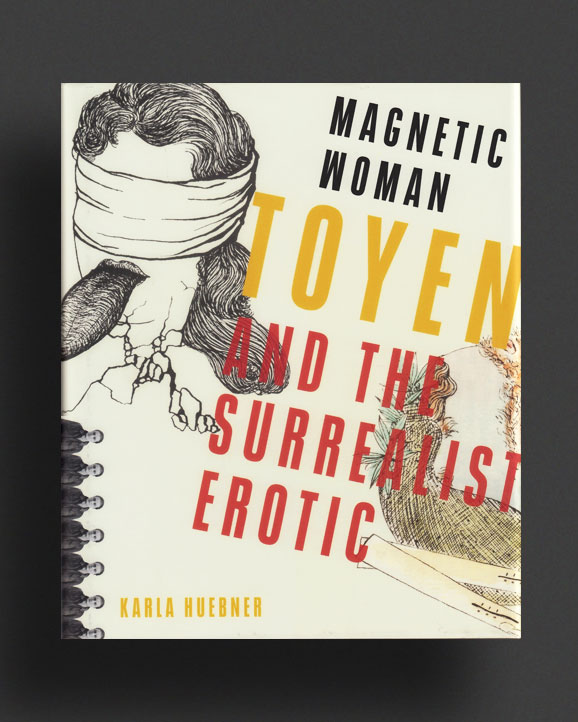
A New Interdisciplinary Study of Czech Gender-Fluid Artist Toyen.
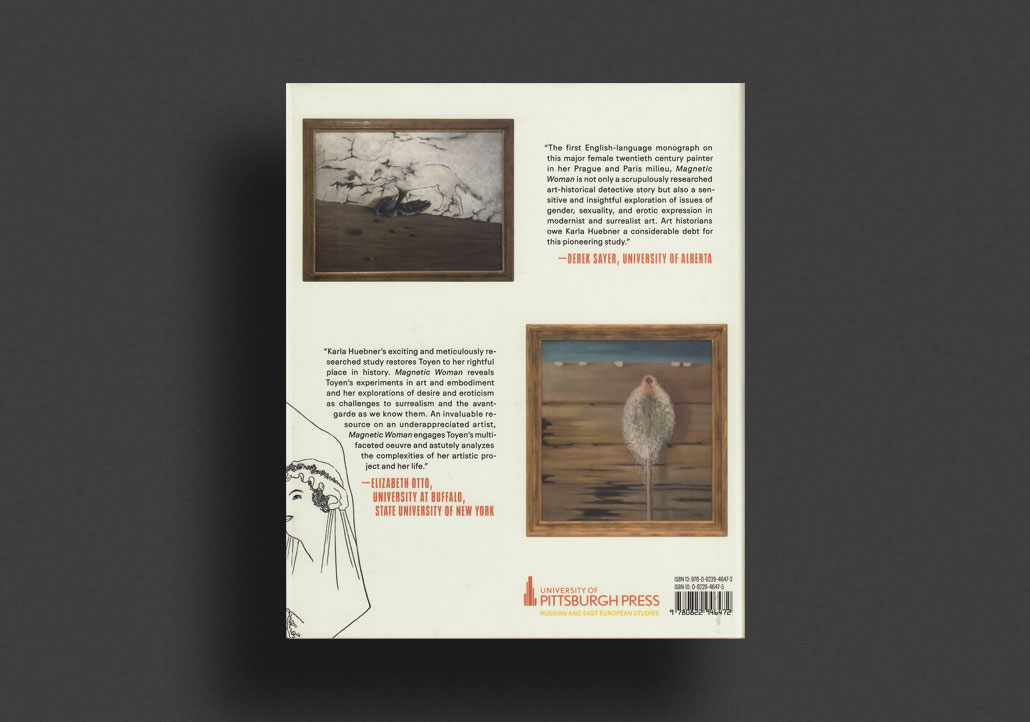
Part art book and part biography, Magnetic Woman examines the life and work of the artist Toyen (Marie Cerminova, 1902—1980), a founding member of the Prague surrealist group, and focuses on her construction of gender and eroticism. Toyen's early life in Prague enabled her to become a force in three avant-garde groups - Devetsil, Prague surrealism, and Paris surrealism — yet, unusually for a female artist of her generation, Toyen presented both her gender and sexuality as ambiguous and often emphasised erotic themes in her work. Despite her importance and ground-breaking work, Toyen has been notoriously difficult to study. Using primary sources gathered from disparate disciplines and studies of the artist's own work, Magnetic Woman is organized both chronologically and thematically, moving through Toyen's career with attention to specific historical circumstances and intellectual developments approximately as they entered her life. Karla Huebner offers a re-evaluation of surrealism, the Central European contribution to modernism, and the role of female artists in the avant-garde, along with a complex and nuanced view of women's roles in and treatment by the surrealist movement.
"The first English-language monograph on this major female twentieth century painter in her Prague and Paris milieux, Magnetic Woman is not only a scrupulously researched art-historical detective story but a sensitive and insightful exploration of issues of gender, sexuality, and erotic expression in modernist and surrealist art. Art historians owe Karla Huebner a considerable debt for this pioneering study."—Derek Sayer, University of Alberta
2005, English
Softcover (in card slipcase), 160 pages, 19 x 17 cm
1st Edition, Out of print title / used / fine
Published by
Atlas Press / London
$190.00 - Out of stock
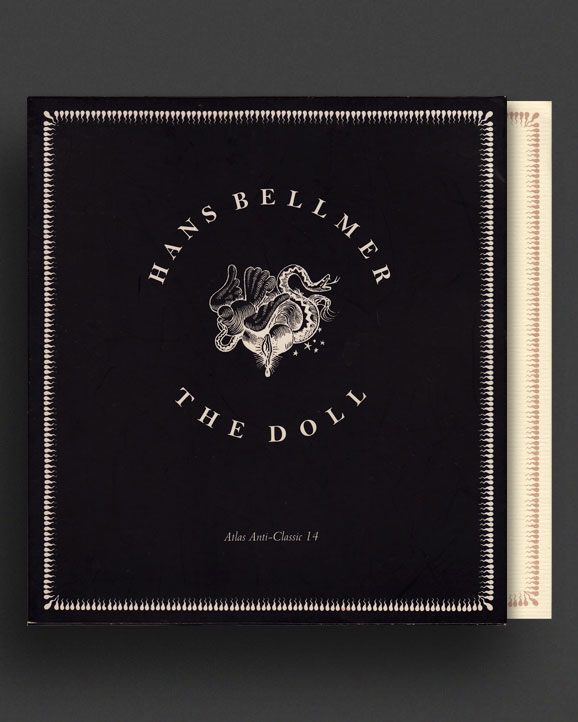
Rare first edition of this slipcased first English translation of Hans Bellmer's subversive Surrealist classic, Die Puppe (The Doll), first published in German in 1962, here translated and Introduced by Malcolm Green and published by the great Atlas Press, London.
Hans Bellmer (1902—1975) is one of the most illustrious names in the field of erotic art and Surrealism. The Doll comprises a series of photographs that have acquired iconic status and which exemplify the Surrealists’ conception of “convulsive beauty”. They are accompanied by a body of theoretical, poetic and speculative texts written between the 1930s and early 1960s which reveal Bellmer as one whose ideas are a “scandal for reason” (Joë Bousquet). But there is a lot more to Bellmer’s work than is at first apparent and the insights his writing provides into his work is crucial to its understanding, in particular those from the final edition of The Doll which are here translated in full. (The other editions widely available on the net mostly contain only the illustrations.) In these texts Bellmer weaves together a remarkably disparate set of concepts — covering such diverse fields as the body, psychology, anagrams, chance, the laws of optics and mathematics, the fourth dimension, hermaphroditism, the marvellous, intuition — into a theory of eroticism which forms the underlying rationale of his fearsome art.
Apart from the extensive texts by Bellmer it includes a suite of poems by Paul Éluard, 15 colour photographs, 10 in black and white, plus numerous line drawings. This English edition is based exactly upon the final edition overseen by Bellmer himself, the texts having been translated for the first time from the final German version rather than the preliminary French versions.
Near Fine copy.
1970, German
Softcover (staple-bound), 14 pages, 16 x 21 cm
1st Edition, Out of print title / used / very good
Published by
Studio 69 / Cologne
$100.00 - In stock -
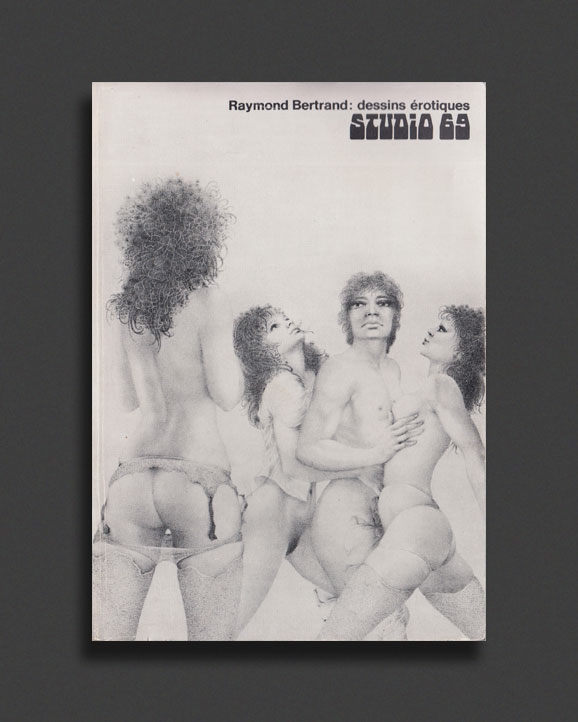
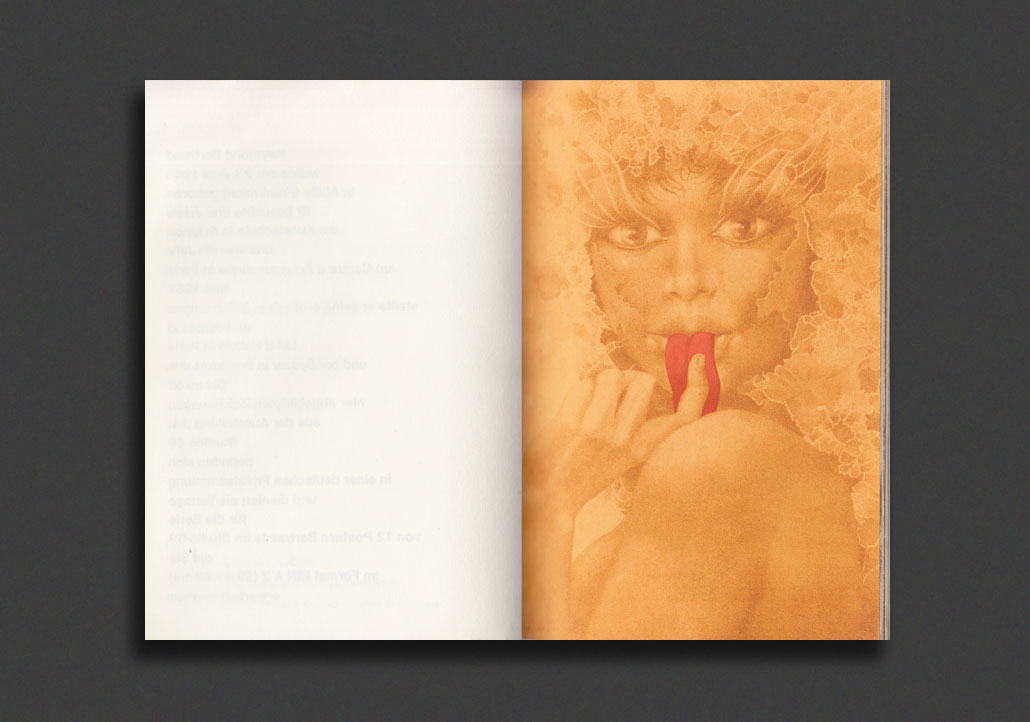
Rare early catalogue published on the occasion of an important solo exhibition "Raymond Bertrand: dessins érotiques," held in 1970 at the great Studio 69 in Cologne. Seemingly the only catalogued exhibition of work by one of the great elusive erotic-fantasy artists from Europe, Raymond Bertrand. Beautifully printed with reproductions of his works throughout, on varying paper stocks.
Along with Leonor Fini, Raymond Bertrand became acknowledged as one of the major new artists dealing with the modern sexuality in a highly personal fashion in the late 1960s-early 1970s, a period that seemed to encapsulate the entire published work of this little-known artist. Bertrand's work became known through his incredible illustrations for French SF journals Fiction, Galaxie, illustrations for the erotic Emmanuelle novels, and Eric Losfeld published collections. Bertrand is a somewhat elusive and shadowy figure about whom it is hard to find biographical information, and it is sadly unknown whether he continued his work after this period.
Very Good copy.
1987, French
Hardcover, 120 pages, 27.5 x 21 cm
1st Edition, Out of print title / used / very good
Published by
Les Editeurs d'Art associés / Brussels
$90.00 - Out of stock
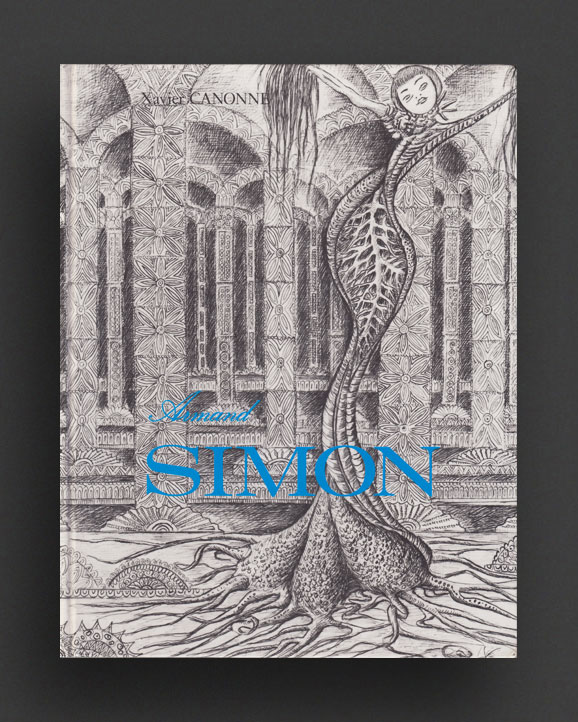
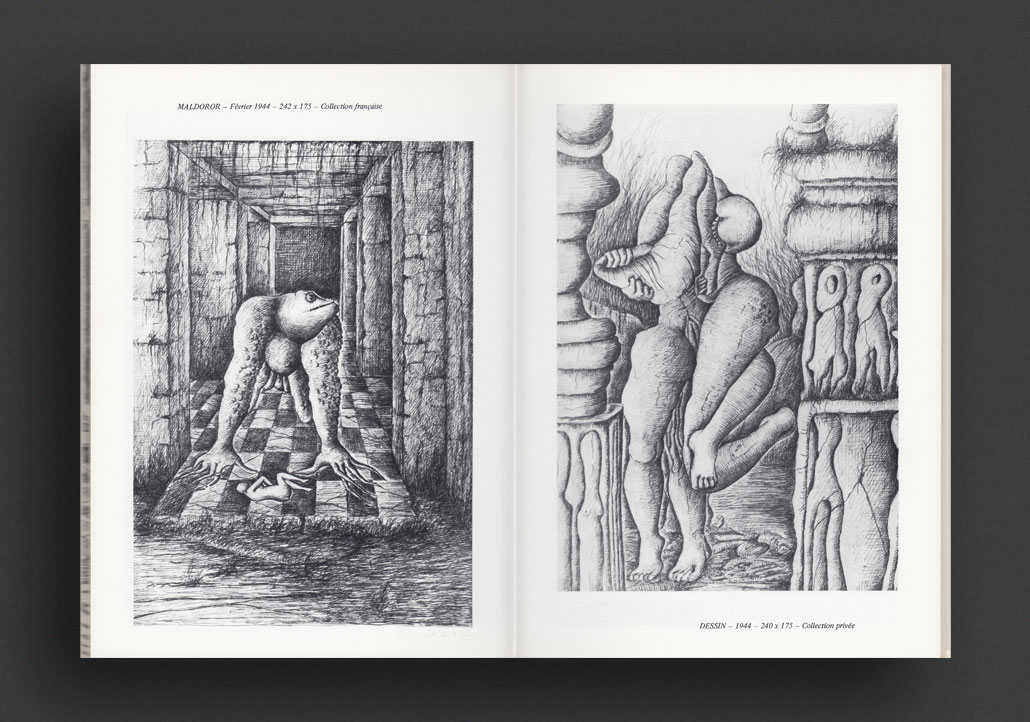
First 1987 hardcover edition of this monographic survey of self-taught Belgian surrealist Armand Simon (1906–1981). Profusely illustrated throughout with colour and b/w reproductions of his wonderful artworks, many inspired by Lautréamont's Maldoror and the poems by Rimbaud., accompanied by text from Belgian art historian and curator, Xavier Canonne. Also includes selections of Simon's poetic works and an illustrated biography with rare photographs. The most comprehensive book on this elusive artist, little known outside Belgium.
Armand Simon (1906–1981) was a self-taught Belgian Surrealist artist, cartoonist and poet known for his dreamlike and thought-provoking works. Born in Mons, Belgium, in 1923 Simon discovered the 'Chants de Maldoror' by Comte de Lautréamont, a text that fascinated him and to which he devoted thousands of drawings. An extremely prolific draftsman, he developed a noir universe nourished by literary sources, of which he proposed "graphic equivalents". Dense and precise, his drawings are based on an automatism to which he remained faithful throughout his life. His ink drawings often featured enigmatic and fantastical elements, exploring themes of the subconscious, dreams, and the absurd. In the mid 1930s Simon joined the Belgian Surrealist group Rupture, established in Hainaut, and alongside Chavée, Dumont and Lefrancq, took part in L'Invention Collective, founded and published by Raoul Ubac (1910-1985) and Rene Magritte (1898-1967) in 1940. He illustrated texts by Monique Watteau and Marcel Brion, as well as Achille Chavée's 'Seven Poems of High Negligence'. Throughout his life, he remained a relatively obscure figure outside of surrealist circles, but his work continues to be appreciated for its unique and devoted contribution to the movement. Simon's legacy is preserved through his art, which remains on display in various collections and museums dedicated to Surrealist art. Simon died in Frameries in 1981.
Xavier Canonne holds a doctorate in art history from the Sorbonne (Paris) and directs the Musée de la Photographie de la Communauté française in Charleroi. Since the 1970s, he has known and frequented the Belgian surrealists, some of whom were his close friends. He has devoted various books or articles to Armand Simon, Marcel Marién, Louis Scutenaire, Max Servais, Tom Gutt, Irène Hamoir and Robert Willems.
Very Good copy, light age/tanning.
1988, Japanese
Softcover, 208 pages, 13 x 18 cm
1st Edition, Out of print title / used / very good
Published by
Fiction Inc. / Tokyo
$70.00 - Out of stock
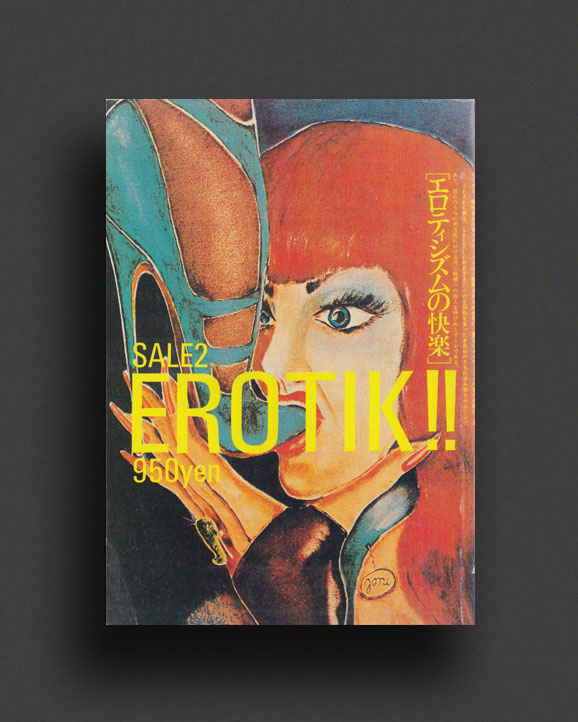
Issue No.35 of the great SALE2 periodical from Tokyo Japan, founded in 1984 by Makoto Orui, who later became art director for Purple magazine in France and Rockin’on magazine in Japan. SALE2 was active for about 14 years during the 1980s—1990s, published regularly as a sort-of fanzine/journal/catalogue/pocket-book by Fiction, Inc., a specialty shop and publisher of fetish and erotica in Tokyo in the 1980-90s. With Orui's distinct design SALE2 developed an exclusive curated editorial set on ‘erotisism and its spiritual philosophy’, with each issue exploring different themes and features, heavy on fetishism and erotic art.
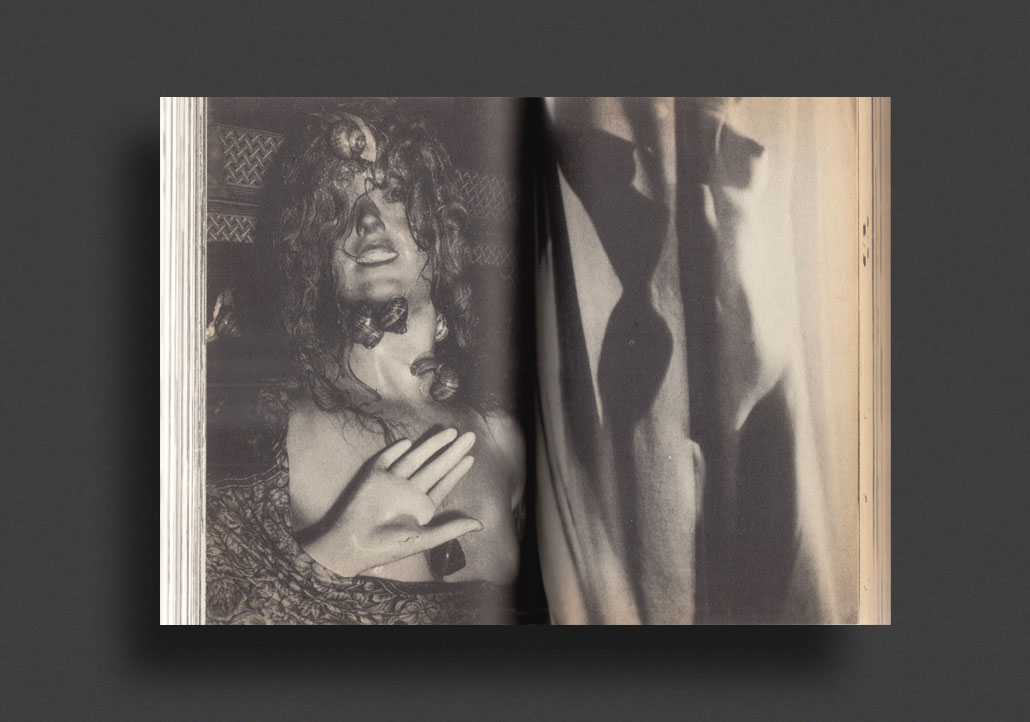
Issue No.35, the "EROTIK!!" issue features erotic writings and artwork throughout by Hans Bellmer, Dorothea Tanning, André Berg, Pierre Molinier, Max Ernst, Armando Calvelli, articles on vintage stag films, nude French postcards, interspersed with lots of mysterious vintage erotic imagery, bondage illustration, and catalogue/advertisments/clippings of Eric Stanton, Irving Klaw, Jim, John Willie, Bizarre Comix, and much more...
Very heavily illustrated throughout with erotic photography and artwork, all texts in Japanese.
Very Good copy, tanning to pages.
1971, English
Hardcover (w. dust jacket), 325 pages, 23 x 29.5 cm
1st Edition, Out of print title / used / very good
Published by
Andre De Rache / Brussels
$200.00 - In stock -
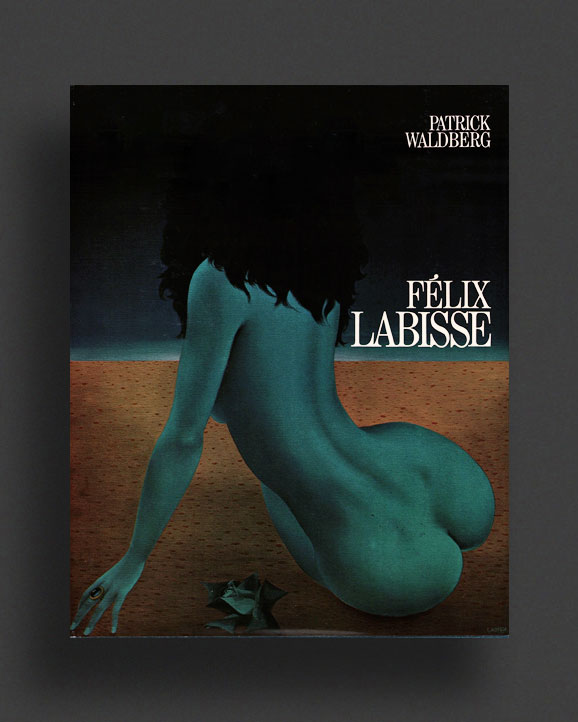
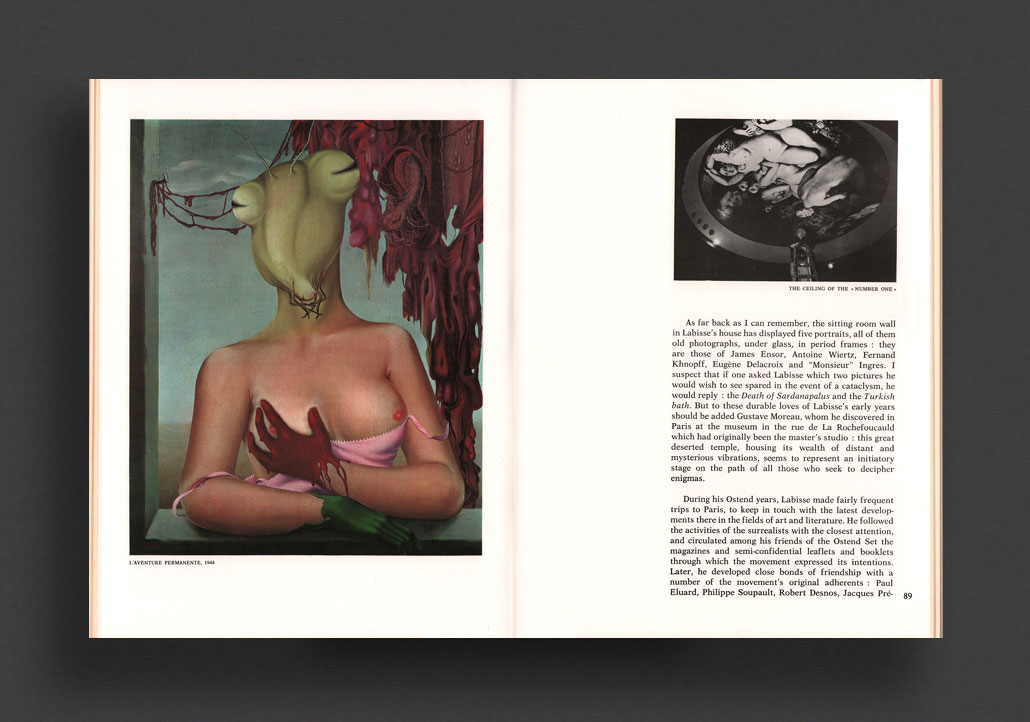
First edition of the best, most comprehensive reference book on the work of French—Belgian Surrealist artist Felix Labisse, and one of the only publications on the artist in the English language. Profusely illustrated throughout in colour and b/w, including many photographs of Labisse's life and artistic circles, with extensive accompanying essays by the great Surrealist biographer and author Patrick Walberg, including chapters: Gayant's child; The Ostend clan; The Wizard of Families; Behind the Scenes of the Party; Devil's Transvestites. Highly recommended.
Félix Labisse (1905—1982) was a self-taught French Surrealist painter, illustrator, and designer. He was born in Marchiennes. He divided his time between Paris and the Belgian coast from 1927. In Ostend he met James Ensor, with whom he became friends for life. In 1927 he set up his own studio there, influenced by his contact with the Ostend artists Ensor, Constant Permeke and Léon Spilliaert. Labisse mainly worked with oil on canvas. Beginning in 1931 he designed extensively literature and for the theater. In 1951 he staged the play Le Diable et le Bon Dieu by Jean-Paul Sartre at the Théâtre Antoine in Paris and in 1954 he staged the play Les Mystères de Paris by Albert Vidalie under the direction of Georges Vitaly at the Theater La Bruyere in Paris. Labisse's work was also influenced by Paul Delvaux and René Magritte. Describing his own work as 'libidoscaphes', his paintings depict fantastical hybrid creatures, heavy with motifs of eroticism and Freudian themes. He painted the first of a series of his iconic blue women in 1960; among them is the Bain Turquoise. He was the subject of a film by Alain Resnais, Visite à Félix Labisse (1947). In 1966 he was elected to the Académie des Beaux-Arts. In 1973 his paintings were shown in a retrospective exhibition at the Museum Boijmans Van Beuningen, Rotterdam. He died in Neuilly-sur-Seine in 1982.
Patrick Waldberg (1913—1985) was a Franco-American art critic known for his profiles of Surrealist artists. Born in Santa Monica, California, Waldberg moved to Paris as a child with his family. In 1932, and while still a student (age 19), he joined Boris Souvarine's Democratic Communist Circle. There he met Georges Bataille and his friends Michel Leiris and André Masson, and was initiated by them into a wild night life. 1937 saw him back in California to take care of "family matters", however, a letter from Georges Bataille reached him there, urging him to return to Paris in order to take part in a Nietzschean secret society Bataille was then forming, called Acéphale ("headless"). Waldberg heeded the call in September 1938, and he says this permanently changed his life. From 1938 to 1940 Waldberg would serve as the secretary of Bataille's "official" group, the College of Sacred Sociology. In 1959 he left Paris to move to the French village of Seillans, where his second wife Line Jubelin was from. Max Ernst and his own second wife Dorothea Tanning joined him there. Their houses are now a Max Ernst museum and a Maison Waldberg museum.
Very Good in VG dust jacket — copy, light wear/age only.
1979, Japanese
Hardcover (w. dust jacket), 236 pages, 20.4 x 20.3 cm
1st Edition, Out of print title / used / average
Published by
Self-published / Kobe City
$65.00 - Out of stock
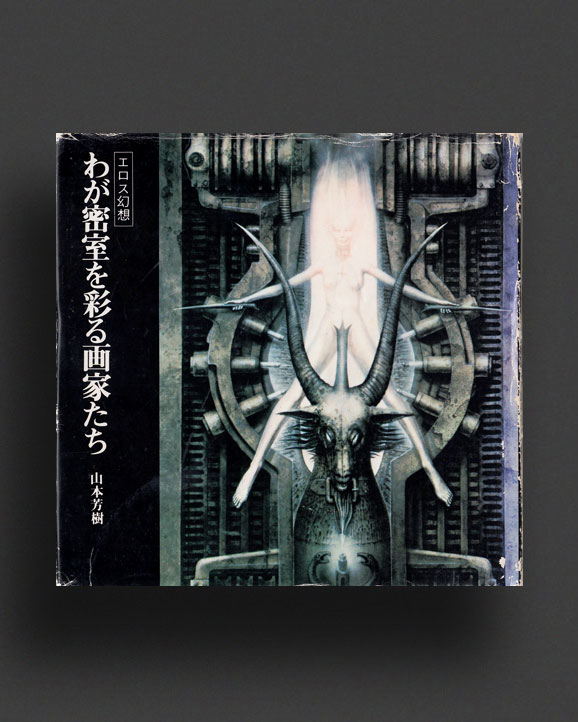
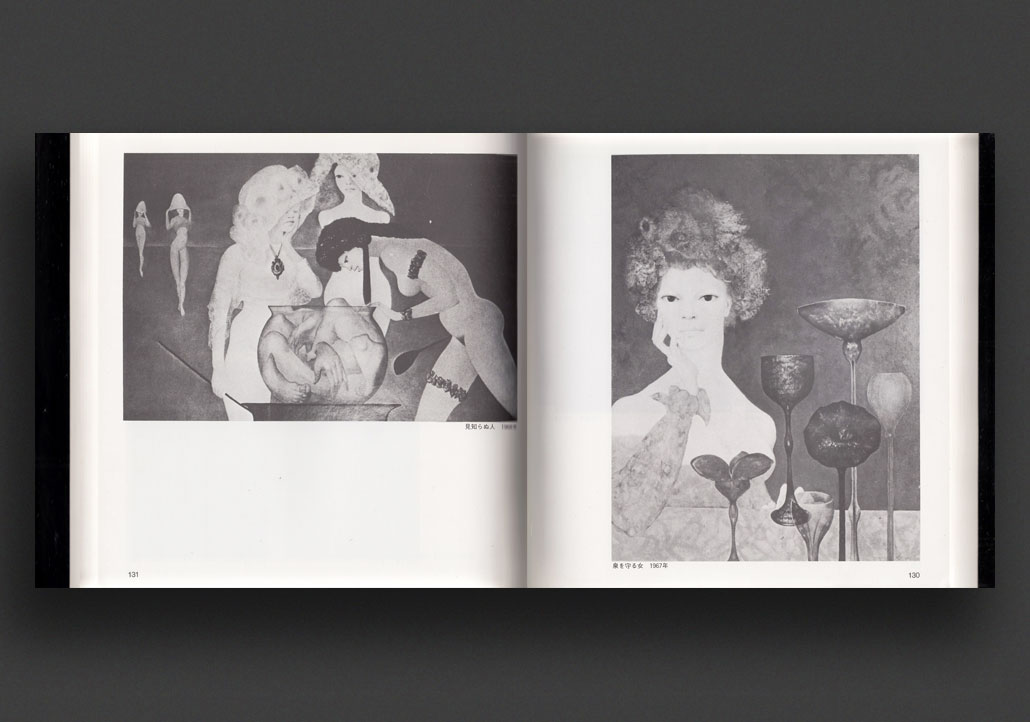
First and only edition of this stunning privately-issued 1979 Japanese hardcover collection of erotic fantasy art, edited and written by Yoshiki Yamamoto. Upon retiring from the Sanyo Electric Railway Company in 1976, Yamamoto devoted himself to the art that he loved and to complete an intimate book study that traces an important lineage of artists of "eros fantasy", focussing on 16 key artists through profusely illustrated chapters, linking artists of the fin de siècle, symbolism, surrealism, and their descendants. A total labour of love. There is no other book like it. "Artists Who Decorate My Secret Room" features profusely illustrated full chapters on Gustave Moreau, Félicien Rops, Gustav Klimt, Franz von Bayros, Egon Schiele, Paul Delvaux, Hans Bellmer, Felix Labisse, Pierre-Yves Trémois, Leonor Fini, Paul Wunderlich, Ernst Fuchs, Tomi Ungerer, H.R. Giger, Raymond Bertrand, Gilles Rimbault, including profiles, many artworks, portraits and texts by Yamamoto, closing with a chronology of further artists and authors through the centuries.
Average—Good copy due to the back hardcover board being reattached. Good dust jacket with the usual wear and tanning of this title, otherwise the book block is VG throughout — crisp and clean.
2000, Japanese
Hardcover (w. dust jacket and obi strip), 48 pages, 31 x 22 cm
1st Edition, Out of print title / used / fine
Published by
Bungeisha / Tokyo
$150.00 - In stock -
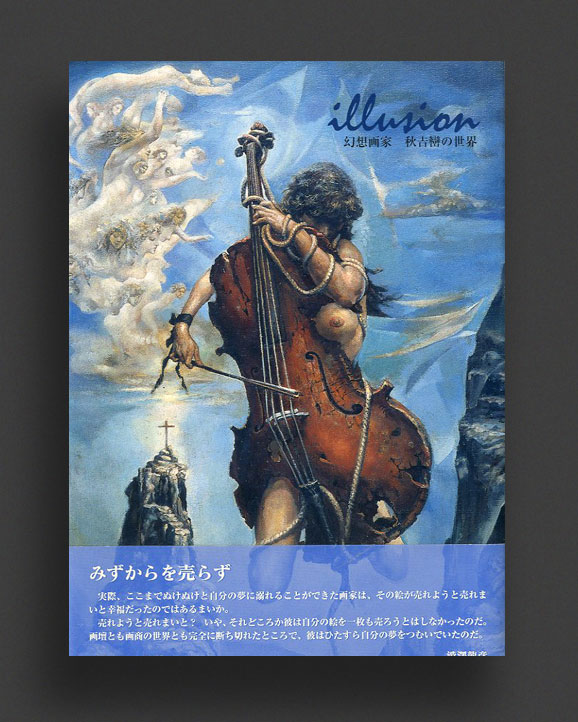
The one and only hardcover monograph dedicated to the fantastic world of artist Ran Akiyoshi (1922—1982), now rare and out-of-print. Virtually unknown and undocumented outside of Japan, Akiyoshi never held an exhibition nor sold any of his drawings in his lifetime. Much like the work of Toshio Saeki or Namio Harukawa, Akiyoshi's creations proliferated throughout the bountiful pages of Tokyo's underground, particularly SM / kinbaku, publishing scene in the 1960s—1970s. Yet Akiyoshi's phantasmagoric world of erotic fantasy is like no other, building sado-masochistic themes within unique, somewhat Lovecraftian and Bosch-esque dreamscapes populated by mythological goddesses and grotesque creatures. His peculiar fantasy drawings were highly praised by Japanese novelist and art critic, Tatsuhiko Shibusawa, an instrumental figure in the Japanese avant-garde who translated de Sade and Bataille to Japanese, and specialised in the study of medieval demonology. This lavishly illustrated hardcover volume collects Akiyoshi's many works together for the first time, surveying his entire career.
Born in Kyongsong (present Seoul), Korea in 1922, Akiyoshi was publicly schooled and self-taught in drawing. After WWII, he moved to Japan, traveled around Kyushu area and finally settled in Tokyo in 1946. Akiyoshi started working for adult entertainment magazines such as "Decameron","Fuzoku Soushi", and "Uramado" in 1950. Around 1958, he began focusing on original drawings while continuing to draw illustrations for various magazines. In the 1970s, Akiyoshi provided iconic cover and insert illustrations to a number of prominent SM magazines, including "SM King", "SM Kitan", and "SM Club". He never held an exhibition nor sold any of his drawings in his lifetime. Akiyoshi died from heart failure in 1982 at the age of 58.
Very Good—Fine copy.
2022, English
Softcover, 272 pages, 13.8 x 21.6 cm
Published by
Bloomsbury Academic / London
$85.00 - In stock -
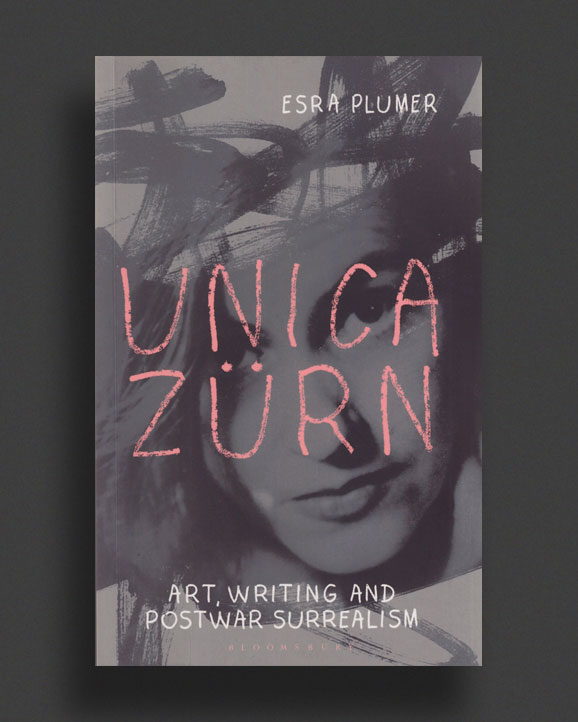
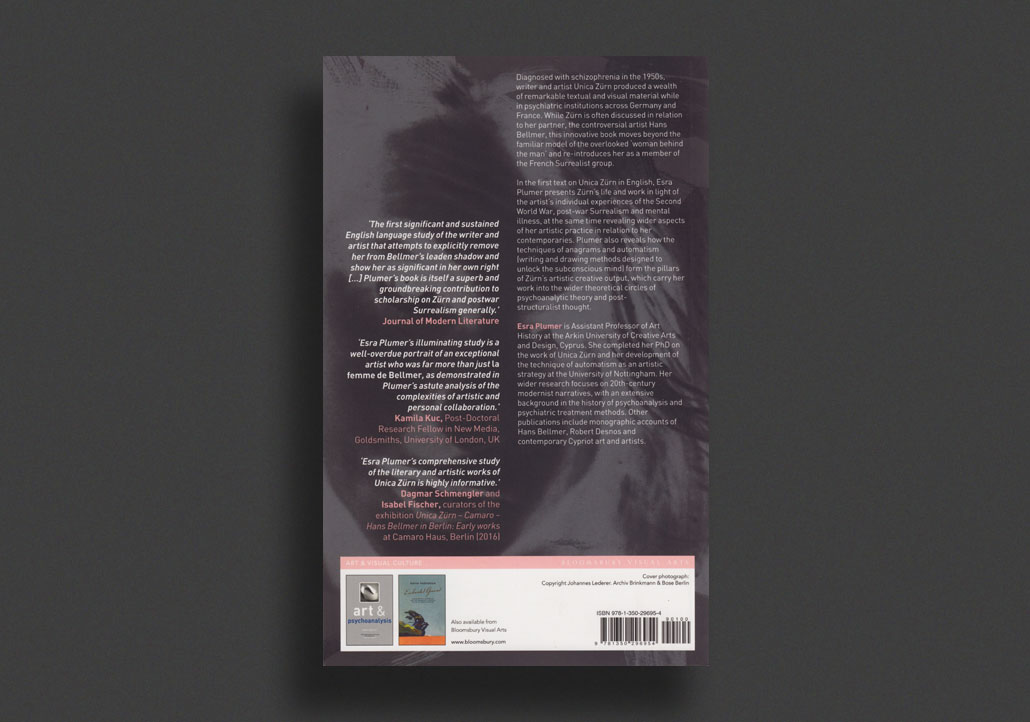
Diagnosed with schizophrenia in the 1950s, writer and artist Unica Zürn produced a wealth of remarkable textual and visual material while in psychiatric institutions across Germany and France. While Zürn is often discussed in relation to her partner, the controversial artist Hans Bellmer, this innovative book moves beyond the familiar model of the overlooked ‘signifigant other’ and re-introduces her as a member of the French Surrealist group.
In the first text on Unica Zürn in English, Esra Plumer presents Zürn’s life and work in light of the artist’s individual experiences of the Second World War, post-war Surrealism and mental illness, at the same time revealing wider aspects of her artistic practice in relation to her contemporaries. Plumer also reveals how the techniques of anagrams and automatism (writing and drawing methods designed to unlock the subconscious mind) form the pillars of Zürn’s artistic creative output, which carry her work into the wider theoretical circles of psychoanalytic theory and post-structuralist thought.
2001, Japanese
Hardcover (w. dust jacket), 164 pages, 25.8 x 19.6 cm
1st Edition, Out of print title / used / fine
Published by
Kokusho Kankokai / Japan
$100.00 - Out of stock
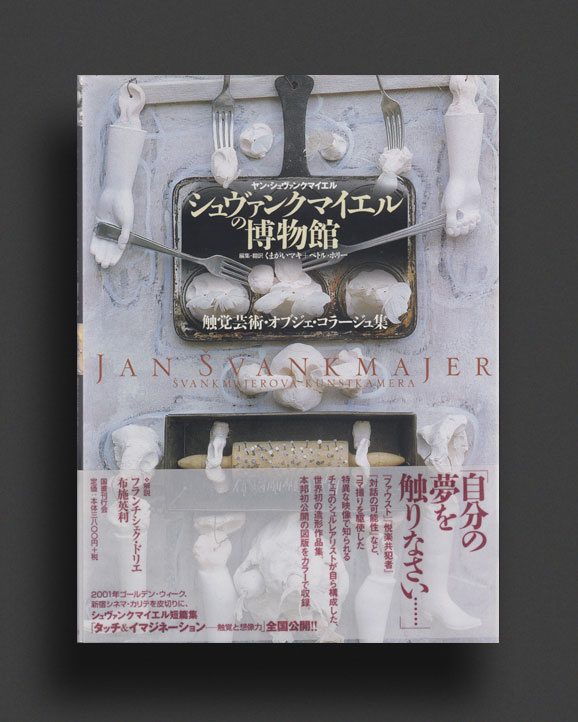
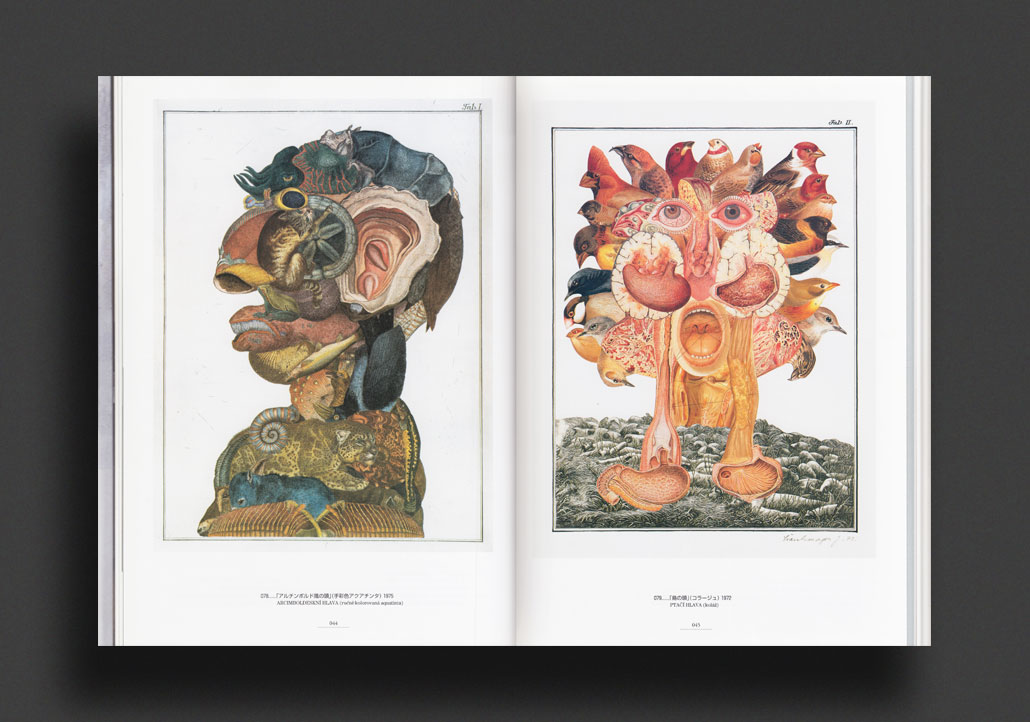
First edition of this wonderful hardcover monographic survey on the work of Czech Surrealist artist, puppeteer, animator, and filmmaker, Jan Švankmajer (b. Prague, 1934), published in Japan in 2001. Profusely illustrated throughout in colour and b/w with chapters dedicated to his sculpture, collage, ceramics, “tactile experiments”, and much more. Well-known for his dark re-imaginings of well-known fairy tales and for his avant-garde merging of live action, stop-motion animation and puppetry, Švankmajer is one of the most distinctive and acclaimed Czech filmmakers. Since the mid-1960s, his films have shocked, mesmerized, repulsed and delighted audiences, amassing international cult-like following. His prolific work off-screen across assemblage and collage mediums, using both man-made and organic materials, share the central thematic elements of his subversive films, such as black humour, metamorphosis, sex, decomposition, mythology, scatology, death, humour and the absurd. Over 300 illustrations with texts by Hideto Fuse, Maki Kumagai, Petr Holly, Jan Švankmajer.
Very Good copy in VG dust jacket.
1965, French
Hardcover (clothbound), 244 pages, 18 x 18 cm
1st Edition, Out of print title / used / good
Published by
Jean-Jacques Pauvert / Paris
$55.00 - Out of stock
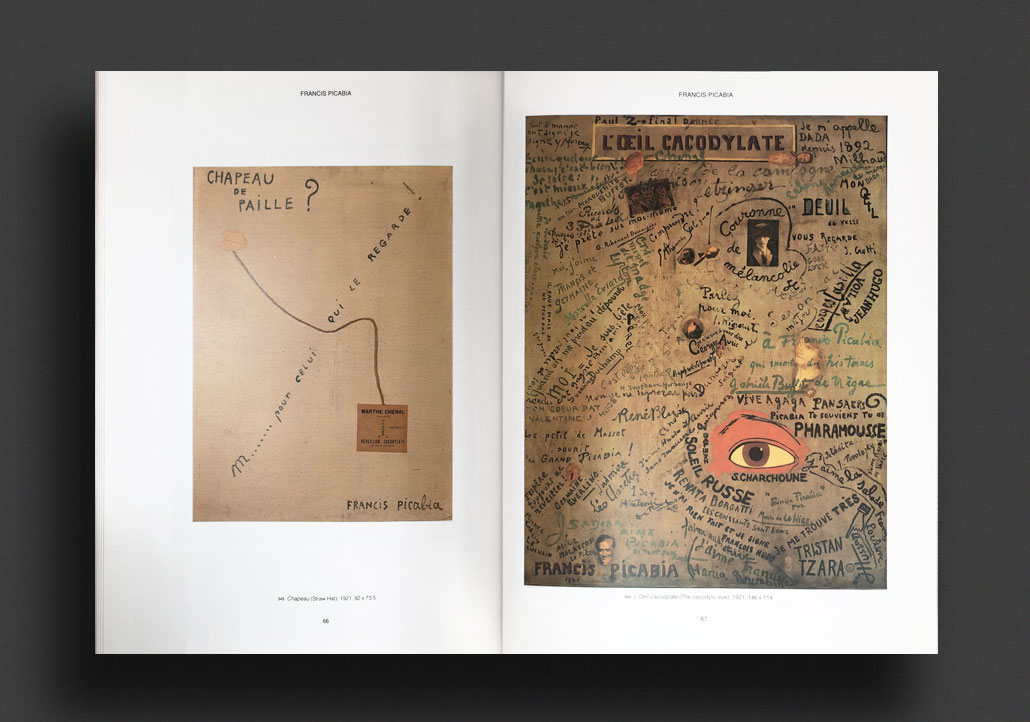
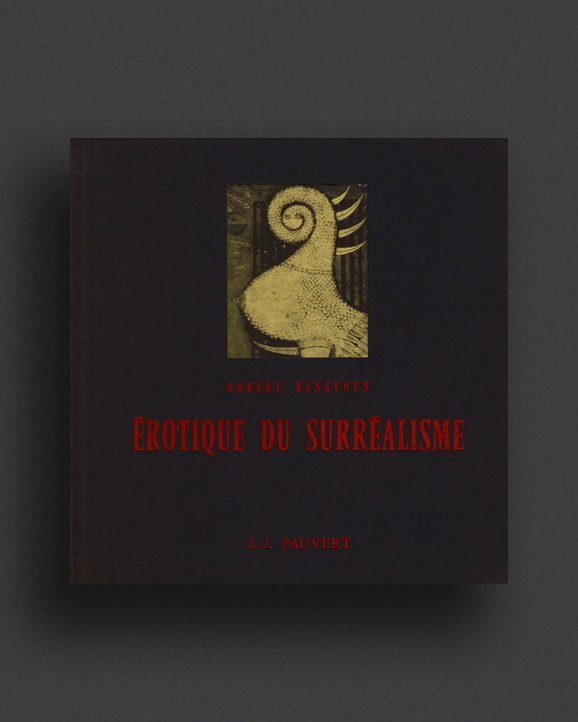
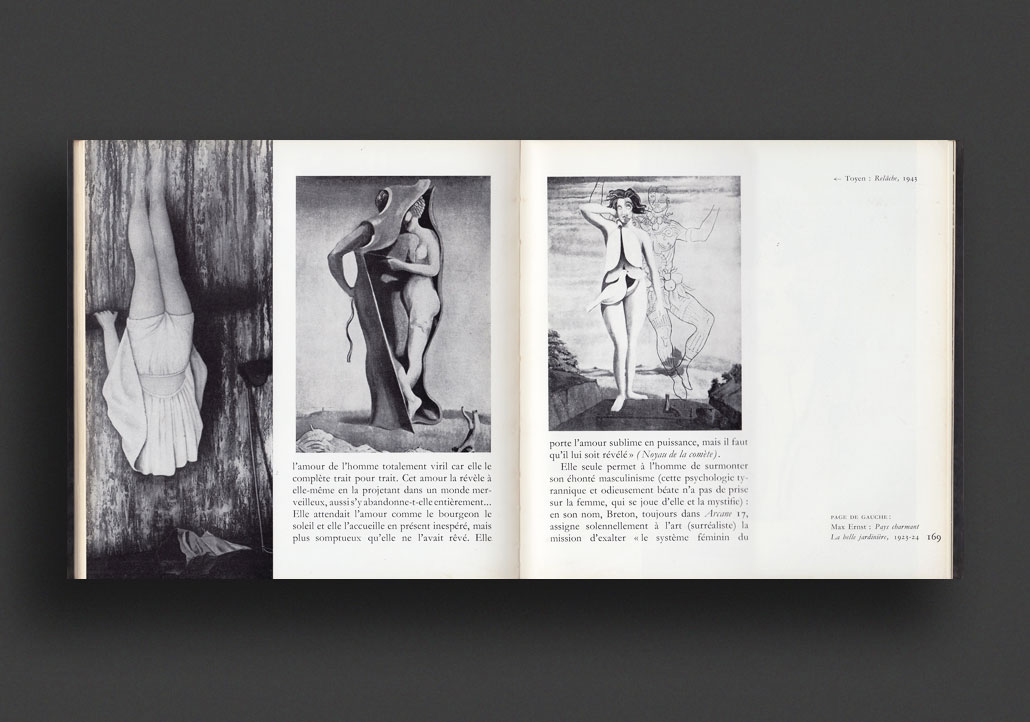
First 1965 clothbound edition of Érotique du Surréalisme, Robert Benayoun's study on the importance of the erotic in the surrealist arts, from L'Androgyne to The Sadist, Le Femme-Enfant to the Poetic Machine, surveying Symbolist and Art Brut precursors, and encompassing the multitude manifestations of eroticism across a broad array of visual and poetic works from the surrealist spectrum, even into the influence in film (a field Benayoun was known in). Reproducing poems and quotes throughout, this heavily illustrated volume reproduces many artworks in b/w and colour plates, including works and works by Max Walter Svanberg, Toyen, Hans Bellmer, Friedrich Schröder Sonnenstern, Heinrich Anton Müller, Marcel Duchamp, Jindřich Štyrský, Brancusi, Victor Brauner, Mimi Parent, Andre Masson, Louis Aragon, Yves Tanguy, Valentine Hugo, Jean Arp, Max Ernst, Balthus, Rene Magritte, André Breton, Giorgio de Chirico, Henry Fuseli, Dali, Man Ray, Henri Rousseau, Picasso, Miro, Edvard Munch, William Blake, Hieronymus Bosch, Ingrid Bergman, Michelangelo Antonioni, Konrad Klapheck, Francis Picabia, Óscar Domínguez, Jean Benoit, Paul Delvaux, Pierre Molinier, and many more.
Good—Very Good copy with light tanning to spine and general tanning/light wear.
2020, English
Softcover, 512 pages, 15.2 x 22.9 cm
Published by
The MIT Press / Massachusetts
$50.00 - Out of stock
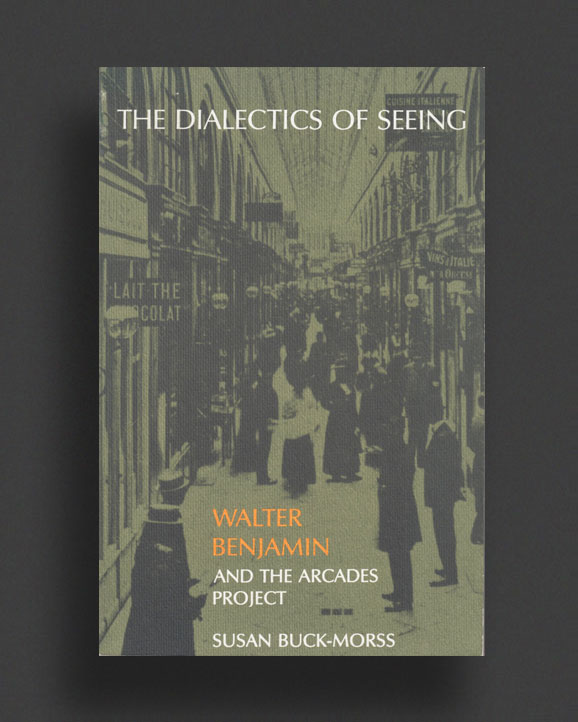
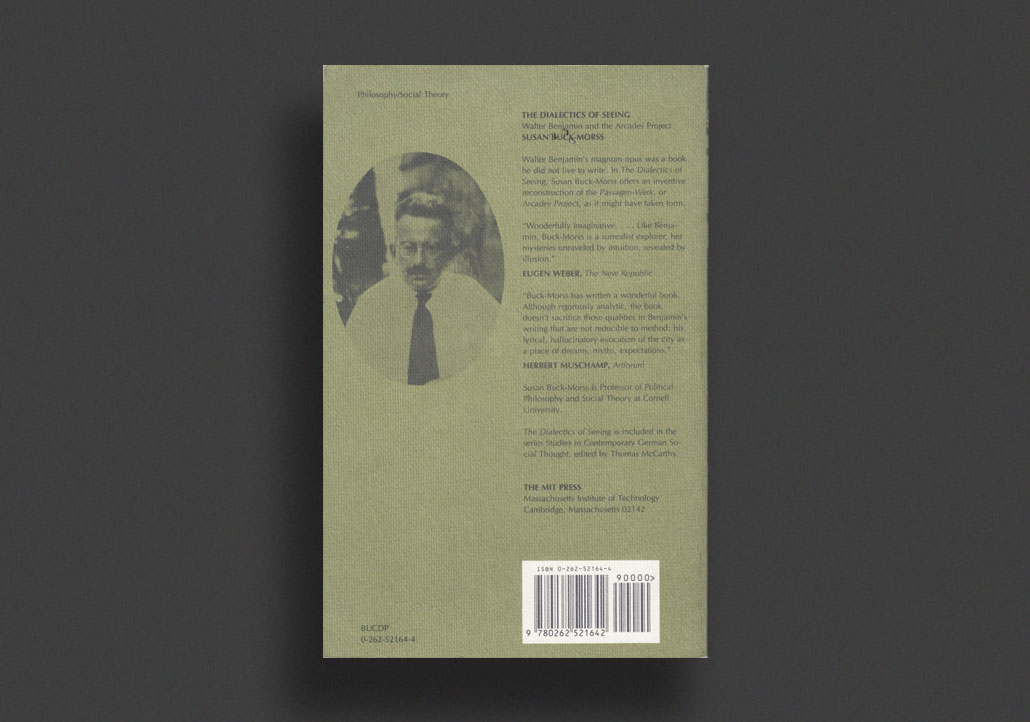
Walter Benjamin's magnum opus was a book he did not live to write. In The Dialectics of Seeing, Susan Buck-Morss offers an inventive reconstruction of the Passagen Werk, or Arcades Project, as it might have taken form. Working with Benjamin's vast files of citations and commentary which contain a myriad of historical details from the dawn of consumer culture, Buck-Morss makes visible the conceptual structure that gives these fragments philosophical coherence. She uses images throughout the book to demonstrate that Benjamin took the debris of mass culture seriously as the source of philosophical truth. The Paris Arcades that so fascinated Benjamin (as they did the Surrealists whose materialist metaphysics he admired) were the prototype, the 19th century ur-form of the modern shopping mall. Benjamin's dialectics of seeing demonstrate how to read these consumer dream houses and so many other material objects of the time--from air balloons to women's fashions, from Baudelaire's poetry to Grandville's cartoons--as anticipations of social utopia and, simultaneously, as clues for a radical political critique. Buck-Morss plots Benjamin's intellectual orientation on axes running east and west, north and south--Moscow Paris, Berlin-Naples--and shows how such thinking in coordinates can explain his understanding of dialectics at a standstill. She argues for the continuing relevance of Benjamin's insights but then allows a set of afterimages to have the last word.
Susan Buck-Morss is Distinguished Professor of Political Theory at the CUNY Graduate Center and Jan Rock Zubrow Professor Emerita of Government at Cornell University. She is the author of Dreamworld and Catastrophe: The Passing of Mass Utopia in East and West (MIT Press) and other books.
"Buck-Morss has written a wonderful book. Although rigorously analytic, the book doesn't sacrifice those qualities in Benjamin's writing that are not reducible to method. His lyrical, hallucinatory evocation of the city as a place of dreams, myths, expectations."—Herbert Muschamp, Artforum
"Wonderfully imaginative...Like Benjamin, Buck-Morss is a surrealist explorer, her mysteries unraveled by intuition, revealed by illusion."—Eugen Weber, The New Republic
2024, English
Hardcover, 224 pages, 26.7 x 20.3 cm
Published by
Marsilio / Venice
$90.00 - In stock -
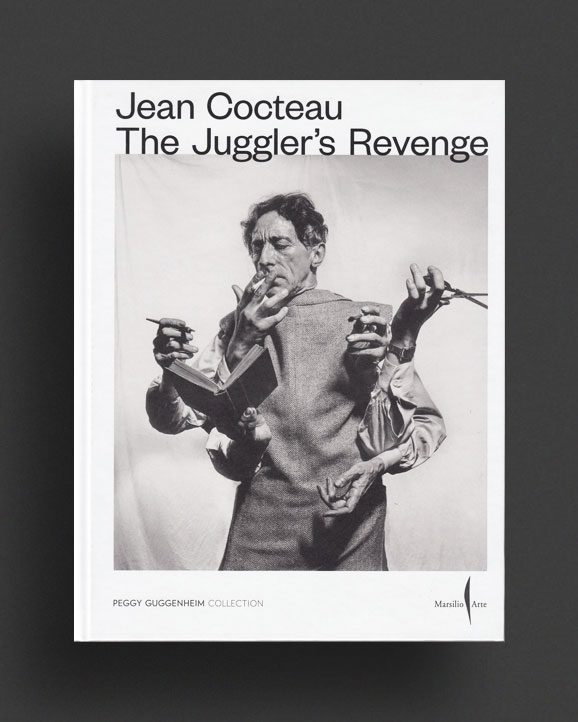
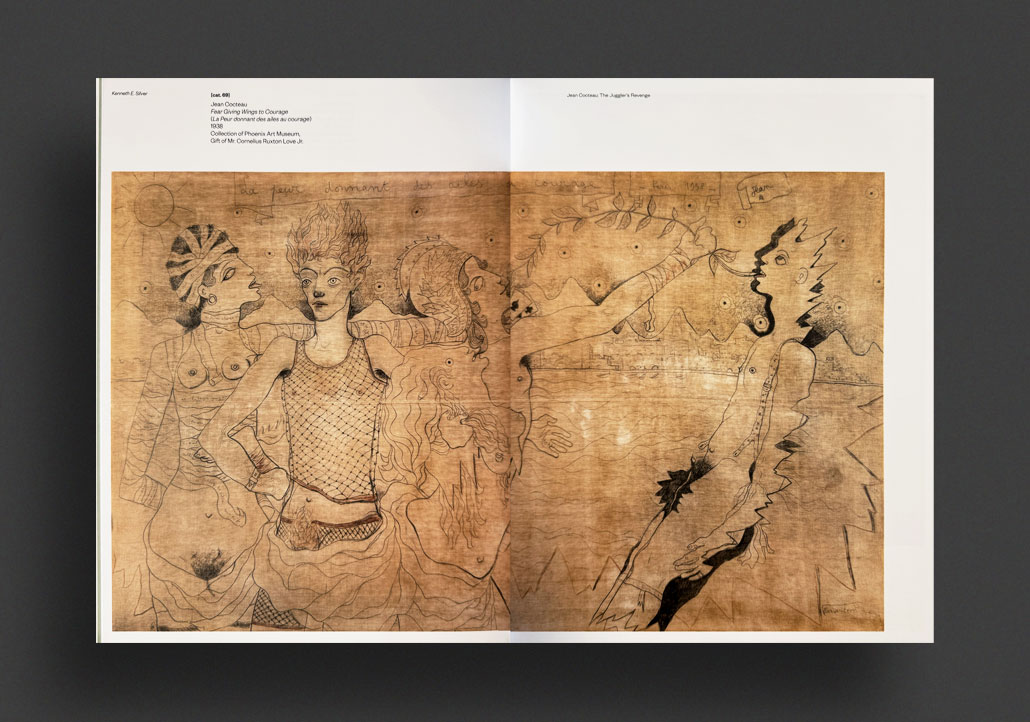
Rediscovering Cocteau’s artistic output, from perfume boxes to sketches of Peggy Guggenheim. Edited with text by Kenneth E. Silver. Text by Blake Oetting.
The multifaceted and surprising artist Jean Cocteau was undoubtedly one of the major figures of the Paris cultural scene in the years between the World Wars. In addition to his literary works, Cocteau was a brilliant visual artist: draftsman, filmmaker and muralist and fashion, jewelry and textile designer. The Juggler’s Revenge embraces the versatility for which the artist was often criticized by his contemporaries, retracing the development of his aesthetics and the key moments of his tumultuous life through works created by a variety of techniques and mediums.
Attention is paid to his ambivalent relationship with Cubism, Dadaism and Surrealism, as well as his central role in the “new classicism” of Europe between the wars. A selection of surprising drawings highlights the centrality of desire and sensuality in Cocteau’s practice. His little-studied fashion and jewelry designs show the artist’s incorporation of “high” and “low” culture. This volume corresponds with an exhibition at the Peggy Guggenheim Collection in Venice, an appropriate setting through which to explore his work. Cocteau had close ties with Guggenheim, who in 1938 opened her first gallery with an exhibition of his drawings. He also had a great love for the city itself, traveling there for the first time at the age of 15 and returning regularly for the Film Festival in the years following World War II.
Jean Cocteau (1889–1963) was an author, artist, film director and a key member of French avant-garde culture. Cocteau preferred to be called a poet and referred to his various works as different forms of poetry. He collaborated with dozens of artists throughout his career, including Erik Satie, Guillaume Apollinaire and Pablo Picasso.
1971, English
Hardcover (w. dust jacket), 342 pages, 24 x 15.5 cm
1st Edition, Out of print title / used / fine
Published by
Allen Lane / UK
$50.00 - Out of stock
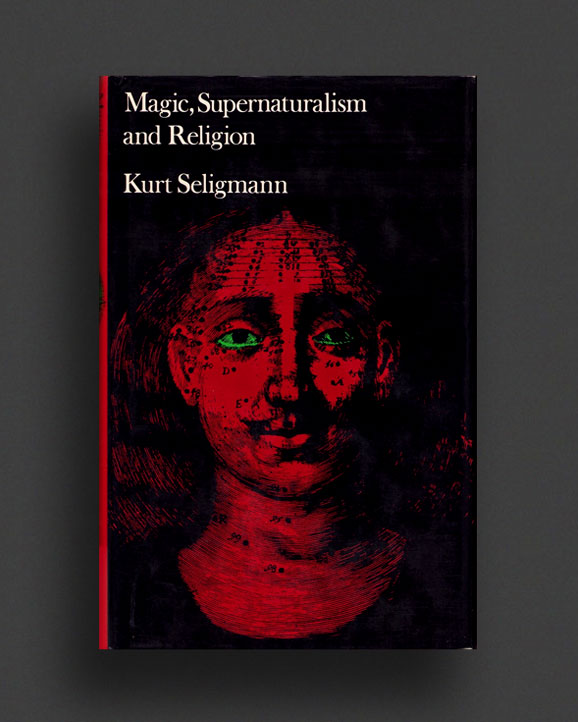
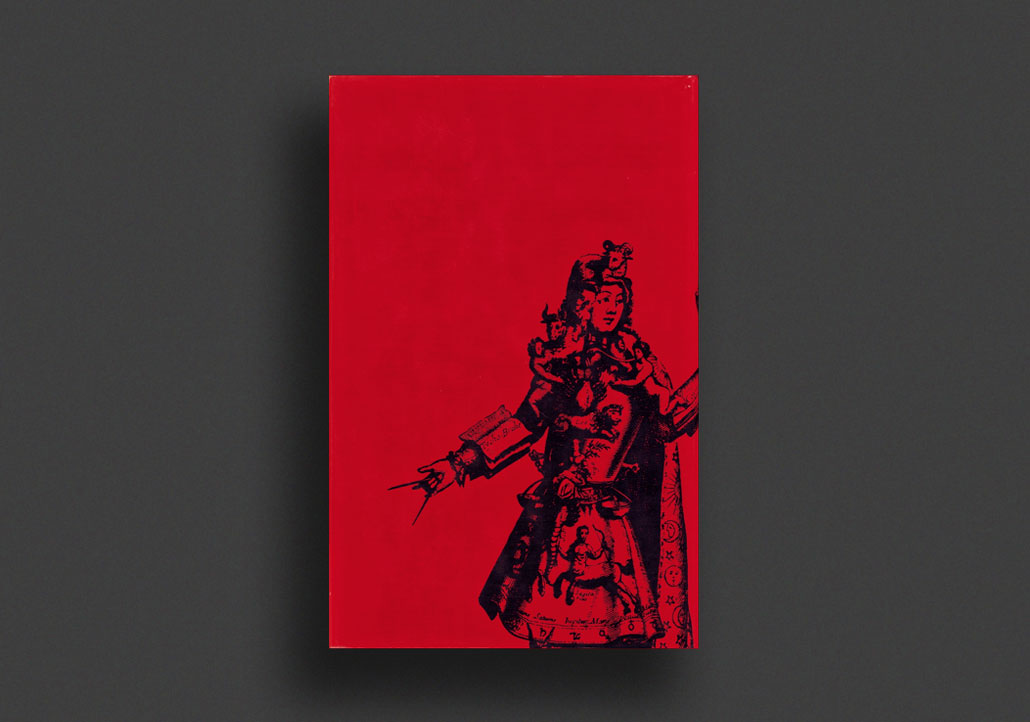
First 1971 English hardcover edition of Magic, Supernaturalism and Religion, the classic illustrated study by Swiss-American Surrealist painter, engraver, and occultist Kurt Seligmann (1900—1962).
In this fascinating study the late Kurt Seligmann, the surrealist painter, gives a history of magical ideas and manifestations in the Western world to reveal the aesthetic value of magic and its influence on creative imagination. He brings forth a vivid picture of the religio-magical beliefs of ancient, medieval and modern times. He shows the growth and development of the magical world-view in its successive stages, beginning with Mesopotamian and Persian magic, assimilating Hebrew thought, Greek philosophy and Christian theology, through the mystical concept of a unified universe with its manifold correspondences and interrelations, which finds expression in pictorial motifs and symbols, in the magical arts of astrology, divination, physiognomy, chiromancy, fortune cards and other branches of 'occult science'. Along the way he presents some colourful personalities: Nostradamus, Dr Faustus, Pico della Mirandola, Agrippa, Trimethius, Gebelin, Mesmer, Cagliostro, Saint- Germain and others.
Fine copy in Near Fine—Very Good dust jacket.
1991, English
Softcover, 304 pages, 23 x 15.5 cm
1st Edition, Out of print title / used / very good
Published by
John Hopkins University Press / Baltimore
$45.00 - Out of stock
First 1991 John Hopkins edition.
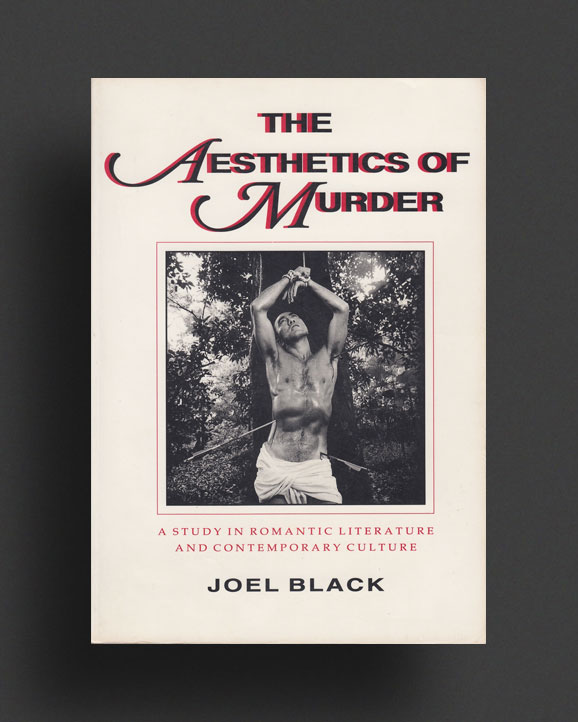
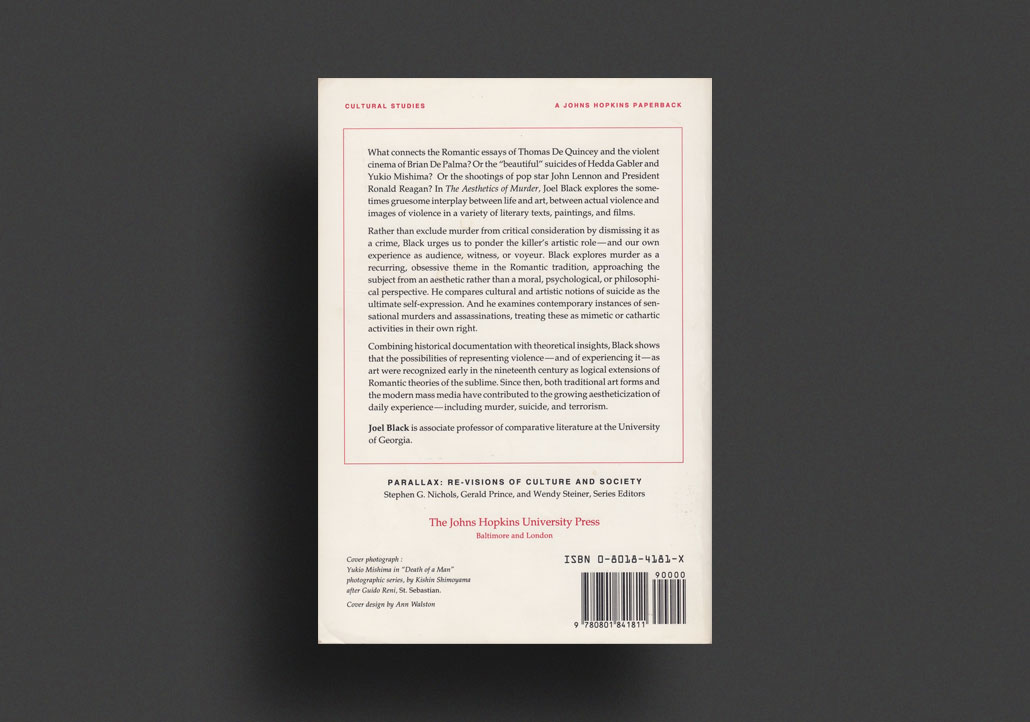
What connects the Romantic essays of Thomas De Quincey and the violent cinema of Brian De Palma? Or the "beautiful" suicides of Hedda Gabler and Yukio Mishima? Or the shootings of John Lennon and Ronald Reagan? In The Aesthetics of Murder, Joel Black explores the sometimes gruesome interplay between life and art, between actual violence and images of violence in a variety of literary texts, paintings, and films.
Rather than exclude murder from critical consideration by dismissing it as a crime, Black urges us to ponder the killer's artistic role—and our own experience as audience, witness, or voyeur. Black examines murder as a recurring, obsessive theme in the Romantic tradition, approaching the subject from an aesthetic rather than a moral, psychological, or philosophical perspective. And he brings into his discussion contemporary instances of sensational murders and assassinations, treating these as mimetic or cathartic activities in their own right.
Combining historical documentation with theoretical insights, Black shows that the possibilities of representing violence—and of experiencing it—as art were recognized early in the nineteenth century as logical extensions of Romantic theories of the sublime. Since then, both traditional art forms and the modern mass media have contributed to the growing aestheticization of violence.
Very Good copy, light wear.