World Food Books' programme is largely produced on Kulin Nation land. We acknowledge the Wurundjeri people of the Kulin Nation as the first and continuing custodians of this land, and pay respect to their Elders past, present, and emerging.
World Food Books is an arts and special interests bookshop in Naarm / Melbourne. Founded in 2010, World Food Books is devoted to the presentation of a rotating, hand-selection of international art, design, literary and counterculture publications with an emphasis on the anti-traditional, the experimental, the avant-garde, the heretic, the marginal.
Presenting new titles alongside rare and out-of-print books, catalogues and journals spanning the fields of modern and contemporary art, design, photography, illustration, film, literature, poetry, cultural theory, philosophy, sexuality, popular and underground culture in its many radical forms, World Food Books wishes to encourage adventurous, thoughtful and open-minded reading, looking, writing, and exchange of publishing and ideas, both current and historical.
As well as our bookshop, located in Melbourne's historical Nicholas Building, all of our inventory is available internationally via our online mail-order service.
World Food Books semi-regularly co-ordinates "Occasions", a programme of exhibits and events at the bookshop and in partnership with other hosts (such as museums and art galleries) that develop out of the activities, relationships and content of the bookshop itself.
World Food Books
The Nicholas Building
37 Swanston Street
Room 5, Level 6
Melbourne 3000
Australia
SHOP HOURS:
THU–SAT 12–6
WEB-SHOP OPEN 24/7
World Food Books
Postal Address:
PO Box 435
Flinders Lane
Victoria 8009
Australia
info@worldfoodbooks.com
Art
Theory / Essay
Architecture / Interior
Graphic Design / Typography
Photography
Fashion
Eros
LGBTQ+
Fiction / Poetry
Weird / Speculative / Science Fiction / Horror
Transgressive / Visceral / Abject
Symbolism / Decadence / Fin de siècle
Film / Video
Painting
Sculpture / Installation
Performance / Dance / Theater
Drawing
Sound / Music
Curatorial
Group Shows / Collections
Periodicals
Out-of-print / Rare
Posters / Ephemera / Discs
Signed Books
World Food Books Gift Voucher
World Food Book Bag
Australian Art
Australian Fiction
Australian Science Fiction / Speculative Fiction
Australian Poetry
Australian Photography
Japanese Photography
Conceptual Art
Minimal Art
Dada
'Pataphysics / Oulipo
Fluxus
Concrete Poetry
Pop Art
Surrealism
Arte Povera
Arte Informale / Haute Pâte / Tachism
Nouveau Réalisme / Zero / Kinetic
Situationism / Lettrism
Collage / Mail Art / Xerox Art
Art Brut / Folk / Visionary / Fantastic
Illustration / Graphic Art / Bandes Dessinées
Furniture
Italian Radical Design / Postmodernism
Textiles
Ceramics / Glass
Counterculture
Protest / Revolt
Philosophy
Psychoanalysis
Anthropology
Anarchism
Socialism / Anarchism / Communism / Capitalism
Literary Theory / Semiotics / Language
Feminism / Women's Studies
Gender Studies / Sexuality
Anthropology
Fetishism / BDSM
Drugs / Psychedelia
Crime / Violence
Animal Rights / Veganism
Occult / Esoterica
Ecology / Earth / Alternative Living
Whole Earth / Crafts
All prices in AUD (Australian dollars)
Pick-Ups
Pick-up orders can be collected in our bookshop during opening hours after order date. Please collect any Pick-up orders within 2 weeks of ordering as we have limited storage space. Orders will be released back into stock if not collected within this time. No refunds can be made for pick-ups left un-collected. If you cannot make it in to the bookshop in this time-frame, please choose postage option.
Return Policy
All sales are final. We do accept returns (for refund or exchange) for items received in error. All our orders are packed with special care using heavy-duty padding and cardboard book-mailers or bubble mailers (for smaller books), using reinforcement where required. We cannot take responsibility for any lost, stolen or damaged parcels.
Insurance
Should you wish to insure your package, please email us directly after placing your order and we can organise this at a small extra expense. Although all standard/express tracked packages are very safe and dependable, we cannot take responsibility for any lost, stolen or damaged parcels. We recommend insurance on valuable orders.
Interested in selling your old books, catalogues, journals, magazines, comics, fanzines, ephemera? We are always looking for interesting, unusual and out-of-print books to buy. We only buy books in our fields of interest and specialty, and that we feel we can resell.
We base these prices on desirability, market value, in-print prices, condition and our current stock levels. We offer cash, store credit, and can take stock on consignment. All
about 25% of the price we expect to get when we sell them, or 30% in store credit. We base these prices on desirability, market value, in-print prices, condition and our current stock levels.
Sell your books any day of the week. You can drop them off and return later. If you have a lot of books, we can visit your Sydney home.
We buy books that we feel we can resell. We offer about 25 % of the price we expect to get when we sell them, or 30% in store credit. We base these prices on desirability, market value, in-print prices, condition and our current stock levels.
Philadelphia Wireman
03 August - 01 September, 2018
World Food Books is proud to announce our next Occasion, the first presentation of sculptures by Philadelphia Wireman in Australia.
The Philadelphia Wireman sculptures were found abandoned in an alley off Philadelphia’s South Street on trash night in 1982. Their discovery in a rapidly-changing neighbourhood undergoing extensive renovation, compounded with the failure of all attempts to locate the artist, suggests that the works may have been discarded after the maker’s death. Dubbed the "Philadelphia Wireman" during the first exhibition of this work, in 1985, the maker’s name, age, ethnicity, and even gender remain uncertain. The entire collection totals approximately 1200 pieces, all intricately bound together with tightly-wound heavy-gauge wire (along with a few small, abstract marker drawings, reminiscent both of Mark Tobey and J.B. Murry). The dense construction of the work, despite a modest range of scale and materials, is singularly obsessive and disciplined in design: a wire armature or exoskeleton firmly binds a bricolage of found objects including plastic, glass, food packaging, umbrella parts, tape, rubber, batteries, pens, leather, reflectors, nuts and bolts, nails, foil, coins, toys, watches, eyeglasses, tools, and jewellery.
Heavy with associations—anthropomorphic, zoomorphic, and socio-cultural responses to wrapped detritus—the totemic sculptures by Philadelphia Wireman have been discussed in the context of work created to fulfil the shamanistic needs of alternative religions in American culture. Curators, collectors, and critics have variously compared certain pieces to sculpture from Classical antiquity, Native American medicine bundles, African-American memory jugs, and African fetish objects. Reflecting the artist’s prolific and incredibly focused scavenging impulse, and despite—or perhaps enhanced by—their anonymity, these enigmatic objects function as urban artefacts and arbiters of power, though their origin and purpose is unknown. Philadelphia Wireman, whatever their identity, possessed an astonishing ability to isolate and communicate the concepts of power and energy through the selection and transformation of ordinary materials. Over the course of the past two decades, this collection has come to be regarded as an important discovery in the field of self-taught art and vernacular art.
Presented in collaboration with Fleisher-Ollman Gallery, Philadelphia, and Robert Heald, Wellington.
Susan Te Kahurangi King
02 February - 10 March, 2018
Susan Te Kahurangi King (24 February 1951 - ) has been a confident and prolific artist since she was a young child, drawing with readily available materials - pencils, ballpoint pens and felt-tip markers, on whatever paper is at hand. Between the ages of four and six Susan slowly ceased verbal communication. Her grandparents William and Myrtle Murphy had developed a special bond with Susan so they took on caring responsibilities for extended periods. Myrtle began informally archiving her work, carefully collecting and storing the drawings and compiling scrapbooks. No drawing was insignificant; every scrap of paper was kept. The King family are now the custodians of a vast collection containing over 7000 individual works, from tiny scraps of paper through to 5 meter long rolls.
The scrapbooks and diaries reveal Myrtle to be a woman of great patience and compassion, seeking to understand a child who was not always behaving as expected. She encouraged Susan to be observant, to explore her environment and absorb all the sights and sounds. Myrtle would show Susan’s drawings to friends and people in her community that she had dealings with, such as shopkeepers and postal workers, but this was not simply a case of a grandmother’s bias. She recognised that Susan had developed a sophisticated and unique visual language and sincerely believed that her art deserved serious attention.
This was an unorthodox attitude for the time. To provide some context, Jean Dubuffet coined the term Art Brut in 1945 to describe work created by self-taught artists – specifically residents of psychiatric institutions and those he considered to be visionaries or eccentrics. In 1972 Roger Cardinal extended this concept by adopting the term Outsider Art to describe work made by non-academically trained artists operating outside of mainstream art networks through choice or circumstance. Susan was born in Te Aroha, New Zealand in 1951, far from the artistic hubs of Paris and London that Dubuffet and Cardinal operated in. That Myrtle fêted Susan as a self-taught artist who deserved to be taken seriously shows how progressive her attitudes were.
Susan’s parents Doug and Dawn were also progressive. Over the years they had consulted numerous health practitioners about Susan’s condition, as the medical establishment could not provide an explanation as to why she had lapsed into silence. Dawn educated herself in the field of homeopathy and went on to treat all twelve of her children using these principles – basing prescriptions on her observations of their physical, mental and emotional state.
Doug was a linguist with an interest in philosophy who devoted what little spare time he had to studying Maori language and culture. To some extent their willingness to explore the fringes of the mainstream made them outsiders too but it was their commitment to living with integrity and their respect for individuality that ensured Susan’s creativity was always encouraged.
Even though Susan’s family supported her artistic pursuits, some staff in schools and hospitals saw it as an impediment to her assimilation into the community and discouraged it in a variety of ways. Her family was not always aware of this and therefore did not fully understand why Susan stopped drawing in the early 1990s. However, rather than dwell on the challenges that Susan faced in pursuit of her artistic practice, they prefer to highlight her achievements. In 2008 Susan began drawing again in earnest, after an almost 20 year interruption, and her work is now shown in galleries around the world.
Susan grew up without television and has been heavily influenced by the comics she read as a child. She is absolutely fearless in the appropriation of recognizable characters, such as Donald Duck and Mickey Mouse, in her work. She twists their limbs, contorts their faces, compresses them together, blends them into complex patterned backgrounds - always imbuing them with an incredible energy. Although Susan often used pop culture characters in her work they are not naive or childlike. These are drawings by a brilliant self-taught artist who has been creating exceptional work for decades without an audience in mind.
Mladen Stilinović
"Various Works 1986 - 1999"
02 February 16 - September 10, 2016
Various works 1986 - 1999, from two houses, from the collections of John Nixon, Sue Cramer, Kerrie Poliness, Peter Haffenden and Phoebe Haffenden.
Including: Geometry of Cakes (various shelves), 1993; Poor People’s Law (black and white plate), 1993; White Absence (glasses, ruler, set square, silver spoon, silver ladel with skin photograph and wooden cubes), 1990-1996; Exploitation of the Dead (grey and red star painting, wooden painting, black spoon with red table, red plate), 1984-1990; Money and Zeros (zero tie, paintings made for friends in Australia (Sue, John, Kerrie), numbers painting), 1991-1992; Words - Slogans (various t-shirts) - “they talk about the death of art...help! someone is trying to kill me”, “my sweet little lamb”, “work is a disease - Karl Marx”; Various artist books, catalogues, monographs, videos; Poster from exhibition Insulting Anarchy; "Circular" Croatian - Australian edition; Artist book by Vlado Martek (Dostoyevsky); more.
Thanks to Mladen Stilinović and Branka Stipančić.
Jonathan Walker
Always Will Need To Wear Winter Shirt Blue + Ochre Small Check Pattern
21 August - 21 September, 2015
Untitled
I am not a great reader of poetry but I always return to the work of Melbourne poet, Vincent Buckley (1925- 1988). Perhaps I find his most tantalising piece to be not a finished poem but a fragment left on a scrap of paper discovered on his desk after the poet’s death.
The poetry gathers like oil
In the word-core, and spreads
It has its music meet,
Its music is in movement.
This fragment is more the shell left behind from a volatile thought than a finished poem. I find the last two lines honest but awkward whereas the first two lines work like an arrow. Most likely he could not find a resolution so it was left. Still, in its present form, it remains an eloquent testimony to the ultimate failure of a medium to express mobile thought and sensation, in Buckley’s case, through verbal language. It’s an important matter because this is something all artists have to deal with regardless of the medium.
I have never written a poem, however, I am forever copying fragments from books on paper scraps in a vain effort to fix certain notions in my head. At first, they function as bookmarks that are sometimes returned to when I open the book. But before long, as they accumulate, they fall out littering the table interspersed with A4 photocopies, bills, books and medications.
To return to Buckley’s fragment, the first two lines very much evoke how I paint nowadays. As you age, detail diminishes and patches of light become more luminous and float. I feel the most honest way of dealing with this is by smearing the oil paint on the canvas with the fingers and working close-up, blind. Only if the patches coalesce into an approaching image can the work gain a life.
-
Jonathan Walker was born in Melbourne, Australia and brought up on a dairy farm in Gippsland. In the 1970’s he studied painting at RMIT and won the Harold Wright Scholarship to the British Museum, London. During the 1980’s he exhibited at Pinacotheca Gallery, Richmond and had work shown at the NGV and Heidi City Art Gallery. Over the same period he designed the cover for the “Epigenesi” LP by Giancarlo Toniutti, Italy and conducted a mail exchange work with Achim Wollscheid, Germany. The work with artists through the post resulted in an article published in the bicentenary issue of Art and Australia 1988. He showed in artist run spaces such as WestSpace in the 90’s and 2000’s, and until 2012, taught painting at Victoria University, which is where we (Colleen Ahern and Lisa Radford) as organisers of the exhibition, among many others, had the privilege of being his student.
Walker’s knowledge was imparted to students through the careful selection of music, literature, and artists found in books that he himself had ordered for the library. Walker’s strategy was the generosity of sharing his vast knowledge with references specific to each student and their context.
Walker’s paintings share a similar focus and intimacy.
This exhibition presents a small selection of recent paintings alongside a publication that includes Walker’s writing. Observational and analytical, Walker’s work is a type of material notation — the time of day, colour and how it is blended, the both specific and fleeting location of a reflection on lino or the question of whether a chair leg should be included in a painting.
Please join us on Friday August 21 between 6-8pm to celebrate the opening of the exhibition.
Curated by Colleen Ahern and Lisa Radford.
B. Wurtz
Curated by Nic Tammens
March 26 - April 4, 2015
B.Wurtz works from a basement studio in his home on Manhattan’s Lower East Side.
This local fact is attested to by the plastic shopping bags and newsprint circulars that appear in his work. As formal objects, they don’t make loud claims about their origins but nonetheless transmit street addresses and places of business from the bottom of this long thin island. Like plenty of artists, Wurtz is affected by what is local and what is consumed. His work is underpinned by this ethic. It often speaks from a neighborhood or reads like the contents of a hamper:
“BLACK PLUMS $1.29 lb.”
“Food Bazaar”
“USDA Whole Pork Shoulder Picnic 99c lb.”
“RITE AID Pharmacy, with us it’s personal.”
“H. Brickman & Sons.”
“Sweet Yams 59c lb."
Most of the work in this exhibition was made while the artist was in residence at Dieu Donne, a workshop dedicated to paper craft in Midtown. Here Wurtz fabricated assemblages with paper and objects that are relatively lightweight, with the intention that they would be easily transportable to Australia. This consideration isn’t absolute in Wurtz’s work, but was prescriptive for making the current exhibition light and cheap. Packed in two boxes, these works were sent from a USPS post office on the Lower East Side and delivered to North Melbourne by Australia Post.
Wurtz appears courtesy of Metro Pictures, New York.
Thanks to Rob Halverson, Joshua Petherick, Sari de Mallory, Matt Hinkley, Helen Johnson, Fayen d'Evie, Ask Kilmartin, Lisa Radon, Ellena Savage, Yale Union, and "Elizabeth".
John Nixon
"Archive"
December 15 - January 20, 2014
The presentation of John Nixon's archive offered a rare showcase of this extensive collection of the artist's own publications, catalogues, posters, ephemera, editions and more, from the mid 1980s onwards, alongside a selection of his artworks.
Organized by John Nixon, Joshua Petherick and Matt Hinkley.
"Habitat"
at Minerva, Sydney (organised by Joshua Petherick and Matt Hinkley)
November 15 - December 20, 2014
Lupo Borgonovo, Janet Burchill & Jennifer McCamley,
Lewis Fidock, HR Giger, Piero Gilardi, Veit Laurent Kurz,
Cinzia Ruggeri, Michael E. Smith, Lucie Stahl, Daniel Weil, Wols
Press Release:
“...It contained seven objects. The slender fluted bone, surely formed for flight, surely from the wing of some large bird. Three archaic circuitboards, faced with mazes of gold. A smooth white sphere of baked clay. An age-blackened fragment of lace. A fingerlength segment of what she assumed was bone from a human wrist, grayish white, inset smoothly with the silicon shaft of a small instrument that must once have ridden flush with the surface of the skin - but the thing’s face was seared and blackened.”
William Gibson, “Count Zero”, 1986
"Autumn Projects Archive"
Curated by Liza Vasiliou
March 6 - March 15, 2014
World Food Books, in conjunction with the Virgin Australia Melbourne Fashion Festival 2014, presented the Autumn Projects archive, consisting of a selection of early examples in Australian fashion with a particular interest in collecting designers and labels from the period beginning in the 1980’s, who significantly influenced the discourse of Australian Fashion.
Curated by Liza Vasiliou, the exhibition provided a unique opportunity to view pieces by designers Anthea Crawford, Barbara Vandenberg, Geoff Liddell and labels CR Australia, Covers, Jag along with early experimental collage pieces by Prue Acton and Sally Browne’s ‘Fragments’ collection, suspended throughout the functioning World Food Books shop in Melbourne.
H.B. Peace
presented by CENTRE FOR STYLE
November 14, 2013
"Hey Blinky, you say chic, I say same"
Anon 2013
H.B. Peace is a clothing collaboration between great friends Blake Barns and Hugh Egan Westland. Their pieces explore the divergences between 'character’ and ‘personality’ in garments....etc
Special Thanks to Joshua Petherick and Matt Hinkley of WFB and Gillian Mears
and a Very Special Thank you to Audrey Thomas Hayes for her shoe collaboration.
Janet Burchill & Jennifer McCamley
"Aesthetic Suicide"
May 10 - June 8, 2013
The first of our occasional exhibitions in the World Food Books office/shop space in Melbourne, "Aesthetic Suicide" presented a body of new and older works together by artists Janet Burchill & Jennifer McCamley, including videos, prints, a wall work, and publications.
During shop open hours videos played every hour, on the hour.
1989, English / German / French
Softcover (w. flexi-disc), 280 pages, 26 x 21 cm
1st Edition, Out of print title / used / very good
Published by
Daadgalerie / Berlin
Gelbe Musik / Berlin
$280.00 - In stock -
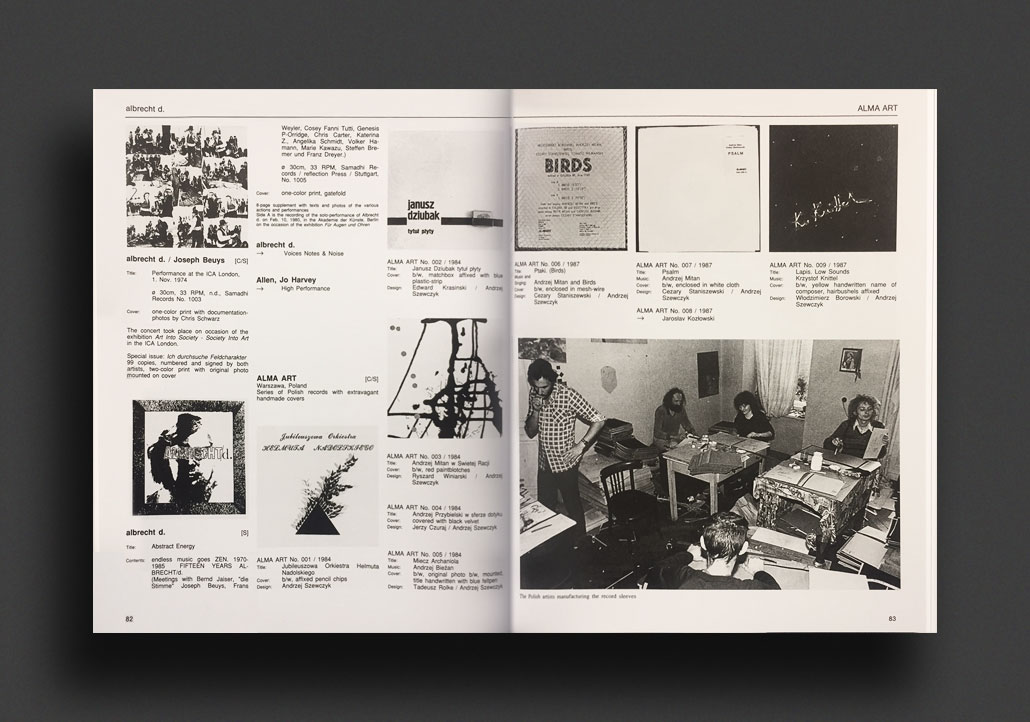
Rare first 1989 edition of Broken Music, an essential compendium for records created by visual artists. Complete with original flexi-disc. The publication was edited by Ursula Block and Michael Glasmeier and published in 1989 by DAAD and Gelbe Musik, Berlin. Broken Music focuses on recordings, record-objects, artwork for records, and record installations made by thousands of artists between WWII and 1989.
It also includes essays by both editors as well as Theodor W. Adorno, René Block, Jean Dubuffet, Milan Knizak, László Moholy-Nagy, Christiane Seiffert, and Hans Rudolf Zeller, as well as a flexi disc of the Arditti Quartet performing Knizak’s “Broken Music.” The centerpiece of the publication is a nearly 200-page bibliography of artists’ records.
Works chosen for the publication revolved around four criteria: (1) record covers created as original work by visual artists; (2) record or sound-producing objects (multiples/editions/sculptures); (3) books and publications that contain a record or recorded-media object; and (4) records or recorded media that have sound by visual artists.
Artists documented in the volume include Vito Acconci, albrecht/d., Laurie Anderson, Guillaume Apollinaire, Karel Appel, Arman, Hans Arp, Antonin Artaud, John Baldessari, Hugo Ball, Claus van Bebber, John Bender, Harry Bertoia, Jean-Pierre Bertrand, Joseph Beuys, Mel Bochner, Claus Böhmler, Christian Boltanski, KP Brehmer, William Burroughs, John Cage, Henri Chopin, Henning Christiansen, Jean Cocteau, William Copley, Philip Corner, Merce Cunningham, Hanne Darboven, Jim Dine, Marcel Duchamp, Max Ernst, Lawrence Ferlinghetti, Fischli and Weiss, R. Buckminster Fuller, Allen Ginsberg, Philip Glass, Jack Goldstein, Peter Gordon, Hans Haacke, Richard Hamilton, Bernard Heidsieck, Holger Hiller, Richard Huelsenbeck, Isidore Isou, Marcel Janco, Servie Janssen, Jasper Johns, Joe Jones, Thomas Kapielski, Allan Kaprow, Martin Kippenberger, Per Kirkeby, Cheri Knight, Milan Knizak, Richard Kriesche, Christina Kubisch, Laibach, John Lennon, Sol Lewitt, Roy Lichtenstein, Annea Lockwood, Paul McCarthy, Meredith Monk, Josef Felix Müller, Piotr Nathan, Hermann Nitsch, Albert Oehlen, Frank O’Hara, Claes Oldenburg, Yoko Ono, Dennis Oppenheim, Nam June Paik, Charlemagne Palestine, A.R. Penck, Tom Phillips, Robert Rauschenberg, The Red Crayola, Ursula Reuter Christiansen, Gerhard Richter, Jim Rosenquist, Dieter Roth, Gerhard Rühm, Robert Rutman, Sarkis, Thomas Schmit, Conrad Schnitzler, Kurt Schwitters, Selten Gehörte Musik, Richard Serra, Robert Smithson, Michael Snow, Keith Sonnier, Strafe für Rebellion, Jean Tinguely, Moniek Toebosch, Tristan Tzara, Ben Vautier, Yoshi Wada, Emmett Walsh, Andy Warhol, William Wegman, and Lawrence Weiner.
Ursula Block is a curator living in Berlin, Germany. From 1981 until 2014, she ran gelbe Musik, a gallery and record shop in Berlin that featured work by artists at the crossroads between music and art. She was married to curator René Block.
Michael Glasmeier is a professor, writer, and editor living in Berlin, Germany. Since the early 1980s, he has curated dozens of shows that explore the intersection between the visual arts, music, film, and language.
Very Good copy all-round, light cover/corner wear.
1976, Portuguese
Double-sided fold-out, 4 panels, 47 x 30 cm (unfolded)
1st Edition, Out of print title / used / very good
Published by
Museu de Arte Contemporânea da Universidade de São Paulo / São Paulo
$45.00 - In stock -
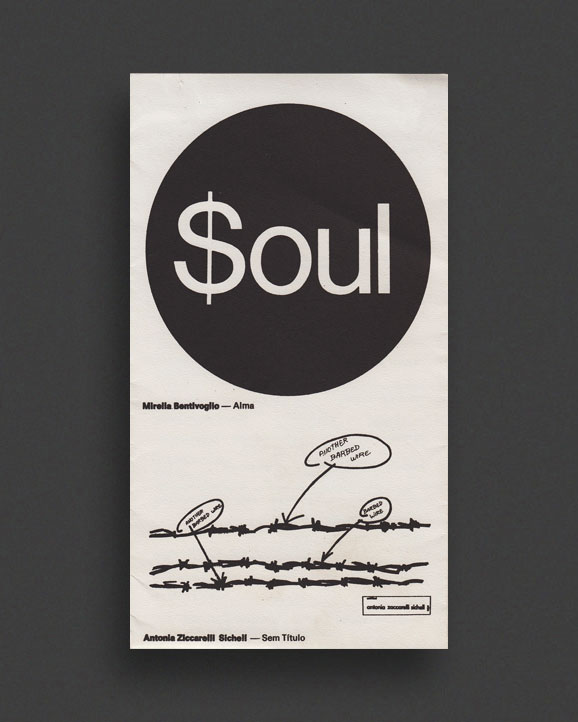
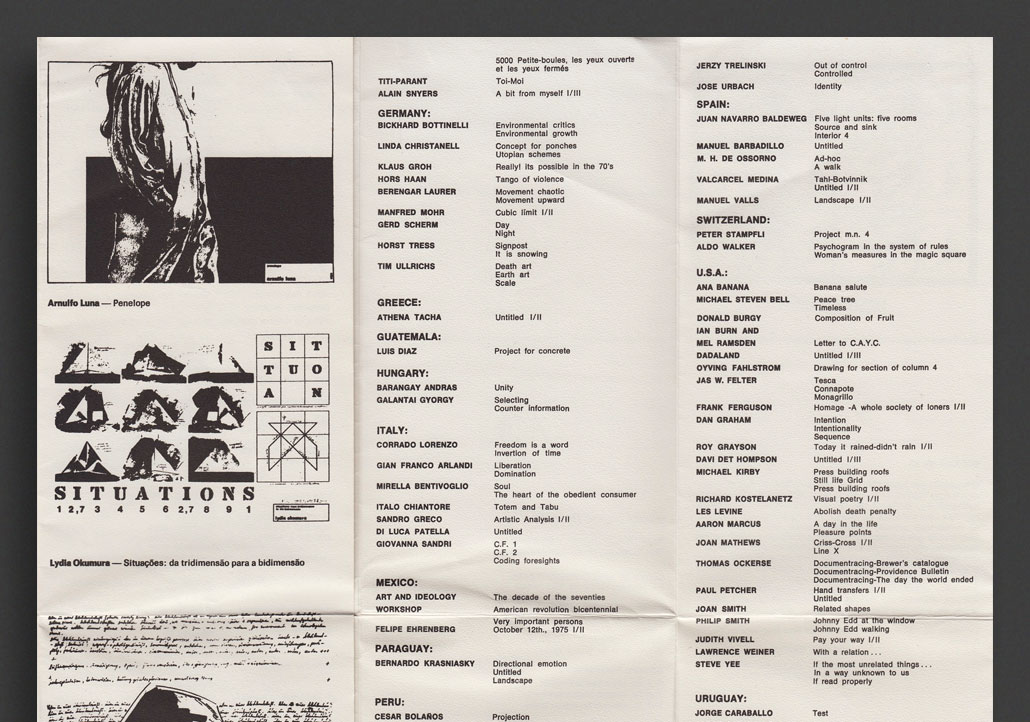
Very rare fold-out catalogue for the important international art exhibition surveying conceptual art, concrete poetry, experimental art, performance art, mail art ("activity with a critical view of society") in the 1970s organized by Argentine author, publisher, curator, professor, and conceptual artist, Jorge Glusberg, who was director of the Center for Art and Communication of Buenos Aires (CAYC). With text by Brazilian professor, historian, art critic and curator by Walter Zanini, director of the Museu de Arte Contemporânea da Universidade de Sao Paulo (MAC). With a number of the exhibited heliographic documents from the exhibition illustrated throughout, the brochure catalogues the exhibited works by participants including: Dan Graham, Lawrence Weiner, Genesis P-Orridge, Ian Burn and Mel Ramsden, Öyvind Fahlström, Július Koller, Tim Ullrichs, Luis Fernando Benedit, Jaime Davidovich, Jorge Glusberg, Víctor Grippo, Lea Lublin, Luis Pazos, Julio Plaza, Jonier Marin, Jiří Valoch, Guillermo Deisler, Juan Navarro Baldeweg, Manuel Barbadillo, MH de Ossorno, Valcárcel Medina, Felipe Ehrenberg, César Bolaños, Pawel Petasz, José Urbach, Lydia Okumura, Haroldo González, Les Levine, and many others.
Very Good copy with light wear.
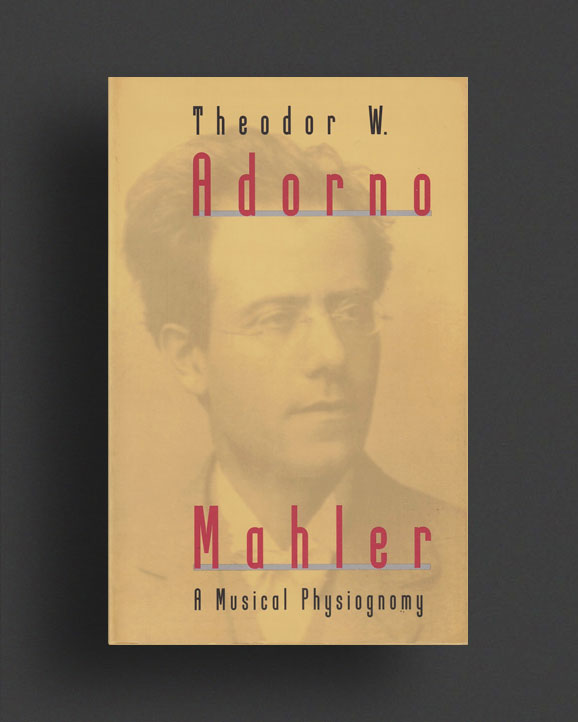
1992, English
Softcover, 180 pages, 21 x 13.5 cm
1st Edition, Out of print title / used / fine
Published by
University of Chicago Press / Chicago
$35.00 - Out of stock
First 1992 University of Chicago English edition.
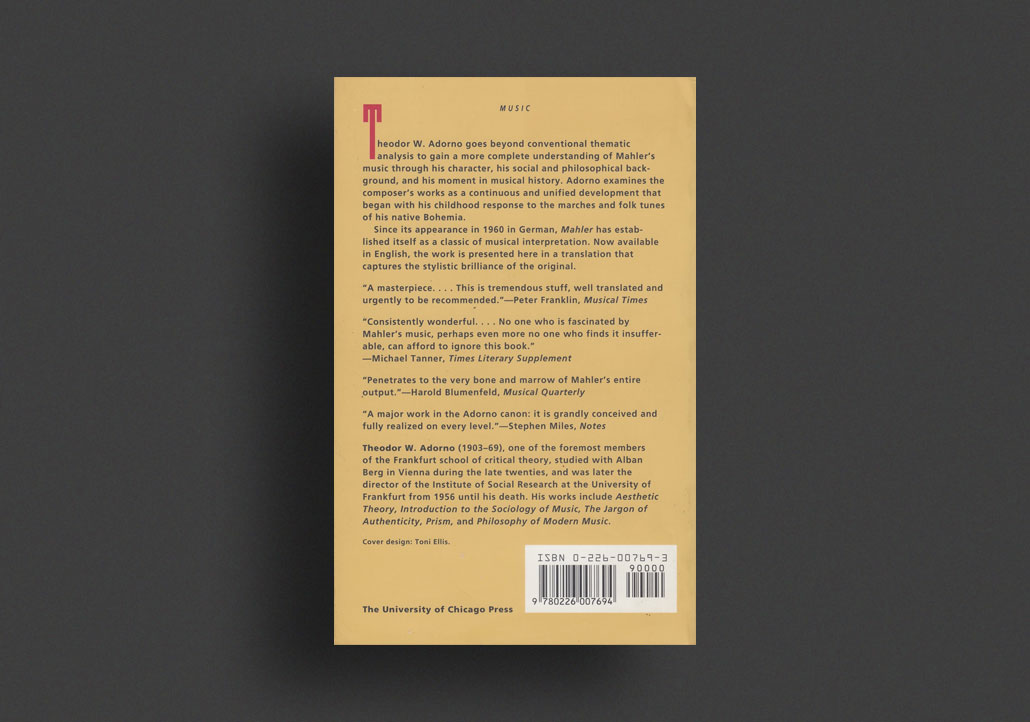
"A masterpiece.... This is tremendous stuff, well translated and urgently to be recommended."—Peter Franklin, Musical Times
Theodor W. Adorno goes beyond conventional thematic analysis to gain a more complete understanding of Mahler's music through his character, his social and philosophical back-ground, and his moment in musical history. Adorno examines the composer's works as a continuous and unified development that began with his childhood response to the marches and folk tunes of his native Bohemia. Since its appearance in 1960 in German, Mahler has established itself as a classic of musical interpretation. Now available in English, the work is presented here in a translation that captures the stylistic brilliance of the original.
"Consistently wonderful.... No one who is fascinated by Mahler's music, perhaps even more no one who finds it insuffer-able, can afford to ignore this book." —Michael Tanner, Times Literary Supplement
"Penetrates to the very bone and marrow of Mahler's entire output."—Harold Blumenfeld, Musical Quarterly
"A major work in the Adorno canon: it is grandly conceived and fully realized on every level."—Stephen Miles, Notes
Theodor W. Adorno (1903-69), one of the foremost members of the Frankfurt school of critical theory, studied with Alban Berg in Vienna during the late twenties, and was later the director of the Institute of Social Research at the University of Frankfurt from 1956 until his death. His works include Aesthetic Theory, Introduction to the Sociology of Music, The Jargon of Authenticity, Prism, and Philosophy of Modern Music.
Very Good—Near Fine copy.
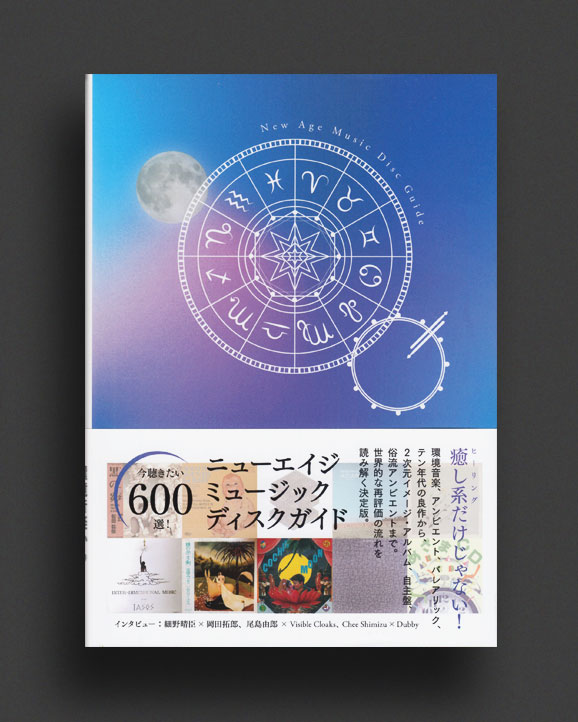
2020, Japanese
Softcover (w. obi strip), 224 pages, 21 x 15 cm
1st Edition, Out of print title / as new
Published by
Disc Union Books / Tokyo
$90.00 - Out of stock
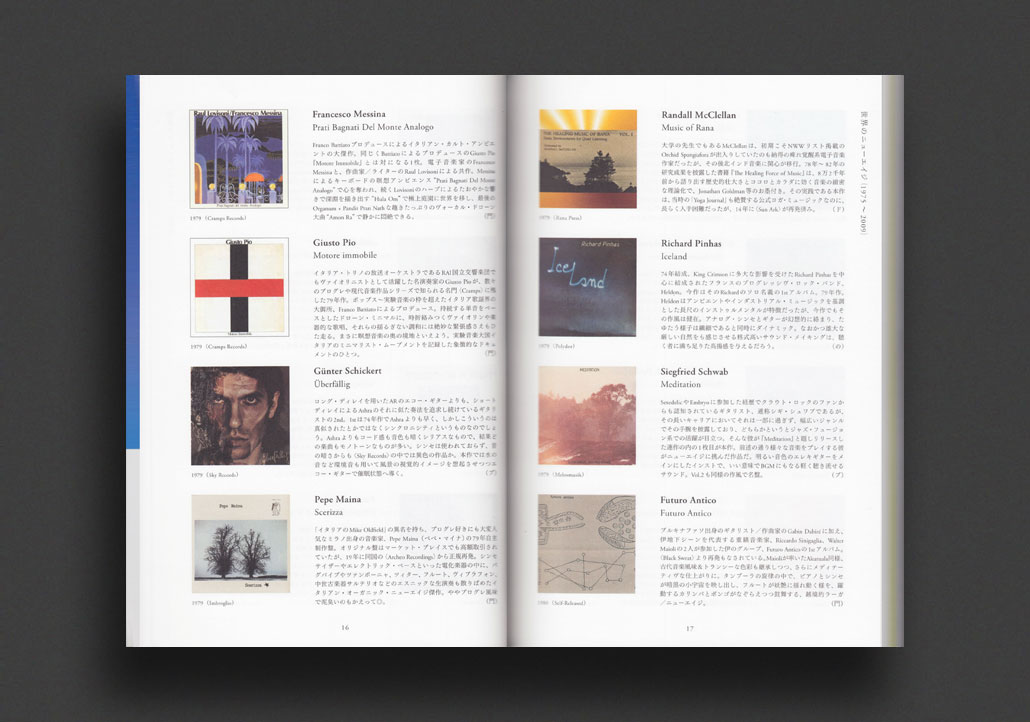
An epoch-making book, New Age Music Disc Guide, published in 2020 by the mighty Disc Union book imprint and compiled by new age music enthusiast, collector, writer and staff member of the Meditations record store in Kyoto, Tsunaki Kadowaki, is an essential and definitive overview of acoustic, ambient, electronic, and meditative sounds. The book collects and profiles over 600 international new age and ambient album recommendations, with full-colour reproductions of the cover artwork, spanning various styles and eras from the private issued 1970's underground, tracing global shifts in the music over decades all the way up to the genre’s well-deserved current revival and re-evaluation. Also takes a look back at various inspirations earlier still (pre 1974), from folk, early electronic, krautrock, prog and cosmic jazz. Spans electronic, acoustic, balearic, "kankyō ongaku” (environmental music), ambient-oriented Japanese 'anime' soundtracks, modern classical, ethereal, fourth world, minimal, fusion, drone, library .... The book also features interviews with Haruomi Hosono, Yoshio Ojima, Chee Shimizu, Dubby, Spencer Dolan of Visible Cloaks and includes an article by Koki Emura of EM Records.
Some artists includes: Iasos, Ariel Karma, Francesco Messina, Hiroshi Yoshimura, Laurie Spiegel, K. Leimer, Gigi Masin, Satoshi Ashikawa, Midori Takada, Robert Rich, Steven Halpern, John Elder, Ros Bandt, Pepe Maina, Giusto Pio, Richard Pinhas, Dorothy Carter, Emerald Web, Dominique Guiot, Suzanne Ciani, Monopoly Child Star Searchers, Dolphins Into The Future, Hype Williams, Ana Roxanne, James Ferraro, Visible Cloaks, Susumu Yokota, S.E.N.S., Hiroki Okano, Yasuaki Shimizu, Popol Vuh, Yoshio Suzuki, Yas-Kaz, Axis, Aragon, Yutaka Hirose, Robert Ashley, Pauline Anna Strom, Dom, Arica, Moondog, John Fahey, Bobby Brown, Third Ear Band, Sun Ra, Terry Riley, Klaus Schulze, Virginia Astley, Lino Capra Vaccina, Woo, Ashra, Iury Lech, Enya, Erik Wøllo, The Ghostwriters, Laraaji, Eric Tingstad, Deuter, Vidna Obmana, Constance Demby, Nik Tyndall, Eduard Artemiev, Peter Davison, Don Slepian, Mark Isham, Igor Savin, Roedelius, Jon Hassell, Michael Stearns, A.r.t. Wilson, Oneohtrix Point Never, Mark McGuire, Sean McCann, Joanna Brouk, Manuel Gottsching, Michael Hoenig, Carlos Maria Trindale / Nuno Canavarro, Steve Roach, Philippe Saisse, Roberto Donnini, Patricia Escudero, Luis Paniagua, Peter Michael Hamel, Morgan Fisher, Wally Badarou, Robert Turman, Malcolm Cecil, J.D. Emmanuel, Joel Vandroogenbroeck, Tangerine Dream, David Lanz, Brainticket ............. to name but a few!!
Highly recommended resource to the music that is usually playing in the World Food Books shop!
2024, English
Softcover, 212 pages, 23 x 15 cm
Published by
Self Published / Melbourne
$30.00 - Out of stock
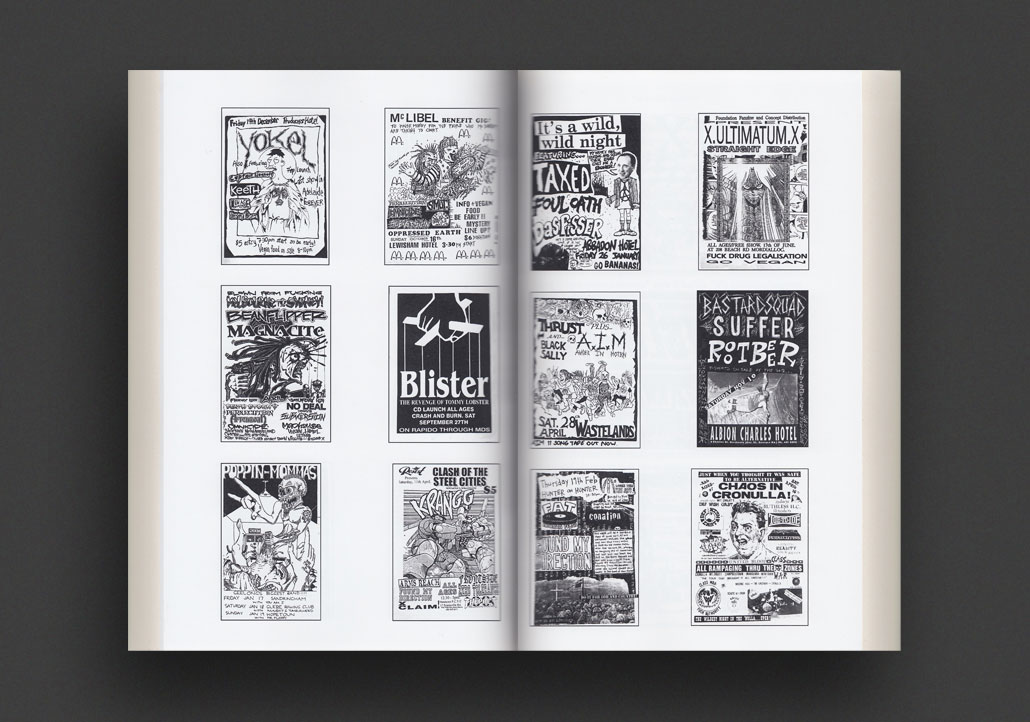
Australia, the 1990s: Strictly Ballroom, Silverchair, Mabo, Port Arthur, economic rationalism, and Pauline Hanson.
Within its more concealed history, the opening of the decade saw punk in Australia experiencing a transitory lull. Populated mostly by the diehards and remnants of the 1980s, its sound and style were in danger of being subsumed, or at least diluted, by grunge and alternative music through a resurgent interest in guitar-driven bands. Able to maintain its own identity and networks against the challenge, as the decade progressed punk evolved into even more diffuse subgenres.
Now, twenty years after its relatively inauspicious birth in Australia, punk, in one of its multivarious forms, topped the national music charts. But though the decade brought if not respectability then a new saleability to punk, it was an era still prone to its tumult, tragedy, humour, and audacity. Through a further 70 interviews, Orstralia: A Punk History 1990-1999 continues the disclosure of its first volume, covering bands from the most obscure to those who reached the very apex of Australia's music industry.
Tristan Clark is a Melbourne-based educator, musician, and writer. His involvement in punk has spanned over three decades and encompassed a near gamut of roles: band member, roadie, merch person, show organizer, Food Not Bombs volunteer, community radio DJ, as well as having written sporadically for local zines and other publications. He now routinely encounters the young students he spends his week working with at local DIY shows and is heartened by punk’s continued ability to self-reproduce.
2024, French / English
Softcover, 256 pages, 13.5 x 20 cm
Published by
Shelter Press / France
$40.00 - In stock -
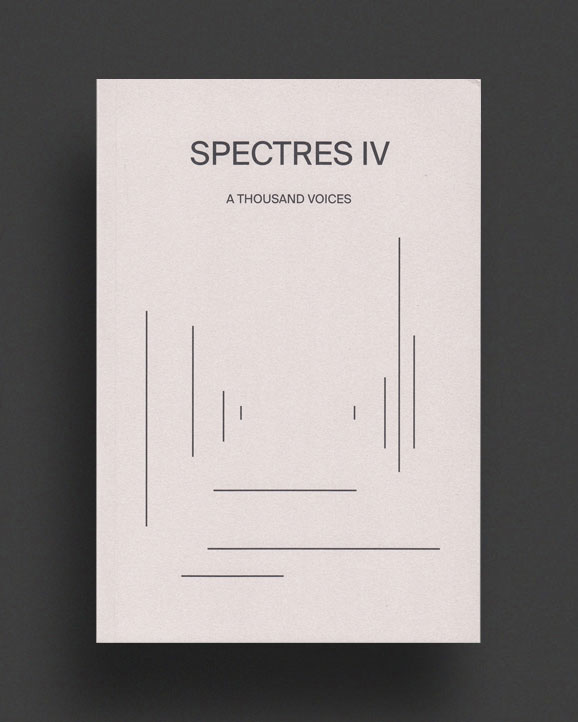
The voice is everywhere, infiltrating everything, making civilisation, marking out territories with infinite borders, spreading from the farthest reaches to the most intimate spaces. It can be neither reduced nor summarised. And accordingly, when taken as a theme, the voice is inexhaustible, even when seen in the light of its very particular relation with the sonic or the musical, as is the case in most of the texts collected in this volume. There is no point therefore in trying to circumscribe or amalgamate the multiple avatars of the voice. We must rather try to apprehend what the voice can do, to envisage its landscape, its potential effects.
Authors: Francois J. Bonnet, John Giorno, David Grubbs, Yannick Guedon, Lee Gamble, Sarah Hennies, Haela Ravenna Hunt-Hendrix, Stine Janvin, Joan La Barbara, Youmna Saba, Akira Sakata, Pierre Schaeffer, Peter Szendy, Ghedalia Tazartes
1987, Japanese
Softcover, 176 pages, 22 x 15 cm
1st Edition, Out of print title / used / fine
Published by
Atelier Peyotl / Tokyo
$120.00 - In stock -
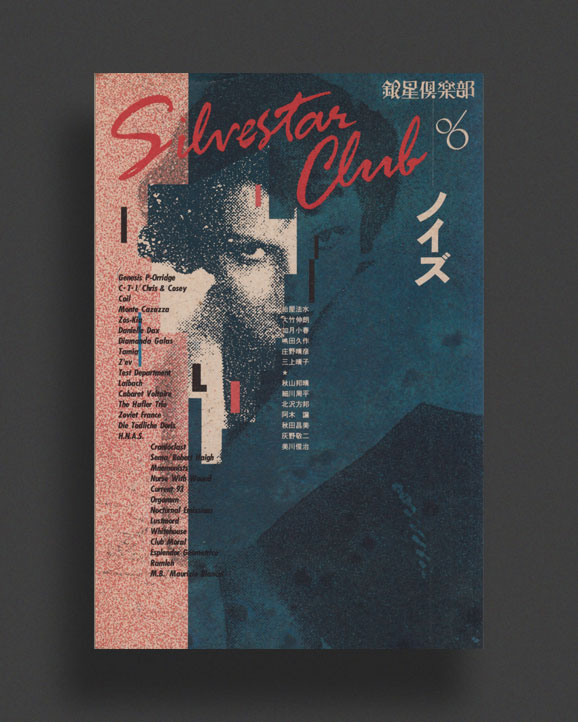
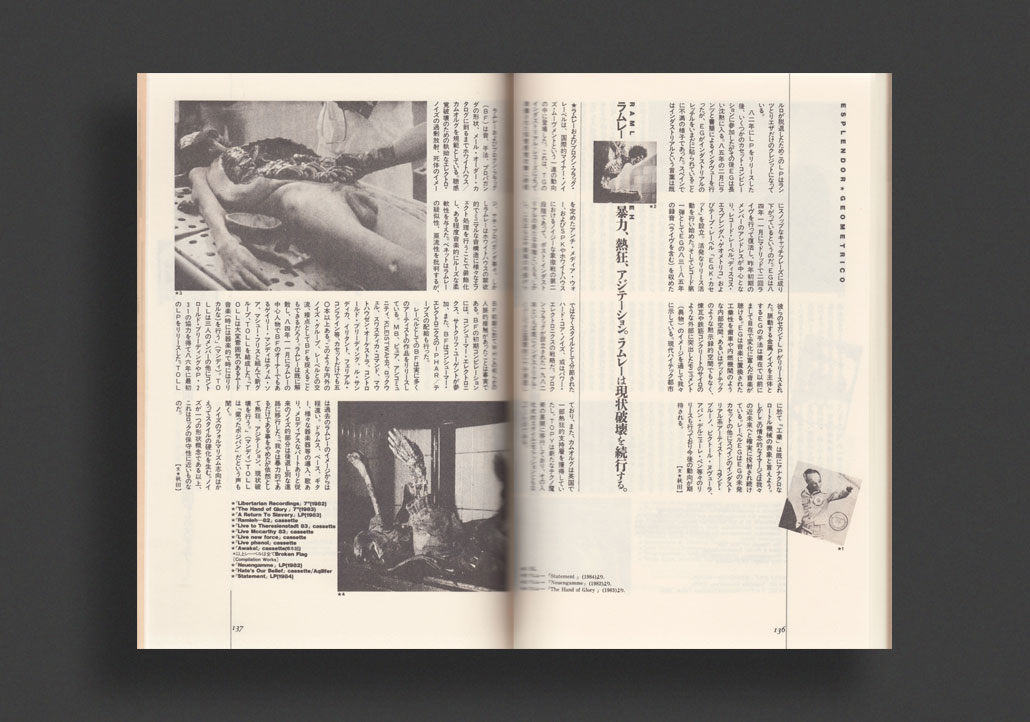
The 1987 "Noise" issue of cult Japanese underground magazine Silvestar Club, published and edited by Yuichi Konno and Atelier Peyotl (publishers of Night Vision/Yaso/Peyotl/Wave...). Features Zoviet France, H.N.A.S., Nurse with Wound, SPK, Etant Donnes, P16.D4, M.B. / Maurizio Bianchi, Sema / Robert Haigh, Coil, Whitehouse, Current 93, Chris & Cosey, Monte Cazazza, Throbbing Gristle, Genesis P-Orridge, Organum, Nocturnal Emissions, Tamia, Ramleh, Club Moral, Esplendor Geometico, Lustmord, Mnemonists, Die Tödliche Doris, The Hafler Trio, Cranioclast, Cabaret Voltaire, Zos-Kia, Test Department, Diamanda Galas, Z'ev, Danielle Dax, and much more. Articles on iconic live performances by Wire and Dome, plus essays by music critic, editor (Rock Magazine, Ego, et al) and Vanity label owner Yuzuru Agi; noise artist Merzbow's Masami Akita; experimental musician Keiji Haino; noise artist Toshiji Mikawa; experimental programmer Ryoichiro Debuchi; plus Tokyo Grand Guignol Theater group artists Norimizu Ameya and Kyusaku Shimada; theatre director Koharu Kisaragi; computer graphics artist for films Haruhiko Shono; visual artist Seiko Mikami; music critic Kuniharu Akiyama... ! Discographies, performance documentation, related artworks, record sleeves, flyers, and much more, printed across multiple raw paper stocks. A must! A perfect pre-cursor (and certainly as good as) Masami Akita's Noise War book of 1992. Texts in Japanese.
Very Good—Fine copy.
1996, Japanese
Softcover (w. dust jacket and obi-strip), 256 pages, 21 x 14.8 cm
1st Edition, Out of print title / used / very good
Published by
Core Magazine / Tokyo
$120.00 - Out of stock
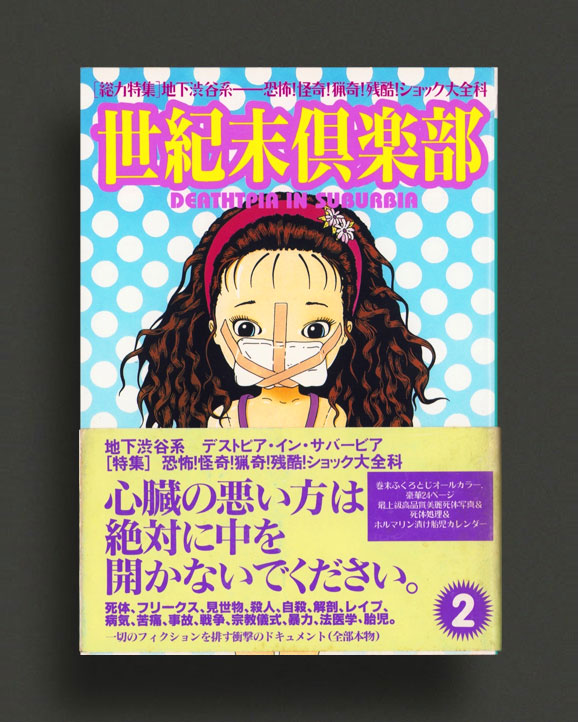
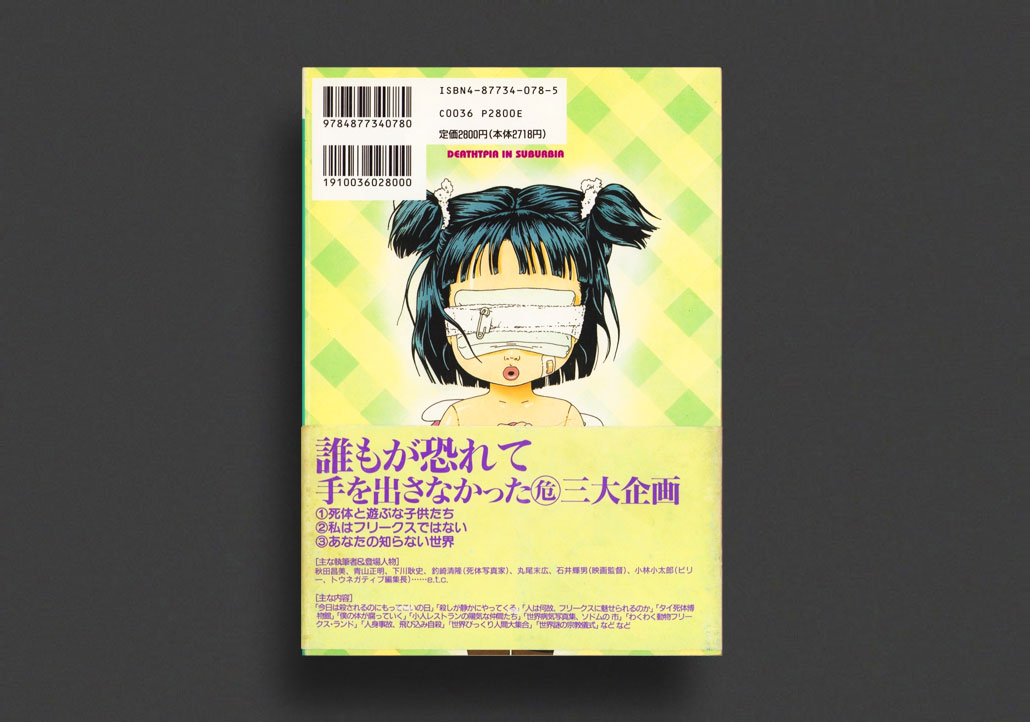
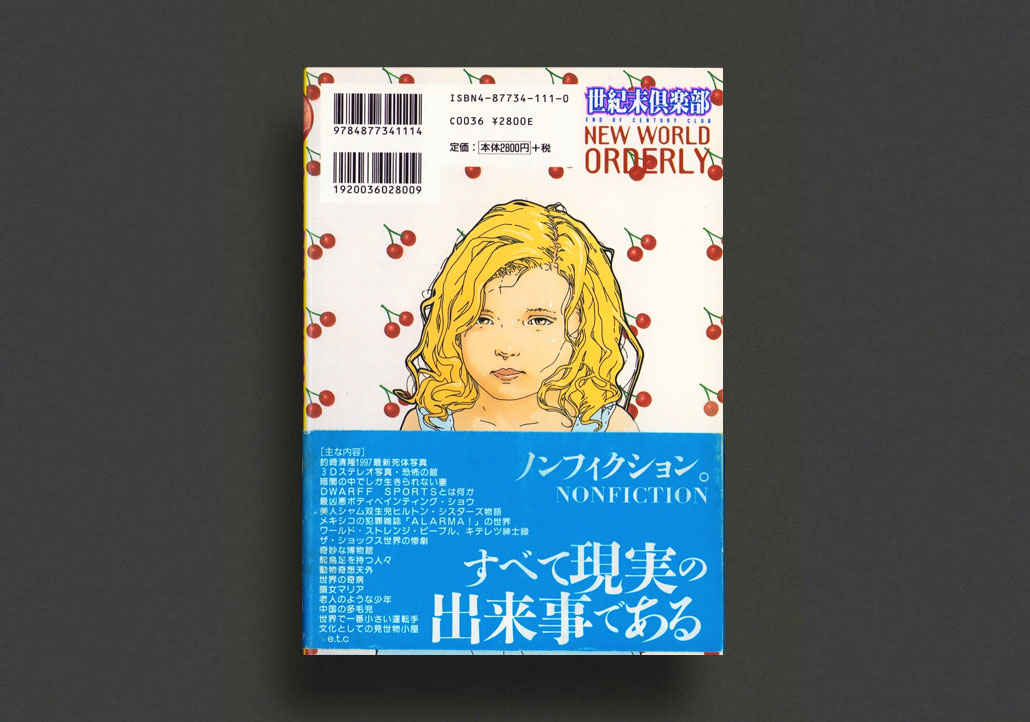
Don't judge a book by it's cover — you've been warned! Straight out of the young nihilist 90s, the second volume of the very short-lived and absolutely demented Seikimatsu Club (End of the Century Club), published in Tokyo between 1996—2000 for a total of only five volumes. This second volume, "Deathtpia in Suburbia", has the feature theme of Horror! Bizarre! Bizarre! Cruelty! and is packed to the absolute brim with "corpses, freaks, spectacles, murders, suicides, autopsies, rapes, sickness, pain, accident, war, religious rituals, violence, forensics, foetuses. A shocking document that eliminates all fiction (all genuine)!"
With contributors to this issue including Masami Akita (Merzbow), Masaaki Aoyama (author), Kiyotaka Tsurisaki (corpse photographer), Suehiro Maruo (ero guro manga artist), Teruo Ishii (ero guro film director), Kotaro Kobayashi (Too Negative editor-in-chief), Trevor Brown (artist), you should know what you are getting yourself into.
Following the trajection of fellow Japanese abnormal subculture magazines such as Kotaro Kobayashi's notorious Too Negative, Ultra Negative, ORG, etc., and in the spirit of a new wave of 90's nihilist publishing around the world (Answer Me!, Killing Times, Fuck!, AMOK, Feral House, etc.) End of the Century Club stares directly into the dark recesses of humanity and presents its viewers with the uncompromising extremes of our global culture. The real stuff. Where Too Negative presents itself as a glossy colour photo/art magazine, End of the Century Club is almost like a Whole Earth Catalog to the authentic macabre. With articles, interviews, reports, catalogues and hundreds of images spanning all manner of medical/autopsy/corpse photography, death journalism, serial killers, formalihide babies, war/shock accident/crime scenes, hara-kiri, murder, rape, slaughterhouse, forensic books, international underground magazines, Photobook of World Diseases, City of Sodom, corpses on the internet, Underground Baby Contest, Atlas of Dermatology, complete guide to Freaks movies, the Garbage Pail Kids, religious ceremonies, animal deformities, Interview with "The King of Cult" ero guro film director Teruo Ishii, bizarro sex, acrotomophila, artist Joel Peter Witkin's world, interview with Masaaki Aoyama, interview with corpse photographer Kotaro Kobayashi (Death, Hardcore Works, Too Negative, Billy, etc.), photography of George Dureau, interview with fetish film director and producer Kaoru Adachi, interview with experimental film director Shozin Fukui (Metal Days, Gerorisuto, Caterpillar, 964 Pinocchio, Rubber's Lover...), article on "Serial Killers & Record Junkies" by Toshihiko Hironaka (of Boris, Balzac, Hellbent fame), and all sorts of other curios from the mondo, bizarro realm.
Includes "gorgeous" 24-page high-quality corpse photo booklet feature and cover art by Trevor Brown.
Not for the fain-hearted. You'll feel like a shower after.
Very Good copy with dust jacket and obi.
1997, Japanese
Softcover (w. dust jacket and obi-strip), 256 pages, 21 x 14.8 cm
1st Edition, Out of print title / used / very good
Published by
Core Magazine / Tokyo
$120.00 - Out of stock
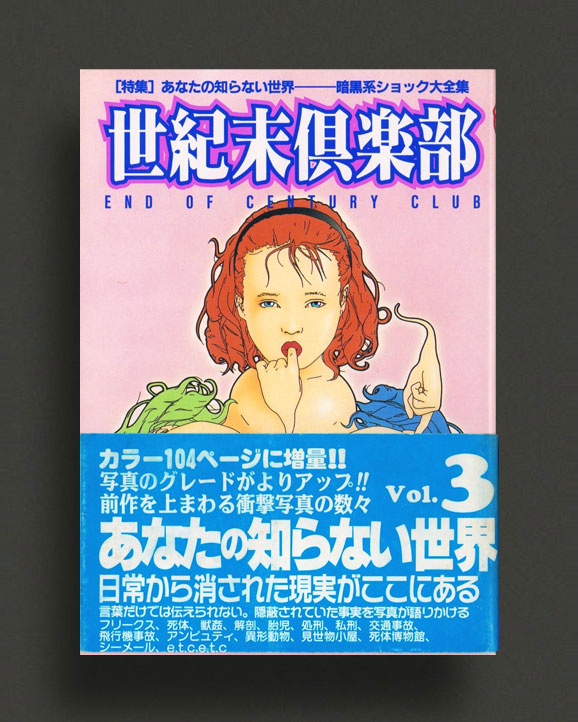
Don't judge a book by it's cover — you've been warned! Straight out of the young nihilist 90s, the third volume of the very short-lived and absolutely demented Seikimatsu Club (End of the Century Club), published in Tokyo between 1996—2000 for a total of only five volumes. This third volume, "The World You Don't Know", has the feature theme of exposing "a reality erased from everyday life", which sums it up... packed to the absolute brim with "freaks, corpses, bestiality, autopsies, fetal executions, lynchings, traffic accidents, plane crashes, amputee, heteromorphic animals, freak shows, corpse museums, shemales, etc. A shocking document that eliminates all fiction (all genuine)!"
With contributors to this issue including Masami Akita (Merzbow), Masaaki Aoyama (author), Kiyotaka Tsurisaki (corpse photographer), Hideshi Hino (horror manga artist / Guinea Pig director), Kotaro Kobayashi (Too Negative editor-in-chief), Trevor Brown (artist), you should know what you are getting yourself into.
Following the trajection of fellow Japanese abnormal subculture magazines such as Kotaro Kobayashi's notorious Too Negative, Ultra Negative, ORG, etc., and in the spirit of a new wave of 90's nihilist publishing around the world (Answer Me!, Killing Times, Fuck!, AMOK, Feral House, etc.) End of the Century Club stares directly into the dark recesses of humanity and presents its viewers with the uncompromising extremes of our global culture. The real stuff. Where Too Negative presents itself as a glossy colour photo/art magazine, End of the Century Club is almost like a Whole Earth Catalog to the authentic macabre. With articles, interviews, reports, catalogues and hundreds of images spanning all manner of medical/autopsy/corpse photography, death journalism, serial killers, formalihide babies, war/shock accident/crime scenes, human intersection, murder art show, lobster boy, 3D stereo photography hall of horrors, donkey fucker (please no!), strange diseases of the world, amputee lovers, siamese twins, deformed children, amazing Photo Press historical stories, animal deformities, huge Hideshi Hino art gallery, book guide and interview, ALARMA! photo gallery, Trevor Brown art gallery, corpse photography, columns and features on and by Kiyotaka Tsurisaki (Death, Hardcore Works, Too Negative, Ultra Negative, Billy, etc.), Father Yod (YaHoWha 13) record guide, Medical Atlas by Naruhiko Tanaka, lots of noise record reviews by Masami Akita (Merzbow) inc. Smell & Quim, M.B., Lustmord, Ramleh, Genocide Organ, Richard Ramirez, Agoraphobic Nosebleed, Whitehouse, Extreme Hair Stench, Genital Masticator, Traci Lords Loves Noise, Morder, etc., interview with artist Wes Benscoter (heavy metal illustrator for Slayer, Mortician, Kreator, Deceased, Cattle Decapitation, etc) on the occasion of his NG Gallery body painting show, complete Freak book library, and all sorts of other curios from the mondo, bizarro realm. Lots of full colour gore.
Not for the fain-hearted. You'll feel like a shower after.
Very Good copy with dust jacket and obi.
2013, English
Softcover, 112 pages, 23 x 22 cm
Out of print title / as new
Published by
PictureBox / Brooklyn
Corbett vs. Dempsey / Chicago
$160.00 - Out of stock
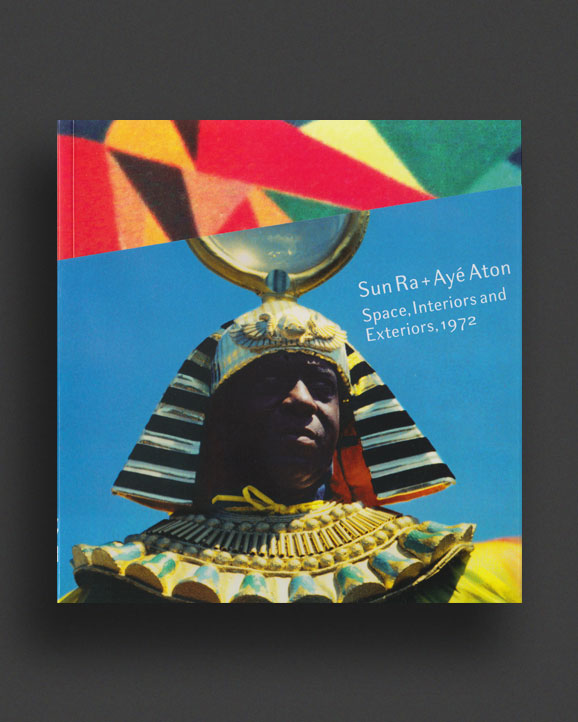
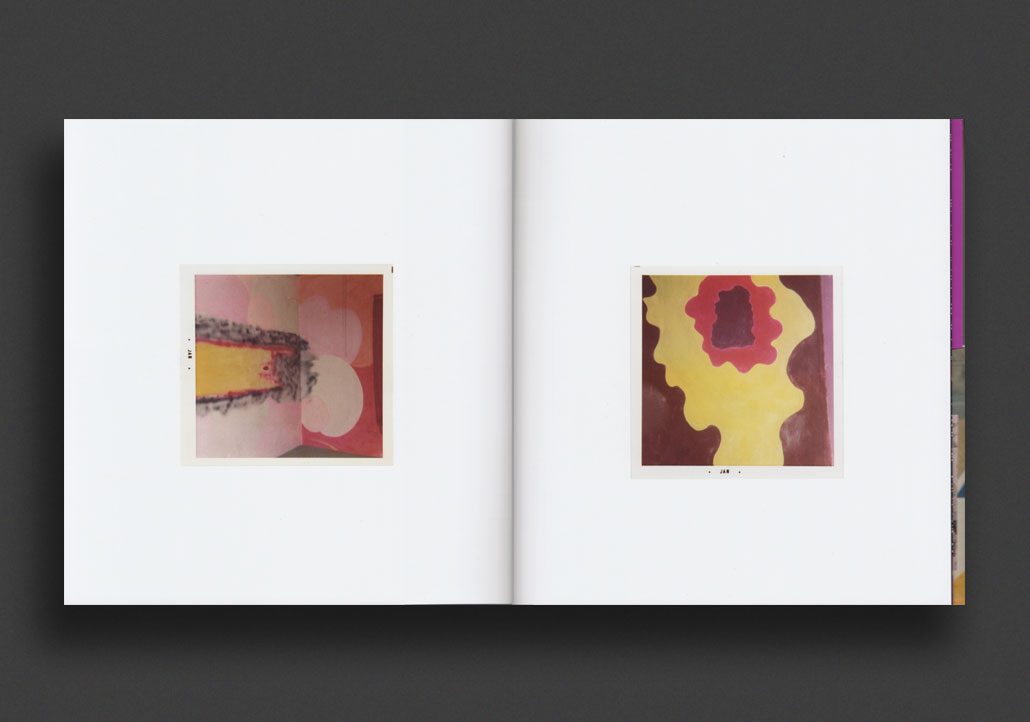
In 1972, the legendary musician, composer and mystic Sun Ra (1914-1993) was hard at work scripting and acting in the now classic documentary on his life and work, Space is the Place, as well as publishing his second book of poetry. The book of poems (now extremely rare) was designed and edited by Ra's manager, who asked one of Ra's band members in the Arkestra--the drummer and percussionist Ayé Aton--to contribute images to accompany Ra's poems. The final publication contained three photographs of Aton's indoor, space-themed murals. Published here for the first time, a once-lost trove of photographs dating from 1972, a pivotal year for Sun Ra. Half of the photos in this book are of the interior murals made by Ayé Aton — spectacularly beautiful in their 1970s supersaturated color. From the same period, a cache of never-published photographs taken on location in Oakland for the film Space is the Place, features Ra in full regalia, wearing beautiful Egyptian costumes borrowed from a local masonic temple. These spectacular photographs — unseen artifacts from a now remote time — offer us a special and often entertaining behind-the-scenes glimpse of a much-missed musical visionary.
Published by PictureBox, Inc. and Corbett vs. Dempsey.
Includes an introduction by Glenn Ligon and an essay by John Corbett
Edited by John Corbett
1978, English
Softcover, 226 pages, 25.5 x 17 cm
1st Edition, Out of print title / used / good
Published by
Semiotext(e) / Los Angeles
$200.00 - Out of stock
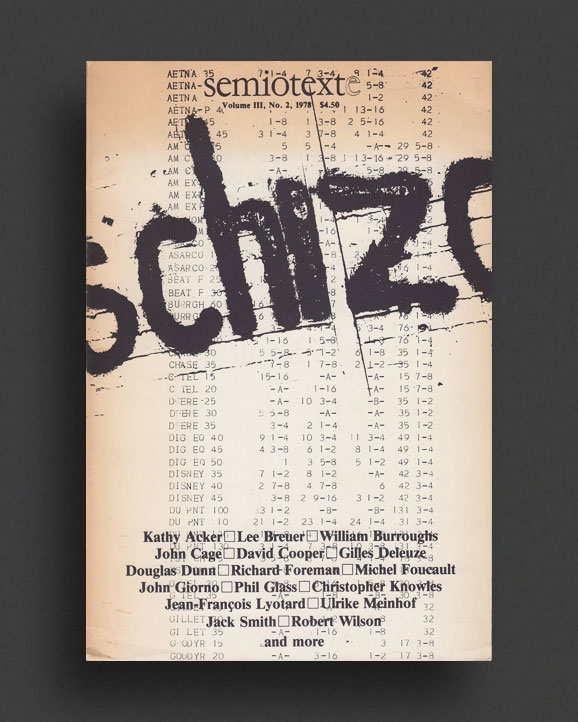
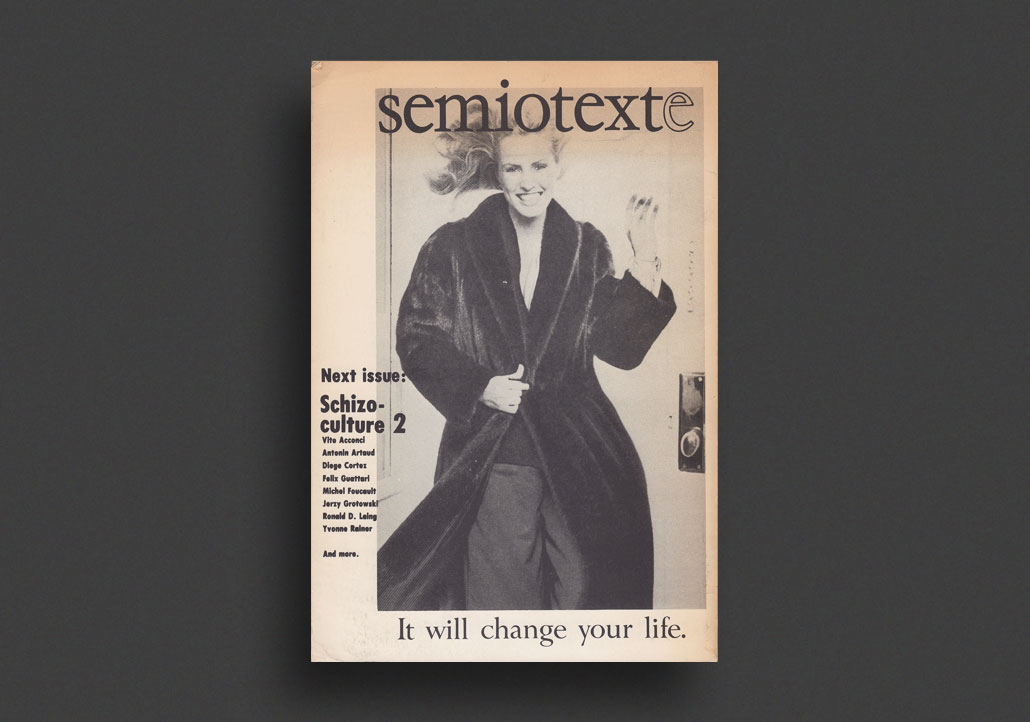
Rare copy of the breakthrough "Schizo-Culture" issue of the original Semiotext(e) journal, published and edited by Sylvère Lotringer between 1974—1985, with later book-length issues appearing in the 1990s. This historical, controversial issue, “consummated the magazine’s rupture with academe”—Sylvère Lotringer. "Schizo-Culture' was published in the wake of the legendary 1975 “Schizo-Culture” conference, conceived by the early Semiotext(e) collective, that began as an attempt to introduce the then-unknown radical philosophies of post-’68 France to the American avant-garde. The event featured a series of seminal papers, from Deleuze’s first presentation of the concept of the “rhizome” to Foucault’s introduction of his History of Sexuality project. The conference was equally important on a political level, and brought together a diverse group of activists, thinkers, patients, and ex-cons in order to address the challenge of penal and psychiatric institutions. The combination proved to be explosive, but amid the fighting and confusion “Schizo-Culture” revealed deep ruptures in left politics, French thought, and American culture. The “Schizo-Culture” issue of the Semiotext(e) journal came three years later. Designed by a group of artists and filmmakers including Kathryn Bigelow and Denise Green with schizophrenia type/image-setting, the issue’s contributors included a kind of who’s who of New York’s downtown art scene (Jack Smith, William S. Burroughs, Kathy Acker...), documenting the artistic chaos, offering interviews with artists, theorists, writers, and No Wave and pre-punk musicians together with new texts from Deleuze, Lyotard, Foucault, Laing, and other conference participants and key “French theory” figures. It also featured a delirious essay about markings on the savage body, by one Alphonso F. Lingis; an intimate interview with a member of an all-female street gang in the Bronx; and a detailed history of behavior-modification programs inside US correctional institutions (post-Attica), written from inside by prisoner activist Eddie Griffin. Gary Indiana has said that reading “Schizo-Culture” was one of the things that made it clear to him that he would inevitably move to New York.
Includes: Michel Foucault, Robert Wilson, Francois Peraldi, Guy Hocquenghem, The Ramones, William S. Burroughs, Louis Wolfson, Lee Breuer, Eddie Griffin, Wendy Clark, Elie C. Messinger, David Cooper, Martine Barrat, John Giorno, Alphonso F. Lingis, Bernard-Henri Levy, Kathy Acker, Richard Foreman, André Cadere, Ulrike Meinhof, Gilles Deleuze, John Cage, Pat Steir , Jean-Jacques Abrahams, Phil Glass, Jack Smith, Jean Francois Lyotard, Douglas Dunn, and others...
Good copy with age wear, marking and tanning to raw stocks.
1977, English
Softcover, 64 pages, 21.5 x 13.5 cm
1st Edition, Out of print title / used / very good
Published by
Dover / New York
$25.00 - Out of stock
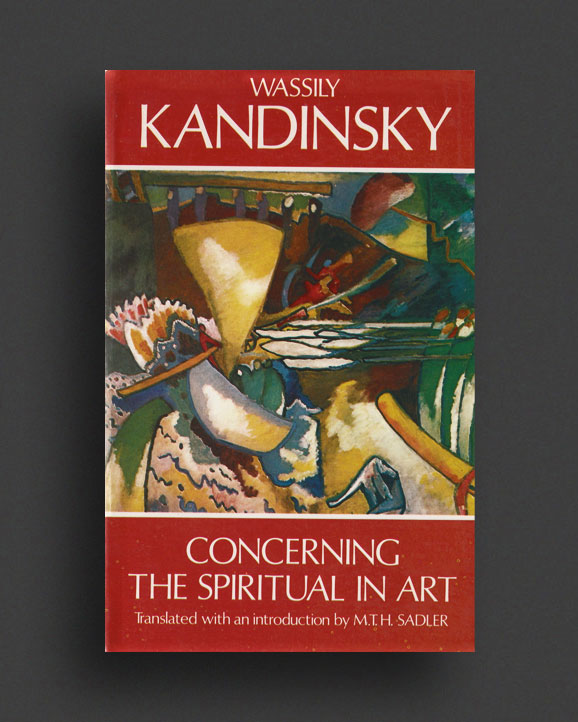
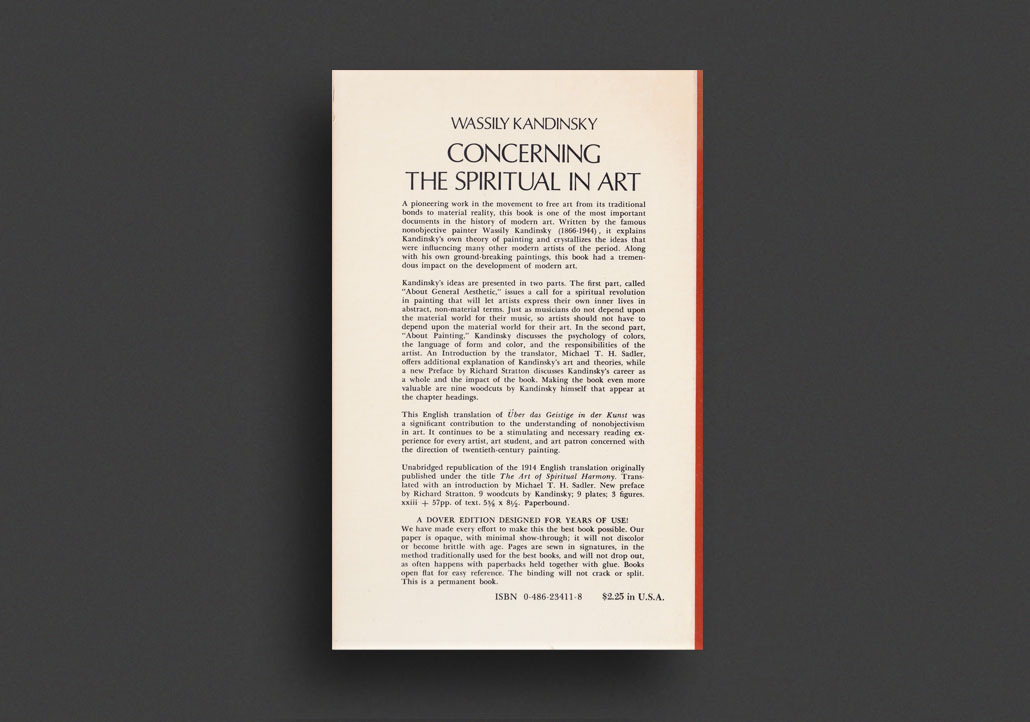
First 1977 unabridged republication of the 1914 English translation originally published under the title The Art of Spiritual Harmony. Translated with an introduction by Michael T. H. Sadler, new preface by Richard Stratton, and 9 woodcuts by Kandinsky. Published by Dover.
A pioneering work in the movement to free art from its traditional bonds to material reality, this book is one of the most important documents in the history of modern art. Written by the famous nonobjective painter Wassily Kandinsky (1866-1944), it explains Kandinsky's own theory of painting and crystallizes the ideas that were influencing many other modern artists of the period. Along with his own ground-breaking paintings, this book had a tremendous impact on the development of modern art.
Kandinsky's ideas are presented in two parts. The first part, called "About General Aesthetic," issues a call for a spiritual revolution in painting that will let artists express their own inner lives in abstract, non-material terms. Just as musicians do not depend upon the material world for their music, so artists should not have to depend upon the material world for their art. In the second part, "About Painting." Kandinsky discusses the psychology of colors, the language of form and color, and the responsibilities of the artist. An Introduction by the translator, Michael T. H. Sadler, offers additional explanation of Kandinsky's art and theories, while a new Preface by Richard Stratton discusses Kandinsky's career a whole and the impact of the book. Making the book even more valuable are nine woodcuts by Kandinsky himself that appear at the chapter headings.
This English translation of Uber das Geistige in der Kunst was a significant contribution to the understanding of nonobjectivism in art. It continues to be a stimulating and necessary reading ex perience for every artist, art student, and art patron concerned with the direction of twentieth-century painting.
Very Good copy.
2008, English / German
Softcover, 80 pages (colour & b/w ill.), 25 x 19 cm
1st Edition, Out of print title / as new
Published by
Galerie Buchholz / Köln
Greene Naftali / New York
$80.00 - In stock -
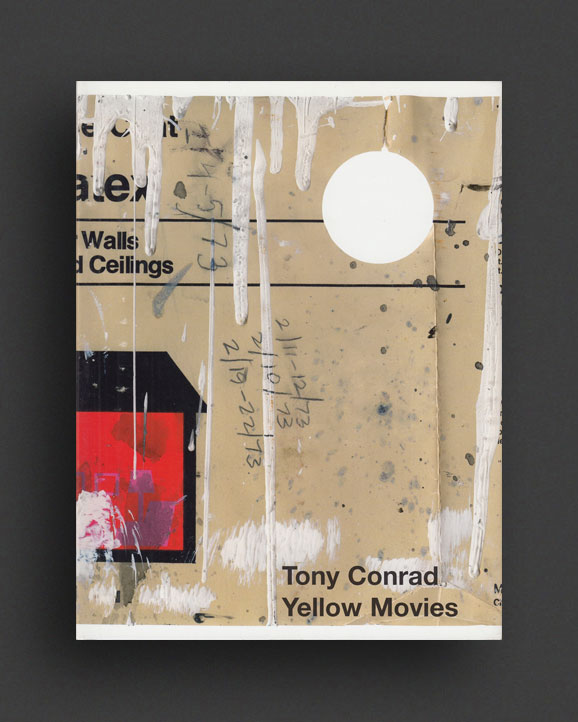
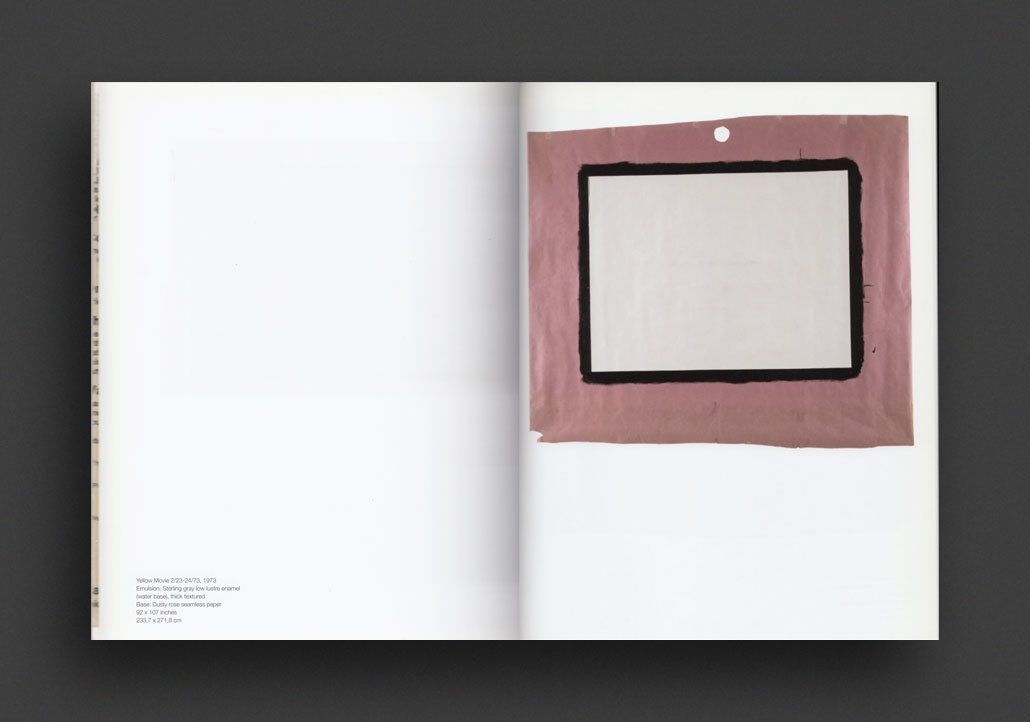
This now out-of-print Conrad catalogue was published on the occasion of two exhibitions, one at Galerie Daniel Buchholz in Cologne and the other at Greene Naftali in New York, that presented a group of works by artist, filmmaker and musician Tony Conrad entitled "Yellow Movies".
Alongside an introductory note by Tony Conrad that served as a press release for the two gallery exhibitions, the book contains a new text by Diedrich Diederichsen and a comprehensive documentation of all the "Yellow Movies" still in existence.
Designed by Yvonne Quirmbach, this wonderful catalogue was produced in collaboration with Galerie Daniel Buchholz and Greene Naftali, in an edition of 1,200 copies.
As new copy.
Anthony Schmalz "Tony" Conrad (March 7, 1940 – April 9, 2016) was an American avant-garde video artist, experimental filmmaker, musician, composer, sound artist, teacher, and writer. Active in a variety of media since the early 1960s, he was a pioneer of both structural film and drone music. He performed and collaborated with a wide range of artists over the course of his career, most prominently the 1960s New York experimental music collective Theatre of Eternal Music, also known as The Dream Syndicate.
Yellow Movies was a project of Conrad's in 1973. It consists of 20 "movies," which are square frames painted in black house paint onto large pieces of photographer's paper. Conrad's concept came from a continued attempt at pushing the framework of film, and his interest in engaging the audience in long spaces of time. He wanted to make a film that would last 50 years, but knew that "normal materials" could not last that long, so he created a whole new conceptual stratagem for Yellow Movies. The "emulsion" is painted on, and the movies take their own course over time, changing very slowly.
1981, Spanish
Softcover, 104 pages, 17 x 12 cm
1st Edition, Out of print title / used / very good
Published by
Editorial Garsi / Madrid
$70.00 - In stock -
Very rare copy of UNA MUSICA PARA LOS 80 by Spanish experimental composer, poet and art critic Javier Maderuelo (b. 1950), published in 1981 in Madrid by Editorial Garsi. This essential compact chronicle was written by Maderuelo to introduce the phenomenon of so-called contemporary music in Spain (electroacoustic, musique concrète, experimental, ambient, sound art, et al.) and analyse the varied positions of its leading protagonists, such as the Zaj group, Suso Sáiz, Eduardo Polonio, Llorenç Balsach, Amadeu Marin, Llorenç Barber, Carles Santos, José Iges, Antoni Caimari, Pedro Estevan, Josep Lluís Berenguer Moreno, Javier Maderuelo (himself a member of studio Alea between 1973-1977 and the musical movement Elenfante), amongst others. With critical overviews, profiles, discographies, bibliographies, chronologies of exhibitions and concerts, this is indeed a vital document on Spanish avant-garde sound c. 1970—1981.
Javier Maderuelo (Madrid, 1950) became interested in experimental poetry and art in 1972 under the influence of Fernando Millán, José Luis Castillejo and Felipe Boso, as well as artists like Elena Asins, Juan Hidalgo and Javier Aguirre, with whom he collaborated. He began producing typewritten poems and collages with texts extracted from newspapers, which converge in the unpublished book Arte Cisoria (1981). Felipe Boso introduced him to the world of phonetic poetry and with Pedro Estevan and María Villa he cofounded the Glotis Group (1979), dedicated to disseminating both the work of avant-garde poets, as well as neo-avant-garde works, some of them expressly written for Glotis. As a composer, he worked at the electronic music studio Alea (1973-1977) and was part of the musical movement Elenfante. He was a member of the Seminar of Analysis and Automatic Generation of Musical Forms, run by Florentino Briones, collaborating on the SIMO concerts. At the end of the eighties he abandoned poetic and musical creation to devote himself to an academic career.
Very Good copy with cover wrap cleanly disconnected from book block (old glue), tanned spine, otherwise VG throughout.
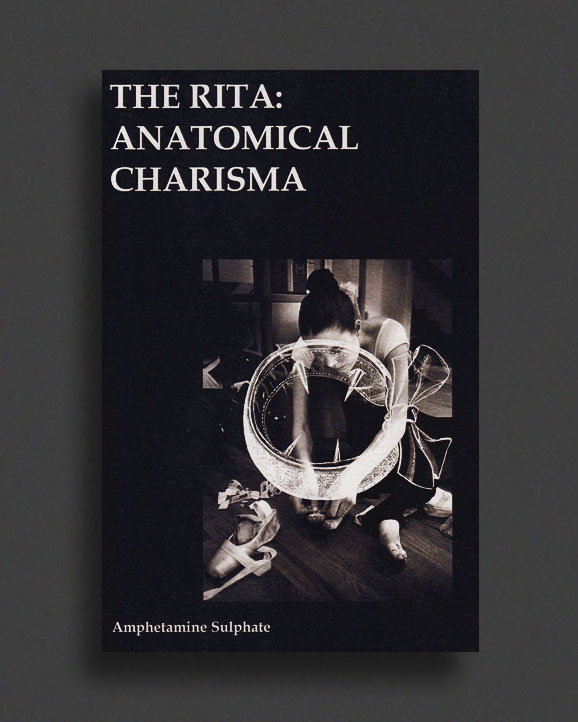
2017, English
Softcover (staple-bound), unpaginated, 21.5 x 13.5 cm
Published by
Amphetamine Sulphate / Austin
$34.00 - Out of stock
High quality art plates, exclusively designed and executed for THE RITA. My guess is that a lot of people reading this book know something personal about immersion.
The experience of watching meaning change over time solely for yourself, depth being equal to the ease with which you get information, the ability to 'read' that information, the extent to which you can invest yourself in that information.
Things you see, you can see over and over, because you love them. Love is best and most correct when you know something but you feel like you can never truly own it'? no matter what, it is always outside of you. Gabrielle Losoncy
1999, English
Softcover (staple bound), 17.7 x 13 cm
1st Edition, Out of print title / as new
Published by
Omni Press / Millbrae
$35.00 - In stock -
Scarce copy of Sun Ra Research issue no. 37, 1999, an exceptional fanzine project edited by Sun Ra devotee Peter Hinds, founded in 1995 to publish extensive, illuminating interviews and conversations with Sun Ra and members of his Arkestra, spanning the 1970's to Sun Ra’s passing in 1993. With each issue featuring exclusive insights from Sun Ra and the Arkestra themselves, plus transcriptions of rehearsals, radio shows, articles, Sun Ra declarations and poetry, and rare, unpublished Arkestra images by many photographers, all risographed on different paper stocks, hand-bound, and independently published by Omni Press in Millbrae, California, Sun Ra Research forms a valuable "product of a lunatic obsession and deranged scholarship" in homage to the cosmic jazz philosopher.
As New copy.
2000, English
Softcover, 458 pages, 23 x 15 cm
1st Edition, Out of print title / used / good
Published by
Feral House / Los Angeles
$90.00 - Out of stock
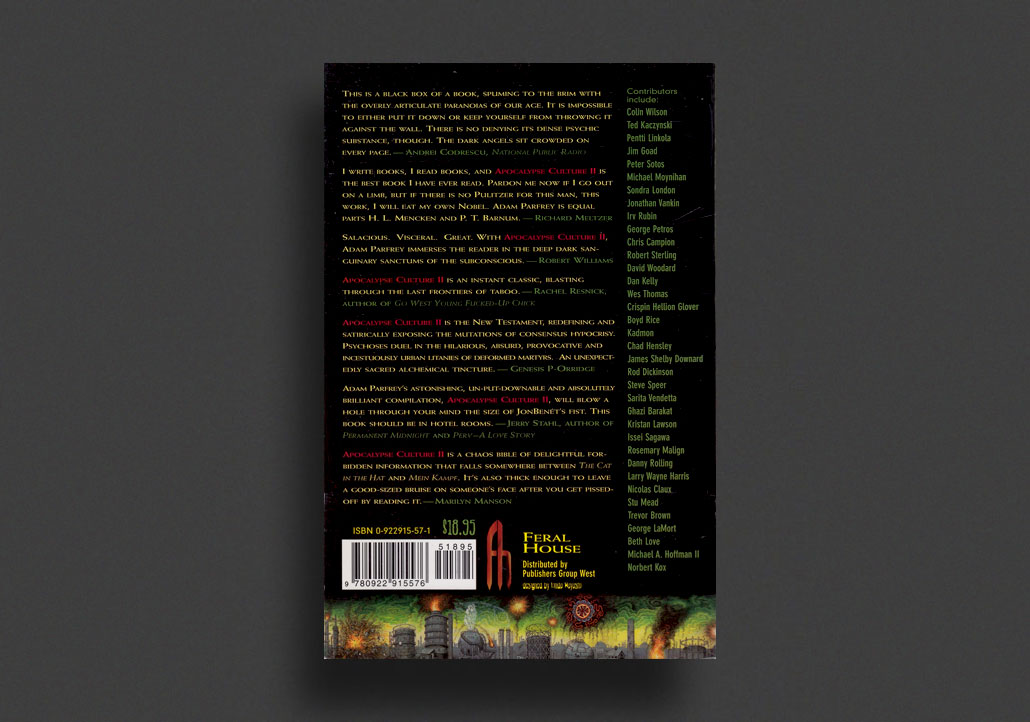
First 2000 edition of the second coming of America’s darkest shadow side, Apocalypse Culture II, the completely cult classic sequel edition to what was called by J.G. Ballard “the terminal documents of the twentieth century.” The original Apocalypse Culture, an underground bestseller since its emergence in 1987, has remained a huge influence on popular culture. The sequel delineates further regions of the Forbidden Zone, the psychic maelstrom that everyone knows exists but fearfully avoids.
Subject matter includes:
The biological resurrection of Jesus Christ via modern cloning technology
Interviews with a convicted murderer and cannibal turned celebrity
Recipes for cooking babies
Homunculi
Pedophilia
A re-enactment of the 914 deaths that occurred at Jonestown in 1978
A report on Bobby Beausoleil, his art, and his prison sex life
The farthest-out conspiracy of all with reasons to take it absolutely seriously
Letters sent to Anton LaVey’s Church of Satan
A sample necrocard for those who wish to donate their body to necrophilia
Steps to overcome masturbation
The replacement of human mates with expensive masturbatory devices
Fecal black magic
Mind control via advertising
And dozens of other compelling examples of our own Apocalypse Culture. Observing that society has been infantilized by being told at every opportunity how to think and what to believe, editor Adam Parfrey refuses to provide easy moral lessons in Apocalypse Culture II, though he supplies pertinent information before and after many articles to assist the interpretation of thoughtful readers. Some will find the contents quite shocking, but that, according to Parfrey, is not his primary purpose. This is an examination of sociological truths that speak of the culture that both created and ignore them.
Contributors include Colin Wilson, Ted Kaczynski, Pentti Linkola, Jim Goad, Peter Sotos, Michael Moynihan, Sondra London, Jonathan Vankin, Irv Rubin, George Petros, Chris Campion, Robert Sterling, David Woodard, Dan Kelly, Wes Thomas, Crispin Hellion Glover, Boyd Rice, Kadmon, Chad Hensley, James Shelby Downard, Rod Dickinson, Steve Speer, Sarita Vendetta, Ghazi Barakat, Kristan Lawson, Issei Sagawa, Rosemary Malign, Danny Rolling, Larry Wayne Harris, Nicolas Claux, Stu Mead, Trevor Brown, George LaMort, and Beth Love.
“This is a black box of a book, spuming to the brim with the overly articulate paranoias of our age. It is impossible to either put it down or keep yourself from throwing it against the wall. There is no denying its dense psychic substance, though. The dark angels sit crowded on every page.”—Andrei Codrescu, National Public Radio
“I write books, I read books, and Apocalypse Culture II is the best book I have ever read. Pardon me now if I go out on a limb, but if there is no Pulitzer for this man, this work, I will eat my own Nobel. Adam Parfrey is equal parts H.L. Mencken and P.T. Barnum.”—Richard Meltzer
“Apocalypse Culture II is an instant classic, blasting through the last frontiers of taboo.”—Rachel Resnick, author of Go West Young Fucked-Up Chick
“Salacious. Visceral. Great. With Apocalypse Culture II, Adam Parfrey immerses the reader in the deep dark sanguinary sanctums of the subconscious.”—Robert Williams
“Apocalypse Culture II is the New Testament, redefining and satirically exposing the mutations of consensus hypocrisy. Psychoses duel in the hilarious, absurd, provocative and incestuously urban litanies of deformed martyrs. An unexpectedly sacred alchemical tincture.”—Genesis P-Orridge
“Adam Parfrey’s astonishing, un-put-downable and absolutely brilliant compilation, Apocalypse Culture II, will blow a hole through your mind the size of JonBenet’s fist. This book should be in hotel rooms.”—Jerry Stahl, author of Permanent Midnight
“Adam Parfrey shows himself to be unique among investigative journalists: one unafraid to go where barkers fear to tread.”—Nick Tosches
“Apocalypse Culture II is a chaos bible of delightful forbidden information that falls somewhere between The Cat in the Hat and Mein Kampf. It’s also thick enough to leave a good-sized bruise on someone’s face after you get pissed-off by reading it.”—Marilyn Manson
Good copy with general wear.
1978, Japanese
Softcover (staple-bound), 52 pages, 30 x 21 cm
1st Edition, Out of print title / used / good
Published by
Rock Magazine / Osaka
$60.00 - Out of stock
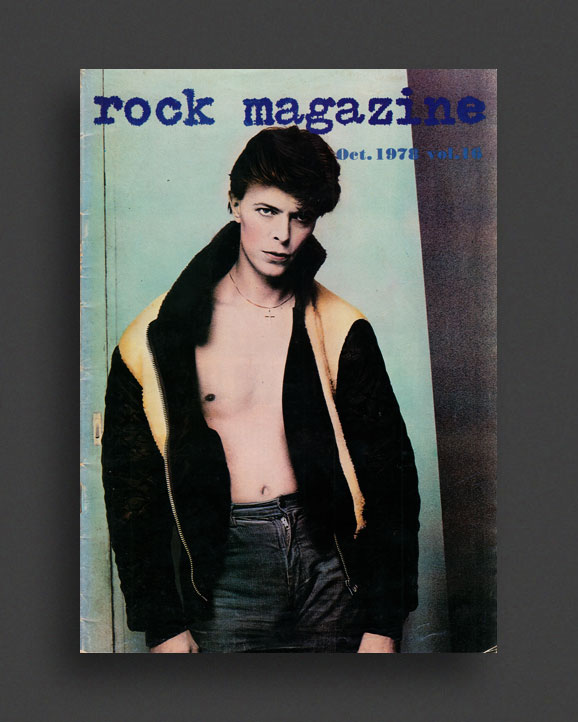
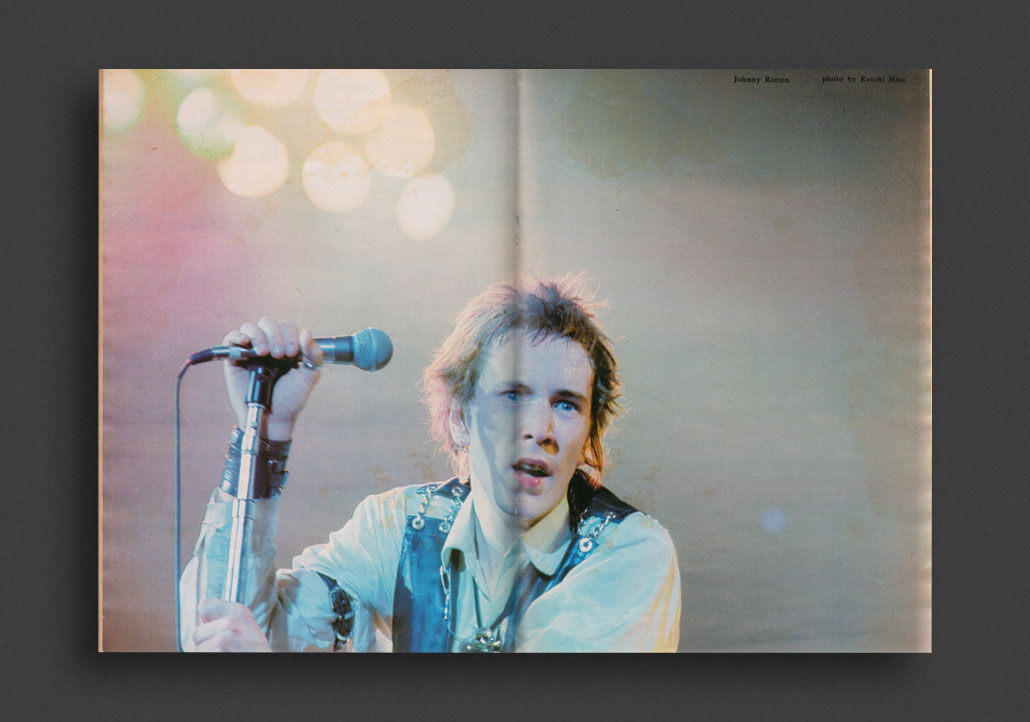
Rare, new very collectible, early issue (October 1978) of Rock Magazine, founded in Osaka in 1976 by music critic, editor and Vanity Records label owner Yuzuru Agi. This issue with David Bowie cover by Masayoshi Sukita, Johnny Rotten (Sex Pistols) colour pin-up, features on UK label Chiswick Records (Motörhead, The Count Bishops, The Damned, Skrewdriver, The Radiators, etc), Europe/Kraftwerk, "The Black New Wave" or "Jah-Punk" (a huge feature with interviews, artist profiles and illustrated discographies — U-Roy, Lee Scratch Perry, Steel Pulse, Prince Far I, Third World, etc), the beginning of Vanity Records, reports from London, New York and Akron, Ohio, record reviews, columns, letters...
Yuzuru Agi (1946—2018) was a singer turn visionary Japanese music critic, editor, producer, and Vanity label owner. Thanks to Agi's unwavering commitment to cutting-edge music, Rock Magazine (1976—1984) was Japan's leading magazine for "contemporary music", channeling the international musical vanguard into Japan every month. A crucial publication in the rise of avant-garde music from the West in Japan, Rock Magazine championed Progressive Rock, Free Jazz, Punk, Art Rock, New Wave, Industrial, Krautrock, Ambient, Reggae, Noise, and much between, charting the developments in Europe, UK, USA, etc., alongside the latest from Japan, through exclusive interviews, scene reports, articles, family trees, discographies, and extensive record reviews, littered with hundreds of photographs, record cover artwork, colour posters, and record label, store and venue advertisements. Wonderful Japanese "maximum data" magazine design throughout, with multiple stocks and colour-processes. Agi and his cohorts didn't miss a beat, and these magazines are as comprehensive a reference for anyone interested in historical "new music" as it gets (alongside Agi's EGO magazine, early Marquee Moon and Fool's Mate, Morgue, G-Modern...).
Good copy with tanning and general wear/spine pinches/foxing from age.
1979, Japanese
Softcover (staple-bound), 52 pages, 30 x 21 cm
1st Edition, Out of print title / used / good
Published by
Rock Magazine / Osaka
$90.00 - In stock -
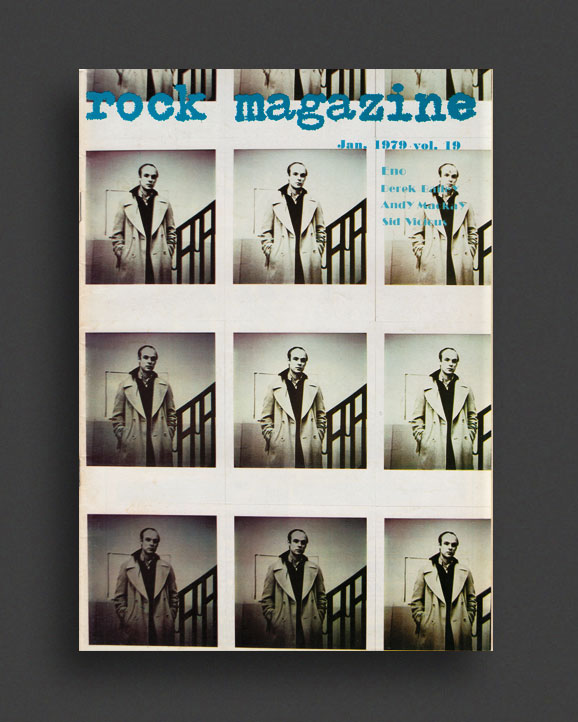
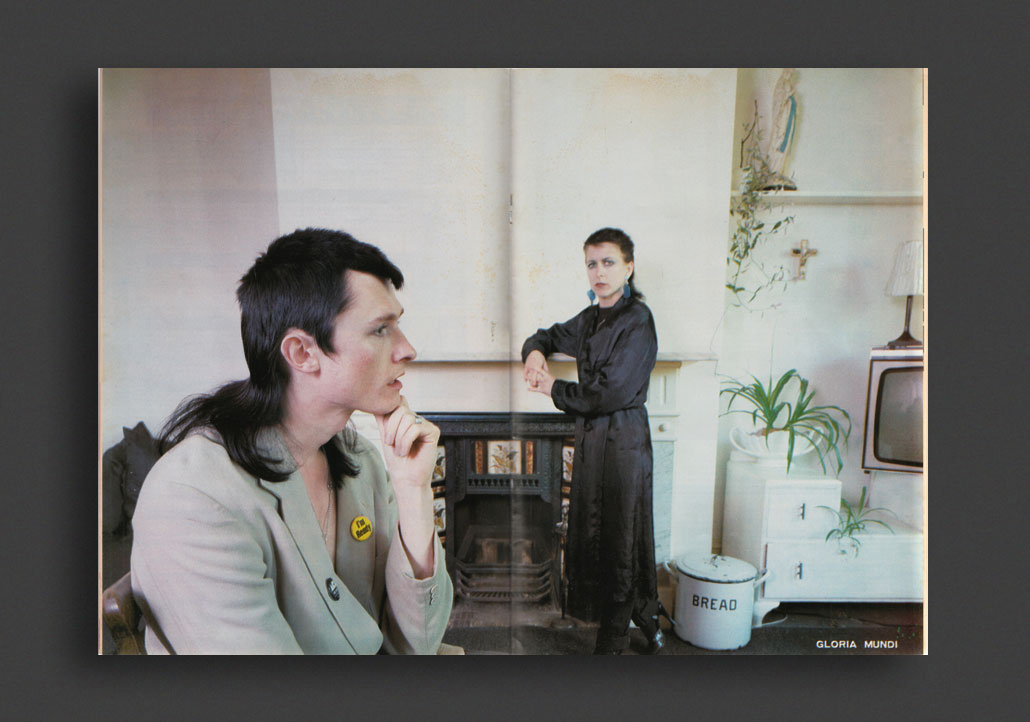
Rare, now very collectible, early issue (January 1979) of Rock Magazine, founded in Osaka in 1976 by music critic, editor and Vanity Records label owner Yuzuru Agi. This issue with Eno cover by Ritva Saarikko, features huge interviews with Brian Eno and Sid Vicious, a huge feature of multiple articles and illustrated discography of British and European Free Music (Derek Bailey, Evan Parker, Han Bennink, Steve Lacy, Hans Reichel, Keith Tippett, Lol Coxhill, Willem Breuker, Misha Mengelberg, Wolfgang Dauner, et al.), colour pin-up of English early punk/gothic rock band Gloria Mundi, Robert Fripp, "Mao Mao Pop": Andy Mackay (Roxy Music), record reviews, columns, letters...
Yuzuru Agi (1946—2018) was a singer turn visionary Japanese music critic, editor, producer, and Vanity label owner. Thanks to Agi's unwavering commitment to cutting-edge music, Rock Magazine (1976—1984) was Japan's leading magazine for "contemporary music", channeling the international musical vanguard into Japan every month. A crucial publication in the rise of avant-garde music from the West in Japan, Rock Magazine championed Progressive Rock, Free Jazz, Punk, Art Rock, New Wave, Industrial, Krautrock, Ambient, Reggae, Noise, and much between, charting the developments in Europe, UK, USA, etc., alongside the latest from Japan, through exclusive interviews, scene reports, articles, family trees, discographies, and extensive record reviews, littered with hundreds of photographs, record cover artwork, colour posters, and record label, store and venue advertisements. Wonderful Japanese "maximum data" magazine design throughout, with multiple stocks and colour-processes. Agi and his cohorts didn't miss a beat, and these magazines are as comprehensive a reference for anyone interested in historical "new music" as it gets (alongside Agi's EGO magazine, early Marquee Moon and Fool's Mate, Morgue, G-Modern...).
Good copy with tanning and general wear/spine pinches/foxing from age.
1981, English
Softcover (staple bound w. brochure), 64 pages, 28 x 21.5 cm
1st Edition, Out of print title / used / very good
Published by
Creative Space / Chippendale
$45.00 - In stock -
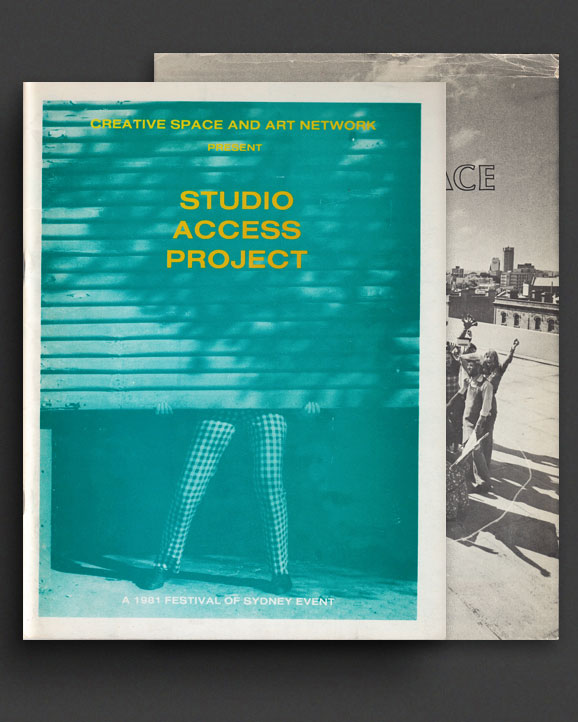
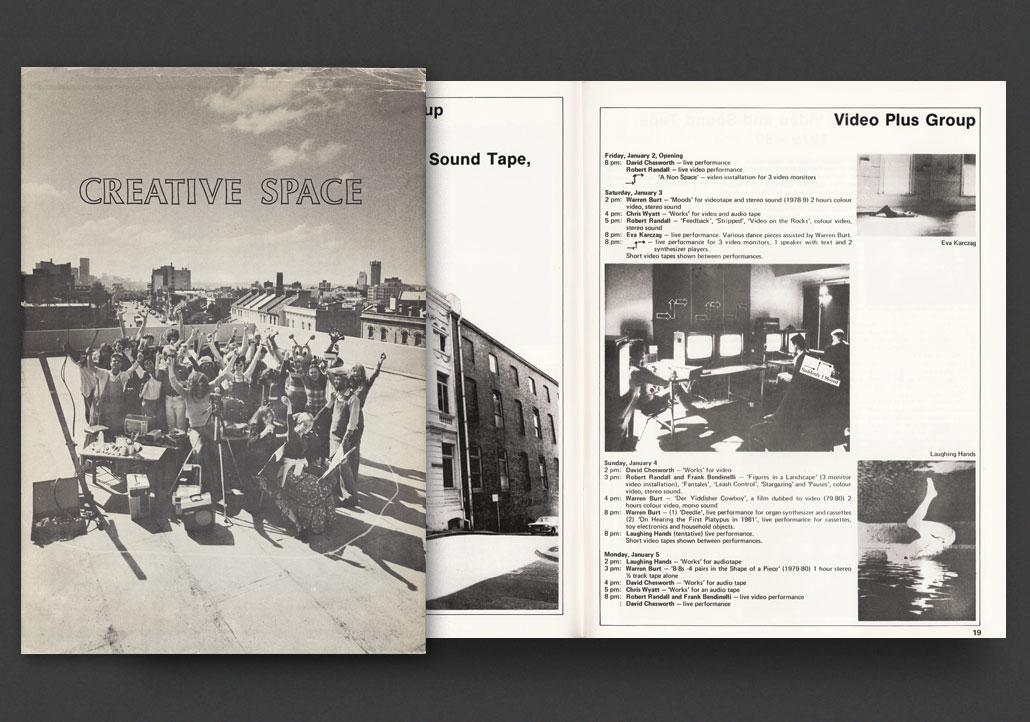
Including the Video Plus Group and the 'Sydney Artists Video and Sound Tape, 1979—1980' performances (Laughing Hands, David Chesworth, → ↑ → (Tsk Tsk Tsk), Warren Burt, Chris Wyatt, Eva Karczag, Robert Randall, and Frank Bendinelli) this rare catalogue published on the occasion of the Studio Access Project, an expansive Sydney-wide event during the 1981 Festival of Sydney and a solution to the desperate situation in the arts competing with industry, commerce and residential expansion in the inner city. "If the city is to remain a lively centre for the arts, room must be found for the artist to work." The first show of its kind in Australia, the project, organised by the volunteer-run Creative Space and Art Network attacked the problem by surveying the needs of artists in Sydney, revealing no less than 400 artists from a multitude of disciplines in urgent need of space, then identifying and investigating unused spaces for studios and presentations. "The redevelopment process is continuous and it leaves many buildings empty for long periods of time. In England and America artists have been found to be the perfect in between tenants for these type of properties."
"The Studio Access Project which this catalogue documents, was initiated to introduce the public to some of the artists in Sydney who are working in studios. It is hoped that in this way some idea of the process and not just the product can be communicated resulting in a greater understanding of artist space needs as well as providing the artists themselves with an exhibiting opportunity."
Sadly nothing has changed. If anything it's exceptionally worse, but this document is an important insight into the battle of Australian cultural initiatives to push back against the rampant redevelopment squeeze in this country and reclaim property waste.
With a map of the city and schedules of concerts and exhibitions, the book profiles all of the artists and utilising the many disparate buildings (shop fronts, garages, basements, warehouses...) profusely illustrated with their artworks, graphics, and biographies.
Includes Creative Space brochure inserted.
Very Good with some creasing to top of inserted brochure.
1995, English
Softcover + 7" Flexi Disc (Sonosheet), unpaginated, 21 x 28 cm
1st Edition, Out of print title / used / very good
Published by
Primary Information / New York
$400.00 - In stock -
Rare very first (black and gold) 1995 edition, hand-assembled and limited to 800 copies!
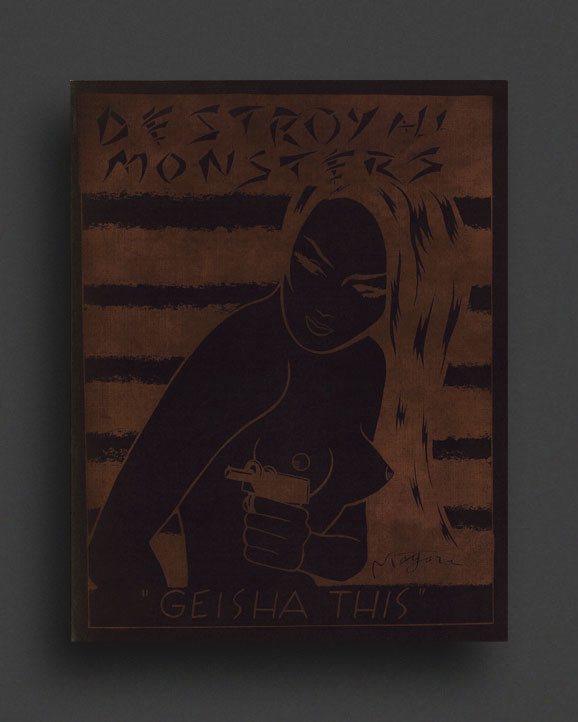
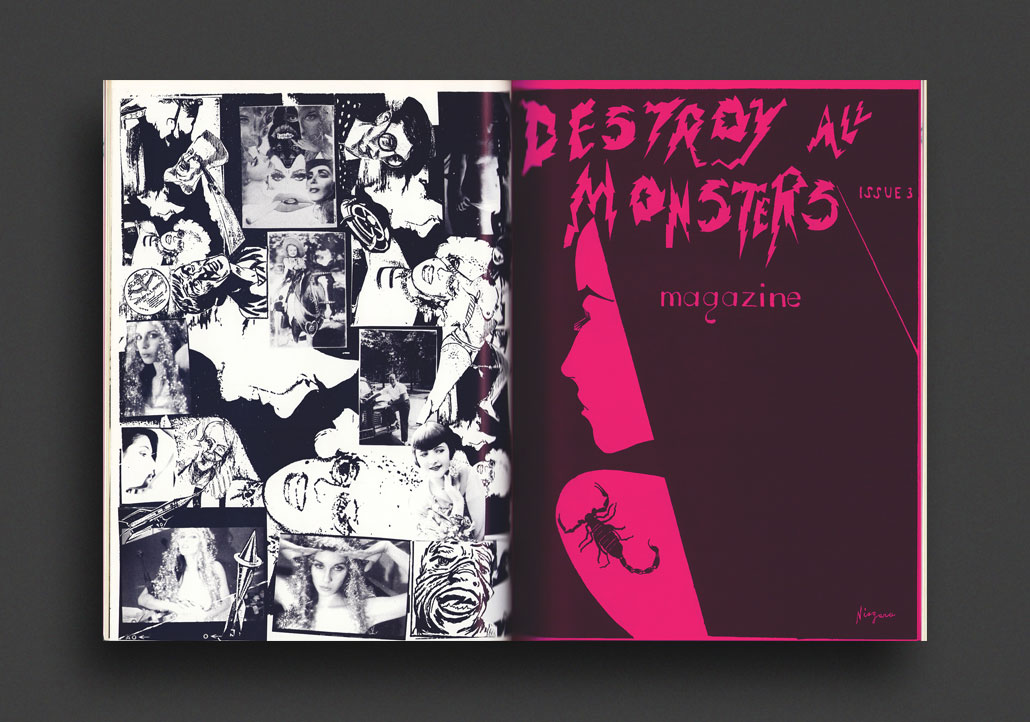
Destroy All Monsters started out as an anti-rock band: four midwestern art students — Jim Shaw, Mike Kelley, Cary Loren, and Niagara — with a mission to subvert the airwaves. Between 1975 and 1979, they produced six issues of DAM Magazine, a barrage of Kelley's perverse cartoons, Shaw and Loren's wild Xeroxed collages, and shots of the band; Niagara did a lot of the cover designs, and everything was crudely printed on cheap paper. "The images that drove us were the strange combinations of film noir, monster movies, psychedelia, thrift-shop values, and the relentless anarchy of an over-stimulated pop culture", recalls Cary Loren. This compilation is the definitive DAM document: hundreds of drawings, photos, Xeroxed artwork, collages, reviews, profiles, and personal manifestos, many works unpublished and unseen before — plus a flexi-record bound into the book (first printing and first pressing of this 1975 recording).
A total of three editions of “Geisha This” were produced and all are out-of-print. Each version was printed in different colours, with a different metallic cover and hand collated in a different sequence, containing new and different contents.
This version (the very first edition), has a cover design by Niagara printed in GOLD metallic ink on BLACK cardboard cover stock. The entire first printing was 800 copies, strikingly printed with dozen’s of multicoloured inks (fluros, metallics), silk-screened and spray-painted pages, with many paper stocks, all hand-assembled, printed, designed and edited by Cary Loren, with artwork and texts by Mike Kelley, Jim Shaw, Loren and Niagara.
Very Good copy of the first edition in black, a stunning document, complete with the brand new Flexi Disc (Sonosheet) in its first pressing.
2006, English
Hardcover (debossed faux leather bound + 7"), 26 x 23 cm
600 numbered copies,
1st Edition, Out of print title / used / fine
Published by
Hysteric Glamour / Tokyo
$120.00 - In stock -
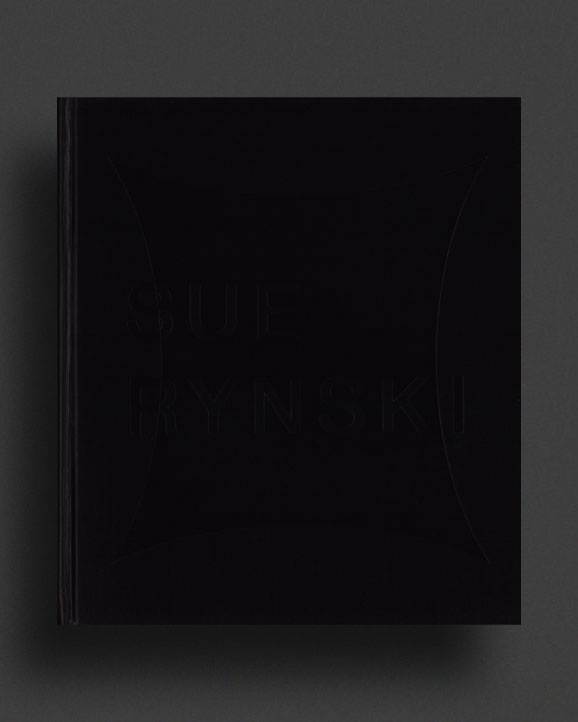
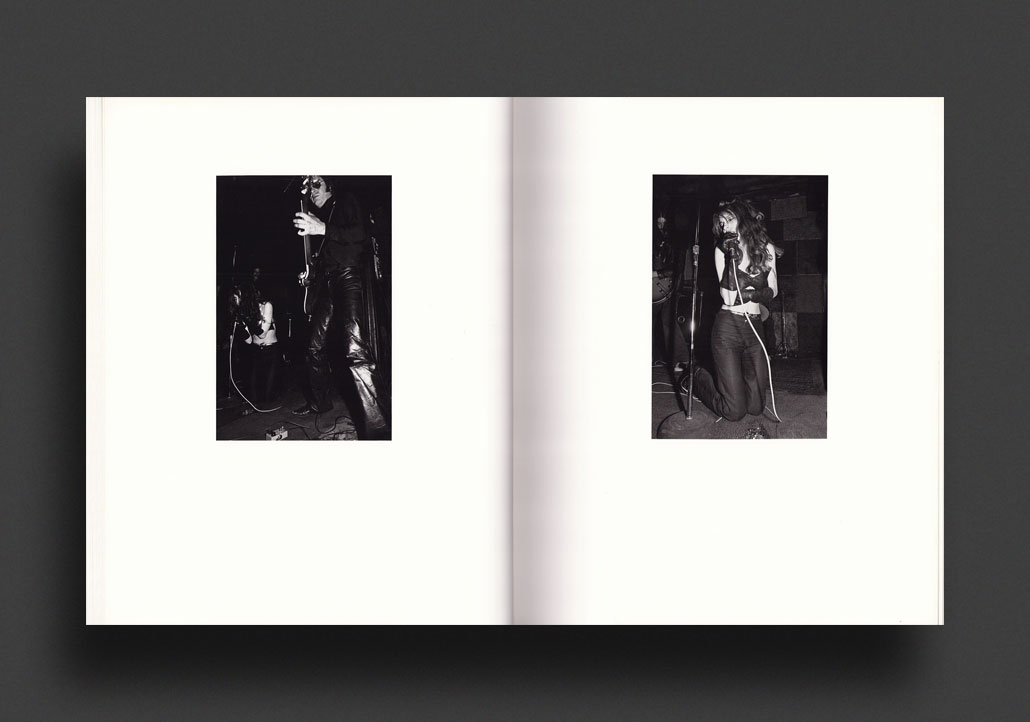
Published in 2006 by fashion brand Hysteric Glamor in a numbered edition of 600 copies, bound in padded debossed faux leather hardcover with a 7" record, "the book is a monograph of my late 1970s photographs of my friends, the avant-garde rock group Destroy All Monsters."—Sue Rynski, Detroit photographer. Described by legendary critic Lester Bangs as "anti-rock", Destroy All Monsters was an influential Detroit rock band formed in 1973 by University of Michigan art students Mike Kelley, Jim Shaw, legendary femme fatale Niagara, and filmmaker Cary Loren, existing to 1985 with shifting personnel and sporadic performances since. Performing their first concert at a comic book convention in Ann Arbor, Michigan, on New Year's Eve of 1973, the group combined elements of punk, psych, metal and noise rock with a heavy dose of experimentation and performance art, influenced as much by ESP-Disk, Sun Ra and The Velvets, as monster movies and Futurism. The cult group earned a measure of notoriety through their coveted DAM Magazine, also due to members of The Stooges and MC5 joining the band, and Sonic Youth singer/guitarist Thurston Moore compiling a three compact disc set of the group's music in 1994.
"Born in 1954, year of the birth of rock and roll, I grew up immersed in the high energy music of my hometown Detroit. This loud, physical, emotional music took hold and became a part of me."—Sue Rynski
A stunning book published by Hysteric Glamor director Nobuhiko Kitamura, with editorial direction by : Osamu Wataya, Michitaka Ota (Sokyusha), and Koichi Hara. 7" includes the tracks "Rocking the Cradle" and "Little Boyfriend" by Destroy All Monsters.
Near Fine copy.
1995, English
Softcover (3 vols in slipcase), 288 pages, 21.6 x 16 cm
1st Edition, Out of print title / used / very good
Published by
Cantz Verlag / Berlin
$160.00 - Out of stock
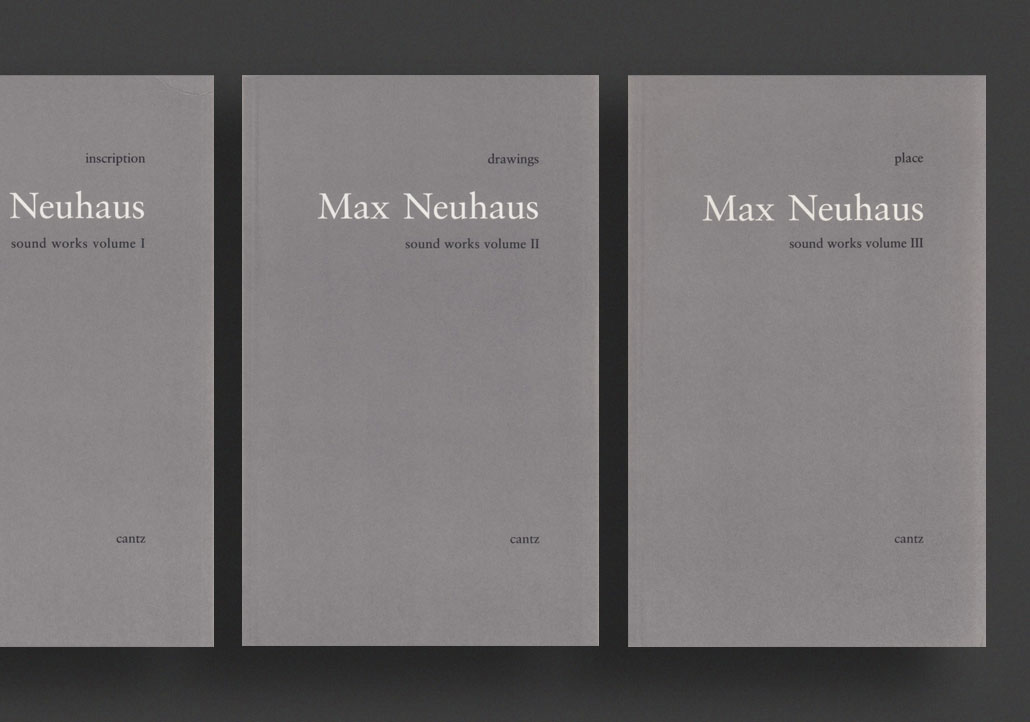
First edition of this scarce 3 volume, slipcased comprehensive collection of American percussionist and pioneering sound artist Max Neuhaus's Sound Works, published by Cantz, Berlin, 1994. Long out-of-print. The volumes are divided into "Inscription" / "Drawings" / "Place", tracing the entire career of Neuhaus (1939—2009), a pioneer in the field of contemporary art and music. Max Neuhaus is credited with being the first to use sound as a medium for site-specific installations. As a young man, Mr. Neuhaus was celebrated in classical music circles as one of the foremost interpreters of the experimental percussion music of composers like John Cage, Karlheinz Stockhausen and Pierre Boulez. He went on to create numerous permanent and short-term sound installations in the four decades that followed. His sound installations allow listeners to approach sound as art, in their own time. Testing the idea that our perception of a place depends also on what we hear, Neuhaus extended sound into social spaces to create sites altered by the synthetic, anonymous sounds concealed within them. Illustrated with texts by Arthur Danto, Carter Ratcliff, Calvin Tomkins, Jean-Christophe Ammann, John Rockwell, Joan La Barbara, Tom Johnson, William Duckworth, Wulf Herzogenrath, Harald Szeemann, Alain Cueff, Franz Kaiser, Susanne Weingarten, Denys Zacharopouloszoz, Doris von Drathen, Germano Celant, Ulrich Loock... Many conversations, lectures, texts, etc. with/by Neuhaus. The definitive publication.
"Neuhaus' oeuvre is diverse, ranging from works in the plastic arts, drawings, music, sound walks, communal sound signals, aural spaces composed of communication networks, sound topographies in water, to inventions of sound-producing and dispersing systems and sound applied to problems of urban and personal design. This structure of separate volumes was chosen to clarify: to encompass the oeuvre, while allowing each of its diverse parts to remain distinct on its own ground."—Markus Hartmann (excerpted from the preface)
Very Good copy, well preserved.
1986, English
Softcover (glue-bound), unpaginated, 14.5 x 11 cm
1st Edition, Out of print title / used / very good
Published by
NMA / Melbourne
$65.00 - Out of stock
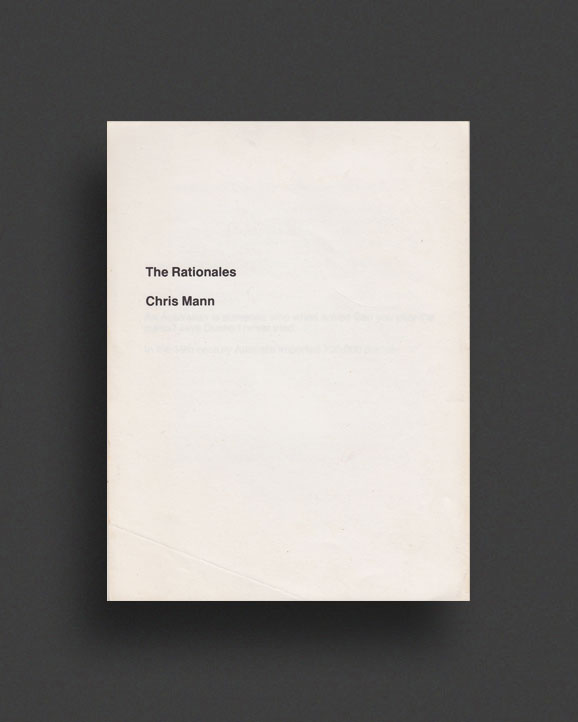
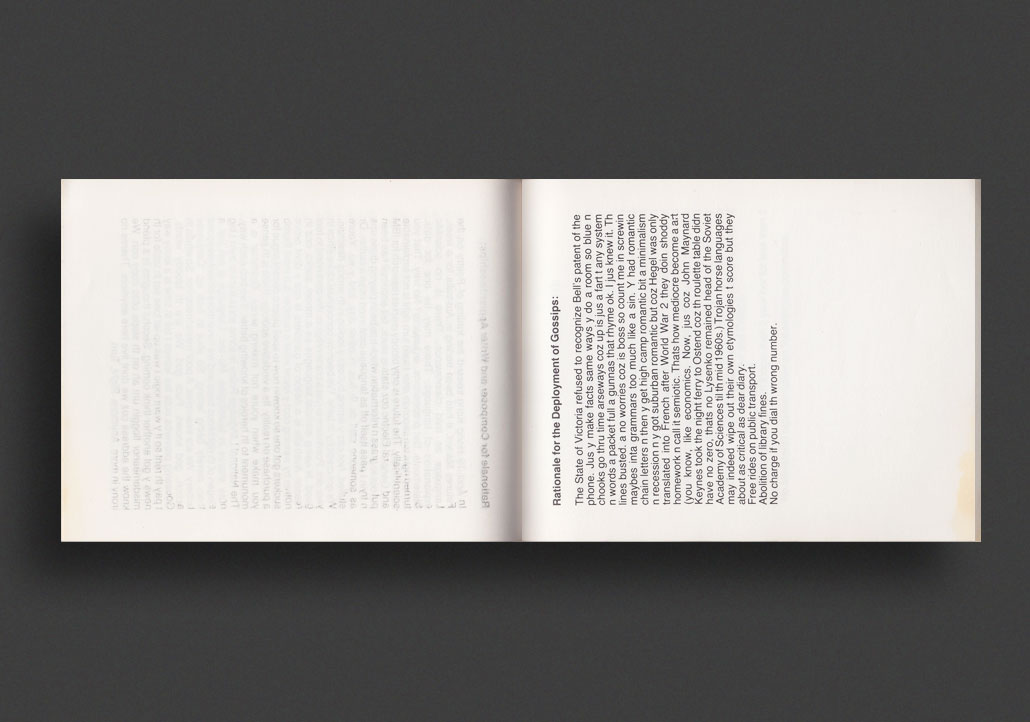
Rare copy of late Australian artist/compositional linguist/raconteur Chris Mann's 1986 “The Rationales” booklet/pad, the NMA published text version of the work recorded by Mann as contribution to NMA TAPES No. 5. This book, an analysis of the Australian conceptual tradition, takes the physical form of a tear-off memorandum pad. The Rationales explored, among other things, the importance in Australia of a tradition of 'making do' and of 'radical amateurism'. Each rationale is printed on a separate sheet.
Chris Mann (1949—2018) was an Australian-American composer, poet and performer specializing in the emerging field of compositional linguistics, coined by Kenneth Gaburo and described by Mann as "the mechanism whereby you understand what I'm thinking better than I do". Mann was the son of German Jewish refugees, Ruth and Peter Mann, who settled in Melbourne and founded the Discurio music store Score record label in the 1960s, producing some of Australia's first recordings of Australian folk music as well as jazz, classical and Aboriginal music. Mann studied Chinese and linguistics at the University of Melbourne, and his interest in language, systems, and philosophy is evident in his work. Mann founded the New Music Centre in 1972 and taught at the State College of Victoria in the mid-1970s. He then left teaching to work on research projects involving cultural ideas of information theory and has been recognized by UNESCO for his work in that field. Mann moved to New York in the 1980s and was an associate of American composers John Cage and Kenneth Gaburo. He has performed text in collaboration with artists such as Thomas Buckner, David Dunn, Annea Lockwood, Larry Polansky, and Robert Rauschenberg. Mann has recorded with the ensemble Machine For Making Sense with Amanda Stewart and others, Chris Mann and the Impediments (with two backup singers and Mann reading a text simultaneously while only being able to hear one another), and Chris Mann and The Use. His piece The Plato Songs, a collaboration with Holland Hopson and R. Luke DuBois, features realtime spectral analysis and parsing of the voice into multiple channels based on phonemes. Mann has also participated in the 60x60 project. Mann taught in the Media Studies Graduate program at The New School. He died in September 2018, survived by his wife and two children.
Very Good with some light wear/marks to outer "cover" pages and extremities.