World Food Books' programme is largely produced on Kulin Nation land. We acknowledge the Wurundjeri people of the Kulin Nation as the first and continuing custodians of this land, and pay respect to their Elders past, present, and emerging.
World Food Books is an arts and special interests bookshop in Naarm / Melbourne. Founded in 2010, World Food Books is devoted to the presentation of a rotating, hand-selection of international art, design, literary and counterculture publications with an emphasis on the anti-traditional, the experimental, the avant-garde, the heretic, the marginal.
Presenting new titles alongside rare and out-of-print books, catalogues and journals spanning the fields of modern and contemporary art, design, photography, illustration, film, literature, poetry, cultural theory, philosophy, sexuality, popular and underground culture in its many radical forms, World Food Books wishes to encourage adventurous, thoughtful and open-minded reading, looking, writing, and exchange of publishing and ideas, both current and historical.
As well as our bookshop, located in Melbourne's historical Nicholas Building, all of our inventory is available internationally via our online mail-order service.
World Food Books semi-regularly co-ordinates "Occasions", a programme of exhibits and events at the bookshop and in partnership with other hosts (such as museums and art galleries) that develop out of the activities, relationships and content of the bookshop itself.
World Food Books
The Nicholas Building
37 Swanston Street
Room 5, Level 6
Melbourne 3000
Australia
SHOP HOURS:
SHOP CLOSED FOR SUMMER
RE—OPEN JAN 2
WEB-SHOP OPEN 24/7
World Food Books
Postal Address:
PO Box 435
Flinders Lane
Victoria 8009
Australia
info@worldfoodbooks.com
Art
Theory / Essay
Architecture / Interior
Graphic Design / Typography
Photography
Fashion
Eros
LGBTQ+
Fiction / Poetry
Weird / Speculative / Science Fiction / Horror
Transgressive / Visceral / Abject
Symbolism / Decadence / Fin de siècle
Film / Video
Painting
Sculpture / Installation
Performance / Dance / Theater
Drawing
Sound / Music
Curatorial
Group Shows / Collections
Periodicals
Out-of-print / Rare
Posters / Ephemera / Discs
Signed Books
World Food Books Gift Voucher
World Food Book Bag
Australian Art
Australian Fiction
Australian Science Fiction / Speculative Fiction
Australian Poetry
Australian Photography
Japanese Photography
Conceptual Art
Minimal Art
Dada
'Pataphysics / Oulipo
Fluxus
Concrete Poetry
Pop Art
Surrealism
Arte Povera
Arte Informale / Haute Pâte / Tachism
Nouveau Réalisme / Zero / Kinetic
Situationism / Lettrism
Collage / Mail Art / Xerox Art
Art Brut / Folk / Visionary / Fantastic
Illustration / Graphic Art / Bandes Dessinées
Furniture
Italian Radical Design / Postmodernism
Textiles
Ceramics / Glass
Counterculture
Protest / Revolt
Philosophy
Psychoanalysis
Anthropology
Anarchism
Socialism / Anarchism / Communism / Capitalism
Literary Theory / Semiotics / Language
Feminism / Women's Studies
Gender Studies / Sexuality
Anthropology
Fetishism / BDSM
Drugs / Psychedelia
Crime / Violence
Animal Rights / Veganism
Occult / Esoterica
Ecology / Earth / Alternative Living
Whole Earth / Crafts
All prices in AUD (Australian dollars)
Pick-Ups
Pick-up orders can be collected in our bookshop during opening hours after order date. Please collect any Pick-up orders within 2 weeks of ordering as we have limited storage space. Orders will be released back into stock if not collected within this time. No refunds can be made for pick-ups left un-collected. If you cannot make it in to the bookshop in this time-frame, please choose postage option.
Return Policy
All sales are final. We do accept returns (for refund or exchange) for items received in error. All our orders are packed with special care using heavy-duty padding and cardboard book-mailers or bubble mailers (for smaller books), using reinforcement where required. We cannot take responsibility for any lost, stolen or damaged parcels.
Insurance
Should you wish to insure your package, please email us directly after placing your order and we can organise this at a small extra expense. Although all standard/express tracked packages are very safe and dependable, we cannot take responsibility for any lost, stolen or damaged parcels. We recommend insurance on valuable orders.
Interested in selling your old books, catalogues, journals, magazines, comics, fanzines, ephemera? We are always looking for interesting, unusual and out-of-print books to buy. We only buy books in our fields of interest and specialty, and that we feel we can resell.
We base these prices on desirability, market value, in-print prices, condition and our current stock levels. We offer cash, store credit, and can take stock on consignment. All
about 25% of the price we expect to get when we sell them, or 30% in store credit. We base these prices on desirability, market value, in-print prices, condition and our current stock levels.
Sell your books any day of the week. You can drop them off and return later. If you have a lot of books, we can visit your Sydney home.
We buy books that we feel we can resell. We offer about 25 % of the price we expect to get when we sell them, or 30% in store credit. We base these prices on desirability, market value, in-print prices, condition and our current stock levels.
Philadelphia Wireman
03 August - 01 September, 2018
World Food Books is proud to announce our next Occasion, the first presentation of sculptures by Philadelphia Wireman in Australia.
The Philadelphia Wireman sculptures were found abandoned in an alley off Philadelphia’s South Street on trash night in 1982. Their discovery in a rapidly-changing neighbourhood undergoing extensive renovation, compounded with the failure of all attempts to locate the artist, suggests that the works may have been discarded after the maker’s death. Dubbed the "Philadelphia Wireman" during the first exhibition of this work, in 1985, the maker’s name, age, ethnicity, and even gender remain uncertain. The entire collection totals approximately 1200 pieces, all intricately bound together with tightly-wound heavy-gauge wire (along with a few small, abstract marker drawings, reminiscent both of Mark Tobey and J.B. Murry). The dense construction of the work, despite a modest range of scale and materials, is singularly obsessive and disciplined in design: a wire armature or exoskeleton firmly binds a bricolage of found objects including plastic, glass, food packaging, umbrella parts, tape, rubber, batteries, pens, leather, reflectors, nuts and bolts, nails, foil, coins, toys, watches, eyeglasses, tools, and jewellery.
Heavy with associations—anthropomorphic, zoomorphic, and socio-cultural responses to wrapped detritus—the totemic sculptures by Philadelphia Wireman have been discussed in the context of work created to fulfil the shamanistic needs of alternative religions in American culture. Curators, collectors, and critics have variously compared certain pieces to sculpture from Classical antiquity, Native American medicine bundles, African-American memory jugs, and African fetish objects. Reflecting the artist’s prolific and incredibly focused scavenging impulse, and despite—or perhaps enhanced by—their anonymity, these enigmatic objects function as urban artefacts and arbiters of power, though their origin and purpose is unknown. Philadelphia Wireman, whatever their identity, possessed an astonishing ability to isolate and communicate the concepts of power and energy through the selection and transformation of ordinary materials. Over the course of the past two decades, this collection has come to be regarded as an important discovery in the field of self-taught art and vernacular art.
Presented in collaboration with Fleisher-Ollman Gallery, Philadelphia, and Robert Heald, Wellington.
Susan Te Kahurangi King
02 February - 10 March, 2018
Susan Te Kahurangi King (24 February 1951 - ) has been a confident and prolific artist since she was a young child, drawing with readily available materials - pencils, ballpoint pens and felt-tip markers, on whatever paper is at hand. Between the ages of four and six Susan slowly ceased verbal communication. Her grandparents William and Myrtle Murphy had developed a special bond with Susan so they took on caring responsibilities for extended periods. Myrtle began informally archiving her work, carefully collecting and storing the drawings and compiling scrapbooks. No drawing was insignificant; every scrap of paper was kept. The King family are now the custodians of a vast collection containing over 7000 individual works, from tiny scraps of paper through to 5 meter long rolls.
The scrapbooks and diaries reveal Myrtle to be a woman of great patience and compassion, seeking to understand a child who was not always behaving as expected. She encouraged Susan to be observant, to explore her environment and absorb all the sights and sounds. Myrtle would show Susan’s drawings to friends and people in her community that she had dealings with, such as shopkeepers and postal workers, but this was not simply a case of a grandmother’s bias. She recognised that Susan had developed a sophisticated and unique visual language and sincerely believed that her art deserved serious attention.
This was an unorthodox attitude for the time. To provide some context, Jean Dubuffet coined the term Art Brut in 1945 to describe work created by self-taught artists – specifically residents of psychiatric institutions and those he considered to be visionaries or eccentrics. In 1972 Roger Cardinal extended this concept by adopting the term Outsider Art to describe work made by non-academically trained artists operating outside of mainstream art networks through choice or circumstance. Susan was born in Te Aroha, New Zealand in 1951, far from the artistic hubs of Paris and London that Dubuffet and Cardinal operated in. That Myrtle fêted Susan as a self-taught artist who deserved to be taken seriously shows how progressive her attitudes were.
Susan’s parents Doug and Dawn were also progressive. Over the years they had consulted numerous health practitioners about Susan’s condition, as the medical establishment could not provide an explanation as to why she had lapsed into silence. Dawn educated herself in the field of homeopathy and went on to treat all twelve of her children using these principles – basing prescriptions on her observations of their physical, mental and emotional state.
Doug was a linguist with an interest in philosophy who devoted what little spare time he had to studying Maori language and culture. To some extent their willingness to explore the fringes of the mainstream made them outsiders too but it was their commitment to living with integrity and their respect for individuality that ensured Susan’s creativity was always encouraged.
Even though Susan’s family supported her artistic pursuits, some staff in schools and hospitals saw it as an impediment to her assimilation into the community and discouraged it in a variety of ways. Her family was not always aware of this and therefore did not fully understand why Susan stopped drawing in the early 1990s. However, rather than dwell on the challenges that Susan faced in pursuit of her artistic practice, they prefer to highlight her achievements. In 2008 Susan began drawing again in earnest, after an almost 20 year interruption, and her work is now shown in galleries around the world.
Susan grew up without television and has been heavily influenced by the comics she read as a child. She is absolutely fearless in the appropriation of recognizable characters, such as Donald Duck and Mickey Mouse, in her work. She twists their limbs, contorts their faces, compresses them together, blends them into complex patterned backgrounds - always imbuing them with an incredible energy. Although Susan often used pop culture characters in her work they are not naive or childlike. These are drawings by a brilliant self-taught artist who has been creating exceptional work for decades without an audience in mind.
Mladen Stilinović
"Various Works 1986 - 1999"
02 February 16 - September 10, 2016
Various works 1986 - 1999, from two houses, from the collections of John Nixon, Sue Cramer, Kerrie Poliness, Peter Haffenden and Phoebe Haffenden.
Including: Geometry of Cakes (various shelves), 1993; Poor People’s Law (black and white plate), 1993; White Absence (glasses, ruler, set square, silver spoon, silver ladel with skin photograph and wooden cubes), 1990-1996; Exploitation of the Dead (grey and red star painting, wooden painting, black spoon with red table, red plate), 1984-1990; Money and Zeros (zero tie, paintings made for friends in Australia (Sue, John, Kerrie), numbers painting), 1991-1992; Words - Slogans (various t-shirts) - “they talk about the death of art...help! someone is trying to kill me”, “my sweet little lamb”, “work is a disease - Karl Marx”; Various artist books, catalogues, monographs, videos; Poster from exhibition Insulting Anarchy; "Circular" Croatian - Australian edition; Artist book by Vlado Martek (Dostoyevsky); more.
Thanks to Mladen Stilinović and Branka Stipančić.
Jonathan Walker
Always Will Need To Wear Winter Shirt Blue + Ochre Small Check Pattern
21 August - 21 September, 2015
Untitled
I am not a great reader of poetry but I always return to the work of Melbourne poet, Vincent Buckley (1925- 1988). Perhaps I find his most tantalising piece to be not a finished poem but a fragment left on a scrap of paper discovered on his desk after the poet’s death.
The poetry gathers like oil
In the word-core, and spreads
It has its music meet,
Its music is in movement.
This fragment is more the shell left behind from a volatile thought than a finished poem. I find the last two lines honest but awkward whereas the first two lines work like an arrow. Most likely he could not find a resolution so it was left. Still, in its present form, it remains an eloquent testimony to the ultimate failure of a medium to express mobile thought and sensation, in Buckley’s case, through verbal language. It’s an important matter because this is something all artists have to deal with regardless of the medium.
I have never written a poem, however, I am forever copying fragments from books on paper scraps in a vain effort to fix certain notions in my head. At first, they function as bookmarks that are sometimes returned to when I open the book. But before long, as they accumulate, they fall out littering the table interspersed with A4 photocopies, bills, books and medications.
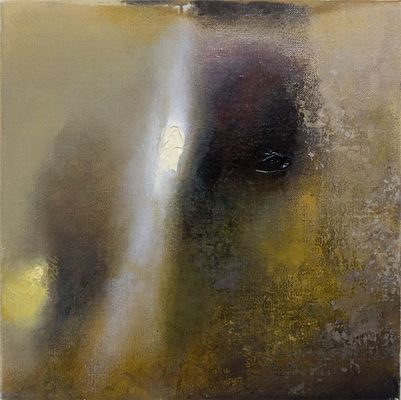
To return to Buckley’s fragment, the first two lines very much evoke how I paint nowadays. As you age, detail diminishes and patches of light become more luminous and float. I feel the most honest way of dealing with this is by smearing the oil paint on the canvas with the fingers and working close-up, blind. Only if the patches coalesce into an approaching image can the work gain a life.
-
Jonathan Walker was born in Melbourne, Australia and brought up on a dairy farm in Gippsland. In the 1970’s he studied painting at RMIT and won the Harold Wright Scholarship to the British Museum, London. During the 1980’s he exhibited at Pinacotheca Gallery, Richmond and had work shown at the NGV and Heidi City Art Gallery. Over the same period he designed the cover for the “Epigenesi” LP by Giancarlo Toniutti, Italy and conducted a mail exchange work with Achim Wollscheid, Germany. The work with artists through the post resulted in an article published in the bicentenary issue of Art and Australia 1988. He showed in artist run spaces such as WestSpace in the 90’s and 2000’s, and until 2012, taught painting at Victoria University, which is where we (Colleen Ahern and Lisa Radford) as organisers of the exhibition, among many others, had the privilege of being his student.
Walker’s knowledge was imparted to students through the careful selection of music, literature, and artists found in books that he himself had ordered for the library. Walker’s strategy was the generosity of sharing his vast knowledge with references specific to each student and their context.
Walker’s paintings share a similar focus and intimacy.
This exhibition presents a small selection of recent paintings alongside a publication that includes Walker’s writing. Observational and analytical, Walker’s work is a type of material notation — the time of day, colour and how it is blended, the both specific and fleeting location of a reflection on lino or the question of whether a chair leg should be included in a painting.
Please join us on Friday August 21 between 6-8pm to celebrate the opening of the exhibition.
Curated by Colleen Ahern and Lisa Radford.
B. Wurtz
Curated by Nic Tammens
March 26 - April 4, 2015
B.Wurtz works from a basement studio in his home on Manhattan’s Lower East Side.
This local fact is attested to by the plastic shopping bags and newsprint circulars that appear in his work. As formal objects, they don’t make loud claims about their origins but nonetheless transmit street addresses and places of business from the bottom of this long thin island. Like plenty of artists, Wurtz is affected by what is local and what is consumed. His work is underpinned by this ethic. It often speaks from a neighborhood or reads like the contents of a hamper:
“BLACK PLUMS $1.29 lb.”
“Food Bazaar”
“USDA Whole Pork Shoulder Picnic 99c lb.”
“RITE AID Pharmacy, with us it’s personal.”
“H. Brickman & Sons.”
“Sweet Yams 59c lb."
Most of the work in this exhibition was made while the artist was in residence at Dieu Donne, a workshop dedicated to paper craft in Midtown. Here Wurtz fabricated assemblages with paper and objects that are relatively lightweight, with the intention that they would be easily transportable to Australia. This consideration isn’t absolute in Wurtz’s work, but was prescriptive for making the current exhibition light and cheap. Packed in two boxes, these works were sent from a USPS post office on the Lower East Side and delivered to North Melbourne by Australia Post.
Wurtz appears courtesy of Metro Pictures, New York.
Thanks to Rob Halverson, Joshua Petherick, Sari de Mallory, Matt Hinkley, Helen Johnson, Fayen d'Evie, Ask Kilmartin, Lisa Radon, Ellena Savage, Yale Union, and "Elizabeth".
John Nixon
"Archive"
December 15 - January 20, 2014
The presentation of John Nixon's archive offered a rare showcase of this extensive collection of the artist's own publications, catalogues, posters, ephemera, editions and more, from the mid 1980s onwards, alongside a selection of his artworks.
Organized by John Nixon, Joshua Petherick and Matt Hinkley.
"Habitat"
at Minerva, Sydney (organised by Joshua Petherick and Matt Hinkley)
November 15 - December 20, 2014
Lupo Borgonovo, Janet Burchill & Jennifer McCamley,
Lewis Fidock, HR Giger, Piero Gilardi, Veit Laurent Kurz,
Cinzia Ruggeri, Michael E. Smith, Lucie Stahl, Daniel Weil, Wols
Press Release:
“...It contained seven objects. The slender fluted bone, surely formed for flight, surely from the wing of some large bird. Three archaic circuitboards, faced with mazes of gold. A smooth white sphere of baked clay. An age-blackened fragment of lace. A fingerlength segment of what she assumed was bone from a human wrist, grayish white, inset smoothly with the silicon shaft of a small instrument that must once have ridden flush with the surface of the skin - but the thing’s face was seared and blackened.”
William Gibson, “Count Zero”, 1986
"Autumn Projects Archive"
Curated by Liza Vasiliou
March 6 - March 15, 2014
World Food Books, in conjunction with the Virgin Australia Melbourne Fashion Festival 2014, presented the Autumn Projects archive, consisting of a selection of early examples in Australian fashion with a particular interest in collecting designers and labels from the period beginning in the 1980’s, who significantly influenced the discourse of Australian Fashion.
Curated by Liza Vasiliou, the exhibition provided a unique opportunity to view pieces by designers Anthea Crawford, Barbara Vandenberg, Geoff Liddell and labels CR Australia, Covers, Jag along with early experimental collage pieces by Prue Acton and Sally Browne’s ‘Fragments’ collection, suspended throughout the functioning World Food Books shop in Melbourne.
H.B. Peace
presented by CENTRE FOR STYLE
November 14, 2013
"Hey Blinky, you say chic, I say same"
Anon 2013
H.B. Peace is a clothing collaboration between great friends Blake Barns and Hugh Egan Westland. Their pieces explore the divergences between 'character’ and ‘personality’ in garments....etc
Special Thanks to Joshua Petherick and Matt Hinkley of WFB and Gillian Mears
and a Very Special Thank you to Audrey Thomas Hayes for her shoe collaboration.
Janet Burchill & Jennifer McCamley
"Aesthetic Suicide"
May 10 - June 8, 2013
The first of our occasional exhibitions in the World Food Books office/shop space in Melbourne, "Aesthetic Suicide" presented a body of new and older works together by artists Janet Burchill & Jennifer McCamley, including videos, prints, a wall work, and publications.
During shop open hours videos played every hour, on the hour.
2016, English
Softcover, 448 pages, 24 x 29.7 cm
Published by
Walker Art Centre / Minneapolis
$95.00 - Out of stock
Published by Walker Art Center
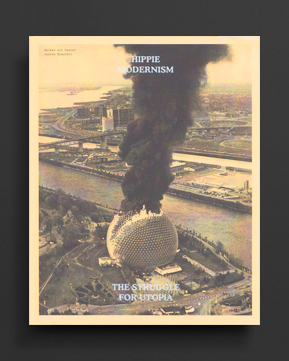
Edited with text by Andrew Blauvelt. Text by Greg Castillo, Esther Choi, Alison Clarke, Hugh Dubberly, Ross Elfline, Craig Peariso, Tina Rivers Ryan, Catharine Rossi, Simon Sadler, Felicity Scott, Lorraine Wild with David Karwan. Interviews by Adam Gildar, Susan Snodgrass, Elizabeth Glass.
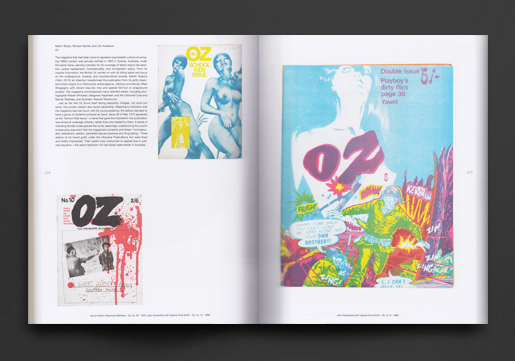
"Hippie Modernism" examines the art, architecture and design of the counterculture of the 1960s and early 1970s. The catalogue surveys the radical experiments that challenged societal norms while proposing new kinds of technological, ecological and political utopia. It includes the counter-design proposals of Victor Papanek and the anti-design polemics of Global Tools; the radical architectural visions of Archigram, Superstudio, Haus-Rucker-Co and ONYX; the installations of Ken Isaacs, Joan Hills, Mark Boyle, Hélio Oiticica and Neville D'Almeida; the experimental films of Jordan Belson, Bruce Conner and John Whitney; posters and prints by Emory Douglas, Corita Kent and Victor Moscoso; documentation of performances by the Diggers and the Cockettes; publications such as "Oz" and "The Whole Earth Catalog"; books by Marshall McLuhan and Buckminster Fuller; and much more. While the turbulent social history of the 1960s is well known, its cultural production remains comparatively under-examined. In this substantial volume, scholars explore a range of practices such as radical architectural and anti-design movements emerging in Europe and North America; the print revolution in the graphic design of books, posters and magazines; and new forms of cultural practice that merged street theater and radical politics. Through a profusion of illustrations, interviews with figures including: Gerd Stern of USCO; Ken Isaacs; Gunther Zamp Kelp of Haus-Rucker-Co; Ron Williams and Woody Rainey of ONYX; Franco Raggi of Global Tools; Tony Martin; Clark Richert and Richard Kallweit of Drop City; as well as new scholarly writings, this book explores the conjunction of the countercultural ethos and the modernist desire to fuse art and life.
Huge, generous and vividly illustrated volume!
2013, English
Hardcover, 400 pages, 25.4 x 30.6 cm
Published by
Prestel / Munich
Stedelijk Museum / Amsterdam
$140.00 - Out of stock
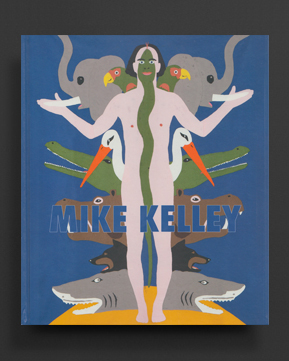
From the mid-1970s, Mike Kelley assembled an incredibly diverse and often controversial body of work. A multi-disciplinary impresario, he created works on paper, paintings, sculpture, video, installation, and performance art that managed to be at once shocking yet humorous, and complex yet accessible. This companion volume to the much-anticipated 2013 exhibition at the Stedelijk Museum (Amsterdam) brings a fresh understanding to the artist's work by seeking to address the more poetic aspects of Kelley's work through Eva Meyer-Hermann's unique curatorial approach. Here she presents individual works in new combinations that cross the boundaries of chronology, bodies of work, and former artistic project groups. Identifying themes such as architecture, language, identity, Informe, power, modernisms, nostalgia, and religion, the book represents ideas that have informed Kelley's work throughout his career. As a result, the overarching lines of his oeuvre become visible and accessible. This book features essays (by John C. Welchman, Eva Meyer-Hermann, Branden W. Joseph, and George Baker), a fully annotated plate section of abundant full-colour images of Kelley's history of work, and a newly researched and revised biography and bibliography of Kelley's work.
The publication promises to be the definitive work on the artist.
A huge publication! Extra shipping charges may apply.
2016, English / German
Softcover, 162 pages, 24 x 34 cm
Published by
Bielefelder Kunstverein / Germany
Kunstverein Nürnberg – Albrecht Dürer Gesellschaft
Sternberg Press / Berlin
$74.00 $25.00 - Out of stock
Edited by Simone Neuenschwander, Thomas Thiel
With contributions by Emmanuel Alloa, Neïl Beloufa, Clare Birchall, Juliette Blightman, Ryan Gander, Calla Henkel and Max Pitegoff, David Horvitz, Metahaven, Simone Neuenschwander, Katja Novitskova, Yuri Pattison, Manfred Schneider, Thomas Thiel
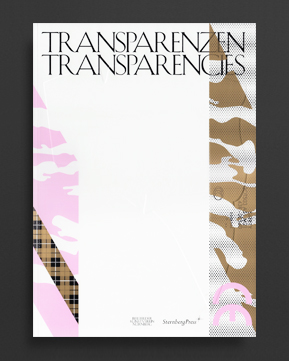
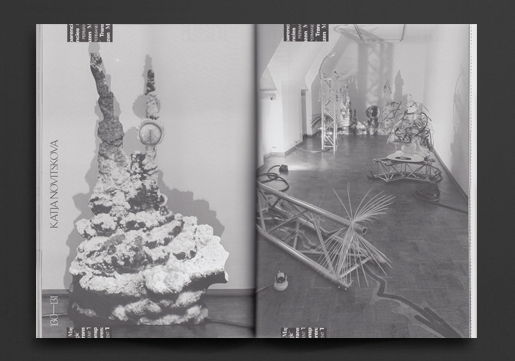
The globalized world seems at once transparent and opaque. The exhibition project “Transparencies” examined the cultural facets and atmospheres of these (non-)transparencies. The two-part, joint exhibition project in Bielefeld and Nuremberg was dedicated to developments in “transparent society,” asking how these are reflected in the current work by contemporary artists. The paradigm of transparency and the ambivalence of the term was addressed by participating artists in multiple, diverse ways. This book documents both exhibitions and outlines all of the contributions to this substantial project. Conceptually designed by Metahaven, it contains artistic statements and scientific essays that encourage an ongoing discussion of the subject.
Copublished with Bielefelder Kunstverein and Kunstverein Nürnberg – Albrecht Dürer Gesellschaft
Design by Metahaven
1984, German
Softcover, 183 pages (colour & b/w ill.), 27 x 21 cm
1st edition, Out of print title / used*,
Published by
Frölich & Kaufmann / Berlin
$85.00 - Out of stock
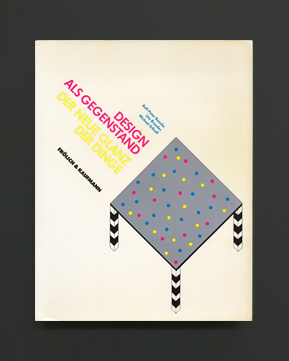
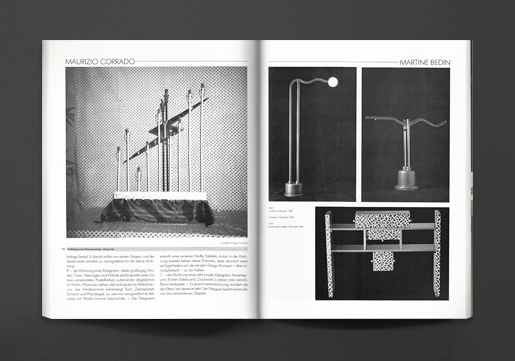
First edition of Design Als Gegenstand (Design as an object), published only in Germany to showcase many of the leading contemporary/radical designers of the early 1980s, visually documenting many incredible and seldom seen works of furniture, industrial objects, electronics, exhibition design, textiles, etc. through object and installation photography, alongside reproductions of design sketches and German texts.
Includes the work of Adolfo Natalini, Thomas S. Bley, Daniele Puppa, Franco Raggi, One Off, Studio Alchimia, Sacha Ketoff, Piero Castiglioni, Winfried Scheuer, Lux, Rouli Lecatsa, Borek Sipek, Paolo Deganello, Lapo Binazzi, Florian Borkenhagen · Harald Krischer, Javier Mariscal, Andrea Branzi, Studio Dada, David Palterer, Ettore Sottsas Jr, Bepi Maggiori, Marco Zanuso Jr., Antonia Astori De Ponti, Denys Santachiara, Juma Francisco, Michele De Luchhi, Nemo, Paola Navone, Jasper Morrison, Zak Ark, Maurizio Corrado, Martine Bedin, Daniel Weil, Totem, Bellefast, Claus Böhmler, Rainer Krause, George James Sowden, Tom Lynham & Lee Curtis, Nathalie Du Pasquier, Jörg Ratzlaff, Dirk Staubert, Matteo Thun.
Very Good copy in VG dust jacket.
1961, German
Softcover, 56 pages, 17 x 19 cm
1st Edition, Out of print title / Used*,
Published by
Goetheanum Freie Hochschule für Geisteswissenschaften / Dornach
$45.00 - Out of stock
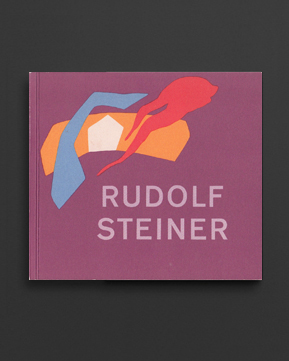
Handsome catalogue produced to accompany an exhibition on the work of Rudolf Steiner in 1961 at the Goetheanum Freie Hochschule für Geisteswissenschaften (Goetheanum School of Spiritual Science) in Dornach Switzerland, the first cultural centre and artistic home designed by Steiner and built in 1913 for the Anthroposophical Society (founded by Steiner) to house performances of plays, exhibitions, conferences - a house for all of the arts.
Through beautiful photographic reproductions, this little publication presents a glimpse into Steiner's visionary work across architecture, sculpture, design and painting around the creation of this incredible building, alongside texts in German.
Rudolf Joseph Lorenz Steiner (1861 – 1925) was an Austrian philosopher, social reformer, architect and esotericist. Steiner gained initial recognition at the end of the nineteenth century as a literary critic and published philosophical works including The Philosophy of Freedom. At the beginning of the twentieth century he founded an esoteric spiritual movement, anthroposophy, with roots in German idealist philosophy and theosophy; other influences include Goethean science and Rosicrucianism.
In the first, more philosophically oriented phase of this movement, Steiner attempted to find a synthesis between science and spirituality. His philosophical work of these years, which he termed "spiritual science", sought to apply the clarity of thinking characteristic of Western philosophy to spiritual questions, differentiating this approach from what he considered to be vaguer approaches to mysticism. In a second phase, beginning around 1907, he began working collaboratively in a variety of artistic media, including drama, the movement arts (developing a new artistic form, eurythmy) and architecture, culminating in the building of the Goetheanum, a cultural centre to house all the arts. In the third phase of his work, beginning after World War I, Steiner worked to establish various practical endeavors, including Waldorf education, biodynamic agriculture, andanthroposophical medicine.
Steiner advocated a form of ethical individualism, to which he later brought a more explicitly spiritual approach. He based his epistemology on Johann Wolfgang Goethe's world view, in which "Thinking… is no more and no less an organ of perception than the eye or ear. Just as the eye perceives colours and the ear sounds, so thinking perceives ideas. "A consistent thread that runs from his earliest philosophical phase through his later spiritual orientation is the goal of demonstrating that there are no essential limits to human knowledge.
2014, English
Softcover, 180 pages, 19.5 x 27.5 cm
Published by
Bom Dia Boa Tarde Boa Noite / Berlin
$30.00 $10.00 - Out of stock
With texts by Kythzia Barrera, Maria Gaida, Moosje M. Goosen, Pablo Katchadjian, Paula López Caballero, Federico Navarrete Linares, Victoria Novelo Oppenheim, Sandra Rozental, Carlos Sandoval, Adam T. Sellen, Anna Szaflarski
The Nahua concept of ixiptla derives from the particle xip, meaning “skin,” coverage or shell. A natural outer layer of tissue that covers the body of a person or animal, the skin can be separated from the body to produce garments, containers for holding liquids or parchment as a writing surface.
Originally a Nahua word, ixiptla has been understood as image, delegate, character, and representative. Ixiptla could be a container, but also could be the actualization of power infused into an object or person. In Nahua culture, it took the form of a statue, a vision, or a victim who turned into a god destined to be sacrificed. Without having to visually appear the same, multiple ixiptlas of the same god could exist simultaneously. The distinction between essence and material, and between original and copy vanishes.
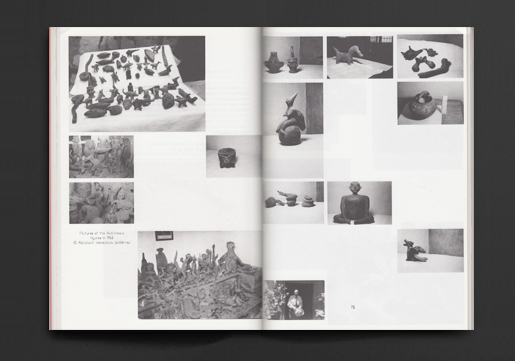
This edition of Ixiptla is focused on the trajectory of objects collected and produced by archeologists - plaster molds, facsimiles, drawings, photographs, and scale models -, in an attempt to capture and replicate material evidences left by time; these objects emerge from a specific moment in time, producing a doppelgänger of the original milieu, which then takes its own course. For this first issue, a group of anthropologists, archaeologists, artists, and writers have been invited to reflect on the role of the model, the copy, and reproduction in their areas of research and practice.
Ixiptla is a new biannual journal about trajectories of Anthropology, it has been initiated by the artist Mariana Castillo Deball.
The first issue is published on the occasion of Expedite Expression, 8th Berlin Biennale for Contemporary Art, Berlin, 2014.
2012, English
Paperback, 440 pages, 17 x 24 cm
Published by
Primary Information / New York
$65.00 - Out of stock
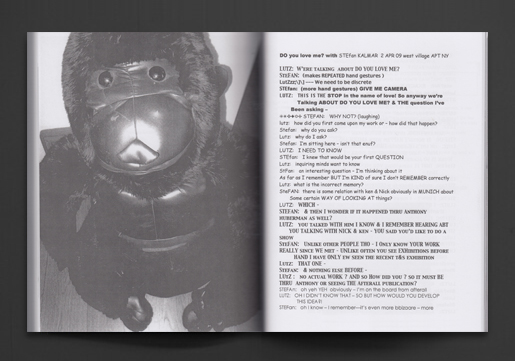
Lutz Bacher is known for diverse conceptual works that span photography, video, sculpture and installation. ‘Do You Love Me?’ is a print extension of Bacher’s video work of the same name, in which she interviews colleagues, friends and family about Bacher “the person” and Bacher “the artist”. The interviews span fifteen years, tracing her evolving career and relationships. Although the artist is always the starting point, these exchanges often reveal more about their subjects than Bacher herself. The publication takes the form of transcripts interwoven with images of artwork from the 1970s to the present, and also includes personal photos, correspondence and ephemera.
2016, English
Hardcover, 400 pages, 20.5 x 24 cm
Published by
Prestel / Munich
$100.00 - Out of stock
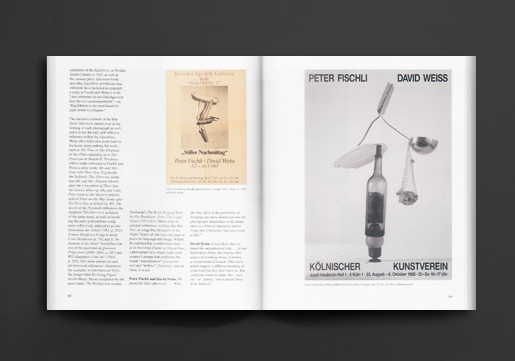
Heavy, definitive volume on the history of work by Peter Fischli and David Weiss, with texts and contributions by Ann Goldstein, Isabelle Graw, Anne Wheeler, and John Kelsey.
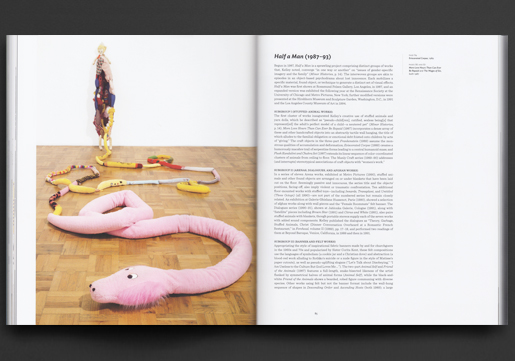
Throughout the course of their collaboration, Peter Fischli and David Weiss celebrated the sheer triviality of everyday existence, observing the world with bemused detachment. As this book shows, their often humorous work offers a sustained reflection on the intertwined strands of leisure, productivity and playful absurdity that shape our lives. With its deliberately mundane subject matter and quotidian source material, their work explores the poetics of banality in a wide range of mediums, including photography, videos, slide projections, films, books, sculptures and multimedia installations. This retrospective volume features an in-depth, illustrated survey of the artists' long history of collaboration, from the early Sausage Series (1979)-staged vignettes created in miniature using deli meats and various household items-to their last work, the large-scale public installation Rock on Top of Another Rock (2010-13), augmented by archival images, notes on process and interview excerpts culled from the artists' Zurich-based archives.A series of probing essays on their practice and thematic concerns rounds out this definitive account of Fischli and Weiss's vital contribution to contemporary art.
2016, English
Softcover, 382 pages, 24 x 17 cm
Published by
Distanz / Berlin
$50.00 - Out of stock
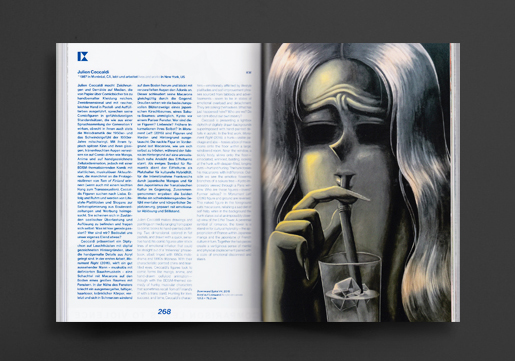
The Present in Drag is published as a companion volume to the 9th Berlin Biennale for Contemporary Art, which was curated by New York collective DIS. Providing information on the works shown in the exhibition, it also includes contributions by Roe Ethridge, Simon und Daniel Fujiwara, Boris Groys, Katja Novitskova, Chus Martinez, Bjarne Melgaard, Sean Patrick Monahan, Sabine Reitmaier, McKenzie Wark, and others.
The 9th Berlin Biennale for Contemporary Art features the work and contributions of: 69, Antoni Abad, Halil Altindere, Ei Arakawa (in collaboration with Dan Poston, Stefan Tcherepnin), Korakrit Arunanondchai/Alex Gvojic, atelier le balto, Armen Avanessian/Alexander Martos (in collaboration with Christopher Roth), åyr, Will Benedict, Julien Ceccaldi, Centre for Style
(in collaboration with Anna-Sophie Berger; Burkhard Beschow & Anne Fellner; Max Brand; Rare Candy with Alden Epp, Spencer Lai, Natasha Madden, Misty Pollen, Ander Rennick & Amber Wright; Susan Cianciolo; Marlie Mul; Liam Osborne; H.B. Peace & Kate Meakin; Joshua Petherick; Lin May Saeed; Eirik Sæther), Brody Condon, CUSS Group (in collaboration with ANGEL-HO, FAKA, Megan Mace, NTU), Kathleen Daniel, Debora Delmar Corp., Simon Denny with Linda Kantchev, Cécile B. Evans, Nicolás Fernández, Lizzie Fitch/Ryan Trecartin, Simon Fujiwara, GCC, GUAN Xiao, Calla Henkel/Max Pitegoff, Camille Henrot, Yngve Holen, Alexa Karolinski/Ingo Niermann, Kartenrecht, Josh Kline, Korpys/Löffler, Nik Kosmas, M/L Artspace, Shawn Maximo, Ashland Mines, Katja Novitskova, Trevor Paglen/Jacob Appelbaum, Juan Sebastián Peláez, Adrian Piper, Alexandra Pirici, Josephine Pryde, Puppies Puppies, Babak Radboy, Jon Rafman, Timur Si-Qin, Lucie Stahl, Hito Steyerl, TELFAR, Christopher Kulendran Thomas, Wu Tsang, Anna Uddenberg, Amalia Ulman, Anne de Vries, Abu Hajar, Halil Altindere, Math Bass, Lizzi Bougatsos & Brian DeGraw, Elysia Crampton, Lizzie Fitch/Ryan Trecartin, Isa Genzken, Juliana Huxtable, Kelela, Nguzunguzu, PATRICIA (Patricia Satterwhite, Jacolby Satterwhite, Nick Weiss), Adrian Piper, Fatima Al Qadiri, Carles Santos, Hito Steyerl, Total Freedom, Amalia Ulman, Antoni Abad, åyr/Rem Koolhaas/Hans Ulrich Obrist, Kathleen Daniel, Cécile B. Evans and Andrew Snyder-Beattie, Oleg Fonaryov and Oleksiy Radynski, Simon & Daniel Fujiwara, GCC, Boris Groys, Rob Horning, Izabella Kaminska and Simon Denny, Chus Martínez, Meredith Meredith, Sean Monahan, New Scenario, Ingo Niermann, Alexandra Pirici, Puppies Puppies, Sean Raspet, Natasha Stagg, Amalia Ulman, Sencer Vardarman, Eduardo Viveiros de Castro and Déborah Danowski in conversation with Michelle Sommer and Daniel Steegmann Mangrané, McKenzie Wark, Will Benedict, Dora Budor, Cao Fei, Roe Ethridge, Hood by Air, Bjarne Melgaard, Simon Dybbroe Møller, Zanele Muholi, Johannes Paul Raether, Torbjørn Rødland, Akeem Smith, Martine Syms, Stewart Uoo, Nina Cristante, Sabine Gottfried, Nik Kosmas, Lesley Moon, Helga Wretman, Frank Benson, Asger Carlsen, DIS, Casey Jane Ellison, Roe Ethridge, Avena Gallagher, Saemundur Thor Helgason, Tilman Hornig, Benjamin Alexander Huseby, Chris Kraus, Bjarne Melgaard, Jason Nocito, Babak Radboy, Sean Raspet, Sabine Reitmaier, Aaron David Ross, Andrew Norman Wilson, Anonymous, Anonymous, Anonymous and others.
2016, English
Softcover, 256 pages, 26.5 x 21 cm
Published by
Distanz / Berlin
$80.00 - Out of stock
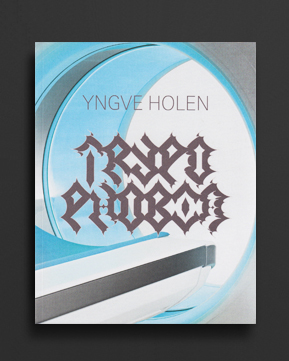
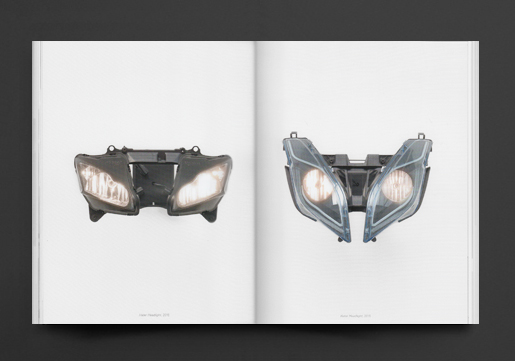
Norwegian-German artist Yngve Holen uses sculpture and imaging techniques to explore themes of transportation, technology, and the body. The series of works he made from 2010-2015 illustrate his use of 3D printing, water-cutting, tailoring, and consumer spare parts to test material limits that define today?s industries and our surroundings. With texts by Thom Bettridge, Victoria Camblin, Karl Holmqvist, Pablo Larios, Aedrhlsomrs Othryutupt Lauecehrofn, S01E01, Eric Schmid.
2016, English
Hardcover, 240 pages, 26.5 x 20 cm
Published by
Hatje Cantz / Berlin
Kunstmuseum Basel / Basel
$82.00 - Out of stock
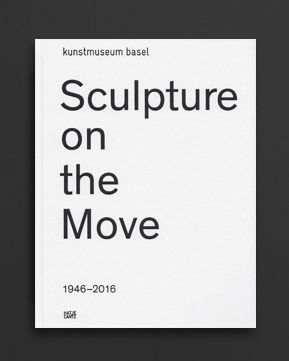
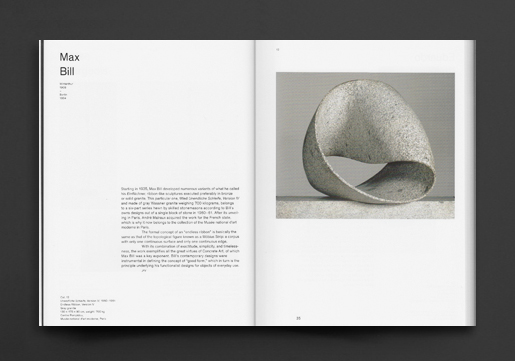
What new paths have sculptors opened up since the end of World War II? Based on late works by Constantin Brancusi and Alberto Giacometti, this comprehensive volume illustrates the exciting and multifaceted developments in this dynamic art form. The long list of the first-class artists presented ranges from Pablo Picasso, Henry Moore, and Jean Tinguely to Franz West, Damien Hirst and Monika Sosnowska. Sculpture on the Move demonstrates how the classic notion of form and sculpture was set in motion, became more abstract, came closer to the ordinary everyday object, dissolved spatial or conceptual boundaries, and even reconstituted itself, returning to figurative traditions. On the basis of selected works from the Kunstmuseum Basel and from international museums and private collections, the book opens up a dense, extremely rich world of contrasts. Featured artists include Absalon, Carl Andre, Jean Arp, Max Bill, Louise Bourgeois, Constantin Brancusi, Alexander Calder, John Chamberlain, Eduardo Chillida, Peter Fischli und David Weiss, Katharina Fritsch, Alberto Giacometti, Robert Gober, Duane Hanson, Eva Hesse, Damien Hirst, Donald Judd, Mike Kelley, Jeff Koons, Mario Merz, Henry Moore, Bruce Nauman, Claes Oldenburg, Gabriel Orozco, Pablo Picasso, Charles Ray, Richard Serra, Monika Sosnowska, David Smith, Jean Tinguely, Oscar Tuazon, Danh Vo and Franz West.
2015, English
Softcover, 96 pages, 17 x 23 cm
Published by
MUMA / Victoria
$20.00 - Out of stock
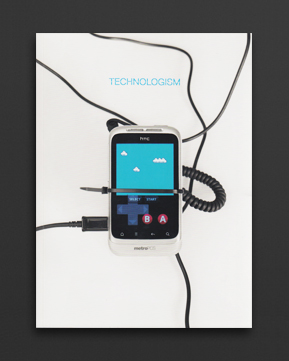
Catalogue published to accompany the exhibition Technologism, at Monash University Museum of Art (MUMA) in Melbourne, 3 Oct - 12 Dec 2015, curated by Charlotte Day.
Artists: Cory Arcangel (US), Dara Birnbaum (US), Chris Burden (US), Ian Burn (AU), Antoinette J. Citizen (AU), Simon Denny (NZ), Jan Dibbets (NL), Aleksandra Domanović (SI/DE), Harun Farocki (DE), Benjamin Forster (AU), Isa Genzken (DE), Greatest Hits (AU), Martijn Hendriks (NL), Lynn Hershman Leeson (US), Matt Hinkley (AU), Jenny Holzer (US), Edward Kienholz & Nancy Reddin Kienholz (US), Oliver Laric (AT), Mark Leckey (UK), Scott Mitchell (AU), Rabih Mroué (LB), Henrik Olesen (DK), Nam June Paik (KR/US), Nam June Paik & John Godfrey (US), Joshua Petherick (AU), Matte Rochford (AU), Jill Scott (AU), Richard Serra (US), John F. Simon Jr. (US), Brian Springer (US), Hito Steyerl (DE), Ricky Swallow (AU), Jeff Thompson (US), Pia van Gelder (AU), Ulla Wiggen (US) and Dennis Wilcox (AU)
MUMA concludes its three-part series on watershed moments in art history — Reinventing the Wheel: the readymade century and Art as a Verb — with Technologism, a major group exhibition bringing together forty-three historical and contemporary artworks, including several new commissions from Australian practitioners. Technologism wrestles with the profound cultural, social and political impact technology has made on art since the 1960s.
Conservative cul-de-sac's of the community are often sceptical of technology and its ever increasing presence in our lives. However many artists — with a natural propensity for constant upheaval — have whole-heartedly embraced radical changes in technology over the last sixty years. Featuring artworks that engage both physically and conceptually with electronic systems — television, computers, the internet, smartphones — Technologism focuses on the ways artists critique and disrupt official uses of the media, or construct their own machines and data systems.
Riffing off both the aesthetic and conceptual characteristics of technology, artists in Technologism document technology's advancement in a plethora of ways: Ulla Wiggen's intricate paintings of circuit boards from the mid 1960s, see the development of an aesthetic inspired by the complex intersection of electrical wires, connectors and components, working to manipulate and rewire the physicality of technology; some thirty years later, John F. Simon's Art Appliances series of the 1990s uses the circuitry of small LCD screens to disrupt pictures and patterns, recreating them over; in Matte Rochford's video Progressively Degrading Test Pattern 2013, humble VHS tapes are copied and recopied, in a process of metaphysical reduction; while in Joshua Petherick's new work, one technology is employed to record another soon to be superseded, revealing new visual dimensions and the 'ghosts in the machine'.
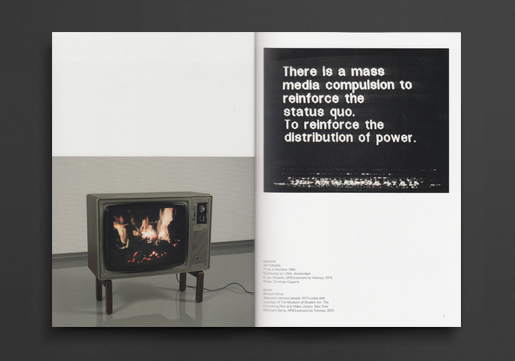
A story of advancement inevitably turns into obsolescence, and Technologism seeks to document the early use of broadcast technology as a way of bridging the gap (and finding a space) between the image on the screen, the physical presence of the viewer, and the broader community. Jan Dibbet's TV as a Fireplace 1968, documents television as a collective experience — even if viewers were separated physically, they were united through time and space like pre-historic cave-dwellers by a communal broadcast. However with the advent of the internet, personal computer devices and streaming services, technology has again changed the relationship we have with the world around us to a more singular yet proliferating existence.
A history of DIY jamming and hacking presents the way artists have continued to subvert conventional uses of technology and challenge the status-quo, from the internet as militarily-designed, to corporately-exploited, civilian-employed, artistically-manipulated, and back again. For instance, Lynn Hershman Leeson's work investigates how media is used as a tool for censorship and political repression, while Simon Denny's work co-opts the aesthetic and rhetoric of language of multinational corporations in order to question their power. In presenting these works and others, Technologism seeks to consider what is the value of such subversion, or is it merely a perpetuation of the problem?
Artist Hito Steyerl asks, 'is the internet dead?' Although, hyperbolic in its prognosis, Technologism recognises that sceptical questions such as this are an important part of how artistic practice negotiates technological advancement. Technologism proceeds from the idea that technology in all its forms, physical and immaterial, needs to be interrogated in order to be perpetually remade.
Technologism considers changes in infrastructure, such as telecommunication networks and the internet, and the cultural implications of technological innovation and considers from the position of the developers of these technologies as well as from the end user. Technologism asks 'how does technology effect artistic practice?' As well as, 'how can artistic practice effect technology?'
Fully illustrated catalogue features texts by Charlotte Day, Philip Brophy, Bridget Crone and Sean Dockray. Designed by Yanni Florence.
2013, English
Hardcover, 160 pages, 21 x 29 cm
Published by
Artists Space / New York
Culturgest / Lisbon
Hatje Cantz / Berlin
Museum für Gegenwartskunst / Basel
$85.00 - Out of stock
Julie Ault is an artist, curator, writer, and editor, whose work emphasizes and celebrates the complex interrelationships between cultural production and politics. Ault cofounded the New York artists' collaborative Group Material, which between 1979 and 1996 explored this relationship between art, activism and politics through socially themed exhibitions and publicly-sited projects. The collection of artworks Ault has assembled over the last 30 years speaks to her practice as one built on exchange, friendship and a critical notion of mutable histories.
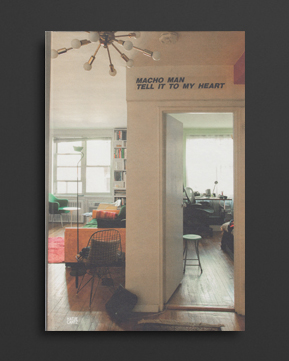
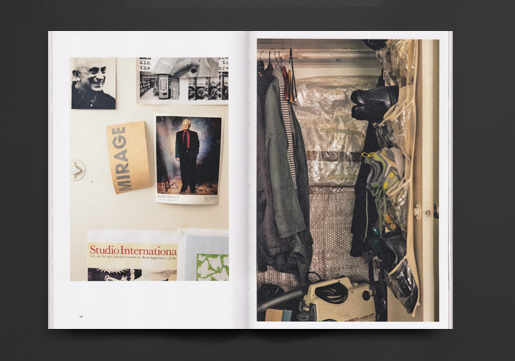
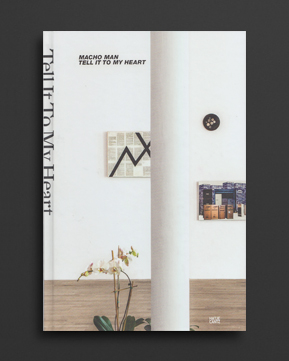
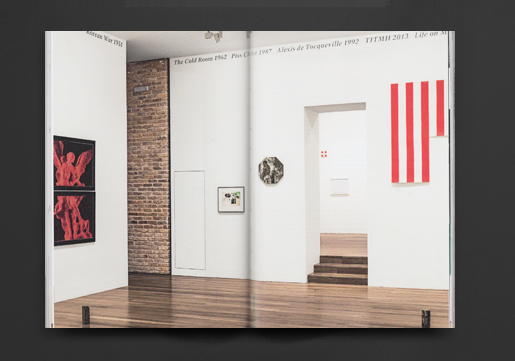
Tell It To My Heart – Collected by Julie Ault is published by Hatje Cantz in collaboration with Artists Space, New York; Museum für Gegenwartskunst, Basel; and Culturgest, Lisbon, and accompanies a three-part exhibition staged around the artworks in Ault's possession. The exhibition was initiated by Nikola Dietrich and Scott Cameron Weaver at Museum für Gegenwartskunst, and was presented in Basel, Lisbon and New York between 2013 and 2014. The first volume of the publication was published to coincide with the exhibitions, and centers on an index of works along with detailed commentary on these works from the diverse voices of the book's editors – Julie Ault, Martin Beck, Nikola Dietrich, Heinz Peter Knes, Rasmus Røhling, Jason Simon, Scott Cameron Weaver, Danh Vo and Amy Zion. Over the course of her 35-plus years at the forefront of New York's art culture, Ault has amassed a superb collection of contemporary art, most of it given to her by artist friends and admirers. Almost more of an interiors book in the style of "Apartamento" magazine, "Tell It to My Heart" takes us through Ault's New York apartment, reproducing works by artists such as Felix Gonzalez-Torres, Roni Horn, Tim Rollins & K.O.S., Andres Serrano, Nancy Spero and Danh Vo among many others. Together, and in situ, the artworks disclose a highly personal experience of an art community, initially centered in New York during Ault's formative years, but with a reach that has long since transcended regional classifications.
2016, English
Hardcover, 156 pages, 21 x 29 cm
Published by
Hatje Cantz / Berlin
$89.00 $60.00 - In stock -
Julie Ault is an artist, curator, writer, and editor, whose work emphasizes and celebrates the complex interrelationships between cultural production and politics. Ault cofounded the New York artists' collaborative Group Material, which between 1979 and 1996 explored this relationship between art, activism and politics through socially themed exhibitions and publicly-sited projects. The collection of artworks Ault has assembled over the last 30 years speaks to her practice as one built on exchange, friendship and a critical notion of mutable histories.
Tell It To My Heart – Collected by Julie Ault is published by Hatje Cantz in collaboration with Artists Space, New York; Museum für Gegenwartskunst, Basel; and Culturgest, Lisbon, and accompanies a three-part exhibition staged around the artworks in Ault's possession. The exhibition was initiated by Nikola Dietrich and Scott Cameron Weaver at Museum für Gegenwartskunst, and was presented in Basel, Lisbon and New York between 2013 and 2014. Over the course of her 35-plus years at the forefront of New York's art culture, Ault has amassed a superb collection of contemporary art, most of it given to her by artist friends and admirers. The "Tell It to My Heart" books take us through Ault's collection in different contexts, reproducing works by artists such as Felix Gonzalez-Torres, Roni Horn, Tim Rollins & K.O.S., Andres Serrano, Nancy Spero and Danh Vo among many others. Together, and in situ, the artworks disclose a highly personal experience of an art community, initially centered in New York during Ault's formative years, but with a reach that has long since transcended regional classifications.
Volume 2 follows a more reflective and distanced mode than its predecessor, including installation images of the exhibitions, and a series of essays from scholars and curators that respond to the overall character and process of Tell It To My Heart. The publication also includes a comprehensive checklist of artworks exhibited across the three venues, as well as those works included in the film programs accompanying each exhibition.
Tell It To My Heart – Collected by Julie Ault, Volume 2 is edited by Richard Birkett, Martin Beck and Julie Ault, and includes texts by curator Richard Birkett; art historian Patricia Falguières; writer Sarah Schulman; and archivist Marvin J. Taylor, with graphic design by Project Projects, New York.
2016, English / Korean
Softcover, 116 pages, 15.6 x 22 cm
Published by
Bom Dia Boa Tarde Boa Noite / Berlin
$35.00 - Out of stock
Texts by Hu Fang, Jenny Jaskey, Hyo Gyoung Jeon, Fionn Meade, Hyunjin Kim, Sung Hwan Kim, Kari Rittenbach, Anja Isabel Schneider, Monika Szewczyk, Jason Wirth, concept by Nina Canell and Robin Watkins, edited by Hyunjin Kim, Hyo Gyoung Jeon
For Canell there is no mediation that is lossless—an output is never the pure transmission of a source—but always as much the distance it has travelled, the things it has come in contact with or bounced with or off. She is interested in the consistency of distances that can be traced through an arbitrary sense of material precision: utilising water, viscosity, synthetic carpets, electricity, surface tension, stray socks and chewing gum. This consistency, at times imperceptible and at times palpable, is what the artist describes as “an extra-linguistic or non-verbal modulation of content—articulating the impurities of a medium or assemblage.”
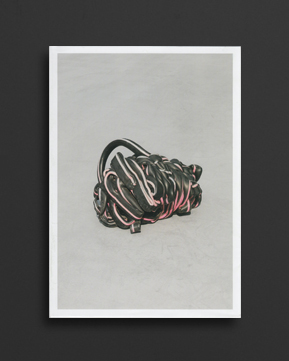
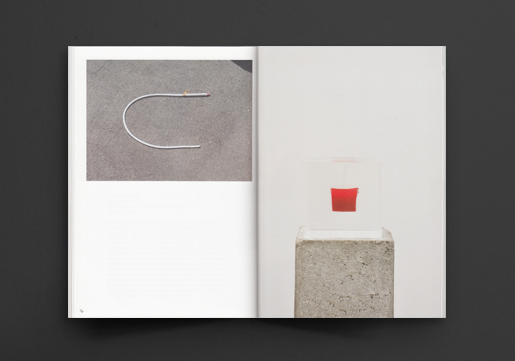
For her first solo exhibition in Asia, Canell made research into the production and distribution of fiber optic sheaths in the outskirts of Seoul, where cable mounds are sorted according to colour and eventually remoulded into the synthetic circumferences of future relations. Literally caught in between melting and being repurposed, several hundred meters of gutted sheaths are compressed into dense lumps of immaterial distance. The accompanying book consists of ten short new texts around which fragments of communication with the authors have been punctuated by observational photographs and sculptural documentation. Contextualized by both recent and earlier works, the exhibition and book considers sculpture as a medium of storage, transmission and reception.
2016, English / German
Softcover, 448 pages, 24 x 30.5 cm
Published by
Bom Dia Boa Tarde Boa Noite / Berlin
K.M Kunstverein / Munich
$56.00 - Out of stock
Edited by Bart van der Heide and Manuel Raeder.
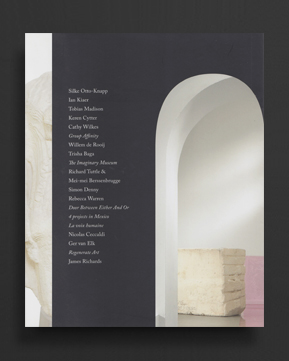
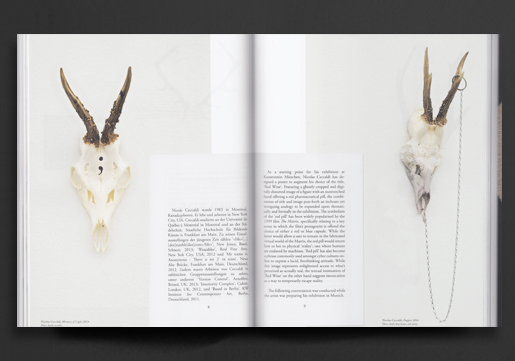
This book is an overview of the exhibition program of Bart van der Heide from 2010 – 2015, which he realised as the director of Kunstverein München. This program includes exhibitions by Silke Otto-Knapp, Ian Kiaer, Tobias Madison, Keren Cytter, Cathy Wilkes, Group Affinity, Willem de Rooij, Trisha Baga, Richard Tuttle, Mei-mei Berssenbrugge, Simon Denny, Nicolas Ceccaldi, Ger van Elk, James Richards, and others. Each exhibition is presented by a corresponding booklet, containing all texts and images. These accompanying publications were designed individually for each exhibition in cooperation with Studio Manuel Raeder. The different designs play with various fonts, formats, and graphic elements. Together with these publications, a variety of coloured images of exhibition views conveys the curatorial direction as well as the identity of the Kunstverein in those years. A reflection by Bart van der Heide and all booklet texts are included in both German and English.
designed by Studio Manuel Raeder
2016, English / Italian
Softcover (newspaper), 334 pages, 25 x 36 cm
Published by
Mousse Publishing / Milan
$20.00 $10.00 - Out of stock
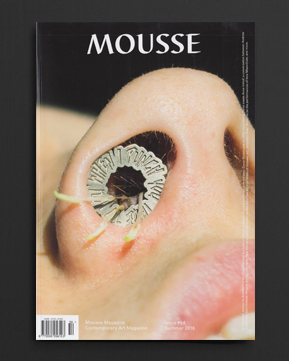
MOUSSE #54, Summer 2016
Contents:
IEVA MISEVIČIŪTĖ
Character Studies of Primeval Life Form
by Jacquelyn Ross
EXTEND, EXCEED, ENHANCE: PROSTHETICS AND SCULPTURE
by Lisa Le Feuvre
ANNE IMHOF
Choreographed layers
by Hans Ulrich Obrist
RAYMOND BOISJOLY, TANYA LUKIN LINKLATER, WALTER SCOTT
Native North America
by Andrew Berardini, Richard William Hill and Candice Hopkins
INSIDE TO OUTSIDE TO INSIDE
by Jens Hoffmann
NEW SCENARIO
Curating Holes
by Melanie Bühler
ROLE PLAY
by Maurizio Cattelan,
Liam Gillick,
Thomas Demand,
Barbara Bloom,
Christian Jankowski,
Elmgreen&Dragset,
Michelle Grabner,
Tobias Rehberger,
Ugo Rondinone,
Harrell Fletcher,
John Miller,
Paulina Olowska
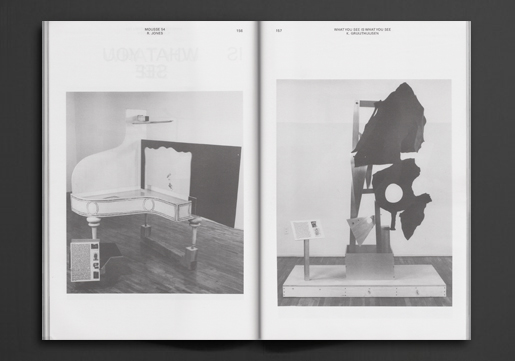
RONALD JONES
What You See Is What You See
by Krist Gruijthuijsen
GARY INDIANA
I Can Give You Anything But Love
by Andrew Durbin
WILLA NASATIR
Psychic Junkyards
by Lauren Cornell
RAGNA BLEY
An Idiosyncratic Abecedary
by Filipa Ramos
NOAH BARKER
Projecting an Island from Another
by Mark Beasley
ISIAH MEDINA
The impossible is the only (no-)thing that ever happens
by Pia Bolognesi
ME
by Dieter Roelstraete
SHIFTING BACKGROUNDS
by Anselm Franke
NOBODY IS SLEEPING IN THE SKY
by Geoffrey Farmer and Dora García
NOW, I AM AFRAID...
by Chus Martínez
CECILIA BENGOLEA AND FRANÇOIS CHAIGNAUD
Emotional Aesthetics
by Kathy Noble
MORAG KEIL AND GEORGIE NETTELL
Domestic Battlegrounds
by Fredi Fischli and Niels Olsen
AN ESSAY ON DRESS-UP AND OTHER THINGS
by Sabrina Tarasoff
2016, English
Hardcover, 496 pages, 19 x 24 cm
Published by
Karma / New York
$110.00 - Out of stock
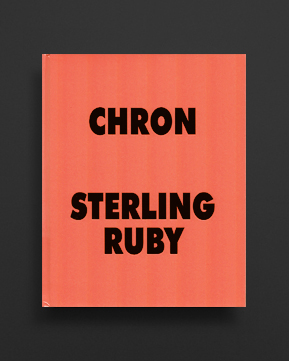
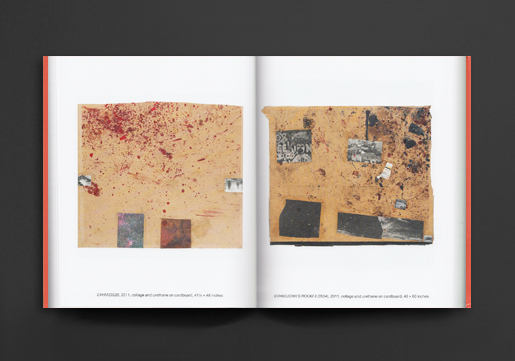
CHRON is an approximately 500-page publication that collects over 300 collages and works on paper from a decade of Los Angeles-based artist Sterling Ruby's (born 1972) practice. Vivid backgrounds and a variety of media compose the intricate, geometric collages and reference the artist's painting and sculptural work. Ruby's DRFTRS and EXHM series are also collected here. The latter, massive pieces of cardboard originally used as a shell for the studio floor, are painted in deep hues of primary colors and exhibit the continued accrual of urethane and studio debris, a technique the artist continues to explore today. Proclaimed "one of the most interesting artists to emerge in this century" byNew York Times art critic Roberta Smith, Ruby--with his graffiti-based spray paint drawings, nail-polish abstractions and inscribed Formica sculptures--has perfected a sort of anti-minimalism, here compiled in this massive new volume.
2016, English / Portuguese
Softcover, 168 pages, 15,5 x 22 cm
Published by
Mousse Publishing / Milan
$45.00 $10.00 - Out of stock
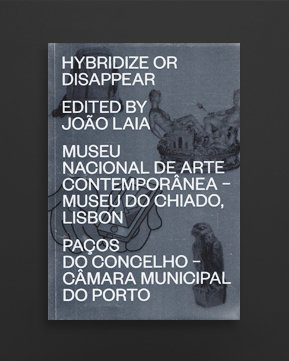
João Laia, ed.
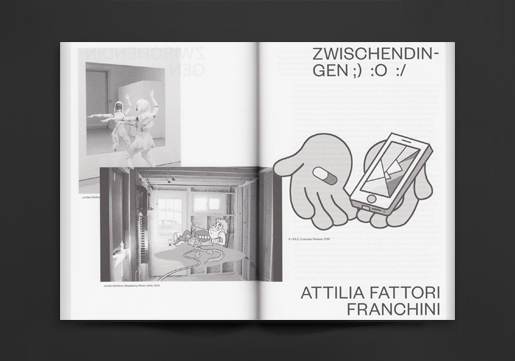
Texts by Stephanie Bailey, Paulo Cunha E Silva, Attilia Fattori Franchini, João Laia, João Ribas, Alex Ross, David Santos, Andrey Shental, Eleanor Ivory Weber, Rósza Zita Farkas
This publication has been produced in the framework of “Hybridize or Disappear”, a group exhibition with works by Cécile B. Evans, Neïl Beloufa, Antoine Catala, Diogo Evangelista, Oliver Laric, Shana Moulton, Katja Novitskova, Laure Prouvost and Magali Reus at the Museu Nacional de Arte Contemporânea – Museu do Chiado, Lisbon, and at the Paços do Concelho, Câmara Municipal do Porto. Edited by João Laia, this book aims to expand on the universe of the show, posing a wide set of questions that shape contemporary visual culture, rather than serving as a document or an archive. Through the lens of the “hybrid”, the commissioned texts look at different dimensions of our current condition, addressing ideas related to the circulation of identity and meaning in our mediated environments.
2016, English
Softcover (w. printed plastic jacket), 124 pages, 10.5 x 16 cm
Published by
Mousse Publishing / Milan
$50.00 $10.00 - Out of stock
Stefano Cernuschi and Abaseh Mirvali, eds.
Texts by Simon Starling and Maja McLaughlin
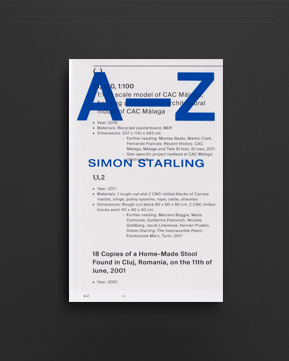
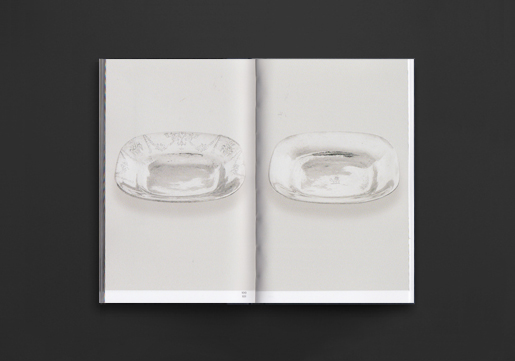
Simon Starling: A–Z is a pocket, non illustrated mid-career catalogue raisonné of a practice now spanning over two decades. Every work ever realized by Starling (Epsom, UK, 1967) is listed in alphabetical order and referenced in this compact guide, which also provides a bibliography and connections to other related projects. Halfway through the text flow, three photo inserts and texts by the artist and Maja McLaughlin document the exhibition projects El Eco and Bowl, Plates realized in Mexico City, at the Museo Experimental El Eco and the Luis Barragán House and Studio, in 2015.
2016, English
Softcover, 200 pages, 15.2 x 23 cm
Published by
October Books / New York
The MIT Press / Massachusetts
$42.00 - Out of stock
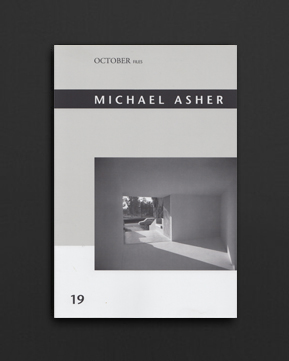
During a career that spanned more than forty years, from the late 1960s until his death in 2012, Michael Asher created site-specific installations and institutional interventions that examined the conditions of art's production, display, and reception. At the Art Institute of Chicago, for example, he famously relocated a bronze replica of an eighteenth-century sculpture of George Washington from the museum's entrance to an interior gallery, thereby highlighting the disjunction between the statue's symbolic function as a public monument and its aesthetic origins as an artwork. Today, Asher is celebrated as one of the forerunners of institutional critique. Yet because of Asher's situation-based method of working, and his resistance to making objects that could circulate in the art market, few of his works survive in physical form. What does survive is writing by scholars and critics about his diverse practice. The essays in this volume document projects that range from Asher's environmental works and museum displacements to his research-based presentations and reflections on urban space.
Contributors: Michael Asher, Sandy Ballatore, Benjamin H. D. Buchloh, Jennifer King, Miwon Kwon, Barbara Munger, Stephan Pascher, Birgit Pelzer, Anne Rorimer, Allan Sekula
2013, English
Softcover, 212 pages, 15.2 x 23 cm
Published by
October Books / New York
The MIT Press / Massachusetts
$42.00 - Out of stock
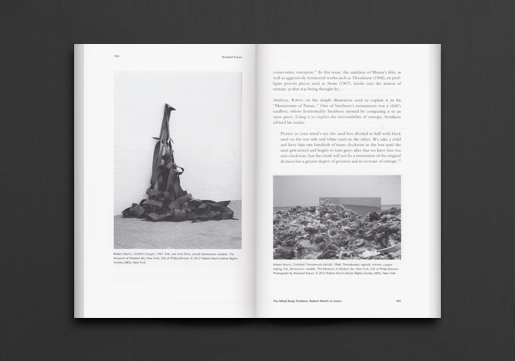
This October Files volume gathers essays, an interview, and a roundtable discussion on the work of Robert Morris, one of the most influential American artists of the postwar period. It includes a little-known text on dance by Morris himself and a never-before-anthologized but influential catalog essay by Annette Michelson. Often associated with minimalism, Morris (b. 1931) also created important works that involved dance, process art, and conceptualism. The texts in this volume focus on Morris's early work and include an examination of a 1971 Tate retrospective by Jon Bird, an interview with the artist by Benjamin Buchloh, a conversation from a 1994 issue of October about resistance to 1960s art, and an essay by this volume's editor, Julia Bryan-Wilson, on the labor involved in installing the massive works in Morris's 1970 solo exhibition at the Whitney. Spanning 1965 to 2009, these writings map the evolution of critical thought on Morris over more than four decades.
2016, English
Softcover, 240 pages, 145 x 210 mm
Published by
The MIT Press / Massachusetts
Whitechapel / London
$52.00 - Out of stock
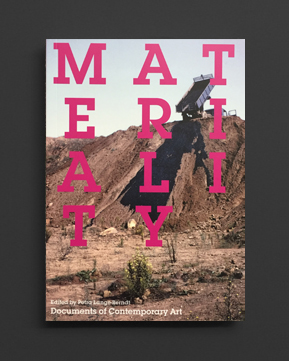
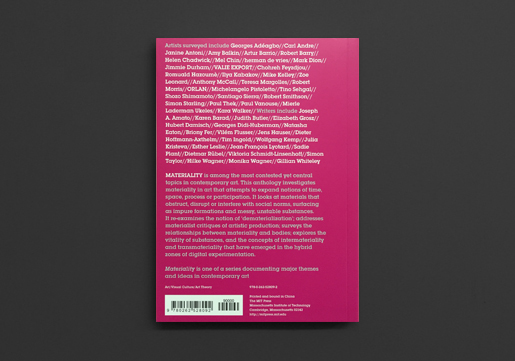
Materiality has reappeared as a highly contested topic in recent art. Modernist criticism tended to privilege form over matter—considering material as the essentialized basis of medium specificity—and technically based approaches in art history reinforced connoisseurship through the science of artistic materials. But in order to engage critically with the meaning, for example, of hair in David Hammons’s installations, milk in the work of Dieter Roth, or latex in the sculptures of Eva Hesse, we need a very different set of methodological tools.
This anthology focuses on the moments when materials become willful actors and agents within artistic processes, entangling their audience in a web of connections. It investigates the role of materiality in art that attempts to expand notions of time, space, process, or participation. And it looks at the ways in which materials obstruct, disrupt, or interfere with social norms, emerging as impure formations and messy, unstable substances. It reexamines the notion of “dematerialization”; addresses materialist critiques of artistic production; surveys relationships between matter and bodies, from the hierarchies of gender to the abject and phobic; explores the vitality of substances; and addresses the concepts of intermateriality and transmateriality emerging in the hybrid zones of digital experimentation.
Artists surveyed include
Georges Adéagbo, Carl Andre, Janine Antoni, Amy Balkin, Artur Barrio, Helen Chadwick, Mel Chin, Mark Dion, Jimmie Durham, Tessa Farmer, Chohreh Feyzdjou, Romuald Hazoumè, Pierre Huyghe, Ilya Kabakov, Mike Kelley, Anthony McCall, Teresa Margolles, Robert Morris, Michelangelo Pistoletto, Tino Sehgal, Shozo Shimamoto, Santiago Sierra, Robert Smithson, Simon Starling, Paul Thek, Paul Vanouse, Mierle Laderman Ukeles, Kara Walker
Writers include
Joseph D. Amato, Karen Barad, Judith Butler, Elizabeth Grosz, Georges Didi-Huberman, Natasha Eaton, Jens Hauser, Dieter Hoffmann-Axthelm, Tim Ingold, Wolfgang Kemp, Julia Kristeva, Esther Leslie, Jean-François Lyotard, Dietmar Rübel, Monika Wagner, Gillian Whiteley
About the Editor
Petra Lange-Berndt is Chair of Modern and Contemporary art in the Art History Department at the University of Hamburg and a leading researcher in the field of material studies in art history. She is coeditor, with Dietmar Rübel, of Sigmar Polke: We Petty Bourgeois! Contemporaries and Comrades, the 1970s.
2016, English
Hardcover (padded), 312 pages, 18.4 x 30 cm
Published by
Moderna Museet / Stockholm
Walther König / Köln
$45.00 - Out of stock
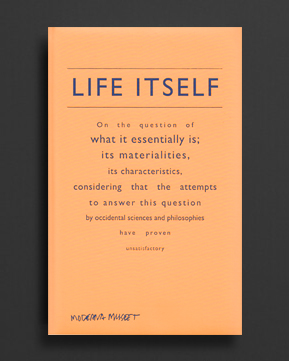
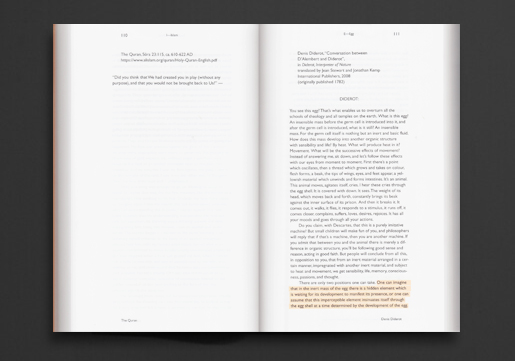
Anyone undertaking a study of the concept of "life" in our culture will observe that it never gets defined as such, writes Giorgio Agamben. Instead, he claims, this indeterminate thing - life itself - gets articulated and divided time and again through a series of oppositions that give it a function in the sciences without ever being defined as such. These theoretical and literary articulations are what this book is about, and what the 173 texts by authors, scientists and philosophers from all times and all disciplines will try to answer.
Ernst Haeckel, speculative biologist and naturalist, coined key concepts as phylum and ecology. In the years 1899-1904 he published Kunstformen der Natur (Art Forms of Nature), one hundred prints depicting organisms many of which were first described by Haeckel himself, who with this project took an unusual step from science to art. His sketches thus create a bridge between this book and the exhibition at Moderna Museet, appearing in the margins of both. Otherwise there is no art in this publication and the division of labor strict: the exhibition is art?s chance to answer the topic spelled out in the subtitle to Life Itself: "On the question of what it essentially is; its materialities, its characteristics, considering that attempts to answer this question by occidental sciences and philosophies have proven unsatisfactory."
Exhibition featured the work of Giovanni Anselmo, Olga Balema, Hicham Berrada, Joseph Beuys, Karl Blossfeldt, Constantin Brancusi, Victor Brauner, Nina Canell, Lygia Clark, Trisha Donnelly, Monica Englund, Valia Fetisov, Dirk Fleischmann, Katharina Fritsch, Ernst Haeckel, Barbara Hauser, Tamara Henderson, Eva Hesse, Damien Hirst, Tehching Hsieh, Pierre Huyghe, Carsten Höller/Rosemarie Trockel, On Kawara, Josh Kline, Hilma af Klint, Edward Krasinski, Mark Leckey, Helen Marten, Henri Michaux, Barnett Newman, Otobong Nkanga, Katja Novitskova, Philippe Parreno, Giuseppe Penone, Leo Reis, Ulf Rollof, Rachel Rose, Anri Sala, Sebastian Stöhrer, Sturtevant, Paul Thek, Rosemarie Trockel, Rosemarie Trockel/Günter Weseler, Christine Ödlund.