World Food Books' programme is largely produced on Kulin Nation land. We acknowledge the Wurundjeri people of the Kulin Nation as the first and continuing custodians of this land, and pay respect to their Elders past, present, and emerging.
World Food Books is an arts and special interests bookshop in Naarm / Melbourne. Founded in 2010, World Food Books is devoted to the presentation of a rotating, hand-selection of international art, design, literary and counterculture publications with an emphasis on the anti-traditional, the experimental, the avant-garde, the heretic, the marginal.
Presenting new titles alongside rare and out-of-print books, catalogues and journals spanning the fields of modern and contemporary art, design, photography, illustration, film, literature, poetry, cultural theory, philosophy, sexuality, popular and underground culture in its many radical forms, World Food Books wishes to encourage adventurous, thoughtful and open-minded reading, looking, writing, and exchange of publishing and ideas, both current and historical.
As well as our bookshop, located in Melbourne's historical Nicholas Building, all of our inventory is available internationally via our online mail-order service.
World Food Books semi-regularly co-ordinates "Occasions", a programme of exhibits and events at the bookshop and in partnership with other hosts (such as museums and art galleries) that develop out of the activities, relationships and content of the bookshop itself.
World Food Books
The Nicholas Building
37 Swanston Street
Room 5, Level 6
Melbourne 3000
Australia
SHOP HOURS:
THU–SAT 12–6
WEB-SHOP OPEN 24/7
World Food Books
Postal Address:
PO Box 435
Flinders Lane
Victoria 8009
Australia
info@worldfoodbooks.com
Art
Theory / Essay
Architecture / Interior
Graphic Design / Typography
Photography
Fashion
Eros
LGBTQ+
Fiction / Poetry
Weird / Speculative / Science Fiction / Horror
Transgressive / Visceral / Abject
Symbolism / Decadence / Fin de siècle
Film / Video
Painting
Sculpture / Installation
Performance / Dance / Theater
Drawing
Sound / Music
Curatorial
Group Shows / Collections
Periodicals
Out-of-print / Rare
Posters / Ephemera / Discs
Signed Books
World Food Books Gift Voucher
World Food Book Bag
Australian Art
Australian Fiction
Australian Science Fiction / Speculative Fiction
Australian Poetry
Australian Photography
Japanese Photography
Conceptual Art
Minimal Art
Dada
'Pataphysics / Oulipo
Fluxus
Concrete Poetry
Pop Art
Surrealism
Arte Povera
Arte Informale / Haute Pâte / Tachism
Nouveau Réalisme / Zero / Kinetic
Situationism / Lettrism
Collage / Mail Art / Xerox Art
Art Brut / Folk / Visionary / Fantastic
Illustration / Graphic Art / Bandes Dessinées
Furniture
Italian Radical Design / Postmodernism
Textiles
Ceramics / Glass
Counterculture
Protest / Revolt
Philosophy
Psychoanalysis
Anthropology
Anarchism
Socialism / Anarchism / Communism / Capitalism
Literary Theory / Semiotics / Language
Feminism / Women's Studies
Gender Studies / Sexuality
Anthropology
Fetishism / BDSM
Drugs / Psychedelia
Crime / Violence
Animal Rights / Veganism
Occult / Esoterica
Ecology / Earth / Alternative Living
Whole Earth / Crafts
All prices in AUD (Australian dollars)
Pick-Ups
Pick-up orders can be collected in our bookshop during opening hours after order date. Please collect any Pick-up orders within 2 weeks of ordering as we have limited storage space. Orders will be released back into stock if not collected within this time. No refunds can be made for pick-ups left un-collected. If you cannot make it in to the bookshop in this time-frame, please choose postage option.
Return Policy
All sales are final. We do accept returns (for refund or exchange) for items received in error. All our orders are packed with special care using heavy-duty padding and cardboard book-mailers or bubble mailers (for smaller books), using reinforcement where required. We cannot take responsibility for any lost, stolen or damaged parcels.
Insurance
Should you wish to insure your package, please email us directly after placing your order and we can organise this at a small extra expense. Although all standard/express tracked packages are very safe and dependable, we cannot take responsibility for any lost, stolen or damaged parcels. We recommend insurance on valuable orders.
Interested in selling your old books, catalogues, journals, magazines, comics, fanzines, ephemera? We are always looking for interesting, unusual and out-of-print books to buy. We only buy books in our fields of interest and specialty, and that we feel we can resell.
We base these prices on desirability, market value, in-print prices, condition and our current stock levels. We offer cash, store credit, and can take stock on consignment. All
about 25% of the price we expect to get when we sell them, or 30% in store credit. We base these prices on desirability, market value, in-print prices, condition and our current stock levels.
Sell your books any day of the week. You can drop them off and return later. If you have a lot of books, we can visit your Sydney home.
We buy books that we feel we can resell. We offer about 25 % of the price we expect to get when we sell them, or 30% in store credit. We base these prices on desirability, market value, in-print prices, condition and our current stock levels.
Philadelphia Wireman
03 August - 01 September, 2018
World Food Books is proud to announce our next Occasion, the first presentation of sculptures by Philadelphia Wireman in Australia.
The Philadelphia Wireman sculptures were found abandoned in an alley off Philadelphia’s South Street on trash night in 1982. Their discovery in a rapidly-changing neighbourhood undergoing extensive renovation, compounded with the failure of all attempts to locate the artist, suggests that the works may have been discarded after the maker’s death. Dubbed the "Philadelphia Wireman" during the first exhibition of this work, in 1985, the maker’s name, age, ethnicity, and even gender remain uncertain. The entire collection totals approximately 1200 pieces, all intricately bound together with tightly-wound heavy-gauge wire (along with a few small, abstract marker drawings, reminiscent both of Mark Tobey and J.B. Murry). The dense construction of the work, despite a modest range of scale and materials, is singularly obsessive and disciplined in design: a wire armature or exoskeleton firmly binds a bricolage of found objects including plastic, glass, food packaging, umbrella parts, tape, rubber, batteries, pens, leather, reflectors, nuts and bolts, nails, foil, coins, toys, watches, eyeglasses, tools, and jewellery.
Heavy with associations—anthropomorphic, zoomorphic, and socio-cultural responses to wrapped detritus—the totemic sculptures by Philadelphia Wireman have been discussed in the context of work created to fulfil the shamanistic needs of alternative religions in American culture. Curators, collectors, and critics have variously compared certain pieces to sculpture from Classical antiquity, Native American medicine bundles, African-American memory jugs, and African fetish objects. Reflecting the artist’s prolific and incredibly focused scavenging impulse, and despite—or perhaps enhanced by—their anonymity, these enigmatic objects function as urban artefacts and arbiters of power, though their origin and purpose is unknown. Philadelphia Wireman, whatever their identity, possessed an astonishing ability to isolate and communicate the concepts of power and energy through the selection and transformation of ordinary materials. Over the course of the past two decades, this collection has come to be regarded as an important discovery in the field of self-taught art and vernacular art.
Presented in collaboration with Fleisher-Ollman Gallery, Philadelphia, and Robert Heald, Wellington.
Susan Te Kahurangi King
02 February - 10 March, 2018
Susan Te Kahurangi King (24 February 1951 - ) has been a confident and prolific artist since she was a young child, drawing with readily available materials - pencils, ballpoint pens and felt-tip markers, on whatever paper is at hand. Between the ages of four and six Susan slowly ceased verbal communication. Her grandparents William and Myrtle Murphy had developed a special bond with Susan so they took on caring responsibilities for extended periods. Myrtle began informally archiving her work, carefully collecting and storing the drawings and compiling scrapbooks. No drawing was insignificant; every scrap of paper was kept. The King family are now the custodians of a vast collection containing over 7000 individual works, from tiny scraps of paper through to 5 meter long rolls.
The scrapbooks and diaries reveal Myrtle to be a woman of great patience and compassion, seeking to understand a child who was not always behaving as expected. She encouraged Susan to be observant, to explore her environment and absorb all the sights and sounds. Myrtle would show Susan’s drawings to friends and people in her community that she had dealings with, such as shopkeepers and postal workers, but this was not simply a case of a grandmother’s bias. She recognised that Susan had developed a sophisticated and unique visual language and sincerely believed that her art deserved serious attention.
This was an unorthodox attitude for the time. To provide some context, Jean Dubuffet coined the term Art Brut in 1945 to describe work created by self-taught artists – specifically residents of psychiatric institutions and those he considered to be visionaries or eccentrics. In 1972 Roger Cardinal extended this concept by adopting the term Outsider Art to describe work made by non-academically trained artists operating outside of mainstream art networks through choice or circumstance. Susan was born in Te Aroha, New Zealand in 1951, far from the artistic hubs of Paris and London that Dubuffet and Cardinal operated in. That Myrtle fêted Susan as a self-taught artist who deserved to be taken seriously shows how progressive her attitudes were.
Susan’s parents Doug and Dawn were also progressive. Over the years they had consulted numerous health practitioners about Susan’s condition, as the medical establishment could not provide an explanation as to why she had lapsed into silence. Dawn educated herself in the field of homeopathy and went on to treat all twelve of her children using these principles – basing prescriptions on her observations of their physical, mental and emotional state.
Doug was a linguist with an interest in philosophy who devoted what little spare time he had to studying Maori language and culture. To some extent their willingness to explore the fringes of the mainstream made them outsiders too but it was their commitment to living with integrity and their respect for individuality that ensured Susan’s creativity was always encouraged.
Even though Susan’s family supported her artistic pursuits, some staff in schools and hospitals saw it as an impediment to her assimilation into the community and discouraged it in a variety of ways. Her family was not always aware of this and therefore did not fully understand why Susan stopped drawing in the early 1990s. However, rather than dwell on the challenges that Susan faced in pursuit of her artistic practice, they prefer to highlight her achievements. In 2008 Susan began drawing again in earnest, after an almost 20 year interruption, and her work is now shown in galleries around the world.
Susan grew up without television and has been heavily influenced by the comics she read as a child. She is absolutely fearless in the appropriation of recognizable characters, such as Donald Duck and Mickey Mouse, in her work. She twists their limbs, contorts their faces, compresses them together, blends them into complex patterned backgrounds - always imbuing them with an incredible energy. Although Susan often used pop culture characters in her work they are not naive or childlike. These are drawings by a brilliant self-taught artist who has been creating exceptional work for decades without an audience in mind.
Mladen Stilinović
"Various Works 1986 - 1999"
02 February 16 - September 10, 2016
Various works 1986 - 1999, from two houses, from the collections of John Nixon, Sue Cramer, Kerrie Poliness, Peter Haffenden and Phoebe Haffenden.
Including: Geometry of Cakes (various shelves), 1993; Poor People’s Law (black and white plate), 1993; White Absence (glasses, ruler, set square, silver spoon, silver ladel with skin photograph and wooden cubes), 1990-1996; Exploitation of the Dead (grey and red star painting, wooden painting, black spoon with red table, red plate), 1984-1990; Money and Zeros (zero tie, paintings made for friends in Australia (Sue, John, Kerrie), numbers painting), 1991-1992; Words - Slogans (various t-shirts) - “they talk about the death of art...help! someone is trying to kill me”, “my sweet little lamb”, “work is a disease - Karl Marx”; Various artist books, catalogues, monographs, videos; Poster from exhibition Insulting Anarchy; "Circular" Croatian - Australian edition; Artist book by Vlado Martek (Dostoyevsky); more.
Thanks to Mladen Stilinović and Branka Stipančić.
Jonathan Walker
Always Will Need To Wear Winter Shirt Blue + Ochre Small Check Pattern
21 August - 21 September, 2015
Untitled
I am not a great reader of poetry but I always return to the work of Melbourne poet, Vincent Buckley (1925- 1988). Perhaps I find his most tantalising piece to be not a finished poem but a fragment left on a scrap of paper discovered on his desk after the poet’s death.
The poetry gathers like oil
In the word-core, and spreads
It has its music meet,
Its music is in movement.
This fragment is more the shell left behind from a volatile thought than a finished poem. I find the last two lines honest but awkward whereas the first two lines work like an arrow. Most likely he could not find a resolution so it was left. Still, in its present form, it remains an eloquent testimony to the ultimate failure of a medium to express mobile thought and sensation, in Buckley’s case, through verbal language. It’s an important matter because this is something all artists have to deal with regardless of the medium.
I have never written a poem, however, I am forever copying fragments from books on paper scraps in a vain effort to fix certain notions in my head. At first, they function as bookmarks that are sometimes returned to when I open the book. But before long, as they accumulate, they fall out littering the table interspersed with A4 photocopies, bills, books and medications.
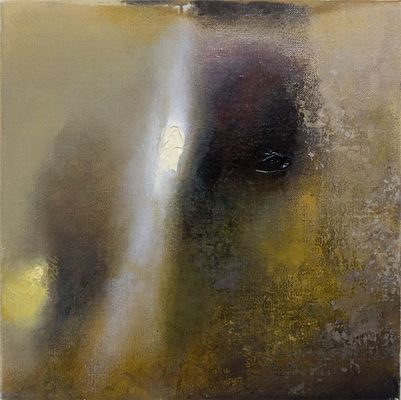
To return to Buckley’s fragment, the first two lines very much evoke how I paint nowadays. As you age, detail diminishes and patches of light become more luminous and float. I feel the most honest way of dealing with this is by smearing the oil paint on the canvas with the fingers and working close-up, blind. Only if the patches coalesce into an approaching image can the work gain a life.
-
Jonathan Walker was born in Melbourne, Australia and brought up on a dairy farm in Gippsland. In the 1970’s he studied painting at RMIT and won the Harold Wright Scholarship to the British Museum, London. During the 1980’s he exhibited at Pinacotheca Gallery, Richmond and had work shown at the NGV and Heidi City Art Gallery. Over the same period he designed the cover for the “Epigenesi” LP by Giancarlo Toniutti, Italy and conducted a mail exchange work with Achim Wollscheid, Germany. The work with artists through the post resulted in an article published in the bicentenary issue of Art and Australia 1988. He showed in artist run spaces such as WestSpace in the 90’s and 2000’s, and until 2012, taught painting at Victoria University, which is where we (Colleen Ahern and Lisa Radford) as organisers of the exhibition, among many others, had the privilege of being his student.
Walker’s knowledge was imparted to students through the careful selection of music, literature, and artists found in books that he himself had ordered for the library. Walker’s strategy was the generosity of sharing his vast knowledge with references specific to each student and their context.
Walker’s paintings share a similar focus and intimacy.
This exhibition presents a small selection of recent paintings alongside a publication that includes Walker’s writing. Observational and analytical, Walker’s work is a type of material notation — the time of day, colour and how it is blended, the both specific and fleeting location of a reflection on lino or the question of whether a chair leg should be included in a painting.
Please join us on Friday August 21 between 6-8pm to celebrate the opening of the exhibition.
Curated by Colleen Ahern and Lisa Radford.
B. Wurtz
Curated by Nic Tammens
March 26 - April 4, 2015
B.Wurtz works from a basement studio in his home on Manhattan’s Lower East Side.
This local fact is attested to by the plastic shopping bags and newsprint circulars that appear in his work. As formal objects, they don’t make loud claims about their origins but nonetheless transmit street addresses and places of business from the bottom of this long thin island. Like plenty of artists, Wurtz is affected by what is local and what is consumed. His work is underpinned by this ethic. It often speaks from a neighborhood or reads like the contents of a hamper:
“BLACK PLUMS $1.29 lb.”
“Food Bazaar”
“USDA Whole Pork Shoulder Picnic 99c lb.”
“RITE AID Pharmacy, with us it’s personal.”
“H. Brickman & Sons.”
“Sweet Yams 59c lb."
Most of the work in this exhibition was made while the artist was in residence at Dieu Donne, a workshop dedicated to paper craft in Midtown. Here Wurtz fabricated assemblages with paper and objects that are relatively lightweight, with the intention that they would be easily transportable to Australia. This consideration isn’t absolute in Wurtz’s work, but was prescriptive for making the current exhibition light and cheap. Packed in two boxes, these works were sent from a USPS post office on the Lower East Side and delivered to North Melbourne by Australia Post.
Wurtz appears courtesy of Metro Pictures, New York.
Thanks to Rob Halverson, Joshua Petherick, Sari de Mallory, Matt Hinkley, Helen Johnson, Fayen d'Evie, Ask Kilmartin, Lisa Radon, Ellena Savage, Yale Union, and "Elizabeth".
John Nixon
"Archive"
December 15 - January 20, 2014
The presentation of John Nixon's archive offered a rare showcase of this extensive collection of the artist's own publications, catalogues, posters, ephemera, editions and more, from the mid 1980s onwards, alongside a selection of his artworks.
Organized by John Nixon, Joshua Petherick and Matt Hinkley.
"Habitat"
at Minerva, Sydney (organised by Joshua Petherick and Matt Hinkley)
November 15 - December 20, 2014
Lupo Borgonovo, Janet Burchill & Jennifer McCamley,
Lewis Fidock, HR Giger, Piero Gilardi, Veit Laurent Kurz,
Cinzia Ruggeri, Michael E. Smith, Lucie Stahl, Daniel Weil, Wols
Press Release:
“...It contained seven objects. The slender fluted bone, surely formed for flight, surely from the wing of some large bird. Three archaic circuitboards, faced with mazes of gold. A smooth white sphere of baked clay. An age-blackened fragment of lace. A fingerlength segment of what she assumed was bone from a human wrist, grayish white, inset smoothly with the silicon shaft of a small instrument that must once have ridden flush with the surface of the skin - but the thing’s face was seared and blackened.”
William Gibson, “Count Zero”, 1986
"Autumn Projects Archive"
Curated by Liza Vasiliou
March 6 - March 15, 2014
World Food Books, in conjunction with the Virgin Australia Melbourne Fashion Festival 2014, presented the Autumn Projects archive, consisting of a selection of early examples in Australian fashion with a particular interest in collecting designers and labels from the period beginning in the 1980’s, who significantly influenced the discourse of Australian Fashion.
Curated by Liza Vasiliou, the exhibition provided a unique opportunity to view pieces by designers Anthea Crawford, Barbara Vandenberg, Geoff Liddell and labels CR Australia, Covers, Jag along with early experimental collage pieces by Prue Acton and Sally Browne’s ‘Fragments’ collection, suspended throughout the functioning World Food Books shop in Melbourne.
H.B. Peace
presented by CENTRE FOR STYLE
November 14, 2013
"Hey Blinky, you say chic, I say same"
Anon 2013
H.B. Peace is a clothing collaboration between great friends Blake Barns and Hugh Egan Westland. Their pieces explore the divergences between 'character’ and ‘personality’ in garments....etc
Special Thanks to Joshua Petherick and Matt Hinkley of WFB and Gillian Mears
and a Very Special Thank you to Audrey Thomas Hayes for her shoe collaboration.
Janet Burchill & Jennifer McCamley
"Aesthetic Suicide"
May 10 - June 8, 2013
The first of our occasional exhibitions in the World Food Books office/shop space in Melbourne, "Aesthetic Suicide" presented a body of new and older works together by artists Janet Burchill & Jennifer McCamley, including videos, prints, a wall work, and publications.
During shop open hours videos played every hour, on the hour.
2022, English
Hardcover, 152 pages, 20.2 x 28.9 cm
Published by
Sternberg Press / Berlin
Kunsthall Trondheim / Norway
$65.00 - Out of stock
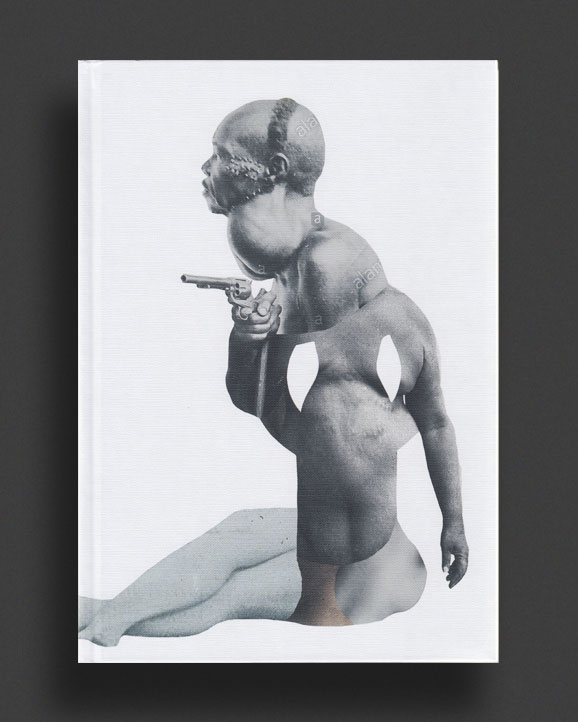
The first full monograph on Frida Orupabo, with images of her collages on paper and aluminum, digital prints, and a new visual essay by the artist.
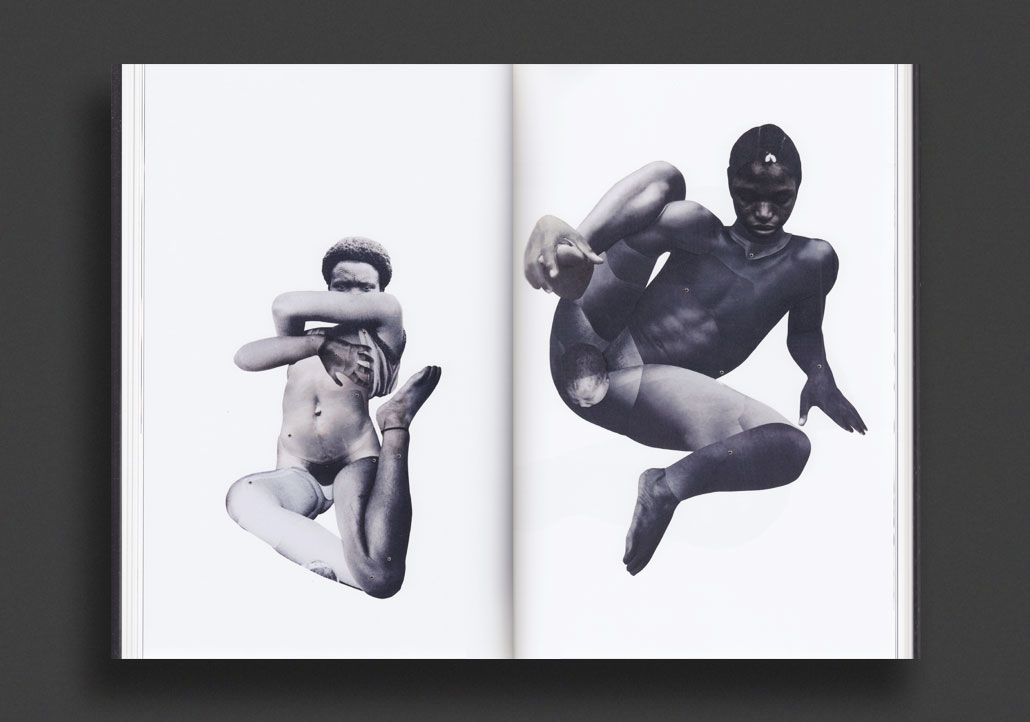
Frida Orupabo's first monograph is published on the occasion of her exhibition at Kunsthall Trondheim. The book contains extensive documentation of her work, including social-media imagery the artist has been producing over the past several years, which forms an integral part of her artistic oeuvre. Essays by Stefanie Hessler, Lola Olufemi, and Legacy Russell provide insights into the relation of the artist's practice to Black visual culture, the archive, and digital life.
In her work, Orupabo explores questions of race, family and heritage, gender, sexuality, violence, and identity, while considering the necessity of visibility for political subjecthood. In her research process, Orupabo mines archives with a colonial history, revisiting images that were created through a racialized lens as well as on digital platforms such as Instagram and YouTube. She creates collages from found material, both digital and physical, and videos that are shown in exhibition spaces and distributed on the same online platforms from which she obtains material. The resulting works take the shape of fragmented Black, mostly female-bodied figures, offering various readings of the stories and lives of the people depicted, many of whom are hardly mentioned in the archives. Through relieving the images of their previous context, Orupabo urges viewers to look at them anew. This look can be unsettling--it is met by a countergaze that negates any monolithic categorization of those being depicted. By bridging historical archives and today's digital platforms, Orupabo foregrounds the social and political structures that determine how we see images, and how these structures organize our thinking. In doing so, her work proposes urgently needed alternatives of seeing otherwise.
2018, English
Hardcover, 136 pages, 28.5 x 31.5 cm
Published by
Forma Edizioni / Firenze
$170.00 - In stock -
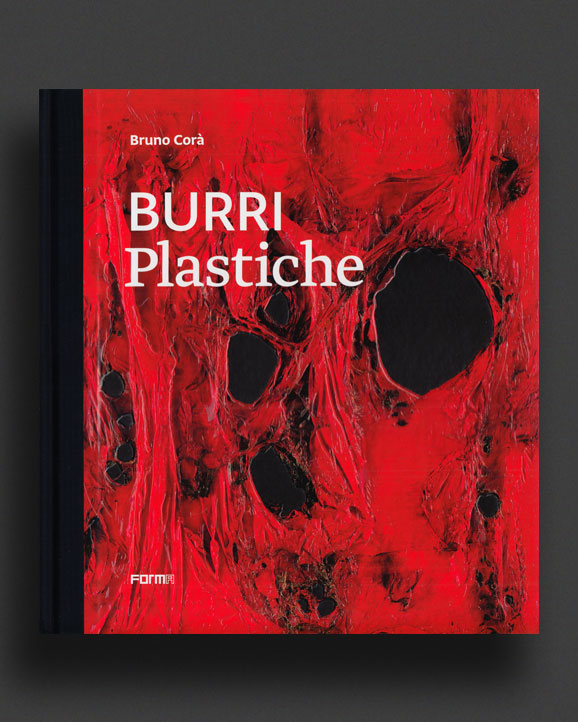
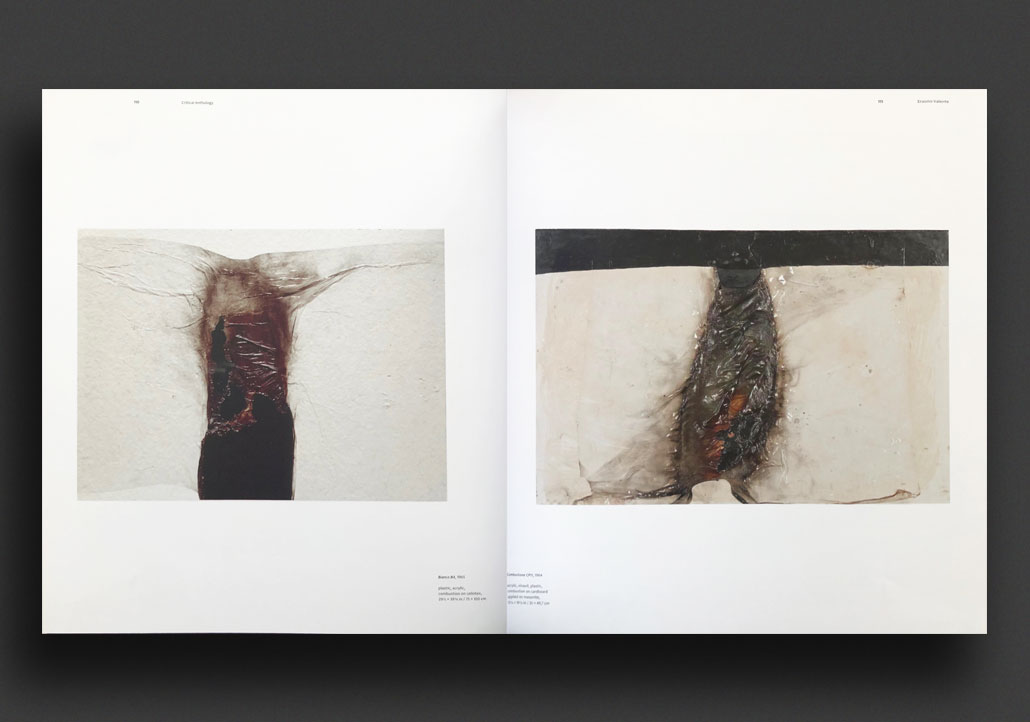
This monograph, edited by noted Italian art critic Bruno Cora and published on the occasion of Art Basel 2018, presents the genesis, critical analysis, and exhibition history of the Combustioni Plastiche [Plastic Combustions] cycle by Alberto Burri. These works span a quarter of a century, from 1953 to 1979, and were created using industrial sheets of different kinds of plastic, with different melting points. They are visceral and technically innovative hybrids, part painting and part sculpture, ranging in size from a few centimetres to larger works installed in places of worship and stage designs for theatre performances. They illuminate Burri's longstanding exploration of the beauty that can be found in mass produced materials, and function as a lens through which we can reassess Burri's entire creative career.
Historical photographs by Claudio Amendola and Ugo Mulas, newspaper articles, and in-depth essays offer a complete analysis of this extraordinary cycle of works in this beautiful over-sized hardcover book.
1998, German
Hardover (w. dust jacket), 140 pages, 30 x 23 cm
1st Edition, Out of print title / used / good
Published by
Prestel / Munich
$70.00 - Out of stock
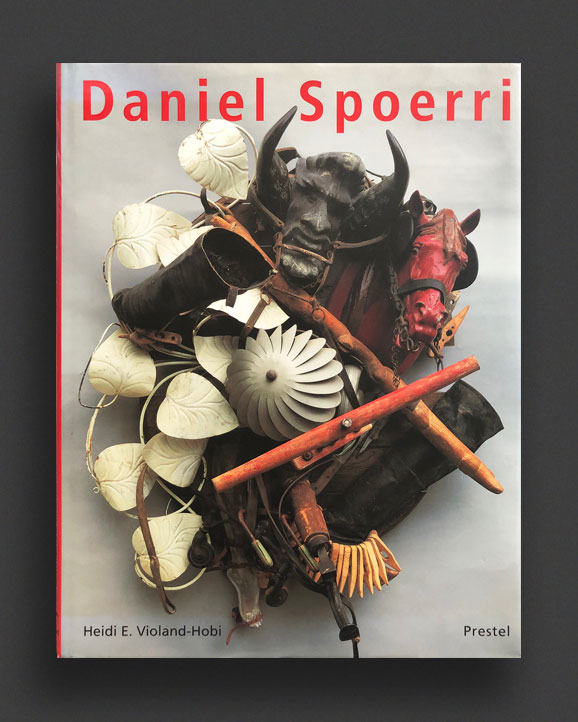
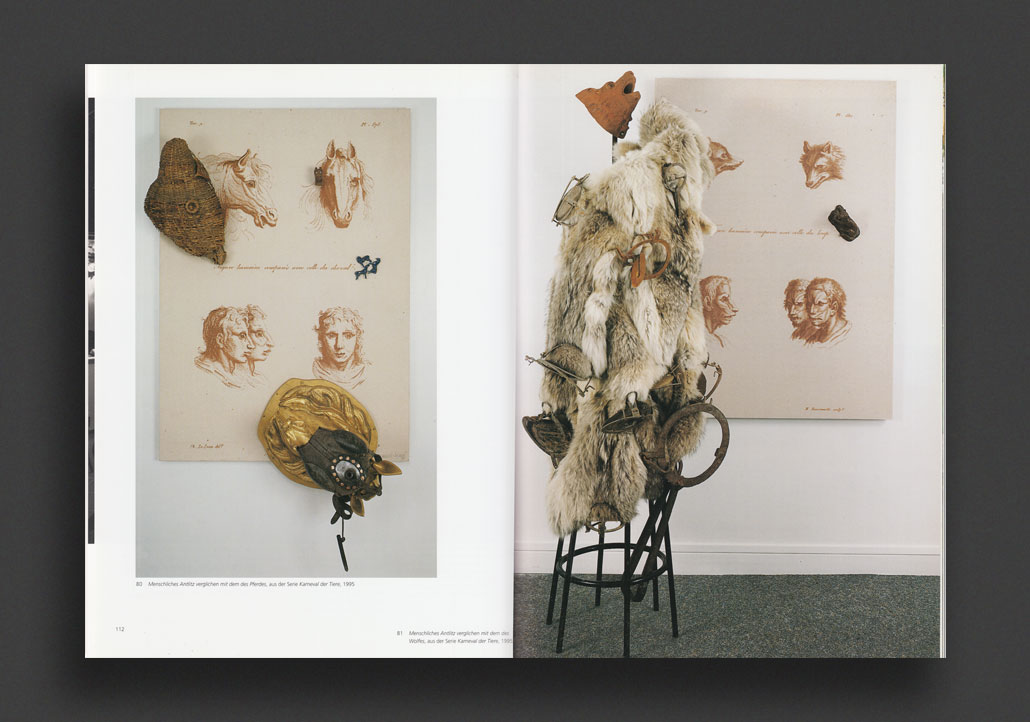
First edition of this excellent first German monograph on Swiss artist Daniel Spoerri, published by Prestel in 1998. Profusely illustrated with Spoerri's incredible artistic history of installations, performances, studio photos, editions, and other activities across important associations with Fluxus, Nouveau réalisme and Eat Art; works across sculpture, assemblage, action, and relief, including a great number of his iconic "snare works". Includes an exhibition history, bibliography and extensive text in German by Heidi E. Violand-Hobi.
Daniel Spoerri (b. 1930) is a Swiss artist and writer born in Romania. Spoerri is best known for his "snare-pictures". In 1960, Spoerri made his first "snare-picture": "objects found in chance positions, in order or disorder (on tables, in boxes, drawers, etc.) are fixed (‘snared’) as they are. Only the plane is changed: since the result is called a picture, what was horizontal becomes vertical. Example: remains of a meal are fixed to the table at which the meal was consumed and the table hung on the wall." His first "snare-picture", Kichka's Breakfast was created from his girlfriend's leftover breakfast. The piece is now in the collection in the Museum of Modern Art in New York. One snare-picture, made in 1964, consists of the remains of a meal eaten by Marcel Duchamp. He also is widely acclaimed for his book, Topographie Anécdotée* du Hasard (An Anecdoted Topography of Chance), a literary analog to his snare-pictures, in which he mapped all the objects located on his table at a particular moment, describing each with his personal recollections evoked by the object, with illustrations by the great Roland Topor. In the 1950s he was active in dance, studying classical dance with Olga Preobrajenska and in 1954 becoming the lead dancer at the State Opera of Bern, Switzerland. He later staged several avant-garde plays including Ionesco's The Bald Soprano and Picasso's surrealist Desire Trapped by the Tail. During that period he met a number of Surrealist artists, including Meret Oppenheim, Jean Tinguely, Marcel Duchamp and Man Ray, and also a number of artists subsequently associated with the Fluxus movement, including Robert Filliou, Dieter Roth and Emmett Williams. Closely associated with the Fluxus art movement, a movement "characterized by a strongly Dadaist attitude, [whose] participants were a divergent group of individualists whose most common theme was their delight in spontaneity and humor." It has been said that his Anecdoted Topography of Chance "seems perfectly to embody aspects of its spirit." Spoerri was also one of the original signers of the manifesto creating the Nouveau réalisme (New Realism) art movement, which involved artists such as Yves Klein, Arman, Martial Raysse, Pierre Restany, Niki de Saint Phalle, César, Jean Tinguely, Mimmo Rotella, Gérard Deschamps, and the Ultra-Lettrists, Francois Dufrêne, Raymond Hains, Jacques de la Villeglé, an avant garde endeavor begun in 1960. His use of everyday life as the main subject-matter of his art reflects his involvement in the New Realism movement. A major theme of Spoerri's artwork is food, and he has called this aspect of his work "Eat Art." This is seen not only in his snare-pictures of eaten meals, but in restaurant performance pieces, for which he cooks for guests and art-critics take on the role of waiters, playing on the idea of the critic bringing the art to the consumers and giving them an understanding of the work.
Good—Very Good copy with light wear and light fading to dust jacket edges.
2021, English
Softcover, 168 pages, 22.5 x 16 cm
Published by
Mousse / Milan
$59.00 - Out of stock
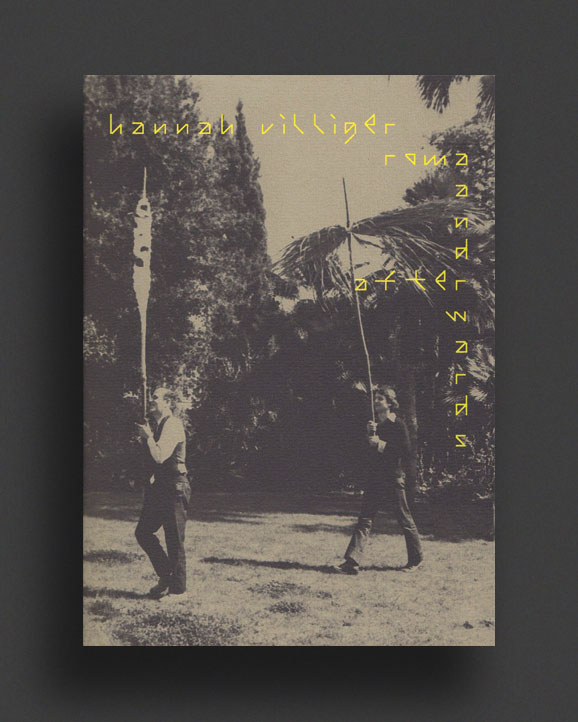
How do we draft a life, make of it a project, do our daily work? In what material and language does it arrive to us? And what if but it is done with one’s own body, and that body becomes this material but not the subject? Villiger’s autofictions––whether sculpture or image, human or vegetal body––prompt such queries. As Griselda Pollock writes brilliantly, ‘here are the collected works that form the project that we name Hannah Villiger. She is not the originating and knowing cause of the work, but the site of its daily compulsion.” –– Quinn Latimer
Hannah Villiger (1951–1997) lived and worked as a resident artist at Istituto Svizzero in Rome from 1974 to 1976. There she realized her early artistic ideas and developed the sculptural approach to photography that would shape all of her later work—namely large-format photographs of her own body arranged into blocks of several images, which show close-ups of sometimes fragmented and abstracted body parts. Villiger viewed herself as a sculptor rather than a photographer, and these Roman years were decisive in shaping her artistic practice. In her studio and in the garden of Villa Maraini, she first developed simple objects inspired by the materials of Arte Povera, then gradually shifted to photography, perceiving it as a more sculptural method.
Published on the occasion of Works/Sculptural at Istituto Svizzero in Rome, Villiger’s first major solo exhibition in Italy, Hannah Villiger: Roma and afterwards expands the horizon of the exhibition with unpublished materials from the artist’s estate as well as images from her working diaries that offer insight into her artistic practice in Rome.
Edited by Gioia Dal Molin.
Texts by Elizabeth Bronfen, Gioia Dal Molin, Quinn Latimer, Thomas Schmutz.
1970, English
Softcover (staple bound), 84 pages, 24 x 23.5 cm
1st Edition, Out of print title / used / very good
Published by
Kineticism Press / New York
$180.00 - Out of stock
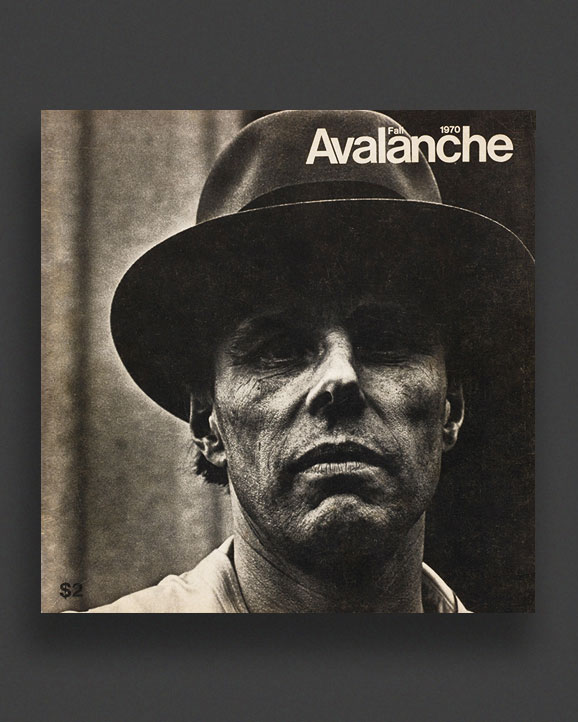
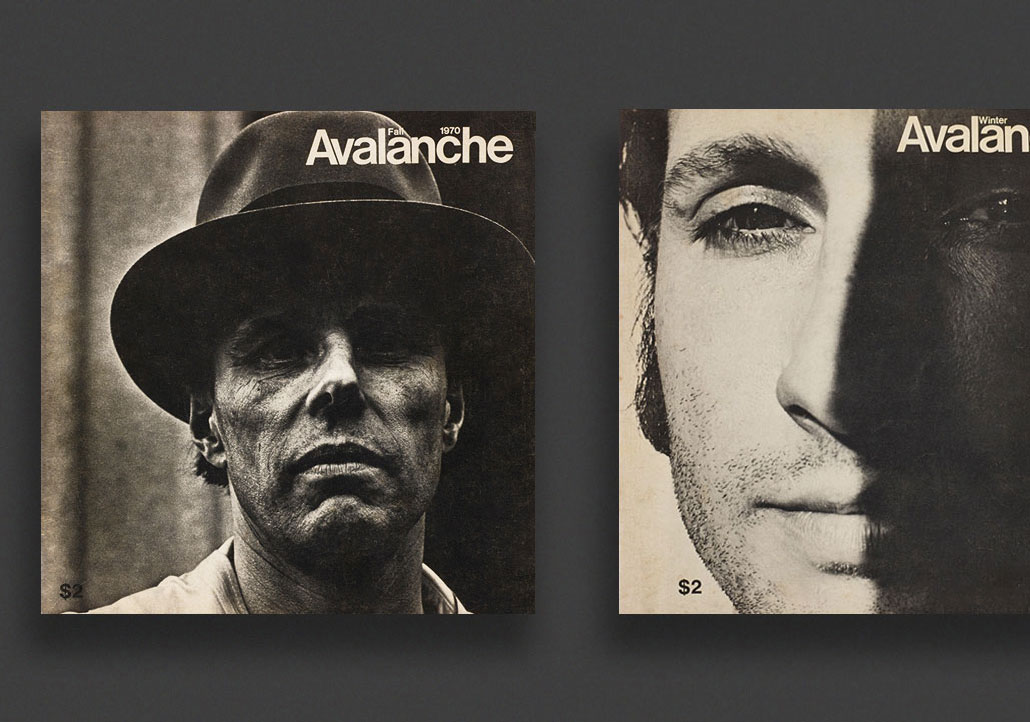
Issue number one of the legendary New York quarterly periodical Avalanche. Featuring Joseph Beuys on cover. Contents: "Rumbles," featuring James Turrell, Keith Arnatt, Douglas Davis, Luis Fernanda Benedit, Paolo Soleri, Isaac Witkin and William Wegman; "Interview: Carl Andre"; "Interview: Jan Dibbets"; "Retrospective: Richard Long"; "Pace and Process," by Robert Morris; "Portrait: Joseph Beuys," by Skunk-Kender; "Body Works," by Willoughby Sharp; "Museums: MOCA, San Francisco"; "Galleries: Reese Palley, San Francisco"; "Discussions with Heizer, Oppenheim, Smithson," by Michael Heizer, Dennis Oppenheim and Robert Smithson. Edited by Liza Bear, published by Willoughby Sharp, designed by Boris Wall Gruphy.
The short-lived New York based art magazine Avalanche, which existed between 1970 and 1976, captured a sense of its time, but also engaged critically with the relationship between printed matter (books, samizdat, etc.) and artwork. Founded by Liza Bear and Willoughby Sharp Avalanche pushed artistic ideas, focusing on new forms of art-making (of it’s day), providing a timely format for art’s movement away from galleries and museums and towards the printed page and emerging discourses surrounding Performance and Land art. The interviews, all conducted by Bear and Sharp, employ a loose but thoughtful approach. Often the articles ran as large as 16 pages. The featured artists were at the time relatively unknown, today they read like a Who’s Who of the avant-garde (in particular as defined by Dia:). The square covers of the early issues feature now iconic portraits of artists; Joseph Beuys, Lawrence Weiner, Yvonne Rainer, Vito Acconci (who had the entire Issue of #6 dedicated to him) and Bruce Nauman.
Featured artists were Vito Acconci, Laurie Anderson, Bill Beckley, Joseph Beuys, Chris Burden, Daniel Buren, Hanne Darboven, Walter De Maria, Jan Dibbets, Barbara Dilley, Simone Forti, Gilbert & George, the Philip Glass Ensemble, Grand Union, Hans Haacke, Jannis Kounellis, Meredith Monk, Barry Le Va, Sol LeWitt, Richard Long, Gordon Matta-Clark, Bruce Nauman, Dennis Oppenheim, Steve Paxton, Yvonne Rainer, Klaus Rinke, Joel Shapiro, Jack Smith, Keith Sonnier, Richard Serra, Robert Smithson, George Trakas, William Wegman, Lawrence Weiner, the Western Front and Jackie Winsor.
Very Good copy with tanning and light wear.
1971, English
Softcover (staple-bound), 114 pages, 24 x 23.5 cm
1st Edition, Out of print title / used / very good
Published by
Kineticism Press / New York
$160.00 - Out of stock
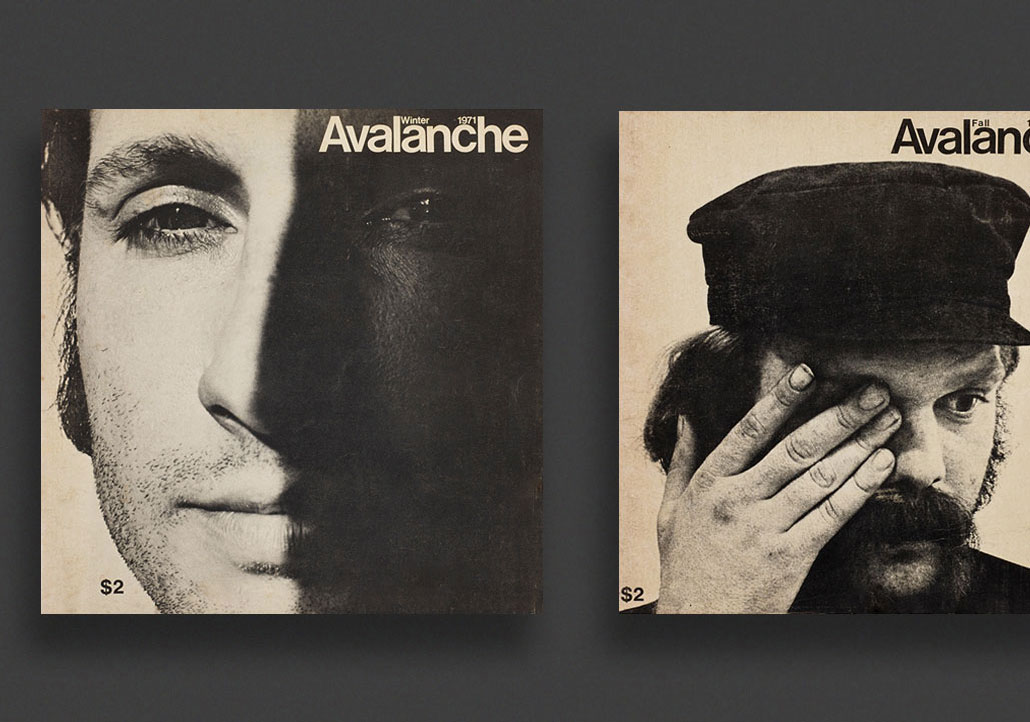
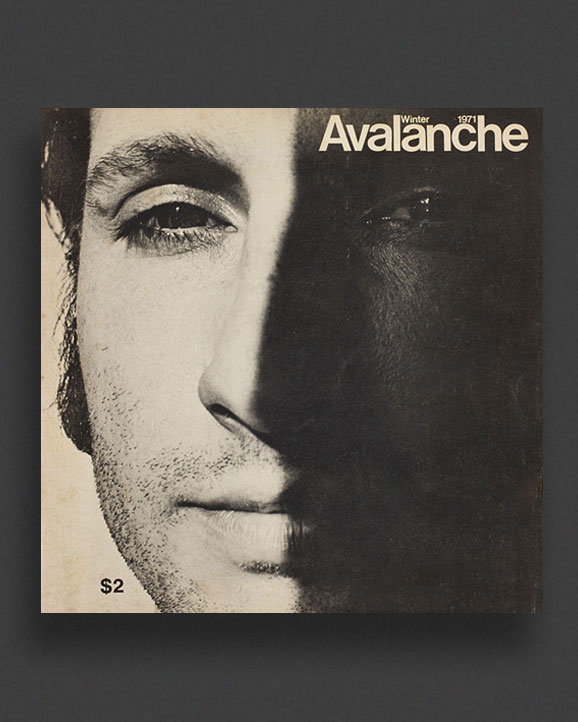
Issue number 2 of the legendary New York quarterly periodical Avalanche, published Winter 1971. Cover features Bruce Nauman. Contents: "Rumbles," featuring Bas jan Ader, John Perreault, Vito Acconci and Paul Kos; "Interview: Bruce Nauman"; "Interview: Terry Fox"; "Klaus Rinke Retrospective"; "Documents: John Van Saun"; "Documents: Dennis Oppenheim"; "Documents: Richard Serra"; "Yves Klein," by Shunk-Kender; "King for a Day," by Bruce McLean; "112 Greene Street," by Alan Saret and Jeffrey Lew; "Mrs. Burke, I Thought You Were Dead," by William Wegman; "Drifts and Conversions," by Vito Acconci; "A Discussion with Acconci, Fox, and Oppenheim," by Vito Acconci, Terry Fox and Dennis Oppenheim. Edited by Liza Bear, published by Willoughby Sharp, designed by Boris Wall Gruphy.
The short-lived New York based art magazine Avalanche, which existed between 1970 and 1976, captured a sense of its time, but also engaged critically with the relationship between printed matter (books, samizdat, etc.) and artwork. Founded by Liza Bear and Willoughby Sharp Avalanche pushed artistic ideas, focusing on new forms of art-making (of it’s day), providing a timely format for art’s movement away from galleries and museums and towards the printed page and emerging discourses surrounding Performance and Land art. The interviews, all conducted by Bear and Sharp, employ a loose but thoughtful approach. Often the articles ran as large as 16 pages. The featured artists were at the time relatively unknown, today they read like a Who’s Who of the avant-garde (in particular as defined by Dia:). The square covers of the early issues feature now iconic portraits of artists; Joseph Beuys, Lawrence Weiner, Yvonne Rainer, Vito Acconci (who had the entire Issue of #6 dedicated to him) and Bruce Nauman.
Featured artists were Vito Acconci, Laurie Anderson, Bill Beckley, Joseph Beuys, Chris Burden, Daniel Buren, Hanne Darboven, Walter De Maria, Jan Dibbets, Barbara Dilley, Simone Forti, Gilbert & George, the Philip Glass Ensemble, Grand Union, Hans Haacke, Jannis Kounellis, Meredith Monk, Barry Le Va, Sol LeWitt, Richard Long, Gordon Matta-Clark, Bruce Nauman, Dennis Oppenheim, Steve Paxton, Yvonne Rainer, Klaus Rinke, Joel Shapiro, Jack Smith, Keith Sonnier, Richard Serra, Robert Smithson, George Trakas, William Wegman, Lawrence Weiner, the Western Front and Jackie Winsor.
Very Good copy with tanning and light wear.
1971, English
Softcover (staple-bound), 94 pages, 24 x 23.5 cm
1st Edition, Out of print title / used / very good
Published by
Kineticism Press / New York
$160.00 - Out of stock
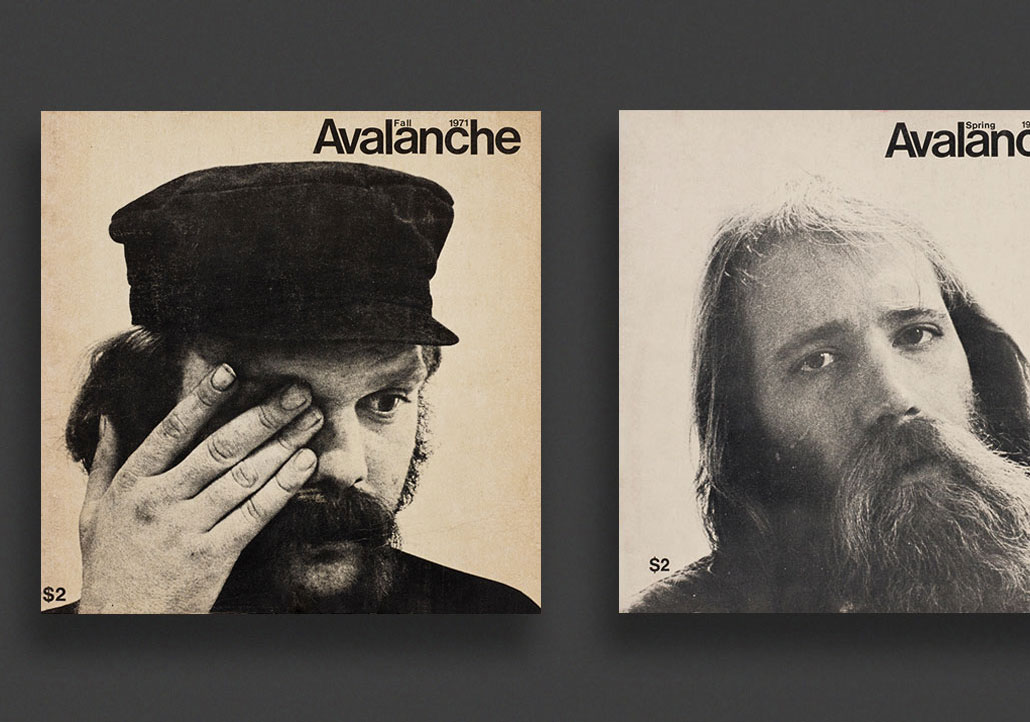
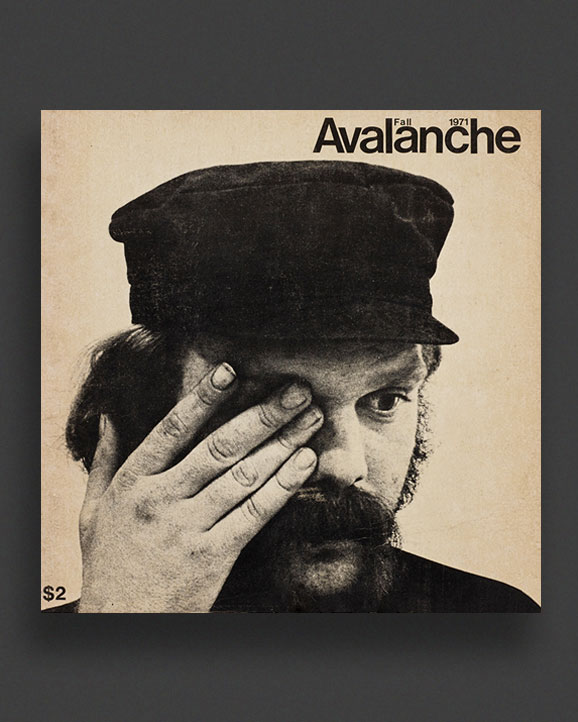
Issue three of the legendary New York quarterly periodical Avalanche, published Fall 1971. Cover features Barry Le Va. Contents: "Rumbles," featuring Jackie Winsor, William Wegman, Allen Ruppersberg, Gilbert & George and Philip Glass; "The Art of Searching," interview with David Tremlett; "Ululations," by Bill Beckley; "Soap," by Joel Fisher; "Jacks," by Gordon Matta-Clark; "Observatory," by Robert Morris; "Christ & Pythagoras," by Italo Scanga; "A Metal Ring Encircling a Tree," interview with Ulrich Ruckriem; "Outcrops," by George Trakas; "Discussions with Barry Le Va," by Liza Béar and Willoughby Sharp. Edited by Liza Béar, published by Willoughby Sharp, design by Boris Wall Gruphy.
The short-lived New York based art magazine Avalanche, which existed between 1970 and 1976, captured a sense of its time, but also engaged critically with the relationship between printed matter (books, samizdat, etc.) and artwork. Founded by Liza Bear and Willoughby Sharp Avalanche pushed artistic ideas, focusing on new forms of art-making (of it’s day), providing a timely format for art’s movement away from galleries and museums and towards the printed page and emerging discourses surrounding Performance and Land art. The interviews, all conducted by Bear and Sharp, employ a loose but thoughtful approach. Often the articles ran as large as 16 pages. The featured artists were at the time relatively unknown, today they read like a Who’s Who of the avant-garde (in particular as defined by Dia:). The square covers of the early issues feature now iconic portraits of artists; Joseph Beuys, Lawrence Weiner, Yvonne Rainer, Vito Acconci (who had the entire Issue of #6 dedicated to him) and Bruce Nauman.
Featured artists were Vito Acconci, Laurie Anderson, Bill Beckley, Joseph Beuys, Chris Burden, Daniel Buren, Hanne Darboven, Walter De Maria, Jan Dibbets, Barbara Dilley, Simone Forti, Gilbert & George, the Philip Glass Ensemble, Grand Union, Hans Haacke, Jannis Kounellis, Meredith Monk, Barry Le Va, Sol LeWitt, Richard Long, Gordon Matta-Clark, Bruce Nauman, Dennis Oppenheim, Steve Paxton, Yvonne Rainer, Klaus Rinke, Joel Shapiro, Jack Smith, Keith Sonnier, Richard Serra, Robert Smithson, George Trakas, William Wegman, Lawrence Weiner, the Western Front and Jackie Winsor.
Very Good copy with tanning and light wear.
1972, English
Softcover (staple-bound), 84 pages, 24 x 23.5 cm
1st Edition, Out of print title / used / very good
Published by
Kineticism Press / New York
$160.00 - Out of stock
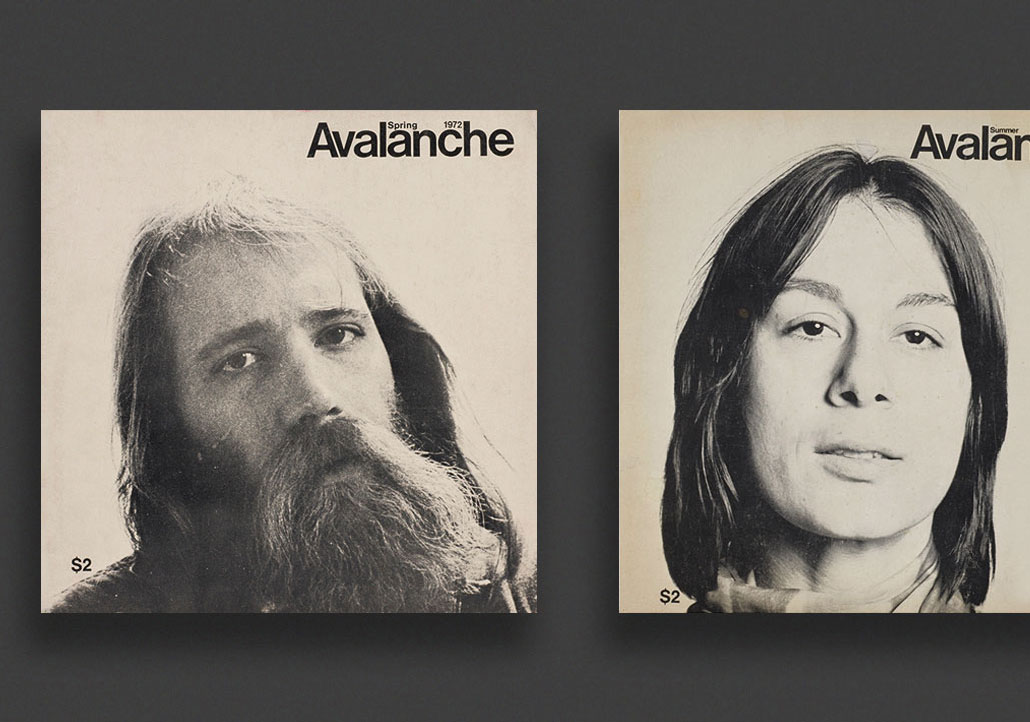
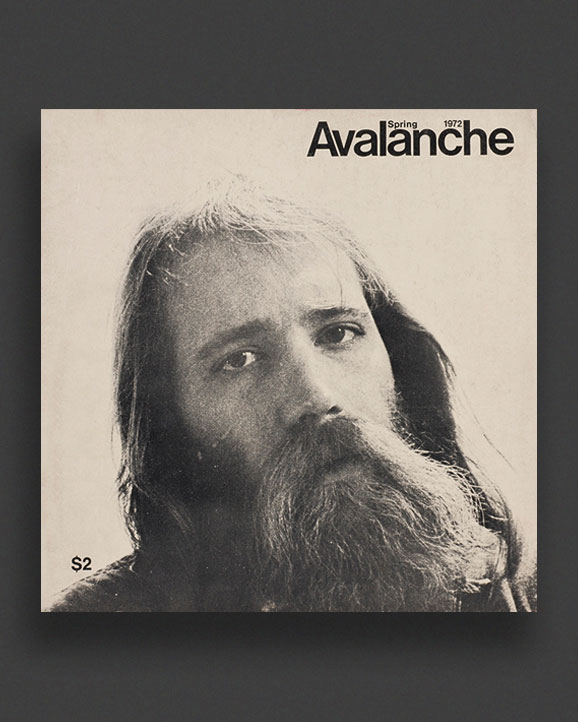
Issue number four of the legendary New York quarterly periodical Avalanche, published Spring 1972. Cover featuring Lawrence Weiner. Contents: "Rumbles," featuring Bill Beckley, Marcel Duchamp, Daniel Buren and Hanne Darboven; "Jackie Winsor: An Interview," by Liza Béar; "Sol LeWitt: Page Drawings"; "Howard Fried: The Cheshire Cat," by Liza Béar; "Alice Aycock: Four 36-38 Exposures"; "Stanley Brouwn: Steps"; "Franz Erhard Walther: First Workset"; "Hanne Darboven: Words"; "Walter de Maria" ; "Lawrence Weiner at Amsterdam," by Willoughby Sharp. Edited by Liza Bear, published by Willoughby Sharp, designed by Boris Wall Gruphy.
The short-lived New York based art magazine Avalanche, which existed between 1970 and 1976, captured a sense of its time, but also engaged critically with the relationship between printed matter (books, samizdat, etc.) and artwork. Founded by Liza Bear and Willoughby Sharp Avalanche pushed artistic ideas, focusing on new forms of art-making (of it’s day), providing a timely format for art’s movement away from galleries and museums and towards the printed page and emerging discourses surrounding Performance and Land art. The interviews, all conducted by Bear and Sharp, employ a loose but thoughtful approach. Often the articles ran as large as 16 pages. The featured artists were at the time relatively unknown, today they read like a Who’s Who of the avant-garde (in particular as defined by Dia:). The square covers of the early issues feature now iconic portraits of artists; Joseph Beuys, Lawrence Weiner, Yvonne Rainer, Vito Acconci (who had the entire Issue of #6 dedicated to him) and Bruce Nauman.
Featured artists were Vito Acconci, Laurie Anderson, Bill Beckley, Joseph Beuys, Chris Burden, Daniel Buren, Hanne Darboven, Walter De Maria, Jan Dibbets, Barbara Dilley, Simone Forti, Gilbert & George, the Philip Glass Ensemble, Grand Union, Hans Haacke, Jannis Kounellis, Meredith Monk, Barry Le Va, Sol LeWitt, Richard Long, Gordon Matta-Clark, Bruce Nauman, Dennis Oppenheim, Steve Paxton, Yvonne Rainer, Klaus Rinke, Joel Shapiro, Jack Smith, Keith Sonnier, Richard Serra, Robert Smithson, George Trakas, William Wegman, Lawrence Weiner, the Western Front and Jackie Winsor.
Very Good copy with tanning and light wear.
1972, English
Softcover (staple-bound), 66 pages, 24 x 23.5 cm
1st Edition, Out of print title / used / very good
$160.00 - Out of stock
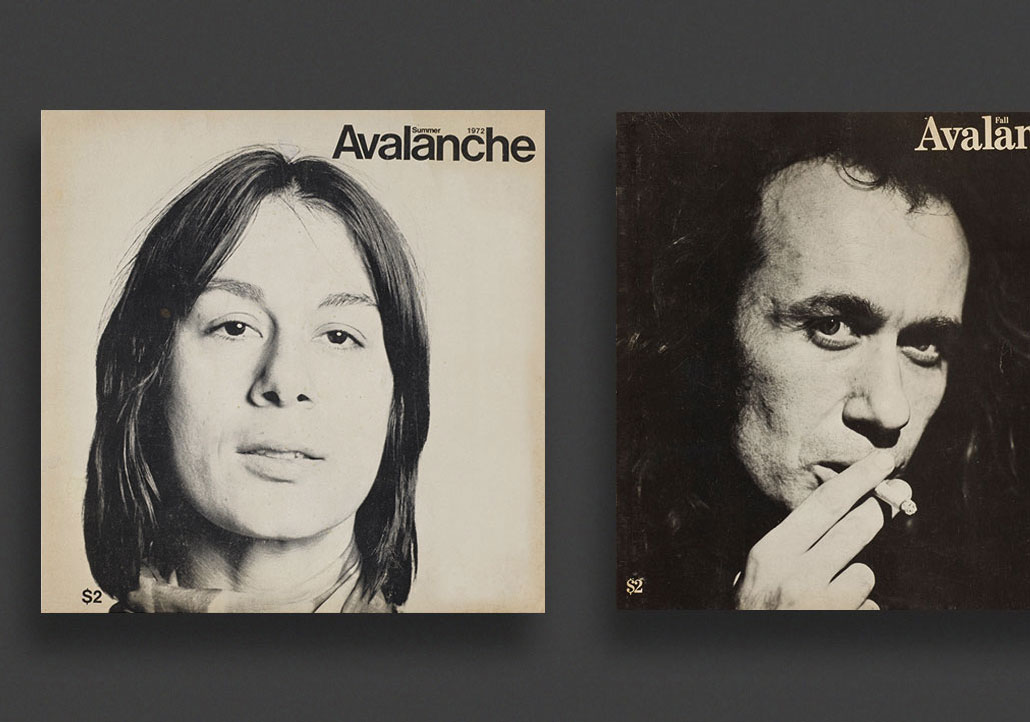
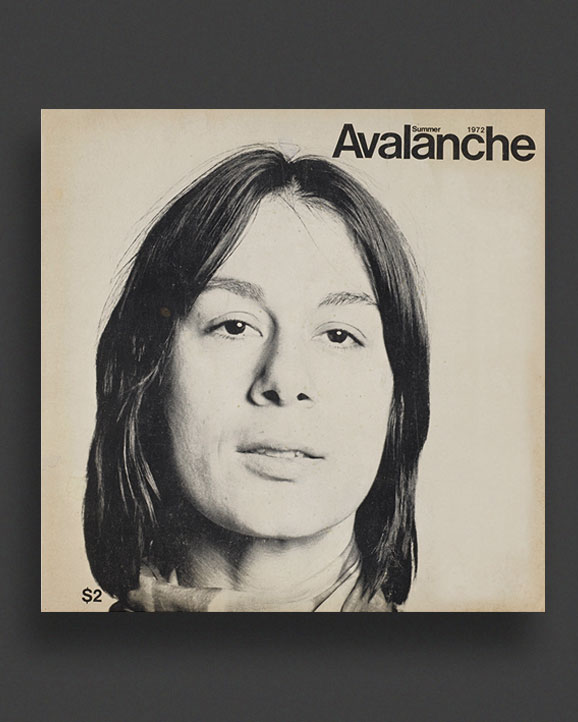
Issue number five of the legendary New York quarterly periodical Avalanche, published Summer 1972. Cover features Yvonne Rainer. Contents: "Rumbles," featuring Hiro Kosaka, Trisha Brown and Marcel Broodthaers; "Braco Dimitrijevic: Casual Passers-by I Met"; "Direct Demokratie: Joseph Beuys Talking at Documenta 5"; "Structure and Sensibility: An Interview with Jannis Kounellis," by Willoughby Sharp; "Phil Glass: An Interview in Two Parts" by Liza Béar and Willoughby Sharp; "Illustrated Time - Proscenium II," by Keith Sonnier, Tina Girouard, Suzanne Harris, Richard Landry and Kurt Munkacs; "The Performer as Persona: An Interview with Yvonne Rainer". Edited by Liza Bear, published by Willoughby Sharp, designed by Boris Wall Gruphy.
The short-lived New York based art magazine Avalanche, which existed between 1970 and 1976, captured a sense of its time, but also engaged critically with the relationship between printed matter (books, samizdat, etc.) and artwork. Founded by Liza Bear and Willoughby Sharp Avalanche pushed artistic ideas, focusing on new forms of art-making (of it’s day), providing a timely format for art’s movement away from galleries and museums and towards the printed page and emerging discourses surrounding Performance and Land art. The interviews, all conducted by Bear and Sharp, employ a loose but thoughtful approach. Often the articles ran as large as 16 pages. The featured artists were at the time relatively unknown, today they read like a Who’s Who of the avant-garde (in particular as defined by Dia:). The square covers of the early issues feature now iconic portraits of artists; Joseph Beuys, Lawrence Weiner, Yvonne Rainer, Vito Acconci (who had the entire Issue of #6 dedicated to him) and Bruce Nauman.
Featured artists were Vito Acconci, Laurie Anderson, Bill Beckley, Joseph Beuys, Chris Burden, Daniel Buren, Hanne Darboven, Walter De Maria, Jan Dibbets, Barbara Dilley, Simone Forti, Gilbert & George, the Philip Glass Ensemble, Grand Union, Hans Haacke, Jannis Kounellis, Meredith Monk, Barry Le Va, Sol LeWitt, Richard Long, Gordon Matta-Clark, Bruce Nauman, Dennis Oppenheim, Steve Paxton, Yvonne Rainer, Klaus Rinke, Joel Shapiro, Jack Smith, Keith Sonnier, Richard Serra, Robert Smithson, George Trakas, William Wegman, Lawrence Weiner, the Western Front and Jackie Winsor.
Very Good copy with tanning and light wear.
1972, English
Softcover (staple-bound), 66 pages, 24 x 23.5 cm
1st Edition, Out of print title / used / very good
Published by
Kineticism Press / New York
$160.00 - Out of stock
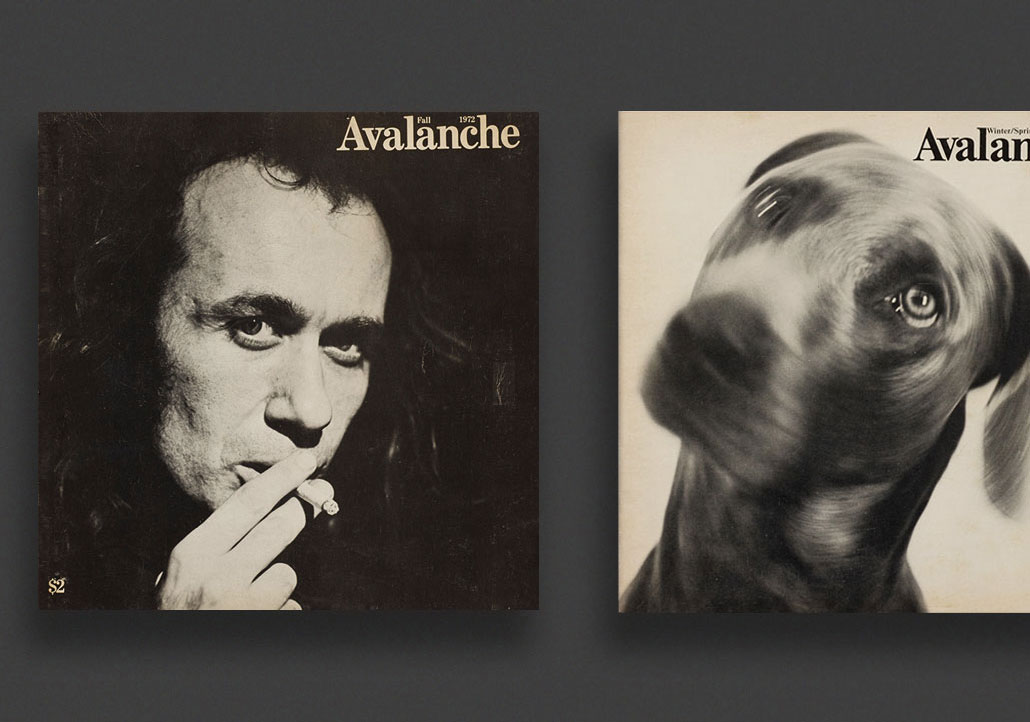
Special issue of the legendary New York quarterly periodical Avalanche focusing on the work of Vito Acconci. Includes performance descriptions written by artist and documentary photographs, biography, and bibliography. Interview between the artist and Liza Bear. Sections: "Introduction: Notes on Performing a Space"; "Early Work: Movement Over a Page"; "Early Work: Moving My Body into Place"; "Body as Place - Moving in on Myself, Performing Myself"; "Peopled Space - Performing Myself Though Another Agent"; "Occupied Zone - Moving in, Performing on Another Agent"; "Concentration - Container - Assimilation"; "Power Field - Exchange Points - Transformations"; "Excerpts from Tapes with Liza Bear"; "Biography"; "Bibliography"; "Index." Edited by Liza Bear, published by Willoughby Sharp, design by Boris Wall Gruphy, Henry Post, Richard Falk.
The short-lived New York based art magazine Avalanche, which existed between 1970 and 1976, captured a sense of its time, but also engaged critically with the relationship between printed matter (books, samizdat, etc.) and artwork. Founded by Liza Bear and Willoughby Sharp Avalanche pushed artistic ideas, focusing on new forms of art-making (of it’s day), providing a timely format for art’s movement away from galleries and museums and towards the printed page and emerging discourses surrounding Performance and Land art. The interviews, all conducted by Bear and Sharp, employ a loose but thoughtful approach. Often the articles ran as large as 16 pages. The featured artists were at the time relatively unknown, today they read like a Who’s Who of the avant-garde (in particular as defined by Dia:). The square covers of the early issues feature now iconic portraits of artists; Joseph Beuys, Lawrence Weiner, Yvonne Rainer, Vito Acconci (who had the entire Issue of #6 dedicated to him) and Bruce Nauman.
Featured artists were Vito Acconci, Laurie Anderson, Bill Beckley, Joseph Beuys, Chris Burden, Daniel Buren, Hanne Darboven, Walter De Maria, Jan Dibbets, Barbara Dilley, Simone Forti, Gilbert & George, the Philip Glass Ensemble, Grand Union, Hans Haacke, Jannis Kounellis, Meredith Monk, Barry Le Va, Sol LeWitt, Richard Long, Gordon Matta-Clark, Bruce Nauman, Dennis Oppenheim, Steve Paxton, Yvonne Rainer, Klaus Rinke, Joel Shapiro, Jack Smith, Keith Sonnier, Richard Serra, Robert Smithson, George Trakas, William Wegman, Lawrence Weiner, the Western Front and Jackie Winsor.
Very Good copy with tanning and light wear.
1972, English
Softcover (staple-bound), 84 pages, 24 x 23.5 cm
1st Edition, Out of print title / used / very good
Published by
Kineticism Press / New York
$160.00 - Out of stock
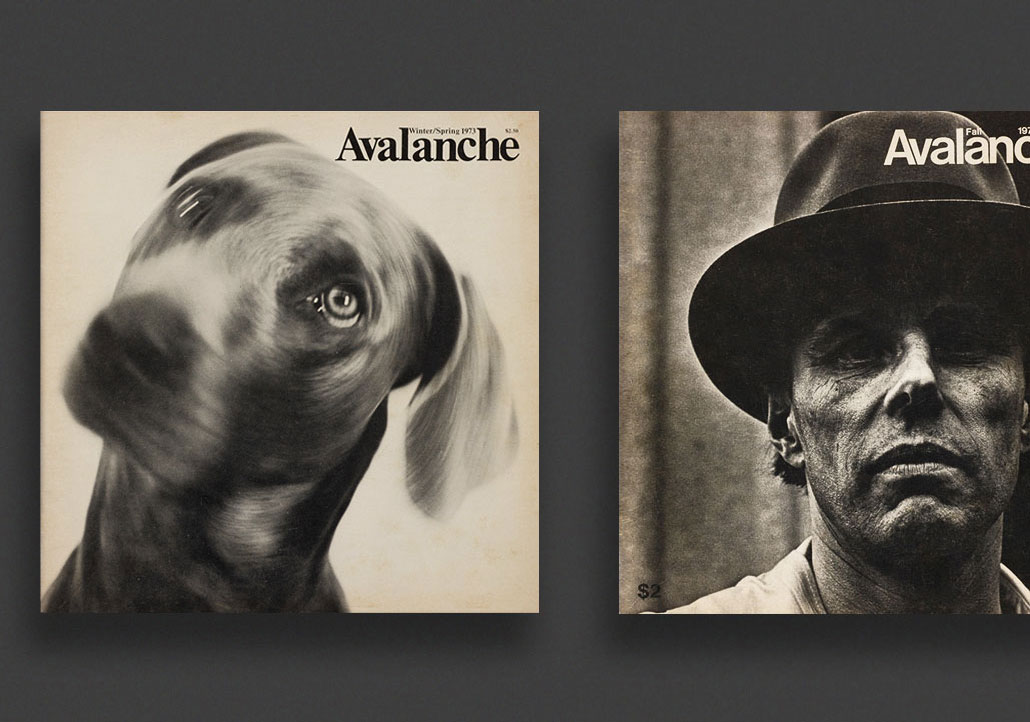
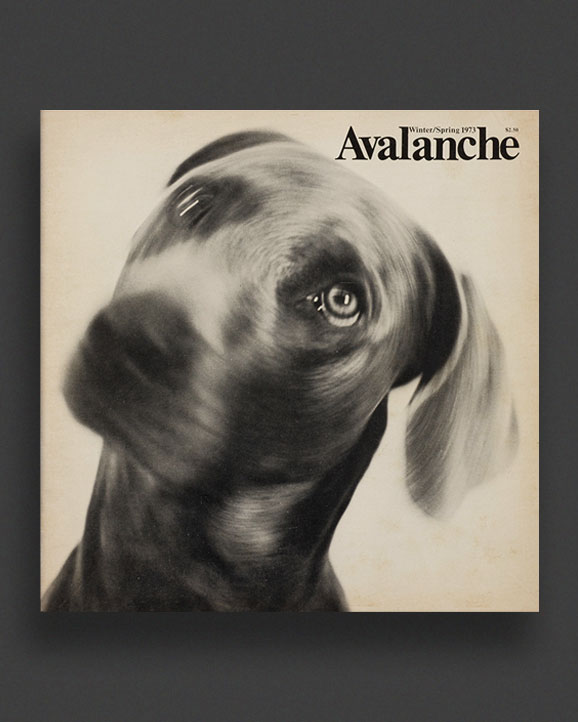
Issue number seven of the legendary New York quarterly periodical Avalanche, published Winter Spring 1973, featuring a William Wegman cover. Contents: "Rumbles," featuring Chris Burden, Jennifer Bartlett and Urs Lüthi; "The Gold-diggers of '84: An Interview with General Idea" by Willoughby Sharp, Ron Gabe, Jorge Saia, A.A. Bronson, Granada Gazelle, P.J., Noah Dakota, Marcel Idea, Ms. Paige, Myth Honey and Ms. Generality; "Different Strokes for Different Folks: An Interview with Van Schley," and includes a bound in portfolio of loose elements; "Shuck and Jive: An Interview with Lowell Darling" by Willoughby Sharp; "... a kind of Huh? A interview with Edward Ruscha" by Willoughby Sharp; "Man Ray, Do You Want To... An Interview with William Wegman". Edited by Liza Bear, published by Willoughby Sharp, designed by Boris Wall Gruphy.
The short-lived New York based art magazine Avalanche, which existed between 1970 and 1976, captured a sense of its time, but also engaged critically with the relationship between printed matter (books, samizdat, etc.) and artwork. Founded by Liza Bear and Willoughby Sharp Avalanche pushed artistic ideas, focusing on new forms of art-making (of it’s day), providing a timely format for art’s movement away from galleries and museums and towards the printed page and emerging discourses surrounding Performance and Land art. The interviews, all conducted by Bear and Sharp, employ a loose but thoughtful approach. Often the articles ran as large as 16 pages. The featured artists were at the time relatively unknown, today they read like a Who’s Who of the avant-garde (in particular as defined by Dia:). The square covers of the early issues feature now iconic portraits of artists; Joseph Beuys, Lawrence Weiner, Yvonne Rainer, Vito Acconci (who had the entire Issue of #6 dedicated to him) and Bruce Nauman.
Featured artists were Vito Acconci, Laurie Anderson, Bill Beckley, Joseph Beuys, Chris Burden, Daniel Buren, Hanne Darboven, Walter De Maria, Jan Dibbets, Barbara Dilley, Simone Forti, Gilbert & George, the Philip Glass Ensemble, Grand Union, Hans Haacke, Jannis Kounellis, Meredith Monk, Barry Le Va, Sol LeWitt, Richard Long, Gordon Matta-Clark, Bruce Nauman, Dennis Oppenheim, Steve Paxton, Yvonne Rainer, Klaus Rinke, Joel Shapiro, Jack Smith, Keith Sonnier, Richard Serra, Robert Smithson, George Trakas, William Wegman, Lawrence Weiner, the Western Front and Jackie Winsor.
Very Good copy with tanning and light wear.
1990, English / French
Softcover, 128 pages, 20.7 x 30.7 cm
1st Edition, Out of print title / used / very good
Published by
Espace Lyonnais d'art Contemporain / Lyon
$80.00 - Out of stock
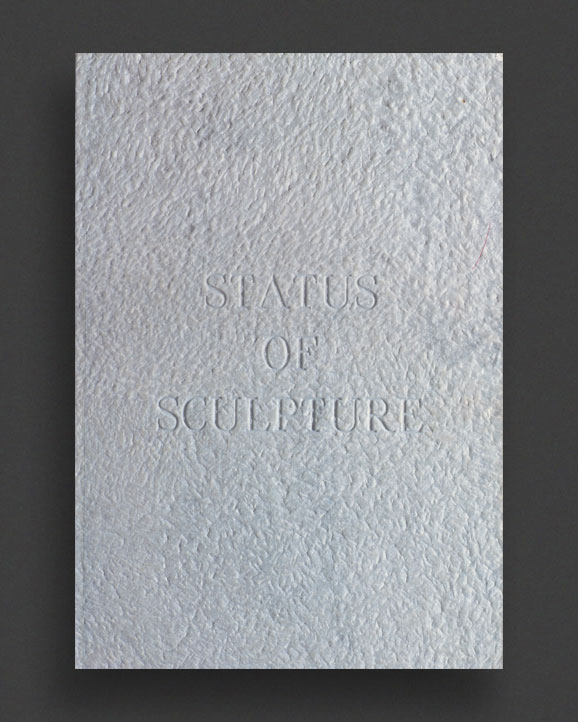
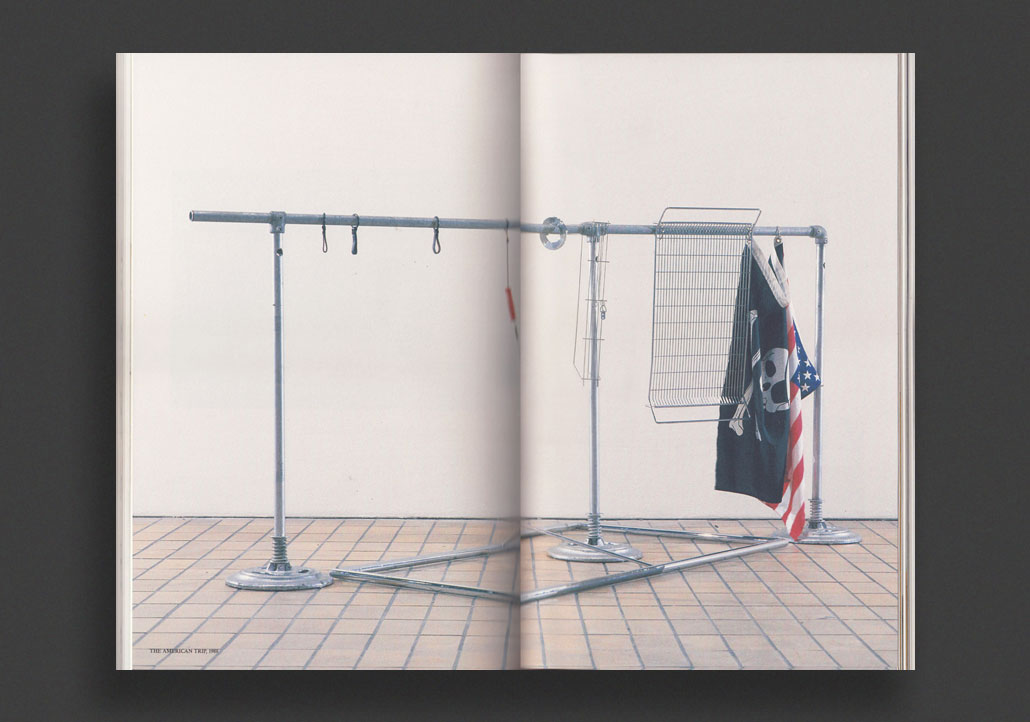
Scarce catalogue published on the occasion of the exhibition Status of Sculpture, curated by Bernard Brunon at Espace Lyonnais d’art Contemporain, Lyon, 1990. The exhibition featured the work of ten American artists: Robert Gober, Tishan Hsu, Laurie Parsons, Jon Kessler, Patty Martori, Cady Noland, Jennifer Bolande, Nancy Shaver, Christian Marclay, and Dustin Shuler. Profusely illustrated throughout with many reproductions of each artist's work in colour and b/w, accompanied by biographies, catalogue of exhibited works, and opening essay by Bernard Brunon.
Very Good copy.
1969, English / French / German / Italian
Softcover binder (w. spring-loaded plate), 170 pages, 31.5 x 24 cm
1st Edition, Out of print title / used / very good
Published by
Kunsthalle Bern / Bern
$600.00 - Out of stock
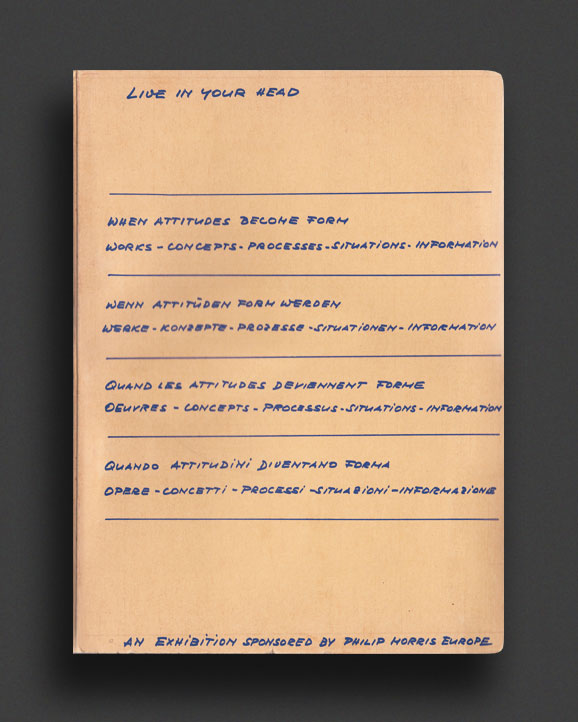
One of the great art documents of the 20th century, the original printing of the legendary catalogue for "Live in Your Head : When Attitudes Become Form", curated by Harald Szeemann at the Kunsthalle Bern in Switzerland, March 22 - April 27, 1969. Very rare original 1969 edition!
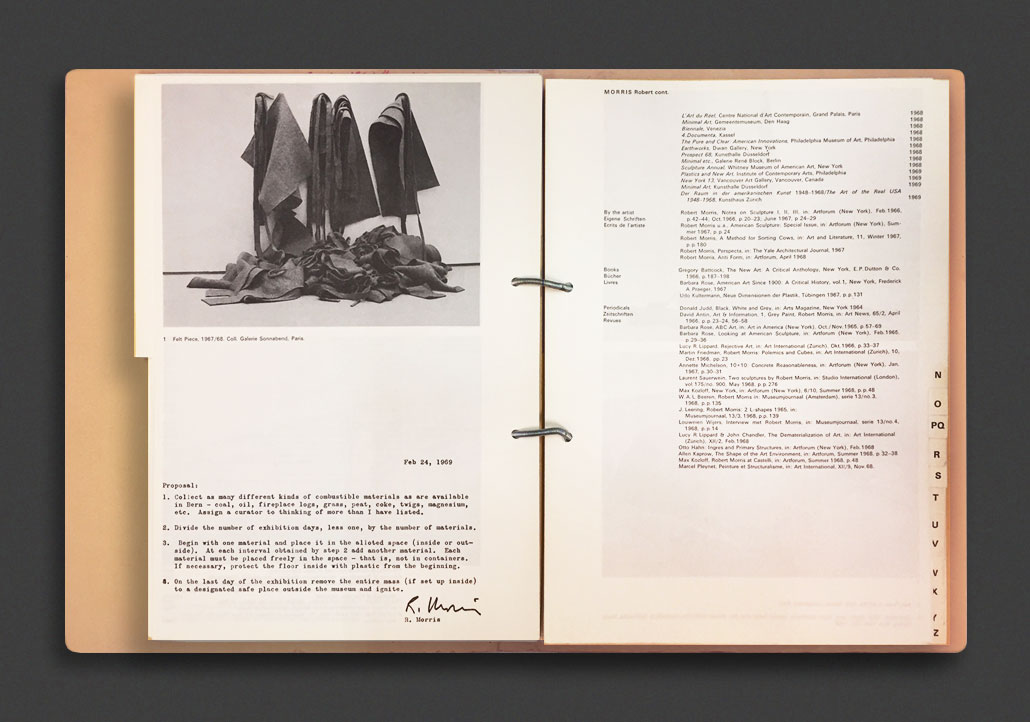
Sponsored by the Philip Morris tobacco company, this was an important, extensive and primary exhibition dedicated to the amalgam of Pop, Minimal and Conceptual Art in Europe and the United States. The catalogue itself is designed and produced by Szeemann, and printed in Switzerland by Stämpfli & Cie in Bern. Alongside those of Seth Siegelaub, Szeemann's now historical catalogues changed the way exhibition publishing performed. Presented as a indexical binder (spring-bound with a metal plate) forming an index of alphabetical artist pages and accompanying texts. Includes a biography, bibliography, illustrations and portrait for each artist.
Texts by Harald Szeemann, Scott Burton, Grégoire Müller and Tommaso Trini.
Artists include Carl Andre, Giovanni Anselmo, Richard Artschwager, Thomas Bang, Jared Bark, Robert Barry, Joseph Beuys, Mel Bochner, Marinus Boezem, Bill Bollinger, Michael Buthe, Pier Paolo Calzolari, Paul Cotton, Alighiero Boetti, Hanne Darboven, Jan Dibbets, Ger Van Elk, Rafael Ferrer, Barry Flanagan, Hans Haacke, Michael Heizer, Douglas Huebler, Paolo Icaro, Alain Jacquet, Neil Jenney, Jo Ann Kaplan, Eva Hesse, Edward Kienholz, Yves Klein, Joseph Kosuth, Jannis Kounellis, Gary B. Kuehn, Sol LeWitt, Richard Long, Roelof Louw, Bruce McLean, Walter De Maria, David Medalla, Mario Merz, Robert Morris, Bruce Nauman, Claes Oldenburg, Dennis Oppenheim, Paul Pechter, Panamarenko, Michelangelo Pisteletto, Emilio Prini, Markus Raetz, Allen Ruppersberg, Reiner Ruthenbeck, Robert Ryman, Alan Saret, Sarkis, Jean-Frédéric Schnyder, Fred Sandback, Richard Serra, Robert Smithson, Keith Sonnier, Richard Tuttle, Frank Viner, Erhard Walther, Lawrence Weiner, William Wegman, William Wiley and Gilberto Zorio.
Texts in English, French, German and Italian.
Light wear and marking to folder covers, internal rubbing from metal plate, previous owners name and "69" to top of inside cover, otherwise very good copy throughout, complete.
2022, English
Hardcover (w. dust jacket), 448 pages, 15.4 x 23.5 cm
Published by
Zone Books / New York
$59.00 - Out of stock
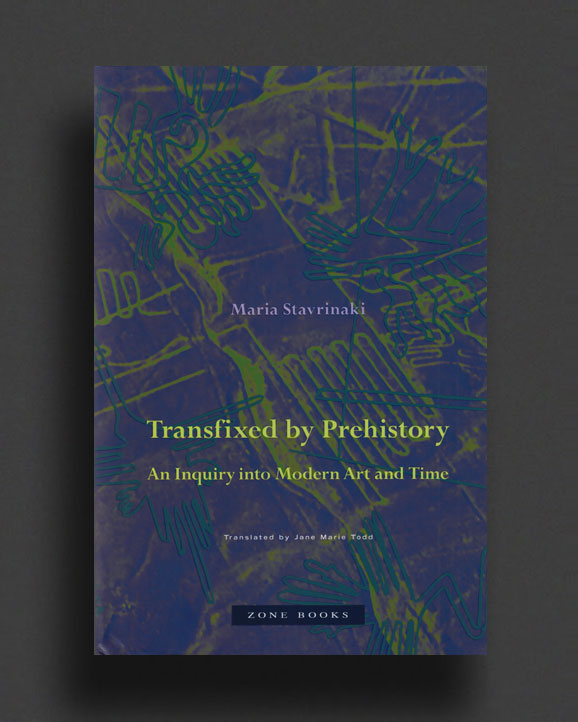
Prehistory is an invention of the late nineteenth century. In that moment of technological progress and acceleration of production and circulation, three major Western narratives about time took shape. One after another, these new fields of inquiry delved into the obscure immensity of the past: first, to surmise the age of the Earth; second, to find the point of emergence of human beings; and third, to ponder the age of art. Maria Stavrinaki considers the inseparability of these accounts of temporality from the disruptive forces of modernity. She asks what a history of modernity and its art would look like if considered through these three interwoven inventions of the longue durée. Transfixed by Prehistory attempts to articulate such a history, which turns out to be more complex than an inevitable march of progress leading up to the Anthropocene. Rather, it is a history of stupor, defamiliarization, regressive acceleration, and incessant invention, since the “new” was also found in the deep sediments of the Earth. Composed of as much speed as slowness, as much change as deep time, as much confidence as skepticism and doubt, modernity is a complex phenomenon that needs to be rethought. Stavrinaki focuses on this intrinsic tension through major artistic practices (Cézanne, Matisse, De Chirico, Ernst, Picasso, Dubuffet, Smithson, Morris, and contemporary artists such as Pierre Huyghe and Thomas Hirschhorn), philosophical discourses (Bataille, Blumenberg, and Jünger), and the human sciences. This groundbreaking book will attract readers interested in the intersections of art history, anthropology, psychoanalysis, mythology, geology, and archaeology.
“Transfixed by Prehistory delivers a stunning reconceptualization of the relationship between time and technology in industrial capitalism.” —Devin Fore
“From Cézanne to Smithson via Paleolithic mandibles, Stavrinaki mobilizes an unlikely group of artifacts to explore the core hermeneutic questions of an Anthropocene epoch in which the symbolic and the geological have become intertwined, if not indistinguishable. Through readings that are not just anecdotally rich and methodologically exemplary but also utterly compelling formally, Transfixed by Prehistory delivers a stunning reconceptualization of the relationship between time and technology in industrial capitalism.” —Devin Fore, Princeton University
1986, English
Softcover, 94 pages, 28 x 24 cm
1st Edition, Out of print title / used / good
Published by
Art Gallery of South Australia / Adelaide
$45.00 - Out of stock
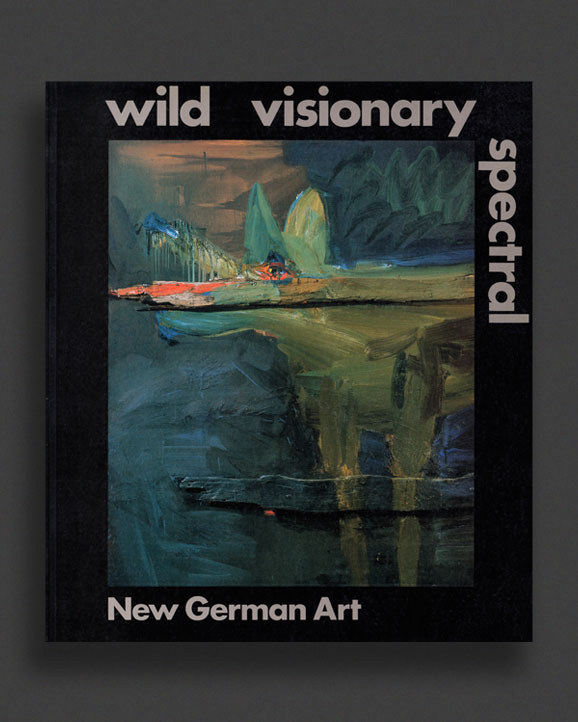
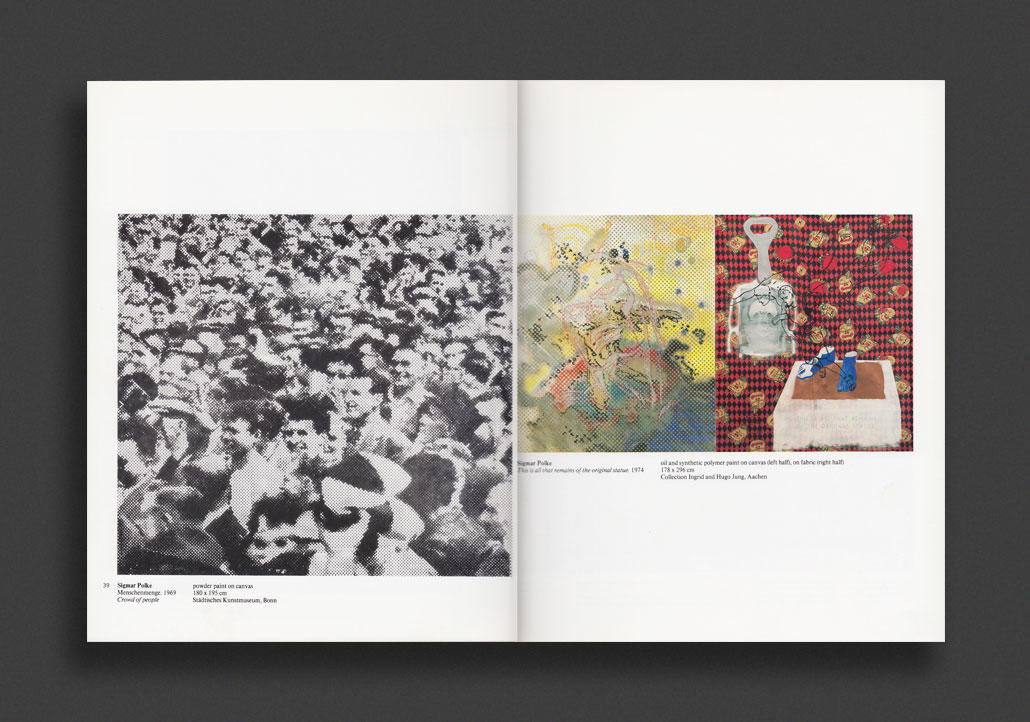
Catalogue published to accompany the exhibition Wild Visionary Spectral : New German Art, organised by the Art Gallery of South Australia, Adelaide, 28 Feb — 20 April, 1986, before traveling Australia and Wellington, New Zealand in 1986. Profusely illustrated in colour throughout with the works 13 contemporary German artists, including Jörg Immendorff, Sigmar Polke, Gerhard Richter, Franz Erhard Walther, Georg Baselitz, Joesph Beuys, A. R. Penck, Anslem Kiefer. Includes bios and texts by Ron Radford (on the relationship between German and Australian art), Karl Ruhrberg, and Wolfgang Max Faust.
Good—Very Good copy with some light general wear.
2021, English
Softcover, 88 pages, 18 x 11 cm
Published by
David Zwirner Books / New York
$25.00 - Out of stock
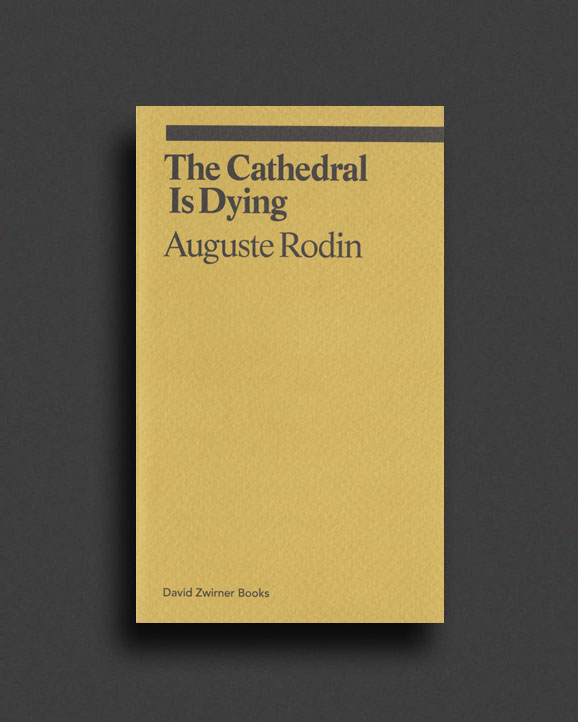
Master sculptor Auguste Rodin’s illuminating writings on cathedrals in France are especially relevant and significant following the recent fire at Notre Dame.
In this volume, the writer and Rodin scholar Rachel Corbett selects excerpts from the famous sculptor’s book Cathedrals of France, first published in 1914, just before the outbreak of World War I. Cathedrals were central to the way Rodin thought about his art: he saw them as visual metaphors for the human figure, among the finest examples of craftsmanship known to modern man, and as a model for how to live and work-slowly, brick by brick.
Here, Corbett takes the fire at Notre Dame and the concerns over its restoration as an entry point in an exploration of Rodin’s cathedrals. Rodin adamantly opposed restoration, as he felt it often did more damage than the original injury. (Many of the cathedrals that Rodin looks at in his texts were, in fact, bombed during the war.) But while he rails against various restoration efforts as evidence that “we are letting our cathedrals die,” the book, with its tenderly rendered sketches and written portraits, is itself an attempt to preserve these cathedrals. The selection of texts in this volume is a reminder-as is the tragedy of Notre Dame-of why we ought to appreciate these feats of architecture, whether or not they are still standing today.
About the Authors
Auguste Rodin (1840-1917) is known for an innovative sculptural style in which the traces of his working process are conserved in the works' final form. His career began in Brussels and later shifted to Paris, where he undertook public commissions that dovetailed with academic trends affirming clarity in sculptural language. These afforded him the support to pursue bolder aesthetic experimentation in private. Rodin's attention to partial figures and fragmentation and his privileging of emotive pathos over allegory are hallmarks of his groundbreaking and influential style.
Rachel Corbett is the author of You Must Change Your Life: The Story of Rainer Maria Rilke and Auguste Rodin, which won the 2016 Marfield Prize, the National Award for Arts Writing. Her essays and journalism have appeared in The New Yorker, The New York Times Magazine, The Atlantic, New York magazine, and other publications. She wrote the introduction to Rainer Maria Rilke's Letters to a Young Painter (2017), published by David Zwirner Books.
2022, English
Softcover, 240 pages, 20.9 x 15 cm
Published by
Whitechapel / London
$40.00 - Out of stock
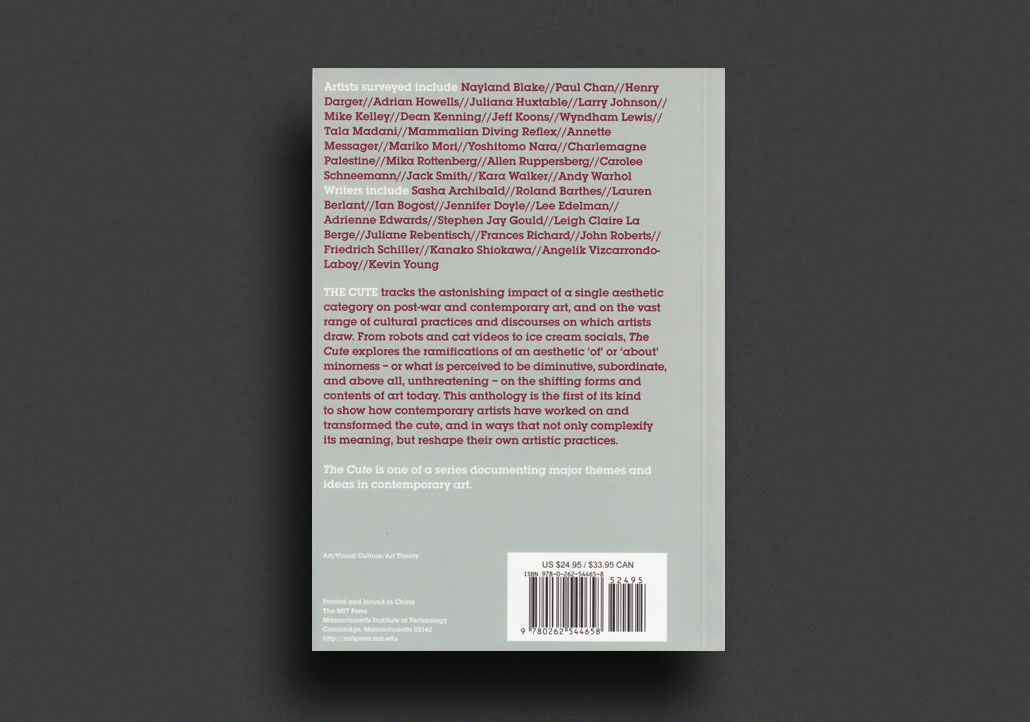
The Cute tracks the astonishing impact of a single aesthetic category on post-war and contemporary art, and on the vast range of cultural practices and discourses on which artists draw. From robots and cat videos to ice cream socials, The Cute explores the ramifications of an aesthetic 'of' or 'about' minorness - or what is perceived to be diminutive, subordinate, and above all, unthreatening - on the shifting forms and contents of art today. This anthology is the first of its kind to show how contemporary artists have worked on and transformed the cute, and in ways that not only complexify its meaning, but reshape their own artistic practices.
Artists surveyed include Peggy Ahwesh, Cosima Von Bonin, Nayland Blake, Paul Chan, Henry Darger, Adrian Howells, Juliana Huxtable, Larry Johnson, Mike Kelley, Dean Kenning, Wyndham Lewis, Jeff Koons, Sean-Kierre Lyons, Mammalian Diving Reflex, Tala Madani, Annette Messager, Mariko Mori, Charlemagne Palestine, Mika Rottenberg, Allen Ruppersberg, Jack Smith, Carolee Schneeman, Kara Walker, Andy Warhol, Yoshitomo Nara
Writers include Sasha Archibald, Roland Barthes, Leigh Claire La Berge, Ian Bogost, Lauren Berlant, Jennifer Doyle, Lee Edelman, Stephen Jay Gould, Angelik Vizcarrondo-Laboy, Bridget Minamore, Juliane Rebentisch, Frances Richard, John Roberts, Friedrich Schiller, Peter Schjeldahl, Kanako Shiokawa
is the author of Ugly Feelings (Harvard, 2005), Our Aesthetic Categories: Zany, Cute, Interesting (Harvard, 2012), and Theory of the Gimmick: Aesthetic Judgment and Capitalist Form (Belknap/Harvard, 2020). She is the Andrew W. Mellon Professor of English at the University of Chicago.
2022, English / French
Softocver, 160 pages, 25.5 x 18 cm
Published by
Walther König / Köln
$57.00 - Out of stock
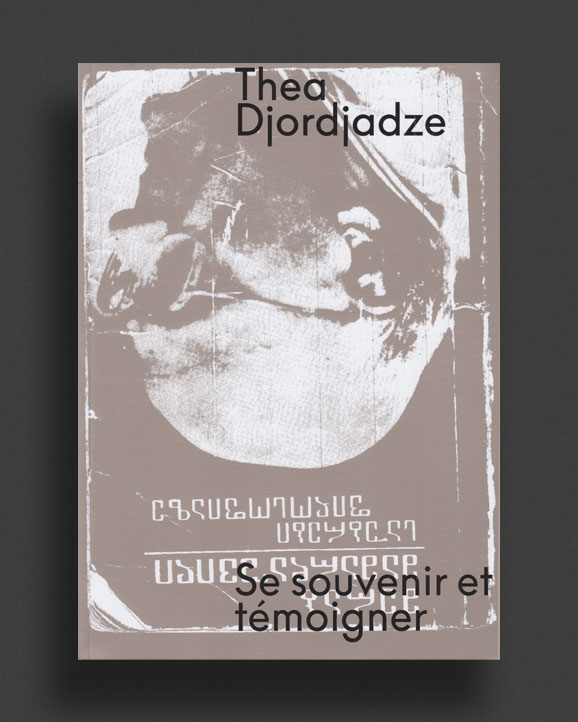
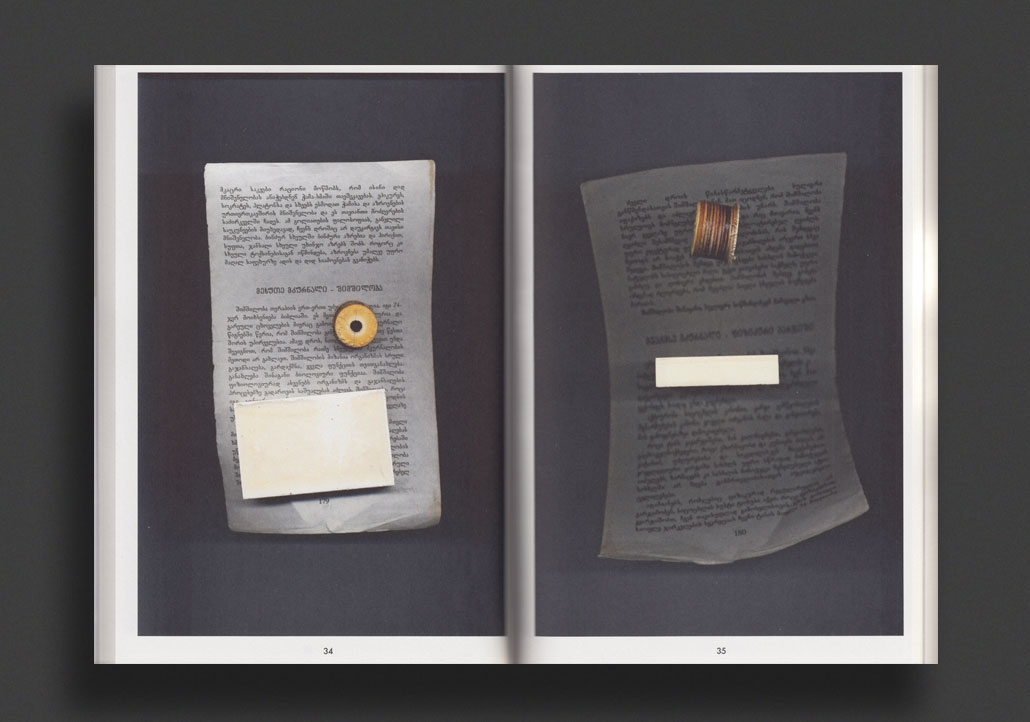
Published on occasion of Thea Djordjadze's first exhibition in a museum in France at the Musée d’art moderne et contemporain de Saint-Étienne (MAMC+), 5 Feb – 15 May 2022. Entitled ‘Remember and Witness’ (‘Se souvenir et témoigner’ in French), this eponymous catalogue unveils materials, archives and writings from the artist in the first part, while the second combines exhibition views from the Gropius Bau in Berlin and MAMC+ to apprehend her sense of installation and composition in two opposite spaces. An interview with the artist by MAMC+ director, Aurélie Voltz, and an essay by the art historian, Thomas Boutoux, question her practice, influences and works.
English and French text.
1963, German
Hardcover (clothbound), 216 pages, 24.5 x 20.5 cm
1st Edition, Out of print title / used / good
Published by
Schuler Verlagsgesellschaft / Stuttgart
$25.00 - Out of stock
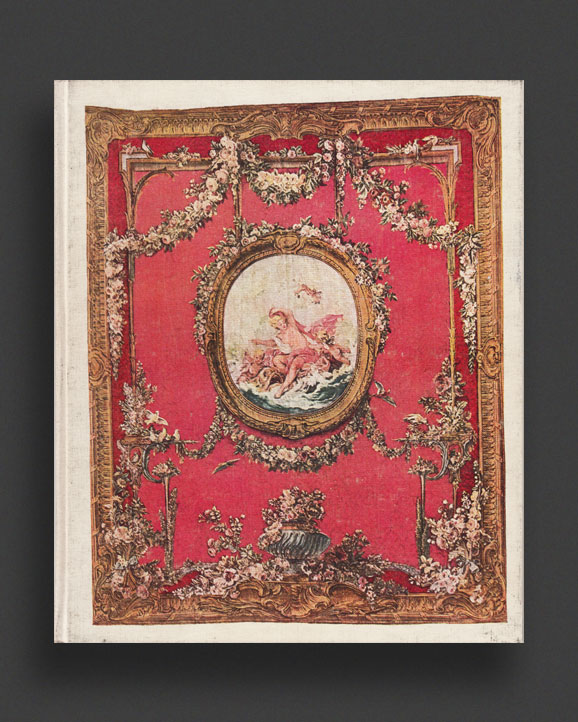
Published in 1963, lavishly illustrated book of 100 Treasures from museums around the world, spanning art history, antiquity, archaeology, handicrafts, biology, architecture, with text by Dr. Traudl Seifert, edited by J.E. Schuler. Includes the throne of Tutankhamun, Order of the Golden Fleece, Venus von Milo, Nike von Samothrake, Ming dynasty vase, Arabian celestial globe, the Taj Mahal, Meißner porcelain, Louis XIV pistols, Renaissance Venetian cabinet, statue of Uta von Naumburg, Venus von Milo, Altar of Verdun, Nike von Samothrake, The Tabatière rifle, the bust of Nefertiti, The lady and the Unicorn
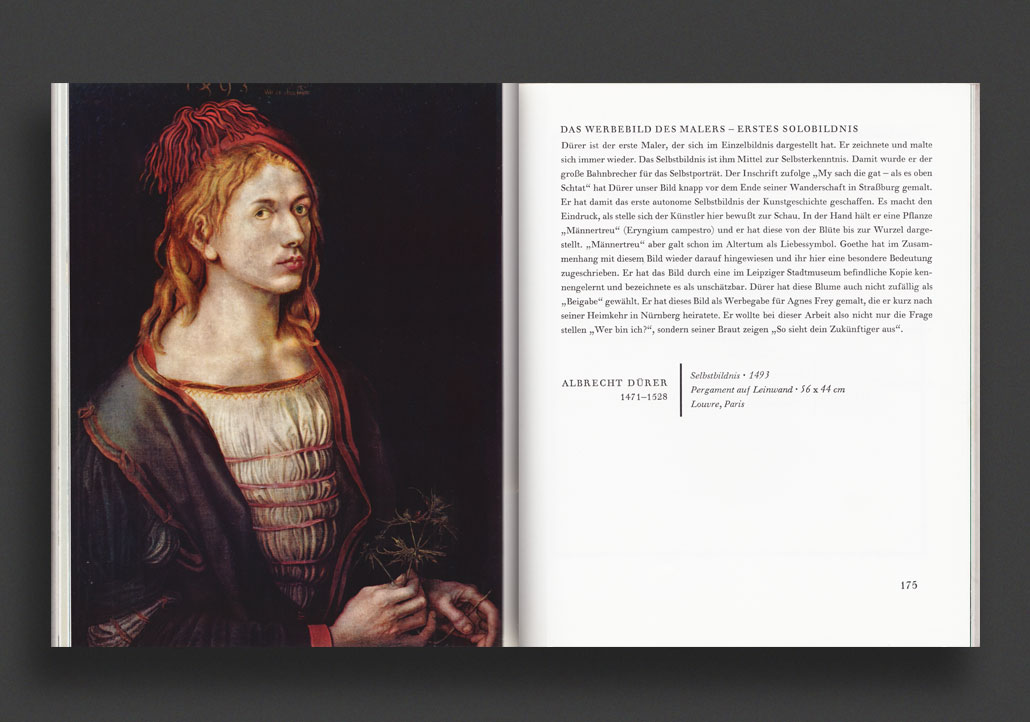
... the work of Michelangelo, Veit Stoss, Aristide Maillol, Tilman Riemenschneider, Albrecht Dürer, and many more.
Good copy with general wear and rubbing to linen boards.
2021, English / German
Hardcover, 64 pages, 24 x 30 cm
Published by
Walther König / Köln
Staatliche Graphische Sammlungen / München
$68.00 - Out of stock
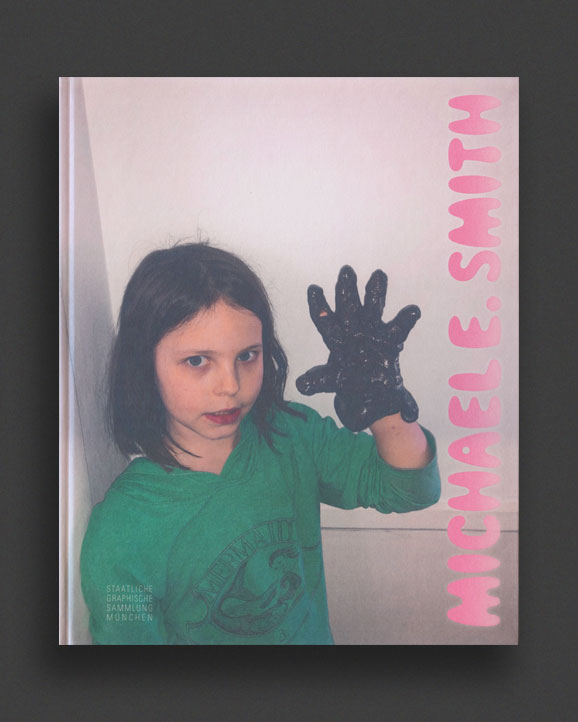
Catalogue published to accompany Michael E. Smith’s exhibition at the Staatliche Graphische Sammlungen, München, September 2—October 24, 2021.
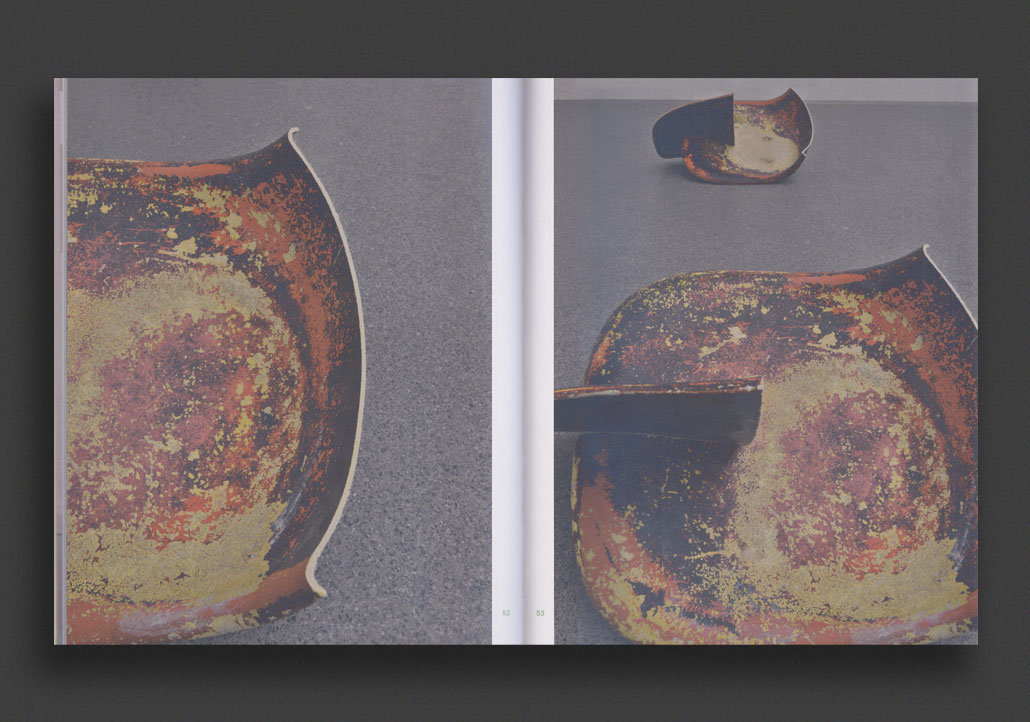
Michael E. Smith makes sculptures out of cast-offs, waste and other residues of our consumer society. He assembles and manipulates this found material in an unusual way. He isolates objects, makes changes to their form and seeks out the limits of their imaginative power. His presentations are characterised by an intense yet sparse choreography of the exhibition space.
Extensively illustrated in colour throughout.
1986, English
Softcover, 116 pages, 27 x 18 cm
Out of print title / used / good
Published by
The MIT Press / Massachusetts
ICA / Boston
$65.00 - Out of stock
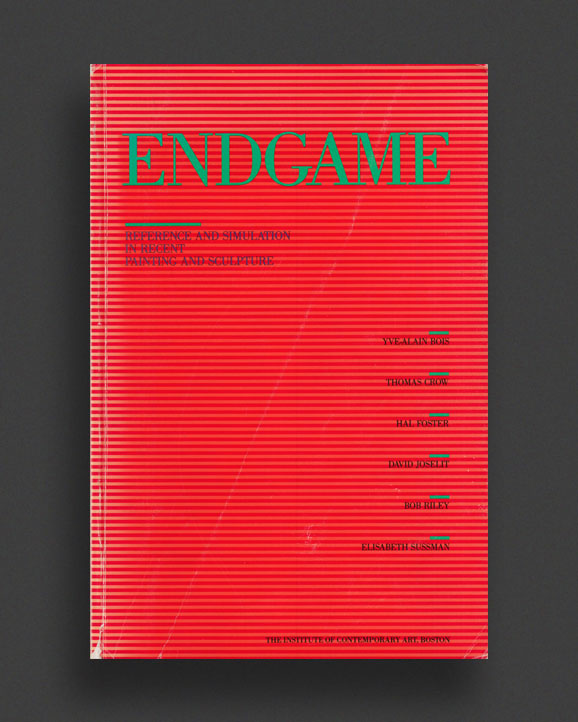
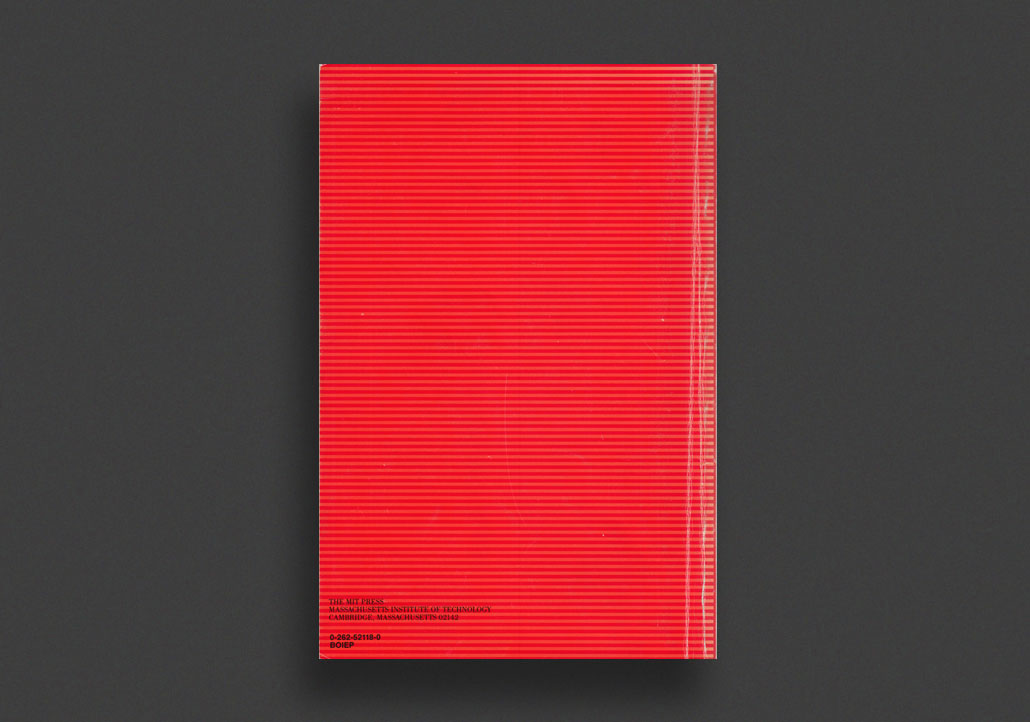
Scarce copy of this long out-of-print seminal catalogue published by MIT Press on the occasion of the exhibition of the same name at the ICA Boston in 1986, curated by Yve-Alain Bois and Elisabeth Sussman.
The six illustrated essays by some of today's most noted art historians and critics which comprise Endgame provide the first comprehensive discussion of reference in contemporary art and the commodification of the art object. The interrrelated concerns of painters Sherry Levine, Ross Bleckner, Peter Halley, and Philip Taaffe — who ironically adapt the visual strategies of earlier modern artists—and those of sculptors Jon Kessler, General Idea, Jeff Koons, Joel Otterson, and Haim Steinbach—who use consumer objects and their mode of representation as the raw material of their sculpture—are the sources of the authors' varied and acute arguments on this theme of the political and social economy of the image.
Contents: The return of Hank Herron / by Thomas Crow; Painting, the task of mourning / by Yve-Alain Bois; The last picture show / by Elisabeth Sussman; Modern leisure / by David Joselit; The future of an illusion, or, The contemporary artist as cargo cultist / by Hal Foster; Notes on new media theater / by Bob Riley. Includes an exhibition checklist. Preface by David A. Ross
Good copy, with some tanning to cover, light wear/marking.
2022, English
Softcover, 68 pages, 30 x 21 cm
Published by
Bill / Brussels
$68.00 - Out of stock
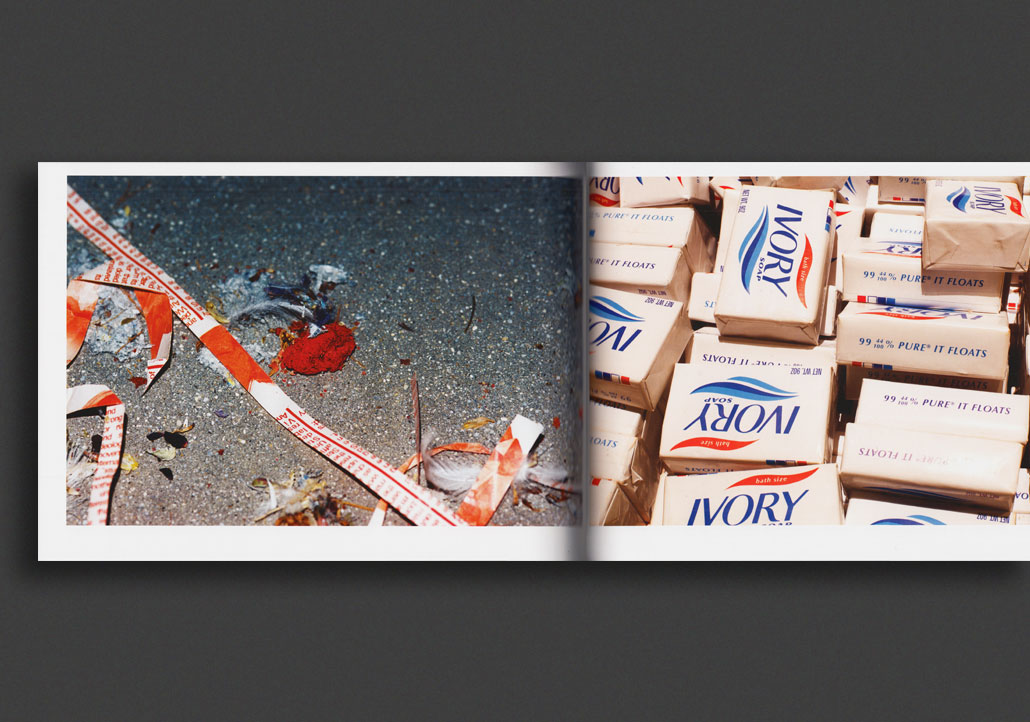
‘Cut a Door in the Wolf’ is an exhibition in the form of a single, site-specific artwork by Jason Dodge. In exploring systems made up of organic and inorganic matter, he is interested in the refuse that humans shed every day: micro-and macro-landscapes made up of the familiar and often discarded things that result from our individual and collective habits. Dodge recognises this not as a singular artistic process, but rather as a shared landscape in which cause and effect are circular phenomena that belong to everyone. He therefore investigates the potential of his audience as producers of meaning. This publication documents the work through a series of photographs.
Published on the occasion of the exhibition by Jason Dodge at MACRO Museum for Contemporary Art of Rome. Photography Adrianna Glaviano. Book design Julie Peeters.
1982, English
Softcover, 34 pages, 17.5 x 22 cm
1st Edition, Out of print title / used / very good
Published by
The Alternative Museum / New York
$100.00 - In stock -
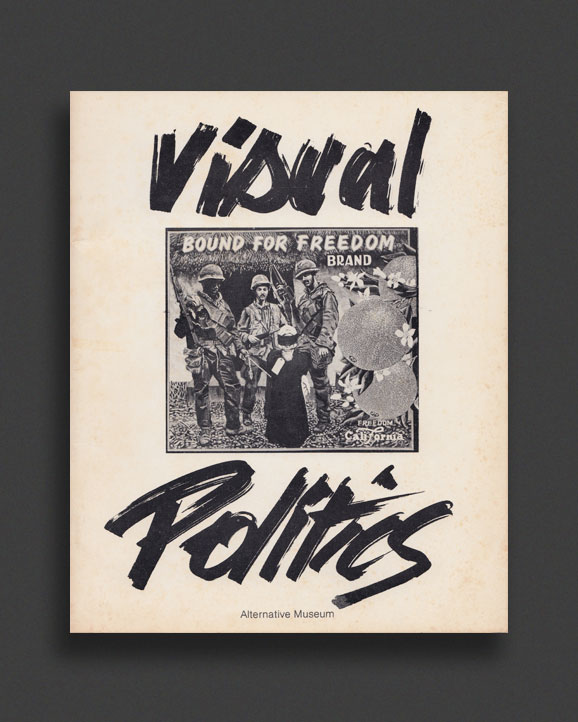
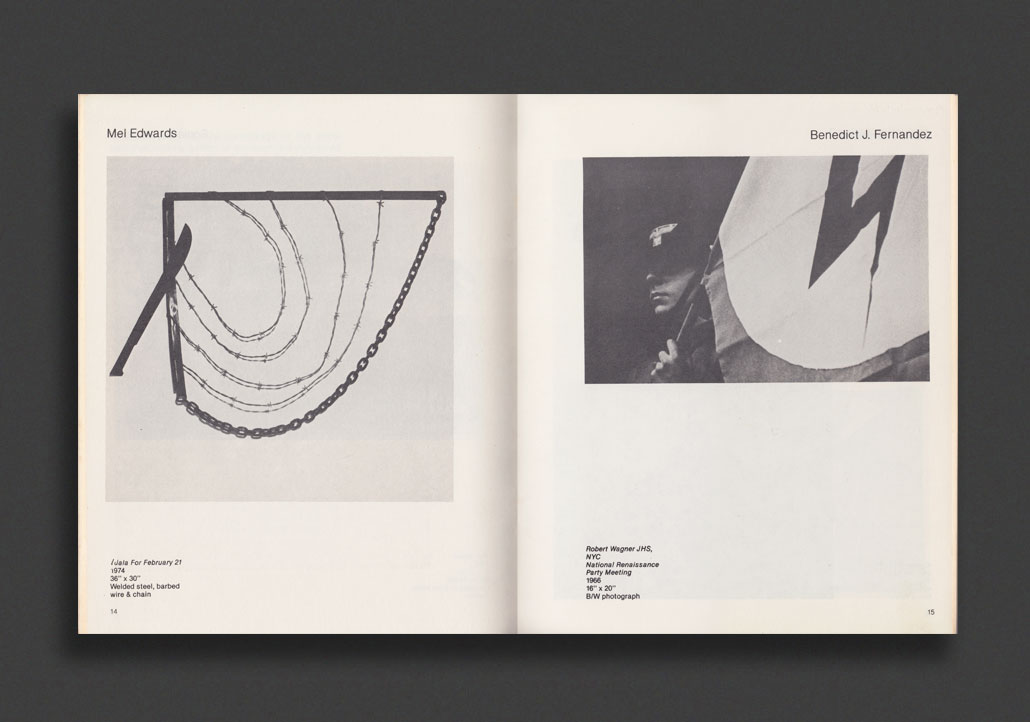
Extremely scarce, lovely catalogue published on the occasion of the exhibition "Visual Politics", curated by Geno Rodriguez at the Alternative Museum in New York, 1982.
Featuring the work of Melvin Edwards, David Hammons, Francesc Torres, Sonia Balassanian, Benedict J. Fernandez, Daniel Kazimierski, Despo Magoni, Juan Sanchez, Randy Lee White, amongst others. Illustrated throughout with the artworks featured in the exhibit, plus biographical info for each artist and a foreword essay by Robert H. Browning.
Very Good with light edge tanning with age.
1983, French
Softcover, 110 pages, 21 x 30 cm
1st UK Edition, Out of print title / used / good
Published by
Centre Georges Pompidou / Paris
$70.00 - Out of stock
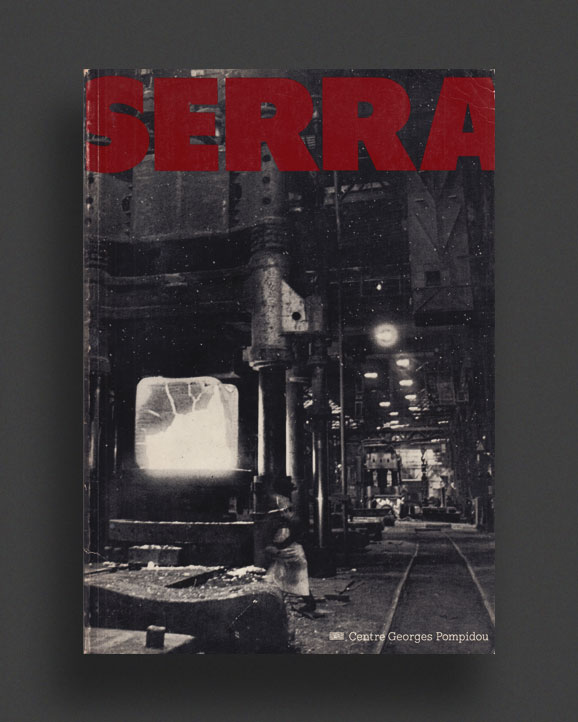
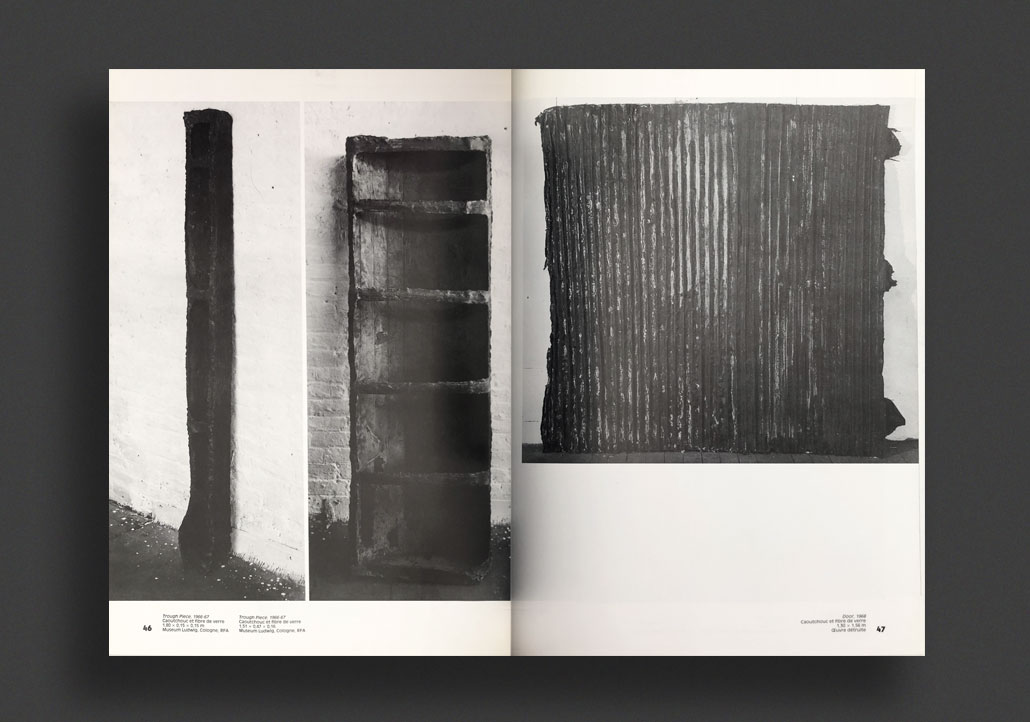
First edition of this scarce, long out-of-print 1983 catalogue on Richard Serra, published by Centre Georges Pompidou, Paris, in conjunction with an exhibition exhibition survey. Profusely illustrated throughout with texts by Yve-Alain Bois, Rosalind Krauss and Alfred Pacquement. Includes full list of artworks, biography, exhibition history, bibliography, and much more. Texts in French.
Richard Serra (b. 1938) is an American artist commonly associated with Minimalism and the Process Art movement. Though perhaps best known for his monumental works made from industrial steel, Serra has also worked extensively in painting and printmaking. After attending the University of California, Berkeley, he earned his MFA from Yale, where he became friends and collaborators with classmates such as Frank Stella, Chuck Close and Nancy Graves, to whom Serra was married for five years. Later working in New York, Serra was inspired by Minimalist contemporaries such as Carl Andre and Sol LeWitt, who valued the work of creation more than the finished artwork itself.
Good copy with light wear to covers/spine, interior Very Good throughout.