World Food Books' programme is largely produced on Kulin Nation land. We acknowledge the Wurundjeri people of the Kulin Nation as the first and continuing custodians of this land, and pay respect to their Elders past, present, and emerging.
World Food Books is an arts and special interests bookshop in Naarm / Melbourne. Founded in 2010, World Food Books is devoted to the presentation of a rotating, hand-selection of international art, design, literary and counterculture publications with an emphasis on the anti-traditional, the experimental, the avant-garde, the heretic, the marginal.
Presenting new titles alongside rare and out-of-print books, catalogues and journals spanning the fields of modern and contemporary art, design, photography, illustration, film, literature, poetry, cultural theory, philosophy, sexuality, popular and underground culture in its many radical forms, World Food Books wishes to encourage adventurous, thoughtful and open-minded reading, looking, writing, and exchange of publishing and ideas, both current and historical.
As well as our bookshop, located in Melbourne's historical Nicholas Building, all of our inventory is available internationally via our online mail-order service.
World Food Books semi-regularly co-ordinates "Occasions", a programme of exhibits and events at the bookshop and in partnership with other hosts (such as museums and art galleries) that develop out of the activities, relationships and content of the bookshop itself.
World Food Books
The Nicholas Building
37 Swanston Street
Room 5, Level 6
Melbourne 3000
Australia
SHOP HOURS:
THU–SAT 12–6
WEB-SHOP OPEN 24/7
World Food Books
Postal Address:
PO Box 435
Flinders Lane
Victoria 8009
Australia
info@worldfoodbooks.com
Art
Theory / Essay
Architecture / Interior
Graphic Design / Typography
Photography
Fashion
Eros
LGBTQ+
Fiction / Poetry
Weird / Speculative / Science Fiction / Horror
Transgressive / Visceral / Abject
Symbolism / Decadence / Fin de siècle
Film / Video
Painting
Sculpture / Installation
Performance / Dance / Theater
Drawing
Sound / Music
Curatorial
Group Shows / Collections
Periodicals
Out-of-print / Rare
Posters / Ephemera / Discs
Signed Books
World Food Books Gift Voucher
World Food Book Bag
Australian Art
Australian Fiction
Australian Science Fiction / Speculative Fiction
Australian Poetry
Australian Photography
Japanese Photography
Conceptual Art
Minimal Art
Dada
'Pataphysics / Oulipo
Fluxus
Concrete Poetry
Pop Art
Surrealism
Arte Povera
Arte Informale / Haute Pâte / Tachism
Nouveau Réalisme / Zero / Kinetic
Situationism / Lettrism
Collage / Mail Art / Xerox Art
Art Brut / Folk / Visionary / Fantastic
Illustration / Graphic Art / Bandes Dessinées
Furniture
Italian Radical Design / Postmodernism
Textiles
Ceramics / Glass
Counterculture
Protest / Revolt
Philosophy
Psychoanalysis
Anthropology
Anarchism
Socialism / Anarchism / Communism / Capitalism
Literary Theory / Semiotics / Language
Feminism / Women's Studies
Gender Studies / Sexuality
Anthropology
Fetishism / BDSM
Drugs / Psychedelia
Crime / Violence
Animal Rights / Veganism
Occult / Esoterica
Ecology / Earth / Alternative Living
Whole Earth / Crafts
All prices in AUD (Australian dollars)
Pick-Ups
Pick-up orders can be collected in our bookshop during opening hours after order date. Please collect any Pick-up orders within 2 weeks of ordering as we have limited storage space. Orders will be released back into stock if not collected within this time. No refunds can be made for pick-ups left un-collected. If you cannot make it in to the bookshop in this time-frame, please choose postage option.
Return Policy
All sales are final. We do accept returns (for refund or exchange) for items received in error. All our orders are packed with special care using heavy-duty padding and cardboard book-mailers or bubble mailers (for smaller books), using reinforcement where required. We cannot take responsibility for any lost, stolen or damaged parcels.
Insurance
Should you wish to insure your package, please email us directly after placing your order and we can organise this at a small extra expense. Although all standard/express tracked packages are very safe and dependable, we cannot take responsibility for any lost, stolen or damaged parcels. We recommend insurance on valuable orders.
Interested in selling your old books, catalogues, journals, magazines, comics, fanzines, ephemera? We are always looking for interesting, unusual and out-of-print books to buy. We only buy books in our fields of interest and specialty, and that we feel we can resell.
We base these prices on desirability, market value, in-print prices, condition and our current stock levels. We offer cash, store credit, and can take stock on consignment. All
about 25% of the price we expect to get when we sell them, or 30% in store credit. We base these prices on desirability, market value, in-print prices, condition and our current stock levels.
Sell your books any day of the week. You can drop them off and return later. If you have a lot of books, we can visit your Sydney home.
We buy books that we feel we can resell. We offer about 25 % of the price we expect to get when we sell them, or 30% in store credit. We base these prices on desirability, market value, in-print prices, condition and our current stock levels.
Philadelphia Wireman
03 August - 01 September, 2018
World Food Books is proud to announce our next Occasion, the first presentation of sculptures by Philadelphia Wireman in Australia.
The Philadelphia Wireman sculptures were found abandoned in an alley off Philadelphia’s South Street on trash night in 1982. Their discovery in a rapidly-changing neighbourhood undergoing extensive renovation, compounded with the failure of all attempts to locate the artist, suggests that the works may have been discarded after the maker’s death. Dubbed the "Philadelphia Wireman" during the first exhibition of this work, in 1985, the maker’s name, age, ethnicity, and even gender remain uncertain. The entire collection totals approximately 1200 pieces, all intricately bound together with tightly-wound heavy-gauge wire (along with a few small, abstract marker drawings, reminiscent both of Mark Tobey and J.B. Murry). The dense construction of the work, despite a modest range of scale and materials, is singularly obsessive and disciplined in design: a wire armature or exoskeleton firmly binds a bricolage of found objects including plastic, glass, food packaging, umbrella parts, tape, rubber, batteries, pens, leather, reflectors, nuts and bolts, nails, foil, coins, toys, watches, eyeglasses, tools, and jewellery.
Heavy with associations—anthropomorphic, zoomorphic, and socio-cultural responses to wrapped detritus—the totemic sculptures by Philadelphia Wireman have been discussed in the context of work created to fulfil the shamanistic needs of alternative religions in American culture. Curators, collectors, and critics have variously compared certain pieces to sculpture from Classical antiquity, Native American medicine bundles, African-American memory jugs, and African fetish objects. Reflecting the artist’s prolific and incredibly focused scavenging impulse, and despite—or perhaps enhanced by—their anonymity, these enigmatic objects function as urban artefacts and arbiters of power, though their origin and purpose is unknown. Philadelphia Wireman, whatever their identity, possessed an astonishing ability to isolate and communicate the concepts of power and energy through the selection and transformation of ordinary materials. Over the course of the past two decades, this collection has come to be regarded as an important discovery in the field of self-taught art and vernacular art.
Presented in collaboration with Fleisher-Ollman Gallery, Philadelphia, and Robert Heald, Wellington.
Susan Te Kahurangi King
02 February - 10 March, 2018
Susan Te Kahurangi King (24 February 1951 - ) has been a confident and prolific artist since she was a young child, drawing with readily available materials - pencils, ballpoint pens and felt-tip markers, on whatever paper is at hand. Between the ages of four and six Susan slowly ceased verbal communication. Her grandparents William and Myrtle Murphy had developed a special bond with Susan so they took on caring responsibilities for extended periods. Myrtle began informally archiving her work, carefully collecting and storing the drawings and compiling scrapbooks. No drawing was insignificant; every scrap of paper was kept. The King family are now the custodians of a vast collection containing over 7000 individual works, from tiny scraps of paper through to 5 meter long rolls.
The scrapbooks and diaries reveal Myrtle to be a woman of great patience and compassion, seeking to understand a child who was not always behaving as expected. She encouraged Susan to be observant, to explore her environment and absorb all the sights and sounds. Myrtle would show Susan’s drawings to friends and people in her community that she had dealings with, such as shopkeepers and postal workers, but this was not simply a case of a grandmother’s bias. She recognised that Susan had developed a sophisticated and unique visual language and sincerely believed that her art deserved serious attention.
This was an unorthodox attitude for the time. To provide some context, Jean Dubuffet coined the term Art Brut in 1945 to describe work created by self-taught artists – specifically residents of psychiatric institutions and those he considered to be visionaries or eccentrics. In 1972 Roger Cardinal extended this concept by adopting the term Outsider Art to describe work made by non-academically trained artists operating outside of mainstream art networks through choice or circumstance. Susan was born in Te Aroha, New Zealand in 1951, far from the artistic hubs of Paris and London that Dubuffet and Cardinal operated in. That Myrtle fêted Susan as a self-taught artist who deserved to be taken seriously shows how progressive her attitudes were.
Susan’s parents Doug and Dawn were also progressive. Over the years they had consulted numerous health practitioners about Susan’s condition, as the medical establishment could not provide an explanation as to why she had lapsed into silence. Dawn educated herself in the field of homeopathy and went on to treat all twelve of her children using these principles – basing prescriptions on her observations of their physical, mental and emotional state.
Doug was a linguist with an interest in philosophy who devoted what little spare time he had to studying Maori language and culture. To some extent their willingness to explore the fringes of the mainstream made them outsiders too but it was their commitment to living with integrity and their respect for individuality that ensured Susan’s creativity was always encouraged.
Even though Susan’s family supported her artistic pursuits, some staff in schools and hospitals saw it as an impediment to her assimilation into the community and discouraged it in a variety of ways. Her family was not always aware of this and therefore did not fully understand why Susan stopped drawing in the early 1990s. However, rather than dwell on the challenges that Susan faced in pursuit of her artistic practice, they prefer to highlight her achievements. In 2008 Susan began drawing again in earnest, after an almost 20 year interruption, and her work is now shown in galleries around the world.
Susan grew up without television and has been heavily influenced by the comics she read as a child. She is absolutely fearless in the appropriation of recognizable characters, such as Donald Duck and Mickey Mouse, in her work. She twists their limbs, contorts their faces, compresses them together, blends them into complex patterned backgrounds - always imbuing them with an incredible energy. Although Susan often used pop culture characters in her work they are not naive or childlike. These are drawings by a brilliant self-taught artist who has been creating exceptional work for decades without an audience in mind.
Mladen Stilinović
"Various Works 1986 - 1999"
02 February 16 - September 10, 2016
Various works 1986 - 1999, from two houses, from the collections of John Nixon, Sue Cramer, Kerrie Poliness, Peter Haffenden and Phoebe Haffenden.
Including: Geometry of Cakes (various shelves), 1993; Poor People’s Law (black and white plate), 1993; White Absence (glasses, ruler, set square, silver spoon, silver ladel with skin photograph and wooden cubes), 1990-1996; Exploitation of the Dead (grey and red star painting, wooden painting, black spoon with red table, red plate), 1984-1990; Money and Zeros (zero tie, paintings made for friends in Australia (Sue, John, Kerrie), numbers painting), 1991-1992; Words - Slogans (various t-shirts) - “they talk about the death of art...help! someone is trying to kill me”, “my sweet little lamb”, “work is a disease - Karl Marx”; Various artist books, catalogues, monographs, videos; Poster from exhibition Insulting Anarchy; "Circular" Croatian - Australian edition; Artist book by Vlado Martek (Dostoyevsky); more.
Thanks to Mladen Stilinović and Branka Stipančić.
Jonathan Walker
Always Will Need To Wear Winter Shirt Blue + Ochre Small Check Pattern
21 August - 21 September, 2015
Untitled
I am not a great reader of poetry but I always return to the work of Melbourne poet, Vincent Buckley (1925- 1988). Perhaps I find his most tantalising piece to be not a finished poem but a fragment left on a scrap of paper discovered on his desk after the poet’s death.
The poetry gathers like oil
In the word-core, and spreads
It has its music meet,
Its music is in movement.
This fragment is more the shell left behind from a volatile thought than a finished poem. I find the last two lines honest but awkward whereas the first two lines work like an arrow. Most likely he could not find a resolution so it was left. Still, in its present form, it remains an eloquent testimony to the ultimate failure of a medium to express mobile thought and sensation, in Buckley’s case, through verbal language. It’s an important matter because this is something all artists have to deal with regardless of the medium.
I have never written a poem, however, I am forever copying fragments from books on paper scraps in a vain effort to fix certain notions in my head. At first, they function as bookmarks that are sometimes returned to when I open the book. But before long, as they accumulate, they fall out littering the table interspersed with A4 photocopies, bills, books and medications.
To return to Buckley’s fragment, the first two lines very much evoke how I paint nowadays. As you age, detail diminishes and patches of light become more luminous and float. I feel the most honest way of dealing with this is by smearing the oil paint on the canvas with the fingers and working close-up, blind. Only if the patches coalesce into an approaching image can the work gain a life.
-
Jonathan Walker was born in Melbourne, Australia and brought up on a dairy farm in Gippsland. In the 1970’s he studied painting at RMIT and won the Harold Wright Scholarship to the British Museum, London. During the 1980’s he exhibited at Pinacotheca Gallery, Richmond and had work shown at the NGV and Heidi City Art Gallery. Over the same period he designed the cover for the “Epigenesi” LP by Giancarlo Toniutti, Italy and conducted a mail exchange work with Achim Wollscheid, Germany. The work with artists through the post resulted in an article published in the bicentenary issue of Art and Australia 1988. He showed in artist run spaces such as WestSpace in the 90’s and 2000’s, and until 2012, taught painting at Victoria University, which is where we (Colleen Ahern and Lisa Radford) as organisers of the exhibition, among many others, had the privilege of being his student.
Walker’s knowledge was imparted to students through the careful selection of music, literature, and artists found in books that he himself had ordered for the library. Walker’s strategy was the generosity of sharing his vast knowledge with references specific to each student and their context.
Walker’s paintings share a similar focus and intimacy.
This exhibition presents a small selection of recent paintings alongside a publication that includes Walker’s writing. Observational and analytical, Walker’s work is a type of material notation — the time of day, colour and how it is blended, the both specific and fleeting location of a reflection on lino or the question of whether a chair leg should be included in a painting.
Please join us on Friday August 21 between 6-8pm to celebrate the opening of the exhibition.
Curated by Colleen Ahern and Lisa Radford.
B. Wurtz
Curated by Nic Tammens
March 26 - April 4, 2015
B.Wurtz works from a basement studio in his home on Manhattan’s Lower East Side.
This local fact is attested to by the plastic shopping bags and newsprint circulars that appear in his work. As formal objects, they don’t make loud claims about their origins but nonetheless transmit street addresses and places of business from the bottom of this long thin island. Like plenty of artists, Wurtz is affected by what is local and what is consumed. His work is underpinned by this ethic. It often speaks from a neighborhood or reads like the contents of a hamper:
“BLACK PLUMS $1.29 lb.”
“Food Bazaar”
“USDA Whole Pork Shoulder Picnic 99c lb.”
“RITE AID Pharmacy, with us it’s personal.”
“H. Brickman & Sons.”
“Sweet Yams 59c lb."
Most of the work in this exhibition was made while the artist was in residence at Dieu Donne, a workshop dedicated to paper craft in Midtown. Here Wurtz fabricated assemblages with paper and objects that are relatively lightweight, with the intention that they would be easily transportable to Australia. This consideration isn’t absolute in Wurtz’s work, but was prescriptive for making the current exhibition light and cheap. Packed in two boxes, these works were sent from a USPS post office on the Lower East Side and delivered to North Melbourne by Australia Post.
Wurtz appears courtesy of Metro Pictures, New York.
Thanks to Rob Halverson, Joshua Petherick, Sari de Mallory, Matt Hinkley, Helen Johnson, Fayen d'Evie, Ask Kilmartin, Lisa Radon, Ellena Savage, Yale Union, and "Elizabeth".
John Nixon
"Archive"
December 15 - January 20, 2014
The presentation of John Nixon's archive offered a rare showcase of this extensive collection of the artist's own publications, catalogues, posters, ephemera, editions and more, from the mid 1980s onwards, alongside a selection of his artworks.
Organized by John Nixon, Joshua Petherick and Matt Hinkley.
"Habitat"
at Minerva, Sydney (organised by Joshua Petherick and Matt Hinkley)
November 15 - December 20, 2014
Lupo Borgonovo, Janet Burchill & Jennifer McCamley,
Lewis Fidock, HR Giger, Piero Gilardi, Veit Laurent Kurz,
Cinzia Ruggeri, Michael E. Smith, Lucie Stahl, Daniel Weil, Wols
Press Release:
“...It contained seven objects. The slender fluted bone, surely formed for flight, surely from the wing of some large bird. Three archaic circuitboards, faced with mazes of gold. A smooth white sphere of baked clay. An age-blackened fragment of lace. A fingerlength segment of what she assumed was bone from a human wrist, grayish white, inset smoothly with the silicon shaft of a small instrument that must once have ridden flush with the surface of the skin - but the thing’s face was seared and blackened.”
William Gibson, “Count Zero”, 1986
"Autumn Projects Archive"
Curated by Liza Vasiliou
March 6 - March 15, 2014
World Food Books, in conjunction with the Virgin Australia Melbourne Fashion Festival 2014, presented the Autumn Projects archive, consisting of a selection of early examples in Australian fashion with a particular interest in collecting designers and labels from the period beginning in the 1980’s, who significantly influenced the discourse of Australian Fashion.
Curated by Liza Vasiliou, the exhibition provided a unique opportunity to view pieces by designers Anthea Crawford, Barbara Vandenberg, Geoff Liddell and labels CR Australia, Covers, Jag along with early experimental collage pieces by Prue Acton and Sally Browne’s ‘Fragments’ collection, suspended throughout the functioning World Food Books shop in Melbourne.
H.B. Peace
presented by CENTRE FOR STYLE
November 14, 2013
"Hey Blinky, you say chic, I say same"
Anon 2013
H.B. Peace is a clothing collaboration between great friends Blake Barns and Hugh Egan Westland. Their pieces explore the divergences between 'character’ and ‘personality’ in garments....etc
Special Thanks to Joshua Petherick and Matt Hinkley of WFB and Gillian Mears
and a Very Special Thank you to Audrey Thomas Hayes for her shoe collaboration.
Janet Burchill & Jennifer McCamley
"Aesthetic Suicide"
May 10 - June 8, 2013
The first of our occasional exhibitions in the World Food Books office/shop space in Melbourne, "Aesthetic Suicide" presented a body of new and older works together by artists Janet Burchill & Jennifer McCamley, including videos, prints, a wall work, and publications.
During shop open hours videos played every hour, on the hour.
1978, English
Softcover (staple-bound), 68 pages, 28 x 21 cm
1st Edition, Out of print title / used / good
Published by
Feminist / Tokyo
$45.00 - In stock -
Fourth 1978 (English-language) issue of "Feminist", a rare and important record of the women's liberation movement in Japan in the the 1970s and document of the cross-currents of international female theorists, artists, poets, authors, and activists in the women's movement. This special "East and West" issue addresses the different pathways that the women's movement must travel throughout Asia and in the western countries. "A source of information and forum for Japanese women, (Feminist) has had from its inception an international perspective." This first fully English-language edition opens the discourse around the Asian feminist movement to western readers, including many articles on the place of Japanese Women in society, and Feminist developments in Korea, Thailand, the Philippines, Burma (Myanmar), Indonesia, and Malaysia. With a cover feature/interview on legendary Japanese art director, costume designer, and graphic designer Eiko Ishioka (known for her production and costume designs for Grace Jones, Paul Schrader, Francis Ford Coppola, Björk, etc., shot by photographer Michiko Matsumoto, this issue, edited by Japanese critic, American literature researcher, and poet, Ikuko Atsumi (who also co-edited "Burning Hearts: Women Poets of Japan" with Kenneth Rexroth, The Seabury Press/New Directions, 1977), with Diane L. Simpson, features contributions from Australian filmmaker Solrun Hoaas, women's rights activist/journalist Yayori Matsui (noted for her work to raise awareness of sex slaves and sex tourism in post-war Asia), photographer Michiko Matsumoto, Japanese linguist Sachiko Ide, author Utsumi Aiko, poet Morgan Gibson, acclaimed Japanese-English translator and historian of the women's movement in Japan Nancy Andrew, critic Chizuko Ikegami, and many others.
"Images of women that arise from sexist ideologies are everywhere tied to an individual cultural milieu. In the Western tradition, woman is simultaneously virgin and seductress, both adored and condemned by men. In the Japanese tradition, she is the man's mother goddess, who nurtures and protects. Under the Confucian ethic in Korea she is defined only in relation to her father, husband and son and in Indonesia she is constrained by the Islamic view that sees her mainly as the bearer of the next generation. Whatever their form, such androcentric views deny women both autonomy and dignity while providing a rationale for social and economic subjugation.
In working to transform these distorted images and ideals, the women's movement in different countries will likely not take the same path. In Japan the enormous influence exerted by the media in promoting the traditional image of women requires that feminists direct considerable effort toward creating a social climate in which the independent women can be viewed positively. At the same time they want to correct the misinterpretations about themselves that pervade Japanese literature, films, and art. While women in the West now seek to create a women's culture, Japanese women seek to revive the women's culture that has always been an important, if sometimes un-recognized, source of their civilization."
Good—VG copy with age/wear to cover extremities, some foxing/staining.
2025, English
Softcover, 220 pages, 32 x 24.5 cm
Published by
Hatje Cantz / Berlin
$85.00 - In stock -
Edited by Vanessa Joan Müller, Bettina Steinbrügge.
Text by Lisa E. Bloom, Andrea Bowers, Haden Guest, Ingrid Luquet-Gad, Jason McBride, Christiane Meyer-Stoll, Olaf Nicolai, Letizia Ragaglia, Alexandro Segade, Bettina Steinbrügge.
Previously unpublished ephemera, poems and photographs accompany this sharp retrospective volume of Antin's 50 years of conceptual, feminist art, the most comprehensive publication on the artist to date, published to accompany the first survey on the artist in more than two decades.
For more than 50 years, Eleanor Antin (born 1935) has been a distinctive voice in postmodernism, traversing conceptual art and feminist movements. Her projects, often photographic series or performances, scrutinize the historic and contemporary roles of women, darkened by consumerist commentary on the ideal feminine. Crash dieting, Schick razors, mascara and pill bottles all play starring roles in her most famous works. This most comprehensive monograph to date accompanies Antin's first retrospective in 25 years and her first ever in Europe. Each commissioned text dives into a different facet of her work: her life in New York and San Diego; her Jewish identity; her feminist activism; her unfailing humor; her performances and films; and the impact of her art on younger generations of artists. It also features a complete exhibition history, a comprehensive list of works and a timeline of her life.
Eleanor Antin is a key figure emerging from the Conceptual art movements of the 1970s. Today as an octogenarian artist, she remains one of the world's leading Feminist artists. Her ground-breaking practice spans five decades and has covered themes surrounding identity, gender, autobiography, class and social structures. Antin's multi-disciplinary approach includes installation, painting, drawing, writing and most notably photography and performance. Over the last 50 years Antin has performed and exhibited her work internationally.
2025, English
Softcover, 122 pages, 20.5 x 13.5 cm
Published by
Wakefield Press / Cambridge
$40.00 - Out of stock
Translated, with an introduction by Napoleon Jeffries
Illustrations by Alfred Prunaire
We were young, always gay, often wealthy . . . But I’ve just struck a gloomy chord: our palace is razed to the ground. I trampled through its debris this past autumn.
Although Gérard de Nerval had originally intended it to be a small anthology of his early poetry, his 1853 Little Castles of Bohemia ended up as something more. As could be said of all his last works, the book was an effort at stability: worn out and financially impoverished from his travels and spells of mental turmoil, Nerval gathered his past writing in an attempt at assembling some sort of posterity, at creating a home for the vagabond pieces.
The melancholic, wandering castles presented here house pieces gathered from the range of Nerval’s literary life, from his autobiographic reminiscences of the bohemian neighborhood of Le Doyenné (destroyed by Baron Hausmann the year before this book’s initial publication), the lyrical “odelettes” that established Nerval as a poet early on, the one-act theatrical “proverb” Corilla, and the mystical sonnets of madness and existential despair that concluded his career.
In assembling together the shards of Nerval’s life, these castles depict both the birth and the decline of the Bohemian, as well as the struggle between Romantic idealism and realism that would formulate the tragic conclusions to the specific life of Nerval and the lives in general of the Bohemians of his time. The collapse of the boundary between art and life here leads to ruins.
Gérard de Nerval (1808–1855) was a writer, poet, and translator who wedded French and German romanticism and transformed his research into mystic thought and his bouts of mental illness into such visionary works as the posthumously published Aurélia, or Dream and Life. After his suicide, his work would grow in stature and go on to influence Marcel Proust, André Breton, Antonin Artaud, Michel Leiris, and countless others.
2025, English
Softcover, 202 pages, 20.4 x 12.7 cm
Published by
Contra Mundum Press / New York
$48.00 - In stock -
WORLD PREMIERE ENGLISH TRANSLATION
Rilke’s Testament opens with the outbreak of WWI, a devastating world event that prevents the poet from returning to the “incomparable city of Paris,” and which is entwined with his own debilitating crises.
In this decisive period, before which recovery or death waits, Rilke undergoes a kind of auto-da-fé and gives us a record of his failure and achievement. With insights into what he called his peculiar fate, the poet forges a will and testament, which he says “will remain his last, even if his heart still faced many years of challenges ahead.” Is this the final word on his struggle between love in life and love transformed into the mosaic of art?
Written while suffering an impasse with the Duino Elegies and just before he and Merline Klossowska discover the Chateau de Muzot, which would become a fertile sanctuary for the nomadic poet, Rilke turns to translation as a pontifex to carry him through the muteness of his crises. Having at last opened some free associative realm, he begins sketching terse reflections, lyrical draft letters, and dense, wistful prose, fragmentary writings that speak to the powers of destruction and creation.
Long secret, this enigmatic and charged series of experimental texts is the record of the close of a remarkable winter, wherein the work of poetry, the artist’s struggle with life, is tested in the crucible of solitude and the sinister expanse of blank pages. An illuminating ars poetica, Rilke’s Testament constitutes the mortal risk of not going beyond love, and the risk of the potential death of the artist, where the silencing of the logos puts creative potency under threat.
This world premiere English translation also includes essays on politics, poetry, sound, the sacred and sexuality, and the complete poem sequence “From the Literary Estate of Count C.W.," all works dating from the 'testament years.' The Testament (& Other Texts) documents a creative interregnum and is the dark passageway between the Duino Elegies and The Sonnets to Orpheus.
Edited by Rainer J. Hanshe
Translated with an introduction by Mark Kanak
1999, English
Softcover, 62 pages, 21 x 14 cm
Published by
Shearsman Books / Bristol
$26.00 - In stock -
Translated from French by Will Stone.
Introduced by Michael Hamburger, with a Preface by Anne Beresford & Notes and Afterword by Norma Rinsler.
Nerval (1808-1855) is one of the most important writers of nineteenth-century France, both in prose and in verse. A precursor of the symbolists and the surrealists, Nerval has fascinated many major literary figures, including Proust and Breton, Eliot and Apollinaire, Michaux and Leiris.
The great sonnet cycle, Les Chimères, in its marvellous combination of spell, quest and dream, continues to fascinate writers, readers, and that special category of writerly readers, translators. The translator of this volume is the gifted poet Will Stone, who explains his work in a strongly-worded essay: "like a partly submerged crocodile, with one amber eye half open the foreign line sits, waiting for the anxious translator to make a move." The book contains three other texts: a foreword by the poet, Anne Beresford, a general introduction to Nerval by Michael Hamburger (published for the first time in the previous edition of this book, some fifty years after it was written), and an afterword and notes on Les Chimères by Professor Norma Rinsler, the doyenne of English Nervaliens.
Published with the Menard Press.
2006, English
Softcover, 160 pages, 15.24 x 1.91 x 16.51 cm
Published by
Archipelago Books / New York
$39.00 - Out of stock
Stroke by Stroke is a pairing of two of Henri Michaux's most suggestive texts, Stroke by Stroke (Par des traits, 1984) and Grasp (Saisir, 1979), written towards the end of his life. Michaux's ideogrammic ink drawings accompany his poetic explorations of animals, humans, and the origins of language. This series of verbal and pictorial gestures is at once explosive and contemplative. Michaux emerges at his most Zen.
"I first encountered Michaux's astonishing work in Stroke By Stroke, a physically and conceptually beautiful little book . . . Reading Stroke By Stroke, I felt invited to travel "toward greater ungraspability"—and in our uncertain times, Michaux's ease with that is deeply reassuring."—Martha Cooley, The Common
Henri Michaux (1899-1994) was born in Namur, Belgium. His travels throughout the Americas, Asia, and Africa inspired his first two books, Ecuador and A Barbarian in Asia. In 1948, after the death of his wife, he devoted himself increasingly to his distinctive calligraphic ink drawings. Averse to publicity of any sort, in 1965 he refused the French Grand Prix National des Lettres. Michaux's other works in English translation include Emergences-Resurgences (Skira, 2001), Darkness Moves: An Henri Michaux Anthology (California, 1997), Tent Posts (Sun and Moon, 1997), and A Barbarian in Asia (New Directions, 1986).
Richard Sieburth's translations include Georg Büchner's Lenz, Friedrich Holderlin's Hymns and Fragments, Walter Benjamin's Moscow Diary, Gérard de Nerval's Selected Writings, Henri Michaux's Emergences/Resurgences, Michel Leiris' Nights as Day, Days as Night, and Gershom Scholem's The Fullness of Time. His English edition of the Nerval won the 2000 PEN/ Book-of-the-Month-Club Translation Prize. His recent translation of Maurice Sceve's Délie was a finalist for the PENTranslation Prize and the Weidenfeld Prize.
1990, English
Softcover, 160 pages, 18 x 11.5 cm
1st Edition, Out of print title / used / good
Published by
Semiotext(e) / Los Angeles
$35.00 - In stock -
First 1990 Semiotext(e) Foreign Agents English edition of "69 Ways to Play the Blues" by Jürg Laederach. Translated by Peter Wortsman, with a preface by Walter Abish.
"The phone refuses to ring. I sit here on 82nd Street: no, on 83rd: no, on 81st: I forget where I am. The phone refuses to ring, to tear me out of this enforced solitude, which I know only too well. This solitude that makes me sick and stirs me to tears, but surely not tears of compassion. A call is bound to come any minute now up from the Village and afford me the company I desperately desire. The phone isn't ringing. The bell doesn't work."
Written after the Swiss writer Jürg Laederach's third trip to New York in the late 1980s, 69 Ways was hailed by award-winning author Walter Abish as a text predictive of 'a Europe to come, when borders dissolve.' Like Alain-Robbe Grillet, Georges Perec, and the great Oulipo writers, Laederach constructs seamless narratives based on sly compositional strategies. The reader is only somewhat aware of the rules of the game. Transposed to America, Laederach's texts, Abish argues, 'function as a scanning device. Characters vanish, reappear. There is something relentless... Everything is transitory. No sentimentality. No clinging to the past. Everything is on the verge of being discarded. Everything is on the verge of dissolution. Everything resonates with imminent change.'
Good copy with age/light wear to block edge/cover edges.
2010, English
Softcover (+ audio CD), 62 pages, 19 x 13 cm
1st Edition, Out of print title / as new
Published by
Thin Man Press / London
$65.00 - Out of stock
This is the first time Aragon's seminal 1924 French surrealist text has been published in English as a single volume. Aragon's extraordinary prose-poem-essay A Wave of Dreams (Une vague de reves), is a compelling, lyrical, first-hand account of the early days of surrealist experimentation in Paris. Writing in 1924, Aragon vividly describes, and philosophically evaluates, the inner adventures, the hallucinations and encounters with the 'Marvellous' which took the young surrealists to the brink of insanity as a revolutionary new era in Art History was born. Among Aragon’s companions in derangement are André Breton (whose own Surrealist Manifesto was preceded by this book), Max Ernst, Man Ray, Antonin Artaud, Robert Desnos, Georgio de Chirico, Philippe Soupault and Benjamin Peret.
This beautifully presented art book contains Susan de Muth’s translation of the text in English with an introduction by Dawn Ades.
The physical copy of A Wave of Dreams is accompanied by a complimentary CD of eight extracts from the test, spoken by actor Alex Walker, evocatively set in musical soundscapes by Tymon Dogg and Alex Thomas.
"A leftfield treat…mysteriously opaque and strangely lovely."—Thomas H Green, Daily Telegraph.
Fine—As New.
1994, English
Softcover, 182 pages, 20 x 12.5 cm
1st Edition, Out of print title / used / very good
Published by
Faber & Faber / London
$18.00 - Out of stock
The first 1994 softcover edition of the first comprehensive and authoritative account of the life and work of the man who changed the course of modern theatre. Antonin Artaud is one of the great cultural legends of the twentieth century. His Theatre of Cruelty altered the course of modern theatre, and his experiments with the Surrealist movement have proved inspirational throughout Europe and America.
But Artaud's life was one of terrible failure and confrontation, an exploration of the extremes of agony and joy. At the end of a long series of journeys - both physical and spiritual - aimed at creating a magical culture of the human body, he was arrested and interned for nine years in a succession of French lunatic asylums, where he suffered starvation and was subjected to fifty electroshock treatments.
Stephen Barber's book is a faithful and moving portrait of a unique figure.
VG copy with some page tanning light wear.
2018, English
Hardcover, 788 pages, 28.7 x 25.4 cm
Published by
Kant / Prague
$220.00 - In stock -
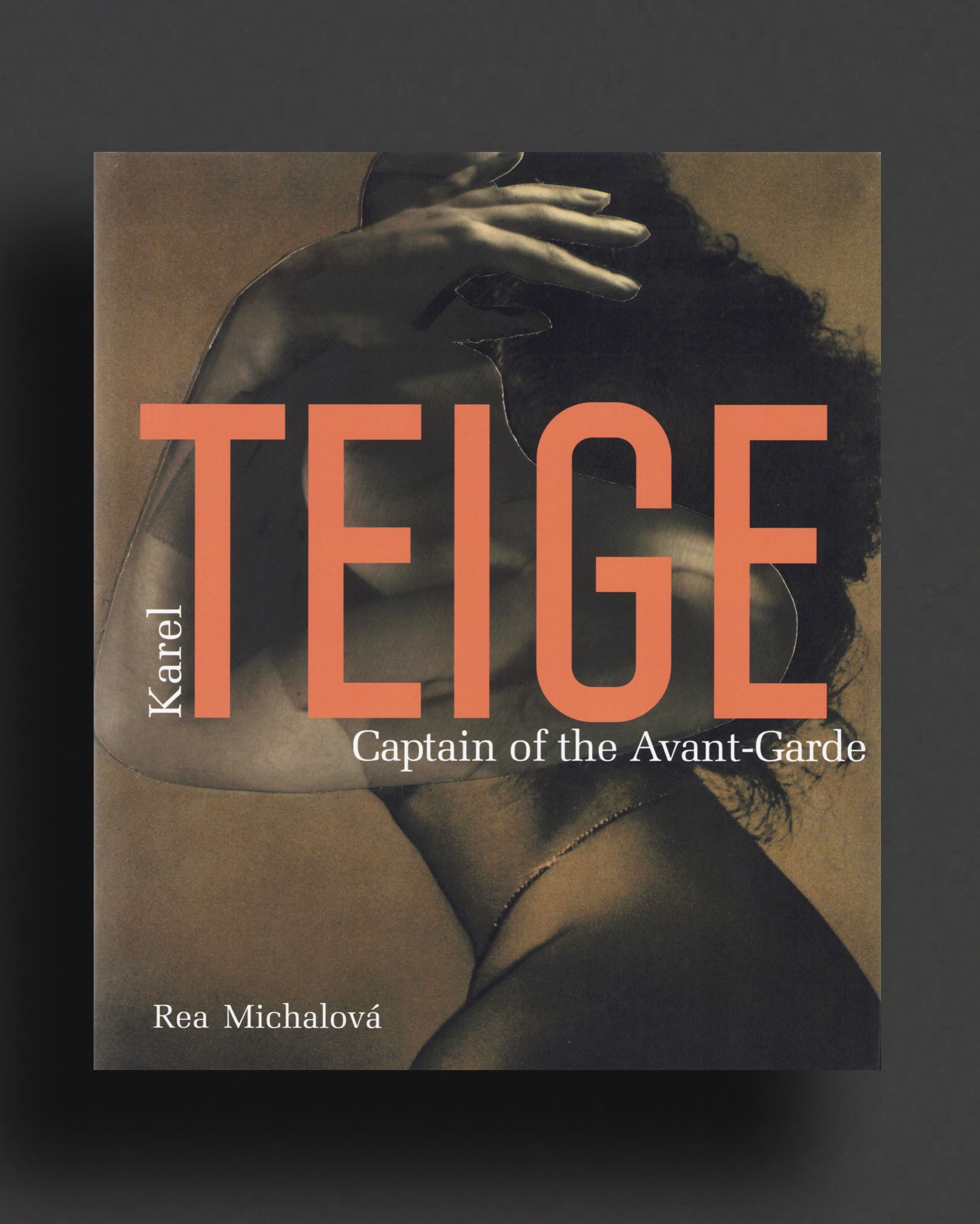
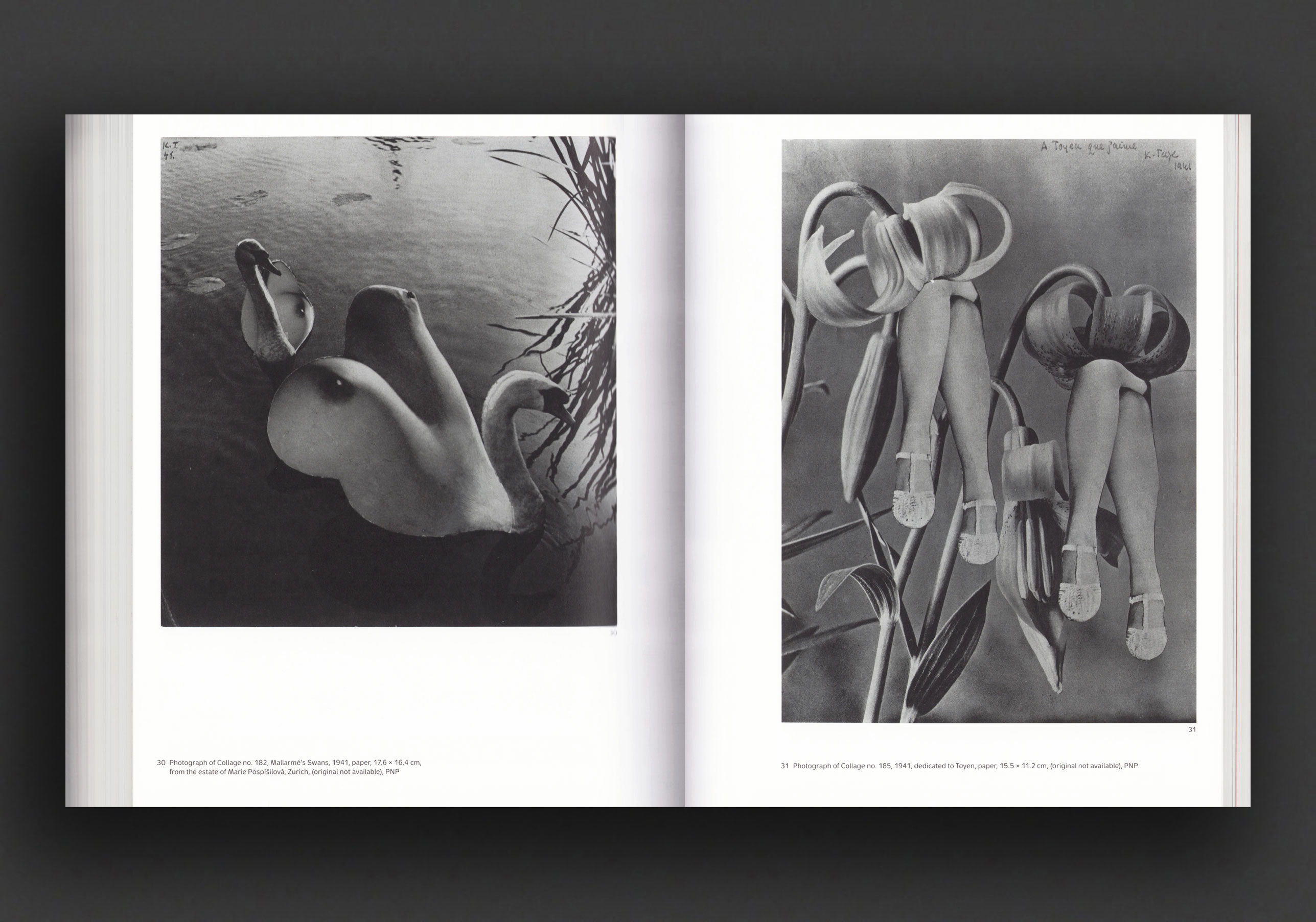
Art theorist and critic, graphic designer, artist, author and translator Karel Teige (1900–51) is today recognized not just as the creator of internationally acclaimed surrealist collages, but also as a leading figure of the European avant-garde. Teige spent his entire life commenting on and interpreting developments in the visual arts. His multifaceted theoretical writings helped shape the conceptual foundations of modern art, and his activities and intensive contacts with other members of the European avant-garde helped secure Czech art's place on the international art scene. His work anticipated, initiated and helped to develop the progressive artistic movements that fundamentally influenced art in the 20th century.
Karel Teige was one of the great European intellectuals of his time; his efforts were aimed at creating not just a system of aesthetics but also an all-encompassing life philosophy. He was intensively interested in architecture and found inspiration in Germany's Bauhaus (where he spent a year lecturing); architectural functionalism would have looked completely different without his input. Teige's preference for rational, minimalist designs with an emphasis on the social uses of modern architecture was the "most functionalist functionalism" of his time.
Teige's own work consisted primarily of a series of phenomenal collages that reveal the hidden and passionate aspects of his personality. His book designs set the tone for an entire generation, and his design principles remain valid today. Teige's complicated personality, full of contradictions, utopian dreams and a yearning for order and logic make him an indecipherable and deeply human individual, a perfect symbol for the 20th century.
This comprehensive, nearly 800-page monograph, by the art historian Rea Michalová, takes a wide-ranging look at the evolution of Teige's ideological, theoretical and political views, and recalls important moments in his life and their significance within the international context. The book includes a rich set of illustrations, photographs from his life, and examples of his unique collages and graphic designs.
"Just a few of the reasons why we can't get over this new Karel Teige monograph. Measuring more than 2.5 inches thick and just under 800 pages long—with 318 color reproductions and a whopping 635 pages of scholarly texts—Karel Teige: Captain of the Avant-Garde, the new Teige monograph from noted Czech art book publisher Kant, is truly extraordinary. "There is no need to explain who Karel Teige was," a Czech writer for Typografia magazine proclaimed in 1927. "I don't think that there was a single modern impulse in our country that he did not either directly inspire or at least support. Architecture, poetry, film, photography, painting, theater, typography—all these bear traces of his insightfulness and modernity."
2025, English
Softcover, 384 pages, 23 x 15.3 cm
Published by
Nightboat Books / New York
$48.00 - In stock -
A posthumous celebration of the poet and provocateur Kevin Killian, Padam Padam pulses with camp, pop culture, and pleasure.
Introduction by Kay Gabriel
Edited by Evan Kennedy and Jason Morris
Kevin Killian—the puckish poet, playwright, novelist, scholar, and impresario of the Bay Area arts community—channeled the charisma of the pop stars. Pulled from his legendary corpus, and long out of print, the work collected here is the record of Killian’s life as a radical littérateur. In Argento Series, Killian conjures the horror, suspense, and cinematic imagery of director Dario Argento as he documents the AIDS epidemic in San Francisco. In Action Kylie, he revels in queer identity and the universal love of fandom. In Tweaky Village and Tony Greene Era, Killian elevates artists and friends to legendary status within his personal pantheon. And Elements, Killian’s wink at the periodic table, makes its U.S. debut.
The collection features an introduction by Kay Gabriel, who writes of Killian’s “fabulous, permissive body of work, charming, filthy and smarmy at turns, with its retchable milk enemas and its devilish twists.”
"Kevin loved culture and was its constant undoing."—Eileen Myles
"I used to say Kevin was the only person I ever knew who possibly could have come from a different planet—an enigma who possessed superhuman knowledge, baffling productivity, and later, super-human kindness."—Robert Glück
"Oh, he is a dark master of the word, Kevin Killian, an inviting bridegroom and a voyeur who’ll let us play in his fictions until we’re spent."—D.A. Powell
"Like his beloved Kylie Minogue sings, Kevin created a body of work that is “more than [we] dare to think about”––a “dark secret” that filled and felt “the need,” a deep need, in all of us."—Dorothea Lasky
Kevin Killian (1952–2019) was a San Francisco-based poet, novelist, playwright, and art writer. Recent books include Padam Padam: Collected Poems (Nightboat Books, 2025) and Selected Amazon Reviews (2024). He is the coauthor of Poet Be Like God: Jack Spicer and the San Francisco Renaissance (1998). With Dodie Bellamy, he co-edited Writers Who Love Too Much: New Narrative Writing, 1977–1997 (2017).
Kay Gabriel is a writer and organizer. She’s the author of Perverts (2025), Kissing Other People or the House of Fame (2023), and A Queen in Bucks County (2022). She’s the Editorial Director at the Poetry Project in New York City.
2025, English
Softcover, 80 pages, 21 x 14.8 cm
Published by
Pilot Press / London
$28.00 - In stock -
Light Film explores the cinema of heartache. Thorough in its quest for drama, this collection of poems threads a personal narrative through kaleidoscoping imagery, in turns erotic, violent, and contemplative. Performing a shifting subject position, the speaker of this book finds humour, shelter, and emotional truth in fantasy, even as reality collapses into his desires.
Sholto Buck is a poet and artist living in Melbourne, Australia. He has been commissioned to write poems for the National Gallery of Victoria, and for 'Derek Jarman: Delphinium Days', at Gus Fisher Gallery, Auckland, and UNSW Gallery, Sydney. His first book, In the printed version of heaven, was published by Rabbit in 2023.
“This is a collection of curves and boots, horny and isolated, in rain and bittersweet love with loneliness and lust, articulated through a series of ekphrastic-ish lyrics enamored with the parts of bodies on film. Jarman, O'Hara, and Wieners exert a strong influence, filtered through smartphone snapshots of queer life and longing: witty, tender, and engaging.” — Joshua Jones
“"The landscape / walked / a red / spiral of green / through me" as the poems in this book have passed through me, leaving me dizzy. Light Film is a great collection of poems: moving, curious, thoughtful – it's a film festival of poems.” — Ben Estes
“You will see Sholto Buck's Light Film being held by a romantic taking the subway. . . What is this book but a screen for holding images of tenderness, signifying a safe harbor for the kiss you imagine?”— Eric Sneathen
1995, French
Sioftcover, 160 pages, 29.5 x 22.5 cm
1st Edition, Out of print title / used / very good
Published by
Éditions Herscher / France
$100.00 - In stock -
First 1995 printing of this wonderful survey of artworks and writings by French illustrator, oral poet, and writer, Fred Deux (1924–2015). This profusely illustrated, most comprehensive catalogue was published to accompany the retrospective exhibitions presented at the museums of Bochum in Germany, at the French cultural center of Essen, in Châteauroux, Montpellier and Charleroi between 1995 and 1996. Texts in French by Sepp Hiekisch-Picard, Pierre Watt, Geneviève Bonnefoi and Fred Deux. Illustrated throughout in colour and b/w. Includes, bibliography and biographical references and personal photographs.
As an artist, he may be situated somewhere between Outsider Art (since he disobeyed the established rules) and Henri Michaux. Influenced by contacts with André Breton, Paul Klee, Max Ernst and Hans Bellmer, the constraints imposed by his artistic and literary work prompted him to lead an introspective lifestyle, far from the turbulence of artistic fashion and the art market. As a result, his oeuvre has strong, singular psychological intensity.
A little-known artist outside France, immersed in the quietness of a life devoted to drawing, Fred Deux, illustrator, oral poet, writer, and, under the pseudonym Jean Douassot, author of a cult book, “La Gana”, was a singular artist who cannot be categorised in terms of art fashions and trends. This autodidact, born in the basement of a large house in Boulogne-Billancourt to a working-class family – occasionally flooded and infested with rats – living conditions that had repercussions on his health (tuberculosis). Working night-duties as a maintenance electrician in 1939, he subsequently joined his factory’s FTP resistance group in 1943. This was his first gesture of refusal. In 1944, not wishing to return to factory work, he joined the Moroccan Goums regiment of the French Army (active in the Vosges, Alsace and Germany), but, refusing to serve France’s colonial policy after the war, he was discharged in 1948 and settled in Marseille. In Marseille, Deux worked in a bookshop, discovered literature and spent more time reading than selling books. Among his discoveries: Blaise Cendrars, André Breton (the Surrealist Manifesto), Louis Aragon, Georges Bataille and Benjamin Peret. He was also particularly inspired by a catalogue featuring works by Paul Klee. His first two artworks were created using bicycle paint and involved “spontaneous” gestures. He also began writing notes for what would become Les Rats, the first version of La Gana. His early artworks (1949-1958) are sometimes nicknamed kleepathologies in reference to the influence of Paul Klee. In 1951, he was noticed by Jean Cassou, then director of the National Museum of Modern Art. He also met André Breton, joined the Surrealists and met French resistance member and France's most accomplished living engraver, Cécile Reims, who would become his companion and print collaborator (Reims also famously collaborated with Hans Bellmer). Anxious to preserve his independence and creative freedom, Deux left the Surrealist group in 1954. In 1958, his autobiographical novel La Gana was published by René Julliard under the pseudonym Jean Douassot (the Jean Douassot-Fred Deux duality expressed his double vocation as a writer-illustrator). Awarded the prestigious Prix de Mai, the book gave Deux initial exposure to a wider public.
Very Good copy.
1934, Czech
Softcover (staple-bound), 30 pages, 29.5 x 21.5 cm
1st Edition, Out of print title / used / very good
Published by
Mánes Association of Fine Artists / Prague
$65.00 - In stock -
Rare 1934 issue of important modern Czech arts and literary magazine, Volné směry (Free Directions), Vol XXX, edited by Emil Filla with Jindřich Štyrský, Karel Honzík, Václav Špála. Published following the landmark 'Poesie 1932' exhibition, one of the first exhibitions of international Surrealism, and issued the year poet Vítězslav Nezval founded the Czech Surrealist group, the content of this issue holds particular significance. This copy includes the inserted announcement of the inaugural revue of the Czech Surrealist group, Surrealismus v ČSR, edited by Nezval with collaborators Konstantin Biebl, Jindřich Štyrský, Toyen, Bohuslav Brouk, Imre Forbath, Jindrich Honzl, Jaroslav Ježek, Katy King, Josef Kunstadt, Vincenc Makovský. The magazine itself features writing by Nezval, Konstantin Biebl and Adolf Hoffmeister, and artworks by Toyen, Jindřich Štyrský, Alfréd Justitz, Rodin, Picasso, Max Ernst, Corbusier-Jeanneret, Edvard Munch, and many more.
Volné směry (Free Directions) was an important monthly arts and literary journal published in Prague between 1896–1948 by the Mánes Association of Fine Artists in Prague. It was one of the longest-running art magazines of the 20th century (1897–1949) and also the most influential platform for modernism and openness of Czech art towards European artistic developments. Editors included Stanislav Sucharda, Josef Čapek, Miloš Jiránek, Karel Vítězslav Mašek, Jan Preisler, František Xaver Šalda, Martin Jiránek, Jan Štursa, Jaroslav Fragner, Jan Kotěra, Emil Filla, and others. After the cubism of Filla's generation, the magazine devoted itself to the art of the 'Poesie 1932' exhibition, one of the first exhibitions of international Surrealism, held at the Mánes Building itself, including the works of Czech artists such as Josef Šíma, Jindřich Štyrský, and Toyen, alongside Hans Arp, Max Ernst, Alberto Giacometti, Paul Klee, Joan Miró, and Yves Tanguy, to name a few. The Mánes Association and Volné Směry became an important outlet of Czech Surrealism, avant-garde art and poetry, with further exhibitions by Štyrský, Toyen and Vincenc Makovský, the trio all members of both the Mánes Association and the Czech Surrealist Group, founded in 1934. After the war, it still captured the spirit of the association and the work of its youngest members (Zdeněk Sklenář, Václav Zykmund, Toyen, Vaclav Tikal, Jindřich Štyrský, etc.), but the Nazi occupation of Czechoslovakia in late 1938 had a major impact on the Mánes Association, Volné směry, and a generation of artists deemed "degenerate". Volné Směry was stopped altogether as part of the post-February changes and Communist takeover of Czechoslovakia. During the Stalinist period, the Mánes Association was dissolved as a private society. The gallery remained, however, and today still stands at its location on the Vltava.
Very Good copy with only light general wear/age.
1938, Czech
Softcover, 58 pages, 29.5 x 21.5 cm
1st Edition, Out of print title / used / good
Published by
Mánes Association of Fine Artists / Prague
$30.00 - In stock -
1938 double-issue of important modern Czech arts and literary magazine, Volné směry (Free Directions), Vol XXXIV, edited by Emil Filla with Jindřich Štyrský. Jaroslav Fragner, Václav Špála, Josef Wagner. Heavily illustrated with artworks by Toyen, Jindřich Štyrský, Delacroix, Matisse, Manet, Duccio, André Derain, Antoine-Louis Barye, Théodore Géricault, and many more.
Volné směry (Free Directions) was an important monthly arts and literary journal published in Prague between 1896–1948 by the Mánes Association of Fine Artists in Prague. It was one of the longest-running art magazines of the 20th century (1897–1949) and also the most influential platform for modernism and openness of Czech art towards European artistic developments. Editors included Stanislav Sucharda, Josef Čapek, Miloš Jiránek, Karel Vítězslav Mašek, Jan Preisler, František Xaver Šalda, Martin Jiránek, Jan Štursa, Jaroslav Fragner, Jan Kotěra, Emil Filla, and others. After the cubism of Filla's generation, the magazine devoted itself to the art of the 'Poesie 1932' exhibition, one of the first exhibitions of international Surrealism, held at the Mánes Building itself, including the works of Czech artists such as Josef Šíma, Jindřich Štyrský, and Toyen, alongside Hans Arp, Max Ernst, Alberto Giacometti, Paul Klee, Joan Miró, and Yves Tanguy, to name a few. The Mánes Association and Volné Směry became an important outlet of Czech Surrealism, avant-garde art and poetry, with further exhibitions by Štyrský, Toyen and Vincenc Makovský, the trio all members of both the Mánes Association and the Czech Surrealist Group, founded in 1934. After the war, it still captured the spirit of the association and the work of its youngest members (Zdeněk Sklenář, Václav Zykmund, Toyen, Vaclav Tikal, Jindřich Štyrský, etc.), but the Nazi occupation of Czechoslovakia in late 1938 had a major impact on the Mánes Association, Volné směry, and a generation of artists deemed "degenerate". Volné Směry was stopped altogether as part of the post-February changes and Communist takeover of Czechoslovakia. During the Stalinist period, the Mánes Association was dissolved as a private society. The gallery remained, however, and today still stands at its location on the Vltava.
Good copy with only light general wear/age but a tape-repaired split to the bottom of the spine.
1967, French
Softcover, 30 pages, 28.8 x 23.1 cm
1st Edition, Out of print title / as new
Published by
Éditions Surréalistes / Paris
$800.00 - In stock -
First 1967 edition of Le Puits Dans La Tour / Débris De Reves (Well in The Tower / Shards of Dreams) a cycle of twelve drawings by the Czech surrealist artist Toyen (1902-1980) and text by Croatian poet Radovan Ivšić (1921-2009). This deluxe original work, published by Éditions Surréalistes in Paris, includes one of the most important series of engraved compositions by Toyen and was printed in a limited, numbered edition of 900 copies on Mandeure paper, in Paris on September 30, 1967, by Fequet and Baudier, typographers. A gorgeous publication on warm rough-cut heavy paper stock, sewn binding wrapped in black printed covers on olive card stock featuring Toyen's title drawing. This copy No. 374 of 900.
Toyen (1902–1980) was a Czech Surrealist painter and writer born Marie Čermínová who adopted a gender-ambiguous pseudonym, becoming a central founding figure in the Prague and Paris Surrealist movements. Her work explores themes of gender, sexuality, and the subconscious, and she is known for collaborations with poet Jindřich Štyrský and poet Vítězslav Nezval.
Radovan Ivšić (1921–2009) was a Croatian poet, writer, playwright, essayist, translator and surrealist of global standing, achieved the greatest acclaim with his poem Narcissus (1942), his play King Gordogan (1943) and poetry collection Black (1974). His uncompromising creative work and life were spent in resistance to either Right or Left wing totalitarianism. Such values brought him into the surrealist movement through collaborative friendships with André Breton, Benjamin Peret, Miro, Toyen and others. He was one of the signers of the last Manifeste du surréalisme, 1955. He married the French poetess Annie Le Brun.
As New pristine, unread copy from Radovan Ivšić's own stock. Light cover corner / edge wear, otherwise perfect.
2025, English
Softcover (staple-bound), 24 pages, 20.32 × 12.7 cm
Published by
Filthy Loot / Ames
$10.00 - In stock -
Spur is the latest chapbook of poetry by Robbie Coburn, Australian poet and author of And I Could Not Have Hurt You, which was on Dennis Cooper’s Mine For Yours: Favorites of 2023 list.
Design by Ira Rat.
Born in 1994, Coburn grew up on his family's farm in Woodstock, Victoria.
He is currently based in Melbourne.
2000, English
Softcover, 224 pages, 21.5 x 13.5 cm
1st Edition, Out of print title / used / very good
Published by
Creation Books / London
$80.00 - Out of stock
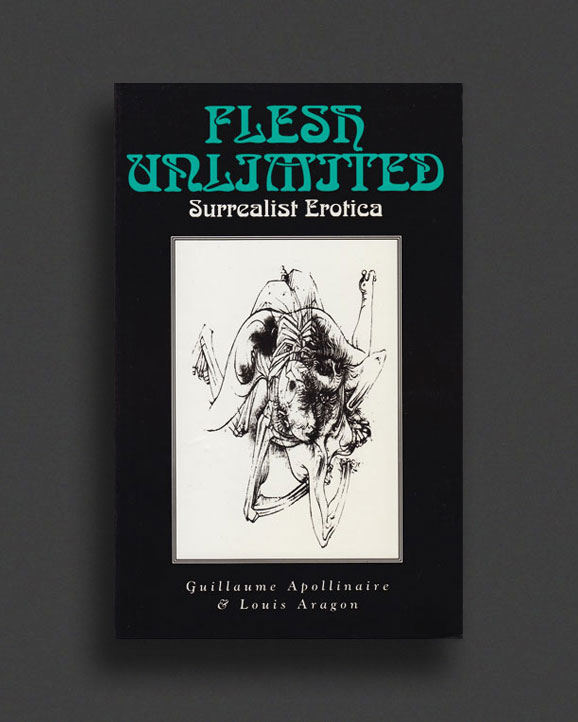
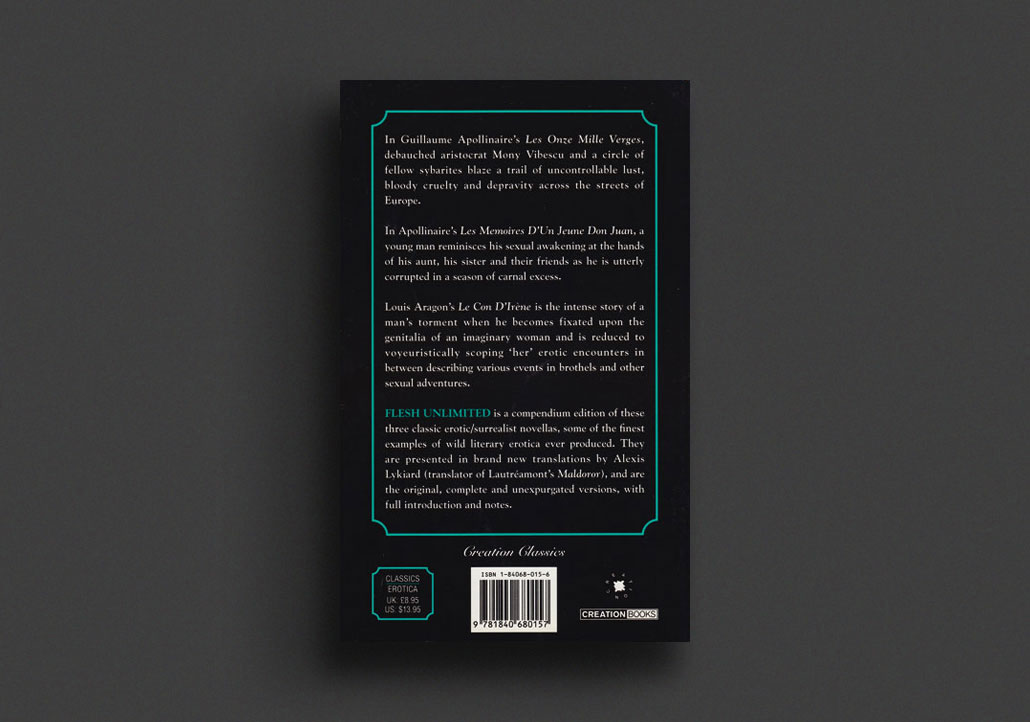
Flesh Unlimited is a compendium edition of three classic erotic/surrealist novellas: Les Onze Mille Verges and Les Mémoires d'un Jeune Don Juan by Guillaume Appollinaire and Le Con d'Irène by Louis Aragon. Published by Creation in 2000, translated into English from the original, complete and unexpurgated versions by Alexis Lykiard (translator of Lautréamont's Maldoror), including a general introduction and notes section. Long out-of-print. Cover artwork by Hans Bellmer.
Dadaist poet Guillaume Apollinaire fine-tuned his uniquely poetic and surreal vision to produce these two materpieces of the explicit erotic imagination at the turn of the century, works which compare with the best of the Marquis de Sade. In Les Onze Milles Verges, debauched aristocrat Mony Vibescu and a circle of fellow sybarites blaze a trail of uncontrollable lust, bloody cruelty and depravity across the streets of Europe. Whilst in Les Mémoires d'un Jeune Don Juan, a young man reminisces his sexual awakening at the hands of his aunt, his sister and their friends as he is utterly corrupted in a season of carnal excess.
Louis Aragon's Le Con d'Irène is the intense story of a man's torment when he becomes fixated upon the genitalia of an imaginary woman and is reduced to voyeuristically scoping her erotic encounters in-between describing various events in brothels and other sexual adventures.
Very Good copy.
1989, English
Softcover, unpaginated, 20.5 x 13.5 cm
1st Edition, Out of print title / as new
Published by
Creation Books / London
$90.00 - Out of stock
As New copy of this very rare collection of poetry by the master of the macabre Edgar Allan Poe, illustrated throughout with many lithographs by French Symbolist Odilon Redon. A beautiful edition from the beginning of the Creation Books catalogue.
"Deep in earth my love is lying And I must weep alone." (1847)
"Edgar Allan Poe (1809-1849) considered himself foremost a poet. Even his best-remembered tales read as prose-poems; obsessive tracts on dream and trance, catalepsy, premature burial, fetishism, necrophilia: a canon of ossified manias whose morbidness is reflected in the substance of his verse compositions. These, epistles of a poisoned romance between body and soul, charting febrile dreamscapes, seem to reflect the writer's life of sexual torment through a drink and opium mirror; a symphony of dead brides and delirium.
It was this doomed spiral that Baudelaire later recognized in announcing his own credo of perpetual intoxication; his "Fleurs du Mal" were inspired directly by Poe, sickly blooms that in turn coil through the feverclaws of Rimbaud, or the foetid distortions of Lautreamont. Right through to the claustrophobic cosmogenies of H.P. Lovecraft and perhaps beyond, the spirit of Poe resonates throughout the history of insane literature.
The poems selected for this present volume chart Poe's idealistic disintegration; from youthful Byronic romanticism, as in the long, convoluted and naive narrative "Al Aaraaf" (1829) into his more familiar, hallucinant cartography of the necropolis - most starkly expressed in the spiritual nadir of "The Conqueror Worm" (1842). In "Ulalume", for example, the writer is compelled to
revisit the swamplands where he has entombed the corpse of his butchered bride on a previous Hallowe'en; in "The Raven" , he is haunted by that dread harbinger of menstruation with promises of a spectral visitation from a mistress beyond the grave. The much-anthologized "Annabel Lee" - included here, as are several poems, in a lesser-known early version - is an unveiled paean to necrophilia.
The above-mentioned pieces are just some of many oneiric shards from that lost and fragmented mosaic, the glittering yet entombed genius of the artist - dreamland glimpsed through the sarcophagus lid of the heavens."
"Odilon Redon (1840-1916) was compelled to reproduce the most insane images from his unconscious, inspired by such "dangerous" writers of his time as Poe, Baudelaire, and Flaubert. Acclaimed by the Symbolists, clearly anticipating Surrealism, his bizarre and macabre works were immortalized by description in Joris-Karl Huysmans' profane bible "A Rebours" ("Against Nature") of 1884 -itself one of the strangest books ever committed to print.
The lithographs reproduced herein are from Redon's series "A Edgar Poe" of 1882."
—James Havoc (introduction)
Fine—As New copy.
1957, English
Softcover, 170 pages, 18 x 11 cm
Reprint,
1st Edition, Out of print title / used / fine
Published by
University of California / Berkeley
$15.00 - Out of stock
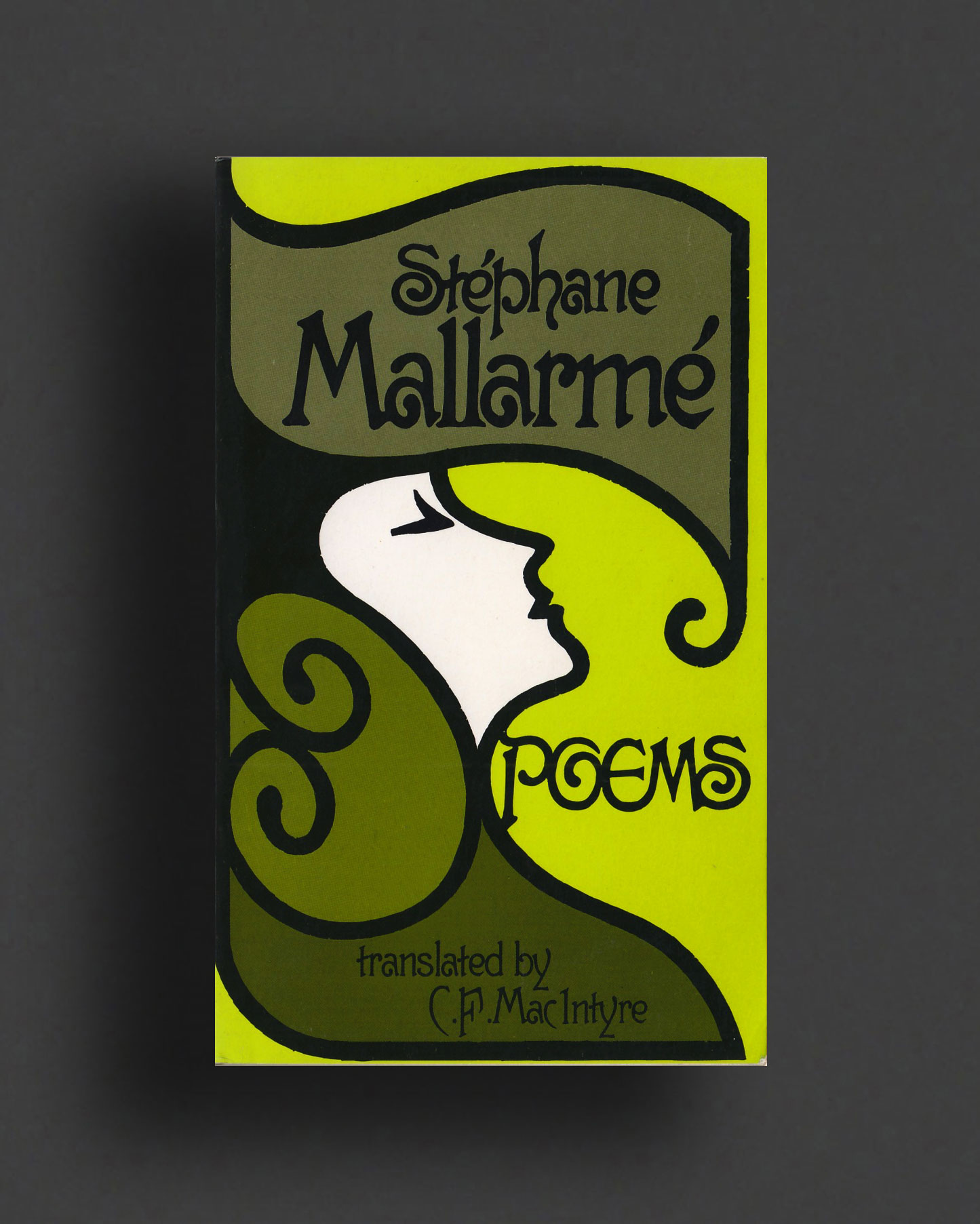
Reprint of the 1957 paperback edition of Poems by Mallarmé, published by the University of California, Berkeley.
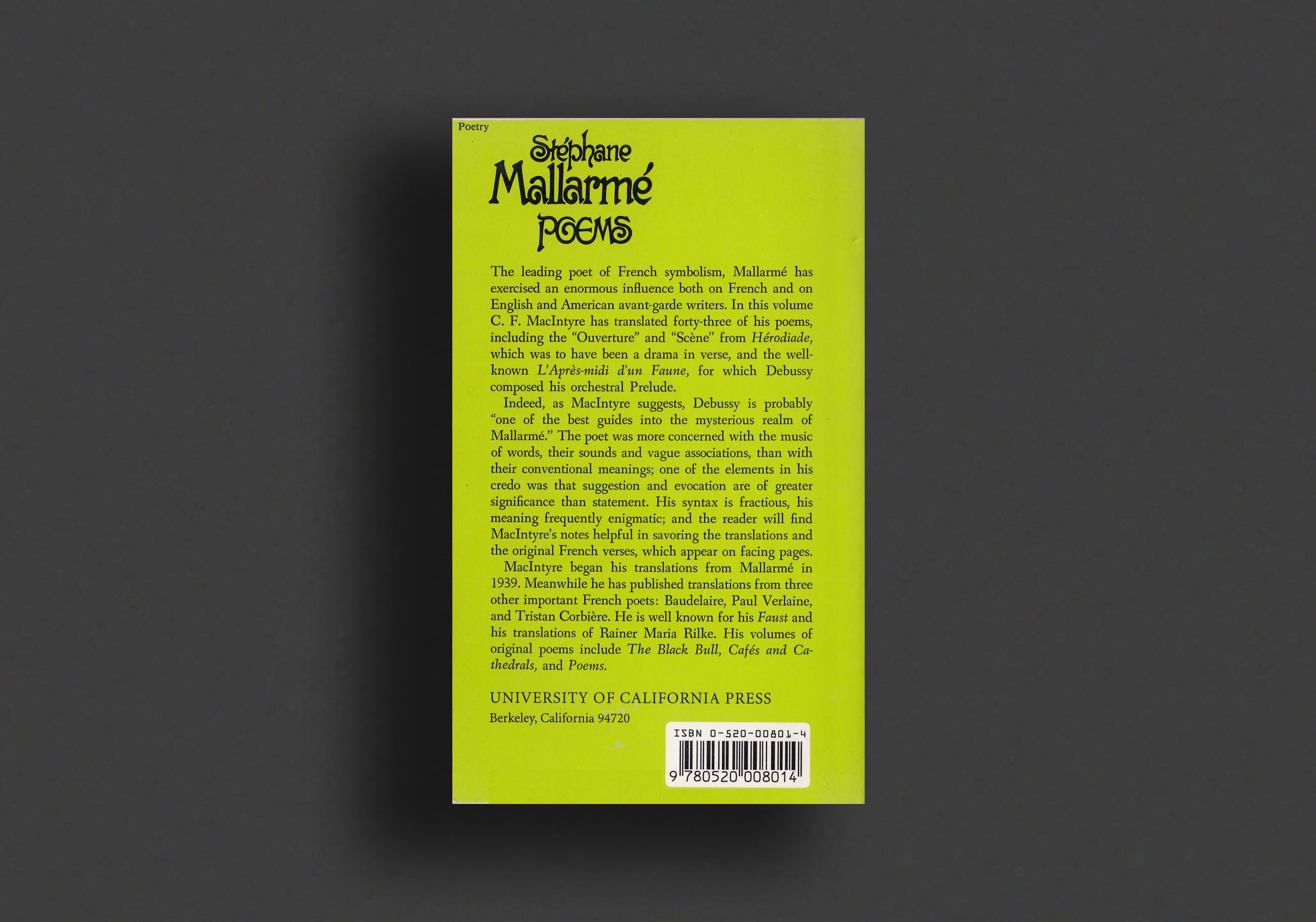
The leading poet of French symbolism, Mallarmé has exercised an enormous influence both on French and on English and American avant-garde writers. In this volume C. F. MacIntyre has translated forty-three of his poems, including the "Ouverture" and "Scène" from Hérodiade, which was to have been a drama in verse, and the well-known L'Après-midi d'un Faune, for which Debussy composed his orchestral Prelude.
Indeed, as MacIntyre suggests, Debussy is probably "one of the best guides into the mysterious realm of Mallarmé." The poet was more concerned with the music of words, their sounds and vague associations, than with their conventional meanings; one of the elements in his credo was that suggestion and evocation are of greater significance than statement. His syntax is fractious, his meaning frequently enigmatic; and the reader will find MacIntyre's notes helpful in savoring the translations and the original French verses, which appear on facing pages.
MacIntyre began his translations from Mallarmé in 1939. Meanwhile he has published translations from three other important French poets: Baudelaire, Paul Verlaine, and Tristan Corbière. He is well known for his Faust and his translations of Rainer Maria Rilke. His volumes of original poems include The Black Bull, Cafés and Ca-thedrals, and Poems.
Fine copy.
2016, English
Softcover, 96 pages, 27.8 x 21.4 cm
Published by
Seagull Books / London
$39.00 - Out of stock
Translated by Donald Nicholson-Smith
Edited with a Preface by Évelyne Grossman
A poet, philosopher, essayist, playwright, actor, and director, Antonin Artaud was a visionary writer and a major influence within and beyond the French avant-garde. A key text for understanding his thought and his appeal, 50 Drawings to Murder Magic is rooted in the nine years Artaud spent in mental asylums, struggling with schizophrenia and the demonic, persecutory visions it unleashed. Set down in a dozen exercise books written between 1946 and 1948, these pieces trace Artaud’s struggle to escape a personal hell that extends far beyond the walls of asylums and the dark magicians he believed ran them.
The first eleven notebooks are filled with fragments of writing and extraordinary sketches: totemic figures, pierced bodies, and enigmatic machines, some revealing the marks of a trembling hand, others carefully built up from firm, forceful pencil strokes. The twelfth notebook, completed two months before Artaud’s death in 1948, changes course: it’s an extraordinary text on the loss of magic to the demonic—the piece that gives the book its title.
“Artaud matters,” wrote John Simon in the Saturday Review years ago. Nearly seventy years after his death, that remains true—perhaps more than ever.
"A gloriously reproduced edition . . . . There is something in this text that speaks to the creative process--especially to the degree to which so much of what the writer or artist commits to the page (or canvass) extends from a place beyond conscious attention, to be received actively but without specific intention."—Rough Ghosts
1967, English
Softcover, 100 pages, 23 x 15 cm
1st Edition, Out of print title / used / very good
Published by
North Atlantic Books / Vermont
$40.00 - In stock -
First edition of 20,000 A.D., a collection of poetry from the 1960s—70s by founder of Peace Eye Bookstore, the Fuck You Press, and the Fugs, Ed Sanders, published by North Atlantic Books, Vermont, in 1976. Deeply influenced by the work of Dylan Thomas, Ezra Pound, and Allen Ginsberg, Sanders helped bridge the concerns of Beat poetry and the countercultural movement of the 1960s. Sanders discussed his approach to investigative poetry: “Nonfiction is a kind of map of fragments of information sequenced together, like an elegant baklava with layers of meaning,” he alleged. “You have to think of different arrays of sequencing information … You have to make an apt choice, or an artistic choice, or an aesthetic choice about what you put in—and what you leave out. It’s an art form when to say no. Especially in investigative poetry, it’s a mission.”
Very Good copy, light tanning.
1986 / 2023, English
Softcover, 208 pages, 21.5 x 14 cm
Published by
Princeton University Press / New York
$33.00 - Out of stock
Named one of the 100 best nonfiction books of all time by the Modern Library. Anne Carson’s remarkable first book about the paradoxical nature of romantic love.
Since it was first published in 1986, Eros the Bittersweet, Anne Carson’s lyrical meditation on love in ancient Greek literature and philosophy, has established itself as a favourite among an unusually broad audience, including classicists, essayists, poets, and general readers. Beginning with the poet Sappho’s invention of the word “bittersweet” to describe Eros, Carson’s original and beautifully written book is a wide-ranging reflection on the conflicted nature of romantic love, which is both “miserable” and “one of the greatest pleasures we have.”
Originally published in 1986.
1964, English
Hardcover (w. dust jacket), 182 pages, 22 x 14.5 cm
1st Edition, Out of print title / used / good
Published by
Dent / London
$65.00 - Out of stock
Scarce hardcover edition of Dylan Thomas - Collected Poems 1934-1952, published by Den in the UK in 1964.
From book jacket:
"At his best he is unique, for he distils an exquisite mysterious moving quality which defies analysis as supreme lyrical poetry always has and—let us hope—always will."—CYRIL CONNOLY, Sunday Times
"Seeing the scope and intensity of the total work it need no longer be eccentric to claim that Thomas is the greatest living poet in the English language. ... His language is seldom colloquial, nearly always in the grandest of grand manners, yet he is an adept at transforming an old and dead familiarity?"—PHILIP TOYNBEE, Observer
*In this critical situation [of English poetry] the appearance of Mr Dylan Thomas's Collected Poems 1934-1972 is a delightful event. The fact that Mr Thomas has omitted virtually nothing from this collection that he has published in his earlier volumes gives it an added interest. ... It is encouraging to notice that a surprising number of his best poems are not obscure at all, and may be enjoyed by anyone who has the humility to approach a new poet in the expectation of finding something different from that which other poets have given him."—The Times Literary Supplement
"The appearance of the col'ected poems of Dylan Thomas is by any standards an important literary event... of the younger generation of established poets, Dylan Thomas seems to me far the best-the most exciting, the most original, with the fullest and grandest command of language."—GRAHAM HOUGH, B.B.C. Broadcast
"Mr Thomas is the most richly endowed of the poets of his generation. His genius is still throwing out rare and surprising inventions. One feels that he will be remembered among the English poets?"—EDWIN MUIR, Britain Today
"Most impressive. Mr Thomas is not afraid of traditional forms and he is willing to experiment at times. ... His imagery is clear cut and striking, and his inspiration is authentic."—ERIC GILLETT, National and English Revien
Awarded the William Foyle Poetry Prize 1952
Awarded the Etna-Taormina International Prize in Poetry 1953
Very Good copy in Average/Good dust jacket (price-clipped with general wear/toning), well preserved book.