World Food Books' programme is largely produced on Kulin Nation land. We acknowledge the Wurundjeri people of the Kulin Nation as the first and continuing custodians of this land, and pay respect to their Elders past, present, and emerging.
World Food Books is an arts and special interests bookshop in Naarm / Melbourne. Founded in 2010, World Food Books is devoted to the presentation of a rotating, hand-selection of international art, design, literary and counterculture publications with an emphasis on the anti-traditional, the experimental, the avant-garde, the heretic, the marginal.
Presenting new titles alongside rare and out-of-print books, catalogues and journals spanning the fields of modern and contemporary art, design, photography, illustration, film, literature, poetry, cultural theory, philosophy, sexuality, popular and underground culture in its many radical forms, World Food Books wishes to encourage adventurous, thoughtful and open-minded reading, looking, writing, and exchange of publishing and ideas, both current and historical.
As well as our bookshop, located in Melbourne's historical Nicholas Building, all of our inventory is available internationally via our online mail-order service.
World Food Books semi-regularly co-ordinates "Occasions", a programme of exhibits and events at the bookshop and in partnership with other hosts (such as museums and art galleries) that develop out of the activities, relationships and content of the bookshop itself.
World Food Books
The Nicholas Building
37 Swanston Street
Room 5, Level 6
Melbourne 3000
Australia
SHOP HOURS:
THU–SAT 12–6
WEB-SHOP OPEN 24/7
World Food Books
Postal Address:
PO Box 435
Flinders Lane
Victoria 8009
Australia
info@worldfoodbooks.com
Art
Theory / Essay
Architecture / Interior
Graphic Design / Typography
Photography
Fashion
Eros
LGBTQ+
Fiction / Poetry
Weird / Speculative / Science Fiction / Horror
Transgressive / Visceral / Abject
Symbolism / Decadence / Fin de siècle
Film / Video
Painting
Sculpture / Installation
Performance / Dance / Theater
Drawing
Sound / Music
Curatorial
Group Shows / Collections
Periodicals
Out-of-print / Rare
Posters / Ephemera / Discs
Signed Books
World Food Books Gift Voucher
World Food Book Bag
Australian Art
Australian Fiction
Australian Science Fiction / Speculative Fiction
Australian Poetry
Australian Photography
Japanese Photography
Conceptual Art
Minimal Art
Dada
'Pataphysics / Oulipo
Fluxus
Concrete Poetry
Pop Art
Surrealism
Arte Povera
Arte Informale / Haute Pâte / Tachism
Nouveau Réalisme / Zero / Kinetic
Situationism / Lettrism
Collage / Mail Art / Xerox Art
Art Brut / Folk / Visionary / Fantastic
Illustration / Graphic Art / Bandes Dessinées
Furniture
Italian Radical Design / Postmodernism
Textiles
Ceramics / Glass
Counterculture
Protest / Revolt
Philosophy
Psychoanalysis
Anthropology
Anarchism
Socialism / Anarchism / Communism / Capitalism
Literary Theory / Semiotics / Language
Feminism / Women's Studies
Gender Studies / Sexuality
Anthropology
Fetishism / BDSM
Drugs / Psychedelia
Crime / Violence
Animal Rights / Veganism
Occult / Esoterica
Ecology / Earth / Alternative Living
Whole Earth / Crafts
All prices in AUD (Australian dollars)
Pick-Ups
Pick-up orders can be collected in our bookshop during opening hours after order date. Please collect any Pick-up orders within 2 weeks of ordering as we have limited storage space. Orders will be released back into stock if not collected within this time. No refunds can be made for pick-ups left un-collected. If you cannot make it in to the bookshop in this time-frame, please choose postage option.
Return Policy
All sales are final. We do accept returns (for refund or exchange) for items received in error. All our orders are packed with special care using heavy-duty padding and cardboard book-mailers or bubble mailers (for smaller books), using reinforcement where required. We cannot take responsibility for any lost, stolen or damaged parcels.
Insurance
Should you wish to insure your package, please email us directly after placing your order and we can organise this at a small extra expense. Although all standard/express tracked packages are very safe and dependable, we cannot take responsibility for any lost, stolen or damaged parcels. We recommend insurance on valuable orders.
Interested in selling your old books, catalogues, journals, magazines, comics, fanzines, ephemera? We are always looking for interesting, unusual and out-of-print books to buy. We only buy books in our fields of interest and specialty, and that we feel we can resell.
We base these prices on desirability, market value, in-print prices, condition and our current stock levels. We offer cash, store credit, and can take stock on consignment. All
about 25% of the price we expect to get when we sell them, or 30% in store credit. We base these prices on desirability, market value, in-print prices, condition and our current stock levels.
Sell your books any day of the week. You can drop them off and return later. If you have a lot of books, we can visit your Sydney home.
We buy books that we feel we can resell. We offer about 25 % of the price we expect to get when we sell them, or 30% in store credit. We base these prices on desirability, market value, in-print prices, condition and our current stock levels.
Philadelphia Wireman
03 August - 01 September, 2018
World Food Books is proud to announce our next Occasion, the first presentation of sculptures by Philadelphia Wireman in Australia.
The Philadelphia Wireman sculptures were found abandoned in an alley off Philadelphia’s South Street on trash night in 1982. Their discovery in a rapidly-changing neighbourhood undergoing extensive renovation, compounded with the failure of all attempts to locate the artist, suggests that the works may have been discarded after the maker’s death. Dubbed the "Philadelphia Wireman" during the first exhibition of this work, in 1985, the maker’s name, age, ethnicity, and even gender remain uncertain. The entire collection totals approximately 1200 pieces, all intricately bound together with tightly-wound heavy-gauge wire (along with a few small, abstract marker drawings, reminiscent both of Mark Tobey and J.B. Murry). The dense construction of the work, despite a modest range of scale and materials, is singularly obsessive and disciplined in design: a wire armature or exoskeleton firmly binds a bricolage of found objects including plastic, glass, food packaging, umbrella parts, tape, rubber, batteries, pens, leather, reflectors, nuts and bolts, nails, foil, coins, toys, watches, eyeglasses, tools, and jewellery.
Heavy with associations—anthropomorphic, zoomorphic, and socio-cultural responses to wrapped detritus—the totemic sculptures by Philadelphia Wireman have been discussed in the context of work created to fulfil the shamanistic needs of alternative religions in American culture. Curators, collectors, and critics have variously compared certain pieces to sculpture from Classical antiquity, Native American medicine bundles, African-American memory jugs, and African fetish objects. Reflecting the artist’s prolific and incredibly focused scavenging impulse, and despite—or perhaps enhanced by—their anonymity, these enigmatic objects function as urban artefacts and arbiters of power, though their origin and purpose is unknown. Philadelphia Wireman, whatever their identity, possessed an astonishing ability to isolate and communicate the concepts of power and energy through the selection and transformation of ordinary materials. Over the course of the past two decades, this collection has come to be regarded as an important discovery in the field of self-taught art and vernacular art.
Presented in collaboration with Fleisher-Ollman Gallery, Philadelphia, and Robert Heald, Wellington.
Susan Te Kahurangi King
02 February - 10 March, 2018
Susan Te Kahurangi King (24 February 1951 - ) has been a confident and prolific artist since she was a young child, drawing with readily available materials - pencils, ballpoint pens and felt-tip markers, on whatever paper is at hand. Between the ages of four and six Susan slowly ceased verbal communication. Her grandparents William and Myrtle Murphy had developed a special bond with Susan so they took on caring responsibilities for extended periods. Myrtle began informally archiving her work, carefully collecting and storing the drawings and compiling scrapbooks. No drawing was insignificant; every scrap of paper was kept. The King family are now the custodians of a vast collection containing over 7000 individual works, from tiny scraps of paper through to 5 meter long rolls.
The scrapbooks and diaries reveal Myrtle to be a woman of great patience and compassion, seeking to understand a child who was not always behaving as expected. She encouraged Susan to be observant, to explore her environment and absorb all the sights and sounds. Myrtle would show Susan’s drawings to friends and people in her community that she had dealings with, such as shopkeepers and postal workers, but this was not simply a case of a grandmother’s bias. She recognised that Susan had developed a sophisticated and unique visual language and sincerely believed that her art deserved serious attention.
This was an unorthodox attitude for the time. To provide some context, Jean Dubuffet coined the term Art Brut in 1945 to describe work created by self-taught artists – specifically residents of psychiatric institutions and those he considered to be visionaries or eccentrics. In 1972 Roger Cardinal extended this concept by adopting the term Outsider Art to describe work made by non-academically trained artists operating outside of mainstream art networks through choice or circumstance. Susan was born in Te Aroha, New Zealand in 1951, far from the artistic hubs of Paris and London that Dubuffet and Cardinal operated in. That Myrtle fêted Susan as a self-taught artist who deserved to be taken seriously shows how progressive her attitudes were.
Susan’s parents Doug and Dawn were also progressive. Over the years they had consulted numerous health practitioners about Susan’s condition, as the medical establishment could not provide an explanation as to why she had lapsed into silence. Dawn educated herself in the field of homeopathy and went on to treat all twelve of her children using these principles – basing prescriptions on her observations of their physical, mental and emotional state.
Doug was a linguist with an interest in philosophy who devoted what little spare time he had to studying Maori language and culture. To some extent their willingness to explore the fringes of the mainstream made them outsiders too but it was their commitment to living with integrity and their respect for individuality that ensured Susan’s creativity was always encouraged.
Even though Susan’s family supported her artistic pursuits, some staff in schools and hospitals saw it as an impediment to her assimilation into the community and discouraged it in a variety of ways. Her family was not always aware of this and therefore did not fully understand why Susan stopped drawing in the early 1990s. However, rather than dwell on the challenges that Susan faced in pursuit of her artistic practice, they prefer to highlight her achievements. In 2008 Susan began drawing again in earnest, after an almost 20 year interruption, and her work is now shown in galleries around the world.
Susan grew up without television and has been heavily influenced by the comics she read as a child. She is absolutely fearless in the appropriation of recognizable characters, such as Donald Duck and Mickey Mouse, in her work. She twists their limbs, contorts their faces, compresses them together, blends them into complex patterned backgrounds - always imbuing them with an incredible energy. Although Susan often used pop culture characters in her work they are not naive or childlike. These are drawings by a brilliant self-taught artist who has been creating exceptional work for decades without an audience in mind.
Mladen Stilinović
"Various Works 1986 - 1999"
02 February 16 - September 10, 2016
Various works 1986 - 1999, from two houses, from the collections of John Nixon, Sue Cramer, Kerrie Poliness, Peter Haffenden and Phoebe Haffenden.
Including: Geometry of Cakes (various shelves), 1993; Poor People’s Law (black and white plate), 1993; White Absence (glasses, ruler, set square, silver spoon, silver ladel with skin photograph and wooden cubes), 1990-1996; Exploitation of the Dead (grey and red star painting, wooden painting, black spoon with red table, red plate), 1984-1990; Money and Zeros (zero tie, paintings made for friends in Australia (Sue, John, Kerrie), numbers painting), 1991-1992; Words - Slogans (various t-shirts) - “they talk about the death of art...help! someone is trying to kill me”, “my sweet little lamb”, “work is a disease - Karl Marx”; Various artist books, catalogues, monographs, videos; Poster from exhibition Insulting Anarchy; "Circular" Croatian - Australian edition; Artist book by Vlado Martek (Dostoyevsky); more.
Thanks to Mladen Stilinović and Branka Stipančić.
Jonathan Walker
Always Will Need To Wear Winter Shirt Blue + Ochre Small Check Pattern
21 August - 21 September, 2015
Untitled
I am not a great reader of poetry but I always return to the work of Melbourne poet, Vincent Buckley (1925- 1988). Perhaps I find his most tantalising piece to be not a finished poem but a fragment left on a scrap of paper discovered on his desk after the poet’s death.
The poetry gathers like oil
In the word-core, and spreads
It has its music meet,
Its music is in movement.
This fragment is more the shell left behind from a volatile thought than a finished poem. I find the last two lines honest but awkward whereas the first two lines work like an arrow. Most likely he could not find a resolution so it was left. Still, in its present form, it remains an eloquent testimony to the ultimate failure of a medium to express mobile thought and sensation, in Buckley’s case, through verbal language. It’s an important matter because this is something all artists have to deal with regardless of the medium.
I have never written a poem, however, I am forever copying fragments from books on paper scraps in a vain effort to fix certain notions in my head. At first, they function as bookmarks that are sometimes returned to when I open the book. But before long, as they accumulate, they fall out littering the table interspersed with A4 photocopies, bills, books and medications.
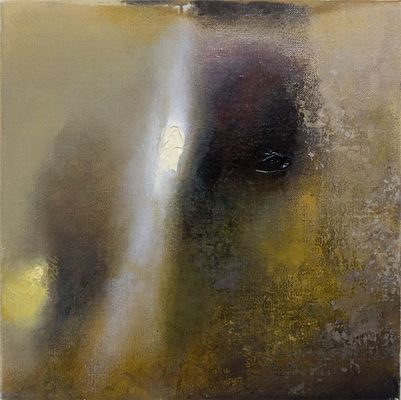
To return to Buckley’s fragment, the first two lines very much evoke how I paint nowadays. As you age, detail diminishes and patches of light become more luminous and float. I feel the most honest way of dealing with this is by smearing the oil paint on the canvas with the fingers and working close-up, blind. Only if the patches coalesce into an approaching image can the work gain a life.
-
Jonathan Walker was born in Melbourne, Australia and brought up on a dairy farm in Gippsland. In the 1970’s he studied painting at RMIT and won the Harold Wright Scholarship to the British Museum, London. During the 1980’s he exhibited at Pinacotheca Gallery, Richmond and had work shown at the NGV and Heidi City Art Gallery. Over the same period he designed the cover for the “Epigenesi” LP by Giancarlo Toniutti, Italy and conducted a mail exchange work with Achim Wollscheid, Germany. The work with artists through the post resulted in an article published in the bicentenary issue of Art and Australia 1988. He showed in artist run spaces such as WestSpace in the 90’s and 2000’s, and until 2012, taught painting at Victoria University, which is where we (Colleen Ahern and Lisa Radford) as organisers of the exhibition, among many others, had the privilege of being his student.
Walker’s knowledge was imparted to students through the careful selection of music, literature, and artists found in books that he himself had ordered for the library. Walker’s strategy was the generosity of sharing his vast knowledge with references specific to each student and their context.
Walker’s paintings share a similar focus and intimacy.
This exhibition presents a small selection of recent paintings alongside a publication that includes Walker’s writing. Observational and analytical, Walker’s work is a type of material notation — the time of day, colour and how it is blended, the both specific and fleeting location of a reflection on lino or the question of whether a chair leg should be included in a painting.
Please join us on Friday August 21 between 6-8pm to celebrate the opening of the exhibition.
Curated by Colleen Ahern and Lisa Radford.
B. Wurtz
Curated by Nic Tammens
March 26 - April 4, 2015
B.Wurtz works from a basement studio in his home on Manhattan’s Lower East Side.
This local fact is attested to by the plastic shopping bags and newsprint circulars that appear in his work. As formal objects, they don’t make loud claims about their origins but nonetheless transmit street addresses and places of business from the bottom of this long thin island. Like plenty of artists, Wurtz is affected by what is local and what is consumed. His work is underpinned by this ethic. It often speaks from a neighborhood or reads like the contents of a hamper:
“BLACK PLUMS $1.29 lb.”
“Food Bazaar”
“USDA Whole Pork Shoulder Picnic 99c lb.”
“RITE AID Pharmacy, with us it’s personal.”
“H. Brickman & Sons.”
“Sweet Yams 59c lb."
Most of the work in this exhibition was made while the artist was in residence at Dieu Donne, a workshop dedicated to paper craft in Midtown. Here Wurtz fabricated assemblages with paper and objects that are relatively lightweight, with the intention that they would be easily transportable to Australia. This consideration isn’t absolute in Wurtz’s work, but was prescriptive for making the current exhibition light and cheap. Packed in two boxes, these works were sent from a USPS post office on the Lower East Side and delivered to North Melbourne by Australia Post.
Wurtz appears courtesy of Metro Pictures, New York.
Thanks to Rob Halverson, Joshua Petherick, Sari de Mallory, Matt Hinkley, Helen Johnson, Fayen d'Evie, Ask Kilmartin, Lisa Radon, Ellena Savage, Yale Union, and "Elizabeth".
John Nixon
"Archive"
December 15 - January 20, 2014
The presentation of John Nixon's archive offered a rare showcase of this extensive collection of the artist's own publications, catalogues, posters, ephemera, editions and more, from the mid 1980s onwards, alongside a selection of his artworks.
Organized by John Nixon, Joshua Petherick and Matt Hinkley.
"Habitat"
at Minerva, Sydney (organised by Joshua Petherick and Matt Hinkley)
November 15 - December 20, 2014
Lupo Borgonovo, Janet Burchill & Jennifer McCamley,
Lewis Fidock, HR Giger, Piero Gilardi, Veit Laurent Kurz,
Cinzia Ruggeri, Michael E. Smith, Lucie Stahl, Daniel Weil, Wols
Press Release:
“...It contained seven objects. The slender fluted bone, surely formed for flight, surely from the wing of some large bird. Three archaic circuitboards, faced with mazes of gold. A smooth white sphere of baked clay. An age-blackened fragment of lace. A fingerlength segment of what she assumed was bone from a human wrist, grayish white, inset smoothly with the silicon shaft of a small instrument that must once have ridden flush with the surface of the skin - but the thing’s face was seared and blackened.”
William Gibson, “Count Zero”, 1986
"Autumn Projects Archive"
Curated by Liza Vasiliou
March 6 - March 15, 2014
World Food Books, in conjunction with the Virgin Australia Melbourne Fashion Festival 2014, presented the Autumn Projects archive, consisting of a selection of early examples in Australian fashion with a particular interest in collecting designers and labels from the period beginning in the 1980’s, who significantly influenced the discourse of Australian Fashion.
Curated by Liza Vasiliou, the exhibition provided a unique opportunity to view pieces by designers Anthea Crawford, Barbara Vandenberg, Geoff Liddell and labels CR Australia, Covers, Jag along with early experimental collage pieces by Prue Acton and Sally Browne’s ‘Fragments’ collection, suspended throughout the functioning World Food Books shop in Melbourne.
H.B. Peace
presented by CENTRE FOR STYLE
November 14, 2013
"Hey Blinky, you say chic, I say same"
Anon 2013
H.B. Peace is a clothing collaboration between great friends Blake Barns and Hugh Egan Westland. Their pieces explore the divergences between 'character’ and ‘personality’ in garments....etc
Special Thanks to Joshua Petherick and Matt Hinkley of WFB and Gillian Mears
and a Very Special Thank you to Audrey Thomas Hayes for her shoe collaboration.
Janet Burchill & Jennifer McCamley
"Aesthetic Suicide"
May 10 - June 8, 2013
The first of our occasional exhibitions in the World Food Books office/shop space in Melbourne, "Aesthetic Suicide" presented a body of new and older works together by artists Janet Burchill & Jennifer McCamley, including videos, prints, a wall work, and publications.
During shop open hours videos played every hour, on the hour.
1977, Japanese
Softcover (staple-bound), 64 pages, 28 x 21 cm
1st Edition, Out of print title / used / good
Published by
Feminist / Tokyo
$65.00 - In stock -
The inaugural 1977 issue of "Feminist", a rare and important record of the women's liberation movement in Japan in the the 1970s and document of the cross-currents of international female theorists, artists, poets, authors, and activists in the women's movement. This first issue with cover story on Yoko Ono, shot by Michiko Matsumoto, one of post war Japan's leading photographers. Edited by Japanese critic, American literature researcher, and poet, Ikuko Atsumi (who also co-edited "Burning Hearts: Women Poets of Japan" with Kenneth Rexroth, The Seabury Press/New Directions, 1977), with Diane L. Simpson, and contributors including women's rights activist/journalist Yayori Matsui (noted for her work to raise awareness of sex slaves and sex tourism in post-war Asia), photographer Michiko Matsumoto, Japanese linguist Sachiko Ide, Japanese poet, literary critic, and scholar Muneko Mizuta, historian Masaaki Sugiyama, author/activist Yumiko Sakuma, with this issue covering the controversy surrounding the formation of the magazine, a feature with performer/educator Mitsuko Hase, modern mythology, masculinity, media, misogyny, the Feminine imagination, the media's disdain for Asians, The Blood Bowl Sutra / women and the Buddhist faith, a report from the frontlines of the American women's movement (w. photography by Michiko Matsumoto), visiting women's studies courses around the world (University of Southern California), book reviews, feminist news, and the cover feature with artist Yoko Ono, "Yoko Ono's Philosophy" and a conversation with editor Ikuko Atsumi by Mitsuko Hase (w. photography by Michiko Matsumoto).
Good—VG copy with age/wear to cover extremities, some foxing/staining.
1985, English
Hardcover (clothbound), 136 pages, 23.5 x 15.5 cm
1st Edition, Out of print title / used / very good
Published by
Pendragon Press / New York
$140.00 - Out of stock
Very rare first 1985 hardcover English translation of the thesis defence of Romanian-born Greek-French avant-garde composer Iannis Xenakis (1922—2001), tape recorded for a "Doctorat d'État" at the Sorbonne in Spring 1976 before composer Olivier Messiaen, art critic Michel Ragon, philosopher Olivier Revault d'Allonnes, philosopher Michel Serres, and philosopher Bernard Teyssèdre (all dialogues recorded within). Translated to English for the first time by Sharon Kanach.
In this fascinating essay Iannis Xenakis succeeds in unraveling the intricate web between the arts and sciences, thereby demonstrating their interdependency as in the components of an alloy. A complete list of works and bibliography are included. In this translation Xenakis explains not only his musical and theoretical writings - but also the role of mathematics as a philosophical catalyst in both his musical and architectural works. He discusses in detail his unique use of computers as a graphic tool in the composition of some of his scores. Unexpected aspects of his character are gracefully revealed in these highly readable exposés.
Xenakis is responding to a panel of noted French masters from the various disciplines in which he has worked and cleverly manages to answer specific questions in one field while simultaneously addressing perhaps less-initiated exponents from other, seemingly unrelated areas. He succeeds in unraveling the intricate web between the arts and sciences, thereby demonstrating their inter-dependency as in the components of alloys.
Very Good copy with some very light marks to cloth covers. Please note this is the first 1985 printing, rather than the later 1994 printing, also scarce.
2025, English
Softcover, 272 pages, 20.8 x 14.9 cm
Published by
Urbanomic / Cornwall
$55.00 - Out of stock
An interdisciplinary, cross-cultural collection that decenters familiar narratives to provide a fresh perspective on what artificial intelligence is today, and what it might become.
Historians, media theorists, science-fiction writers, philosophers, and artists from China and elsewhere reexamine the nation's intense engagement with AI, moving beyond the clichés that still dominate contemporary debate.
Today, visions of the contested future of AI veer between common planetary goals and a new Cold War, as culturally-specific models of intelligence, speculative traditions, and thought experiments come up against the emergence of novel forms of cognition that cannot be reduced to any historical cultural tradition.
This uniquely positioned volume provides expert insight into this tension, using China as a touchstone for rethinking "artificiality" and "intelligence" as sites of difference in a way that is already present in the difficulty of precisely translating the Chinese term 人工智能. Tracking the history of Chinese AI from the pre-Cultural Revolution to the post-Deng Xiaoping eras right up to contemporary debates surrounding facial recognition, the writers in this collection draw on a mixture of speculative thought experiments and cutting-edge use cases to offer singular views on topics including AI and Chinese philosophy, AI ethics and policymaking, the development of computational models in early Chinese cybernetics, and the aesthetics of Sinofuturism.
Spanning borders between different worlds, histories, futures, and foundational models, Machine Decision is Not Final is not only a timely reappraisal of the stakes of AI development, but a tool for constructing more global imaginaries for the future of AI.
Contributors
Blaise Aguera y Arcas, Bo An, Benjamin Bratton, Shuang Frost, Vince Garton, Steve Goodman, Yvette Granata, Anna Greenspan, Amy Ireland, Xia Jia, Bogna Konior, Vincent Le, Lawrence Lek, Lukas Likavcan, Suzanne Livingston, Iris Long, Bingchun Meng, Reza Negarestani, Chen Quifan, Gabriele de Seta, Hongzhe Wang, Wang Xin, Mi You
2025, English
Softcover, 360 pages, 21.5 x 14 cm
Published by
University of Minnesota Press / Minnesota
Univocal Publishing / Minneapolis
$62.00 - In stock -
From 1970 until 1987, Gilles Deleuze held a weekly seminar at the Experimental University of Vincennes and, starting in 1980, at Saint-Denis. In the spring of 1981, he began a series of eight seminars on painting and its intersections with philosophy. The recorded sessions, newly transcribed and translated into English, are now available in their entirety for the first time. Extensively annotated by philosopher David Lapoujade, On Painting illuminates Deleuze's thinking on artistic creation, significantly extending the lines of thought in his book Francis Bacon.
Through paintings and writing by Rembrandt, Delacroix, Turner, Cezanne, Van Gogh, Klee, Pollock, and Bacon, Deleuze explores the creative process, from chaos to the pictorial fact. The introduction and use of color feature prominently as Deleuze elaborates on artistic and philosophical concepts such as the diagram, modulation, code, and the digital and the analogical. Through this scrutiny, he raises a series of profound and stimulating questions for his students: How does a painter ward off greyness and attain color? What is a line without contour? Why paint at all?
Written and thought in a rhizomatic manner that is thoroughly Deleuzian-strange, powerful, and novel-On Painting traverses both the conception of art history and the possibility of color as a philosophical concept.
Edited by David Lapoujade, translated by Charles J. Stivale.
1990, English
Softcover, 182 pages, 18 x 11.5 cm
1st Edition, Out of print title / used / very good
Published by
Semiotext(e) / Los Angeles
$50.00 - In stock -
"The project: to rescue 'communism' from its own disrepute. Once invoked as the liberation of work through mankind's collective action, communism has instead stifled humanity. We who see in communism the liberation of both collective and individual possibilities must reverse that regimentation of thought and desire which terminates the individual."
Translated by Michael Ryan. Includes "Postscript, 1990" by Toni Negri.
Very Good copy.
2022, English
Softcover, 160 pages, 19.9 x 13.3 cm
1st Edition, Out of print title / used / fine
Published by
Continuum / London
$50.00 - In stock -
From the preface by Alain Badiou: It is no exaggeration to say that Quentin Meillassoux has opened up a new path in the history of philosophy, understood here as the history of what it is to know ... This remarkable "critique of critique" is introduced here without embellishment, cutting straight to the heart of the matter in a particularly clear and logical manner. It allows the destiny of thought to be the absolute once more.
"This work is one of the most important to appear in continental philosophy in recent years and deserves a wide readership at the earliest possible date ... Apres la finitude is an important book of philosophy by an authnted emerging voices in continental thought. Quentin Meillassoux deserves our close attention in the years to come and his book deserves rapid translation and widespread discussion in the English-speaking world. There is nothing like it."—Graham Harman in Philosophy Today
Quentin Meillassoux's remarkable debut makes a strikingly original contribution to contemporary French philosophy and is set to have a significant impact on the future of continental philosophy. Written in a style that marries great clarity of expression with argumentative rigour, After Finitude provides bold readings of the history of philosophy and sets out a devastating critique of the unavowed fideism at the heart of post-Kantian philosophy.
The exceptional lucidity and the centrality of argument in Meillassoux's writing should appeal to analytic as well as continental philosophers, while his critique of fideism will be of interest to anyone preoccupied by the relation between philosophy, theology and religion.
Meillassoux introduces a startlingly novel philosophical alternative to the forced choice between dogmatism and critique. After Finitude proposes a new alliance between philosophy and science and calls for an unequivocal halt to the creeping return of religiosity in contemporary philosophical discourse.
"Rarely do we encounter a book which not only meets the highest standards of thinking, but sets up itself new standards, transforming the entire field into which it intervenes. Quentin Meillassoux does exactly this."—Slavoj Zizek
Fine copy of first 2008 edition.
1958 / 1985, English
Softcover, 332 pages, 23 x 15 cm
1st Edition, Out of print title / used / good
Published by
University of California Press / Berkley
$55.00 - In stock -
First 1958 paperback edition, 1985 print of Hannah Arendt's "The Human Condition", published by the University of Chicago Press. A work of striking originality, The Human Condition is in many respects more relevant now than when it first appeared in 1958. In her study of the state of modern humanity, Hannah Arendt considers humankind from the perspective of the actions of which it is capable. The problems Arendt identified then—diminishing human agency and political freedom, the paradox that as human powers increase through technological and humanistic inquiry, we are less equipped to control the consequences of our actions—continue to confront us today.
A classic in political and social theory, The Human Condition is a work that has proved both timeless and perpetually timely.
Good copy with fading to spine light wear to extremities, very minimal (eraser-able) lead pencil marginalia. No spine creasing.
2025, English
Hardcover (w. dust jacket), 408 pages, 23.5 x 15.9 cm
Published by
Zone Books / New York
$65.00 - Out of stock
When words are not heard but overheard, when phrases are perceived in bits and pieces, and when speakers, failing to do as they intend, state things that they never meant to say, the saying, in its unsteady relation to understanding, becomes an event. That event has long been studied by a disparate company of interpreters: prophets, priests, and rabbis, poets and philosophers, linguists, psychiatrists and psychoanalysts, novelists and filmmakers. All have suggested that in the contingencies of discourse, there are precious indications to be gleaned, for which special techniques are required. In Far Calls, Daniel Heller-Roazen reconstructs such arts of detection, interweaving ancient, medieval, and modern examples. From the rituals of the ancient Greeks, Jews, and Romans to Freud and Lacan, from Augustine’s catching of a salvific scrap of speech to the inspiration that Breton and Yeats, Proust and Joyce, drew from profane cries and transmissions, Far Calls explores the powers of sonorous coincidence and the varieties of reading that it incites.
“A captivating journey through centuries of Western culture and beyond, with the help of extraordinary erudition.”—Maurizio Bettini
“Far Calls culls a remarkable trove of glints and inklings, omens and names, echoes, auguries, and fleeting indications of a powerfully resonant counter-sublime. Daniel Heller-Roazen is a masterful interpreter of literary interstices, openings in language that take us into an endangered place of wisdom’s alternative beginnings. This is a steeply beautiful book, stunning for its insight, erudition, and range, and—above all—for its powers of vision and audition.”— Peter Cole, author of Draw Me After: Poems
“The brilliance of this book is that it brings to the surface one of those mysterious properties of utterance that we can’t quite locate. It’s the enigmatic communication that emerges from chance, from darkness, from inadvertence, from a child’s babble, from the gods, where more is meant than was said or known. We travel through Mesopotamia, catch our breath as Scipio and Napoleon portentously stumble, and linger with Joyce’s epiphanies and Heidegger’s ‘call of conscience’, all the while observing our human inability to control the way the heavens speak to us and indulging our unstoppable desire to keep overhearing their fragmentary messages in the hope that we will.”— Ardis Butterfield, Marie Borroff Professor of English and Professor of French and Music, Yale University
“Far Calls weaves a fascinating thread of thought from antiquity up to modernity. What a wonderful surprise to discover that Augustine, Alfonso el Sabio, Leibniz, Poe, Breton, Freud, Proust, even Heidegger attributed the power to communicate important ‘truths’ to what ancient divinatory wisdom called kledōn or omen: that is, the hidden meaning of words uttered with a completely different communicative intention. A captivating journey through centuries of Western culture and beyond, with the help of extraordinary erudition put in the service of a lucid and compact construction.”— Maurizio Bettini, Professor Emeritus of Classical Philology, Director of the Center for Anthropology and the Classics, University of Siena
Daniel Heller-Roazen is the Arthur W. Marks 1919 Professor of Comparative Literature at Princeton University. His is the author, most recently, of Absentees: On Variously Missing Persons; No One's Ways: An Essay on Infinite Naming, Dark Tongues: The Art of Rogues and Riddlers, and The Fifth Hammer: Pythagoras and the Disharmony of the World.
1986, English
Softcover, 328 pages, 22.8 x 15 cm
1st Edition, Out of print title / used / average
Published by
Blackwell / Cambridge
$25.00 - In stock -
First 1986 printing.
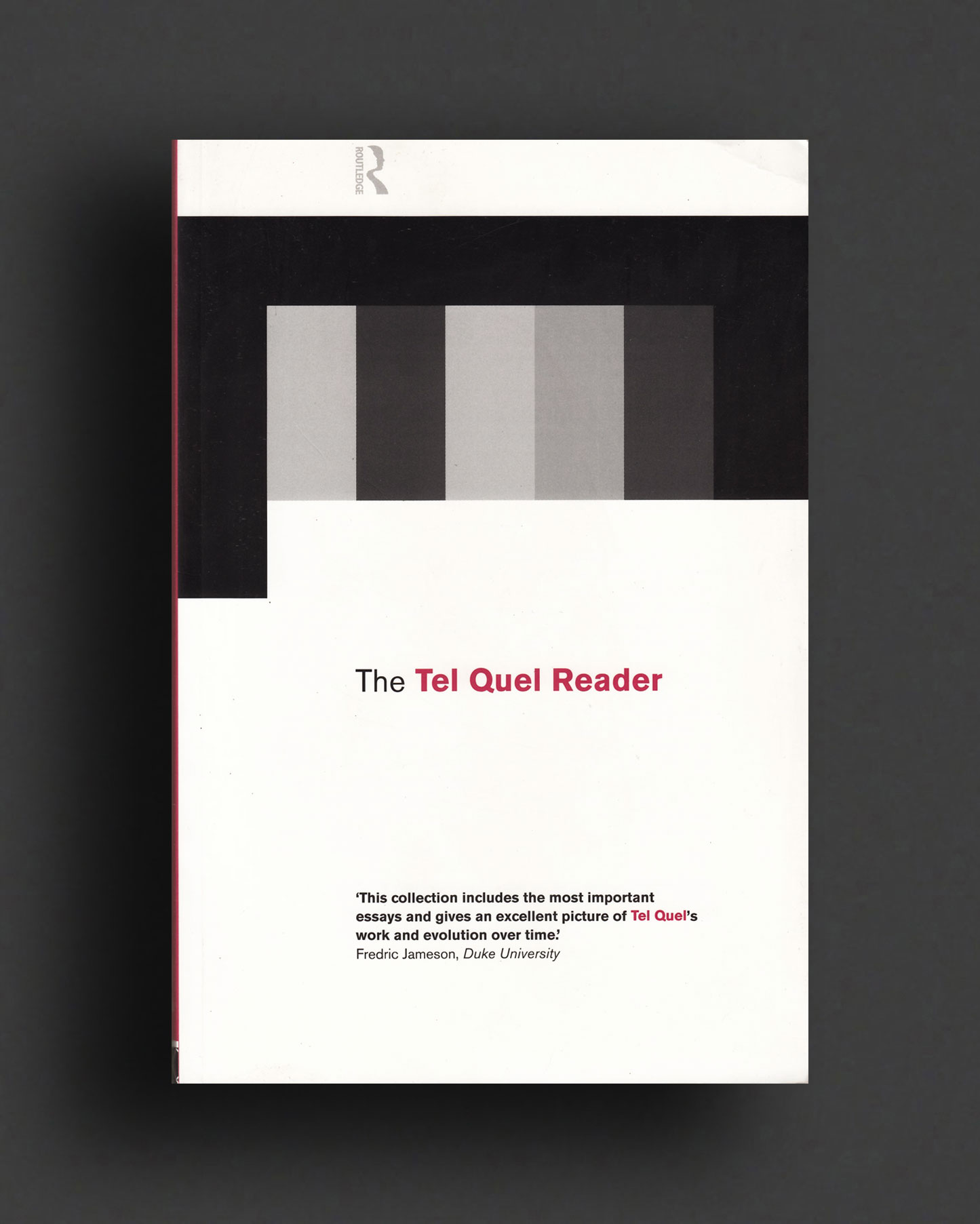
Julia Kristeva is a theorist and has been acclaimed for her work in linguistics, psychoanalysis, literary and political theory. This is an introduction to her work in English, containing a range of essays from all phases of her career.
Julia Kristeva is one of Europe's most brilliant and original theorists, widely acclaimed for her work in such diverse areas as linguistics, psychoanalysis, literary and political theory. The Kristeva Reader is a fully-comprehensive, easily accessible introduction to her work in English, containing a wide range of essays from all phases of Kristeva's career. The essays have been carefully selected as representative of the three main areas of her writing - semiotics, psychoanalysis and political theory - and each is prefaced by a clear, instructive introduction.
Julia Kristeva, internationally known psychoanalyst and critic, is Professor of Linguistics at the University de Paris VII. She has hosted a French television series and is the author of many critically acclaimed books published by Columbia University Press in translation, including Time and Sense: Proust and the Experience of Literature and the novel, Possessions.
"It has been apprarent for some time that Julia Kristeva has inherited the intellectual throne left vacant by the death of Simone de Beauvoir."—Elaine Showalter
Average ex-library copy, general wear and creasing, library markings. Sample image only.
1995, English
Softcover, 256 pages, 15.6 x 23.4 cm
1st Edition, Out of print title / used / very good
Published by
Pluto Press / London-Sydney
$20.00 - In stock -
Louis Althusser is one of France's foremost intellectuals of the postwar period. Controversial and influential, his writings and reputation have extended beyond the boundaries of his own country to leave a lasting mark on the ideas of others. In turn, Althusser found inspiration in many of Lenin's ideas and, in the first significant study of this association, Majumdar offers an objective reevaluation of Althusser's overt espousal of Leninism during the two decades up to the end of the 1970s. Focusing specifically on Althusser's attempt to rehabilitate Lenin as an academically respectable philosopher, rather than as a politician, Majumdar takes the assessment forward to evaluate Lenin's legacy today. Althusser's neglect of the significant contribution Lenin made to political theory and his subsequent shift away from Leninism at the end of the 1970s are also examined.
Margaret A. Majumdar teaches French Political Thought at the University of Westminster and is a member of the University of Westminster Francophone Africa Research Centre. She co-edits the Bulletin of Francophone Africa and has written widely on politics and philosophy.
Very Good—Fine copy.
1993, English
Hardcover (w. dust jacket), 384 pages, 24.5 x 16.5 cm
1st Edition, Out of print title / used / fine
Published by
The New Press / New York
$45.00 - In stock -
First 1993 hardcover edition.
“On November 16, 1980, Louis Althusser, while massaging his wife’s neck, discovered that he had strangled her. The world‑renowned French philosopher was immediately confined to an insane asylum, and his murderous act was officially deemed ‘temporary insanity.’ Althusser’s memoirs, written in his years of confinement, offer a far more complex and intriguing explanation. … Reminiscent to many readers of Strindberg’s Diary of a Madman and Styron’s Darkness Visible, The Future Lasts Forever is a profound yet subtle exercise in documenting madness from the inside.”
"A confession, an autobiography. ... It's hard to know what to call this magnificent text by Louis Althusser. What is apparent is that it is one of the most surprising, the most moving, and the most intellectually enriching books one might hope to read. ... The philosopher takes us on a journey inside his own madness, and the [French] publishers of the autobiography may be right in asserting that this long confession can be read as a complement to Michel Foucault's Madness and Civilization. For while Foucault used historical analysis to show us how thin the line is between sanity and madness and how that line can shift and fluctuate by century and civilization, Louis Althusser forces us to ask the same questions at the individual level. Indeed, Althusser the man was a study in contrasts. Rational thinking was key to his life's work, and he was virtually obsessed by rationalist exigencies. Yet reason abandoned him and he required regular psychiatric treatment. As though madness were the inevitable price of philosophy-a price paid by such figures as Nietzsche, Wittgenstein, and even the young Foucault. What Althusser seeks to unearth [in The Future Lasts Forever] are the roots of his madness."—Didier Eribon, author of Michel Foucault
Louis Pierre Althusser (1918–1990) was one of the most influential Marxist philosophers of the 20th Century. As they seemed to offer a renewal of Marxist thought as well as to render Marxism philosophically respectable, the claims he advanced in the 1960s about Marxist philosophy were discussed and debated worldwide. Due to apparent reversals in his theoretical positions, to the ill-fated facts of his life, and to the historical fortunes of Marxism in the late twentieth century, this intense interest in Althusser's reading of Marx did not survive the 1970s. Despite the comparative indifference shown to his work as a whole after these events, the theory of ideology Althusser developed within it has been broadly deployed in the social sciences and humanities and has provided a foundation for much “post-Marxist” philosophy. In addition, aspects of Althusser's project have served as inspiration for Analytic Marxism as well as for Critical Realism. Though this influence is not always explicit, Althusser's work and that of his students continues to inform the research programs of literary studies, political philosophy, history, economics, and sociology. In addition, his autobiography has been subject to much critical attention over the last decade. At present, Althusser's philosophy as a whole is undergoing a critical reevaluation by scholars who have benefited from the anthologization of hard-to-find and previously unpublished texts and who have begun to engage with the great mass of writings that remain in his archives.
Fine copy in Fine dust jacket (preserved under mylar wrap).
2001, English
Softcover, 413 pages, 22.86 × 15.24 cm
1st Edition, Out of print title / used / very good
Published by
State University of New York Press / New York
$30.00 - In stock -
An indispensable guide to the major work of one of the twentieth century's most influential thinkers.
This is the most comprehensive commentary on both Divisions of Heidegger's Being and Time, making it the essential guide for newcomers and specialists alike. Beginning with a non-technical exposition of the question Heidegger poses-"What does it mean to be?"-and keeping that question in view, it gradually increases the closeness of focus on the text. Citing Joan Stambaugh's translation, the author explains the key notions of the original with the help of concrete illustrations and reference to certain of the most relevant works Heidegger composed both before and after the publication of Being and Time.
Born in Budapest in 1910, Magda King was educated there, in Vienna, and at Edinburgh. She contributed papers to The Human Context, to the Journal of the British Society for Phenomenology and conducted seminars on Heidegger at the University of Edinburgh. John Llewelyn is the author of many books including most recently, The HypoCritical Imagination: Between Kant and Levinas.
"Originally published in the early sixties as one of the first English-language commentaries on Heidegger's Being and Time, Magda King's masterful Guide has now been vastly expanded to cover the whole of Being and Time, its renderings of Heidegger's German terms revised to correspond to Joan Stambaugh's new translation of Being and Time, and its discussions of Heidegger's later texts supplemented with references to his recently published earliest texts before Being and Time. In this expanded and revised edition prepared by John Llewelyn, King's Guide is now the best companion volume to use with Stambaugh's new translation of Being and Time."—John van Buren, author of The Young Heidegger: Rumor of the Hidden King
"Of all the studies of Being and Time with which I am familiar, Magda King's is the most direct, the simplest, and the clearest. Remarkably, the simplicity and clarity are achieved without loss of detail or accuracy and without dodging difficult interpretive problems. This makes her book an extraordinarily effective guide to a complex work and thus a virtually perfect companion text for use with Being and Time."—Joseph P. Fell, J. H. Harris Professor Emeritus, Bucknell University
Good copy, bumping to top right corner, light rubbing to boards, otherwise a VG copy in general.
1996, English
Hardcover (w. dust jacket), 124 pages, 215 x 14 cm
1st Edition, Out of print title / used / fine
Published by
University of Chicago Press / Chicago
$35.00 - Out of stock
First 1995 University of Chicago Press hardcover edition of "The Gift of Death", Jacques Derrida's most sustained consideration of religion to date. While continuing to explore questions introduced in "Given Time" such as the possibility, or impossibility, of giving and the economic and anthropological nature of gifts, Derrida turns to the notion of "responsibility" and the ultimate gifts of life and death.
Derrida divides the book into four parts, which deal respectively with the development of the notion of responsibility in the Platonic and Christian traditions; the relation between sacrifice and mortality; the contemporary meaning of the story of Abraham and Isaac; and the relation between religious ideology and economic rationality, explicitly linking this book with "Given Time." The texts under discussion include the Hebrew Bible and the New Testament, as well as writings from Patocka, Heidegger, Levinas, and Kierkegaard (whom he addresses here for the first time in print.)
Derrida's main concern is with the meaning of moral and ethical responsibility in Western religion and philosophy. He questions the limits of the rational and the responsible that one reaches in granting or accepting death, whether by sacrifice, murder, execution, or suicide. Beginning with a discussion of Patocka's "Heretical Essays on the History of Philosophy," Derrida develops Patocka's ideas concerning the sacred and responsibility through comparisons with the works of Heidegger, Levinas, and, finally, Kierkegaard. Derrida's treatment of Kierkegaard makes clear that the two philosophers share some of the same concerns. He then undertakes a careful reading of Kierkegaard's "Fear and Trembling," comparing and contrasting his own conception of responsibility with that of Kierkegaard, and extending and deepening his recent accounts of the gift and sacrifice. For Derrida, the very possibility of sacrifice, especially the ultimate sacrifice of one's own life for the sake of another, comes into question.
This work resonates with much of Derrida's earlier writing and will be of interest to scholars in anthropology, philosophy, and, of course, literary criticism. In addition, given the emphasis on the work of Kierkegaard and on the role of religion in our thinking, it will be of particular interest to a new readership among scholars of ethics and religion.
1992 / 2001, English
Softcover, 502 pages, 22 x 16 cm
1st Edition, Out of print title / used / good
Published by
The Athlone Press / UK
$65.00 - Out of stock
First 1992 Athlone edition of Deleuze and Guattari's classic, translated to English with foreword by Brian Massumi.
A Thousand Plateaus continues the work Gilles Deleuze and Félix Guattari began in Anti-Oedipus and has now become established as one of the classic studies of the development of critical theory in the late twentieth century. It occupies an important place at the center of the debate reassessing the works of Freud and Marx, advancing an approach that is neither Freudian nor Marxist but which learns from both to find an entirely new and radical path. It presents an attempt to pioneer a variety of social and psychological analyses free of the philosophical encumbrances criticized by apostmodern writers. A Thousand Plateaus is an essential text for feminists, literary theorists, social scientists, philosophers, and others interested in the problems of contemporary Western culture.
"Full of brilliant insights, this series of brief, seemingly random essays on hot topics — war and death, territoriality and the anthropology of groups, model theory, and psychosis — provides much material for thought. An excellent introduction and extraordinary translation of this most difficult book." — Sander L. Gilman, University of Chicago
Good copy with only real damage being sun bleaching to spine edge.
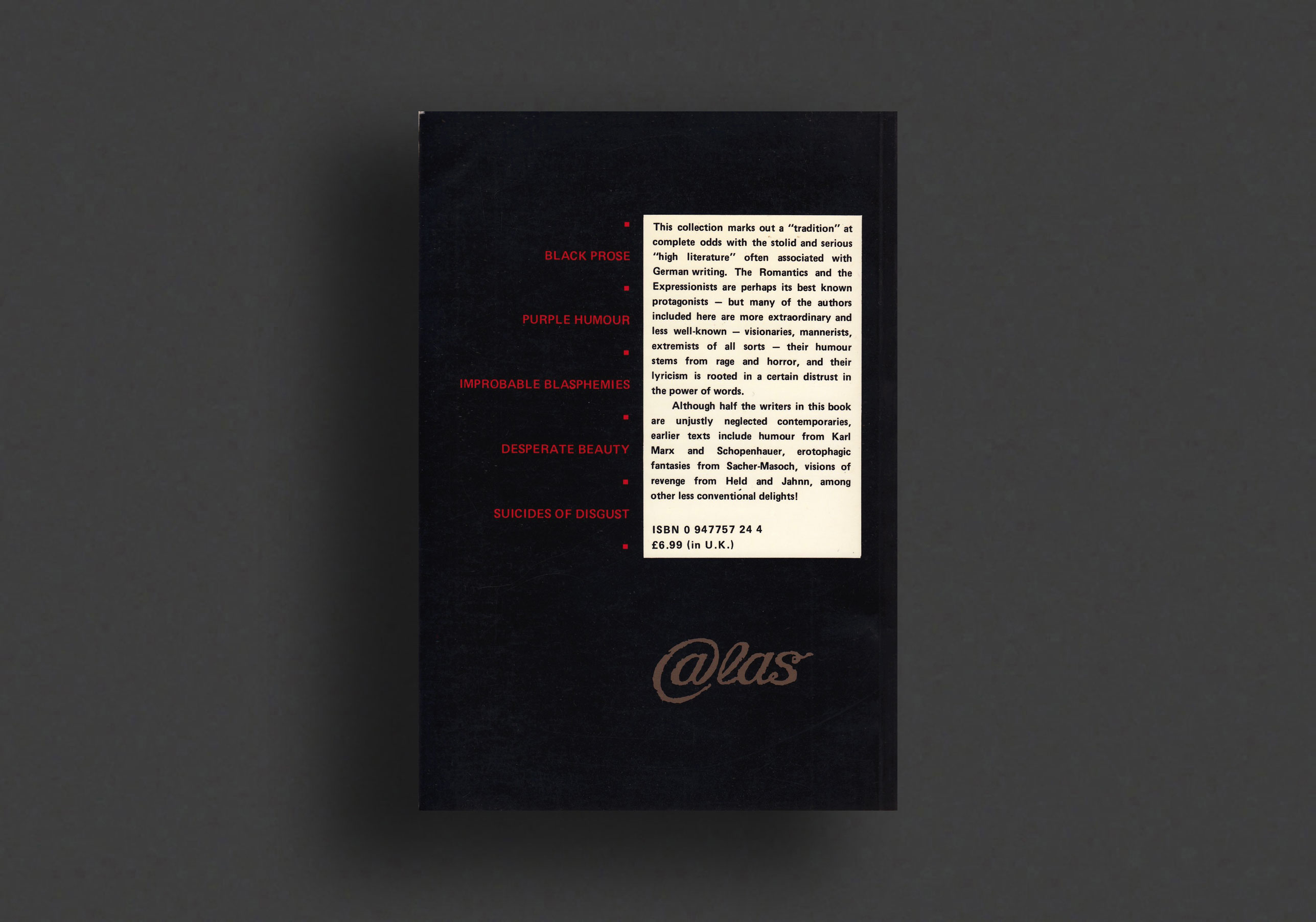
2018, English
Hardcover, 480 pages, 17.4 x 23.2 cm
Published by
Atlas Press / London
$74.00 - In stock -
Georges Bataille's secret society, long the stuff of legend, is now revealed in its texts, meditations, rules and prohibitions.
This book recounts what must be one of the most unusual intellectual journeys of modern times, in which the influential philosopher, cultural theorist and occasional pornographer Georges Bataille (1897-1962), having spent the early 1930s in far-left groups opposing the rise of fascism, abandoned that approach in order to transfer the struggle onto "the mythological plane."
In 1937, Bataille founded two groups in order to explore the combinations of power and the "sacred" at work in society. The first group, the College of Sociology, gave lectures that were intended to reveal the hidden undercurrents within a society on the verge of catastrophe. The second group was Acéphale, a genuine secret society and anti-religion whose emblem was a headless figure that, in part, represented the death of God. Until the discovery a few years ago of the group's internal papers (which include theoretical texts, meditations, minutes of meetings, rules and prohibitions and even a membership list), almost nothing was known of its activities.
This book is the first to collect a representative selection of the writings of Bataille, and of those close to him, in the years leading up to World War II. The texts published here comprise lectures given to the College of Sociology by Bataille, Roger Caillois and Michel Leiris, essays from the Acéphale journal and a large cache of the internal papers from the secret society. A desperate narrative unfolds, wherein Bataille risked all in a wholly unreasonable quest--with a few fellow travelers, he undertook what he later described as a "journey out of this world."
Additional texts by Roger Caillois, Pierre Klossowski, Michel Leiris, and by Georges Ambrosino, Pierre Andler, Michel Carrouges, Jacques Chavy, Jean Dautry, Henri Dobier, Henri Dussat, Imre Kelemen, Jean Rollin, Patrick Waldberg.
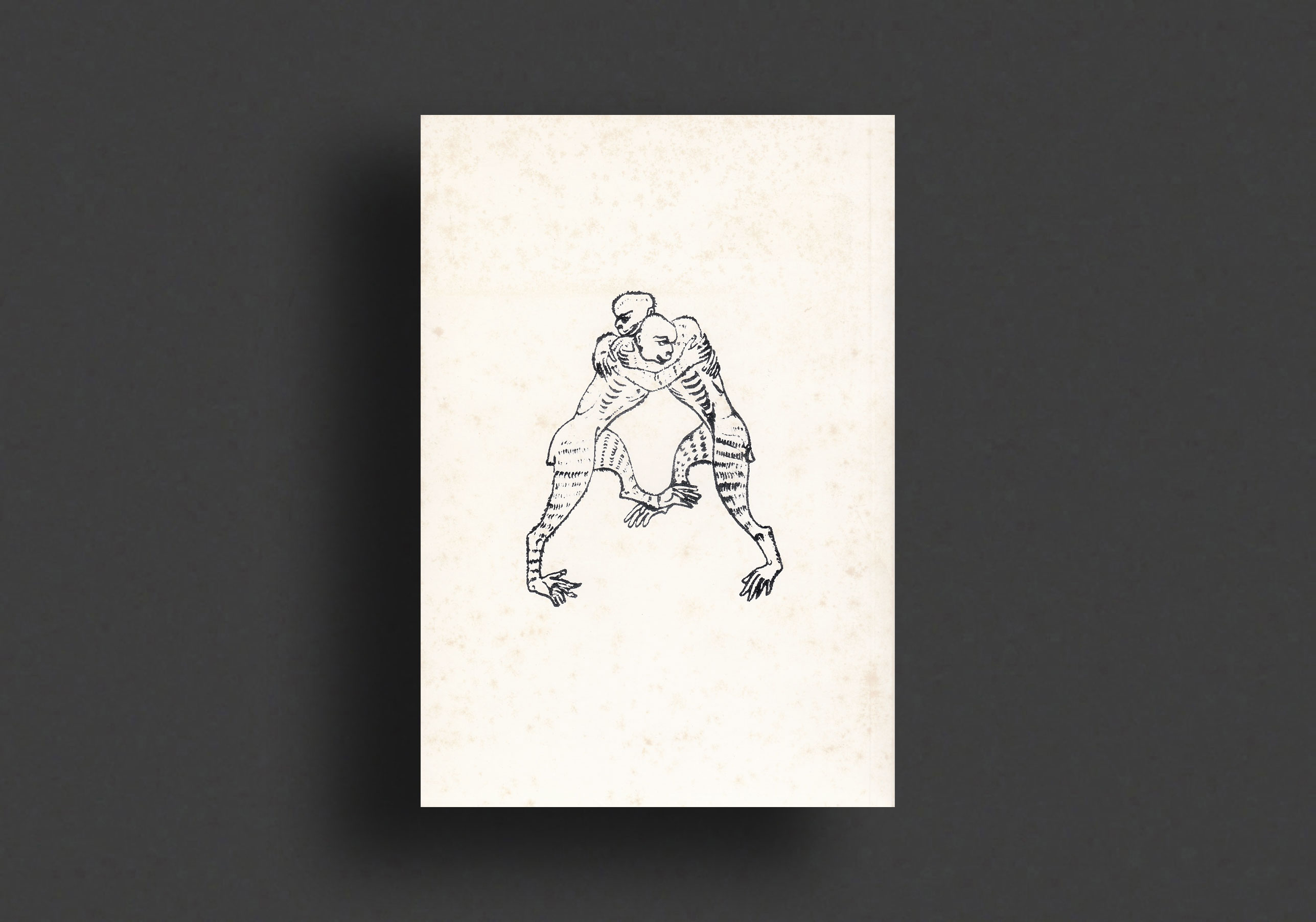
And with drawings by André Masson
Highest recommendation!
2011, English
Softcover, 670 pages, 11.5 x 17.5 cm
Published by
Urbanomic / Cornwall
Sequence Press / New York
$55.00 - In stock -
Fanged Noumena assembles for the first time the writings of Nick Land, variously described as ‘rabid nihilism’, ‘mad black Deleuzianism’, ‘accelerationism’, and ‘cybergothic’.Wielding weaponized, machinically-recombined versions of Deleuze and Guattari, Reich and Freud, in the company of fellow ‘werewolves’ such as Nietzsche, Bataille, Artaud, Trakl and Cioran, to a cutup soundtrack of Bladerunner, Terminator and Apocalypse Now, Land plotted a rigorously schizophrenic escape route out of academic philosophy, and declared all-out war on the Human Security System. Despite his ‘disappearance’, Land’s output has been a crucial underground influence both on recent Speculative Realist thought, and on artists, writers, musicians and filmmakers invigorated by his uncompromising and abrasive philosophical vision.Long the subject of rumor and vague legend, Land’s turbulent post-genre theory-fictions of cybercapitalist meltdown smear cyberpunk, philosophy, arithmetic, poetics, cryptography, anthropology, grammatology and the occult into unrecognizable and gripping hybrids. Beginning with Land’s radical rereadings of Heidegger, Nietzsche and Kant, Fanged Noumena terminates in Professor Barker’s cosmic theory of geo-trauma and neo-qabbalistic attempts to formulate a numerical anti-language.Fanged Noumena is a dizzying trip through land’s rigorous, incisive and provocative work, establishing it as an indispensable resource for radically inhuman thought in the twenty-first century.
Edited and with an Introduction by Ray Brassier and Robin Mackay
Contents: Editors' Introduction / Kant, Capital and the Prohibition of Incest / Narcissism and Dispersion in Heidegger's 1953 Trakl Interpretation / Delighted to Death / Art as Insurrection / Spirit and Teeth / After the Law / Making it with Death / Shamanic Nietzsche / Circuitries / Machinic Desire / Cybergothic / Cyberrevolution / Hypervirus / No Future / Cyberspace Anarchitecture as Jungle-War / Meat (or How to Kill Oedipus in Cyberspace) / Meltdown / A ZiiGothic X-Coda (Cooking Lobsters with Jake and Dinos) / KatasoniX / Barker Speaks / Mechanomics / Cryptolith / Non-Standard Numeracies: Nomad Cultures / Occultures / Origins of the Cthulhu Club / Introduction to Qwernomics / Tic-Talk / Qabbala 101 / Critique of Transcendental Miserablism----
Land had the most brilliantly seductive and meteoric mind, endlessly imaginative and capable of adopting, inhabiting and discarding any philosophical position. With him - and rightly so - philosophy infected every area of life, and sheer vitality of life reverberated in his thinking.
I see Fanged Noumena as a kind of righteous revenge. Nick was dismissed by professional philosophers because they simply didn't want to think and preferred their turgid academic complacency. I always admired him for his unwavering desire to take thought to its absolute limit and then see how much harder one could push. - Simon Critchley
These extraordinary texts, superheated compounds of severe abstraction and scabrous wit, testify to a uniquely penetrating intelligence, fusing transcendental philosophy, number theory, geophysics, biology, cryptography and occultism into startlingly cohesive but increasingly delirious theory-fictions. - Ray Brassier
This is theory as cyberpunk fiction: Deleuze-Guattari's concept of capitalism as the virtual unnameable Thing that haunts all previous formations pulp-welded to the timebending of the Terminator films. Land's machinic theory-poetry parallelled the digital intensities of 90s jungle, techno and doomcore, anticipating 'impending human extinction becoming accessible as a dance-floor'. - Mark Fisher (K-Punk)
In the last half of the twentieth century, academics talked endlessly about the outside, but no-one went there. Land, by exemplary contrast, made experiments in the unknown unavoidable for a philosophy caught in the abstractive howl of post-political cybernetics. Fanged Noumena demonstrates how Land ruined a generation of intellectuals for merely academic philosophy, by opening a speculative singularity where the future used to be. - Iain Hamilton Grant
1982, English
Softcover, 218 pages, 22.5 x 15 cm
Out of print title / used / very good
Published by
Columbia University Press / New York
$70.00 - In stock -
1982 Columbia classics re-print of Powers of Horror: An Essay on Abjection (French: Pouvoirs de l'horreur. Essai sur l'abjection), a 1980 book by Julia Kristeva. The work is an extensive treatise on the subject of abjection, in which Kristeva draws on the theories of Sigmund Freud and Jacques Lacan to examine horror, marginalization, castration, the phallic signifier, the "I/Not I" dichotomy, the Oedipal complex, exile, and other concepts appropriate to feminist criticism and queer theory.
According to Kristeva, the abject marks a "primal order" that escapes signification in the symbolic order; the term is used to refer to the human reaction (horror, vomit) to a threatened breakdown in meaning caused by the loss of the distinction between subject and object, or between the self and the other.
"Kristeva is one of the leading voices in contemporary French criticism, on a par with such names as Genette, Foucault, Greimas and others. ... [Powers of Horror is] an excellent introduction to an aspect of contemporary French literature which has been allowed to become somewhat neglected in the current emphasis on para-philosophical modes of discourse. The sections on Celine, for example, are indispensable reading for those interested in this writer and place him within a context that is both illuminating and of general interest."—Paul de Man
1982 English translation by Leon S. Roudiez. Single spine crease, light knocking/creasing to baord extremities, otherwise VG throughout.
1989, English
Softcover, 213 pages, 20.5 x 18 cm
1st Edition, Out of print title / used / very good
Published by
City Lights Books / San Francisco
$120.00 - In stock -
First 1989 City Lights English translation, long out-of-print.
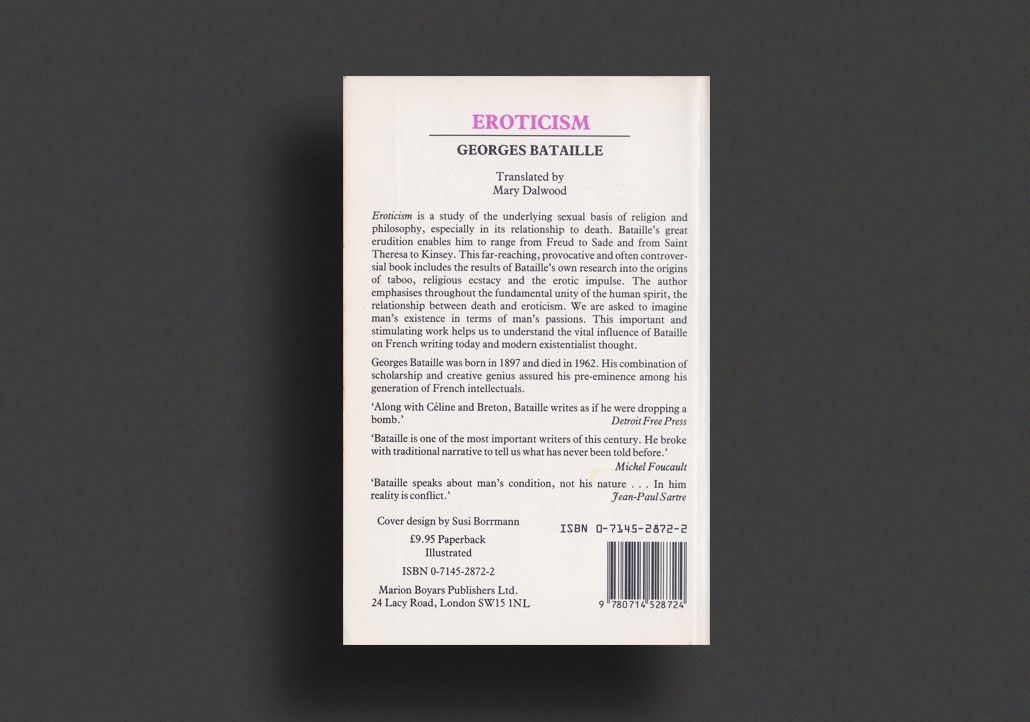
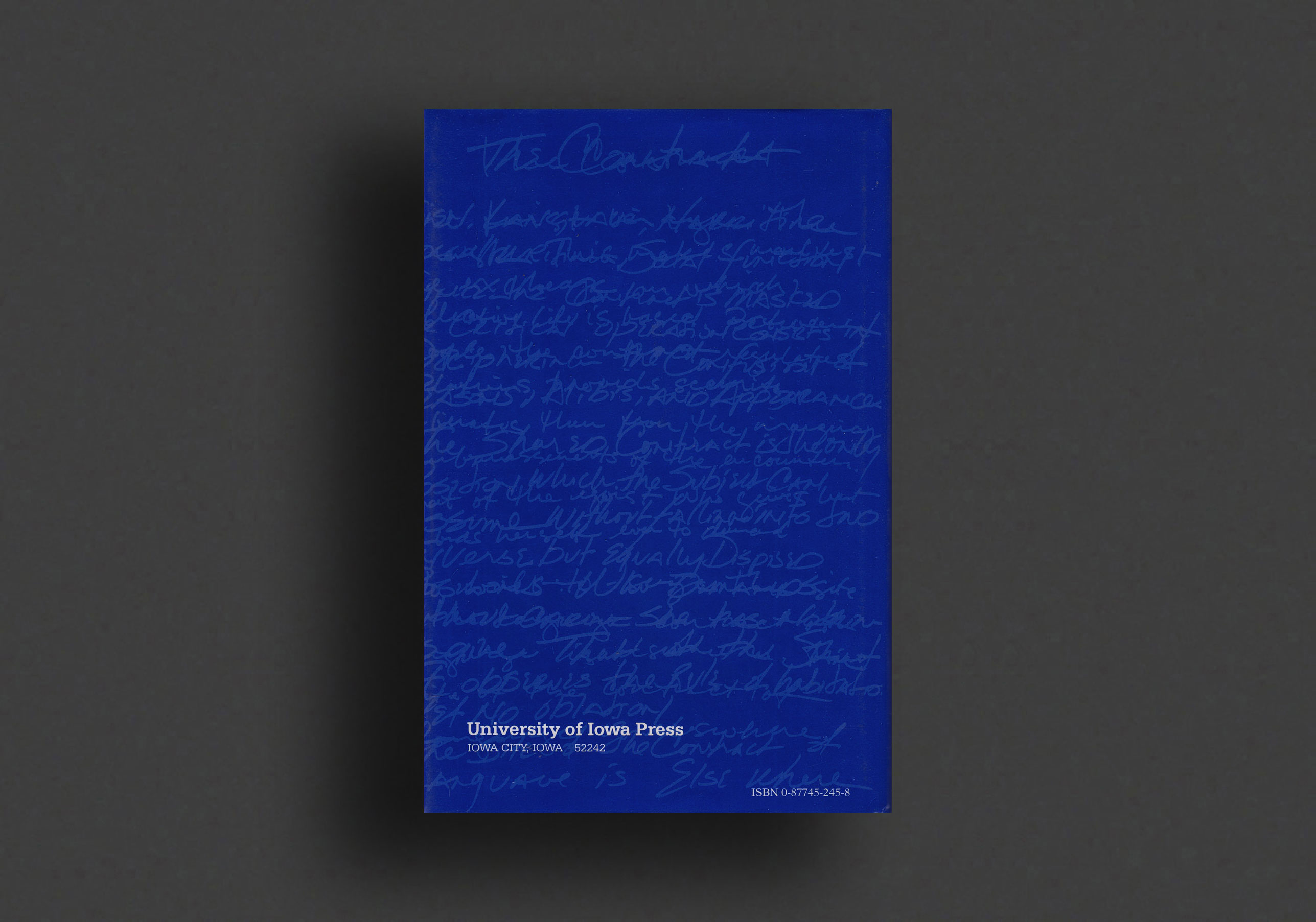
Tears of Eros is the culmination of Georges Bataille's inquiries into the relationship between violence and the sacred. Taking up such figures as Giles de Rais, Erzebet Bathory, the Marquis de Sade, El Greco, Gustave Moreau, Andre Breton, Voodoo practitioners, and Chinese torture victims, Bataille reveals their common death. This essay, illustrated with artwork from every era, was developed out of ideas explored in Death and Sexuality and Prehistoric Lascaux or the Birth of Art . In it Bataille examines death—the "little death" that follows sexual climax, the proximate death in sadomasochistic practices, and death as part of religious ritual and sacrifice. "Bataille is one of the most important writers of the century."— Michel Foucault Georges Bataille was born in Billom, France, in 1897. He was a librarian by profession. Also a philosopher, novelist, and critic he was founder of the College of Sociology. In 1959, Bataille began Tears of Eros , and it was completed in 1961, his final work. City Lights published two of his other Story of the Eye and The Impossible . Bataille died in 1962.
French essayist, philosophical theorist, and novelist, often called the "metaphysician of evil." Bataille was interested in sex, death, degradation, and the power and potential of the obscene. He rejected traditional literature and considered that the ultimate aim of all intellectual, artistic, or religious activity should be the annihilation of the rational individual in a violent, transcendental act of communion. Roland Barthes, Julia Kristeva, and Philippe Sollers have all written enthusiastically about his work.
Very Good copy, light wear to extremities/corners.
1996, English
Softcover, 116 pages, 21 x 15 cm
Ed. of 300,
1st Edition, Out of print title / used / good
Published by
ACCA / Melbourne
$45.00 - In stock -
Very rare copy of Transgression And The Culture Industry — Critical Media: Perspectives On New Technologies, the book document of The Gordon Darling Foundation Seminars 1995, with guest convenors Denise Robinson and Julianne Pierce (VNS Matrix), presenting the papers from seminars held at the Australian Centre For Contemporary Art, Melbourne, 8 April—7 October 1995.
Contents:
"Introduction" – Denise Robinson, "Duchamp's Queer Signature" – Rex Butler, "Transgression And The Culture Industry (Australia/1995)" – Lesley Stern, "The Art Curator, Our Cultural Transponder" – Juan Davila, "Normalizing Transgression" – David M. Halperin, "Introduction" – Julianne Pierce, "The Indifference Engine – 1990s Culture And The Corporate Imagination" – David Cox, "Observations" – Linda Wallace, "The Amazing Mcscent™ Machine" – Bridget Mcgraw, "Rehearsal Of Memory" – Graham Harwood.
"This one day symposium is a response to the sliding formations of the concept of 'transgression', as it is appropriated, mobilised or mutated by our contemporary cultural institutions. The event comprised two elements. A two hour film screening of short films included a selection from 1964 by New York underground film maker, Kenneth Anger and a selection of recent contemporary films from Australia by Christopher Ryan and Leone Knight. A second element involved a presentation of papers published here by Rex Butler, Juan Davila, David Halperin and Lesley Stern. The papers were not intended to act as a commentary of the films or the films to reflect the papers, rather the co-existence of these elements were to function more like a folding of the languages of cinema and visual art: as one possible means of illuminating the effects of the historicisation of 'transgressive strategies in relation to the Culture Industry."—DENISE ROBINSON, Introduction
Good copy with sunned spine edge, crease to back cover corner.
2005, English
Softcover, 304 pages, 23 x 15.5 cm
1st Edition, Out of print title / used / very good
Published by
Creation Books / London
$60.00 - Out of stock
Scarce 2005 edition published by Creation Books.
The spectre of Gilles de Rais, satanist and child-killer, eclipses French history like a dark star. A fallen general, once the champion of Jeanne d'Arc, de Rais' riches and experimentations led him to the very gates of Hell.
With quotations, essays and fiction, as well as a complete chronology and register of people and places in de Rais' brief but cataclysmic existence, "Dark Star is a rich evocation of the satanic allure of the most intriguing figure in the annals of mass murder.
Features the writings of Georges Bataille, Blaise Cendrars, J-K Huysmans, Valentine Penrose, Angela Carter, Jean Genet, Marquis de Sade, André Breton, Arthur Rimbaud, Gustave Flaubert, Richard Thoma, James Havoc, Charles Perrault, and many others
"Gilles de Rais - one of the most glorious, sinister, enigmatie figures in all European history"—Henry Miller
Very Good copy with some age rippling to the cover laminate. Some foxing to block top.
2025, English
Softcover, 116 pages, 14.7 x 10.5 cm
Published by
Everyday Analysis / UK
$18.00 - In stock -
Patricia Gherovic takes as a model Jacques Lacan’s 1964 seminar in which he presented four fundamental concepts of psychoanalysis, the unconscious, repetition, the transference, and the drive.[i] In a similar manner, it reflects on some key concepts that underpin the author’s clinical work as a psychoanalyst with trans-identified analysands. It argues for the re-discovery of four terms that expand Lacan’s central insights and apply to the question of trans today.
The first one is that of realness and it develops Lacan’s notion of the Real as not identical with reality; realness is often used by trans persons to describe the authenticity of their gender performance for it is a supreme truth beyond any verification. The second concept is the concept of plasticity as developed by Catherine Malabou and applied to Schreber’s case discussed by Freud and Lacan. Plasticity leads to a conversation about beauty and its function in trans discourse. The third concept is that of the nothing articulated with a certain type of laughter, a nothing introduced by Democritus and discussed by Barbara Cassin, Alain Badiou and Madlen Dolar. Lacan famously identified the “nothing” as one of the objects of psychoanalysis. I push the analysis to the point where one can understand a wish to “not being” (as found in suicide) as leading to the goal of “being again.” The meden was deployed by Barbara Cassin in her book Lacan the Sophist, and in discussion with Alain Badiou. Finally, the last concept is that of the clinamen or turbulence in atomic philosophy (Lucretius) and in contemporary discourse; this turbulence throws new light on the role of accidents, and how accidents can turn into destiny (tuché). The classical concepts of the clinamen and turbulence have been explored systematically by Michel Serres. This turbulence echoes with Lacan’s notion of the sinthome as a symptom that does not need to be cured but leads to a re-creation of oneself that makes life livable.
Offering a new twist to philosophical references the author discussed in Transgender Psychoanalysis (2017). Taken together, these four clusters of concepts provide a foundation for Gherovici’s thinking about psychoanalysis. She rethinks Lacan’s notions of the Real, the nothing, the endless transformations of the body that pertain to plasticity, the clinamen, the death drive - all of which are shown to be key to her understanding of the trans experience as revealed in her clinical practice.
2024, English
Softcover, 24 pages, 14.7 x 10.5 cm
Published by
Everyday Analysis / UK
$18.00 - In stock -
In this new collected edition of his recent articles, Simon Critchley - one of the most important living philosophers - takes us through his reflections on death, questions of doubt and reason, the legacy of David Bowie, the nature of fear and empathy in a broken society and a critique of narrative identity - among other things. YOUR LIFE IS NOT A (FUCKING) STORY explores the contemporary world and its psychological impact on us, offering us a way to see our situation different and resist its tricks and contrivances.
Simon Critchley is the Hans Jonas Professor of Philosophy at The New School for Social Research and a Director of the Onassis Foundation. His work engages in many areas: continental philosophy, philosophy and literature, psychoanalysis, ethics, and political theory, among others. He has written over twenty books, including studies of Greek tragedy, David Bowie, football, suicide, Shakespeare, how philosophers die, and a novella. As co-editor of The Stone at the New York Times, Critchley showed that philosophy plays a vital role in the public realm.
1992, English
Hardcover, 262 pages
1st Edition, Out of print title / used / very good
Published by
State University of New York Press / New York
$10.00 - In stock -
First hardcover edition, 1992.
This book asks how we may undertake to represent representation.
Stephen David Ross is Professor of Philosophy and Comparative Literature at the State University of New York at Binghamton. He is the author of Art and Its Significance: An Anthology of Aesthetic Theory-Second Edition; Metaphysical Aporia and Philosophical Heresy; Perspective in Whitehead's Metaphysics; Philosophical Mysteries; and A Theory of Art: Inexhaustibility by Contrast, all published by SUNY Press.
Reviews
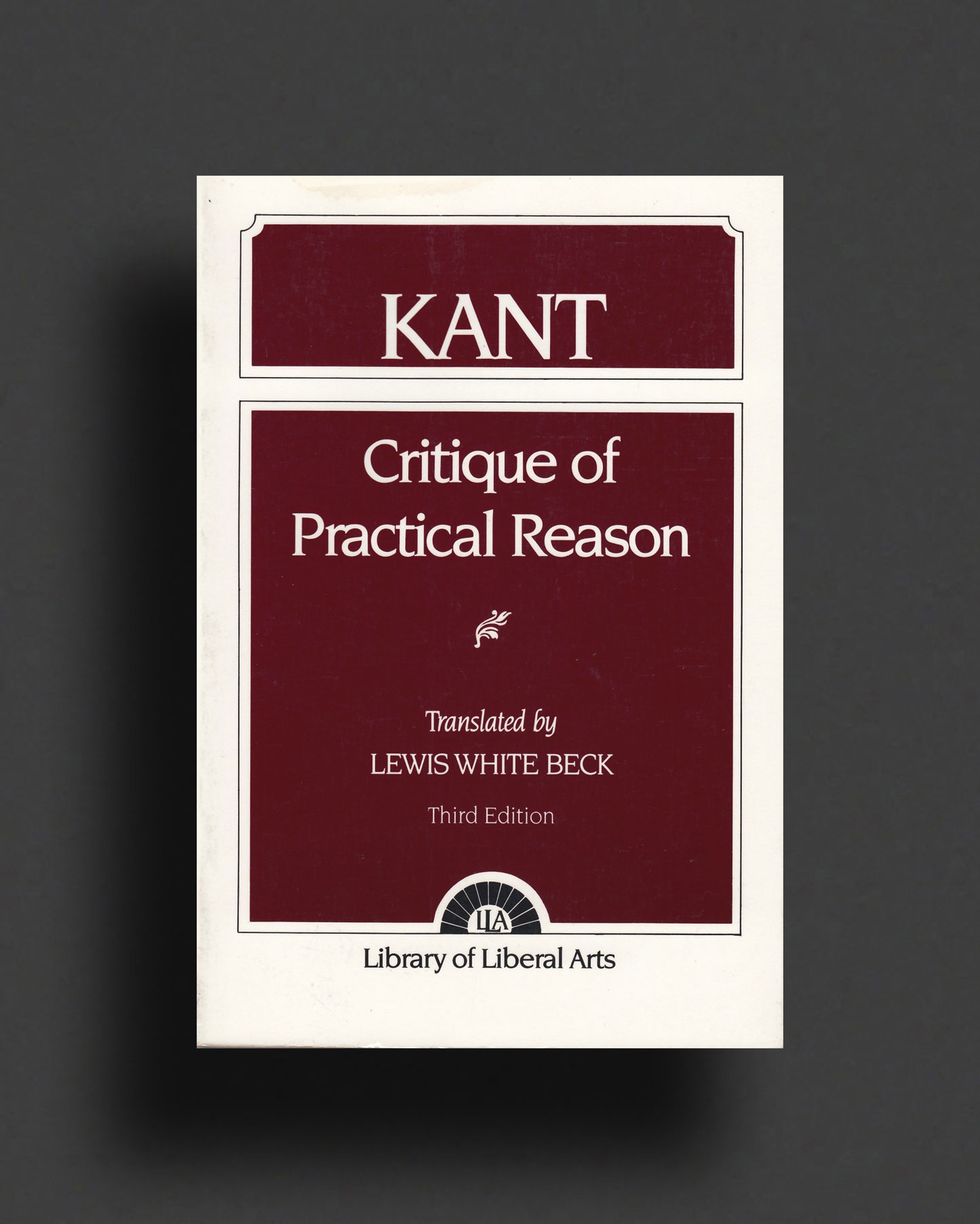
"It's the ambitious question of how philosophical representation can proceed once it ceases to be naive regarding its representational means. Can philosophy recognize its own limits? (What is a 'limit' in this case?) It is Heidegger's question concerning the 'overcoming' of metaphysics. It is implicitly posed by Kant's 1st Critique: what is the status of the critique itself?"—Forrest Williams, University of Colorado, Boulder
"There is no book I know of that deals with such an extensive group of philosophers and themes. The author has addressed many of the most cogent issues in contemporary philosophy, allowed them to resonate in terms of each other, even provided an implicit landscape from which to organize them. There is a lot of original work here and some interpretation of recent essays that will prove extraordinarily helpful. I would point to his extraordinary treatment of Derrida's Geschlecht texts. The importance of these texts is well known and Ross' 'commentary' on them and his ability to situate Derrida's discussion in a chapter on embodiment is the best treatment of the subject I know of. I would also mention Ross' notion of 'sonorescence' which completely shifts the 'ground' of philosophy and is an original philosophical contribution. Finally, he has set up a dialogue between many of the key figures in philosophy, both contemporary and in the history.
"Ross shows that the issue is not an overcoming of metaphysics but a releasing of the excess within and beyond representational metaphysics. But his own work is itself a metaphysics. Each of the issues he addresses flow into the next issue so that his final discussion of physis and techne really returns and re-presents the origin of metaphysics." — Walter A. Brogan, Villanova University
VG copy.
1982/1992, Japanese
Softcover, 192 pages, 21 x 14.5 cm
Out of print title / used / very good
Published by
Atelier Peyotl / Tokyo
$60.00 - In stock -
"Corpse" Special Feature Issue of cult Japanese underground magazine Yaso, first published in 1982, then re-printed in 1992, edited by Yuichi Konno and Atelier Peyotl (publishers of Night Vision/Yaso/Peyotl/Wave/Silvester Club...). Heavily illustrated with texts in Japanese that look at the theme of death and the dead in the arts, literature, occultism, ancient sciences, philosophy, mythology, poetry, film, crime, and much more. Features John Duncan, Tetsumi Kudo, Cosey Fanni Tutti, Masahisa Fukase, Franz Kafka, Johann Wolfgang von Goethe, Guillaume Apollinaire, Joe Potts (LAFMS), Takashi Ishii, Rudolf II — Holy Roman Emperor, Akinari Ueda, Marcel Duchamp, Chris Burden, Paul Celan, Alain Resnais, Gilyak Amagasaki, Shusaku Arakawa, Pieter Bruegel the Elder, Shuji Terayama, Andy Warhol, Charles Manson, Brian Wilson, Kyoko Endoh, Princess Yongtai, Salvador Dalí, Ono no Komachi, Kiyoshi Kasai, Caravaggio, Throbbing Gristle, Takizawa Bakin, Leno and Rosemary LaBianca, Manson Family, Fyodor Dostoevsky, Wu Zetian, Genesis P-Orridge, Yusuke Nakahara, Ranpo Lagrange, Mitsusada Fukasaku, Nakai Hideo, Richard Wagner, and many more.
Very Good copy.