World Food Books' programme is largely produced on Kulin Nation land. We acknowledge the Wurundjeri people of the Kulin Nation as the first and continuing custodians of this land, and pay respect to their Elders past, present, and emerging.
World Food Books is an arts and special interests bookshop in Naarm / Melbourne. Founded in 2010, World Food Books is devoted to the presentation of a rotating, hand-selection of international art, design, literary and counterculture publications with an emphasis on the anti-traditional, the experimental, the avant-garde, the heretic, the marginal.
Presenting new titles alongside rare and out-of-print books, catalogues and journals spanning the fields of modern and contemporary art, design, photography, illustration, film, literature, poetry, cultural theory, philosophy, sexuality, popular and underground culture in its many radical forms, World Food Books wishes to encourage adventurous, thoughtful and open-minded reading, looking, writing, and exchange of publishing and ideas, both current and historical.
As well as our bookshop, located in Melbourne's historical Nicholas Building, all of our inventory is available internationally via our online mail-order service.
World Food Books semi-regularly co-ordinates "Occasions", a programme of exhibits and events at the bookshop and in partnership with other hosts (such as museums and art galleries) that develop out of the activities, relationships and content of the bookshop itself.
World Food Books
The Nicholas Building
37 Swanston Street
Room 5, Level 6
Melbourne 3000
Australia
SHOP HOURS:
Thu–Fri 12–6, Sat 12–5
WEB-SHOP OPEN 24/7
World Food Books
Postal Address:
PO Box 435
Flinders Lane
Victoria 8009
Australia
Art
Theory / Essay
Architecture / Interior
Graphic Design / Typography
Photography
Fashion
Eros
LGBTQ+
Fiction / Poetry
Weird / Speculative / Science Fiction / Horror
Transgressive / Visceral / Abject
Symbolism / Decadence / Fin de siècle
Film / Video
Painting
Sculpture / Installation
Performance / Dance / Theater
Drawing
Sound / Music
Curatorial
Group Shows / Collections
Periodicals
Out-of-print / Rare
Posters / Ephemera / Discs
Signed Books
World Food Books Gift Voucher
World Food Book Bag
Australian Art
Australian Fiction
Australian Science Fiction / Speculative Fiction
Australian Poetry
Australian Photography
Japanese Photography
Conceptual Art
Minimal Art
Dada
'Pataphysics / Oulipo
Fluxus
Concrete Poetry
Pop Art
Surrealism
Arte Povera
Arte Informale / Haute Pâte / Tachism
Nouveau Réalisme / Zero / Kinetic
Situationism / Lettrism
Collage / Mail Art / Xerox Art
Art Brut / Folk / Visionary / Fantastic
Illustration / Graphic Art / Bandes Dessinées
Furniture
Italian Radical Design / Postmodernism
Textiles
Ceramics / Glass
Counterculture
Protest / Revolt
Philosophy
Psychoanalysis
Anthropology
Anarchism
Socialism / Anarchism / Communism / Capitalism
Literary Theory / Semiotics / Language
Feminism / Women's Studies
Gender Studies / Sexuality
Anthropology
Fetishism / BDSM
Drugs / Psychedelia
Crime / Violence
Animal Rights / Veganism
Occult / Esoterica
Ecology / Earth / Alternative Living
Whole Earth / Crafts
All prices in AUD (Australian dollars)
Pick-Ups
Pick-up orders can be collected in our bookshop during opening hours after order date. Please collect any Pick-up orders within 2 weeks of ordering as we have limited storage space. Orders will be released back into stock if not collected within this time. No refunds can be made for pick-ups left un-collected. If you cannot make it in to the bookshop in this time-frame, please choose postage option.
Return Policy
All sales are final. We do accept returns (for refund or exchange) for items received in error. All our orders are packed with special care using heavy-duty padding and cardboard book-mailers or bubble mailers (for smaller books), using reinforcement where required. We cannot take responsibility for any lost, stolen or damaged parcels.
Insurance
Should you wish to insure your package, please email us directly after placing your order and we can organise this at a small extra expense. Although all standard/express tracked packages are very safe and dependable, we cannot take responsibility for any lost, stolen or damaged parcels. We recommend insurance on valuable orders.
Interested in selling your old books, catalogues, journals, magazines, comics, fanzines, ephemera? We are always looking for interesting, unusual and out-of-print books to buy. We only buy books in our fields of interest and specialty, and that we feel we can resell.
We base these prices on desirability, market value, in-print prices, condition and our current stock levels. We offer cash, store credit, and can take stock on consignment. All
about 25% of the price we expect to get when we sell them, or 30% in store credit. We base these prices on desirability, market value, in-print prices, condition and our current stock levels.
Sell your books any day of the week. You can drop them off and return later. If you have a lot of books, we can visit your Sydney home.
We buy books that we feel we can resell. We offer about 25 % of the price we expect to get when we sell them, or 30% in store credit. We base these prices on desirability, market value, in-print prices, condition and our current stock levels.
Philadelphia Wireman
03 August - 01 September, 2018
World Food Books is proud to announce our next Occasion, the first presentation of sculptures by Philadelphia Wireman in Australia.
The Philadelphia Wireman sculptures were found abandoned in an alley off Philadelphia’s South Street on trash night in 1982. Their discovery in a rapidly-changing neighbourhood undergoing extensive renovation, compounded with the failure of all attempts to locate the artist, suggests that the works may have been discarded after the maker’s death. Dubbed the "Philadelphia Wireman" during the first exhibition of this work, in 1985, the maker’s name, age, ethnicity, and even gender remain uncertain. The entire collection totals approximately 1200 pieces, all intricately bound together with tightly-wound heavy-gauge wire (along with a few small, abstract marker drawings, reminiscent both of Mark Tobey and J.B. Murry). The dense construction of the work, despite a modest range of scale and materials, is singularly obsessive and disciplined in design: a wire armature or exoskeleton firmly binds a bricolage of found objects including plastic, glass, food packaging, umbrella parts, tape, rubber, batteries, pens, leather, reflectors, nuts and bolts, nails, foil, coins, toys, watches, eyeglasses, tools, and jewellery.
Heavy with associations—anthropomorphic, zoomorphic, and socio-cultural responses to wrapped detritus—the totemic sculptures by Philadelphia Wireman have been discussed in the context of work created to fulfil the shamanistic needs of alternative religions in American culture. Curators, collectors, and critics have variously compared certain pieces to sculpture from Classical antiquity, Native American medicine bundles, African-American memory jugs, and African fetish objects. Reflecting the artist’s prolific and incredibly focused scavenging impulse, and despite—or perhaps enhanced by—their anonymity, these enigmatic objects function as urban artefacts and arbiters of power, though their origin and purpose is unknown. Philadelphia Wireman, whatever their identity, possessed an astonishing ability to isolate and communicate the concepts of power and energy through the selection and transformation of ordinary materials. Over the course of the past two decades, this collection has come to be regarded as an important discovery in the field of self-taught art and vernacular art.
Presented in collaboration with Fleisher-Ollman Gallery, Philadelphia, and Robert Heald, Wellington.
Susan Te Kahurangi King
02 February - 10 March, 2018
Susan Te Kahurangi King (24 February 1951 - ) has been a confident and prolific artist since she was a young child, drawing with readily available materials - pencils, ballpoint pens and felt-tip markers, on whatever paper is at hand. Between the ages of four and six Susan slowly ceased verbal communication. Her grandparents William and Myrtle Murphy had developed a special bond with Susan so they took on caring responsibilities for extended periods. Myrtle began informally archiving her work, carefully collecting and storing the drawings and compiling scrapbooks. No drawing was insignificant; every scrap of paper was kept. The King family are now the custodians of a vast collection containing over 7000 individual works, from tiny scraps of paper through to 5 meter long rolls.
The scrapbooks and diaries reveal Myrtle to be a woman of great patience and compassion, seeking to understand a child who was not always behaving as expected. She encouraged Susan to be observant, to explore her environment and absorb all the sights and sounds. Myrtle would show Susan’s drawings to friends and people in her community that she had dealings with, such as shopkeepers and postal workers, but this was not simply a case of a grandmother’s bias. She recognised that Susan had developed a sophisticated and unique visual language and sincerely believed that her art deserved serious attention.
This was an unorthodox attitude for the time. To provide some context, Jean Dubuffet coined the term Art Brut in 1945 to describe work created by self-taught artists – specifically residents of psychiatric institutions and those he considered to be visionaries or eccentrics. In 1972 Roger Cardinal extended this concept by adopting the term Outsider Art to describe work made by non-academically trained artists operating outside of mainstream art networks through choice or circumstance. Susan was born in Te Aroha, New Zealand in 1951, far from the artistic hubs of Paris and London that Dubuffet and Cardinal operated in. That Myrtle fêted Susan as a self-taught artist who deserved to be taken seriously shows how progressive her attitudes were.
Susan’s parents Doug and Dawn were also progressive. Over the years they had consulted numerous health practitioners about Susan’s condition, as the medical establishment could not provide an explanation as to why she had lapsed into silence. Dawn educated herself in the field of homeopathy and went on to treat all twelve of her children using these principles – basing prescriptions on her observations of their physical, mental and emotional state.
Doug was a linguist with an interest in philosophy who devoted what little spare time he had to studying Maori language and culture. To some extent their willingness to explore the fringes of the mainstream made them outsiders too but it was their commitment to living with integrity and their respect for individuality that ensured Susan’s creativity was always encouraged.
Even though Susan’s family supported her artistic pursuits, some staff in schools and hospitals saw it as an impediment to her assimilation into the community and discouraged it in a variety of ways. Her family was not always aware of this and therefore did not fully understand why Susan stopped drawing in the early 1990s. However, rather than dwell on the challenges that Susan faced in pursuit of her artistic practice, they prefer to highlight her achievements. In 2008 Susan began drawing again in earnest, after an almost 20 year interruption, and her work is now shown in galleries around the world.
Susan grew up without television and has been heavily influenced by the comics she read as a child. She is absolutely fearless in the appropriation of recognizable characters, such as Donald Duck and Mickey Mouse, in her work. She twists their limbs, contorts their faces, compresses them together, blends them into complex patterned backgrounds - always imbuing them with an incredible energy. Although Susan often used pop culture characters in her work they are not naive or childlike. These are drawings by a brilliant self-taught artist who has been creating exceptional work for decades without an audience in mind.
Mladen Stilinović
"Various Works 1986 - 1999"
02 February 16 - September 10, 2016
Various works 1986 - 1999, from two houses, from the collections of John Nixon, Sue Cramer, Kerrie Poliness, Peter Haffenden and Phoebe Haffenden.
Including: Geometry of Cakes (various shelves), 1993; Poor People’s Law (black and white plate), 1993; White Absence (glasses, ruler, set square, silver spoon, silver ladel with skin photograph and wooden cubes), 1990-1996; Exploitation of the Dead (grey and red star painting, wooden painting, black spoon with red table, red plate), 1984-1990; Money and Zeros (zero tie, paintings made for friends in Australia (Sue, John, Kerrie), numbers painting), 1991-1992; Words - Slogans (various t-shirts) - “they talk about the death of art...help! someone is trying to kill me”, “my sweet little lamb”, “work is a disease - Karl Marx”; Various artist books, catalogues, monographs, videos; Poster from exhibition Insulting Anarchy; "Circular" Croatian - Australian edition; Artist book by Vlado Martek (Dostoyevsky); more.
Thanks to Mladen Stilinović and Branka Stipančić.
Jonathan Walker
Always Will Need To Wear Winter Shirt Blue + Ochre Small Check Pattern
21 August - 21 September, 2015
Untitled
I am not a great reader of poetry but I always return to the work of Melbourne poet, Vincent Buckley (1925- 1988). Perhaps I find his most tantalising piece to be not a finished poem but a fragment left on a scrap of paper discovered on his desk after the poet’s death.
The poetry gathers like oil
In the word-core, and spreads
It has its music meet,
Its music is in movement.
This fragment is more the shell left behind from a volatile thought than a finished poem. I find the last two lines honest but awkward whereas the first two lines work like an arrow. Most likely he could not find a resolution so it was left. Still, in its present form, it remains an eloquent testimony to the ultimate failure of a medium to express mobile thought and sensation, in Buckley’s case, through verbal language. It’s an important matter because this is something all artists have to deal with regardless of the medium.
I have never written a poem, however, I am forever copying fragments from books on paper scraps in a vain effort to fix certain notions in my head. At first, they function as bookmarks that are sometimes returned to when I open the book. But before long, as they accumulate, they fall out littering the table interspersed with A4 photocopies, bills, books and medications.
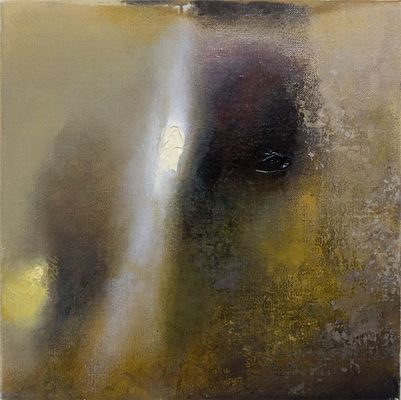
To return to Buckley’s fragment, the first two lines very much evoke how I paint nowadays. As you age, detail diminishes and patches of light become more luminous and float. I feel the most honest way of dealing with this is by smearing the oil paint on the canvas with the fingers and working close-up, blind. Only if the patches coalesce into an approaching image can the work gain a life.
-
Jonathan Walker was born in Melbourne, Australia and brought up on a dairy farm in Gippsland. In the 1970’s he studied painting at RMIT and won the Harold Wright Scholarship to the British Museum, London. During the 1980’s he exhibited at Pinacotheca Gallery, Richmond and had work shown at the NGV and Heidi City Art Gallery. Over the same period he designed the cover for the “Epigenesi” LP by Giancarlo Toniutti, Italy and conducted a mail exchange work with Achim Wollscheid, Germany. The work with artists through the post resulted in an article published in the bicentenary issue of Art and Australia 1988. He showed in artist run spaces such as WestSpace in the 90’s and 2000’s, and until 2012, taught painting at Victoria University, which is where we (Colleen Ahern and Lisa Radford) as organisers of the exhibition, among many others, had the privilege of being his student.
Walker’s knowledge was imparted to students through the careful selection of music, literature, and artists found in books that he himself had ordered for the library. Walker’s strategy was the generosity of sharing his vast knowledge with references specific to each student and their context.
Walker’s paintings share a similar focus and intimacy.
This exhibition presents a small selection of recent paintings alongside a publication that includes Walker’s writing. Observational and analytical, Walker’s work is a type of material notation — the time of day, colour and how it is blended, the both specific and fleeting location of a reflection on lino or the question of whether a chair leg should be included in a painting.
Please join us on Friday August 21 between 6-8pm to celebrate the opening of the exhibition.
Curated by Colleen Ahern and Lisa Radford.
B. Wurtz
Curated by Nic Tammens
March 26 - April 4, 2015
B.Wurtz works from a basement studio in his home on Manhattan’s Lower East Side.
This local fact is attested to by the plastic shopping bags and newsprint circulars that appear in his work. As formal objects, they don’t make loud claims about their origins but nonetheless transmit street addresses and places of business from the bottom of this long thin island. Like plenty of artists, Wurtz is affected by what is local and what is consumed. His work is underpinned by this ethic. It often speaks from a neighborhood or reads like the contents of a hamper:
“BLACK PLUMS $1.29 lb.”
“Food Bazaar”
“USDA Whole Pork Shoulder Picnic 99c lb.”
“RITE AID Pharmacy, with us it’s personal.”
“H. Brickman & Sons.”
“Sweet Yams 59c lb."
Most of the work in this exhibition was made while the artist was in residence at Dieu Donne, a workshop dedicated to paper craft in Midtown. Here Wurtz fabricated assemblages with paper and objects that are relatively lightweight, with the intention that they would be easily transportable to Australia. This consideration isn’t absolute in Wurtz’s work, but was prescriptive for making the current exhibition light and cheap. Packed in two boxes, these works were sent from a USPS post office on the Lower East Side and delivered to North Melbourne by Australia Post.
Wurtz appears courtesy of Metro Pictures, New York.
Thanks to Rob Halverson, Joshua Petherick, Sari de Mallory, Matt Hinkley, Helen Johnson, Fayen d'Evie, Ask Kilmartin, Lisa Radon, Ellena Savage, Yale Union, and "Elizabeth".
John Nixon
"Archive"
December 15 - January 20, 2014
The presentation of John Nixon's archive offered a rare showcase of this extensive collection of the artist's own publications, catalogues, posters, ephemera, editions and more, from the mid 1980s onwards, alongside a selection of his artworks.
Organized by John Nixon, Joshua Petherick and Matt Hinkley.
<a href=http://wfb.public-office.info/artist/john-nixon>All titles by John Nixon
"Habitat"
at Minerva, Sydney (organised by Joshua Petherick and Matt Hinkley)
November 15 - December 20, 2014
Lupo Borgonovo, Janet Burchill & Jennifer McCamley,
Lewis Fidock, HR Giger, Piero Gilardi, Veit Laurent Kurz,
Cinzia Ruggeri, Michael E. Smith, Lucie Stahl, Daniel Weil, Wols
Press Release:
“...It contained seven objects. The slender fluted bone, surely formed for flight, surely from the wing of some large bird. Three archaic circuitboards, faced with mazes of gold. A smooth white sphere of baked clay. An age-blackened fragment of lace. A fingerlength segment of what she assumed was bone from a human wrist, grayish white, inset smoothly with the silicon shaft of a small instrument that must once have ridden flush with the surface of the skin - but the thing’s face was seared and blackened.”
William Gibson, “Count Zero”, 1986
"Autumn Projects Archive"
Curated by Liza Vasiliou
March 6 - March 15, 2014
World Food Books, in conjunction with the Virgin Australia Melbourne Fashion Festival 2014, presented the Autumn Projects archive, consisting of a selection of early examples in Australian fashion with a particular interest in collecting designers and labels from the period beginning in the 1980’s, who significantly influenced the discourse of Australian Fashion.
Curated by Liza Vasiliou, the exhibition provided a unique opportunity to view pieces by designers Anthea Crawford, Barbara Vandenberg, Geoff Liddell and labels CR Australia, Covers, Jag along with early experimental collage pieces by Prue Acton and Sally Browne’s ‘Fragments’ collection, suspended throughout the functioning World Food Books shop in Melbourne.
H.B. Peace
presented by CENTRE FOR STYLE
November 14, 2013
"Hey Blinky, you say chic, I say same"
Anon 2013
H.B. Peace is a clothing collaboration between great friends Blake Barns and Hugh Egan Westland. Their pieces explore the divergences between 'character’ and ‘personality’ in garments....etc
Special Thanks to Joshua Petherick and Matt Hinkley of WFB and Gillian Mears
and a Very Special Thank you to Audrey Thomas Hayes for her shoe collaboration.
Janet Burchill & Jennifer McCamley
"Aesthetic Suicide"
May 10 - June 8, 2013
The first of our occasional exhibitions in the World Food Books office/shop space in Melbourne, "Aesthetic Suicide" presented a body of new and older works together by artists Janet Burchill & Jennifer McCamley, including videos, prints, a wall work, and publications.
During shop open hours videos played every hour, on the hour.
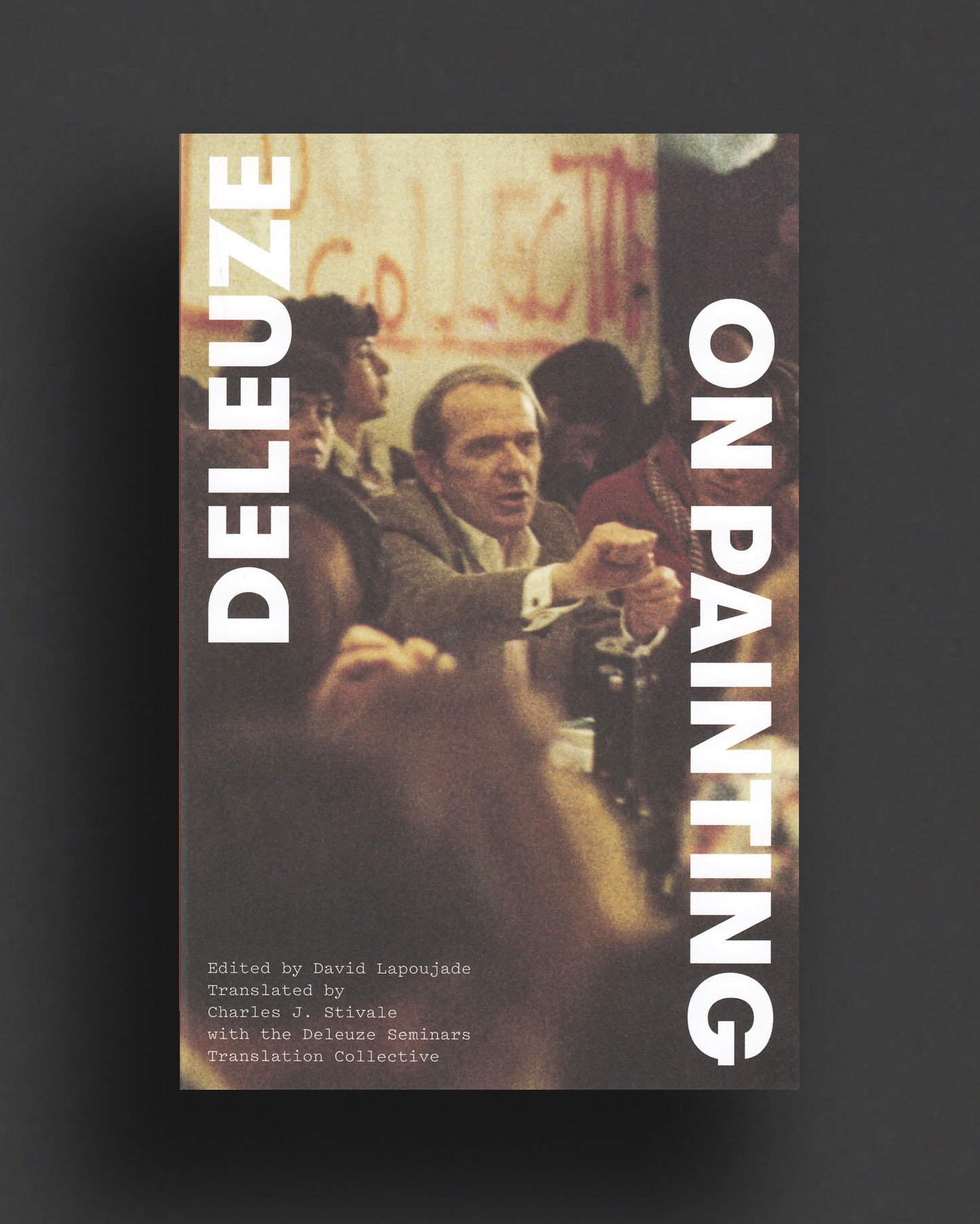
2025, English
Softcover, 360 pages, 21.5 x 14 cm
Published by
University of Minnesota Press / Minnesota
Univocal Publishing / Minneapolis
$62.00 - Out of stock
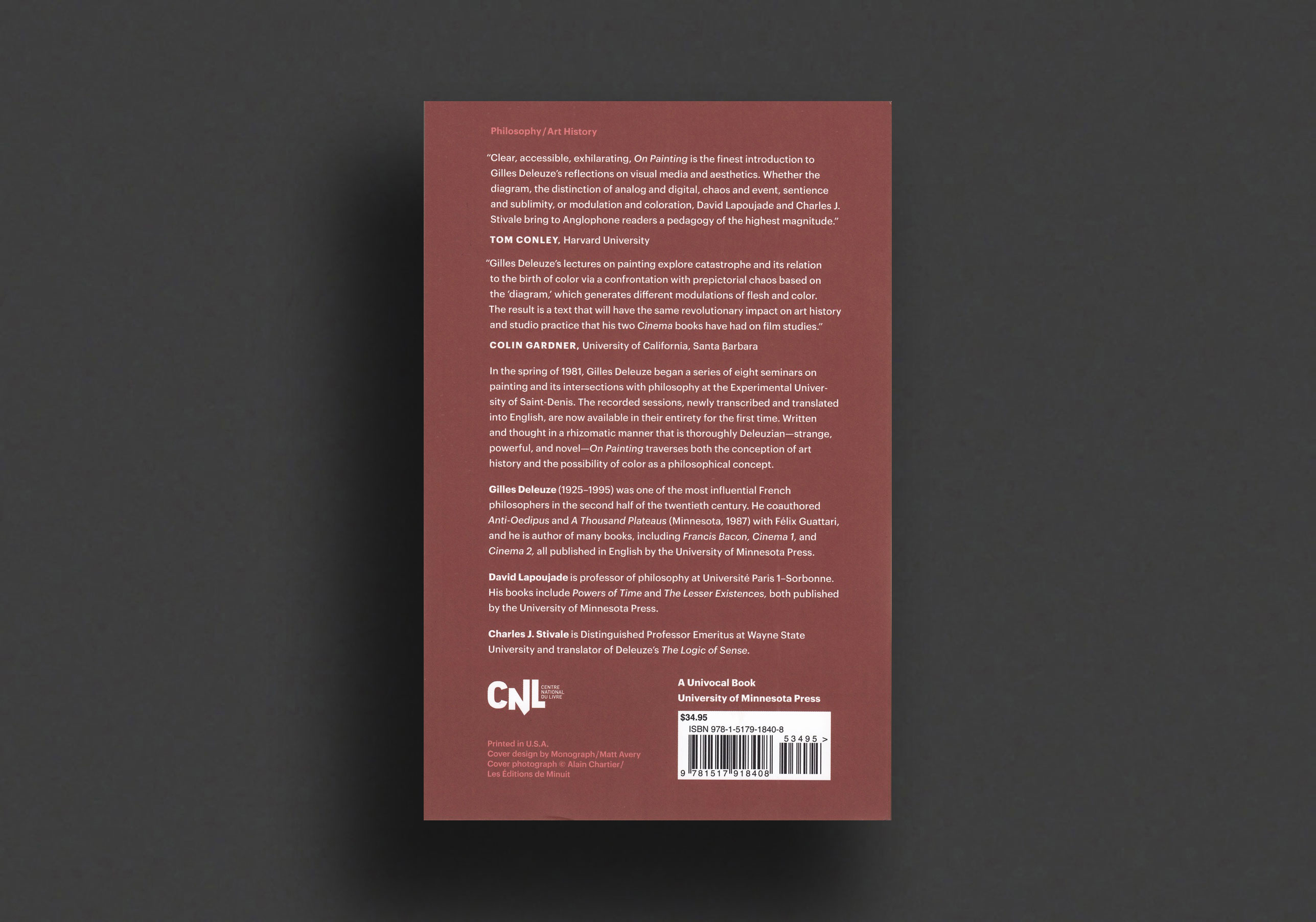
From 1970 until 1987, Gilles Deleuze held a weekly seminar at the Experimental University of Vincennes and, starting in 1980, at Saint-Denis. In the spring of 1981, he began a series of eight seminars on painting and its intersections with philosophy. The recorded sessions, newly transcribed and translated into English, are now available in their entirety for the first time. Extensively annotated by philosopher David Lapoujade, On Painting illuminates Deleuze's thinking on artistic creation, significantly extending the lines of thought in his book Francis Bacon.
Through paintings and writing by Rembrandt, Delacroix, Turner, Cezanne, Van Gogh, Klee, Pollock, and Bacon, Deleuze explores the creative process, from chaos to the pictorial fact. The introduction and use of color feature prominently as Deleuze elaborates on artistic and philosophical concepts such as the diagram, modulation, code, and the digital and the analogical. Through this scrutiny, he raises a series of profound and stimulating questions for his students: How does a painter ward off greyness and attain color? What is a line without contour? Why paint at all?
Written and thought in a rhizomatic manner that is thoroughly Deleuzian-strange, powerful, and novel-On Painting traverses both the conception of art history and the possibility of color as a philosophical concept.
Edited by David Lapoujade, translated by Charles J. Stivale.
2025, English
Hardcover, 368 pages, 28 x 28 cm
Published by
Hauser & Wirth / Zurich
Hauser & Wirth / Los Angeles
$160.00 - In stock -
Hammons' body prints, flags and found-object sculptures come together in this artist's book documenting his thought-provoking conceptual exhibition.
This post-exhibition catalog revisits David Hammons’ 2019 show at Hauser & Wirth Los Angeles. A singular book created entirely under the artist’s direction, this publication illustrates the most expansive exhibition of this legendary artist’s work to date.
Said critic Jonathan Griffin of the original exhibition, "Alongside finished artworks, including framed examples of Hammons’s sublime drawings made with bounced basketballs and powdered Kool-Aid, there are plenty of apparently ad hoc, readymade interventions, installations in which it is unclear where one ends and the next begins. … Hammons, it seems, wants his viewers to relax, historiography be damned."
Born in 1943 in Springfield, Illinois, David Hammons moved to Los Angeles in 1963 at the age of 20 and began making his body prints several years later. He studied at Otis Art Institute with Charles White and became part of a younger generation of Black avant-garde artists loosely associated with the Black Arts Movement. In Los Angeles, Hammons was a cofounder of Studio Z, a group which included Senga Nengudi, Maren Hassinger, Joe Ray and others. Hammons has lived in New York since 1978.
2012, English / German
Hardcover (cloth-bound), 247 pages, 20.7 x 28.8 mm
Published by
Walther König / Köln
$55.00 - In stock -
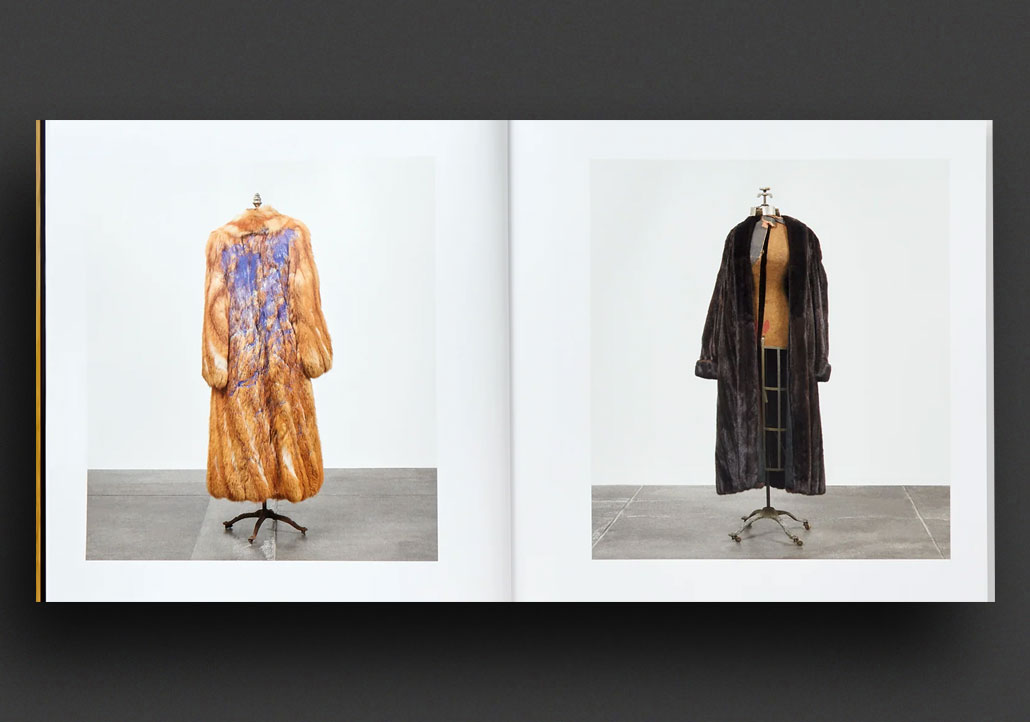
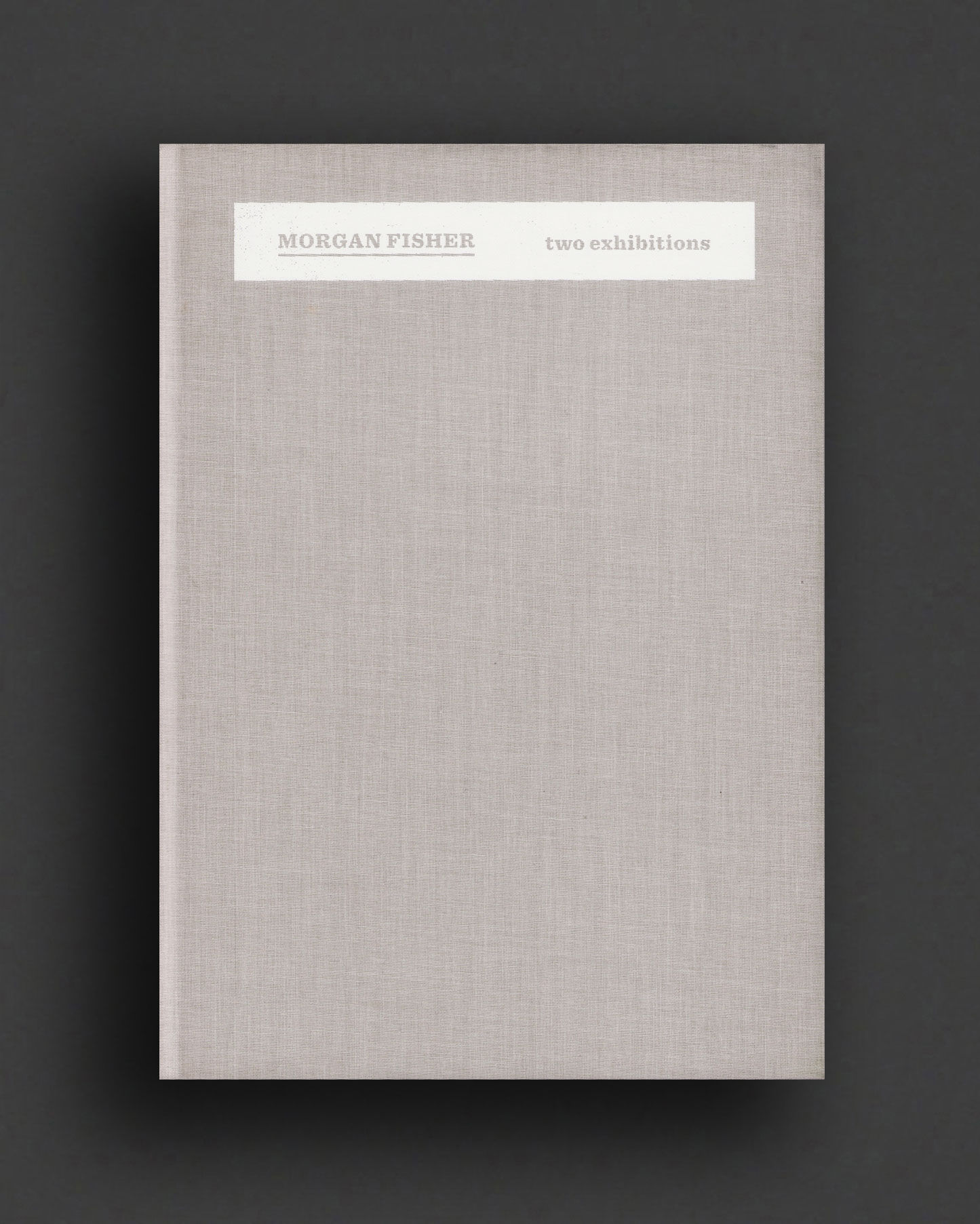
Morgan Fisher became prominent in the early 1970s as an experimental filmmaker in the structuralist milieu, whose main interest was not the content of that depicted but rather the analysis of the medium itself. In the mid 90s Fisher turned to monochrome painting and the installation of monochrome paintings. Fundamental questions on the history and aesthetic of perception as well as its inscription in genres and technologies are central in all of Morgan Fisher's work. Forgoing the illusionism of narrative, Fisher reveals the conditions of perception in his films and reflects the creation and the nature of the filmic image. His post-conceptual painting deals with the relation between colour, size and form of an image, frames, the relationship of figure and ground as well as the observer's point of view - themes that have been contested since the abstraction of modernism and minimalism.
2023, English
Softcover, 152 pages, 17.5 x 11 cm
Published by
Index Journal / Melbourne
$30.00 - In stock -
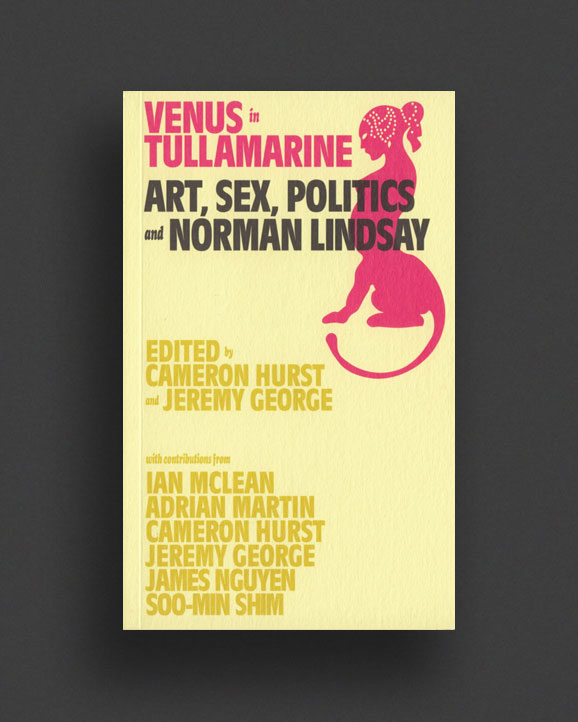
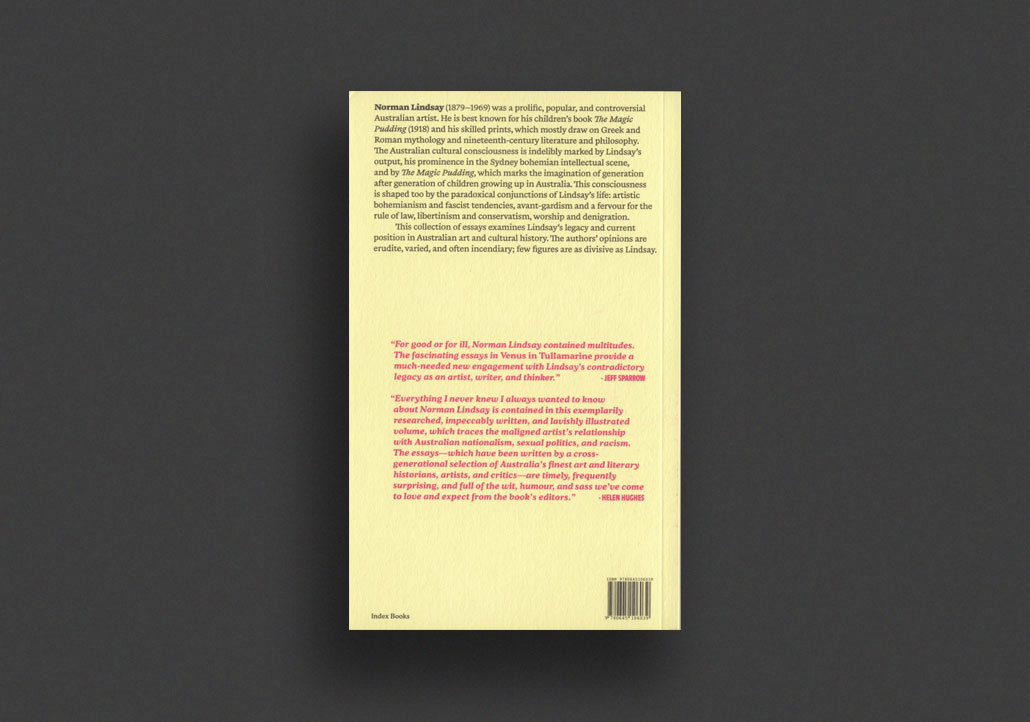
Norman Lindsay (1879–1969) was a prolific, popular and controversial Australian artist. He is best known for his children’s book The Magic Pudding and his skilled prints, which mostly draw on Greek and Roman mythology and nineteenth century literature and philosophy. The Australian cultural consciousness is indelibly marked by Lindsay’s output, his prominence in the Sydney bohemian intellectual scene and by The Magic Pudding, which entrances the imagination of generation after generation of Australian children. This consciousness is marked too by the paradoxical conjunctions of Lindsay’s life: artistic bohemia and fascistic tendencies, avant-gardism and a fervour for the rule of law, libertinism and conservatism, worship and denigration.
This collection of essays examines Lindsay’s current position in Australian art history. The authors’ opinions are erudite, varied and often incendiary; few figures are as divisive as Lindsay.
Film critic Adrian Martin writes alongside Ian McLean, the Hugh Ramsay Chair of Australian Art History at the University of Melbourne, art historian Cameron Hurst, and literary critic Jeremy George. Art historian Soo-Min Shim responds to a video work by artist James Nguyen.
The project develops research conducted during an exhibition of the University of Melbourne’s Norman Lindsay collection, also titled Venus in Tullamarine, held at the George Paton Gallery in 2022.
1959, German
Softcover (staple-bound), 44 pages, 20 x 19.5 cm
1st Edition, Out of print title / used / very good
Published by
Kongresshalle / Berlin
$50.00 - In stock -
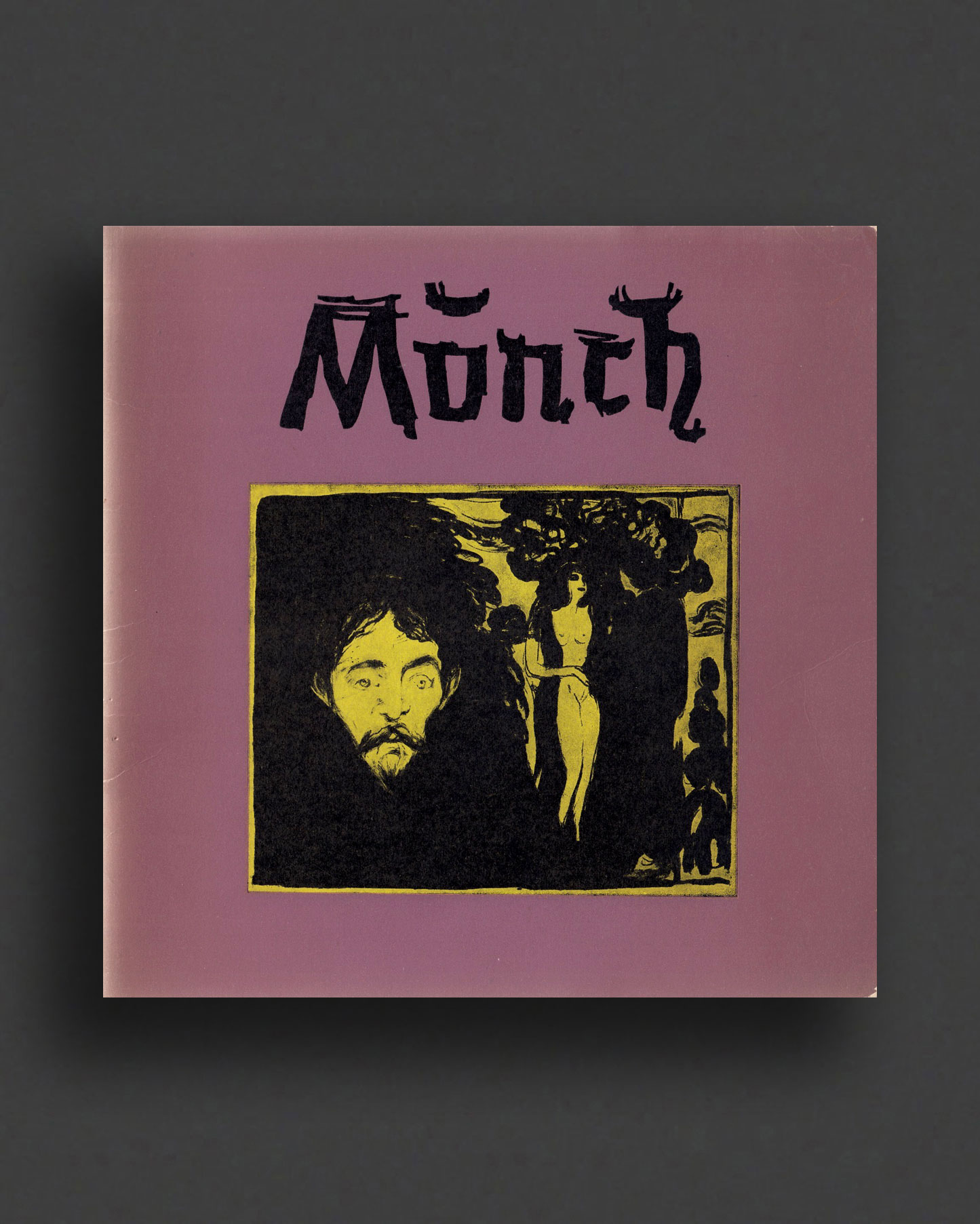
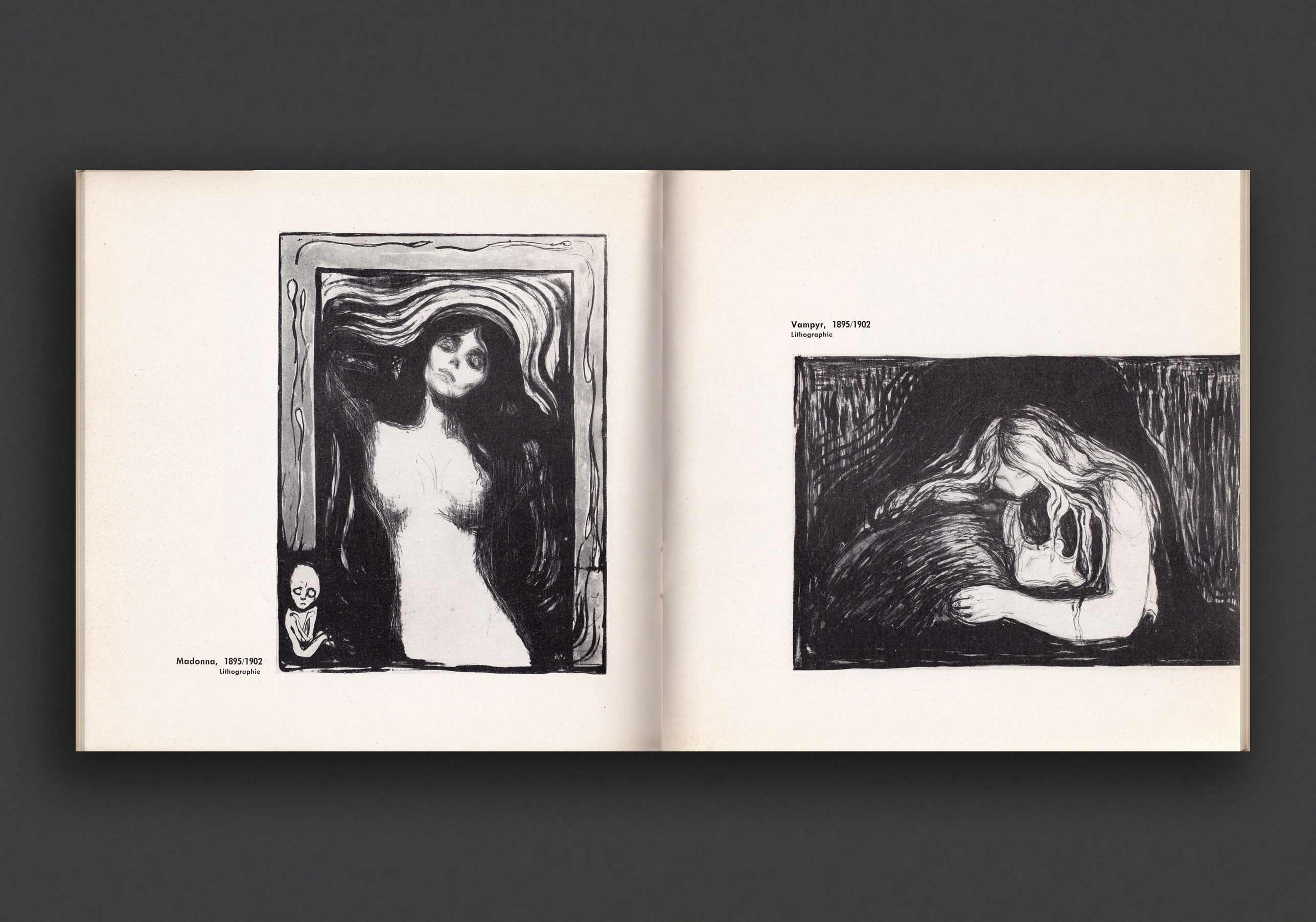
Lovely 1959 catalogue published on the occasion of the exhibition Edvard Munch 1863—1944, at the Kongresshalle Berlin, September—October, 1959, a very significant exhibition of the Norwegian painter's graphic works, profusely b/w illustrated throughout. Munch produced a substantial body of work using intaglio techniques—such as etching, drypoint, and aquatint—on copper plates. Beginning in 1894, he embarked on engraving directly onto copper and, largely self-taught and without formal instruction, created numerous masterpieces in this medium. Texts in German on alternating paper stocks throughout the galleries, plus a full catalogue of exhibited works.
Very Good copy, light wear.
1991, Japanese
Hardcover (w. dust jacket and slipcase), 168 pages, 26 x 29.5 cm
1st Edition, Out of print title / used / very good
Published by
Libro Port Publishing Co. Ltd. / Tokyo
$160.00 - Out of stock
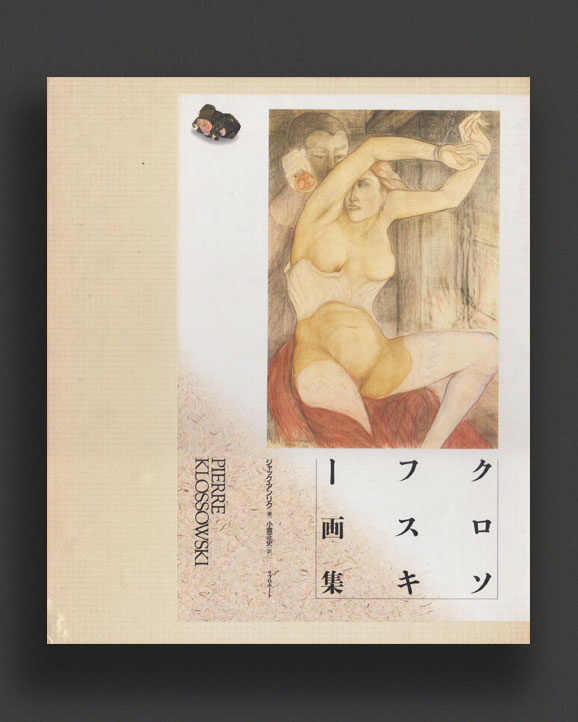
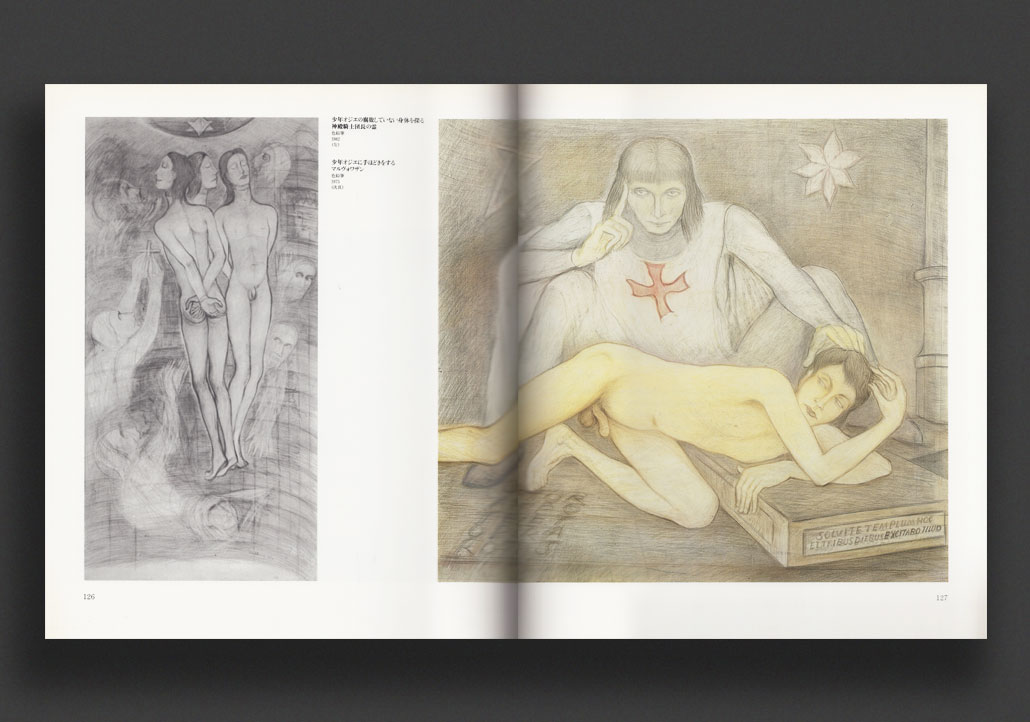
The incredible and rarely seen 1991 Japanese slipcased, hardcover edition of Jacques Henric's monographic volume on the great Pierre Klossowski. One of the most comprehensive books ever published on the artist, with beautiful large reproductions of artworks in colour and b/w heavily featured throughout, alongside Henric's text (here translated into Japanese from the original French) with a full catalogue of works and bibliography. First printing in original dust jacket, illustrated slipcase, beautifully printed in Italy and bound in Japan.
Jacques Henric (b. 1938) is a French literary critic, essayist and novelist.
Pierre Klossowski (1905-2001) was a significant and influential philosopher, writer, translator and artist who befriended Georges Bataille and formulated an original stance on many theological issues, as well as the philosophy of the Marquis de Sade. His first novel, Roberte, ce soir, appeared in 1954 as a limited edition containing six of his own erotic illustrations, after he rejected drawings by his younger brother, the painter Balthus. Following the encouragement of Robert Lebel, Andre Masson and Alberto Giacometti, Klossowski held his first exhibition in Paris in 1956, and subsequently produced numerous life-size drawings of erotic scenes imbued with mythological, allegorical and philosophical connotations. By the 1970s, he had won the acclaim of such eminent thinkers as Maurice Blanchot, Michel Butor, Gilles Deleuze, Michel Foucault and Felix Guattari. Of Klossowski, Gilles Deleuze once said, "That bodies speak has been known for a long time."
Fine As New copy of book and dj, preserved in Good slipcase with some wear and bumps.
2005, English / German
Softcover (w. folded poster dust-jacket), 192 pages, 22.5 x 27 cm
1st Edition, Out of print title / used / very good
Published by
Walther König / Köln
$320.00 - Out of stock
Rare 2006 edition (w. original fold-out dust-jacket poster) of Rosemarie Trockel's Post Menopause catalogue (raisonné), published on the occasion of the major 2005—2006 exhibition Rosemarie Trockel: Menopause, at the Museum Ludwig, Köln, and MAXXI-Museo nazionale delle arti del XXI secolo, Rome.
This wonderful, major survey disappeared from print very fast, quickly becoming a valuable item in the mid-2000s. A catalogue raisonné of sorts, collecting Rosemarie Trockel's work from 1980—2005 (sculpture, wool works, drawings, publications, garments, photography, video — including many very rarely seen objects), Post Menopause remains one the best, most comprehensive, and Trockel-esque books produced on one of Germany's most important and influential conceptual artists. Not surprisingly, since Post Menopause was realised in close collaboration between Trockel herself with Museum Ludwig curator Barbara Engelbach, and designed by her regular design collaborator, and sometimes muse, the great graphic designer Yvonne Quirmbach. Extensive chronological cataloguing of all works, biography, bibliography, and bilingual (English and German) essays by Brigid Doherty, Silvia Eiblmayr, Barbara Engelbach, Kasper König, and Gregory Williams.
A highly recommended and invaluable resource on the artist.
Rosemarie Trockel (*1952) is widely regarded as one of the most important and influential conceptual artists in Germany. Her sculptures, collages, ceramics, knitted works, drawings and photographs are noted for their subtle social critique and range of subversive, aesthetic strategies—including the reinterpretation of “feminine” techniques, the ironic shifting of cultural codes, a delight in paradox, and a refusal to conform to the commercial and institutional ideologies of the art system.
VG/VG.
2025, English
Hardcover (clothbound), 176 pages, 24.2 x 31.8 cm
Published by
La Fábrica / Madrid
$110.00 - Out of stock
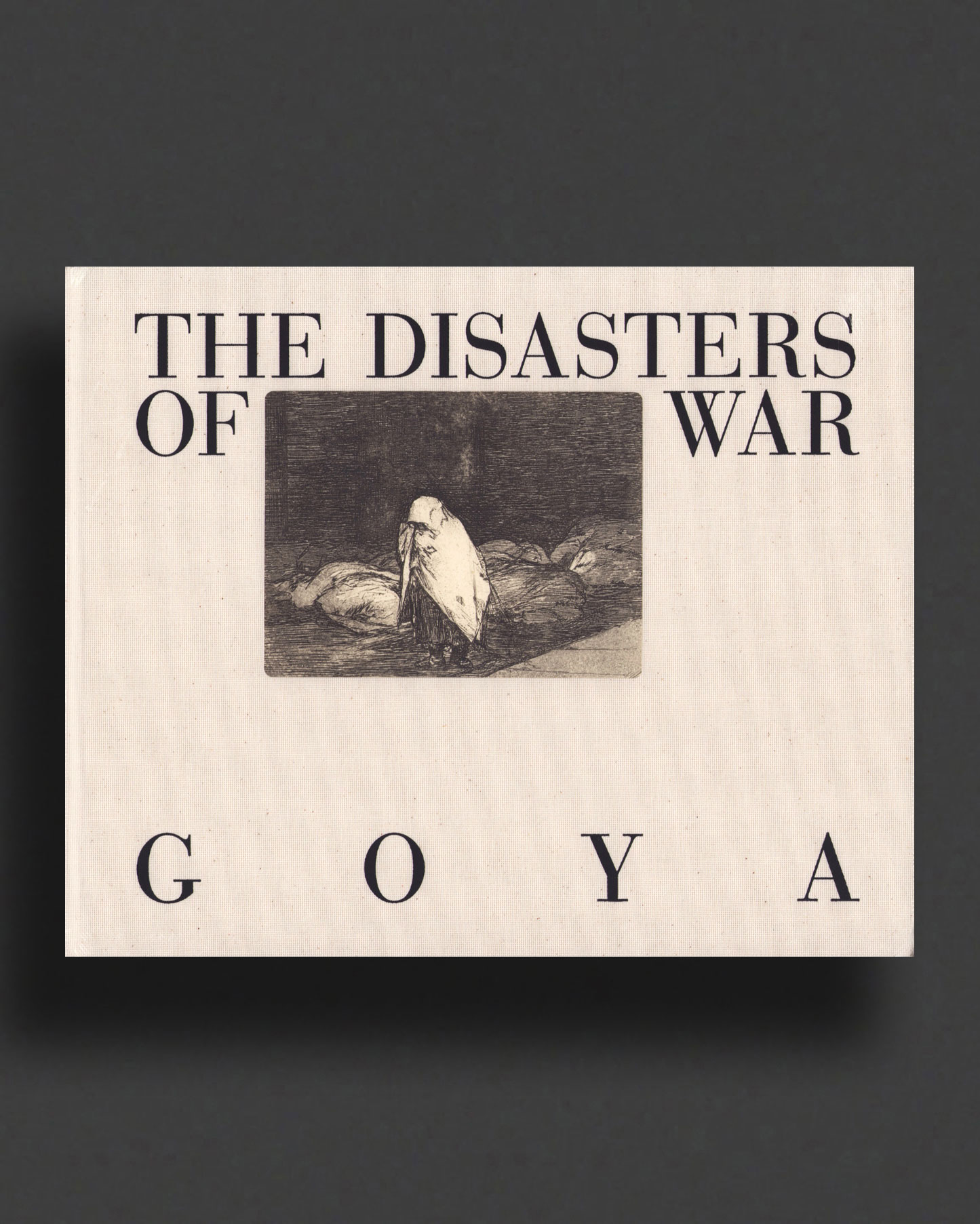
Goya’s The Disasters of War: A Timeless Cry Against Atrocity
Based on the original 1863 edition, this presentation of Goya’s 80 etchings decries the consequences of war through his bleak, gruesome and unflinching imagery.
Following his tenure as court painter for the Spanish royal family, Francisco de Goya’s art took on darker subjects and a more expressive style, especially during the Peninsular War (1808–14). Much can be gleaned from the fraught and visceral work of this period, including his series of etchings known as The Disasters of War.
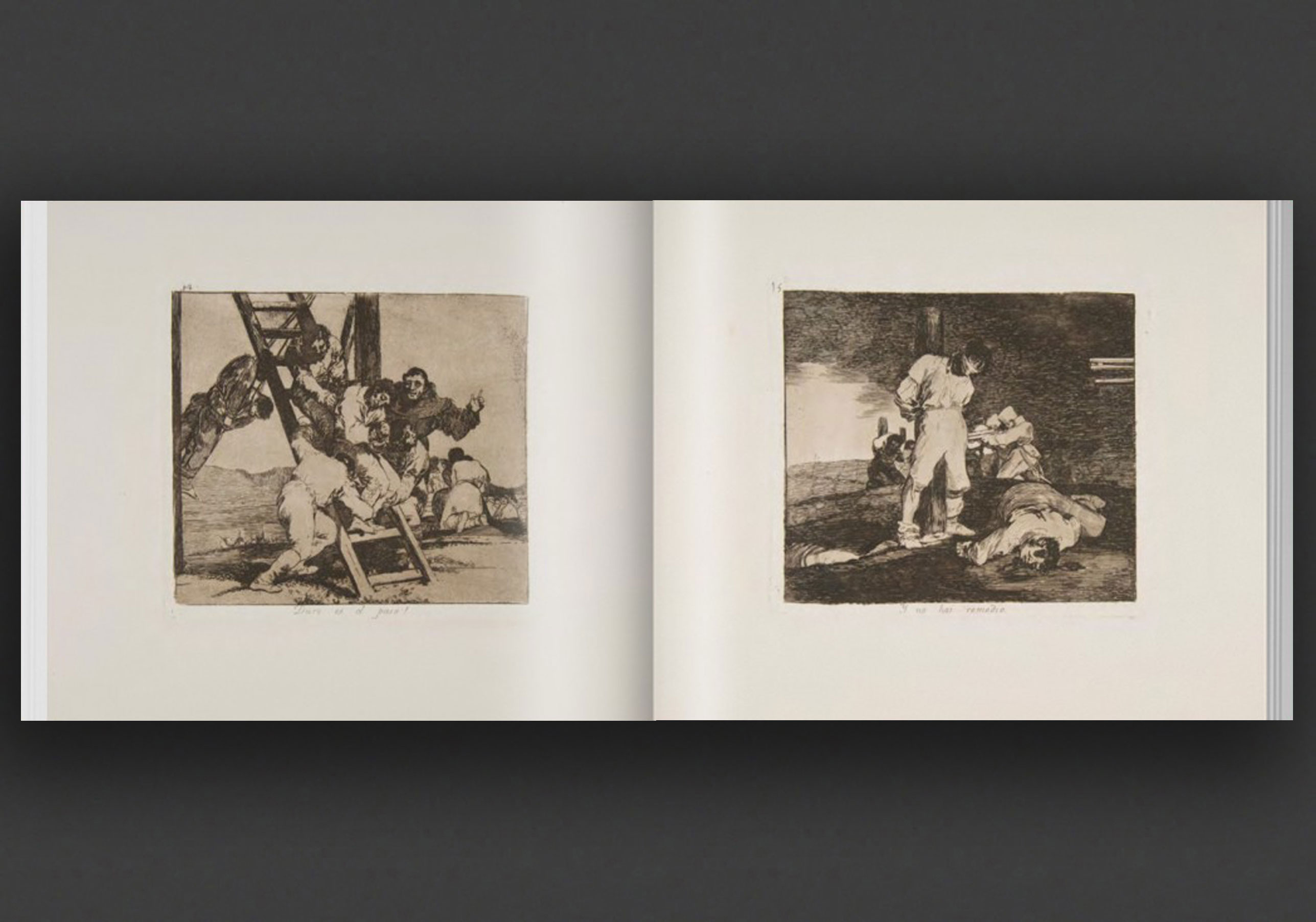
Concerned about the state of the world as much as his own failing health, Goya spent 10 years on what he personally titled Fatal Consequences of Spain’s Bloody War with Bonaparte, and Other Emphatic Caprices. Starvation, sickness, looting, assault, torture, execution—each image confronts the shattered lives of everyday soldiers and civilians, accompanied by brief, ambiguous captions such as “Y no hay remedio” (“And there is no remedy”) and “Yo lo vi” (“This I saw”).
This clothbound book faithfully reproduces the first edition of the complete set of 80 works which was published in 1863, 35 years after Goya’s death. It features exquisite printing quality on paper that closely resembles the texture of the original engravings, in a similar format and scale. War is still a condition of human existence today; Goya’s etchings are timeless for their vehement denunciation of its atrocities committed by all combatants, regardless of their national affiliations.
Born in Fuendetodos, Spain, Francisco de Goya (1746–1828) trained in Zaragoza and later moved to Madrid. In 1789 he was appointed as a court painter by Charles IV. Considered “the last of the Old Masters and the first of the moderns,” his art blended elements of Romanticism with a deeply personal and often critical vision of society.
2025, English
Hardcover, 208 pages, 28 x 24 cm
Published by
Skira / Milan
$95.00 - In stock -
Edited by Antonio Sergio Bessa
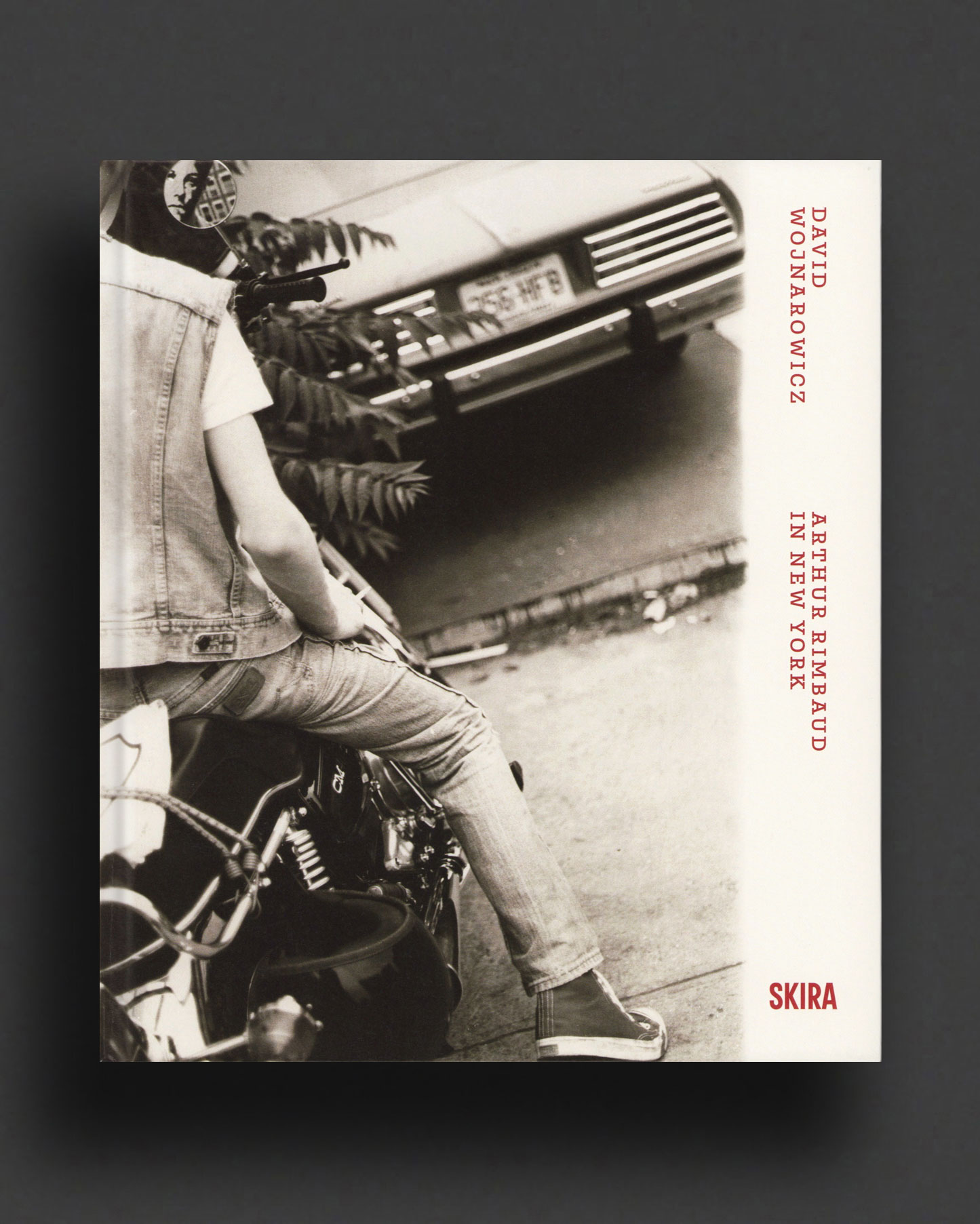
One of David Wojnarowicz's few incursions into photography is a testimony of urban, social and political change in New York in the late 1970s.
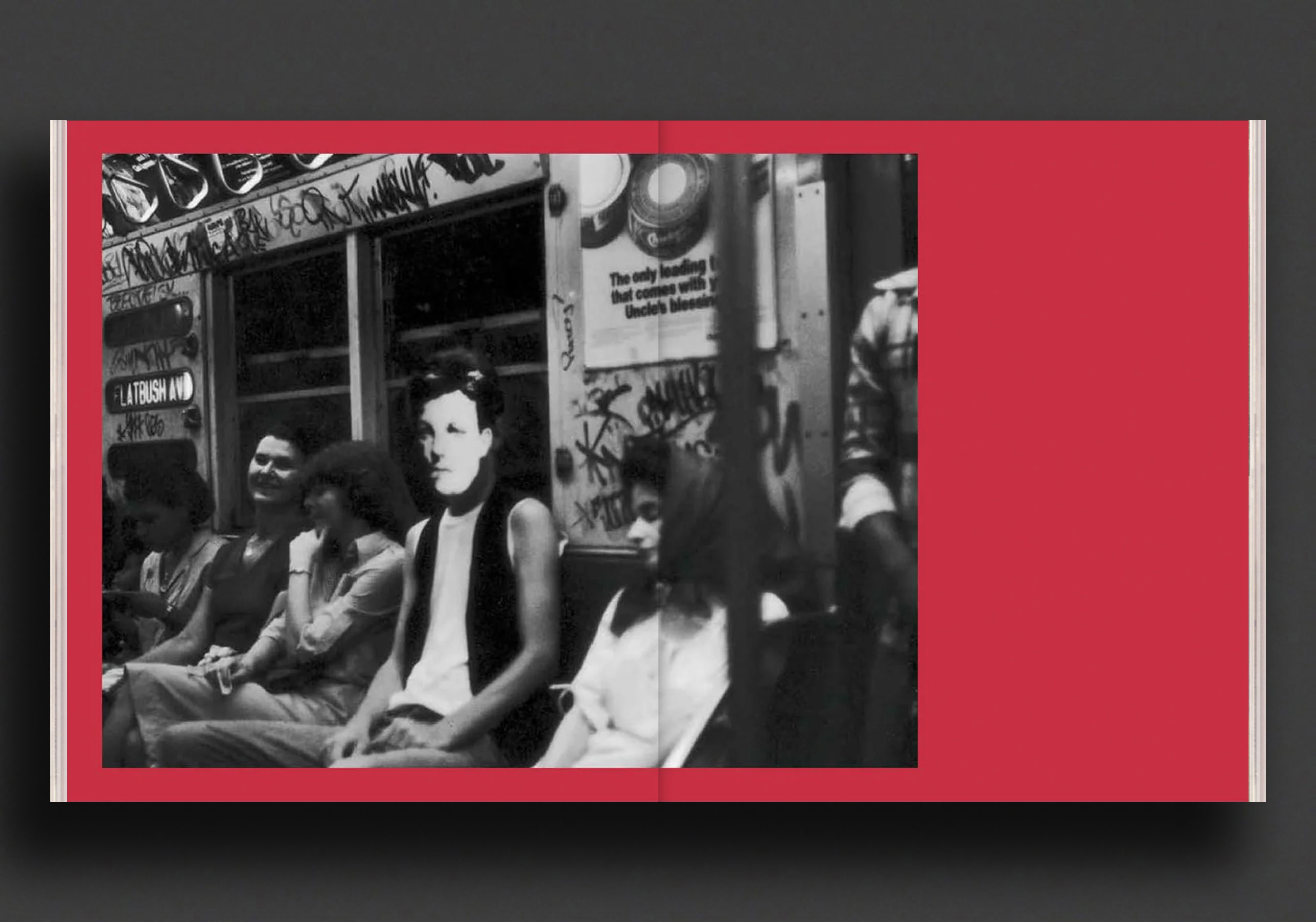
In 1978 and 1979, David Wojnarowicz took a series of photographs of a man wearing a paper mask bearing the visage of Arthur Rimbaud, the French poet equally known for his fervid verse and dramatic life. Rimbaud was the instantiation, and perhaps the inventor, of the idea of the young gay hustler of genius.
Presenting a selection of photographs by Wojnarowicz, this amply illustrated volume features an introductory essay by Antonio Sergio Bessa contextualizing the series within a foundation of other works across literature, photography and performance. Nicholas Martin explores Wojnarowicz's practice in the context of the rise of the punk movement in downtown Manhattan in the late 1970s. Craig Dworkin explores Rimbaud's years as a runaway youth in Paris during the Commune, and his acquaintances with the city's bohemia. Marguerite Van Cook contributes an essay about her experiences with the London and New York music and art scenes throughout the 1970s and 1980s. Phillip Aarons offers a personal account of his engagement as a collector of Wojnarowicz's work. The book also features an interview with photographer Allen Frame, who produced several performances of Wojnarowicz's monologues in the early 1980s in New York's Lower East Side, Berlin and Brooklyn.
Painter, photographer, writer, filmmaker, performance artist, songwriter and activist David Wojnarowicz was born in Red Bank, New Jersey, in 1954 and died from AIDS-related illness in New York in 1992. He authored a few books, most famously Close to the Knives. Wojnarowicz attained national prominence as a writer and advocate for AIDS awareness and for his stance against censorship.
2024, English
Softcover, 160 pages, 20.5 x 13.5 cm
Published by
Wakefield Press / Cambridge
$34.00 - In stock -
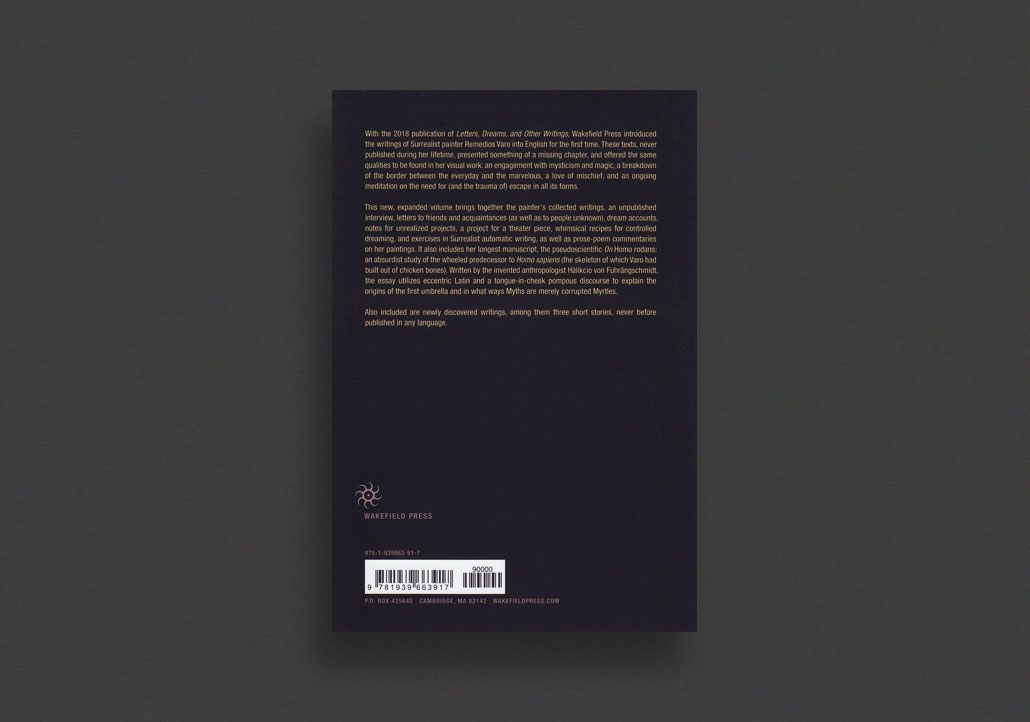
With the 2018 publication of Letters, Dreams, and Other Writings, Wakefield Press introduced the writings of Surrealist painter Remedios Varo into English for the first time. These texts, never published during her lifetime, presented something of a missing chapter, and offered the same qualities to be found in her visual work: an engagement with mysticism and magic, a breakdown of the border between the everyday and the marvelous, a love of mischief, and an ongoing meditation on the need for (and the trauma of) escape in all its forms.
This new, expanded volume brings together the painter’s collected writings, an unpublished interview, letters to friends and acquaintances (as well as to people unknown), dream accounts, notes for unrealized projects, a project for a theater piece, whimsical recipes for controlled dreaming, and exercises in Surrealist automatic writing, as well as prose-poem commentaries on her paintings. It also includes her longest manuscript, the pseudoscientific On Homo rodans: an absurdist study of the wheeled predecessor to Homo sapiens (the skeleton of which Varo had built out of chicken bones). Written by the invented anthropologist Hälikcio von Fuhrängschmidt, the essay utilizes eccentric Latin and a tongue-in-cheek pompous discourse to explain the origins of the first umbrella and in what ways Myths are merely corrupted Myrtles.
Also included are newly discovered writings, among them three short stories, never before published in any language.
Edited and translated by Margaret Carson
Remedios Varo (1908–1963) was a Spanish-born painter who entered the Surrealist circle in Paris before the German occupation forced her into exile to Mexico at the end of 1941, where she would stay until the end of her life. Her dream-infused allegorical works combine the elements of classical training, alchemical mysticism, and fairy-tale science.
2018, English
Hardcover, 788 pages, 28.7 x 25.4 cm
Published by
Kant / Prague
$220.00 - In stock -
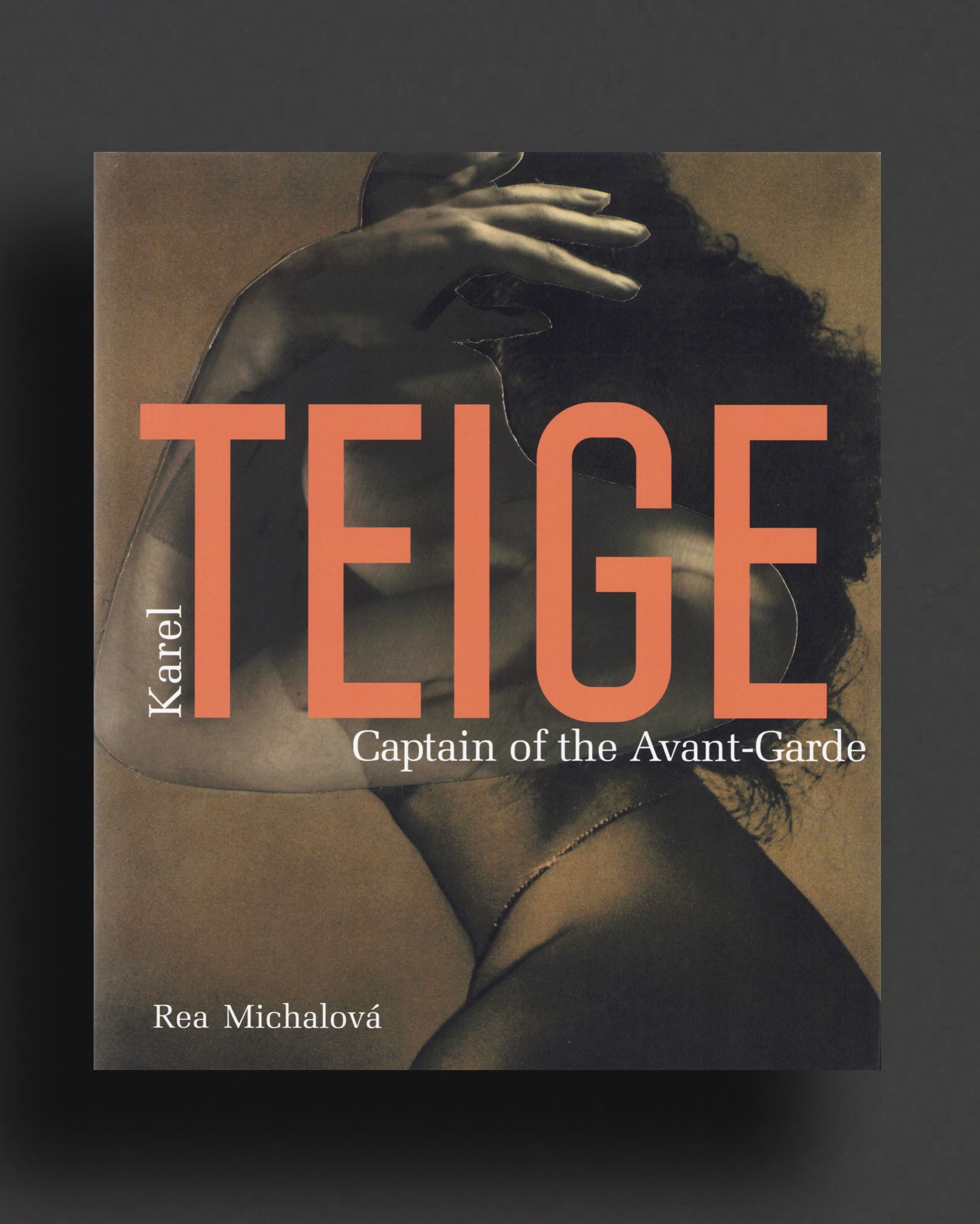
Art theorist and critic, graphic designer, artist, author and translator Karel Teige (1900–51) is today recognized not just as the creator of internationally acclaimed surrealist collages, but also as a leading figure of the European avant-garde. Teige spent his entire life commenting on and interpreting developments in the visual arts. His multifaceted theoretical writings helped shape the conceptual foundations of modern art, and his activities and intensive contacts with other members of the European avant-garde helped secure Czech art's place on the international art scene. His work anticipated, initiated and helped to develop the progressive artistic movements that fundamentally influenced art in the 20th century.
Karel Teige was one of the great European intellectuals of his time; his efforts were aimed at creating not just a system of aesthetics but also an all-encompassing life philosophy. He was intensively interested in architecture and found inspiration in Germany's Bauhaus (where he spent a year lecturing); architectural functionalism would have looked completely different without his input. Teige's preference for rational, minimalist designs with an emphasis on the social uses of modern architecture was the "most functionalist functionalism" of his time.
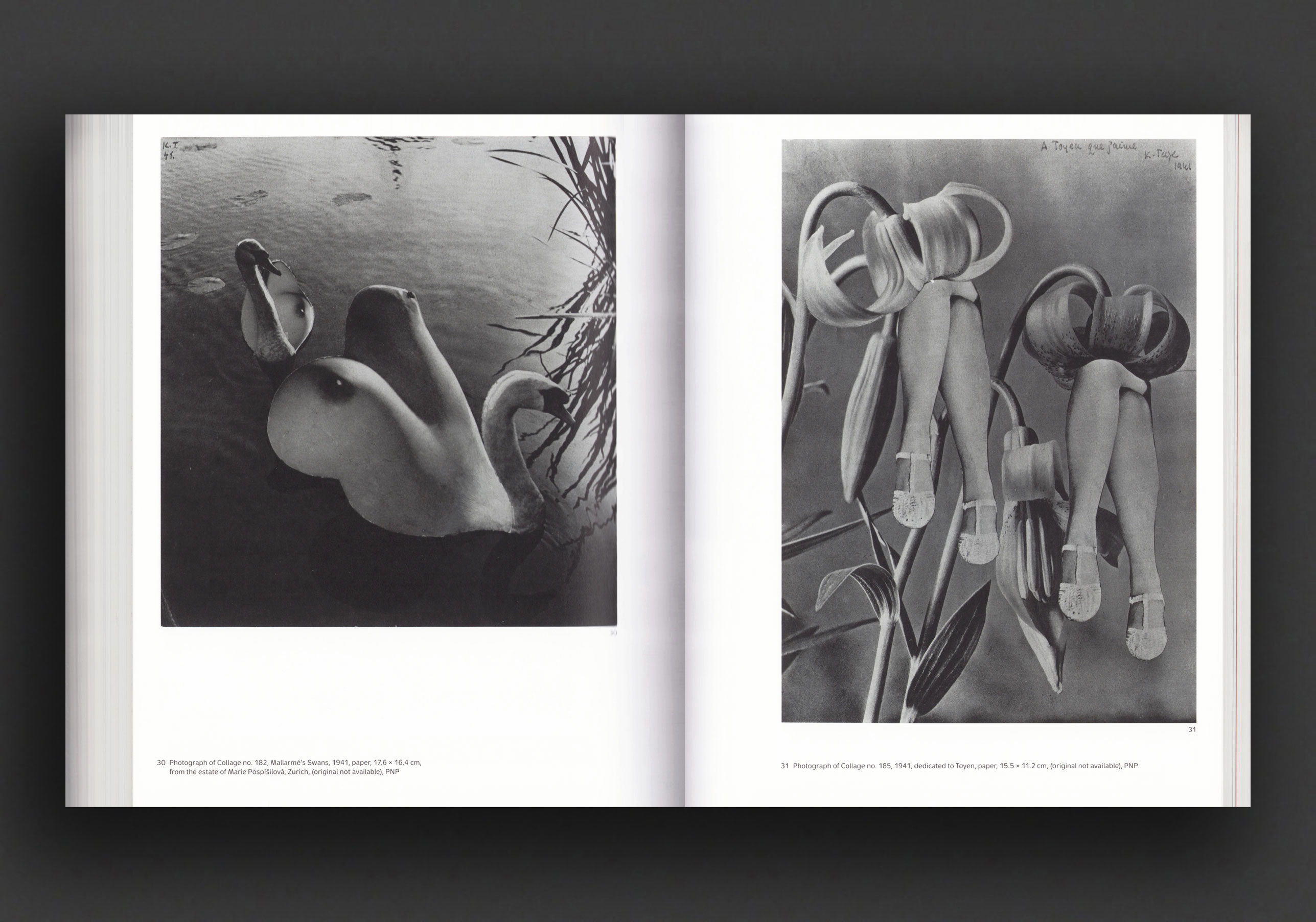
Teige's own work consisted primarily of a series of phenomenal collages that reveal the hidden and passionate aspects of his personality. His book designs set the tone for an entire generation, and his design principles remain valid today. Teige's complicated personality, full of contradictions, utopian dreams and a yearning for order and logic make him an indecipherable and deeply human individual, a perfect symbol for the 20th century.
This comprehensive, nearly 800-page monograph, by the art historian Rea Michalová, takes a wide-ranging look at the evolution of Teige's ideological, theoretical and political views, and recalls important moments in his life and their significance within the international context. The book includes a rich set of illustrations, photographs from his life, and examples of his unique collages and graphic designs.
"Just a few of the reasons why we can't get over this new Karel Teige monograph. Measuring more than 2.5 inches thick and just under 800 pages long—with 318 color reproductions and a whopping 635 pages of scholarly texts—Karel Teige: Captain of the Avant-Garde, the new Teige monograph from noted Czech art book publisher Kant, is truly extraordinary. "There is no need to explain who Karel Teige was," a Czech writer for Typografia magazine proclaimed in 1927. "I don't think that there was a single modern impulse in our country that he did not either directly inspire or at least support. Architecture, poetry, film, photography, painting, theater, typography—all these bear traces of his insightfulness and modernity."
1966, Czech
Folder/dust jacket containing 2 staple-bound booklets, 24 + 24 pages, 22 x 20.5 cm
1st Edition, Out of print title / used / very good
Published by
Dum Umeni Mesta / Brno
$70.00 - In stock -
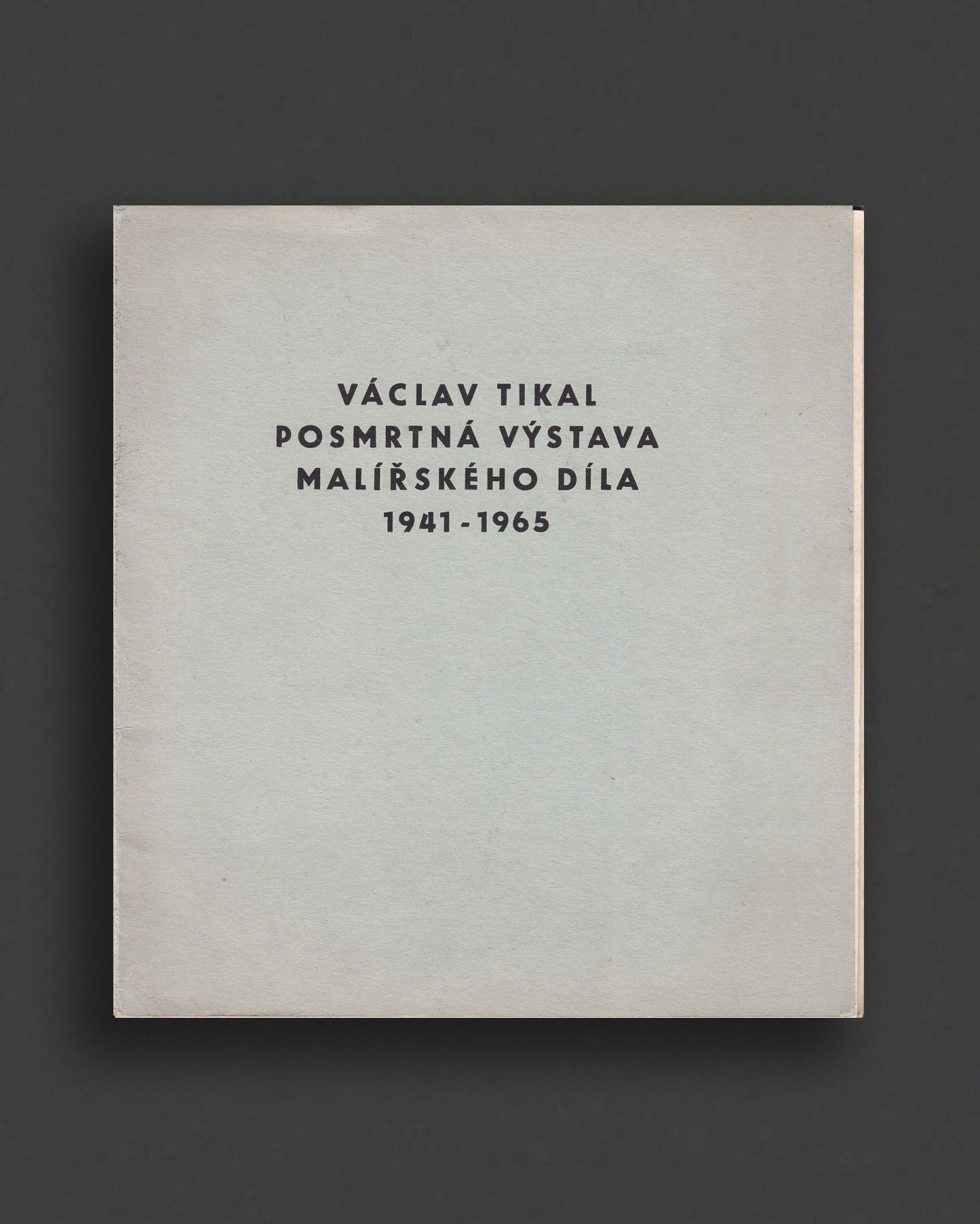
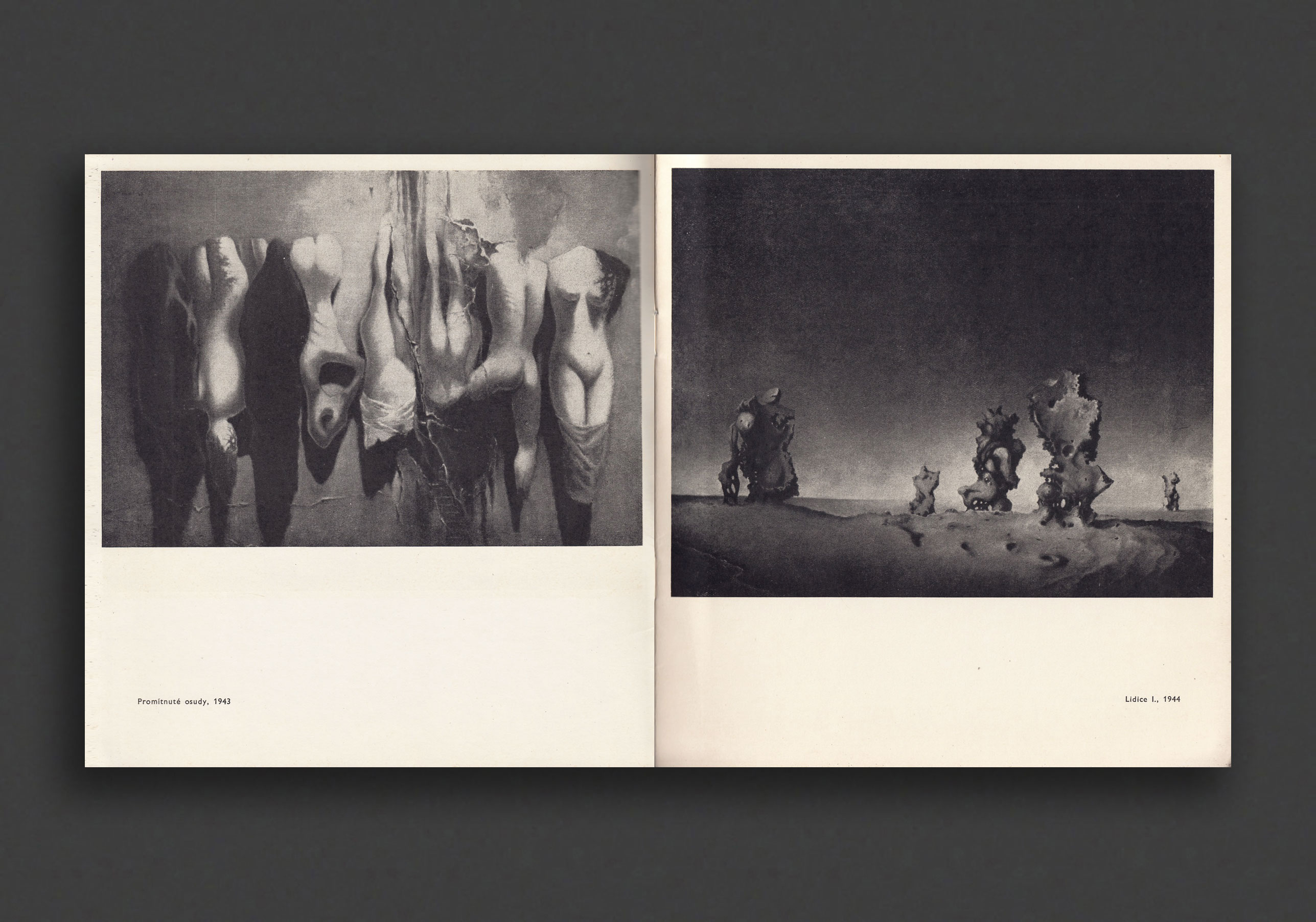
Lovely rare exhibition catalogue by Czechoslovak surrealist painter and ceramist, Václav Tikal (1906—1965), a 1966 posthumous exhibition of paintings from between 1941-1965, published by Dum Umeni Mesta, Brno. The show travelled between Brno and Prague. Catalogue comprises a folder/dust jacket housing 2 booklets, each 24 pages — the first a lengthy text by František Šmejkal, portrait of Tikal by Karel Kuklík, bio, list of exhibitions, and full catalogue of exhibited works. The second is entirely made up of b/w reproductions of Tikal's paintings.
Václav Tikal was a Czech painter associated with the Surrealist movement in Prague. Active from the 1930s onward, he worked within the circle of the Czech Surrealist group, whose members were deeply influenced by the ideas of André Breton and the international Surrealist movement. Tikal was closely connected with leading figures of Czech Surrealism such as Karel Teige, Toyen, Jindřich Štyrský, and poet Vítězslav Nezval. While some of his colleagues focused strongly on erotic or poetic imagery, Tikal’s paintings often reflected his background in architecture: he created carefully structured compositions filled with enigmatic objects, landscapes, and spatial constructions that evoke a sense of quiet mystery.
Very Good copy is light softening at edges, light/marking tanning.
1990, English
Softcover (w. dust jacket), 512 pages, 29.5 x 23 cm
1st Edition, Out of print title / used / very good
Published by
Biennale of Sydney / Sydney
$100.00 - In stock -
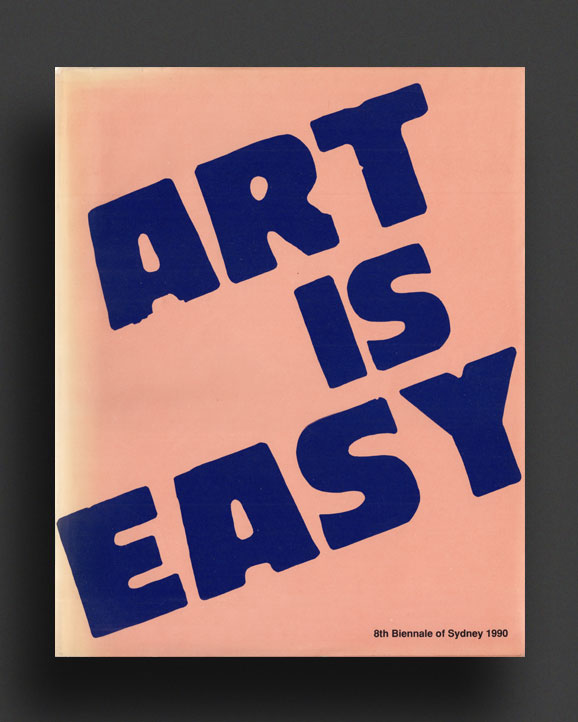
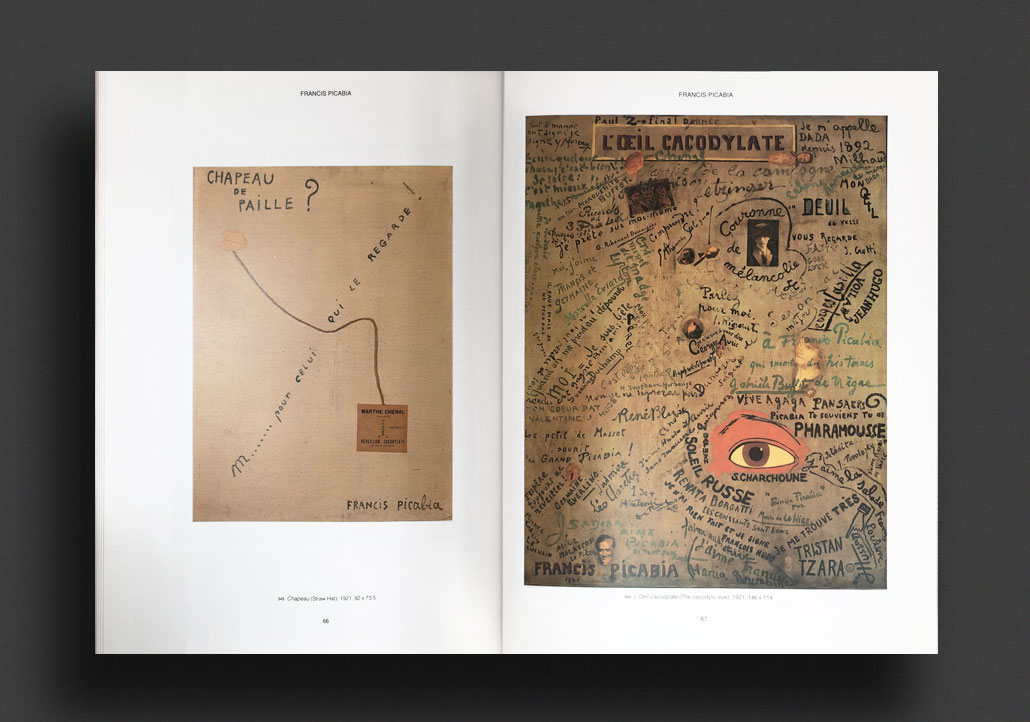
First edition of the incredible (huge) catalogue published to accompany the 8th Biennale of Sydney 1990 "The Readymade Boomerang: Certain Relations in 20th Century Art", held 11 April-3 June 1990 in Sydney across various venues. The eighth Biennale began from ‘a trio of Dada originators’: Marcel Duchamp, Man Ray and Francis Picabia. A large number of artists across generations joined these key figures in Artistic Director René Block’s exploration of the ‘readymade’ in twentieth-century art, which aimed to highlight ‘its invention and pure use by Duchamp, to its resurgence in Nouveau Realism, Pop Art, and Fluxus of the 60s, all the way to new versions by young contemporary artists’. Pop, fluxus and conceptual artists such as Andy Warhol, Richard Hamilton, Marcel Broodthaers, Joseph Beuys, John Cage, Alison Knowles, César, George Brecht, Nam Jun Paik and Piero Manzoni were shown alongside Rosemarie Trockel, John Nixon, Ian Burn, Mel Ramsden, Janet Burchill, Peter Tyndall, Robert Rooney, Rosalie Gascoigne, Cindy Sherman, Bruce Nauman, Hans Haacke, Rebecca Horn, Sophie Calle, Jeff Koons, Allan Kaprow, Jenny Holzer, Robert Gober, Jill Scott, Bill Culbert, Stanley Brouwn, Peter Cripps, Terry Fox, Ian Hamilton Finlay, Fischli & Weiss, KP Brehmer, Sigmar Polke, Dieter Rot, Hanne Darboven, Robert MacPherson, Jackie Redgate, Ed Ruscha, Barbara Bloom, Oyvind Fahlstrom, amongst so many others. The industrial Bond Store at Millers Point featured site-specific works by artists such as Olaf Metzel and Simone Mangos, and several works were created on-site in Sydney, amplifying Block’s notion of the Biennale as a ‘workshop’. A comprehensive satellite program of music, performance, lectures, symposia, workshops and exhibitions at various Sydney venues complemented the exhibition, with Carles Santos’ piano recital on a barge in Sydney Harbour a highlight. Five satellite exhibitions included On Kawara, Joseph Beuys, Alain Fleischer, Fluxus and Broken Record, which featured artist’s experimentations with audio recordings, vinyl and album artwork – from John Cage’s 33 1/3 composition for 12 record players to Milan Knížák’s record-collages.
An incredible Sydney biennale, captured here across over 500 pages conceived and realised by René Block and Jennifer Cook - profusely illustrated with examples of all artists works and accompanying texts throughout by Lynne Cooke, Bernice Murphy, Anne Marie Freybourg, Dick Higgins, René Block and Jennifer Cook. Very Good copy with only general wear/ageing. Bright and clean, includes tanned original dust jacket now preserved under plastic wrap.
Having represented Beuys, Richter and Polke, German gallery owner, art publisher, art collector and curator René Block (born 1942) ranks among the central figures of the 1960s avant-garde.
Very Good copy with original dust jacket. Common tanning to dust jacket spine, now preserved under mylar wrap.
2026, English
Hardcover, 296 pages, 28 x 23.5 cm
Published by
Walther König / Köln
Albertina Modern / Vienna
$115.00 - In stock -
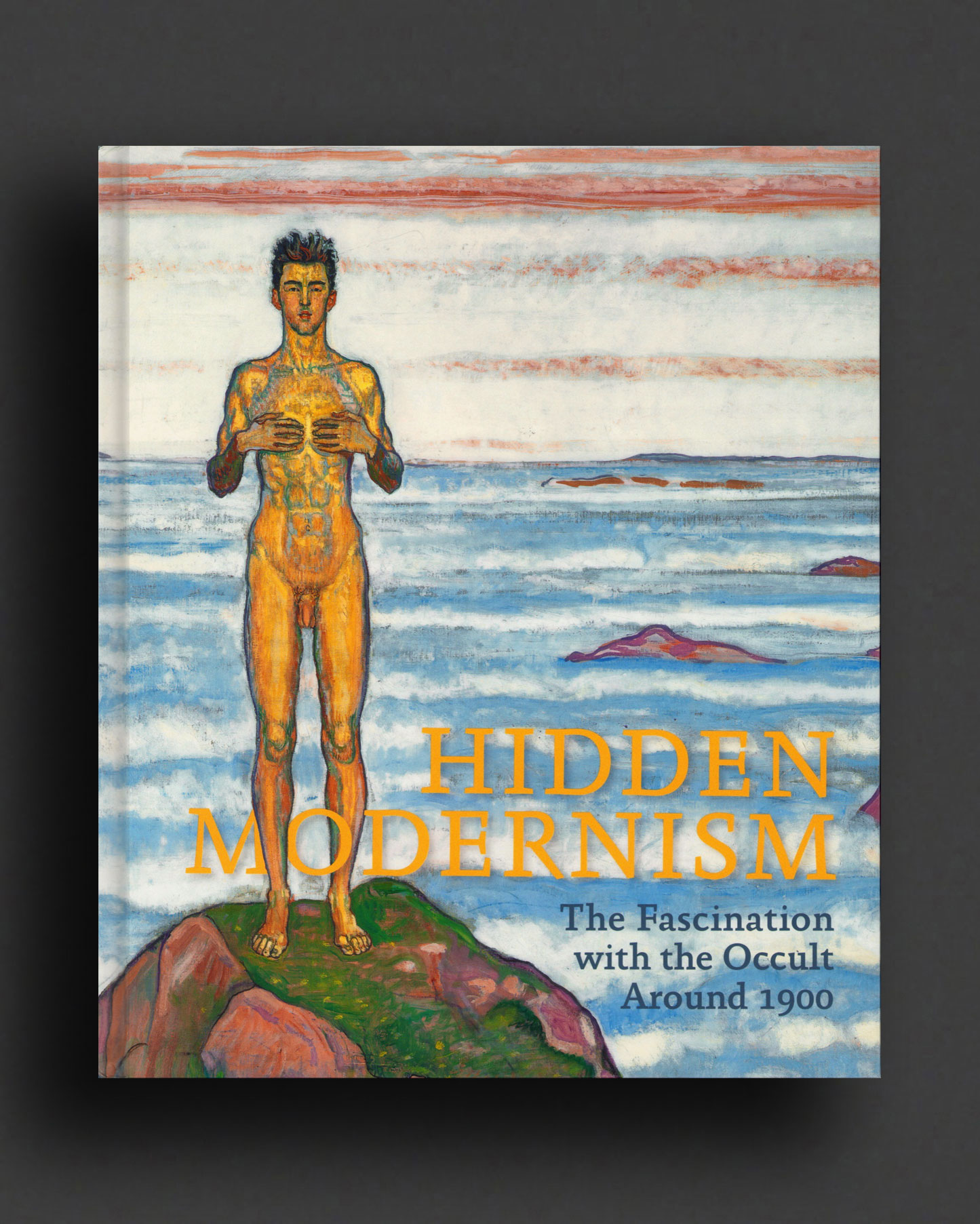
From auratic presences to mediumistic drawings—an account of the occult's role in the art of Vienna's Lebensreform movement.
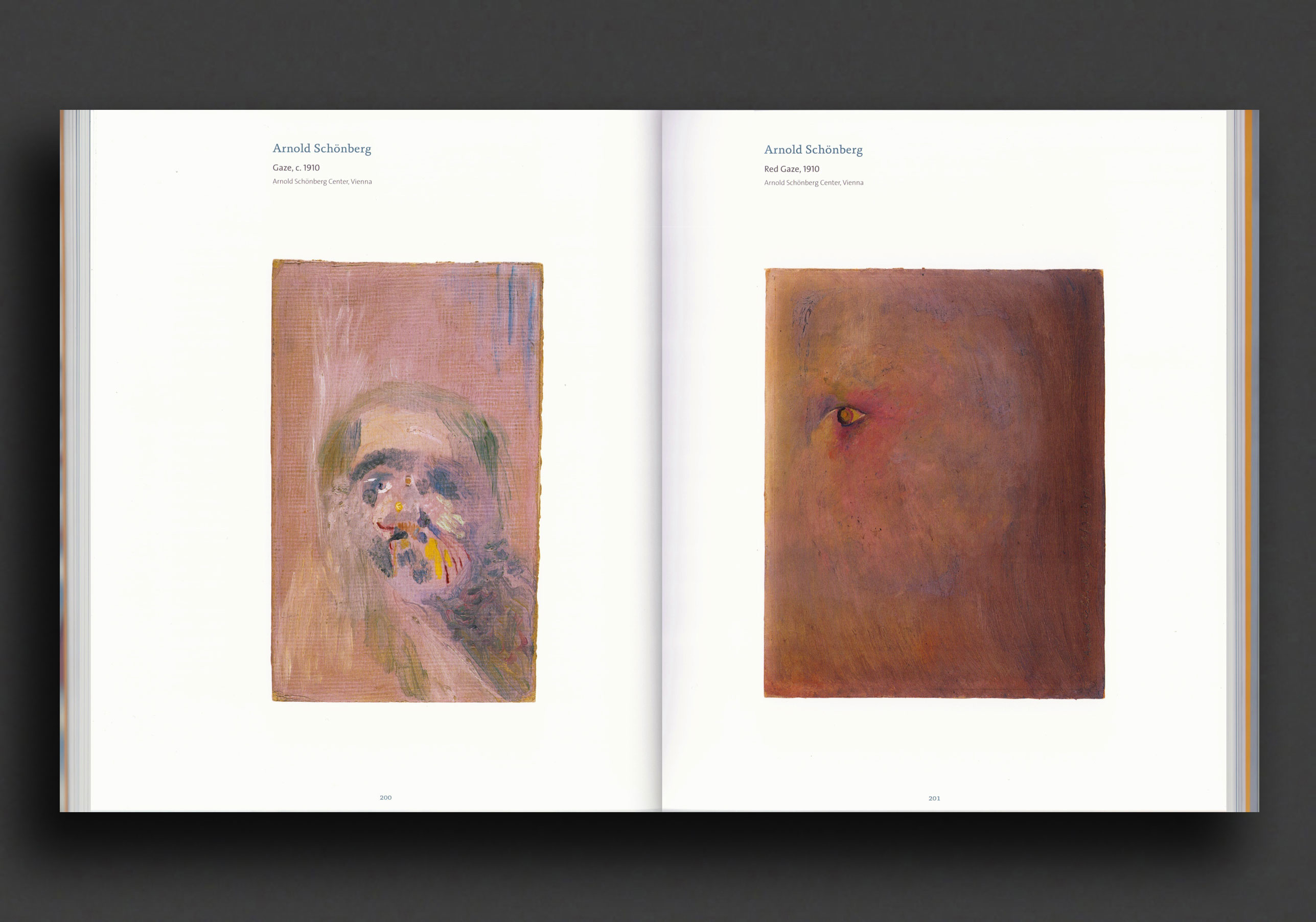
Around 1900, a nature-oriented way of life, spiritism and theosophy inspired artists from Arnold Schoenberg to Egon Schiele. Hidden Modernism is the first to explore the occult aspects of the "Lebensreform" movement in Vienna. In the late 19th century, criticism of industrialized society's materialism reached Vienna. Spiritism and theosophy inspired many who were looking for a "better self." Painters such as Albert von Keller and Gabriel von Max documented their trance states, Gertrude Honzatko-Mediz created mediumistic drawings, the writer August Strindberg painted dark landscape visions, artists such as Richard Gerstl, Arnold Schoenberg, Egon Schiele, Oskar Kokoschka and Max Oppenheimer saw their models as auratic presences. Through intensively researched scholarly texts and abundant artwork images and archival photographs, this volume examines the search for the "New Human" in Vienna without ignoring the darker aspects of magical thinking.
Edited by Matthias Dusini, Ivan Ristic, Hans-Peter Wipplinger. Text by Karl Baier, Matthias Dusini, Laura Feurle, Kira Kaufmann, Astrid Kury, Michaela Lindinger, Therese Muxeneder, Ivan Ristic.
1980, French
Hardcover (w. dust jacket), 179 pages, 30.5 x 30.5 cm
1st Edition, Out of print title / used / fine
Published by
Clairefontaine / Lausanne
$150.00 - Out of stock
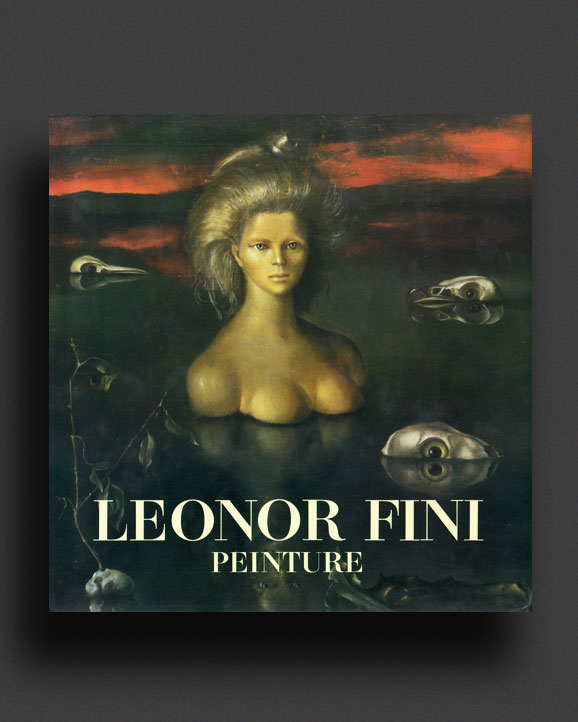
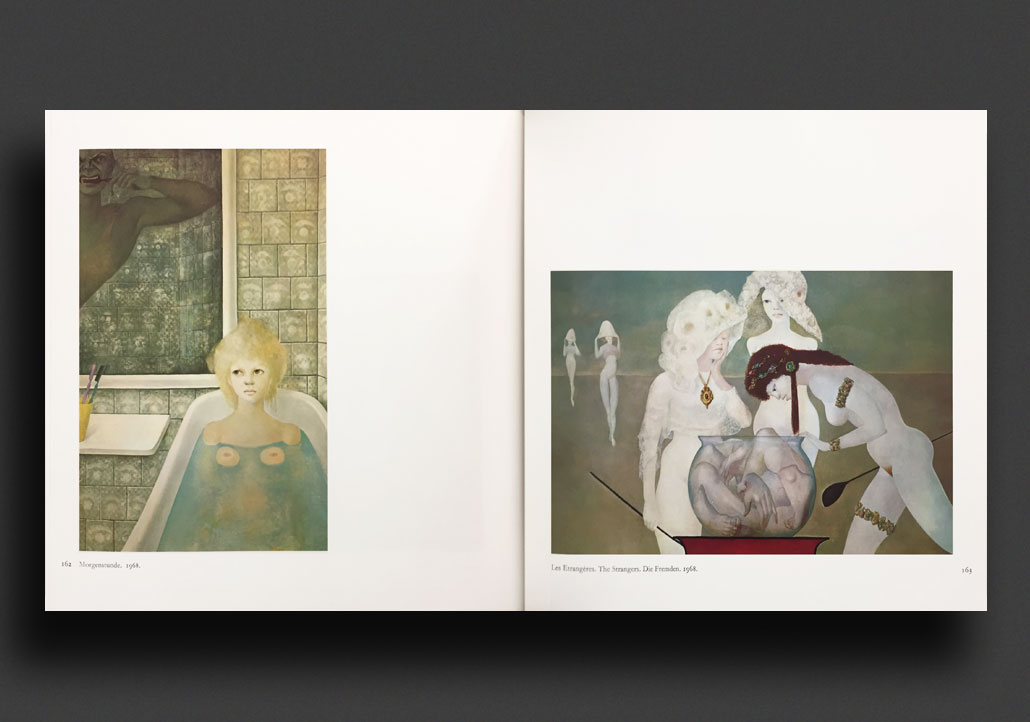
The most extensive monograph on the work of Argentine artist Leonor Fini (1918-1996), published in 1980 by Clairefontaine, Lausanne. With text by Constantin Jelenski, this over-sized hardcover volume is profusely illustrated throughout with Fini's incredible paintings, along with portraits, a list of exhibitions and bibliography.
Leonor Fini (1907–1996), an Argentine painter, designer, illustrator, and author, known for her depictions of powerful women, is considered one of the most important women artists of the twentieth century and also one of the most misunderstood.
Fini had no formal artistic training. Born in Buenos Aires, she travelled extensively from a young age, living in Milan and then moving to Paris in 1931-32 where she was considered part of a pre-war generation of Parisian artists, becoming acquainted with Carlo Carrà and Giorgio de Chirico, who inspired much of her work, and also Paul Éluard, Max Ernst, Georges Bataille, Henri Cartier-Bresson, Picasso, Salvador Dalí, and André Pieyre de Mandiargues. She had her first one person show in Paris when she was twenty-five at a gallery directed by Christian Dior. Her work caught on fast and was included in the pivotal and groundbreaking Fantastic Art, Dada and Surrealism exhibition at the MOMA in 1936 while at the same time she had her first New York exhibition at the avant-garde Julien Levy Galley. Surrealist artists in France came to know her as important in the movement. She is mentioned in most comprehensive works about surrealism, although she did not consider herself a surrealist, nor a part of any particular artistic movement. Fini preferred to stake her own claim on modernism with a vision that owes more to the farthest shores of her imagination than to any affiliation with art trends, schools or movements. The originality of her art as well as her intelligence, famous wit and charisma accorded her celebrity status in the Paris art world and beyond beginning in the late thirties. Her panache and glamour, once they found a place in the collective imagination of the time, turned her into a much-publicized fashion and feminist icon. Always controversial, with as many detractors as admirers, she lived and painted consummately on her own terms.
In Paris in 1939 she curated the inaugural exhibition of her friend Leo Castelli’s first gallery (of surrealist furniture) and shortly thereafter, just before the German occupation, she traveled with André and a new lover to Arcachon in the southwest of France to begin waiting out the war. She remained there for almost a year with Salvador and Gala Dali before moving to Monte Carlo where she met the young Italian diplomat, Stanislao Lepri who became one of the great and enduring loves of her life. As the war intensified she moved with Stanislao to Rome where she lived, worked and formed close friendships with Anna Magnani, Luchino Visconti and other leading figures of world of art and letters. After the Liberation of Paris in 1946 she returned there to live and work for the remainder of her life, exhibiting extensively around the world.
The predominant themes in Leonor Fini’s art are sexual tensions, mysteries and games. One of her favored subjects is the interplay between the dominant female and the passive male, and in many of her most powerful works the female takes the form of the sphinx to which she felt a strong identification. She was also a renowned portraitist, and among her subjects were such friends as writers André Pieyre de Mandiargues, Jean Genet, Klaus Mann (son of Thomas), such actresses as Anna Magnani and Suzanne Flon, ballerina Margot Fonteyn, film director Luchino Visconti and artists Meret Oppenheim and Leonora Carrington.
Her genius for stage and screen design is evident in her numerous ground breaking theater decors with their elaborate conception, costumes and phantasmagorical masks. She designed for the Paris Opera, George Balanchine’s ballet Palais de Crystal, and choreographer Roland Petit’s company Ballets de Paris, for Maria Callas at the La Scala theater in Milan, as well as over seventy productions at theaters in Paris between 1946 and 1969. She had a unique talent for film design and created costumes for Fellini's 8 ½ as well as for Renato Castellani's Romeo and Juliet and John Huston’s A Walk with Love and Death.
In the 1970s, she wrote three novels, Rogomelec, Moumour, Contes pour enfants velu and Oneiropompe. Her friends included Jean Cocteau, Giorgio de Chirico, and Alberto Moravia, Fabrizio Clerici and most of the other artists and writers inhabiting or visiting Paris. She illustrated many works by the great authors and poets, including Edgar Allan Poe, Charles Baudelaire and Shakespeare, as well as texts by new writers. She was very generous with her illustrations and donated many drawings to writers to help them get published. She is, perhaps, best known for her graphic illustrations for Histoire d'O.
The provocative and much-publicized life of Leonor Fini was pure theater. Her story is that of a hard-won struggle to forge her life as a woman artist in a man’s world and to invent herself on her own terms. It is the story of a woman possessing exceptional independence, a highly original vision and great personal magnetism who lived passionately through her art and friendships and in the process became a feminist role model.
Fine copy in Near Fine dust jacket.
1975, English / German
Softcover, 96 pages, 28.1 x 26.9 cm
1st Edition, Out of print title / used / very good
Published by
Kunstraum München / Münich
$85.00 - In stock -
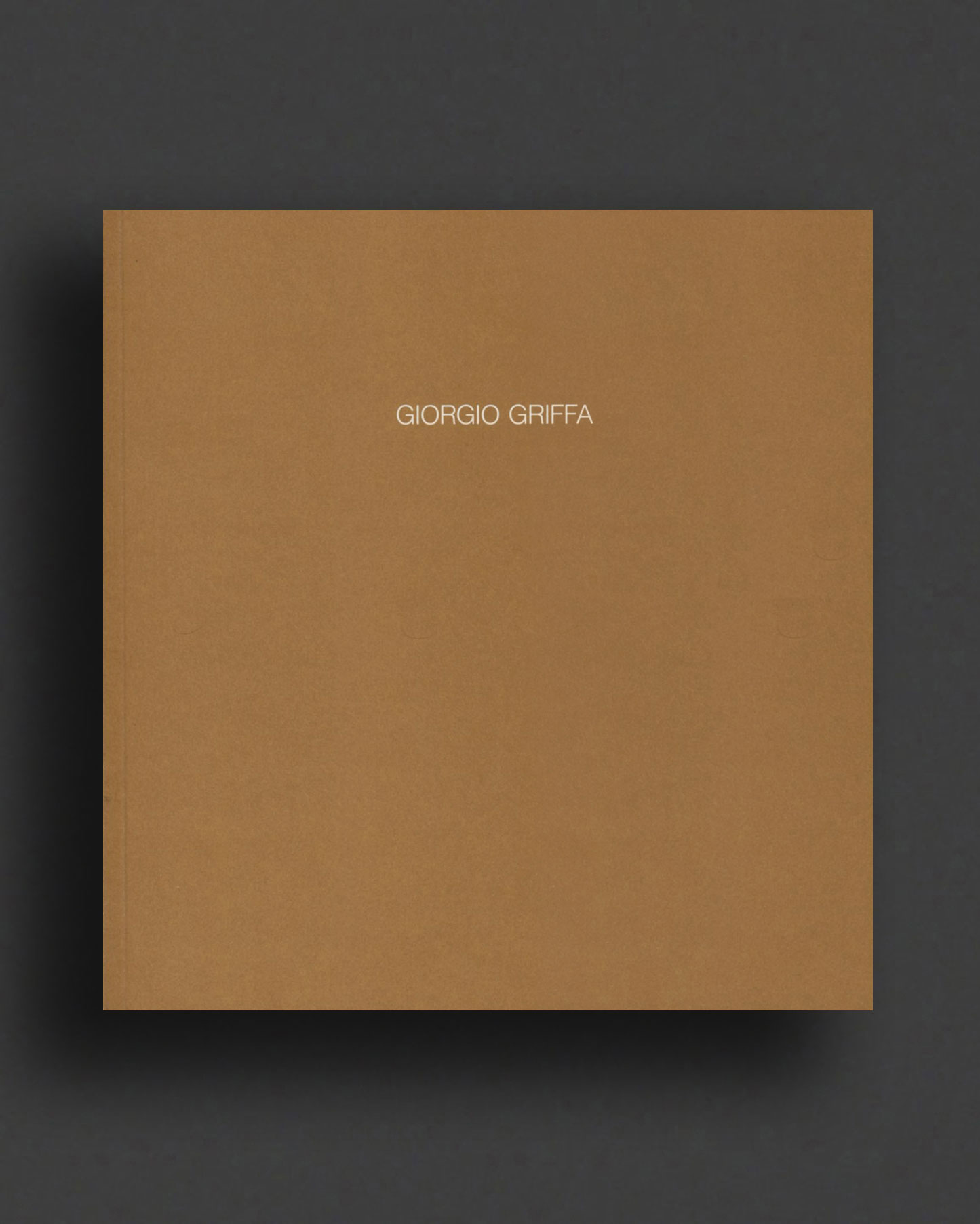
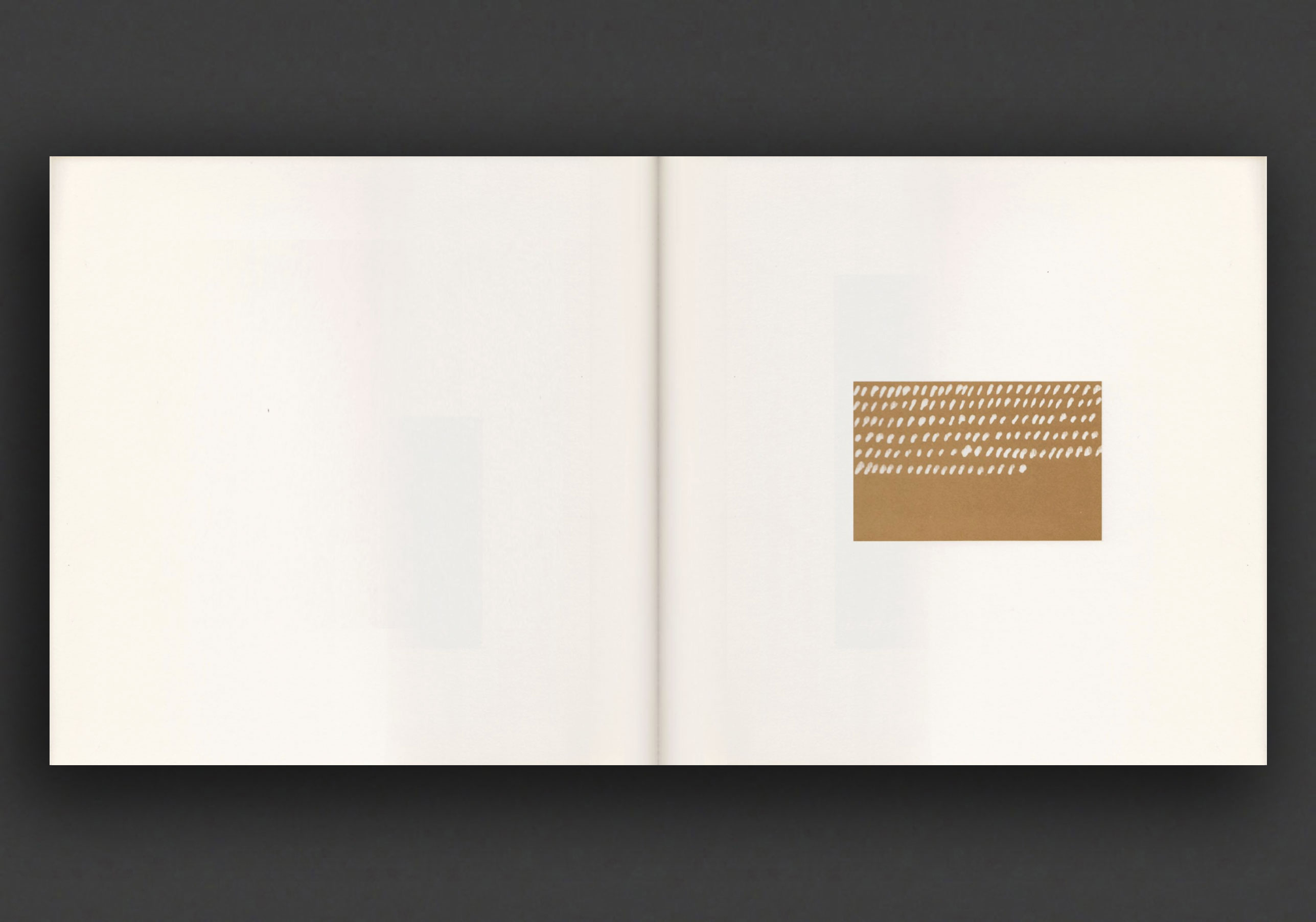
Catalogue for Italian artist Giorgio Griffa's 1975 exhibition at the Kunstraum München. Featuring works on cardboard, reproduced here at actual size, illustrated throughout in (mostly) two-colour printing. Accompanying text by Herrmann Kern in German and English.
“Giorgio Griffa is one of the least-known Turin-born artists of the Arte Povera generation. Another precious ‘secret’ that the city of Turin, discreet and haughty as ever, has managed to keep under wraps—in this case for almost half a century. From the immediate post-war period, a singular group of young artists in the city helped write the history of European art in the second half of the twentieth-century. Together with now universally acclaimed figures, such as Alighiero Boetti, Giuseppe Penone, Giulio Paolini, Giovanni Anselmo, Michelangelo Pistoletto, Gilberto Zorio, and Mario and Marisa Merz, there were also other leading artists in Turin, who have only recently begun to receive the international attention they deserve. Here I am thinking of the likes of Piero Gilardi, Gianni Piacentino, Carol Rama, Salvo, and Aldo Mondino, but also of the eccentric and eclectic Carlo Mollino. Griffa was one of the most discreet and isolated in this group of young people who revolved around Sperone’s gallery. He immediately showed an exclusive interest in painting, while his companions mainly moved out towards sculpture and installation from the mid-sixties.”—Andrea Bellini
Very Good copy, light wear only.
2025, English / German
Softcover, 288 pages, 28 x 23 cm
Published by
Walther König / Köln
$130.00 - In stock -
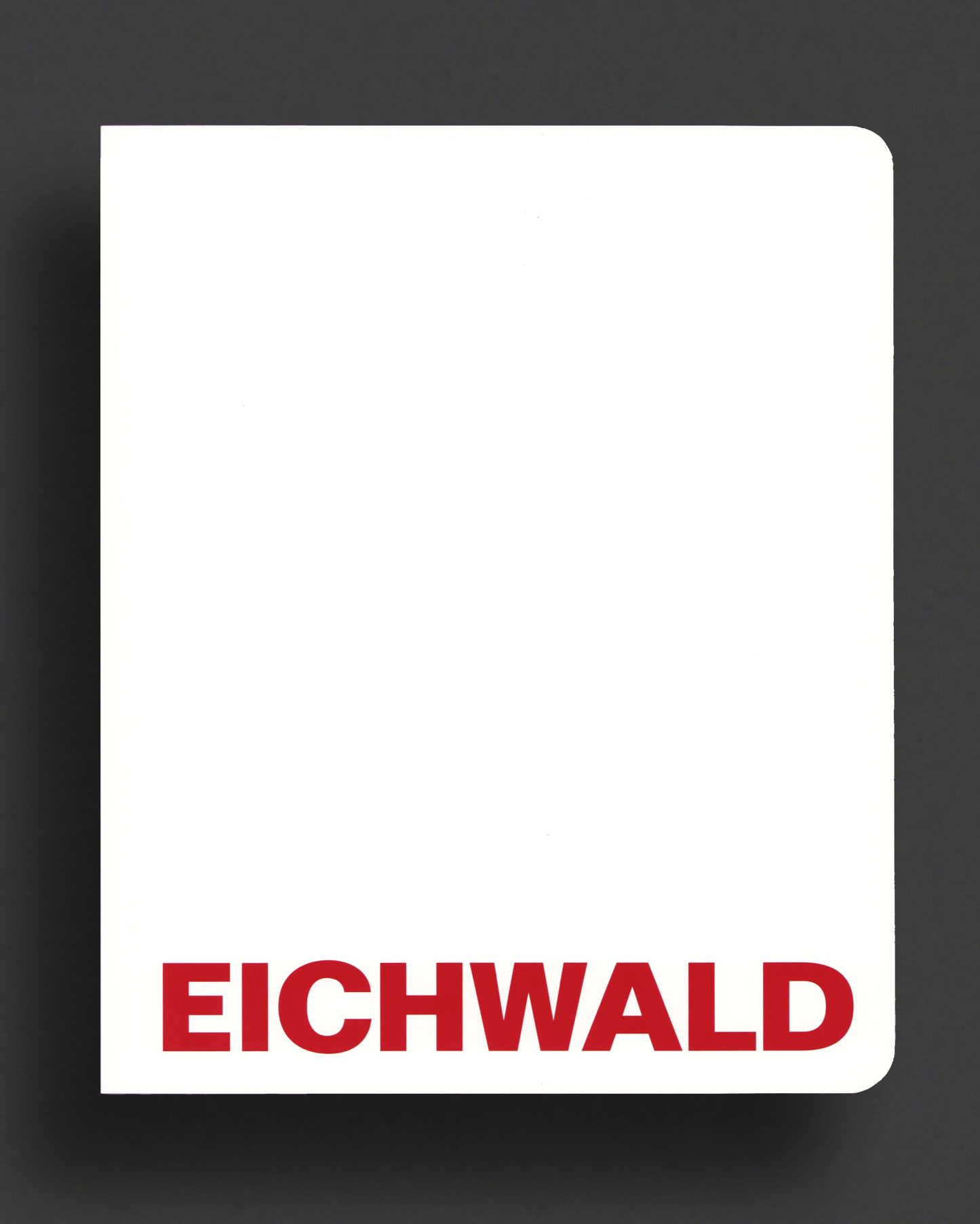
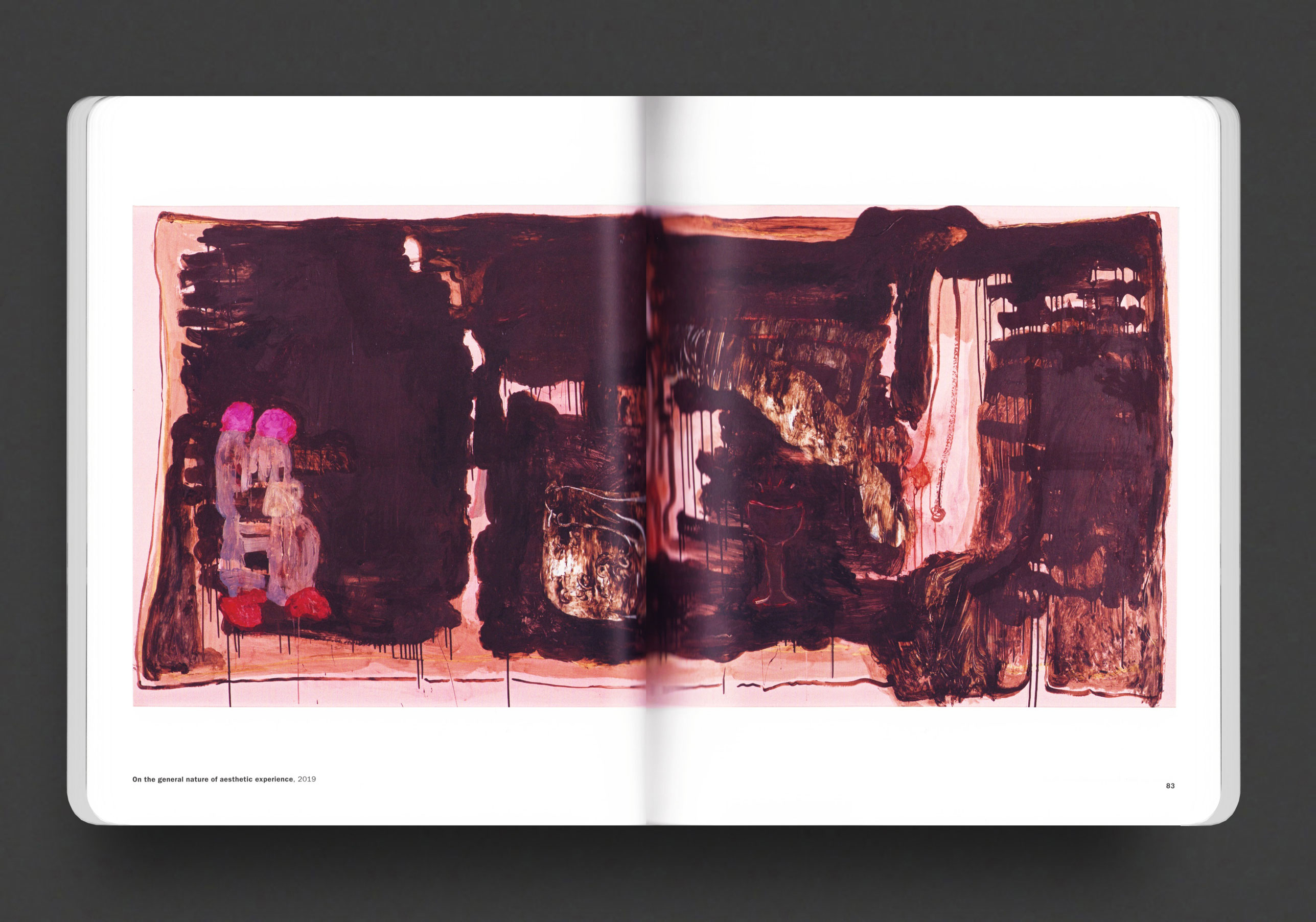
The first monograph on an German artist Michaela Eichwald (b. 1967) who consistently explores the "fundamental and inexhaustible problems of art" in her work, engaging with the interplay between material and form.
The publication charts more than three decades of Michaela Eichwald’s singular and shapeshifting practice that spans painting, sculpture, writing, and more elusive forms, creating idiosyncratic visions and (visual) worlds. Eichwald shifts expertly between the disciplines, drawing her unconventional work titles from sources that range from Medieval mysticism to bureaucratic solecisms. Alongside rich reproductions of her works, the publication delves deep into her creative universe – featuring rare archival material and selections from her long-running, legendary blog, uhutrust.com, active since 2006.
Contributions by Michaela Eichwald, Elena Filipovic & Renate Wagner, John Kelsey, Matthias Mühling, Monika Rinck & Stephanie Weber.
2025, English
Hardcover (clothbound), 376 pages, 28 x 20 cm
Published by
Walther König / Köln
Fridericianum / Kassel
$95.00 - Out of stock
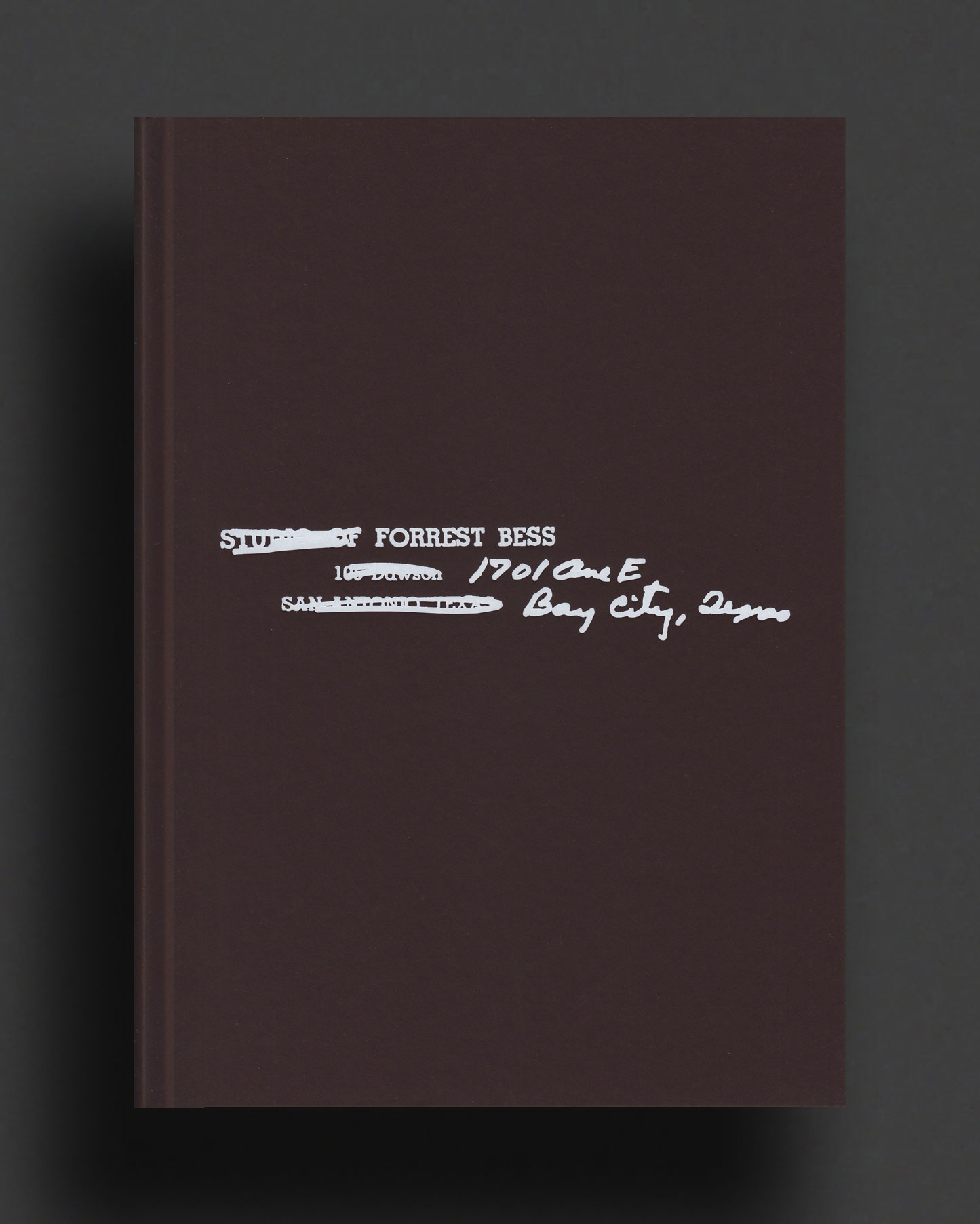
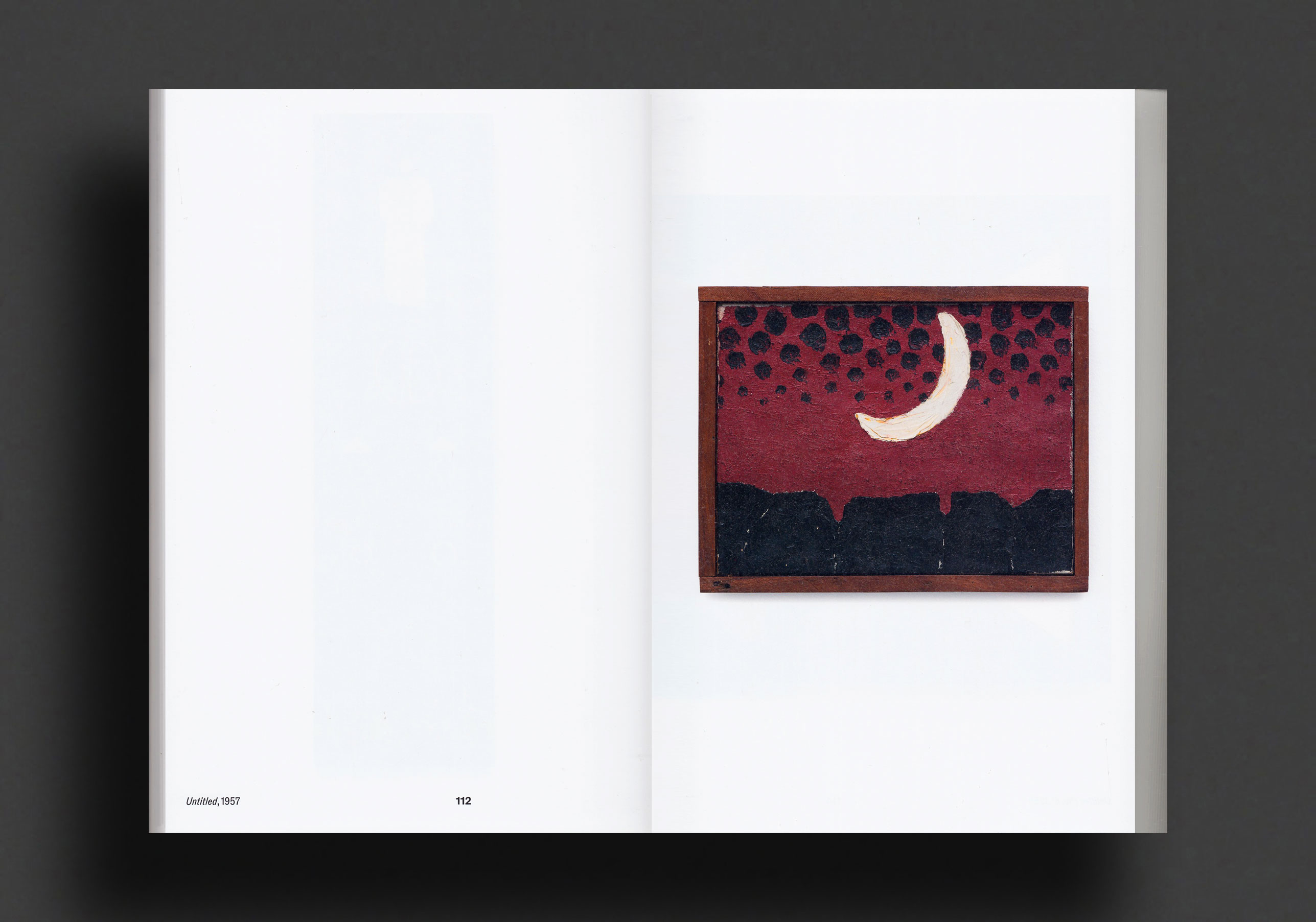
This is the most comprehensive book ever published on one of the most extraordinary figures in post-war American art: Forrest Bess, who described himself as a painter and fisherman and whose biomorphic abstractions cannot be assigned to any movement. Starting in the 1940s, he lived in isolation in Texas and created small paintings that reflect his visionary experiences between wakefulness and sleep. Bess combined his art with an intense exploration of mythology, psychology, and sexology. Believing that immortality could be achieved through the union of the masculine and feminine, he underwent medical procedures. His unconventional works received posthumous recognition in international exhibitions and influenced many contemporary artists such as Amy Sillman, Richard Hawkins or James Benning.
Lavishly illustrated throughout, the work of Forrest Bess is accompanied by texts (in English and German) by Tomma Abts, Dieter Schwarz, Amy Sillman and Moritz Wesseler.
Forrest Bess, born in 1911 in Bay City, Texas, where he also died in 1977, led an extremely secluded existence in the first half of the 1940s on the Gulf of Mexico, where alongside catching and selling fishing bait he dedicated himself to painting. During this time, Bess began to systematically encapsulate in painting “visions” that appeared to him on the threshold between wakefulness and sleep. For Bess, subconscious human experiences manifested themselves in these abstract and highly symbolic images. He pursed their exploration like a piece of obsessive research that he articulated in countless records and intensive correspondence without ever unravelling the mystery of his creativity.
1956, English
Softcover, 370 pages, 18 x 10.5 cm
1st Edition, Out of print title / used / good
Published by
Doubleday Anchor / US
$45.00 - In stock -
First 1956 edition.
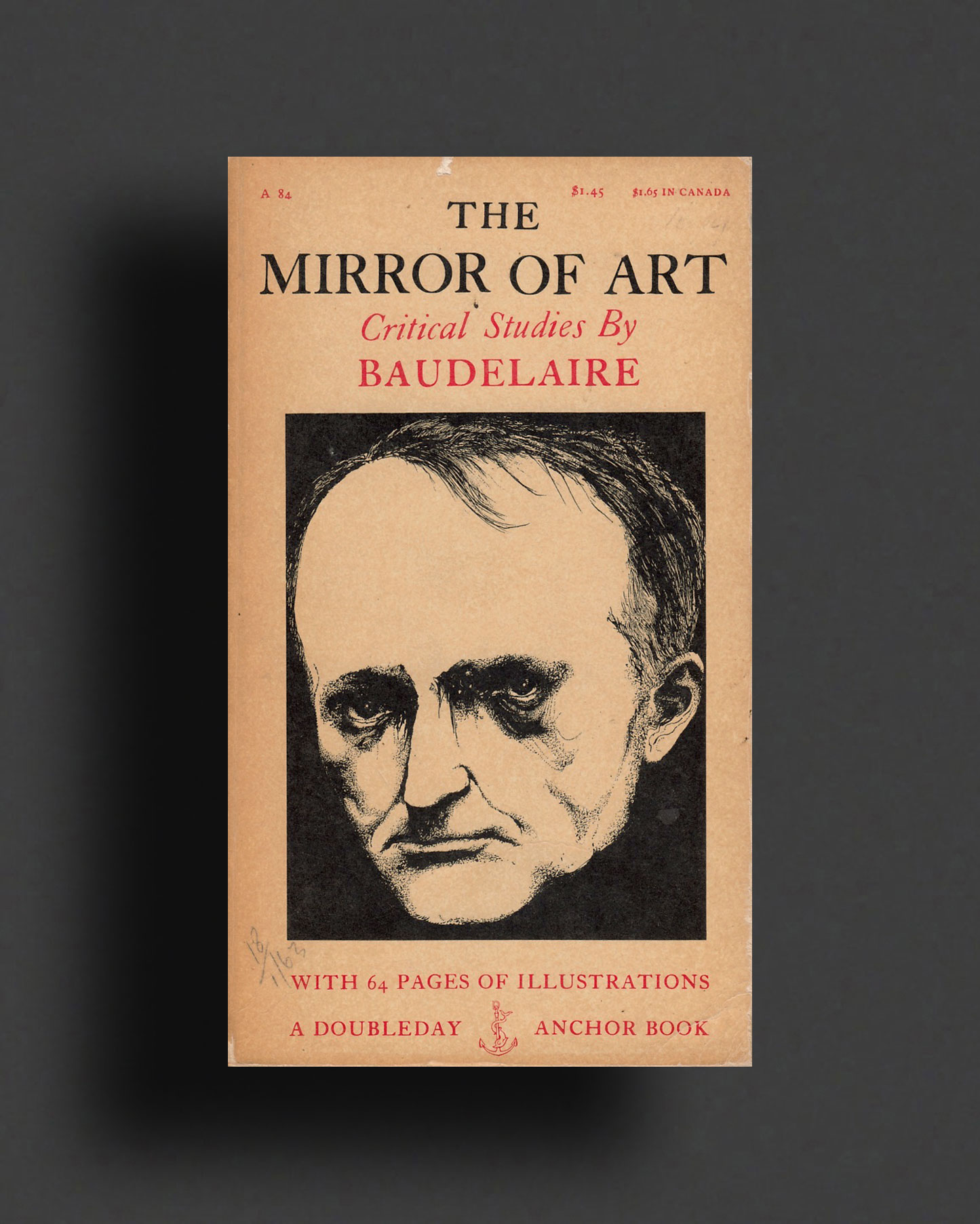
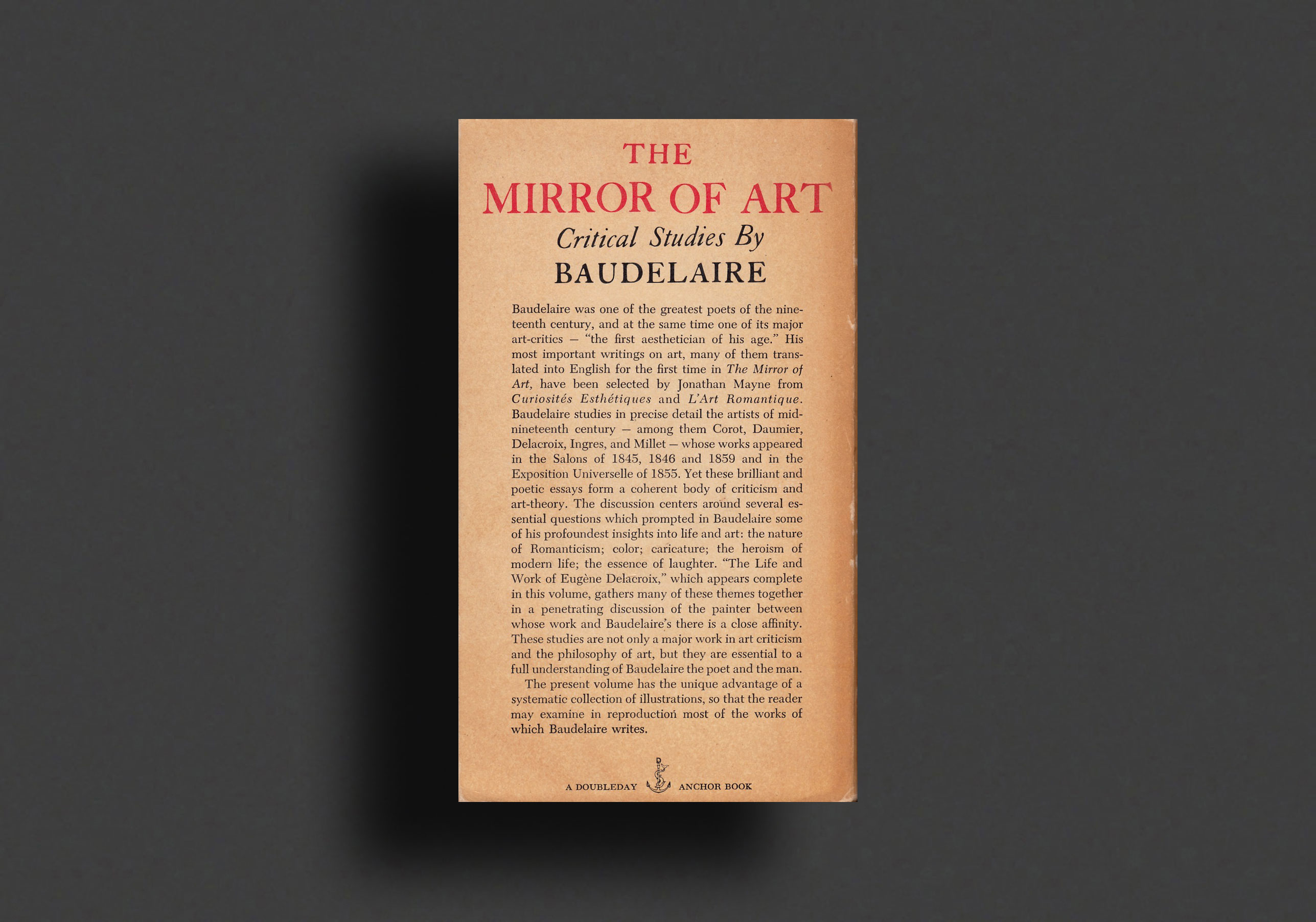
Baudelaire was one of the greatest poets of the nineteenth century, and at the same time one of its major art-critics - "the first aesthetician of his age." His most important writings on art, many of them translated into English for the first time in The Mirror of Art, have been selected by Jonathan Mayne from Curiosités Esthétiques and L'Art Romantique.
Baudelaire studies in precise detail the artists of mid-nineteenth century - among them Corot, Daumier, Delacroix, Ingres, and Millet - whose works appeared in the Salons of 1845, 1846 and 1859 and in the Exposition Universelle of 1855. Yet these brilliant and poetic essays form a coherent body of criticism and art-theory. The discussion centers around several essential questions which prompted in Baudelaire some of his profoundest insights into life and art: the nature of Romanticism; color; caricature; the heroism of modern life; the essence of laughter. "The Life and Work of Eugène Delacroix," which appears complete in this volume, gathers many of these themes together in a penetrating discussion of the painter between whose work and Baudelaire's there is a close affinity.
These studies are not only a major work in art criticism and the philosophy of art, but they are essential to a full understanding of Baudelaire the poet and the man.
The present volume has the unique advantage of a systematic collection of illustrations, so that the reader may examine in reproduction most of the works of which Baudelaire writes.
G—VG copy with tanning/cracking to spine, some general cover wear, still tightly bound.
1982, English
Hardcover (w. dust jacket), 246 pages,
1st Edition, Out of print title / used / very good
Published by
Allison & Busby / London
$35.00 - Out of stock
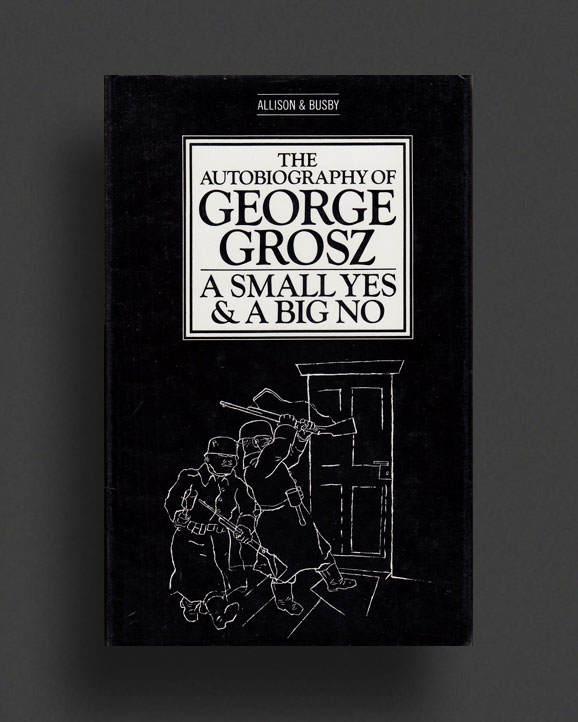
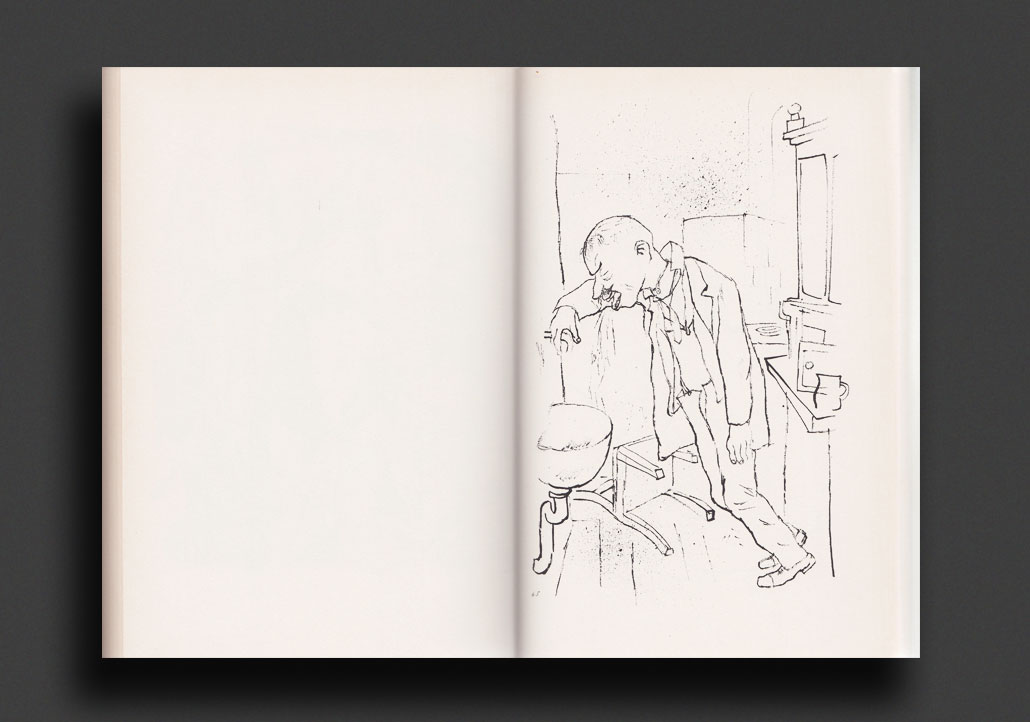
1982 English hardcover edition of The Autobiography of George Grosz: A Small Yes and a Big No, first published by Dial Press in New York City, translated by Lola Sachs Dorin. In 1982, this new translation by Arnold Pomerans of the 1955 German edition was published by Allison and Busby in London.
The autobiography of George Grosz (1893—1959), the great German artist and satirist, is crammed with unique anecdotes and reminiscences. More than just a chronicle of his own life, it becomes in effect a history of the modern movement and is, says the Stuttgarter Zeitung, "a glorious, exciting book".
Grosz recalls his Pomeranian childhood, army life during the First World War, revolution and hunger in its aftermath, the frenzied, disjointed world of Dadaism and Nazism in the Weimar Republic. He describes the cafés, beer-cellars and studios of Paris and Berlin, a dangerous but optimistic journey to Soviet Russia and final emigration to the United States — less than a month before the Nazis came to power.
He conjures up an exciting period and the central figures, the intellectual outsiders, who were responsible for shaping it — a colourful and unforgettable crowd, the artists and writers and film people and political activists, Dali, de Chirico, Rosa Luxemburg, Thomas Mann, Lenin, Brecht, Dos Passos, Joseph von Sternberg, Trotsky, and many others.
Grosz was the most rebellious and explosive of artists, the scourge of militarism, capitalism and the bourgeoisie in the 1920s, whose lines "tore like barbed wire" and whose life and work became a legend. His autobiography is a rich, enjoyable book, here fully available in English for the first time.
Very Good copy, VG dust jacket.
1980, German
Softcover, 84 page, 26 x 17 cm
Out of print title / used / very good
Published by
Rowohlt / Hamburg
$45.00 - Out of stock
Perhaps the most famous of Grosz's collections is Ecce Homo (Berlin: Malik Verlag, 1923). The title echoes Pilate's presentation of Jesus as King of the Jews, beaten, with a crown of thorns, bloody and ready for crucifixion, and clearly not the Messiah he had been proclaimed to be six days earlier when he was greeted by rapturous crowds. Just so, the image of the heroic German, brave in war and moral in peacetime, took such a beating in Grosz's drawings, watercolors, and paintings, that he was prosecuted for "offences against public morality and for besmirching the values of the German people" (Kranzfelder, 59). Offering an unsparing vision of human nakedness, lust, greed and cruelty, Ecce Homo was found to be a slanderous attack upon the army, which won damages and the removal of 5 color plates and 17 black and white plates from the portfolio in a law suit. Grosz was also fined 6000 marks. Since Grosz had been attacking the Nazis since the early 1920s and since he had singled out Hitler in particular, it is not surprising that after the Nazi's took power in Germany, his works were singled out for ridicule and destruction. 285 of his works were removed from German collections and destroyed and the 1937 Munich Exhibition of Nazi-labelled "Degenerate Art" included five of his paintings, two watercolours, and thirteen drawings. After relocating to the U.S., Grosz wrote to J. B. Neuman concerning his own place in the history of art: "My drawings will naturally stay true–they are fireproof. They will later be seen as Goya's work [is]. They are not documents of the class struggle, but eternally living documents of human stupidity and brutality"
1980 reprint of the collection reproduced in black and white and colour, published by Rowohlt in Hamburg, 1980.
Very good copy.
1979, English
Softcover, 159 pages, 28 x 23 cm
1st Edition, Out of print title / used / good
Published by
Harry N. Abrams / New York
$50.00 - Out of stock
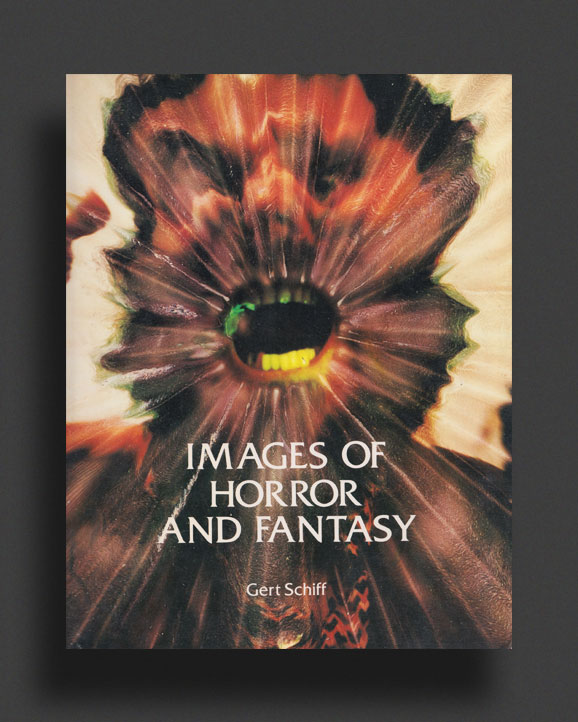
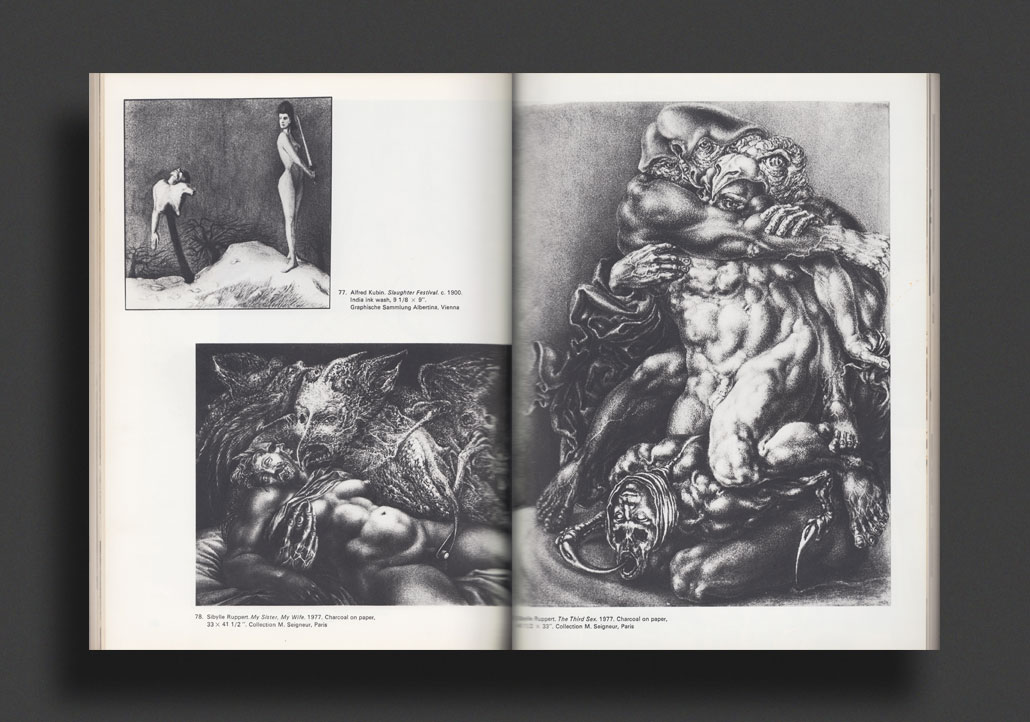
Published by Abrams in 1978, Images of Horror and Fantasy by art historian Gert Schiff expanded on a major group exhibition guest curated by Schiff at the Bronx Museum in 1977. The resulting publication is a perceptive critical and psychological analyses of a variety of nineteenth-and twentieth-century art that "unfolds simultaneously on the level of historical and social reality and on the level of dreams. Its purpose is to expose some of the principal anxieties of modern man and their resolution in utopian reveries and escapist fantasies." Profusely illustrated in colour and b/w throughout with the works of Alfred Kubin, James Ensor, George Grosz, Paul Thek, Sibylle Ruppert, Henry Fuseli, Paul Delvaux, Nancy Grossman, Käthe Kollwitz, Max Beckmann, Fernand Khnopff, Rudolph von Ripper, Max Klinger, H. R. Giger, Jonah Kinigstein, Edward Keinholz, Jean Delville, Lucas Samaras, Miriam Beerman, Willem de Kooning, Man Ray, Oskar Kokoschka, Salvador Dali, Paolo Soleri, Jean Auguste Dominique Ingres, Georges Rouault, Otto Dix, Pablo Picasso, Philip Evergood, William Blake, Giorgio de Chirico, Ivan Albright, Yves Tanguy, Paul Klee, Jasper Johns, Germaine Richier, Francisco de Goya, Henri de Toulouse-Lautrec, Henri Matisse, Max Ernst, Francis Bacon, Rene Magritte, Illya Repin, Antoine Wiertz, Odilon Redon, Edward Burra, Larry Rivers, George Segal, Thomas Cole, Léon Frédéric, Matthias Grünewald, Rico Lebrun, Bruce Connor, Edvard Munch, and many more.
Gert Schiff (1926 — 1990, b. Oldenburg, Germany) was an art historian, critic, lecturer and professor at the Institute of Fine Arts of New York University. A specialist in the Romantic movement, particularly the work of Henry Fuseli and William Blake, Mr. Schiff was also very much involved with 20th-century art, organising many major exhibitions around his interests whilst authoring important studies on the arts from his dwellings at the Chelsea Hotel.
Good copy with wear to edges and some chipping to top of spine.
1997, English
Hardcover (w. dust jacket), 112 pages, 24. 5 x 17 cm
1st Edition, Out of print title / used / very good
Published by
Prestel / Munich
$25.00 - Out of stock
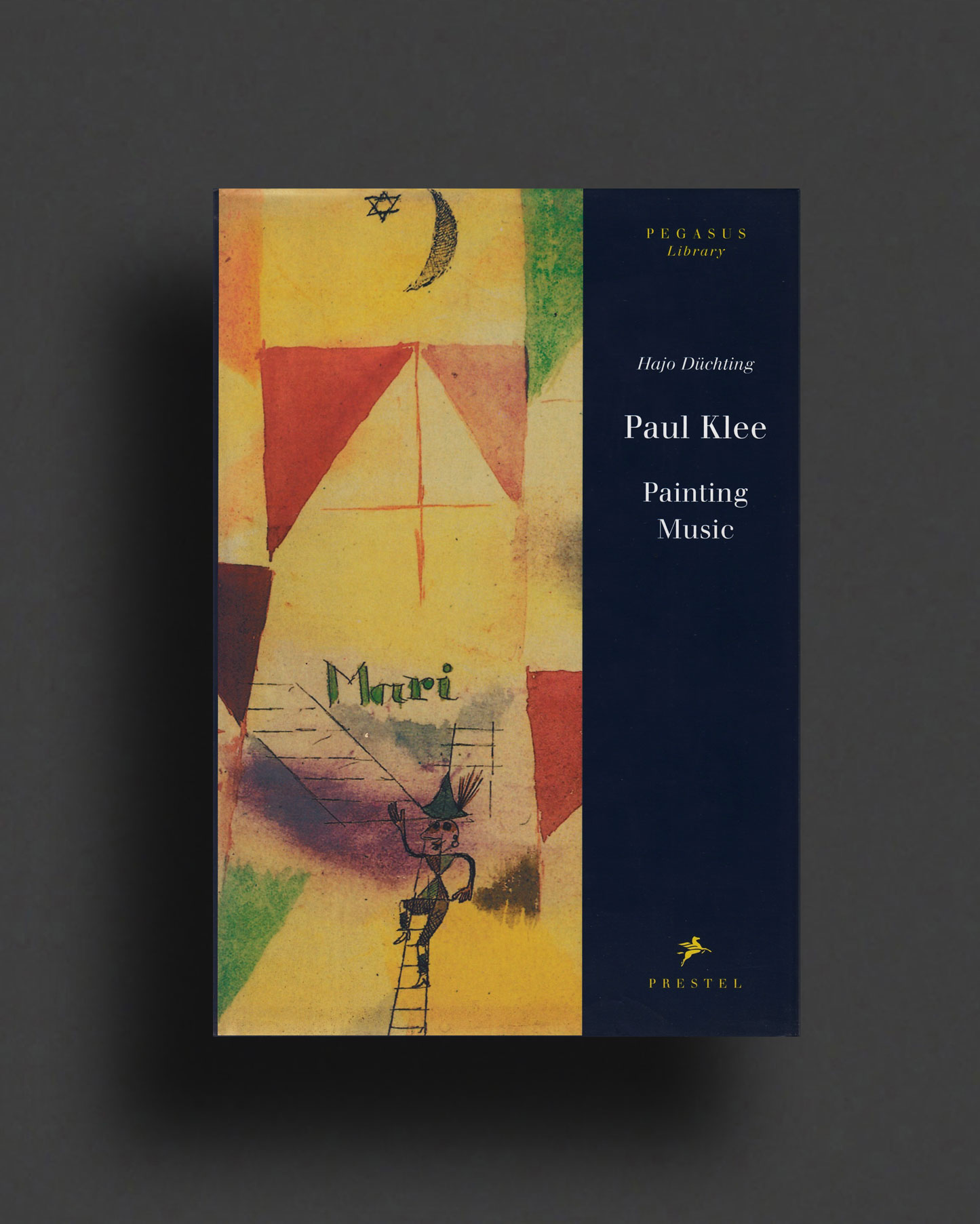
First 1997 HC edition of this fascinating book examines the relationship between music and painting in Klee's art. A talented violinist as well as a painter, Klee drew much of the inspiration for his abstract art from musical rhythms and structures. Like a composer, he developed and harmonized pictorial themes, weaving a complex series of signs and symbols into his painting. The book focuses on Klee's decadelong tenure at the Bauhaus, where the artist's theories and practices first merged. Illustrated throughout with full-color reproductions of Klee's paintings and etchings, as well as entries from his diaries, this unique study sheds light on an important aspect of Klee's work while providing insights into his development as an abstract artist.
VG copy in VG dj.
2000, Japanese
Hardcover (w. dust jacket and obi strip), 48 pages, 31 x 22 cm
1st Edition, Out of print title / used / fine
Published by
Bungeisha / Tokyo
$150.00 - In stock -
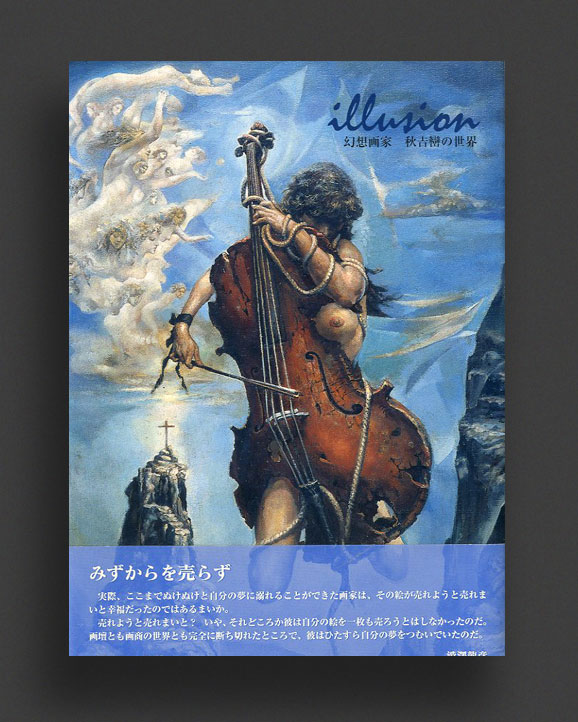
The one and only hardcover monograph dedicated to the fantastic world of artist Ran Akiyoshi (1922—1982), now rare and out-of-print. Virtually unknown and undocumented outside of Japan, Akiyoshi never held an exhibition nor sold any of his drawings in his lifetime. Much like the work of Toshio Saeki or Namio Harukawa, Akiyoshi's creations proliferated throughout the bountiful pages of Tokyo's underground, particularly SM / kinbaku, publishing scene in the 1960s—1970s. Yet Akiyoshi's phantasmagoric world of erotic fantasy is like no other, building sado-masochistic themes within unique, somewhat Lovecraftian and Bosch-esque dreamscapes populated by mythological goddesses and grotesque creatures. His peculiar fantasy drawings were highly praised by Japanese novelist and art critic, Tatsuhiko Shibusawa, an instrumental figure in the Japanese avant-garde who translated de Sade and Bataille to Japanese, and specialised in the study of medieval demonology. This lavishly illustrated hardcover volume collects Akiyoshi's many works together for the first time, surveying his entire career.
Born in Kyongsong (present Seoul), Korea in 1922, Akiyoshi was publicly schooled and self-taught in drawing. After WWII, he moved to Japan, traveled around Kyushu area and finally settled in Tokyo in 1946. Akiyoshi started working for adult entertainment magazines such as "Decameron","Fuzoku Soushi", and "Uramado" in 1950. Around 1958, he began focusing on original drawings while continuing to draw illustrations for various magazines. In the 1970s, Akiyoshi provided iconic cover and insert illustrations to a number of prominent SM magazines, including "SM King", "SM Kitan", and "SM Club". He never held an exhibition nor sold any of his drawings in his lifetime. Akiyoshi died from heart failure in 1982 at the age of 58.
Very Good—Fine copy.