World Food Books' programme is largely produced on Kulin Nation land. We acknowledge the Wurundjeri people of the Kulin Nation as the first and continuing custodians of this land, and pay respect to their Elders past, present, and emerging.
World Food Books is an arts and special interests bookshop in Naarm / Melbourne. Founded in 2010, World Food Books is devoted to the presentation of a rotating, hand-selection of international art, design, literary and counterculture publications with an emphasis on the anti-traditional, the experimental, the avant-garde, the heretic, the marginal.
Presenting new titles alongside rare and out-of-print books, catalogues and journals spanning the fields of modern and contemporary art, design, photography, illustration, film, literature, poetry, cultural theory, philosophy, sexuality, popular and underground culture in its many radical forms, World Food Books wishes to encourage adventurous, thoughtful and open-minded reading, looking, writing, and exchange of publishing and ideas, both current and historical.
As well as our bookshop, located in Melbourne's historical Nicholas Building, all of our inventory is available internationally via our online mail-order service.
World Food Books semi-regularly co-ordinates "Occasions", a programme of exhibits and events at the bookshop and in partnership with other hosts (such as museums and art galleries) that develop out of the activities, relationships and content of the bookshop itself.
World Food Books
The Nicholas Building
37 Swanston Street
Room 5, Level 6
Melbourne 3000
Australia
SHOP HOURS:
THU–SAT 12–6
WEB-SHOP OPEN 24/7
World Food Books
Postal Address:
PO Box 435
Flinders Lane
Victoria 8009
Australia
info@worldfoodbooks.com
Art
Theory / Essay
Architecture / Interior
Graphic Design / Typography
Photography
Fashion
Eros
LGBTQ+
Fiction / Poetry
Weird / Speculative / Science Fiction / Horror
Transgressive / Visceral / Abject
Symbolism / Decadence / Fin de siècle
Film / Video
Painting
Sculpture / Installation
Performance / Dance / Theater
Drawing
Sound / Music
Curatorial
Group Shows / Collections
Periodicals
Out-of-print / Rare
Posters / Ephemera / Discs
Signed Books
World Food Books Gift Voucher
World Food Book Bag
Australian Art
Australian Fiction
Australian Science Fiction / Speculative Fiction
Australian Poetry
Australian Photography
Japanese Photography
Conceptual Art
Minimal Art
Dada
'Pataphysics / Oulipo
Fluxus
Concrete Poetry
Pop Art
Surrealism
Arte Povera
Arte Informale / Haute Pâte / Tachism
Nouveau Réalisme / Zero / Kinetic
Situationism / Lettrism
Collage / Mail Art / Xerox Art
Art Brut / Folk / Visionary / Fantastic
Illustration / Graphic Art / Bandes Dessinées
Furniture
Italian Radical Design / Postmodernism
Textiles
Ceramics / Glass
Counterculture
Protest / Revolt
Philosophy
Psychoanalysis
Anthropology
Anarchism
Socialism / Anarchism / Communism / Capitalism
Literary Theory / Semiotics / Language
Feminism / Women's Studies
Gender Studies / Sexuality
Anthropology
Fetishism / BDSM
Drugs / Psychedelia
Crime / Violence
Animal Rights / Veganism
Occult / Esoterica
Ecology / Earth / Alternative Living
Whole Earth / Crafts
All prices in AUD (Australian dollars)
Pick-Ups
Pick-up orders can be collected in our bookshop during opening hours after order date. Please collect any Pick-up orders within 2 weeks of ordering as we have limited storage space. Orders will be released back into stock if not collected within this time. No refunds can be made for pick-ups left un-collected. If you cannot make it in to the bookshop in this time-frame, please choose postage option.
Return Policy
All sales are final. We do accept returns (for refund or exchange) for items received in error. All our orders are packed with special care using heavy-duty padding and cardboard book-mailers or bubble mailers (for smaller books), using reinforcement where required. We cannot take responsibility for any lost, stolen or damaged parcels.
Insurance
Should you wish to insure your package, please email us directly after placing your order and we can organise this at a small extra expense. Although all standard/express tracked packages are very safe and dependable, we cannot take responsibility for any lost, stolen or damaged parcels. We recommend insurance on valuable orders.
Interested in selling your old books, catalogues, journals, magazines, comics, fanzines, ephemera? We are always looking for interesting, unusual and out-of-print books to buy. We only buy books in our fields of interest and specialty, and that we feel we can resell.
We base these prices on desirability, market value, in-print prices, condition and our current stock levels. We offer cash, store credit, and can take stock on consignment. All
about 25% of the price we expect to get when we sell them, or 30% in store credit. We base these prices on desirability, market value, in-print prices, condition and our current stock levels.
Sell your books any day of the week. You can drop them off and return later. If you have a lot of books, we can visit your Sydney home.
We buy books that we feel we can resell. We offer about 25 % of the price we expect to get when we sell them, or 30% in store credit. We base these prices on desirability, market value, in-print prices, condition and our current stock levels.
Philadelphia Wireman
03 August - 01 September, 2018
World Food Books is proud to announce our next Occasion, the first presentation of sculptures by Philadelphia Wireman in Australia.
The Philadelphia Wireman sculptures were found abandoned in an alley off Philadelphia’s South Street on trash night in 1982. Their discovery in a rapidly-changing neighbourhood undergoing extensive renovation, compounded with the failure of all attempts to locate the artist, suggests that the works may have been discarded after the maker’s death. Dubbed the "Philadelphia Wireman" during the first exhibition of this work, in 1985, the maker’s name, age, ethnicity, and even gender remain uncertain. The entire collection totals approximately 1200 pieces, all intricately bound together with tightly-wound heavy-gauge wire (along with a few small, abstract marker drawings, reminiscent both of Mark Tobey and J.B. Murry). The dense construction of the work, despite a modest range of scale and materials, is singularly obsessive and disciplined in design: a wire armature or exoskeleton firmly binds a bricolage of found objects including plastic, glass, food packaging, umbrella parts, tape, rubber, batteries, pens, leather, reflectors, nuts and bolts, nails, foil, coins, toys, watches, eyeglasses, tools, and jewellery.
Heavy with associations—anthropomorphic, zoomorphic, and socio-cultural responses to wrapped detritus—the totemic sculptures by Philadelphia Wireman have been discussed in the context of work created to fulfil the shamanistic needs of alternative religions in American culture. Curators, collectors, and critics have variously compared certain pieces to sculpture from Classical antiquity, Native American medicine bundles, African-American memory jugs, and African fetish objects. Reflecting the artist’s prolific and incredibly focused scavenging impulse, and despite—or perhaps enhanced by—their anonymity, these enigmatic objects function as urban artefacts and arbiters of power, though their origin and purpose is unknown. Philadelphia Wireman, whatever their identity, possessed an astonishing ability to isolate and communicate the concepts of power and energy through the selection and transformation of ordinary materials. Over the course of the past two decades, this collection has come to be regarded as an important discovery in the field of self-taught art and vernacular art.
Presented in collaboration with Fleisher-Ollman Gallery, Philadelphia, and Robert Heald, Wellington.
Susan Te Kahurangi King
02 February - 10 March, 2018
Susan Te Kahurangi King (24 February 1951 - ) has been a confident and prolific artist since she was a young child, drawing with readily available materials - pencils, ballpoint pens and felt-tip markers, on whatever paper is at hand. Between the ages of four and six Susan slowly ceased verbal communication. Her grandparents William and Myrtle Murphy had developed a special bond with Susan so they took on caring responsibilities for extended periods. Myrtle began informally archiving her work, carefully collecting and storing the drawings and compiling scrapbooks. No drawing was insignificant; every scrap of paper was kept. The King family are now the custodians of a vast collection containing over 7000 individual works, from tiny scraps of paper through to 5 meter long rolls.
The scrapbooks and diaries reveal Myrtle to be a woman of great patience and compassion, seeking to understand a child who was not always behaving as expected. She encouraged Susan to be observant, to explore her environment and absorb all the sights and sounds. Myrtle would show Susan’s drawings to friends and people in her community that she had dealings with, such as shopkeepers and postal workers, but this was not simply a case of a grandmother’s bias. She recognised that Susan had developed a sophisticated and unique visual language and sincerely believed that her art deserved serious attention.
This was an unorthodox attitude for the time. To provide some context, Jean Dubuffet coined the term Art Brut in 1945 to describe work created by self-taught artists – specifically residents of psychiatric institutions and those he considered to be visionaries or eccentrics. In 1972 Roger Cardinal extended this concept by adopting the term Outsider Art to describe work made by non-academically trained artists operating outside of mainstream art networks through choice or circumstance. Susan was born in Te Aroha, New Zealand in 1951, far from the artistic hubs of Paris and London that Dubuffet and Cardinal operated in. That Myrtle fêted Susan as a self-taught artist who deserved to be taken seriously shows how progressive her attitudes were.
Susan’s parents Doug and Dawn were also progressive. Over the years they had consulted numerous health practitioners about Susan’s condition, as the medical establishment could not provide an explanation as to why she had lapsed into silence. Dawn educated herself in the field of homeopathy and went on to treat all twelve of her children using these principles – basing prescriptions on her observations of their physical, mental and emotional state.
Doug was a linguist with an interest in philosophy who devoted what little spare time he had to studying Maori language and culture. To some extent their willingness to explore the fringes of the mainstream made them outsiders too but it was their commitment to living with integrity and their respect for individuality that ensured Susan’s creativity was always encouraged.
Even though Susan’s family supported her artistic pursuits, some staff in schools and hospitals saw it as an impediment to her assimilation into the community and discouraged it in a variety of ways. Her family was not always aware of this and therefore did not fully understand why Susan stopped drawing in the early 1990s. However, rather than dwell on the challenges that Susan faced in pursuit of her artistic practice, they prefer to highlight her achievements. In 2008 Susan began drawing again in earnest, after an almost 20 year interruption, and her work is now shown in galleries around the world.
Susan grew up without television and has been heavily influenced by the comics she read as a child. She is absolutely fearless in the appropriation of recognizable characters, such as Donald Duck and Mickey Mouse, in her work. She twists their limbs, contorts their faces, compresses them together, blends them into complex patterned backgrounds - always imbuing them with an incredible energy. Although Susan often used pop culture characters in her work they are not naive or childlike. These are drawings by a brilliant self-taught artist who has been creating exceptional work for decades without an audience in mind.
Mladen Stilinović
"Various Works 1986 - 1999"
02 February 16 - September 10, 2016
Various works 1986 - 1999, from two houses, from the collections of John Nixon, Sue Cramer, Kerrie Poliness, Peter Haffenden and Phoebe Haffenden.
Including: Geometry of Cakes (various shelves), 1993; Poor People’s Law (black and white plate), 1993; White Absence (glasses, ruler, set square, silver spoon, silver ladel with skin photograph and wooden cubes), 1990-1996; Exploitation of the Dead (grey and red star painting, wooden painting, black spoon with red table, red plate), 1984-1990; Money and Zeros (zero tie, paintings made for friends in Australia (Sue, John, Kerrie), numbers painting), 1991-1992; Words - Slogans (various t-shirts) - “they talk about the death of art...help! someone is trying to kill me”, “my sweet little lamb”, “work is a disease - Karl Marx”; Various artist books, catalogues, monographs, videos; Poster from exhibition Insulting Anarchy; "Circular" Croatian - Australian edition; Artist book by Vlado Martek (Dostoyevsky); more.
Thanks to Mladen Stilinović and Branka Stipančić.
Jonathan Walker
Always Will Need To Wear Winter Shirt Blue + Ochre Small Check Pattern
21 August - 21 September, 2015
Untitled
I am not a great reader of poetry but I always return to the work of Melbourne poet, Vincent Buckley (1925- 1988). Perhaps I find his most tantalising piece to be not a finished poem but a fragment left on a scrap of paper discovered on his desk after the poet’s death.
The poetry gathers like oil
In the word-core, and spreads
It has its music meet,
Its music is in movement.
This fragment is more the shell left behind from a volatile thought than a finished poem. I find the last two lines honest but awkward whereas the first two lines work like an arrow. Most likely he could not find a resolution so it was left. Still, in its present form, it remains an eloquent testimony to the ultimate failure of a medium to express mobile thought and sensation, in Buckley’s case, through verbal language. It’s an important matter because this is something all artists have to deal with regardless of the medium.
I have never written a poem, however, I am forever copying fragments from books on paper scraps in a vain effort to fix certain notions in my head. At first, they function as bookmarks that are sometimes returned to when I open the book. But before long, as they accumulate, they fall out littering the table interspersed with A4 photocopies, bills, books and medications.
To return to Buckley’s fragment, the first two lines very much evoke how I paint nowadays. As you age, detail diminishes and patches of light become more luminous and float. I feel the most honest way of dealing with this is by smearing the oil paint on the canvas with the fingers and working close-up, blind. Only if the patches coalesce into an approaching image can the work gain a life.
-
Jonathan Walker was born in Melbourne, Australia and brought up on a dairy farm in Gippsland. In the 1970’s he studied painting at RMIT and won the Harold Wright Scholarship to the British Museum, London. During the 1980’s he exhibited at Pinacotheca Gallery, Richmond and had work shown at the NGV and Heidi City Art Gallery. Over the same period he designed the cover for the “Epigenesi” LP by Giancarlo Toniutti, Italy and conducted a mail exchange work with Achim Wollscheid, Germany. The work with artists through the post resulted in an article published in the bicentenary issue of Art and Australia 1988. He showed in artist run spaces such as WestSpace in the 90’s and 2000’s, and until 2012, taught painting at Victoria University, which is where we (Colleen Ahern and Lisa Radford) as organisers of the exhibition, among many others, had the privilege of being his student.
Walker’s knowledge was imparted to students through the careful selection of music, literature, and artists found in books that he himself had ordered for the library. Walker’s strategy was the generosity of sharing his vast knowledge with references specific to each student and their context.
Walker’s paintings share a similar focus and intimacy.
This exhibition presents a small selection of recent paintings alongside a publication that includes Walker’s writing. Observational and analytical, Walker’s work is a type of material notation — the time of day, colour and how it is blended, the both specific and fleeting location of a reflection on lino or the question of whether a chair leg should be included in a painting.
Please join us on Friday August 21 between 6-8pm to celebrate the opening of the exhibition.
Curated by Colleen Ahern and Lisa Radford.
B. Wurtz
Curated by Nic Tammens
March 26 - April 4, 2015
B.Wurtz works from a basement studio in his home on Manhattan’s Lower East Side.
This local fact is attested to by the plastic shopping bags and newsprint circulars that appear in his work. As formal objects, they don’t make loud claims about their origins but nonetheless transmit street addresses and places of business from the bottom of this long thin island. Like plenty of artists, Wurtz is affected by what is local and what is consumed. His work is underpinned by this ethic. It often speaks from a neighborhood or reads like the contents of a hamper:
“BLACK PLUMS $1.29 lb.”
“Food Bazaar”
“USDA Whole Pork Shoulder Picnic 99c lb.”
“RITE AID Pharmacy, with us it’s personal.”
“H. Brickman & Sons.”
“Sweet Yams 59c lb."
Most of the work in this exhibition was made while the artist was in residence at Dieu Donne, a workshop dedicated to paper craft in Midtown. Here Wurtz fabricated assemblages with paper and objects that are relatively lightweight, with the intention that they would be easily transportable to Australia. This consideration isn’t absolute in Wurtz’s work, but was prescriptive for making the current exhibition light and cheap. Packed in two boxes, these works were sent from a USPS post office on the Lower East Side and delivered to North Melbourne by Australia Post.
Wurtz appears courtesy of Metro Pictures, New York.
Thanks to Rob Halverson, Joshua Petherick, Sari de Mallory, Matt Hinkley, Helen Johnson, Fayen d'Evie, Ask Kilmartin, Lisa Radon, Ellena Savage, Yale Union, and "Elizabeth".
John Nixon
"Archive"
December 15 - January 20, 2014
The presentation of John Nixon's archive offered a rare showcase of this extensive collection of the artist's own publications, catalogues, posters, ephemera, editions and more, from the mid 1980s onwards, alongside a selection of his artworks.
Organized by John Nixon, Joshua Petherick and Matt Hinkley.
"Habitat"
at Minerva, Sydney (organised by Joshua Petherick and Matt Hinkley)
November 15 - December 20, 2014
Lupo Borgonovo, Janet Burchill & Jennifer McCamley,
Lewis Fidock, HR Giger, Piero Gilardi, Veit Laurent Kurz,
Cinzia Ruggeri, Michael E. Smith, Lucie Stahl, Daniel Weil, Wols
Press Release:
“...It contained seven objects. The slender fluted bone, surely formed for flight, surely from the wing of some large bird. Three archaic circuitboards, faced with mazes of gold. A smooth white sphere of baked clay. An age-blackened fragment of lace. A fingerlength segment of what she assumed was bone from a human wrist, grayish white, inset smoothly with the silicon shaft of a small instrument that must once have ridden flush with the surface of the skin - but the thing’s face was seared and blackened.”
William Gibson, “Count Zero”, 1986
"Autumn Projects Archive"
Curated by Liza Vasiliou
March 6 - March 15, 2014
World Food Books, in conjunction with the Virgin Australia Melbourne Fashion Festival 2014, presented the Autumn Projects archive, consisting of a selection of early examples in Australian fashion with a particular interest in collecting designers and labels from the period beginning in the 1980’s, who significantly influenced the discourse of Australian Fashion.
Curated by Liza Vasiliou, the exhibition provided a unique opportunity to view pieces by designers Anthea Crawford, Barbara Vandenberg, Geoff Liddell and labels CR Australia, Covers, Jag along with early experimental collage pieces by Prue Acton and Sally Browne’s ‘Fragments’ collection, suspended throughout the functioning World Food Books shop in Melbourne.
H.B. Peace
presented by CENTRE FOR STYLE
November 14, 2013
"Hey Blinky, you say chic, I say same"
Anon 2013
H.B. Peace is a clothing collaboration between great friends Blake Barns and Hugh Egan Westland. Their pieces explore the divergences between 'character’ and ‘personality’ in garments....etc
Special Thanks to Joshua Petherick and Matt Hinkley of WFB and Gillian Mears
and a Very Special Thank you to Audrey Thomas Hayes for her shoe collaboration.
Janet Burchill & Jennifer McCamley
"Aesthetic Suicide"
May 10 - June 8, 2013
The first of our occasional exhibitions in the World Food Books office/shop space in Melbourne, "Aesthetic Suicide" presented a body of new and older works together by artists Janet Burchill & Jennifer McCamley, including videos, prints, a wall work, and publications.
During shop open hours videos played every hour, on the hour.
2023, English / French
Hardcover, 224 pages, 20 x 27 cm
Published by
Mousse / Milan
$96.00 - In stock -
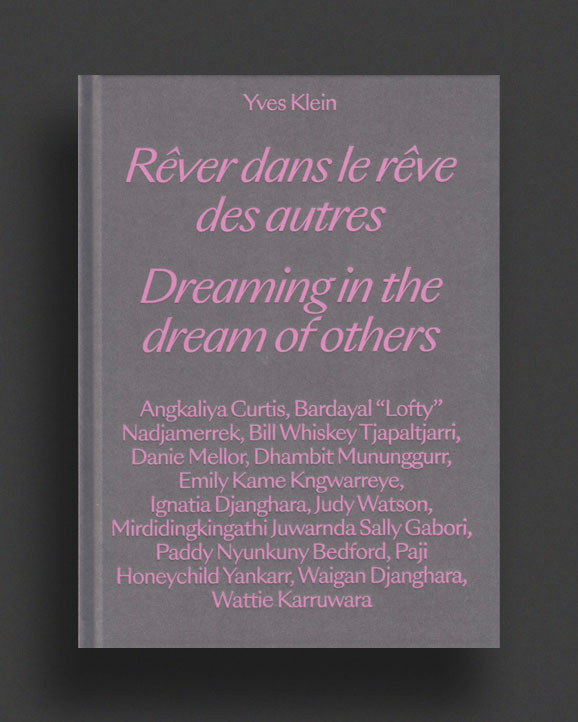
Yves Klein may be one of the first European artists to have taken an explicit interest in Aboriginal visual art. This catalog offers a poetic and completely new approach to his work, placed in perspective with the works of twelve Aboriginal artists.
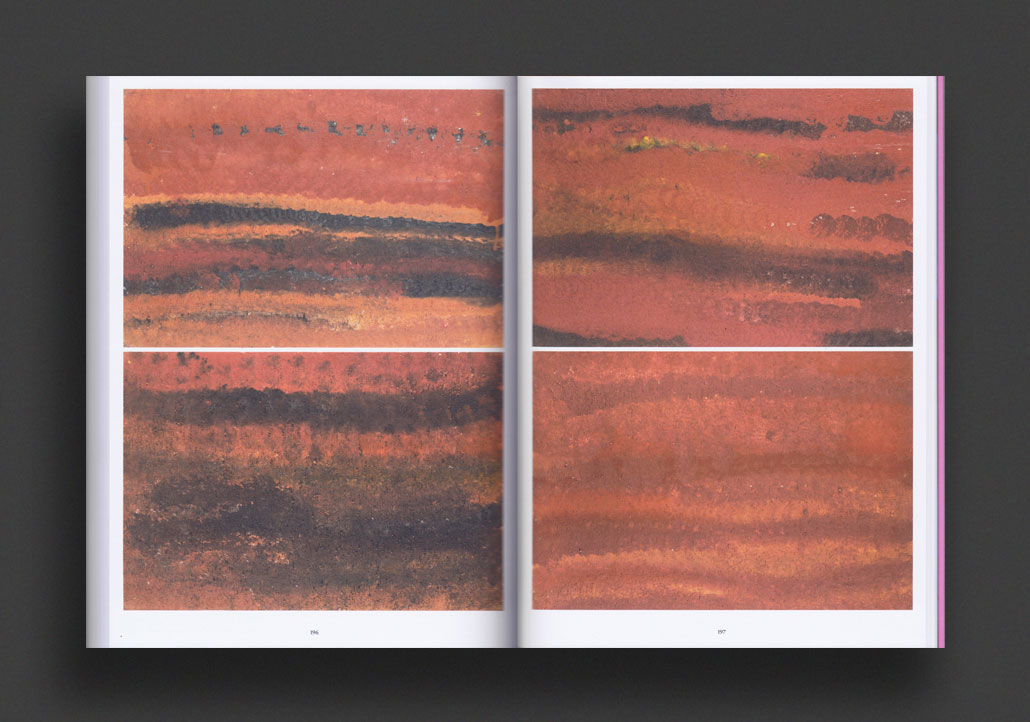
Published on the occasion of the homonymous exhibition held at the Opale Foundation (in Lens, Switzerland), the book Rêver dans le rêve des autres (Dreaming in the dream of others) presents the work of Yves Klein alongside with works by twelve Aboriginal artists (Angkaliya Curtis, Bardayal "Lofty" Nadjamerrek, Bill Whiskey Tjapaltjarri, Danie Mellor, Dhambit Munungurr, Emily Kame Kngwarreye, Ignatia Djanghara, Paddy Bedford, Waigan Djanghara, Wattie Karruwara, Judy Watson, and Paji Honeychild Yankarr), showing how the link between the French artist and the world of the Australian Aborigines is anything but arbitrary. Klein was very interested in the non-Western: works from his youth have been discovered in his archives that were later identified as copies of Aboriginal motifs, and his writings confirm that he was familiar with the cave paintings of north-western Australia. In the '50s, Aboriginal art, which was little known, was seen not as the expression of a different spirit, but rather as the survival of a vanished spirit, in short, that of the Neolithic: Yves Klein, like his parents, was fascinated by prehistory.
Yves Klein, born in 1928 in Nice, had as a first vocation to be a judoka. It was only back in Paris, in 1954, that he dedicated himself fully to art, setting out on his "adventure into monochrome".
Animated by a quest to "liberate colour from the prison that is the line", Yves Klein directed his attention to the monochrome which, to him, was the only form of painting that allowed to "make visible the absolute".
By choosing to express feeling rather than figurative form, Yves Klein moved beyond ideas of artistic representation, conceiving the work of art instead as a trace of communication between the artist and the world; invisible truth made visible. His works, he said, were to be "the ashes of his art", traces of that which the eye could not see.
Yves Klein's practice revealed of new way of conceptualising the role of the artist, conceiving his whole life as an artwork. "Art is everywhere that the artist goes", he once declared. According to him, beauty existed everywhere, but in a state of invisibility. His task was to to capture beauty wherever it might be found, in matter as in air.
The artist used blue as the vehicle for his quest to capture immateriality and the infinite. His celebrated bluer-than-blue hue, soon to be named "IKB" (International Klein Blue), radiates colourful waves, engaging not only the eyes of the viewer, but in fact allowing us see with our souls, to read with our imaginations.
From monochromes, to the void, to his "technique of living brushes" or "Anthropometry"; by way of his deployment of nature's elements in order to manifest their creative life-force; and his use of gold as a portal to the absolute; Yves Klein developed a ground-breaking practice that broke down boundaries between conceptual art, sculpture, painting, and performance.
Just before dying, Yves Klein told a friend, "I am going to go into the biggest studio in the world, and I will only do immaterial works."
Between May 1954 and June 6, 1962, the date of his death, Yves Klein burned his life to make a flamboyant work that marked his era and still shines today.
Texts by Georges Petitjean, Wally Caruana, Didier Semin, Kim Akerman.
2014, English
Softcover, 376 pages, 21 x 26 cm
1st Edition, Out of print title / as new
Published by
Paul Holberton Publishing / London
National Gallery of Canada / Ottawa
$200.00 $120.00 - In stock -
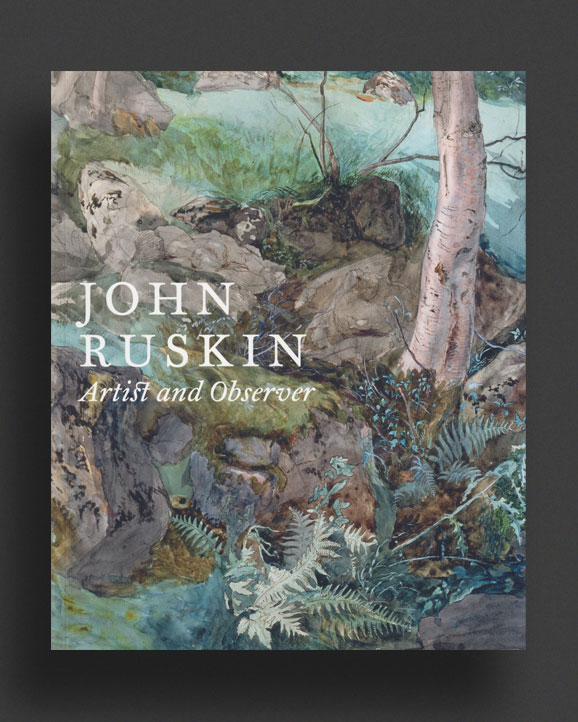
First, only, quickly out-of-print edition of this comprehensive catalogue surveying Ruskin's drawings and watercolours, published on the occasion of the major exhibition at the National Gallery of Canada, Ottawa, 14 February – 11 May 2014, and National Gallery of Scotland, Edinburgh, 4 July – 28 September 2014.
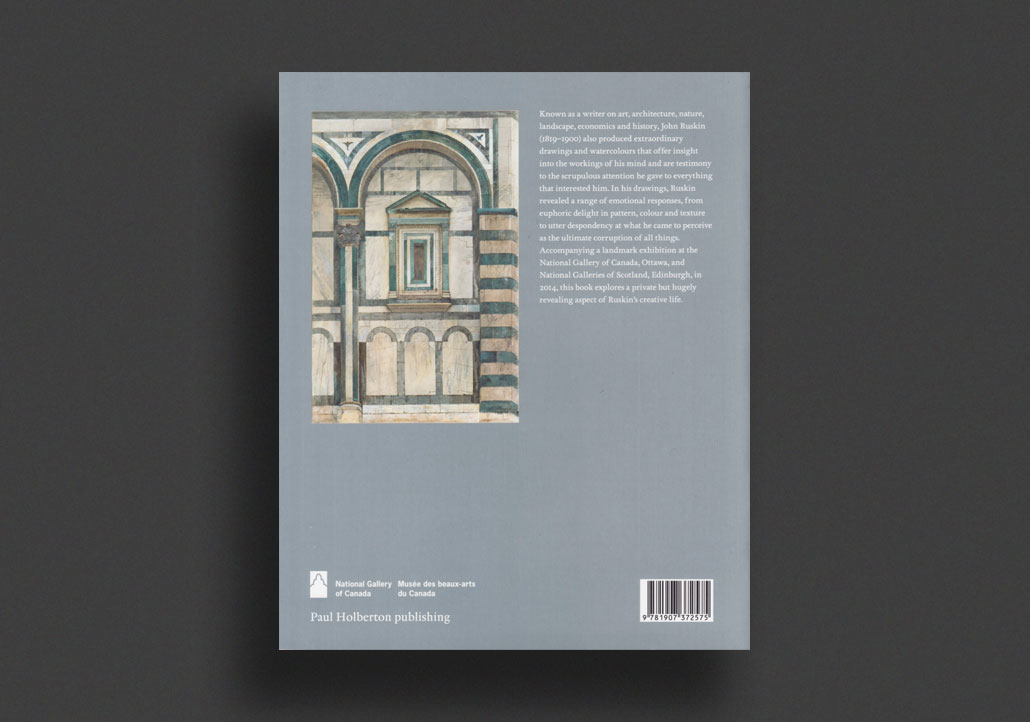
Known an a writer on art, architecture, nature, landscape, economics and history, John Ruskin (1819–1900) also produced extraordinary drawings and watercolours that offer insight into the workings of his brilliant mind and are testimony to the scrupulous attention he gave to everything that interested him. These exhilarating works deserve to be appreciated afresh by audiences anew.
Accompanying a landmark exhibition at the National Galleries of Canada and Scotland in 2104, this definitive exploration of a private but hugely revealing aspect of Ruskin’s creative life – representing his entire career and all subject types and degrees of finish and elaboration – will demonstrate how his use of drawing evolved in terms of his most characteristic stylistic traits and how he used the medium in a most distinctive technical manner. Ruskin regarded drawing as a means of focusing his eye and as a discipline of observation, and so he attached small significance to the work itself when completed. Paradoxically, despite the extraordinary skill and emotion his drawings demonstrate, Ruskin has never been acclaimed as the great artist he undoubtedly was.
Drawing was used by Ruskin to express the ecstasy he felt in the presence of transcendent beauty in nature and landscape, as well as in the works of man. His drawings are instantly enjoyable for their immediacy and verve, for their absence of self-consciousness or artistic indulgence, but they also reveal a range of emotional responses and are profoundly informative about the devastating swings of mood that he endured and which fired his massive intellectual creativity as well as his eventual descent into insanity.
In examining alongside the central core of Ruskin’s own drawings those made by artists who were his mentors, friends and followers, this book also aims to give an account of the wider phenomenon which might be called ‘Ruskinism’. It will demonstrate how Ruskin’s own style formed as a result of contact with an older generation of drawing masters, such as Samuel Prout and J.D. Harding. Ruskin’s paramount admiration for J.M.W. Turner, and the story of his advocacy of Turner as the greatest genius of British art, will also be explained. A fascinating and visually rich element of the book are the photographs (Daguerrotypes), including those taken by Ruskin himself or under his immediate supervision. By seeing photographs and drawings together it is possible to identify certain pictorial traits that are characteristic of Ruskinian methods of looking.
Contributions by Conal Shields, Ian Jeffrey, Christopher Baker and Christopher Newall.
As New, out-of-print.
2019, English
Softcover, 120 pages, 26 x 21.5 cm
1st Edition, Out of print title / as new
Published by
Paul Holberton Publishing / London
$60.00 $30.00 - Out of stock
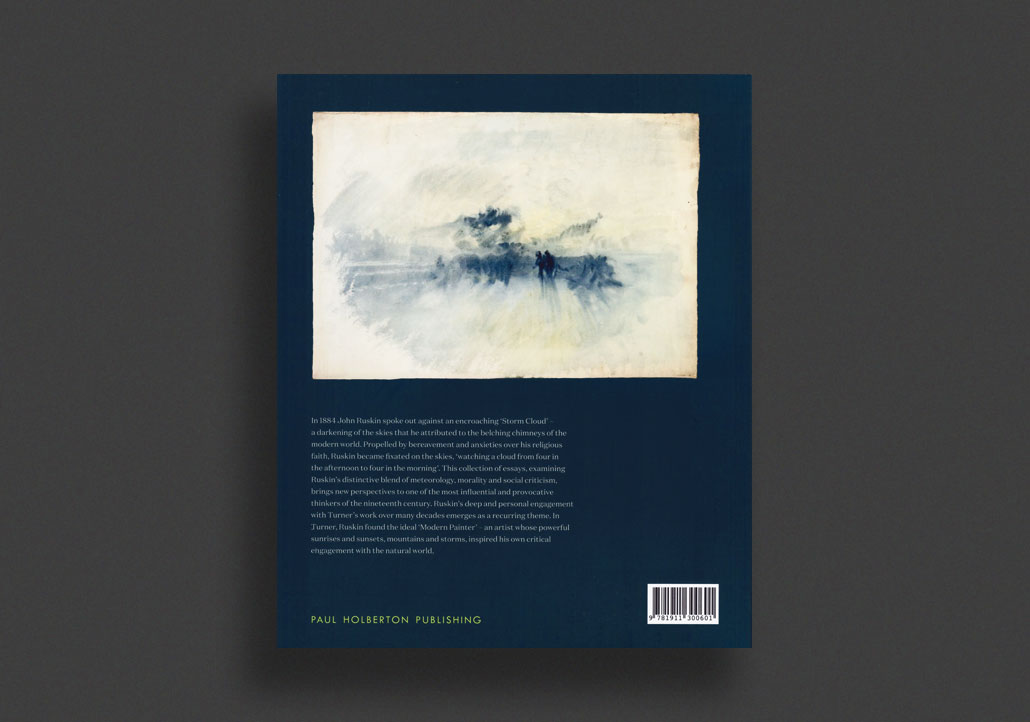
Ruskin, Turner & the Storm Cloud presents new writing on John Ruskin’s vision of art and its relationship with modern society and a changing environment. As part of the re-evaluation of Ruskin, 200 years after his birth in 1819, art historians, scientists, geographers, artists and curators explore the critic’s lifelong commitment to the painted landscapes of JMW Turner and his own artistic ambitions, as well as his prophetic concerns about the world’s darkening skies, pollution and psychological turbulence.
In 1884 John Ruskin spoke out against an encroaching “Storm Cloud”—a darkening of the skies that he attributed to the belching chimneys of the modern world. The imagery of the pollution-stained sky also allowed Ruskin to articulate the internal distress that seemed to engulf him. His analysis of a “blanched sun, blighted grass [and] blinded man” overwhelmed by a modern “plague-wind” expresses both the visible climatic effects of industrialization and the effects of his own worsening mental health. Propelled by bereavement and anxieties over his religious faith, Ruskin became fixated on the skies, “watching a cloud from four in the afternoon to four in the morning”.
This collection of essays examining Ruskin’s distinctive blend of meteorology, morality and social criticism brings new perspectives to one of the most influential and provocative thinkers of the nineteenth century. Ruskin’s deep and personal engagement with Turner’s work over many decades emerges as a recurring theme. In Turner, Ruskin found the ideal “Modern Painter”—an artist whose powerful sunrises and sunsets, mountains and storms, inspired his own critical engagement with the natural world.
As an artist and critic, Ruskin consistently challenged the way others experienced the world, encouraging his audiences to recognise and record nature’s transient beauty, and doing the same with his own intimately observed drawings of animals, flora and weathered buildings. As an environmentalist, he witnessed a natural world changing before his eyes, as the landscapes, buildings and skies he had seen as a young man came under threat. As an ethical provocateur ahead of his time, he condemned the throwaway culture that spoilt the towns and rivers he loved, urging his audiences to take responsibility for these changes.
Responding to this rich and troubled legacy, the book brings together original contributions by artists and curators, art historians, geographers and climate change specialists, each of whom shares new insights into Ruskin’s concerns about the changing weather patterns and shifting landscapes of the modern world. Individual essays reconsider Ruskin alongside a range of contemporary issues, encompassing mental health, technology, environmental pollution and climate change. The collection’s diverse voices make a compelling case for the continuing relevance of Ruskin and his ways of seeing in the twenty-first century.
Ruskin, Turner & the Storm Cloud accompanies a major exhibition at York Art Gallery and Abbot Hall Art Gallery.
As New, out-of-print.
1963, English
Hardcover (w. dust jacket), 140 pages
1st Edition, Out of print title / used / good
Published by
Boston Book & Art Shop / Boston
$30.00 - Out of stock
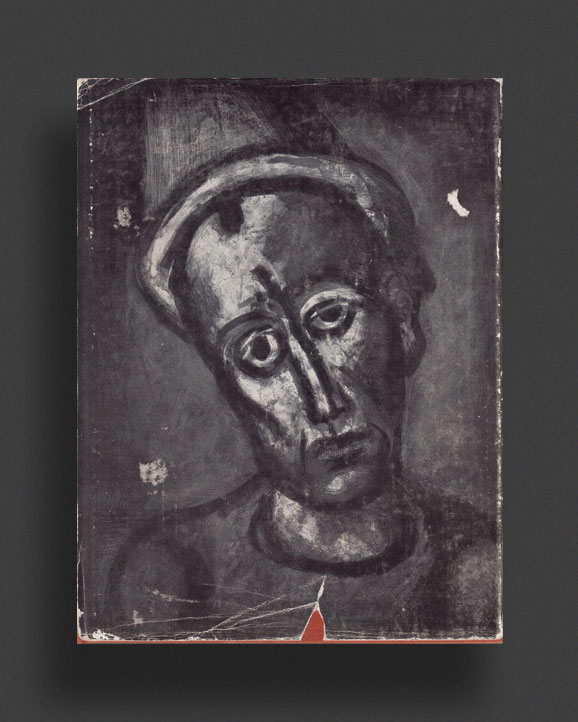
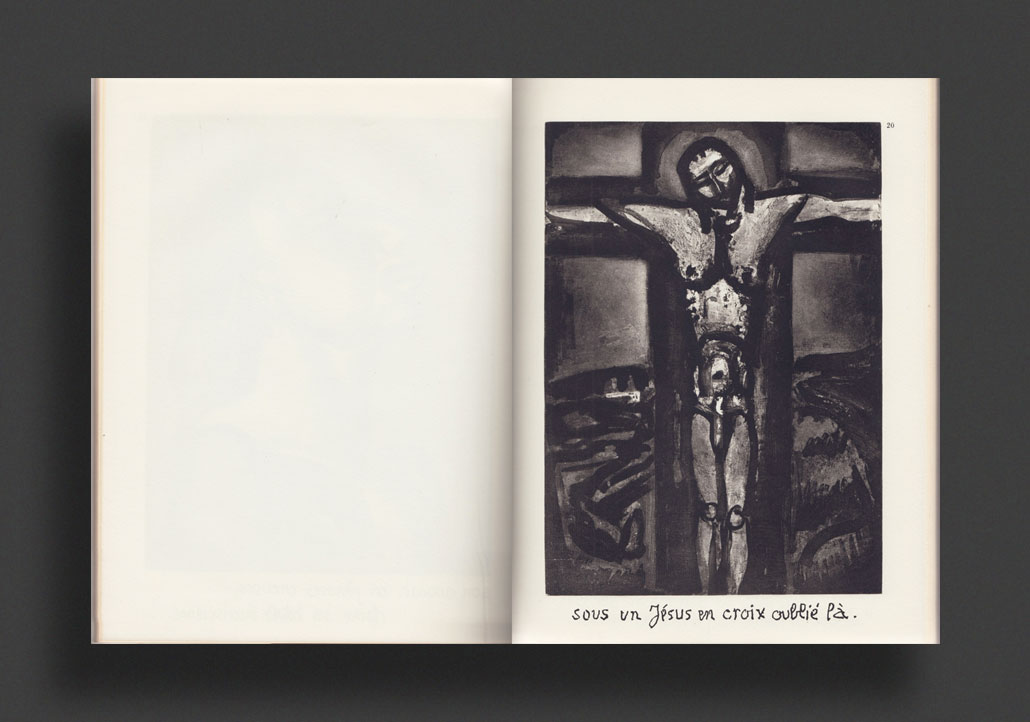
First 1963 hardcover edition of this English translation of Georges Rouault's (1871-1958) Miserere, published by the Boston Book & Art Shop. Beautifully printed reproduction of this classic, including Rouault's original preface translated to English, the series of 58 engravings with titles reproduced in facsimile from the artist's handwriting, and 18 plates comparing various successive states with the finished engravings. Introduction by Anthony Blunt.
Georges Henri Rouault (1871—1958) was a French painter, draughtsman, and print artist, whose work is often associated with Fauvism and Expressionism.
Average dust jacket with chipping and wear, book G—VG.
1999, English / Swedish
Hardcover (in illustrated slipcase w. dust jacket + 2 CD), 337 pages, 29 x 16 cm
1st Edition, Out of print title / used / very good
Published by
Sveriges Radios Förlag / Stockholm
$190.00 - In stock -
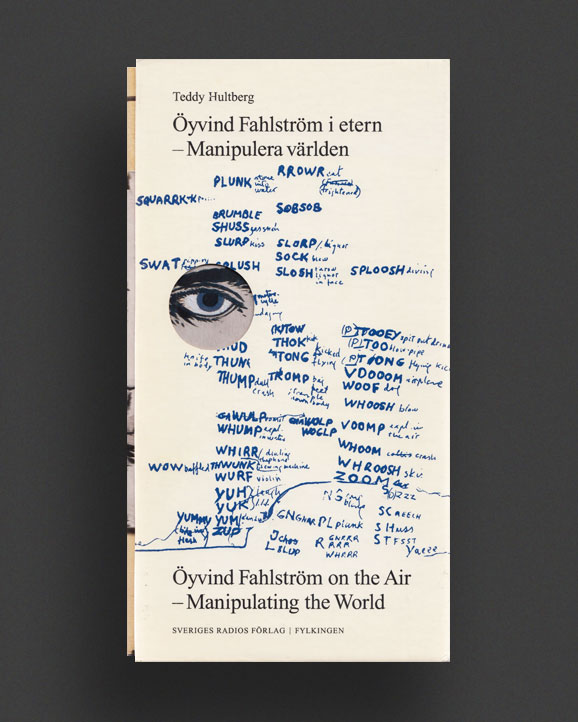
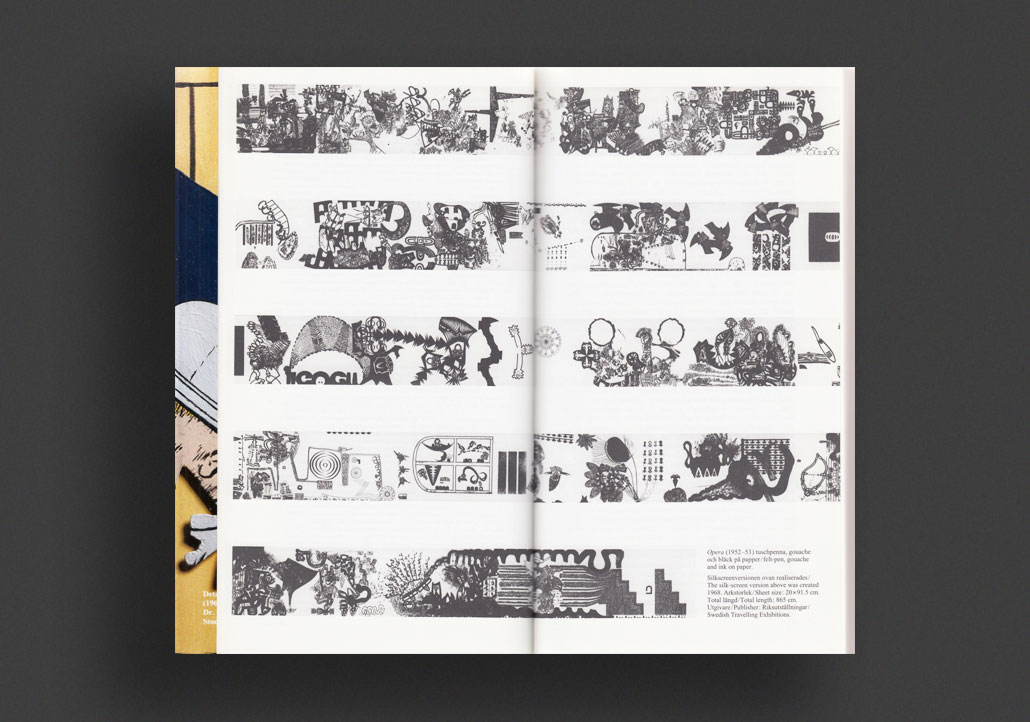
Under the motto: "Manipulate the world - take care of the world", Fahlström set up a variety of meeting-places in which participants were invited to take part in an interdiciplinary game of purposeful discovery. He introduced elements of popular culture into his work early on and made substantial contributions to a critical assessment of the "medialisation" of art. In this, the most extensive book about Öyvind Fahlström to date, Teddy Hultberg charts the artist´s predominant lines of creative development and shows how his cross-genre endeavours were based on a few central ideas: character forms, signs, games and life materials.
The present study focuses on two innovative and extraordinary compositions for radio: "Birds in Sweden" (1963) and "The Holy Torsten Nilsson" (1966). These works can be heard on the two accompanying CD records and are also included here in written form. Some unique and hitherto unpublished visual and textual material, the result of several years of research by Teddy Hultberg, is also included in the book.
Now long out-of-print, this first 1999 edition (in bi-lingual English / Swedish) comes housed in illustrated, die-cut slipcase, with hardcovers and illustrated dust jacket. All Very Good—Fine in condition.
2004, English
Softcover, 176 pages, 23 x 17.5 cm
1st Edition, Out of print title / used / very good
Published by
Yale University Press / New Haven
$45.00 - Out of stock
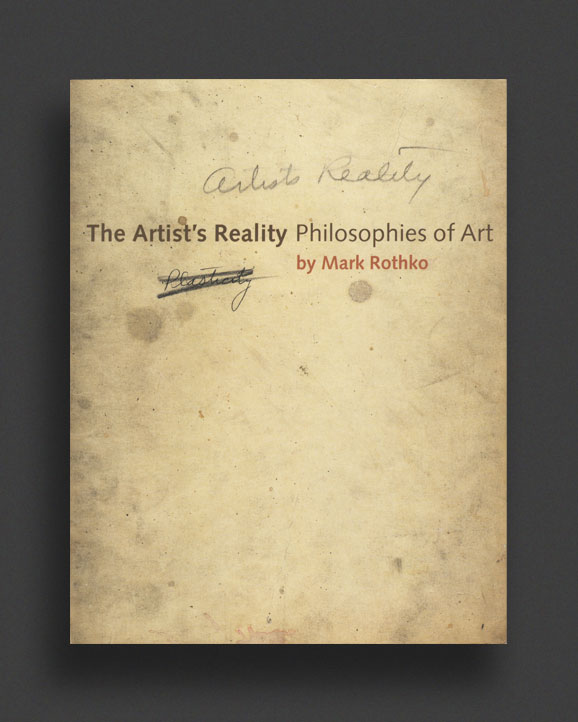
First edition of this recently discovered book manuscript by the celebrated artist Mark Rothko offering a landmark discussion of his views on topics ranging from the Renaissance to contemporary art, criticism, and the role of art and artists in society.
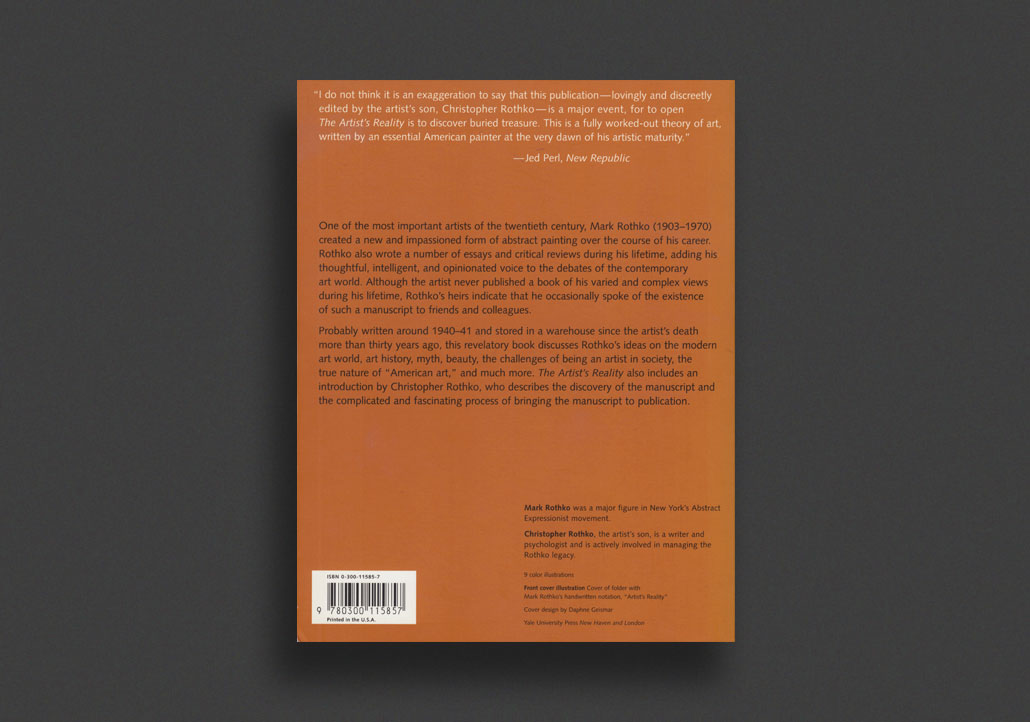
One of the most important artists of the twentieth century, Mark Rothko (1903–1970) created a new and impassioned form of abstract painting over the course of his career. Rothko also wrote a number of essays and critical reviews during his lifetime, adding his thoughtful, intelligent, and opinionated voice to the debates of the contemporary art world. Although the artist never published a book of his varied and complex views, his heirs indicate that he occasionally spoke of the existence of such a manuscript to friends and colleagues. Stored in a New York City warehouse since the artist’s death more than thirty years ago, this extraordinary manuscript, titled The Artist’s Reality, is now being published for the first time.
Probably written around 1940–41, this revelatory book discusses Rothko’s ideas on the modern art world, art history, myth, beauty, the challenges of being an artist in society, the true nature of “American art,” and much more. The Artist’s Reality alsoincludes an introduction by Christopher Rothko, the artist’s son, who describes the discovery of the manuscript and the complicated and fascinating process of bringing the manuscript to publication. The introduction is illustrated with a small selection of relevant examples of the artist’s own work as well as with reproductions of pages from the actual manuscript.
The Artist’s Reality will be a classic text for years to come, offering insight into both the work and the artistic philosophies of this great painter.
Out-of-print. First edition. Good copy with small creases to bottom cover corner, few pages. A few removable pencil underlines in text.
2019, English
Hardcover (w. dust jacket), 262 pages, 22.8 x 15.2 cm
Published by
Zone Books / New York
$50.00 - Out of stock
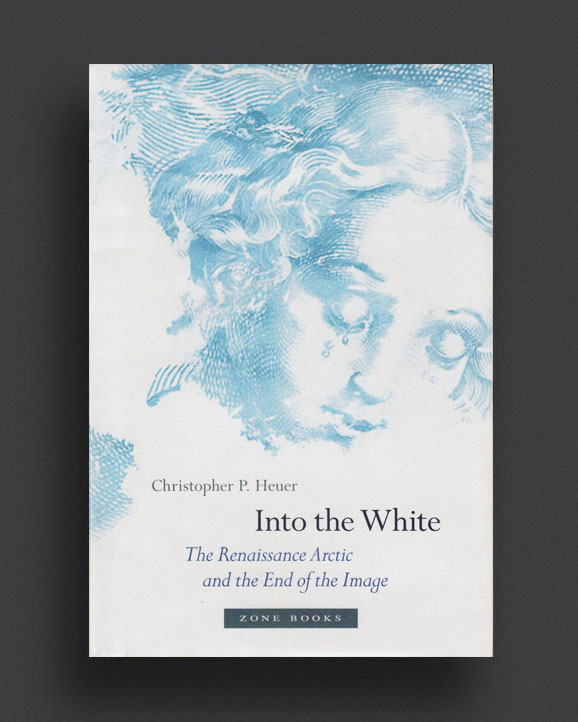
European narratives of the Atlantic New World tell stories of people and things: strange flora, wondrous animals, and sun-drenched populations for Europeans to mythologize or exploit. Yet between 1500 and 1700 one region upended all of these conventions in travel writing, science, and, most unexpectedly, art: the Arctic. Icy, unpopulated, visually and temporally “abstract,” the far North – a different kind of terra incognita for the Renaissance imagination – offered more than new stuff to be mapped, plundered, or even seen. Neither a continent, an ocean, nor a meteorological circumstance, the Arctic forced visitors from England, the Netherlands, Germany, and Italy, to grapple with what we would now call a “nonsite,” spurring dozens of previously unknown works, objects, and texts – and this all in an intellectual and political milieu crackling with Reformation debates over art’s very legitimacy.
Into the White uses five case studies to probe how the early modern Arctic (as site, myth, and ecology) affected contemporary debates of perception and matter, of representation, discovery, and the time of the earth – long before the nineteenth century romanticized the polar landscape. In the far North, this book contends, the Renaissance exotic became something far stranger than the marvelous or the curious, something darkly material and unmasterable, something beyond the idea of image itself.
“Making a major contribution to conversations about globalism, art, and ecology, Heuer challenges the complacent understanding of ‘the global Renaissance’ and generates new ways of thinking across disciplinary boundaries.”—Rebecca E. Zorach
Very Good in VG dust jacket.
2012, English
Hardcover (w. dust jacket), 240 pages, 22.8 x 15.2 cm
Published by
Zone Books / New York
$50.00 - Out of stock
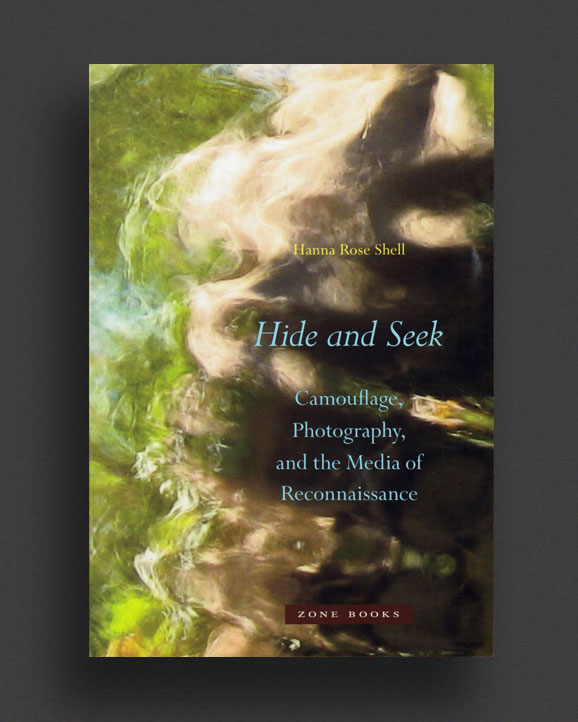
Camouflage is an adaptive logic of escape from photographic representation. In Hide and Seek, Hanna Rose Shell traces the evolution of camouflage as it developed in counterpoint to technological advances in photography, innovations in warfare, and as-yet-unsolved mysteries of natural history. Today camouflage is commonly thought of as a textile pattern of interlocking greens and browns. But in Hide and Seek it reveals itself as much more — a set of institutional structures, mixed-media art practices, and permutations of subjectivity, that emerged over the course of the twentieth century in environments increasingly mediated by photographic and cinematic intervention.
Through a series of fascinating case studies, Shell uncovers three conceptually linked species of photographic camouflage — the static, the serial, and the dynamic — and shows how each not only reflects the type of photographic reconnaissance it was meant to counter, but also contains aspects of the previously developed species. Hide and Seek develops its argument from the material forms camouflage has left behind — photomontages, paper blankets, stuffed rabbits, ghillie suits, and instructional films.
Beginning in the domains of natural history and figurative art in the late nineteenth-century, continuing through the rise of aerial warfare in World War I, and onto the cinematic techniques designed to train snipers and civilians during World War II, this book is both a history and a theory of the drive to hide in plain sight.
"There is much to enjoy in all four chapters and without doubt this book, detailing interrelationships of technological advances in photography and film and developments in camouflage media and camouflage consciousness, will live into the future as readers scrutinise it, evaluate it and take its useful and imaginative store of ideas in additional directions."—Ann Elias * History of Photography
Very Good in VG dust jacket.
2007, English
Hardcover (w. dust jacket), 386 pages, 22.9 x 15.2 cm
Published by
Zone Books / New York
$50.00 - In stock -
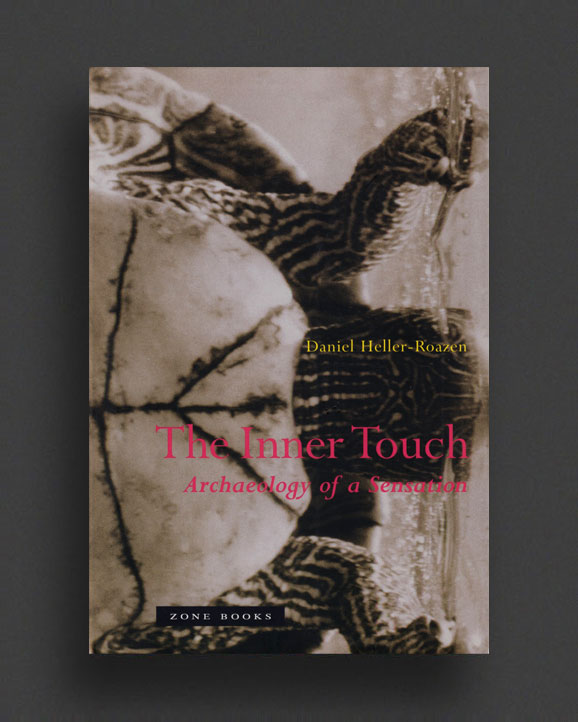
This book presents the archaeology of a single sense: the sense of being sentient. Aristotle was perhaps the first to define this faculty when, in his treatise On the Soul, he identified a sensory power irreducible to the five senses, by which animals perceive that they are perceiving: the simple “sense,” as he wrote, “that we are seeing and hearing.” After him, thinkers returned, time and again, to define and redefine this curious sensation.
The classical Greek and Roman philosophers as well as the medieval Arabic, Hebrew, and Latin thinkers who followed them all investigated a power they called “the common sense,” which one ancient author likened to “a kind of inner touch, by which we are able to grasp ourselves.” Their many findings were not lost with the waning of the Middle Ages. From Montaigne and Francis Bacon to Locke, Leibniz, and Rousseau, from nineteenth-century psychiatry and neurology to Proust and Walter Benjamin, the writers and thinkers of the modern period have turned knowingly and unknowing to the terms of older traditions in exploring the perception that every sensitive being possesses of its life.
The Inner Touch reconstructs and reconsiders the history of this perception. In twenty-five concise chapters that move freely among ancient, medieval, and modern cultures, Daniel Heller-Roazen investigates a set of exemplary phenomena that have played central roles in philosophical, literary, psychological, and medical accounts of the nature of animal existence. Here sensation and self-sensation, sleeping and waking, aesthetics and anesthetics, perception and apperception, animal nature and human nature, consciousness and unconsciousness, all acquire a new meaning.
The Inner Touch proposes an original, elegant, and far-reaching philosophical inquiry into a problem that has never been more pressing: what it means to feel that one is alive.
Winner of the Aldo and Jeanne Scaglione Prize for Comparative Literary Studies, Modern Language Association.
Very Good in VG dust jacket.
2023, English
Softcover (w. dust jacket), 220 pages, 29.5 x 18.5 cm
Published by
Museum of Modern Art in Warsaw / Warsaw
$95.00 - Out of stock
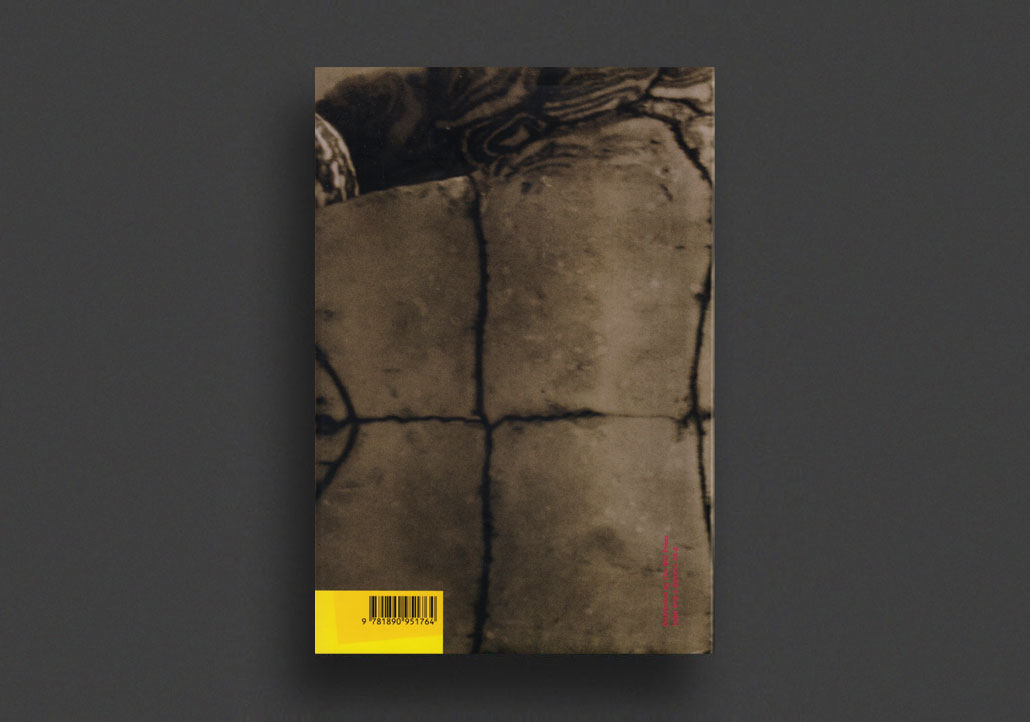
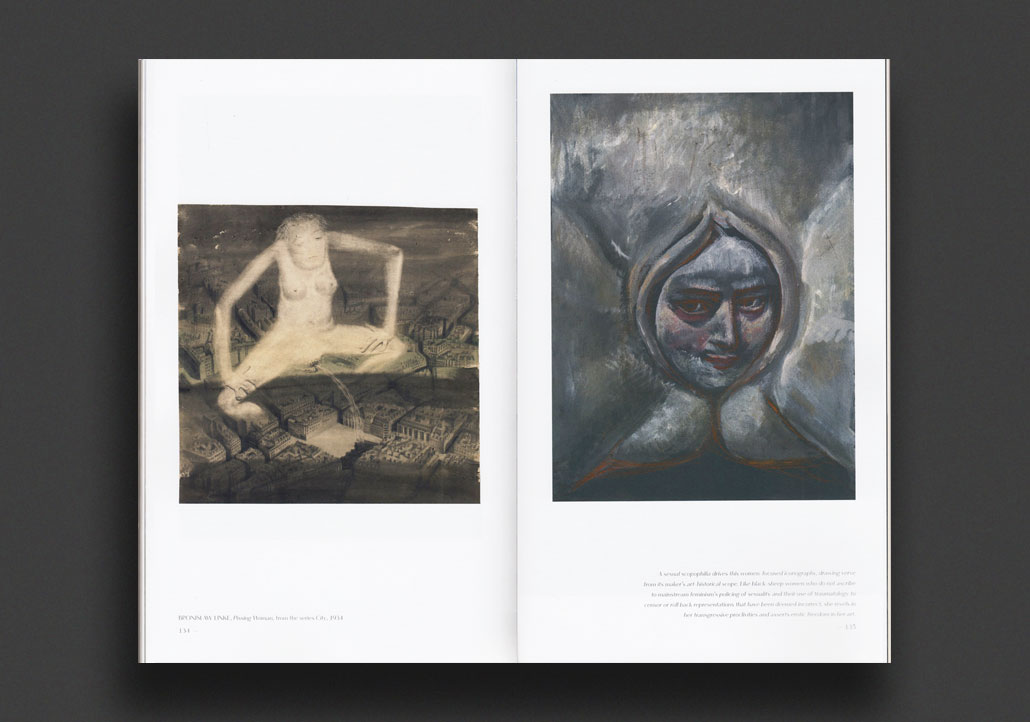
A look at the dark, symbolic work of Polish painter Aleksandra Waliszewska alongside historical artworks that influence her.
Painter Aleksandra Waliszewska creates densely narrative, art historically saturated oil and gouache paintings. Waliszewska’s pictorial universe is populated by supernatural characters and dark themes: devils, vampires, satanic creatures, possessed girls, apocalyptic scenes, bloodthirsty zombies, and other incarnations of the living dead. These characters are situated in dystopian urban landscapes, lost highways, deserted suburbs, gloomy housing estates, swamps, and other sites associated with the Eastern European landscape. Drawing from the specifically Slavic histories of the Upiór (the living dead), Waliszewska claims her artistic and conceptual descendance from premodern art and Symbolist works of the late 19th and early 20th century from Nordic, Baltic, and Eastern European regions.
The Dark Arts presents a dense visual narrative, reproducing over a hundred images of Waliszewska’s in juxtaposition with dozens of historical paintings and sculptures. Shifting away from the dominant figures of French and Austrian artists, this revisionist look at Symbolism through an Eastern and Baltic lens will introduce a wider audience to a rich and relatively understudied field of visual culture.
2023, English
Softcover (w. dust jacket) 330 pages, 21 x 14.9 cm
Published by
Treville / Tokyo
Pan-Exotica / Tokyo
$70.00 - Out of stock
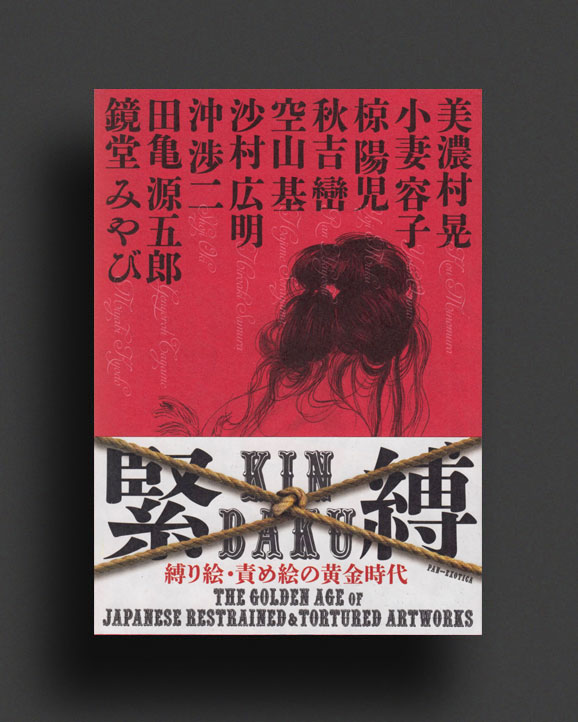
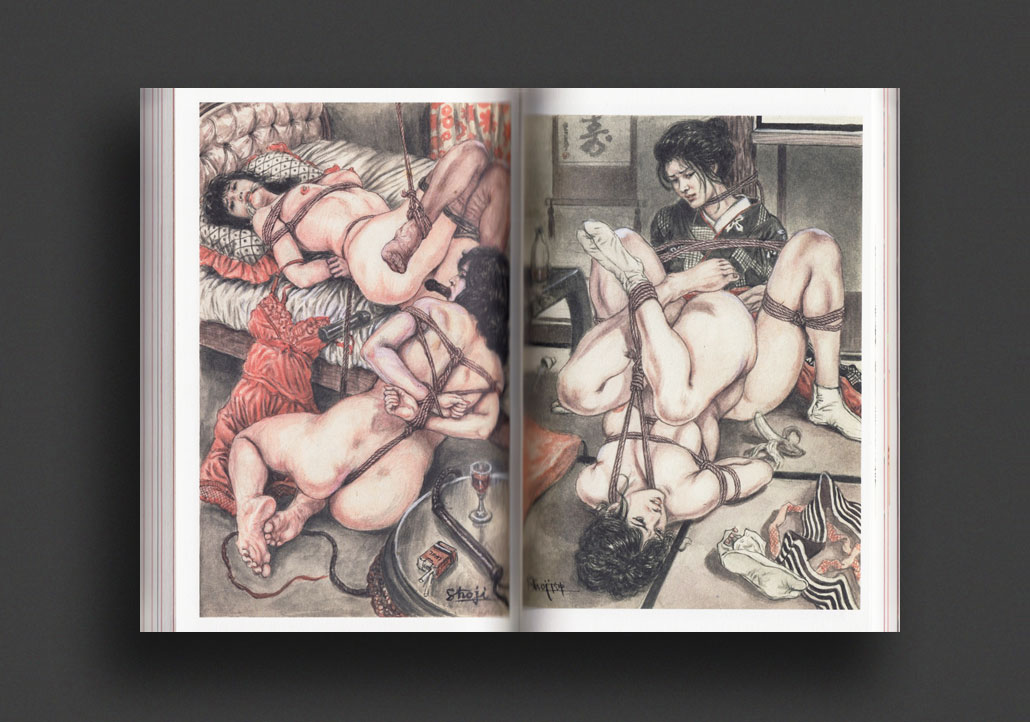
The first of its kind, "KINBAKU The Golden Age of Japanese Restrained & Tortured Artworks" collects the masters of Japanese kinbaku rope bondage and torture artworks by nine Japanese artists, spanning generations, artists who have refined the beauty of masochism and inherited the legacy of Japanese Shibari-e eroticism as pioneered by Seiu Ito. This book presents beautiful reproductions in colour and b/w of many extreme artworks by Kou Minomura, Yoko Ozuma, Yoji Muku, Ran Akiyoshi, Hajime Sorayama, Hiroaki Samura, Shoji Oki, Gengoroh Tagame, and Miyabi Kyodo. Each artist has bilingual introduction text, plus essays in Japanese by Akira Naka, Masakazu Tanaka, and Toshihi Soma.
Published on the occasion of the exhibition, The Essentials of KINBAKU ART, held at Vanilla Gallery, Tokyo, 16 March—9 April, 2023.
"After World War II, people who had been freed from the long curse of asceticism sought entertainment and freedom in easy "reading", and a multitude of magazines were launched into the world. Among the numerous magazines were the forbidden maniac magazines. These unique magazines raised people's sexual and even aesthetic interests in
1990, English
Hardcover (w. dust jacket), 358 pages, 17.5 x 23 cm
1st Edition, Out of print title / used / very good
Published by
October Books / New York
$90.00 - In stock -
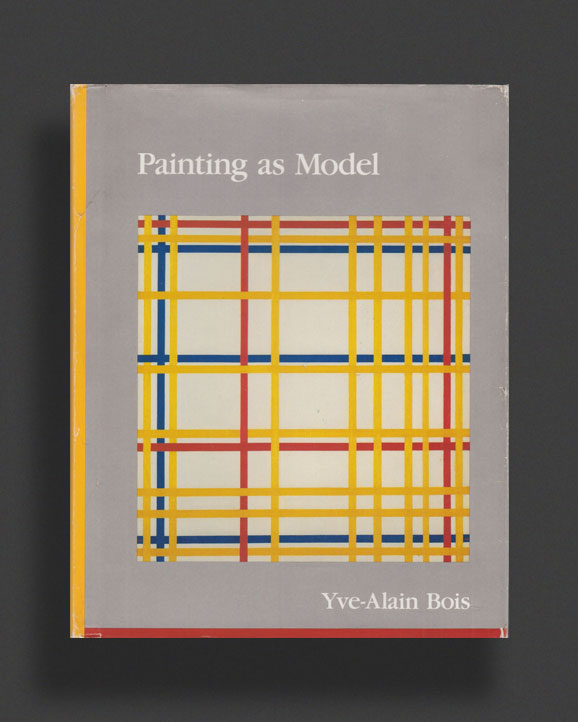
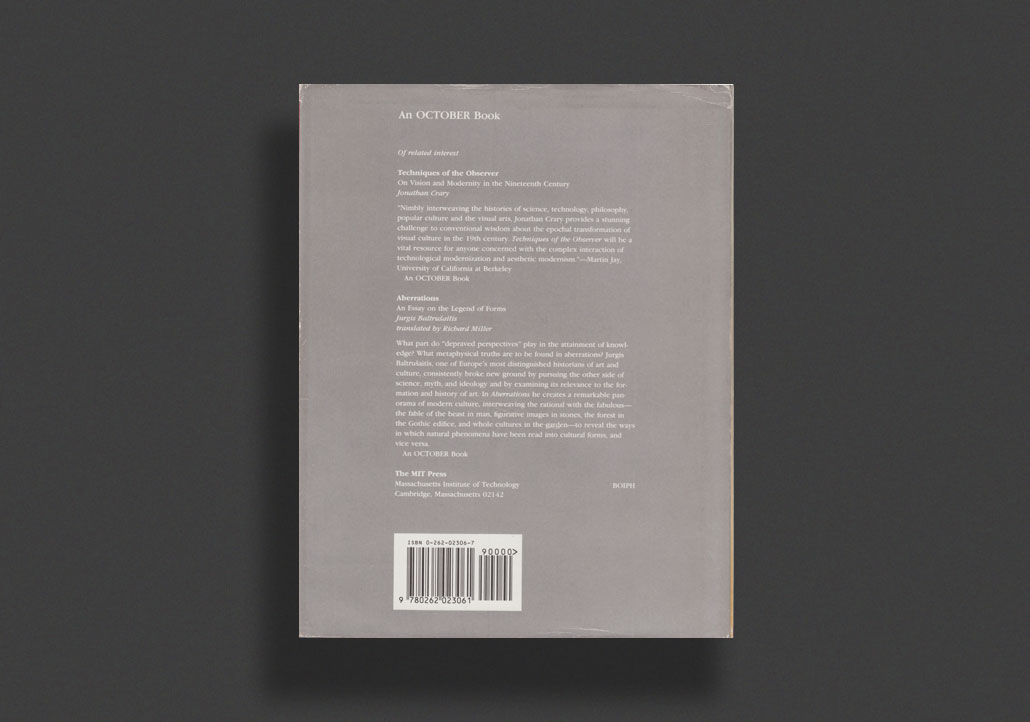
First 1990 hardcover edition of this landmark collection of essays, Yve-Alain Bois’ Painting as Model remains to this day one of the most influential contemporary books on painting. Informed by both structuralism and poststructuralism, these essays by art critic and historian Yve Alain Bois seek to redefine the status of theory in modernist critical discourse. Warning against the uncritical adoption of theoretical fashions and equally against the a priori rejection of all theory, Bois argues that theory is best employed in response to the specific demands of a critical problem. The essays lucidly demonstrate the uses of various theoretical approaches in conjunction with close reading of both paintings and texts.
"A genuinely original contribution, in both style and approach, to a 'new history' of art which reconciles critical theory to historical research." - Louis Marin, École des Hautes Études en Sciences Sociales, Paris
Yve-Alain Bois studied at the Ecole des Hautes Etudes under the guidance of Roland Barthes and Hubert Damisch. A founder of the French journal Macula, Bois is currently a professor in the School of Historical Studies at the Institute for Advanced Study, Princeton, NJ.
Very Good copy w. good dust jacket.
2023, English
Softcover, 376 pages, 20.5 x 15 cm
Published by
No Place Press / US
$55.00 - In stock -
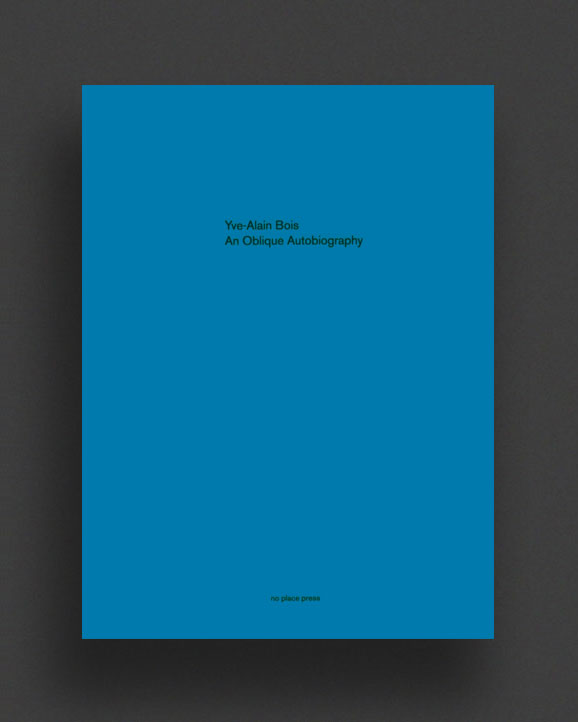
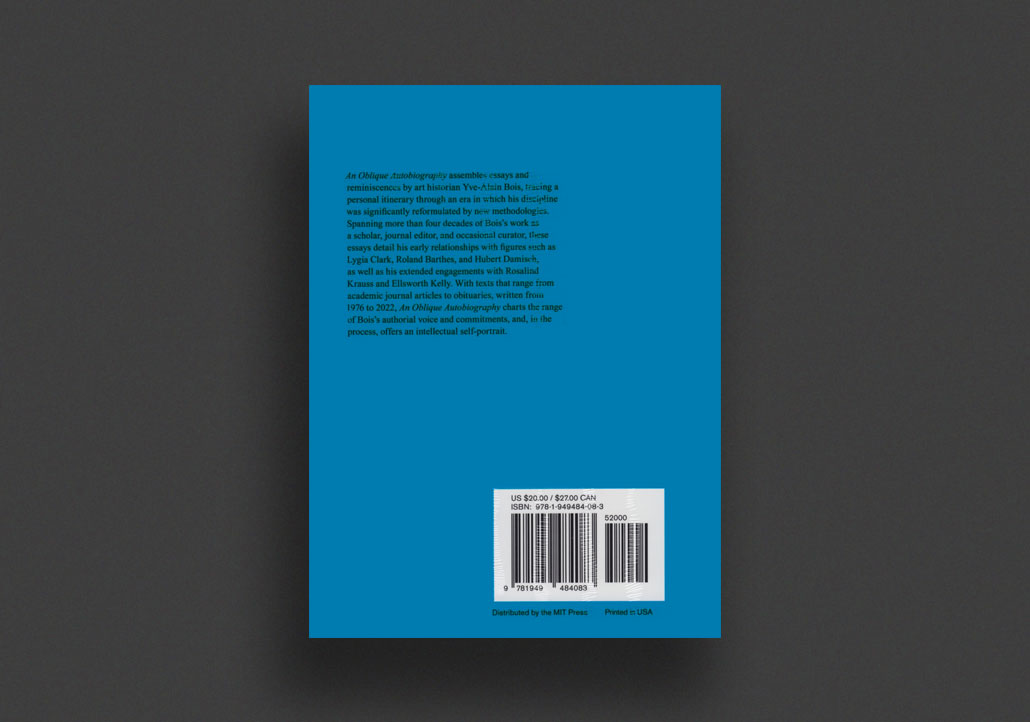
Essays and reminiscences by one of the preeminent art historians of our time, spanning more than four decades.
An Oblique Autobiography assembles a new collection of essays and reminiscences by one of the preeminent art historians of our time. Spanning more than four decades of Yve-Alain Bois's work as a scholar, journal editor, and occasional curator, this volume traces a deeply personal itinerary through an important era of art history, in which the discipline—in part occasioned by Bois's own journey from France to the United States—was significantly reformulated by new methodologies.
Detailing Bois's early relationships with figures such as Roland Barthes, Hubert Damisch, Lygia Clark, and Jacques Derrida, as well as his extended engagements with Rosalind Krauss, Ellsworth Kelly, and Martin Barré, these essays track Bois's intellectual commitments against the backdrop of an evolving academic field. With texts that range from academic journal articles to obituaries, written from 1976 to 2021, An Oblique Autobiography reveals the range of Bois's authorial voice and offers a remarkable self-portrait of one of art history's primary protagonists.
2023, English
Hardcover, 275 pages, 24.8 x 17.2 cm
Published by
Power Publications / Sydney
$40.00 - Out of stock
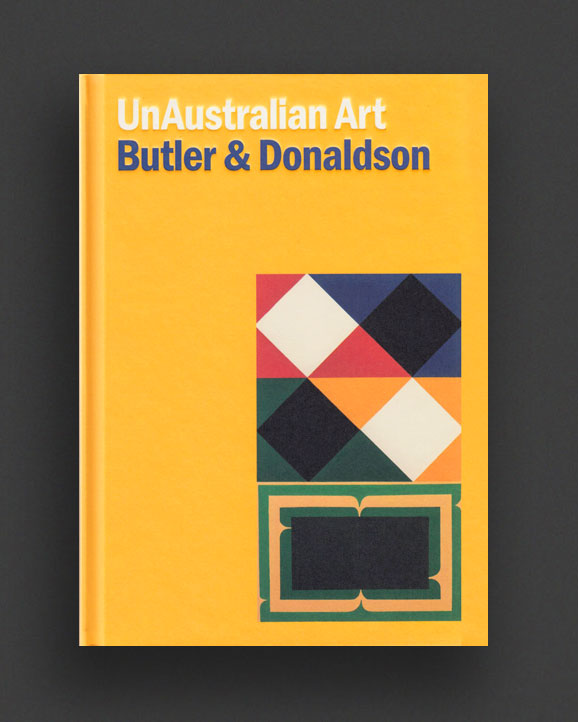
UnAustralian Art: Ten Essays on Transnational Art History proposes a radical rethinking of Australian art. Rather than identifying a national sensibility, Rex Butler and ADS Donaldson demonstrate that Australian art and artists have always been engaged in struggles and creative exchanges with the rest of the world. Examining Australian art as much from the outside in as the inside out, Butler and Donaldson’s methods open Australian art history to an encyclopaedic multitude of hitherto excluded stories.
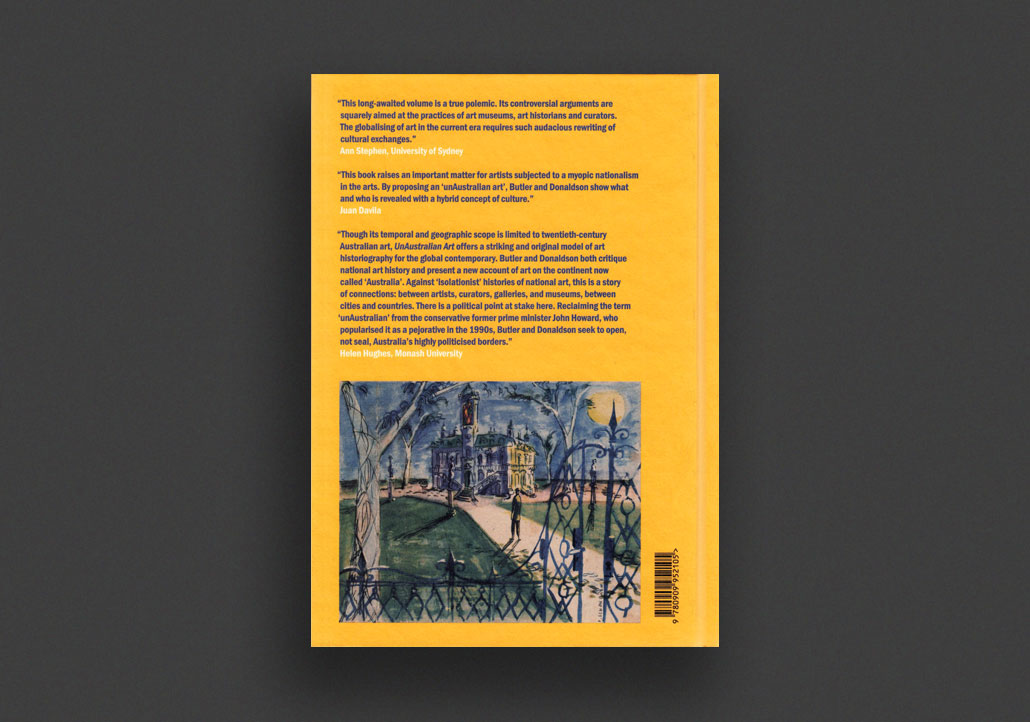
“This long-awaited volume is a true polemic. Its controversial arguments are squarely aimed at the practices of art museums, art historians and curators. The globalising of art in the current era requires such audacious rewriting of cultural exchanges.”—Ann Stephen, Senior Curator, Art, University of Sydney
“This book raises an important matter for artists subjected to a myopic nationalism in the arts. By proposing an ‘unAustralian art’, Butler and Donaldson show what and who is revealed with a hybrid concept of culture.”—Juan Davila
“Though its temporal and geographic scope is limited to twentieth-century Australian art, UnAustralian Art offers a striking and original model of art historiography for the global contemporary. Butler and Donaldson both critique national art history and present a new account of art on the continent now called ‘Australia’. Against ‘isolationist’ histories of national art, this is a story of connections: between artists, curators, galleries, and museums, between cities and countries. There is a political point at stake here. Reclaiming the term ‘unAustralian’ from the conservative former prime minister John Howard, who popularised it as a pejorative in the 1990s, Butler and Donaldson seek to open, not seal, Australia’s highly politicised borders.”—Helen Hughes, Monash University
2023, English
Softcover, 346 pages, 24.8 x 17.2 cm
Published by
Power Publications / Sydney
$40.00 - Out of stock
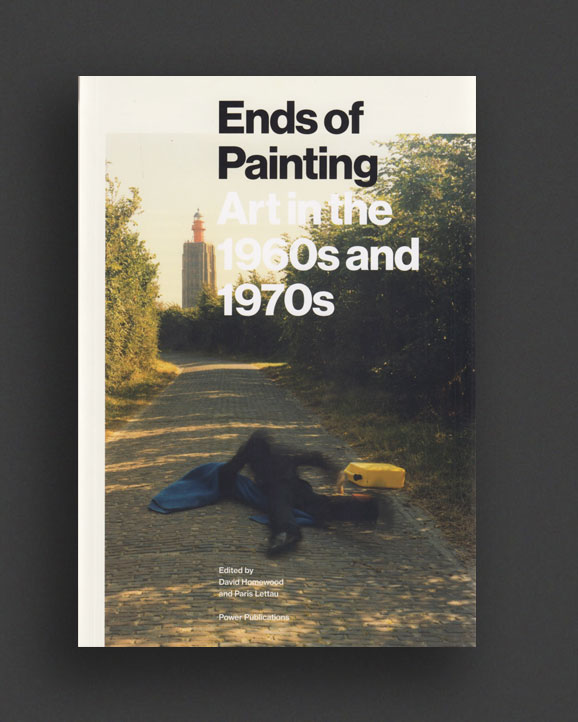
Contemporary art begins where painting ends, or so goes one of recent art history's most dominant narratives. This book is a post-mortem of the supposed death of painting in the period following World War II. In eleven essays by a global array of leading scholars, Ends of Painting offers a counter-history, showing how the practice and discourse of painting remained integral to art throughout the 1960s and 1970s.
Written by art historians from Australia, Asia, Europe and North America, each chapter captures a renewed critical approach to topics as diverse as conceptualism and anachronism, photography and autobiography, theatre and politics, nationalism and consumerism, race and modernism.
The book reveals a vast constellation in which painting’s ends are also beginnings—from Warhol’s Cow Wallpaper at the Leo Castelli Gallery in New York to Naoyoshi Hikosaka’s act of pouring latex over tatami mats on his bedroom floor in Tokyo; from the first canvas boards by Aboriginal artists at Papunya in Australia’s Western Desert to the Collective Actions Group’s documentation of people holding up arrangements of coloured envelopes in snowfields outside Moscow.
These unlikely correspondences between times and places sustain this book’s return to the medium, revealing how history is brushed by painting, and painting by history.
2001, English
Softcover, 216 pages, 29.7 x 21 cm
Published by
Power Publications / Sydney
Griffith University / Brisbane
$45.00 - Out of stock
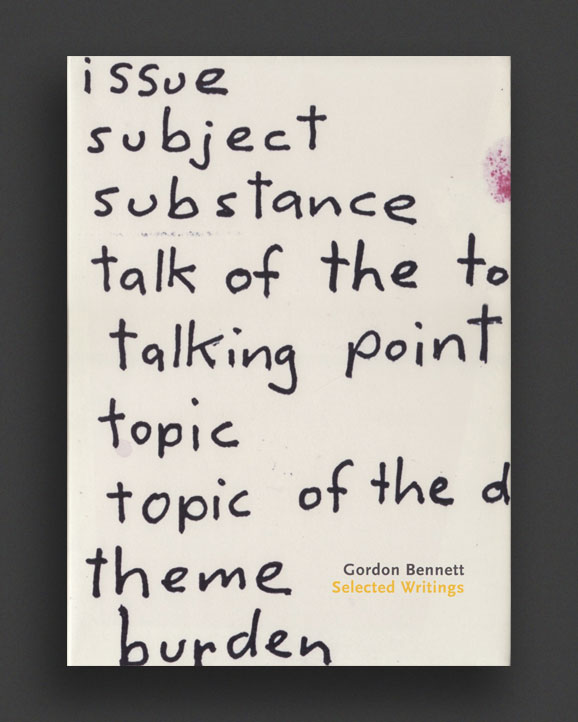
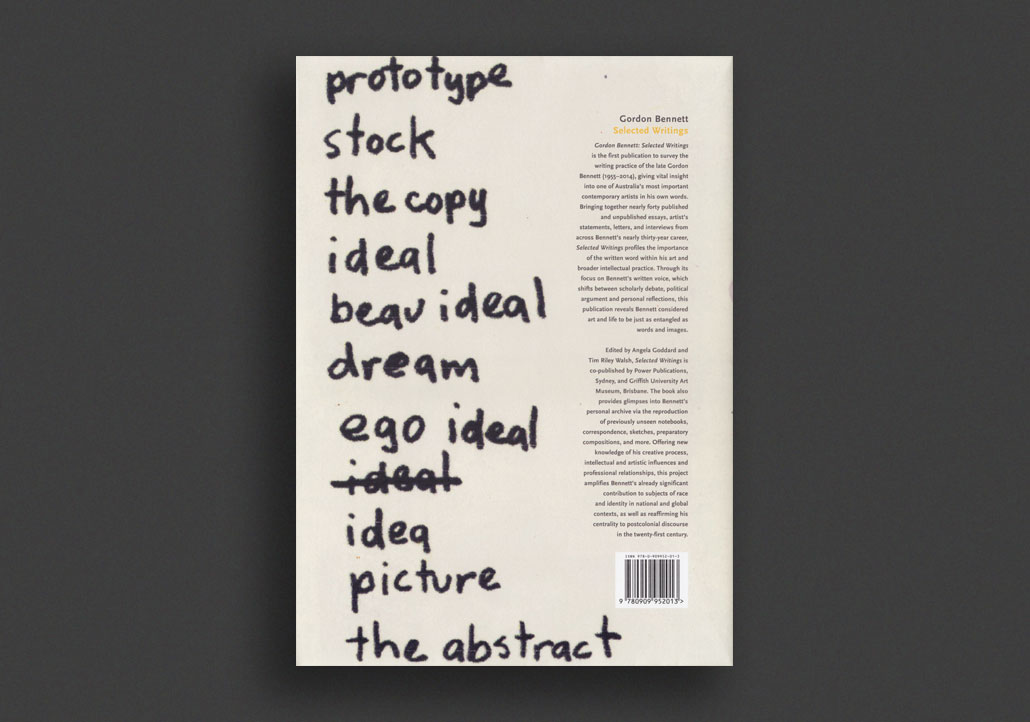
Gordon Bennett: Selected Writings is the first publication to survey the writing practice of the late Gordon Bennett (1955–2014), giving vital insight into one of Australia’s most important contemporary artists in his own words. Bringing together nearly forty published and unpublished essays, artist’s statements, letters, and interviews from across Bennett’s nearly thirty-year career, Selected Writings profiles the importance of the written word within his art and broader intellectual practice. Through its focus on Bennett’s written voice, which shifts between scholarly debate, political argument and personal reflections, this publication reveals Bennett considered art and life to be just as entangled as words and images.
Edited by Angela Goddard and Tim Riley Walsh, Selected Writings is co-published by Power Publications, Sydney, and Griffith University Art Museum, Brisbane. The book also provides glimpses into Bennett’s personal archive via the reproduction of previously unseen notebooks, correspondence, sketches, preparatory compositions, and more. Offering new knowledge of his creative process, intellectual and artistic influences and professional relationships, this project amplifies Bennett’s already significant contribution to subjects of race and identity in national and global contexts, as well as reaffirming his centrality to postcolonial discourse in the twenty-first century.
1988, English
Softcover, 156 pages, 21 x 15 cm
$20.00 - Out of stock
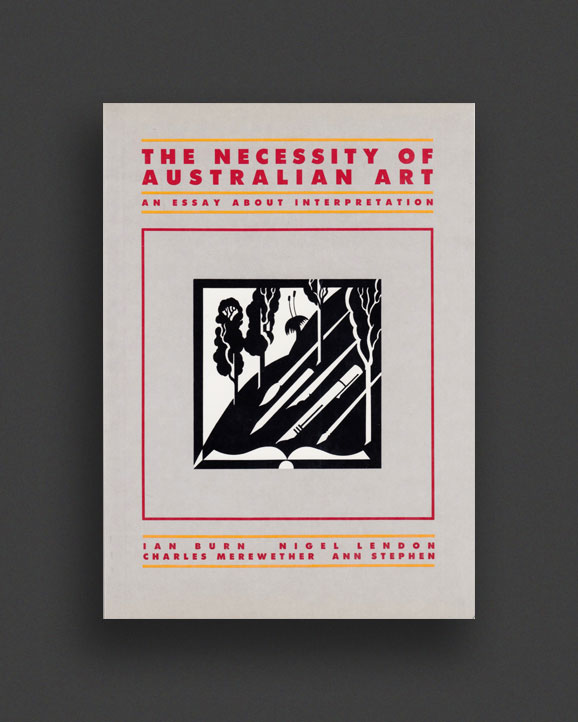
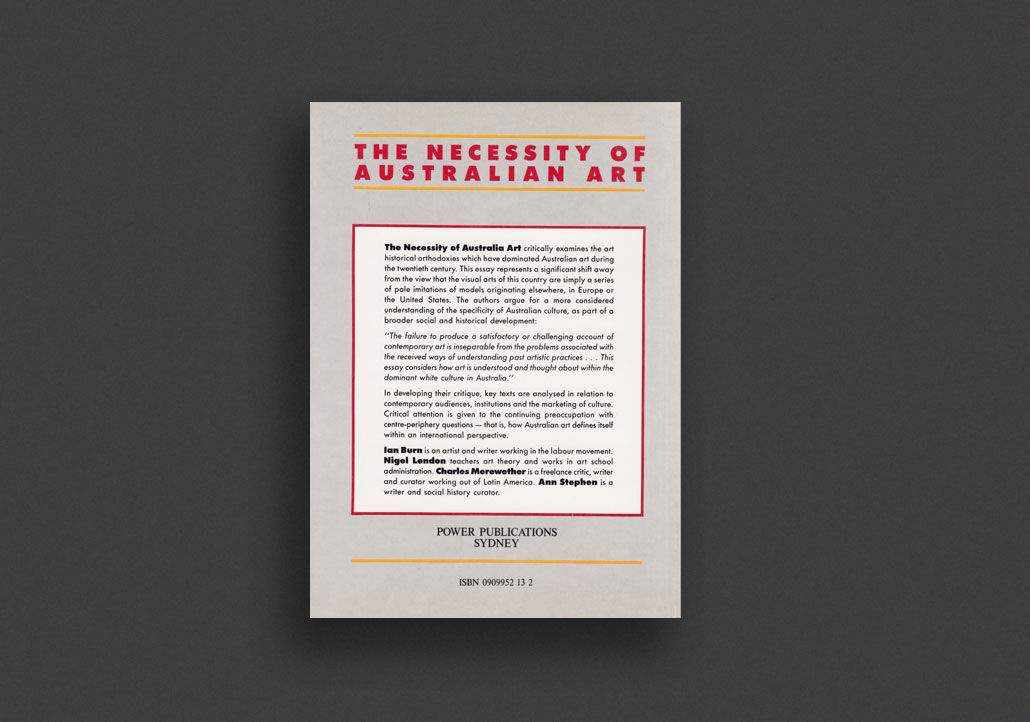
The Necessity of Australian Art : An Essay About Interpretation by Ian Burn, Nigel Lendon, Charles Merewether and Ann Stephen critically examines the art historical orthodoxies which have dominated Australian art during the twentieth century.
2023, English
Softcover (in sealed cardboard case), 110 pages, 30 x 22 mm
Ed. of 300,
Published by
Guzzler / Rosanna
$50.00 - In stock -
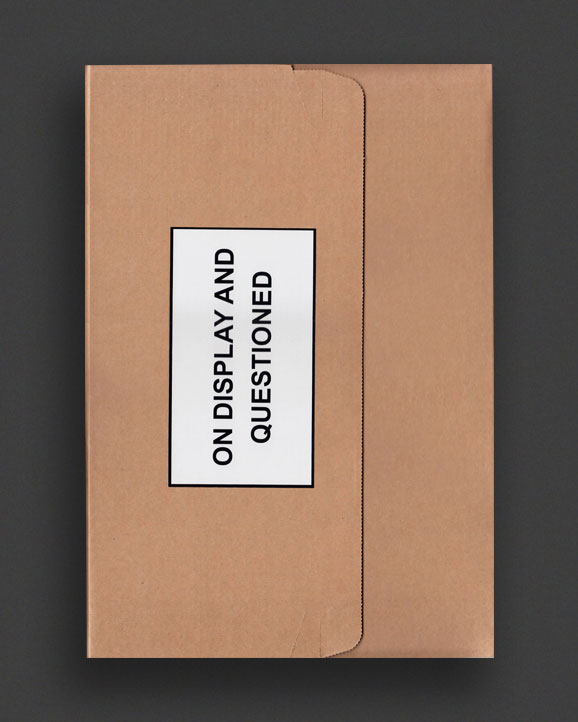
On Display and Questioned : Two exhibitions by Alex Vivian; two interviews with Alex Vivian, 2022, published in a limited edition of 300 copies, each sealed in cardboard mailer. Illustrated throughout with colour plates cataloguing the Victorian exhibitions FIEND? 5–20.12.2020, Guzzler, Rosanna and Porn: squared, hung, drawn, quartered. 11.3–2.4.22, Centre D’editions Melbourne, each accompanied by interviews with artist Alex Vivian by editor and art historian David Homewood. Designed by Alexandra Margetic; photographed by Luke Sands.
Keywords: aid; amyl nitrate; Arial; average gay male (AGM); baseball; bathhouse; condom; cricket; Futura; Genet, Jean; Gerry, Cheesemouth; Golub, Leon; Haring, Keith; Kentucky Fried Chicken (KFC); Kruger, Barbara; Lingard, Grant; Melbourne Wankers Club (MWC); Pettibon, Raymond; pornography; rugby; smegma; Treasury Gardens.
2023, English
Softcover, 152 pages, 17.5 x 11 cm
Published by
Index Journal / Melbourne
$30.00 - Out of stock
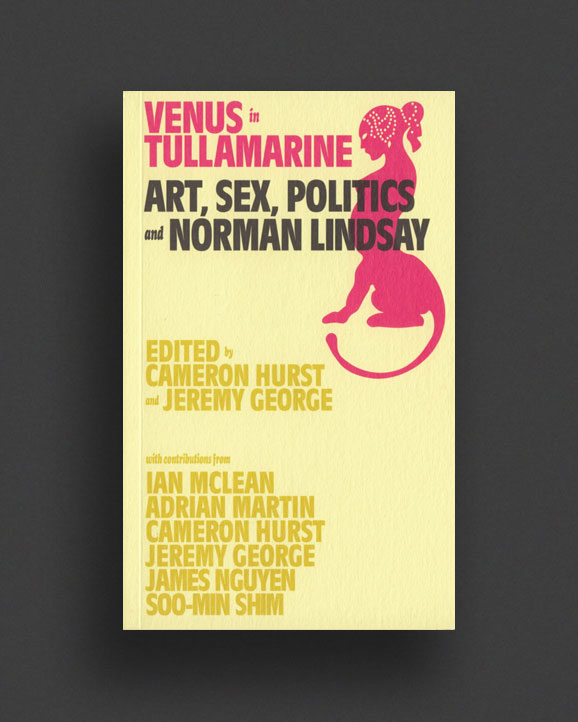
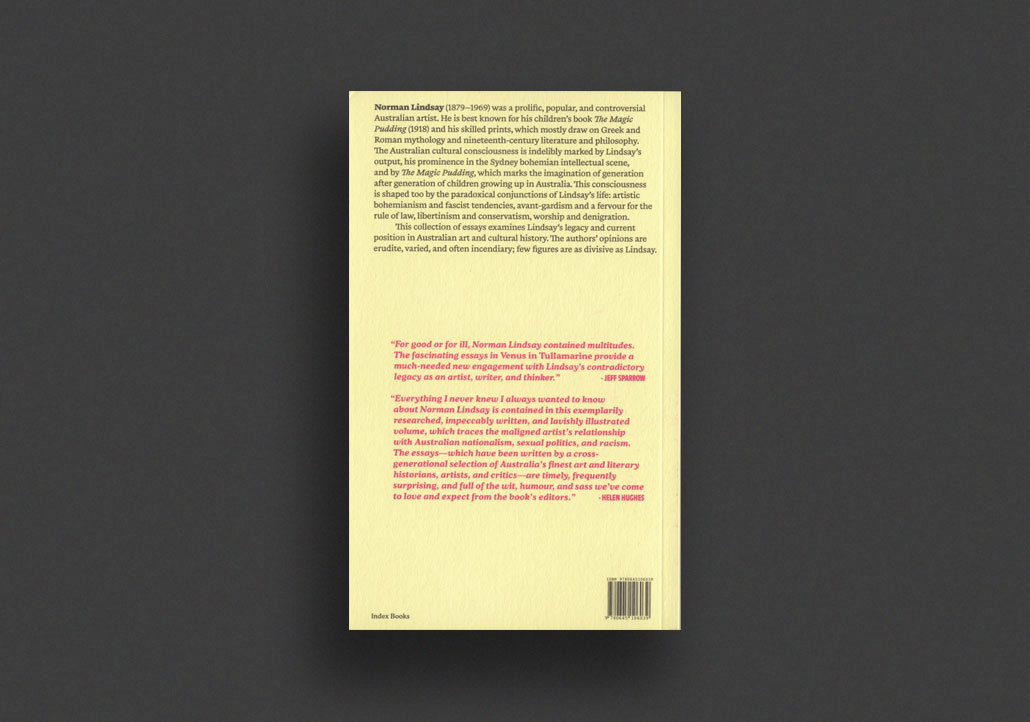
Norman Lindsay (1879–1969) was a prolific, popular and controversial Australian artist. He is best known for his children’s book The Magic Pudding and his skilled prints, which mostly draw on Greek and Roman mythology and nineteenth century literature and philosophy. The Australian cultural consciousness is indelibly marked by Lindsay’s output, his prominence in the Sydney bohemian intellectual scene and by The Magic Pudding, which entrances the imagination of generation after generation of Australian children. This consciousness is marked too by the paradoxical conjunctions of Lindsay’s life: artistic bohemia and fascistic tendencies, avant-gardism and a fervour for the rule of law, libertinism and conservatism, worship and denigration.
This collection of essays examines Lindsay’s current position in Australian art history. The authors’ opinions are erudite, varied and often incendiary; few figures are as divisive as Lindsay.
Film critic Adrian Martin writes alongside Ian McLean, the Hugh Ramsay Chair of Australian Art History at the University of Melbourne, art historian Cameron Hurst, and literary critic Jeremy George. Art historian Soo-Min Shim responds to a video work by artist James Nguyen.
The project develops research conducted during an exhibition of the University of Melbourne’s Norman Lindsay collection, also titled Venus in Tullamarine, held at the George Paton Gallery in 2022.
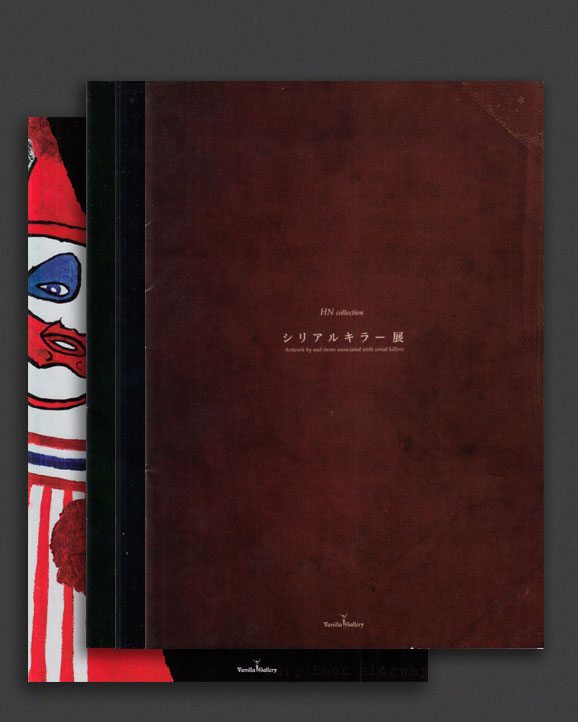
2016/2017, Japanese
3 softcover publications (staple-bound), plus flyer, 70 pages, 26 x 18 cm
1st Edition, Out of print title / used / very good
Published by
Vanilla Gallery / Tokyo
$160.00 - Out of stock
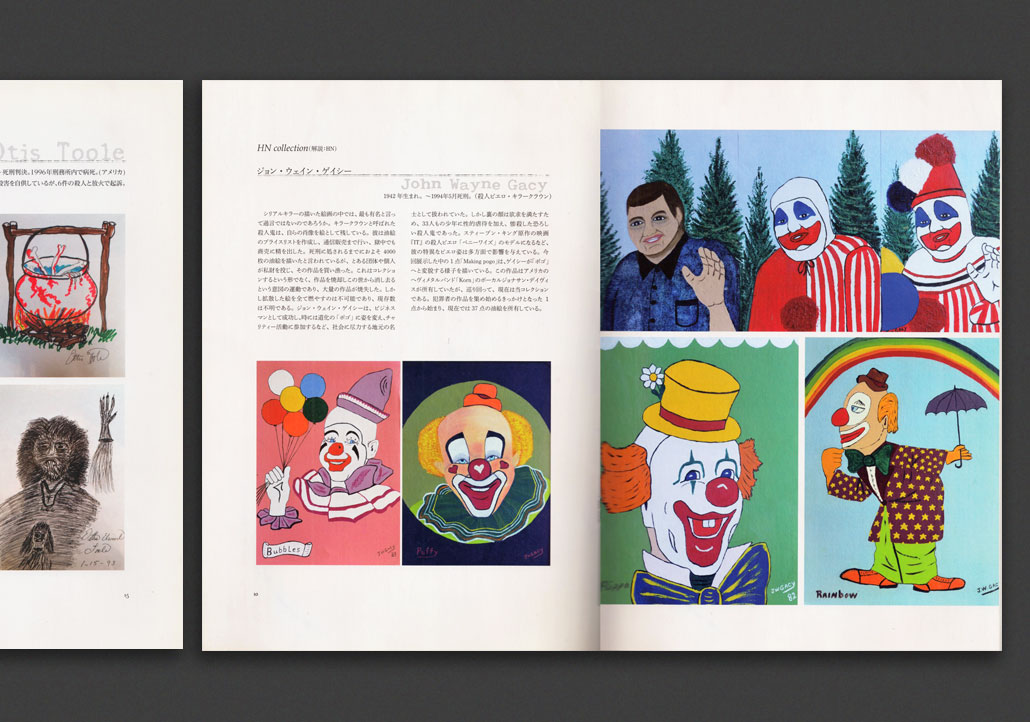
Rare collected documents from the first exhibitions of Serial Killer Art at Vanilla Gallery, Ginza, Tokyo, in 2016 and 2017, from the HN collection. From John Wayne Gacy, Ed Gein, Ted Bundy, Henry Lee Lucas, and Ronnie Clay, these exhibitions featured artworks, self-portraits, letters, and documents of serial killers in Europe and America whose heinous personalities and numerous crimes have served as models for novels and films, becoming known the world over.
"The world portrayed by murderers who committed crimes that make you want to look away is like a dreadful, lonely, impermanent feeling that looks into the depths of the viewer's heart, and is like when confronted with something unknown. It's full of tension."
Collected by Mr. HN (H. Nakajima), over 200 items were displayed in Tokyo on the occasion of these exhibits, with these pamphlets available at the exhibitions only. Illustrated with examples throughout in colour and b/w, texts in Japanese by film critic Kiichirō Yanashita, Orihara Ichi, and collector/curator H. Nakajima.
Killers included in the exhibitions: John Wayne Gacy, Henry Lee Lucas, Peter Sutcliffe, Danny Rowling, Keith Jasperson, James Earl Ray, Thomas Pitera, Henry Hill, Nicholas Crowe, Dorothy Puente, Haddon Clarke, Gerald Shaffer, Anthony Shore, James Munro, Gary Ray Balls, Hudson Graham, Carroll Bundy, Otis Toole, Charles Watson, Lawrence Bittaker, Herbert Mullin, Arthur Shawcross, Rod Ferrell, Ted Bundy, Jim Jones, Christa Pike, Harvard Baumeister, David Berkowitz, Richard Ramirez, Ronnie Clay, Irene Wuornos, Wayne Low, Dana Sue Gray, Roy Norris, Kenneth Bianchi, Michael Alig, Veronica Compton, Joe Roy Metheny, Gary Heidnik, Charles Manson, Jeremy Jones, Jack Trawick, Carl Drew, Wayne Harton, Rosemary West, Theodore Kaczynski, Thomas Heyer, Ed Gein, Ferrell Mykers, Douglas Clark, Richard Clarey, Ian Brady, Jack Kevorkian, Bonnie & Clyde, Philip Jacobinski, Daniel Siebert, Tommy Lynn Sells.
Very Good with only light wear. Includes flyer for the 2017 exhibition, folded as issued.
2022, English
Hardcover (w. dust jacket), 69 pages, 22 × 25.5 cm
Published by
Walther König / Köln
$70.00 - Out of stock
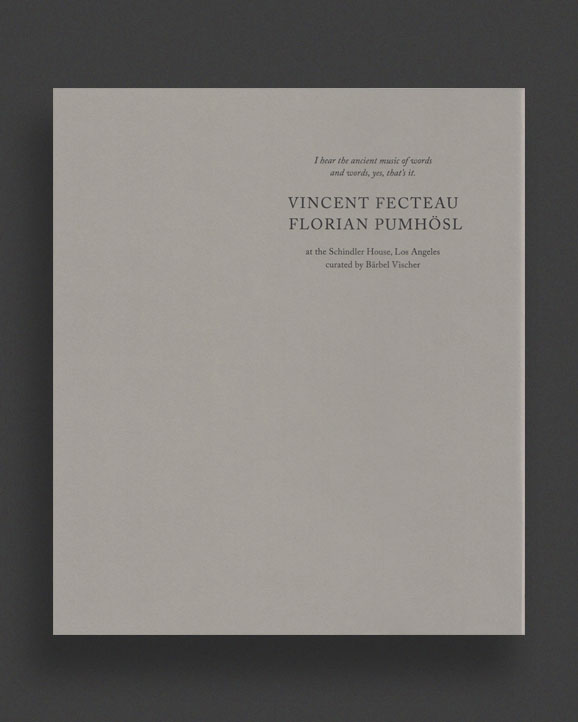
Hardcover catalogue published on the occasion of the exhibition "I hear the ancient music of words and words, yes, that’s it.", curated by Bärbel Vischer at the Schindler House/MAK Center for Art and Daniel Buchholz, Berlin. Designed by Florian Pumhösl and contains images of the installation at Schindler House and documentation of the exhibited works along with an introductory text by MAK curator Bärbel Vischer and a conversation between Vincent Fecteau and Florian Pumhösl.
Set against the context of modernity, the exhibition examines the relationship of images, objects, and legacies of abstraction. Together, the artists Vincent Fecteau and Florian Pumhösl orchestrate a dialogue between pictorial and three-dimensional work, studio production, and the architectural setting of the Schindler House as it relates to aspects of materiality, surface, pattern, color, and light.
The title of the exhibition, I hear the ancient music of words and words, yes, that’s it., quotes the Brazilian writer Clarice Lispector, echoing the intimate sense she generated in her writing and corresponding to space, moods, and history. The exhibition, evolving in Rudolph M. and Pauline Schindler’s former studio and residence, includes objects from their private collections and work studies by both artists. Fecteau and Pumhösl evoke an exchange with their studios and focus on inventories, studies, attempts, materials, and snapshots of production that lead to imaginative leaps in which we can follow blurred lines and raw edges of modern art from today’s perspective.
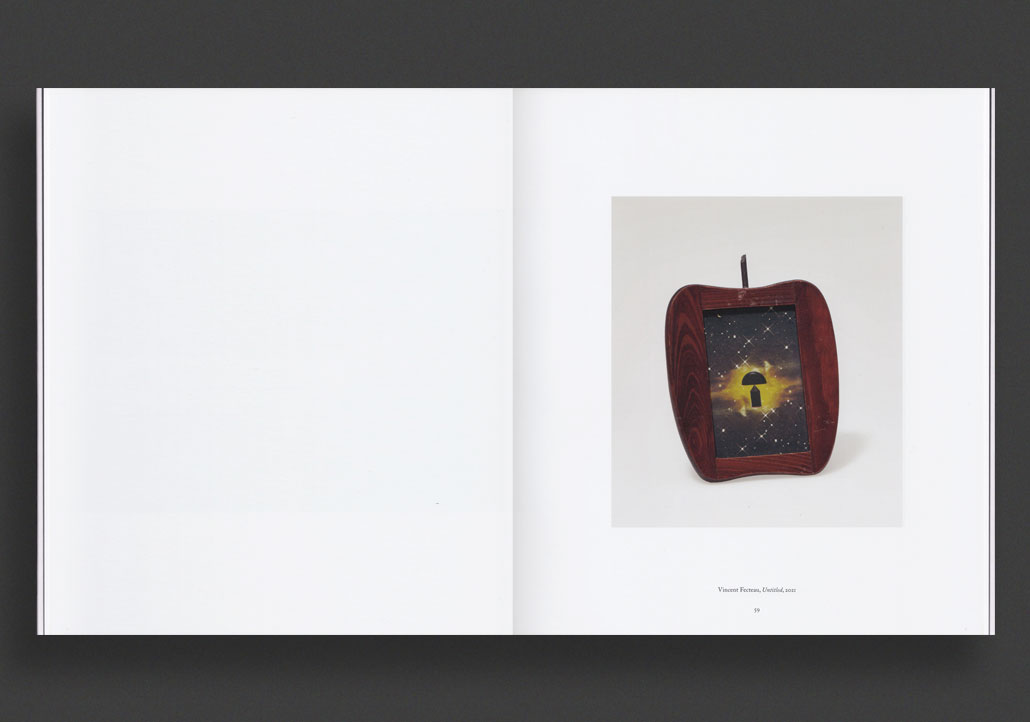
Vincent Fecteau (b. 1969) is a San Franciscan based artist who produces sculptures of various materials including papier-mâché, cardboard, resin clay. Often described as abstract, their forms and colors, symbolic fragments of architecture, and found objects engage with representation, specifically photography and its depiction of space. For this exhibition, Fecteau interweaves digital photographic images with collages. Loosely arranged, and integrating furniture pieces they interlink sculpture and architecture. Everyday objects, architectural structures, mass media artifacts, and impressions of social interaction build a momentum in the setting of a communal home. He is interested in the atmosphere of the rooms and living spaces. There are images the artist has collected as well as images he has taken over the years. Fecteau likes the idea of showing them as one would family photos, in a series of arrangements throughout the house. The display creates a narrative between ideas and reality. He thinks of these photographic works – snapshots – as sculptures deployed in the architecture. Patterns and shapes, curved elements, expressive forms, architectonical surfaces, found objects, and the play of color define his photograph-as sculpture works.
Florian Pumhösl (b. 1971) currently lives and works in Vienna. He contextualizes the abstraction of images, materials, and forms by mediating contemporaneity in the history of crafts and objecthood. His matrix of works combines the quality of the graphic picture and the presence of paintings, expanding the boundaries of their medium and material – like sheets of steel, aluminum, and lead or ceramics and casts of plaster – as well as the ephemerality of color and light. In his studio archive, Pumhösl keeps a large selection of works, which mark the process of thought, image, and production. Interested in the deformation of the pictorial space, Pumhösl is aware of the ambiguity of the memory of materials. Forms, shapes, and cut-outs relate as negative forms to warped reliefs. Found roofing material, as models, led him to studies in lead foil. These works are made of folded lead sheets, with small irregularities in their angles and shapes. Defined by singular construction and its repetition, some of the constellations and compositions appear like textile fragments (and are engendered by that association). Pumhösl painted the works in a range of uncommon pigments: a ‘rusty red’ addresses the iron oxide-base of the material, black creates an infinite depth, and shades of blue and white enhance the idea of abstraction, balance, and space.
2023, English
Hardcover, 240 pages, 30 x 20 cm
Published by
Edition Patrick Frey / Zürich
$109.00 - In stock -
Matthias Groebel's activities in the late ’80s sound more like the plot of a cyberpunk novel than like a sober account of a serious artist’s professional practice: he spent those years rummaging around in electronic waste dumps in Münster, Germany, in search of windshield wiper and photocopier motors, bicycle chains and other parts to use in constructing a three-axle painting machine capable of painting according to his specifications. Meanwhile, he was also fiddling with parabolic antennas in order to catch signals from far, far away. Over the next decade, Groebel spent countless nights changing the channels, rummaging around this time around for TV stills to paint with the aid of his computer-controlled machine.
The upshot is a series of paintings that anticipated technocultural developments and plumbed the collective psychological depths of satellite television and mass media. This book is the first comprehensive exposition of Groebel's remarkable machine paintings from 1989 to 2001, along with two essays about Groebel’s unusual work.
Text by Sadie Plant.
Matthias Groebel (born 1958 in Aachen) is a German artist based in Cologne. He worked with photography, video and digital image processing, using different devices made or modified by himself. Since 1989 he has been working with a computer-controlled painting machine. From 2010 to 2020, Groebel published and exhibited works under a pseudonym.
2019, English
Softcover, 576 pages, 12.5 x 19 cm
Published by
Primary Information / New York
$54.00 - Out of stock
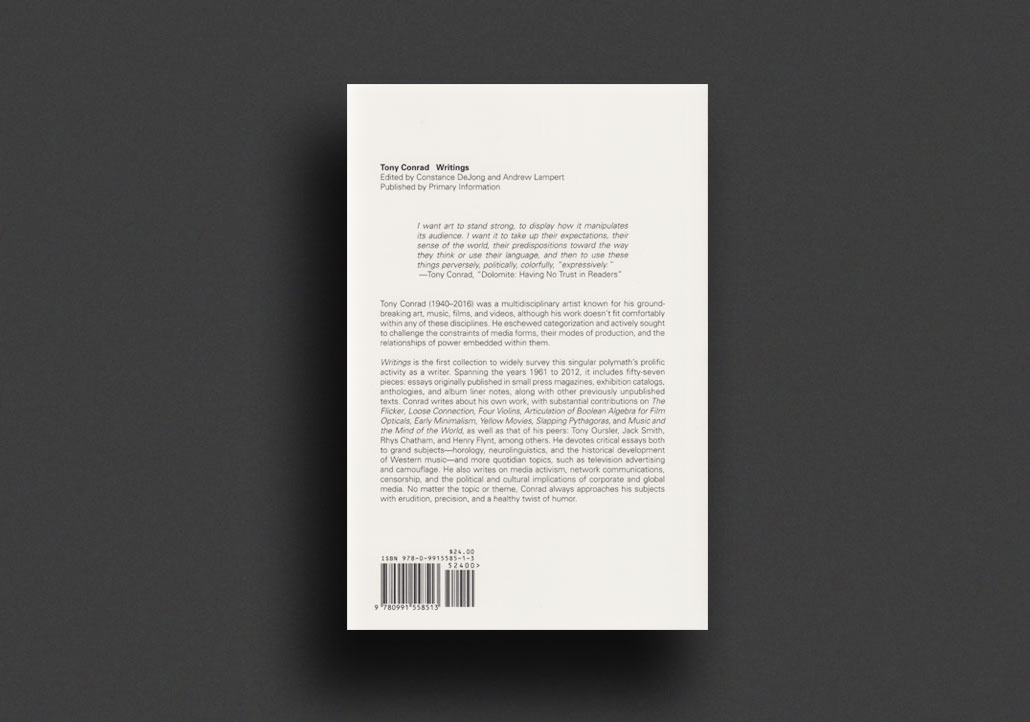
I want art to stand strong, to display how it manipulates its audience. I want it to take up their expectations, their sense of the world, their predispositions toward the way they think or use their language, and then to use these things perversely, politically, colorfully, “expressively.”
—Tony Conrad, “Dolomite: Having No Trust in Readers”
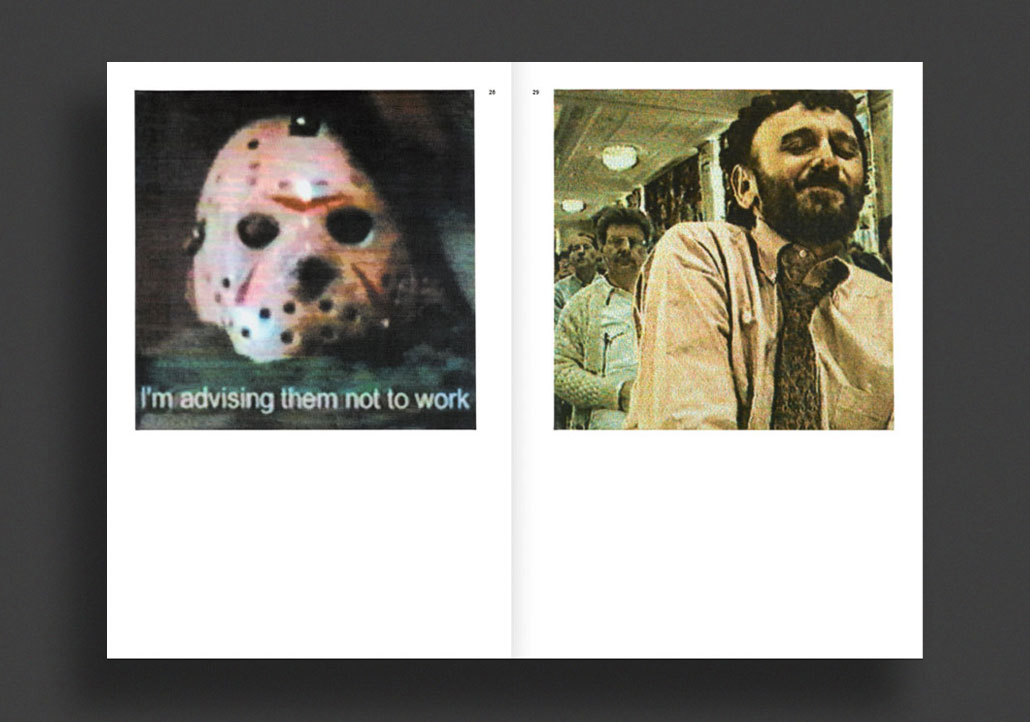
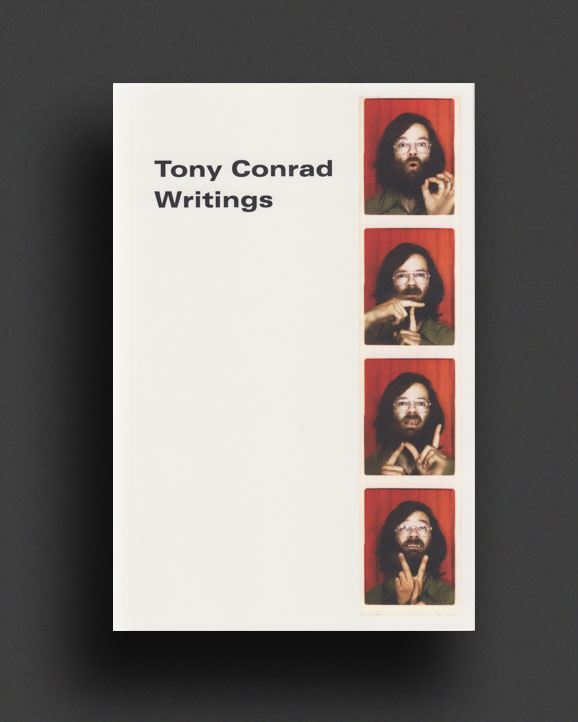
Writings is the first collection to widely survey this singular polymath’s prolific activity as a writer. Edited by artists Constance DeJong and Andrew Lampert, the book spans the years 1961 – 2012 and includes fifty-seven pieces: essays originally published in small press magazines, exhibition catalogs, anthologies, and album liner notes, along with other previously unpublished texts. Conrad writes about his own work, with substantial contributions on The Flicker, Loose Connection, Four Violins, Articulation of Boolean Algebra for Film Opticals, Early Minimalism, Yellow Movies, Slapping Pythagoras, and Music and the Mind of the World, as well as that of his peers: Tony Oursler, Jack Smith, Rhys Chatham, and Henry Flynt, among others. He devotes critical essays both to grand subjects—horology, neurolinguistics, and the historical development of Western music—and more quotidian topics, such as television advertising and camouflage. He also writes on media activism, network communications, censorship, and the political and cultural implications of corporate and global media. No matter the topic or theme, Conrad always approaches his subjects with erudition, precision, and a healthy twist of humor.
Tony Conrad (1940–2016) was a multidisciplinary artist known for his groundbreaking art, music, films, and videos, although his work doesn’t fit comfortably within any of these disciplines. He eschewed categorization and actively sought to challenge the constraints of media forms, their modes of production, and the relationships of power embedded within them.
Re-print.
1984, German
Softcover, 78 pages (w. fold-outs), 42 x 30 cm
1st Edition, Out of print title / used / very good
Published by
Edition C / Zürich
$180.00 - Out of stock
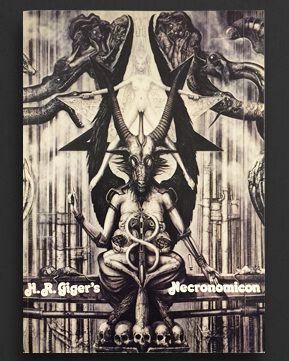
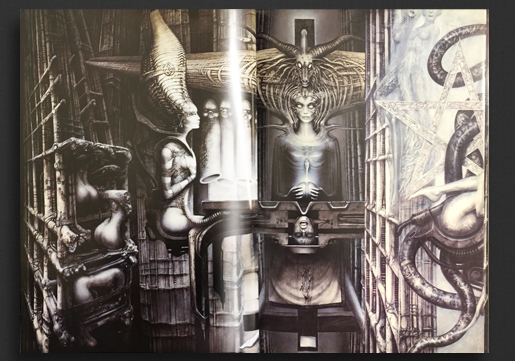
With an introduction by Clive Baker and numerous texts by HR Giger as well as texts by Fritz Billeter and Simon Vinkenoog and a tribute from Salvador Dali.
"The "Necronomicon" is a legendary magical book that is kept in inaccessible places only in a few, incompletely preserved specimens because it could have disastrous consequences if it fell into the wrong hands. It was written down around 730 AD in Yemen by the legendary Abdul Al Azred. It is said to tell of things and events that took place in the gray age, and illustrations of uncanny creatures lurking in the depths of the earth and the seas, one day destroying mankind and striking the world.
Al Azred's "Necronomicon" is a kind of museum of the most wonderful abominations and perversions. The well-known writer HP Lovecraft was the first to report in his "Cthulhu" mythology of this work. Many other science fiction and fantasy writers have quoted this fictional work time and again, but it has only become a visual reality in "HR Giger's Necronomicon"!"
"Giger always opens up new approaches to the origins of our psyche," writes Clive Baker in his foreword. "He is planning for us to go, encouraged by the knowledge that others have gone before this path, and only a few artists are able to give such impulses, and if we follow Giger, we are initially afraid of our mental health. And quickly recognize that the supposed new territory has countless stations that are connected with our familiar life. For, after all, we are no strangers: Giger points the direction into the world in which we must return, where we pledge our pledge, to pay the tithes which we owe. Giger's world is the place of our own taboos, and only our own disregard makes him appear frightening, sullen, "alien" (alien). (...) Giger's work calls us to the common ground of the unconscious, where, though we sometimes alienate ourselves from it, we are never really strangers. In other words, HR Giger's fantastic art is calling us home."
Beginning with a hommage from Salvador Dali, the first in this series of oversized and visually overwhelming volumes takes us through the early history of one of the most brilliant fantasy artists of the century. From his "Passegen" series, his work for theatre, posters, album artwork, environments, personal works, is designs for Alejandro Jodorowsky's DUNE, and much more, all beautifully reproduced in full-colour and black and white, full-bleed spreads, including fold-out pages. These Giger folio books have become very desirable, collectable editions in their various printings around the world, the series encompassing the work of one of the world's most unique and influential visionaries.
This is the first Swiss edition, published by Edition C.
Very Good copy.