World Food Books' programme is largely produced on Kulin Nation land. We acknowledge the Wurundjeri people of the Kulin Nation as the first and continuing custodians of this land, and pay respect to their Elders past, present, and emerging.
World Food Books is an arts and special interests bookshop in Naarm / Melbourne. Founded in 2010, World Food Books is devoted to the presentation of a rotating, hand-selection of international art, design, literary and counterculture publications with an emphasis on the anti-traditional, the experimental, the avant-garde, the heretic, the marginal.
Presenting new titles alongside rare and out-of-print books, catalogues and journals spanning the fields of modern and contemporary art, design, photography, illustration, film, literature, poetry, cultural theory, philosophy, sexuality, popular and underground culture in its many radical forms, World Food Books wishes to encourage adventurous, thoughtful and open-minded reading, looking, writing, and exchange of publishing and ideas, both current and historical.
As well as our bookshop, located in Melbourne's historical Nicholas Building, all of our inventory is available internationally via our online mail-order service.
World Food Books semi-regularly co-ordinates "Occasions", a programme of exhibits and events at the bookshop and in partnership with other hosts (such as museums and art galleries) that develop out of the activities, relationships and content of the bookshop itself.
World Food Books
The Nicholas Building
37 Swanston Street
Room 5, Level 6
Melbourne 3000
Australia
SHOP HOURS:
THU–SAT 12–6
WEB-SHOP OPEN 24/7
World Food Books
Postal Address:
PO Box 435
Flinders Lane
Victoria 8009
Australia
info@worldfoodbooks.com
Art
Theory / Essay
Architecture / Interior
Graphic Design / Typography
Photography
Fashion
Eros
LGBTQ+
Fiction / Poetry
Weird / Speculative / Science Fiction / Horror
Transgressive / Visceral / Abject
Symbolism / Decadence / Fin de siècle
Film / Video
Painting
Sculpture / Installation
Performance / Dance / Theater
Drawing
Sound / Music
Curatorial
Group Shows / Collections
Periodicals
Out-of-print / Rare
Posters / Ephemera / Discs
Signed Books
World Food Books Gift Voucher
World Food Book Bag
Australian Art
Australian Fiction
Australian Science Fiction / Speculative Fiction
Australian Poetry
Australian Photography
Japanese Photography
Conceptual Art
Minimal Art
Dada
'Pataphysics / Oulipo
Fluxus
Concrete Poetry
Pop Art
Surrealism
Arte Povera
Arte Informale / Haute Pâte / Tachism
Nouveau Réalisme / Zero / Kinetic
Situationism / Lettrism
Collage / Mail Art / Xerox Art
Art Brut / Folk / Visionary / Fantastic
Illustration / Graphic Art / Bandes Dessinées
Furniture
Italian Radical Design / Postmodernism
Textiles
Ceramics / Glass
Counterculture
Protest / Revolt
Philosophy
Psychoanalysis
Anthropology
Anarchism
Socialism / Anarchism / Communism / Capitalism
Literary Theory / Semiotics / Language
Feminism / Women's Studies
Gender Studies / Sexuality
Anthropology
Fetishism / BDSM
Drugs / Psychedelia
Crime / Violence
Animal Rights / Veganism
Occult / Esoterica
Ecology / Earth / Alternative Living
Whole Earth / Crafts
All prices in AUD (Australian dollars)
Pick-Ups
Pick-up orders can be collected in our bookshop during opening hours after order date. Please collect any Pick-up orders within 2 weeks of ordering as we have limited storage space. Orders will be released back into stock if not collected within this time. No refunds can be made for pick-ups left un-collected. If you cannot make it in to the bookshop in this time-frame, please choose postage option.
Return Policy
All sales are final. We do accept returns (for refund or exchange) for items received in error. All our orders are packed with special care using heavy-duty padding and cardboard book-mailers or bubble mailers (for smaller books), using reinforcement where required. We cannot take responsibility for any lost, stolen or damaged parcels.
Insurance
Should you wish to insure your package, please email us directly after placing your order and we can organise this at a small extra expense. Although all standard/express tracked packages are very safe and dependable, we cannot take responsibility for any lost, stolen or damaged parcels. We recommend insurance on valuable orders.
Interested in selling your old books, catalogues, journals, magazines, comics, fanzines, ephemera? We are always looking for interesting, unusual and out-of-print books to buy. We only buy books in our fields of interest and specialty, and that we feel we can resell.
We base these prices on desirability, market value, in-print prices, condition and our current stock levels. We offer cash, store credit, and can take stock on consignment. All
about 25% of the price we expect to get when we sell them, or 30% in store credit. We base these prices on desirability, market value, in-print prices, condition and our current stock levels.
Sell your books any day of the week. You can drop them off and return later. If you have a lot of books, we can visit your Sydney home.
We buy books that we feel we can resell. We offer about 25 % of the price we expect to get when we sell them, or 30% in store credit. We base these prices on desirability, market value, in-print prices, condition and our current stock levels.
Philadelphia Wireman
03 August - 01 September, 2018
World Food Books is proud to announce our next Occasion, the first presentation of sculptures by Philadelphia Wireman in Australia.
The Philadelphia Wireman sculptures were found abandoned in an alley off Philadelphia’s South Street on trash night in 1982. Their discovery in a rapidly-changing neighbourhood undergoing extensive renovation, compounded with the failure of all attempts to locate the artist, suggests that the works may have been discarded after the maker’s death. Dubbed the "Philadelphia Wireman" during the first exhibition of this work, in 1985, the maker’s name, age, ethnicity, and even gender remain uncertain. The entire collection totals approximately 1200 pieces, all intricately bound together with tightly-wound heavy-gauge wire (along with a few small, abstract marker drawings, reminiscent both of Mark Tobey and J.B. Murry). The dense construction of the work, despite a modest range of scale and materials, is singularly obsessive and disciplined in design: a wire armature or exoskeleton firmly binds a bricolage of found objects including plastic, glass, food packaging, umbrella parts, tape, rubber, batteries, pens, leather, reflectors, nuts and bolts, nails, foil, coins, toys, watches, eyeglasses, tools, and jewellery.
Heavy with associations—anthropomorphic, zoomorphic, and socio-cultural responses to wrapped detritus—the totemic sculptures by Philadelphia Wireman have been discussed in the context of work created to fulfil the shamanistic needs of alternative religions in American culture. Curators, collectors, and critics have variously compared certain pieces to sculpture from Classical antiquity, Native American medicine bundles, African-American memory jugs, and African fetish objects. Reflecting the artist’s prolific and incredibly focused scavenging impulse, and despite—or perhaps enhanced by—their anonymity, these enigmatic objects function as urban artefacts and arbiters of power, though their origin and purpose is unknown. Philadelphia Wireman, whatever their identity, possessed an astonishing ability to isolate and communicate the concepts of power and energy through the selection and transformation of ordinary materials. Over the course of the past two decades, this collection has come to be regarded as an important discovery in the field of self-taught art and vernacular art.
Presented in collaboration with Fleisher-Ollman Gallery, Philadelphia, and Robert Heald, Wellington.
Susan Te Kahurangi King
02 February - 10 March, 2018
Susan Te Kahurangi King (24 February 1951 - ) has been a confident and prolific artist since she was a young child, drawing with readily available materials - pencils, ballpoint pens and felt-tip markers, on whatever paper is at hand. Between the ages of four and six Susan slowly ceased verbal communication. Her grandparents William and Myrtle Murphy had developed a special bond with Susan so they took on caring responsibilities for extended periods. Myrtle began informally archiving her work, carefully collecting and storing the drawings and compiling scrapbooks. No drawing was insignificant; every scrap of paper was kept. The King family are now the custodians of a vast collection containing over 7000 individual works, from tiny scraps of paper through to 5 meter long rolls.
The scrapbooks and diaries reveal Myrtle to be a woman of great patience and compassion, seeking to understand a child who was not always behaving as expected. She encouraged Susan to be observant, to explore her environment and absorb all the sights and sounds. Myrtle would show Susan’s drawings to friends and people in her community that she had dealings with, such as shopkeepers and postal workers, but this was not simply a case of a grandmother’s bias. She recognised that Susan had developed a sophisticated and unique visual language and sincerely believed that her art deserved serious attention.
This was an unorthodox attitude for the time. To provide some context, Jean Dubuffet coined the term Art Brut in 1945 to describe work created by self-taught artists – specifically residents of psychiatric institutions and those he considered to be visionaries or eccentrics. In 1972 Roger Cardinal extended this concept by adopting the term Outsider Art to describe work made by non-academically trained artists operating outside of mainstream art networks through choice or circumstance. Susan was born in Te Aroha, New Zealand in 1951, far from the artistic hubs of Paris and London that Dubuffet and Cardinal operated in. That Myrtle fêted Susan as a self-taught artist who deserved to be taken seriously shows how progressive her attitudes were.
Susan’s parents Doug and Dawn were also progressive. Over the years they had consulted numerous health practitioners about Susan’s condition, as the medical establishment could not provide an explanation as to why she had lapsed into silence. Dawn educated herself in the field of homeopathy and went on to treat all twelve of her children using these principles – basing prescriptions on her observations of their physical, mental and emotional state.
Doug was a linguist with an interest in philosophy who devoted what little spare time he had to studying Maori language and culture. To some extent their willingness to explore the fringes of the mainstream made them outsiders too but it was their commitment to living with integrity and their respect for individuality that ensured Susan’s creativity was always encouraged.
Even though Susan’s family supported her artistic pursuits, some staff in schools and hospitals saw it as an impediment to her assimilation into the community and discouraged it in a variety of ways. Her family was not always aware of this and therefore did not fully understand why Susan stopped drawing in the early 1990s. However, rather than dwell on the challenges that Susan faced in pursuit of her artistic practice, they prefer to highlight her achievements. In 2008 Susan began drawing again in earnest, after an almost 20 year interruption, and her work is now shown in galleries around the world.
Susan grew up without television and has been heavily influenced by the comics she read as a child. She is absolutely fearless in the appropriation of recognizable characters, such as Donald Duck and Mickey Mouse, in her work. She twists their limbs, contorts their faces, compresses them together, blends them into complex patterned backgrounds - always imbuing them with an incredible energy. Although Susan often used pop culture characters in her work they are not naive or childlike. These are drawings by a brilliant self-taught artist who has been creating exceptional work for decades without an audience in mind.
Mladen Stilinović
"Various Works 1986 - 1999"
02 February 16 - September 10, 2016
Various works 1986 - 1999, from two houses, from the collections of John Nixon, Sue Cramer, Kerrie Poliness, Peter Haffenden and Phoebe Haffenden.
Including: Geometry of Cakes (various shelves), 1993; Poor People’s Law (black and white plate), 1993; White Absence (glasses, ruler, set square, silver spoon, silver ladel with skin photograph and wooden cubes), 1990-1996; Exploitation of the Dead (grey and red star painting, wooden painting, black spoon with red table, red plate), 1984-1990; Money and Zeros (zero tie, paintings made for friends in Australia (Sue, John, Kerrie), numbers painting), 1991-1992; Words - Slogans (various t-shirts) - “they talk about the death of art...help! someone is trying to kill me”, “my sweet little lamb”, “work is a disease - Karl Marx”; Various artist books, catalogues, monographs, videos; Poster from exhibition Insulting Anarchy; "Circular" Croatian - Australian edition; Artist book by Vlado Martek (Dostoyevsky); more.
Thanks to Mladen Stilinović and Branka Stipančić.
Jonathan Walker
Always Will Need To Wear Winter Shirt Blue + Ochre Small Check Pattern
21 August - 21 September, 2015
Untitled
I am not a great reader of poetry but I always return to the work of Melbourne poet, Vincent Buckley (1925- 1988). Perhaps I find his most tantalising piece to be not a finished poem but a fragment left on a scrap of paper discovered on his desk after the poet’s death.
The poetry gathers like oil
In the word-core, and spreads
It has its music meet,
Its music is in movement.
This fragment is more the shell left behind from a volatile thought than a finished poem. I find the last two lines honest but awkward whereas the first two lines work like an arrow. Most likely he could not find a resolution so it was left. Still, in its present form, it remains an eloquent testimony to the ultimate failure of a medium to express mobile thought and sensation, in Buckley’s case, through verbal language. It’s an important matter because this is something all artists have to deal with regardless of the medium.
I have never written a poem, however, I am forever copying fragments from books on paper scraps in a vain effort to fix certain notions in my head. At first, they function as bookmarks that are sometimes returned to when I open the book. But before long, as they accumulate, they fall out littering the table interspersed with A4 photocopies, bills, books and medications.
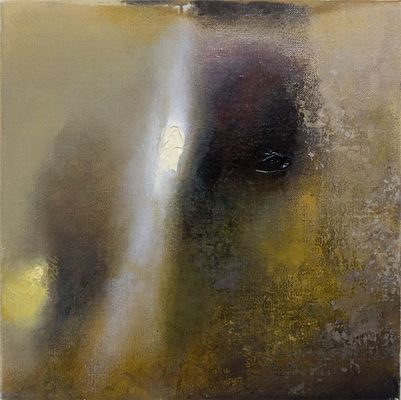
To return to Buckley’s fragment, the first two lines very much evoke how I paint nowadays. As you age, detail diminishes and patches of light become more luminous and float. I feel the most honest way of dealing with this is by smearing the oil paint on the canvas with the fingers and working close-up, blind. Only if the patches coalesce into an approaching image can the work gain a life.
-
Jonathan Walker was born in Melbourne, Australia and brought up on a dairy farm in Gippsland. In the 1970’s he studied painting at RMIT and won the Harold Wright Scholarship to the British Museum, London. During the 1980’s he exhibited at Pinacotheca Gallery, Richmond and had work shown at the NGV and Heidi City Art Gallery. Over the same period he designed the cover for the “Epigenesi” LP by Giancarlo Toniutti, Italy and conducted a mail exchange work with Achim Wollscheid, Germany. The work with artists through the post resulted in an article published in the bicentenary issue of Art and Australia 1988. He showed in artist run spaces such as WestSpace in the 90’s and 2000’s, and until 2012, taught painting at Victoria University, which is where we (Colleen Ahern and Lisa Radford) as organisers of the exhibition, among many others, had the privilege of being his student.
Walker’s knowledge was imparted to students through the careful selection of music, literature, and artists found in books that he himself had ordered for the library. Walker’s strategy was the generosity of sharing his vast knowledge with references specific to each student and their context.
Walker’s paintings share a similar focus and intimacy.
This exhibition presents a small selection of recent paintings alongside a publication that includes Walker’s writing. Observational and analytical, Walker’s work is a type of material notation — the time of day, colour and how it is blended, the both specific and fleeting location of a reflection on lino or the question of whether a chair leg should be included in a painting.
Please join us on Friday August 21 between 6-8pm to celebrate the opening of the exhibition.
Curated by Colleen Ahern and Lisa Radford.
B. Wurtz
Curated by Nic Tammens
March 26 - April 4, 2015
B.Wurtz works from a basement studio in his home on Manhattan’s Lower East Side.
This local fact is attested to by the plastic shopping bags and newsprint circulars that appear in his work. As formal objects, they don’t make loud claims about their origins but nonetheless transmit street addresses and places of business from the bottom of this long thin island. Like plenty of artists, Wurtz is affected by what is local and what is consumed. His work is underpinned by this ethic. It often speaks from a neighborhood or reads like the contents of a hamper:
“BLACK PLUMS $1.29 lb.”
“Food Bazaar”
“USDA Whole Pork Shoulder Picnic 99c lb.”
“RITE AID Pharmacy, with us it’s personal.”
“H. Brickman & Sons.”
“Sweet Yams 59c lb."
Most of the work in this exhibition was made while the artist was in residence at Dieu Donne, a workshop dedicated to paper craft in Midtown. Here Wurtz fabricated assemblages with paper and objects that are relatively lightweight, with the intention that they would be easily transportable to Australia. This consideration isn’t absolute in Wurtz’s work, but was prescriptive for making the current exhibition light and cheap. Packed in two boxes, these works were sent from a USPS post office on the Lower East Side and delivered to North Melbourne by Australia Post.
Wurtz appears courtesy of Metro Pictures, New York.
Thanks to Rob Halverson, Joshua Petherick, Sari de Mallory, Matt Hinkley, Helen Johnson, Fayen d'Evie, Ask Kilmartin, Lisa Radon, Ellena Savage, Yale Union, and "Elizabeth".
John Nixon
"Archive"
December 15 - January 20, 2014
The presentation of John Nixon's archive offered a rare showcase of this extensive collection of the artist's own publications, catalogues, posters, ephemera, editions and more, from the mid 1980s onwards, alongside a selection of his artworks.
Organized by John Nixon, Joshua Petherick and Matt Hinkley.
"Habitat"
at Minerva, Sydney (organised by Joshua Petherick and Matt Hinkley)
November 15 - December 20, 2014
Lupo Borgonovo, Janet Burchill & Jennifer McCamley,
Lewis Fidock, HR Giger, Piero Gilardi, Veit Laurent Kurz,
Cinzia Ruggeri, Michael E. Smith, Lucie Stahl, Daniel Weil, Wols
Press Release:
“...It contained seven objects. The slender fluted bone, surely formed for flight, surely from the wing of some large bird. Three archaic circuitboards, faced with mazes of gold. A smooth white sphere of baked clay. An age-blackened fragment of lace. A fingerlength segment of what she assumed was bone from a human wrist, grayish white, inset smoothly with the silicon shaft of a small instrument that must once have ridden flush with the surface of the skin - but the thing’s face was seared and blackened.”
William Gibson, “Count Zero”, 1986
"Autumn Projects Archive"
Curated by Liza Vasiliou
March 6 - March 15, 2014
World Food Books, in conjunction with the Virgin Australia Melbourne Fashion Festival 2014, presented the Autumn Projects archive, consisting of a selection of early examples in Australian fashion with a particular interest in collecting designers and labels from the period beginning in the 1980’s, who significantly influenced the discourse of Australian Fashion.
Curated by Liza Vasiliou, the exhibition provided a unique opportunity to view pieces by designers Anthea Crawford, Barbara Vandenberg, Geoff Liddell and labels CR Australia, Covers, Jag along with early experimental collage pieces by Prue Acton and Sally Browne’s ‘Fragments’ collection, suspended throughout the functioning World Food Books shop in Melbourne.
H.B. Peace
presented by CENTRE FOR STYLE
November 14, 2013
"Hey Blinky, you say chic, I say same"
Anon 2013
H.B. Peace is a clothing collaboration between great friends Blake Barns and Hugh Egan Westland. Their pieces explore the divergences between 'character’ and ‘personality’ in garments....etc
Special Thanks to Joshua Petherick and Matt Hinkley of WFB and Gillian Mears
and a Very Special Thank you to Audrey Thomas Hayes for her shoe collaboration.
Janet Burchill & Jennifer McCamley
"Aesthetic Suicide"
May 10 - June 8, 2013
The first of our occasional exhibitions in the World Food Books office/shop space in Melbourne, "Aesthetic Suicide" presented a body of new and older works together by artists Janet Burchill & Jennifer McCamley, including videos, prints, a wall work, and publications.
During shop open hours videos played every hour, on the hour.
2017, English
Softcover, 106 pages, 17 x 22 cm
Ed. of 500,
Published by
Castlemaine Art Museum / Castlemaine
$35.00 - Out of stock
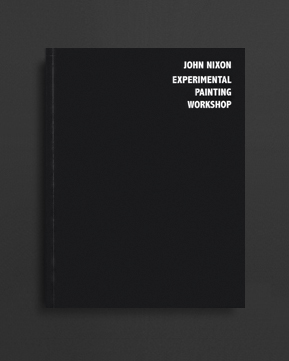
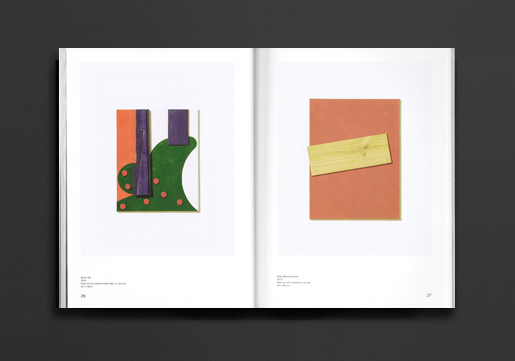
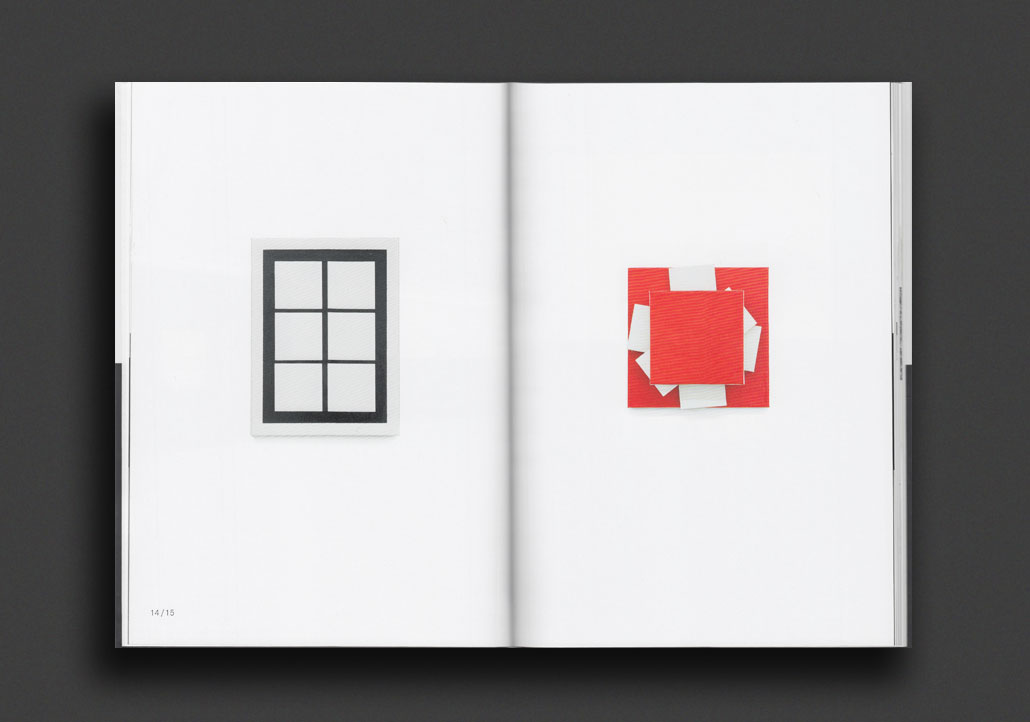
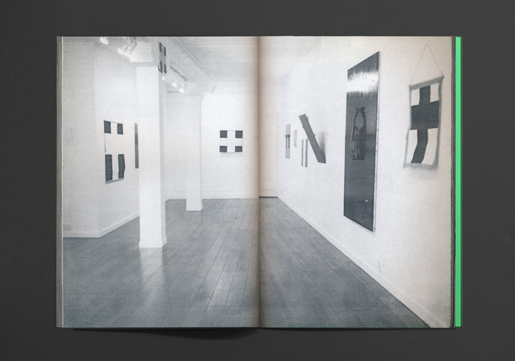
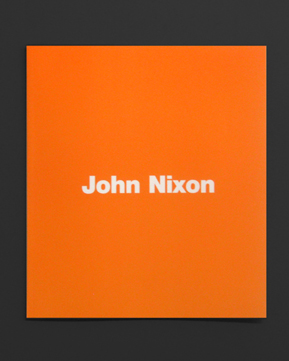
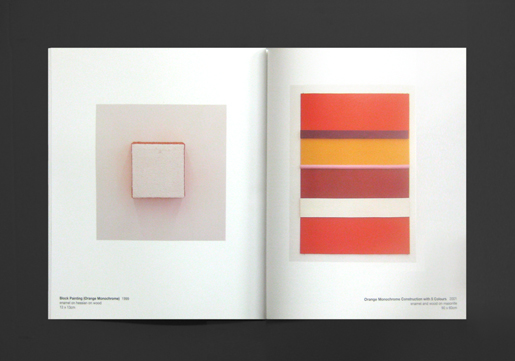
Published on the occasion of the exhibition JOHN NIXON: EPW at Castlemaine Art Museum 19 March-25 June, 2017. "This exhibition presents a recent selection from Nixon’s Experimental Painting Workshop (EPW), a project that began in London in 1978 and continues to this day. Rejecting narrative, realism and pictorialism which he sees as limitations on painting, Nixon’s EPW proposes an expanded, and expanding, definition via the principles of modernist non-objectivity, specifically, the monochrome, Minimalism and Constructivism, and dynamic approaches to their exhibition. In his employment of the ready-made object, made famous by Marcel Duchamp in the early 20th century, Nixon demonstrates an intuitive method of collecting, rationalizing and repurposing the everyday into otherwise abstract works. The en masse presentation of this exhibition is a hallmark of the EPW, offering both a spectacular experience of the whole, while also giving emphasis to individual works as evidence of the progression of Nixon’s thesis on the open-ended possibilities for painting."
Designed by Yanni Florence and John Nixon.
Photography by Christo Crocker.
Text by Emma Busowsky Cox.
Published in an edition of 500 copies.
John Nixon (b. 1949, Sydney) is one of Australia’s foremost artists. Since his first solo exhibition in Melbourne in 1973, Nixon has mounted hundreds of exhibitions in Australia, New Zealand, Europe, and the United States, and his work is included in public and private collections worldwide.
2018, English
Softcover (staple-bound), 12 pages, 14.8 x 21 cm
Ed. of 50,
Published by
Pataphysics Books / Melbourne
$40.00 - Out of stock
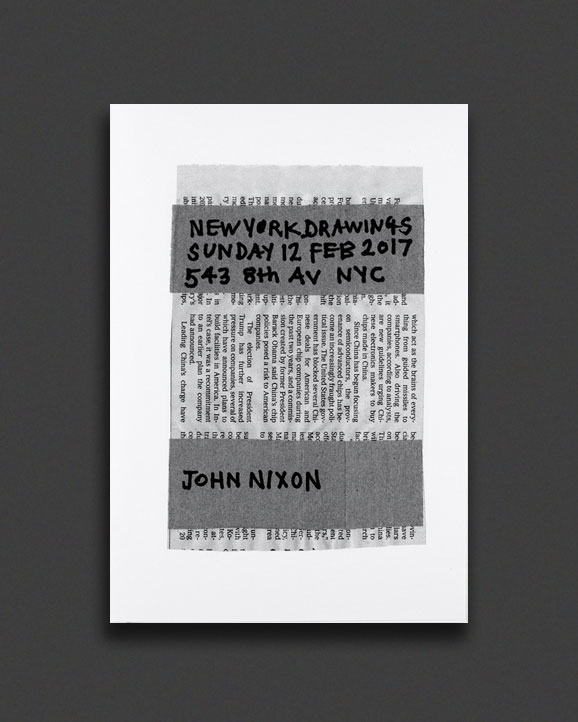
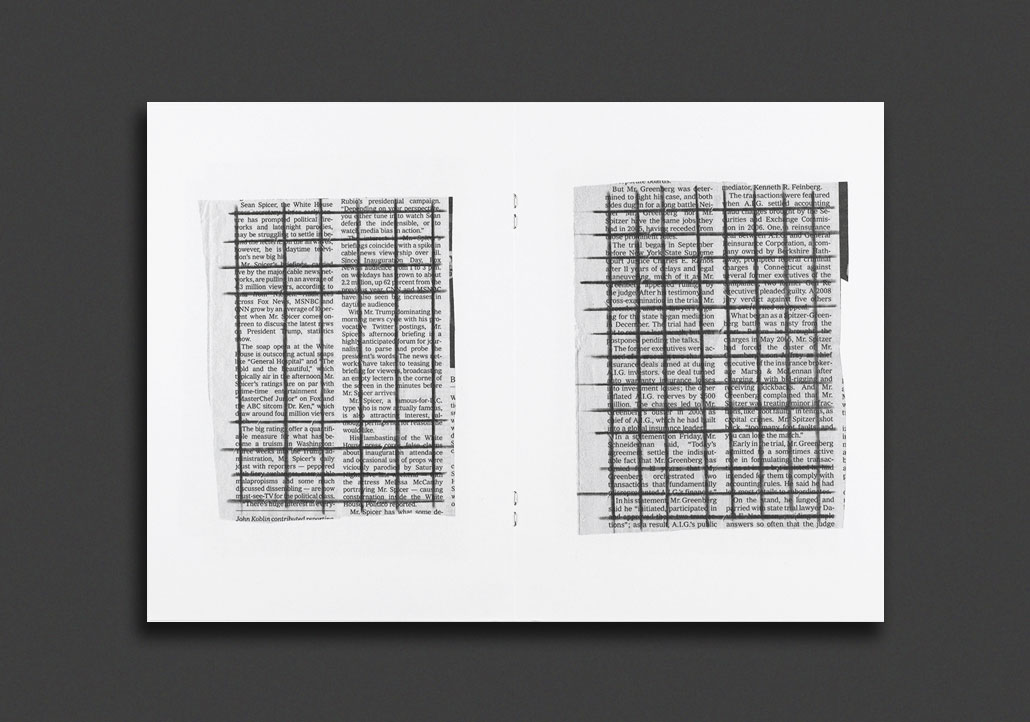
NEW YORK DRAWINGS
SUNDAY 12 FEB 2017
543 8th Av NYC
JOHN NIXON
Published by Pataphysics Books (Melbourne) in 2018, this artist's book by John Nixon presents a series of drawings on newspaper.
Edition of 50 copies.
2017, German, English
Hardcover, 64 pages, 17.5 x 24.5cm
Published by
Museum Gegenstandsfreier Kunst / Otterndorf
$50.00 - Out of stock
Catalogue published on the occasion of the 2017 exhibition at Museum Gegenstandsfreier Kunst in Otterndorf, Germany.
John Nixon is an Australian artist born in 1949. His exhibition at Museum Gegenstandsfreier Kunst presents various photographic, drawing, collage and painting based works from 2013-2017 with an essay written by Ulrike Schick.
Published in English and German.
2018, English
Softcover, 36 pages, 21 x 28 cm
Ed. of 400,
Published by
Laure Genillard Gallery / London
$30.00 - Out of stock
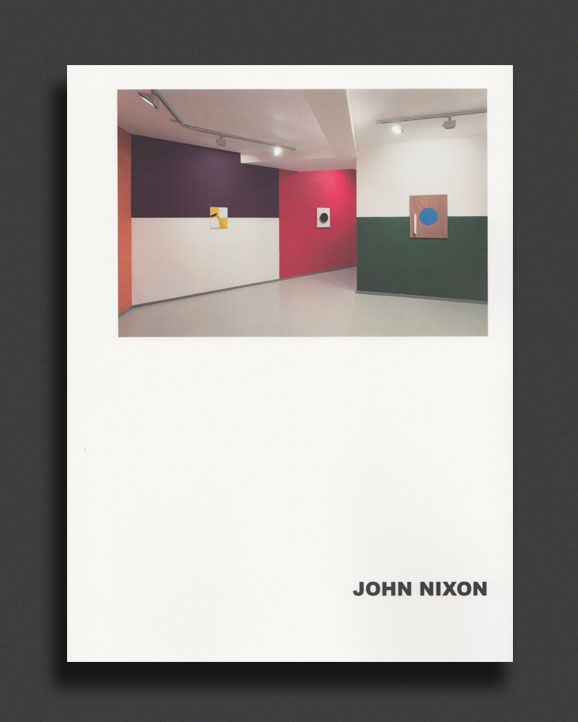
Made on the occasion of the exhibition Various Paintings on Various Colours at Laure Genillard Gallery, London, 2018. The exhibition is organised around a group of twelve recent works. Together, they survey the artist's use of primary and secondary colours, art and non-art materials, and his relationship with the surrounding architecture.
Including a conversation between John Nixon and Barry Barker.
Edition of 400 copies.
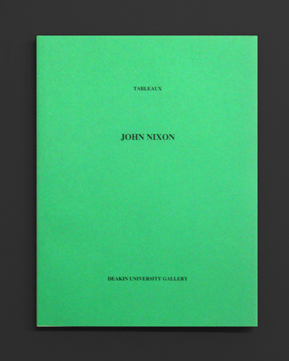
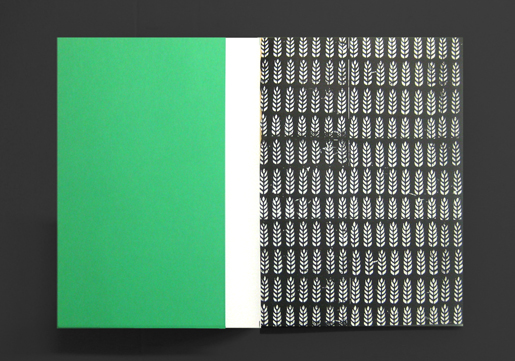
1991, English
Softcover (w. dustjacket), unpaginated (b&w ill.), 24 x 18.5 cm
1st edition, Out of print title / As New,
Published by
Deakin University / Geelong
$75.00 - Out of stock
Catalogue for the 1991 exhibition Tableaux at Deakin University Gallery, Geelong.
John Nixon is an Australian artist born in 1949, his Experimental Painting Workshop EPW – founded in 1990 – is not a physical workshop but an intellectual as well as a practical visual investigation into non-representational painting.
2001, English
Softcover, 32 pages (colour ill.), 26 x 22.5 cm
1st edition, Out of print title / As New,
Published by
Sarah Cottier / Sydney
$45.00 - Out of stock
Published on the occasion of the exhibition Gerber/Nixon at the Australian Embassy, Tokyo , 2001
John Nixon is an Australian artist born in 1949, his Experimental Painting Workshop EPW – founded in 1990 – is not a physical workshop but an intellectual as well as a practical visual investigation into non-representational painting.
2020, English / German
Hardcover, 216 pages, 24.6 x 17.4 cm
Published by
Ludwig Museum / Cologne
Walther König / Köln
$70.00 - Out of stock
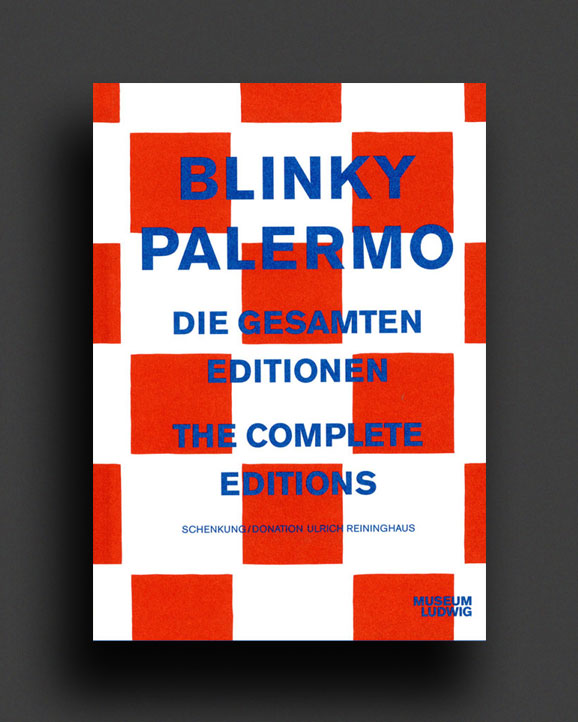
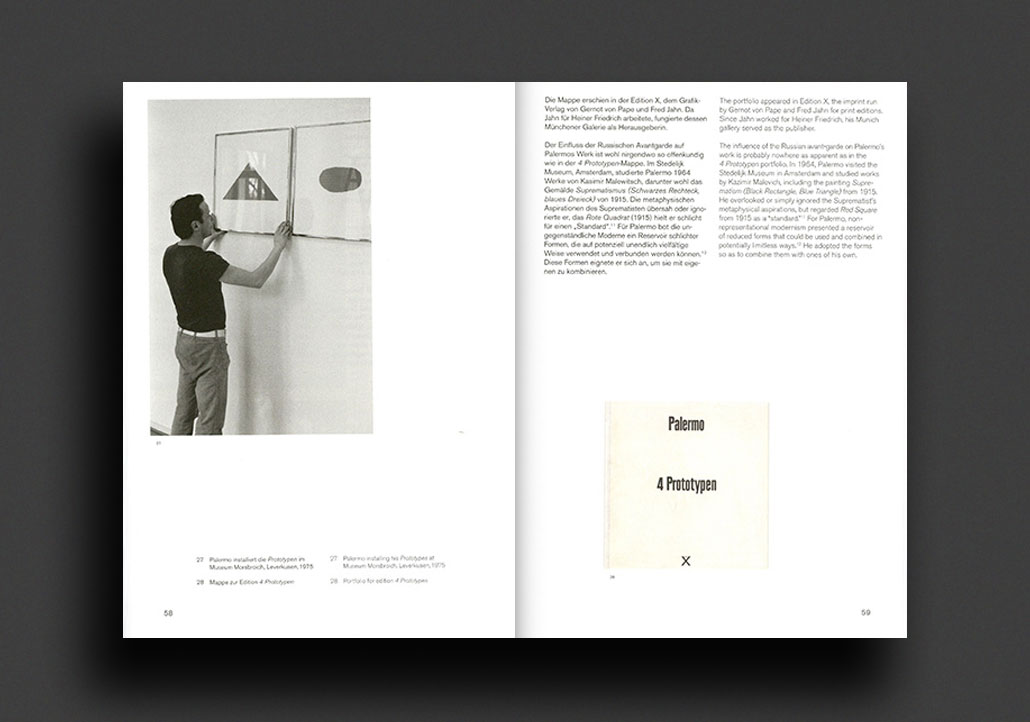
The German artist Peter Heisterkamp (1943–1977), who named himself after the mafioso Frank “Blinky” Palermo, is known for his objects, installations, and above all for the bright colour fields of his fabric and metal pictures, which supposedly directly illustrate what they conceptually question: the sensual qualities of contemporary painting. Less well known yet no less clever and stimulating are works he created in editions: screen prints and offset prints, lithographs, objects, and a template for painting. Palermo made these editions throughout almost his entire career. They not only reflect his development from the 1960s to his early death in 1977, but also represent a deliberate expansion of his work.
Thanks to a donation from the Cologne collector Ulrich Reininghaus, since 2018 the Museum Ludwig has been the only public institution to have a complete collection of Palermo’s editions. The exhibition catalogue documents the results: it includes an updated version of the out-of-print catalogue raisonné Die gesamte Grafik und alle Auflagenobjekte 1966 bis 1975, published in 1983 by the Munich gallerist and publisher Fred Jahn.
Includes texts by Yilmaz Dziewior, Susanne Küper, Julia Frirdrich, Fred Jahn.
1965, English
Softcover (staple-bound and cloth-taped), 44 pages, 18.5 x 17 cm
1st Edition, Out of print title / used / very good
Published by
ICA / Pennsylvania
$390.00 - Out of stock
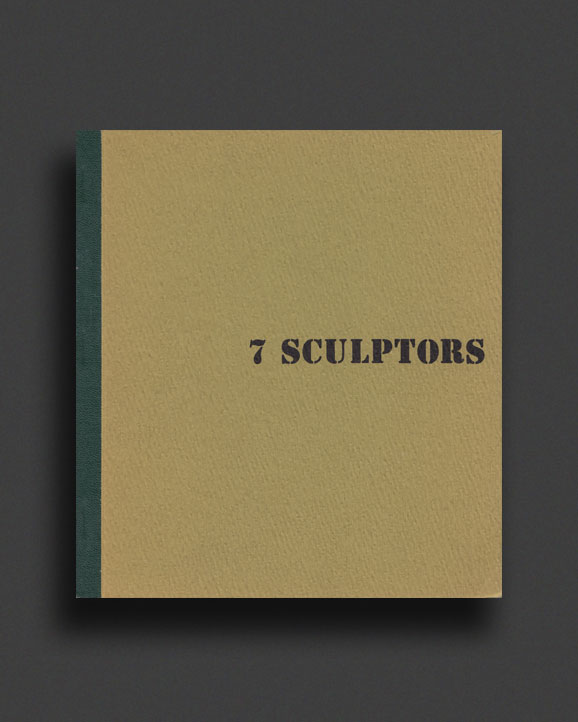
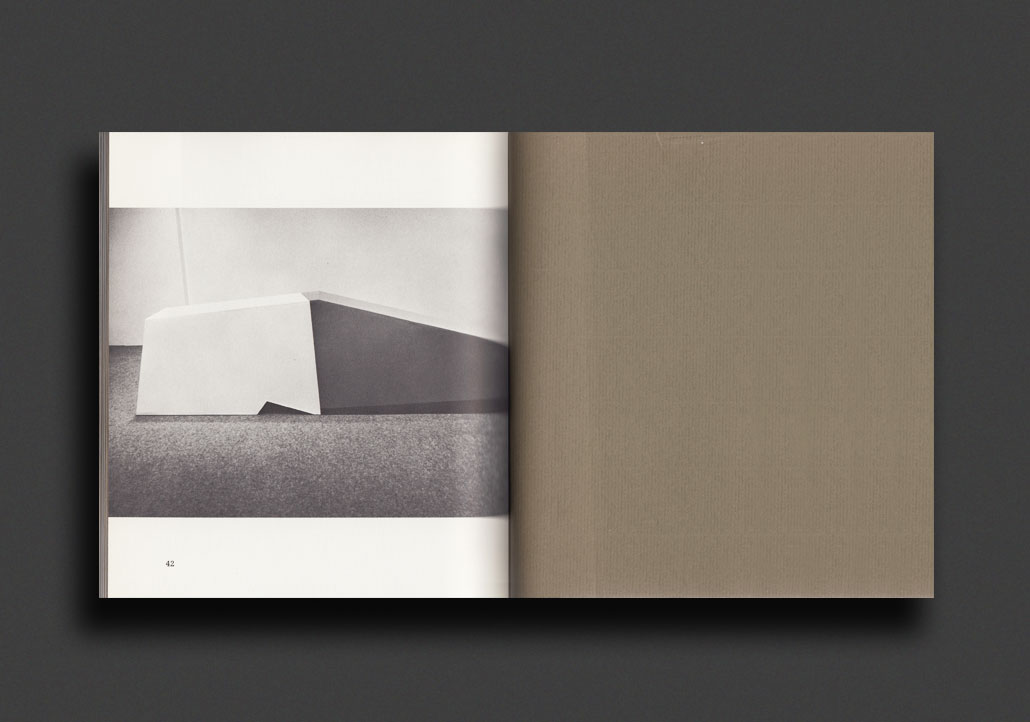
Exceptionally rare catalogue published in conjunction with the exhibition "7 Sculptors" held at the Institute of Contemporary Art, University of Pennsylvania, Dec 1, 1965 – Jan 17, 1966. An impossible to find catalogue for this seminal precursor exhibition prior to the legendary “Primary Structures” held in New York later in 1966.
Includes essays on each artist within exhibition: Michael Benedikt on Anthony Caro; Donald Judd on John Chamberlain; Robert Smithson on Donald Judd; Lawrence Alloway on Alexander Liberman; Stephanie Rose on Tina Matkovic; William Berkson on David Smith; Gerald Nordland on Anne Truitt. Illustrated with photographic portrait, biography and checklist for each artist. Foreword by Samuel Adams Green.
Very Good copy.
1968, English
Offset printed poster (56 x 72 cm)
1st Edition, Out of print title / used / very good
Published by
Leo Castelli / New York
$980.00 - Out of stock
Stunning, extremely rare early Donald Judd exhibition invitation poster, published on the occasion of an early solo exhibition at Leo Castelli Gallery, New York, NY, January 4 – 25, 1968. One of the scarcest, largest and most collectible of Judd's important vintage Castelli posters. Offset print, black on white stock featuring one of Judd's drawings. A real collector's item.
Dimensions : 56 x 72 cm
Good-Very Good copy. unmarked, light post-handling wear, stamped and addressed to reverse of poster, as all copies of poster were mailed as an invitation to the reception. Folded in eights for posting, as issued.
1968, English
Colour offset lithographic poster (46 x 46 cm)
1st Edition, Out of print title / used / good
Published by
Ace / Los Angeles
$650.00 - Out of stock
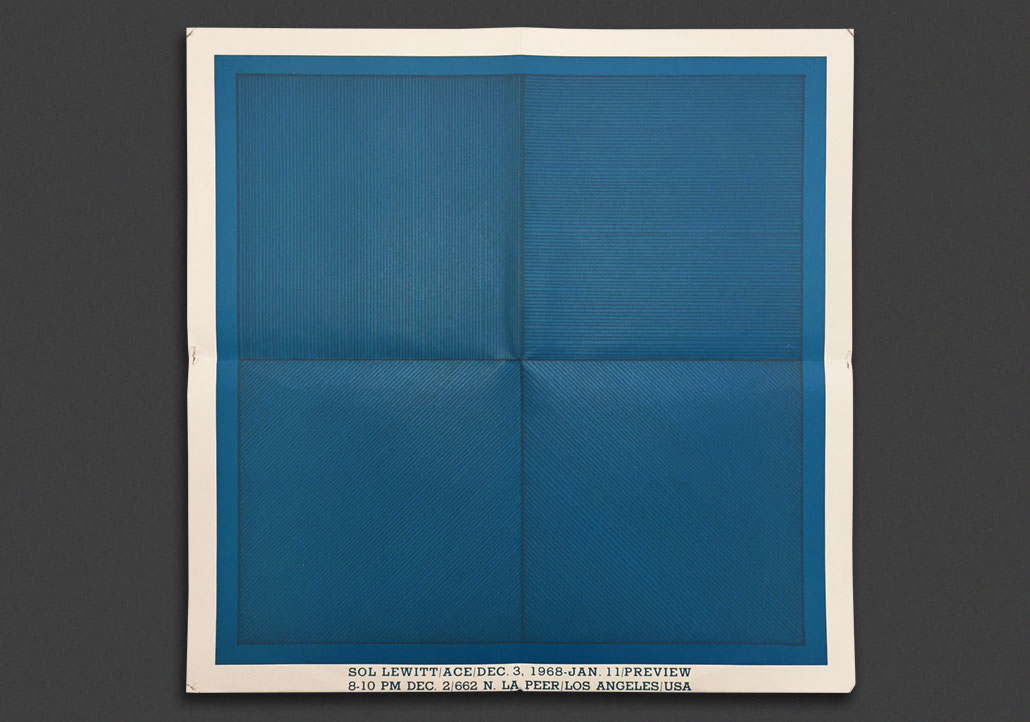
Very rare vintage Sol LeWitt poster published in conjunction with the preview of his solo exhibition at Ace, Los Angeles, December 3, 1968 - January 11, 1969. Beautiful colour offset lithographic poster featuring blue and black ink on white paper with image of LeWitt's Lines in Four Directions: vertical lines, horizontal lines, diagonal left to right, and diagonal right to left. A real collector's item.
Dimensions : 46 x 46 cm
Good-Very Good copy. Very small puncture marks to corners/edges, otherwise perfect and unmarked. Folded in four, as issued.
1969, Italian / English / French
Hardcover (w. dust jacket), 196 pages, 23 x 25 cm
1st Edition, Out of print title / used / good
Published by
Alfieri / Milan
$90.00 - Out of stock
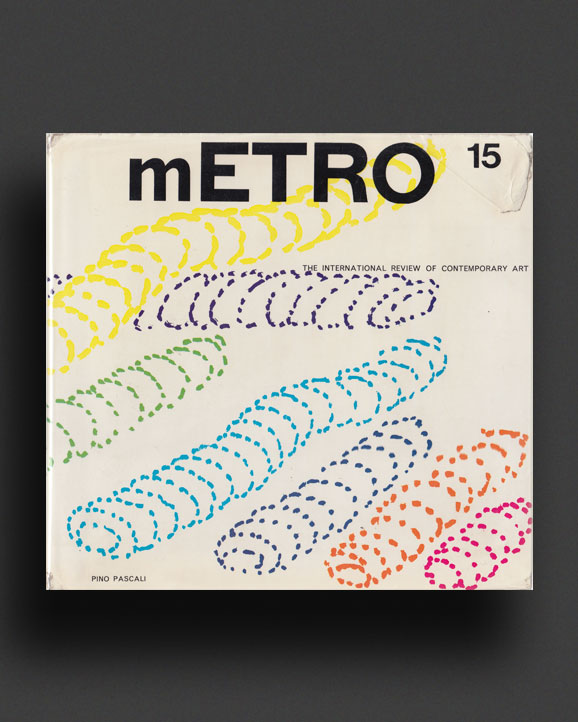
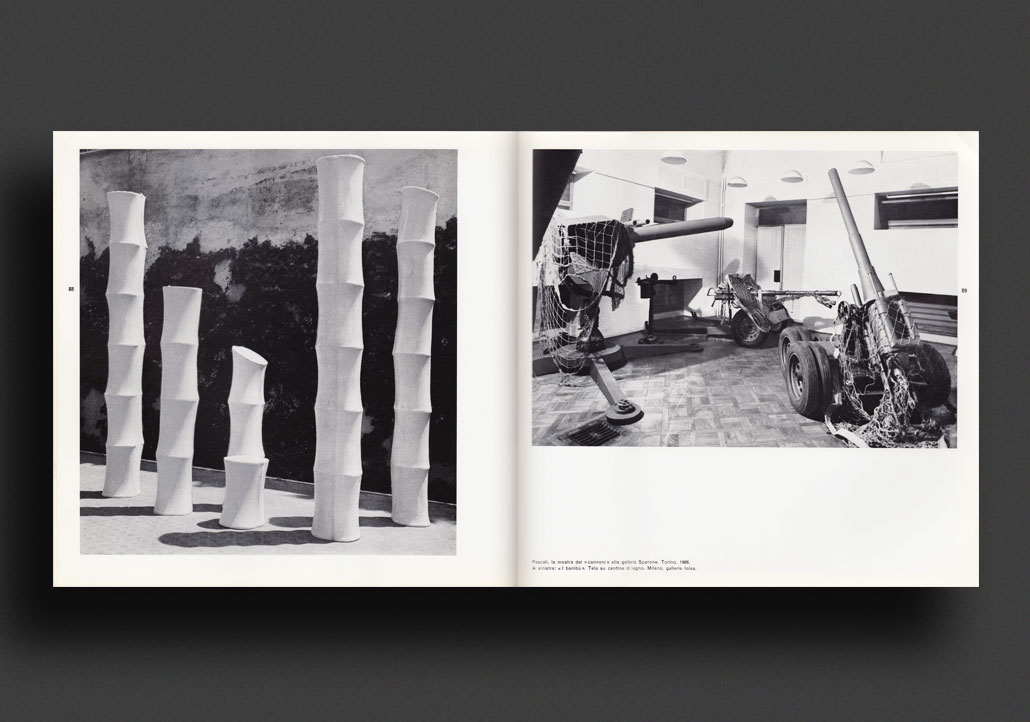
Scarce copy of Metro, "The International Review Of Contemporary Art", published in Milan twice yearly, each issue in dust-jacketed hardcover format and edited by Bruno Alfieri. This 15th edition from 1969 with a wonderful illustrated cover by Pino Pascali. Like it's more widely-known architectural counterpart, Lotus, each issue of Metro features in-depth articles on a selection of artists or events in a format and style far closer to a book than a periodical. This issue also includes articles on Piero Manzoni, Leo Castelli Gallery (Robert Morris, Richard Serra, etc.), Bridget Riley, Documenta 4 in Kassel, Italian sociologist and artist Hans Glauber, and of course Pino Pascali. Also an article that looks at the work of Pascali alongside Lucio Fontana. Texts by Germano Celant, Lea Vergine, Bruno Alfieri, Giulio Carlo Argan, Peter Gorsen, Gillo Dorfles, Maurizio Dell'Arco, Giuseppe Gatt, and others. Text in Italian, English and French.
Good copy with some small closed tears to jacket and edge wear. Now preserved in mylar wrap.
1992, English
Softcover, 70 pages, 30 x 24.5 cm
1st Edition, Out of print title / used / very good
Published by
Matthew Marks / New York
$200.00 - Out of stock
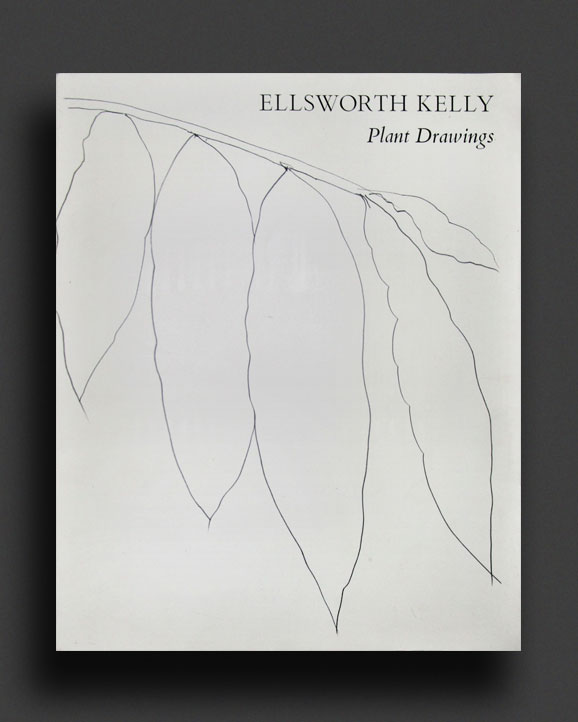
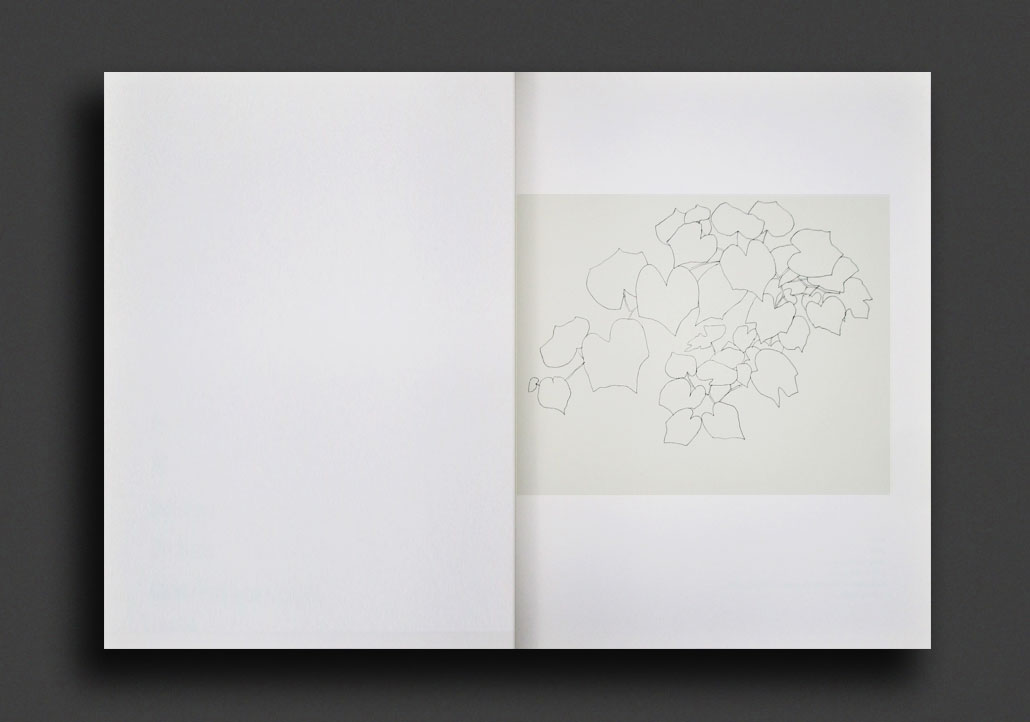
First collectable edition of Ellsworth Kelly's Plant Drawings, published in 1992 to accompany Kelly's first solo exhibition at Matthew Marks Gallery, Plant Drawings, New York that year. Long out of print and re-editioned multiple times, "Ellsworth Kelly: Plant Drawings" features 30 plates of drawings made by Kelly between 1960 and 1992, this edition with the text by John Ashbery. Kelly made these gorgeously economical line drawings from life, sometimes barely lifting the pencil as he translated each plant’s contours to paper. Focusing on direct visual impression—“nothing is changed or added,” as he put it—Kelly used the natural forms of the plants to explore some of his painterly fixations, like the effects of volume, negative space and overlapping planes. Despite the immediacy of their execution and their representational content, the most striking surprise of Kelly’s plant drawings is how much they share with his abstract paintings and sculptures.
Ellsworth Kelly was an American painter, sculptor, and printmaker associated with hard-edge painting, Color Field painting and minimalism. His works demonstrate unassuming techniques emphasizing line, color and form, similar to the work of John McLaughlin and Kenneth Noland. Kelly often employed bright colors. He lived and worked in Spencertown, New York.
Very Good copy with light edge wear/toning.
1988, Italian / French
Hardcover (w. dust jacket), 324 pages, 31 x 22 cm
1st Edition, Out of print title / used / very good
$200.00 - Out of stock
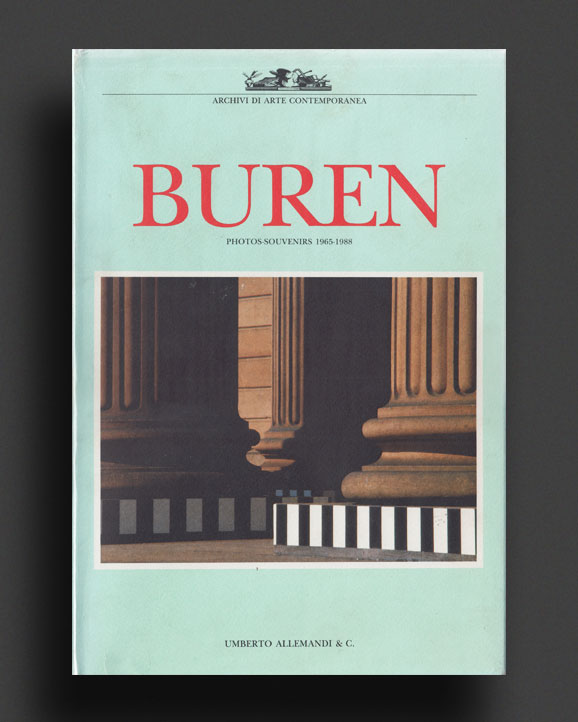
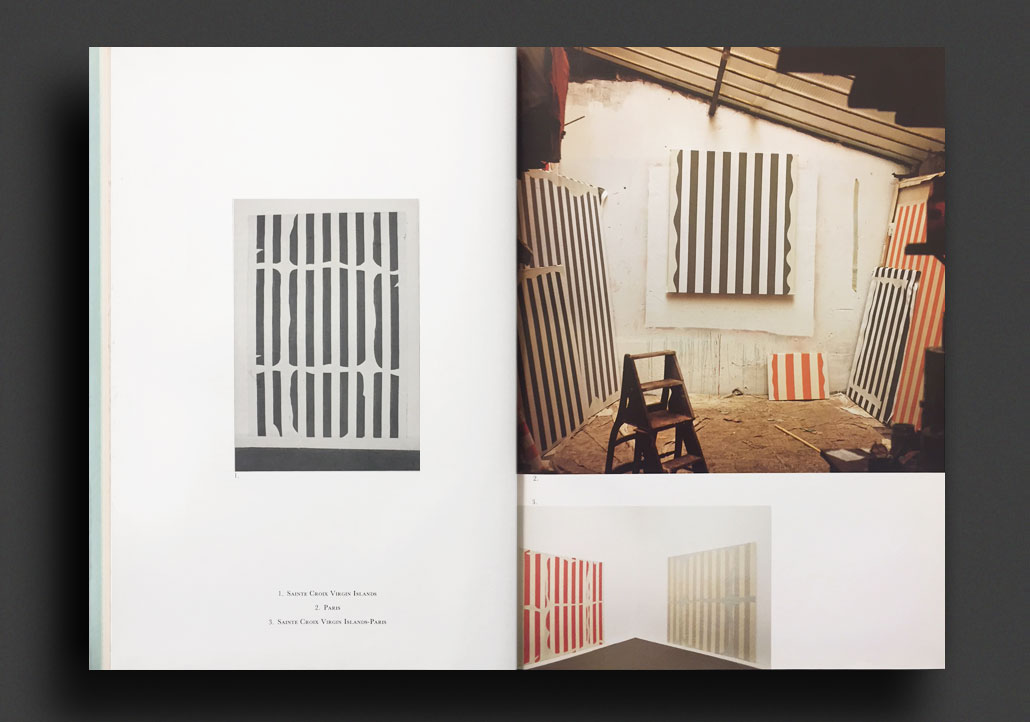
Very scarce first Italian edition of the ultimate Buren photographic album, 1988's Photos-Souvenirs (1965-1988). Compiled by Buren, this over-sized, comprehensive hardcover book chronologically traces his entire career up (until the year of publication) through 400 colour and b/w photographs of his gallery exhibitions, architectural interventions, outdoor installations, performances, studios, and everything else, from the awnings to his Toile/Voile sailboat works. Although the book is almost entirely made up of photographs, it opens with a text by Buren (translated into Italian from French) and closes with an in-depth index of the collected works, with details and captions by Buren in their original French. A must for any Buren fan.
Often classified as a Minimalist, French artist Daniel Buren (born 25 March 1938) is known best for using regular, contrasting colored stripes in an effort to integrate visual surface and architectural space, notably on historical, landmark architecture. Among his chief concerns is the "scene of production" as a way of presenting art and highlighting facture (the process of 'making' rather than for example, mimesis or representation of anything but the work itself). The work is site-specific installation, having a relation to its setting in contrast to prevailing ideas of an autonomous work of art.
Very Good copy in original dust jacket (preserved under mylar wrap), with small chip/shelf bumping to bottom of hardcover not affecting the jacket or the pages at all.
1999, Japanese / English / Italian / German
Hardcover, 120 pages, 20.6 × 28.5 cm
1st Edition, Out of print title / used / very good
Published by
Toyota Municipal Museum of Art / Aichi
$90.00 - Out of stock
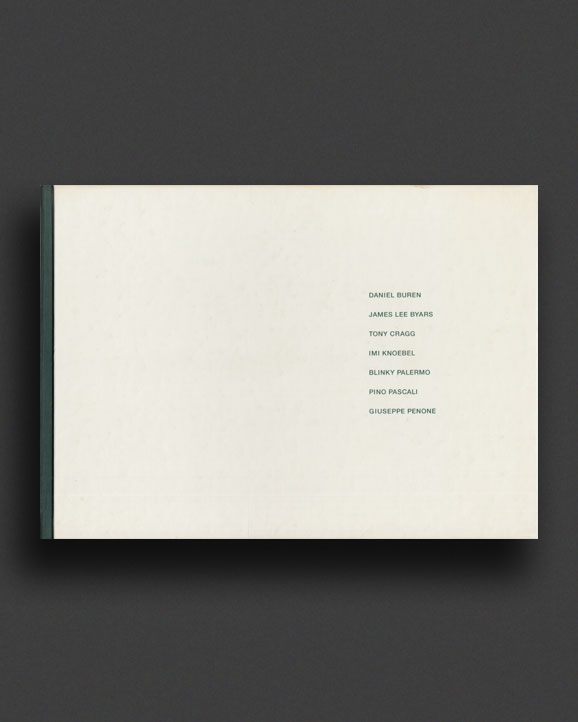
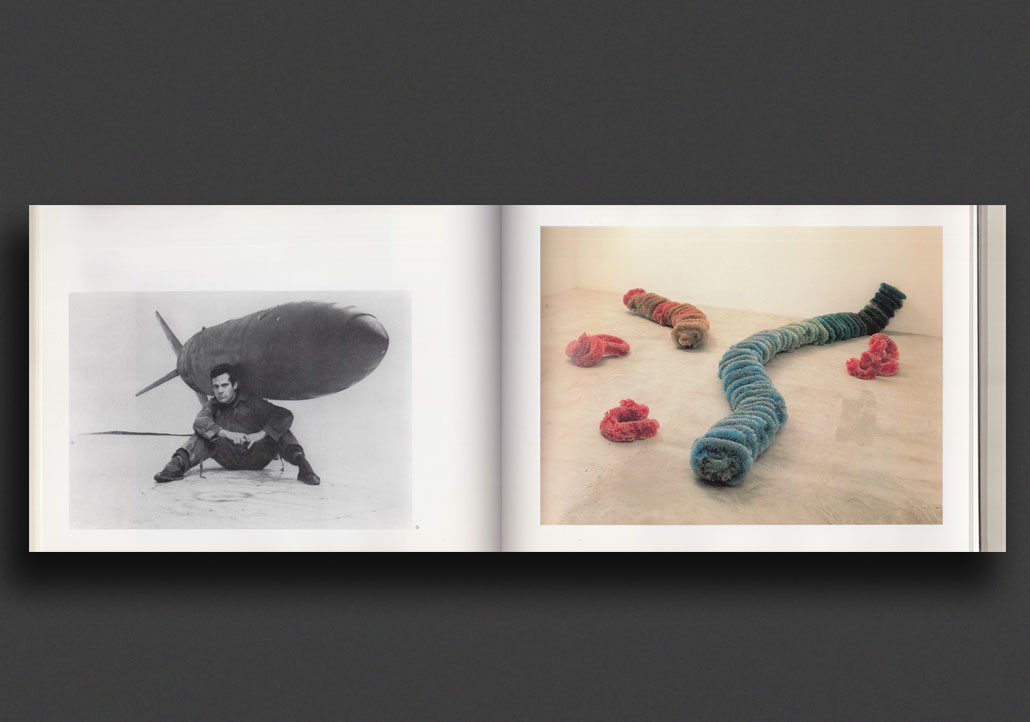
Very scarce and beautifully compiled hardcover catalogue published in Japan in 1999 to accompany the unique exhibition, Silent Friendship : 1960-90's: 7 Artists, featuring the work of Daniel Buren, James Lee Byars, Tony Cragg, Imi Knoebel, Blinky Palermo, Pino Pascali, and Giuseppe Penone. Generous colour spreads of each artist are accompanied by biographies, exhibition histories and text contributions by and about the artists in their native language(s), including Buren's reflections "In those days Europe", Tony Cragg on "that era" and James Lee Byars, Giuseppe Penone remembering the "cubes, giraffes and weapons of Pino Pascali", Masahiro Aoki on Imi Knoebel, Masao Chatan on Giuseppe Penone, Tomoaki Kitagawa on Tony Cragg the "Material Seeker", Laszlo Glozer and Joseph Beuy's in conversation about Blinky Palermo, and more. Through twenty-six paintings, sculptures and installations the exhibition presented a meaningful overview of the broad scope of the artistic expressions of 7 artists from the 1960s that embodied the theme of the collection, "the art of our time". "Each of them in his own individual way strongly provokes in us new ideas and emotions, suggesting new possibilities for the arts of the next generation." - from the Introduction
Very Good copy.
2018, English
Softcover, 208 pages, 14 x 22.5 cm
$57.00 - Out of stock
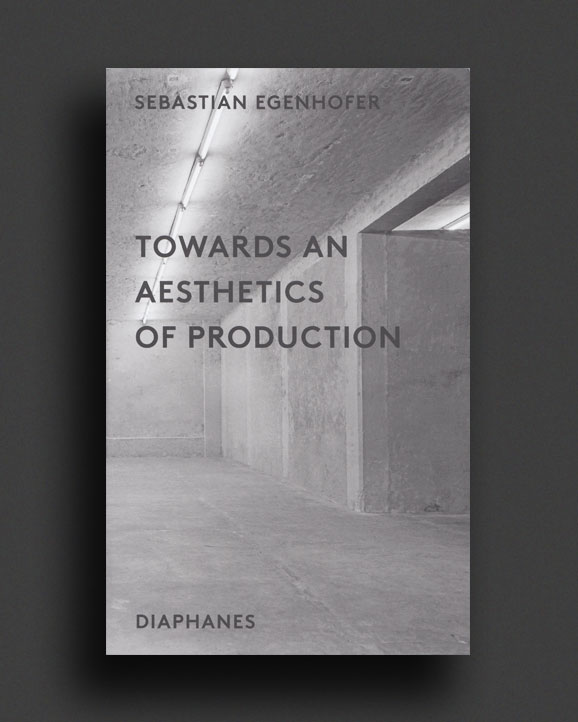
Throughout the twentieth century, art history has been too narrowly focused on formalism. As a result, analyses regularly reduced works of art to their materials, texture, and composition. By contrast, art historian Sebastian Egenhofer takes Gilles Deleuze's readings of Spinoza, Nietzsche, and Bergson as the basis for a new resistance to the overly reductive account of art history. After laying out his argument for a new aesthetics of production in introductory chapters that discuss the work of Spinoza, Nietzsche, and Bergson, as well as Heidegger and Kant, Egenhofer applies this theoretical framework to case studies on Michael Asher, Marcel Duchamp, Thomas Hirschhorn, and Piet Mondrian. An aesthetics of production does not, he argues, imply a nostalgia for the artisanal or for a work of art's singularity, but a way to bring together elements of critical materialism with a thorough reevaluation of the modern art and abstraction.
2016, English
Hardcover (w. dust jacket), 288 pages, 15.2 x 24.1 cm
Published by
University of Chicago Press / Chicago
$89.00 - Out of stock
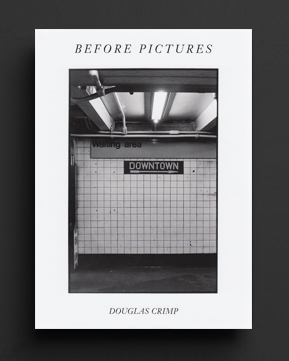
Douglas Crimp is the rare art critic whose work profoundly influenced a generation of artists. He is best known for his work with the "Pictures Generation" the very name of which Crimp coined to define the work of artists like Robert Longo and Cindy Sherman who appropriated images from mass culture to carry out a subversive critique. But while his influence is widely recognized, we know little about Crimp's own formative experiences before "Pictures."Before Pictures tells the story of Crimp's life as a young gay man and art critic in New York City during the late 1960s through the turbulent 1970s. Crimp participated in all of what made the city so stimulating in that vibrant decade. The details of his professional and personal life are interwoven with this the particularly rich history of New York City at that time, producing a vivid portrait of both the critic and his adopted city. The book begins with his escape from his hometown in Idaho, and we quickly find Crimp writing criticism for ArtNews while working at the Guggenheim where, as a young curatorial assistant, he was one of the few to see Daniel Buren's Peinture-Sculpture before it was removed amid cries of institutional censorship. We also travel to the Chelsea Hotel (where Crimp helped the down-on-his-luck couturier Charles James organize his papers) through to his days as a cinephile and balletomane to the founding of the art journal October, where he remained a central figure for many years. As he was developing his reputation as a critic, he was also partaking of the New York night life, from drugs and late nights alongside the Warhol crowd at the Max's Kansas City to discos, roller-skating, and casual sex with famous (and not-so-famous) men. As AIDS began to ravage the closely linked art and gay communities, Crimp eventually turned his attention to activism dedicated to rethinking AIDS. Part biography and part cultural history, Before Pictures is a courageous account of an exceptional period in both Crimp's life and the life of New York City. At the same time, it offers a deeply personal and engaging point of entry into important issues in contemporary art.
Includes the work of Cindy Sherman, Jack Goldstein, Daniel Buren, Charles James, Hiroshi Sugimoto, Agnes Martin, Dan Flavin, Peter Hujar, Eva Hesse, Bernardo Bertolucci, Walker Evans, Joseph Cornell, Alfred Hitchcock, Jack Tworkov, Robert Ryman, Jane Freilicher, Robert Smithson, Michael Snow, Stanley Kubrick, Cristobal Balenciaga, Christian Dior, Brice Marden, Ellsworth Kelly, Guilio Romano, Andrea Mantegna, Merce Cunningham, Joan Jonas, Yvonne Rainer, John Baldessari, Dan Graham, Vito Acconci, Alvin Baltrop, Divine, Gordon Matta-Clark, Edgar Degas, Louise Lawler, and so many others.
2019, English
Softcover, 48 pages, 17 x 23cm
Published by
Herbert Foundation / Belgium
$43.00 - Out of stock
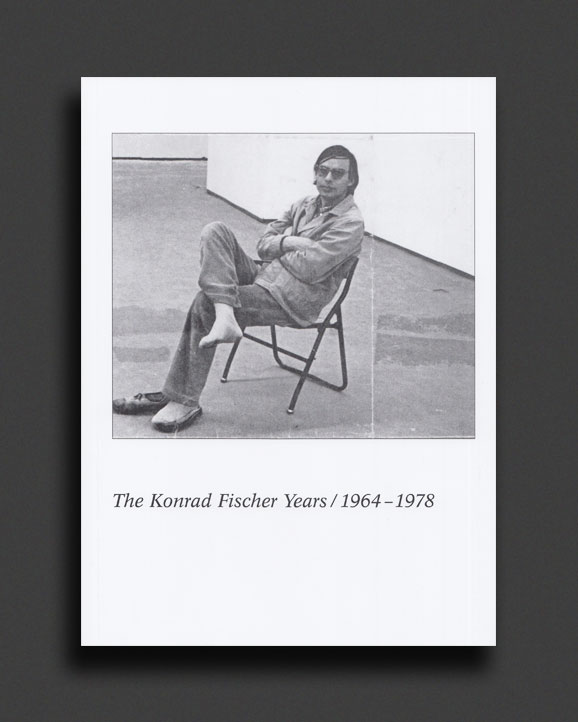
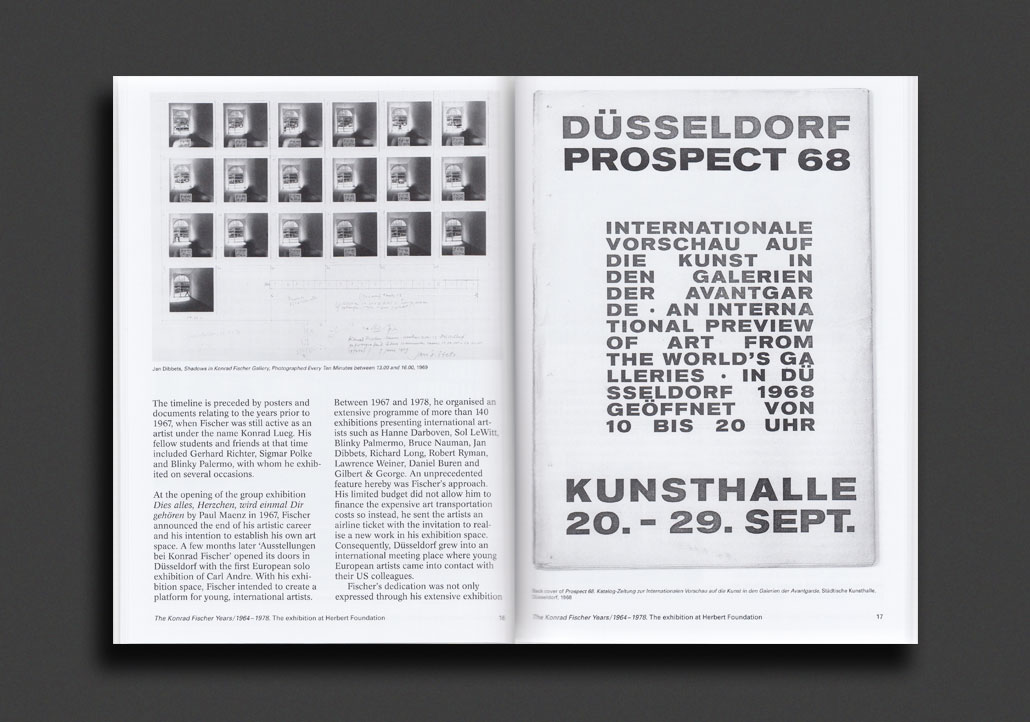
Konrad Fischer opened his exhibition space in 1967 with the first European solo presentation of Carl Andre. Located in a converted alley in Düsseldorf, the gallery offered a platform for emerging international artists. Through his exhibition programme, Fischer enabled contact between European and American artists, transforming Düsseldorf into an international hot spot. With this book, the Herbert Foundation pays homage to the atypical art dealer who left an undeniable mark on its collection. The subjective reflection on Fischer’s activities and role within the international art world of the time includes a reprint of Fischer’s first interview in 1971 and a critical essay by Lynda Morris.
1974, English
Hardcover (linen bound), 88 pages, 19 x 24 cm
1st Edition, Out of print title / used / good
Published by
New York University Press / New York
The Press of the Nova Scotia College of Art and Design / Halifax
$100.00 - Out of stock
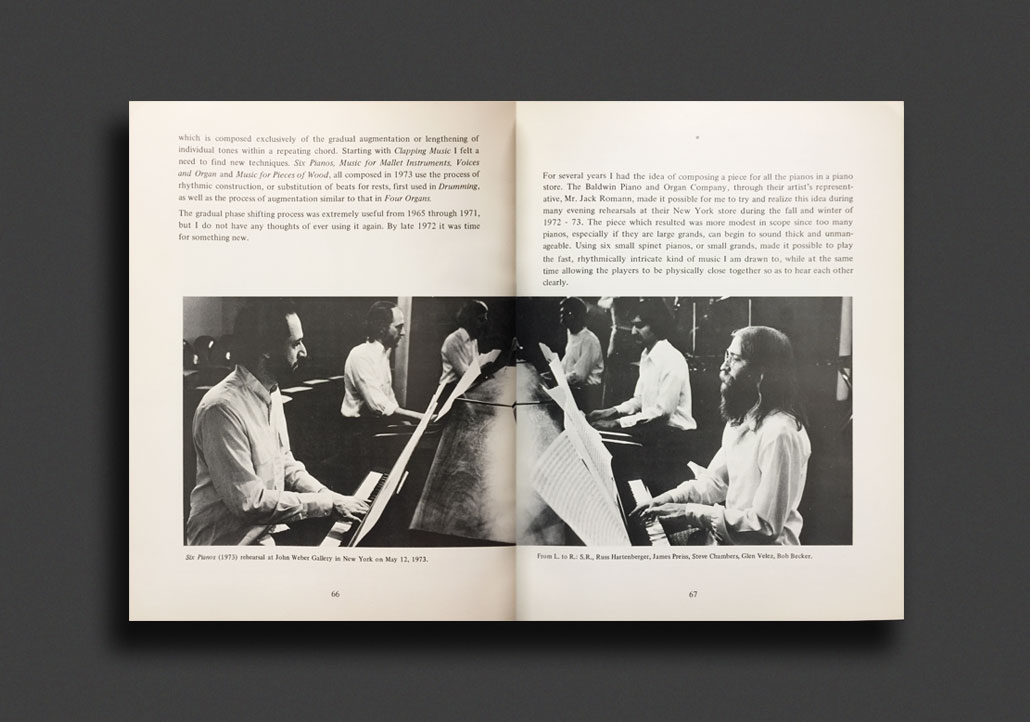
Rare first hardcopy edition copy of the highly influential Steve Reich book of texts,"Writings About Music", first published in 1974 by The Press of the Nova Scotia College of Art and Design.
In the mid-1960s, American composer Steve Reich radically renewed the musical landscape, along with La Monte Young, Terry Riley, and Philip Glass, to pioneer what became minimal music. These early Reich works, characterised by a relentless pulse and static harmony, focused single-mindedly on the process of gradual rhythmic change. Throughout his career, Reich has continued to reinvigorate the music world, drawing from a wide array of classical, popular, sacred, and non-western idioms. His works reflect the steady evolution of an original musical mind.
In 1974 Reich published the book Writings About Music, containing essays on his philosophy, aesthetics, and musical projects written between 1963 and 1974. The book features, amongst many other texts and studies, Reich's 1968 essay "Music as a Gradual Process," widely considered one of the most influential pieces of music theory in the second half of the 20th century.
Good copy lacking dust jacket, with ex-library stamps/markings to cloth cover. Light wear, otherwise Very Good interior well-preserved.
2017, English
Hardcover (w. dust jacket), 184 pages, 20.3 x 26.7 cm
Published by
Yale University Press / New Haven
$80.00 - Out of stock
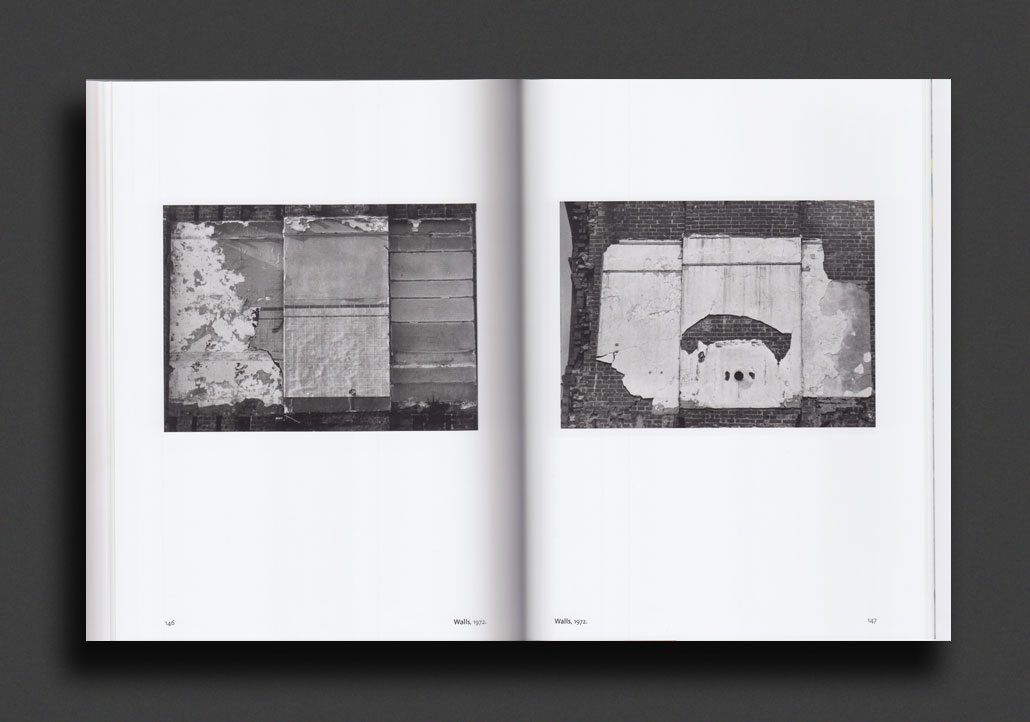
"Undoing is just as much a democratic right as doing."---Gordon Matta-Clark
This revealing book looks at the groundbreaking work of Gordon Matta-Clark (1943–1978), whose socially conscious practice blurred the boundaries between contemporary art and architecture. After completing a degree in architecture at Cornell University, Matta-Clark returned to his home city of New York. There he employed the term “anarchitecture,” combining “anarchy” and “architecture,” to describe the site-specific works he initially realized in the South Bronx.
The borough’s many abandoned buildings, the result of economic decline and middle-class flight, served as Matta-Clark’s raw material. His series Cuts dissected these structures, performing an anatomical study of the ravaged urban landscape. Moving from New York to Paris with Conical Intersect, a piece that became emblematic of artistic protest, Matta-Clark applied this same method to a pair of 17th-century row houses slated for demolition as a result of the Centre Pompidou’s construction. This compelling volume grounds Matta-Clark’s practice against the framework of architectural and urban history, stressing his pioneering activist-inspired approach, as well as his contribution to the nascent fields of social practice and relational aesthetics.
2018, English
Hardcover (w. dust jacket), 304 pages, 24.1 x 29.8 cm
Published by
Yale University Press / New Haven
$85.00 - Out of stock
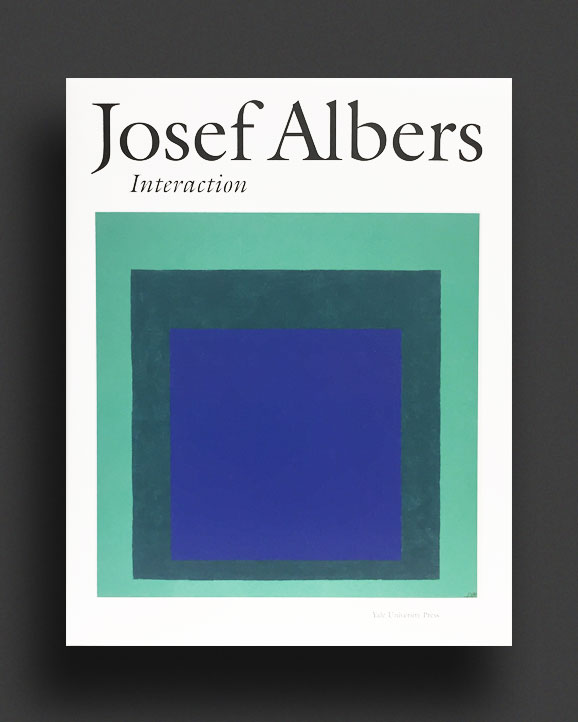
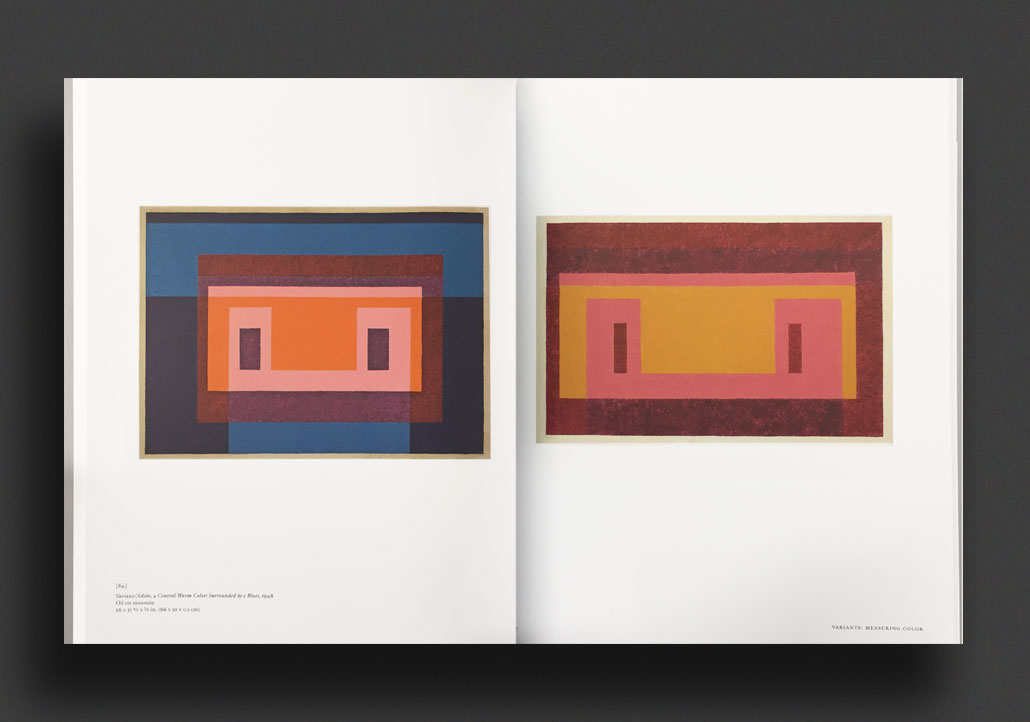
"Only appearances are not deceiving." - Josef Albers
Josef Albers (1888-1976) was one of the leading pioneers of 20th-century modernism: he was an extraordinary teacher, writer, painter, and color theorist, who is best known for the Homages to the Square (painted 1950-76) and The Interaction of Color, published by Yale University Press in 1963.
This generously illustrated overview of Albers's work, accompanying the first major exhibition on the artist in more than thirty years, features all aspects of his long, creative career. Beginning with Albers's time at the Bauhaus in Weimar and Dessau, the publication follows the artist to America and describes major themes of his work there as well as the importance of his frequent travels to Mexico. Paintings, prints, furniture, household objects, works in glass, photographs, and pre-Columbian sculptures are beautifully reproduced and discussed by a team of experts. The juxtaposition of Renaissance sculptures and icons with paintings by Albers underlines the intellectual and spiritual dimensions of his art, and Albers's influence on 1960s Minimalist art is also explored.
Including a comprehensive biography, the book convincingly demonstrates how this great artist transformed modern design by using line, color, surface, and space to challenge the perception of the viewer.
1971, English
Softcover, 210 pages, 23 x 25 cm
1st UK Edition, Out of print title / used / good
Published by
Mathews Miller Dunbar / London
$70.00 - Out of stock
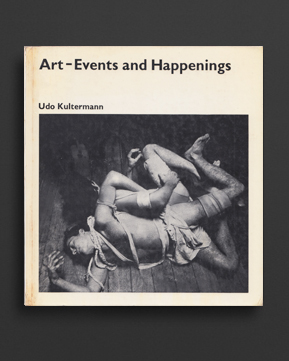
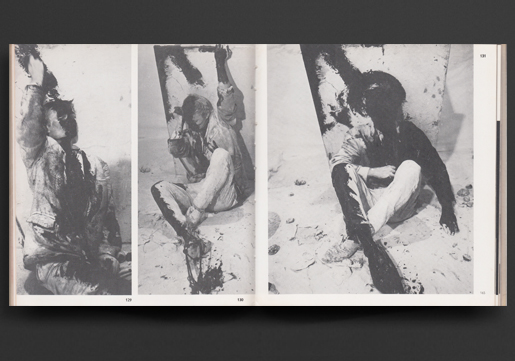
First English edition from 1971, Udo Kultermann's "Art-Events and Happenings", published by Mathews Miller Dunbar of London, translated by John William Gabriel. A deep reflection on an important part of Art's development throughout the 1960s - the turn to action through performance and conceptual art - surveying happenings, protests, theatre, ritual, land art and much more, and featuring a vast collection of black and white photographic illustrations of the work of Allan Kaprow, Ann Halprin, Yvonne Rainer, Merce Cunningham, Otto Mühl, Oyvind Fahlstrom, Piero Gilardi, Charlotte Moorman, Franz Erhard Walther, Joseph Beuys, Tetsumi Kudo, Lygia Clark, Carolee Schneemann, Stan Brakhage, John Cage, Hermann Nitsch, Günther Brus, Dennis Oppenheim, Jean-Jacques Lebel, Andy Warhol, Jan Dibbets, Carl Andre, Barry La Va, Rafael Ferrer, Marinus Boezum, Nam June Paik, Wolf Vostell, Milan Knizak, Jackson Pollock, Saburo Murakami, Atsuko Tanaka, Claes Oldenburg, Piero Manzoni, Peter Hutchinson, Christo, Robert Morris, and many more.
Very good copy (some tanning, previous owners name to first page)
1981, English
Softcover (w. John Nixon insert), 68 pages, 18.5 x 24 cm
1st Edition, Out of print title / used / very good
Published by
Art & Text / Prahran
$60.00 - Out of stock
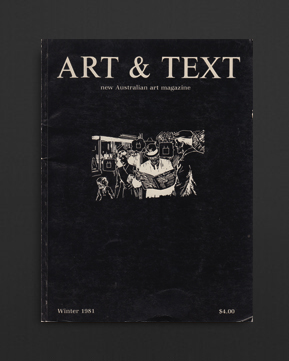
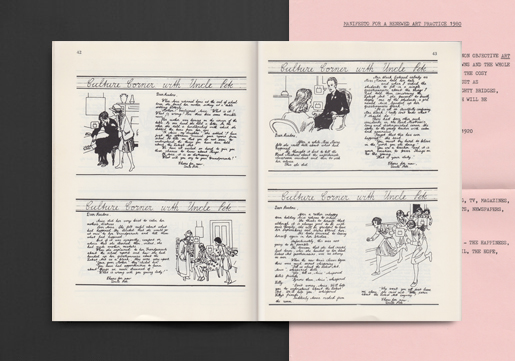
ART & TEXT 2
Winter 1981
Edited by Paul Taylor
CONTENTS:
"On Some Alternatives to the Code in the Age of Hyperreality: the Hermit and the City—Dweller" by John Young and Terry Blake
"The Desire of Maria Kozic" by Adrian Martin
"David Wilson’s New Sculpture" by Patrick McCaughey
"Modernism and Realism: Some Orientations" by Terry Smith
"Culture Corner" by Peter Tyndall
Manifestos:
"Manifesto for a future Sculpture Triennial" by Judy Annear
"Manifesto for a Renewed Art Practice 1980" by John Nixon
Book Reviews:
"About Looking by John Berger" by Ian North
"The Shock of the New: Art and the Century of Change by Robert Hughes" by David Bromfield
"The Years of Hope: Australian Art and Criticism 1959 — 1968 by Gary Catalano" by Noel Hutchison
note: this is a rare copy that still contains the insert manifesto "Manifesto for a Renewed Art Practice 1980" by John Nixon
Art & Text, one of the landmark contemporary art magazines of the 1980s and 1990s. Founded in Melbourne, Australia, in 1981 by Paul Taylor (1957–92), who soon moved to New York City to make his mark as an art critic, the magazine went on to become one of a handful of international art magazines that succeeded in capturing the turmoil and passing brilliance of that period of postmodernism.
Very Good - general wear/tanning. Includes Nixon's inserted manifesto.
1983, English
Softcover, 104 pages, 17.5 x 24 cm
1st Edition, Out of print title / used / very good
Published by
Art & Text / Prahran
$45.00 - Out of stock
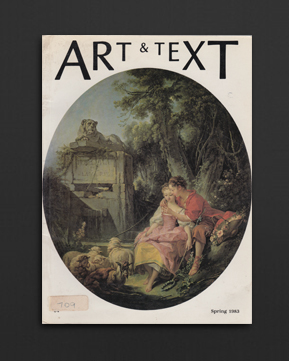
ART & TEXT 11
Spring 1983
Edited by Paul Taylor
Blurb by Malcolm McLaren
CONTENTS:
"The Precession of Simulacra" by Jean Baudrillard (translated by Paul Foss and Paul Patton
"Kristeva, Bakhtin and Carnival" by Kateryna Arthur
"Performance Art As Politicised Epistemology" by Thomas Huhn
"Anything Still" by John Young
"Duck Rock" by Andrew Preston
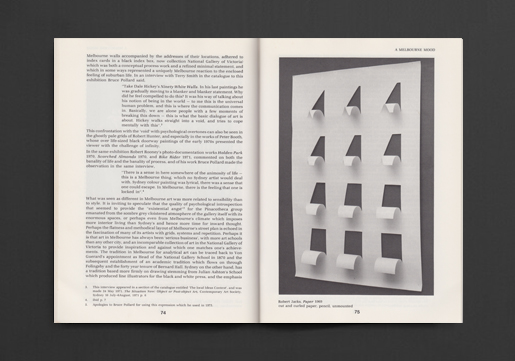
"A Melbourne Mood" by Frances Lindsay
"Made by →↑→" by Mary Eagle
"Horrality" by Philip Brophy
Art & Text, one of the landmark contemporary art magazines of the 1980s and 1990s. Founded in Melbourne, Australia, in 1981 by Paul Taylor (1957–92), who soon moved to New York City to make his mark as an art critic, the magazine went on to become one of a handful of international art magazines that succeeded in capturing the turmoil and passing brilliance of that period of postmodernism.
Very Good - general wear/tanning.
1989, English
Softcover, 134 pages, 21 x 27 cm
1st Edition, Out of print title / As New,
Published by
IMA / Brisbane
$80.00 - Out of stock
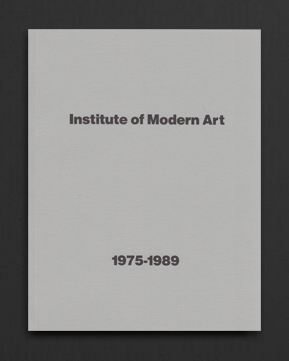
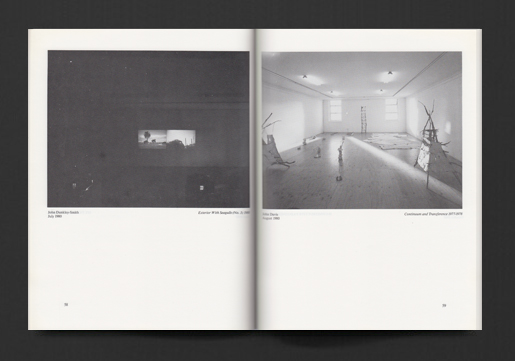
Institute of Modern Art 1975-1989 - A Documentary History, was edited by Bob Lingard, Sue Cramer in Brisbane in 1989, and takes an in-depth look at the history of a very important period of one of Australia's oldest contemporary art spaces. Through essays by Bob Lingard and Peter Anderson, exhibition photography, a full list of exhibitions, catalogues and bulletins, this publication retrospectively showcases the directorship years of Robert Jadin de Fronenteau, John Buckley, John Nixon, Barbara Campbell, Peter Cripps and Sue Cramer, exhibiting John Olsen, Robert MacPherson, Ian Hamilton, Sidney Nolan, John Baldessari, Peter Cripps, Gunter Christmann, David Hockney, Diane Arbus, Jenny Watson, Chuck Close, Joseph Kosuth, Paul Sharits, Mike Parr, Arthur Boyd, Robert Jacks, John Davis, Mario Merz, Peter Tyndall, Hilary Boscott, Imants Tillers, John Nixon, Elizabeth Gower, Janet Burchill, Tony Clark, Dale Frank, Henri Chopin, Scott Redford, Tim Johnson, Robert Mapplethorpe, Vivienne Shark Lewitt, Fiona McDonald, Fiona Hall, Joanna Flynn, Jan Nelson, Joanna Ritson, Robert Hunter, Stephen Roach,Dominique Gonzalez-Foerster, Lehan Ramsey, Hiram To, John Dunkley-Smith, Stieg Persson, Merilyn Fairskye, Linda Marrinon, Bill Henson, Fritz Rahman, Melinda Harper, Geoff Lowe, Lindy Lee, Eugene Carchesio, Diena Georgetti, Maria Kozic, Lyndal Jones, amongst many others!
"This publication documents the history of the Institute of Modern Art, Brisbane from its inception in 1975 until the present day (1989). In doing so, it provides a partial record, both visual and verbal, of the life of one particular institution and an insight into a fifteen year history of exhibition-making within contemporary art. There can be no doubt that “Contemporary Art Spaces” (previously institutions such as the IMA were known as “alternative spaces”) have a crucial and unique role in supporting and developing contemporary art and curatorial practices within Australia. As the photographs of exhibitions, and the essays in this publication show, the Institute has played a significant role over its fifteen years as a venue not only for the exhibition of art that is being made in Brisbane itself, but also that of artists working elsewhere in Australia and overseas. It is worth remembering too that the Institute is the second oldest of the Contemporary Art Spaces in Australia. With this in mind, the Institute’s archive, from which this publication has been drawn, becomes a valuable resource in the study of recent art. The photographs published here ofier a visual record of individual works by many contemporary artists, a number of which may not have been published elsewhere. It is hoped therefore, that this publication might fruitfully be regarded as a source book from which more detailed projects of research can be undertaken. It is impossible in one publication to cover all of the activities and personalities, ideas, debates and discussions that have made up the life of the gallery. Alongside the exhibition program, the Institute has generated forums, lectures, film screenings and publications as an important part of its activities..."
SUE CRAMER DIRECTOR, June 1989