World Food Books' programme is largely produced on Kulin Nation land. We acknowledge the Wurundjeri people of the Kulin Nation as the first and continuing custodians of this land, and pay respect to their Elders past, present, and emerging.
World Food Books is an arts and special interests bookshop in Naarm / Melbourne. Founded in 2010, World Food Books is devoted to the presentation of a rotating, hand-selection of international art, design, literary and counterculture publications with an emphasis on the anti-traditional, the experimental, the avant-garde, the heretic, the marginal.
Presenting new titles alongside rare and out-of-print books, catalogues and journals spanning the fields of modern and contemporary art, design, photography, illustration, film, literature, poetry, cultural theory, philosophy, sexuality, popular and underground culture in its many radical forms, World Food Books wishes to encourage adventurous, thoughtful and open-minded reading, looking, writing, and exchange of publishing and ideas, both current and historical.
As well as our bookshop, located in Melbourne's historical Nicholas Building, all of our inventory is available internationally via our online mail-order service.
World Food Books semi-regularly co-ordinates "Occasions", a programme of exhibits and events at the bookshop and in partnership with other hosts (such as museums and art galleries) that develop out of the activities, relationships and content of the bookshop itself.
World Food Books
The Nicholas Building
37 Swanston Street
Room 5, Level 6
Melbourne 3000
Australia
SHOP HOURS:
THU–SAT 12–6
WEB-SHOP OPEN 24/7
World Food Books
Postal Address:
PO Box 435
Flinders Lane
Victoria 8009
Australia
info@worldfoodbooks.com
Art
Theory / Essay
Architecture / Interior
Graphic Design / Typography
Photography
Fashion
Eros
LGBTQ+
Fiction / Poetry
Weird / Speculative / Science Fiction / Horror
Transgressive / Visceral / Abject
Symbolism / Decadence / Fin de siècle
Film / Video
Painting
Sculpture / Installation
Performance / Dance / Theater
Drawing
Sound / Music
Curatorial
Group Shows / Collections
Periodicals
Out-of-print / Rare
Posters / Ephemera / Discs
Signed Books
World Food Books Gift Voucher
World Food Book Bag
Australian Art
Australian Fiction
Australian Science Fiction / Speculative Fiction
Australian Poetry
Australian Photography
Japanese Photography
Conceptual Art
Minimal Art
Dada
'Pataphysics / Oulipo
Fluxus
Concrete Poetry
Pop Art
Surrealism
Arte Povera
Arte Informale / Haute Pâte / Tachism
Nouveau Réalisme / Zero / Kinetic
Situationism / Lettrism
Collage / Mail Art / Xerox Art
Art Brut / Folk / Visionary / Fantastic
Illustration / Graphic Art / Bandes Dessinées
Furniture
Italian Radical Design / Postmodernism
Textiles
Ceramics / Glass
Counterculture
Protest / Revolt
Philosophy
Psychoanalysis
Anthropology
Anarchism
Socialism / Anarchism / Communism / Capitalism
Literary Theory / Semiotics / Language
Feminism / Women's Studies
Gender Studies / Sexuality
Anthropology
Fetishism / BDSM
Drugs / Psychedelia
Crime / Violence
Animal Rights / Veganism
Occult / Esoterica
Ecology / Earth / Alternative Living
Whole Earth / Crafts
All prices in AUD (Australian dollars)
Pick-Ups
Pick-up orders can be collected in our bookshop during opening hours after order date. Please collect any Pick-up orders within 2 weeks of ordering as we have limited storage space. Orders will be released back into stock if not collected within this time. No refunds can be made for pick-ups left un-collected. If you cannot make it in to the bookshop in this time-frame, please choose postage option.
Return Policy
All sales are final. We do accept returns (for refund or exchange) for items received in error. All our orders are packed with special care using heavy-duty padding and cardboard book-mailers or bubble mailers (for smaller books), using reinforcement where required. We cannot take responsibility for any lost, stolen or damaged parcels.
Insurance
Should you wish to insure your package, please email us directly after placing your order and we can organise this at a small extra expense. Although all standard/express tracked packages are very safe and dependable, we cannot take responsibility for any lost, stolen or damaged parcels. We recommend insurance on valuable orders.
Interested in selling your old books, catalogues, journals, magazines, comics, fanzines, ephemera? We are always looking for interesting, unusual and out-of-print books to buy. We only buy books in our fields of interest and specialty, and that we feel we can resell.
We base these prices on desirability, market value, in-print prices, condition and our current stock levels. We offer cash, store credit, and can take stock on consignment. All
about 25% of the price we expect to get when we sell them, or 30% in store credit. We base these prices on desirability, market value, in-print prices, condition and our current stock levels.
Sell your books any day of the week. You can drop them off and return later. If you have a lot of books, we can visit your Sydney home.
We buy books that we feel we can resell. We offer about 25 % of the price we expect to get when we sell them, or 30% in store credit. We base these prices on desirability, market value, in-print prices, condition and our current stock levels.
Philadelphia Wireman
03 August - 01 September, 2018
World Food Books is proud to announce our next Occasion, the first presentation of sculptures by Philadelphia Wireman in Australia.
The Philadelphia Wireman sculptures were found abandoned in an alley off Philadelphia’s South Street on trash night in 1982. Their discovery in a rapidly-changing neighbourhood undergoing extensive renovation, compounded with the failure of all attempts to locate the artist, suggests that the works may have been discarded after the maker’s death. Dubbed the "Philadelphia Wireman" during the first exhibition of this work, in 1985, the maker’s name, age, ethnicity, and even gender remain uncertain. The entire collection totals approximately 1200 pieces, all intricately bound together with tightly-wound heavy-gauge wire (along with a few small, abstract marker drawings, reminiscent both of Mark Tobey and J.B. Murry). The dense construction of the work, despite a modest range of scale and materials, is singularly obsessive and disciplined in design: a wire armature or exoskeleton firmly binds a bricolage of found objects including plastic, glass, food packaging, umbrella parts, tape, rubber, batteries, pens, leather, reflectors, nuts and bolts, nails, foil, coins, toys, watches, eyeglasses, tools, and jewellery.
Heavy with associations—anthropomorphic, zoomorphic, and socio-cultural responses to wrapped detritus—the totemic sculptures by Philadelphia Wireman have been discussed in the context of work created to fulfil the shamanistic needs of alternative religions in American culture. Curators, collectors, and critics have variously compared certain pieces to sculpture from Classical antiquity, Native American medicine bundles, African-American memory jugs, and African fetish objects. Reflecting the artist’s prolific and incredibly focused scavenging impulse, and despite—or perhaps enhanced by—their anonymity, these enigmatic objects function as urban artefacts and arbiters of power, though their origin and purpose is unknown. Philadelphia Wireman, whatever their identity, possessed an astonishing ability to isolate and communicate the concepts of power and energy through the selection and transformation of ordinary materials. Over the course of the past two decades, this collection has come to be regarded as an important discovery in the field of self-taught art and vernacular art.
Presented in collaboration with Fleisher-Ollman Gallery, Philadelphia, and Robert Heald, Wellington.
Susan Te Kahurangi King
02 February - 10 March, 2018
Susan Te Kahurangi King (24 February 1951 - ) has been a confident and prolific artist since she was a young child, drawing with readily available materials - pencils, ballpoint pens and felt-tip markers, on whatever paper is at hand. Between the ages of four and six Susan slowly ceased verbal communication. Her grandparents William and Myrtle Murphy had developed a special bond with Susan so they took on caring responsibilities for extended periods. Myrtle began informally archiving her work, carefully collecting and storing the drawings and compiling scrapbooks. No drawing was insignificant; every scrap of paper was kept. The King family are now the custodians of a vast collection containing over 7000 individual works, from tiny scraps of paper through to 5 meter long rolls.
The scrapbooks and diaries reveal Myrtle to be a woman of great patience and compassion, seeking to understand a child who was not always behaving as expected. She encouraged Susan to be observant, to explore her environment and absorb all the sights and sounds. Myrtle would show Susan’s drawings to friends and people in her community that she had dealings with, such as shopkeepers and postal workers, but this was not simply a case of a grandmother’s bias. She recognised that Susan had developed a sophisticated and unique visual language and sincerely believed that her art deserved serious attention.
This was an unorthodox attitude for the time. To provide some context, Jean Dubuffet coined the term Art Brut in 1945 to describe work created by self-taught artists – specifically residents of psychiatric institutions and those he considered to be visionaries or eccentrics. In 1972 Roger Cardinal extended this concept by adopting the term Outsider Art to describe work made by non-academically trained artists operating outside of mainstream art networks through choice or circumstance. Susan was born in Te Aroha, New Zealand in 1951, far from the artistic hubs of Paris and London that Dubuffet and Cardinal operated in. That Myrtle fêted Susan as a self-taught artist who deserved to be taken seriously shows how progressive her attitudes were.
Susan’s parents Doug and Dawn were also progressive. Over the years they had consulted numerous health practitioners about Susan’s condition, as the medical establishment could not provide an explanation as to why she had lapsed into silence. Dawn educated herself in the field of homeopathy and went on to treat all twelve of her children using these principles – basing prescriptions on her observations of their physical, mental and emotional state.
Doug was a linguist with an interest in philosophy who devoted what little spare time he had to studying Maori language and culture. To some extent their willingness to explore the fringes of the mainstream made them outsiders too but it was their commitment to living with integrity and their respect for individuality that ensured Susan’s creativity was always encouraged.
Even though Susan’s family supported her artistic pursuits, some staff in schools and hospitals saw it as an impediment to her assimilation into the community and discouraged it in a variety of ways. Her family was not always aware of this and therefore did not fully understand why Susan stopped drawing in the early 1990s. However, rather than dwell on the challenges that Susan faced in pursuit of her artistic practice, they prefer to highlight her achievements. In 2008 Susan began drawing again in earnest, after an almost 20 year interruption, and her work is now shown in galleries around the world.
Susan grew up without television and has been heavily influenced by the comics she read as a child. She is absolutely fearless in the appropriation of recognizable characters, such as Donald Duck and Mickey Mouse, in her work. She twists their limbs, contorts their faces, compresses them together, blends them into complex patterned backgrounds - always imbuing them with an incredible energy. Although Susan often used pop culture characters in her work they are not naive or childlike. These are drawings by a brilliant self-taught artist who has been creating exceptional work for decades without an audience in mind.
Mladen Stilinović
"Various Works 1986 - 1999"
02 February 16 - September 10, 2016
Various works 1986 - 1999, from two houses, from the collections of John Nixon, Sue Cramer, Kerrie Poliness, Peter Haffenden and Phoebe Haffenden.
Including: Geometry of Cakes (various shelves), 1993; Poor People’s Law (black and white plate), 1993; White Absence (glasses, ruler, set square, silver spoon, silver ladel with skin photograph and wooden cubes), 1990-1996; Exploitation of the Dead (grey and red star painting, wooden painting, black spoon with red table, red plate), 1984-1990; Money and Zeros (zero tie, paintings made for friends in Australia (Sue, John, Kerrie), numbers painting), 1991-1992; Words - Slogans (various t-shirts) - “they talk about the death of art...help! someone is trying to kill me”, “my sweet little lamb”, “work is a disease - Karl Marx”; Various artist books, catalogues, monographs, videos; Poster from exhibition Insulting Anarchy; "Circular" Croatian - Australian edition; Artist book by Vlado Martek (Dostoyevsky); more.
Thanks to Mladen Stilinović and Branka Stipančić.
Jonathan Walker
Always Will Need To Wear Winter Shirt Blue + Ochre Small Check Pattern
21 August - 21 September, 2015
Untitled
I am not a great reader of poetry but I always return to the work of Melbourne poet, Vincent Buckley (1925- 1988). Perhaps I find his most tantalising piece to be not a finished poem but a fragment left on a scrap of paper discovered on his desk after the poet’s death.
The poetry gathers like oil
In the word-core, and spreads
It has its music meet,
Its music is in movement.
This fragment is more the shell left behind from a volatile thought than a finished poem. I find the last two lines honest but awkward whereas the first two lines work like an arrow. Most likely he could not find a resolution so it was left. Still, in its present form, it remains an eloquent testimony to the ultimate failure of a medium to express mobile thought and sensation, in Buckley’s case, through verbal language. It’s an important matter because this is something all artists have to deal with regardless of the medium.
I have never written a poem, however, I am forever copying fragments from books on paper scraps in a vain effort to fix certain notions in my head. At first, they function as bookmarks that are sometimes returned to when I open the book. But before long, as they accumulate, they fall out littering the table interspersed with A4 photocopies, bills, books and medications.
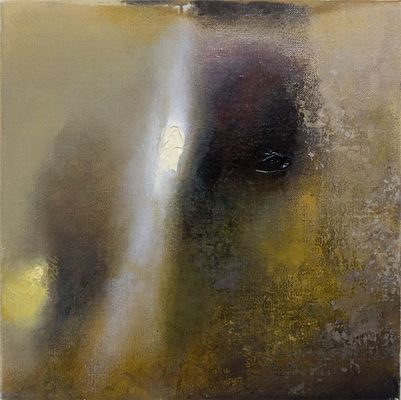
To return to Buckley’s fragment, the first two lines very much evoke how I paint nowadays. As you age, detail diminishes and patches of light become more luminous and float. I feel the most honest way of dealing with this is by smearing the oil paint on the canvas with the fingers and working close-up, blind. Only if the patches coalesce into an approaching image can the work gain a life.
-
Jonathan Walker was born in Melbourne, Australia and brought up on a dairy farm in Gippsland. In the 1970’s he studied painting at RMIT and won the Harold Wright Scholarship to the British Museum, London. During the 1980’s he exhibited at Pinacotheca Gallery, Richmond and had work shown at the NGV and Heidi City Art Gallery. Over the same period he designed the cover for the “Epigenesi” LP by Giancarlo Toniutti, Italy and conducted a mail exchange work with Achim Wollscheid, Germany. The work with artists through the post resulted in an article published in the bicentenary issue of Art and Australia 1988. He showed in artist run spaces such as WestSpace in the 90’s and 2000’s, and until 2012, taught painting at Victoria University, which is where we (Colleen Ahern and Lisa Radford) as organisers of the exhibition, among many others, had the privilege of being his student.
Walker’s knowledge was imparted to students through the careful selection of music, literature, and artists found in books that he himself had ordered for the library. Walker’s strategy was the generosity of sharing his vast knowledge with references specific to each student and their context.
Walker’s paintings share a similar focus and intimacy.
This exhibition presents a small selection of recent paintings alongside a publication that includes Walker’s writing. Observational and analytical, Walker’s work is a type of material notation — the time of day, colour and how it is blended, the both specific and fleeting location of a reflection on lino or the question of whether a chair leg should be included in a painting.
Please join us on Friday August 21 between 6-8pm to celebrate the opening of the exhibition.
Curated by Colleen Ahern and Lisa Radford.
B. Wurtz
Curated by Nic Tammens
March 26 - April 4, 2015
B.Wurtz works from a basement studio in his home on Manhattan’s Lower East Side.
This local fact is attested to by the plastic shopping bags and newsprint circulars that appear in his work. As formal objects, they don’t make loud claims about their origins but nonetheless transmit street addresses and places of business from the bottom of this long thin island. Like plenty of artists, Wurtz is affected by what is local and what is consumed. His work is underpinned by this ethic. It often speaks from a neighborhood or reads like the contents of a hamper:
“BLACK PLUMS $1.29 lb.”
“Food Bazaar”
“USDA Whole Pork Shoulder Picnic 99c lb.”
“RITE AID Pharmacy, with us it’s personal.”
“H. Brickman & Sons.”
“Sweet Yams 59c lb."
Most of the work in this exhibition was made while the artist was in residence at Dieu Donne, a workshop dedicated to paper craft in Midtown. Here Wurtz fabricated assemblages with paper and objects that are relatively lightweight, with the intention that they would be easily transportable to Australia. This consideration isn’t absolute in Wurtz’s work, but was prescriptive for making the current exhibition light and cheap. Packed in two boxes, these works were sent from a USPS post office on the Lower East Side and delivered to North Melbourne by Australia Post.
Wurtz appears courtesy of Metro Pictures, New York.
Thanks to Rob Halverson, Joshua Petherick, Sari de Mallory, Matt Hinkley, Helen Johnson, Fayen d'Evie, Ask Kilmartin, Lisa Radon, Ellena Savage, Yale Union, and "Elizabeth".
John Nixon
"Archive"
December 15 - January 20, 2014
The presentation of John Nixon's archive offered a rare showcase of this extensive collection of the artist's own publications, catalogues, posters, ephemera, editions and more, from the mid 1980s onwards, alongside a selection of his artworks.
Organized by John Nixon, Joshua Petherick and Matt Hinkley.
"Habitat"
at Minerva, Sydney (organised by Joshua Petherick and Matt Hinkley)
November 15 - December 20, 2014
Lupo Borgonovo, Janet Burchill & Jennifer McCamley,
Lewis Fidock, HR Giger, Piero Gilardi, Veit Laurent Kurz,
Cinzia Ruggeri, Michael E. Smith, Lucie Stahl, Daniel Weil, Wols
Press Release:
“...It contained seven objects. The slender fluted bone, surely formed for flight, surely from the wing of some large bird. Three archaic circuitboards, faced with mazes of gold. A smooth white sphere of baked clay. An age-blackened fragment of lace. A fingerlength segment of what she assumed was bone from a human wrist, grayish white, inset smoothly with the silicon shaft of a small instrument that must once have ridden flush with the surface of the skin - but the thing’s face was seared and blackened.”
William Gibson, “Count Zero”, 1986
"Autumn Projects Archive"
Curated by Liza Vasiliou
March 6 - March 15, 2014
World Food Books, in conjunction with the Virgin Australia Melbourne Fashion Festival 2014, presented the Autumn Projects archive, consisting of a selection of early examples in Australian fashion with a particular interest in collecting designers and labels from the period beginning in the 1980’s, who significantly influenced the discourse of Australian Fashion.
Curated by Liza Vasiliou, the exhibition provided a unique opportunity to view pieces by designers Anthea Crawford, Barbara Vandenberg, Geoff Liddell and labels CR Australia, Covers, Jag along with early experimental collage pieces by Prue Acton and Sally Browne’s ‘Fragments’ collection, suspended throughout the functioning World Food Books shop in Melbourne.
H.B. Peace
presented by CENTRE FOR STYLE
November 14, 2013
"Hey Blinky, you say chic, I say same"
Anon 2013
H.B. Peace is a clothing collaboration between great friends Blake Barns and Hugh Egan Westland. Their pieces explore the divergences between 'character’ and ‘personality’ in garments....etc
Special Thanks to Joshua Petherick and Matt Hinkley of WFB and Gillian Mears
and a Very Special Thank you to Audrey Thomas Hayes for her shoe collaboration.
Janet Burchill & Jennifer McCamley
"Aesthetic Suicide"
May 10 - June 8, 2013
The first of our occasional exhibitions in the World Food Books office/shop space in Melbourne, "Aesthetic Suicide" presented a body of new and older works together by artists Janet Burchill & Jennifer McCamley, including videos, prints, a wall work, and publications.
During shop open hours videos played every hour, on the hour.
1989, English
Softcover, 246 pages, 20 x 13 cm
1st Edition, Out of print title / used / very good
Published by
Paladin / London
$80.00 - Out of stock
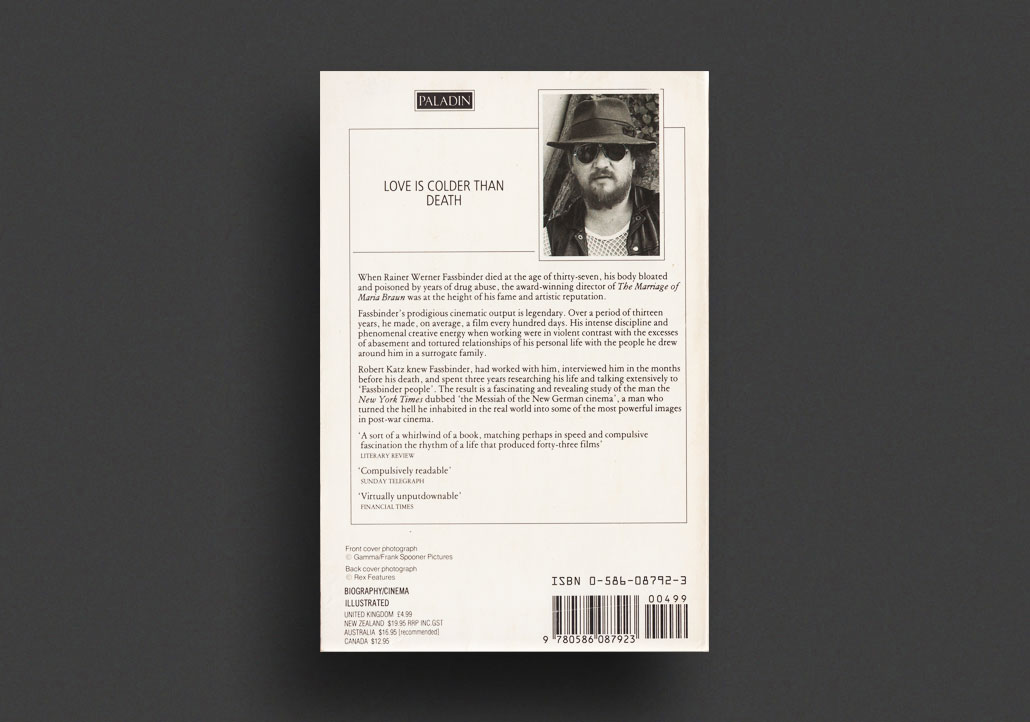
First 1989 edition of this colossal and now rare biography and a painful gaze inside the life and times of the tortured cinematic genius that was Rainer Werner Fassbinder. Author Robert Katz knew Fassbinder, had worked with him, interviewed him in the months before his death, and spent three years researching his life and talking extensively to 'Fassbinder people'. The result is a fascinating and revealing study of the man who turned the hell he inhabited in the real world into some of the most powerful images in post-war cinema.
"A sort of a whirlwind of a book, matching perhaps in speed and compulsive fascination the rhythm of a life that produced forty-three films"—LITERARY REVIEW
When Rainer Werner Fassbinder died at the age of thirty-seven, his body bloated and poisoned by years of drug abuse, the award-winning director of The Marriage of Maria Braun was at the height of his fame and artistic reputation.
Fassbinder's prodigious cinematic output is legendary. Over a period of thirteen years, he made, on average, a film every hundred days. His intense discipline and phenomenal creative energy when working were in violent contrast with the excesses of abasement and tortured relationships of his personal life with the people he drew around him in a surrogate family.
Very Good copy with general light wear/tanning to extremities.
2024, English
Softcover, 68 pages, 22 x 14 cm
Published by
Primary Information / New York
$44.00 - In stock -
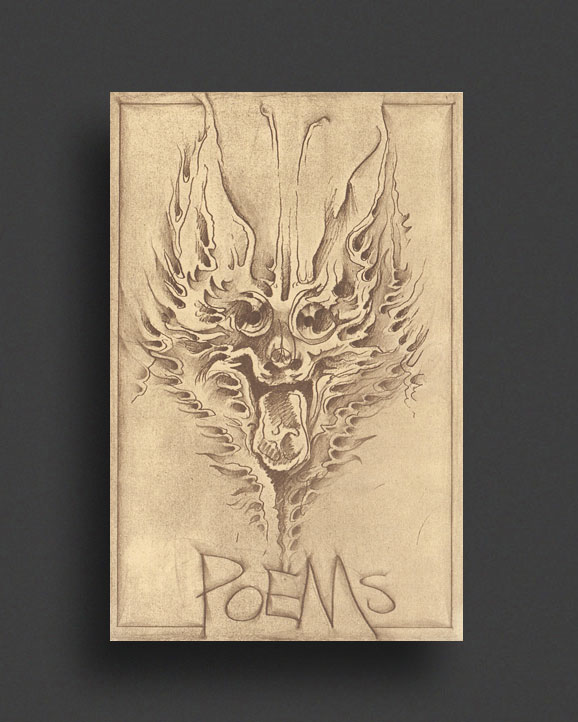
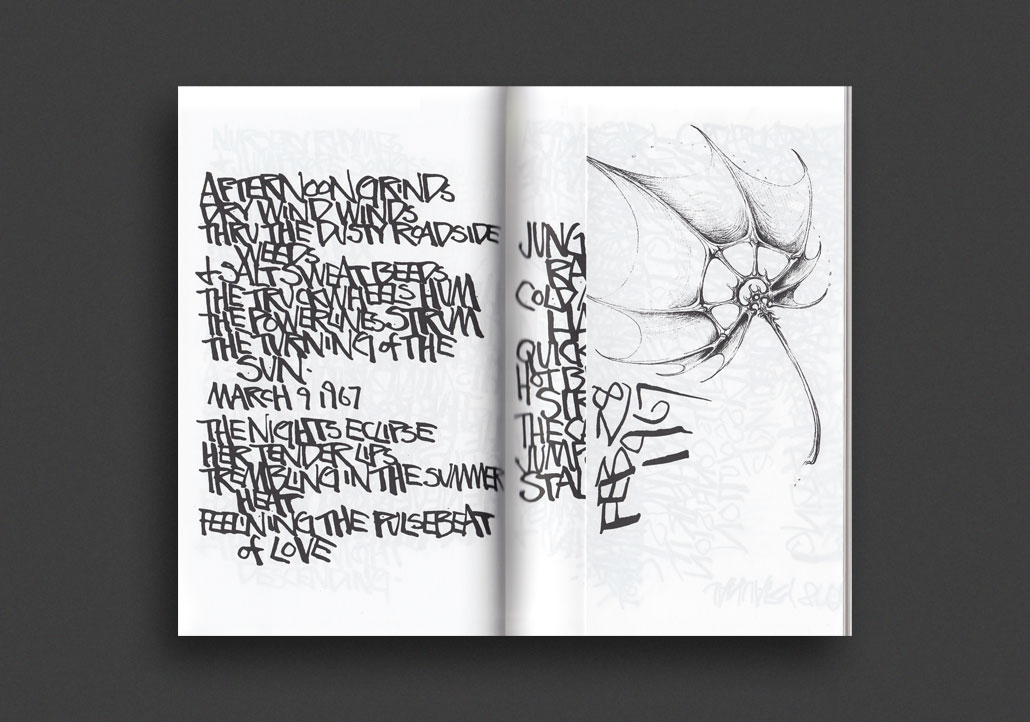
Self-published in 1968, Footprints, Poems, and Leaves collects dozens of poems written by Martin Wong between 1966 and 1968. Hand-written in a signature calligraphic style that he was just beginning to develop, the poems ebb and flow visually across the page, much like the fluctuating characters, scenes, and moods that inhabit them. This was Wong’s first book of poetry and it contains a double cover showcasing intricate drawings of skeletal angels and other tableaux, as well as a folded, looseleaf broadsheet containing two poems and a drawing of a boney leaf.
The poems were written during a relatively free period for the artist, shortly after he dropped out of Berkeley and began exploring San Francisco at the height of the hippy movement. The poems range from surrealist and pastoral descriptions of the urban subculture that surrounded him to downtrodden, travel-weary biographical entries that are both lonely and tender. Footprints, Poems, and Leaves functions like a journal capturing Wong’s tumultuous life in this period, which included being arrested at a queer, drug-fueled house party (along with Rudolf Nureyev and Dame Margot Fonteyn) and a stay in a mental institution in late 1967 and early 1968. Around the time of the book’s publication, Wong enrolled in Humboldt State University to finish his degree, beginning a new chapter for the artist.
Despite the dark backdrops of many of the works, the writing displays a playfulness with form and language and a sense of humor that can be seen throughout Wong’s later work as well. Altogether, Footprints, Poems, and Leaves creates a rich tapestry of visual poetry that is both a product of its time and the budding artistic mind of a young Martin Wong.
Martin Wong (1946-1999) was born in Portland, Oregon and raised in San Francisco, California. He studied ceramics at Humboldt State University, graduating in 1968. Wong was active in the performance art groups The Cockettes and Angels of Light before moving to New York in 1978. He exhibited for two decades at notable downtown galleries including EXIT ART, Semaphore, and P·P·O·W, among others, before his passing in San Francisco from an AIDS related illness. His work is represented in the collections of The Metropolitan Museum of Art, New York, NY; Museum of Modern Art, New York, NY; The Bronx Museum of the Arts, New York, NY; Whitney Museum of American Art, New York, NY; Cleveland Museum of Art, Cleveland, OH; Art Institute of Chicago, Chicago, IL; and the San Francisco Museum of Modern Art, San Francisco, CA, among others. Human Instamatic, a comprehensive retrospective, opened at the Bronx Museum of The Arts in November 2015, before traveling to the Wexner Center for the Arts in 2016 and the UC Berkeley Art Museum and Pacific Film Archive in 2017. In 2022, the first extensive, touring exhibition of Wong’s work in Europe, Martin Wong: Malicious Mischief, opened at Museo Centro de Arte Dos de Mayo in Madrid before traveling to KW Institute of Contemporary Art (Berlin), Camden Art Centre (London), and Stedelijk Museum (Amsterdam).
Managing Editor (2024): James Hoff
Managing Designer (2024): Rick Myers
2022, English
Softcover, 352 pages, 28 x 21.5 cm
1st Edition, Out of print title / as new
Published by
Walther König / Köln
KW Institute for Contemporary Art / Berlin
$350.00 - In stock -
First, only edition, very quickly out-of-print.
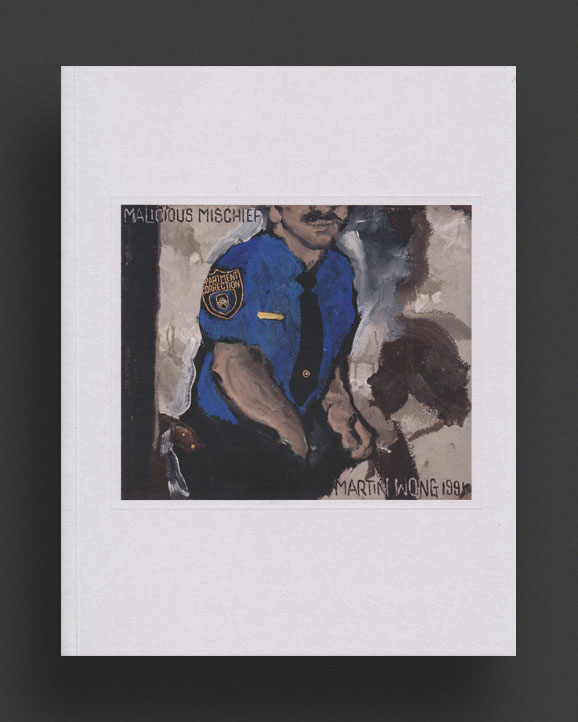
New major publication published to accompany the first extensive European exhibition of the work of the US-Chinese artist Martin Wong (b. 1946, Portland, US, d. 1999, San Francisco), ‘Martin Wong: Malicious Mischief’, initiated by KW Institute for Contemporary Art, Berlin. Curated by Krist Gruijthuijsen and Agustín Pérez-Rubio, and produced in collaboration with Camden Art Centre, Stedelijk Museum and Museo Centro de Arte Dos de Mayo, Malicious Mischief is the result of exhaustive research into the life’s work of Wong from his early creations on the US East Coast to his work in the late-1990s before he died due to an VIH/AIDS-related illness.
Martin Wong is recognized for his depictions of social, sexual, and political scenographies from the US in the 1970s, 1980s, and 1990s. Poetically weaving together narratives of queer existence, marginal communities, and urban gentrification, Wong stands out as an important countercultural voice at odds with the art establishment’s reactionary discourse at the time. Heavily influenced by his immediate surroundings, the artist’s practice merges the visual languages of Chinese iconography, urban poetry, graffiti, carceral aesthetics, and sign language. His work offers rare insight into decisive periods of recent US American history as told through its changing urban landscapes, unfolding hidden desires, and complexities.
Martin Wong: Malicious Mischief presents a vast survey of Wong’s works, encompassing early paintings and sculptures made in the euphoric environments of San Francisco and Eureka, California, in the late 1960s and early 1970s; Wong’s iconic 1980s and 1990s paintings from his time as a citizen of a dilapidated New York City; lastly, his reminiscences on the imagery of Chinatowns on the East and West Coast, made prior to his premature death from an HIV/AIDS-related illness.
Edited by curators Krist Gruijthuijsen and Agustín Pérez Rubío.
Contributions by Julie Ault, Sofie Krogh Christensen, David J. Getsy, Heinz Peter Knes, Marci Kwon, Agustín Pérez Rubio, Danh Vo.
Co-published by Walther Koenig with KW Berlin.
As New copy.
2023, English
Softcover, 224 pages, 20.83 x 13.72 cm
Published by
Verso / London
$45.00 - Out of stock
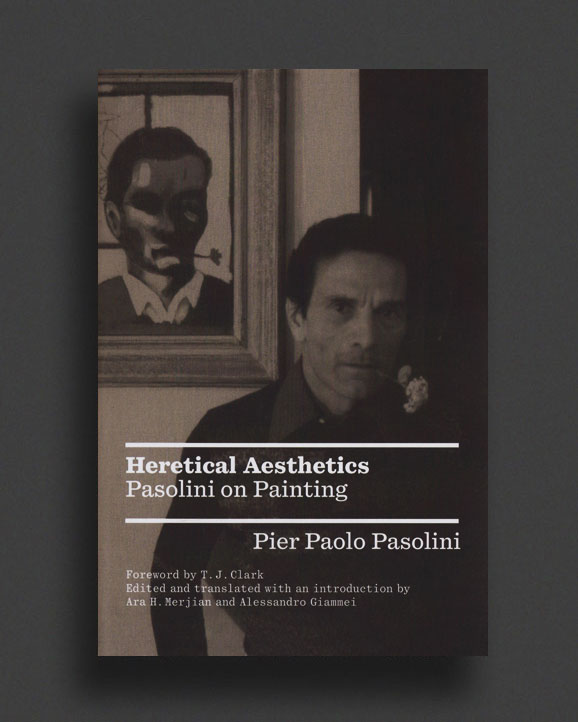
First collection on filmmaker and poet Pasolini's passion for painting.
Preface by T. J. Clark
Edited by Alessandro Giammei and Ara H Merjian
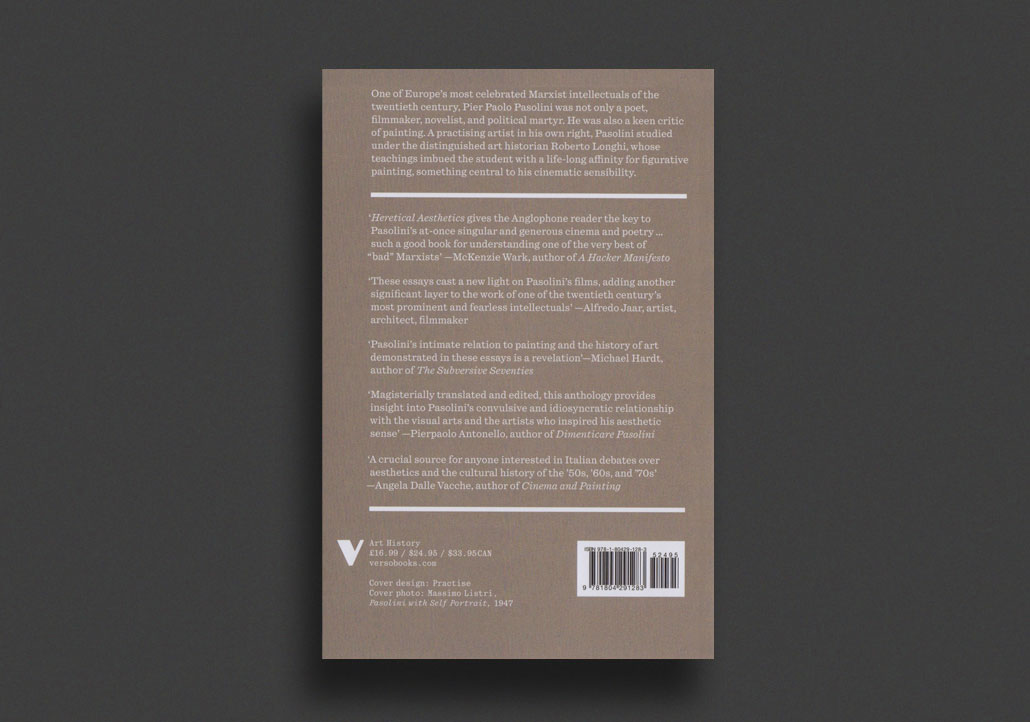
One of Europe's most mythologized Marxist intellectuals of the 20th century, Pier Paolo Pasolini was not only a poet, filmmaker, novelist, and political martyr. He was also a keen critic of painting. An intermittently practicing artist in his own right, Pasolini studied under the distinguished art historian Roberto Longhi, whose lessons marked a life-long affinity for figurative painting and its centrality to a particular cinematic sensibility.
Pasolini set out wilfully to "contaminate" art criticism with semiotics, dialectology, and film theory, penning catalogue essays and exhibition reviews alongside poems, autobiographical meditations, and public lectures on painting. His fiercely idiosyncratic blend of Communism and classicism, localism and civic universalism, iconophilia and aesthetic "heresy," animated and antagonized Cold War culture like few European contemporaries. This book offers numerous texts previously available only in Italian, each accompanied by an editorial note elucidating its place in the tumultuous context of post-war Italian culture.
Prefaced by the renowned art historian T.J. Clark, a historical essay on Pasolini's radical aesthetics anchors the anthology. One hundred years after his birth, Heretical Aesthetics sheds light on one of the most consequential aspects of Pasolini's intellectual life, further illuminating a vast cinematic and poetic corpus along the way.
"Vision in Pasolini is at once tactile, earthy, erotic, divine and communist. His way of seeing communes with the world rather than holding it at a distance. By bringing together his writings on art, Heretical Aesthetics gives the Anglophone reader the key to his at once singular and generous cinema and poetry. His is a perspective from elsewhere in history, one which holds our own times sternly to account. This is such a good book for understanding one of the very best of 'bad' Marxists."—T.J. Clark
"Magisterially translated and edited, this indispensable anthology is finally available to an English-speaking audience. It provides detailed and precise insight into Pasolini's convulsive and idiosyncratic relationship with the visual arts and the artists who inspired his aesthetic sense. This exhilarating trove sheds light on the contaminated and visionary visual landscape produced by one of the most important filmmakers in the history of cinema: a total artist who found expressive depth in the heretical forms of his vision."—Pierpaolo Antonello
"Pasolini's intimate relation to painting and the history of art demonstrated in these essays is a revelation, especially for understanding his films. The texts are classic Pasolini - unfailingly brilliant and erudite, but also at once revolutionary and reactionary, observant of his times and blind to some of the most innovative developments. A fascinating collection."—Michael Hardt, author of The Subversive Seventies
2024, English
Softcover, 208 pages, 22.86 x 15.24 cm
Published by
Duke University Press / North Carolina
$49.00 - Out of stock
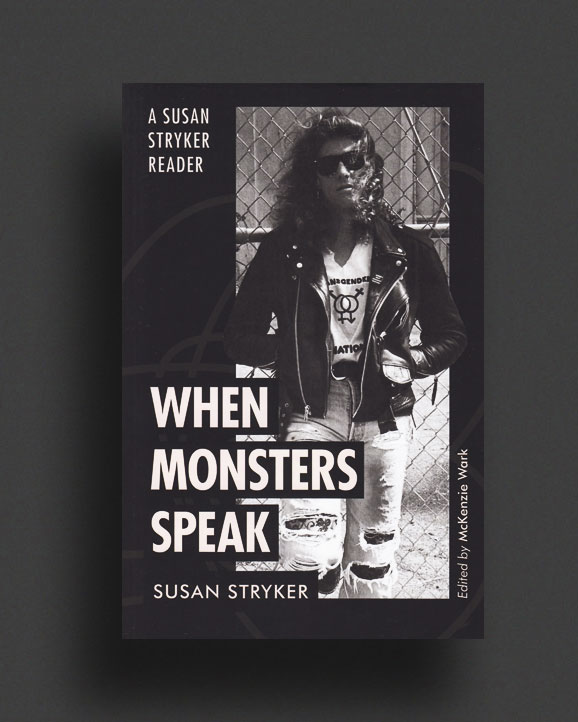
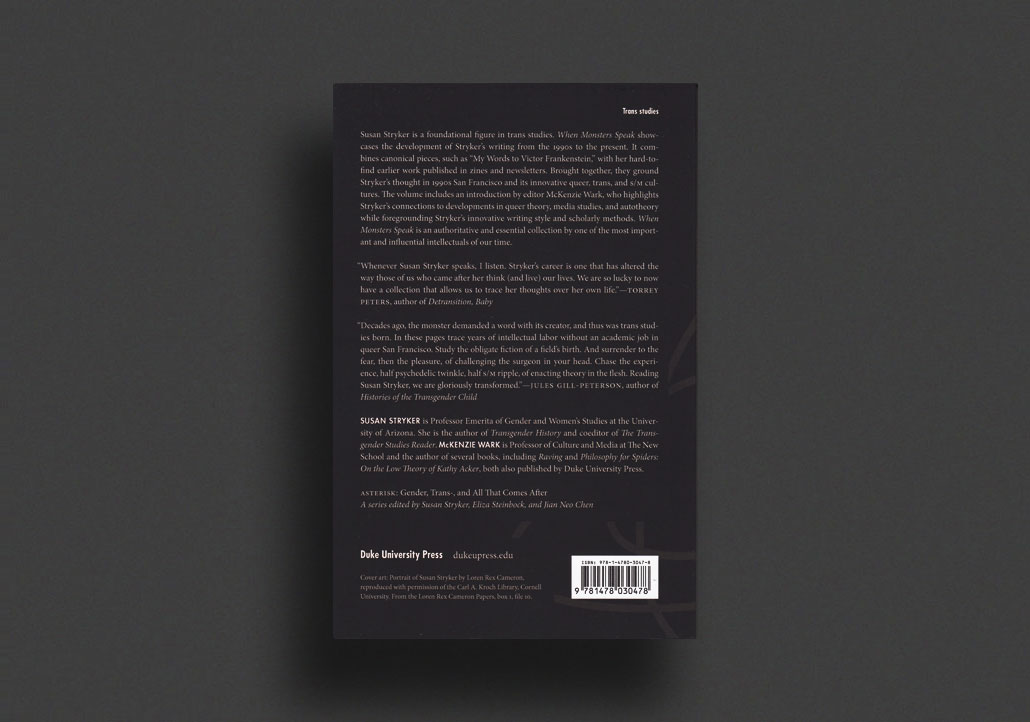
Susan Stryker is a foundational figure in trans studies. When Monsters Speak showcases the development of Stryker’s writing from the 1990s to the present. It combines canonical pieces, such as “My Words to Victor Frankenstein,” with her hard to find earlier work published in zines and newsletters. Brought together, they ground Stryker’s thought in 1990s San Francisco and its innovative queer, trans, and S/M cultures. The volume includes an introduction by editor McKenzie Wark, who highlights Stryker’s connections to developments in queer theory, media studies, and autotheory while foregrounding Stryker’s innovative writing style and scholarly methods. When Monsters Speak is an authoritative and essential collection by one of the most important and influential intellectuals of our time.
Susan Stryker is Professor Emerita of Gender and Women’s Studies at the University of Arizona. She is the author of Transgender History and coeditor of The Transgender Studies Reader.
McKenzie Wark is Professor of Culture and Media at The New School and the author of several books, including Raving and Philosophy for Spiders: On the Low Theory of Kathy Acker, both also published by Duke University Press.
“Whenever Susan Stryker speaks, I listen. Stryker’s career is one of those that has altered the way that those of us who came after her think—and live our lives. We are so lucky to now have a collection that allows us to trace her thoughts over her own life.”—Torrey Peters, author of Detransition, Baby
“Decades ago, the monster demanded a word with its creator, and thus was trans studies born. In these pages, trace years of intellectual labor without an academic job in queer San Francisco. Study the obligate fiction of a field’s birth. And surrender to the fear, then the pleasure, of challenging the surgeon in your head. Chase the experience, half psychedelic twinkle, half S/M ripple, of enacting theory in the flesh. Reading Susan Stryker, we are gloriously transformed.”—Jules Gill-Peterson, author of Histories of the Transgender Child
"Stryker provides a bracing assessment of frictions within the LGBTQ movement, criticizing cis gay and lesbian individuals who seek to secure a place in mainstream society by excluding trans people. . . . The result is a striking introduction to the work of an essential queer thinker."—Publishers Weekly
"In this slim volume, McKenzie Wark has collected some of Susan Stryker’s most prominent pieces, both fiction and nonfiction. Wark provides a robust introduction, setting the stage for this and subsequent generations to fully grasp the importance and context of her work."—Karla Strand, Ms. Magazine
2024, English / Portuguese
Softcover (staple-bound), 30 pages, 21.59 x 13 cm
Ed. of 150,
Published by
Fugitive Materials / New York
$19.00 - Out of stock
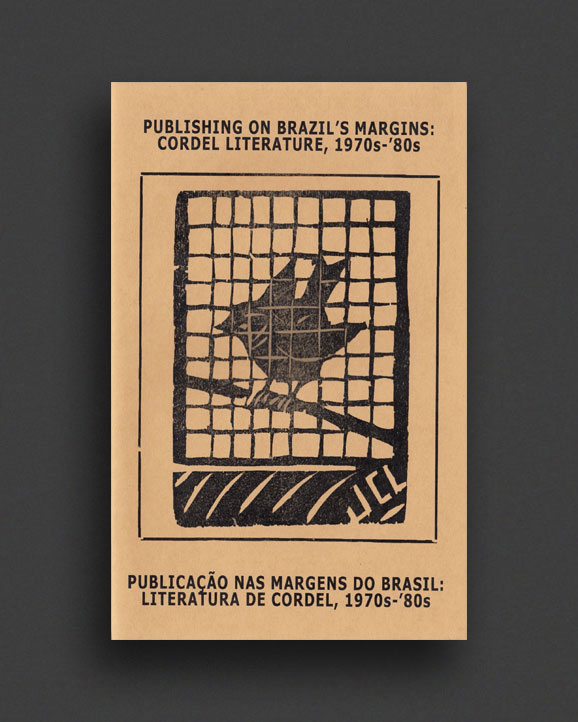
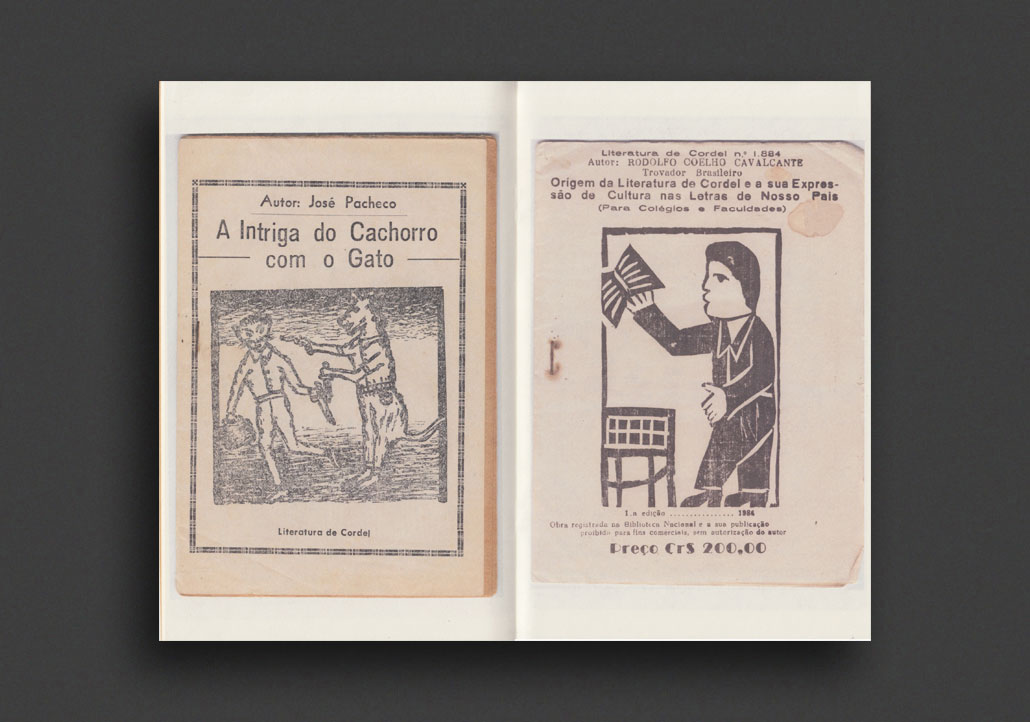
This zine reproduces some of the covers in a substantial collection of Brazilian cordel literature from the period of the military dictatorship and shortly thereafter – self-publishing from Brazil’s margins, documenting politics, religion and folklore, and even an early treatment of AIDS in Brazil during a period of extreme censorship and repression.
Text in English and Portuguese.
1971, Japanese
Softcover (staple-bound), 160 pages, 21.5 x 15 cm
1st Edition, Out of print title / used / good
Published by
Lemon Inc. / Tokyo
$90.00 - Out of stock
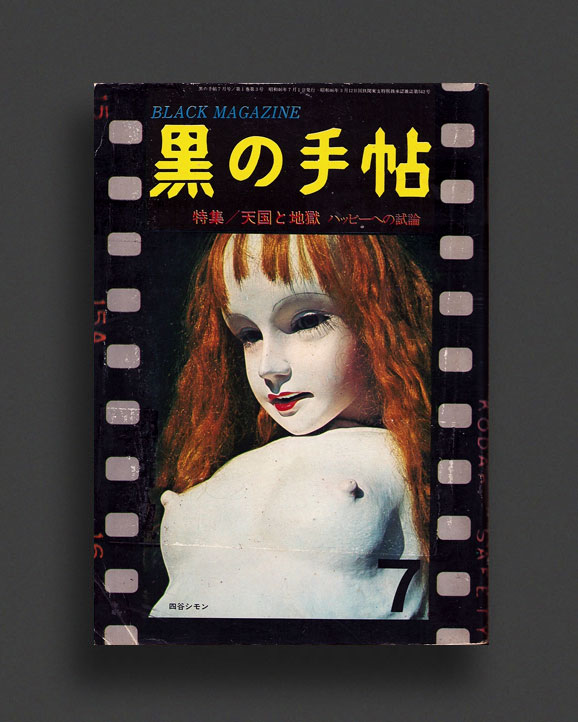
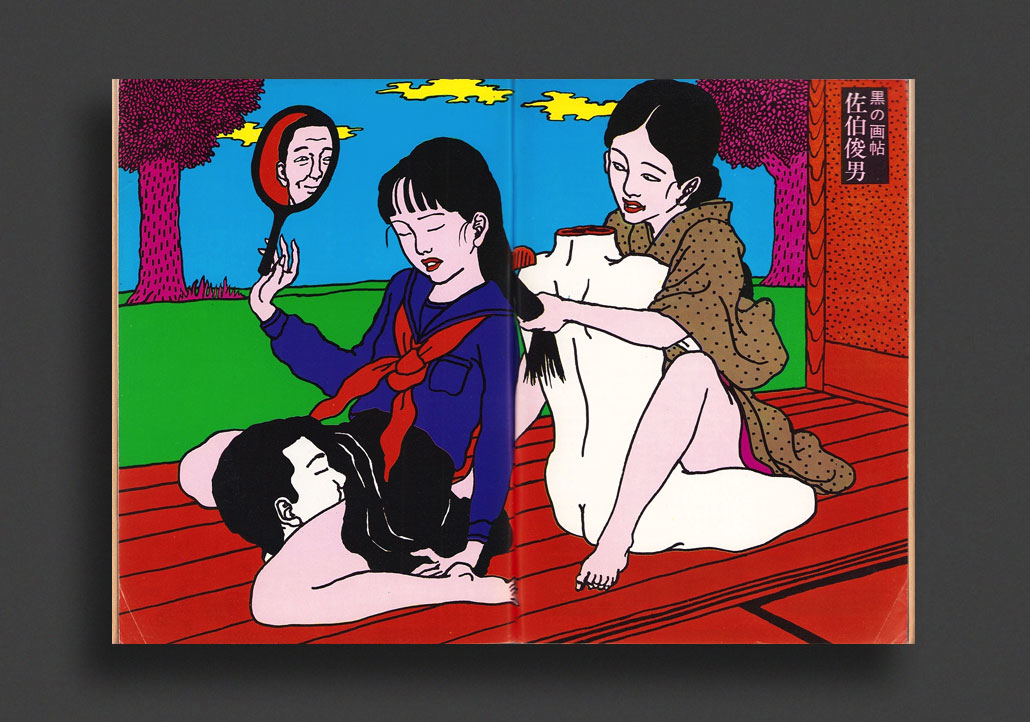
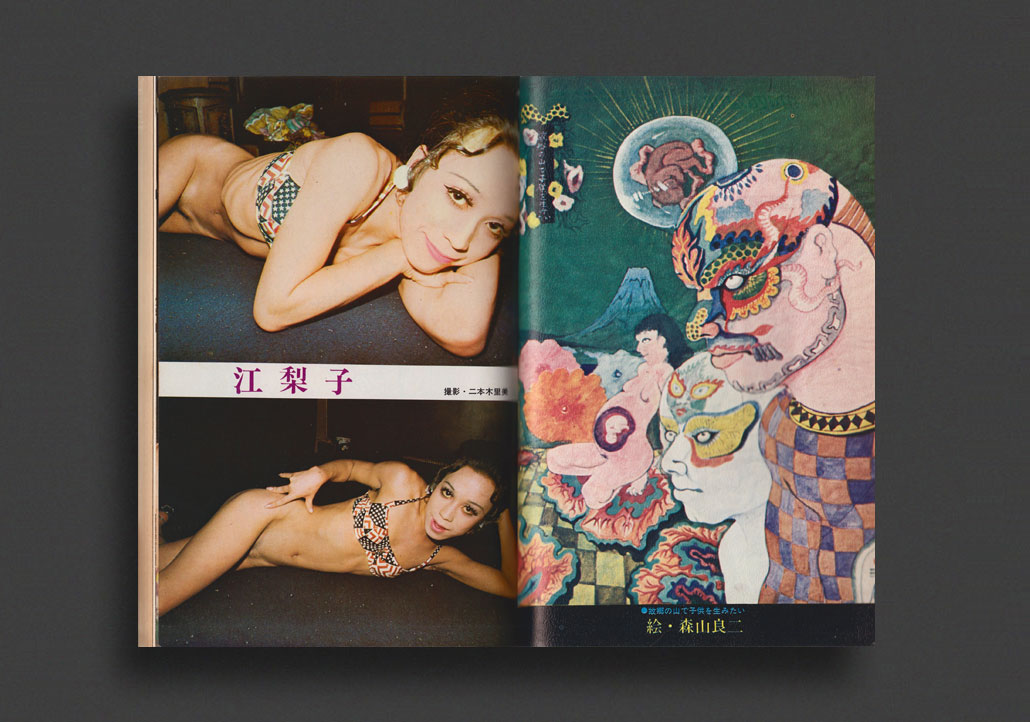
July 1971 (w. Simon Yotsuya cover) issue of legendary Japanese underground arts periodical, Black Magazine (or Black Notebook), a taboo-shattering vehicle of the 1970s subculture in Tokyo. A magazine like no-other, each issue, "a paradise of 1970's heretical culture", was a who's who of non-conformity, introducing a new wave of illustrators, painters, doll-makers and photographers, "taboo" sexuality and fetish culture, avant-garde comics, sadistic literature, radical criticism, queer poetry, activism, black humour, underground film and theatre, and all manner of transgressive, esoteric and erotic material, new and historical. Black Magazine featured the work of Yukio Mishima, Toshio Saeki, Izumi Suzuki, Simon Yotsuya, Shūji Terayama, Ken Katayama, Nobuyoshi Araki, Genpei Akasegawa, Keiichi Tanaami, Kikuji Yamashita, Aoi Fujimoto, Tadanori Yokoo, Hiroshi Nakamura, and so many others. It was also where Japanese photographer Satomi Nihongi's Tokyo Transgender photographs were first printed. Black Magazine was heavy with queer and trans content, and Nihongi's "The Most Beautifuls" was a regular photo-feature in its pages. A lot of great things started in the pages of this unique magazine. A highly recommended publication!
This third issue, themed "Heaven and Hell", features incredible cover by renowned Japanese doll artist (and female doll actor) Simon Yotsuya, and contributions by ero guro master Toshio Saeki, artist Genpei Akasegawa, art critic Junzo Ishiko, "Funeral Parade of Roses" director Toshio Matsumoto, Butoh dancer Natsu Nakajima, poet and critic Akiko Baba, photographer Masatoshi Naitō, manga artist Ryuzan Aki, literary critic Katsutarō Isogai, illustrator Akechi Goro, writer Masaki Umehara, author Utagawa Taiga, literary critic Nobuo Kasahara, essayist Shinichi Kusamori, critic Hidetomo Kanaoka, illustrator (Flower Travellin' Band) Shinobu Ishimaru, manga artist Shigeru Sugiura, scholar Aoi Suenaga, artist Takahashi Shōtei, illustrator Yosuke Inoue, and many more. A lot of great things started in the pages of this unique magazine. A highly recommended publication!
2025, English
Softcover, 240 pages, 21.5 x 12.7 cm
Published by
McNally Editions / US
$38.00 - Out of stock
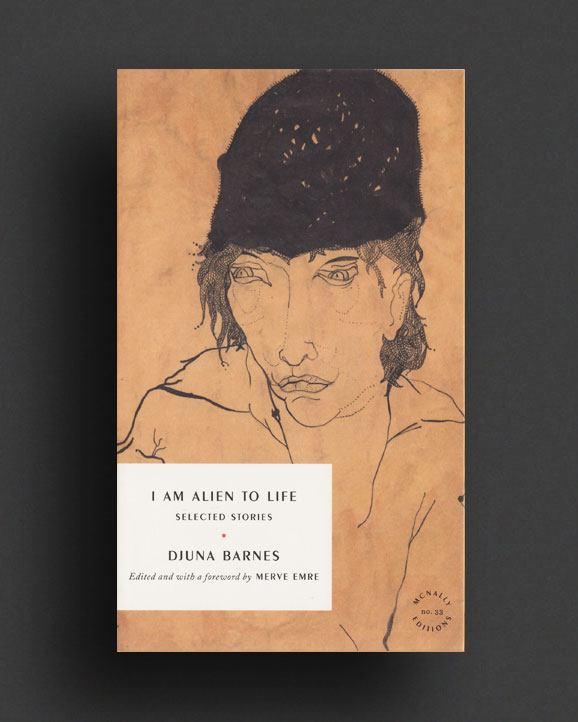
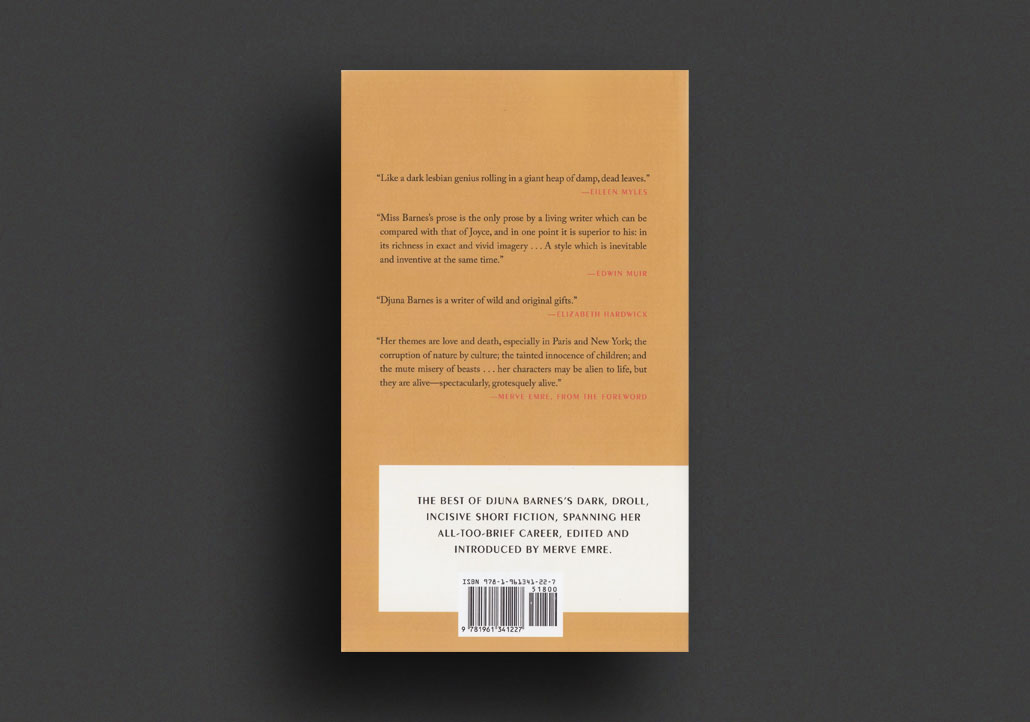
The best of Djuna Barnes's dark, droll, incisive short fiction, spanning her all-too-brief career, edited and introduced by Merve Emre.
Djuna Barnes is rightly remembered for Nightwood, her breakthrough and final novel: a hallmark of modernist literature, championed by T. S. Eliot, and one of the first, strangest, and most brilliant novels of love between women to be published in the twentieth century. Barnes's career began long before Nightwood, however, with journalism, essays, drama, and satire of extraordinary wit and courage. Long into her later life, after World War II, when she published nothing more, it was her short fiction above all that she prized and would continue to revise.
Here are all the stories Barnes sought to preserve, in the versions she preferred, as well as a smattering of rarities as selected by critic and New Yorker contributor Merve Emre. These are tales of women "'tragique' and 'triste' and 'tremendous' all at once," of sons and daughters being initiated into the ugly comedy of life, monuments all to a worldview singular and scathing. As Emre writes in her foreword "[Barnes's] themes are love and death, especially in Paris and New York; the corruption of nature by culture; the tainted innocence of children; and the mute misery of beasts . . . her characters may be alien to life, but they are alive—spectacularly, grotesquely alive."
2024, English / French
Softcover, 208 pages + 32 page insert, 21 x 27 cm
Published by
Mousse / Milan
$85.00 - In stock -
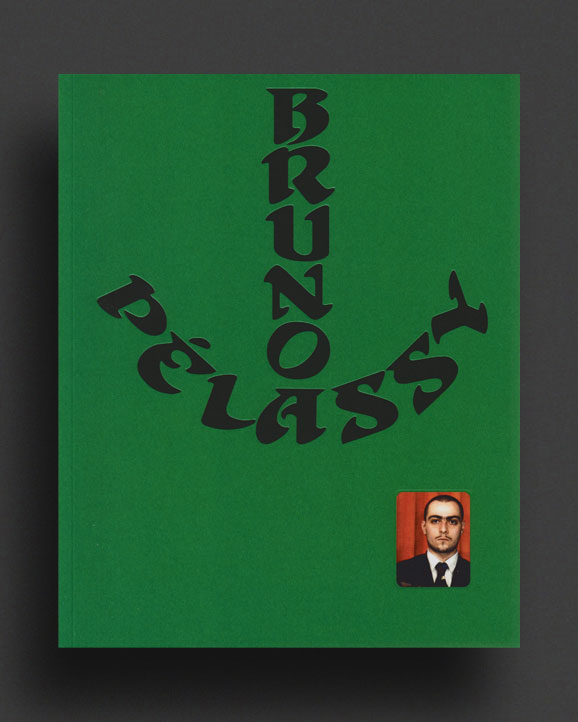
The very first monograph dedicated to the work of Bruno Pélassy (1966–2002), featuring all his works, installation views, and a vast range of materials from his unpublished personal archive.
Also available in English edition.
"In 1987, while finishing his training as a tailor, Bruno Pélassy was living in a studio apartment in Paris, amidst dark clutter and a cascade of needles, lace and fur that his mother used to bring him from Nice. On his cathode-ray television, his VHS tapes played on repeat: The Exorcist (1973), Female Trouble (1974), and The Law of the Strongest (1975). Sometimes he would turn the volume down to play his vinyl records along with the images: "Madame Butterfly" by Malcolm McLaren (1984), the recording of Ingrid Caven at Le Pigall's (1978), anything by Madonna. On a pine shelf, a Chanel perfume bag and the beginnings of a library: La Nuit juste avant les forêts (1977), Dans la solitude des champs de coton (1985) and Le Retour au désert (1988). Like Koltès, the author of these books, Pelassy was gay, born into a Catholic family, with a military father and a housewife mother." As it turns out from the words of Baptiste Pinteaux, throughout his life Bruno Pélassy embodied a multifaceted and gleaming persona, one of a rampant collector whose subversive and sensual oeuvre rejects pigeonholing. His work, which spans over a decade (1990s–2000s), range from sculptures and bijoux to drawings and films, incorporating motifs from both haute couture and the second-hand cultures of a throwaway society, addressing both the issues of adornment and those of technology.
Pélassy was born in 1966 in Vientiane, Laos, where his father worked as a mechanic in the air force, and he grew up amid the souvenirs his parents brought back with them: lengths of fabrics bought at markets, photographs of Khmer temples, and stories of Buddhist funeral rites.
In the early 1990s, he began drawing and making his first jewelry pieces, mixing glass beads and black leather, and he started to collaborate occasionally with Swarovski. His first solo exhibition was held in 1993 at the Galerie Art Concept in Nice, where he presented a series of reliquaries, including a memorable bleached denim jacket adorned with huge red glass beads. He produced a series of drawings entitled We gonna have a good time which combine images from a classic 1970s hairdressing book with those from a medical textbook on facial diseases. With the same biting humor, he also created his first Bestioles ("Beasties"): a series of wigs concealing toy robots that animate them in a jerky manner. One of his most iconic work is Sans titre, Sang titre, Cent titres (1995), a feature-length film entirely made up of pirated fragments of movies and television excerpts. He continued sculpting with glass beads, crafting beautiful, ever-erect phalluses.
Pélassy died in 2002 in Nice from complications related to AIDS at the age of thirty-six. As he became weaker, he surrounded himself with a crowd of small creatures made of pearls, silk, and silicone—a "freaky pet shop" installed in the comfort of his own home. His last solo exhibition was held at the Galerie Vigna in Nice and is beautifully entitled Shim. Double gender.
Edited by Ilaria Bombelli, Florence Bonnefous, Alice Dusapin, Anna Gritz.
Texts by Florence Bonnefous, Marie Canet, Laura Cottingham, Baptiste Pinteaux.
2023, English
Softcover, 264 pages, 21.5 x 14 cm
Published by
Clash Books / US
$38.00 $20.00 - In stock -
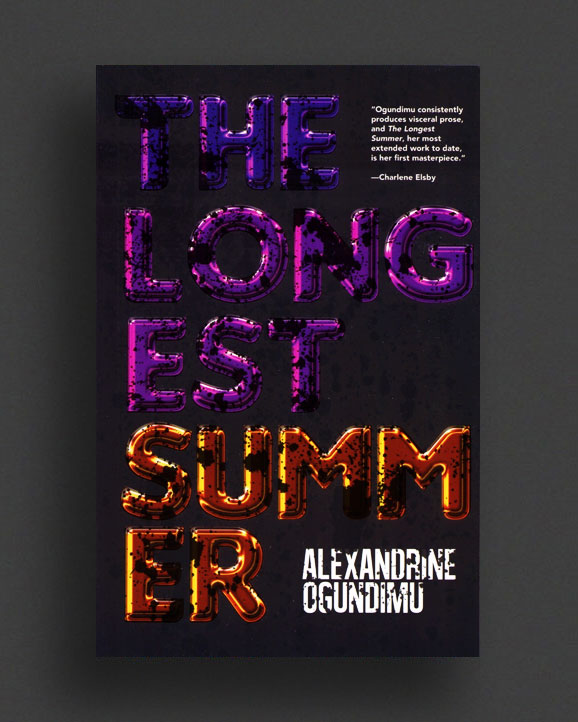
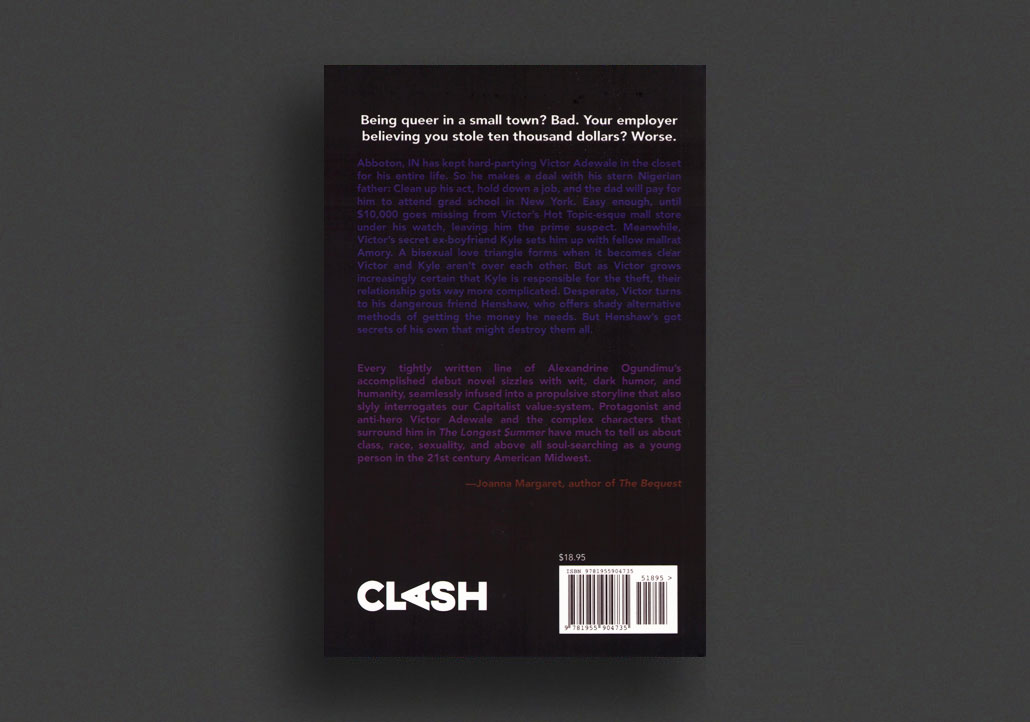
Being queer in a small town? Bad. Your employer believing you stole ten thousand dollars? Worse. Abboton, IN has kept hard-partying Victor Adewale in the closet for his entire life. So he makes a deal with his stern Nigerian father: Clean up his act, hold down a job, and the dad will pay for him to attend grad school in New York. Easy enough, until $10,000 goes missing from Victor’s Hot Topic-esque mall store under his watch, leaving him the prime suspect. Meanwhile, Victor’s secret ex-boyfriend Kyle sets him up with fellow mallrat Amory. A bisexual love triangle forms when it becomes clear Victor and Kyle aren’t over each other. But as Victor grows increasingly certain that Kyle is responsible for the theft, their relationship gets way more complicated. Desperate, Victor turns to his dangerous friend Henshaw, who offers shady alternative methods of getting the money he needs. But Henshaw’s got secrets of his own that might destroy them all.
“With The Longest Summer, Ogundimu manages to tap into the very essence of what it means to be human in a world that literally ceases to have meaning… in the process, once again, proving to the world that she is one of the best at her craft. It is in the decayed city of Abboton, Indiana (an almost too-perfect portrayal of a very specific moment in time of a very specific part of the American Midwest) that a certain type of slow-motion violence occurs—quietly descending upon its denizens, and sending out never-ending waves of irreparable destruction. I mean… My father lays his rifle across the bed and tells my mother “One of us is going to die tonight.” Holy Hell. Jesus Christ. WTGDF. This is one that is going to stay with you forever.”—Mike Kleine
2024, English
Softcover, 416 pages, 21.6 x 13.8 cm
Published by
SPBH Editions / UK
$89.00 $65.00 - In stock -
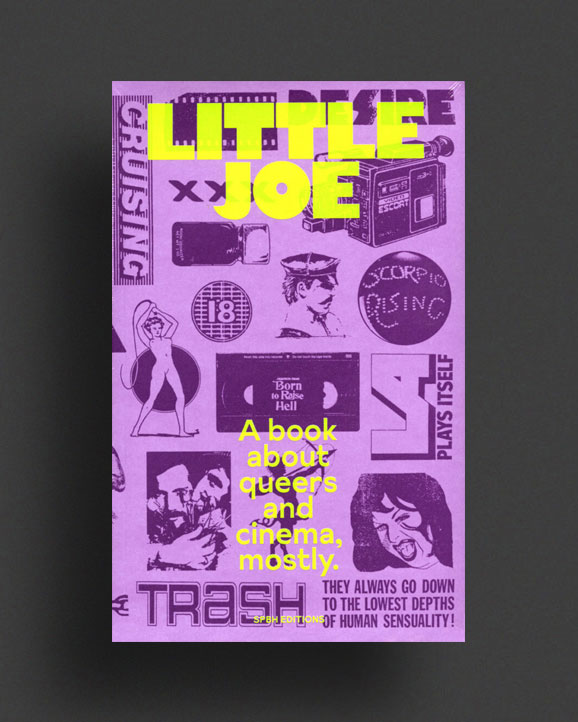
The cult periodical Little Joe, published as a limited-edition zine from 2010 to 2021, challenged the mainstream narrative of film history with a rebellious, queer perspective. Rather than reviewing new releases, it explored forgotten and overlooked films and celebrated a diverse spectrum of cinema – from obscure art films to porn to Hollywood classics – as worthy of critical debate. Stubbornly print-only, Little Joe was notoriously hard to find, privileging word-of-mouth distribution akin to the films it championed. This volume, compiled by editor-in-chief Sam Ashby, brings together the best of its previously elusive texts and proposes a new, alternative cinematic canon drawn from the fringes of taste and style, while paying homage to the original DIY Risograph aesthetic of the journal.
This volume features essays, in-depth conversations, short stories and archival discoveries from a host of queer and allied writers, artists, filmmakers, and academics, including John Waters, Sarah Schulman, Douglas Crimp, William E. Jones, Erika Balsom, Jeremy Atherton Lin, John Greyson, Elizabeth Purchell, Liz Rosenfeld, Peter Strickland, Ira Sachs, Terence Davies, Shu Lea Cheang, Kevin Killian, Wayne Koestenbaum, Abdellah Taïa, Marlene McCarty, John Cameron Mitchell, Rosa von Praunheim, Stuart Comer, Ed Halter, Jenni Olson, A.L. Steiner, A.K. Burns, Desiree Akhavan, and Andrew Haigh.
2020, English
Softcover, 320 pages, 14.5 x 23.6 cm
Published by
Semiotext(e) / Los Angeles
$39.00 - Out of stock
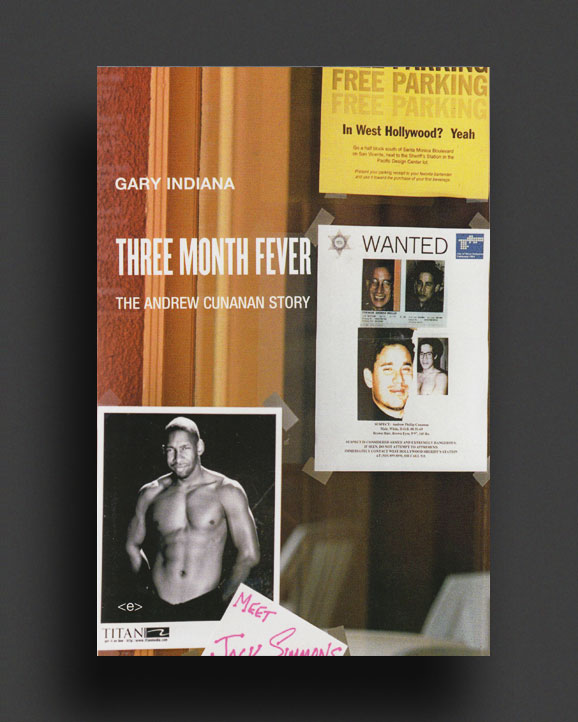
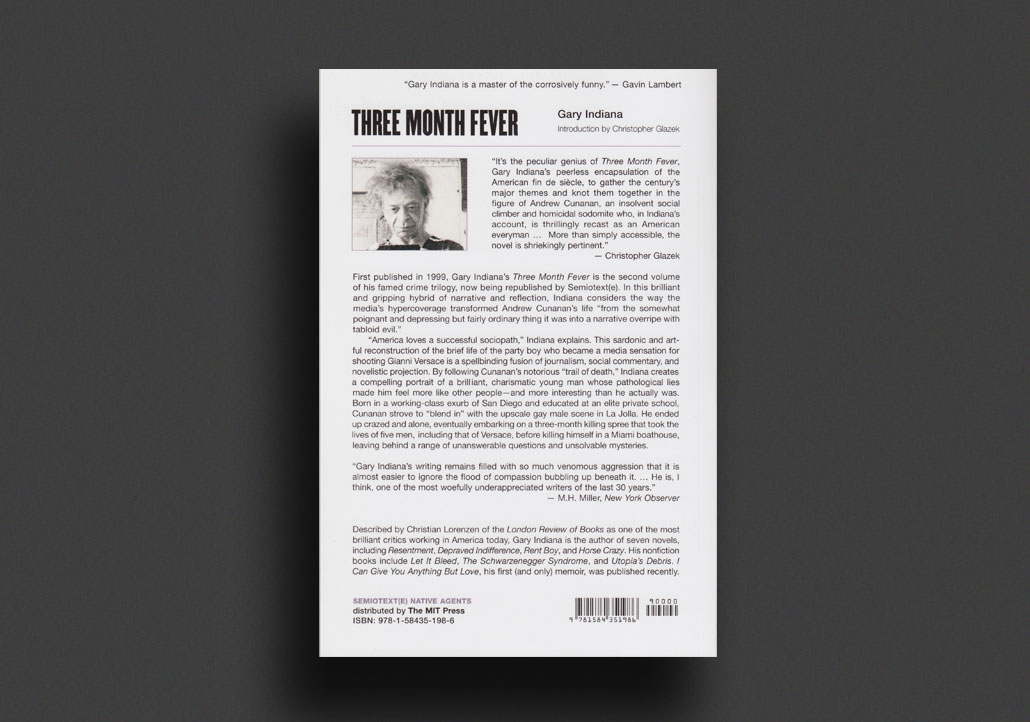
A sardonic and artful reconstruction of the brief life of the party boy who became a media sensation for shooting Gianni Versace.
It was suddenly chic to be "targeted" by Andrew.... It also became chic to claim a deep personal friendship with Versace, to infer that one might, but for a trick of fate, have been with Versace at the very moment of his "assassination," as it had once been chic to reveal one's invitation to Cielo Drive in the evening of the Tate slayings, an invitation only declined because of car trouble or a previous engagement...
--from Three Month Fever
First published in 1999, Gary Indiana's Three Month Fever is the second volume of his famed crime trilogy, now being republished by Semiotext(e). (The first, Resentment, reissued in 2015, was set in a Menendez trial-era L.A.) In this brilliant and gripping hybrid of narrative and reflection, Indiana considers the way the media's hypercoverage transformed Andrew Cunanan's life "from the somewhat poignant and depressing but fairly ordinary thing it was into a narrative overripe with tabloid evil."
"America loves a successful sociopath," Indiana explains. This sardonic and artful reconstruction of the brief life of the party boy who became a media sensation for shooting Gianni Versace is a spellbinding fusion of journalism, social commentary, and novelistic projection. By following Cunanan's notorious "trail of death," Indiana creates a compelling portrait of a brilliant, charismatic young man whose pathological lies made him feel more like other people--and more interesting than he actually was. Born in a working-class exurb of San Diego and educated at an elite private school, Cunanan strove to "blend in" with the upscale gay male scene in La Jolla. He ended up crazed and alone, eventually embarking on a three-month killing spree that took the lives of five men, including that of Versace, before killing himself in a Miami boathouse, leaving behind a range of unanswerable questions and unsolvable mysteries.
"Gary Indiana belongs to a special breed of American urban writers who take cool pleasure in dissecting the lives of the rich and ugly and is possibly the most jaded chronicler of them all. On a good day, he makes Bret Easton Ellis look like Enid Blyton, yet many, myself included, think he might have already written the Great America Novel(s)." - Christopher Fowler, The Independent
2024, English
Softcover (flexi-silver mirror, 148 pages, 23 x 17.4 cm
Published by
Prototype Publishing / UK
$40.00 - Out of stock
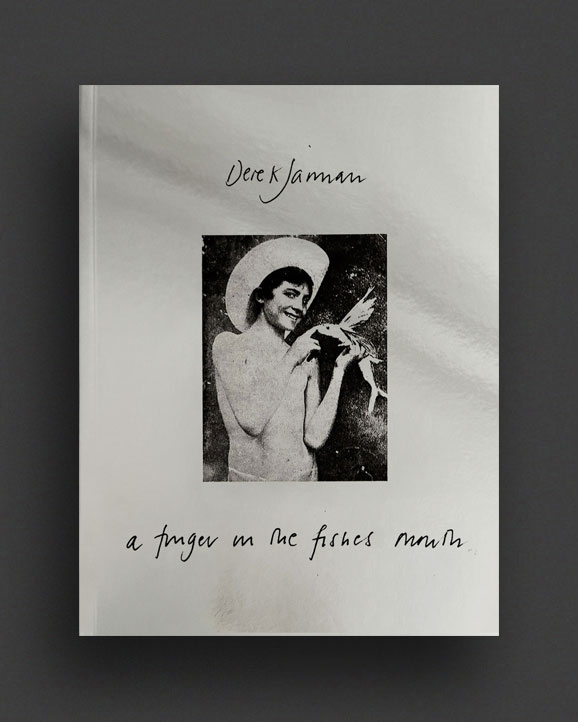
A facsimile edition of Derek Jarman’s sole, early, extremely rare poetry book A Finger in the Fishes Mouth, originally published in 1972.
Heavily illustrated from Jarman’s collection of postcards, the book combines text and visual imagery in a way which foreshadows his subsequent style as an artist and filmmaker. With the majority of the first edition having been destroyed by Jarman, this makes available a missing, significant piece of his oeuvre.
The facsimile retains the book’s original format, with a silver mirror cover, and an image accompanying each poem, printed in a striking green ink. Additional material comes in the form of a Foreword and Afterwords by So Mayer, Tony Peake and Keith Collins.
2024, English
Softcover, 240 pages, 21 x 14 cm
Published by
Seven Stories Press / New York
$36.00 - Out of stock
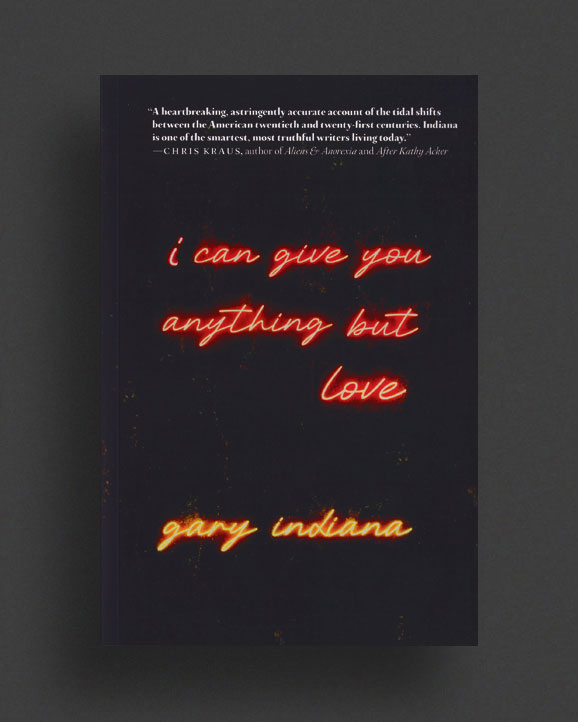
A beloved memoir from one of the most acclaimed radical writers in American literature—whose graphic, funny, and caustic voice has by turns haunted and influenced the literary and artistic establishments.
"[Indiana] becomes the connective tissue that binds together a diaspora of subcultures: the beatnik-era experimental writing and happenings of downtown New York, the 1960s co-opted counterculture gone awry, the punk movement that followed, and the art and intellectual circles of the Reagan 80s, when the AIDS crisis was wiping out a generation of young gay men like him." —Los Angeles Times
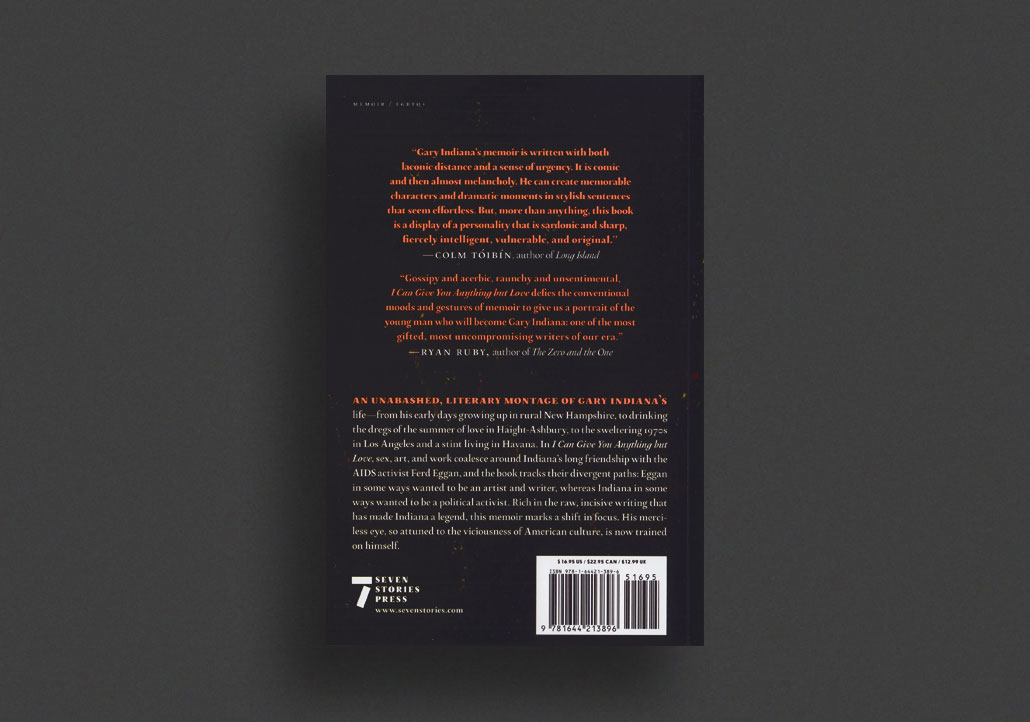
With I Can Give You Anything but Love, Gary Indiana has composed a literary, unabashedly wicked, and revealing montage of excursions into his life and work—from his early days growing up gay in rural New Hampshire to his escape to Haight-Ashbury in the post–summer-of-love era, the sweltering 1970s in Los Angeles, and ultimately his existence in New York in the 1980s as a bona fide downtown personality. Interspersed throughout his vivid recollections are present-day chapters set against the louche culture and raw sexuality of Cuba, where he lived and worked occasionally over the past decades.
Connoisseurs will recognize in this—his most personal book—the same mixture of humor and realism, philosophy and immediacy, that have long confused the definitions of genre applied to his writing. Vivid, atmospheric, revealing, and entertaining, this is an engrossing read and a serious contribution to the genres of gay and literary memoir.
"Beautifully written, Gary Indiana's 'memoir' is one of his greatest books: a heartbreaking, astringently accurate account of the tidal shifts between the American 20th and 21st centuries. Indiana is one of the smartest, most truthful writers living today."—Chris Kraus, author of Aliens & Anorexia and After Kathy Acker
"Gary Indiana's memoir is written with both laconic distance and a sense of urgency. It is comic and then almost melancholy. He can create memorable characters and dramatic moments in stylish sentences that seem effortless. But, more than anything, this book is a display of a personality that is sardonic and sharp, fiercely intelligent, vulnerable and original."—Colm Tóibín, author of Long Island
"I Can Give You Anything but Love recounts the wicked adventures of old Gary in Cuba and young Gary living dangerously in the demimondes of LA, San Francisco, Boston, and New York, in prose so conversant and apt it's like a superpower, like ease in a foreign element, breathing underwater or flying. Fueled by Swiftian indignation at our unbelievable stupidity, accuracy is a kind of revenge on a world that declines to return our love. Young Gary suffers the opposite of an education: he unlearns till all that remains is chaos and invisibility. He respects beautiful flesh and friendship's damaged utopia as he encounters others who are also desperate, brilliant, and sometimes famous."—Robert Glück, author of About Ed
"Gossipy and acerbic, raunchy and unsentimental, I Can Give You Anything but Love defies the conventional moods and gestures of memoir to give us a portrait of the young man who will become Gary Indiana: one of the most gifted, most uncompromising writers of our era."—Ryan Ruby, author of The Zero and the One
GARY INDIANA is a novelist and critic who has chronicled the despair and hysteria of America in the late twentieth century. From Horse Crazy (1989), a tale of feverish love set against the backdrop of downtown New York amid the AIDS epidemic, to Do Everything in the Dark (2003), "a desolate frieze of New York's aging bohemians" (n+1), Indiana's novels mix horror and bathos, grim social commentary with passages of tenderest, frailest desire. With 1997's Resentment- A Comedy, Indiana began his true crime trilogy, following up with Three Month Fever- The Andrew Cunanan Story (1999) and Depraved Indifference (2002). Together, the three novels show the most vicious crimes in our nation's history to be only American pathologies personified. In 2015, Indiana published his acclaimed anti-memoir, I Can Give You Anything But Love and later the novel Gone Tomorrow. Called one of "the most brilliant critics writing in America today" by the London Review of Books, "the punk poet and pillar of lower-Manhattan society" by Jamaica Kincaid, and "one of the most important chroniclers of the modern psyche" by the Guardian, Gary Indiana remains both inimitable and impossible to pin down.
2023, English
Softcover, 296 pages, 20.5 x 14 cm
Published by
Semiotext(e) / Los Angeles
$36.00 - In stock -
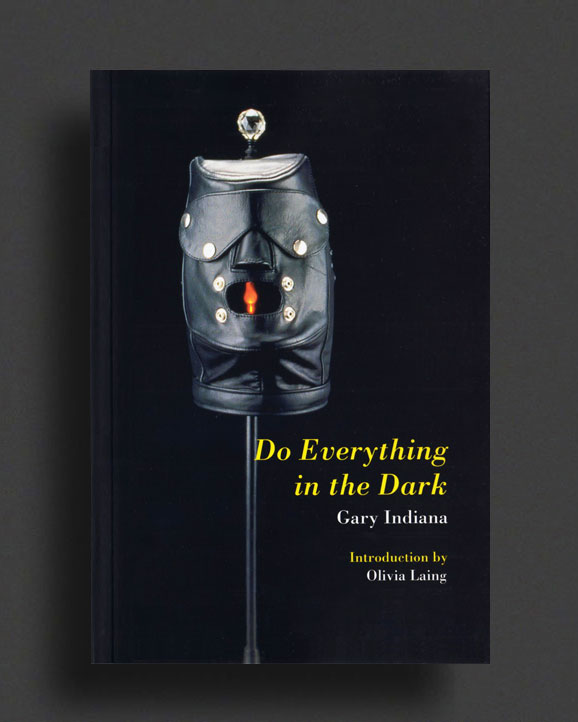
A dark yet compassionate comedy of art aspirations and friendships come to naught.
First published in 2003, Gary Indiana's turn-of-the-millennium novel traces the lives of a loosely connected group of New York artists and the dissolution of their scene.
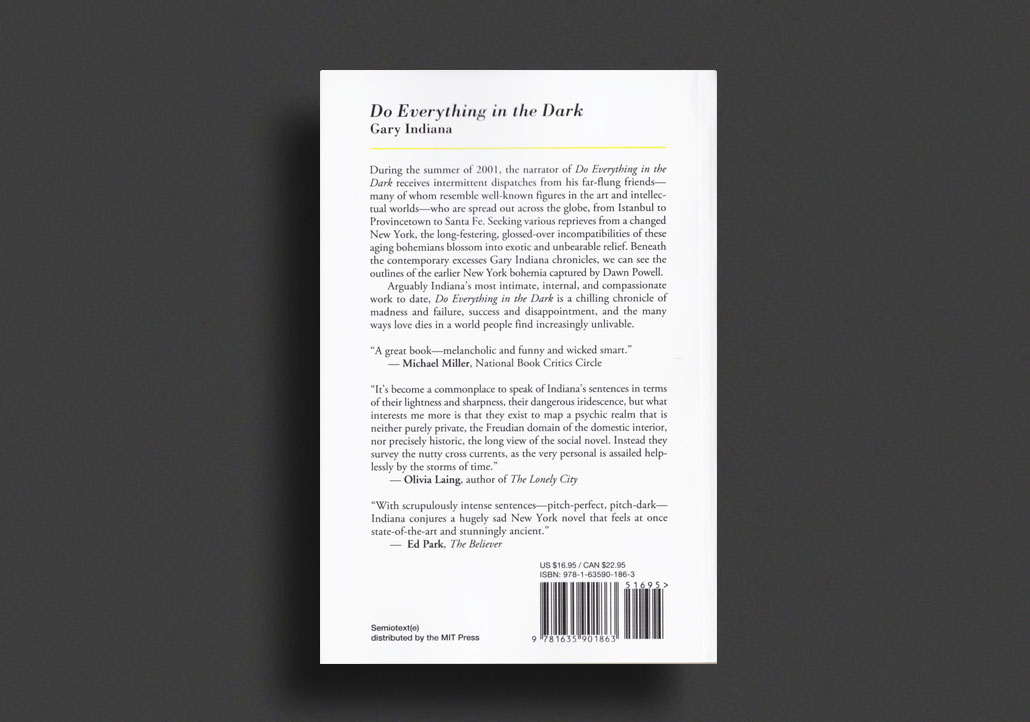
During the summer of 2001, the narrator of Do Everything in the Dark, a gallery curator, receives intermittent dispatches from his far-flung friends-many of whom resemble well-known figures in the art and intellectual worlds-who are spread out across the globe, from Istanbul to Provincetown to Santa Fe. Seeking various reprieves from a changed New York, the long-festering, glossed-over incompatibilities of these aging bohemians blossom into exotic and unbearable relief. Beneath the contemporary excesses Indiana chronicles, we can see the outlines of the earlier New York bohemia captured by Dawn Powell.
Arguably Indiana's most intimate, internal, and compassionate work to date, Do Everything in the Dark is a chilling chronicle of madness and failure, success and disappointment, and the many ways love dies in a world people find increasingly unlivable.
"A great book-melancholic and funny and wicked smart."—Michael Miller, National Book Critics Circle
"With scrupulously intense sentences-pitch-perfect, pitch-dark-Indiana conjures a hugely sad New York novel that feels once state-of-the-art and stunningly ancient."—Ed Park, The Believer
2024, English
Softcover, 200 pages 21 x 14.7 cm
Ed. of 350,
1st Edition, Out of print title / as new
Published by
SMUT Press / London
$65.00 - Out of stock
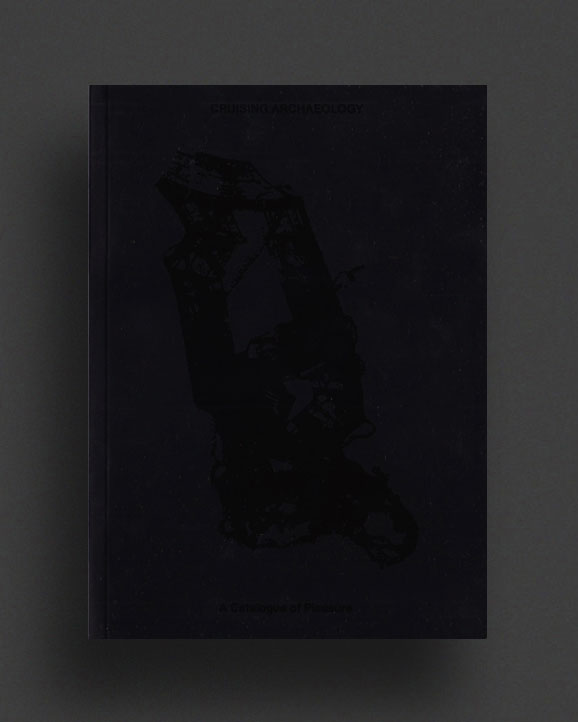
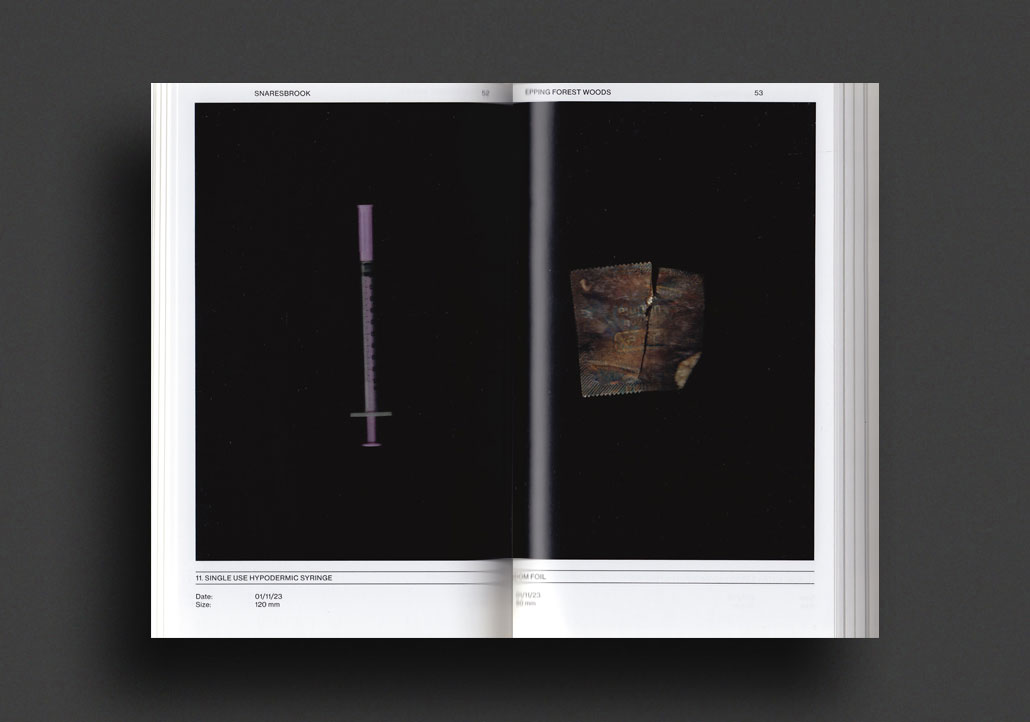
Initially born from an Instagram account bearing the same name, this project is a careful process of selection and curation that sees the anonymous artist reconstitute detritus and debris discarded in over half a dozen renowned cruising locations around London into cultural artefacts. Positioning archaeology as its point of departure, over 100 unique relics not only uncover and investigate the types of sex and pleasure that happen in cruising areas through a material culture lens, but also serve as a testimonial to the often invisible sexual practice.
Accompanying the series of scanned objects is a foreword by Marcus McCann, author of ‘Park Cruising: What Happens When We Wander Off Path’ (2023) as well as an interview with OWL, a volunteer litter-picking group in one of the cruising sites and a report on ‘Jurassic’ a renowned local cruising site in Medellín by academic David Edgar.
The soft-cover 200 page publication is purposely pocket sized, intended to be utilised as a nu-hunter’s-guide for those who cruise. The book’s design has been thoughtfully researched and assembled by London based designer Marco Cacioni.
Edition of 350
1991, English
Softcover (loose-leaf tabloid), 32 pages, 43 x 29 cm
1st Edition, Out of print title / used / very good
Published by
Broadsheet / Adelaide
$50.00 - Out of stock
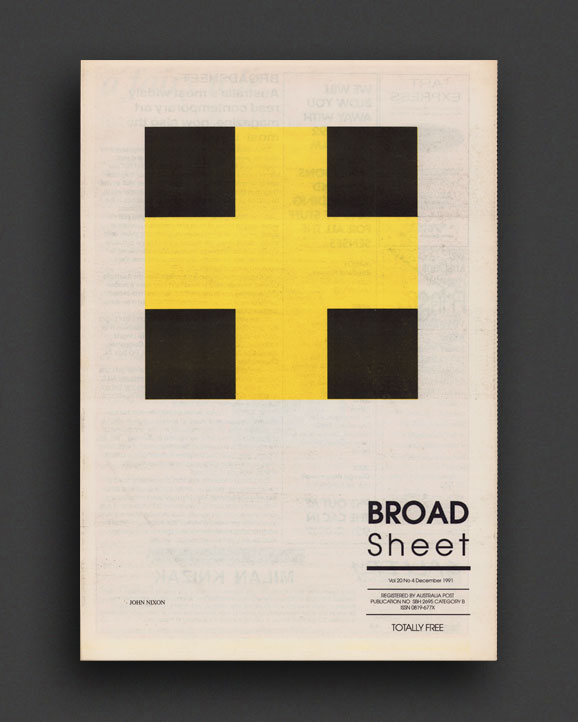
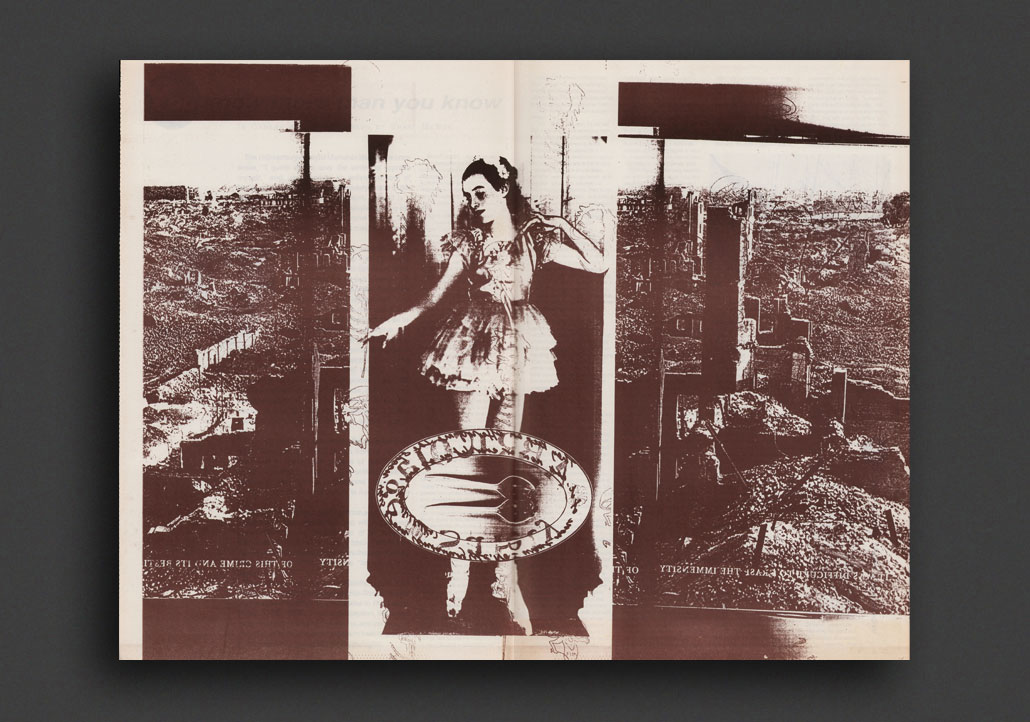
Vol. 20 No. 4, December 1991, of Broadsheet. Not the crappy Melbourne yuppy consumer guide, the 90's Adelaide arts newspaper, founded in the late 1980's to run throughout the 1990's. With cover artwork by John Nixon and centre-spread collage artwork by Bronia Iwanczak. Heavily illustrated (and uncensored) articles and reviews throughout, this issue features contributors Catherine Lumby, Kevin Murray, Shane McNeill, Leon Marvel, Leonie Neilson, Manne Schulze, John McConchie, Michelle Prak, Carolyn Barnes, Louise Dauth, and others covering Juan Davila, the exhibition history of Melbourne's Store 5, Georges Bataille, Archeology of Gnostic cinema, Gareth Samson, Jeff Koons' collaborations with Cicciolina (Ilona Staller), Australia's first Museum of Modern Art, the new Mitsubishi Magna, Australian film maker Ross Gibson, Adelaide's Critical City Project, and much more.
Very Good copy with light aging.
2024, English
Softcover, 160 pages, 20.32 x 13.67 cm
Published by
Semiotext(e) / Los Angeles
$34.00 $25.00 - In stock -
A novel about escape and connection, class, sex, and queer intimacy in the American Midwest.
The oldest story: an insider pretends to be an outsider and receives praise for his empathy and imagination and intelligence. Maybe some asshole even says bravery. An outsider pretends to be an insider, is exposed as a fraud, a liar, and burned to the ground.
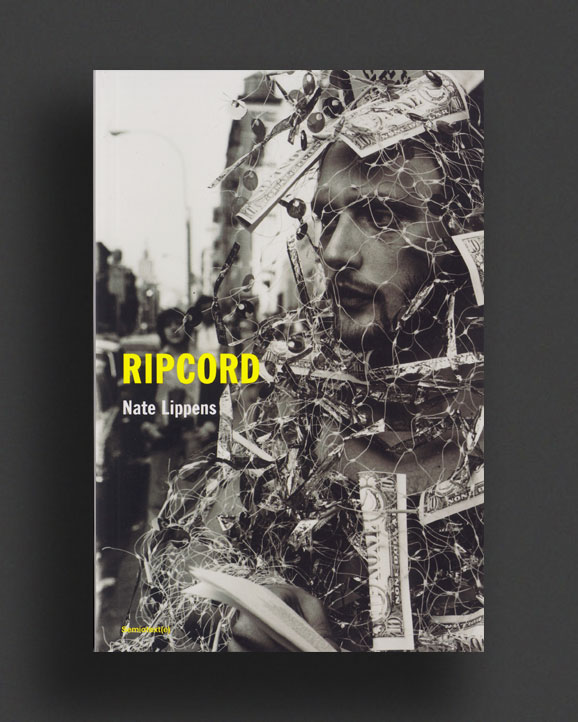
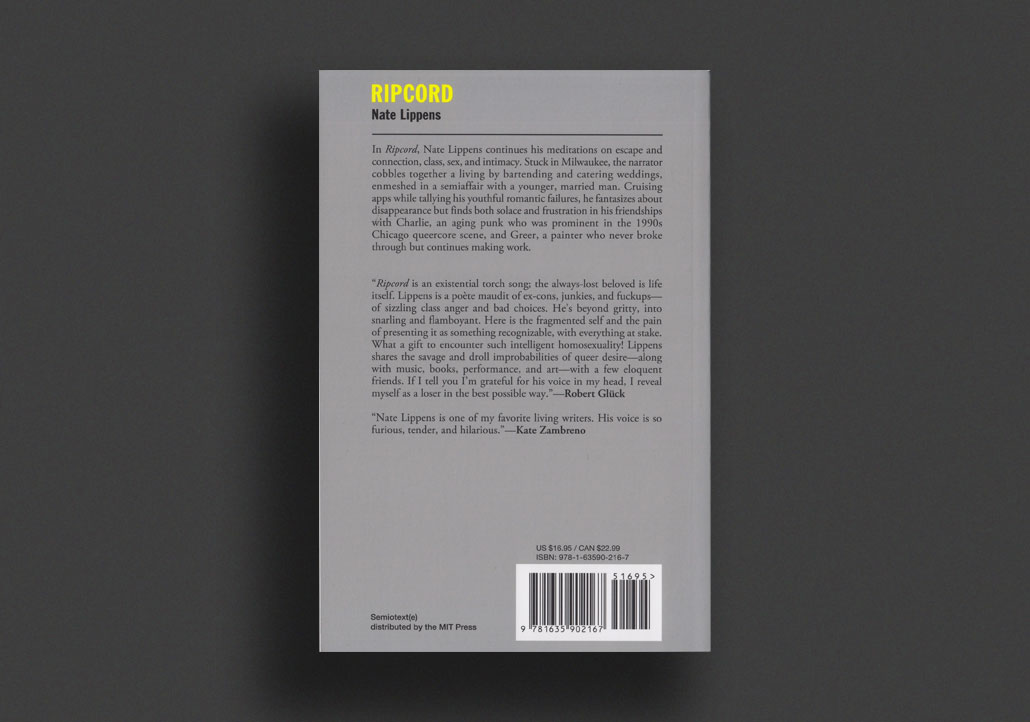
In Ripcord, Nate Lippens continues his meditations on escape and connection, class, sex, and intimacy. Stuck in Milwaukee, the narrator cobbles together a living by bartending and catering weddings, enmeshed in a semiaffair with a younger, married man. Cruising apps while tallying his youthful romantic failures, he fantasizes about disappearance but finds both solace and frustration in his friendships with Charlie, an aging punk who was prominent in the 1990s Chicago queercore scene, and Greer, a painter who never broke through but continues making work.
“Ripcord is an existential torch song; the always-lost beloved is the world itself that declines to love us back. Lippens is a poèt maudit of ex-cons, junkies, and fuckups—of sizzling class anger and bad choices. He's beyond gritty, into snarling and flamboyant. Here is the fragmented self and the pain of presenting it as something recognizable, with everything at stake. What a gift to encounter such intelligent homosexuality! Lippens shares the savage and droll improbabilities of queer desire—along with music, books, performance, and art—with a few eloquent friends. If I tell you I'm grateful for his voice in my head, I reveal myself as a loser in the best possible way.”—Robert Glück, author of About Ed
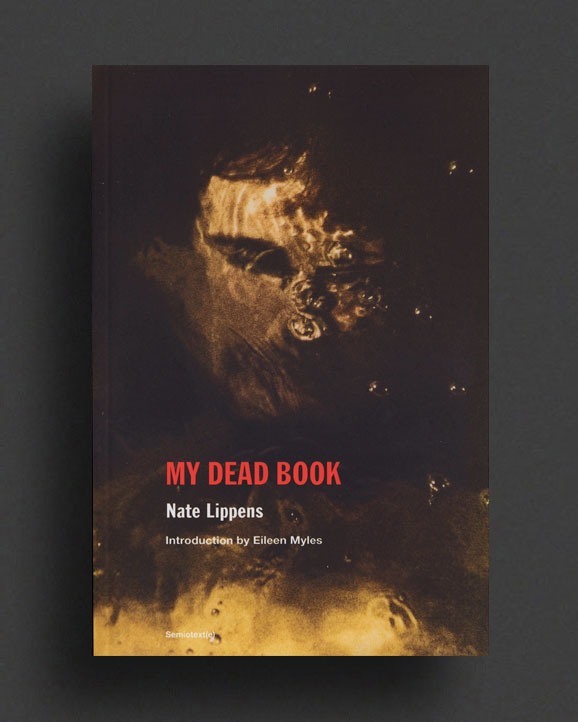
2024, English
Softcover, 136 pages, 20.32 x 13.67cm
Published by
Semiotext(e) / Los Angeles
$36.00 - Out of stock
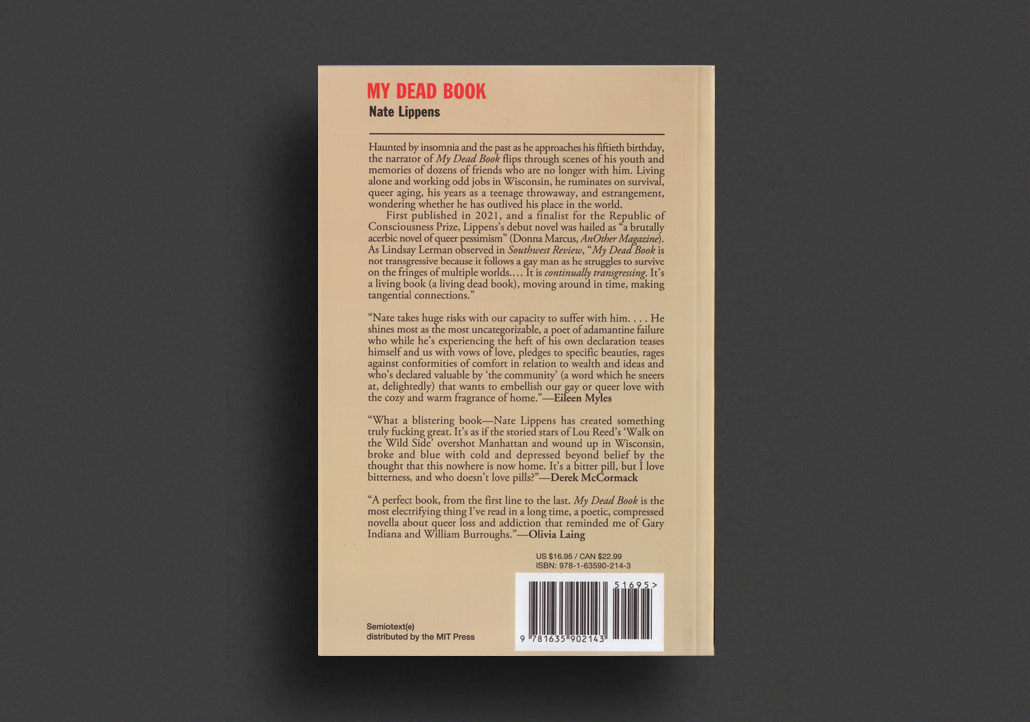
A rumination on survival, queer aging, and estrangement that was a finalist for the Republic of Consciousness Prize.
Introduction by Eileen Myles
My dead friends are back. I lie in bed at night and see them.
Haunted by insomnia and the past as he approaches his fiftieth birthday, the narrator of My Dead Book flips through scenes of his youth and memories of dozens of friends who are no longer with him. Living alone and working odd jobs in Wisconsin, he ruminates on survival, queer aging, his years as a teenage throwaway, and estrangement, wondering whether he has outlived his place in the world.
First published in 2021, Lippens's debut novel was hailed as “a brutally acerbic novel of queer pessimism” (Donna Marcus, AnOther Magazine). As Lindsay Lerman observed in Southwest Review, “My Dead Book is not transgressive because it follows a gay man as he struggles to survive on the fringes of multiple worlds. … It is continually transgressing. It's a living book (a living dead book), moving around in time, making tangential connections.”
This new edition includes an introduction by LAMBDA Literary Award-winning American poet and writer, Eileen Myles.
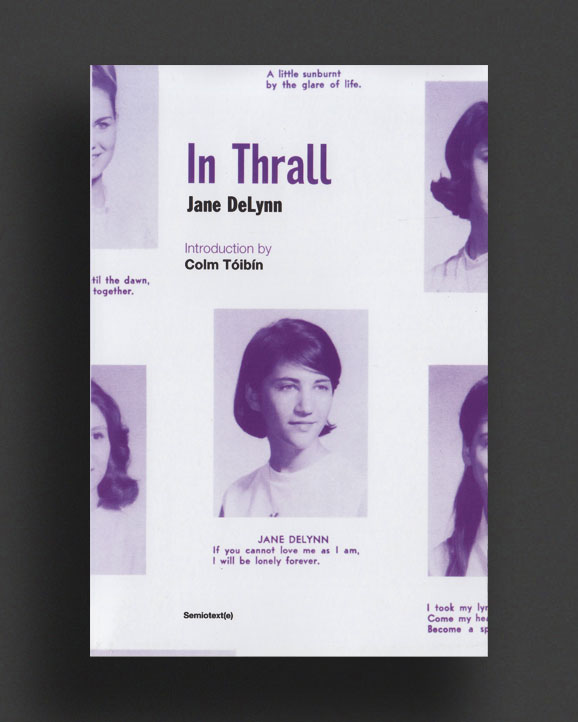
2023, English
Softcover, 312 pages, 20.5 x 13.5 cm
Published by
Semiotext(e) / Los Angeles
$38.00 - Out of stock
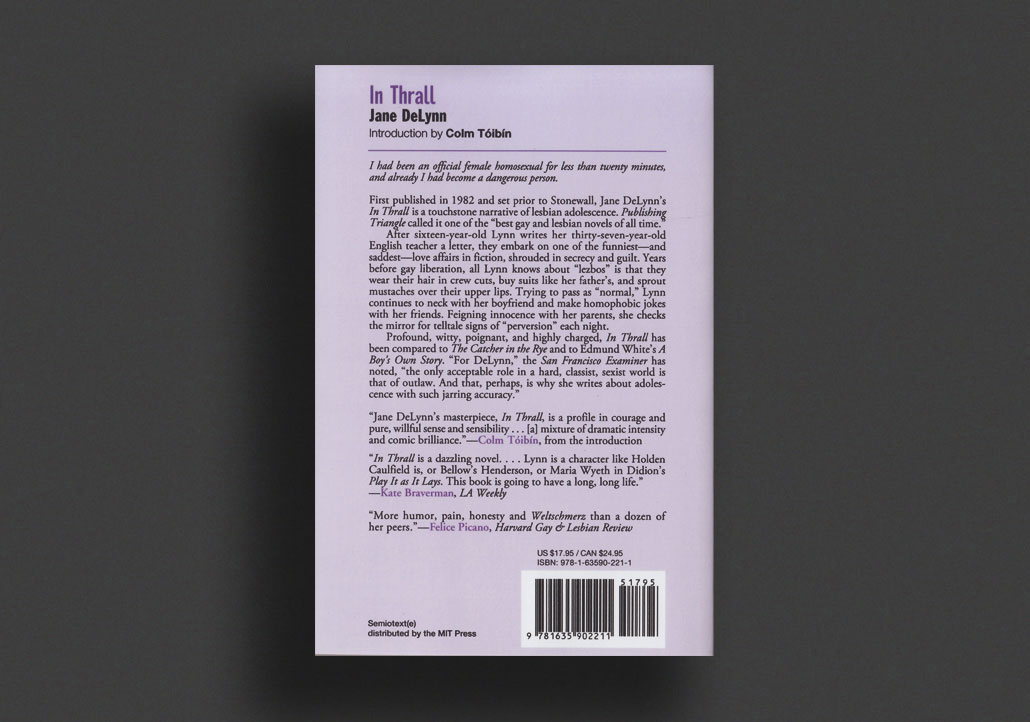
A touchstone novel of lesbian adolescence, set years before gay liberation.
Introduction by Colm Tóibín
“Dear Miss Maxfield … what I'm really afraid of is that I am a homosexual human being. I wish you were one too but I don't think it's possible there could be so many in one school, do you?—probably there is only one person who is homosexual in one place at one time and that one person (I am afraid) is me …”
First published in 1982 and set prior to Stonewall, Jane DeLynn's In Thrall is a touchstone narrative of lesbian adolescence. Publishing Triangle called it one of the “best gay and lesbian novels of all time.”
After sixteen-year-old Lynn writes her thirty-seven-year-old English teacher a letter, they embark on one of the funniest—and saddest—love affairs in fiction, shrouded in secrecy and guilt. Years before gay liberation, all Lynn knows about “lezbos” is that they wear their hair in crew cuts, buy suits like her father's, and sprout mustaches over their upper lips. Trying to pass as “normal,” Lynn continues to neck with her boyfriend and make homophobic jokes with her friends. Feigning innocence with her parents, she checks the mirror for telltale signs of “perversion” each night.
Profound, witty, poignant, and highly charged, In Thrall has been compared to The Catcher in the Rye and to Edmund White's A Boy's Own Story. “The single most wonderful quality of this novel,” the Los Angeles Times Book Review writes, “is its absolute credibility.”
This new edition includes a foreword by Irish author Colm Tóibín.
Jane DeLynn is the author of the widely acclaimed novels Leash, Real Estate, and Some Do. Her work has appeared in Paris Review, Mademoiselle, Glamour, Harper's Bazaar, the New York Times, New York Observer, and Tikkun, and she lived in Saudi Arabia as a correspondent for Mirabella and Rolling Stone during the Gulf War. Her novel Real Estate was named a New York Times Notable Book of the Year.
Colm Tóibín is the author of eleven novels, including Long Island; The Magician, winner of the Rathbones Folio Prize; The Master, winner of the Los Angeles Times Book Prize; Brooklyn, winner of the Costa Book Award; The Testament of Mary; and Nora Webster; as well as two story collections and several books of criticism. He is the Irene and Sidney B. Silverman Professor of the Humanities at Columbia University and has been named as the Laureate for Irish Fiction for 2022–2024 by the Arts Council of Ireland. Three times shortlisted for the Booker Prize, Tóibín lives in Dublin and New York.
1992, Japanese
Softcover (w. dust jacket + obi), 190 pages, 14.5 x 10.5 cm
1st Edition, Out of print title / used / very good
Published by
Fiction Inc. / Tokyo
Futami Shobo / Japan
$70.00 - In stock -
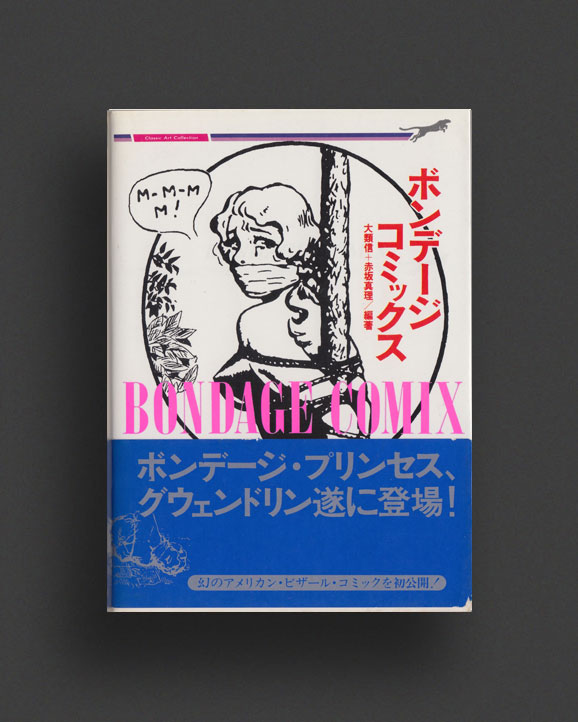
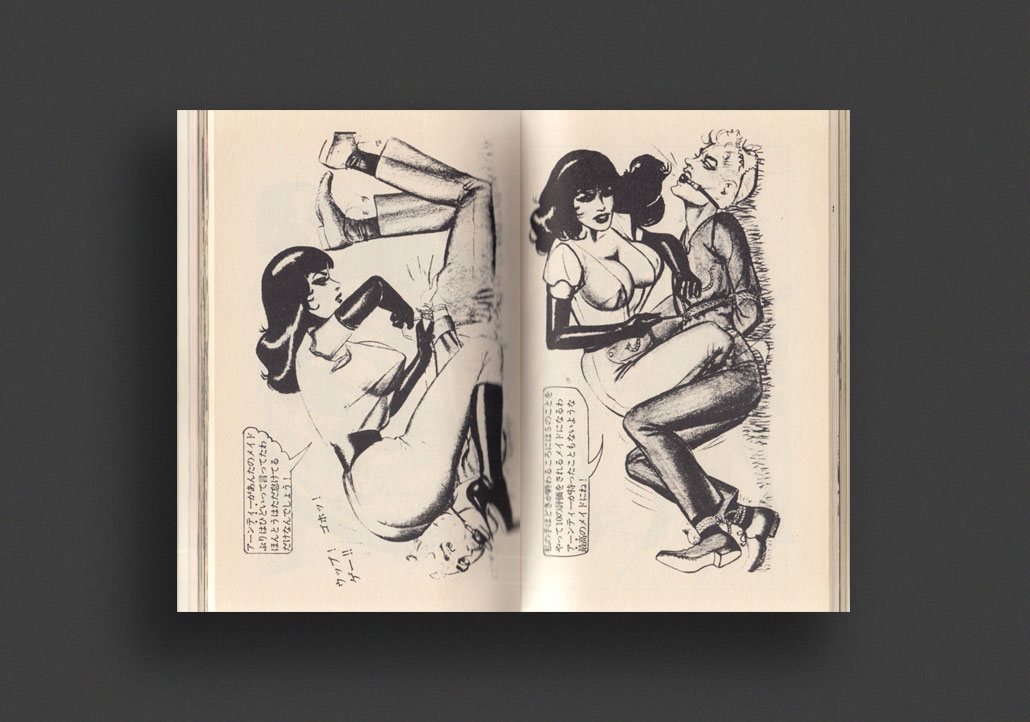
Amazing pocket art book of fetish masters John Willie and Eric Stanton. Bondage Comix was edited by Makoto Ohrui and Japanese novelist Mari Akasaka (both editors of SALE2/Fiction Inc.) and published in Tokyo Japan by Futami Shobo in 1992. Packed cover-to-cover with colour and b/w reproductions of classic artworks by Willie and Stanton, from "Sweet Gwendoline" to "From Girl to Pony" to "Beached", Fetish and Bizarre publications, John Willie's bondage photography, Stanton fashions, and much more. Perfectly compiled in the way SALE2 did so well, with elegant scrapbook style, dense with imagery, blown-up, full-bleed reproductions from many publications. Cover artwork and postcard insert by John Willie.
John Alexander Scott Coutts (1902—1962), better known by the pseudonym John Willie, was an artist, fetish photographer, editor and the publisher of the first 20 issues of the fetish magazine Bizarre, featuring his characters Sweet Gwendoline and Sir Dystic d'Arcy.
Eric Stanton (1926—1999) was an American underground cartoonist and fetish art pioneer. While Stanton began his career as a bondage fantasy artist for Irving Klaw, the majority of his later work depicted gender role reversal and proto-feminist female dominance scenarios.
Makoto Ohrui founded the publishing house Fiction Inc. (later Radical Silence Production), the magazine SALE2, the gallery THE deep in Tokyo, and the magazine THE International. Ohrui was art director for SALE2, Purple, Rockin' On, and designed many books.
Mari Akasaka (b. 1964) is a Japanese novelist. In 1999 her novel Vibrator was nominated for the Akutagawa Prize, which was adapted into a 2003 film directed by Ryūichi Hiroki. She was again nominated for the Akutagawa prize in 2000 for her novel, Muse, and won the Noma Literary Prize for New Writers for the same novel.
Very Good copy, with obi.
1980, English
Softcover, 60 pages, 28 x 22 cm
1st Edition, Out of print title / used / very good
Published by
Galerie Jurka / Amsterdam
$280.00 $160.00 - In stock -
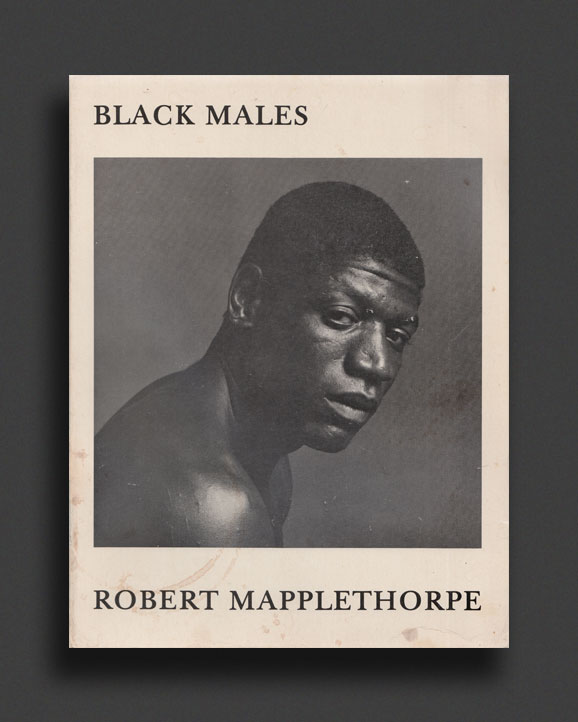
Very scarce first edition of Robert Mapplethorpe's Black Males, published in 1980 by Galerie Jurka, Amsterdam. Dutch gallery owner Robert Jurka was instrumental in the early reception of Robert Mapplethorpe’s photography in Europe, exhibiting for the first time many of his (now) world-renowned photographs. Following an early Mapplethorpe monograph from 1979, Jurka also published the first Black Males catalogue as part of the homonymous exhibition he organized in 1980 at Galerie Jurka. With an introductory essay by Edmund White, this first 1980 edition remains the most sought after printing of this beautiful and controversial series by Mapplethorpe.
Robert Mapplethorpe (1946-1989) took his first photographs using a Polaroid camera. His first Polaroids were self-portraits and the first of a series of portraits of his close friend, the singer-artist-poet Patti Smith. These early photographic works were generally shown in groups or elaborately presented in shaped and painted frames that were as significant to the finished piece as the photograph itself. Then he acquired a large format press camera and began taking photographs of a wide circle of friends and acquaintances. These included artists, composers, socialites, pornographic film stars and members of the S & M underground. Some of these photographs were shocking for their content but exquisite in their technical mastery. During the early 1980s, Mapplethorpe’s photographs began a shift toward a phase of refinement of subject and an emphasis on classical formal beauty. During this period he concentrated on statuesque male and female nudes, delicate flower still lifes, and formal portraits of artists and celebrities.
Good copy throughout with light wear. Note coffee marking to covers and previous owner's name penned into first blank page. Interior otherwise clean, tight and overall well preserved.
1972, Japanese
Softcover, 122 pages, 21.5 x 15 cm
1st Edition, Out of print title / used / good
Published by
Lemon Inc. / Tokyo
$45.00 - In stock -
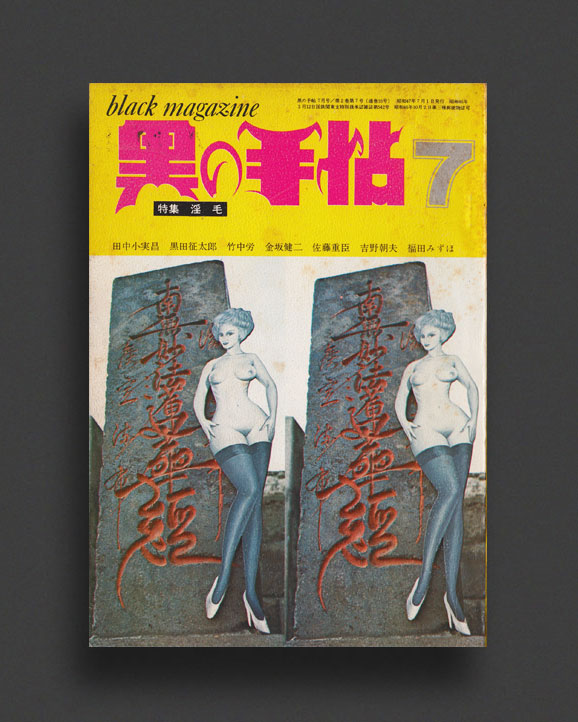
July 1972 issue of legendary Japanese underground arts periodical, Black Magazine (or Black Notebook), a taboo-shattering vehicle of the 1970s subculture in Tokyo. A magazine like no-other, each issue, "a paradise of 1970's heretical culture", was a who's who of non-conformity, introducing a new wave of illustrators, painters, doll-makers and photographers, "taboo" sexuality and fetish culture, avant-garde comics, sadistic literature, radical criticism, queer poetry, activism, black humour, underground film and theatre, and all manner of transgressive, esoteric and erotic material, new and historical. Black Magazine featured the work of Yukio Mishima, Toshio Saeki, Izumi Suzuki, Simon Yotsuya, Shūji Terayama, Ken Katayama, Nobuyoshi Araki, Genpei Akasegawa, Keiichi Tanaami, Kikuji Yamashita, Aoi Fujimoto, Tadanori Yokoo, Hiroshi Nakamura, and so many others. It was also where Japanese photographer Satomi Nihongi's Tokyo Transgender photographs were first printed. Black Magazine was heavy with queer and trans content, and Nihongi's "The Most Beautifuls" was a regular photo-feature in its pages. A lot of great things started in the pages of this unique magazine. A highly recommended publication!
1997, English
Softcover, 512 pages, 24.5 x 19 cm
1st Edition, Out of print title / used / very good
Published by
University of Michigan Press / Michigan
Bay Press / USA
$65.00 - Out of stock
First 1997 edition.
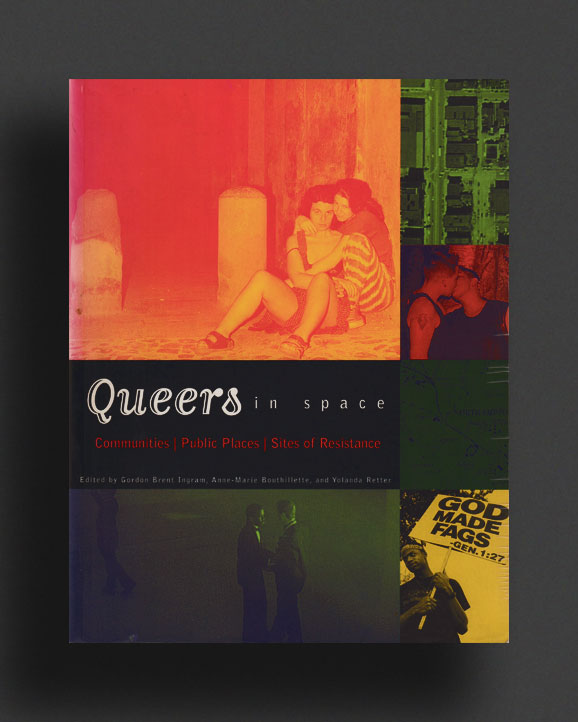
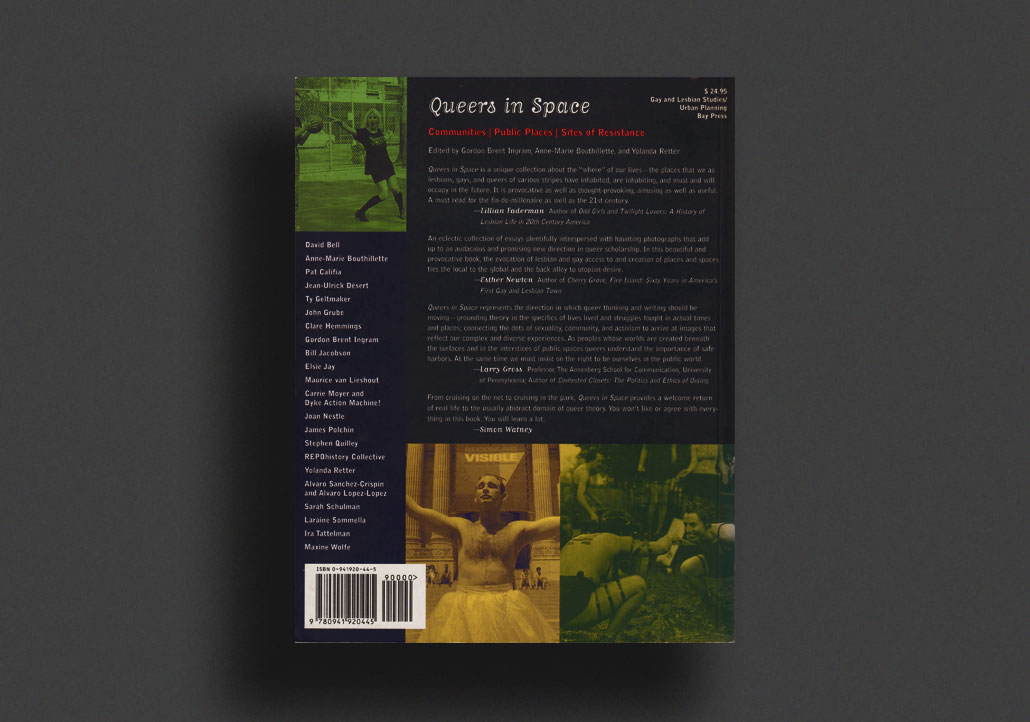
Exploring the interactions between queer identity, experience, and activism and a range of communal and public spaces, QUEERS IN SPACE: COMMUNITIES, PUBLIC PLACES, SITES OF RESISTANCE opens up a new direction in gay and lesbian studies. From gay space in Mexico City to the now legendary baths of New York and San Francisco, QUEERS IN SPACE travels to bars, parks, beaches, neighborhoods, and cities to follow the expansion and transformation of queer communities beyond the gay ghetto.
By focusing on the geography of queer social relationships QUEERS IN SPACE raises critical and timely questions about the role of social space in shaping identities, the meaning of communal space for marginalised peoples, and the significance of public spaces for social visibility.