World Food Books' programme is largely produced on Kulin Nation land. We acknowledge the Wurundjeri people of the Kulin Nation as the first and continuing custodians of this land, and pay respect to their Elders past, present, and emerging.
World Food Books is an arts and special interests bookshop in Naarm / Melbourne. Founded in 2010, World Food Books is devoted to the presentation of a rotating, hand-selection of international art, design, literary and counterculture publications with an emphasis on the anti-traditional, the experimental, the avant-garde, the heretic, the marginal.
Presenting new titles alongside rare and out-of-print books, catalogues and journals spanning the fields of modern and contemporary art, design, photography, illustration, film, literature, poetry, cultural theory, philosophy, sexuality, popular and underground culture in its many radical forms, World Food Books wishes to encourage adventurous, thoughtful and open-minded reading, looking, writing, and exchange of publishing and ideas, both current and historical.
As well as our bookshop, located in Melbourne's historical Nicholas Building, all of our inventory is available internationally via our online mail-order service.
World Food Books semi-regularly co-ordinates "Occasions", a programme of exhibits and events at the bookshop and in partnership with other hosts (such as museums and art galleries) that develop out of the activities, relationships and content of the bookshop itself.
World Food Books
The Nicholas Building
37 Swanston Street
Room 5, Level 6
Melbourne 3000
Australia
SHOP HOURS:
THU–SAT 12–6
WEB-SHOP OPEN 24/7
World Food Books
Postal Address:
PO Box 435
Flinders Lane
Victoria 8009
Australia
info@worldfoodbooks.com
Art
Theory / Essay
Architecture / Interior
Graphic Design / Typography
Photography
Fashion
Eros
LGBTQ+
Fiction / Poetry
Weird / Speculative / Science Fiction / Horror
Transgressive / Visceral / Abject
Symbolism / Decadence / Fin de siècle
Film / Video
Painting
Sculpture / Installation
Performance / Dance / Theater
Drawing
Sound / Music
Curatorial
Group Shows / Collections
Periodicals
Out-of-print / Rare
Posters / Ephemera / Discs
Signed Books
World Food Books Gift Voucher
World Food Book Bag
Australian Art
Australian Fiction
Australian Science Fiction / Speculative Fiction
Australian Poetry
Australian Photography
Japanese Photography
Conceptual Art
Minimal Art
Dada
'Pataphysics / Oulipo
Fluxus
Concrete Poetry
Pop Art
Surrealism
Arte Povera
Arte Informale / Haute Pâte / Tachism
Nouveau Réalisme / Zero / Kinetic
Situationism / Lettrism
Collage / Mail Art / Xerox Art
Art Brut / Folk / Visionary / Fantastic
Illustration / Graphic Art / Bandes Dessinées
Furniture
Italian Radical Design / Postmodernism
Textiles
Ceramics / Glass
Counterculture
Protest / Revolt
Philosophy
Psychoanalysis
Anthropology
Anarchism
Socialism / Anarchism / Communism / Capitalism
Literary Theory / Semiotics / Language
Feminism / Women's Studies
Gender Studies / Sexuality
Anthropology
Fetishism / BDSM
Drugs / Psychedelia
Crime / Violence
Animal Rights / Veganism
Occult / Esoterica
Ecology / Earth / Alternative Living
Whole Earth / Crafts
All prices in AUD (Australian dollars)
Pick-Ups
Pick-up orders can be collected in our bookshop during opening hours after order date. Please collect any Pick-up orders within 2 weeks of ordering as we have limited storage space. Orders will be released back into stock if not collected within this time. No refunds can be made for pick-ups left un-collected. If you cannot make it in to the bookshop in this time-frame, please choose postage option.
Return Policy
All sales are final. We do accept returns (for refund or exchange) for items received in error. All our orders are packed with special care using heavy-duty padding and cardboard book-mailers or bubble mailers (for smaller books), using reinforcement where required. We cannot take responsibility for any lost, stolen or damaged parcels.
Insurance
Should you wish to insure your package, please email us directly after placing your order and we can organise this at a small extra expense. Although all standard/express tracked packages are very safe and dependable, we cannot take responsibility for any lost, stolen or damaged parcels. We recommend insurance on valuable orders.
Interested in selling your old books, catalogues, journals, magazines, comics, fanzines, ephemera? We are always looking for interesting, unusual and out-of-print books to buy. We only buy books in our fields of interest and specialty, and that we feel we can resell.
We base these prices on desirability, market value, in-print prices, condition and our current stock levels. We offer cash, store credit, and can take stock on consignment. All
about 25% of the price we expect to get when we sell them, or 30% in store credit. We base these prices on desirability, market value, in-print prices, condition and our current stock levels.
Sell your books any day of the week. You can drop them off and return later. If you have a lot of books, we can visit your Sydney home.
We buy books that we feel we can resell. We offer about 25 % of the price we expect to get when we sell them, or 30% in store credit. We base these prices on desirability, market value, in-print prices, condition and our current stock levels.
Philadelphia Wireman
03 August - 01 September, 2018
World Food Books is proud to announce our next Occasion, the first presentation of sculptures by Philadelphia Wireman in Australia.
The Philadelphia Wireman sculptures were found abandoned in an alley off Philadelphia’s South Street on trash night in 1982. Their discovery in a rapidly-changing neighbourhood undergoing extensive renovation, compounded with the failure of all attempts to locate the artist, suggests that the works may have been discarded after the maker’s death. Dubbed the "Philadelphia Wireman" during the first exhibition of this work, in 1985, the maker’s name, age, ethnicity, and even gender remain uncertain. The entire collection totals approximately 1200 pieces, all intricately bound together with tightly-wound heavy-gauge wire (along with a few small, abstract marker drawings, reminiscent both of Mark Tobey and J.B. Murry). The dense construction of the work, despite a modest range of scale and materials, is singularly obsessive and disciplined in design: a wire armature or exoskeleton firmly binds a bricolage of found objects including plastic, glass, food packaging, umbrella parts, tape, rubber, batteries, pens, leather, reflectors, nuts and bolts, nails, foil, coins, toys, watches, eyeglasses, tools, and jewellery.
Heavy with associations—anthropomorphic, zoomorphic, and socio-cultural responses to wrapped detritus—the totemic sculptures by Philadelphia Wireman have been discussed in the context of work created to fulfil the shamanistic needs of alternative religions in American culture. Curators, collectors, and critics have variously compared certain pieces to sculpture from Classical antiquity, Native American medicine bundles, African-American memory jugs, and African fetish objects. Reflecting the artist’s prolific and incredibly focused scavenging impulse, and despite—or perhaps enhanced by—their anonymity, these enigmatic objects function as urban artefacts and arbiters of power, though their origin and purpose is unknown. Philadelphia Wireman, whatever their identity, possessed an astonishing ability to isolate and communicate the concepts of power and energy through the selection and transformation of ordinary materials. Over the course of the past two decades, this collection has come to be regarded as an important discovery in the field of self-taught art and vernacular art.
Presented in collaboration with Fleisher-Ollman Gallery, Philadelphia, and Robert Heald, Wellington.
Susan Te Kahurangi King
02 February - 10 March, 2018
Susan Te Kahurangi King (24 February 1951 - ) has been a confident and prolific artist since she was a young child, drawing with readily available materials - pencils, ballpoint pens and felt-tip markers, on whatever paper is at hand. Between the ages of four and six Susan slowly ceased verbal communication. Her grandparents William and Myrtle Murphy had developed a special bond with Susan so they took on caring responsibilities for extended periods. Myrtle began informally archiving her work, carefully collecting and storing the drawings and compiling scrapbooks. No drawing was insignificant; every scrap of paper was kept. The King family are now the custodians of a vast collection containing over 7000 individual works, from tiny scraps of paper through to 5 meter long rolls.
The scrapbooks and diaries reveal Myrtle to be a woman of great patience and compassion, seeking to understand a child who was not always behaving as expected. She encouraged Susan to be observant, to explore her environment and absorb all the sights and sounds. Myrtle would show Susan’s drawings to friends and people in her community that she had dealings with, such as shopkeepers and postal workers, but this was not simply a case of a grandmother’s bias. She recognised that Susan had developed a sophisticated and unique visual language and sincerely believed that her art deserved serious attention.
This was an unorthodox attitude for the time. To provide some context, Jean Dubuffet coined the term Art Brut in 1945 to describe work created by self-taught artists – specifically residents of psychiatric institutions and those he considered to be visionaries or eccentrics. In 1972 Roger Cardinal extended this concept by adopting the term Outsider Art to describe work made by non-academically trained artists operating outside of mainstream art networks through choice or circumstance. Susan was born in Te Aroha, New Zealand in 1951, far from the artistic hubs of Paris and London that Dubuffet and Cardinal operated in. That Myrtle fêted Susan as a self-taught artist who deserved to be taken seriously shows how progressive her attitudes were.
Susan’s parents Doug and Dawn were also progressive. Over the years they had consulted numerous health practitioners about Susan’s condition, as the medical establishment could not provide an explanation as to why she had lapsed into silence. Dawn educated herself in the field of homeopathy and went on to treat all twelve of her children using these principles – basing prescriptions on her observations of their physical, mental and emotional state.
Doug was a linguist with an interest in philosophy who devoted what little spare time he had to studying Maori language and culture. To some extent their willingness to explore the fringes of the mainstream made them outsiders too but it was their commitment to living with integrity and their respect for individuality that ensured Susan’s creativity was always encouraged.
Even though Susan’s family supported her artistic pursuits, some staff in schools and hospitals saw it as an impediment to her assimilation into the community and discouraged it in a variety of ways. Her family was not always aware of this and therefore did not fully understand why Susan stopped drawing in the early 1990s. However, rather than dwell on the challenges that Susan faced in pursuit of her artistic practice, they prefer to highlight her achievements. In 2008 Susan began drawing again in earnest, after an almost 20 year interruption, and her work is now shown in galleries around the world.
Susan grew up without television and has been heavily influenced by the comics she read as a child. She is absolutely fearless in the appropriation of recognizable characters, such as Donald Duck and Mickey Mouse, in her work. She twists their limbs, contorts their faces, compresses them together, blends them into complex patterned backgrounds - always imbuing them with an incredible energy. Although Susan often used pop culture characters in her work they are not naive or childlike. These are drawings by a brilliant self-taught artist who has been creating exceptional work for decades without an audience in mind.
Mladen Stilinović
"Various Works 1986 - 1999"
02 February 16 - September 10, 2016
Various works 1986 - 1999, from two houses, from the collections of John Nixon, Sue Cramer, Kerrie Poliness, Peter Haffenden and Phoebe Haffenden.
Including: Geometry of Cakes (various shelves), 1993; Poor People’s Law (black and white plate), 1993; White Absence (glasses, ruler, set square, silver spoon, silver ladel with skin photograph and wooden cubes), 1990-1996; Exploitation of the Dead (grey and red star painting, wooden painting, black spoon with red table, red plate), 1984-1990; Money and Zeros (zero tie, paintings made for friends in Australia (Sue, John, Kerrie), numbers painting), 1991-1992; Words - Slogans (various t-shirts) - “they talk about the death of art...help! someone is trying to kill me”, “my sweet little lamb”, “work is a disease - Karl Marx”; Various artist books, catalogues, monographs, videos; Poster from exhibition Insulting Anarchy; "Circular" Croatian - Australian edition; Artist book by Vlado Martek (Dostoyevsky); more.
Thanks to Mladen Stilinović and Branka Stipančić.
Jonathan Walker
Always Will Need To Wear Winter Shirt Blue + Ochre Small Check Pattern
21 August - 21 September, 2015
Untitled
I am not a great reader of poetry but I always return to the work of Melbourne poet, Vincent Buckley (1925- 1988). Perhaps I find his most tantalising piece to be not a finished poem but a fragment left on a scrap of paper discovered on his desk after the poet’s death.
The poetry gathers like oil
In the word-core, and spreads
It has its music meet,
Its music is in movement.
This fragment is more the shell left behind from a volatile thought than a finished poem. I find the last two lines honest but awkward whereas the first two lines work like an arrow. Most likely he could not find a resolution so it was left. Still, in its present form, it remains an eloquent testimony to the ultimate failure of a medium to express mobile thought and sensation, in Buckley’s case, through verbal language. It’s an important matter because this is something all artists have to deal with regardless of the medium.
I have never written a poem, however, I am forever copying fragments from books on paper scraps in a vain effort to fix certain notions in my head. At first, they function as bookmarks that are sometimes returned to when I open the book. But before long, as they accumulate, they fall out littering the table interspersed with A4 photocopies, bills, books and medications.
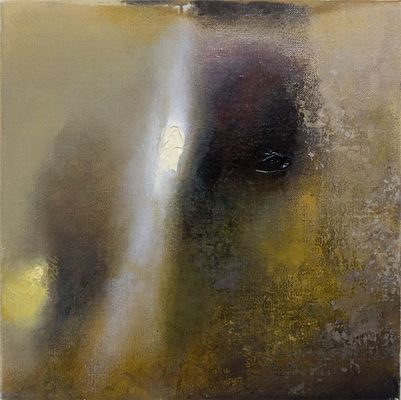
To return to Buckley’s fragment, the first two lines very much evoke how I paint nowadays. As you age, detail diminishes and patches of light become more luminous and float. I feel the most honest way of dealing with this is by smearing the oil paint on the canvas with the fingers and working close-up, blind. Only if the patches coalesce into an approaching image can the work gain a life.
-
Jonathan Walker was born in Melbourne, Australia and brought up on a dairy farm in Gippsland. In the 1970’s he studied painting at RMIT and won the Harold Wright Scholarship to the British Museum, London. During the 1980’s he exhibited at Pinacotheca Gallery, Richmond and had work shown at the NGV and Heidi City Art Gallery. Over the same period he designed the cover for the “Epigenesi” LP by Giancarlo Toniutti, Italy and conducted a mail exchange work with Achim Wollscheid, Germany. The work with artists through the post resulted in an article published in the bicentenary issue of Art and Australia 1988. He showed in artist run spaces such as WestSpace in the 90’s and 2000’s, and until 2012, taught painting at Victoria University, which is where we (Colleen Ahern and Lisa Radford) as organisers of the exhibition, among many others, had the privilege of being his student.
Walker’s knowledge was imparted to students through the careful selection of music, literature, and artists found in books that he himself had ordered for the library. Walker’s strategy was the generosity of sharing his vast knowledge with references specific to each student and their context.
Walker’s paintings share a similar focus and intimacy.
This exhibition presents a small selection of recent paintings alongside a publication that includes Walker’s writing. Observational and analytical, Walker’s work is a type of material notation — the time of day, colour and how it is blended, the both specific and fleeting location of a reflection on lino or the question of whether a chair leg should be included in a painting.
Please join us on Friday August 21 between 6-8pm to celebrate the opening of the exhibition.
Curated by Colleen Ahern and Lisa Radford.
B. Wurtz
Curated by Nic Tammens
March 26 - April 4, 2015
B.Wurtz works from a basement studio in his home on Manhattan’s Lower East Side.
This local fact is attested to by the plastic shopping bags and newsprint circulars that appear in his work. As formal objects, they don’t make loud claims about their origins but nonetheless transmit street addresses and places of business from the bottom of this long thin island. Like plenty of artists, Wurtz is affected by what is local and what is consumed. His work is underpinned by this ethic. It often speaks from a neighborhood or reads like the contents of a hamper:
“BLACK PLUMS $1.29 lb.”
“Food Bazaar”
“USDA Whole Pork Shoulder Picnic 99c lb.”
“RITE AID Pharmacy, with us it’s personal.”
“H. Brickman & Sons.”
“Sweet Yams 59c lb."
Most of the work in this exhibition was made while the artist was in residence at Dieu Donne, a workshop dedicated to paper craft in Midtown. Here Wurtz fabricated assemblages with paper and objects that are relatively lightweight, with the intention that they would be easily transportable to Australia. This consideration isn’t absolute in Wurtz’s work, but was prescriptive for making the current exhibition light and cheap. Packed in two boxes, these works were sent from a USPS post office on the Lower East Side and delivered to North Melbourne by Australia Post.
Wurtz appears courtesy of Metro Pictures, New York.
Thanks to Rob Halverson, Joshua Petherick, Sari de Mallory, Matt Hinkley, Helen Johnson, Fayen d'Evie, Ask Kilmartin, Lisa Radon, Ellena Savage, Yale Union, and "Elizabeth".
John Nixon
"Archive"
December 15 - January 20, 2014
The presentation of John Nixon's archive offered a rare showcase of this extensive collection of the artist's own publications, catalogues, posters, ephemera, editions and more, from the mid 1980s onwards, alongside a selection of his artworks.
Organized by John Nixon, Joshua Petherick and Matt Hinkley.
"Habitat"
at Minerva, Sydney (organised by Joshua Petherick and Matt Hinkley)
November 15 - December 20, 2014
Lupo Borgonovo, Janet Burchill & Jennifer McCamley,
Lewis Fidock, HR Giger, Piero Gilardi, Veit Laurent Kurz,
Cinzia Ruggeri, Michael E. Smith, Lucie Stahl, Daniel Weil, Wols
Press Release:
“...It contained seven objects. The slender fluted bone, surely formed for flight, surely from the wing of some large bird. Three archaic circuitboards, faced with mazes of gold. A smooth white sphere of baked clay. An age-blackened fragment of lace. A fingerlength segment of what she assumed was bone from a human wrist, grayish white, inset smoothly with the silicon shaft of a small instrument that must once have ridden flush with the surface of the skin - but the thing’s face was seared and blackened.”
William Gibson, “Count Zero”, 1986
"Autumn Projects Archive"
Curated by Liza Vasiliou
March 6 - March 15, 2014
World Food Books, in conjunction with the Virgin Australia Melbourne Fashion Festival 2014, presented the Autumn Projects archive, consisting of a selection of early examples in Australian fashion with a particular interest in collecting designers and labels from the period beginning in the 1980’s, who significantly influenced the discourse of Australian Fashion.
Curated by Liza Vasiliou, the exhibition provided a unique opportunity to view pieces by designers Anthea Crawford, Barbara Vandenberg, Geoff Liddell and labels CR Australia, Covers, Jag along with early experimental collage pieces by Prue Acton and Sally Browne’s ‘Fragments’ collection, suspended throughout the functioning World Food Books shop in Melbourne.
H.B. Peace
presented by CENTRE FOR STYLE
November 14, 2013
"Hey Blinky, you say chic, I say same"
Anon 2013
H.B. Peace is a clothing collaboration between great friends Blake Barns and Hugh Egan Westland. Their pieces explore the divergences between 'character’ and ‘personality’ in garments....etc
Special Thanks to Joshua Petherick and Matt Hinkley of WFB and Gillian Mears
and a Very Special Thank you to Audrey Thomas Hayes for her shoe collaboration.
Janet Burchill & Jennifer McCamley
"Aesthetic Suicide"
May 10 - June 8, 2013
The first of our occasional exhibitions in the World Food Books office/shop space in Melbourne, "Aesthetic Suicide" presented a body of new and older works together by artists Janet Burchill & Jennifer McCamley, including videos, prints, a wall work, and publications.
During shop open hours videos played every hour, on the hour.
1981, German
Softcover, 190 pages, 29 x 21 cm
1st Edition, Out of print title / used / good
Published by
Frölich & Kaufmann / Berlin
$60.00 - Out of stock
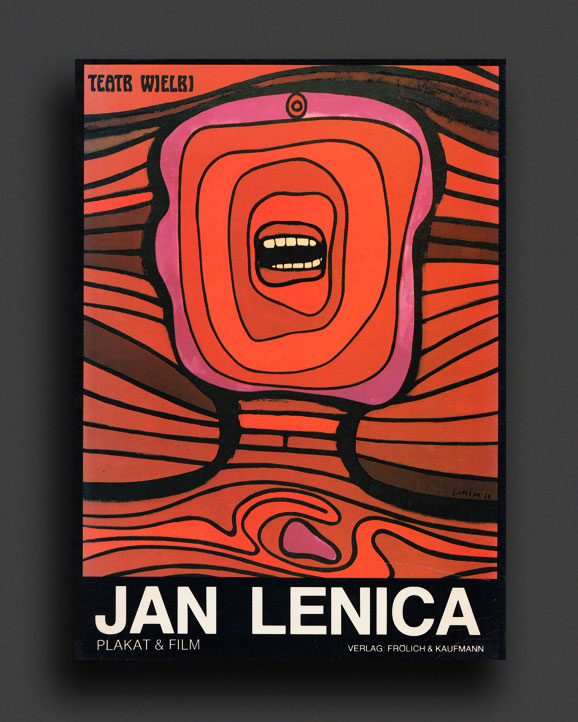
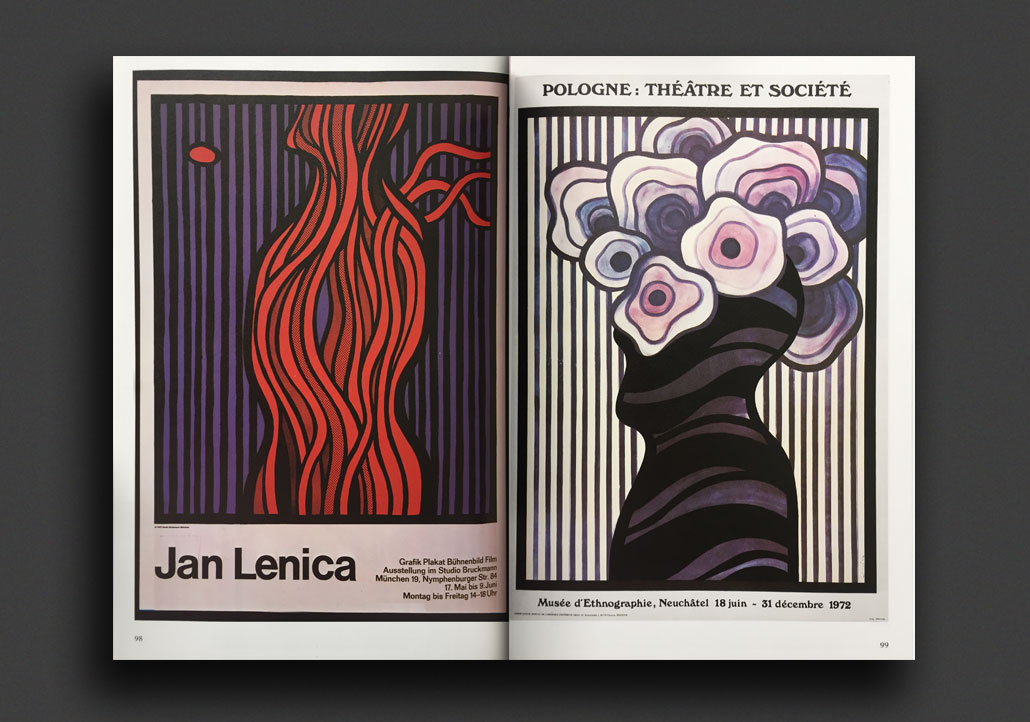
The first (and best) comprehensive monograph dedicated to the work of Polish graphic designer and cartoonist, Jan Lenica. Published in 1981 to accompany a major German travelling exhibition, this profusely illustrated book showcases (in colour) his prolific career as a poster artist for theatre and film, as well as his iconic animated works and other graphic and personal works.
Jan Lenica (4 January 1928, Poznań, Poland - 5 October 2001, Berlin) was a Polish graphic designer and cartoonist. A graduate of the Architecture Department of Warsaw Polytechnic, Lenica became a poster illustrator and a collaborator on the early animation films of Walerian Borowczyk. From 1963 - 1986 he lived and worked in France, while from 1987 he lived and worked in Berlin. He was a professor of graphic, poster, animated cartoon for many years at German high schools and the first professor of the animation class at the University of Kassel, Germany, in 1979. He used cut-out stop motion animation in his numerous films, which included two features: Adam 2 (1968) and Ubu et la grande gidouille (1976, but released in France only in 1979).
2016, English
Softcover, 328 pages, 23cm × 17cm
Ed. of 2000,
Published by
Unit Editions / London
$69.00 - Out of stock
United Edition's 'The Archive Series' is a bibliographic celebration of hidden and neglected visual archives. The Archive Series views graphic design as one of the ways to understand the semiotics of culture. United Editions is committed to the collection and preservation of printed specimens and graphic design artefacts to open up possibilities of decoding the past.
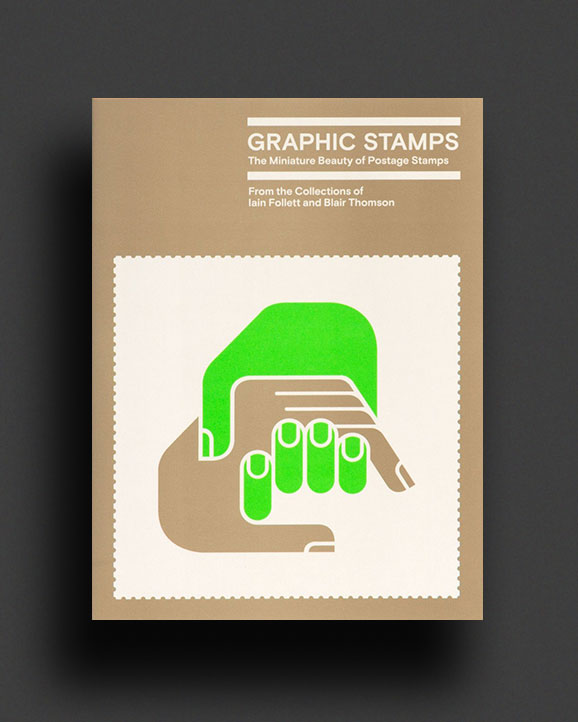
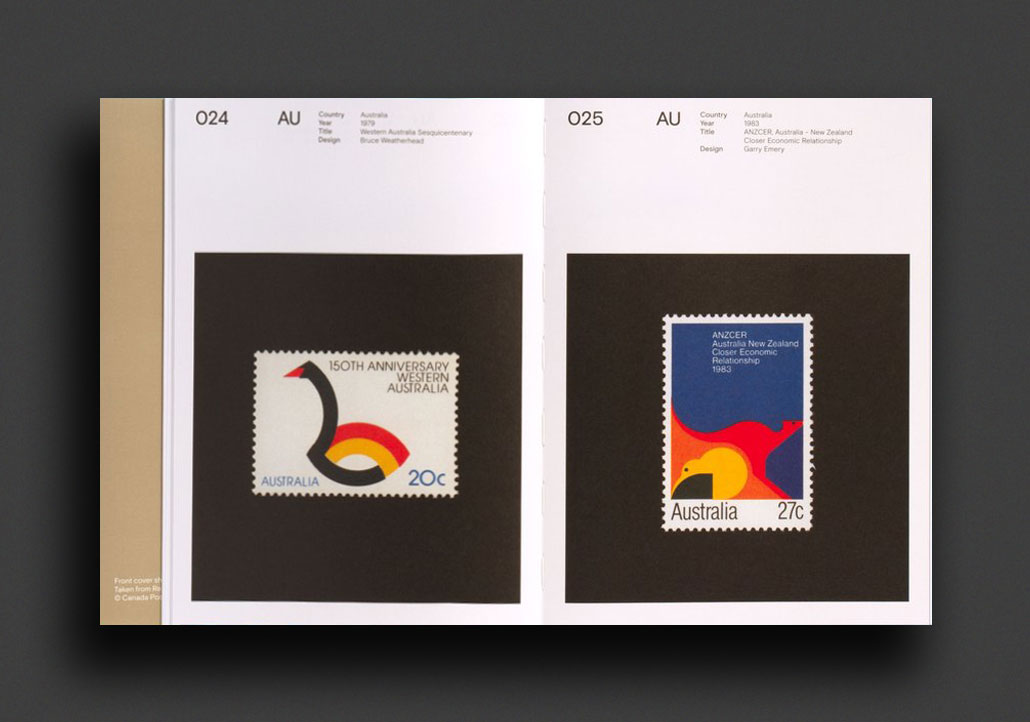
The first title in the series is devoted to the design of postage stamps. Sourced from the collections of stamp design experts Iain Follett and Blair Thomson, this book celebrates the often-neglected aesthetic and technical brilliance of postage stamps from around the world.
Postage stamps are the forgotten gems of graphic design. This is odd when you contemplate the high levels of aesthetic and technical qualities required to produce graphics for a tiny scrap of paper with perforated edges.
"…the result is a beauty. Graphic designers and philatelists alike will fawn over the boldness of the red-and-white right angles in 1960s Swiss stamps or the brash reds, whites and blues of their US-designed counterparts. The enduring qualities of these most disposable of mediums is striking. The title is the first in the publisher’s forthcoming Archive Series – a collection worth saving room for in any design library." - Monocle
"This brand new publication offers an in-depth look into the lovingly assembled collections of two passionate stamp collectors and graphics designers: Iain Follett and Blair Thomson. Not only does the book serve as a showcase of the best in stamp design, Follett and Thomson also offer a brief historical overview of postage stamps…" - People of Print
Edited by Tony Brook & Adrian Shaughnessy
Essay by Mark Sinclair
Design by Spin
Edition of 2000
2016, English
Softcover, 320 pages, 23cm × 17cm
Ed. of 2000,
Published by
Unit Editions / London
$69.00 - Out of stock
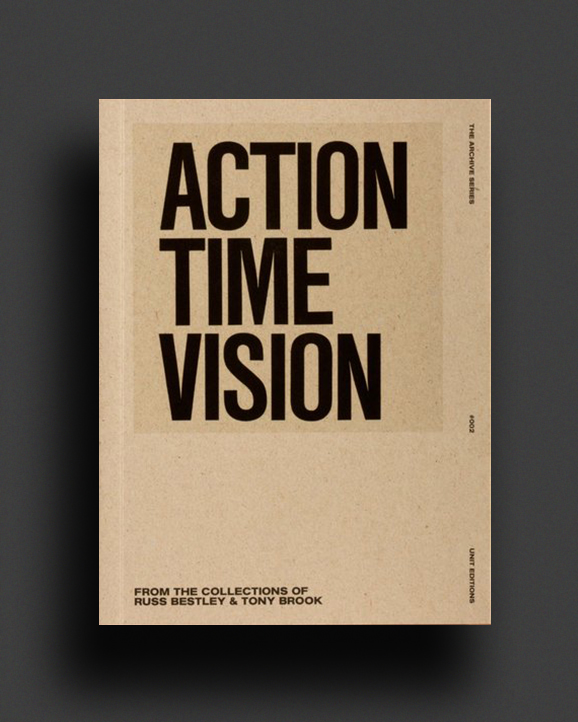
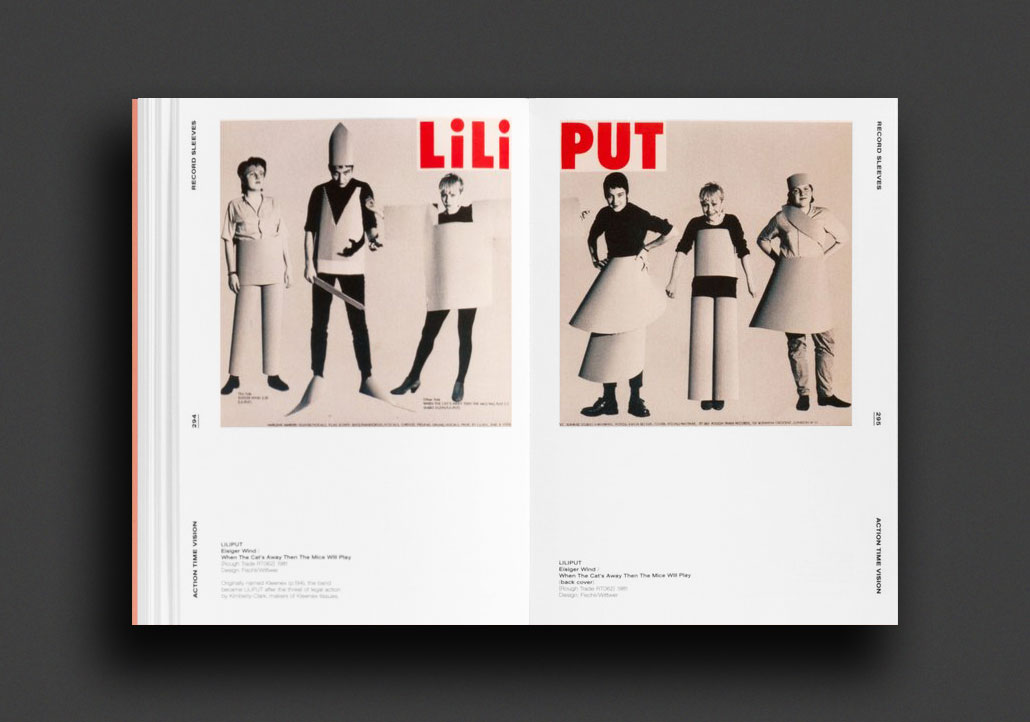
The punk era transformed the world of music. If you could play three chords, you could make records. You didn’t even need a record label. You could start your own.
The same thing happened in graphic design. All you needed were a few a sheets of Letraset and access to a photocopier, and you could make your own record covers. And lots of people did just that.
The work in this book is culled from the record collections of designer (and Unit Editions co-founder) Tony Brook, and leading punk scholar Russ Bestley. As one of the world’s leading authorities on punk and post-punk music, Russ has contributed an insightful essay to the book.
The book also features interviews with designer Malcolm Garrett, Mute founder Daniel Miller and Sniffin’ Glue editor and musician Mark Perry.
United Edition's 'The Archive Series' is a bibliographic celebration of hidden and neglected visual archives. The Archive Series views graphic design as one of the ways to understand the semiotics of culture. United Editions is committed to the collection and preservation of printed specimens and graphic design artefacts to open up possibilities of decoding the past.
Edited by Tony Brook & Adrian Shaughnessy
Consultant Editor - Russ Bestley
Design by Spin
Edition of 2000
1968, German
Hardcover (w. dust jacket), 370 pages, 22 x 22 cm
Out of print title / used / good
Published by
Württembergischer Kunstverein / Stuttgart
$120.00 - Out of stock
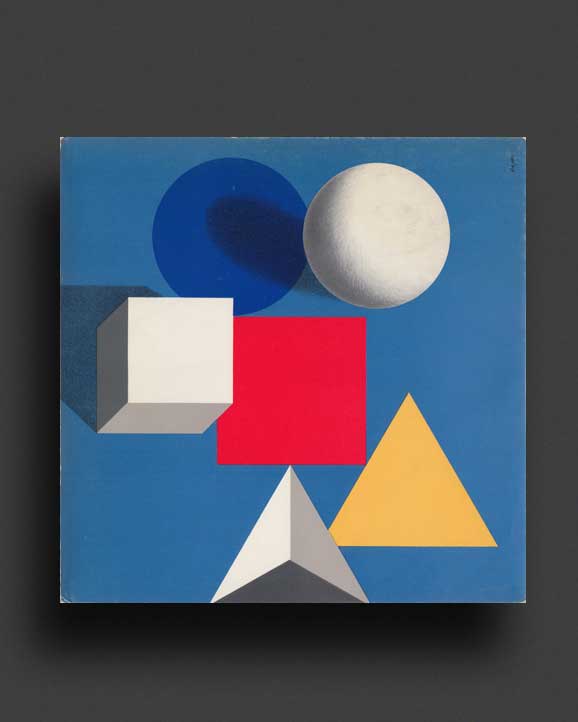
The amazing Bauhaus book, published in 1968 and designed and typeset to abolish all Upper Case letters by Herbert Bayer (one of the most influential members of the Bauhaus) for the first major Bauhaus survey exhibition after the Second World War, curated by Prof. Ludwig Grote, dr. Dieter Honisch, Herbert Bayer and Hans Maria Wingler, at Württembergischer Kunstverein Stuttgart.
This is the hard cover edition of what is without a doubt one of the most comprehensive and characteristic Bauhaus reference books ever published.
370 pages (with multiple paper stocks) contain no less than 650 colour and black and white illustrations selected from the Bauhaus Archiv, documenting the output of the Bauhaus from Weimar to Dessau to Berlin. This heavy, exhaustive volume is split into the following sections : preliminary course and teaching (includes Iteen, Moholy-Nagy, Albers, Schlemmer, Hirschfield-Mack, Klee and Schmidt); workshops (includes Teaching on Architecture, Sculpture, Stage, Stained Glass, Photography, Metal, Carpentry, Pottery, Typography, Mural Painting and Weaving); architecture and design (includes Gropius, Hannes Meyer, Mies van der Rohe, Hilberseimer, Brenner, Heiberg, A. Mayer, Stam Wittwer, Arndt, Bayer and Breuer); painting, sculpture, graphics (includes Josef Albers, Arndt, Bayer, Feininger, Itten, Kandinsky, Klee, Marcks, Moholy-Nagy, Muche, Schlemmer, Wols, etc.); life at the bauhaus; continuation of the teaching; biographies; bibliographies; index.
Includes introductory essays by Ludwig Grote, Walter Gropius, Heinz Winfried Sabais, Otto Stelzer, Hans Eckstein, Nikolaus Pevsner, Jurgen Joedicke, Will Grohmann and Hans M. Wingler.
Artists included: Walter Gropius, Marcel Breuer, Ludwig Mies Van Der Rohe, Gunta Stolzl, Joost Schmidt, Oskar Schlemmer, Walter Peterhans, Georg Muche, Lilly Reich, Laszlo Moholy-Nagy, Hannes Meyer, Gerhard Marcks, Johannes Itten, Ludwig Hilberseimer, Max Bill, Wassily Kandinsky, Lyonel Feininger, Alfred Arndt, Josef Albers, Marianne Brandt, Herbert Bayer, Paul Klee, Josef Hartwig, Wilhelm Wagenfeld, Christian Dell, Otto Lindig, Theodor Bogler, Wols, and so many others.
Includes references to all aspects of the Bauhaus, including: Itten's Preliminary Course, Klee's Course, Kandinsky's Course, Color Experiments, Carpentry Workshop, Stained Glass Workshop, Pottery Workshop, Metal Workshop, Weaving Workshop, Stage Workshop, Wall Painting Workshop, Display Design, Architecture, Typography and Layout; the Bauhaus Press, the Weimar Exhibition, 1923, Moholy-Nagy's Preliminary Course, Albers' Preliminary Course, Bauhaus Building, The Masters' Houses, Other Buildings in Dessau, Architecture Department, Weaving Workshop, Typography Workshop: Printing, layout, posters, Photography, Exhibition Technique, Wall Painting Workshop: Wall paper, Sculpture Workshop, Stage Workshop, Extracurricular Activities, Spread of the Bauhaus Idea, Bauhaus Teaching in the United States and much more.
All texts in German.
Of all the artists to pass through the Bauhaus, none lived the Bauhaus ideal of total integration of the arts into life like Herbert Bayer (1900 - 1985). He was a graphic designer, typographer, photographer, painter, environmental designer, sculptor and exhibition designer. Between 1925 and 1928, Bayer was head of the printing workshop at the Bauhaus and produced many designs that became standards of a Bauhaus "style." Bayer was instrumental in moving the Bauhaus to purely sans serif usage in all its work, and is especially known is his lowercase, which continues in this 1968 catalogue.
Hardcover 2nd edition w. illustrated dust jacket (protected under plastic wrap) - good copy throughout, with the common bind-splitting at some intervals due to old glue and paper weight (seems to have been previously repaired). All pages still bound and present. Heavy spotting to outer top block edge, tanning to pages edges, otherwise bright and very clean throughout. Good jacket, only light wear.
1953, English
Hardcover (w. dust jacket), 112 pages, 11.8 x 15 cm
1st Edition, Out of print title / used / good
Published by
Gaberbocchus Press / London
$45.00 - Out of stock
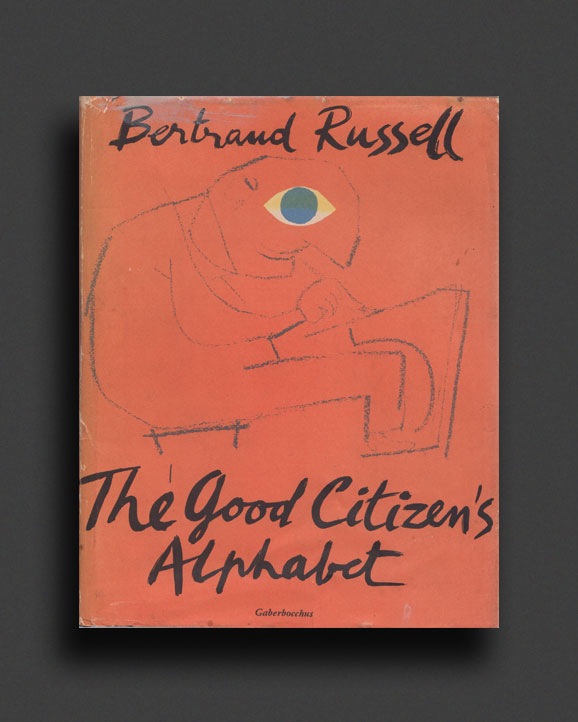
First 1953 hardcover edition of The Good Citizen’s Alphabet.
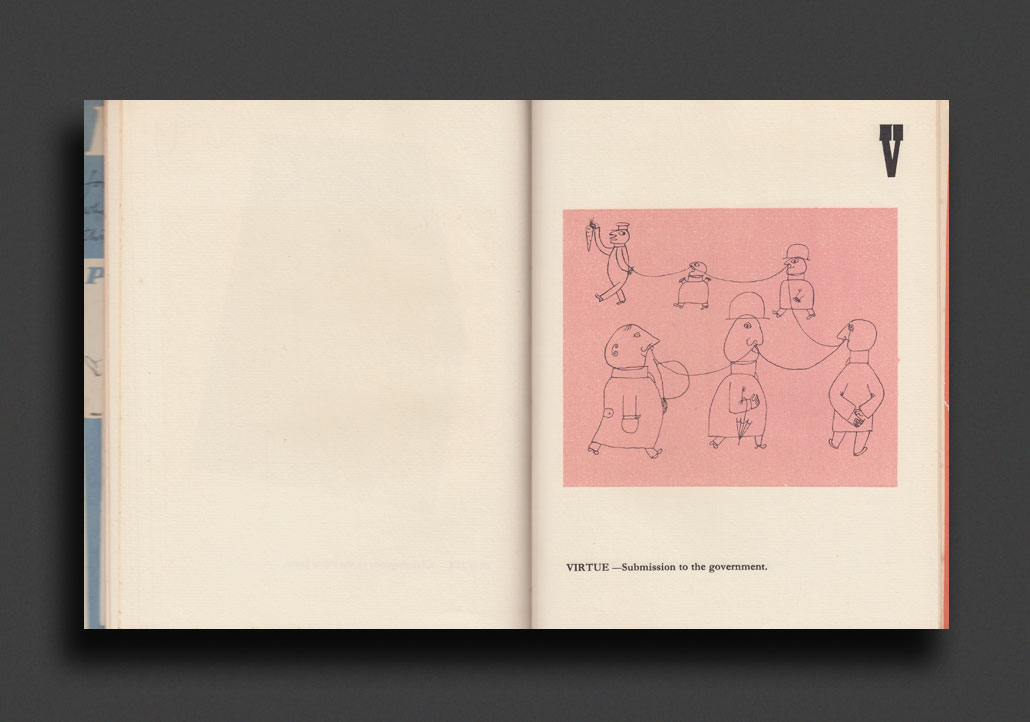
"E: Erroneous: Capable of being proved true"; "J: Jolly: The downfall of our enemies"; "M: Mystery: What I understand and you don't" . . . Enter the delightful, satirical world of the Good Citizen. In this pocket-size book, renowned philosopher and writer Bertrand Russell’s witty, subversive A–Z encompasses pedants and nincompoops, knowledge and virtue, providing a diverting and entertaining guide to the English alphabet. Beautifully printed and illustrated with the lively drawings of Franciszka Themerson, whose apt and amusing images add an anarchic spirit to this delightful gift book.
Bertrand Russell (1872–1970) was one of the foremost philosophers and logicians of the 20th century.
Franciszka Themerson (1907–1988) was a central figure of the Polish avant-garde.
1972, English
Hardcover, 256 pages, 31 x 23 cm
Published by
New York Graphic Society / New York
Darien House / New York
$50.00 - Out of stock
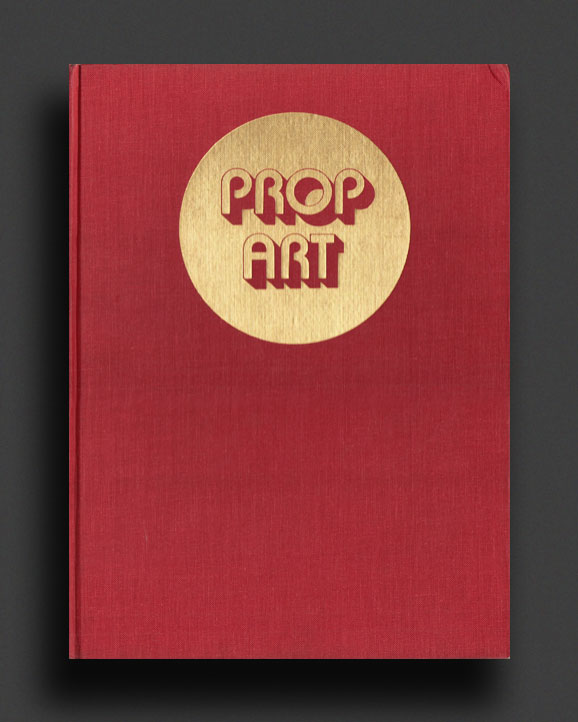
Published in 1972 and now long out of print, this heavy over-sized book details a complete and colourful history of the propaganda poster. Propaganda art - persuasion through visual means - is as old as man. In PROP ART, Gary Yanker examines the recent political poster as a vehicle for conveying the propaganda message. Posters, which can be duplicated on a vast scale or quickly and crudely made by hand, are the cheapest medium for the dissemination of ideas. National governments, political parties, pressure groups of all persuasions, rely on posters for much of their propaganda. Today, thanks largely to the highly visible efforts of students around the world - notably in France, Czechoslovakia, Mexico and the United States - posters have become more widespread than ever. As "cult" objects and as purely decorative designs they appear as frequently in living rooms as on billboards, fostering a new "poster consciousness."
Contents include: Part 1: The propaganda poster: The international propaganda phenomen. Poster literature. Poster types and function. Basic elements of political graphic design. (labelling symbols, right-wing symbols, left-wing symbols) The PLANT approach. Production and distribution (the French student experience,) Poster substitutes (buttons and bumperstickers, the sticker as a sabotage device,) The law and Prop Art. Part 2: The Poster Gallery: Election campaigns 1967-1971. Election campaign issues. Major political events (cultural revolution in China '66 - '69, Greek Junta '67, Arab-Israeli conflict '67 - '71, Assassination of Che Guevara '67, Assassination of Martin Luther King, '68, Paris May revolt, '68, Resurrection City '68, Invasion of Czechoslovakia '68, Cambodian invasion '70, Rockefeller's visit to South America '68, Nationalization of the copper mines in Chile '71) major political themes (Vietnam, Liberation : blacks, Puerto Ricans, women, Indians; ecology, communist celebrations,) Minor themes (peace, Cuba, anti-establishment, the army Nixon, solidarity, free all political prisoners), Poster substitutes: buttons, patches, bumperstickers, stickers. Includes the SO WHAT newspaper cover with moon landing, Hippie pissing on stockbroker, Alfred E. Neuman as Uncle Sam: Who Needs YOU?, lots of tricky D. & Spiro, white power bumper stickers, "win with Dick" bubble gum cigar box. An amazing collection in one book!
Very Good copy w/o dust jacket.
1996, French
Softcover, 200 pages, 26 x 21 cm
1st Edition, Out of print title / Used*,
Published by
Dreamland Éditeur / Paris
$40.00 - Out of stock
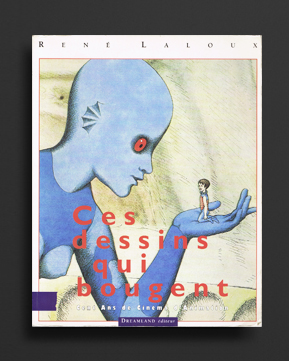
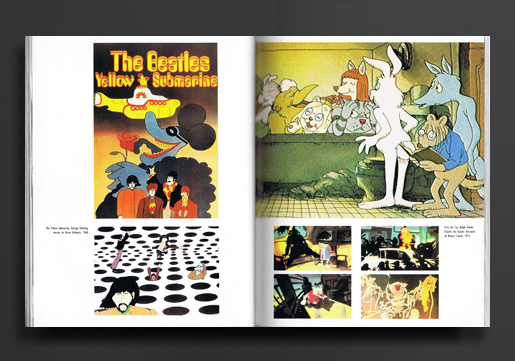
Written by one of the finest in the field, René Laloux, this scarce French book published in 1996 traces the history of animated cinema. "Ces Dessins qui Bougent : 1892-1992 - Cent Ans de Cinema d'Animation" (These drawings that move : 1892-1992 - One hundred years of Animated Film) is richly illustrated throughout with some of the best historical examples in animated film, dissecting the form through the work of Bruno Bozzetto, Jan Svankmajer, Paul Grimault, Walt Disney, Hayao Miyazaki, Yuri Norstein, Norman Mclaren, Walérian Borowczyk, Jiri Trnka, Ralph Bakshi, Jean Giraud (Mœbius), Philippe Caza, Osvaldo Cavandoli, Peter Foldes, and so many more. Includes a great illustrated chronology of important works. Texts in French.
René Laloux (July 13, 1929 – March 14, 2004) was a French animator and film director, well known for his animated films including The Snails (Les Escargots, 1965), Time Masters (1982), Gandahar (1988), and his most famous, Fantastic Planet (La Planète Sauvage, 1973), collaborating with artists Roland Topor, Jean Giraud (Mœbius) and Philippe Caza.
1980, German
Softcover, 130 pages, 19 x 15.5 cm
Out of print title / used / fine
Published by
Diogenes / Zürich
$65.00 - Out of stock
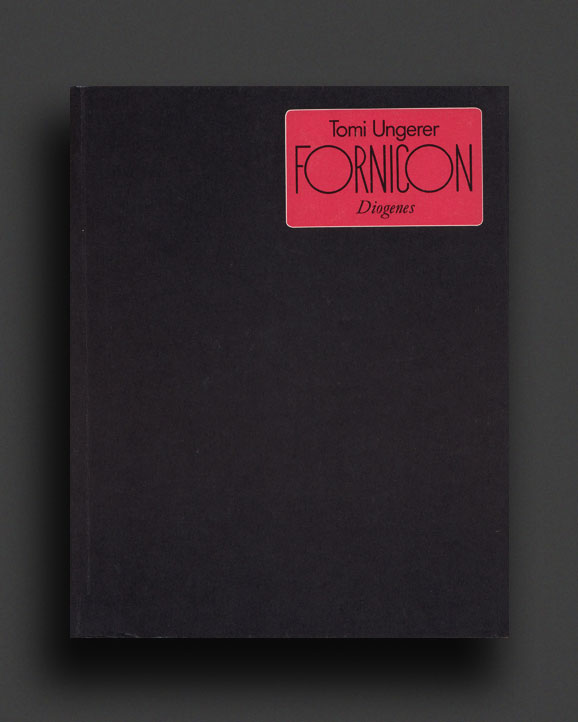
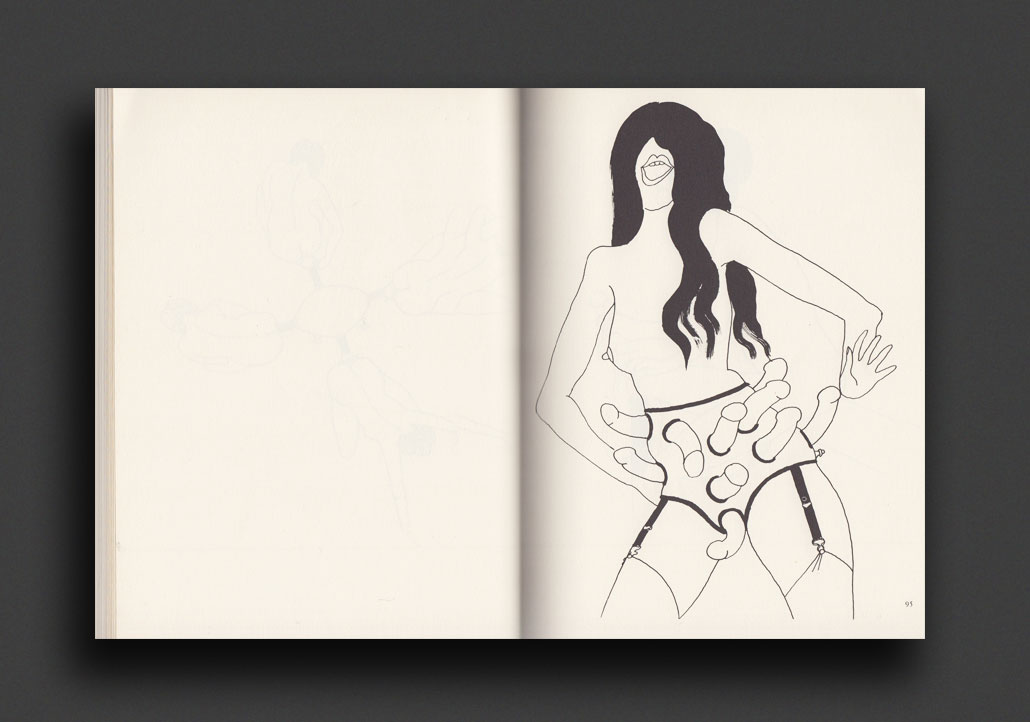
1980 paperback edition of Tomi Ungerer's controversial cult classic from 1969, Fornicon, originally published as an over-sized folio of Ungerer's stunning line drawings of machine sex. Over one hundred pages of Ungerer's wild contraptions and participants in diagrammatic instructional bondage bliss. One of the finest illustration erotic works of our time, from one of the great European illustrators.
"Black Power/White Power, with its Kama Sutra suggestion of simultaneous fellatio, has an undeniable sexual undercurrent, but Ungerer also addressed the sexual revolution head-on, assimilating the fluid line and stark patterning of Aubrey Beardsley in wildly phallocratic drawings of baroque pleasure devices and mechanical means of penetration. Published as an expensive folio, The Fornicon, these sprightly images—a literal, if perverse, expression of the desire to make love rather than war—provoked a strong negative reaction, effectively suspending Ungerer’s career as a children’s book artist (his works, he says, were banned from libraries) and precipitating his departure from New York..." - NY Books
Published in 1980 in Zürich. Very little text, in German.
Tomi Ungerer (born 28 November 1931) is an award winning French illustrator and a writer in three languages. He has published over 140 books ranging from much loved children's books to controversial adult work and from the fantastic to the autobiographical. He is known for sharp social satire and witty aphorisms. He is renowned for his iconic Advertising campaigns and political posters against the Vietnam War and Racial Injustice which were representative of the burgeoning political consciousness in New York in the 1960’s. His political engagement has continued to this day in campaigns against Racism and Fascism, for Nuclear disarmament, Ecology and numerous Humanitarian causes.
Very Good - Fine copy.
1985, English
Softcover, 224 pages, 24.5 x 19 cm
1st Edition, Out of print title / used / good
Published by
Jonathan Cape / London
$50.00 - Out of stock
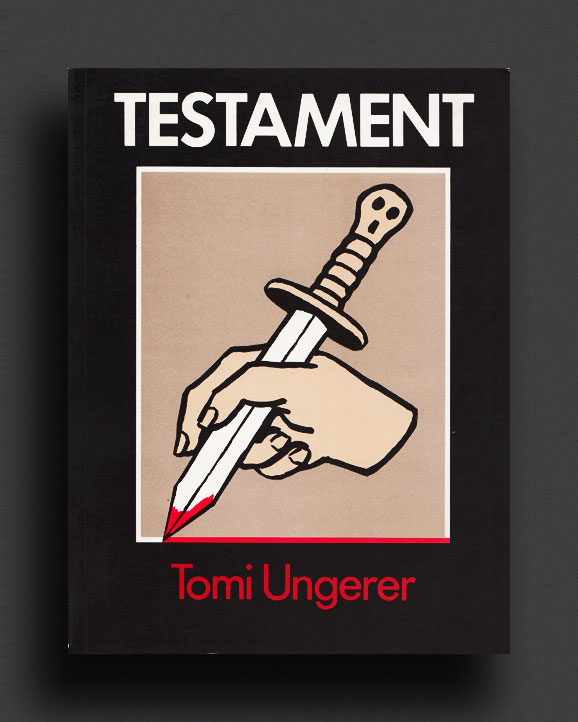
First edition of the great "Testament" book by Tomi Ungerer, published in 1985 to coincide with a major retrospective exhibition in London of one of the world's most famous graphic artists. This volume presents an exceptional collection of Ungerer's satirical drawings spanning 1960 to 1980. From his Underground Sketchbook, The Party, Compromises, politrics, Babylon, Symptomatics, and Rigor Mortis.
"From Tomi Ungerer we can expect the unexpected. Testament - which spans twenty years of his enormously successful career - is filled with surprises. Familiar images are re-assessed from new angles: the improbable, the sinister, the macabre. This is Tomi Ungerer's vision - it is also his
genius. With a fearless eye this master of satire and the absurd pinpoints those areas of our society which we may wish to ignore, and translates his observations into images of immediacy and startling boldness. Ungerer is relentless in exposing human behaviour, as each powerful image cuts through surface appearances to reveal black humour in the underlying realities. From the needless horrors of war and the glorification of violence, through sophisticated pretensions and pomposity, to the little man, often isolated, whose ridiculous actions - tinged with heavy satire - may evoke pathos, nothing
and no one is exempt from Ungerer's dark and biting humour. Newsweek has aptly said of Ungerer's startling graphic commentaries, 'they thud into the solar plexus and stab the intellect'. They are also very funny. This collection is as thought-provoking as it is entertaining. Above all, it is a testament
to the inexhaustible wit and imaginative skill of Tomi Ungerer."
Tomi Ungerer (born 28 November 1931) is an award winning French illustrator and a writer in three languages. He has published over 140 books ranging from much loved children's books to controversial adult work and from the fantastic to the autobiographical. He is known for sharp social satire and witty aphorisms. He is renowned for his iconic Advertising campaigns and political posters against the Vietnam War and Racial Injustice which were representative of the burgeoning political consciousness in New York in the 1960’s. His political engagement has continued to this day in campaigns against Racism and Fascism, for Nuclear disarmament, Ecology and numerous Humanitarian causes.
Good copy, light wear to cover, spotting to title page. Clean, tight copy throughout.
1982, German
Softcover, 154 pages, 8.4 x 12.6 cm
Out of print title / used / very good
Published by
Diogenes / Zürich
$48.00 - Out of stock
“The mind, body, and society of men seem fragile containers for violent, centrifugal forces.” - Jonathan Miller
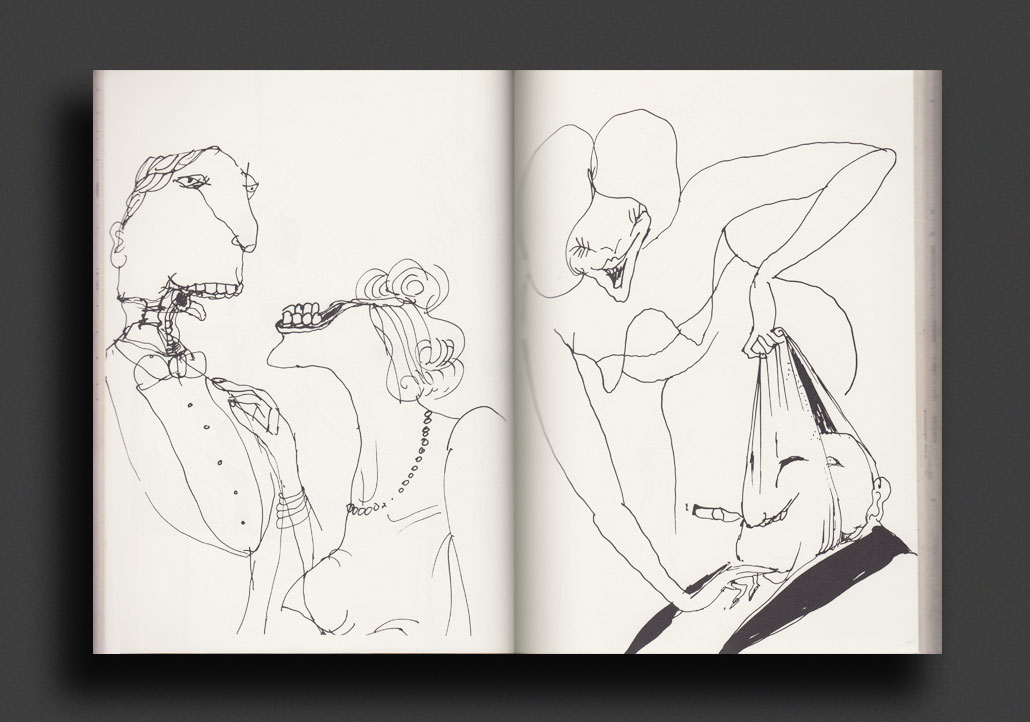
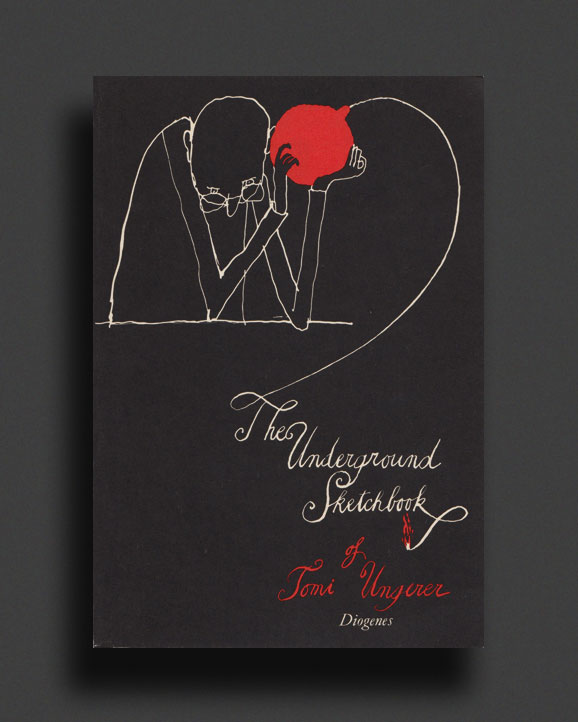
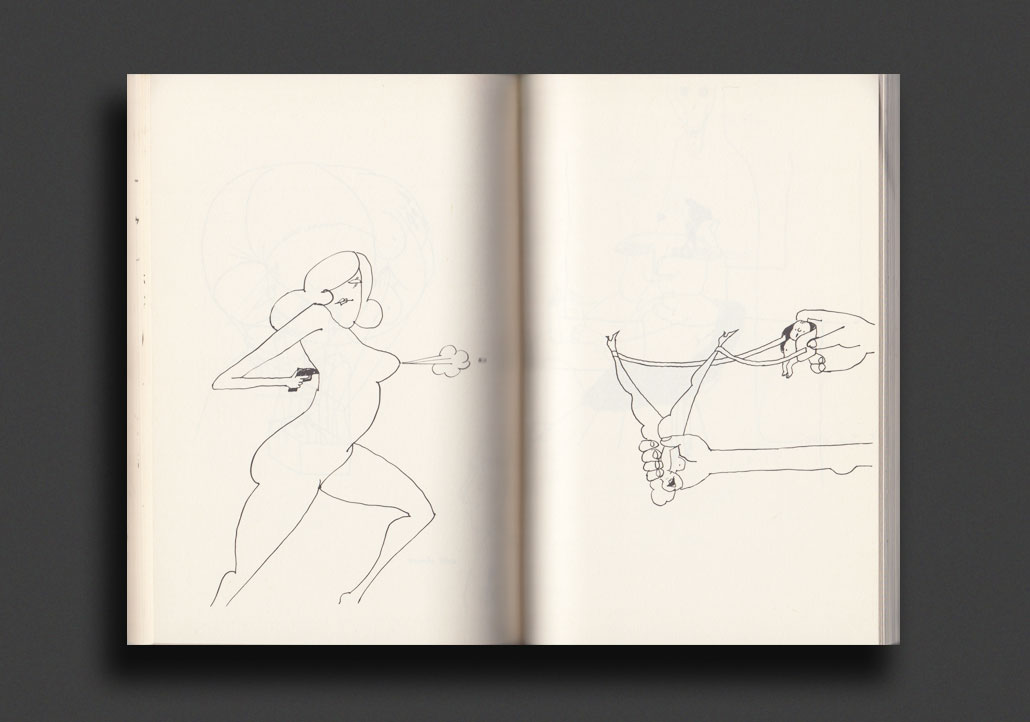
"The Underground Sketchbook of Tomi Ungerer" was first published in 1964 across many editions world-wide and remains one of the most prized illustrated books of subversive, black humour that Ungerer produced so well. At once a satire on the mechanised violence of human kind and a cutting parody of our body image, "The Underground Sketchbook of Tomi Ungerer" is a brutal and joyous romp of subversive, masochistic, absurdist scenarios spanning over 150 pages.
This is the 1982 printing published by Diogenes in Zürich, with original preface by Jonathan Miller (here in German).
Tomi Ungerer (born 28 November 1931) is an award winning French illustrator and a writer in three languages. He has published over 140 books ranging from much loved children's books to controversial adult work and from the fantastic to the autobiographical. He is known for sharp social satire and witty aphorisms. He is renowned for his iconic Advertising campaigns and political posters against the Vietnam War and Racial Injustice which were representative of the burgeoning political consciousness in New York in the 1960’s. His political engagement has continued to this day in campaigns against Racism and Fascism, for Nuclear disarmament, Ecology and numerous Humanitarian causes.
1971, English / French / German
Hardcover, 176 pages, 29 x 22 cm
1st Edition, Out of print title / used / good
Published by
Studio Vista / London
$40.00 - Out of stock
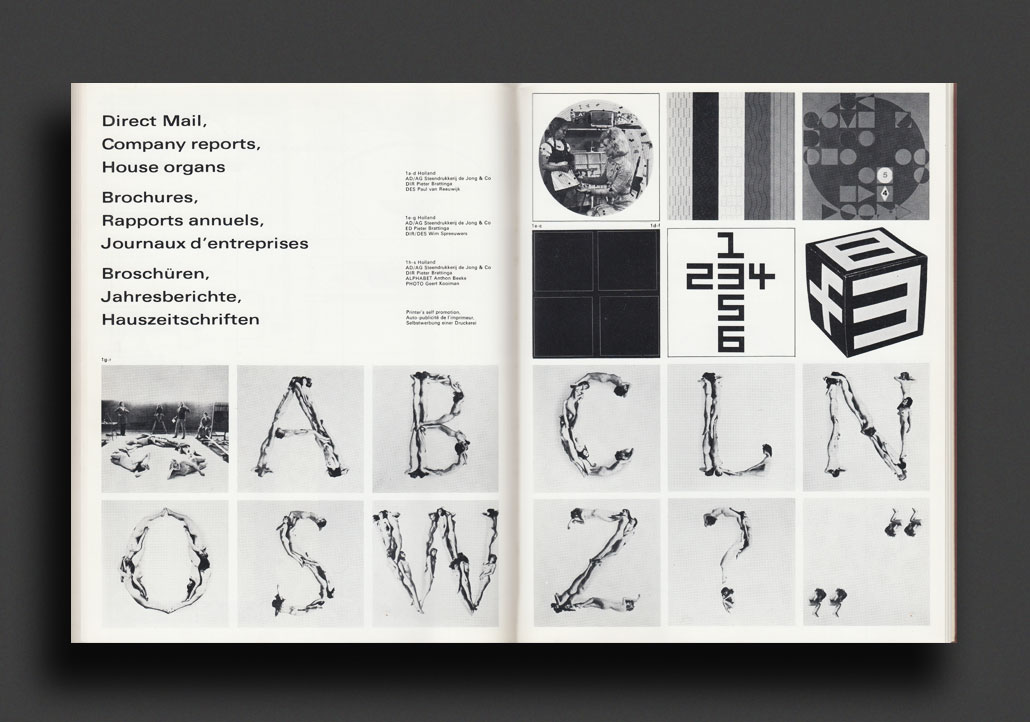
Published by the great Studio Vista publishing house between 1924-1985, Modern Publicity was, and remains, an in-depth and crucial reference of international graphic design, alongside the likes of Graphis and Pubblicitá In Italia. Each lavishly illustrated hardcover volume presents new work by designers and artists across various media, inc. posters, press advertisements, type faces, books, trademarks, logos, packaging, record sleeves, coordinated campaigns, direct-mail advertising, calendars, company reports, TV graphics, animation, postage-stamp design, and much more, all informatively captioned in English, French and German with details on the designers, art directors, clients, printing processes and size of the original products.
Modern Publicity 1971-72, edited by Felix Gluck, features the work of Richard Hollis, Olaf Leu, Paul Rand, Pieter Brattinga, Milton Glaser, Tom Wesselman, Nicole Claveloux, Les Mason, Roman Cieślewicz, Holger Matties, Max Velthuijs, Ogilvy and Mather, Jan van Toorn, Crosby/Fletcher/Forbes, Massimo Vignelli, Adriana Botti, Dick Bruna, Masuda Tadashi, Jan Młodożeniec, Edward Wright, André Francois, Veniero Bertolotti, Sarah Moon, Tomi Ungerer, and so many more.
Good Copy but without dust jacket, now preserved under plastic wrap. Ex-libris markings and general library wear.
1972, English / French / German
Hardcover (w. dust jacket), 176 pages, 29 x 22 cm
1st Edition, Out of print title / used / good
Published by
Studio Vista / London
$45.00 - Out of stock
Published by the great Studio Vista publishing house between 1924-1985, Modern Publicity was, and remains, an in-depth and crucial reference of international graphic design, alongside the likes of Graphis and Pubblicitá In Italia. Each lavishly illustrated hardcover volume presents new work by designers and artists across various media, inc. posters, press advertisements, type faces, books, trademarks, logos, packaging, record sleeves, coordinated campaigns, direct-mail advertising, calendars, company reports, TV graphics, animation, postage-stamp design, and much more, all informatively captioned in English, French and German with details on the designers, art directors, clients, printing processes and size of the original products.
Modern Publicity 1972-73, edited by Felix Gluck, features the work of Raymond Savignac, Guy Bourdin, Otl Aicher, Roman Cieślewicz, Helmut Newton, Sarah Moon, Holger Matthies, Olaf Leu, Hiroshi Ohchi, Crosby/Fletcher/Forbes, John Gorham, Kenichi Matsinaga, Walter Breker, David Hockney, Les Mason, Walter Tafelmaier, and so many more.
Good ex-libris copy in dust jacket with some wear/whipping, now preserved under plastic wrap. Light ex-libris marking, otherwise clean, tight copy throughout.
1975, English / French / German
Hardcover (w. dust jacket), 192 pages, 29 x 22 cm
1st Edition, Out of print title / used / good
Published by
Studio Vista / London
$50.00 - Out of stock
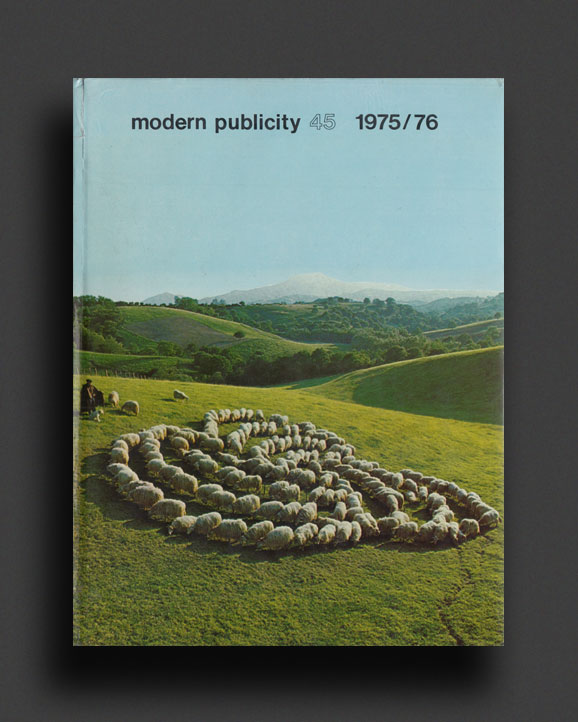
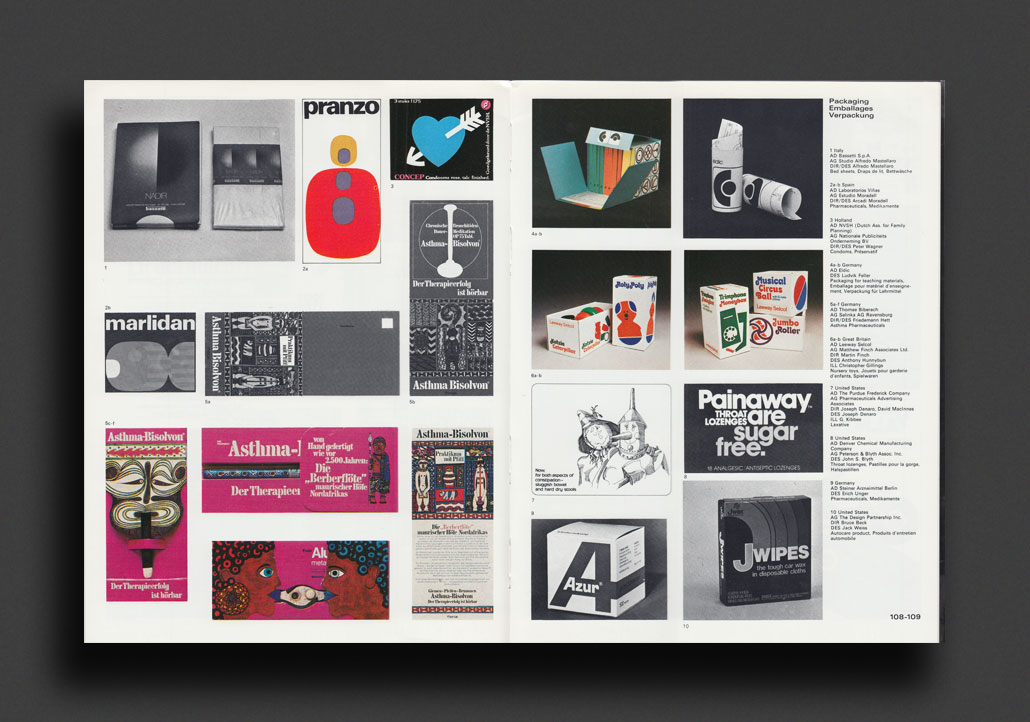
Published by the great Studio Vista publishing house between 1924-1985, Modern Publicity was, and remains, an in-depth and crucial reference of international graphic design, alongside the likes of Graphis and Pubblicitá In Italia. Each lavishly illustrated hardcover volume presents new work by designers and artists across various media, inc. posters, press advertisements, type faces, books, trademarks, logos, packaging, record sleeves, coordinated campaigns, direct-mail advertising, calendars, company reports, TV graphics, animation, postage-stamp design, and much more, all informatively captioned in English, French and German with details on the designers, art directors, clients, printing processes and size of the original products.
Modern Publicity 1975/76, edited by Felix Gluck, features the work of Dick Bruna, Milton Glaser, Sarah Moon, Pentagram, Léo Kouper, Shigeo Okamoto, Peter Beard, Seymour Chwast, Pierre Delessert, Alan Fletcher, Les Mason, Olaf Leu, Herb Lubalin, Guillermo Morillo, Max Bill, Ivan Chermayeff, Roman Cieślewicz, Olivetti, Letraset, Ikko Tanaka, Sam Haskins, and so many more.
Good ex-library Copy with good dust jacket, now preserved under plastic wrap.
General library associated markings and wear.
1972, English
Softcover, 50 pages, 26.5 x 21 cm
1st Edition, Out of print title / used / good
Published by
Baroque Press / London
$35.00 - Out of stock
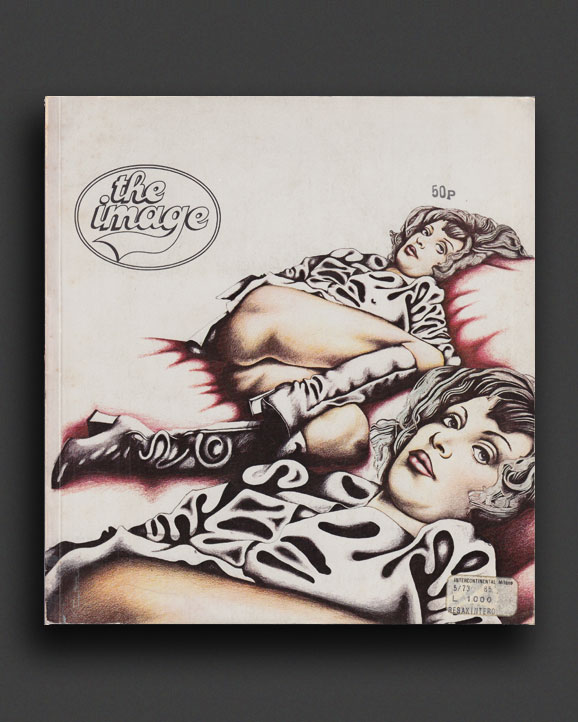
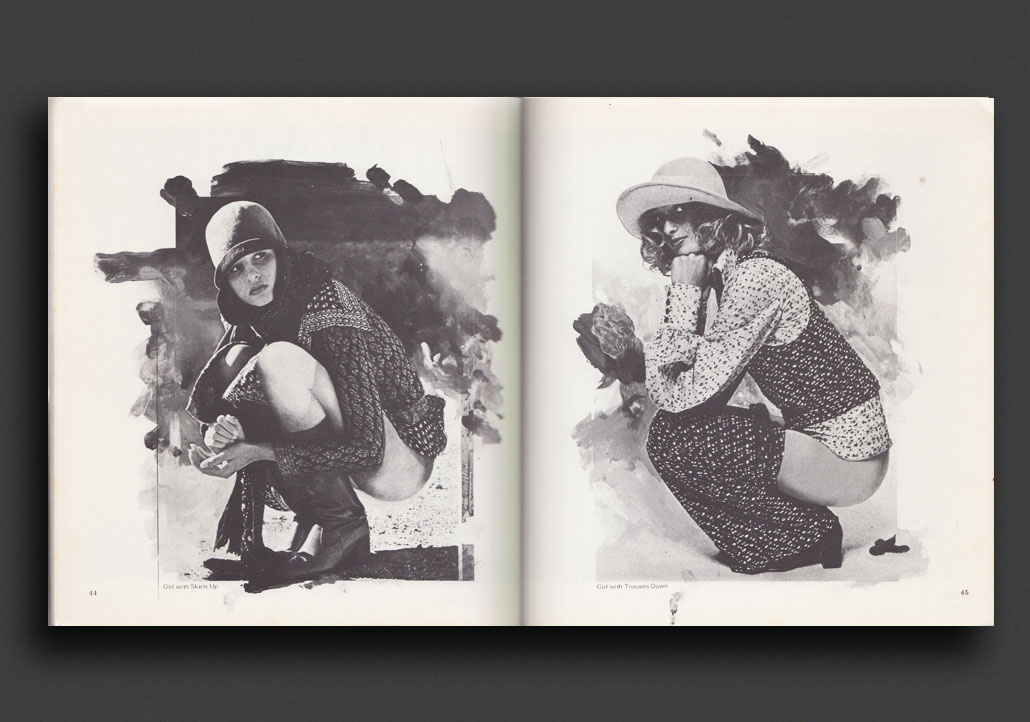
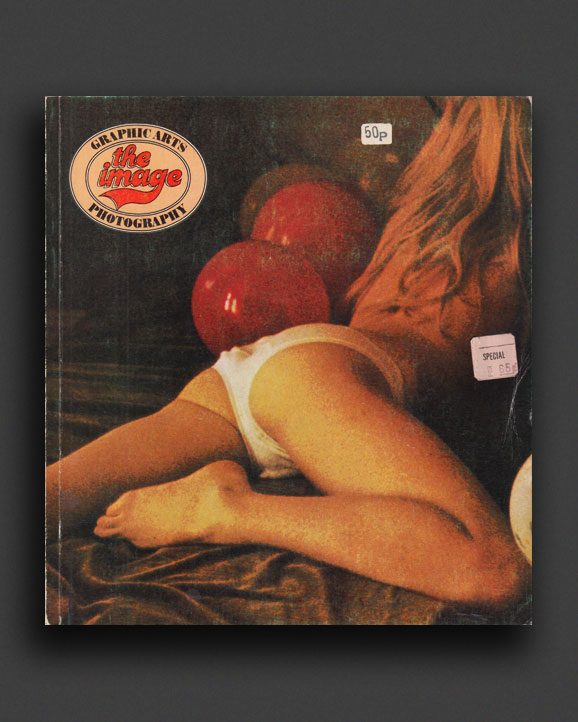
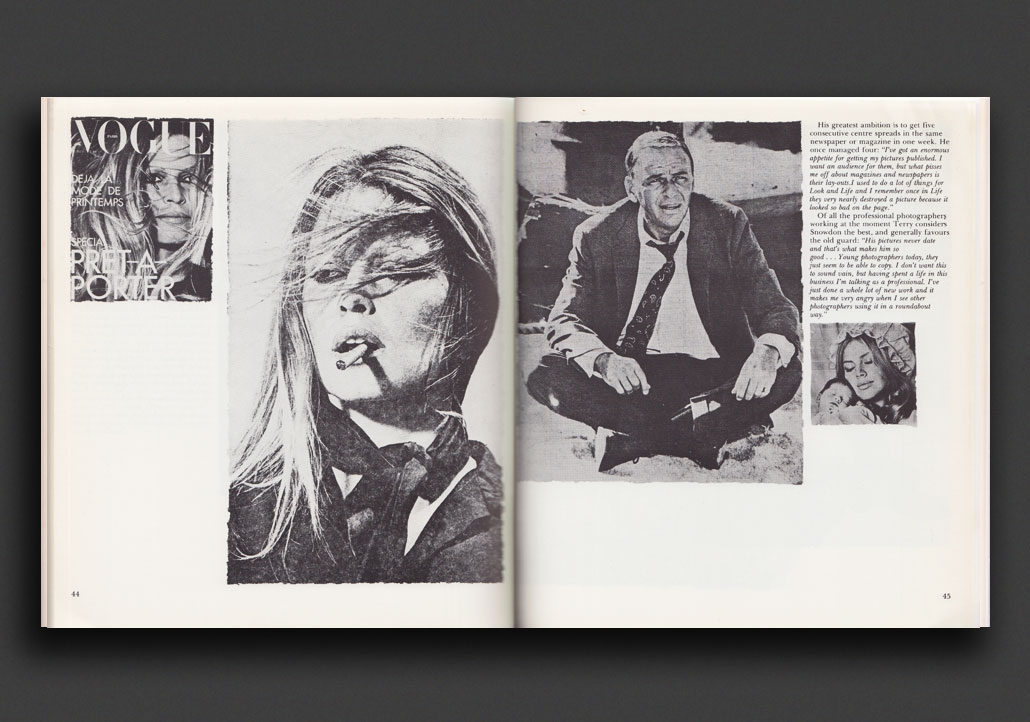
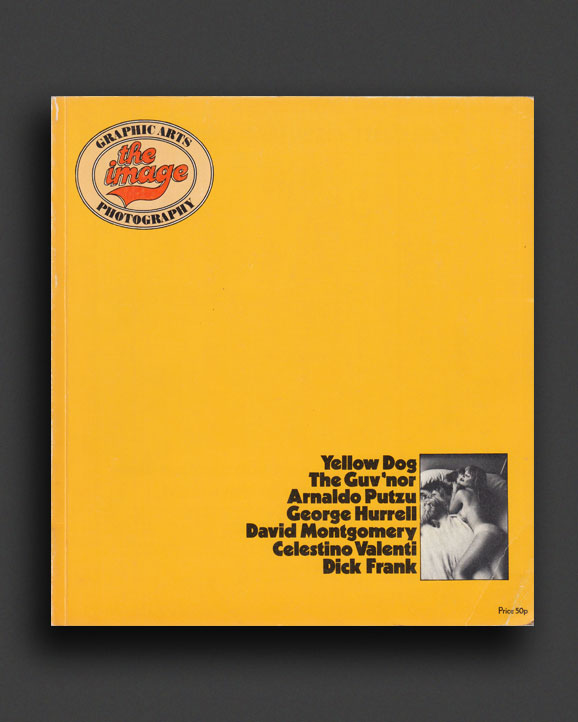
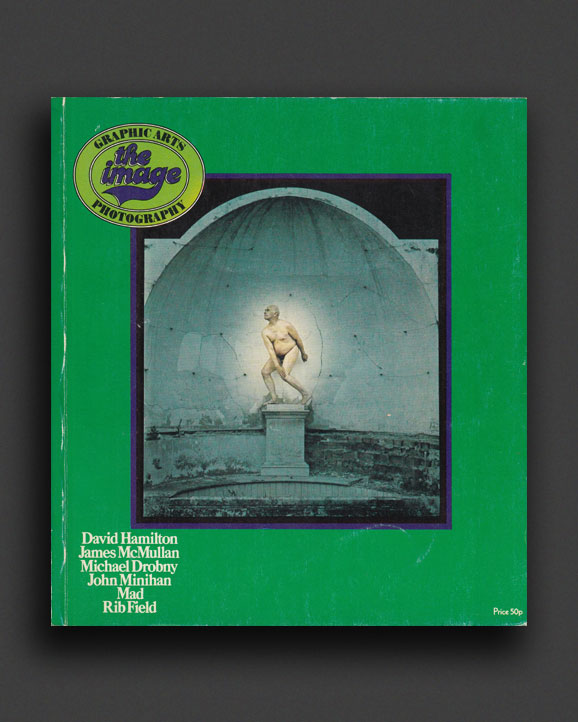
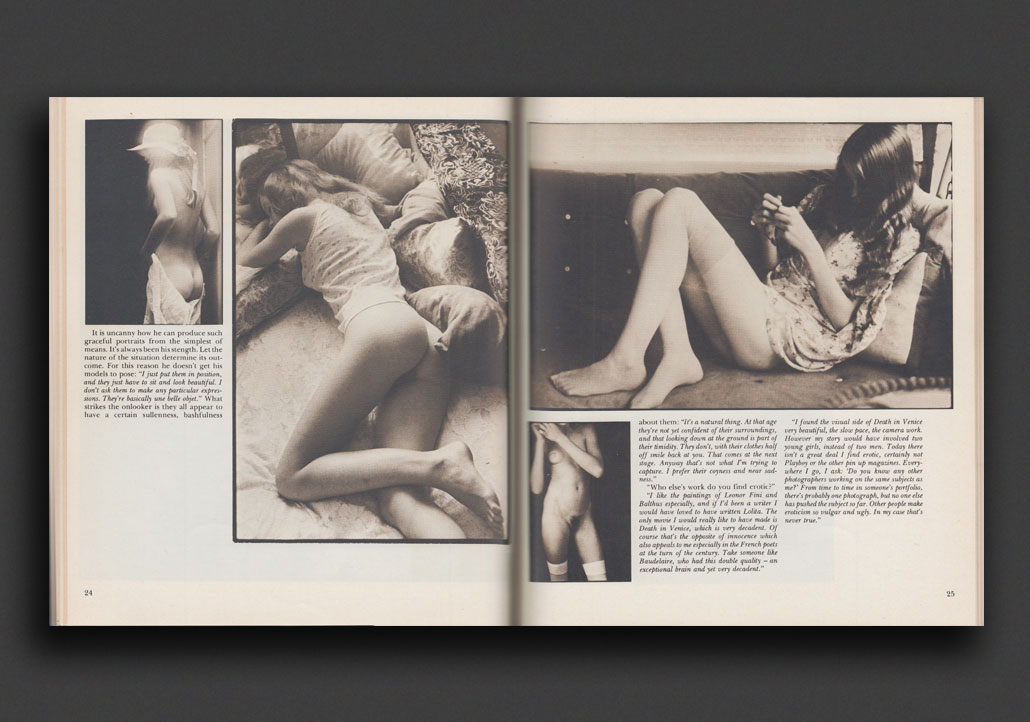
The Image was a great periodical dedicated to the Graphic Arts and Photography, published monthly in the early 1970s by the Baroque Press of London. Each issue profiles artists with heavily illustrated spreads of their work alongside commentary and interviews.
This issue (No. 8, 1972) includes features on: Bob Hook, Ralph Steadman, Richard Hamilton, Elliot Erwitt, Robert Montgomery, Dave Atkinson, Harry Holland, J.P. Smut, James Wedge, and more.
1973, English
Softcover, 50 pages, 26.5 x 21 cm
Published by
Baroque Press / London
$35.00 - Out of stock
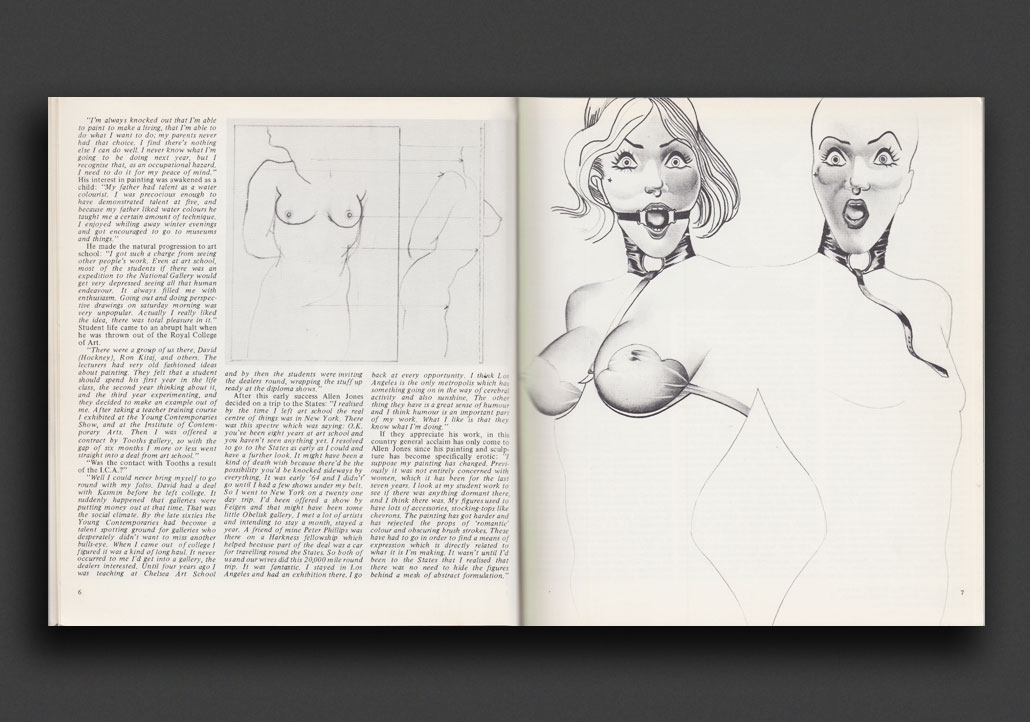
The Image was a great periodical dedicated to the Graphic Arts and Photography, published monthly in the early 1970s by the Baroque Press of London. Each issue profiles artists with heavily illustrated spreads of their work alongside commentary and interviews.
This issue (No. 9, 1973) includes features on: Allen Jones, Barry Pringle, Vince Farrell, Norman Earles, Raymond Thompson, Richard Hurley, Ray Bellisario, Dave Anthony, Bill Brandt, and more.
1973, English
Softcover, 50 pages, 26.5 x 21 cm
Published by
Baroque Press / London
$35.00 - Out of stock
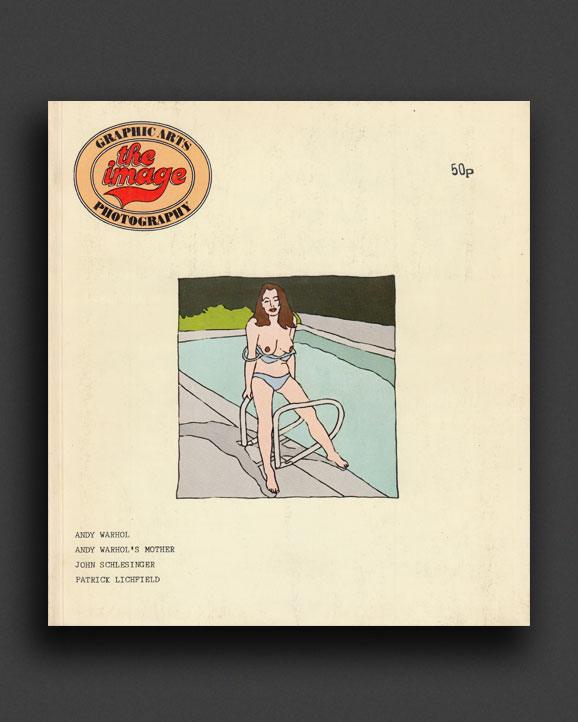
The Image was a great periodical dedicated to the Graphic Arts and Photography, published monthly in the early 1970s by the Baroque Press of London. Each issue profiles artists with heavily illustrated spreads of their work alongside commentary and interviews.
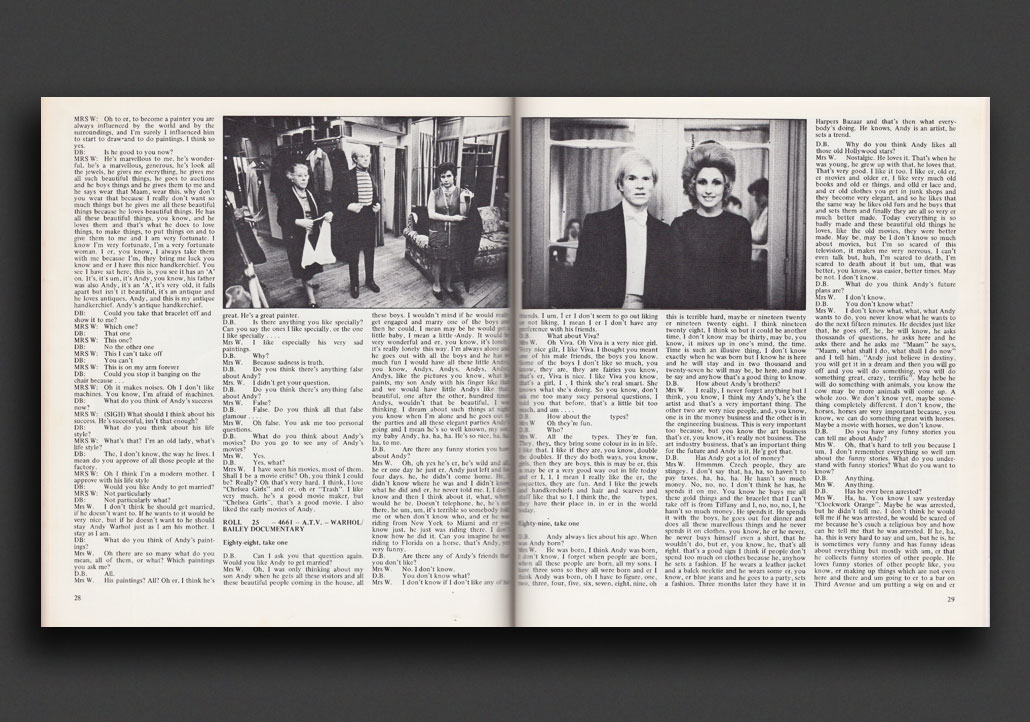
This issue (No. 10, 1973) includes features on: Andy Warhol, Andy Warhol's mother, Christine Roche, Bruce Rae, Donald Haunam, John Schlesinger, Patrick Lichfield, Hans Wallner, Doris, Bob Gale, and more.
1973, English
Softcover, 50 pages, 26.5 x 21 cm
1st Edition, Out of print title / used / good
Published by
Baroque Press / London
$35.00 - Out of stock
The Image was a great periodical dedicated to the Graphic Arts and Photography, published monthly in the early 1970s by the Baroque Press of London. Each issue profiles artists with heavily illustrated spreads of their work alongside commentary and interviews.
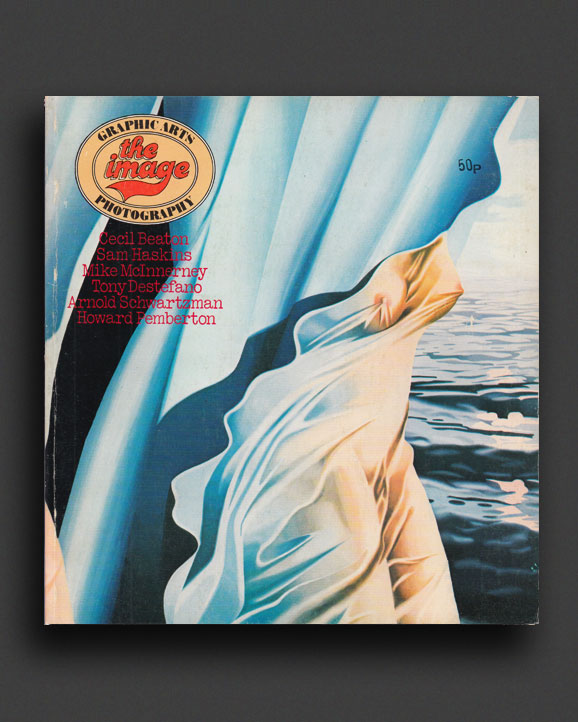
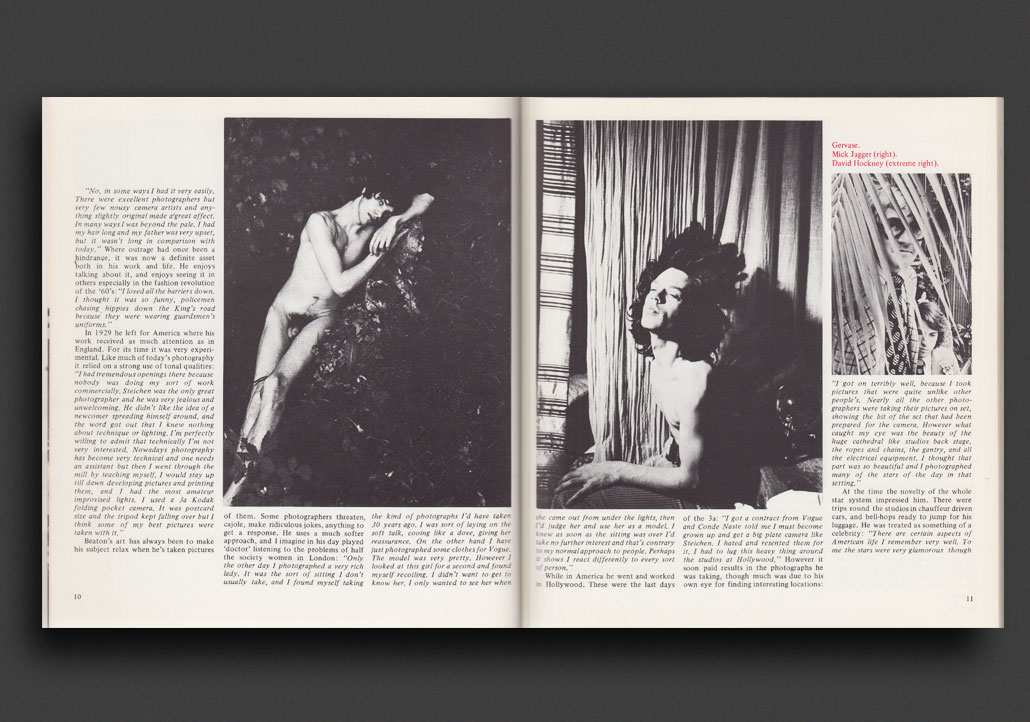
This issue (No. 11, 1973) includes features on: Cecil Beaton, Sam Haskins, Mike McInnerney, Tony Destefano, Arnold Schwartzmann, and Howard Pemperton.
1973, English
Softcover, 50 pages, 26.5 x 21 cm
1st Edition, Out of print title / used / good
Published by
Baroque Press / London
$20.00 - Out of stock
The Image was a great periodical dedicated to the Graphic Arts and Photography, published monthly in the early 1970s by the Baroque Press of London. Each issue profiles artists with heavily illustrated spreads of their work alongside commentary and interviews.
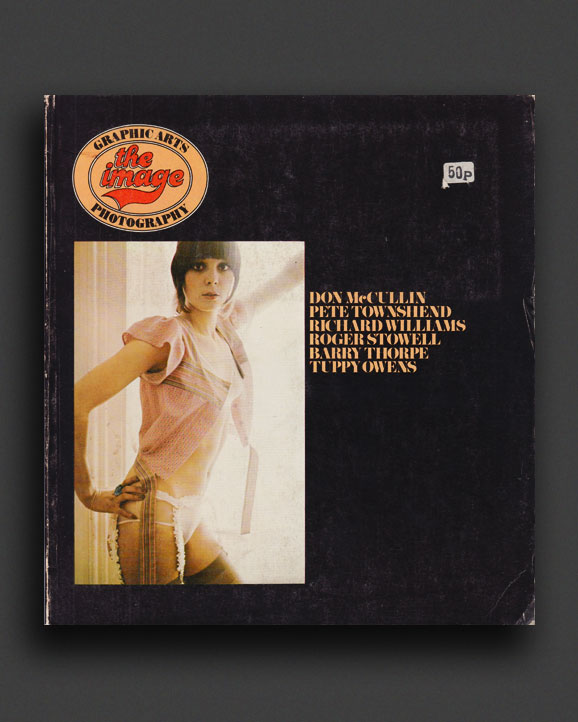
This issue (No. 12, 1973) includes features on: Don McCullin, Pete Townshend, Richard Williams, Roger Stowell, Barry Thorpe, Tuppy Owens, and more.
1973, English
Softcover, 56 pages, 26.5 x 21 cm
1st Edition, Out of print title / used / good
Published by
Baroque Press / London
$30.00 - In stock -
The Image was a great periodical dedicated to the Graphic Arts and Photography, published monthly in the early 1970s by the Baroque Press of London. Each issue profiles artists with heavily illustrated spreads of their work alongside commentary and interviews.
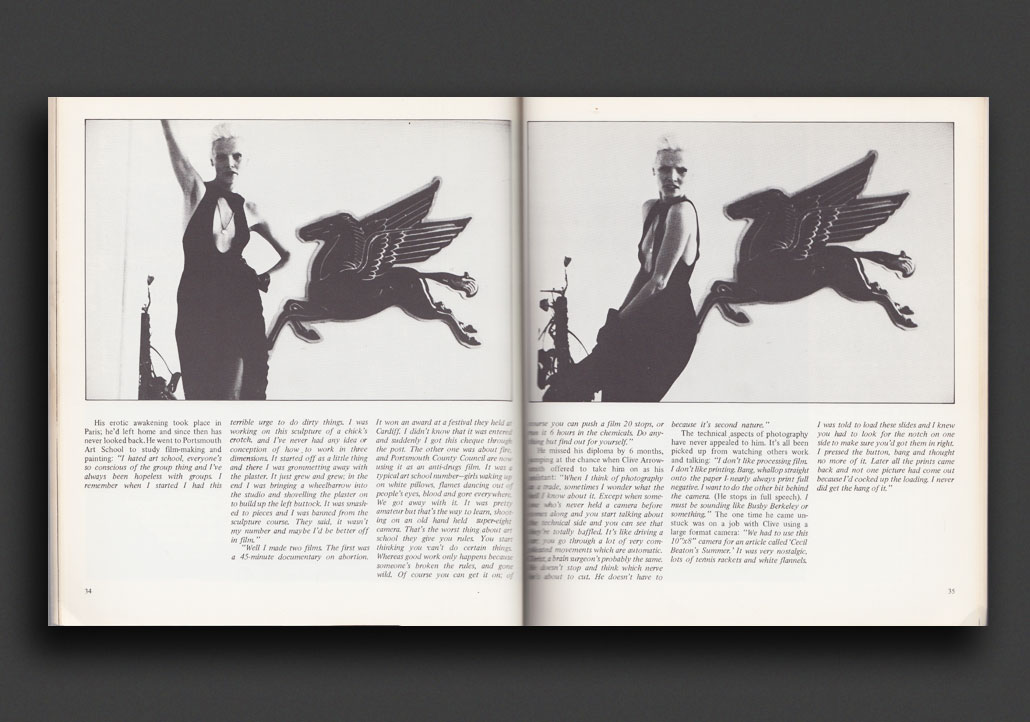
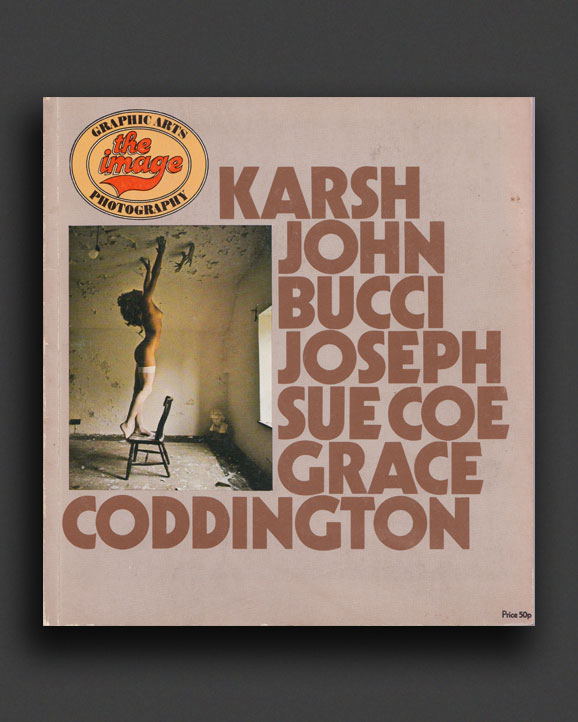
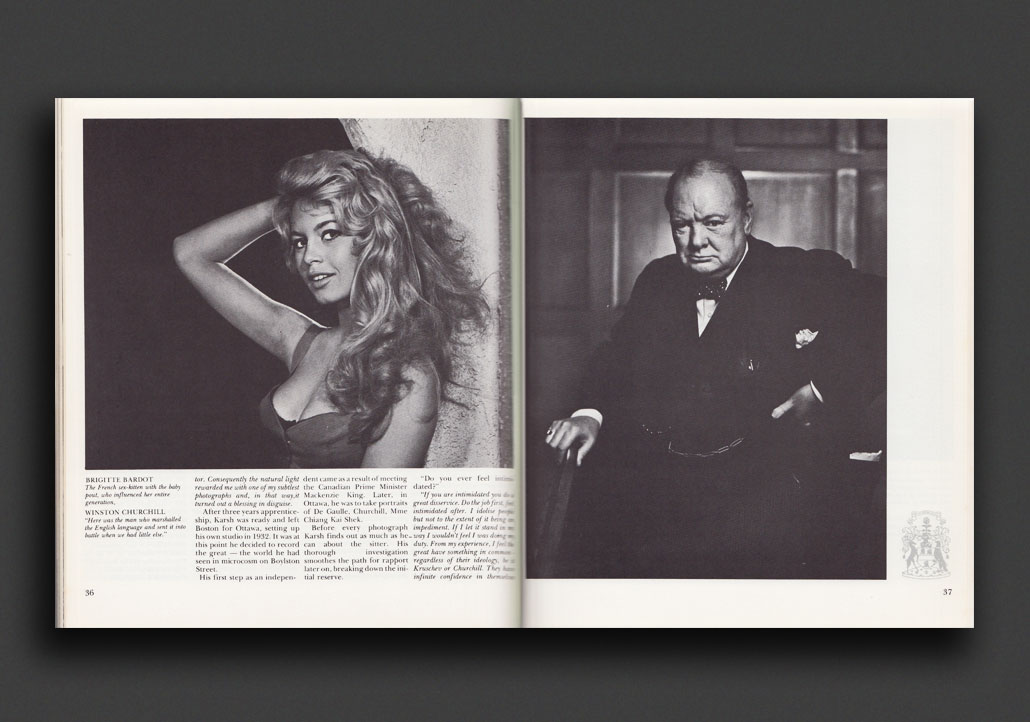
This issue (Vol. 2 No. 1, 1973) includes features on: Youssuf Karsh, Australian photographer John Thornton (Bucci), Sue Coe, Grace Coddington, Alberto Vazquez, and more.
1973, English
Softcover, 56 pages, 26.5 x 21 cm
1st Edition, Out of print title / used / good
Published by
Baroque Press / London
$30.00 - In stock -
The Image was a great periodical dedicated to the Graphic Arts and Photography, published monthly in the early 1970s by the Baroque Press of London. Each issue profiles artists with heavily illustrated spreads of their work alongside commentary and interviews.
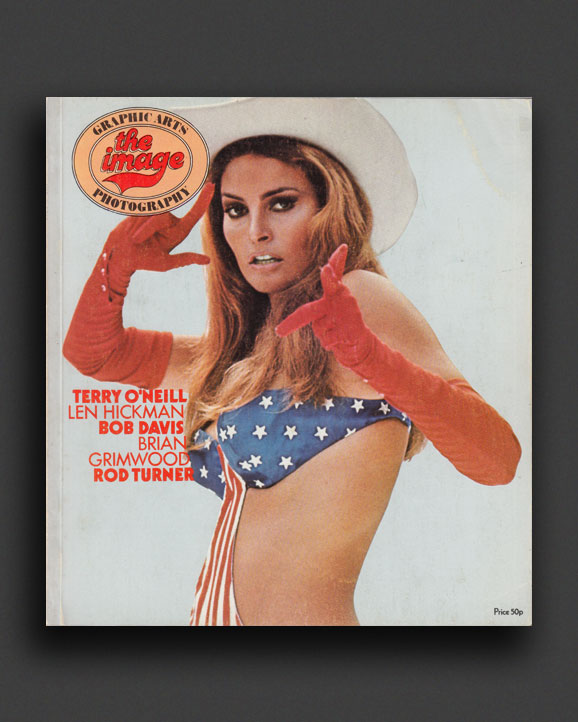
This issue (Vol. 2 No. 2, 1973) includes features on: Australian photographer Bob Davis, Terry O'Neill, Len Hickman, Brian Grimwood, Rod Turner, Laurie Lewis, and more.
1973, English
Softcover, 60 pages, 26.5 x 21 cm
1st Edition, Out of print title / used / good
Published by
Baroque Press / London
$20.00 - In stock -
The Image was a great periodical dedicated to the Graphic Arts and Photography, published monthly in the early 1970s by the Baroque Press of London. Each issue profiles artists with heavily illustrated spreads of their work alongside commentary and interviews.
This issue (Vol. 2 No. 3, 1973) includes features on: Dick Frank, David Montgomery, Celestino Valenti, George Hurrell, Arnaldo Putzu, and more.
1973, English
Softcover, 60 pages, 26.5 x 21 cm
1st Edition, Out of print title / used / good
Published by
Baroque Press / London
$25.00 - Out of stock
The Image was a great periodical dedicated to the Graphic Arts and Photography, published monthly in the early 1970s by the Baroque Press of London. Each issue profiles artists with heavily illustrated spreads of their work alongside commentary and interviews.
This issue (Vol. 2 No. 4, 1973) includes features on: David Hamilton, James McMullen, Michael Drobny, John Minihan, Mad Magazine, Rib Field, and more.
1981, English / French / French
Hardcover, 120 pages, 27 x 22.5 cm
1st Edition, Out of print title / used / average
Published by
Argos Press / Köln
$45.00 $25.00 - Out of stock
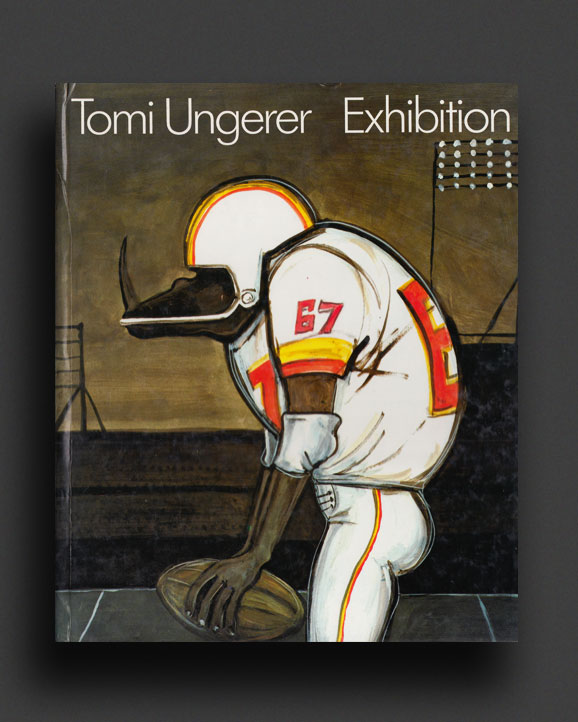
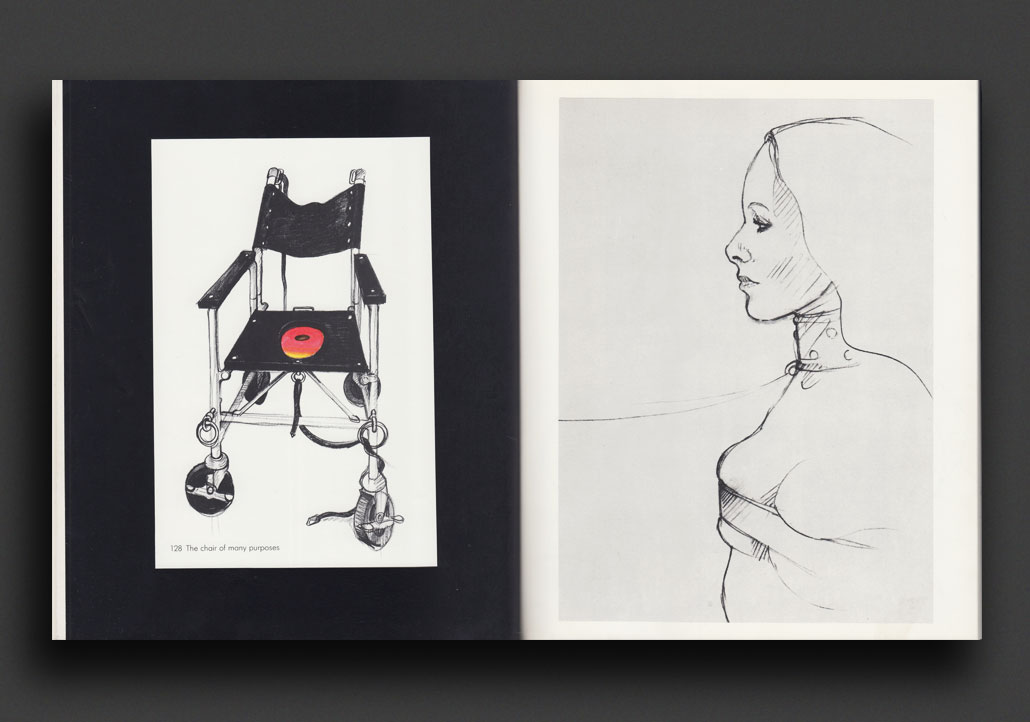
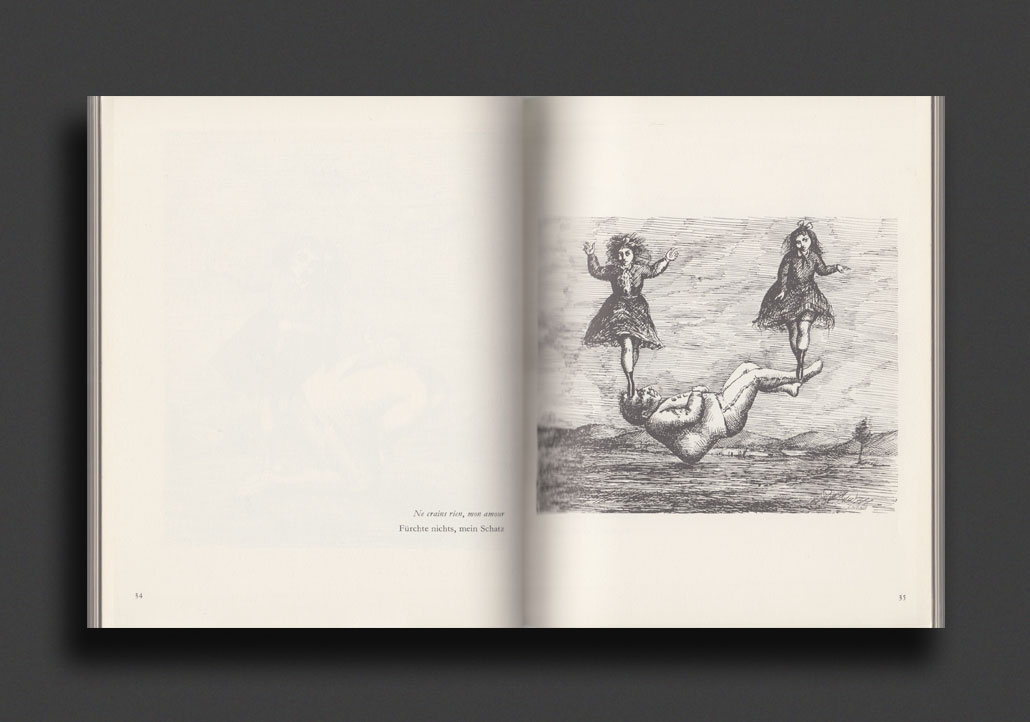
First hardcover edition of the monographic catalogue "Exhibition", published to accompany an important retrospective exhibition arranged by the Museum of the City of Strasbourg (his home town) in cooperation with the Musée des Arts Décoratifs, Paris, showcasing of over 400 artworks produced by author and artist Tomi Ungerer between 1956 and 1981 - from his famous protest poster designs and award-winning children's book illustrations to personal painting studies, rarely seen assemblage sculptures and erotica. Profusely illustrated across 120 pages, many of the artworks here are reproduced for the first time. As well as the visual content, this valuable resource contains a complete illustrated biography of Ungerer, full list of exhibited works with details, extensive bibliography of his press articles, interviews, published books, and much more, forming an important reference for Ungerer fan or collector. Catalogue texts by Christine Hamm and Sylvie Erb. All texts in English, French and German.
Tomi Ungerer (born 28 November 1931) is an award winning French illustrator and a writer in three languages. He has published over 140 books ranging from much loved children's books to controversial adult work and from the fantastic to the autobiographical. He is known for sharp social satire and witty aphorisms. He is renowned for his iconic Advertising campaigns and political posters against the Vietnam War and Racial Injustice which were representative of the burgeoning political consciousness in New York in the 1960’s. His political engagement has continued to this day in campaigns against Racism and Fascism, for Nuclear disarmament, Ecology and numerous Humanitarian causes.
1980, French / German
Softcover, 140 pages, 19 x 15.5 cm
Out of print title / used / very good
Published by
Diogenes / Zürich
$30.00 - Out of stock
“Toxicologie” by the great French illustrator, author, humorist, satirist, play-write, actor, poet, painter, performer, sculptor, Roland Topor (1938–1997) was first published in 1970 and forms one of the classic collections of the absurdist, surrealistic illustrations he is so well known for.
Preface by fellow Mouvement Panique member Fernando Arrabal and postface by French poet Jacques Prévert.
1980 softcover edition published by Diogenes in Zürich.
Roland Topor was one of the most unique and versatile French artists of the second half of the 20th century, working prolifically as a provocative and spirited illustrator, author, humorist, satirist, play-write, actor, poet, painter, performer, sculptor, and much more. Son of a Parisian painter and sculptor of Polish-Jewish descent, in 1941, Topor's father was arrested and sent to camp Pithiviers. Two years later, the family moved to Savoy, where they baptised their son to hide his real identity. After the war, he studied art at the Institute of Beaux-Arts in Paris. He discovered surrealism, Hieronymus Bosch and the scatological plays of Alfred Jarry, which would influence his work and his attitude to life in general.
In 1958, he published his first work in magazines such as Bizarre and later Elle. Three years later, he joined the anarchic group of artists who created the controversial magazine Hara-Kiri, publishing his surreal juxtapositions of people, animals, plants and objects. Topor seldom used words in his illustrations, leaving all power to the visual. In February 1962, Topor, Alejandro Jodorowsky, Olivier O. Olivier, Jacques Sternberg, Christian Zeimert, Abel Ogier and Fernando Arrabal founded the "Mouvement Panique" ("Panic Movement"). This collective focused on creating absurd and bewildering performances to reject the commercialization of surrealism. The founders created many provocative and surreal works in the next decade before Jodorowsky dissolved the movement in 1973. However, Topor continued making scandalous plays afterwards, including 'Le Bébé de Monsieur Laurent' (1975) and 'Vinci avait raison' (1976).
In print, Topor's history is legendary. In 1964 Topor published his debut novel 'Le Locataire Chimérique' ('The Tenant', 1964), a psychological horror story about a man moving in an apartment where he is gradually pestered into madness by the other inhabitants. The work was adapted to film in 1976 by Roman Polanski and both the book as well as the picture are cult classics to this day. His 1980s pamphlet '100 Bonnes Raisons Pour Me Suicider' ('100 Good Reasons To Commit Suicide') is another example of his taste for black comedy. The most unique and unusual book in Topor's oeuvre must be 'Souvenir' (1972), a kind-of Fluxus obscurity featuring a text with all the sentences scratched out to the point of being unreadable. When the artist was interviewed on Dutch television by Adriaan van Dis to read some extracts from it Topor accepted the request by holding his hand in front of his mouth and mumble through it. In 1966 Topor illustrated 'Topographie Anécdotée du Hasard' (Anecdoted Topography of Chance) by Swiss assemblage artist Daniel Spoerri. Following a rambling conversation with his friend Robert Filliou in 1961, Daniel Spoerri one day mapped the objects lying at random on the table in his room, adding a rigorously scientific description of each. These objects subsequently evoked associations, memories and anecdotes from both the original author and his friends Filliou, Emmett Williams, Dieter Roth and Roland Topor. Considered a "quasi-autobiographical tour de force", incredible book was published in 1966 by the Something Else Press in New York City. Topor added sketches of each object. Acknowledged as one of the most important and entertaining artists’ books of the postwar period, An Anecdoted Topography of Chance is a unique collaborative work by four artists associated with the Fluxus and Nouveau Réalisme movements.
Topor also had an interest in film. He designed the posters of movies such as 'L'Ibis Rouge' (1975), 'Ai no borei' ('The Empire of Passion', 1978) and 'Die Blechtrommel' ('The Tin Drum', 1979). His drawings can also be seen during the opening titles of Fernando Arrabal's experimental film 'Viva La Muerte' (1971) and during the magic lantern sequence in Federico Fellini's 'Il Casanova di Fellini' (1976). He also worked as an actor, appearing in Dusan Makavejev's 'Sweet Movie' (1974) and as Dracula's assistant Renfield in Werner Herzog's horror remake of 'Nosferatu' (1979). The latter film has also immortalized his notorious hysterical and chilling laugh.
Together with René Laloux, he created the animated shorts 'Les Temps Morts' (1964) and 'Les Escargots' ('The Snails', 1965) and the full length animated feature 'La Planète Sauvage' ('Fantastic Planet', 1973). The latter work was based on Stefan Wul's science fiction novel 'Oms en Série' and takes place on a surreal planet where gigantic blue aliens treat humans as pets. 'La Planète Sauvage' won the special jury prize at the Festival of Cannes and has achieved cult status over the years.
Topor was a frequent guest in the philosophical radio show 'Des Papous dans la tête' (1984) at France Culture. Together with his good friend and playwright Jean-Michel Ribes, he wrote scripts for the satirical TV sketch series 'Merci Bernard' (1982-1984) on France 3 and 'Palace' (1988-1989) on Canal +. They wrote the theatrical play 'Batailles' (1983) about people of different social classes stranded on a raft, which was a satirical allegory of capitalism. Another collaborative project was the comedy film 'La Galette du Roi' (1985). In 1975 he recorded an album with his Belgian friend Freddy De Vree called 'Panic (The Golden Years)'. It features Topor being interviewed by De Vree on the Flemish public radio channel BRT 3. Apart from talking he also recites some nonsensical songs, including the Dutch nursery rhyme 'Iene miene mutte' and the tongue twister 'De kat krabt de krullen van de trap.' Topor also wrote two songs, 'Je m'aime' and 'Monte dans mon ambulance', which were set to music by François d'Aime and recorded by Japanese singer Megumi Satsu in 1980.
In the 1980s, Topor published in Le Petit Psikopat Illustré, an alternative review, and also teamed up with Belgian film director Henri Xhonneux to create the cult children's series 'Téléchat', a news show featuring anthropomorphic animals and objects and marionets presenting news. The program received various awards, including the 1984 award for best French broadcast for children and adolescents at the Festival of Cannes. It was also nominated for an Emmy in 1985.
Topor and Xhonneux joined forces again in 1989 to create the film 'Marquis', which was loosely based on the life and work of the notorious Marquis de Sade. The actors performed in animal masks and De Sade's penis was made into a separate puppet with a human face and the ability to talk. Due to the unusualness of its execution it became a cult favorite.
Very good copy with light wear.