World Food Books' programme is largely produced on Kulin Nation land. We acknowledge the Wurundjeri people of the Kulin Nation as the first and continuing custodians of this land, and pay respect to their Elders past, present, and emerging.
World Food Books is an arts and special interests bookshop in Naarm / Melbourne. Founded in 2010, World Food Books is devoted to the presentation of a rotating, hand-selection of international art, design, literary and counterculture publications with an emphasis on the anti-traditional, the experimental, the avant-garde, the heretic, the marginal.
Presenting new titles alongside rare and out-of-print books, catalogues and journals spanning the fields of modern and contemporary art, design, photography, illustration, film, literature, poetry, cultural theory, philosophy, sexuality, popular and underground culture in its many radical forms, World Food Books wishes to encourage adventurous, thoughtful and open-minded reading, looking, writing, and exchange of publishing and ideas, both current and historical.
As well as our bookshop, located in Melbourne's historical Nicholas Building, all of our inventory is available internationally via our online mail-order service.
World Food Books semi-regularly co-ordinates "Occasions", a programme of exhibits and events at the bookshop and in partnership with other hosts (such as museums and art galleries) that develop out of the activities, relationships and content of the bookshop itself.
World Food Books
The Nicholas Building
37 Swanston Street
Room 5, Level 6
Melbourne 3000
Australia
SHOP HOURS:
THU–SAT 12–6
WEB-SHOP OPEN 24/7
World Food Books
Postal Address:
PO Box 435
Flinders Lane
Victoria 8009
Australia
info@worldfoodbooks.com
Art
Theory / Essay
Architecture / Interior
Graphic Design / Typography
Photography
Fashion
Eros
LGBTQ+
Fiction / Poetry
Weird / Speculative / Science Fiction / Horror
Transgressive / Visceral / Abject
Symbolism / Decadence / Fin de siècle
Film / Video
Painting
Sculpture / Installation
Performance / Dance / Theater
Drawing
Sound / Music
Curatorial
Group Shows / Collections
Periodicals
Out-of-print / Rare
Posters / Ephemera / Discs
Signed Books
World Food Books Gift Voucher
World Food Book Bag
Australian Art
Australian Fiction
Australian Science Fiction / Speculative Fiction
Australian Poetry
Australian Photography
Japanese Photography
Conceptual Art
Minimal Art
Dada
'Pataphysics / Oulipo
Fluxus
Concrete Poetry
Pop Art
Surrealism
Arte Povera
Arte Informale / Haute Pâte / Tachism
Nouveau Réalisme / Zero / Kinetic
Situationism / Lettrism
Collage / Mail Art / Xerox Art
Art Brut / Folk / Visionary / Fantastic
Illustration / Graphic Art / Bandes Dessinées
Furniture
Italian Radical Design / Postmodernism
Textiles
Ceramics / Glass
Counterculture
Protest / Revolt
Philosophy
Psychoanalysis
Anthropology
Anarchism
Socialism / Anarchism / Communism / Capitalism
Literary Theory / Semiotics / Language
Feminism / Women's Studies
Gender Studies / Sexuality
Anthropology
Fetishism / BDSM
Drugs / Psychedelia
Crime / Violence
Animal Rights / Veganism
Occult / Esoterica
Ecology / Earth / Alternative Living
Whole Earth / Crafts
All prices in AUD (Australian dollars)
Pick-Ups
Pick-up orders can be collected in our bookshop during opening hours after order date. Please collect any Pick-up orders within 2 weeks of ordering as we have limited storage space. Orders will be released back into stock if not collected within this time. No refunds can be made for pick-ups left un-collected. If you cannot make it in to the bookshop in this time-frame, please choose postage option.
Return Policy
All sales are final. We do accept returns (for refund or exchange) for items received in error. All our orders are packed with special care using heavy-duty padding and cardboard book-mailers or bubble mailers (for smaller books), using reinforcement where required. We cannot take responsibility for any lost, stolen or damaged parcels.
Insurance
Should you wish to insure your package, please email us directly after placing your order and we can organise this at a small extra expense. Although all standard/express tracked packages are very safe and dependable, we cannot take responsibility for any lost, stolen or damaged parcels. We recommend insurance on valuable orders.
Interested in selling your old books, catalogues, journals, magazines, comics, fanzines, ephemera? We are always looking for interesting, unusual and out-of-print books to buy. We only buy books in our fields of interest and specialty, and that we feel we can resell.
We base these prices on desirability, market value, in-print prices, condition and our current stock levels. We offer cash, store credit, and can take stock on consignment. All
about 25% of the price we expect to get when we sell them, or 30% in store credit. We base these prices on desirability, market value, in-print prices, condition and our current stock levels.
Sell your books any day of the week. You can drop them off and return later. If you have a lot of books, we can visit your Sydney home.
We buy books that we feel we can resell. We offer about 25 % of the price we expect to get when we sell them, or 30% in store credit. We base these prices on desirability, market value, in-print prices, condition and our current stock levels.
Philadelphia Wireman
03 August - 01 September, 2018
World Food Books is proud to announce our next Occasion, the first presentation of sculptures by Philadelphia Wireman in Australia.
The Philadelphia Wireman sculptures were found abandoned in an alley off Philadelphia’s South Street on trash night in 1982. Their discovery in a rapidly-changing neighbourhood undergoing extensive renovation, compounded with the failure of all attempts to locate the artist, suggests that the works may have been discarded after the maker’s death. Dubbed the "Philadelphia Wireman" during the first exhibition of this work, in 1985, the maker’s name, age, ethnicity, and even gender remain uncertain. The entire collection totals approximately 1200 pieces, all intricately bound together with tightly-wound heavy-gauge wire (along with a few small, abstract marker drawings, reminiscent both of Mark Tobey and J.B. Murry). The dense construction of the work, despite a modest range of scale and materials, is singularly obsessive and disciplined in design: a wire armature or exoskeleton firmly binds a bricolage of found objects including plastic, glass, food packaging, umbrella parts, tape, rubber, batteries, pens, leather, reflectors, nuts and bolts, nails, foil, coins, toys, watches, eyeglasses, tools, and jewellery.
Heavy with associations—anthropomorphic, zoomorphic, and socio-cultural responses to wrapped detritus—the totemic sculptures by Philadelphia Wireman have been discussed in the context of work created to fulfil the shamanistic needs of alternative religions in American culture. Curators, collectors, and critics have variously compared certain pieces to sculpture from Classical antiquity, Native American medicine bundles, African-American memory jugs, and African fetish objects. Reflecting the artist’s prolific and incredibly focused scavenging impulse, and despite—or perhaps enhanced by—their anonymity, these enigmatic objects function as urban artefacts and arbiters of power, though their origin and purpose is unknown. Philadelphia Wireman, whatever their identity, possessed an astonishing ability to isolate and communicate the concepts of power and energy through the selection and transformation of ordinary materials. Over the course of the past two decades, this collection has come to be regarded as an important discovery in the field of self-taught art and vernacular art.
Presented in collaboration with Fleisher-Ollman Gallery, Philadelphia, and Robert Heald, Wellington.
Susan Te Kahurangi King
02 February - 10 March, 2018
Susan Te Kahurangi King (24 February 1951 - ) has been a confident and prolific artist since she was a young child, drawing with readily available materials - pencils, ballpoint pens and felt-tip markers, on whatever paper is at hand. Between the ages of four and six Susan slowly ceased verbal communication. Her grandparents William and Myrtle Murphy had developed a special bond with Susan so they took on caring responsibilities for extended periods. Myrtle began informally archiving her work, carefully collecting and storing the drawings and compiling scrapbooks. No drawing was insignificant; every scrap of paper was kept. The King family are now the custodians of a vast collection containing over 7000 individual works, from tiny scraps of paper through to 5 meter long rolls.
The scrapbooks and diaries reveal Myrtle to be a woman of great patience and compassion, seeking to understand a child who was not always behaving as expected. She encouraged Susan to be observant, to explore her environment and absorb all the sights and sounds. Myrtle would show Susan’s drawings to friends and people in her community that she had dealings with, such as shopkeepers and postal workers, but this was not simply a case of a grandmother’s bias. She recognised that Susan had developed a sophisticated and unique visual language and sincerely believed that her art deserved serious attention.
This was an unorthodox attitude for the time. To provide some context, Jean Dubuffet coined the term Art Brut in 1945 to describe work created by self-taught artists – specifically residents of psychiatric institutions and those he considered to be visionaries or eccentrics. In 1972 Roger Cardinal extended this concept by adopting the term Outsider Art to describe work made by non-academically trained artists operating outside of mainstream art networks through choice or circumstance. Susan was born in Te Aroha, New Zealand in 1951, far from the artistic hubs of Paris and London that Dubuffet and Cardinal operated in. That Myrtle fêted Susan as a self-taught artist who deserved to be taken seriously shows how progressive her attitudes were.
Susan’s parents Doug and Dawn were also progressive. Over the years they had consulted numerous health practitioners about Susan’s condition, as the medical establishment could not provide an explanation as to why she had lapsed into silence. Dawn educated herself in the field of homeopathy and went on to treat all twelve of her children using these principles – basing prescriptions on her observations of their physical, mental and emotional state.
Doug was a linguist with an interest in philosophy who devoted what little spare time he had to studying Maori language and culture. To some extent their willingness to explore the fringes of the mainstream made them outsiders too but it was their commitment to living with integrity and their respect for individuality that ensured Susan’s creativity was always encouraged.
Even though Susan’s family supported her artistic pursuits, some staff in schools and hospitals saw it as an impediment to her assimilation into the community and discouraged it in a variety of ways. Her family was not always aware of this and therefore did not fully understand why Susan stopped drawing in the early 1990s. However, rather than dwell on the challenges that Susan faced in pursuit of her artistic practice, they prefer to highlight her achievements. In 2008 Susan began drawing again in earnest, after an almost 20 year interruption, and her work is now shown in galleries around the world.
Susan grew up without television and has been heavily influenced by the comics she read as a child. She is absolutely fearless in the appropriation of recognizable characters, such as Donald Duck and Mickey Mouse, in her work. She twists their limbs, contorts their faces, compresses them together, blends them into complex patterned backgrounds - always imbuing them with an incredible energy. Although Susan often used pop culture characters in her work they are not naive or childlike. These are drawings by a brilliant self-taught artist who has been creating exceptional work for decades without an audience in mind.
Mladen Stilinović
"Various Works 1986 - 1999"
02 February 16 - September 10, 2016
Various works 1986 - 1999, from two houses, from the collections of John Nixon, Sue Cramer, Kerrie Poliness, Peter Haffenden and Phoebe Haffenden.
Including: Geometry of Cakes (various shelves), 1993; Poor People’s Law (black and white plate), 1993; White Absence (glasses, ruler, set square, silver spoon, silver ladel with skin photograph and wooden cubes), 1990-1996; Exploitation of the Dead (grey and red star painting, wooden painting, black spoon with red table, red plate), 1984-1990; Money and Zeros (zero tie, paintings made for friends in Australia (Sue, John, Kerrie), numbers painting), 1991-1992; Words - Slogans (various t-shirts) - “they talk about the death of art...help! someone is trying to kill me”, “my sweet little lamb”, “work is a disease - Karl Marx”; Various artist books, catalogues, monographs, videos; Poster from exhibition Insulting Anarchy; "Circular" Croatian - Australian edition; Artist book by Vlado Martek (Dostoyevsky); more.
Thanks to Mladen Stilinović and Branka Stipančić.
Jonathan Walker
Always Will Need To Wear Winter Shirt Blue + Ochre Small Check Pattern
21 August - 21 September, 2015
Untitled
I am not a great reader of poetry but I always return to the work of Melbourne poet, Vincent Buckley (1925- 1988). Perhaps I find his most tantalising piece to be not a finished poem but a fragment left on a scrap of paper discovered on his desk after the poet’s death.
The poetry gathers like oil
In the word-core, and spreads
It has its music meet,
Its music is in movement.
This fragment is more the shell left behind from a volatile thought than a finished poem. I find the last two lines honest but awkward whereas the first two lines work like an arrow. Most likely he could not find a resolution so it was left. Still, in its present form, it remains an eloquent testimony to the ultimate failure of a medium to express mobile thought and sensation, in Buckley’s case, through verbal language. It’s an important matter because this is something all artists have to deal with regardless of the medium.
I have never written a poem, however, I am forever copying fragments from books on paper scraps in a vain effort to fix certain notions in my head. At first, they function as bookmarks that are sometimes returned to when I open the book. But before long, as they accumulate, they fall out littering the table interspersed with A4 photocopies, bills, books and medications.
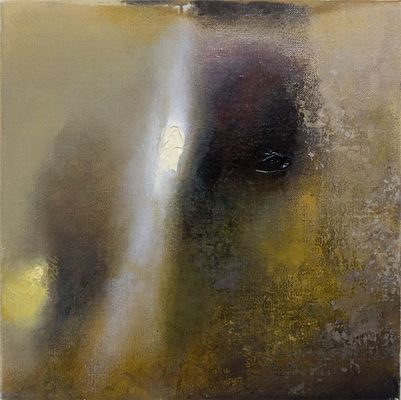
To return to Buckley’s fragment, the first two lines very much evoke how I paint nowadays. As you age, detail diminishes and patches of light become more luminous and float. I feel the most honest way of dealing with this is by smearing the oil paint on the canvas with the fingers and working close-up, blind. Only if the patches coalesce into an approaching image can the work gain a life.
-
Jonathan Walker was born in Melbourne, Australia and brought up on a dairy farm in Gippsland. In the 1970’s he studied painting at RMIT and won the Harold Wright Scholarship to the British Museum, London. During the 1980’s he exhibited at Pinacotheca Gallery, Richmond and had work shown at the NGV and Heidi City Art Gallery. Over the same period he designed the cover for the “Epigenesi” LP by Giancarlo Toniutti, Italy and conducted a mail exchange work with Achim Wollscheid, Germany. The work with artists through the post resulted in an article published in the bicentenary issue of Art and Australia 1988. He showed in artist run spaces such as WestSpace in the 90’s and 2000’s, and until 2012, taught painting at Victoria University, which is where we (Colleen Ahern and Lisa Radford) as organisers of the exhibition, among many others, had the privilege of being his student.
Walker’s knowledge was imparted to students through the careful selection of music, literature, and artists found in books that he himself had ordered for the library. Walker’s strategy was the generosity of sharing his vast knowledge with references specific to each student and their context.
Walker’s paintings share a similar focus and intimacy.
This exhibition presents a small selection of recent paintings alongside a publication that includes Walker’s writing. Observational and analytical, Walker’s work is a type of material notation — the time of day, colour and how it is blended, the both specific and fleeting location of a reflection on lino or the question of whether a chair leg should be included in a painting.
Please join us on Friday August 21 between 6-8pm to celebrate the opening of the exhibition.
Curated by Colleen Ahern and Lisa Radford.
B. Wurtz
Curated by Nic Tammens
March 26 - April 4, 2015
B.Wurtz works from a basement studio in his home on Manhattan’s Lower East Side.
This local fact is attested to by the plastic shopping bags and newsprint circulars that appear in his work. As formal objects, they don’t make loud claims about their origins but nonetheless transmit street addresses and places of business from the bottom of this long thin island. Like plenty of artists, Wurtz is affected by what is local and what is consumed. His work is underpinned by this ethic. It often speaks from a neighborhood or reads like the contents of a hamper:
“BLACK PLUMS $1.29 lb.”
“Food Bazaar”
“USDA Whole Pork Shoulder Picnic 99c lb.”
“RITE AID Pharmacy, with us it’s personal.”
“H. Brickman & Sons.”
“Sweet Yams 59c lb."
Most of the work in this exhibition was made while the artist was in residence at Dieu Donne, a workshop dedicated to paper craft in Midtown. Here Wurtz fabricated assemblages with paper and objects that are relatively lightweight, with the intention that they would be easily transportable to Australia. This consideration isn’t absolute in Wurtz’s work, but was prescriptive for making the current exhibition light and cheap. Packed in two boxes, these works were sent from a USPS post office on the Lower East Side and delivered to North Melbourne by Australia Post.
Wurtz appears courtesy of Metro Pictures, New York.
Thanks to Rob Halverson, Joshua Petherick, Sari de Mallory, Matt Hinkley, Helen Johnson, Fayen d'Evie, Ask Kilmartin, Lisa Radon, Ellena Savage, Yale Union, and "Elizabeth".
John Nixon
"Archive"
December 15 - January 20, 2014
The presentation of John Nixon's archive offered a rare showcase of this extensive collection of the artist's own publications, catalogues, posters, ephemera, editions and more, from the mid 1980s onwards, alongside a selection of his artworks.
Organized by John Nixon, Joshua Petherick and Matt Hinkley.
"Habitat"
at Minerva, Sydney (organised by Joshua Petherick and Matt Hinkley)
November 15 - December 20, 2014
Lupo Borgonovo, Janet Burchill & Jennifer McCamley,
Lewis Fidock, HR Giger, Piero Gilardi, Veit Laurent Kurz,
Cinzia Ruggeri, Michael E. Smith, Lucie Stahl, Daniel Weil, Wols
Press Release:
“...It contained seven objects. The slender fluted bone, surely formed for flight, surely from the wing of some large bird. Three archaic circuitboards, faced with mazes of gold. A smooth white sphere of baked clay. An age-blackened fragment of lace. A fingerlength segment of what she assumed was bone from a human wrist, grayish white, inset smoothly with the silicon shaft of a small instrument that must once have ridden flush with the surface of the skin - but the thing’s face was seared and blackened.”
William Gibson, “Count Zero”, 1986
"Autumn Projects Archive"
Curated by Liza Vasiliou
March 6 - March 15, 2014
World Food Books, in conjunction with the Virgin Australia Melbourne Fashion Festival 2014, presented the Autumn Projects archive, consisting of a selection of early examples in Australian fashion with a particular interest in collecting designers and labels from the period beginning in the 1980’s, who significantly influenced the discourse of Australian Fashion.
Curated by Liza Vasiliou, the exhibition provided a unique opportunity to view pieces by designers Anthea Crawford, Barbara Vandenberg, Geoff Liddell and labels CR Australia, Covers, Jag along with early experimental collage pieces by Prue Acton and Sally Browne’s ‘Fragments’ collection, suspended throughout the functioning World Food Books shop in Melbourne.
H.B. Peace
presented by CENTRE FOR STYLE
November 14, 2013
"Hey Blinky, you say chic, I say same"
Anon 2013
H.B. Peace is a clothing collaboration between great friends Blake Barns and Hugh Egan Westland. Their pieces explore the divergences between 'character’ and ‘personality’ in garments....etc
Special Thanks to Joshua Petherick and Matt Hinkley of WFB and Gillian Mears
and a Very Special Thank you to Audrey Thomas Hayes for her shoe collaboration.
Janet Burchill & Jennifer McCamley
"Aesthetic Suicide"
May 10 - June 8, 2013
The first of our occasional exhibitions in the World Food Books office/shop space in Melbourne, "Aesthetic Suicide" presented a body of new and older works together by artists Janet Burchill & Jennifer McCamley, including videos, prints, a wall work, and publications.
During shop open hours videos played every hour, on the hour.
1986, English
Softcover, 100 pages, 21.5 x 15 cm
1st Edition, Out of print title / used / very good
Published by
Atlas Press / London
$45.00 - In stock -
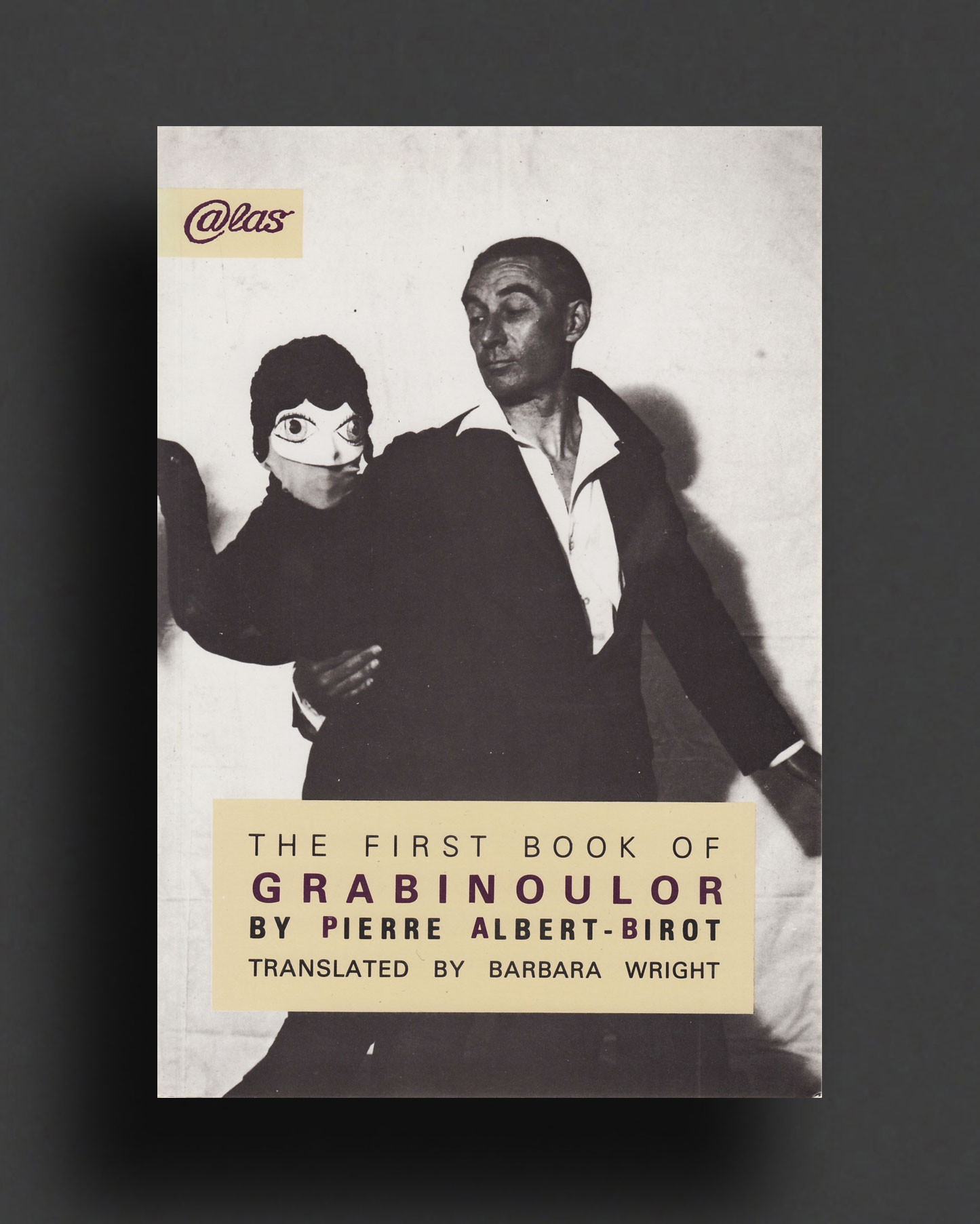
Scarce first 1986 paperback edition of Pierre Albert-Birot's The First Book of Grabinoulor (1919), published by the legendary Atlas Press, translated with a preface by Barbara Wright. Postface by Arlette Albert-Birot.
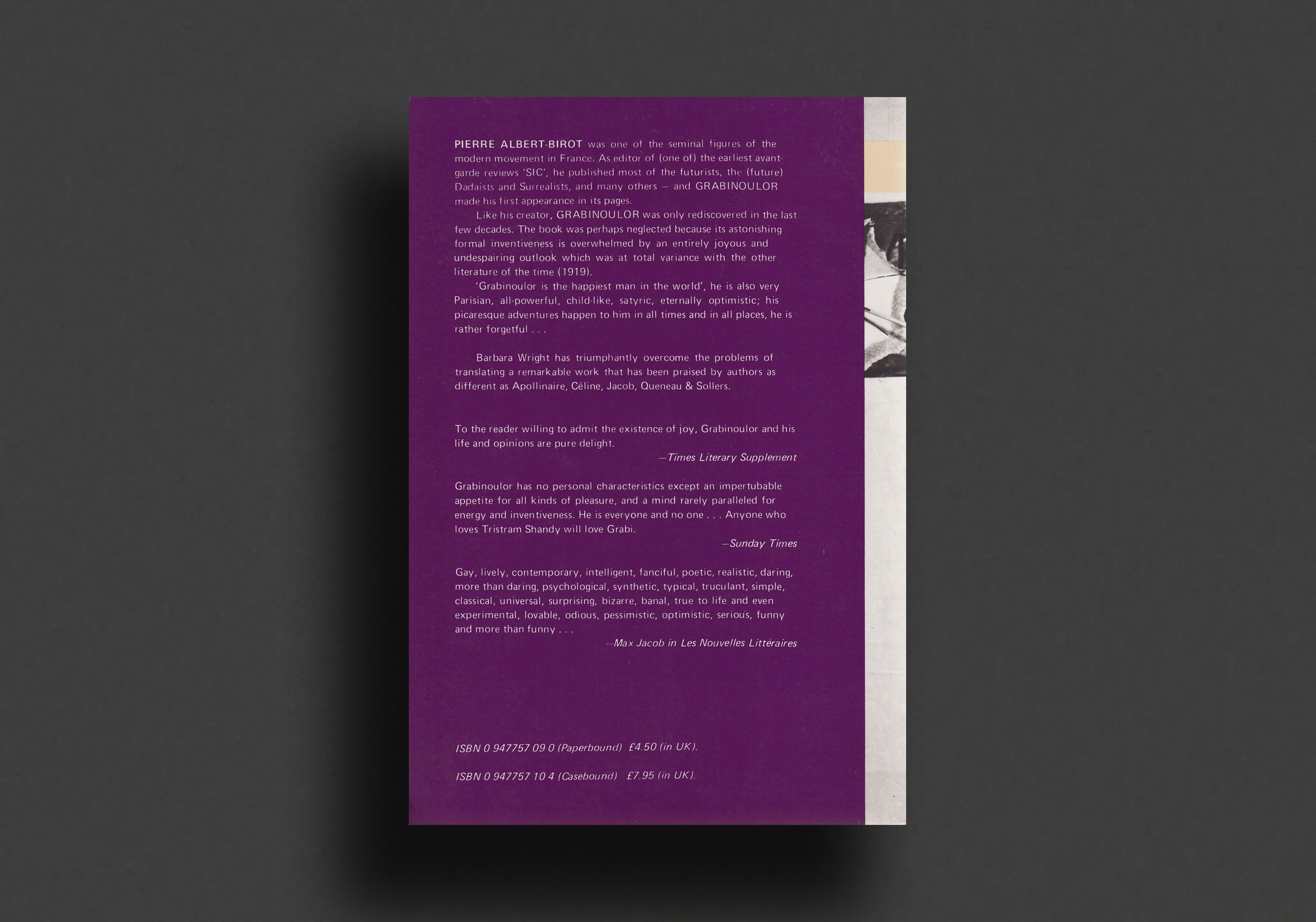
Pierre Albert-Birot was one of the seminal figures of the modern movement in France. As editor of (one of) the earliest avant-garde reviews SIC, he published most of the futurists, the (future) Dadaists and Surrealists, and many others—and Grabinoulor made his first appearance in its pages.
Like his creator, Grabinoulor was only rediscovered in the last few decades. The book was perhaps neglected because its astonishing formal inventiveness is overwhelmed by an entirely joyous and undespairing outlook which was at total variance with the other literature of the time (1919).
"Grabinoulor is the happiest man in the world;" he is also very Parisian, all-powerful, childlike, satiric, eternally optimistic; his picaresque adventures happen to him in all times and in all places, he is rather forgetful...
Barbara Wright has triumphantly overcome the problems of translating a remarkable work that has been praised by authors as different as Apollinaire, Celine, Jacob, Queneau, and Sollers.
"To the reader willing to admit the existence of joy, Grabinoulor and his life and opinions are pure delight."—Times Literary Supplement
"Grabinoulor has no personal characteristics except an imperturbable appetite for all kinds of pleasure, and a mind rarely paralleled for energy and inventiveness. He is everyone and no one... Anyone who loves Tristram Shandy will love Grabi."—Sunday Times
"It has been called a masterpiece, as if a work could qualify as such when it's only just been born. A work isn't born a masterpiece, it becomes one. And yet it's saying a lot of a book to call it at the same time: Gay, living, contemporary (I don't like the word modern), intelligent, fantastic, poetic, realistic, daring, more than daring, psychological, synthetic, symbolic, simple, classic, universal, surprising, bizarre, banal, larger than life, true to life and even true to experience, attractive, odious, pessimistic, optimistic, serious, humorous and even more than humorous."—Max Jacob in Les Nouvelles litteraires
"Joyously erotic... The irrepressible Grabinoulor performs his fantastic epic feats in an onrush of perpetual motion, which this slim book presents in rivers of unpunctuated prose... Albert-Birot celebrated the erotic as a means of freeing the artistic imagination from bourgeois constraints. For him, sexuality represented poetic creation. His tricks of language, his leaps through time and space are in the tradition of Rabelais and Shandy. The ribaldry does not shock not as it once perhaps did, but Grabinoulor is still fun to read. The book is a valuable document in the development of Dada and surrealism."—Publishers Weekly 1/23/87
"Ingenious imagination.... This fine translation of the Grabinoulor saga deserves reading as a genuine sample of the modernism that its author nurtured in SIC, and that cleared the path for the likes of Cocteau, Breton, and Ionesco."—Choice Jul-Aug '87
Very Good copy.
1995, English
Softcover, 304 pages, 23 x 21 cm
1st Edition, Out of print title / used / very good
Published by
Atlas Press / London
$65.00 - Out of stock
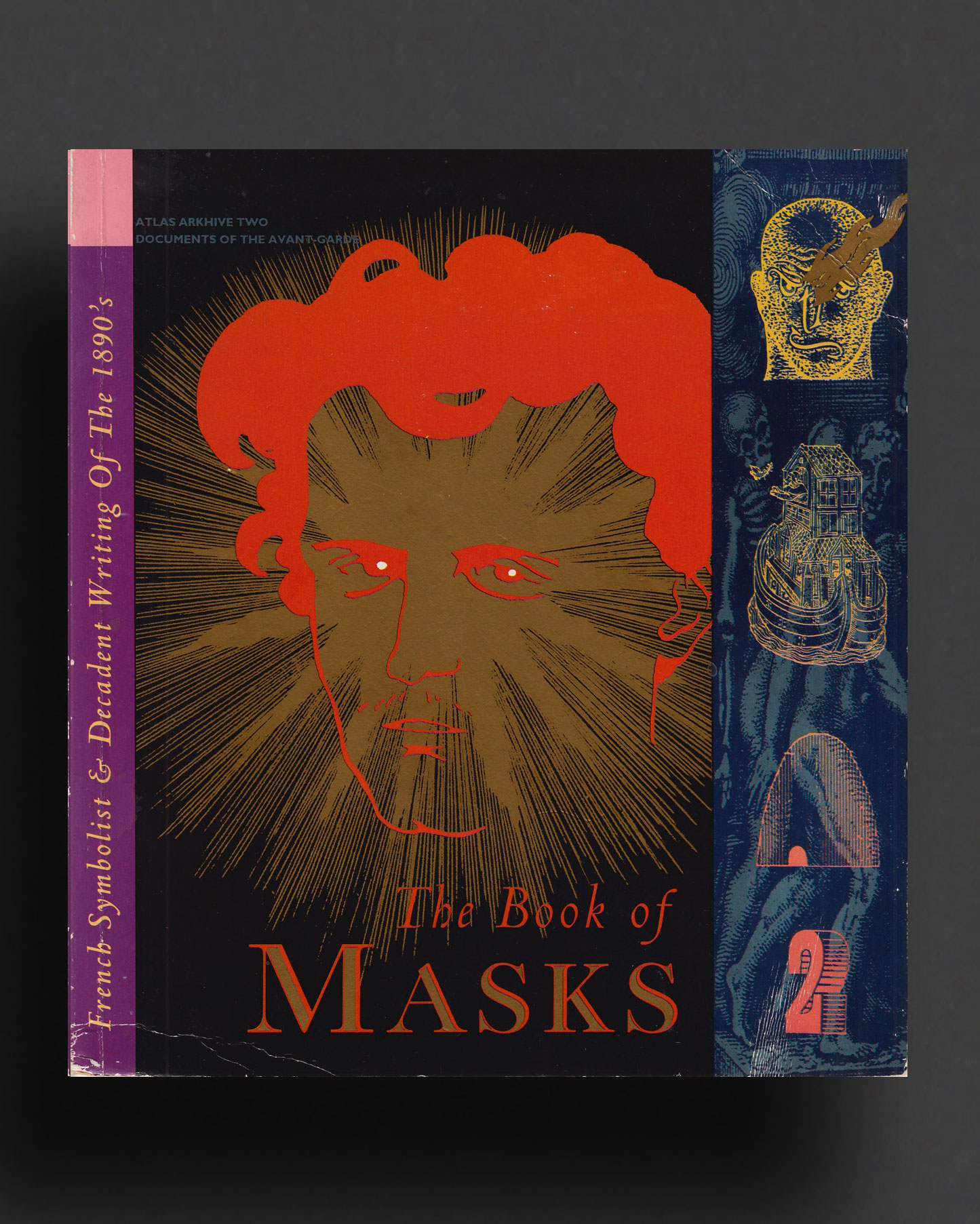
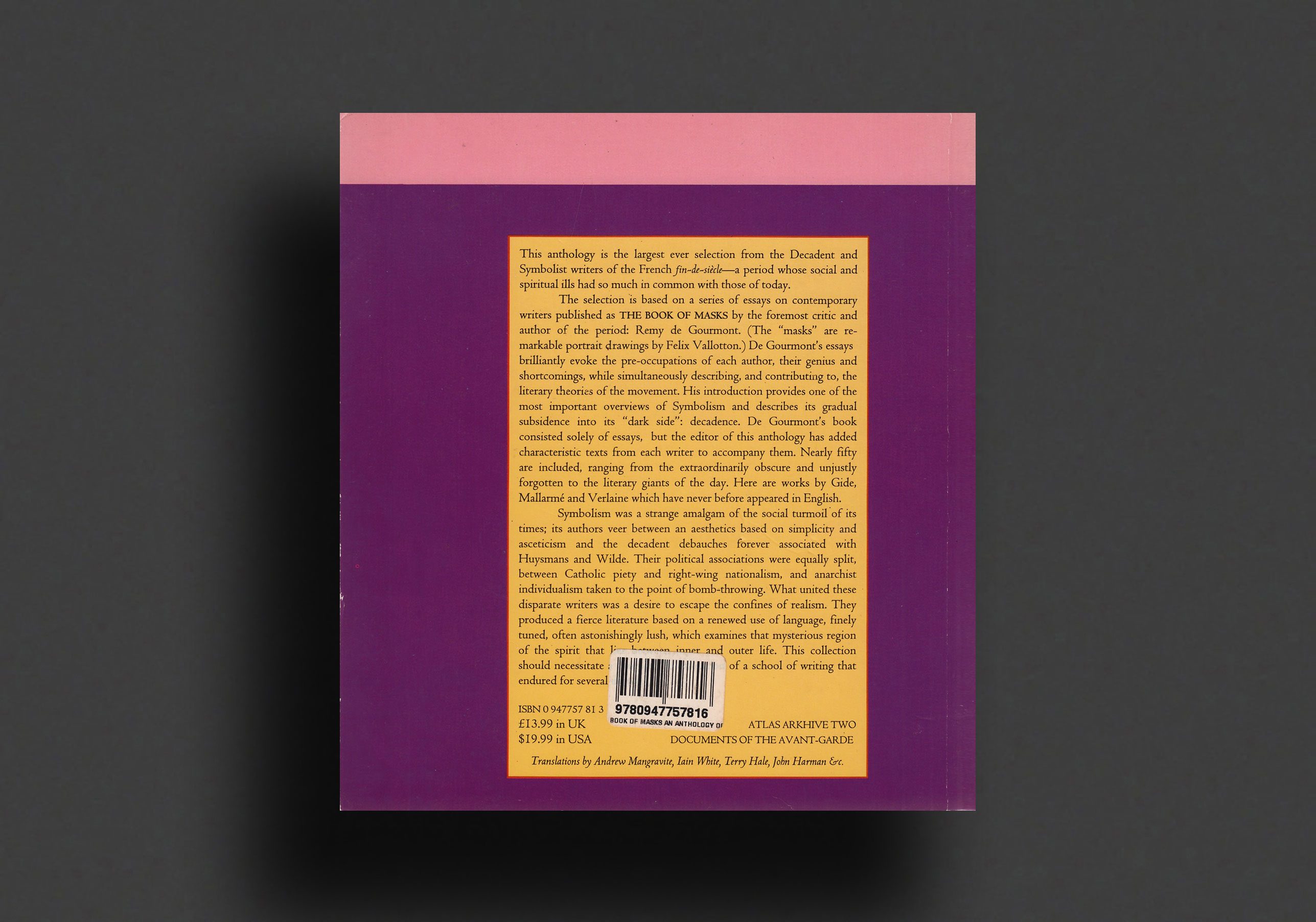
Long out-of-print Atlas Arkhive 2 published by the legendary Atlas Press in 1995. This anthology is the largest ever selection from the Decadent and Symbolist writers of the French fin-de-siècle — a period whose social and spiritual ills had so much in common with those of today.
The selection is based on a series of essays on contemporary writers published as The Book of Masks by the foremost critic and author of the period: Remy de Gourmont. (The "masks" are remarkable portrait drawings by Félix Vallotton.) De Gourmont's essays brilliantly evoke the pre-occupations of each author, their genius and shortcomings, while simultaneously describing, and contributing to, the literary theories of the movement. His introduction provides one of the most important overviews of Symbolism and describes its gradual subsidence into its "dark side": decadence. De Gourmont's book consisted solely of essays, but the editor of this anthology has added characteristic texts from each writer to accompany them. Nearly fifty are included, ranging from the extraordinary obscure and unjustly forgotten to the literary giants of the day. Here are works by Gide, Mallarme and Verlaine which have never before appeared in English.
Symbolism was a strange amalgam of the social turmoil of its times; its authors veer between an aesthetics based on simplicity and asceticism and the decadent debauches forever associated with Huysmans and Wilde. Their political associations were equally split, between Catholic piety and right-wing nationalism, and anarchist individualism taken to the point of bomb-throwing. What united these disparate writers was a desire to escape the confines of realism. They produced a fierce literature based on a renewed use of language, finely tuned, often astonishingly lush, which examines that mysterious region of the spirit that lies between inner and outer life. This collection should necessitate a complete re-evaluation of a school of writing that endured for several decades.
Good—Very Good copy with some wear to extremities small bump to bottom of spine, creasing to boards.
1994, English
Softcover, 404 pages, 23 x 15.5 cm
1st Edition, Out of print title / used / very good
Published by
John Hopkins University Press / Baltimore
$20.00 - Out of stock
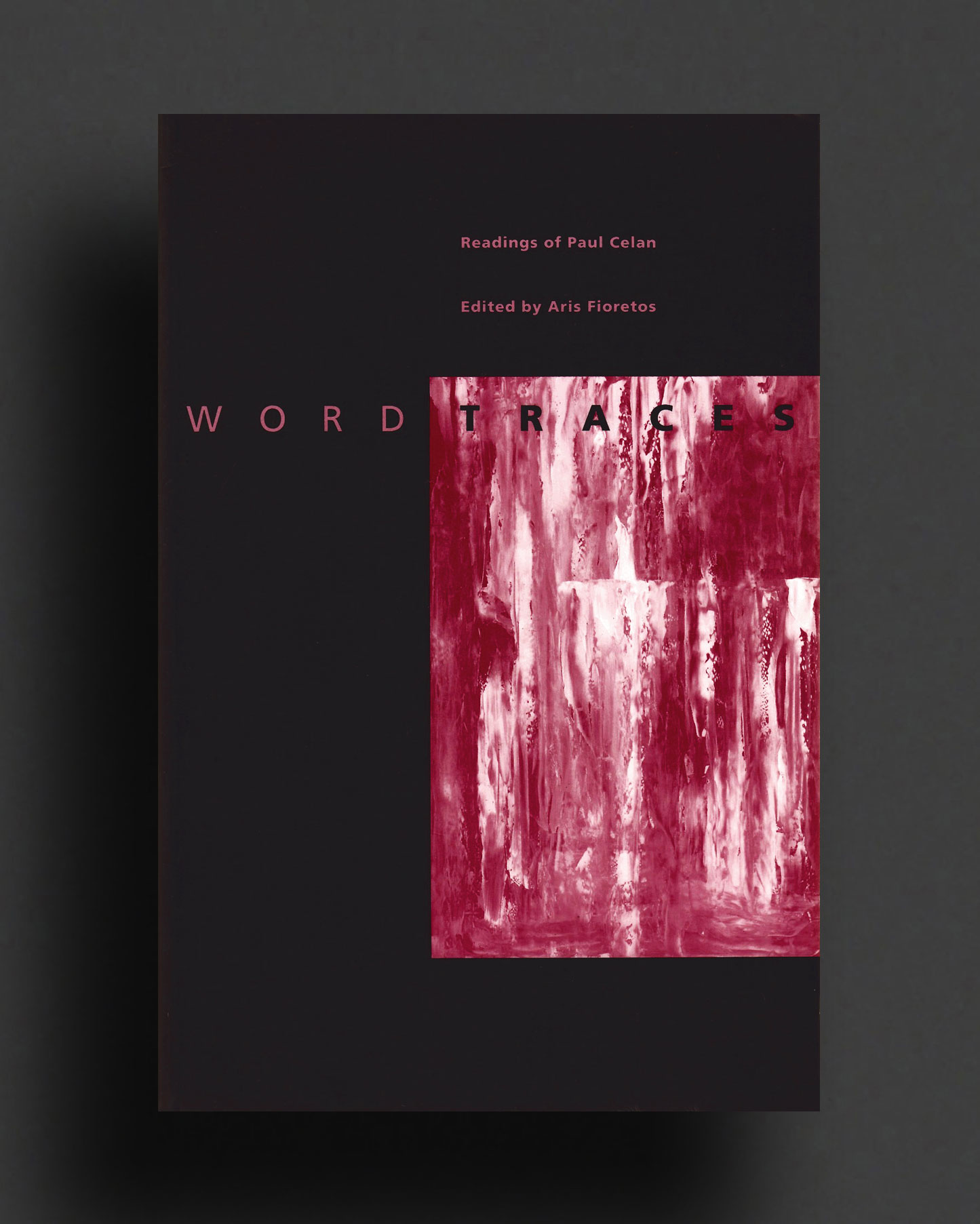
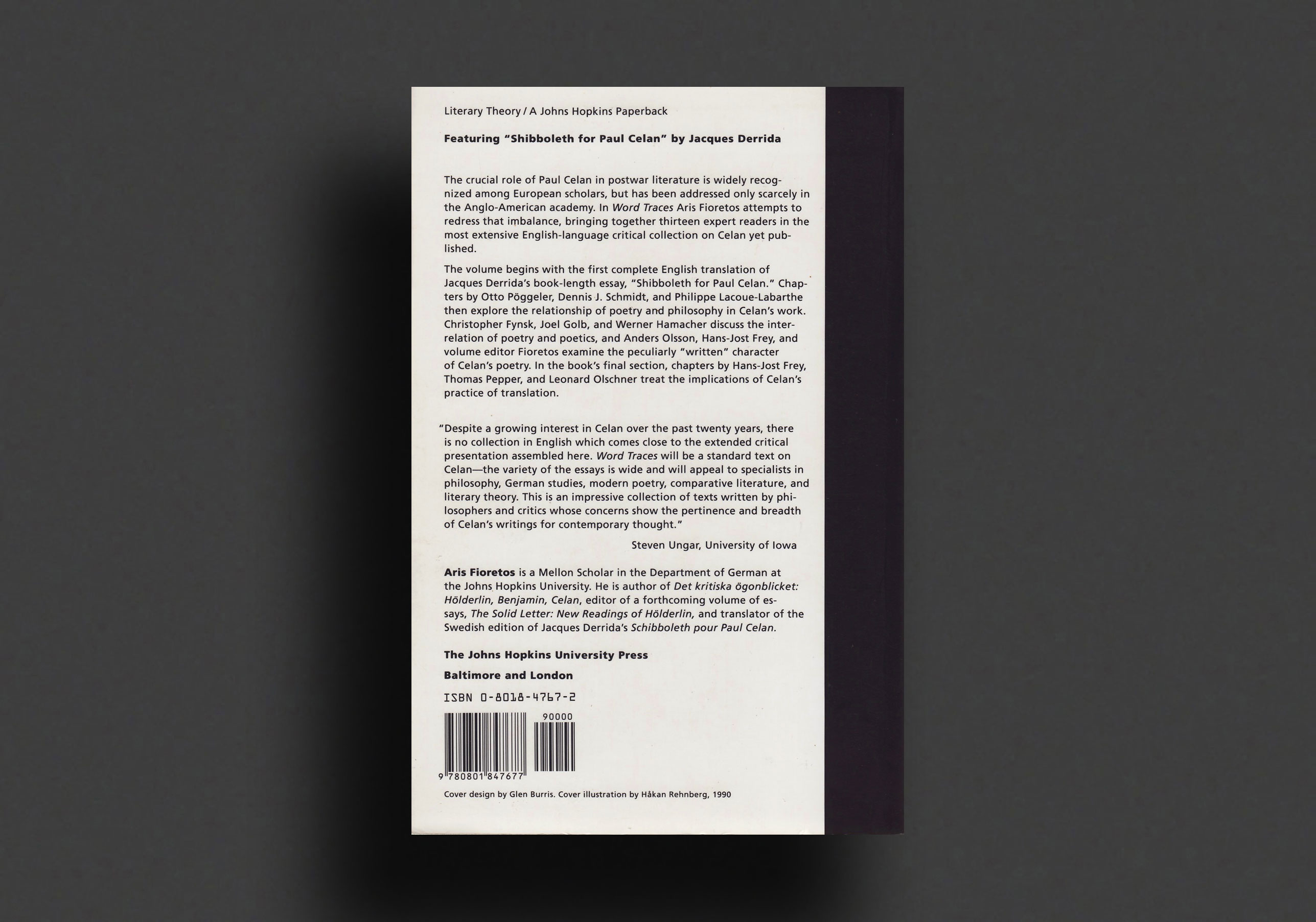
Featuring "Shibboleth for Paul Celan" by Jacques Derrida
The crucial role of Paul Celan in postwar literature is widely recognized among European scholars, but has been addressed only scarcely in the Anglo-American academy. In Word Traces Aris Fioretos attempts to redress that imbalance, bringing together thirteen expert readers in the most extensive English-language critical collection on Celan yet published.
The volume begins with the first complete English translation of Jacques Derrida's book-length essay, "Shibboleth for Paul Celan." Chapters by Otto Pöggeler, Dennis J. Schmidt, and Philippe Lacoue-Labarthe then explore the relationship of poetry and philosophy in Celan's work.
Christopher Fynsk, Joel Golb, and Werner Hamacher discuss the interrelation of poetry and poetics, and Anders Olsson, Hans-Jost Frey, and volume editor Fioretos examine the peculiarly "written" character of Celan's poetry. In the book's final section, chapters by Hans-Jost Frey, Thomas Pepper, and Leonard Olschner treat the implications of Celan's practice of translation.
"Despite a growing interest in Celan over the past twenty years, there is no collection in English which comes close to the extended critical presentation assembled here. Word Traces will be a standard text on Celan—the variety of the essays is wide and will appeal to specialists in philosophy, German studies, modern poetry, comparative literature, and literary theory. This is an impressive collection of texts written by philosophers and critics whose concerns show the pertinence and breadth of Celan's writings for contemporary thought."—Steven Ungar, University of lowa
Aris Fioretos is a Mellon Scholar in the Department of German at the Johns Hopkins University. He is author of Det kritiska ögonblicket: Hölderlin, Benjamin, Celan, editor of a forthcoming volume of essays, The Solid Letter: New Readings of Hölderlin, and translator of the Swedish edition of Jacques Derrida's Schibboleth pour Paul Celan.
Very Good copy.
1973, English
Softcover, 140 pages, 20 x 13 cm
1st Edition, Out of print title / used / good
Published by
Penguin Books / London
$35.00 - Out of stock
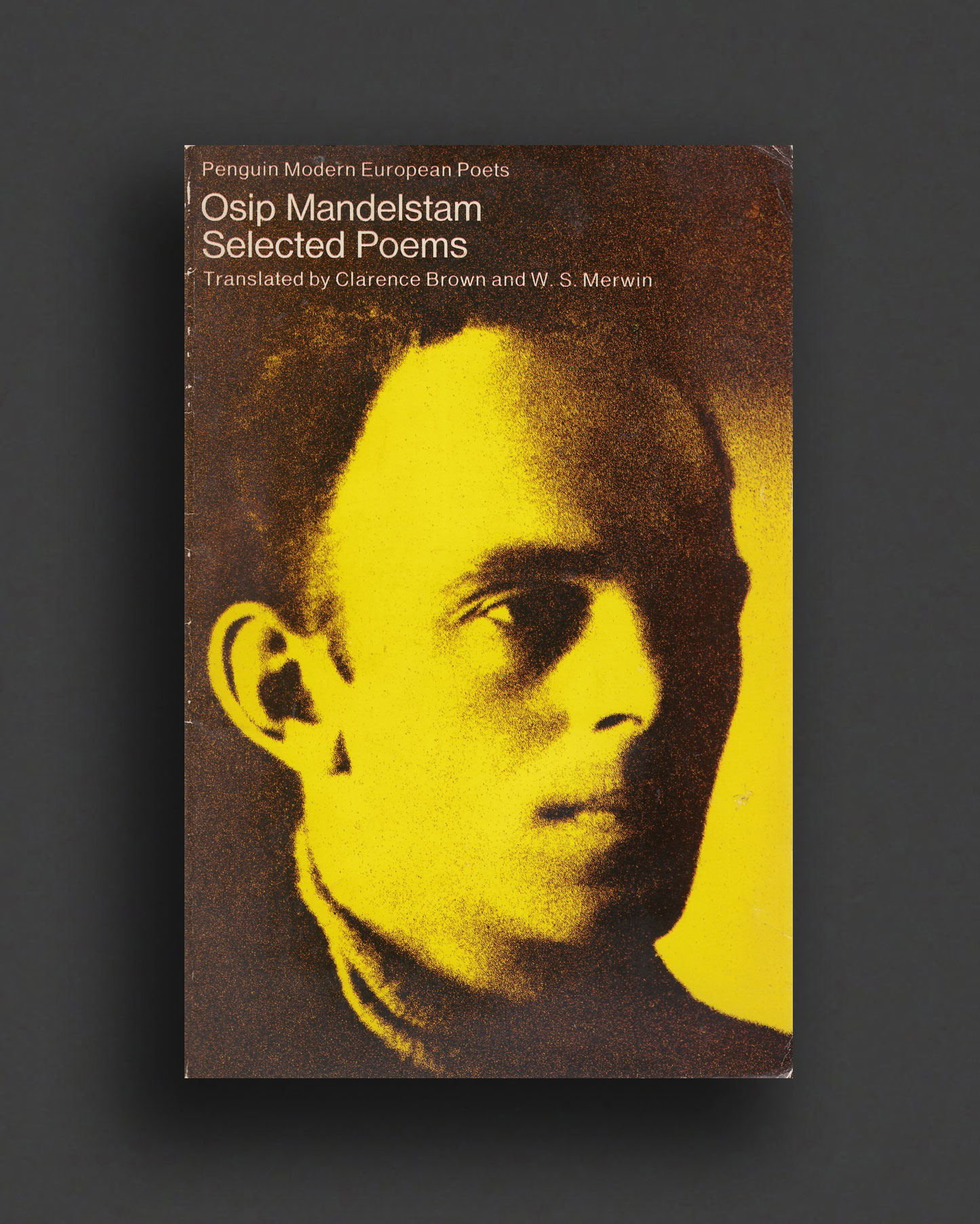
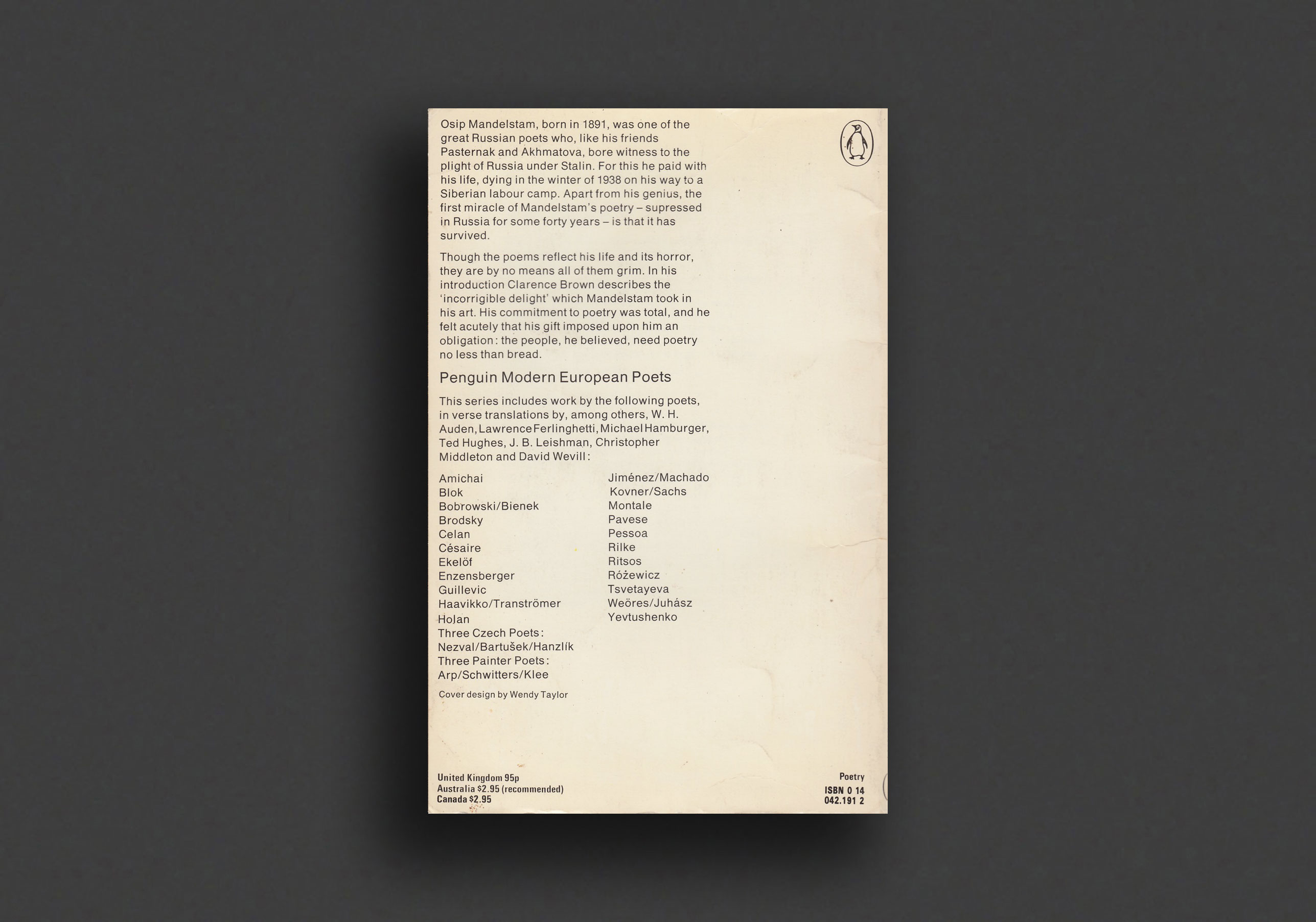
Collection of Osip Mandelstam's poems translated to English by Clarence Brown and W. S. Merwin and published in 1974.
Osip Mandelstam (1891–1938) ranks among the most significant Russian and Soviet poets of the 20th century. He was born in Warsaw, Poland in or around 1891, but soon afterward his family moved to St. Petersburg, Russia. Mandelstam first published his poems in Apollyon, an avant-garde magazine, in 1910, then banded together with Anna Akhmatova and Nicholas Gumilev to form the Acmeist group, which advocated an aesthetic of exact description and chiseled form, as suggested by the title of Mandelstam’s first book, Stone (1913). During the Russian Revolution, Mandelstam left Leningrad for the Crimea and Georgia, and he settled in Moscow in 1922, where his second collection of poems, Tristia, appeared. Unpopular with the Soviet authorities, Mandelstam found it increasingly difficult to publish his poetry, though an edition of collected poems did come out in 1928. In 1934, after reading an epigram denouncing Stalin to friends, Mandelstam was arrested and sent into exile. He wrote furiously during these years, and his wife, Nadezhda, memorized his work in case his notebooks were destroyed or lost. (Nadezhda Mandelstam’s extraordinary memoirs of life with her husband, Hope Against Hope and Hope Abandoned, published in the 1970s, later helped to bring Mandelstam a worldwide audience.)
Good—VG copy light general wear and toned pages.
1987, English
Softcover, 246 pages, 17.5 x 10.5 cm
Out of print title / used / very good
Published by
Ace Books / New York
$20.00 - Out of stock
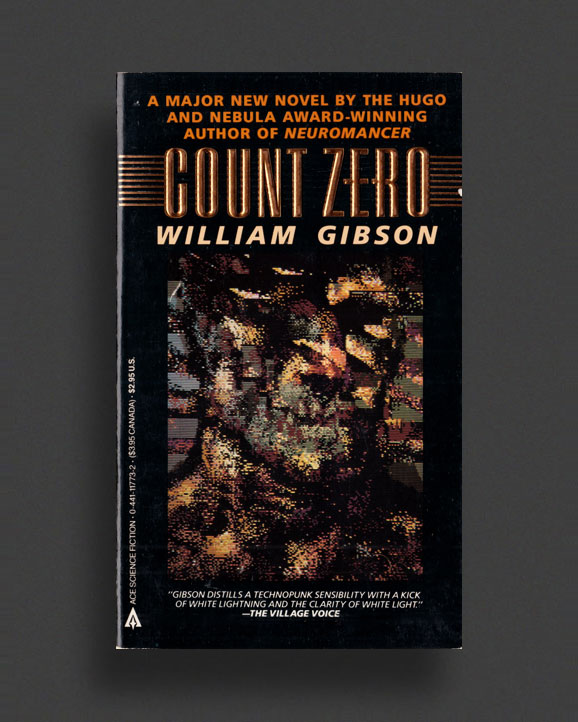
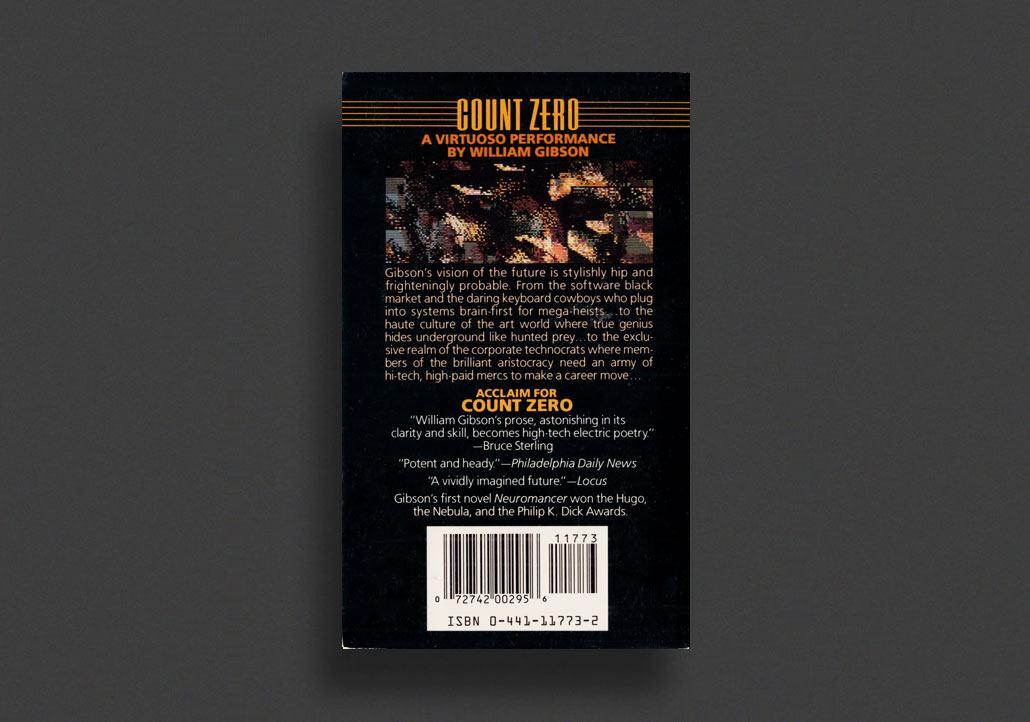
1987 Ace paperback edition. Nominated for both the Hugo and Nebula Awards, Count Zero is a science fiction novel by American-Canadian writer William Gibson, originally published in 1986. It is the second volume of the groundbreaking cyberpunk Sprawl trilogy, which begins with Neuromancer and concludes with Mona Lisa Overdrive.
They set a Slamhound on Turner's trail in New Delhi, slotted it to his pheromones and the colour of his hair.
When the Maas Biolabs and Hosaka zaibatsus fight it out for world domination, computer cowboys like Turner and Count Zero are just foot soldiers in the great game: useful but ultimately expendable.
When Turner wakes up in Mexico - in a new body with a beautiful woman beside him - his corporate masters let him recuperate for a while, then reactivate his memory for a mission even more dangerous than the one that nearly killed him: the head designer from Maas Biolabs says he wants to defect to Hosaka, and it's Turner's job to deliver him safely.
Count Zero is a rustbelt data-hustler totally unprepared for what comes his way when the designer's defection triggers war in cyberspace. With voodoo gods in the Net and angels in the software, he can only hope that the megacorps and the super-rich have their virtual hands too full to notice the amateur hacker with the black market kit trying desperately to stay alive . . .
William Gibson (b. 1948) began writing in 1977 and burst upon the literary world with his acclaimed first novel, Neuromancer, the book that launched the cyberpunk generation, and the first novel to win the holy trinity of science fiction, the Hugo, Nebula and Philip K. Dick Awards. Although best known for his early cyberpunk novels, Gibson's work has continued to evolve over the ensuing years, always casting an astute critical eye on modern societal trends.
Very Good copy. Scarcer first Ace ed.
1997, English
Softcover, 216 pages, 23 x 16 cm
1st Edition, Out of print title / used / very good
Published by
Routledge / London
$60.00 - In stock -
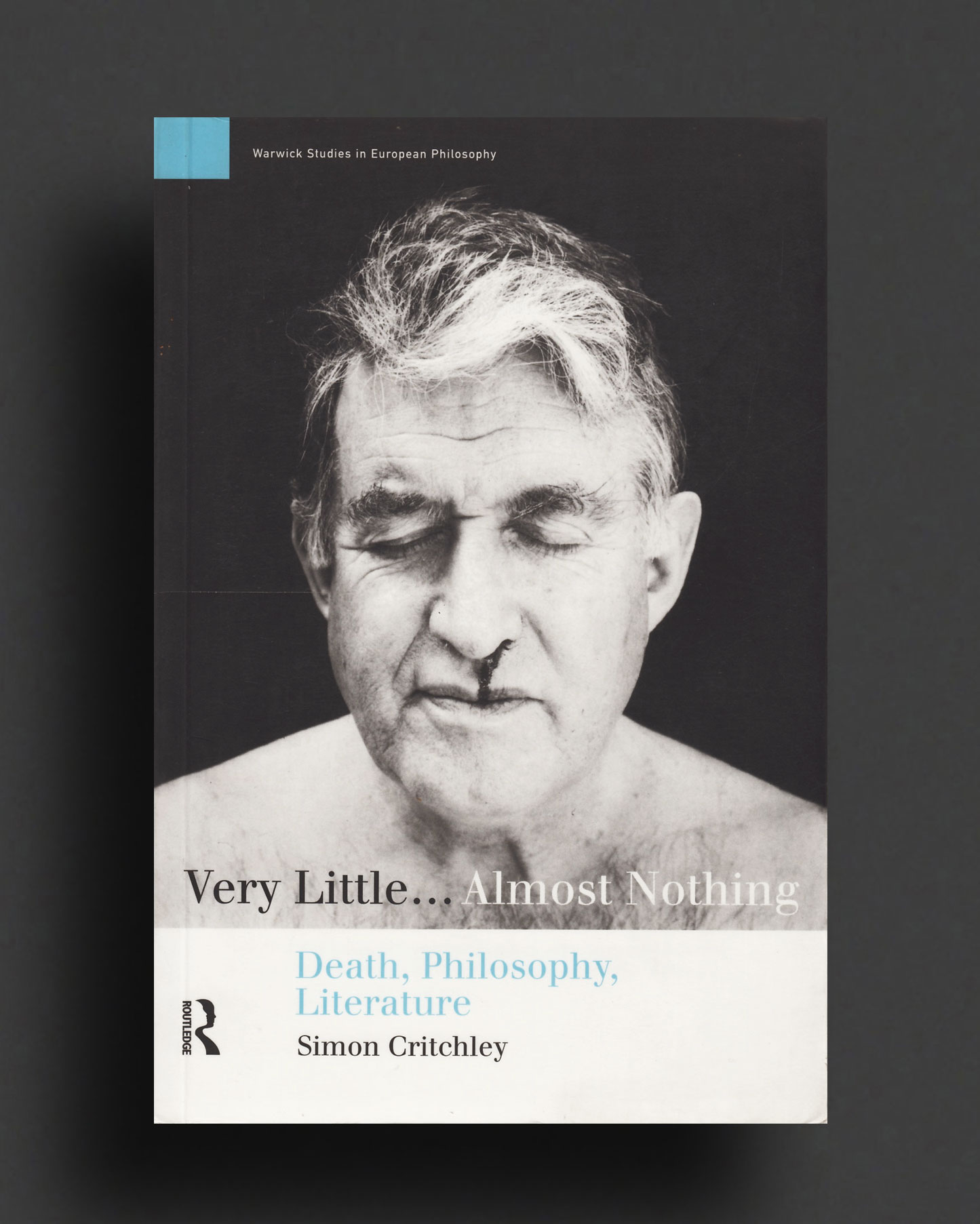
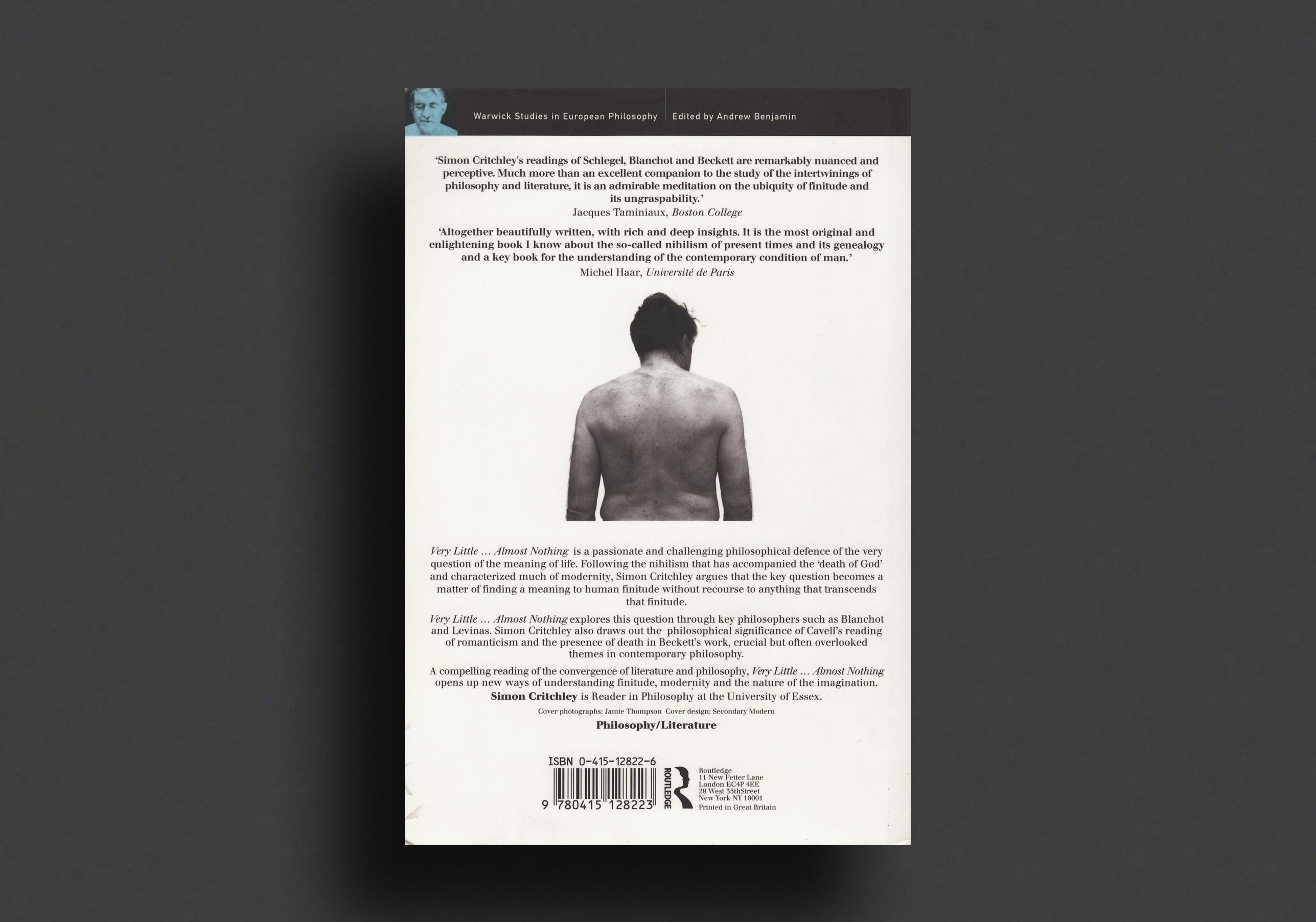
Rare first edition of Critchley's Very Little ... Almost Nothing, published in 1997. This remarkable book puts the question of the meaning of life back at the centre of intellectual debate. Its central concern is how we can find a meaning to human finitude without recourse to anything that transcends that finitude. A profound but secular meditation on the theme of death, Critchley traces the idea of nihilism through Blanchot, Levinas, Jena Romanticism and Cavell, culminating in a reading of Beckett, in many ways the hero of the book.
"This is a very brave book ...it makes philosophical conversation possible again after two decades of pragmatist intolerance."—Roger Poole, Parallax
"This is an often beautifully written philosophical act of mourning ... It also commands respect because it obliges one to examine the fictions one employs to avoid really doing philosophy. Critchley's steadfastly post-Kantian rejection of theological answers to the questions he asks is very welcome."—Andrew Bowie, Radical Philosophy
"Very Little ... Almost Nothing manages with some aplomb, to pull off the extraordinarily difficult task of saying something new and interesting about Beckett and Blanchot."—Martin McQuillan, New Formations
Very Good copy with some wear to extremities.
1997, English
Hardcover (w. dust jacket), 412 pages, 24 x 16.5 cm
1st Edition, Out of print title / used / fine
Published by
Stanford University Press / Palo Alto
$60.00 - In stock -
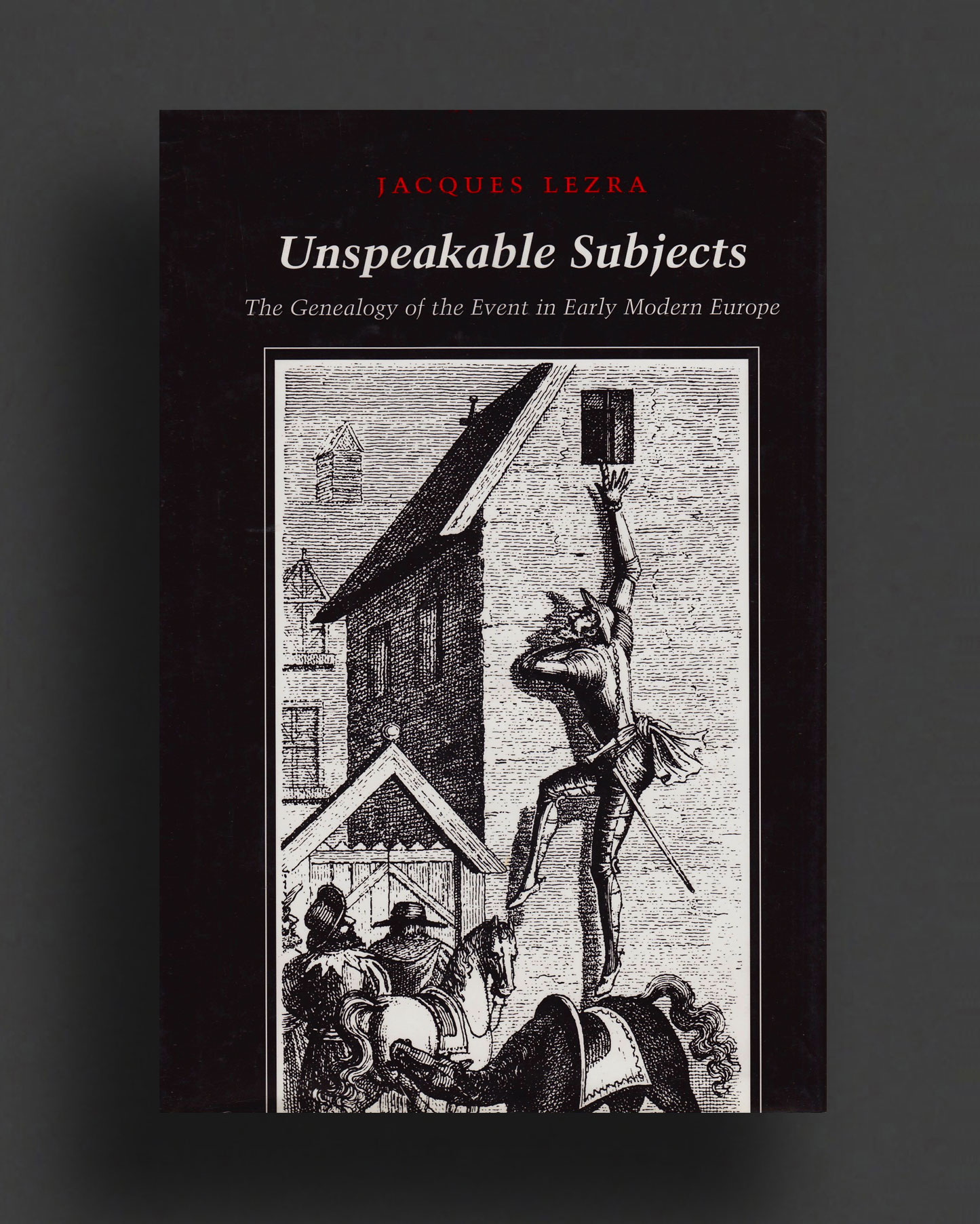
In groundbreaking readings linking works of Descartes, Shakespeare, and Cervantes with contemporary revisions of Freud and Nietzsche, Unspeakable Subjects argues that the concepts and discourses that have come to define European modernity―the subject's extension and responsibility, genealogies of intention and of freedom, the literary, legal, and medical construction of the body, among others―arise as strategies for evading a profound redefinition of the nature of events in early modern Europe.
Negotiating the often competing claims of rhetorical reading and cultural analysis, Lezra reassesses the grounds of literary and philosophical history as a materialist practice of eventful reading. His original accounts of Don Quixote, Descartes's Second Meditation and Regulae, and Measure for Measure tack between linguistic, psychoanalytic, and cultural materialist approaches to define and discuss the double aspect of the event in early modern literature and philosophy, and in Freudian and Heideggerian critical discourse: the event is at once an accident, the unpredictable, deontic intrusion of the empirical in idealizing schemes, and the disclosing and recollecting of a subject's relation to discursive and cultural morphologies in which empirical events are said properly to take place.
The advent of "modernity," Unspeakable Subjects argues, arises as the novel account of the permanently interrupted negotiation between the event's deontic and its morphological aspects. If Unspeakable Subjects considers on this level the "singularities" of textual events, it also seeks to show their complex relation to the "singularities" of the forms given material history.
Drawing upon such varied sources as the proclamations of James I, the law of entail, Renaissance treatises on typography, and documents on Jacobean and Elizabethan privateering, as well as accounts of the "events" of May 1968 and of Lacan's treatment of the fort-da game, and of the cultural uses of the figure of Don Quixote in Spanish proto-Falangist thought, the author shows that the institutional setting and conditions for literary and philosophical speech-acts, and the graphic constraints upon the bodies that such acts support, also take shape according to patterns set in response to the instability of the event.
NF—Fine copy in NF dust jacket under mylar wrap.
2024, English
Softcover, 88 pages, 17.8 x 11.4 cm
Published by
Wakefield Press / Cambridge
$32.00 - In stock -
Foreword by René Daumal
Translated by Terry Bradford
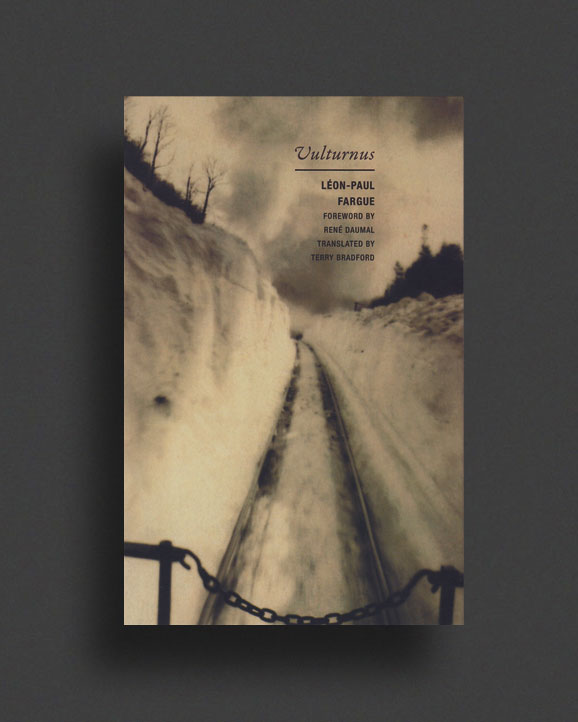
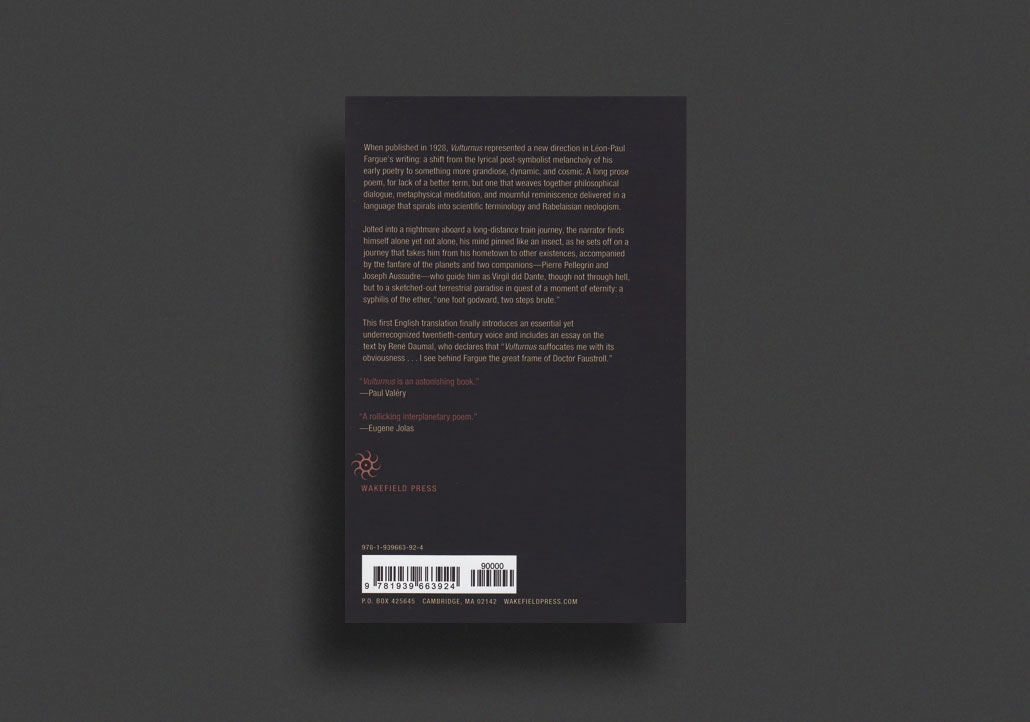
When published in 1928, Vulturnus represented a new direction in Léon-Paul Fargue’s writing: a shift from the lyrical post-Symbolist melancholy of his early poetry to something more grandiose, dynamic, and cosmic. A long prose poem, for lack of a better term, but one that weaves together philosophical dialogue, metaphysical meditation, and mournful reminiscence delivered in a language that spirals into scientific terminology and Rabelaisian neologism.
Jolted into a nightmare aboard a long-distance train journey, the author finds himself alone yet not alone, his mind pinned like an insect, as he sets off on a journey that takes him from his hometown to other existences, accompanied by the fanfare of the planets and two companions—Pierre Pellegrin and Joseph Aussudre—who guide him as Virgil did Dante, though not through hell, but to a sketched-out terrestrial paradise in quest of a moment of eternity: a syphilis of the ether, “one foot godward, two steps brute.”
This first English translation finally introduces an essential yet underrecognized twentieth-century voice and includes an essay on the text by René Daumal, who declares that “Vulturnus suffocates me with its obviousness … I see behind Fargue the great frame of Doctor Faustroll.”
“Vulturnus is an astonishing book.”—Paul Valéry
“A rollicking interplanetary poem.”—Eugene Jolas
Léon-Paul Fargue (1876–1947) was the archetypal poet of Paris, with ties to everyone from Alfred Jarry and Erik Satie to Colette and Maurice Ravel. His work was admired by Rilke, Joyce, and Walter Benjamin. Though his work spanned and was sometimes associated with various literary movements, a bridge of sorts from symbolism to surrealism (though he was opposed to the latter), he kept to his own path throughout his life: a night wanderer who turned his perambulations through Paris into a unique poetry and prose.
“The greatest living poet in France.”—Walter Benjamin
“One of our greatest poets.”—Rainer Maria Rilke
“Fargue taught us to sublimate the life of everyday and make the highest poetry out of it.”—Max Jacob
2024, English
Softcover, 220 pages, 20.32 x 12.7 cm
Published by
Contra Mundum Press / New York
$45.00 - Out of stock
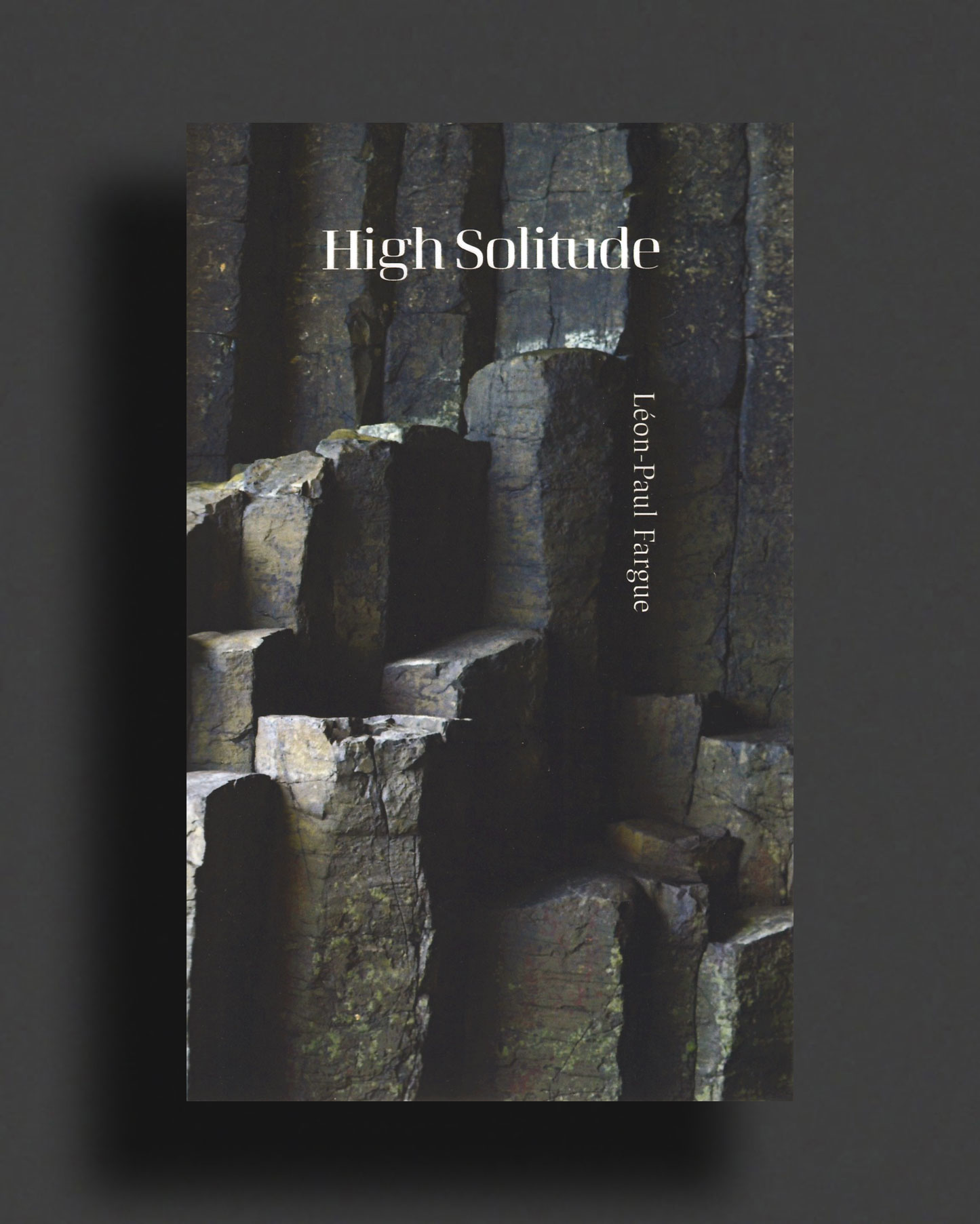
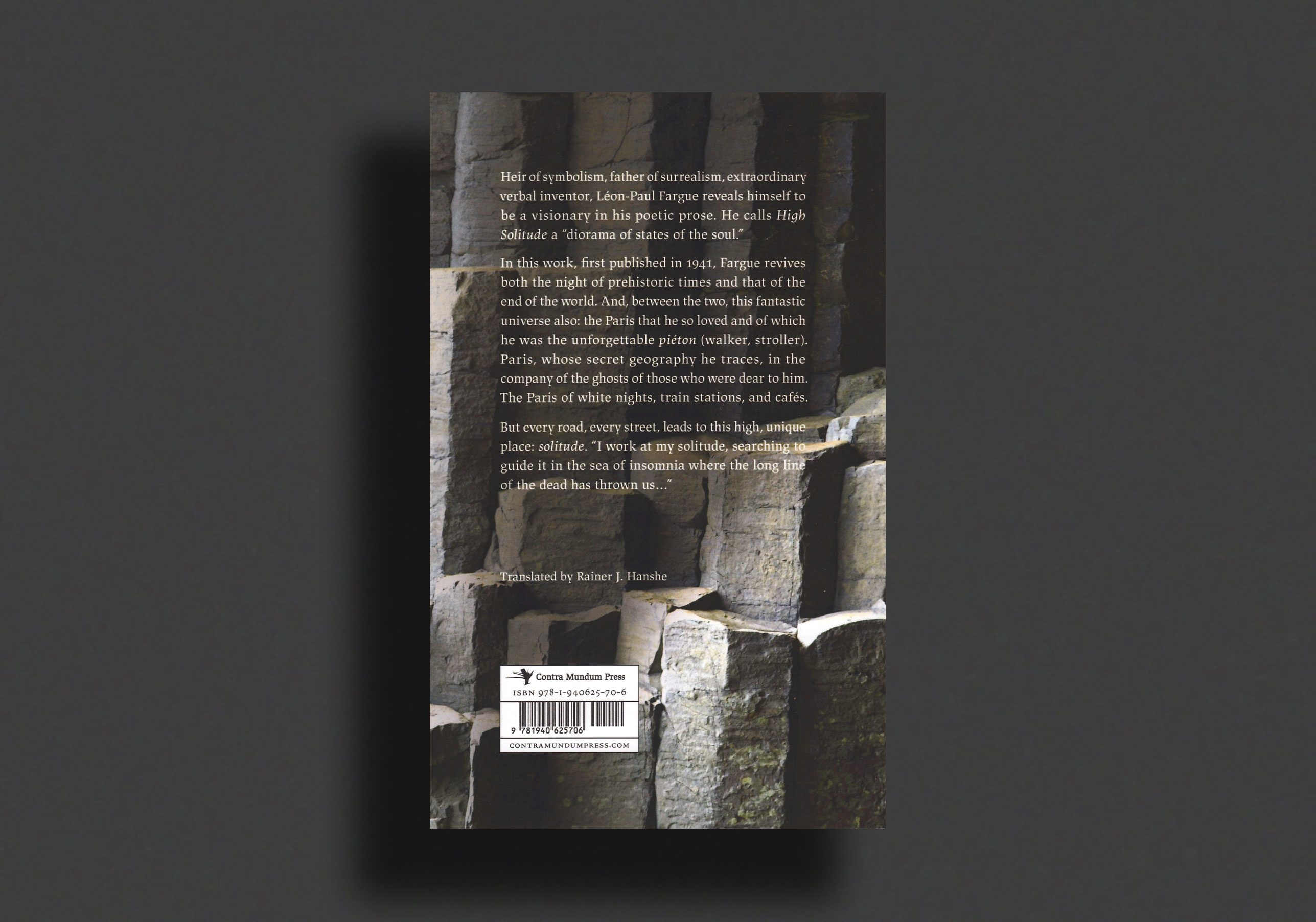
Heir of symbolism, father of surrealism, extraordinary verbal inventor, L on-Paul Fargue reveals himself to be a visionary in his prose poems. He calls High Solitude a "diorama of states of the soul."
In this work, originally published in 1941, Léon-Paul Fargue revives both the night of prehistoric times and that of the end of the world. And, between the two, this fantastic universe also: the Paris that he so loved and of which he was the unforgettable Pi ton. Paris, whose secret geography he traces, in the company of the ghosts of those who were dear to him. The Paris of white nights, stations, and cafes.
But every road, every street, leads to this high, unique place: solitude. "I work at my solitude, searching to guide it in the sea of insomnia where the long line of the dead has thrown us..."
"Fargue taught us to sublimate everyday life and make the highest poetry out of it."—Max Jacob
"Fargue transforms reality and incites it to undergo perilous metamorphoses, and eventually drives it some way toward the abyss. That is the danger of an art devoted to metaphor: it calls everything into question; but that is also its merit, and in the lament for the life of another era which Fargue readily, too readily, intones, it is right that we should hear the wrong note, the unheard of note, which intrudes into it like the cracked echo of an enigma."—Maurice Blanchot
"There is an unknown demon within Fargue that seems to drive him to the most audacious comparisons, in which he makes use of animals, cathedrals, or monsters to castigate the moral squalor of his day. It is a matter of pure poetry, an agility of spirit that leads him ceaselessly to find resemblances or associations for everything his eyes fall on."—André Beucler
LÉON-PAUL FARGUE (1876-1947) was a writer of poems, novels, and essays. He was a member of Les Apaches, an artist's group formed by Ravel and others, and a close friend of Alfred Jarry. Walter Benjamin considered Fargue the greatest poet in twentieth-century France and the two met in the 30s, with Fargue touring the philosopher around the arcades and other parts of Paris. Fargue was considered the great walker of the city of lights and recounted his perambulations in D'après Paris (1931) and Le Piéton de Paris (1939). Other books of his include Haute solitude (1941) and Déjeuners de soleil (1942).
Rainer J. Hanshe was born in Tehran, Iran, raised in New York, and has resided in Europe and elsewhere. He is the author of the novels The Acolytes and The Abdication, as well as of the hybrid entity Shattering the Muses (2016), a collaboration with visual artist Federico Gori, Closing Melodies (2023), a phantomatic encounter between Nietzsche & Van Gogh, and Dionysos Speed (2024). His translations include Baudelaire's My Heart Laid Bare (2017; 2020), Belgium Stripped Bare (2019), and Paris Spleen (2021), Évelyne Grossman's The Creativity of the Crisis, Antonin Artaud's Journey to Mexico: Revolutionary Messages, and Léon-Paul Fargue's High Solitude. as well as longer and shorter works by other authors.His newest work, Humanimality, is forthcoming in 2025. Beyond Sense, a vatic exploration of the aphasiac disintegration of Hölderlin, Baudelaire, Nietzsche, and Artaud, is due out in 2026. He is at work on a new book entitled Burn Poet Burn.
2025, English
Softcover, 656 pages, 20.3 x 12.7 cm
Published by
Contra Mundum Press / New York
$68.00 - In stock -
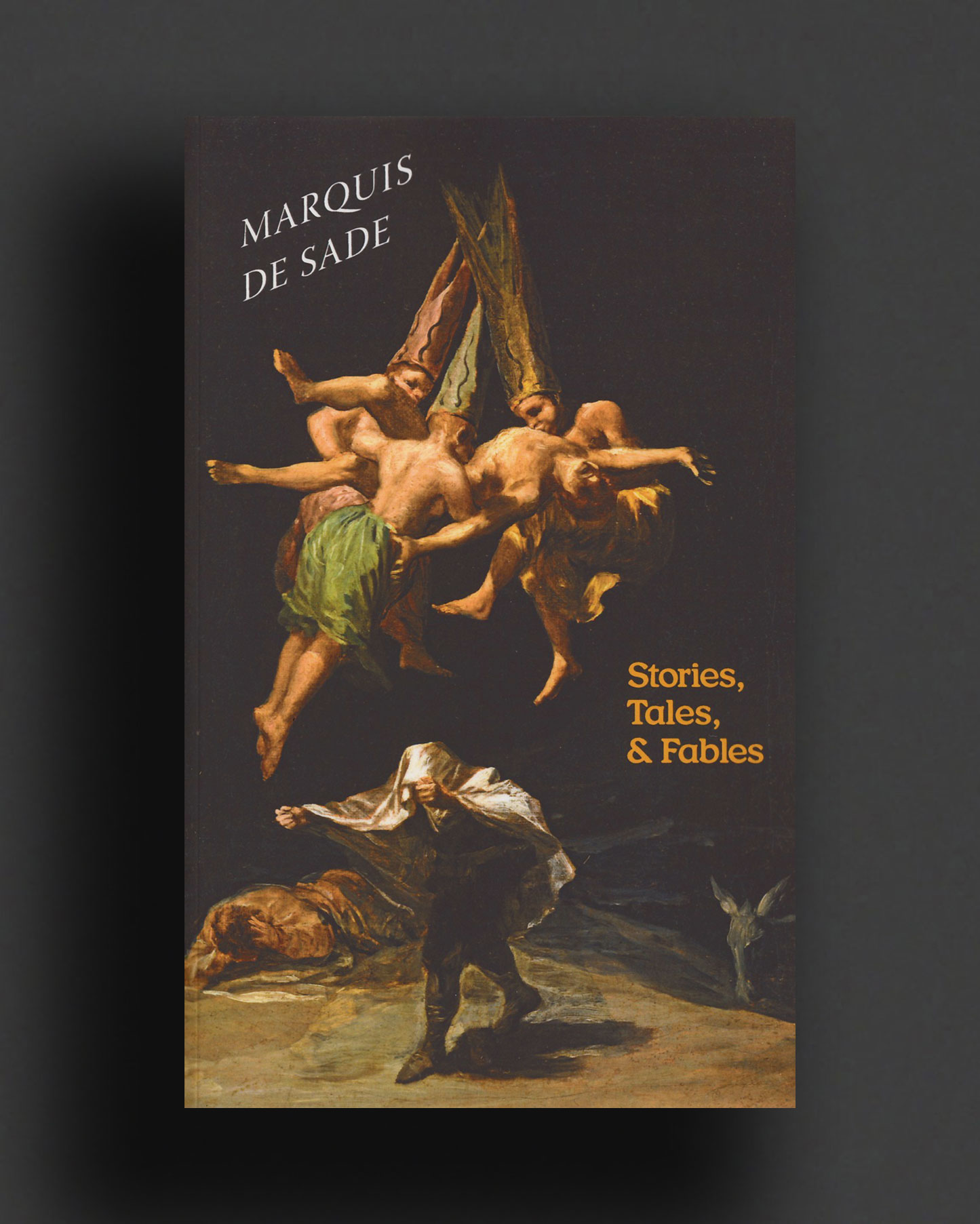
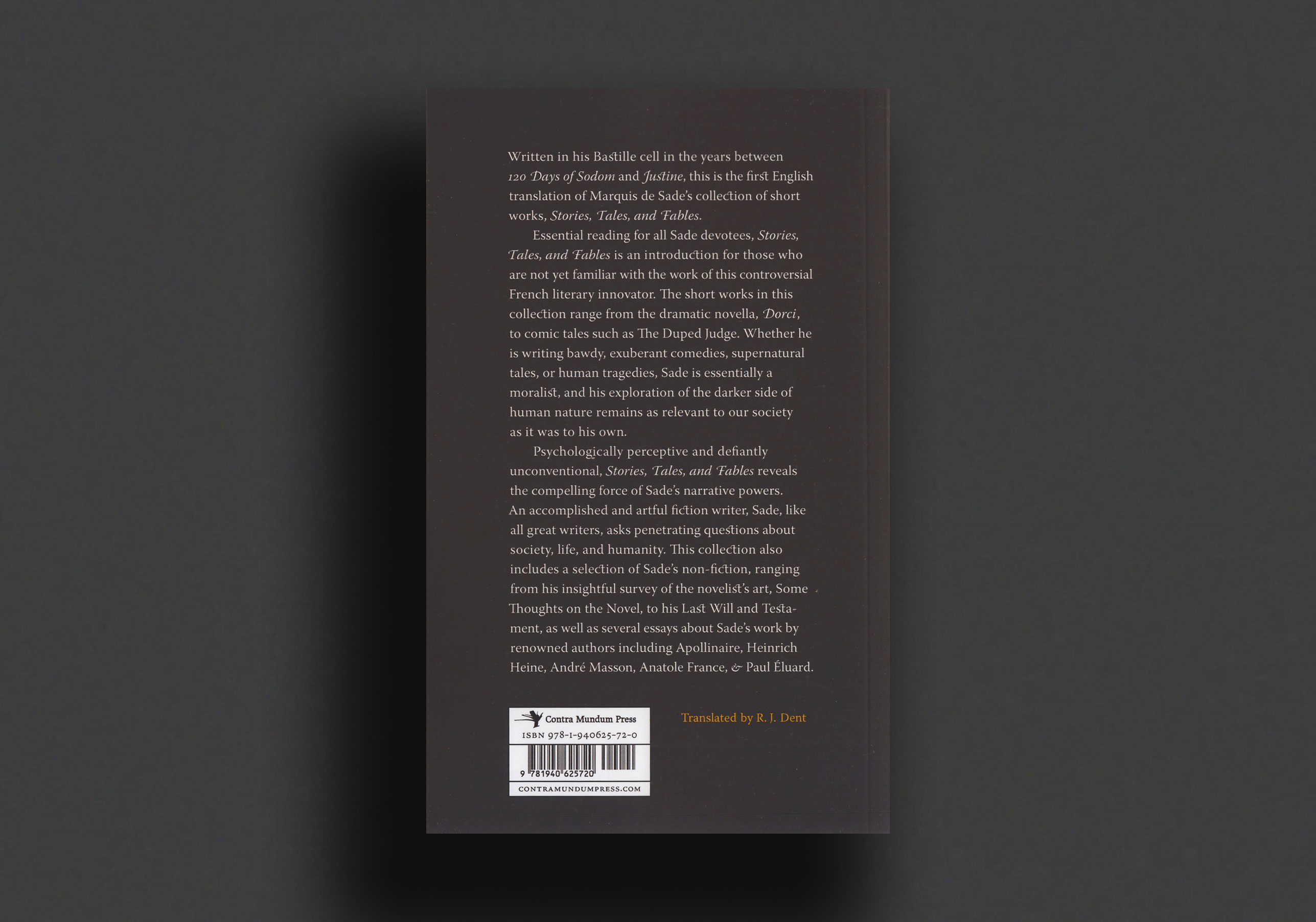
“It is said I present vice as too odious. The reason: I do not want people to be attracted to vice. I am far more moral than those who make their villains attractive. I shall only ever depict crime in the most vivid colours of hell. I want readers to see crime in all its vile nakedness, to fear it and to hate it, and so I show it in all its horror. Woe to those who dress crime in roses! Their intentions are impure, and I will never imitate them.”—The Marquis de Sade
Written in his Bastille cell in the years between 120 Days of Sodom and Justine, this is the first English translation of Marquis de Sade’s collection of short works, Stories, Tales, and Fables.
Essential reading for all Sade devotees, Stories, Tales, and Fables is an introduction for those who are not yet familiar with the work of this controversial French literary innovator. The short works in this collection range from the dramatic novella, Dorci, to comic tales such as The Duped Judge. Whether he is writing bawdy, exuberant comedies, supernatural tales, or human tragedies, Sade is essentially a moralist, and his exploration of the darker side of human nature remains as relevant to our society as it was to his own.
Psychologically perceptive and defiantly unconventional, Stories, Tales, and Fables reveals the compelling force of Sade’s narrative powers. An accomplished and artful fiction writer, Sade, like all great writers, asks penetrating questions about society, life, and humanity. This collection also includes a selection of Sade’s non-fiction, ranging from his insightful survey of the novelist's art, Some Thoughts on the Novel, to his Last Will and Testament, as well as several essays about Sade’s work by renowned authors including Apollinaire, Heine, Masson, Anatole France and Paul Ėluard.
Translated by R.J. Dent
1969, English
Hardcover (w. dust jacket), 340 pages, 21.5 x 14 cm
1st Edition, Out of print title / used / good
Published by
Hutchinson International Authors / London
$10.00 - In stock -
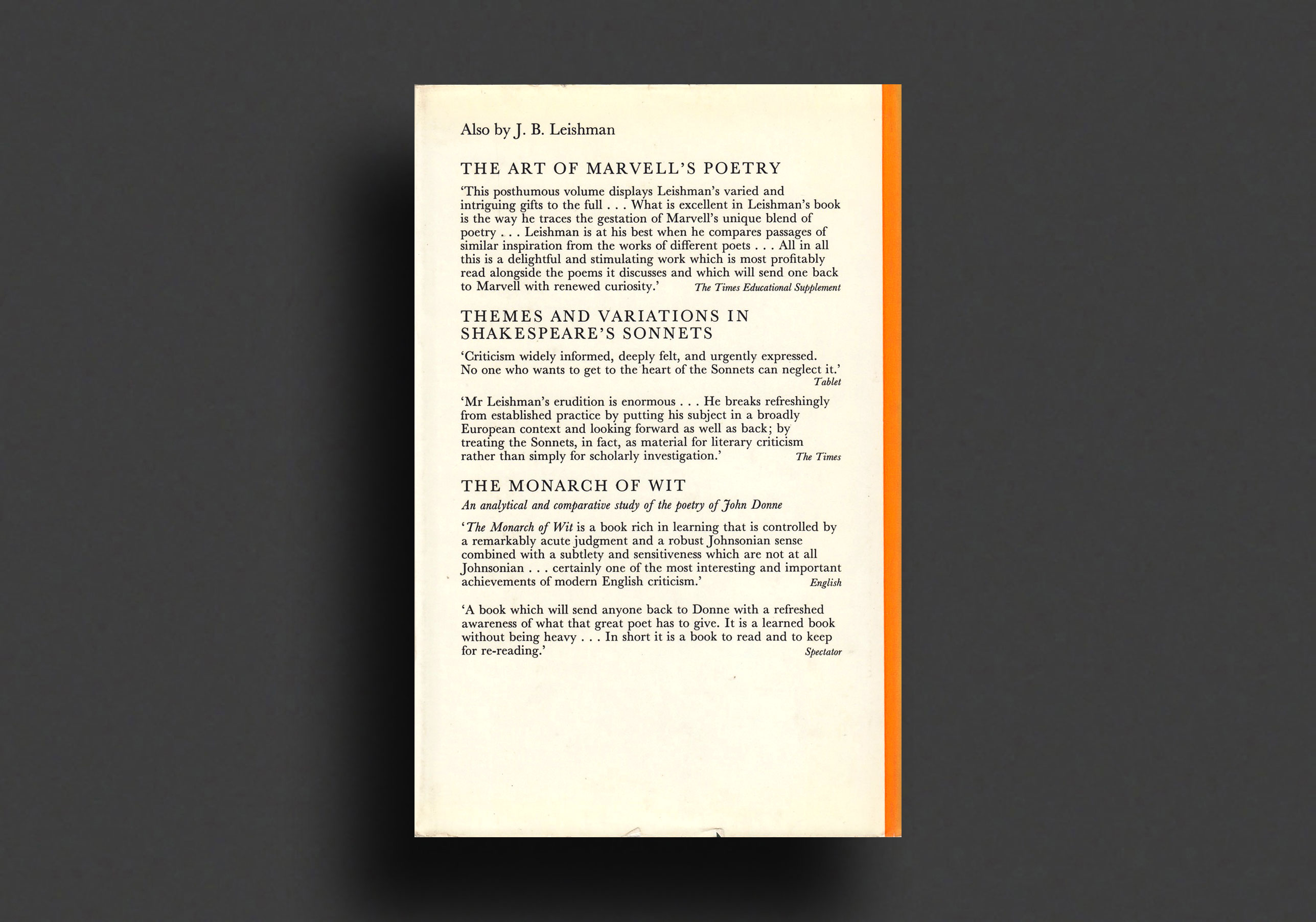
"When J. B. Leishman died just over six years ago, he left, among his posthumous papers, manuscript lectures on Milton's minor poems which have now been edited for publication by Professor Geoffrey Tillotson, his literary executor. Such a book is doubly welcome: first and foremost, it is by J. B. Leishman, an outstanding scholar and literary critic, author of The Monarch of Wit, Themes and Variations in Shakespeare's Sonnets and The Art of Marvell's Poetry, as well as translator of Rilke; secondly, it is concerned with Milton's minor poems, to which surprisingly little attention has been paid by recent critics, in comparison with Paradise Lost.
Over half this book is devoted to Comus and Lycidas, the rest chiefly to L'Allegro, Il Penseroso, Arcades and the Ode on the Morning of Christ's Nativity. Characteristically, Leishman is concerned to show from what sources Milton derived his ideas, images and phrases. He makes numerous comparisons, quoting widely both from the Greek and Roman poets and from Milton's English predecessors and contemporaries.
Professor Tillotson writes: 'Many of us nowadays have almost no equipment for reading Milton as he should be read.
Leishman laboured to make himself as nearly the ideal reader of Milton as he could manage. He read what Milton had read, which meant in particular the poetry written in Europe from its beginnings in Greece and Rome? This book is far more, though, than an immensely learned discussion; it is 'critical appreciation' in the fullest sense. Leishman imparts not only scholarship but enthusiasm, as when he lovingly calis Lycidas the most perfect poem of its length in the English language' And after reading Leishman we can indeed turn to Lycidas, and to the other poems, with greater understanding and enjoyment."
Good copy with price-clipped end paper. Good dj with wear to extremities.
1990, English
Hardcover (w. dust jacket), 204 pages, 23.5 x 16 cm
1st Edition, Out of print title / used / very good
Published by
Stanford University Press / Palo Alto
$25.00 - In stock -
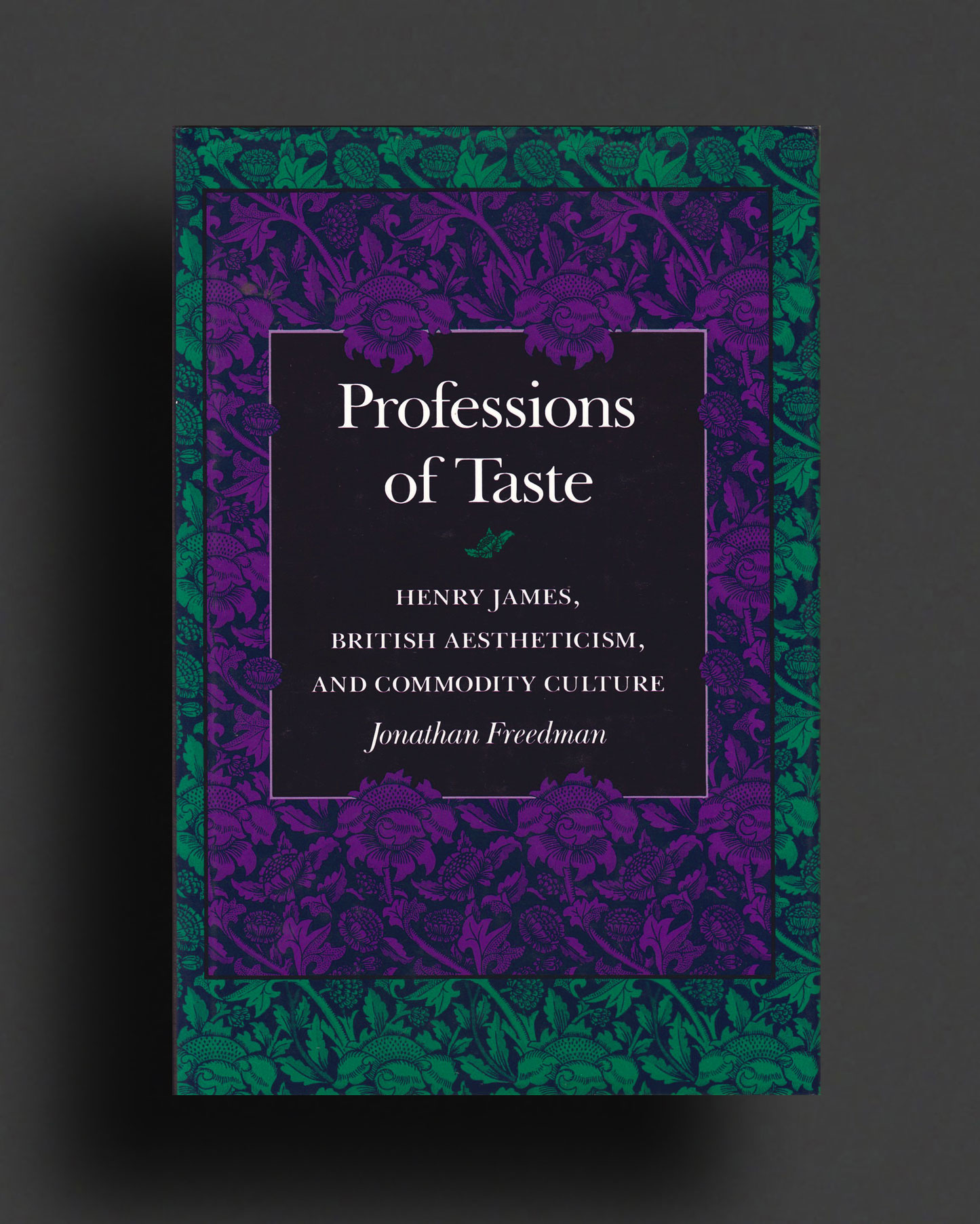
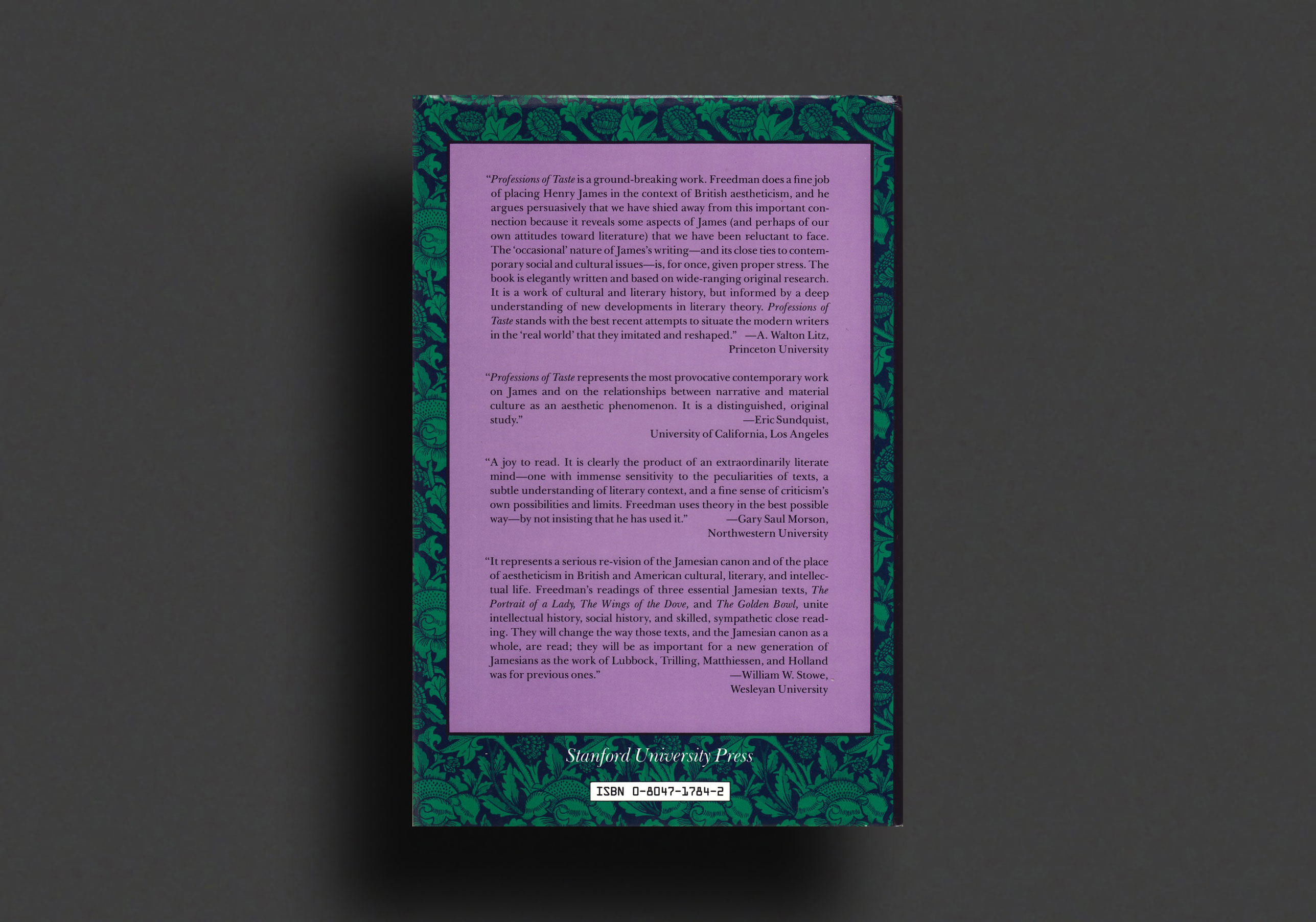
The author traces Henry James's career-long encounter with the tradition of British aestheticism and places both in the context of the late-19th-century's professionalization and commodification of literary life. Professions of Taste reopens the question of later James in a new fashion and with a new perspective. A richer genealogy of modernism, and indeed postmodernism, begins to take shape, in which both the problematics of British aestheticism and James's relations with it play an important role. This book aims to enlighten the reader's understanding of the way Pre-Raphaelite concerns fertilized the aestheticist breeding grounds of Anglo-American modernism.
"Our understanding of the way Pre-Raphaelite concerns fertilized the aestheticist breeding grounds of Anglo-American modernism takes a leap forward with Freedman's Professions of Taste, an ambitiously theorized, handsomely written, and enlightening book."—Studies in English Literature
"Professions of Taste is a work that Henry James might have read with pleasure. It is beautifully written, crafted in the highest spirit of critical enterprise."—American Literature
"An important and innovative book. . . . Professions of Taste reopens the question of later James in a new fashion and with a new perspective. A richer geneaology of modernism, and indeed postmodernism, begins to take shape, in which both the problematics of British aestheticism and James's relations with it play an important role."—Henry James Review
"This well-written study sheds much new light on the sphere of experience and expertise, 'the aesthetic,' that was created in the latter half of the nineteenth century."—Virginia Quarterly Review
VG copy in VG dj. Minor light marginalia in erasable lead pencil.
1985, English
Hardcover (w. dust jacket), 252 pages, 22.4 x 14 cm
1st Edition, Out of print title / used / very good
Published by
University of Nebraska Press / Lincoln
$70.00 - In stock -
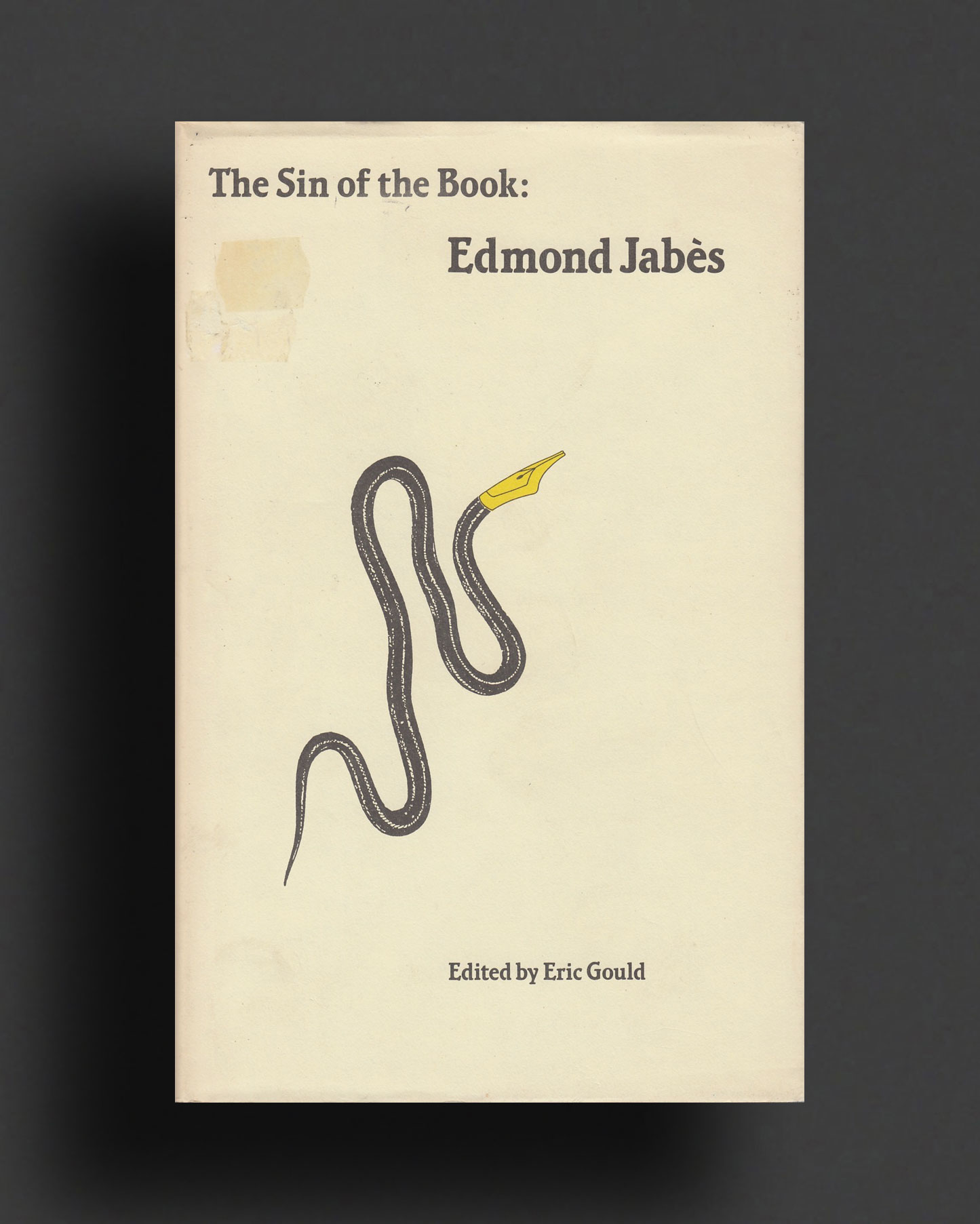
"In the last ten years, nothing of interest has been written in France that does not have its precedent somewhere in the work of Jabès."—Jacques Derrida
Rare first hardcvoer edition of this first full-length study in English of the work of Edmond Jabès. It provides a comprehensive introduction to his books, which — thanks to the translations of Rosmarie Waldrop — are now accessible to a growing British and American audience.
Any discussion of the writing of this Egyptian-born and French-speaking Jewish postmodernist must deal with a number of important literary issues: the nature, necessity, and difficulty of post-Holocaust Jewish literature; contemporary theories of deconstruction and the ontological limits of writing; the poetics of exile and dis-placement. Jabes's works strike at the heart of all these matters.
Eric Gould introduces the collection and contributes one of the seventeen essays. Four significant entries by Jabès himself and an interview by Paul Auster make this book an essential starting point for all future studies. Two commentaries by European critics, Maurice Blanchot and Jean Starobinski, appear in translation. Analyzing and responding to the intensely lyrical and aphoristic writing that makes up the seven volumes of The Book of Questions and the three of The Book of Resemblances are such American scholars and poets as Mary Ann Caws, Robert Duncan, Edward Kaplan, Susan Handelman, Richard Stamelman, Rosmarie Waldrop, Sydney Lévy, Kathryn Kinczewski, and Berel Lang.
Very Good copy in VG dust jacket with minor price tag discolouration/wear.
2011, English
Softcover, 228 pages, 20.5 x 15 cm
Published by
Exact Change / Boston
$34.00 - Out of stock
Translated and with an introduction by Simon Watson Taylor.
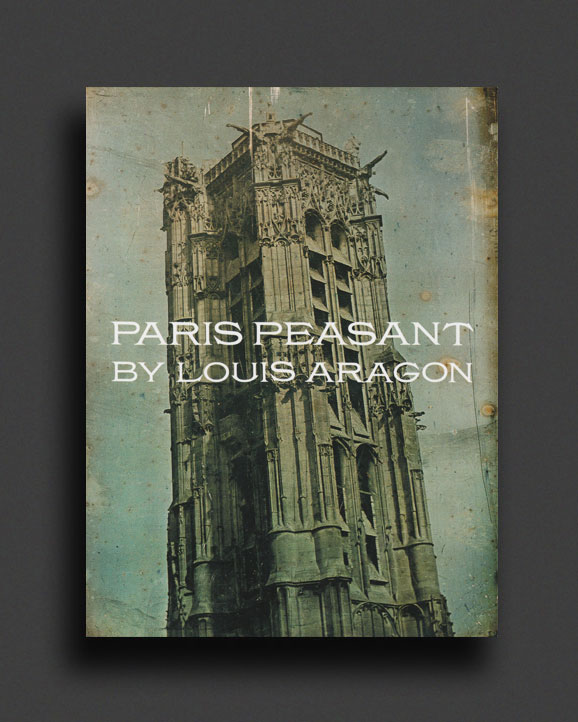
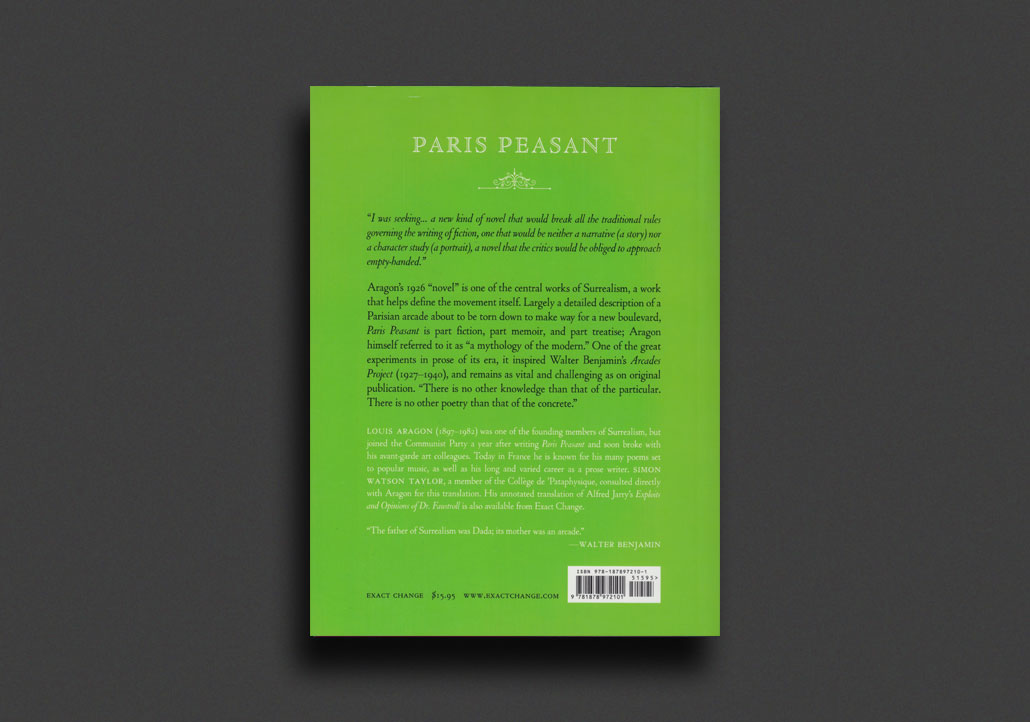
Paris Peasant (1926) is one of the central works of Surrealism, yet Exact Change's edition is the first U.S. publication of Simon Watson Taylor's authoritative translation, completed after consultations with the author.
Unconventional in form--Aragon consciously avoided recognizable narration or character development--Paris Peasant is, in the author's words, “a mythology of the modern.” The book uses the city of Paris as a stage or framework, and Aragon interweaves his text with images of related ephemera: café menus, maps, inscriptions on monuments and newspaper clippings. A detailed description of a Parisian arcade (nineteenth-century precursor to the mini-mall) and another of the Buttes-Chaumont park, are among the great set pieces within Aragon's swirling prose of philosophy, dream and satire.
André Breton wrote of this work: “no one could have been a more astute detector of the unwonted in all its forms; no one else could have been carried away by such intoxicating reveries about a sort of secret life of the city. . . .”
2001, English
Softcover, 103 pages, 14 x 20.4 cm
Published by
City Lights Books / San Francisco
$28.00 - Out of stock
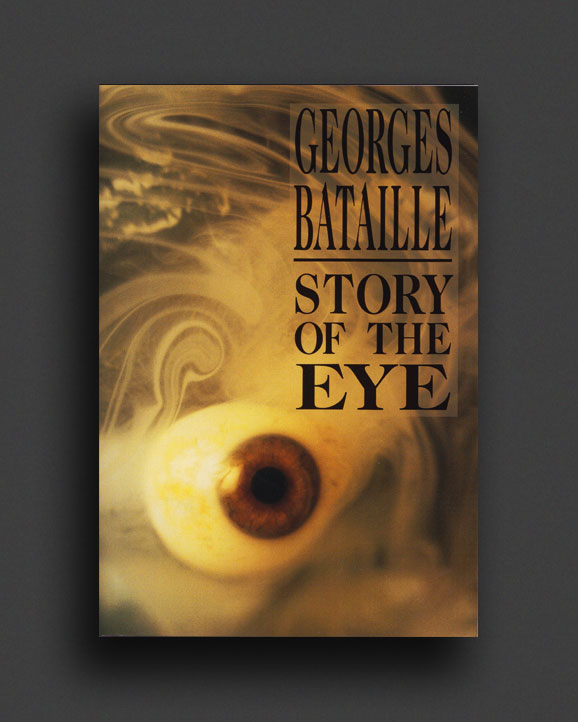
"The caress of the eye over the skin is so utterly, so extraordinarily gentle, and the sensation is so bizarre that it has something of a rooster's horrible crowing." - G.B.
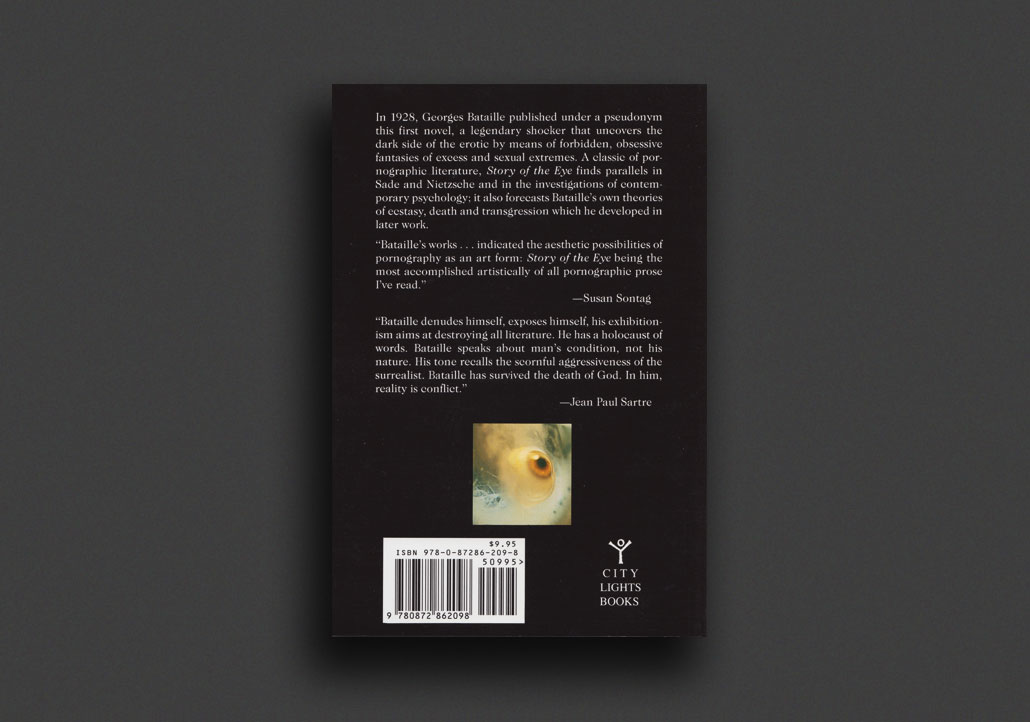
A masterpiece of transgressive, surrealist erotica, Bataille's first novel, published under the pseudonym 'Lord Auch', is still his most notorious work. Called a "metaphysician of evil, Bataille wrote the 1928 novella "Story of the Eye (French: L'histoire de l'œil) as a psychoanalytical task. In this explicit erotic fantasy, the young male narrator and his lovers Simone and Marcelle embark on a sexual quest involving sadism, torture, orgies, madness and defilement, culminating in a final act of transgression. Shocking and sacrilegious, Story of the Eye is the fullest expression of Bataille's obsession with the closeness of sex, violence and death. Yet it is also hallucinogenic in its power, and is one of the erotic classics of the twentieth century.
Georges Bataille (1897-1962), French essayist and novelist, was born in Billom, France. He converted to Catholicism, then later to Marxism, and was interested in psychoanalysis and mysticism, forming a secret society dedicated to glorifying human sacrifice. Leading a simple life as the curator of a municipal library, Bataille was involved on the fringes of Surrealism, founding the Surrealist magazine Documents in 1929, and editing the literary review Critique from 1946 until his death.
2013, English / Portugese
Softcover, 224 pages, 23 x 18.5 cm
1st Edition, Out of print title / as new
Published by
Bom Dia Boa Tarde Boa Noite / Berlin
$150.00 - In stock -
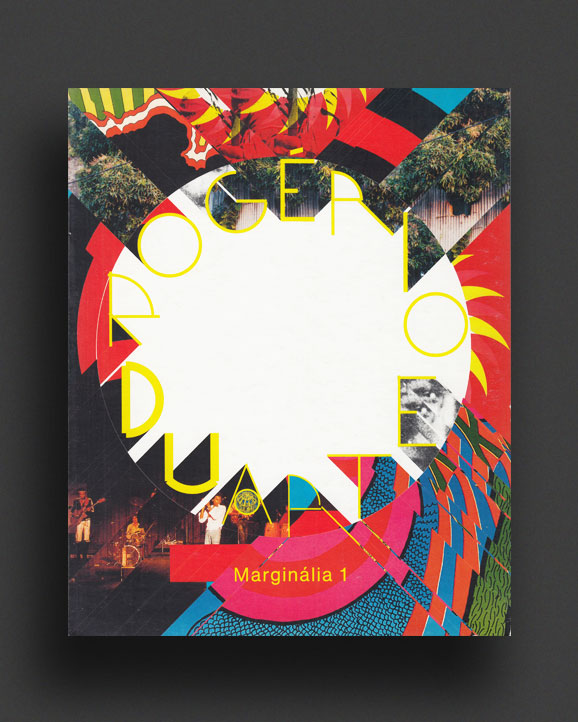
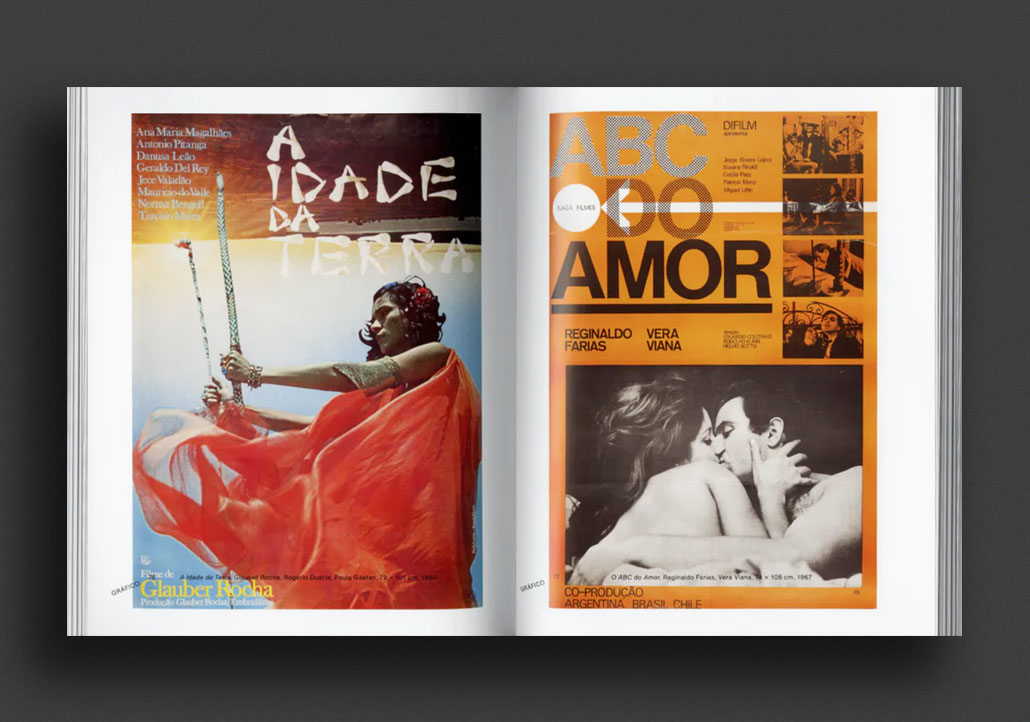
The first in-depth survey of Brazilian designer, poet, musician, artist and author, Rogério Duarte's practice, and the first time that a selection of his poems and texts have been translated into English. Now long out-of-print and collectible resource.
Arguably, Rogério Duarte (* 1939, Ubaíra) is “the genius behind the geniuses” (Narlan Mattos) of Brazil's 1960–70s counter-cultural and avant-garde efforts. Thus, it comes as no surprise that key figures in the fields of design, music, art, and cinema, such as Glauber Rocha, Hélio Oiticica, Gilberto Gil, and Caetano Veloso, have provided the posterity with a vast catalogue of testimonies that leave no doubt as to the crucial role that Rogério played in the emergence of what is known today as the Tropicália movement, or Tropicalism. Yet, despite the growing interest that the Brazilian counter-culture of that time encountered on the international stage during the past two decades, Rogério's work has remained almost unknown to a broader public.
Marginália 1 was developed by the designer Manuel Raeder and the artist Mariana Castillo Deball over a period of four years and published by BOM DIA BOA TARDE BOA NOITE. Profusely illustrated in colour and b/w with texts by Rogério Duarte, Narlan Matos Teixeira, Max Jorge Hinderer Cruz, Mariana Castillo Deball, Manuel Raeder. Published in both English and Portuguese.
As New copy, still sealed.
1975, English
Hardcover (clothbound in slipcase), 48 pages, 27.5 x 19 cm
Ed. of 3000,
1st Edition, Out of print title / used / fine
Published by
Thames and Hudson / London
$30.00 - In stock -
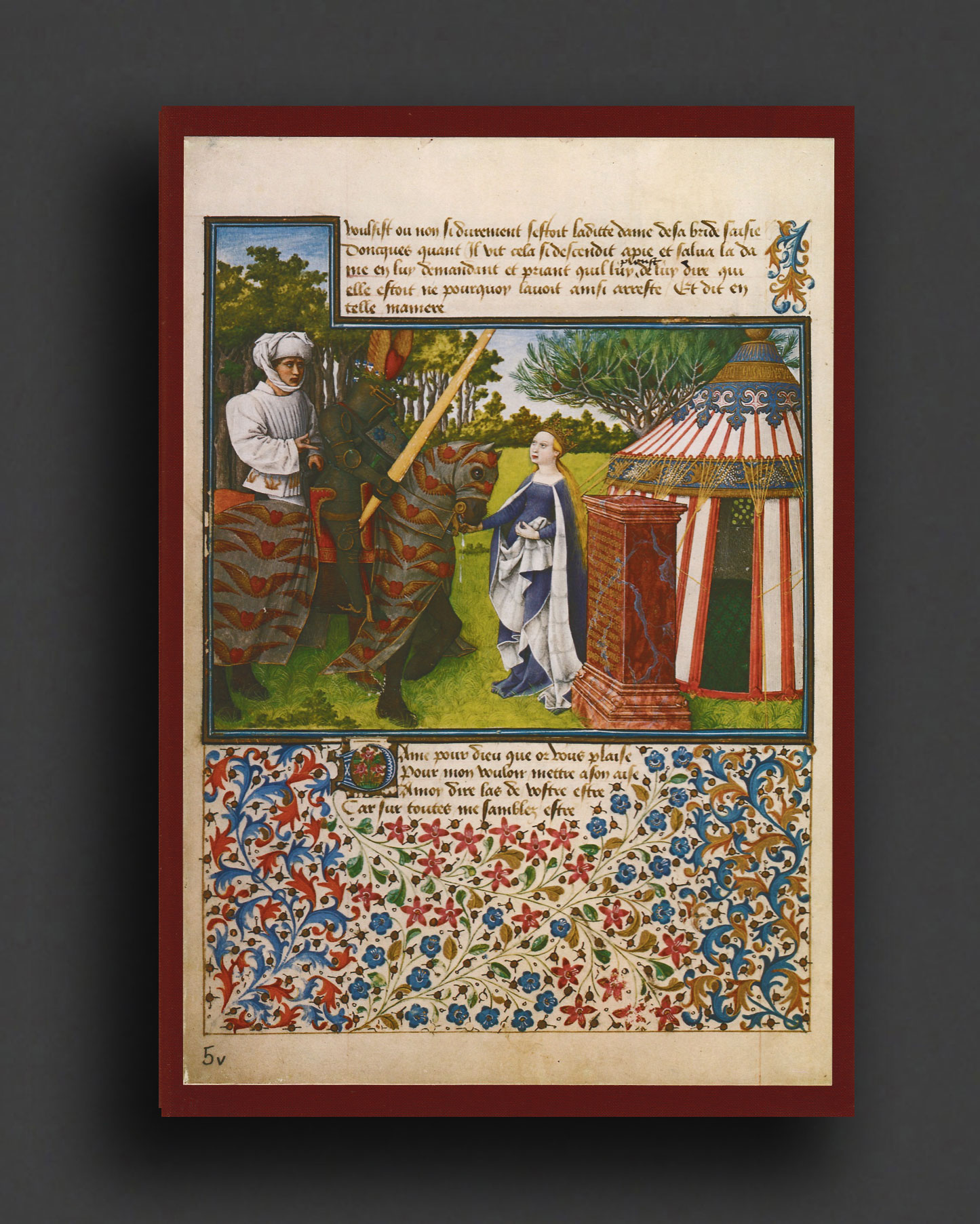
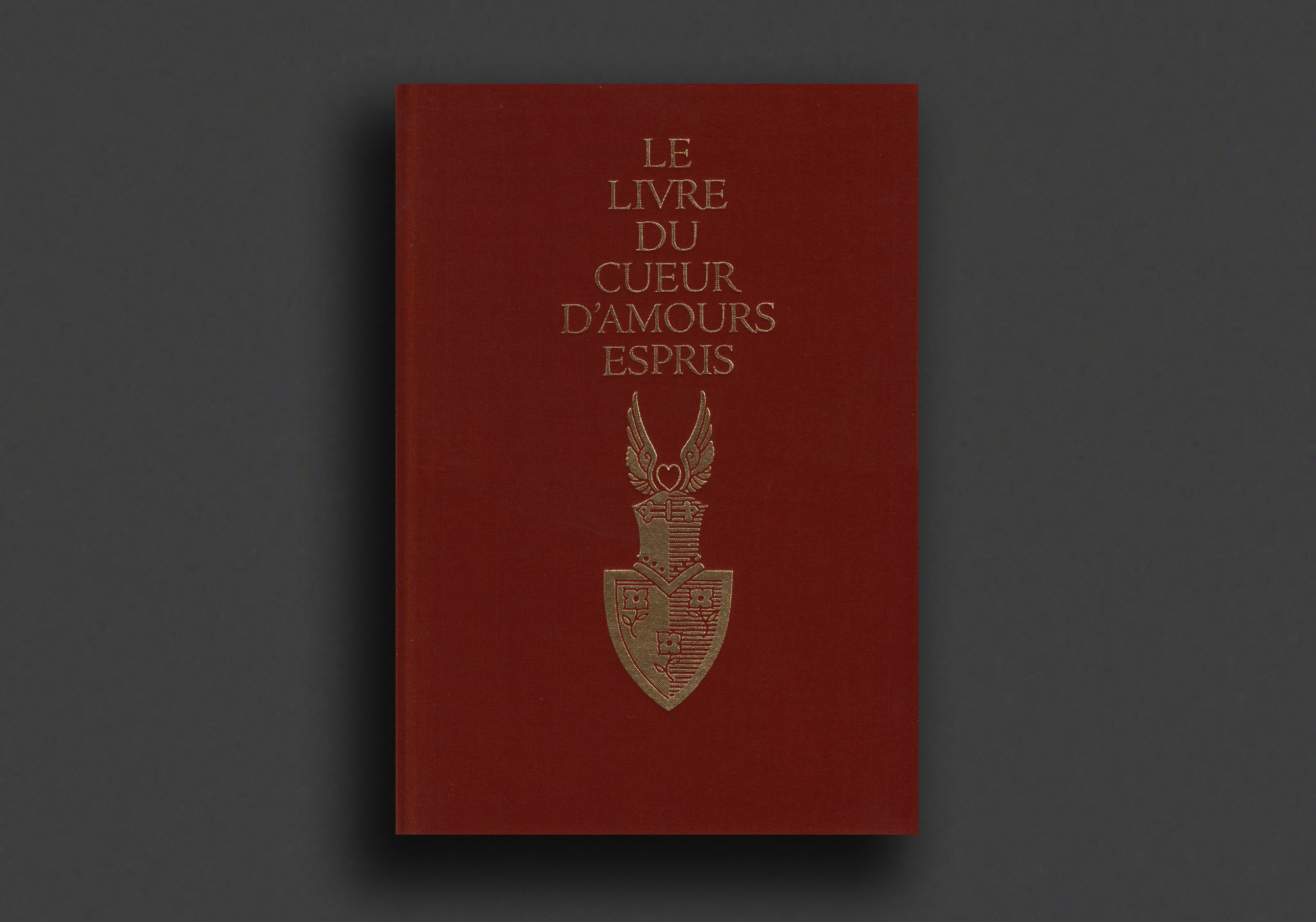
Lavish 1975 slipcase reproduction of Le livre du Coeur d'amour épris (The book of the love-smitten heart) an allegorical romance written in 1457 by King René of Anjou (1409-80). Inspired by a tragic loss, illustrated with the most beautiful twilight scenes of illumination: an allegorical chivalric romance written by Duke René d´Anjou and illustrated by Barthélemy d'Eyck
The text in verse and prose recounts the quest for love of the knight Heart who, in a dream, leaves with Desire in search of his lady, Mercy. This amorous journey combines the knight's studies and his personal memories. The tone is that of a disenchanted man at the end of his life, for whom courtly love and desire both amount to obstacles and suffering. The work combines features of the Arthurian novels in prose and allegorical poems in the style of the Roman de la Rose.
Near Fine—Fine copy all-round.
1988, English
Softcover, 174 pages, 20 x 13 cm
Out of print title / used / very good
Published by
Paladin / London
$35.00 - Out of stock
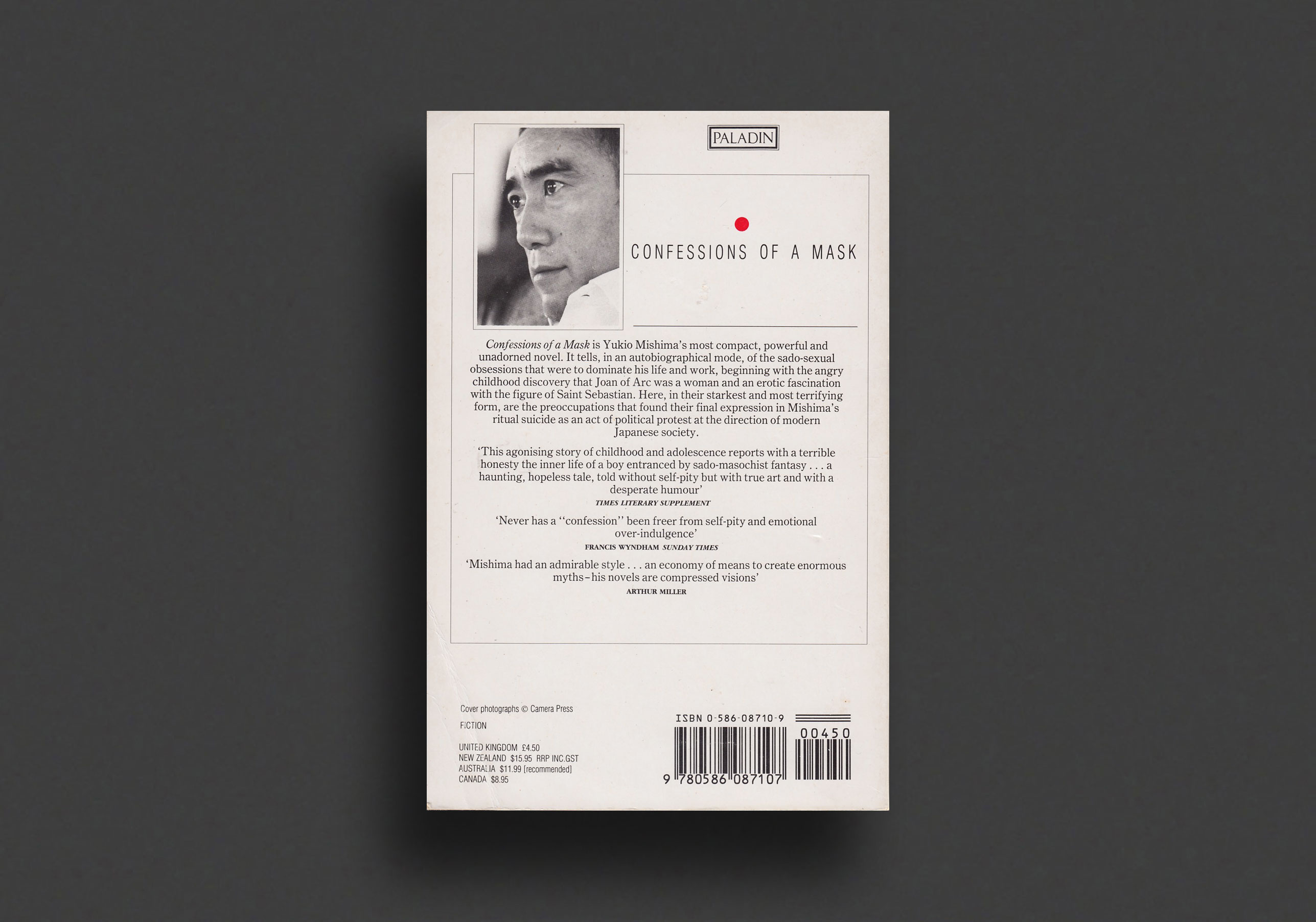
Lovely 1988 Paladin paperback edition.
Confessions of a Mask is Yukio Mishima's most compact, powerful and unadorned novel. It tells, in an autobiographical mode, of the sado-sexual obsessions that were to dominate his life and work, beginning with the angry childhood discovery that Joan of Arc was a woman and an erotic fascination with the figure of Saint Sebastian. Here, in their starkest and most terrifying form, are the preoccupations that found their final expression in Mishima's ritual suicide as an act of political protest at the direction of modern Japanese society.
VG copy with foxing/tanning to pages, light wear.
2025, English
Softcover, 160 pages, 19.8 x 12.9 cm
Published by
Silver Press / London
$35.00 - In stock -
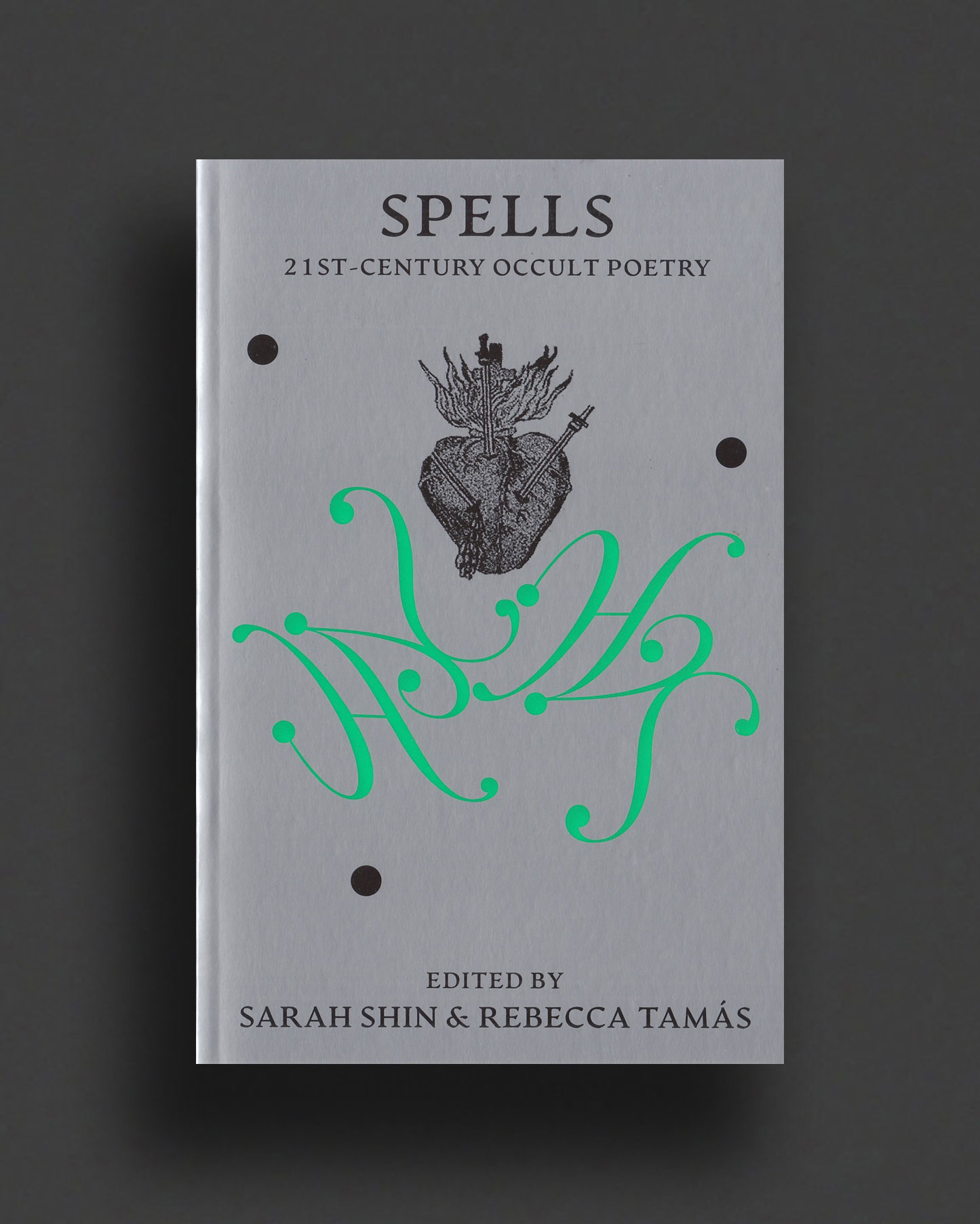
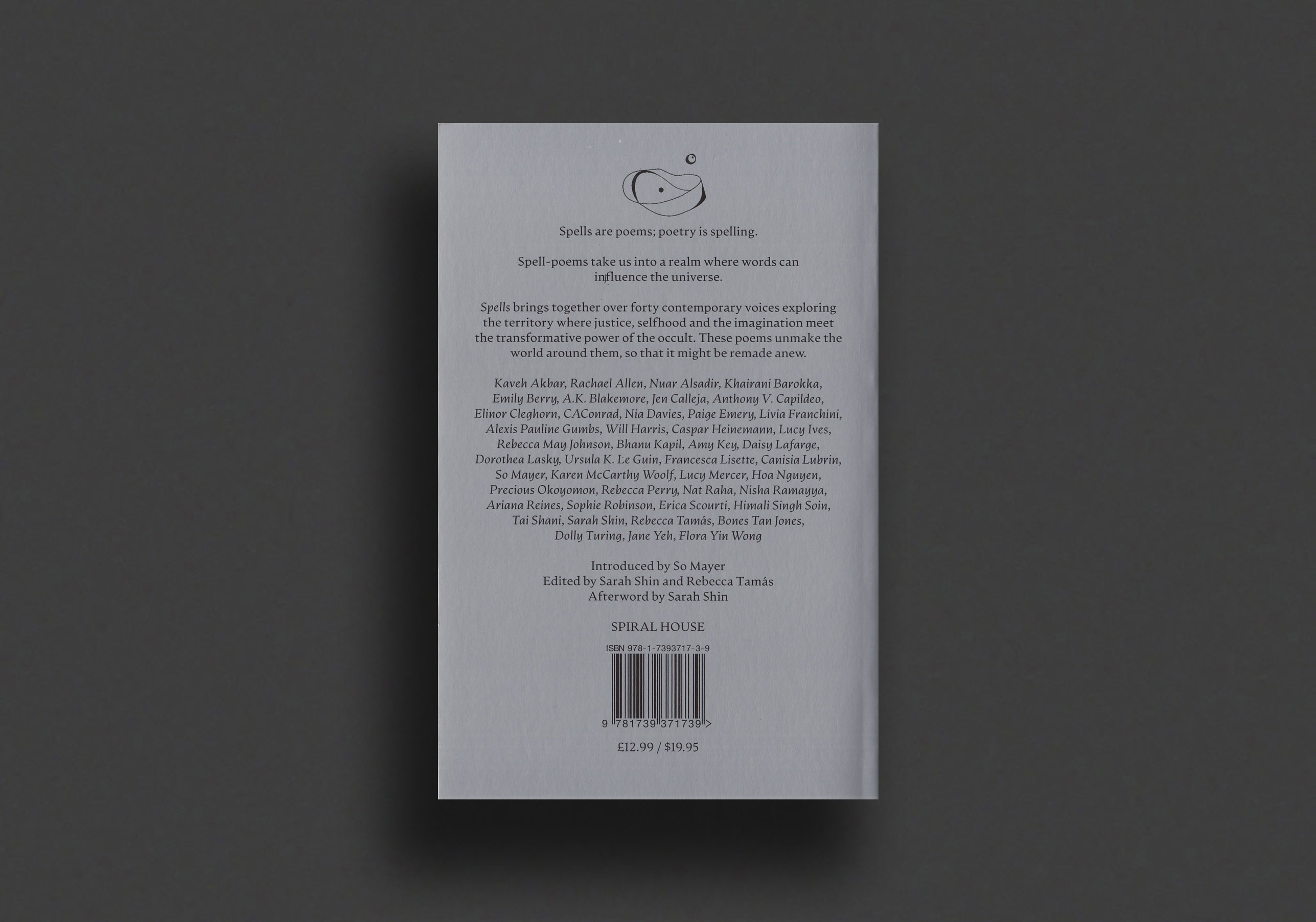
This new edition brings together over forty contemporary voices exploring the territory where justice, selfhood and the imagination meet the transformative power of the occult. These poems unmake the world around them so that it might be remade anew. Contributors include Rachael Allen, Bhanu Kapil, Amy Key, Daisy Lafarge, Dorothea Lasky, Nisha Ramayya, Ariana Reines, Kaveh Akbar, Nuar Alsadir, Khairani Barokka, Emily Berry, Rebecca May Johnson, Jane Yeh, Flora Yin Wong. Further contributors include: A.K. Blakemore, Jen Calleja, Anthony V. Capildeo, Elinor Cleghorn, CAConrad, Nia Davies, Paige Emery, Livia Franchini, Alexis Pauline Gumbs, Will Harris, Caspar Heinemann, Lucy Ives, Francesca Lisette, Canisia Lubrin, Karen McCarthy Woolf, Lucy Mercer, Hoa Nguyen, Precious Okoyomon, Rebecca Perry, Nat Raha, Sophie Robinson, Erica Scourti, Sarah Shin, Himali Singh Soin, Tai Shani, Rebecca Tamás, Bones Tan Jones, Dolly Turing,
2025, English
Softcover, 360 pages, 22.8 x 15.2 cm
Published by
Semiotext(e) / Los Angeles
$38.00 - In stock -
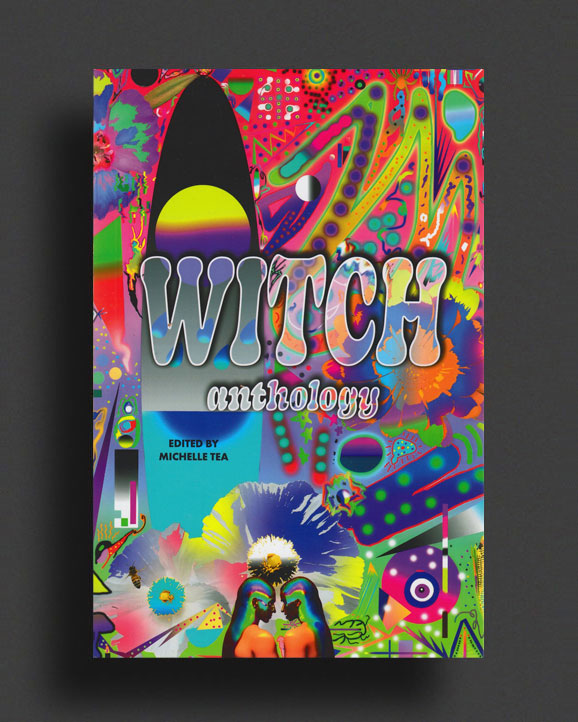
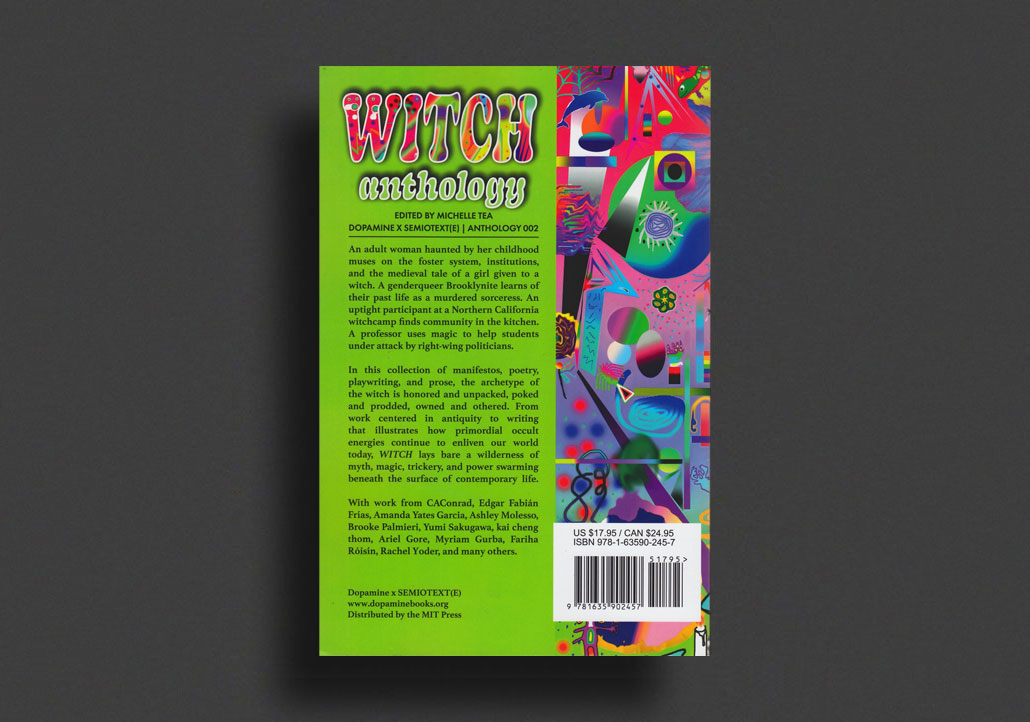
An exploration of the Witch, as radical archetype, in ancient and contemporary life. An adult woman haunted by her childhood muses on the foster system, institutions, and the medieval tale of a girl given to a witch. A genderqueer Brooklynite learns of their past life as a murdered sorceress. An uptight participant at a Northern California witch camp finds community in the kitchen. A professor uses magic to help students under attack by right-wing politicians. In this collection of manifesto, poetry, playscripts, and prose, the archetype of the Witch is honored and unpacked, poked and prodded, owned and othered. From work centered in antiquity to writing which illustrates how primordial occult energies continue to enliven our world today, WITCH: Anthology lays bare a wilderness of myth, magic, trickery, and power swarming beneath the surface of contemporary life.
With work from CAConrad, Edgar Fabián Frías, Amanda Yates Garcia, Ashley Ray, Brooke Palmieri, Yumi Sakugawa, Kai Cheng Thom, Ariel Gore, Myriam Gurba, Fariha Róisín, and many others.
2025, English
Hardcover, 100 pages, 21 x 14.5 cm
Published by
Amphetamine Sulphate / Austin
$52.00 - In stock -
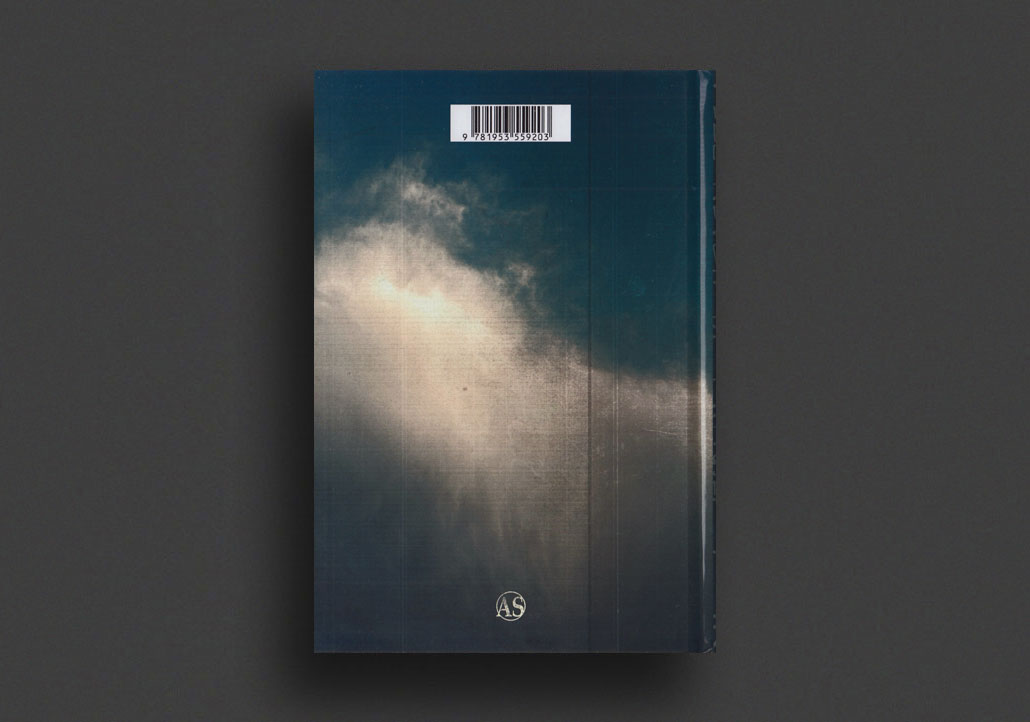
WHAT I SEE IS BEAUTIFUL, BUT I DON'T THINK IT'S ENOUGH
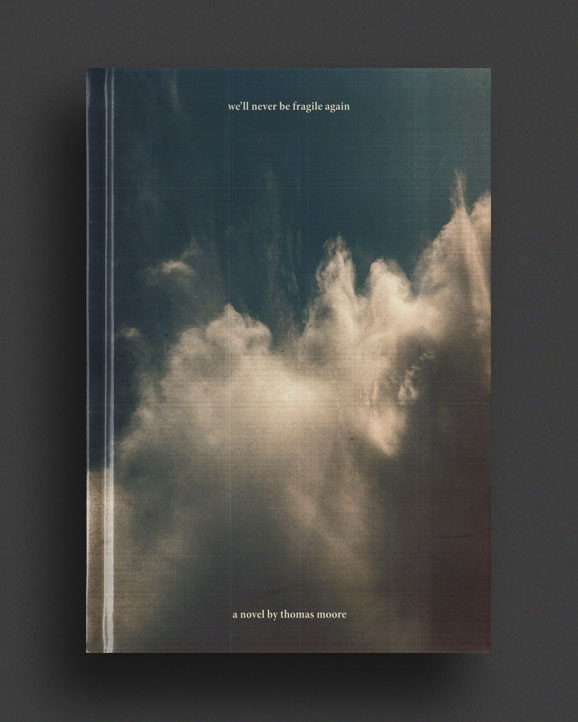
"I’m beyond thrilled to announce that my brand new novel, WE’LL NEVER BE FRAGILE AGAIN, is ready and waiting to enter the world. It’s my sixth novel, and a book that I’m really proud of. I feel it’s the best writing I’ve done so far and I’m excited to share it with you very soon.
"And again, I’m honoured that the incredible Michael Salerno has given me his miraculous skills and created such gorgeous, beautiful artwork for the book.
"It’s a strange, painful book about memory, regrets, art, friendship, desire and death."—Thomas Moore
Original cover photography and design throughout by Michael Salerno.
2025, English
Hardcover, 160 pages, 13 x 13 cm
Published by
kiddiepunk / Paris
$60.00 - In stock -
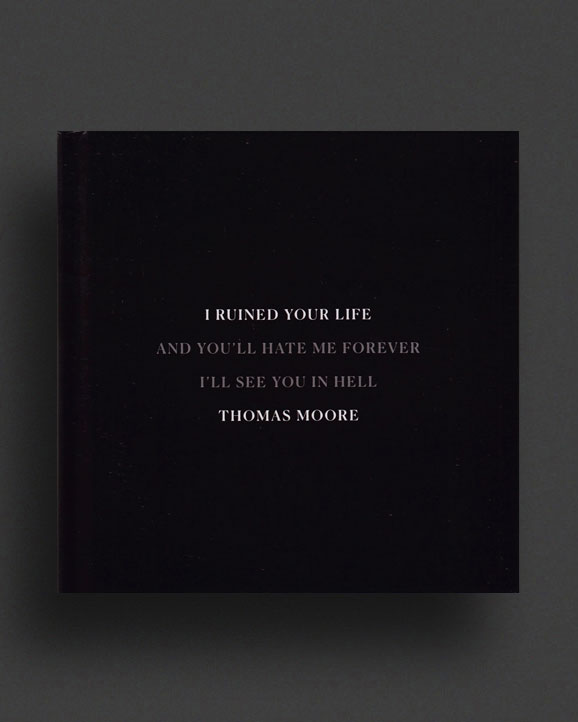
A series of haunted and tragic events are pieced back together in Thomas Moore’s first book of poems in 7 years. Told in shattered, three-lined verses, "I RUINED YOUR LIFE" explores guilt, mourning, regret and blame with a searingly precise economy of language.
2021, English
Softcover, 122 pages, 21.5 x 13.5 cm
Published by
Amphetamine Sulphate / Austin
$46.00 - Out of stock
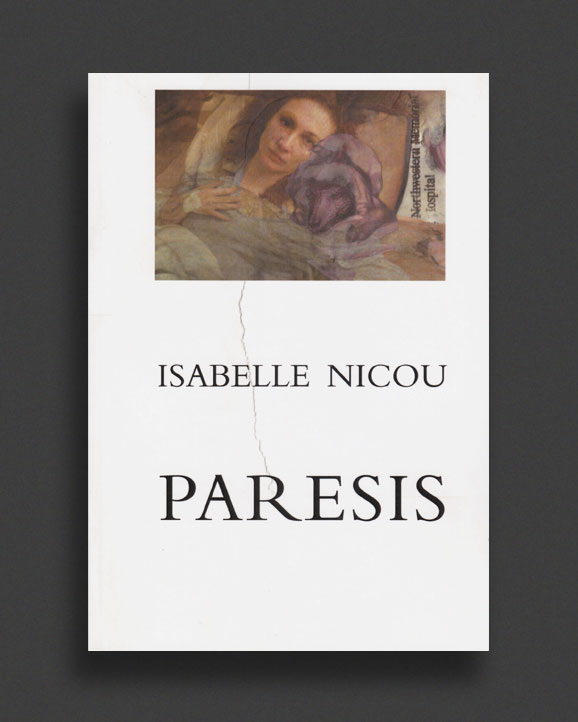
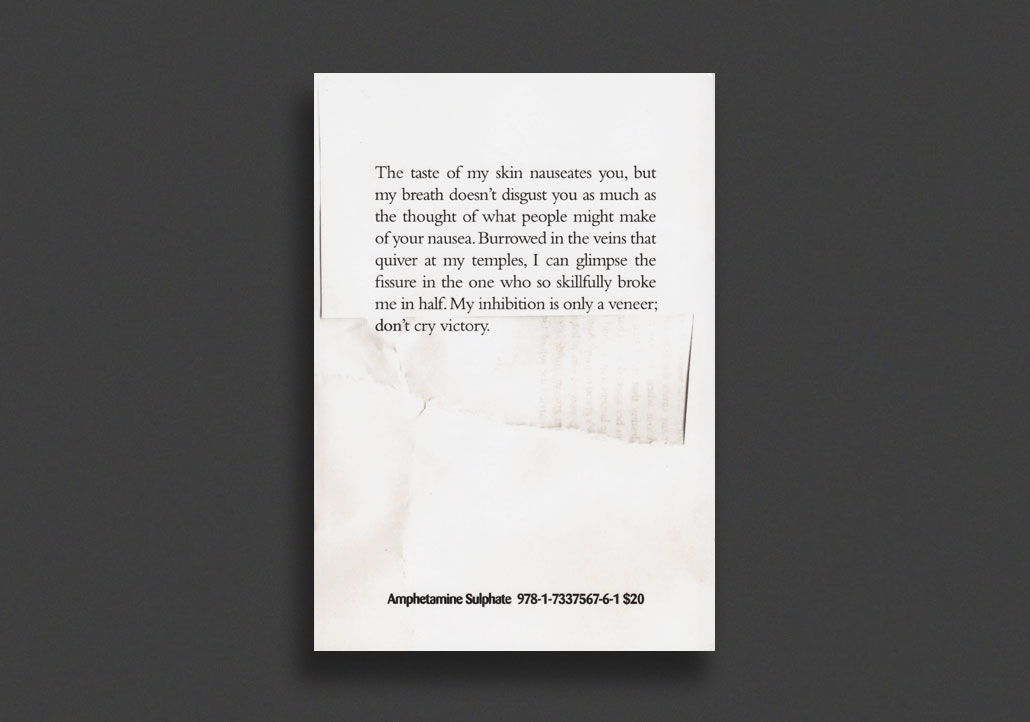
The paresis conquered my entire right side in a procession of patient and orderly ants. Pins and needles pulsating across my cheek, my leg, my arm, followed by a disturbing heat that flooded them intermittently; then the anesthesia took everything away. There was no pain. I let myself be occupied by your absence; I waited without trying to understand. Almost without moving.
A few days after the first rush of desire – my mouth on your lips, seeking your tongue – after those words that lodged themselves in the pit of my being and yet held no meaning for me, when all I wanted was for your body to never leave me in peace, came the waiting, the endless putting off of things. What was so repugnant about me that your hand wouldn’t venture to touch my breasts, to reach under my sweater or stroke my stomach? That you wouldn’t make the slightest attempt to undress me or lead me to your place?
What was electric in our joining turned aseptic, doctored, calculated as our depravity played itself out. And if you bit the back of my neck, it was with such effort that I wondered if you hadn’t sensed, nearby, a sudden decompensation: a collapsing building, an accident, a scream...
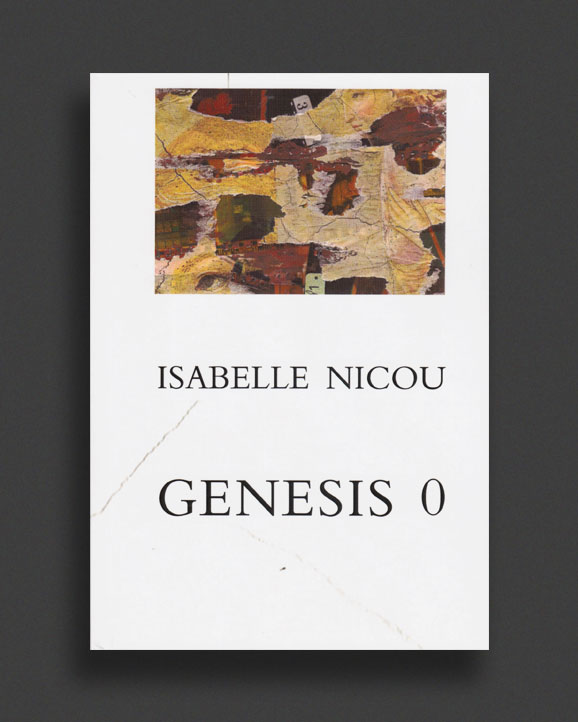
Isabelle Nicou is a French writer (b.1969)
Studying philosophy at Université Paris 1 Panthéon-Sorbonne, Isabelle began researching phenomenology and the works of Martin Heidegger and Jacques Derrida, eventually working with Derrida for some years during her studies. She published her first novel, Paresis, in 2002 and her second, Genesis 0, in 2007. In 2015, Isabelle played the role of Nora in the movie Love by Gaspar Noé, selected for the Cannes Film Festival the same year. She is currently finishing her third book, Stricture.
2021, English
Softcover, 108 pages, 21.5 x 13.5 cm
Published by
Amphetamine Sulphate / Austin
$46.00 - Out of stock
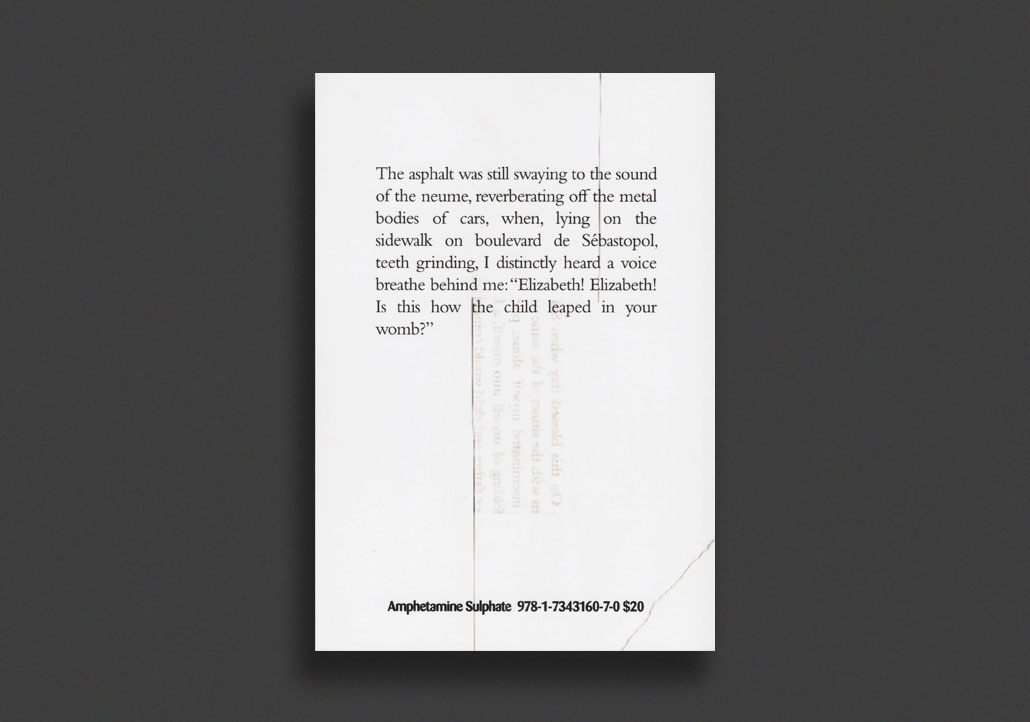
“As soon as my eyes close, I’m besieged by waves of blood. A piece of flesh floats in with the tide. No panic, only silence and then the sound of the bloody debris when it comes crashing into my wall. I’m a rampart. An enclosure. A stronghold. Very strong, and I’m afraid of nothing. Certainly not of blood, of its stench of warm entrails and iron dust.
Tomorrow I’ll gain what life will lose: defeat of my body – of the teeming power of the body – that will disgorge its excess of blood and return me to myself, alone, cut off from all lineage and with no line of descent. Being done with this tension in my breasts. Done with the stigmata of your existence and all those that pass through me in the place where you cling. Done with being possessed like this, double-stitched, overlocked, woven into a web that covers me like a shroud. Tomorrow, it’s the women in my family, their tide of hemoglobin A, that I’ll abort. Once the pills are absorbed, I would wait to be delivered. Alone. Free of all lineage and with no line of descent. Eternal. The genesis and the lack. The apocalypse and its angel. Now and forever. The point zero. O.”
Isabelle Nicou is a French writer (b.1969)
Studying philosophy at Université Paris 1 Panthéon-Sorbonne, Isabelle began researching phenomenology and the works of Martin Heidegger and Jacques Derrida, eventually working with Derrida for some years during her studies. She published her first novel, Paresis, in 2002 and her second, Genesis 0, in 2007. In 2015, Isabelle played the role of Nora in the movie Love by Gaspar Noé, selected for the Cannes Film Festival the same year. She is currently finishing her third book, Stricture.