World Food Books' programme is largely produced on Kulin Nation land. We acknowledge the Wurundjeri people of the Kulin Nation as the first and continuing custodians of this land, and pay respect to their Elders past, present, and emerging.
World Food Books is an arts and special interests bookshop in Naarm / Melbourne. Founded in 2010, World Food Books is devoted to the presentation of a rotating, hand-selection of international art, design, literary and counterculture publications with an emphasis on the anti-traditional, the experimental, the avant-garde, the heretic, the marginal.
Presenting new titles alongside rare and out-of-print books, catalogues and journals spanning the fields of modern and contemporary art, design, photography, illustration, film, literature, poetry, cultural theory, philosophy, sexuality, popular and underground culture in its many radical forms, World Food Books wishes to encourage adventurous, thoughtful and open-minded reading, looking, writing, and exchange of publishing and ideas, both current and historical.
As well as our bookshop, located in Melbourne's historical Nicholas Building, all of our inventory is available internationally via our online mail-order service.
World Food Books semi-regularly co-ordinates "Occasions", a programme of exhibits and events at the bookshop and in partnership with other hosts (such as museums and art galleries) that develop out of the activities, relationships and content of the bookshop itself.
World Food Books
The Nicholas Building
37 Swanston Street
Room 5, Level 6
Melbourne 3000
Australia
SHOP HOURS:
THU–SAT 12–6
WEB-SHOP OPEN 24/7
World Food Books
Postal Address:
PO Box 435
Flinders Lane
Victoria 8009
Australia
info@worldfoodbooks.com
Art
Theory / Essay
Architecture / Interior
Graphic Design / Typography
Photography
Fashion
Eros
LGBTQ+
Fiction / Poetry
Weird / Speculative / Science Fiction / Horror
Transgressive / Visceral / Abject
Symbolism / Decadence / Fin de siècle
Film / Video
Painting
Sculpture / Installation
Performance / Dance / Theater
Drawing
Sound / Music
Curatorial
Group Shows / Collections
Periodicals
Out-of-print / Rare
Posters / Ephemera / Discs
Signed Books
World Food Books Gift Voucher
World Food Book Bag
Australian Art
Australian Fiction
Australian Science Fiction / Speculative Fiction
Australian Poetry
Australian Photography
Japanese Photography
Conceptual Art
Minimal Art
Dada
'Pataphysics / Oulipo
Fluxus
Concrete Poetry
Pop Art
Surrealism
Arte Povera
Arte Informale / Haute Pâte / Tachism
Nouveau Réalisme / Zero / Kinetic
Situationism / Lettrism
Collage / Mail Art / Xerox Art
Art Brut / Folk / Visionary / Fantastic
Illustration / Graphic Art / Bandes Dessinées
Furniture
Italian Radical Design / Postmodernism
Textiles
Ceramics / Glass
Counterculture
Protest / Revolt
Philosophy
Psychoanalysis
Anthropology
Anarchism
Socialism / Anarchism / Communism / Capitalism
Literary Theory / Semiotics / Language
Feminism / Women's Studies
Gender Studies / Sexuality
Anthropology
Fetishism / BDSM
Drugs / Psychedelia
Crime / Violence
Animal Rights / Veganism
Occult / Esoterica
Ecology / Earth / Alternative Living
Whole Earth / Crafts
All prices in AUD (Australian dollars)
Pick-Ups
Pick-up orders can be collected in our bookshop during opening hours after order date. Please collect any Pick-up orders within 2 weeks of ordering as we have limited storage space. Orders will be released back into stock if not collected within this time. No refunds can be made for pick-ups left un-collected. If you cannot make it in to the bookshop in this time-frame, please choose postage option.
Return Policy
All sales are final. We do accept returns (for refund or exchange) for items received in error. All our orders are packed with special care using heavy-duty padding and cardboard book-mailers or bubble mailers (for smaller books), using reinforcement where required. We cannot take responsibility for any lost, stolen or damaged parcels.
Insurance
Should you wish to insure your package, please email us directly after placing your order and we can organise this at a small extra expense. Although all standard/express tracked packages are very safe and dependable, we cannot take responsibility for any lost, stolen or damaged parcels. We recommend insurance on valuable orders.
Interested in selling your old books, catalogues, journals, magazines, comics, fanzines, ephemera? We are always looking for interesting, unusual and out-of-print books to buy. We only buy books in our fields of interest and specialty, and that we feel we can resell.
We base these prices on desirability, market value, in-print prices, condition and our current stock levels. We offer cash, store credit, and can take stock on consignment. All
about 25% of the price we expect to get when we sell them, or 30% in store credit. We base these prices on desirability, market value, in-print prices, condition and our current stock levels.
Sell your books any day of the week. You can drop them off and return later. If you have a lot of books, we can visit your Sydney home.
We buy books that we feel we can resell. We offer about 25 % of the price we expect to get when we sell them, or 30% in store credit. We base these prices on desirability, market value, in-print prices, condition and our current stock levels.
Philadelphia Wireman
03 August - 01 September, 2018
World Food Books is proud to announce our next Occasion, the first presentation of sculptures by Philadelphia Wireman in Australia.
The Philadelphia Wireman sculptures were found abandoned in an alley off Philadelphia’s South Street on trash night in 1982. Their discovery in a rapidly-changing neighbourhood undergoing extensive renovation, compounded with the failure of all attempts to locate the artist, suggests that the works may have been discarded after the maker’s death. Dubbed the "Philadelphia Wireman" during the first exhibition of this work, in 1985, the maker’s name, age, ethnicity, and even gender remain uncertain. The entire collection totals approximately 1200 pieces, all intricately bound together with tightly-wound heavy-gauge wire (along with a few small, abstract marker drawings, reminiscent both of Mark Tobey and J.B. Murry). The dense construction of the work, despite a modest range of scale and materials, is singularly obsessive and disciplined in design: a wire armature or exoskeleton firmly binds a bricolage of found objects including plastic, glass, food packaging, umbrella parts, tape, rubber, batteries, pens, leather, reflectors, nuts and bolts, nails, foil, coins, toys, watches, eyeglasses, tools, and jewellery.
Heavy with associations—anthropomorphic, zoomorphic, and socio-cultural responses to wrapped detritus—the totemic sculptures by Philadelphia Wireman have been discussed in the context of work created to fulfil the shamanistic needs of alternative religions in American culture. Curators, collectors, and critics have variously compared certain pieces to sculpture from Classical antiquity, Native American medicine bundles, African-American memory jugs, and African fetish objects. Reflecting the artist’s prolific and incredibly focused scavenging impulse, and despite—or perhaps enhanced by—their anonymity, these enigmatic objects function as urban artefacts and arbiters of power, though their origin and purpose is unknown. Philadelphia Wireman, whatever their identity, possessed an astonishing ability to isolate and communicate the concepts of power and energy through the selection and transformation of ordinary materials. Over the course of the past two decades, this collection has come to be regarded as an important discovery in the field of self-taught art and vernacular art.
Presented in collaboration with Fleisher-Ollman Gallery, Philadelphia, and Robert Heald, Wellington.
Susan Te Kahurangi King
02 February - 10 March, 2018
Susan Te Kahurangi King (24 February 1951 - ) has been a confident and prolific artist since she was a young child, drawing with readily available materials - pencils, ballpoint pens and felt-tip markers, on whatever paper is at hand. Between the ages of four and six Susan slowly ceased verbal communication. Her grandparents William and Myrtle Murphy had developed a special bond with Susan so they took on caring responsibilities for extended periods. Myrtle began informally archiving her work, carefully collecting and storing the drawings and compiling scrapbooks. No drawing was insignificant; every scrap of paper was kept. The King family are now the custodians of a vast collection containing over 7000 individual works, from tiny scraps of paper through to 5 meter long rolls.
The scrapbooks and diaries reveal Myrtle to be a woman of great patience and compassion, seeking to understand a child who was not always behaving as expected. She encouraged Susan to be observant, to explore her environment and absorb all the sights and sounds. Myrtle would show Susan’s drawings to friends and people in her community that she had dealings with, such as shopkeepers and postal workers, but this was not simply a case of a grandmother’s bias. She recognised that Susan had developed a sophisticated and unique visual language and sincerely believed that her art deserved serious attention.
This was an unorthodox attitude for the time. To provide some context, Jean Dubuffet coined the term Art Brut in 1945 to describe work created by self-taught artists – specifically residents of psychiatric institutions and those he considered to be visionaries or eccentrics. In 1972 Roger Cardinal extended this concept by adopting the term Outsider Art to describe work made by non-academically trained artists operating outside of mainstream art networks through choice or circumstance. Susan was born in Te Aroha, New Zealand in 1951, far from the artistic hubs of Paris and London that Dubuffet and Cardinal operated in. That Myrtle fêted Susan as a self-taught artist who deserved to be taken seriously shows how progressive her attitudes were.
Susan’s parents Doug and Dawn were also progressive. Over the years they had consulted numerous health practitioners about Susan’s condition, as the medical establishment could not provide an explanation as to why she had lapsed into silence. Dawn educated herself in the field of homeopathy and went on to treat all twelve of her children using these principles – basing prescriptions on her observations of their physical, mental and emotional state.
Doug was a linguist with an interest in philosophy who devoted what little spare time he had to studying Maori language and culture. To some extent their willingness to explore the fringes of the mainstream made them outsiders too but it was their commitment to living with integrity and their respect for individuality that ensured Susan’s creativity was always encouraged.
Even though Susan’s family supported her artistic pursuits, some staff in schools and hospitals saw it as an impediment to her assimilation into the community and discouraged it in a variety of ways. Her family was not always aware of this and therefore did not fully understand why Susan stopped drawing in the early 1990s. However, rather than dwell on the challenges that Susan faced in pursuit of her artistic practice, they prefer to highlight her achievements. In 2008 Susan began drawing again in earnest, after an almost 20 year interruption, and her work is now shown in galleries around the world.
Susan grew up without television and has been heavily influenced by the comics she read as a child. She is absolutely fearless in the appropriation of recognizable characters, such as Donald Duck and Mickey Mouse, in her work. She twists their limbs, contorts their faces, compresses them together, blends them into complex patterned backgrounds - always imbuing them with an incredible energy. Although Susan often used pop culture characters in her work they are not naive or childlike. These are drawings by a brilliant self-taught artist who has been creating exceptional work for decades without an audience in mind.
Mladen Stilinović
"Various Works 1986 - 1999"
02 February 16 - September 10, 2016
Various works 1986 - 1999, from two houses, from the collections of John Nixon, Sue Cramer, Kerrie Poliness, Peter Haffenden and Phoebe Haffenden.
Including: Geometry of Cakes (various shelves), 1993; Poor People’s Law (black and white plate), 1993; White Absence (glasses, ruler, set square, silver spoon, silver ladel with skin photograph and wooden cubes), 1990-1996; Exploitation of the Dead (grey and red star painting, wooden painting, black spoon with red table, red plate), 1984-1990; Money and Zeros (zero tie, paintings made for friends in Australia (Sue, John, Kerrie), numbers painting), 1991-1992; Words - Slogans (various t-shirts) - “they talk about the death of art...help! someone is trying to kill me”, “my sweet little lamb”, “work is a disease - Karl Marx”; Various artist books, catalogues, monographs, videos; Poster from exhibition Insulting Anarchy; "Circular" Croatian - Australian edition; Artist book by Vlado Martek (Dostoyevsky); more.
Thanks to Mladen Stilinović and Branka Stipančić.
Jonathan Walker
Always Will Need To Wear Winter Shirt Blue + Ochre Small Check Pattern
21 August - 21 September, 2015
Untitled
I am not a great reader of poetry but I always return to the work of Melbourne poet, Vincent Buckley (1925- 1988). Perhaps I find his most tantalising piece to be not a finished poem but a fragment left on a scrap of paper discovered on his desk after the poet’s death.
The poetry gathers like oil
In the word-core, and spreads
It has its music meet,
Its music is in movement.
This fragment is more the shell left behind from a volatile thought than a finished poem. I find the last two lines honest but awkward whereas the first two lines work like an arrow. Most likely he could not find a resolution so it was left. Still, in its present form, it remains an eloquent testimony to the ultimate failure of a medium to express mobile thought and sensation, in Buckley’s case, through verbal language. It’s an important matter because this is something all artists have to deal with regardless of the medium.
I have never written a poem, however, I am forever copying fragments from books on paper scraps in a vain effort to fix certain notions in my head. At first, they function as bookmarks that are sometimes returned to when I open the book. But before long, as they accumulate, they fall out littering the table interspersed with A4 photocopies, bills, books and medications.
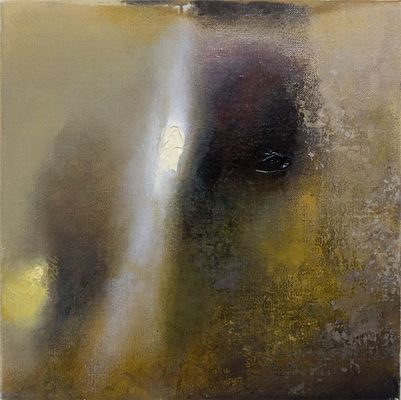
To return to Buckley’s fragment, the first two lines very much evoke how I paint nowadays. As you age, detail diminishes and patches of light become more luminous and float. I feel the most honest way of dealing with this is by smearing the oil paint on the canvas with the fingers and working close-up, blind. Only if the patches coalesce into an approaching image can the work gain a life.
-
Jonathan Walker was born in Melbourne, Australia and brought up on a dairy farm in Gippsland. In the 1970’s he studied painting at RMIT and won the Harold Wright Scholarship to the British Museum, London. During the 1980’s he exhibited at Pinacotheca Gallery, Richmond and had work shown at the NGV and Heidi City Art Gallery. Over the same period he designed the cover for the “Epigenesi” LP by Giancarlo Toniutti, Italy and conducted a mail exchange work with Achim Wollscheid, Germany. The work with artists through the post resulted in an article published in the bicentenary issue of Art and Australia 1988. He showed in artist run spaces such as WestSpace in the 90’s and 2000’s, and until 2012, taught painting at Victoria University, which is where we (Colleen Ahern and Lisa Radford) as organisers of the exhibition, among many others, had the privilege of being his student.
Walker’s knowledge was imparted to students through the careful selection of music, literature, and artists found in books that he himself had ordered for the library. Walker’s strategy was the generosity of sharing his vast knowledge with references specific to each student and their context.
Walker’s paintings share a similar focus and intimacy.
This exhibition presents a small selection of recent paintings alongside a publication that includes Walker’s writing. Observational and analytical, Walker’s work is a type of material notation — the time of day, colour and how it is blended, the both specific and fleeting location of a reflection on lino or the question of whether a chair leg should be included in a painting.
Please join us on Friday August 21 between 6-8pm to celebrate the opening of the exhibition.
Curated by Colleen Ahern and Lisa Radford.
B. Wurtz
Curated by Nic Tammens
March 26 - April 4, 2015
B.Wurtz works from a basement studio in his home on Manhattan’s Lower East Side.
This local fact is attested to by the plastic shopping bags and newsprint circulars that appear in his work. As formal objects, they don’t make loud claims about their origins but nonetheless transmit street addresses and places of business from the bottom of this long thin island. Like plenty of artists, Wurtz is affected by what is local and what is consumed. His work is underpinned by this ethic. It often speaks from a neighborhood or reads like the contents of a hamper:
“BLACK PLUMS $1.29 lb.”
“Food Bazaar”
“USDA Whole Pork Shoulder Picnic 99c lb.”
“RITE AID Pharmacy, with us it’s personal.”
“H. Brickman & Sons.”
“Sweet Yams 59c lb."
Most of the work in this exhibition was made while the artist was in residence at Dieu Donne, a workshop dedicated to paper craft in Midtown. Here Wurtz fabricated assemblages with paper and objects that are relatively lightweight, with the intention that they would be easily transportable to Australia. This consideration isn’t absolute in Wurtz’s work, but was prescriptive for making the current exhibition light and cheap. Packed in two boxes, these works were sent from a USPS post office on the Lower East Side and delivered to North Melbourne by Australia Post.
Wurtz appears courtesy of Metro Pictures, New York.
Thanks to Rob Halverson, Joshua Petherick, Sari de Mallory, Matt Hinkley, Helen Johnson, Fayen d'Evie, Ask Kilmartin, Lisa Radon, Ellena Savage, Yale Union, and "Elizabeth".
John Nixon
"Archive"
December 15 - January 20, 2014
The presentation of John Nixon's archive offered a rare showcase of this extensive collection of the artist's own publications, catalogues, posters, ephemera, editions and more, from the mid 1980s onwards, alongside a selection of his artworks.
Organized by John Nixon, Joshua Petherick and Matt Hinkley.
"Habitat"
at Minerva, Sydney (organised by Joshua Petherick and Matt Hinkley)
November 15 - December 20, 2014
Lupo Borgonovo, Janet Burchill & Jennifer McCamley,
Lewis Fidock, HR Giger, Piero Gilardi, Veit Laurent Kurz,
Cinzia Ruggeri, Michael E. Smith, Lucie Stahl, Daniel Weil, Wols
Press Release:
“...It contained seven objects. The slender fluted bone, surely formed for flight, surely from the wing of some large bird. Three archaic circuitboards, faced with mazes of gold. A smooth white sphere of baked clay. An age-blackened fragment of lace. A fingerlength segment of what she assumed was bone from a human wrist, grayish white, inset smoothly with the silicon shaft of a small instrument that must once have ridden flush with the surface of the skin - but the thing’s face was seared and blackened.”
William Gibson, “Count Zero”, 1986
"Autumn Projects Archive"
Curated by Liza Vasiliou
March 6 - March 15, 2014
World Food Books, in conjunction with the Virgin Australia Melbourne Fashion Festival 2014, presented the Autumn Projects archive, consisting of a selection of early examples in Australian fashion with a particular interest in collecting designers and labels from the period beginning in the 1980’s, who significantly influenced the discourse of Australian Fashion.
Curated by Liza Vasiliou, the exhibition provided a unique opportunity to view pieces by designers Anthea Crawford, Barbara Vandenberg, Geoff Liddell and labels CR Australia, Covers, Jag along with early experimental collage pieces by Prue Acton and Sally Browne’s ‘Fragments’ collection, suspended throughout the functioning World Food Books shop in Melbourne.
H.B. Peace
presented by CENTRE FOR STYLE
November 14, 2013
"Hey Blinky, you say chic, I say same"
Anon 2013
H.B. Peace is a clothing collaboration between great friends Blake Barns and Hugh Egan Westland. Their pieces explore the divergences between 'character’ and ‘personality’ in garments....etc
Special Thanks to Joshua Petherick and Matt Hinkley of WFB and Gillian Mears
and a Very Special Thank you to Audrey Thomas Hayes for her shoe collaboration.
Janet Burchill & Jennifer McCamley
"Aesthetic Suicide"
May 10 - June 8, 2013
The first of our occasional exhibitions in the World Food Books office/shop space in Melbourne, "Aesthetic Suicide" presented a body of new and older works together by artists Janet Burchill & Jennifer McCamley, including videos, prints, a wall work, and publications.
During shop open hours videos played every hour, on the hour.
1979, English
Softcover, 366 pages, 30 x 24 cm
1st Edition, Out of print title / used / very good
Published by
Frauenliteratur Verlag Hermine Fees / Germany
$500.00 - In stock -
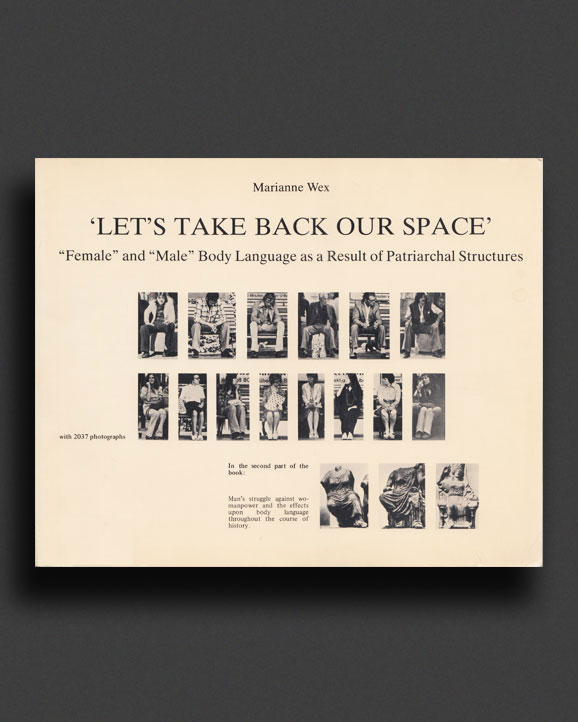
Very rare first 1979 English edition of one the finest artist's books and photographic projects of the 1970's, Let's Take Back Our Space (“Female” and “Male” Body Language as a Result of Patriarchal Structures / with 2037 photographs / In the second part of the book: Man's stuggle against womanpower and the effects upon body language throughout the course of history.)
The German artist Marianne Wex started out as a painter before producing her encyclopaedic photographic project "Let’s Take Back Our Space", one of the great unsung works of 1970s feminist history and cultural analysis. Marianne Wex bases her work on the assumption that body language is a result of sex-based, patriarchal socialization, affecting all of our other "feminine" and "masculine" role behavior. Born in Hamburg in 1937, Wex studied at the city’s University of Fine Arts, where she later taught for seventeen years. In 1979, she published Let’s Take Back Our Space as a book in both a German and English edition, to accompany an exhibition in the Neue Gesellschaft fair Bildende Kiinste in Berlin, in connection with the show Women Artists International, 1877 to 1977. It is an in-depth visual survey comprised of 5,000 to 6,000 photographs of body postures, taken between 1974 and 1977, assembled into dozens of thematic grids: Seated persons—leg and feet; arm and hand positions; standing persons—leg and feet; arm and hand positions; people sitting and laying on the ground; arm and leg positions; and so on. The images were culled from a huge range of sources—re-photographed advertisements, reportage, fashion magazines, pornography, studio portraits, the history of art—and many were taken on the streets of Hamburg by Wex, who proposes that our smallest, most unconscious gestures speak volumes about the power relations of gender in daily life. The work was expanded to include an extensive historical section for the book, where Marianne Wex investigates the body language shown in sculptures of the last 3,000 to 4,000 years, and comes to the conclusion that the ideals of body language and body forms have never been so different between the sexes as they are today.
Very Good copy. General light wear/ageing, tanning to cover, but a most lovely copy of the rare first edition from 1979. A more common reprint edition was published in 1984.
1974, English / Italian
Softcover, 40 pages, 20.5 x 15.5 cm
1st Edition, Out of print title / used / good
Published by
Rivolta Femminile / Rome
$380.00 - In stock -
First, extremely rare edition of Suzanne Santoro's artist's book "Per una espressione nuova / Towards a New Expression", published in a small run in Rome 1974 by Santaro and The Rivolta Femminile ("Women's Revolt") publishing house, founded in 1970 by Carla Lonzi. In the 1960s, Suzanne Santoro (b. 1946, Brooklyn New York), after training at the School of Visual Arts in New York and NYU and being affiliated with the minimalist and conceptual New York context of the 1960s, moved to Rome where she studied classical sculpture. Here her artistic path crossed with the experience of feminist militancy, through her connection to Rivolta Femminile and Carla Lonzi and co-founded the Beato Angelico Cooperative (CBA) and exhibition space. Her research immediately focused on restoring those characteristics of the female image that had been intentionally hidden or transformed by the patriarchal tradition of visual arts, culminating in this artist’s libretto. Mysterious, beautiful and fiercely feminist, Towards a New Expression articulates, through a photographic collection of images, a critical stance towards the "subordinate and unclarified" portrayal of women's genitalia in art from classical to contemporary times. Santoro's book generated some controversy when it was censored by The Institute of Contemporary Arts in London.
Very rare, especially in this first edition. Good copy, only with notable but attractive ex-libris "Moon Books" rubber stamp mark on back cover and another to the front end page. The title is written on the blank spine for filing into the collection. It is believed this was from a community library in Berkley. General light corner and edge wear/marking.
2025, English / Italian
Softcover, 304 pages, 21.5 x 15.3 cm
Published by
Crackers / Milan
$68.00 - In stock -
The book Superior and Inferior features a facsimile copy of pivotal and extremely rare publication by the Italian abstract artist Carla Accardi (1924–2014) titled Superiore e Inferiore, plus the first ever translation of the work into English. Published in 1972, it brings together the recordings of a series of conversations between Accardi and her pupils – she was a teacher at a public middle school – all between 10 and 13, about society’s discriminatory behaviour towards women. They also commented the Manifesto of the revolutionary feminist group Rivolta Femminile, collectively written by art critic Carla Accardi, artist Carla Lonzi and Elvira Banotti, which first appeared posted on city walls in Rome in July 1970.
For having discussed sex-related issues with pupils, Accardi was fired and permanently suspended from teaching. (Her letter of dismissal issued by the Italian Ministry of Education forms part of the introduction to the book.) Along the lines of Pasolini’s Comizi d’Amore (Love Meetings), Accardi’s own voice is secondary in the book, giving way to the thoughts, narratives, opinions and debates expressed among girls from the middle school where she taught, on the role of women and girls, family conflicts and sentimental relations, as well as their reflections on Accardi’s Manifesto.
English / Italian
1978, Japanese
Softcover, 204 pages, 21 x 29.6 cm
1st Edition, Out of print title / used / very good
Published by
Hanashi-no-Tokushu / Tokyo
$650.00 - In stock -
Exceptionally rare (signed!) 1978 first edition photobook by Michiko Matsumoto, one of post war Japan's leading photographers. As a young female photographer growing up in a period of turmoil, Matsumoto conveys the wonders of women to the viewer from the perspective of a woman. Women Come Alive is her rarest and greatest example of this. This wonderful book collects "seven years with women...", Matsumoto's front-line photographic records of the women's liberation movement in Japan in the 1970s and her "Sisters Across Borders" (New York, Paris, Los Angeles, London...), as well as portraits of female artists, activists and friends Yoko Ono, Maki Asakawa, Eiko Ishioka, Michiko Gorman, Mamako Yoneyama, Teruko Yoshitake, Tokiko Kato, Harumi Yamaguchi, Chinatsu Nakayama and others. A true time-capsule, this book visits the workshops, bookshops, marches, women's centres, lesbian bars, exhibitions, editorial offices, dances and studios of a pivotal time of great change. An incredible book of feminist protest and celebration. Virtually an impossible book to find, even without a signature from the artist! Highly recommended!!
Very Good copy in very good dust jacket. Signed in black ink and dated 1978.6.7 on title page.
1977, Japanese
Softcover (staple-bound), 64 pages, 28 x 21 cm
1st Edition, Out of print title / used / good
Published by
Feminist / Tokyo
$65.00 - In stock -
The inaugural 1977 issue of "Feminist", a rare and important record of the women's liberation movement in Japan in the the 1970s and document of the cross-currents of international female theorists, artists, poets, authors, and activists in the women's movement. This first issue with cover story on Yoko Ono, shot by Michiko Matsumoto, one of post war Japan's leading photographers. Edited by Japanese critic, American literature researcher, and poet, Ikuko Atsumi (who also co-edited "Burning Hearts: Women Poets of Japan" with Kenneth Rexroth, The Seabury Press/New Directions, 1977), with Diane L. Simpson, and contributors including women's rights activist/journalist Yayori Matsui (noted for her work to raise awareness of sex slaves and sex tourism in post-war Asia), photographer Michiko Matsumoto, Japanese linguist Sachiko Ide, Japanese poet, literary critic, and scholar Muneko Mizuta, historian Masaaki Sugiyama, author/activist Yumiko Sakuma, with this issue covering the controversy surrounding the formation of the magazine, a feature with performer/educator Mitsuko Hase, modern mythology, masculinity, media, misogyny, the Feminine imagination, the media's disdain for Asians, The Blood Bowl Sutra / women and the Buddhist faith, a report from the frontlines of the American women's movement (w. photography by Michiko Matsumoto), visiting women's studies courses around the world (University of Southern California), book reviews, feminist news, and the cover feature with artist Yoko Ono, "Yoko Ono's Philosophy" and a conversation with editor Ikuko Atsumi by Mitsuko Hase (w. photography by Michiko Matsumoto).
Good—VG copy with age/wear to cover extremities, some foxing/staining.
1978, English
Softcover (staple-bound), 68 pages, 28 x 21 cm
1st Edition, Out of print title / used / good
Published by
Feminist / Tokyo
$45.00 - In stock -
Fourth 1978 (English-language) issue of "Feminist", a rare and important record of the women's liberation movement in Japan in the the 1970s and document of the cross-currents of international female theorists, artists, poets, authors, and activists in the women's movement. This special "East and West" issue addresses the different pathways that the women's movement must travel throughout Asia and in the western countries. "A source of information and forum for Japanese women, (Feminist) has had from its inception an international perspective." This first fully English-language edition opens the discourse around the Asian feminist movement to western readers, including many articles on the place of Japanese Women in society, and Feminist developments in Korea, Thailand, the Philippines, Burma (Myanmar), Indonesia, and Malaysia. With a cover feature/interview on legendary Japanese art director, costume designer, and graphic designer Eiko Ishioka (known for her production and costume designs for Grace Jones, Paul Schrader, Francis Ford Coppola, Björk, etc., shot by photographer Michiko Matsumoto, this issue, edited by Japanese critic, American literature researcher, and poet, Ikuko Atsumi (who also co-edited "Burning Hearts: Women Poets of Japan" with Kenneth Rexroth, The Seabury Press/New Directions, 1977), with Diane L. Simpson, features contributions from Australian filmmaker Solrun Hoaas, women's rights activist/journalist Yayori Matsui (noted for her work to raise awareness of sex slaves and sex tourism in post-war Asia), photographer Michiko Matsumoto, Japanese linguist Sachiko Ide, author Utsumi Aiko, poet Morgan Gibson, acclaimed Japanese-English translator and historian of the women's movement in Japan Nancy Andrew, critic Chizuko Ikegami, and many others.
"Images of women that arise from sexist ideologies are everywhere tied to an individual cultural milieu. In the Western tradition, woman is simultaneously virgin and seductress, both adored and condemned by men. In the Japanese tradition, she is the man's mother goddess, who nurtures and protects. Under the Confucian ethic in Korea she is defined only in relation to her father, husband and son and in Indonesia she is constrained by the Islamic view that sees her mainly as the bearer of the next generation. Whatever their form, such androcentric views deny women both autonomy and dignity while providing a rationale for social and economic subjugation.
In working to transform these distorted images and ideals, the women's movement in different countries will likely not take the same path. In Japan the enormous influence exerted by the media in promoting the traditional image of women requires that feminists direct considerable effort toward creating a social climate in which the independent women can be viewed positively. At the same time they want to correct the misinterpretations about themselves that pervade Japanese literature, films, and art. While women in the West now seek to create a women's culture, Japanese women seek to revive the women's culture that has always been an important, if sometimes un-recognized, source of their civilization."
Good—VG copy with age/wear to cover extremities, some foxing/staining.
2010, English
Softcover, 128 pages, 30.5 x 22.5 cm
1st Edition, Out of print title / used / very good
Published by
Richardson / New York
$220.00 - In stock -
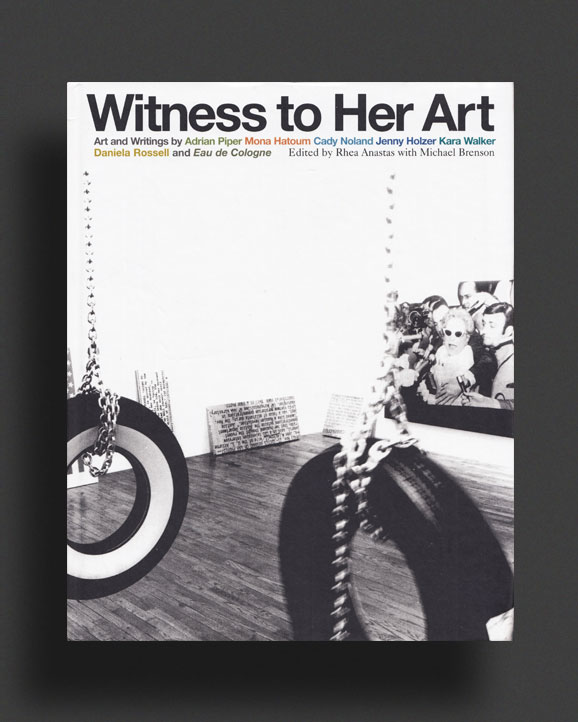
Incredible fourth issue ("The Female Gaze Issue") of Richardson magazine, the cult magazine that navigates the murky boundaries between art and obscenity, edited by Andrew Richardson (of Richardson label, fashion stylist w. Supreme, CK, Valentino, etc.) and art direction by Laura Genninger of STUDIO 191 (designer of AnOther Magazine, etc.). This fourth issue (The Female Gaze Issue) features the Sasha Grey cover photographed by Glen Luchford (w. continued photo feature inside), and featuring work by Carolee Schneemann, Valie Export, Genesis P-Orridge, GB Jones, Alex Needham, Amy Kellner, Kira Jolliffe, Bunny Yeager, Tristan Taormino, Michelle Maccarone, Mila Djordjevic, Gunter Rambow, V. Vale/ Re/Search, Simon Ford, Clara Herve & Eugene Krafft, Carol Bove, Sue Williams, Tracy Emin, Carolin Kunst & Sunje Todt, Kotaro Iizawa, and much more. Riddled with bans and confiscations due to explicit un-censored imagery by Japanese censorship standards.
Very Good copy.
2025, English
Softcover, 220 pages, 32 x 24.5 cm
Published by
Hatje Cantz / Berlin
$85.00 - In stock -
Edited by Vanessa Joan Müller, Bettina Steinbrügge.
Text by Lisa E. Bloom, Andrea Bowers, Haden Guest, Ingrid Luquet-Gad, Jason McBride, Christiane Meyer-Stoll, Olaf Nicolai, Letizia Ragaglia, Alexandro Segade, Bettina Steinbrügge.
Previously unpublished ephemera, poems and photographs accompany this sharp retrospective volume of Antin's 50 years of conceptual, feminist art, the most comprehensive publication on the artist to date, published to accompany the first survey on the artist in more than two decades.
For more than 50 years, Eleanor Antin (born 1935) has been a distinctive voice in postmodernism, traversing conceptual art and feminist movements. Her projects, often photographic series or performances, scrutinize the historic and contemporary roles of women, darkened by consumerist commentary on the ideal feminine. Crash dieting, Schick razors, mascara and pill bottles all play starring roles in her most famous works. This most comprehensive monograph to date accompanies Antin's first retrospective in 25 years and her first ever in Europe. Each commissioned text dives into a different facet of her work: her life in New York and San Diego; her Jewish identity; her feminist activism; her unfailing humor; her performances and films; and the impact of her art on younger generations of artists. It also features a complete exhibition history, a comprehensive list of works and a timeline of her life.
Eleanor Antin is a key figure emerging from the Conceptual art movements of the 1970s. Today as an octogenarian artist, she remains one of the world's leading Feminist artists. Her ground-breaking practice spans five decades and has covered themes surrounding identity, gender, autobiography, class and social structures. Antin's multi-disciplinary approach includes installation, painting, drawing, writing and most notably photography and performance. Over the last 50 years Antin has performed and exhibited her work internationally.
1997, English
Softcover, 276 pages, 17.7 x 11.2 cm
1st Edition, Out of print title / used / very good
Published by
Semiotext(e) / Los Angeles
$120.00 - In stock -
Rare first 1997 edition of Chris Kraus' modern cult classic I Love Dick, published by Semiotext(e) in their Native Agents book series. Blurring the lines of fiction, essay and memoir, Chris Kraus's novel was a literary sensation when it was first published in 1997.
"Oh Dick, I want to be an intellectual like you."
In I Love Dick, published in 1997, Chris Kraus, author of Aliens & Anorexia, Torpor, and Video Green, boldly tore away the veil that separates fiction from reality and privacy from self-expression. It’s no wonder that I Love Dick instantly elicited violent controversies and attracted a host of passionate admirers.
The story is gripping enough: in 1994 a married, failed independent filmmaker, turning forty, falls in love with a well-known theorist and endeavors to seduce him with the help of her husband. But when the theorist refuses to answer her letters, the husband and wife continue the correspondence for each other instead, imagining the fling the wife wishes to have with Dick. What follows is a breathless pursuit that takes the woman across America and away from her husband—and far beyond her original infatuation into a discovery of the transformative power of first person narrative.
I Love Dick is a manifesto for a new kind of feminist who isn’t afraid to burn through her own narcissism in order to assume responsibility for herself and for all the injustice in world—and it’s a book you won’t put down until the author’s final, heroic acts of self-revelation and transformation.
Chris Kraus is a filmmaker and the author of I Love Dick and Aliens & Anorexia, and coeditor of Hatred of Capitalism: A Semiotext(e) Reader. Index called her “one of the most subversive voices in American fiction.” Her work has been praised for its damning intelligence, vulnerability and dazzling speed.
Very Good copy, with creasing to top-right corner of cover, some wear and a scratch to the cover.
1999, English
Softcover, 218 pages, 30.5 x 23 cm
1st Edition, Out of print title / used / very good
Published by
Fine Arts Gallery - University of Maryland / Baltimore
$110.00 - In stock -
Scarce first extensive monographic catalogue published in conjunction with Adrian Piper's major survey exhibition held at the Fine Arts Gallery, University of Maryland, Baltimore, October 14, 1999 - January 15, 2000. Traveled to the New Museum of Contemporary Art, New York, October 4, 2001 - January 13, 2002. Profusely illustrated in black-and-white and colour, alongside accompanying texts by Piper, Maurice Berger, Jean Fisher, Kobena Mercer, Laura Cottingham, and Dara Meyers-Kingsley. With illustrated checklist and bibliography. Cover features her "Self-Portrait Exaggerating My Negroid Features" (1981) work.
Adrian Margaret Smith Piper (b. 1948) is an American conceptual artist and philosopher. Her work addresses ostracism, otherness, racial passing and racism by using various traditional and non-traditional media. The only African American in the early conceptual art movement of the 1960s, she has profoundly influenced the language and form of Conceptual art in America and is widely recognised today through her equally important writings.
Very Good copy. Light tanning to edges and light bump to top-right corner.
1975, English
Softcover, 64 pages, 18 x 11.5 cm
1st Edition, Out of print title / used / good
Published by
Thames and Hudson / London
$15.00 - In stock -
1975, profusely illustrated pocket-book survey of the many strands of contemporary art which have emerged since the appearance of Pop culture.
"Art after Pop, if not exactly uncharted territory, is only now beginning to turn into art history. This book sets out to disentangle the many strands which have appeared since Pop started the cult of cool in art. The Pop artists proved that figuration was not dead; and their Photo-Realist successors have carried the icy gloss finish to its limits. The Abstract Expressionists, too, have had successors, who proved that abstraction was not dead either; these were the Hard Edge artists, whose rejection of illusion was part of the trend towards the reduction of form and content to a minimum. With Minimal Art many people expected painting and sculpture to disappear altogether; this has not happened, but they have been joined by a number of would-be successors: Environments, Actions, Land art, photographic records, printed definitions, Conceptual art. The contact with popular culture, with the Rock underground, even with cybernetics and academic philosophy, has changed the physical appearance of art without changing the art world - and without diminishing the resources of creativity which mankind still puts into art."
John A. Walker is a critic of contemporary art and the author of a glossary of twentieth-century art terms.
Good—VG copy, general light wear/tanning/marking, previous owner's name to title page.
1991, English
Hardcover (w. dust jacket), 274 pages, 24 x 16.5 cm
1st Edition, Out of print title / used / very good
Published by
Routledge / London
$25.00 - Out of stock
First hardcover edition.
In 1791, the French feminist Olympe de Gouges wrote that "as women have the right to take their places on the scaffold, they must also have the right to take their seats in government".
In Death Comes to the Maiden, Dr Camille Naish explores the issue of women's rights through the history of female execution, concentrating on three major periods of European history: the Middle Ages, the Renaissance and the French Revolution. She reveals the sexual prejudices and humiliation experienced by women condemned to death. In an attempt to uncover the historical truth behind such figures as Joan of Joan of Arc, Anne Boleyn, Manon Roland and Charlotte Corday, Dr Naish goes beyond biography to consider their deaths in symbolic terms and stresses the tragic, sacrificial and erotic literary viewpoints of such writers as Genet, Schiller, Yourcenar and Brecht.
Very Good copy in VG dust jacket.
2013, English
Softcover, 90 pages, 16.5 x 11.5 cm
Published by
AK Press / Edinburgh
$28.00 - Out of stock
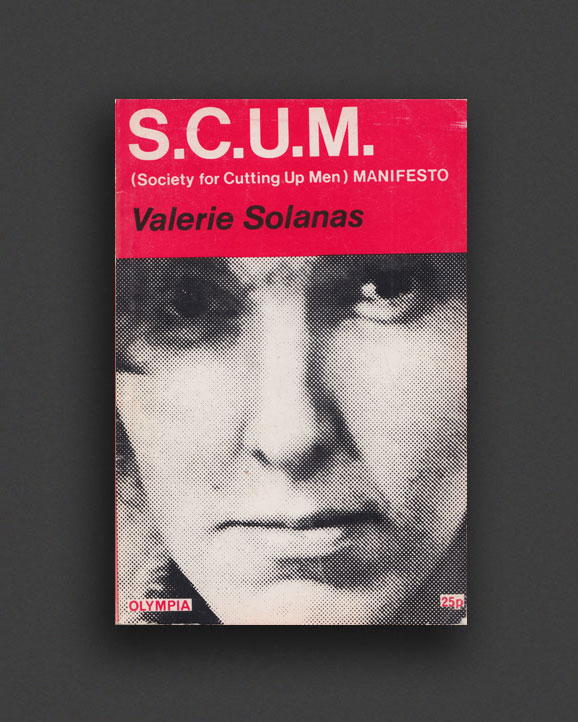
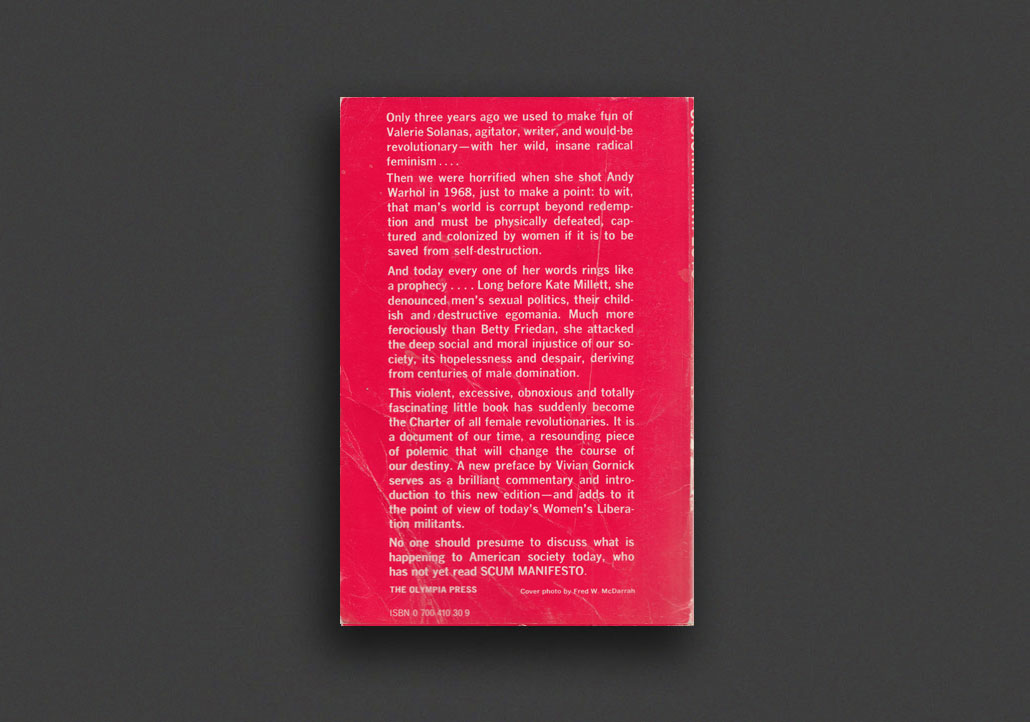
First circulated on the streets of Greenwich Village in 1967, the SCUM Manifesto is a searing indictment of patriarchal culture in all its forms. Shifting fluidly between the worlds of satire and straightforward critique, this classic is a call to action--a radical feminist vision for a different world. This is an update of the essential AK Press edition, with a new foreword by Michelle Tea.
"To see the SCUM Manifesto's humor, to let it crack you up page after page, is not to read it as a joke. It's not. The truth of the world as seen though Valerie's eyes is patently absurd, a cosmic joke. Humor such as this is a muscle, a weapon... It was the truth, and the truth is so absurd it's painful."—Michelle Tea
"Unhampered by propriety, niceness, discretion, public opinion, 'morals', the respect of assholes, always funky, dirty, low-down SCUM gets around... You've got to go through a lot of sex to get to anti-sex, and SCUM's been through it all, and they're now ready for a new show; they want to crawl out from under the dock, move, take off, sink out."—Valerie Solanas
Valerie Solanas was a radical feminist playwright and social propagandist who was arrested in 1968 after her attempted assassination of Andy Warhol. Deemed a paranoid schizophrenic by the state, Solanas was immortalized in the 1996 film I Shot Andy Warhol.
1982, English
Softcover, 218 pages, 22.5 x 15 cm
Out of print title / used / very good
Published by
Columbia University Press / New York
$70.00 - In stock -
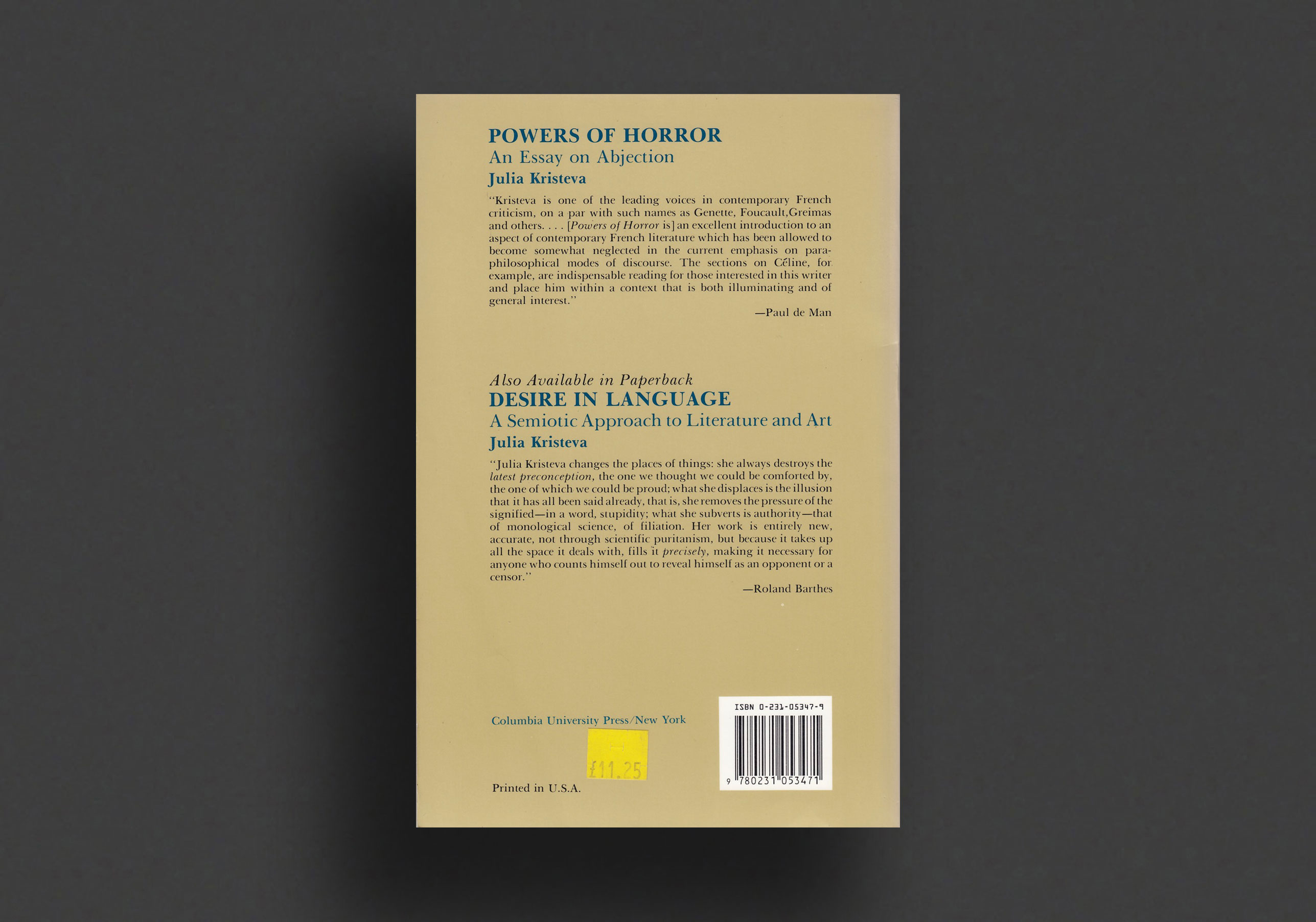
1982 Columbia classics re-print of Powers of Horror: An Essay on Abjection (French: Pouvoirs de l'horreur. Essai sur l'abjection), a 1980 book by Julia Kristeva. The work is an extensive treatise on the subject of abjection, in which Kristeva draws on the theories of Sigmund Freud and Jacques Lacan to examine horror, marginalization, castration, the phallic signifier, the "I/Not I" dichotomy, the Oedipal complex, exile, and other concepts appropriate to feminist criticism and queer theory.
According to Kristeva, the abject marks a "primal order" that escapes signification in the symbolic order; the term is used to refer to the human reaction (horror, vomit) to a threatened breakdown in meaning caused by the loss of the distinction between subject and object, or between the self and the other.
"Kristeva is one of the leading voices in contemporary French criticism, on a par with such names as Genette, Foucault, Greimas and others. ... [Powers of Horror is] an excellent introduction to an aspect of contemporary French literature which has been allowed to become somewhat neglected in the current emphasis on para-philosophical modes of discourse. The sections on Celine, for example, are indispensable reading for those interested in this writer and place him within a context that is both illuminating and of general interest."—Paul de Man
1982 English translation by Leon S. Roudiez. Single spine crease, light knocking/creasing to baord extremities, otherwise VG throughout.
1975, English
Softcover (staple-bound), 130 pages, 27 x 21 cm
1st Edition, Out of print title / used / good
Published by
Persistence of Vision / Berkeley
$40.00 - In stock -
Scarce issue of Women & Film Volume 2, Number 7, Summer 1975, published in California between 1972 and 1975, it was the first feminist film magazine, "a project that would transform cinema". Edited by Siew-Hwa Beh and Saunie Salyer, this issue includes Jill Godmilow (interview), Eleanor Perry (interview), Women's Film Festivals, Cinda Firestone's 'Attica', Leontine Sagan's 'Maedchen in Uniform', and more. Includes contributions by Connie Greenbaum, Barbara Martineau, Marjorie Keller, Patricia Erens, Eleanor Perry, Marion Weiss, Eileen McGarry, Carol Wikarska, Nancy Scholar, Carol Emmens, Sharon Lieberman, Michael Shedlin, Judith Taylor, Joyce Newman, Bill Nichols, Alexis Krasilovsky, and more. Interviews with Jill Godmilow and Eleanor Perry. Cover by Thelma Soderquist.
From the collection of Australian film critic Adrian Martin (b. 1959), name neatly penned to the first page.
G copy with tanning to edges, toning to pages, minor chipping/tears to cover edges.
1973, English
Softcover (staple-bound), 120 pages, 27 x 21 cm
1st Edition, Out of print title / used / very good
Published by
Persistence of Vision / Berkeley
$40.00 - In stock -
Scarce 1973 double-issue of Women & Film Vol. 1, No. 3 & 4, published in California between 1972 and 1975, it was the first feminist film magazine, "a project that would transform cinema". Edited by Siew-Hwa Beh and Saunie Salyer, this issue includes Eric Rohmer (interview), Christiane Rochefort (interview), Ken Russell and Paul Morrissey, Jean-Luc Godard and Jean-Pierre Gorin's 'Letter to Jane', Ingmar Bergman's 'Cries and Whispers', Bree Daniels in 'Klute', Armando Robles Godoy's 'The Green Wall', Mai Zetterling's 'The Girls', early suffrage films, and more. Includes contributions by Beverly Walker, Lucille Iverson, Marsha Kinder, Beverle Houston, Jacoba Atlas, Gretchen Bataille, Carol Davidson, Sibyl James, Constance Penley, Diane Giddis, Julia Lesage, Chuck Kleinhaus, Abigail Child, Sharon Smith, Kristina Nordstrom, Jeanne Betancourt, Sashi, Sally Pugh, Donnie, Bill Nichols, and more. Cover by Wayne Thiebaud.
From the collection of Australian film critic Adrian Martin (b. 1959), name neatly penned to the first page.
VG copy with tanning to edges, toning to pages, sticker to cover.
1981, English
Softcover, 176 pages, 21 x 29 cm
Signed by Virginia Fraser,
1st Edition, Out of print title / used / good
Published by
Sydney College of Arts / Sydney
$90.00 - In stock -
Australian photographer Virginia Fraser's copy of this fantastic publication from the Sydney College of Arts, 1981. Signed in red pen to the front blank page. Densely packed with essays and photo-essays focussing on photography, politics, theory, criticism, sexuality and racism. "This is the first publication in what we hope to be a continuing commitment to critical thought and practice in photography. Contributors from all over Australia were invited to participate on a collective basis for selection, layout and production." (from Foreword).
Features contributions from Fiona Hall, Terry Smith, Experimental Art Foundation, Sue Ford, John Williams, Ted Colless, Mimmo Cozzolino, Jacki Redgate, Violet Hamilton, Kris Hemensley, Charles Merewether, Martyn Jolly, Robyn Stacey, Esther Faerber, Anne Zahalka, Catherine De Lorenzo, Anne-Marie Willis, Christine Godden, and many more.
Good copy with some wear to extremities, sticker to front cover, light foxing to block edge.
1974, English
Softcover, 142 pages, 27.5 x 21cm
1st Edition, Out of print title / used / very good
Published by
Outback Press / Fitzroy
$650.00 - Out of stock
First edition of Carol Jerrems first, only photobook, "A Book About Australian Women", published by the Outback Press in Fitzroy in 1974, with text by Virginia Fraser. This now very collectable Australian photobook classic by Jerrems collects 131 portraits of Australian women dating from 1968 to 1974; 'womens liberationists, Aboriginal spokeswomen, activists, revolutionaries, teachers, students, drop-outs'. Preoccupied by subcultures or marginal groups, she intimately captures pockets of life previously ignored. A dynamic series of images that display Jerrems’ compositional flair, evident in the decorative synergy between foreground and background. The photographs are accompanied by text by Virginia Fraser.
Very Good copy with light tanning and edge/spine wear, very faint foxing to block edge. Lovely copy of this rare book.
1992, English
Softcover (w. dust jacket), 140 pages, 26 x 20 cm
1st Edition, Out of print title / used / very good
Published by
MIMA / Melbourne
$35.00 - Out of stock
Scarce catalogue edited by Adrian Martin and published in 1990 to accompany experimenta — A Major Survey of Film and Video Art, Melbourne, November 20—December 4, 1990, presented by Modern Image Makers Association Inc. (MIMA) and founded in 1988. Showcasing Australian video art, media art, installation and performance works.
Contents include: An introduction to Experimenta 1992 by Lizzette Atkins, Of Prisms and Tools: The Possibility of an Avant Garde by Vikki Riley, Australian Screenings, Introduction by Steven Ball, Opening Night, Signposts To The Imagination Re-animated; (re)constructing an art, Techknowledge, Dusan Marek's Cobweb On A Parachute — Essay by Arthur Cantrill, David Perry's The Refracting Glasses, Interview with David Perry, Passionate Uncertainty, Text and Textures, Engineering Memory: Views of History, Politics, Culture and Geography, Helical Scans: Diverse Ways of Seeing (Video) Programme 1 and 2, One Way Street: Fragments for Walter Benjamin, Sound and Image, Experience and The Other, The Fall Of The Berlin Wall, The Open 'Iron Curtain' and Post-Socialist Drama, Artists seen by artists, Die Mauer—The negative horizon, The Czech Avant Garde 1911-1941 essay by Jaroslav Andel, Programme 1, Programme 2, Video Programmes From 'New Europe' curated by Heiko DaxI, U.K., Intimate Imaginaries, Artist Screening: Michael Maziere, Slow Glass, U.S.A., Shalom Gorewitz-Experimental Television Center, New York, WAX, or the discovery of television among the bees, Flesh Histories, Programme 1, Programme 2, Japan, Emotional Wave: Image Network Japan, V.I.E.W., Shinya Tsukamoto's Tetsuo: The Iron Man, Interview with Shinya Tsukamoto, Performance: Introduction by Jeffrey Fereday, Artist statements, Installation: Introduction by Jennifer Phipps, Artist statements, Medienkunst—A survey of German, installation art— introduction by Heiko Daxl, Medienkunst-Artist statements, Special Events, Noisefest 2, Techno Garden, Century Endings - An Afternoon of Performance in the Great Hall, Seminars and Talks, Essays: Video As Art: Personal Observations From New York by Shalom Gorewitz, Some Thoughts on the German State of Things: Teaching Video by Ingo Petzke, An Attempt Toward The Anti-Oedipus-Japanese Video Art After The '80s by Junji Ito, Schedule of events, Artist index, Title index...
Includes the work of Arthur and Corinne Cantrill, Arf Arf, Ian Haig, GANG, Jun Kurosawa, Warren Burt, Chris Mann, Anne Ferran, Sadie Benning, Michelle Handelman, Monte Cazazza, Pete Spence, Fiona MacDonald, Cyber Dada Manifesto, Dale Nason, Troy Innocent, Dusan Marek, Critical Art Ensemble, John Maybury, David Perrt, Steven Ball, Karel Hašler, Otakar Vávra, Jiří Lehovec, Michael Maziere, David Blair, Danny Fass, Joe Kelly, Shelly Silver, Laurens Tan, John Gillies, and many more.
VG copy light wear to extremities/DJ.
1990, English
Softcover (staple-bound), 54 pages, 30 x 21 cm
1st Edition, Out of print title / used / very good
Published by
MIMA / Melbourne
$25.00 - Out of stock
Scarce catalogue edited by Adrian Martin and published in 1990 to accompany experimenta — A Major Survey of Film and Video Art, Melbourne, November 20—December 4, 1990, presented by Modern Image Makers Association Inc. (MIMA) and founded in 1988. Showcasing Australian video art, media art, installation and performance works, this iteration also included programs of Lettrist Cinema and French Avant-Garde film from the 1980s. Illustrated throughout with information on all of the works, accompanied by essays: Adrian Martin – "The Adventures of Form", John Conomos – "Video as Moonlighting", Christian Lebrat – "The Lettrist Cinema of the 1950s", Vikki Riley – "The Picture Can't Get Any Louder", John Flaus – "In the Eye's Mind - Paul Winkler Retrospective.
Includes the work of Arthur and Corinne Cantrill, Maria Kozic and Ian Haig, Peter Callas, Josko Petkovic, Edward Colless, Tona Keane, Arf Arf, Shelley Lasica, Peter Tyndall, Gerald Murnane, William Yang, John Nixon, Primary Source, Warren Burt, Chris Mann, Stelarc, Pete Spence, Philip Brophy, David Cox, Maurice Lemaitre, Frederique Devaux, Cyber Dada Manifesto, Dale Nason, Troy Innocent, Lydia Lunch, Foil, Swans, Einsturzende Neubauten, Butthole Surfers, Violinda, Steven Ball, and so many more...
VG copy light wear to extremities.
2025, English
Softcover, 28 pages, 14.7 x 10.5 cm
Published by
Everyday Analysis / UK
$18.00 - In stock -
Feminist Fatwas traces how Muslim feminists are resisting misogynistic interpretations of the Quran (like the verse male clerics have used to condone wife-beating).
For centuries, the translators and interpreters of the Holy Quran have been men. This is changing now as more and more Muslim feminists cast their eye on the patriarchal contexts of these interpretations. Feminist Fatwas tells the story of Verse 34 in Chapter 4 which has been interpreted by male clerics as condoning a husband beating his wife. This essay traces the groundbreaking work of knocking down this misogynist Quranic interpretations. The story of how Muslim feminists are doing this work is a chronicle of the slow and quiet feminist revolution taking place within Islam as women take on significant and powerful roles
Rafia Zakaria is a Pakistani-American attorney, feminist, journalist, and author. She has written for The Nation, Guardian Books, The New Republic, The Baffler, Boston Review, and Al Jazeera. In 2021, she published Against White Feminism, in which she critiques the emphasis that conventional feminist thought places on the experiences of white women while excluding women of color
1980, English
Hardcover (w. dust jacket), 224 pages, 30 x 23 cm
1st Edition, Out of print title / used / very good
Published by
Fleetbooks / New York
$30.00 - Out of stock
"Unblushing color, is the sexual world around us painted by outstanding artists of the twentieth century. In this extraordinary book, the modern world, the flesh, and the devil are captured as never before."
Foreword by Henry Miller.
Within it are 163 newly photographed works of art, each one faithfully reproduced, unretouched, in four color lithography. On these oversized pages is reflected the erotic life of our times from never before published Picasso watercolors of 1901-02 to the initial publication of recent works by George Segal, Andy Warhol, Larry Rivers, R.B. Kitaj, Tom Wesselman and many others.
1980 hardcover survey by Bradley Smith, '20th Century Masters of Erotic Art' is a lavishly illustrated (colour and b/w) collection of erotic works from private and public collections and museums. "Within it are 163 newly photographed works of art, each one faithfully reproduced, unretouched, in four-color lithography. On these oversized pages is reflected the erotic life of our times from never before published Picasso watercolors of 1901-02 to the initial publication of recent works by George Segal, Andy Warhol, Larry Rivers, R.B. Kitaj, Tom Wesselman and many others." Featuring further works by Leonor Fini, Otto Dix, Ernst Fuchs, Fernando Botero, Hans Bellmer, André Masson, Mel Ramos, Friedrich Schröder Sonnenstern, Paul Wunderlich, Richard Lindner, Elias Friedensohn, Roberto Matta, Graham Ovenden, Francisco Toledo, Carlos Revilla, Egon Schiele, Leonard Foujita, Henk Pander, Pablo Picasso, Alexander Calder, Max Ernst, Félix Labisse, Paul Delvaux, Salvador Dalí, and many other painters and illustrators who have conveyed human sexuality through fantasy, romance, symbolism, and super realism, contributing to the development of diverse erotic themes in art becoming more prominent and accepted in the modern era. We've since regressed.
Good copy in Good DJ, wear to dj extremities.
1974, English
Softcover, 218 pages, 22.2 x 13.3 cm
1st Edition, Out of print title / used / very good
Published by
E P Dutton / New York
$65.00 - Out of stock
Scarce first 1974 Dutton edition of Dworkin’s seminal debut which argued that a deep-rooted hatred of women reigned society for centuries – and still governs us today.
‘This book is an action, a political action where revolution is the goal’
Andrea Dworkin’s blazing, prophetic debut argued that a deep-rooted hatred of women has been ingrained in society for centuries – and still governs us today. From fairy tales to erotic novels to witch-burnings, she uncovers the ways in which male violence and oppression have been normalized throughout history, and points the way to liberation.
"... a bold and visionary book.... Her ideas are powerful and dangerous."—Phyllis Chesler
"Reading a fairy tale after reading Woman Hating will never be the same. Nor will the phrase 'they lived happily ever after.'"—Ellen Frankfort
"To see where we are going we must understand where we have been. Woman Hating is a much needed and long overdue addition toward that understanding."—Audre Lourde
"The very fact of Dworkin's book, its abrasive, outrageous quality, its ability to generate so much abuse, anger, warfare—is testament to its power."—Kate Millett
"This book is fast, pure, and angry. Just reading the chapter on foot-binding or the Story of O could turn a reader into a revolutionary."—Gloria Steinem
Very Good copy, light foxing to block edges, spine sunned no creasing, tight binding.
1990, English
Softcover, 218 pages, 21.5 x 14.5 cm
1st Edition, Out of print title / used / very good
Published by
Routledge / London
$35.00 - Out of stock
First 1990 edition.
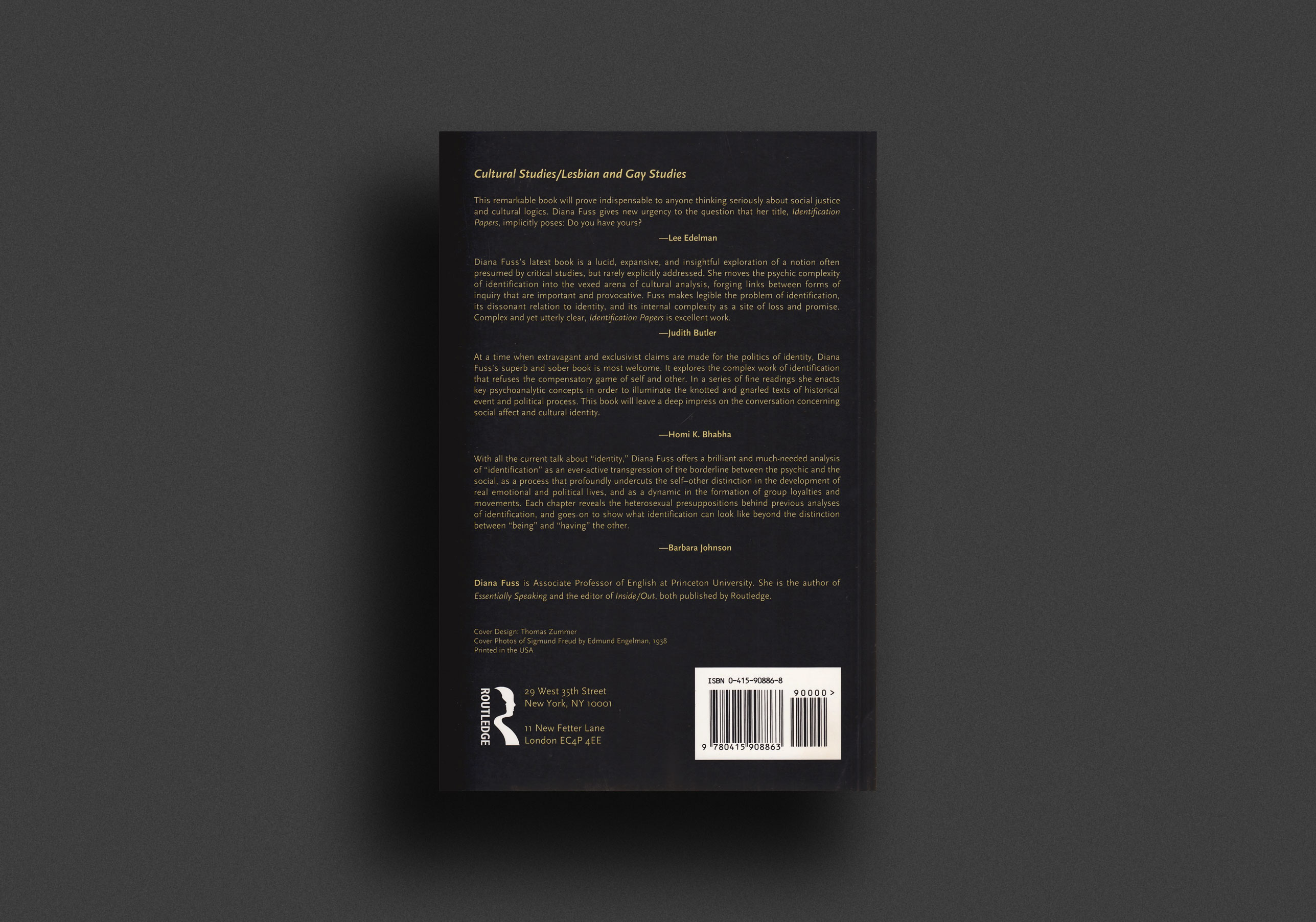
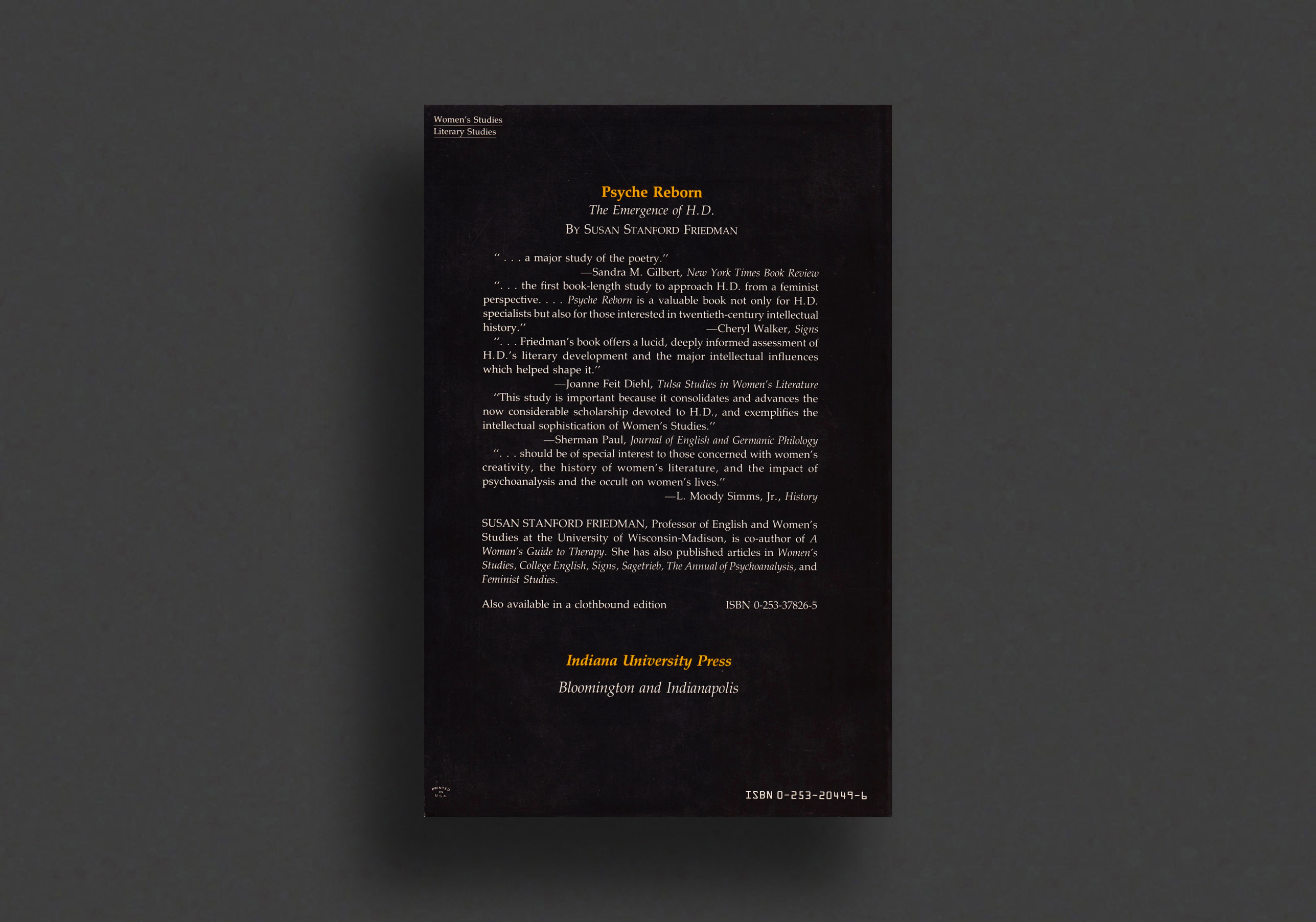
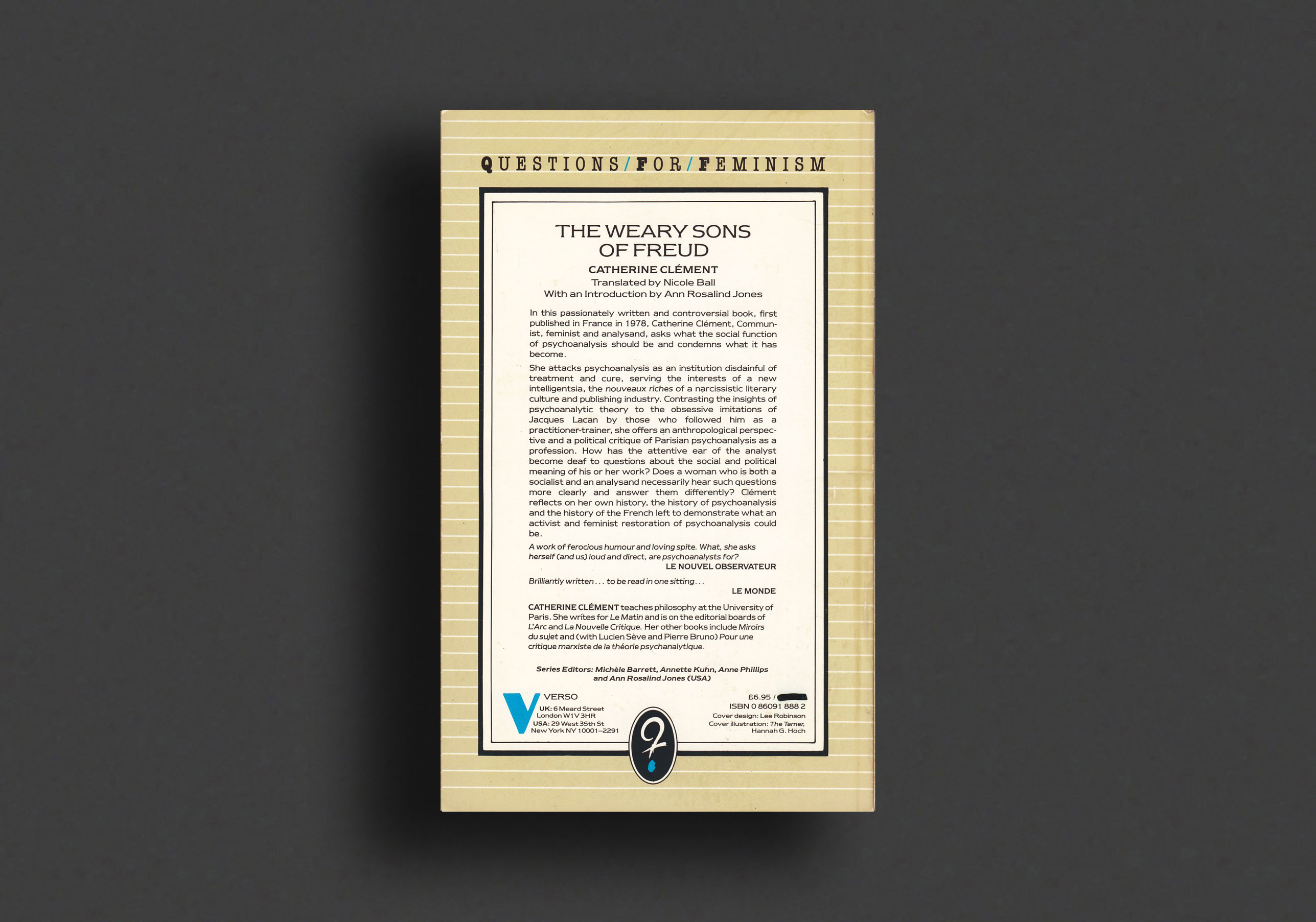
Why has the work of Jacques Lacan been so influential in feminist, psychoanalytic, and literary theory?
Why have his writings caused so much debate and controversy?
Feminists interested in questions of subjectivity, knowledge, and desire can afford to ignore Lacan's work at their peril. Yet his views can be accepted only at great cost, for his position is clearly antagonistic to, not agnostic about, any feminism committed to an equality of the two sexes.
Elizabeth Grosz has written a critical overview of Lacan's work from a feminist perspective, introducing and discussing his major texts and providing a much needed background to many of his arguments. She points to the difficulty of 'independent' evaluation of this complex body of work - it is hard not to read Lacan on his own terms; and she discusses the arguments with which feminist critics have supported and countered his ideas. She outlines the debate as to whether he has merely described patriarchal power rela-tions, or whether his work, lacking historical and cultural qualification, insidiously advocates them.
Elizabeth Grosz is Senior Lecturer in the Department of General Philosophy at the University of Sydney.
Good—VG copy light general wear.