World Food Books' programme is largely produced on Kulin Nation land. We acknowledge the Wurundjeri people of the Kulin Nation as the first and continuing custodians of this land, and pay respect to their Elders past, present, and emerging.
World Food Books is an arts and special interests bookshop in Naarm / Melbourne. Founded in 2010, World Food Books is devoted to the presentation of a rotating, hand-selection of international art, design, literary and counterculture publications with an emphasis on the anti-traditional, the experimental, the avant-garde, the heretic, the marginal.
Presenting new titles alongside rare and out-of-print books, catalogues and journals spanning the fields of modern and contemporary art, design, photography, illustration, film, literature, poetry, cultural theory, philosophy, sexuality, popular and underground culture in its many radical forms, World Food Books wishes to encourage adventurous, thoughtful and open-minded reading, looking, writing, and exchange of publishing and ideas, both current and historical.
As well as our bookshop, located in Melbourne's historical Nicholas Building, all of our inventory is available internationally via our online mail-order service.
World Food Books semi-regularly co-ordinates "Occasions", a programme of exhibits and events at the bookshop and in partnership with other hosts (such as museums and art galleries) that develop out of the activities, relationships and content of the bookshop itself.
World Food Books
The Nicholas Building
37 Swanston Street
Room 5, Level 6
Melbourne 3000
Australia
SHOP HOURS:
THU–SAT 12–6
WEB-SHOP OPEN 24/7
World Food Books
Postal Address:
PO Box 435
Flinders Lane
Victoria 8009
Australia
info@worldfoodbooks.com
Art
Theory / Essay
Architecture / Interior
Graphic Design / Typography
Photography
Fashion
Eros
LGBTQ+
Fiction / Poetry
Weird / Speculative / Science Fiction / Horror
Transgressive / Visceral / Abject
Symbolism / Decadence / Fin de siècle
Film / Video
Painting
Sculpture / Installation
Performance / Dance / Theater
Drawing
Sound / Music
Curatorial
Group Shows / Collections
Periodicals
Out-of-print / Rare
Posters / Ephemera / Discs
Signed Books
World Food Books Gift Voucher
World Food Book Bag
Australian Art
Australian Fiction
Australian Science Fiction / Speculative Fiction
Australian Poetry
Australian Photography
Japanese Photography
Conceptual Art
Minimal Art
Dada
'Pataphysics / Oulipo
Fluxus
Concrete Poetry
Pop Art
Surrealism
Arte Povera
Arte Informale / Haute Pâte / Tachism
Nouveau Réalisme / Zero / Kinetic
Situationism / Lettrism
Collage / Mail Art / Xerox Art
Art Brut / Folk / Visionary / Fantastic
Illustration / Graphic Art / Bandes Dessinées
Furniture
Italian Radical Design / Postmodernism
Textiles
Ceramics / Glass
Counterculture
Protest / Revolt
Philosophy
Psychoanalysis
Anthropology
Anarchism
Socialism / Anarchism / Communism / Capitalism
Literary Theory / Semiotics / Language
Feminism / Women's Studies
Gender Studies / Sexuality
Anthropology
Fetishism / BDSM
Drugs / Psychedelia
Crime / Violence
Animal Rights / Veganism
Occult / Esoterica
Ecology / Earth / Alternative Living
Whole Earth / Crafts
All prices in AUD (Australian dollars)
Pick-Ups
Pick-up orders can be collected in our bookshop during opening hours after order date. Please collect any Pick-up orders within 2 weeks of ordering as we have limited storage space. Orders will be released back into stock if not collected within this time. No refunds can be made for pick-ups left un-collected. If you cannot make it in to the bookshop in this time-frame, please choose postage option.
Return Policy
All sales are final. We do accept returns (for refund or exchange) for items received in error. All our orders are packed with special care using heavy-duty padding and cardboard book-mailers or bubble mailers (for smaller books), using reinforcement where required. We cannot take responsibility for any lost, stolen or damaged parcels.
Insurance
Should you wish to insure your package, please email us directly after placing your order and we can organise this at a small extra expense. Although all standard/express tracked packages are very safe and dependable, we cannot take responsibility for any lost, stolen or damaged parcels. We recommend insurance on valuable orders.
Interested in selling your old books, catalogues, journals, magazines, comics, fanzines, ephemera? We are always looking for interesting, unusual and out-of-print books to buy. We only buy books in our fields of interest and specialty, and that we feel we can resell.
We base these prices on desirability, market value, in-print prices, condition and our current stock levels. We offer cash, store credit, and can take stock on consignment. All
about 25% of the price we expect to get when we sell them, or 30% in store credit. We base these prices on desirability, market value, in-print prices, condition and our current stock levels.
Sell your books any day of the week. You can drop them off and return later. If you have a lot of books, we can visit your Sydney home.
We buy books that we feel we can resell. We offer about 25 % of the price we expect to get when we sell them, or 30% in store credit. We base these prices on desirability, market value, in-print prices, condition and our current stock levels.
Philadelphia Wireman
03 August - 01 September, 2018
World Food Books is proud to announce our next Occasion, the first presentation of sculptures by Philadelphia Wireman in Australia.
The Philadelphia Wireman sculptures were found abandoned in an alley off Philadelphia’s South Street on trash night in 1982. Their discovery in a rapidly-changing neighbourhood undergoing extensive renovation, compounded with the failure of all attempts to locate the artist, suggests that the works may have been discarded after the maker’s death. Dubbed the "Philadelphia Wireman" during the first exhibition of this work, in 1985, the maker’s name, age, ethnicity, and even gender remain uncertain. The entire collection totals approximately 1200 pieces, all intricately bound together with tightly-wound heavy-gauge wire (along with a few small, abstract marker drawings, reminiscent both of Mark Tobey and J.B. Murry). The dense construction of the work, despite a modest range of scale and materials, is singularly obsessive and disciplined in design: a wire armature or exoskeleton firmly binds a bricolage of found objects including plastic, glass, food packaging, umbrella parts, tape, rubber, batteries, pens, leather, reflectors, nuts and bolts, nails, foil, coins, toys, watches, eyeglasses, tools, and jewellery.
Heavy with associations—anthropomorphic, zoomorphic, and socio-cultural responses to wrapped detritus—the totemic sculptures by Philadelphia Wireman have been discussed in the context of work created to fulfil the shamanistic needs of alternative religions in American culture. Curators, collectors, and critics have variously compared certain pieces to sculpture from Classical antiquity, Native American medicine bundles, African-American memory jugs, and African fetish objects. Reflecting the artist’s prolific and incredibly focused scavenging impulse, and despite—or perhaps enhanced by—their anonymity, these enigmatic objects function as urban artefacts and arbiters of power, though their origin and purpose is unknown. Philadelphia Wireman, whatever their identity, possessed an astonishing ability to isolate and communicate the concepts of power and energy through the selection and transformation of ordinary materials. Over the course of the past two decades, this collection has come to be regarded as an important discovery in the field of self-taught art and vernacular art.
Presented in collaboration with Fleisher-Ollman Gallery, Philadelphia, and Robert Heald, Wellington.
Susan Te Kahurangi King
02 February - 10 March, 2018
Susan Te Kahurangi King (24 February 1951 - ) has been a confident and prolific artist since she was a young child, drawing with readily available materials - pencils, ballpoint pens and felt-tip markers, on whatever paper is at hand. Between the ages of four and six Susan slowly ceased verbal communication. Her grandparents William and Myrtle Murphy had developed a special bond with Susan so they took on caring responsibilities for extended periods. Myrtle began informally archiving her work, carefully collecting and storing the drawings and compiling scrapbooks. No drawing was insignificant; every scrap of paper was kept. The King family are now the custodians of a vast collection containing over 7000 individual works, from tiny scraps of paper through to 5 meter long rolls.
The scrapbooks and diaries reveal Myrtle to be a woman of great patience and compassion, seeking to understand a child who was not always behaving as expected. She encouraged Susan to be observant, to explore her environment and absorb all the sights and sounds. Myrtle would show Susan’s drawings to friends and people in her community that she had dealings with, such as shopkeepers and postal workers, but this was not simply a case of a grandmother’s bias. She recognised that Susan had developed a sophisticated and unique visual language and sincerely believed that her art deserved serious attention.
This was an unorthodox attitude for the time. To provide some context, Jean Dubuffet coined the term Art Brut in 1945 to describe work created by self-taught artists – specifically residents of psychiatric institutions and those he considered to be visionaries or eccentrics. In 1972 Roger Cardinal extended this concept by adopting the term Outsider Art to describe work made by non-academically trained artists operating outside of mainstream art networks through choice or circumstance. Susan was born in Te Aroha, New Zealand in 1951, far from the artistic hubs of Paris and London that Dubuffet and Cardinal operated in. That Myrtle fêted Susan as a self-taught artist who deserved to be taken seriously shows how progressive her attitudes were.
Susan’s parents Doug and Dawn were also progressive. Over the years they had consulted numerous health practitioners about Susan’s condition, as the medical establishment could not provide an explanation as to why she had lapsed into silence. Dawn educated herself in the field of homeopathy and went on to treat all twelve of her children using these principles – basing prescriptions on her observations of their physical, mental and emotional state.
Doug was a linguist with an interest in philosophy who devoted what little spare time he had to studying Maori language and culture. To some extent their willingness to explore the fringes of the mainstream made them outsiders too but it was their commitment to living with integrity and their respect for individuality that ensured Susan’s creativity was always encouraged.
Even though Susan’s family supported her artistic pursuits, some staff in schools and hospitals saw it as an impediment to her assimilation into the community and discouraged it in a variety of ways. Her family was not always aware of this and therefore did not fully understand why Susan stopped drawing in the early 1990s. However, rather than dwell on the challenges that Susan faced in pursuit of her artistic practice, they prefer to highlight her achievements. In 2008 Susan began drawing again in earnest, after an almost 20 year interruption, and her work is now shown in galleries around the world.
Susan grew up without television and has been heavily influenced by the comics she read as a child. She is absolutely fearless in the appropriation of recognizable characters, such as Donald Duck and Mickey Mouse, in her work. She twists their limbs, contorts their faces, compresses them together, blends them into complex patterned backgrounds - always imbuing them with an incredible energy. Although Susan often used pop culture characters in her work they are not naive or childlike. These are drawings by a brilliant self-taught artist who has been creating exceptional work for decades without an audience in mind.
Mladen Stilinović
"Various Works 1986 - 1999"
02 February 16 - September 10, 2016
Various works 1986 - 1999, from two houses, from the collections of John Nixon, Sue Cramer, Kerrie Poliness, Peter Haffenden and Phoebe Haffenden.
Including: Geometry of Cakes (various shelves), 1993; Poor People’s Law (black and white plate), 1993; White Absence (glasses, ruler, set square, silver spoon, silver ladel with skin photograph and wooden cubes), 1990-1996; Exploitation of the Dead (grey and red star painting, wooden painting, black spoon with red table, red plate), 1984-1990; Money and Zeros (zero tie, paintings made for friends in Australia (Sue, John, Kerrie), numbers painting), 1991-1992; Words - Slogans (various t-shirts) - “they talk about the death of art...help! someone is trying to kill me”, “my sweet little lamb”, “work is a disease - Karl Marx”; Various artist books, catalogues, monographs, videos; Poster from exhibition Insulting Anarchy; "Circular" Croatian - Australian edition; Artist book by Vlado Martek (Dostoyevsky); more.
Thanks to Mladen Stilinović and Branka Stipančić.
Jonathan Walker
Always Will Need To Wear Winter Shirt Blue + Ochre Small Check Pattern
21 August - 21 September, 2015
Untitled
I am not a great reader of poetry but I always return to the work of Melbourne poet, Vincent Buckley (1925- 1988). Perhaps I find his most tantalising piece to be not a finished poem but a fragment left on a scrap of paper discovered on his desk after the poet’s death.
The poetry gathers like oil
In the word-core, and spreads
It has its music meet,
Its music is in movement.
This fragment is more the shell left behind from a volatile thought than a finished poem. I find the last two lines honest but awkward whereas the first two lines work like an arrow. Most likely he could not find a resolution so it was left. Still, in its present form, it remains an eloquent testimony to the ultimate failure of a medium to express mobile thought and sensation, in Buckley’s case, through verbal language. It’s an important matter because this is something all artists have to deal with regardless of the medium.
I have never written a poem, however, I am forever copying fragments from books on paper scraps in a vain effort to fix certain notions in my head. At first, they function as bookmarks that are sometimes returned to when I open the book. But before long, as they accumulate, they fall out littering the table interspersed with A4 photocopies, bills, books and medications.
To return to Buckley’s fragment, the first two lines very much evoke how I paint nowadays. As you age, detail diminishes and patches of light become more luminous and float. I feel the most honest way of dealing with this is by smearing the oil paint on the canvas with the fingers and working close-up, blind. Only if the patches coalesce into an approaching image can the work gain a life.
-
Jonathan Walker was born in Melbourne, Australia and brought up on a dairy farm in Gippsland. In the 1970’s he studied painting at RMIT and won the Harold Wright Scholarship to the British Museum, London. During the 1980’s he exhibited at Pinacotheca Gallery, Richmond and had work shown at the NGV and Heidi City Art Gallery. Over the same period he designed the cover for the “Epigenesi” LP by Giancarlo Toniutti, Italy and conducted a mail exchange work with Achim Wollscheid, Germany. The work with artists through the post resulted in an article published in the bicentenary issue of Art and Australia 1988. He showed in artist run spaces such as WestSpace in the 90’s and 2000’s, and until 2012, taught painting at Victoria University, which is where we (Colleen Ahern and Lisa Radford) as organisers of the exhibition, among many others, had the privilege of being his student.
Walker’s knowledge was imparted to students through the careful selection of music, literature, and artists found in books that he himself had ordered for the library. Walker’s strategy was the generosity of sharing his vast knowledge with references specific to each student and their context.
Walker’s paintings share a similar focus and intimacy.
This exhibition presents a small selection of recent paintings alongside a publication that includes Walker’s writing. Observational and analytical, Walker’s work is a type of material notation — the time of day, colour and how it is blended, the both specific and fleeting location of a reflection on lino or the question of whether a chair leg should be included in a painting.
Please join us on Friday August 21 between 6-8pm to celebrate the opening of the exhibition.
Curated by Colleen Ahern and Lisa Radford.
B. Wurtz
Curated by Nic Tammens
March 26 - April 4, 2015
B.Wurtz works from a basement studio in his home on Manhattan’s Lower East Side.
This local fact is attested to by the plastic shopping bags and newsprint circulars that appear in his work. As formal objects, they don’t make loud claims about their origins but nonetheless transmit street addresses and places of business from the bottom of this long thin island. Like plenty of artists, Wurtz is affected by what is local and what is consumed. His work is underpinned by this ethic. It often speaks from a neighborhood or reads like the contents of a hamper:
“BLACK PLUMS $1.29 lb.”
“Food Bazaar”
“USDA Whole Pork Shoulder Picnic 99c lb.”
“RITE AID Pharmacy, with us it’s personal.”
“H. Brickman & Sons.”
“Sweet Yams 59c lb."
Most of the work in this exhibition was made while the artist was in residence at Dieu Donne, a workshop dedicated to paper craft in Midtown. Here Wurtz fabricated assemblages with paper and objects that are relatively lightweight, with the intention that they would be easily transportable to Australia. This consideration isn’t absolute in Wurtz’s work, but was prescriptive for making the current exhibition light and cheap. Packed in two boxes, these works were sent from a USPS post office on the Lower East Side and delivered to North Melbourne by Australia Post.
Wurtz appears courtesy of Metro Pictures, New York.
Thanks to Rob Halverson, Joshua Petherick, Sari de Mallory, Matt Hinkley, Helen Johnson, Fayen d'Evie, Ask Kilmartin, Lisa Radon, Ellena Savage, Yale Union, and "Elizabeth".
John Nixon
"Archive"
December 15 - January 20, 2014
The presentation of John Nixon's archive offered a rare showcase of this extensive collection of the artist's own publications, catalogues, posters, ephemera, editions and more, from the mid 1980s onwards, alongside a selection of his artworks.
Organized by John Nixon, Joshua Petherick and Matt Hinkley.
"Habitat"
at Minerva, Sydney (organised by Joshua Petherick and Matt Hinkley)
November 15 - December 20, 2014
Lupo Borgonovo, Janet Burchill & Jennifer McCamley,
Lewis Fidock, HR Giger, Piero Gilardi, Veit Laurent Kurz,
Cinzia Ruggeri, Michael E. Smith, Lucie Stahl, Daniel Weil, Wols
Press Release:
“...It contained seven objects. The slender fluted bone, surely formed for flight, surely from the wing of some large bird. Three archaic circuitboards, faced with mazes of gold. A smooth white sphere of baked clay. An age-blackened fragment of lace. A fingerlength segment of what she assumed was bone from a human wrist, grayish white, inset smoothly with the silicon shaft of a small instrument that must once have ridden flush with the surface of the skin - but the thing’s face was seared and blackened.”
William Gibson, “Count Zero”, 1986
"Autumn Projects Archive"
Curated by Liza Vasiliou
March 6 - March 15, 2014
World Food Books, in conjunction with the Virgin Australia Melbourne Fashion Festival 2014, presented the Autumn Projects archive, consisting of a selection of early examples in Australian fashion with a particular interest in collecting designers and labels from the period beginning in the 1980’s, who significantly influenced the discourse of Australian Fashion.
Curated by Liza Vasiliou, the exhibition provided a unique opportunity to view pieces by designers Anthea Crawford, Barbara Vandenberg, Geoff Liddell and labels CR Australia, Covers, Jag along with early experimental collage pieces by Prue Acton and Sally Browne’s ‘Fragments’ collection, suspended throughout the functioning World Food Books shop in Melbourne.
H.B. Peace
presented by CENTRE FOR STYLE
November 14, 2013
"Hey Blinky, you say chic, I say same"
Anon 2013
H.B. Peace is a clothing collaboration between great friends Blake Barns and Hugh Egan Westland. Their pieces explore the divergences between 'character’ and ‘personality’ in garments....etc
Special Thanks to Joshua Petherick and Matt Hinkley of WFB and Gillian Mears
and a Very Special Thank you to Audrey Thomas Hayes for her shoe collaboration.
Janet Burchill & Jennifer McCamley
"Aesthetic Suicide"
May 10 - June 8, 2013
The first of our occasional exhibitions in the World Food Books office/shop space in Melbourne, "Aesthetic Suicide" presented a body of new and older works together by artists Janet Burchill & Jennifer McCamley, including videos, prints, a wall work, and publications.
During shop open hours videos played every hour, on the hour.
1980, Japanese
Softcover, 200 pages, 28 x 20.5 cm
1st Edition, Out of print title / used / good
Published by
Futabasha / Tokyo
$45.00 - Out of stock
Rare issue of Japanese "men's magazine" Chat Noir, published in Shinjuku in 1980. Cover to cover full-colour female nude photography from Paris, around 200 pages of saturated colour, skin, and textiles, almost no text or advertising. Each model chapter has many pages, and there are about 30 models featured. Possibly these are all the photo features collected from a French magazine published in 1980?
Good copy with some waving to page edges, marking to cover.
1981, Japanese
Softcover, 86 pages, 30 x 21 cm
1st Edition, Out of print title / used / very good
Published by
College Press / Tokyo
$60.00 - Out of stock
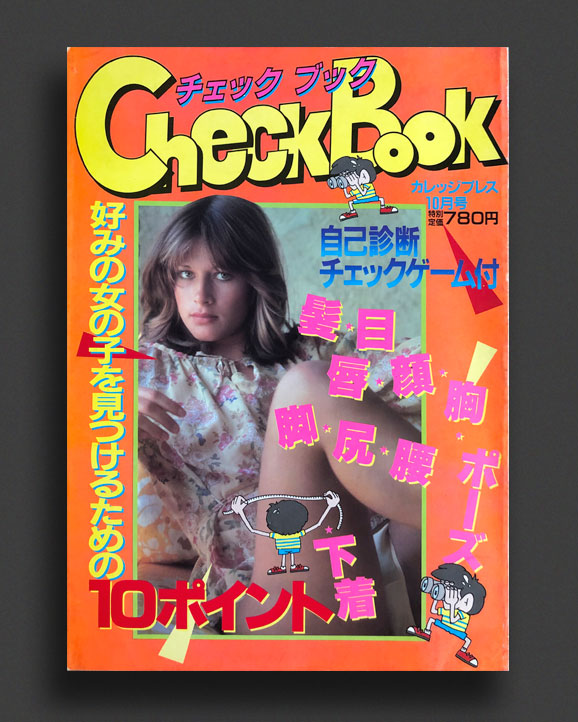
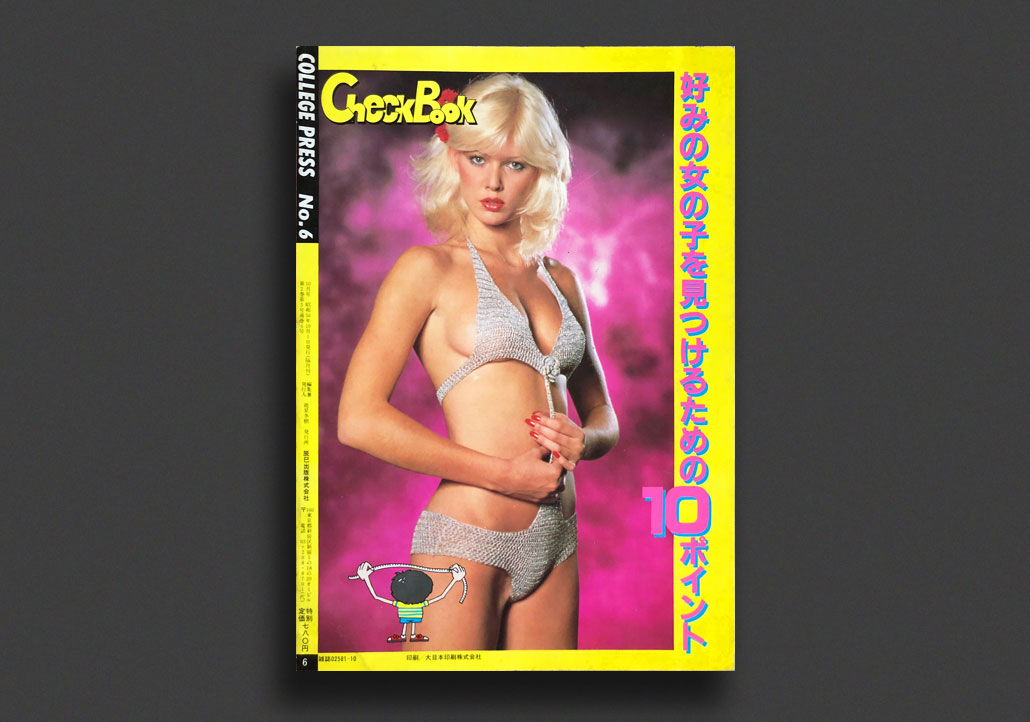
Published in Tokyo by College Press in 1981, this odd adult magazine is aimed at assisting young Japanese men in finding their ideal young woman. Only Japan, only 1981. Heavily illustrated throughout in colour and b/w, this glossy erotic mag lampoons a school exercise book, providing photographic analysis of female physical attributes, illustrated sex puzzles, and comic questionnaires that would more likely encourage inceldom. Superficial education aside, it is really just an excuse to compile a magazine of Western female nudes, which makes it all the more confusing.
Very Good copy.
1994, Japanese
Softcover in die-cut, foiled slipcase w. obi-strip, 162 pages,
1st Edition, Out of print title / used / very good
Published by
Treville / Tokyo
$200.00 - Out of stock
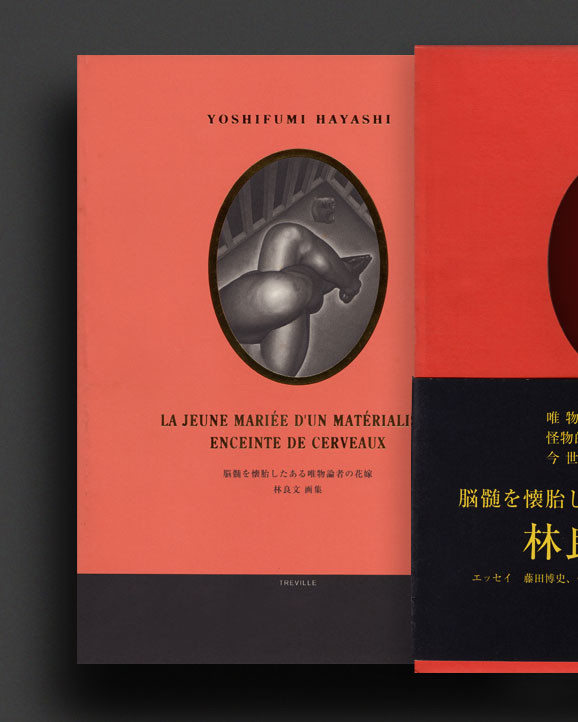
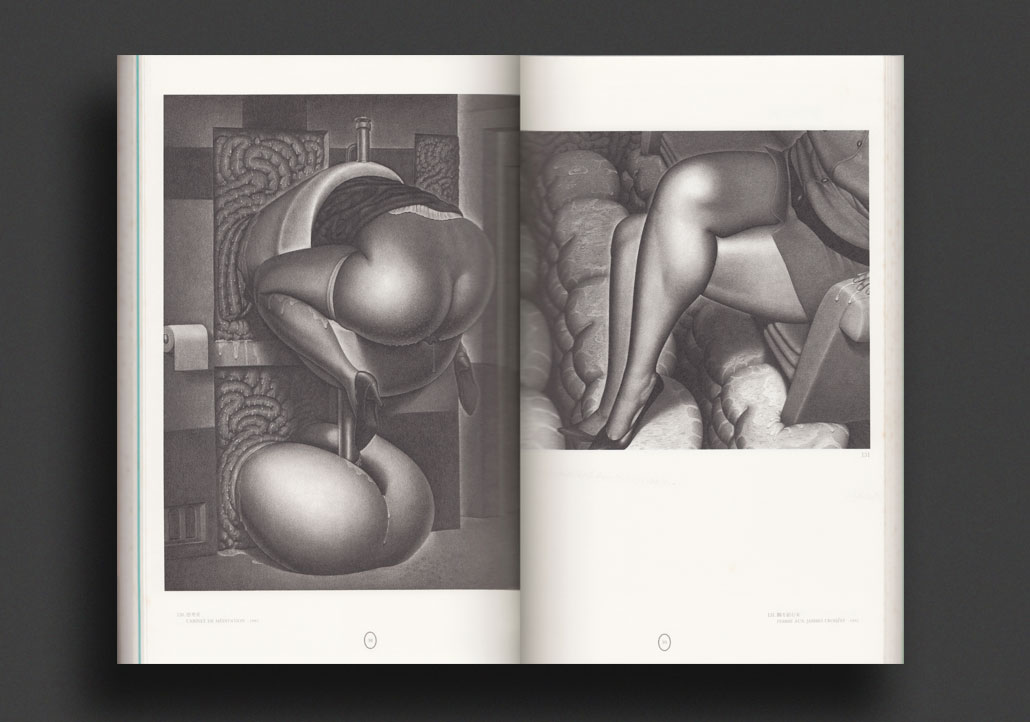
First edition of the rare, long out-of-print first major monograph on Japanese artist Yoshifumi Hayashi, published only in Japan in this slipcased edition in 1994. Profusley illustrated throughout, chronologically surveying self-taught Hayashi's work from his mid-1970s De Chirico-inspired sci-fi-scapes quickly evolving into his life's-work of grotesque, disembodied eroticism rendered masterfully in graphite. All the artist’s deepest and darkest paranoias, fetishes, and obsessions are laid bare here, tracing the development of various themes and subjects throughout in a delirium of convulsing legs, breasts, vulvas, intestines, brains and modernist architectural interiors. This book is a must for anyone interested in Hayashi's work. Accompanying texts by Roger Borderie, Gilbert Bellquet, Issei Sagana, Hiroshi Fujita. Also includes a rare portrait of the reclusive Hayashi.
Contemporary Japanese erotic artist Yoshifumi Hayashi (b. 1948, Fukuoka, Japan) dropped out of Chuo University Department of Philosophy in 1972, moving to Paris in 1974, where he began to produce pencil drawings through self study. At first his main influence was the metaphysical world of De Chirico, but soon his focus shifted to the lower half of the female anatomy. Exhibiting and publishing his drawings in France in the late 1970's, Hayashi gained a cult following for his dark explorations of fetishized female physiology and mutating genitalia, rendered masterfully in pencil. Often mentioned in relation to the likes of Hans Bellmer, H.R. Giger, and even David Cronenberg, Hayashi's drawings were featured in specialist fetish magazines, and director Walerian Borowczyk even made a film in 1980 of the artist at work, yet still little is known about Hayashi, who continues to work and exhibit internationally.
Very Good copy. Some edge wear to slipcase and damage to obi-strip.
1996, Japanese
Softcover (w. dust jacket), 225 pages, 15 x 23 cm
1st Edition, Out of print title / used / very good
Published by
Heibonsha / Tokyo
$100.00 - Out of stock
First edition of Araki's "Bodyscapes", the second in the series of the Complete Works collection. This beautiful collection focuses on the intimate nude portrait work of Araki, from the 1970 to the 1990s, mostly photographs of women, with a few men, and a little bondage. Although, as the title suggests, these are not nude pictures but "naked scenery", a word coined by Araki and legendary Japanese publisher Akira Suei at a time when it was not allowed to record the nude body public in Japan. Always one to challenge sexual taboos with radical techniques, this book captures Araki's trickery and mockery of the censors with his famed pubic hair shaving and soap bubble photos, pushing photographic freedom in the face of regulations that lead to dangerous definition of "obscenities". A gorgeous collection of Araki's nudes, lavishly reproduced in colour and black and white.
Nobuyoshi Araki was born in Tokyo in 1940. Given a camera by his father at the ripe age of twelve, Araki has been taking pictures ever since. He studied photography and film at Chiba University and went into commercial photography soon after graduating. In 1970 he created his famous Xeroxed Photo Albums, which he produced in limited editions and sent to friends, art critics, and people selected randomly from the telephone book. Over the years, his bold, unabashed photographs of his private life have been the object of a great deal of controversy and censorship (especially in his native Japan), a fact that has not fazed the artist nor diminished his influence. To date, Araki has published over 400 books of his work.
Very Good in VG dust jacket.
2014, English
Softcover, 160 pages, 52 x 80 cm
Published by
University of Chicago Press / Chicago
$44.00 - Out of stock
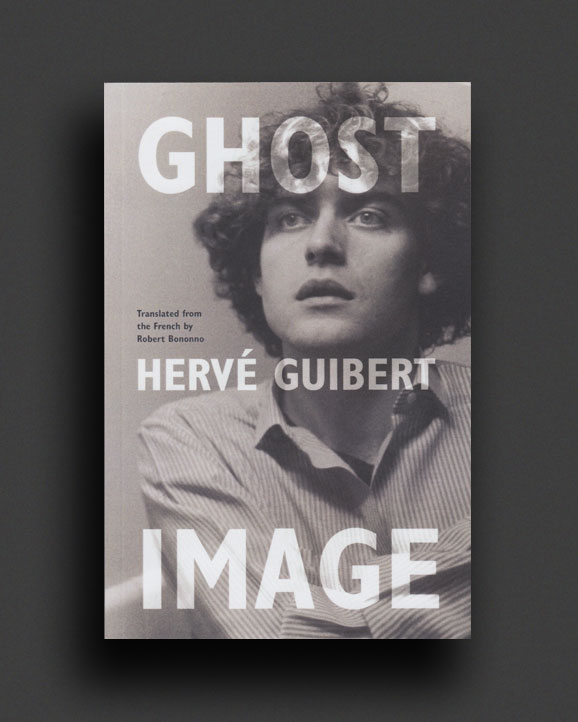
Ghost Image is made up of sixty-three short essays - meditations, memories, fantasies, and stories bordering on prose poems - and not a single image. Herve Guibert's brief, literary rumination on photography was written in response to Roland Barthes' Camera Lucida, but its deeply personal contents go far beyond that canonical text. Some essays talk of Guibert's parents and friends, some describe old family photographs and films, and spinning through them all are reflections on remembrance, narcissism, seduction, deception, death, and the phantom images that have been missed. Both a memoir and an exploration of the artistic process, Ghost Image not only reveals Guibert's particular experience as a gay artist captivated by the transience and physicality of his media and his life, but also his thoughts on the more technical aspects of his vocation. In one essay, Guibert searches through a cardboard box of family portraits for clues-answers, or even questions-about the lives of his parents and more distant relatives.
Rifling through vacation snapshots and the autographed images of long-forgotten film stars, Guibert muses, "I don't even recognize the faces, except occasionally that of an aunt or great-aunt, or the thin, fair face of my mother as a young girl." In other essays, he explains how he composes his photographs, and how - in writing - he seeks to escape and correct the inherent limits of his technique, to preserve those images lost to his technical failings as a photographer. With strains of Jean Genet and recurring themes that speak to the work of contemporary artists across a range of media, Guibert's Ghost Image is a beautifully written, melancholic ode to existence and art forms both fleeting and powerful - a unique memoir at the nexus of family, memory, desire, and photography.
HERVÉ GUIBERT (1955-1991) was a French writer and photographer. A critic for Le Monde, he was the author of some thirty books, most notably To the Friend Who Did Not Save My Life, which presents an intimate portrait of Michel Foucault and played a significant role in changing public attitudes in France towards AIDS.
2004, English
Softcover, 219 pages, 14 x 21.6 cm
Published by
FC2 / US
The University of Alabama Press / Alabama
$42.00 - Out of stock
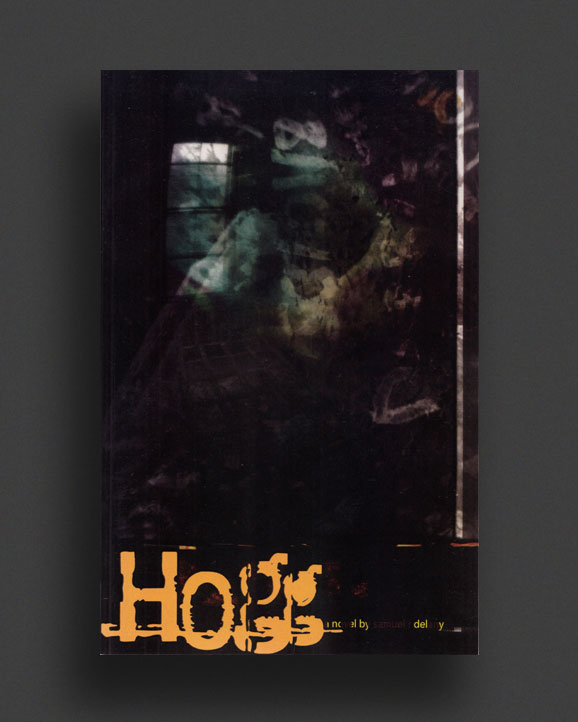
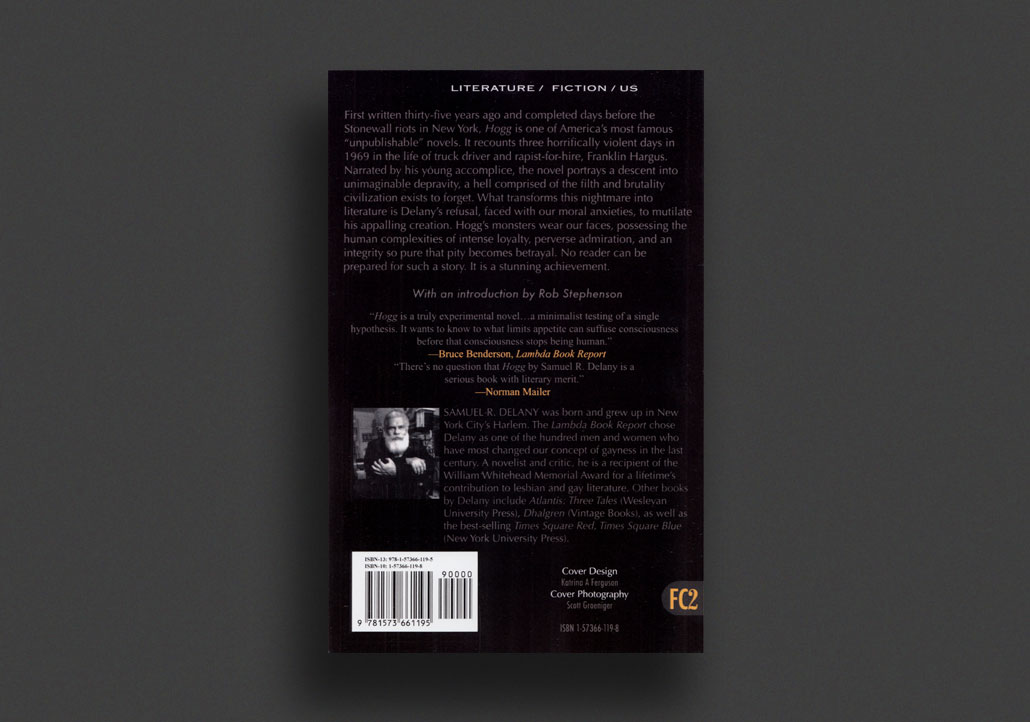
The 2004 definitive edition of a classic and controversial novel. First written in 1969 and completed days before the Stonewall riots in New York, Hogg is one of America’s most famous “unpublishable” novels. It recounts three horrifically violent days in the life of truck driver and rapist-for-hire, Franklin Hargus. Narrated by his young boy accomplice, the novel portrays a descent into unimaginable depravity, a hell comprised of the filth and brutality civilization exists to forget. What transforms this nightmare into literature is Delany’s refusal, faced with our moral anxieties, to mutilate his appalling creation. Hogg’s monsters wear our faces, possessing the human complexities of intense loyalty, perverse admiration, and an integrity so pure that pity becomes betrayal. No reader can be prepared for such a story. It is a stunning achievement.
"Hogg is a truly significant book. It is distasteful, raw, and upsetting; it also treats some of the sexual taboos that Americans do not want addressed in either art or politics. Hogg is an artistic triumph, as well as a political one." — John O'Brien, Dalkey Archive Press
"There’s no question that Hogg by Samuel R. Delany is a serious book with literary merit." — Norman Mailer
"Hogg is explicitly and violently pornographic. Delany takes his readers to the limit of readability – but as long as you keep reading, you repeatedly face up to some of the darkest and most carefully hidden parts of your own desire." — Dennis Cooper
"Hogg is a truly experimental novel and a minimalist testing of a single hypothesis. It wants to know to what limits appetite can suffuse consciousness before that consciousness stops being human." — Bruce Benderson
Samuel R. Delany (b. 1942), nicknamed "Chip", is an award-winning American science-fiction novelist and critic whose highly imaginative works address sexual, racial, and social issues, heroic quests, and the nature of language. Delany was the first African American writer to achieve note through commercial American science fiction. The Lambda Book Report chose Delany, a recipient of the William Whitehead Memorial Award for a lifetime’s contribution to lesbian and gay literature, as one of the hundred men and women who have most changed our concept of gayness in the last century. Delany’s books include Atlantis: Three Tales (Wesleyan University Press), Dhalgren (Vintage Books), as well as the best-selling Times Square Red, Times Square Blue (New York University Press).
1986, English
Softcover (staple-bound), 16 pages, 21 x 13.5 cm
1st Edition, Out of print title / used / very good
Published by
Athletic Model Guild (AMG) / Los Angeles
$30.00 - Out of stock
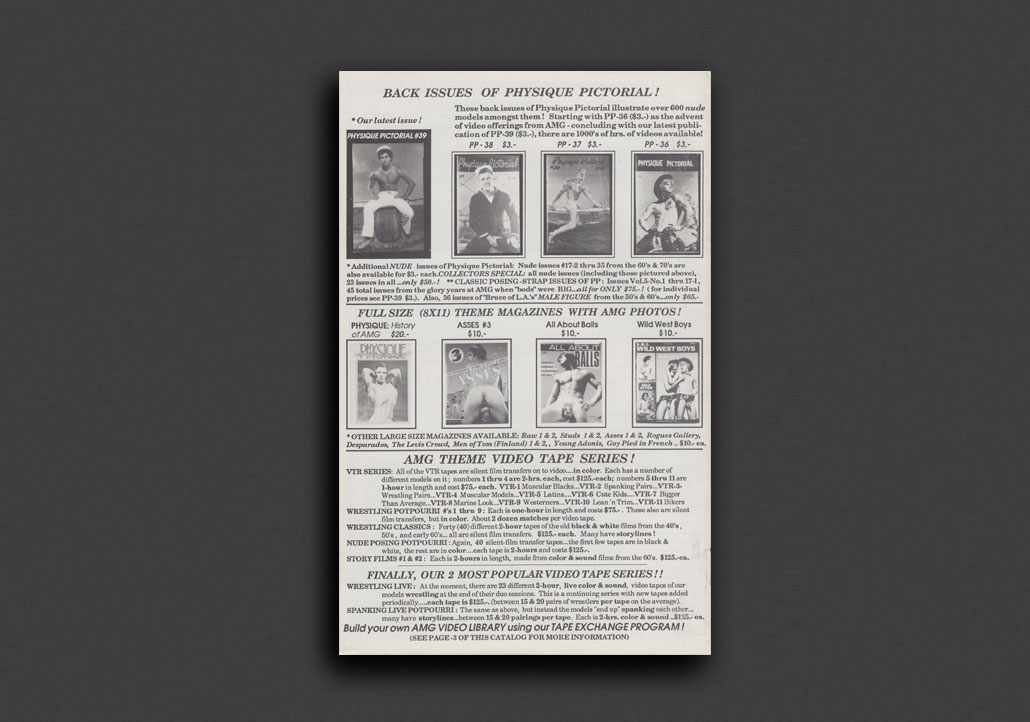
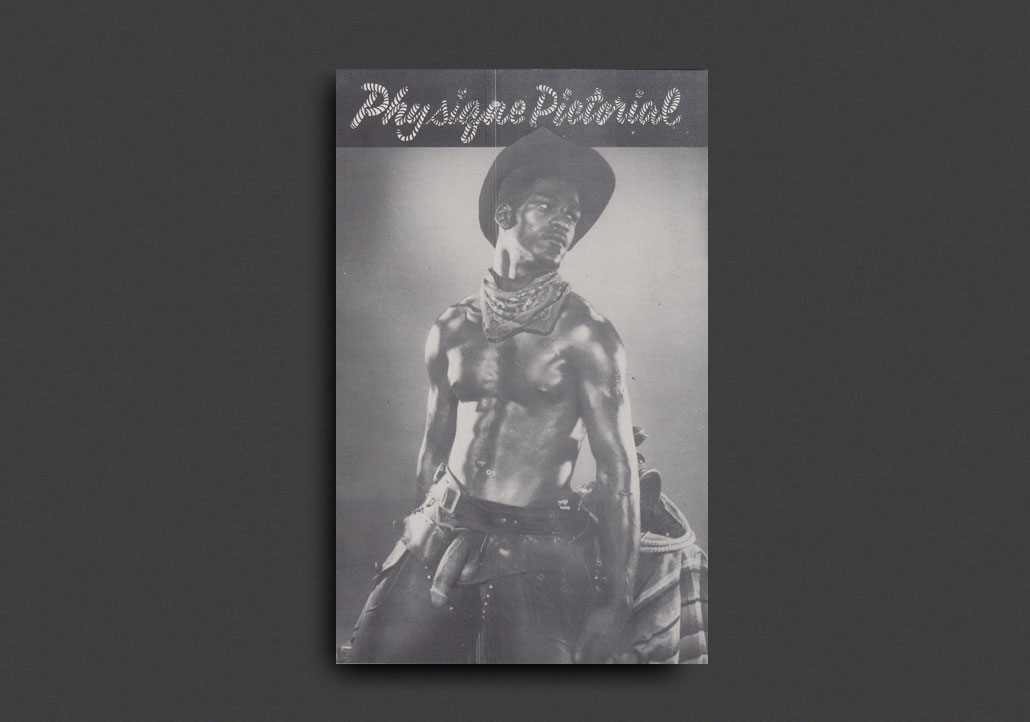
Premier issue of the Athletic Model Guild trade catalogue of photos, slides, videos, and magazines, from the makers of the iconic Physique Pictorial magazine (back-issues also all listed). Packed with male nudes and their profiles. Published in 1986.
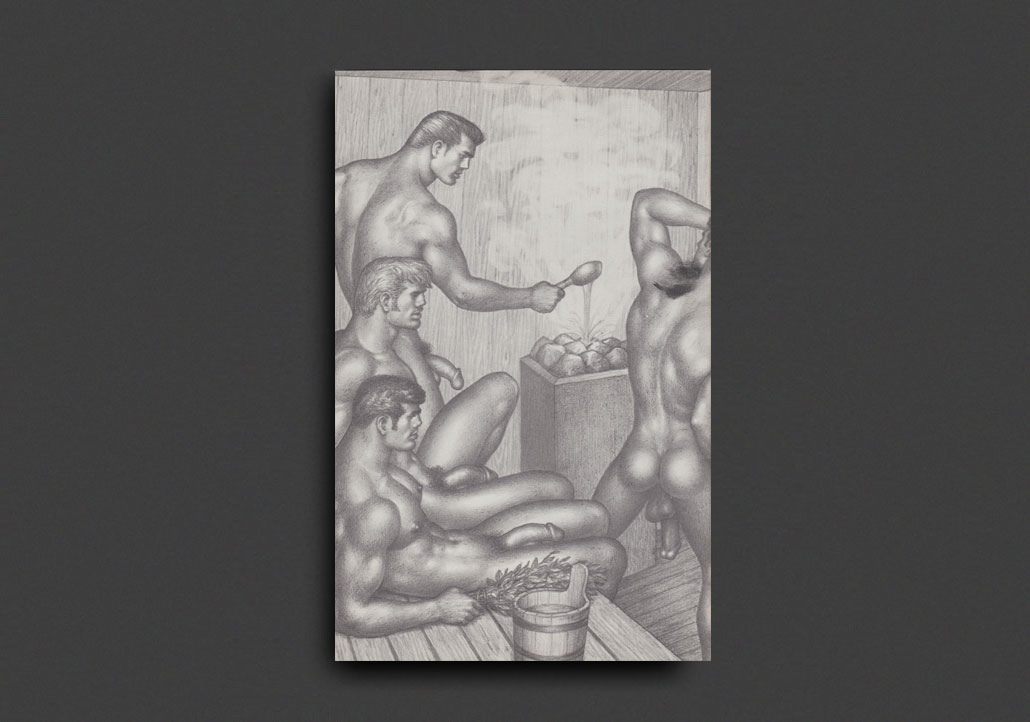
In 1945, gay pornography pioneer Bob Mizer founded Athletic Model Guild, or AMG. Mizer's AMG produced the trailblazing, iconic Physique Pictorial, the first all-nude and all-male magazine. Bob, himself, worked on every aspect of PP's production from the graphic design and tedious cut-and-paste production of the layout to the composition of the texts and the all-important selection of photographs and illustrations. Physique Pictorial was and still is the most highly coveted publication of its genre, introducing the world to such fantastic photographers such as Bruce of Los Angeles, Lon of London and Champion Studios, models such as John Apache, Jim Paris, and Tico Patterson, and artists such as Tom of Finland, Etienne and George Quaintance. In the 1960s, the pretense of being a digest about about exercise and fitness was dropped as controls on pornography were reduced. By the end of the decade gay pornography became legal, and the market for physique "beefcake" magazines collapsed. These magazines are a gorgeous time capsule.
Very Good copy.
1991, English
Softcover (staple-bound), 32 pages, 21 x 13.5 cm
1st Edition, Out of print title / used / very good
Published by
Athletic Model Guild (AMG) / Los Angeles
$40.00 - Out of stock
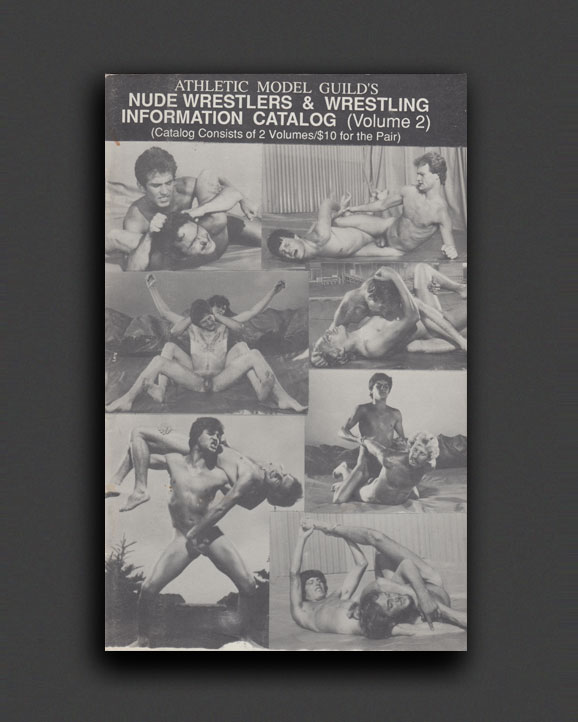
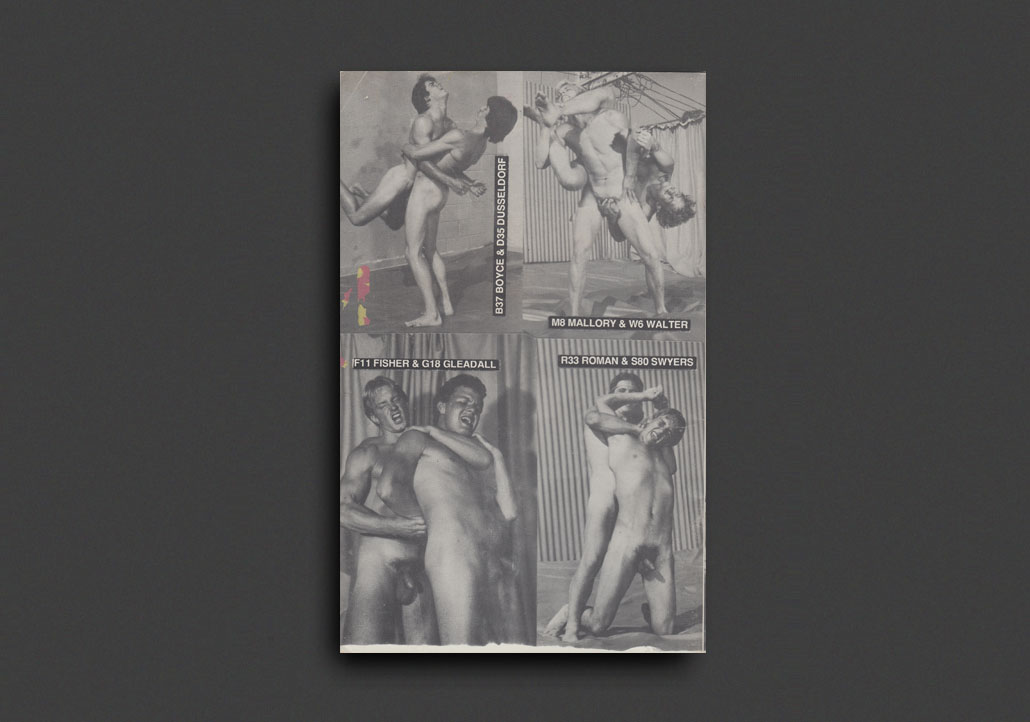
Athletic Model Guild's Nude Wrestlers & Wrestling Information Catalog (Vol. 2), published in 1991. Densely packed with photographs of full-frontal male nude models with catalog numbers relating to available VHS and Beta video tapes as well as cover and inner cover stills from the wrestling videos produced by AMG.
In 1945, gay pornography pioneer Bob Mizer founded Athletic Model Guild, or AMG. Mizer's AMG produced the trailblazing, iconic Physique Pictorial, the first all-nude and all-male magazine. Bob, himself, worked on every aspect of PP's production from the graphic design and tedious cut-and-paste production of the layout to the composition of the texts and the all-important selection of photographs and illustrations. Physique Pictorial was and still is the most highly coveted publication of its genre, introducing the world to such fantastic photographers such as Bruce of Los Angeles, Lon of London and Champion Studios, models such as John Apache, Jim Paris, and Tico Patterson, and artists such as Tom of Finland, Etienne and George Quaintance. In the 1960s, the pretense of being a digest about about exercise and fitness was dropped as controls on pornography were reduced. By the end of the decade gay pornography became legal, and the market for physique "beefcake" magazines collapsed. These magazines are a gorgeous time capsule.
Very Good copy.
1970, English
Softcover (staple-bound), 32 pages, 21 x 13.5 cm
1st Edition, Out of print title / used / very good
Published by
Athletic Model Guild (AMG) / Los Angeles
$60.00 - In stock -
Physique Pictorial Vol. 18, #1 January, 1970 issue of the iconic Physique Pictorial magazine from Los Angeles. Original issue packed with nude photographs and illustrations from various artists. Includes both covers by Tom of Finland.
In 1945, gay pornography pioneer Bob Mizer founded Athletic Model Guild, or AMG. Mizer's AMG produced the trailblazing, iconic Physique Pictorial, the first all-nude and all-male magazine. Bob, himself, worked on every aspect of PP's production from the graphic design and tedious cut-and-paste production of the layout to the composition of the texts and the all-important selection of photographs and illustrations. Physique Pictorial was and still is the most highly coveted publication of its genre, introducing the world to such fantastic photographers such as Bruce of Los Angeles, Lon of London and Champion Studios, models such as John Apache, Jim Paris, and Tico Patterson, and artists such as Tom of Finland, Etienne and George Quaintance. In the 1960s, the pretense of being a digest about about exercise and fitness was dropped as controls on pornography were reduced. By the end of the decade gay pornography became legal, and the market for physique "beefcake" magazines collapsed. These magazines are a gorgeous time capsule.
Very Good copy.
1976, English
Softcover (staple-bound), 32 pages, 21 x 13.5 cm
1st Edition, Out of print title / used / very good
Published by
Athletic Model Guild (AMG) / Los Angeles
$60.00 - Out of stock
Physique Pictorial Vol. 28 August, 1976 issue of the iconic Physique Pictorial magazine from Los Angeles. Original issue packed with nude photographs and illustrations from various artists. Includes cover artwork by Tom of Finland.
In 1945, gay pornography pioneer Bob Mizer founded Athletic Model Guild, or AMG. Mizer's AMG produced the trailblazing, iconic Physique Pictorial, the first all-nude and all-male magazine. Bob, himself, worked on every aspect of PP's production from the graphic design and tedious cut-and-paste production of the layout to the composition of the texts and the all-important selection of photographs and illustrations. Physique Pictorial was and still is the most highly coveted publication of its genre, introducing the world to such fantastic photographers such as Bruce of Los Angeles, Lon of London and Champion Studios, models such as John Apache, Jim Paris, and Tico Patterson, and artists such as Tom of Finland, Etienne and George Quaintance. In the 1960s, the pretense of being a digest about about exercise and fitness was dropped as controls on pornography were reduced. By the end of the decade gay pornography became legal, and the market for physique "beefcake" magazines collapsed. These magazines are a gorgeous time capsule.
Very Good copy.
1984, English
Softcover (staple-bound), 69 pages, 28 x 21cm
1st Edition, Out of print title / used / good
Published by
Drummer / San Francisco
$65.00 - Out of stock
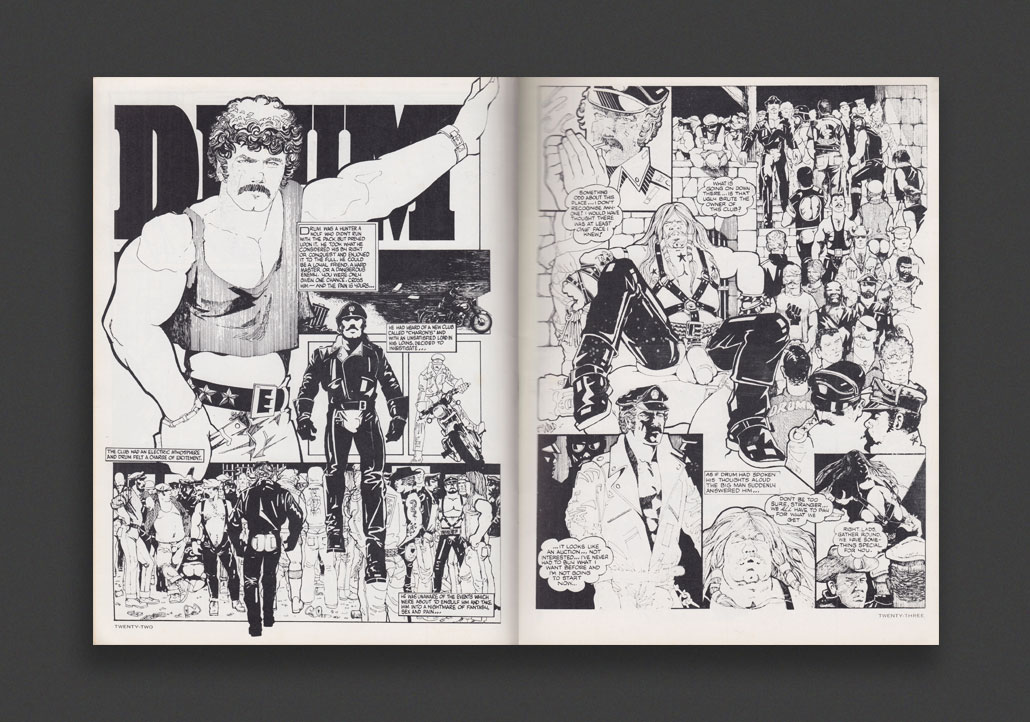
Very rare copy of The Erotic Art of Bill Ward, a book of homoerotic fantasy comic stories by British gay graphic artist, Bill Ward (1927–1996), published by Drummer magazine. This volume collects his various graphic erotic adventures that would appear in the pages of British and American magazines from about 1976 onwards, such as Him, Zipper, Manifest Reader, Stroke, Drummer, etc. It particularly focusses on his famed "Adventures of Drum" series, and also the strips of "King". Muscular bears, bikers, barbarians, cops and mythological creatures in sexual quests that play out in clubs, alleys and dungeons.
Bill Ward was a gay graphic artist born 20th August 1927 in East London. (Not to be confused with the American heterosexual erotic artist by the same name, William Hess Ward 1919-1998). Bill's publishing career began as a copyboy in newspaper publishing before becoming an art editor for children’s comics and then a graphic artist. He worked as a graphic artist for Amalgamated Press and Fleetway on childrens’ comics, notably their Thriller series (November 1951 – May 1963). In 1957 Bill had his first erotic drawings published anonymously in the British physique magazine Male Classics and he would later work openly for hard-core American magazines. Bill’s work features in the same issue of Drummer that includes Robert Mapplethorpe’s first commissioned cover (issue 24, September 1978). Bill was a member of the British gay bikers club called MSC London. Bill Ward died on 24th July 1996 at Stratford in London at the tail end of the worst period of the AIDS epidemic.
Good copy with light wear and spine pinching.
2014, English
Softcover, 512 pages, 14 x 21.6 cm
Published by
Nightboat Books / New York
$49.00 - Out of stock
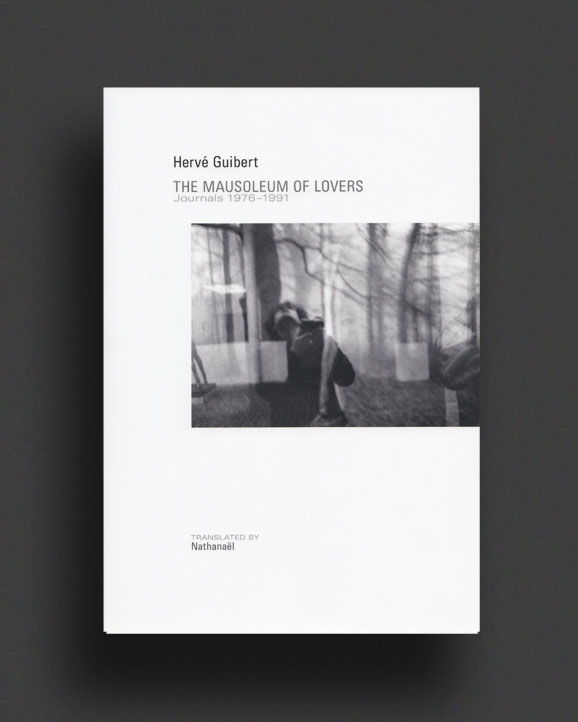
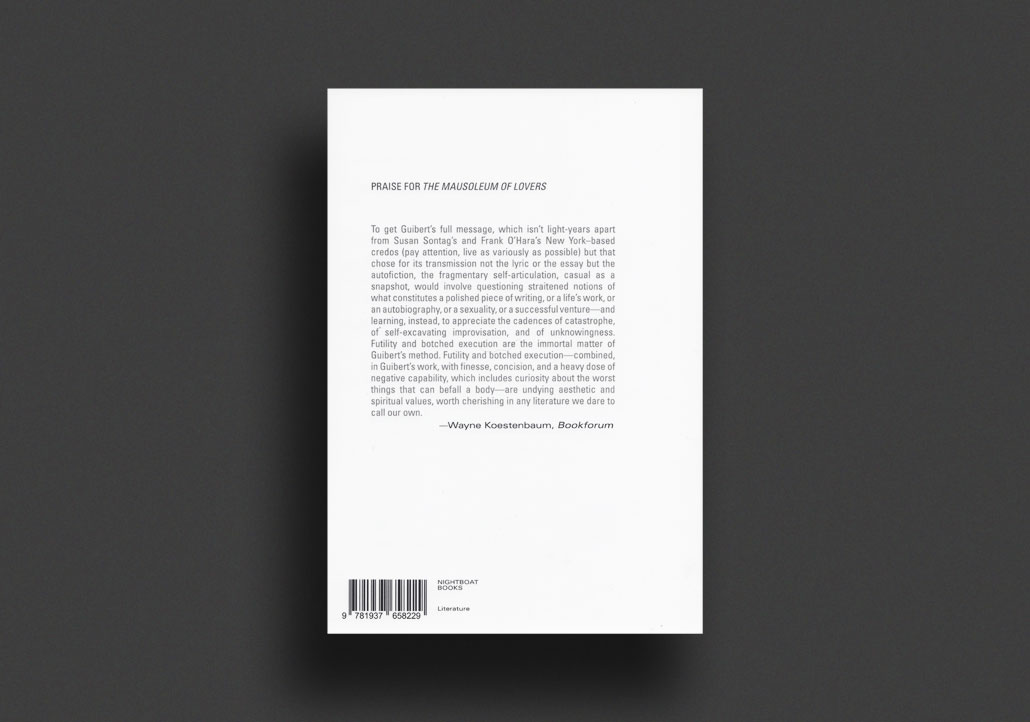
The long-awaited English-language translation of Hervé Guibert’s arresting journals.
The Mausoleum of Lovers comprises Guibert's journals, kept from 1976-1991. Functioning as an atelier, it forecasts the writing of a novel, which does not materialize as such; the journal itself - a mausoleum of lovers - comes to take its place. The sensual exigencies and untempered forms of address in this epistolary work, often compared to Barthes' A Lover's Discourse, use the letter and the photograph in a work that hovers between forms, in anticipation of its own disintegration.
Translated by Keshii Pelao Nathanaël.
Hervé Guibert (1955–1991) was a French writer and photographer. A critic for Le Monde, he was the author of some thirty books, most notably To the Friend Who Did Not Save My Life, which presents an intimate portrait of Michel Foucault and played a significant role in changing public attitudes in France towards AIDS.
2020, English
Softcover, 272 pages, 13.7 x 20.3 cm
Published by
Semiotext(e) / Los Angeles
$49.00 - In stock -
A novel that describes, with devastating, darkly comic clarity, its narrator's experience of being diagnosed with AIDS.
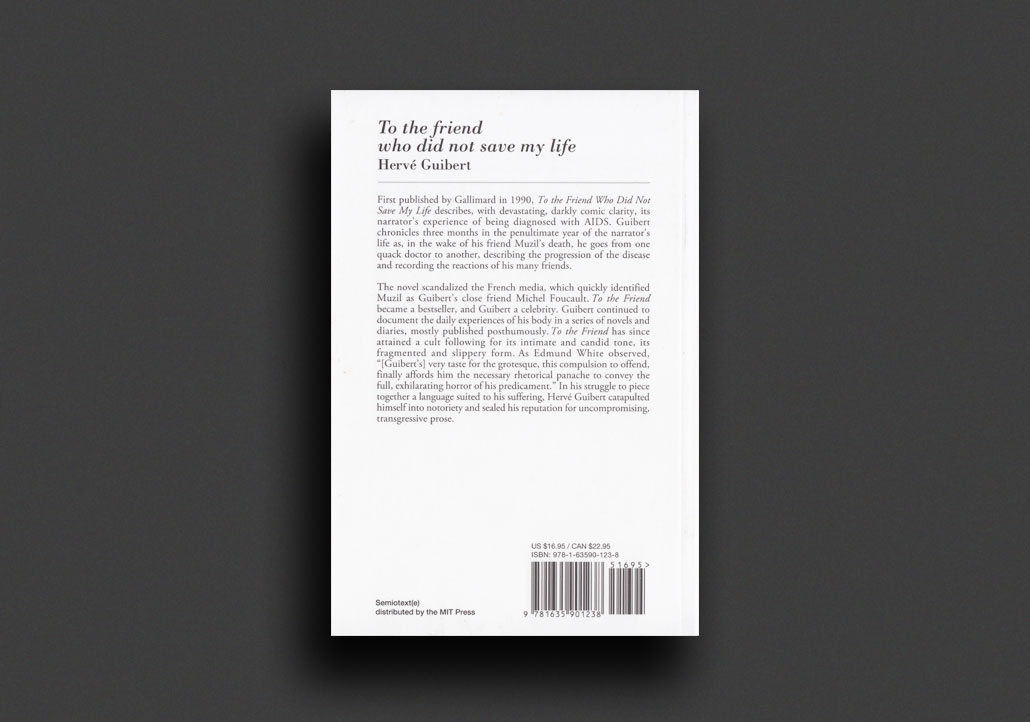
First published by Gallimard in 1990, To the Friend Who Did Not Save My Life describes, with devastating, darkly comic clarity, its narrator's experience of being diagnosed with AIDS. Guibert chronicles three months in the penultimate year of the narrator's life as, in the wake of his friend Muzil's death, he goes from one quack doctor to another, describing the progression of the disease and recording the reactions of his many friends.
The novel scandalized the French media, which quickly identified Muzil as Guibert's close friend Michel Foucault. To the Friend became a bestseller, and Guibert a celebrity. Guibert continued to document the daily experiences of his body in a series of novels and diaries, mostly published posthumously. To the Friend has since attained a cult following for its intimate and candid tone, its fragmented and slippery form. As Edmund White observed, "[Guibert's] very taste for the grotesque, this compulsion to offend, finally affords him the necessary rhetorical panache to convey the full, exhilarating horror of his predicament." In his struggle to piece together a language suited to his suffering, Herve Guibert catapulted himself into notoriety and sealed his reputation for uncompromising, transgressive prose.
Translated by Linda Coverdale, Afterword by Edmund White, Introduction by Andrew Durbin
HERVÉ GUIBERT (1955-1991) was a French writer and photographer. A critic for Le Monde, he was the author of some thirty books, most notably To the Friend Who Did Not Save My Life, which presents an intimate portrait of Michel Foucault and played a significant role in changing public attitudes in France towards AIDS.
2003, English
Hardcover (w. dust jacket), 128 pages, 26 x 21 cm
1st Edition, Out of print title / as new
Published by
Little Bear Press / US
$700.00 - Out of stock
As new, first edition sealed copy of extremely collectible monograph by pioneering male-figure photographer Jim French, of Man and Another Man fame, showcasing French's 1972 nude study collection of the popular Colt model, Erron, also known as David Scrivanek. A beautifully produced monograph designed by Dimitri Levas with an essay and interview with French by photographer and publisher Bruce Weber. As with all of Little Bear’s books, the quality of the design, paper and printing is impeccable. Now near impossible to find.
Jim French (1932 – 2017) was an American artist, illustrator, photographer, filmmaker, and publisher. He is best known for his association as co-founder of Colt Studio, using the pseudonym Rip Colt, created in late 1967, where French built what would become one of the most successful gay male erotica companies in the U.S. French began drawing and photographing male erotica in the mid-1960s while working as an illustrator and artist for Madison Avenue advertising agencies. His first published book, Man, was issued in 1972. Other books include Another Man, Jim French Men, Quorum, Opus Deorum, Masc., The Art of Jim French and The Art of the Male Nude. Publication of Colt magazines began in 1969 with the digest-size "Manpower!". During the 1970s, French began marketing his short films in 8mm format; they were soon collected on video-cassette format, which were remastered for DVD format in the 1990s. French's artwork and photography has been hailed as “iconic, groundbreaking, and singularly influential”, leaving a legacy of homoerotic images in artwork, illustrations, photo sets, slides, film, fine-art photographs, magazines, books and calendars that presented his work exclusively and set a new standard in photography of men.
As New copy.
1970, French
Softcover (staple-bound), 14 pages,
1st Edition, Out of print title / used / very good
Published by
Eric Losfeld / Paris
$45.00 - Out of stock
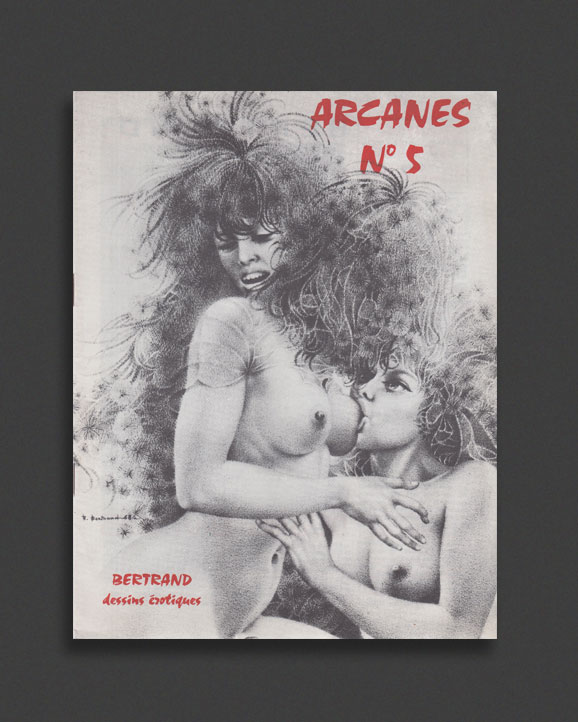
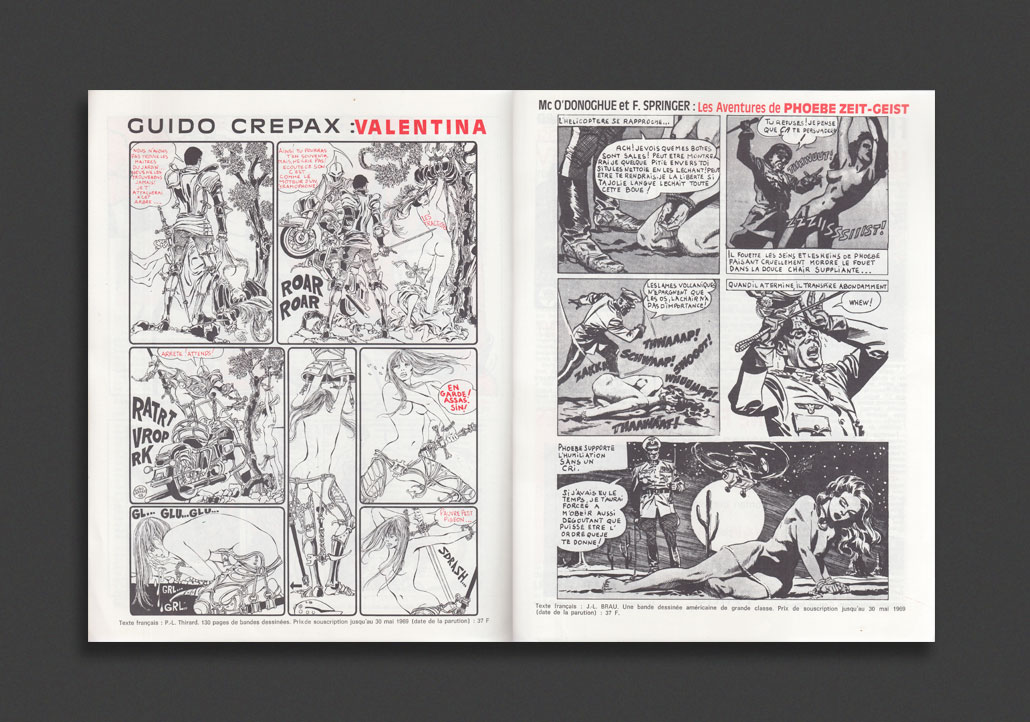
Scarce issue No. 5 of Arcanes, the "bulletin terrain vague" issued by publisher Eric Losfeld, Paris. With a cover feature on French artist Raymond Bertrand's "dessins érotiques", this issue also features the artwork of Guido Crepax and Jean-Claude Forest, as well as other information on the happenings around the Losfeld imprint.
Éric Losfeld (1922 - 1979) was a Belgian-born French publisher who had a reputation for publishing controversial material and was as often sued as Jean-Jacques Pauvert. A publisher who despised profit, he boasted that he had been, throughout his life, "in debt like a mule". When the creditors and the prosecutors gave him a little respite, he who defined himself as a "free editor" had only one principle: to be faithful to his tastes and unfaithful to his disgusts. "The only literature that touches me," he proclaimed, " is literature written with passion, or rather passionate literature." Thus, for thirty years, Losfeld created, at Arcane Editions, Le Terrain Vague, and under his own name, an invaluable and often clandestine catalog of Babouvist and hallucinated principality, and where he gathered all his preferences. For surrealism, eroticism, anarchism, romanticism, fantasy, black humor, jazz and comics. The world according to Losfeld, was that of Artaud, Mandiargues, Druillet, Sade, Vian, Peret, Allais, Jarry, Gbe, Sternberg, Forneret, Bealu, Topor, Arrabal, Peellaert or Klossowski. He was the publisher of Emmanuelle (1967), surrealist magazines ("Bief") and cinematographic magazines ("Midi Minuit Fantastique" and "Positif"), and the Barbarella science fiction comic book created by Jean-Claude Forest, amongst many other titles. Losfeld's tombstone inscription reads, "Tout ce qu'il éditait avait le souffle de la liberté." ("Everything he edited had the breath of freedom.").
Very Good copy.
2000, French / Japanese
Softcover + poster, 176 pages, 18.5 x 14.5 cm
Published by
L'Appareil-Photo Éditeur / Tokyo
$100.00 - Out of stock
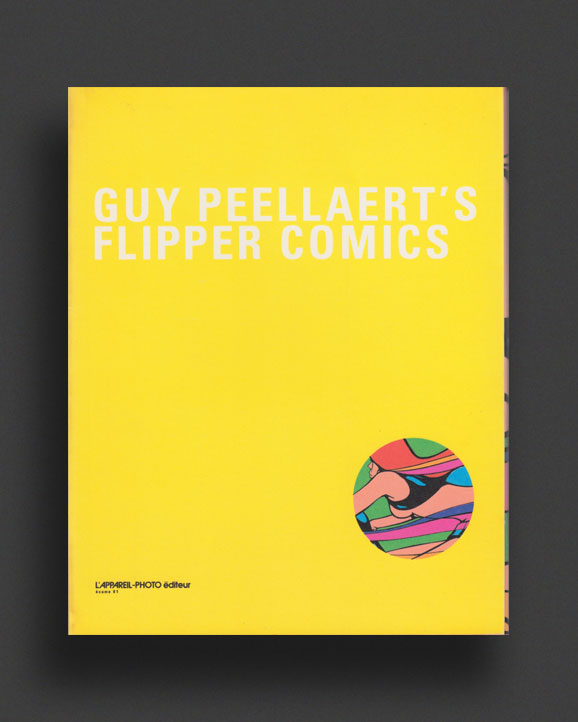
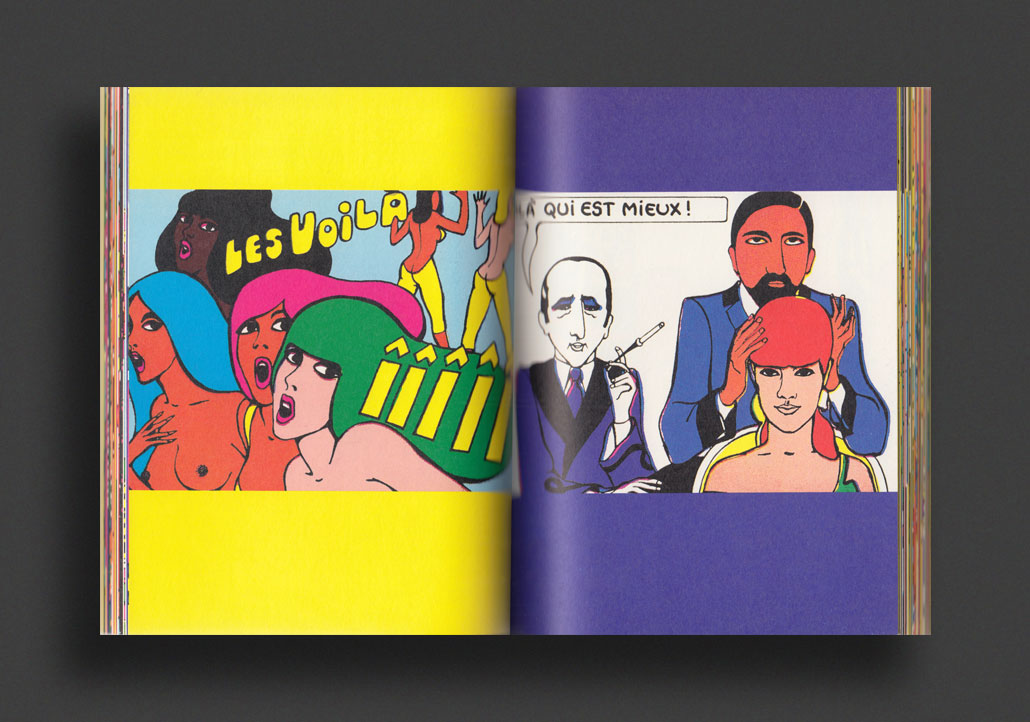
First edition of this wonderful and very uncommon Japanese volume published by L'Appareil-Photo Éditeur on the explosive pop bandes dessinees art of Guy Peellaert. Cover to cover reproductions of Belgian pop comic artist Peellaert's famous 'Les Aventures de Jodelle' and 'Pravda la Survireuse' comic strips, together with press clippings and photos from french newspapers, accompanied with short texts in Japanese. Comics fragments are in their original French. Complete copy with the 'Pravda la Survireuse' fold-out poster.
Guy Peellaert (1934 – 2008) was a Belgian artist, painter, illustrator, comic artist and photographer, most famous for the book Rock Dreams, and his album covers for rock artists like David Bowie (Diamond Dogs) and The Rolling Stones (It's Only Rock 'n' Roll). He also designed film posters for films like Taxi Driver, Paris, Texas, and Short Cuts. The band Frankie Goes to Hollywood took their name from Peellaert's painting, titled Frank Sinatra, which featured the headline "Frankie Goes Hollywood".
After contributing a number of photo collage-based style strips to 'Hara-Kiri', Peellaert adopted a photo-realistic airbrush style and made a successful return to advertising and illustration. Yet he was also briefly active as a comics artist in the late 1960s, making such psychedelica and pop art-influenced stories as 'Les Aventures de Jodelle' (1966), 'Pravda, la survireuse' (1967), 'The Game' (1968) and 'SHE and the Green Rairs' (1968). These comic strips remain hugely important in Bandes Dessinees history.
Very Good copy w. VG original issue poster, light markings to back corners from previous owner's blue-tac.
2021, English
Softcover, 21 x 29.7 cm
Published by
Centre d'editions / Melbourne
Guzzler / Rosanna
$30.00 - In stock -
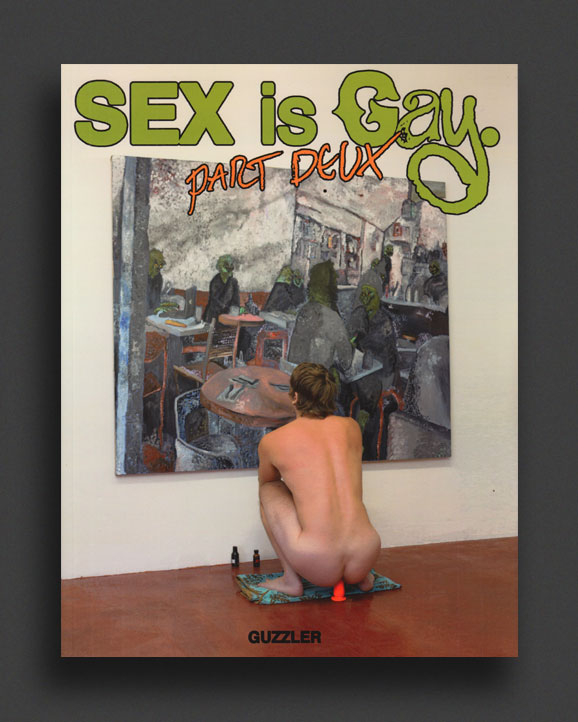
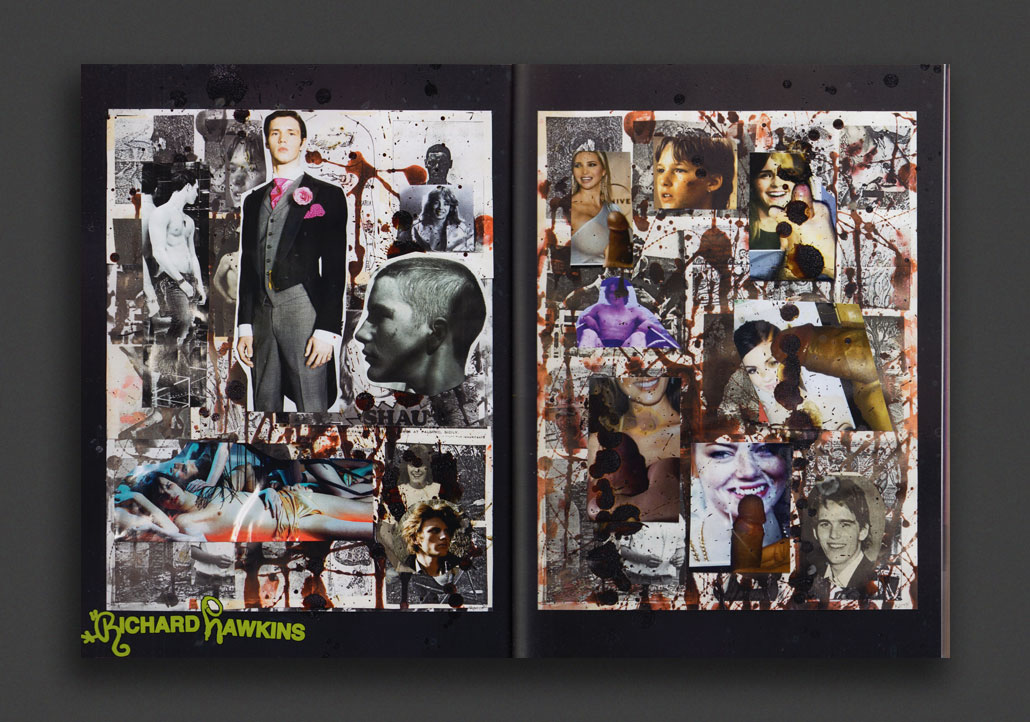
Very limited edition informal magazine/catalogue published on the occasion of ‘Sex is Gay: Part Deux’, a group exhibition presented by Zac Segbedzi at Guzzler, Rosanna, 20 Nov — 5 Dec, 2021. Features the work of Ramsay Alderson, Richard Hawkins, Paul Levack, Mathieu Malouf, Heji Shin, and Alex Vivian. Lavishly colour illustrated on glossy stock with work images, video stills and installation photography from the exhibition, followed by 20 pages of erotic photos shot by Ramsey Alderson and Richard Hawkins of famed pornstar Tom Faulk during Mathieu Malouf's 2016 show ‘Toilet’ at Jenny's in Los Angeles.
Very limited print run.
1995, English
Softcover, 164 pages, 14 x 21.5 cm
1st UK Edition, Out of print title / used / very good
Published by
Creation Books / London
$100.00 - Out of stock
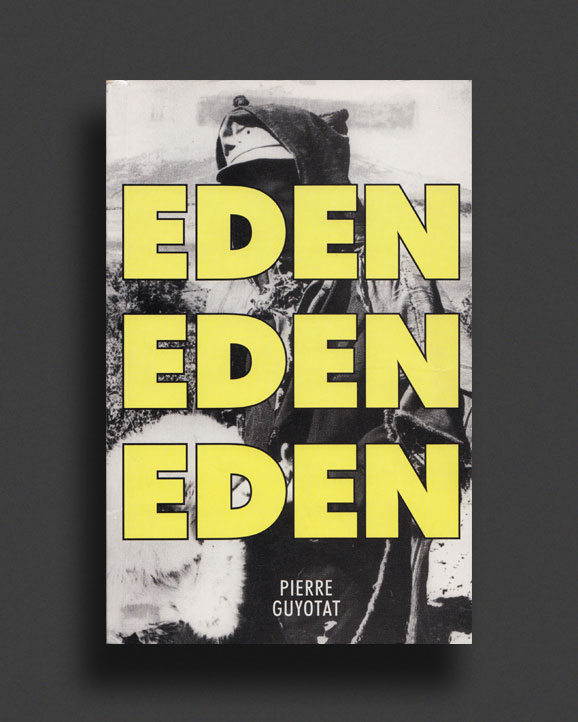
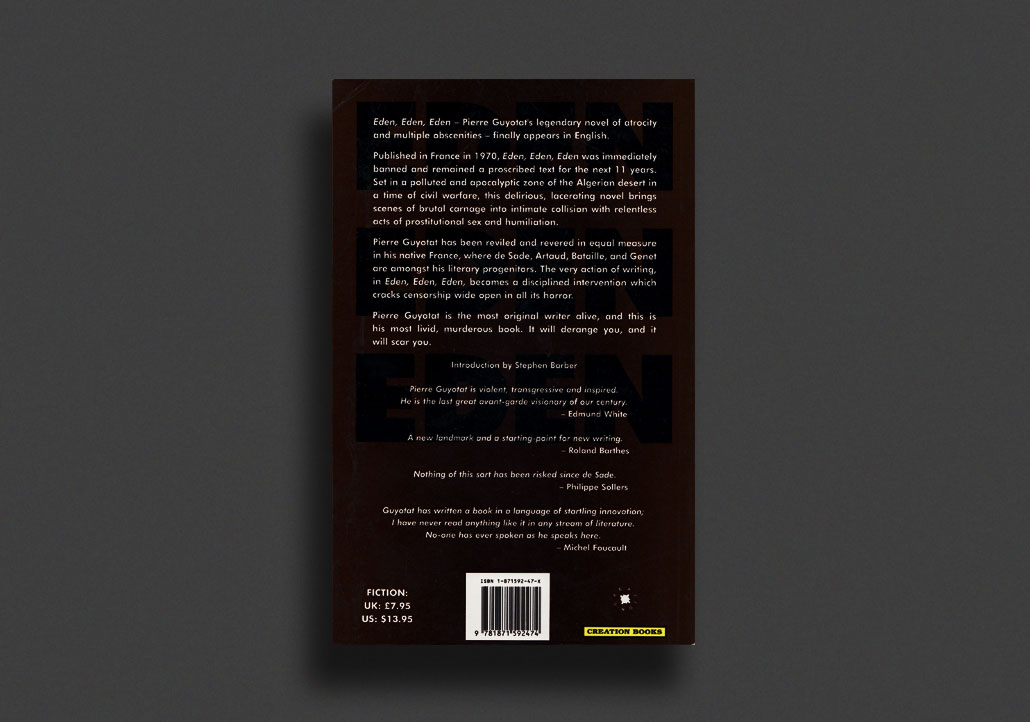
First edition of the long out-of-print English edition of Eden, Eden, Eden - Pierre Guyotat's masterpiece of atrocity and obscenity.
The most subversive French novelist of the later 20th century, Pierre Guyotat (b. 1940) was the uncompromising heir of De Sade, Artaud, Rimbaud and Genet. Published in France in 1970 by Gallimard, with a preface by Michel Leiris, Roland Barthes and Philippe Sollers, Eden, Eden, Eden was greeted by both furore and acclaim. The book was immediately banned by the French government as pornographic. A campaign of international support for the book was signed by the like of Pier Paolo Pasolini, Jean-Paul Sartre, Pierre Boulez, Joseph Beuys, Pierre Dac, Jean Genet, Simone de Beauvoir, Joseph Kessel, Maurice Blanchot, Max Ernst, Italo Calvino, Jacques Monod, and Nathalie Sarraute. François Mitterrand and Georges Pompidou tried to get the ban lifted but failed until 11 years later when a newly elected President Mitterrand personally intervened to lift the ban in 1981.
Today Eden, Eden, Eden is recognised as one of the major works of the last century. In literally a single sentence, a desert-like, polluted, apocalyptic landscape of unending civil war unfolds without any morality (and therefore also without evil). This delirious, lacerating novel of startling innovation brings scenes of brutal carnage into intimate collision with relentless acts of prostitutional sex and humiliation.
'a new landmark and starting-point for new writing' - Roland Barthes
'I have never read anything like it in any stream of literature' - Michel Foucault
Very Good copy with some light wear and light creasing.
1995, English
Softcover, 240 pages, 26.7 x 20.5 cm
1st Edition, Out of print title / used / very good
Published by
Goad to Hell Enterprises / Portland
$400.00 - Out of stock
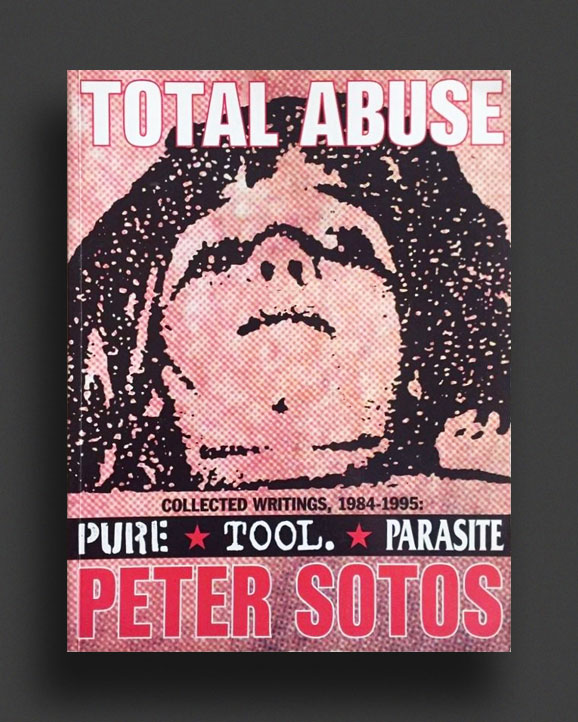
Extremely rare and collectible first edition of Peter Sotos' Total Abuse, a coveted collection of Peter's early and extremely aggressive zines and nearly all of his written output between 1984 and the year of publication in 1995 by Jim and Debbie Goad's infamous Goad to Hell publishing imprint.
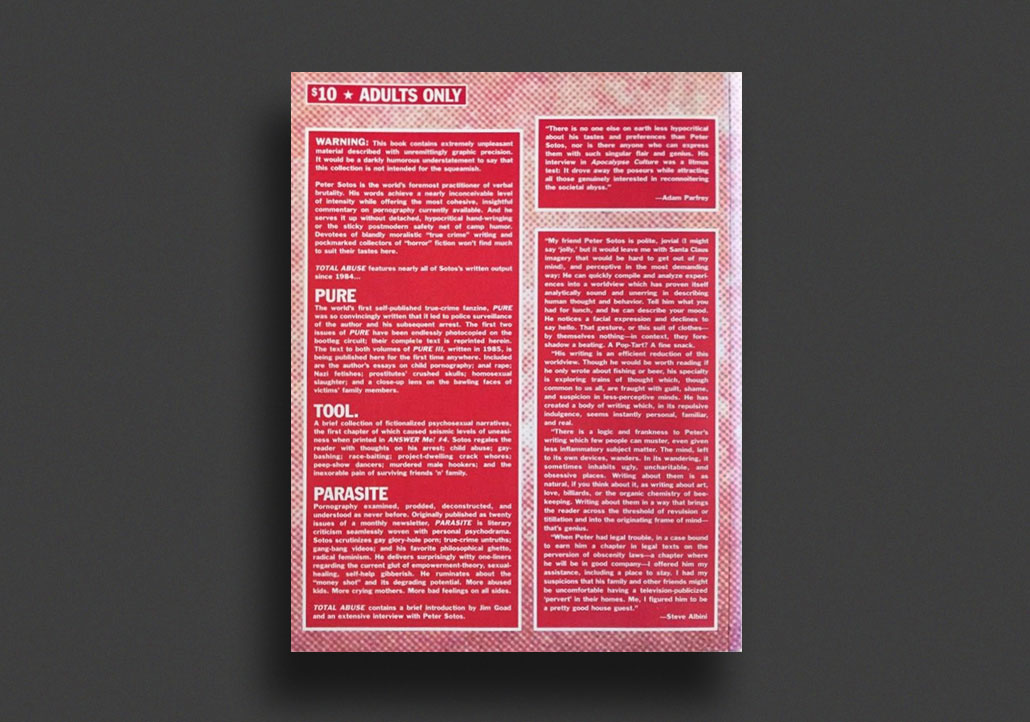
WARNING: TOTAL ABUSE is not for the squeamish!!! This book contains extremely unpleasant material described with unremittingly graphic precision. It would be a darkly humorous understatement to say that this collection is not intended for the squeamish.
Peter Sotos is the world's foremost practitioner of verbal brutality. His words achieve a nearly inconceivable level of intensity while offering the most cohesive, insightful commentary on pornography currently available. And he serves it up without detached, hypocritical hand-wringing or the sticky postmodern safety net of camp humor. Devotees of blandly moralistic “true crime” writing and pockmarked collectors of “horror” fiction won't find much to suit their tastes here.
Total Abuse: Collected Writings 1984—1995 contains the publications Pure #1, #2, #3; Tool; Parasite 1—20.
PURE. The world's first self-published true-crime fanzine, PURE was so convincingly written that it led to police surveillance of the author and his subsequent arrest. The first two issues of PURE have been endlessly photocopied on the bootleg circuit; their complete text is reprinted herein. The text to both volumes of PURE III, written in 1985, is being published here for the first time anywhere. Included are the author's essays on child pornography; anal rape; Nazi fetishes; Prostitutes' crushed skulls; homosexual slaughter; and a close-up lens on the bawling faces of victims' family members.
TOOL. A brief collection of fictionalized psycho sexual narratives, the first chapter of which caused seismic levels of uneasiness when printed in ANSWER Me! #4. Sotos regales the reader with thoughts on his arrest; child abuse; gay-bashing; race-baiting; project-dwelling crack whores; peep-show dancers; murdered male hookers; and the inexorable pain of surviving friends 'n' family.
PARASITE. Pornography examined, prodded, deconstructed, and understood as never before. Originally published as twenty issues of a monthly newsletter, PARASITE is literary criticism seamlessly woven with personal psychodrama. Sotos scrutinizes gay glory-hole porn; true-crime untruths; gang-bang videos; and his favorite philosophical ghetto, radical feminism. He delivers surprisingly witty one-liners regarding the current glut of empowerment-theory, sexual-healing, self-help gibberish. He ruminates about the “money shot” and its degrading potential. More abused kids. More crying mothers. More bad feelings on all sides.
Total Abuse contains a brief introduction by Jim Goad and an extensive interview with Peter Sotos.
Peter Sotos (born April 17, 1960) is a Chicago-born writer who has contributed an unprecedented examination of the peculiar motivations of sadistic sexual criminals. His works are often cited as conveying an uncanny understanding of myriad aspects of pornography. Most of his writings have focused on sexually violent pornography, particularly of that involving children. His writings are also considered by many to be social criticism often commenting on the hypocritical way media handles these issues.
In 1984, while attending The Art Institute of Chicago, Sotos began producing a self-published newsletter or "fanzine" named Pure, notable as the first zine dedicated to serial killer lore. Much of the text and pictures in Pure were photocopied images from major newspapers and other print media. Sotos also used a photocopy from a magazine of child pornography as the cover of issue#2 of Pure. In 1986 this cover led to his arrest and charges of obscenity and possession of child pornography. The charges of obscenity were dropped, but Sotos eventually pled guilty to the possession charge and received a suspended sentence. Sotos was the first person in the United States ever to be charged for owning child pornography.
Sotos' writings explore sadistic and pedophilic sexual impulses in their many, often hidden, guises. Often using first person narratives, his prose takes on the point of view of the sexual predator. Despite his early legal troubles, and the seemingly fatal stigma of falsely being labeled a pedophile, Sotos continues to garner support for his ideas and literary output.
He was until 2003 a seminal member of the industrial noise band Whitehouse.
Good—VG copy with some edge wear and light cover/spine creasing.
1995, Japanese
Softcover (w. dust jacket and obi-strip), 200 pages, 26 x 19 cm
1st Edition, Out of print title / used / very good
Published by
Fusosha / Tokyo
$100.00 - Out of stock
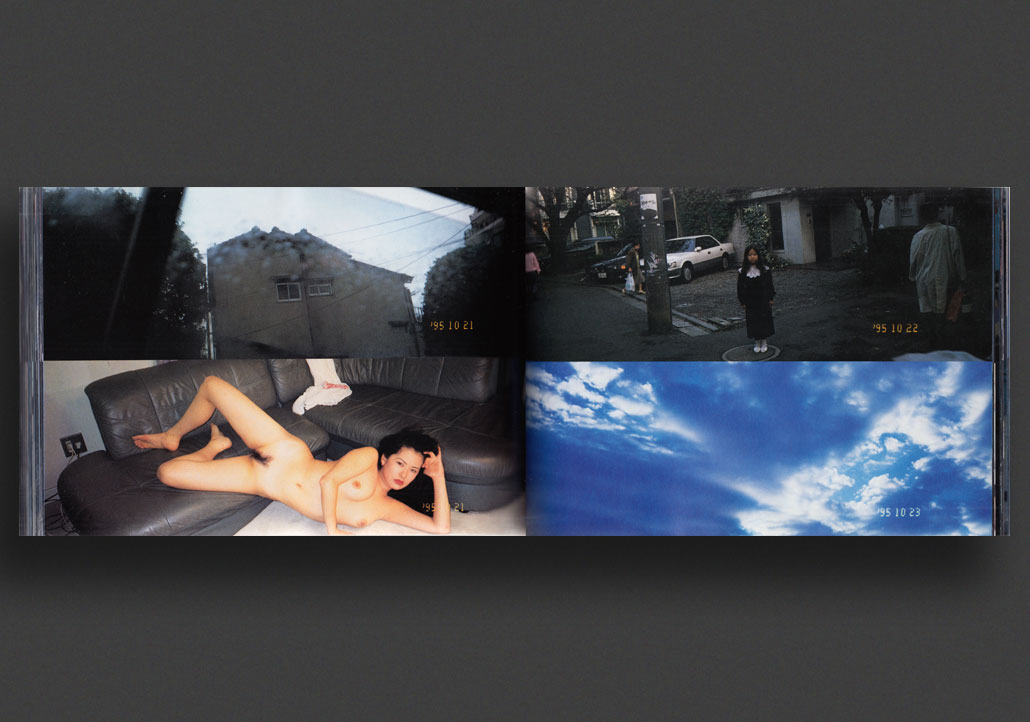
Scarce, first edition of this wonderful 1995 Araki photo album. From cover to cover this book is entirely comprised of Araki's date-stamped photographs taken in the year 1995, presented chronologically and in rich colour. Araki documents all his favourite subjects — women, nudes, flowers, still-lifes, Japanese city details and his beloved cat Chiro, all in amazing panoramic format. Robert Frank and Nan Goldin even make appearances. The landscape format of this hardcover book allows for the images to be grouped into selections of two per page (four per spread) or a glorious single shot spanning a spread, making a jam-packed collection of almost 400 photographs. A great collection.
Very Good copy with Good dust jacket and obi-strip.
2003, Japanese
Softcover (w. dust jakcet and obi-strip), 400 pages, 18.3 x 25.7 cm
1st Edition, Out of print title / used / very good
Published by
Wides Shuppan Co. / Tokyo
$100.00 - Out of stock
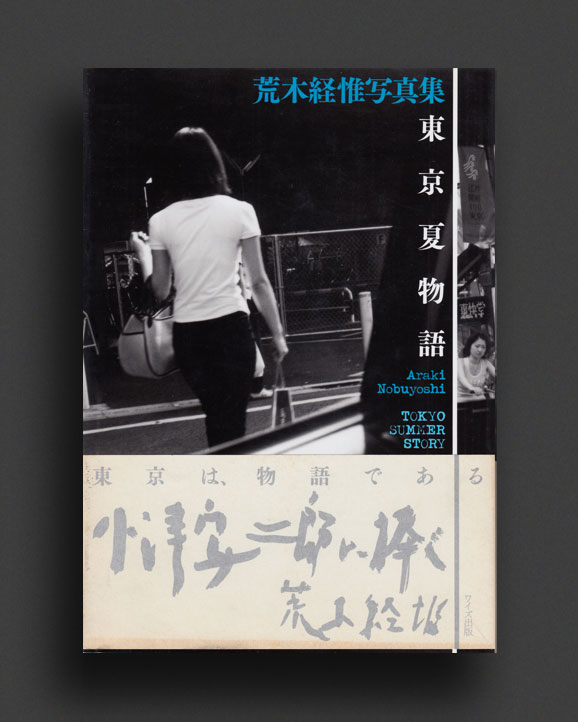
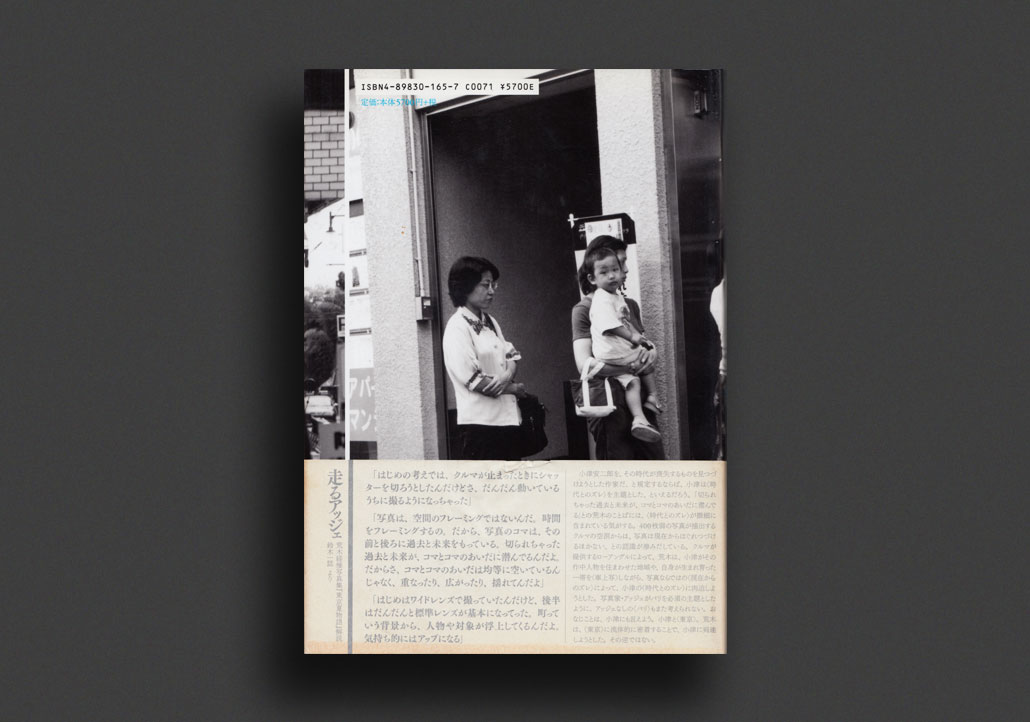
First edition of Nobuyoshi Araki's "Tokyo Summer Story", published in 2003. Tokyo told as a story. Dedicated to Japanese film-maker Yasujirō Ozu. Unique among the many snaps of Araki, "Tokyo Summer Story" is entirely comprised of photographs of Tokyo streets taken by Araki whilst riding in a taxi. Accompanying text “The Running Atget” by Hitoshi Suzuki
“At first I thought, I will release my shutter when the cars have stopped. But step by step, I began to shoot while things were moving.” [...] “Photography is not about framing a space, no. It is an art about framing time. Before and after every single photography frame, there’s a past and a future. These deleted futures and pasts lurk in the space between the frames. So you see, the spaces between each shot are not evenly empty, they spread out, overlap, swing.” [...] “At first I used a wide lens to shoot, but in the latter half, I gradually switched to a normal lens. People and subjects come floating out of the city landscape. On an emotional level, this gets me closer.” — quotes by Nobuyoshi Araki taken from Hitoshi Suzuki’s “The Running Atget”
Very Good copy, with only light tanning, otherwise As New.
1982, Japanese
Softcover (w. dust jacket), 68 pages, 12.9 x 18.2 cm
1st Edition, Out of print title / used / very good
Published by
Nippon Geijutsu Shuppan (NGS) / Japan
$190.00 - Out of stock
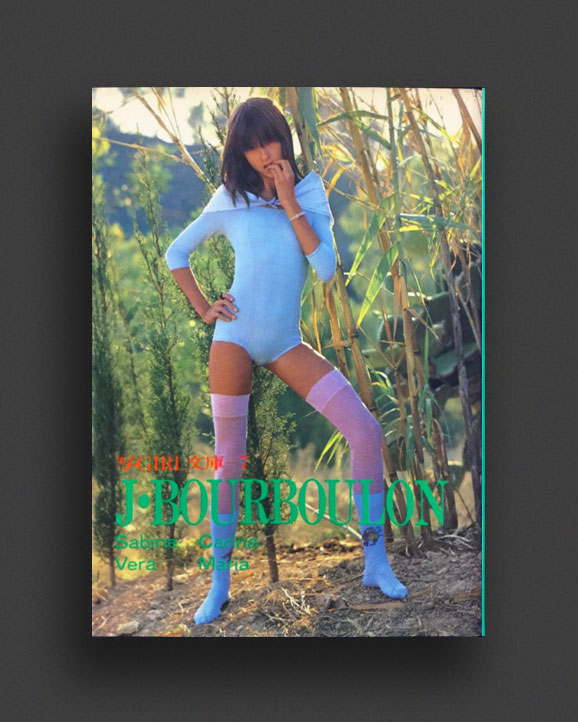
1982 volume of nude photography by French photographer Jacques Bourboulon from the collectible Photo Girl series of green paperbacks from Japanese imprint Nippon Geijutsu Shuppan (NGS). Cover to cover glossy, full-bleed photography, printed in Japan.
Very Good copy.
1984, Japanese
Softcover, 96 pages, 25.5 x 18 cm
1st Edition, Out of print title / used / very good
Published by
Art Vivant / Tokyo
$70.00 - Out of stock
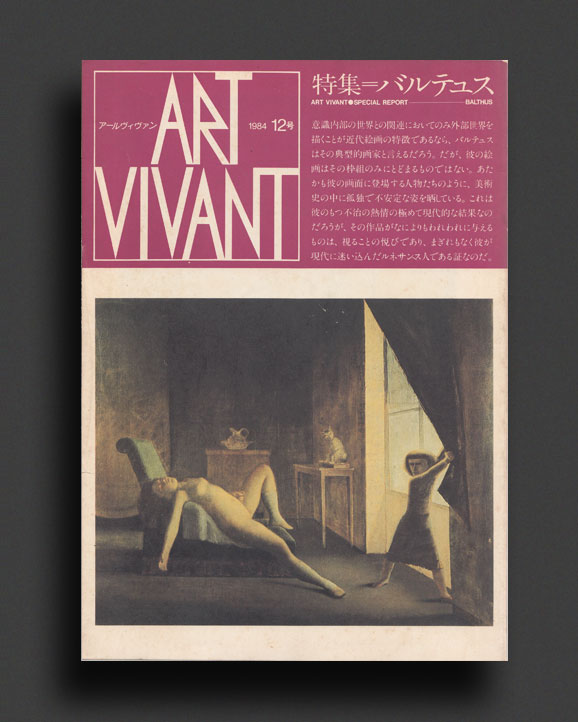
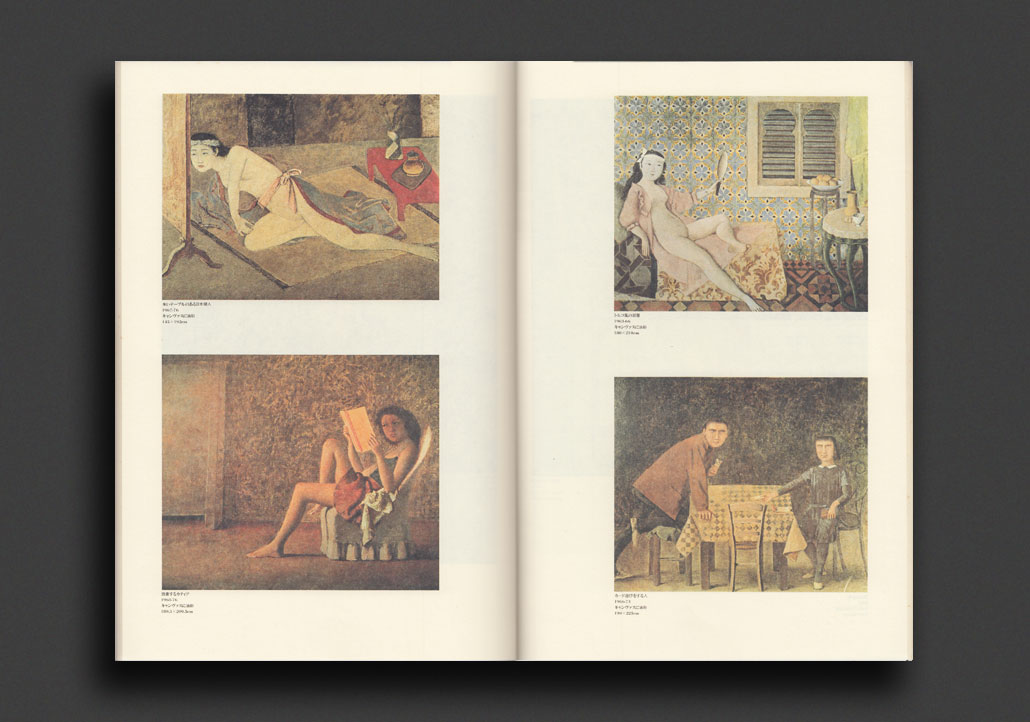
Issue 12 (1984) of Japan's great Art Vivant quarterly journal. This very special issue dedicated entirely to the work of Balthus (1908 – 2001). Heavily illustrated throughout with black and white reproductions of Balthus' drawings and etchings, along with a large colour section reproducing many of Balthus' paintings, also essays in Japanese, portraits, biography, and much more. Both front and back covers feature work by Balthus.
Very scarce and Very Good copy of this collectible issue.
Throughout his career, Balthus rejected the usual conventions of the art world. He insisted that his paintings should be seen and not read about, and he resisted any attempts made to build a biographical profile. A telegram sent to the Tate Gallery as it prepared for its 1968 retrospective of his works read: "NO BIOGRAPHICAL DETAILS. BEGIN: BALTHUS IS A PAINTER OF WHOM NOTHING IS KNOWN. NOW LET US LOOK AT THE PICTURES. REGARDS. B."
Balthus (1908 – 2001), was a Polish-French modern artist born in Paris to Polish expatriate parents. His given name was Balthasar Klossowski - his sobriquet "Balthus" was based on his childhood nickname, alternately spelled Baltus, Baltusz, Balthusz or Balthus. His father, Erich Klossowski, was an art historian who wrote a noted monograph on Daumier. His older brother was the philosopher and artist Pierre Klossowski. An unusual figure in the history of twentieth century painting, Balthus both traveled among and drew upon the work of other major artists of his time, while at the same time following a unique individual trajectory. He was mentored by, friends of, and/or even collaborated with seminal creative figures from different eras, including Antonin Artaud, André Breton, and Rainer Maria Rilke, while cultivating his own highly refined style of dreamlike, classically-informed painting. The scenes he usually depicted were very ordinary bourgeois interiors or outdoor settings, which nonetheless managed to reveal the heightened inner states of his subjects as well as the states of mind of those who might be viewing them.
"I always feel the desire to look for the extraordinary in ordinary things; to suggest, not to impose, to leave always with a slight touch of mystery in my paintings." - Balthus
Good-Very Good copy.
1939 / 1973, French
Softcover (w. lace-printed dust jacket), 26 pages, 13.4 x 9.5 cm
1st Facsimile Edition,
1st Edition, Out of print title / used / very good
Published by
GQ / Tokyo
$250.00 - Out of stock
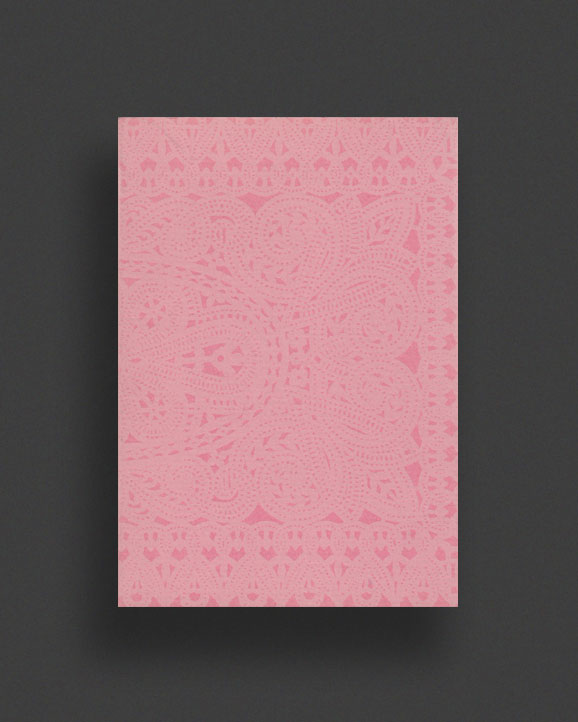
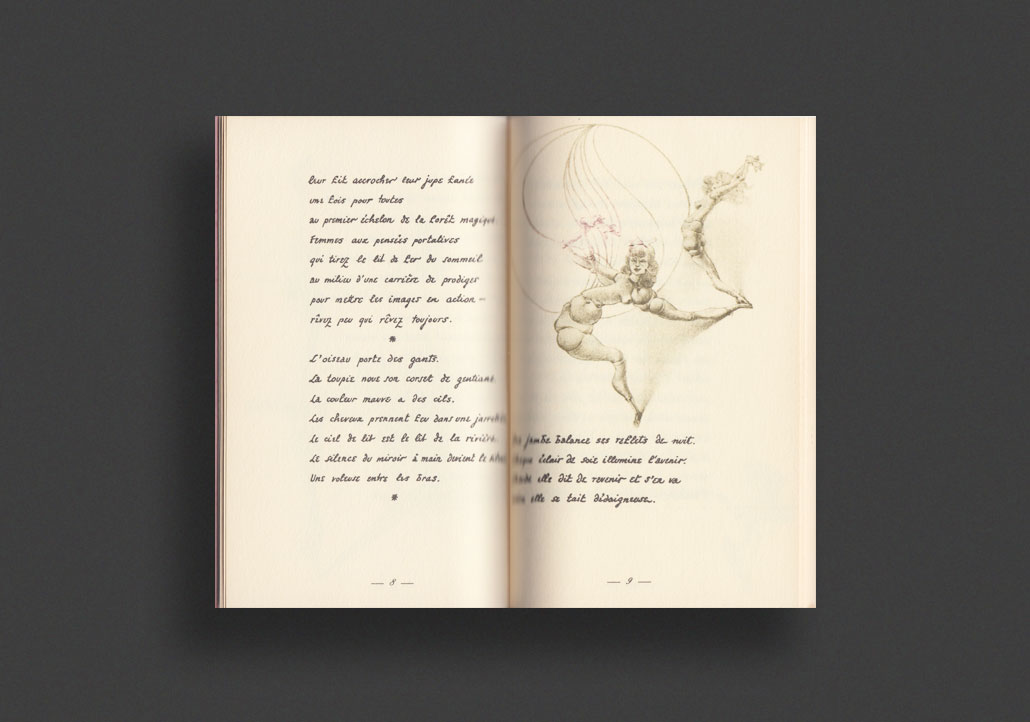
Super rare and mysterious 1973 reprint of the exceptionally rare 'Oeillades Ciselées en Branche' (1939), Hans Bellmer's (1902 – 1975) collaboration with fellow Surrealist Georges Hugnet (1906 – 1974), published in Paris by publisher Jeanne Bucher in an edition limited to 230 hand-numbered copies wrapped in lace paper. Although Bellmer had illustrated books before 'Oeillades Ciselées en Branche', those, such as the notoriously scarce 'Die Puppe' (1934) and the later French version 'La Poupée' (1936) were illustrated with original photographs, this was his very first illustrated book. Bellmer had worked as a draftsman for his own advertising agency and his technical virtuosity combined with his inspirational predilections produced a highly original body of illustration - here in heliogravure - for Hugnet's erotic text. In the words of Pierre Seghers, the poet and publisher, the text and illustration, as well as the design of the book, with its patterned lace over pink paper, combined to produce 'an absolutely perfect little book'. Hugnet was a French graphic artist, poet, writer, art historian, bookbinding designer, critic and film director and a figure in the Dada movement and Surrealism. This was his second book after the famous collage novel Le septième face du dé (1936). The text is a prose poem on the theme of young adolescent girls, articulated with the erotic images of Bellmer, whose extraordinary skill, inherited from the technical drawing of his engineering studies, perfectly serves this particular eroticism. 'Bellmer's color engravings, placed outside the text or using free spaces in the text, offer variations on the theme of the metamorphosis of the female body associated with that of the double. Disarticulated puppets or slender silhouettes with sometimes disproportionate limbs, young girls evolve slightly over the pages, drawn with spider-like finesse by Bellmer, one of the most successful of all. '
Lovingly reproduced here in limited offset-print on warm, fragile, soft paper stocks with delicate dust jacket lace over-prints, reproducing in simplified facsimile edition number "221" of the original 230. Published in Tokyo by the great 1970s GQ (Graphic Quarterly) periodical, their facsimile editions were widely regarded for their quality, and very collectible in their own right, usually only available to those on their mailing list. They were also official reproductions, permitted by their original publishers and authors. That said, there is little to no information anywhere about this particular 1973 edition, published shortly before the deaths of both artists.
Very Good copy.