World Food Books' programme is largely produced on Kulin Nation land. We acknowledge the Wurundjeri people of the Kulin Nation as the first and continuing custodians of this land, and pay respect to their Elders past, present, and emerging.
World Food Books is an arts and special interests bookshop in Naarm / Melbourne. Founded in 2010, World Food Books is devoted to the presentation of a rotating, hand-selection of international art, design, literary and counterculture publications with an emphasis on the anti-traditional, the experimental, the avant-garde, the heretic, the marginal.
Presenting new titles alongside rare and out-of-print books, catalogues and journals spanning the fields of modern and contemporary art, design, photography, illustration, film, literature, poetry, cultural theory, philosophy, sexuality, popular and underground culture in its many radical forms, World Food Books wishes to encourage adventurous, thoughtful and open-minded reading, looking, writing, and exchange of publishing and ideas, both current and historical.
As well as our bookshop, located in Melbourne's historical Nicholas Building, all of our inventory is available internationally via our online mail-order service.
World Food Books semi-regularly co-ordinates "Occasions", a programme of exhibits and events at the bookshop and in partnership with other hosts (such as museums and art galleries) that develop out of the activities, relationships and content of the bookshop itself.
World Food Books
The Nicholas Building
37 Swanston Street
Room 5, Level 6
Melbourne 3000
Australia
SHOP HOURS:
THU–SAT 12–6
WEB-SHOP OPEN 24/7
World Food Books
Postal Address:
PO Box 435
Flinders Lane
Victoria 8009
Australia
info@worldfoodbooks.com
Art
Theory / Essay
Architecture / Interior
Graphic Design / Typography
Photography
Fashion
Eros
LGBTQ+
Fiction / Poetry
Weird / Speculative / Science Fiction / Horror
Transgressive / Visceral / Abject
Symbolism / Decadence / Fin de siècle
Film / Video
Painting
Sculpture / Installation
Performance / Dance / Theater
Drawing
Sound / Music
Curatorial
Group Shows / Collections
Periodicals
Out-of-print / Rare
Posters / Ephemera / Discs
Signed Books
World Food Books Gift Voucher
World Food Book Bag
Australian Art
Australian Fiction
Australian Science Fiction / Speculative Fiction
Australian Poetry
Australian Photography
Japanese Photography
Conceptual Art
Minimal Art
Dada
'Pataphysics / Oulipo
Fluxus
Concrete Poetry
Pop Art
Surrealism
Arte Povera
Arte Informale / Haute Pâte / Tachism
Nouveau Réalisme / Zero / Kinetic
Situationism / Lettrism
Collage / Mail Art / Xerox Art
Art Brut / Folk / Visionary / Fantastic
Illustration / Graphic Art / Bandes Dessinées
Furniture
Italian Radical Design / Postmodernism
Textiles
Ceramics / Glass
Counterculture
Protest / Revolt
Philosophy
Psychoanalysis
Anthropology
Anarchism
Socialism / Anarchism / Communism / Capitalism
Literary Theory / Semiotics / Language
Feminism / Women's Studies
Gender Studies / Sexuality
Anthropology
Fetishism / BDSM
Drugs / Psychedelia
Crime / Violence
Animal Rights / Veganism
Occult / Esoterica
Ecology / Earth / Alternative Living
Whole Earth / Crafts
All prices in AUD (Australian dollars)
Pick-Ups
Pick-up orders can be collected in our bookshop during opening hours after order date. Please collect any Pick-up orders within 2 weeks of ordering as we have limited storage space. Orders will be released back into stock if not collected within this time. No refunds can be made for pick-ups left un-collected. If you cannot make it in to the bookshop in this time-frame, please choose postage option.
Return Policy
All sales are final. We do accept returns (for refund or exchange) for items received in error. All our orders are packed with special care using heavy-duty padding and cardboard book-mailers or bubble mailers (for smaller books), using reinforcement where required. We cannot take responsibility for any lost, stolen or damaged parcels.
Insurance
Should you wish to insure your package, please email us directly after placing your order and we can organise this at a small extra expense. Although all standard/express tracked packages are very safe and dependable, we cannot take responsibility for any lost, stolen or damaged parcels. We recommend insurance on valuable orders.
Interested in selling your old books, catalogues, journals, magazines, comics, fanzines, ephemera? We are always looking for interesting, unusual and out-of-print books to buy. We only buy books in our fields of interest and specialty, and that we feel we can resell.
We base these prices on desirability, market value, in-print prices, condition and our current stock levels. We offer cash, store credit, and can take stock on consignment. All
about 25% of the price we expect to get when we sell them, or 30% in store credit. We base these prices on desirability, market value, in-print prices, condition and our current stock levels.
Sell your books any day of the week. You can drop them off and return later. If you have a lot of books, we can visit your Sydney home.
We buy books that we feel we can resell. We offer about 25 % of the price we expect to get when we sell them, or 30% in store credit. We base these prices on desirability, market value, in-print prices, condition and our current stock levels.
Philadelphia Wireman
03 August - 01 September, 2018
World Food Books is proud to announce our next Occasion, the first presentation of sculptures by Philadelphia Wireman in Australia.
The Philadelphia Wireman sculptures were found abandoned in an alley off Philadelphia’s South Street on trash night in 1982. Their discovery in a rapidly-changing neighbourhood undergoing extensive renovation, compounded with the failure of all attempts to locate the artist, suggests that the works may have been discarded after the maker’s death. Dubbed the "Philadelphia Wireman" during the first exhibition of this work, in 1985, the maker’s name, age, ethnicity, and even gender remain uncertain. The entire collection totals approximately 1200 pieces, all intricately bound together with tightly-wound heavy-gauge wire (along with a few small, abstract marker drawings, reminiscent both of Mark Tobey and J.B. Murry). The dense construction of the work, despite a modest range of scale and materials, is singularly obsessive and disciplined in design: a wire armature or exoskeleton firmly binds a bricolage of found objects including plastic, glass, food packaging, umbrella parts, tape, rubber, batteries, pens, leather, reflectors, nuts and bolts, nails, foil, coins, toys, watches, eyeglasses, tools, and jewellery.
Heavy with associations—anthropomorphic, zoomorphic, and socio-cultural responses to wrapped detritus—the totemic sculptures by Philadelphia Wireman have been discussed in the context of work created to fulfil the shamanistic needs of alternative religions in American culture. Curators, collectors, and critics have variously compared certain pieces to sculpture from Classical antiquity, Native American medicine bundles, African-American memory jugs, and African fetish objects. Reflecting the artist’s prolific and incredibly focused scavenging impulse, and despite—or perhaps enhanced by—their anonymity, these enigmatic objects function as urban artefacts and arbiters of power, though their origin and purpose is unknown. Philadelphia Wireman, whatever their identity, possessed an astonishing ability to isolate and communicate the concepts of power and energy through the selection and transformation of ordinary materials. Over the course of the past two decades, this collection has come to be regarded as an important discovery in the field of self-taught art and vernacular art.
Presented in collaboration with Fleisher-Ollman Gallery, Philadelphia, and Robert Heald, Wellington.
Susan Te Kahurangi King
02 February - 10 March, 2018
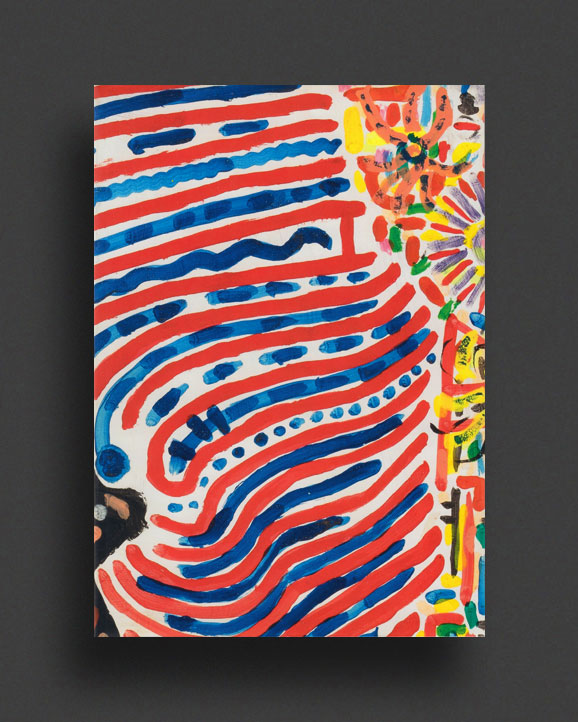
Susan Te Kahurangi King (24 February 1951 - ) has been a confident and prolific artist since she was a young child, drawing with readily available materials - pencils, ballpoint pens and felt-tip markers, on whatever paper is at hand. Between the ages of four and six Susan slowly ceased verbal communication. Her grandparents William and Myrtle Murphy had developed a special bond with Susan so they took on caring responsibilities for extended periods. Myrtle began informally archiving her work, carefully collecting and storing the drawings and compiling scrapbooks. No drawing was insignificant; every scrap of paper was kept. The King family are now the custodians of a vast collection containing over 7000 individual works, from tiny scraps of paper through to 5 meter long rolls.
The scrapbooks and diaries reveal Myrtle to be a woman of great patience and compassion, seeking to understand a child who was not always behaving as expected. She encouraged Susan to be observant, to explore her environment and absorb all the sights and sounds. Myrtle would show Susan’s drawings to friends and people in her community that she had dealings with, such as shopkeepers and postal workers, but this was not simply a case of a grandmother’s bias. She recognised that Susan had developed a sophisticated and unique visual language and sincerely believed that her art deserved serious attention.
This was an unorthodox attitude for the time. To provide some context, Jean Dubuffet coined the term Art Brut in 1945 to describe work created by self-taught artists – specifically residents of psychiatric institutions and those he considered to be visionaries or eccentrics. In 1972 Roger Cardinal extended this concept by adopting the term Outsider Art to describe work made by non-academically trained artists operating outside of mainstream art networks through choice or circumstance. Susan was born in Te Aroha, New Zealand in 1951, far from the artistic hubs of Paris and London that Dubuffet and Cardinal operated in. That Myrtle fêted Susan as a self-taught artist who deserved to be taken seriously shows how progressive her attitudes were.
Susan’s parents Doug and Dawn were also progressive. Over the years they had consulted numerous health practitioners about Susan’s condition, as the medical establishment could not provide an explanation as to why she had lapsed into silence. Dawn educated herself in the field of homeopathy and went on to treat all twelve of her children using these principles – basing prescriptions on her observations of their physical, mental and emotional state.
Doug was a linguist with an interest in philosophy who devoted what little spare time he had to studying Maori language and culture. To some extent their willingness to explore the fringes of the mainstream made them outsiders too but it was their commitment to living with integrity and their respect for individuality that ensured Susan’s creativity was always encouraged.
Even though Susan’s family supported her artistic pursuits, some staff in schools and hospitals saw it as an impediment to her assimilation into the community and discouraged it in a variety of ways. Her family was not always aware of this and therefore did not fully understand why Susan stopped drawing in the early 1990s. However, rather than dwell on the challenges that Susan faced in pursuit of her artistic practice, they prefer to highlight her achievements. In 2008 Susan began drawing again in earnest, after an almost 20 year interruption, and her work is now shown in galleries around the world.
Susan grew up without television and has been heavily influenced by the comics she read as a child. She is absolutely fearless in the appropriation of recognizable characters, such as Donald Duck and Mickey Mouse, in her work. She twists their limbs, contorts their faces, compresses them together, blends them into complex patterned backgrounds - always imbuing them with an incredible energy. Although Susan often used pop culture characters in her work they are not naive or childlike. These are drawings by a brilliant self-taught artist who has been creating exceptional work for decades without an audience in mind.
Mladen Stilinović
"Various Works 1986 - 1999"
02 February 16 - September 10, 2016
Various works 1986 - 1999, from two houses, from the collections of John Nixon, Sue Cramer, Kerrie Poliness, Peter Haffenden and Phoebe Haffenden.
Including: Geometry of Cakes (various shelves), 1993; Poor People’s Law (black and white plate), 1993; White Absence (glasses, ruler, set square, silver spoon, silver ladel with skin photograph and wooden cubes), 1990-1996; Exploitation of the Dead (grey and red star painting, wooden painting, black spoon with red table, red plate), 1984-1990; Money and Zeros (zero tie, paintings made for friends in Australia (Sue, John, Kerrie), numbers painting), 1991-1992; Words - Slogans (various t-shirts) - “they talk about the death of art...help! someone is trying to kill me”, “my sweet little lamb”, “work is a disease - Karl Marx”; Various artist books, catalogues, monographs, videos; Poster from exhibition Insulting Anarchy; "Circular" Croatian - Australian edition; Artist book by Vlado Martek (Dostoyevsky); more.
Thanks to Mladen Stilinović and Branka Stipančić.
Jonathan Walker
Always Will Need To Wear Winter Shirt Blue + Ochre Small Check Pattern
21 August - 21 September, 2015
Untitled
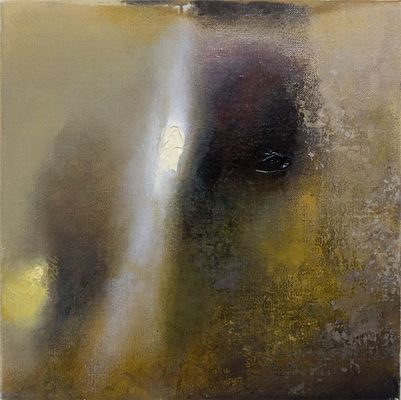
I am not a great reader of poetry but I always return to the work of Melbourne poet, Vincent Buckley (1925- 1988). Perhaps I find his most tantalising piece to be not a finished poem but a fragment left on a scrap of paper discovered on his desk after the poet’s death.
The poetry gathers like oil
In the word-core, and spreads
It has its music meet,
Its music is in movement.
This fragment is more the shell left behind from a volatile thought than a finished poem. I find the last two lines honest but awkward whereas the first two lines work like an arrow. Most likely he could not find a resolution so it was left. Still, in its present form, it remains an eloquent testimony to the ultimate failure of a medium to express mobile thought and sensation, in Buckley’s case, through verbal language. It’s an important matter because this is something all artists have to deal with regardless of the medium.
I have never written a poem, however, I am forever copying fragments from books on paper scraps in a vain effort to fix certain notions in my head. At first, they function as bookmarks that are sometimes returned to when I open the book. But before long, as they accumulate, they fall out littering the table interspersed with A4 photocopies, bills, books and medications.
To return to Buckley’s fragment, the first two lines very much evoke how I paint nowadays. As you age, detail diminishes and patches of light become more luminous and float. I feel the most honest way of dealing with this is by smearing the oil paint on the canvas with the fingers and working close-up, blind. Only if the patches coalesce into an approaching image can the work gain a life.
-
Jonathan Walker was born in Melbourne, Australia and brought up on a dairy farm in Gippsland. In the 1970’s he studied painting at RMIT and won the Harold Wright Scholarship to the British Museum, London. During the 1980’s he exhibited at Pinacotheca Gallery, Richmond and had work shown at the NGV and Heidi City Art Gallery. Over the same period he designed the cover for the “Epigenesi” LP by Giancarlo Toniutti, Italy and conducted a mail exchange work with Achim Wollscheid, Germany. The work with artists through the post resulted in an article published in the bicentenary issue of Art and Australia 1988. He showed in artist run spaces such as WestSpace in the 90’s and 2000’s, and until 2012, taught painting at Victoria University, which is where we (Colleen Ahern and Lisa Radford) as organisers of the exhibition, among many others, had the privilege of being his student.
Walker’s knowledge was imparted to students through the careful selection of music, literature, and artists found in books that he himself had ordered for the library. Walker’s strategy was the generosity of sharing his vast knowledge with references specific to each student and their context.
Walker’s paintings share a similar focus and intimacy.
This exhibition presents a small selection of recent paintings alongside a publication that includes Walker’s writing. Observational and analytical, Walker’s work is a type of material notation — the time of day, colour and how it is blended, the both specific and fleeting location of a reflection on lino or the question of whether a chair leg should be included in a painting.
Please join us on Friday August 21 between 6-8pm to celebrate the opening of the exhibition.
Curated by Colleen Ahern and Lisa Radford.
B. Wurtz
Curated by Nic Tammens
March 26 - April 4, 2015
B.Wurtz works from a basement studio in his home on Manhattan’s Lower East Side.
This local fact is attested to by the plastic shopping bags and newsprint circulars that appear in his work. As formal objects, they don’t make loud claims about their origins but nonetheless transmit street addresses and places of business from the bottom of this long thin island. Like plenty of artists, Wurtz is affected by what is local and what is consumed. His work is underpinned by this ethic. It often speaks from a neighborhood or reads like the contents of a hamper:
“BLACK PLUMS $1.29 lb.”
“Food Bazaar”
“USDA Whole Pork Shoulder Picnic 99c lb.”
“RITE AID Pharmacy, with us it’s personal.”
“H. Brickman & Sons.”
“Sweet Yams 59c lb."
Most of the work in this exhibition was made while the artist was in residence at Dieu Donne, a workshop dedicated to paper craft in Midtown. Here Wurtz fabricated assemblages with paper and objects that are relatively lightweight, with the intention that they would be easily transportable to Australia. This consideration isn’t absolute in Wurtz’s work, but was prescriptive for making the current exhibition light and cheap. Packed in two boxes, these works were sent from a USPS post office on the Lower East Side and delivered to North Melbourne by Australia Post.
Wurtz appears courtesy of Metro Pictures, New York.
Thanks to Rob Halverson, Joshua Petherick, Sari de Mallory, Matt Hinkley, Helen Johnson, Fayen d'Evie, Ask Kilmartin, Lisa Radon, Ellena Savage, Yale Union, and "Elizabeth".
John Nixon
"Archive"
December 15 - January 20, 2014
The presentation of John Nixon's archive offered a rare showcase of this extensive collection of the artist's own publications, catalogues, posters, ephemera, editions and more, from the mid 1980s onwards, alongside a selection of his artworks.
Organized by John Nixon, Joshua Petherick and Matt Hinkley.
"Habitat"
at Minerva, Sydney (organised by Joshua Petherick and Matt Hinkley)
November 15 - December 20, 2014
Lupo Borgonovo, Janet Burchill & Jennifer McCamley,
Lewis Fidock, HR Giger, Piero Gilardi, Veit Laurent Kurz,
Cinzia Ruggeri, Michael E. Smith, Lucie Stahl, Daniel Weil, Wols
Press Release:
“...It contained seven objects. The slender fluted bone, surely formed for flight, surely from the wing of some large bird. Three archaic circuitboards, faced with mazes of gold. A smooth white sphere of baked clay. An age-blackened fragment of lace. A fingerlength segment of what she assumed was bone from a human wrist, grayish white, inset smoothly with the silicon shaft of a small instrument that must once have ridden flush with the surface of the skin - but the thing’s face was seared and blackened.”
William Gibson, “Count Zero”, 1986
"Autumn Projects Archive"
Curated by Liza Vasiliou
March 6 - March 15, 2014
World Food Books, in conjunction with the Virgin Australia Melbourne Fashion Festival 2014, presented the Autumn Projects archive, consisting of a selection of early examples in Australian fashion with a particular interest in collecting designers and labels from the period beginning in the 1980’s, who significantly influenced the discourse of Australian Fashion.
Curated by Liza Vasiliou, the exhibition provided a unique opportunity to view pieces by designers Anthea Crawford, Barbara Vandenberg, Geoff Liddell and labels CR Australia, Covers, Jag along with early experimental collage pieces by Prue Acton and Sally Browne’s ‘Fragments’ collection, suspended throughout the functioning World Food Books shop in Melbourne.
H.B. Peace
presented by CENTRE FOR STYLE
November 14, 2013
"Hey Blinky, you say chic, I say same"
Anon 2013
H.B. Peace is a clothing collaboration between great friends Blake Barns and Hugh Egan Westland. Their pieces explore the divergences between 'character’ and ‘personality’ in garments....etc
Special Thanks to Joshua Petherick and Matt Hinkley of WFB and Gillian Mears
and a Very Special Thank you to Audrey Thomas Hayes for her shoe collaboration.
Janet Burchill & Jennifer McCamley
"Aesthetic Suicide"
May 10 - June 8, 2013
The first of our occasional exhibitions in the World Food Books office/shop space in Melbourne, "Aesthetic Suicide" presented a body of new and older works together by artists Janet Burchill & Jennifer McCamley, including videos, prints, a wall work, and publications.
During shop open hours videos played every hour, on the hour.
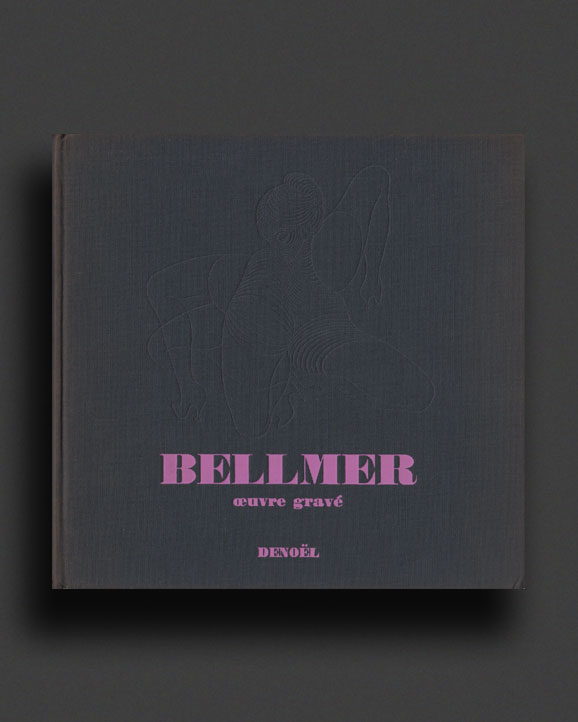
1969, French
Hardcover (cloth bound), 106 pages, 21 x 21 cm
1st Edition, Out of print title / used / very good
Published by
Éditions Denoël / Paris
$100.00 - Out of stock
First Edition of the catalogue raisonné of the engraved work of German Surrealist Hans Bellmer, published in 1969 by Éditions Denoël, Paris. Wrapped in the publisher's debossed black covers featuring Bellmer's Céphalopode of 1965, this handsome volume opens with "Morale of Engraving", a four page introduction by author Andre Pieyre De Mandiargues (in French). The rest of the book is made up of 141 beautifully reproduced engraved works of Bellmer, including his exquisite works complimenting Georges Bataille, Marquis de Sade, Joyce Mansour, Louis Aragon, Charles Baudelaire, and others, followed by a 7 pages complete catalogue raisonné index, including work title, date, process and technique, dimensions, printing justifications, editors and other details. An essential title in any Bellmer collection and important reference.
Very Good copy, tanning to board/page edges with age.
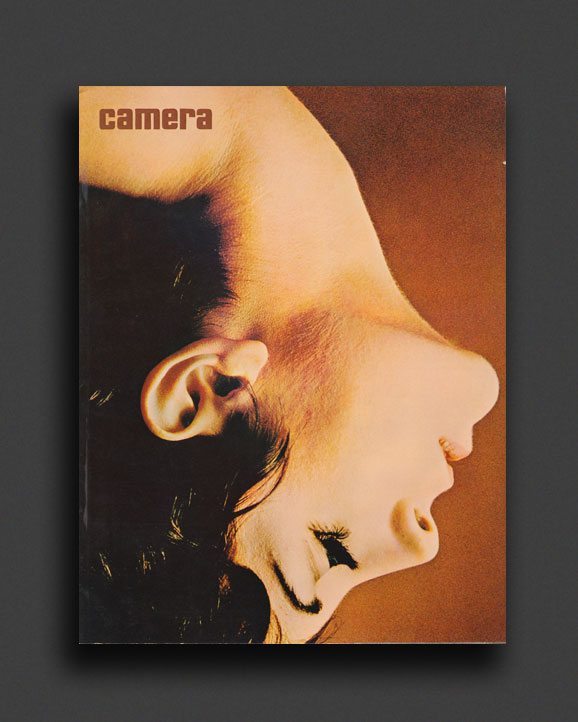
1969, English
Softcover, 66 pages, 29 x 22.5 cm
1st UK Edition, Out of print title / used / very good
Published by
C. J. Bucher Ltd. / Lucerne
$50.00 $30.00 - In stock -
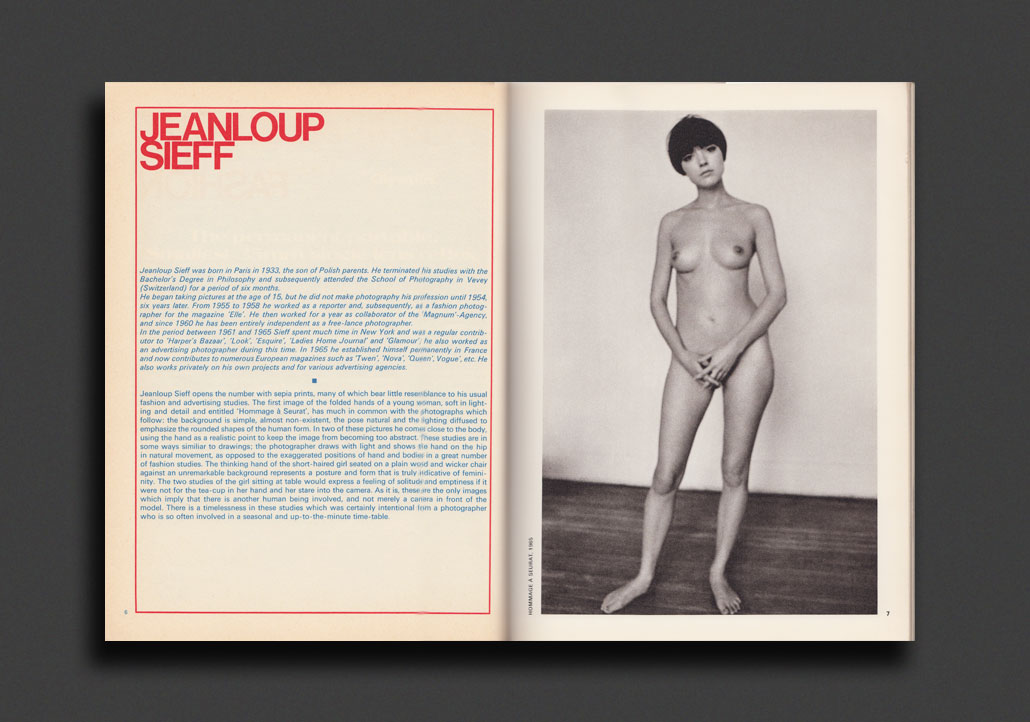
First English edition of the April 1969 issue of Switzerland's legendary Camera - International Magazine of Photography and Cinematography. Wonderful issue with the topic of the month being "Out of Fashion", featuring the photographic work of Jeanloup Sieff, Sam Haskins, Will McBride, Kishin Shinoyama, John Pfahl, and William Larson.
Very good copy with creases to back cover only, common light curling to both glossy covers.
1986, French
Hardcover (w. dust jacket), 104 pages, 32.5 x 30.5 cm
1st Edition, Out of print title / used / good
Published by
Contrejour / Paris
$450.00 $350.00 - In stock -
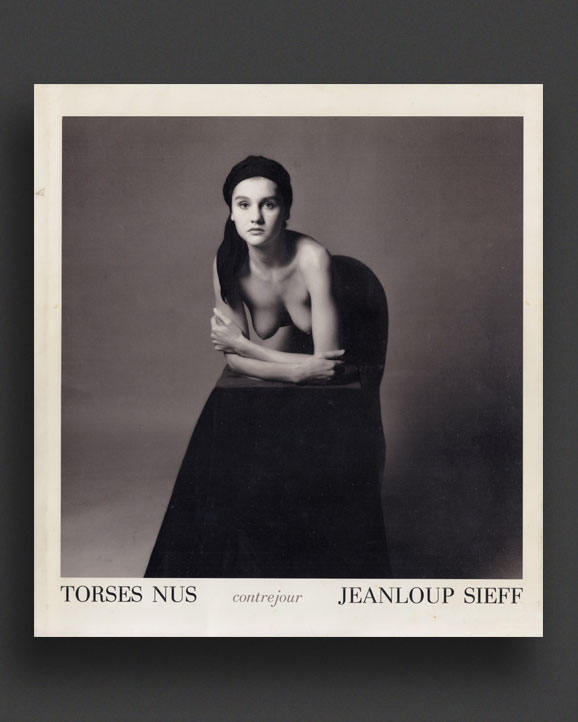
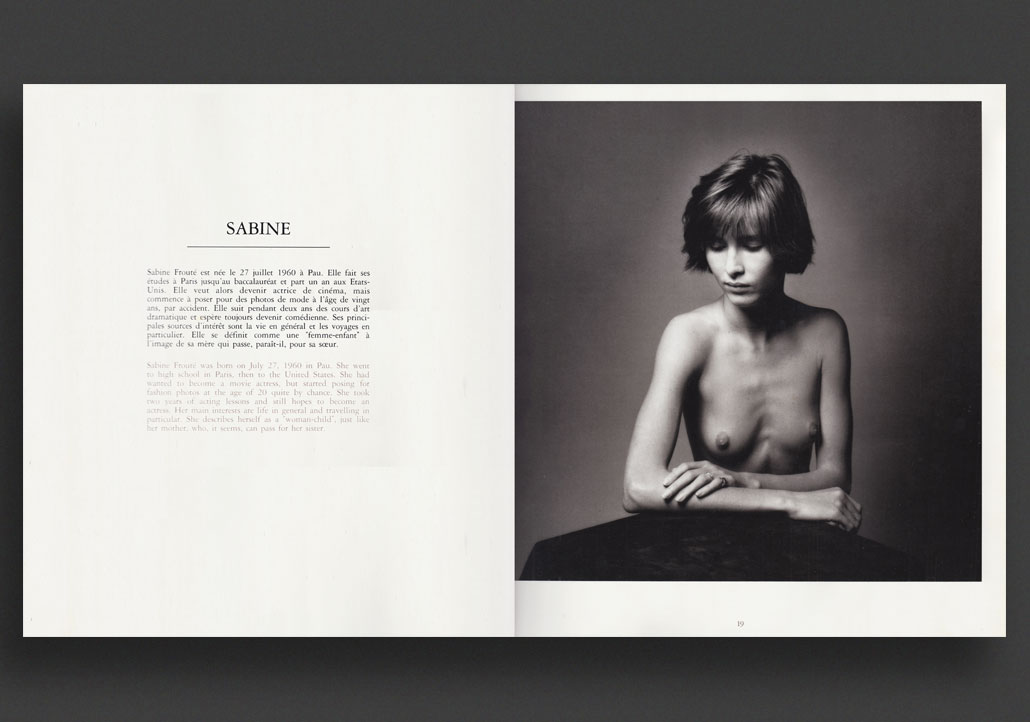
Rare first French hardcover edition of Jeanloup Sieff's 1986 classic photobook, Torses Nus, signed by the legendary French photographer that same year. Published by Contrejour, this beautiful over-sized hardcover edition was the first print of Torses Nus, an extraordinary series of nude portraits and Jeanloup Sieff at his finest. Torses Nus is a collection of 48 beautifully-toned black-and-white photographs, primarily featuring (as the title indicates) women (and a few men) show with nude torsos. These almost classical portrait images embrace the beauty of the human form while taking in the unique personality of each person. Sieff's models include Isabelle Huppert, Emmanuelle Sallet, Jane Birkin, Tierney Gearon, Isabelle Weingarten, Sylvie Guillem, Bess Stonehouse, Yasmine Haury, Florence Dauchez. Larrio Ekson, Charlotte Rampling, and many more. Each is accompanied by a short text with biographical information by Sieff. Includes an introduction by Sieff, with all texts in both French and English.
Jeanloup Sieff (1933 – 2000) was a French photographer. He was born in Paris to Polish parents. He was a photography student of Gertrude Fehr. After working for Elle magazine and the Magnum agency, he lived and worked in New York from 1961 to 1966. Once back in Paris, his work appeared frequently in Vogue, Harper's Bazaar, as well as, in many other publications. He worked mainly in black and white and in fashion. Many do not know that he was a master darkroom technician, who printed his own images. Sieff used different focal length lenses, but is known as the master of the 21.
This copy signed in pen to the title page by Jeanloup Sieff on "23.09.1986".
Good copy but with light foxing to dust jacket, endpapers and a few pages, heavy foxing to title page. Light wear to dj.
2024, English
Softcover, 416 pages, 21.6 x 13.8 cm
Published by
SPBH Editions / UK
$89.00 $65.00 - In stock -
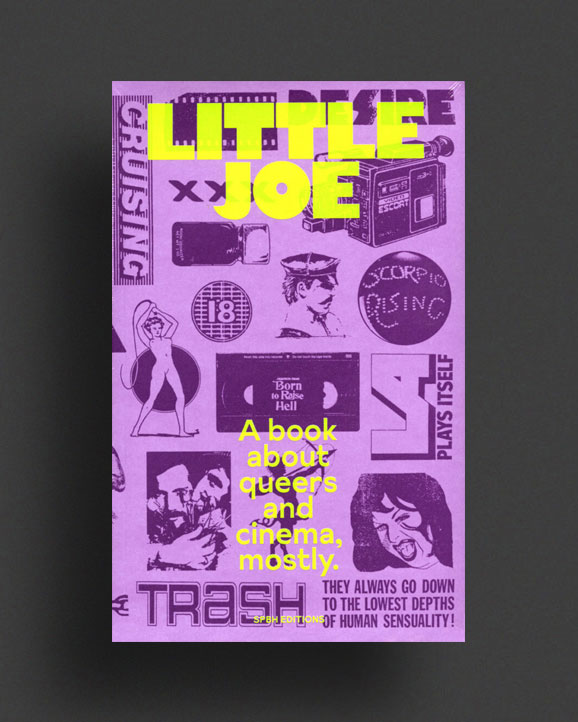
The cult periodical Little Joe, published as a limited-edition zine from 2010 to 2021, challenged the mainstream narrative of film history with a rebellious, queer perspective. Rather than reviewing new releases, it explored forgotten and overlooked films and celebrated a diverse spectrum of cinema – from obscure art films to porn to Hollywood classics – as worthy of critical debate. Stubbornly print-only, Little Joe was notoriously hard to find, privileging word-of-mouth distribution akin to the films it championed. This volume, compiled by editor-in-chief Sam Ashby, brings together the best of its previously elusive texts and proposes a new, alternative cinematic canon drawn from the fringes of taste and style, while paying homage to the original DIY Risograph aesthetic of the journal.
This volume features essays, in-depth conversations, short stories and archival discoveries from a host of queer and allied writers, artists, filmmakers, and academics, including John Waters, Sarah Schulman, Douglas Crimp, William E. Jones, Erika Balsom, Jeremy Atherton Lin, John Greyson, Elizabeth Purchell, Liz Rosenfeld, Peter Strickland, Ira Sachs, Terence Davies, Shu Lea Cheang, Kevin Killian, Wayne Koestenbaum, Abdellah Taïa, Marlene McCarty, John Cameron Mitchell, Rosa von Praunheim, Stuart Comer, Ed Halter, Jenni Olson, A.L. Steiner, A.K. Burns, Desiree Akhavan, and Andrew Haigh.
2022, English
Softcover, 362 pages, 23.5 x 19 cm
Published by
Nine-Banded Books / West Virginia
$65.00 - Out of stock
Once in a century, a book comes along that both defines a genre - and defies it. This is that century. This is that book.
The book is A History of Violence (1973). A memoir of the human race. Its concept is simple: take the date in 1973 on which a violent film was first screened - and go beyond the film to see the world that exists outside the theatre. It's a book that realizes that the line between life and cinema is as much a horizon as it is a terminator. A History of Violence (1973) takes you across that horizon to places in time you never even imagined existed. Because bombs don't explode in only one direction.
169 films. The brutal and transgressive sex films (Forced Entry; High Priestess of Sexual Witchcraft; Teenage Jailbait). The films of cinematic masters like Brian De Palma (Sisters), Terence Malick (Badlands), and Nicolas Roeg (Don't Look Now). The Italian crime films (Death Carries a Cane; The Flower With the Deadly Sting; Torso). The police procedurals (Blade; The Laughing Policeman; The Marcus-Nelson Murders). The flat-out shocking and bizarre films that can only be appreciated by surviving them (The Hunchback of the Morgue; The Night God Screamed; The Sinful Dwarf).
1973: The year that the War in Vietnam ends, military coups convulse Afghanistan and Chile and Rwanda, and the spectre of Watergate looms large.1973. The year that a teen thinks his neighbor is using telepathy to make him gay - so he strips him nude, kills him and his entire family, and burns down their house. The year that a husband kidnaps young men and holds them at gunpoint - while they have sex with his wife. The year that a man goes out for a night on the town with a friend - and comes home to find that his wife has murdered their children, then killed herself. 1973. The year of the deaths of writers W.H. Auden and Victor Jara; actors Bruce Lee and Lon Chaney Jr.; and artists Robert Smithson and Pablo Picasso. The year of Skylab and Pioneer and Kohoutek. The year of the mass murders of Edmund Emil Kemper, Herbert William Mullin, Charlie Chop-Off, and The Alphabet Killer. A History of Violence (1973) also stands as a testament to the tireless efforts of law enforcement to solve the violent crimes that grip America. In 1973, America sees the first blue flashing lights that complete the lightbars of today's police cruisers; the breathalyzer comes into common usage; and Dr. Lester Luntz becomes the first forensic odontologist to try to crack a case by obtaining a search warrant to get a cast of a suspect's teeth.
A History of Violence (1973). A history book for the history books.
A History of Violence (1973) represents the culmination of 20 years of exhaustive research, employing the digital advances that have thrown wide the doors of archives everywhere for a greater understanding of the human condition - both scaling the heights of creation and plunging to the depths of annihilation. With an audience as wide-ranging as true-crime enthusiasts, police detectives and horror movie buffs, A History of Violence (1973) also presents a seething array of lurid and alluring movie advertising art - some unseen for more than 40 years.
This isn't the book about violence you thought you wanted. This is the book about violence you knew you needed.
“An incisive autopsy of concentrated cultural psychosis. Like Michael Lesy’s Wisconsin Death Trip, A History of Violence (1973) is an association-tripping chronicle of misery – but filtered through David Cotner’s intimate prose, it reveals a strange hopefulness that counteracts its despair.”—Kier-La Janisse, author of House of Psychotic Women
David Cotner is a culture critic, composer, and conceptual artist. His writing has appeared in the Los Angeles Times, the L.A. Weekly, the Village Voice, the San Francisco Chronicle and elsewhere. He lives in and around the greater metropolitan Los Angeles area.
1973, French
Softcover, c.40 pages, 24 x 21 cm
1st Edition, Out of print title / used / very good
Published by
Belgisches Haus Köln / Köln
$120.00 - Out of stock
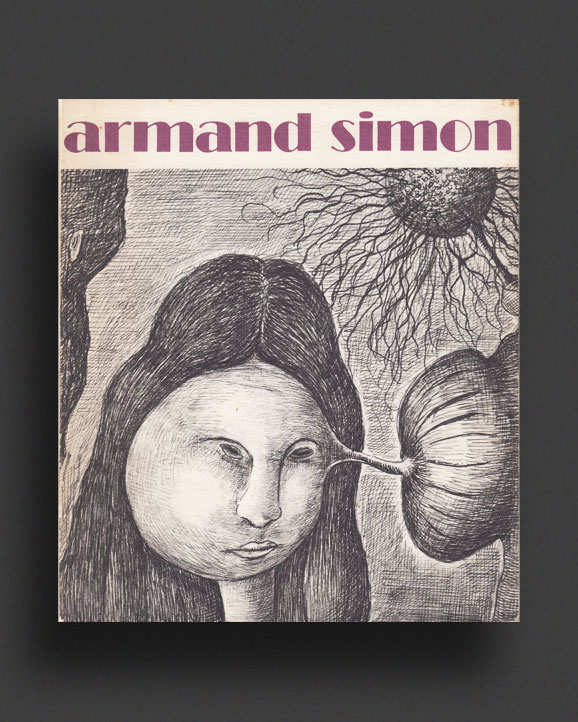
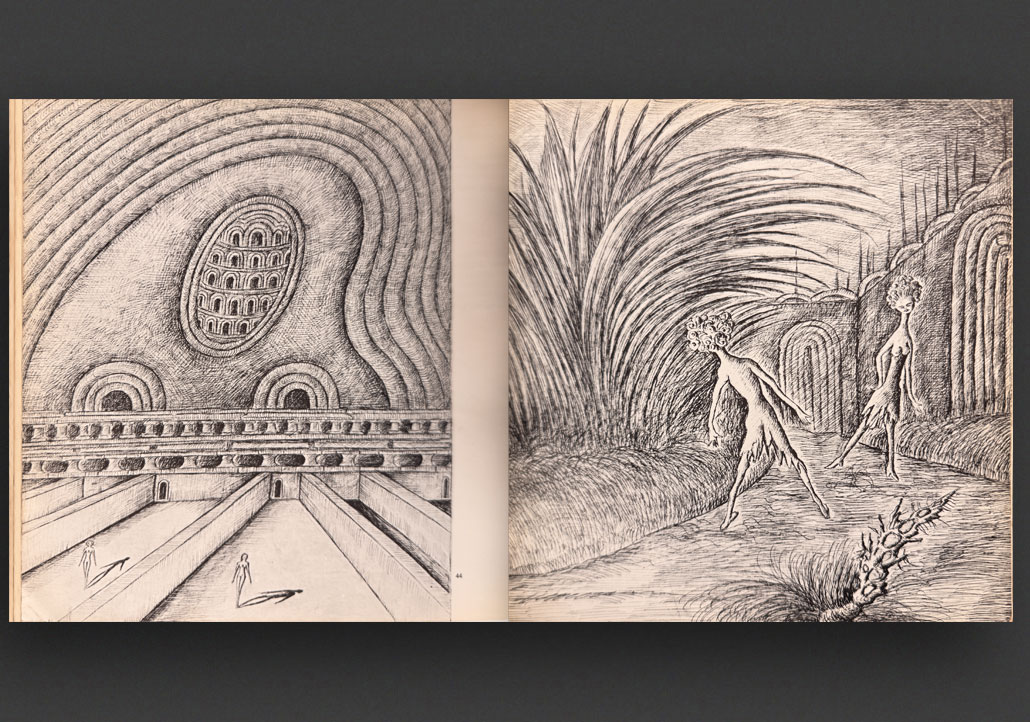
Rare catalogue published to accompany an exhibition of self-taught Belgian surrealist Armand Simon (1906–1981) in 1973 at the Belgisches Haus Köln. Profusely illustrated throughout with b/w reproductions of his wonderful artworks, many inspired by Lautréamont's Maldoror and the poems by Rimbaud, accompanied by texts from Belgian poet and member of the Oulipo group, André Blavier (1922—2001) and Belgian poet and member of the Hainaut Surrealist group, Achille Chavée (1906—1969), along with excerpts of correspondences and texts by Simon. The beautiful catalogue on this elusive artist, little known outside Belgium.
Armand Simon (1906–1981) was a self-taught Belgian Surrealist artist, cartoonist and poet known for his dreamlike and thought-provoking works. Born in Mons, Belgium, in 1923 Simon discovered the 'Chants de Maldoror' by Comte de Lautréamont, a text that fascinated him and to which he devoted thousands of drawings. An extremely prolific draftsman, he developed a noir universe nourished by literary sources, of which he proposed "graphic equivalents". Dense and precise, his drawings are based on an automatism to which he remained faithful throughout his life. His ink drawings often featured enigmatic and fantastical elements, exploring themes of the subconscious, dreams, and the absurd. In the mid 1930s Simon joined the Belgian Surrealist group Rupture, established in Hainaut, and alongside Chavée, Dumont and Lefrancq, took part in L'Invention Collective, founded and published by Raoul Ubac (1910-1985) and Rene Magritte (1898-1967) in 1940. He illustrated texts by Monique Watteau and Marcel Brion, as well as Achille Chavée's 'Seven Poems of High Negligence'. Throughout his life, he remained a relatively obscure figure outside of surrealist circles, but his work continues to be appreciated for its unique and devoted contribution to the movement. Simon's legacy is preserved through his art, which remains on display in various collections and museums dedicated to Surrealist art. Simon died in Frameries in 1981.
Xavier Canonne holds a doctorate in art history from the Sorbonne (Paris) and directs the Musée de la Photographie de la Communauté française in Charleroi. Since the 1970s, he has known and frequented the Belgian surrealists, some of whom were his close friends. He has devoted various books or articles to Armand Simon, Marcel Marién, Louis Scutenaire, Max Servais, Tom Gutt, Irène Hamoir and Robert Willems.
Very Good copy, light age/tanning.
2024, English
Softcover, 240 pages, 20.2 x 13.7 cm
Published by
Semiotext(e) / Los Angeles
$38.00 - In stock -
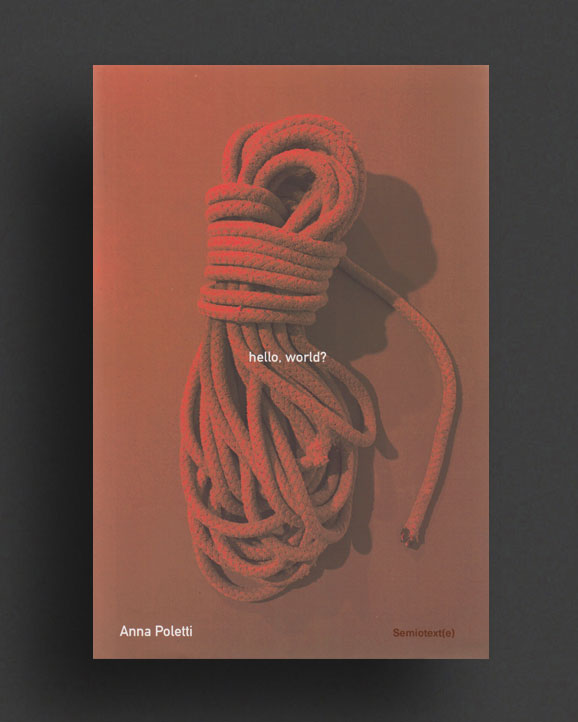
A feminist paean to perversity: on remaking intimacy outside the Republic of Gender.
Seasonal begins writing sentences and thinking thoughts they never thought possible. They want to give László the pleasure of being nothing. The more they come to like him, to value his sensitivity, his sharp mind, his aesthetics, his ethics, and the more they want his respect, the easier it seems to become to think about destroying him. A new set of capacities which they had only dimly sensed are now coursing in their muscles, their cunt, their blood, their mind.
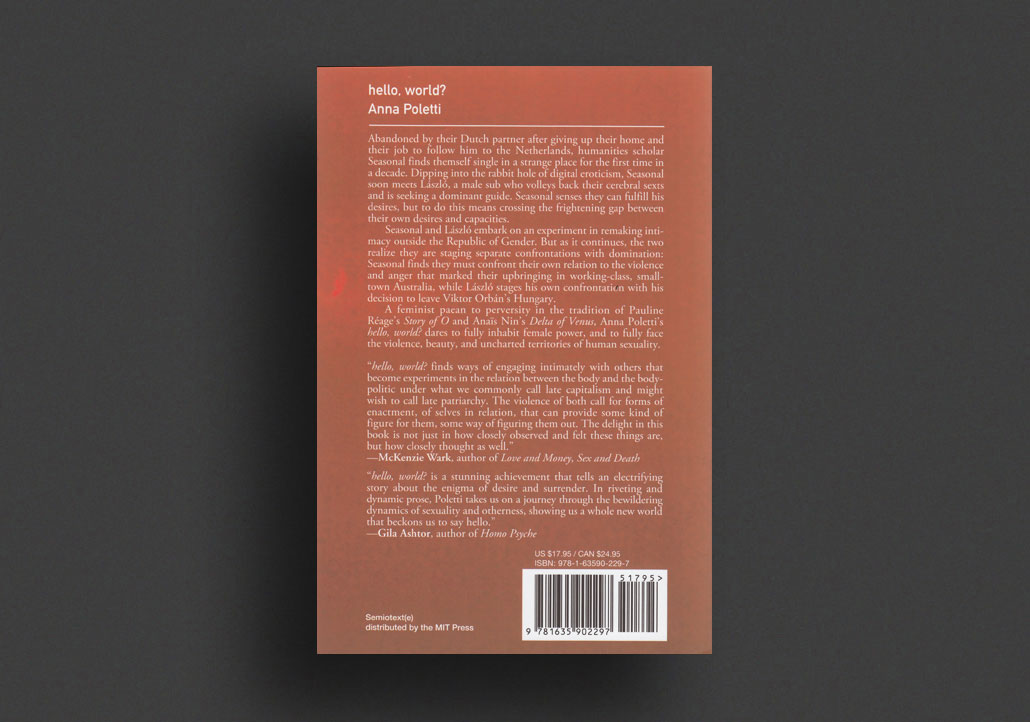
Abandoned by their Dutch partner after giving up their home and their job to follow him to the Netherlands, humanities scholar Seasonal finds themself single in a strange place for the first time in a decade.
Dipping into the rabbit hole of digital eroticism, Seasonal soon meets László, a male sub who volleys back their cerebral sexts and is seeking a dominant guide. His dating-app profile—a photo of Foucault and the ingenuous greeting “Hello, World?”—thinly veils his desire to be annihilated. It's a desire that Seasonal senses they can fulfill. But to do this means crossing the frightening gap between their desires and capacities.
Seasonal and László embark on an experiment in remaking intimacy outside the Republic of Gender. But as it continues, the two realize they are staging separate confrontations with domination: Seasonal finds they must confront their own relation to the violence and anger that marked their upbringing in working-class, small-town Australia, while László stages his own confrontation with his decision to leave Viktor Orbán's Hungary. As they attempt to improvise a theater of domination that opens up possibilities of reciprocity, the energies of their sexuality stalk this collaboration, threatening to give them exactly what they bargained or begged for.
A feminist paean to perversity in the tradition of Pauline Réage's Story of O and Anaïs Nin's Delta of Venus, Anna Poletti's hello, world? dares to fully inhabit female power, and to fully face the violence, beauty, and uncharted territories of human sexuality.
"hello, World? starts with that all too familiar scenario of uprooting one's life for a partner only to be let down by them. What Seasonal does then might also be familiar to many—they go on the apps, fuck around, find out. What they find are ways of engaging intimately with others that become experiments in the relation between the body and the body-politic under what we commonly call late capitalism and might wish to call late patriarchy. The violence of both call for forms of enactment, of selves in relation, that can provide some kind of figure for them, some way of figuring them out. The delight in this book is not just in how closely observed and felt these things are, but how closely thought as well."—McKenzie Wark, author of Reverse Cowgirl
2020, English
Softcover, 320 pages, 14.5 x 23.6 cm
Published by
Semiotext(e) / Los Angeles
$39.00 - Out of stock
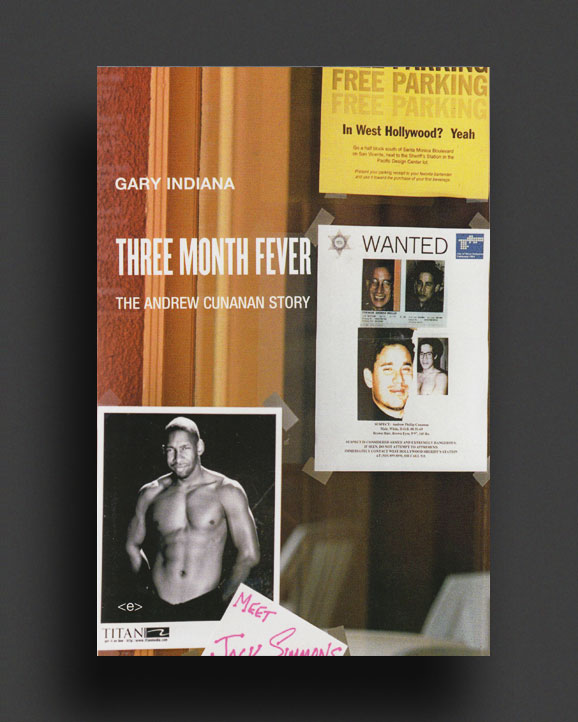
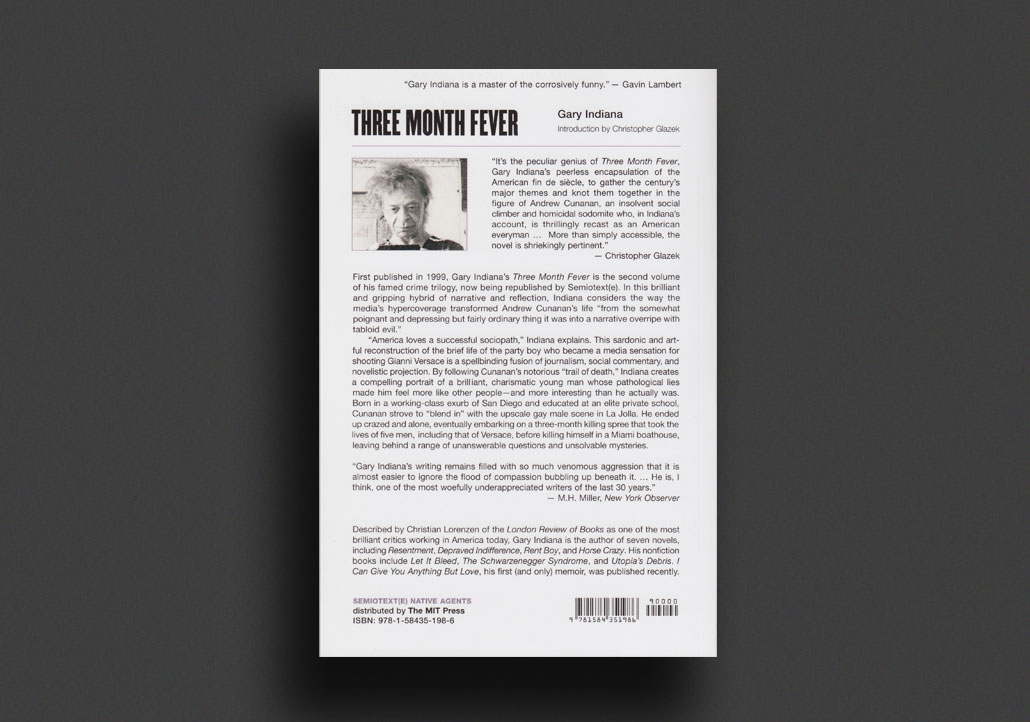
A sardonic and artful reconstruction of the brief life of the party boy who became a media sensation for shooting Gianni Versace.
It was suddenly chic to be "targeted" by Andrew.... It also became chic to claim a deep personal friendship with Versace, to infer that one might, but for a trick of fate, have been with Versace at the very moment of his "assassination," as it had once been chic to reveal one's invitation to Cielo Drive in the evening of the Tate slayings, an invitation only declined because of car trouble or a previous engagement...
--from Three Month Fever
First published in 1999, Gary Indiana's Three Month Fever is the second volume of his famed crime trilogy, now being republished by Semiotext(e). (The first, Resentment, reissued in 2015, was set in a Menendez trial-era L.A.) In this brilliant and gripping hybrid of narrative and reflection, Indiana considers the way the media's hypercoverage transformed Andrew Cunanan's life "from the somewhat poignant and depressing but fairly ordinary thing it was into a narrative overripe with tabloid evil."
"America loves a successful sociopath," Indiana explains. This sardonic and artful reconstruction of the brief life of the party boy who became a media sensation for shooting Gianni Versace is a spellbinding fusion of journalism, social commentary, and novelistic projection. By following Cunanan's notorious "trail of death," Indiana creates a compelling portrait of a brilliant, charismatic young man whose pathological lies made him feel more like other people--and more interesting than he actually was. Born in a working-class exurb of San Diego and educated at an elite private school, Cunanan strove to "blend in" with the upscale gay male scene in La Jolla. He ended up crazed and alone, eventually embarking on a three-month killing spree that took the lives of five men, including that of Versace, before killing himself in a Miami boathouse, leaving behind a range of unanswerable questions and unsolvable mysteries.
"Gary Indiana belongs to a special breed of American urban writers who take cool pleasure in dissecting the lives of the rich and ugly and is possibly the most jaded chronicler of them all. On a good day, he makes Bret Easton Ellis look like Enid Blyton, yet many, myself included, think he might have already written the Great America Novel(s)." - Christopher Fowler, The Independent
2001, English
Softcover, 224 pages, 27 x 20 cm
1st Edition, Out of print title / used / very good
Published by
Purple Institute / Paris
$240.00 - Out of stock
A very rare copy of the eighth issue of Purple, edited by Olivier Zahm, art directed by Makoto Ohru, featuring Chiara Mastroianni on the cover. One of the best issues, featuring Mark Borthwick, Roe thridge, Richard Kern, Katja Rahlwes, Terry Richardson, Wolfgang Tillmans, Chloë Sevigny, Henry Roy, Colin de Land, Bruce Benderson, Anders Edström, Jutta Koether, Kate Moss, Maison Martin Margiela, Takashi Homma, Chloë Sevigny, Kim Gordon, Antek Walczak, Hermés, Masafumi Sanai, Dike Blair, Comme des Garçons, Balenciaga, Nakako Hayashi, Jeff Rian, Dominique Gonzales Foerster, Bless, Experimental Jetset, Bob Nickas, Ann Demeuelemeester, Claude Closky, Kyoji Takahashi, Michael Smith, Matt Sweeney, John Kelsey, Helmut Lang, Bennett Simpson, Gareth James, Miu Miu, Vanina Sorrenti, Cedrick Eymenier, Andreas Larsson, Mark Kingwell, Bernard Joisten, Laetitia Benat, Anaïd Demir, Costume National, Michel Sumpf, Alex Antitch, Giasco Bertoli, Jeremy Blake, Ola Rindal, and many more....
In 1992, Elein Fleiss and Olivier Zahm started the magazine Purple Prose as a reaction against the superficial glamour of the 1980s; much as a part of the global counterculture at the time, inspired by magazines like Interview, Ray Gun, Nova, and Helmut Newton's Illustrated, but with the aesthetics of what usually is referred to as anti-fashion. Based on their personal interests and views; Purple was, and in a sense still is, made much in the same spirit of the fanzine. Started "without any means, and without any experience, because we wanted to make a magazine that was radically different. We wanted to support the artists around us that no one else supported, much less talked about."—Olivier Zahm. The magazine became associated with the "realism" of the new fashion photography of the 1990s, with names like Juergen Teller, Terry Richardson, Wolfgang Tillmans, Mark Borthwick, Corinne Day, and Mario Sorrenti. Soon after the birth of Purple Prose, Zahm and Fleiss created spin-off publications such as les cahiers purple, Purple Sexe, Purple Fiction, and of course, Purple Fashion, in which Zahm aimed at fusing together his two worlds, fashion and art. Now one of the most iconic and influential fashion magazines in history.
Very Good copy.
2024, English / German
Softcover, 224 pages, 22 x 28 cm
Published by
Walther König / Köln
Schirn Kunsthalle / Frankfurt
$80.00 - Out of stock
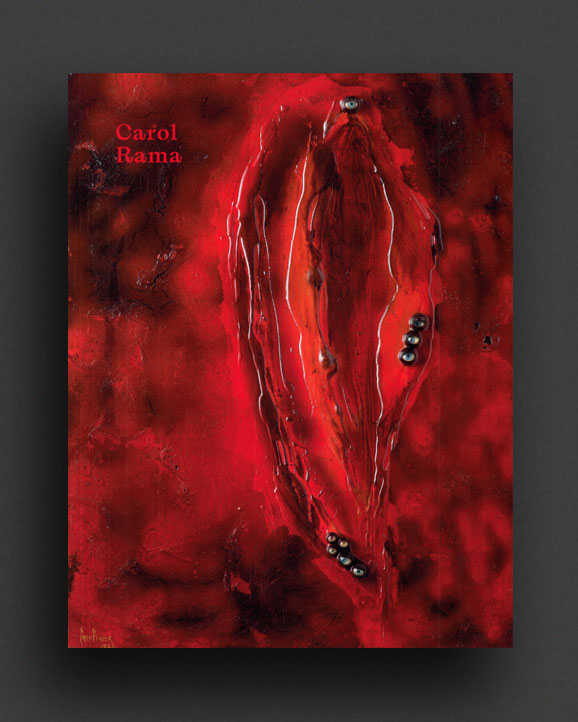
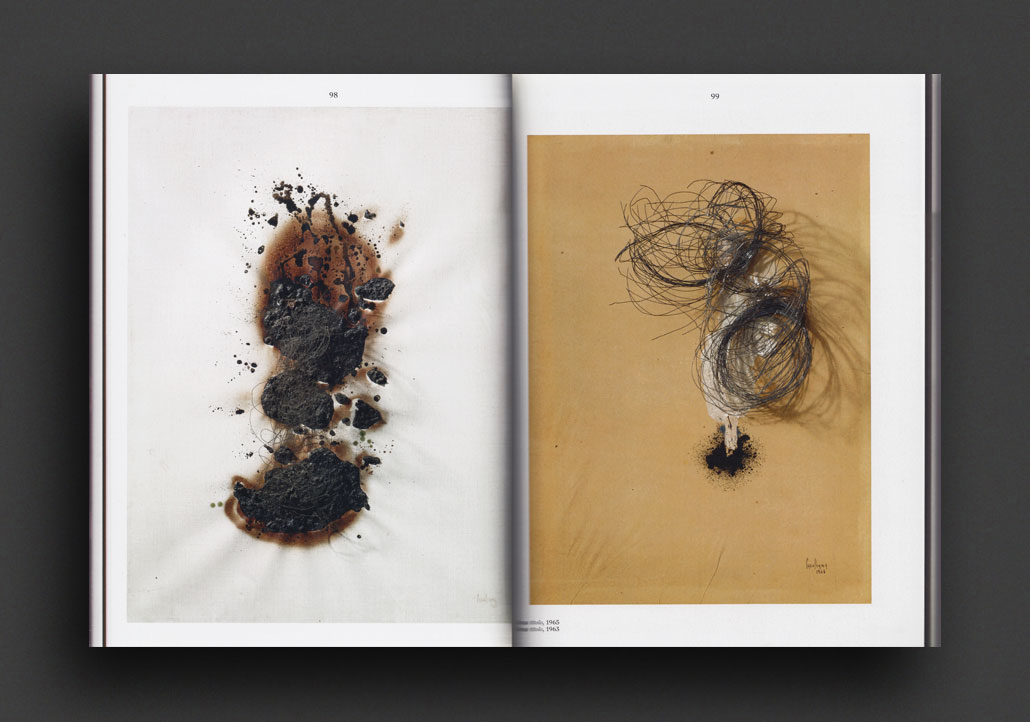
Sexuality, passion, illness, death - these are the great human themes and fundamental experiences to which Carol Rama dedicated her art. Rama (1918–2015) is one of those outstanding female artists of modernism who, in spite of impressive and multifaceted oeuvres, achieved fame late in their career. Her depictions from the 1930s of female lust paved the way for today’s feminist art. Independent of artistic schools and groupings, the self-taught talent created over the course of 70 years an unconventional and highly personal oeuvre. Rama’s work defies simple categorization and is distinguished by an enthusiastic delight in experimentation. From her early days as an artist in the 1930s through to the early 2000s, she managed to reinvent her style every ten years or so with new groups of works, while always remaining true to herself. An adept iconoclast, she pushed the boundaries of artistic and social conventions in terms of both form and content.
This richly illustrated catalog traces the various phases of the artist's extensive and extraordinary work – from provocative watercolours and paintings to her bricolages: object montages in which Rama experimented with a wide range of materials. In addition to a comprehensive introduction by curator Martina Weinhart, who provides an in-depth look into the different phases of Rama's work, essays by Florian Werner and Elena Volpato explore specific aspects of her art. Companions of Rama, such as Lea Vergine and Eduardo Sanguineti, also contribute their insights. Also includes a joint foreword by the director of the Schirn, Sebastian Baden, and the director of the Kunstmuseum Bern, Nina Zimmer, and an extensive biography by Theresa Dettinger that presents the most important milestones of Rama's long life and artistic career.
2024, English
Softcover (w. dust jacket), 96 pages. 17 x 24 cm
Published by
Drill Hall Gallery / Canberra
$38.00 - Out of stock
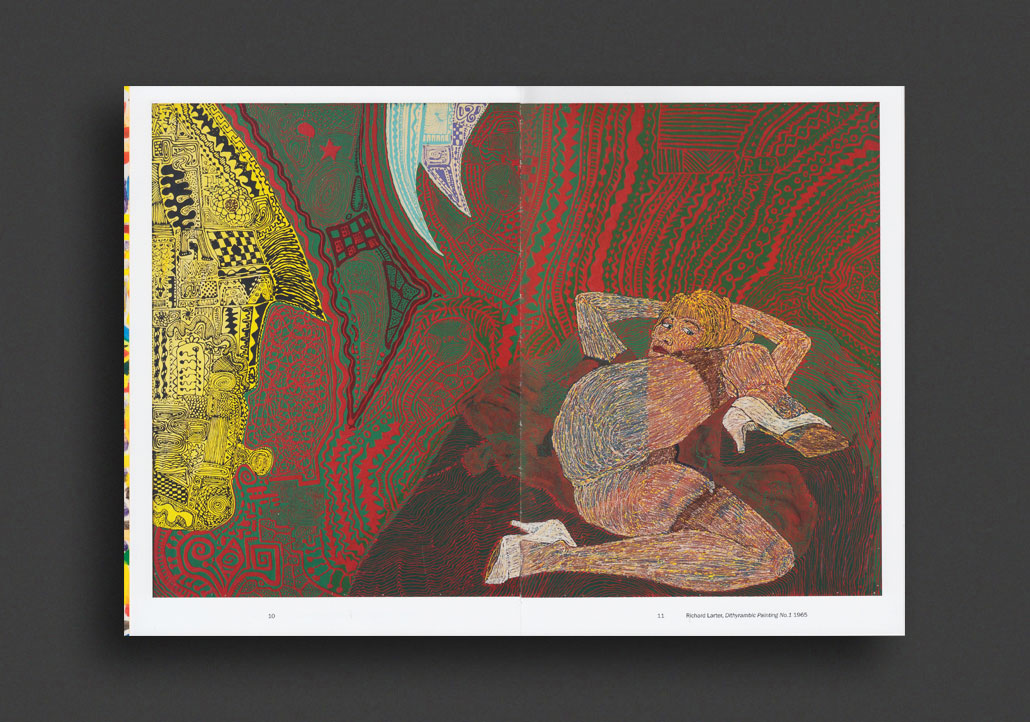
In this publication the art of Richard Larter, Pat Larter and Peter Maloney is unearthed in reproductions and three complimentary texts from Tony Oates, Hester Gascoigne and Mark Bayly. What emerges is a picture of Canberran visual culture that challenges the image of a stuffy national capital devoid of radical action. In its place we see a revolutionary community of like-minds hell bent on freedom, fairness and fun.Tony Oates delves into the leftist libertarian ethos that drove Richard Larter through the nitty gritty of his politically powerful pop imagery to his luminous abstraction, suggestive of universal truths. Here, Larter, so often regarded as the founding father of Australian Pop art, is revealed to be so much more. In Hester Gascoigne’s essay the work of husband faces off against the work of wife. Gascoigne traces the weaving threads of Pat’s and Richard’s practices as they merged and diverged over the years, from collaborative to competitive, always with an effervescent cheekiness and fierce dedication to the other. In conversation with Oates, Mark Bayly offers up personal reflections on the life and art of his late partner Peter Maloney with particular focus on the fertile relationship he shared with the Larters.
1987, English
Softcover, 276 pages, 20.5 x 13 cm
1st Edition, Out of print title / used / very good
Published by
Marion Boyars / London
$65.00 - Out of stock
1987 Marion Boyars paperback edition.
Translated by Mary Dalwood.
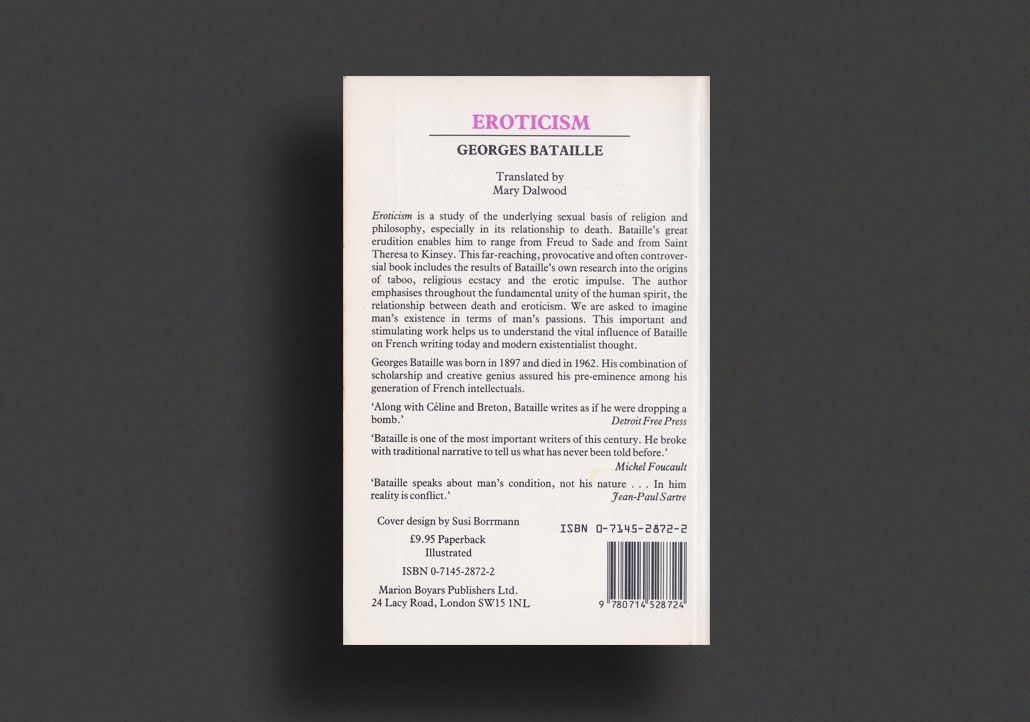
Eroticism is a study of the underlying sexual basis of religion and philosophy, especially in its relationship to death. Bataille's great erudition enables him to range from Freud to Sade and from Saint Theresa to Kinsey. This far-reaching, provocative and often controversial book includes the results of Bataille's own research into the origins of taboo, religious ecstacy and the erotic impulse. The author emphasises throughout the fundamental unity of the human spirit, the relationship between death and eroticism. We are asked to imagine man's existence in terms of man's passions. This important and stimulating work helps us to understand the vital influence of Bataille on French writing today and modern existentialist thought.
Georges Bataille was born in 1897 and died in 1962. His combination of scholarship and creative genius assured his pre-eminence among his generation of French intellectuals.
"Along with Céline and Breton, Bataille writes as if he were dropping a bomb."—Detroit Free Press
"Bataille is one of the most important writers of this century. He broke with traditional narrative to tell us what has never been told before."—Michel Foucault
"Bataille speaks about man's condition, not his nature... In him reality is conflict."—Jean-Paul Sartre
Very Good copy, tanning to page edges.
1977, Spanish
Softcover (staple-bound), 50 pages, 30 x 21 cm
1st Edition, Out of print title / used / very good
Published by
Edita Edinaper / Barcelona
$100.00 - Out of stock
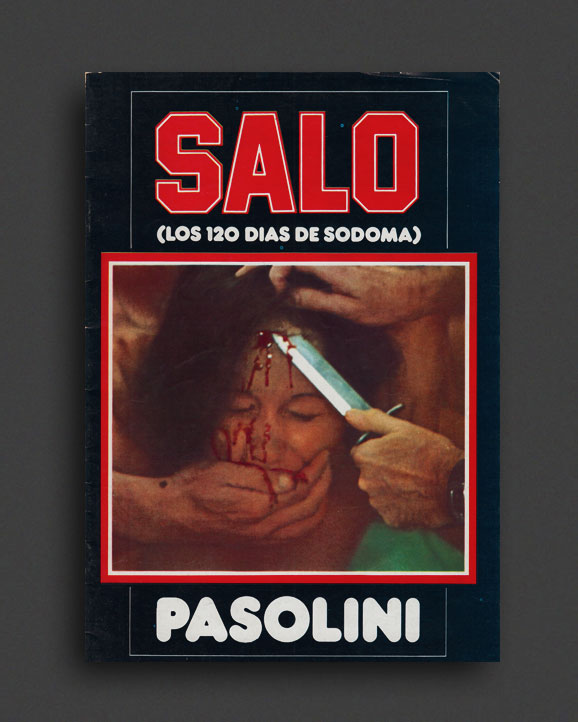
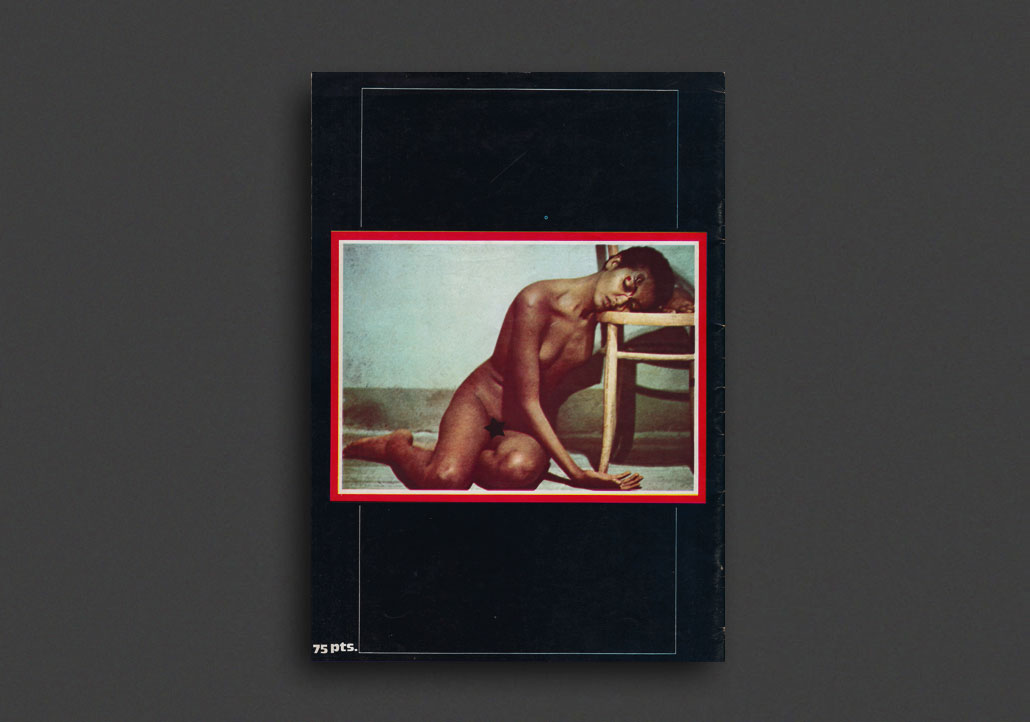
Glossy 1977 photo album documenting Salò, or The 120 Days of Sodom, Pasolini's notorious final film from 1975, released three weeks after his murder. The film has been called nauseating, shocking, depraved, pornographic... It’s also a masterpiece. The controversial poet, novelist, and filmmaker’s transposition of the Marquis de Sade’s eighteenth-century opus of torture and degradation to Fascist Italy in 1944 remains one of the most passionately debated films of all time, a thought-provoking inquiry into the political, social, and sexual dynamics that define the world we live in. Lavishly illustrated with film stills and behind-the-scenes imagery in graphic glossy colour and b/w, the publication visually documents the film script (in Spanish text), while giving a biographical account of Pasolini and his interest in Marquis de Sade, etc./origin to the film's making. Includes all film credits.
Salò, or the 120 Days of Sodom, billed on-screen as Pasolini's 120 Days of Sodom on English-language prints and commonly referred to as simply Salò, is a 1975 political horror film directed and co-written by Pier Paolo Pasolini. The film is a loose adaptation of the 1785 novel (first published in 1904) The 120 Days of Sodom by Marquis de Sade, updating the story's setting to the World War II era. It was Pasolini's final film, released three weeks after his murder.
The film focuses on four wealthy, corrupt Italian libertines in the time of the fascist Republic of Salò (1943–1945). The libertines kidnap 18 teenagers and subject them to four months of extreme violence, sadism, genital torture and psychological torture. The film explores themes of political corruption, consumerism, authoritarianism, nihilism, morality, capitalism, totalitarianism, sadism, sexuality, and fascism. The story is in four segments, inspired by Dante's Divine Comedy: the Anteinferno, the Circle of Manias, the Circle of Shit, and the Circle of Blood. The film also contains frequent references to and several discussions of Friedrich Nietzsche's 1887 book On the Genealogy of Morality, Ezra Pound's poem The Cantos, and Marcel Proust's novel sequence In Search of Lost Time.
Premiering at the Paris Film Festival on 23 November 1975, the film had a brief theatrical run in Italy before being banned in January 1976, and was released in the United States the following year on 3 October 1977. Because it depicts youths subjected to graphic violence, torture, sexual abuse, and murder, the film was controversial upon its release and has remained banned in many countries.
Good—Very Good copy. General light wear to extremities, well preserved.
1977, Spanish
Softcover (staple-bound), 50 pages, 30 x 21 cm
1st Edition, Out of print title / used / very good
Published by
Edita Edinaper / Barcelona
$60.00 - In stock -
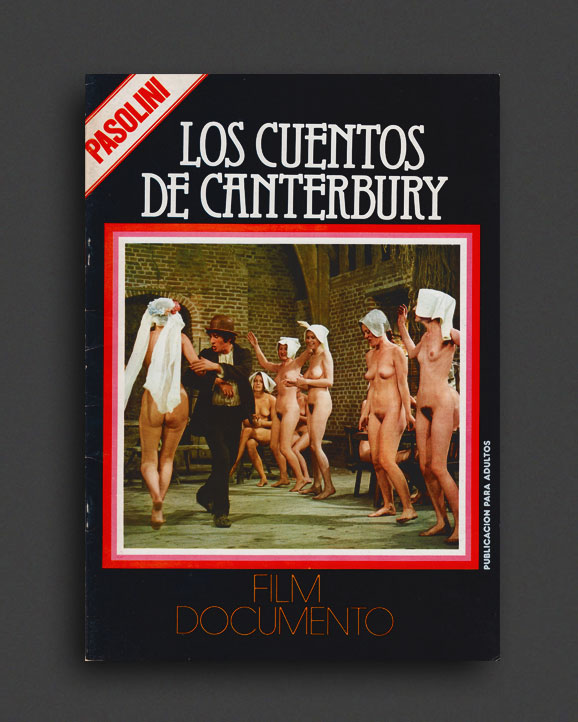
Glossy 1977 photo album documenting Pier Paolo Pasolini's The Canterbury Tales, a 1972 erotic black comedy based on the medieval narrative poem by Geoffrey Chaucer. Lavishly illustrated with titillating
film stills and behind-the-scenes imagery in graphic glossy colour and b/w, the publication visually documents the film script (in Spanish text), while giving a biographical account of Pasolini and his interest in Chaucer's tales/origin to the film's making. Includes all film credits.
The second film in Pasolini's "Trilogy of Life", preceded by The Decameron and followed by Arabian Nights, it won the Golden Bear at the 22nd Berlin International Film Festival. With the "Trilogy of Life", Pasolini sought to adapt vibrant, erotic tales from classical literature. With The Canterbury Tales he set his sights to the earthy Middle English tales of Chaucer. The film came after a string of movies of the late 1960s in which Pasolini had a major ideological bent. Though this film is much more light-hearted in nature Pasolini nonetheless considered it among his most "ideological". The film can be seen as an attack on the stiff sexual mores of both Chaucer and Pasolini's times.
Good—Very Good copy. General light wear to extremities, well preserved.
1980, French
Hardcover cloth-bound slipcase, 13 plates + text insert, 42.2 x 30.9 cm
Signed,
1st Edition, Out of print title / used / very good
Published by
Galerie Bijan Aalam / Paris
Editions Natiris / Paris
$550.00 - Out of stock
"An artist with a secret, terrible and painful gaze, Ruppert's work boldly plunges us into the darkest abysses of our souls, to the depths of our unconfessed sexuality, into these cursed areas that we refuse with a self-protective horror instilled by the taboos of society."
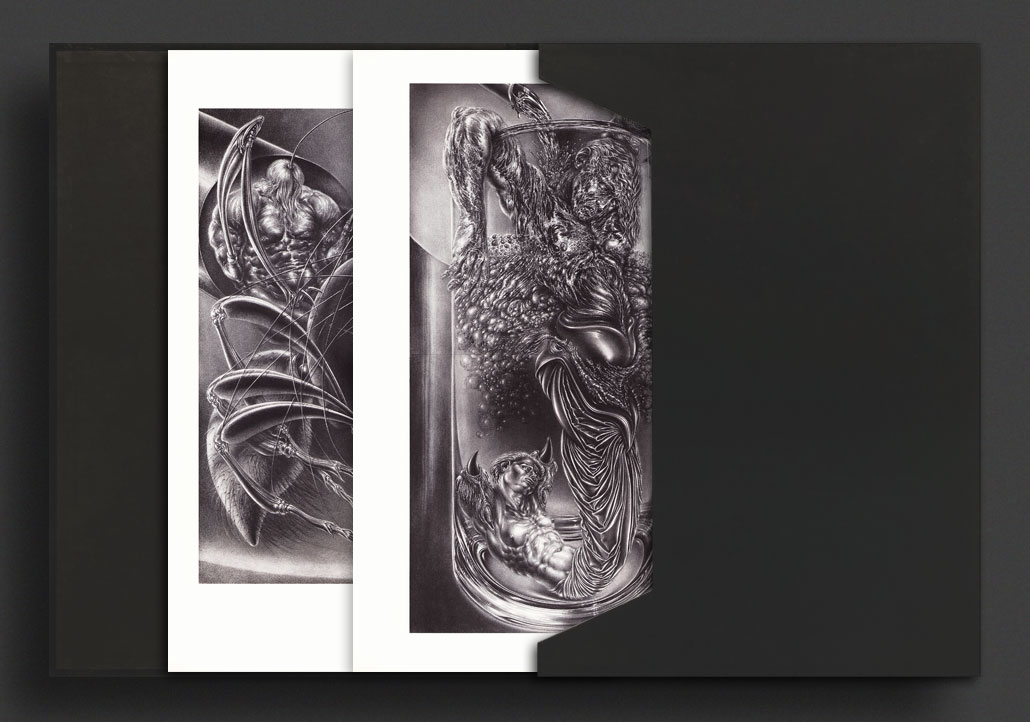
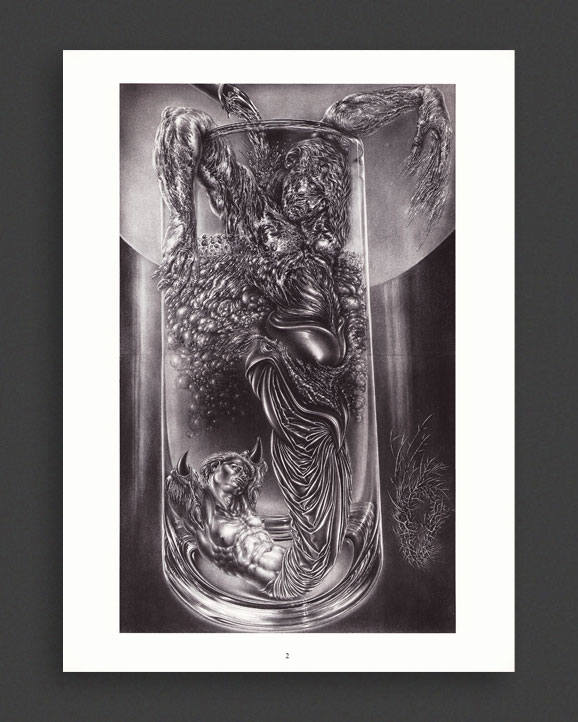
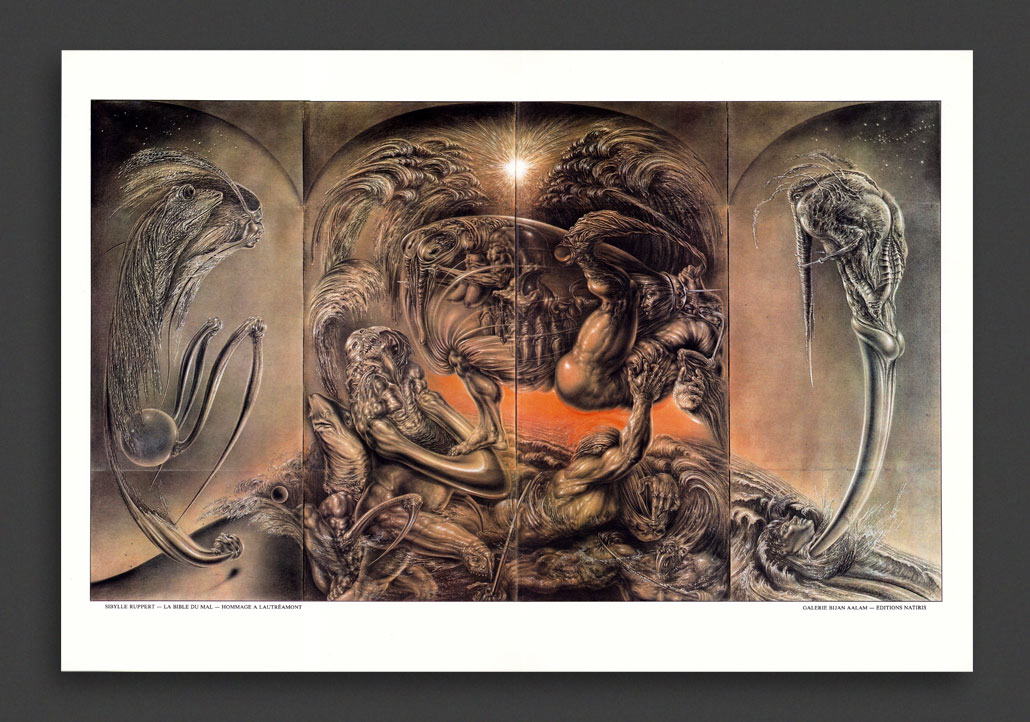
Extremely rare, signed and numbered cloth-bound portfolio by German artist Sibylle Ruppert (1942—2011), published in 1980 by Galerie Bijan Aalam / Editions Natiris, Paris, published in an edition of 1300. With a preface by Alain Robbe-Grillet, this magnificent portfolio illustrating Lautréamont's Les Chants de Maldoror (1868) presents 13 litho-printed loose-leaf plates in colour and monochrome, exquisitely reproducing Ruppert's artworks in striking large-format. The leading plate folds-out to a double-size spread. Accompanied by a selection of passages by Comte de Lautréamont (Isidore Lucien Ducasse) to whom this title is dedicated and from which these illustrations are inspired. Numbered and signed by the artist in the colophon. A complete copy of this major published work of this incredible artist.
"The opening pages of Georges Bataille’s 1928 novella, Story of the Eye, recount a violent three-way sex scene on the edge of a cliff. As the libidinal frenzy nears its peak, rain starts to fall, introducing mud and dirt into the already visceral cocktail of piss, cum, and other bodily fluids in free flow. If this literary vignette had a visual equivalent, it might well be the Sisyphean compositions of Sibylle Ruppert, in which hybrid limbs, flesh, machinery, and the natural elements all commingle and fuse into one another without beginning or end, obliterating any notion of bodily integrity. Bataille, the Marquis de Sade, and Comte de Lautréamont make up the unholy trinity who nourished Ruppert’s dark fantasies. The violent explosiveness of eroticism, desire, pain, destruction, and resurgence so dear to those authors is channeled in Ruppert's works"—Anya Harrison
Sibylle Ruppert (1942, Frankfurt—2011, Paris) created a radical oeuvre of paintings, drawings and collages throughout the 1960s—1980s in a brutal aesthetic of dark surrealism, mixing death and sexuality in a swirling dislocation, a frenetic tearing shared by aggregates of tangled bodies such as the morbid and obscene writings of Marquis de Sade, Comte de Lautréamont, both which she illustrated, or that of Georges Bataille. Ruppert was born during an air raid on September 8th, 1942, the first night of massive bombing of Frankfurt during World War II. At age of 10 she had a religious enlightenment and she insisted on becoming a nun. Discouraged by her parents, in 1959, at the age of 17, Sibylle was instead admitted to the Städelschule in Frankfurt to study art. Shortly after, she left for Paris, where she enrolled in a ballet school and became a successful dancer. During a visit to New York with her friend H.R. Giger, Ruppert decided to give up her dancing career, returned to Germany and became a full-time artist and to teach at her father's drawing school. In 1976 she moved back to Paris and exhibited her large format charcoal drawings, inspired by the writings of de Sade, Lautréamont and Georges Bataille, and her collages and paintings at the Gallery Bijan Aalam. French intellectuals and great minds like Alain Robbe-Grillet, Pierre Restany, Henri Michaux and Gert Schiff were fascinated by her work and tried to interpret her infernal world. When the gallery closed in 1982, she returned to teaching and she started giving art classes in prisons, mental hospitals and drug addiction rehabilitation centers. Sibylle Ruppert died in 2011, withdrawn from any social and public life.
"Here offered to the revulsed senses, the secret shames of anatomy: torn orifices, spilled entrails, secretions, losses. A sharp point, I said. Yes, the sticky and the sharp seem, now, to generate each other in a circle, the fine knife of torture to belong to the same monster as the ignominious flesh which is cut (unbunched), the sexes are invert, insidiously, and invaginate the murder weapon[...]"—A. Robbe-Grillet
Very Good copy with some light wear and tanning to spine of hardcase.
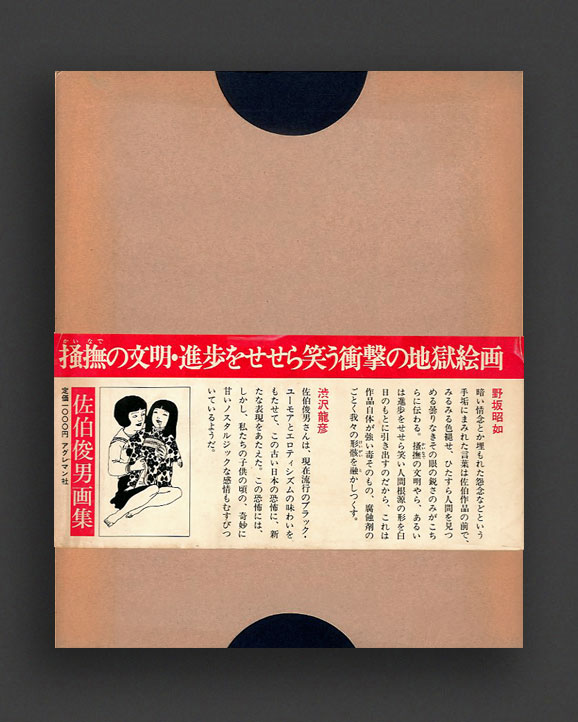
1970, Japanese
Softcover (w. slipcase and obi), 104 pages, 31 x 24 cm
1st US Edition, Out of print title / used / very good
Published by
Agureman-sha / Tokyo
$550.00 - Out of stock
Super rare first major book of collected artworks by ero-guro master Toshio Saeki (1945—2019), published in 1970 by Agureman after his 1968 self-published collection. Stunning large-format softcover collection of uncompromising black and white images that would propel the career of this legendary underground artist of the comic macabre, housed in original publisher's cardboard slipcase and with the rarely preserved illustrated obi-strip.
Toshio Saeki (1945—2019) was an illusive Japanese illustrator and painter, and icon of 1970s Tokyo counterculture, known for combining Japanese folklore, Yōkai spirits and elements of Western art with his own sophisticated aesthetics to create a unique, sensational world of eros, dark humour, and horror. Given the title “Erotic Engineer” by Timothy Leary, Saeki's provocative art broke all sexual taboos, questioned Japanese ideology and traditional views on love, desire and gender roles. Saeki’s surgically-precise graphic work is closely related to the Japanese cultural phenomenon ‘Erotic, Grotesque, Nonsense’ (ero, guro, nansensu).
“Toshio Saeki conjures death with a pen”—Shūji Terayama, 1969.
Good—VG copy with tanning and wear with some light creasing, light foxing, light chipping to case spine. In remarkable, preserved shape for this title!
1998, English / French
Softcover, 21.5 x 15.5 cm
1st Edition, Out of print title / used / very good
Published by
Purple Institute / Paris
$280.00 - Out of stock
The scarce third issue (of eight total, published between 1998-2001) of Olivier Zahm's short-lived, erotically charged photography journal "Purple Sexe". This issue profusely illustrated throughout, containing portfolios by Anette Aurell, Vanessa Beecroft, Ben Cho, Claude Closky, Yasmine Eslami, Jason Farrer, Carolina Gonzales, Jamil Gs, Noritoshi Hirakawa, Bernadette Van-Huy, Richard Kern's photoshoot of Lucy McKenzie, Chris Moor, Justine Parsons, Jack Pierson, Terry Richardson, Katja Rahlwes, Francois Rotger, Gilles Tonelado, and more. Art Direction by Christophe Brunnquell.
In 1992 Olivier Zahm and his partner Elein Fleiss printed the first issue of Purple Prose, a Parisian literary art zine that over the years has evolved into Purple Fashion Magazine. Soon after the birth of Purple Prose, Zahm created spin-off publications like Purple Sexe, Purple Fiction and what we now know and love, Purple Fashion. Zahm aimed at fusing together his two worlds, fashion and art, in creating Purple and Purple Fashion. Purple Sexe remains one of the scarcest of the early Purple series', published in the same format as Purple Prose and Purple Fiction in late 1990s. A magazine devoted to sexuality, only 8 issues of Purple Sexe were ever published between 1998 - 2001, edited by Olivier Zahm and commencing the same year as Purple, which was a fusion of Purple Prose, Fiction, Fashion, and Sexe.
Very Good copy.
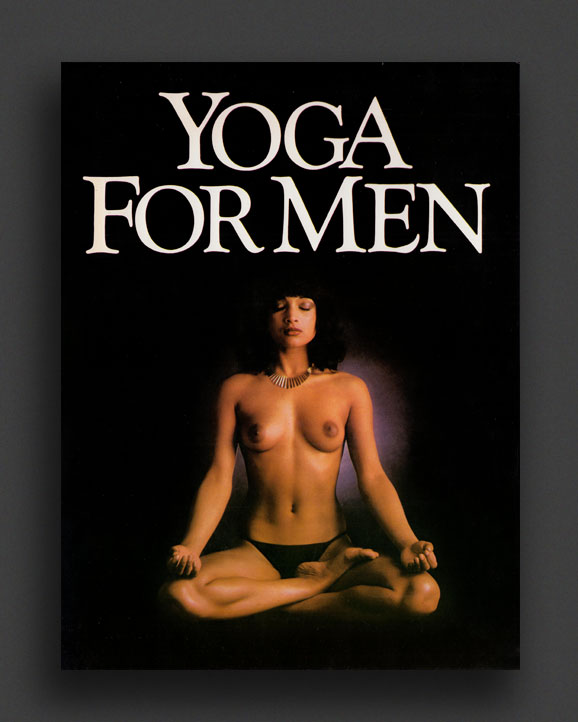
1978, English
Hardcover (w. dust jacket), 60 pages, 23 x 29 cm
1st Edition, Out of print title / used / very good
Published by
Sackett & Marshall / London
$160.00 - In stock -
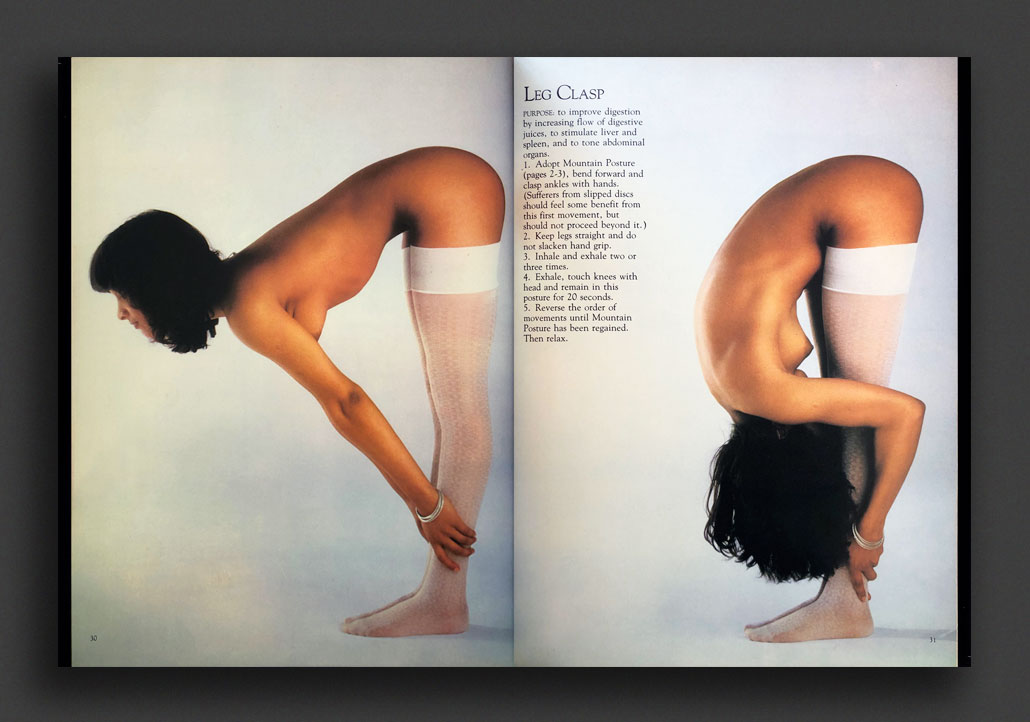
First hardcover edition of the one and only Yoga For Men from 1978, a book that really couldn't be from another year. John Champ, an advertising art director and Hatha Yoga practitioner, teamed up with yoga expert Pauline Donovan and photographer John Russell to re-invigorate the instructional yoga book. The result is a lively, handsomely designed, over-sized glossy nude/semi-nude photo book of female models executing basic yoga postures to "persuade more people to take up what is a rewarding way of life". A special book, and now very collectible!
Good copy w. Very Good dust jacket. Some light foxing/spotting to first and final pages and board bowing, otherwise a VG copy all-round.
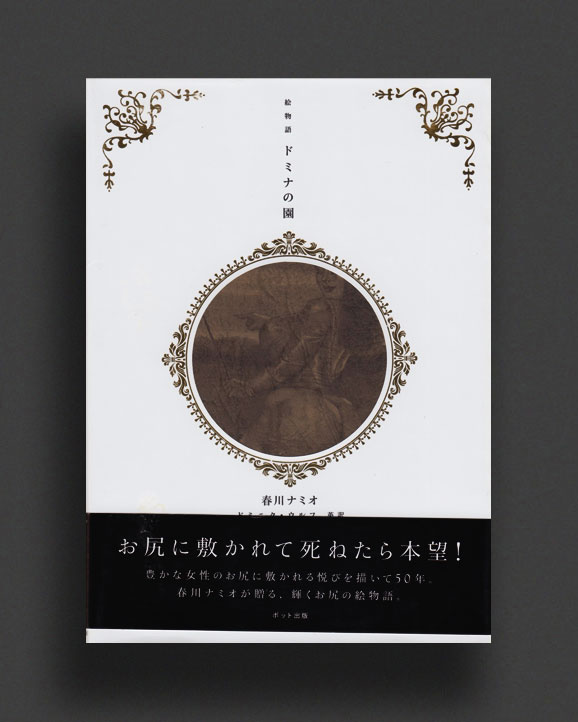
2012, English / Japanese
Softcover (w. dust jacket + obi), 169 pages, 21 x 14.5 cm
Published by
Pot Publishing / Japan
$60.00 - In stock -
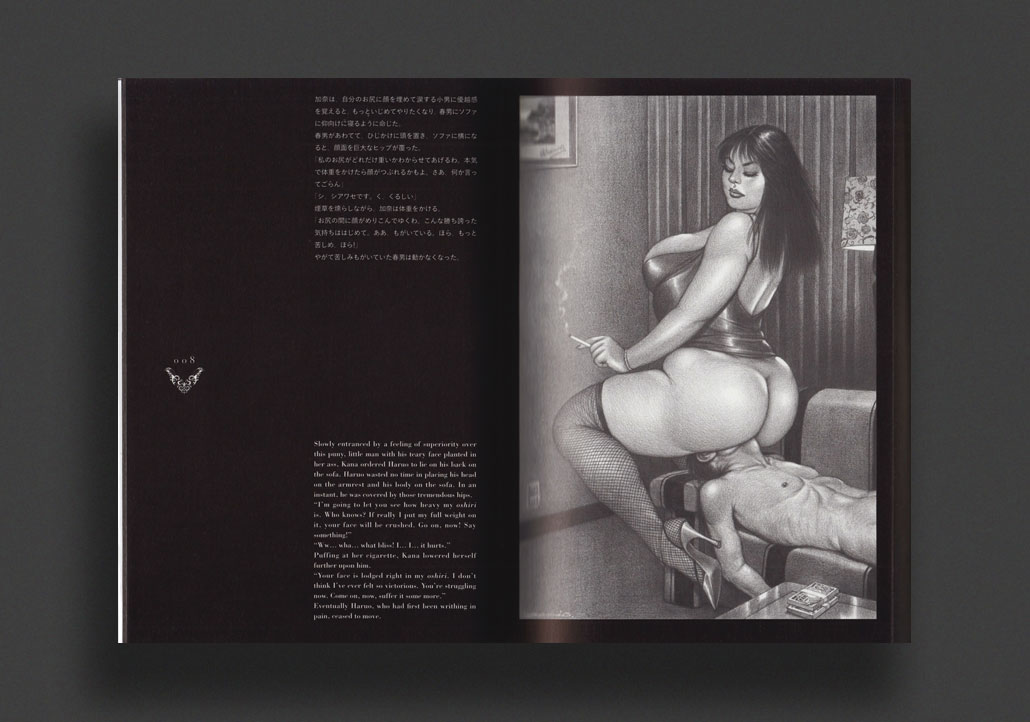
The last(?) of Namio Harukawa's illustrated story books, Garden of Domina, published in Japan in 2012. A bilingual (Japanese / English) story illustrated by 80 new femdom artworks rendered by Harukawa. "A gorgeous gluteus, a bounteous bottom, a robust rump, even an ample ass: there are many ways to describe the pleasures of the oshiri (pronounced o-shee-ree.) In Harukawa Namio's delicately conceived drawings and their accompanying story, there emerges a holy bond of lust and love between cosmetics company president Ohara Kana and the men who would serve her. Kana loves to abuse men with her tremendous buttocks, and they explore the cruel joys found beneath her stunning endowment. Eventually, Kana creates a Garden of Paradise where she, her fellow lusty ladies, and their slaves discover the most exquisite ecstasies of the ass. A leading Japanese SM illustrator who has dedicated his oeuvre to the glories of the glories of the glories of the glories of the glories of the ass, Namio Harukawa both amuses and arouses his reader in this charming tale."
Sample of a story: "Yoshiko liberated Horoshi from her oshiri and fastened him by his two hands to a post in the room. 'It's so sweet you're crying. I'll make you cry some more.' Completely naked, Yoshiko straddled Horoshi from above and pressed her genitals into his face. A slender man, Horoshi arched backwards like a bow...."
Namio Harukawa (1947—2020), a pseudonymous Japanese fetish artist best known for his masterful pencil works depicting female domination ("femdom"), with erotic asphyxiation through facesitting appearing as a frequent subject of his art. Born 1947 in Osaka, Japan, Harukawa’s distinctive penname combines the name of film actress Harukawa Masumi with an anagram of Naomi, the sadistic heroine in Tanizaki Jun’ichiro’s novel "Chijin no ai / A Fool’s Love". While in high school, Harukawa began contributing work to the readers’ column of leading postwar Japanese SM pulp magazine "Kitan Club". Since then, Harukawa’s drawings of male masochism have lovingly portrayed noble, voluptuously beautiful women and the men who serve them as human furniture. An extraordinary and prolific artist who remained committed to the regime of “absolute Ganmen Kijo Shugi (facesitting principle)” throughout his artistic life, Namio Harukawa passed away on April 2020, he was 72 years old.
2001, Japanese
Hardcover (w. dust jacket + obi), 160 pages, 31 x 22 cm
1st Edition, Out of print title / used / fine
Published by
Kawade Shobo Shinsha / Tokyo
$300.00 - Out of stock
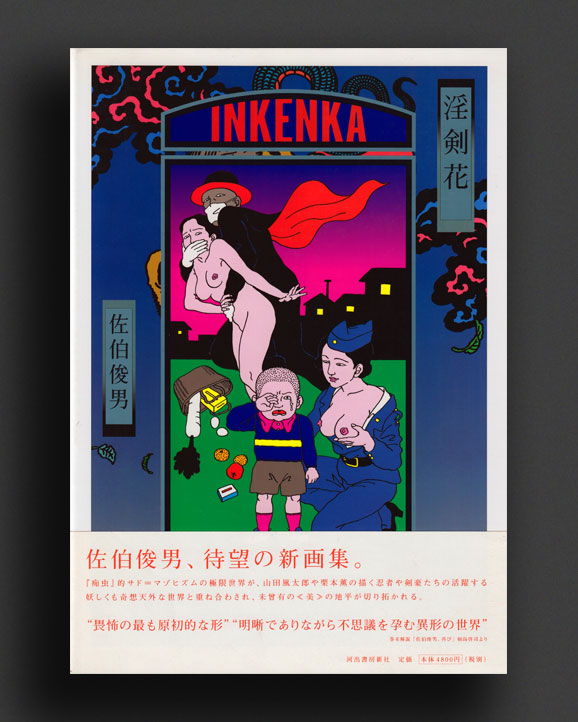
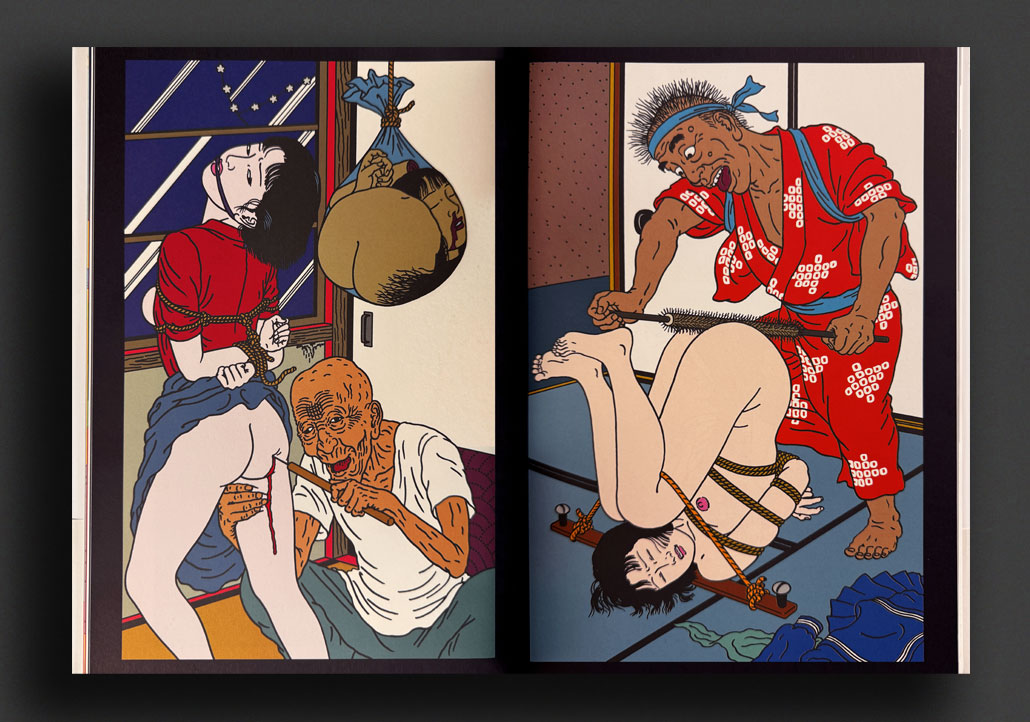
Rare copy of the deluxe hardcover "Inkenka" art collection of ero guro master Toshio Saeki, published in 2001 in Japan and seldom seen since. This extensive, over-sized full-colour collection spans Saeki's entire career, split into three distinct chapters of work: "Lewd Pleasures" — a decadent assault of every darkest sexual depravity rendered in vibrant, explicit colour — all erotic taboos broken by Saeki's brush of dark humour; "Fantasy of the Sword" — a beautiful collection of Saeki's refined fantasy work around the world of the samarai and Japanese legend, also heavy with violence and erotica; "Bewitching Flowers of Spring" — a amazing collection of black and white prints related to all manner of themes central to Saeki — erotica, folklore, monsters, etc. Also includes a two page essay by Ueshima Keiji, bibliography of publications that Toshio Saeki has appeared in, and biography. Rare!
Toshio Saeki (1945—2019) was an illusive Japanese illustrator and painter, and icon of 1970s Tokyo counterculture, known for combining Japanese folklore, Yōkai spirits and elements of Western art with his own sophisticated aesthetics to create a unique, sensational world of eros, dark humour, and horror. Given the title “Erotic Engineer” by Timothy Leary, Saeki's provocative art broke all sexual taboos, questioned Japanese ideology and traditional views on love, desire and gender roles. Saeki’s surgically-precise graphic work is closely related to the Japanese cultural phenomenon ‘Erotic, Grotesque, Nonsense’ (ero, guro, nansensu).
“Toshio Saeki conjures death with a pen”—Shūji Terayama, 1969.
Near Fine copy in NF dust jacket and NF obi.
1995, Japanese
Softcover (w. dust jacket), 150 pages, 27 x 21 cm
1st Edition, Out of print title / used / very good
Published by
Shogakukan / Tokyo
$60.00 - In stock -
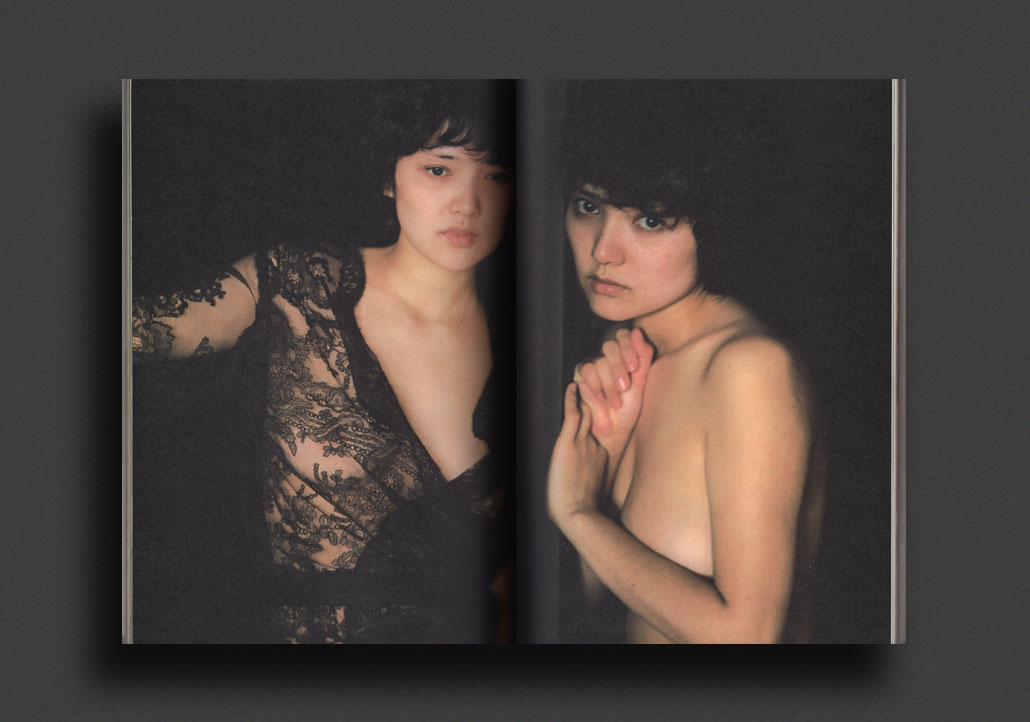
Beautiful Japanese photobook by famed Japanese photographer Kishin Shinoyama, published in 1995. This entire photographic collection is dedicated to Shinoyama's photographs of his friend, Japanese actress and model Aki Mizusawa (1954-) spanning 1975‐1995.
“It is extremely rare for a photographer to be able to shoot a single subject; one woman continuously for twenty years. Now, seeing all those images - as fleeting and instantaneous then as the magazines that carried them - revived and bound together gives that particular history a closure that weighs like marble. This book captures the twenty year photogenic evolution of a wonderful friend and subject, Aki Mizusawa."—Kishin Shinoyama
Kishin Shinoyama was born in 1940, in Tokyo, Japan. He embarked on his career while studying in the Department of Photography at Nippon University, and was awarded the Advertising Photographer’s Association prize, among others. After being employed at the Light Publicity advertising company, he started to work as a freelance photographer in 1968. His work is acclaimed for the portraits of the most famous celebrities of our day and age, such as John Lennon and Yoko Ono, Rie Miyazawa, and other major personalities. In his “Gekisha” and “Shinorama” series, he carries on capturing the times using new forms of expression and new technologies. He is also an exponent of solarization and has used it to challenge preconceived ideas of beauty and the nude.
Very Good copy in original dust jacket.
1980, English
Softcover, 60 pages, 28 x 22 cm
1st Edition, Out of print title / used / very good
Published by
Galerie Jurka / Amsterdam
$280.00 $160.00 - In stock -
Very scarce first edition of Robert Mapplethorpe's Black Males, published in 1980 by Galerie Jurka, Amsterdam. Dutch gallery owner Robert Jurka was instrumental in the early reception of Robert Mapplethorpe’s photography in Europe, exhibiting for the first time many of his (now) world-renowned photographs. Following an early Mapplethorpe monograph from 1979, Jurka also published the first Black Males catalogue as part of the homonymous exhibition he organized in 1980 at Galerie Jurka. With an introductory essay by Edmund White, this first 1980 edition remains the most sought after printing of this beautiful and controversial series by Mapplethorpe.
Robert Mapplethorpe (1946-1989) took his first photographs using a Polaroid camera. His first Polaroids were self-portraits and the first of a series of portraits of his close friend, the singer-artist-poet Patti Smith. These early photographic works were generally shown in groups or elaborately presented in shaped and painted frames that were as significant to the finished piece as the photograph itself. Then he acquired a large format press camera and began taking photographs of a wide circle of friends and acquaintances. These included artists, composers, socialites, pornographic film stars and members of the S & M underground. Some of these photographs were shocking for their content but exquisite in their technical mastery. During the early 1980s, Mapplethorpe’s photographs began a shift toward a phase of refinement of subject and an emphasis on classical formal beauty. During this period he concentrated on statuesque male and female nudes, delicate flower still lifes, and formal portraits of artists and celebrities.
Good copy throughout with light wear. Note coffee marking to covers and previous owner's name penned into first blank page. Interior otherwise clean, tight and overall well preserved.
1998, Japanese
Hardcover (w. dust jacket), 224 pages, 21.5 x 14.5 cm
1st Edition, Out of print title / used / very good
Published by
Futami Shobo / Japan
$100.00 - In stock -
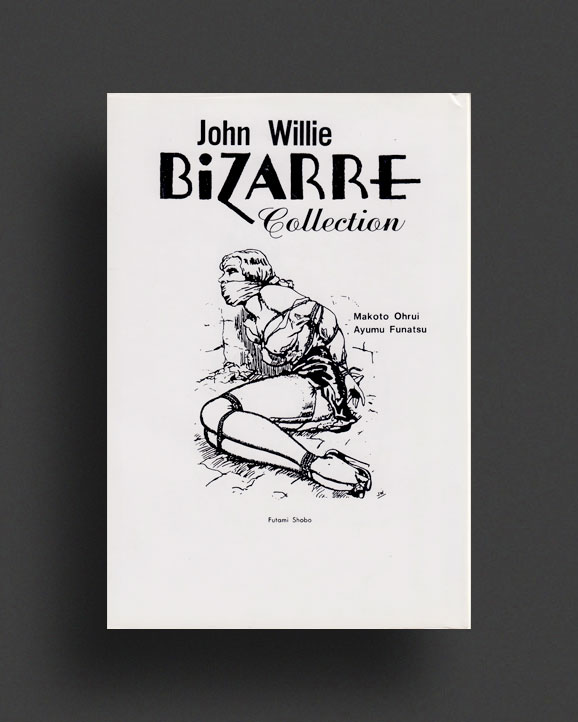
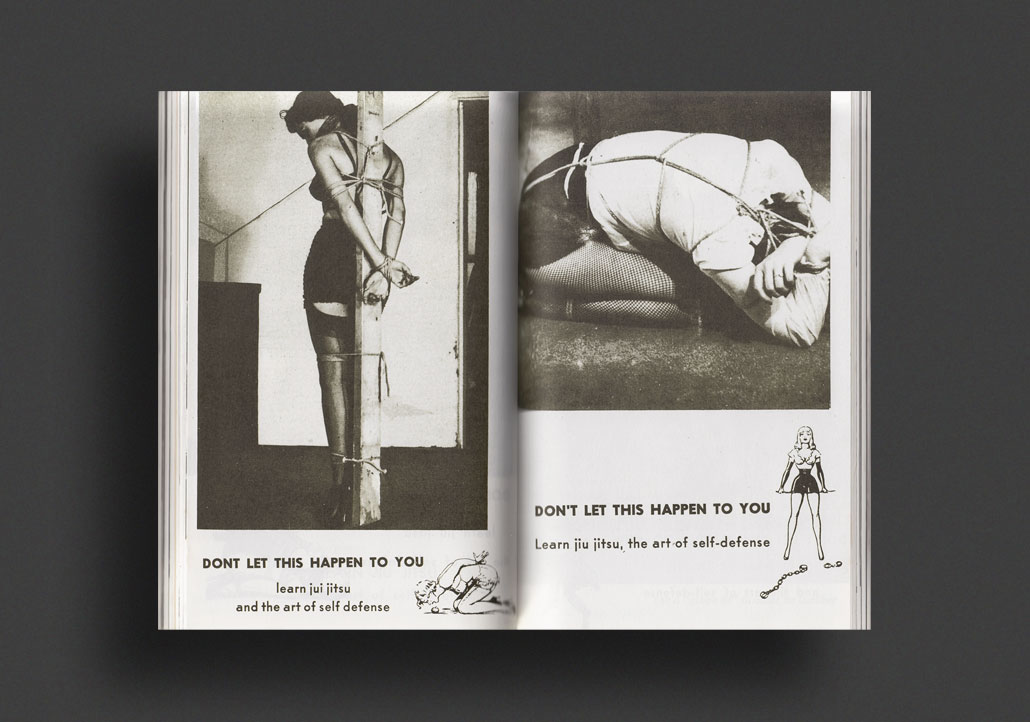
Rare first hardcover edition of this book collection of artwork by legendary fetish artist and publisher John Willie, compiled by SALE2/Fiction Inc. editor Makoto Ohrui and Ayumu Funatsu and published in Tokyo Japan by Futami Shobo in 1998. Packed cover-to-cover with colour and b/w reproductions of classic artworks by Willie and his famed Bizarre publications, John Willie's bondage photography, Bizarre fetish fashion illustrations and paintings, alongside his letters and writings translated into Japanese.
John Alexander Scott Coutts (1902—1962), better known by the pseudonym John Willie, was an artist, fetish photographer, editor and the publisher of the first 20 issues of the fetish magazine Bizarre, featuring his characters Sweet Gwendoline and Sir Dystic d'Arcy.
Makoto Ohrui founded the publishing house Fiction Inc. (later Radical Silence Production), the magazine SALE2, the gallery THE deep in Tokyo, and the magazine THE International. Ohrui was art director for SALE2, Purple, Rockin' On, and designed many books.
Very Good copy.
1962, German
Hardcover (w. dust jacket + signed lithograph), 58 pages, 21.5 x 21.5 cm
Signed,
1st Edition, Out of print title / used / very good
Published by
Sydow-Zirkwitz / Frankfurt
$90.00 - Out of stock
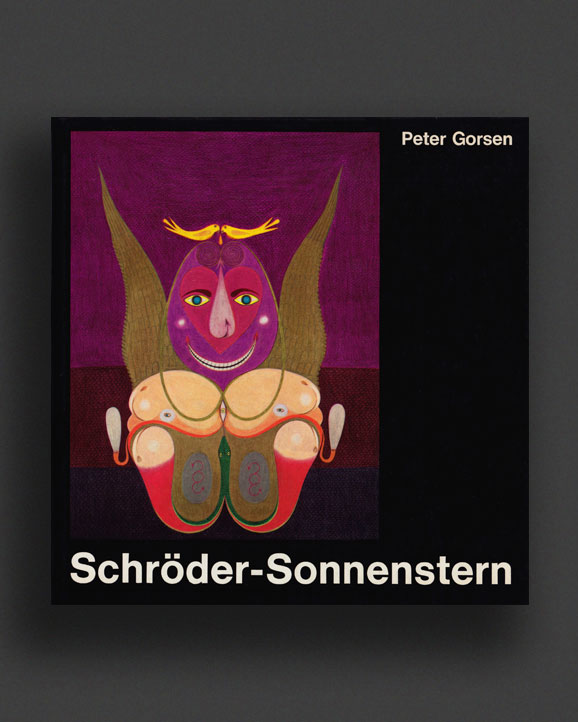
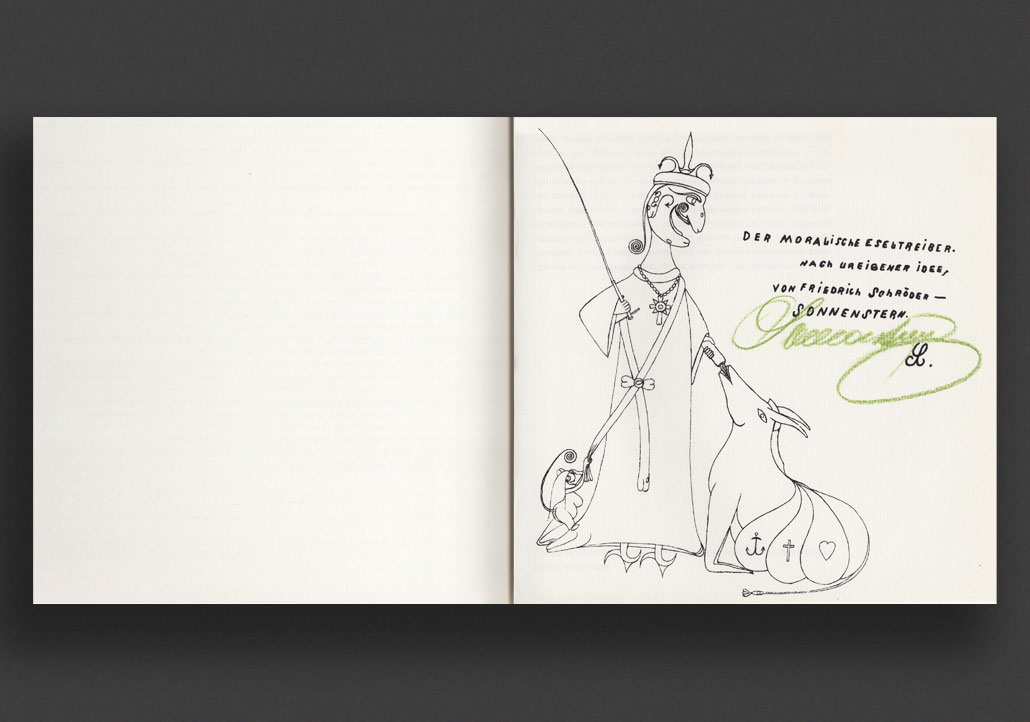
First 1962 hardcover edition of the first definitive study ("An Interpretation") of German artist Friedrich Schröder-Sonnenstern (1892—1982), considered one of the most important representatives of Art Brut or Outsider Art, by Austrian art historian Peter Gorsen (1933—2017) who studied under Theodor W. Adorno and Jürgen Habermas at the University of Frankfurt. This is one of 999 numbered copies from the limited first print edition of 1100, each with a loosely inserted original serigraph by the artist, boldly signed in green crayon. No. 750.
Friedrich Schröder-Sonnenstern was a draftsman, painter and poet-philosopher. Born in 1892 in East Prussia, one of thirteen children, all of whom apart from one other died shortly after birth. He was sent to a number of reform schools due to accusations of theft and violent behaviour and then, at the age of twenty-six, he was diagnosed with schizophrenia and committed to a sanatorium. His experiences as a child contributed to his lifelong hatred of authority. One year later he showed up in Berlin, where he occupied himself with occultism, divination and healing magnetism. He founded a sect and distributed its income in the form of bread rolls to poor children, earning him the title "Schrippenfürst of Schöneberg". He created the name Sonnenstern (English: Sun Star) for himself while working as a con-artist, posing as a Quack doctor in "natural health", calling himself Professor Dr. Eliot Gnass von Sonnenstern. This career path was cut off by the Nazis' interdiction of occult practices, and after being confined in psychiatric institutes and in a penal camp, Schröder-Sonnenstern reemerged in 1944, scavenging firewood in the bombed-out German capital. Only in his late fifties, in 1949, did he begin to draw, using coloured pencils to create allegorical grotesques stocked with a personal iconography. Although his art was rarely shown, he was championed in Surrealist and art brut circles; Jean Dubuffet and Hans Bellmer were among his admirers, and a few drawings were included in Marcel Duchamp and André Breton's 1959 "Exposition inteRnatiOnale du Surréalisme" in Paris. The demand for his pictures by collectors and gallerists rose rapidly and he resorted to employing assistants to produce his work for him. His success was short-lived when he began to paint less and less and became the victim of counterfeiting cliques by his assistants, destroying his position in the art market. He became increasingly dependent on alcohol following the death, in 1964, of his long-time companion, Martha Möller whom he called Aunt Martha. He died almost forgotten and impoverished in 1982 in Berlin.
Very Good copy in good dust jacket — back cover corner tear-off, otherwise VG.