World Food Books' programme is largely produced on Kulin Nation land. We acknowledge the Wurundjeri people of the Kulin Nation as the first and continuing custodians of this land, and pay respect to their Elders past, present, and emerging.
World Food Books is an arts and special interests bookshop in Naarm / Melbourne. Founded in 2010, World Food Books is devoted to the presentation of a rotating, hand-selection of international art, design, literary and counterculture publications with an emphasis on the anti-traditional, the experimental, the avant-garde, the heretic, the marginal.
Presenting new titles alongside rare and out-of-print books, catalogues and journals spanning the fields of modern and contemporary art, design, photography, illustration, film, literature, poetry, cultural theory, philosophy, sexuality, popular and underground culture in its many radical forms, World Food Books wishes to encourage adventurous, thoughtful and open-minded reading, looking, writing, and exchange of publishing and ideas, both current and historical.
As well as our bookshop, located in Melbourne's historical Nicholas Building, all of our inventory is available internationally via our online mail-order service.
World Food Books semi-regularly co-ordinates "Occasions", a programme of exhibits and events at the bookshop and in partnership with other hosts (such as museums and art galleries) that develop out of the activities, relationships and content of the bookshop itself.
World Food Books
The Nicholas Building
37 Swanston Street
Room 5, Level 6
Melbourne 3000
Australia
SHOP HOURS:
THU–SAT 12–6
WEB-SHOP OPEN 24/7
World Food Books
Postal Address:
PO Box 435
Flinders Lane
Victoria 8009
Australia
info@worldfoodbooks.com
Art
Theory / Essay
Architecture / Interior
Graphic Design / Typography
Photography
Fashion
Eros
LGBTQ+
Fiction / Poetry
Weird / Speculative / Science Fiction / Horror
Transgressive / Visceral / Abject
Symbolism / Decadence / Fin de siècle
Film / Video
Painting
Sculpture / Installation
Performance / Dance / Theater
Drawing
Sound / Music
Curatorial
Group Shows / Collections
Periodicals
Out-of-print / Rare
Posters / Ephemera / Discs
Signed Books
World Food Books Gift Voucher
World Food Book Bag
Australian Art
Australian Fiction
Australian Science Fiction / Speculative Fiction
Australian Poetry
Australian Photography
Japanese Photography
Conceptual Art
Minimal Art
Dada
'Pataphysics / Oulipo
Fluxus
Concrete Poetry
Pop Art
Surrealism
Arte Povera
Arte Informale / Haute Pâte / Tachism
Nouveau Réalisme / Zero / Kinetic
Situationism / Lettrism
Collage / Mail Art / Xerox Art
Art Brut / Folk / Visionary / Fantastic
Illustration / Graphic Art / Bandes Dessinées
Furniture
Italian Radical Design / Postmodernism
Textiles
Ceramics / Glass
Counterculture
Protest / Revolt
Philosophy
Psychoanalysis
Anthropology
Anarchism
Socialism / Anarchism / Communism / Capitalism
Literary Theory / Semiotics / Language
Feminism / Women's Studies
Gender Studies / Sexuality
Anthropology
Fetishism / BDSM
Drugs / Psychedelia
Crime / Violence
Animal Rights / Veganism
Occult / Esoterica
Ecology / Earth / Alternative Living
Whole Earth / Crafts
All prices in AUD (Australian dollars)
Pick-Ups
Pick-up orders can be collected in our bookshop during opening hours after order date. Please collect any Pick-up orders within 2 weeks of ordering as we have limited storage space. Orders will be released back into stock if not collected within this time. No refunds can be made for pick-ups left un-collected. If you cannot make it in to the bookshop in this time-frame, please choose postage option.
Return Policy
All sales are final. We do accept returns (for refund or exchange) for items received in error. All our orders are packed with special care using heavy-duty padding and cardboard book-mailers or bubble mailers (for smaller books), using reinforcement where required. We cannot take responsibility for any lost, stolen or damaged parcels.
Insurance
Should you wish to insure your package, please email us directly after placing your order and we can organise this at a small extra expense. Although all standard/express tracked packages are very safe and dependable, we cannot take responsibility for any lost, stolen or damaged parcels. We recommend insurance on valuable orders.
Interested in selling your old books, catalogues, journals, magazines, comics, fanzines, ephemera? We are always looking for interesting, unusual and out-of-print books to buy. We only buy books in our fields of interest and specialty, and that we feel we can resell.
We base these prices on desirability, market value, in-print prices, condition and our current stock levels. We offer cash, store credit, and can take stock on consignment. All
about 25% of the price we expect to get when we sell them, or 30% in store credit. We base these prices on desirability, market value, in-print prices, condition and our current stock levels.
Sell your books any day of the week. You can drop them off and return later. If you have a lot of books, we can visit your Sydney home.
We buy books that we feel we can resell. We offer about 25 % of the price we expect to get when we sell them, or 30% in store credit. We base these prices on desirability, market value, in-print prices, condition and our current stock levels.
Philadelphia Wireman
03 August - 01 September, 2018
World Food Books is proud to announce our next Occasion, the first presentation of sculptures by Philadelphia Wireman in Australia.
The Philadelphia Wireman sculptures were found abandoned in an alley off Philadelphia’s South Street on trash night in 1982. Their discovery in a rapidly-changing neighbourhood undergoing extensive renovation, compounded with the failure of all attempts to locate the artist, suggests that the works may have been discarded after the maker’s death. Dubbed the "Philadelphia Wireman" during the first exhibition of this work, in 1985, the maker’s name, age, ethnicity, and even gender remain uncertain. The entire collection totals approximately 1200 pieces, all intricately bound together with tightly-wound heavy-gauge wire (along with a few small, abstract marker drawings, reminiscent both of Mark Tobey and J.B. Murry). The dense construction of the work, despite a modest range of scale and materials, is singularly obsessive and disciplined in design: a wire armature or exoskeleton firmly binds a bricolage of found objects including plastic, glass, food packaging, umbrella parts, tape, rubber, batteries, pens, leather, reflectors, nuts and bolts, nails, foil, coins, toys, watches, eyeglasses, tools, and jewellery.
Heavy with associations—anthropomorphic, zoomorphic, and socio-cultural responses to wrapped detritus—the totemic sculptures by Philadelphia Wireman have been discussed in the context of work created to fulfil the shamanistic needs of alternative religions in American culture. Curators, collectors, and critics have variously compared certain pieces to sculpture from Classical antiquity, Native American medicine bundles, African-American memory jugs, and African fetish objects. Reflecting the artist’s prolific and incredibly focused scavenging impulse, and despite—or perhaps enhanced by—their anonymity, these enigmatic objects function as urban artefacts and arbiters of power, though their origin and purpose is unknown. Philadelphia Wireman, whatever their identity, possessed an astonishing ability to isolate and communicate the concepts of power and energy through the selection and transformation of ordinary materials. Over the course of the past two decades, this collection has come to be regarded as an important discovery in the field of self-taught art and vernacular art.
Presented in collaboration with Fleisher-Ollman Gallery, Philadelphia, and Robert Heald, Wellington.
Susan Te Kahurangi King
02 February - 10 March, 2018
Susan Te Kahurangi King (24 February 1951 - ) has been a confident and prolific artist since she was a young child, drawing with readily available materials - pencils, ballpoint pens and felt-tip markers, on whatever paper is at hand. Between the ages of four and six Susan slowly ceased verbal communication. Her grandparents William and Myrtle Murphy had developed a special bond with Susan so they took on caring responsibilities for extended periods. Myrtle began informally archiving her work, carefully collecting and storing the drawings and compiling scrapbooks. No drawing was insignificant; every scrap of paper was kept. The King family are now the custodians of a vast collection containing over 7000 individual works, from tiny scraps of paper through to 5 meter long rolls.
The scrapbooks and diaries reveal Myrtle to be a woman of great patience and compassion, seeking to understand a child who was not always behaving as expected. She encouraged Susan to be observant, to explore her environment and absorb all the sights and sounds. Myrtle would show Susan’s drawings to friends and people in her community that she had dealings with, such as shopkeepers and postal workers, but this was not simply a case of a grandmother’s bias. She recognised that Susan had developed a sophisticated and unique visual language and sincerely believed that her art deserved serious attention.
This was an unorthodox attitude for the time. To provide some context, Jean Dubuffet coined the term Art Brut in 1945 to describe work created by self-taught artists – specifically residents of psychiatric institutions and those he considered to be visionaries or eccentrics. In 1972 Roger Cardinal extended this concept by adopting the term Outsider Art to describe work made by non-academically trained artists operating outside of mainstream art networks through choice or circumstance. Susan was born in Te Aroha, New Zealand in 1951, far from the artistic hubs of Paris and London that Dubuffet and Cardinal operated in. That Myrtle fêted Susan as a self-taught artist who deserved to be taken seriously shows how progressive her attitudes were.
Susan’s parents Doug and Dawn were also progressive. Over the years they had consulted numerous health practitioners about Susan’s condition, as the medical establishment could not provide an explanation as to why she had lapsed into silence. Dawn educated herself in the field of homeopathy and went on to treat all twelve of her children using these principles – basing prescriptions on her observations of their physical, mental and emotional state.
Doug was a linguist with an interest in philosophy who devoted what little spare time he had to studying Maori language and culture. To some extent their willingness to explore the fringes of the mainstream made them outsiders too but it was their commitment to living with integrity and their respect for individuality that ensured Susan’s creativity was always encouraged.
Even though Susan’s family supported her artistic pursuits, some staff in schools and hospitals saw it as an impediment to her assimilation into the community and discouraged it in a variety of ways. Her family was not always aware of this and therefore did not fully understand why Susan stopped drawing in the early 1990s. However, rather than dwell on the challenges that Susan faced in pursuit of her artistic practice, they prefer to highlight her achievements. In 2008 Susan began drawing again in earnest, after an almost 20 year interruption, and her work is now shown in galleries around the world.
Susan grew up without television and has been heavily influenced by the comics she read as a child. She is absolutely fearless in the appropriation of recognizable characters, such as Donald Duck and Mickey Mouse, in her work. She twists their limbs, contorts their faces, compresses them together, blends them into complex patterned backgrounds - always imbuing them with an incredible energy. Although Susan often used pop culture characters in her work they are not naive or childlike. These are drawings by a brilliant self-taught artist who has been creating exceptional work for decades without an audience in mind.
Mladen Stilinović
"Various Works 1986 - 1999"
02 February 16 - September 10, 2016
Various works 1986 - 1999, from two houses, from the collections of John Nixon, Sue Cramer, Kerrie Poliness, Peter Haffenden and Phoebe Haffenden.
Including: Geometry of Cakes (various shelves), 1993; Poor People’s Law (black and white plate), 1993; White Absence (glasses, ruler, set square, silver spoon, silver ladel with skin photograph and wooden cubes), 1990-1996; Exploitation of the Dead (grey and red star painting, wooden painting, black spoon with red table, red plate), 1984-1990; Money and Zeros (zero tie, paintings made for friends in Australia (Sue, John, Kerrie), numbers painting), 1991-1992; Words - Slogans (various t-shirts) - “they talk about the death of art...help! someone is trying to kill me”, “my sweet little lamb”, “work is a disease - Karl Marx”; Various artist books, catalogues, monographs, videos; Poster from exhibition Insulting Anarchy; "Circular" Croatian - Australian edition; Artist book by Vlado Martek (Dostoyevsky); more.
Thanks to Mladen Stilinović and Branka Stipančić.
Jonathan Walker
Always Will Need To Wear Winter Shirt Blue + Ochre Small Check Pattern
21 August - 21 September, 2015
Untitled
I am not a great reader of poetry but I always return to the work of Melbourne poet, Vincent Buckley (1925- 1988). Perhaps I find his most tantalising piece to be not a finished poem but a fragment left on a scrap of paper discovered on his desk after the poet’s death.
The poetry gathers like oil
In the word-core, and spreads
It has its music meet,
Its music is in movement.
This fragment is more the shell left behind from a volatile thought than a finished poem. I find the last two lines honest but awkward whereas the first two lines work like an arrow. Most likely he could not find a resolution so it was left. Still, in its present form, it remains an eloquent testimony to the ultimate failure of a medium to express mobile thought and sensation, in Buckley’s case, through verbal language. It’s an important matter because this is something all artists have to deal with regardless of the medium.
I have never written a poem, however, I am forever copying fragments from books on paper scraps in a vain effort to fix certain notions in my head. At first, they function as bookmarks that are sometimes returned to when I open the book. But before long, as they accumulate, they fall out littering the table interspersed with A4 photocopies, bills, books and medications.
To return to Buckley’s fragment, the first two lines very much evoke how I paint nowadays. As you age, detail diminishes and patches of light become more luminous and float. I feel the most honest way of dealing with this is by smearing the oil paint on the canvas with the fingers and working close-up, blind. Only if the patches coalesce into an approaching image can the work gain a life.
-
Jonathan Walker was born in Melbourne, Australia and brought up on a dairy farm in Gippsland. In the 1970’s he studied painting at RMIT and won the Harold Wright Scholarship to the British Museum, London. During the 1980’s he exhibited at Pinacotheca Gallery, Richmond and had work shown at the NGV and Heidi City Art Gallery. Over the same period he designed the cover for the “Epigenesi” LP by Giancarlo Toniutti, Italy and conducted a mail exchange work with Achim Wollscheid, Germany. The work with artists through the post resulted in an article published in the bicentenary issue of Art and Australia 1988. He showed in artist run spaces such as WestSpace in the 90’s and 2000’s, and until 2012, taught painting at Victoria University, which is where we (Colleen Ahern and Lisa Radford) as organisers of the exhibition, among many others, had the privilege of being his student.
Walker’s knowledge was imparted to students through the careful selection of music, literature, and artists found in books that he himself had ordered for the library. Walker’s strategy was the generosity of sharing his vast knowledge with references specific to each student and their context.
Walker’s paintings share a similar focus and intimacy.
This exhibition presents a small selection of recent paintings alongside a publication that includes Walker’s writing. Observational and analytical, Walker’s work is a type of material notation — the time of day, colour and how it is blended, the both specific and fleeting location of a reflection on lino or the question of whether a chair leg should be included in a painting.
Please join us on Friday August 21 between 6-8pm to celebrate the opening of the exhibition.
Curated by Colleen Ahern and Lisa Radford.
B. Wurtz
Curated by Nic Tammens
March 26 - April 4, 2015
B.Wurtz works from a basement studio in his home on Manhattan’s Lower East Side.
This local fact is attested to by the plastic shopping bags and newsprint circulars that appear in his work. As formal objects, they don’t make loud claims about their origins but nonetheless transmit street addresses and places of business from the bottom of this long thin island. Like plenty of artists, Wurtz is affected by what is local and what is consumed. His work is underpinned by this ethic. It often speaks from a neighborhood or reads like the contents of a hamper:
“BLACK PLUMS $1.29 lb.”
“Food Bazaar”
“USDA Whole Pork Shoulder Picnic 99c lb.”
“RITE AID Pharmacy, with us it’s personal.”
“H. Brickman & Sons.”
“Sweet Yams 59c lb."
Most of the work in this exhibition was made while the artist was in residence at Dieu Donne, a workshop dedicated to paper craft in Midtown. Here Wurtz fabricated assemblages with paper and objects that are relatively lightweight, with the intention that they would be easily transportable to Australia. This consideration isn’t absolute in Wurtz’s work, but was prescriptive for making the current exhibition light and cheap. Packed in two boxes, these works were sent from a USPS post office on the Lower East Side and delivered to North Melbourne by Australia Post.
Wurtz appears courtesy of Metro Pictures, New York.
Thanks to Rob Halverson, Joshua Petherick, Sari de Mallory, Matt Hinkley, Helen Johnson, Fayen d'Evie, Ask Kilmartin, Lisa Radon, Ellena Savage, Yale Union, and "Elizabeth".
John Nixon
"Archive"
December 15 - January 20, 2014
The presentation of John Nixon's archive offered a rare showcase of this extensive collection of the artist's own publications, catalogues, posters, ephemera, editions and more, from the mid 1980s onwards, alongside a selection of his artworks.
Organized by John Nixon, Joshua Petherick and Matt Hinkley.
"Habitat"
at Minerva, Sydney (organised by Joshua Petherick and Matt Hinkley)
November 15 - December 20, 2014
Lupo Borgonovo, Janet Burchill & Jennifer McCamley,
Lewis Fidock, HR Giger, Piero Gilardi, Veit Laurent Kurz,
Cinzia Ruggeri, Michael E. Smith, Lucie Stahl, Daniel Weil, Wols
Press Release:
“...It contained seven objects. The slender fluted bone, surely formed for flight, surely from the wing of some large bird. Three archaic circuitboards, faced with mazes of gold. A smooth white sphere of baked clay. An age-blackened fragment of lace. A fingerlength segment of what she assumed was bone from a human wrist, grayish white, inset smoothly with the silicon shaft of a small instrument that must once have ridden flush with the surface of the skin - but the thing’s face was seared and blackened.”
William Gibson, “Count Zero”, 1986
"Autumn Projects Archive"
Curated by Liza Vasiliou
March 6 - March 15, 2014
World Food Books, in conjunction with the Virgin Australia Melbourne Fashion Festival 2014, presented the Autumn Projects archive, consisting of a selection of early examples in Australian fashion with a particular interest in collecting designers and labels from the period beginning in the 1980’s, who significantly influenced the discourse of Australian Fashion.
Curated by Liza Vasiliou, the exhibition provided a unique opportunity to view pieces by designers Anthea Crawford, Barbara Vandenberg, Geoff Liddell and labels CR Australia, Covers, Jag along with early experimental collage pieces by Prue Acton and Sally Browne’s ‘Fragments’ collection, suspended throughout the functioning World Food Books shop in Melbourne.
H.B. Peace
presented by CENTRE FOR STYLE
November 14, 2013
"Hey Blinky, you say chic, I say same"
Anon 2013
H.B. Peace is a clothing collaboration between great friends Blake Barns and Hugh Egan Westland. Their pieces explore the divergences between 'character’ and ‘personality’ in garments....etc
Special Thanks to Joshua Petherick and Matt Hinkley of WFB and Gillian Mears
and a Very Special Thank you to Audrey Thomas Hayes for her shoe collaboration.
Janet Burchill & Jennifer McCamley
"Aesthetic Suicide"
May 10 - June 8, 2013
The first of our occasional exhibitions in the World Food Books office/shop space in Melbourne, "Aesthetic Suicide" presented a body of new and older works together by artists Janet Burchill & Jennifer McCamley, including videos, prints, a wall work, and publications.
During shop open hours videos played every hour, on the hour.
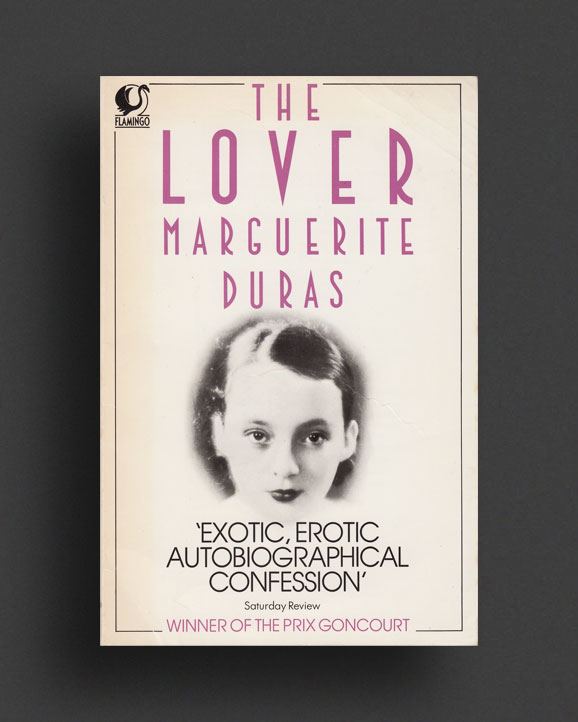
1986, English
Softcover, 124 pages, 19.5 x 13 cm
Out of print title / used / very good
Published by
Fontana / UK
$15.00 - Out of stock
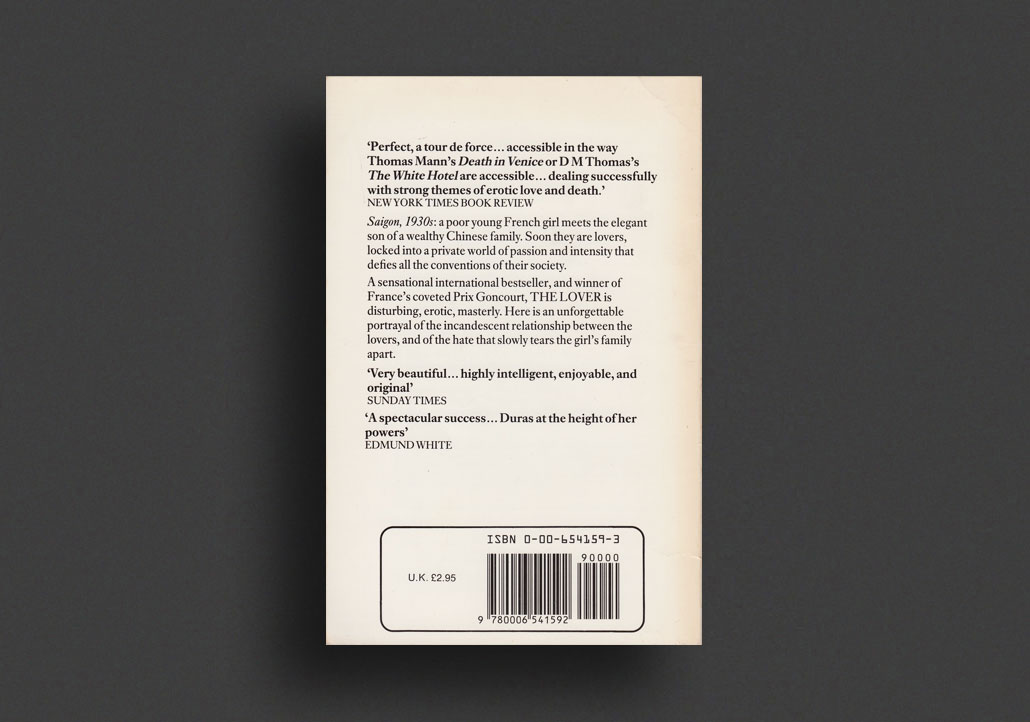
'Perfect, a tour de force... accessible in the way Thomas Mann's Death in Venice or D M Thomas's The White Hotel are accessible... dealing successfully with strong themes of erotic love and death.'—NEW YORK TIMES BOOK REVIEW
Saigon, 1930s: a poor young French girl meets the elegant son of a wealthy Chinese family. Soon they are lovers, locked into a private world of passion and intensity that defies all the conventions of their society.
A sensational international bestseller, and winner of France's coveted Prix Goncourt, THE LOVER is disturbing, erotic, masterly. Here is an unforgettable portrayal of the incandescent relationship between the lovers, and of the hate that slowly tears the girl's family apart.
'A spectacular success... Duras at the height of her powers'—EDMUND WHITE
Good copy of 1986 ed. with general light wear to extremities and tanning.
2017, English
Softcover, 162 pages, 22.6 x 15.1 cm
Published by
The MIT Press / Massachusetts
$48.00 - In stock -
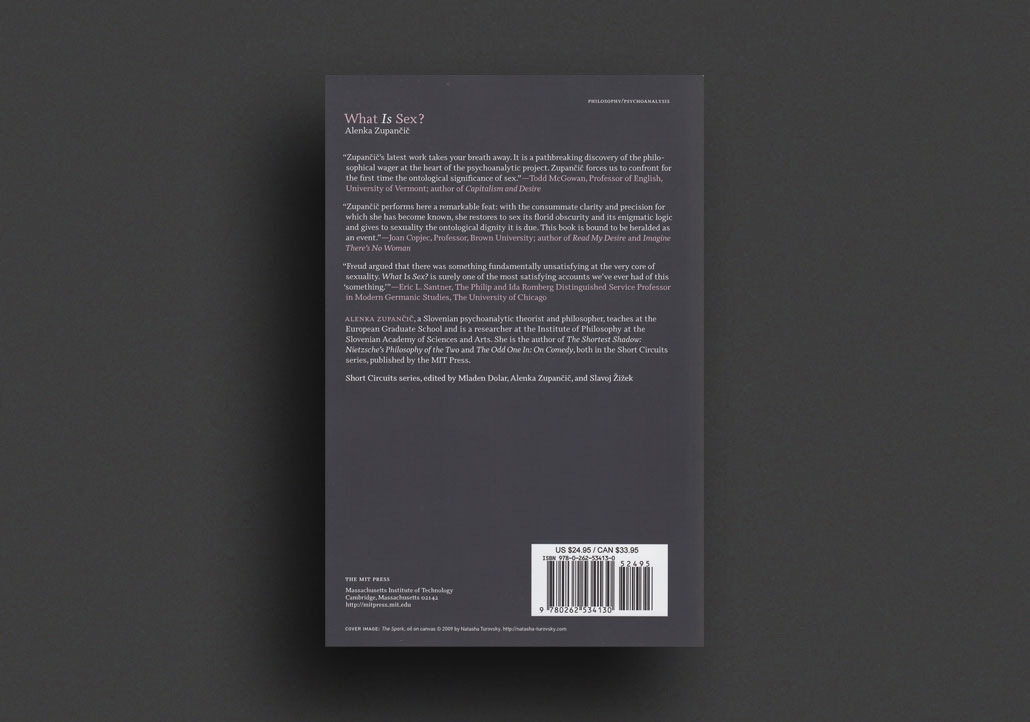
Why sexuality is at the point of a "short circuit" between ontology and epistemology.
Consider sublimation-conventionally understood as a substitute satisfaction for missing sexual satisfaction. But what if, as Lacan claims, we can get exactly the same satisfaction that we get from sex from talking (or writing, painting, praying, or other activities)? The point is not to explain the satisfaction from talking by pointing to its sexual origin, but that the satisfaction from talking is itself sexual. The satisfaction from talking contains a key to sexual satisfaction (and not the other way around)-even a key to sexuality itself and its inherent contradictions. The Lacanian perspective would make the answer to the simple-seeming question, "What is sex?" rather more complex. In this volume in the Short Circuits series, Alenka Zupancic approaches the question from just this perspective, considering sexuality a properly philosophical problem for psychoanalysis; and by psychoanalysis, she means that of Freud and Lacan, not that of the kind of clinician practitioners called by Lacan "orthopedists of the unconscious."
Zupancic argues that sexuality is at the point of a "short circuit" between ontology and epistemology. Sexuality and knowledge are structured around a fundamental negativity, which unites them at the point of the unconscious. The unconscious (as linked to sexuality) is the concept of an inherent link between being and knowledge in their very negativity.
2017, English
Softcover, 304 pages, 15.5 x 23 cm
Published by
Semiotext(e) / Los Angeles
$38.00 - Out of stock
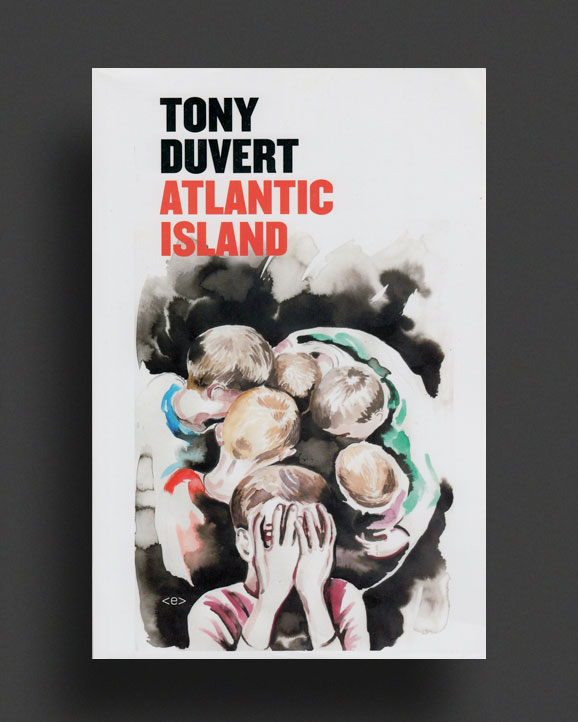
A forgotten gem of French literature, Duvert's version of The Lord of the Flies: an indictment against the violence embedded in a middle-class community. Translated by Purdey Lord Kreiden and Michael Thomas Taren.
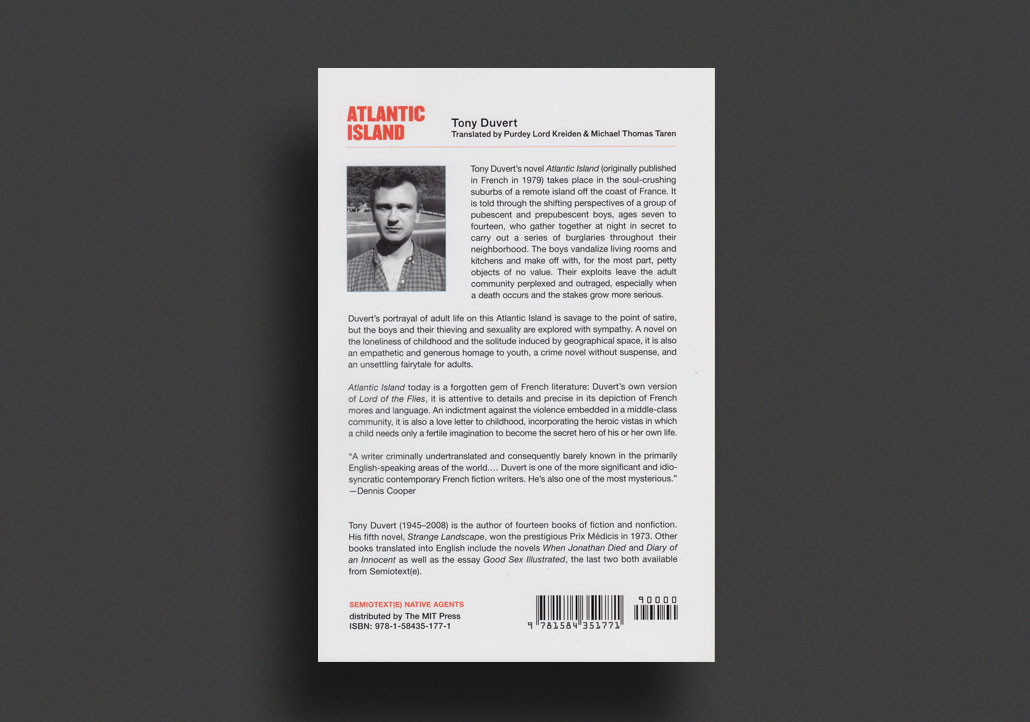
Tony Duvert's novel Atlantic Island (originally published in French in 1979) takes place in the soul-crushing suburbs of a remote island off the coast of France. It is told through the shifting perspectives of a group of pubescent and prepubescent boys, ages seven to fourteen, who gather together at night in secret to carry out a series of burglaries throughout their neighborhood. The boys vandalize living rooms and kitchens and make off with, for the most part, petty objects of no value. Their exploits leave the adult community perplexed and outraged, especially when a death occurs and the stakes grow more serious.
Duvert's portrayal of adult life on this Atlantic Island is savage to the point of satire, but the boys and their thieving and sexuality are explored with sympathy. A novel on the loneliness of childhood and the solitude induced by geographical space, it is also an empathetic and generous homage to youth, a crime novel without suspense, and an unsettling fairytale for adults.
Atlantic Island today is a forgotten gem of French literature: Duvert's own version of The Lord of the Flies, it is attentive to details and precise in its depiction of French mores and language. An indictment against the violence embedded in a middle-class community, it is also a love letter to childhood, incorporating the heroic vistas in which a child needs only a fertile imagination to become the secret hero of his or her own life.
Tony Duvert (1945–2008) is the author of fourteen books of fiction and nonfiction. His fifth novel, Strange Landscape, won the prestigious Prix Médicis in 1973. Other books translated into English include the novels When Jonathan Died and Diary of an Innocent as well as the essay Good Sex Illustrated, the last two both available from Semiotext(e).
2010, English
Softcover, 256 pages, 15.5 x 23 cm
Published by
Semiotext(e) / Los Angeles
$38.00 - Out of stock
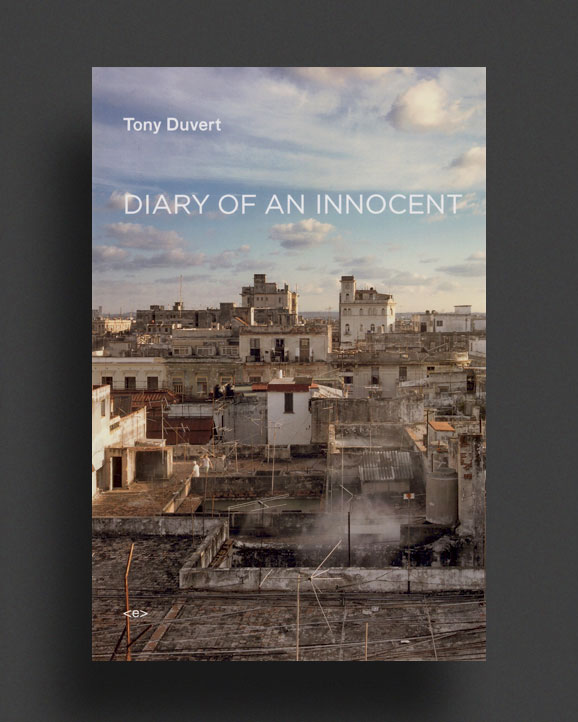
"'I always write completely nude, and I don't wash before,' writes Tony Duvert, whose explosive Diary of an Innocent is part tract, part porn, part theory, part fiction, and (I presume) part fact. Certain pages of Gide, Genet, Hocquenghem and certain scenes from Bresson or Pasolini suggest themselves as mild precursors, but Duvert goes further, filthier, faster. Only the Marquis de Sade outpaces him. Must we burn Duvert? I pray not. This book, troubling and memorable, interrogates with delicate strokes the damaged state of contemporary sexual relations."—Wayne Koestenbaum
Now in English, Duvert's shocking novel about a sexual adventurer among a tribe of adolescent boys in Northern Africa. Translated with introduction by Bruce Benderson.
"I'd find it amusing if, in a few centuries, the only thing that our descendents condescend to retain of our artistic production, the only thing in which they'll see worlds to admire, to penetrate, the only thing that they'll show off as precious in immense museums after having flushed down the toilet all our acknowledged masterpieces, the only thing that will give them nostalgia and love for us will be our porn."—from Diary of an Innocent
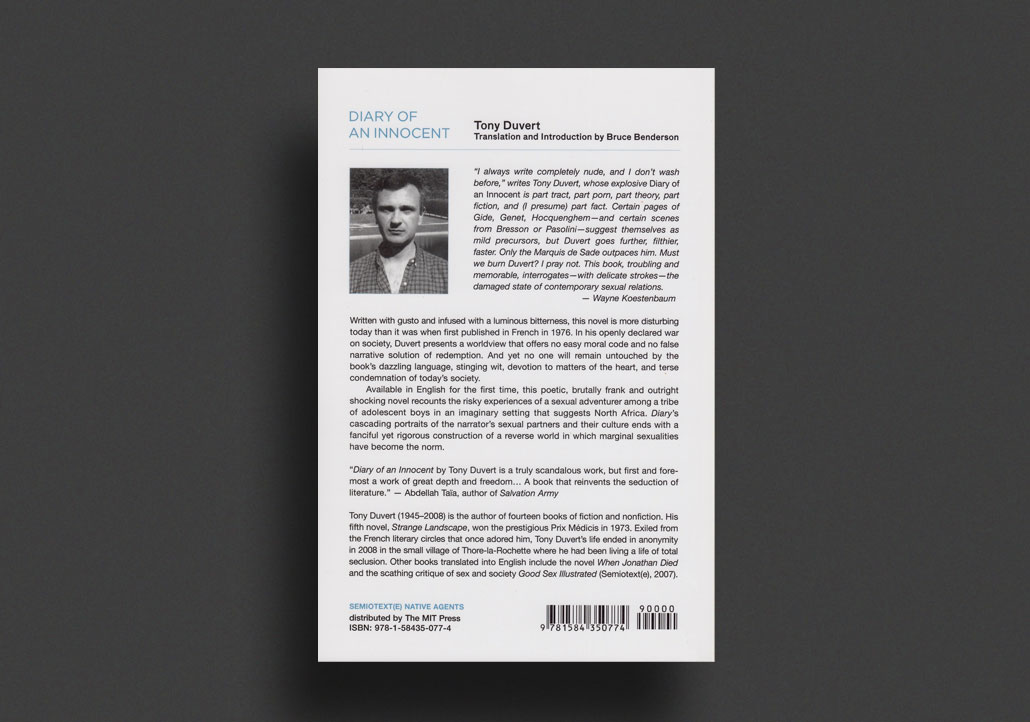
Exiled from the prestigious French literary circles that had adored him in the 1970s, novelist Tony Duvert's life ended in anonymity. In 2008, nineteen years after his last book was published, Duvert's lifeless body was discovered in the small village of Thoré-la-Rochette, where he had been living a life of total seclusion.
Now for the first time, Duvert's most highly crafted novel is available in English. Poetic, brutally frank, and outright shocking, Diary of an Innocent recounts the risky experiences of a sexual adventurer among a tribe of adolescent boys in an imaginary setting that suggests North Africa. More reverie than narrative, Duvert's Diary presents a cascading series of portraits of the narrator's adolescent sexual partners and their culture, and ends with a fanciful yet rigorous construction of a reverse world in which marginal sexualities have become the norm.
Written with gusto and infused with a luminous bitterness, this novel is more unsettling to readers today than it was to its first audience when published in French in 1976. In his openly declared war on society, Duvert presents a worldview that offers no easy moral code and no false narrative solution of redemption. And yet no reader will remain untouched by the book's dazzling language, stinging wit, devotion to matters of the heart, and terse condemnation of today's society.
"Diary of an Innocent by Tony Duvert is a truly scandalous work, but first and foremost a work of great depth and freedom.... A book that reinvents the seduction of literature."—Abdellah Taïa, author of Salvation Army
Tony Duvert (1945–2008) is the author of fourteen books of fiction and nonfiction. His fifth novel, Strange Landscape, won the prestigious Prix Médicis in 1973. Other books translated into English include the novels When Jonathan Died and Diary of an Innocent as well as the essay Good Sex Illustrated, the last two both available from Semiotext(e).
Novelist, translator, and essayist Bruce Benderson is the author of a memoir, The Romanian: Story of an Obsession, winner of France's prestigious Prix de Flore in French translation, and Pacific Agony (Semiotext(e), 2009.)
1972, English
Hardcover (w. dust jacket), 320 pages, 22 x 14.5 cm
Out of print title / used / very good
Published by
Faber & Faber / London
$65.00 - Out of stock
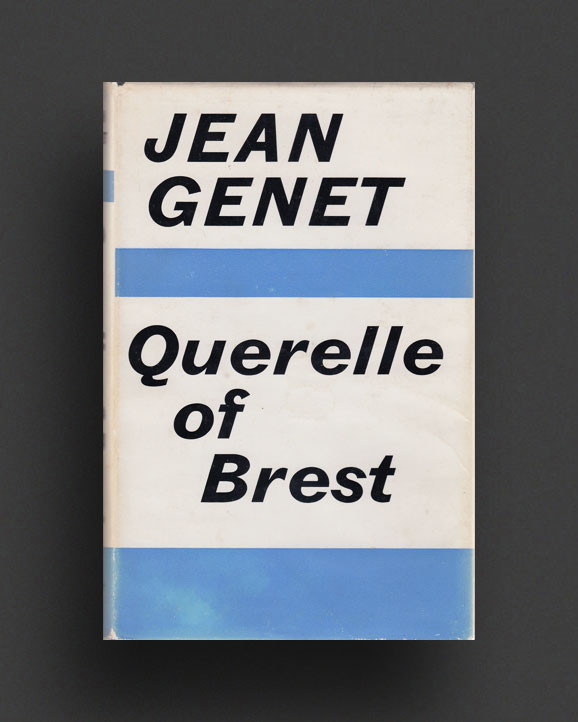
1973 hardcover Faber & Faber edition of Genet's classic, translated from French by Gregory Streatham.
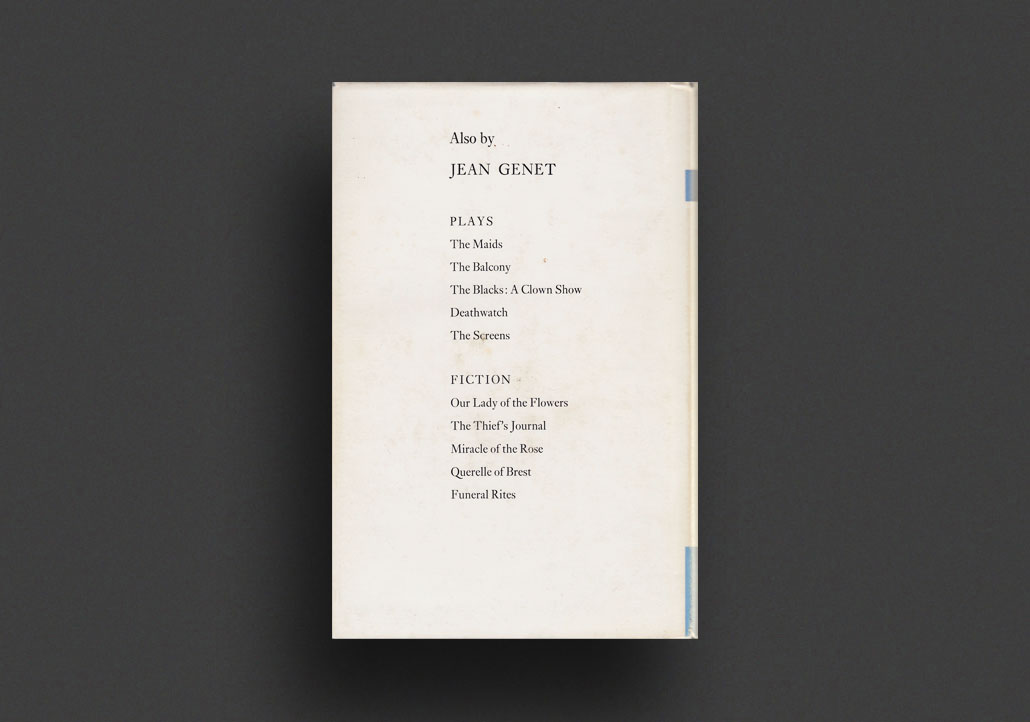
Jean Genet, French playwright, novelist and poet, turned the experiences in his life amongst pimps, whores, thugs and other fellow social outcasts into a poetic literature, with an honesty and explicitness unprecedented at the time. Widely considered an outstanding and unique figure in French literature, Genet wrote five novels between 1942 and 1947. Querelle of Brest is widely considered to be Jean Genet's most accomplished novel, which was made into a film by Rainer Werner Fassbinder in 1982. Querelle, a young sailor at large in the port of Brest, is an object of illicit desire to his diary-keeping superior officer, Lieutenant Seblon. He is coveted, too, by corrupt policeman Mario. He gives himself freely both to brothel-keeper Madame Lysiane and to her husband. But Querelle is a thief and a murderer -- not a man to be trusted or trifled with . . .
Jean Genet, (born Dec. 19, 1910, Paris, France-died April 15, 1986, Paris), French criminal and social outcast turned writer who, as a novelist, transformed erotic and often obscene subject matter into a poetic vision of the universe and, as a dramatist, became a leading figure in the avant-garde theatre, especially the Theatre of the Absurd.
VG copy in VG dust jacket, light wear and tear to extremities, price-clipped to inner front dj flap, old bookseller stamp to inner spine.
1980, English
Softcover (w. insert), 142 pages, 21 x 29 cm
1st Edition, Out of print title / used / very good
Published by
LIP / Melbourne
$50.00 - Out of stock
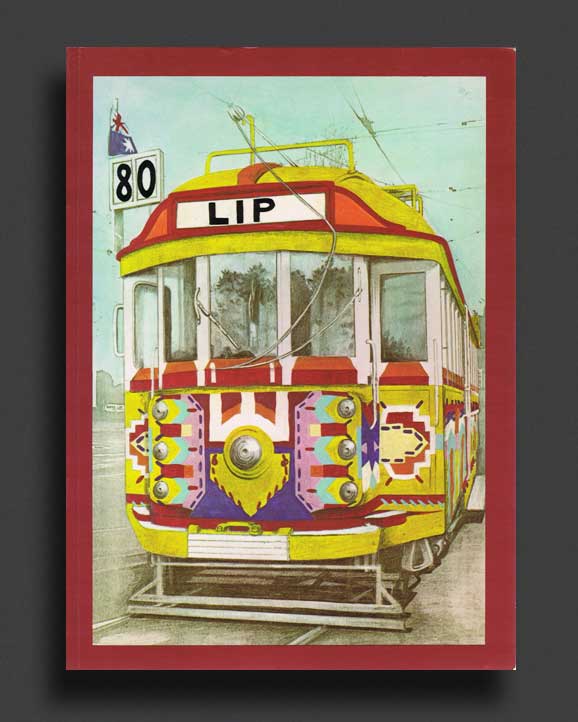
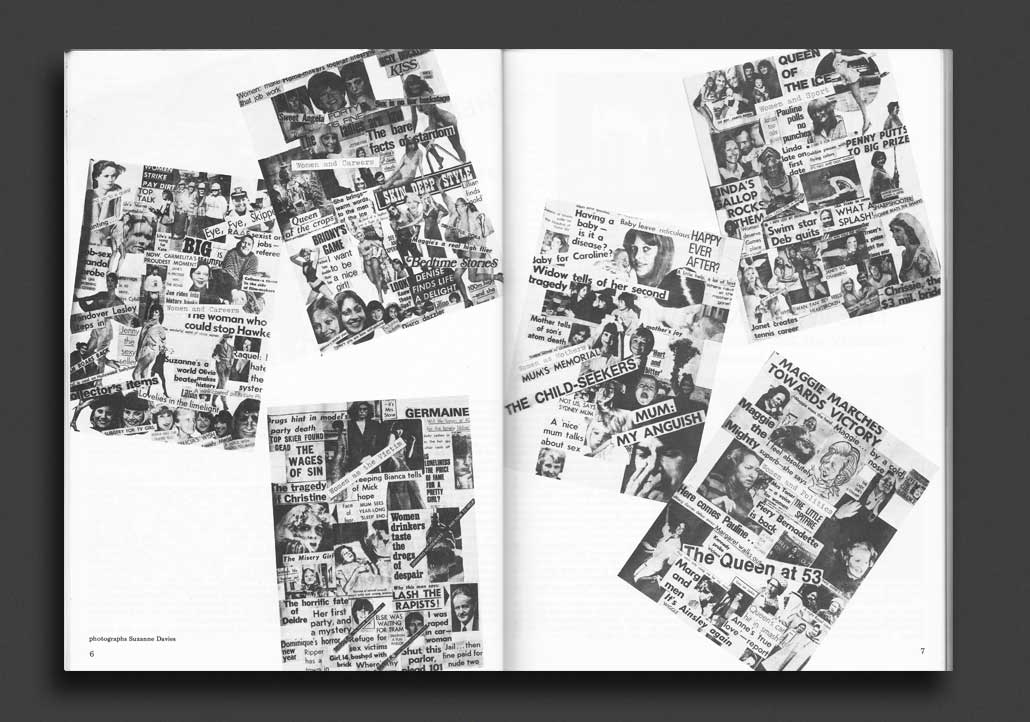
The incredible book-sized 1980 edition of Melbourne's great LIP journal. Published out of Carlton between 1976-1984, LIP encapsulated Australian feminist artistic practice of the period, publishing articles and interviews by women on women in film, sound, theatre, painting, photography, poetry, criticism, activism, journalism, publishing, sculpture, design, education, and much more.
In this issue:
Editorial; MEDIA : Heralding Women : A Visual Essay by Lesley Dumbrell, Freda Freiberg and Elizabeth Gower; The Women At Work Kit - a discussion with Judy Munro, Sylvie Shaw and Ponch Hawkes, by Jeannette Fenelon; Shoulder to Shoulder and Up Hill; The Way by Julie Copeland; The Coming Out Show : Five Years On by Julie Rigg; Nancy Dexter : In Her Own Accent by Elizabeth Owen; Fiona McDougall press photographer; Child's Image, Women's Hands by Barbara Hall; ART : Memories of Grace Crowley by Janine Burke, Ian North, Frank and Margel Hinder; "Mothers' Memories, Others' Memories" by Vivienne Binns; The Dinner Party - Introduction by Isabel Davies; Judy Chicago And The Dinner Party by Ailsa O'Connor; 'The Coming Out Show' discusses 'The Dinner Party'. Transcribed and edited by Isabel Davies; The Adelaide Women's Art Movement by Jane Kent and Anne Marsh; Adelaide Women's Performance Month, November 1979; River Murray Project by Bonita Ely; Joy Hester by Janine Burke; Janet Dawson - Painter, interviewed by Lesley Dumbrell; Monday To Monday by Maxienne Foote; Ethel Carrick (Mrs. E. Phillips Fox) by Margaret Rich; The Male Nude, Margaret Walters interviewed by Julie Copeland; Stella Sallman photographs; Don't Believe I'm An Amazon - Ulrike Rosenbach talking with Elizabeth Gower, Margaret Rose and Janine Burke, transcribed by Margaret Rose; Tertiary Visual Arts Education Study and Report by Alison Fraser; Holos - Whole, Graphos - Picture, The Work Of Margaret Benyon by Catherine Peake; Ceramic Sculpture - Maggie May; Artist-Decorated Trams - Statements by Erica McGilchrist and Mirka Mora on the tram design project, Melbourne and Metropolitan Tramways Board; THEATRE/PERFORMANCE : At Home - A series of Five Solo Performances by Lyndal Jones (1977-80) documentation by Lyndal Jones and Suzanne Spunner; Beyond Glitter - The Role Of The Female Performer as seen by Robyn Archer in "A Star is Tom" by Suzanne Spunner; Wimmin's Circus by Katie Noad; Jeannie Lewis interviewed by Christine Johnston; Failing In Love by Ruth Maddison; By A Bamboo Blind : Jenny Kemp, writer and director of Sheila Alone interviewed by Suzanne Spunner; Brisbane Womens Theatre Group by Barbara Allen; FILM : The Women's Film In The Post-Haskell Era by Freda Freiberg; Making A Career Of Feminism by Suzanne Spurner; How Will We Learn To Remember Tomorrow? 'A Catalogue of Independent Women's Films' reviewed by Barbara Hall; The Problems Of Pluralism : Women's Films And Feminist Films by Kate Legge; Interview With Norma Disher; Margot Nash & Margot Oliver; Roma 'Just An Ordinary Life' by Jan Macdonald
Insert : Crosswords by Elizabeth Gower
Front Cover : Erica Mc Gilchrist
Back Cover : Mirka Mora
Co-ordinator : Elizabeth Gower
LIP Collective members: Annette Blonski, Janine Burke, Isabel Davies, Suzanne Davies, Lesley Dumbrell, Jeannette Fenelon, Freda Freiberg, Elizabeth Gower, Barbara Hall, Christine Johnston, Elizabeth Owen, Cathy Peake, Suzanne Spunner.
VG copy.
1996, Japanese / English
Softcover (w. dust jacket and obi), 140 pages, 18.5 x 26 cm
1st Edition, Out of print title / used / fine
Published by
Images of Erotic Art / Tokyo
$450.00 - Out of stock
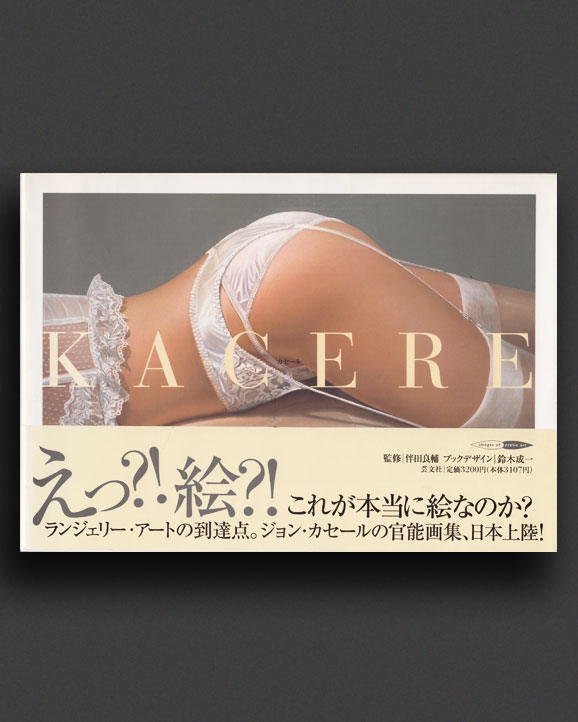
The ridiculously rare Japanese-only publication on the work of John Kacere.
“I can find beauty in any woman. That joy is the vitality of my life,”—Kacere
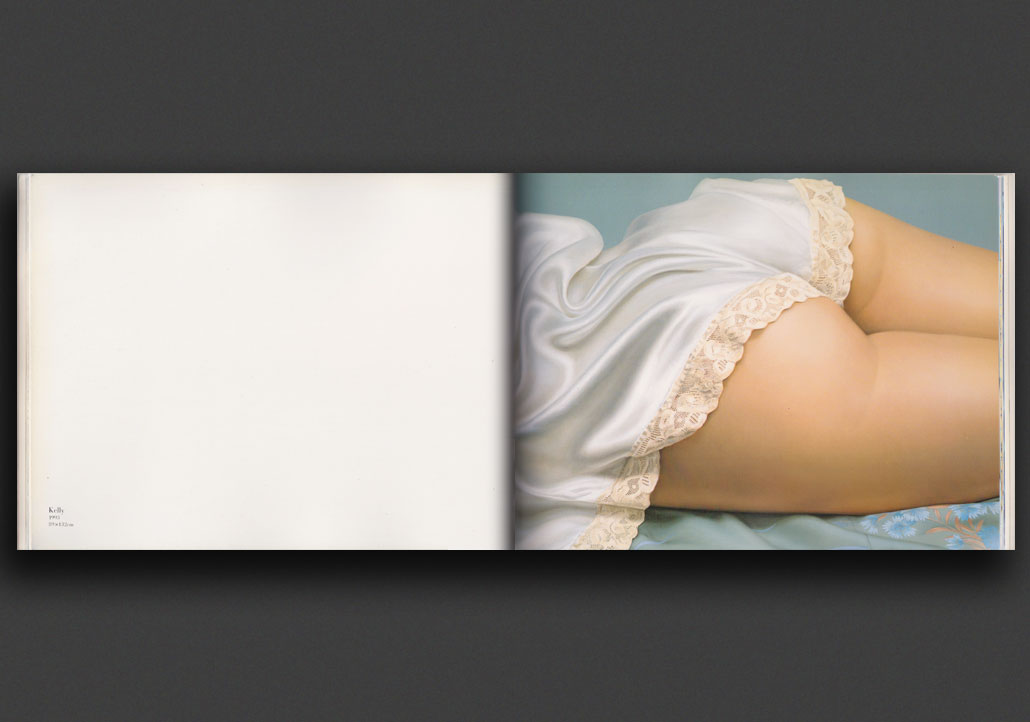
Published by Images of Erotic Art in Tokyo in 1996, this fantastic monograph reproduces the largest selection of his famous photorealist paintings of the female midsection in full colour across roughly 140 landscape pages, broken into chapters "Lace", "See Through", "Delta", "Cotton", "Hip", and "Garter". Includes quotes from John Kacere in English, plus short texts and biography in Japanese, portrait of the artist in his studio, and more. Rarely seen and beautifully designed, this is arguably the best book of these works as the reproductions are so much finer than the classic Filipacchi book of 1989, with so many of his best works created in the years after that book was published. They are also all presented here in the most appropriate landscape page format. Kacere oversaw the production of this book a few years before his passing.
John C. Kacere (23 June 1920 – 5 August 1999) was an American artist. Although he rejected the term, Kacere is considered one of the original photorealists. Kacere's first painting in this style was in 1969, involving the midsection of a woman dressed in lingerie. It was over three times life size. Kacere continued this type of painting throughout the rest of his career, making it an icon of the photorealism movement. Though figurative paintings, Kacere's works have often been considered still lifes or even landscapes.
A fine copy in NF dust jacket and NF (rarely seen) obi, making it a complete collector's copy, protected under archival mylar.
2014, English
Softcover, 142 pages, 18 x 11.5 cm
Published by
Wakefield Press / Cambridge
$33.00 - In stock -
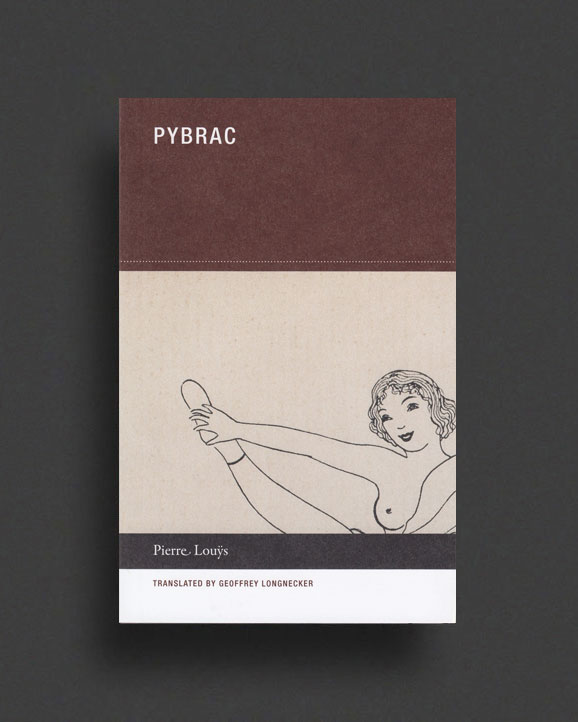
Translated, with an introduction, by Geoffrey Longnecker
Illustrations by Toyen
In turns amusing and offensive, Pierre Louÿs’ Pybrac is possibly the filthiest collection of poetry ever published, and offers a taste of what the Marquis de Sade might have produced if he had ever turned his hand to verse. First published posthumously in 1927, Pybrac was, with The Young Girl’s Handbook of Good Manners, one of the first of Louÿs’ secret erotic manuscripts to see clandestine publication. Composed of 313 rhymed alexandrine quatrains, the majority of them starting with the phrase “I do not like to see…,” Pybrac is in form a mockery of sixteenth-century chancellor poet Guy Du Faur, Seigneur de Pibrac, whose moralizing quatrains were common literary fare for young French readers until the nineteenth century. Louÿs spent his life coming up with his own evergrowing collection of rhymed moral precepts (suitable only for adult readers): a dizzying litany describing everything he “disliked” witnessing, from lesbianism, sodomy, incest, and prostitution to perversions extreme enough to give even a modern reader pause. With the rest of his erotic manuscripts, the original collection of over 2,000 quatrains was auctioned off and scattered throughout private collections; but like everything erotic, what remains collected here conveys an impression of unending absurdity and near hypnotic obsession.
Pierre Louÿs (1870–1925) was a best-selling author in his time, and a friend of and influence on such luminaries as André Gide, Paul Valéry, Oscar Wilde, and Stephane Mallarmé. He achieved instant notoriety with Aphrodite and The Songs of Bilitis, and his 1898 novel The Woman and the Puppet has been adapted for the screen in such noteworthy films as Josef von Sternberg’s The Devil Is a Woman and Luis Buñuel’s That Obscure Object of Desire. But it was only after his death that his true legacy was to be uncovered: nearly nine hundred pounds of erotic manuscripts were discovered in his home, all of them immediately scattered among collectors and many lost. The body of work that has since been gathered—manuscripts continue to be discovered—leaves little doubt: Louÿs is the greatest French writer of erotica there ever was.
“Louÿs entered eroticism the way others enter politics or religion”—Jean-Paul Goujon
“One of the great and glorious erotomaniacs of the end of the nineteenth century and the beginning of the twentieth”—André Pieyre de Mandiargues
2023, English
Hardcover (w. dust jacket), 224 pages, 29 x 29 cm
Published by
George Schwarz and Charis / East Sydney
$190.00 - In stock -
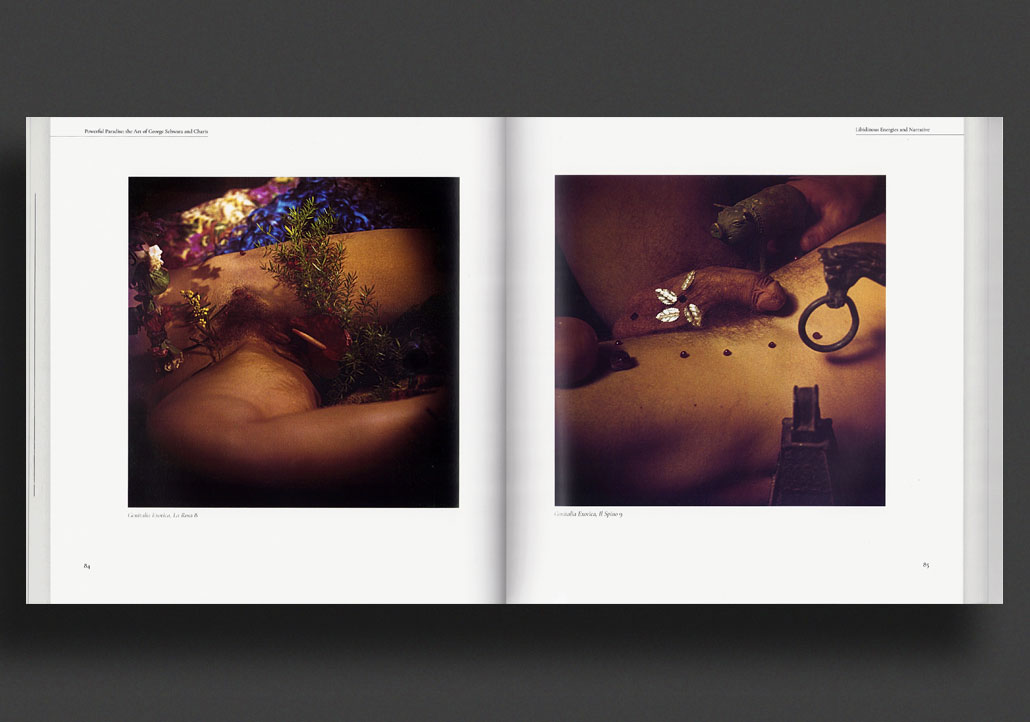
Powerful Paradise the Art of George Schwarz and Charis is an artists book, a collaboration between George Schwarz, his partner Charis, Linda Dement and Craig Judd. It is an introduction to a wonderful life and to beautiful, complex and intriguing art. Ernest Georg Schwarz and Charis Elizabeth McKittrick enjoy a unique partnership beginning 1964. The word collaborators in this case is an inadequate descriptor. In their presence one is witness to but a force of nature, a swirling vortex of creative mutuality. Simultaneously lovers, artists, apiarists, activists, authors, film and wine makers, 'Powerful Paradise' is a celebration and a legacy.
This extremely limited hardcover edition is the first survey of the couple's life in art, the last survivors of bohemian Kings Cross. Creators of the first Australian hardcore sex films to be passed by the censors (and also refused classification), George and Charis were ahead of the curve in every aspect of their practice. This volume features the only writing covering their film output, extensive photographic work and global travels. Simultaneously erotic, taboo, progressive, liberated; lives dedicated to their work and one another and perhaps too provocative/evocative for the Australian art establishment.
2025, English
Softcover, 16 silk-screened pages, 21 x 15 cm
Published by
Self-Published / Naarm
$60.00 - Out of stock
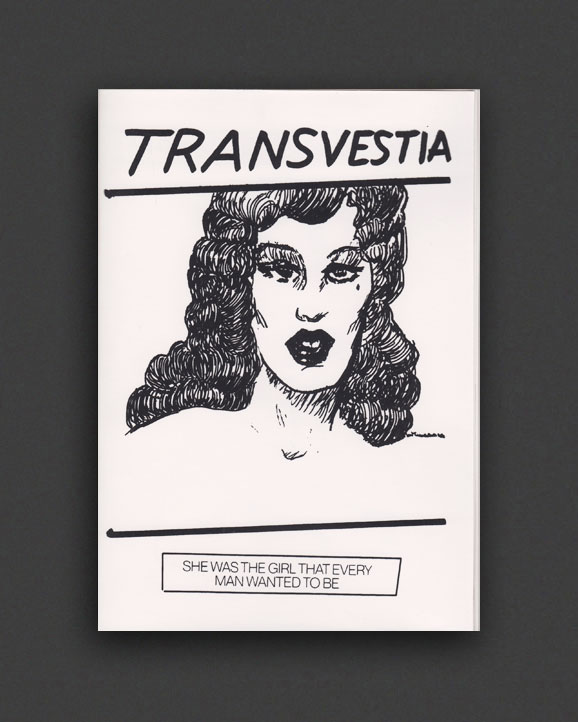
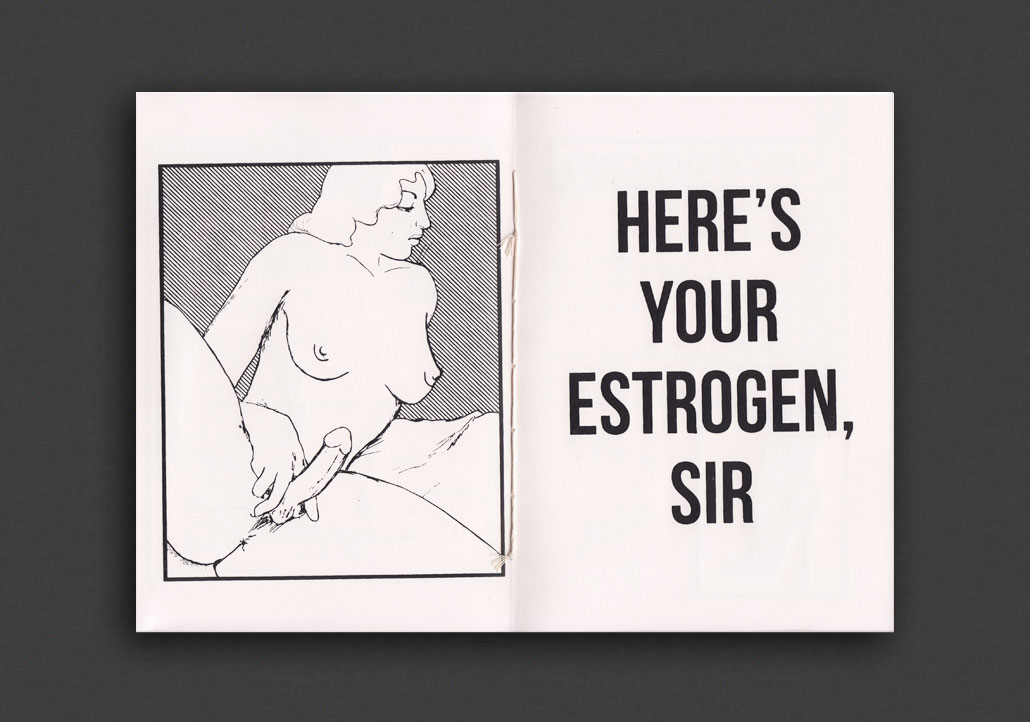
Screen printed A5 zine by Oriette Wood with writing from Anonymous woman #1 is an ode to all the transvestite/transsexual/crossdressing publications that had shone the light before. This collection of poetry and prints draws upon sissification, trans exultation, obscurity and playfulness. Although there is particular reference to Virginia Prince’s magazine ‘Transvestia’, there are so many others like it that shared stories, educated and connected people to the community.
Oriette Wood is a Naarm/Melbourne based transgender printmaker and seamstress, her works explore the erotics of trans bodies, taking inspiration from influential fetish artists, cross-dressing forums, and personal fantasies.
2025, English
Softcover (thread-sewn), 12 hand-bound silkscreened pages, 30 x 21.5 cm
Numbered Ed. of 11,
Published by
Self-Published / Naarm
$220.00 - In stock -
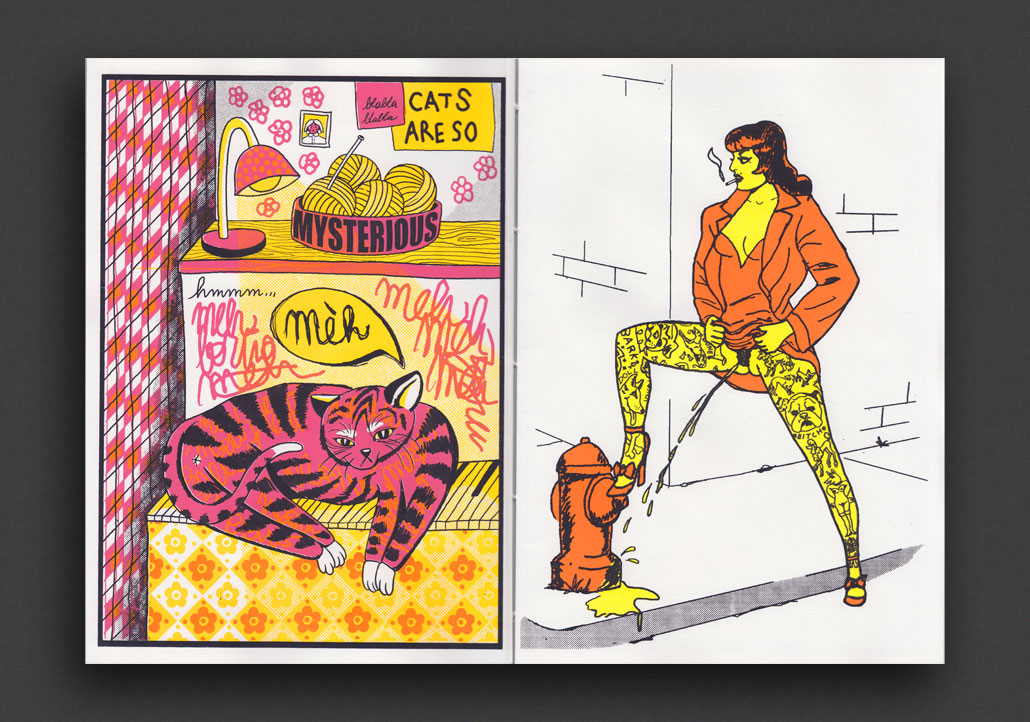
'Cats Versus Dogs' is hand bound and screen-printed zine collection of prints published in a numbered edition of 11, self-published by Laurette Chiappa (Bicy) and Oriette Wood. “After meeting at our local screen printing studio (Troppo), this collaborative work started as a personal joke as we had conflicting opinions on which of these two domestic animals was best, drawing scenes in defence and attack of one another. Each print guiding and questioning the roles each animal plays in our lives, while technically teaching us a lot about multi-colour overlays, layouts, and binding. Over the course of a month and a half we drew, printed and bound the books.”
Oriette Wood is a Naarm/Melbourne based transgender printmaker and seamstress, her works explore the erotics of trans bodies, taking inspiration from influential fetish artists, cross-dressing forums, and personal fantasies.
Laurette Chiappa (Bicy) is printmaker and tattoo artist from Toulouse, living and working in Naarm/Melbourne. Her works inquire what and where 'home' is using tattooing and ornamental design as reference.
Limited edition of 11 copies
2003, English / Japanese
Softcover (die-cut, embossed stiff slipcase w. internal illustrated card fold-out sleeve), 92 pages, 22 x 30 cm
Signed by artist,
1st Edition, Out of print title / used / very good
Published by
Treville / Tokyo
$450.00 - In stock -
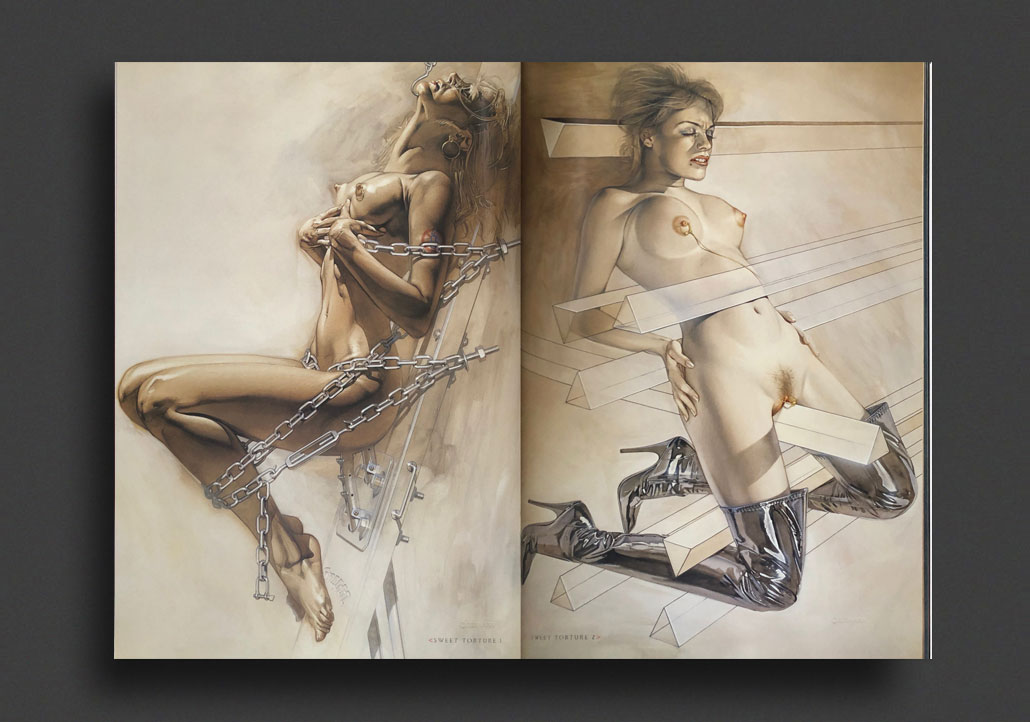
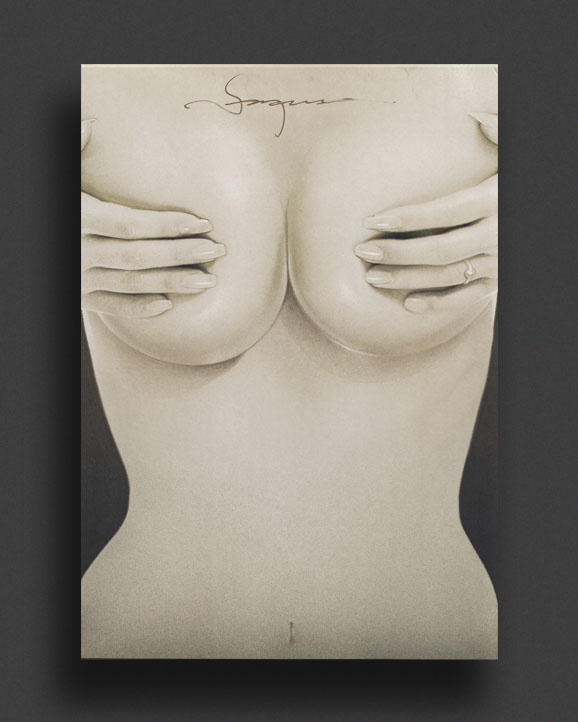
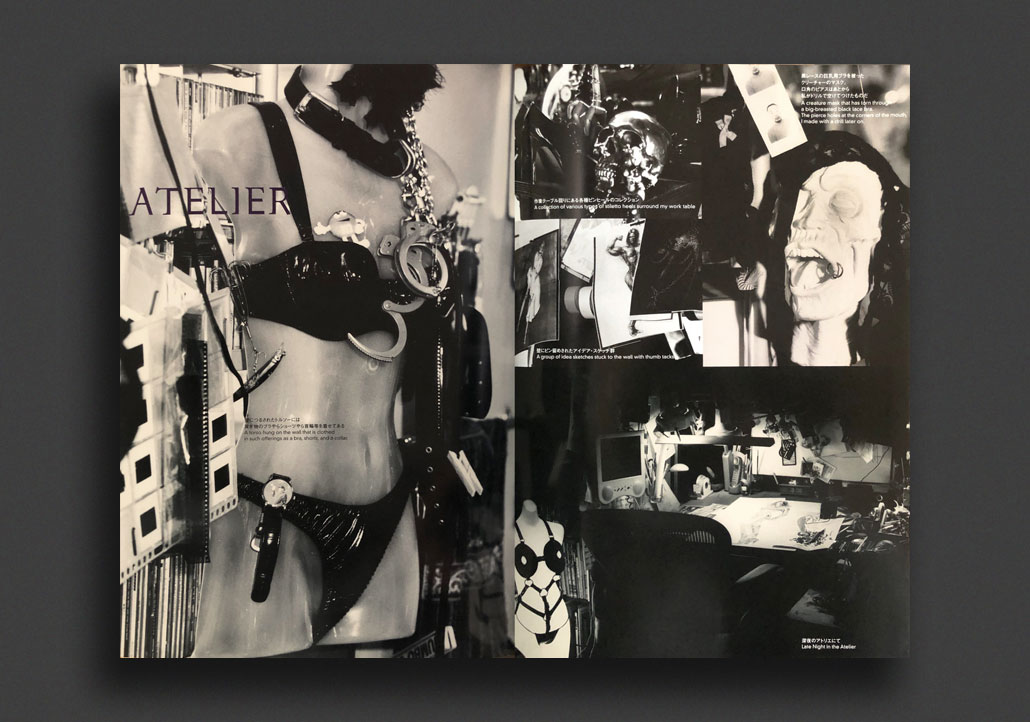
First, deluxe edition of this rare Hajime Sorayama book published by Treville especially for the exhibition 'Hajime Sorayama - The Exhibition' at Ginza Graphic Gallery in 2003. Now out-of-print and collectible, this extra special copy is also signed by Sorayama himself on the cover "cleavage". Housed in an embossed, die-cut corset slipcase, with an illustrated, fold-out "pin-up" doubled-sided internal sleeve, both made from stiff card, this catalogue is profusely illustrated throughout with Japanese airbrush master Hajime Sorayama's erotic, futuristic, hyper-realistic illustrations with a heavy emphasis on latex and bondage mistresses. Includes his own commentary throughout (in English and Japanese), plus a special look inside his atelier.
Hajime Sorayama (b. 1947) is a Japanese illustrator famed for his precisely detailed, erotic portrayals of feminine robots and fetish pin-ups, and also well-known for his design work on the original Sony AIBO. He describes his highly detailed style as "superrealism", which he says "deals with the technical issue of how close one can get to one's object."
Very Good copy.
1999, English
Softcover, 192 pages, 21 x 15 cm
1st Edition, Out of print title / used / very good
Published by
Fringecore / Belgium
$70.00 - Out of stock
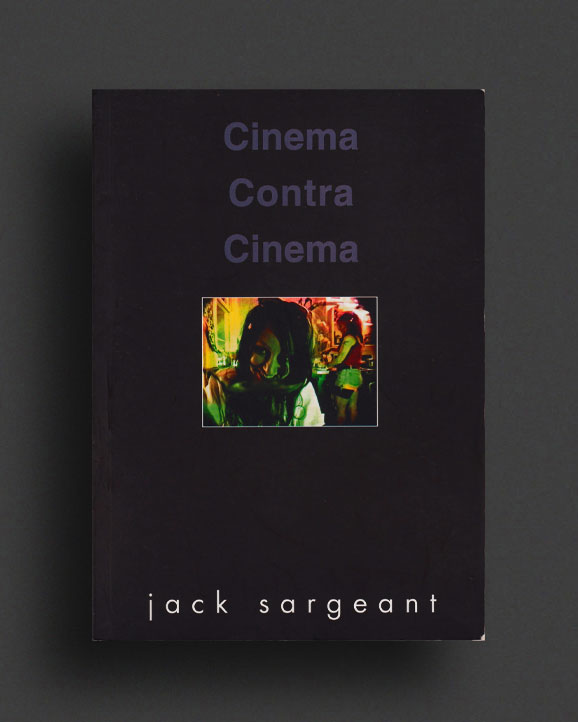
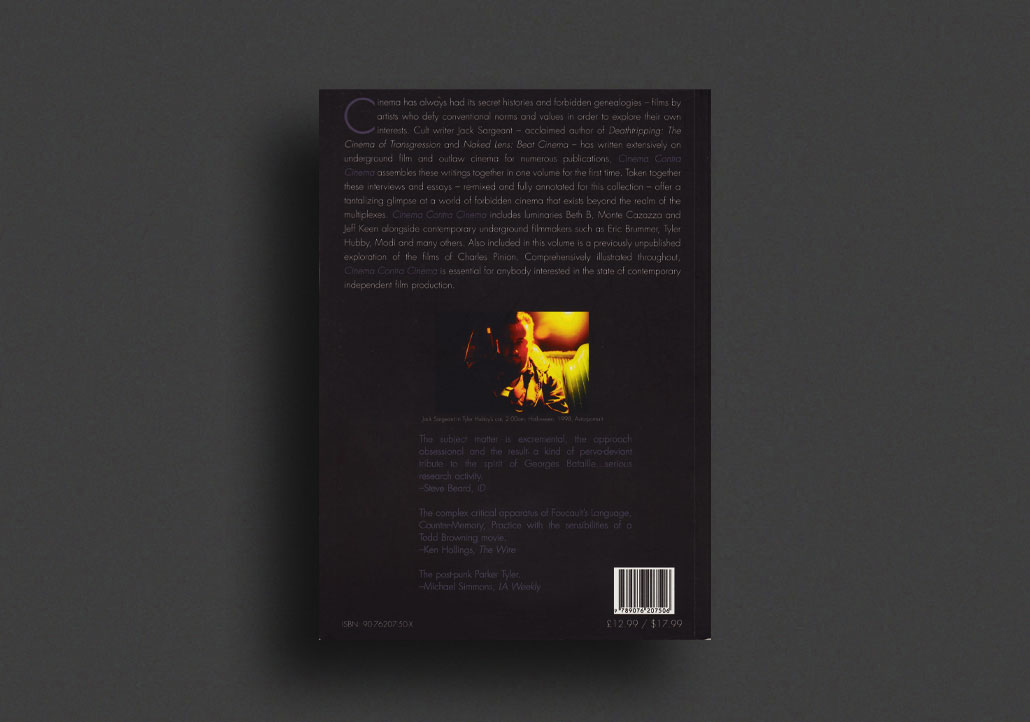
First edition of Cinema Contra Cinema is a collection of essays and interviews by cult author Jack Sargeant on the vertiginous extremes of underground cinema. Published in 1999 in Belgium, the book includes underground filmmakers, Bruce La Bruce, Beth B, David Cronenberg, M. Henry Jones, Jeff Keen, Harry Smith, Marne Lucas, Raymond Pettibon, Eric Brummer, Boyd Rice, David Alan Clarke, Craig Baldwin, Vivien Dick, Jeff Krulik, Huck Botko, Beat Takashi, as well as newcomers such as Tyler Hubby, Modi and Peter Strickland. Plus essays on David Cronenberg's Crash, Bruce La Bruce's Hustler White, Mark Heynar's award-winning Affliction and Blunt Cut's De Leiber Rausch. Fully illustrated with many rare and previously unseen photographs.
"The subject matter is excremental, the approach obsessional and the result a kind of pervo-deviant tribute to the spirit of Georges Bataille...serious research activity."—Steve Beard, iD
"The complex critical apparatus of Foucault's Language, Counter-Memory, Practice with the sensibilities of a Todd Browning movie."—Ken Hollings, The Wire
"The post-punk Parker Tyler."—Michael Simmons, LA Weekly
VG copy with light wear to cpver/extremities.
1996, English
Softcover, 192 pages, 24.5 x 17 cm
1st Edition, Out of print title / used / very good
Published by
Creation Books / London
$40.00 - Out of stock
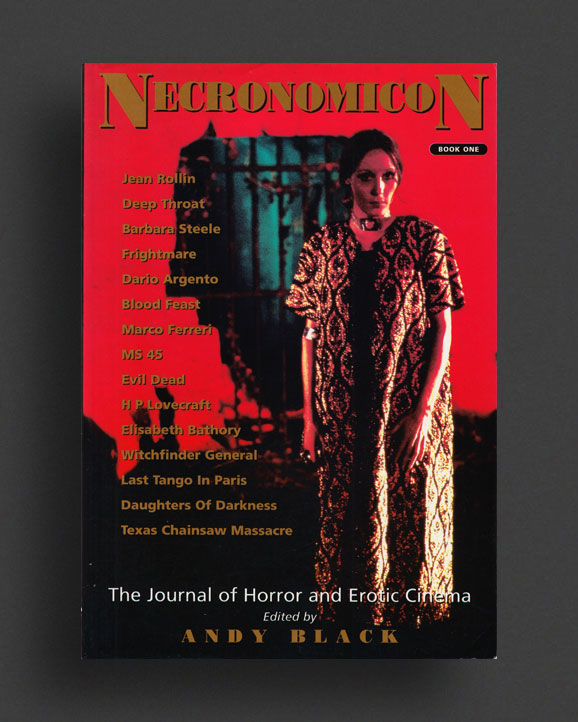
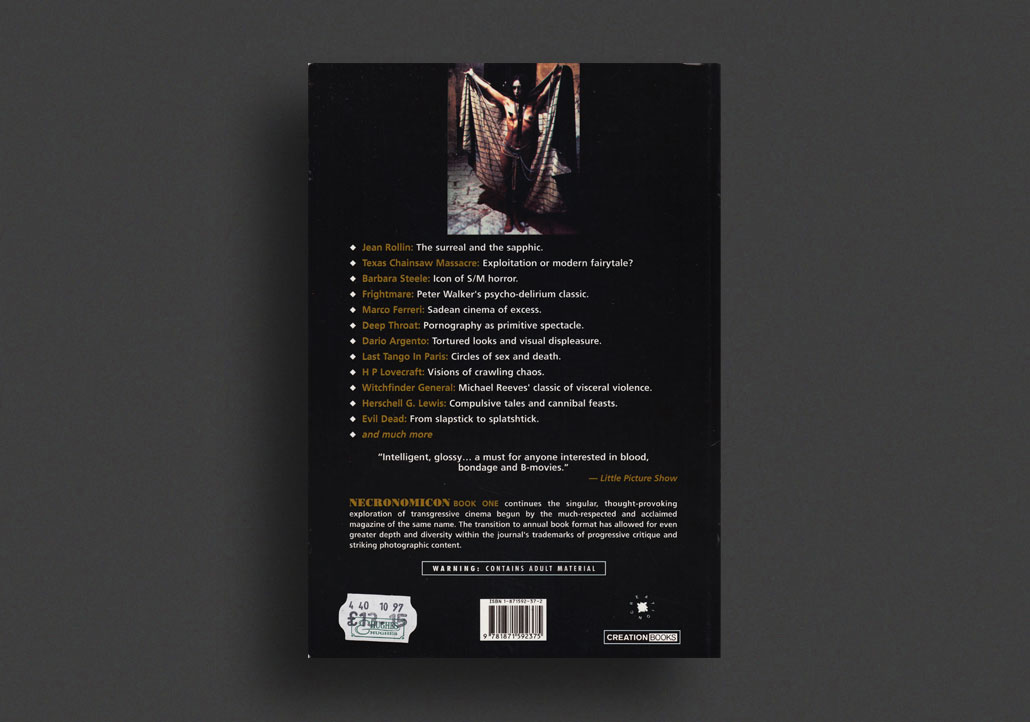
Published in 1996, Necronomicon: Book one continues the singular, thought-provoking exploration of transgressive cinema begun by the much-respected and acclaimed magazine of the same name. The transition to annual book format has allowed for even greater depth and diversity within the journal's trademarks of progressive critique and striking photographic content. Includes: Jean Rollin: The surreal and the sapphic Texas Chainsaw Massacre: Exploitation or modern fairytale Barbara Steele: Icon of S/M horror Frightmare: Peter Walker's psycho-delirium classic Marco Ferreri: Sadean cinema of excess Deep Throat: Pornography as primitive spectacle Dario Argento: Tortured looks and visual displeasure Last Tango in Paris: Circles of sex and death H P Lovecraft: Visions of crawling chaos Witchfinder General: Michael Reeves' classic of visceral violence Herschell G. Lewis: Compulsive tales and cannibal feasts Evil Dead: From slapstick to splatshtick * And much more....
VG copy.
1997, Japanese / English
Hardcover (w. dust jacket), 84 pages, 24 x 20 cm
1st Edition, Out of print title / used / very good
Published by
Treville / Tokyo
$100.00 - In stock -
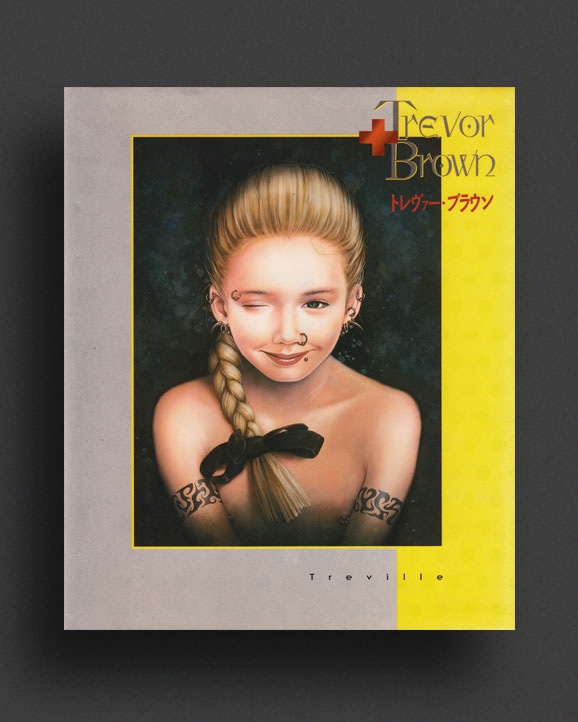
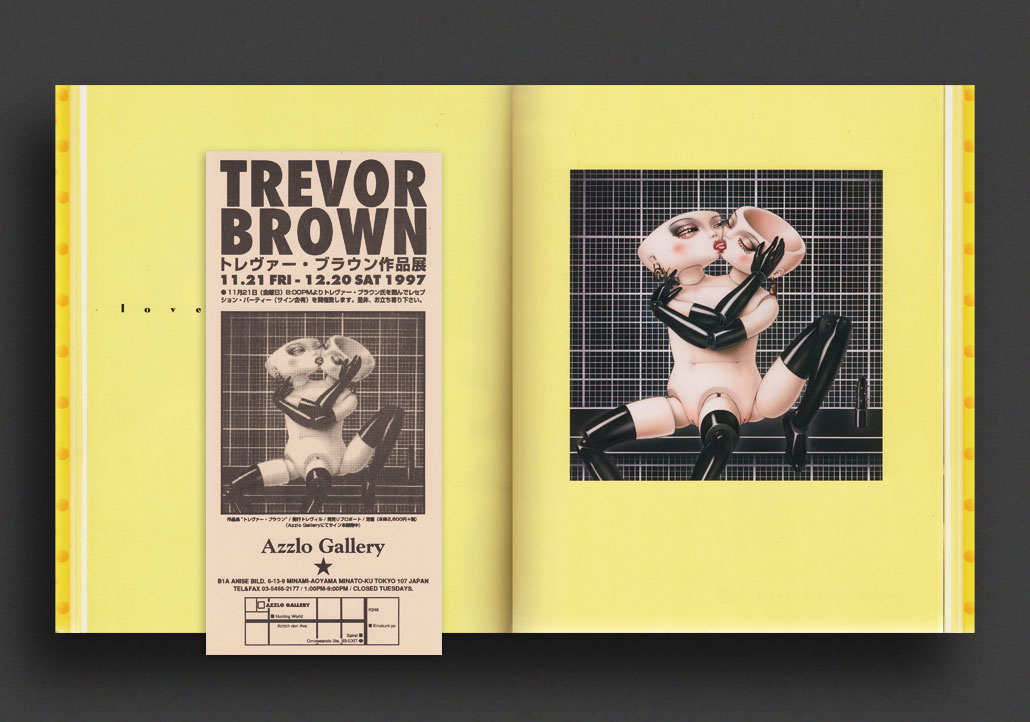
First 1997 hardcover edition of Trevor Brown’s first major art book, published in Japan by Treville. This collection of Brown's uniquely perverse, disturbing and now iconic paintings revolves around girls/dolls and themes of "medical art", like his friend, Bazooka-artist and photographer, Romain Slocombe. Lots of cutesy, lolita-esque girls and girl-dolls in transgressive scenarios of fetishism, bondage, body modification, etc. Published only in Japan, where the English artist has resided since 1994.
This very popular book was also published to coincide with Brown's solo exhibition at Azzlo Gallery, who specialised in fetish wear, run by artist, costume designer and student of Kaneko Kuniyoshi, Yumi Azzlo. Invitation to the exhibition is included as an insert.
Trevor Brown (b. 1959) is an illusive and prolific artist who's work explores paraphilias, such as lolicon, ero guro, BDSM, and other fetish themes. Innocence and violence collide in Brown's confronting images. Early features on his art appeared in Adam Parfrey's Apocalypse Culture II, Shade Rupe's Funeral Party 2, and in Jim Goad's ANSWER Me! zine, garnering him wide notoriety across the provocative underground publishing scene of the 1980s—90s. He's contributed artwork to many album covers of Whitehouse, Coil, John Zorn, and many more, illustrated for Coup de Grace, an edition of Friedrich Nietzsche's Der Antichrist, the covers of Timeless magazine, and more recently illustrated the cover of the Gothic & Lolita Bible (a subculture in which Brown has many dedicated fans) in Japan, where the the artist has lived since 1994 and where his work has been published in many art book editions.
VG—NF copy.
2020, Japanese
Hardcover (w. dust jacket), 148 pages, 30 x 23 cm
1st Edition, Out of print title / used / fine
Published by
Fukkan / Tokyo
$200.00 - In stock -
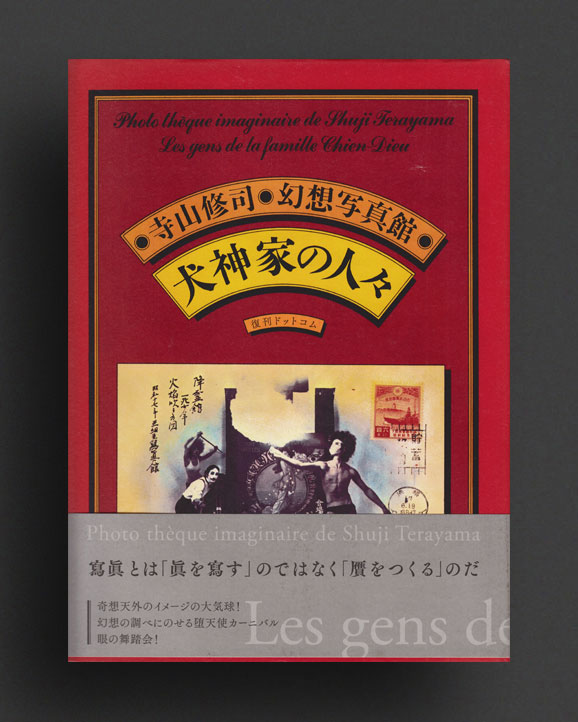
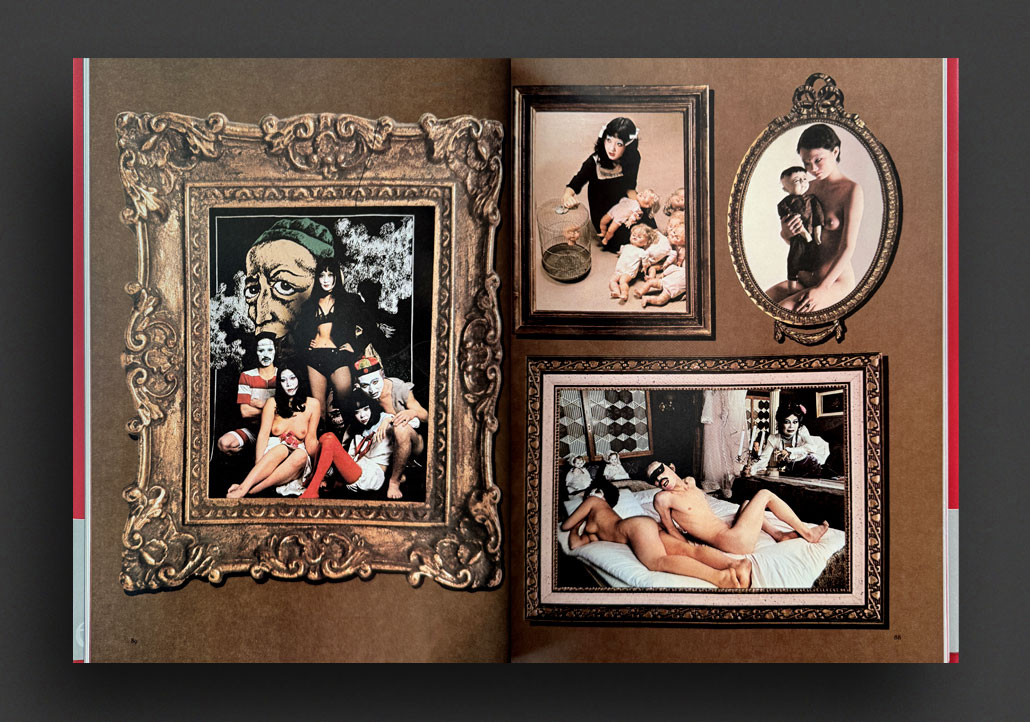
Wonderful hardcover limited re-issue (also now out-of-print) of Shuji Terayama’s extraordinary 1975 art photobook “Phototheque imaginaire de Shuji Terayama Les Gens de la Famille Chien-Dieu”, an imaginary photo collection of the prolific Japanese avant-garde writer, film maker, poet, photographer, and anarchist, and his "people of the Chien Dieu family." A stunning photomontage collection that perfectly embodies the irreverent spirit of Terayama and his experimental theatre troupe, Tenjō Sajiki, full of bizarre, surrealist, imagery and sexuality, perfectly in harmony with the radical work of his Provoke peers. Terayama’s works range from radio drama, experimental television, underground (Angura) theatre, countercultural essays, to Japanese New Wave and "expanded" cinema. Led by Terayama and active between 1967—1983, Tenjō Sajiki's members included Kohei Ando, Kujō Kyōko, Yutaka Higashi, Tadanori Yokoo, and Fumiko Takagi.
"Terayama’s eclectic work focuses on issues of sexuality, normatised values, traditions, and conventions – breaking (or ignoring) the latter in terms of form and style. This eccentric, dazzling mix of photography, written text, irony, remix, originality, narrative and subconsciousness dives into legends and memories to form its absurd scenery."
From Bertolotti’s Book of Nudes: “The photographs were reproduced in the manner of an old souvenir album…’ as framed photos of staged portraits and’ fake period postcards, with addresses and stamps in their proper place, and they were accompanied by a series of poems and handwritten annotations that emphasized the artist’s intention of mixing expressive language with sophisticated photomontages.”
Very highly recommended. As New.
1982, Japanese
Softcover, 320 pages, 21 x 15 cm
1st Edition, Out of print title / used / very good
Published by
Tsukasa Shobo / Tokyo
$50.00 - In stock -
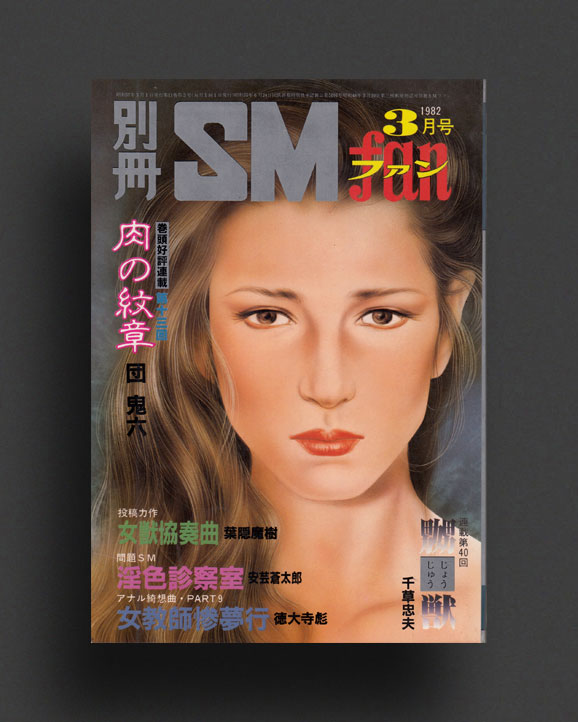
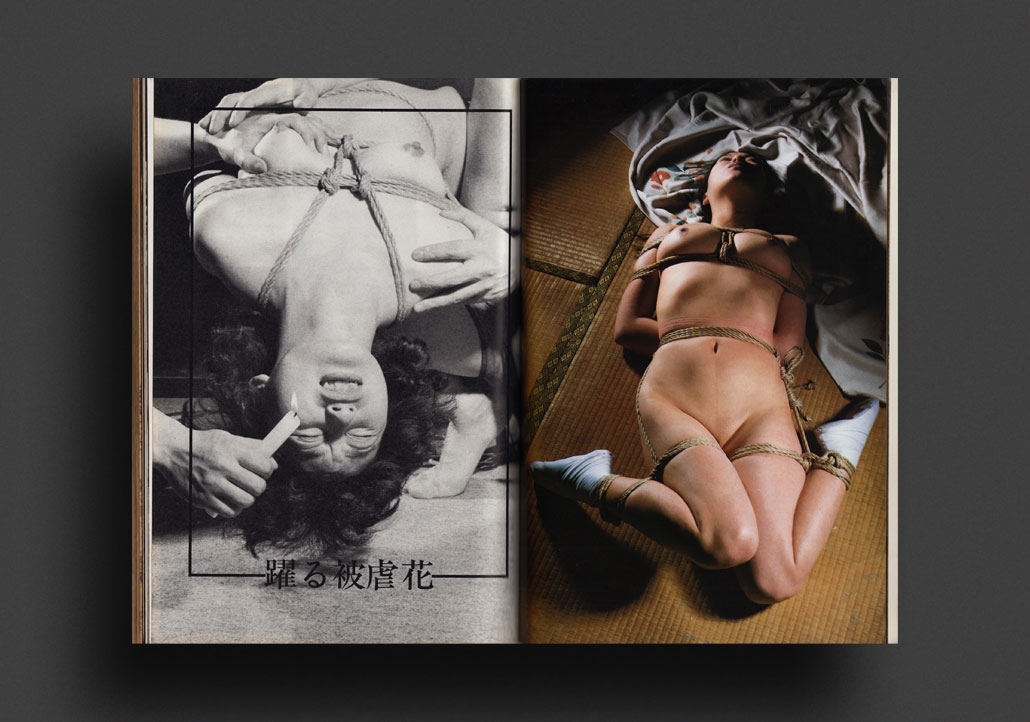
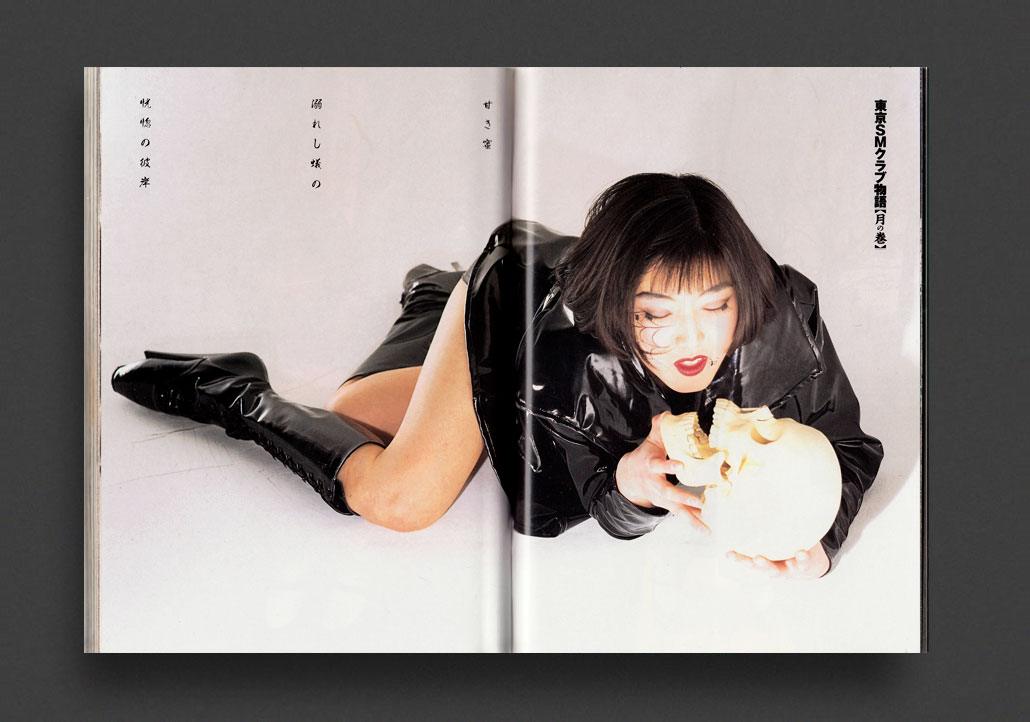
SM Fan Special Edition March 1982, published by Tsukasa Shobo, featuring Dan Oniroku, Gekko Hayashi, Tadao Chigusa, Juan Maeda, Kaname Ozuma (Yoko Ozuma), Takashi Kibe, Yuki Haruhiko, to name a few. Cult classic vintage Japanese BDSM and Kinbaku (Japanese bondage) magazine, each issue of SM Fan featured almost over 300 pages of Japan's most depraved fetish fiction, littered with illustrations unseen elsewhere, including many historical pieces, plus full-colour glossy bondage photo-features, artwork galleries of fanstastic erotic art and manga, fold-outs, articles, interviews, reviews, letters, classifieds, ads, and much more. SM Fan was at the forefront of showcasing the artwork and photography by some of Japan's biggest names in the field of erotic art, including Namio Harukawa, Kaname Ozuma, Gekko Hayashi, Yoshifumi Hayashi, Toshio Saeki, and Ken Katayama, alongside the likes of masters such as Yoshitoshi Tsukioka.
18+ ONLY
Good—VG copy with tanning.
1997, Japanese
Softcover (staple-bound), 220 pages, 21 x 15 cm
1st Edition, Out of print title / used / average
Published by
Tsukasa Shobo / Tokyo
$45.00 - Out of stock
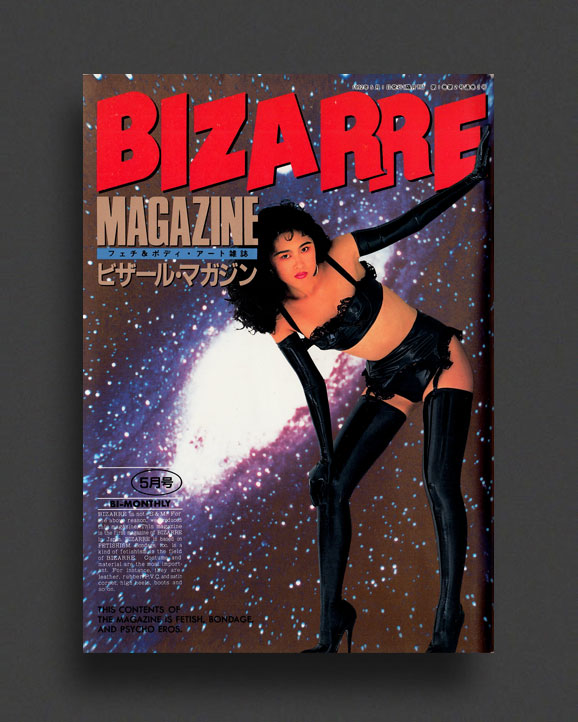
No. 32 (May 1997) of Bizarre Magazine, Japan's first glossy magazine devoted fully to all things "bizarre culture" and the new fetish subculture that exploded in the 1990's, published by manga (and SM Fan) publisher Tsukasa Shobo from 1990—2000s.
"Fetish, bondage, psycho eros, and body arts".
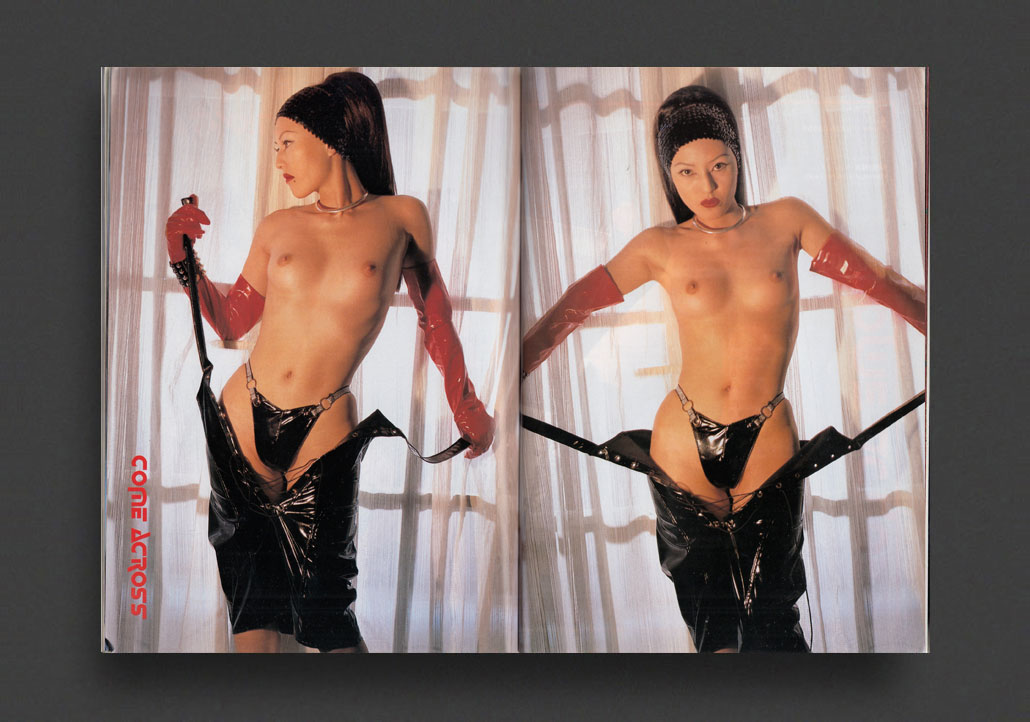
Profusely illustrated throughout with glossy colour and b/w photoshoots styled with fetish fashion materials and costume — models and Japanese AV/pink film idols in rubber, pvc, leather, boots, high heels, corsets, etc. covering all manner of fetishes and cos-themes from cyberpunk to medical, body art, cross-dressing, lesbianism, fem-dom, scene reports from around the world, dominatrix profiles and interviews, lots of manga, articles, stories, advice columns, DIY tutorials, and packed with wild ads for sex clubs, dungeons, bars, bookstores, video catalogues, toys, fashions, reviews of cult books and film, european imports, classifieds, all heavy with illustrations and hundreds, if not thousands of photographs. This issue includes contributions by ORGANIZER's Kyoshi Ikejiri, Masami Akita (Merzbow), Yokoyama Kouji, Mikio Tanaka, heavy metal artist Wes Benscoter, costume designer Yukiko, continued special feature on Japanese cyberpunk-horror film Rubber's Lover by Shozin Fukui (964 Pinocchio), plus hentai sex, diary of a female bondage artist, Practical Scat University, trans men, coverage of fetish film, fetish parties, brothels, bizarre photo galleries, etc. Much like SM Sniper, Bizarre Magazine favoured the exploration of new innovations of fetish and underground sex culture, emphasising the work of the models, stylists, make-up artists, and fashion designers, as much as the writers or photographers, encompassing the entire "new wave" of SM counterculture embedded in underground music, film, fashion and visual art at the dawn of the 90's.
Cover statement: "BIZARRE is not S&M. For the above reason, we produced this magazine. This magazine is the first magazine of BIZARRE in Japan. BIZARRE is based on FETISHISM. Bondage, too, is a kind of fetishism in the field of BIZARRE. Costume and material are the most important. For instance, they are leather, rubber, P.V.C. and satin corset, high heels, boots and so on."
18+ ONLY
Average copy due to some scunching to the lower par of the back cover and last few pages, otherwise Good copy rest.
1992, Japanese
Softcover (staple-bound), 210 pages, 21 x 15 cm
1st Edition, Out of print title / used / very good
Published by
Shishobo / Tokyo
Tsukasa Shobo / Tokyo
$65.00 - Out of stock
May 1992 issue of Bizarre Magazine, Japan's first glossy magazine devoted fully to all things "bizarre culture" and the new fetish subculture that exploded in the 1990's, published by manga (and SM Fan) publisher Tsukasa Shobo from 1990—2000s. "Fetish, bondage, psycho eros, and body arts". Profusely illustrated throughout with glossy colour and b/w photoshoots styled with fetish fashion materials and costume — models and Japanese AV idols in rubber, pvc, leather, boots, high heels, corsets, etc. covering all manner of fetishes and cos-themes from cyberpunk to medical, body art, cross-dressing, lesbianism, fem-dom, scene reports from around the world, dominatrix profiles and interviews, lots of manga, articles, stories, advice columns, DIY tutorials, and packed with wild ads for sex clubs, dungeons, bars, bookstores, video catalogues, toys, fashions, reviews of cult books and film, european imports, classifieds, all heavy with illustrations and hundreds, if not thousands of photographs. Each issue was overseen by a rotating group of editors, this issue including material by Kinichi Tanaka, Junji Ito, Masami Akita (Merzbow), Nao Saejima, Seiu Ito, Domu Kitahara, Issei (Kobe Cannibal) Sagawa, Yukinori Fukushima, Ryuko Yano, Mika Mori, Hiroko Mugibayashi, and many more... Much like SM Sniper, Bizarre Magazine favoured the exploration of new innovations of fetish and underground sex culture, emphasising the work of the models, stylists, make-up artists, and fashion designers, as much as the writers or photographers, encompassing the entire "new wave" of SM counterculture embedded in underground music, film, fashion and visual art at the dawn of the 90's.
Cover statement: "BIZARRE is not S&M. For the above reason, we produced this magazine. This magazine is the first magazine of BIZARRE in Japan. BIZARRE is based on FETISHISM. Bondage, too, is a kind of fetishism in the field of BIZARRE. Costume and material are the most important. For instance, they are leather, rubber, P.V.C. and satin corset, high heels, boots and so on."
18+ ONLY
Very Good copy.
1989, English / Japanese
Softcover (w. dust jacket), unpaginated, 30 x 22 cm
1st Edition, Out of print title / used / very good
Published by
Bijutsu Shuppan-sha / Japan
$70.00 - Out of stock
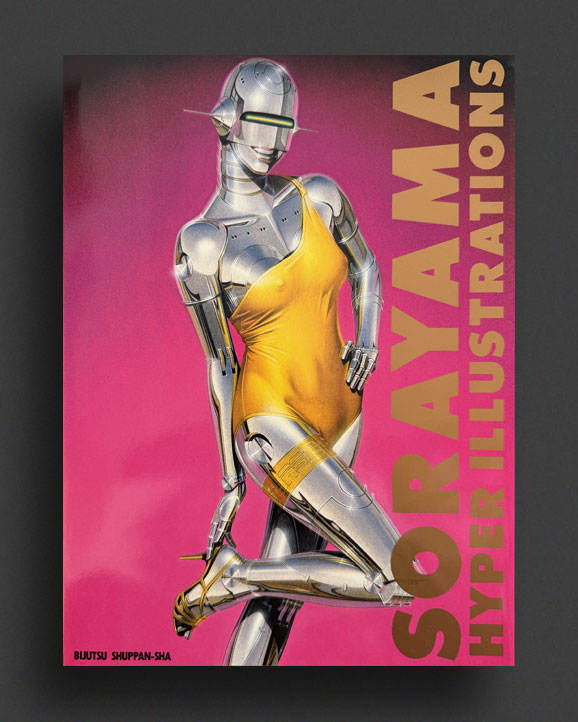
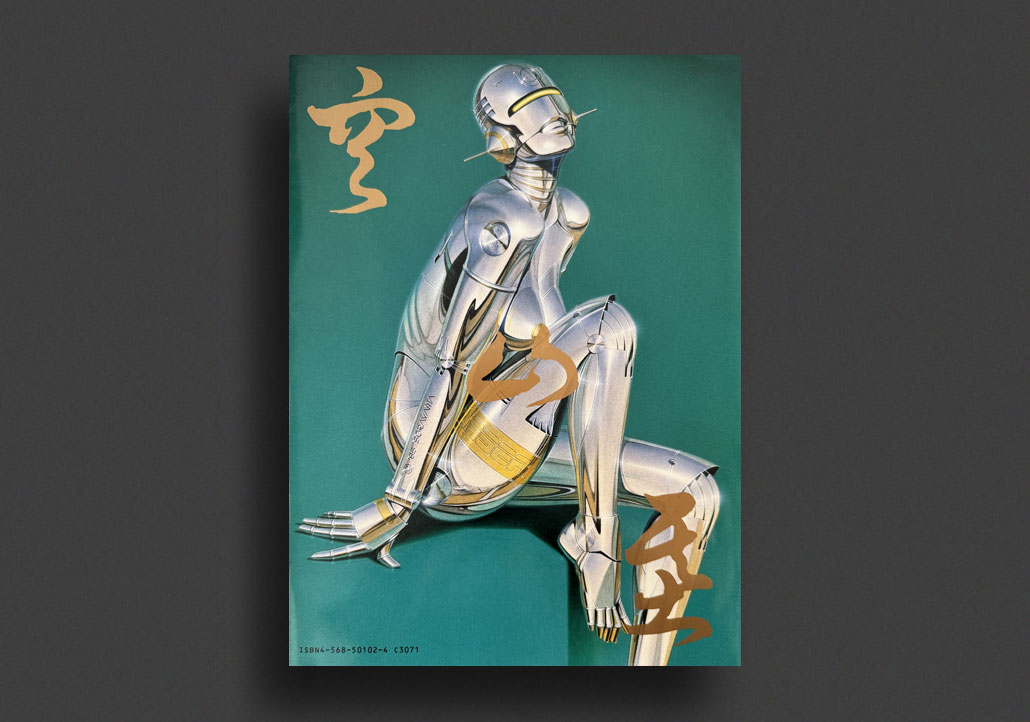
First 1989 bi-lingual (English/Japanese) edition of Hajime Sorayama's Hyper Illustrations, an excellent survey of works from the Japanese master of Gynoids, made famous the world-over with the publication of his Sexy Robot, 1983. Cover-to-cover full-page and double-page reproductions of some of his finest superrealist pin-ups, nudes and fetish works, and of course his Gynoids, plus much more. Includes a step-by-step tutorial from the artists, as well as an interview.
Hajime Sorayama (b. 1947 in Imabari, Ehime prefecture) has established his position as a legendary artist, both within Japan and internationally, for his extensive oeuvre that centers upon an ongoing pursuit for beauty in the human body and the machine. Best known for his precisely detailed, hand-painted portrayals of voluptuous women, obtained through an astoundingly artful use of a wide array of realistic expressional techniques, most prominently airbrush painting, the artist’s international recognition is inextricably tied to his signature series titled “Sexy Robot” (1978-) featuring erotic android figures clad in shiny chrome metal, and to AIBO, the award-winning robotic pet he designed for SONY in 1999.
Near Fine copy in Very Good dust jacket, light wear.
2020, English / Japanese
Softcover (w. dust-jacket, poster, stickers), 108 pages, 26.5 x 36.5 cm
1st Edition, Out of print title / as new
Published by
PARCO / Tokyo
Kaleidoscope Press / Milan
$200.00 - Out of stock
First edition, now out-of-print.
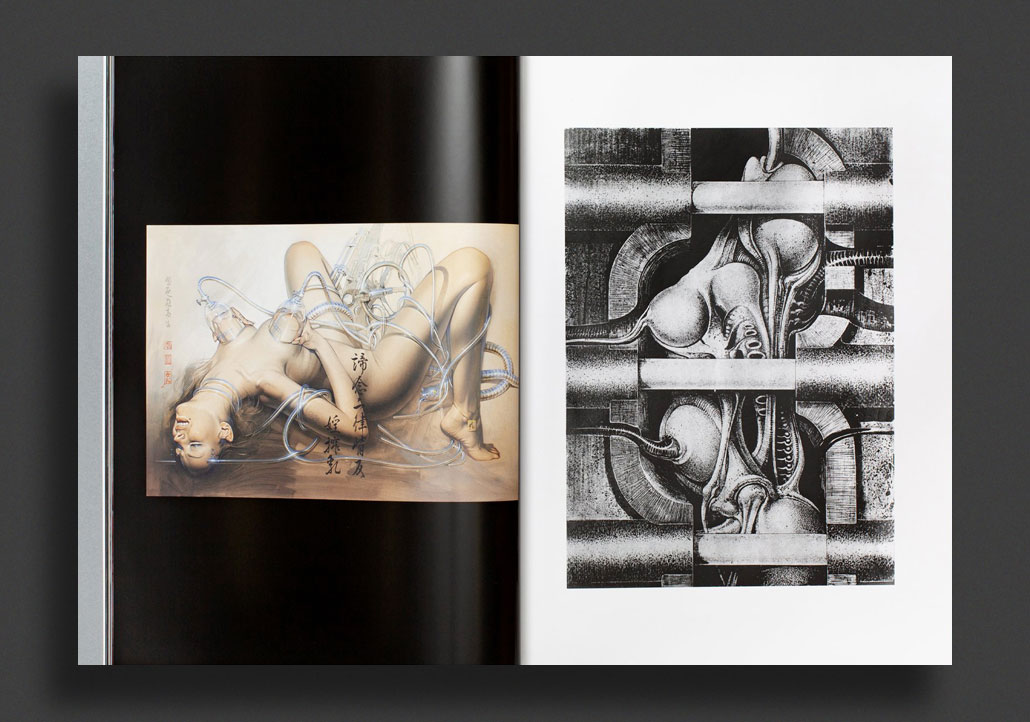
With a first edition sold out in Japan in one week, this super book published by Italian art publisher KALEIDOSCOPE accompanies a two-artist exhibition co-curated by Alessio Ascari and Shinji Nanzuka, bringing together for the very first time the work of Japanese artist Hajime Sorayama and Swiss artist HR Giger. Touring from PARCO Museum in Tokyo to PARCO Event Hall in Osaka between December 2020 and February 2021, the exhibition coincides with the 80th anniversary of Giger’s birth and features over 50 works ranging from the late 1960s to the present day.
The catalogue, designed by Swiss-based art direction firm Kasper-Florio with Samuel Bänziger, features a foreword by co-curator Alessio Ascari, a critical essay by Venus Lau, an interview with the late HR Giger by Hans Ulrich Obrist and Patrick Frey, and a recent interview with Sorayama by Ascari.
Lavishly illustrated throughout, this beautiful edition also comes with a 50 x 70 cm two-sided poster, and two 20 cm die-cut stickers.
Born and trained at opposite ends of the world, Sorayama and Giger are apparently at odds—one’s bright colors are swallowed by the other’s dark chiaroscuro; one’s enthusiastic outlook on technology borders with the other’s nightmarish dystopia; one’s “super-realism” challenges the other’s surrealism—yet they share more than meets the eye. Both emerged in the 1970s and 1980s, becoming acknowledged masters of airbrush painting and influential creators beyond the boundaries of the traditional art world, blurring the relationship between commercial and personal work. But more importantly, at the very core of their practice lies a similar concern: an obsessive investigation of AI, eternal life, and the fusion of organic and apparatus. Gynoids (female androids) are predominant subjects, conjuring the post-human and the apotheosis of the woman to reveal an underlying tension between life, death, power and desire.
Hajime Sorayama (b. 1947 in Imabari, Ehime prefecture) has established his position as a legendary artist, both within Japan and internationally, for his extensive oeuvre that centers upon an ongoing pursuit for beauty in the human body and the machine. Best known for his precisely detailed, hand-painted portrayals of voluptuous women, obtained through an astoundingly artful use of a wide array of realistic expressional techniques, most prominently airbrush painting, the artist’s international recognition is inextricably tied to his signature series titled “Sexy Robot” (1978-) featuring erotic android figures clad in shiny chrome metal, and to AIBO, the award-winning robotic pet he designed for SONY in 1999.
Hans Ruedi Giger (1940–2014) was a Swiss surrealist painter, sculptor, and set designer known for his biomechanical creatures, extraterrestrial landscapes, and disturbing sexual machines. In a career that spanned more than five decades, he employed a staggering variety of media, including furniture, movie props, prints, paintings and sculptures, often creating exhibition displays and total environments with the immersive quality of a wunderkammer—including, most notably, the HR Giger Museum in Gruyères. In 1979, his concept design for Ridley Scott’s Alien (1979) won an Academy Award for Best Achievement in Visual Effects and catapulted to fame his daunting vision of death and futurism.
1980, Japanese
Softcover, 132 pages, 30 x 21 cm
1st Edition, Out of print title / used / very good
Published by
Sun Publishing / Japan
$500.00 - In stock -
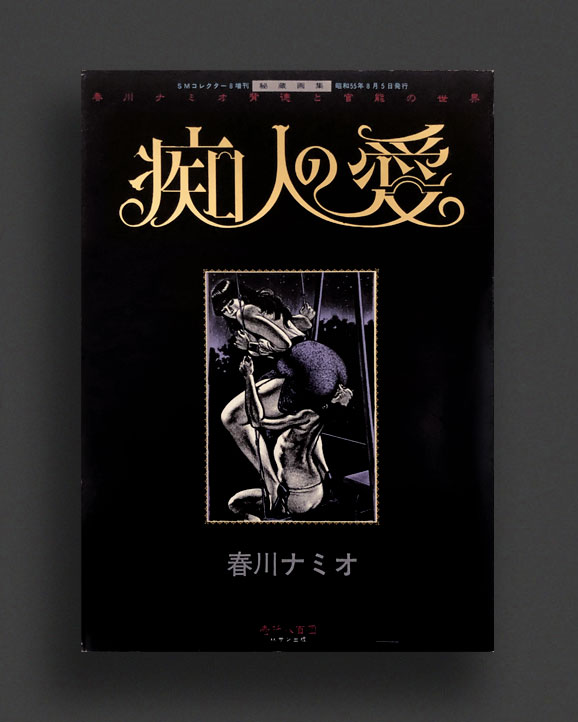
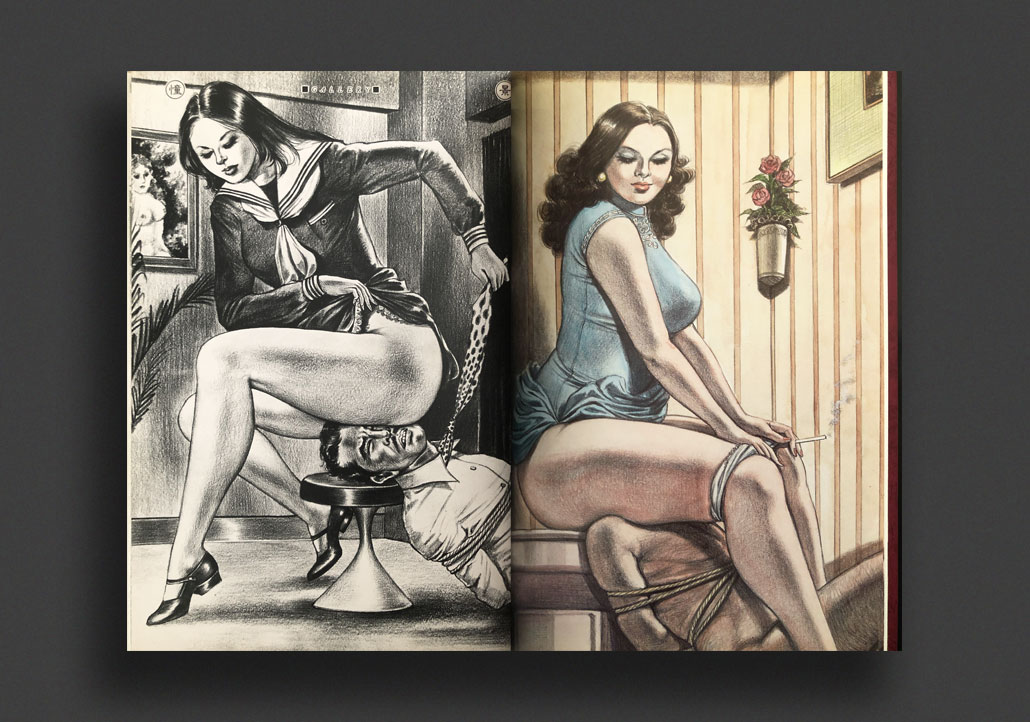
Absolutely incredible, super rare, ultra collectible first edition of the first Namio Harukawa art book, published in Japan in 1980 by leading SM magazine SM Collector and their publishing house, Sun. An absolute treasure of vintage Namio Harukawa femdom works, released a full 20 years prior to his "Big Girl Love / My Fair Fat Lady" (2000) and 32 years before his late "Garden of Domina". By 1980 Namio was already a prolific master of fetish illustration, contributing to countless cult SM magazines. Lavishly illustrated throughout in colour and black and white with gorgeous reproductions on various paper stocks, including full-colour fold-out poster, this volume introduces so many early works never seen in any later monographs with a diverse array of "femdom" fetishes and narratives, including all his SM magazine work through to the establishment of his iconic face-sitting queens. A breath-taking, comprehensive collection that is a must for any fan of Harukawa or erotic illustration, period. Appropriately this "treasured art collection" was named "Chijin No Ai" ("A Fool’s Love") by Harukawa, after Tanizaki Jun’ichiro’s novel featuring Naomi, the sadistic heroine whose name was adopted by Harukawa. Cannot recommend this book more.
Namio Harukawa (1947—2020), a pseudonymous Japanese fetish artist best known for his masterful pencil works depicting female domination ("femdom"), with erotic asphyxiation through facesitting appearing as a frequent subject of his art. Born 1947 in Osaka, Japan, Harukawa’s distinctive penname combines the name of film actress Harukawa Masumi with an anagram of Naomi, the sadistic heroine in Tanizaki Jun’ichiro’s novel "Chijin no ai / A Fool’s Love". While in high school, Harukawa began contributing work to the readers’ column of leading postwar Japanese SM pulp magazine "Kitan Club". Since then, Harukawa’s drawings of male masochism have lovingly portrayed noble, voluptuously beautiful women and the men who serve them as human furniture. An extraordinary and prolific artist who remained committed to the regime of “absolute Ganmen Kijo Shugi (facesitting principle)” throughout his artistic life, Namio Harukawa passed away on April 2020, he was 72 years old.
Very Good copy, beautifully preserved, only light cover wear.
1972, Japanese
Softcover (w. dust jacket in cardboard slipcase w. illustrated paste-on), 124 pages, 37.4 x 25.9 cm
1st Edition, Out of print title / used / very good
Published by
Suiyangsha / Japan
Sun Publishing / Japan
$380.00 - In stock -
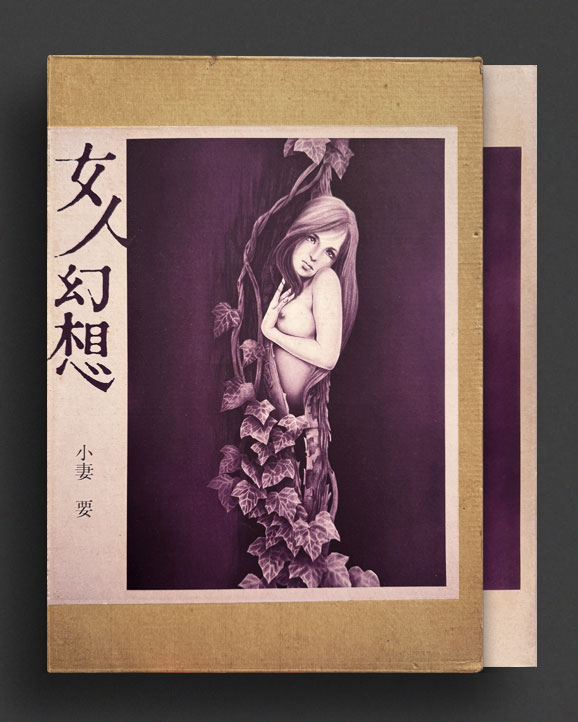
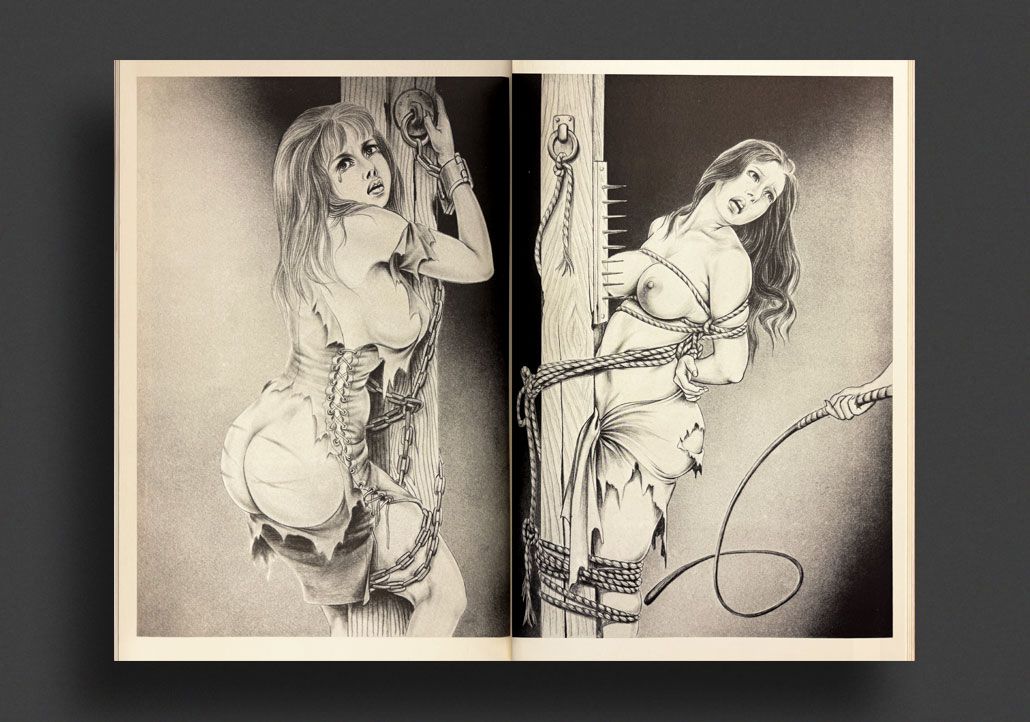
The gorgeous, super rare, first slip-cased monograph collection of artworks by kinbaku artist master Kaname Ozuma (1939—2011), also know as Yoko Ozuma, published in 1972 by Sun Publishing. Stunning over-sized vibrant printing, this very rare collector's item presents an incredible wealth of erotic drawings and paintings from the artist’s early oeuvre, spanning ero-guro fantasy in fine pointillism technique to his delicately painted, enchanted scenes of tattooed women and sadomasochistic kinbaku bondage on hand woven silk, which brought him a devoted following.
Kaname Ozuma and Yoko Ozuma, were pseudonyms for the renowned Japanese artist, illustrator and costume designer, Katsutoshi Sakai. Ozuma's unorthodox but exceptionally refined style became one of the most recognisable and celebrated in the underground scene of 1960s—1980s Japanese SM publishing, after his debut appearance in legendary The Kitan Club in September 1965. His work as a cover and feature illustrator became recognised through The Kitan Club, SM Select, S&M Collector, SM King, Suspense Magazine, SM Secret, and monographs of his SM works. Expanding upon the Meiji era (1868—1912) traditions of Nihonga painting and ukiyo-e, with contemporary style and sensibility, Ozuma's art ranks alongside master artists Tsukioka Yoshitoshi and Seiu Ito as well as his contemporaries, Ran Akiyoshi, Yoji Muku, Shoji Oki, Toshio Saeki, Namio Harukawa. This first book of SM artworks see Ozuma at his most adventurous. Highly recommended.
Very Good copy, complete with VG slipcase. Like foxing to dust jacket, light tanning to box, light wear.
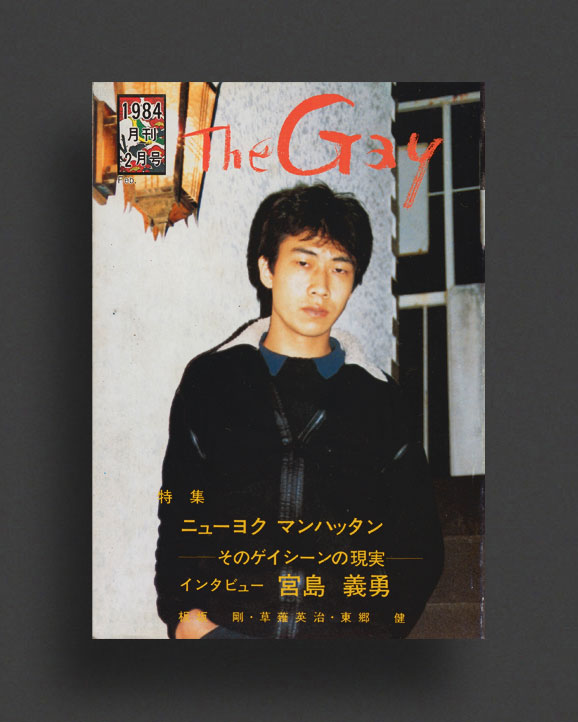
1984, Japanese
Softcover, 208 pages, 21 x 15 cm
1st Edition, Out of print title / used / very good
Published by
The Gay / Tokyo
$60.00 - In stock -
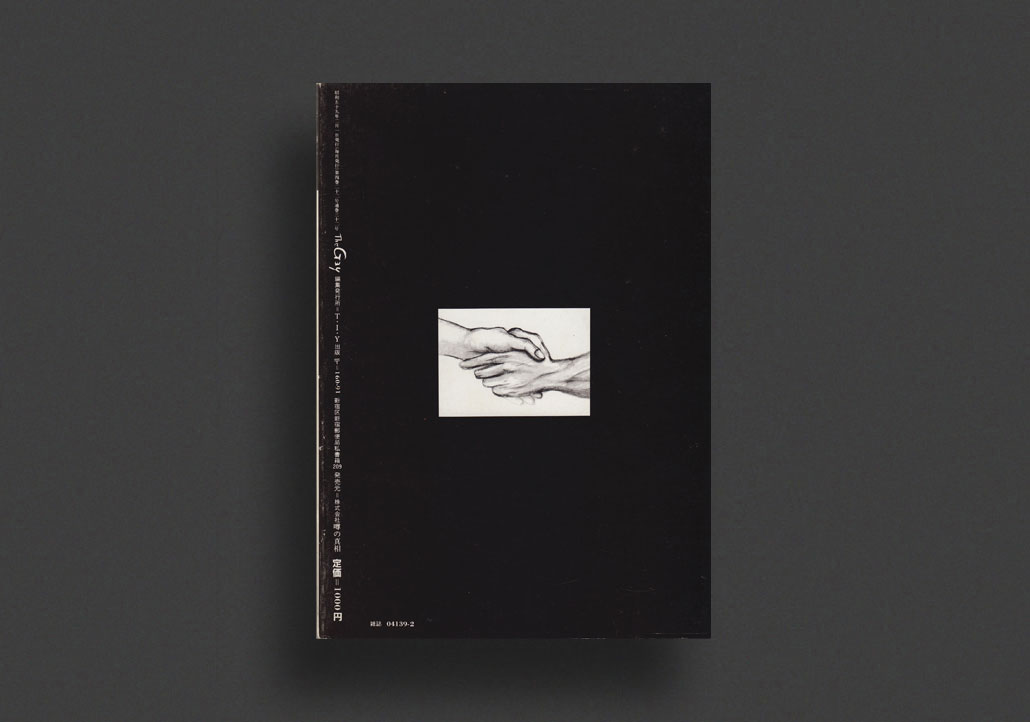
Rare copy of the February 1984 issue 22 of Tokyo's The Gay, one of the best and lesser-known of Japan's gay magazine scene of the 1970s—1980s, with this issue including a special feature on the reality of the gay scene in New York Manhattan, New York interviews with editors of The Advocate, Christopher Street, and The National Gay Task Force Report (NGTF founded by gays rights activist Bruce Voeller in 1973), an exclusive interview with Japanese cinematographer Yoshio Miyajima, and much more, alongside explicit nude photo shoots of young Japanese men in colour and b/w, illustrations, gay fiction, news, movie reviews, ads, classifieds, articles, essays and other interviews. Packed!
Very Good copy.