World Food Books' programme is largely produced on Kulin Nation land. We acknowledge the Wurundjeri people of the Kulin Nation as the first and continuing custodians of this land, and pay respect to their Elders past, present, and emerging.
World Food Books is an arts and special interests bookshop in Naarm / Melbourne. Founded in 2010, World Food Books is devoted to the presentation of a rotating, hand-selection of international art, design, literary and counterculture publications with an emphasis on the anti-traditional, the experimental, the avant-garde, the heretic, the marginal.
Presenting new titles alongside rare and out-of-print books, catalogues and journals spanning the fields of modern and contemporary art, design, photography, illustration, film, literature, poetry, cultural theory, philosophy, sexuality, popular and underground culture in its many radical forms, World Food Books wishes to encourage adventurous, thoughtful and open-minded reading, looking, writing, and exchange of publishing and ideas, both current and historical.
As well as our bookshop, located in Melbourne's historical Nicholas Building, all of our inventory is available internationally via our online mail-order service.
World Food Books semi-regularly co-ordinates "Occasions", a programme of exhibits and events at the bookshop and in partnership with other hosts (such as museums and art galleries) that develop out of the activities, relationships and content of the bookshop itself.
World Food Books
The Nicholas Building
37 Swanston Street
Room 5, Level 6
Melbourne 3000
Australia
SHOP HOURS:
THU–SAT 12–6
WEB-SHOP OPEN 24/7
World Food Books
Postal Address:
PO Box 435
Flinders Lane
Victoria 8009
Australia
info@worldfoodbooks.com
Art
Theory / Essay
Architecture / Interior
Graphic Design / Typography
Photography
Fashion
Eros
LGBTQ+
Fiction / Poetry
Weird / Speculative / Science Fiction / Horror
Transgressive / Visceral / Abject
Symbolism / Decadence / Fin de siècle
Film / Video
Painting
Sculpture / Installation
Performance / Dance / Theater
Drawing
Sound / Music
Curatorial
Group Shows / Collections
Periodicals
Out-of-print / Rare
Posters / Ephemera / Discs
Signed Books
World Food Books Gift Voucher
World Food Book Bag
Australian Art
Australian Fiction
Australian Science Fiction / Speculative Fiction
Australian Poetry
Australian Photography
Japanese Photography
Conceptual Art
Minimal Art
Dada
'Pataphysics / Oulipo
Fluxus
Concrete Poetry
Pop Art
Surrealism
Arte Povera
Arte Informale / Haute Pâte / Tachism
Nouveau Réalisme / Zero / Kinetic
Situationism / Lettrism
Collage / Mail Art / Xerox Art
Art Brut / Folk / Visionary / Fantastic
Illustration / Graphic Art / Bandes Dessinées
Furniture
Italian Radical Design / Postmodernism
Textiles
Ceramics / Glass
Counterculture
Protest / Revolt
Philosophy
Psychoanalysis
Anthropology
Anarchism
Socialism / Anarchism / Communism / Capitalism
Literary Theory / Semiotics / Language
Feminism / Women's Studies
Gender Studies / Sexuality
Anthropology
Fetishism / BDSM
Drugs / Psychedelia
Crime / Violence
Animal Rights / Veganism
Occult / Esoterica
Ecology / Earth / Alternative Living
Whole Earth / Crafts
All prices in AUD (Australian dollars)
Pick-Ups
Pick-up orders can be collected in our bookshop during opening hours after order date. Please collect any Pick-up orders within 2 weeks of ordering as we have limited storage space. Orders will be released back into stock if not collected within this time. No refunds can be made for pick-ups left un-collected. If you cannot make it in to the bookshop in this time-frame, please choose postage option.
Return Policy
All sales are final. We do accept returns (for refund or exchange) for items received in error. All our orders are packed with special care using heavy-duty padding and cardboard book-mailers or bubble mailers (for smaller books), using reinforcement where required. We cannot take responsibility for any lost, stolen or damaged parcels.
Insurance
Should you wish to insure your package, please email us directly after placing your order and we can organise this at a small extra expense. Although all standard/express tracked packages are very safe and dependable, we cannot take responsibility for any lost, stolen or damaged parcels. We recommend insurance on valuable orders.
Interested in selling your old books, catalogues, journals, magazines, comics, fanzines, ephemera? We are always looking for interesting, unusual and out-of-print books to buy. We only buy books in our fields of interest and specialty, and that we feel we can resell.
We base these prices on desirability, market value, in-print prices, condition and our current stock levels. We offer cash, store credit, and can take stock on consignment. All
about 25% of the price we expect to get when we sell them, or 30% in store credit. We base these prices on desirability, market value, in-print prices, condition and our current stock levels.
Sell your books any day of the week. You can drop them off and return later. If you have a lot of books, we can visit your Sydney home.
We buy books that we feel we can resell. We offer about 25 % of the price we expect to get when we sell them, or 30% in store credit. We base these prices on desirability, market value, in-print prices, condition and our current stock levels.
Philadelphia Wireman
03 August - 01 September, 2018
World Food Books is proud to announce our next Occasion, the first presentation of sculptures by Philadelphia Wireman in Australia.
The Philadelphia Wireman sculptures were found abandoned in an alley off Philadelphia’s South Street on trash night in 1982. Their discovery in a rapidly-changing neighbourhood undergoing extensive renovation, compounded with the failure of all attempts to locate the artist, suggests that the works may have been discarded after the maker’s death. Dubbed the "Philadelphia Wireman" during the first exhibition of this work, in 1985, the maker’s name, age, ethnicity, and even gender remain uncertain. The entire collection totals approximately 1200 pieces, all intricately bound together with tightly-wound heavy-gauge wire (along with a few small, abstract marker drawings, reminiscent both of Mark Tobey and J.B. Murry). The dense construction of the work, despite a modest range of scale and materials, is singularly obsessive and disciplined in design: a wire armature or exoskeleton firmly binds a bricolage of found objects including plastic, glass, food packaging, umbrella parts, tape, rubber, batteries, pens, leather, reflectors, nuts and bolts, nails, foil, coins, toys, watches, eyeglasses, tools, and jewellery.
Heavy with associations—anthropomorphic, zoomorphic, and socio-cultural responses to wrapped detritus—the totemic sculptures by Philadelphia Wireman have been discussed in the context of work created to fulfil the shamanistic needs of alternative religions in American culture. Curators, collectors, and critics have variously compared certain pieces to sculpture from Classical antiquity, Native American medicine bundles, African-American memory jugs, and African fetish objects. Reflecting the artist’s prolific and incredibly focused scavenging impulse, and despite—or perhaps enhanced by—their anonymity, these enigmatic objects function as urban artefacts and arbiters of power, though their origin and purpose is unknown. Philadelphia Wireman, whatever their identity, possessed an astonishing ability to isolate and communicate the concepts of power and energy through the selection and transformation of ordinary materials. Over the course of the past two decades, this collection has come to be regarded as an important discovery in the field of self-taught art and vernacular art.
Presented in collaboration with Fleisher-Ollman Gallery, Philadelphia, and Robert Heald, Wellington.
Susan Te Kahurangi King
02 February - 10 March, 2018
Susan Te Kahurangi King (24 February 1951 - ) has been a confident and prolific artist since she was a young child, drawing with readily available materials - pencils, ballpoint pens and felt-tip markers, on whatever paper is at hand. Between the ages of four and six Susan slowly ceased verbal communication. Her grandparents William and Myrtle Murphy had developed a special bond with Susan so they took on caring responsibilities for extended periods. Myrtle began informally archiving her work, carefully collecting and storing the drawings and compiling scrapbooks. No drawing was insignificant; every scrap of paper was kept. The King family are now the custodians of a vast collection containing over 7000 individual works, from tiny scraps of paper through to 5 meter long rolls.
The scrapbooks and diaries reveal Myrtle to be a woman of great patience and compassion, seeking to understand a child who was not always behaving as expected. She encouraged Susan to be observant, to explore her environment and absorb all the sights and sounds. Myrtle would show Susan’s drawings to friends and people in her community that she had dealings with, such as shopkeepers and postal workers, but this was not simply a case of a grandmother’s bias. She recognised that Susan had developed a sophisticated and unique visual language and sincerely believed that her art deserved serious attention.
This was an unorthodox attitude for the time. To provide some context, Jean Dubuffet coined the term Art Brut in 1945 to describe work created by self-taught artists – specifically residents of psychiatric institutions and those he considered to be visionaries or eccentrics. In 1972 Roger Cardinal extended this concept by adopting the term Outsider Art to describe work made by non-academically trained artists operating outside of mainstream art networks through choice or circumstance. Susan was born in Te Aroha, New Zealand in 1951, far from the artistic hubs of Paris and London that Dubuffet and Cardinal operated in. That Myrtle fêted Susan as a self-taught artist who deserved to be taken seriously shows how progressive her attitudes were.
Susan’s parents Doug and Dawn were also progressive. Over the years they had consulted numerous health practitioners about Susan’s condition, as the medical establishment could not provide an explanation as to why she had lapsed into silence. Dawn educated herself in the field of homeopathy and went on to treat all twelve of her children using these principles – basing prescriptions on her observations of their physical, mental and emotional state.
Doug was a linguist with an interest in philosophy who devoted what little spare time he had to studying Maori language and culture. To some extent their willingness to explore the fringes of the mainstream made them outsiders too but it was their commitment to living with integrity and their respect for individuality that ensured Susan’s creativity was always encouraged.
Even though Susan’s family supported her artistic pursuits, some staff in schools and hospitals saw it as an impediment to her assimilation into the community and discouraged it in a variety of ways. Her family was not always aware of this and therefore did not fully understand why Susan stopped drawing in the early 1990s. However, rather than dwell on the challenges that Susan faced in pursuit of her artistic practice, they prefer to highlight her achievements. In 2008 Susan began drawing again in earnest, after an almost 20 year interruption, and her work is now shown in galleries around the world.
Susan grew up without television and has been heavily influenced by the comics she read as a child. She is absolutely fearless in the appropriation of recognizable characters, such as Donald Duck and Mickey Mouse, in her work. She twists their limbs, contorts their faces, compresses them together, blends them into complex patterned backgrounds - always imbuing them with an incredible energy. Although Susan often used pop culture characters in her work they are not naive or childlike. These are drawings by a brilliant self-taught artist who has been creating exceptional work for decades without an audience in mind.
Mladen Stilinović
"Various Works 1986 - 1999"
02 February 16 - September 10, 2016
Various works 1986 - 1999, from two houses, from the collections of John Nixon, Sue Cramer, Kerrie Poliness, Peter Haffenden and Phoebe Haffenden.
Including: Geometry of Cakes (various shelves), 1993; Poor People’s Law (black and white plate), 1993; White Absence (glasses, ruler, set square, silver spoon, silver ladel with skin photograph and wooden cubes), 1990-1996; Exploitation of the Dead (grey and red star painting, wooden painting, black spoon with red table, red plate), 1984-1990; Money and Zeros (zero tie, paintings made for friends in Australia (Sue, John, Kerrie), numbers painting), 1991-1992; Words - Slogans (various t-shirts) - “they talk about the death of art...help! someone is trying to kill me”, “my sweet little lamb”, “work is a disease - Karl Marx”; Various artist books, catalogues, monographs, videos; Poster from exhibition Insulting Anarchy; "Circular" Croatian - Australian edition; Artist book by Vlado Martek (Dostoyevsky); more.
Thanks to Mladen Stilinović and Branka Stipančić.
Jonathan Walker
Always Will Need To Wear Winter Shirt Blue + Ochre Small Check Pattern
21 August - 21 September, 2015
Untitled
I am not a great reader of poetry but I always return to the work of Melbourne poet, Vincent Buckley (1925- 1988). Perhaps I find his most tantalising piece to be not a finished poem but a fragment left on a scrap of paper discovered on his desk after the poet’s death.
The poetry gathers like oil
In the word-core, and spreads
It has its music meet,
Its music is in movement.
This fragment is more the shell left behind from a volatile thought than a finished poem. I find the last two lines honest but awkward whereas the first two lines work like an arrow. Most likely he could not find a resolution so it was left. Still, in its present form, it remains an eloquent testimony to the ultimate failure of a medium to express mobile thought and sensation, in Buckley’s case, through verbal language. It’s an important matter because this is something all artists have to deal with regardless of the medium.
I have never written a poem, however, I am forever copying fragments from books on paper scraps in a vain effort to fix certain notions in my head. At first, they function as bookmarks that are sometimes returned to when I open the book. But before long, as they accumulate, they fall out littering the table interspersed with A4 photocopies, bills, books and medications.
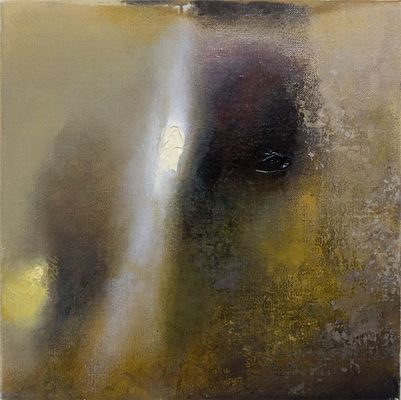
To return to Buckley’s fragment, the first two lines very much evoke how I paint nowadays. As you age, detail diminishes and patches of light become more luminous and float. I feel the most honest way of dealing with this is by smearing the oil paint on the canvas with the fingers and working close-up, blind. Only if the patches coalesce into an approaching image can the work gain a life.
-
Jonathan Walker was born in Melbourne, Australia and brought up on a dairy farm in Gippsland. In the 1970’s he studied painting at RMIT and won the Harold Wright Scholarship to the British Museum, London. During the 1980’s he exhibited at Pinacotheca Gallery, Richmond and had work shown at the NGV and Heidi City Art Gallery. Over the same period he designed the cover for the “Epigenesi” LP by Giancarlo Toniutti, Italy and conducted a mail exchange work with Achim Wollscheid, Germany. The work with artists through the post resulted in an article published in the bicentenary issue of Art and Australia 1988. He showed in artist run spaces such as WestSpace in the 90’s and 2000’s, and until 2012, taught painting at Victoria University, which is where we (Colleen Ahern and Lisa Radford) as organisers of the exhibition, among many others, had the privilege of being his student.
Walker’s knowledge was imparted to students through the careful selection of music, literature, and artists found in books that he himself had ordered for the library. Walker’s strategy was the generosity of sharing his vast knowledge with references specific to each student and their context.
Walker’s paintings share a similar focus and intimacy.
This exhibition presents a small selection of recent paintings alongside a publication that includes Walker’s writing. Observational and analytical, Walker’s work is a type of material notation — the time of day, colour and how it is blended, the both specific and fleeting location of a reflection on lino or the question of whether a chair leg should be included in a painting.
Please join us on Friday August 21 between 6-8pm to celebrate the opening of the exhibition.
Curated by Colleen Ahern and Lisa Radford.
B. Wurtz
Curated by Nic Tammens
March 26 - April 4, 2015
B.Wurtz works from a basement studio in his home on Manhattan’s Lower East Side.
This local fact is attested to by the plastic shopping bags and newsprint circulars that appear in his work. As formal objects, they don’t make loud claims about their origins but nonetheless transmit street addresses and places of business from the bottom of this long thin island. Like plenty of artists, Wurtz is affected by what is local and what is consumed. His work is underpinned by this ethic. It often speaks from a neighborhood or reads like the contents of a hamper:
“BLACK PLUMS $1.29 lb.”
“Food Bazaar”
“USDA Whole Pork Shoulder Picnic 99c lb.”
“RITE AID Pharmacy, with us it’s personal.”
“H. Brickman & Sons.”
“Sweet Yams 59c lb."
Most of the work in this exhibition was made while the artist was in residence at Dieu Donne, a workshop dedicated to paper craft in Midtown. Here Wurtz fabricated assemblages with paper and objects that are relatively lightweight, with the intention that they would be easily transportable to Australia. This consideration isn’t absolute in Wurtz’s work, but was prescriptive for making the current exhibition light and cheap. Packed in two boxes, these works were sent from a USPS post office on the Lower East Side and delivered to North Melbourne by Australia Post.
Wurtz appears courtesy of Metro Pictures, New York.
Thanks to Rob Halverson, Joshua Petherick, Sari de Mallory, Matt Hinkley, Helen Johnson, Fayen d'Evie, Ask Kilmartin, Lisa Radon, Ellena Savage, Yale Union, and "Elizabeth".
John Nixon
"Archive"
December 15 - January 20, 2014
The presentation of John Nixon's archive offered a rare showcase of this extensive collection of the artist's own publications, catalogues, posters, ephemera, editions and more, from the mid 1980s onwards, alongside a selection of his artworks.
Organized by John Nixon, Joshua Petherick and Matt Hinkley.
"Habitat"
at Minerva, Sydney (organised by Joshua Petherick and Matt Hinkley)
November 15 - December 20, 2014
Lupo Borgonovo, Janet Burchill & Jennifer McCamley,
Lewis Fidock, HR Giger, Piero Gilardi, Veit Laurent Kurz,
Cinzia Ruggeri, Michael E. Smith, Lucie Stahl, Daniel Weil, Wols
Press Release:
“...It contained seven objects. The slender fluted bone, surely formed for flight, surely from the wing of some large bird. Three archaic circuitboards, faced with mazes of gold. A smooth white sphere of baked clay. An age-blackened fragment of lace. A fingerlength segment of what she assumed was bone from a human wrist, grayish white, inset smoothly with the silicon shaft of a small instrument that must once have ridden flush with the surface of the skin - but the thing’s face was seared and blackened.”
William Gibson, “Count Zero”, 1986
"Autumn Projects Archive"
Curated by Liza Vasiliou
March 6 - March 15, 2014
World Food Books, in conjunction with the Virgin Australia Melbourne Fashion Festival 2014, presented the Autumn Projects archive, consisting of a selection of early examples in Australian fashion with a particular interest in collecting designers and labels from the period beginning in the 1980’s, who significantly influenced the discourse of Australian Fashion.
Curated by Liza Vasiliou, the exhibition provided a unique opportunity to view pieces by designers Anthea Crawford, Barbara Vandenberg, Geoff Liddell and labels CR Australia, Covers, Jag along with early experimental collage pieces by Prue Acton and Sally Browne’s ‘Fragments’ collection, suspended throughout the functioning World Food Books shop in Melbourne.
H.B. Peace
presented by CENTRE FOR STYLE
November 14, 2013
"Hey Blinky, you say chic, I say same"
Anon 2013
H.B. Peace is a clothing collaboration between great friends Blake Barns and Hugh Egan Westland. Their pieces explore the divergences between 'character’ and ‘personality’ in garments....etc
Special Thanks to Joshua Petherick and Matt Hinkley of WFB and Gillian Mears
and a Very Special Thank you to Audrey Thomas Hayes for her shoe collaboration.
Janet Burchill & Jennifer McCamley
"Aesthetic Suicide"
May 10 - June 8, 2013
The first of our occasional exhibitions in the World Food Books office/shop space in Melbourne, "Aesthetic Suicide" presented a body of new and older works together by artists Janet Burchill & Jennifer McCamley, including videos, prints, a wall work, and publications.
During shop open hours videos played every hour, on the hour.
1997, Japanese
Softcover (w. dust jacket), 254 pages, 30. x 21.6 cm
1st Edition, Out of print title / used / very good
Published by
Korinsha Press & Co / Kyoto
$95.00 - In stock -
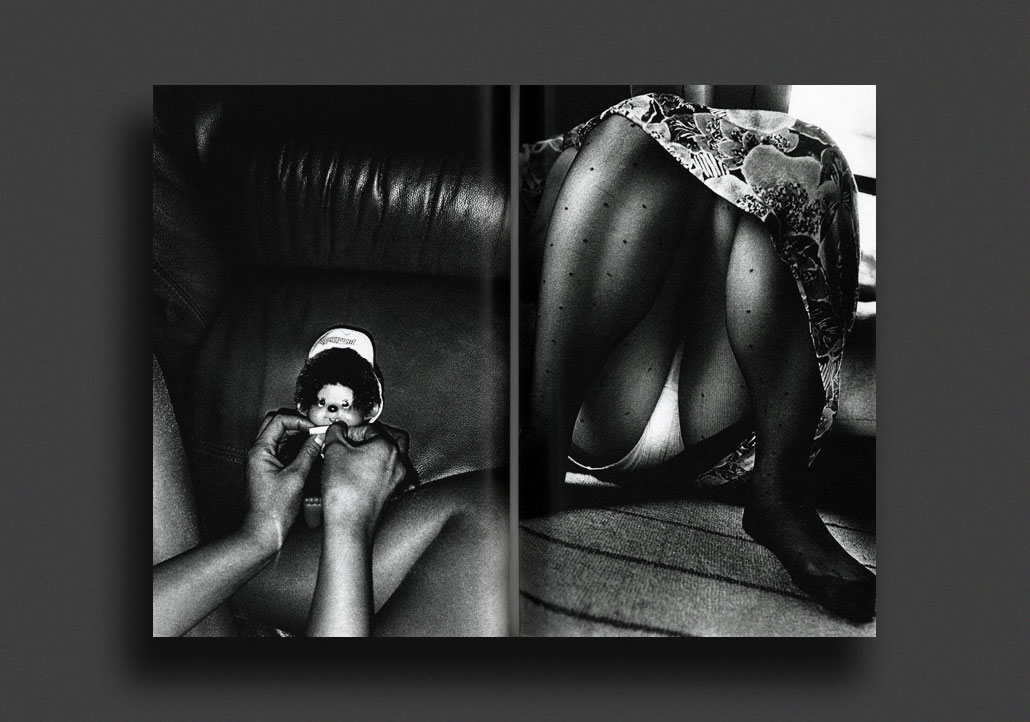
First 1997 edition of this wonderful black and white collection of Araki's photographic works, almost entirely comprised of his finest female nudes and provocative bondage photography. Text sections in English and Japanese with introductory essay by Werner Würtinger, Vienna Secession. "The artist Nobuyoshi Araki works without a safety net, so to speak, every utterance turns into the spontaneous and irrevocable expression of his loneliness vis-à-vis the wilderness of sexuality"—Werner Würtinger, Vienna Secession). Includes biographical information and exhibition history at rear.
VG copy with a light buckling to the block.
1976/2006, Japanese
Hardcover (w. dust jacket, slipcase, obi), 82 pages, 31 x 25 cm
Out of print title / used / fine
Published by
Kawade Shobo Shinsha / Tokyo
$120.00 - In stock -
2006 facsimile edition of this wonderful 1976 slip-cased hardcover monograph on German artist Friedrich Schröder-Sonnenstern, considered one of the most important representatives of Art Brut or Outsider Art. Bound in red cloth and wrapped in illustrated original dust-jacket, this heavily illustrated book surveys Schröder-Sonnenstern's incredible paintings and drawings through beautiful colour and monochrome gravure reproductions, with alongside various texts, biography, bibliography and portrait of the artist. Published as volume 6 of the deluxe La Septième Face du Dé series by Kawade Shobo Shinsha in Japan in the 1970s, all later re-printed in the 2000s. All editions now out-of-print.
Friedrich Schröder-Sonnenstern was a draftsman, painter and poet-philosopher. Born in 1892 in East Prussia, one of thirteen children, all of whom apart from one other died shortly after birth. He was sent to a number of reform schools due to accusations of theft and violent behaviour and then, at the age of twenty-six, he was diagnosed with schizophrenia and committed to a sanatorium. His experiences as a child contributed to his lifelong hatred of authority. One year later he showed up in Berlin, where he occupied himself with occultism, divination and healing magnetism. He founded a sect and distributed its income in the form of bread rolls to poor children, earning him the title "Schrippenfürst of Schöneberg". He created the name Sonnenstern (English: Sun Star) for himself while working as a con-artist, posing as a Quack doctor in "natural health", calling himself Professor Dr. Eliot Gnass von Sonnenstern. This career path was cut off by the Nazis' interdiction of occult practices, and after being confined in psychiatric institutes and in a penal camp, Schröder-Sonnenstern reemerged in 1944, scavenging firewood in the bombed-out German capital. Only in his late fifties, in 1949, did he begin to draw, using coloured pencils to create allegorical grotesques stocked with a personal iconography. Although his art was rarely shown, he was championed in Surrealist and art brut circles; Jean Dubuffet and Hans Bellmer were among his admirers, and a few drawings were included in Marcel Duchamp and André Breton's 1959 "Exposition inteRnatiOnale du Surréalisme" in Paris. The demand for his pictures by collectors and gallerists rose rapidly and he resorted to employing assistants to produce his work for him. His success was short-lived when he began to paint less and less and became the victim of counterfeiting cliques by his assistants, destroying his position in the art market. He became increasingly dependent on alcohol following the death, in 1964, of his long-time companion, Martha Möller whom he called Aunt Martha. He died almost forgotten and impoverished in 1982 in Berlin.
Fine copy.
1970/1971, French
Softcover, 2 volumes, unpaginated, 28.5 x 19 cm
1st Edition, Out of print title / used / very good
Published by
Marie Concorde / Paris
$320.00 - In stock -
Both of the only volumes ever produced of this wonderful French avant-garde journal, published in Paris at the beginning of the 1970s. A visual manifesto against the prudishness of the times, KITSCH presented hundreds of illustrations of mostly erotic, fetish and fantastic/grotesque artwork by artists from all over the world, and spanning generations, with both issues wrapped in the most striking Tom Wesselmann covers. KITSCH 1 includes Toshio Saeki, Guido Crepax, Richard Linder, Robert Crumb, Guy Bourdin, Petr Herel, Hannes Jahn, Roman Cieślewicz, Ben Vautier, Christian Bour, Jacques Sternberg, Roland Topor, Jim, Allen Jones, Thomas Weir, alongside photo essays on upskirt polaroids, Satanik, Diabolik, fashion and more. KITSCH 2 includes Aslan, Roy Lichtenstein, Virgil Finlay, Jim Osborne, Ronald Lipking, Greg Irons, George Grosz, Egon Schiele, Mel Ramos, alongside photo essays on subjects such as "Pop Art", "Human Concern" and Paris' "Pigalle" district, further featuring work by H.C.Westermann, Paul Thek, Edward Keinholz, William Tunberg, Christian Schad, William Weegee, James Rosenquist, Frank Gallo, Tom Wesselmann, and many more.
Very good copies both, light wear.
1971, English / Japanese
Softcover, 98 pages, 30 x 26 cm
1st Edition, Out of print title / used / good
Published by
Mainichi Shimbun / Tokyo
$100.00 - In stock -
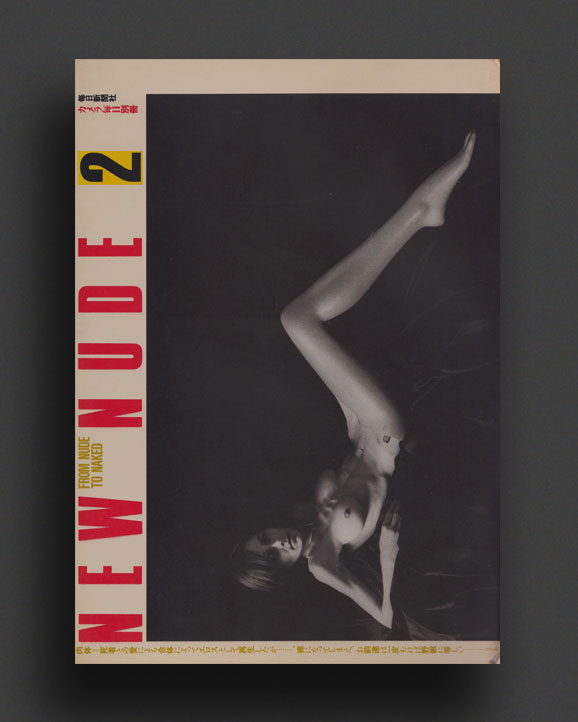
Scarce first 1971 edition of acclaimed Japanese photographer Shunji Okura's photo book "Emma", published in 1971 by Mainichi Shinbun. A marvel of early 1970s nude "sentimental photography", this early book of Okura's is a touching, histrionic collection of portraits and the many moods of the alluring and charismatic young Japanese singer, model and actress, Emma Sugimoto, born under the sign of Gemini. Shunji Okura presents a delicate, playful and intimate relationship between photographer and muse through seventy five beautifully shot monochromes, including many nudes, which have been laid out with a large amount of consideration to communicate Okura's intention as observer and photographer. Stunning intimate portraiture as mastered by the Japanese in this period. Joyous and melancholic. Erotic and naïve. The grandson of Japanese painter Kawai Gyokudō, Shunji Okura (b. 1937) began his photographic career taking portraits of jazz musicians as well as working in fashion and beauty commercial photography.
Number 2 in Camera Mainichi's Private series.
Good copy with tanning and wear to extremities, some chipping to spine tips. Some foxing to initial pages.
2017, French
Softcover (die-cut), 64 pages, 25 x 20.5 cm
Signed by artists,
1st Edition, Out of print title / used / very good
Published by
Les éditions du cimetière / Limogne-en-Quercy
$160.00 - In stock -
Rare copy of this quickly out-of-print, unique collaboration between Japanese photographer Chikashi Suzuki and French illustrator François Alary, this copy signed by both artists. Chikashi Suzuki (b. 1972) moved from Japan to France in 1996 and started his career as a photographer at Purple magazine. Appearing in the pages of Ellen Fleiss and Olivier Zahm's Purple, Hayashi Fumihiro's Dune and Libertine, Dazed & Confused, as well as campaigns for Issey Miyake, United Bamboo, and others, Suzuki's photography became synonymous with the new (anti-)fashion and subculture movement of the 1990s—2000s. This intimate, handsomely-produced artists' book is of experimental nature — Suzuki’s photography documents Alary’s drawing directly on the skin of a naked model. In the book, the monochromatic images of the painted model, Fukan, are joined by a small cartoon character, adding one more touch of strangeness in this textless, image-exploration of the importance of eroticism in Japanese art and the differences between the erotic sensibilities in Japan and France. Printed in Japan.
Very Good—Near Fine copy with only very light cover wear to screen-printed raw cover boards, internally Fine—As New. Signed by both the photographer and illustrator in black ink to first page.
1984, Japanese
Softcover, 226 pages, 17.4 x 11 cm
1st Edition, Out of print title / used / very good
Published by
Asahi Shimbun / Japan
$180.00 - In stock -
One of Kishin Shinoyama's finest, lesser-known works of erotica, "Bibun - Differential" is a rare 1984 experimental flipbook created in collaboration with graphic designer Tsuguya Inoue, known for his art direction at Comme des Garçons. Turning the pages reveals Shinoyama images of actress Rikako Nakamura writhing in various stages of naked ecstasy, simulating a female orgasm, while the facing pages show "explicit" close-ups of Nakamura’s armpit as she fingers it. The graphic allusion of close-up masturbation (complete with forbidden pubic hair!) is a genius ruse against Japanese censorship laws and a sensuous and bizarre piece of comic-surrealism. An wonderful, very uncommon work of erotica from the ever-provocative master.
Very Good copy, light cover wear/age.
1960?, Japanese
Softcover (w. dust jacket), 152 pages, 10.5 x 7.2 cm
1st Edition, Out of print title / used / very good
Published by
? / Japan
$70.00 - In stock -
Rare Pink karaoke lyric book, Love Stroke, likely given away at a Tokyo hostess club in the 1960s. Beautifully preserved in illustrated dust jacket, this pocket-sized adult book is filed to the brim with the lyrics to over 100 R-Rated ("Kae-uta") parody versions of famous Japanese popular folk songs, heavily illustrated with naked girls and an abundance of erotic illustrations and cartoons, jokes, and illustrated sexual positions! The perfect souvenir from a long-lost red-light Tokyo.
VG copy in VG dust jacket.
1960?, Japanese
Boxset (20 photo cards + audio cassette), 13.5 x 15.5 cm
1st Edition, Out of print title / used / very good
Published by
Cassette Moon / Tokyo
$120.00 - In stock -
"20 naughty photos, 20 naughty songs, a cassette tape"
Late 1960s/very early 1970s (undated) adult (Pink) karaoke boxset published by Cassette Moon in Japan. Contains original karaoke cassette with 20 full-colour erotic photographic cards of Japanese women, each with lewd lyrics printed on the verso corresponding to a song on the R-Rated audio cassette of perverted ("Kae-uta") parody versions of famous Japanese popular folk songs. A great night in!
VG copy, with some creasing to box edges, contents Fine—As New preserved photographs and cassette tape in plastic case.
1960?, Japanese / English
Softcover, 80 pages, 8 x 7 cm
1st Edition, Out of print title / used / good
Published by
? / Japan
$50.00 - In stock -
Rare pocket-sized adult booklet issued in (probably) the 1960s (undated) in Japan, "Porn Terms" is crazy little book — a Japanese regional dialect guide of pornographic terms spanning all of the prefectures of Nippon, all the different sexual slang and variant pet names, a dictionary of translations from English terms (many very under-appreciated vulgarities) to various Japanese equivalents, the folk-lore of girls from different regions ("A woman from Shikoku with no sense of chastity", "Sexually proactive girls in Kansai", "Kyushu women transform into women on top at night", "Akita woman with sticky, supple skin", etc. (please pardon translations), an illustrated "Cunt" map of Japanese "Omanko" (a vulgar term for female genitalia... ie. "Cunt"), and so much more. With two-colour print throughout, "Porn Terms" is filled with amazing, pornographic, psychedelic illustration from various Japanese illustrators. A valuable little book of linguistic smut, vulgar vernacular and study of endangered colloquialisms.
Good copy, sound binding, light creasing to cover, light edgewear/marking. Internally Very Good and well preserved.
1971, German
Hardcover (cloth-bound), 264 pages, 18.5 x 23 cm
1st Edition, Out of print title / used / average
Published by
Propyläen-Verl / Berlin
$15.00 - Out of stock
First edition of this catalogue raisonne of lithographs by German painter, sculptor and graphic artist, Paul Wunderlich (1927—2010). Illustrated heavily throughout, this wonderful and extensive reference book of graphic works by Wunderlich was compiled by the artist, together with gallerist Dieter Brusberg, and accompanied by texts from art historians and philosophers Max Bense, Hanns Theodor Flemming, Fritz J. Raddatz, Frank Whitford, and others.
Paul Wunderlich (1927—2010) is known for his erotic, Surrealist-inspired paintings, prints, and sculptures featuring mythological imagery. A pioneer of Magic Realism, Wunderlich received the Japan Cultural Forum Award and the Kunstpreis des Landes Schleswig-Holstein among other accolades. Despite his iconic works being held in some of the world’s most prominent museums, such as the Museum of Modern Art, the British Museum, and the Victoria and Albert Museum, Wunderlich remains an “artist’s artist.” He studied graphic arts at the University of Fine Arts in Hamburg; he later learned printmaking techniques from Oskar Kokoschka and Emil Nolde. His early paintings displayed an abstract, Tachist style, although he embraced figuration in the late 1950s and he developed his characteristic style. He portrayed dismembered figures and sexually provocative imagery reminiscent of the Surrealists, but also influenced art movements such as Art Deco and Art Nouveau. His work was critically received as so scandalous that, in 1960, his lithograph series Qui s’explique (1959) was seized by authorities in Hamburg, and he often had trouble with raids that destroyed his works. Paul Wunderlich was married to photographer Karin Székessy in 1971, and the couple pursued art projects together.
Average copy as the fragile glue has deteriorated and some pages are loose, though all are present.
1978, German
Hardcover (w. hard slipcase), 22 pages + 34 plates, 35 x 29 cm
1st Edition, Out of print title / used / average
Published by
Edition Volker Huber / Offenbach am Main
$35.00 - In stock -
First German 1978 edition of Paul Wunderlich's erotic portfolio "Homo Sum", published by Edition Volker Huber, Offenbach am Main. An lovely over-sized, hardcover edition of 34 full-page drawings housed in hard slipcase with illustrated plate by German painter, sculptor and graphic artist, Paul Wunderlich (1927—2010). Homo Sum is Wunderlich's more explicit works including many same gender male and female scenarios rendered in his iconic airbrush style.
Paul Wunderlich (1927—2010) is known for his erotic, Surrealist-inspired paintings, prints, and sculptures featuring mythological imagery. A pioneer of Magic Realism, Wunderlich received the Japan Cultural Forum Award and the Kunstpreis des Landes Schleswig-Holstein among other accolades. Despite his iconic works being held in some of the world’s most prominent museums, such as the Museum of Modern Art, the British Museum, and the Victoria and Albert Museum, Wunderlich remains an “artist’s artist.” He studied graphic arts at the University of Fine Arts in Hamburg; he later learned printmaking techniques from Oskar Kokoschka and Emil Nolde. His early paintings displayed an abstract, Tachist style, although he embraced figuration in the late 1950s and he developed his characteristic style. He portrayed dismembered figures and sexually provocative imagery reminiscent of the Surrealists, but also influenced art movements such as Art Deco and Art Nouveau. His work was critically received as so scandalous that, in 1960, his lithograph series Qui s’explique (1959) was seized by authorities in Hamburg, and he often had trouble with raids that destroyed his works. Paul Wunderlich was married to photographer Karin Székessy in 1971, and the couple pursued art projects together.
Average copy due to significant foxing (spotting) to pages throughout, light wear, tanning to box edges.
1984, French
Softcover (french-folds), 84 pages, 30.5 x 23.5 cm
1st Edition, Out of print title / used / very good
Published by
Pink Star Éditions / Paris
$350.00 - In stock -
Rare, first edition of the extraordinary "Exhibition in Paris" photo book, published in 1984 by Pink Star Éditions, Paris. One woman's nude exhibitionist walk, swim, motorcycle, train, bicycle, ferry and helicopter ride through Paris, enjoying the Cimetière du Père Lachaise, the Tour Eiffel, the Seine, and the attention of many passers-by, all candidly captured by Patrick Magaud. A wonderfully liberated and cheeky collection of nudist photography like no other, printed in lush saturated colours, alongside a small interview with Elle, the star of the book. A sight-seers delight and a photobook like no other. Now very collectible.
Very Good copy.
2025, English
Softcover, 250 pages, 25.4 x 20.3 cm
Ed. of 500,
Published by
Friend Editions / New York
$120.00 - In stock -
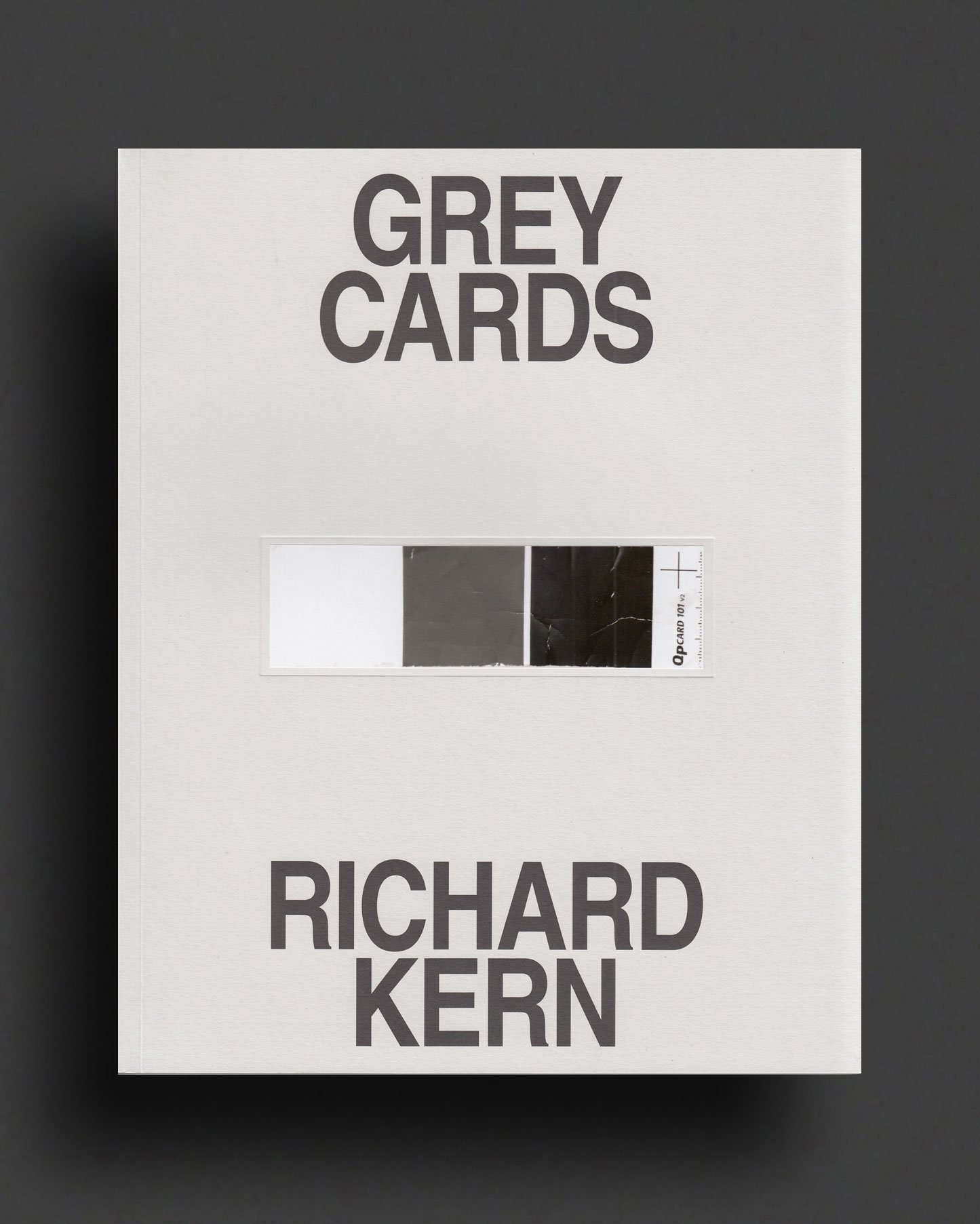
Already out of print at source, published in an edition of only 500 copies, here are the collected notorious 'Grey Card' pictures from Richard Kern, encapsulated in one book. Some candid, some not — Grey Cards is an interesting perspective on the artists practice, and a side of his work long appreciated by many.
"Digital cameras made photography cheap and easy for everyone but one drawback was unreliable image capture. A greycard is used so that the photographer can correct color and lighting during post production work. the photographs in this book are presented here as they came out of the camera."
Richard Kern, photographer and filmmaker remains, first and foremost, a portraitist. For more than two decades Kern has sought to unravel and illuminate the complex and often darker sides of human nature. Kern makes the psychological space between the sitter, photographer and audience his subject. With his dry, matter of fact approach, he underlines the absurdity of truth and objectivity in photography while playing with our reliance upon taxonomies around sexual representation. - Matthew Higgs
First edition of 500 copies. Cover with tipped-in Grey Card.
1998, English / Japanese
Hardcover (w. dust jacket), 100 pages, 37 x 26 cm
1st Edition, Out of print title / used / fine
Published by
Sakuhinsha / Tokyo
$190.00 - In stock -
Scarce first Japanese hardcover edition of Japanese master of erotic fantasy illustration Hajime Sorayama's absolute classic Torquere (Torture), published in 1998. Following the success of best-seller NAGA, Sorayama's Torquere delves deeper into the darker realm of fantasy fetishism and, as the title suggests, into the world of Sadomasochism. This lavish over-sized volume is illustrated cover-to-cover with Sorayama's most explicit works presented in dramatic, glossy full-colour throughout. Rare in this original hardcover edition.
Hajime Sorayama is revered for his erotic airbrushed illustrations of humanoid robots that explore ideals of femininity and beauty. Drawing on pinup pictures, Sorayama published the first book of his signature “Sexy Robot” series of chromium-plated figures in 1983. Decades later, these striking works have sold for more than $500,000. Sorayama started his career in advertising before freelancing in Hollywood, where he helped to produce visuals for sci-fi films. His illustrations gained widespread attention in 1995, when Penthouse began featuring them in a monthly column. While Sorayama has enjoyed a particular cult status for his sensual cyborgs —who appear empowered rather than objectified —he has also received mainstream commercial attention. Sony enlisted him to produce the first designs for its robotic dog AIBO, which won the grand prize for Japan’s Good Design Award in 1999. Sorayama has also worked with fashion titans such as Thierry Mugler and Dior on projects that have extended his illustrations into the realm of wearables, sculpture, and performance.
Near Fine copy.
2025, English
Softcover, 160 pages, 30.5 x 22.6 cm
Published by
Richardson / New York
$77.00 - In stock -
New "California" themed issue of of Richardson magazine, the cult magazine that navigates the murky boundaries between art and obscenity, edited by Andrew Richardson (of Richardson label, fashion stylist w. Supreme, CK, Valentino, etc.) and art direction by Laura Genninger of STUDIO 191 (designer of AnOther Magazine, etc.). Featuring Sky Bri, Photographed by Harley Weir. With additional work by Frances Stark, Mario Ayala, Andy Capper, Bruce Wagner, Ed Ruscha, Bruce LaBruce, Chivas Clem, Alex Kekesi, Delicious Tacos, Jack Mason, Kazumi, Karley Sciortino, Noah Kumin, Taylor Lorenz, Weirdo Dave / Fuck This Life, William E. Jones, Scarlett Kapella, Stewart Home, Rosie Marks, A. Kircher, Anna Khachiyan, and Dasha Nekrasova.
2013, English
Softcover, 160 pages, 30.6 x 22.6 cm
1st Edition, Out of print title / used / fine
Published by
Richardson / New York
$220.00 - In stock -
Incredible seventh issue ("The Death Issue") of Richardson magazine, the cult magazine that navigates the murky boundaries between art and obscenity, edited by Andrew Richardson (of Richardson label, fashion stylist w. Supreme, CK, Valentino, etc.) and art direction by Laura Genninger of STUDIO 191 (designer of AnOther Magazine, etc.). This seventh issue features features Tori Black on the cover (and inside) photographed by Nobuyoshi Araki, Aaron Bondaroff, Antoine D'Agata, Nobuyoshi Araki, Aurel Schmidt, Bela Borsodi, Bill Henson, Bjarne Melgaard, Bret Easton Ellis, Genesis Breyer P-Orridge, Christopher Wool, Cy Twombly, Cyprien Gaillard, Dan Colen, Daniel Johnston, Danny Lyon, Doping Pong, Enrique Metindes, Weirdo Dave / Fuck This Life, Fuyuko Matsui, Giasco Bertoli, Glenn Kenny, Gunter Brus, Hanna Liden, Harmony Korine, Jack Webb, Jack Donoghue, James Dearlove, Jenny Saville, Jim Goad, Joe Coleman, John Holland, John Willie, Pope John Paul II, Kiyotaka Tsurisaki, Leon Lefarge, Michael Schmidt, Mila Djordjevic, Namio Harukawa, Nate Lowman, Pascal Dangin, Paul McCarthy, Peter Saville, Robert Crumb, Raymond Pettibon, Richard Prince, Sophia Al Maria, Stewart Home, Terry Richardson, Toshio Saeki, Trevor Brown, Vince Aletti.
Near Fine copy.
2010, English
Softcover, 128 pages, 30.5 x 22.5 cm
1st Edition, Out of print title / used / very good
Published by
Richardson / New York
$220.00 - In stock -
Incredible fourth issue ("The Female Gaze Issue") of Richardson magazine, the cult magazine that navigates the murky boundaries between art and obscenity, edited by Andrew Richardson (of Richardson label, fashion stylist w. Supreme, CK, Valentino, etc.) and art direction by Laura Genninger of STUDIO 191 (designer of AnOther Magazine, etc.). This fourth issue (The Female Gaze Issue) features the Sasha Grey cover photographed by Glen Luchford (w. continued photo feature inside), and featuring work by Carolee Schneemann, Valie Export, Genesis P-Orridge, GB Jones, Alex Needham, Amy Kellner, Kira Jolliffe, Bunny Yeager, Tristan Taormino, Michelle Maccarone, Mila Djordjevic, Gunter Rambow, V. Vale/ Re/Search, Simon Ford, Clara Herve & Eugene Krafft, Carol Bove, Sue Williams, Tracy Emin, Carolin Kunst & Sunje Todt, Kotaro Iizawa, and much more. Riddled with bans and confiscations due to explicit un-censored imagery by Japanese censorship standards.
Very Good copy.
1998, English / Japanese
Softcover, 128 pages, 30.5 x 22.5 cm
1st Edition, Out of print title / used / very good
Published by
Little More / Tokyo
Richardson / New York
$250.00 - Out of stock
Controversial inaugural (December 1998) issue of Richardson magazine, the cult 1990's art/sex magazine published by Little More in Japan, edited by Andrew Richardson (of Richardson label, fashion stylist w. Supreme, CK, Valentino, etc.) and art direction by Laura Genninger of STUDIO 191 (designer of AnOther Magazine, etc.). Navigating the murky boundaries between art and obscenity, an honourable pursuit in Japan, this first issue features the double-cover (censored and non-censored) of adult film star Jenna Jameson shot by Glen Luchford, along with J.J. photo feature and interview, Richard Prince’s “Spiritual America” text and photography/artworks inc. the infamous 11-year-old Brooke Shields piece, "Be Broken" erotic artwork gallery by Harmony Korine, "Love Letter to Amerika" from Takashi Homma, Terry Richardson photography, "Cunt" fiction by Stewart Home, photos by French cinematographer (Gummo, Ulysse, Boy Meets Girl, etc.) Jean-Yves Escoffier, Japanese V-Cinema and pink star Nao Saejima, Stewart Home on Cosey Fanni Tutti, many works of photography and text by American photojournalist and writer Erika Langley, erotic photography by skater Ed Templeton of photographer and wife Deanna Templeton, vintage erotica collection by photographer Bela Borsodi, poetry and more! Riddled with bans and confiscations due to explicit un-censored imagery by Japanese censorship standards.
Texts in both English and Japanese.
Very Good copy.
2025, English
Softcover, 24 pages, 19 x 13 cm
Published by
Innen Books / Zürich
Kosaku Kanechika / Tokyo
$22.00 - In stock -
Ataru Sato's "Erotomania", published by Innen Books, Zürich, with Kosaku Kanechika, Tokyo, 2022. First edition.
2018, English
Softcover (staple-bound), 32 pages, 13 x 19 cm
Edition of 300,
Published by
Innen Books / Zürich
$22.00 - In stock -
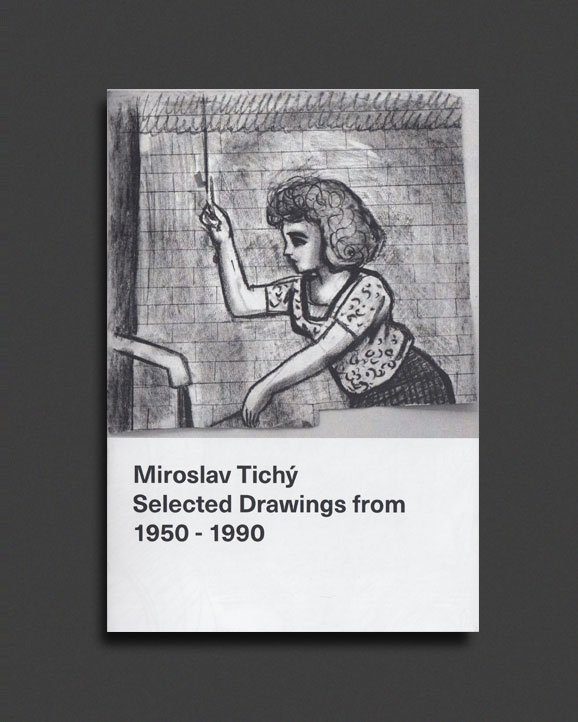
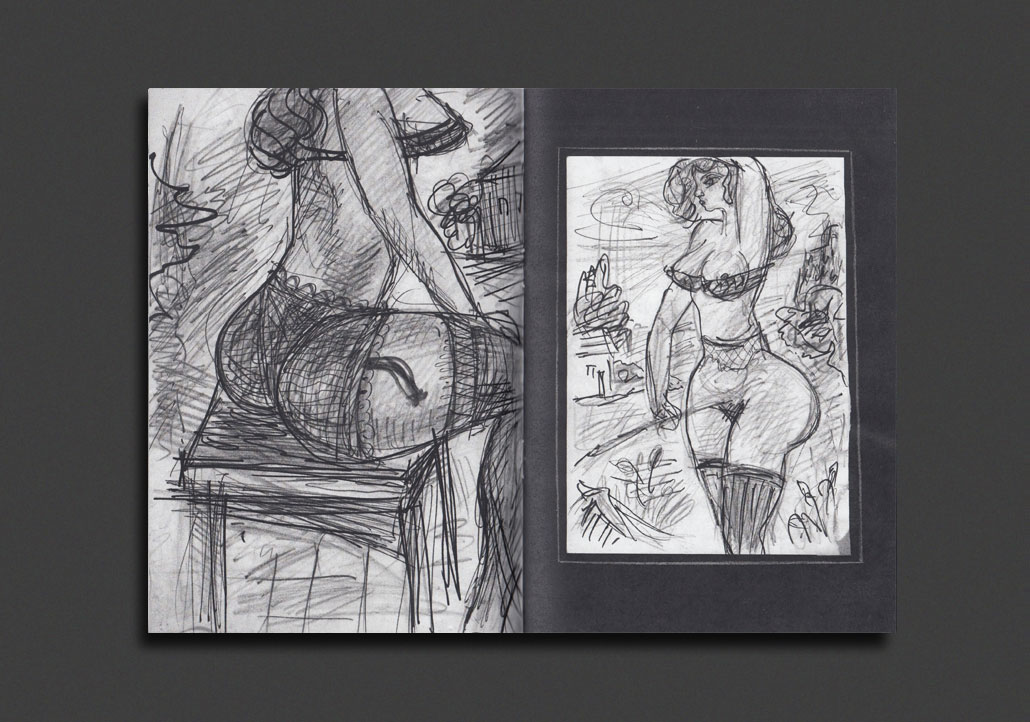
"Selected Drawings from 1950 to 1990" is a limited edition publication dedicated to the rarely seen drawings of the reclusive and mysterious Czech photographer Miroslav Tichý. Published in 2017 by Innen Books in Zürich in an edition of 300 copies only.
Miroslav Tichy (1926-2011)
After studying at the Academy of Arts in Prague (1945-48), Miroslav Tichy withdrew to a life in isolation in his hometown of Kyjov, Moravia, Czech Republic. In the late 1950s he quit painting and became a distinctive Diogenes-like figure. From the end of the 1960s he began to take photographs mainly of local women, in part with cameras he made by hand. He later mounted them on hand-made frames, added finishing touches with pencil, and thus moved them from photography in the direction of drawing. The result are works of strikingly unusual formal qualities, which disregard the rules of conventional photography. They constitute a large oeuvre of poetic, dreamlike views of feminine beauty in a small town under the Czechoslovak Communist regime.
2021, English
Softcover (staple-bound), 40 pages, 13 x 19 cm
Published by
Innen Books / Zürich
$22.00 - In stock -
Nobuyoshi Araki's "Polanography" zine, published by Innen Books, Zürich, in 2021. First Edition.
Nobuyoshi Araki was born in Tokyo in 1940. Given a camera by his father at the ripe age of twelve, Araki has been taking pictures ever since. He studied photography and film at Chiba University and went into commercial photography soon after graduating. In 1970 he created his famous Xeroxed Photo Albums, which he produced in limited editions and sent to friends, art critics, and people selected randomly from the telephone book. Over the years, his bold, unabashed photographs of his private life have been the object of a great deal of controversy and censorship (especially in his native Japan), a fact that has not fazed the artist nor diminished his influence. Celebrated the world-over as one of Japan's leading, most original photographers, to date Araki has published over 400 books of his work.
2010, Japanese
Softcover, 208 pages, 24 x 18.5 cm
1st Edition, Out of print title / used / very good
Published by
Atelier Peyotl / Tokyo
$65.00 - Out of stock
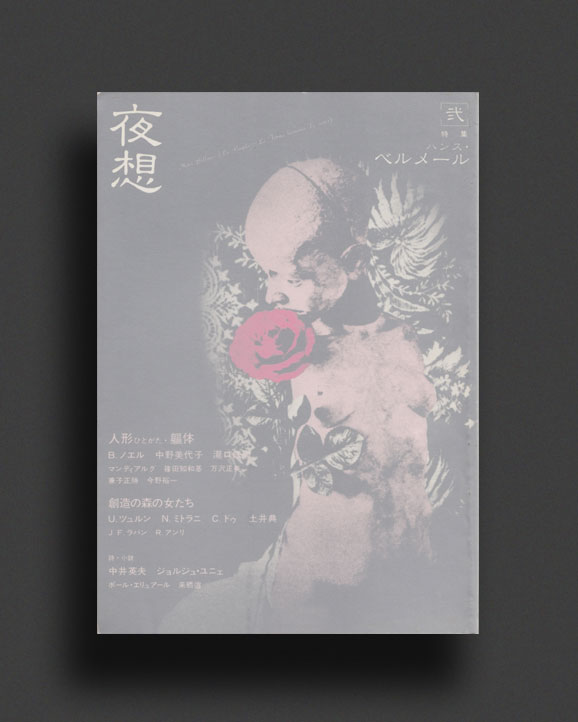
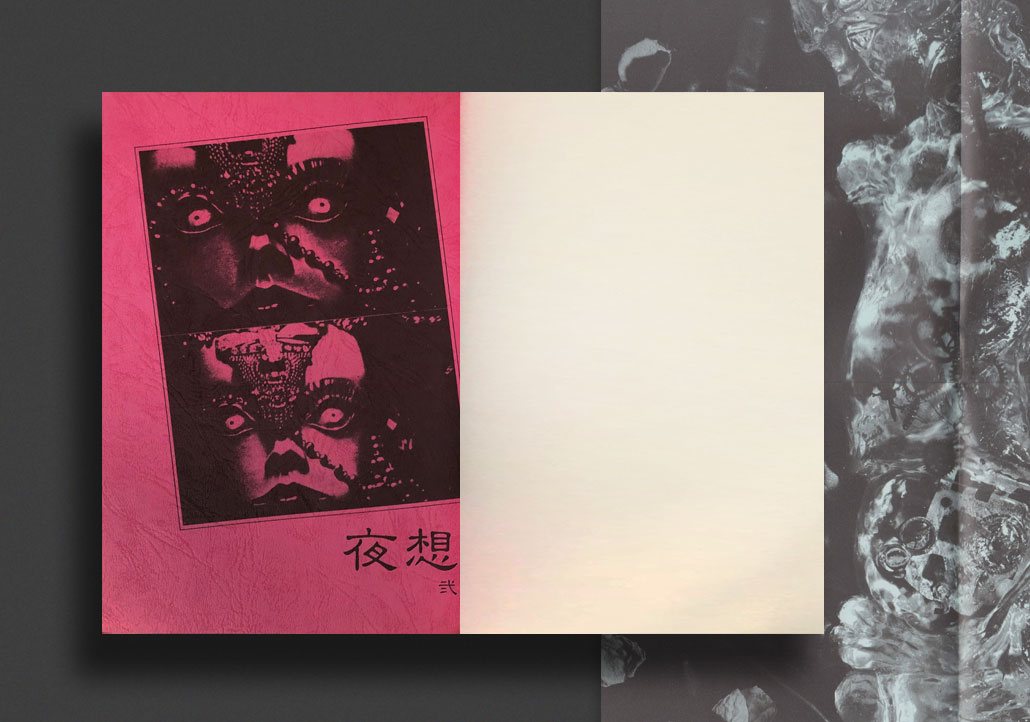
Incredible Hans Bellmer special feature Issue of cult Japanese underground magazine Yaso, published in 2010, edited by Yuichi Konno and Atelier Peyotl (publishers of Night Vision/Yaso/Peyotl/Wave/Silvester Club...). Being a magazine specialising in the doll arts it was only natural that they would dedicate an entire issue to the ground-breaking work of German Surrealist Hans Bellmer and the development of his dolls, and pay homage to his immense influence on Japanese doll artists by discussing his work with them. Heavily illustrated with reproductions of Bellmer's iconic doll photography and drawings, alongside reproduced and translated original texts, extensive chronology of Bellmer and Unica Zürn, the drawing and anagram work of his partner Zürn, an invaluable bibliography of publications related to Bellmer to date, and many portraits of the artist. There is an extensive chronicle of doll history and development stretching from 1902—2010 and a large part of the issue is made up of heavily illustrated exclusive interviews with Japanese artists influenced by the legacy of Bellmer, including Simon Yotsuya, Nori Doi, Ryo Yoshida, Tatsumi Hijikata, Makoto Onozuka, Kishin Shinoyama, Minori Nawata, and more, surveys contemporary doll artists Volks, PEACH-PIT, naruto, Hizuki, Tari Nakagawa, Minori Nawata, Os, Akihiko Aono, mican, Ayumi, Masanao, Katan Amano, Nishioka Bro. & Sis., and many more, and includes essays by Sue Taylor, Alice Mahon, Kumi Ogata... absolutely packed with content and a valuable Bellmer reference in the context of his Japanese influence on the arts.
Very Good copy.
2004, Japanese
Softcover, 176 pages, 24 x 18 cm
1st Edition, Out of print title / used / very good
Published by
Atelier Peyotl / Tokyo
$60.00 - In stock -
"Doll" Special Feature Issue of cult Japanese underground magazine Yaso, published in 2004, edited by Yuichi Konno and Atelier Peyotl (publishers of Night Vision/Yaso/Peyotl/Wave/Silvester Club...). Heavily illustrated with texts in Japanese with in-depth profiles, interviews and essays on leading artists that work with dolls, including contemporary Japanese masters of doll art, Koitsukihime, Katan Amano, Etsuko Miura, Yoshiko Hori, Yogu, Simon Yotsuya, Ryo Yoshida, Akiyama Mahoko, Mari Shimizu, influential Gothic Lolita illustrator Mitsukazu Mihara, Nori Doi, legendary Czech artist and animator Jan Švankmajer, Polish artist and theatre director Tadeusz Kantor, Japanese photographer Miwa Yanagi, film-maker Floria Sigismondi, Louise Bourgeois, Slawomir Rumiak, Nori Doi, and a fantastic illustrated book guide of doll-related art books and literature, from Mary Shelley to The Surrealists, Hans Bellmer, Ken Katayama, Pierre Mollinier, Makoto Aida, Irina Ionesco, H.R. Giger...
Very Good copy with some wear to cover extremities.
2025, English
Softcover (staple-bound), 12 pages, 13.4 x 13.6 cm
Limited Edition,
Published by
Oriette Wood / Naarm
$40.00 - In stock -
"Comic Trials" is a new small edition hand silk-screen and assembled graphic zine from Oriette Wood.
"A homage to the golden age of comics, this screen printed publication is an exercise of drawing and half-toning in colour, formatted like a comic panel. Like a lot of my work these pages are scenes of love, kink, femininity, and something other."—Oriette Wood
Silkscreened in very limited edition