World Food Books' programme is largely produced on Kulin Nation land. We acknowledge the Wurundjeri people of the Kulin Nation as the first and continuing custodians of this land, and pay respect to their Elders past, present, and emerging.
World Food Books is an arts and special interests bookshop in Naarm / Melbourne. Founded in 2010, World Food Books is devoted to the presentation of a rotating, hand-selection of international art, design, literary and counterculture publications with an emphasis on the anti-traditional, the experimental, the avant-garde, the heretic, the marginal.
Presenting new titles alongside rare and out-of-print books, catalogues and journals spanning the fields of modern and contemporary art, design, photography, illustration, film, literature, poetry, cultural theory, philosophy, sexuality, popular and underground culture in its many radical forms, World Food Books wishes to encourage adventurous, thoughtful and open-minded reading, looking, writing, and exchange of publishing and ideas, both current and historical.
As well as our bookshop, located in Melbourne's historical Nicholas Building, all of our inventory is available internationally via our online mail-order service.
World Food Books semi-regularly co-ordinates "Occasions", a programme of exhibits and events at the bookshop and in partnership with other hosts (such as museums and art galleries) that develop out of the activities, relationships and content of the bookshop itself.
World Food Books
The Nicholas Building
37 Swanston Street
Room 5, Level 6
Melbourne 3000
Australia
SHOP HOURS:
THU–SAT 12–6
WEB-SHOP OPEN 24/7
World Food Books
Postal Address:
PO Box 435
Flinders Lane
Victoria 8009
Australia
info@worldfoodbooks.com
Art
Theory / Essay
Architecture / Interior
Graphic Design / Typography
Photography
Fashion
Eros
LGBTQ+
Fiction / Poetry
Weird / Speculative / Science Fiction / Horror
Transgressive / Visceral / Abject
Symbolism / Decadence / Fin de siècle
Film / Video
Painting
Sculpture / Installation
Performance / Dance / Theater
Drawing
Sound / Music
Curatorial
Group Shows / Collections
Periodicals
Out-of-print / Rare
Posters / Ephemera / Discs
Signed Books
World Food Books Gift Voucher
World Food Book Bag
Australian Art
Australian Fiction
Australian Science Fiction / Speculative Fiction
Australian Poetry
Australian Photography
Japanese Photography
Conceptual Art
Minimal Art
Dada
'Pataphysics / Oulipo
Fluxus
Concrete Poetry
Pop Art
Surrealism
Arte Povera
Arte Informale / Haute Pâte / Tachism
Nouveau Réalisme / Zero / Kinetic
Situationism / Lettrism
Collage / Mail Art / Xerox Art
Art Brut / Folk / Visionary / Fantastic
Illustration / Graphic Art / Bandes Dessinées
Furniture
Italian Radical Design / Postmodernism
Textiles
Ceramics / Glass
Counterculture
Protest / Revolt
Philosophy
Psychoanalysis
Anthropology
Anarchism
Socialism / Anarchism / Communism / Capitalism
Literary Theory / Semiotics / Language
Feminism / Women's Studies
Gender Studies / Sexuality
Anthropology
Fetishism / BDSM
Drugs / Psychedelia
Crime / Violence
Animal Rights / Veganism
Occult / Esoterica
Ecology / Earth / Alternative Living
Whole Earth / Crafts
All prices in AUD (Australian dollars)
Pick-Ups
Pick-up orders can be collected in our bookshop during opening hours after order date. Please collect any Pick-up orders within 2 weeks of ordering as we have limited storage space. Orders will be released back into stock if not collected within this time. No refunds can be made for pick-ups left un-collected. If you cannot make it in to the bookshop in this time-frame, please choose postage option.
Return Policy
All sales are final. We do accept returns (for refund or exchange) for items received in error. All our orders are packed with special care using heavy-duty padding and cardboard book-mailers or bubble mailers (for smaller books), using reinforcement where required. We cannot take responsibility for any lost, stolen or damaged parcels.
Insurance
Should you wish to insure your package, please email us directly after placing your order and we can organise this at a small extra expense. Although all standard/express tracked packages are very safe and dependable, we cannot take responsibility for any lost, stolen or damaged parcels. We recommend insurance on valuable orders.
Interested in selling your old books, catalogues, journals, magazines, comics, fanzines, ephemera? We are always looking for interesting, unusual and out-of-print books to buy. We only buy books in our fields of interest and specialty, and that we feel we can resell.
We base these prices on desirability, market value, in-print prices, condition and our current stock levels. We offer cash, store credit, and can take stock on consignment. All
about 25% of the price we expect to get when we sell them, or 30% in store credit. We base these prices on desirability, market value, in-print prices, condition and our current stock levels.
Sell your books any day of the week. You can drop them off and return later. If you have a lot of books, we can visit your Sydney home.
We buy books that we feel we can resell. We offer about 25 % of the price we expect to get when we sell them, or 30% in store credit. We base these prices on desirability, market value, in-print prices, condition and our current stock levels.
Philadelphia Wireman
03 August - 01 September, 2018
World Food Books is proud to announce our next Occasion, the first presentation of sculptures by Philadelphia Wireman in Australia.
The Philadelphia Wireman sculptures were found abandoned in an alley off Philadelphia’s South Street on trash night in 1982. Their discovery in a rapidly-changing neighbourhood undergoing extensive renovation, compounded with the failure of all attempts to locate the artist, suggests that the works may have been discarded after the maker’s death. Dubbed the "Philadelphia Wireman" during the first exhibition of this work, in 1985, the maker’s name, age, ethnicity, and even gender remain uncertain. The entire collection totals approximately 1200 pieces, all intricately bound together with tightly-wound heavy-gauge wire (along with a few small, abstract marker drawings, reminiscent both of Mark Tobey and J.B. Murry). The dense construction of the work, despite a modest range of scale and materials, is singularly obsessive and disciplined in design: a wire armature or exoskeleton firmly binds a bricolage of found objects including plastic, glass, food packaging, umbrella parts, tape, rubber, batteries, pens, leather, reflectors, nuts and bolts, nails, foil, coins, toys, watches, eyeglasses, tools, and jewellery.
Heavy with associations—anthropomorphic, zoomorphic, and socio-cultural responses to wrapped detritus—the totemic sculptures by Philadelphia Wireman have been discussed in the context of work created to fulfil the shamanistic needs of alternative religions in American culture. Curators, collectors, and critics have variously compared certain pieces to sculpture from Classical antiquity, Native American medicine bundles, African-American memory jugs, and African fetish objects. Reflecting the artist’s prolific and incredibly focused scavenging impulse, and despite—or perhaps enhanced by—their anonymity, these enigmatic objects function as urban artefacts and arbiters of power, though their origin and purpose is unknown. Philadelphia Wireman, whatever their identity, possessed an astonishing ability to isolate and communicate the concepts of power and energy through the selection and transformation of ordinary materials. Over the course of the past two decades, this collection has come to be regarded as an important discovery in the field of self-taught art and vernacular art.
Presented in collaboration with Fleisher-Ollman Gallery, Philadelphia, and Robert Heald, Wellington.
Susan Te Kahurangi King
02 February - 10 March, 2018
Susan Te Kahurangi King (24 February 1951 - ) has been a confident and prolific artist since she was a young child, drawing with readily available materials - pencils, ballpoint pens and felt-tip markers, on whatever paper is at hand. Between the ages of four and six Susan slowly ceased verbal communication. Her grandparents William and Myrtle Murphy had developed a special bond with Susan so they took on caring responsibilities for extended periods. Myrtle began informally archiving her work, carefully collecting and storing the drawings and compiling scrapbooks. No drawing was insignificant; every scrap of paper was kept. The King family are now the custodians of a vast collection containing over 7000 individual works, from tiny scraps of paper through to 5 meter long rolls.
The scrapbooks and diaries reveal Myrtle to be a woman of great patience and compassion, seeking to understand a child who was not always behaving as expected. She encouraged Susan to be observant, to explore her environment and absorb all the sights and sounds. Myrtle would show Susan’s drawings to friends and people in her community that she had dealings with, such as shopkeepers and postal workers, but this was not simply a case of a grandmother’s bias. She recognised that Susan had developed a sophisticated and unique visual language and sincerely believed that her art deserved serious attention.
This was an unorthodox attitude for the time. To provide some context, Jean Dubuffet coined the term Art Brut in 1945 to describe work created by self-taught artists – specifically residents of psychiatric institutions and those he considered to be visionaries or eccentrics. In 1972 Roger Cardinal extended this concept by adopting the term Outsider Art to describe work made by non-academically trained artists operating outside of mainstream art networks through choice or circumstance. Susan was born in Te Aroha, New Zealand in 1951, far from the artistic hubs of Paris and London that Dubuffet and Cardinal operated in. That Myrtle fêted Susan as a self-taught artist who deserved to be taken seriously shows how progressive her attitudes were.
Susan’s parents Doug and Dawn were also progressive. Over the years they had consulted numerous health practitioners about Susan’s condition, as the medical establishment could not provide an explanation as to why she had lapsed into silence. Dawn educated herself in the field of homeopathy and went on to treat all twelve of her children using these principles – basing prescriptions on her observations of their physical, mental and emotional state.
Doug was a linguist with an interest in philosophy who devoted what little spare time he had to studying Maori language and culture. To some extent their willingness to explore the fringes of the mainstream made them outsiders too but it was their commitment to living with integrity and their respect for individuality that ensured Susan’s creativity was always encouraged.
Even though Susan’s family supported her artistic pursuits, some staff in schools and hospitals saw it as an impediment to her assimilation into the community and discouraged it in a variety of ways. Her family was not always aware of this and therefore did not fully understand why Susan stopped drawing in the early 1990s. However, rather than dwell on the challenges that Susan faced in pursuit of her artistic practice, they prefer to highlight her achievements. In 2008 Susan began drawing again in earnest, after an almost 20 year interruption, and her work is now shown in galleries around the world.
Susan grew up without television and has been heavily influenced by the comics she read as a child. She is absolutely fearless in the appropriation of recognizable characters, such as Donald Duck and Mickey Mouse, in her work. She twists their limbs, contorts their faces, compresses them together, blends them into complex patterned backgrounds - always imbuing them with an incredible energy. Although Susan often used pop culture characters in her work they are not naive or childlike. These are drawings by a brilliant self-taught artist who has been creating exceptional work for decades without an audience in mind.
Mladen Stilinović
"Various Works 1986 - 1999"
02 February 16 - September 10, 2016
Various works 1986 - 1999, from two houses, from the collections of John Nixon, Sue Cramer, Kerrie Poliness, Peter Haffenden and Phoebe Haffenden.
Including: Geometry of Cakes (various shelves), 1993; Poor People’s Law (black and white plate), 1993; White Absence (glasses, ruler, set square, silver spoon, silver ladel with skin photograph and wooden cubes), 1990-1996; Exploitation of the Dead (grey and red star painting, wooden painting, black spoon with red table, red plate), 1984-1990; Money and Zeros (zero tie, paintings made for friends in Australia (Sue, John, Kerrie), numbers painting), 1991-1992; Words - Slogans (various t-shirts) - “they talk about the death of art...help! someone is trying to kill me”, “my sweet little lamb”, “work is a disease - Karl Marx”; Various artist books, catalogues, monographs, videos; Poster from exhibition Insulting Anarchy; "Circular" Croatian - Australian edition; Artist book by Vlado Martek (Dostoyevsky); more.
Thanks to Mladen Stilinović and Branka Stipančić.
Jonathan Walker
Always Will Need To Wear Winter Shirt Blue + Ochre Small Check Pattern
21 August - 21 September, 2015
Untitled
I am not a great reader of poetry but I always return to the work of Melbourne poet, Vincent Buckley (1925- 1988). Perhaps I find his most tantalising piece to be not a finished poem but a fragment left on a scrap of paper discovered on his desk after the poet’s death.
The poetry gathers like oil
In the word-core, and spreads
It has its music meet,
Its music is in movement.
This fragment is more the shell left behind from a volatile thought than a finished poem. I find the last two lines honest but awkward whereas the first two lines work like an arrow. Most likely he could not find a resolution so it was left. Still, in its present form, it remains an eloquent testimony to the ultimate failure of a medium to express mobile thought and sensation, in Buckley’s case, through verbal language. It’s an important matter because this is something all artists have to deal with regardless of the medium.
I have never written a poem, however, I am forever copying fragments from books on paper scraps in a vain effort to fix certain notions in my head. At first, they function as bookmarks that are sometimes returned to when I open the book. But before long, as they accumulate, they fall out littering the table interspersed with A4 photocopies, bills, books and medications.
To return to Buckley’s fragment, the first two lines very much evoke how I paint nowadays. As you age, detail diminishes and patches of light become more luminous and float. I feel the most honest way of dealing with this is by smearing the oil paint on the canvas with the fingers and working close-up, blind. Only if the patches coalesce into an approaching image can the work gain a life.
-
Jonathan Walker was born in Melbourne, Australia and brought up on a dairy farm in Gippsland. In the 1970’s he studied painting at RMIT and won the Harold Wright Scholarship to the British Museum, London. During the 1980’s he exhibited at Pinacotheca Gallery, Richmond and had work shown at the NGV and Heidi City Art Gallery. Over the same period he designed the cover for the “Epigenesi” LP by Giancarlo Toniutti, Italy and conducted a mail exchange work with Achim Wollscheid, Germany. The work with artists through the post resulted in an article published in the bicentenary issue of Art and Australia 1988. He showed in artist run spaces such as WestSpace in the 90’s and 2000’s, and until 2012, taught painting at Victoria University, which is where we (Colleen Ahern and Lisa Radford) as organisers of the exhibition, among many others, had the privilege of being his student.
Walker’s knowledge was imparted to students through the careful selection of music, literature, and artists found in books that he himself had ordered for the library. Walker’s strategy was the generosity of sharing his vast knowledge with references specific to each student and their context.
Walker’s paintings share a similar focus and intimacy.
This exhibition presents a small selection of recent paintings alongside a publication that includes Walker’s writing. Observational and analytical, Walker’s work is a type of material notation — the time of day, colour and how it is blended, the both specific and fleeting location of a reflection on lino or the question of whether a chair leg should be included in a painting.
Please join us on Friday August 21 between 6-8pm to celebrate the opening of the exhibition.
Curated by Colleen Ahern and Lisa Radford.
B. Wurtz
Curated by Nic Tammens
March 26 - April 4, 2015
B.Wurtz works from a basement studio in his home on Manhattan’s Lower East Side.
This local fact is attested to by the plastic shopping bags and newsprint circulars that appear in his work. As formal objects, they don’t make loud claims about their origins but nonetheless transmit street addresses and places of business from the bottom of this long thin island. Like plenty of artists, Wurtz is affected by what is local and what is consumed. His work is underpinned by this ethic. It often speaks from a neighborhood or reads like the contents of a hamper:
“BLACK PLUMS $1.29 lb.”
“Food Bazaar”
“USDA Whole Pork Shoulder Picnic 99c lb.”
“RITE AID Pharmacy, with us it’s personal.”
“H. Brickman & Sons.”
“Sweet Yams 59c lb."
Most of the work in this exhibition was made while the artist was in residence at Dieu Donne, a workshop dedicated to paper craft in Midtown. Here Wurtz fabricated assemblages with paper and objects that are relatively lightweight, with the intention that they would be easily transportable to Australia. This consideration isn’t absolute in Wurtz’s work, but was prescriptive for making the current exhibition light and cheap. Packed in two boxes, these works were sent from a USPS post office on the Lower East Side and delivered to North Melbourne by Australia Post.
Wurtz appears courtesy of Metro Pictures, New York.
Thanks to Rob Halverson, Joshua Petherick, Sari de Mallory, Matt Hinkley, Helen Johnson, Fayen d'Evie, Ask Kilmartin, Lisa Radon, Ellena Savage, Yale Union, and "Elizabeth".
John Nixon
"Archive"
December 15 - January 20, 2014
The presentation of John Nixon's archive offered a rare showcase of this extensive collection of the artist's own publications, catalogues, posters, ephemera, editions and more, from the mid 1980s onwards, alongside a selection of his artworks.
Organized by John Nixon, Joshua Petherick and Matt Hinkley.
"Habitat"
at Minerva, Sydney (organised by Joshua Petherick and Matt Hinkley)
November 15 - December 20, 2014
Lupo Borgonovo, Janet Burchill & Jennifer McCamley,
Lewis Fidock, HR Giger, Piero Gilardi, Veit Laurent Kurz,
Cinzia Ruggeri, Michael E. Smith, Lucie Stahl, Daniel Weil, Wols
Press Release:
“...It contained seven objects. The slender fluted bone, surely formed for flight, surely from the wing of some large bird. Three archaic circuitboards, faced with mazes of gold. A smooth white sphere of baked clay. An age-blackened fragment of lace. A fingerlength segment of what she assumed was bone from a human wrist, grayish white, inset smoothly with the silicon shaft of a small instrument that must once have ridden flush with the surface of the skin - but the thing’s face was seared and blackened.”
William Gibson, “Count Zero”, 1986
"Autumn Projects Archive"
Curated by Liza Vasiliou
March 6 - March 15, 2014
World Food Books, in conjunction with the Virgin Australia Melbourne Fashion Festival 2014, presented the Autumn Projects archive, consisting of a selection of early examples in Australian fashion with a particular interest in collecting designers and labels from the period beginning in the 1980’s, who significantly influenced the discourse of Australian Fashion.
Curated by Liza Vasiliou, the exhibition provided a unique opportunity to view pieces by designers Anthea Crawford, Barbara Vandenberg, Geoff Liddell and labels CR Australia, Covers, Jag along with early experimental collage pieces by Prue Acton and Sally Browne’s ‘Fragments’ collection, suspended throughout the functioning World Food Books shop in Melbourne.
H.B. Peace
presented by CENTRE FOR STYLE
November 14, 2013
"Hey Blinky, you say chic, I say same"
Anon 2013
H.B. Peace is a clothing collaboration between great friends Blake Barns and Hugh Egan Westland. Their pieces explore the divergences between 'character’ and ‘personality’ in garments....etc
Special Thanks to Joshua Petherick and Matt Hinkley of WFB and Gillian Mears
and a Very Special Thank you to Audrey Thomas Hayes for her shoe collaboration.
Janet Burchill & Jennifer McCamley
"Aesthetic Suicide"
May 10 - June 8, 2013
The first of our occasional exhibitions in the World Food Books office/shop space in Melbourne, "Aesthetic Suicide" presented a body of new and older works together by artists Janet Burchill & Jennifer McCamley, including videos, prints, a wall work, and publications.
During shop open hours videos played every hour, on the hour.
1988, Japanese
Softcover, 300 pages, 21 x 15 cm
1st Edition, Out of print title / used / very good
Published by
Million Publishing / Tokyo
$70.00 - In stock -
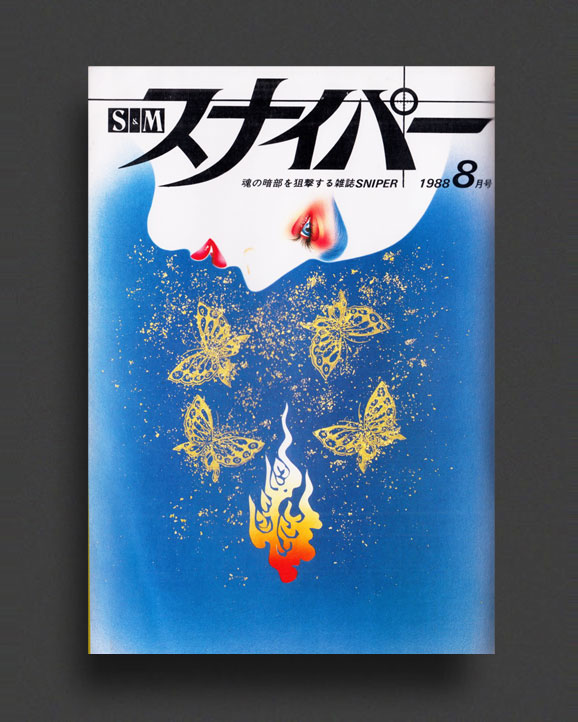
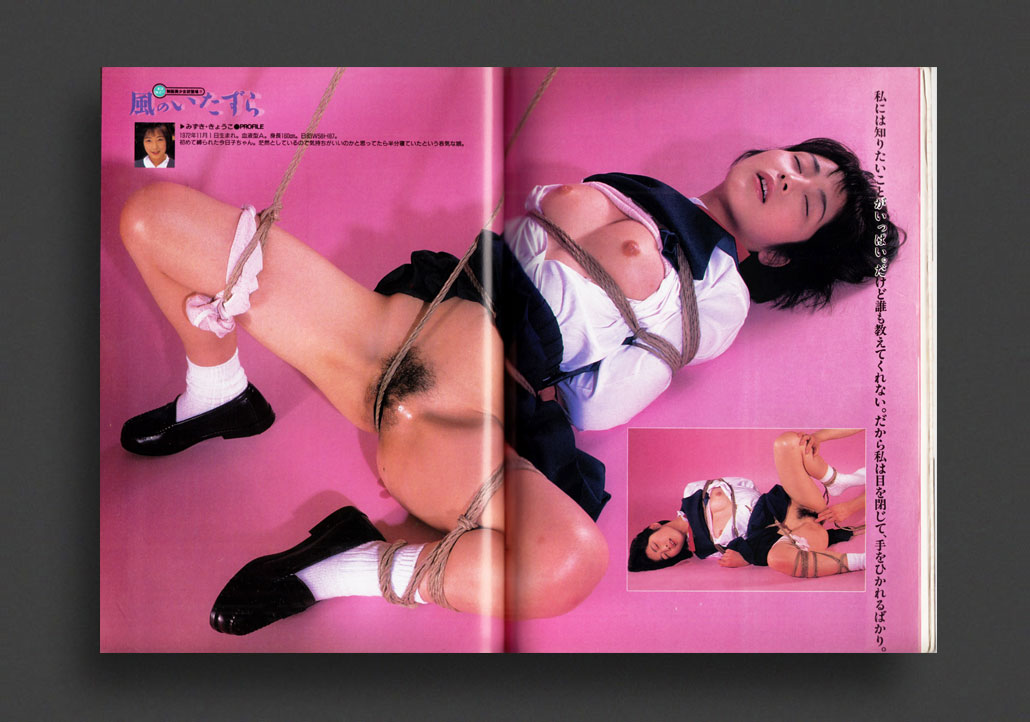
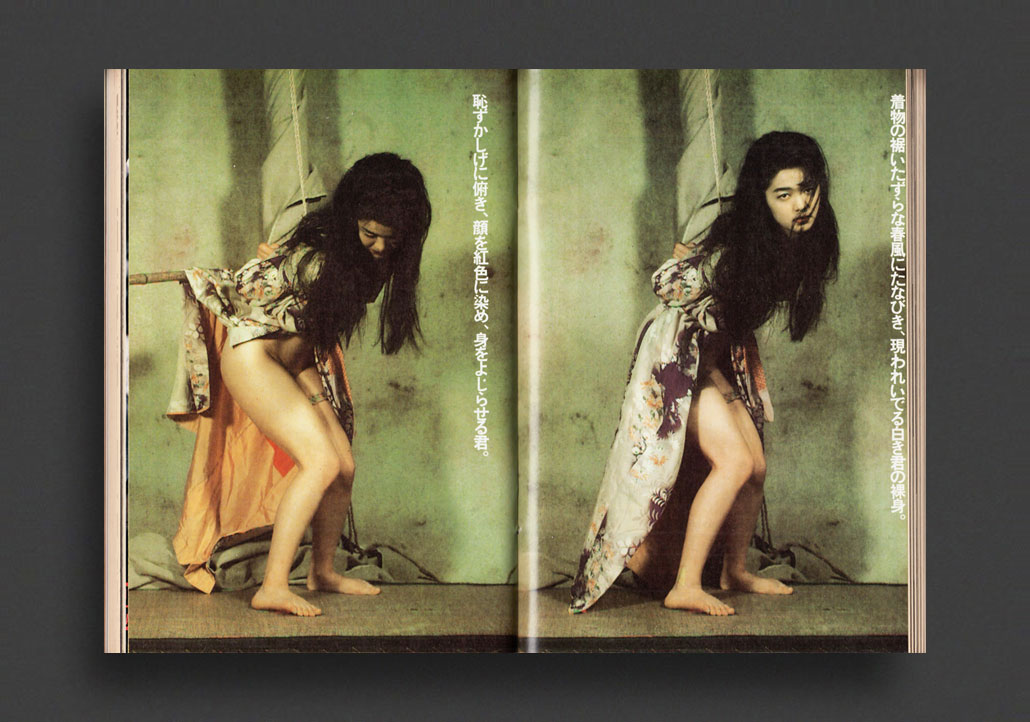
August 1988 issue of S&M Sniper, the cutting-edge cult glossy fetish magazine published in Japan between 1979—2009 that, unlike previous SM magazines, didn't centre so much around professional kinbakushi, favouring instead the exploration of new innovations of fetish and underground sex culture and emphasising the work of the models, stylists, make-up artists, and fashions designers, as much as the writers or photographers. The "new wave" of SM counterculture, embedded in 1980s underground music, fashion and visual art culture in Japan. Explicitly and profusely illustrated, each issue came wrapped in the iconic hyper-stylized airbrushed front covers of artist Yosuke Onishi, veiling the core content of non-fiction realist degradation and an eclectic, expressive editorial of kinbaku and all manner of SM, and extreme fetish photoshoots, illustrations, comics, essays, diaries, reports, exhibitions, reviews, interviews, and included regular contributors such as SM archivist and noise musician Masami Akita (Merzbow), legendary SM writer and editor Dan Oniroku ("the most celebrated writer of popular SM novels in Japan"), features by legendary SM and seppuku performer, actress, and author Hiromi Saotome, features by contributing photographers Nobuyoshi Araki, Masaaki Toyoura, Kenichi Murata, Nobuhiko Ansai, Kinichi Tanaka, Domu Kitahara, sadistic BDSM trainer Shima Shikou, and regular writings by convicted murderer and cannibal Issei Sagawa!! Including his translations of Guido Crepax comics from Italian to Japanese. This was not a magazine like the others. Each issue is also brimming with amazing Japanese advertisements and classifieds for the latest bondage clubs, boutiques, dungeons, fashion, toys, video and publication catalogues, hook-ups, phone sex, and much more.
This issue includes Nobuyoshi Araki, Yosuke Onishi, Katsu Yoshida, Chiharu Kitahara, Kinichi Tanaka, Keiko Kool Queen, Tadashi Chigusa, Erika Sakurazawa, Kazu Hamada, Yukimasa Okumura, Domu Kitahara, Ritsuko Hara, Shima Shikou, Hiroshi Yumemura, Riichi Inugami, Miki Sato, Tetsuo Amano, Mika Kitamura, Hiromi Takase, Masako Tsuzuki, Suehiro Tanemura, Yosuke Onishi, Ryo Aki, Masahito Tokuno, all the usual and more... Not for the faint of heart.
Very Good copy.
1985, Japanese
Softcover, 290 pages, 21 x 15 cm
1st Edition, Out of print title / used / very good
Published by
Million Publishing / Tokyo
$80.00 - Out of stock
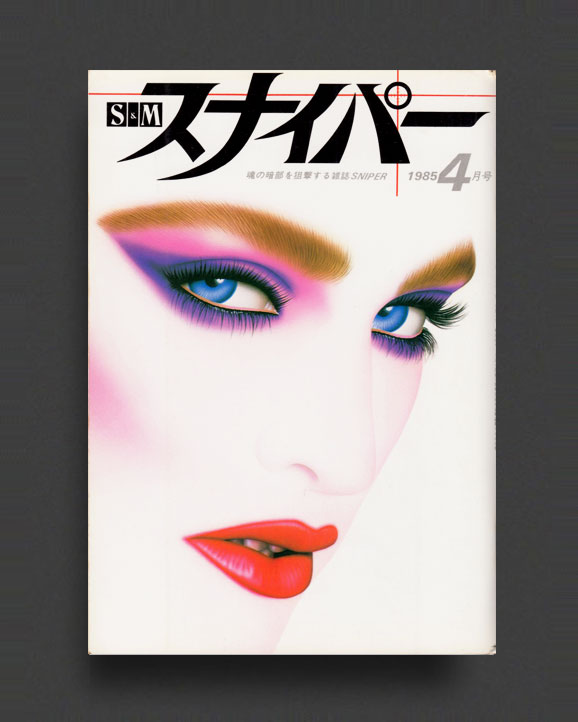
April 1985 issue of S&M Sniper, the cutting-edge cult glossy fetish magazine published in Japan between 1979—2009 that, unlike previous SM magazines, didn't centre so much around professional kinbakushi, favouring instead the exploration of new innovations of fetish and underground sex culture and emphasising the work of the models, stylists, make-up artists, and fashions designers, as much as the writers or photographers. The "new wave" of SM counterculture, embedded in 1980s underground music, fashion and visual art culture in Japan. Explicitly and profusely illustrated, each issue came wrapped in the iconic hyper-stylized airbrushed front covers of artist Yosuke Onishi, veiling the core content of non-fiction realist degradation and an eclectic, expressive editorial of kinbaku and all manner of SM, and extreme fetish photoshoots, illustrations, comics, essays, diaries, reports, exhibitions, reviews, interviews, and included regular contributors such as SM archivist and noise musician Masami Akita (Merzbow), legendary SM writer and editor Dan Oniroku ("the most celebrated writer of popular SM novels in Japan"), features by legendary SM and seppuku performer, actress, and author Hiromi Saotome, features by contributing photographers Nobuyoshi Araki, Masaaki Toyoura, Kenichi Murata, Nobuhiko Ansai, Kinichi Tanaka, Domu Kitahara, sadistic BDSM trainer Shima Shikou, and regular writings by convicted murderer and cannibal Issei Sagawa!! Including his translations of Guido Crepax comics from Italian to Japanese. This was not a magazine like the others. Each issue is also brimming with amazing Japanese advertisements and classifieds for the latest bondage clubs, boutiques, dungeons, fashion, toys, video and publication catalogues, hook-ups, phone sex, and much more.
This issue includes Nobuyoshi Araki, Yosuke Onishi, Fumika Kitahara, Ryo Aki, actress Jun Marumo, Kiyoshi Nakamura, Hiromi Hiraguchi manga, actress Kate Asabuki, Kinichi Tanaka, all the usual and more... Not for the faint of heart.
Very Good copy.
1993, Japanese
Softcover, 320 pages, 21 x 15 cm
1st Edition, Out of print title / used / very good
Published by
Million Publishing / Tokyo
$70.00 - In stock -
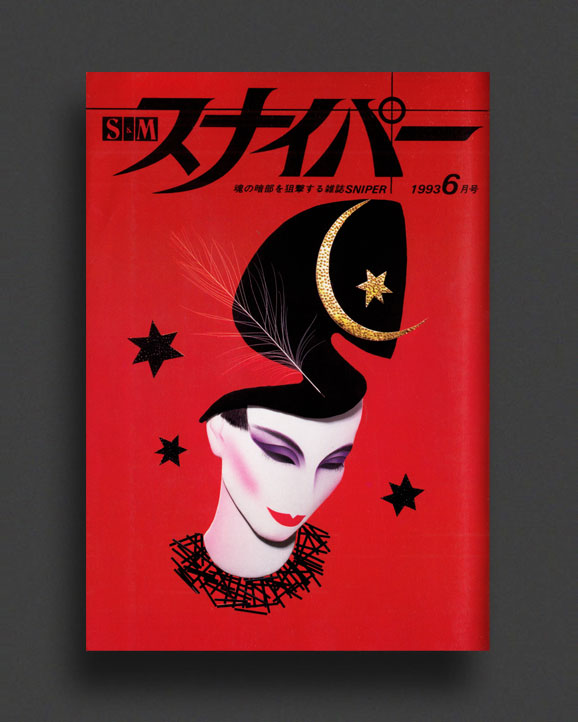
July 1993 issue of S&M Sniper, the cutting-edge cult glossy fetish magazine published in Japan between 1979—2009 that, unlike previous SM magazines, didn't centre so much around professional kinbakushi, favouring instead the exploration of new innovations of fetish and underground sex culture and emphasising the work of the models, stylists, make-up artists, and fashions designers, as much as the writers or photographers. The "new wave" of SM counterculture, embedded in 1980s underground music, fashion and visual art culture in Japan. Explicitly and profusely illustrated, each issue came wrapped in the iconic hyper-stylized airbrushed front covers of artist Yosuke Onishi, veiling the core content of non-fiction realist degradation and an eclectic, expressive editorial of kinbaku and all manner of SM, and extreme fetish photoshoots, illustrations, comics, essays, diaries, reports, exhibitions, reviews, interviews, and included regular contributors such as SM archivist and noise musician Masami Akita (Merzbow), legendary SM writer and editor Dan Oniroku ("the most celebrated writer of popular SM novels in Japan"), features by legendary SM and seppuku performer, actress, and author Hiromi Saotome, features by contributing photographers Nobuyoshi Araki, Masaaki Toyoura, Kenichi Murata, Nobuhiko Ansai, Kinichi Tanaka, Domu Kitahara, sadistic BDSM trainer Shima Shikou, and regular writings by convicted murderer and cannibal Issei Sagawa!! Including his translations of Guido Crepax comics from Italian to Japanese. This was not a magazine like the others. Each issue is also brimming with amazing Japanese advertisements and classifieds for the latest bondage clubs, boutiques, dungeons, fashion, toys, video and publication catalogues, hook-ups, phone sex, and much more.
This issue includes Nobuyoshi Araki, Yosuke Onishi, Katsu Ashita, Kinichi Tanaka, Shima Shikou, Chihiro Abe, Wakao Takahashi, Domu Kitahara, Kazu Hamada, Norito Mishima, Takashi Ishii, all the usual and more... Not for the faint of heart.
Very Good copy.
1996, Japanese
Softcover, 368 pages, 21 x 15 cm
Published by
Million Publishing / Tokyo
$70.00 - Out of stock
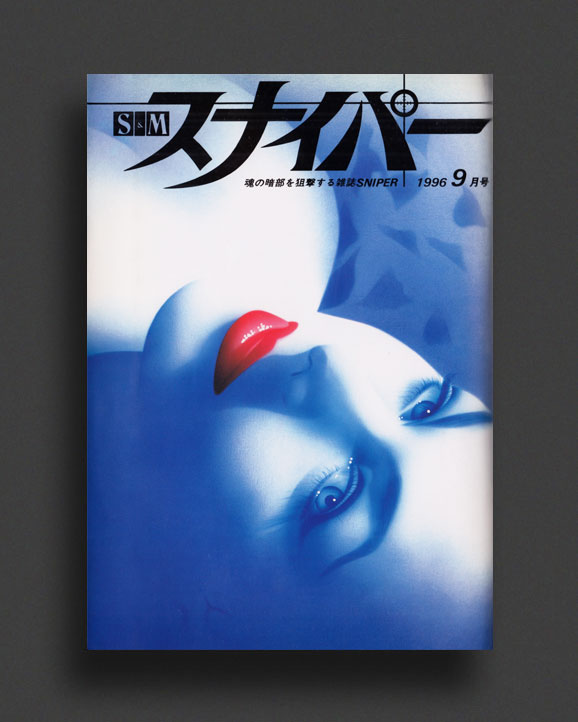
September 1996 issue of S&M Sniper, the cutting-edge cult glossy fetish magazine published in Japan between 1979—2009 that, unlike previous SM magazines, didn't centre so much around professional kinbakushi, favouring instead the exploration of new innovations of fetish and underground sex culture and emphasising the work of the models, stylists, make-up artists, and fashions designers, as much as the writers or photographers. The "new wave" of SM counterculture, embedded in 1980s underground music, fashion and visual art culture in Japan. Explicitly and profusely illustrated, each issue came wrapped in the iconic hyper-stylized airbrushed front covers of artist Yosuke Onishi, veiling the core content of non-fiction realist degradation and an eclectic, expressive editorial of kinbaku and all manner of SM, and extreme fetish photoshoots, illustrations, comics, essays, diaries, reports, exhibitions, reviews, interviews, and included regular contributors such as SM archivist and noise musician Masami Akita (Merzbow), legendary SM writer and editor Dan Oniroku ("the most celebrated writer of popular SM novels in Japan"), features by legendary SM and seppuku performer, actress, and author Hiromi Saotome, features by contributing photographers Nobuyoshi Araki, Masaaki Toyoura, Kenichi Murata, Nobuhiko Ansai, Kinichi Tanaka, Domu Kitahara, sadistic BDSM trainer Shima Shikou, and regular writings by convicted murderer and cannibal Issei Sagawa!! Including his translations of Guido Crepax comics from Italian to Japanese. This was not a magazine like the others. Each issue is also brimming with amazing Japanese advertisements and classifieds for the latest bondage clubs, boutiques, dungeons, fashion, toys, video and publication catalogues, hook-ups, phone sex, and much more.
This issue includes Yosuke Onishi, Nobuyoshi Araki, Wakao Takahashi, Kinichi Tanaka, Shima Shikou, Kenishi Murata, interview with ropemaster Nagaike Takeshi, Sniper mistress queen Sayaka Akiyoshi with photography by Chihiro Abe, Namio Harukawa, German SM travelogue with Japanese mistress Asuka, Keiichi Koyabu, Domu Kitahara, Masami Akita (Merzbow), Kazu Hamada, Yuki Kahoru, Mizuki Kyoko, Yoshiro Hori, all the usual and more... Not for the faint of heart.
Very Good copy.
1992, Japanese
Softcover, 320 pages, 21 x 15 cm
1st Edition, Out of print title / used / very good
Published by
Million Publishing / Tokyo
$70.00 - In stock -
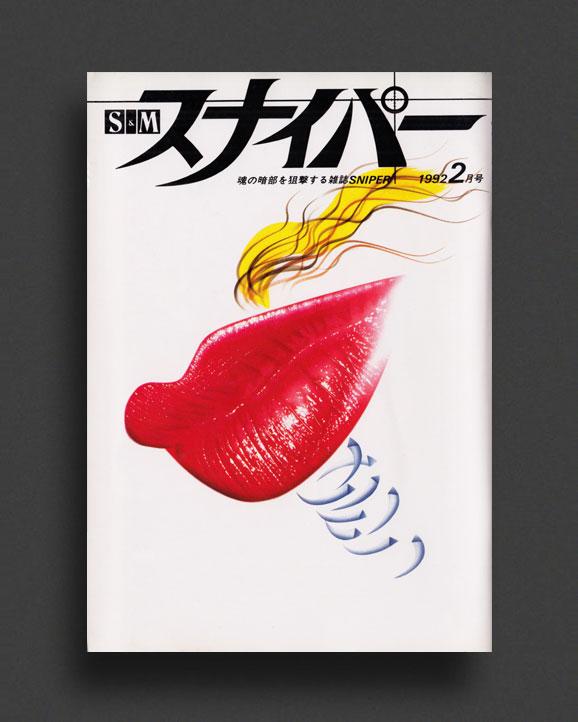
February 1992 issue of S&M Sniper, the cutting-edge cult glossy fetish magazine published in Japan between 1979—2009 that, unlike previous SM magazines, didn't centre so much around professional kinbakushi, favouring instead the exploration of new innovations of fetish and underground sex culture and emphasising the work of the models, stylists, make-up artists, and fashions designers, as much as the writers or photographers. The "new wave" of SM counterculture, embedded in 1980s underground music, fashion and visual art culture in Japan. Explicitly and profusely illustrated, each issue came wrapped in the iconic hyper-stylized airbrushed front covers of artist Yosuke Onishi, veiling the core content of non-fiction realist degradation and an eclectic, expressive editorial of kinbaku and all manner of SM, and extreme fetish photoshoots, illustrations, comics, essays, diaries, reports, exhibitions, reviews, interviews, and included regular contributors such as SM archivist and noise musician Masami Akita (Merzbow), legendary SM writer and editor Dan Oniroku ("the most celebrated writer of popular SM novels in Japan"), features by legendary SM and seppuku performer, actress, and author Hiromi Saotome, features by contributing photographers Nobuyoshi Araki, Masaaki Toyoura, Kenichi Murata, Nobuhiko Ansai, Kinichi Tanaka, Domu Kitahara, sadistic BDSM trainer Shima Shikou, and regular writings by convicted murderer and cannibal Issei Sagawa!! Including his translations of Guido Crepax comics from Italian to Japanese. This was not a magazine like the others. Each issue is also brimming with amazing Japanese advertisements and classifieds for the latest bondage clubs, boutiques, dungeons, fashion, toys, video and publication catalogues, hook-ups, phone sex, and much more.
This issue includes Nobuyoshi Araki, Nobuhiko Ansai, Yosuke Onishi, Shima Shikou, Claude Alexandre, Sachiko Nakamura, Kinichi Tanaka, Naomi Masuda, Guido Crepax, Issei Sagawa, Tadao Chigusa, Nao Saejima, all the usual and more... Not for the faint of heart.
Very Good copy.
1992, Japanese
Softcover, 320 pages, 21 x 15 cm
1st Edition, Out of print title / used / very good
Published by
Million Publishing / Tokyo
$80.00 - Out of stock
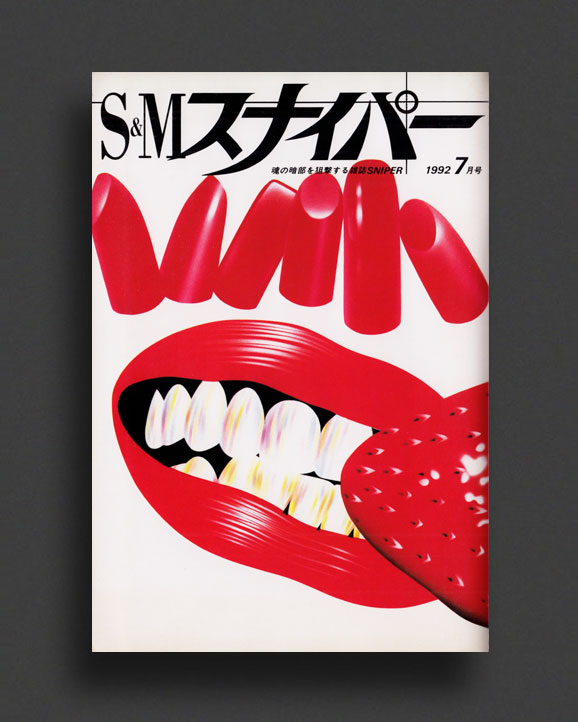
July 1992 issue of S&M Sniper, the cutting-edge cult glossy fetish magazine published in Japan between 1979—2009 that, unlike previous SM magazines, didn't centre so much around professional kinbakushi, favouring instead the exploration of new innovations of fetish and underground sex culture and emphasising the work of the models, stylists, make-up artists, and fashions designers, as much as the writers or photographers. The "new wave" of SM counterculture, embedded in 1980s underground music, fashion and visual art culture in Japan. Explicitly and profusely illustrated, each issue came wrapped in the iconic hyper-stylized airbrushed front covers of artist Yosuke Onishi, veiling the core content of non-fiction realist degradation and an eclectic, expressive editorial of kinbaku and all manner of SM, and extreme fetish photoshoots, illustrations, comics, essays, diaries, reports, exhibitions, reviews, interviews, and included regular contributors such as SM archivist and noise musician Masami Akita (Merzbow), legendary SM writer and editor Dan Oniroku ("the most celebrated writer of popular SM novels in Japan"), features by legendary SM and seppuku performer, actress, and author Hiromi Saotome, features by contributing photographers Nobuyoshi Araki, Masaaki Toyoura, Kenichi Murata, Nobuhiko Ansai, Kinichi Tanaka, Domu Kitahara, sadistic BDSM trainer Shima Shikou, and regular writings by convicted murderer and cannibal Issei Sagawa!! Including his translations of Guido Crepax comics from Italian to Japanese. This was not a magazine like the others. Each issue is also brimming with amazing Japanese advertisements and classifieds for the latest bondage clubs, boutiques, dungeons, fashion, toys, video and publication catalogues, hook-ups, phone sex, and much more. This issue includes Nobuyoshi Araki, Masaaki Toyoura, Wakao Takahashi, Kinichi Tanaka, Akira Gomi, Ryo Aki, Yosuke Onishi, Aki Masatoshi, Shima Shikou, all the usual and more... Not for the faint of heart.
With the appearance of legend writer and editor Dan Oniroku in its debut issue and thereof blessing S&M Sniper by association, this new format magazine was quickly welcomed by its readers and became increasingly popular until it rose to leading print in the mid-1980s. Accordingly, S&M Sniper evolved into a vital force in Japan SM publishing and in the following years it cooperated with many contemporary innovators and cultural heavy weights.
The collaborations with Yosuke Onishi, photographers Nobuyoshi Araki and Kenichi Murata, BDSM trainer Shima Shikou, convicted murderer and cannibal Issei Sagawa as well as SM archivist and noise musician Masami Akita were some of the partnerships that extended in time.
Very Good copy.
1991, Japanese
Softcover, 300 pages, 21 x 15 cm
1st Edition, Out of print title / used / very good
Published by
Million Publishing / Tokyo
$70.00 - Out of stock
April 1991 issue of S&M Sniper, the cutting-edge cult glossy fetish magazine published in Japan between 1979—2009 that, unlike previous SM magazines, didn't centre so much around professional kinbakushi, favouring instead the exploration of new innovations of fetish and underground sex culture and emphasising the work of the models, stylists, make-up artists, and fashions designers, as much as the writers or photographers. The "new wave" of SM counterculture, embedded in 1980s underground music, fashion and visual art culture in Japan. Explicitly and profusely illustrated, each issue came wrapped in the iconic hyper-stylized airbrushed front covers of artist Yosuke Onishi, veiling the core content of non-fiction realist degradation and an eclectic, expressive editorial of kinbaku and all manner of SM, and extreme fetish photoshoots, illustrations, comics, essays, diaries, reports, exhibitions, reviews, interviews, and included regular contributors such as SM archivist and noise musician Masami Akita (Merzbow), legendary SM writer and editor Dan Oniroku ("the most celebrated writer of popular SM novels in Japan"), features by legendary SM and seppuku performer, actress, and author Hiromi Saotome, features by contributing photographers Nobuyoshi Araki, Masaaki Toyoura, Kenichi Murata, Nobuhiko Ansai, Kinichi Tanaka, Domu Kitahara, sadistic BDSM trainer Shima Shikou, and regular writings by convicted murderer and cannibal Issei Sagawa!! Including his translations of Guido Crepax comics from Italian to Japanese. This was not a magazine like the others. Each issue is also brimming with amazing Japanese advertisements and classifieds for the latest bondage clubs, boutiques, dungeons, fashion, toys, video and publication catalogues, hook-ups, phone sex, and much more. This issue includes Nobuyoshi Araki, Wolfgang Eicher, Yumika Hayashi, Naito Hisashi, Yosuke Onishi, Kinichi Tanaka, Tadao Chigusa, Shima Shikou, all the usual and more... Not for the faint of heart.
Very Good copy.
1988, Japanese
Softcover, 300 pages, 21 x 15 cm
1st Edition, Out of print title / used / very good
Published by
Million Publishing / Tokyo
$70.00 - In stock -
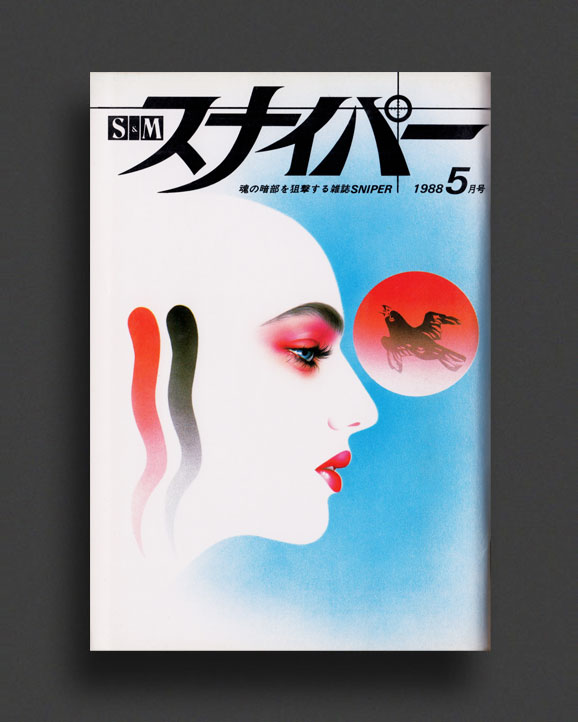
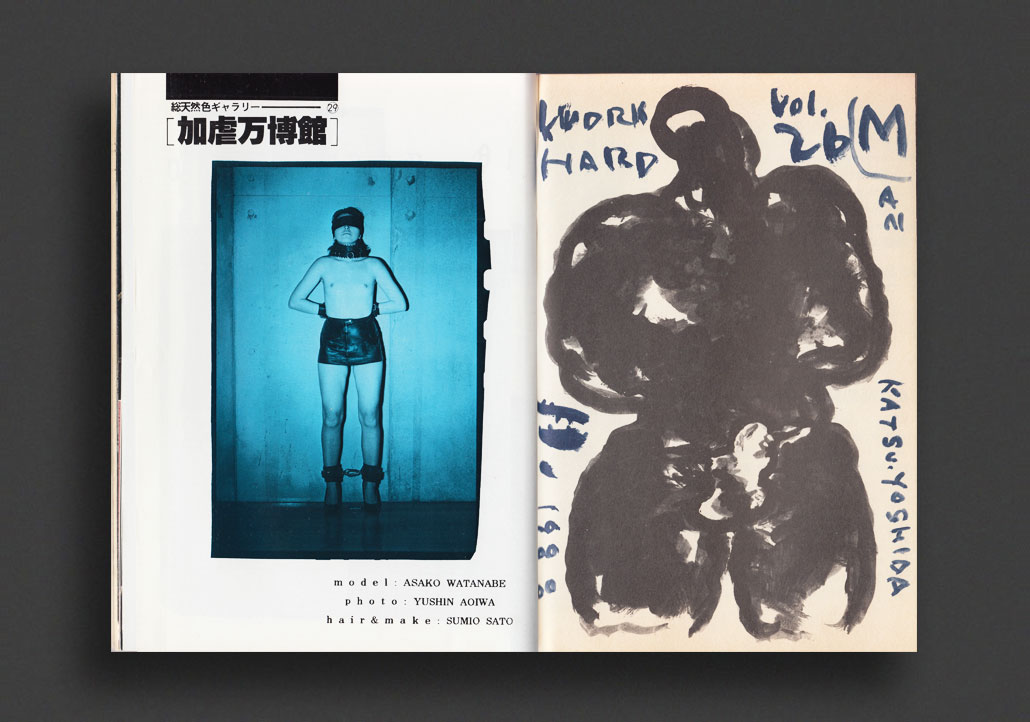
May 1988 issue of S&M Sniper, the cutting-edge cult glossy fetish magazine published in Japan between 1979—2009 that, unlike previous SM magazines, didn't centre so much around professional kinbakushi, favouring instead the exploration of new innovations of fetish and underground sex culture and emphasising the work of the models, stylists, make-up artists, and fashions designers, as much as the writers or photographers. The "new wave" of SM counterculture, embedded in 1980s underground music, fashion and visual art culture in Japan. Explicitly and profusely illustrated, each issue came wrapped in the iconic hyper-stylized airbrushed front covers of artist Yosuke Onishi, veiling the core content of non-fiction realist degradation and an eclectic, expressive editorial of kinbaku and all manner of SM, and extreme fetish photoshoots, illustrations, comics, essays, diaries, reports, exhibitions, reviews, interviews, and included regular contributors such as SM archivist and noise musician Masami Akita (Merzbow), legendary SM writer and editor Dan Oniroku ("the most celebrated writer of popular SM novels in Japan"), features by legendary SM and seppuku performer, actress, and author Hiromi Saotome, features by contributing photographers Nobuyoshi Araki, Masaaki Toyoura, Kenichi Murata, Nobuhiko Ansai, Kinichi Tanaka, Domu Kitahara, sadistic BDSM trainer Shima Shikou, and regular writings by convicted murderer and cannibal Issei Sagawa!! Including his translations of Guido Crepax comics from Italian to Japanese. This was not a magazine like the others. Each issue is also brimming with amazing Japanese advertisements and classifieds for the latest bondage clubs, boutiques, dungeons, fashion, toys, video and publication catalogues, hook-ups, phone sex, and much more. This issue includes Nobuyoshi Araki, Yosuke Onishi, Nobuhiko Ansai, Katsu Yoshida, Shima Shikou, Tadao Chigusa, Shōzō Numa, Aki Masatoshi, Kinichi Tanaka, Domu Kitahara, Akira Minomura, Jiro Takahashi, all the usual and more... Not for the faint of heart.
Very Good copy.
1988, Japanese
Softcover, 310 pages, 21 x 15 cm
1st Edition, Out of print title / used / very good
Published by
Million Publishing / Tokyo
$70.00 - Out of stock
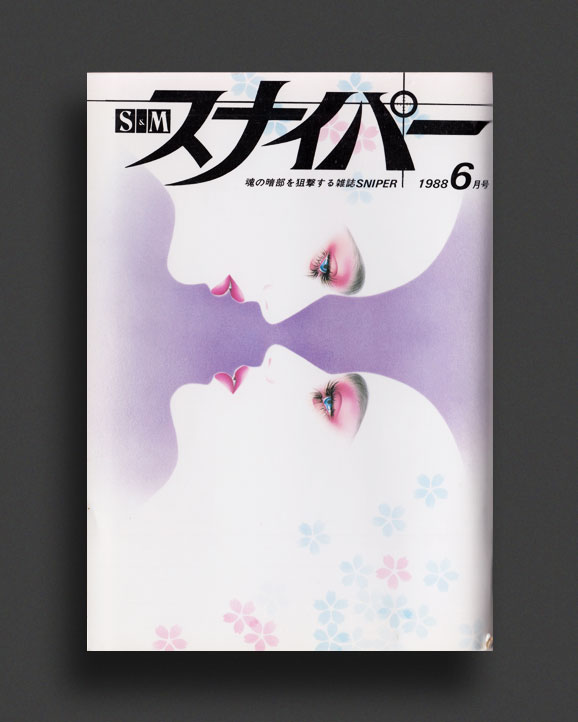
June 1988 issue of S&M Sniper, the cutting-edge cult glossy fetish magazine published in Japan between 1979—2009 that, unlike previous SM magazines, didn't centre so much around professional kinbakushi, favouring instead the exploration of new innovations of fetish and underground sex culture and emphasising the work of the models, stylists, make-up artists, and fashions designers, as much as the writers or photographers. The "new wave" of SM counterculture, embedded in 1980s underground music, fashion and visual art culture in Japan. Explicitly and profusely illustrated, each issue came wrapped in the iconic hyper-stylized airbrushed front covers of artist Yosuke Onishi, veiling the core content of non-fiction realist degradation and an eclectic, expressive editorial of kinbaku and all manner of SM, and extreme fetish photoshoots, illustrations, comics, essays, diaries, reports, exhibitions, reviews, interviews, and included regular contributors such as SM archivist and noise musician Masami Akita (Merzbow), legendary SM writer and editor Dan Oniroku ("the most celebrated writer of popular SM novels in Japan"), features by legendary SM and seppuku performer, actress, and author Hiromi Saotome, features by contributing photographers Nobuyoshi Araki, Masaaki Toyoura, Kenichi Murata, Nobuhiko Ansai, Kinichi Tanaka, Domu Kitahara, sadistic BDSM trainer Shima Shikou, and regular writings by convicted murderer and cannibal Issei Sagawa!! Including his translations of Guido Crepax comics from Italian to Japanese. This was not a magazine like the others. Each issue is also brimming with amazing Japanese advertisements and classifieds for the latest bondage clubs, boutiques, dungeons, fashion, toys, video and publication catalogues, hook-ups, phone sex, and much more. This issue includes Nobuyoshi Araki, Katsu Yoshida, Asumi Takiguchi, Yukimasa Okumura, Kazumi Kakizaki, Gaijin Tokuno, Shiori Miharu, all the usual and more... Not for the faint of heart.
Very Good copy.
1991, Japanese
Softcover, 300 pages, 21 x 15 cm
1st Edition, Out of print title / used / very good
Published by
Million Publishing / Tokyo
$70.00 - Out of stock
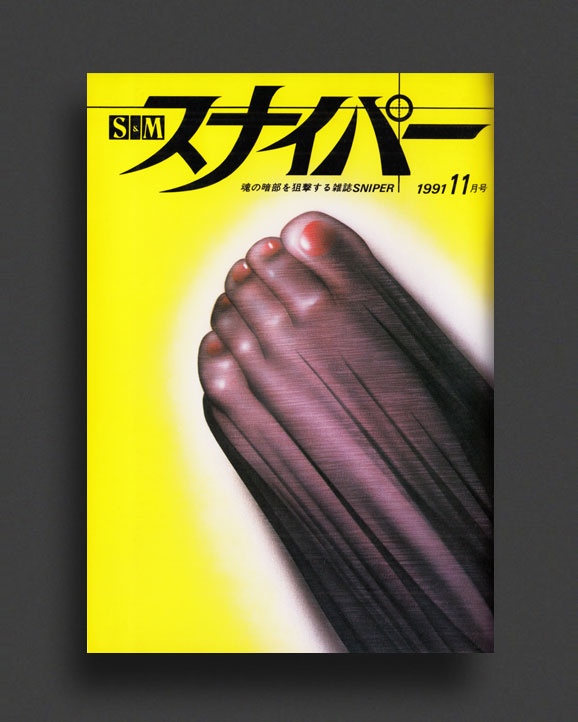
November 1991 issue of S&M Sniper, the cutting-edge cult glossy fetish magazine published in Japan between 1979—2009 that, unlike previous SM magazines, didn't centre so much around professional kinbakushi, favouring instead the exploration of new innovations of fetish and underground sex culture and emphasising the work of the models, stylists, make-up artists, and fashions designers, as much as the writers or photographers. The "new wave" of SM counterculture, embedded in 1980s underground music, fashion and visual art culture in Japan. Explicitly and profusely illustrated, each issue came wrapped in the iconic hyper-stylized airbrushed front covers of artist Yosuke Onishi, veiling the core content of non-fiction realist degradation and an eclectic, expressive editorial of kinbaku and all manner of SM, and extreme fetish photoshoots, illustrations, comics, essays, diaries, reports, exhibitions, reviews, interviews, and included regular contributors such as SM archivist and noise musician Masami Akita (Merzbow), legendary SM writer and editor Dan Oniroku ("the most celebrated writer of popular SM novels in Japan"), features by legendary SM and seppuku performer, actress, and author Hiromi Saotome, features by contributing photographers Nobuyoshi Araki, Masaaki Toyoura, Kenichi Murata, Nobuhiko Ansai, Kinichi Tanaka, Domu Kitahara, sadistic BDSM trainer Shima Shikou, and regular writings by convicted murderer and cannibal Issei Sagawa!! Including his translations of Guido Crepax comics from Italian to Japanese. This was not a magazine like the others. Each issue is also brimming with amazing Japanese advertisements and classifieds for the latest bondage clubs, boutiques, dungeons, fashion, toys, video and publication catalogues, hook-ups, phone sex, and much more. This issue includes Nobuyoshi Araki, Kinichi Tanaka, Tadao Chigusa, Guido Crepax, Kenichi Yamakawa, Sachiko Nakamura, Masaaki Toyoura, Yosuke Onishi, Shima Shikou, Kazumasa Sagawa, all the usual and more... Not for the faint of heart.
Very Good copy.
1995, Japanese
Softcover, 340 pages, 21 x 15 cm
1st Edition, Out of print title / used / very good
Published by
Million Publishing / Tokyo
$80.00 - Out of stock
May 1995 issue of S&M Sniper, the cutting-edge cult glossy fetish magazine published in Japan between 1979—2009 that, unlike previous SM magazines, didn't centre so much around professional kinbakushi, favouring instead the exploration of new innovations of fetish and underground sex culture and emphasising the work of the models, stylists, make-up artists, and fashions designers, as much as the writers or photographers. The "new wave" of SM counterculture, embedded in 1980s underground music, fashion and visual art culture in Japan. Explicitly and profusely illustrated, each issue came wrapped in the iconic hyper-stylized airbrushed front covers of artist Yosuke Onishi, veiling the core content of non-fiction realist degradation and an eclectic, expressive editorial of kinbaku and all manner of SM, and extreme fetish photoshoots, illustrations, comics, essays, diaries, reports, exhibitions, reviews, interviews, and included regular contributors such as SM archivist and noise musician Masami Akita (Merzbow), legendary SM writer and editor Dan Oniroku ("the most celebrated writer of popular SM novels in Japan"), features by legendary SM and seppuku performer, actress, and author Hiromi Saotome, features by contributing photographers Nobuyoshi Araki, Masaaki Toyoura, Kenichi Murata, Nobuhiko Ansai, Kinichi Tanaka, Domu Kitahara, sadistic BDSM trainer Shima Shikou, and regular writings by convicted murderer and cannibal Issei Sagawa!! Including his translations of Guido Crepax comics from Italian to Japanese. This was not a magazine like the others. Each issue is also brimming with amazing Japanese advertisements and classifieds for the latest bondage clubs, boutiques, dungeons, fashion, toys, video and publication catalogues, hook-ups, phone sex, and much more. This issue includes Nobuyoshi Araki, Yosuke Onishi, Masahiko Taniguchi, Mitsuzumi Yoshiyuki, Kinichi Tanaka, Shima Shikou, Chihiro Abe, Wakao Takahashi, Kenji Nakano, Masaaki Toyoura, all the usual and more... Not for the faint of heart.
Very Good copy.
1997, Japanese
Softcover, 320 pages, 21 x 15 cm
1st Edition, Out of print title / used / very good
Published by
Million Publishing / Tokyo
$70.00 - In stock -
January 1997 issue of S&M Sniper, the cutting-edge cult glossy fetish magazine published in Japan between 1979—2009 that, unlike previous SM magazines, didn't centre so much around professional kinbakushi, favouring instead the exploration of new innovations of fetish and underground sex culture and emphasising the work of the models, stylists, make-up artists, and fashions designers, as much as the writers or photographers. The "new wave" of SM counterculture, embedded in 1980s underground music, fashion and visual art culture in Japan. Explicitly and profusely illustrated, each issue came wrapped in the iconic hyper-stylized airbrushed front covers of artist Yosuke Onishi, veiling the core content of non-fiction realist degradation and an eclectic, expressive editorial of kinbaku and all manner of SM, and extreme fetish photoshoots, illustrations, comics, essays, diaries, reports, exhibitions, reviews, interviews, and included regular contributors such as SM archivist and noise musician Masami Akita (Merzbow), legendary SM writer and editor Dan Oniroku ("the most celebrated writer of popular SM novels in Japan"), features by legendary SM and seppuku performer, actress, and author Hiromi Saotome, features by contributing photographers Nobuyoshi Araki, Masaaki Toyoura, Kenichi Murata, Nobuhiko Ansai, Kinichi Tanaka, Domu Kitahara, sadistic BDSM trainer Shima Shikou, and regular writings by convicted murderer and cannibal Issei Sagawa!! Including his translations of Guido Crepax comics from Italian to Japanese. This was not a magazine like the others. Each issue is also brimming with amazing Japanese advertisements and classifieds for the latest bondage clubs, boutiques, dungeons, fashion, toys, video and publication catalogues, hook-ups, phone sex, and much more. This issue includes Nobuyoshi Araki, Yosuke Onishi, Shima Shikou, Katsu Yoshida, Kinichi Tanaka, Kenichi Murata, Chihiro Abe, Kenji Nakano, Ryutaro Jinno, Selfish Gene, Wakao Takahashi, all the usual and more... Not for the faint of heart.
Very Good copy.
2022, English
Hardcover, 200 pages, 29.5 x 27.5 cm
$95.00 - In stock -
FAMILY: THE SOURCE FAMILY SCRAPBOOK provides an immersive view into the public and private world of the Southern California occult commune The Brotherhood of the Source. This lavishly illustrated book reproduces 200 original scrapbook pages assembled by family historian Isis Aquarian from 1972-1977, documenting the group's dramatic rise and fall, from their time living together in the Hollywood Hills operating their wildly popular Source vegetarian restaurant on the Sunset Strip to their exodus to Hawaii and San Francisco as the group began to unravel. Copious unpublished photographs, newspaper clippings, letters, manifestos, album art and flyers, augmented by descriptive captions by Isis Aquarian, reveal the Source Family's astonishing trajectory, from controversial leader Father Yod's spiritual awakening to the group's wild musical and social experimentations, to the provocations that led to the group's paradise lost. These pages provide a revelatory, firsthand view into the widely misunderstood phenomenon of new religious movements and cults of the 1960s and 70s.
1989, Japanese
Softcover, 176 pages, 13 x 18 cm
1st Edition, Out of print title / used / very good
Published by
Fiction Inc. / Tokyo
$70.00 - In stock -
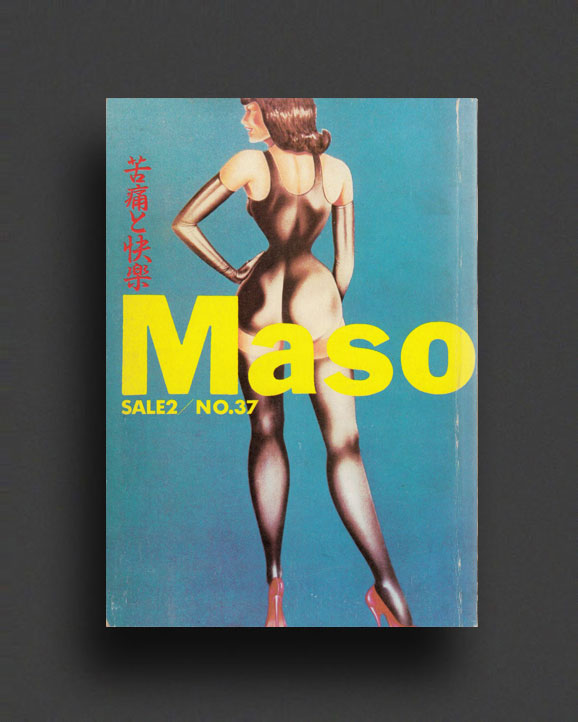
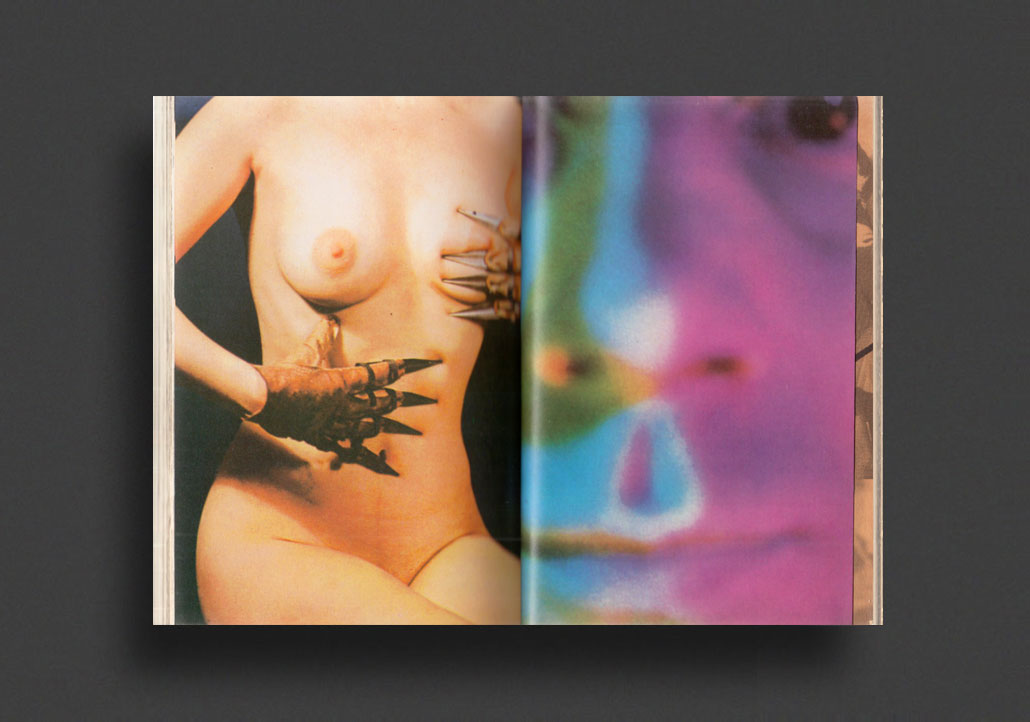
Issue No.37 of the great SALE2 periodical from Tokyo Japan, founded in 1984 by Makoto Orui, who later became art director for Purple magazine in France and Rockin’on magazine in Japan. SALE2 was active for about 14 years during the 1980s—1990s, published regularly as a sort-of fanzine/journal/catalogue/pocket-book by Fiction, Inc., a specialty shop and publisher of fetish and erotica in Tokyo in the 1980-90s. With Orui's distinct design SALE2 developed an exclusive curated editorial set on ‘erotisism and its spiritual philosophy’, with each issue exploring different themes and features, heavy on fetishism and erotic art.
Issue No.37, the Masochism issue features erotic writings and artwork throughout by Loic Dubigeon, Guido Crepax, David Bailey, Man Ray, Lucas Samaras, Annie Sprinkle's Bosom Ballet, Hans Bellmer, Paul Outerbridge, Leopold von Sacher-Masoch, Shinichi Kusamori on the paintings of Seiu Ito "the father of modern kinbaku", Yamaguchi Tsubaki, E. J. Bellocq, René Girard, Noriyuki Eda on Saint Sebastian, Edogawa Ranpo, Serge Nazarieff, Rieko Matsuura, Tetsuo Amano, Freud, Nietzsche, de Sade, interspersed with lots of mysterious vintage erotic imagery, bondage illustration, and catalogue/advertisments/clippings of Richard Cerf, Araki, Eric Stanton, Irving Klaw, Jim, John Willie, Bizarre Comix, and much more...
Very heavily illustrated throughout with erotic photography and artwork, all texts in Japanese.
Very Good copy, tanning with age.
1972, Japanese
Softcover, 254 pages, 21 x 14.8 cm
1st Edition, Out of print title / used / good
Published by
Taiyo books / Japan
$80.00 - Out of stock
March 1974 issue of SM KING, legendary Japanese SM magazine edited by Oniroku Dan (1931—2011), "the most celebrated writer of popular SM novels in Japan", published by Taiyo books between 1972—1974, with each issue featuring many colour and b/w photo features, illustrations, and fetish fiction. Regular contributors included actress Naomi Tani, Toshiyuki Suma, Norio Sugiura, Takashi Tsujimura, Yoji Muku, Gekko Hayashi (Gojin Ishihara), Tadao Chigusa and Juan Maeda. This issue featuring cover artwork by legendary erotic fantasy artist Ran Akiyoshi (1922–1982), plus the work of Gekko Hayashi (Gojin Ishihara), Tadao Chigusa, Takashi Ishii, Aya Nakagawa, Shoji Oki, Oniroku Dan, and many many more. One of the great few with cover art by legendary Japanese illustrator Shiro Tatsumi.
Good copy with light cover wear.
1979, Japanese
Softcover (staple-bound), 250 pages, 21 x 15 cm
1st Edition, Out of print title / used / very good
Published by
Sun Publishing / Japan
$65.00 - Out of stock
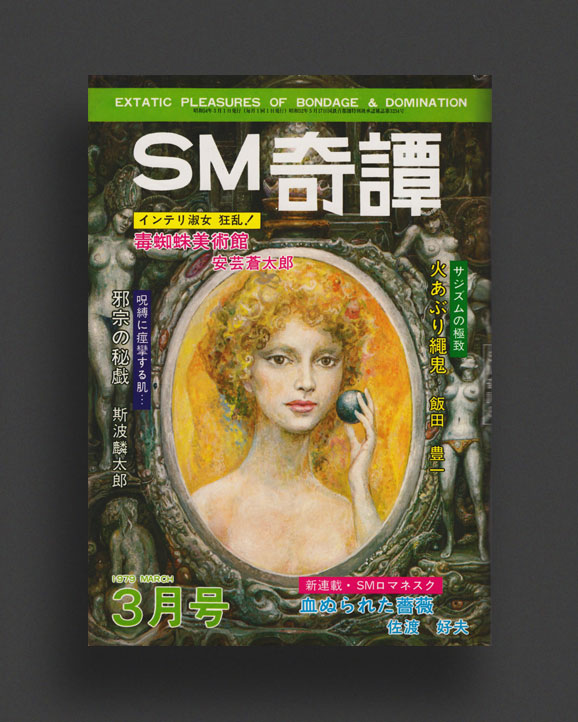
SM Kitan March 1979 issue, featuring cover artwork by legendary erotic fantasy artist Ran Akiyoshi (1922–1982). This issue features the work of some of the best names in Japanese SM art, including Shoji Oki, Namio Harukawa, Yoko Ozuma, Yoji Muku, Gekko Hayashi (Gojin Ishihara), and Reiko Kita. A cult classic of vintage Japanese BDSM and Kinbaku (Japanese bondage), SM Kitan was the SM magazine published by the great Sun Publishing house, and was formerly known as S&M Abhunter (changing its name to SM Kitan from August 1975). Heavy with wonderful artwork galleries in colour and bw, glossy bondage photo-features, illustrated fetish fiction, manga, fold-outs, and much more. Ran Akiyoshi (1922–1982) illustrated many of the iconic covers, with regular contributors including Sotaro Aki, Tadao Chigusa, Namio Harukawa, Yoko Ozuma, Reiko Kita, Akiyoshi Akiyoshi, Hakuzan Shiraishi, Shoji Oki, Namio Harukawa, Akira Kasuga, and Gekko Hayashi (Gojin Ishihara).
Very Good copy. Light cover wear/age.
1977, French / Japanese
Softcover, 40 pages (w. Japanese translation booklet insert), 34.5 x 29 cm
1st Edition, Out of print title / used / very good
Published by
Façade / Paris
$220.00 - Out of stock
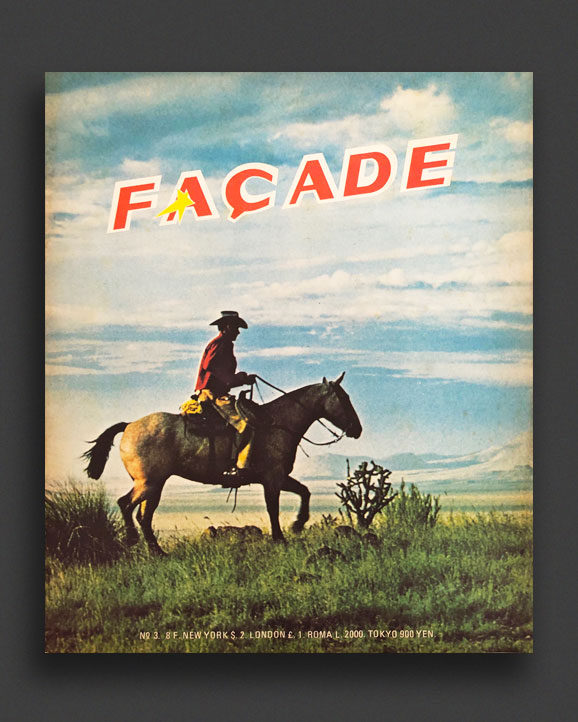
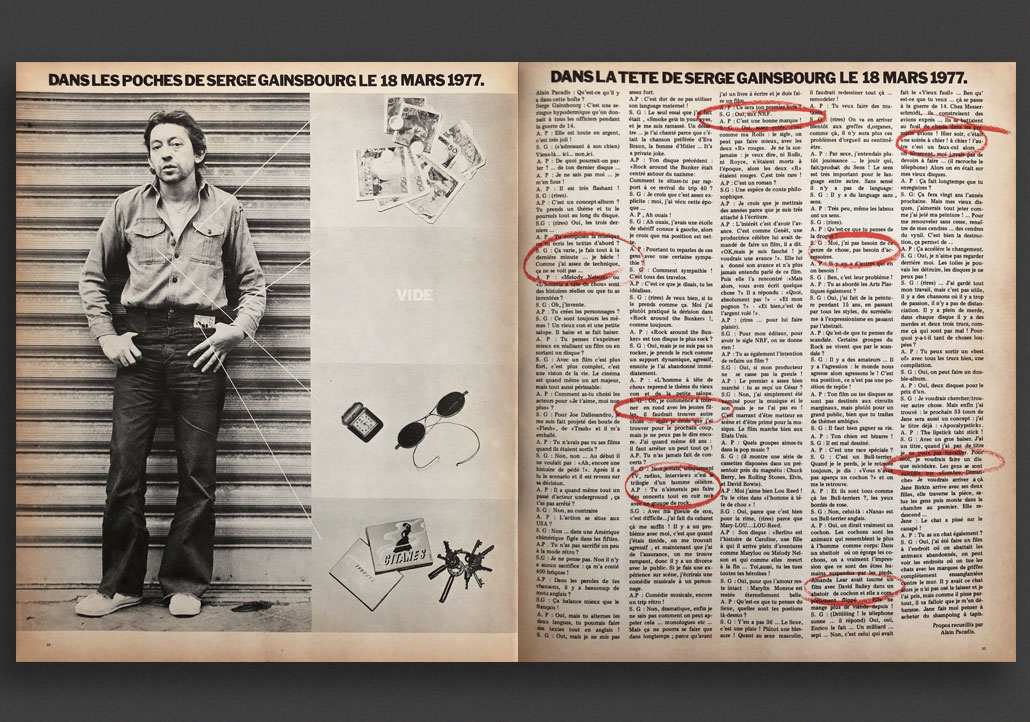
Issue no. 3 of the incredibly rare and iconic Façade, the French underground magazine published in Paris between 1976—1983. Founded in 1976 by Alain Benoist and Hervé Pinard, Façade was the french answer to Andy Warhol's Interview, heavily centered around Parisian club, fashion and art scene and published without any date or periodicity until 1983. Launched at an Issey Miyake show where models handed out the magazine from the catwalk, the cult magazine witness through its pages a long-lost, short-lived period in Paris featuring the so-called "jeunes gens modernes" of the 1970's, like punk icons Edwige Belmore and Alain Pacadis. With pop celebrity covers and vibrant fashion shoots styled by the likes of a young Pierre et Gilles (who met through working on this very magazine), features in collaboration with the likes of Serge Gainsbourg, and in each issue a unique "false" advertisement created by Karl Lagerfeld, it's no wonder Façade's reputation spread quickly to New York, Tokyo and beyond, making it one of the most desired magazines of the new wave. With texts in French, these rare issues come complete with the inserted Japanese translation booklets. Includes Eddie and the Hot Rods, Andy Warhol, Gilbert and George, the Inauguration of Beaubourg, Serge Gainsbourg, Alain Pacadis, Karl Lagerfeld… with collaborations from Pierre Commoy, Thierry Ardisson, Philippe Morillon, and much more.
Very Good copy, tanning. Beautifully preserved.
1988, Italian
Softcover (staple-bound), 32 pages, 29 x 21 cm
1st Edition, Out of print title / used / very good
Published by
Maelzel / Poirino
$90.00 - Out of stock
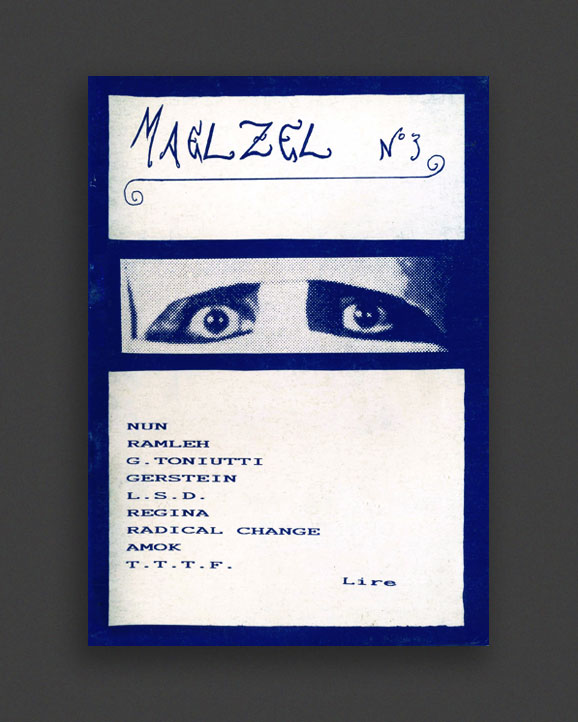
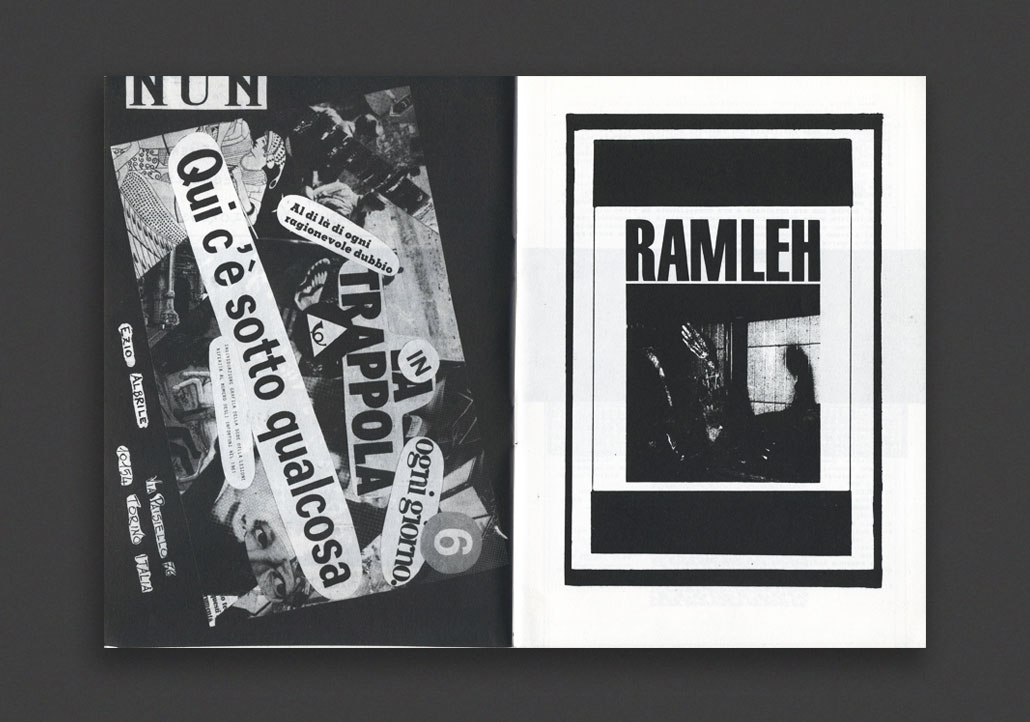
Third issue of this rare, wonderful experimental / industrial music fanzine, Maelzel, published in Italy in 1988 by artist, journalist and founder of later fanzine Chain D.L.K., Maurizio Pustianaz (aka Gerstein). In navy printed wraps packed with artwork and texts by/features on/interviews with Giancarlo Toniutti, Ramleh, Tito Turbina Tastierista Futurista (Luca Faraci), Amok (Enrico Piva), LSD (Gianfranco Santoro), Maurizio's own Infektion Prod., NUN, Regina, and more. Giancarlo Toniutti interview particularly substantial, with photography and discography. All postal contacts for artists throughout. Texts in Italian.
Very Good copy, with only light wear/age to covers.
2019, English
Softcover, 264 pages, 27 x 19.5 cm
Published by
Nero / Rome
$65.00 - Out of stock
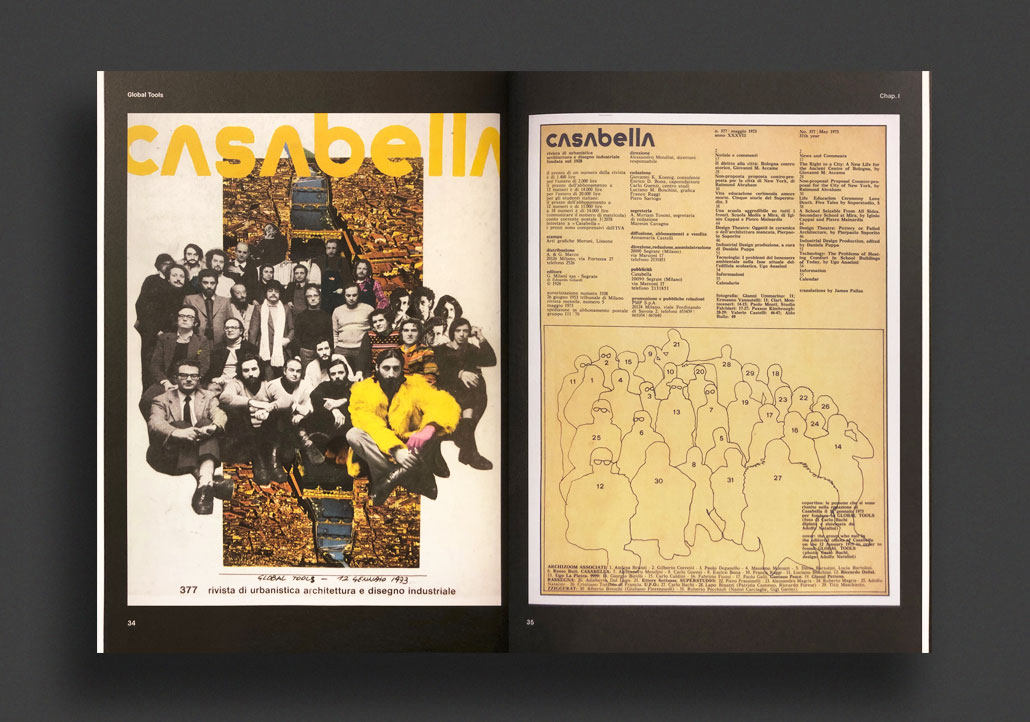
Global Tools 1973–1975 documents and narrates the story of the eponymous experience of Radical Design and its multidisciplinary school program “without students or teachers.” The Global Tools journey began with its foundation in 1973 by groups and figures drawn from Italian Radical Architecture, Arte Povera, and Conceptual Art, and ended in 1975 after three years of intense experimentation. This book is both a commentary and an impressive visual archive that brings together essays by international authors and reproductions of many original documents—including the Global Tools bulletins, entirely republished here for the first time. This unique and definitive book marks a fundamental stage in the rediscovery of one of the most fascinating European cultural experiences of the late twentieth century.
Edited by Valerio Borgonuovo and Silvia Franceschini.
With texts by Manola Antonioli and Alessandro Vicari, Valerio Borgonuovo and Silvia Franceschini, Alison J. Clarke, Beatriz Colomina, Maurizio Lazzarato, Franco Raggi, Simon Sadler.
Published by Nero in collaboration with SALT, Istanbul.
1993, Japanese
Hardcover (w. dust jacket and obi-strip), 230 pages, 13.6 cm x 19.4 cm
1st Edition, Out of print title / used / very good
Published by
Seikyūsha / Tokyo
$90.00 - In stock -
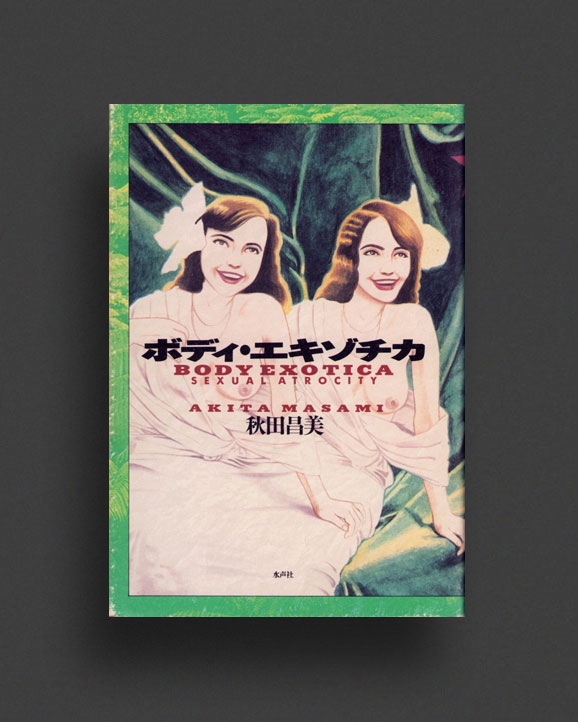
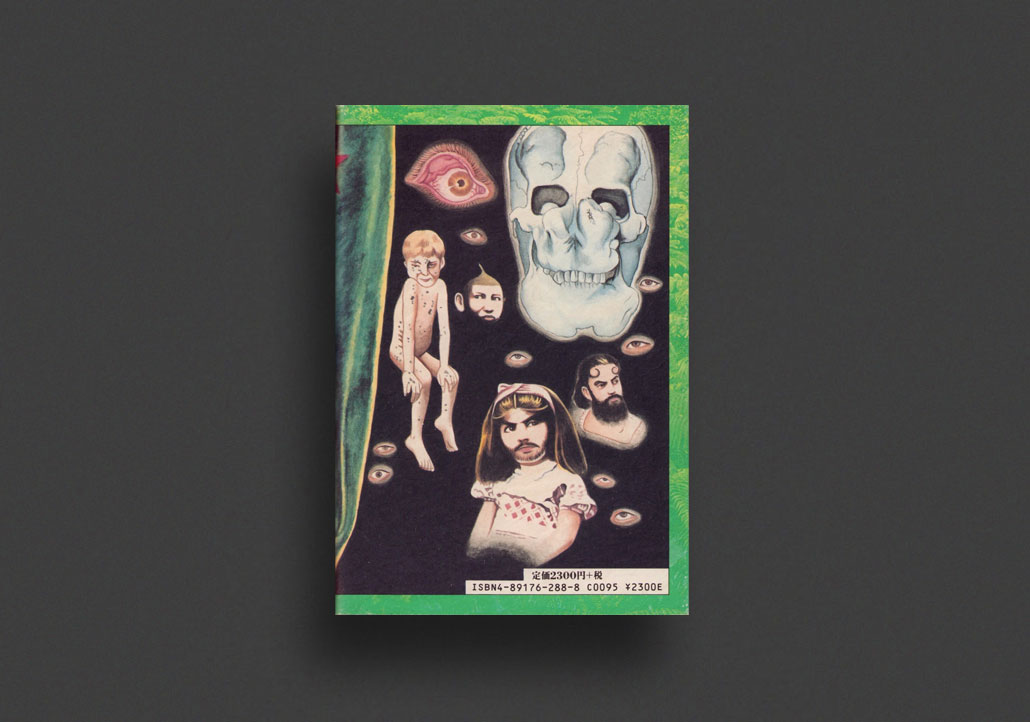
First hardcover edition of "Body Exotica : Sexual Atrocity", written by Merzbow's Masami Akita and published only in Japan in 1993. Covering subjects such as body manipulation and decoration, Japanese genital museums, German anarcho-pacifist Ernst Friedrich's Anti-War imagery, Daisy and Violet Hilton, amputee love, clothing and deformity, "freaks", fetishism, abnormal sex customs, corpse and medical photography, and much more, all with b/w illustrations, "Body Exotica : Sexual Atrocity" could be considered the sister book to Akita's "Terminal Body Play", issued the same year. Merzbow is a noise project created in Tokyo, Japan in 1979 under the direction of noise technician Masami Akita. As well as a legendary underground noise artist, Akita is a prolific writer in Japan and frequently writes on the arts, music, erotica, esoterica, modern architecture, and animal rights, with articles on emerging subcultures and underground extreme cultures appearing in publications like SM Sniper, Studio Voice and Fool's Mate. His development of the Merzbow aesthetic ran parallel with a series of investigative books in which he catalogued and introduced a vast amount of hermetic types of music, sexual practices and autonomous creativity to a fairly conservative (but not close-minded) Japanese audience. "Body Exotica" is one of these very books.
First edition, Japanese text, VG copy with VG "textured" and illustrated dust jacket and original publisher's obi-strip inserted (not-pictured).
2023, English
Hardcover (w. dust jacket), 288 pages, 25.4 x 19 cm
Published by
Princeton University Press / New York
$89.00 - Out of stock
How California's counterculture of the 1960s to 1980s profoundly shaped—and was shaped by—West Coast artists.
The 1960s exert a special fascination in modern art. But most accounts miss the defining impact of the period's youth culture, largely incubated in California, on artists who came of age in that decade. As their prime exemplar, Bruce Conner, reminisced, "I did everything that everybody did in 1967 in the Haight-Ashbury. . . . I would take peyote and walk out in the streets." And he vividly channeled those experiences into his art, while making his mark on every facet of the psychedelic movement—from the mountains of Mexico with Timothy Leary to the rock ballrooms of San Francisco to the gilded excesses of the New Hollywood. In The Artist in the Counterculture, Thomas Crow tells the story of California art from the 1960s to the 1980s—some of the strongest being made anywhere at the time—and why it cannot be understood apart from the new possibilities of thinking and feeling unleashed by the rebels of the counterculture.
Crow reevaluates Conner and other key figures—from Catholic activist Corita Kent to Black Panther Emory Douglas to ecological witness Bonnie Ora Sherk—as part of a generational cohort galvanized by resistance to war, racial oppression, and environmental degradation. Younger practitioners of performance and installation carried the mindset of rebellion into the 1970s and 1980s, as previously excluded artists of color moved to the forefront in Los Angeles. Mike Kelley, their contemporary, remained unwaveringly true to the late countercultural flowering he had witnessed at the dawn of his career.
The result is a major new account of the counterculture's enduring influence on modern art.
1998, English
Softcover, 385 pages, 15.24 x 22.86 cm
1st Edition, Out of print title / used / average
Published by
Feral House / Los Angeles
$35.00 - Out of stock
First edition of the definitive published account of Black Metal, published by Feral House in 1998. The Bloody Rise of the Black Metal Mafia Murder, suicide, occult sacrifices, church-burnings and fascism terrorism preoccupy the musicians and followers of Black Metal: a dark and psychotic version of heavy metal music. This extraordinary book penetrates the inner circle of the Black Metal leaders, reveals the truth behind the stories, and includes an interview with Varg Vikerness of the group Burzum, currently imprisoned for the murder of another Black Metal musician.
"With Lords of Chaos Michael Moynihan and Didrik Soderlind paint a portrait of a fantastic realm where Satanism, neo-paganism and National Socialism energized a musical scene in which fantasy was actualized in the burning of medieval churches in Norway ...a uniquely valuable history of Black Metal music in general and of the Norwegian scene in particular as it is viewed by the participants themselves. Lords of Chaos is a compelling work deserving of a wide readership on both sides of the Atlantic." -- Dr. Jeffrey Kaplan, author of Radical Religion in America.
Average—Good copy with considerable wear, creasing.
2004, English
Softcover, 285 pages, 15.24 x 22.86 cm
1st Edition, Out of print title / used / average
Published by
Feral House / Los Angeles
$35.00 - In stock -
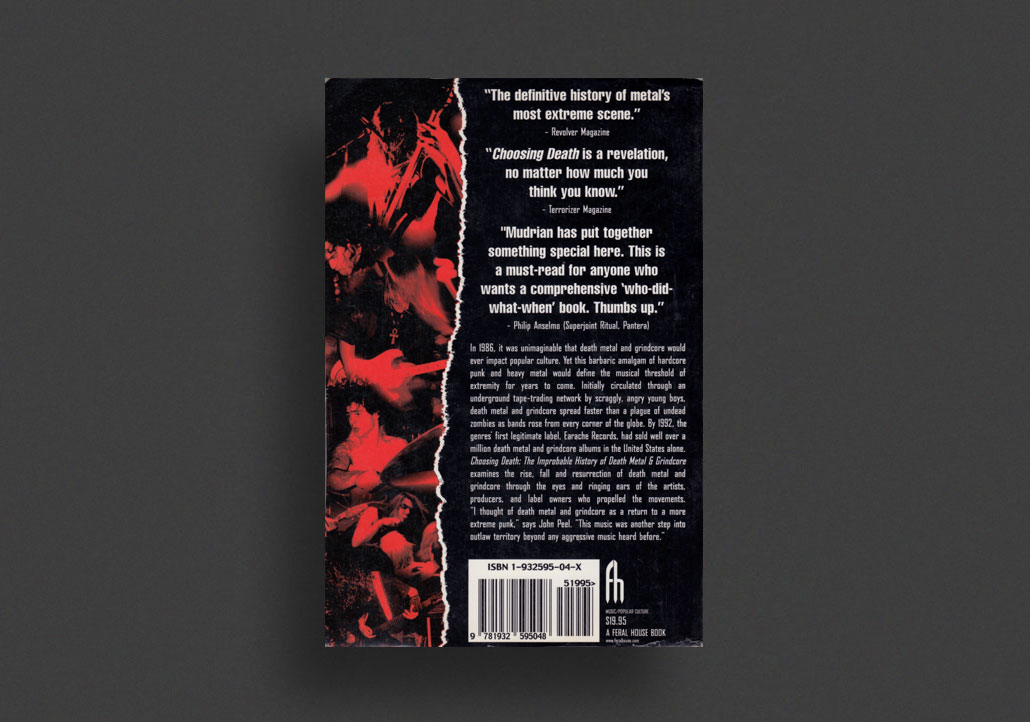
First 2004 edition. In 1986, the idea that death metal and grindcore would ever impact popular culture was unimaginable. Initially circulated through a scattered tape-trading network of underground thrill-seekers, bands rose from every corner of the globe and death metal and grindcore spread faster than a pandemic plague of undead flesh-eaters. By 1994, the genre's most prominent labels had sold millions of albums. This exciting history, featuring an introduction by famed DJ John Peel, tells the two-decade-long history of grindcore and death metal through the eyes and ringing ears of the artists, producers, and label owners who propelled them. Includes essential discography and "Life After Death" biography updates on the lives of those featured. Autopsy, Napalm Death, Carcass, Fear of God, S.O.B., Morbid Angel, Obituary, Terrorizer, Doom, Extreme Noise Terror, Decide, Entombed, Grave, Bolt Thrower, Brutal Truth, Morbid Angel, Suffocation, Siege, Cannibal Corpse, Discordance Axis, Decapitated, Exhumed, Vader, and so many more...
Average—Good copy with considerable wear, creasing.
2021, English
Softcover, 144 pages, 12 x 19 cm
Published by
Rab-Rab Press / Helsinki
$38.00 - Out of stock
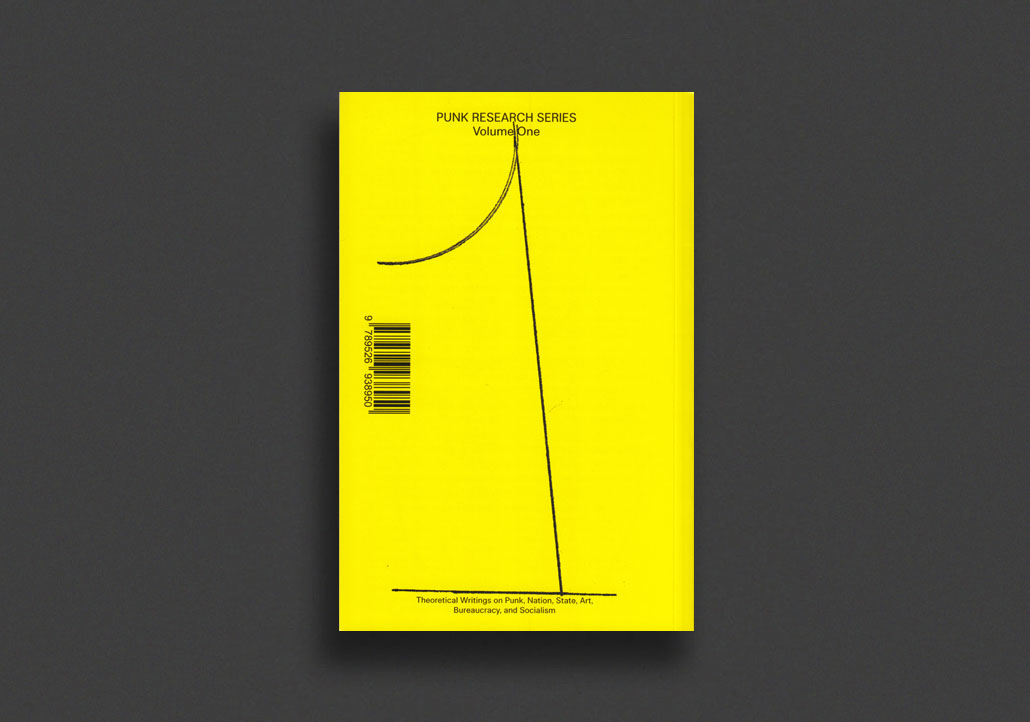
Punk Suprematism includes the first English translation of theoretical writings on punk, art, socialism, bureaucracy, and nationalism by Slavoj Žižek, Rastko Močnik, and Zoja Skušek.
Written in the first half of the eighties, these texts are a unique mixture of punk attitude with theoretical concepts borrowed from Althusser, Lacan, and avant-garde art. Written in a turbulent period of Yugoslav socialism, these texts were trying to understand the political importance of punk as a mass movement of impoverished youth. The conclusions of these interventions had a lasting effect on the theoretical formation of Yugoslav post-Marxism, as well to the organizational forms of the socialist alternative. The book also includes a foreword on the historical context of the eighties and the extensive narrative bibliography of punk related publications in the Socialist Republic of Slovenia written by Sezgin Boynik. In addition to this, it also includes translations of the two editorials to Punk Problemi written by renowned Slovenian theoreticians.
The book is the first in an upcoming series on punk research by Rab-Rab press. The series starts from the idea that punk is a break, and focuses on punk as something completely separated from bourgeois culture.