World Food Books' programme is largely produced on Kulin Nation land. We acknowledge the Wurundjeri people of the Kulin Nation as the first and continuing custodians of this land, and pay respect to their Elders past, present, and emerging.
World Food Books is an arts and special interests bookshop in Naarm / Melbourne. Founded in 2010, World Food Books is devoted to the presentation of a rotating, hand-selection of international art, design, literary and counterculture publications with an emphasis on the anti-traditional, the experimental, the avant-garde, the heretic, the marginal.
Presenting new titles alongside rare and out-of-print books, catalogues and journals spanning the fields of modern and contemporary art, design, photography, illustration, film, literature, poetry, cultural theory, philosophy, sexuality, popular and underground culture in its many radical forms, World Food Books wishes to encourage adventurous, thoughtful and open-minded reading, looking, writing, and exchange of publishing and ideas, both current and historical.
As well as our bookshop, located in Melbourne's historical Nicholas Building, all of our inventory is available internationally via our online mail-order service.
World Food Books semi-regularly co-ordinates "Occasions", a programme of exhibits and events at the bookshop and in partnership with other hosts (such as museums and art galleries) that develop out of the activities, relationships and content of the bookshop itself.
World Food Books
The Nicholas Building
37 Swanston Street
Room 5, Level 6
Melbourne 3000
Australia
SHOP HOURS:
Thu–Fri 12–6, Sat 12–5
WEB-SHOP OPEN 24/7
World Food Books
Postal Address:
PO Box 435
Flinders Lane
Victoria 8009
Australia
Art
Theory / Essay
Architecture / Interior
Graphic Design / Typography
Photography
Fashion
Eros
LGBTQ+
Fiction / Poetry
Weird / Speculative / Science Fiction / Horror
Transgressive / Visceral / Abject
Symbolism / Decadence / Fin de siècle
Film / Video
Painting
Sculpture / Installation
Performance / Dance / Theater
Drawing
Sound / Music
Curatorial
Group Shows / Collections
Periodicals
Out-of-print / Rare
Posters / Ephemera / Discs
Signed Books
World Food Books Gift Voucher
World Food Book Bag
Australian Art
Australian Fiction
Australian Science Fiction / Speculative Fiction
Australian Poetry
Australian Photography
Japanese Photography
Conceptual Art
Minimal Art
Dada
'Pataphysics / Oulipo
Fluxus
Concrete Poetry
Pop Art
Surrealism
Arte Povera
Arte Informale / Haute Pâte / Tachism
Nouveau Réalisme / Zero / Kinetic
Situationism / Lettrism
Collage / Mail Art / Xerox Art
Art Brut / Folk / Visionary / Fantastic
Illustration / Graphic Art / Bandes Dessinées
Furniture
Italian Radical Design / Postmodernism
Textiles
Ceramics / Glass
Counterculture
Protest / Revolt
Philosophy
Psychoanalysis
Anthropology
Anarchism
Socialism / Anarchism / Communism / Capitalism
Literary Theory / Semiotics / Language
Feminism / Women's Studies
Gender Studies / Sexuality
Anthropology
Fetishism / BDSM
Drugs / Psychedelia
Crime / Violence
Animal Rights / Veganism
Occult / Esoterica
Ecology / Earth / Alternative Living
Whole Earth / Crafts
All prices in AUD (Australian dollars)
Pick-Ups
Pick-up orders can be collected in our bookshop during opening hours after order date. Please collect any Pick-up orders within 2 weeks of ordering as we have limited storage space. Orders will be released back into stock if not collected within this time. No refunds can be made for pick-ups left un-collected. If you cannot make it in to the bookshop in this time-frame, please choose postage option.
Return Policy
All sales are final. We do accept returns (for refund or exchange) for items received in error. All our orders are packed with special care using heavy-duty padding and cardboard book-mailers or bubble mailers (for smaller books), using reinforcement where required. We cannot take responsibility for any lost, stolen or damaged parcels.
Insurance
Should you wish to insure your package, please email us directly after placing your order and we can organise this at a small extra expense. Although all standard/express tracked packages are very safe and dependable, we cannot take responsibility for any lost, stolen or damaged parcels. We recommend insurance on valuable orders.
Interested in selling your old books, catalogues, journals, magazines, comics, fanzines, ephemera? We are always looking for interesting, unusual and out-of-print books to buy. We only buy books in our fields of interest and specialty, and that we feel we can resell.
We base these prices on desirability, market value, in-print prices, condition and our current stock levels. We offer cash, store credit, and can take stock on consignment. All
about 25% of the price we expect to get when we sell them, or 30% in store credit. We base these prices on desirability, market value, in-print prices, condition and our current stock levels.
Sell your books any day of the week. You can drop them off and return later. If you have a lot of books, we can visit your Sydney home.
We buy books that we feel we can resell. We offer about 25 % of the price we expect to get when we sell them, or 30% in store credit. We base these prices on desirability, market value, in-print prices, condition and our current stock levels.
Philadelphia Wireman
03 August - 01 September, 2018
World Food Books is proud to announce our next Occasion, the first presentation of sculptures by Philadelphia Wireman in Australia.
The Philadelphia Wireman sculptures were found abandoned in an alley off Philadelphia’s South Street on trash night in 1982. Their discovery in a rapidly-changing neighbourhood undergoing extensive renovation, compounded with the failure of all attempts to locate the artist, suggests that the works may have been discarded after the maker’s death. Dubbed the "Philadelphia Wireman" during the first exhibition of this work, in 1985, the maker’s name, age, ethnicity, and even gender remain uncertain. The entire collection totals approximately 1200 pieces, all intricately bound together with tightly-wound heavy-gauge wire (along with a few small, abstract marker drawings, reminiscent both of Mark Tobey and J.B. Murry). The dense construction of the work, despite a modest range of scale and materials, is singularly obsessive and disciplined in design: a wire armature or exoskeleton firmly binds a bricolage of found objects including plastic, glass, food packaging, umbrella parts, tape, rubber, batteries, pens, leather, reflectors, nuts and bolts, nails, foil, coins, toys, watches, eyeglasses, tools, and jewellery.
Heavy with associations—anthropomorphic, zoomorphic, and socio-cultural responses to wrapped detritus—the totemic sculptures by Philadelphia Wireman have been discussed in the context of work created to fulfil the shamanistic needs of alternative religions in American culture. Curators, collectors, and critics have variously compared certain pieces to sculpture from Classical antiquity, Native American medicine bundles, African-American memory jugs, and African fetish objects. Reflecting the artist’s prolific and incredibly focused scavenging impulse, and despite—or perhaps enhanced by—their anonymity, these enigmatic objects function as urban artefacts and arbiters of power, though their origin and purpose is unknown. Philadelphia Wireman, whatever their identity, possessed an astonishing ability to isolate and communicate the concepts of power and energy through the selection and transformation of ordinary materials. Over the course of the past two decades, this collection has come to be regarded as an important discovery in the field of self-taught art and vernacular art.
Presented in collaboration with Fleisher-Ollman Gallery, Philadelphia, and Robert Heald, Wellington.
Susan Te Kahurangi King
02 February - 10 March, 2018
Susan Te Kahurangi King (24 February 1951 - ) has been a confident and prolific artist since she was a young child, drawing with readily available materials - pencils, ballpoint pens and felt-tip markers, on whatever paper is at hand. Between the ages of four and six Susan slowly ceased verbal communication. Her grandparents William and Myrtle Murphy had developed a special bond with Susan so they took on caring responsibilities for extended periods. Myrtle began informally archiving her work, carefully collecting and storing the drawings and compiling scrapbooks. No drawing was insignificant; every scrap of paper was kept. The King family are now the custodians of a vast collection containing over 7000 individual works, from tiny scraps of paper through to 5 meter long rolls.
The scrapbooks and diaries reveal Myrtle to be a woman of great patience and compassion, seeking to understand a child who was not always behaving as expected. She encouraged Susan to be observant, to explore her environment and absorb all the sights and sounds. Myrtle would show Susan’s drawings to friends and people in her community that she had dealings with, such as shopkeepers and postal workers, but this was not simply a case of a grandmother’s bias. She recognised that Susan had developed a sophisticated and unique visual language and sincerely believed that her art deserved serious attention.
This was an unorthodox attitude for the time. To provide some context, Jean Dubuffet coined the term Art Brut in 1945 to describe work created by self-taught artists – specifically residents of psychiatric institutions and those he considered to be visionaries or eccentrics. In 1972 Roger Cardinal extended this concept by adopting the term Outsider Art to describe work made by non-academically trained artists operating outside of mainstream art networks through choice or circumstance. Susan was born in Te Aroha, New Zealand in 1951, far from the artistic hubs of Paris and London that Dubuffet and Cardinal operated in. That Myrtle fêted Susan as a self-taught artist who deserved to be taken seriously shows how progressive her attitudes were.
Susan’s parents Doug and Dawn were also progressive. Over the years they had consulted numerous health practitioners about Susan’s condition, as the medical establishment could not provide an explanation as to why she had lapsed into silence. Dawn educated herself in the field of homeopathy and went on to treat all twelve of her children using these principles – basing prescriptions on her observations of their physical, mental and emotional state.
Doug was a linguist with an interest in philosophy who devoted what little spare time he had to studying Maori language and culture. To some extent their willingness to explore the fringes of the mainstream made them outsiders too but it was their commitment to living with integrity and their respect for individuality that ensured Susan’s creativity was always encouraged.
Even though Susan’s family supported her artistic pursuits, some staff in schools and hospitals saw it as an impediment to her assimilation into the community and discouraged it in a variety of ways. Her family was not always aware of this and therefore did not fully understand why Susan stopped drawing in the early 1990s. However, rather than dwell on the challenges that Susan faced in pursuit of her artistic practice, they prefer to highlight her achievements. In 2008 Susan began drawing again in earnest, after an almost 20 year interruption, and her work is now shown in galleries around the world.
Susan grew up without television and has been heavily influenced by the comics she read as a child. She is absolutely fearless in the appropriation of recognizable characters, such as Donald Duck and Mickey Mouse, in her work. She twists their limbs, contorts their faces, compresses them together, blends them into complex patterned backgrounds - always imbuing them with an incredible energy. Although Susan often used pop culture characters in her work they are not naive or childlike. These are drawings by a brilliant self-taught artist who has been creating exceptional work for decades without an audience in mind.
Mladen Stilinović
"Various Works 1986 - 1999"
02 February 16 - September 10, 2016
Various works 1986 - 1999, from two houses, from the collections of John Nixon, Sue Cramer, Kerrie Poliness, Peter Haffenden and Phoebe Haffenden.
Including: Geometry of Cakes (various shelves), 1993; Poor People’s Law (black and white plate), 1993; White Absence (glasses, ruler, set square, silver spoon, silver ladel with skin photograph and wooden cubes), 1990-1996; Exploitation of the Dead (grey and red star painting, wooden painting, black spoon with red table, red plate), 1984-1990; Money and Zeros (zero tie, paintings made for friends in Australia (Sue, John, Kerrie), numbers painting), 1991-1992; Words - Slogans (various t-shirts) - “they talk about the death of art...help! someone is trying to kill me”, “my sweet little lamb”, “work is a disease - Karl Marx”; Various artist books, catalogues, monographs, videos; Poster from exhibition Insulting Anarchy; "Circular" Croatian - Australian edition; Artist book by Vlado Martek (Dostoyevsky); more.
Thanks to Mladen Stilinović and Branka Stipančić.
Jonathan Walker
Always Will Need To Wear Winter Shirt Blue + Ochre Small Check Pattern
21 August - 21 September, 2015
Untitled
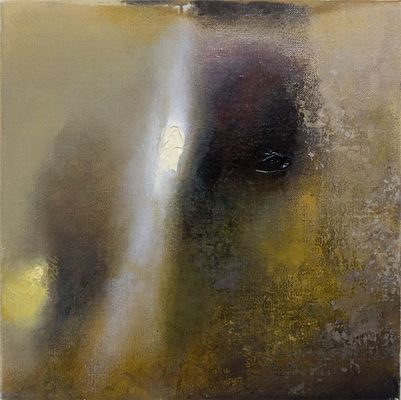
I am not a great reader of poetry but I always return to the work of Melbourne poet, Vincent Buckley (1925- 1988). Perhaps I find his most tantalising piece to be not a finished poem but a fragment left on a scrap of paper discovered on his desk after the poet’s death.
The poetry gathers like oil
In the word-core, and spreads
It has its music meet,
Its music is in movement.
This fragment is more the shell left behind from a volatile thought than a finished poem. I find the last two lines honest but awkward whereas the first two lines work like an arrow. Most likely he could not find a resolution so it was left. Still, in its present form, it remains an eloquent testimony to the ultimate failure of a medium to express mobile thought and sensation, in Buckley’s case, through verbal language. It’s an important matter because this is something all artists have to deal with regardless of the medium.
I have never written a poem, however, I am forever copying fragments from books on paper scraps in a vain effort to fix certain notions in my head. At first, they function as bookmarks that are sometimes returned to when I open the book. But before long, as they accumulate, they fall out littering the table interspersed with A4 photocopies, bills, books and medications.
To return to Buckley’s fragment, the first two lines very much evoke how I paint nowadays. As you age, detail diminishes and patches of light become more luminous and float. I feel the most honest way of dealing with this is by smearing the oil paint on the canvas with the fingers and working close-up, blind. Only if the patches coalesce into an approaching image can the work gain a life.
-
Jonathan Walker was born in Melbourne, Australia and brought up on a dairy farm in Gippsland. In the 1970’s he studied painting at RMIT and won the Harold Wright Scholarship to the British Museum, London. During the 1980’s he exhibited at Pinacotheca Gallery, Richmond and had work shown at the NGV and Heidi City Art Gallery. Over the same period he designed the cover for the “Epigenesi” LP by Giancarlo Toniutti, Italy and conducted a mail exchange work with Achim Wollscheid, Germany. The work with artists through the post resulted in an article published in the bicentenary issue of Art and Australia 1988. He showed in artist run spaces such as WestSpace in the 90’s and 2000’s, and until 2012, taught painting at Victoria University, which is where we (Colleen Ahern and Lisa Radford) as organisers of the exhibition, among many others, had the privilege of being his student.
Walker’s knowledge was imparted to students through the careful selection of music, literature, and artists found in books that he himself had ordered for the library. Walker’s strategy was the generosity of sharing his vast knowledge with references specific to each student and their context.
Walker’s paintings share a similar focus and intimacy.
This exhibition presents a small selection of recent paintings alongside a publication that includes Walker’s writing. Observational and analytical, Walker’s work is a type of material notation — the time of day, colour and how it is blended, the both specific and fleeting location of a reflection on lino or the question of whether a chair leg should be included in a painting.
Please join us on Friday August 21 between 6-8pm to celebrate the opening of the exhibition.
Curated by Colleen Ahern and Lisa Radford.
B. Wurtz
Curated by Nic Tammens
March 26 - April 4, 2015
B.Wurtz works from a basement studio in his home on Manhattan’s Lower East Side.
This local fact is attested to by the plastic shopping bags and newsprint circulars that appear in his work. As formal objects, they don’t make loud claims about their origins but nonetheless transmit street addresses and places of business from the bottom of this long thin island. Like plenty of artists, Wurtz is affected by what is local and what is consumed. His work is underpinned by this ethic. It often speaks from a neighborhood or reads like the contents of a hamper:
“BLACK PLUMS $1.29 lb.”
“Food Bazaar”
“USDA Whole Pork Shoulder Picnic 99c lb.”
“RITE AID Pharmacy, with us it’s personal.”
“H. Brickman & Sons.”
“Sweet Yams 59c lb."
Most of the work in this exhibition was made while the artist was in residence at Dieu Donne, a workshop dedicated to paper craft in Midtown. Here Wurtz fabricated assemblages with paper and objects that are relatively lightweight, with the intention that they would be easily transportable to Australia. This consideration isn’t absolute in Wurtz’s work, but was prescriptive for making the current exhibition light and cheap. Packed in two boxes, these works were sent from a USPS post office on the Lower East Side and delivered to North Melbourne by Australia Post.
Wurtz appears courtesy of Metro Pictures, New York.
Thanks to Rob Halverson, Joshua Petherick, Sari de Mallory, Matt Hinkley, Helen Johnson, Fayen d'Evie, Ask Kilmartin, Lisa Radon, Ellena Savage, Yale Union, and "Elizabeth".
John Nixon
"Archive"
December 15 - January 20, 2014
The presentation of John Nixon's archive offered a rare showcase of this extensive collection of the artist's own publications, catalogues, posters, ephemera, editions and more, from the mid 1980s onwards, alongside a selection of his artworks.
Organized by John Nixon, Joshua Petherick and Matt Hinkley.
<a href=http://wfb.public-office.info/artist/john-nixon>All titles by John Nixon
"Habitat"
at Minerva, Sydney (organised by Joshua Petherick and Matt Hinkley)
November 15 - December 20, 2014
Lupo Borgonovo, Janet Burchill & Jennifer McCamley,
Lewis Fidock, HR Giger, Piero Gilardi, Veit Laurent Kurz,
Cinzia Ruggeri, Michael E. Smith, Lucie Stahl, Daniel Weil, Wols
Press Release:
“...It contained seven objects. The slender fluted bone, surely formed for flight, surely from the wing of some large bird. Three archaic circuitboards, faced with mazes of gold. A smooth white sphere of baked clay. An age-blackened fragment of lace. A fingerlength segment of what she assumed was bone from a human wrist, grayish white, inset smoothly with the silicon shaft of a small instrument that must once have ridden flush with the surface of the skin - but the thing’s face was seared and blackened.”
William Gibson, “Count Zero”, 1986
"Autumn Projects Archive"
Curated by Liza Vasiliou
March 6 - March 15, 2014
World Food Books, in conjunction with the Virgin Australia Melbourne Fashion Festival 2014, presented the Autumn Projects archive, consisting of a selection of early examples in Australian fashion with a particular interest in collecting designers and labels from the period beginning in the 1980’s, who significantly influenced the discourse of Australian Fashion.
Curated by Liza Vasiliou, the exhibition provided a unique opportunity to view pieces by designers Anthea Crawford, Barbara Vandenberg, Geoff Liddell and labels CR Australia, Covers, Jag along with early experimental collage pieces by Prue Acton and Sally Browne’s ‘Fragments’ collection, suspended throughout the functioning World Food Books shop in Melbourne.
H.B. Peace
presented by CENTRE FOR STYLE
November 14, 2013
"Hey Blinky, you say chic, I say same"
Anon 2013
H.B. Peace is a clothing collaboration between great friends Blake Barns and Hugh Egan Westland. Their pieces explore the divergences between 'character’ and ‘personality’ in garments....etc
Special Thanks to Joshua Petherick and Matt Hinkley of WFB and Gillian Mears
and a Very Special Thank you to Audrey Thomas Hayes for her shoe collaboration.
Janet Burchill & Jennifer McCamley
"Aesthetic Suicide"
May 10 - June 8, 2013
The first of our occasional exhibitions in the World Food Books office/shop space in Melbourne, "Aesthetic Suicide" presented a body of new and older works together by artists Janet Burchill & Jennifer McCamley, including videos, prints, a wall work, and publications.
During shop open hours videos played every hour, on the hour.
2020, English
Softcover, 200 pages, 20.3 x 12.7 cm
Out of print title / as new
Published by
Rab-Rab Press / Helsinki
$100.00 - In stock -
Second edition, published in a run of 750 copies. All editions out-of-print.
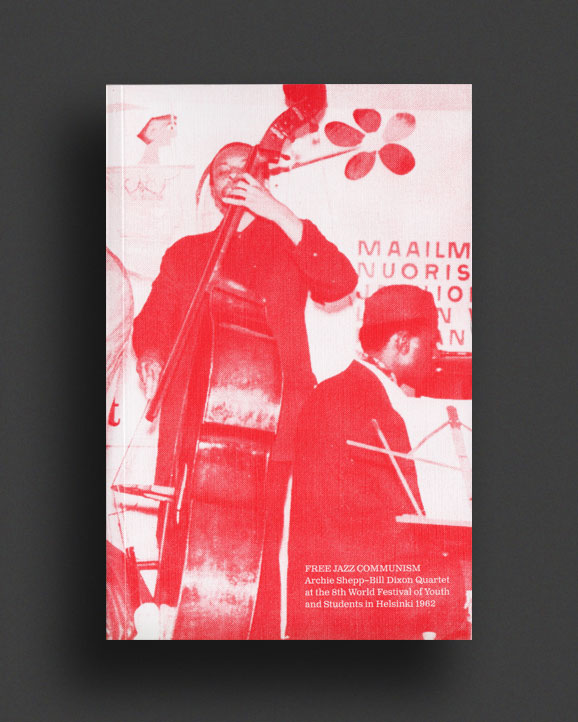
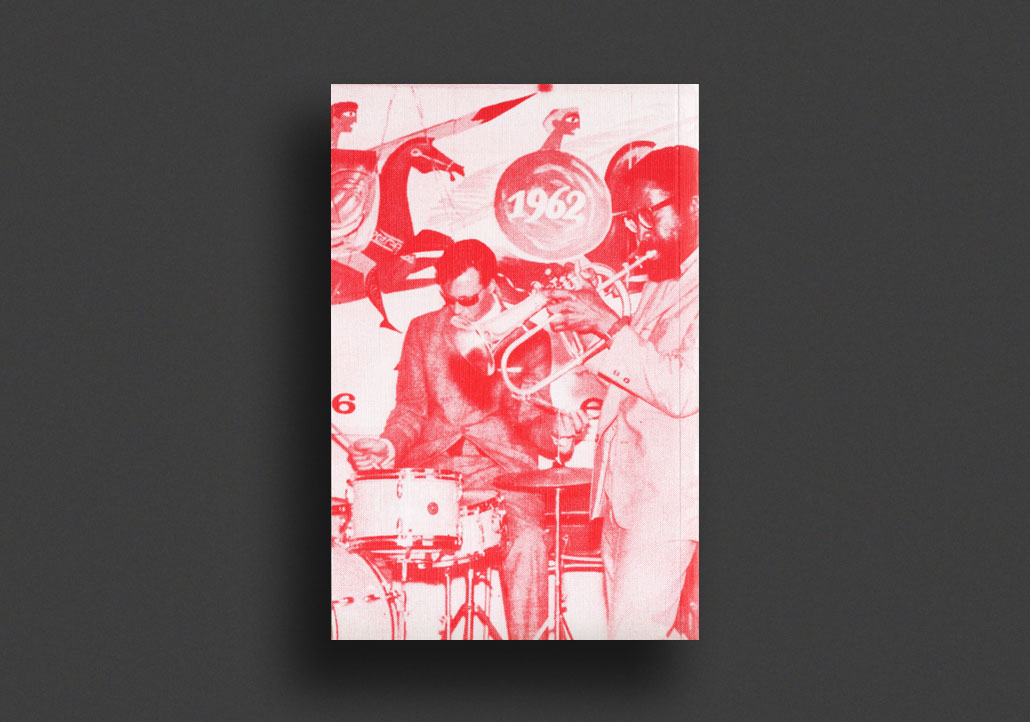
Rab-Rab Press announces the publication of Free Jazz Communism, a new book actualising Archie Shepp–Bill Dixon Quartet at the 8th World Festival of Youth and Students in Helsinki 1962. Including archive material and documents, commissioned theoretical and historical texts, and interviews, the book edited by Sezgin Boynik and Taneli Viitahuhta contextualizes politics of free jazz music in light of global decolonisation movements, anti-war activism, structures of racial capitalism, and forms of avant-garde music.
By focusing on concerts of Shepp–Dixon Quartet, leading avant-garde jazz musicians from the US, in the socialist anti-colonial festival in Helsinki, the book is introducing complexities in the usual Cold War stories about the sixties, and pictures politics of jazz as something transcending boundaries of nation-state and capitalist market regulations.
Apart from the theoretical and historical overview by its editors, the book includes testimonies of the collective and international spirit of the 1962 Youth Festival, translated documents from Finnish press, a new interview with Archie Shepp, commissioned text by Jeff Schwartz on the historical context of political engagement of free jazz musicians, and reproduction of three hard-to-find texts by Shepp.
The book is designed by Ott Kagovere.
As New copy.
1977, German
Hardcover (w. dust jacket), 182 pages, 28 x 25 cm
1st UK Edition, Out of print title / used / very good
Published by
Edition Spangenberg / Münich
$55.00 - Out of stock
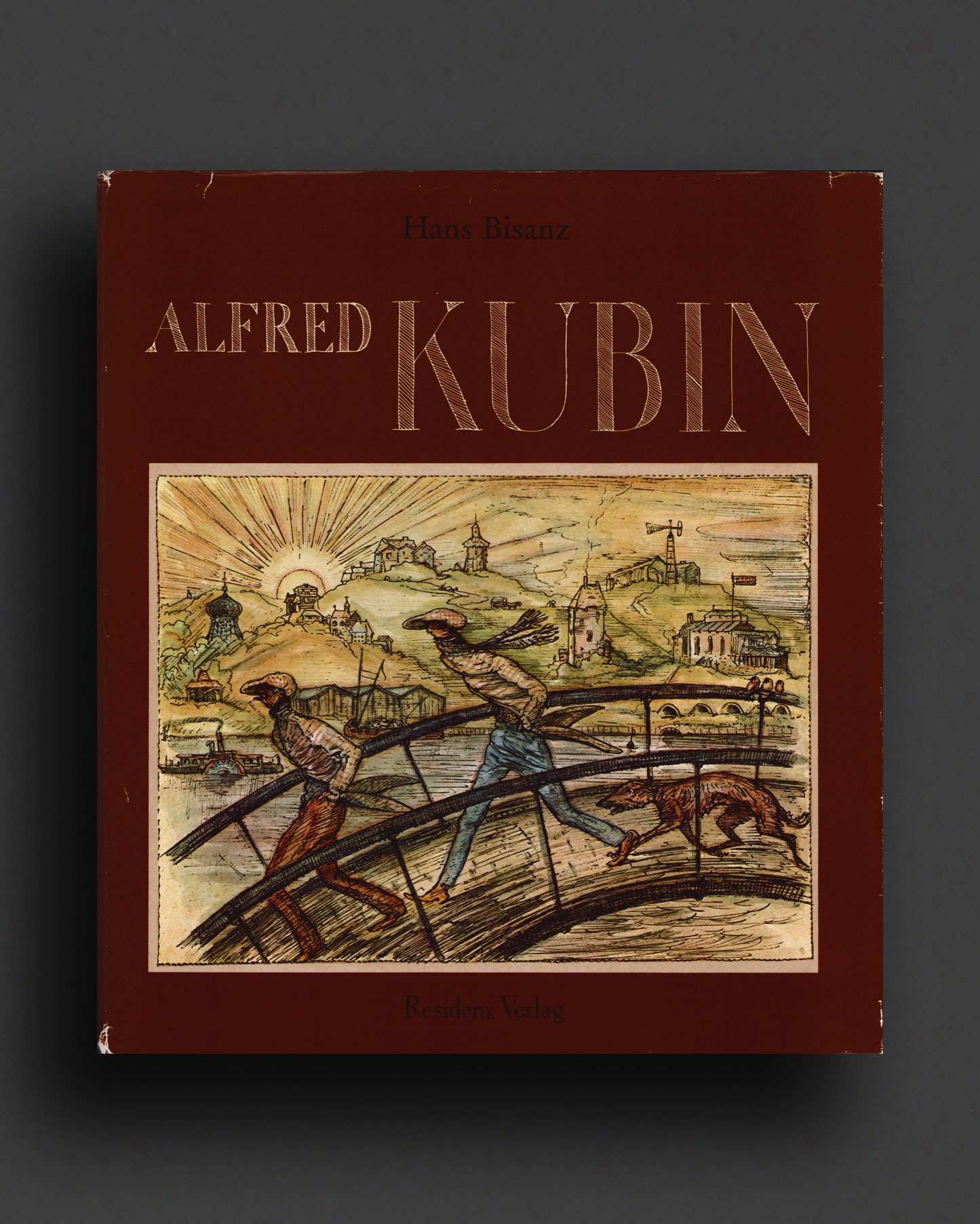
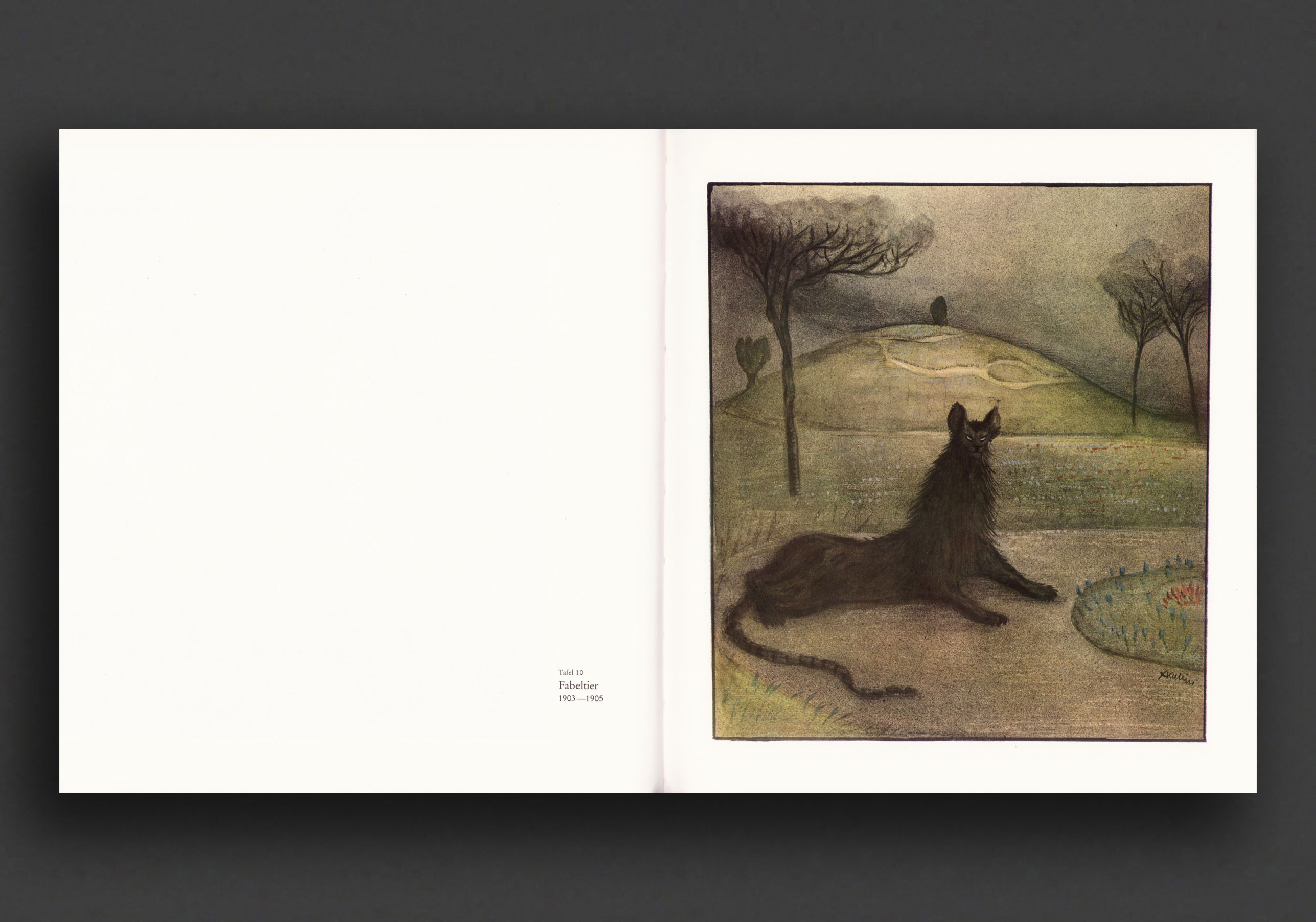
First 1977 hardcover edition of Hans Bisanz's monographic study of the great Austrian draftsman, illustrator and author Alfred Kubin (1877–1959), originator of the Austrian fantastic and bizarre achieving mastery in both literature and the visual arts. Alfred Kubin : Zeichner, Schriftsteller und Philosoph (Illustrator, Writer and Philosopher), published by Edition Spangenberg, Münich, is profusely illustrated throughout with colour and b/w plates covering the breadth of this magnificent artist's life and work, including biography with rare photographs.
Alfred Kubin, an accomplished draughtsman, was inspired by his fascination with the philosophies of Schopenhauer and Nietzsche; and influenced by the artists Goya, Klinger, Ensor, Redon, Rops and Munch. Kubin called his dreamlike imagery a vital "escape into the unreal": ghostly figures, hybrid creatures, variants of torture and self-torture, dream, vampirism, spiritualism, decadence, sex, death and birth. His extraordinary oeuvre comprises more than 20,000 drawings, a large part of it consist of pen drawings, portfolio pieces and illustrations from more than 70 books.
Very Good copy in VG dust jacket with some wear and small closed tears to edges, preserved in mylar wrap.
1977, English
Hardcover (w. dust jacket), 296 pages, 19.5 x 12.5 cm
1st Edition, Out of print title / used / very good
Published by
Allison & Busby / London
$140.00 - In stock -
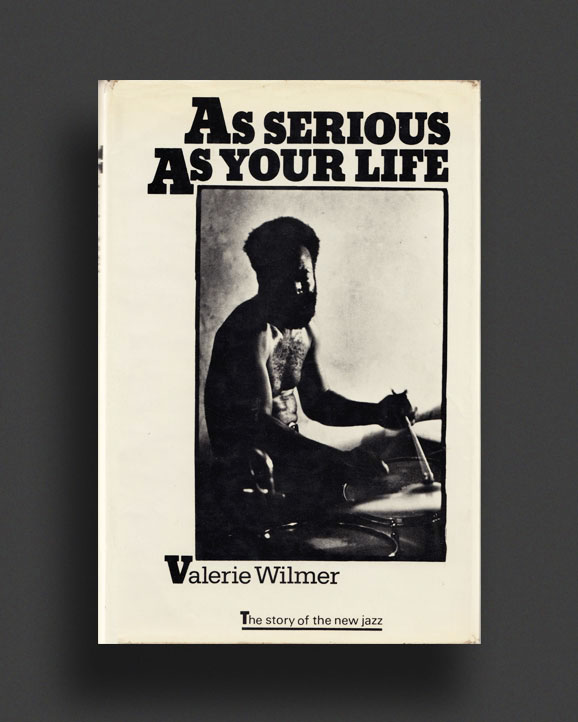
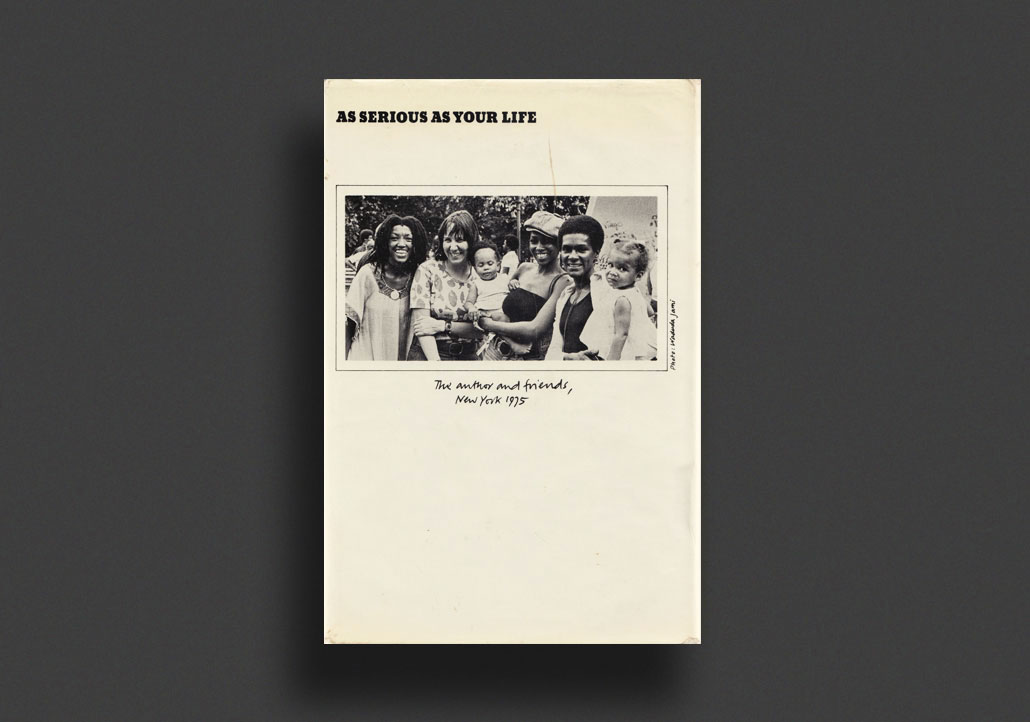
Very rare first 1977 hardcover edition of this essential masterpiece of jazz history by renowned photographer and music historian, Val Wilmer, published by Allison & Busby in London.
In this classic account of the new black music of the 1960s and 70s, celebrated photographer and jazz historian Val Wilmer tells the story of how a generation of revolutionary musicians established black music as the true vanguard of American culture. Placing the achievements of African-American artists such as Albert Ayler, Ornette Coleman, John Coltrane and Sun Ra in their broader political and social context, Wilmer evokes an era of extraordinary innovation and experimentation that continues to inspire musicians today. As vital now as when it was first published in 1977, As Serious As Your Life is the essential story of one of the most dynamic musical movements of the twentieth century.
Features : Marion Brown, Don Cherry, Andrew Cyrille, Milford Graves, Cecil Taylor, Mcoy Tyner, Rashied Ali, Dewey Redman, Anthony Braxton, Frank Lowe, Sonny Sharrock, Marshall Allen, Archie Shepp, Jimmy Lyons, Elvin Jones, Lester Bowie, Charlie Hayden, Albert Ayler, Ornette Coleman, John Coltrane, Sun Ra, and so many more....
Val Wilmer is an internationally acclaimed photographer, journalist, author and black music historian who has been documenting African-American music since 1959. In that time she has interviewed and photographed almost every significant figure in post-war jazz, blues and R&B, from Louis Armstrong and Thelonious Monk to Sun Ra and Albert Ayler via Muddy Waters and Aretha Franklin. As a photographer, her work features in the permanent collections of the British Library, the V&A Museum and the National Portrait Gallery; as a writer and historian, she has contributed to the Oxford Dictionary Of National Biography and the New Grove Dictionary Of Jazz. She lives in London.
Very Good with Very Good dust jacket (some light book block edge wear and marking, tanning)
1972, Japanese
Softcover (w. french-fold dust jacket and printed cardboard slipcase w. original obistrip), 246 pages, 13 x 19.5 cm
1st Edition, Out of print title / used / very good
Published by
Kodansha Int / Tokyo
$100.00 - In stock -
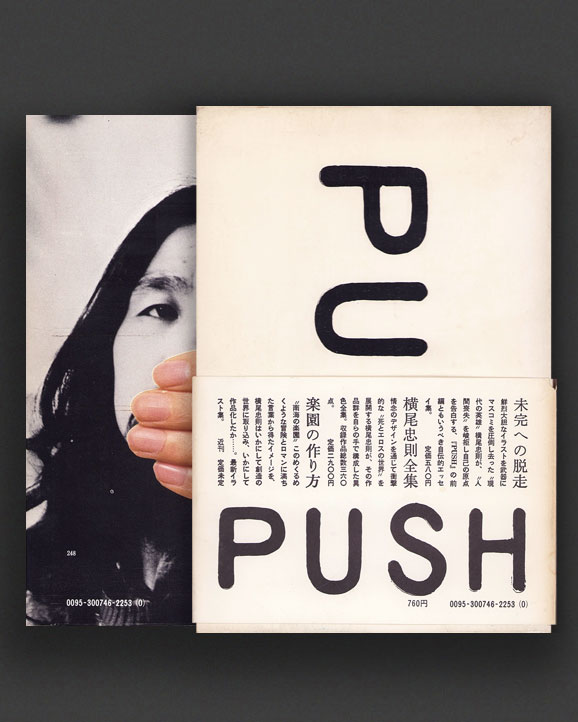
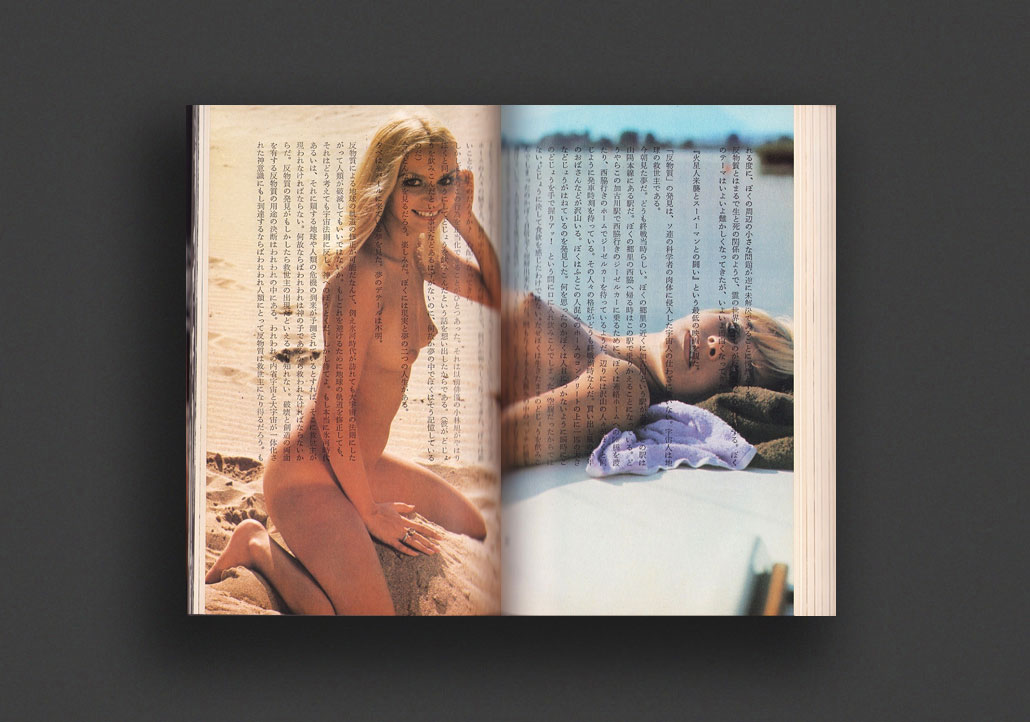
The wonderful PUSH by Tadanori Yokoo, published in 1972 and featuring photography by Kishin Shinoyama and Daido Moriyama.
After a car accident in 1972 Tadanori Yokoo decided to take a two year hiatus from work at the height of his fame. PUSH is a visually inventive dairy of this period beautifully designed by Yokoo himself with colour nude girl photographs and b/w self-portraits of the artist by none other than Kishin Shinoyama, Daido Moriyama and Tadashi Krahashi. A gorgeous and curious production with humorous over-printing and incredible design, housed in original printed slipcase with the original publisher's obi-strip.
Tadanori Yokoo (b. 1936) is one of Japan's most successful and internationally recognized graphic designers and artists, who began working with painting in 1966. In parallel, Yokoo’s early screenprints experimented with collage and illustration, combining found photographs with the influence of traditional Japanese ukiyo-e and pop art’s flat vibrant colours and overtly sexual and grotesque content, often reflecting on the rapid changes and Westernisation of Japan post-war society. His interests in mysticism and esotericism, deepened by travels to India, influenced his iconic posters with eclectic psychedelic imagery sharing the aesthetics of the underground counterculture he was associated with. In Tokyo, Yokoo worked as a stage designer for avant-garde theatre, collaborating extensively with Shūji Terayama and his experimental theater group Tenjō Sajiki. By the late 60s he had already achieved international recognition and in the early 1970s MoMA mounted a solo exhibition of his graphic work. His famous designs for The Beatles, Miles Davis, Carlos Santana and collaborations with friend and iconic Japanese fashion designer Issey Miyake are renowned the world over. He also starred as a protagonist in Nagisa Oshima's film Diary of a Shinjuku Thief in 1968.
Very Good copy, with only light wear and age. Very well preserved and complete.
1974, Japanese
Softcover (French-fold cover), 80 pages, 21 x 28.5 cm
1st Edition, Out of print title / used / very good
Published by
Mainichi Shinbun / Japan
$120.00 - In stock -
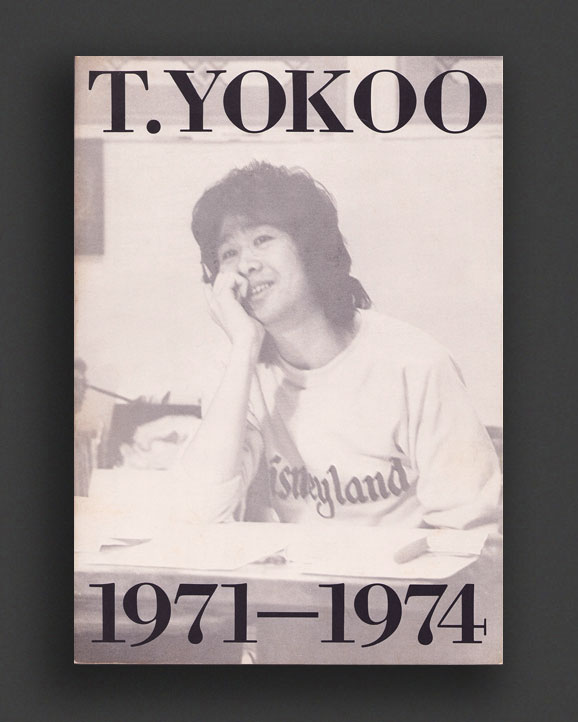
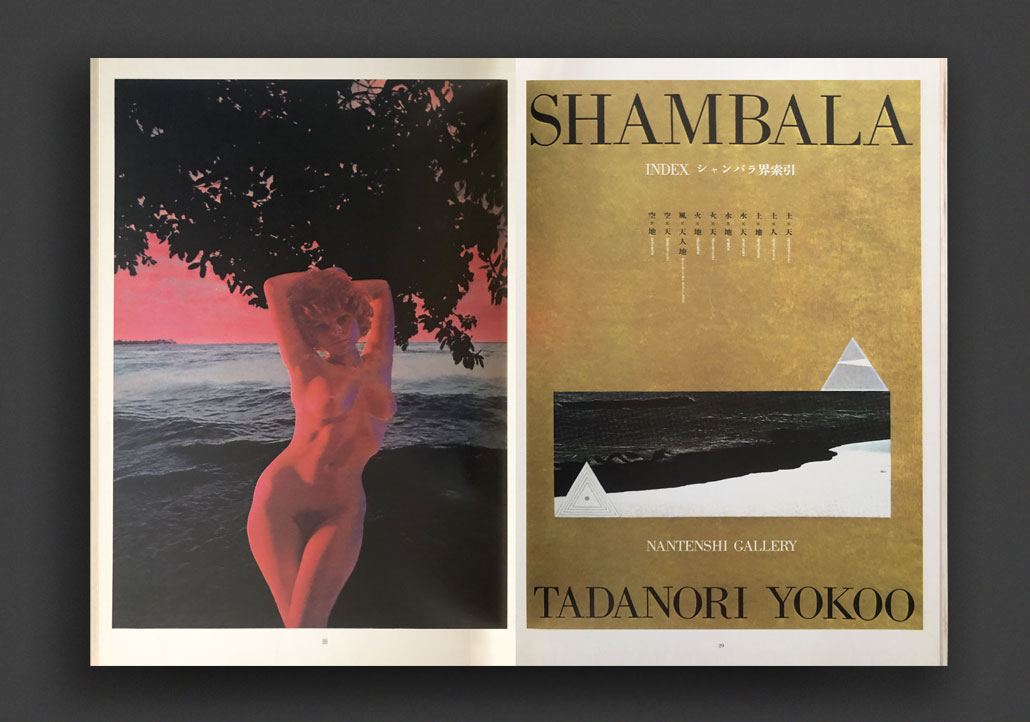
Rarely seen gorgeous book on the poster work of the legendary Japanese graphic artist Tadanori Yokoo at the height of his powers. Printed and published by Mainichi Shinbun in Japan in 1974, this volume carries very little text and is made up almost 100% with beautiful full-page reproductions of Yokoo's major poster works from the years 1971-1974, in which his iconic photo-montage and print-making had a distinct psychedelic, erotic and esoteric spirit rendered in his vivid pop colours. One of the nicest books on this period of his work, designed by Yokoo himself and adorned with adorable self-portrait in Disneyland sweater. Rare even in Japan.
Tadanori Yokoo (b. 1936) is one of Japan's most successful and internationally recognized graphic designers and artists, who began working with painting in 1966. In parallel, Yokoo’s early screenprints experimented with collage and illustration, combining found photographs with the influence of traditional Japanese ukiyo-e and pop art’s flat vibrant colours and overtly sexual and grotesque content, often reflecting on the rapid changes and Westernisation of Japan post-war society. His interests in mysticism and esotericism, deepened by travels to India, influenced his iconic posters with eclectic psychedelic imagery sharing the aesthetics of the underground counterculture he was associated with. In Tokyo, Yokoo worked as a stage designer for avant-garde theatre, collaborating extensively with Shūji Terayama and his experimental theater group Tenjō Sajiki. By the late 60s he had already achieved international recognition and in the early 1970s MoMA mounted a solo exhibition of his graphic work. His famous designs for The Beatles, Miles Davis, Carlos Santana and collaborations with friend and iconic Japanese fashion designer Issey Miyake are renowned the world over. He also starred as a protagonist in Nagisa Oshima's film Diary of a Shinjuku Thief in 1968.
Very Good copy with foxing to first blank page. Light corner/spine wear.
2026, English
Hardcover (w. dust jacket), 480 pages, 24 x 16 cm
Published by
Farrar Straus & Giroux / New York
$62.00 - In stock -
US hardcover edition.
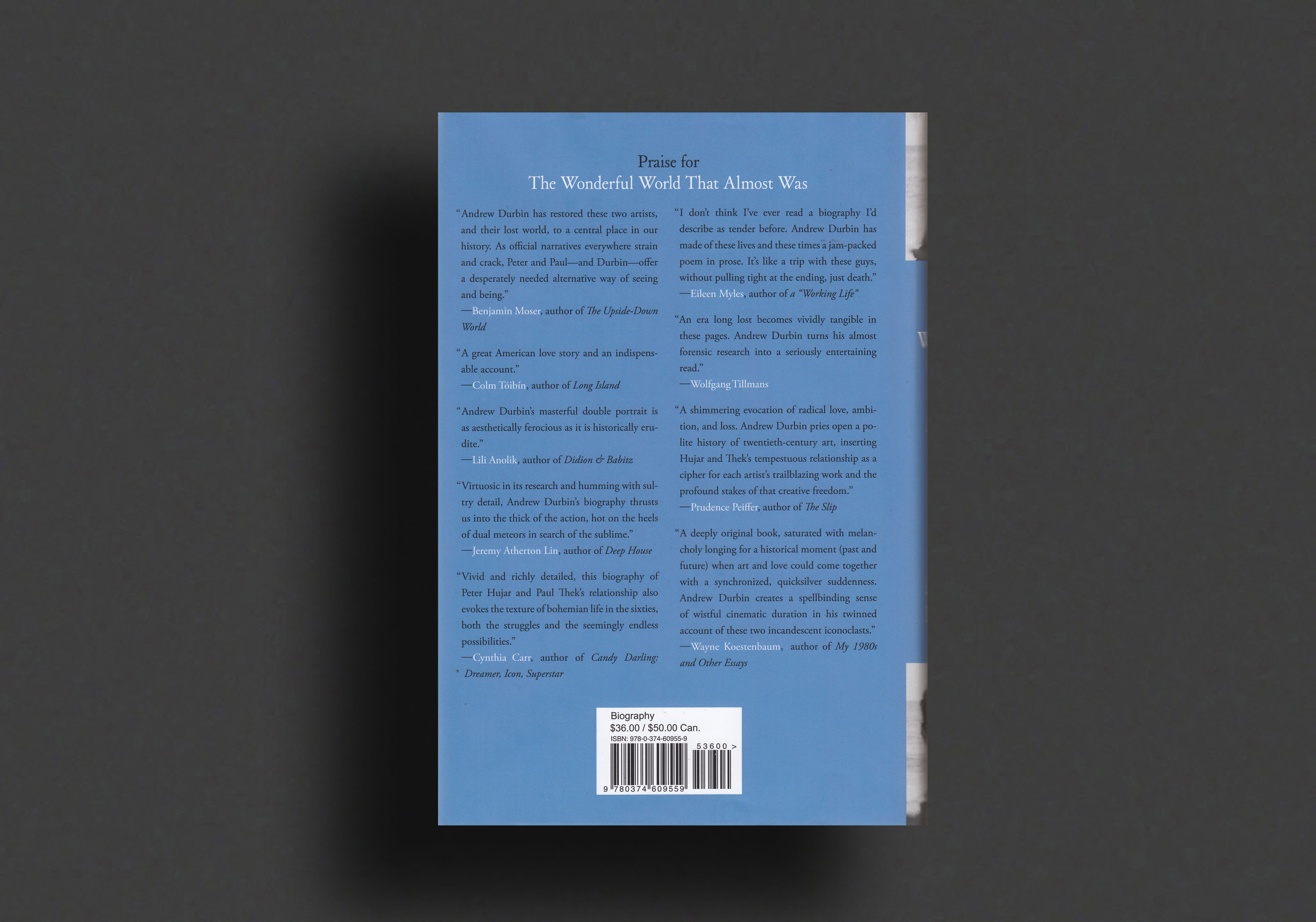
"As official narratives everywhere strain and crack, Peter and Paul—and Durbin—offer a desperately needed alternative way of seeing and being."—Benjamin Moser, author of Susan Sontag: Her Life and Work, winner of the Pulitzer Prize
"A deeply original book, saturated with melancholy longing for a historical moment (past and future) when art and love could come together with a synchronized, quicksilver suddenness. Andrew Durbin creates a spellbinding sense of wistful cinematic duration in his twinned account of these two incandescent iconoclasts."—Wayne Koestenbaum
"[Andrew Durbin] has made of these lives and these times a jam-packed poem in prose. It's like a trip with these guys, without pulling tight at the ending, just death."—Eileen Myles, author of A "Working Life"
The cinematic, never-before-told story of two intimately entangled artists who redefined queer art.
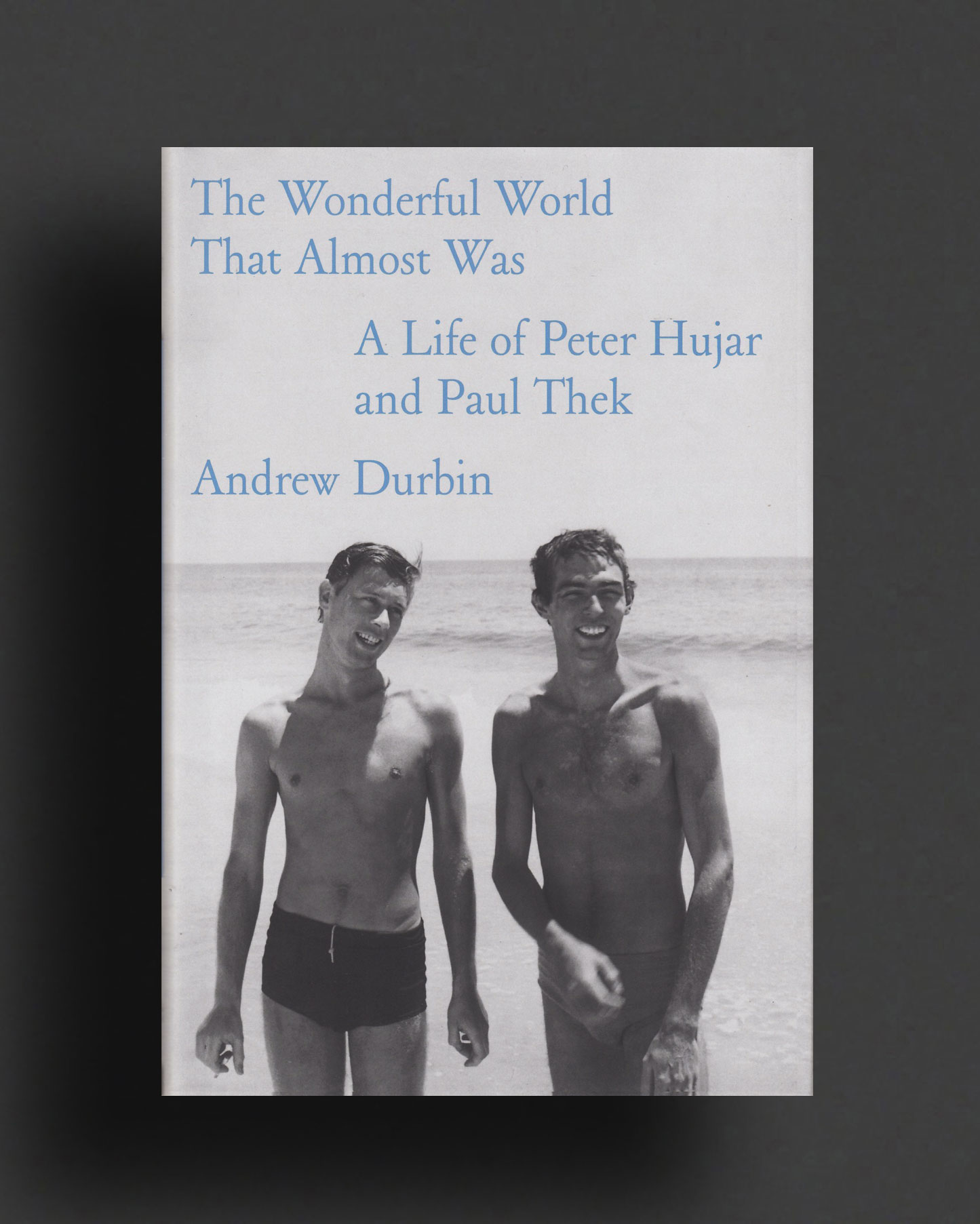
When Paul Thek met Peter Hujar in the winter of 1956 in Coral Gables, Florida, a slow-simmering connection began to burn. Thek, twenty-three and living in Miami, was handsome and itching to make it as a painter; in the twenty-two-year-old Hujar, a shy, sensual photographer, he'd found a kindred spirit. By 1960, they were dating and living in New York, beginning decades of sex, love, competition, and reconciliation—an entanglement that changed American art forever.
Surrounded by a robust creative scene populated by Susan Sontag, Andy Warhol, Fran Lebowitz, John Waters, and David Wojnarowicz, Thek and Hujar's profoundly influential careers, from the early 1960s through the late 1980s, differed as much as the men themselves. The unpredictable and often overlooked Thek crafted visceral installations and sculptures, while Hujar, celebrated and sociable, took penetrating portraits of his world, queer and otherwise. Yet even at their most estranged, and even after their deaths from AIDS, both men were united by a pursuit of liberation—from artistic and sexual limits, from anything short of changing the world.
Andrew Durbin's The Wonderful World That Almost Was unravels, for the first time, the intertwined stories and work of two boundaryburning, paradigm-tilting, never more relevant American artists. Weaving together deft art criticism with moving portraits of both men's inner lives, and assembled with exhaustive research, Durbin's book is an ode to a lost but still-living world—and two men who defined it.
2023, English
Softcover, 224 pages, 20.83 x 13.72 cm
Published by
Verso / London
$45.00 - In stock -
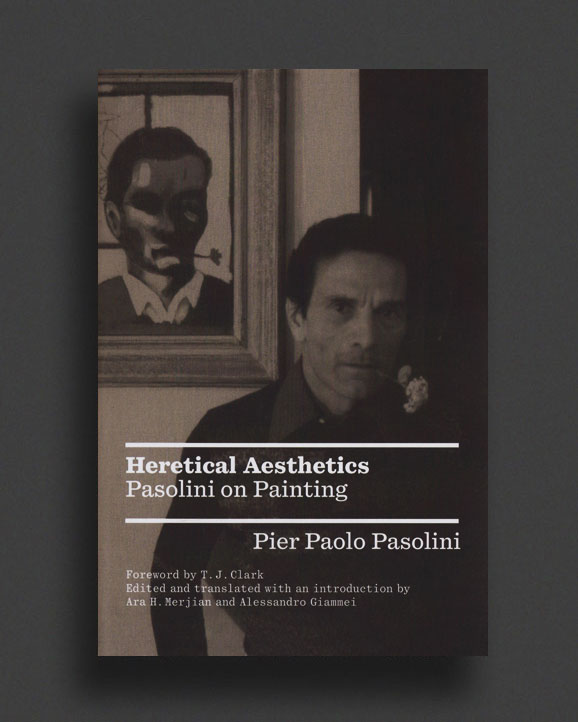
First collection on filmmaker and poet Pasolini's passion for painting.
Preface by T. J. Clark
Edited by Alessandro Giammei and Ara H Merjian
One of Europe's most mythologized Marxist intellectuals of the 20th century, Pier Paolo Pasolini was not only a poet, filmmaker, novelist, and political martyr. He was also a keen critic of painting. An intermittently practicing artist in his own right, Pasolini studied under the distinguished art historian Roberto Longhi, whose lessons marked a life-long affinity for figurative painting and its centrality to a particular cinematic sensibility.
Pasolini set out wilfully to "contaminate" art criticism with semiotics, dialectology, and film theory, penning catalogue essays and exhibition reviews alongside poems, autobiographical meditations, and public lectures on painting. His fiercely idiosyncratic blend of Communism and classicism, localism and civic universalism, iconophilia and aesthetic "heresy," animated and antagonized Cold War culture like few European contemporaries. This book offers numerous texts previously available only in Italian, each accompanied by an editorial note elucidating its place in the tumultuous context of post-war Italian culture.
Prefaced by the renowned art historian T.J. Clark, a historical essay on Pasolini's radical aesthetics anchors the anthology. One hundred years after his birth, Heretical Aesthetics sheds light on one of the most consequential aspects of Pasolini's intellectual life, further illuminating a vast cinematic and poetic corpus along the way.
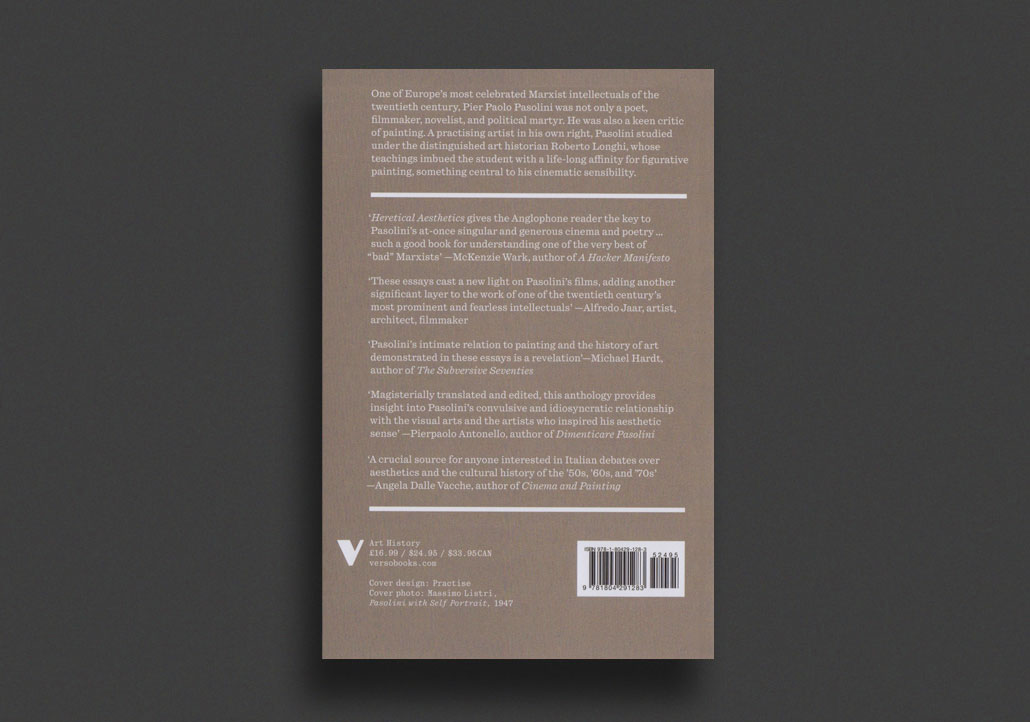
"Vision in Pasolini is at once tactile, earthy, erotic, divine and communist. His way of seeing communes with the world rather than holding it at a distance. By bringing together his writings on art, Heretical Aesthetics gives the Anglophone reader the key to his at once singular and generous cinema and poetry. His is a perspective from elsewhere in history, one which holds our own times sternly to account. This is such a good book for understanding one of the very best of 'bad' Marxists."—T.J. Clark
"Magisterially translated and edited, this indispensable anthology is finally available to an English-speaking audience. It provides detailed and precise insight into Pasolini's convulsive and idiosyncratic relationship with the visual arts and the artists who inspired his aesthetic sense. This exhilarating trove sheds light on the contaminated and visionary visual landscape produced by one of the most important filmmakers in the history of cinema: a total artist who found expressive depth in the heretical forms of his vision."—Pierpaolo Antonello
"Pasolini's intimate relation to painting and the history of art demonstrated in these essays is a revelation, especially for understanding his films. The texts are classic Pasolini - unfailingly brilliant and erudite, but also at once revolutionary and reactionary, observant of his times and blind to some of the most innovative developments. A fascinating collection."—Michael Hardt, author of The Subversive Seventies
2025, English
Softcover, 240 pages, 20 x 13 cm
Published by
Verso / London
$46.00 - In stock -
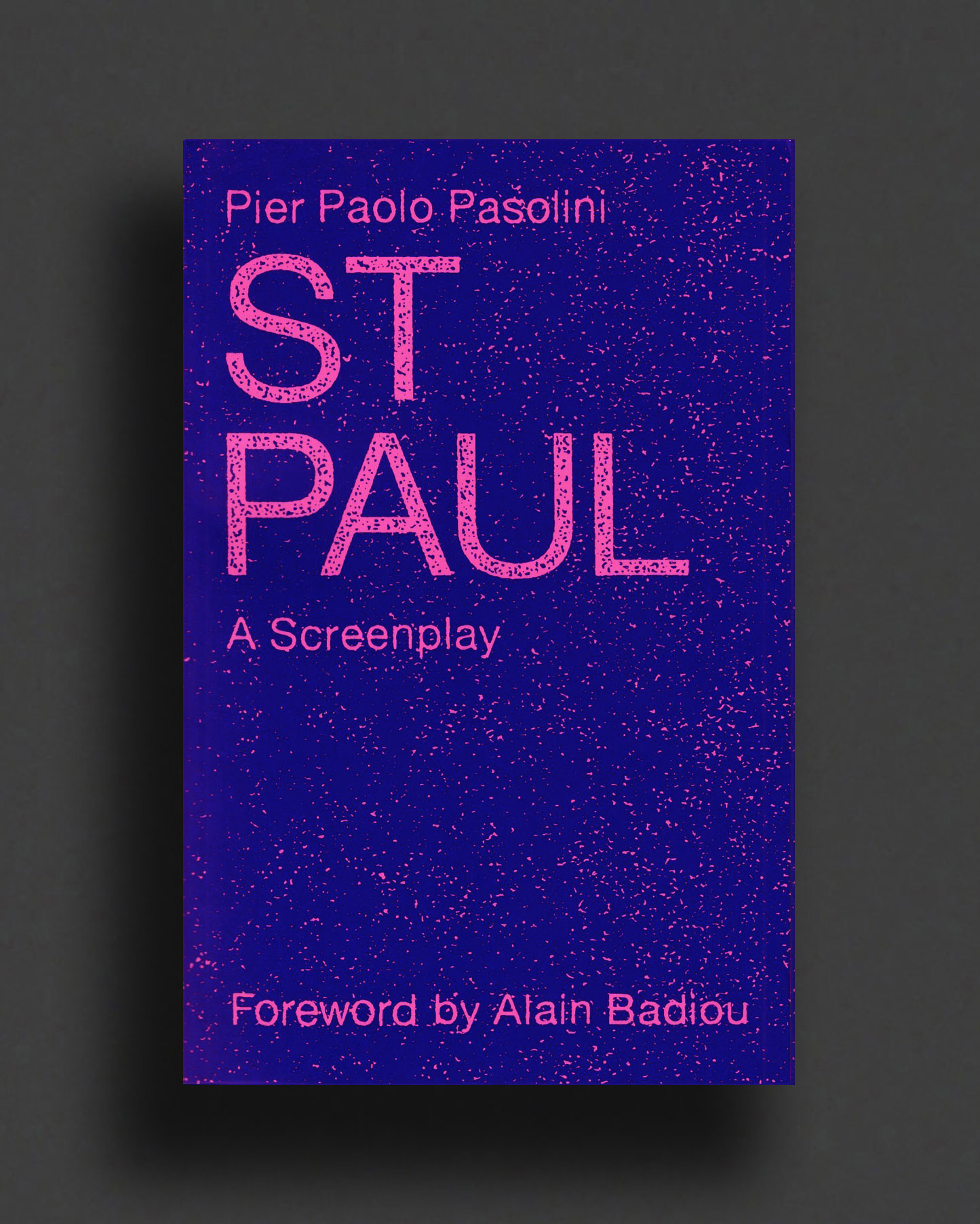
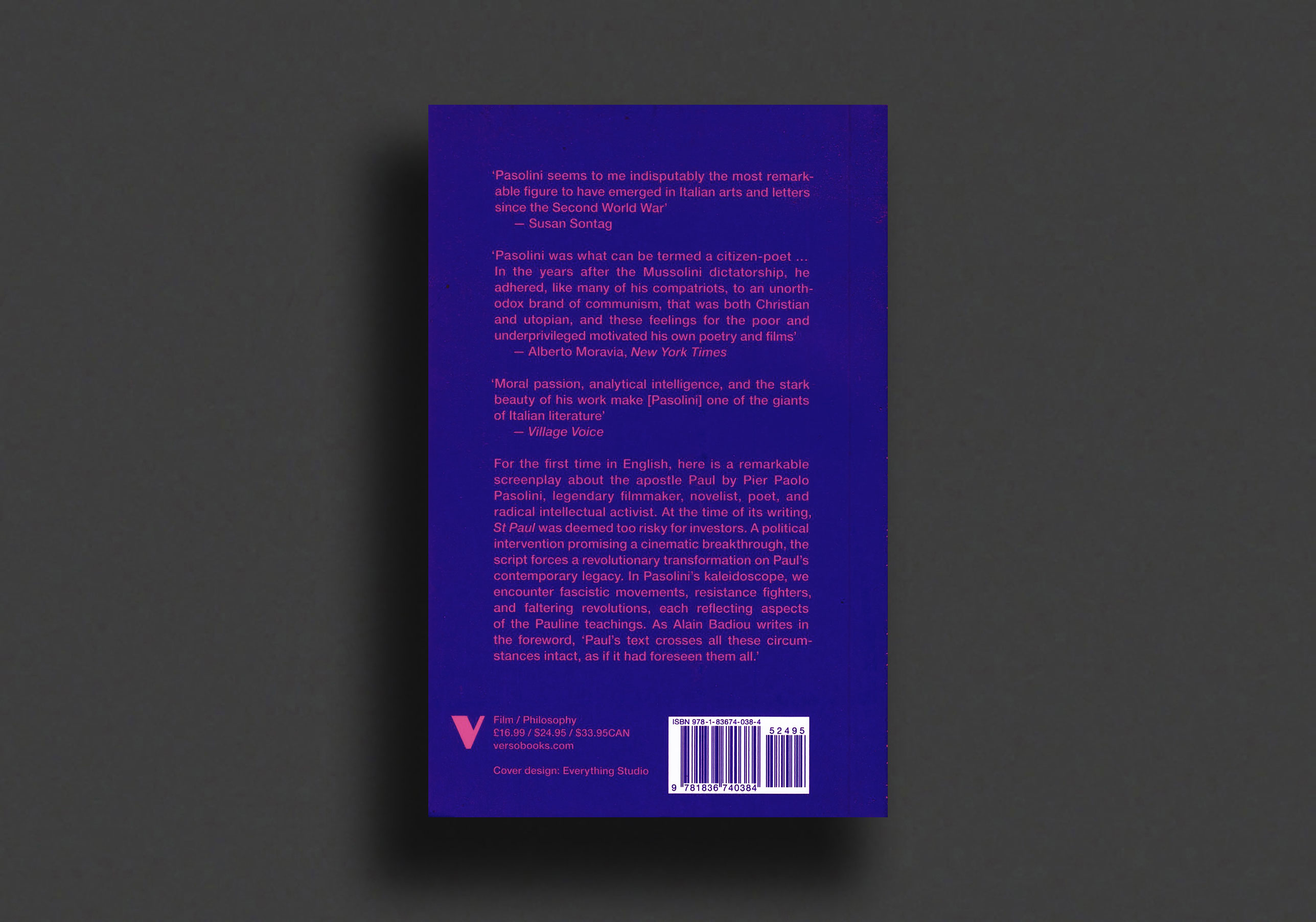
Presented here for the first time in English is a remarkable screenplay about the apostle Paul by Pier Paolo Pasolini, legendary filmmaker, novelist, poet, and radical intellectual activist. Written between the appearance of his renowned film Teorema and the shocking, controversial Salò, or the 120 Days of Sodom, St Paul was deemed too risky for investors. At once a political intervention and cinematic breakthrough, the script forces a revolutionary transformation on the contemporary legacy of Paul. In Pasolini's kaleidoscope, we encounter fascistic movements, resistance fighters, and faltering revolutions, each of which reflects on aspects of the Pauline teachings. From Jerusalem to Wall Street and Greenwich Village, from the rise of SS troops to the death of Martin Luther King, Jr, here— as Alain Badiou writes in the foreword—"Paul's text crosses all these circumstances intact, as if it had foreseen them all."
This is a key addition to the growing debate around St Paul and to the proliferation of literature centred on the current turn to religion in philosophy and critical theory, which embraces contemporary figures such as Alain Badiou, Slavoj Žižek and Giorgio Agamben.
Translated by Elizabeth A. Castelli
Preface by Alain Badiou
Introduction by Ward Blanton
1986, English
Softcover (staple-bound), 52 pages, 28 x 21.5 cm
1st Edition, Out of print title / used / very good
Published by
International Synergy Institute / Los Angeles
$150.00 - In stock -
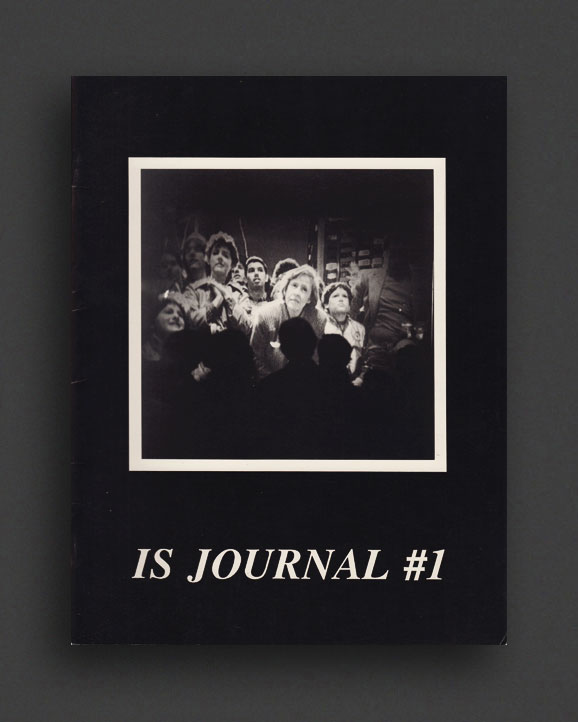
"A thrice yearly exploration of ambiguous borders and dynamic (intellectual/artistic) frontiers."
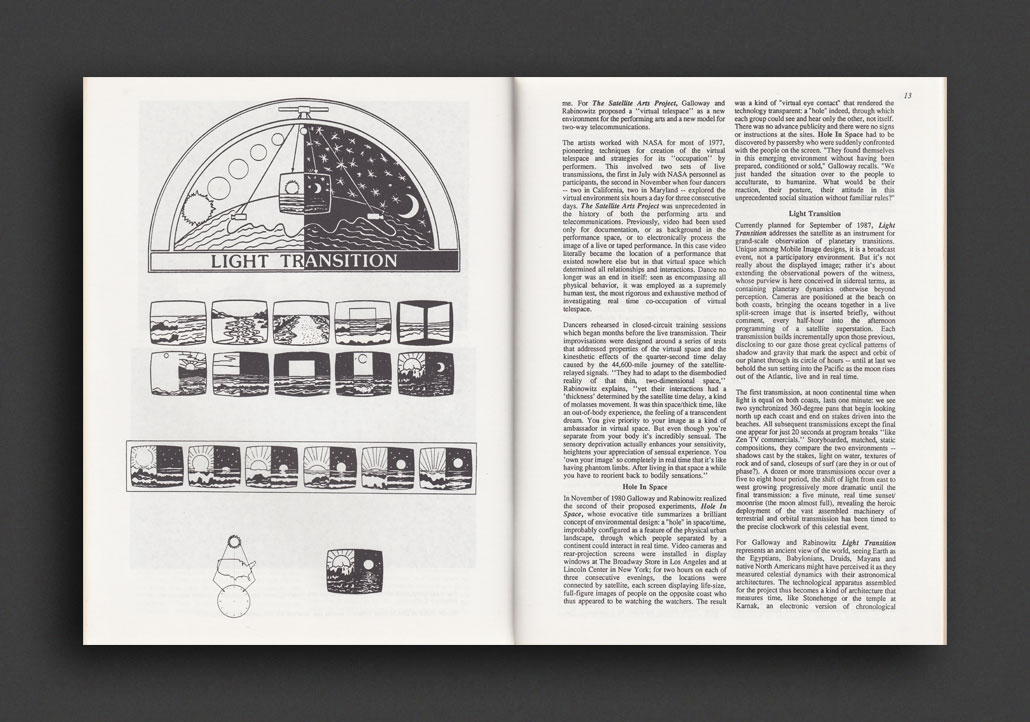
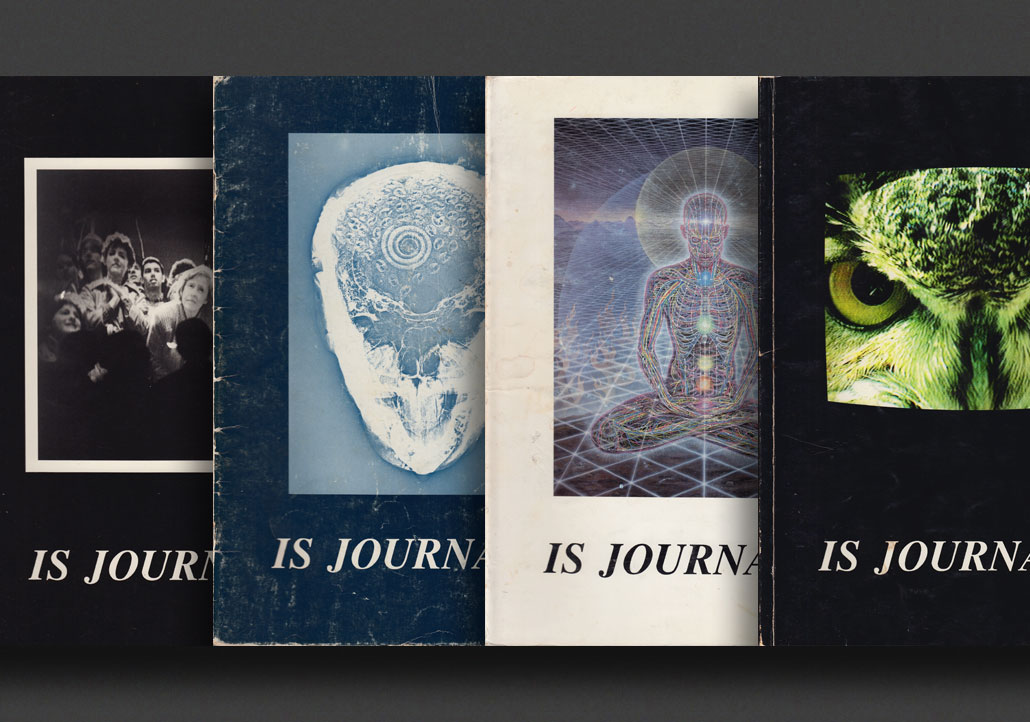
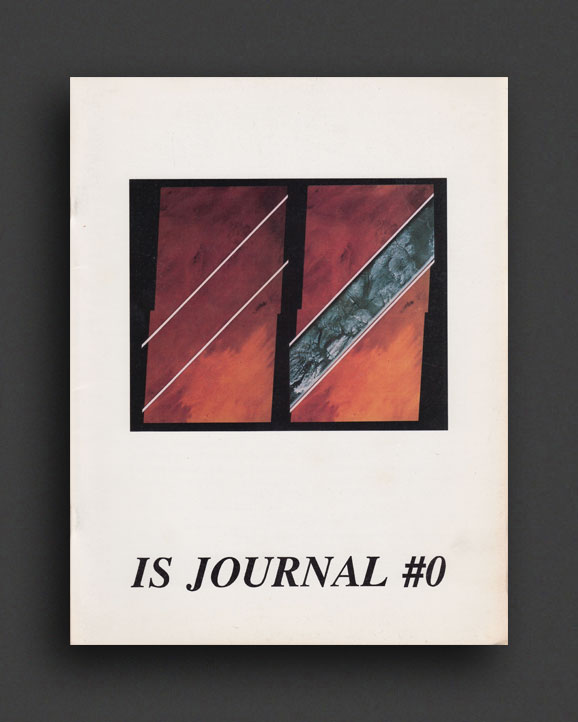
Exceptionally rare, issue #1 (after the inaugural #0) of the trail-blazing subscription-only journal published by the International Synergy Institute, a intermedia think-tank active in Hollywood between 1986—1987. IS was founded by American actress and philanthropist Andra Akers (Charlie's Angels, Dallas, Dukes of Hazzard...), edited by experimental composer, researcher and Harry Partch Ensemble member David Dunn, with a cast of contributors for this issue including early media artist visionaries Kit Galloway and Sherrie Rabinowitz (Mobile Image, the Electronic Café...), media theorist Gene Youngblood (Expanded Cinema...), Science Fiction theorist, philosopher and writer for Marvel comics Allyn B. Brodsky, aeronautical engineer and astronaut Russell Schweickart, cultural historian William Irwin Thompson, systems theorist Will McWhinney, actress Debra Clinger (The Love Boat, The Krofft Supershow, Midnight Madness, The Brady Bunch Variety Hour...), VFX pioneer Mimi Gramatky (LOST, Miami Vice, Star Trek, Tron, Damnation Alley...), and more.
"INTERNATIONAL SYNERGY consists of a global network of vanguard artists, scientists, and meta-physicians who are united by a deep sense of commitment to crossing the boundaries of their individual disciplines. Integral to this awareness is a reconciliation between advanced technological resources and a sense of the planet's sanctity. INTERNATIONAL SYNERGY is dedicated to the premise that such an understanding can form the basis of a creative matrix for responsible action in the information age."
"At this hinge of history, it seems appropriate that we should publish a journal where the passion of the individual scientist/artist can meet in sovereign association with global concerns — spinning the wheel of knowledge so that each of us can create our own theoretical magic." [...] "I am deeply moved by the creative commonwealth in this community, filled with explorers of topology, morphology, chaos dynamics, cognition, mind video, the revisioning of nature and art, telecommunications, sonics, cybernetics, cultural history, fractal politics, and what it now means to be deeply human. The provocative interaction of these ideas cannot help but to create a new and uniquely meaningful story. Come with us."—Andra Akers
Very Good copy, light wear/age.
1986—1994, English
Softcover (12 issues), approx 50-80 pages ea., 28 x 21.5 cm
1st Edition, Out of print title / used / good
Published by
International Synergy Institute / Los Angeles
$500.00 - In stock -
"A thrice yearly exploration of ambiguous borders and dynamic (intellectual/artistic) frontiers."
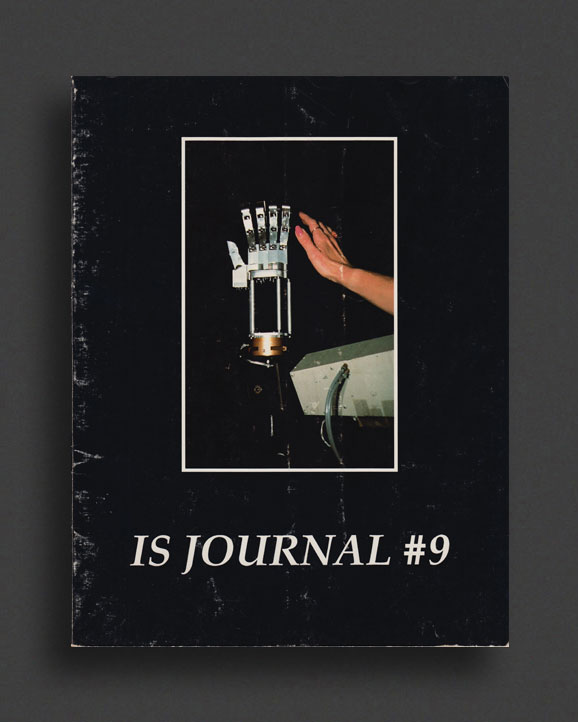
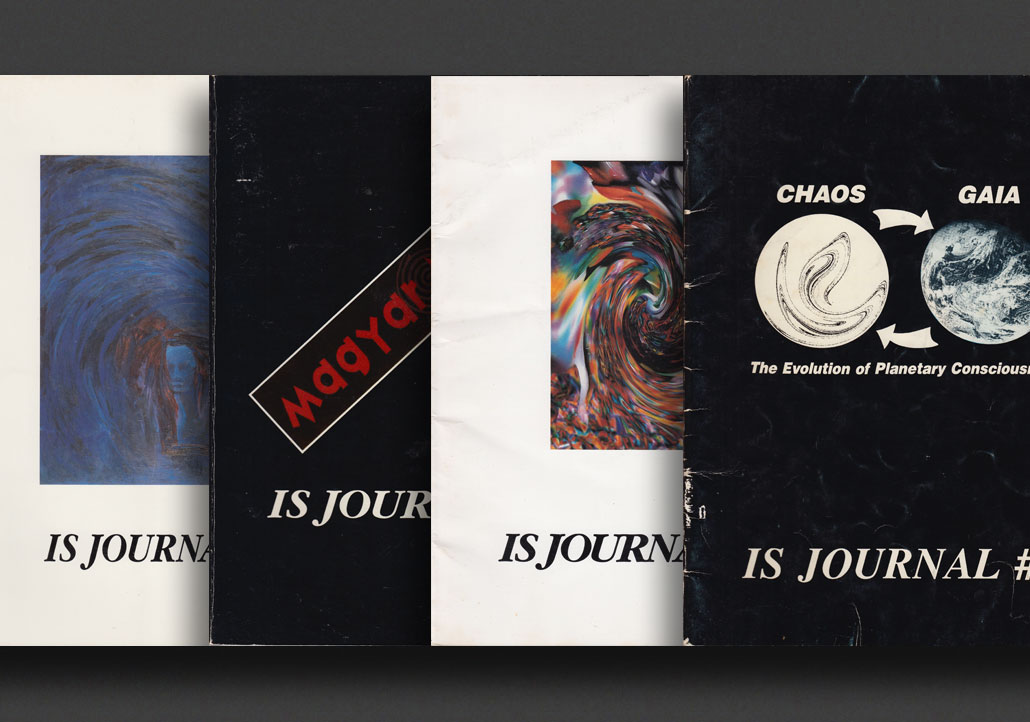
Exceptionally rare lot of 12 issues (1986—1994) of the trail-blazing subscription-only one-of-a-kind journal published by the International Synergy Institute, a intermedia think-tank active in Hollywood between 1986—1987. IS was founded by American actress and philanthropist Andra Akers (Charlie's Angels, Dallas, Dukes of Hazzard...), edited by experimental composer, researcher and Harry Partch Ensemble member David Dunn, with a cast of incredible contributors spanning these issues that includes media theorist Gene Youngblood (Expanded Cinema...), Australian composer, poet and performer Chris Mann, American ethnobotanist Terence McKenna, American artist Bill Viola, American landscape architect Bonnie Sherk, parapsychologist Rupert Sheldrake, mathematician Ralph Abrahams, composer Kenneth Gaburo, Australian experimental composer Warren Burt, early media artist visionaries Kit Galloway and Sherrie Rabinowitz (Mobile Image, the Electronic Café...), Science Fiction theorist, philosopher and writer for Marvel comics Allyn B. Brodsky, American composer and writer Elaine Barkin, visionary Czech author Lukáš Tomin, aeronautical engineer and astronaut Russell Schweickart, mathematician and polymath Tim Poston, climate crisis artists Newton and Helen Mayer Harrison, American composer John Bischoff, cultural historian William Irwin Thompson, ecological philosopher and author Boleslaw Rok, essayist and activist Tomaž Mastnak, Chilean biologist and philosopher Francisco Varela, artist Michael Kalil, systems theorist Will McWhinney, percussionist and composer Stuart Saunders Smith, mathematician Gottfried Mayer-Kress, alternative broadcaster Jay Levin, British-American futurist Hazel Henderson, actress Debra Clinger (The Love Boat, The Krofft Supershow, Midnight Madness, The Brady Bunch Variety Hour...), musician Mark Trayle, artist Sheila Pinkel, VFX pioneer Mimi Gramatky (LOST, Miami Vice, Star Trek, Tron, Damnation Alley...), sonic healer Jill Purce, robot dance choreographer Margo K. Apostolos, American psychedelic artist Alex Grey, social critic and historian Morris Berman, futurist Riane Eisler, poet James Bertolino, British zoologist, anthropologist and author John Heathorn Huxley, multi-media artist Todd Siler, American philosopher of science Ervin László, Budapest dissident magazine Magyar Narancs, and more.
Issues present: #0, #1, #2, #3, #4, #5, #9, #10, #11, #12, #13, #14 (12 issues total, not all pictured)
"INTERNATIONAL SYNERGY consists of a global network of vanguard artists, scientists, and meta-physicians who are united by a deep sense of commitment to crossing the boundaries of their individual disciplines. Integral to this awareness is a reconciliation between advanced technological resources and a sense of the planet's sanctity. INTERNATIONAL SYNERGY is dedicated to the premise that such an understanding can form the basis of a creative matrix for responsible action in the information age."
"At this hinge of history, it seems appropriate that we should publish a journal where the passion of the individual scientist/artist can meet in sovereign association with global concerns — spinning the wheel of knowledge so that each of us can create our own theoretical magic." [...] "I am deeply moved by the creative commonwealth in this community, filled with explorers of topology, morphology, chaos dynamics, cognition, mind video, the revisioning of nature and art, telecommunications, sonics, cybernetics, cultural history, fractal politics, and what it now means to be deeply human. The provocative interaction of these ideas cannot help but to create a new and uniquely meaningful story. Come with us."—Andra Akers
Most Good—Very Good, with a couple of issues Average (mostly due to cover rubbing or creasing), all with light wear/age.
1988 / 1989, English / Japanese
Softcover (w. dust jacket), 210 pages, 30 x 21.4 cm
1st Edition, Out of print title / used / very good
Published by
Asahi Shimbun / Japan
$90.00 - In stock -
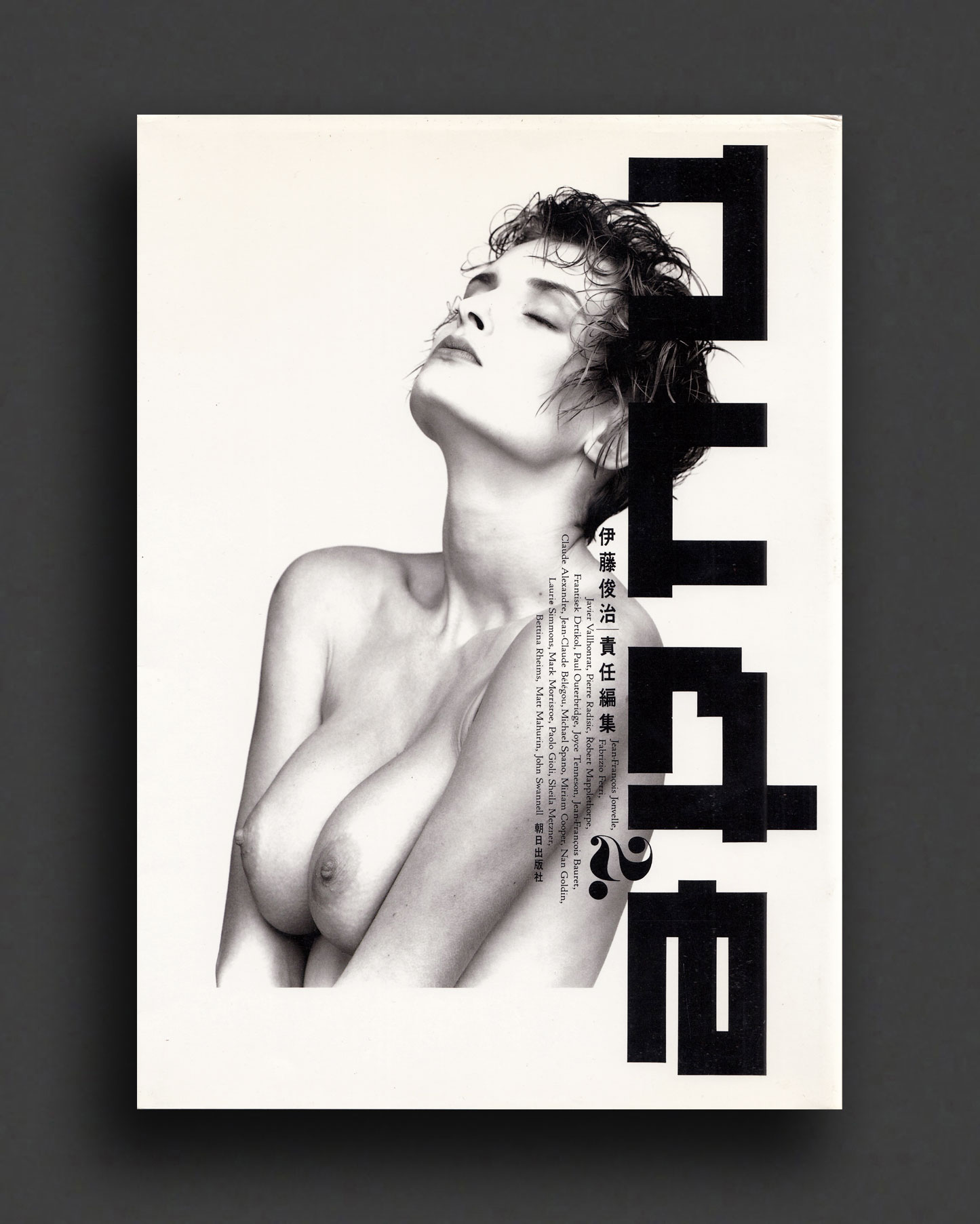
Second 1988 instalment of this incredible short–lived series of Japanese books on contemporary nude photography c. late 1980s, edited by art critic Toshiharu Ito and published by Asahi Shuppan-sha, Tokyo. Following the design of the first successful NEW NUDE series earlier in the 1980s, each volume presents works generously and sympathetically presented in colour and black-and-white across various paper-stocks and finishes. Nude 2 features the work of Jean-François Jonvelle, Fabrizio Ferri, Javier Vallhonrat, Pierre Radisic, Robert Mapplethorpe, Frantisek Drtikol, Paul Outerbridge, Joyce Tenneson, Jean-François Bauret, Claude Alexandre, Jean-Claude Bélégou, Michael Spano, Miriam Cooper, Nan Goldin, Laurie Simmons, Mark Morrisroe, Paolo Gioli, Sheila Metzner, Bettina Rheims, Matt Mahurin, John Swannell. Many other artists are included throughout the following illustrated essays by leading Japanese critics and this volume also includes an illustrated article on the "50 Best Books on the Nude Photograph" for the bibliophile.
Every historical period has revealed its particular perception of the human body through artistic representation of the nude form. Of particular interest is the unconscious yet inseparable relationship between the manner of representation of the nude and such fundamental aspects of the human situation as sex, death, love, desire and violence. [...] This book is the first attempt anywhere to grasp what is unconscious in our historical period by compiling a collection of nudes. We have carefully chosen the latest nudes from photographers around the world to produce a representative collection rich in variety. It is also the first book in a series which we conceive of as a comprehensive anthology of 20th century nude images. Each book in the series will include incisive commentary from the foremost art critics to help the reader interpret the spirit of our times. (from the introduction)
Very Good copy in VG dust jacket. Only light wear.
1985—1986, Japanese
Softcover, each approx 276 pages, 29.7 x 21 cm
1st Edition, Out of print title / used / very good
Published by
Camera Mainichi and The Mainichi Graphic / Japan
$180.00 - In stock -
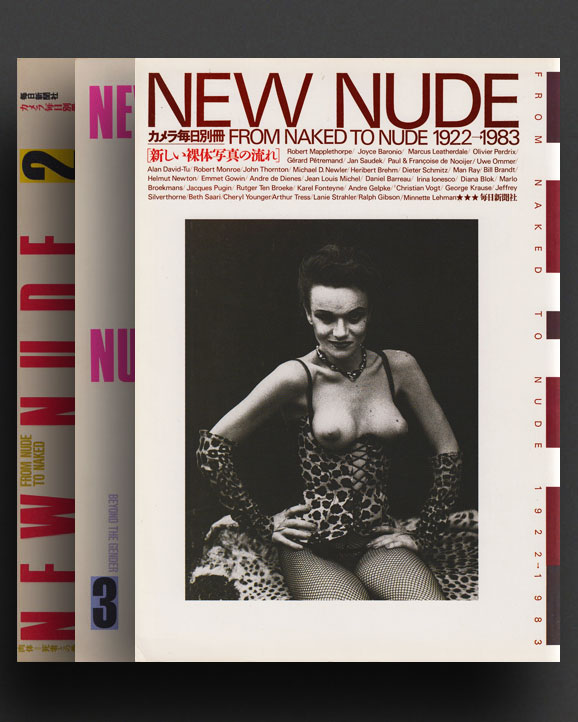
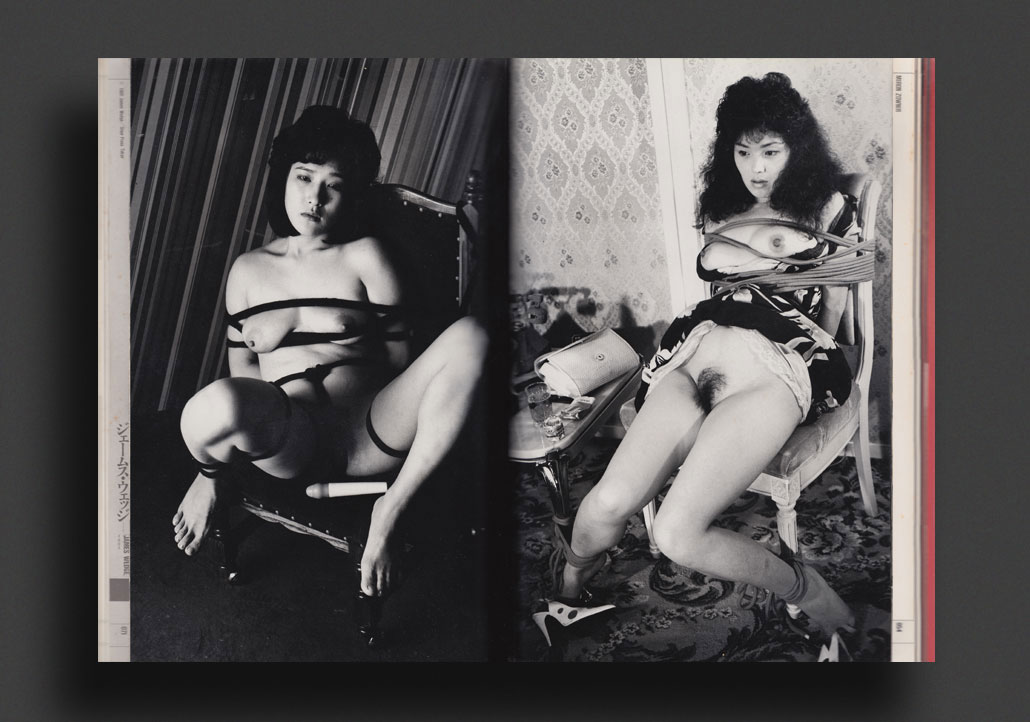
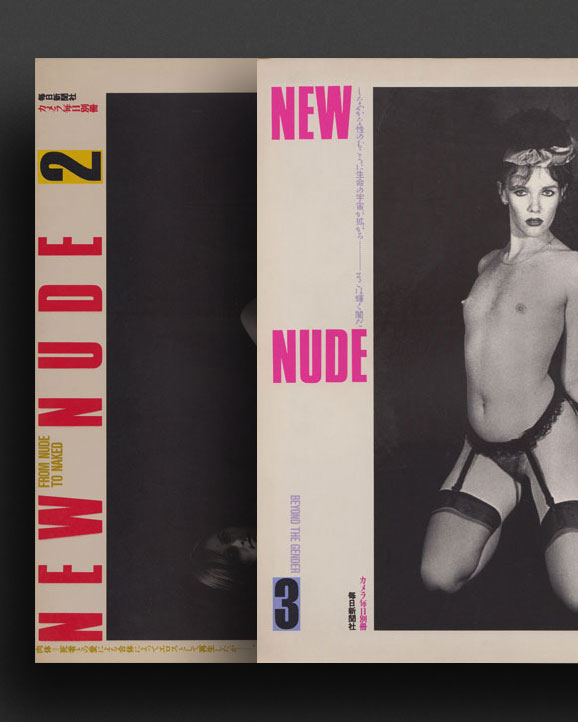
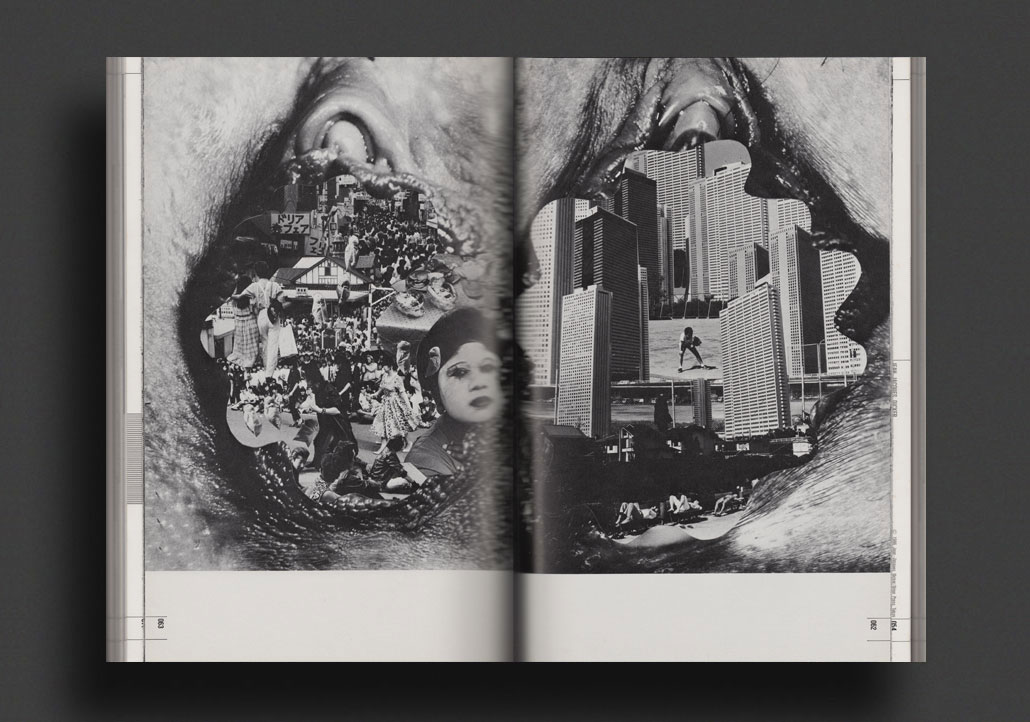
First printing, complete set of 3 volumes of NEW NUDE, published in Japan in 1985—1986, a unique and short-lived book series published by the mighty Camera Mainchi house, showcasing leading photographers and artists on the subject of the nude. Each volume opening with illustrated essays by photo critic Kōtarō Iizawa and others, the series presents works generously and sympathetically presented in colour and black-and-white across various paper-stocks including the work of Nobuyoshi Araki, Daido Moriyama, Masahisa Fukase, Joyce Baronio, Jan Saudek, Hans Bellmer, Keiichi Tahara, Noriaki Yokosuka, Irina Ionesco, Hennri Maccheroni, Keizo Kitajima, Takashi Ishii, Richard Cerf, Ayako Parks, Taku Aramasa Seiji Kurata, Jean-Jacques Dicker, Ralph Gibson, Flip and Debra Schulke, Robert Mapplethorpe, Marie-Claire Montanari, Lee Friedlander, Jaques Schumacher, Joyce Tenneson, Man Ray, Herlinde Koelbl, Yoshiichi Hara, Masaaki Nakagawa, Uwe Omner, Lee Friedlander, Alice Odilon, E. J. Bellocq, Heinrich Zille, Donald Woodman, Florence Chevallier, Laurence Sackman, Joel Peter Witkin, Marie Bume, James Wedge, Franco Fontana, Lucas Samaras, Miron Zownir, Bill Brandt, Herlinde Koelbl, and many others.
All Good—Very Good copies.
1994, English
Softcover, 254 pages, 22 x 15 cm
1st Edition, Out of print title / used / very good
Published by
Atlas Press / London
$70.00 - Out of stock
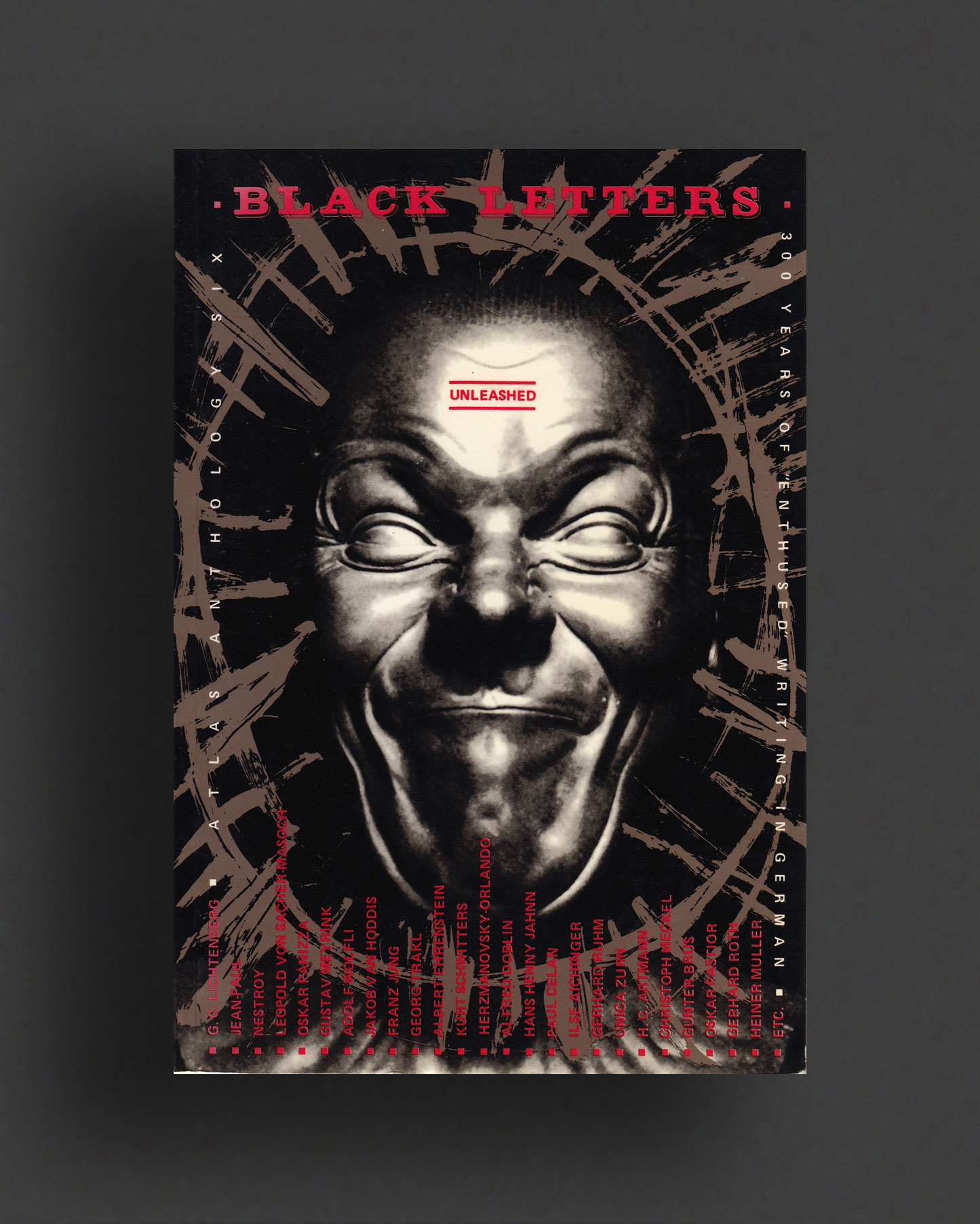
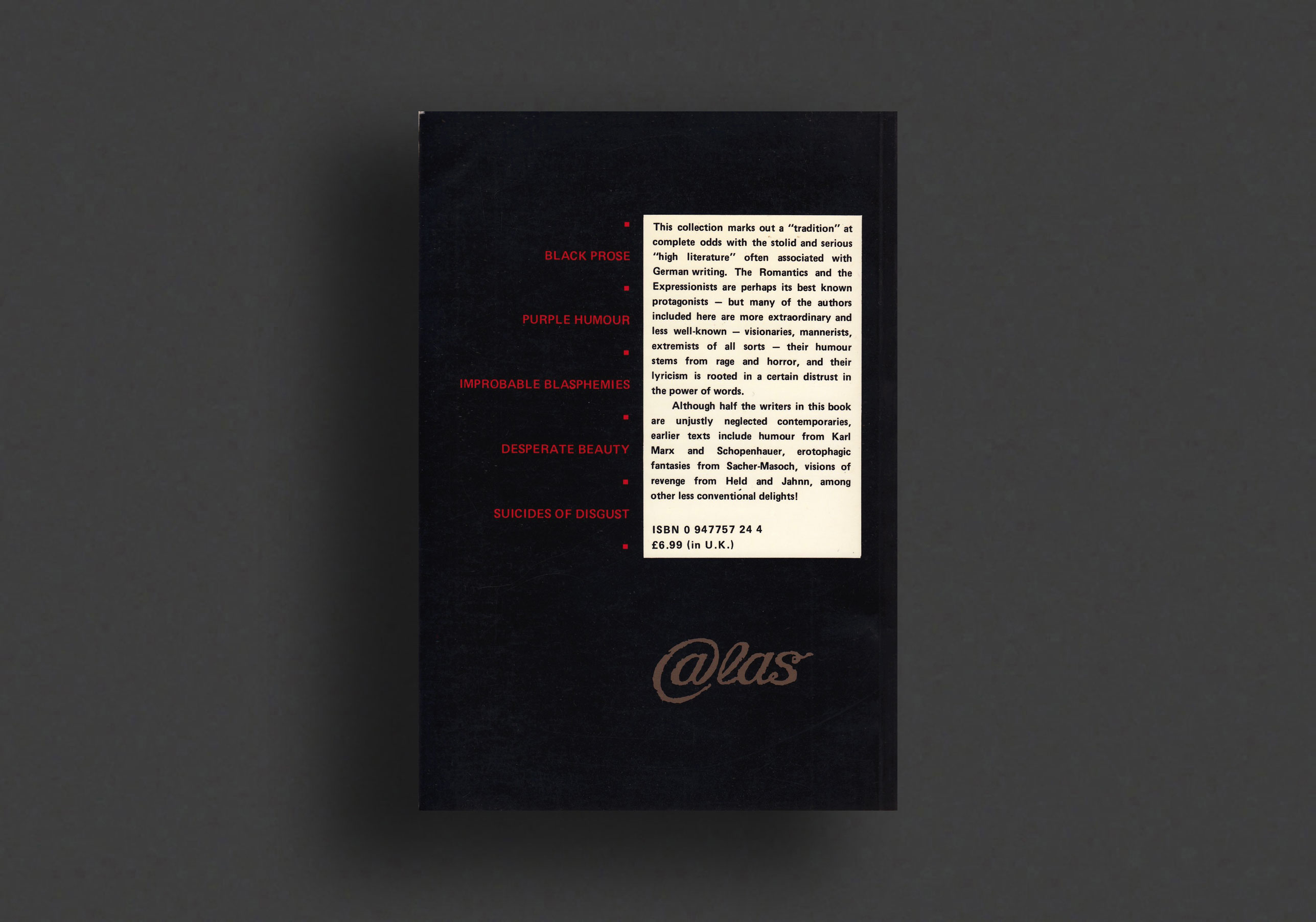
Black Prose, Purple Humour, Improbable Blasphemies, Desperate Beauty, Suicides of Disgust
Rare copy of the long out–of–print Atlas Anthology 6, Black Letters Unleashed: 300 years of enthused writing in German, translated and introduced by Malcolm Green and published by Atlas Press in 1994.
This anthology contains an astounding selection of German weirdness, fanaticism and general literary extremism. The critical reaction to it was one of astonishment and incomprehension, in particular as regards its mix of world-famous names with figures of utter obscurity, even to specialists — something we still see as a great virtue!
"This collection marks out a "tradition" at complete odds with the stolid and serious "high literature" often associated with German writing. The Romantics and the Expressionists are perhaps its best known protagonists - but many of the authors included here are more extraordinary and less well-known - visionaries, mannerists, extremists of all sorts - their humour stems from rage and horror, and their lyricism is rooted in a certain distrust in the power of words. Although half the writers in this book are unjustly neglected contemporaries, earlier texts include humour from Karl Marx and Schopenhauer, erotophagic fantasies from Sacher-Masoch, visions of revenge from Held and Jahnn, among other less conventional delights!"
Texts by Ilse Aichinger, H.C. Artmann, Wolfgang Bauer, Günter Brus, Gottfried Bürger, Paul Celan, Alfred Döblin, Albert Ehrenstein, Johannes Fischart, Franz Grillparzer, Ferdinand Hardekopf, Georg Heym, Franz Held, Wieland Herzefelde, Fritz von Hermanovsky-Orlando, Jacob van Hoddis, E.T.A. Hoffmann, Jean Paul Jacobs, Hans Henny Jahnn, Jean Paul, Franz Jung, Ingomar Kieseritsky, Erna Kröner, Quirinus Kuhlmann, Christoph Meckel, Imtraud Morgner, Heiner Müller, Oskar Pastior, Peter Pongratz, Elsa Lasker-Schuler, G.C. Lichtenberg, Karl Marx, Gustav Meyrink, Nestroy, Friedrich Nietzsche, Novalis, Oskar Panizza, Stanislaw Przybyszewski, Gerhard Roth, Gerhard Rühm, Leopold von Sacher-Masoch, Heinrich Schaefer, Paul Scheerbart, Arthur Schopenhauer, Kurt Schwitters, Max Stirner, Monica Tornow, Georg Trakl, Adolf Wöffli, Ror Wolf, Unica Zurn.
Very Good copy, only very light wear.
1980, Japanese
Softcover, 200 pages (plus poster insert), 21 x 15 cm
1st Edition, Out of print title / used / very good
Published by
Night Vision / Japan
$80.00 - In stock -
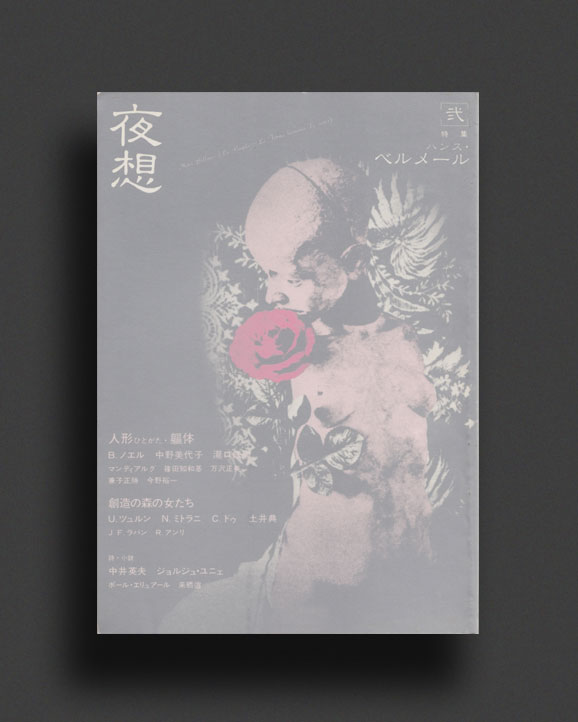
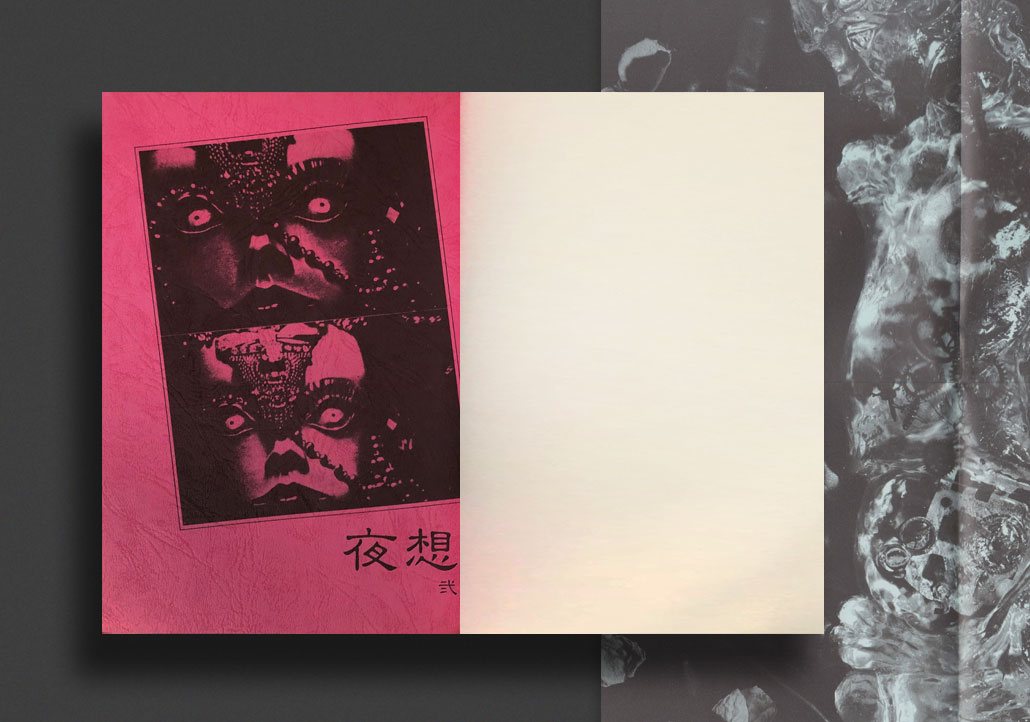
First 1980 edition of cult Japanese underground magazine Night Vision, a special edition dedicated to the work of German artist Hans Bellmer (1902-1975). ("the doll = the human form - the body"). Nowhere in the world has Bellmer's "Die Puppe" has such a lasting effect than in Japan. This volume compiles many of the artist's texts, translated to Japanese, with many illustrations of Bellmer's graphic works, drawings nad photography, alongside contributions by Miyoko Nakano, Yuichi Konno, Shuzo Takiguchi, Hideo Nakai and others. This book also comes with an inserted copy of Japanese doll artist Nori Doi's four-fold poster
German artist Hans Bellmer (1902-1975) was one of the most subversive artists associated with Surrealism, famous--notorious, even--for his erotic engravings, objects and photographs. Best known for the life-sized pubescent female dolls he produced in the mid-1930s. "Bellmer was born in the city of Kattowitz, then part of the German Empire (now Katowice, Poland). Up until 1926, he'd been working as a draftsman for his own advertising company. He initiated his doll project to oppose the fascism of the Nazi Party by declaring that he would make no work that would support the new German state. Represented by mutated forms and unconventional poses, his dolls were directed specifically at the cult of the perfect body then prominent in Germany. Bellmer was influenced in his choice of art form by reading the published letters of Oskar Kokoschka (Der Fetisch, 1925)."
Very Good copy.
1977, German
Hardcover (clothbound w. dust jacket), 422 pages, 27.5 x 21 cm
Out of print title / used / very good
Published by
VEB / Dresden
$65.00 - Out of stock
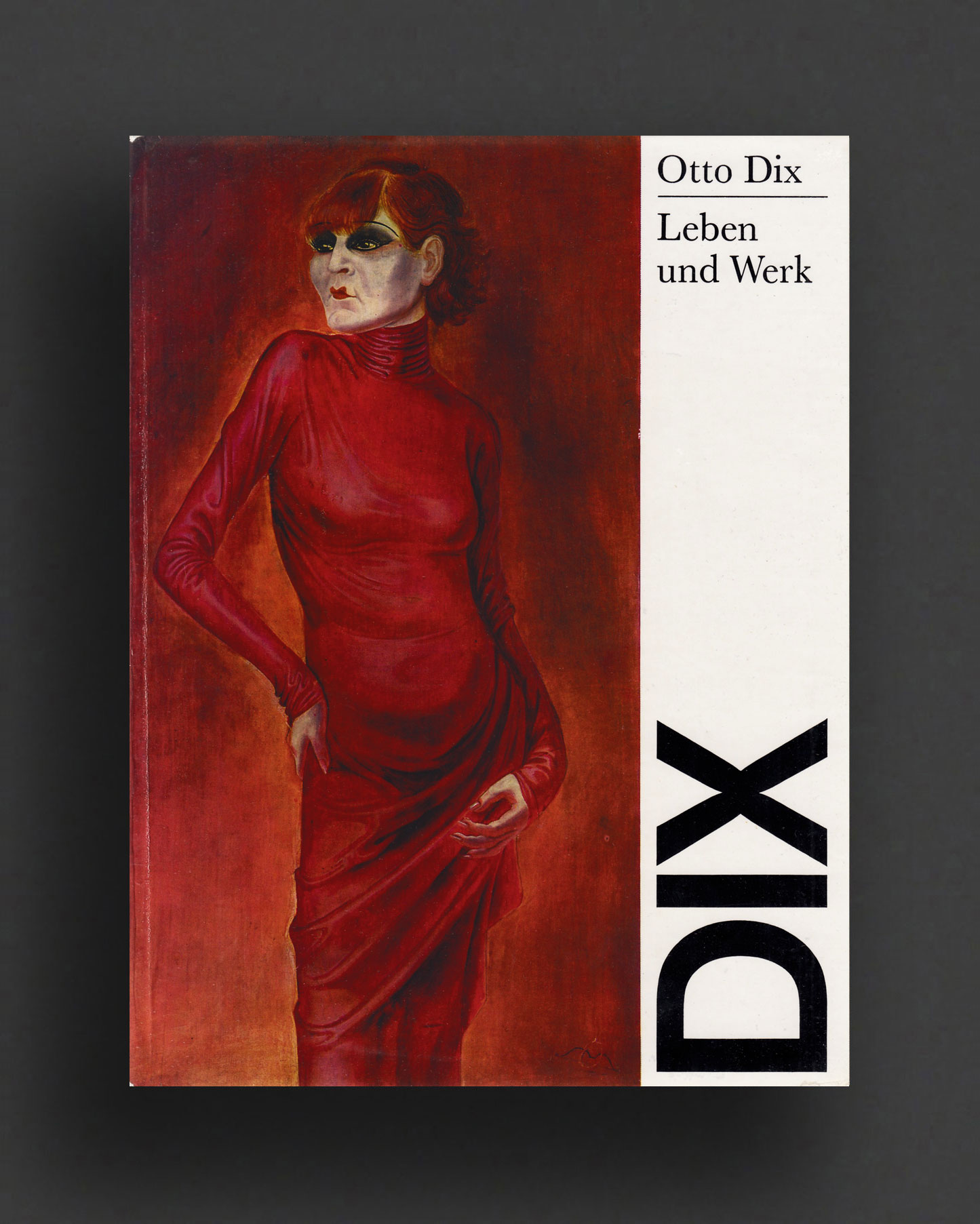
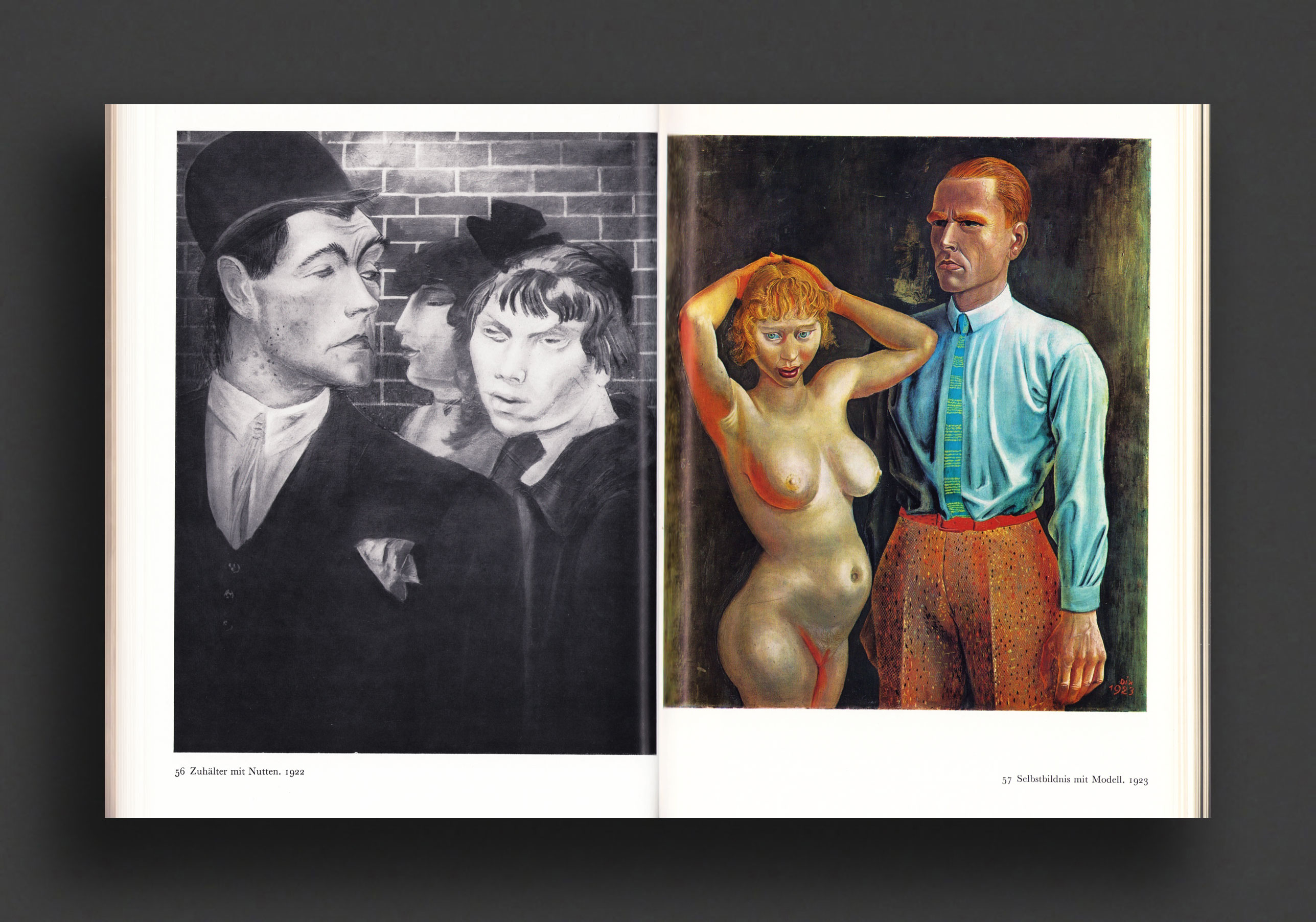
1977 printing of this definitive monographic study of German painter and printmaker, Otto Dix (1891—1969). Written by Fritz Löffler in the original German language, the books presents a large plate section of reproduced paintings and drawings in colour and b/w, including fold-out panels, spanning his entire career. One of the most important artists of the Neue Sachlichkeit (New Objectivity), which also attracted George Grosz and Max Beckmann in the mid 1920s. Dix was noted for his ruthless and harshly realistic depictions of German society during the Weimar Republic and the brutality of war. A veteran haunted by his experiences of WWI, his first great subjects were crippled soldiers, but during the height of his career he also painted nudes, prostitutes, and often savagely satirical portraits of celebrities from Germany's intellectual circles. His work became even darker and more allegorical in the early 1930s, and he became a target of the Nazis, defining Dix as one of Germany's most 'degenerate' artists. Through his art, he had committed a 'violation of the moral sensibilities' of the nation and forced to promise to paint only inoffensive landscapes. His paintings that were considered "degenerate" were discovered in 2012 among the 1500+ paintings hidden away by the son of Hitler's looted-art dealer Hildebrand Gurlitt.
Very Good copy in VG dust jacket, light wear to extremities (preserved under mylar wrap).
1980, English
Hardcover (w. dust jacket), 394 pages, 23.5 x 16 cm
1st Edition, Out of print title / used / very good
Published by
Cambridge University Press / Cambridge
$80.00 - In stock -
Scarce first 1990 hardcover edition.
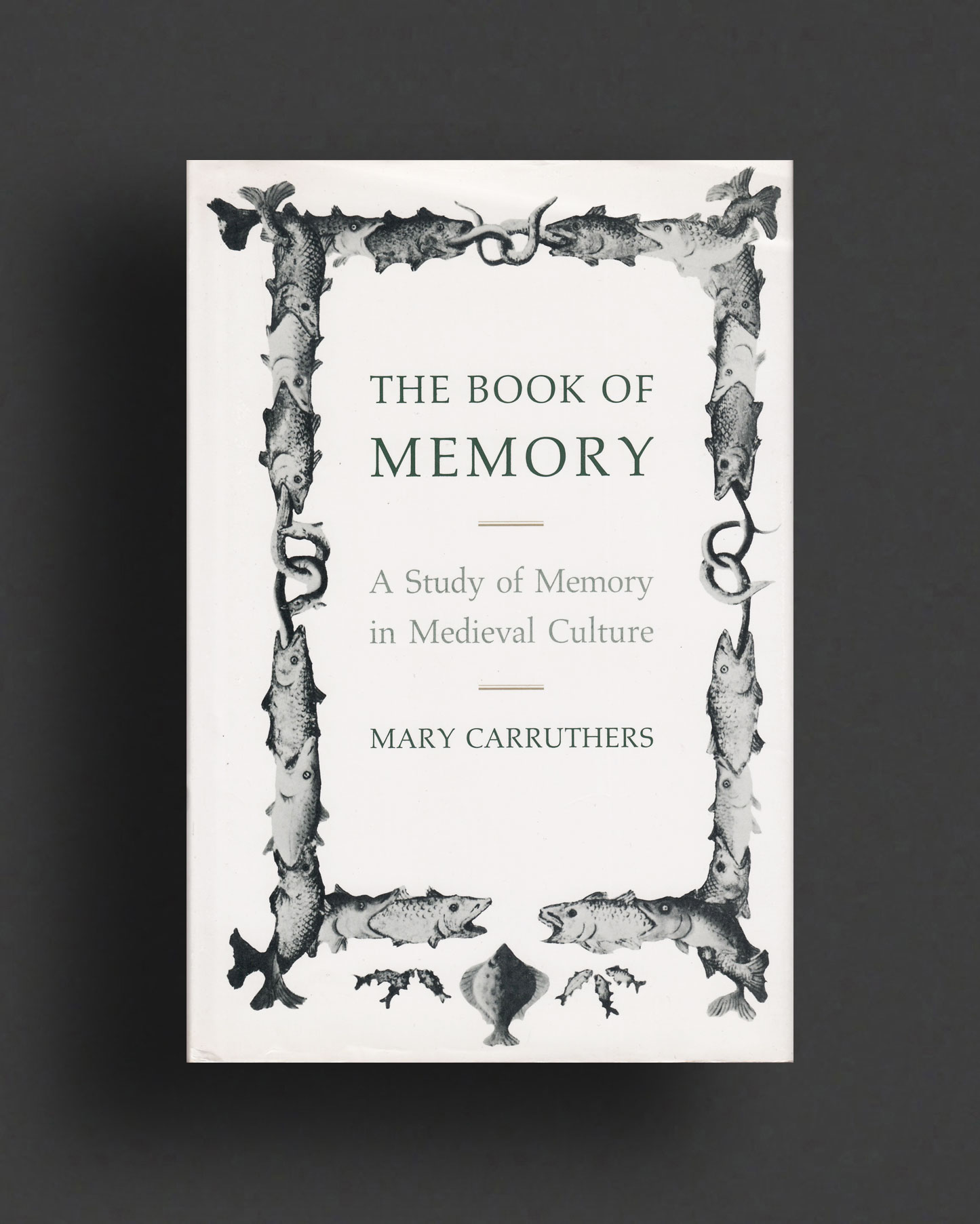
The Book of Memory is a magisterial and beautifully illustrated account of the workings and function of memory in medieval society. Memory was the psychological faculty valued above all others in the period stretching from late antiquity through the Renaissance. The prominence given to memory has profound implications for the contemporary understanding of all creative activity, and the social role of literature and art. Drawing on a range of fascinating examples from Dante, Chaucer, and Aquinas to the symbolism of illuminated manuscripts, this unusually wide-ranging book offers new insights into the medieval world.
Very Good—Near Fine copy in Very Good dust jacket. A crisp copy preserved in archival mylar wrap.
2013, English
Hardcover, 396 pages, 35 x 23.5 cm
Out of print title / used / very good
Published by
Rizzoli / New York
$200.00 - Out of stock
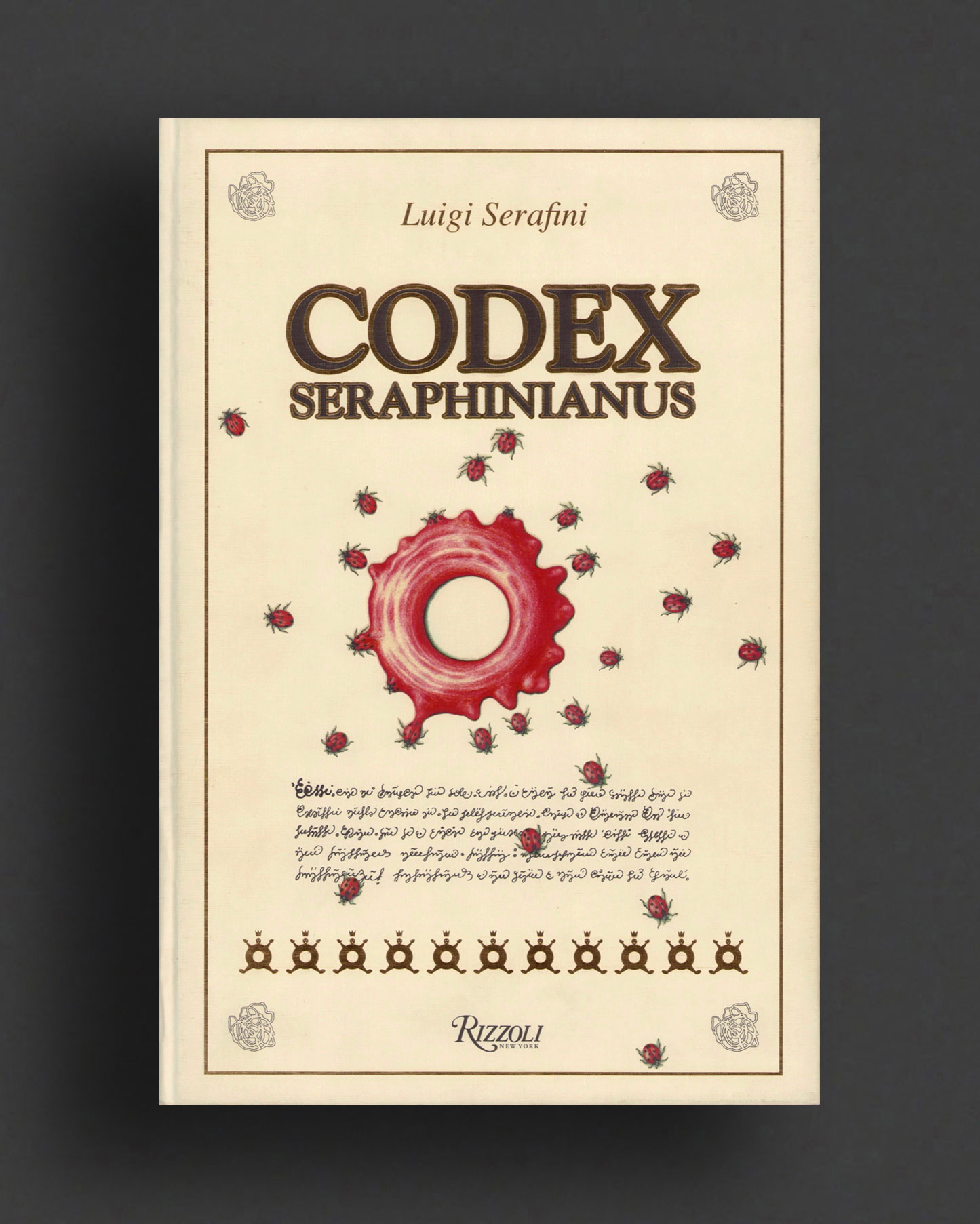
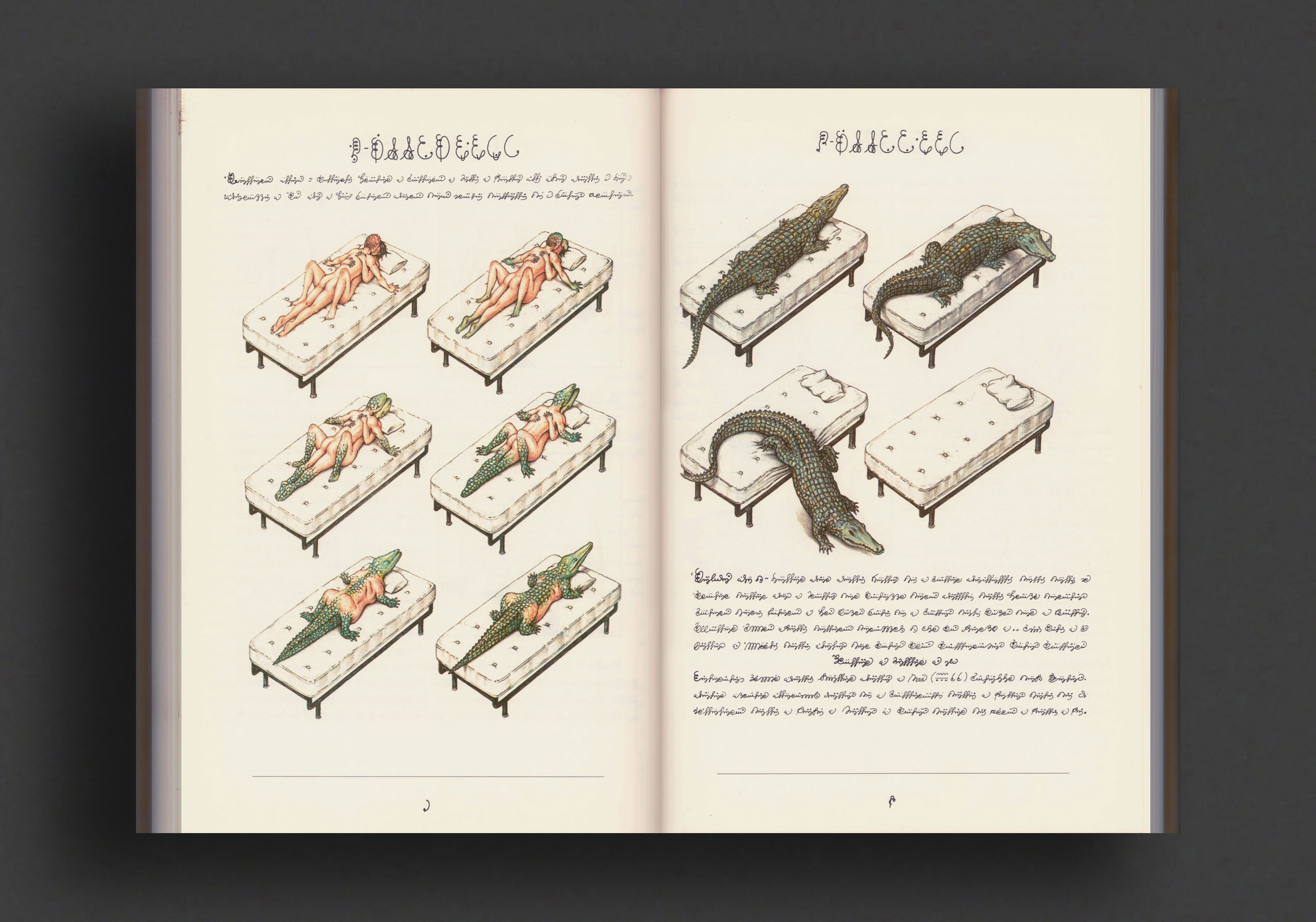
An extraordinary and surreal art book, this edition has been redesigned by the author and includes new illustrations. Ever since the Codex Seraphinianus was first published in 1981, the book has been recognized as one of the strangest and most beautiful art books ever made. This visual encyclopedia of an unknown world written in an unknown language has fueled much debate over its meaning. Written for the information age and addressing the import of coding and decoding in genetics, literary criticism, and computer science, the Codex confused, fascinated, and enchanted a generation, including Roland Barthes and Italo Calvino.
While its message may be unclear, its appeal is obvious: it is a most exquisite artifact. Blurring the distinction between art book and art object, this anniversary edition-redesigned by the author and featuring new illustrations-presents this unique work in a new, unparalleled light. With the advent of new media and forms of communication and continuous streams of information, the Codex is now more relevant and timely than ever.
Complete with the additional Decodex illustrated booklet insert.
Very Good copy, very light wear/marking to covers/extremities. Light rippling to spine laminate from production. Well preserved.
1973, English
Hardcover (w. dust jacket), 64 pages, 30.5 x 24.5 cm
1st Edition, Out of print title / used / very good
Published by
Hutchinson / London
$45.00 - Out of stock
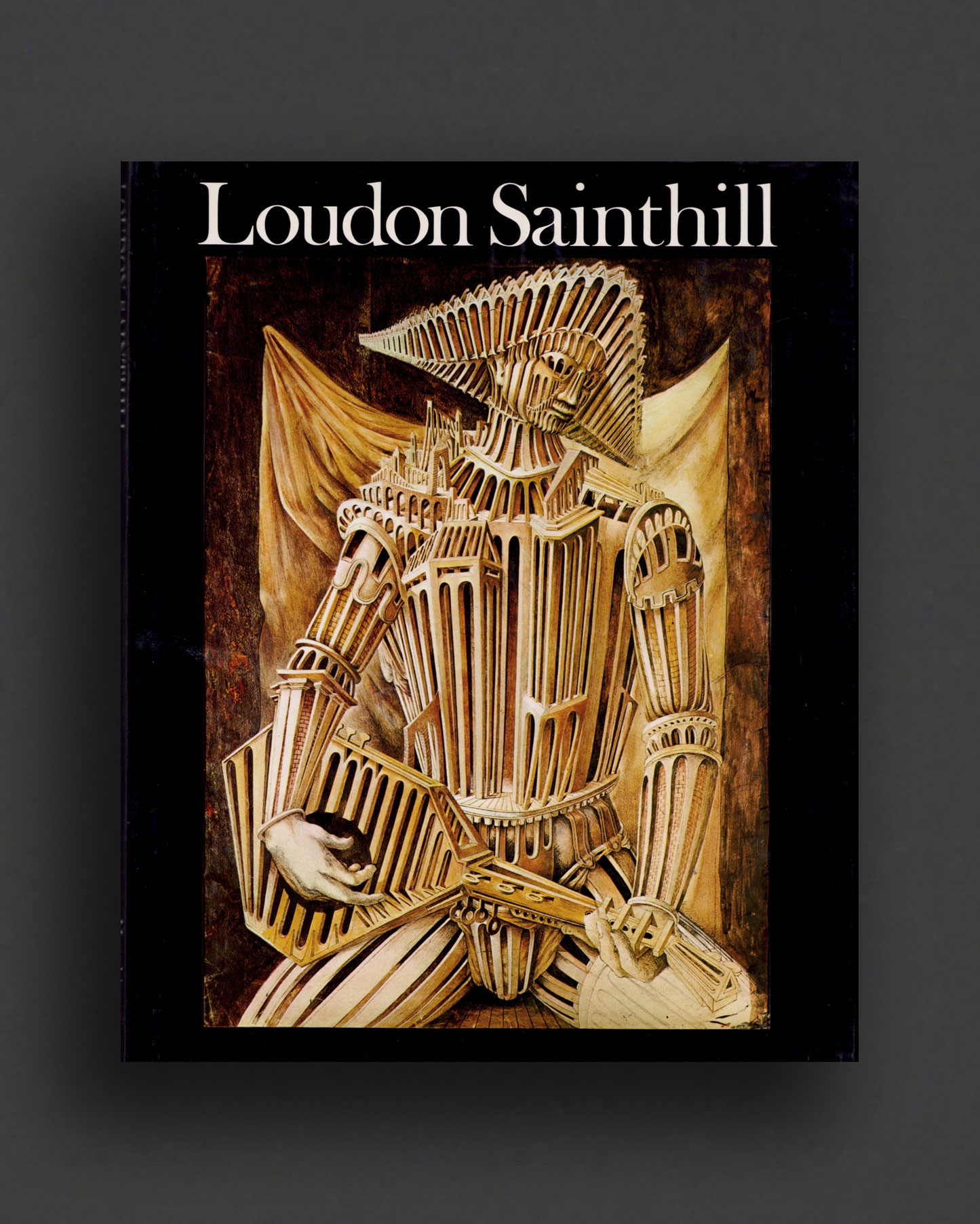
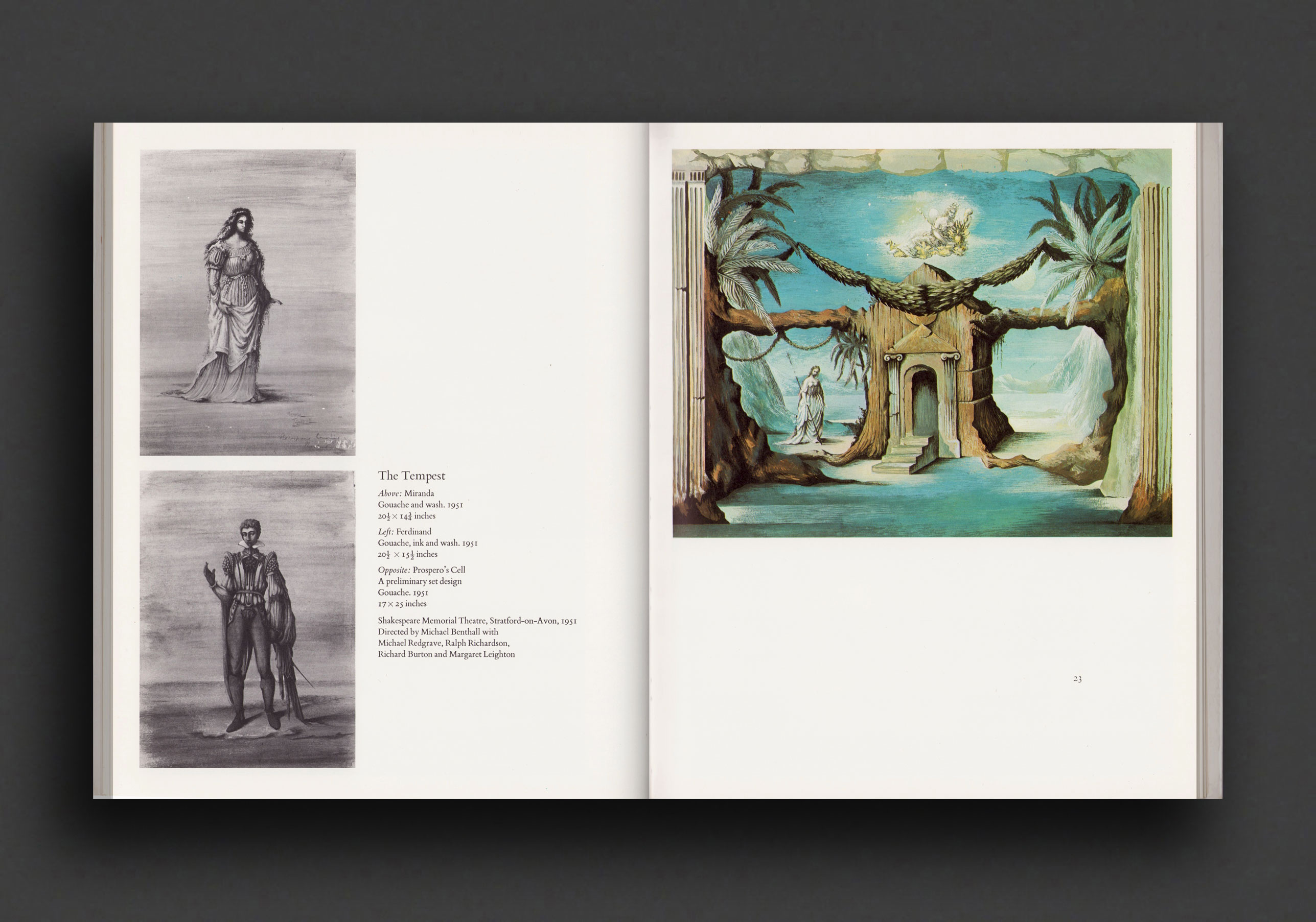
First 1973 hardcover edition of the first book devoted to the work of Australian artist and stage and costume designer, Loudon Sainthill (1918—1969), illustrated throughout with colour and b/w reproductions Sainthill's incredible designs. Appreciation by Bryan Robertson. Edited by Harry Tatlock Miller.
"Loudon Sainthill was one of the most imaginative designers in the theatre of his time, an artist whose canvas was the stage. He loved the theatre, could never accept the limiting confines of the stereotyped division into classical theatre and light entertainment, and showed his extraordinary imagination, creativity and style in a wide diversity which could range from Shakespeare to Tennessee Williams. Loudon Sainthill's first London exhibition was of paintings of the Russian Ballet at the Redfern Gallery in 1939, when he was nineteen. Later he steadfastly refused to allow his designs to be exhibited, for he regarded his work for the theatre as belonging to the theatre, insisting that it should be seen only framed by the proscenium arch. It was not until 1973, four years after his death, that a new exhibition was mounted. This selection of designs and drawings shows the essential magic and mystery that were Sainthill's own: the very particular quality of enchantment, mixed so often with a haunting sadness, that was characteristic of both the artist and his work.
Australian by birth, Loudon Sainthill died in London in 1969 at the age of fifty, having created an international reputation derived from more than fifty productions of theatre, opera, ballet, revue, pantomimes and musicals.
Very Good copy w. VG dust jacket.
2017, English
Hardcover (clothbound), 230 pages, 32 x 24.5 cm
1st Edition, Out of print title / used / fine
Published by
Koenig Books / London
$55.00 - In stock -
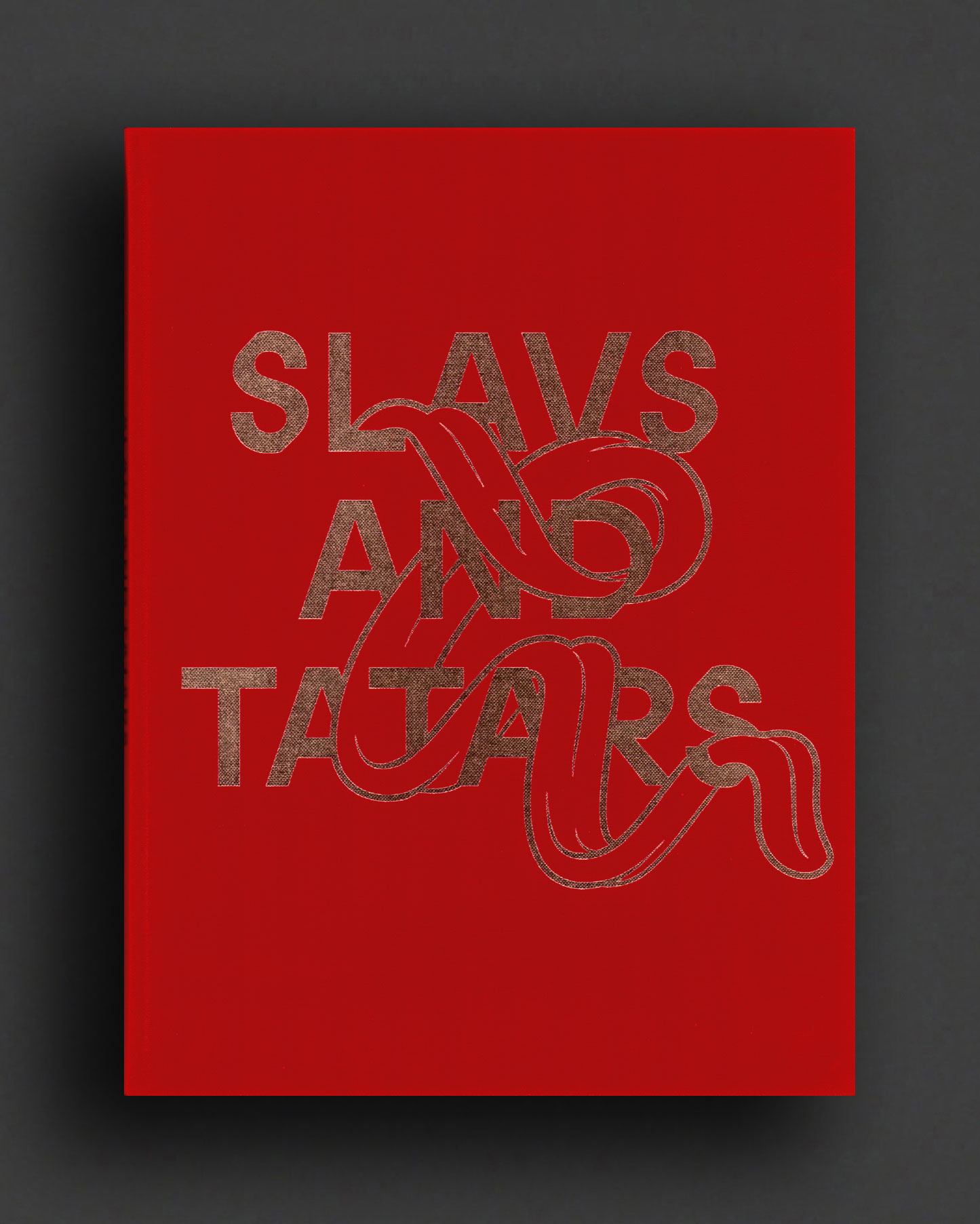
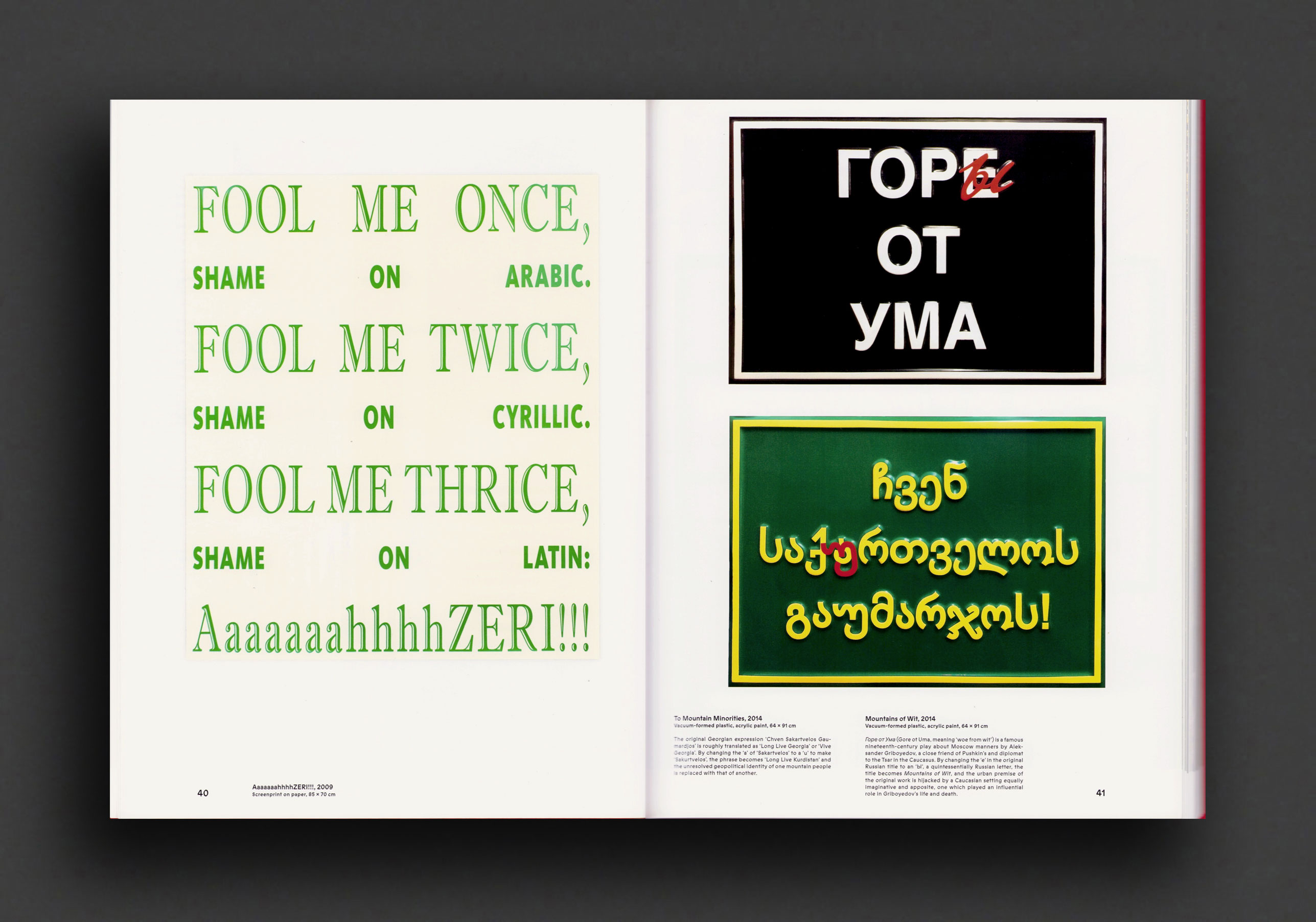
On the occasion of a mid-career survey presented in Warsaw, Tehran, Istanbul and Vilnius, Mouth to Mouth is the first monograph on the collective, with documentation of all eight cycles of work. This monograph offers a critical inventory of Slavs and Tatars’ lecture-performances, exhibitions and publications across ten years of activity. Edited by Pablo Larios with essays by Susan Babaie, Jörg Haiser, and David Joselit.
NF—As New copy.
1942, German
Hardcover, unpaginated, 28 x 19 cm
1st Edition, Out of print title / used / very good
Published by
Kiepenheuer Verlag / Berlin
$55.00 - Out of stock
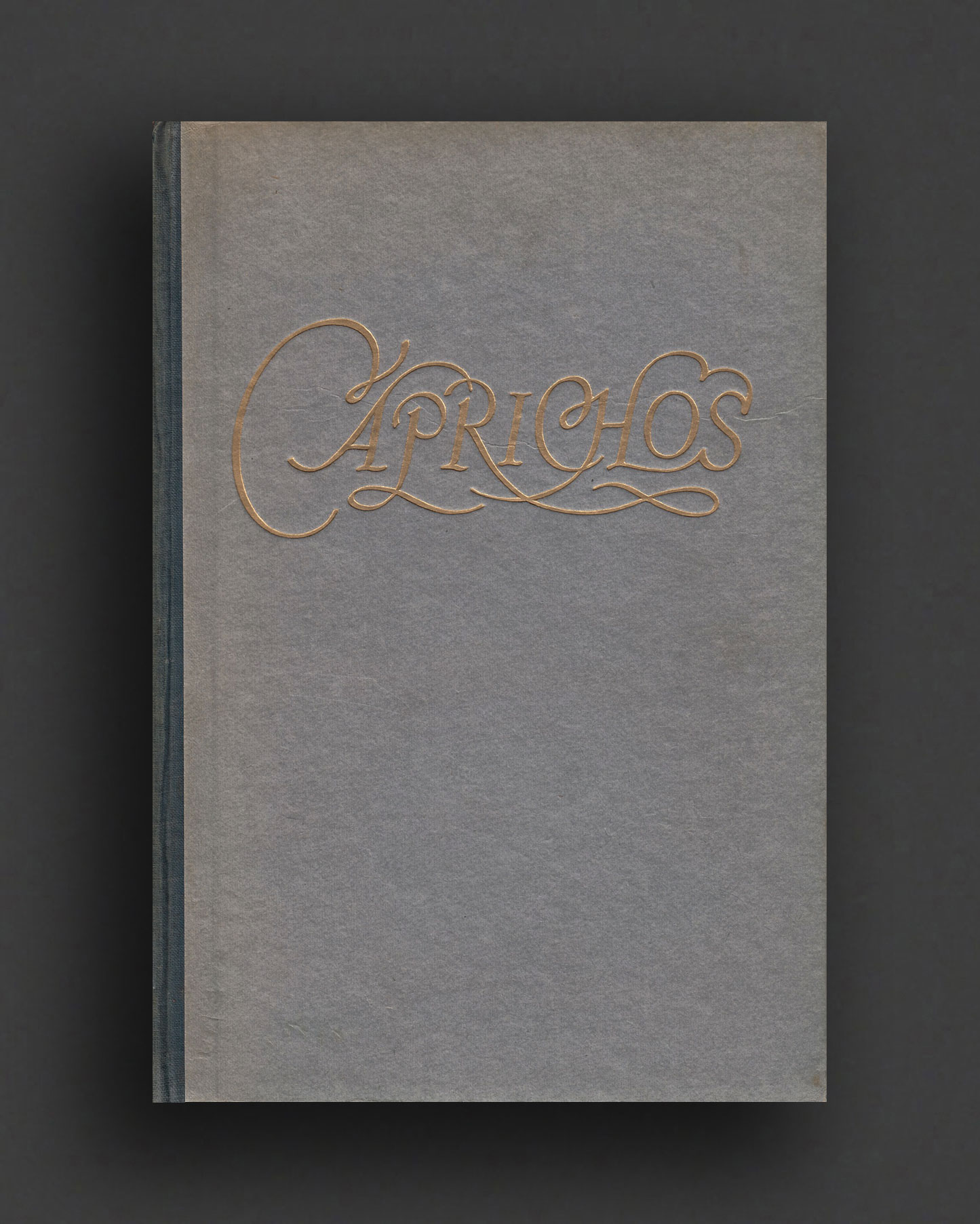
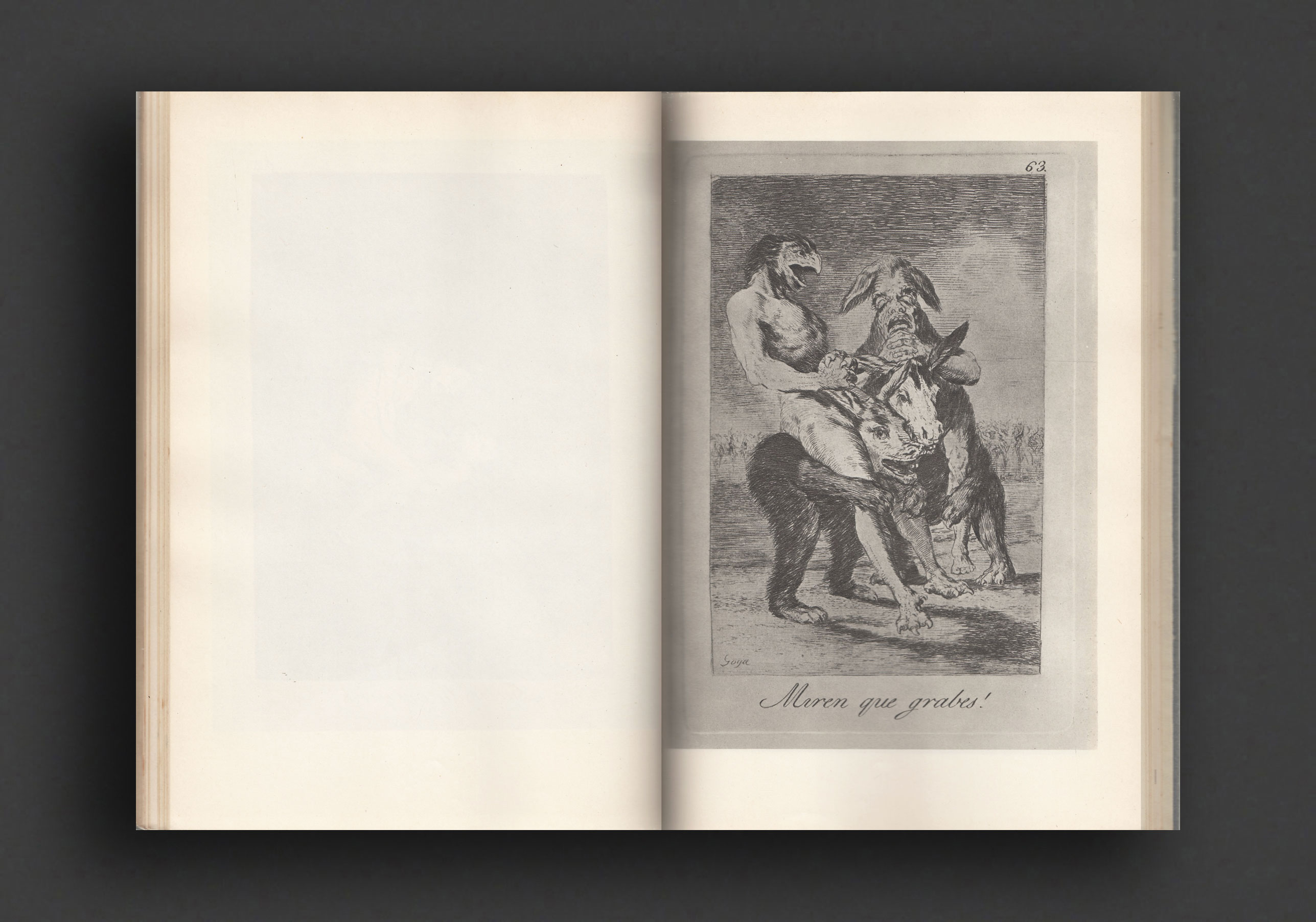
1942 hardcover volume devoted to Francisco Goya's Los Caprichos, a near unrivalled technical and satirical masterpiece. The graphic series is reproduced with full–page illustrations, accompanied by text from Dr. Leopold Zahn (1890-1970) an Austrian writer and art historian who was an expert on the works of Paul Klee. In original German language.
In 1792 Goya developed a debilitating illness which ultimately left him deaf. His recuperation took over five years, a period of withdrawal that had a profound and depressing impact on his life. In 1792 Goya developed a debilitating illness which ultimately left him deaf. His recuperation took over five years, a period of withdrawal that had a profound and depressing impact on his life. Distress and anxiety found expression in new subjects: witches, banditos, gaols and moon-lit mad-houses. In his isolation, he began to draw with a frequency and conviction he had not previously experienced. The resulting sketches, informed by the Enlightenment philosophies of Rousseau and Voltaire, birthed the extraordinary Los Caprichos. The word ‘caprice’ normally suggests whimsical fancy, but Goya’s Caprichos are as wickedly vulgar as they come. First printed in 1799, Los Caprichos is a landmark series of 80 aquatint etchings that serves as a biting and deeply cynical critique of 18th-century Spanish society, targeting ignorance, superstition, corruption, and moral decay. Departing from traditional court portraiture, Goya utilized a groundbreaking, dark style featuring sharp contrasts to expose the vices of the clergy, nobility, and general public through allegorical imagery, including witches, donkeys, and fantastical creatures. More than a satirical tour-de-force, the Caprichos masterfully employed a new printmaking method called aquatint, which involves dusting and melting fine particles of resin into a minutely pock-marked ground on the plate. Where in the past large areas of darkness could only be achieved in etching with dense cross-hatching, aquatint enabled tones comparable to an ink wash. Goya was among the first artists to make use of it, and the results were astonishing. Drunkards and lecherous priests leer from the shadows while demons wheel in night skies specked with stars. Los Caprichos were quickly withdrawn from sale due to fear of the Inquisition. As a pioneering work of modernism, Los Caprichos influenced generations of artists, from Romantics like Delacroix to Surrealists, for its intense, free, and subjective exploration of the human condition.
VG copy with some tanning to covers and page edges, light wear, without dust jacket.
2024, English
Softcover, 510 pages, 28 x 21 cm
Published by
Rickmoe Publishing / US
$72.00 - In stock -
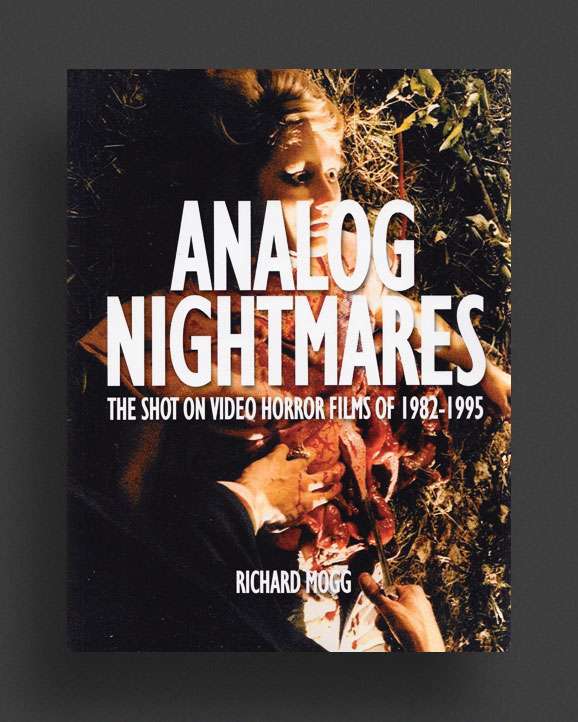
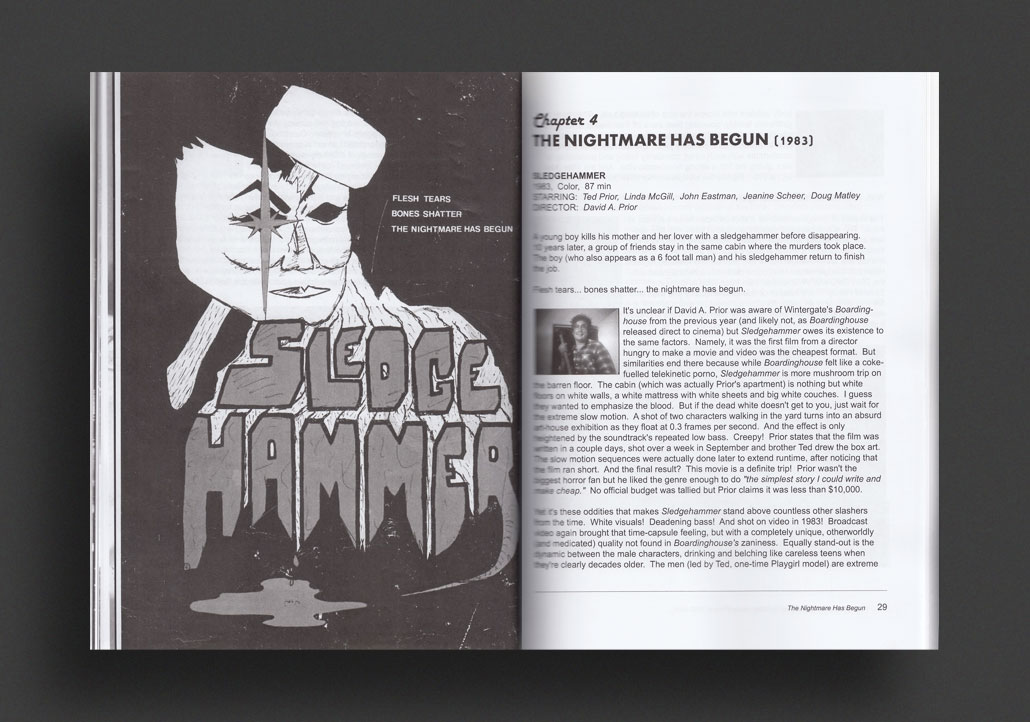
The most comprehensive, all-inclusive look at the history and evolution of shot on video horror films. In 1982, "Boardinghouse" became the first shot on video feature-length horror film ever made. Totally lensed on videotape, the film was later transferred to 16mm and blown-up to 35mm for theatrical exhibition. In 1983, David A. Prior shot "Sledgehammer" on video and eventually released the film on videotape. For the first time, analog video became the format used in motion picture productions. It was smeary, messy and it wasn't film... but it was cheap. In 1985, United Home Video boldly released "Blood Cult" with the claim it was "the first movie made for the home video market." The booming popularity of video stores coupled with a never-satisfied demand for content ensured these films longevity. Soon hundreds of titles followed, all video-created features by independent unknowns. They weren't from Hollywood. They weren't trained. But they had a lot of heart and a love for horror. And they made their own movies against the odds. For the first time EVER - "ANALOG NIGHTMARES" has brought these films together. Everything from "Boardinghouse" to "Zombie Holocaust" individually reviewed, categorized and presented chronologically by production year. Over 260 films! Featuring in-depth interviews with the filmmakers themselves - some speaking for the very first time! TIM BOGGS! MARK POLONIA! DONALD FARMER! TIM RITTER! JOEL D. WYNKOOP! DOUG STONE! ANDREA ADAMS! GARY WHITSON! DAVE CASTIGLIONE! PHIL HERMAN! ERIC STANZE! JAMES L. EDWARDS! WALTER RUETHER! TODD JASON COOK! NICK MILLARD! DAVID "THE ROCK" NELSON! RON BONK!
2020, English
Hardcover (w. dust jacket), 248 pages, 28.7 x 23.83 cm
Published by
Rizzoli / New York
Electa / Milan
$105.00 - In stock -
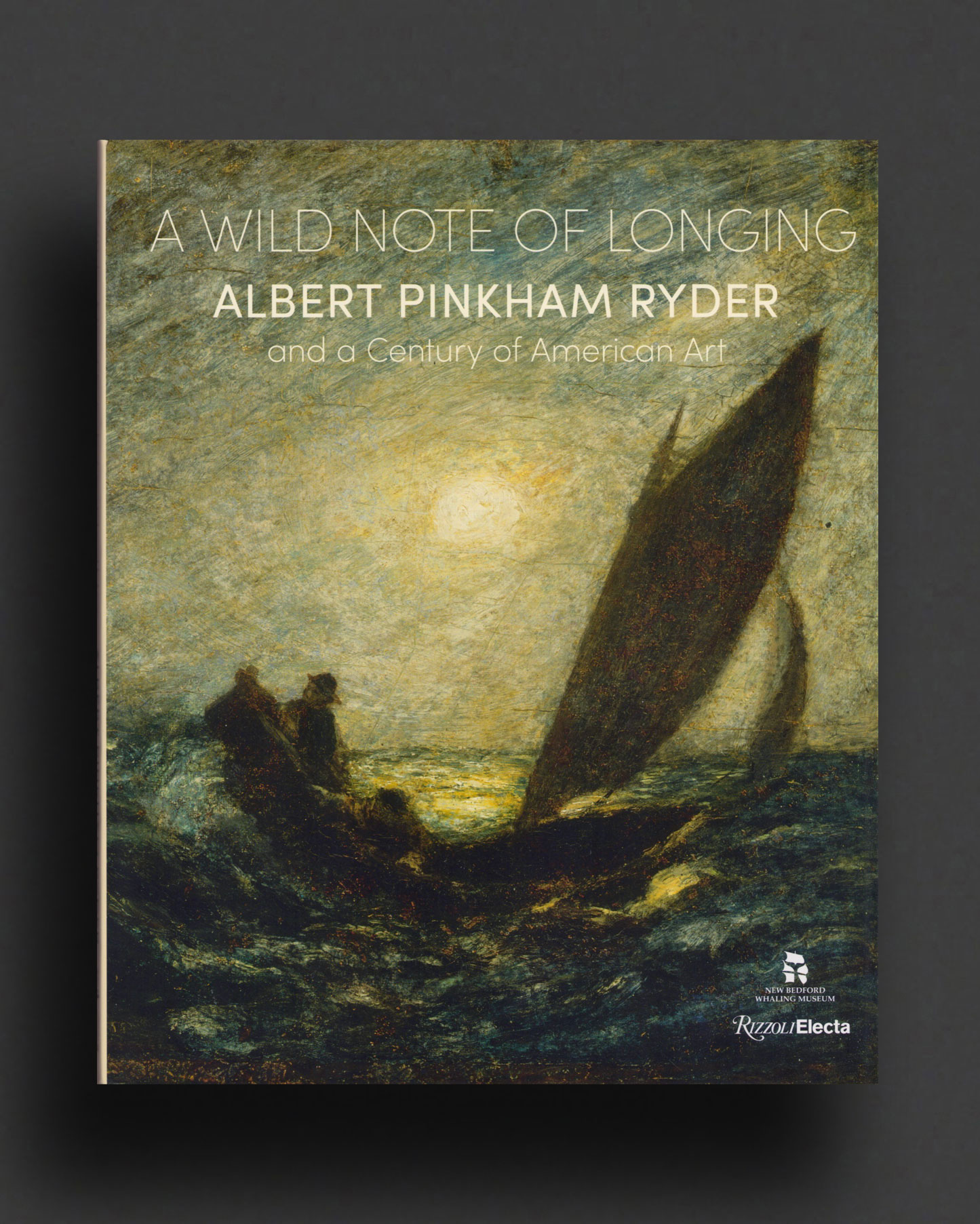
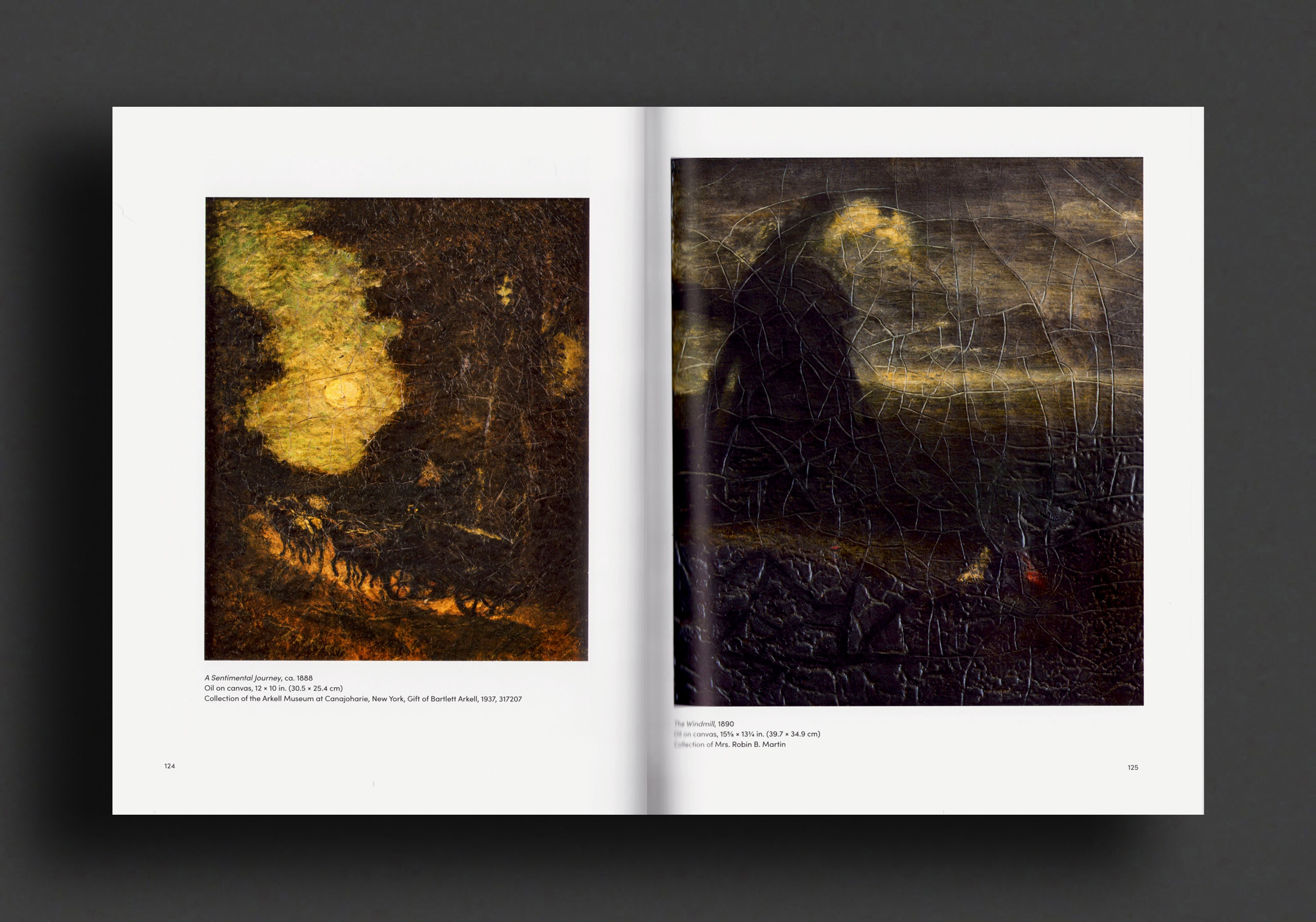
This long-overdue new look at the life and work of Albert Pinkham Ryder (1847-1917) explores the artist's deeply visionary paintings and the powerful and enduring paths he forged for generations of American modernists.
The brooding spirituality of his works, coupled with formal innovation decades ahead of its time, have long made Ryder a favourite of innovators like Jackson Pollock, Marsden Hartley, and Robert Rauschenberg. And yet, the artist's biography and practices remain elusive.
A Wild Note of Longing – whose title is taken from a Ryder poem – takes up the challenge, bringing a new generation of scholarship to the most comprehensive collection of Ryder masterworks assembled to date.
Ryder is considered a seminal artist for both the late-nineteenth-century Gilded Age and for the emerging modernism of the early twentieth century. This publication presents research from the last ten years including William Agee's recent work on Ryder's influence and context within modernism. New evidence has also debunked some of the historical myths around Ryder, such as the degree of his elusiveness and social eccentricities and the lack of deliberateness with which he experimented with colour and luminosity. New perspectives include a deep focus on Ryder from the perspective of his hometown of New Bedford, Massachusetts. This monumental project will represent multiple voices from leaders in the field on the continuing and ever evolving relevance of Albert Pinkham Ryder on modern art.
"With color illustrations as well as insightful essays by Christina Connett Brophy, Elizabeth Broun, and William C. Agee that analyze, respectively, Ryder’s historical context, his elusive painterly ideas, and his outsize influence on generations of artists, A Wild Note of Longing: Albert Pinkham Ryder and a Century of American Artoffers us the exceedingly welcome chance to reflect on this austere, stirring, and wholeheartedly strange painter." —THE NEW CRITERION
2022, English
Hardcover (w. dust jacket), 192 pages, 24 x 17 cm
1st Edition, Out of print title / as new
Published by
Cornelius / Paris
$65.00 - Out of stock
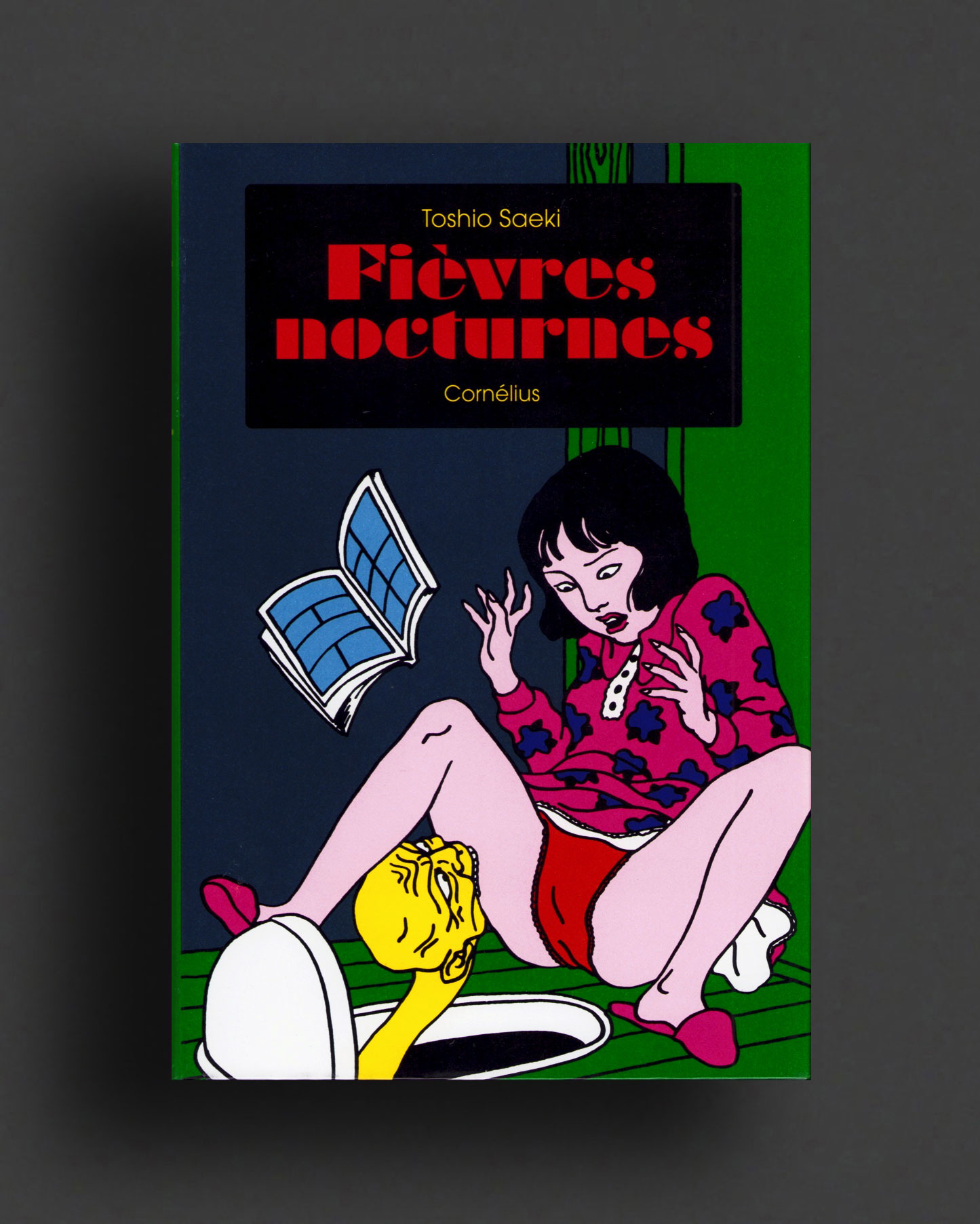
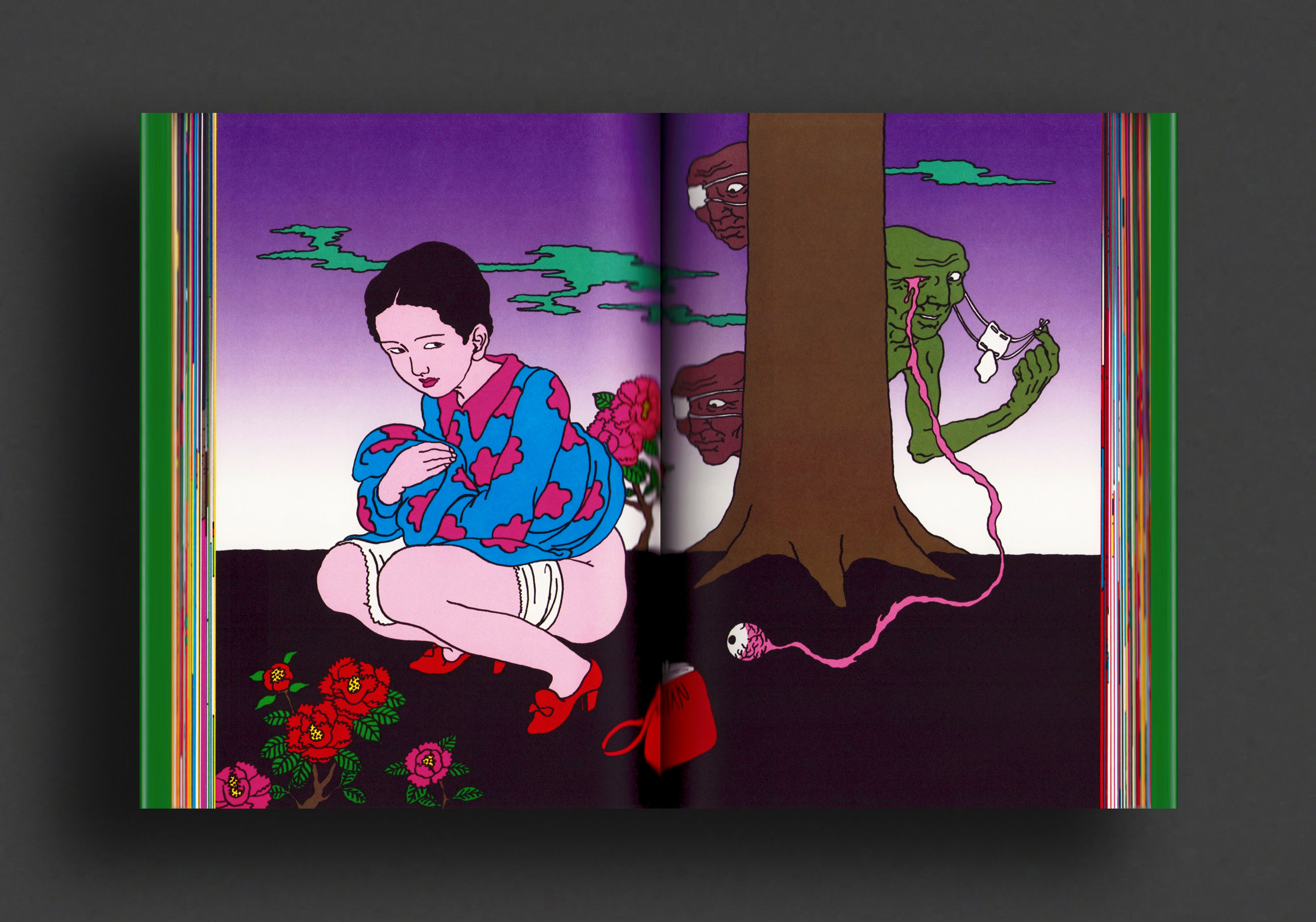
A cult artist, Toshio Saeki is the inventor of a unique style in a field he has totally transformed: ero guro, which can be translated as "erotico-grotesque scenes". Attributed to the writer Edogawa Ranpo, this genre is rooted in the origins of classical Japanese drawing, feeding monsters and nightmarish scenes into numerous prints throughout the ages.
By combining traditional motifs with his own obsessions, Saeki echoes the anxieties of his generation, the youth of the 1970s, who believed they could free themselves from the conventions of a paternalistic society, only to be disillusioned.
Human society, with its violence and shortcomings, is the setting for scenes whose cruelty provokes terror or laughter, pushing the mechanics of fantasy to its limits. Here, sadomasochism covers up no reality, relying on onirism to create a form of macabre poetry. Stimulated by Japanese censorship - it is forbidden to show the sexes - Saeki turns the forbidden into an artistic constraint, transforming the world's oldest subject into absurdity and onirism. His precise style, which reminds Europeans of the famous "clear line" of Hergé and Joost Swarte, remains strange to Japanese and Western readers alike, each finding in this perfectly simple line a new form of exoticism. This perception can only be explained by the absolute originality of an extravagant imagier, straight from the pen of an artist who devoted his life to tracing as closely as possible "what goes on in his head when he closes his eyes".
This second volume of the anthology follows the work Scarlet Dream and compiles illustrations published between 1972 and 1974 in the magazine SM Selecto .
PLEASE NOTE: This illustrated book has a preface translated into three languages (French, English and Japanese).
NF—As New copy.
2017, English
Softcover, 502 pages, 20 x 13 cm
Out of print title / used / very good
Published by
Faber & Faber / London
$25.00 - In stock -
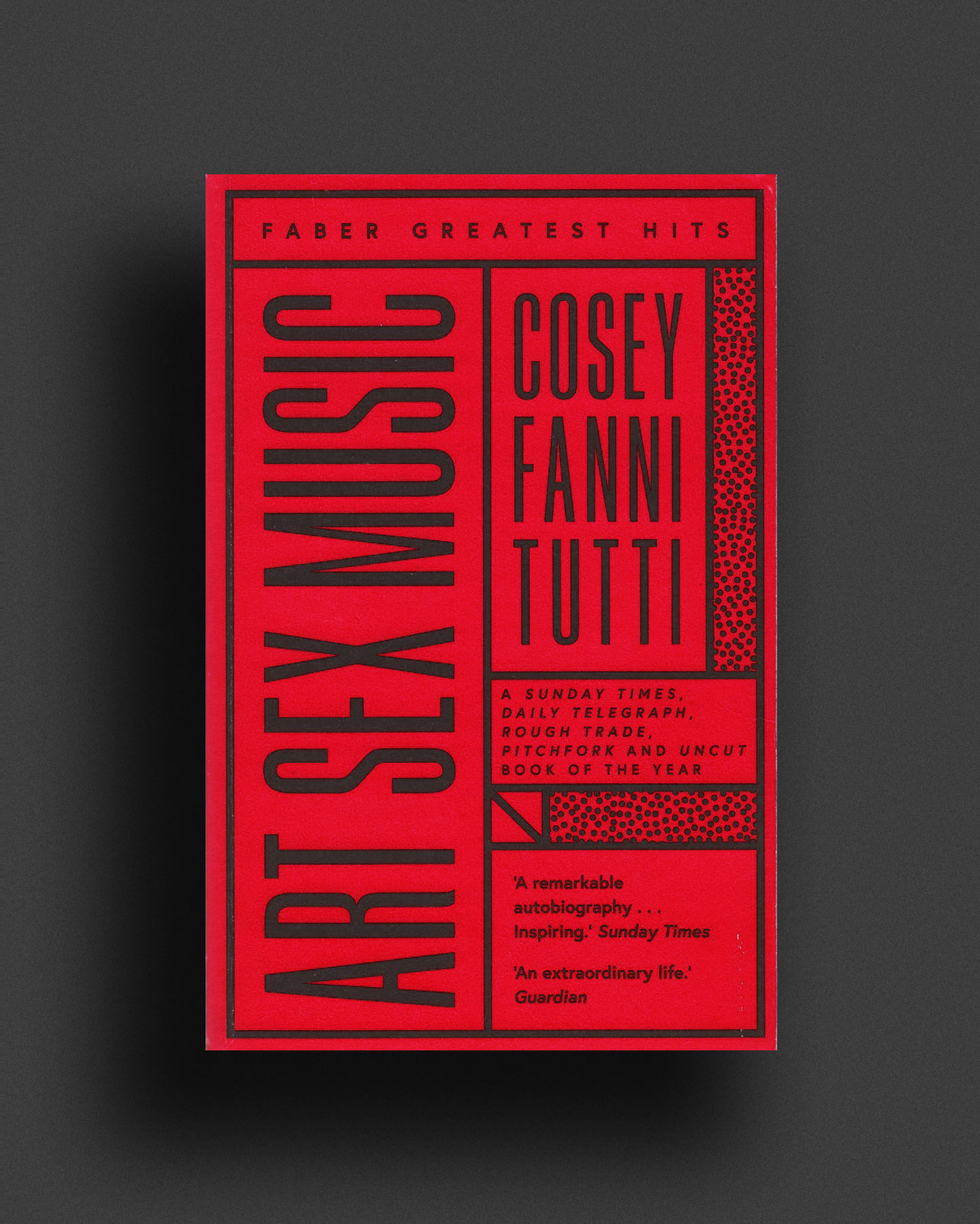
Punk, pornographer, pioneer, provocateur: the incredible story of Cosey Fanni Tutti, the performer whose art and music inspired a generation and rocked the establishment to its core.
A new edition as part of the Faber Greatest Hits - books that have taken writing about music in new and exciting directions for the twenty-first century.
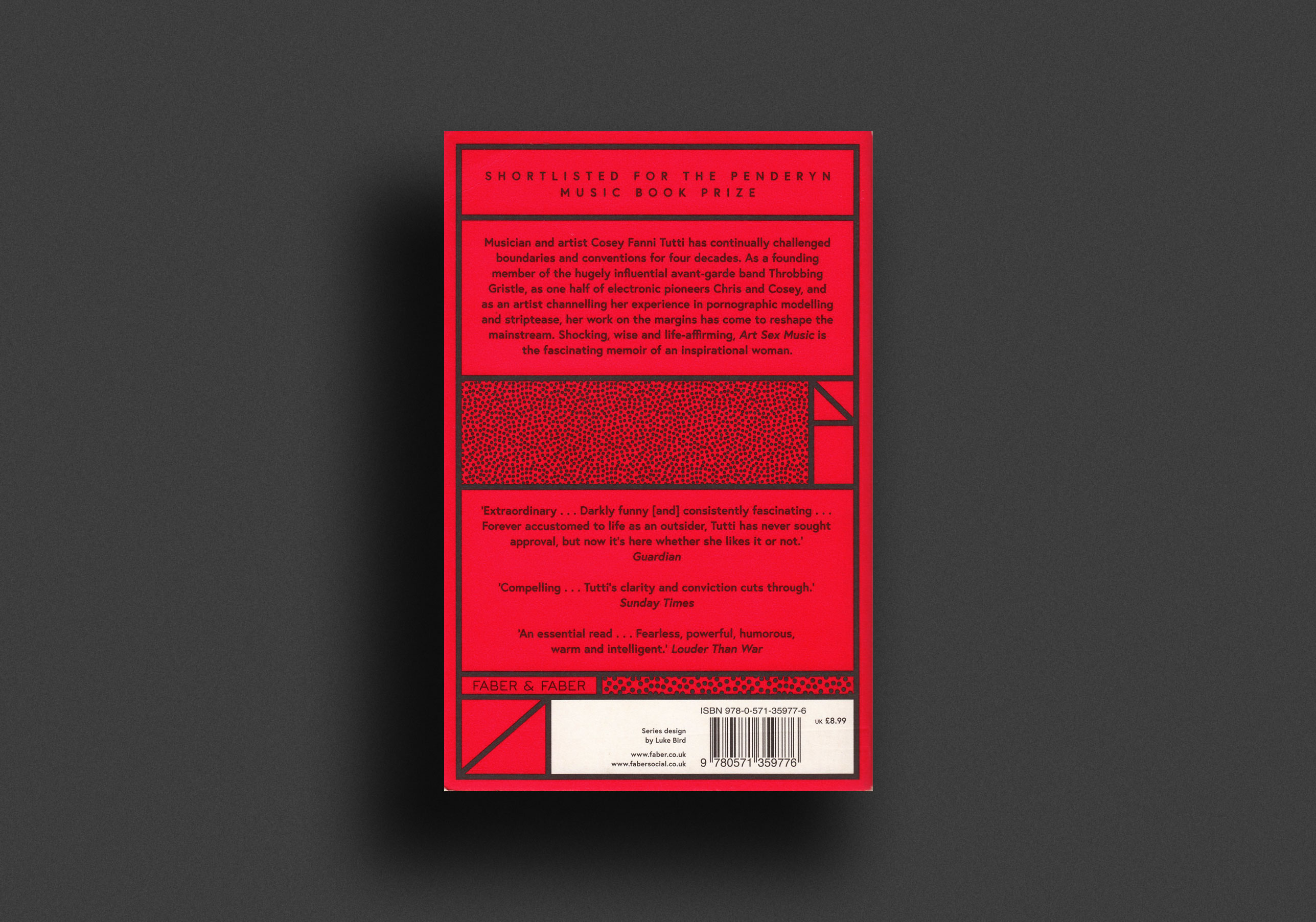
Musician and artist Cosey Fanni Tutti has continually challenged boundaries and conventions for four decades. As a founding member of the hugely influential avant-garde band Throbbing Gristle, as one half of electronic pioneers Chris and Cosey, and as an artist channelling her experience in pornographic modelling and striptease, her work on the margins has come to reshape the mainstream. Shocking, wise and life-affirming, Art Sex Music is the fascinating memoir of an inspirational woman.
Very Good copy, light wear to covers.