World Food Books' programme is largely produced on Kulin Nation land. We acknowledge the Wurundjeri people of the Kulin Nation as the first and continuing custodians of this land, and pay respect to their Elders past, present, and emerging.
World Food Books is an arts and special interests bookshop in Naarm / Melbourne. Founded in 2010, World Food Books is devoted to the presentation of a rotating, hand-selection of international art, design, literary and counterculture publications with an emphasis on the anti-traditional, the experimental, the avant-garde, the heretic, the marginal.
Presenting new titles alongside rare and out-of-print books, catalogues and journals spanning the fields of modern and contemporary art, design, photography, illustration, film, literature, poetry, cultural theory, philosophy, sexuality, popular and underground culture in its many radical forms, World Food Books wishes to encourage adventurous, thoughtful and open-minded reading, looking, writing, and exchange of publishing and ideas, both current and historical.
As well as our bookshop, located in Melbourne's historical Nicholas Building, all of our inventory is available internationally via our online mail-order service.
World Food Books semi-regularly co-ordinates "Occasions", a programme of exhibits and events at the bookshop and in partnership with other hosts (such as museums and art galleries) that develop out of the activities, relationships and content of the bookshop itself.
World Food Books
The Nicholas Building
37 Swanston Street
Room 5, Level 6
Melbourne 3000
Australia
SHOP HOURS:
Thu–Fri 12–6, Sat 12–5
WEB-SHOP OPEN 24/7
World Food Books
Postal Address:
PO Box 435
Flinders Lane
Victoria 8009
Australia
Art
Theory / Essay
Architecture / Interior
Graphic Design / Typography
Photography
Fashion
Eros
LGBTQ+
Fiction / Poetry
Weird / Speculative / Science Fiction / Horror
Transgressive / Visceral / Abject
Symbolism / Decadence / Fin de siècle
Film / Video
Painting
Sculpture / Installation
Performance / Dance / Theater
Drawing
Sound / Music
Curatorial
Group Shows / Collections
Periodicals
Out-of-print / Rare
Posters / Ephemera / Discs
Signed Books
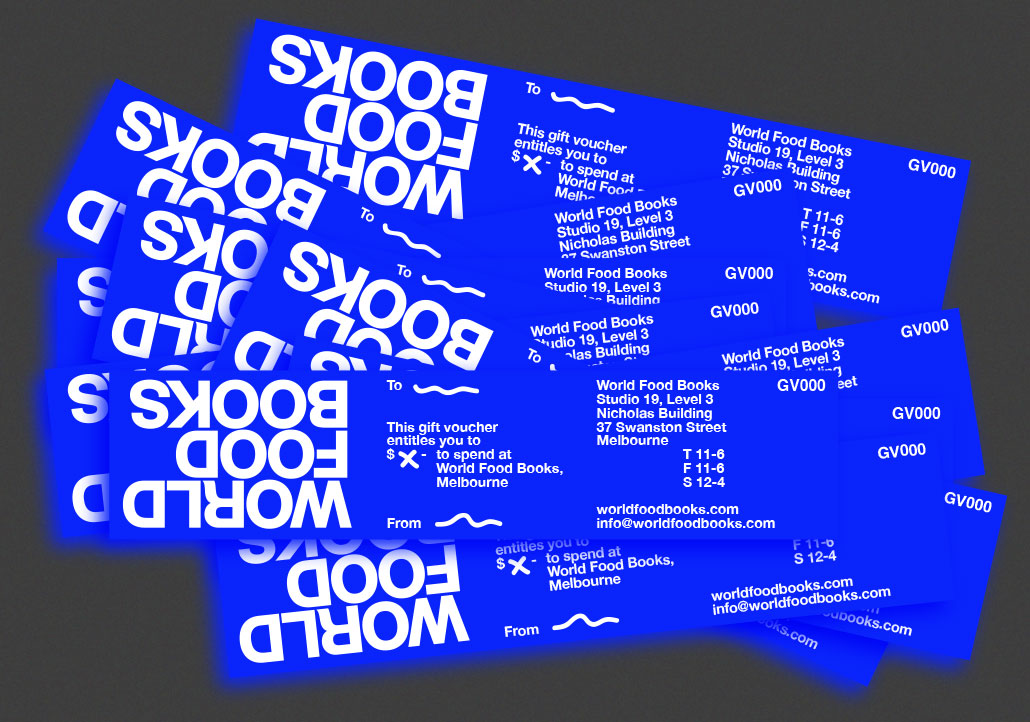
World Food Books Gift Voucher
World Food Book Bag
Australian Art
Australian Fiction
Australian Science Fiction / Speculative Fiction
Australian Poetry
Australian Photography
Japanese Photography
Conceptual Art
Minimal Art
Dada
'Pataphysics / Oulipo
Fluxus
Concrete Poetry
Pop Art
Surrealism
Arte Povera
Arte Informale / Haute Pâte / Tachism
Nouveau Réalisme / Zero / Kinetic
Situationism / Lettrism
Collage / Mail Art / Xerox Art
Art Brut / Folk / Visionary / Fantastic
Illustration / Graphic Art / Bandes Dessinées
Furniture
Italian Radical Design / Postmodernism
Textiles
Ceramics / Glass
Counterculture
Protest / Revolt
Philosophy
Psychoanalysis
Anthropology
Anarchism
Socialism / Anarchism / Communism / Capitalism
Literary Theory / Semiotics / Language
Feminism / Women's Studies
Gender Studies / Sexuality
Anthropology
Fetishism / BDSM
Drugs / Psychedelia
Crime / Violence
Animal Rights / Veganism
Occult / Esoterica
Ecology / Earth / Alternative Living
Whole Earth / Crafts
All prices in AUD (Australian dollars)
Pick-Ups
Pick-up orders can be collected in our bookshop during opening hours after order date. Please collect any Pick-up orders within 2 weeks of ordering as we have limited storage space. Orders will be released back into stock if not collected within this time. No refunds can be made for pick-ups left un-collected. If you cannot make it in to the bookshop in this time-frame, please choose postage option.
Return Policy
All sales are final. We do accept returns (for refund or exchange) for items received in error. All our orders are packed with special care using heavy-duty padding and cardboard book-mailers or bubble mailers (for smaller books), using reinforcement where required. We cannot take responsibility for any lost, stolen or damaged parcels.
Insurance
Should you wish to insure your package, please email us directly after placing your order and we can organise this at a small extra expense. Although all standard/express tracked packages are very safe and dependable, we cannot take responsibility for any lost, stolen or damaged parcels. We recommend insurance on valuable orders.
Interested in selling your old books, catalogues, journals, magazines, comics, fanzines, ephemera? We are always looking for interesting, unusual and out-of-print books to buy. We only buy books in our fields of interest and specialty, and that we feel we can resell.
We base these prices on desirability, market value, in-print prices, condition and our current stock levels. We offer cash, store credit, and can take stock on consignment. All
about 25% of the price we expect to get when we sell them, or 30% in store credit. We base these prices on desirability, market value, in-print prices, condition and our current stock levels.
Sell your books any day of the week. You can drop them off and return later. If you have a lot of books, we can visit your Sydney home.
We buy books that we feel we can resell. We offer about 25 % of the price we expect to get when we sell them, or 30% in store credit. We base these prices on desirability, market value, in-print prices, condition and our current stock levels.
Philadelphia Wireman
03 August - 01 September, 2018
World Food Books is proud to announce our next Occasion, the first presentation of sculptures by Philadelphia Wireman in Australia.
The Philadelphia Wireman sculptures were found abandoned in an alley off Philadelphia’s South Street on trash night in 1982. Their discovery in a rapidly-changing neighbourhood undergoing extensive renovation, compounded with the failure of all attempts to locate the artist, suggests that the works may have been discarded after the maker’s death. Dubbed the "Philadelphia Wireman" during the first exhibition of this work, in 1985, the maker’s name, age, ethnicity, and even gender remain uncertain. The entire collection totals approximately 1200 pieces, all intricately bound together with tightly-wound heavy-gauge wire (along with a few small, abstract marker drawings, reminiscent both of Mark Tobey and J.B. Murry). The dense construction of the work, despite a modest range of scale and materials, is singularly obsessive and disciplined in design: a wire armature or exoskeleton firmly binds a bricolage of found objects including plastic, glass, food packaging, umbrella parts, tape, rubber, batteries, pens, leather, reflectors, nuts and bolts, nails, foil, coins, toys, watches, eyeglasses, tools, and jewellery.
Heavy with associations—anthropomorphic, zoomorphic, and socio-cultural responses to wrapped detritus—the totemic sculptures by Philadelphia Wireman have been discussed in the context of work created to fulfil the shamanistic needs of alternative religions in American culture. Curators, collectors, and critics have variously compared certain pieces to sculpture from Classical antiquity, Native American medicine bundles, African-American memory jugs, and African fetish objects. Reflecting the artist’s prolific and incredibly focused scavenging impulse, and despite—or perhaps enhanced by—their anonymity, these enigmatic objects function as urban artefacts and arbiters of power, though their origin and purpose is unknown. Philadelphia Wireman, whatever their identity, possessed an astonishing ability to isolate and communicate the concepts of power and energy through the selection and transformation of ordinary materials. Over the course of the past two decades, this collection has come to be regarded as an important discovery in the field of self-taught art and vernacular art.
Presented in collaboration with Fleisher-Ollman Gallery, Philadelphia, and Robert Heald, Wellington.
Susan Te Kahurangi King
02 February - 10 March, 2018
Susan Te Kahurangi King (24 February 1951 - ) has been a confident and prolific artist since she was a young child, drawing with readily available materials - pencils, ballpoint pens and felt-tip markers, on whatever paper is at hand. Between the ages of four and six Susan slowly ceased verbal communication. Her grandparents William and Myrtle Murphy had developed a special bond with Susan so they took on caring responsibilities for extended periods. Myrtle began informally archiving her work, carefully collecting and storing the drawings and compiling scrapbooks. No drawing was insignificant; every scrap of paper was kept. The King family are now the custodians of a vast collection containing over 7000 individual works, from tiny scraps of paper through to 5 meter long rolls.
The scrapbooks and diaries reveal Myrtle to be a woman of great patience and compassion, seeking to understand a child who was not always behaving as expected. She encouraged Susan to be observant, to explore her environment and absorb all the sights and sounds. Myrtle would show Susan’s drawings to friends and people in her community that she had dealings with, such as shopkeepers and postal workers, but this was not simply a case of a grandmother’s bias. She recognised that Susan had developed a sophisticated and unique visual language and sincerely believed that her art deserved serious attention.
This was an unorthodox attitude for the time. To provide some context, Jean Dubuffet coined the term Art Brut in 1945 to describe work created by self-taught artists – specifically residents of psychiatric institutions and those he considered to be visionaries or eccentrics. In 1972 Roger Cardinal extended this concept by adopting the term Outsider Art to describe work made by non-academically trained artists operating outside of mainstream art networks through choice or circumstance. Susan was born in Te Aroha, New Zealand in 1951, far from the artistic hubs of Paris and London that Dubuffet and Cardinal operated in. That Myrtle fêted Susan as a self-taught artist who deserved to be taken seriously shows how progressive her attitudes were.
Susan’s parents Doug and Dawn were also progressive. Over the years they had consulted numerous health practitioners about Susan’s condition, as the medical establishment could not provide an explanation as to why she had lapsed into silence. Dawn educated herself in the field of homeopathy and went on to treat all twelve of her children using these principles – basing prescriptions on her observations of their physical, mental and emotional state.
Doug was a linguist with an interest in philosophy who devoted what little spare time he had to studying Maori language and culture. To some extent their willingness to explore the fringes of the mainstream made them outsiders too but it was their commitment to living with integrity and their respect for individuality that ensured Susan’s creativity was always encouraged.
Even though Susan’s family supported her artistic pursuits, some staff in schools and hospitals saw it as an impediment to her assimilation into the community and discouraged it in a variety of ways. Her family was not always aware of this and therefore did not fully understand why Susan stopped drawing in the early 1990s. However, rather than dwell on the challenges that Susan faced in pursuit of her artistic practice, they prefer to highlight her achievements. In 2008 Susan began drawing again in earnest, after an almost 20 year interruption, and her work is now shown in galleries around the world.
Susan grew up without television and has been heavily influenced by the comics she read as a child. She is absolutely fearless in the appropriation of recognizable characters, such as Donald Duck and Mickey Mouse, in her work. She twists their limbs, contorts their faces, compresses them together, blends them into complex patterned backgrounds - always imbuing them with an incredible energy. Although Susan often used pop culture characters in her work they are not naive or childlike. These are drawings by a brilliant self-taught artist who has been creating exceptional work for decades without an audience in mind.
Mladen Stilinović
"Various Works 1986 - 1999"
02 February 16 - September 10, 2016
Various works 1986 - 1999, from two houses, from the collections of John Nixon, Sue Cramer, Kerrie Poliness, Peter Haffenden and Phoebe Haffenden.
Including: Geometry of Cakes (various shelves), 1993; Poor People’s Law (black and white plate), 1993; White Absence (glasses, ruler, set square, silver spoon, silver ladel with skin photograph and wooden cubes), 1990-1996; Exploitation of the Dead (grey and red star painting, wooden painting, black spoon with red table, red plate), 1984-1990; Money and Zeros (zero tie, paintings made for friends in Australia (Sue, John, Kerrie), numbers painting), 1991-1992; Words - Slogans (various t-shirts) - “they talk about the death of art...help! someone is trying to kill me”, “my sweet little lamb”, “work is a disease - Karl Marx”; Various artist books, catalogues, monographs, videos; Poster from exhibition Insulting Anarchy; "Circular" Croatian - Australian edition; Artist book by Vlado Martek (Dostoyevsky); more.
Thanks to Mladen Stilinović and Branka Stipančić.
Jonathan Walker
Always Will Need To Wear Winter Shirt Blue + Ochre Small Check Pattern
21 August - 21 September, 2015
Untitled
I am not a great reader of poetry but I always return to the work of Melbourne poet, Vincent Buckley (1925- 1988). Perhaps I find his most tantalising piece to be not a finished poem but a fragment left on a scrap of paper discovered on his desk after the poet’s death.
The poetry gathers like oil
In the word-core, and spreads
It has its music meet,
Its music is in movement.
This fragment is more the shell left behind from a volatile thought than a finished poem. I find the last two lines honest but awkward whereas the first two lines work like an arrow. Most likely he could not find a resolution so it was left. Still, in its present form, it remains an eloquent testimony to the ultimate failure of a medium to express mobile thought and sensation, in Buckley’s case, through verbal language. It’s an important matter because this is something all artists have to deal with regardless of the medium.
I have never written a poem, however, I am forever copying fragments from books on paper scraps in a vain effort to fix certain notions in my head. At first, they function as bookmarks that are sometimes returned to when I open the book. But before long, as they accumulate, they fall out littering the table interspersed with A4 photocopies, bills, books and medications.
To return to Buckley’s fragment, the first two lines very much evoke how I paint nowadays. As you age, detail diminishes and patches of light become more luminous and float. I feel the most honest way of dealing with this is by smearing the oil paint on the canvas with the fingers and working close-up, blind. Only if the patches coalesce into an approaching image can the work gain a life.
-
Jonathan Walker was born in Melbourne, Australia and brought up on a dairy farm in Gippsland. In the 1970’s he studied painting at RMIT and won the Harold Wright Scholarship to the British Museum, London. During the 1980’s he exhibited at Pinacotheca Gallery, Richmond and had work shown at the NGV and Heidi City Art Gallery. Over the same period he designed the cover for the “Epigenesi” LP by Giancarlo Toniutti, Italy and conducted a mail exchange work with Achim Wollscheid, Germany. The work with artists through the post resulted in an article published in the bicentenary issue of Art and Australia 1988. He showed in artist run spaces such as WestSpace in the 90’s and 2000’s, and until 2012, taught painting at Victoria University, which is where we (Colleen Ahern and Lisa Radford) as organisers of the exhibition, among many others, had the privilege of being his student.
Walker’s knowledge was imparted to students through the careful selection of music, literature, and artists found in books that he himself had ordered for the library. Walker’s strategy was the generosity of sharing his vast knowledge with references specific to each student and their context.
Walker’s paintings share a similar focus and intimacy.
This exhibition presents a small selection of recent paintings alongside a publication that includes Walker’s writing. Observational and analytical, Walker’s work is a type of material notation — the time of day, colour and how it is blended, the both specific and fleeting location of a reflection on lino or the question of whether a chair leg should be included in a painting.
Please join us on Friday August 21 between 6-8pm to celebrate the opening of the exhibition.
Curated by Colleen Ahern and Lisa Radford.
B. Wurtz
Curated by Nic Tammens
March 26 - April 4, 2015
B.Wurtz works from a basement studio in his home on Manhattan’s Lower East Side.
This local fact is attested to by the plastic shopping bags and newsprint circulars that appear in his work. As formal objects, they don’t make loud claims about their origins but nonetheless transmit street addresses and places of business from the bottom of this long thin island. Like plenty of artists, Wurtz is affected by what is local and what is consumed. His work is underpinned by this ethic. It often speaks from a neighborhood or reads like the contents of a hamper:
“BLACK PLUMS $1.29 lb.”
“Food Bazaar”
“USDA Whole Pork Shoulder Picnic 99c lb.”
“RITE AID Pharmacy, with us it’s personal.”
“H. Brickman & Sons.”
“Sweet Yams 59c lb."
Most of the work in this exhibition was made while the artist was in residence at Dieu Donne, a workshop dedicated to paper craft in Midtown. Here Wurtz fabricated assemblages with paper and objects that are relatively lightweight, with the intention that they would be easily transportable to Australia. This consideration isn’t absolute in Wurtz’s work, but was prescriptive for making the current exhibition light and cheap. Packed in two boxes, these works were sent from a USPS post office on the Lower East Side and delivered to North Melbourne by Australia Post.
Wurtz appears courtesy of Metro Pictures, New York.
Thanks to Rob Halverson, Joshua Petherick, Sari de Mallory, Matt Hinkley, Helen Johnson, Fayen d'Evie, Ask Kilmartin, Lisa Radon, Ellena Savage, Yale Union, and "Elizabeth".
John Nixon
"Archive"
December 15 - January 20, 2014
The presentation of John Nixon's archive offered a rare showcase of this extensive collection of the artist's own publications, catalogues, posters, ephemera, editions and more, from the mid 1980s onwards, alongside a selection of his artworks.
Organized by John Nixon, Joshua Petherick and Matt Hinkley.
<a href=http://wfb.public-office.info/artist/john-nixon>All titles by John Nixon
"Habitat"
at Minerva, Sydney (organised by Joshua Petherick and Matt Hinkley)
November 15 - December 20, 2014
Lupo Borgonovo, Janet Burchill & Jennifer McCamley,
Lewis Fidock, HR Giger, Piero Gilardi, Veit Laurent Kurz,
Cinzia Ruggeri, Michael E. Smith, Lucie Stahl, Daniel Weil, Wols
Press Release:
“...It contained seven objects. The slender fluted bone, surely formed for flight, surely from the wing of some large bird. Three archaic circuitboards, faced with mazes of gold. A smooth white sphere of baked clay. An age-blackened fragment of lace. A fingerlength segment of what she assumed was bone from a human wrist, grayish white, inset smoothly with the silicon shaft of a small instrument that must once have ridden flush with the surface of the skin - but the thing’s face was seared and blackened.”
William Gibson, “Count Zero”, 1986
"Autumn Projects Archive"
Curated by Liza Vasiliou
March 6 - March 15, 2014
World Food Books, in conjunction with the Virgin Australia Melbourne Fashion Festival 2014, presented the Autumn Projects archive, consisting of a selection of early examples in Australian fashion with a particular interest in collecting designers and labels from the period beginning in the 1980’s, who significantly influenced the discourse of Australian Fashion.
Curated by Liza Vasiliou, the exhibition provided a unique opportunity to view pieces by designers Anthea Crawford, Barbara Vandenberg, Geoff Liddell and labels CR Australia, Covers, Jag along with early experimental collage pieces by Prue Acton and Sally Browne’s ‘Fragments’ collection, suspended throughout the functioning World Food Books shop in Melbourne.
H.B. Peace
presented by CENTRE FOR STYLE
November 14, 2013
"Hey Blinky, you say chic, I say same"
Anon 2013
H.B. Peace is a clothing collaboration between great friends Blake Barns and Hugh Egan Westland. Their pieces explore the divergences between 'character’ and ‘personality’ in garments....etc
Special Thanks to Joshua Petherick and Matt Hinkley of WFB and Gillian Mears
and a Very Special Thank you to Audrey Thomas Hayes for her shoe collaboration.
Janet Burchill & Jennifer McCamley
"Aesthetic Suicide"
May 10 - June 8, 2013
The first of our occasional exhibitions in the World Food Books office/shop space in Melbourne, "Aesthetic Suicide" presented a body of new and older works together by artists Janet Burchill & Jennifer McCamley, including videos, prints, a wall work, and publications.
During shop open hours videos played every hour, on the hour.
$.00 - Out of stock
The eternal clean out! New items weekly.
https://worldfoodbooks.com/category/sale
Published by World Food Books / Melbourne
$20.00 - In stock -
A World Food Books gift voucher is redeemable in our Melbourne bookshop or via our webshop (here). An e-voucher (printable pdf) will be sent to your purchase email address (please notify us if you wish to have the voucher sent to an alternate address and wish us to fill in the receiver's details on the card).
Gift vouchers can be purchased in increments of $20 (Australian Dollars) and the total amount can simply be added to by increasing the quantity in your shopping cart. eg. A quantity of 5 gift vouchers will result in an item total of $100 - a $100 gift voucher. Simply click "ADD TO CART" 5 times, or update your quantity in the shopping cart.
If you wish to purchase multiple, separate gift vouchers in one go, please just email us and we can personally prepare and email you a payment request.
Please note: Please select Pick-Up on gift voucher purchse to avoid any postage charges. Accidental postage charges will be refunded right away!
Thank you.
For any questions, please don't hesitate to email: info@worldfoodbooks.com
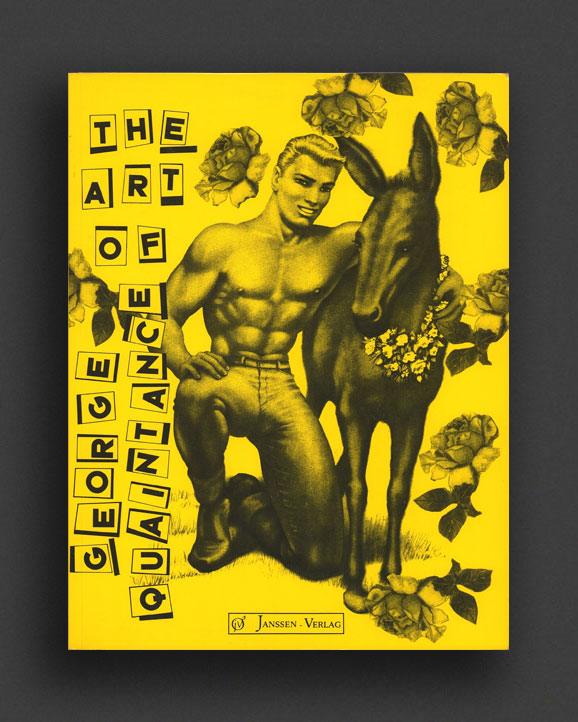
1990, English
Softcover, 80 pages, 30 x 23 cm
1st Edition, Out of print title / used / very good
Published by
Janssen Verlag / Berlin
$200.00 - Out of stock
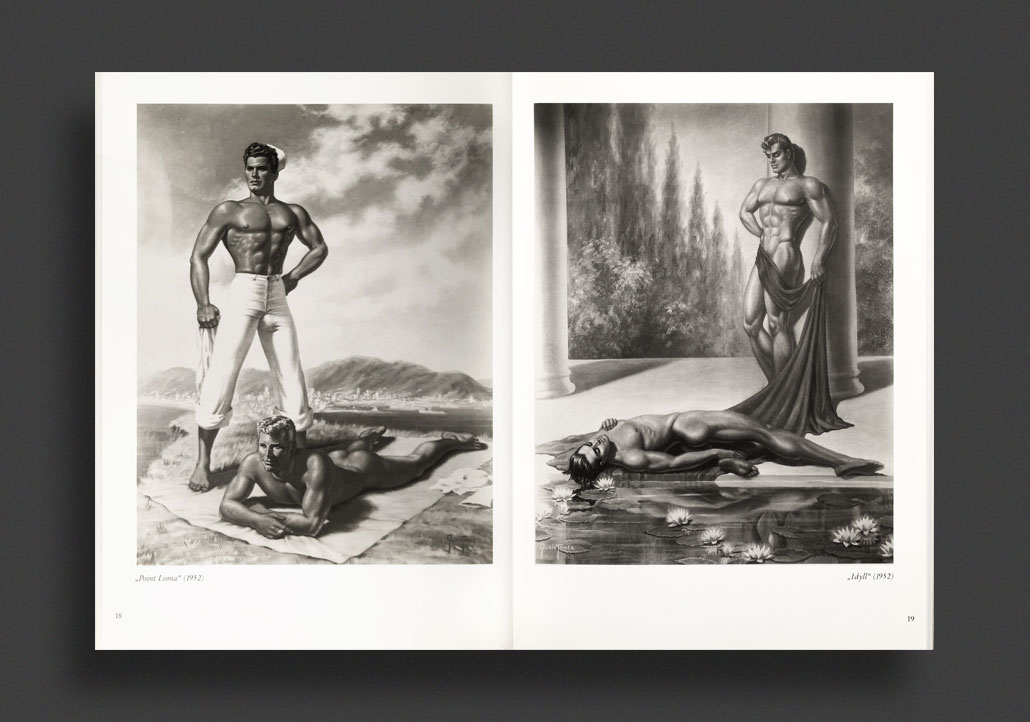
First 1990 edition of The Art of George Quaintance, the first comprehensive art book survey of George Quaintance's work. Profusely illustrated throughout with beautiful reproductions of Quaintance's stunning homo-erotic artworks and book illustrations, alongside many press clippings, magazine articles, advertisements for Studio Quaintance, texts in English and German by George Quaintance, Volker Janssen, and Tora Lillstrom. George Quaintance (1902—1957) was an important Arizonan American artist, famous for his "idealized, strongly homoerotic" depictions of men in mid-20th-century physique magazines, such as the influential Physique Pictorial. Using historical settings and folklore such as the Wild West, or the mythology of ancient Greece and Rome, George Quaintance distanced his subjects from modern society, his world of legends made glorious with muscular, semi-nude or nude male figures, helping establish the stereotype of the homosexual "macho stud". A pioneer of a gay aesthetic, George Quaintance's work would influence many later homoerotic artists, including, most notably Tom of Finland.
Very Good copy.
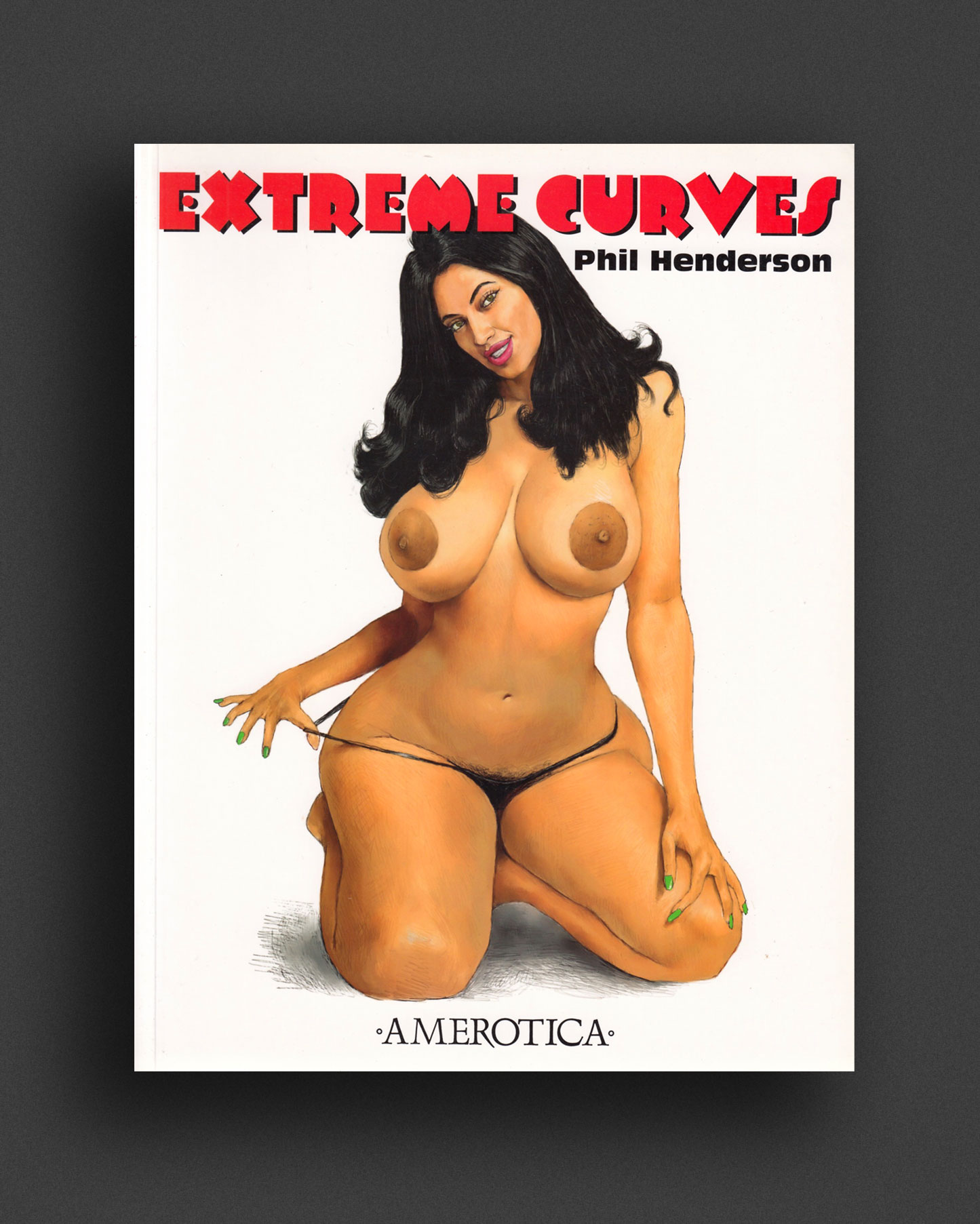
2004, English
Softcover, 80 pages, 28 x 22 cm
1st Edition, Out of print title / used / very good
Published by
Amerotica / New York
$85.00 - In stock -
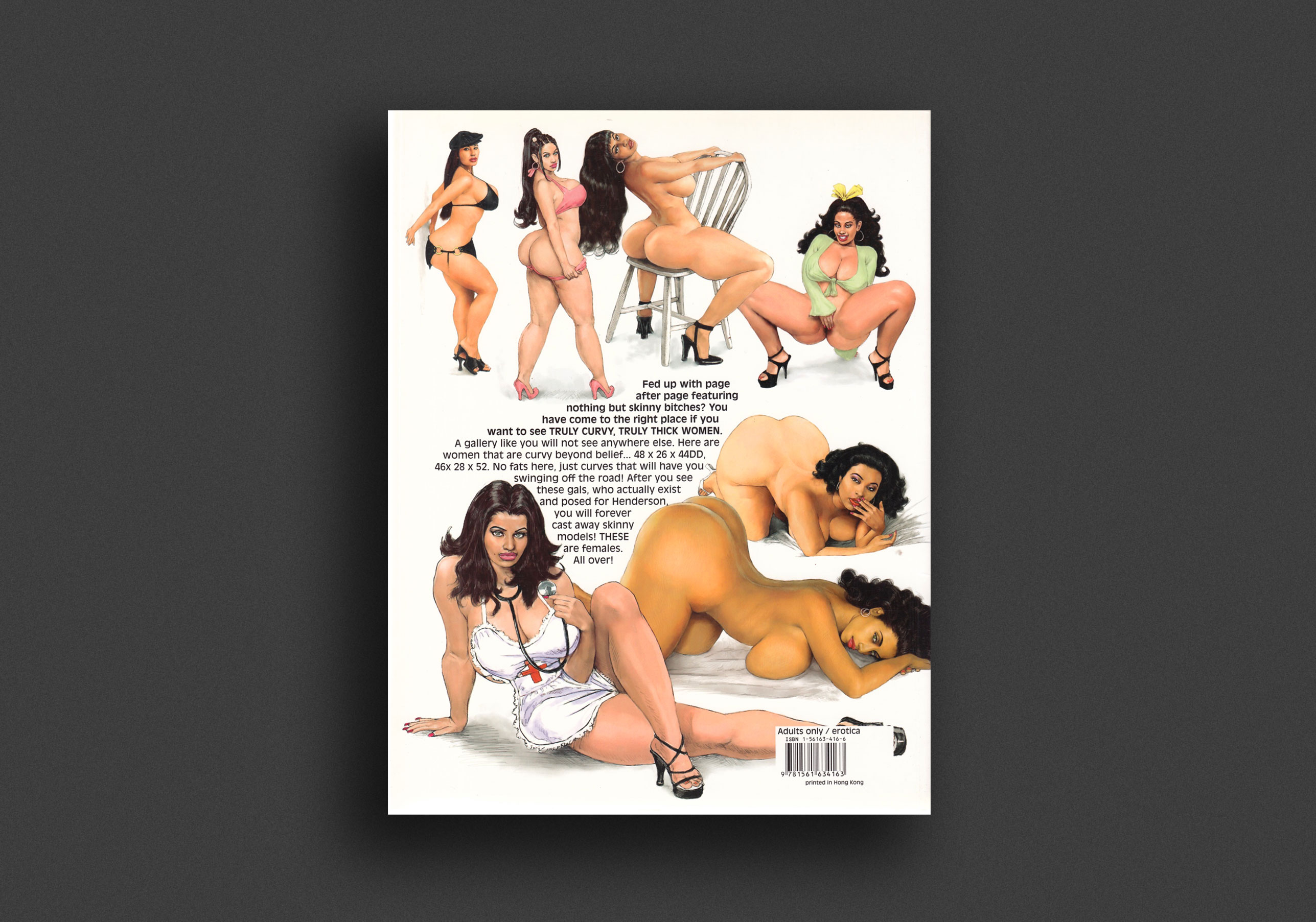
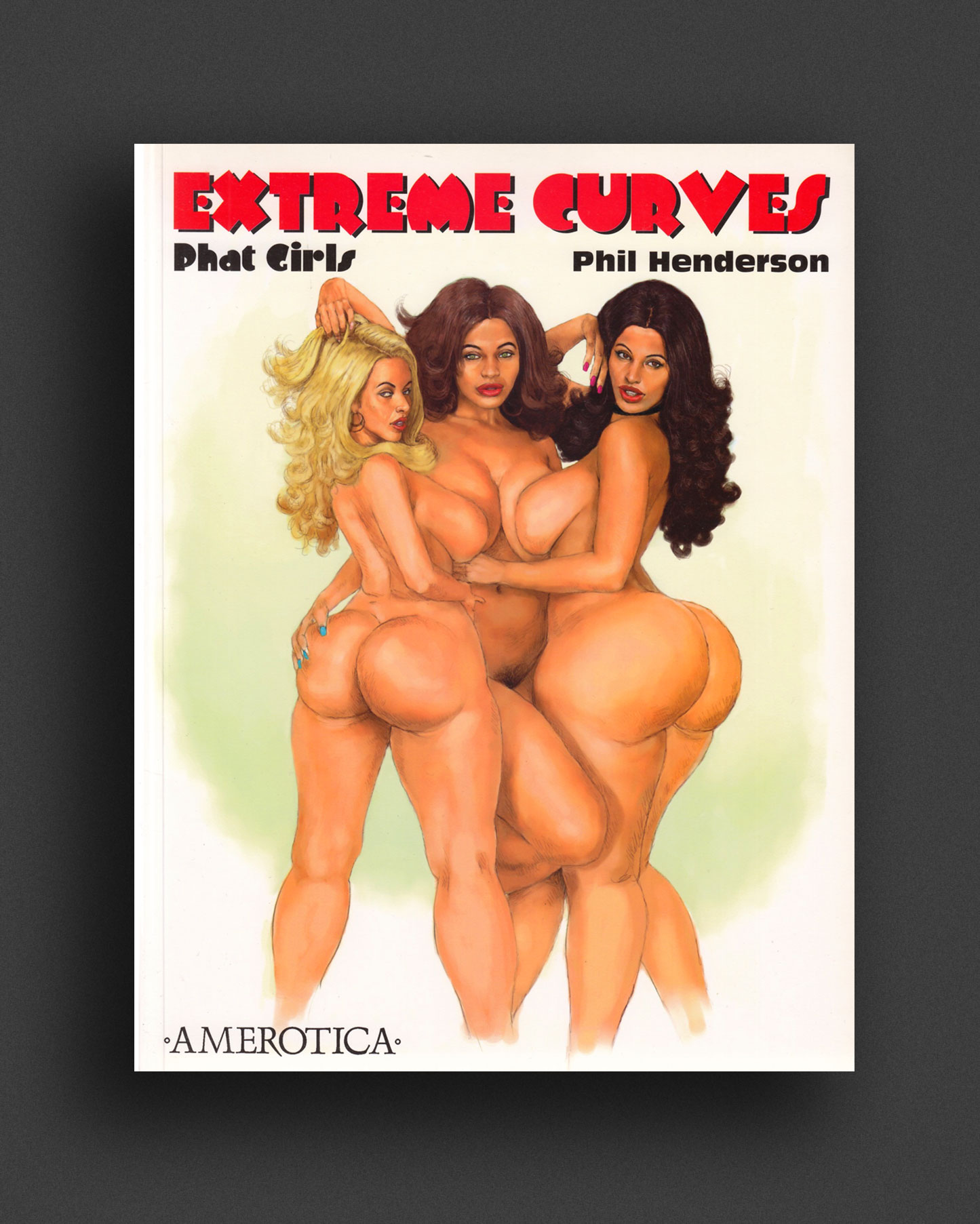
"A gallery like you will not see anywhere else. Here are women that are curvy beyond belief... 48 X 26 X 44DD, 46 X 28 X 52. No fat here, just curves that will have you swinging off the road! After you see these gals, who actually exist and posed for Henderson, you will forever cast away the Kate Mosses of the world! THESE are females. All over!"
First 2004 edition, second printing, fast out–of–print.
Very Good—Near Fine copy with only light wear.
2008, English
Softcover, 80 pages, 28 x 22 cm
1st Edition, Out of print title / used / very good
Published by
Amerotica / New York
$70.00 - In stock -
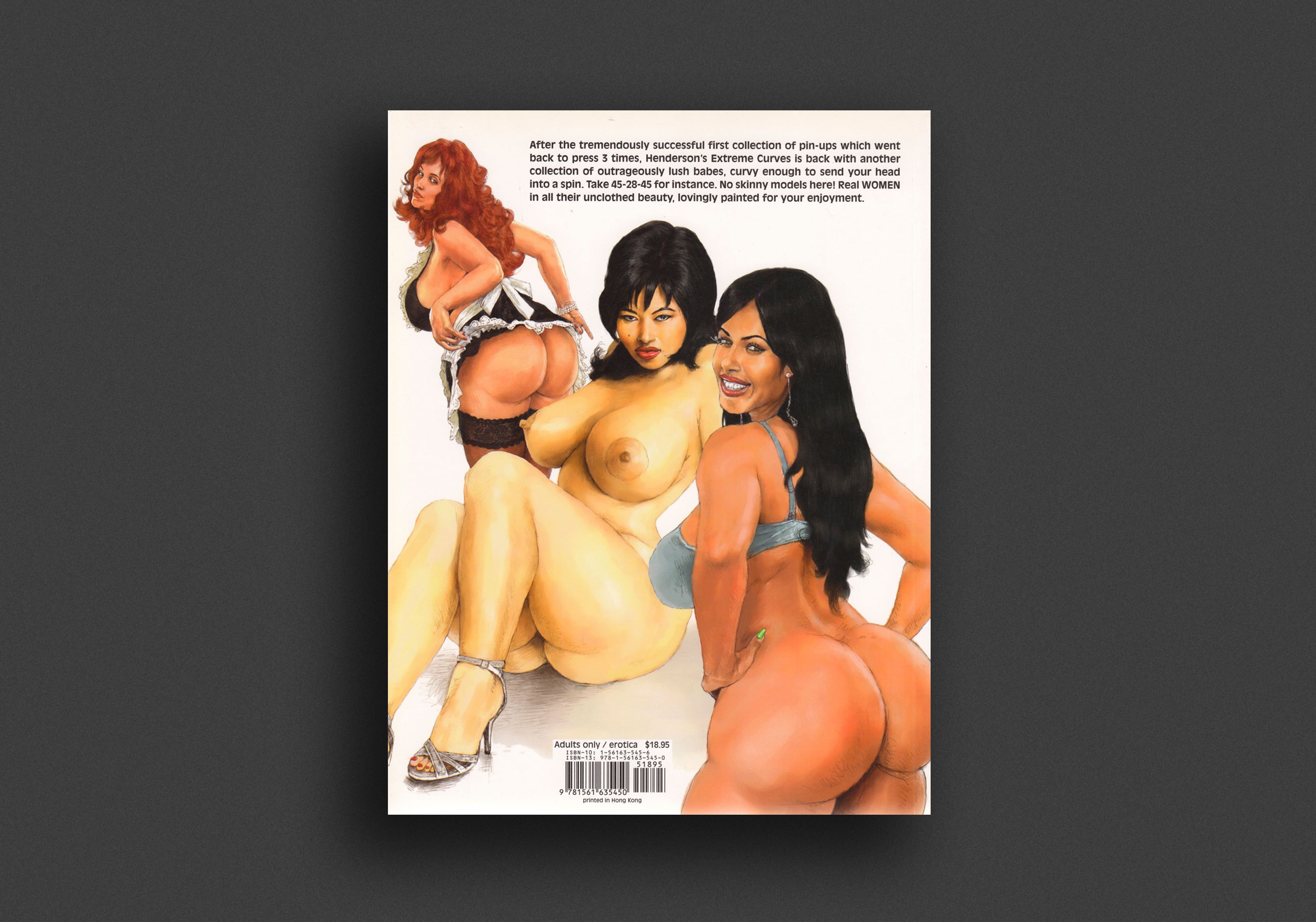
"After the tremendously successful first collection of pin-ups which went back to press 3 times, Henderson's Extreme Curves is back with another collection of outrageously lush babes, curvy enough to send your head into a spin. Take 45-28-45 for instance. No skinny models here! Real WOMEN in all their unclothed beauty, lovingly painted for your enjoyment."
First 2008 edition, first printing, again fast out–of–print.
Very Good—Near Fine copy with only light wear.
1990, English
Softcover (staple–bound), 56 pages, 30 x 21 cm
1st Edition, Out of print title / used / good
Published by
Electronic Media Arts Ltd. / NSW
$25.00 - In stock -
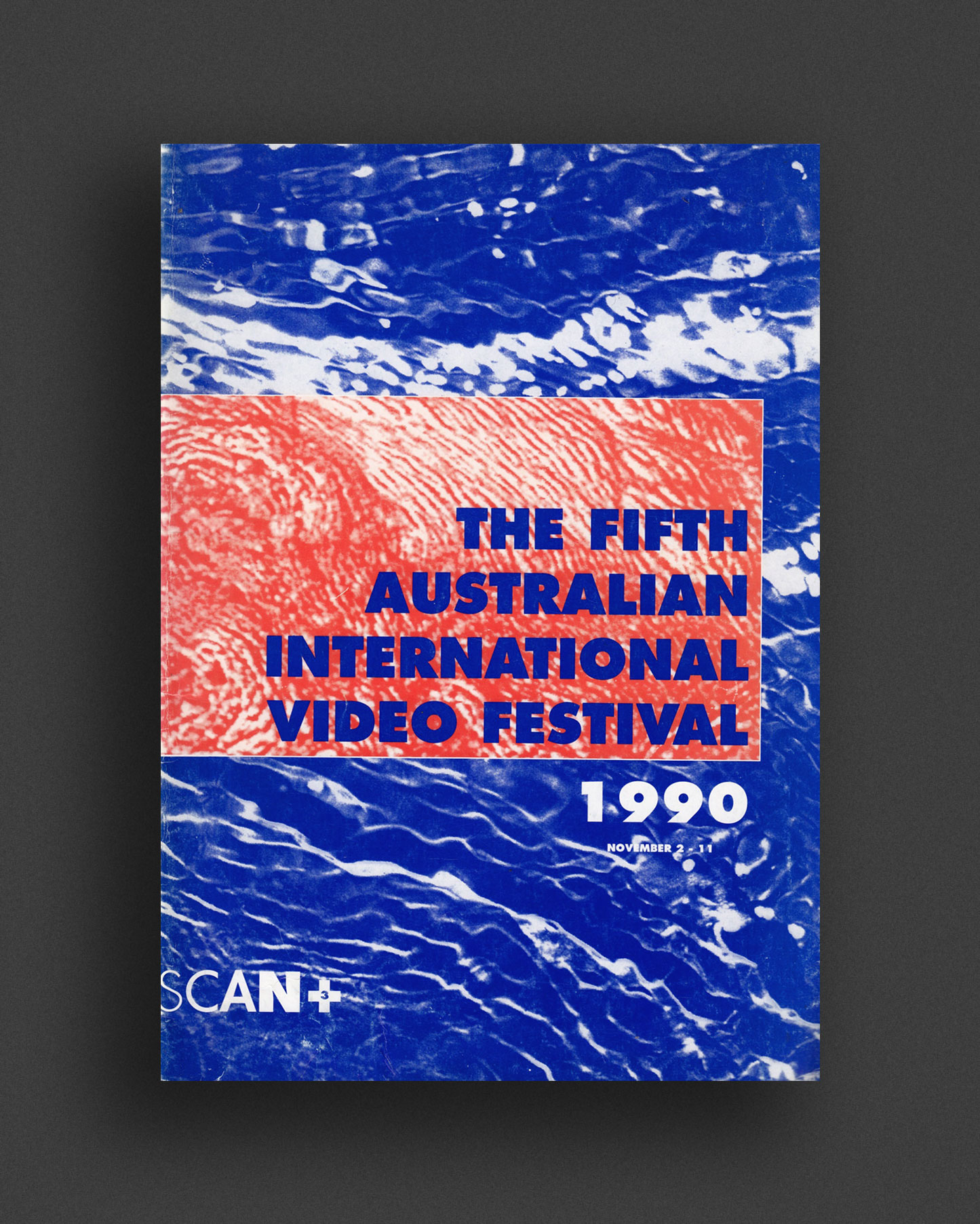
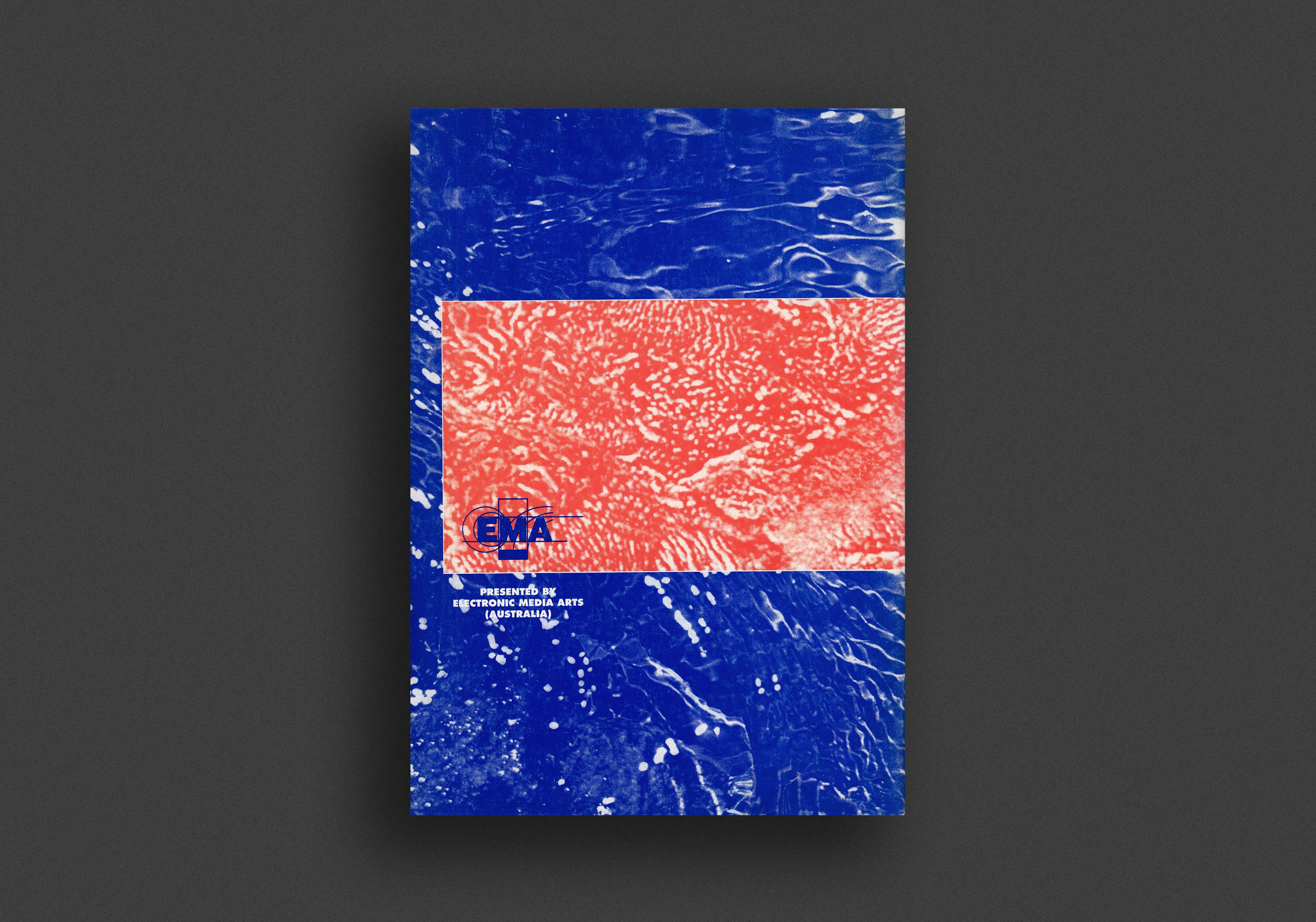
Catalogue published on the occasion of SCAN+ 3: The Fifth Australian International Video Festival, 1990, November 2–11, directed by Brian Langer and presented by Electronic Media Arts Ltd. Illustrated throughout with essays by David Dunn and Bohuslav Woody Vasulka, an interview with Nam June Paik by Nicholas Zurbrugg, the retrospective of early video art pioneers, Steina and Woody Vasulka, by Roy Durfee, Mckenzie Wark on Peter Callas, Ulrike Rosenbach's installaion, Bill Seaman, New Video from Japan by Carl E. Loeffler, and more, a full Videoteque Directory of international and local works screening in the festival, and much more.
Biran Langer was the Artistic Director of the Australian International Video Festival from 1988 to 1992 and Executive Director of Electronic Media Arts Ltd from 1990 to 1992.
Good copy with light wear to boards/corners.
2025, English
Softcover, 640 pages, 24 x 16.99 cm
Published by
Intellect Ltd / US
$110.00 - Out of stock
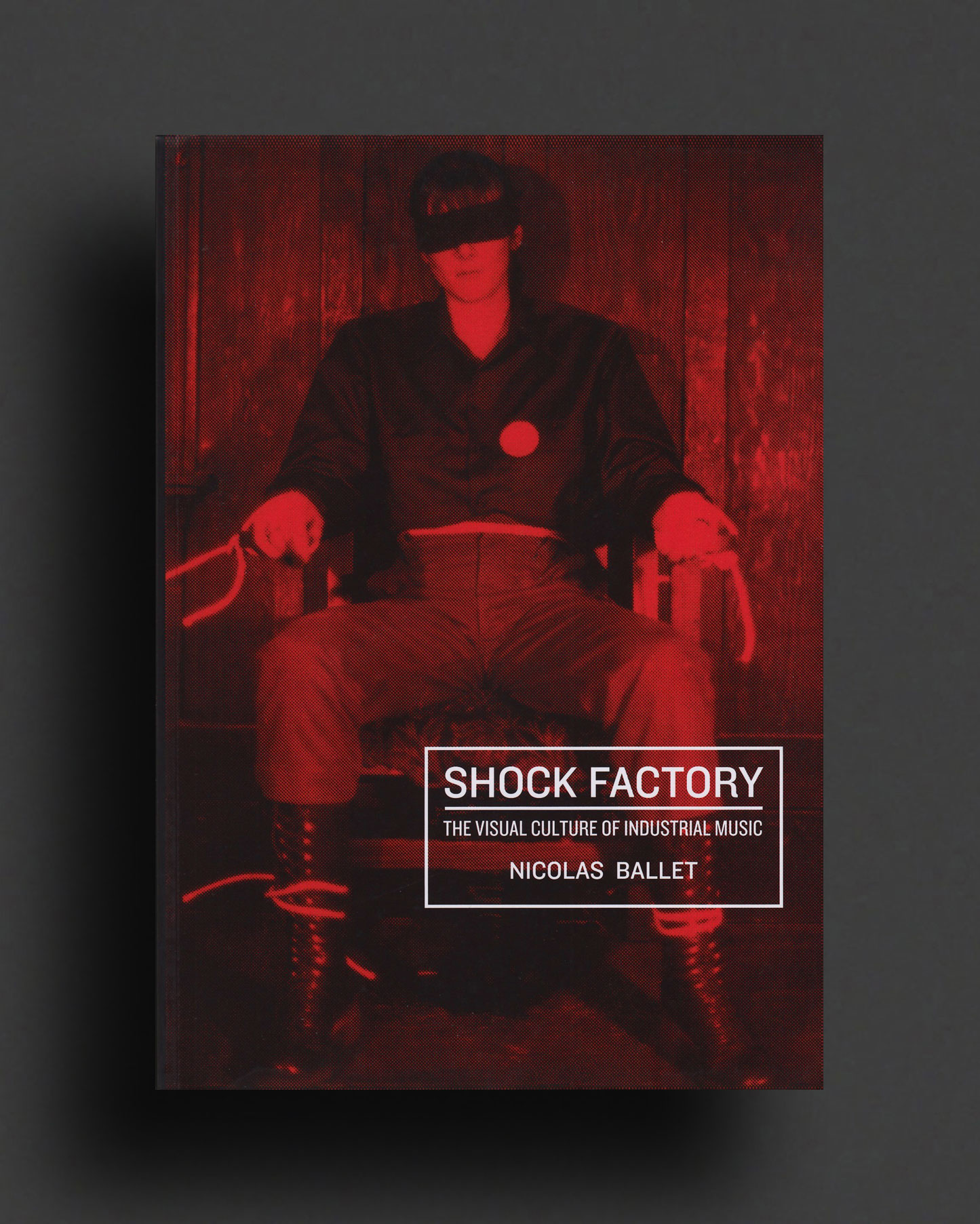
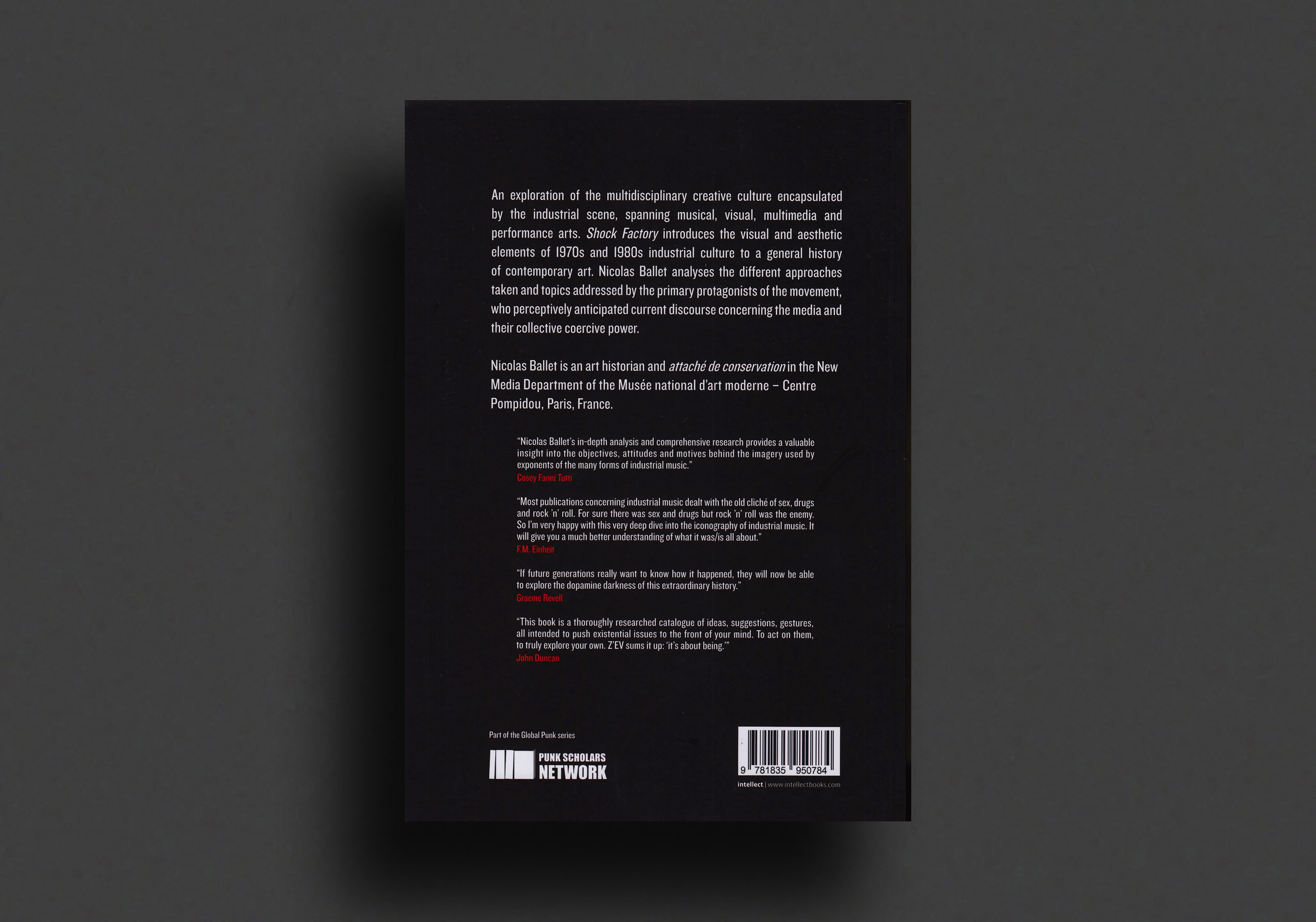
Industrial music has long been recognized for its sonic innovations, but the radical visual culture that accompanied this underground movement has remained largely unexplored. Shock Factory: The Visual Culture of Industrial Music presents the first comprehensive examination of how industrial artists created a coherent aesthetic language across multiple media—from xerox art and mail art to installation and performance—fundamentally challenging modernist utopias while prophetically anticipating contemporary discourse about media manipulation and technological control.
Emerging in mid-1970s Britain from the post-punk underground before expanding globally throughout the 1980s, artists like Throbbing Gristle, Cabaret Voltaire, SPK, Test Dept, Laibach, Einstürzende Neubauten, Nurse With Wound, Current 93, Coil, Psychic TV, Boyd Rice, Whitehouse, Merzbow, Hijokaidan, Hunting Lodge, Controlled Bleeding, Hafler Trio, Z'EV, Nocturnal Emissions, 23 Skidoo, Clock DVA, Master/Slave Relationship, and Monte Cazazza developed sophisticated visual strategies that matched their abrasive soundscapes with equally confrontational imagery.
At 640 pages, this award-winning monograph reveals how industrial artists systematically appropriated reprographic techniques—particularly xerox art and photocollage—to create disturbing visual narratives investigating mind control, criminality, occultism, pornography, psychiatry, and totalitarianism. Through détournement strategies borrowed from Situationist theory, they exposed the coercive mechanisms of mass media and technological society, creating a visual vocabulary that challenged viewers to confront uncomfortable truths about modern power structures. What emerges is a movement that perceptively anticipated contemporary concerns about surveillance, media manipulation, and collective psychological control. Industrial artists' exploration of these themes through deliberately provocative imagery served not as mere provocation but as sophisticated critique of the very media systems they inhabited. Their radical aesthetic choices—degraded reproduction quality, found imagery manipulation, shock tactics—created hybrid forms that defied traditional categorization while establishing independent networks that bypassed conventional art world structures.
Shock Factory positions industrial music's visual culture within broader art historical narratives, revealing connections to Dada, Surrealism, and conceptual art while demonstrating the movement's unique contributions to contemporary visual culture. The book arrives at a moment when questions about technology, media manipulation, and social control have never been more urgent, demonstrating how these artists' radical visual strategies continue to offer valuable insights for our digital age.
For scholars of contemporary art, music history, and media studies, this book provides essential documentation of an overlooked movement that significantly influenced subsequent artistic developments. For readers interested in underground culture and avant-garde aesthetics, Shock Factory reveals the sophisticated visual thinking that accompanied one of the most innovative musical movements of the past half-century.
"A history of industrial music needed to be written. Nicolas Ballet has accomplished this. Thoroughly. This is the book's greatest strength. It explores the significance of noise as a reflection of a world in decay and screaming as a need. And doing it so it reveals a significant connection between industrial music and contemporary art. This is also what makes it an essential book: its contribution to dismantling categories and rethinking history from mixed creative territories."—David G. Torres
Nicolas Ballet is an art historian and assistant curator at the Centre Pompidou in the New Media Department. He is the author of books and articles exploring the visual and sonic contributions of countercultures and experimental artistic practices.
1986, English
Softcover (staple–bound), 22 pages, 29.5 x 21 cm
1st Edition, Out of print title / used / good
Published by
MIMA / Melbourne
$40.00 - In stock -
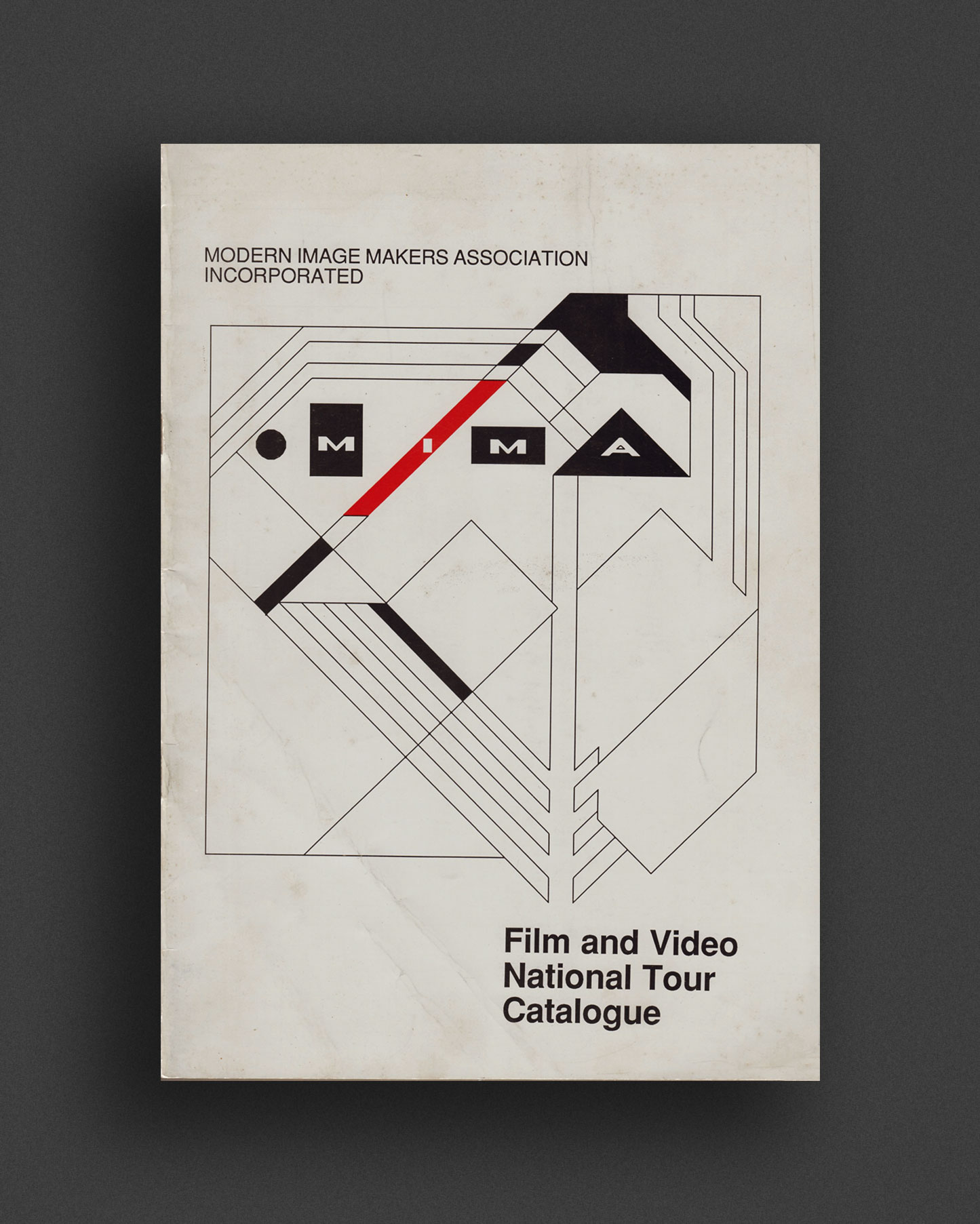
Rare copy of the catalogue published to accompany the touring exhibition that grew from the first year of the Modern Image Makers Association's activities in 1986. MIMA (Modern Image Makers Association Inc.) was Experimenta Media Arts is a Melbourne based group which was was first established in 1986 as the Modern Image Makers Association Inc. (MIMA). In 1986 MIMA received funding from the Australian Film Commission and Film Victoria to run a series of exhibitions and produce a set of compilation tapes of Victorian Film and Video Art titled MIMA Yearbook Videos. This catalogue documents the film programmes, profiles all of the artists, and is accompanied by essays from Australian poet Kris Hemensley and Australian actor John Flaus. Features the work of: → ↑ → (Tsk Tsk Tsk), Virginia Fraser. David Chesworth, James Clayden, Arthur & Corinne Cantrill, Ivor Cantrill, Dirk de Bruyn, John Dunkley–Smith, John Hillcoat, John Hughes / Peter Kennedy, Chris Knowles, Michael Lee, Marie Hoy, Jean–Marc Le Pechoux, Lynsey Martin, Ruben Mow, Nick Ostrovskis, Randelli (Frank Bendinelli & Robert Randall), Peter Tammer, Marcus Bergner, Michael Buckley & Sue McCauley, Warren Burt.
MIMA (Modern Image Makers Association Inc.) was Experimenta Media Arts is a Melbourne based group which was was first established in 1986 as the Modern Image Makers Association Inc. (MIMA)
"I'm constantly moved by that tale told of Moholy-Nagy, how just as Mondrian in his last paintings abandoned the straight-edge and restored to the free-stroke of the hand its right to speak, so a few days before his death Moholy with a free & eager hand engraved lines and signs in the finest of his plexiglass sculptures - thus creating a link between noology and biology. This expressionist (or emotionalist as Moholy-Nagy might have called it) impulse, both egotistical and transcendent of primordial resonance, is an abiding feature of the art of modern times. Originating here is the contradictory enablement proposed in such terms as abstract expressionism and collage, for example, wherein personality and history, respectively, are the products of their apparent antitheses. This fruitful ambiguity is the signature of the most memorable work of the MIMA collection."—Kris Hemensley (from his essay)
Good copy with general light wear to boards/corners.
2025, English
Softcover, 64 pages, 17.5 x 10.7 cm
Published by
UTS Gallery / Sydney
$25.00 - In stock -
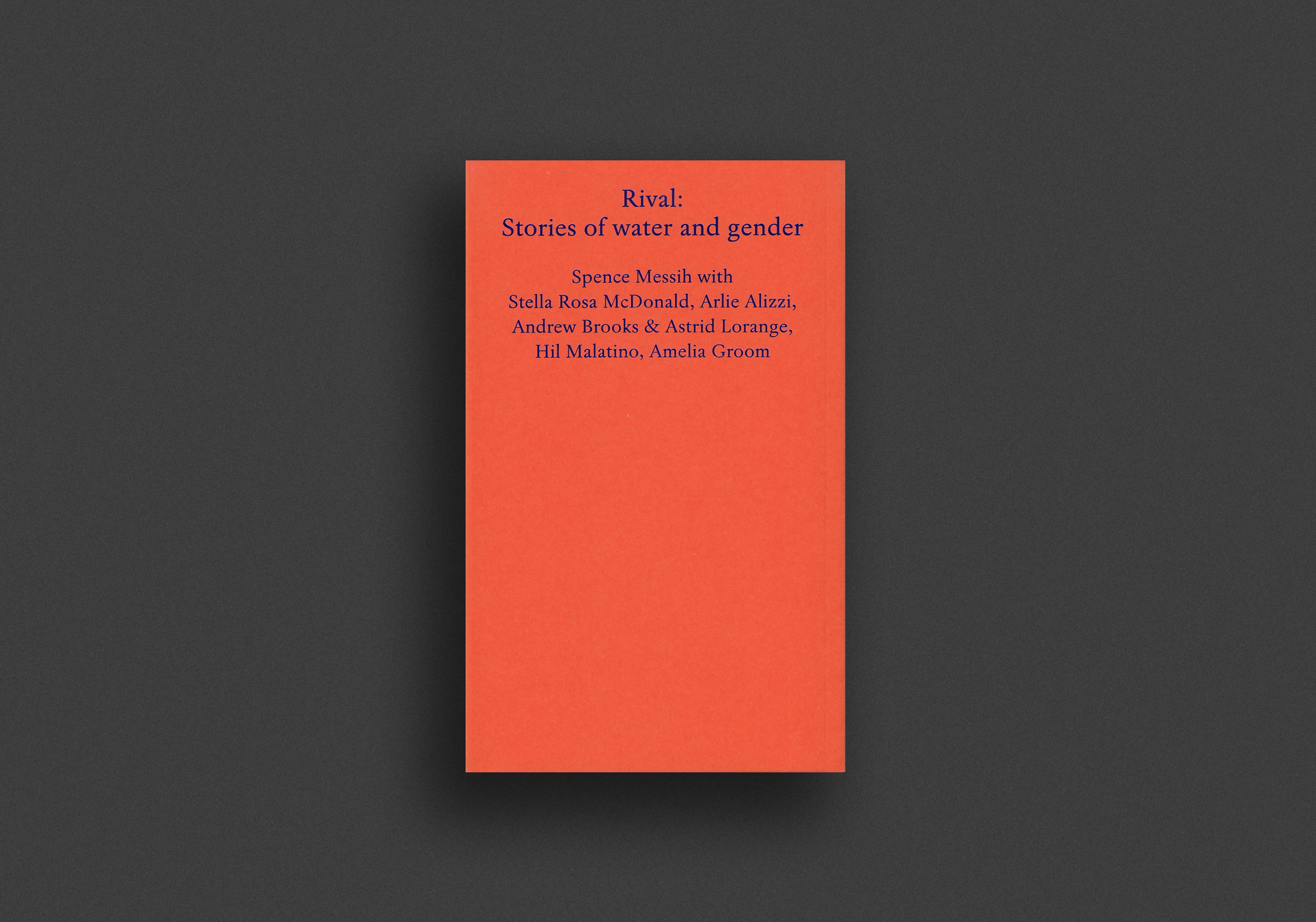
Published on the occasion of Spence Messih's exhibition A river runs through (UTS Gallery 2026) Rival: Stories of water and gender brings together perspectives on water and gender from the fields of political ecology and trans studies. Rival opens a wider field of reflection around Messih's body of work, attending to what the artist describes as "the excess" of water and gender. Foregrounded by the shared pressures and porosities that shape both bodies and environments, contributing writers Astrid Lorange and Andrew Brooks, Amelia Groom, Arlie Alizzi, and Hil Malatino explore questions of embodiment, extraction, labour, legibility, kinship, and contamination.
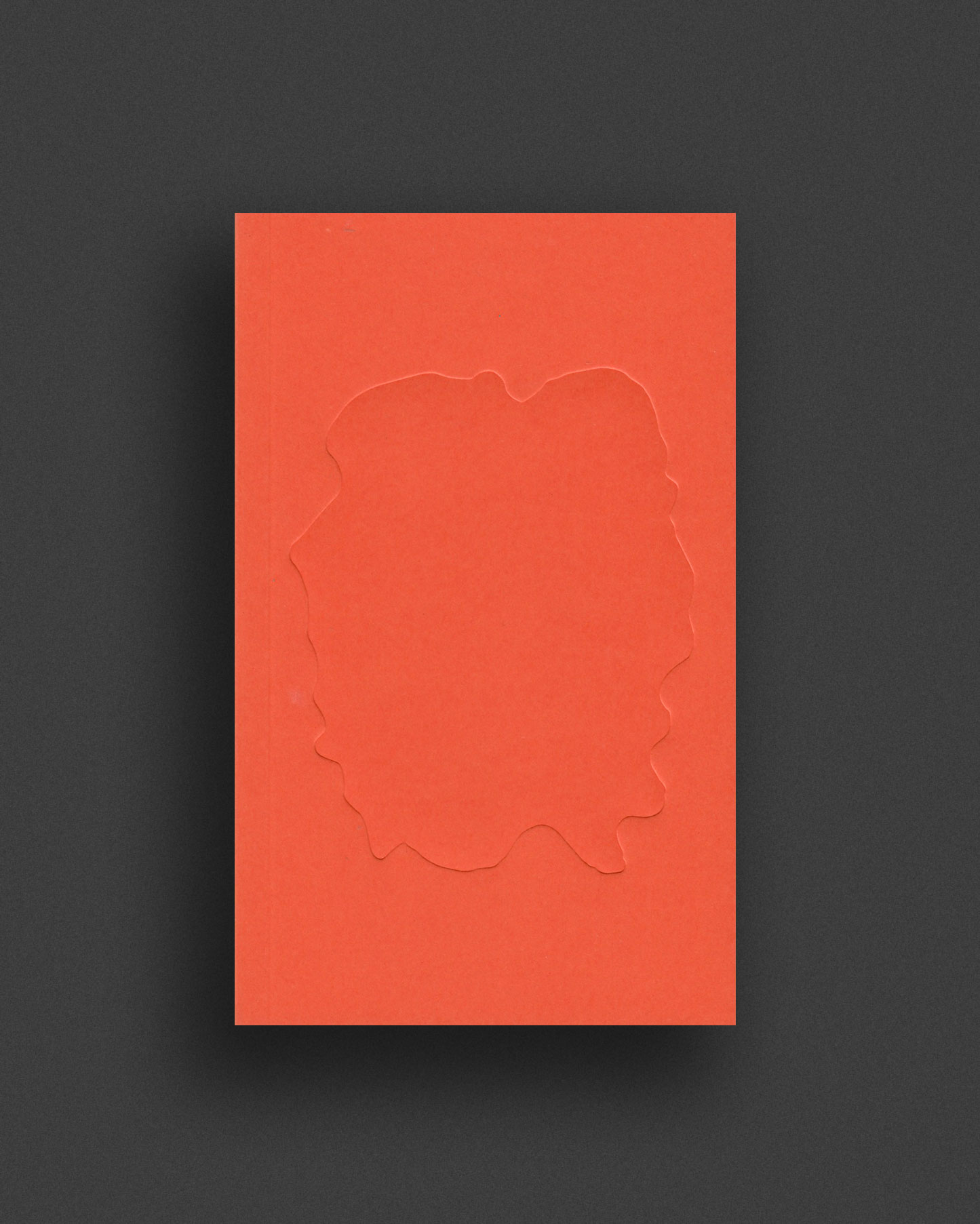
The book moves through writings by invited contributors and includes one-colour reproductions of Messih’s photogravure print Hiddener abode I–VII (2025). The debossed outline on the cover recalls the shape of the feral goat hides Messih uses in his body of work, alluding to the figure of the scapegoat.
Design by Zenobia Ahmed
Print by Gunn & Taylor
Authors: Spence Messih; Stella Rosa McDonald; Arlie Alizzi; Andrew Brooks and Astrid Lorange; Hil Malatino; Amelia Groom
Commissioning editors: Stella Rosa McDonald and Spence Messih
1995, English
Softcover, 178 pages, 23 x 15 cm
1st Edition, Out of print title / used / very good
Published by
Routledge / London
$15.00 - In stock -
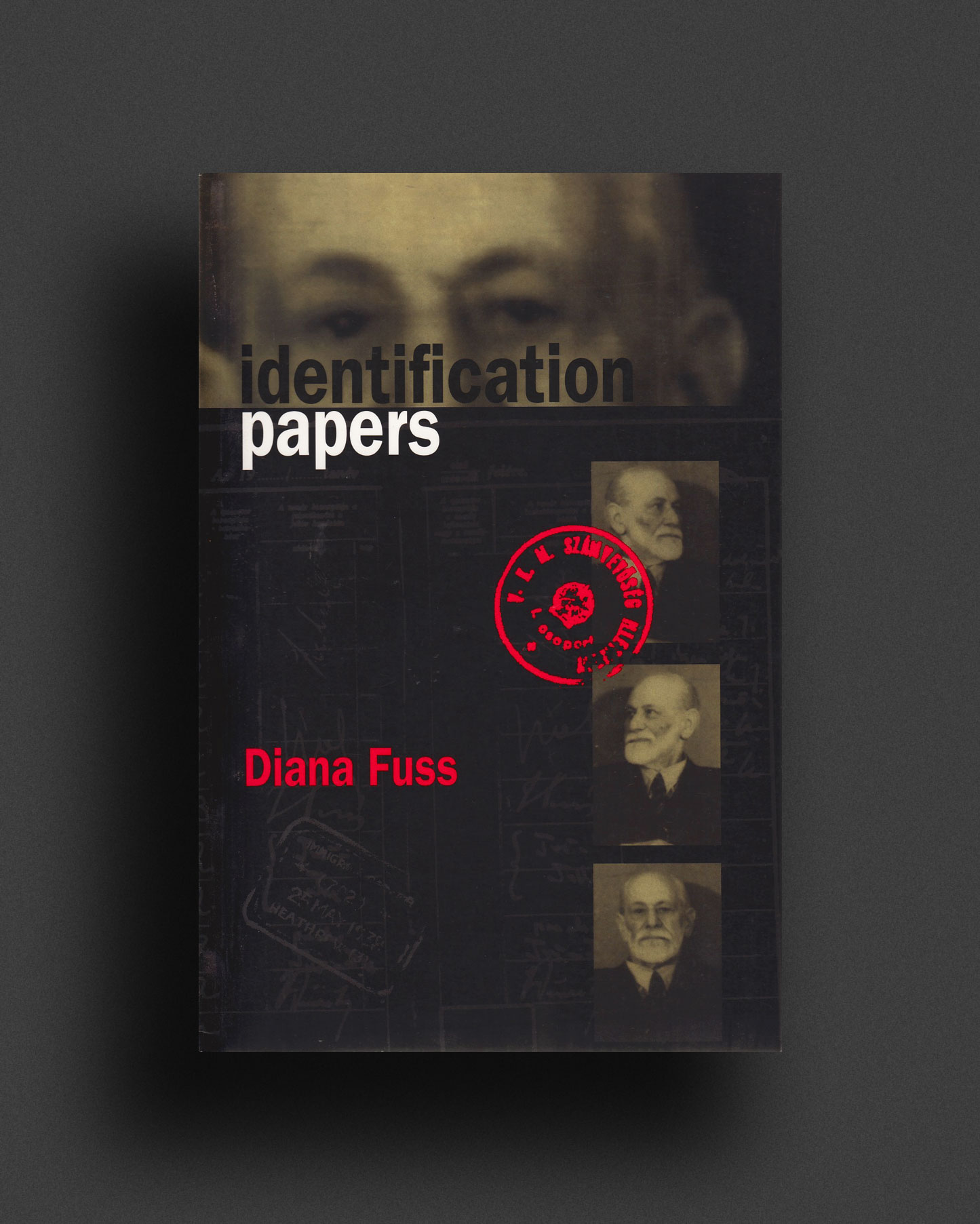
Studies/Lesbian and Gay Studies
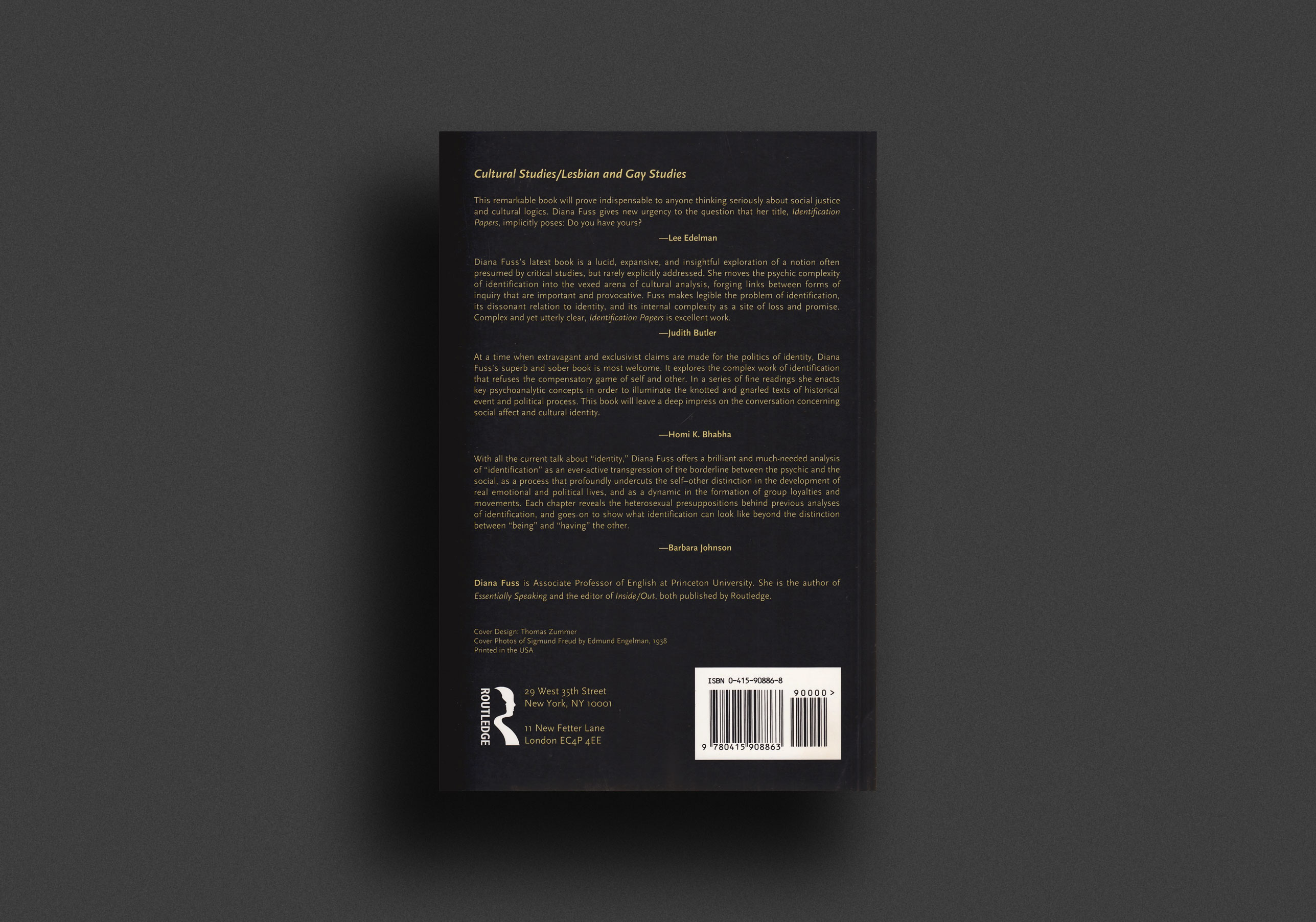
This remarkable book will prove indispensable to anyone thinking seriously about social justice and cultural logics. Diana Fuss gives new urgency to the question that her title, Identification Papers, implicitly poses: Do you have yours?—Lee Edelman
Diana Fuss's latest book is a lucid, expansive, and insightful exploration of a notion often presumed by critical studies, but rarely explicitly addressed. She moves the psychic complexity of identification into the vexed arena of cultural analysis, forging links between forms of inquiry that are important and provocative. Fuss makes legible the problem of identification, its dissonant relation to identity, and its internal complexity as a site of loss and promise. Complex and yet utterly clear, Identification Papers is excellent work.—Judith Butler
At a time when extravagant and exclusivist claims are made for the politics of identity, Diana Fuss's superb and sober book is most welcome. It explores the complex work of identification that refuses the compensatory game of self and other. In a series of fine readings she enacts key psychoanalytic concepts in order to illuminate the knotted and gnarled texts of historical event and political process. This book will leave a deep impress on the conversation concerning social affect and cultural identity.—Homi K. Bhabha
With all the current talk about "identity," Diana Fuss offers a brilliant and much-needed analysis of "identification" as an ever-active transgression of the borderline between the psychic and the social, as a process that profoundly undercuts the self-other distinction in the development of real emotional and political lives, and as a dynamic in the formation of group loyalties and movements. Each chapter reveals the heterosexual presuppositions behind previous analyses of identification, and goes on to show what identification can look like beyond the distinction between "being" and "having" the other.—Barbara Johnson
Diana Fuss is Associate Professor of English at Princeton University. She is the author of Essentially Speaking and the editor of Inside/Out, both published by Routledge.
VG firs 1995 edition, light wear.
1987, English
Softcover, 158 pages, 21 x 14.5 cm
1st Edition, Out of print title / used / good
Published by
The Harvester Press / Essex
$15.00 - In stock -
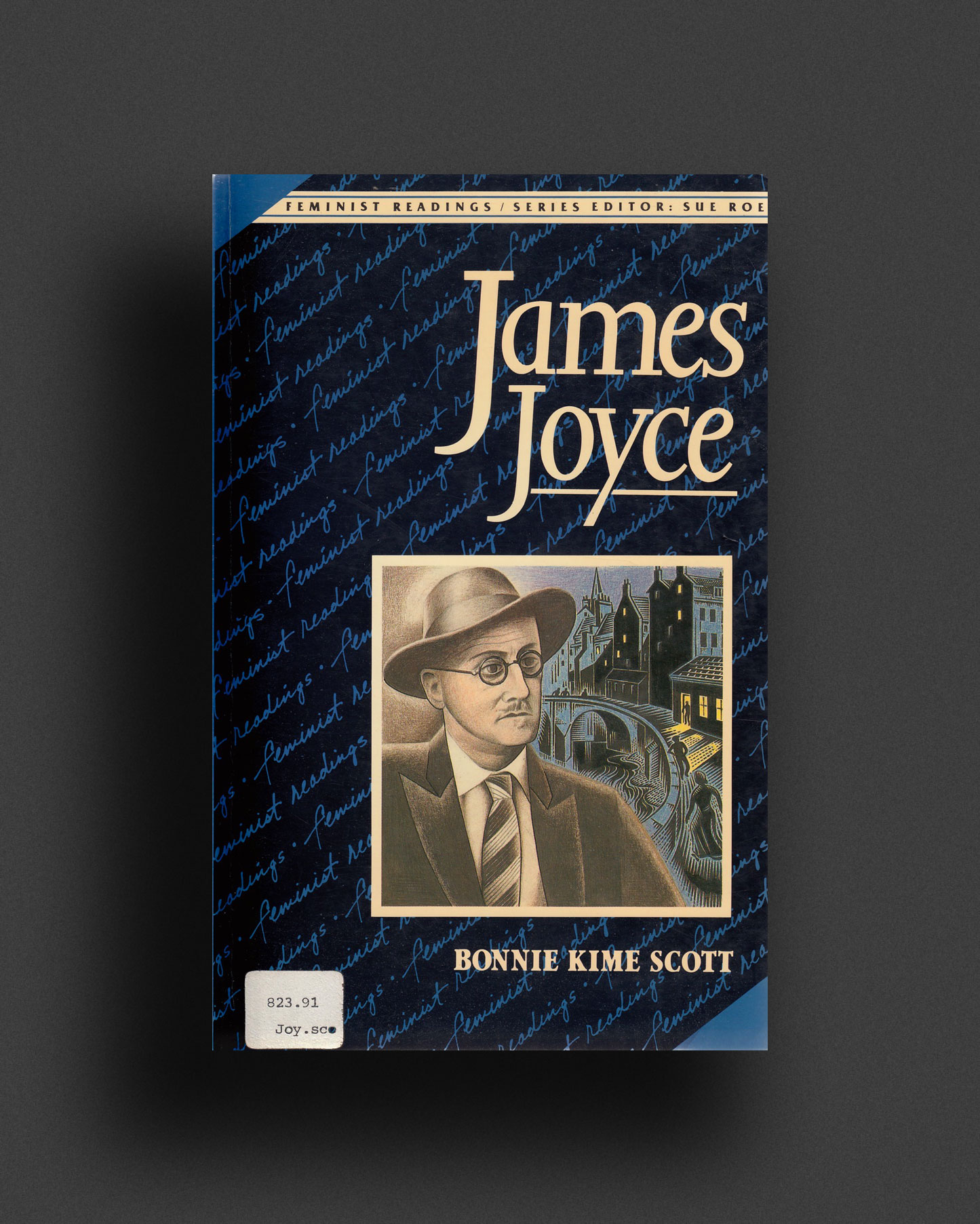
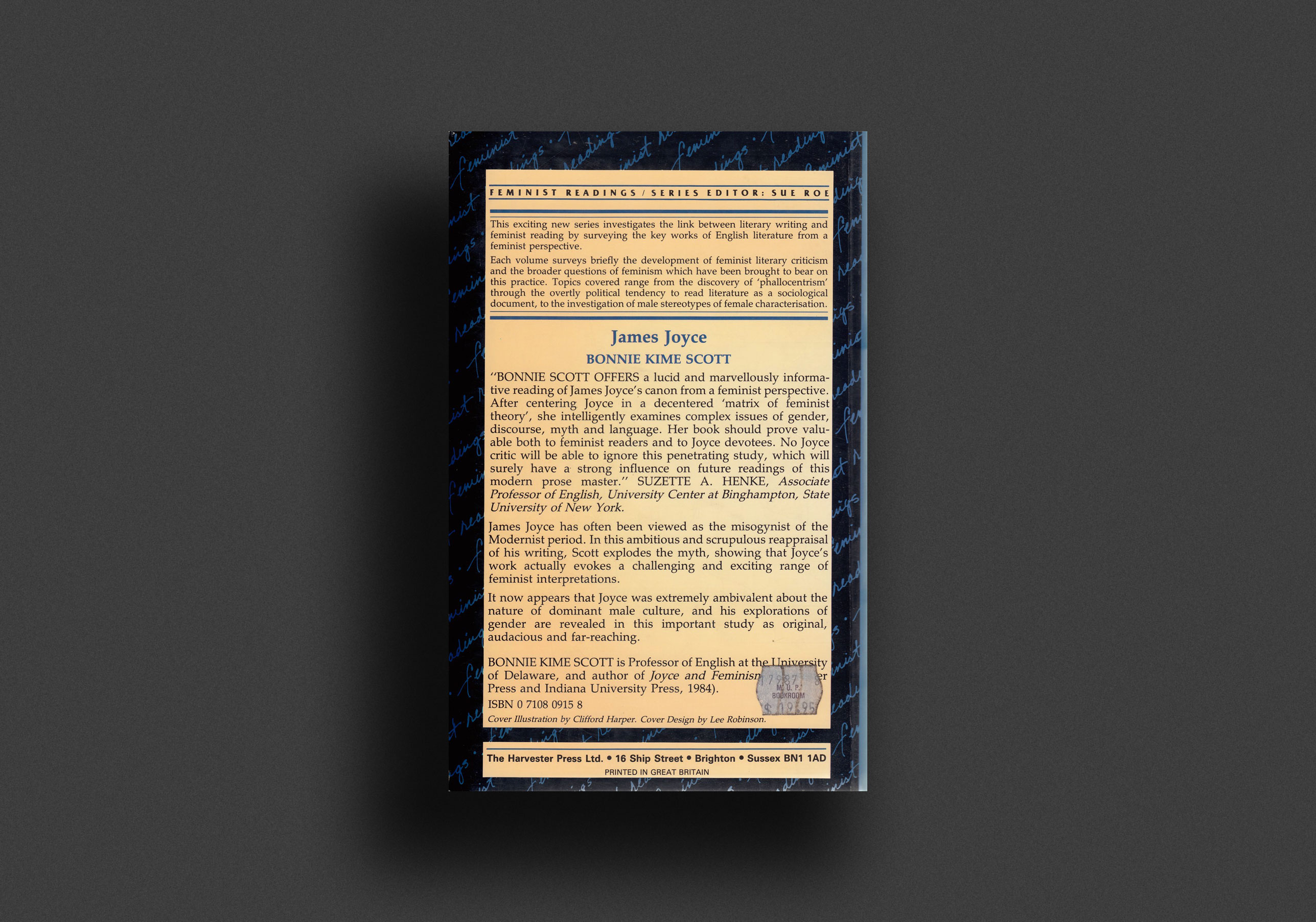
"BONNIE SCOTT OFFERS a lucid and marvellously informative reading of James Joyce's canon from a feminist perspective.
"After centering Joyce in a decentered 'matrix of feminist theory', she intelligently examines complex issues of gender, discourse, myth and language. Her book should prove valuable both to feminist readers and to Joyce devotees. No Joyce critic will be able to ignore this penetrating study, which will surely have a strong influence on future readings of this modern prose master."—SUZETTE A. HENKE, Associate Professor of English, University Center at Binghampton, State University of New York.
James Joyce has often been viewed as the misogynist of the Modernist period. In this ambitious and scrupulous reappraisal of his writing, Scott explodes the myth, showing that Joyce's work actually evokes a challenging and exciting range of feminist interpretations.
It now appears that Joyce was extremely ambivalent about the nature of dominant male culture, and his explorations of gender are revealed in this important study as original, audacious and far-reaching.
BONNIE KIME SCOTT is Professor of English at the University of Delaware, and author of Joyce and Feminism (Harvester Press and Indiana University Press, 1984).
Good copy of ex–Uni of Melbourne copy with minor markings/age.
1996, English
Hardcover (w. dust jacket), 144 pages, 32.5 x 24.5 cm
1st Edition, Out of print title / used / very good
Published by
Edition Stemmle / Zürich
$100.00 - Out of stock
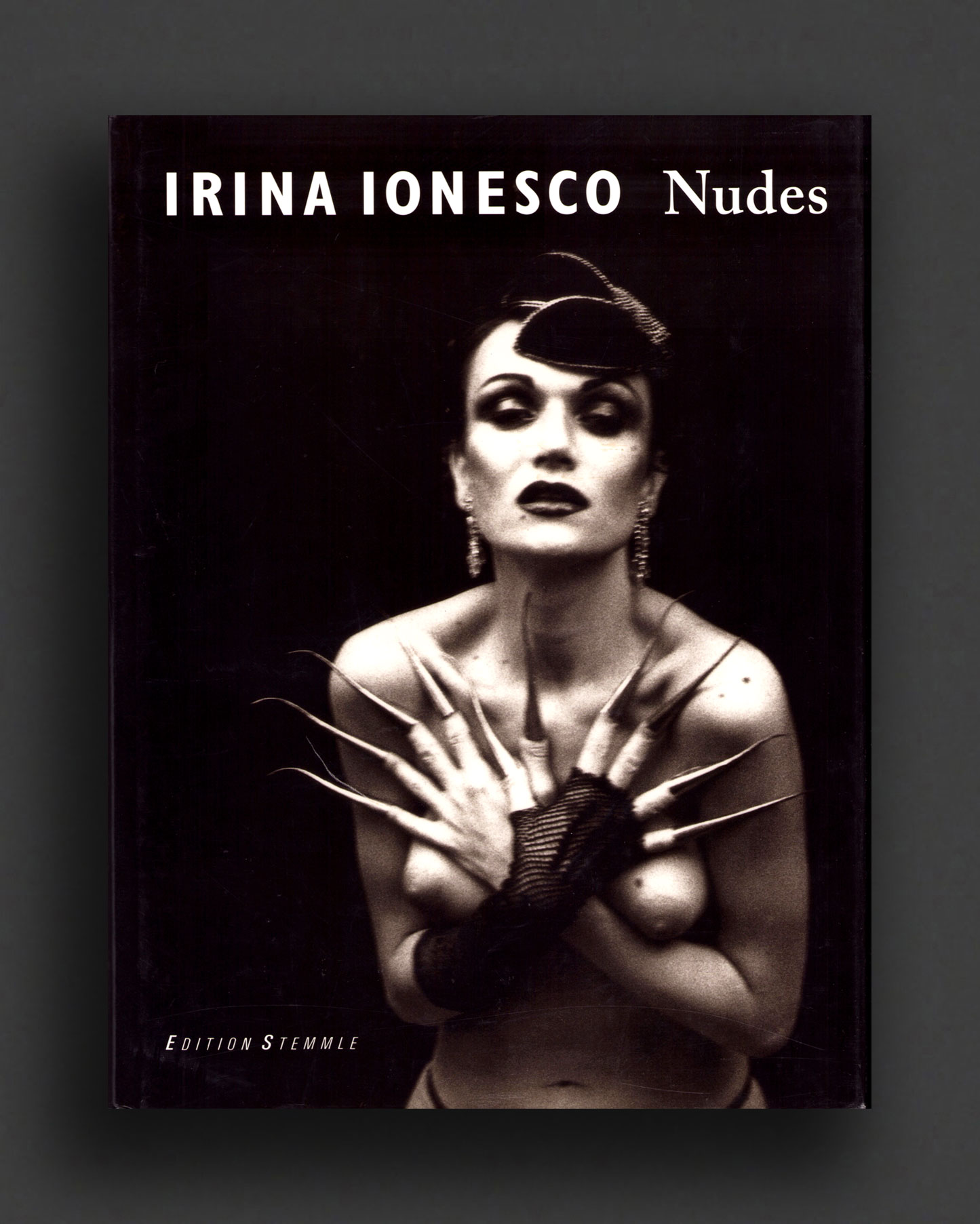
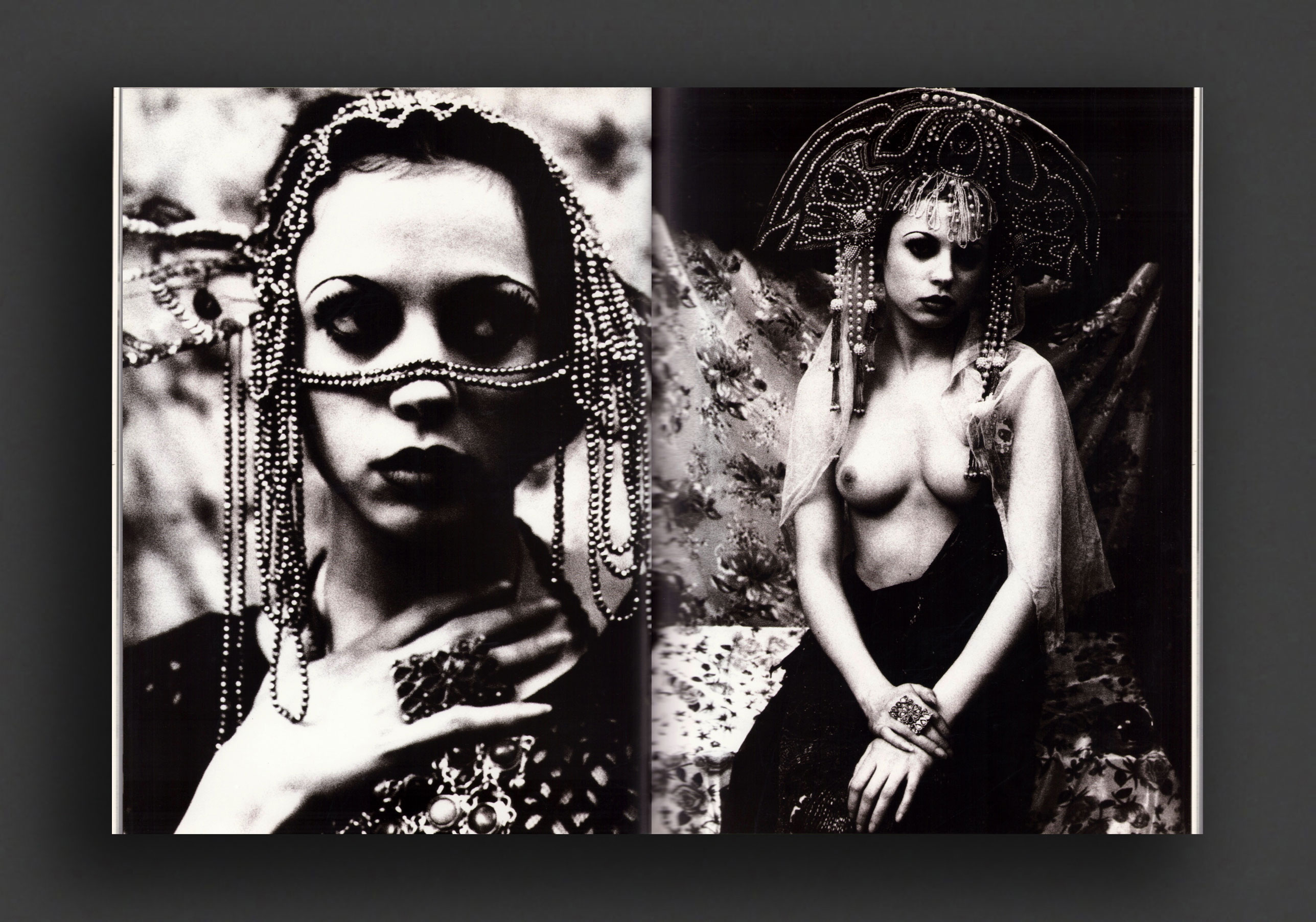
First 1996 hardcover edition of this long out-of-print, collectible photo book of French photographer Irina Ionesco (1930-2022). "Nudes" is a luxurious collection spanning over twenty-five years of Irina Ionesco's black and white, dream-like and excessive, erotic photographs, including several of a young daughter Eva. Text in English, with an exhibition history and bibliography.
"Irina Ionesco's nudes inhabit a world of suffering, passion, longing, and desire. Her models, are seductively exoticized in fairy tale clothing and leather, but clad with razor sharp fingernails they are unmistakably quite deadly."—publisher's blurb
Irina Ionesco (1930-2022) was a French photographer celebrated for her unique style of dramatically lit, baroque, erotic female portraits, influenced by the Decadent movement, the poetry of Baudelaire, and the dream-like psycho-erotic imagery of Surrealism. Raised in Romania by her circus performing family, Ionesco herself spent the ages of 15 to 22 performing as a contortionist. She traveled and painted for several years before discovering photography and gained wide attention when she exhibited her work at the Nikon Gallery in Paris in 1974, leading to her work being published in magazines, books, and exhibited at galleries across the globe. Ionesco stirred controversy with her renowned nude portraits. Her work often features women in elaborate dress, bejewelled, gloved, and in other finery, but also adorning themselves with symbolic pieces such as chokers, clawed nails and other fetishistic props, posing provocatively like black widows — objects of deadly sexual desire. Ionesco is most famous for her photographs using her young daughter, Eva, as her model and muse, a decision that remains controversial to this day.
Very Good copy in VG dust jacket with some light jacket wear/light foxing to reverse. Preserved in mylar wrap.
1988, Japanese
Hardcover (w. dust jacket), 132 pages, 30.5 x 27 cm
1st Edition, Out of print title / used / very good
Published by
Treville / Tokyo
$120.00 - In stock -
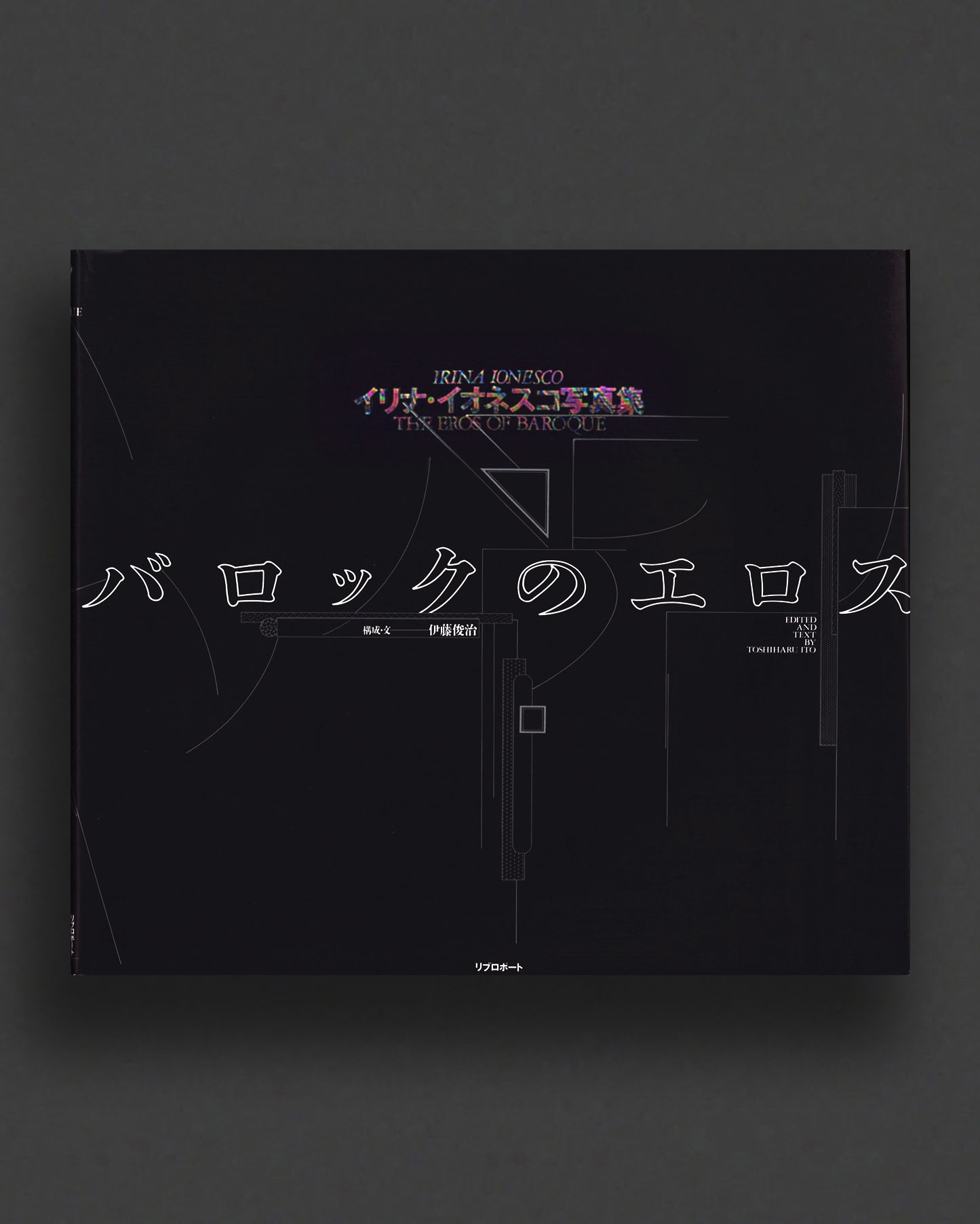
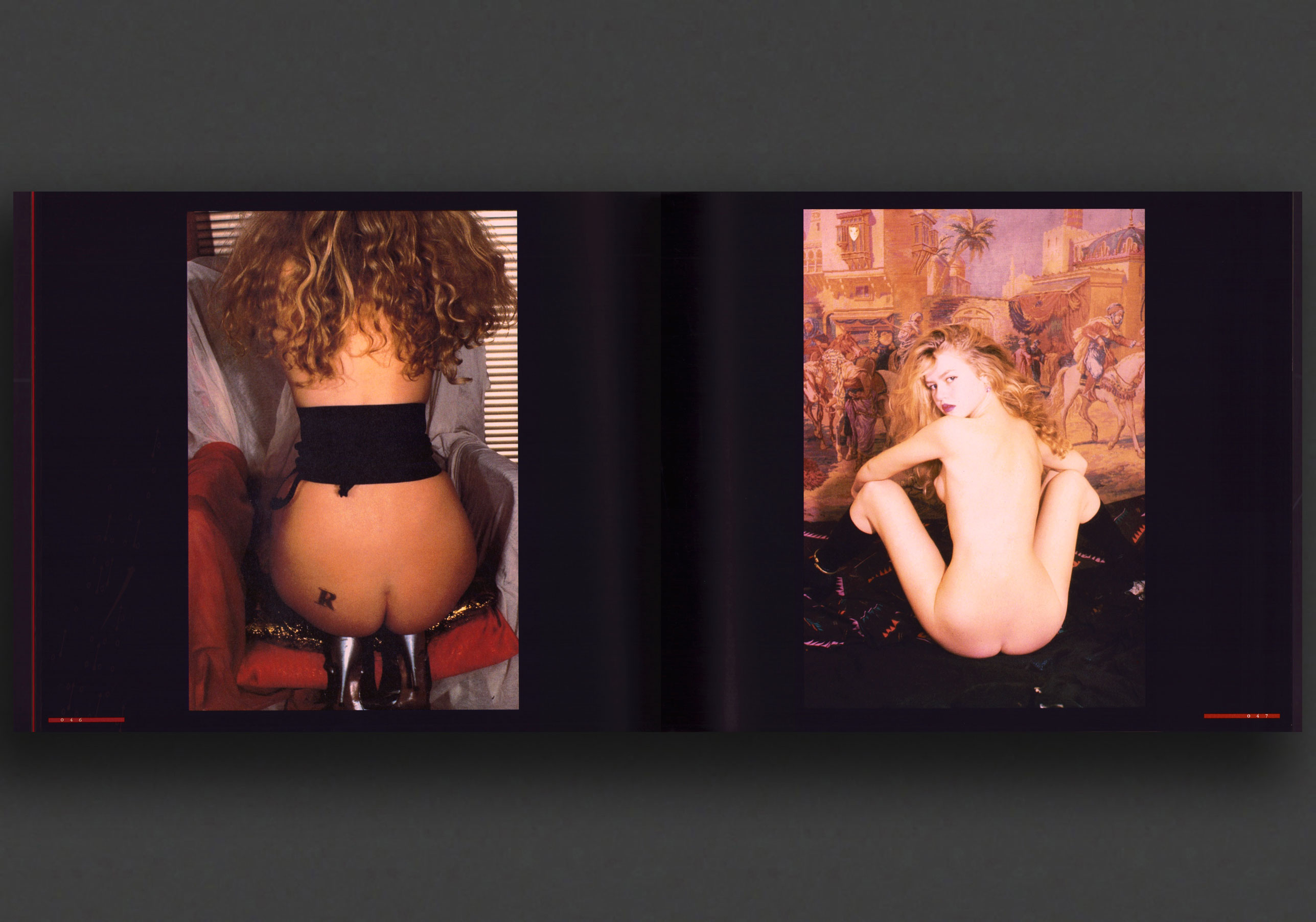
First 1988 hardcover edition of this long out-of-print, collectible photo book of French photographer Irina Ionesco (1930-2022) published only in Japan. "The Eros of Baroque" is a luxurious, elaborately designed photo collection of Ionesco's black and white and colour, dream-like and excessive erotic photographs, including several of a young daughter Eva. A profusely illustrated book spanning multiple paper stocks and including a sealed-in smaller text book section on blue paper with many further photographic images in the text, divided into 10 "scenes."
Irina Ionesco (1930-2022) was a French photographer celebrated for her unique style of dramatically lit, baroque, erotic female portraits, influenced by the Decadent movement, the poetry of Baudelaire, and the dream-like psycho-erotic imagery of Surrealism. Raised in Romania by her circus performing family, Ionesco herself spent the ages of 15 to 22 performing as a contortionist. She traveled and painted for several years before discovering photography and gained wide attention when she exhibited her work at the Nikon Gallery in Paris in 1974, leading to her work being published in magazines, books, and exhibited at galleries across the globe. Ionesco stirred controversy with her renowned nude portraits. Her work often features women in elaborate dress, bejewelled, gloved, and in other finery, but also adorning themselves with symbolic pieces such as chokers, clawed nails and other fetishistic props, posing provocatively like black widows — objects of deadly sexual desire. Ionesco is most famous for her photographs using her young daughter, Eva, as her model and muse, a decision that remains controversial to this day.
Very Good copy in VG dust jacket with some light jacket wear/light foxing to reverse. Preserved in mylar wrap.
1992, Italian / English
Newspaper (newsprint), 8 pages, 70 x 20 cm
1st Edition, Out of print title / used / good
Published by
Ignazio Corsaro / Naples
$55.00 - In stock -
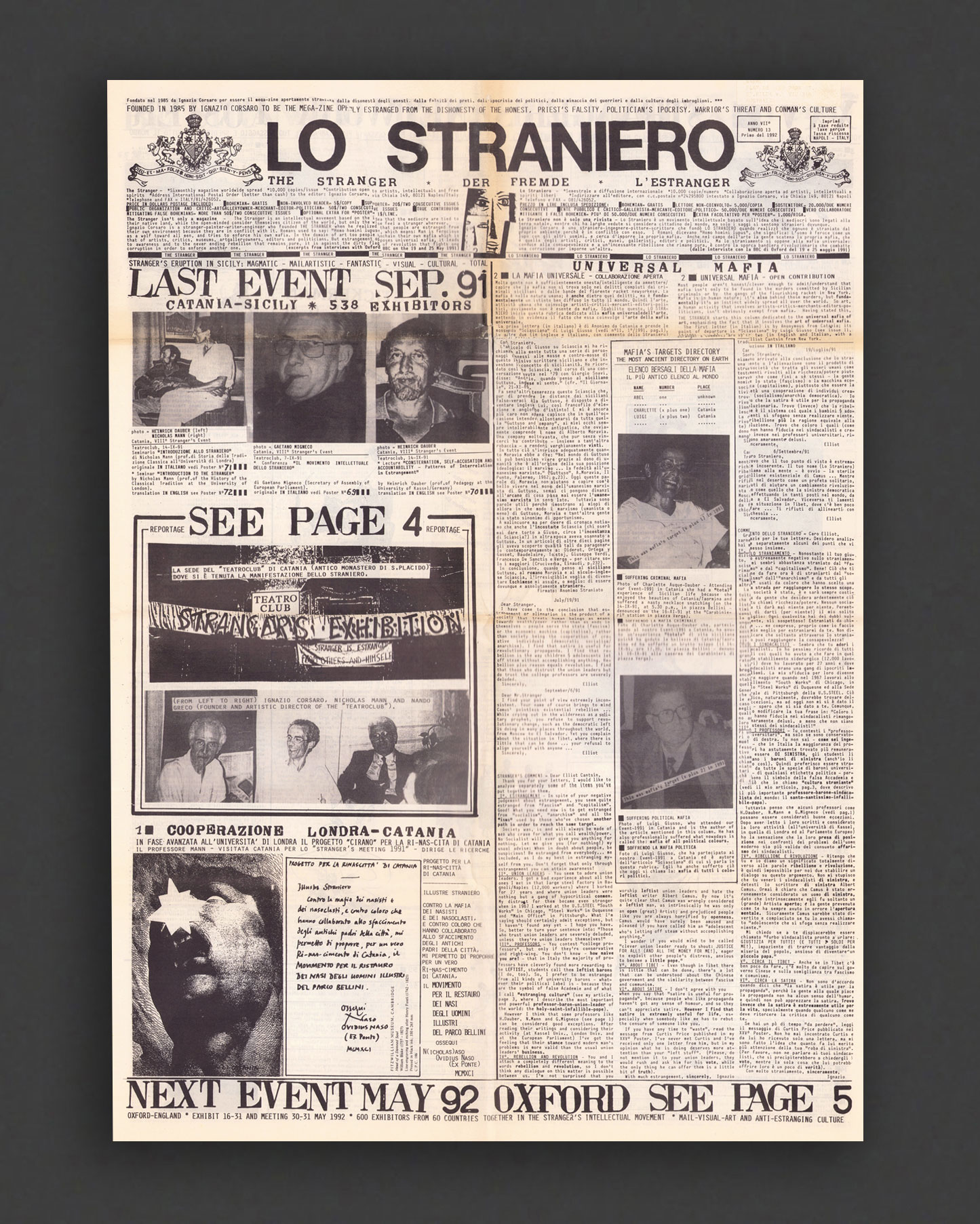
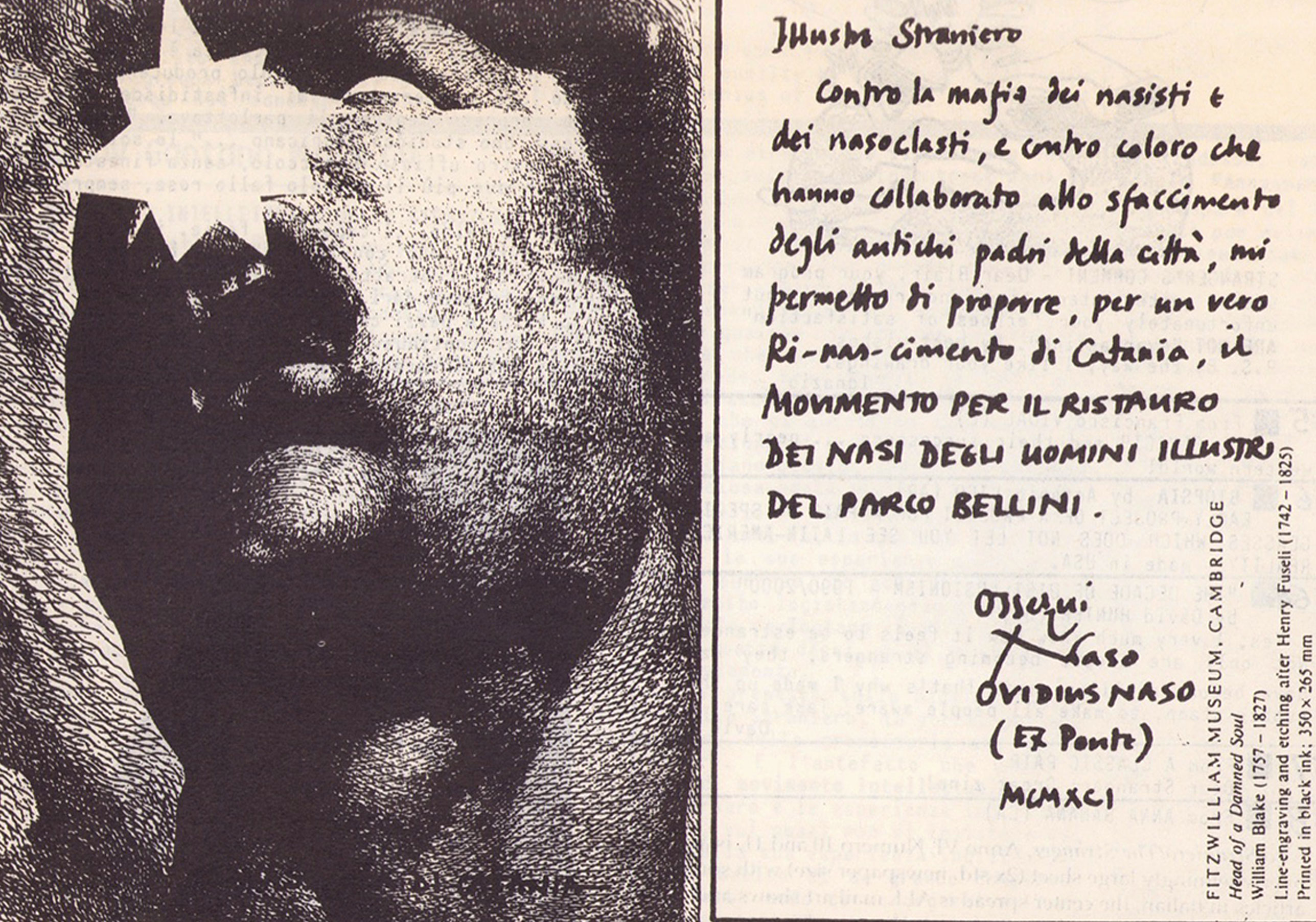
Rare copy of LO STRANIERO (The Stranger) Numero 13 from 1992, the radical over–sized newspaper/mail–art zine founded by editor Ignazio Corsaro in Naples, Italy, in 1985 "to be the mega–zine openly estranged from the dishonesty of the honest, priest's falsity, politician's hypocrisy, warrior's threat and conman's culture." Heavy with features and poster around various LO STRANIERO events in London, Oxford, Sicily, the first instalment of a column on "The Universal Mafia of Art", lots of anti–religion (A. N. Wilson, et al), extensive letter/classified contributions from a vast network of Mail–art/performance/activist/experimental music people worldwide including Anna Banana, Edgardo Antonio Vigo, Randy Koppang, Heinrich Dauber, Gaetano Migneco, Joel Haertling, Reiu Tüür, Nicholas Mann, Blair Wilson, Antonio Vigo, John Held Jr, Eliza Blaxckweb, Paulette Dumont, John Bennett, Ruth Howard, collage/press clippings. Texts in Italian and English. The back page features the enormous supporter's directory of Mail–artists and their contacts.
Very Good copy of this enormous publication, folded in 8. Light wear/age to folds and extremities but overall very well preserved. Mailed to Australian experimental composer Warren Burt.
1981, English
Softcover (staple–bound), 88 pages, 30 x 21 cm
1st Edition, Out of print title / used / very good
Published by
RMIT University / Melbourne
$100.00 - In stock -
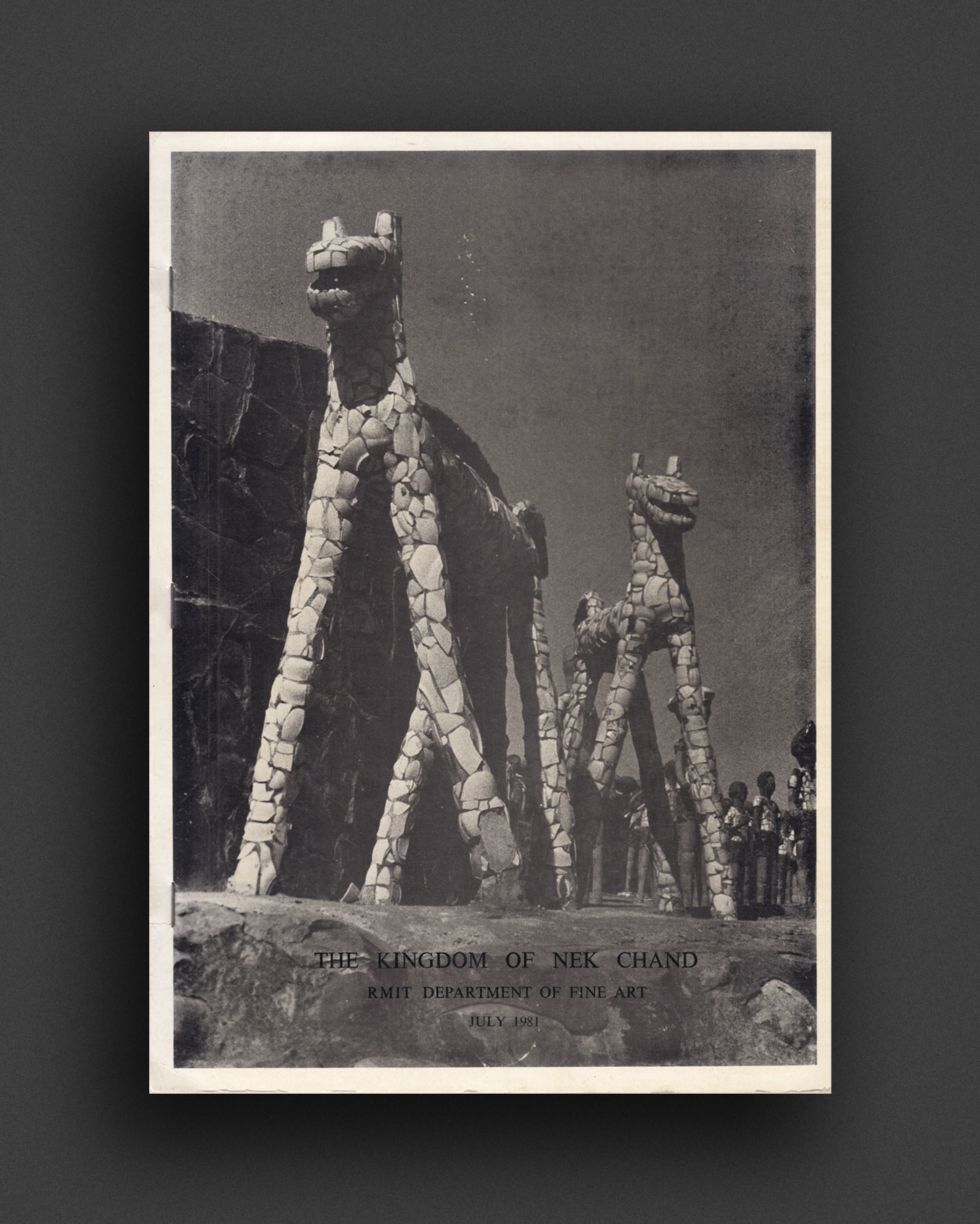
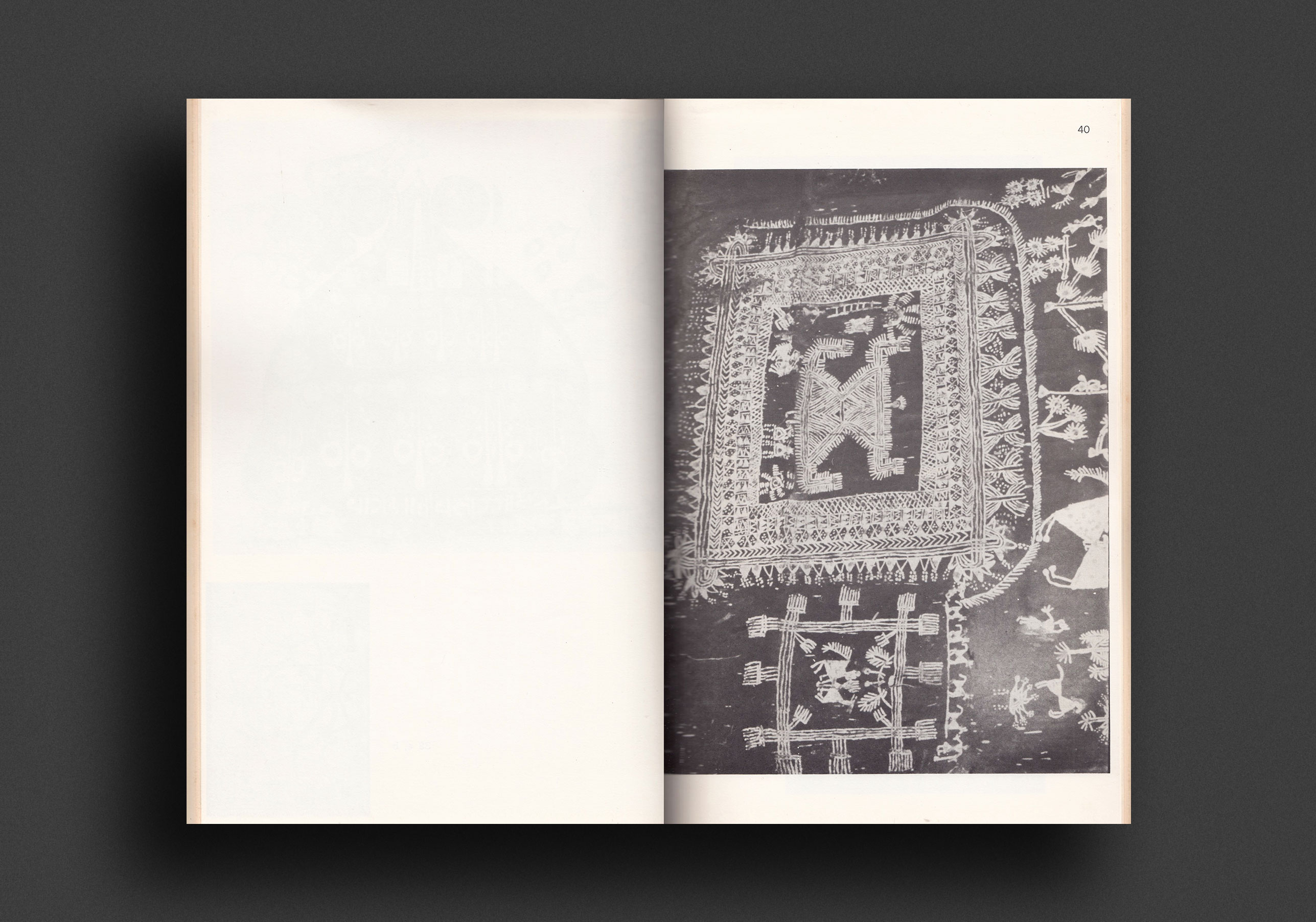
Very rare copy of this catalogue published to accompany 'The Kingdom of Nek Chand: Exhibition of Photographs and Film', RMIT Department of Art, July 1981. The Kingdom of Nek Chand is a 1980/1981 Australian documentary film by Ulli Beier and Paul Cox about Nek Chand Saini (1924–2015) a self-taught Indian artist who built the Rock Garden of Chandigarh, an eighteen-acre sculpture garden made of waste materials in the city of Chandigarh, one of the most famous sites in India. Essay contributions from many local and international historians, critics and artists mimeographed on single–sided pages followed by a gallery of plates on heavy paper stock. A lovely publication.
Chief Horst Ulrich Beier, commonly known as Ulli Beier (1922–2011), was a German editor, writer and scholar who had a pioneering role in developing the Western world's understanding of literature, drama and poetry in Nigeria, as well as in Papua New Guinea.
Paulus Henrique Benedictus Cox (1940–2016), known as Paul Cox, was a highly acclaimed Dutch-born Australian filmmaker, widely considered the "father of Australian independent cinema" and one of the country's most prolific auteurs.
Contents:
Jenny Zimmer, Introduction; Suzi Gablik, Extract from 'Report From India', Art In America, Sept., 1979; Ulli Beier, The Kingdom of Nek Chand; Nek Chand, From an Interview with Ulli Beier and Paul Cox; Janet Andrews, Art Brut; Ulli Beier, On the Arrangements for an Exhibition of 'New Art of India' at the University of Bayreuth, West Germany. From an Interview with Jenny Zimmer; Andrew Sibley, Impressions of India. From an Interview with Jenny Zimmer; Ulli Beier, Soma Mase and Other Warli Painters.
Very Good copy. Small inscription to title page.
2021, English
Softcover (w. dust jacket), 80 pages, 23 x 17 cm
Published by
UTS Gallery / Sydney
$25.00 - In stock -
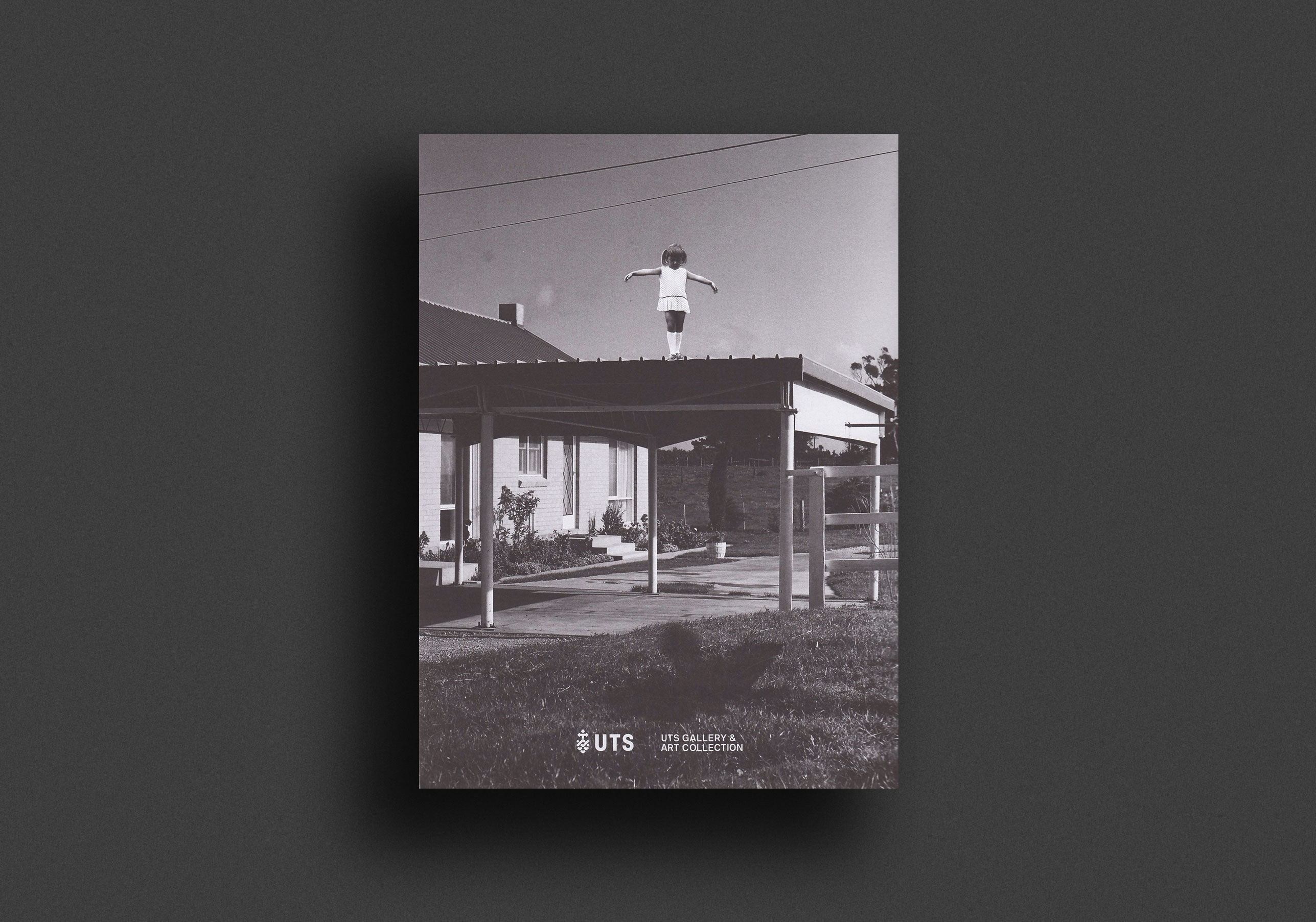
Bringing together five photographic series produced by Hayley Millar Baker between 2016 and 2019, There we were all in one place traces Baker’s use of historical citation, digital editing and archival research to consider experiences of time, memory and place.
Working primarily in black and white, Baker’s layered photographic assemblages affirm Aboriginal experience and culture within the Australian imaginary, forming complex narratives of place, family, identity and survival. Grounded in her Gunditjmara and cross-cultural heritage, her practice is guided by a non-linear understanding of time in which past, present and future remain interconnected.
With essays by Stella Rosa McDonald, Hetti Perkins and Talia Smith, and a commissioned poem in language by Vicki Couzens, the publication extends the exhibition’s exploration of photography and storytelling as acts of re-authoring history and asserting the authority of lived experience across generations. Also included is a Learning Experience developed by Emily McDaniel in consultation with the artist, designed to support tertiary engagement with the work through reflection on personal memory and connection.
Design by Daryl Prondoso
Authors: Vicki Couzens; Hayley Millar Baker; Emily McDaniel; Stella Rosa McDonald; Hetti Perkins; Talia Smith
2026, English / German
Softcover (staple–bound w. silver gelatin paper insert), unpaginated, 25.5 x 20.5 cm
Edition of 350,
Published by
Museum Folkwang / Essen
$30.00 - In stock -
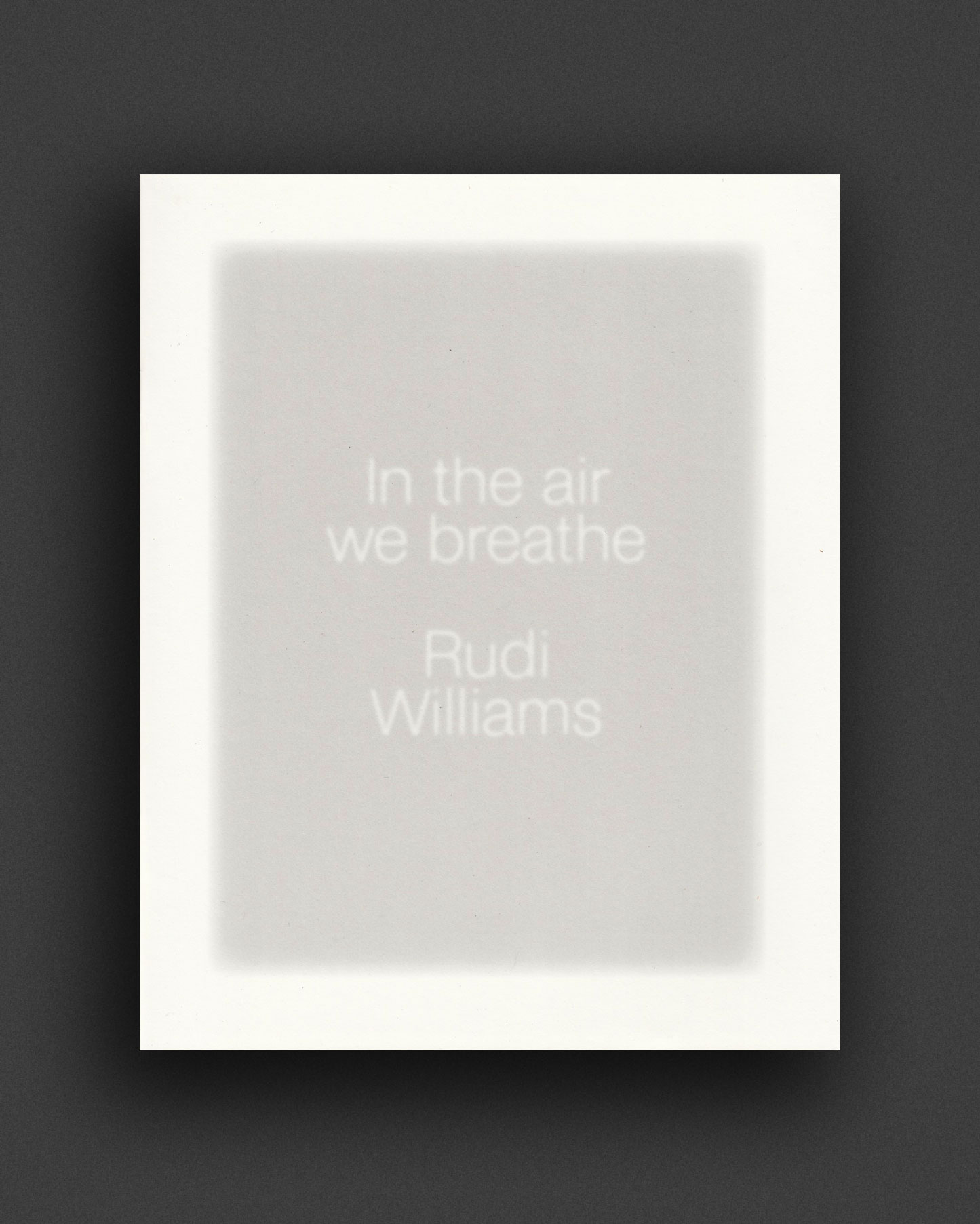
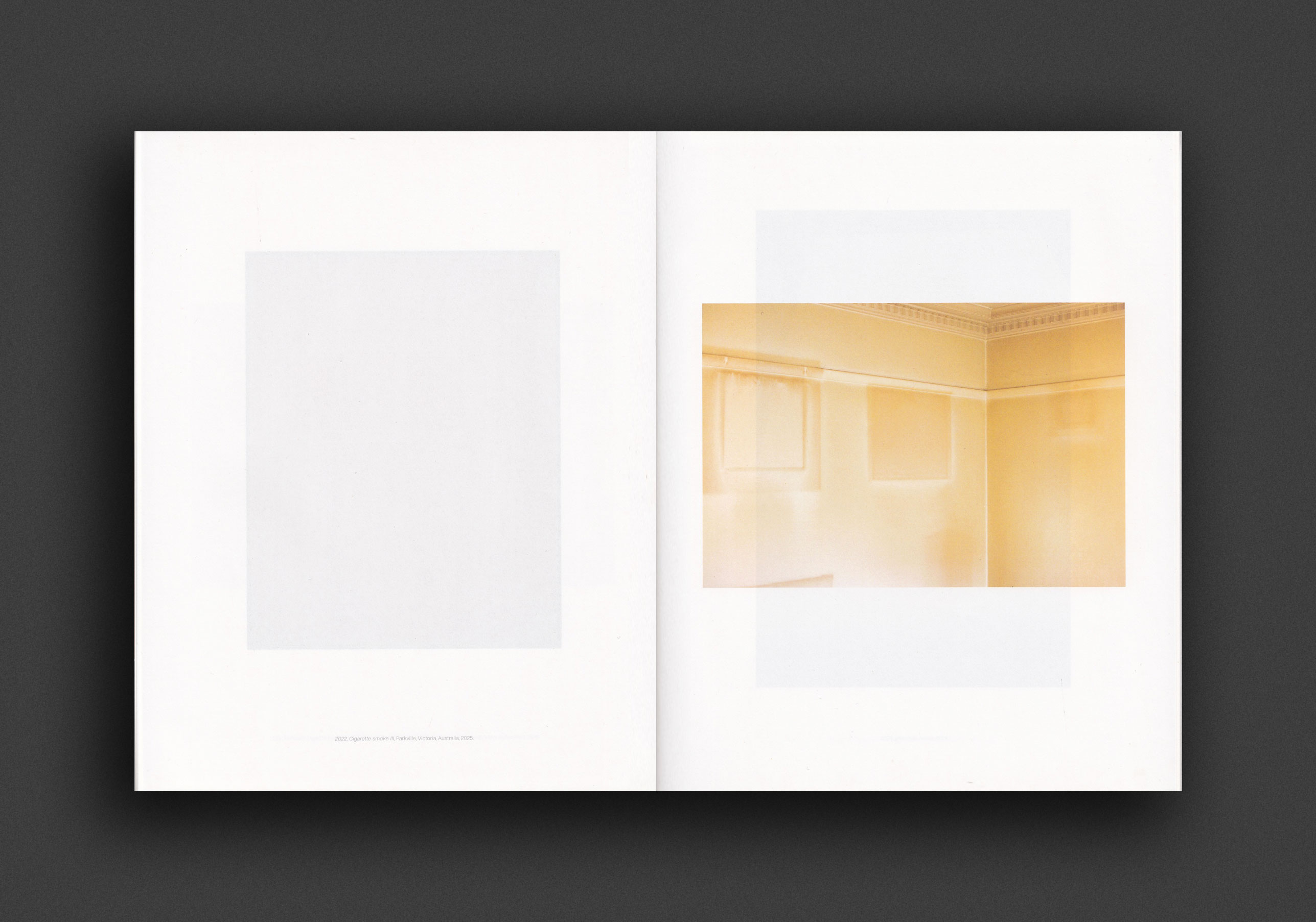
Australian artist Rudi Williams presents photographs and photographic artefacts – some of which she has created herself, others she has found. Williams' motifs are quiet spaces full of traces that evoke a wealth of associations. In this exhibition, she focuses on camera-less images and silhouettes that revolve around the tension between presence and absence and address the theme of loss. Her practice reflects both the history and technical processes of photography, experimenting with early techniques such as daguerreotype and cyanotype, also known as ‘sun printing’. The photographs, daguerreotypes and textiles on display are supported by delicate steel structures that refer to forms of presentation in museums and emphasise the distinctiveness of each object. Thus, photography does not appear here as a flood of images, but as a collection of unique, breathing testimonies. The title of the exhibition In the air we breathe refers to the perception of signs that emerge in the spirit of the social zeitgeist, such as the mood around 1839 when the invention of photography was already 'in the air' and images were 'fixed' for the first time.
This catalogue made on the occasion of Williams’ exhibition at the Museum Folkwang in 2025 responds to the idea of the unfixed image explored in the exhibition. The paper stock will yellow over time and there has been a sheet of unfixed silver gelatin paper inserted into each copy.
Edition of 350
2024, English
Softcover (staple–bound w. dust jacket), 52 pages, 20 x 18.5 cm
Published by
UTS Gallery / Sydney
IMA / Brisbane
Adelaide Contemporary Experimental / Adelaide
$25.00 - In stock -
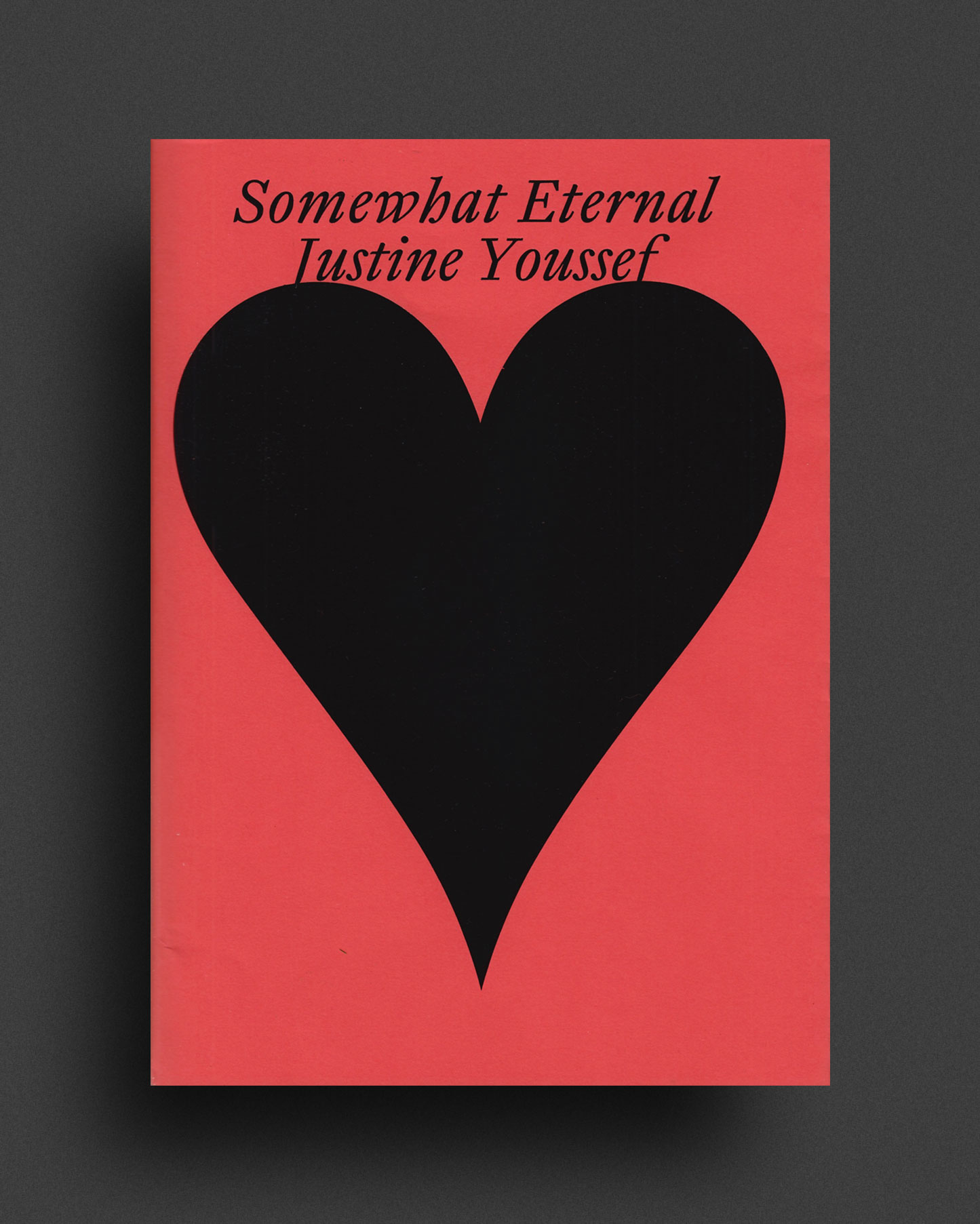
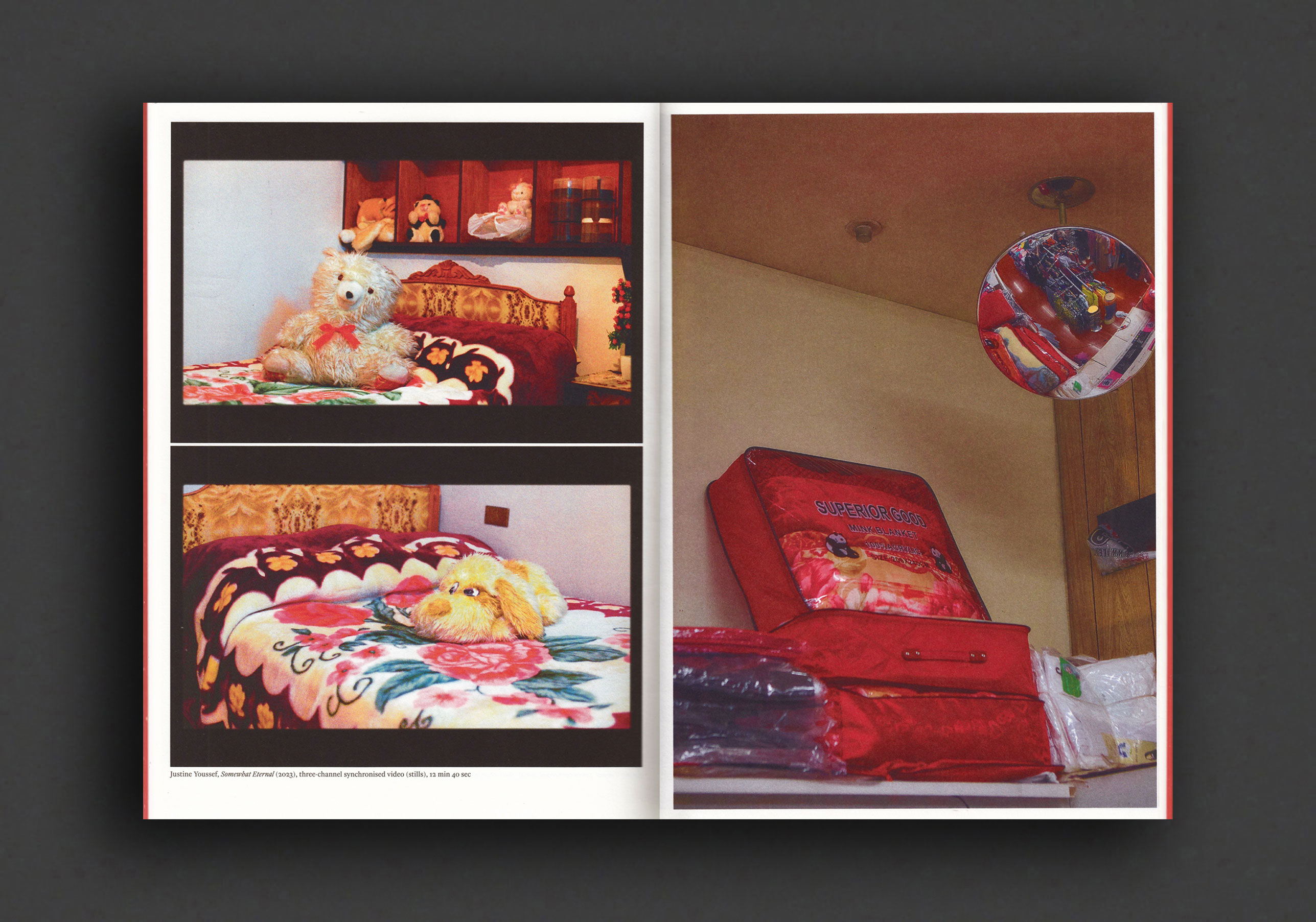
Somewhat Eternal is a major publication documenting the works and practice of artist Justine Youssef, produced on the occasion of her landmark exhibition Somewhat Eternal. The publication considers Youssef’s new and recent works, exploring the interconnected impacts of displacement and finding hope in acts of ritual and preservation.
Three commissioned texts reflect on the solidarities and postcolonial discourse Youssef’s practice engages with. Latoya Rule—a Wiradjuri/Te Ātiawa, takatāpu/queer writer, poet, and campaigner—writes of solidarity between Aboriginal, Lebanese, and Palestinian communities in Australia. Filmmaker and writer Chi Tran considers Youssef’s metaphysical connections to the world as a form of resistance against colonial regimes. Dr Mykaela Saunders—a Koori/Goori and Lebanese writer and editor, teacher, and researcher—bridges the distances implicit in Youssef’s inheritances. An essay by the exhibition curators Stella Rosa McDonald, Tulleah Pearce, and Patrice Sharkey and an introductory text by IMA Director Robert Leonard situates Youssef’s new and recent work.
Designed by Žiga Testen and Sunny Lai
Authors: Robert Leonard; Stella Rosa McDonald; Tulleah Pearce; Latoya Rule; Mykaela Saunders; Patrice Sharkey; Chi Tran
Editors: Stella Rosa McDonald, Tulleah Pearce and Patrice Sharkey
2026, English
Softcover, 189 pages. 19.6 x 13.1 cm
Published by
Peninsula Press / UK
$35.00 - Out of stock
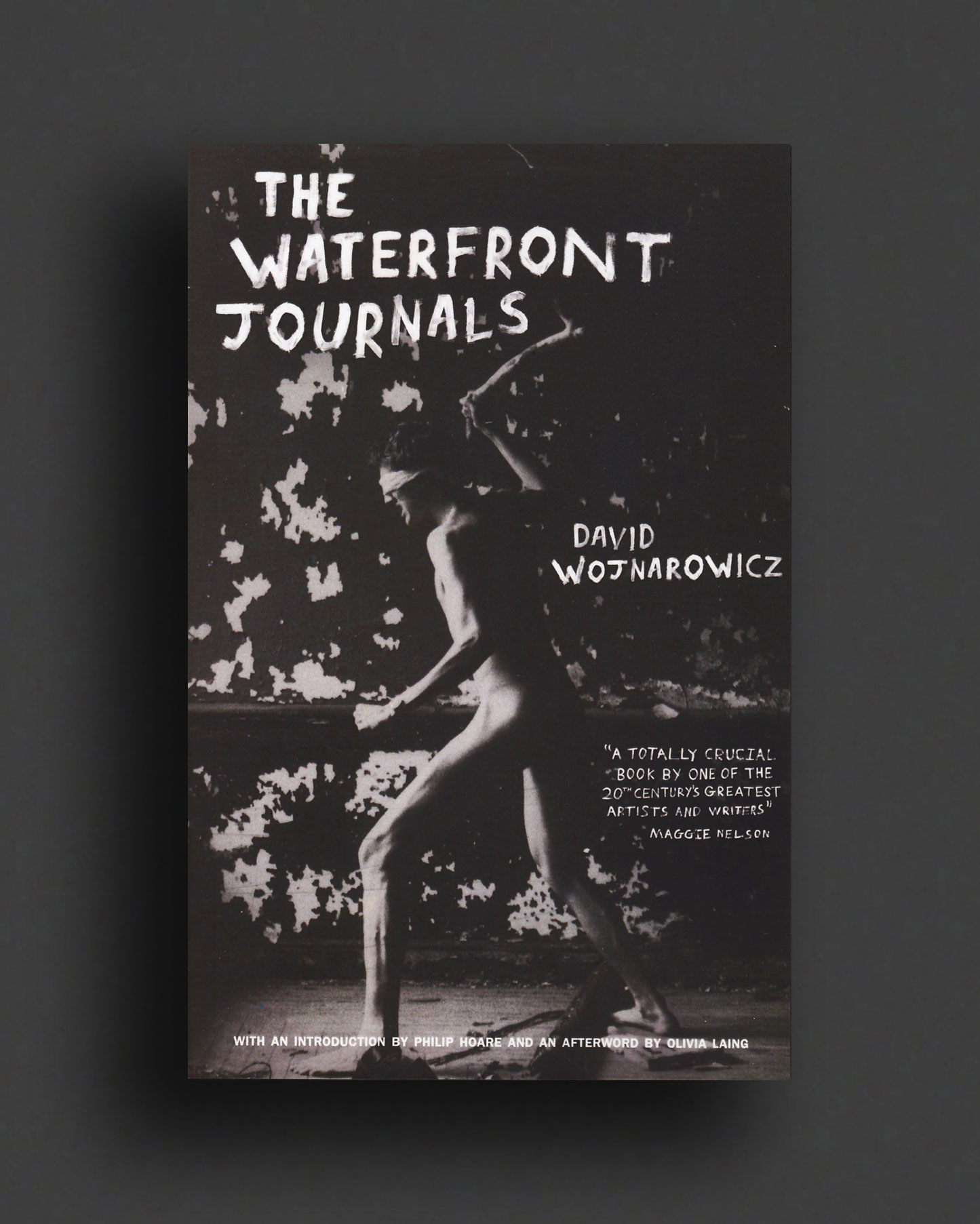
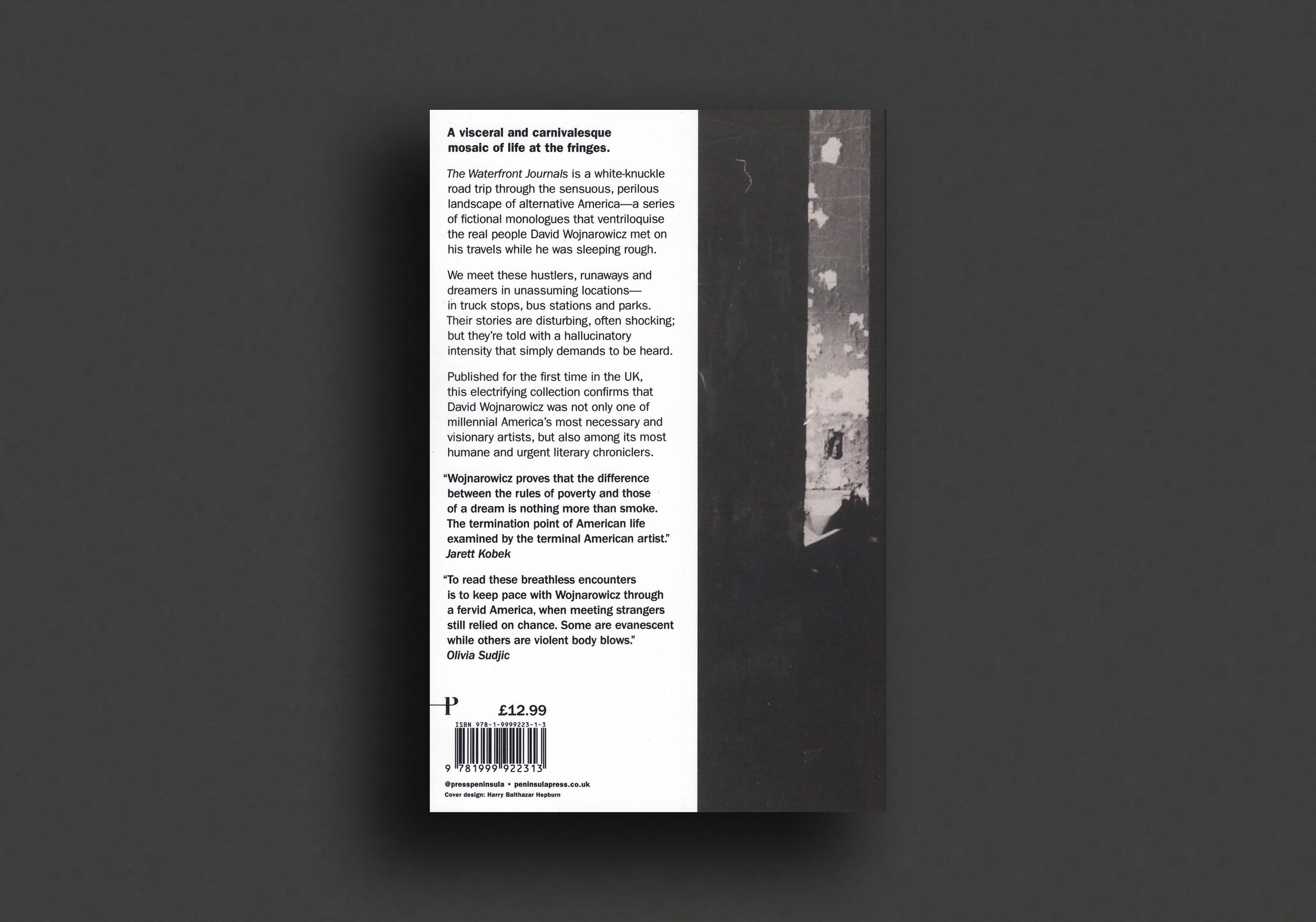
'The Waterfront Journals' is a road trip through the sensuous, perilous landscape of alternative America – a series of fictional monologues that ventriloquise the real people Wojnarowicz met on his travels while he was sleeping rough. We meet these hustlers, runaways and dreamers in unassuming locations – in truck stops, bus stations and parks. Their stories are disturbing, often shocking; but they're told with an honesty and a hallucinatory intensity that demands to be heard. Published for the first time in the UK, this electrifying collection confirms that David Wojnarowicz was not only one of millennial America’s most necessary and visionary artists, but also among its most humane and urgent literary chroniclers.
David Wojnarowicz was a writer, artist, AIDS activist and anticensorship advocate. He wrote five books, and his paintings are exhibited in MoMA and the Whitney Museum of American Art. He died from AIDS in 1992.
A visceral and carnivalesque mosaic of life at the fringes.A totally crucial book by one of the 20th century’s greatest artists and writers.' – Maggie Nelson
2021, English
Hardcover, 320 pages, 23 x 16 cm
Published by
Blum & Poe / Los Angeles
$95.00 - In stock -
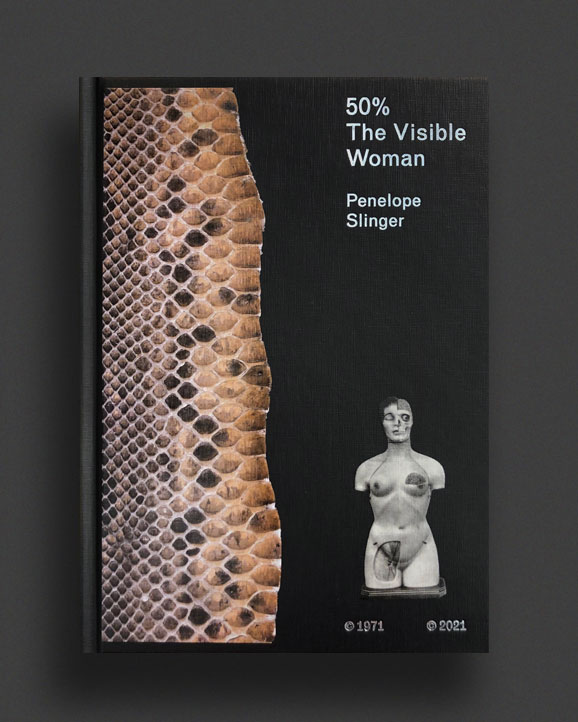
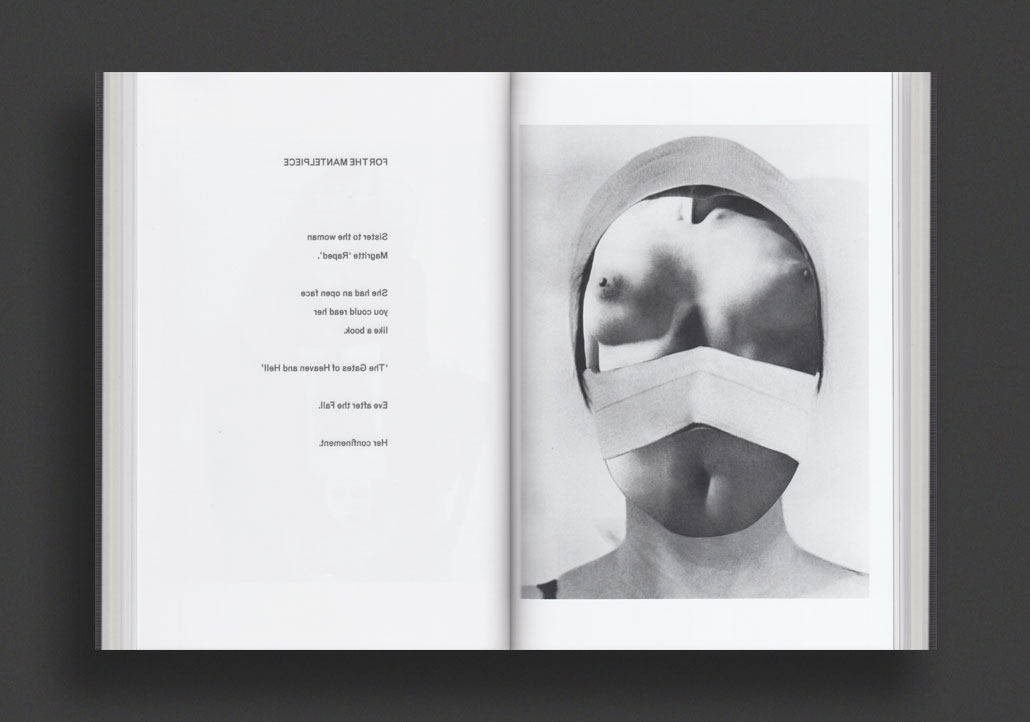
Released on the 50th anniversary of the publication of Penny Slinger's iconic artists’ book 50% The Visible Woman, this 2021 edition presents Slinger’s series of surrealist photomontage works and poetry unabridged for the first time, following the hand-constructed snakeskin-bound book from 1969, and the out-of-print abridged edition from 1971. With a new conversation transcribed between Slinger and fellow artist and friend Linder.
2025, English
Softcover, 250 pages, 25.4 x 20.3 cm
Ed. of 500,
Published by
Friend Editions / New York
$120.00 - In stock -
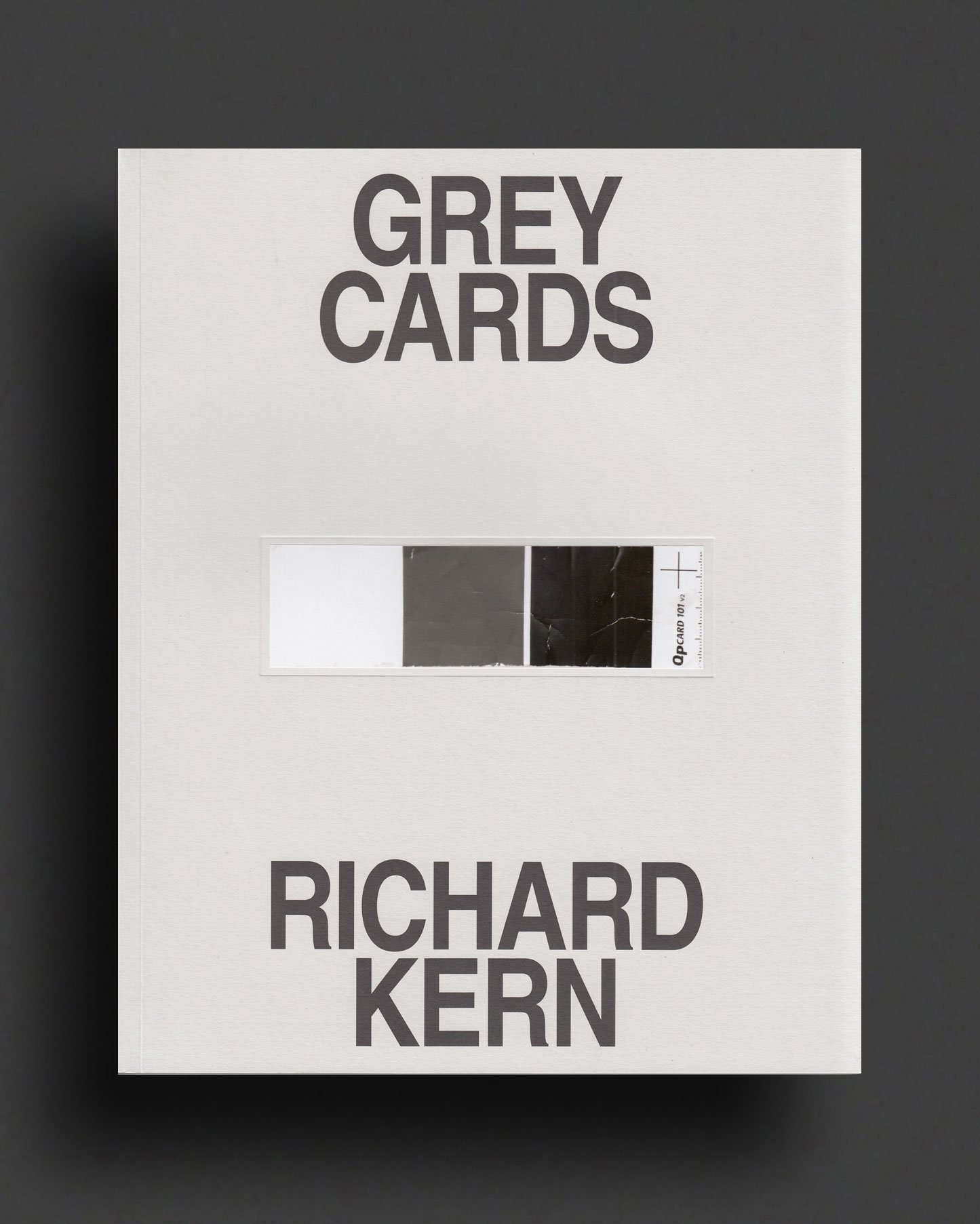
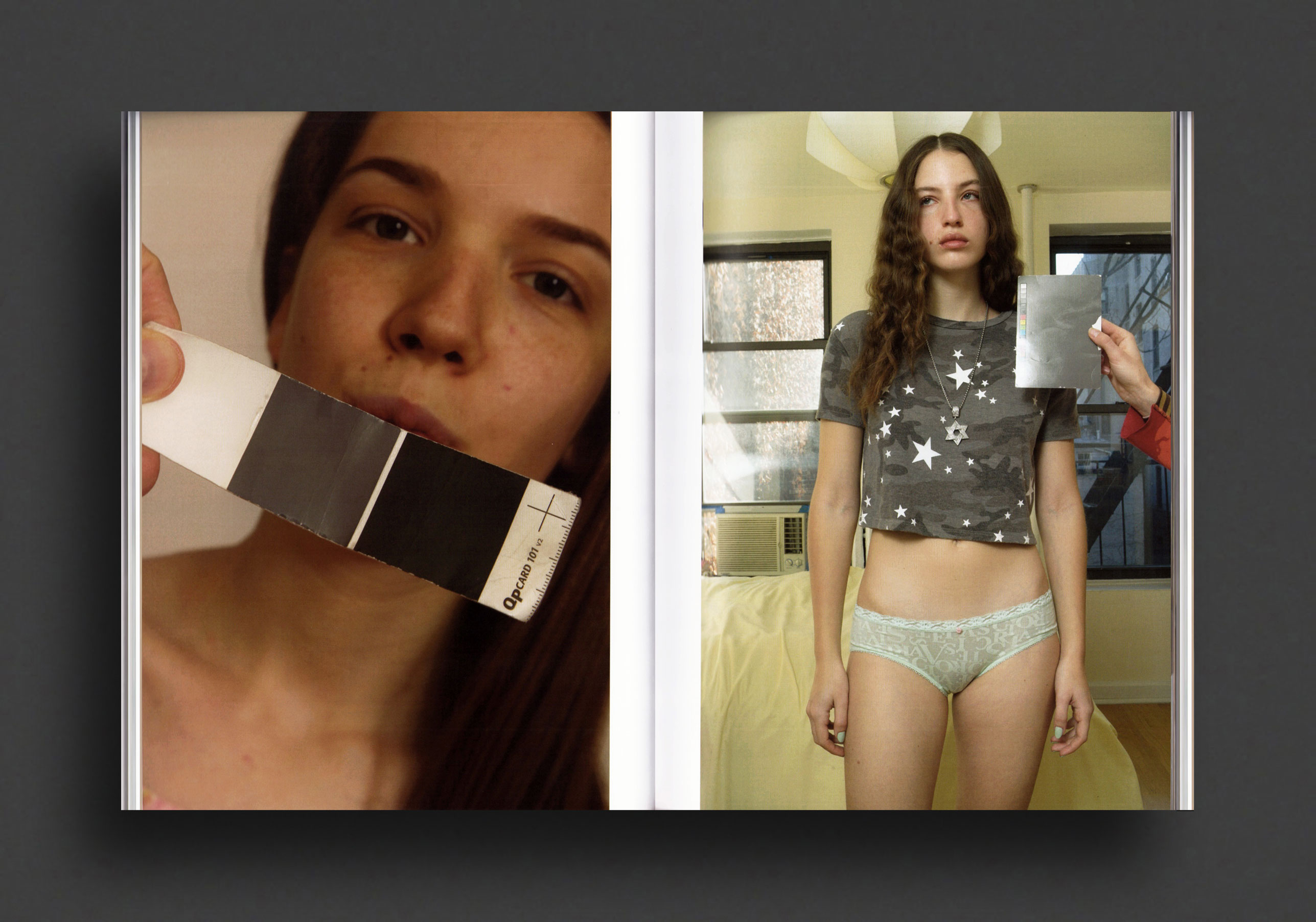
Already out of print at source, published in an edition of only 500 copies, here are the collected notorious 'Grey Card' pictures from Richard Kern, encapsulated in one book. Some candid, some not — Grey Cards is an interesting perspective on the artists practice, and a side of his work long appreciated by many.
"Digital cameras made photography cheap and easy for everyone but one drawback was unreliable image capture. A greycard is used so that the photographer can correct color and lighting during post production work. the photographs in this book are presented here as they came out of the camera."
Richard Kern, photographer and filmmaker remains, first and foremost, a portraitist. For more than two decades Kern has sought to unravel and illuminate the complex and often darker sides of human nature. Kern makes the psychological space between the sitter, photographer and audience his subject. With his dry, matter of fact approach, he underlines the absurdity of truth and objectivity in photography while playing with our reliance upon taxonomies around sexual representation. - Matthew Higgs
First edition of 500 copies. Cover with tipped-in Grey Card.
2023, English
Softcover, 176 pages, 22 x 30 cm
Published by
Art Paper Editions / Ghent
$110.00 - In stock -
For more than three decades Richard Kern has sought to unravel and illuminate the complex and often darker sides of human nature. Kern makes the psychological space between the sitter, photographer and audience his subject. With his dry, matter of fact approach, he underlines the absurdity of truth and objectivity in photography while playing with our reliance upon taxonomies around sexual representation.
This publications contains more than 200 polaroids taken by Kern between 1980 and 2005 while shooting.
Edition of 1000
1995, English
Softcover, 29.5 x 23 cm
1st Edition, Out of print title / used / very good
Published by
Purr Books / London
$80.00 - Out of stock
First edition of Richard Kern's classic "New York Girls" released in 1995, defining a time, a place, and the raw aesthetic of the artist Richard Kern (b. 1954). Kern was a leading figure in the 1980s Cinema of Transgression, director of the iconic films You Killed Me First, Fingered and Submit to Me Now; producer of Sonic Youth’s “Death Valley ’69” and Marilyn Manson’s Lunchbox music videos; and a pioneering zine publisher responsible for The Heroin Addict and The Valium Addict. After kicking his own heroin habit, Kern turned to still photography, shooting girls in his downtown, punk-inflected New York social circle. Regarded as one of the best female nude photo-books of the 1990's, Kern's New York girls were naked, bold, tattooed, pierced, and casually posed in minimal sets, mostly just Richard’s ratty slum apartment. They were young, but not innocent, fully complicit in the bondage, gunplay, and infamous candle insertions. "Dedicated to the models." With an introduction by Lydia Lunch, interview with Richard Kern by Kim Gordon, text by Kern, and filmography.
John Waters said of one of Kern's notorious scum-bag Super-8 movies: "Finger is the ultimate date movie for psychos. It's the best hillbilly-punk-art-porno movie in the world and I always show it to people very late at night to make them happy."
Very Good copy, light wear.
2020, English
Hardcover, 88 pages, 22.5 x 32 cm
Published by
Art Paper Editions / Ghent
$190.00 - In stock -
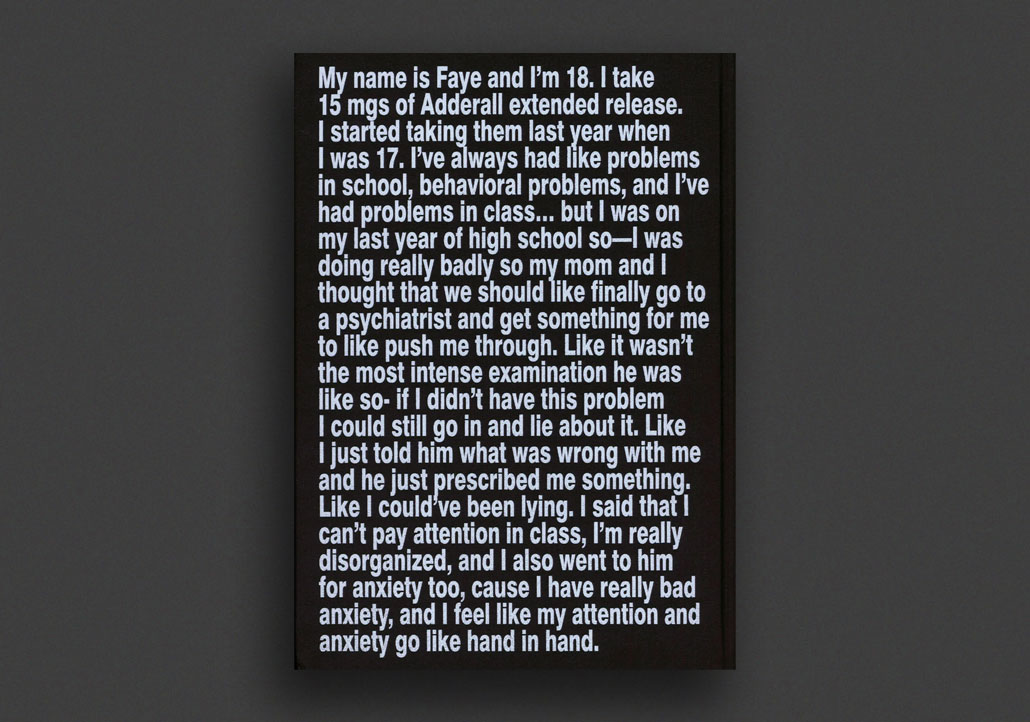
“My name is Faye and I’m 18. I take 15 mgs of Adderall extended release. I started taking them last year when I was 17. I’ve always had like problems in school, behavioral problems, and I’ve had problems in class… but I was on my last year of high school so—I was doing really badly so my mom and I thought that we should like finally go to a psychiatrist and get something for me to like push me through. Like it wasn’t the most intense examination he was like so- if I didn’t have this problem I could still go in and lie about it. Like I just told him what was wrong with me and he just prescribed me something. Like I could’ve been lying. I said that I can’t pay attention in class, I’m really disorganized, and I also went to him for anxiety too, cause I have really bad anxiety, and I feel like my attention and anxiety go like hand in hand.”
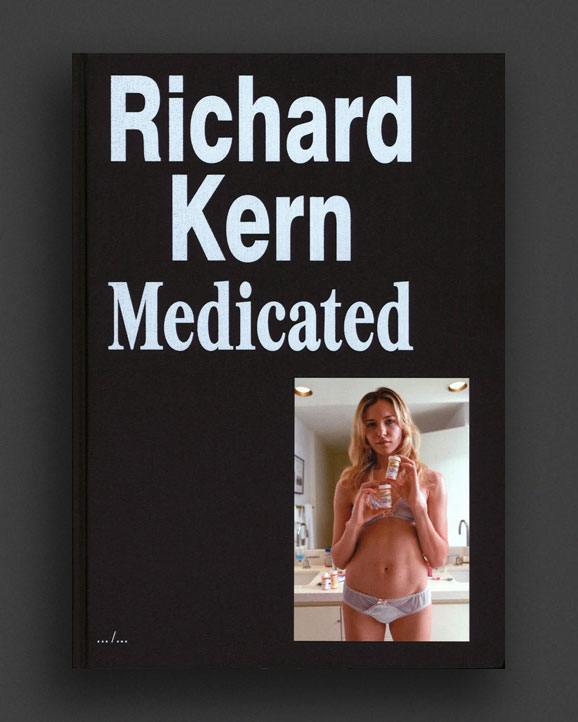
Between 2010 and 2018, Kern interviewed women about the medications they used and the effects of those meds on their outlook. Their responses appear side-by-side with their portraits shot by Kern.
1st edition, 1250 copies