World Food Books' programme is largely produced on Kulin Nation land. We acknowledge the Wurundjeri people of the Kulin Nation as the first and continuing custodians of this land, and pay respect to their Elders past, present, and emerging.
World Food Books is an arts and special interests bookshop in Naarm / Melbourne. Founded in 2010, World Food Books is devoted to the presentation of a rotating, hand-selection of international art, design, literary and counterculture publications with an emphasis on the anti-traditional, the experimental, the avant-garde, the heretic, the marginal.
Presenting new titles alongside rare and out-of-print books, catalogues and journals spanning the fields of modern and contemporary art, design, photography, illustration, film, literature, poetry, cultural theory, philosophy, sexuality, popular and underground culture in its many radical forms, World Food Books wishes to encourage adventurous, thoughtful and open-minded reading, looking, writing, and exchange of publishing and ideas, both current and historical.
As well as our bookshop, located in Melbourne's historical Nicholas Building, all of our inventory is available internationally via our online mail-order service.
World Food Books semi-regularly co-ordinates "Occasions", a programme of exhibits and events at the bookshop and in partnership with other hosts (such as museums and art galleries) that develop out of the activities, relationships and content of the bookshop itself.
World Food Books
The Nicholas Building
37 Swanston Street
Room 5, Level 6
Melbourne 3000
Australia
SHOP HOURS:
THU–SAT 12–6
WEB-SHOP OPEN 24/7
World Food Books
Postal Address:
PO Box 435
Flinders Lane
Victoria 8009
Australia
info@worldfoodbooks.com
Art
Theory / Essay
Architecture / Interior
Graphic Design / Typography
Photography
Fashion
Eros
LGBTQ+
Fiction / Poetry
Weird / Speculative / Science Fiction / Horror
Transgressive / Visceral / Abject
Symbolism / Decadence / Fin de siècle
Film / Video
Painting
Sculpture / Installation
Performance / Dance / Theater
Drawing
Sound / Music
Curatorial
Group Shows / Collections
Periodicals
Out-of-print / Rare
Posters / Ephemera / Discs
Signed Books
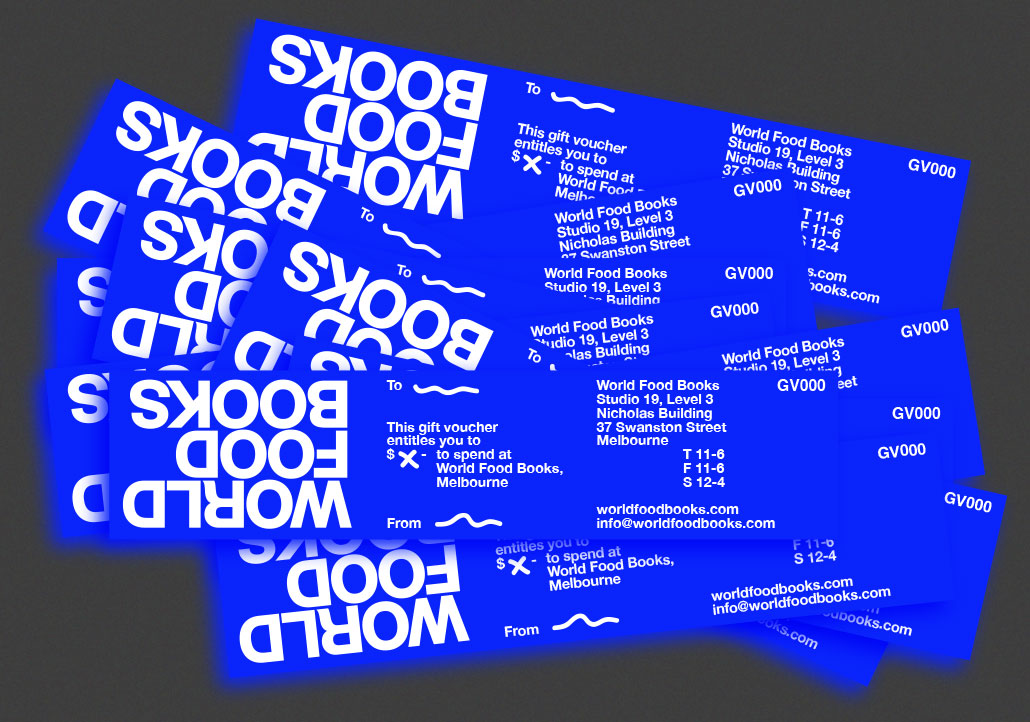
World Food Books Gift Voucher
World Food Book Bag
Australian Art
Australian Fiction
Australian Science Fiction / Speculative Fiction
Australian Poetry
Australian Photography
Japanese Photography
Conceptual Art
Minimal Art
Dada
'Pataphysics / Oulipo
Fluxus
Concrete Poetry
Pop Art
Surrealism
Arte Povera
Arte Informale / Haute Pâte / Tachism
Nouveau Réalisme / Zero / Kinetic
Situationism / Lettrism
Collage / Mail Art / Xerox Art
Art Brut / Folk / Visionary / Fantastic
Illustration / Graphic Art / Bandes Dessinées
Furniture
Italian Radical Design / Postmodernism
Textiles
Ceramics / Glass
Counterculture
Protest / Revolt
Philosophy
Psychoanalysis
Anthropology
Anarchism
Socialism / Anarchism / Communism / Capitalism
Literary Theory / Semiotics / Language
Feminism / Women's Studies
Gender Studies / Sexuality
Anthropology
Fetishism / BDSM
Drugs / Psychedelia
Crime / Violence
Animal Rights / Veganism
Occult / Esoterica
Ecology / Earth / Alternative Living
Whole Earth / Crafts
All prices in AUD (Australian dollars)
Pick-Ups
Pick-up orders can be collected in our bookshop during opening hours after order date. Please collect any Pick-up orders within 2 weeks of ordering as we have limited storage space. Orders will be released back into stock if not collected within this time. No refunds can be made for pick-ups left un-collected. If you cannot make it in to the bookshop in this time-frame, please choose postage option.
Return Policy
All sales are final. We do accept returns (for refund or exchange) for items received in error. All our orders are packed with special care using heavy-duty padding and cardboard book-mailers or bubble mailers (for smaller books), using reinforcement where required. We cannot take responsibility for any lost, stolen or damaged parcels.
Insurance
Should you wish to insure your package, please email us directly after placing your order and we can organise this at a small extra expense. Although all standard/express tracked packages are very safe and dependable, we cannot take responsibility for any lost, stolen or damaged parcels. We recommend insurance on valuable orders.
Interested in selling your old books, catalogues, journals, magazines, comics, fanzines, ephemera? We are always looking for interesting, unusual and out-of-print books to buy. We only buy books in our fields of interest and specialty, and that we feel we can resell.
We base these prices on desirability, market value, in-print prices, condition and our current stock levels. We offer cash, store credit, and can take stock on consignment. All
about 25% of the price we expect to get when we sell them, or 30% in store credit. We base these prices on desirability, market value, in-print prices, condition and our current stock levels.
Sell your books any day of the week. You can drop them off and return later. If you have a lot of books, we can visit your Sydney home.
We buy books that we feel we can resell. We offer about 25 % of the price we expect to get when we sell them, or 30% in store credit. We base these prices on desirability, market value, in-print prices, condition and our current stock levels.
Philadelphia Wireman
03 August - 01 September, 2018
World Food Books is proud to announce our next Occasion, the first presentation of sculptures by Philadelphia Wireman in Australia.
The Philadelphia Wireman sculptures were found abandoned in an alley off Philadelphia’s South Street on trash night in 1982. Their discovery in a rapidly-changing neighbourhood undergoing extensive renovation, compounded with the failure of all attempts to locate the artist, suggests that the works may have been discarded after the maker’s death. Dubbed the "Philadelphia Wireman" during the first exhibition of this work, in 1985, the maker’s name, age, ethnicity, and even gender remain uncertain. The entire collection totals approximately 1200 pieces, all intricately bound together with tightly-wound heavy-gauge wire (along with a few small, abstract marker drawings, reminiscent both of Mark Tobey and J.B. Murry). The dense construction of the work, despite a modest range of scale and materials, is singularly obsessive and disciplined in design: a wire armature or exoskeleton firmly binds a bricolage of found objects including plastic, glass, food packaging, umbrella parts, tape, rubber, batteries, pens, leather, reflectors, nuts and bolts, nails, foil, coins, toys, watches, eyeglasses, tools, and jewellery.
Heavy with associations—anthropomorphic, zoomorphic, and socio-cultural responses to wrapped detritus—the totemic sculptures by Philadelphia Wireman have been discussed in the context of work created to fulfil the shamanistic needs of alternative religions in American culture. Curators, collectors, and critics have variously compared certain pieces to sculpture from Classical antiquity, Native American medicine bundles, African-American memory jugs, and African fetish objects. Reflecting the artist’s prolific and incredibly focused scavenging impulse, and despite—or perhaps enhanced by—their anonymity, these enigmatic objects function as urban artefacts and arbiters of power, though their origin and purpose is unknown. Philadelphia Wireman, whatever their identity, possessed an astonishing ability to isolate and communicate the concepts of power and energy through the selection and transformation of ordinary materials. Over the course of the past two decades, this collection has come to be regarded as an important discovery in the field of self-taught art and vernacular art.
Presented in collaboration with Fleisher-Ollman Gallery, Philadelphia, and Robert Heald, Wellington.
Susan Te Kahurangi King
02 February - 10 March, 2018
Susan Te Kahurangi King (24 February 1951 - ) has been a confident and prolific artist since she was a young child, drawing with readily available materials - pencils, ballpoint pens and felt-tip markers, on whatever paper is at hand. Between the ages of four and six Susan slowly ceased verbal communication. Her grandparents William and Myrtle Murphy had developed a special bond with Susan so they took on caring responsibilities for extended periods. Myrtle began informally archiving her work, carefully collecting and storing the drawings and compiling scrapbooks. No drawing was insignificant; every scrap of paper was kept. The King family are now the custodians of a vast collection containing over 7000 individual works, from tiny scraps of paper through to 5 meter long rolls.
The scrapbooks and diaries reveal Myrtle to be a woman of great patience and compassion, seeking to understand a child who was not always behaving as expected. She encouraged Susan to be observant, to explore her environment and absorb all the sights and sounds. Myrtle would show Susan’s drawings to friends and people in her community that she had dealings with, such as shopkeepers and postal workers, but this was not simply a case of a grandmother’s bias. She recognised that Susan had developed a sophisticated and unique visual language and sincerely believed that her art deserved serious attention.
This was an unorthodox attitude for the time. To provide some context, Jean Dubuffet coined the term Art Brut in 1945 to describe work created by self-taught artists – specifically residents of psychiatric institutions and those he considered to be visionaries or eccentrics. In 1972 Roger Cardinal extended this concept by adopting the term Outsider Art to describe work made by non-academically trained artists operating outside of mainstream art networks through choice or circumstance. Susan was born in Te Aroha, New Zealand in 1951, far from the artistic hubs of Paris and London that Dubuffet and Cardinal operated in. That Myrtle fêted Susan as a self-taught artist who deserved to be taken seriously shows how progressive her attitudes were.
Susan’s parents Doug and Dawn were also progressive. Over the years they had consulted numerous health practitioners about Susan’s condition, as the medical establishment could not provide an explanation as to why she had lapsed into silence. Dawn educated herself in the field of homeopathy and went on to treat all twelve of her children using these principles – basing prescriptions on her observations of their physical, mental and emotional state.
Doug was a linguist with an interest in philosophy who devoted what little spare time he had to studying Maori language and culture. To some extent their willingness to explore the fringes of the mainstream made them outsiders too but it was their commitment to living with integrity and their respect for individuality that ensured Susan’s creativity was always encouraged.
Even though Susan’s family supported her artistic pursuits, some staff in schools and hospitals saw it as an impediment to her assimilation into the community and discouraged it in a variety of ways. Her family was not always aware of this and therefore did not fully understand why Susan stopped drawing in the early 1990s. However, rather than dwell on the challenges that Susan faced in pursuit of her artistic practice, they prefer to highlight her achievements. In 2008 Susan began drawing again in earnest, after an almost 20 year interruption, and her work is now shown in galleries around the world.
Susan grew up without television and has been heavily influenced by the comics she read as a child. She is absolutely fearless in the appropriation of recognizable characters, such as Donald Duck and Mickey Mouse, in her work. She twists their limbs, contorts their faces, compresses them together, blends them into complex patterned backgrounds - always imbuing them with an incredible energy. Although Susan often used pop culture characters in her work they are not naive or childlike. These are drawings by a brilliant self-taught artist who has been creating exceptional work for decades without an audience in mind.
Mladen Stilinović
"Various Works 1986 - 1999"
02 February 16 - September 10, 2016
Various works 1986 - 1999, from two houses, from the collections of John Nixon, Sue Cramer, Kerrie Poliness, Peter Haffenden and Phoebe Haffenden.
Including: Geometry of Cakes (various shelves), 1993; Poor People’s Law (black and white plate), 1993; White Absence (glasses, ruler, set square, silver spoon, silver ladel with skin photograph and wooden cubes), 1990-1996; Exploitation of the Dead (grey and red star painting, wooden painting, black spoon with red table, red plate), 1984-1990; Money and Zeros (zero tie, paintings made for friends in Australia (Sue, John, Kerrie), numbers painting), 1991-1992; Words - Slogans (various t-shirts) - “they talk about the death of art...help! someone is trying to kill me”, “my sweet little lamb”, “work is a disease - Karl Marx”; Various artist books, catalogues, monographs, videos; Poster from exhibition Insulting Anarchy; "Circular" Croatian - Australian edition; Artist book by Vlado Martek (Dostoyevsky); more.
Thanks to Mladen Stilinović and Branka Stipančić.
Jonathan Walker
Always Will Need To Wear Winter Shirt Blue + Ochre Small Check Pattern
21 August - 21 September, 2015
Untitled
I am not a great reader of poetry but I always return to the work of Melbourne poet, Vincent Buckley (1925- 1988). Perhaps I find his most tantalising piece to be not a finished poem but a fragment left on a scrap of paper discovered on his desk after the poet’s death.
The poetry gathers like oil
In the word-core, and spreads
It has its music meet,
Its music is in movement.
This fragment is more the shell left behind from a volatile thought than a finished poem. I find the last two lines honest but awkward whereas the first two lines work like an arrow. Most likely he could not find a resolution so it was left. Still, in its present form, it remains an eloquent testimony to the ultimate failure of a medium to express mobile thought and sensation, in Buckley’s case, through verbal language. It’s an important matter because this is something all artists have to deal with regardless of the medium.
I have never written a poem, however, I am forever copying fragments from books on paper scraps in a vain effort to fix certain notions in my head. At first, they function as bookmarks that are sometimes returned to when I open the book. But before long, as they accumulate, they fall out littering the table interspersed with A4 photocopies, bills, books and medications.
To return to Buckley’s fragment, the first two lines very much evoke how I paint nowadays. As you age, detail diminishes and patches of light become more luminous and float. I feel the most honest way of dealing with this is by smearing the oil paint on the canvas with the fingers and working close-up, blind. Only if the patches coalesce into an approaching image can the work gain a life.
-
Jonathan Walker was born in Melbourne, Australia and brought up on a dairy farm in Gippsland. In the 1970’s he studied painting at RMIT and won the Harold Wright Scholarship to the British Museum, London. During the 1980’s he exhibited at Pinacotheca Gallery, Richmond and had work shown at the NGV and Heidi City Art Gallery. Over the same period he designed the cover for the “Epigenesi” LP by Giancarlo Toniutti, Italy and conducted a mail exchange work with Achim Wollscheid, Germany. The work with artists through the post resulted in an article published in the bicentenary issue of Art and Australia 1988. He showed in artist run spaces such as WestSpace in the 90’s and 2000’s, and until 2012, taught painting at Victoria University, which is where we (Colleen Ahern and Lisa Radford) as organisers of the exhibition, among many others, had the privilege of being his student.
Walker’s knowledge was imparted to students through the careful selection of music, literature, and artists found in books that he himself had ordered for the library. Walker’s strategy was the generosity of sharing his vast knowledge with references specific to each student and their context.
Walker’s paintings share a similar focus and intimacy.
This exhibition presents a small selection of recent paintings alongside a publication that includes Walker’s writing. Observational and analytical, Walker’s work is a type of material notation — the time of day, colour and how it is blended, the both specific and fleeting location of a reflection on lino or the question of whether a chair leg should be included in a painting.
Please join us on Friday August 21 between 6-8pm to celebrate the opening of the exhibition.
Curated by Colleen Ahern and Lisa Radford.
B. Wurtz
Curated by Nic Tammens
March 26 - April 4, 2015
B.Wurtz works from a basement studio in his home on Manhattan’s Lower East Side.
This local fact is attested to by the plastic shopping bags and newsprint circulars that appear in his work. As formal objects, they don’t make loud claims about their origins but nonetheless transmit street addresses and places of business from the bottom of this long thin island. Like plenty of artists, Wurtz is affected by what is local and what is consumed. His work is underpinned by this ethic. It often speaks from a neighborhood or reads like the contents of a hamper:
“BLACK PLUMS $1.29 lb.”
“Food Bazaar”
“USDA Whole Pork Shoulder Picnic 99c lb.”
“RITE AID Pharmacy, with us it’s personal.”
“H. Brickman & Sons.”
“Sweet Yams 59c lb."
Most of the work in this exhibition was made while the artist was in residence at Dieu Donne, a workshop dedicated to paper craft in Midtown. Here Wurtz fabricated assemblages with paper and objects that are relatively lightweight, with the intention that they would be easily transportable to Australia. This consideration isn’t absolute in Wurtz’s work, but was prescriptive for making the current exhibition light and cheap. Packed in two boxes, these works were sent from a USPS post office on the Lower East Side and delivered to North Melbourne by Australia Post.
Wurtz appears courtesy of Metro Pictures, New York.
Thanks to Rob Halverson, Joshua Petherick, Sari de Mallory, Matt Hinkley, Helen Johnson, Fayen d'Evie, Ask Kilmartin, Lisa Radon, Ellena Savage, Yale Union, and "Elizabeth".
John Nixon
"Archive"
December 15 - January 20, 2014
The presentation of John Nixon's archive offered a rare showcase of this extensive collection of the artist's own publications, catalogues, posters, ephemera, editions and more, from the mid 1980s onwards, alongside a selection of his artworks.
Organized by John Nixon, Joshua Petherick and Matt Hinkley.
"Habitat"
at Minerva, Sydney (organised by Joshua Petherick and Matt Hinkley)
November 15 - December 20, 2014
Lupo Borgonovo, Janet Burchill & Jennifer McCamley,
Lewis Fidock, HR Giger, Piero Gilardi, Veit Laurent Kurz,
Cinzia Ruggeri, Michael E. Smith, Lucie Stahl, Daniel Weil, Wols
Press Release:
“...It contained seven objects. The slender fluted bone, surely formed for flight, surely from the wing of some large bird. Three archaic circuitboards, faced with mazes of gold. A smooth white sphere of baked clay. An age-blackened fragment of lace. A fingerlength segment of what she assumed was bone from a human wrist, grayish white, inset smoothly with the silicon shaft of a small instrument that must once have ridden flush with the surface of the skin - but the thing’s face was seared and blackened.”
William Gibson, “Count Zero”, 1986
"Autumn Projects Archive"
Curated by Liza Vasiliou
March 6 - March 15, 2014
World Food Books, in conjunction with the Virgin Australia Melbourne Fashion Festival 2014, presented the Autumn Projects archive, consisting of a selection of early examples in Australian fashion with a particular interest in collecting designers and labels from the period beginning in the 1980’s, who significantly influenced the discourse of Australian Fashion.
Curated by Liza Vasiliou, the exhibition provided a unique opportunity to view pieces by designers Anthea Crawford, Barbara Vandenberg, Geoff Liddell and labels CR Australia, Covers, Jag along with early experimental collage pieces by Prue Acton and Sally Browne’s ‘Fragments’ collection, suspended throughout the functioning World Food Books shop in Melbourne.
H.B. Peace
presented by CENTRE FOR STYLE
November 14, 2013
"Hey Blinky, you say chic, I say same"
Anon 2013
H.B. Peace is a clothing collaboration between great friends Blake Barns and Hugh Egan Westland. Their pieces explore the divergences between 'character’ and ‘personality’ in garments....etc
Special Thanks to Joshua Petherick and Matt Hinkley of WFB and Gillian Mears
and a Very Special Thank you to Audrey Thomas Hayes for her shoe collaboration.
Janet Burchill & Jennifer McCamley
"Aesthetic Suicide"
May 10 - June 8, 2013
The first of our occasional exhibitions in the World Food Books office/shop space in Melbourne, "Aesthetic Suicide" presented a body of new and older works together by artists Janet Burchill & Jennifer McCamley, including videos, prints, a wall work, and publications.
During shop open hours videos played every hour, on the hour.
$.00 - Out of stock
The eternal clean out! New items weekly.
https://worldfoodbooks.com/category/sale
Published by World Food Books / Melbourne
$20.00 - In stock -
A World Food Books gift voucher is redeemable in our Melbourne bookshop or via our webshop (here). An e-voucher (printable pdf) will be sent to your purchase email address (please notify us if you wish to have the voucher sent to an alternate address and wish us to fill in the receiver's details on the card).
Gift vouchers can be purchased in increments of $20 (Australian Dollars) and the total amount can simply be added to by increasing the quantity in your shopping cart. eg. A quantity of 5 gift vouchers will result in an item total of $100 - a $100 gift voucher. Simply click "ADD TO CART" 5 times, or update your quantity in the shopping cart.
If you wish to purchase multiple, separate gift vouchers in one go, please just email us and we can personally prepare and email you a payment request.
Please note: Please select Pick-Up on gift voucher purchse to avoid any postage charges. Accidental postage charges will be refunded right away!
Thank you.
For any questions, please don't hesitate to email: info@worldfoodbooks.com
1999, Japanese / English / Spanish
Softcover (French Flaps), 170 pages, 29 x 20 cm
1st Edition, Out of print title / used / fine
Published by
Tokyo Shimbun / Tokyo
$140.00 - In stock -
Scarce, stunning Japanese catalogue on Spanish surrealist Remedios Varo, published on the occasion of a major touring retrospective of her work throughout Japan in 1999. Only available in the participating Japanese museums in the late 1990s and now long out-of-print, this book beautifully reproduces Varo's paintings and drawings (including preliminary sketches alongside final oils) with detailed captions and descriptions, accompanied by illustrated essays and other texts by Masayo Nonaka, Octavio Paz, Luis-Martin Lozano, and Walter Green, portraits of the artist, exhibition history, bibliography, work list and more.
Remedios Varo Uranga (1908 – 1963) was a Spanish surrealist artist. Born in Anglès (north of Catalonia), Spain in 1908, she studied at the Real Academia de Bellas Artes de San Fernando, Madrid. Varo spent her formative years between France and Barcelona and was greatly influenced by the surrealist movement. The summer of 1935 marked Varo's formal invitation into Surrealism when French surrealist Marcel Jean arrived in Barcelona. While still married to her first husband Gerardo Lizarraga, Varo met her second partner, the French surrealist poet Benjamin Péret, in Barcelona. During the Spanish Civil War she fled to Paris with Péret leaving Lizarraga behind (1937). It was through Peret that Remedios Varo met André Breton and the Surrealist circle, which included Leonora Carrington, Dora Maar, Roberto Matta, Wolfgang Paalen, and Max Ernst among others. Shortly after arriving in France, Varo took part in the International Surrealist exhibitions in Paris and in Amsterdam in 1938. She was forced into exile from Paris during the German occupation of France and moved to Mexico City at the end of 1941 when the Mexican president, Lázaro Cardenas, made it a policy to welcome Spanish and European refugees. In Mexico, she met native artists such as Frida Kahlo and Diego Rivera, but her strongest ties were to other exiles and expatriates, notably the English painter Leonora Carrington and the French pilot and adventurer, Jean Nicolle. However, because Mexican muralism still dominated the country's art scene, surrealism was not generally well received. She worked as an assistant to Marc Chagall with the design of the costumes for the production of the ballet Aleko, which premiered in Mexico City in 1942. In 1947, Péret returned to Paris, and Varo traveled to Venezuela, living there for two years. She returned to Mexico and began her third and last important relationship with Austrian refugee Walter Gruen, who had endured concentration camps before escaping Europe. Gruen believed fiercely in Varo, and he gave her the economic and emotional support that allowed her to fully concentrate on her painting. In 1955, Varo had her first solo exhibition at the Galería Diana in Mexico City. Buyers were put on waiting lists for her work. Even Diego Rivera was supportive. In 1960, her representative, Juan Martín, opened his own gallery and showed her work there, and opened a second in 1962. Only a year after that opening, at the height of her career, she died from a heart attack in Mexico City. Her work is well known in Mexico, but not as commonly known throughout the rest of the world.
Fine, As New copy.
1984, Japanese / English / French
Softcover, 149 pages, 27 x 22 cm
1st Edition, Out of print title / used / fine
Published by
Seibu / Tokyo
$90.00 - In stock -
Scarce Japanese Francis Picabia catalogue produced on the occasion of an exhibition at The Museum of Modern Art, Seibu Takanawa 21 July-5 September 1984 and The Seibu Museum of Art, Tokyo 9 September-21 October 1984.
Richly illustrated with many of Picabia's works spanning his entire oeuvre in painting, drawing, text and print, with texts in Japanese,some English and French.
Francis Picabia (22 January 1879 – 30 November 1953) was a French avant-garde painter, poet and typographist. After experimenting with Impressionism and pointillism, Picabia became associated with Cubism. His highly abstract planar compositions were colourful and rich in contrasts. He was one of the early major figures of the Dada movement in the United States and in France. His was later briefly associated with Surrealism, but would soon turn his back on the art establishment.
Near Fine copy.
1999, English / French / Japanese
Softcover (2 Vols in curregated cardboard slip-case), 226 + 120 pages, 18 x 25 cm
1st Edition, Out of print title / used / very good
Published by
APT International / Tokyo
Isetan Museum of Art / Tokyo
$160.00 - In stock -
First Edition of this long out-of-print, comprehensive, beautifully produced Japanese two-volume publication on the life and work of the great French avant-garde painter, poet and typographist, Francis Picabia.
Published by APT International in 1999 for a major Japanese travelling exhibition on Francis Picabia, starting at the Isetan Museum of Art in Tokyo in 1999, then to Fukushima and Osaka throughout 1999-2000.
Two Volumes bound in french-fold wraps, both housed in protective corrugated cardboard slip-case with scarlet label wrapped around spine. Slipcase itself is now protected under plastic sleeve.
First volume (226 page) forms a comprehensive retrospective of Picabia's life and prolific and defying work across painting, drawing, printing, poetry and film. Extensive colour and b&w reproductions of a vast collection of his painting, illustration and publishing projects are presented alongside a folio of his poems and drawings, plus photo documentation of his studio and private/social life. Also includes a biography and bibliography, as well as an insightful conversation between Olga Picabia (Francis Picabia's widow), Pierre Calté (director of Comité Picabia), Hans Ulrich Obrist (independent curator) and Stefan Banz (independent curator), about Picabia's life (text in English and Japanese). Introductory essays in Japanese and French by Beverley Calte and Arnauld Pierre.
Second volume (120 pages) "391" is a very special book made up of collated facsimiles of the 19 issues of Picabia's famous Dada periodical, "391", dating 1917-1924. 391 first appeared in January 1917 in Barcelona, published and edited by Picabia, assisted in assembling by Olga Sacharoff, a Georgian emigre residing in Barcelona. The title of the magazine derives from Alfred Stieglitz's New York periodical 291 (to which Picabia had contributed), and bore no relation to its contents. Despite Picabia's renown as an artist, it was mostly literary in content, with a wide-ranging aggressive tone, possibly influenced by Alfred Jarry and Apollinaire. There were contributions by two men new to Dada: Man Ray and Marcel Duchamp. However 391 remained essentially the expression of the inventive, energetic and wealthy Picabia, who stated of it: "Every page must explode, whether through seriousness, profundity, turbulence, nausea, the new, the eternal, annihilating nonsense, enthusiasm for principles, or the way it is printed. Art must be unaesthetic in the extreme, useless and impossible to justify."
Francis Picabia (22 January 1879 – 30 November 1953) was a French avant-garde painter, poet and typographist. After experimenting with Impressionism and pointillism, Picabia became associated with Cubism. His highly abstract planar compositions were colourful and rich in contrasts. He was one of the early major figures of the Dada movement in the United States and in France. His was later briefly associated with Surrealism, but would soon turn his back on the art establishment.
Very Good copy in Good slipcase that has discoloured with sun-tanning to spine, corregation has some wear. Books VG both.
2025, English / French
Hardcover (clothbound), 224 pages, 29.5 x 25 cm
Published by
Hauser & Wirth / Zurich
$110.00 - In stock -
Documenting the great, late, neglected work of a modernist master.
Prefaced by Beverley Calté, president of the Comité Picabia, this book delves into Picabia’s practice between the years 1945 to 1952—an incredibly rich period during which Picabia created paintings unlike anything he had produced before, working alongside the growing Art Informel movement in Paris.
Essays by art historians Arnauld Pierre and Candace Clements shed new light on the hidden signs and symbols buried in his abstractions, the new painting techniques he employed, and the mysterious and fantastical reappearance of the “dot” in his work.
'Éternel recommencement / Eternal Beginning' is an essential resource, marking the first focused exploration of a crucial chapter of Picabia’s practice.
1998, English / Japanese
Hardcover (w. dust jacket), 100 pages, 37 x 26 cm
1st Edition, Out of print title / used / fine
Published by
Sakuhinsha / Tokyo
$190.00 - In stock -
Scarce first Japanese hardcover edition of Japanese master of erotic fantasy illustration Hajime Sorayama's absolute classic Torquere (Torture), published in 1998. Following the success of best-seller NAGA, Sorayama's Torquere delves deeper into the darker realm of fantasy fetishism and, as the title suggests, into the world of Sadomasochism. This lavish over-sized volume is illustrated cover-to-cover with Sorayama's most explicit works presented in dramatic, glossy full-colour throughout. Rare in this original hardcover edition.
Hajime Sorayama is revered for his erotic airbrushed illustrations of humanoid robots that explore ideals of femininity and beauty. Drawing on pinup pictures, Sorayama published the first book of his signature “Sexy Robot” series of chromium-plated figures in 1983. Decades later, these striking works have sold for more than $500,000. Sorayama started his career in advertising before freelancing in Hollywood, where he helped to produce visuals for sci-fi films. His illustrations gained widespread attention in 1995, when Penthouse began featuring them in a monthly column. While Sorayama has enjoyed a particular cult status for his sensual cyborgs —who appear empowered rather than objectified —he has also received mainstream commercial attention. Sony enlisted him to produce the first designs for its robotic dog AIBO, which won the grand prize for Japan’s Good Design Award in 1999. Sorayama has also worked with fashion titans such as Thierry Mugler and Dior on projects that have extended his illustrations into the realm of wearables, sculpture, and performance.
Near Fine copy.
2025, English
Softcover, 386 pages, 23.2 x 17 cm
Published by
Smalltown Supersound / Oslo
$85.00 - In stock -
New and updated edition of Johannes Rød’s landmark guide to Free Jazz & Improv labels originally compiled and published in 2014 (copies of that first edition will set you back $$$), and now massively expanded for this new edition. 428 pages. Johannes Rød returns with the massively expanded edition of his essential guide - a monument of discographic research spanning six decades of creative music documentation. 381 pages plus 47 unnumbered pages of label artwork. 185 labels mapped with obsessive detail and passionate advocacy. From the explosive emergence of free jazz in the mid-1960s through ESP-Disk, BYG Actuel, and Actuel, through the European improvisers' movement documented by FMP, Incus, ICP, and Po Torch, to contemporary operations like Clean Feed, Trost Records, Astral Spirits, and Smalltown Supersound.
This is not just catalogue information. This is cultural history. Each label entry captures aesthetic vision, cultural context, the networks of musicians and presenters that made each imprint distinctive. Rød understands that free jazz culture has always been about more than just the music in the grooves - from Absinth Records' handpainted sleeves to FMP's iconic covers by Annette Peacock and Paul Lovens, this book documents the visual beauty alongside the sonic radicalism.
When Rød's Free Jazz and Improvisation on Vinyl 1965-1985 appeared in 2014, it immediately became the essential companion for anyone navigating the vast landscape of creative music documentation. This 2025 edition is the complete map. Hundreds of catalogue entries. Geographical, cultural, and ideological perspectives spanning American pioneers (Savoy, Blue Note's avant-garde excursions), European explosions, Japanese radicalism (DIW, PSF), Scandinavian innovations (Odin, Circulasione Totale).
With a foreword by Mats Gustafsson who writes: "DIG IN, enjoy and start your own research. It is all in front of you! Johannes Rød has created a unique possibility for all of us. It is a deep well of knowledge and music. It is the most FUN ride you can make: into the (un)known world of improvised music!"
As Joakim Haugland of Smalltown Supersound notes in his introduction, free jazz has been "the spine of the label, that holds it all together" - always present, always essential. This book is that spine made visible, tangible, researchable. It's information and inspiration in equal measure.
In an era when streaming platforms flatten everything into algorithmic sameness, when the physical object threatens to become mere nostalgia, this book reminds us why labels matter - why curatorial vision, aesthetic presentation, and committed documentation are crucial to creative music's survival and flourishing.
A landmark publication.
1967, German
Hardcover (w. dust jacket), 78 pages, 22.5 x 20.5 cm
1st Edition, Out of print title / used / average
Published by
Verlag Gerd Hatje / Stuttgart
$30.00 - In stock -
1967 hardcover monograph on Belgian-born French experimental poet, writer and painter Henri Michaux (1899–1984) by Kurt Leonhard, published in Germany by Hatje, Stuttgart. He studied mysticism as a young man and traveled throughout South America and Asia in the ’20s and ’30s before settling in Paris. Michaux is renowned for his strange, highly original poetry and prose, and also for his art, when in the late ’50s he first showed paintings created under the influence of mescaline. In 1965, he was awarded the French National Prize for Letters, but refused the award, saying that it threatened his independence. Published in the series "Kunst heute" as volume 9; with 72 illustrations of works on full-page plates, four of which are in colour.
Average—Good copy in Average DJ w. chipping to extremities, tanning and foxing to both.
1981 / 2025, English
Softcover, 112 pages, 22.2 x 20.6 cm
Published by
Colpa Press / San Francisco
$72.00 - In stock -
Originally published in 1981, this reprint of the classic guide to New Age music is an annotated listing of the music heard on the seminal radio program Music from the Hearts of Space, hosted by Stephen Hill and Anna Turner, since 1973. First produced in 1973 by presenter Stephen Hill with co-producer Anna Turner, Hearts of Space is a pioneering weekly syndicated public radio show in California featuring music of a contemplative nature drawn largely from the ambient, New Age and electronic genres, while also including classical, world, Celtic, experimental, and other music selections. For many years, Hill has applied the term "space music" to the music broadcast on the show, irrespective of genre. It is the longest-running radio program of its type in the world. It was first broadcast as Music from the Hearts of Space, a three-hour long late-night show on KPFA-FM in Berkeley, California. Each episode ends with Hill gently saying, "Safe journeys, space fans ... wherever you are."
This annotated listening guide traverses the spectrum of space music presented on the radio throughout the 1970s-80s, with the editors providing introductions, glossary of genres, descriptions of each record, alongside interspersed reflections on sound by scholars, composers, artists, poets, architects — everyone from Cage to Inayat Khan, Steiner to Wagner. Includes a list of related material including reading, retail and mail-order resources, as well as a full index and record label contacts.
An indispensable volume for anyone interested in ambient music, beautifully designed by Janaia Marisolle and impeccably reproduced by Colpa Press, San Francisco.
1979, English
Softcover, 366 pages, 30 x 24 cm
1st Edition, Out of print title / used / very good
Published by
Frauenliteratur Verlag Hermine Fees / Germany
$500.00 - In stock -
Very rare first 1979 English edition of one the finest artist's books and photographic projects of the 1970's, Let's Take Back Our Space (“Female” and “Male” Body Language as a Result of Patriarchal Structures / with 2037 photographs / In the second part of the book: Man's stuggle against womanpower and the effects upon body language throughout the course of history.)
The German artist Marianne Wex started out as a painter before producing her encyclopaedic photographic project "Let’s Take Back Our Space", one of the great unsung works of 1970s feminist history and cultural analysis. Marianne Wex bases her work on the assumption that body language is a result of sex-based, patriarchal socialization, affecting all of our other "feminine" and "masculine" role behavior. Born in Hamburg in 1937, Wex studied at the city’s University of Fine Arts, where she later taught for seventeen years. In 1979, she published Let’s Take Back Our Space as a book in both a German and English edition, to accompany an exhibition in the Neue Gesellschaft fair Bildende Kiinste in Berlin, in connection with the show Women Artists International, 1877 to 1977. It is an in-depth visual survey comprised of 5,000 to 6,000 photographs of body postures, taken between 1974 and 1977, assembled into dozens of thematic grids: Seated persons—leg and feet; arm and hand positions; standing persons—leg and feet; arm and hand positions; people sitting and laying on the ground; arm and leg positions; and so on. The images were culled from a huge range of sources—re-photographed advertisements, reportage, fashion magazines, pornography, studio portraits, the history of art—and many were taken on the streets of Hamburg by Wex, who proposes that our smallest, most unconscious gestures speak volumes about the power relations of gender in daily life. The work was expanded to include an extensive historical section for the book, where Marianne Wex investigates the body language shown in sculptures of the last 3,000 to 4,000 years, and comes to the conclusion that the ideals of body language and body forms have never been so different between the sexes as they are today.
Very Good copy. General light wear/ageing, tanning to cover, but a most lovely copy of the rare first edition from 1979. A more common reprint edition was published in 1984.
1974, English / Italian
Softcover, 40 pages, 20.5 x 15.5 cm
1st Edition, Out of print title / used / good
Published by
Rivolta Femminile / Rome
$380.00 - In stock -
First, extremely rare edition of Suzanne Santoro's artist's book "Per una espressione nuova / Towards a New Expression", published in a small run in Rome 1974 by Santaro and The Rivolta Femminile ("Women's Revolt") publishing house, founded in 1970 by Carla Lonzi. In the 1960s, Suzanne Santoro (b. 1946, Brooklyn New York), after training at the School of Visual Arts in New York and NYU and being affiliated with the minimalist and conceptual New York context of the 1960s, moved to Rome where she studied classical sculpture. Here her artistic path crossed with the experience of feminist militancy, through her connection to Rivolta Femminile and Carla Lonzi and co-founded the Beato Angelico Cooperative (CBA) and exhibition space. Her research immediately focused on restoring those characteristics of the female image that had been intentionally hidden or transformed by the patriarchal tradition of visual arts, culminating in this artist’s libretto. Mysterious, beautiful and fiercely feminist, Towards a New Expression articulates, through a photographic collection of images, a critical stance towards the "subordinate and unclarified" portrayal of women's genitalia in art from classical to contemporary times. Santoro's book generated some controversy when it was censored by The Institute of Contemporary Arts in London.
Very rare, especially in this first edition. Good copy, only with notable but attractive ex-libris "Moon Books" rubber stamp mark on back cover and another to the front end page. The title is written on the blank spine for filing into the collection. It is believed this was from a community library in Berkley. General light corner and edge wear/marking.
2025, English / Italian
Softcover, 304 pages, 21.5 x 15.3 cm
Published by
Crackers / Milan
$68.00 - In stock -
The book Superior and Inferior features a facsimile copy of pivotal and extremely rare publication by the Italian abstract artist Carla Accardi (1924–2014) titled Superiore e Inferiore, plus the first ever translation of the work into English. Published in 1972, it brings together the recordings of a series of conversations between Accardi and her pupils – she was a teacher at a public middle school – all between 10 and 13, about society’s discriminatory behaviour towards women. They also commented the Manifesto of the revolutionary feminist group Rivolta Femminile, collectively written by art critic Carla Accardi, artist Carla Lonzi and Elvira Banotti, which first appeared posted on city walls in Rome in July 1970.
For having discussed sex-related issues with pupils, Accardi was fired and permanently suspended from teaching. (Her letter of dismissal issued by the Italian Ministry of Education forms part of the introduction to the book.) Along the lines of Pasolini’s Comizi d’Amore (Love Meetings), Accardi’s own voice is secondary in the book, giving way to the thoughts, narratives, opinions and debates expressed among girls from the middle school where she taught, on the role of women and girls, family conflicts and sentimental relations, as well as their reflections on Accardi’s Manifesto.
English / Italian
1978, Japanese
Softcover, 204 pages, 21 x 29.6 cm
1st Edition, Out of print title / used / very good
Published by
Hanashi-no-Tokushu / Tokyo
$650.00 - In stock -
Exceptionally rare (signed!) 1978 first edition photobook by Michiko Matsumoto, one of post war Japan's leading photographers. As a young female photographer growing up in a period of turmoil, Matsumoto conveys the wonders of women to the viewer from the perspective of a woman. Women Come Alive is her rarest and greatest example of this. This wonderful book collects "seven years with women...", Matsumoto's front-line photographic records of the women's liberation movement in Japan in the 1970s and her "Sisters Across Borders" (New York, Paris, Los Angeles, London...), as well as portraits of female artists, activists and friends Yoko Ono, Maki Asakawa, Eiko Ishioka, Michiko Gorman, Mamako Yoneyama, Teruko Yoshitake, Tokiko Kato, Harumi Yamaguchi, Chinatsu Nakayama and others. A true time-capsule, this book visits the workshops, bookshops, marches, women's centres, lesbian bars, exhibitions, editorial offices, dances and studios of a pivotal time of great change. An incredible book of feminist protest and celebration. Virtually an impossible book to find, even without a signature from the artist! Highly recommended!!
Very Good copy in very good dust jacket. Signed in black ink and dated 1978.6.7 on title page.
1977, Japanese
Softcover (staple-bound), 64 pages, 28 x 21 cm
1st Edition, Out of print title / used / good
Published by
Feminist / Tokyo
$65.00 - In stock -
The inaugural 1977 issue of "Feminist", a rare and important record of the women's liberation movement in Japan in the the 1970s and document of the cross-currents of international female theorists, artists, poets, authors, and activists in the women's movement. This first issue with cover story on Yoko Ono, shot by Michiko Matsumoto, one of post war Japan's leading photographers. Edited by Japanese critic, American literature researcher, and poet, Ikuko Atsumi (who also co-edited "Burning Hearts: Women Poets of Japan" with Kenneth Rexroth, The Seabury Press/New Directions, 1977), with Diane L. Simpson, and contributors including women's rights activist/journalist Yayori Matsui (noted for her work to raise awareness of sex slaves and sex tourism in post-war Asia), photographer Michiko Matsumoto, Japanese linguist Sachiko Ide, Japanese poet, literary critic, and scholar Muneko Mizuta, historian Masaaki Sugiyama, author/activist Yumiko Sakuma, with this issue covering the controversy surrounding the formation of the magazine, a feature with performer/educator Mitsuko Hase, modern mythology, masculinity, media, misogyny, the Feminine imagination, the media's disdain for Asians, The Blood Bowl Sutra / women and the Buddhist faith, a report from the frontlines of the American women's movement (w. photography by Michiko Matsumoto), visiting women's studies courses around the world (University of Southern California), book reviews, feminist news, and the cover feature with artist Yoko Ono, "Yoko Ono's Philosophy" and a conversation with editor Ikuko Atsumi by Mitsuko Hase (w. photography by Michiko Matsumoto).
Good—VG copy with age/wear to cover extremities, some foxing/staining.
1978, English
Softcover (staple-bound), 68 pages, 28 x 21 cm
1st Edition, Out of print title / used / good
Published by
Feminist / Tokyo
$45.00 - In stock -
Fourth 1978 (English-language) issue of "Feminist", a rare and important record of the women's liberation movement in Japan in the the 1970s and document of the cross-currents of international female theorists, artists, poets, authors, and activists in the women's movement. This special "East and West" issue addresses the different pathways that the women's movement must travel throughout Asia and in the western countries. "A source of information and forum for Japanese women, (Feminist) has had from its inception an international perspective." This first fully English-language edition opens the discourse around the Asian feminist movement to western readers, including many articles on the place of Japanese Women in society, and Feminist developments in Korea, Thailand, the Philippines, Burma (Myanmar), Indonesia, and Malaysia. With a cover feature/interview on legendary Japanese art director, costume designer, and graphic designer Eiko Ishioka (known for her production and costume designs for Grace Jones, Paul Schrader, Francis Ford Coppola, Björk, etc., shot by photographer Michiko Matsumoto, this issue, edited by Japanese critic, American literature researcher, and poet, Ikuko Atsumi (who also co-edited "Burning Hearts: Women Poets of Japan" with Kenneth Rexroth, The Seabury Press/New Directions, 1977), with Diane L. Simpson, features contributions from Australian filmmaker Solrun Hoaas, women's rights activist/journalist Yayori Matsui (noted for her work to raise awareness of sex slaves and sex tourism in post-war Asia), photographer Michiko Matsumoto, Japanese linguist Sachiko Ide, author Utsumi Aiko, poet Morgan Gibson, acclaimed Japanese-English translator and historian of the women's movement in Japan Nancy Andrew, critic Chizuko Ikegami, and many others.
"Images of women that arise from sexist ideologies are everywhere tied to an individual cultural milieu. In the Western tradition, woman is simultaneously virgin and seductress, both adored and condemned by men. In the Japanese tradition, she is the man's mother goddess, who nurtures and protects. Under the Confucian ethic in Korea she is defined only in relation to her father, husband and son and in Indonesia she is constrained by the Islamic view that sees her mainly as the bearer of the next generation. Whatever their form, such androcentric views deny women both autonomy and dignity while providing a rationale for social and economic subjugation.
In working to transform these distorted images and ideals, the women's movement in different countries will likely not take the same path. In Japan the enormous influence exerted by the media in promoting the traditional image of women requires that feminists direct considerable effort toward creating a social climate in which the independent women can be viewed positively. At the same time they want to correct the misinterpretations about themselves that pervade Japanese literature, films, and art. While women in the West now seek to create a women's culture, Japanese women seek to revive the women's culture that has always been an important, if sometimes un-recognized, source of their civilization."
Good—VG copy with age/wear to cover extremities, some foxing/staining.
2025, English
Softcover, 160 pages, 30.5 x 22.6 cm
Published by
Richardson / New York
$77.00 - In stock -
New "California" themed issue of of Richardson magazine, the cult magazine that navigates the murky boundaries between art and obscenity, edited by Andrew Richardson (of Richardson label, fashion stylist w. Supreme, CK, Valentino, etc.) and art direction by Laura Genninger of STUDIO 191 (designer of AnOther Magazine, etc.). Featuring Sky Bri, Photographed by Harley Weir. With additional work by Frances Stark, Mario Ayala, Andy Capper, Bruce Wagner, Ed Ruscha, Bruce LaBruce, Chivas Clem, Alex Kekesi, Delicious Tacos, Jack Mason, Kazumi, Karley Sciortino, Noah Kumin, Taylor Lorenz, Weirdo Dave / Fuck This Life, William E. Jones, Scarlett Kapella, Stewart Home, Rosie Marks, A. Kircher, Anna Khachiyan, and Dasha Nekrasova.
2013, English
Softcover, 160 pages, 30.6 x 22.6 cm
1st Edition, Out of print title / used / fine
Published by
Richardson / New York
$220.00 - In stock -
Incredible seventh issue ("The Death Issue") of Richardson magazine, the cult magazine that navigates the murky boundaries between art and obscenity, edited by Andrew Richardson (of Richardson label, fashion stylist w. Supreme, CK, Valentino, etc.) and art direction by Laura Genninger of STUDIO 191 (designer of AnOther Magazine, etc.). This seventh issue features features Tori Black on the cover (and inside) photographed by Nobuyoshi Araki, Aaron Bondaroff, Antoine D'Agata, Nobuyoshi Araki, Aurel Schmidt, Bela Borsodi, Bill Henson, Bjarne Melgaard, Bret Easton Ellis, Genesis Breyer P-Orridge, Christopher Wool, Cy Twombly, Cyprien Gaillard, Dan Colen, Daniel Johnston, Danny Lyon, Doping Pong, Enrique Metindes, Weirdo Dave / Fuck This Life, Fuyuko Matsui, Giasco Bertoli, Glenn Kenny, Gunter Brus, Hanna Liden, Harmony Korine, Jack Webb, Jack Donoghue, James Dearlove, Jenny Saville, Jim Goad, Joe Coleman, John Holland, John Willie, Pope John Paul II, Kiyotaka Tsurisaki, Leon Lefarge, Michael Schmidt, Mila Djordjevic, Namio Harukawa, Nate Lowman, Pascal Dangin, Paul McCarthy, Peter Saville, Robert Crumb, Raymond Pettibon, Richard Prince, Sophia Al Maria, Stewart Home, Terry Richardson, Toshio Saeki, Trevor Brown, Vince Aletti.
Near Fine copy.
2010, English
Softcover, 128 pages, 30.5 x 22.5 cm
1st Edition, Out of print title / used / very good
Published by
Richardson / New York
$220.00 - In stock -
Incredible fourth issue ("The Female Gaze Issue") of Richardson magazine, the cult magazine that navigates the murky boundaries between art and obscenity, edited by Andrew Richardson (of Richardson label, fashion stylist w. Supreme, CK, Valentino, etc.) and art direction by Laura Genninger of STUDIO 191 (designer of AnOther Magazine, etc.). This fourth issue (The Female Gaze Issue) features the Sasha Grey cover photographed by Glen Luchford (w. continued photo feature inside), and featuring work by Carolee Schneemann, Valie Export, Genesis P-Orridge, GB Jones, Alex Needham, Amy Kellner, Kira Jolliffe, Bunny Yeager, Tristan Taormino, Michelle Maccarone, Mila Djordjevic, Gunter Rambow, V. Vale/ Re/Search, Simon Ford, Clara Herve & Eugene Krafft, Carol Bove, Sue Williams, Tracy Emin, Carolin Kunst & Sunje Todt, Kotaro Iizawa, and much more. Riddled with bans and confiscations due to explicit un-censored imagery by Japanese censorship standards.
Very Good copy.
1998, English / Japanese
Softcover, 128 pages, 30.5 x 22.5 cm
1st Edition, Out of print title / used / very good
Published by
Little More / Tokyo
Richardson / New York
$250.00 - Out of stock
Controversial inaugural (December 1998) issue of Richardson magazine, the cult 1990's art/sex magazine published by Little More in Japan, edited by Andrew Richardson (of Richardson label, fashion stylist w. Supreme, CK, Valentino, etc.) and art direction by Laura Genninger of STUDIO 191 (designer of AnOther Magazine, etc.). Navigating the murky boundaries between art and obscenity, an honourable pursuit in Japan, this first issue features the double-cover (censored and non-censored) of adult film star Jenna Jameson shot by Glen Luchford, along with J.J. photo feature and interview, Richard Prince’s “Spiritual America” text and photography/artworks inc. the infamous 11-year-old Brooke Shields piece, "Be Broken" erotic artwork gallery by Harmony Korine, "Love Letter to Amerika" from Takashi Homma, Terry Richardson photography, "Cunt" fiction by Stewart Home, photos by French cinematographer (Gummo, Ulysse, Boy Meets Girl, etc.) Jean-Yves Escoffier, Japanese V-Cinema and pink star Nao Saejima, Stewart Home on Cosey Fanni Tutti, many works of photography and text by American photojournalist and writer Erika Langley, erotic photography by skater Ed Templeton of photographer and wife Deanna Templeton, vintage erotica collection by photographer Bela Borsodi, poetry and more! Riddled with bans and confiscations due to explicit un-censored imagery by Japanese censorship standards.
Texts in both English and Japanese.
Very Good copy.
2024, English
Hardcover (w. dust jacket), 88 pages, 26 x 28.6 cm
Published by
Letter16 Press / Miami
$90.00 - In stock -
New documentation of Joseph Beuys’ controversial performance piece.
Edited with foreword by Brett Sokol
May 2024 marks the 50th anniversary of Joseph Beuys’ infamous piece of performance art staged in New York City: I Like America and America Likes Me. The premise—a man and a wild coyote locked together inside a room—helped build a cult following for Beuys that has made him alternately revered and reviled throughout the contemporary art world. Stephen Aiken’s (born 1948) photographs of this May 1974 "action" by Beuys—recently unearthed and previously unpublished—offer a fresh look at this seminal art happening. These striking images are supplemented with a set of previously unseen color photos taken by Aiken of Beuys at Greenwich Village’s New School in January 1974: verbally sparring onstage with fellow artist Hannah Wilke and jousting with a raucous audience that threatened to turn his lecture into a brawl.
1976 / 1984, German
Softcover, 24 x 19.5 cm
Out of print title / used / fine
Published by
Achberger Verlag / Achberg
$28.00 - In stock -
1984 print of the 1976 Joseph Beuys book "Soziale Plastik". "The three authors of this book engage with one of the most dazzling and controversial figures in contemporary cultural life. Joseph Beuys is among the most prominent figures in the modern art scene, and one cannot claim to have grasped the essential characteristics of this scene without also considering Beuys's contribution. This contribution is multifaceted, and the individual parts of his work are often judged very differently. The authors demonstrate how the various works and pronouncements of Joseph Beuys, often described as contradictory, can be considered together to form a unified, coherent, and consistent whole. Drawings, sculptures, performances, and lectures appear as logical stages in the development of an artist who, in recent times, has attracted particular attention by publicly presenting social concepts and advocating for political goals.
Beuys' political engagement can be understood as an integral part of his work, as a necessary consequence of the image of humanity presented throughout his oeuvre and the resulting image of society.
A large number of drawings, sculptures, and action photographs, some previously unpublished, help those unfamiliar with Beuys's work to gain an understanding. For those already acquainted with the work of Joseph Beuys, this book provides new material."
NF—Fine copy. German language.
2025, English / German
Softcover, 240 pages, 30 × 24.5 cm
Published by
Distanz / Berlin
Fondation Vincent van Gogh Arles / Arles
$98.00 - In stock -
Sigmar Polke (1941–2010) has been hailed as one of the world’s preeminent artists of the twentieth century. In his oeuvre, Polke worked through experiences of war, militarization and forced migration, and reflected on the image and the mass media in which it circulated. Taking an interest early on in the visual information contained in pictures and their agency, Polke set standards that younger generations of artists continue to emulate, and his work remains as relevant as ever—what might seem its historic dimension in fact turns out to speak directly to present-day concerns.
Beneath the Cobblestones, the Earth is the catalogue for the exhibition devoted to Sigmar Polke at the Fondation Vincent van Gogh Arles. Bice Curiger, curator of the exhibition and a specialist in Polke’s work, is editing the book. It gathers paintings, photographs, and films plus graphic art from 1960 to 2009 to illustrate the multifaceted quality of the artist’s output, which is informed by astute observations and powerful creative choices that reflect the artist’s sense of irony and love of experimentation. One focus of the selection of works is on the political dimension of Polke’s oeuvre; he was an exacting analyst of the world around him and commented critically on politics, art, and history.
The extensive essay section includes the main contribution by Bice Curiger, and texts by Ulf Erdmann Ziegler, Nina Pohl, Kathy Halbreich, Friedrich W. Heubach, Maria Stavrinaki, Petra Lange-Berndt and Dietmar Rübel. Poems by Thomas Kling and statements by artists Anne Imhof, Alvaro Barrington, Michael Krebber, Helen Marten, Trajal Harrell, and Laura Owens provide further insight into Polke’s work.
2025, English
Softcover, 24 pages, 19 x 13 cm
Published by
Innen Books / Zürich
Kosaku Kanechika / Tokyo
$22.00 - In stock -
Ataru Sato's "Erotomania", published by Innen Books, Zürich, with Kosaku Kanechika, Tokyo, 2022. First edition.