World Food Books' programme is largely produced on Kulin Nation land. We acknowledge the Wurundjeri people of the Kulin Nation as the first and continuing custodians of this land, and pay respect to their Elders past, present, and emerging.
World Food Books is an arts and special interests bookshop in Naarm / Melbourne. Founded in 2010, World Food Books is devoted to the presentation of a rotating, hand-selection of international art, design, literary and counterculture publications with an emphasis on the anti-traditional, the experimental, the avant-garde, the heretic, the marginal.
Presenting new titles alongside rare and out-of-print books, catalogues and journals spanning the fields of modern and contemporary art, design, photography, illustration, film, literature, poetry, cultural theory, philosophy, sexuality, popular and underground culture in its many radical forms, World Food Books wishes to encourage adventurous, thoughtful and open-minded reading, looking, writing, and exchange of publishing and ideas, both current and historical.
As well as our bookshop, located in Melbourne's historical Nicholas Building, all of our inventory is available internationally via our online mail-order service.
World Food Books semi-regularly co-ordinates "Occasions", a programme of exhibits and events at the bookshop and in partnership with other hosts (such as museums and art galleries) that develop out of the activities, relationships and content of the bookshop itself.
World Food Books
The Nicholas Building
37 Swanston Street
Room 5, Level 6
Melbourne 3000
Australia
SHOP HOURS:
THU–SAT 12–6
WEB-SHOP OPEN 24/7
World Food Books
Postal Address:
PO Box 435
Flinders Lane
Victoria 8009
Australia
info@worldfoodbooks.com
Art
Theory / Essay
Architecture / Interior
Graphic Design / Typography
Photography
Fashion
Eros
LGBTQ+
Fiction / Poetry
Weird / Speculative / Science Fiction / Horror
Transgressive / Visceral / Abject
Symbolism / Decadence / Fin de siècle
Film / Video
Painting
Sculpture / Installation
Performance / Dance / Theater
Drawing
Sound / Music
Curatorial
Group Shows / Collections
Periodicals
Out-of-print / Rare
Posters / Ephemera / Discs
Signed Books
World Food Books Gift Voucher
World Food Book Bag
Australian Art
Australian Fiction
Australian Science Fiction / Speculative Fiction
Australian Poetry
Australian Photography
Japanese Photography
Conceptual Art
Minimal Art
Dada
'Pataphysics / Oulipo
Fluxus
Concrete Poetry
Pop Art
Surrealism
Arte Povera
Arte Informale / Haute Pâte / Tachism
Nouveau Réalisme / Zero / Kinetic
Situationism / Lettrism
Collage / Mail Art / Xerox Art
Art Brut / Folk / Visionary / Fantastic
Illustration / Graphic Art / Bandes Dessinées
Furniture
Italian Radical Design / Postmodernism
Textiles
Ceramics / Glass
Counterculture
Protest / Revolt
Philosophy
Psychoanalysis
Anthropology
Anarchism
Socialism / Anarchism / Communism / Capitalism
Literary Theory / Semiotics / Language
Feminism / Women's Studies
Gender Studies / Sexuality
Anthropology
Fetishism / BDSM
Drugs / Psychedelia
Crime / Violence
Animal Rights / Veganism
Occult / Esoterica
Ecology / Earth / Alternative Living
Whole Earth / Crafts
All prices in AUD (Australian dollars)
Pick-Ups
Pick-up orders can be collected in our bookshop during opening hours after order date. Please collect any Pick-up orders within 2 weeks of ordering as we have limited storage space. Orders will be released back into stock if not collected within this time. No refunds can be made for pick-ups left un-collected. If you cannot make it in to the bookshop in this time-frame, please choose postage option.
Return Policy
All sales are final. We do accept returns (for refund or exchange) for items received in error. All our orders are packed with special care using heavy-duty padding and cardboard book-mailers or bubble mailers (for smaller books), using reinforcement where required. We cannot take responsibility for any lost, stolen or damaged parcels.
Insurance
Should you wish to insure your package, please email us directly after placing your order and we can organise this at a small extra expense. Although all standard/express tracked packages are very safe and dependable, we cannot take responsibility for any lost, stolen or damaged parcels. We recommend insurance on valuable orders.
Interested in selling your old books, catalogues, journals, magazines, comics, fanzines, ephemera? We are always looking for interesting, unusual and out-of-print books to buy. We only buy books in our fields of interest and specialty, and that we feel we can resell.
We base these prices on desirability, market value, in-print prices, condition and our current stock levels. We offer cash, store credit, and can take stock on consignment. All
about 25% of the price we expect to get when we sell them, or 30% in store credit. We base these prices on desirability, market value, in-print prices, condition and our current stock levels.
Sell your books any day of the week. You can drop them off and return later. If you have a lot of books, we can visit your Sydney home.
We buy books that we feel we can resell. We offer about 25 % of the price we expect to get when we sell them, or 30% in store credit. We base these prices on desirability, market value, in-print prices, condition and our current stock levels.
Philadelphia Wireman
03 August - 01 September, 2018
World Food Books is proud to announce our next Occasion, the first presentation of sculptures by Philadelphia Wireman in Australia.
The Philadelphia Wireman sculptures were found abandoned in an alley off Philadelphia’s South Street on trash night in 1982. Their discovery in a rapidly-changing neighbourhood undergoing extensive renovation, compounded with the failure of all attempts to locate the artist, suggests that the works may have been discarded after the maker’s death. Dubbed the "Philadelphia Wireman" during the first exhibition of this work, in 1985, the maker’s name, age, ethnicity, and even gender remain uncertain. The entire collection totals approximately 1200 pieces, all intricately bound together with tightly-wound heavy-gauge wire (along with a few small, abstract marker drawings, reminiscent both of Mark Tobey and J.B. Murry). The dense construction of the work, despite a modest range of scale and materials, is singularly obsessive and disciplined in design: a wire armature or exoskeleton firmly binds a bricolage of found objects including plastic, glass, food packaging, umbrella parts, tape, rubber, batteries, pens, leather, reflectors, nuts and bolts, nails, foil, coins, toys, watches, eyeglasses, tools, and jewellery.
Heavy with associations—anthropomorphic, zoomorphic, and socio-cultural responses to wrapped detritus—the totemic sculptures by Philadelphia Wireman have been discussed in the context of work created to fulfil the shamanistic needs of alternative religions in American culture. Curators, collectors, and critics have variously compared certain pieces to sculpture from Classical antiquity, Native American medicine bundles, African-American memory jugs, and African fetish objects. Reflecting the artist’s prolific and incredibly focused scavenging impulse, and despite—or perhaps enhanced by—their anonymity, these enigmatic objects function as urban artefacts and arbiters of power, though their origin and purpose is unknown. Philadelphia Wireman, whatever their identity, possessed an astonishing ability to isolate and communicate the concepts of power and energy through the selection and transformation of ordinary materials. Over the course of the past two decades, this collection has come to be regarded as an important discovery in the field of self-taught art and vernacular art.
Presented in collaboration with Fleisher-Ollman Gallery, Philadelphia, and Robert Heald, Wellington.
Susan Te Kahurangi King
02 February - 10 March, 2018
Susan Te Kahurangi King (24 February 1951 - ) has been a confident and prolific artist since she was a young child, drawing with readily available materials - pencils, ballpoint pens and felt-tip markers, on whatever paper is at hand. Between the ages of four and six Susan slowly ceased verbal communication. Her grandparents William and Myrtle Murphy had developed a special bond with Susan so they took on caring responsibilities for extended periods. Myrtle began informally archiving her work, carefully collecting and storing the drawings and compiling scrapbooks. No drawing was insignificant; every scrap of paper was kept. The King family are now the custodians of a vast collection containing over 7000 individual works, from tiny scraps of paper through to 5 meter long rolls.
The scrapbooks and diaries reveal Myrtle to be a woman of great patience and compassion, seeking to understand a child who was not always behaving as expected. She encouraged Susan to be observant, to explore her environment and absorb all the sights and sounds. Myrtle would show Susan’s drawings to friends and people in her community that she had dealings with, such as shopkeepers and postal workers, but this was not simply a case of a grandmother’s bias. She recognised that Susan had developed a sophisticated and unique visual language and sincerely believed that her art deserved serious attention.
This was an unorthodox attitude for the time. To provide some context, Jean Dubuffet coined the term Art Brut in 1945 to describe work created by self-taught artists – specifically residents of psychiatric institutions and those he considered to be visionaries or eccentrics. In 1972 Roger Cardinal extended this concept by adopting the term Outsider Art to describe work made by non-academically trained artists operating outside of mainstream art networks through choice or circumstance. Susan was born in Te Aroha, New Zealand in 1951, far from the artistic hubs of Paris and London that Dubuffet and Cardinal operated in. That Myrtle fêted Susan as a self-taught artist who deserved to be taken seriously shows how progressive her attitudes were.
Susan’s parents Doug and Dawn were also progressive. Over the years they had consulted numerous health practitioners about Susan’s condition, as the medical establishment could not provide an explanation as to why she had lapsed into silence. Dawn educated herself in the field of homeopathy and went on to treat all twelve of her children using these principles – basing prescriptions on her observations of their physical, mental and emotional state.
Doug was a linguist with an interest in philosophy who devoted what little spare time he had to studying Maori language and culture. To some extent their willingness to explore the fringes of the mainstream made them outsiders too but it was their commitment to living with integrity and their respect for individuality that ensured Susan’s creativity was always encouraged.
Even though Susan’s family supported her artistic pursuits, some staff in schools and hospitals saw it as an impediment to her assimilation into the community and discouraged it in a variety of ways. Her family was not always aware of this and therefore did not fully understand why Susan stopped drawing in the early 1990s. However, rather than dwell on the challenges that Susan faced in pursuit of her artistic practice, they prefer to highlight her achievements. In 2008 Susan began drawing again in earnest, after an almost 20 year interruption, and her work is now shown in galleries around the world.
Susan grew up without television and has been heavily influenced by the comics she read as a child. She is absolutely fearless in the appropriation of recognizable characters, such as Donald Duck and Mickey Mouse, in her work. She twists their limbs, contorts their faces, compresses them together, blends them into complex patterned backgrounds - always imbuing them with an incredible energy. Although Susan often used pop culture characters in her work they are not naive or childlike. These are drawings by a brilliant self-taught artist who has been creating exceptional work for decades without an audience in mind.
Mladen Stilinović
"Various Works 1986 - 1999"
02 February 16 - September 10, 2016
Various works 1986 - 1999, from two houses, from the collections of John Nixon, Sue Cramer, Kerrie Poliness, Peter Haffenden and Phoebe Haffenden.
Including: Geometry of Cakes (various shelves), 1993; Poor People’s Law (black and white plate), 1993; White Absence (glasses, ruler, set square, silver spoon, silver ladel with skin photograph and wooden cubes), 1990-1996; Exploitation of the Dead (grey and red star painting, wooden painting, black spoon with red table, red plate), 1984-1990; Money and Zeros (zero tie, paintings made for friends in Australia (Sue, John, Kerrie), numbers painting), 1991-1992; Words - Slogans (various t-shirts) - “they talk about the death of art...help! someone is trying to kill me”, “my sweet little lamb”, “work is a disease - Karl Marx”; Various artist books, catalogues, monographs, videos; Poster from exhibition Insulting Anarchy; "Circular" Croatian - Australian edition; Artist book by Vlado Martek (Dostoyevsky); more.
Thanks to Mladen Stilinović and Branka Stipančić.
Jonathan Walker
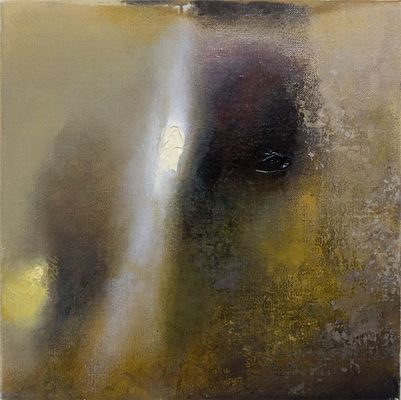
Always Will Need To Wear Winter Shirt Blue + Ochre Small Check Pattern
21 August - 21 September, 2015
Untitled
I am not a great reader of poetry but I always return to the work of Melbourne poet, Vincent Buckley (1925- 1988). Perhaps I find his most tantalising piece to be not a finished poem but a fragment left on a scrap of paper discovered on his desk after the poet’s death.
The poetry gathers like oil
In the word-core, and spreads
It has its music meet,
Its music is in movement.
This fragment is more the shell left behind from a volatile thought than a finished poem. I find the last two lines honest but awkward whereas the first two lines work like an arrow. Most likely he could not find a resolution so it was left. Still, in its present form, it remains an eloquent testimony to the ultimate failure of a medium to express mobile thought and sensation, in Buckley’s case, through verbal language. It’s an important matter because this is something all artists have to deal with regardless of the medium.
I have never written a poem, however, I am forever copying fragments from books on paper scraps in a vain effort to fix certain notions in my head. At first, they function as bookmarks that are sometimes returned to when I open the book. But before long, as they accumulate, they fall out littering the table interspersed with A4 photocopies, bills, books and medications.
To return to Buckley’s fragment, the first two lines very much evoke how I paint nowadays. As you age, detail diminishes and patches of light become more luminous and float. I feel the most honest way of dealing with this is by smearing the oil paint on the canvas with the fingers and working close-up, blind. Only if the patches coalesce into an approaching image can the work gain a life.
-
Jonathan Walker was born in Melbourne, Australia and brought up on a dairy farm in Gippsland. In the 1970’s he studied painting at RMIT and won the Harold Wright Scholarship to the British Museum, London. During the 1980’s he exhibited at Pinacotheca Gallery, Richmond and had work shown at the NGV and Heidi City Art Gallery. Over the same period he designed the cover for the “Epigenesi” LP by Giancarlo Toniutti, Italy and conducted a mail exchange work with Achim Wollscheid, Germany. The work with artists through the post resulted in an article published in the bicentenary issue of Art and Australia 1988. He showed in artist run spaces such as WestSpace in the 90’s and 2000’s, and until 2012, taught painting at Victoria University, which is where we (Colleen Ahern and Lisa Radford) as organisers of the exhibition, among many others, had the privilege of being his student.
Walker’s knowledge was imparted to students through the careful selection of music, literature, and artists found in books that he himself had ordered for the library. Walker’s strategy was the generosity of sharing his vast knowledge with references specific to each student and their context.
Walker’s paintings share a similar focus and intimacy.
This exhibition presents a small selection of recent paintings alongside a publication that includes Walker’s writing. Observational and analytical, Walker’s work is a type of material notation — the time of day, colour and how it is blended, the both specific and fleeting location of a reflection on lino or the question of whether a chair leg should be included in a painting.
Please join us on Friday August 21 between 6-8pm to celebrate the opening of the exhibition.
Curated by Colleen Ahern and Lisa Radford.
B. Wurtz
Curated by Nic Tammens
March 26 - April 4, 2015
B.Wurtz works from a basement studio in his home on Manhattan’s Lower East Side.
This local fact is attested to by the plastic shopping bags and newsprint circulars that appear in his work. As formal objects, they don’t make loud claims about their origins but nonetheless transmit street addresses and places of business from the bottom of this long thin island. Like plenty of artists, Wurtz is affected by what is local and what is consumed. His work is underpinned by this ethic. It often speaks from a neighborhood or reads like the contents of a hamper:
“BLACK PLUMS $1.29 lb.”
“Food Bazaar”
“USDA Whole Pork Shoulder Picnic 99c lb.”
“RITE AID Pharmacy, with us it’s personal.”
“H. Brickman & Sons.”
“Sweet Yams 59c lb."
Most of the work in this exhibition was made while the artist was in residence at Dieu Donne, a workshop dedicated to paper craft in Midtown. Here Wurtz fabricated assemblages with paper and objects that are relatively lightweight, with the intention that they would be easily transportable to Australia. This consideration isn’t absolute in Wurtz’s work, but was prescriptive for making the current exhibition light and cheap. Packed in two boxes, these works were sent from a USPS post office on the Lower East Side and delivered to North Melbourne by Australia Post.
Wurtz appears courtesy of Metro Pictures, New York.
Thanks to Rob Halverson, Joshua Petherick, Sari de Mallory, Matt Hinkley, Helen Johnson, Fayen d'Evie, Ask Kilmartin, Lisa Radon, Ellena Savage, Yale Union, and "Elizabeth".
John Nixon
"Archive"
December 15 - January 20, 2014
The presentation of John Nixon's archive offered a rare showcase of this extensive collection of the artist's own publications, catalogues, posters, ephemera, editions and more, from the mid 1980s onwards, alongside a selection of his artworks.
Organized by John Nixon, Joshua Petherick and Matt Hinkley.
"Habitat"
at Minerva, Sydney (organised by Joshua Petherick and Matt Hinkley)
November 15 - December 20, 2014
Lupo Borgonovo, Janet Burchill & Jennifer McCamley,
Lewis Fidock, HR Giger, Piero Gilardi, Veit Laurent Kurz,
Cinzia Ruggeri, Michael E. Smith, Lucie Stahl, Daniel Weil, Wols
Press Release:
“...It contained seven objects. The slender fluted bone, surely formed for flight, surely from the wing of some large bird. Three archaic circuitboards, faced with mazes of gold. A smooth white sphere of baked clay. An age-blackened fragment of lace. A fingerlength segment of what she assumed was bone from a human wrist, grayish white, inset smoothly with the silicon shaft of a small instrument that must once have ridden flush with the surface of the skin - but the thing’s face was seared and blackened.”
William Gibson, “Count Zero”, 1986
"Autumn Projects Archive"
Curated by Liza Vasiliou
March 6 - March 15, 2014
World Food Books, in conjunction with the Virgin Australia Melbourne Fashion Festival 2014, presented the Autumn Projects archive, consisting of a selection of early examples in Australian fashion with a particular interest in collecting designers and labels from the period beginning in the 1980’s, who significantly influenced the discourse of Australian Fashion.
Curated by Liza Vasiliou, the exhibition provided a unique opportunity to view pieces by designers Anthea Crawford, Barbara Vandenberg, Geoff Liddell and labels CR Australia, Covers, Jag along with early experimental collage pieces by Prue Acton and Sally Browne’s ‘Fragments’ collection, suspended throughout the functioning World Food Books shop in Melbourne.
H.B. Peace
presented by CENTRE FOR STYLE
November 14, 2013
"Hey Blinky, you say chic, I say same"
Anon 2013
H.B. Peace is a clothing collaboration between great friends Blake Barns and Hugh Egan Westland. Their pieces explore the divergences between 'character’ and ‘personality’ in garments....etc
Special Thanks to Joshua Petherick and Matt Hinkley of WFB and Gillian Mears
and a Very Special Thank you to Audrey Thomas Hayes for her shoe collaboration.
Janet Burchill & Jennifer McCamley
"Aesthetic Suicide"
May 10 - June 8, 2013
The first of our occasional exhibitions in the World Food Books office/shop space in Melbourne, "Aesthetic Suicide" presented a body of new and older works together by artists Janet Burchill & Jennifer McCamley, including videos, prints, a wall work, and publications.
During shop open hours videos played every hour, on the hour.
2024, English
Hardcover, 308 pages, 22 x 30 cm
Published by
Nero / Rome
$95.00 - Out of stock
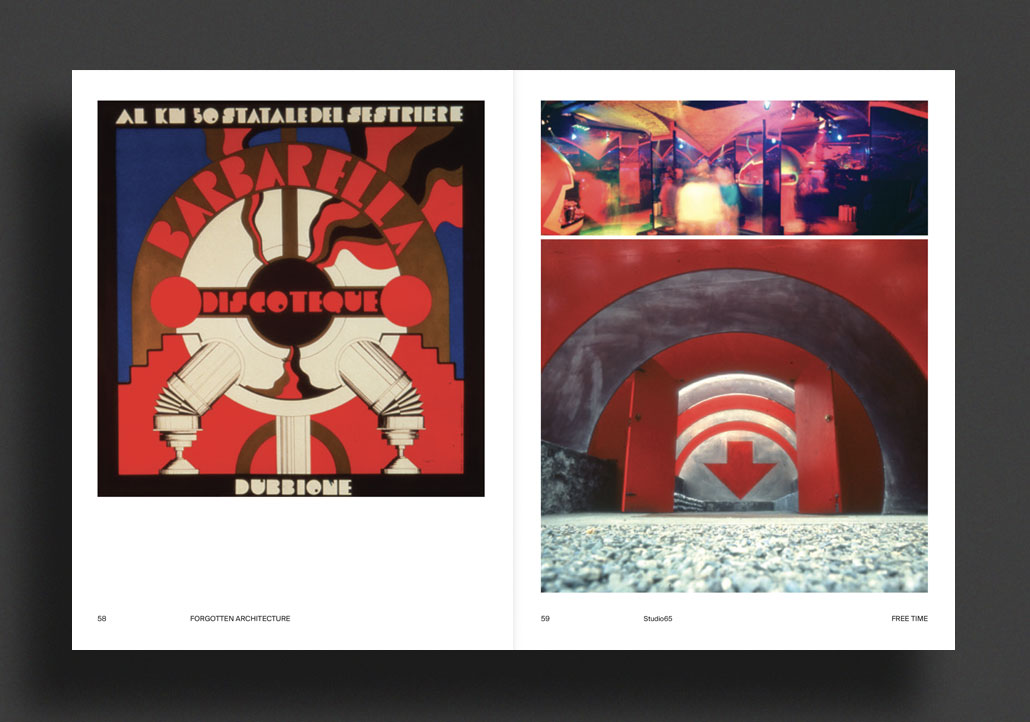
A "minor" and alternative history of architecture.
Initially founded as a Facebook group in May 2019, Forgotten Architecture's goal is to research and unearth not well known modern architecture worldwide. The idea behind it is simple: to recover projects by little-known architects and works left in the shadows of the masters, to delve into the work of "minor" figures, and to unite alternative takes on the History of Architecture as a complement to university courses.
The book maintains its distinctive features of a collective, dynamic, and horizontal experience born on a social network. The publication uses the architectural categories most frequently featured in the group as guiding themes, providing for each project a collection of photographic materials, documents, and drawings from prominent professional firms, institutions, and private archives—such as Fornasetti, Gaetano Pesce, Nanda Vigo, Vitra. Ephemeral architecture, gas stations, night clubs, playgrounds, houses, vacation resorts, cemeteries, churches, architectures in music videos.
Several forgotten projects by well renowned architects, such as the house designed for Arnaldo Pomodoro by Ettore Sottsass Jr. and the avant-garde Binishells by Dante Bini, are published exclusively in the book, alongside drive-in churches, flying houses, psychedelic inflatable architectures, etc.
At the end of the book, a series of critical essays reflect on its characteristics as a collective and pedagogical experience, considering the repercussions of this experience on the discipline of architecture through different points of view.
Bianca Felicori is an architect, author, curator, and PhD researcher at UCLouvain, Bruxelles (FNRS Research Fellow). Her research aims to demonstrate the convergence of artistic and architectural experimentation that emerged in Europe and America during the 1960s and 1970s. Felicori has curated exhibitions and cultural programs, collaborating with institutions such as Triennale Milano and La Biennale di Venezia. Her articles have been featured in magazines such as Domus and AD, and she currently serves as a guest curator for the Elle Decor Italia architectural section. In 2019, she founded the Forgotten Architecture Facebook group, about less-known modern architecture worldwide. In 2021, she co-founded the cultural center DOPO? in Milan.
2017, English
Softcover, 256 pages, 22 x 27 cm
1st Edition, Out of print title / used / very good
Published by
The Tate Gallery / London
$80.00 - Out of stock
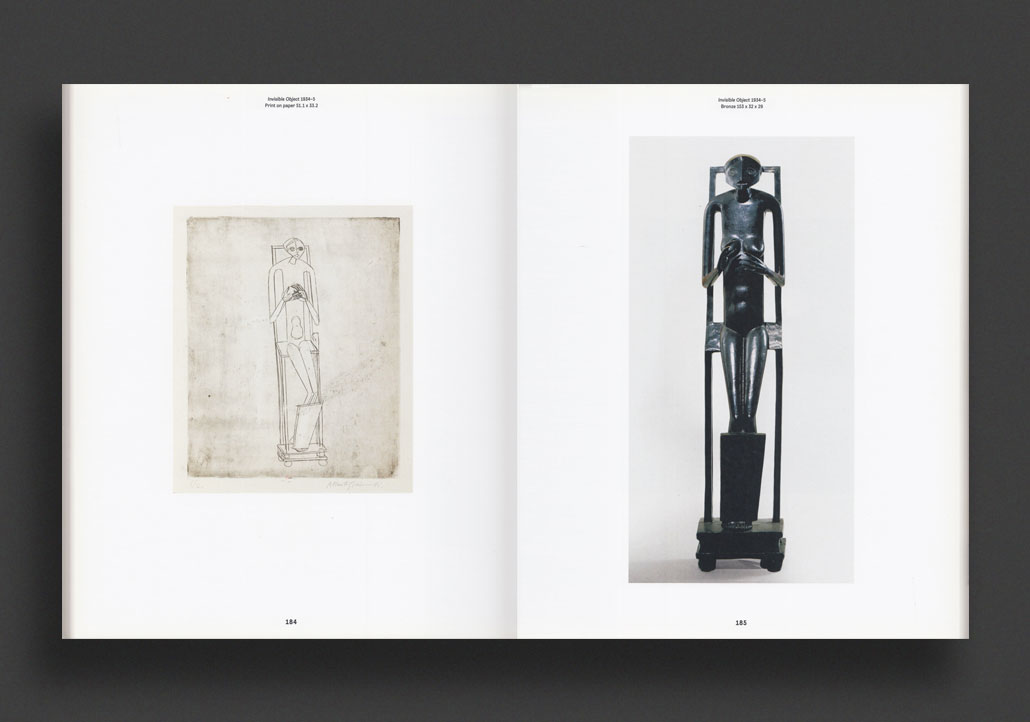
Alberto Giacometti (1901–1966) is one of the few artists of the last century whose work is almost more recognizable than his name. His distinctive elongated figures are well known, and appear in major museum collections worldwide. However, the story of Giacometti’s evolution, from his first professional works of art through his surrealist compositions to the emergence of his mature style, has rarely been explored fully and in depth. This comprehensive overview of his career focuses on the art, the people, and the events that influenced him, and on the original and experimental way in which he approached and developed his work. An illustrated glossary of texts on his life and art is accompanied by a plate section of strikingly beautiful illustrations of his sculptures, paintings, and drawings as well as sketchbooks, decorative works, photographs, and studio ephemera, much of which have never been published before. This accessible survey is the definitive resource for fans of the artist.
Out-of-print, first edition, Very Good copy with light cover wear.
1980, French
Hardcover cloth-bound slipcase, 13 plates + text insert, 42.2 x 30.9 cm
Signed,
1st Edition, Out of print title / used / very good
Published by
Galerie Bijan Aalam / Paris
Editions Natiris / Paris
$550.00 - Out of stock
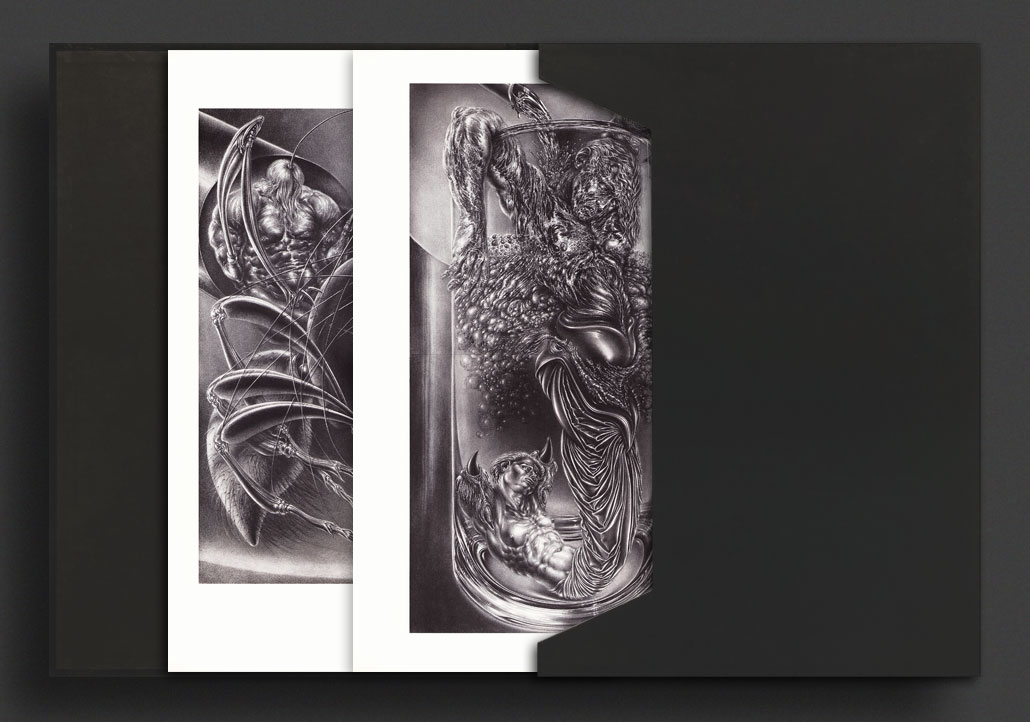
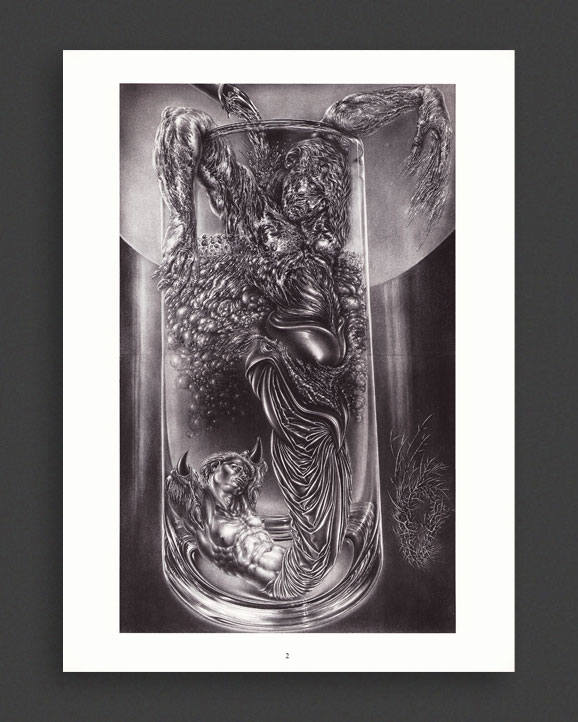
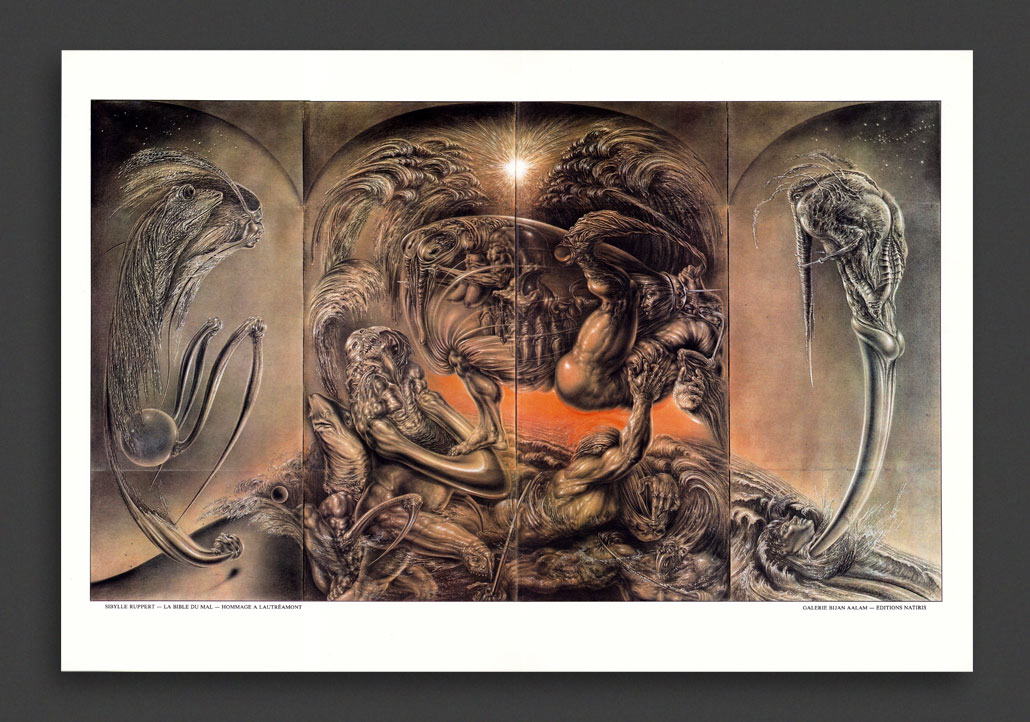
"An artist with a secret, terrible and painful gaze, Ruppert's work boldly plunges us into the darkest abysses of our souls, to the depths of our unconfessed sexuality, into these cursed areas that we refuse with a self-protective horror instilled by the taboos of society."
Extremely rare, signed and numbered cloth-bound portfolio by German artist Sibylle Ruppert (1942—2011), published in 1980 by Galerie Bijan Aalam / Editions Natiris, Paris, published in an edition of 1300. With a preface by Alain Robbe-Grillet, this magnificent portfolio illustrating Lautréamont's Les Chants de Maldoror (1868) presents 13 litho-printed loose-leaf plates in colour and monochrome, exquisitely reproducing Ruppert's artworks in striking large-format. The leading plate folds-out to a double-size spread. Accompanied by a selection of passages by Comte de Lautréamont (Isidore Lucien Ducasse) to whom this title is dedicated and from which these illustrations are inspired. Numbered and signed by the artist in the colophon. A complete copy of this major published work of this incredible artist.
"The opening pages of Georges Bataille’s 1928 novella, Story of the Eye, recount a violent three-way sex scene on the edge of a cliff. As the libidinal frenzy nears its peak, rain starts to fall, introducing mud and dirt into the already visceral cocktail of piss, cum, and other bodily fluids in free flow. If this literary vignette had a visual equivalent, it might well be the Sisyphean compositions of Sibylle Ruppert, in which hybrid limbs, flesh, machinery, and the natural elements all commingle and fuse into one another without beginning or end, obliterating any notion of bodily integrity. Bataille, the Marquis de Sade, and Comte de Lautréamont make up the unholy trinity who nourished Ruppert’s dark fantasies. The violent explosiveness of eroticism, desire, pain, destruction, and resurgence so dear to those authors is channeled in Ruppert's works"—Anya Harrison
Sibylle Ruppert (1942, Frankfurt—2011, Paris) created a radical oeuvre of paintings, drawings and collages throughout the 1960s—1980s in a brutal aesthetic of dark surrealism, mixing death and sexuality in a swirling dislocation, a frenetic tearing shared by aggregates of tangled bodies such as the morbid and obscene writings of Marquis de Sade, Comte de Lautréamont, both which she illustrated, or that of Georges Bataille. Ruppert was born during an air raid on September 8th, 1942, the first night of massive bombing of Frankfurt during World War II. At age of 10 she had a religious enlightenment and she insisted on becoming a nun. Discouraged by her parents, in 1959, at the age of 17, Sibylle was instead admitted to the Städelschule in Frankfurt to study art. Shortly after, she left for Paris, where she enrolled in a ballet school and became a successful dancer. During a visit to New York with her friend H.R. Giger, Ruppert decided to give up her dancing career, returned to Germany and became a full-time artist and to teach at her father's drawing school. In 1976 she moved back to Paris and exhibited her large format charcoal drawings, inspired by the writings of de Sade, Lautréamont and Georges Bataille, and her collages and paintings at the Gallery Bijan Aalam. French intellectuals and great minds like Alain Robbe-Grillet, Pierre Restany, Henri Michaux and Gert Schiff were fascinated by her work and tried to interpret her infernal world. When the gallery closed in 1982, she returned to teaching and she started giving art classes in prisons, mental hospitals and drug addiction rehabilitation centers. Sibylle Ruppert died in 2011, withdrawn from any social and public life.
"Here offered to the revulsed senses, the secret shames of anatomy: torn orifices, spilled entrails, secretions, losses. A sharp point, I said. Yes, the sticky and the sharp seem, now, to generate each other in a circle, the fine knife of torture to belong to the same monster as the ignominious flesh which is cut (unbunched), the sexes are invert, insidiously, and invaginate the murder weapon[...]"—A. Robbe-Grillet
Very Good copy with some light wear and tanning to spine of hardcase.
2024, English
Hardcover (w. dust jacket), 264 pages, 22.8 x 15.2 cm
Published by
Arcade Publishing / New York
$49.00 - Out of stock
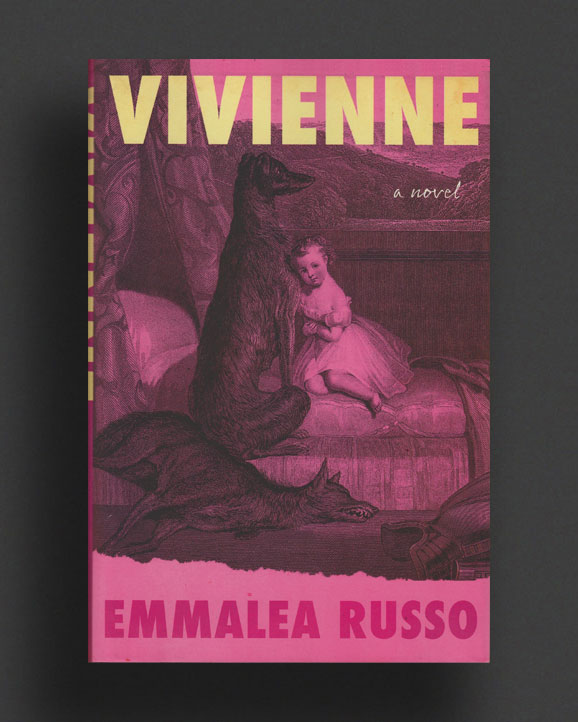
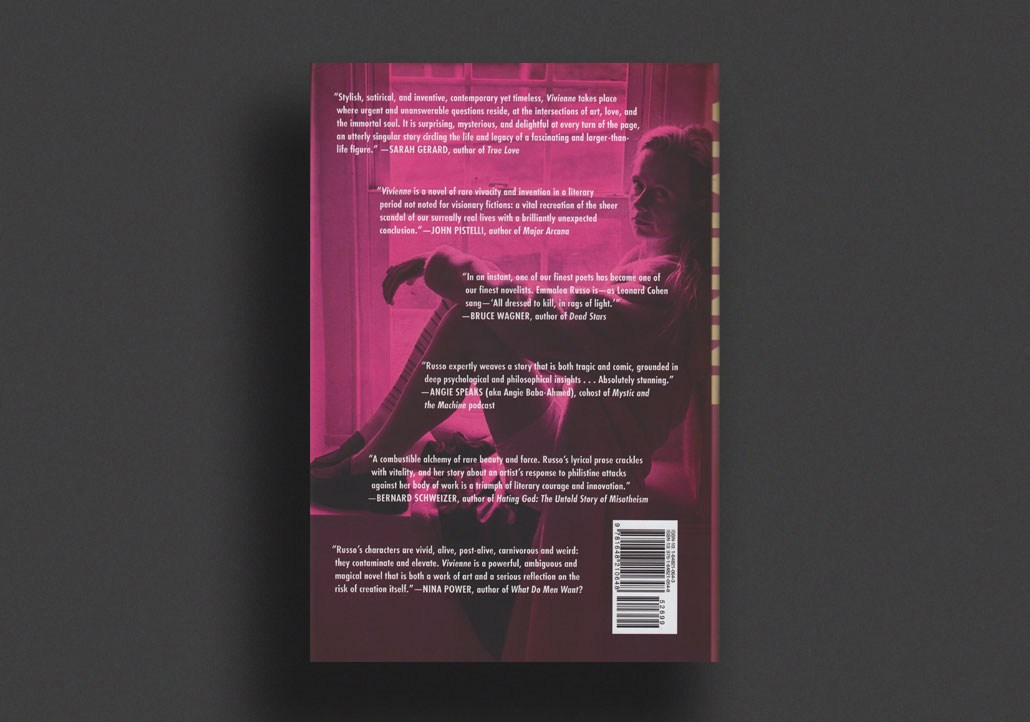
"A skin-crawling drama about three generations of women and their relationships to one another. . . a satirical comedy that is at its core a book of poetry, or literary art."—Artnet
Did Vivienne Volker Kill Wilma Lang?
This question has dogged Vivienne ever since Wilma jumped from a window to her death shortly after Volker stole her lover, the visionary artist Hans Bellmer, in the 1970s. Once a famous artist and fashion icon, Volker is now in her eighties and spends her days in religious contemplation in rural Pennsylvania alongside her daughter Velour Bellmer, her granddaughter Vesta Furio, her much younger boyfriend-a garbageman named Lou-and Franz, the family dog. Their quiet lives are disrupted when Vivienne's work is selected for inclusion in a high-profile retrospective called "Forgotten Women Surrealists" at the prestigious NAT Museum. However, when rumors of her past misdeeds begin to circulate and she is dropped from the show, a gallery curator enters the picture hoping to capitalize on the buzz generated by the controversy, sending the family's tensions, hopes, and dreams to a dizzying peak.
Set over the course of a fateful week, Vivienne deftly weaves surreal prose with a Greek chorus of internet comments and text messages, to ask the questions: what is the cost of vision, what is the price of art? What connects creation and procreation, a life and an afterlife?
"Russo's characters are vivid, alive, post-alive, carnivorous and weird: they contaminate and elevate. Vivienne is a powerful, ambiguous and magical novel that is both a work of art and a serious reflection on the risk of creation itself."—Nina Power, author of What Do Men Want?
2024, English
Softcover, 356 pages17.2 x 10.8 cm
Published by
Inside The Castle / Kansas
$55.00 - Out of stock
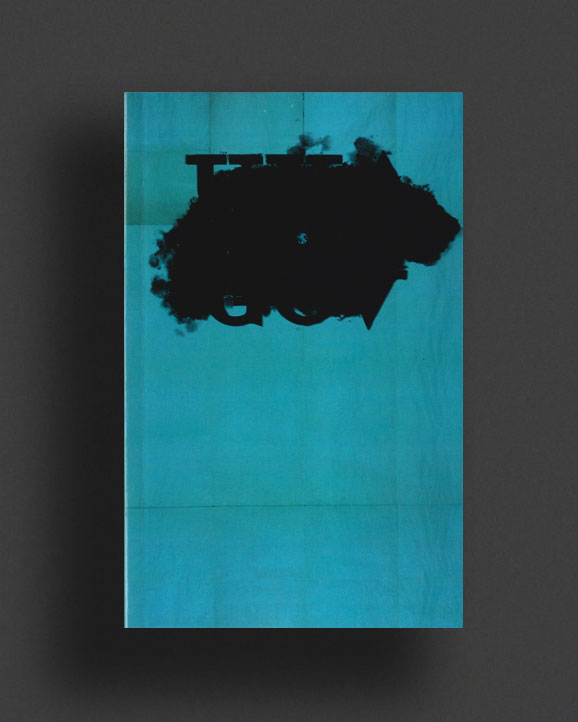
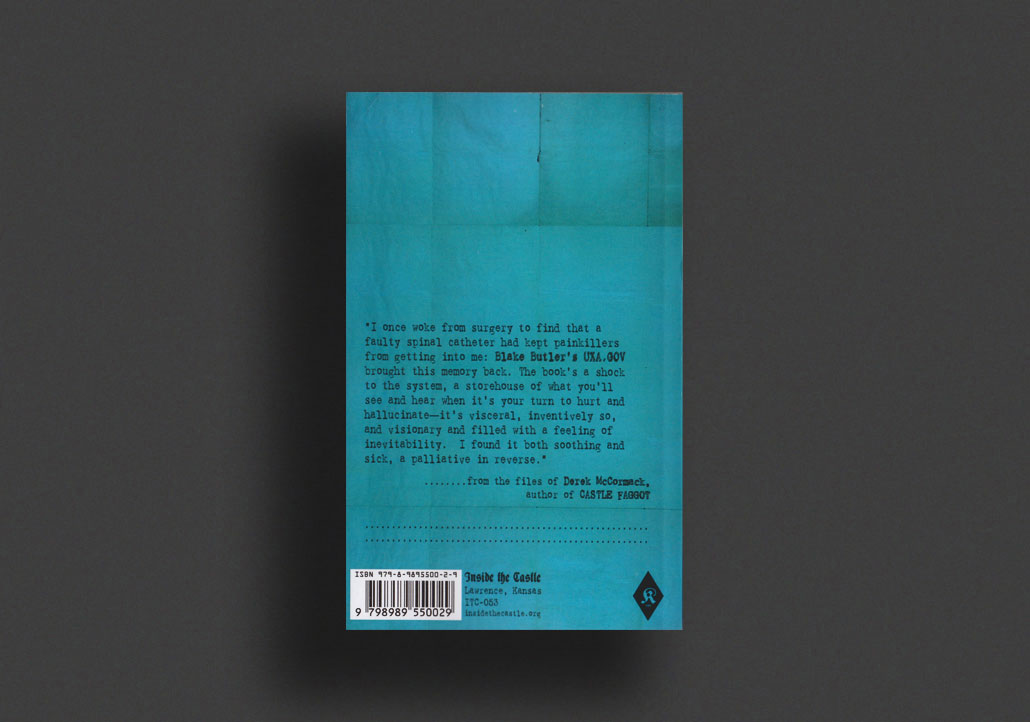
"I once woke from surgery to find that a faulty spinal catheter had kept painkillers from getting into me: Blake Butler's UXA.GOV brought this memory back. The book's a shock to the system, a storehouse of what you'll see and hear when it's your turn to hurt and hallucinate-it's visceral, inventively so, and visionary and filled with a feeling of inevitability. I found it both soothing and sick, a palliative in reverse."—Derek McCormack
This text was composed and revised in fits and starts from 2010 to 2024, often in wildly different states, rooms, moods, modes, spirits, and epochs. It began as a response to John Zorn’s “Treatment for a Film in Fifteen Scenes” (composed in the 1980s; published in Arcana: Musicians on Music. Zorn, J. (ed), Granary Books, 2000, alongside work by Ikue Mori, Bill Frisell, Eyvind Kang, Marc Ribot, Mike Patton, etc.), a 7-page outline consisting of 254 ‘shots’ (or prompts) described by brief (1-12 word) lines of all caps text. As a novel, UXA.GOV is meant to be read as a film; perhaps the kind one might otherwise only be allowed to view through slits in a training helmet deep before being work-released into what remains of the land where America once was.—Blake Butler
2024, English
Softcover, 160 pages, 20.32 x 13.67 cm
Published by
Semiotext(e) / Los Angeles
$34.00 $25.00 - In stock -
A novel about escape and connection, class, sex, and queer intimacy in the American Midwest.
The oldest story: an insider pretends to be an outsider and receives praise for his empathy and imagination and intelligence. Maybe some asshole even says bravery. An outsider pretends to be an insider, is exposed as a fraud, a liar, and burned to the ground.
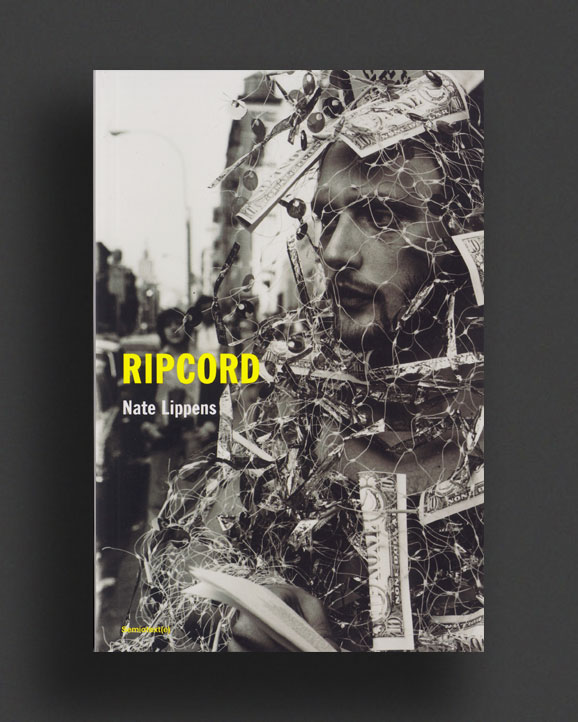
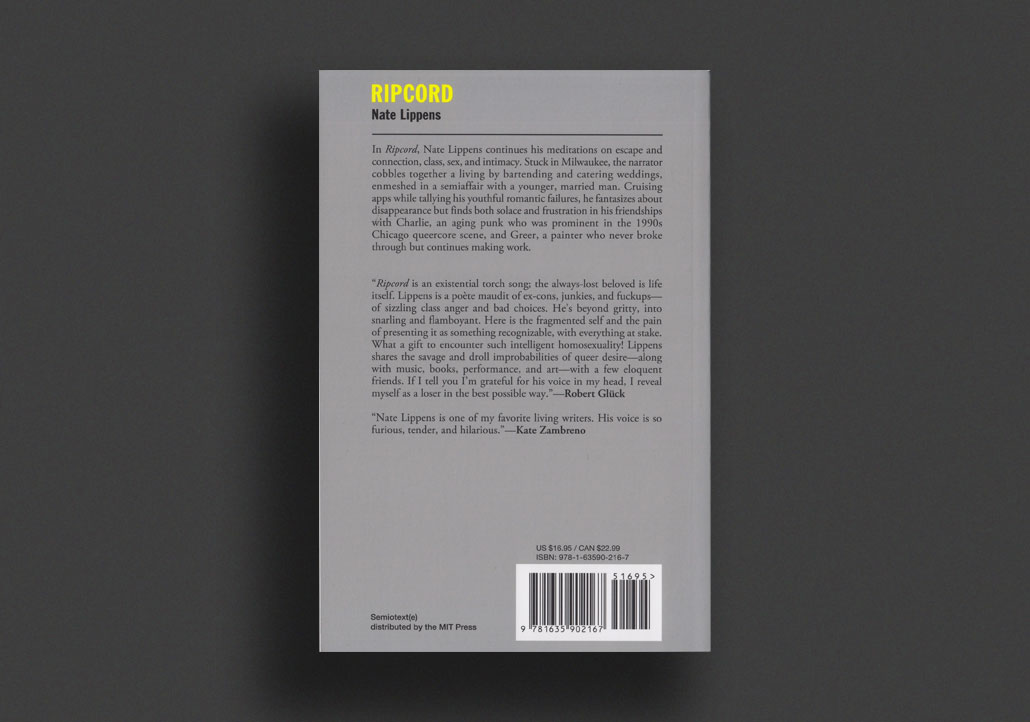
In Ripcord, Nate Lippens continues his meditations on escape and connection, class, sex, and intimacy. Stuck in Milwaukee, the narrator cobbles together a living by bartending and catering weddings, enmeshed in a semiaffair with a younger, married man. Cruising apps while tallying his youthful romantic failures, he fantasizes about disappearance but finds both solace and frustration in his friendships with Charlie, an aging punk who was prominent in the 1990s Chicago queercore scene, and Greer, a painter who never broke through but continues making work.
“Ripcord is an existential torch song; the always-lost beloved is the world itself that declines to love us back. Lippens is a poèt maudit of ex-cons, junkies, and fuckups—of sizzling class anger and bad choices. He's beyond gritty, into snarling and flamboyant. Here is the fragmented self and the pain of presenting it as something recognizable, with everything at stake. What a gift to encounter such intelligent homosexuality! Lippens shares the savage and droll improbabilities of queer desire—along with music, books, performance, and art—with a few eloquent friends. If I tell you I'm grateful for his voice in my head, I reveal myself as a loser in the best possible way.”—Robert Glück, author of About Ed
2024, English
Softcover, 136 pages, 20.32 x 13.67cm
Published by
Semiotext(e) / Los Angeles
$36.00 - Out of stock
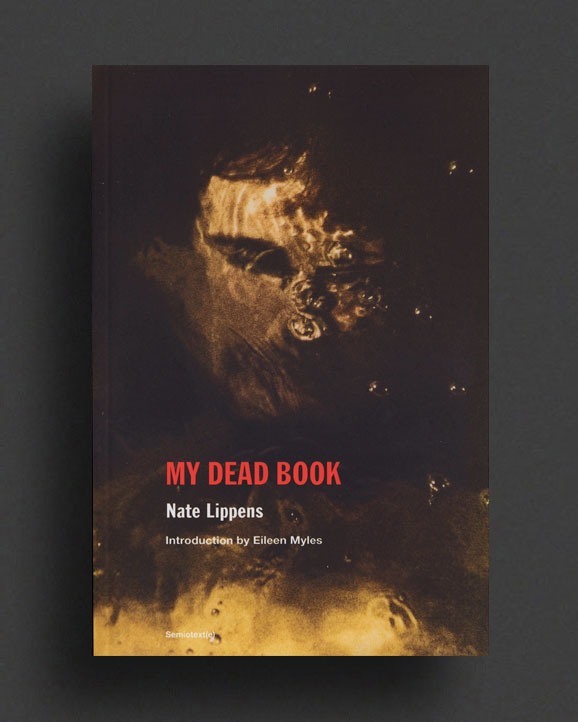
A rumination on survival, queer aging, and estrangement that was a finalist for the Republic of Consciousness Prize.
Introduction by Eileen Myles
My dead friends are back. I lie in bed at night and see them.
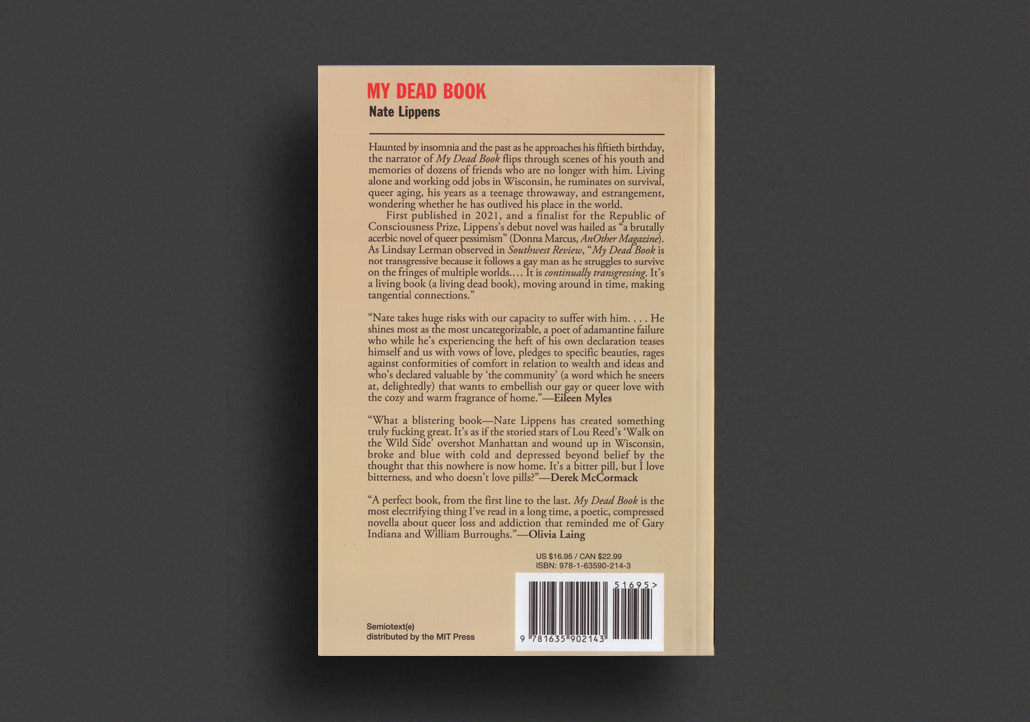
Haunted by insomnia and the past as he approaches his fiftieth birthday, the narrator of My Dead Book flips through scenes of his youth and memories of dozens of friends who are no longer with him. Living alone and working odd jobs in Wisconsin, he ruminates on survival, queer aging, his years as a teenage throwaway, and estrangement, wondering whether he has outlived his place in the world.
First published in 2021, Lippens's debut novel was hailed as “a brutally acerbic novel of queer pessimism” (Donna Marcus, AnOther Magazine). As Lindsay Lerman observed in Southwest Review, “My Dead Book is not transgressive because it follows a gay man as he struggles to survive on the fringes of multiple worlds. … It is continually transgressing. It's a living book (a living dead book), moving around in time, making tangential connections.”
This new edition includes an introduction by LAMBDA Literary Award-winning American poet and writer, Eileen Myles.
2023, English
Softcover, 312 pages, 20.5 x 13.5 cm
Published by
Semiotext(e) / Los Angeles
$38.00 - Out of stock
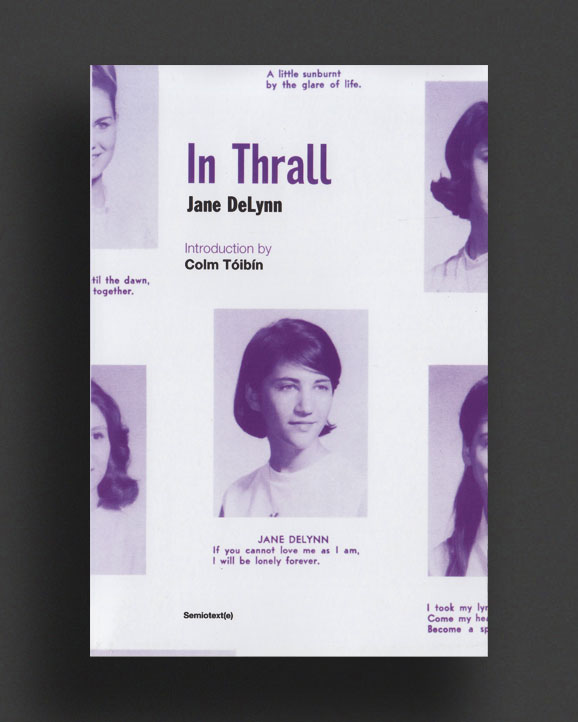
A touchstone novel of lesbian adolescence, set years before gay liberation.
Introduction by Colm Tóibín
“Dear Miss Maxfield … what I'm really afraid of is that I am a homosexual human being. I wish you were one too but I don't think it's possible there could be so many in one school, do you?—probably there is only one person who is homosexual in one place at one time and that one person (I am afraid) is me …”
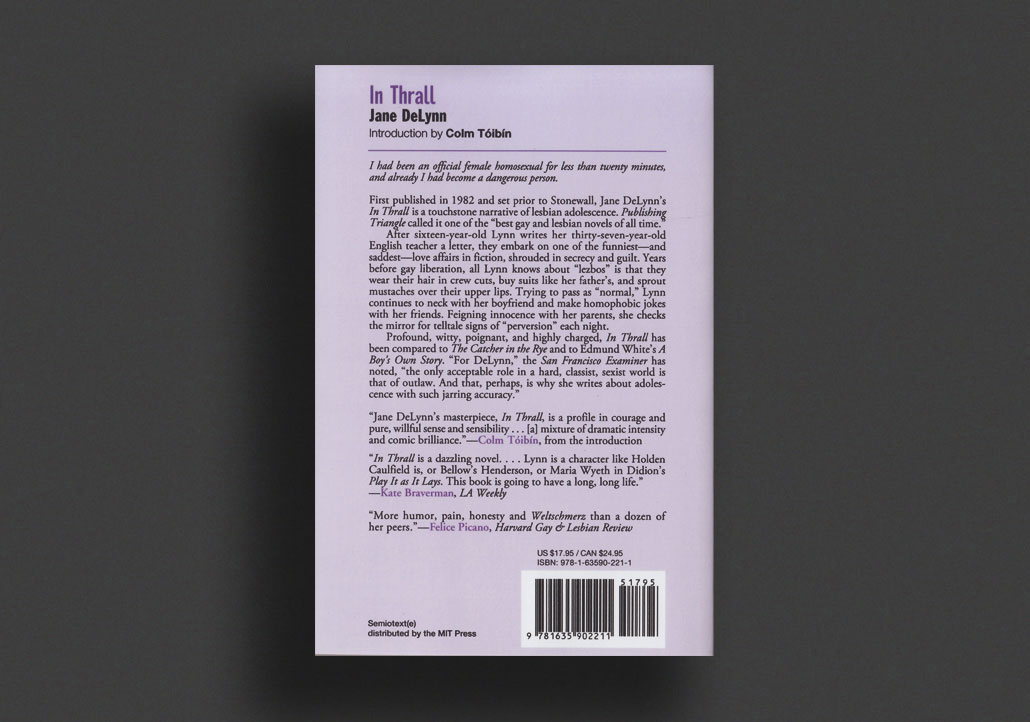
First published in 1982 and set prior to Stonewall, Jane DeLynn's In Thrall is a touchstone narrative of lesbian adolescence. Publishing Triangle called it one of the “best gay and lesbian novels of all time.”
After sixteen-year-old Lynn writes her thirty-seven-year-old English teacher a letter, they embark on one of the funniest—and saddest—love affairs in fiction, shrouded in secrecy and guilt. Years before gay liberation, all Lynn knows about “lezbos” is that they wear their hair in crew cuts, buy suits like her father's, and sprout mustaches over their upper lips. Trying to pass as “normal,” Lynn continues to neck with her boyfriend and make homophobic jokes with her friends. Feigning innocence with her parents, she checks the mirror for telltale signs of “perversion” each night.
Profound, witty, poignant, and highly charged, In Thrall has been compared to The Catcher in the Rye and to Edmund White's A Boy's Own Story. “The single most wonderful quality of this novel,” the Los Angeles Times Book Review writes, “is its absolute credibility.”
This new edition includes a foreword by Irish author Colm Tóibín.
Jane DeLynn is the author of the widely acclaimed novels Leash, Real Estate, and Some Do. Her work has appeared in Paris Review, Mademoiselle, Glamour, Harper's Bazaar, the New York Times, New York Observer, and Tikkun, and she lived in Saudi Arabia as a correspondent for Mirabella and Rolling Stone during the Gulf War. Her novel Real Estate was named a New York Times Notable Book of the Year.
Colm Tóibín is the author of eleven novels, including Long Island; The Magician, winner of the Rathbones Folio Prize; The Master, winner of the Los Angeles Times Book Prize; Brooklyn, winner of the Costa Book Award; The Testament of Mary; and Nora Webster; as well as two story collections and several books of criticism. He is the Irene and Sidney B. Silverman Professor of the Humanities at Columbia University and has been named as the Laureate for Irish Fiction for 2022–2024 by the Arts Council of Ireland. Three times shortlisted for the Booker Prize, Tóibín lives in Dublin and New York.
2024, English
Softcover, 96 pages, 21.6 x 15.2 cm
Published by
Afterall / London
The MIT Press / Massachusetts
$38.00 - Out of stock
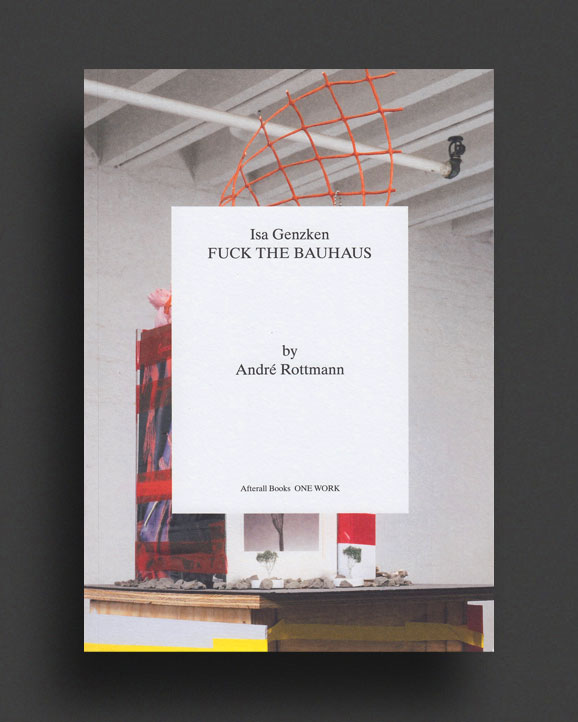
A strikingly original analysis of Isa Genzken’s move towards merging sculptural and architectural morphologies into a trailblazing practice of contemporary assemblage.
Fuck the Bauhaus, a series of audacious architectural models for future high-rise buildings in Manhattan, marks a poetic and provocative shift in Isa Genzken’s artistic oeuvre. Made in the year 2000, out of quotidian objects and cheap materials foraged in the streets and stores of New York, these sculptural assemblages depart from the German artist’s ‘post-Minimalist’ works begun in the 1970s. The earlier works conjured the haunting spectres of catastrophe, destruction and failed utopia, as well as the potential for freedom amidst the ruins of post-War reconstruction culture.
Analysing Genken’s post–2000 penchant for appropriation, collage and montage, André Rottmann draws on the writings of Deleuze and Guattari, Bruno Latour and other theorists of "assemblage," to show how her ‘late style’ is not a return to (neo-)avant-garde traditions but a powerful reimagining of them for the contemporary moment.
André Rottmann is an Assistant Professor for Art and Media Theory at the European University Viadrina Frankfurt (Oder), Germany, and the editor of the October Files volume John Knight.
2024, English
Softcover, 192 pages, 21.6 x 14 cm
Published by
Pluto Press / UK
$45.00 - Out of stock
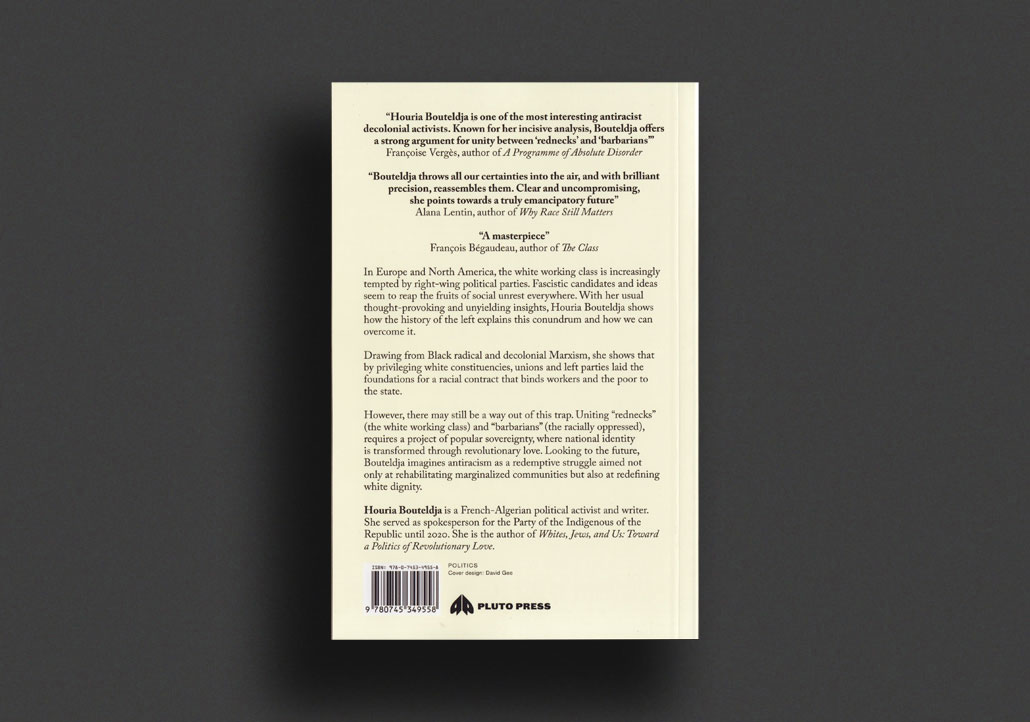
In Europe and North America, the white working class is increasingly tempted by right-wing political parties. Fascistic candidates and ideas seem to reap the fruits of social unrest everywhere. With her usual thought-provoking and unyielding insights, Houria Bouteldja shows how the history of the left explains this conundrum and how we can overcome it.
Drawing from Black radical and decolonial Marxism, she shows that by privileging white constituencies, unions and left parties laid the foundations for a racial contract that binds workers and the poor to the state.
However, there may still be a way out of this trap. Uniting “rednecks” (the white working class) and “barbarians” (the racially oppressed), requires a project of popular sovereignty, where national identity is transformed through revolutionary love. Looking to the future, Bouteldja imagines antiracism as a redemptive struggle aimed not only at rehabilitating marginalized communities but also at redefining white dignity.
“Houria Bouteldja is one of the most interesting antiracist decolonial activists. Known for her incisive analysis, Bouteldja offers a strong argument for unity between ‘rednecks’ and ‘barbarians’”—Françoise Vergès, author of A Programme of Absolute Disorder
“Bouteldja throws all our certainties into the air, and with brilliant precision, reassembles them. Clear and uncompromising, she points towards a truly emancipatory future”—Alana Lentin, author of Why Race Still Matters
“A masterpiece”—François Bégaudeau, author of The Class
Houria Bouteldja is a French-Algerian political activist and writer. She served as spokesperson for the Party of the Indigenous of the Republic until 2020. She is the author of Whites, Jews, and Us: Toward a Politics of Revolutionary Love.
1988, English
Softcover, 48 pages, 26 x 21 cm
1st US Edition, Out of print title / used / very good
Published by
Westfälischer Kunstverein / Münster
Daadgalerie / Berlin
Kunstraum München / Münich
$70.00 - Out of stock
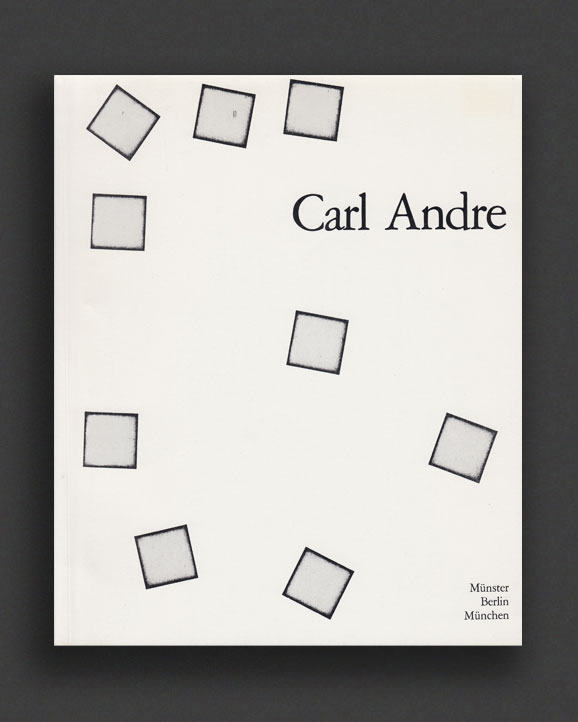
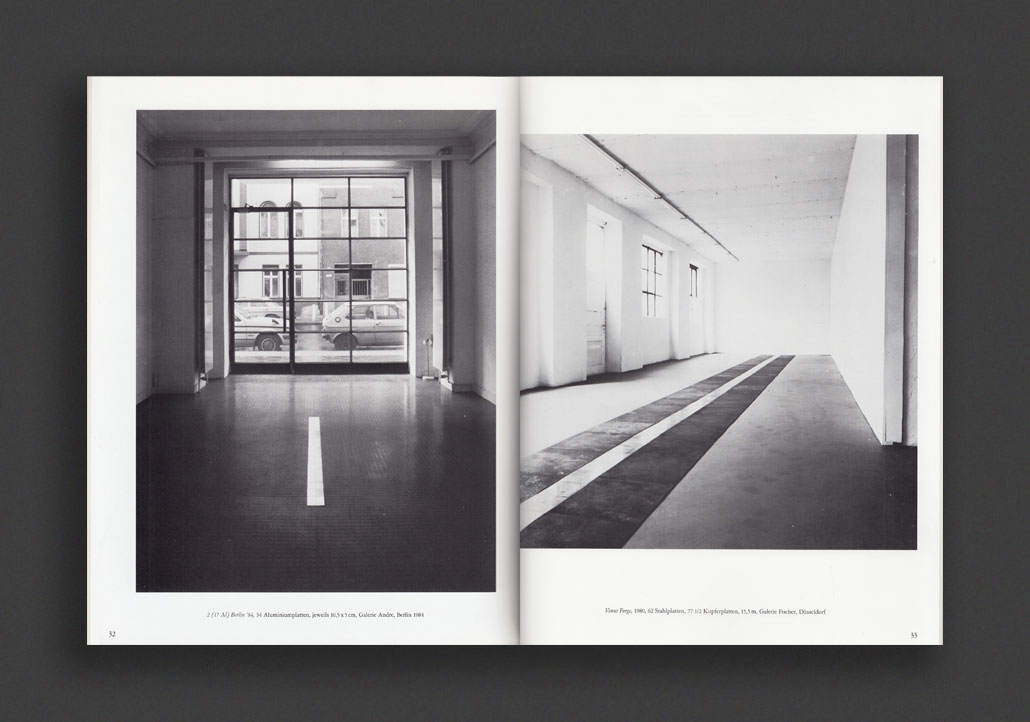
Exhibition catalogue published in conjunction with show held in 1984-1985 at the Westfälischer Kunstverein, Münster. Traveled to Berliner Künstlerprogramm des DAAD (Galerie im Körnerpark), Berlin; and the Kunstraum, München. Organised by René Block Thomas Deecke, Michael Tacke. Profusely illustrated throughout, accompanied by essays in English and German by Thomas Deecke, Christine Tacke, and Wolfgang Siano. Also includes biography, exhibition history, and a brief bibliography.
Very good copy, with cancelled National Gallery of Victoria Library stamp added to the publisher's edition stamped page.
1974, English
Softcover, unpaginated, 17.5 x 11 cm
1st Edition, Out of print title / used / very good
Published by
Weproductions / London
$75.00 - In stock -
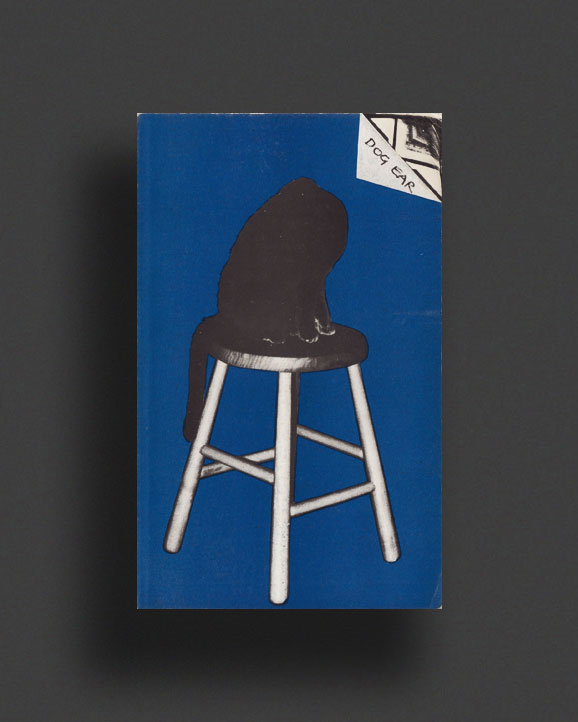
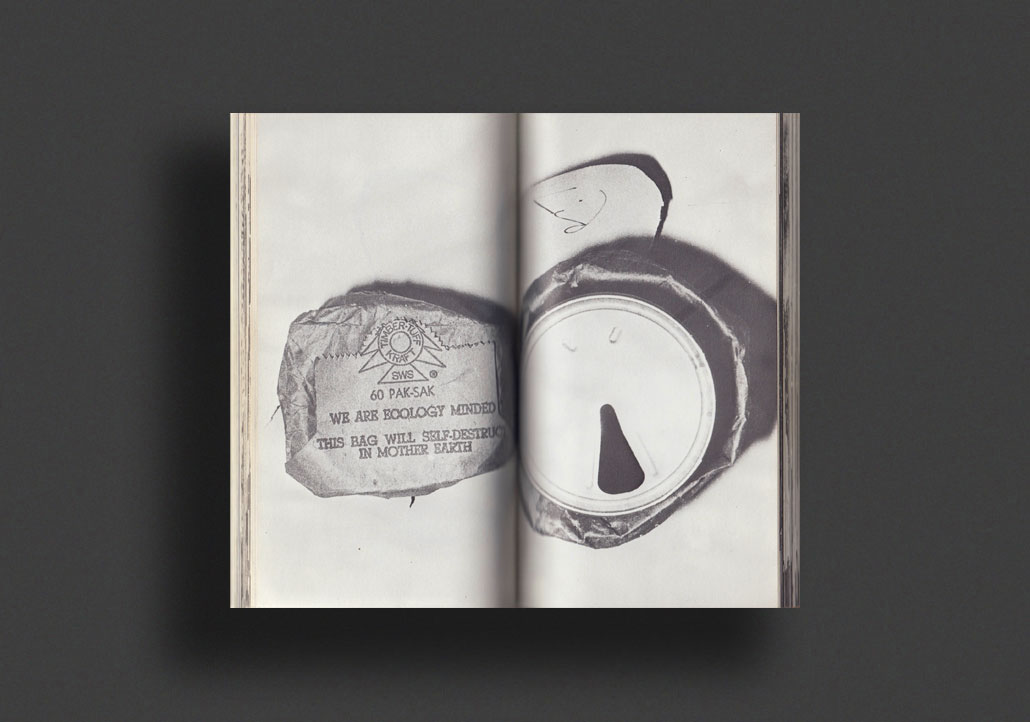
London: Weproductions, 1974. First Edition. Octavo. An artist's photo-book published in 1974 by Scottish artist and publisher, Telfer Stokes (b. 1940) in collaboration with Weproductions in London. What a joy of the page! Entirely comprised of full-page black-and-white images, Spaces starts off as a series of seemingly straightforward presentations of photographic facts: the flatiron building, a studio interior, another city building. These are interspersed with various kinds of typewriter paper identified only by name in their upper right hand corners that are suspiciously hard to tell apart. The images proceed to get more confusing and unreliable as the book progresses. Pictures that seem to be fixed illustrations of newspaper articles take on a life of their own while the text around them remains stable. The scale of everything shifts radically when the camera pulls out to reveal the newspaper as part of a much larger collage propped up against a big arched doorway – but just for a moment. It zooms back in to lead the reader down a rabbit hole and into an ocean of shifting perspectives. If you can surrender to the disorienting pleasure of this photographic text you will be rewarded with insight into the radical narrative possibilities of artists books.
Very Good copy. Intentionally artist-clipped "dog ear" cover corner. Some rubbing to spine and covers.
1988, English
Softcover, 78 pages, 30.5 x 23 cm
1st Edition, Out of print title / used / very good
Published by
KLF Publications / UK
$550.00 - In stock -
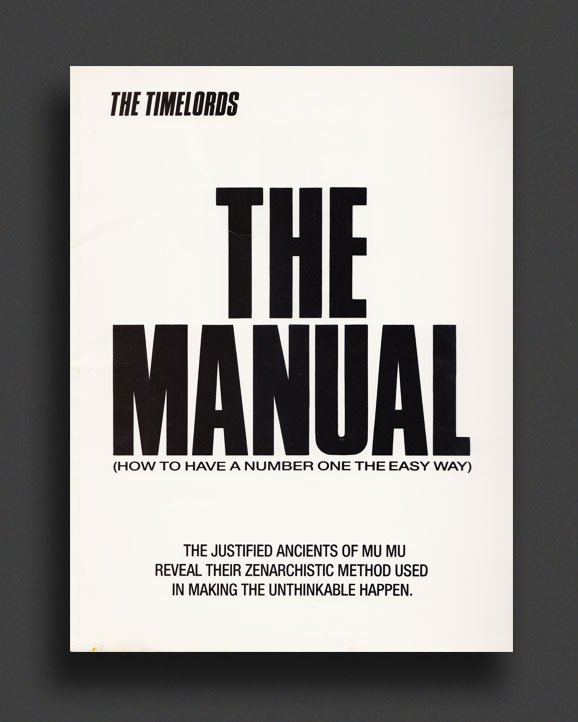
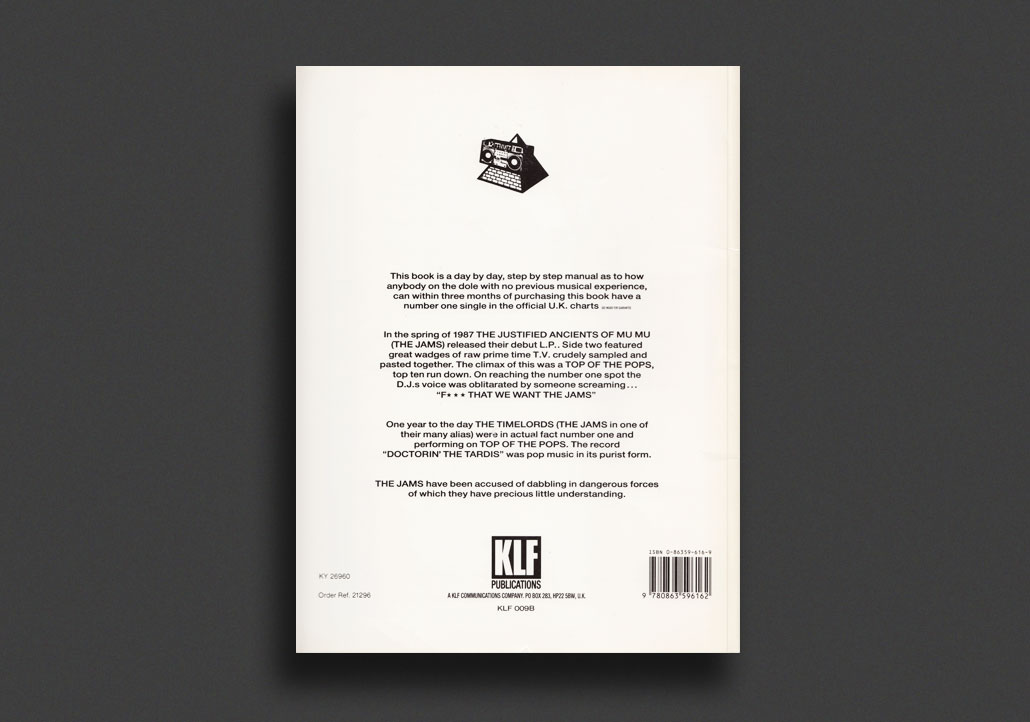
Extremely rare very first 1988 edition of The Manual (How to Have a Number One the Easy Way), the legendary publication by "The Timelords" ("Time Boy" and "Lord Rock", aliases of Bill Drummond and Jimmy Cauty, better known as The KLF). The Manual is a 'Zenarchistic' step-by-step guide to achieving a No.1 single with no money or musical skills, and a case study of the duo's UK novelty pop No. 1 "Doctorin' the Tardis". The Manual is an unparalleled expose of the reality behind the pop-music business and while names may have changed since its first issue, the mechanics of financing, producing and promoting a hit set out here remain absolutely relevant.
"Firstly, you must be skint and on the dole. Anybody with a proper job or tied up with full time education will not have the time to devote to see it through... Being on the dole gives you a clearer perspective on how much of society is run... having no money sharpens the wits. Forces you never to make the wrong decision. There is no safety net to catch you when you fall." "If you are already a musician stop playing your instrument. Even better, sell the junk."
Very collectible in this first, self-published large format edition (KLF009B). The following editions (also very hard to find) were much smaller in format with differing graphics and contents.
Very Good, clean copy, with only light wear to stiff covers and corners.
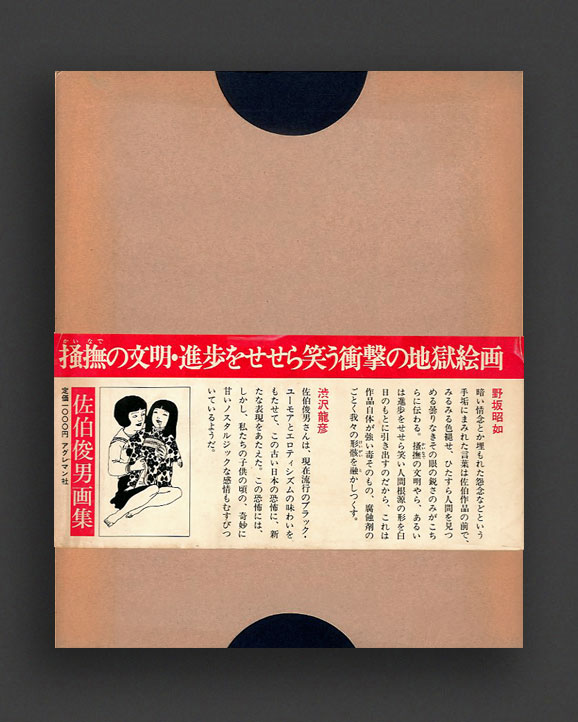
1970, Japanese
Softcover (w. slipcase and obi), 104 pages, 31 x 24 cm
1st US Edition, Out of print title / used / very good
Published by
Agureman-sha / Tokyo
$550.00 - Out of stock
Super rare first major book of collected artworks by ero-guro master Toshio Saeki (1945—2019), published in 1970 by Agureman after his 1968 self-published collection. Stunning large-format softcover collection of uncompromising black and white images that would propel the career of this legendary underground artist of the comic macabre, housed in original publisher's cardboard slipcase and with the rarely preserved illustrated obi-strip.
Toshio Saeki (1945—2019) was an illusive Japanese illustrator and painter, and icon of 1970s Tokyo counterculture, known for combining Japanese folklore, Yōkai spirits and elements of Western art with his own sophisticated aesthetics to create a unique, sensational world of eros, dark humour, and horror. Given the title “Erotic Engineer” by Timothy Leary, Saeki's provocative art broke all sexual taboos, questioned Japanese ideology and traditional views on love, desire and gender roles. Saeki’s surgically-precise graphic work is closely related to the Japanese cultural phenomenon ‘Erotic, Grotesque, Nonsense’ (ero, guro, nansensu).
“Toshio Saeki conjures death with a pen”—Shūji Terayama, 1969.
Good—VG copy with tanning and wear with some light creasing, light foxing, light chipping to case spine. In remarkable, preserved shape for this title!
2001, English
Hardcover (w. dust jacket), 144 pages, 28.6 x 27.5 cm
1st Edition, Out of print title / used / fine
Published by
Bullfinch Press / New York
$250.00 - Out of stock
First hardcover edition of this landmark monograph of Irving Penn's striking still life photography spanning 1938—2000, personally supervised by the artist. Penn is one of the leading photographers of the 20th century. Former curator of The Museum of Modern Art in New York, John Szarkowski once commented, “Penn has been one of photography’s conspicuous innovators and distinguished performers in at least two of the medium’s oldest and most successful genres: still life and portraiture.” Although he was best known for his fashion photography, Penn created more than one hundred still lifes over the course of his career and these are still some of the most coveted of his pictures. This beautifully printed and now very collectible volume collects 98 of his greatest still life images, reflecting his initial training as a painter as well as his studies with Russian-American photographer and designer Alexey Brodovitch. Underpinning all of Penn's work as a photographer is his special talent in the still life genre, to which he applied his signature resolve to prune away anything that did not contribute to the picture. From his earliest work at Vogue to his latest series of personal work, this resulted in powerful images that invite contemplation of Penn’s acute awareness of objects and their placement. Penn frequently included elements of memento mori and selected subject matter that could, at first glance, seem unworthy of close examination, which give his images a "bite" that lingers.
Fine copy in Fine dust jacket.
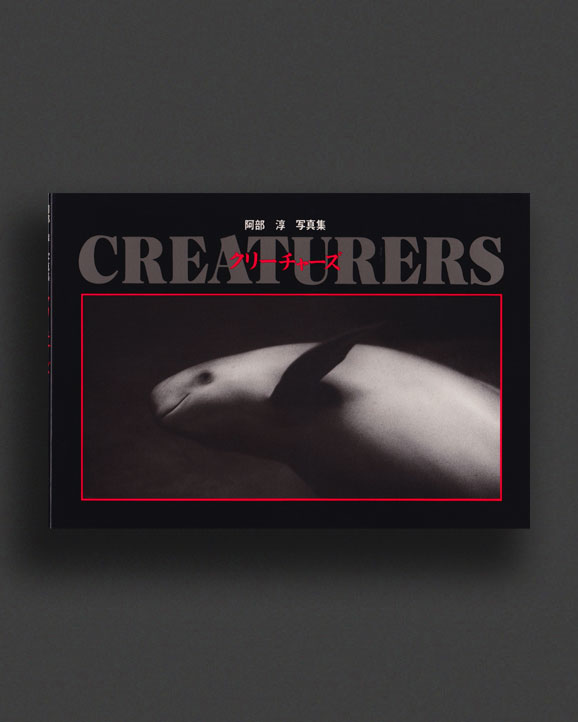
1989, Japanese
Softcover (w. dust jacket), 52 pages, 26 x 18.5 cm
1st Edition, Out of print title / used / fine
Published by
Village Press / Tokyo
$80.00 - Out of stock
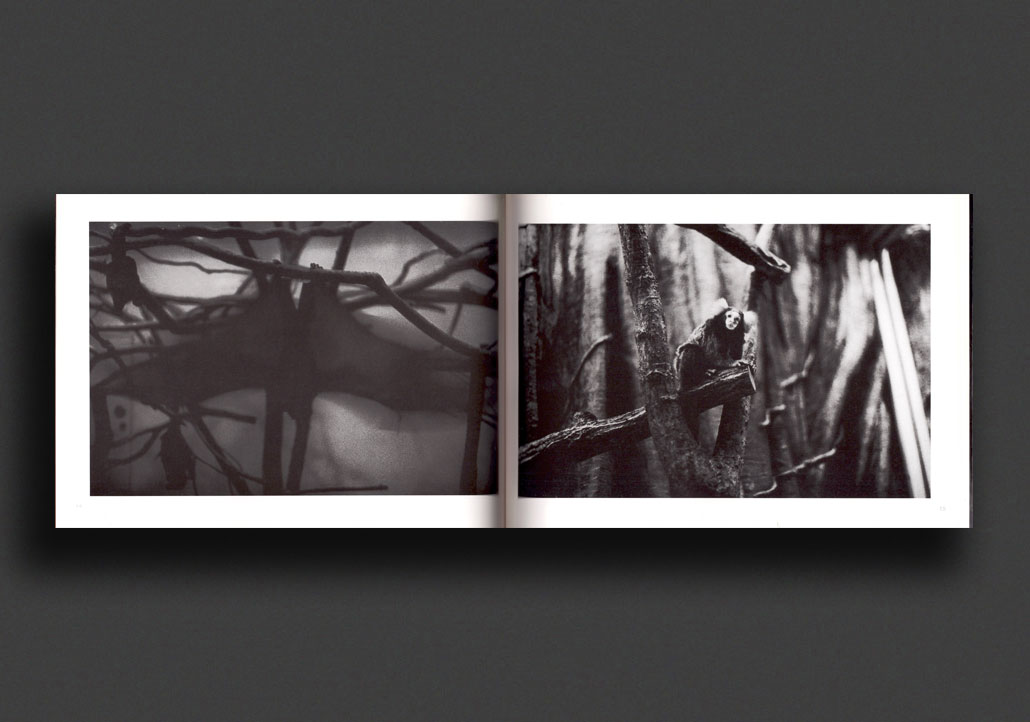
First 1989 edition of Japanese photographer Jun Abe's first photo book, Creaturers [sic], an incredibly melancholic masterpiece of ghostly black and white images of animals "captured" in artificial environments — zoos, aquariums, arboretums, lab cages, the urban street, exhibited at Picture Photo Space in Osaka in 1989. Abe's haunting, spectral images are an unsettling reminder of the cold alienating reality of man's interference with mother nature. During the time he produced these images of animals, Jun Abe (b. 1955) was the official photographer of the butoh dance group Byakko-sha. Unlike the lazy comparisons to Winogrand's The Animals, Abe depicts no humorous animal/human interactions, because Abe depicts no humans. He does not need to. In depicting his creatures he reflects man's cruelty directly back at him. This death dance of captivity is far more attuned to the concerns of butoh's "body on the edge of crisis". Abe's dark, cold, dreamlike imagery of animals and plants here are both quietly beautiful and desperately sorrowful, abstract and emotionally direct. An outstanding documentary photographer, Abe went on to become well known for his street photography of people, including Citizens: 1979–1983, which won the Society of Photography Award. He has an almost uncanny ability to seek out – and capture – those moments in the chaos of everyday life which can tell entire stories in the frame of a photograph. Creaturers is no different in this regard, yet here there is a pervasive presence of a second aperture beyond the lens that frames the subject in every image, that of man's built-world to dominate the natural one. A very under-rated Japanese photo book. At times even slightly foreshadowing Jochen Lempert's work to come.
"In Abe-chan's photographs ... a feeling of endless suspension ripples, as if something created by God were changing within a man-made landscape created by urban humans — a zoo — and continuing its journey between the extremes of God and man, like a circus tightrope walker on a taut steel rod, on a precarious tightrope where you never know when you might fall."—Isamu Osuga (rough translation from book essay)
Fine copy.
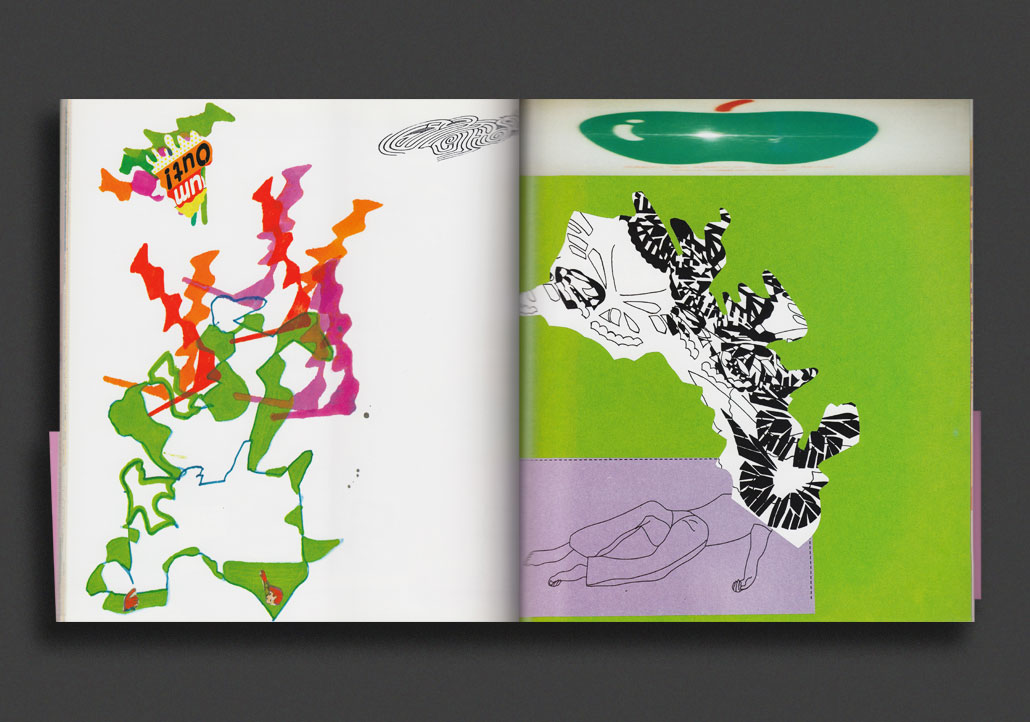
1996, Japanese
Softcover, unpaginated, 24.6 x 23 cm
1st Edition, Out of print title / used / very good
Published by
Little More / Tokyo
$160.00 - Out of stock
First edition of this classic artist's book from Yamantaka Eye (Boredoms) published in 1996! First major book by EYƎ, packed to the brim with his incredible cosmic noise collage, issued only in Japan. Like Pedro Bell (Funkadelic), Corky McCoy (Electric Miles), Sun Ra, punk bootleg 7s, and Rammellzee in a blender. Includes flyer of the 1996 Nanoo launch exhibition inserted!
EYƎ is a Japanese vocalist and visual artist, best known as co-founder of the influential rock music band Boredoms and Naked City. He has changed his stage name several times, from Yamatsuka Eye, to Yamantaka Eye, to Yamataka Eye and now simply calls himself EYƎ.
EYƎ is a member of the bands Hanatarash, UFO or Die, Puzzle Punks, Noise Ramones and Destroy 2. He is notorious for his vast, confusing discography and countless guest appearances. Notable collaborations include his work with Nam June Paik, Sonic Youth, Yamamoto Seiichi & Yamazaki Maso, Bill Laswell's Praxis and John Zorn's groups Naked City and Painkiller.
As well as his music, EYƎ is famous for his mixed-media style of art that utilises airbrush, marker pen and collage, amongst other materials. His artworks have adorned a number of records, including the majority of Boredom’s releases and, perhaps more famously, Beck's Midnite Vultures. Drawing as much from Japanese mythology as from his musical influences, his work aims to complement the music as well as to provide another dimension to the sound.
Very Good (this copy without obi-strip).
1993, English / Italian
Softcover (textured w. foiled french-folds), 56 pages, 21 x 27 cm
1st Edition, Out of print title / used / very good
Published by
AETA / Melbourne
$50.00 - In stock -
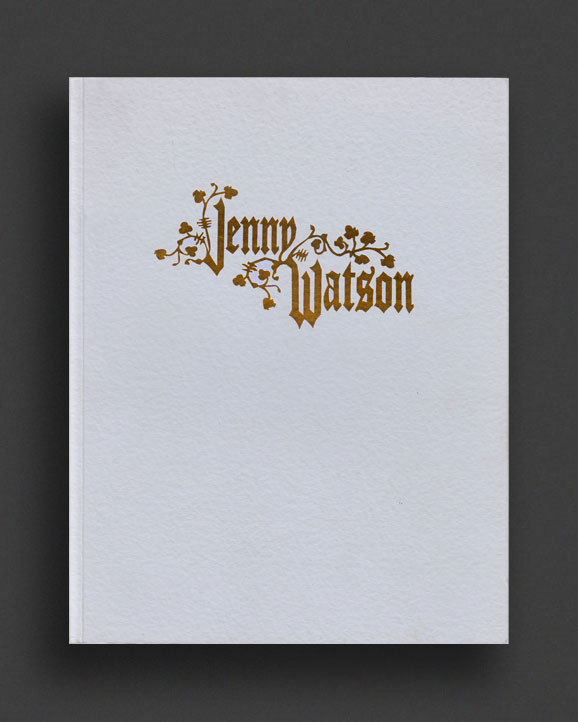
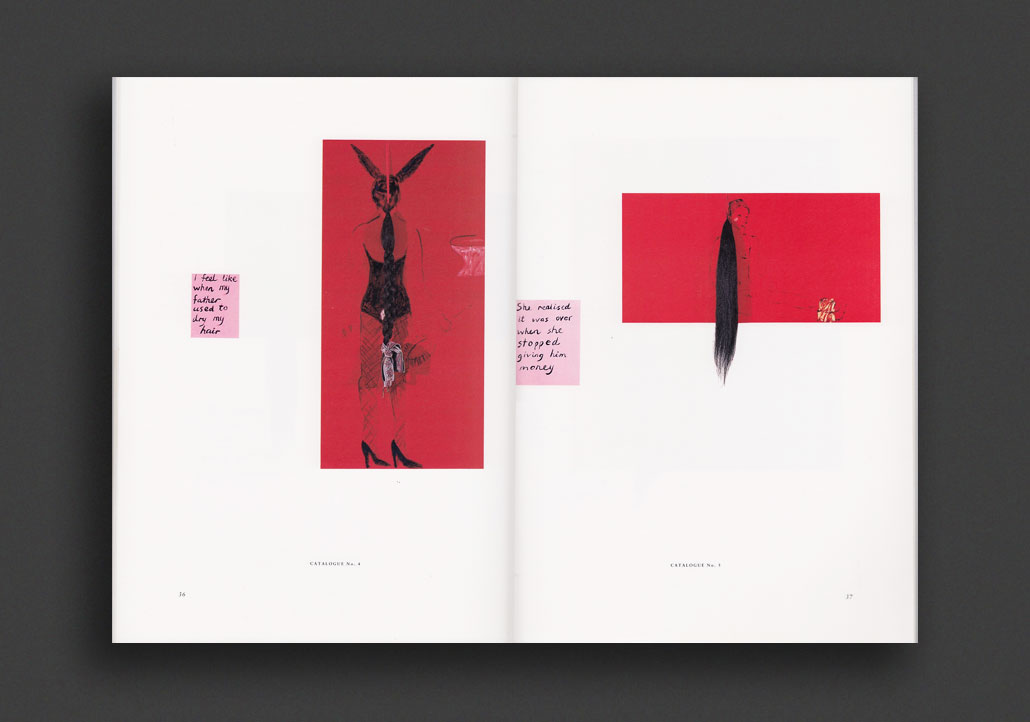
Painting with Veils and False Tails" was published on the occasion of Jenny Watson's exhibition at the Australian Pavilion Biennale Gardens, 45th International Exhibition of Art, Venice Biennale 13 June - 10 October 1993.
This handsome bi-lingual (English/Italian) catalogue includes text by Judy Annear, colour and b&w reproductions of Jenny Watson's paintings, portraits, a catalogue of works, and a biography/bibliography.
"Jenny Watson (b. 1951) is one of Australia’s most respected artists. As commissioner and curator for the Australian Pavilion at the 45th Venice Biennale, I selected Watson as one who could command an international audience for the quality of her work as a painter and installation artist. She was also the first woman to represent Australia in Venice with a solo exhibition. Watson showed Painting with tails and false veils – a series of paintings in two groups, one made from red velvet and horse tails and the other from taffeta and netting. Both groups of works were accompanied by smaller text panels. The luxurious material values of rich velvet and luminescent taffeta were offset by sketchy painting and elliptical texts on pink canvas. Watson has pared down her work over the years to deal with her private world and its relationship to the exterior. These webs of relationships are sometimes claustrophobic and restrictive, at other times productive and enhancing.
The mind is a mirror on which the body is endlessly re-described. The effort to communicate whether through words or pictures is as much with herself as it is with the world. There is an inevitable repetition of motifs, for example, the obsessive depiction of the self denotes aspects of the ego which appear through projection onto beloved things whether words or phrases, objects, animals or people."—Judy Annear
Very Good copy.
1998, English / French
Softcover, 21.5 x 15.5 cm
1st Edition, Out of print title / used / very good
Published by
Purple Institute / Paris
$280.00 - Out of stock
The scarce third issue (of eight total, published between 1998-2001) of Olivier Zahm's short-lived, erotically charged photography journal "Purple Sexe". This issue profusely illustrated throughout, containing portfolios by Anette Aurell, Vanessa Beecroft, Ben Cho, Claude Closky, Yasmine Eslami, Jason Farrer, Carolina Gonzales, Jamil Gs, Noritoshi Hirakawa, Bernadette Van-Huy, Richard Kern's photoshoot of Lucy McKenzie, Chris Moor, Justine Parsons, Jack Pierson, Terry Richardson, Katja Rahlwes, Francois Rotger, Gilles Tonelado, and more. Art Direction by Christophe Brunnquell.
In 1992 Olivier Zahm and his partner Elein Fleiss printed the first issue of Purple Prose, a Parisian literary art zine that over the years has evolved into Purple Fashion Magazine. Soon after the birth of Purple Prose, Zahm created spin-off publications like Purple Sexe, Purple Fiction and what we now know and love, Purple Fashion. Zahm aimed at fusing together his two worlds, fashion and art, in creating Purple and Purple Fashion. Purple Sexe remains one of the scarcest of the early Purple series', published in the same format as Purple Prose and Purple Fiction in late 1990s. A magazine devoted to sexuality, only 8 issues of Purple Sexe were ever published between 1998 - 2001, edited by Olivier Zahm and commencing the same year as Purple, which was a fusion of Purple Prose, Fiction, Fashion, and Sexe.
Very Good copy.
1995, English
Softcover, 128 pages, 27 x 23 cm
1st Edition, Out of print title / used / very good
Published by
The Drawing Center / New York
Hardy Marks Publications / Honolulu
$160.00 - Out of stock
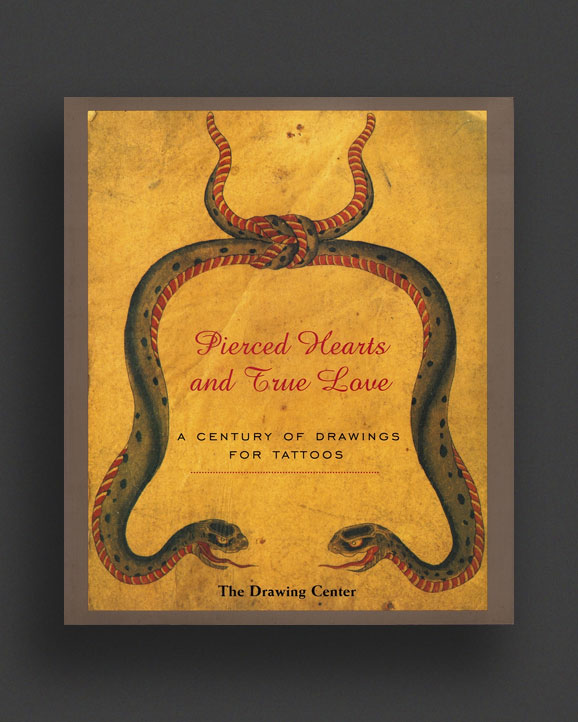
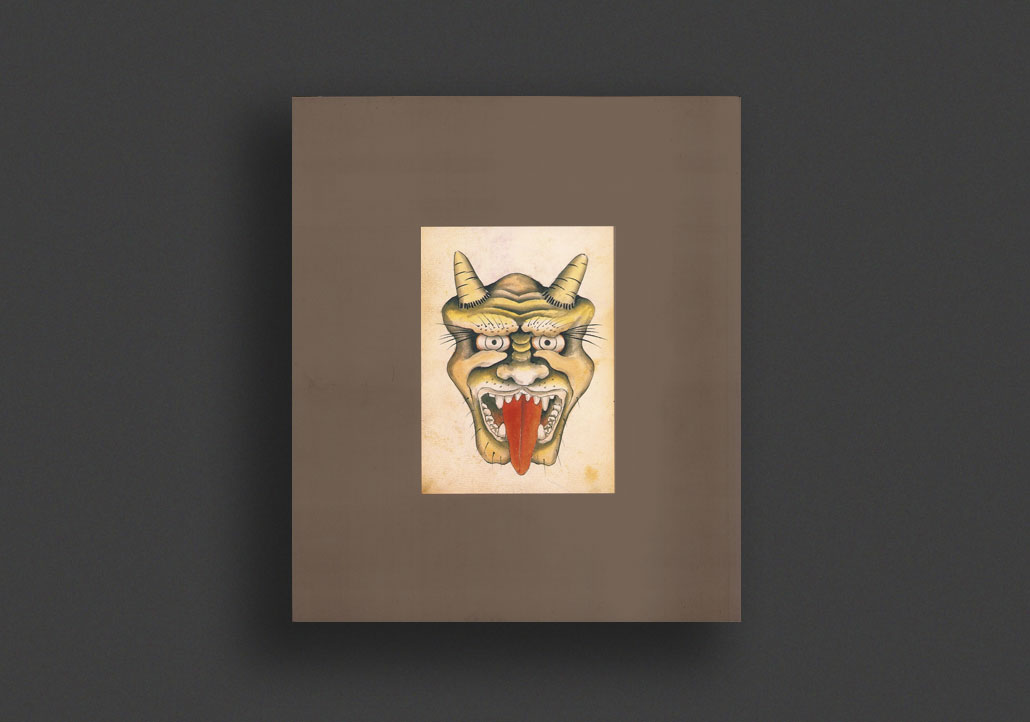
First and only edition of this fascinating and rare catalogue from 1995 published to accompany the exhibition organised by Legendary tattoo artist Don Ed Hardy for the Drawing Center in New York, and a definitive history of the enigmatic medium of tattoo art. The illustrations range from tattoo flashes from the early 1900s to actual work from the present day. Lavishly illustrated in colour throughout, accompanied by essays by Margo DeMello, Alan B. Govenar, Don Ed Hardy, Mark C. Taylor, Michael McCabe. Co-published with Hardy Marks Publications in Honolulu.
"Tattooing is not only widely practiced, but in recent years has become quite fashionable. Accordingly, over the course of this century, designs for tattoos have evolved from standardized "flash" to completely customized work that allows for more detail, creativity, and even abstract painterly effects. With its curious collection of imagery, including vintage freak show advertisements, this book explores the development of the iconography of the tattoo and examines the age-old rite and tradition of embellishing the human body with images, words, and designs. Completely absorbing, the book traces the remarkable changes in tattoo styles and practices in the past several decades that have contributed significantly to this medium's ever-growing popularity and diversity. Particularly fascinating is a chapter devoted to tattooed women that includes photographs from the turn of the century to the present."
Very Good copy.
1978, English
Hardcover (w. dust jacket), 60 pages, 23 x 29 cm
1st Edition, Out of print title / used / very good
Published by
Sackett & Marshall / London
$160.00 - In stock -
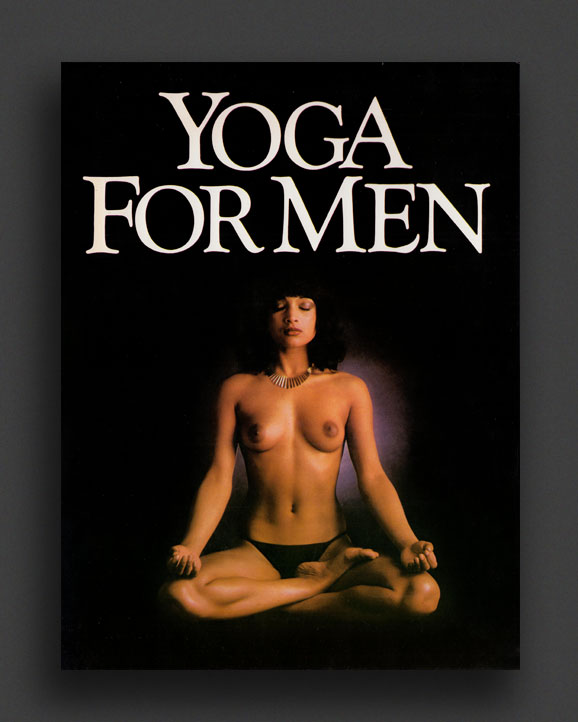
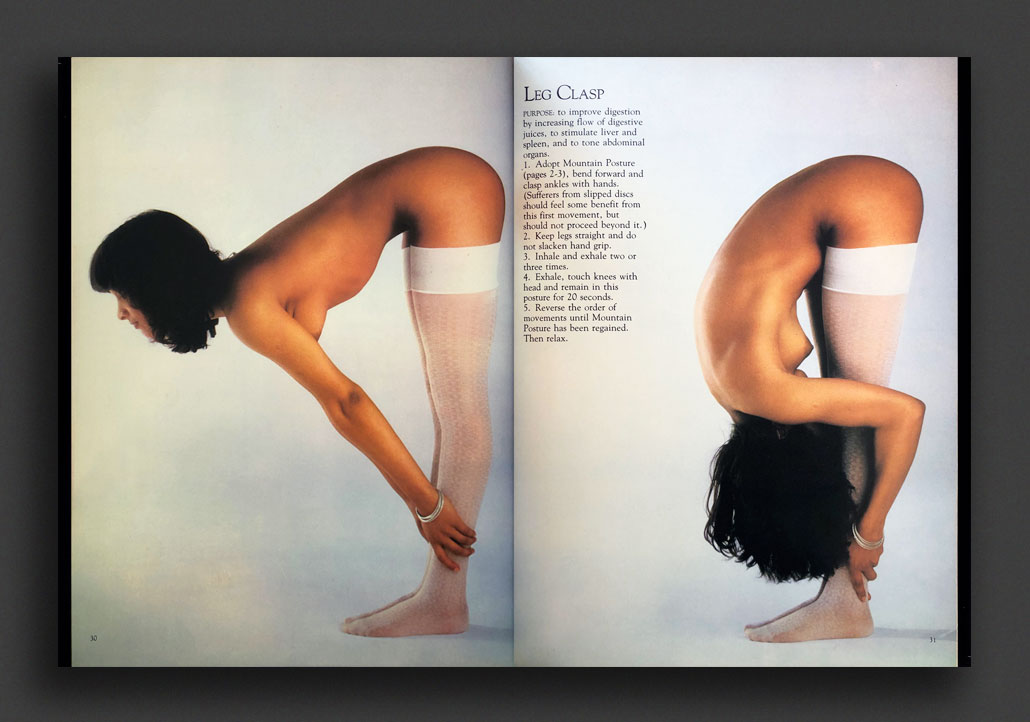
First hardcover edition of the one and only Yoga For Men from 1978, a book that really couldn't be from another year. John Champ, an advertising art director and Hatha Yoga practitioner, teamed up with yoga expert Pauline Donovan and photographer John Russell to re-invigorate the instructional yoga book. The result is a lively, handsomely designed, over-sized glossy nude/semi-nude photo book of female models executing basic yoga postures to "persuade more people to take up what is a rewarding way of life". A special book, and now very collectible!
Good copy w. Very Good dust jacket. Some light foxing/spotting to first and final pages and board bowing, otherwise a VG copy all-round.
2012, English
Hardcover (embossed cloth), 206 pages, 25 x 28.5 cm
Out of print title / used / fine
Published by
MACK / London
$150.00 - In stock -
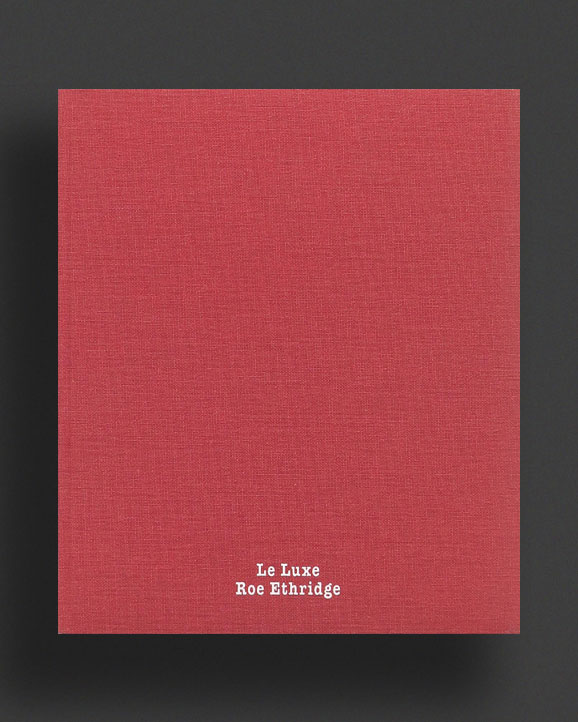
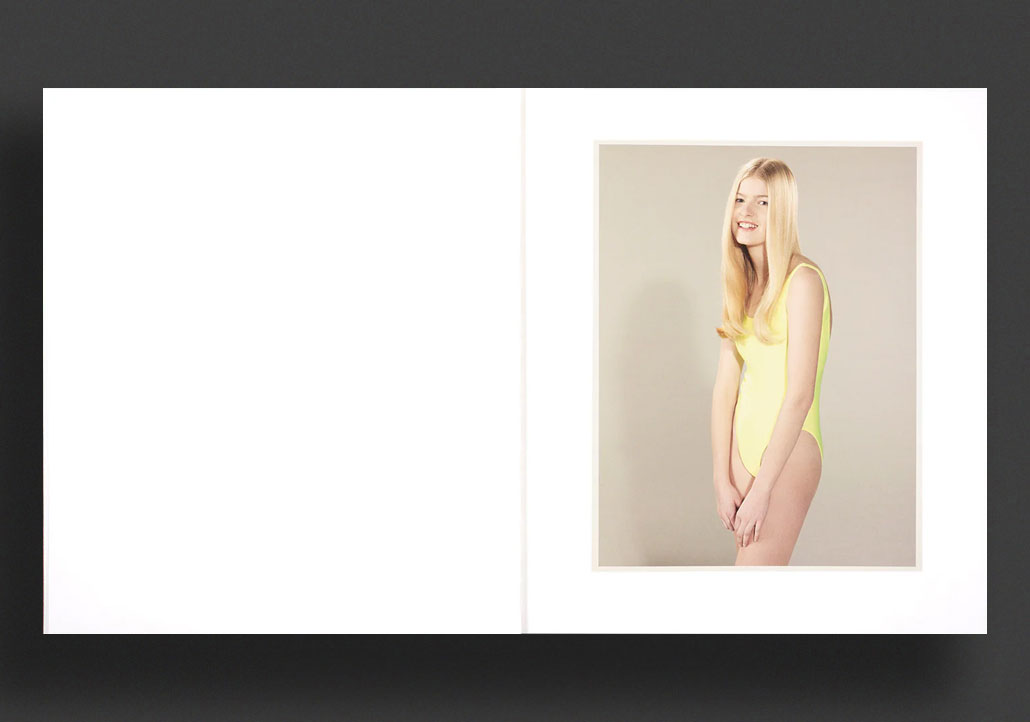
American artist Roe Ethridge's latest book takes its title from the French "C'est pas du luxe", an ironic phrase which alludes to the superfluous nature of luxury whilst proclaiming how essential it is to existence. Such paradoxes are fluently woven through Ethridge's oeuvre and Le Luxe encompasses his practice from the past decade, without ever slipping into the moribund gravitas of a retrospective.
Plumbing his diverse image inventories, from personal images and magazine commissions to an archive of online screen shots, the book continues his exploration of picture-making that disavows the potential for creating a finished work. Ethridge para-phrases Eggleston when he states that he is "at war with the finished" in an era of digital photography straining towards idealisation. The pristine conditions of photography are undermined in the book's design and riff on Henri Matisse's apposite aphorism "exactitude is not truth" (Matisse titled two of his paintings Le Luxe).
Composed in three parts, Le Luxe contains an unusual backdrop, the everyday of the artist, who worked from November 2005 to January 2010 on one commission documenting a building in downtown Manhattan on a site adjacent to the World Trade Centre. This narrative offers an uneasy balance to the fissures between analogue and digital and Ethridge's consistent undermining of his own certainties.
Roe Ethridge was born in 1969 in Miami and received a BFA in Photography at The College of Art in Atlanta, GA. Ethridge's images emanate from his direct experience of the world. His focus is multiple and restless as he works to capture the vivid and intimate details of his various locales. In doing so, he moves freely among the classic genres of the photographic medium - portrait, landscape, and still life.
Very Good—Near Fine copy of the 2nd (red) edition. Long out-of-print.
2022, English
Softcover, 232 pages, 15.2 x 22.9 cm
Published by
October Books / New York
$48.00 $10.00 - Out of stock
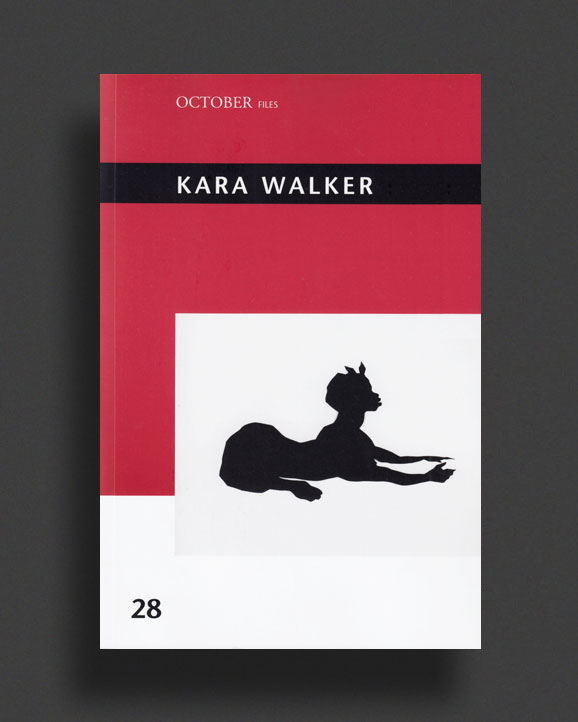
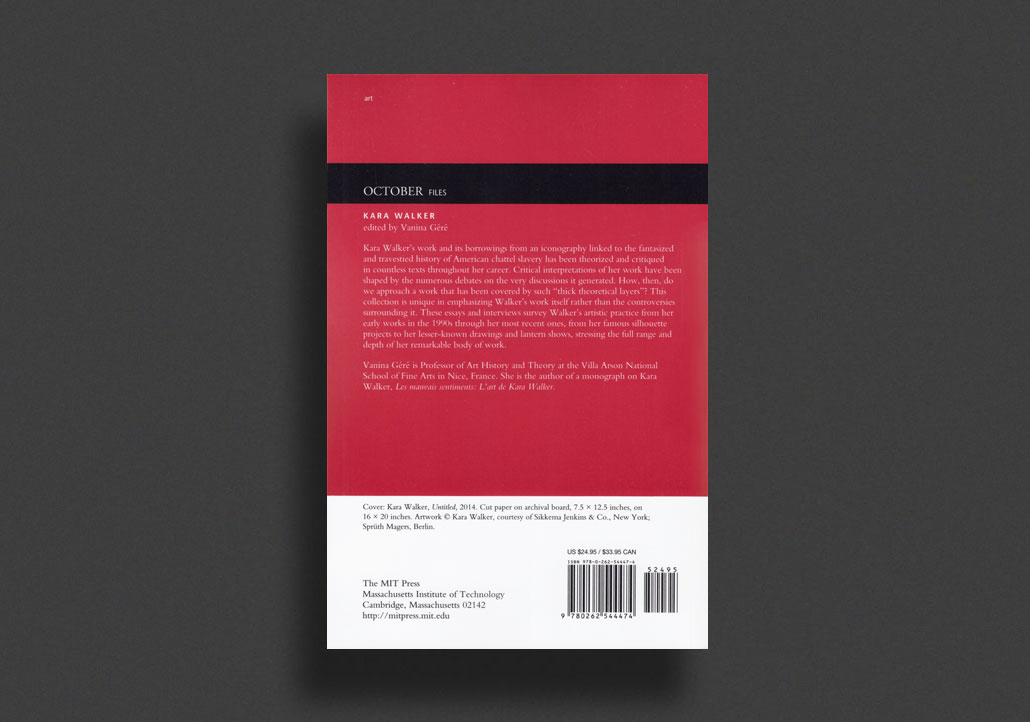
Selected texts that survey the full range of Kara Walker's artistic practice, emphasizing the work itself rather than the debates and controversies around it.
Kara Walker's work and its borrowings from an iconography linked to the fantasized and travestied history of American chattel slavery has been theorized and critiqued in countless texts throughout her career. Exegeses of her work have been shaped by the numerous debates on the very debates it generated. How, then, do we approach a work that has been covered by such "thick theoretical layers"? This collection is unique in emphasizing Walker's work itself rather than the controversies surrounding it. These essays and interviews survey Walker's artistic practice from her early works in the 1990s through her most recent ones, from her famous silhouette projects to her lesser-known drawings and lantern shows.
The texts, by art historians, curators, critics, scholars, and writers engage scrupulously with Walker's pieces as material works of art, putting them in the context of the sociopolitical and cultural environments that shape--but never determine--them. They include an interview of the artist by Thelma Golden of the Studio Museum in Harlem; an essay in the form of a lexicon, cataloguing key elements in Walker's art, by curator Yasmil Raymond; and an essay by volume editor Vanina Géré on Walker's use of historical archives. Finally, novelist Zadie Smith considers Walker's public art as counter-propositions to colonial monuments and as a reflection on colonial history.
Contributors : Lorraine Morales Cox, Vanina Géré, Thelma Golden, Tavia Nyong'o, Yasmil Raymond, Jerry Saltz, Zadie Smith, Anne M. Wagner, Hamza Walker
2012, English / Japanese
Softcover (w. dust jacket + obi), 169 pages, 21 x 14.5 cm
Published by
Pot Publishing / Japan
$60.00 - In stock -
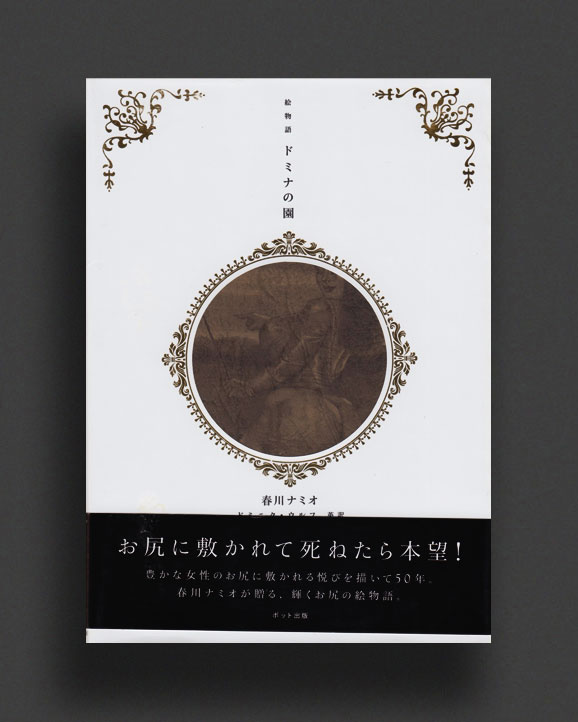
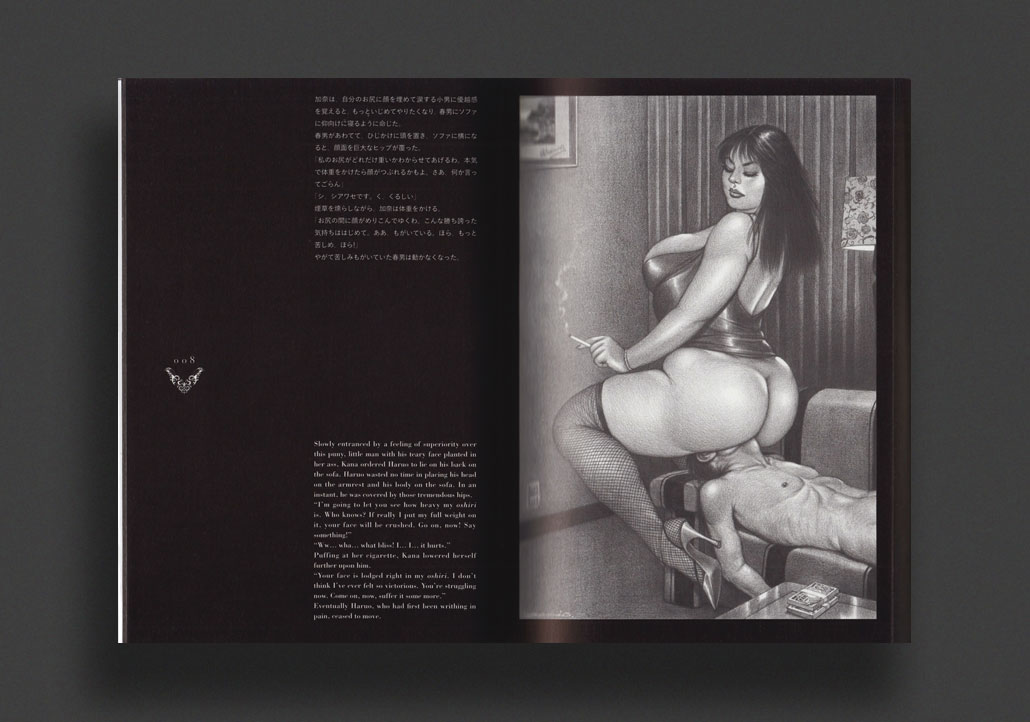
The last(?) of Namio Harukawa's illustrated story books, Garden of Domina, published in Japan in 2012. A bilingual (Japanese / English) story illustrated by 80 new femdom artworks rendered by Harukawa. "A gorgeous gluteus, a bounteous bottom, a robust rump, even an ample ass: there are many ways to describe the pleasures of the oshiri (pronounced o-shee-ree.) In Harukawa Namio's delicately conceived drawings and their accompanying story, there emerges a holy bond of lust and love between cosmetics company president Ohara Kana and the men who would serve her. Kana loves to abuse men with her tremendous buttocks, and they explore the cruel joys found beneath her stunning endowment. Eventually, Kana creates a Garden of Paradise where she, her fellow lusty ladies, and their slaves discover the most exquisite ecstasies of the ass. A leading Japanese SM illustrator who has dedicated his oeuvre to the glories of the glories of the glories of the glories of the glories of the ass, Namio Harukawa both amuses and arouses his reader in this charming tale."
Sample of a story: "Yoshiko liberated Horoshi from her oshiri and fastened him by his two hands to a post in the room. 'It's so sweet you're crying. I'll make you cry some more.' Completely naked, Yoshiko straddled Horoshi from above and pressed her genitals into his face. A slender man, Horoshi arched backwards like a bow...."
Namio Harukawa (1947—2020), a pseudonymous Japanese fetish artist best known for his masterful pencil works depicting female domination ("femdom"), with erotic asphyxiation through facesitting appearing as a frequent subject of his art. Born 1947 in Osaka, Japan, Harukawa’s distinctive penname combines the name of film actress Harukawa Masumi with an anagram of Naomi, the sadistic heroine in Tanizaki Jun’ichiro’s novel "Chijin no ai / A Fool’s Love". While in high school, Harukawa began contributing work to the readers’ column of leading postwar Japanese SM pulp magazine "Kitan Club". Since then, Harukawa’s drawings of male masochism have lovingly portrayed noble, voluptuously beautiful women and the men who serve them as human furniture. An extraordinary and prolific artist who remained committed to the regime of “absolute Ganmen Kijo Shugi (facesitting principle)” throughout his artistic life, Namio Harukawa passed away on April 2020, he was 72 years old.