World Food Books' programme is largely produced on Kulin Nation land. We acknowledge the Wurundjeri people of the Kulin Nation as the first and continuing custodians of this land, and pay respect to their Elders past, present, and emerging.
World Food Books is an arts and special interests bookshop in Naarm / Melbourne. Founded in 2010, World Food Books is devoted to the presentation of a rotating, hand-selection of international art, design, literary and counterculture publications with an emphasis on the anti-traditional, the experimental, the avant-garde, the heretic, the marginal.
Presenting new titles alongside rare and out-of-print books, catalogues and journals spanning the fields of modern and contemporary art, design, photography, illustration, film, literature, poetry, cultural theory, philosophy, sexuality, popular and underground culture in its many radical forms, World Food Books wishes to encourage adventurous, thoughtful and open-minded reading, looking, writing, and exchange of publishing and ideas, both current and historical.
As well as our bookshop, located in Melbourne's historical Nicholas Building, all of our inventory is available internationally via our online mail-order service.
World Food Books semi-regularly co-ordinates "Occasions", a programme of exhibits and events at the bookshop and in partnership with other hosts (such as museums and art galleries) that develop out of the activities, relationships and content of the bookshop itself.
World Food Books
The Nicholas Building
37 Swanston Street
Room 5, Level 6
Melbourne 3000
Australia
SHOP HOURS:
SHOP CLOSED FOR SUMMER
RE—OPEN JAN 2
WEB-SHOP OPEN 24/7
World Food Books
Postal Address:
PO Box 435
Flinders Lane
Victoria 8009
Australia
info@worldfoodbooks.com
Art
Theory / Essay
Architecture / Interior
Graphic Design / Typography
Photography
Fashion
Eros
LGBTQ+
Fiction / Poetry
Weird / Speculative / Science Fiction / Horror
Transgressive / Visceral / Abject
Symbolism / Decadence / Fin de siècle
Film / Video
Painting
Sculpture / Installation
Performance / Dance / Theater
Drawing
Sound / Music
Curatorial
Group Shows / Collections
Periodicals
Out-of-print / Rare
Posters / Ephemera / Discs
Signed Books
World Food Books Gift Voucher
World Food Book Bag
Australian Art
Australian Fiction
Australian Science Fiction / Speculative Fiction
Australian Poetry
Australian Photography
Japanese Photography
Conceptual Art
Minimal Art
Dada
'Pataphysics / Oulipo
Fluxus
Concrete Poetry
Pop Art
Surrealism
Arte Povera
Arte Informale / Haute Pâte / Tachism
Nouveau Réalisme / Zero / Kinetic
Situationism / Lettrism
Collage / Mail Art / Xerox Art
Art Brut / Folk / Visionary / Fantastic
Illustration / Graphic Art / Bandes Dessinées
Furniture
Italian Radical Design / Postmodernism
Textiles
Ceramics / Glass
Counterculture
Protest / Revolt
Philosophy
Psychoanalysis
Anthropology
Anarchism
Socialism / Anarchism / Communism / Capitalism
Literary Theory / Semiotics / Language
Feminism / Women's Studies
Gender Studies / Sexuality
Anthropology
Fetishism / BDSM
Drugs / Psychedelia
Crime / Violence
Animal Rights / Veganism
Occult / Esoterica
Ecology / Earth / Alternative Living
Whole Earth / Crafts
All prices in AUD (Australian dollars)
Pick-Ups
Pick-up orders can be collected in our bookshop during opening hours after order date. Please collect any Pick-up orders within 2 weeks of ordering as we have limited storage space. Orders will be released back into stock if not collected within this time. No refunds can be made for pick-ups left un-collected. If you cannot make it in to the bookshop in this time-frame, please choose postage option.
Return Policy
All sales are final. We do accept returns (for refund or exchange) for items received in error. All our orders are packed with special care using heavy-duty padding and cardboard book-mailers or bubble mailers (for smaller books), using reinforcement where required. We cannot take responsibility for any lost, stolen or damaged parcels.
Insurance
Should you wish to insure your package, please email us directly after placing your order and we can organise this at a small extra expense. Although all standard/express tracked packages are very safe and dependable, we cannot take responsibility for any lost, stolen or damaged parcels. We recommend insurance on valuable orders.
Interested in selling your old books, catalogues, journals, magazines, comics, fanzines, ephemera? We are always looking for interesting, unusual and out-of-print books to buy. We only buy books in our fields of interest and specialty, and that we feel we can resell.
We base these prices on desirability, market value, in-print prices, condition and our current stock levels. We offer cash, store credit, and can take stock on consignment. All
about 25% of the price we expect to get when we sell them, or 30% in store credit. We base these prices on desirability, market value, in-print prices, condition and our current stock levels.
Sell your books any day of the week. You can drop them off and return later. If you have a lot of books, we can visit your Sydney home.
We buy books that we feel we can resell. We offer about 25 % of the price we expect to get when we sell them, or 30% in store credit. We base these prices on desirability, market value, in-print prices, condition and our current stock levels.
Philadelphia Wireman
03 August - 01 September, 2018
World Food Books is proud to announce our next Occasion, the first presentation of sculptures by Philadelphia Wireman in Australia.
The Philadelphia Wireman sculptures were found abandoned in an alley off Philadelphia’s South Street on trash night in 1982. Their discovery in a rapidly-changing neighbourhood undergoing extensive renovation, compounded with the failure of all attempts to locate the artist, suggests that the works may have been discarded after the maker’s death. Dubbed the "Philadelphia Wireman" during the first exhibition of this work, in 1985, the maker’s name, age, ethnicity, and even gender remain uncertain. The entire collection totals approximately 1200 pieces, all intricately bound together with tightly-wound heavy-gauge wire (along with a few small, abstract marker drawings, reminiscent both of Mark Tobey and J.B. Murry). The dense construction of the work, despite a modest range of scale and materials, is singularly obsessive and disciplined in design: a wire armature or exoskeleton firmly binds a bricolage of found objects including plastic, glass, food packaging, umbrella parts, tape, rubber, batteries, pens, leather, reflectors, nuts and bolts, nails, foil, coins, toys, watches, eyeglasses, tools, and jewellery.
Heavy with associations—anthropomorphic, zoomorphic, and socio-cultural responses to wrapped detritus—the totemic sculptures by Philadelphia Wireman have been discussed in the context of work created to fulfil the shamanistic needs of alternative religions in American culture. Curators, collectors, and critics have variously compared certain pieces to sculpture from Classical antiquity, Native American medicine bundles, African-American memory jugs, and African fetish objects. Reflecting the artist’s prolific and incredibly focused scavenging impulse, and despite—or perhaps enhanced by—their anonymity, these enigmatic objects function as urban artefacts and arbiters of power, though their origin and purpose is unknown. Philadelphia Wireman, whatever their identity, possessed an astonishing ability to isolate and communicate the concepts of power and energy through the selection and transformation of ordinary materials. Over the course of the past two decades, this collection has come to be regarded as an important discovery in the field of self-taught art and vernacular art.
Presented in collaboration with Fleisher-Ollman Gallery, Philadelphia, and Robert Heald, Wellington.
Susan Te Kahurangi King
02 February - 10 March, 2018
Susan Te Kahurangi King (24 February 1951 - ) has been a confident and prolific artist since she was a young child, drawing with readily available materials - pencils, ballpoint pens and felt-tip markers, on whatever paper is at hand. Between the ages of four and six Susan slowly ceased verbal communication. Her grandparents William and Myrtle Murphy had developed a special bond with Susan so they took on caring responsibilities for extended periods. Myrtle began informally archiving her work, carefully collecting and storing the drawings and compiling scrapbooks. No drawing was insignificant; every scrap of paper was kept. The King family are now the custodians of a vast collection containing over 7000 individual works, from tiny scraps of paper through to 5 meter long rolls.
The scrapbooks and diaries reveal Myrtle to be a woman of great patience and compassion, seeking to understand a child who was not always behaving as expected. She encouraged Susan to be observant, to explore her environment and absorb all the sights and sounds. Myrtle would show Susan’s drawings to friends and people in her community that she had dealings with, such as shopkeepers and postal workers, but this was not simply a case of a grandmother’s bias. She recognised that Susan had developed a sophisticated and unique visual language and sincerely believed that her art deserved serious attention.
This was an unorthodox attitude for the time. To provide some context, Jean Dubuffet coined the term Art Brut in 1945 to describe work created by self-taught artists – specifically residents of psychiatric institutions and those he considered to be visionaries or eccentrics. In 1972 Roger Cardinal extended this concept by adopting the term Outsider Art to describe work made by non-academically trained artists operating outside of mainstream art networks through choice or circumstance. Susan was born in Te Aroha, New Zealand in 1951, far from the artistic hubs of Paris and London that Dubuffet and Cardinal operated in. That Myrtle fêted Susan as a self-taught artist who deserved to be taken seriously shows how progressive her attitudes were.
Susan’s parents Doug and Dawn were also progressive. Over the years they had consulted numerous health practitioners about Susan’s condition, as the medical establishment could not provide an explanation as to why she had lapsed into silence. Dawn educated herself in the field of homeopathy and went on to treat all twelve of her children using these principles – basing prescriptions on her observations of their physical, mental and emotional state.
Doug was a linguist with an interest in philosophy who devoted what little spare time he had to studying Maori language and culture. To some extent their willingness to explore the fringes of the mainstream made them outsiders too but it was their commitment to living with integrity and their respect for individuality that ensured Susan’s creativity was always encouraged.
Even though Susan’s family supported her artistic pursuits, some staff in schools and hospitals saw it as an impediment to her assimilation into the community and discouraged it in a variety of ways. Her family was not always aware of this and therefore did not fully understand why Susan stopped drawing in the early 1990s. However, rather than dwell on the challenges that Susan faced in pursuit of her artistic practice, they prefer to highlight her achievements. In 2008 Susan began drawing again in earnest, after an almost 20 year interruption, and her work is now shown in galleries around the world.
Susan grew up without television and has been heavily influenced by the comics she read as a child. She is absolutely fearless in the appropriation of recognizable characters, such as Donald Duck and Mickey Mouse, in her work. She twists their limbs, contorts their faces, compresses them together, blends them into complex patterned backgrounds - always imbuing them with an incredible energy. Although Susan often used pop culture characters in her work they are not naive or childlike. These are drawings by a brilliant self-taught artist who has been creating exceptional work for decades without an audience in mind.
Mladen Stilinović
"Various Works 1986 - 1999"
02 February 16 - September 10, 2016
Various works 1986 - 1999, from two houses, from the collections of John Nixon, Sue Cramer, Kerrie Poliness, Peter Haffenden and Phoebe Haffenden.
Including: Geometry of Cakes (various shelves), 1993; Poor People’s Law (black and white plate), 1993; White Absence (glasses, ruler, set square, silver spoon, silver ladel with skin photograph and wooden cubes), 1990-1996; Exploitation of the Dead (grey and red star painting, wooden painting, black spoon with red table, red plate), 1984-1990; Money and Zeros (zero tie, paintings made for friends in Australia (Sue, John, Kerrie), numbers painting), 1991-1992; Words - Slogans (various t-shirts) - “they talk about the death of art...help! someone is trying to kill me”, “my sweet little lamb”, “work is a disease - Karl Marx”; Various artist books, catalogues, monographs, videos; Poster from exhibition Insulting Anarchy; "Circular" Croatian - Australian edition; Artist book by Vlado Martek (Dostoyevsky); more.
Thanks to Mladen Stilinović and Branka Stipančić.
Jonathan Walker
Always Will Need To Wear Winter Shirt Blue + Ochre Small Check Pattern
21 August - 21 September, 2015
Untitled
I am not a great reader of poetry but I always return to the work of Melbourne poet, Vincent Buckley (1925- 1988). Perhaps I find his most tantalising piece to be not a finished poem but a fragment left on a scrap of paper discovered on his desk after the poet’s death.
The poetry gathers like oil
In the word-core, and spreads
It has its music meet,
Its music is in movement.
This fragment is more the shell left behind from a volatile thought than a finished poem. I find the last two lines honest but awkward whereas the first two lines work like an arrow. Most likely he could not find a resolution so it was left. Still, in its present form, it remains an eloquent testimony to the ultimate failure of a medium to express mobile thought and sensation, in Buckley’s case, through verbal language. It’s an important matter because this is something all artists have to deal with regardless of the medium.
I have never written a poem, however, I am forever copying fragments from books on paper scraps in a vain effort to fix certain notions in my head. At first, they function as bookmarks that are sometimes returned to when I open the book. But before long, as they accumulate, they fall out littering the table interspersed with A4 photocopies, bills, books and medications.
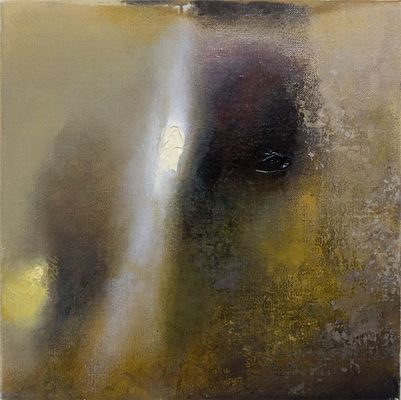
To return to Buckley’s fragment, the first two lines very much evoke how I paint nowadays. As you age, detail diminishes and patches of light become more luminous and float. I feel the most honest way of dealing with this is by smearing the oil paint on the canvas with the fingers and working close-up, blind. Only if the patches coalesce into an approaching image can the work gain a life.
-
Jonathan Walker was born in Melbourne, Australia and brought up on a dairy farm in Gippsland. In the 1970’s he studied painting at RMIT and won the Harold Wright Scholarship to the British Museum, London. During the 1980’s he exhibited at Pinacotheca Gallery, Richmond and had work shown at the NGV and Heidi City Art Gallery. Over the same period he designed the cover for the “Epigenesi” LP by Giancarlo Toniutti, Italy and conducted a mail exchange work with Achim Wollscheid, Germany. The work with artists through the post resulted in an article published in the bicentenary issue of Art and Australia 1988. He showed in artist run spaces such as WestSpace in the 90’s and 2000’s, and until 2012, taught painting at Victoria University, which is where we (Colleen Ahern and Lisa Radford) as organisers of the exhibition, among many others, had the privilege of being his student.
Walker’s knowledge was imparted to students through the careful selection of music, literature, and artists found in books that he himself had ordered for the library. Walker’s strategy was the generosity of sharing his vast knowledge with references specific to each student and their context.
Walker’s paintings share a similar focus and intimacy.
This exhibition presents a small selection of recent paintings alongside a publication that includes Walker’s writing. Observational and analytical, Walker’s work is a type of material notation — the time of day, colour and how it is blended, the both specific and fleeting location of a reflection on lino or the question of whether a chair leg should be included in a painting.
Please join us on Friday August 21 between 6-8pm to celebrate the opening of the exhibition.
Curated by Colleen Ahern and Lisa Radford.
B. Wurtz
Curated by Nic Tammens
March 26 - April 4, 2015
B.Wurtz works from a basement studio in his home on Manhattan’s Lower East Side.
This local fact is attested to by the plastic shopping bags and newsprint circulars that appear in his work. As formal objects, they don’t make loud claims about their origins but nonetheless transmit street addresses and places of business from the bottom of this long thin island. Like plenty of artists, Wurtz is affected by what is local and what is consumed. His work is underpinned by this ethic. It often speaks from a neighborhood or reads like the contents of a hamper:
“BLACK PLUMS $1.29 lb.”
“Food Bazaar”
“USDA Whole Pork Shoulder Picnic 99c lb.”
“RITE AID Pharmacy, with us it’s personal.”
“H. Brickman & Sons.”
“Sweet Yams 59c lb."
Most of the work in this exhibition was made while the artist was in residence at Dieu Donne, a workshop dedicated to paper craft in Midtown. Here Wurtz fabricated assemblages with paper and objects that are relatively lightweight, with the intention that they would be easily transportable to Australia. This consideration isn’t absolute in Wurtz’s work, but was prescriptive for making the current exhibition light and cheap. Packed in two boxes, these works were sent from a USPS post office on the Lower East Side and delivered to North Melbourne by Australia Post.
Wurtz appears courtesy of Metro Pictures, New York.
Thanks to Rob Halverson, Joshua Petherick, Sari de Mallory, Matt Hinkley, Helen Johnson, Fayen d'Evie, Ask Kilmartin, Lisa Radon, Ellena Savage, Yale Union, and "Elizabeth".
John Nixon
"Archive"
December 15 - January 20, 2014
The presentation of John Nixon's archive offered a rare showcase of this extensive collection of the artist's own publications, catalogues, posters, ephemera, editions and more, from the mid 1980s onwards, alongside a selection of his artworks.
Organized by John Nixon, Joshua Petherick and Matt Hinkley.
"Habitat"
at Minerva, Sydney (organised by Joshua Petherick and Matt Hinkley)
November 15 - December 20, 2014
Lupo Borgonovo, Janet Burchill & Jennifer McCamley,
Lewis Fidock, HR Giger, Piero Gilardi, Veit Laurent Kurz,
Cinzia Ruggeri, Michael E. Smith, Lucie Stahl, Daniel Weil, Wols
Press Release:
“...It contained seven objects. The slender fluted bone, surely formed for flight, surely from the wing of some large bird. Three archaic circuitboards, faced with mazes of gold. A smooth white sphere of baked clay. An age-blackened fragment of lace. A fingerlength segment of what she assumed was bone from a human wrist, grayish white, inset smoothly with the silicon shaft of a small instrument that must once have ridden flush with the surface of the skin - but the thing’s face was seared and blackened.”
William Gibson, “Count Zero”, 1986
"Autumn Projects Archive"
Curated by Liza Vasiliou
March 6 - March 15, 2014
World Food Books, in conjunction with the Virgin Australia Melbourne Fashion Festival 2014, presented the Autumn Projects archive, consisting of a selection of early examples in Australian fashion with a particular interest in collecting designers and labels from the period beginning in the 1980’s, who significantly influenced the discourse of Australian Fashion.
Curated by Liza Vasiliou, the exhibition provided a unique opportunity to view pieces by designers Anthea Crawford, Barbara Vandenberg, Geoff Liddell and labels CR Australia, Covers, Jag along with early experimental collage pieces by Prue Acton and Sally Browne’s ‘Fragments’ collection, suspended throughout the functioning World Food Books shop in Melbourne.
H.B. Peace
presented by CENTRE FOR STYLE
November 14, 2013
"Hey Blinky, you say chic, I say same"
Anon 2013
H.B. Peace is a clothing collaboration between great friends Blake Barns and Hugh Egan Westland. Their pieces explore the divergences between 'character’ and ‘personality’ in garments....etc
Special Thanks to Joshua Petherick and Matt Hinkley of WFB and Gillian Mears
and a Very Special Thank you to Audrey Thomas Hayes for her shoe collaboration.
Janet Burchill & Jennifer McCamley
"Aesthetic Suicide"
May 10 - June 8, 2013
The first of our occasional exhibitions in the World Food Books office/shop space in Melbourne, "Aesthetic Suicide" presented a body of new and older works together by artists Janet Burchill & Jennifer McCamley, including videos, prints, a wall work, and publications.
During shop open hours videos played every hour, on the hour.
1980, English
Softcover, 72 pages, 24.5 x 18 cm
1st Edition, Out of print title / used / good
Published by
Aspect Publications / Scotland Island
$50.00 - Out of stock
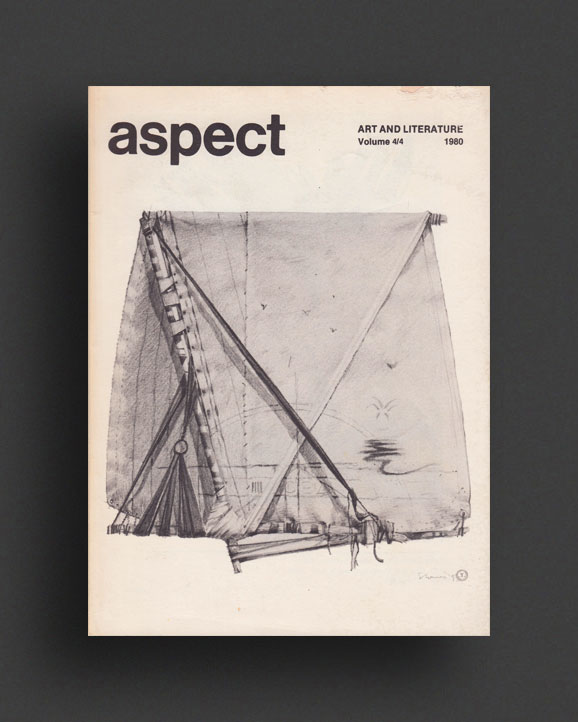
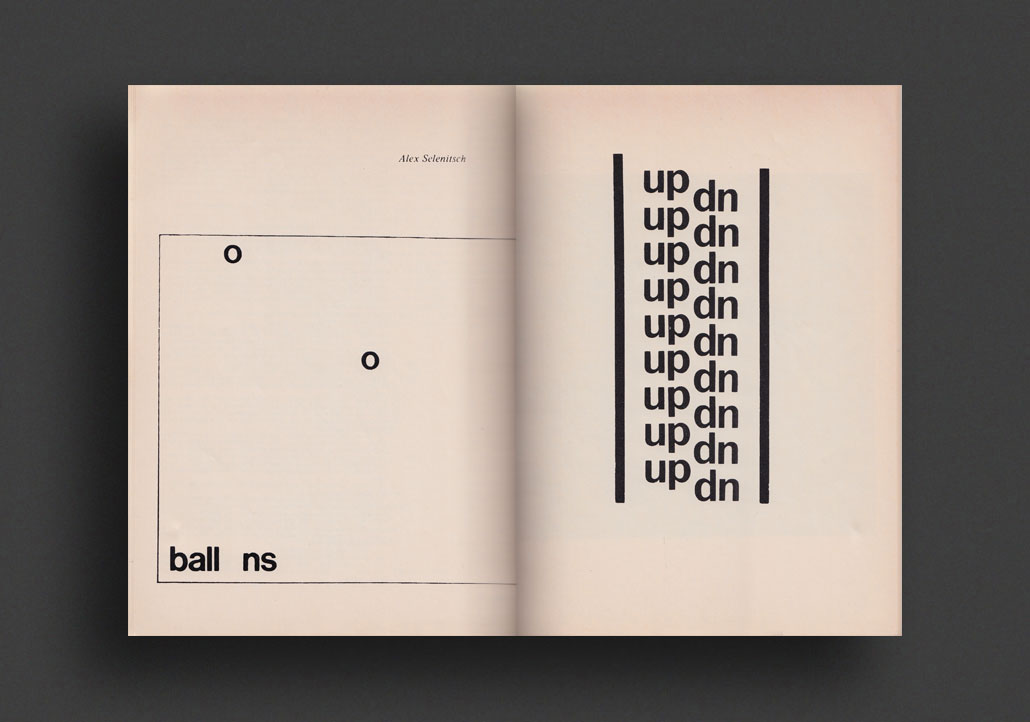
Special "Visual Poetry" issue of Aspect, a small press "Art and Literature" magazine edited by Australian playwright and poet, Rudi Krausmann, and published out of Scotland Island, NSW, between 1975—1989.
This issue, Vol. 4/4, 1980, with contributions by Richard Tipping, Nicholas Zurbrugg, Jas H. Duke, π.O., Noel Sheridan, Alex Selenitsch, Murray Bail, Peter Anderson, Gary Catalano, Dal Stivens, Ann Taylor, Grant Caldwell, Anna Couani, Liliana Rydzynski, Peter Skrzynecki, Richard James Allen, Madge Staunton, Kate Lilley, Stephen K. Kelen, Christopher Mooney, Russel Soaba, Harry Roskolenko, Jutta Brueckner, Nicholas Pope, Tim Storrier, Arthur McIntyre, Annette Onslow, and of course Rudi Krausmann. Contributing editors Franco Paisio, John Olsen, John Tranter, James Cowan, Tom Thompson, John Davies, Gary Catalano, Jenny Zimmer, Jennifer Compton, Horst Bienek, David Aspden.
Good copy, if not for some bug nibbles to the top of the cover it would be a Very Good copy with moderate age/page tanning.
2024, English
Softcover, 58 pages, 15 x 10.5 cm
Published by
Everyday Analysis / UK
$19.00 - In stock -
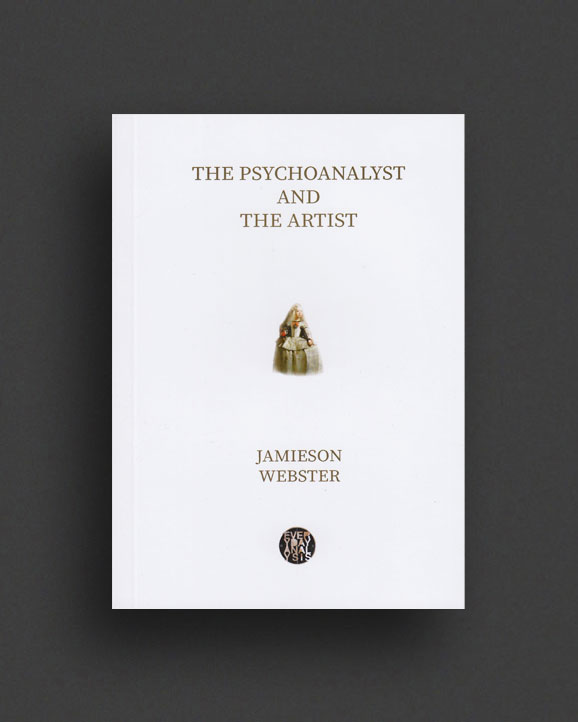
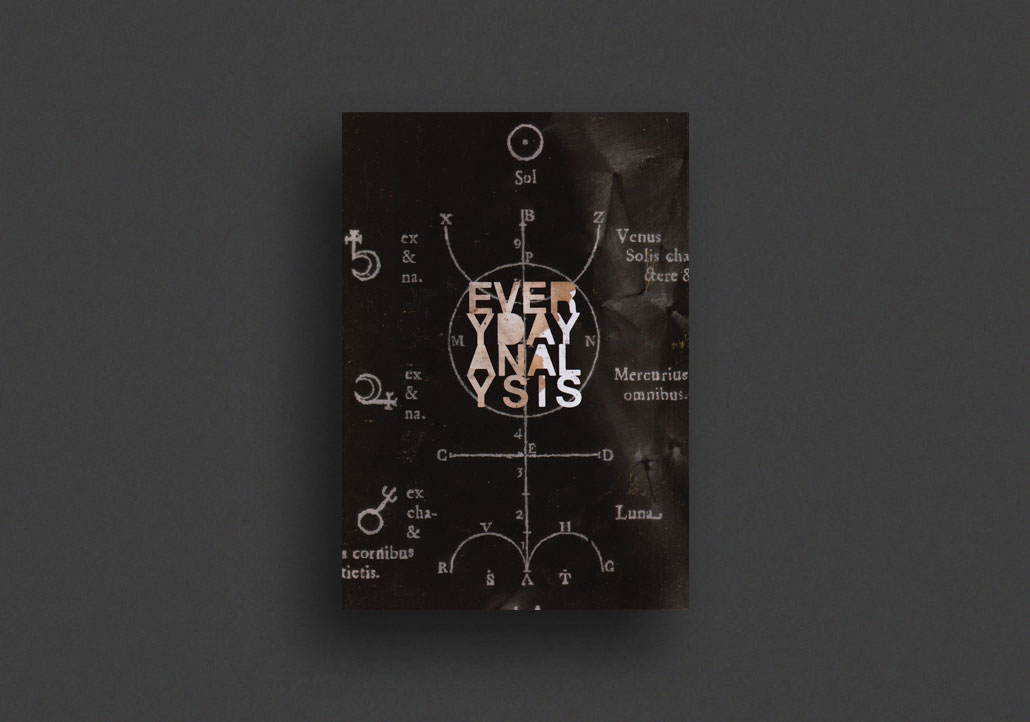
In these essays, New York psychoanalyst and author Jamieson Webster considers the relationship between the studio and the psychoanalyst’s couch. From the scopophilic instinct of the viewer and the artist’s anticipation of it to the pursuit of perfection and it’s connection to the girl-child’s curiosity about her mother’s body, she asks us to think about art and analysis as connected practices. Focusing on Carroll Dunham and Louise Bourgeois, she argues for an embrace of our wildest symptoms in theory and in art.
Jamieson Webster is a psychoanalyst in New York City. She is the author of The Life and Death of Psychoanalysis (Karnac, 2011) and Conversion Disorder (Columbia University Press, 2018); she also co-wrote, with Simon Critchley, Stay, Illusion! The Hamlet Doctrine (Pantheon, 2013). She contributes regularly to Artforum, Spike Art Magazine, Apology and the New York Review of Books.
The Everyday Analysis pamphlet series is a psychoanalytically inspired short-form publishing house. We publish texts in the form of pamphlets/chapbooks/tracts that are psychoanalytic or of interest to the psychoanalytic community but which are also political and timely. Authors include Slavoj Žižek, Simon Critchley, Jamieson Webster, Anouchka Grose, Srećko Horvat and others, though we also focus on new and emerging authors in psychoanalysis.
2024, English
Softcover, 58 pages, 15 x 10.5 cm
Published by
Everyday Analysis / UK
$19.00 - In stock -
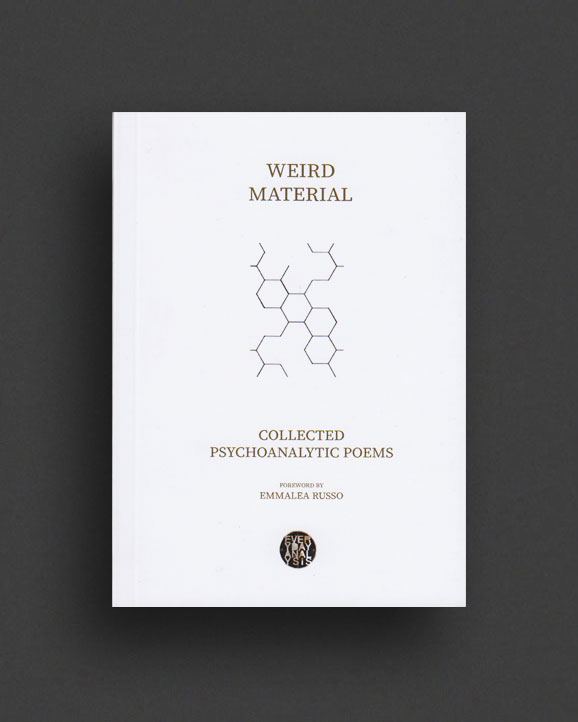
A new collection of psychoanalytically inspired poems, from poets including Cindy Zeiher, Erik Kennedy, Korn, Ben Brown, Pádraig Ó Tuama, Brandon Meland, John Milton Bunch and others.
The collection - ranging from freeform to haikus, are to varying degrees engaged with questions of psychoanalysis, materialism and subjectivity. They are prefaced by an essay on psychoanalysis and poetry by Emmalea Russo.
Emmalea Russo is a writer, astrologer, and teacher. Her books of poetry are G (2018), Wave Archive (2019), Confetti (2022), and Magenta (2023). Recent poems and essays have appeared in Artforum, BOMB, Spike Art Magazine, The Brooklyn Rail, Compact, Granta, Gulf Coast, Los Angeles Review of Books, and elsewhere. She has been a writer in residence at Lower Manhattan Cultural Council in New York and 18th Street Arts Center in Los Angeles and a visiting critic at Parsons School of Design and The Art Institute of Cincinnati. She has taught courses on poetry, philosophy, and art at various institutions including Saint Peters University, Northeastern University, The Melbourne School of Continental Philosophy, and GCAS. Her books have been reviewed in The Chicago Review, The Yale Review, Publishers Weekly, and elsewhere. She keeps a substack newsletter, Cosmic Edges and teaches classes on writing, literature, art, philosophy, and the occult. Her first novel, Vivienne, is forthcoming in September.
The Everyday Analysis pamphlet series is a psychoanalytically inspired short-form publishing house. We publish texts in the form of pamphlets/chapbooks/tracts that are psychoanalytic or of interest to the psychoanalytic community but which are also political and timely. Authors include Slavoj Žižek, Simon Critchley, Jamieson Webster, Anouchka Grose, Srećko Horvat and others, though we also focus on new and emerging authors in psychoanalysis.
2024, English
Softcover, 52 pages, 15 x 10.5 cm
Published by
Everyday Analysis / UK
$19.00 - In stock -
If we want to oppose Zionism (i.e. Israeli Jewish ethnonationalism), should we do that by vicariously adopting Palestinian ethnonationalism, or by appealing to absolutely universal standards of democracy and human rights?
In these four essays on Palestine, Ben Burgis explores this question - and others that arise from this crisis - from the perspective of the Left. Directly tackling a topic which many either avoid or reduce to oppositional side-taking, Burgis examines the crises and our responses to it in full. The collection ranges from essays aimed at ‘convincing normies’ of the legitimacy of a Leftist approach to philosophical reflections on what the Left has become and how it thinks.
Ben Burgis is a Jacobin columnist, an adjunct philosophy professor at Rutgers University, and the host of the YouTube show and podcast Give Them An Argument. He’s the author of several books, most recently Christopher Hitchens: What He Got Right, How He Went Wrong, and Why He Still Matters.
2024, English
Softcover, 42 pages, 15 x 10.5 cm
Published by
The Everyday Press / London
$19.00 - In stock -
The fantasy of consumer capitalism consists of endless promises of wholeness and completeness and all manner of suggestions as to how we might get from A to B. To combat this form of capitalism, Peter Rollins proposes a form of psychoanalytic belief - a pyrotheology - in which we can avoid the ideological drive to move from A to B and the promise of completeness and instead learn to stay at A, be in the present and accept the nothingness that brings us together.
Peter Rollins is an author, philosopher, storyteller, producer and public speaker who has gained an international reputation for overturning traditional notions of religion and forming “churches” that preach the Good News that we can’t be satisfied, that life is difficult, and that we don’t know the secret.
The Everyday Analysis pamphlet series is a psychoanalytically inspired short-form publishing house. We publish texts in the form of pamphlets/chapbooks/tracts that are psychoanalytic or of interest to the psychoanalytic community but which are also political and timely. Authors include Slavoj Žižek, Simon Critchley, Jamieson Webster, Anouchka Grose, Srećko Horvat and others, though we also focus on new and emerging authors in psychoanalysis.
2023, English
Softcover, 364 pages, 13.9 x 21.6 cm
Published by
Divided Publishing / London
$42.00 - Out of stock
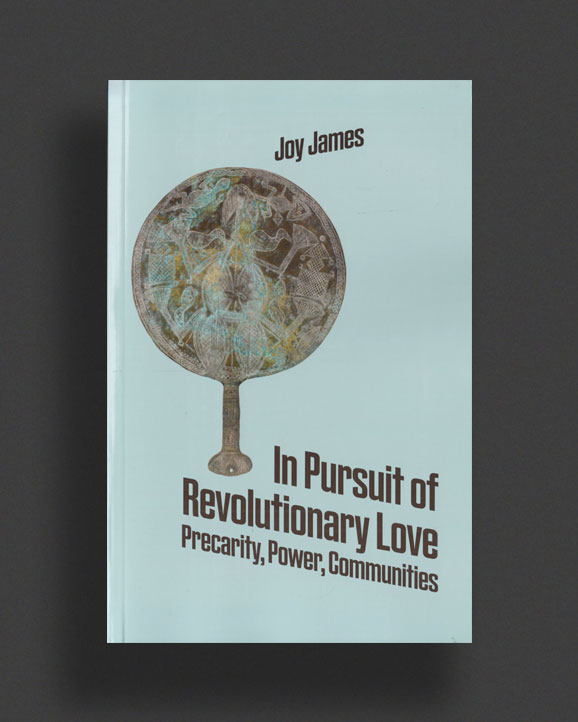
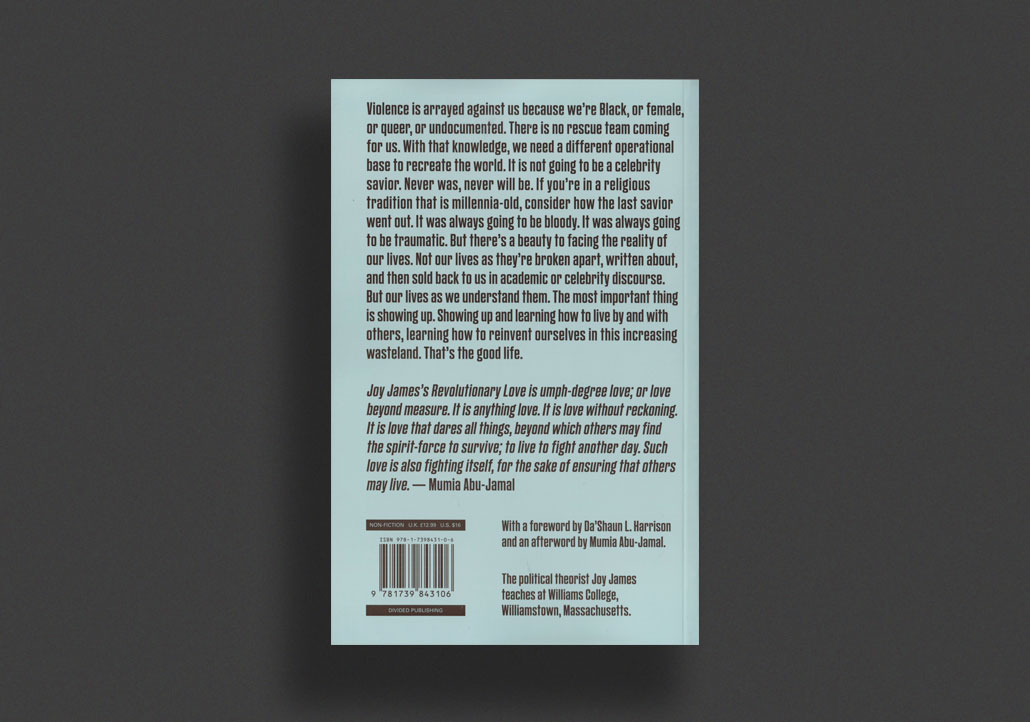
Violence is arrayed against me because I'm Black, or female, or queer, or undocumented. There is no rescue team coming for us. With that knowledge, we need a different operational base to recreate the world. It is not going to be a celebrity savior. Never was, never will be. If you're in a religious tradition that is millennia-old, consider how the last savior went out. It was always going to be bloody. It was always going to be traumatic. But there's a beauty to facing the reality of our lives. Not our lives as they're broken apart, written about and then sold back to us in academic or celebrity discourse. But our lives as we understand them. The most important thing is showing up. Showing up and learning how to live by and with others, learning how to reinvent ourselves in this increasing wasteland. That's the good life.
The political theorist Joy James teaches at Williams College, Williamstown, Massachusetts. Editor of The Angela Y. Davis Reader (Blackwell, 1998), Imprisoned Intellectuals (Rowman & Littlefield, 2003), The New Abolitionists (SUNY Press, 2005) and Warfare in the American Homeland (Duke University Press, 2007), James is also author of Resisting State Violence (University of Minnesota Press, 1996), Transcending the Talented Tenth (Routledge, 1997), Seeking the Beloved Community (SUNY Press, 2013), New Bones Abolition: Captive Maternal Agency and the Afterlife of Erica Garner (Common Notions, 2023), and the forthcoming Contextualizing Angela Davis.
Foreword by Da'Shaun L. Harrison
Afterword by Mumia Abu-Jamal
2022, English
Softcover, 364 pages, 14.2 x 21.8 cm
Published by
Divided Publishing / London
$46.00 - Out of stock
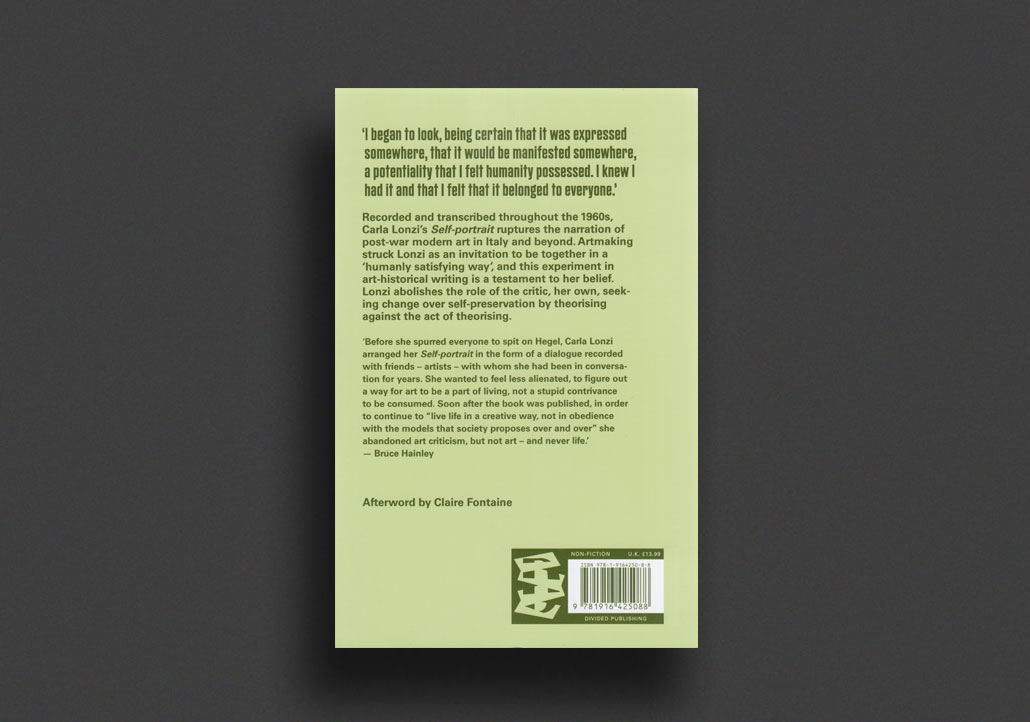
Recorded and transcribed throughout the 1960s, Carla Lonzi’s Self-portrait ruptures the narration of post-war modern art in Italy and beyond. Artmaking struck Lonzi as an invitation to be together in a ‘humanly satisfying way’, and this experiment in art-historical writing is a testament to her belief. Lonzi abolishes the role of the critic, her own, seeking change over self-preservation by theorising against the act of theorising.
The life and work of Carla Lonzi (1931–1982) is inseparable from the cultural, political, and social history of Italy in the decades following the Second World War; she occupies a singular position, which today merits reevaluation. A reputed art critic of the 1960s artistic scene, both friend and collaborator of such figures as Carla Accardi, Luciano Fabro, Giulio Paolini, and Jannis Kounellis, she wrote “Autoportrait” in 1969, a “love letter” to the artists and to creation, but also a farewell chorus to art criticism and the art world. The following year she founded Rivolta Femminile, an active feminist collective, thus becoming the central figure of Italian feminism.
Interviews with Carla Accardi, Getulio Alviani, Enrico Castellani, Pietro Consagra, Luciano Fabro, Lucio Fontana, Jannis Kounellis, Mario Nigro, Guilio Paolini, Pino Pascali, Mimmo Rotella, Salvatore Scarpita, Guilio Turcato, Cy Twombly.
Afterword by Claire Fontaine.
Translated by Allison Grimaldi Donahue.
"Before she spurred everyone to spit on Hegel, Carla Lonzi arranged her Self-portrait in the form of a dialogue recorded with friends – artists – with whom she had been in conversation for years. She wanted to feel less alienated, to figure out a way for art to be a part of living, not a stupid contrivance to be consumed. Soon after the book was published, in order to continue to ‘live life in a creative way, not in obedience with the models that society proposes over and over’, she abandoned art criticism, but not art – and never life." —Bruce Hainley
“The volume underscores the genderedness of its genre. Yet, it also pokes holes in the enterprise of art criticism more broadly and proves original precisely in its author’s intermittent passivity...”—Frieze Magazine
The life and work of Carla Lonzi (1931–1982) is inseparable from the cultural, political, and social history of Italy in the decades following the Second World War; she occupies a singular position, which today merits reevaluation. A reputed art critic of the 1960s artistic scene, both friend and collaborator of such figures as Carla Accardi, Luciano Fabro, Giulio Paolini, and Jannis Kounellis, she wrote “Autoportrait” in 1969, a “love letter” to the artists and to creation, but also a farewell chorus to art criticism and the art world. The following year she founded Rivolta Femminile, an active feminist collective, thus
2023, English
Softcover, 104 pages, 21.6 x 13.9 cm
Published by
Divided Publishing / London
$36.00 - Out of stock
"Few artists dig deep into themselves like this: an extraordinary insight into the process of producing art."—Cosey Fanni Tutti
To make art is to understand how you are, to notice your prejudices and assumptions about value, to acknowledge your hand in an unequal world, and to recognise how you institute yourself – all while letting go of the outcome of work. Bosses replaces strategies of high performance with acts of trust. It is a book about doubt, about maintaining that condition and its untenable faith. About becoming a parent. Where individualism dissolves into dependence, ‘like when you get into a bath that’s the same temperature as your body, or when the summer comes and the wind touches your skin’.
"I would call Bosses auto-factual. Leung accounts for work and life co-authored with facts, conjuring a prosaic and beautiful sociality. Her negations are profound, they hold and express the social apophatically. What is not here almost feels like a choice, and the thing convulses."—Ed Atkins
"Some events you can never correct. One of them is childbirth. If you want to know, here it is."—Fanny Howe
Ghislaine Leung is a British conceptual artist. Her work uses score-based instructions to radically redistribute and constitute the terms of artistic production. For Leung, limitations, felt as personal, institutional, structural or systemic to the parameters of industry, are engaged in as means to institute differently. Born in Stockholm, Sweden to a father from Hong Kong and a mother from London, she was raised first in Reims, France and then in London, England. She received a BA Fine Art in Context at the University of the West of England in 2002 and a Masters in Aesthetics and Art Theory at the Centre for Research in Modern European Philosophy at Middlesex University in 2009. Between 2004 and 2014 she worked at Tate and LUX, London. Leung’s first book was Partners (Cell Project Space, 2018). She lives in London, UK.
2024, English
2 hardcover vols in slipcase, 544 pages, 21 x 28 cm
Published by
Fondazione Prada / Venice
$220.00 - In stock -
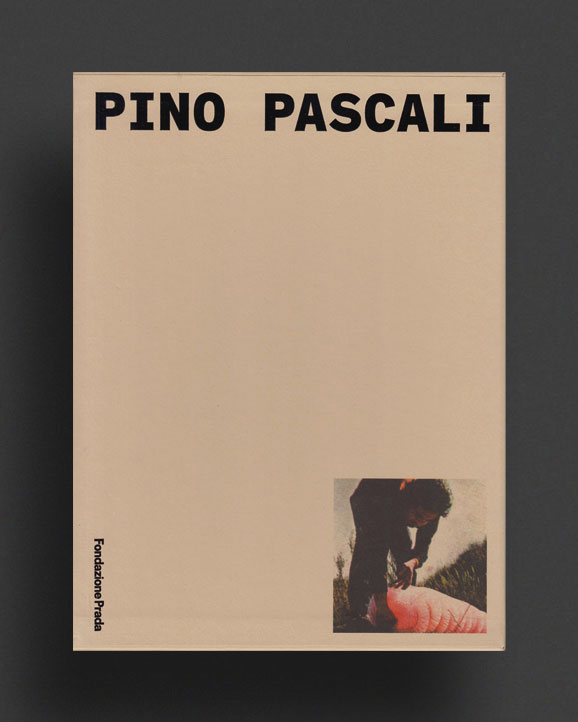
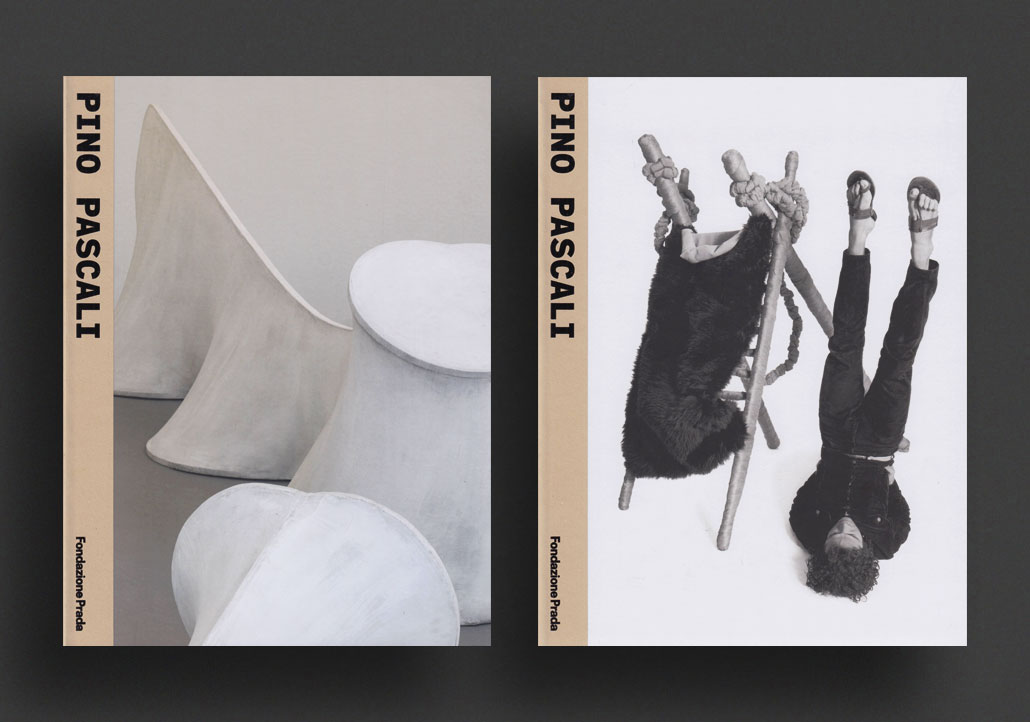
Lavish two-volume slipcased exhibition catalogue tracing the entire, tragically short career of Arte Povera artist Pino Pascali (1935–68), who created “fake sculptures” that played with perceptions of reality. From fuzzy spiders to toy machine guns, Pascali’s playfulness is on full display in this expansive catalogue-cum-reader, published on the occasion of the largest retrospective of the artist's work, curated by Mark Godfrey for the Fondazione Prada in Milan. Profusely illustrated in colour and b/w, the publication juxtaposes 49 of his works with nine pieces by other postwar artists, and includes both a full exhibition chronology and an anthology of texts on the artist.
Introduction by Miuccia Prada. Text by Mark Godfrey, Valérie Da Costa, Michele D’Aurizio, Eva Fabbris, Pia Gottschaller, Teresa Kittler, Peter Fischli, Achille Bonito Oliva, et al.
2022, English
Softcover, 264 pages, 21.6 x 14 cm
Published by
Tenement Press / Earth
$59.00 - Out of stock
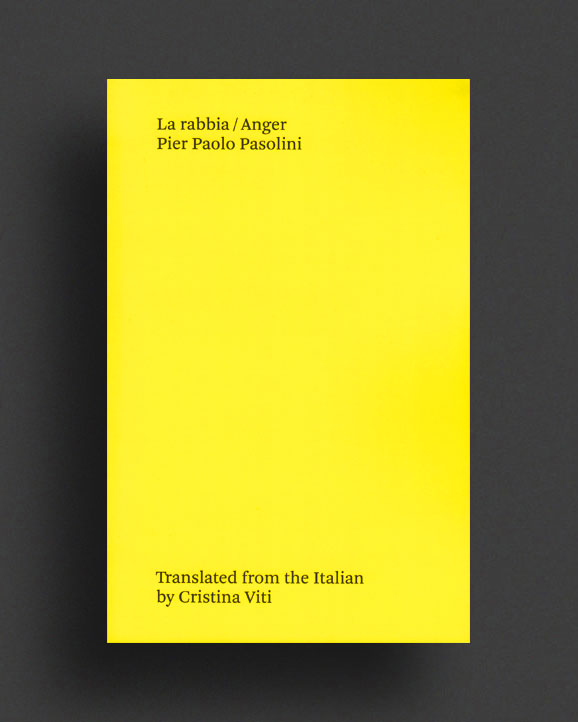
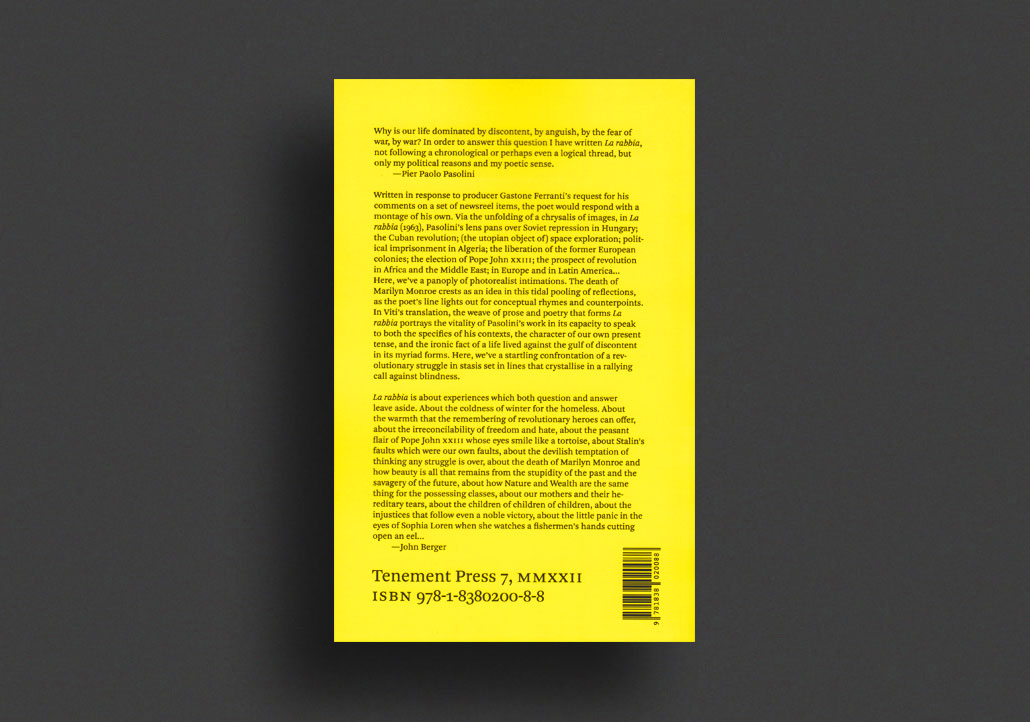
Why is our life dominated by discontent, by anguish, by the fear of war, by war? In order to answer this question I have written La rabbia, not following a chronological or perhaps even a logical thread, but only my political reasons and my poetic sense.—Pier Paolo Pasolini
Written in response to producer Gastone Ferranti’s request for his comments on a set of newsreel items, the poet would respond with a montage of his own. Via the unfolding of a chrysalis of images, in La rabbia (1963), Pasolini’s lens pans over Soviet repression in Hungary; the Cuban revolution; (the utopian object of) space exploration; political imprisonment in Algeria; the liberation of the former European colonies; the election of Pope John XXIII; the prospect of revolution in Africa and the Middle East; in Europe and in Latin America… Here, we’ve a panoply of photorealist intimations of Pasolini’s ‘poetic sense.’ The death of Marilyn Monroe crests as an idea in this tidal pooling of reflections, as the poet’s line lights out for conceptual rhymes and counterpoints.
In Viti’s translation, the weave of prose and poetry that forms La rabbia portrays the vitality of Pasolini’s work in its capacity to speak to both the specifics of his contexts, the character of our own present tense, and the ironic fact of a life lived against the gulf of discontent in its myriad forms. Here, we’ve a startling confrontation of a revolutionary struggle in stasis set in lines that crystallise a rallying call against blindness. ‘I’ll not have peace, not ever,’ he writes. A lucid acceptance of the poet’s restlessness, and a marker for Pasolini’s commitment to a solidarity with the oppressed that we find reaffirmed on every page, in La rabbia the poet charts how ‘the powerful world of capital takes an abstract painting as its brash banner’ in this unravelling of ‘crisis in the world.’
Praise for Viti's translation of Pasolini's La rabbia
Pasolini’s poems thrive with passion and outrage. A 20th century Dante, he grieves at inequity, feels disgusted by corruption, and wails against the evil that people do. Pasolini doesn’t render a coming paradise, but contests hate with love, meanness with generosity, and through the reality of his beautiful poems, suggests the possibility of creating a better world.—Lynne Tillman
Pasolini saw what was coming, and saw the poet’s mission as an excoriation of this world to come, that has now arrived. His tremendous energy was not negative. It came from an abounding love of the world. Picturing himself like a hero from ancient days, he struggled mightily, in and against the powers arrayed against life. What he called neocapitalism already came with its own brands of neofascism. Good comrade that he was, he knew the mark of our enemies, and where to direct his rage. Here we find him in a moment when he thought the good fight might still be won. A book to give us courage.—McKenzie Wark
Pier Paolo Pasolini (1922–1975) was an Italian poet, novelist, journalist, filmmaker, theorist, and dramaturg. First and foremost a poet, he is a major figure in European literature and cinematic arts. Life in Rome during the 1950s furnished the material for his first two novels, Ragazzi di vita / The Ragazzi, 1955) and Una vita violenta / A Violent Life, 1959); works whose brutal reflections of urban poverty in the city were similar in character to the depictions of Rome in his debut film, Accattone (1961). All three works dealt with the lives of thieves, prostitutes, and other denizens of a Roman underworld. Other notable novels and narrative works in translation include the unfinished novel Petrolio (published in English in Ann Goldstein’s translation by Pantheon), a work-in-progress at the time of Pasolini’s death, and La lunga strada di sabbia / The Long Road of Sand, a facsimile of writings towards a travelogue initially published in the magazine Successo. Pasolini published numerous volumes of poetry in his lifetime, including La meglio gioventù (1954); Le ceneri di Gramsci (1957); L'usignolo della chiesa cattolica (1958); La religione del mio tempo (1961); Poesia in forma di rosa (1964); Trasumanar e organizzar (1971); and La nuova gioventù (1975). Works of poetry in English language translation include Norman MacAfee’s Poems, an anthology covering the entirety of Pasolini’s ‘official publications’ (Farrar, Strauss and Giroux, 1982); Lawrence Ferlinghetti and Francesca Valente's Roman Poems (City Lights, 1986); Jack Hirschman's anthology, In Danger (City Lights, 2010); and Thomas E. Perterson’s translation of The Divine Mimesis (Contra Mundum, 2014), amongst others. A noted journalist and publisher, Pasolini was also a rare voice in the popular press. In 1955—in collaboration with Francesco Leonetti, Roberto Roversi and others—he edited and oversaw the publication of Officina, a periodical dedicated to new poetry in Italian (which ran for fourteen issues), and contributed a regular column to Vie Nuove from May 1960 to September 1965 (titled Dialoghi con Pasolini / Pasolini in Dialogue, subsequently published as a collated edition in 1977 as Le belle bandiere / The Beautiful Flags). His literary works informed his cinema, and Pasolini would follow the release of Accattone in ‘61 with such noted features as Il Vangelo secondo Matteo / The Gospel According to Saint Matthew (1964); Uccellacci e Uccellini / Hawks and the Sparrows (1966); Oedipus Rex (1967); Medea (1969); Teorema / Theorem (1968); Porcile / Pigsty (1969); Il Decamerone / The Decameron (1971); and The Canterbury Tales (1972). Pasolini referred to himself as a ‘Catholic Marxist’ and often used shocking juxtapositions of idea and imagery to expose the vapidity of values in modern society. His friend, the writer Alberto Moravia, considered him “the major Italian poet” of the second half of the 20th century. Pasolini was murdered in 1975.
Cristina Viti is a translator and poet working with Italian, English and French. Her most recent publication was a co-translation of poems by Anna Gréki (The Streets of Algiers and Other Poems, Smokestack Books, 2020), and her translation of Elsa Morante’s The World Saved by Kids and Other Epics (Seagull Books, 2016) was shortlisted for the John Florio Prize. Previous publications include the Selected Works of Dino Campana (Survivors’ Press, 2006), including a full version of the Orphic Songs, and excerpts from Carlo Emilio Gadda’s War & Prison Journals (in No Man’s Land, Serpent’s Tail 2014). Other translations (including Amelia Rosselli, Clemente Rèbora) and/or Viti’s own poetry have been published in various reviews (including Shearsman Magazine, Agenda, The White Review, et cetera). Her Italian version of Orson Welles’ Moby Dick—Rehearsed is in production with the Teatro dell’Elfo in Milan. A translation of Furio Jesi’s essays on literature, myth and revolt (Time & Festivity, Seagull Books 2021) is the subject of one of three video presentations on Jesi commissioned by the Italian Institute in London. Among other projects, forthcoming are translations of a collection by Luigi Di Ruscio—a poet from the Marche who, over forty years, created a prodigious body of work after his daily shifts in a steel factory in Oslo—and Luca Rastello’s The Rain’s Falling Up, a novel exploring the politics and spirit of the Seventies in Italy. Viti currently holds collaborative translation workshops within the Radical Translations project run by the French and Comparative Literature departments of King’s College.
2024, English
Softcover (w. dust jacket), 96 pages. 17 x 24 cm
Published by
Drill Hall Gallery / Canberra
$38.00 - Out of stock
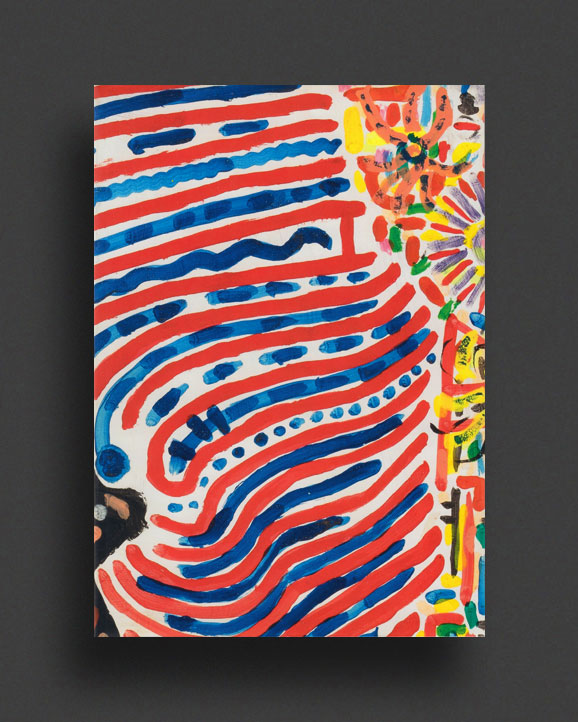
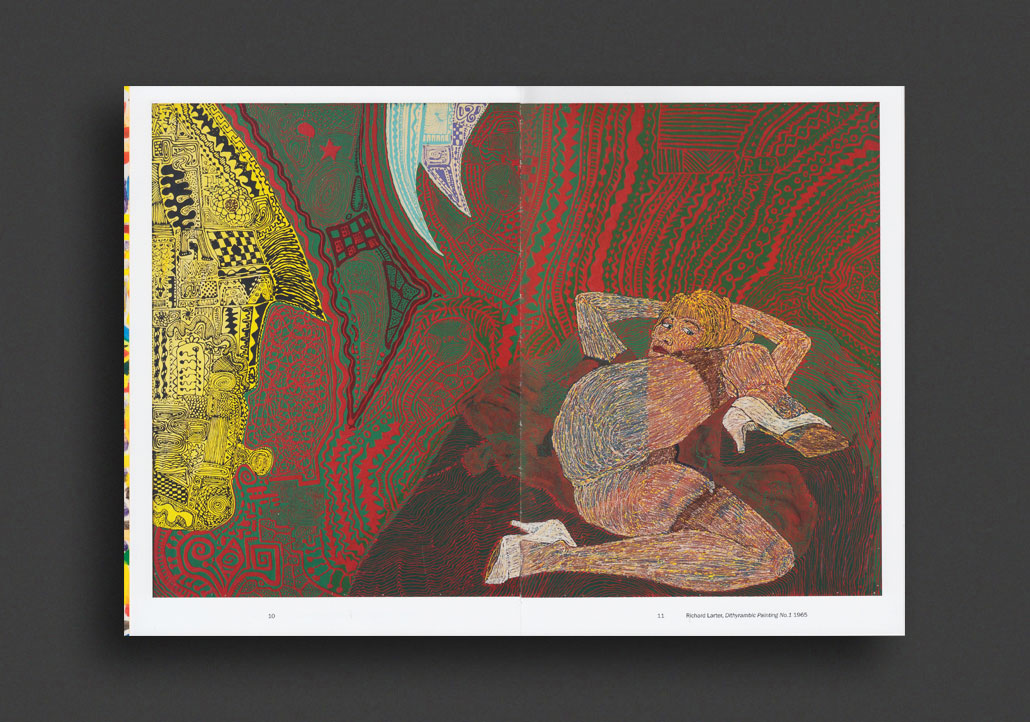
In this publication the art of Richard Larter, Pat Larter and Peter Maloney is unearthed in reproductions and three complimentary texts from Tony Oates, Hester Gascoigne and Mark Bayly. What emerges is a picture of Canberran visual culture that challenges the image of a stuffy national capital devoid of radical action. In its place we see a revolutionary community of like-minds hell bent on freedom, fairness and fun.Tony Oates delves into the leftist libertarian ethos that drove Richard Larter through the nitty gritty of his politically powerful pop imagery to his luminous abstraction, suggestive of universal truths. Here, Larter, so often regarded as the founding father of Australian Pop art, is revealed to be so much more. In Hester Gascoigne’s essay the work of husband faces off against the work of wife. Gascoigne traces the weaving threads of Pat’s and Richard’s practices as they merged and diverged over the years, from collaborative to competitive, always with an effervescent cheekiness and fierce dedication to the other. In conversation with Oates, Mark Bayly offers up personal reflections on the life and art of his late partner Peter Maloney with particular focus on the fertile relationship he shared with the Larters.
1966, English
Hardcover (Burlap covered boards), 342 pages, 32 x 31cm
1st Edition, Out of print title / used / very good
Published by
Harry N. Abrams / New York
$400.00 - Out of stock
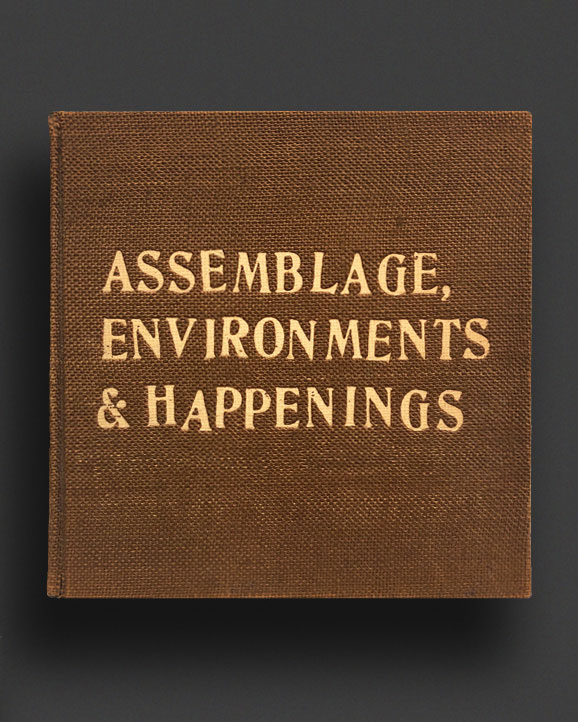
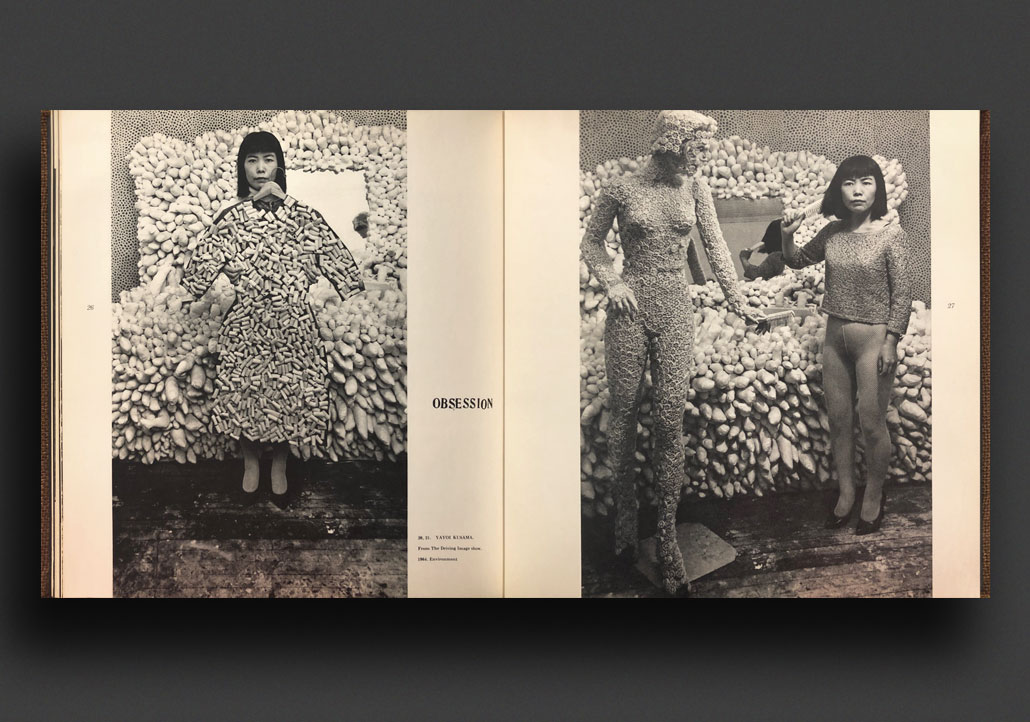
Rare first 1966 burlap-bound edition of this seminal work by Allan Kaprow documenting the milieu of performance art and happenings in the early-mid 1960s. Published by H. N. Abrams, Assemblage, Environments & Happenings is a legendary photo-artist-book by “one of the grand antiheroes of contemporary art”, produced in way we would never see today. Wrapped in a heavy, debossed and screen-printed raw burlap hardcover, this massive and visually stunning volume features incredible typography, commentary and lay-out by Kaprow himself, accompanying countless photogravures (photos taken by Oldenburg, Robert McElroy, Peter Moore and others) featuring the work of artists (and non-artists) such as Claes Oldenburg, Tetsumi Kudo, Jean Tinguely, Clarence Schmidt, Jean-Jacques Lebel, Wolf Vostell, George Brecht, Kenneth Dewey, Milan Knizak, Jackson Pollock, Robert Whitman, Red Grooms, George Segal, Yayoi Kusama, Jim Dine, Robert Rauschenberg, Allan Kaprow, together with images of works by the Japanese Gutai Group (Murakami Saburo, Shozo Shimamoto, Kazuo Shiraga, Atsuko Tanaka, et al) and many more.
Allan Kaprow, “an artist who coined the term ‘happenings’ in the late 1950s and whose anti-art works contributed to radical changes in the course of late 20th-century art,” was a leading member-with artists George Segal, Jim Dine and Claes Oldenberg-of a group whose performance works were signally influenced by John Cage’s “reliance on chance as an organizing, or disorganizing element in art. Like Cage, Kaprow used a combination of choice and accident as a way of creating nonverbal, quasi-theatrical situations in which performers functioned as kinetic objects, the role of the single artist-genius was de-emphasized, audience members became creative participants and no-clear distinction was made between everyday actions and ritual…” (New York Times).
"Step Right In"
Very Good copy, spotless with tight-As New binding, perfectly preserved.
2024, English
Softcover, 240 pages, 24.1 x 17.8 cm
Published by
Atelier Editions / Los Angeles
$74.00 - In stock -
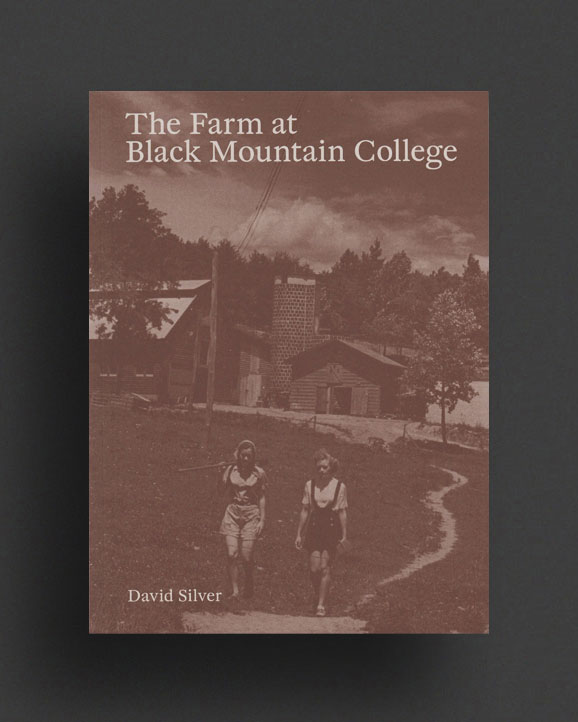
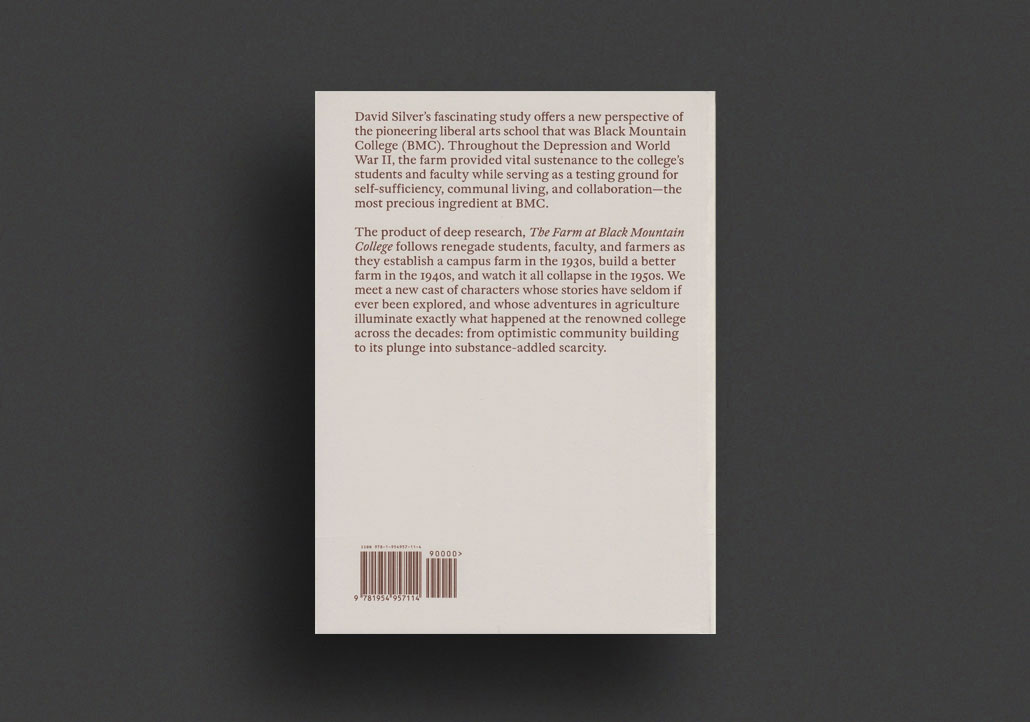
Black Mountain College (BMC) was a wellspring of 20th-century creative unorthodoxy. Through deep original research, this title follows renegade students, faculty & farmers as they establish a campus farm in the 1930s, build a better farm in the 1940s and watch it all collapse in the 1950s. In these engrossing pages, we encounter the extraordinary folk whose endeavours on the land helped shape the Black Mountain College of myth and extraordinary reality.From its founding in 1933 and over its celebrated 23-year history, the small liberal arts school in rural North Carolina attracted a remarkable number of famous and soon-to-be famous artists, writers and visionaries including Anni and Josef Albers, Ruth Asawa, John Cage, Merce Cunningham, Willem de Kooning, Buckminster Fuller, Ray Johnson, Charles Olson and M.C. Richards. The exploits of these BMC cultural luminaries have been recounted time and time again.David Silver’s fascinating new book offers a very different perspective. The farm was vital to BMC. Throughout the Depression and World War II it provided vital sustenance, while serving as a testing ground for self-sufficiency, communal living and collaboration—the most precious and precarious ingredient at the college.
David Silver (born 1968) is professor and chair of environmental studies at the University of San Francisco. He teaches classes on urban agriculture, hyperlocal food systems and food, culture and storytelling.
2018, English
Softcover, 184 pages, 11.4 x 17.8 cm
Published by
Wakefield Press / Cambridge
$30.00 - Out of stock
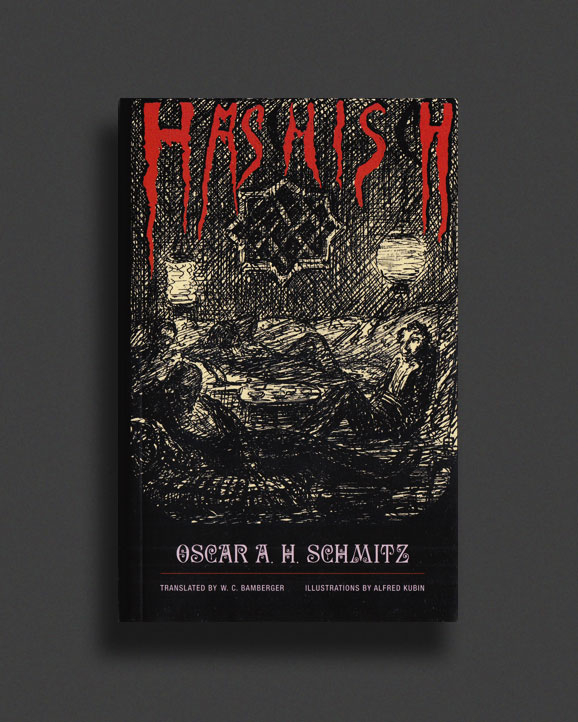
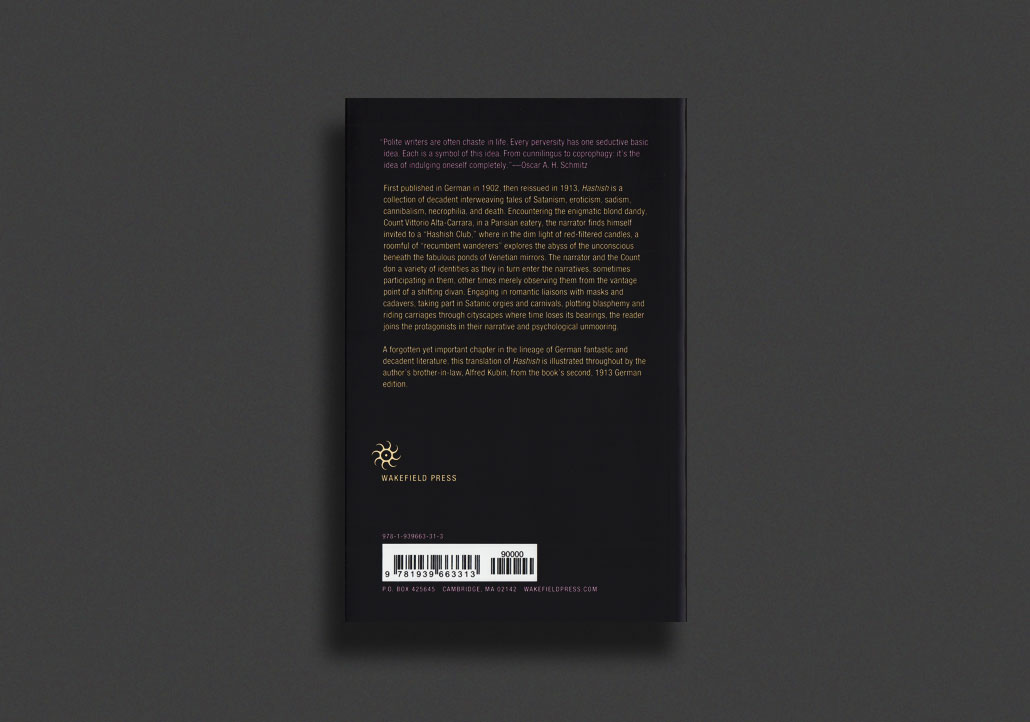
First published in German in 1902, Hashish is a collection of decadent, interwoven tales of Satanism, eroticism, sadism, cannibalism, necrophilia and death. Encountering the enigmatic dandy Count Vittorio Alta-Carrara in a Parisian eatery, the narrator finds himself invited to a “Hashish Club", where in the dim light of red-filtered candles, a roomful of “recumbent wanderers” explores the abyss of the unconscious. The narrator and the count don a variety of identities as they in turn enter the narratives, sometimes participating in them, other times merely observing them from the vantage point of a shifting divan. Engaging in romantic liaisons with masks and cadavers, taking part in Satanic orgies and carnivals, plotting blasphemy and riding carriages through cityscapes where time loses its bearings, the protagonists draw the reader into their narrative and psychological unmooring.
A forgotten yet important chapter in the lineage of German fantastic and decadent literature, this translation of Hashish is illustrated throughout with drawings by the author's brother-in-law, Alfred Kubin, from the book's second, 1913 German edition.
Oscar A.H. Schmitz (1873-1931) lived the life of a literary dandy. Although best remembered in Germany for his second book, Hashish, and the decadent lineage it helped inaugurate in German letters, his output was wide-ranging, from Romantic verse to plays and travel books, to a series of popular non-fiction works on politics, yoga, astrology, etiquette and Jungian psychology.
2024, Englsih
Softcover, 240 pages, 20.3 x 13.3 cm
Published by
Wakefield Press / Cambridge
$36.00 - In stock -
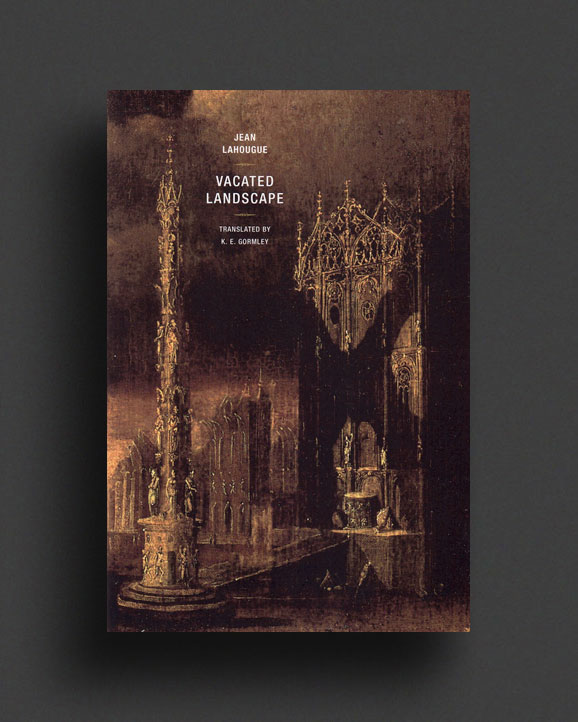
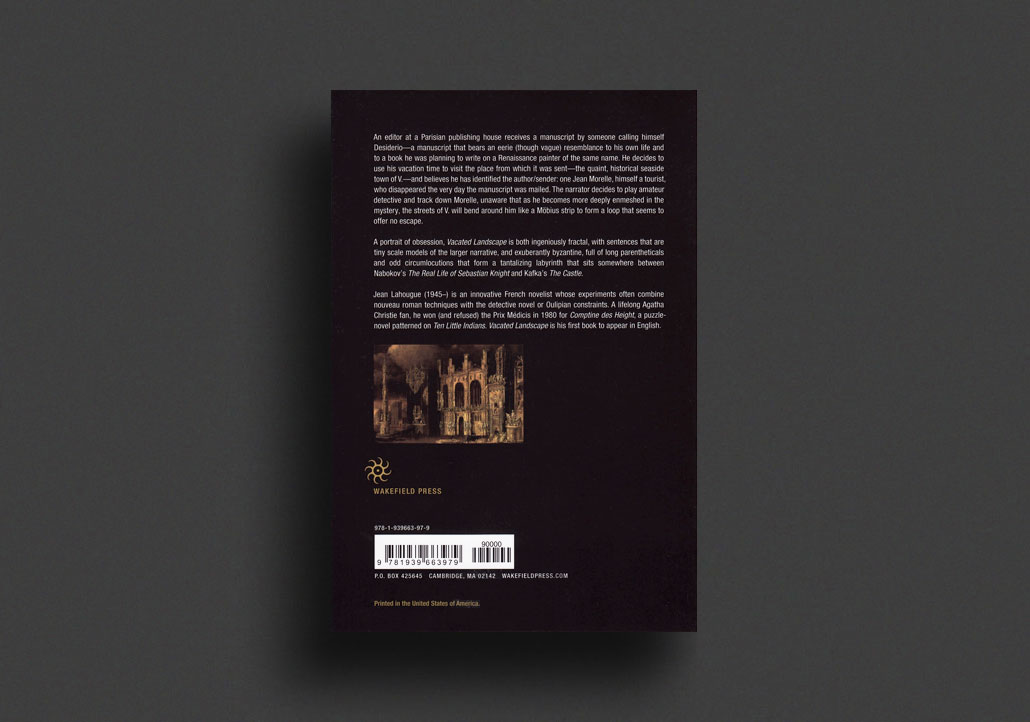
An editor at a Parisian publishing house receives a manuscript by someone calling himself Desiderio—a manuscript that bears an eerie (though vague) resemblance to his own life and to a book he was planning to write on a Renaissance painter of the same name. He decides to use his vacation time to visit the place from which it was sent—the quaint, historical seaside town of V.—and believes he has identified the author/sender: one Jean Morelle, himself a tourist, who disappeared the very day the manuscript was mailed. The narrator decides to play amateur detective and track down Morelle, unaware that as he becomes more deeply enmeshed in the mystery, the streets of V. will bend around him like a Möbius strip to form a loop that seems to offer no escape.
A portrait of obsession, Vacated Landscape is both ingeniously fractal, with sentences that are tiny scale models of the larger narrative, and exuberantly byzantine, full of long parentheticals and odd circumlocutions that form a tantalizing labyrinth that sits somewhere between Nabokov’s The Real Life of Sebastian Knight and Kafka’s The Castle.
Jean Lahougue (1945–) is an innovative French novelist whose experiments often combine nouveau roman techniques with the detective novel or Oulipian constraints. A lifelong Agatha Christie fan, he won (and refused) the Prix Médicis in 1980 for Comptine des Height, a puzzle-novel patterned on Ten Little Indians. Vacated Landscape is his first book to appear in English.
Translated, with an afterword, by K. E. Gormley
2024, English
Softcover, 256 pages. 20 x 13 cm
Published by
Silver Press / London
$37.00 - In stock -
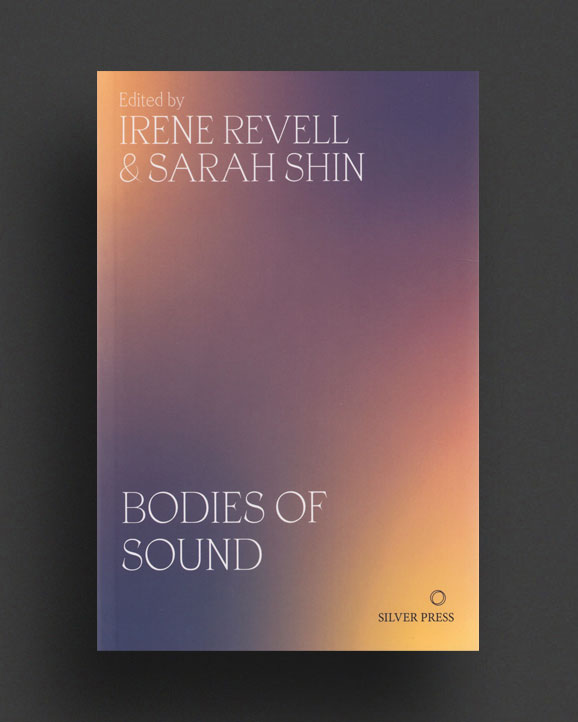
With contributions from: Sara Ahmed, Ximena Alarcón, Svetlana Alexievich, Ain Bailey & Frances Morgan, Anna Barham, Xenia Benivolski, Leanne Betasamosake Simpson & Kite, Elena Biserna, Karen Barad & Black Quantum Futurism, Anne Bourne, Daniela Cascella, Theresa Hak Kyung Cha, Maria Chávez, Don Mee Choi, Carson Cole Arthur, Petero Kalulé & AM Kanngieser, Lindsay Cooper, Julia Eckhardt, Lucia Farinati & Claudia Firth, Ella Finer, Annie Goh, Louise Gray, Christina Hazboun, Johanna Hedva, Sarah Hennies, Tomoko Hojo, IONE, Lee Ingleton, Hannah Catherine Jones, Christine Sun Kim, Nat Lall, Cathy Lane, Jeanne Lee & Lona Foote, Marysia Lewandowska, Annea Lockwood & Jennifer Lucy Allan, Cannach MacBride, Elaine Mitchener & Hannah Kendall, Alison O'Daniel, Naomi Okabe, Pauline Oliveros, Daphne Oram, Gascia Ouzounian, Holly Pester, Roy Claire Potter, Anna Raimondo, Tara Rodgers, Aura Satz & Barbara London, Shortwave Collective, Sisters of the Order of Celestial Nephology, Sop, Syma Tariq, Marie Thompson, Trinh T. Minh-ha & Stoffel Debuysere, Salomé Voegelin
‘I am concerned with the power of sound! and what it can do to the body and the mind,’ wrote composer Pauline Oliveros. In the body, histories and politics come together with sound and listening, memory and feeling. Bodies of Sound offers a resonant exploration of feminist sonic cultures and radical listening in over fifty contributions. In this book of echoes, a variety of forms – from essays to text scores to art, fiction and memoir – speak across gender, ways of knowing, witnessing, sounding and voicing, translation, displacement, violence and peace.
2022, English
Softcover, 64 pages, 11 x 16 cm
Published by
Ignota / UK
$20.00 - Out of stock
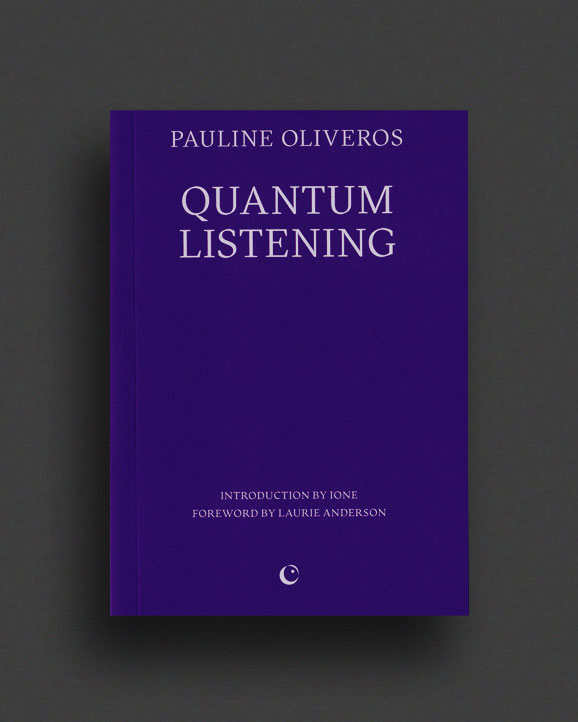
In response to the anti-war movements of the 1960s, pioneering musician and composer Pauline Oliveros began to expand the way she made music, experimenting with meditation, movement and activism in her compositions. This title is a manifesto for listening as activism. Through simple yet profound exercises, Oliveros shows how Deep Listening is the foundation for a radically transformed social matrix: one in which compassion and peace form the basis for our actions in the world. Fascinated by the role that sound and consciousness play in our daily lives, Oliveros developed a series of Sonic Meditations that would eventually lead to the creation of Deep Listening – a practice for healing and transformation open to all, rooted in her musicianship. This timely edition brings Oliveros’ futuristic vision – blending technology and spirituality – together with a new Foreword and Introduction by Laurie Anderson and IONE.
2019, English
Softcover, 48 pages, 11 x 16 cm
Published by
Ignota / UK
$20.00 - Out of stock
Introduction by Donna J. Haraway
Illustrated by Lee Bul
In The Carrier Bag Theory of Fiction, visionary author Ursula K. Le Guin retells the story of human origin by redefining technology as a cultural carrier bag rather than a weapon of domination. Hacking the linear, progressive mode of the Techno-Heroic, the Carrier Bag Theory of human evolution proposes: 'before the tool that forces energy outward, we made the tool that brings energy home.' Prior to the preeminence of sticks, swords and the Hero's long, hard, killing tools, our ancestors' greatest invention was the container: the basket of wild oats, the medicine bundle, the net made of your own hair, the home, the shrine, the place that contains whatever is sacred. The recipient, the holder, the story. The bag of stars. This influential essay opens a portal to terra ignota: unknown lands where the possibilities of human experience and knowledge can be discovered anew. With a new introduction by Donna Haraway, the eminent cyberfeminist, author of the revolutionary A Cyborg Manifesto and most recently, Staying with the Trouble and Manifestly Haraway. With images by Lee Bul, a leading South Korean feminist artist who had a retrospective at London's Hayward Gallery in 2018.
1989, English
Softcover, 26 pages, 21 x 14.8 cm
John Nixon hand-painted monochrome covers,
1st Edition, Out of print title / used / very good
Published by
City Gallery / Melbourne
$160.00 - Out of stock
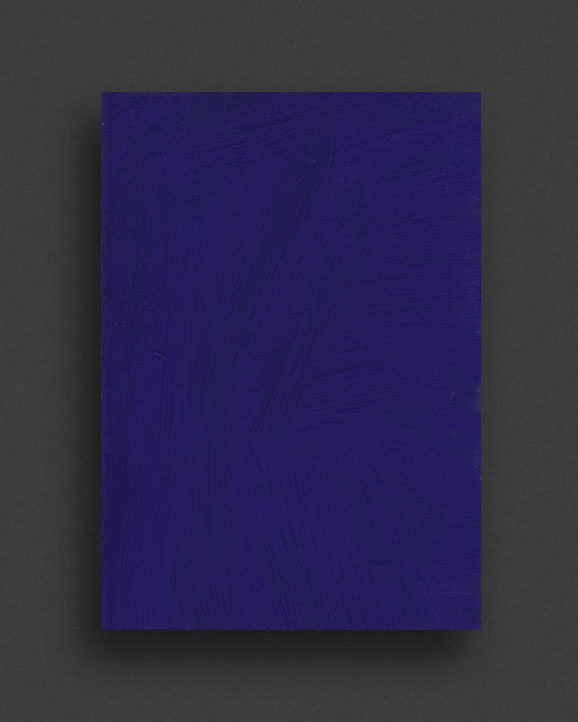
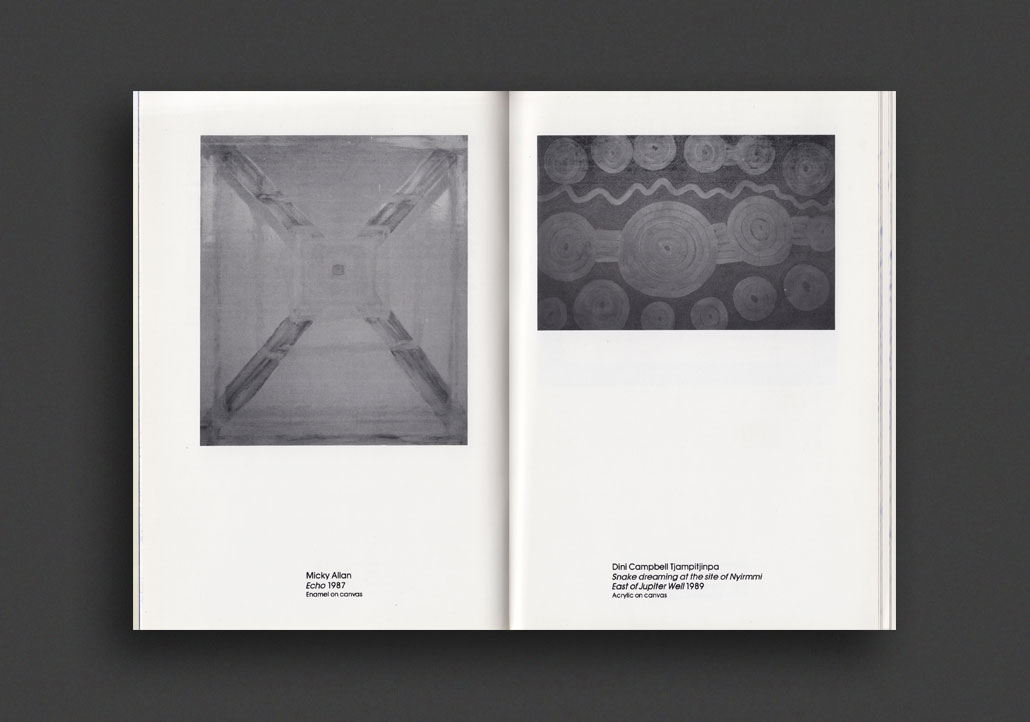
Rare copy of John Nixon's hand-painted monochromatic catalogue, published in 1989 on the occasion of the exhibition Nixon curated for the City Gallery, Melbourne. In stiff card wrappers painted in royal blue by John, the catalogue presents the work of Micky Allan, Dini Campbell Tjampitjinpa, Eugene Carchesio, Peter Cripps, Dale Frank, Melinda Harper, Tim Johnson, John Nixon, Rose Nolan, Robert Owen, Stieg Piersson, Billy Stockman Tjapaltjarra, Johnny Warangkula Tjupurrula, Jimmy Wululu, John Young.
"Our Commune: With a multitude of visions they have moved beyond the circle into the centre of the universe (into the world of 'non-objectivity'). Into a journey outward (with spiritual, cosmic, constructivist, materialist, simulative, dreaming, conceptual and formal endeavours) and into the worlds of the Cosmos;
the worlds of Abstractions Utopia."—John Nixon, July 1987
As New.
2024, English
Softcover, 240 pages, 21 x 14 cm
Published by
Seven Stories Press / New York
$36.00 - Out of stock
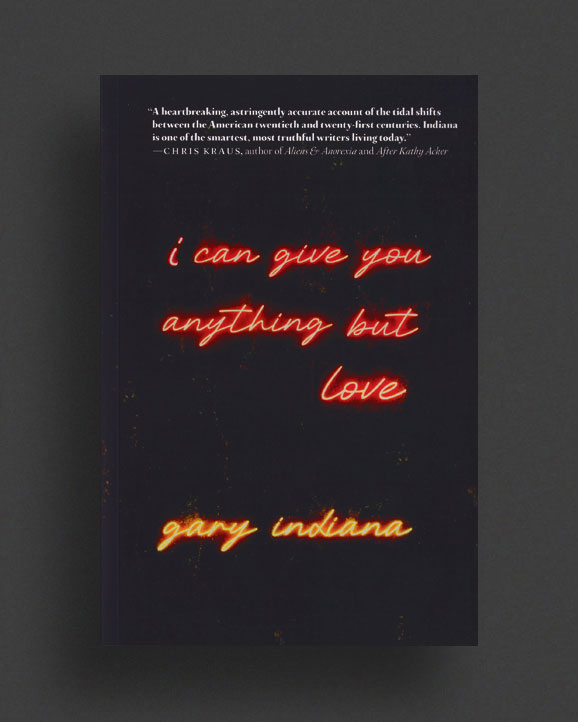
A beloved memoir from one of the most acclaimed radical writers in American literature—whose graphic, funny, and caustic voice has by turns haunted and influenced the literary and artistic establishments.
"[Indiana] becomes the connective tissue that binds together a diaspora of subcultures: the beatnik-era experimental writing and happenings of downtown New York, the 1960s co-opted counterculture gone awry, the punk movement that followed, and the art and intellectual circles of the Reagan 80s, when the AIDS crisis was wiping out a generation of young gay men like him." —Los Angeles Times
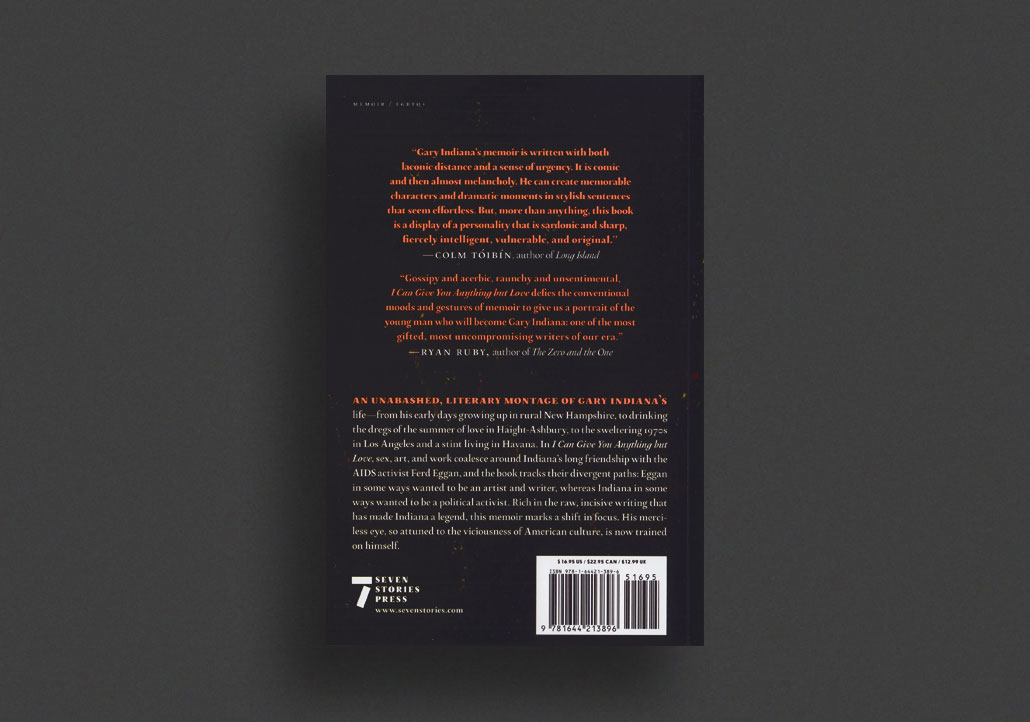
With I Can Give You Anything but Love, Gary Indiana has composed a literary, unabashedly wicked, and revealing montage of excursions into his life and work—from his early days growing up gay in rural New Hampshire to his escape to Haight-Ashbury in the post–summer-of-love era, the sweltering 1970s in Los Angeles, and ultimately his existence in New York in the 1980s as a bona fide downtown personality. Interspersed throughout his vivid recollections are present-day chapters set against the louche culture and raw sexuality of Cuba, where he lived and worked occasionally over the past decades.
Connoisseurs will recognize in this—his most personal book—the same mixture of humor and realism, philosophy and immediacy, that have long confused the definitions of genre applied to his writing. Vivid, atmospheric, revealing, and entertaining, this is an engrossing read and a serious contribution to the genres of gay and literary memoir.
"Beautifully written, Gary Indiana's 'memoir' is one of his greatest books: a heartbreaking, astringently accurate account of the tidal shifts between the American 20th and 21st centuries. Indiana is one of the smartest, most truthful writers living today."—Chris Kraus, author of Aliens & Anorexia and After Kathy Acker
"Gary Indiana's memoir is written with both laconic distance and a sense of urgency. It is comic and then almost melancholy. He can create memorable characters and dramatic moments in stylish sentences that seem effortless. But, more than anything, this book is a display of a personality that is sardonic and sharp, fiercely intelligent, vulnerable and original."—Colm Tóibín, author of Long Island
"I Can Give You Anything but Love recounts the wicked adventures of old Gary in Cuba and young Gary living dangerously in the demimondes of LA, San Francisco, Boston, and New York, in prose so conversant and apt it's like a superpower, like ease in a foreign element, breathing underwater or flying. Fueled by Swiftian indignation at our unbelievable stupidity, accuracy is a kind of revenge on a world that declines to return our love. Young Gary suffers the opposite of an education: he unlearns till all that remains is chaos and invisibility. He respects beautiful flesh and friendship's damaged utopia as he encounters others who are also desperate, brilliant, and sometimes famous."—Robert Glück, author of About Ed
"Gossipy and acerbic, raunchy and unsentimental, I Can Give You Anything but Love defies the conventional moods and gestures of memoir to give us a portrait of the young man who will become Gary Indiana: one of the most gifted, most uncompromising writers of our era."—Ryan Ruby, author of The Zero and the One
GARY INDIANA is a novelist and critic who has chronicled the despair and hysteria of America in the late twentieth century. From Horse Crazy (1989), a tale of feverish love set against the backdrop of downtown New York amid the AIDS epidemic, to Do Everything in the Dark (2003), "a desolate frieze of New York's aging bohemians" (n+1), Indiana's novels mix horror and bathos, grim social commentary with passages of tenderest, frailest desire. With 1997's Resentment- A Comedy, Indiana began his true crime trilogy, following up with Three Month Fever- The Andrew Cunanan Story (1999) and Depraved Indifference (2002). Together, the three novels show the most vicious crimes in our nation's history to be only American pathologies personified. In 2015, Indiana published his acclaimed anti-memoir, I Can Give You Anything But Love and later the novel Gone Tomorrow. Called one of "the most brilliant critics writing in America today" by the London Review of Books, "the punk poet and pillar of lower-Manhattan society" by Jamaica Kincaid, and "one of the most important chroniclers of the modern psyche" by the Guardian, Gary Indiana remains both inimitable and impossible to pin down.
1991, English
Softcover, 736 pages, 25.3 x 16.5 cm
Published by
Vintage / UK
$42.00 - Out of stock
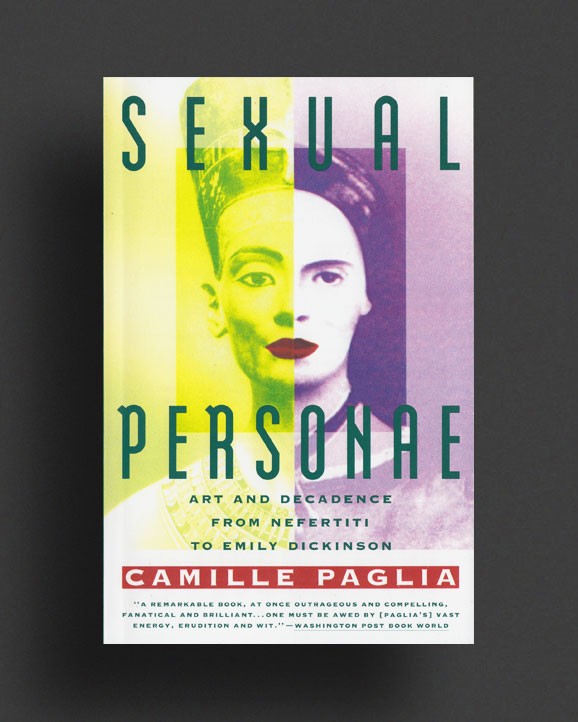
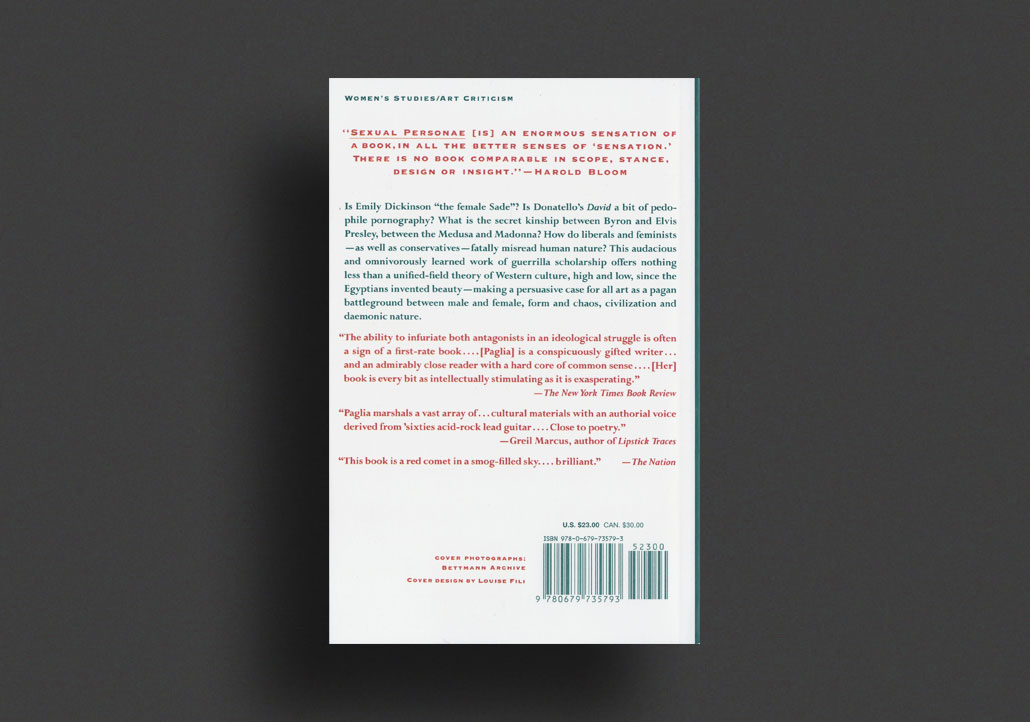
Here is the fiery, provocative, and unparalleled work of feminist art criticism that launched Camille Paglia's exceptional career as one of our most important public intellectuals. Is Emily Dickinson the female Sade? Is Donatello's David a bit of pedophile pornography? What is the secret kinship between Byron and Elvis Presley, between Medusa and Madonna? How do liberals and feminists as well as conservatives fatally misread human nature?
This audacious and omnivorously learned work of guerrilla scholarship offers nothing less than a unified-field theory of Western culture, high and low, since Egyptians invented beauty making a persuasive case for all art as a pagan battleground between male and female, form and chaos, civilization and daemonic nature.
Includes 47 photographs.
Camille Paglia is the University Professor of Humanities and Media Studies at the University of the Arts in Philadelphia. A regular contributor to Salon.com, she is the author of Glittering Images; Break, Blow, Burn; Sexual Personae; Sex, Art, and American Culture; and Vamps & Tramps.
"A remarkable book, at once outrageous and compelling, fanatical and brilliant. . . . One must be awed by [Paglia's] vast energy, erudition and wit."—The Washington Post
"Sexual Personae [is] an enormous sensation of a book, in all the better senses of 'sensation.' There is no book comparable in scope, stance, design or insight."—Harold Bloom
"The ability to infuriate both antagonists in an ideological struggle is often a sign of a first-rate book. . . . [Paglia] is a conspicuously gifted writer . . . and an admirably close reader with a hard core of common sense."—The New York Times Book Review
"Paglia marshals a vast array of . . . cultural materials with an authorial voice derived from sixties acid-rock lead guitar. . . . Close to poetry."—Greil Marcus, author of Lipstick Traces
"This book is a red comet in a smog-filled sky. . . . Brilliant."—The Nation
2024, English
Softcover, 416 pages, 21 x 14 cm
Published by
Verso / London
$48.00 - Out of stock
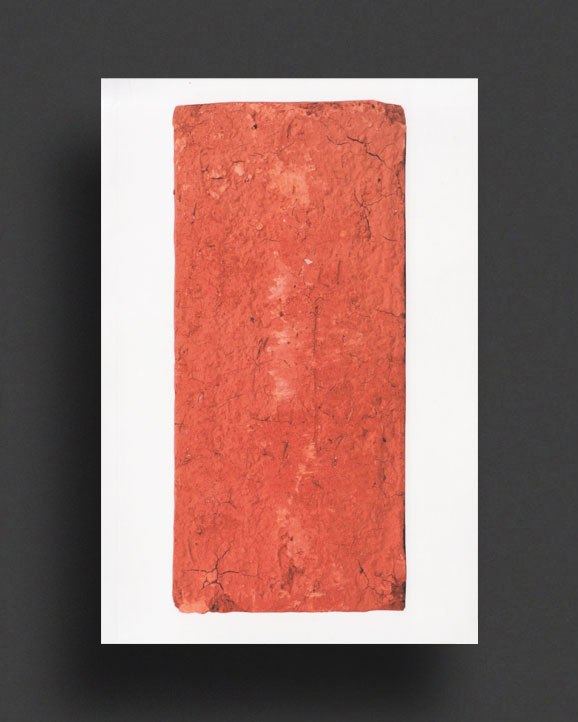
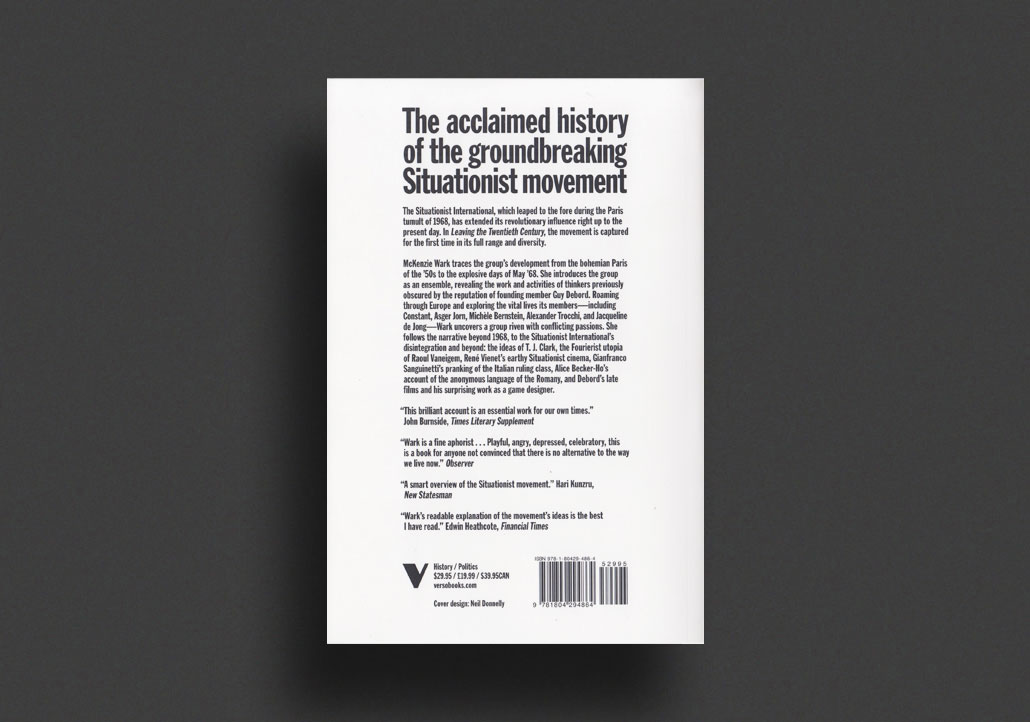
The highly-acclaimed history of the ground-breaking Situationist movement, in one volume for the first time.
The Situationist International, who came to the fore during the Paris tumults of 1968, were revolutionary thinkers who continue to influence movements and philosophy into the twenty-first century. Mostly know for Guy Debord's The Society of the Spectacle as well as other key texts, the group was in fact hugely diverse and radical. In Leaving The 20th Century McKenzie Wark explores the full range of the movement.
At once an extraordinary counter history of radical praxis and a call to arms in the age of financial crisis and the resurgence of the streets Wark traces the group's development from the bohemian Paris of the '50s to the explosive days of May '68, Wark's take on the Situationists is biographically and historically rich, presenting the group as an ensemble creation, rather than the brainchild and dominion of its most famous member, Guy Debord. Roaming through Europe and the lives of those who made up the movement—including Constant, Asger Jorn, Mich le Bernstein, Alex Trocchi and Jacqueline De Jong—Wark uncovers an international movement riven with conflicting passions.
She also follows the narrative beyond 1968 to show what happened after the movement disintegration exploring the lives and ideas of T.J. Clark, the Fourierist utopia of Raoul Vaneigem, Ren Vienet's earthy situationist cinema, Gianfranco Sangunetti's pranking of the Italian ruling class, Alice-Becker Ho's account of the anonymous language of the Romany, Guy Debord's late films and his surprising work as a game designer.
2011, English
Softcover, 416 pages, 20.3 x 14 cm
Published by
Deep Vellum / Texas
$34.00 - Out of stock
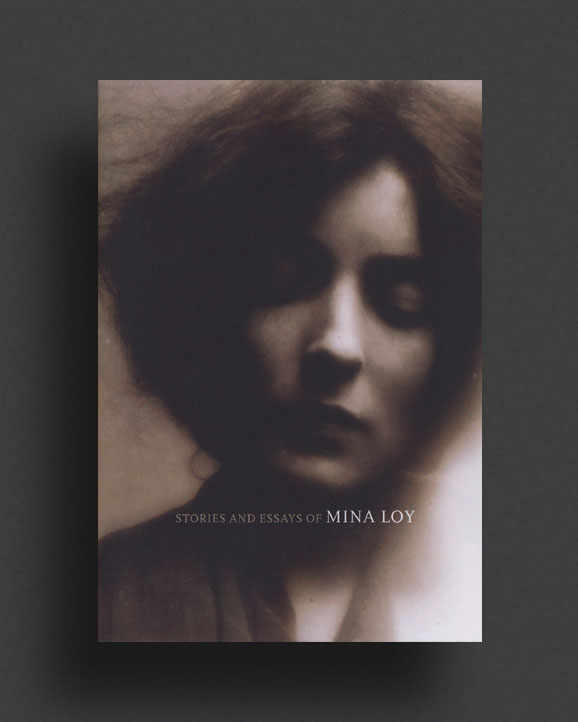
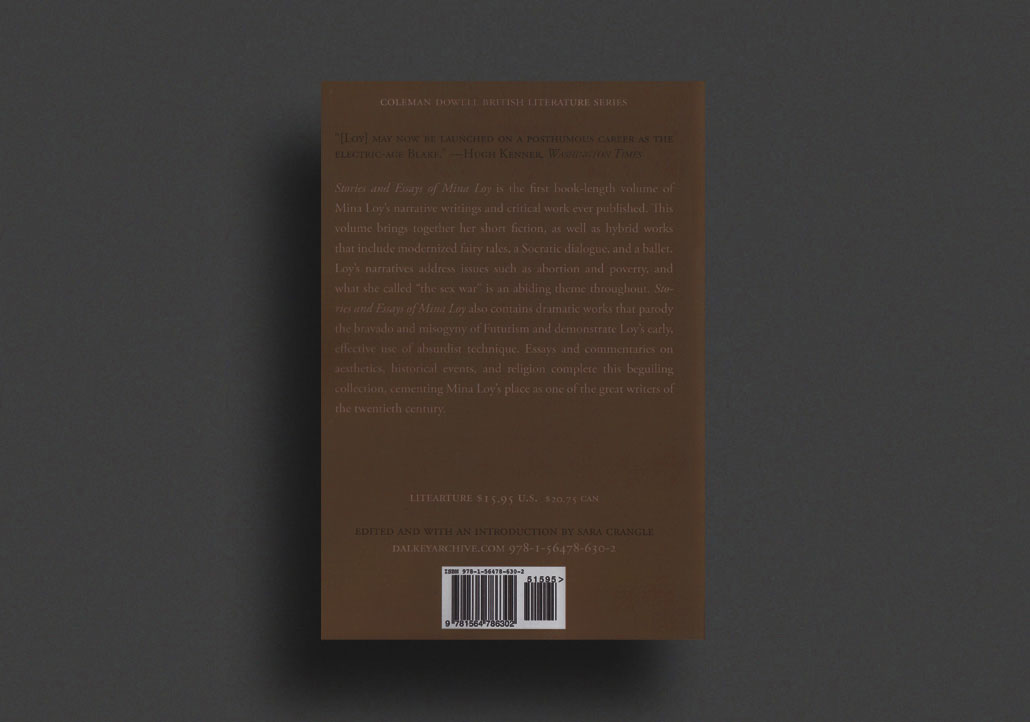
"Stories and Essays of Mina Loy" is the first book-length volume of Mina Loy's narrative writings and critical work ever published. This volume brings together her short fiction, as well as hybrid works that include modernized fairy tales, a Socratic dialogue, and a ballet. Loy's narratives address issues such as abortion and poverty, and what she called "the sex war" is an abiding theme throughout. "Stories and Essays of Mina Loy" also contains dramatic works that parody the bravado and misogyny of Futurism and demonstrate Loy's early, effective use of absurdist technique. Essays and commentaries on aesthetics, historical events, and religion complete this beguiling collection, cementing Mina Loy's place as one of the great writers of the twentieth century.
Marjorie Perloff writes: "Among the great modernist poets, Mina Loy was surely the greatest wit, the most sophisticated commentator on the vagaries of love, the one whose brittle and sardonic laughter continues... to pursue us."
2024, English
Softcover, 146 pages, 20.5 x 12.5 cm
Published by
Forgotten Press / Aotearoa—New Zealand
$30.00 - Out of stock
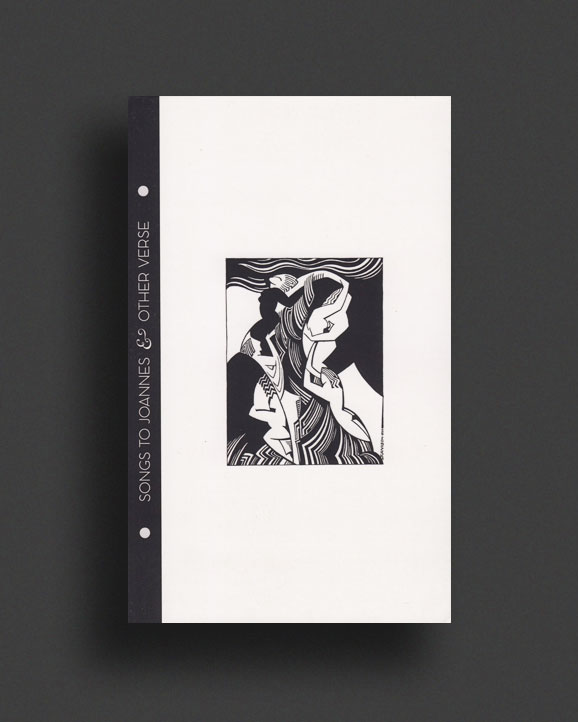
'Songs to Joannes & Other Verse' brings together a selection of poems by London poet Mina Loy, later based in Paris and New York, including the entire 34 song sequence, 'Songs to Joannes', and a generous selection of Loy's other verses (originally published 1914-1923), as well as selected short essays, manifestos, and aphorisms; with illustrations by Mina Loy, Djuna Barnes, and Clara Tice. Loy was a revolutionary poet, and a member of the Futurist and Dada groups in the mid-1910s, and a forerunner to the 'free' and 'new verse' movements of the 1920s.
The Forgotten Poets Newsletter presents: new collections of out-of-print and obscure poetry, with a focus on compressed & fragmented 'free' and 'new' verse from the late-1800s & early-1900s, & the early history of English-language tanka & haiku. Verses are carefully selected & spaciously laid-out, adorned with illustrations & ornaments from the books & magazines they originally appeared in.