World Food Books' programme is largely produced on Kulin Nation land. We acknowledge the Wurundjeri people of the Kulin Nation as the first and continuing custodians of this land, and pay respect to their Elders past, present, and emerging.
World Food Books is an arts and special interests bookshop in Naarm / Melbourne. Founded in 2010, World Food Books is devoted to the presentation of a rotating, hand-selection of international art, design, literary and counterculture publications with an emphasis on the anti-traditional, the experimental, the avant-garde, the heretic, the marginal.
Presenting new titles alongside rare and out-of-print books, catalogues and journals spanning the fields of modern and contemporary art, design, photography, illustration, film, literature, poetry, cultural theory, philosophy, sexuality, popular and underground culture in its many radical forms, World Food Books wishes to encourage adventurous, thoughtful and open-minded reading, looking, writing, and exchange of publishing and ideas, both current and historical.
As well as our bookshop, located in Melbourne's historical Nicholas Building, all of our inventory is available internationally via our online mail-order service.
World Food Books semi-regularly co-ordinates "Occasions", a programme of exhibits and events at the bookshop and in partnership with other hosts (such as museums and art galleries) that develop out of the activities, relationships and content of the bookshop itself.
World Food Books
The Nicholas Building
37 Swanston Street
Room 5, Level 6
Melbourne 3000
Australia
SHOP HOURS:
SHOP CLOSED FOR SUMMER
RE—OPEN JAN 2
WEB-SHOP OPEN 24/7
World Food Books
Postal Address:
PO Box 435
Flinders Lane
Victoria 8009
Australia
info@worldfoodbooks.com
Art
Theory / Essay
Architecture / Interior
Graphic Design / Typography
Photography
Fashion
Eros
LGBTQ+
Fiction / Poetry
Weird / Speculative / Science Fiction / Horror
Transgressive / Visceral / Abject
Symbolism / Decadence / Fin de siècle
Film / Video
Painting
Sculpture / Installation
Performance / Dance / Theater
Drawing
Sound / Music
Curatorial
Group Shows / Collections
Periodicals
Out-of-print / Rare
Posters / Ephemera / Discs
Signed Books
World Food Books Gift Voucher
World Food Book Bag
Australian Art
Australian Fiction
Australian Science Fiction / Speculative Fiction
Australian Poetry
Australian Photography
Japanese Photography
Conceptual Art
Minimal Art
Dada
'Pataphysics / Oulipo
Fluxus
Concrete Poetry
Pop Art
Surrealism
Arte Povera
Arte Informale / Haute Pâte / Tachism
Nouveau Réalisme / Zero / Kinetic
Situationism / Lettrism
Collage / Mail Art / Xerox Art
Art Brut / Folk / Visionary / Fantastic
Illustration / Graphic Art / Bandes Dessinées
Furniture
Italian Radical Design / Postmodernism
Textiles
Ceramics / Glass
Counterculture
Protest / Revolt
Philosophy
Psychoanalysis
Anthropology
Anarchism
Socialism / Anarchism / Communism / Capitalism
Literary Theory / Semiotics / Language
Feminism / Women's Studies
Gender Studies / Sexuality
Anthropology
Fetishism / BDSM
Drugs / Psychedelia
Crime / Violence
Animal Rights / Veganism
Occult / Esoterica
Ecology / Earth / Alternative Living
Whole Earth / Crafts
All prices in AUD (Australian dollars)
Pick-Ups
Pick-up orders can be collected in our bookshop during opening hours after order date. Please collect any Pick-up orders within 2 weeks of ordering as we have limited storage space. Orders will be released back into stock if not collected within this time. No refunds can be made for pick-ups left un-collected. If you cannot make it in to the bookshop in this time-frame, please choose postage option.
Return Policy
All sales are final. We do accept returns (for refund or exchange) for items received in error. All our orders are packed with special care using heavy-duty padding and cardboard book-mailers or bubble mailers (for smaller books), using reinforcement where required. We cannot take responsibility for any lost, stolen or damaged parcels.
Insurance
Should you wish to insure your package, please email us directly after placing your order and we can organise this at a small extra expense. Although all standard/express tracked packages are very safe and dependable, we cannot take responsibility for any lost, stolen or damaged parcels. We recommend insurance on valuable orders.
Interested in selling your old books, catalogues, journals, magazines, comics, fanzines, ephemera? We are always looking for interesting, unusual and out-of-print books to buy. We only buy books in our fields of interest and specialty, and that we feel we can resell.
We base these prices on desirability, market value, in-print prices, condition and our current stock levels. We offer cash, store credit, and can take stock on consignment. All
about 25% of the price we expect to get when we sell them, or 30% in store credit. We base these prices on desirability, market value, in-print prices, condition and our current stock levels.
Sell your books any day of the week. You can drop them off and return later. If you have a lot of books, we can visit your Sydney home.
We buy books that we feel we can resell. We offer about 25 % of the price we expect to get when we sell them, or 30% in store credit. We base these prices on desirability, market value, in-print prices, condition and our current stock levels.
Philadelphia Wireman
03 August - 01 September, 2018
World Food Books is proud to announce our next Occasion, the first presentation of sculptures by Philadelphia Wireman in Australia.
The Philadelphia Wireman sculptures were found abandoned in an alley off Philadelphia’s South Street on trash night in 1982. Their discovery in a rapidly-changing neighbourhood undergoing extensive renovation, compounded with the failure of all attempts to locate the artist, suggests that the works may have been discarded after the maker’s death. Dubbed the "Philadelphia Wireman" during the first exhibition of this work, in 1985, the maker’s name, age, ethnicity, and even gender remain uncertain. The entire collection totals approximately 1200 pieces, all intricately bound together with tightly-wound heavy-gauge wire (along with a few small, abstract marker drawings, reminiscent both of Mark Tobey and J.B. Murry). The dense construction of the work, despite a modest range of scale and materials, is singularly obsessive and disciplined in design: a wire armature or exoskeleton firmly binds a bricolage of found objects including plastic, glass, food packaging, umbrella parts, tape, rubber, batteries, pens, leather, reflectors, nuts and bolts, nails, foil, coins, toys, watches, eyeglasses, tools, and jewellery.
Heavy with associations—anthropomorphic, zoomorphic, and socio-cultural responses to wrapped detritus—the totemic sculptures by Philadelphia Wireman have been discussed in the context of work created to fulfil the shamanistic needs of alternative religions in American culture. Curators, collectors, and critics have variously compared certain pieces to sculpture from Classical antiquity, Native American medicine bundles, African-American memory jugs, and African fetish objects. Reflecting the artist’s prolific and incredibly focused scavenging impulse, and despite—or perhaps enhanced by—their anonymity, these enigmatic objects function as urban artefacts and arbiters of power, though their origin and purpose is unknown. Philadelphia Wireman, whatever their identity, possessed an astonishing ability to isolate and communicate the concepts of power and energy through the selection and transformation of ordinary materials. Over the course of the past two decades, this collection has come to be regarded as an important discovery in the field of self-taught art and vernacular art.
Presented in collaboration with Fleisher-Ollman Gallery, Philadelphia, and Robert Heald, Wellington.
Susan Te Kahurangi King
02 February - 10 March, 2018
Susan Te Kahurangi King (24 February 1951 - ) has been a confident and prolific artist since she was a young child, drawing with readily available materials - pencils, ballpoint pens and felt-tip markers, on whatever paper is at hand. Between the ages of four and six Susan slowly ceased verbal communication. Her grandparents William and Myrtle Murphy had developed a special bond with Susan so they took on caring responsibilities for extended periods. Myrtle began informally archiving her work, carefully collecting and storing the drawings and compiling scrapbooks. No drawing was insignificant; every scrap of paper was kept. The King family are now the custodians of a vast collection containing over 7000 individual works, from tiny scraps of paper through to 5 meter long rolls.
The scrapbooks and diaries reveal Myrtle to be a woman of great patience and compassion, seeking to understand a child who was not always behaving as expected. She encouraged Susan to be observant, to explore her environment and absorb all the sights and sounds. Myrtle would show Susan’s drawings to friends and people in her community that she had dealings with, such as shopkeepers and postal workers, but this was not simply a case of a grandmother’s bias. She recognised that Susan had developed a sophisticated and unique visual language and sincerely believed that her art deserved serious attention.
This was an unorthodox attitude for the time. To provide some context, Jean Dubuffet coined the term Art Brut in 1945 to describe work created by self-taught artists – specifically residents of psychiatric institutions and those he considered to be visionaries or eccentrics. In 1972 Roger Cardinal extended this concept by adopting the term Outsider Art to describe work made by non-academically trained artists operating outside of mainstream art networks through choice or circumstance. Susan was born in Te Aroha, New Zealand in 1951, far from the artistic hubs of Paris and London that Dubuffet and Cardinal operated in. That Myrtle fêted Susan as a self-taught artist who deserved to be taken seriously shows how progressive her attitudes were.
Susan’s parents Doug and Dawn were also progressive. Over the years they had consulted numerous health practitioners about Susan’s condition, as the medical establishment could not provide an explanation as to why she had lapsed into silence. Dawn educated herself in the field of homeopathy and went on to treat all twelve of her children using these principles – basing prescriptions on her observations of their physical, mental and emotional state.
Doug was a linguist with an interest in philosophy who devoted what little spare time he had to studying Maori language and culture. To some extent their willingness to explore the fringes of the mainstream made them outsiders too but it was their commitment to living with integrity and their respect for individuality that ensured Susan’s creativity was always encouraged.
Even though Susan’s family supported her artistic pursuits, some staff in schools and hospitals saw it as an impediment to her assimilation into the community and discouraged it in a variety of ways. Her family was not always aware of this and therefore did not fully understand why Susan stopped drawing in the early 1990s. However, rather than dwell on the challenges that Susan faced in pursuit of her artistic practice, they prefer to highlight her achievements. In 2008 Susan began drawing again in earnest, after an almost 20 year interruption, and her work is now shown in galleries around the world.
Susan grew up without television and has been heavily influenced by the comics she read as a child. She is absolutely fearless in the appropriation of recognizable characters, such as Donald Duck and Mickey Mouse, in her work. She twists their limbs, contorts their faces, compresses them together, blends them into complex patterned backgrounds - always imbuing them with an incredible energy. Although Susan often used pop culture characters in her work they are not naive or childlike. These are drawings by a brilliant self-taught artist who has been creating exceptional work for decades without an audience in mind.
Mladen Stilinović
"Various Works 1986 - 1999"
02 February 16 - September 10, 2016
Various works 1986 - 1999, from two houses, from the collections of John Nixon, Sue Cramer, Kerrie Poliness, Peter Haffenden and Phoebe Haffenden.
Including: Geometry of Cakes (various shelves), 1993; Poor People’s Law (black and white plate), 1993; White Absence (glasses, ruler, set square, silver spoon, silver ladel with skin photograph and wooden cubes), 1990-1996; Exploitation of the Dead (grey and red star painting, wooden painting, black spoon with red table, red plate), 1984-1990; Money and Zeros (zero tie, paintings made for friends in Australia (Sue, John, Kerrie), numbers painting), 1991-1992; Words - Slogans (various t-shirts) - “they talk about the death of art...help! someone is trying to kill me”, “my sweet little lamb”, “work is a disease - Karl Marx”; Various artist books, catalogues, monographs, videos; Poster from exhibition Insulting Anarchy; "Circular" Croatian - Australian edition; Artist book by Vlado Martek (Dostoyevsky); more.
Thanks to Mladen Stilinović and Branka Stipančić.
Jonathan Walker
Always Will Need To Wear Winter Shirt Blue + Ochre Small Check Pattern
21 August - 21 September, 2015
Untitled
I am not a great reader of poetry but I always return to the work of Melbourne poet, Vincent Buckley (1925- 1988). Perhaps I find his most tantalising piece to be not a finished poem but a fragment left on a scrap of paper discovered on his desk after the poet’s death.
The poetry gathers like oil
In the word-core, and spreads
It has its music meet,
Its music is in movement.
This fragment is more the shell left behind from a volatile thought than a finished poem. I find the last two lines honest but awkward whereas the first two lines work like an arrow. Most likely he could not find a resolution so it was left. Still, in its present form, it remains an eloquent testimony to the ultimate failure of a medium to express mobile thought and sensation, in Buckley’s case, through verbal language. It’s an important matter because this is something all artists have to deal with regardless of the medium.
I have never written a poem, however, I am forever copying fragments from books on paper scraps in a vain effort to fix certain notions in my head. At first, they function as bookmarks that are sometimes returned to when I open the book. But before long, as they accumulate, they fall out littering the table interspersed with A4 photocopies, bills, books and medications.
To return to Buckley’s fragment, the first two lines very much evoke how I paint nowadays. As you age, detail diminishes and patches of light become more luminous and float. I feel the most honest way of dealing with this is by smearing the oil paint on the canvas with the fingers and working close-up, blind. Only if the patches coalesce into an approaching image can the work gain a life.
-
Jonathan Walker was born in Melbourne, Australia and brought up on a dairy farm in Gippsland. In the 1970’s he studied painting at RMIT and won the Harold Wright Scholarship to the British Museum, London. During the 1980’s he exhibited at Pinacotheca Gallery, Richmond and had work shown at the NGV and Heidi City Art Gallery. Over the same period he designed the cover for the “Epigenesi” LP by Giancarlo Toniutti, Italy and conducted a mail exchange work with Achim Wollscheid, Germany. The work with artists through the post resulted in an article published in the bicentenary issue of Art and Australia 1988. He showed in artist run spaces such as WestSpace in the 90’s and 2000’s, and until 2012, taught painting at Victoria University, which is where we (Colleen Ahern and Lisa Radford) as organisers of the exhibition, among many others, had the privilege of being his student.
Walker’s knowledge was imparted to students through the careful selection of music, literature, and artists found in books that he himself had ordered for the library. Walker’s strategy was the generosity of sharing his vast knowledge with references specific to each student and their context.
Walker’s paintings share a similar focus and intimacy.
This exhibition presents a small selection of recent paintings alongside a publication that includes Walker’s writing. Observational and analytical, Walker’s work is a type of material notation — the time of day, colour and how it is blended, the both specific and fleeting location of a reflection on lino or the question of whether a chair leg should be included in a painting.
Please join us on Friday August 21 between 6-8pm to celebrate the opening of the exhibition.
Curated by Colleen Ahern and Lisa Radford.
B. Wurtz
Curated by Nic Tammens
March 26 - April 4, 2015
B.Wurtz works from a basement studio in his home on Manhattan’s Lower East Side.
This local fact is attested to by the plastic shopping bags and newsprint circulars that appear in his work. As formal objects, they don’t make loud claims about their origins but nonetheless transmit street addresses and places of business from the bottom of this long thin island. Like plenty of artists, Wurtz is affected by what is local and what is consumed. His work is underpinned by this ethic. It often speaks from a neighborhood or reads like the contents of a hamper:
“BLACK PLUMS $1.29 lb.”
“Food Bazaar”
“USDA Whole Pork Shoulder Picnic 99c lb.”
“RITE AID Pharmacy, with us it’s personal.”
“H. Brickman & Sons.”
“Sweet Yams 59c lb."
Most of the work in this exhibition was made while the artist was in residence at Dieu Donne, a workshop dedicated to paper craft in Midtown. Here Wurtz fabricated assemblages with paper and objects that are relatively lightweight, with the intention that they would be easily transportable to Australia. This consideration isn’t absolute in Wurtz’s work, but was prescriptive for making the current exhibition light and cheap. Packed in two boxes, these works were sent from a USPS post office on the Lower East Side and delivered to North Melbourne by Australia Post.
Wurtz appears courtesy of Metro Pictures, New York.
Thanks to Rob Halverson, Joshua Petherick, Sari de Mallory, Matt Hinkley, Helen Johnson, Fayen d'Evie, Ask Kilmartin, Lisa Radon, Ellena Savage, Yale Union, and "Elizabeth".
John Nixon
"Archive"
December 15 - January 20, 2014
The presentation of John Nixon's archive offered a rare showcase of this extensive collection of the artist's own publications, catalogues, posters, ephemera, editions and more, from the mid 1980s onwards, alongside a selection of his artworks.
Organized by John Nixon, Joshua Petherick and Matt Hinkley.
"Habitat"
at Minerva, Sydney (organised by Joshua Petherick and Matt Hinkley)
November 15 - December 20, 2014
Lupo Borgonovo, Janet Burchill & Jennifer McCamley,
Lewis Fidock, HR Giger, Piero Gilardi, Veit Laurent Kurz,
Cinzia Ruggeri, Michael E. Smith, Lucie Stahl, Daniel Weil, Wols
Press Release:
“...It contained seven objects. The slender fluted bone, surely formed for flight, surely from the wing of some large bird. Three archaic circuitboards, faced with mazes of gold. A smooth white sphere of baked clay. An age-blackened fragment of lace. A fingerlength segment of what she assumed was bone from a human wrist, grayish white, inset smoothly with the silicon shaft of a small instrument that must once have ridden flush with the surface of the skin - but the thing’s face was seared and blackened.”
William Gibson, “Count Zero”, 1986
"Autumn Projects Archive"
Curated by Liza Vasiliou
March 6 - March 15, 2014
World Food Books, in conjunction with the Virgin Australia Melbourne Fashion Festival 2014, presented the Autumn Projects archive, consisting of a selection of early examples in Australian fashion with a particular interest in collecting designers and labels from the period beginning in the 1980’s, who significantly influenced the discourse of Australian Fashion.
Curated by Liza Vasiliou, the exhibition provided a unique opportunity to view pieces by designers Anthea Crawford, Barbara Vandenberg, Geoff Liddell and labels CR Australia, Covers, Jag along with early experimental collage pieces by Prue Acton and Sally Browne’s ‘Fragments’ collection, suspended throughout the functioning World Food Books shop in Melbourne.
H.B. Peace
presented by CENTRE FOR STYLE
November 14, 2013
"Hey Blinky, you say chic, I say same"
Anon 2013
H.B. Peace is a clothing collaboration between great friends Blake Barns and Hugh Egan Westland. Their pieces explore the divergences between 'character’ and ‘personality’ in garments....etc
Special Thanks to Joshua Petherick and Matt Hinkley of WFB and Gillian Mears
and a Very Special Thank you to Audrey Thomas Hayes for her shoe collaboration.
Janet Burchill & Jennifer McCamley
"Aesthetic Suicide"
May 10 - June 8, 2013
The first of our occasional exhibitions in the World Food Books office/shop space in Melbourne, "Aesthetic Suicide" presented a body of new and older works together by artists Janet Burchill & Jennifer McCamley, including videos, prints, a wall work, and publications.
During shop open hours videos played every hour, on the hour.
1957, English
Softcover, 128 pages, 20.5 x 13 cm
1st Edition, Out of print title / used / very good
Published by
Grove Press / New York
Evergreen Review Inc. / New York
$35.00 - Out of stock
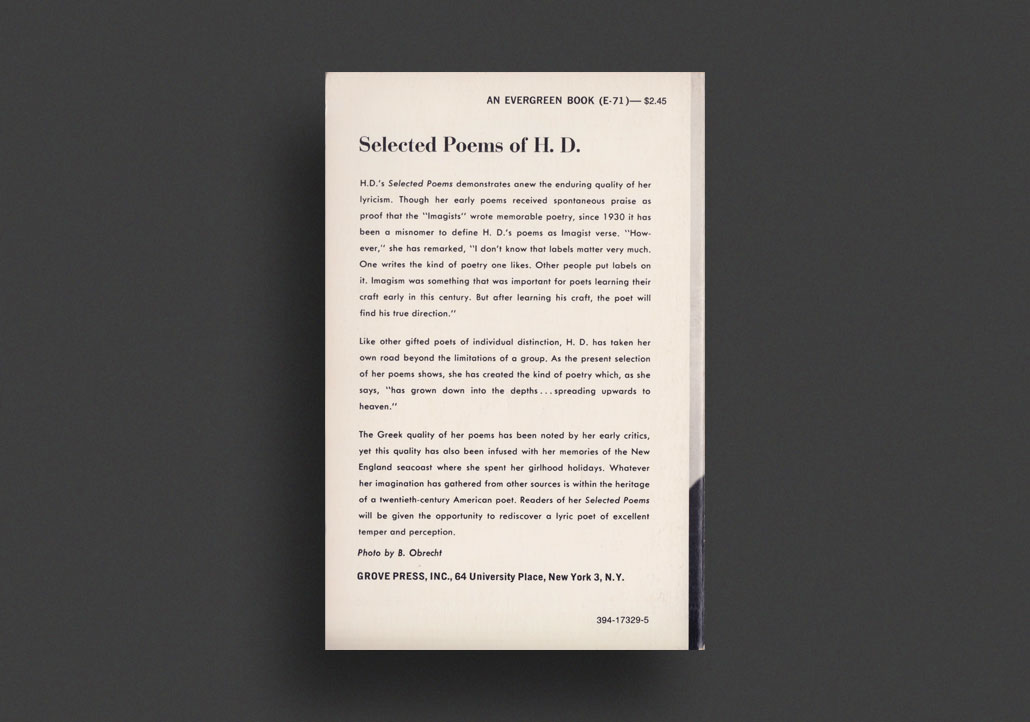
First 1957 paperback edition, seventh printing, of Selected Poems of H.D., published by Evergreen/Grove Press.
H.D.'s Selected Poems demonstrates anew the enduring quality of her lyricism. Though her early poems received spontaneous praise as proof that the "Imagists" wrote memorable poetry, since 1930 it has been a misnomer to define H. D.'s poems as Imagist verse. "How-ever," she has remarked, "I don't know that labels matter very much. One writes the kind of poetry one likes. Other people put labels on it. Imagism was something that was important for poets learning their craft early in this century. But after learning his craft, the poet will find his true direction."
Like other gifted poets of individual distinction, H. D. has taken her own road beyond the limitations of a group. As the present selection of her poems shows, she has created the kind of poetry which, as she says, "has grown down into the depths ... spreading upwards to heaven."
The Greek quality of her poems has been noted by her early critics, yet this quality has also been infused with her memories of the New England seacoast where she spent her girlhood holidays. Whatever her imagination has gathered from other sources is within the heritage of a twentieth-century American poet. Readers of her Selected Poems will be given the opportunity to rediscover a lyric poet of excellent temper and perception.
An innovative modernist writer, Hilda Doolittle (1886–1961) wrote under her initials in a career that stretched from 1909 to 1961. Although she is most well known for her poetry—lyric and epic—H.D. also wrote novels, memoirs, short stories, essays, reviews, a children’s book, and translations. An American woman who lived her adult life abroad, H.D. was engaged in the formalist experimentation that preoccupied much of her generation. A range of thematic concerns resonates through her writing: the role of the poet, the civilian representation of war, material and mythologized ancient cultures, the role of national and colonial identity, lesbian and queer sexuality, and religion and spirituality.
Very Good copy.
1973, English
Hardcover (w. dust jacket), 172 pages, 21 x 14.5 cm
1st Edition, Out of print title / used / very good
Published by
Carcanet Press / Cheshire
$90.00 - In stock -
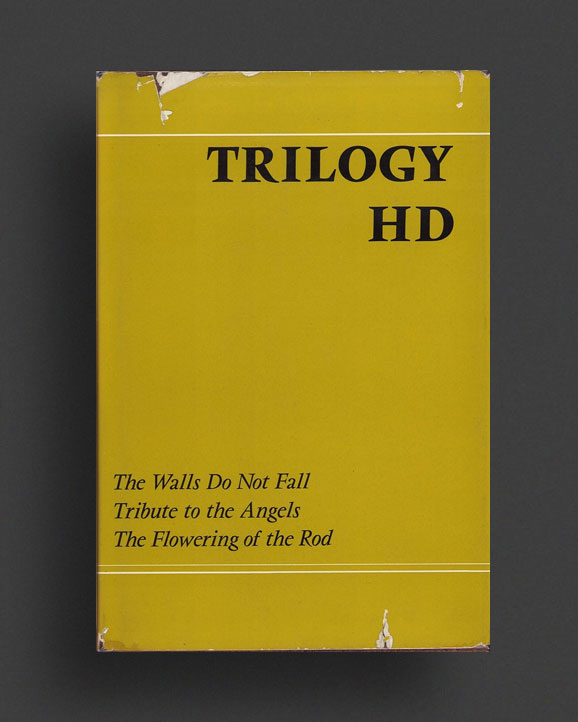
Very rare first 1973 hardcover edition of H.D.'s classic war Trilogy (The Walls Do Not Fall (1944), Tribute to the Angels (1945) and The Flowering of the Rod (1946), collected for the first time and published together by Carcanet Press, Cheshire. American first editions followed the following year.
"…this ecstasy, ecstasy in language, in beautiful language, is what carries me through the entire trilogy, not only content with her trick…not only content with these high-handed fictions but enchanted with her whole poem, not to say enraptured."—Hayden Carruth, Hudson Review
HD's war Trilogy ranks with Eliot's Four Quartets, Pound's Pisan Cantos and poems like Edith Sitwell's 'Still Falls the Rain' as civilian war poetry in a war which tore apart so many of the cities of Europe. The outer violence of the scene touches the deepest nerves, bringing together a remarkable range of human experience and response.
The Walls Do Not Fall (1944), Tribute to the Angels (1945) and The Flowering of the Rod (1946) were first published in small editions which became collectors' items. They were brought together for the first time in 1973 and recognised as a major poem of our time in which HD decisively transcends the purism of her early styles. With deft indirection she uncovers, through modulation and subversion of a language burdened with history, the very heart of her concerns as a woman of this century carrying the songs and silences of earlier centuries in her bones.
An innovative modernist writer, Hilda Doolittle (1886–1961) wrote under her initials in a career that stretched from 1909 to 1961. Although she is most well known for her poetry—lyric and epic—H.D. also wrote novels, memoirs, short stories, essays, reviews, a children’s book, and translations. An American woman who lived her adult life abroad, H.D. was engaged in the formalist experimentation that preoccupied much of her generation. A range of thematic concerns resonates through her writing: the role of the poet, the civilian representation of war, material and mythologized ancient cultures, the role of national and colonial identity, lesbian and queer sexuality, and religion and spirituality.
Very Good copy in Good distjacket with some chipping/small tears (preserved in mylar wrap)
1991, English
Hardcover (w. dust jacket), 288 pages, 23 x 14 cm
1st Edition, Out of print title / used / very good
Published by
Virago / London
$40.00 - In stock -
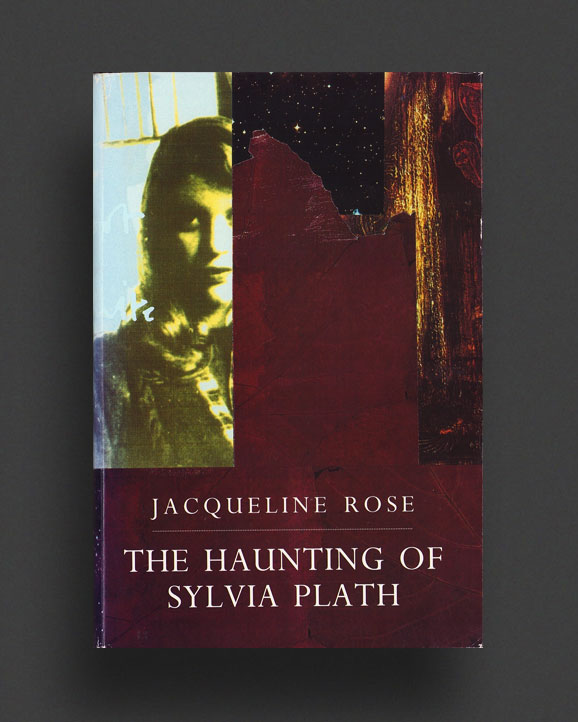
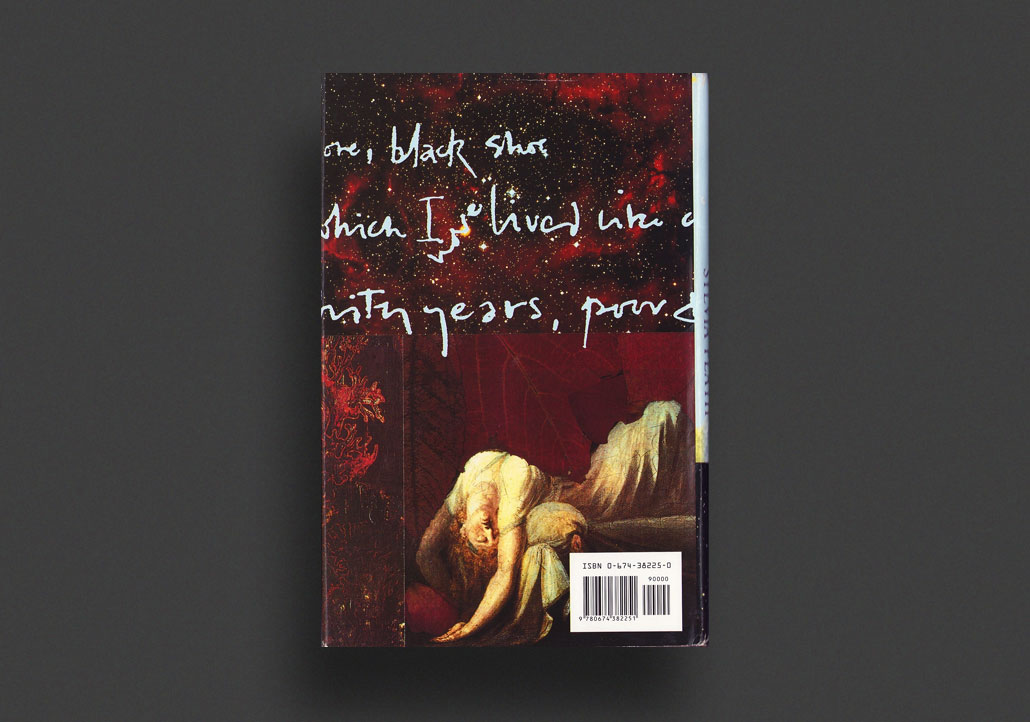
First hardcover edition of The Haunting Of Sylvia Plath by Jacqueline Rose, published by Virago, London, 1991.
Since her suicide in 1963 at the age of 30, Sylvia Plath has become a strange icon. Rose offers an interpretation of Sylvia Plath's writing, claiming that previous interpretations - both feminist and psychoanalytic - have been too polarized. The book also asks why Sylvia Plath has, since her death, become the object of intense speculation, of fantasy, repulsion and desire. The author argues that without a concept of fantasy we can understand neither Plath's work nor what she has come to represent. She proposes that no writer demonstrates more forcefully than Plath the importance of inner psychic life for the wider sexual and political world. By the author of Sexuality in the Field of Vision.
Very Good in Good DJ.
1966/1974, English
Softcover, 258 pages, 18.5 x 12.5 cm
1st Edition, Out of print title / used / good
Published by
Faber & Faber / London
$50.00 - Out of stock
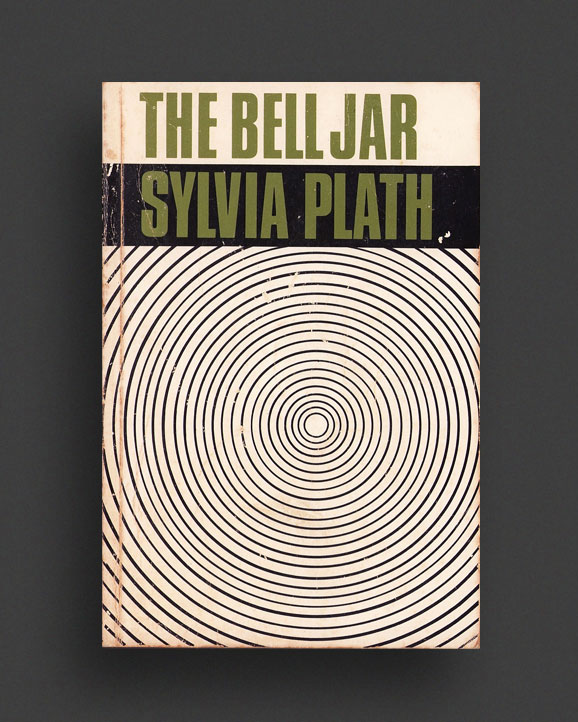
First edition from 1966 of The Bell Jar, Sylvia Plath's only novel, originally published under a pseudonym in 1963.
"It is a fine novel, as bitter and remorseless as her last poems.... The world in which the events of this novel take place is a world bounded by the cold war on one side and the sexual war on the other. We follow Esther Greenwood's personal life from her summer job in New York with "Ladies' Day" magazine, back through her days at New England's largest school for women, and forward through her attempted suicide, her bad treatment at one asylum and her good treatment at another, to her final re-entry into the world like a used tyre: "patched, retreaded, and approved for the road".... This novel is not political or historical in any narrow sense, but in looking at the madness of the world and the world of madness it forces us to con-sider the great question posed by all truly realistic fiction: What is reality and how can it be confronted? Esther Greenwood's account of her year in the bell jar is as clear and readable as it is witty and disturbing."—Robert Scholes in the New York Times Book Review
"It has magnificent sections whose candour and revealed suffering will haunt anyone's memory."—M. L. Rosenthal in the Spectator
Good copy of first edition in 1974 printing, with some foxing/tanning to block edges.
1971 / 1975, English
Softcover, 64 pages, 19.5 x 13 cm
1st Edition, Out of print title / used / very good
Published by
Faber & Faber / London
$35.00 - Out of stock
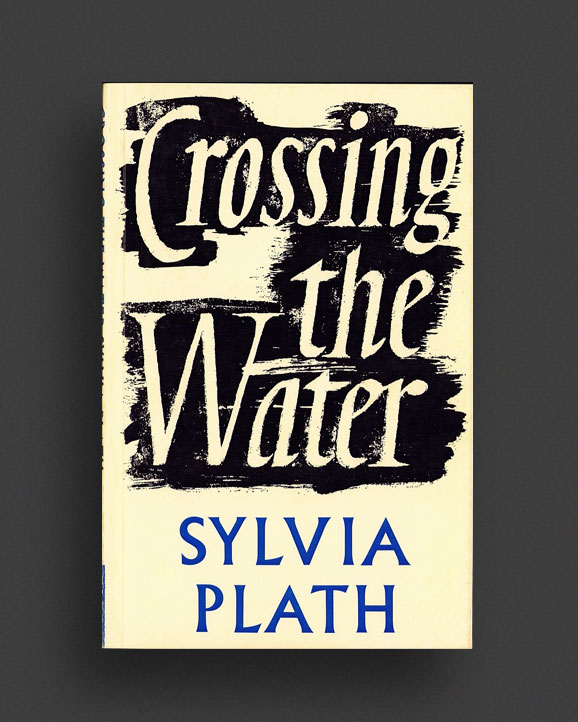
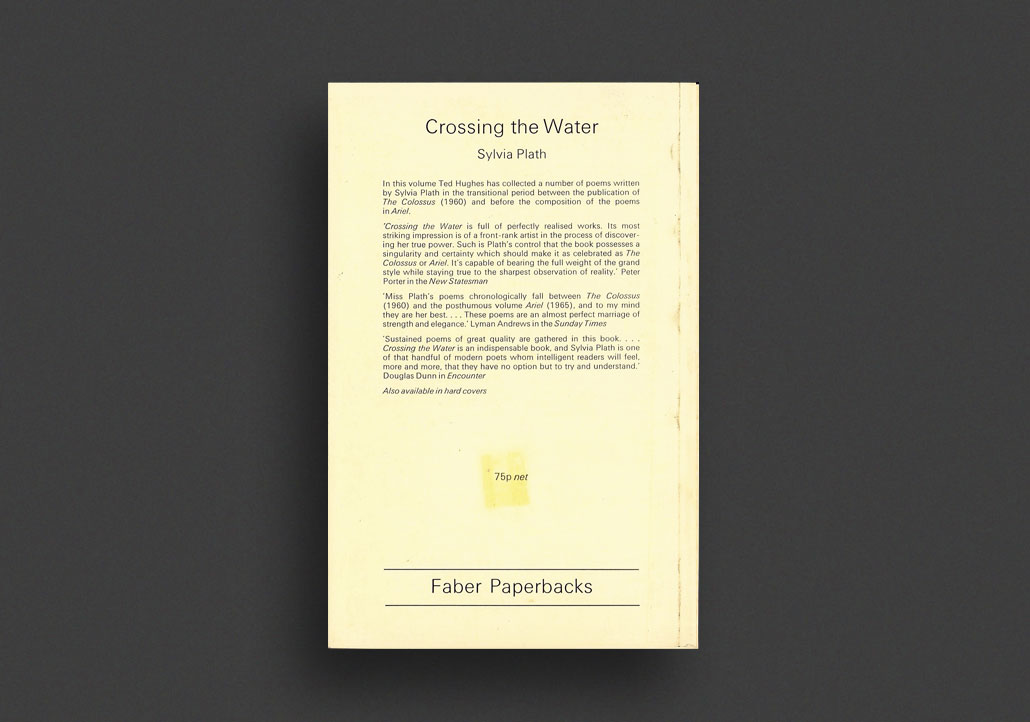
First 1971 paperback edition in 1975 print of Crossing the Water by Sylvia Plath.
In this volume Ted Hughes has collected a number of poems written by Sylvia Plath in the transitional period between the publication of The Colossus (1960) and before the composition of the poems in Ariel.
'Crossing the Water is full of perfectly realised works. Its most striking impression is of a front-rank artist in the process of discover-ing her true power. Such is Plath's control that the book possesses a singularity and certainty which should make it as celebrated as The Colossus or Ariel. It's capable of bearing the full weight of the grand style while staying true to the sharpest observation of reality.'—Peter Porter in the New Statesman
'Miss Plath's poems chronologically fall between The Colossus (1960) and the posthumous volume Ariel (1965), and to my mind they are her best. ... These poems are an almost perfect marriage of strength and elegance.'—Lyman Andrews in the Sunday Times
'Sustained poems of great quality are gathered in this book. . . . Crossing the Water is an indispensable book, and Sylvia Plath is one of that handful of modern poets whom intelligent readers will feel, more and more, that they have no option but to try and understand.'—Douglas Dunn in Encounter
Very Good copy.
1971 / 1975, English
Softcover, 56 pages, 19.5 x 13 cm
1st Edition, Out of print title / used / very good
Published by
Faber & Faber / London
$25.00 - Out of stock
First 1971 softcover edition in 1975 print of Winter Trees, a poetry collection by Sylvia Plath.
The poems in this collection were all written in the last nine months of Sylvia Plath's life, and form part of the group from which the Ariel poems were chosen. Her radio play Three Women, also included here, was written slightly earlier, in the transitional period between The Colossus and Ariel.
Winter Trees was the Poetry Book Society's Choice for Autumn 1971.
'A book that anyone seriously interested in poetry now must have ... Sylvia Plath's immense gift is evident throughout.'—Martin Dodsworth in the Guardian
'Nearly all the poems here have the familiar Plath daring, the same feel of bits of frightened, vibrant, indignant conciousness translated instantly into words and images that blend close, experienced horror and icy, sardonic control.'—Alan Brownjohn in the New Statesman
Very Good copy, light cover wear
1992, English
Softcover, 410 pages, 23.17 x 16.66 cm
1st Edition, Out of print title / used / very good
Published by
University of Chicago Press / Chicago
$45.00 - Out of stock
From incest to infanticide, from breast-feeding and women's sexuality to female prostitution, from pornography to reproductive politics, and from the first homosexual rights movement to AIDS—this anthology addresses these and other crucial questions concerning the regulation of sexuality: How have society's values and attitudes toward sexuality and morality changed over the centuries? Why and how has the state sought to criminalize certain forms of sexual behavior and to control reproduction? How have churches tried to influence the state in its regulation of sexuality?
Contributions from a diverse group of prominent scholars representing a variety of disciplines are included in this anthology that spans European history. Essays by Randolph Trumbach on "Sex, Gender, and Identity in Modern Culture: Male Sodomy and Female Prostitution in Enlightenment London"; Ruth Perry on "Colonizing the Breast: Sexuality and Maternity in Eighteenth Century England"; Theo van der Meer on "Female Same-Sex Offenders in Late Eighteenth Century Amsterdam"; Robin Ann Sheets on "Pornography, Fairy Tales, and Feminism: Angela Carter's 'The Bloody Chamber'"; and James W. Jones on "Discourses on and of AIDS in West Germany, 1986-1990." Offering the most up-to-date scholarship from a significant and growing field, this collection is essential for both students and faculty in social history, family history, women's and gender studies, gay studies, sociology and literature. These essays were originally published in the Journal of the History of Sexuality.
John C. Fout is professor of history at Bard College. He is the founding editor of the Journal of the History of Sexuality, and general editor of The Chicago Series on Sexuality, History, and Society, a book series published by the University of Chicago Press.
Very Good copy.
1989, English
Softcover, 174 pages, 13 x 20 cm
1st Edition, Out of print title / used / very good
Published by
Faber & Faber / London
$25.00 - Out of stock
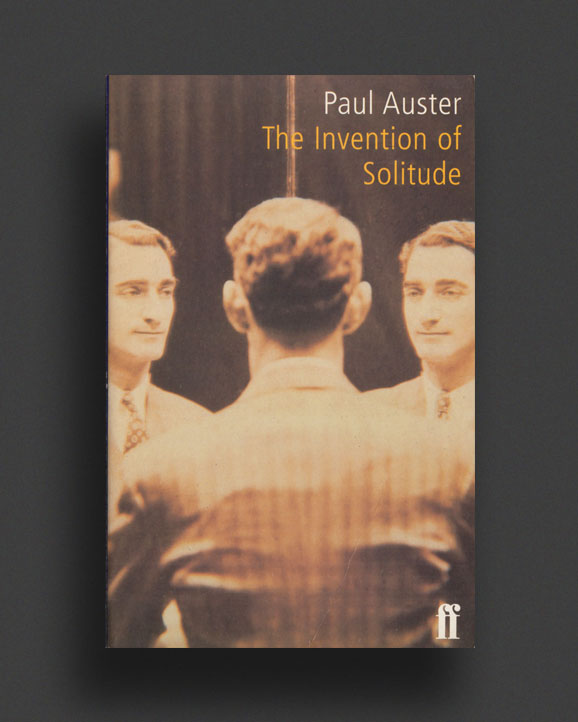
'One day there is life . . . And then, suddenly, it happens there is death.'
So begins Paul Auster's moving and personal meditation on fatherhood, The Invention of Solitude. The first section, 'Portrait of an Invisible Man', reveals Auster's memories and feelings after the death of his father. In 'The Book of Memory' the perspective shifts to Auster's role as a father. The narrator, 'A.', contemplates his separation from his son, his dying grandfather and the solitary nature of writing and story-telling.
With all the keen literary intelligence familiar from The New York Trilogy or Sunset Park, Paul Auster crafts an intensely intimate work from a ground-breaking combination of introspection, meditation and biography.
1989 first paperback Faber and Faber edition. Very Good copy.
2023, English
Softcover, 194 pages, 14.6 x 22.23 cm
Published by
Roof Books / New York
$48.00 - Out of stock
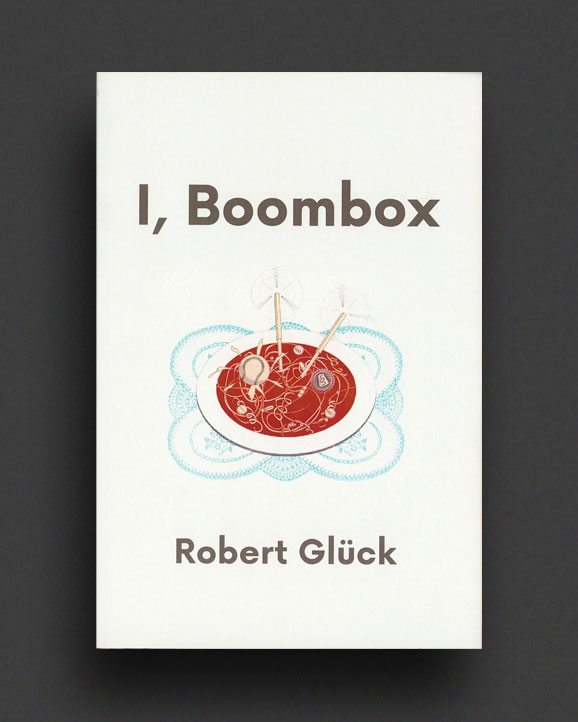
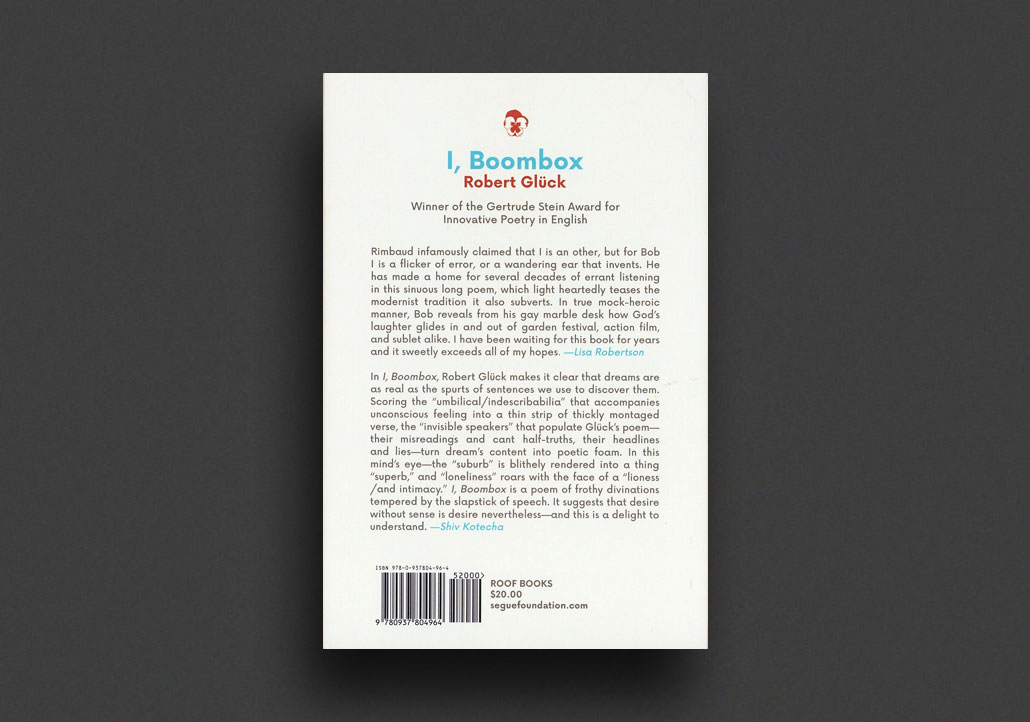
Robert Glück's new book I, Boombox is a long poem fashioned from the author's misreadings. In that sense, it's a queer autobiography in which Glück dreams on the page. Winner of the Gertrude Stein Award for Innovative Poetry in English.
"Rimbaud infamously claimed that I is an other, but for Bob I is a flicker of error, or a wandering ear that invents. He has made a home for several decades of errant listening in this sinuous long poem, which light heartedly teases the modernist tradition it also subverts. In true mock-heroic manner, Bob reveals from his gay marble desk how God's laughter glides in and out of garden festival, action film, and sublet alike. I have been waiting for this book for years and it sweetly exceeds all of my hopes."—Lisa Robertson
"In I, Boombox, Robert Glück makes it clear that dreams are as real as the spurts of sentences we use to discover them. Scoring the 'umbilical/indescribabilia' that accompanies unconscious feeling into a thin strip of thickly montaged verse, the 'invisible speakers' that populate Glück's poem--their misreadings and cant half-truths, their headlines and lies--turn dream's content into poetic foam. In this mind's eye--the 'suburb' is blithely rendered into a thing 'superb, ' and 'loneliness' roars with the face of a 'lioness /and intimacy.' I, Boombox is a poem of frothy divinations tempered by the slapstick of speech. It suggests that desire without sense is desire nevertheless--and this is a delight to understand."—Shiv Kotecha
Robert Glück served as director of San Francisco State University's The Poetry Center, co-director of Small Press Traffic Literary Center, and associate editor at Lapis Press. His books include two novels, Jack the Modernist and Margery Kempe, two books of stories, ELEMENTS OF A COFFEE SERVICE and Denny Smith, a book of poems, Reader, and with Kathleen Fraser, a book of prose poems, In Commemoration of the Visit. With Bruce Boone, Glück translated La Fontaine for a book of that name. With Camille Roy, Mary Berger, and Gail Scott, he edited Biting the Error: Writers on Narrative. Glück prefaced Between Life and Death, a volume of Frank Moore's paintings, and, with artist Dean Smith, made the film Aliengnosis, based on readings from I, Boombox. Other books include Communal Nude: Collected Essays, and Parables, an editioned artist book with Cuban artists José Angel Toirac and Meira Marrero D'az. Margery Kempe was republished by NYRB Classics in 2020 and his novel About Ed by NYRB in 2023.
1981, German
Hardcover (w. dust jacket), 164 pages, 20 x 24.7 cm
1st Edition, Out of print title / used / very good
$100.00 - Out of stock
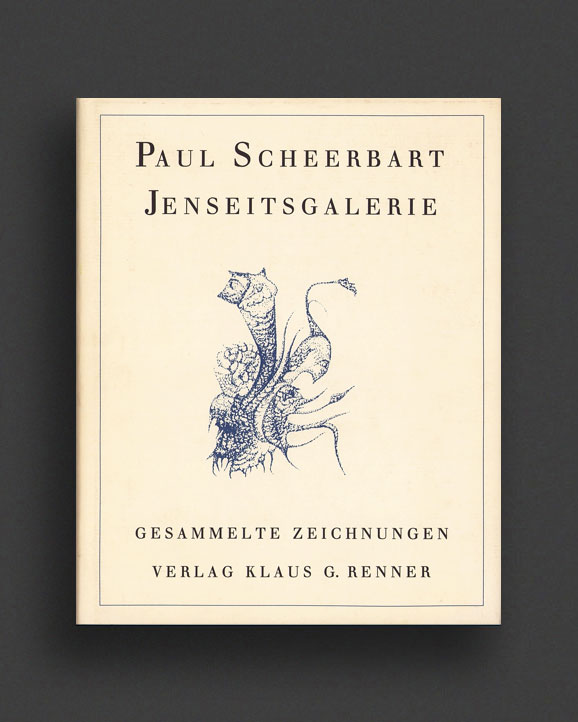
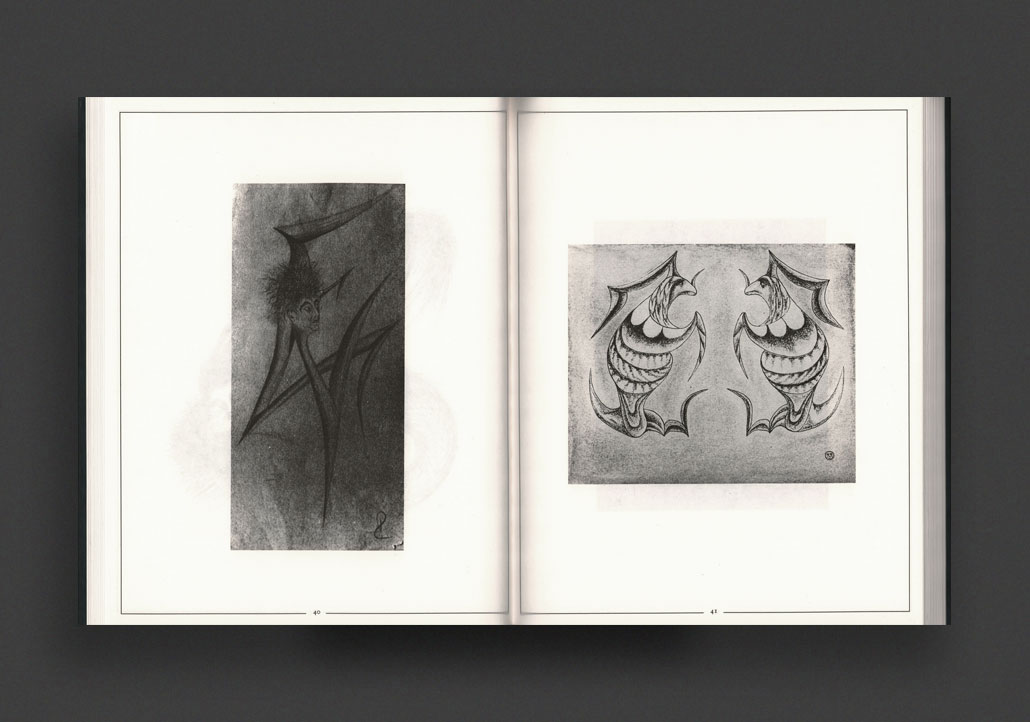
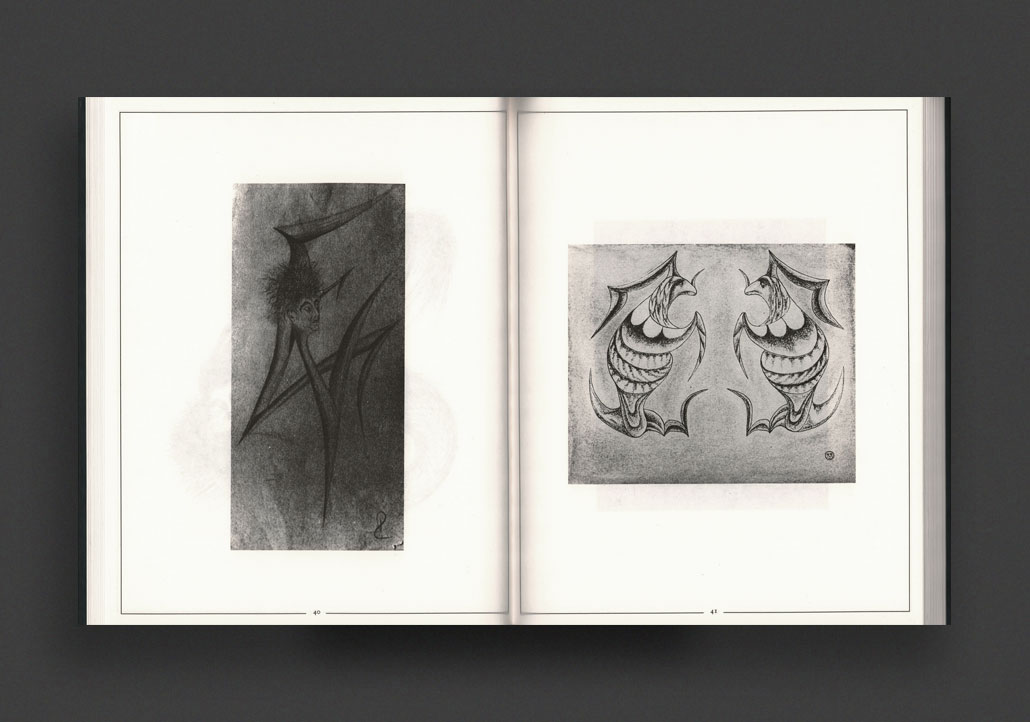
Beautiful album collecting the graphic works of the eccentric, Danzig-born poet, architectural prophet, and proto-surrealist Paul Scheerbart, edited by Machthild Rausch and published by Verlag Klaus G. Renner, Münich. "Beyond Gallery", reproducing his phenomenal illustrations, alongside texts in German, is a comprehensive overview of the visionary "first Expressionist" and master of the fantastique. Highly recommended.
Paul Karl Wilhelm Scheerbart (1863—1915) was a German author of speculative fiction literature and drawings, best remembered through obscure citations from Walter Benjamin, Walter Gropius, and Bruno Taut. From the late 1880s to his premature death in 1915, he wrote prolifically on science, urban planning and design, space travel, and gender politics, often in the course of a single text. His most celebrated treatise, Glass Architecture (Glasarchitektur, 1914) foretold of a sublime, technocratic civilization whose peaceful world-order was borne from the proliferation of crystal cities and floating continents of chromatic glass, a vision summed up in his aphorism: “Colored glass destroys all hatred at last.” Like his French contemporaries Camille Flammarion, Villiers de L’Isle-Adam, Raymond Roussel, and Alfred Jarry, Scheerbart’s prophetic oeuvre oscillated between themes of technology and aesthetics in a genre known in the Francophone world as fantastique.
Very Good copy with VG dust jacket.
1981, German
Hardcover, 164 pages, 20 x 24.7 cm
1st Edition, Out of print title / used / very good
Published by
Verlag Klaus G. Renner / Münich
$70.00 - Out of stock
Beautiful album collecting the graphic works of the eccentric, Danzig-born poet, architectural prophet, and proto-surrealist Paul Scheerbart, edited by Machthild Rausch and published by Verlag Klaus G. Renner, Münich. "Beyond Gallery", reproducing his phenomenal illustrations, alongside texts in German, is a comprehensive overview of the visionary "first Expressionist" and master of the fantastique. Highly recommended.
Paul Karl Wilhelm Scheerbart (1863—1915) was a German author of speculative fiction literature and drawings, best remembered through obscure citations from Walter Benjamin, Walter Gropius, and Bruno Taut. From the late 1880s to his premature death in 1915, he wrote prolifically on science, urban planning and design, space travel, and gender politics, often in the course of a single text. His most celebrated treatise, Glass Architecture (Glasarchitektur, 1914) foretold of a sublime, technocratic civilization whose peaceful world-order was borne from the proliferation of crystal cities and floating continents of chromatic glass, a vision summed up in his aphorism: “Colored glass destroys all hatred at last.” Like his French contemporaries Camille Flammarion, Villiers de L’Isle-Adam, Raymond Roussel, and Alfred Jarry, Scheerbart’s prophetic oeuvre oscillated between themes of technology and aesthetics in a genre known in the Francophone world as fantastique.
Very Good copy. No dust jacket.
2021, English
Softcover, 152 pages, 11.4 x 17.5 cm
Published by
Wakefield Press / Cambridge
$30.00 - In stock -
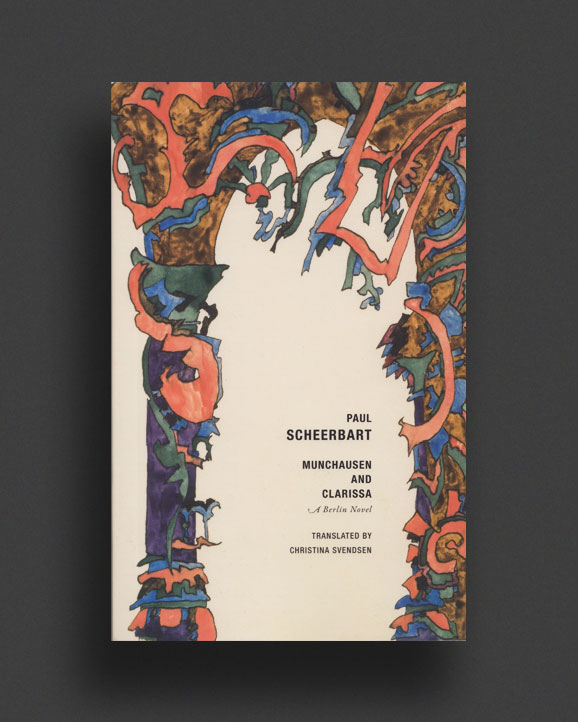
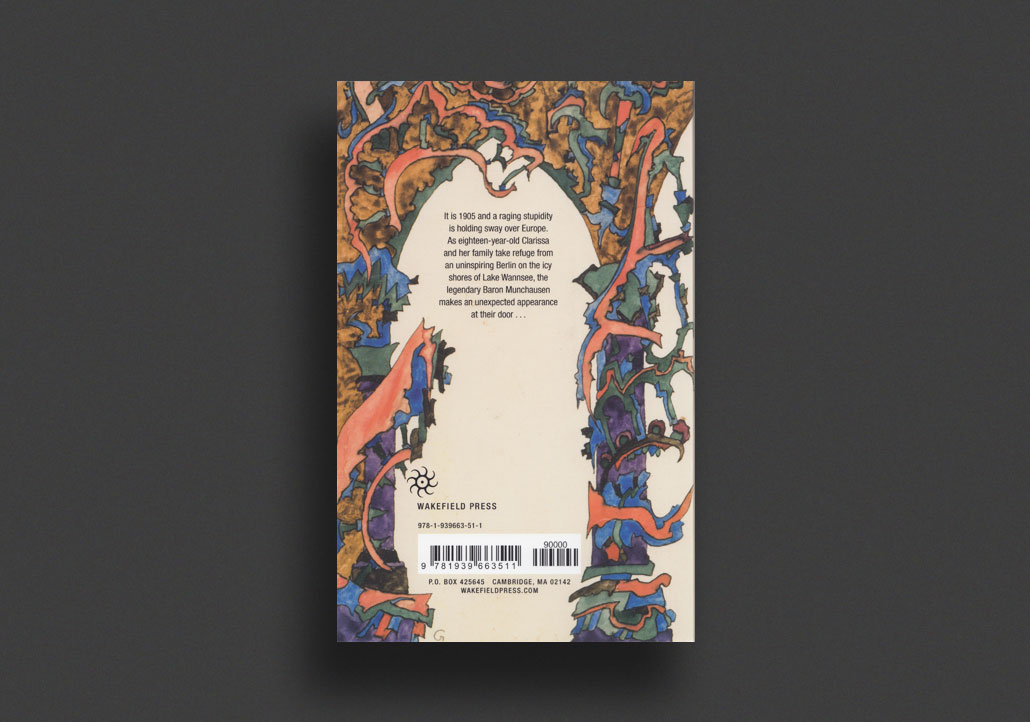
In 1905 on the icy shores of Lake Wannsee, the legendary Baron Munchausen makes an unexpected appearance. Returning to German society after a century of absence at the ripe age of 180, the Baron is cajoled into presenting his impressions of the World Fair in Melbourne, Australia. His tales of Melbourne eventually take his audience from a restaurant in the ocean depths to the dwellings of mineral giants in mountain caverns, before culminating in a spiritual voyage to outer space.Over the course of a week, the sprightly Baron arrives nightly by sleighmobile to combat the dreary days with a series of fantastical visions and theories: he discusses mobile architecture, the role of technology in the arts and the need for art to ignore nature in its quest to discover new planetary organs and senses; the new household miracles of vacuum tubes for cleaning and potato-peeling machines; the repressive function of sexuality; and the need for progressive taxation.
Paul Scheerbart (1863-1915) was a novelist, playwright, poet, critic, draftsman, visionary, proponent of glass architecture and would-be inventor of perpetual motion. Dubbed the “wise clown” by his contemporaries, he opposed the naturalism of his day with fantastical fables and interplanetary satires that would influence Expressionist authors and the German Dada movement, and which helped found German science fiction.
2014 / 2022, English
Softcover, 92 pages, 14.5 x 21.8 cm
Published by
Zero Books / UK
$29.00 - Out of stock
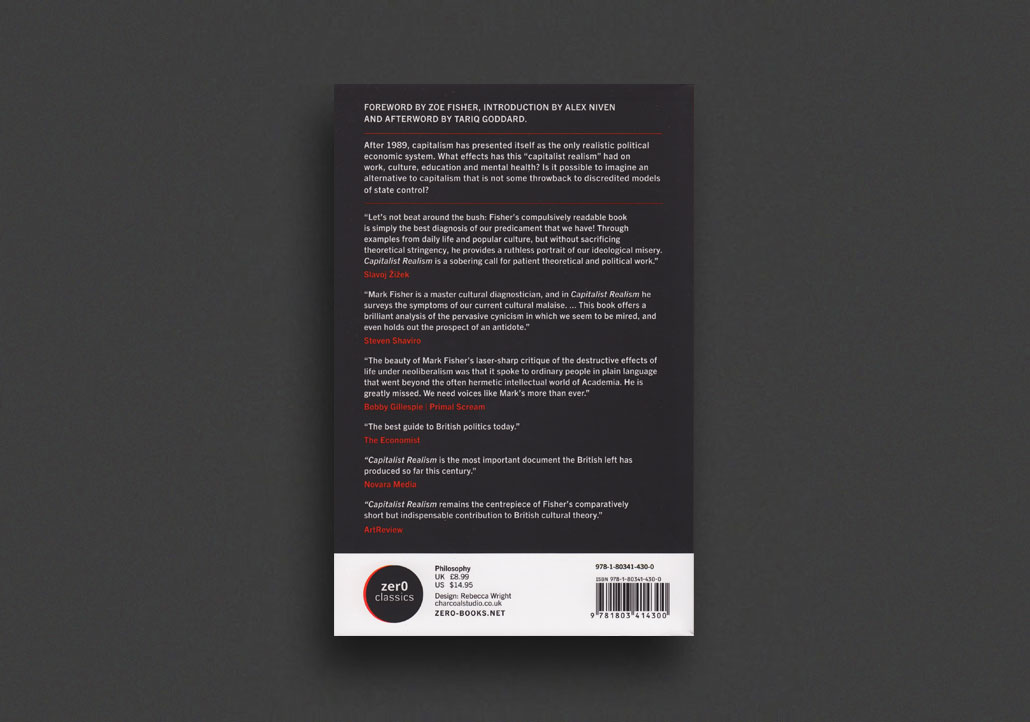
After 1989, capitalism has presented itself as the only realistic political economic system. What effects has this 'capitalist realism' had on work, culture, education and mental health? Is it possible to imagine an alternative to capitalism that is not some throwback to discredited models of state control?
"The beauty of Mark Fisher's laser sharp critique of the destructive effects of life under Neo-Liberalism was that it spoke to ordinary people in plain language that went beyond the often hermetic intellectual world of Academia. He is greatly missed. We need voices like Mark's more than ever."—Bobby Gillespie, Primal Scream”
Mark Fisher is highly respected both as a music writer and a theorist. He writes regularly for The Wire, frieze, New Statesman, and Sight & Sound. He is a Visiting Fellow at Goldsmiths, University Of London, and maintains one of the most successful weblogs on cultural theory, k-punk (http://k-punk.abstractdynamics.org)
2023, English
Softcover, 288 pages, 19.7 x 13.4 cm
Published by
Semiotext(e) / Los Angeles
$42.00 - Out of stock
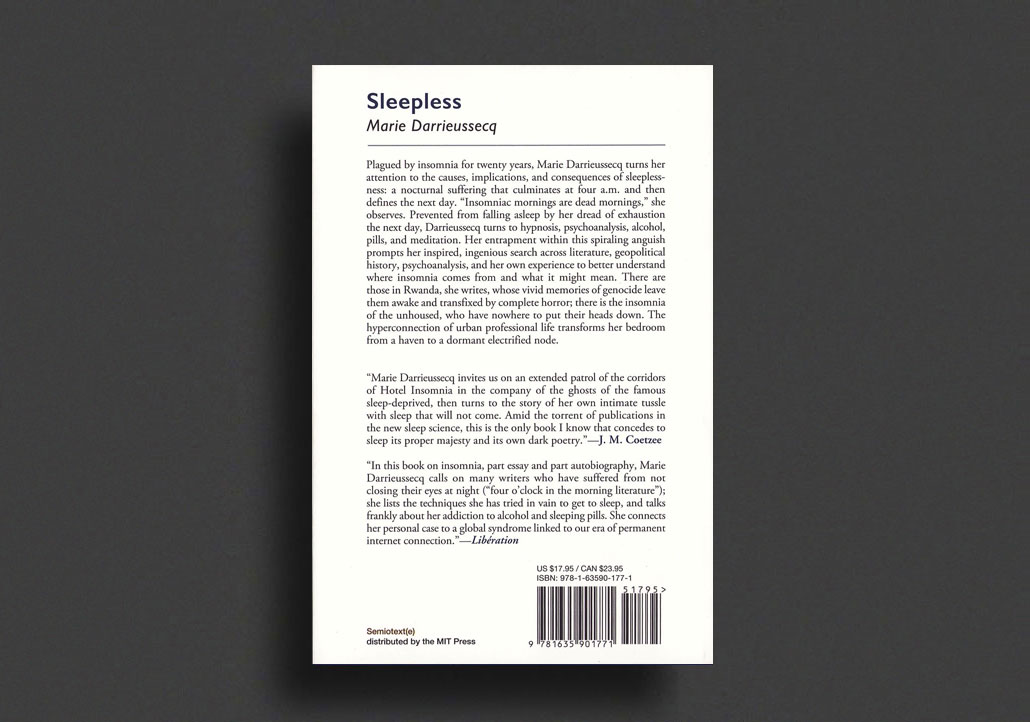
A restless inquiry into the cultural and psychic sources of insomnia by one of contemporary French literature's most elegant voices.
Plagued by insomnia for twenty years, Marie Darrieussecq turns her attention to the causes, implications, and consequences of sleeplessness: a nocturnal suffering that culminates at 4 a.m. and then defines the next day. “Insomniac mornings are dead mornings,” she observes. Prevented from falling asleep by her dread of exhaustion the next day, Darrieussecq turns to hypnosis, psychoanalysis, alcohol, pills, and meditation. Her entrapment within this spiraling anguish prompts her inspired, ingenious search across literature, geopolitical history, psychoanalysis, and her own experience to better understand where insomnia comes from and what it might mean. There are those, she writes, in Rwanda, whose vivid memories of genocide leave them awake and transfixed by complete horror; there is the insomnia of the unhoused, who have nowhere to put their heads down. The hyperconnection of urban professional life transforms her bedroom from a haven to a dormant electrified node.
Ranging between autobiography, clinical observation, and criticism, Sleepless is a graceful, inventive meditation by one of the most daring, inventive novelists writing today.
Translated by Penny Hueston.
Marie Darrieussecq is one of the leading voices in contemporary French literature. Her first novel, Pig Tales, was a finalist for France's prestigious Prix Goncourt in 1996 and became an international bestseller. Her 2013 novel Men: A Novel of Cinema and Desire received the Prix Médicis, and her luminous, voluptuous portrait of the artist Paula Modersohn-Becker, Being Here Is Everything, was published in English by Semiotext(e) in 2017. Darrieussecq has also worked as a translator and a psychoanalyst.
1996, English
Softcover, 150 pages, 21.6 x 16.5 cm
Published by
University of Chicago Press / Chicago
$65.00 - Out of stock
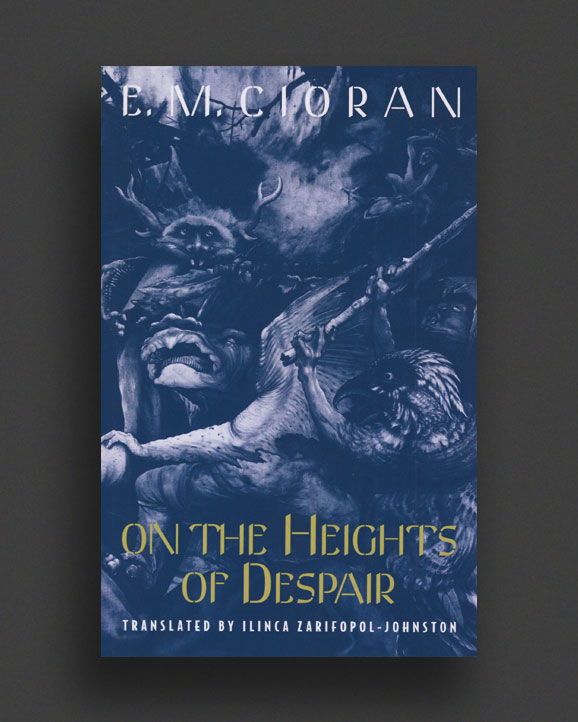
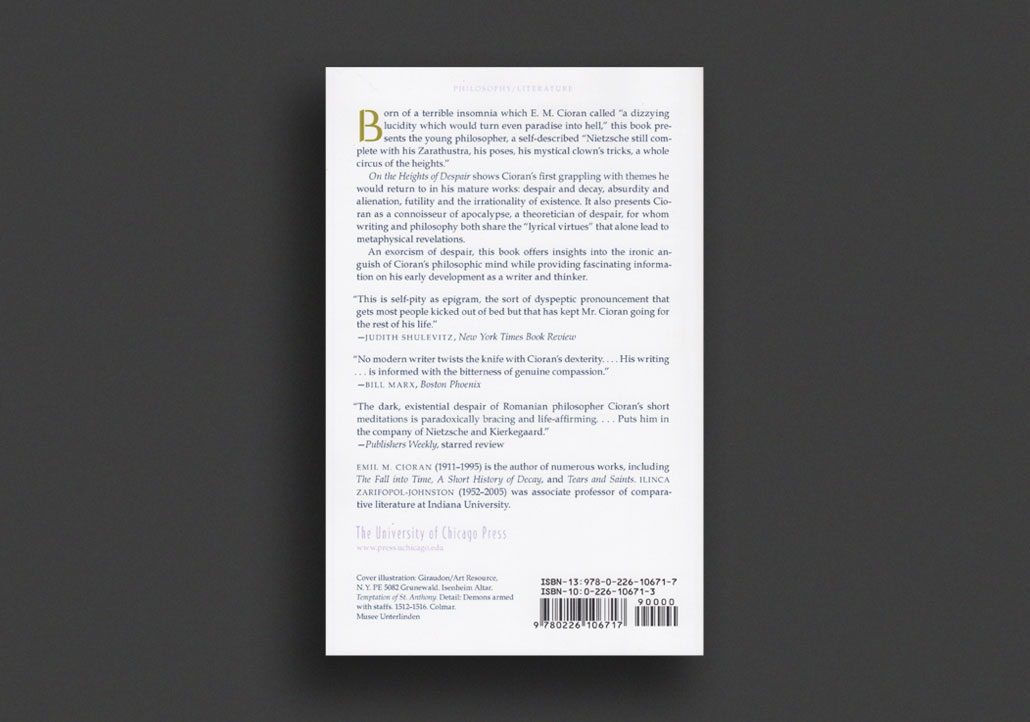
"This book saved my life." So recalls the Romanian philosopher E. M. Cioran about a book that meditates on madness and death, the absurdity of existence, and the agony of consciousness. Cioran finds in our darkest fears not only reasons to continue living but also the comic, absurd humor in doing so. This early work by Cioran, whom Susan Sontag calls "the most distinguished figure in the tradition of Kierkegaard, Nietzsche, and Wittgenstein, " and Marc Fumaroli recently described as "a legend...a master of French prose, " portrays the philosophical mind in the crisis of its self-consuming fever. Born out of a terrible insomnia which Cioran characterizes as "a dizzying lucidity which would turn even paradise into hell, " On the Heights of Despair was written in Romania in 1934 at the age of twenty-two. It presents us with the youthful Cioran, who described himself as "a Nietzsche still complete with his Zarathustra, his poses, his mystical clown's tricks, a whole circus of the heights." It also presents Cioran as a connoisseur of apocalypse, a theoretician of despair. For Cioran, writing and philosophy are closely related to physical suffering: both share the "lyrical virtues" that alone lead to metaphysical revelation. The result is a book that becomes a substitute for as well as an antidote to suicide. By enacting the struggle of the Romantic soul against God, the universe, and itself, Cioran releases a saving burst of lyrical energy that carries him safely out of his desperation. On the Heights of Despair shows the philosopher's first grappling with themes he would return to in his mature works: despair and decay, absurdity and alienation, futility and the irrationality of existence.
Emil Mihai Cioran (1911—1995) was a Romanian-born French philosopher and essayist, and author of some two dozen books of savage, unsettling beauty. His works frequently engaged with issues of suffering, decay, and nihilism. For some, he was one of the most subversive thinkers of his time — a 20th-century Nietzsche, only darker and with a better sense of humor. His work has been noted for its pervasive philosophical pessimism, and whimsical, unsystematic, fragmentary style; he is celebrated as one of the great masters of aphorism. He called himself “un homme de fragment.” From the age of 20, Cioran began to suffer from insomnia, a condition which he suffered from for the rest of his life, and permeated his writings. In 1937, Cioran moved to the Latin Quarter of Paris, which became his permanent residence, wherein he lived in seclusion with his partner, Simone Boué, avoiding the public, but still maintained contact with numerous friends, including Mircea Eliade, Eugène Ionesco, Paul Celan, Samuel Beckett, Henri Michaux and Fernando Savater.
1984(?) , English
Softcover, 64 pages, 26.5 x 26 cm
1st Edition, Out of print title / used / good
Published by
International Cultural Corporation of Australia Limited / Australia
$55.00 - Out of stock
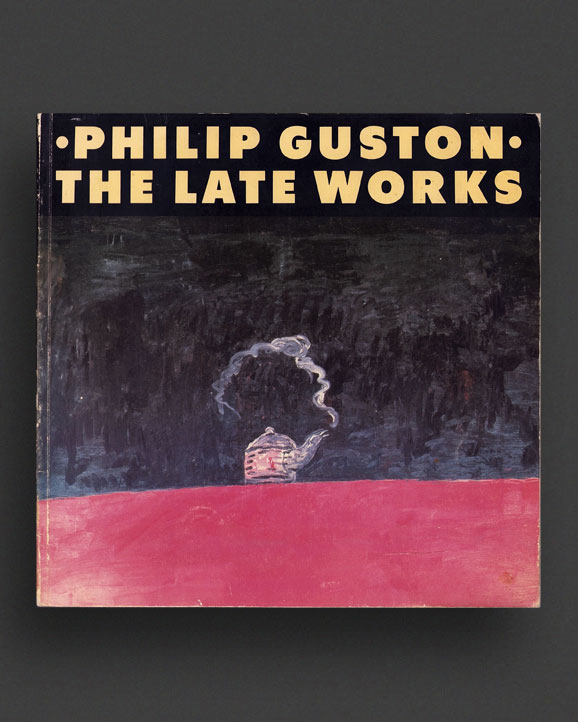
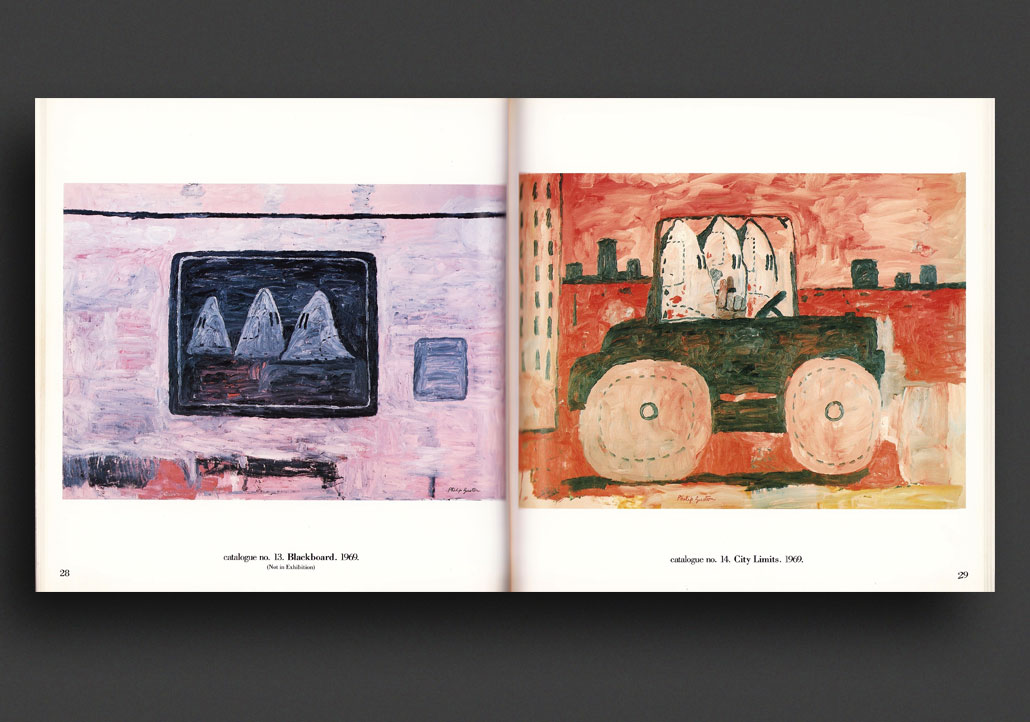
Rare Australian catalogue of American artist Philip Guston (1913—1980) published on the occasion of the major touring exhibition in 1984(?) of "The Late Works", curated by John Buckley, exhibited at the National Gallery of Victoria, August 17-September 16; the Art Gallery of Western Australia, September 26-October 28; Art Gallery of New South Wales, November 7-December 30. Large format softcover with colour plate illustrations of Guston's works dating from 1969—1979. Accompanying texts by Buckley, Edward F. Fry, and Joseph Ablow, and a transcription of a lecture given by Guston in 1978, plus chronology, bibliography and checklist.
Good copy with light cover wear.
2022, English
Softcover, 242 pages, 20.3 x 12.7 cm
Published by
Rab-Rab Press / Helsinki
$49.00 - Out of stock
First edition, published in a run of 750 copies. All editions out-of-print.
Rab-Rab Press announces the third, expanded edition of the publication of Free Jazz Communism, an outstanding book (first published in 2019 by Rab-Rab) actualising Archie Shepp–Bill Dixon Quartet at the 8th World Festival of Youth and Students in Helsinki 1962. Including archive material and documents, commissioned theoretical and historical texts, and interviews, the book edited by Sezgin Boynik and Taneli Viitahuhta contextualizes politics of free jazz music in light of global decolonisation movements, anti-war activism, structures of racial capitalism, and forms of avant-garde music.
By focusing on concerts of Shepp–Dixon Quartet, leading avant-garde jazz musicians from the US, in the socialist anti-colonial festival in Helsinki, the book is introducing complexities in the usual Cold War stories about the sixties, and pictures politics of jazz as something transcending boundaries of nation-state and capitalist market regulations.
Apart from the theoretical and historical overview by its editors, the book includes testimonies of the collective and international spirit of the 1962 Youth Festival, translated documents from Finnish press, a new interview with Archie Shepp, commissioned text by Jeff Schwartz on the historical context of political engagement of free jazz musicians, and reproduction of three hard-to-find texts by Shepp.
The book is designed by Ott Kagovere.
3rd Edition.
1977, German
Softcover, unpaginated, 30 x 21 cm
Ed. of 600, signed,
1st Edition, Out of print title / used / fine
Published by
Edition Hundertmark / Berlin
$190.00 - In stock -
First 1977 signed, numbered edition of this wild, occasionally sexually explicit pictorial and literary collaboration between the radical Viennese artists Günter Brus and Dominik Steiger. One of 600 numbered copies, this copy no. 394/600, signed by Brus and Steiger. In the mid-1970s, every Wednesday each of the two artists would receive something from the other on a sheet of paper with which to build a shared work. This is how the series Jeden jeden Mittwoch. Ein Zwoman [Every Every Wednesday. A Novel in Two] arose in 1974, summarised in this 1977 volume of text and images: each double page presents a half, containing either text or drawings, on each side of the fold.
Dominik Steiger (born 1940 in Vienna, died 2014 in Vienna) was an Austrian writer and artist active in the spheres of the Vienna Group and Viennese Actionism. A university drop out, Steiger joined the French foreign legion in 1959 but was dismissed a year later for psychiatric reasons. He is regarded as a significant crossover artist between genres and an important representative of the Austrian avant-garde since the 1950s. From 1961 onwards he lead a vagabond life through Europe and Asia, publishing many books of poetry and prose, in the 1970s exhibiting and publishing drawings and graphic works, his first LP of songs “Wiener Lieder und Gemischte Waisen” was published 1979 by Dieter Roth's Verlag. With artistic contemporaries such as Christian Ludwig Attersee, Hermann Nitsch, Dieter Roth, Arnulf Rainer, and Günter Brus, he developed numerous collaborations throughout the 1970s and 1980s.
Günter Brus (born 1938 in Ardning, Austria) is an Austrian artist known for his controversial films, performances, and paintings. He was notably a member of the Viennese Actionist Group alongside Otto Muehl and Hermann Nitsch. In 1960, the artist’s interest in the paintings of Jackson Pollock led his transition into making performance-based paintings regarding his own body. Many of the Viennese Actionist’s radical acts were intended as reactions to what they considered the ongoing legacy of Nazi fascism in Austrian culture. His 1968 performance Kunst und Revolution, consisted of the artist consuming his own urine, masturbating in public, and vomiting, he was subsequently jailed for six months. Brus currently lives and works in Graz, Austria.
Fine copy.
1972, German
Softcover, 60 pages (plus inserts), 21 x 19 cm
1st Edition, Out of print title / used / good
Published by
Zürich Kunstgesellschaft / Zürich
$50.00 - Out of stock
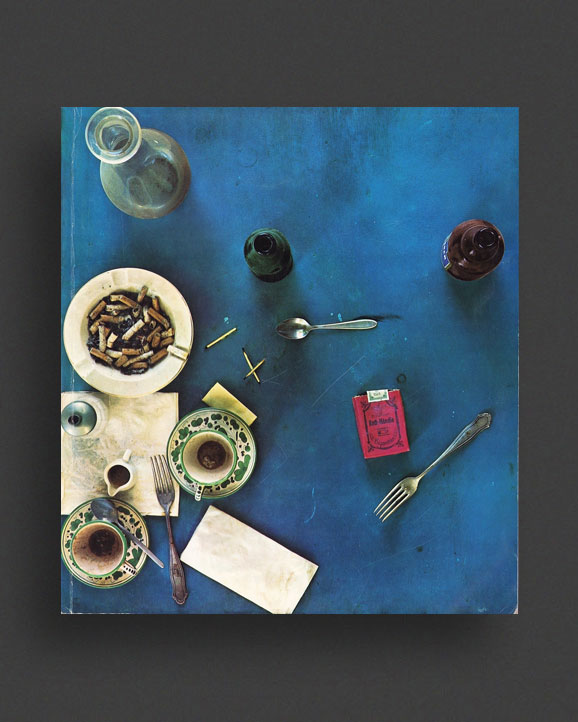
Lovely, scarce Daniel Spoerri exhibition catalogue published in 1972 on the occasion of his exhibition at Zurich Kunstgesellschaft - Helmhaus Zurich, April 16 to May 22. Includes detailed biographical notes on Spoerri, a conversation about Spoerri in the CNAC by Claus Bremer, numerous illustrations of his sculptural works, a full list of works, and a detailed chronology and bibliography of Spoerri. Comes with the enclosed seperate prints from the artist's glossary of Switzerland XX. and "The Mythological Travels...", Emmett Williams' "Preface to the Translation of the Symi-Cycle" (8 pages).
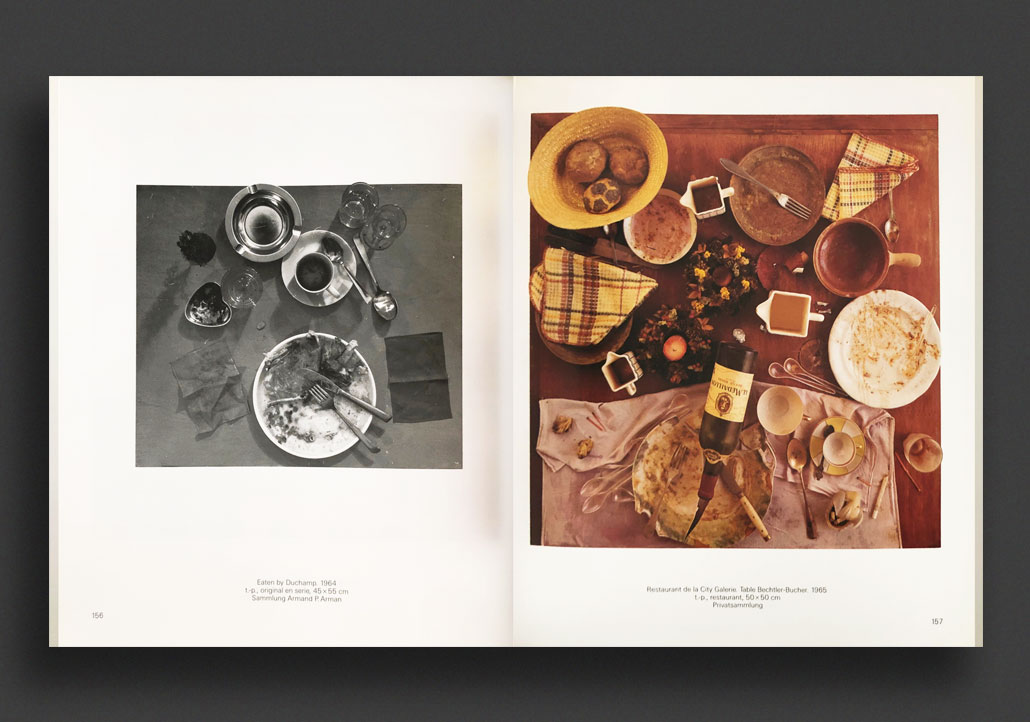
Daniel Spoerri (born 27 March 1930 in Galați) is a Swiss artist and writer born in Romania. Spoerri is best known for his “snare-pictures,” a type of assemblage or object art, in which he captures a group of objects, such as the remains of meals eaten by individuals, including the plates, silverware and glasses, all of which are fixed to the table or board, which is then displayed on a wall. He also is widely acclaimed for his book, Topographie Anécdotée* du Hasard (An Anecdoted Topography of Chance), a literary analog to his snare-pictures, in which he mapped all the objects located on his table at a particular moment, describing each with his personal recollections evoked by the object, with illustrations by the great Roland Topor. In the 1950s he was active in dance, studying classical dance with Olga Preobrajenska and in 1954 becoming the lead dancer at the State Opera of Bern, Switzerland. He later staged several avant-garde plays including Ionesco’s The Bald Soprano and Picasso’s surrealist Desire Trapped by the Tail. During that period he met a number of Surrealist artists, including Meret Oppenheim, Jean Tinguely, Marcel Duchamp and Man Ray, and also a number of artists subsequently associated with the Fluxus movement, including Robert Filliou, Dieter Roth and Emmett Williams. Closely associated with the Fluxus art movement, a movement “characterized by a strongly Dadaist attitude, [whose] participants were a divergent group of individualists whose most common theme was their delight in spontaneity and humor.” It has been said that his Anecdoted Topography of Chance “seems perfectly to embody aspects of its spirit.” Spoerri was also one of the original signers of the manifesto creating the Nouveau réalisme (New Realism) art movement, which involved artists such as Yves Klein, Arman, Martial Raysse, Pierre Restany, Niki de Saint Phalle, César, Jean Tinguely, Mimmo Rotella, Gérard Deschamps, and the Ultra-Lettrists, Francois Dufrêne, Raymond Hains, Jacques de la Villeglé, an avant garde endeavor begun in 1960. His use of everyday life as the main subject-matter of his art reflects his involvement in the New Realism movement.
A major theme of Spoerri’s artwork is food, and he has called this aspect of his work “Eat Art.” This is seen not only in his snare-pictures of eaten meals, but in a variety of other contexts. For example, in 1961 he sold in an art-gallery in Copenhagen store-bought canned food which he had signed and rubber-stamped “Attention: Work of Art.” In 1963, he enacted a sort of performance art called Restaurant de la Galerie J in Paris, for which he cooked on several evenings. Art-critics took over the role of waiters, playing on the idea of the critic bringing the art to the consumers and giving them an understanding of the work. On June 18, 1968, Spoerri opened the Restaurant Spoerri in Düsseldorf, and on September 18, 1970, he opened the Eat-Art-Gallery upstairs.He also published in 1970 a diary of his life on the Greek island of Symi, in which he included numerous recipes of the dishes he ate there. Originally titled A Gastronomic Itinerary, it was later republished under the title Mythology & Meatballs.
Good copy with some buckling and corner warp. Ex-libris (NGV)
1969, German
Softcover (staple-bound), 32 pages, 21 x 22 cm
1st Edition, Out of print title / used / very good
Published by
Zentrum für aktuelle / Aachen
$50.00 - Out of stock
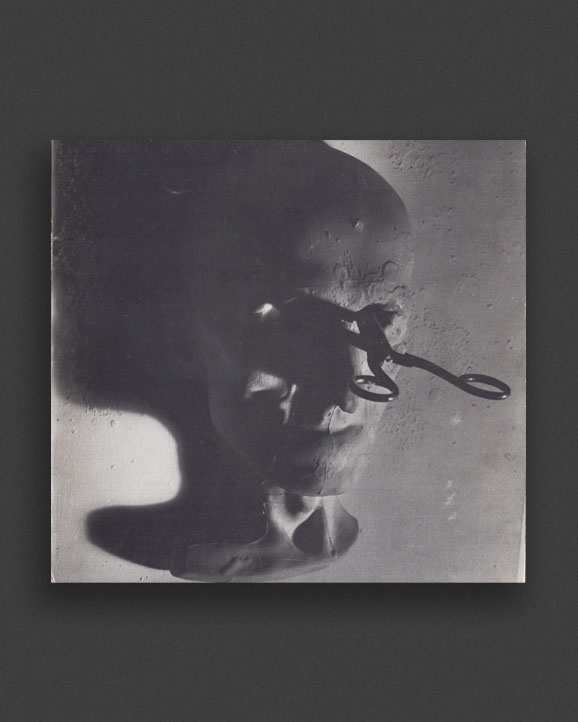
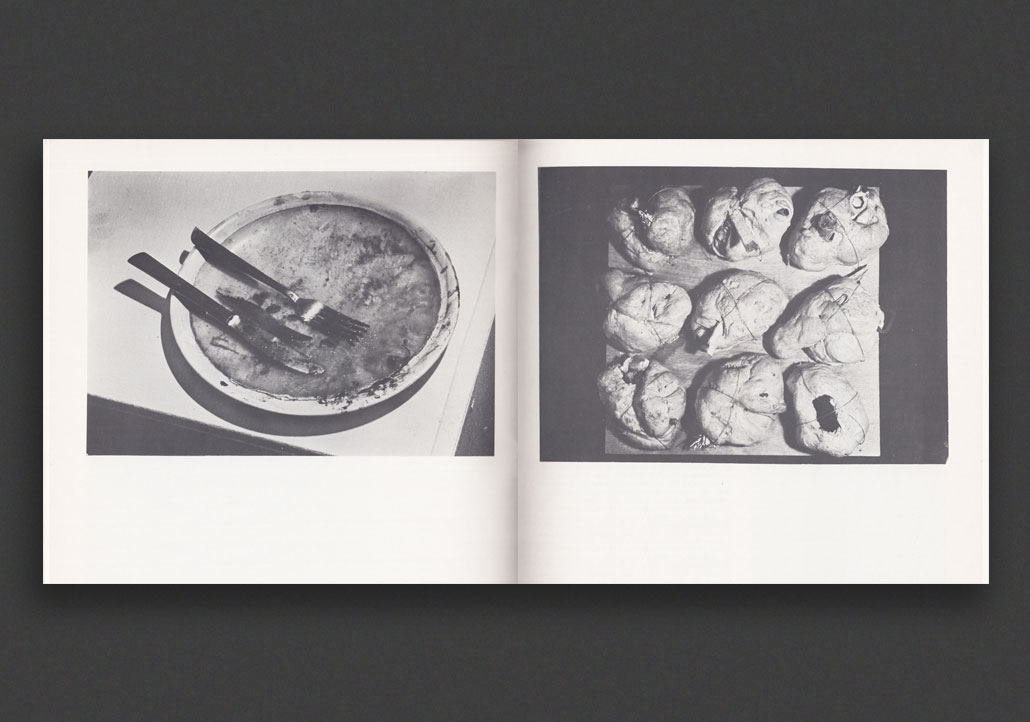
Scarce early Daniel Spoerri catalogue published on the occasion of his exhibition at Zentrum für aktuelle, Aachen, August 28—September 20, 1969. Illustrated throughout in b/w with Spoerri's assemblages, "snares-pictures" and other works, alongside texts in German, exhibition history and biography/portrait.
Daniel Spoerri (b. 1930) is a Swiss artist and writer born in Romania. Spoerri is best known for his "snare-pictures". In 1960, Spoerri made his first "snare-picture": "objects found in chance positions, in order or disorder (on tables, in boxes, drawers, etc.) are fixed (‘snared’) as they are. Only the plane is changed: since the result is called a picture, what was horizontal becomes vertical. Example: remains of a meal are fixed to the table at which the meal was consumed and the table hung on the wall." His first "snare-picture", Kichka's Breakfast was created from his girlfriend's leftover breakfast. The piece is now in the collection in the Museum of Modern Art in New York. One snare-picture, made in 1964, consists of the remains of a meal eaten by Marcel Duchamp. He also is widely acclaimed for his book, Topographie Anécdotée* du Hasard (An Anecdoted Topography of Chance), a literary analog to his snare-pictures, in which he mapped all the objects located on his table at a particular moment, describing each with his personal recollections evoked by the object, with illustrations by the great Roland Topor. In the 1950s he was active in dance, studying classical dance with Olga Preobrajenska and in 1954 becoming the lead dancer at the State Opera of Bern, Switzerland. He later staged several avant-garde plays including Ionesco's The Bald Soprano and Picasso's surrealist Desire Trapped by the Tail. During that period he met a number of Surrealist artists, including Meret Oppenheim, Jean Tinguely, Marcel Duchamp and Man Ray, and also a number of artists subsequently associated with the Fluxus movement, including Robert Filliou, Dieter Roth and Emmett Williams. Closely associated with the Fluxus art movement, a movement "characterized by a strongly Dadaist attitude, [whose] participants were a divergent group of individualists whose most common theme was their delight in spontaneity and humor." It has been said that his Anecdoted Topography of Chance "seems perfectly to embody aspects of its spirit." Spoerri was also one of the original signers of the manifesto creating the Nouveau réalisme (New Realism) art movement, which involved artists such as Yves Klein, Arman, Martial Raysse, Pierre Restany, Niki de Saint Phalle, César, Jean Tinguely, Mimmo Rotella, Gérard Deschamps, and the Ultra-Lettrists, Francois Dufrêne, Raymond Hains, Jacques de la Villeglé, an avant garde endeavor begun in 1960. His use of everyday life as the main subject-matter of his art reflects his involvement in the New Realism movement. A major theme of Spoerri's artwork is food, and he has called this aspect of his work "Eat Art." This is seen not only in his snare-pictures of eaten meals, but in restaurant performance pieces, for which he cooks for guests and art-critics take on the role of waiters, playing on the idea of the critic bringing the art to the consumers and giving them an understanding of the work.
Very Good copy.
1990, French
Softcover, 232 pages, 27 x 24 cm
1st Edition, Out of print title / used / very good
Published by
Centre Georges Pompidou / Paris
Musée Picasso / Antibes
$100.00 - Out of stock
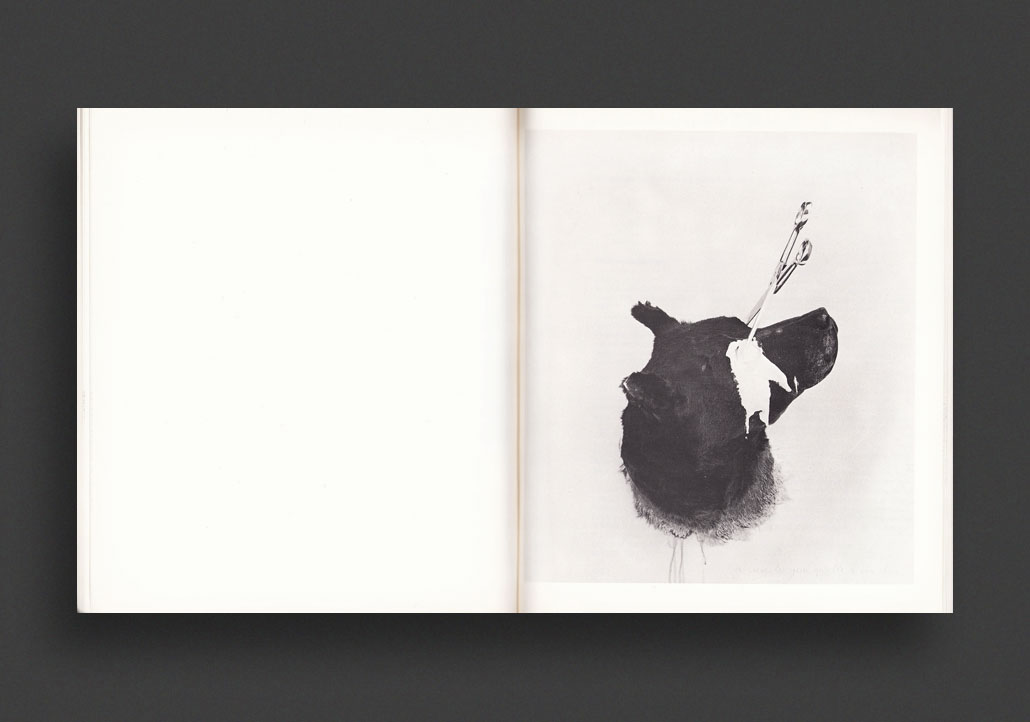
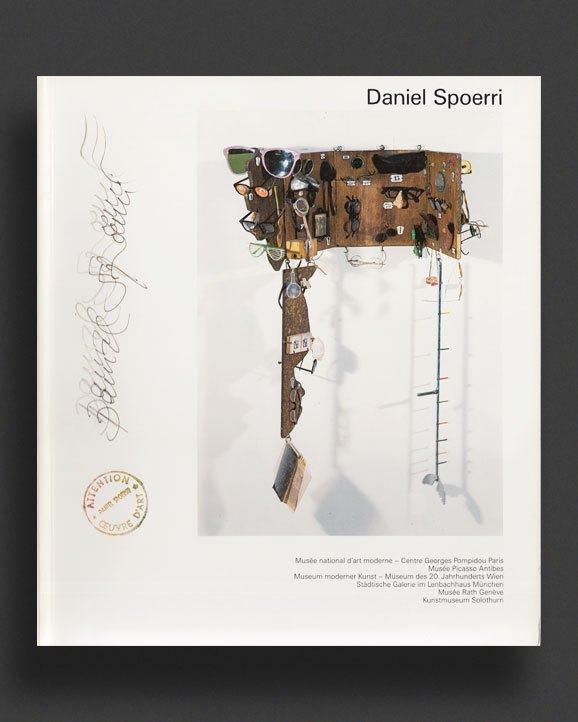
One of the best and most comprehensive books on the great Swiss artist, Daniel Spoerri, beautifully put together to accompany a travelling exhibition of his work in 1990/1991 in Paris, Antibes, Wien, München, Genève, Solothurn. Profusely illustrated with Spoerri's incredible artistic history of installations, performances, studio photos, editions, and other activities across important associations with Fluxus, Nouveau réalisme and Eat Art; works across sculpture, assemblage, action, and relief, including a great number of his iconic "snare works". Includes an exhibition history, bibliography and essays (in French). Highly recommended book, long out-of-print.
Daniel Spoerri (b. 1930) is a Swiss artist and writer born in Romania. Spoerri is best known for his "snare-pictures". In 1960, Spoerri made his first "snare-picture": "objects found in chance positions, in order or disorder (on tables, in boxes, drawers, etc.) are fixed (‘snared’) as they are. Only the plane is changed: since the result is called a picture, what was horizontal becomes vertical. Example: remains of a meal are fixed to the table at which the meal was consumed and the table hung on the wall." His first "snare-picture", Kichka's Breakfast was created from his girlfriend's leftover breakfast. The piece is now in the collection in the Museum of Modern Art in New York. One snare-picture, made in 1964, consists of the remains of a meal eaten by Marcel Duchamp. He also is widely acclaimed for his book, Topographie Anécdotée* du Hasard (An Anecdoted Topography of Chance), a literary analog to his snare-pictures, in which he mapped all the objects located on his table at a particular moment, describing each with his personal recollections evoked by the object, with illustrations by the great Roland Topor. In the 1950s he was active in dance, studying classical dance with Olga Preobrajenska and in 1954 becoming the lead dancer at the State Opera of Bern, Switzerland. He later staged several avant-garde plays including Ionesco's The Bald Soprano and Picasso's surrealist Desire Trapped by the Tail. During that period he met a number of Surrealist artists, including Meret Oppenheim, Jean Tinguely, Marcel Duchamp and Man Ray, and also a number of artists subsequently associated with the Fluxus movement, including Robert Filliou, Dieter Roth and Emmett Williams. Closely associated with the Fluxus art movement, a movement "characterized by a strongly Dadaist attitude, [whose] participants were a divergent group of individualists whose most common theme was their delight in spontaneity and humor." It has been said that his Anecdoted Topography of Chance "seems perfectly to embody aspects of its spirit." Spoerri was also one of the original signers of the manifesto creating the Nouveau réalisme (New Realism) art movement, which involved artists such as Yves Klein, Arman, Martial Raysse, Pierre Restany, Niki de Saint Phalle, César, Jean Tinguely, Mimmo Rotella, Gérard Deschamps, and the Ultra-Lettrists, Francois Dufrêne, Raymond Hains, Jacques de la Villeglé, an avant garde endeavor begun in 1960. His use of everyday life as the main subject-matter of his art reflects his involvement in the New Realism movement. A major theme of Spoerri's artwork is food, and he has called this aspect of his work "Eat Art." This is seen not only in his snare-pictures of eaten meals, but in restaurant performance pieces, for which he cooks for guests and art-critics take on the role of waiters, playing on the idea of the critic bringing the art to the consumers and giving them an understanding of the work.
Very Good, preserved copy.
1977, English
Softcover, 64 pages, 26 x 32 cm
Edition of 2000,
1st Edition, Out of print title / used / very good
Published by
ICA / Pennsylvania
$280.00 - Out of stock
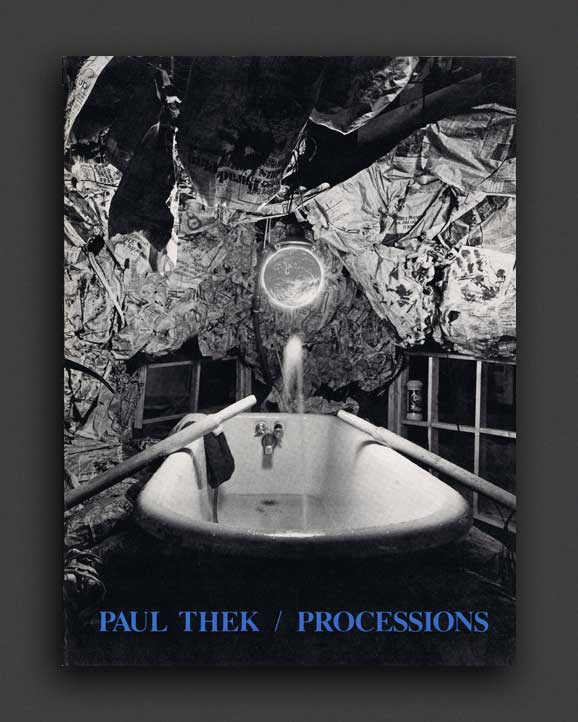
The great, and very rare, Paul Thek "Processions" catalogue from 1977.
"Processions (: The Tower of Babel, Uncle Tom's Cabin, Bandwagon, The Burning Bridge, Bo Jangles, Jack Lantern, Paul Thek, Zhivago)" was published on the occasion of the exhibition "Paul Thek -
Processions" at the Institute of Contemporary Art, University of Pennsylvania, Philadelphia, 30 October to 4 December 1977. This handsome, heavily illustrated catalogue is a very important title in the history of Thek's work as it was the only published document dedicated to his immersive, site-specific installations. Selected and arranged by Thek with curator Suzanne Delehanty, these pages help capture the most conceptually complicated and complete environments created by Thek to that date, including The Tomb-Death of a Hippie (1967), A Procession in Honor of Aesthetic Progress... (1968), The Procession/The Artist's Co-op (1969), Pyramid/A Work in Progress (1971-72), A Station of the Cross (1972), Ark, Pyramid (1972), Ark, Pyramid, Easter (1973), and more, along with his Technological Reliquaries (1965-1967), Fishman (1968), works on paper and bronze sculpture (1973-1977), list of exhibitions, bibliography, text by Suzanne Delehanty and more.
A must for any Thek collection. Published once in an edition of 2000 copies. Now very rarely seen.
1970, English
Softcover, 208 pages, 20.3 x 25.4 cm
1st Edition, Out of print title / used / very good
Published by
MoMA / New York
$600.00 - In stock -
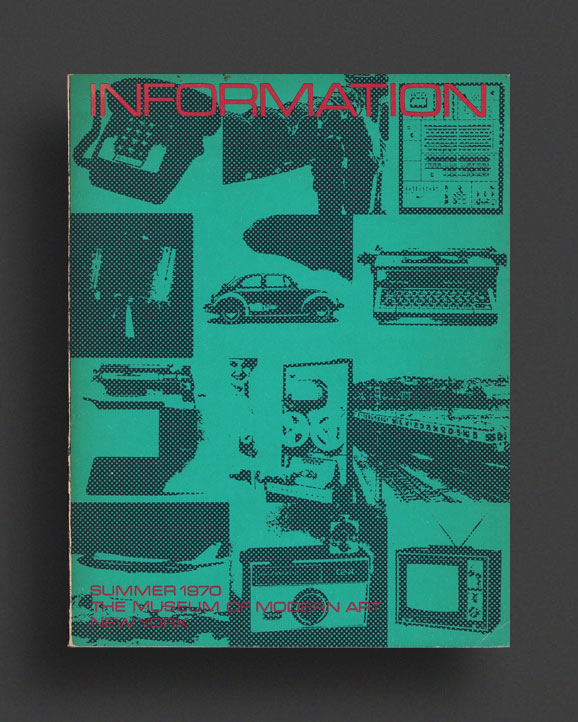
Extremely rare first 1970 edition of MoMA's landmark book on conceptual art, published to accompany this groundbreaking avant-garde show.
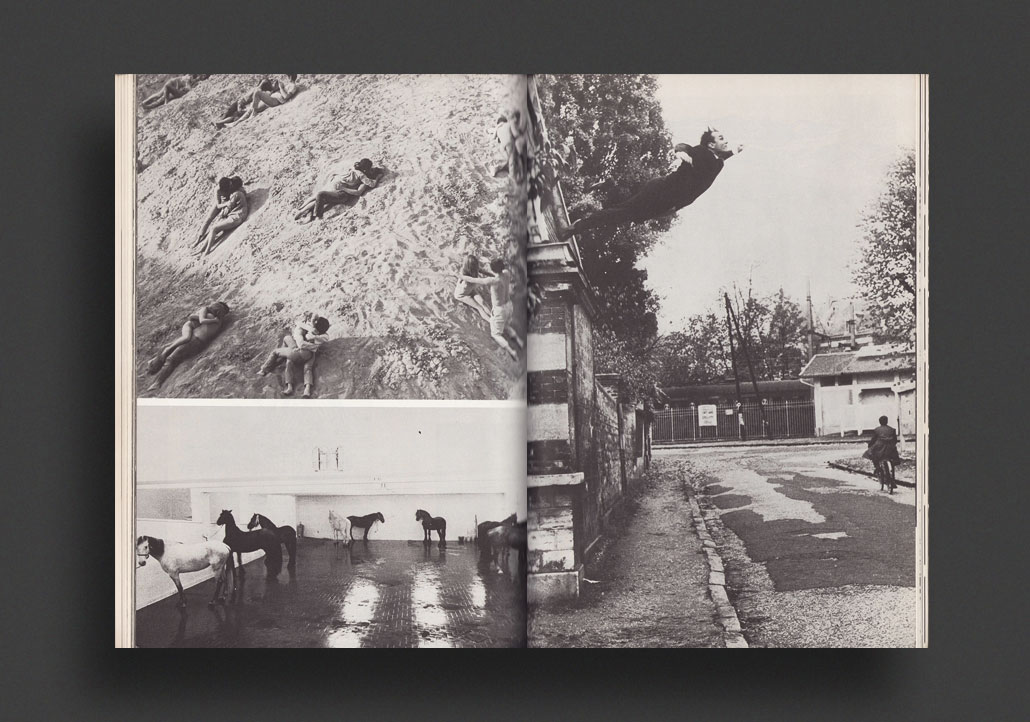
In the summer of 1970, the Museum of Modern Art in New York mounted the now legendary exhibition Information, one of the first surveys of conceptual art. Conceived by MoMA’s celebrated curator Kynaston McShine as an “international report” on contemporary trends, the show and attendant catalog together assembled the work of more than 150 artists from 15 countries to explore the parameters and possibilities of the emerging art practices of the era. Noting the participating artists’ attunement to the “mobility and change that pervades their time,” McShine underscored their interest in “ways of rapidly exchanging ideas, rather than embalming the idea in an ‘object.’” Indeed, much of the work in the exhibition engaged mass-communications systems, such as broadcast television and the postal service, and addressed viewers directly, often encouraging their participation in return.
The catalog, rather than merely document the show, functioned autonomously: it included a list of recommended reading, a chance-based index by critic Lucy Lippard, and individual artist contributions in the form of photographic documentation, textual description, drawings and diagrams—some relating to work in the exhibition and others to artworks as yet unrealized.
Artists include Vito Acconci, Carl Andre, Siah Armajani, Keith Arnatt, Art & Language Press, Art & Project, Richard Artschwager, David Askevold, Terry Atkinson, David Bainbridge, John Baldessari, Michael Baldwin, Barrio, Robert Barry, Frederick Barthelme, Bernhard & Hilla Becher, Joseph Beuys, Mel Bochner, Bill Bollinger, George Brecht, Stig Broegger, Stanley Brouwn, Daniel Buren, Victor Burgin, Donald Burgy, Ian Burn and Mel Ramsden, James Lee Byars, Jorge Luis Carballa, Christopher Cook, Roger Cutforth, Carlos D'Alessio, Hanne Darboven, Walter de Maria, Jan Dibbets, Gerald Ferguson, Rafael Ferrer, Barry Flanagan, Group Frontera, Hamish Fulton, Gilbert & George, Giorno Poetry Systems, Dan Graham, Hans Haacke, Ira Joel Haber, Randy Hardy, Michael Heizer, Hans Hollein, Douglas Huebler, Robert Huot, Peter Hutchinson, Richards Jarden, Stephen Kaltenbach, On Kawara, Joseph Kosuth, Christine Kozlov, John Latham, Barry Le Va, Sol Lewitt, Lucy Lippard, Richard Long, Bruce McLean, Cildo Campos Meirelles, Marta Minujin, Robert Morris, N.E. Thing Co., Bruce Nauman, New York Graphic Workshop, Newspaper, Group Oho, Helio Oiticica, Yoko Ono, Dennis Oppenheim, Panamarenko, Giulio Paolini, Paul Pechter, Giuseppe Penone, Adrian Piper, Michelangelo Pistoletto, Emilio Prini, Alejandro Puente, Markus Raetz, Yvonne Rainer, Klaus Rinke, Edward Ruscha, J.M. Sanejouand, Richard Sladden, Robert Smithson, Keith Sonnier, Ettore Sottsass Jr., Erik Thygesen, John Van Saun, Guilherme Magalhaes Vaz, Bernar Venet, Jeff Wall, Lawrence Weiner, Ian Wilson.
Kynaston McShine was formerly Chief Curator at Large at The Museum of Modern Art, New York.
Very Good copy. Light cover wear, single spine crack, all crisp, clean interior and tightly bound copy of a book that usually sees serious page detachments. Best copy we have seen.
2001, English
Softcover, 420 pages, 28.1 x 21.7 cm
1st Edition, Out of print title / used / very good
Published by
Richter Verlag / Dusseldorf
$220.00 - Out of stock
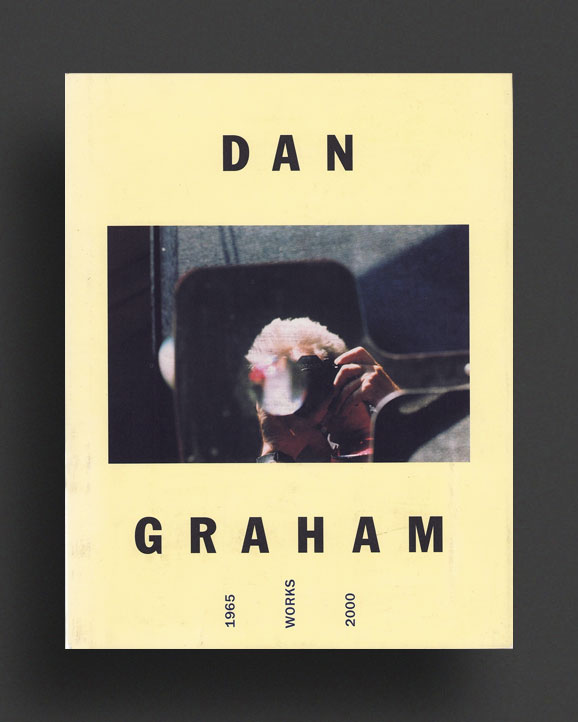
First edition of the now out-of-print Dan Graham catalogue raisonne, published to accompany a major traveling exhibition held from 13 January to 25 March 2001 at the Museum of Contemporary Art Serralves, 21 June to 30 September at the Musée d’art moderne de la Ville de Paris from 25 November to 10 February 2002 in Kroller Müller Museum in Otterlo and May to August 2002 at the Museum of Contemporary Art in Helsinki.
Since the 1960s, Dan Graham has carved out a unique space in the field of contemporary art, combing his work as an artist and as a critic of architecture and art in a unique fusion of theory and practice. From the outset, Graham engaged seriously with the aesthetic and political ramifications of Structuralism, taking the artist's critical perceptions of reality to an increasingly conceptual level. His early articles grappled with the question of architecture, arguing that behind the high-rise apartment complexes and housing projects spreading over the Western world lay the phenomenon of economic and social rationalization. Since the beginning of the 1970s Graham has pursued these and other observations with installations, videos, films and large-scale pavilions that serve as thought-models for his critical insights.
This catalogue raisonne provides a comprehensive, chronological documentation of 165 works and writings from 1965 until the present day, and includes articles, written sketches, Graham's reports about his artistic activities, art critical essays, film stills, architectural models, pavilions and video rooms, as well as an extensive bibliography. With essays by preeminent critic/philosophers Benjamin Buchloh and Thierry de Duve, among others, the result is a complete and edifying look at one of the premier artist-scholars of the past thirty years.
VG in VG dust jacket with some shelf rubbing, preserved now under mylar wrap.