World Food Books' programme is largely produced on Kulin Nation land. We acknowledge the Wurundjeri people of the Kulin Nation as the first and continuing custodians of this land, and pay respect to their Elders past, present, and emerging.
World Food Books is an arts and special interests bookshop in Naarm / Melbourne. Founded in 2010, World Food Books is devoted to the presentation of a rotating, hand-selection of international art, design, literary and counterculture publications with an emphasis on the anti-traditional, the experimental, the avant-garde, the heretic, the marginal.
Presenting new titles alongside rare and out-of-print books, catalogues and journals spanning the fields of modern and contemporary art, design, photography, illustration, film, literature, poetry, cultural theory, philosophy, sexuality, popular and underground culture in its many radical forms, World Food Books wishes to encourage adventurous, thoughtful and open-minded reading, looking, writing, and exchange of publishing and ideas, both current and historical.
As well as our bookshop, located in Melbourne's historical Nicholas Building, all of our inventory is available internationally via our online mail-order service.
World Food Books semi-regularly co-ordinates "Occasions", a programme of exhibits and events at the bookshop and in partnership with other hosts (such as museums and art galleries) that develop out of the activities, relationships and content of the bookshop itself.
World Food Books
The Nicholas Building
37 Swanston Street
Room 5, Level 6
Melbourne 3000
Australia
SHOP HOURS:
SHOP CLOSED FOR SUMMER
RE—OPEN JAN 2
WEB-SHOP OPEN 24/7
World Food Books
Postal Address:
PO Box 435
Flinders Lane
Victoria 8009
Australia
info@worldfoodbooks.com
Art
Theory / Essay
Architecture / Interior
Graphic Design / Typography
Photography
Fashion
Eros
LGBTQ+
Fiction / Poetry
Weird / Speculative / Science Fiction / Horror
Transgressive / Visceral / Abject
Symbolism / Decadence / Fin de siècle
Film / Video
Painting
Sculpture / Installation
Performance / Dance / Theater
Drawing
Sound / Music
Curatorial
Group Shows / Collections
Periodicals
Out-of-print / Rare
Posters / Ephemera / Discs
Signed Books
World Food Books Gift Voucher
World Food Book Bag
Australian Art
Australian Fiction
Australian Science Fiction / Speculative Fiction
Australian Poetry
Australian Photography
Japanese Photography
Conceptual Art
Minimal Art
Dada
'Pataphysics / Oulipo
Fluxus
Concrete Poetry
Pop Art
Surrealism
Arte Povera
Arte Informale / Haute Pâte / Tachism
Nouveau Réalisme / Zero / Kinetic
Situationism / Lettrism
Collage / Mail Art / Xerox Art
Art Brut / Folk / Visionary / Fantastic
Illustration / Graphic Art / Bandes Dessinées
Furniture
Italian Radical Design / Postmodernism
Textiles
Ceramics / Glass
Counterculture
Protest / Revolt
Philosophy
Psychoanalysis
Anthropology
Anarchism
Socialism / Anarchism / Communism / Capitalism
Literary Theory / Semiotics / Language
Feminism / Women's Studies
Gender Studies / Sexuality
Anthropology
Fetishism / BDSM
Drugs / Psychedelia
Crime / Violence
Animal Rights / Veganism
Occult / Esoterica
Ecology / Earth / Alternative Living
Whole Earth / Crafts
All prices in AUD (Australian dollars)
Pick-Ups
Pick-up orders can be collected in our bookshop during opening hours after order date. Please collect any Pick-up orders within 2 weeks of ordering as we have limited storage space. Orders will be released back into stock if not collected within this time. No refunds can be made for pick-ups left un-collected. If you cannot make it in to the bookshop in this time-frame, please choose postage option.
Return Policy
All sales are final. We do accept returns (for refund or exchange) for items received in error. All our orders are packed with special care using heavy-duty padding and cardboard book-mailers or bubble mailers (for smaller books), using reinforcement where required. We cannot take responsibility for any lost, stolen or damaged parcels.
Insurance
Should you wish to insure your package, please email us directly after placing your order and we can organise this at a small extra expense. Although all standard/express tracked packages are very safe and dependable, we cannot take responsibility for any lost, stolen or damaged parcels. We recommend insurance on valuable orders.
Interested in selling your old books, catalogues, journals, magazines, comics, fanzines, ephemera? We are always looking for interesting, unusual and out-of-print books to buy. We only buy books in our fields of interest and specialty, and that we feel we can resell.
We base these prices on desirability, market value, in-print prices, condition and our current stock levels. We offer cash, store credit, and can take stock on consignment. All
about 25% of the price we expect to get when we sell them, or 30% in store credit. We base these prices on desirability, market value, in-print prices, condition and our current stock levels.
Sell your books any day of the week. You can drop them off and return later. If you have a lot of books, we can visit your Sydney home.
We buy books that we feel we can resell. We offer about 25 % of the price we expect to get when we sell them, or 30% in store credit. We base these prices on desirability, market value, in-print prices, condition and our current stock levels.
Philadelphia Wireman
03 August - 01 September, 2018
World Food Books is proud to announce our next Occasion, the first presentation of sculptures by Philadelphia Wireman in Australia.
The Philadelphia Wireman sculptures were found abandoned in an alley off Philadelphia’s South Street on trash night in 1982. Their discovery in a rapidly-changing neighbourhood undergoing extensive renovation, compounded with the failure of all attempts to locate the artist, suggests that the works may have been discarded after the maker’s death. Dubbed the "Philadelphia Wireman" during the first exhibition of this work, in 1985, the maker’s name, age, ethnicity, and even gender remain uncertain. The entire collection totals approximately 1200 pieces, all intricately bound together with tightly-wound heavy-gauge wire (along with a few small, abstract marker drawings, reminiscent both of Mark Tobey and J.B. Murry). The dense construction of the work, despite a modest range of scale and materials, is singularly obsessive and disciplined in design: a wire armature or exoskeleton firmly binds a bricolage of found objects including plastic, glass, food packaging, umbrella parts, tape, rubber, batteries, pens, leather, reflectors, nuts and bolts, nails, foil, coins, toys, watches, eyeglasses, tools, and jewellery.
Heavy with associations—anthropomorphic, zoomorphic, and socio-cultural responses to wrapped detritus—the totemic sculptures by Philadelphia Wireman have been discussed in the context of work created to fulfil the shamanistic needs of alternative religions in American culture. Curators, collectors, and critics have variously compared certain pieces to sculpture from Classical antiquity, Native American medicine bundles, African-American memory jugs, and African fetish objects. Reflecting the artist’s prolific and incredibly focused scavenging impulse, and despite—or perhaps enhanced by—their anonymity, these enigmatic objects function as urban artefacts and arbiters of power, though their origin and purpose is unknown. Philadelphia Wireman, whatever their identity, possessed an astonishing ability to isolate and communicate the concepts of power and energy through the selection and transformation of ordinary materials. Over the course of the past two decades, this collection has come to be regarded as an important discovery in the field of self-taught art and vernacular art.
Presented in collaboration with Fleisher-Ollman Gallery, Philadelphia, and Robert Heald, Wellington.
Susan Te Kahurangi King
02 February - 10 March, 2018
Susan Te Kahurangi King (24 February 1951 - ) has been a confident and prolific artist since she was a young child, drawing with readily available materials - pencils, ballpoint pens and felt-tip markers, on whatever paper is at hand. Between the ages of four and six Susan slowly ceased verbal communication. Her grandparents William and Myrtle Murphy had developed a special bond with Susan so they took on caring responsibilities for extended periods. Myrtle began informally archiving her work, carefully collecting and storing the drawings and compiling scrapbooks. No drawing was insignificant; every scrap of paper was kept. The King family are now the custodians of a vast collection containing over 7000 individual works, from tiny scraps of paper through to 5 meter long rolls.
The scrapbooks and diaries reveal Myrtle to be a woman of great patience and compassion, seeking to understand a child who was not always behaving as expected. She encouraged Susan to be observant, to explore her environment and absorb all the sights and sounds. Myrtle would show Susan’s drawings to friends and people in her community that she had dealings with, such as shopkeepers and postal workers, but this was not simply a case of a grandmother’s bias. She recognised that Susan had developed a sophisticated and unique visual language and sincerely believed that her art deserved serious attention.
This was an unorthodox attitude for the time. To provide some context, Jean Dubuffet coined the term Art Brut in 1945 to describe work created by self-taught artists – specifically residents of psychiatric institutions and those he considered to be visionaries or eccentrics. In 1972 Roger Cardinal extended this concept by adopting the term Outsider Art to describe work made by non-academically trained artists operating outside of mainstream art networks through choice or circumstance. Susan was born in Te Aroha, New Zealand in 1951, far from the artistic hubs of Paris and London that Dubuffet and Cardinal operated in. That Myrtle fêted Susan as a self-taught artist who deserved to be taken seriously shows how progressive her attitudes were.
Susan’s parents Doug and Dawn were also progressive. Over the years they had consulted numerous health practitioners about Susan’s condition, as the medical establishment could not provide an explanation as to why she had lapsed into silence. Dawn educated herself in the field of homeopathy and went on to treat all twelve of her children using these principles – basing prescriptions on her observations of their physical, mental and emotional state.
Doug was a linguist with an interest in philosophy who devoted what little spare time he had to studying Maori language and culture. To some extent their willingness to explore the fringes of the mainstream made them outsiders too but it was their commitment to living with integrity and their respect for individuality that ensured Susan’s creativity was always encouraged.
Even though Susan’s family supported her artistic pursuits, some staff in schools and hospitals saw it as an impediment to her assimilation into the community and discouraged it in a variety of ways. Her family was not always aware of this and therefore did not fully understand why Susan stopped drawing in the early 1990s. However, rather than dwell on the challenges that Susan faced in pursuit of her artistic practice, they prefer to highlight her achievements. In 2008 Susan began drawing again in earnest, after an almost 20 year interruption, and her work is now shown in galleries around the world.
Susan grew up without television and has been heavily influenced by the comics she read as a child. She is absolutely fearless in the appropriation of recognizable characters, such as Donald Duck and Mickey Mouse, in her work. She twists their limbs, contorts their faces, compresses them together, blends them into complex patterned backgrounds - always imbuing them with an incredible energy. Although Susan often used pop culture characters in her work they are not naive or childlike. These are drawings by a brilliant self-taught artist who has been creating exceptional work for decades without an audience in mind.
Mladen Stilinović
"Various Works 1986 - 1999"
02 February 16 - September 10, 2016
Various works 1986 - 1999, from two houses, from the collections of John Nixon, Sue Cramer, Kerrie Poliness, Peter Haffenden and Phoebe Haffenden.
Including: Geometry of Cakes (various shelves), 1993; Poor People’s Law (black and white plate), 1993; White Absence (glasses, ruler, set square, silver spoon, silver ladel with skin photograph and wooden cubes), 1990-1996; Exploitation of the Dead (grey and red star painting, wooden painting, black spoon with red table, red plate), 1984-1990; Money and Zeros (zero tie, paintings made for friends in Australia (Sue, John, Kerrie), numbers painting), 1991-1992; Words - Slogans (various t-shirts) - “they talk about the death of art...help! someone is trying to kill me”, “my sweet little lamb”, “work is a disease - Karl Marx”; Various artist books, catalogues, monographs, videos; Poster from exhibition Insulting Anarchy; "Circular" Croatian - Australian edition; Artist book by Vlado Martek (Dostoyevsky); more.
Thanks to Mladen Stilinović and Branka Stipančić.
Jonathan Walker
Always Will Need To Wear Winter Shirt Blue + Ochre Small Check Pattern
21 August - 21 September, 2015
Untitled
I am not a great reader of poetry but I always return to the work of Melbourne poet, Vincent Buckley (1925- 1988). Perhaps I find his most tantalising piece to be not a finished poem but a fragment left on a scrap of paper discovered on his desk after the poet’s death.
The poetry gathers like oil
In the word-core, and spreads
It has its music meet,
Its music is in movement.
This fragment is more the shell left behind from a volatile thought than a finished poem. I find the last two lines honest but awkward whereas the first two lines work like an arrow. Most likely he could not find a resolution so it was left. Still, in its present form, it remains an eloquent testimony to the ultimate failure of a medium to express mobile thought and sensation, in Buckley’s case, through verbal language. It’s an important matter because this is something all artists have to deal with regardless of the medium.
I have never written a poem, however, I am forever copying fragments from books on paper scraps in a vain effort to fix certain notions in my head. At first, they function as bookmarks that are sometimes returned to when I open the book. But before long, as they accumulate, they fall out littering the table interspersed with A4 photocopies, bills, books and medications.
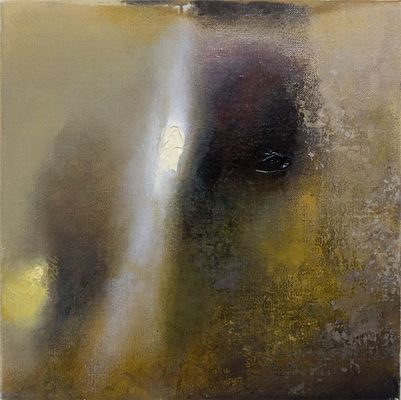
To return to Buckley’s fragment, the first two lines very much evoke how I paint nowadays. As you age, detail diminishes and patches of light become more luminous and float. I feel the most honest way of dealing with this is by smearing the oil paint on the canvas with the fingers and working close-up, blind. Only if the patches coalesce into an approaching image can the work gain a life.
-
Jonathan Walker was born in Melbourne, Australia and brought up on a dairy farm in Gippsland. In the 1970’s he studied painting at RMIT and won the Harold Wright Scholarship to the British Museum, London. During the 1980’s he exhibited at Pinacotheca Gallery, Richmond and had work shown at the NGV and Heidi City Art Gallery. Over the same period he designed the cover for the “Epigenesi” LP by Giancarlo Toniutti, Italy and conducted a mail exchange work with Achim Wollscheid, Germany. The work with artists through the post resulted in an article published in the bicentenary issue of Art and Australia 1988. He showed in artist run spaces such as WestSpace in the 90’s and 2000’s, and until 2012, taught painting at Victoria University, which is where we (Colleen Ahern and Lisa Radford) as organisers of the exhibition, among many others, had the privilege of being his student.
Walker’s knowledge was imparted to students through the careful selection of music, literature, and artists found in books that he himself had ordered for the library. Walker’s strategy was the generosity of sharing his vast knowledge with references specific to each student and their context.
Walker’s paintings share a similar focus and intimacy.
This exhibition presents a small selection of recent paintings alongside a publication that includes Walker’s writing. Observational and analytical, Walker’s work is a type of material notation — the time of day, colour and how it is blended, the both specific and fleeting location of a reflection on lino or the question of whether a chair leg should be included in a painting.
Please join us on Friday August 21 between 6-8pm to celebrate the opening of the exhibition.
Curated by Colleen Ahern and Lisa Radford.
B. Wurtz
Curated by Nic Tammens
March 26 - April 4, 2015
B.Wurtz works from a basement studio in his home on Manhattan’s Lower East Side.
This local fact is attested to by the plastic shopping bags and newsprint circulars that appear in his work. As formal objects, they don’t make loud claims about their origins but nonetheless transmit street addresses and places of business from the bottom of this long thin island. Like plenty of artists, Wurtz is affected by what is local and what is consumed. His work is underpinned by this ethic. It often speaks from a neighborhood or reads like the contents of a hamper:
“BLACK PLUMS $1.29 lb.”
“Food Bazaar”
“USDA Whole Pork Shoulder Picnic 99c lb.”
“RITE AID Pharmacy, with us it’s personal.”
“H. Brickman & Sons.”
“Sweet Yams 59c lb."
Most of the work in this exhibition was made while the artist was in residence at Dieu Donne, a workshop dedicated to paper craft in Midtown. Here Wurtz fabricated assemblages with paper and objects that are relatively lightweight, with the intention that they would be easily transportable to Australia. This consideration isn’t absolute in Wurtz’s work, but was prescriptive for making the current exhibition light and cheap. Packed in two boxes, these works were sent from a USPS post office on the Lower East Side and delivered to North Melbourne by Australia Post.
Wurtz appears courtesy of Metro Pictures, New York.
Thanks to Rob Halverson, Joshua Petherick, Sari de Mallory, Matt Hinkley, Helen Johnson, Fayen d'Evie, Ask Kilmartin, Lisa Radon, Ellena Savage, Yale Union, and "Elizabeth".
John Nixon
"Archive"
December 15 - January 20, 2014
The presentation of John Nixon's archive offered a rare showcase of this extensive collection of the artist's own publications, catalogues, posters, ephemera, editions and more, from the mid 1980s onwards, alongside a selection of his artworks.
Organized by John Nixon, Joshua Petherick and Matt Hinkley.
"Habitat"
at Minerva, Sydney (organised by Joshua Petherick and Matt Hinkley)
November 15 - December 20, 2014
Lupo Borgonovo, Janet Burchill & Jennifer McCamley,
Lewis Fidock, HR Giger, Piero Gilardi, Veit Laurent Kurz,
Cinzia Ruggeri, Michael E. Smith, Lucie Stahl, Daniel Weil, Wols
Press Release:
“...It contained seven objects. The slender fluted bone, surely formed for flight, surely from the wing of some large bird. Three archaic circuitboards, faced with mazes of gold. A smooth white sphere of baked clay. An age-blackened fragment of lace. A fingerlength segment of what she assumed was bone from a human wrist, grayish white, inset smoothly with the silicon shaft of a small instrument that must once have ridden flush with the surface of the skin - but the thing’s face was seared and blackened.”
William Gibson, “Count Zero”, 1986
"Autumn Projects Archive"
Curated by Liza Vasiliou
March 6 - March 15, 2014
World Food Books, in conjunction with the Virgin Australia Melbourne Fashion Festival 2014, presented the Autumn Projects archive, consisting of a selection of early examples in Australian fashion with a particular interest in collecting designers and labels from the period beginning in the 1980’s, who significantly influenced the discourse of Australian Fashion.
Curated by Liza Vasiliou, the exhibition provided a unique opportunity to view pieces by designers Anthea Crawford, Barbara Vandenberg, Geoff Liddell and labels CR Australia, Covers, Jag along with early experimental collage pieces by Prue Acton and Sally Browne’s ‘Fragments’ collection, suspended throughout the functioning World Food Books shop in Melbourne.
H.B. Peace
presented by CENTRE FOR STYLE
November 14, 2013
"Hey Blinky, you say chic, I say same"
Anon 2013
H.B. Peace is a clothing collaboration between great friends Blake Barns and Hugh Egan Westland. Their pieces explore the divergences between 'character’ and ‘personality’ in garments....etc
Special Thanks to Joshua Petherick and Matt Hinkley of WFB and Gillian Mears
and a Very Special Thank you to Audrey Thomas Hayes for her shoe collaboration.
Janet Burchill & Jennifer McCamley
"Aesthetic Suicide"
May 10 - June 8, 2013
The first of our occasional exhibitions in the World Food Books office/shop space in Melbourne, "Aesthetic Suicide" presented a body of new and older works together by artists Janet Burchill & Jennifer McCamley, including videos, prints, a wall work, and publications.
During shop open hours videos played every hour, on the hour.
1972, English
Hardcover (w. dust jacket), 294 pages, 36 x 27.5 cm
1st Edition, Out of print title / used / very good
Published by
Van Nostrand Reinhold Co. / New York
$160.00 - Out of stock
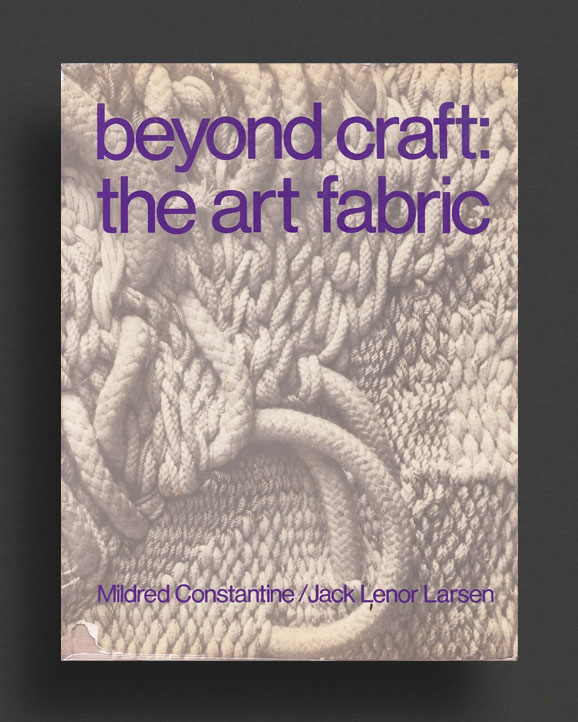
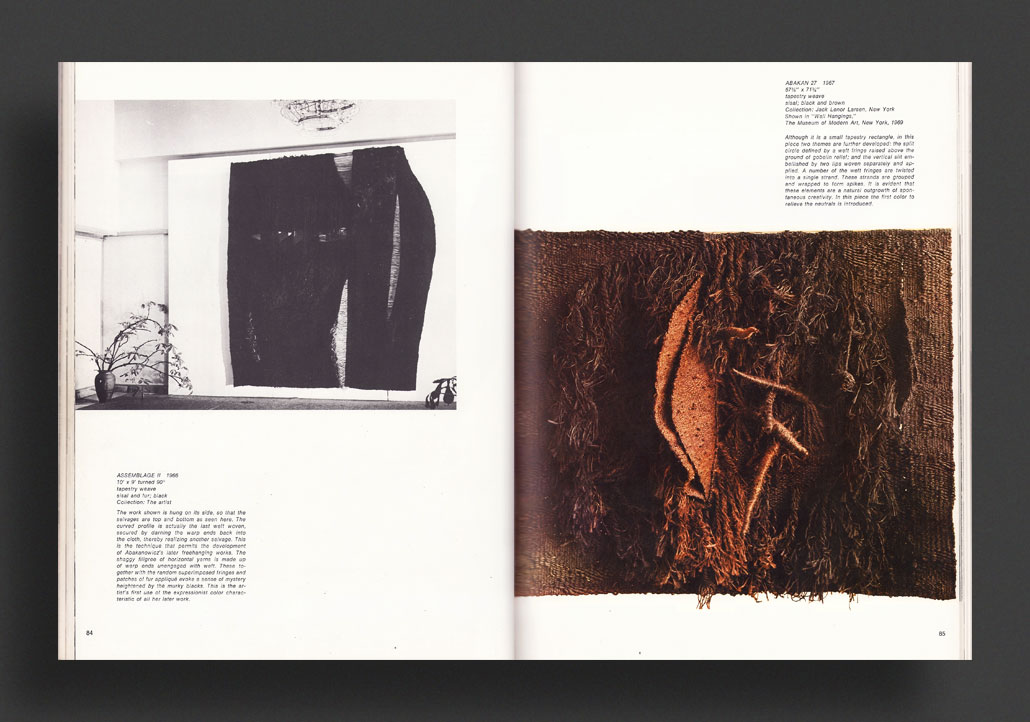
First 1972 hardcover edition of Beyond Craft : The Art Fabric, edited by Mildred Constantine and Jack Lenor Larsen and published by Van Nostrand Reinhold Co., New York. A very important volume and authoritive survey of the Art Fabric movement of the 1960s, featuring leading artists working in fiber art from Europe and the United States that have liberated their work from tradition and thus heightened their international recognition by critics and public. Edited by Mildred Constantine, a curator of design at MoMA in the 1950s—1960s, and American textile designer, collector and author, Jack Lenor Larsen, noted for popularising the incorporation of textile art and fabric patterns into modernist architecture and furnishings of the 1960s, this authoritative coffee table survey captured the movement at its most robust and innovative and forms an important time capsule of the period. Lavishly illustrated throughout with beautiful colour and b/w artwork reproductions, installations, details and portraits, this heavy volume features chapters on Magdalena Abakanowicz, Sheila Hicks, Olga de Amaral, Susan Weitzman, Evelyn Anselevicius, Thelma Becherer, Tadek Beutlich, Lenore Tawney, Jagoda Buic, Zofia Butrymowicz, Marguerite Carau-Ischi, Barbara Falkowska, Claire Zeisler, Kay Sekimachi, Sherri Smith, Wojciech Sadley, Moik Schiele, Herman Scholten, Mariette Rousseau-Vermette, Richard Landis, Aurelia Muñoz, Debra Rapoport, Ed Rossbach , Ewa Jaroszynska, Wilhelmina Fruytier Ritzi, Peter Jacobi, Elsi Giauque, Françoise Grossen, Marguerite Carau-Ischi, Barbara Falkowska, Tadek Beutlich, Zofia Butrymowicz, Thelma Bechererand, many others. A gorgeous book printed and bound in Japan. A must for anyone interested in textile art.
Very Good copy with previous owner's name to title page, in Good dust jacket with minor chipping to extremities.
1975 / 76, English
Hardcover (w. dust jacket), 150 pages, 25 x 18.5 cm
1st Edition, Out of print title / used / very good
Published by
Mullaya / Canterbury
$120.00 - Out of stock
Rare first 1975 edition, 1976 printing of Alistair Knox's hardcover mud brick classic, Living in the environment, now a cherished bible in the library of any Australian bush-builder, and the first book by the pioneer of the Australian environmental building movement.
"Environmental building and environmental living are not a withdrawal from life, but a renewal of it. Neither is it a habit or fashion. It is a belief in action."—Alistair Knox (1912—1986)
"The history and progress of environmental building is synonymous with the history of modern mud brick building, but it is not confined to this alone. Earth-wall construction stimulates a point of view and a relationship with nature that no other material is able to do. The universality of earth-walling springs first from its availability, and secondly from the fact that it can be produced by human labour alone. It is the heart and soul of the Low Technology lifestyle that is so exercising the minds of conservationists today. The feeling of humanity of earth-walling is one of its greatest ingredients. It also has marvellous insulation qualities. But perhaps the greatest single quality of earth walls is found in the sense of serenity one feels within them. They are almost completely sound absorbent. They neither echo nor creak, but just remain as silent and immutable as the distant Australian landscape itself. In Living in the Environment Alistair Knox, who is considered to be the originator of the Australian environmental building movement, not only tells of his designing activities spanning half a lifetime, but also discusses with deep perception the conservation problems facing society today. In his far-ranging review of the Australian environmental building scene he discusses the influence of Francis Greenway and Walter Burley Griffin, relating their design concepts to their affinity with the Australian landscape."—book jacket
Alistair Samuel Knox (1912—1986) was an Australian designer, builder and landscape architect who used recycled materials and mudbrick in his constructions and is considered to be a pioneer of modern mudbrick building, having designed more than 1,000 houses throughout the Nillumbik region of Victoria as well as in other parts of Australia. Largely self-taught, Knox believed that houses should be built using available resources and by working in harmony with the environment. Knox's main influences were Justus Jorgensen at Montsalvat, Francis Greenaway, Walter Burley Griffin and Frank Lloyd Wright In landscape design Knox was particularly impressed by the work of Ellis Stones and Gordon Ford, whose espousal of 'bush gardens' he helped to promote. As a building practitioner Alistair Knox played a key role in encouraging and facilitating the self-builder movement. By demystifying the building process he helped empower people to build for themselves. Knox was a founding member and fellow (1983) of the Australian Institute of Landscape Architects. After more than 30 years of designing and building Alistair Knox was awarded an honorary degree as a Doctor of Architecture by the University of Melbourne in 1984.
Very Good copy with VG dust jacket. Light sunning/jacket wear.
1971, English
Softcover, 448 pages, 36.5 cm x 27.5 cm
1st Edition, Out of print title / used / good
Published by
Penguin Putnam / New York
$200.00 - Out of stock
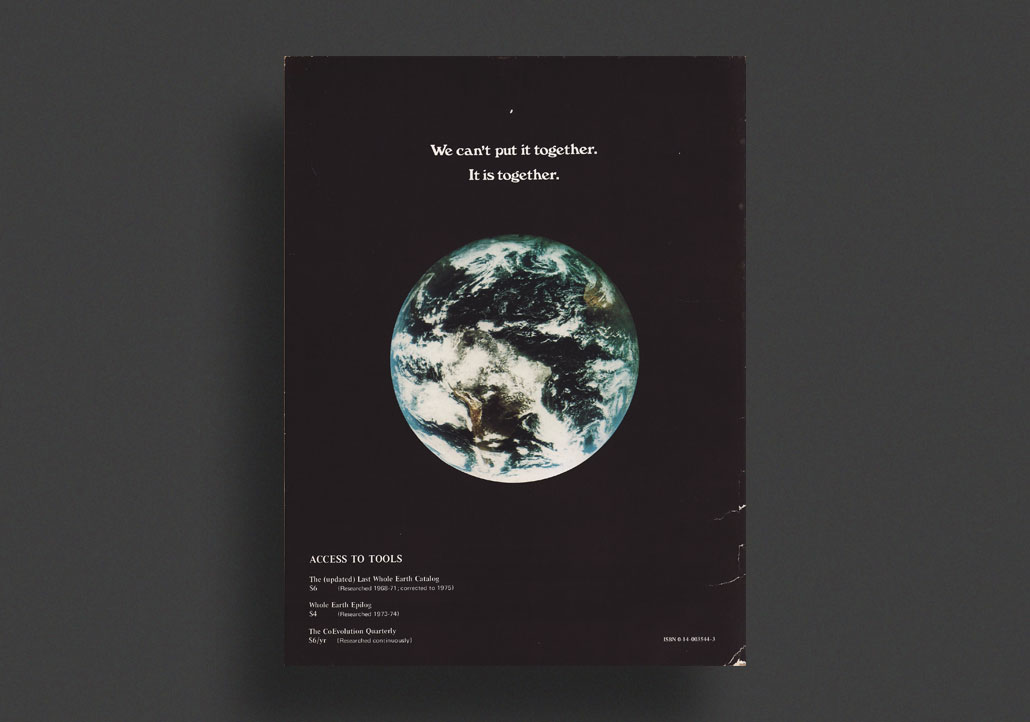
Original 1971 edition of the Back-to-the-land bible and hippie homesteading encyclopedia, The Last Whole Earth Catalog. Considered "the internet before the internet", The Whole Earth Catalog was an important American counterculture magazine and product catalog published by author, editor and founder of the Long Now Foundation, Stewart Brand, between 1968—1972. The magazine, sporting the famous slogan "access to tools", promoted self-sufficiency, ecology, alternative education, "do it yourself" (DIY), and holism, through featured essays, articles, poetry, practical guides, plans, philosophies, artwork and most importantly, a huge catalog of product reviews (from books by Buckminster Fuller to synthesizers by Wendy Carlos) that formed an important directory and direct network of craftspeople, educators, artisans, nomads, growers, idealists and independent developers. "It was sort of like Google in paperback form, 35 years before Google came along."—Steve Jobs. Oh how the internet has turned on us.
"We are as gods and we might as well get used to it. So far remotely done power and glory - as via government, big business, formal education, church - has succeeded to the point where gross defects obscure actual gains. In response to this dilemma and to these gains a realm of intimate, personal power is developing - the power of individuals to conduct their own education, find their own inspiration, shape their own environment, and share the adventure with whoever is interested. Tools that aid this process are sought and promoted by The Next Earth Catalog."
The back cover photo is of the earth from space. The caption reads, “We can’t put it together. It is together.”
VG copy, with exception of closed tear between front cover and bottom of spine only. Otherwise uncreased spine, only unusually light wear and tear and usual tanning to newsprint pages.
1975, English
Softcover, 96 pages, 21 x 21 cm
1st UK Edition, Out of print title / used / very good
Published by
Idea Books International / London
$55.00 - Out of stock
"Author, Art Boericke and Photography Barry Shapiro have traveled for years to the ends of many rural road in order to visit and record the best owner-built structures they could. These words and images will not tell you what to build nor how to build it. We hope that the book will show you some neat solutions to old problems, with gorgeous embellishments, and it will tell you that you needn't be a titan of carpentry in order to have a sprightly outbuilding or a snug main house."
An classic book on wooden houses, lavishly illustrated with interior/exterior photography and details of the author's examples, captured in the early 1970s.
A copy of the less common Idea Books edition from 1975.
2023, English
Hardcover, 240 pages, 16 x 20 cm
Published by
Fuel / London
$60.00 - Out of stock
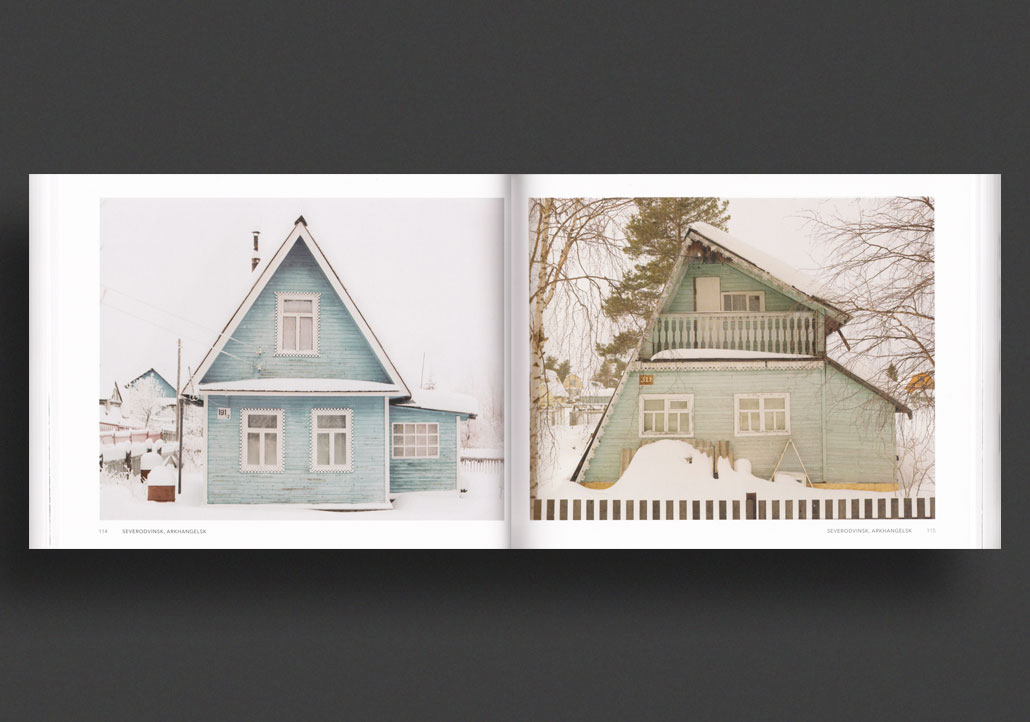
Dachas - countryside houses, built from wood - are largely unknown outside the post-Soviet states. Photographer Fyodor Savintsev has documented these important architectural forms, creating a unique record of a vanishing world.
A 'dacha' is a country house, made of wood, used by Soviet citizens to escape the rigors of the city for rural idyll. Widespread in the countries of the former USSR, this important cultural and architectural form has been largely ignored academically. In Dacha Fyodor Savintsev documents this particularly Russian phenomenon, his photographs constitute a unique record of a rapidly vanishing fairytale wooden world.
The word 'dacha' has been used to describe constructions ranging from grand imperial villas to small sheds. Originally bestowed by the Tsar to reward courtiers, this custom continued following the revolution, with Soviet cooperatives building dachas for their members. Supposedly for the benefit of labourers, in reality they were destined for those favoured by the State, including famous writers, architects and artists - from Pasternak to Prokofiev. The fall of the Soviet Union accelerated their use, as economic uncertainty forced city dwellers towards self-sufficiency. The dacha tradition has survived Revolution, war and the collapse of Communism, becoming an integral part of life in the process.
Using contemporary photographs to showcase these uniquely individual buildings for the first time, alongside an introduction explaining their historical and cultural context, Dacha is the only publication of its kind.
1977, English
Softcover, 545 pages, 27.5 x 21.5 cm
1st Edition, Out of print title / used / very good
Published by
Scribners / New York
$70.00 - Out of stock
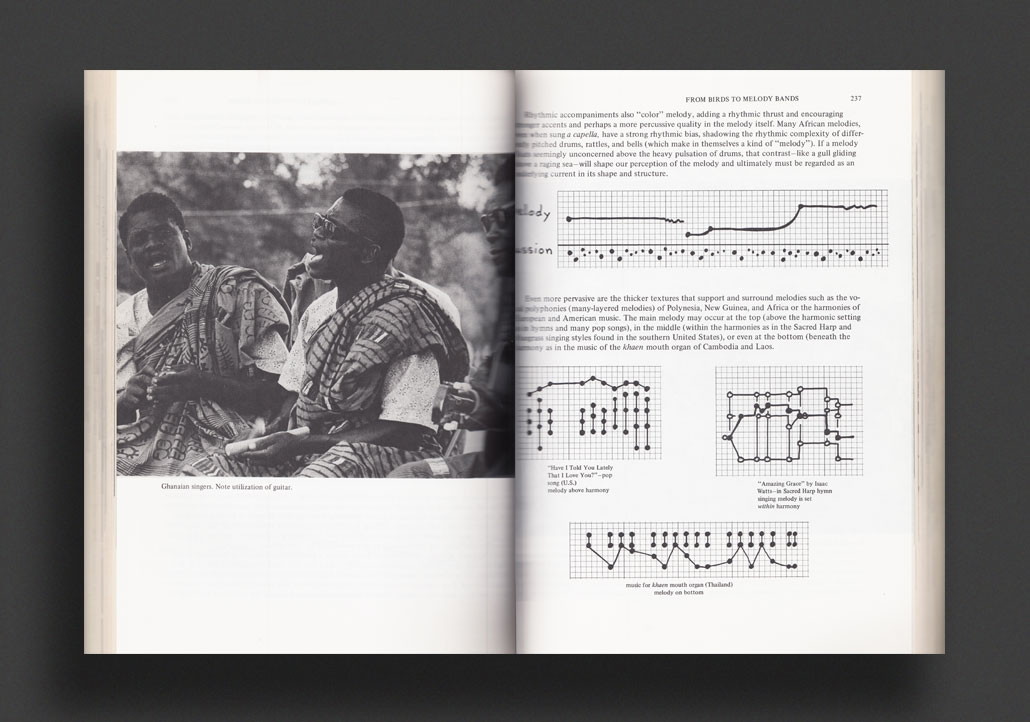
First edition of Music of the Whole Earth from 1977.
"I look upon the musician/composer," David Reck has said, "as a carpenter of sound (also a poet/philosopher/and highwire artist). I am delighted by the processes of making and building (the bricks can be invisible) and doing and thinking. I like to be surprised (by myself and others). But I study music, and play it, primarily for that magical touch, an emotional contact with music itself that mystically makes me (and others) more human, more attuned to the ecology of ourselves and the world."
In this extraordinary 545-page book, ethnomusicologist David Reck "invites you to discover the musical universe. MUSIC OF THE WHOLE EARTH explores the richness and variety of sound, instruments, and music from many different cultures and a great variety of musical traditions. Tribal, folk, and classical music of India, Tibet, China, Japan, the American Indians, Southeast Asia, Java and Bali, Oceania/Polynesia, the Middle East, Africa, Europe, and the Americas — including pop, rock, jazz, soul, and country. The mythical origins of music, endangered musics, ensembles, the ecology of sound, and music in relation to art, magic, ritual, theater, dance, and life-styles. The anatomy and mechanics of instruments, with special sections on how to make them yourself. Profusely illustrated with photographs, drawings, maps, and diagrams, MUSIC OF THE WHOLE EARTH narrows the gap between the audience and the performer and between our own musical culture and that of other peoples."
Very Good copy.
1994, Japanese
Softcover, 192 pages, 13 x 18 cm
1st Edition, Out of print title / used / very good
Published by
Fiction Inc. / Tokyo
$80.00 - Out of stock
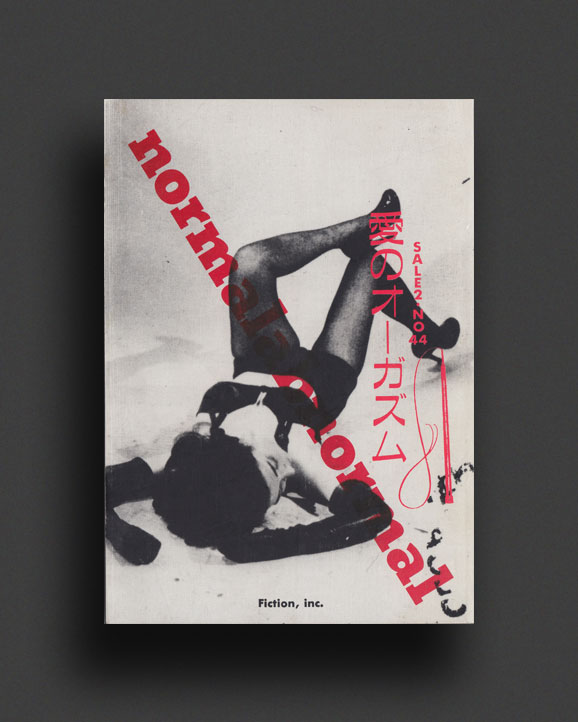
Issue No.44 of the great SALE2 periodical from Tokyo Japan during the late 1980s and early 1990s.
Published regularly as a sort-of fanzine/journal/catalogue/pocket-book by Fiction, Inc., a specialty shop and publisher of fetish and erotica in Tokyo in the 1980-90s. Each issue covers different themes and features, heavy on fetishism.
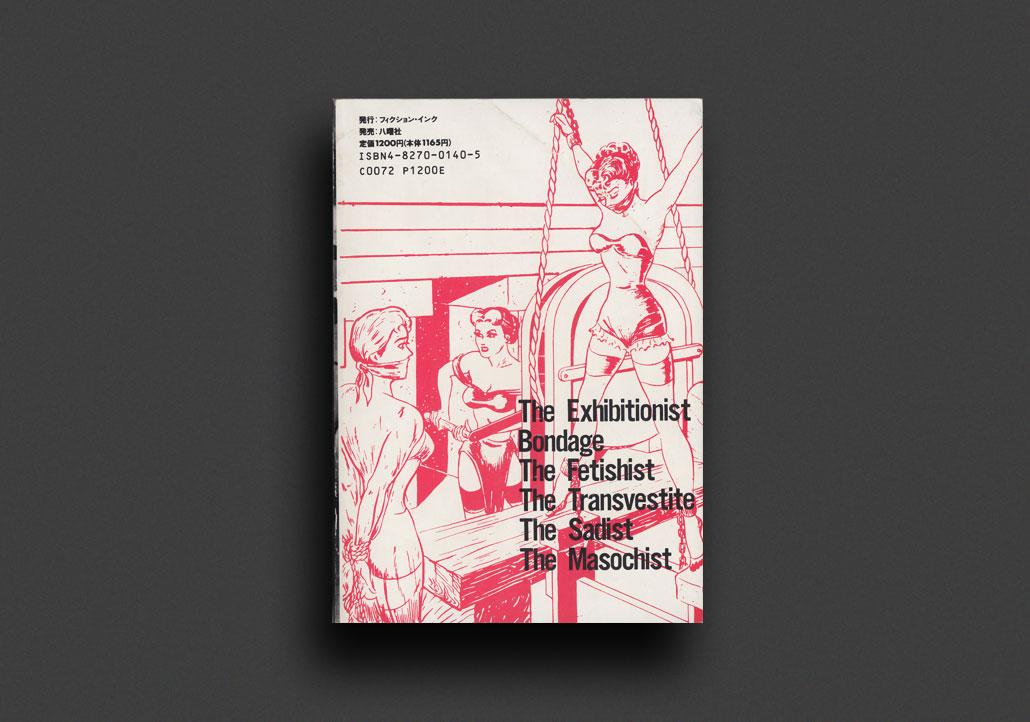
Issue No.44, the "normalabnormal" issue features "The Exhibitionist, Bondage, The Fetishist, The Transvestite, The Sadist, The Masochist", Gerard Malanga, Nobuyoshi Araki, Guido Crepax, Luc Sante's Evidence book, Carlo Mollino, fetish comix, Erotic Lactation, bondage catalogues, and much more...
Very heavily illustrated throughout with erotic photography and artwork, all texts in Japanese.
1990, Japanese
Softcover, 176 pages, 13 x 18 cm
1st Edition, Out of print title / used / very good
Published by
Fiction Inc. / Tokyo
$80.00 - Out of stock
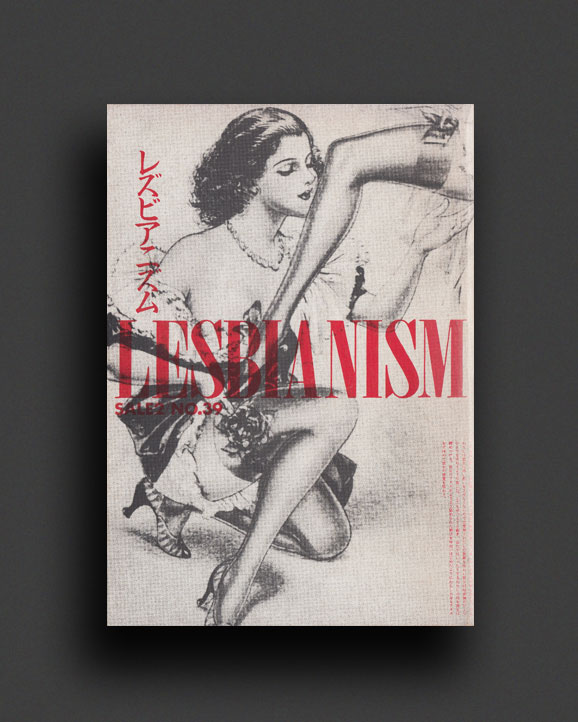
Issue No.39 of the great SALE2 periodical from Tokyo Japan, founded in 1984 by Makoto Orui, who later became art director for Purple magazine in France and Rockin’on magazine in Japan. SALE2 was active for about 14 years during the 1980s—1990s, published regularly as a sort-of fanzine/journal/catalogue/pocket-book by Fiction, Inc., a specialty shop and publisher of fetish and erotica in Tokyo in the 1980-90s. With Orui's distinct design SALE2 developed an exclusive curated editorial set on ‘erotisism and its spiritual philosophy’, with each issue exploring different themes and features, heavy on fetishism and erotic art.
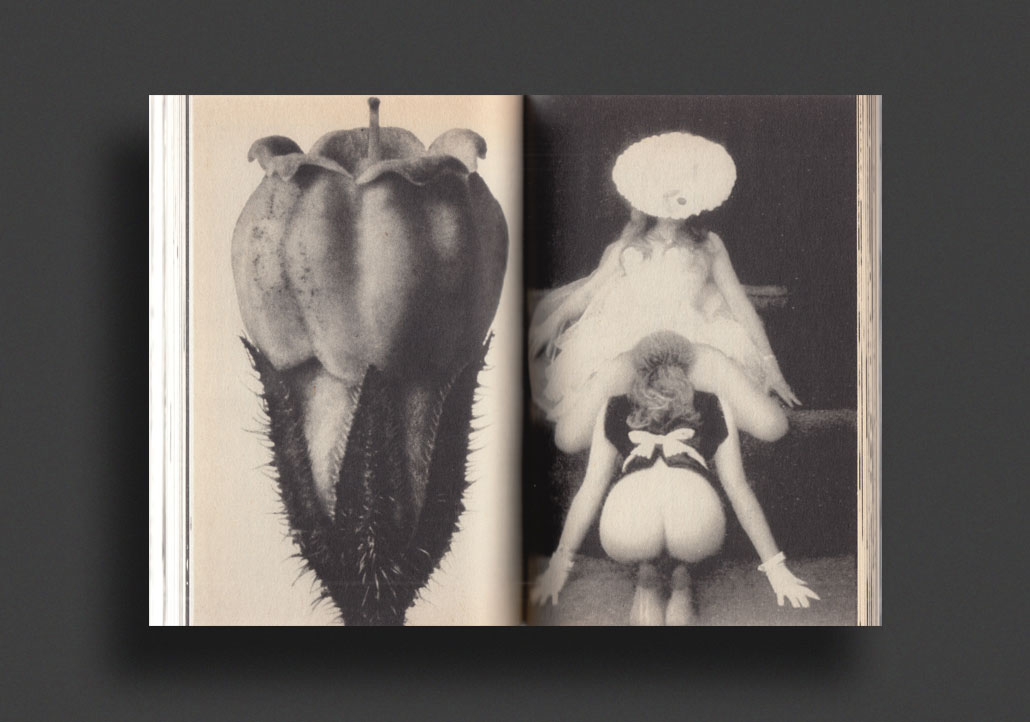
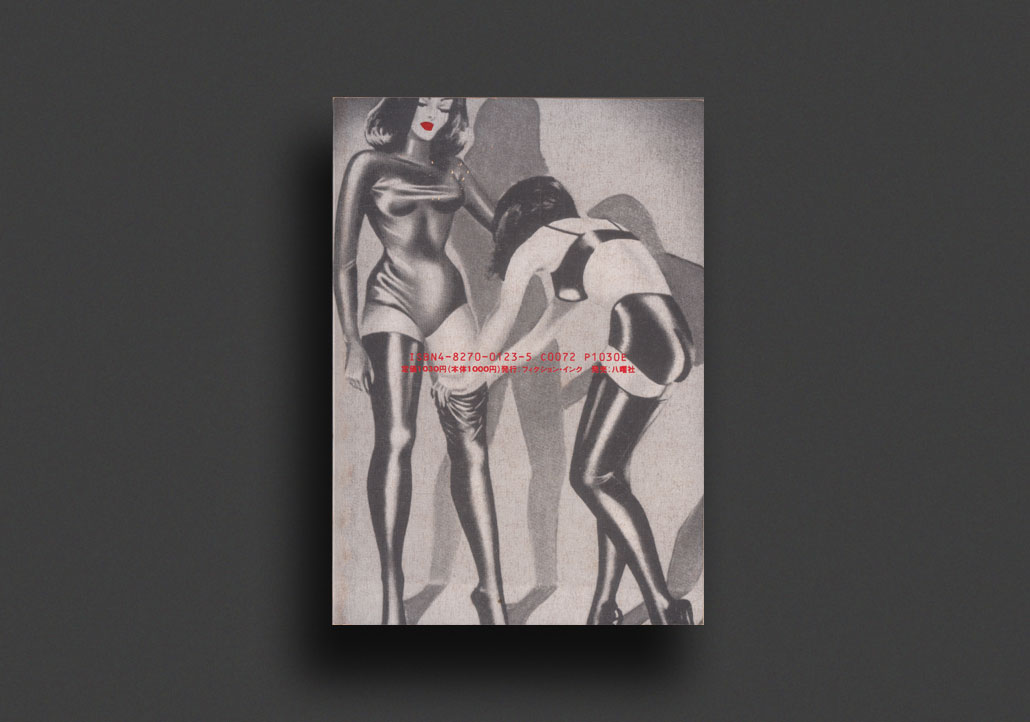
Issue No.39, the "Lesbianism" issue features writings by Rita Mae Brown, Alice Walker, Simone de Beauvoir, and many more, interspersed with erotic female imagery (photography, film stills, drawings, paintings) with facing images of flowers by famed German photographer Karl Blossfeldt. Also includes John Kacere, and catalogue/advertisments/clippings of Nobuyoshi Araki, Richard Cerf, Carlo Mollino, Pierre Molinier, Irving Claw, Jim, Betty Page, Sweet Gwen, Diva Bizarre, Centurian, Bizarre Comix, and much more...
Very heavily illustrated throughout with erotic photography and artwork, all texts in Japanese.
Very Good copy.
1991, Japanese
Softcover, 160 pages, 13 x 18 cm
1st Edition, Out of print title / used / very good
Published by
Fiction Inc. / Tokyo
$80.00 - Out of stock
Issue No.40 of the great SALE2 periodical from Tokyo Japan during the late 1980s and early 1990s.
Published regularly as a sort-of fanzine/journal/catalogue/pocket-book by Fiction, Inc., a specialty shop and publisher of fetish and erotica in Tokyo in the 1980-90s. Each issue covers different themes and features, heavy on fetishism.
Issue No.40, the "Skin To Skin" issue features collected writings and images around the themes of body art, tattoo, piercing, bondage, "modern primitivism", etc. including Masami Akita (Merzbow), Mari Akasaka, Kyoko Okazaki, performance artist Fakir Musafar, Irving Klaw, Betty Page, many artists, plus imagery/advertisements/clippings/artworks by Carlo Mollino, Pierre Molinier, John Willie, Guido Crepax, more Irving Claw, more Betty Page, comix and periodicals such as Sweet Gwen's, Bizarre, Gwendoline, Rigorosa Disciplina, and much more...
Very heavily illustrated throughout with erotic photography and artwork, all texts in Japanese.
1991, English
Softcover, 200 pages, 15.2 x 22.9 cm
Published by
Zone Books / New York
$54.00 - Out of stock
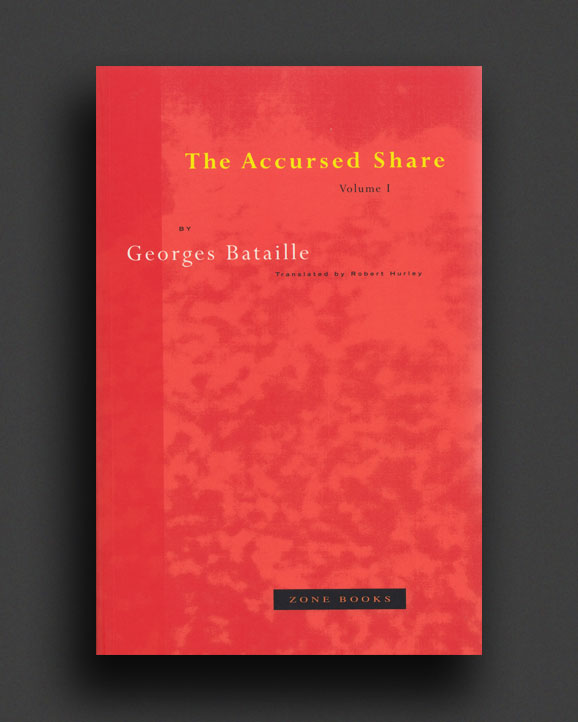
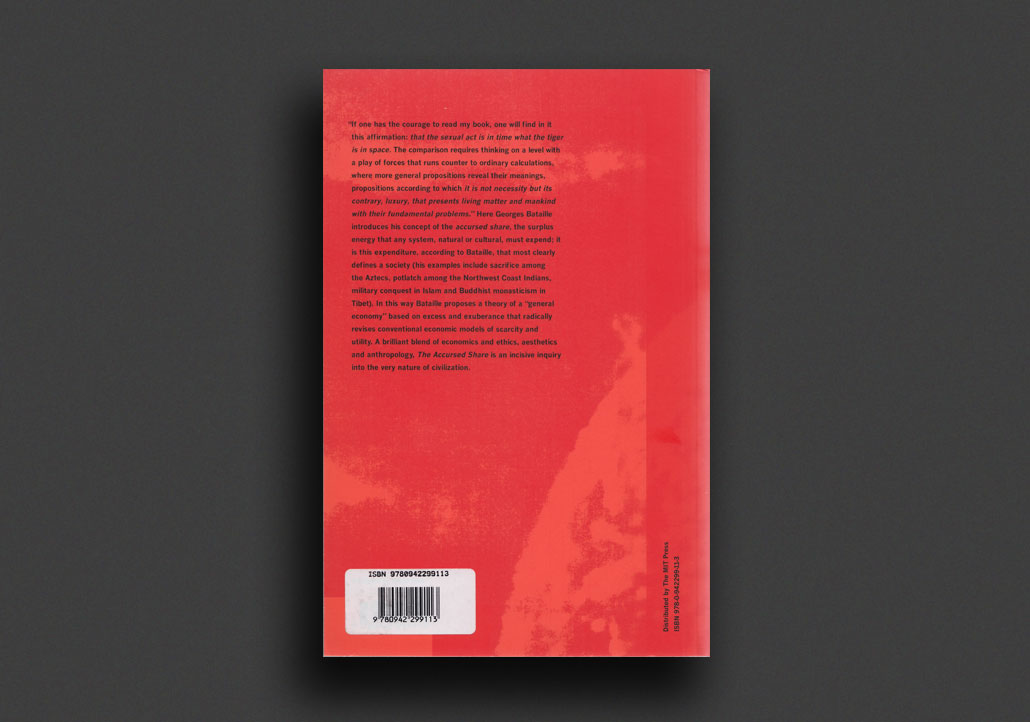
Most Anglo-American readers know Bataille as a novelist. The Accursed Share provides an excellent introduction to Bataille the philosopher. Here he uses his unique economic theory as the basis for an incisive inquiry into the very nature of civilization. Unlike conventional economic models based on notions of scarcity, Bataille's theory develops the concept of excess: a civilization, he argues, reveals its order most clearly in the treatment of its surplus energy. The result is a brilliant blend of ethics, aesthetics, and cultural anthropology that challenges both mainstream economics and ethnology.
Georges Bataille (1897-1962) was a French writer, essayist, and philosopher whose works include The Story of the Eye, The Blue of Noon, The Accursed Share, and Theory of Religion.
A serious book of political economy that also claims 'the sexual act is in time what the tiger is in space.'... The Accursed Share is a brilliant product of [Bataille's] loony-tunes coupling of critical genres: pseudo/antisurrealist manifestos, leftist political treatises, erotics, Hegel 'n' Nietzsche studies, mysticism, anthropology, and sun worship. - Erik Davis, The Voice Literary Supplement
1993, English
Softcover, 464 pages, 15.3 x 22.7 cm
Published by
Zone Books / New York
$69.00 - In stock -
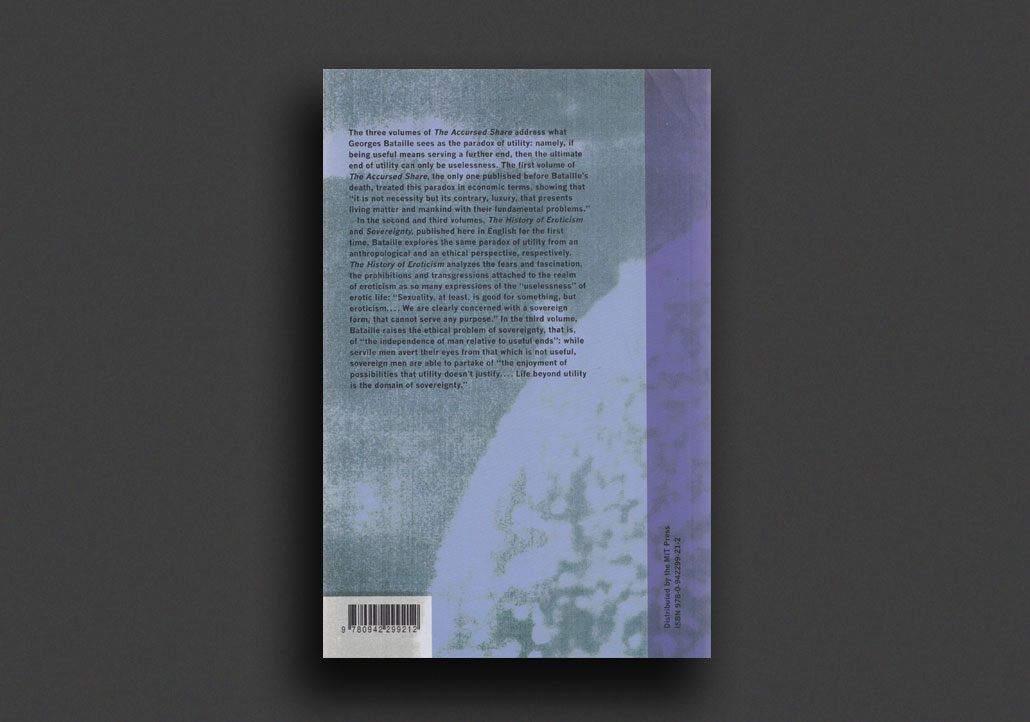
The three volumes of The Accursed Share address what Georges Bataille sees as the paradox of utility: namely, if being useful means serving a further end, then the ultimate end of utility can only be uselessness. The first volume of The Accursed Share, the only one published before Bataille's death, treated this paradox in economic terms, showing that "it is not necessity but its contrary, luxury, that presents living matter and mankind with their fundamental problems." This Zone edition includes in a single volume a reconstruction, based on the versions published in Bataille's posthumous collected works, of his intended continuation of The Accursed Share.
In the second and third volumes, The History of Eroticism and Sovereignty, Bataille explores the same paradox of utility, respectively from an anthropological and an ethical perspective. He first analyzes the fears and fascination, the prohibitions and the transgressions attached to the realm of eroticism as so many expressions of the "uselessness" of erotic life. It is just this expenditure of excess energy that demarcates the realm of human autonomy, of independence relative to "useful" ends. The study of eroticism therefore leads naturally to the examination of human sovereignty, in which Bataille defines the sovereign individual as one who consumes and does not labor, creating a life beyond the realm of utility.
Georges Bataille (1897-1962) was a French writer, essayist, and philosopher whose works include The Story of the Eye, The Blue of Noon, The Accursed Share, and Theory of Religion.
1970, Japanese
Hardcover (w. illustrated slipcase), 266 pages, 23.5 x 16 cm
1st Edition, Out of print title / used / very good
Published by
Asahi Sonorama / Tokyo
$200.00 - In stock -
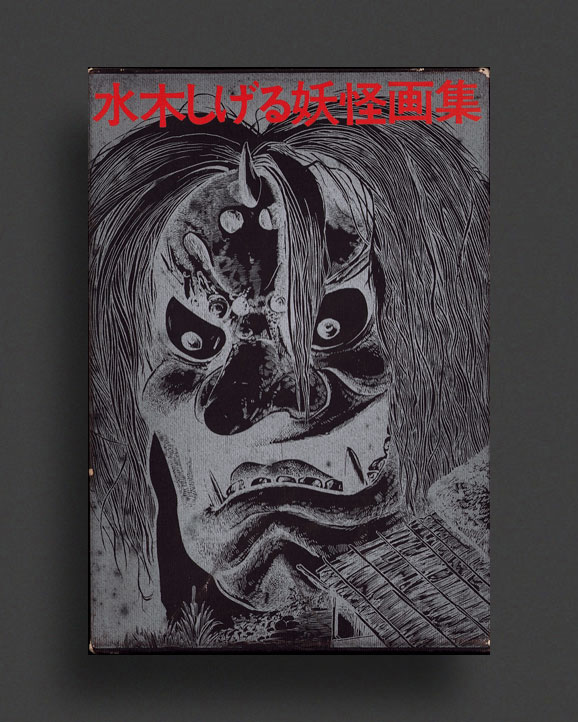
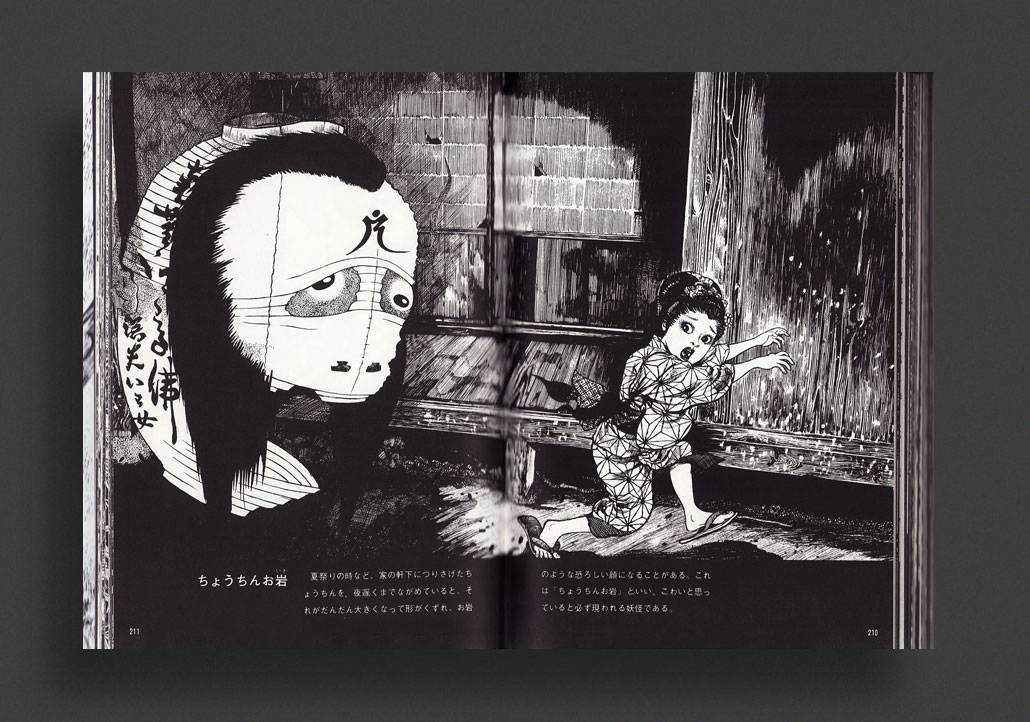
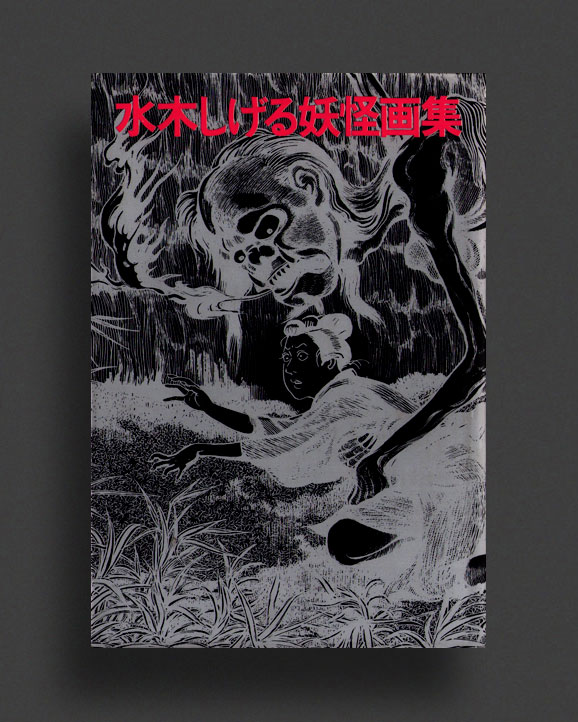
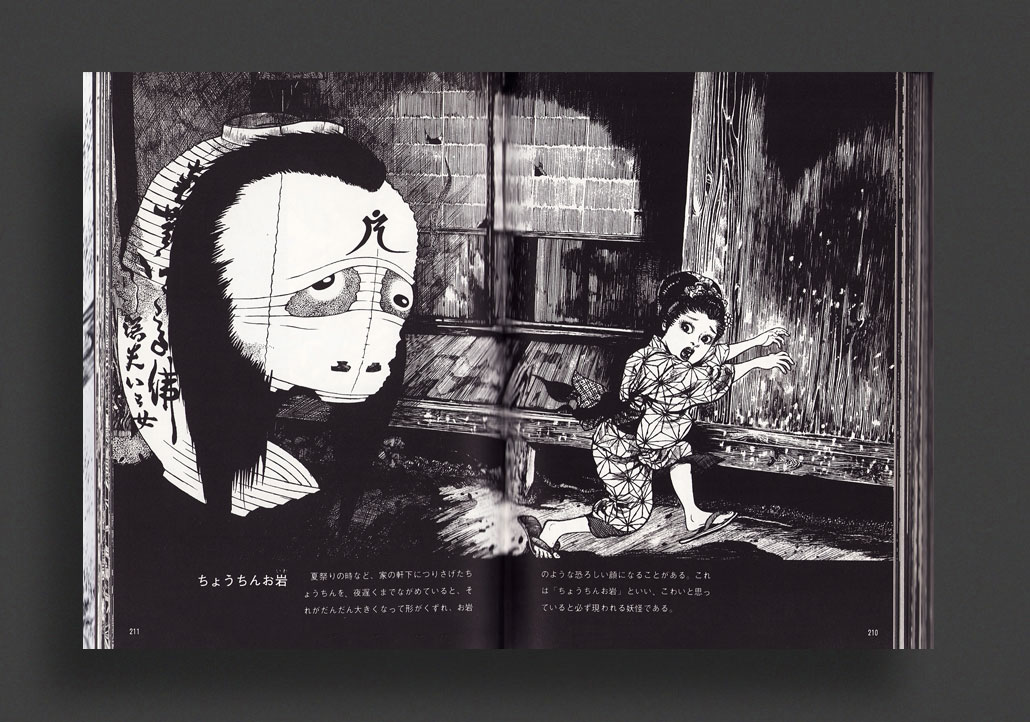
Rare first 1970 slipcased hardcover edition of manga master Shigeru Mizuki's absolute classic illustrated encyclopedia of his beloved Yōkai (Japanese supernatural beings and phenomena), published in this gorgeous hardcover edition in illustrated slipcase by Ashahi Sonorama, here for the first time in 1970 and long out-of-print. A must for any lover of the illustrated weird by a master of the genre.
Shigeru Mizuki (1922–2015) was one of Japan’s most respected artists. A creative prodigy, he lost an arm in World War II. After the war, Mizuki became one of the founders of Japan’s latest craze—manga. He invented the yokai genre with GeGeGe no Kitaro, his most famous character, who has been adapted for the screen several times, as anime, live action, and video games. In fact, a new anime series has been made every decade since 1968, capturing the imaginations of generations of Japanese children. A researcher of yokai and a real-life ghost hunter, Mizuki traveled to over sixty countries to engage in fieldwork based on spirit folklore. In his hometown of Sakaiminato, one can find Shigeru Mizuki Road, a street decorated with bronze statues of his Kitaro characters.
VG in VG dj. Beautiful copy.
1985, Japanese
Hardcover, 264 pages, 23 x 16 cm
Out of print title / used / very good
Published by
Asahi Sonorama / Tokyo
$120.00 - Out of stock
1985 revised edition of manga master Shigeru Mizuki's absolute classic 1970 illustrated encyclopedia of his beloved Yōkai (Japanese supernatural beings and phenomena), published in this gorgeous hardcover clothbound edition by Ashahi Sonorama, long out-of-print. A must for any lover of the illustrated weird by a master of the genre.
Shigeru Mizuki (1922–2015) was one of Japan’s most respected artists. A creative prodigy, he lost an arm in World War II. After the war, Mizuki became one of the founders of Japan’s latest craze—manga. He invented the yokai genre with GeGeGe no Kitaro, his most famous character, who has been adapted for the screen several times, as anime, live action, and video games. In fact, a new anime series has been made every decade since 1968, capturing the imaginations of generations of Japanese children. A researcher of yokai and a real-life ghost hunter, Mizuki traveled to over sixty countries to engage in fieldwork based on spirit folklore. In his hometown of Sakaiminato, one can find Shigeru Mizuki Road, a street decorated with bronze statues of his Kitaro characters.
VG in VG dj.
1987, English
Softcover (French-fold), 169 pages, 22 x 14 cm
1st Edition, Out of print title / used / very good
Published by
Eridanos Press / Colorado
$60.00 - Out of stock
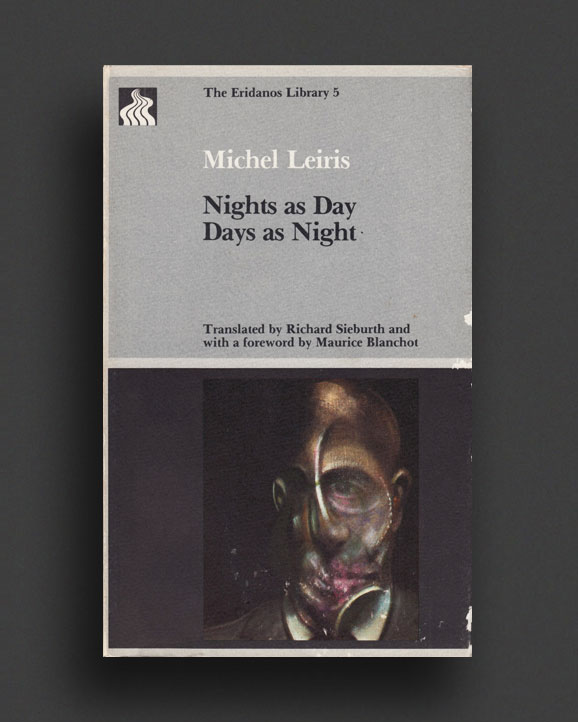
Long out-of-print 1987 Eridanos Press edition, the first in English, of French surrealist writer and ethnographer Michel Leiris' Nights as Day Days as Night.
Nights as Day is a diary of over a hundred short dreams composed over the course of four decades. As the title implies (Nuits sans nuit, et quelques jours sans jour is literally "Nights without darkness, and a few days without light"), the texts in this volume pursue an extended pun on the porous demarcation between waking and dreaming. By transcribing the events of his daily life as if they were episodes in an ongoing dream, by recording his dreams as if they embodied the true narrative of his waking existence, Leiris in effect defuses the distinction between the two. "I have always behaved as if I were on stage," Leiris confesses in Manhood, and the roles he executes in these texts are various: he is a hero of Greek or Racinian tragedy, martyr of the French Resistance, matador, bantamweight champion of the world, Chaplinesque victim of the Eternal Feminine, Ben Turpin, Gary Cooper, but most frequently he simply plays a mild-mannered minor functionary and author beset by the usual anxieties and fantasies of the average homme moyen sensuel. One of the most striking aspects of these texts is their ordinariness, their deliberate dailiness, their eschewal of lyricism in favor of the unprepossessing prose of the world. Whatever the setting (music halls, fairgrounds, circus shows, boxing matches, museum exhibitions, exotic lands, brothels, streets of Paris or Hollywood movies), Leiris concentrates on estranging the familiar, on unsettling the commonplace, on eliciting the foreignness of the most domestic, local detail. And it is thus that Nights as Days, Days as Night rejoins Leiris's autobiographical and ethnographic enterprises: all it takes is a minor adjustment of lighting or a slight troping of rhetoric for daily life to take on the uncertain distance of dreams, and conversely, for dream to be de-mystified into the quotidian.—R.S.
Michel Leiris (1901—1990) grew up in comfortable Parisian bourgeois surroundings. The earnest student of chemistry was soon seduced by the exciting world of cafés and cabarets, and particularly by the heady stimulus of Dada and Surrealism. Introduced to surrealist circles by his lifelong friend André Masson, Leiris by the late 1920s had become one of the earlier defectors from the movement. Subsequently, he co-founded, with George Bataille, Maurice Blanchot, Pierre Klossowski and Roger Caillois the College de Sociologie. His continuing ethnographic fascination with the cultures of Africa, the Caribbean, and Central America, as well as his extensive fieldwork in Sudan and Ethiopia, have produced such literary fruits as his unique travel account L'Afrique Fantôme (1933). He is also author of a four-volume autobiography, La Règle du Jeu, of which the first volume was published in English as Manhood. Michel Leiris lived in Paris with his wife, owner of the Galérie Louise Leiris, a major art institution in the post-war period. Leiris has written extensively on major modern artists-among them Miró, Giacometti, Duchamp, Lam, and Bacon.
Richard Sieburth has translated Hölderlin's Hymns and Fragments and Benjamin's Moscow Diary, as well as works by Michaux and Guillevic. He is also the author of a study of Ezra Pound and Remy de Gourmont. He teaches French and Comparative Literature at New York University.
Good—Very Good copy with some light buggery (insect nibbles to cover edge and spine), light foxing to block edge, clean interior, uncreased spine. Stiff French-fold covers.
2015, English
Hardcover (w. dust jacket), 144 pages, 18.7 x 12.5 cm
Published by
New Directions / New York
$42.00 - Out of stock
Translated by Susan Bernofsky, Lydia Davis and Christopher Middleton
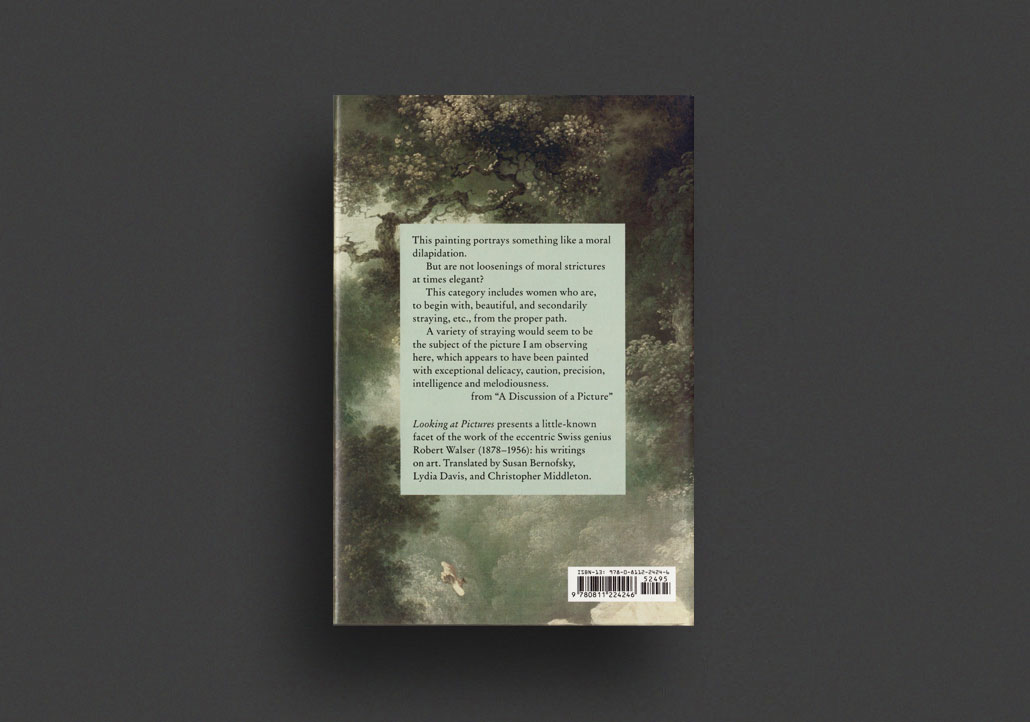
A beautiful and elegant collection, with gorgeous full-color art reproductions, Looking at Pictures presents a little-known side of the eccentric Swiss genius: his great writings on art. His essays consider Van Gogh, Cezanne, Rembrandt, Cranach, Watteau, Fragonard, Brueghel and his own brother Karl and also discuss general topics such as the character of the artist and of the dilettante as well as the differences between painters and poets. Every piece is marked by Walser's unique eye, his delicate sensitivity, and his very particular sensibilities--and all are touched by his magic screwball wit.
"Everyone who reads Walser falls in love with him."—Nicholas Lazard - The Guardian
"A Paul Klee in prose, a good-humoured, sweet Beckett, Walser is a truly wonderful, heartbreaking writer."—Susan Sontag
"Bold and idiosyncratic." —Lydia Davis
"Singular-genius."—Ben Lerner
"Written between 1902 and 1930 and, with two exceptions, previously untranslated, the pieces gathered here elaborate a nervous, slapstick sort of hack journalism that set the stage for a fabulously experimental modernist writing situation whose fans included Kafka, Musil, and Benjamin."—John Kelsey - Artforum
2012, English
Softcover, 264 pages, 14 x 21.6 cm
Published by
Princeton University Press / New York
$38.00 - Out of stock
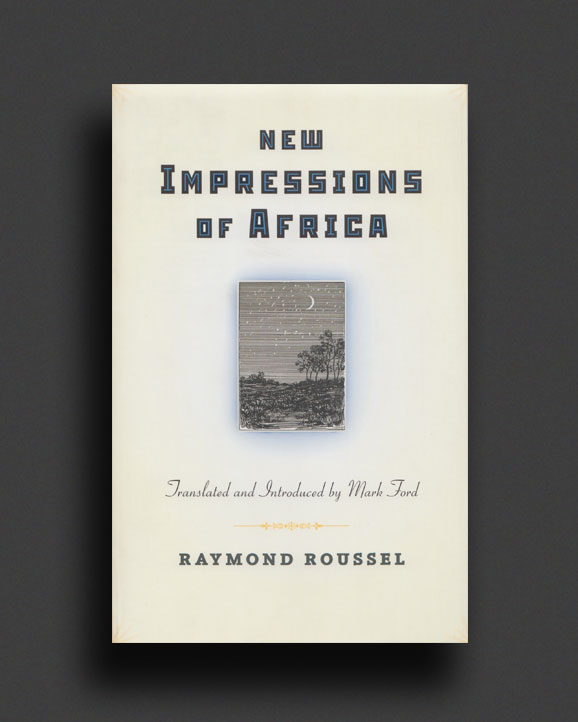
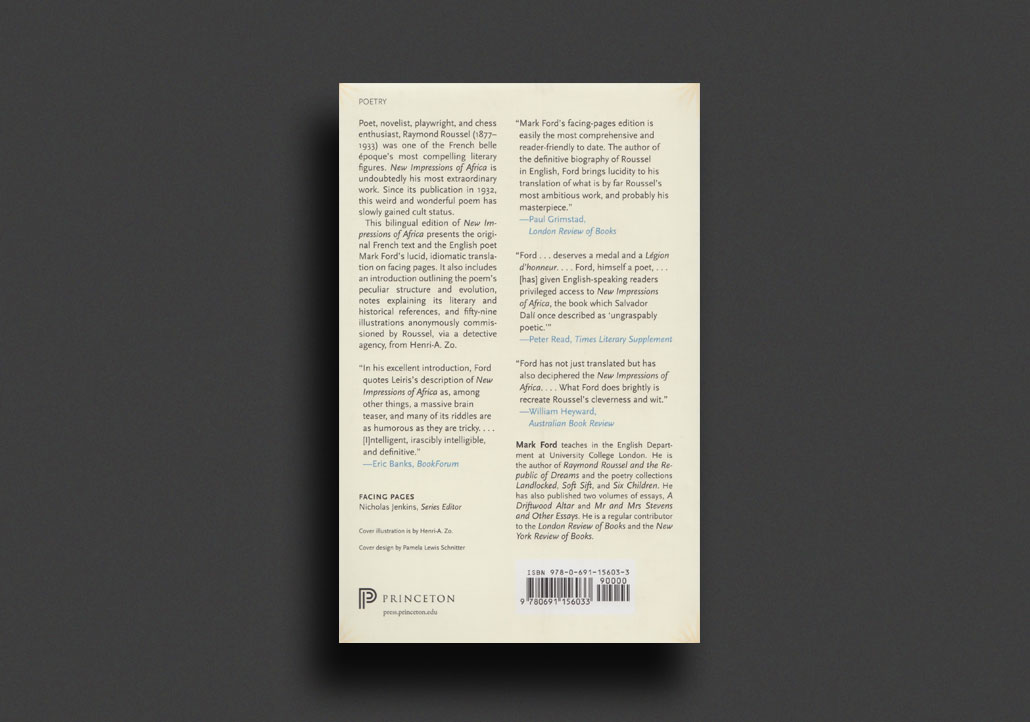
Poet, novelist, playwright, and chess enthusiast, Raymond Roussel (1877-1933) was one of the French belle époque’s most compelling literary figures. During his lifetime, Roussel’s work was vociferously championed by the surrealists, but never achieved the widespread acclaim for which he yearned. New Impressions of Africa is undoubtedly Roussel’s most extraordinary work. Since its publication in 1932, this weird and wonderful poem has slowly gained cult status, and its admirers have included Salvador Dalì — who dubbed it the most “ungraspably poetic” work of the era — André Breton, Jean Cocteau, Marcel Duchamp, Michel Foucault, Kenneth Koch, and John Ashbery.
Roussel began writing New Impressions of Africa in 1915 while serving in the French Army during the First World War and it took him seventeen years to complete. “It is hard to believe the immense amount of time composition of this kind of verse requires,” he later commented. Mysterious, unnerving, hilarious, haunting, both rigorously logical and dizzyingly sublime, it is truly one of the hidden masterpieces of twentieth-century modernism.
This bilingual edition of New Impressions of Africa presents the original French text and the English poet Mark Ford’s lucid, idiomatic translation on facing pages. It also includes an introduction outlining the poem’s peculiar structure and evolution, notes explaining its literary and historical references, and the fifty-nine illustrations anonymously commissioned by Roussel, via a detective agency, from Henri-A. Zo.
1983, English
Softcover, 317 pages, 20 x 13 cm
1st Edition, Out of print title / used / very good
Published by
John Calder / London
Riverrun Press / New Jersey
$65.00 - Out of stock
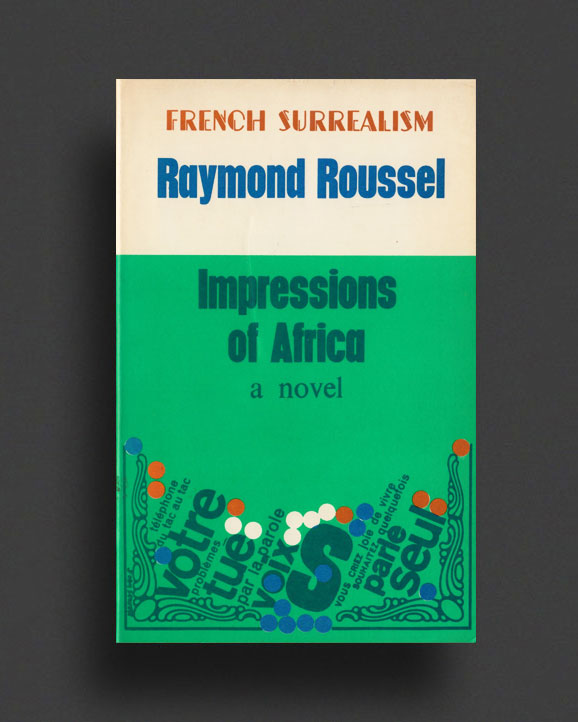
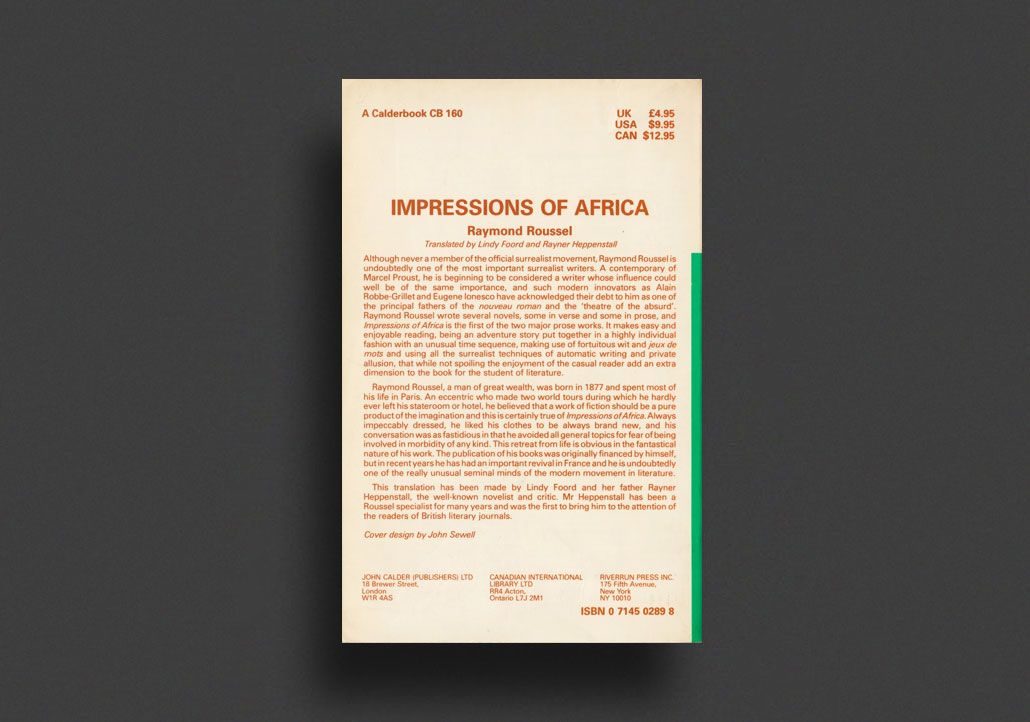
First 1983 Calder / Riverrun Press US paperback edition in English of Raymond Roussel's classic, Impressions of Africa : A Novel, translated by Lindy Foord and Rayner Heppenstall.
"Although never a member of the official surrealist movement, Raymond Roussel is undoubtedly one of the most important surrealist writers. A contemporary of Marcel Proust, he is beginning to be considered a writer whose influence could well be of the same importance, and such modern innovators as Alain Robbe-Grillet and Eugene lonesco have acknowledged their debt to him as one of the principal fathers of the nouveau roman and the 'theatre of the absurd'. Raymond Roussel wrote several novels, some in verse and some in prose, and Impressions of Africa is the first of the two major prose works. It makes easy and enjoyable reading, being an adventure story put together in a highly individual fashion with an unusual time sequence, making use of fortuitous wit and jeux de mots and using all the surrealist techniques of automatic writing and private allusion, that while not spoiling the enjoyment of the casual reader add an extra dimension to the book for the student of literature.
Raymond Roussel, a man of great wealth, was born in 1877 and spent most of his life in Paris. An eccentric who made two world tours during which he hardly ever left his stateroom or hotel, he believed that a work of fiction should be a pure product of the imagination and this is certainly true of Impressions of Africa. Always impeccably dressed, he liked his clothes to be always brand new, and his conversation was as fastidious in that he avoided all general topics for fear of being involved in morbidity of any kind. This retreat from life is obvious in the fantastical nature of his work. The publication of his books was originally financed by himself, but in recent years he has had an important revival in France and he is undoubtedly one of the really unusual seminal minds of the modern movement in literature. This translation has been made by Lindy Foord and her father Rayner Heppenstall, the well-known novelist and critic. Mr Heppenstall has been a Roussel specialist for many years and was the first to bring him to the attention of the readers of British literary journals."—publisher's 1983 blurb.
Very Good copy.
1983 / 2003, English
Softcover, 254 pages, 20 x 13 cm
Out of print title / used / very good
Published by
Calder and Boyars / London
Riverrun Press / New Jersey
$60.00 - Out of stock
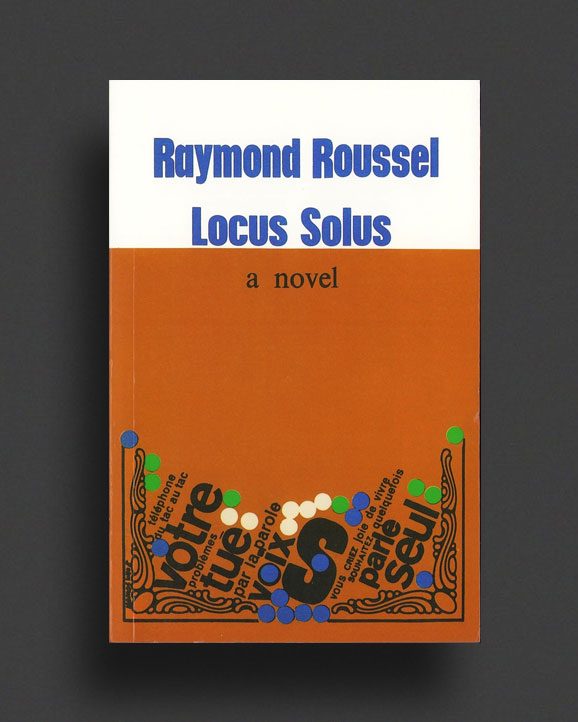
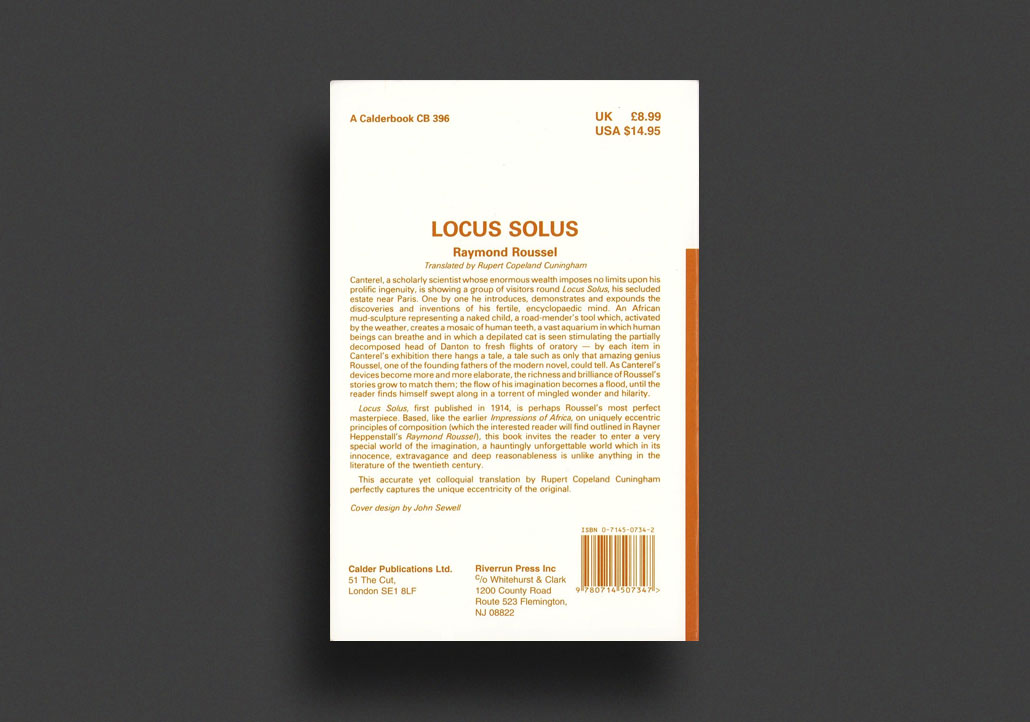
First 1983 Calder / Riverrun Press paperback edition in English of Raymond Roussel's classic, Locus Solus (1914), translated by Rupert Copeland.
Cuningham Canterel, a scholarly scientist whose enormous wealth imposes no limits upon his prolific ingenuity, is showing a group of visitors round Locus Solus, his secluded estate near Paris. One by one he introduces, demonstrates and expounds the discoveries and inventions of his fertile, encyclopaedic mind. An African mud-sculpture representing a naked child, a road-mender's tool which, activated by the weather, creates a mosaic of human teeth, a vast aquarium in which human beings can breathe and in which a depilated cat is seen stimulating the partially decomposed head of Danton to fresh flights of oratory — by each item in Canterel's exhibition there hangs a tale, a tale such as only that amazing genius Roussel, one of the founding fathers of the modern novel, could tell. As Canterel's devices become more and more elaborate, the richness and brilliance of Roussel's stories grow to match them; the flow of his imagination becomes a flood, until the reader finds himself swept along in a torrent of mingled wonder and hilarity.
Locus Solus, first published in 1914, is perhaps Roussel's most perfect masterpiece. Based, like the earlier Impressions of Africa, on uniquely eccentric principles of composition (which the interested reader will find outlined in Rayner Heppenstall's Raymond Roussel), this book invites the reader to enter a very special world of the imagination, a hauntingly unforgettable world which in its innocence, extravagance and deep reasonableness is unlike anything in the literature of the twentieth century. This accurate yet colloquial translation by Rupert Copeland Cuningham perfectly captures the unique eccentricity of the original.
Very Good copy.
1966, English
Hardcover (w. dustjacket), 98 pages, 14 x 20 cm
1st Edition, Out of print title / used / good
Published by
Calder and Boyars / London
$45.00 - In stock -
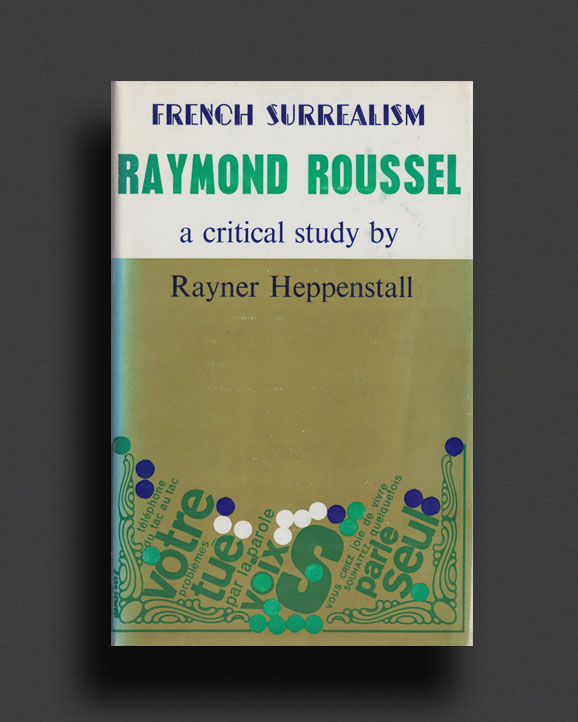
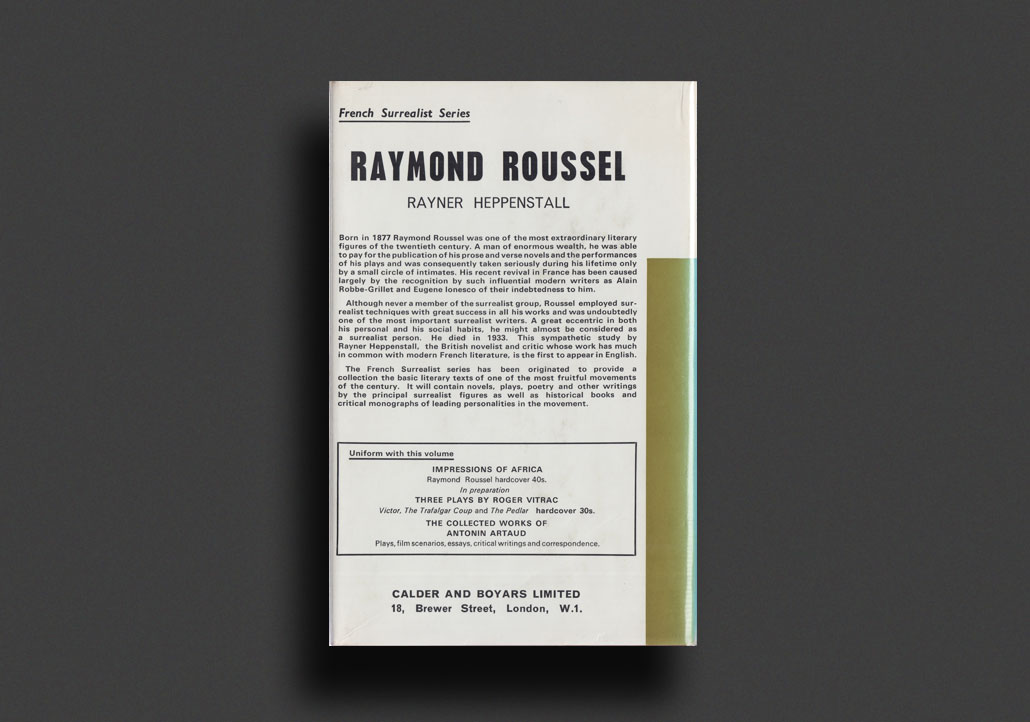
First hardcover edition of Raymond Roussel : A Critical Study by Rayner Heppenstall, published in 1966 by London's Calder and Boyars as part of their 'French Surrealism' series of books. This sympathetic study by Rayner Hoppenstall, a British novelist, critic and Roussel translator whose work has much in common with modern French literature, was the first to appear in the English language.
Raymond Roussel (1877-1933) was a French poet, novelist, playwright, musician, and chess enthusiast. Through his works he exerted a profound influence on certain groups within 20th century French literature, including the Surrealists, Oulipo, and the authors of the nouveau roman.
Very Good copy in Good dust jacket. Some tanning to edges.
1918 / ?, English
Softcover, 597 pages, 26.5 x 19 cm
Out of print title / used / good
Published by
Kessinger / Montana
$70.00 - Out of stock
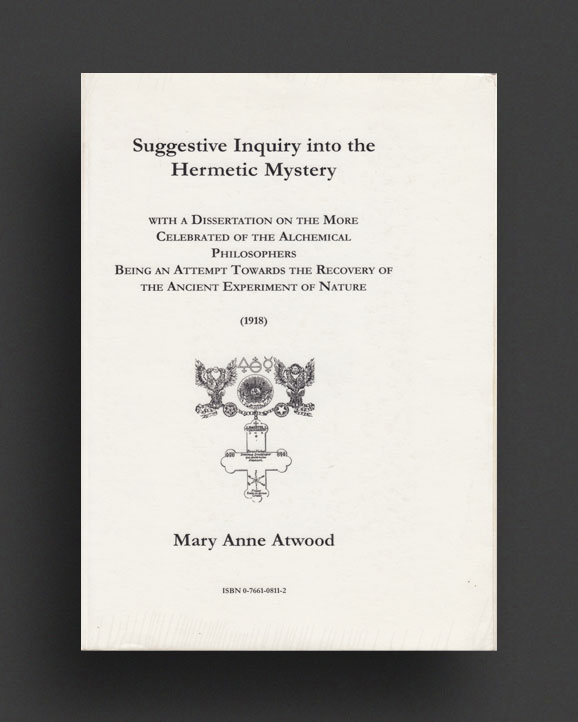
Complete academic facsimile reprint of the original historical 1918 edition. Includes the introduction by Walter Leslie Wilmshurst.
"Alchemy is philosophy; it is the philosophy, the seeking out of the Sophia in the mind."—Walter Leslie Wilmshurst
Mary Anne wrote A Suggestive Inquiry into the Hermetic Mystery... at her father’s request, and in parallel with his own composition of a lengthy poem on the same subject. Thomas South (her father) paid for the book to be published anonymously in 1850, but without having read it, trusting his daughter’s judgement. Reading it after publication, he believed Mary Anne had revealed many hermetic secrets that were better left unpublished, and therefore bought up the remaining stock and, with his daughter, burnt them, along with the unfinished manuscript of his poem. Only a few copies of the book survived. Ms. Atwood published nothing after A Suggestive Inquiry...
Chapters: Theory of Transmutation; The Golden Treatise; The True Subject; The Mysteries; Experimental Method; Manifestation of the Matter; Mental Requisites and Impediments; The Gross Work; The Six Keys; Rewards and Potencies.
Walter Leslie Wilmshurst, in his 1918 introduction to the reissue, laments that the thoughts of her later years did not find fruition in another work. He claims, however, that there is much to be found in her papers, of which he was then in possession.
Good copy with some general wear, fold to back cover, very light erase-able pencil marginalia from previous (almost entirely as an index to inside front cover, very little through contents).
1971, English
Softcover, 452 pages, 21.4 x 13.5 cm
1st Edition, Out of print title / used / very good
Published by
Dover / New York
$45.00 - Out of stock
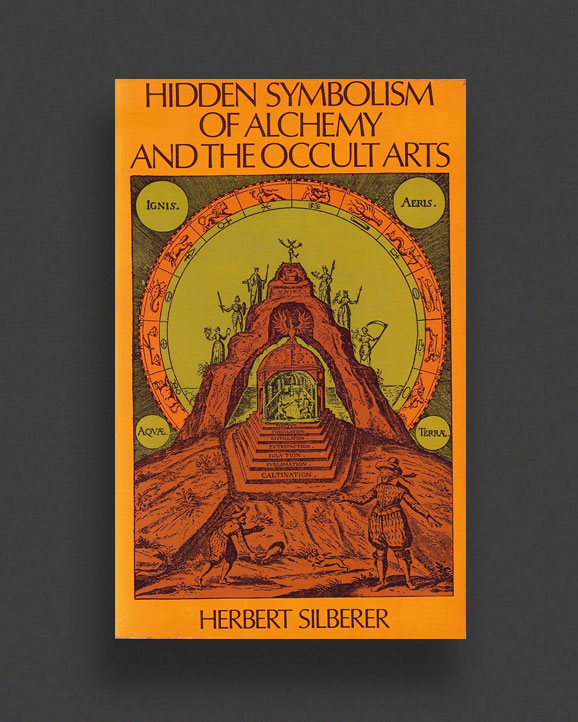
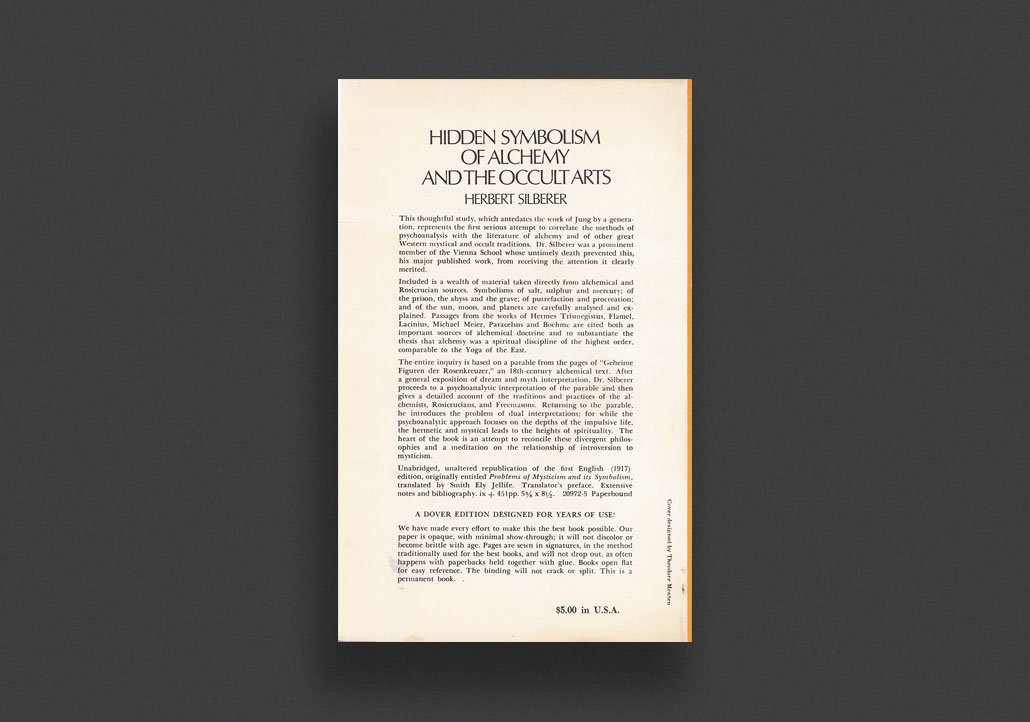
First English 1971 edition of Herbert Silberer's examinations of alchemy and the occult, and his attempts to correlate the two crafts to the pursuit of psychoanalysis. First published in 1917, this text represents the extensive investigations Herbert Silberer undertook in order to map occurrences in the occult with the ascendant psychoanalytic disciplines present in the Vienna School of which he was part. This text is marked by its depth of research, with sources such as Hermes Trismegistus, Flamel, Lacinius, Michael Meier, Paracelsus, and Boehme quoted and drawn upon in service of Silberer's thesis. The support of alchemy as a spiritual movement, on the same level as the yoga traditions of the Indian subcontinent, is also notable.
Very Good copy.
1987, English
Softcover, 522 pages, 21.5 x 13.5 cm
1st Edition, Out of print title / as new
Published by
University of Chicago Press / Chicago
$55.00 - Out of stock
First 1987 edition. Translated by Alan Bass.
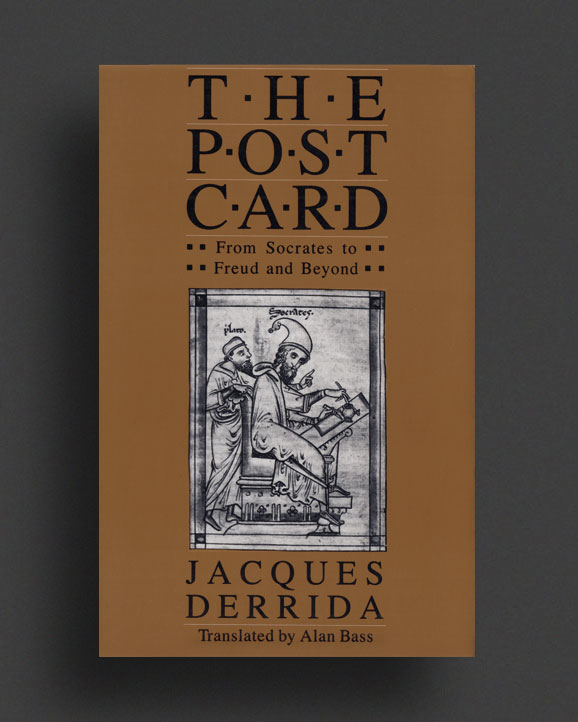
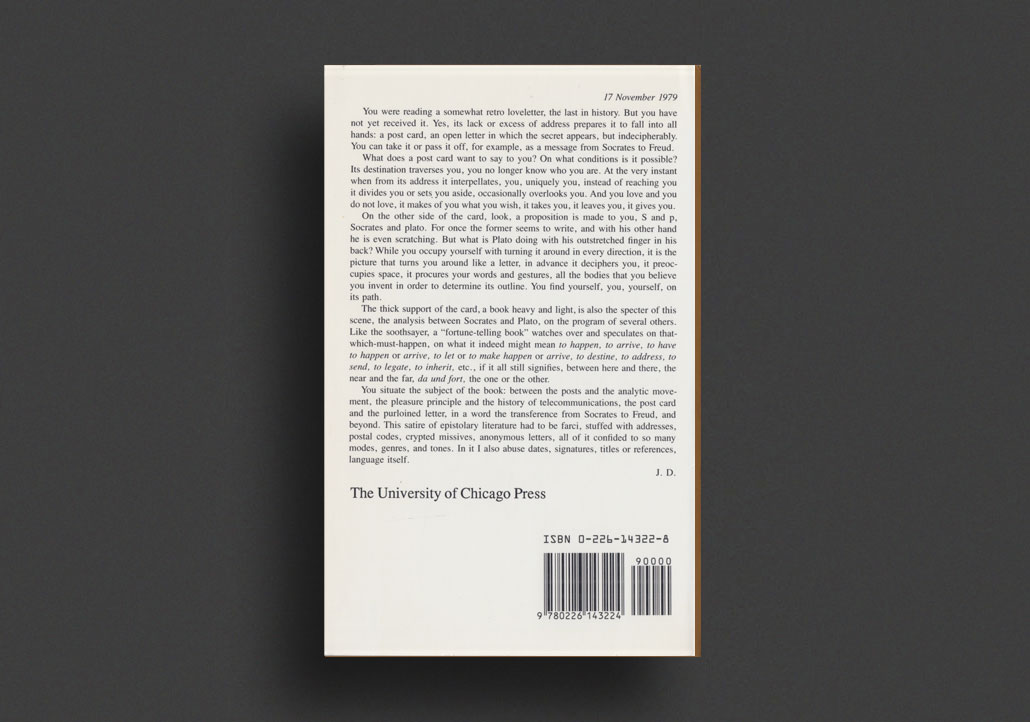
"You were reading a somewhat retro loveletter, the last in history. But you have not yet received it. Yes, its lack or excess of address prepares it to fall into all hands: a post card, an open letter in which the secret appears, but indecipherably.
What does a post card want to say to you? On what conditions is it possible? Its destination traverses you, you no longer know who you are. At the very instant when from its address it interpellates, you, uniquely you, instead of reaching you it divides you or sets you aside, occasionally overlooks you. And you love and you do not love, it makes of you what you wish, it takes you, it leaves you, it gives you.
On the other side of the card, look, a proposition is made to you, S and p, Socrates and plato. For once the former seems to write, and with his other hand he is even scratching. But what is Plato doing with his outstretched finger in his back? While you occupy yourself with turning it around in every direction, it is the picture that turns you around like a letter, in advance it deciphers you, it preoccupies space, it procures your words and gestures, all the bodies that you believe you invent in order to determine its outline. You find yourself, you, yourself, on its path.
The thick support of the card, a book heavy and light, is also the specter of this scene, the analysis between Socrates and Plato, on the program of several others. Like the soothsayer, a “fortune-telling book” watches over and speculates on that-which-must-happen, on what it indeed might mean to happen, to arrive, to have to happen or arrive, to let or to make happen or arrive, to destine, to address, to send, to legate, to inherit, etc., if it all still signifies, between here and there, the near and the far, da und fort, the one or the other.
You situate the subject of the book: between the posts and the analytic movement, the pleasure principle and the history of telecommunications, the post card and the purloined letter, in a word the transference from Socrates to Freud, and beyond. This satire of epistolary literature had to be farci, stuffed with addresses, postal codes, crypted missives, anonymous letters, all of it confided to so many modes, genres, and tones. In it I also abuse dates, signatures, titles or references, language itself." — J. D.
“With The Post Card, as with Glas, Derrida appears more as writer than as philosopher. Or we could say that here, in what is in part a mock epistolary novel (the long section is called “Envois,” roughly, “dispatches” ), he stages his writing more overtly than in the scholarly works. . . . The Post Card also contains a series of self-reflective essays, largely focused on Freud, in which Derrida is beautifully lucid and direct.”—Alexander Gelley, Library Journal
As New copy.
2017, English
Hardcover (w. dust jacket), 464 pages, 23 x 15 cm
1st Edition, Out of print title / used / very good
Published by
John Wiley and Sons / London
$55.00 - Out of stock
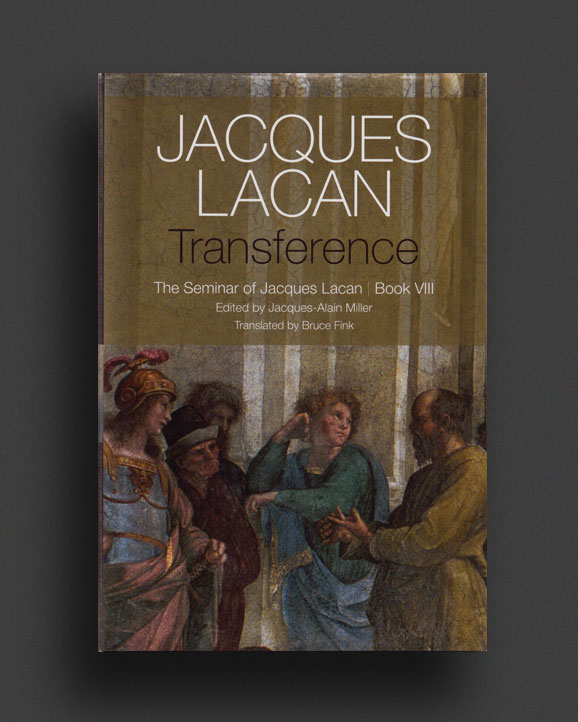
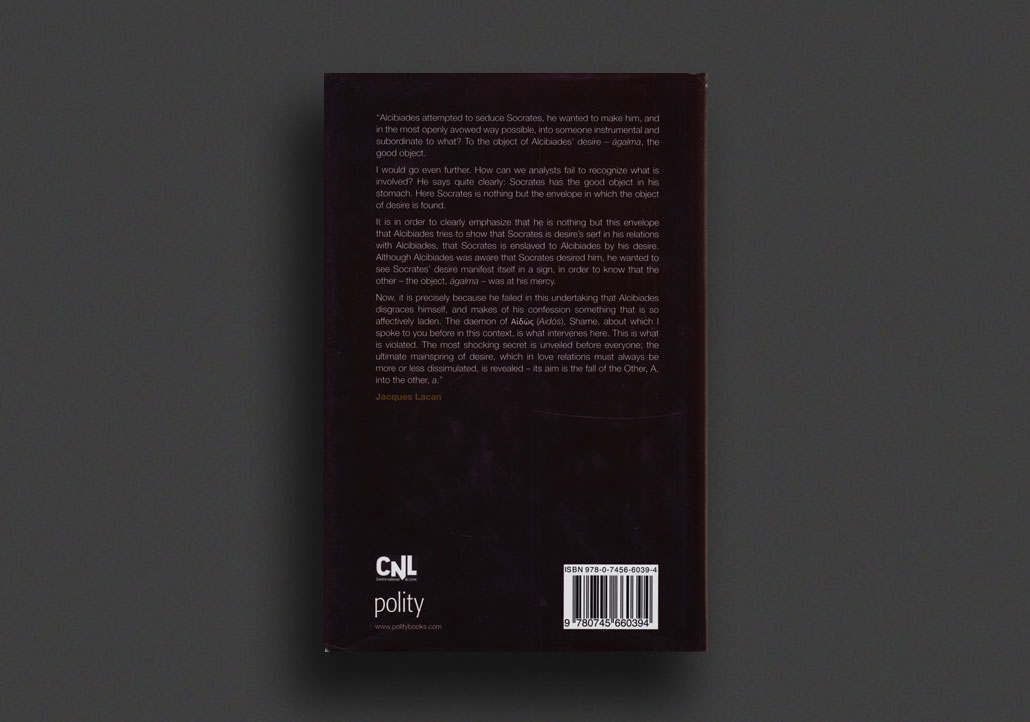
"Alcibiades attempted to seduce Socrates, he wanted to make him, and in the most openly avowed way possible, into someone instrumental and subordinate to what? To the object of Alcibiades's desire - ágalma, the good object.
I would go even further. How can we analysts fail to recognize what is involved? He says quite clearly: Socrates has the good object in his stomach. Here Socrates is nothing but the envelope in which the object of desire is found.
It is in order to clearly emphasize that he is nothing but this envelope that Alcibiades tries to show that Socrates is desire's serf in his relations with Alcibiades, that Socrates is enslaved to Alcibiades by his desire. Although Alcibiades was aware that Socrates desired him, he wanted to see Socrates's desire manifest itself in a sign, in order to know that the other - the object, ágalma - was at his mercy.
Now, it is precisely because he failed in this undertaking that Alcibiades disgraces himself, and makes of his confession something that is so affectively laden. The daemon of Αἰδώς (Aidós), Shame, about which I spoke to you before in this context, is what intervenes here. This is what is violated here. The most shocking secret is unveiled before everyone; the ultimate mainspring of desire, which in love relations must always be more or less dissimulated, is revealed - its aim is the fall of the Other, A, into the other, a."—Jacques Lacan
"In this extraordinary text Lacan teaches us that to become Lacanians would be to miss the point. To understand transference, Lacan shows us with his usual wit and precision, is to understand how and why people get stuck in their relationships to people, and to ideas. This is Lacan at his breeziest and most incisive. He reveals once again, in his own inimitable way, that to talk well about psychoanalysis is always to talk about so much more than psychoanalysis."
-Adam Phillips, Psychoanalyst and writer
First HC Polity edition. Very Good copy with light wear.
1984, English
Softcover, 220 pages, 23.5 x 15.5 cm
Out of print title / used / very good
Published by
Indiana University Press / Indiana
$35.00 - Out of stock
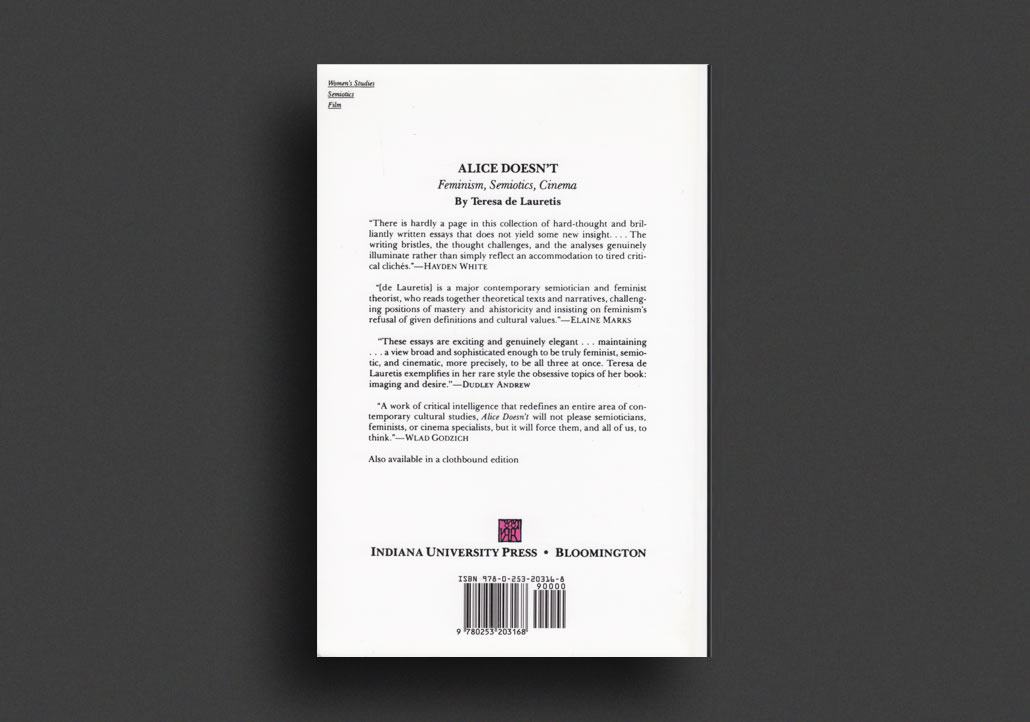
1984 collection of writings by Teresa De Lauretis, Alice Doesn't : Feminism, Semiotics, Cinema, published by Indiana University Press.
"There is hardly a page in this collection of hard-thought and brilliantly written essays that does not yield some new insight. . . . The writing bristles, the thought challenges, and the analyses genuinely illuminate rather than simply reflect an accommodation to tired critical cliches."—HAYDEN WHITE
"[de Lauretis] is a major contemporary semiotician and feminist theorist, who reads together theoretical texts and narratives, challenging positions of mastery and ahistoricity and insisting on feminism's refusal of given definitions and cultural values."—ELAINE MARKS
"These essays are exciting and genuinely elegant . . . maintaining . . . a view broad and sophisticated enough to be truly feminist, semiotic, and cinematic, more precisely, to be all three at once. Teresa de Lauretis exemplifies in her rare style the obsessive topics of her book: imaging and desire."—DUDLEY ANDREW
"A work of critical intelligence that redefines an entire area of con-temporary cultural studies, Alice Doesn't will not please semioticians, feminists, or cinema specialists, but it will force them, and all of us, to think."—WLAD GODZICH
"In a sense, then, narrative and visual pleasure constitute the frame of reference of cinema, one which provides the measure of desire. I believe this statement must apply to women as it does to men. The difference is, quite literally, that it is men who have defined the ''visible things'' of cinema, who have defined the object and the modalities of vision, pleasure, and meaning on the basis of perceptual and conceptual schemata provided by partriarchal ideological and social formations. In the frame of reference of men's cinema, narrative, and visual theories, the male is the measure of desire, quite as the phallus is its signifier and the standard of visibility in psychoanalysis. The project of feminist cinema, therefore, is not so much ''to make visible the invisible'', as the saying goes, or to destroy vision altogether, as to construct another (object of) vision and the conditions of visibility for a different social subject."
Very Good with light wear and previous owner inscriber to title page. First 1984 edition, reprint.