World Food Books' programme is largely produced on Kulin Nation land. We acknowledge the Wurundjeri people of the Kulin Nation as the first and continuing custodians of this land, and pay respect to their Elders past, present, and emerging.
World Food Books is an arts and special interests bookshop in Naarm / Melbourne. Founded in 2010, World Food Books is devoted to the presentation of a rotating, hand-selection of international art, design, literary and counterculture publications with an emphasis on the anti-traditional, the experimental, the avant-garde, the heretic, the marginal.
Presenting new titles alongside rare and out-of-print books, catalogues and journals spanning the fields of modern and contemporary art, design, photography, illustration, film, literature, poetry, cultural theory, philosophy, sexuality, popular and underground culture in its many radical forms, World Food Books wishes to encourage adventurous, thoughtful and open-minded reading, looking, writing, and exchange of publishing and ideas, both current and historical.
As well as our bookshop, located in Melbourne's historical Nicholas Building, all of our inventory is available internationally via our online mail-order service.
World Food Books semi-regularly co-ordinates "Occasions", a programme of exhibits and events at the bookshop and in partnership with other hosts (such as museums and art galleries) that develop out of the activities, relationships and content of the bookshop itself.
World Food Books
The Nicholas Building
37 Swanston Street
Room 5, Level 6
Melbourne 3000
Australia
SHOP HOURS:
SHOP CLOSED FOR SUMMER
RE—OPEN JAN 2
WEB-SHOP OPEN 24/7
World Food Books
Postal Address:
PO Box 435
Flinders Lane
Victoria 8009
Australia
info@worldfoodbooks.com
Art
Theory / Essay
Architecture / Interior
Graphic Design / Typography
Photography
Fashion
Eros
LGBTQ+
Fiction / Poetry
Weird / Speculative / Science Fiction / Horror
Transgressive / Visceral / Abject
Symbolism / Decadence / Fin de siècle
Film / Video
Painting
Sculpture / Installation
Performance / Dance / Theater
Drawing
Sound / Music
Curatorial
Group Shows / Collections
Periodicals
Out-of-print / Rare
Posters / Ephemera / Discs
Signed Books
World Food Books Gift Voucher
World Food Book Bag
Australian Art
Australian Fiction
Australian Science Fiction / Speculative Fiction
Australian Poetry
Australian Photography
Japanese Photography
Conceptual Art
Minimal Art
Dada
'Pataphysics / Oulipo
Fluxus
Concrete Poetry
Pop Art
Surrealism
Arte Povera
Arte Informale / Haute Pâte / Tachism
Nouveau Réalisme / Zero / Kinetic
Situationism / Lettrism
Collage / Mail Art / Xerox Art
Art Brut / Folk / Visionary / Fantastic
Illustration / Graphic Art / Bandes Dessinées
Furniture
Italian Radical Design / Postmodernism
Textiles
Ceramics / Glass
Counterculture
Protest / Revolt
Philosophy
Psychoanalysis
Anthropology
Anarchism
Socialism / Anarchism / Communism / Capitalism
Literary Theory / Semiotics / Language
Feminism / Women's Studies
Gender Studies / Sexuality
Anthropology
Fetishism / BDSM
Drugs / Psychedelia
Crime / Violence
Animal Rights / Veganism
Occult / Esoterica
Ecology / Earth / Alternative Living
Whole Earth / Crafts
All prices in AUD (Australian dollars)
Pick-Ups
Pick-up orders can be collected in our bookshop during opening hours after order date. Please collect any Pick-up orders within 2 weeks of ordering as we have limited storage space. Orders will be released back into stock if not collected within this time. No refunds can be made for pick-ups left un-collected. If you cannot make it in to the bookshop in this time-frame, please choose postage option.
Return Policy
All sales are final. We do accept returns (for refund or exchange) for items received in error. All our orders are packed with special care using heavy-duty padding and cardboard book-mailers or bubble mailers (for smaller books), using reinforcement where required. We cannot take responsibility for any lost, stolen or damaged parcels.
Insurance
Should you wish to insure your package, please email us directly after placing your order and we can organise this at a small extra expense. Although all standard/express tracked packages are very safe and dependable, we cannot take responsibility for any lost, stolen or damaged parcels. We recommend insurance on valuable orders.
Interested in selling your old books, catalogues, journals, magazines, comics, fanzines, ephemera? We are always looking for interesting, unusual and out-of-print books to buy. We only buy books in our fields of interest and specialty, and that we feel we can resell.
We base these prices on desirability, market value, in-print prices, condition and our current stock levels. We offer cash, store credit, and can take stock on consignment. All
about 25% of the price we expect to get when we sell them, or 30% in store credit. We base these prices on desirability, market value, in-print prices, condition and our current stock levels.
Sell your books any day of the week. You can drop them off and return later. If you have a lot of books, we can visit your Sydney home.
We buy books that we feel we can resell. We offer about 25 % of the price we expect to get when we sell them, or 30% in store credit. We base these prices on desirability, market value, in-print prices, condition and our current stock levels.
Philadelphia Wireman
03 August - 01 September, 2018
World Food Books is proud to announce our next Occasion, the first presentation of sculptures by Philadelphia Wireman in Australia.
The Philadelphia Wireman sculptures were found abandoned in an alley off Philadelphia’s South Street on trash night in 1982. Their discovery in a rapidly-changing neighbourhood undergoing extensive renovation, compounded with the failure of all attempts to locate the artist, suggests that the works may have been discarded after the maker’s death. Dubbed the "Philadelphia Wireman" during the first exhibition of this work, in 1985, the maker’s name, age, ethnicity, and even gender remain uncertain. The entire collection totals approximately 1200 pieces, all intricately bound together with tightly-wound heavy-gauge wire (along with a few small, abstract marker drawings, reminiscent both of Mark Tobey and J.B. Murry). The dense construction of the work, despite a modest range of scale and materials, is singularly obsessive and disciplined in design: a wire armature or exoskeleton firmly binds a bricolage of found objects including plastic, glass, food packaging, umbrella parts, tape, rubber, batteries, pens, leather, reflectors, nuts and bolts, nails, foil, coins, toys, watches, eyeglasses, tools, and jewellery.
Heavy with associations—anthropomorphic, zoomorphic, and socio-cultural responses to wrapped detritus—the totemic sculptures by Philadelphia Wireman have been discussed in the context of work created to fulfil the shamanistic needs of alternative religions in American culture. Curators, collectors, and critics have variously compared certain pieces to sculpture from Classical antiquity, Native American medicine bundles, African-American memory jugs, and African fetish objects. Reflecting the artist’s prolific and incredibly focused scavenging impulse, and despite—or perhaps enhanced by—their anonymity, these enigmatic objects function as urban artefacts and arbiters of power, though their origin and purpose is unknown. Philadelphia Wireman, whatever their identity, possessed an astonishing ability to isolate and communicate the concepts of power and energy through the selection and transformation of ordinary materials. Over the course of the past two decades, this collection has come to be regarded as an important discovery in the field of self-taught art and vernacular art.
Presented in collaboration with Fleisher-Ollman Gallery, Philadelphia, and Robert Heald, Wellington.
Susan Te Kahurangi King
02 February - 10 March, 2018
Susan Te Kahurangi King (24 February 1951 - ) has been a confident and prolific artist since she was a young child, drawing with readily available materials - pencils, ballpoint pens and felt-tip markers, on whatever paper is at hand. Between the ages of four and six Susan slowly ceased verbal communication. Her grandparents William and Myrtle Murphy had developed a special bond with Susan so they took on caring responsibilities for extended periods. Myrtle began informally archiving her work, carefully collecting and storing the drawings and compiling scrapbooks. No drawing was insignificant; every scrap of paper was kept. The King family are now the custodians of a vast collection containing over 7000 individual works, from tiny scraps of paper through to 5 meter long rolls.
The scrapbooks and diaries reveal Myrtle to be a woman of great patience and compassion, seeking to understand a child who was not always behaving as expected. She encouraged Susan to be observant, to explore her environment and absorb all the sights and sounds. Myrtle would show Susan’s drawings to friends and people in her community that she had dealings with, such as shopkeepers and postal workers, but this was not simply a case of a grandmother’s bias. She recognised that Susan had developed a sophisticated and unique visual language and sincerely believed that her art deserved serious attention.
This was an unorthodox attitude for the time. To provide some context, Jean Dubuffet coined the term Art Brut in 1945 to describe work created by self-taught artists – specifically residents of psychiatric institutions and those he considered to be visionaries or eccentrics. In 1972 Roger Cardinal extended this concept by adopting the term Outsider Art to describe work made by non-academically trained artists operating outside of mainstream art networks through choice or circumstance. Susan was born in Te Aroha, New Zealand in 1951, far from the artistic hubs of Paris and London that Dubuffet and Cardinal operated in. That Myrtle fêted Susan as a self-taught artist who deserved to be taken seriously shows how progressive her attitudes were.
Susan’s parents Doug and Dawn were also progressive. Over the years they had consulted numerous health practitioners about Susan’s condition, as the medical establishment could not provide an explanation as to why she had lapsed into silence. Dawn educated herself in the field of homeopathy and went on to treat all twelve of her children using these principles – basing prescriptions on her observations of their physical, mental and emotional state.
Doug was a linguist with an interest in philosophy who devoted what little spare time he had to studying Maori language and culture. To some extent their willingness to explore the fringes of the mainstream made them outsiders too but it was their commitment to living with integrity and their respect for individuality that ensured Susan’s creativity was always encouraged.
Even though Susan’s family supported her artistic pursuits, some staff in schools and hospitals saw it as an impediment to her assimilation into the community and discouraged it in a variety of ways. Her family was not always aware of this and therefore did not fully understand why Susan stopped drawing in the early 1990s. However, rather than dwell on the challenges that Susan faced in pursuit of her artistic practice, they prefer to highlight her achievements. In 2008 Susan began drawing again in earnest, after an almost 20 year interruption, and her work is now shown in galleries around the world.
Susan grew up without television and has been heavily influenced by the comics she read as a child. She is absolutely fearless in the appropriation of recognizable characters, such as Donald Duck and Mickey Mouse, in her work. She twists their limbs, contorts their faces, compresses them together, blends them into complex patterned backgrounds - always imbuing them with an incredible energy. Although Susan often used pop culture characters in her work they are not naive or childlike. These are drawings by a brilliant self-taught artist who has been creating exceptional work for decades without an audience in mind.
Mladen Stilinović
"Various Works 1986 - 1999"
02 February 16 - September 10, 2016
Various works 1986 - 1999, from two houses, from the collections of John Nixon, Sue Cramer, Kerrie Poliness, Peter Haffenden and Phoebe Haffenden.
Including: Geometry of Cakes (various shelves), 1993; Poor People’s Law (black and white plate), 1993; White Absence (glasses, ruler, set square, silver spoon, silver ladel with skin photograph and wooden cubes), 1990-1996; Exploitation of the Dead (grey and red star painting, wooden painting, black spoon with red table, red plate), 1984-1990; Money and Zeros (zero tie, paintings made for friends in Australia (Sue, John, Kerrie), numbers painting), 1991-1992; Words - Slogans (various t-shirts) - “they talk about the death of art...help! someone is trying to kill me”, “my sweet little lamb”, “work is a disease - Karl Marx”; Various artist books, catalogues, monographs, videos; Poster from exhibition Insulting Anarchy; "Circular" Croatian - Australian edition; Artist book by Vlado Martek (Dostoyevsky); more.
Thanks to Mladen Stilinović and Branka Stipančić.
Jonathan Walker
Always Will Need To Wear Winter Shirt Blue + Ochre Small Check Pattern
21 August - 21 September, 2015
Untitled
I am not a great reader of poetry but I always return to the work of Melbourne poet, Vincent Buckley (1925- 1988). Perhaps I find his most tantalising piece to be not a finished poem but a fragment left on a scrap of paper discovered on his desk after the poet’s death.
The poetry gathers like oil
In the word-core, and spreads
It has its music meet,
Its music is in movement.
This fragment is more the shell left behind from a volatile thought than a finished poem. I find the last two lines honest but awkward whereas the first two lines work like an arrow. Most likely he could not find a resolution so it was left. Still, in its present form, it remains an eloquent testimony to the ultimate failure of a medium to express mobile thought and sensation, in Buckley’s case, through verbal language. It’s an important matter because this is something all artists have to deal with regardless of the medium.
I have never written a poem, however, I am forever copying fragments from books on paper scraps in a vain effort to fix certain notions in my head. At first, they function as bookmarks that are sometimes returned to when I open the book. But before long, as they accumulate, they fall out littering the table interspersed with A4 photocopies, bills, books and medications.
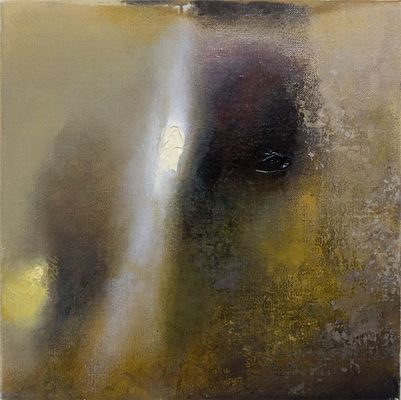
To return to Buckley’s fragment, the first two lines very much evoke how I paint nowadays. As you age, detail diminishes and patches of light become more luminous and float. I feel the most honest way of dealing with this is by smearing the oil paint on the canvas with the fingers and working close-up, blind. Only if the patches coalesce into an approaching image can the work gain a life.
-
Jonathan Walker was born in Melbourne, Australia and brought up on a dairy farm in Gippsland. In the 1970’s he studied painting at RMIT and won the Harold Wright Scholarship to the British Museum, London. During the 1980’s he exhibited at Pinacotheca Gallery, Richmond and had work shown at the NGV and Heidi City Art Gallery. Over the same period he designed the cover for the “Epigenesi” LP by Giancarlo Toniutti, Italy and conducted a mail exchange work with Achim Wollscheid, Germany. The work with artists through the post resulted in an article published in the bicentenary issue of Art and Australia 1988. He showed in artist run spaces such as WestSpace in the 90’s and 2000’s, and until 2012, taught painting at Victoria University, which is where we (Colleen Ahern and Lisa Radford) as organisers of the exhibition, among many others, had the privilege of being his student.
Walker’s knowledge was imparted to students through the careful selection of music, literature, and artists found in books that he himself had ordered for the library. Walker’s strategy was the generosity of sharing his vast knowledge with references specific to each student and their context.
Walker’s paintings share a similar focus and intimacy.
This exhibition presents a small selection of recent paintings alongside a publication that includes Walker’s writing. Observational and analytical, Walker’s work is a type of material notation — the time of day, colour and how it is blended, the both specific and fleeting location of a reflection on lino or the question of whether a chair leg should be included in a painting.
Please join us on Friday August 21 between 6-8pm to celebrate the opening of the exhibition.
Curated by Colleen Ahern and Lisa Radford.
B. Wurtz
Curated by Nic Tammens
March 26 - April 4, 2015
B.Wurtz works from a basement studio in his home on Manhattan’s Lower East Side.
This local fact is attested to by the plastic shopping bags and newsprint circulars that appear in his work. As formal objects, they don’t make loud claims about their origins but nonetheless transmit street addresses and places of business from the bottom of this long thin island. Like plenty of artists, Wurtz is affected by what is local and what is consumed. His work is underpinned by this ethic. It often speaks from a neighborhood or reads like the contents of a hamper:
“BLACK PLUMS $1.29 lb.”
“Food Bazaar”
“USDA Whole Pork Shoulder Picnic 99c lb.”
“RITE AID Pharmacy, with us it’s personal.”
“H. Brickman & Sons.”
“Sweet Yams 59c lb."
Most of the work in this exhibition was made while the artist was in residence at Dieu Donne, a workshop dedicated to paper craft in Midtown. Here Wurtz fabricated assemblages with paper and objects that are relatively lightweight, with the intention that they would be easily transportable to Australia. This consideration isn’t absolute in Wurtz’s work, but was prescriptive for making the current exhibition light and cheap. Packed in two boxes, these works were sent from a USPS post office on the Lower East Side and delivered to North Melbourne by Australia Post.
Wurtz appears courtesy of Metro Pictures, New York.
Thanks to Rob Halverson, Joshua Petherick, Sari de Mallory, Matt Hinkley, Helen Johnson, Fayen d'Evie, Ask Kilmartin, Lisa Radon, Ellena Savage, Yale Union, and "Elizabeth".
John Nixon
"Archive"
December 15 - January 20, 2014
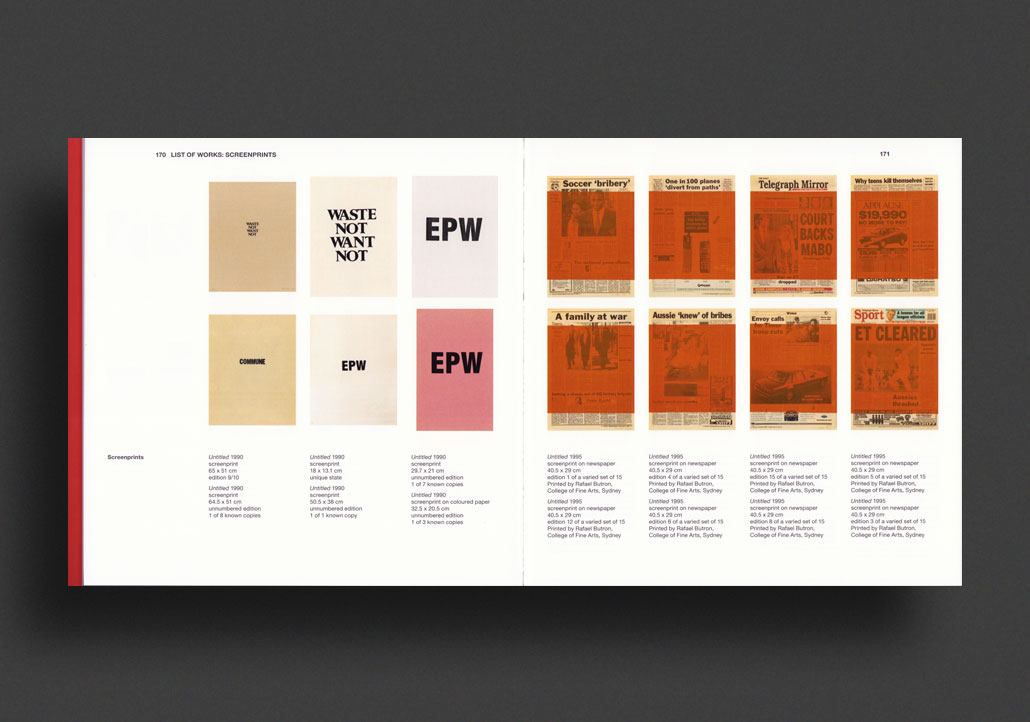
The presentation of John Nixon's archive offered a rare showcase of this extensive collection of the artist's own publications, catalogues, posters, ephemera, editions and more, from the mid 1980s onwards, alongside a selection of his artworks.
Organized by John Nixon, Joshua Petherick and Matt Hinkley.
"Habitat"
at Minerva, Sydney (organised by Joshua Petherick and Matt Hinkley)
November 15 - December 20, 2014
Lupo Borgonovo, Janet Burchill & Jennifer McCamley,
Lewis Fidock, HR Giger, Piero Gilardi, Veit Laurent Kurz,
Cinzia Ruggeri, Michael E. Smith, Lucie Stahl, Daniel Weil, Wols
Press Release:
“...It contained seven objects. The slender fluted bone, surely formed for flight, surely from the wing of some large bird. Three archaic circuitboards, faced with mazes of gold. A smooth white sphere of baked clay. An age-blackened fragment of lace. A fingerlength segment of what she assumed was bone from a human wrist, grayish white, inset smoothly with the silicon shaft of a small instrument that must once have ridden flush with the surface of the skin - but the thing’s face was seared and blackened.”
William Gibson, “Count Zero”, 1986
"Autumn Projects Archive"
Curated by Liza Vasiliou
March 6 - March 15, 2014
World Food Books, in conjunction with the Virgin Australia Melbourne Fashion Festival 2014, presented the Autumn Projects archive, consisting of a selection of early examples in Australian fashion with a particular interest in collecting designers and labels from the period beginning in the 1980’s, who significantly influenced the discourse of Australian Fashion.
Curated by Liza Vasiliou, the exhibition provided a unique opportunity to view pieces by designers Anthea Crawford, Barbara Vandenberg, Geoff Liddell and labels CR Australia, Covers, Jag along with early experimental collage pieces by Prue Acton and Sally Browne’s ‘Fragments’ collection, suspended throughout the functioning World Food Books shop in Melbourne.
H.B. Peace
presented by CENTRE FOR STYLE
November 14, 2013
"Hey Blinky, you say chic, I say same"
Anon 2013
H.B. Peace is a clothing collaboration between great friends Blake Barns and Hugh Egan Westland. Their pieces explore the divergences between 'character’ and ‘personality’ in garments....etc
Special Thanks to Joshua Petherick and Matt Hinkley of WFB and Gillian Mears
and a Very Special Thank you to Audrey Thomas Hayes for her shoe collaboration.
Janet Burchill & Jennifer McCamley
"Aesthetic Suicide"
May 10 - June 8, 2013
The first of our occasional exhibitions in the World Food Books office/shop space in Melbourne, "Aesthetic Suicide" presented a body of new and older works together by artists Janet Burchill & Jennifer McCamley, including videos, prints, a wall work, and publications.
During shop open hours videos played every hour, on the hour.
1982, English
Softcover (staple bound), 46 pages, 28.5 x 24.5 cm
1st Edition, Out of print title / used / very good
Published by
TRANSITION / St. Kilda
$25.00 - Out of stock
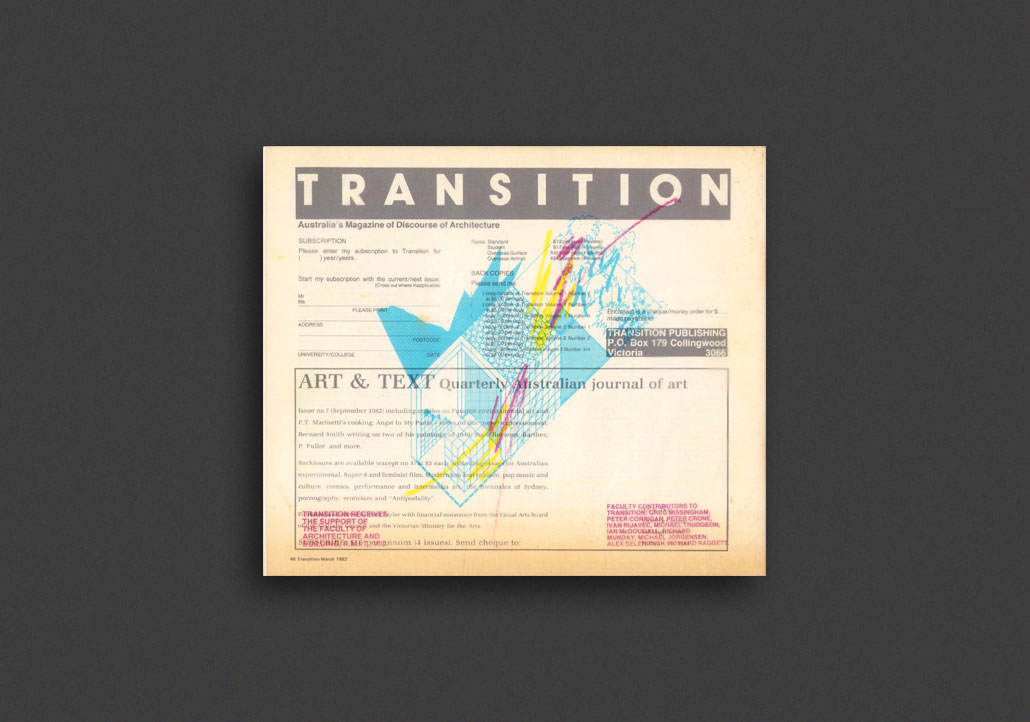
Scarce copy of March 1982 issue (Vol. 3 No. 1) of TRANSITION magazine, a critical journal about architecture published quarterly out of St. Kilda and produced by the Department of Architecture at RMIT University. TRANSITION was devoted to discourse on contemporary architectural practice and theory, considering architecture's often difficult relationship with theory and how knowledge enters into the production of architecture. Articles focus on the predictive and speculative and encourage experimental design work, propositional writing and variations in between.
This issue edited by Ian McDougall and Richard Munday, designed by Michael Trudgeon.
Features: Fashion And Consumption: Notes On Aldo Rossi—Micha Bandini
Howard Raggatt - 1981 Shinkenchiku Residential Design Competition—Ian Mcdougall
On Howard Raggatt's House - Writings Are Drawing On Building—Alex Selenitsch
Sherlock Holmes—Derham Groves
Unity And The Idea—Michael Tawa
Shades Of Bill Harney—Peter Myers
The Discreet Charm Of The Anti-Bourgeoise A Review Of From Bauhaus To Our House By Tom Wolfe—Paul Rankin
and more.
Very Good copy with storage rippling to printed wax paper covers. Light age/tanning to page edges.
2024, English
Softcover, 224 pages (500+ ills.), 22.5 x 22 cm
Published by
Geelong Art Gallery / Victoria
$60.00 - In stock -
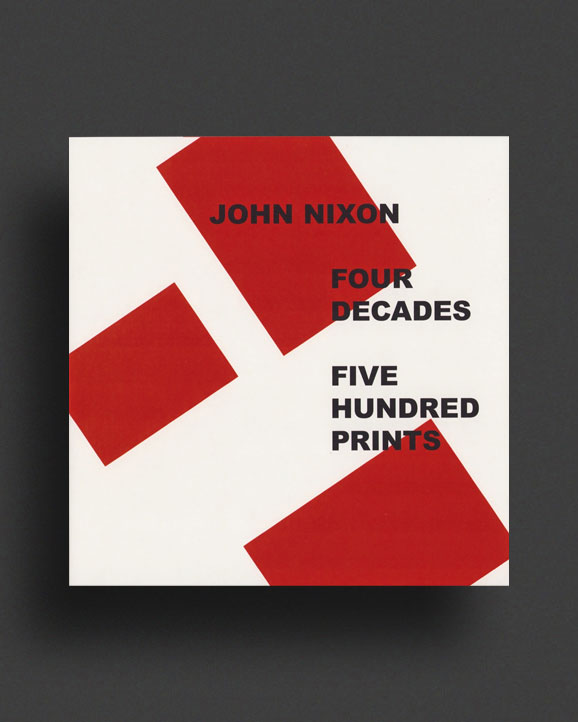
Printmaking was a vital part of artist John Nixon’s celebrated oeuvre of abstract art. This catalogue accompanies the exhibition of the same name at Geelong Gallery and reveals Nixon's inventive use of varied techniques, which ranged from simple woodcuts and potato prints, to more complex screenprints, stone lithographs and etchings. It includes a curatorial essay by Sue Cramer, Emma Nixon, and Trent Walter. Additional contributions by Stephen Bram, Lizzie Boon, Roger Butler, Claus Carstensen, Sally Foster, James Gatt, Erik Jensen, Rebecca Mayo, Rose Nolan, Mike Parr, Victoria Perin, Jacqueline Stojanović, Jason Smith, and Warren Taylor.
2022, English
Softcover, 142 pages, 24 x 33 cm
1st Edition, Out of print title / as new
Published by
Tina Kim Gallery / New York
$200.00 - Out of stock
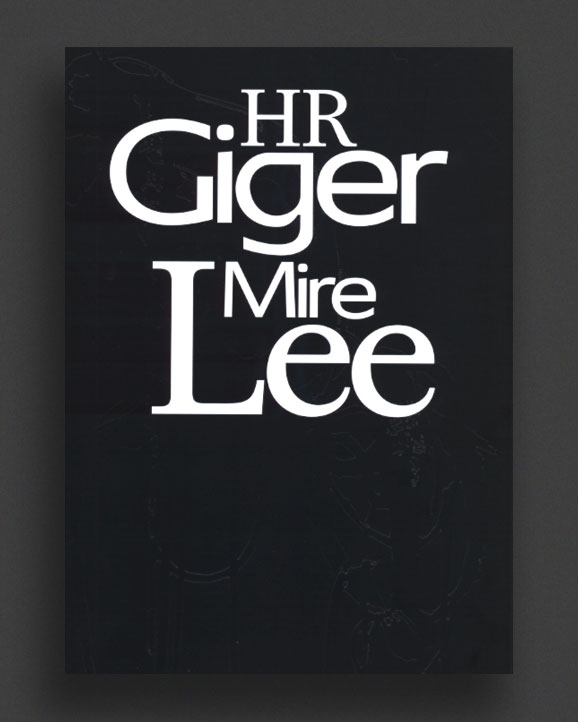
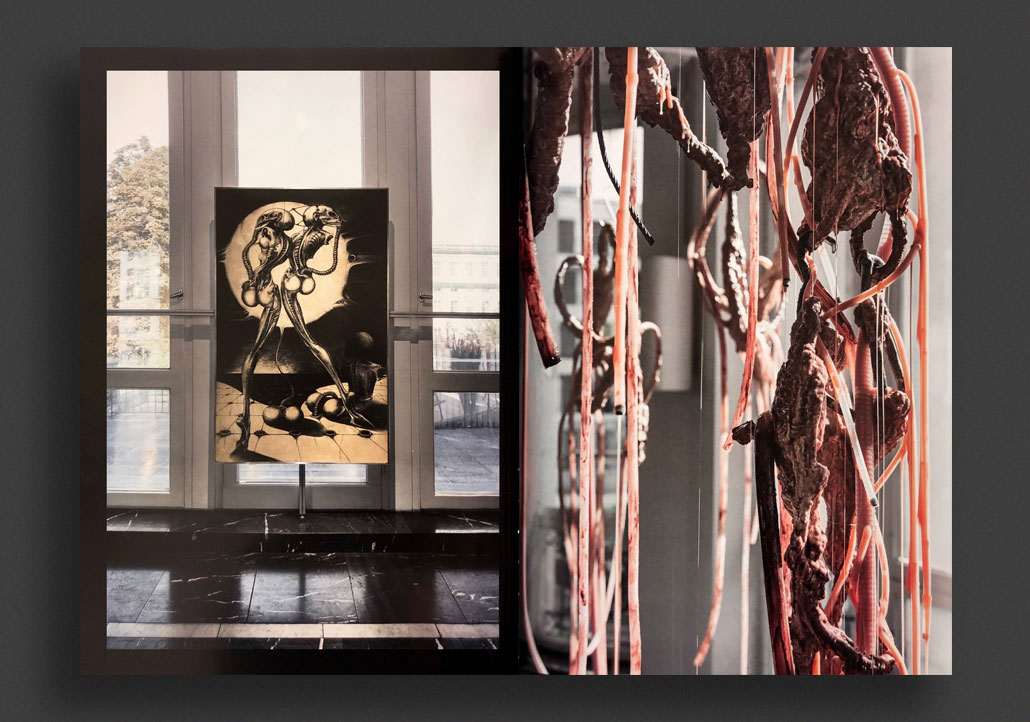
First edition, quickly out-of-print. Published to accompany an exhibition bringing together the worlds of the late Swiss visionary Hans Ruedi Giger (1940–2014) and South Korean artist Mire Lee, at The Schinkel Pavillon, Berlin, September 18, 2021–January 2, 2022, this book beckons towards the darkest aisles of the human body and psyche. Both artists deal in biomechanical phantasmagorias of human and machine forms combining in an indissoluble whole, a constant metamorphosis between the stages of decline and resilience, hopelessness and power, lust and revulsion, male and female – thus emblematic of the polarities of our own existence. With texts by Agnes Gryczkowska, Charlie Fox, and McKenzie Wark and conversations between the artists and Hans Ulrich Obrist.
1968, English
Softcover (staple bound), 32 pages
1st Edition, Out of print title / used / good
Published by
Federation of Australian Anarchists / Sydney
$70.00 - Out of stock
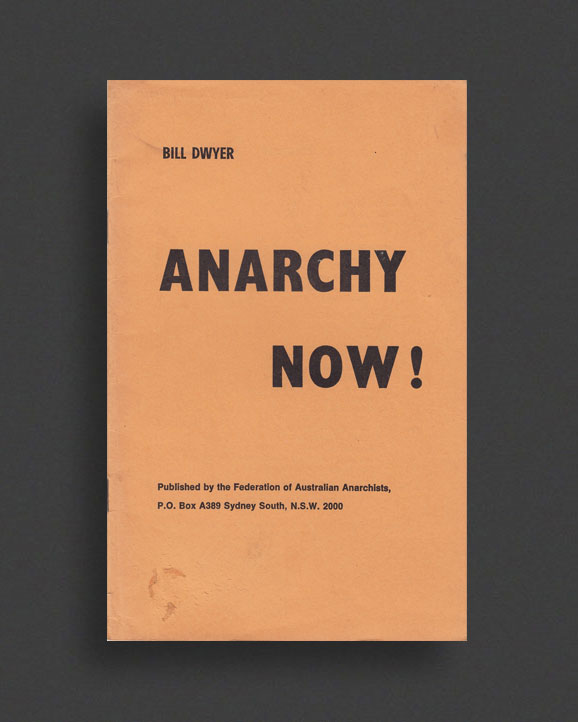
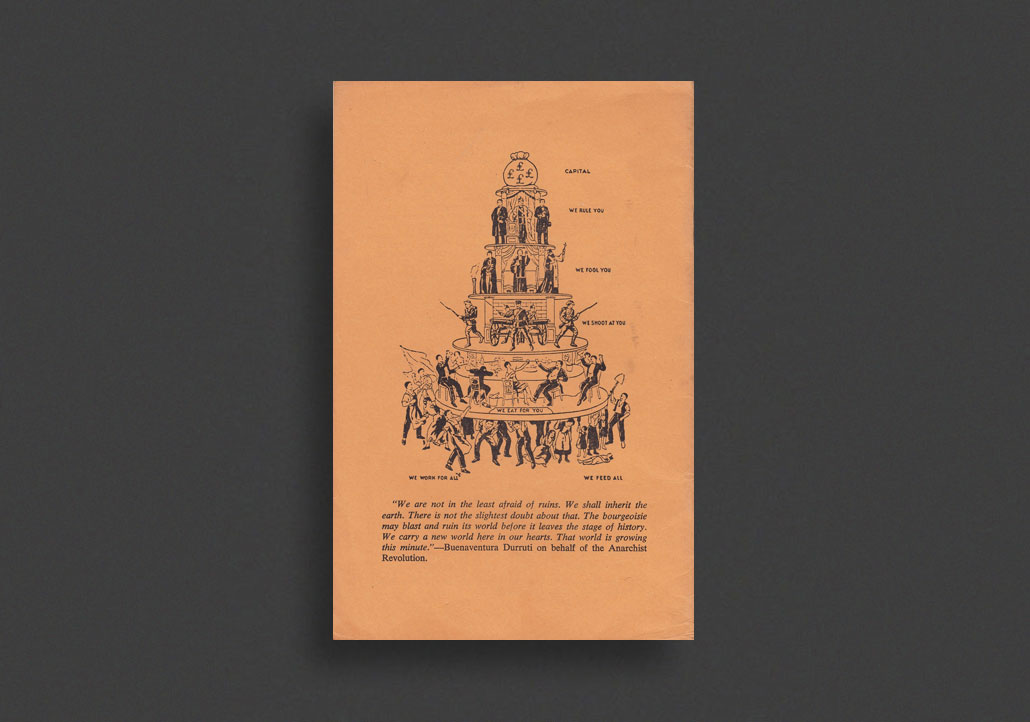
Rare copy of the wonderful 1968 pamphlet by Bill ‘Ubi’ Dwyer (1933—2001), an anarchist activist, squatter and Freedom Festival trail-blazer in New Zealand, Australia, England and his native Ireland, published by Federation of Australian Anarchists, Sydney. Anarchy now! is a great Anarchist primer that also outlined Dwyer particular style of heterodox anarchism. Heavily illustrated and citing all the important figures throughout the history of anarchist tradition and ideology, littered with quotes and heavy with information, especially for the Australian reader, on Anarchist groups and journals, recommended reading list, bios, questionnaire... Dwyer was involved with Freedom Press news group in Britain and its associated Anarchy magazine.
In the mid-1950s, Dwyer moved to Aotearoa (New Zealand) from Ireland. Whilst there he was introduced to anarchism by an English expat and became very active in politics. He lived in New Zealand until 1966, and was involved in a series of legendary events. Dwyer organised no-confidence motions in the leadership of the Wellington Watersiders Union and the Victoria University Students Union. After being convicted for calling the Queen a bludger whilst speaking in Auckland in 1966, Dwyer moved to Sydney and sold acid to finance his anarchist activities. He became an exponent of psychedelic anarchism, and engaged in soapbox oratory in the Sydney Domain and published this pamphlet (Anarchy now!) on his political philosophy of liberation. The same year he was sent to prison for selling LSD, and the Australian government deported him back to Ireland in 1969. In Dublin in 1970, Dwyer was a member of the Island Commune, a squatted house on Dublin's exclusive Merrion Road and between 1970 and 1972, a commune, organised by friend Sid Rawle, was established on Dorinish, an island then owned by John Lennon. Inspired by his experiences during the "liberation" of the Isle of Wight Festival 1970, Dwyer developed the idea of a truly "free" festival. An acid trip in Windsor Great Park led to the notion of squatting on the former common land that had been in Crown ownership since being reserved for royal hunting by William the Conqueror, and he began to organise what was to become the People's Free Festival. Windsor Free Festival was the forerunner of, and inspiration for, the Free Festival Movement, particularly the Stonehenge Free Festival and the later Glastonbury Festivals. Following the violent suppression of the 1974 event, he and Rawle were imprisoned to prevent the organising of a 1975 festival. Dwyer was imprisoned again attempting to organise another Windsor Free Festival in 1978, which did take place at Caesar's Camp nearby.
"This booklet is intended partly as an elementary introduction to anarchism, partly to show its relevance and immediacy to modern society and partly to demonstrate the unity of anarchist tradition and philosophy. Quotations are drawn from anarchists of widely differing backgrounds ranging from Max Stirner and Peter Kropotkin to a contemporary Sydney libertarian. Much of the criticism which different schools of anarchist thought have made of one another often shows a lack of understanding of their varying environments and needs. Anarchism is no dogma and its appeal, for example, to an artist will be quite different to its appeal for an industrial worker. I have divided the booklet into two parts — I. The Enemy and II. We, the People-to emphasise the principal aspects of anarchism, viz. rejection of authority and the concept that the individual and society can exist without authority and its attendant evils. The title ANARCHY NOW! indicates the need for an unceasing battle against authority and the possibility (sometimes a reality) of people organising co-operative, mutual aid enterprises ranging from the establishment of free schools to worker control of industry. Every individual must repudiate the claim of anyone else to rule and exploit him. In whatever occupation he is engaged he may fight by co-operating with his fellows to insist on a share in the making of decisions and on their fundamental equal ownership of society's wealth. The urgency of this fight is based on the realisation that the status of Mr Everyman today is that of a slave."—Bill Dwyer, Sydney, September 1968 (preface)
Good copy with some cover wear and general age.
1984, English
Softcover (staple bound), 50 pages, 27.5 x 20.5 cm
Signed copy.,
1st Edition, Out of print title / used / very good
Published by
Denis Freney / Sydney
$70.00 - Out of stock
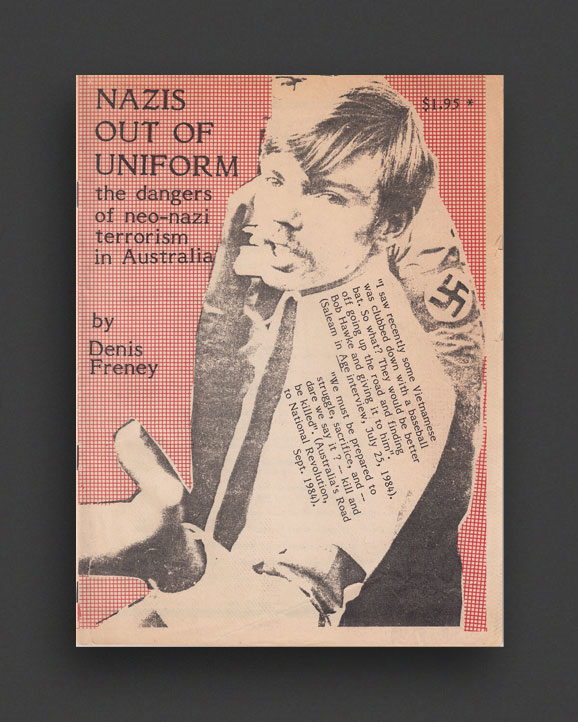
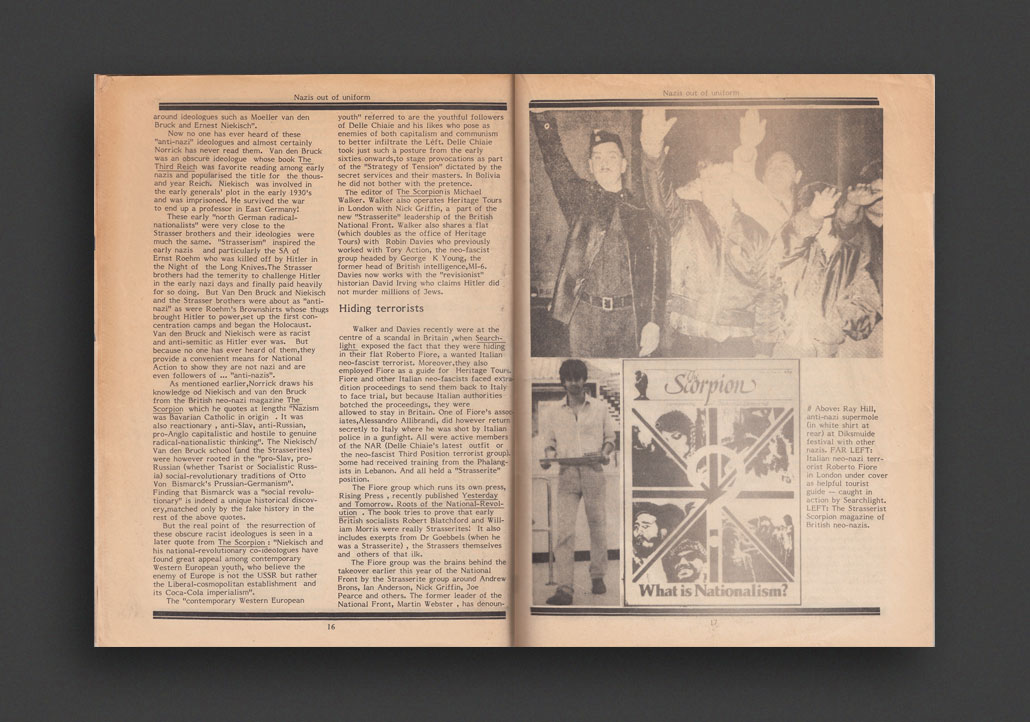
Very rare and controversial publication self published in late 1984, Nazis Out Of Uniform, by Denis Freney, teacher, political activist, journalist, writer and editor of the Communist Party paper Tribune and author of The CIA's Australian Connection (1977). With cover illustration of National Action founder (and Australia First Party member) "Jim Saleam in full nazi regalia at a demonstration in Brisbane in mid-1970's. Behind him, largely obscured, is Ross "The ull" Skull" May, also in full nazi uniform". Illustrated throughout, with chapters "- Don't call us nazis: the early post-war groups"; "The fascist international"; "National Alliance: the great illusions"; "Strasserism and all that: the ideology of oz nazism"; "Bashers and bombers: National Action in Action"; "Terrorists worldwide: NA makes friends"; "The respectable racists: All the way with Joh and Flo"; "Conclusion: what can be done?"; "Appendix One: The League of Rights"; "Appendix Two: Graeme Royce/Maguire"; "Appendix Three: Geoff McDonald"; "Appendix Four: From White Power to Grey Power?", plus advertisements for Searchlight: The Anti-Fascist Monthly, Tribune, and Australian Left Review.
Signed by Denis, dedicated to Carmel, on the contents page in green ink.
Freney was a well known political activist in the 1970s. He helped organise demonstrations against the war in Vietnam and the Springbok rugby tour (1971). This was followed by his involvement in the campaign for an independent East Timor and the independence struggles in Vanuatu and New Caledonia.
Very Good copy with only very light wear to edges and light age/tanning.
2013, English
Softcover, 126 pages, 15.2 x 10 cm
Published by
RE/SEARCH / San Francisco
$28.00 - Out of stock
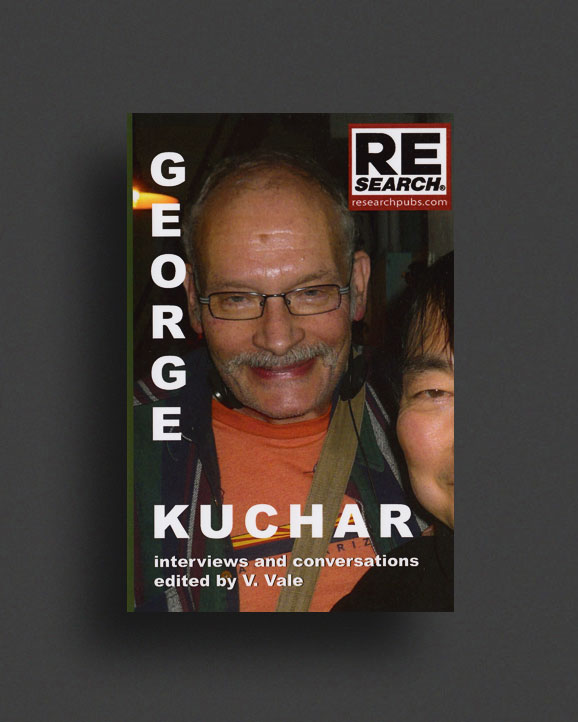
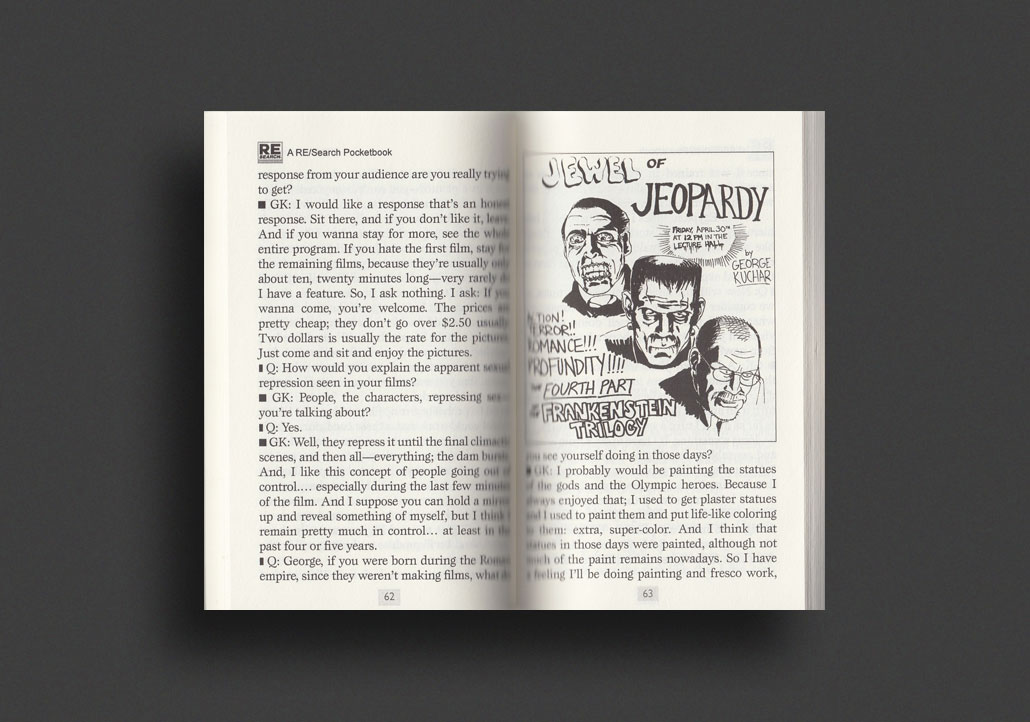
In this book of witty, illuminating interviews with V. Vale, San Francisco Art Institute teacher, George Kuchar shares his secrets of how to make a film for close to zero-budget. PLUS interview with Kuchar star Marion Eaton, lists, and conversations.
Beloved by filmmakers such as John Waters and Todd Solondz, George Kuchar worked with the moving image for over half a century. In the 1950s, Kuchar and his twin brother Mike began producing ultra-low-budget underground versions of Hollywood genre films, with names like I Was a Teenage Rumpot and The Devil’s Cleavage. These 8mm kitchen-sink masterpieces bore the distinctive marks of what Susan Sontag called “camp,” and positioned the Kuchar brothers as the Bronx’s answer to the downtown underground filmmaking scene, which quickly adopted the Kuchars as their own — and in the work of Jack Smith, Andy Warhol, and others, showed their influence.
"INSPIRING, funny interviews with and about filmmaker George Kuchar. Lots of pictures, too! The most complete film/videoography to date for George Kuchar alone is worth the cover price. The best book you have ever published!”—M.B.
George Kuchar is an inventor of low-budget filmmaking, using thrift-store props, costumes and cheap make-up to transform non-professional actors into sex symbols and louche legends. In this book he reveals the secrets of LIGHTING: the key to making an ordinary human into a god or goddess. He does NOT reveal one of his major secret weapons: that he found countless lesser-known and just plain unknown vinyl records and plundered them to create spectacular, mood-enhancing soundtracks supplying drama, melancholy and passion where none hitherto existed. Buy this book and you may become a filmmaker yourself!—Jacob Cruikshank, Film Thread
1999, English
Softcover, 304 pages, 23 x 15.5 cm
1st Edition, Out of print title / used / very good
Published by
Columbia University Press / New York
$40.00 - Out of stock
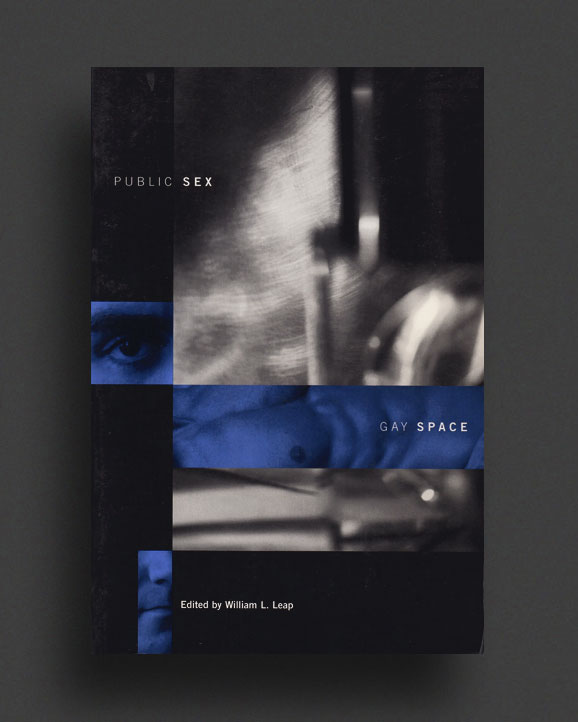
Male homosexual activity in public and semipublic locations is a central but seldom explored dimension of gay culture around the world. The majority of existing research emphasizes the impersonality of such erotic interaction and underscores the element of danger involved. While never denying the danger of anonymous public sex in the age of AIDS, the contributors to Public Sex/Gay Space go beyond narrow moralisms about the need to regulate unsafe sexual practices to discuss the significance of sex in public. William Leap has brought together contributions from such fields as anthropology, sociology, literary criticism, and history to reinvigorate the discussion on this issue, with twelve essays providing a more nuanced portrait of why public sexual activity is such an integral part of gay culture. The authors present rich ethnographic snapshots of male sex in public places--many drawn from interviews with participants or, in some instances, the authors' personal experiences.Contributors investigate a broad cultural spectrum of gay sexual space and activity: in a public park in contemporary Hanoi, at the beachfront community of New York's Fire Island, and in nineteenth-century Amsterdam, for example. They explore issues such as visibility and secrecy, as well as economic status and social class, and interrogate the historical trajectories through which certain locations come to be favored sites for sexual encounters. Together, they offer insight into the ways in which public sex calls into question the very line that divides "public" from "private."
William L. Leap is professor of anthropology at The American University. He is the author of books including American Indian English and Word Is Out: Gay Men's English, and the editor of such works as Beyond the Lavender Lexicon: Authenticity, Representation, and Imagination in Lesbian and Gay Discourse.
Very Good copy with only light wear.
1991, English / Japanese
Softcover (w. original silk-screened plastic sleeve), 36 pages, 39.5 x 30 cm
1st Edition, Out of print title / used / very good
Published by
Comme des Garçons / Tokyo
$300.00 - Out of stock
The seventh issue of Comme des Garçons 'Six' magazine (1991) featuring avant-garde photography exploring the idea of the 'Sixth Sense' while reflecting the Spring 1991 collection, including conceptual works by acclaimed photographers Christian Moser, David Seidner, Madame Yevonde, Brian Griffin, Jeurgen Teller, Javier Vallhonrat. Cover story and photo series featuring Comme des Garçons photographed by Christian Moser.
Between 1988 and 1991, Comme des Garçons explored the theme of the sixth sense via eight special biannual oversized, unstapled magazines titled 'Six'. These magazines were launched to coincide with Comme des Garçons fashion collections and were privately distributed at the time. The magazine visually represented the brand in a way that no other fashion company had before. Rei Kawakubo invited Tsuguya Inoue to art direct and Atsuko Kozasu to edit the issues, whilst contributions came from different designers and artists.
Issues of Comme des Garçons 'Six' have become very sought after collectors items.
Very Good—Near Fine copy in original silkscreened Comme des Garçons plastic sleeve (general wear to protective sleeve, magazine is bright and clean)
1979, English / French
Softcover (french folds), 78 pages, 27 x 21.2 cm
1st Edition, Out of print title / used / very good
Published by
Bernard Letu Editeur / Geneva
$55.00 - Out of stock
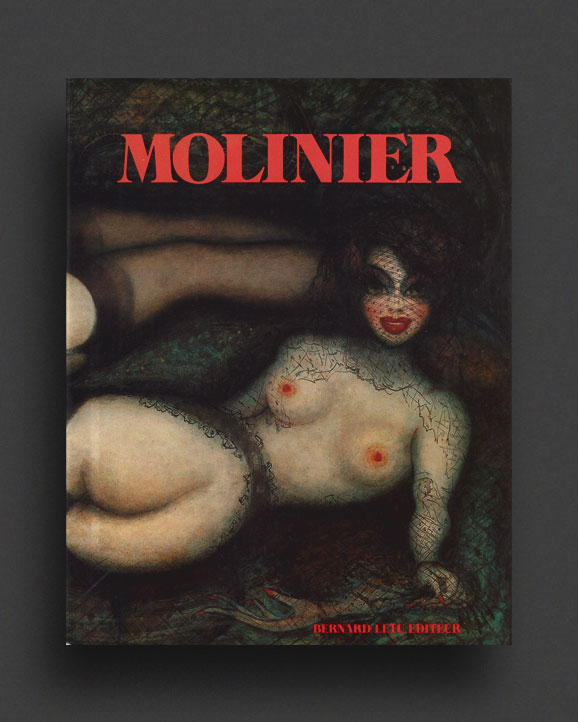
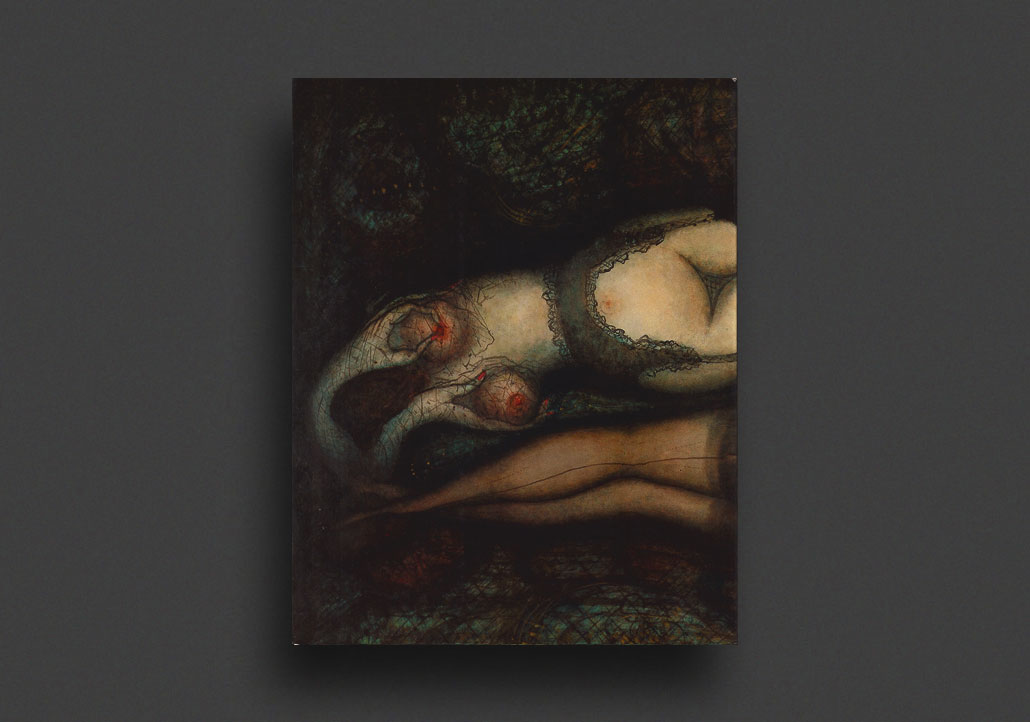
First 1979 edition of this monograph on French painter, photographer and a forerunner of gender performance art and Body Art (Art corporel), Pierre Molinier (1900—1976), published by Bernard Letu Editeur in Geneva. With accompanying text by Egyptian-French Surrealist author Joyce Mansour, this book is a retrospective survey of Molinier's provocative gender-bending paintings and drawings, illustrated throughout in colour and b/w. Texts in English and French.
Pierre Molinier (1900—1976) was a French painter, photographer and a forerunner of gender performance art and Body Art (Art corporel). Molinier spent much of his artistic life working in isolation in Bordeaux, exiled from local and national art scenes. Born in Agen, nothing had predestined Molinier to a life as an artist. Self-taught, from a working-class background, he followed in his father’s footsteps and started out as a house painter. He got married and had two children. Tired of his infidelities and provocative behaviour, his wife left their marital home an in 1950 and Molinier begun photographing himself seriously, staging his own death and erecting a fake gravestone proudly declaring himself ‘a man without morals’. He was thrown out of the Bordeaux Salon des Indépendants as early as 1951 amidst controversy over his orgiastic painting of the same year, Le Grand Combat. Stirring up an obsessive correspondence with the anarchic poet-founder of Surrealism, André Breton, Molinier was soon integrated into the Surrealist group with a solo exhibition at Breton’s Paris gallery in 1956. Molinier’s anti-moral project appealed to the group’s interest in repressed desires, fetishism, and the transgression of bourgeois morals. In 1959, he exhibited at the Exposition International du Surrealism in Paris. From the mid-1960s Molinier chronicled the exploration of his subconscious transsexual desires in "Cent Photographies Erotiques": graphically detailed images of pain and pleasure. Cut-up, reassembled, and manipulated, Molinier painstakingly created elaborate and sensual photomontages in which he assumed the roles of dominatrix and succuba previously taken by the women of his paintings. Either alone with doll-like mannequins or with female models such as German sadomasochist Hanel Koeck, Molinier, who considered himself fundamentally androgynous, appears as a transvestite, employing his body and that of his acquaintances to create visions of hybrid identity, where stockinged multi-limbed, multi-sexed beings imitate pagan figures, Hindu gods, and Masonic symbols, in a rejection of a Christian tradition which he argued, had repressed androgyny. Designed to shock, Molinier’s artwork represented a very intimate disclosure about his own sexual ambiguity, inviting the viewer to bring to the images his or her own response of excitement or disgust. The degree of his artistic perversity and blasphemous tendencies was deemed too much for the French cultural elite, and the man Breton dubbed the “magician of erotic art” was shunned from the art world. Molinier did not participate in the 1965 International Surrealist Exhibition. For the last 11 years of his life Molinier played out his own most profound moments in the 'theatre' of his Bordeaux 'boudoir – atelier'. He committed suicide in 1976, shooting himself with a pistol, something he had foreshadowed in his artwork, time and again. Essentially a leg fetishist, but also considering himself as a shaman, facetious and provocative, anti-bourgeois and anti-religious, Molinier enjoyed transgressing gender identification : his outstanding photographs greatly influenced the European and North American Body Art in the 1970s and continue to fascinate artists today.
Very Good copy.
1968, Japanese
5 litho prints in letterpress envelope, 19 x 13 cm
1st Edition, Out of print title / used / very good
Published by
Kodansha Int / Tokyo
$180.00 - In stock -
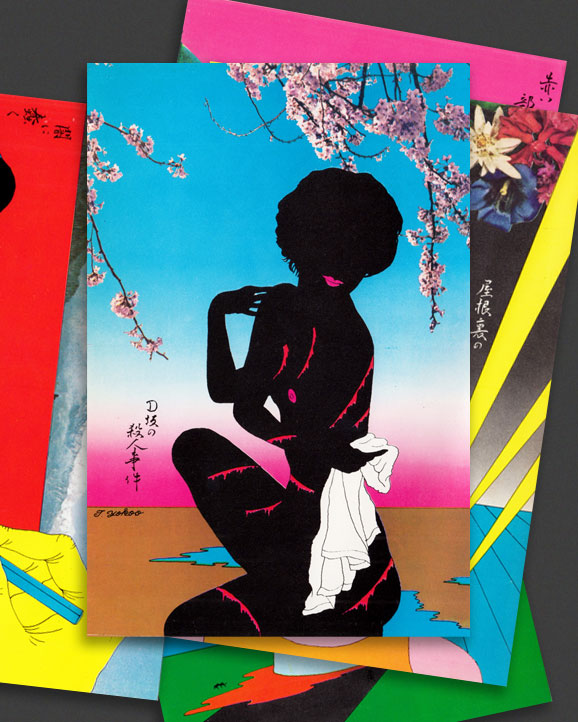
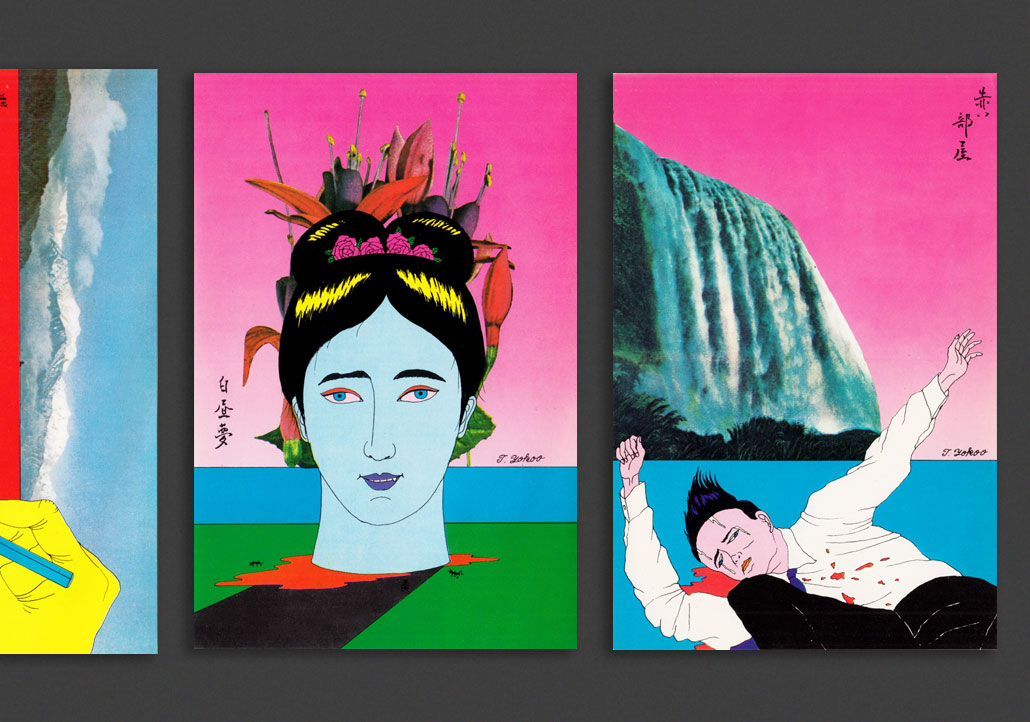
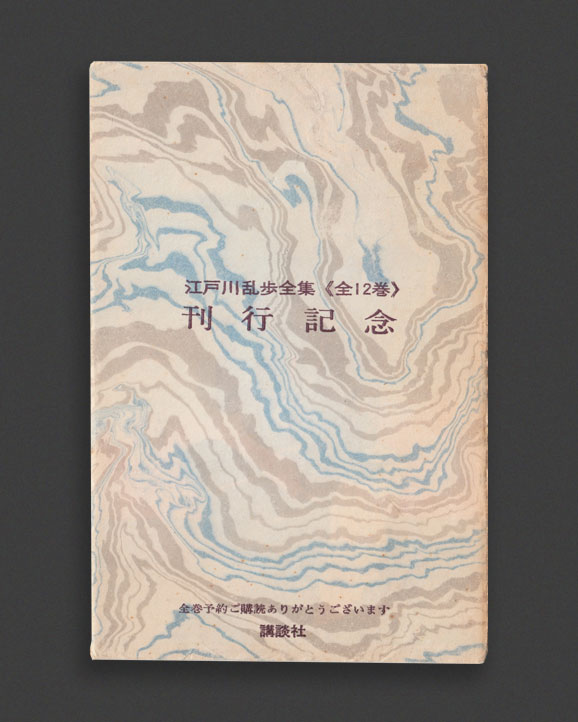
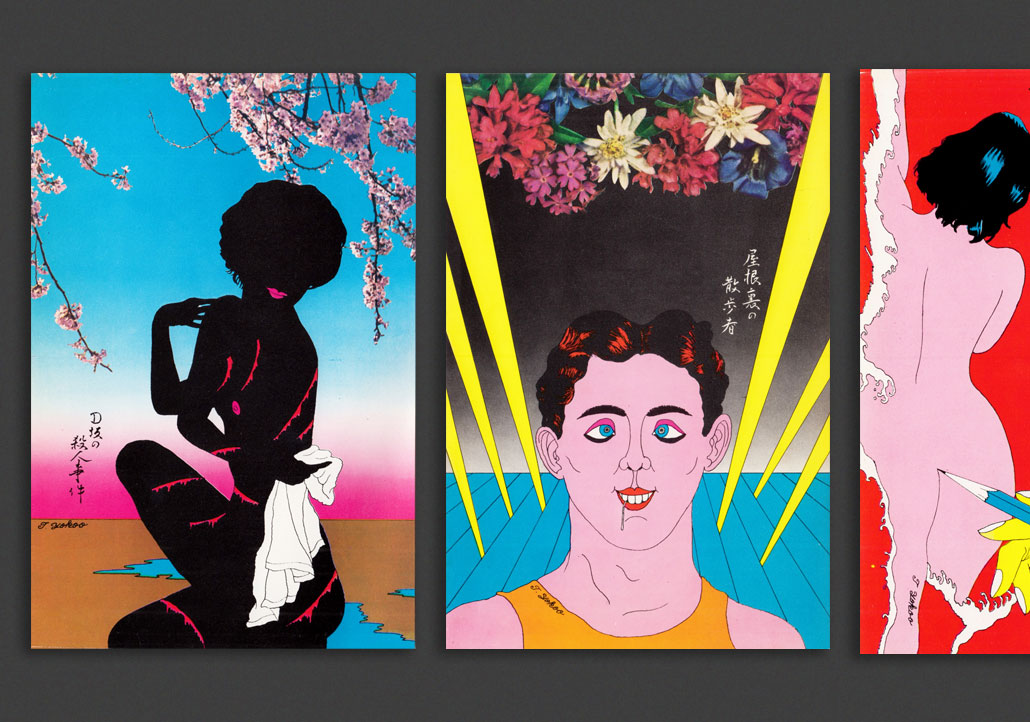
Complete 5 card set of litho prints by legendary Japanese artist Tadanori Yokoo, issued in letterpress, marbled envelope in 1968 to commemorate the release of the complete 12 volume collected works of Japanese author and critic Edogawa Ranpo (1894—1965), who played a major role in the development of Japanese mystery and thriller fiction. Yokoo contributed many illustrations to the book collection, alongside fellow artists Iwami Furusawa and others. This rare folio of prints (roughly the size of post cards) collects five of the finest examples of Yokoo's instantly recognisable 1960's psychedelic work — erotic, grotesque, and esoteric themes rendered in vivid graphic collage and pop colour.
Tadanori Yokoo (b. 1936) is one of Japan's most successful and internationally recognized graphic designers and artists, who began working with painting in 1966. In parallel, Yokoo’s early screenprints experimented with collage and illustration, combining found photographs with the influence of traditional Japanese ukiyo-e and pop art’s flat vibrant colours and overtly sexual and grotesque content, often reflecting on the rapid changes and Westernisation of Japan post-war society. His interests in mysticism and esotericism, deepened by travels to India, influenced his iconic posters with eclectic psychedelic imagery sharing the aesthetics of the underground counterculture he was associated with. In Tokyo Yokoo worked as a stage designer for avant-garde theatre, collaborating extensively with Shūji Terayama and his experimental theater group Tenjō Sajiki. By the late 60s he had already achieved international recognition and in the early 1970s MoMA mounted a solo exhibition of his graphic work. His famous designs for The Beatles, Miles Davis, Carlos Santana and collaborations with friend and iconic Japanese fashion designer Issey Miyake are renowned the world over.
Very Good, perfectly preserved cards in aged envelope with some wear to edges and tanning.
2024, English
Softcover, 200 pages, 23 x 17 cm
Published by
Scheidegger und Spiess / Zürich
$90.00 - In stock -
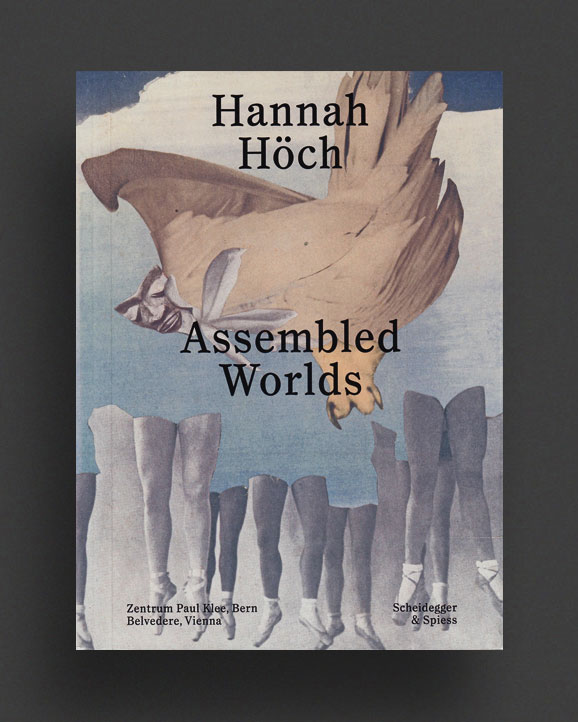
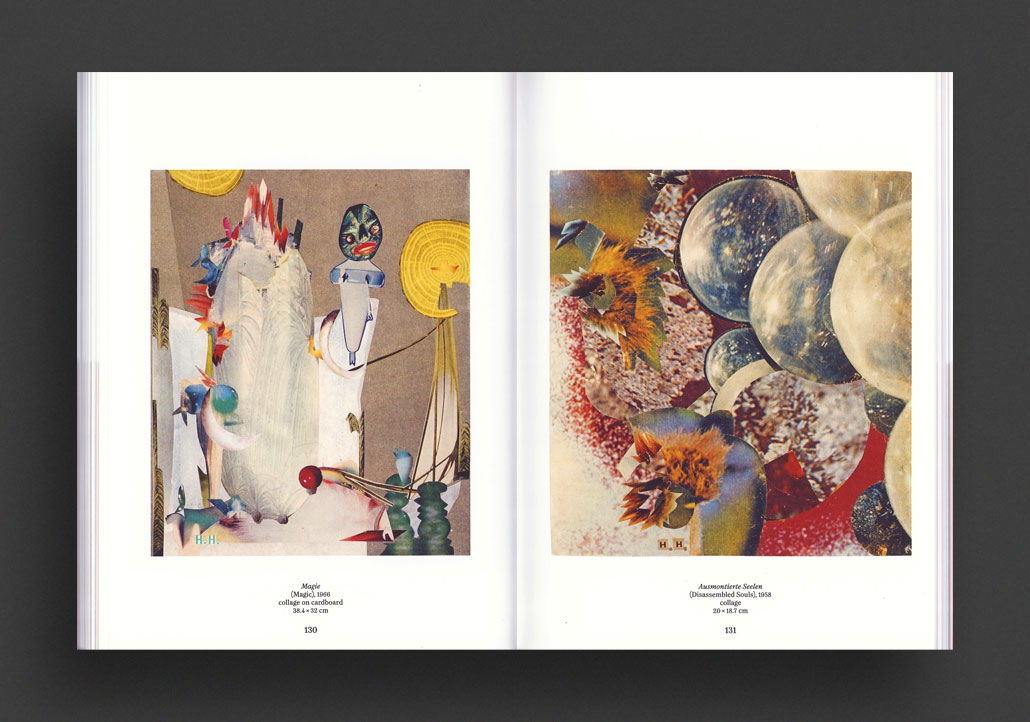
A groundbreaking, richly illustrated book on Hannah Höch’s montages in the context of film and the visual culture of Modernism. Sheds light for the first time on Hannah Höch’s significance as a pioneering artist to confront the industrial age’s flood of images.
Hannah Höch (1889-1978) moved between differing worlds: as an editorial assistant with a major Berlin-based magazine publisher, and as the only woman who could hold her own in the German capital's vibrant Dada scene of the 1920s. Her works dissected a world marked by the catastrophe of the Great War and an intense consumer culture, and reassembled it in revolutionary, poetic, and often ironic ways. Scissors and glue were the weapons of her art of montage, of which she was a coinventor.
Cutting and montage also shaped film, still a new medium in the 1920s, which strongly influenced Höch's art: she understood her assembled pictures as static films. This richly illustrated and expertly annotated book explores comprehensively for the first time Höch's life-long fascination with film and the visual culture of the modern industrial age. Covering her entire career, It demonstrates how montage evolved in a field of tension between artistic experimentation, commercial exploitation, and political appropriation. A text on photomontage by Höch, written in 1948, and a text-collage on the history of montage, in which major protagonists of Modernism and Avant-garde have their say, round out this volume.
Contributors:
Martin Waldmeier is a curator at the Zentrum Paul Klee in Bern.
Nina Zimmer is director of the Kunstmuseum Bern and its affiliate Zentrum Paul Klee.
1997, Japanese / English / Spanish
Softcover, 152 pages (plus ephemera), 26.5 x 20 cm
1st Edition, Out of print title / as new
Published by
Tokyo Shimbun / Tokyo
$150.00 - Out of stock
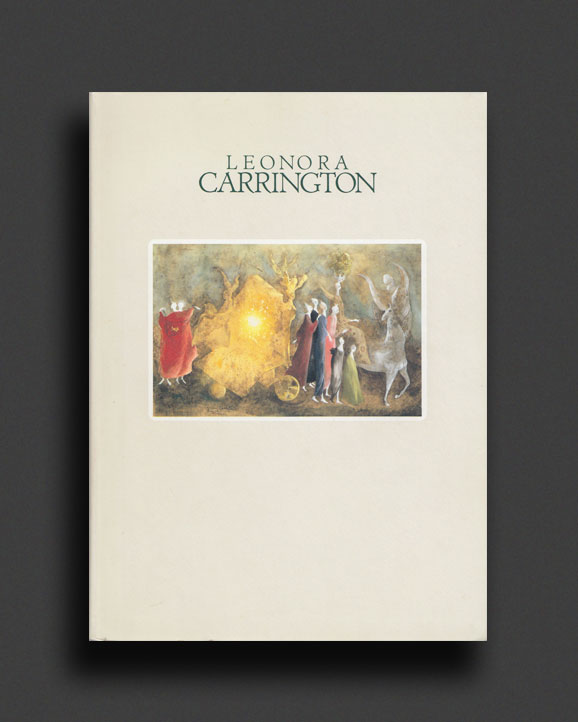
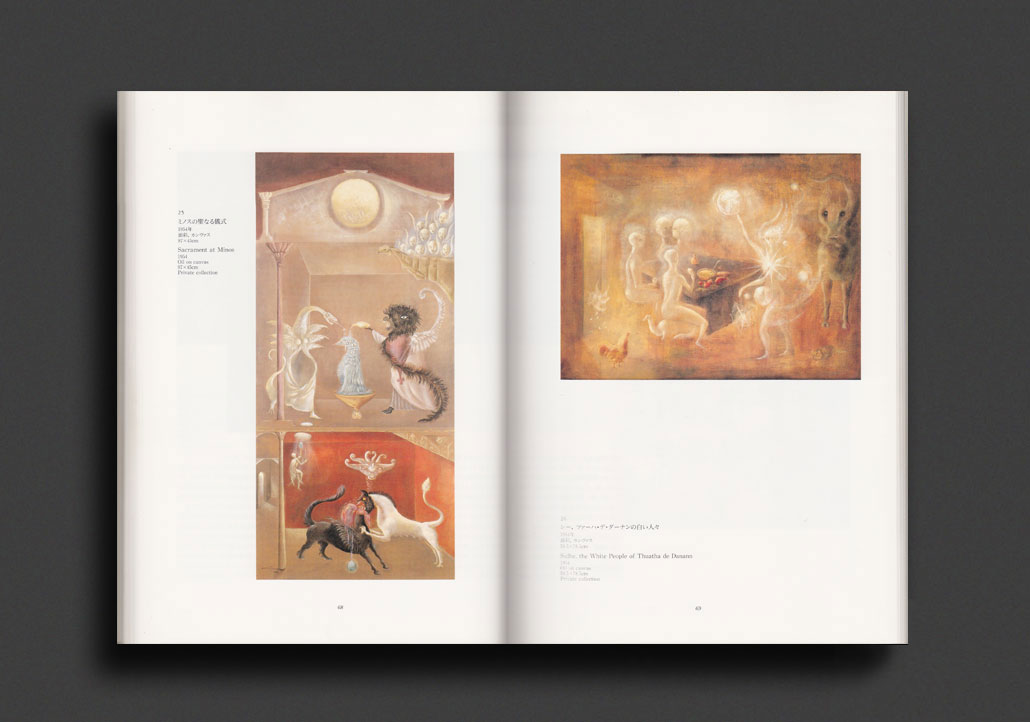
Seldom seen, scarce late 1990s monographic catalogue on the great Leonora Carrington, published on the occasion of a major retrospective exhibition at The Tokyo Station Gallery in 1997. Profusely illustrated throughout with Carrington's fantastic paintings, with illustrated history, list of exhibited works, exhibition history, bibliography and essays in English, Japanese and Spanish. This fine copy, in brand new condition, comes with inserted advertising for the exhibition. One of the best publications on the artist.
Leonora Carrington (1917 – 2011) was an English-born Mexican artist, surrealist painter, and novelist. She lived most of her adult life in Mexico City, and was one of the last surviving participants in the Surrealist movement of the 1930s. Carrington was also a founding member of the Women’s Liberation Movement in Mexico during the 1970s.
Leonora Carrington escaped a stultifying, upper class Lancashire childhood to run off away to France with her lover, the German Surrealist artist Max Ernst. After a spell in Paris, she and Ernst settled in the tiny village of Saint-Martin-d’Ardèche, where they turned an inhospitable farmhouse into a lived-in art work. It was an idyllic and productive retreat that came to an abrupt end at the outbreak of WW2, with Ernst's arrest by the French as a "hostile alien". After months imprisoned (sharing a cell with fellow-German Surrealist, Hans Bellmer), Ernst was released and again arrested, this time by the Nazi Gestapo as a "degenerate". Devastated and fleeing the Nazis to Spain, Carrington experienced paralyzing anxiety and growing delusions culminating in a final breakdown at the British Embassy in Madrid. Her parents intervened and had her hospitalised. She was given "convulsive therapy" and treated with dangerous drugs. Carrington ran away and sought refuge in the Mexican Embassy. With the help of Renato Leduc, a Mexican Ambassador, Carrington began a new life in Mexico. There she found a new love, had two children, painted profusley, made new friends (most notably the Spanish-Mexican artist Remedios Varo). She lived, and on her own terms. The artist herself preferred not to explain the private visual language of her detailed, dream-like paintings to others, however she used magical realism, alchemy and autobiographical detail and symbolism as subjects. Carrington was interested in presenting female sexuality as she experienced it, rather than as that of male surrealists’ characterization of female sexuality. Carrington’s work of the 1940s is focused on the underlying theme of women’s role in the creative process.
Fine copy, beautifully preserved.
2023, English
Hardcover (w. dust jacket), 224 pages, 25 x 17.5 cm
Published by
Princeton University Press / New York
$68.00 - In stock -
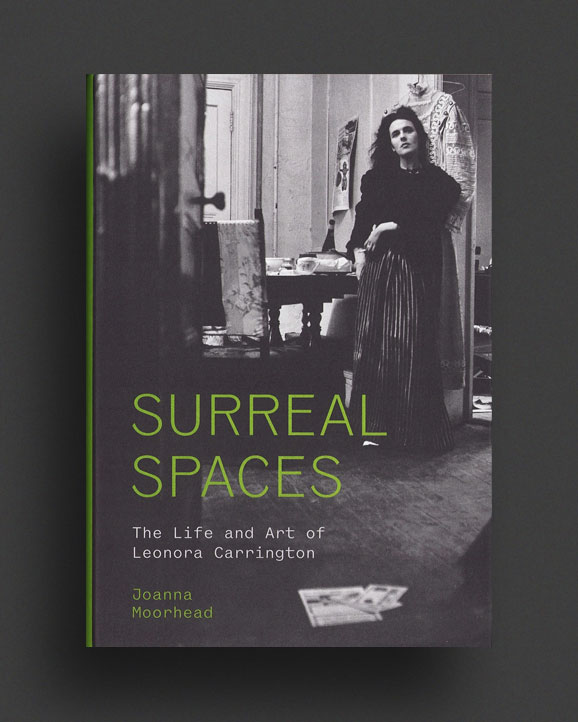
An illustrated biography of the pioneering British artist and writer, tracing her life and work through the many places around the world where she lived
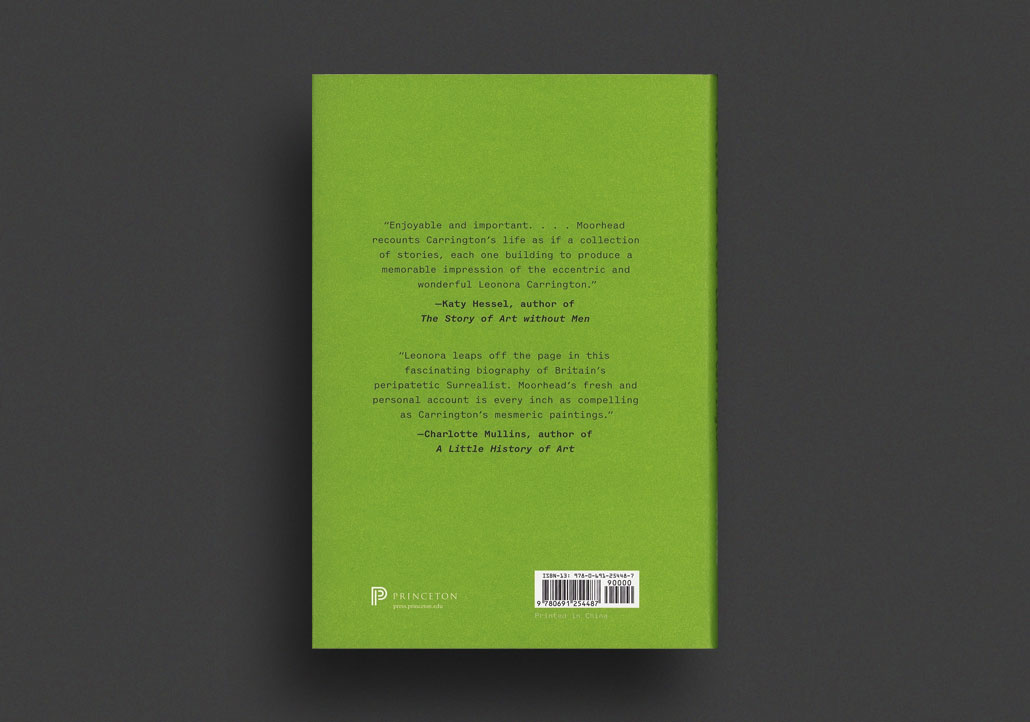
The British-born artist and writer Leonora Carrington (1917-2011) is one of the vanguards in the history of women artists and the history of Surrealism. The interests of this visionary--feminism, ecology, the arcane and the mystical, the interconnectedness of everything--are now shared by many. Challenging the conventions of her time, Carrington abandoned family, society, and England to embrace new experiences and forge a unique artistic style in Europe and the Americas. In this evocative illustrated biography, writer and journalist Joanna Moorhead traces her cousin's footsteps, exploring the artist's life, loves, friendships, and work.
Leading readers on a personal journey across Britain, Ireland, France, Italy, Spain, Portugal, the United States, and Mexico, Surreal Spaces describes the places and experiences that would become etched in Carrington's memory and be echoed, sometimes decades later, in her art and writing--whether her grandmother's kitchen with its giant stove; a remote Cornish hideaway where she holidayed with Max Ernst, Lee Miller, and Man Ray; the Left Bank of Paris; an asylum in Santander, Spain; New York, where she lived among other European exiles; or Mexico City, her final sanctuary. "Houses are really bodies," Carrington wrote in her novella The Hearing Trumpet. "We connect ourselves with walls, roofs and objects just as we hang on to our livers, skeletons, flesh and blood streams."
Featuring photographs, drawings, and paintings of the spaces that so richly influenced Carrington's work, Surreal Spaces is an intimate and vivid portrait of a fascinating artist.
1973, Japanese
Softcover, unpaginated (approx 200 pages), 21 x 14.5 cm
1st Edition, Out of print title / used / very good
Published by
Tatsumi / Tokyo
$70.00 - Out of stock
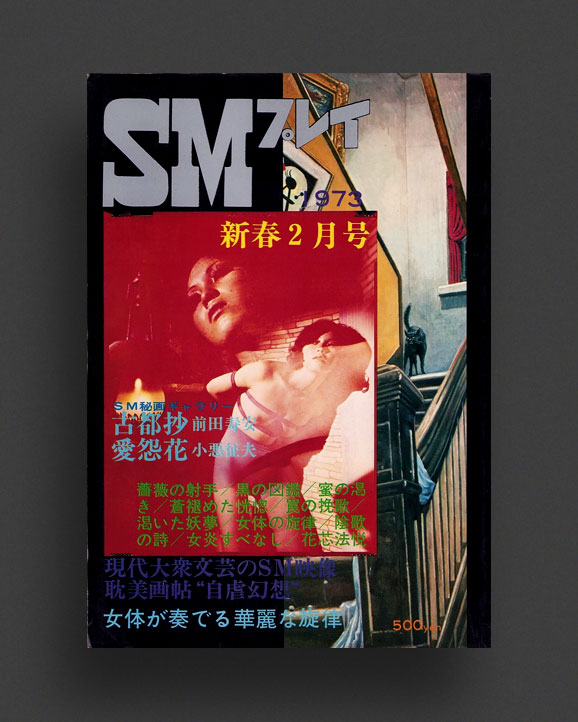
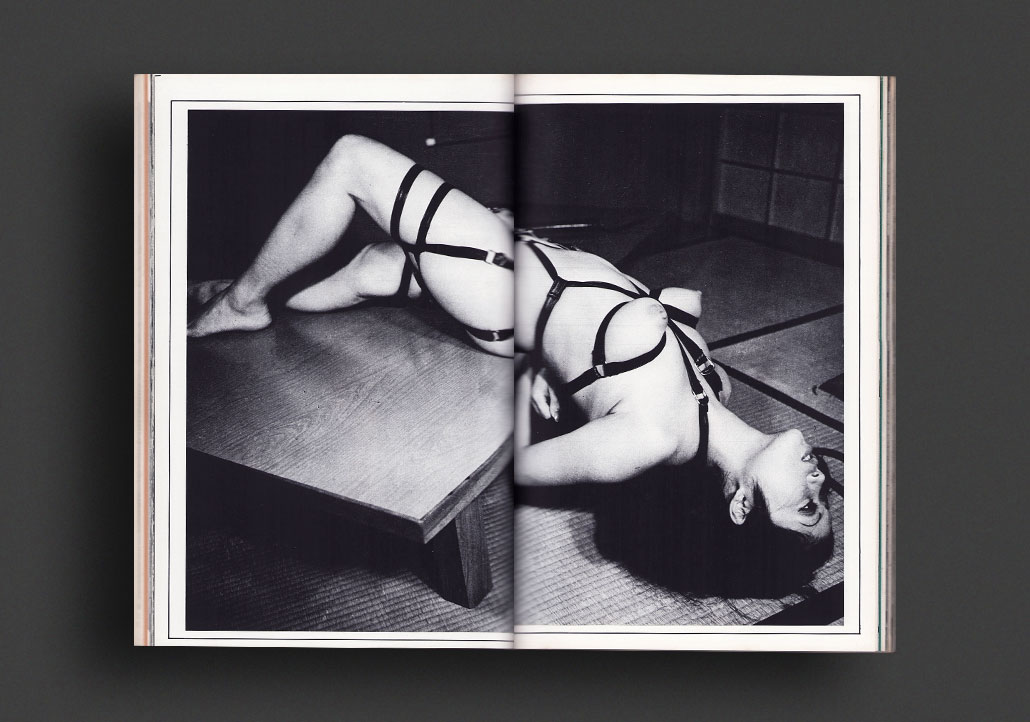
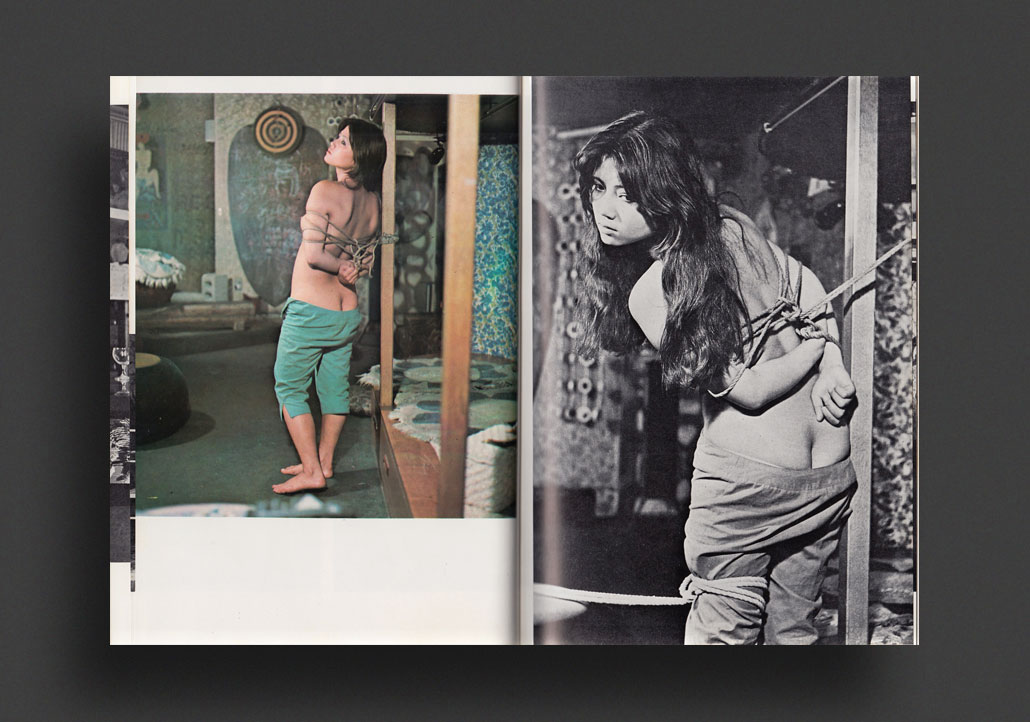
Scarce February 1973 issue (one of the best) of cult Japanese SM magazine, SM Play, edited by bondage master, photographer and editor, Aokiro Ueda, and published by Tatsumi Publishing, Tokyo. Launched in 1972, SM Play was a beautifully produced bondage magazine heavy with high quality photography features in gorgeous gravure black and white and lavish colour, with many fold-outs and great illustrated stories/art galleries by leading kinbaku artists of the time. This issue featuring contributions by fantasy illustrator Ran Akiyoshi, pink film director Satoru Kobayashi, Seiji Kawakami, Juan Maeda, Yukio Koaku, Jun Fujisaki, and many others. Editor Ueda edited the early kinbaku magazine Yomiuri Romance, which published bondage photos before Kitan Club. He also contributed to early fetish magazine Fuzokuka, and published valuable early SM photo books as early as 1952. He collaborated with pink film directors in the 1970s—1980s such as Satoru Kobayashi, Giichi Nishihara and Tetsuji Takechi.
Very Good copy.
1959, English
Softcover (staple bound), 20 pages, 19.5 x 15.5 cm
1st Edition, Out of print title / used / very good
Published by
The Matthiesen Gallery / London
$110.00 - In stock -
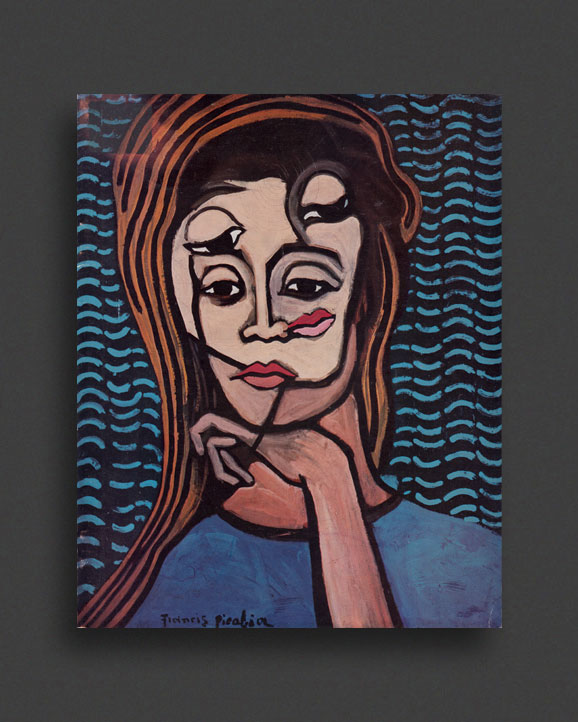
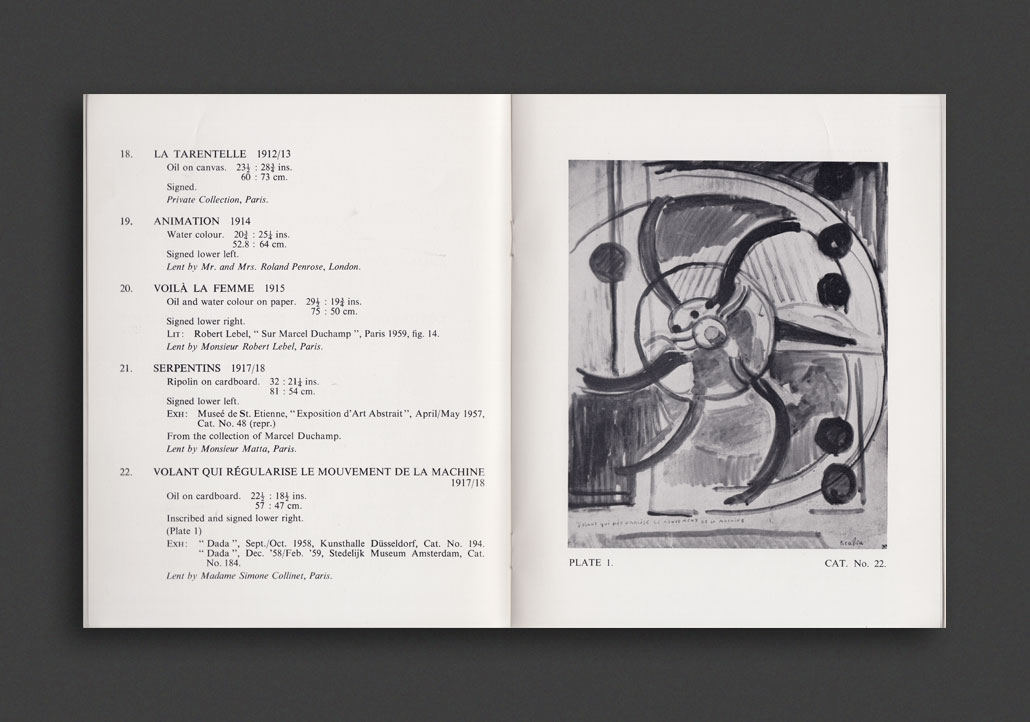
Gorgeous and very rare 1959 Francis Picabia exhibition catalogue published on the occasion of the solo retrospective show at The Matthiesen Gallery, London, October—November 1959. A catalogue of 56 works, some illustrated with b/w plates, with accompanying text by André Breton. Includes biography.
Francis Picabia (1879—1953) was a Cuban-French avant-garde painter, writer, filmmaker, magazine publisher, poet, typographist and provocateur closely associated with Dada. A friend to fellow iconoclasts Duchamp, Breton, Tzara, and Man Ray, Picabia's discordant, self-contradicting art, in which wispy watercolours, pin-up girls and mechanical pistons could hang side by side, had a clear conviction: to crush distinctions between high and low, elegance and kitsch, and to force us all to the limits of taste. When considering the many styles that Picabia painted in, observers have described his career as "shape-shifting" or "kaleidoscopic". After experimenting with Impressionism and Pointillism, Picabia became associated with Cubism. “The Cuban who out-cubed the Cubists”, his highly abstract planar compositions were colourful and rich in contrasts. He was one of the early major figures of the Dada movement in the United States and in France, publishing his Dada periodical 391 with Duchamp before denouncing Dada in 1921 in favour of the development of Surrealism. "If you want to have clean ideas, change them like shirts."—Picabia. From 1922, Breton's relaunched Littérature magazine featured cover artwork every issue by Picabia that drew on religious imagery, erotic iconography, and the iconography of games of chance. In 1925, Picabia returned to figurative painting, his "Monster" period, followed by his "Transparencies" series (1927—1930) and his then abhorred pin-up girl/"Nazi porn" paintings, all highly influential on contemporary German painters such as Sigmar Polke. Picabia would soon turn his back on the art establishment altogether.
Very Good copy with light shadow from sticker to top-left of cover, two National Gallery of Victoria stamps.
2008, English / German
Softcover, 80 pages (colour & b/w ill.), 25 x 19 cm
1st Edition, Out of print title / as new
Published by
Galerie Buchholz / Köln
Greene Naftali / New York
$80.00 - In stock -
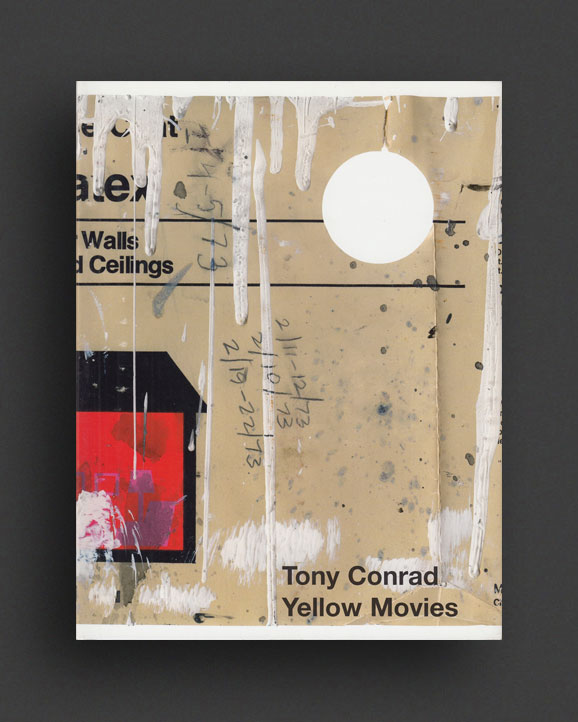
This now out-of-print Conrad catalogue was published on the occasion of two exhibitions, one at Galerie Daniel Buchholz in Cologne and the other at Greene Naftali in New York, that presented a group of works by artist, filmmaker and musician Tony Conrad entitled "Yellow Movies".
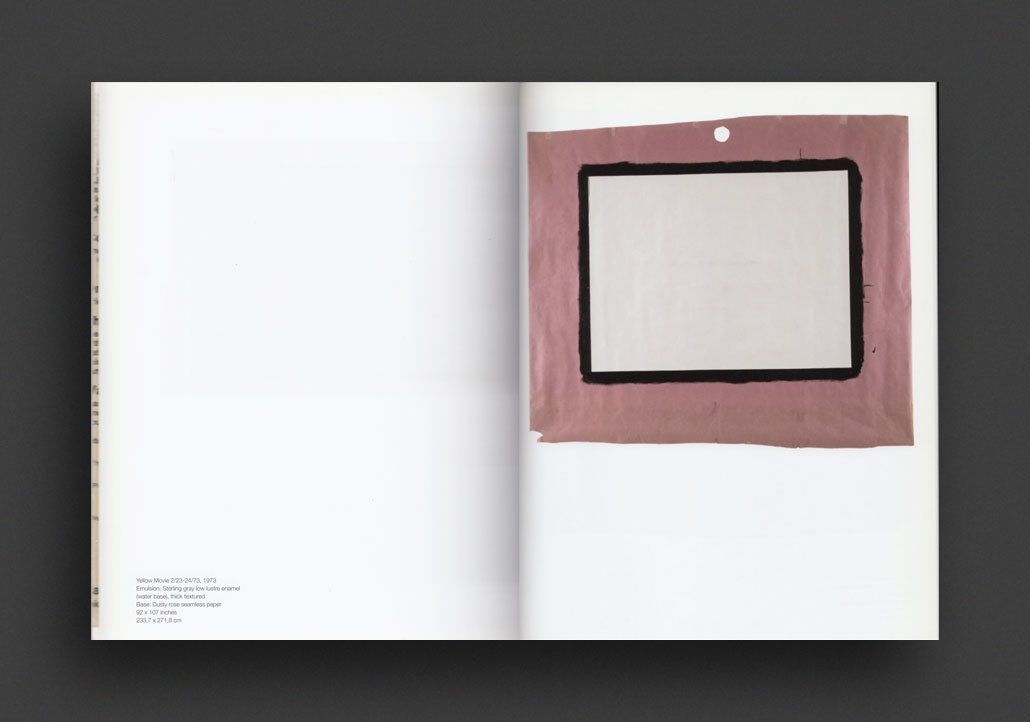
Alongside an introductory note by Tony Conrad that served as a press release for the two gallery exhibitions, the book contains a new text by Diedrich Diederichsen and a comprehensive documentation of all the "Yellow Movies" still in existence.
Designed by Yvonne Quirmbach, this wonderful catalogue was produced in collaboration with Galerie Daniel Buchholz and Greene Naftali, in an edition of 1,200 copies.
As new copy.
Anthony Schmalz "Tony" Conrad (March 7, 1940 – April 9, 2016) was an American avant-garde video artist, experimental filmmaker, musician, composer, sound artist, teacher, and writer. Active in a variety of media since the early 1960s, he was a pioneer of both structural film and drone music. He performed and collaborated with a wide range of artists over the course of his career, most prominently the 1960s New York experimental music collective Theatre of Eternal Music, also known as The Dream Syndicate.
Yellow Movies was a project of Conrad's in 1973. It consists of 20 "movies," which are square frames painted in black house paint onto large pieces of photographer's paper. Conrad's concept came from a continued attempt at pushing the framework of film, and his interest in engaging the audience in long spaces of time. He wanted to make a film that would last 50 years, but knew that "normal materials" could not last that long, so he created a whole new conceptual stratagem for Yellow Movies. The "emulsion" is painted on, and the movies take their own course over time, changing very slowly.
1981, Spanish
Softcover, 104 pages, 17 x 12 cm
1st Edition, Out of print title / used / very good
Published by
Editorial Garsi / Madrid
$70.00 - In stock -
Very rare copy of UNA MUSICA PARA LOS 80 by Spanish experimental composer, poet and art critic Javier Maderuelo (b. 1950), published in 1981 in Madrid by Editorial Garsi. This essential compact chronicle was written by Maderuelo to introduce the phenomenon of so-called contemporary music in Spain (electroacoustic, musique concrète, experimental, ambient, sound art, et al.) and analyse the varied positions of its leading protagonists, such as the Zaj group, Suso Sáiz, Eduardo Polonio, Llorenç Balsach, Amadeu Marin, Llorenç Barber, Carles Santos, José Iges, Antoni Caimari, Pedro Estevan, Josep Lluís Berenguer Moreno, Javier Maderuelo (himself a member of studio Alea between 1973-1977 and the musical movement Elenfante), amongst others. With critical overviews, profiles, discographies, bibliographies, chronologies of exhibitions and concerts, this is indeed a vital document on Spanish avant-garde sound c. 1970—1981.
Javier Maderuelo (Madrid, 1950) became interested in experimental poetry and art in 1972 under the influence of Fernando Millán, José Luis Castillejo and Felipe Boso, as well as artists like Elena Asins, Juan Hidalgo and Javier Aguirre, with whom he collaborated. He began producing typewritten poems and collages with texts extracted from newspapers, which converge in the unpublished book Arte Cisoria (1981). Felipe Boso introduced him to the world of phonetic poetry and with Pedro Estevan and María Villa he cofounded the Glotis Group (1979), dedicated to disseminating both the work of avant-garde poets, as well as neo-avant-garde works, some of them expressly written for Glotis. As a composer, he worked at the electronic music studio Alea (1973-1977) and was part of the musical movement Elenfante. He was a member of the Seminar of Analysis and Automatic Generation of Musical Forms, run by Florentino Briones, collaborating on the SIMO concerts. At the end of the eighties he abandoned poetic and musical creation to devote himself to an academic career.
Very Good copy with cover wrap cleanly disconnected from book block (old glue), tanned spine, otherwise VG throughout.
1969, Japanese
Hardcover (clothbound w. plastic dust jacket in slipcase), 168 pages, 22 x 16 cm
1st Edition, Out of print title / used / very good
Published by
Shoshi Soubikan / Tokyo
$180.00 - Out of stock
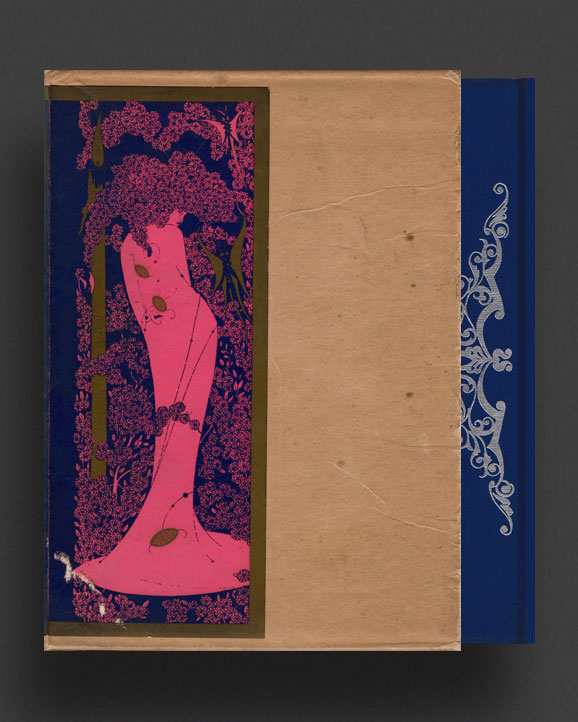
Very rare copy of SM Photo Collection Rose Mirror, an exquisite early 1969 hardcover collection of bondage photographic works housed in heavy cardboard slipcase adorned with Beardsley illustration. The photographic works follow in the decadent tradition, with beautiful b/w gravure photo reproductions and lush colour plates with colour fold-out spreads, each of the eight kinbaku/shibari scenarios shot by photographer Yoshimi Sunaji in response to fictional stories, the chapters titled: "`The Mirror of the Rose," "The Lesson of the Cat," "The Queen Angel," "The Ballad of the Pearl Shell," "The Trapped Agarwood," "The Play of the Twigs," "The Sacrifice of the Spider," and "The Mermaid's Bond," performed by eight women. The book concludes with the texts "Rope Arakaruto" by Arata Beppu, "Flowers of Heresy" by Akira Shiokawa, and "SM Yomoyama Story" by Oniroku Dan, "the most celebrated writer of popular SM novels in Japan."
Very Good copy with some general age and wear in gilded cloth bound hardcover and original publisher's plastic jacket (VG), housed in illustrated cardboard slipcase in Good—VG condition (light wear, age, marking). Very well preserved.
2024, English
Hardcover, 124 pages, 22 x 14.5 cm
Published by
Amphetamine Sulphate / Austin
$50.00 - Out of stock
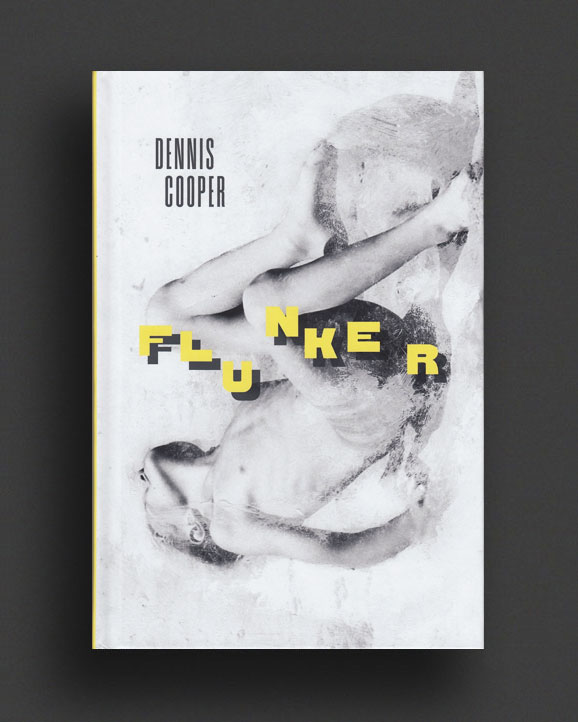
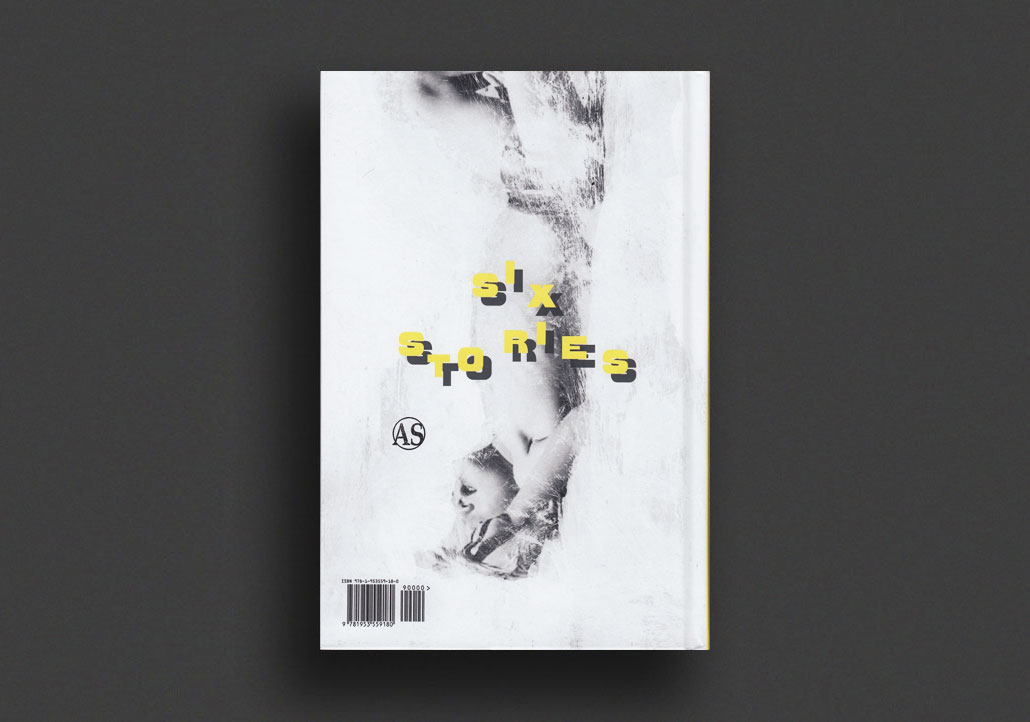
When Dennis Cooper decides to publish a new collection of short stories with Amphetamine Sulphate, you just know the master will have something extra special in mind.
Yet again, this is Dennis Cooper without limits.
Poignant, uncompromising.
The original and the best.
Full colour cover design by Michael Salerno
2024, English
Softcover (+ art cards), 112 pages, 21.5 x 14 cm
Published by
Amphetamine Sulphate / Austin
$40.00 - In stock -
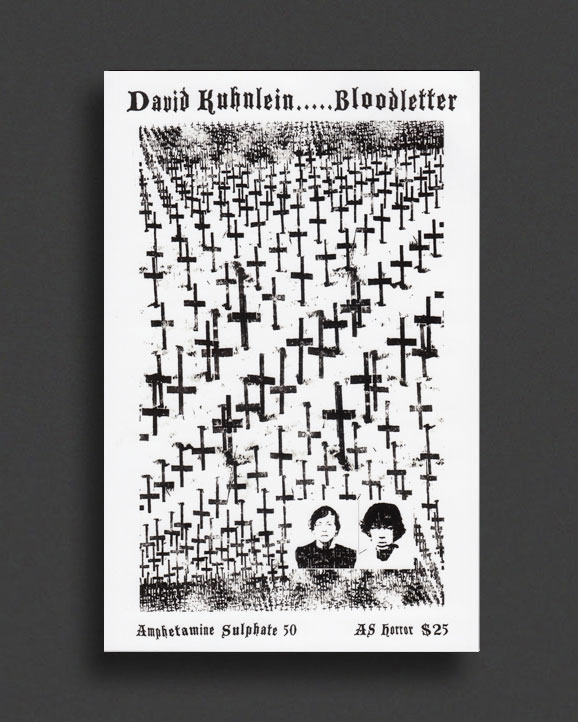
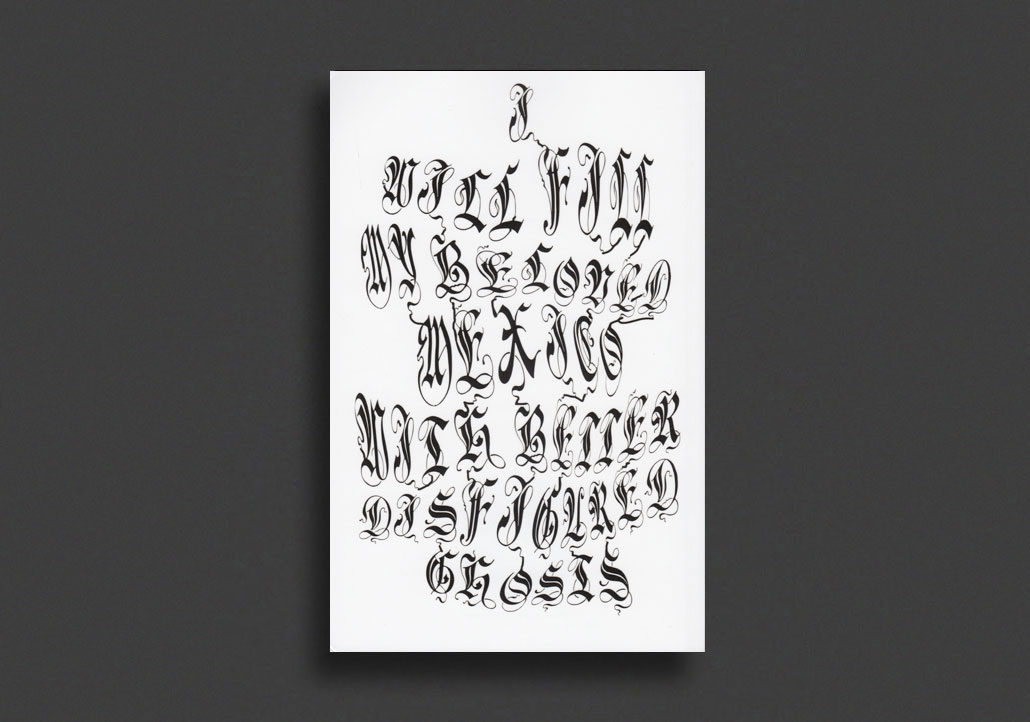
I WILL FILL MY BELOVED MEXICO WITH BETTER DISFIGURED GHOSTS
David Kuhnlein writes like he’s casting a spell. Bloodletter is entrancingly evil, every sentence a revelation and a curse: “How much can you care for someone if you can’t afford to dress them in a body bag? ” A grotesque world unfurls from his searing prose: “Ghosts reveal their measurements in smoke, different shades, more rings in the middle if they died long ago. Satan can’t keep up.” Blood sacrifices have never been so beautiful.—Danielle Chelosky
"Half our clothes are on the floor. The other half hang from the ceiling. Labyrinthine flesh-piles make a staircase. Polishing the soot off a breast with my sleeve, I dance horizontally. The band regurgitates into their instruments to slow the tempo, blowing catchy bubbles of sick. Sweat snows upward, stagnant when we see ourselves pooled within it, mosquitoes in a tin can. Vestigial, amoebic replications, abominable degenerations of the ape, totems fucked through stained glass. I toast the trash.
Out of mounds, shaved together into a consciousness, a golden star excretes, floating toward me in a mist, apples singed in her teenaged hair, waist the width of a cigarette. I’m going to bugger her so hard they’ll have to put a serial number on the headstone. “If I’m to your taste, mister, this might spell the end for you.” What more could I ask of a woman?
A heart condition of a child, torqued to breed too soon. I offer dialectic fugues, 77 press her forehead, cast a sigil tuned to the cacophony around us. Swaying, she enters a canyon trance, plummeting under magma.
Beautiful funerals for all my friends. Remember me as an itch."
With cover design, illustrations and Art Cards by Steven Purtill (Human Rights, Coyote, Small Talk at the Clinic etc.)
2017, English
Softcover (staple-bound), unpaginated, 21.5 x 13.5 cm
Published by
Amphetamine Sulphate / Austin
$34.00 - Out of stock
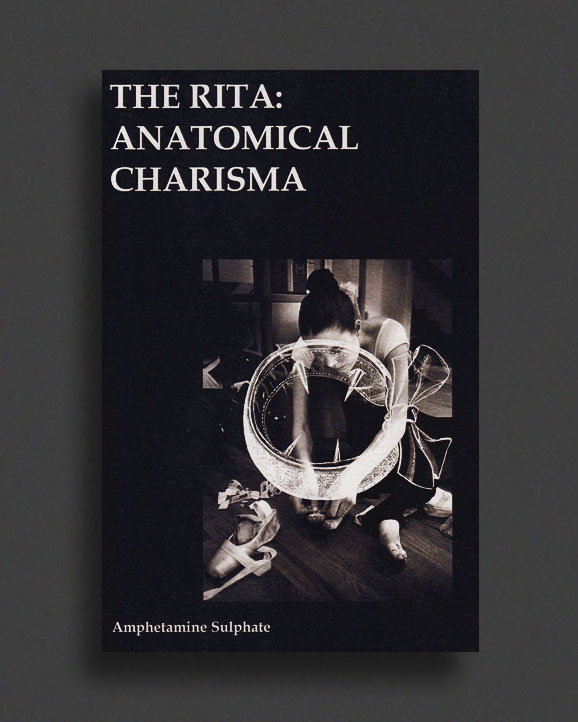
High quality art plates, exclusively designed and executed for THE RITA. My guess is that a lot of people reading this book know something personal about immersion.
The experience of watching meaning change over time solely for yourself, depth being equal to the ease with which you get information, the ability to 'read' that information, the extent to which you can invest yourself in that information.
Things you see, you can see over and over, because you love them. Love is best and most correct when you know something but you feel like you can never truly own it'? no matter what, it is always outside of you. Gabrielle Losoncy
1986, Japanese
Softcover, 106 pages, 30 x 21 cm
1st Edition, Out of print title / used / very good
Published by
V-Zone / Japan
$100.00 - Out of stock
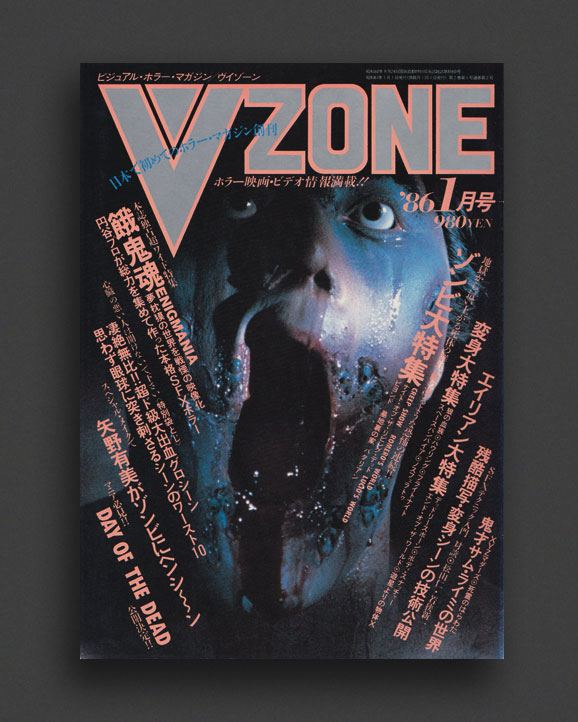
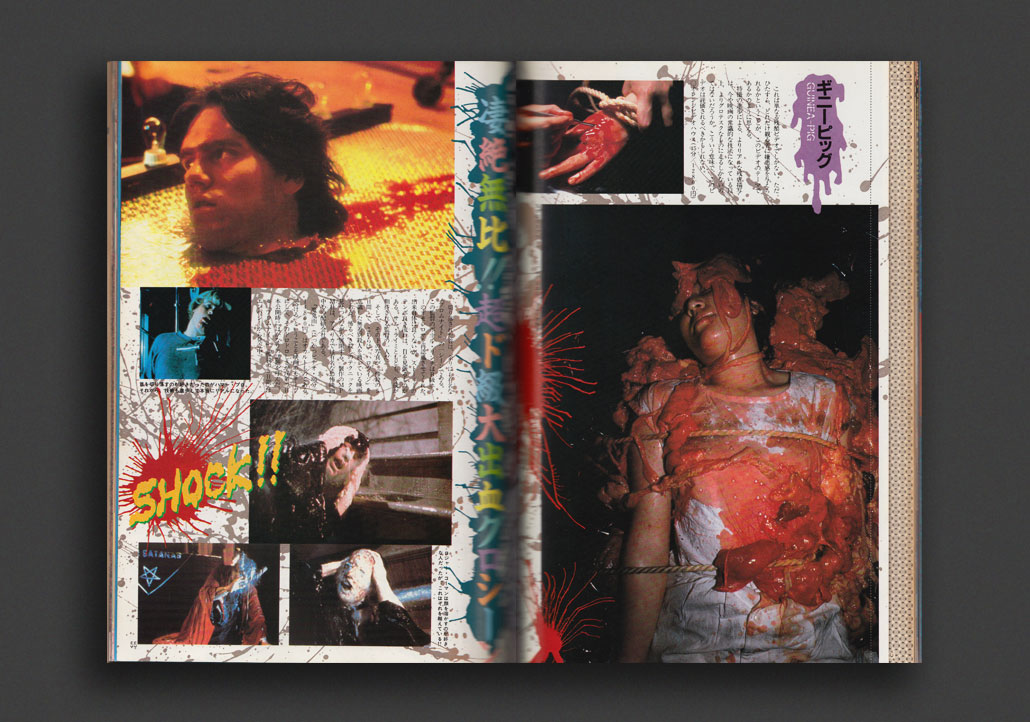
Rare 1986 collectible second issue of V-Zone, the wild, short-lived cult horror/sci-fi/fantasy movie magazine from Japan, published between 1985—1987. This issue is particularly sought after for the rare special feature on the controversial Guinea Pig 2: Flower of Flesh and Blood, a film written and directed by horror magna master Hideshi Hino, that was withdrawn from the US and Japanese video market for it's realistic gruesome special effects. The film achieved further notoriety after incident in which American actor Charlie Sheen is said to have watched the film and believed that it depicted the actual killing and dismemberment of a real woman, prompting him to report it to authorities. The feature herein includes the sealed shut pages that readers had to cut it open to see the gruesome images of various shock films. This copy is still sealed!
At the height of the home video revolution of the 1980s, V-Zone committed it's graphic-saturated pages to the explosion of horror, fantasy, and science fiction films that came with it. V-Zone's coverage of American horror is unparalleled in the world of Japanese magazines, but they also focused attention on historical and underground western science fiction and cult cinema, whilst also playing an important role in fostering the new wave of Japanese gore and V-Cinema (direct-to-video splatter films). Heavy with film features, interviews, stills, ads and reviews, each issue has amazing behind-the-scenes reportage from industry conventions and sfx fan parties, content you would not find anywhere but Japan, including a regular column by legendary Godzilla special effects artist Shinichi Wakasa on how to make your own SFX makeup, gore, and even craft realistic squibs with dimestore prophylactics.
Needless to say, V-Zone is a must for any 1980s video collector or lover of gore.
Very Good copy.
2019, English
Softcover, 312 pages, 14.8 x 19 cm
1st Edition, Out of print title / as new
Published by
Rokas Sutkaitis / Lithuania
$190.00 - Out of stock
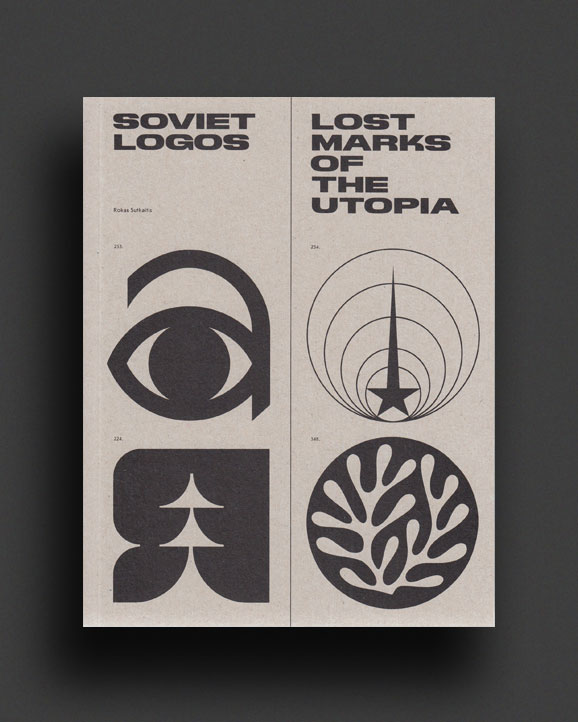
The immediately out-of-print first and only edition of Soviet Logos.
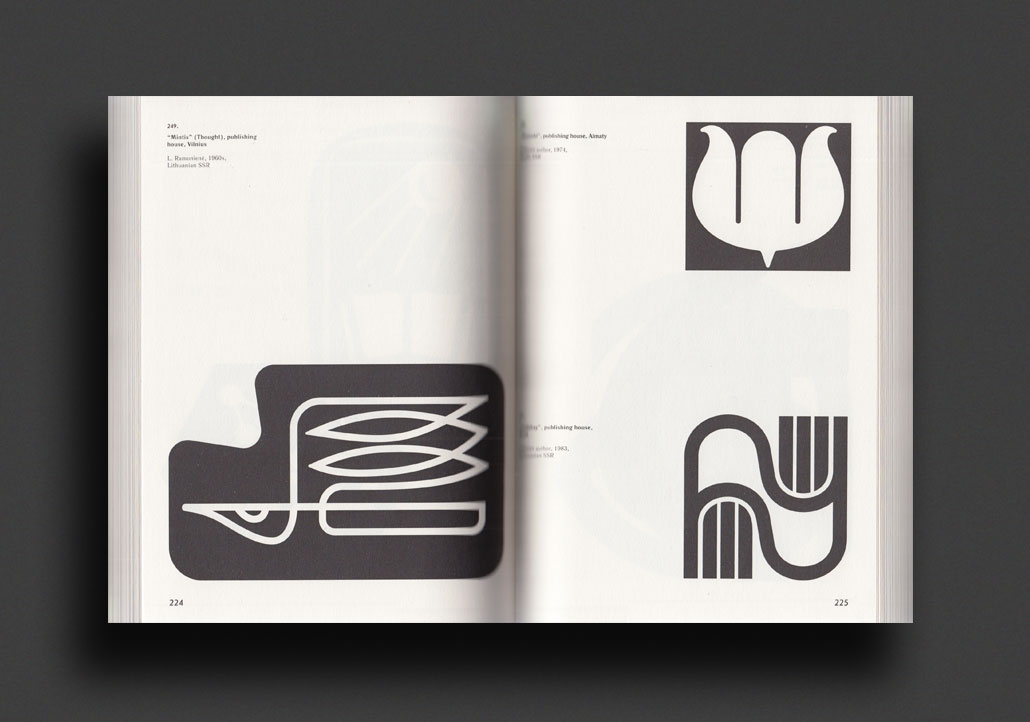
Even if thousands of logos were created in the USSR only a very small part of them managed to survive until our days. Designed by professionals of various specialties, these fine graphic creations quickly became forgotten because of the turbulent fall of the Soviet Union. This monograph aims to rediscover the unrighteously forgotten logos and to introduce them into the global design context.
The book not only comprises of a collection of more than 360 carefully redrawn marks, but also provides a thorough analysis of the ambiguous functions of Soviet logos. With the help of social, economic and cultural discourse of the times, the functions of Soviet logos are analyzed in order to reveal their utopian nature.
Printed in Lithuania
Text by Rokas Sutkaitis
Designed by Acid
As New copy.
2018, English
Hardcover (die-cut linen-bound), 64 pages, 22.9 x 29.9 cm
Ed. of 500,
1st Edition, Out of print title / as new
Published by
Small Press / New York
$115.00 - In stock -
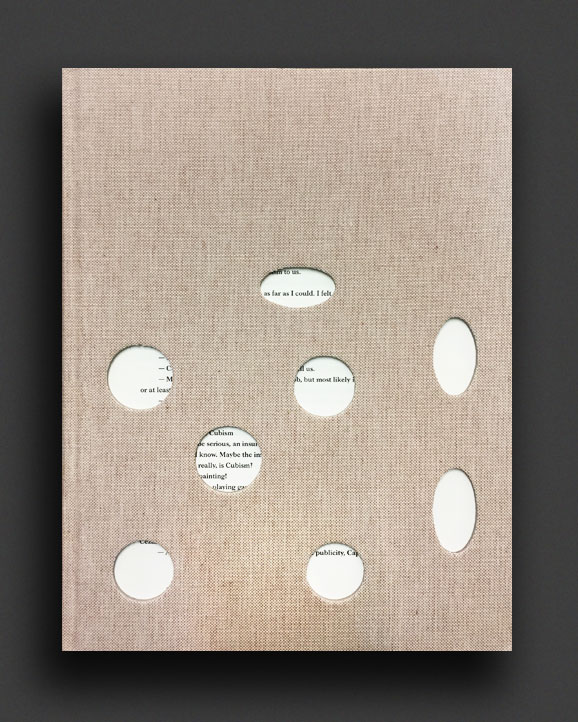
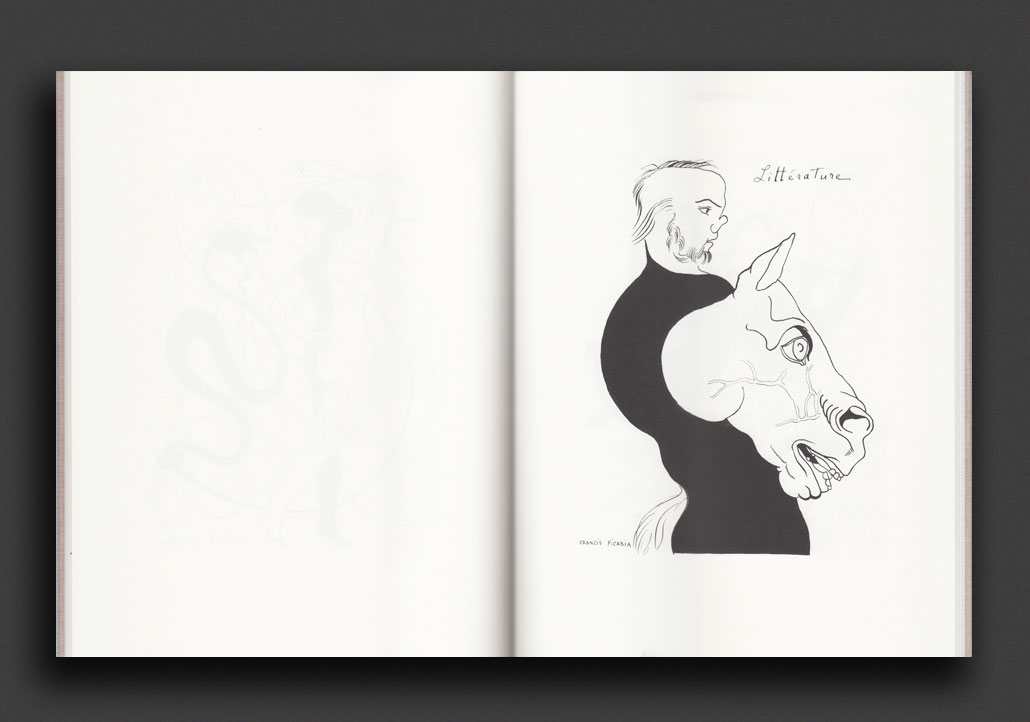
Limited to 500 copies, and now out-of-print, Litterature pairs excerpts from Francis Picabia’s (1879–1953) novel Caravanserail with nine drawings and seventeen studies he created for the cover of André Breton’s Litterature journal between 1922 and 1924. This beautifully produced linen-bound book—whose front cover features circular die-cuts derived from one of Picabia’s dice drawings—offers a celebration of subversive play and fluid forms.
Originally produced as potential covers for André Breton's 1920s Surrealist literary journal, Littérature, the twenty-six subversive—at the time, even scandalous—Francis Picabia drawings that are collected in this remarkable new limited edition from Small Press Books had been sealed in an envelope (dated August 8, 1923) and forgotten for decades until Breton's daughter, Aube Breton-Elléouët, unearthed and exhibited them in 2008. Of the original group, only nine of these playfully insurgent works were actually published by Breton. According to a 1922 letter from fellow Dadaist Marcel Duchamp to Breton, American retailers considered Picabia's cover graphics far too salacious to be displayed on their newsstands. Thus Duchamp was forced to become the journal's only American micro-distributor, circulating it among likeminded friends until its demise in 1924.
Edited by Stephanie LaCava. Translated by Lauren Elkin. Design by Eric Wrenn Office.